EP3027795B1 - Monobrin en cvr (composite verre-résine) amélioré - Google Patents
Monobrin en cvr (composite verre-résine) amélioré Download PDFInfo
- Publication number
- EP3027795B1 EP3027795B1 EP14739105.6A EP14739105A EP3027795B1 EP 3027795 B1 EP3027795 B1 EP 3027795B1 EP 14739105 A EP14739105 A EP 14739105A EP 3027795 B1 EP3027795 B1 EP 3027795B1
- Authority
- EP
- European Patent Office
- Prior art keywords
- monofilament
- resin
- gpa
- glass
- measured
- Prior art date
- Legal status (The legal status is an assumption and is not a legal conclusion. Google has not performed a legal analysis and makes no representation as to the accuracy of the status listed.)
- Active
Links
- PTVLFEIDVRARIU-UHFFFAOYSA-N CCc1cccc(C)c1OCC(COC(C(C)=C)=O)O Chemical compound CCc1cccc(C)c1OCC(COC(C(C)=C)=O)O PTVLFEIDVRARIU-UHFFFAOYSA-N 0.000 description 1
Images


Classifications
-
- B—PERFORMING OPERATIONS; TRANSPORTING
- B60—VEHICLES IN GENERAL
- B60C—VEHICLE TYRES; TYRE INFLATION; TYRE CHANGING; CONNECTING VALVES TO INFLATABLE ELASTIC BODIES IN GENERAL; DEVICES OR ARRANGEMENTS RELATED TO TYRES
- B60C9/00—Reinforcements or ply arrangement of pneumatic tyres
- B60C9/005—Reinforcements made of different materials, e.g. hybrid or composite cords
-
- D—TEXTILES; PAPER
- D02—YARNS; MECHANICAL FINISHING OF YARNS OR ROPES; WARPING OR BEAMING
- D02G—CRIMPING OR CURLING FIBRES, FILAMENTS, THREADS, OR YARNS; YARNS OR THREADS
- D02G3/00—Yarns or threads, e.g. fancy yarns; Processes or apparatus for the production thereof, not otherwise provided for
- D02G3/02—Yarns or threads characterised by the material or by the materials from which they are made
- D02G3/16—Yarns or threads made from mineral substances
- D02G3/18—Yarns or threads made from mineral substances from glass or the like
-
- B—PERFORMING OPERATIONS; TRANSPORTING
- B60—VEHICLES IN GENERAL
- B60C—VEHICLE TYRES; TYRE INFLATION; TYRE CHANGING; CONNECTING VALVES TO INFLATABLE ELASTIC BODIES IN GENERAL; DEVICES OR ARRANGEMENTS RELATED TO TYRES
- B60C15/00—Tyre beads, e.g. ply turn-up or overlap
- B60C15/04—Bead cores
-
- B—PERFORMING OPERATIONS; TRANSPORTING
- B60—VEHICLES IN GENERAL
- B60C—VEHICLE TYRES; TYRE INFLATION; TYRE CHANGING; CONNECTING VALVES TO INFLATABLE ELASTIC BODIES IN GENERAL; DEVICES OR ARRANGEMENTS RELATED TO TYRES
- B60C7/00—Non-inflatable or solid tyres
-
- B—PERFORMING OPERATIONS; TRANSPORTING
- B60—VEHICLES IN GENERAL
- B60C—VEHICLE TYRES; TYRE INFLATION; TYRE CHANGING; CONNECTING VALVES TO INFLATABLE ELASTIC BODIES IN GENERAL; DEVICES OR ARRANGEMENTS RELATED TO TYRES
- B60C7/00—Non-inflatable or solid tyres
- B60C7/24—Non-inflatable or solid tyres characterised by means for securing tyres on rim or wheel body
-
- B—PERFORMING OPERATIONS; TRANSPORTING
- B60—VEHICLES IN GENERAL
- B60C—VEHICLE TYRES; TYRE INFLATION; TYRE CHANGING; CONNECTING VALVES TO INFLATABLE ELASTIC BODIES IN GENERAL; DEVICES OR ARRANGEMENTS RELATED TO TYRES
- B60C9/00—Reinforcements or ply arrangement of pneumatic tyres
- B60C9/0028—Reinforcements comprising mineral fibres, e.g. glass or carbon fibres
-
- B—PERFORMING OPERATIONS; TRANSPORTING
- B60—VEHICLES IN GENERAL
- B60C—VEHICLE TYRES; TYRE INFLATION; TYRE CHANGING; CONNECTING VALVES TO INFLATABLE ELASTIC BODIES IN GENERAL; DEVICES OR ARRANGEMENTS RELATED TO TYRES
- B60C9/00—Reinforcements or ply arrangement of pneumatic tyres
- B60C9/0042—Reinforcements made of synthetic materials
-
- B—PERFORMING OPERATIONS; TRANSPORTING
- B60—VEHICLES IN GENERAL
- B60C—VEHICLE TYRES; TYRE INFLATION; TYRE CHANGING; CONNECTING VALVES TO INFLATABLE ELASTIC BODIES IN GENERAL; DEVICES OR ARRANGEMENTS RELATED TO TYRES
- B60C9/00—Reinforcements or ply arrangement of pneumatic tyres
- B60C9/02—Carcasses
-
- B—PERFORMING OPERATIONS; TRANSPORTING
- B60—VEHICLES IN GENERAL
- B60C—VEHICLE TYRES; TYRE INFLATION; TYRE CHANGING; CONNECTING VALVES TO INFLATABLE ELASTIC BODIES IN GENERAL; DEVICES OR ARRANGEMENTS RELATED TO TYRES
- B60C9/00—Reinforcements or ply arrangement of pneumatic tyres
- B60C9/18—Structure or arrangement of belts or breakers, crown-reinforcing or cushioning layers
- B60C9/20—Structure or arrangement of belts or breakers, crown-reinforcing or cushioning layers built-up from rubberised plies each having all cords arranged substantially parallel
- B60C9/2003—Structure or arrangement of belts or breakers, crown-reinforcing or cushioning layers built-up from rubberised plies each having all cords arranged substantially parallel characterised by the materials of the belt cords
-
- C—CHEMISTRY; METALLURGY
- C08—ORGANIC MACROMOLECULAR COMPOUNDS; THEIR PREPARATION OR CHEMICAL WORKING-UP; COMPOSITIONS BASED THEREON
- C08J—WORKING-UP; GENERAL PROCESSES OF COMPOUNDING; AFTER-TREATMENT NOT COVERED BY SUBCLASSES C08B, C08C, C08F, C08G or C08H
- C08J5/00—Manufacture of articles or shaped materials containing macromolecular substances
- C08J5/04—Reinforcing macromolecular compounds with loose or coherent fibrous material
- C08J5/0405—Reinforcing macromolecular compounds with loose or coherent fibrous material with inorganic fibres
- C08J5/043—Reinforcing macromolecular compounds with loose or coherent fibrous material with inorganic fibres with glass fibres
-
- D—TEXTILES; PAPER
- D02—YARNS; MECHANICAL FINISHING OF YARNS OR ROPES; WARPING OR BEAMING
- D02G—CRIMPING OR CURLING FIBRES, FILAMENTS, THREADS, OR YARNS; YARNS OR THREADS
- D02G3/00—Yarns or threads, e.g. fancy yarns; Processes or apparatus for the production thereof, not otherwise provided for
- D02G3/22—Yarns or threads characterised by constructional features, e.g. blending, filament/fibre
- D02G3/40—Yarns in which fibres are united by adhesives; Impregnated yarns or threads
- D02G3/404—Yarns or threads coated with polymeric solutions
-
- B—PERFORMING OPERATIONS; TRANSPORTING
- B29—WORKING OF PLASTICS; WORKING OF SUBSTANCES IN A PLASTIC STATE IN GENERAL
- B29D—PRODUCING PARTICULAR ARTICLES FROM PLASTICS OR FROM SUBSTANCES IN A PLASTIC STATE
- B29D30/00—Producing pneumatic or solid tyres or parts thereof
- B29D30/06—Pneumatic tyres or parts thereof (e.g. produced by casting, moulding, compression moulding, injection moulding, centrifugal casting)
- B29D30/38—Textile inserts, e.g. cord or canvas layers, for tyres; Treatment of inserts prior to building the tyre
- B29D2030/383—Chemical treatment of the reinforcing elements, e.g. cords, wires and filamentary materials, to increase the adhesion to the rubber
-
- B—PERFORMING OPERATIONS; TRANSPORTING
- B60—VEHICLES IN GENERAL
- B60C—VEHICLE TYRES; TYRE INFLATION; TYRE CHANGING; CONNECTING VALVES TO INFLATABLE ELASTIC BODIES IN GENERAL; DEVICES OR ARRANGEMENTS RELATED TO TYRES
- B60C9/00—Reinforcements or ply arrangement of pneumatic tyres
- B60C2009/0071—Reinforcements or ply arrangement of pneumatic tyres characterised by special physical properties of the reinforcements
-
- B—PERFORMING OPERATIONS; TRANSPORTING
- B60—VEHICLES IN GENERAL
- B60C—VEHICLE TYRES; TYRE INFLATION; TYRE CHANGING; CONNECTING VALVES TO INFLATABLE ELASTIC BODIES IN GENERAL; DEVICES OR ARRANGEMENTS RELATED TO TYRES
- B60C9/00—Reinforcements or ply arrangement of pneumatic tyres
- B60C2009/0071—Reinforcements or ply arrangement of pneumatic tyres characterised by special physical properties of the reinforcements
- B60C2009/0078—Modulus
-
- B—PERFORMING OPERATIONS; TRANSPORTING
- B60—VEHICLES IN GENERAL
- B60C—VEHICLE TYRES; TYRE INFLATION; TYRE CHANGING; CONNECTING VALVES TO INFLATABLE ELASTIC BODIES IN GENERAL; DEVICES OR ARRANGEMENTS RELATED TO TYRES
- B60C9/00—Reinforcements or ply arrangement of pneumatic tyres
- B60C9/18—Structure or arrangement of belts or breakers, crown-reinforcing or cushioning layers
- B60C9/20—Structure or arrangement of belts or breakers, crown-reinforcing or cushioning layers built-up from rubberised plies each having all cords arranged substantially parallel
- B60C2009/2074—Physical properties or dimension of the belt cord
-
- B—PERFORMING OPERATIONS; TRANSPORTING
- B60—VEHICLES IN GENERAL
- B60C—VEHICLE TYRES; TYRE INFLATION; TYRE CHANGING; CONNECTING VALVES TO INFLATABLE ELASTIC BODIES IN GENERAL; DEVICES OR ARRANGEMENTS RELATED TO TYRES
- B60C9/00—Reinforcements or ply arrangement of pneumatic tyres
- B60C9/18—Structure or arrangement of belts or breakers, crown-reinforcing or cushioning layers
- B60C9/20—Structure or arrangement of belts or breakers, crown-reinforcing or cushioning layers built-up from rubberised plies each having all cords arranged substantially parallel
- B60C2009/2074—Physical properties or dimension of the belt cord
- B60C2009/2077—Diameters of the cords; Linear density thereof
-
- B—PERFORMING OPERATIONS; TRANSPORTING
- B60—VEHICLES IN GENERAL
- B60C—VEHICLE TYRES; TYRE INFLATION; TYRE CHANGING; CONNECTING VALVES TO INFLATABLE ELASTIC BODIES IN GENERAL; DEVICES OR ARRANGEMENTS RELATED TO TYRES
- B60C9/00—Reinforcements or ply arrangement of pneumatic tyres
- B60C9/18—Structure or arrangement of belts or breakers, crown-reinforcing or cushioning layers
- B60C9/20—Structure or arrangement of belts or breakers, crown-reinforcing or cushioning layers built-up from rubberised plies each having all cords arranged substantially parallel
- B60C2009/2074—Physical properties or dimension of the belt cord
- B60C2009/208—Modulus of the cords
-
- B—PERFORMING OPERATIONS; TRANSPORTING
- B60—VEHICLES IN GENERAL
- B60C—VEHICLE TYRES; TYRE INFLATION; TYRE CHANGING; CONNECTING VALVES TO INFLATABLE ELASTIC BODIES IN GENERAL; DEVICES OR ARRANGEMENTS RELATED TO TYRES
- B60C9/00—Reinforcements or ply arrangement of pneumatic tyres
- B60C9/18—Structure or arrangement of belts or breakers, crown-reinforcing or cushioning layers
- B60C9/20—Structure or arrangement of belts or breakers, crown-reinforcing or cushioning layers built-up from rubberised plies each having all cords arranged substantially parallel
- B60C2009/2074—Physical properties or dimension of the belt cord
- B60C2009/2093—Elongation of the reinforcements at break point
-
- B—PERFORMING OPERATIONS; TRANSPORTING
- B60—VEHICLES IN GENERAL
- B60C—VEHICLE TYRES; TYRE INFLATION; TYRE CHANGING; CONNECTING VALVES TO INFLATABLE ELASTIC BODIES IN GENERAL; DEVICES OR ARRANGEMENTS RELATED TO TYRES
- B60C15/00—Tyre beads, e.g. ply turn-up or overlap
- B60C15/04—Bead cores
- B60C2015/042—Bead cores characterised by the material of the core, e.g. alloy
-
- C—CHEMISTRY; METALLURGY
- C08—ORGANIC MACROMOLECULAR COMPOUNDS; THEIR PREPARATION OR CHEMICAL WORKING-UP; COMPOSITIONS BASED THEREON
- C08J—WORKING-UP; GENERAL PROCESSES OF COMPOUNDING; AFTER-TREATMENT NOT COVERED BY SUBCLASSES C08B, C08C, C08F, C08G or C08H
- C08J2331/00—Characterised by the use of copolymers of compounds having one or more unsaturated aliphatic radicals, each having only one carbon-to-carbon double bond, and at least one being terminated by an acyloxy radical of a saturated carboxylic acid, or carbonic acid, or of a haloformic acid
- C08J2331/02—Characterised by the use of omopolymers or copolymers of esters of monocarboxylic acids
-
- D—TEXTILES; PAPER
- D10—INDEXING SCHEME ASSOCIATED WITH SUBLASSES OF SECTION D, RELATING TO TEXTILES
- D10B—INDEXING SCHEME ASSOCIATED WITH SUBLASSES OF SECTION D, RELATING TO TEXTILES
- D10B2505/00—Industrial
- D10B2505/02—Reinforcing materials; Prepregs
-
- D—TEXTILES; PAPER
- D10—INDEXING SCHEME ASSOCIATED WITH SUBLASSES OF SECTION D, RELATING TO TEXTILES
- D10B—INDEXING SCHEME ASSOCIATED WITH SUBLASSES OF SECTION D, RELATING TO TEXTILES
- D10B2505/00—Industrial
- D10B2505/02—Reinforcing materials; Prepregs
- D10B2505/022—Reinforcing materials; Prepregs for tyres
Definitions
- the field of the present invention is that of composite reinforcements used in particular for the reinforcement of semi-finished products or of finished articles made of rubber such as tires for vehicles, of the pneumatic or non-pneumatic type.
- this request EP 1 167 080 has shown that it was advantageously possible to substitute such CVR monobrins for steel cables, as new elements for reinforcing tire belts, thereby significantly reducing the tire structure.
- the invention also relates to the use of such a CVR monofilament reinforcement (that is to say, reinforcing element) of semi-finished products or of finished articles of rubber such as tires, pneumatic or otherwise tires.
- the invention also relates to these semi-finished products, rubber articles and bandages themselves, both in the raw state (that is to say before cooking or vulcanization) and in the cooked state (after cooking) .
- the bandages of the invention may be intended for motor vehicles of the tourism type, 4x4, "SUV” ( Sport Utility Vehicles ), but also to industrial vehicles chosen from light trucks, "heavy vehicles” - ie , metro, bus, road transport equipment (trucks, tractors, trailers), off-the-road vehicles -, agricultural or civil engineering machinery, airplanes, other commercial vehicles for transport or handling.
- the CVR monofilament of the invention is particularly useful as a reinforcing element in crown reinforcement (or belts) or in carcass reinforcement of pneumatic tires, as described in particular in the documents EP 1 167 080 (or US 7,032,637 ) and WO 2012/115615 .
- the CVR monofilament of the invention is also advantageously usable, because of its low density and its improved compression properties, as reinforcing element in tires or flexible wheels of the non-pneumatic type, that is to say supported structurally (without internal pressure).
- Such bandages are well known to those skilled in the art (see for example EP 1 242 254 or US 6,769,465 , EP 1 359 028 or US 6,994,135 , US 7,201,194 , WO 00/37269 or US 6,640,859 , WO 2007/085414 , WO 2008/080535 , WO 2009/033620 , WO 2009/135561 , WO 2012/032000 ); when they are associated with any rigid mechanical element intended to ensure the connection between the flexible tire and the hub of a wheel, they replace the assembly constituted by by the tire, rim and disc as they are known on most road vehicles today.
- the CVR monofilament of the invention is particularly useful as a substantially inextensible reinforcing element of the membranes used in the annular band (or shear band) of a non-pneumatic tire as described for example in the patent US 7,201,194 , such a tire having the characteristic of comprising an annular band which supports the load on the tire and a plurality of support elements or spokes, with very low compression stiffness, which work in tension to transmit the forces between the annular band and the hub of the wheel.
- any range of values designated by the expression "between a and b" represents the range of values from more than a to less than b (i.e., terminals a and b excluded) while any range of values designated by the expression “from a to b” means the range from a to b (i.e., including the strict limits a and b).
- the glass filaments are present in the form of a single multifilament fiber or of several multifilament fibers (if they are several, they are preferably essentially unidirectional), each of which may comprise several tens, hundreds or even thousands of unit glass filaments.
- These very fine unitary filaments generally and preferably have an average diameter of the order of 5 to 30 ⁇ m, more preferably 10 to 20 ⁇ m.
- resin is meant here the resin as such and any composition based on this resin and comprising at least one additive (that is to say one or more additives).
- cross-linked resin it is of course understood that the resin is hardened (photocured and / or thermoset), in other words in the form of a network of three-dimensional bonds, in a state specific to so-called thermosetting polymers (as opposed to to so-called thermoplastic polymers).
- the glass transition temperature denoted Tg of the resin is preferably greater than 190 ° C., more preferably greater than 195 ° C., in particular greater than 200 ° C. It is measured in a known manner by differential scanning calorimetry (DSC), in the second pass, for example, and unless otherwise specified in the present application, according to the ASTM D3418 standard of 1999 (Mettler Toledo DSC apparatus "822-2"; Nitrogen: samples previously brought from room temperature (23 ° C) to 250 ° C (10 ° C / min), then rapidly cooled to 23 ° C, before final recording of the DSC curve from 23 ° C to 250 ° C ° C, with a ramp of 10 ° C / min).
- DSC differential scanning calorimetry
- the elongation at break noted Ar of the monobrin in CVR is preferably greater than 4.0%, more preferably greater than 4.2%, in particular greater than 4.4%.
- Its initial modulus in extension E 23 measured at 23 ° C, is preferably greater than 36 GPa; more preferably still, it is greater than 40 GPa, preferably greater than 42 GPa.
- the mechanical properties in extension of the CVR monofilament are measured in a known manner using an "INSTRON" traction machine of the type 4466 (BLUEHILL-2 software supplied with the machine tensile strength), according to ASTM D 638, on CVR single-stranded blanks, that is to say unglued, or glued (that is to say ready to use), or extracted semi-finished product or rubber article they reinforce.
- these single strands are subjected to a preliminary conditioning (storage of monobrins for at least 24 hours in a standard atmosphere according to the European standard DIN EN 20139 (temperature of 23 ⁇ 2 ° C, hygrometry of 50 ⁇ 5%).
- the tested samples are pulled over an initial length of 400 mm at a nominal speed of 100 m / min, under a standard pretension of 0.5 cN / tex. All results given are an average of 10 measurements.
- the module E ' 190 is preferably greater than 33 GPa, more preferably greater than 36 GPa.
- the ratio E ' (Tg' - 25) / E '23 is greater than 0.85, preferably greater than at 0.90, E '23 and E' (Tg '- 25) being the real part of the complex module of the monobrin measured by DMTA, respectively at 23 ° C and at a temperature expressed in ° C equal to (Tg' - 25 ), in which expression Tg ' represents the glass transition temperature measured this time by DMTA.
- the ratio E ' (Tg' - 10) / E '23 is greater than 0.80, preferably greater than 0.85, E' (Tg '- 10) being the real part of the monobrin complex module measured by DMTA at a temperature expressed in ° C equal to (Tg '- 10).
- the three-point bending test does not allow in known manner to enter the initial geometric data for a single-strand circular section, we can only introduce the geometry of a rectangular section (or square).
- the software therefore conventionally introduces a square section of side " a " having the same moment of surface inertia, so as to work with stiffness R of test pieces tested.
- the same method of calculation will apply by determining beforehand the moment of inertia of surface I s on a straight cut of the tested sample.
- the test specimen generally of circular section and of diameter D, has a length of 35 mm. It is arranged horizontally on two supports 24 mm apart. A repeated bending stress is applied perpendicularly to the center of the test piece, halfway between the two supports, in the form of a vertical displacement of amplitude equal to 0.1 mm (deformation therefore asymmetrical, the inside of the specimen being stressed only in compression and not in extension), at a frequency of 10 Hz.
- the elastic deformation under flexural compression is greater than 3.0%, more preferably greater than 3.5%, in particular greater than 4.0%.
- the compression stress under flexural compression is greater than 1000 MPa, more preferably greater than 1200 MPa, in particular greater than 1400 MPa.
- Bending of a rectangular bar can also be performed by the so-called three-point method (ASTM D 790). This method also makes it possible to verify, visually, that the nature of the rupture is indeed in extension.
- the breaking stress in pure compression is greater than 700 MPa, more preferably greater than 900 MPa, in particular greater than 1100 MPa.
- this quantity is measured according to the method described in the publication "Critical compressive stress for continuous fiber unidirectional composites" by Thompson et al, Journal of Composite Materials, 46 (26), 3231-3245 .
- the alignment ratio of the glass filaments is such that more than 85% (% by number) of the filaments have an inclination with respect to the axis of the single strand which is less than 2.0 degrees, more preferably less than 1.5 degrees, this inclination (or misalignment) being measured as described in the above publication by Thompson et al.
- the weight ratio of glass filaments in the CVR monobrin is between 60 and 80%, preferably between 65 and 75%.
- This weight ratio is calculated by comparing the title of the initial fiberglass with the title of the single strand in final CVR.
- the titre (or linear density) is determined on at least three samples, each corresponding to a length of 50 m, by weighing this length; the title is given in tex (weight in grams of 1000 m of product - as a reminder, 0, 111 tex equals 1 denier).
- the density (or density in g / cm 3 ) of the CVR monobrin is between 1.8 and 2.1. It is measured (at 23 ° C) using a specialized scale of the Mettler Toledo company of the "PG503 DeltaRange"type; the samples, a few cm, are successively weighed in the air and immersed in ethanol; the device software then determines the average density over three measurements.
- the diameter D of the CVR monofilament of the invention is preferably between 0.2 and 1.5 mm, more preferably between 0.3 and 1.2 mm, in particular between 0.4 and 1.1 mm.
- D is conventionally the so-called clutter diameter, that is to say the diameter of the cylinder of imaginary revolution enveloping the single-strand, in other words the diameter of the circumscribed circle surrounding its cross section.
- the resin used is, by definition, a crosslinkable resin (ie, hardenable resin) capable of being crosslinked, cured by any known method, in particular by UV (or UV-visible) radiation, preferably emitting in a spectrum of at least 300 nm at 450 nm.
- a crosslinkable resin ie, hardenable resin
- a polyester or vinyl ester resin As a crosslinkable resin, a polyester or vinyl ester resin, more preferably a vinylester resin, is preferably used.
- polymers By “polyester” resin is meant in known manner an unsaturated polyester resin. Vinylester resins are well known in the field of composite materials.
- the vinylester resin is preferably of the epoxyvinylester type. It is more preferable to use a vinylester resin, in particular of the epoxide type, which is at least partly based (that is to say grafted on a structure of the type) novolac (also called phenoplast) and / or bisphenol, or preferably a vinylester resin containing novolac, bisphenolic, or novolak and bisphenol.
- a vinylester resin in particular of the epoxide type, which is at least partly based (that is to say grafted on a structure of the type) novolac (also called phenoplast) and / or bisphenol, or preferably a vinylester resin containing novolac, bisphenolic, or novolak and bisphenol.
- the initial modulus in extension of the resin measured at 23 ° C., is greater than 3.0 GPa, more preferably greater than 3.5 GPa.
- a novolac-based epoxyvinylester resin (part in square brackets in formula I below), for example, satisfies, in known manner, the following formula (I):
- a bisphenol A epoxyvinylester resin (part in brackets of formula (II) below) for example meets the formula (the "A” recalling that the product is manufactured using acetone):
- An epoxyvinylester resin of novolac and bisphenolic type has shown excellent results.
- Epoxyvinylester resins are available from other manufacturers such as for example AOC (USA - "VIPEL" resins).
- the glass filaments After passing through the vacuum chamber, the glass filaments enter an impregnation chamber which is totally filled with impregnating resin, thus free of air: it is in this sense that this step can be described as impregnation of "vacuum impregnation".
- the resin preferably comprises a sensitive photo-initiator (reagent) with UV radiation above 300 nm, preferably between 300 and 450 nm.
- This photoinitiator is used at a preferential rate of 0.5 to 3%, more preferably 1 to 2.5%. It may also comprise a crosslinking agent, for example at a level of between 5% and 15% (% by weight of impregnating composition).
- this photoinitiator is of the family of phosphine compounds, more preferably a bis (acyl) phosphine oxide, for example bis (2,4,6-trimethylbenzoyl) -phenylphosphine oxide ("Irgacure 819").
- a bis (acyl) phosphine oxide for example bis (2,4,6-trimethylbenzoyl) -phenylphosphine oxide ("Irgacure 819").
- phosphine compounds that can be used in a mixture with other photoinitiators, for example photoinitiators alpha-hydroxy ketone type such as for example dimethylhydroxyacetophenone (eg "Lamberti KL200 Esacure") or 1-hydroxycyclohexylphenylketone (eg "Lamberti KS300”), benzophenones such as 2,4,6-trimethylbenzophenone (eg "Lamberti TZT Esacure”) and / or thioxanthone derivatives such as for example isopropylthioxanthone (eg "Lamberti's Esacure ITX").
- photoinitiators alpha-hydroxy ketone type such as for example dimethylhydroxyacetophenone (eg "Lamberti KL200 Esacure") or 1-hydroxycyclohexylphenylketone (eg "Lamberti KS300”)
- benzophenones such as 2,4,6-trimethylbenz
- the so-called “calibration" die makes it possible, by means of a cross-section of determined dimensions, generally and preferably circular or rectangular, to adjust the proportion of resin with respect to the glass fibers while imposing on the impregnated form and 'thickness targeted for the single-core.
- the polymerization or UV irradiation chamber then has the function of polymerizing, crosslinking the resin under the action of UV. It comprises one or preferably several UV irradiators, constituted for example each by a UV lamp having a wavelength of 200 to 600 nm.
- the final CVR monofilament thus formed through the UV irradiation chamber, in which the resin is now in the solid state, is then harvested, for example, on a receiving coil on which it can be wound over a very great length.
- the tensions experienced by the glass fibers at a moderate level, preferably between 0.2 and 2.0 cN / tex, more preferably between 0.3 and 1.5 cN / tex; to control this, one can for example measure these voltages directly at the output of the irradiation chamber, using appropriate tensiometers well known to those skilled in the art.
- V ir a high irradiation rate (greater than 50 m / min, preferably between 50 and 150 m / min) was favorable on the one hand for an excellent level of alignment of the filaments of glass inside the CVR monofilament, on the other hand to a better maintenance of the vacuum in the vacuum chamber with a clearly reduced risk of seeing a certain impregnating resin fraction of the impregnation chamber return to the chamber empty, and therefore to a better quality of impregnation.
- the diameter of the irradiation tube (preferably made of glass) is preferably between 10 and 80 mm, more preferably between 20 and 60 mm.
- the speed V ir is between 50 and 150 m / min, more preferably in a range of 60 to 120 m / min.
- the irradiation time D ir is between 1.5 and 10 s, more preferably in a range of 2 to 5 s.
- the irradiation chamber comprises a plurality of irradiators (or radiators) UV, that is to say at least two (two or more) which are arranged in line around the tube irradiation.
- Each UV irradiator typically comprises one (at least one) UV lamp (emitting preferably in a spectrum of 200 to 600 nm) and a parabolic reflector at the focus of which is the center of the irradiation tube; it delivers a linear power preferably between 2,000 and 14,000 watts per meter.
- the irradiation chamber comprises at least three, in particular at least four in-line UV irradiators.
- the linear power delivered by each UV irradiator is between 2,500 and 12,000 watts per meter, in particular in a range of 3,000 to 10,000 watts per meter.
- UV radiators suitable for the process of the invention are well known to those skilled in the art, for example those marketed by the company Dr. Hönle AG (Germany) under the reference “1055 LCP AM UK", equipped with lamps “UVAPRINT” (high pressure mercury lamps doped with iron).
- the nominal power (maximum) of each radiator of this type is equal to about 13,000 Watts, the power actually delivered being adjustable with a potentiometer between 30 and 100% of the nominal power.
- the temperature of the resin (resin composition) in the impregnation chamber is between 50 ° C and 95 ° C, more preferably between 60 ° C and 90 ° C.
- the irradiation conditions are adjusted in such a way that the temperature of the CVR monobrin at the outlet of the impregnation chamber is greater than the Tg of the crosslinked resin; more preferably, this temperature is greater than the Tg of the crosslinked resin and less than 270 ° C.
- the figure 1 annexed schematizes very simply an example of a device 10 for the production of single strand CVR according to the invention.
- the coil 11a containing, in the example shown, glass fibers 11b (in the form of multifilaments).
- the coil is unwound continuously by driving, so as to achieve a rectilinear arrangement 12 of these fibers 11b.
- This arrangement 12 then passes through a vacuum chamber 13 (connected to a vacuum pump not shown), disposed between an inlet pipe 13a and an outlet pipe 13b opening onto an impregnation chamber 14, the two pipes preferably to rigid wall having for example a minimum upper section (typically twice as much) to the total fiber section and a much greater length (typically 50 times more) to said minimum section.
- the use of rigid wall tubing both for the inlet port in the vacuum chamber and for the outlet of the vacuum chamber and the transfer from the vacuum chamber to the chamber impregnation, is compatible with both high rates of passage of fibers through the orifices without breaking the fibers, but also ensures a sufficient seal. It suffices, if necessary experimentally, to search for the largest section of passage, taking into account the total section of the fibers to be treated, again making it possible to provide sufficient sealing, taking into account the speed of advance of the fibers and the length tubing.
- the vacuum inside the chamber 13 is for example of the order of 0.1 bar, the length of the vacuum chamber is about 1 meter.
- impregnation chamber 14 comprising a supply tank 15 (connected to a metering pump, not shown) and a storage tank.
- impregnation 16 completely filled with impregnation composition 17 based on a curable resin vinylester type (eg, "E-Nova FW 2045" from DSM).
- the composition 17 further comprises (at a weight ratio of 1 to 2%) a photoinitiator suitable for the UV and / or UV-visible radiation by which the composition will subsequently be treated, for example bis- (2,4,6-trimethylbenzoyl) -phenylphosphine oxide ("Irgacure 819" from BASF).
- a crosslinking agent such as, for example, tris (2-hydroxyethyl) isocyanurate triacrylate ("SR 368" from Sartomer).
- SR 368 tris (2-hydroxyethyl) isocyanurate triacrylate
- the length of the impregnation chamber is several meters, for example between 2 and 10 m, in particular between 3 and 5 m.
- an impregnated material which comprises for example (% by weight) from 65 to 75% of solid fibers 11b, the remainder (25%) 35%) being constituted by the liquid impregnation matrix 17.
- the impregnated material then passes through calibration means 19 comprising at least one calibration die 20 whose channel (not shown here), for example of circular, rectangular or conical shape, is adapted to the particular conditions of production.
- this channel has a minimum cross section of circular shape whose downstream orifice has a diameter slightly greater than that of the targeted single-core.
- the die has a length that is typically greater than at least 100 times the minimum dimension of the minimum section. Its function is to ensure a high dimensional accuracy to the finished product, it can also play a role of dosing the fiber ratio with respect to the resin.
- the die 20 can be directly integrated into the impregnation chamber 14, which avoids, for example, the use of the outlet pipe 18.
- the length of the calibration zone is several centimeters, for example between 5 and 50 cm, in particular between 5 and 20 cm.
- the liquid composite monobrin 21 thus obtained is then polymerized by passing through a UV irradiation chamber (22) comprising a sealed glass tube (23) through which the monobrush circulates. composite; said tube, the diameter of which is typically a few cm (for example 2 to 3 cm), is irradiated with a plurality (here, for example 4) of UV irradiators (24) in line ("UVAprint” lamps of the Dr company Hönle, wavelength 200 to 600 nm) arranged at a short distance (a few cm) from the glass tube.
- UVAprint lamps of the Dr company Hönle, wavelength 200 to 600 nm
- the length of the irradiation chamber is several meters, for example between 2 and 15 m, in particular between 3 and 10 m.
- the irradiation tube 23 is traversed by a stream of nitrogen.
- the irradiation conditions are preferably adjusted in such a way that, at the outlet of the impregnation chamber, the temperature of the CVR monofilament, measured at the surface of the latter (for example using a thermocouple), is greater than the Tg of the crosslinked resin (in other words greater than 190 ° C), and more preferably less than 270 ° C.
- the CVR (25) this time in the solid state, driven in the direction of arrow F, then arrives on its final receiving coil (26).
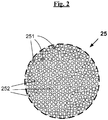
- a finished composite block of manufacture is obtained, as schematized very simply in the figure 2 , in the form of a continuous CVR monofilament (25), of very great length, whose unit glass filaments (251) are homogeneously distributed throughout the volume of hardened resin (252). Its diameter is for example equal to about 1 mm.
- the process of the invention can be carried out at high speed, greater than 50 m / min, preferably between 50 and 150 m / min, more preferably in a range from 60 to 120 m / min.
- the CVR monofilament of the invention thus manufactured is advantageously usable for the reinforcement of tires, pneumatic or non-pneumatic, of all types of vehicles, in particular passenger vehicles or industrial vehicles such as heavy vehicles, civil engineering, aircraft, other transport or handling vehicles.
- the figure 3 shows very schematically (without respecting a specific scale), a radial section of a tire according to the invention for tourism type vehicle.
- This tire 1 has a crown 2 reinforced by a crown reinforcement or belt 6, two sidewalls 3 and two beads 4, each of these beads 4 being reinforced with a rod 5.
- the crown 2 is surmounted by a tread not shown in this schematic figure.
- a carcass reinforcement 7 is wound around the two rods 5 in each bead 4, the upturn 8 of this armature 7 being for example disposed towards the outside of the tire 1 which is shown here mounted on its rim 9.
- the carcass reinforcement 7 is in a manner known per se consisting of at least one rubber ply reinforced by textile reinforcements called "radial”, that is to say that these reinforcements are arranged substantially parallel to each other and extend from one bead to the other so as to form an angle of between 80 ° and 90 ° with the median circumferential plane (plane perpendicular to the axis of rotation of the tire which is situated halfway between the two beads 4 and goes through the middle of the crown frame 6).
- the belt 6 is for example constituted, in a manner known per se, by at least two rubber sheets called “working plies” or “triangulation plies”, superimposed and crossed, reinforced with metal cables arranged substantially parallel to each other with respect to others and inclined relative to the median circumferential plane, these working plies may or may not be associated with other plies and / or fabrics of rubber. These working plies have the primary function of giving the tire a high rigidity of drift.
- the belt 6 further comprises in this example a rubber sheet called “hooping sheet” reinforced by so-called “circumferential” reinforcing son, that is to say that these reinforcing son are arranged substantially parallel to each other and extend substantially circumferentially around the tire so as to form an angle preferably within a range of 0 to 10 ° with the medial circumferential plane.
- These circumferential reinforcing son have the primary function, it is recalled, to resist the centrifugation of the top at high speed.
- the tire 1 of the invention has the essential feature that at least its belt (6) and / or its carcass reinforcement (7) comprises a CVR monofilament according to the invention.
- it is the bead area that can be reinforced with such a single strand; it is for example the rods (5) which could consist, in whole or in part, of a CVR monofilament according to the invention.
- the rubber compositions used for single-strand reinforced rubber plies made of CVR are conventional compositions for calendering textile reinforcements, typically based on natural rubber, carbon black or silica, a vulcanization system and conventional additives. . Thanks to the invention, compared to rubber compositions reinforced with steel cables, they are advantageously free of metal salt such as cobalt salt.
- metal salt such as cobalt salt.
- the adhesion between the CVR monofilament of the invention and the rubber layer which coats it is ensured in a known manner, for example by a conventional RFL-type glue (resorcinol-formaldehyde-latex).
- CVR monobrins of the invention have also shown excellent performance as circumferential reinforcements in non-pneumatic type tires as described in the introduction to this specification.
Landscapes
- Engineering & Computer Science (AREA)
- Mechanical Engineering (AREA)
- Chemical & Material Sciences (AREA)
- Textile Engineering (AREA)
- Chemical Kinetics & Catalysis (AREA)
- Manufacturing & Machinery (AREA)
- Materials Engineering (AREA)
- Health & Medical Sciences (AREA)
- Inorganic Chemistry (AREA)
- Medicinal Chemistry (AREA)
- Polymers & Plastics (AREA)
- Organic Chemistry (AREA)
- Reinforced Plastic Materials (AREA)
- Moulding By Coating Moulds (AREA)
- Compositions Of Macromolecular Compounds (AREA)
- Tires In General (AREA)
Description
- Le domaine de la présente invention est celui des renforts composites utilisables notamment pour le renforcement de produits semi-finis ou d'articles finis en caoutchouc tels que des bandages pour véhicules, du type pneumatiques ou non pneumatiques.
- Elle se rapporte plus particulièrement à des monobrins du type en « CVR » (abrégé pour Composite Verre-Résine) à hautes propriétés mécaniques comportant des fibres de verre multifilamentaires continues, unidirectionnelles, noyées dans une résine, utilisables en particulier comme éléments de renforcement (ou « renforts ») de ces bandages.
- Les concepteurs de bandages sont depuis longtemps à la recherche de renforts du type textiles ou composites, à faible densité, pouvant se substituer avantageusement et efficacement aux fils ou câbles métalliques conventionnels, en vue de réduire notamment le poids de ces bandages et aussi de pallier les éventuels problèmes de corrosion.
- Ainsi, la demande de brevet
EP 1 167 080 (ouUS 7 032 637 ) a déjà décrit un monobrin en CVR à hautes propriétés mécaniques, comportant des fibres de verre continues, unidirectionnelles, imprégnées dans une résine réticulée du type vinylester. Ce monobrin en CVR présente, outre une contrainte de rupture en compression élevée, supérieure à sa contrainte de rupture en extension, un allongement à la rupture de l'ordre de 3,0 à 3,5% et un module initial en extension d'au moins 30 GPa ; sa résine thermodurcie présente une Tg (température de transition vitreuse) supérieure à 130°C et un module initial en extension d'au moins 3 GPa. - Grâce aux propriétés ci-dessus, cette demande
EP 1 167 080 a montré qu'il était avantageusement possible de substituer de tels monobrins en CVR à des câbles d'acier, comme nouveaux éléments de renforcement de ceintures de bandages pneumatiques, permettant d'alléger ainsi notablement la structure des pneumatiques. - La demande de brevet
EP 1 174 250 (équivalentsUS 6 926 853 ouUS 7 484 949 ) a quant à elle proposé un procédé de fabrication en continu de tels monobrins en CVR, comportant les étapes essentielles suivantes : - réaliser un arrangement rectiligne de fibres de verre et entraîner cet arrangement dans une direction d'avancement :
- dans une chambre à vide, dégazer l'arrangement de fibres par l'action du vide ;
- en sortie de la chambre à vide, après dégazage, traverser une chambre d'imprégnation sous vide de manière à imprégner ledit arrangement de fibres par la résine à l'état liquide pour obtenir un imprégné contenant les fibres et la résine ;
- faire passer ledit imprégné au travers d'une filière de calibrage ayant une section de surface et de forme prédéfinies, pour lui imposer une forme de monobrin (par exemple un mono filament de section ronde ou un ruban de section rectangulaire) ;
- en aval de la filière, dans une chambre d'irradiation UV, stabiliser, solidifier le monobrin par photopolymérisation de la résine sous l'action des UV ;
- puis enrouler pour stockage le monobrin ainsi obtenu.
- L'expérience montre toutefois que les monobrins en CVR décrits dans les demandes de brevet ci-dessus peuvent être encore améliorés, en particulier pour leur utilisation dans les bandages pour véhicules.
- On a constaté en particulier, de manière inattendue, que ces monobrins en CVR de l'art antérieur, lorsqu'ils étaient utilisés comme renforts de ceintures de certains bandages pneumatiques, pouvaient subir un certain nombre de casses en compression, par un effondrement visible de leur structure, au cours de la fabrication-même de ces bandages, plus précisément au cours de l'étape finale de cuisson en moule de ces bandages qui on le sait est conduite sous haute pression et à une température très élevée, typiquement supérieure à 160°C.
- Il est enfin souhaitable de pouvoir fabriquer ces monobrins à plus haute vitesse, afin de pouvoir en réduire le coût industriel final, et par conséquent celui aussi des produits semi-finis ou des articles finis en caoutchouc les comportant.
- Or, poursuivant leurs recherches, les Demanderesses ont trouvé un monobrin en CVR nouveau à propriétés améliorées de Tg, d'allongement à la rupture et de module, conférant à ce dernier des propriétés en compression, en particulier sous température élevée, qui sont notablement améliorées par rapport à celles des monobrins en CVR de l'art antérieur, et qui permet de pallier le problème précité. Ce monobrin peut être fabriqué à haute vitesse.
- Ainsi, selon un premier objet, la présente invention concerne un monobrin en composite verre-résine (ci-après en abrégé « CVR ») comportant des filaments de verre noyés dans une résine réticulée, caractérisé en ce que :
- la température de transition vitreuse (notée Tg) de la résine est égale ou supérieure à 190°C ;
- l'allongement à la rupture (noté Ar) du monobrin, mesuré à 23°C, est égal ou supérieur à 4,0% ;
- le module initial en extension (noté E23 ) du monobrin, mesuré à 23°C, est supérieur à 35 GPa ; et
- la partie réelle du module complexe (noté E'190 ) du monobrin, mesurée à 190°C par la méthode DTMA, est supérieure à 30 GPa.
- L'invention concerne également l'utilisation d'un tel monobrin en CVR comme renfort (c'est-à-dire, élément de renforcement) de produits semi-finis ou d'articles finis en caoutchouc tels que des bandages, pneumatiques ou non pneumatiques.
- L'invention concerne également ces produits semi-finis, articles en caoutchouc et bandages eux-mêmes, tant à l'état cru (c'est-à-dire avant cuisson ou vulcanisation) qu'à l'état cuit (après cuisson). Les bandages de l'invention, en particulier, peuvent être destinés à des véhicules à moteur du type tourisme, 4x4, "SUV" (Sport Utility Vehicles), mais également à des véhicules industriels choisis parmi camionnettes, "Poids-lourd" - i.e., métro, bus, engins de transport routier (camions, tracteurs, remorques), véhicules hors-la-route -, engins agricoles ou de Génie civil, avions, autres véhicules utilitaires de transport ou de manutention.
- Le monobrin en CVR de l'invention est tout particulièrement utilisable comme élément de renforcement dans des armatures de sommet (ou ceintures) ou dans les armatures de carcasse de bandages pneumatiques, tels que décrits notamment dans les documents
EP 1 167 080 (ouUS 7 032 637 ) etWO 2012/115615 . - Le monobrin en CVR de l'invention est aussi avantageusement utilisable, en raison de sa faible densité et de ses propriétés en compression améliorées, comme élément de renforcement dans les bandages ou roues flexibles du type non pneumatiques, c'est-à-dire supportés structurellement (sans pression interne). De tels bandages sont bien connus de l'homme du métier (voir par exemple
EP 1 242 254 ouUS 6 769 465 ,EP 1 359 028 ouUS 6 994 135 ,US 7 201 194 ,WO 00/37269 US 6 640 859 ,WO 2007/085414 ,WO 2008/080535 ,WO 2009/033620 ,WO 2009/135561 ,WO 2012/032000 ) ; lorsqu'ils sont associés à tout élément mécanique rigide destiné à assurer la liaison entre le bandage flexible et le moyeu d'une roue, ils remplacent l'ensemble constitué par le bandage pneumatique, la jante et le disque tels qu'on les connaît sur la plupart des véhicules routiers actuels. - Le monobrin en CVR de l'invention est particulièrement utilisable comme élément de renforcement essentiellement inextensible des membranes utilisées dans la bande annulaire (ou bande de cisaillement) d'un bandage non pneumatique tel que décrit par exemple dans le brevet
US 7 201 194 , un tel bandage ayant pour caractéristique de comporter une bande annulaire qui supporte la charge sur le bandage et une pluralité d'éléments de support ou rayons, à très faible rigidité de compression, qui travaillent en tension pour transmettre les efforts entre la bande annulaire et le moyeu de la roue. - L'invention ainsi que ses avantages seront aisément compris à la lumière de la description détaillée et des exemples de réalisation qui suivent, ainsi que des
figures 1 à 3 relatives à ces exemples qui schématisent (sans respect d'une échelle spécifique) : - un dispositif utilisable pour la fabrication d'un monobrin en CVR selon l'invention (
Fig. 1 ) ; - en coupe transversale, un monobrin en CVR selon l'invention obtenu à l'aide de ce dispositif (
Fig. 2 ) ; - en coupe radiale, un exemple de bandage pneumatique conforme à l'invention, incorporant un monobrin en CVR selon l'invention (
Fig. 3 ). - Dans la présente demande, sauf indication expresse différente, tous les pourcentages (%) indiqués sont des pourcentages en masse.
- Tout intervalle de valeurs désigné par l'expression "entre a et b" représente le domaine de valeurs allant de plus de a à moins de b (c'est-à-dire bornes a et b exclues) tandis que tout intervalle de valeurs désigné par l'expression "de a à b" signifie le domaine de valeurs allant de a jusqu'à b (c'est-à-dire incluant les bornes strictes a et b).
- L'invention concerne donc un monobrin en composite verre-résine (en abrégé « CVR ») comportant des filaments de verre noyés dans une résine réticulée, caractérisé en ce que :
- la température de transition vitreuse (notée Tg) de la résine est égale ou supérieure à 190°C ;
- l'allongement à la rupture (noté Ar) du monobrin, mesuré à 23°C, est égal ou supérieur à 4,0% ;
- le module initial en extension (noté E23 ) du monobrin, mesuré à 23°C, est supérieur à 35 GPa ; et
- la partie réelle du module complexe (noté E'190 ) du monobrin, mesurée à 190°C par la méthode DTMA, est supérieure à 30 GPa.
- Typiquement, les filaments de verre sont présents sous la forme d'une fibre multifilamentaire unique ou de plusieurs fibres multifilamentaires (si elles sont plusieurs, elles sont de préférence essentiellement unidirectionnelles), chacune d'entre elles pouvant comporter plusieurs dizaines, centaines voire milliers de filaments de verre unitaires. Ces filaments unitaires très fins ont généralement et de préférence un diamètre moyen de l'ordre de 5 à 30 µm, plus préférentiellement de 10 à 20 µm.
- Par « résine », on entend ici la résine en tant que telle et toute composition à base de cette résine et comportant au moins un additif (c'est-à-dire un ou plusieurs additifs). Par résine « réticulée », on entend bien entendu que la résine est durcie (photodurcie et/ou thermodurcie), en d'autres termes sous la forme d'un réseau de liaisons tridimensionnelles, dans un état propre aux polymères dits thermodurcissables (par opposition aux polymères dits thermoplastiques).
- La température de transition vitreuse notée Tg de la résine est de préférence supérieure à 190°C, plus préférentiellement supérieure à 195°C, en particulier supérieure à 200°C. Elle est mesurée de manière connue par DSC (Differential Scanning Calorimetry), au second passage, par exemple et sauf indications différentes spécifiées dans la présente demande, selon la norme ASTM D3418 de 1999 (appareil DSC "822-2" de Mettler Toledo ; atmosphère azote ; échantillons préalablement portés de la température ambiante (23°C) à 250°C (10°C/min), puis refroidis rapidement jusqu'à 23°C, avant enregistrement final de la courbe de DSC de 23°C à 250°C, selon une rampe de 10°C/min).
- L'allongement à la rupture noté Ar du monobrin en CVR, mesuré à 23°C, est de préférence supérieur à 4,0%, plus préférentiellement supérieur à 4,2%, en particulier supérieur à 4,4%. Son module initial en extension E23 , mesuré à 23°C, est de préférence supérieur à 36 GPa ; plus préférentiellement encore, il est supérieur à 40 GPa, de préférence supérieur à 42 GPa.
- Les propriétés mécaniques en extension du monobrin en CVR (module E23 et allongement à la rupture Ar) sont mesurées de manière connue à l'aide d'une machine de traction « INSTRON » du type 4466 (logiciel BLUEHILL-2 fourni avec la machine de traction), selon la norme ASTM D 638, sur des monobrins en CVR bruts de fabrication c'est-à-dire non encollés, ou bien encollés (c'est-à-dire prêts à l'emploi), ou encore extraits du produit semi-fini ou de l'article en caoutchouc qu'ils renforcent. Avant mesure, ces monobrins sont soumis à un conditionnement préalable (stockage des monobrins pendant au moins 24 heures dans une atmosphère standard selon la norme européenne DIN EN 20139 (température de 23 ± 2°C ; hygrométrie de 50 ± 5 %). Les échantillons testés subissent une traction sur une longueur initiale de 400 mm à une vitesse nominale de 100 m/min, sous une prétension standard de 0,5 cN/tex. Tous les résultats donnés sont une moyenne de 10 mesures.
- Le module E'190 est de préférence supérieur à 33 GPa, plus préférentiellement supérieur à 36 GPa.
- Selon un autre mode de réalisation préférentiel, pour un compromis optimisé de propriétés thermiques et mécaniques du monobrin en CVR de l'invention, le rapport E'(Tg' - 25) / E'23 est supérieur à 0,85, de préférence supérieur à 0,90, E'23 et E'(Tg' - 25) étant la partie réelle du module complexe du monobrin mesurée par DMTA, respectivement à 23°C et à une température exprimée en °C égale à (Tg' - 25), expression dans laquelle Tg' représente la température de transition vitreuse mesurée cette fois par DMTA.
- Selon un autre mode de réalisation plus préférentiel, le rapport E'(Tg' - 10) / E'23 est supérieur à 0,80, de préférence supérieur à 0,85, E'(Tg' - 10) étant la partie réelle du module complexe du monobrin mesuré par DMTA à une température exprimée en °C égale à (Tg' - 10).
- Les mesures de E' et Tg' sont effectuées de manière connue par DMTA (« Dynamical Mechanical Thermal Analysis »), avec un viscoanalyseur « DMA+ 450 » de ACOEM (France), utilisant le logiciel « Dynatest 6.83 / 2010 » pilotant des essais de flexion, traction ou torsion.
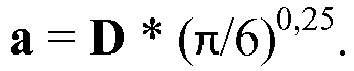
- Selon ce dispositif, le test de flexion trois points ne permettant pas de manière connue de rentrer les données géométriques initiales pour un monobrin de section circulaire, on peut seulement introduire la géométrie d'une section rectangulaire (ou carrée). Afin d'obtenir une mesure précise du module E' pour un monofilament de diamètre D, on introduit donc par convention dans le logiciel une section carrée de côté « a » ayant le même moment d'inertie de surface, ceci afin de travailler à même raideur R des éprouvettes testées.
- Les relations bien connues qui suivent doivent s'appliquer (E étant le module du matériau, Is le moment d'inertie de surface du corps considéré, et * le symbole de multiplication) :

- On en déduit aisément la valeur du côté « a » du carré équivalent de même inertie de surface que celle de la section (circulaire) du monobrin de diamètre D, selon l'équation :
- Dans le cas où la section droite de l'échantillon testé n'est pas circulaire (ni rectangulaire), quelle que soit sa forme particulière, le même mode de calcul s'appliquera en déterminant préalablement le moment d'inertie de surface Is sur une coupe droite de l'échantillon testé.
- L'éprouvette à tester, généralement de section circulaire et de diamètre D, a une longueur de 35 mm. Elle est disposée horizontalement sur deux appuis distants de 24 mm. Une sollicitation répétée en flexion est appliquée perpendiculairement au centre de l'éprouvette, à mi-distance des deux appuis, sous la forme d'un déplacement vertical d'amplitude égale à 0,1 mm (déformation donc asymétrique, l'intérieur de l'éprouvette étant uniquement sollicité en compression et pas en extension), à une fréquence de 10 Hz.
- Le programme suivant est ensuite appliqué : sous cette sollicitation dynamique, l'éprouvette est progressivement chauffée de 25°C à 260°C avec une rampe de 2°C/min. A la fin du test on obtient les mesures du module élastique E', du module visqueux E" et de l'angle de perte (δ) en fonction de la température (où E' est la partie réelle et E" la partie imaginaire du module complexe) ; Tg' est la température de transition vitreuse correspondant au maximum (pic) de tan(δ).
- Selon un mode de réalisation préférentiel, la déformation élastique en compression sous flexion est supérieure à 3,0%, plus préférentiellement supérieure à 3,5%, en particulier supérieure à 4,0%. Selon un autre mode de réalisation préférentiel, la contrainte de rupture en compression sous flexion est supérieure à 1 000 MPa, plus préférentiellement supérieure à 1 200 MPa, en particulier supérieure à 1 400 MPa.
- Les propriétés ci-dessus en compression sous flexion sont mesurées sur le monobrin en CVR comme décrit dans la demande
EP 1 167 080 précitée, par la méthode dite du test de boucle (D. Inclair, J. App. Phys. 21, 380, 1950). Dans le cas présent, on réalise une boucle que l'on amène progressivement au point de rupture. La nature de la rupture, facilement observable en raison de la grande taille de la section, permet immédiatement de se rendre compte que le monobrin en CVR de l'invention, sollicité en flexion jusqu'à rupture, se rompt du côté où la matière est en extension, ce que l'on identifie par simple observation. Etant donné que dans ce cas les dimensions de la boucle sont importantes, il est possible à tout instant de lire le rayon du cercle inscrit dans la boucle. Le rayon du cercle inscrit juste avant le point de rupture correspond au rayon de courbure critique, désigné par Rc. - La formule suivante permet ensuite de déterminer par le calcul la déformation élastique critique notée Ec (où r correspond au rayon du monobrin, c'est-à-dire D/2) :

- La contrainte de rupture en compression sous flexion notée σc est obtenue par le calcul par la formule suivante (où E est le module initial en extension) :

- Puisque, dans le cas du monobrin en CVR selon l'invention, la rupture de la boucle apparaît dans la partie en extension, on conclut que, en flexion, la contrainte de rupture en compression est supérieure à la contrainte de rupture en extension.
- On peut également procéder à la rupture en flexion d'un barreau rectangulaire selon la méthode dite des trois points (ASTM D 790). Cette méthode permet également de vérifier, visuellement, que la nature de la rupture est bien en extension.
- Selon un mode de réalisation préférentiel, la contrainte de rupture en compression pure est supérieure à 700 MPa, plus préférentiellement supérieure à 900 MPa, en particulier supérieure à 1 100 MPa. Pour éviter le flambage du monobrin en CVR sous compression, cette grandeur est mesurée selon la méthode décrite dans la publication « Critical compressive stress for continuous fiber unidirectional composites » de Thompson et al, Journal of Composite Materials, 46(26), 3231-3245.
- Préférentiellement, dans le monobrin en CVR de l'invention, le taux d'alignement des filaments de verre est tel que plus de 85% (% en nombre) des filaments ont une inclinaison par rapport à l'axe du monobrin qui est inférieure à 2,0 degrés, plus préférentiellement inférieure à 1,5 degrés, cette inclinaison (ou défaut d'alignement) étant mesuré comme décrit dans la publication ci-dessus de Thompson et al.
- Préférentiellement, le taux pondéral de filaments de verre dans le monobrin en CVR est compris entre 60 et 80%, de préférence entre 65 et 75%.
- Ce taux pondéral est calculé en faisant le rapport du titre de la fibre de verre initiale sur le titre du monobrin en CVR final. Le titre (ou densité linéique) est déterminé sur au moins trois échantillons, chacun correspondant à une longueur de 50 m, par pesée de cette longueur ; le titre est donné en tex (poids en grammes de 1000 m de produit - pour rappel, 0, 111 tex équivaut à 1 denier).
- De préférence, la densité (ou masse volumique en g/cm3) du monobrin en CVR est comprise entre 1,8 et 2,1. Elle est mesurée (à 23°C) à l'aide d'une balance spécialisée de la société Mettler Toledo de type « PG503 DeltaRange » ; les échantillons, de quelques cm, sont successivement pesés dans l'air et plongés dans de l'éthanol ; le logiciel de l'appareil détermine ensuite la densité moyenne sur trois mesures.
- Le diamètre D du monobrin en CVR de l'invention est de préférence compris entre 0,2 et 1,5 mm, plus préférentiellement entre 0,3 et 1,2 mm, en particulier entre 0,4 et 1,1 mm.
- Cette définition couvre aussi bien des mono filaments de forme essentiellement cylindrique (à section droite circulaire) que des monofilaments de forme différente, par exemple des monofilaments oblongs (de forme plus ou moins aplatie) ou de section droite rectangulaire. Dans le cas d'une section non circulaire et sauf indication spécifique différente, D est par convention le diamètre dit d'encombrement, c'est-à-dire le diamètre du cylindre de révolution imaginaire enveloppant le monobrin, en d'autres termes le diamètre du cercle circonscrit entourant sa section droite.
- La résine utilisée est par définition une résine réticulable (i.e., durcissable) susceptible d'être réticulée, durcie par toute méthode connue, en particulier par un rayonnement UV (ou UV-visible), de préférence émettant dans un spectre allant au moins de 300 nm à 450 nm.
- A titre de résine réticulable, on utilise de préférence une résine polyester ou vinylester, plus préférentiellement une résine vinylester. Par résine "polyester", on entend de manière connue une résine du type polyester insaturé. Les résines vinylester sont quant à elles bien connues dans le domaine des matériaux composites.
- Sans que cette définition soit limitative, la résine vinylester est préférentiellement du type époxyvinylester. On utilise plus préférentiellement une résine vinylester, notamment du type époxyde, qui au moins pour partie est à base (c'est-à-dire greffée sur une structure du type) novolaque (encore appelée phénoplaste) et/ou bisphénolique, soit préférentiellement une résine vinylester à base novolaque, bisphénolique, ou novolaque et bisphénolique.
- De préférence, le module initial en extension de la résine, mesuré à 23°C, est supérieur à 3,0 GPa, plus préférentiellement supérieur à 3,5 GPa.
- Une résine époxyvinylester à base novolaque (partie entre crochets dans la formule I ci-dessous) répond par exemple, de manière connue, à la formule (I) qui suit :

- Une résine époxyvinylester à base bisphénolique A (partie entre crochets de la formule (II) ci-dessous) répond par exemple à la formule (le "A" rappelant que le produit est fabriqué à l'aide d'acétone):

- Une résine époxyvinylester de type novolaque et bisphénolique a montré d'excellents résultats. A titre d'exemple d'une telle résine, on peut citer notamment les résines vinylester « ATLAC 590 » et « E-Nova FW 2045 » de la société DSM (diluées avec environ 40% de styrène) décrites dans les demandes
EP-A-1 074 369 etEP-A-1 174 250 précitées. Des résines époxyvinylester sont disponibles auprès d'autres fabricants tels que par exemple AOC (USA - résines « VIPEL »). - Le monobrin en CVR de l'invention est susceptible d'être préparé selon un procédé comportant les étapes connues suivantes :
- réaliser un arrangement rectiligne de fibres (filaments) de verre et entraîner cet arrangement dans une direction d'avancement :
- dans une chambre à vide, dégazer l'arrangement de fibres par l'action du vide ;
- en sortie de la chambre à vide, après dégazage, traverser une chambre d'imprégnation sous vide de manière à imprégner ledit arrangement de fibres par une résine ou composition de résine thermodurcissable, à l'état liquide, pour obtenir un imprégné contenant les filaments de verre et la résine ;
- faire passer ledit imprégné au travers d'une filière de calibrage ayant une section de surface et de forme prédéfinies, pour lui imposer une forme de monobrin (par exemple un mono filament de section droite ronde ou un ruban de section droite rectangulaire) ;
- en aval de la filière, dans une chambre d'irradiation UV, polymériser la résine sous l'action des UV ;
- puis enrouler pour stockage le monobrin ainsi obtenu.
- Toutes les étapes ci-dessus (arrangement, dégazage, imprégnation, calibrage, polymérisation et enroulage final) du procédé de l'invention sont des étapes connues de l'homme du métier, ainsi que les matières (fibres multifilamentaires et compositions de résine) utilisées ; elles ont par exemple été décrites dans l'une et/ou l'autre des deux demandes
EP-A-1 074 369 etEP-A-1 174 250 précitées. - On rappellera notamment qu'avant toute imprégnation des fibres, doit être conduite une étape essentielle de dégazage de l'arrangement de fibres par l'action du vide, afin notamment de renforcer l'efficacité de l'imprégnation ultérieure et surtout de garantir l'absence de bulles à l'intérieur du monobrin composite final.
- Après traversée de la chambre à vide, les filaments de verre entrent dans une chambre d'imprégnation qui est totalement pleine de résine d'imprégnation, donc dépourvue d'air : c'est en ce sens qu'on peut qualifier cette étape d'imprégnation d'« imprégnation sous vide ».
- La résine (composition de résine) d'imprégnation comporte de préférence un photo-initiateur sensible (réactif) aux UV au-delà de 300 nm, de préférence entre 300 et 450 nm. Ce photo-initiateur est utilisé à un taux préférentiel de 0,5 à 3%, plus préférentiellement de 1 à 2,5%. Elle peut également comporter un agent de réticulation, par exemple à un taux compris entre 5% et 15% (% en poids de composition d'imprégnation).
- De préférence, ce photo-initiateur est de la famille des composés phosphine, plus préférentiellement un oxyde de bis(acyl)phosphine comme par exemple l'oxyde de bis-(2,4,6-triméthylbenzoyl)-phénylphosphine ("Irgacure 819" de la société BASF) ou un oxyde de mono(acyl)phosphine (par exemple "Esacure TPO" de la société Lamberti), de tels composés phosphine pouvant être utilisés en mélange avec d'autres photo-initiateurs, par exemple des photo-initiateurs de type alpha-hydroxy-cétone tels que par exemple la diméthylhydroxy-acétophénone (e.g. «Esacure KL200 » de Lamberti) ou la 1-hydroxy-cyclohexyl-phényl-cétone (e.g. « Esacure KS300 » de Lamberti), des benzophénones telles que la 2,4,6-triméthylbenzophénone (e.g. « Esacure TZT » de Lamberti) et/ou des dérivés de thioxanthones comme par exemple l'isopropylthioxanthone (e.g. « Esacure ITX » de Lamberti).
- La filière dite "de calibrage" permet, grâce à une section droite de dimensions déterminées, généralement et de préférence circulaire ou rectangulaire, d'ajuster la proportion de résine par rapport aux fibres de verre tout en imposant à l'imprégné la forme et l'épaisseur visées pour le monobrin.
- La chambre de polymérisation ou d'irradiation UV a ensuite pour fonction de polymériser, réticuler la résine sous l'action des UV. Elle comporte un ou de préférence plusieurs irradiateurs UV, constitué(s) par exemple chacun par une lampe UV de longueur d'onde de 200 à 600 nm.
- Le monobrin en CVR final ainsi formé à travers la chambre d'irradiation UV, dans lequel la résine est maintenant à l'état solide, est ensuite récolté par exemple sur une bobine de réception sur laquelle il peut être enroulé sur une très grande longueur.
- Entre la filière de calibrage et le support de réception finale, on préfère maintenir les tensions subies par les fibres de verre à un niveau modéré, de préférence compris entre 0,2 et 2,0 cN/tex, plus préférentiellement entre 0,3 et 1,5 cN/tex ; pour contrôler cela, on pourra par exemple mesurer ces tensions directement en sortie de la chambre d'irradiation, à l'aide de tensiomètres appropriés bien connus de l'homme du métier.
- Outre les étapes connues précédemment décrites, le procédé pour fabriquer le monobrin en CVR de l'invention comporte les étapes essentielles qui suivent :
- la vitesse (Vir ) de passage du monobrin dans la chambre d'irradiation est supérieure à 50 m/min ;
- la durée (Dir ) de passage du monobrin dans la chambre d'irradiation est égale ou supérieure à 1,5 s ;
- la chambre d'irradiation comporte un tube transparent aux UV (tel qu'un tube en quartz ou de préférence en verre), dit tube d'irradiation, à travers lequel circule le monobrin en cours de formation, ce tube étant parcouru par un courant de gaz inerte, de préférence de l'azote.
- Si ces étapes essentielles ne sont pas combinées, les propriétés améliorées du monobrin en CVR de l'invention, à savoir de Tg, d'allongement Ar et de modules (E et E') ne peuvent pas être atteintes.
- En particulier, en l'absence de balayage de gaz neutre tel que de l'azote dans le tube d'irradiation, on a constaté que les propriétés ci-dessus du monobrin en CVR étant dégradées assez rapidement en cours de fabrication et donc que la performance industrielle n'était plus garantie.
- Par ailleurs, si la durée d'irradiation Dir du monobrin dans la chambre d'irradiation est trop courte (inférieure à 1,5 s), de nombreux essais ont révélé (voir résultats du tableau ci-dessous, tests conduits à différentes vitesses Vir supérieures à 50 m/min) que soit les valeurs de Tg étaient insuffisantes, inférieures à 190°C, soit les valeurs de Ar étaient trop faibles, inférieures à 4,0%.
Tableau Dir (s) Tg(°C) Ar(%) Essai 1 1.2 186.1 3.4 1.3 188.8 3.8 1.45 189.1 3.9 1.7 194.8 4.3 2.0 195.7 4.5 Essai 2 1.5 190.0 4.0 1.65 192.7 4.1 1.8 195.0 4.1 2.0 199.2 4.3 Essai 3 2.0 192.8 4.3 2.4 193.7 4.5 3.0 196.9 4.6 4.0 195.0 4.7 Essai 4 1.0 184.7 4.3 1.2 187.3 4.2 1.6 190.5 4.2 2.0 200.5 4.3 - On a constaté en outre qu'une vitesse d'irradiation Vir élevée (supérieure à 50 m/min, de préférence comprise entre 50 et 150 m/min) était favorable d'une part à un excellent taux d'alignement des filaments de verre à l'intérieur du monobrin en CVR, d'autre part à un meilleur maintien du vide dans la chambre à vide avec un risque nettement réduit de voir remonter une certaine fraction de résine d'imprégnation de la chambre d'imprégnation vers la chambre à vide, et donc à une meilleure qualité d'imprégnation.
- Le diamètre du tube d'irradiation (de préférence en verre) est préférentiellement compris entre 10 et 80 mm, plus préférentiellement entre 20 et 60 mm.
- Préférentiellement, la vitesse Vir est comprise entre 50 et 150 m/min, plus préférentiellement dans un domaine de 60 à 120 m/min.
- Préférentiellement, la durée d'irradiation Dir est comprise entre 1,5 et 10 s, plus préférentiellement dans un domaine de 2 à 5 s.
- Selon un autre mode de réalisation préférentiel, la chambre d'irradiation comporte une pluralité d'irradiateurs (ou radiateurs) UV, c'est-à-dire au moins deux (deux ou plus de deux) qui sont disposés en ligne autour du tube d'irradiation. Chaque irradiateur UV comporte typiquement une (au moins une) lampe UV (émettant de préférence dans un spectre de 200 à 600 nm) et un réflecteur parabolique au foyer duquel se trouve le centre du tube d'irradiation ; il délivre une puissance linéique préférentiellement comprise entre 2 000 et 14 000 watts par mètre. Plus préférentiellement encore, la chambre d'irradiation comporte au moins trois, en particulier au moins quatre irradiateurs UV en ligne.
- Encore plus préférentiellement, la puissance linéique délivrée par chaque irradiateur UV est comprise entre 2 500 et 12 000 watts par mètre, en particulier comprise dans un domaine de 3 000 à 10 000 watts par mètre.
- Des radiateurs UV convenant au procédé de l'invention sont bien connus de l'homme du métier, par exemple ceux commercialisés par la société Dr. Hönle AG (Allemagne) sous la référence « 1055 LCP AM UK », équipés de lampes « UVAPRINT » (lampes au mercure haute pression dopé au fer). La puissance nominale (maximale) de chaque radiateur de ce type est égale à environ 13 000 Watts, la puissance délivrée effectivement pouvant être réglée avec un potentiomètre entre 30 et 100% de la puissance nominale.
- De préférence, la température de la résine (composition de résine), dans la chambre d'imprégnation, est comprise entre 50°C et 95°C, plus préférentiellement entre 60°C et 90°C.
- Selon un autre mode de réalisation préférentiel, les conditions d'irradiation sont ajustées de telle manière que la température du monobrin en CVR, en sortie de la chambre d'imprégnation, soit supérieure à la Tg de la résine réticulée ; plus préférentiellement, cette température est supérieure à la Tg de la résine réticulée et inférieure à 270°C.
- On décrit ci-après des exemples de fabrication de monobrins en CVR selon l'invention et leur utilisation comme renforts de bandages pneumatiques.
- La
figure 1 annexée schématise très simplement un exemple d'un dispositif 10 permettant la production de monobrins en CVR conformes à l'invention. - On y voit une bobine 11a contenant, dans l'exemple illustré, des fibres de verre 11b (sous forme de multifilaments). La bobine est déroulée en continu par entraînement, de manière à réaliser un arrangement rectiligne 12 de ces fibres 11b. En général, les fibres de renforcement sont livrées en "rovings", c'est à dire déjà en groupes de fibres enroulées en parallèle sur une bobine ; par exemple, on utilise des fibres commercialisées par Owens Corning sous la désignation de fibre "Advantex", de titre égal à 1200 tex (pour rappel, 1 tex = 1 g/1000 m de fibre). C'est par exemple la traction exercée par la réception tournante 26 qui va permettre l'avancement des fibres en parallèle et du monobrin en CVR tout le long de l'installation.
- Cet arrangement 12 traverse ensuite une chambre à vide 13 (reliée à une pompe à vide non représentée), disposée entre une tubulure d'entrée 13a et une tubulure de sortie 13b débouchant sur une chambre d'imprégnation 14, les deux tubulures de préférence à paroi rigide ayant par exemple une section minimale supérieure (typiquement deux fois plus) à la section totale de fibres et une longueur très supérieure (typiquement 50 fois plus) à ladite section minimale.
- Comme déjà enseigné par la demande
EP-A-1 174 250 précitée, l'utilisation de tubulures à paroi rigide, aussi bien pour l'orifice d'entrée dans la chambre à vide que pour l'orifice de sortie de la chambre à vide et le transfert depuis la chambre à vide jusqu'à la chambre d'imprégnation, s'avère compatible à la fois avec des cadences élevées de passage des fibres au travers des orifices sans rompre les fibres, mais aussi permet d'assurer une étanchéité suffisante. Il suffit, au besoin expérimentalement, de rechercher la plus grande section de passage, compte tenu de la section totale des fibres à traiter, permettant encore d'offrir une étanchéité suffisante, compte tenu de la vitesse d'avancement des fibres et de la longueur des tubulures. Typiquement, le vide à l'intérieur de la chambre 13 est par exemple de l'ordre de 0,1 bar, la longueur de la chambre à vide est d'environ 1 mètre. - En sortie de la chambre à vide 13 et de la tubulure de sortie 13b, l'arrangement 12 de fibres 11b traverse une chambre d'imprégnation 14 comportant un réservoir d'alimentation 15 (relié à une pompe doseuse non représentée) et un réservoir d'imprégnation 16 étanche totalement rempli de composition d'imprégnation 17 à base d'une résine durcissable du type vinylester (e.g., "E-Nova FW 2045" de DSM). A titre d'exemple, la composition 17 comporte en outre (à un taux pondéral de 1 à 2%) un agent photo-initiateur approprié pour le rayonnement UV et/ou UV-visible par lequel la composition sera ultérieurement traitée, par exemple l'oxyde de bis-(2,4,6-triméthylbenzoyl)-phénylphosphine ("Irgacure 819" de la société BASF). Elle peut également comporter (par exemple environ 5% à 15 %) d'un agent réticulant tel que par exemple le tris(2-hydroxy éthyl)isocyanurate triacrylate (« SR 368 » de la société Sartomer). Bien entendu, la composition d'imprégnation 17 est à l'état liquide.
- Préférentiellement, la longueur de la chambre d'imprégnation est de plusieurs mètres, par exemple comprise entre 2 et 10 m, en particulier entre 3 et 5 m.
- Ainsi, ressort de la chambre d'imprégnation 14, dans une tubulure de sortie 18 étanche (toujours sous vide primaire), un imprégné qui comporte par exemple (% en poids) de 65 à 75% de fibres solides 11b, le reste (25 à 35%) étant constitué par la matrice liquide d'imprégnation 17.
- L'imprégné passe ensuite à travers des moyens de calibrage 19 comportant au moins une filière de calibrage 20 dont le canal (non représenté ici), par exemple de forme circulaire, rectangulaire ou encore conique, est adapté aux conditions particulières de réalisation. A titre d'exemple, ce canal a une section droite minimale de forme circulaire dont l'orifice aval a un diamètre légèrement supérieur à celui du monobrin visé. Ladite filière a une longueur qui est typiquement supérieure d'au moins 100 fois à la dimension minimale de la section minimale. Elle a pour fonction d'assurer une grande précision dimensionnelle au produit fini, elle peut également jouer un rôle de dosage du taux de fibre par rapport à la résine. Selon une variante de réalisation possible, la filière 20 peut être directement intégrée à la chambre d'imprégnation 14, ce qui évite par exemple l'emploi de la tubulure de sortie 18.
- Préférentiellement, la longueur de la zone de calibrage est de plusieurs centimètres, par exemple comprise entre 5 et 50 cm, en particulier entre 5 et 20 cm.
- Grâce aux moyens de calibrage (19, 20) est obtenu à ce stade un monobrin composite "liquide" 21 (liquide au sens que sa résine d'imprégnation est toujours liquide) dont la forme de la section droite est préférentiellement essentiellement circulaire.
- En sortie des moyens de calibrage (19, 20), le monobrin composite liquide 21 ainsi obtenu est ensuite polymérisé par passage à travers une chambre d'irradiation UV (22) comportant un tube en verre étanche (23) à travers lequel circule le monobrin composite ; ledit tube, dont le diamètre est typiquement de quelques cm (par exemple 2 à 3 cm), est irradié par une pluralité (ici, par exemple 4) d'irradiateurs UV (24) en ligne (lampes "UVAprint" de la société Dr. Hönle, de longueur d'onde 200 à 600 nm) disposés à courte distance (quelques cm) du tube en verre.
- Préférentiellement, la longueur de la chambre d'irradiation est de plusieurs mètres, par exemple comprise entre 2 et 15 m, en particulier entre 3 et 10 m.
- Le tube d'irradiation 23 est dans cet exemple parcouru par un courant d'azote.
- Les conditions d'irradiation sont préférentiellement ajustées de telle manière que, en sortie de la chambre d'imprégnation, la température du monobrin en CVR, mesurée en surface de ce dernier (par exemple à l'aide d'un thermocouple), soit supérieure à la Tg de la résine réticulée (en d'autres termes supérieure à 190°C), et plus préférentiellement inférieure à 270°C.
- Une fois la résine polymérisée (durcie), le monobrin en CVR (25), cette fois à l'état solide, entraîné dans le sens de la flèche F, arrive ensuite sur sa bobine de réception finale (26).
- On obtient finalement un bloc composite terminé de fabrication tel que schématisé très simplement à la
figure 2 , sous la forme d'un monobrin en CVR continu (25), de très grande longueur, dont les filaments de verre unitaires (251) sont répartis de manière homogène dans tout le volume de résine durcie (252). Son diamètre est par exemple égal à environ 1 mm. - Grâce aux conditions opératoires décrites ci-dessus, le procédé de l'invention peut être mise en oeuvre à haute vitesse, supérieure à 50 m/min, de préférence entre 50 et 150 m/min, plus préférentiellement dans un domaine de 60 à 120 m/min.
- Le monobrin en CVR de l'invention ainsi fabriqué est avantageusement utilisable pour le renforcement de bandages, pneumatiques ou non pneumatiques, de tous types de véhicules, en particulier de véhicules tourisme ou véhicules industriels tels que Poids-lourd, Génie civil, avions, autres véhicules de transport ou de manutention.
- Pour les exemples d'application en bandages pneumatiques ci-après décrits, ce sont des bobines de 40 000 mètres (soit près de 7 heures de fabrication en continu à une vitesse de 100 m/min) qui ont été produites, ce qui illustre bien la performance industrielle du procédé précédemment décrit.
- A titre d'exemple, la
figure 3 représente de manière très schématique (sans respect d'une échelle spécifique), une coupe radiale d'un bandage pneumatique conforme à l'invention pour véhicule du type tourisme. - Ce pneumatique 1 comporte un sommet 2 renforcé par une armature de sommet ou ceinture 6, deux flancs 3 et deux bourrelets 4, chacun de ces bourrelets 4 étant renforcé avec une tringle 5. Le sommet 2 est surmonté d'une bande de roulement non représentée sur cette figure schématique. Une armature de carcasse 7 est enroulée autour des deux tringles 5 dans chaque bourrelet 4, le retournement 8 de cette armature 7 étant par exemple disposé vers l'extérieur du pneumatique 1 qui est ici représenté monté sur sa jante 9.
- L'armature de carcasse 7 est de manière connue en soi constituée d'au moins une nappe de caoutchouc renforcée par des renforts textiles dits "radiaux", c'est-à-dire que ces renforts sont disposés pratiquement parallèles les uns aux autres et s'étendent d'un bourrelet à l'autre de manière à former un angle compris entre 80° et 90° avec le plan circonférentiel médian (plan perpendiculaire à l'axe de rotation du pneumatique qui est situé à mi-distance des deux bourrelets 4 et passe par le milieu de l'armature de sommet 6).
- La ceinture 6 est par exemple constituée, de manière connue en soi, par au moins deux nappes de caoutchouc dites "nappes de travail" ou "nappes de triangulation", superposées et croisées, renforcées de câbles métalliques disposés sensiblement parallèlement les uns par rapport aux autres et inclinés par rapport au plan circonférentiel médian, ces nappes de travail pouvant être associées ou non à d'autres nappes et/ou tissus de caoutchouc. Ces nappes de travail ont pour fonction première de donner au bandage pneumatique une rigidité de dérive élevée. La ceinture 6 comporte en outre dans cet exemple une nappe de caoutchouc dite "nappe de frettage" renforcée par des fils de renforcement dits "circonférentiels", c'est-à-dire que ces fils de renforcement sont disposés pratiquement parallèles les uns aux autres et s'étendent sensiblement circonférentiellement autour du bandage pneumatique de manière à former un angle préférentiellement compris dans un domaine de 0 à 10° avec le plan circonférentiel médian. Ces fils de renforcement circonférentiels ont pour fonction première, on le rappelle, de résister à la centrifugation du sommet à haute vitesse.
- Le pneumatique 1 de l'invention a par exemple pour caractéristique essentielle qu'au moins sa ceinture (6) et/ou son armature de carcasse (7) comporte un monobrin en CVR selon l'invention. Selon un autre exemple de réalisation possible de l'invention, c'est la zone bourrelet qui peut être renforcée d'un tel monobrin ; ce sont par exemple les tringles (5) qui pourraient être constituées, en tout ou partie, d'un monobrin en CVR selon l'invention.
- Les compositions de caoutchouc utilisées pour les nappes de caoutchouc renforcées de monobrins en CVR sont des compositions conventionnelles pour calandrage de renforts textiles, typiquement à base de caoutchouc naturel, de noir de carbone ou de silice, d'un système de vulcanisation et des additifs usuels. Grâce à l'invention, comparativement aux compositions de caoutchouc renforcées de câbles d'acier, elles sont avantageusement dépourvues de sel métallique tel que sel de cobalt. L'adhésion entre le monobrin en CVR de l'invention et la couche de caoutchouc qui l'enrobe est assurée de manière connue, par exemple par une colle usuelle du type RFL (résorcinol-formol-latex).
- Des tests particuliers en bandages pneumatiques ont été réalisés, où des monobrins en CVR ont été utilisés comme renforts longilignes, c'est-à-dire non câblés, dans des nappes de travail croisées à la place de câbles en acier conventionnels, comme décrit dans le document précité
EP 1 167 080 . - Ces tests ont démontré clairement que les monobrins en CVR de l'invention, grâce à leurs propriétés en compression améliorées, ne subissaient pas de casses en compression au cours de la fabrication-même de ces bandages pneumatiques, contrairement aux monobrins en CVR de l'art antérieur tels que décrits dans
EP 1 167 080 . - Tout en allégeant notablement les bandages pneumatiques et supprimant les risques liés à la corrosion, par rapport à des bandages dont la ceinture est conventionnellement renforcée de câbles d'acier, les monobrins en CVR de l'invention ont révélé comme autre avantage notable celui de ne pas augmenter le bruit de roulage des bandages pneumatiques, contrairement aux autres solutions (renforts) textiles connues.
- Ces monobrins en CVR de l'invention ont également montré une excellente performance comme renforts circonférentiels dans des bandages du type non pneumatiques tels que décrits en introduction du présent mémoire.
Claims (15)
- Monobrin en composite verre-résine comportant des filaments de verre noyés dans une résine réticulée, caractérisé en ce que :- la température de transition vitreuse notée Tg de la résine est égale ou supérieure à 190°C ;- l'allongement à la rupture noté Ar du monobrin, mesuré à 23°C, est égal ou supérieur à 4,0% ;- le module initial en extension noté E23 du monobrin, mesuré à 23°C, est supérieur à 35 GPa ; et- la partie réelle du module complexe noté E'190 du monobrin, mesurée à 190°C par la méthode DTMA, est supérieure à 30 GPa.
- Monobrin selon la revendication 1, dans lequel la Tg de la résine est supérieure à 195°C, de préférence supérieure à 200°C.
- Monobrin selon les revendications 1 ou 2, dont l'allongement Ar est supérieur à 4,2%, de préférence supérieur à 4,4%.
- Monobrin selon l'une quelconque des revendications 1 à 3, dont le rapport E'(Tg'- 25) / E'23 est supérieur à 0,85, de préférence supérieur à 0,90, E'23 et E'(Tg'- 25) étant la partie réelle du module complexe du monobrin mesurée par DTMA, respectivement à 23°C et à une température exprimée en °C égale à Tg' - 25, et Tg' étant la température de transition vitreuse de la résine mesurée par DTMA.
- Monobrin selon l'une quelconque des revendications 1 à 4, dont le rapport E'(Tg'-10) / E'23 est supérieur à 0,80, de préférence supérieur à 0,85, E'23 et E'(Tg'-10) étant la partie réelle du module complexe du monobrin mesuré par DTMA, respectivement à 23°C et à une température exprimée en °C égale à Tg' - 10, et Tg' étant la température de transition vitreuse de la résine mesurée par DTMA.
- Monobrin selon l'une quelconque des revendications 1 à 5, dont le module E23 est supérieur à 40 GPa, de préférence supérieur à 42 GPa.
- Monobrin selon l'une quelconque des revendications 1 à 6, dont le module E'190 est supérieur à 33 GPa, de préférence supérieur à 36 GPa.
- Monobrin selon l'une quelconque des revendications 1 à 7, dont la déformation élastique en compression sous flexion est supérieure à 3,0%, de préférence supérieure à 3,5%, plus préférentiellement supérieure à 4,0%.
- Monobrin selon l'une quelconque des revendications 1 à 8, dont la contrainte de rupture en compression sous flexion est supérieure à 1 000 MPa, de préférence supérieure à 1 200 MPa, plus préférentiellement supérieure à 1 400 MPa.
- Monobrin selon l'une quelconque des revendications 1 à 9, dans lequel le taux pondéral de filaments de verre est compris entre 60 et 80%, de préférence entre 65 et 75% et dont la masse volumique est comprise entre 1,8 et 2,1 g/cm3.
- Monobrin selon l'une quelconque des revendications 1 à 10, dans lequel la résine est une résine vinylester.
- Monobrin selon l'une quelconque des revendications 1 à 11, dans lequel le module initial en extension de la résine, mesuré à 23°C, est supérieur à 3,0 GPa, de préférence supérieur à 3,5 GPa.
- Monobrin selon l'une quelconque des revendications 1 à 12, dont le diamètre D du monobrin est compris entre 0,2 et 1,5 mm, de préférence entre 0,3 et 1,2 mm, en particulier entre 0,4 et 1,1 mm.
- Bandage pour véhicule, pneumatique ou non pneumatique, comportant un monobrin en composite verre-résine selon l'une quelconque des revendications 1 à 13.
- Bandage selon la revendication 14, dans lequel le monobrin en composite verre-résine est présent dans la ceinture (6), dans l'armature de carcasse (7) du bandage ou dans la zone bourrelet (4) du bandage.
Applications Claiming Priority (2)
| Application Number | Priority Date | Filing Date | Title |
|---|---|---|---|
| FR1357647A FR3009225B1 (fr) | 2013-08-01 | 2013-08-01 | Monobrin en cvr (composite verre-resine) ameliore |
| PCT/EP2014/064565 WO2015014578A1 (fr) | 2013-08-01 | 2014-07-08 | Monobrin en cvr (composite verre-resine) ameliore |
Publications (2)
| Publication Number | Publication Date |
|---|---|
| EP3027795A1 EP3027795A1 (fr) | 2016-06-08 |
| EP3027795B1 true EP3027795B1 (fr) | 2017-04-19 |
Family
ID=49949769
Family Applications (1)
| Application Number | Title | Priority Date | Filing Date |
|---|---|---|---|
| EP14739105.6A Active EP3027795B1 (fr) | 2013-08-01 | 2014-07-08 | Monobrin en cvr (composite verre-résine) amélioré |
Country Status (7)
| Country | Link |
|---|---|
| US (1) | US11491820B2 (fr) |
| EP (1) | EP3027795B1 (fr) |
| JP (1) | JP6412571B2 (fr) |
| KR (1) | KR102128805B1 (fr) |
| CN (1) | CN105408536B (fr) |
| FR (1) | FR3009225B1 (fr) |
| WO (1) | WO2015014578A1 (fr) |
Families Citing this family (23)
| Publication number | Priority date | Publication date | Assignee | Title |
|---|---|---|---|---|
| CA2915483C (fr) | 2013-06-15 | 2021-11-16 | Ronald Thompson | Bague annulaire et bandage non pneumatique |
| FR3009225B1 (fr) | 2013-08-01 | 2015-07-31 | Michelin & Cie | Monobrin en cvr (composite verre-resine) ameliore |
| FR3015363B1 (fr) * | 2013-12-19 | 2016-02-05 | Michelin & Cie | Renfort multi-composite |
| FR3020369B1 (fr) | 2014-04-29 | 2016-05-06 | Michelin & Cie | Renfort plat multi-composite |
| FR3031757B1 (fr) * | 2015-01-21 | 2017-09-01 | Michelin & Cie | Renfort multi-composite verre-resine a proprietes ameliorees |
| WO2016126983A1 (fr) | 2015-02-04 | 2016-08-11 | Advancing Mobility, Llc. | Pneu non pneumatique et autres dispositifs annulaires |
| KR102360510B1 (ko) * | 2015-05-28 | 2022-02-10 | 꽁빠니 제네날 드 에따블리세망 미쉘린 | 개선된 유리-수지로부터 제조된 다중복합체 보강재 |
| FR3036651B1 (fr) * | 2015-05-28 | 2017-05-19 | Michelin & Cie | Renfort plat multi-composite |
| WO2017106750A1 (fr) | 2015-12-16 | 2017-06-22 | Thompson Ronald H | Système de chenille pour la traction d'un véhicule |
| MX2018013849A (es) * | 2016-06-29 | 2019-02-28 | Tokyo Rope Mfg Co | Cable de fibra sintetica. |
| FR3056444A1 (fr) | 2016-09-27 | 2018-03-30 | Compagnie Generale Des Etablissements Michelin | Roue elastique non pneumatique incorporant un stratifie a base de caoutchouc silicone et de composite fibre-resine |
| FR3056442A1 (fr) * | 2016-09-27 | 2018-03-30 | Compagnie Generale Des Etablissements Michelin | Produit stratifie a base de caoutchouc silicone et de composite fibre-resine |
| EP3638515B1 (fr) | 2017-06-15 | 2023-04-05 | Camso Inc. | Roue équipée d'un pneu non pneumatique |
| FR3089217A3 (fr) | 2018-11-30 | 2020-06-05 | Michelin & Cie | Matériau multi-composite à base de composite verre-résine |
| WO2020109723A1 (fr) | 2018-11-30 | 2020-06-04 | Compagnie Generale Des Etablissements Michelin | Collage d'un monobrin en composite verre-résine à une matrice thermoplastique |
| FR3089228A3 (fr) | 2018-11-30 | 2020-06-05 | Michelin & Cie | Collage d’un monobrin en composite verre-résine à une matrice thermoplastique |
| WO2020109721A1 (fr) | 2018-11-30 | 2020-06-04 | Compagnie Generale Des Etablissements Michelin | Matériau multi-composite à base de composite verre-résine |
| FR3089218A3 (fr) | 2018-11-30 | 2020-06-05 | Michelin & Cie | Matériau multi-composite à base de composite verre-résine |
| WO2020109722A1 (fr) | 2018-11-30 | 2020-06-04 | Compagnie Generale Des Etablissements Michelin | Matériau multi-composite à base de composite verre-résine |
| FR3117482A1 (fr) * | 2020-12-16 | 2022-06-17 | Compagnie Generale Des Etablissements Michelin | Utilisation de fibres composite verre-resine pour le renforcement du beton |
| JP7684404B2 (ja) * | 2020-12-29 | 2025-05-27 | ブリヂストン アメリカズ タイヤ オペレーションズ、 エルエルシー | 非円形断面を有するフィラメントを有するタイヤバンド |
| FR3155159A1 (fr) | 2023-11-14 | 2025-05-16 | Compagnie Generale Des Etablissements Michelin | Elément de renfort et procédé de fabrication d’un tel élément de renfort |
| KR20250174275A (ko) | 2024-06-05 | 2025-12-12 | 한국타이어앤테크놀로지 주식회사 | 비공기입 타이어용 하이브리드 보강재 |
Family Cites Families (36)
| Publication number | Priority date | Publication date | Assignee | Title |
|---|---|---|---|---|
| US4882370A (en) * | 1988-01-27 | 1989-11-21 | Minnesota Mining And Manufacturing Company | Fiber reinforced composites with improved glass transition temperatures |
| JPH04202825A (ja) * | 1990-11-29 | 1992-07-23 | Toyobo Co Ltd | 複合モノフィラメント |
| US5556496A (en) * | 1995-01-10 | 1996-09-17 | Sumerak; Joseph E. | Pultrusion method for making variable cross-section thermoset articles |
| GB9501605D0 (en) | 1995-01-27 | 1995-03-15 | Kobe Steel Europ Ltd | Radiation-curable compositions |
| GB9615995D0 (en) | 1996-07-30 | 1996-09-11 | Kobe Steel Europ Ltd | Fibre reinforced compositions and methods for their production |
| FR2765346B1 (fr) | 1997-06-26 | 1999-09-24 | Alsthom Cge Alcatel | Procede de fabrication d'un conducteur optique |
| FR2787388B1 (fr) | 1998-12-18 | 2001-01-12 | Conception & Dev Michelin Sa | Bandage elastique utilisable de facon non pneumatique |
| ATE305847T1 (de) * | 1999-08-04 | 2005-10-15 | Conception & Dev Michelin Sa | Verfahren zur herstellung von hochbeanspruchten verbundteilen |
| DE60035491T2 (de) | 1999-10-13 | 2008-04-03 | Toray Industries, Inc. | Prepreg und faserverstärkter verbundwerkstoff |
| DE69929903T2 (de) | 1999-12-10 | 2006-09-28 | Michelin Recherche Et Technique S.A. | Elastischer selbsttragender reifen |
| EP1167080B1 (fr) * | 2000-06-22 | 2007-01-03 | Conception et Développement Michelin S.A. | Bandage renforcé par un élément composite, ainsi qu'un tel élément |
| DE60114096T2 (de) | 2000-07-17 | 2006-07-06 | Conception Et Development Michelin S.A. | Kontinuieriche Imprägnierung von sehr langen Fasern mit Harz zur Herstellung von langestreckten Verbundelementen |
| CA2458002C (fr) | 2001-08-24 | 2010-08-17 | Michelin Recherche Et Technique S.A. | Pneu non pneumatique |
| FR2839015A1 (fr) | 2002-04-29 | 2003-10-31 | Conception & Dev Michelin Sa | Bandage flexible non pneumatique |
| ATE552957T1 (de) * | 2006-01-27 | 2012-04-15 | Michelin Rech Tech | Verfahren zur herstellung eines verbundstoffrings |
| ATE465030T1 (de) * | 2006-11-22 | 2010-05-15 | Pirelli | Reifen mit leichtem wulstkern |
| FR2910838B1 (fr) | 2006-12-27 | 2009-03-06 | Conception & Dev Michelin Sa | Procede et dispositif de fabrication d'un anneau composite |
| FR2921013B1 (fr) | 2007-09-14 | 2009-11-27 | Soc Tech Michelin | Roue elastique non pneumatique. |
| FR2928865B1 (fr) | 2008-03-19 | 2010-03-19 | Michelin Soc Tech | Roue elastique non pneumatique |
| FR2928859B1 (fr) * | 2008-03-19 | 2010-03-19 | Michelin Soc Tech | Produit stratifie composite |
| FR2964597B1 (fr) | 2010-09-09 | 2012-08-31 | Michelin Soc Tech | Roue elastique non pneumatique multietages |
| US20130327459A1 (en) | 2011-02-21 | 2013-12-12 | Compagnie Cenerale Des Etablissements Michelin | Tire with crown reinforcing structure |
| FR2978770B1 (fr) | 2011-08-04 | 2013-09-27 | Michelin Soc Tech | Composition adhesive aqueuse a base de polyaldehyde et phloroglucinol |
| FR2978769B1 (fr) | 2011-08-04 | 2013-09-27 | Michelin Soc Tech | Composition adhesive aqueuse a base de polyaldehyde et de polyphenol |
| FR2978771B1 (fr) | 2011-08-04 | 2013-09-27 | Michelin Soc Tech | Composition adhesive aqueuse a base de polyaldehyde et 2,2', 4,4'-tetrahydroxydiphenyl sulfide |
| RU2014130090A (ru) * | 2011-12-22 | 2016-02-10 | Мишлен Решерш Э Текник, С.А. | Полоса сдвига с чередующимся армированием |
| FR2986455B1 (fr) | 2012-02-08 | 2014-10-31 | Michelin & Cie | Renfort composite gaine d'une couche de polymere auto-adherente au caoutchouc |
| WO2013129525A1 (fr) | 2012-02-29 | 2013-09-06 | 株式会社ブリヂストン | Pneumatique |
| FR2991630B1 (fr) | 2012-06-07 | 2014-06-27 | Michelin & Cie | Tringle hybride elastique pour pneumatique. |
| FR2991632B1 (fr) | 2012-06-07 | 2014-06-27 | Michelin & Cie | Tringle hybride allegee pour pneumatique. |
| FR2991631B1 (fr) | 2012-06-07 | 2015-04-24 | Michelin & Cie | Tringle pliable pour pneumatique. |
| FR3009225B1 (fr) | 2013-08-01 | 2015-07-31 | Michelin & Cie | Monobrin en cvr (composite verre-resine) ameliore |
| FR3009226B1 (fr) | 2013-08-01 | 2016-01-01 | Michelin & Cie | Procede de fabrication d’un monobrin en composite verre-resine |
| FR3015363B1 (fr) | 2013-12-19 | 2016-02-05 | Michelin & Cie | Renfort multi-composite |
| FR3020369B1 (fr) | 2014-04-29 | 2016-05-06 | Michelin & Cie | Renfort plat multi-composite |
| FR3031757B1 (fr) | 2015-01-21 | 2017-09-01 | Michelin & Cie | Renfort multi-composite verre-resine a proprietes ameliorees |
-
2013
- 2013-08-01 FR FR1357647A patent/FR3009225B1/fr active Active
-
2014
- 2014-07-08 JP JP2016530406A patent/JP6412571B2/ja active Active
- 2014-07-08 WO PCT/EP2014/064565 patent/WO2015014578A1/fr not_active Ceased
- 2014-07-08 EP EP14739105.6A patent/EP3027795B1/fr active Active
- 2014-07-08 US US14/908,851 patent/US11491820B2/en active Active
- 2014-07-08 CN CN201480042615.9A patent/CN105408536B/zh active Active
- 2014-07-08 KR KR1020167002362A patent/KR102128805B1/ko active Active
Non-Patent Citations (1)
| Title |
|---|
| None * |
Also Published As
| Publication number | Publication date |
|---|---|
| JP6412571B2 (ja) | 2018-10-24 |
| CN105408536A (zh) | 2016-03-16 |
| WO2015014578A1 (fr) | 2015-02-05 |
| EP3027795A1 (fr) | 2016-06-08 |
| CN105408536B (zh) | 2017-04-05 |
| FR3009225B1 (fr) | 2015-07-31 |
| KR20160037920A (ko) | 2016-04-06 |
| US11491820B2 (en) | 2022-11-08 |
| FR3009225A1 (fr) | 2015-02-06 |
| JP2016531176A (ja) | 2016-10-06 |
| KR102128805B1 (ko) | 2020-07-03 |
| US20160159152A1 (en) | 2016-06-09 |
Similar Documents
| Publication | Publication Date | Title |
|---|---|---|
| EP3027395B1 (fr) | Procede de fabrication d'un monobrin en composite verre-resine | |
| EP3027795A1 (fr) | Monobrin en cvr (composite verre-resine) ameliore | |
| EP3247827B1 (fr) | Renfort multi-composite verre-résine à propriétés améliorées | |
| EP3083775B1 (fr) | Renfort multi-composite pour pneumatique | |
| EP3137317B1 (fr) | Renfort plat multi-composite | |
| EP3303006B1 (fr) | Renfort plat multi-composite | |
| WO2016189209A1 (fr) | Renfort multi-composite en verre-resine ameliore | |
| EP2643515B1 (fr) | Renfort composite auto-adherent | |
| EP1981700B1 (fr) | Procede de fabrication d'un anneau composite | |
| EP2125346B1 (fr) | Procede et dispositif de fabrication d'un anneau composite | |
| EP2812177B1 (fr) | Renfort composite gaine d'une couche de polymere auto-adherente au caoutchouc et procédé de fabrication associé | |
| EP3887472A1 (fr) | Matériau multi-composite à base de composite verre-résine | |
| EP4263458A1 (fr) | Utilisation de fibres composite verre-resine pour le renforcement du beton | |
| EP4263459A1 (fr) | Utilisation de fibres composite verre-resine pour le renforcement du beton | |
| WO2020109721A1 (fr) | Matériau multi-composite à base de composite verre-résine | |
| WO2026003469A1 (fr) | Procédé de fabrication d'un monobrin en composite filament-résine comprenant des filaments noyés dans une résine réticulée mettant en œuvre une composition de résine spécifique | |
| WO2020109722A1 (fr) | Matériau multi-composite à base de composite verre-résine |
Legal Events
| Date | Code | Title | Description |
|---|---|---|---|
| PUAI | Public reference made under article 153(3) epc to a published international application that has entered the european phase |
Free format text: ORIGINAL CODE: 0009012 |
|
| 17P | Request for examination filed |
Effective date: 20160301 |
|
| AK | Designated contracting states |
Kind code of ref document: A1 Designated state(s): AL AT BE BG CH CY CZ DE DK EE ES FI FR GB GR HR HU IE IS IT LI LT LU LV MC MK MT NL NO PL PT RO RS SE SI SK SM TR |
|
| AX | Request for extension of the european patent |
Extension state: BA ME |
|
| DAX | Request for extension of the european patent (deleted) | ||
| GRAP | Despatch of communication of intention to grant a patent |
Free format text: ORIGINAL CODE: EPIDOSNIGR1 |
|
| INTG | Intention to grant announced |
Effective date: 20161221 |
|
| GRAS | Grant fee paid |
Free format text: ORIGINAL CODE: EPIDOSNIGR3 |
|
| GRAA | (expected) grant |
Free format text: ORIGINAL CODE: 0009210 |
|
| AK | Designated contracting states |
Kind code of ref document: B1 Designated state(s): AL AT BE BG CH CY CZ DE DK EE ES FI FR GB GR HR HU IE IS IT LI LT LU LV MC MK MT NL NO PL PT RO RS SE SI SK SM TR |
|
| REG | Reference to a national code |
Ref country code: GB Ref legal event code: FG4D Free format text: NOT ENGLISH |
|
| REG | Reference to a national code |
Ref country code: CH Ref legal event code: EP |
|
| REG | Reference to a national code |
Ref country code: AT Ref legal event code: REF Ref document number: 886065 Country of ref document: AT Kind code of ref document: T Effective date: 20170515 |
|
| REG | Reference to a national code |
Ref country code: IE Ref legal event code: FG4D Free format text: LANGUAGE OF EP DOCUMENT: FRENCH |
|
| REG | Reference to a national code |
Ref country code: DE Ref legal event code: R096 Ref document number: 602014008871 Country of ref document: DE |
|
| REG | Reference to a national code |
Ref country code: FR Ref legal event code: PLFP Year of fee payment: 4 |
|
| REG | Reference to a national code |
Ref country code: NL Ref legal event code: MP Effective date: 20170419 |
|
| REG | Reference to a national code |
Ref country code: LT Ref legal event code: MG4D |
|
| REG | Reference to a national code |
Ref country code: AT Ref legal event code: MK05 Ref document number: 886065 Country of ref document: AT Kind code of ref document: T Effective date: 20170419 |
|
| PG25 | Lapsed in a contracting state [announced via postgrant information from national office to epo] |
Ref country code: NL Free format text: LAPSE BECAUSE OF FAILURE TO SUBMIT A TRANSLATION OF THE DESCRIPTION OR TO PAY THE FEE WITHIN THE PRESCRIBED TIME-LIMIT Effective date: 20170419 |
|
| PG25 | Lapsed in a contracting state [announced via postgrant information from national office to epo] |
Ref country code: ES Free format text: LAPSE BECAUSE OF FAILURE TO SUBMIT A TRANSLATION OF THE DESCRIPTION OR TO PAY THE FEE WITHIN THE PRESCRIBED TIME-LIMIT Effective date: 20170419 Ref country code: AT Free format text: LAPSE BECAUSE OF FAILURE TO SUBMIT A TRANSLATION OF THE DESCRIPTION OR TO PAY THE FEE WITHIN THE PRESCRIBED TIME-LIMIT Effective date: 20170419 Ref country code: FI Free format text: LAPSE BECAUSE OF FAILURE TO SUBMIT A TRANSLATION OF THE DESCRIPTION OR TO PAY THE FEE WITHIN THE PRESCRIBED TIME-LIMIT Effective date: 20170419 Ref country code: HR Free format text: LAPSE BECAUSE OF FAILURE TO SUBMIT A TRANSLATION OF THE DESCRIPTION OR TO PAY THE FEE WITHIN THE PRESCRIBED TIME-LIMIT Effective date: 20170419 Ref country code: NO Free format text: LAPSE BECAUSE OF FAILURE TO SUBMIT A TRANSLATION OF THE DESCRIPTION OR TO PAY THE FEE WITHIN THE PRESCRIBED TIME-LIMIT Effective date: 20170719 Ref country code: GR Free format text: LAPSE BECAUSE OF FAILURE TO SUBMIT A TRANSLATION OF THE DESCRIPTION OR TO PAY THE FEE WITHIN THE PRESCRIBED TIME-LIMIT Effective date: 20170720 Ref country code: LT Free format text: LAPSE BECAUSE OF FAILURE TO SUBMIT A TRANSLATION OF THE DESCRIPTION OR TO PAY THE FEE WITHIN THE PRESCRIBED TIME-LIMIT Effective date: 20170419 |
|
| PG25 | Lapsed in a contracting state [announced via postgrant information from national office to epo] |
Ref country code: BG Free format text: LAPSE BECAUSE OF FAILURE TO SUBMIT A TRANSLATION OF THE DESCRIPTION OR TO PAY THE FEE WITHIN THE PRESCRIBED TIME-LIMIT Effective date: 20170719 Ref country code: RS Free format text: LAPSE BECAUSE OF FAILURE TO SUBMIT A TRANSLATION OF THE DESCRIPTION OR TO PAY THE FEE WITHIN THE PRESCRIBED TIME-LIMIT Effective date: 20170419 Ref country code: PL Free format text: LAPSE BECAUSE OF FAILURE TO SUBMIT A TRANSLATION OF THE DESCRIPTION OR TO PAY THE FEE WITHIN THE PRESCRIBED TIME-LIMIT Effective date: 20170419 Ref country code: IS Free format text: LAPSE BECAUSE OF FAILURE TO SUBMIT A TRANSLATION OF THE DESCRIPTION OR TO PAY THE FEE WITHIN THE PRESCRIBED TIME-LIMIT Effective date: 20170819 Ref country code: SE Free format text: LAPSE BECAUSE OF FAILURE TO SUBMIT A TRANSLATION OF THE DESCRIPTION OR TO PAY THE FEE WITHIN THE PRESCRIBED TIME-LIMIT Effective date: 20170419 Ref country code: LV Free format text: LAPSE BECAUSE OF FAILURE TO SUBMIT A TRANSLATION OF THE DESCRIPTION OR TO PAY THE FEE WITHIN THE PRESCRIBED TIME-LIMIT Effective date: 20170419 |
|
| REG | Reference to a national code |
Ref country code: DE Ref legal event code: R097 Ref document number: 602014008871 Country of ref document: DE |
|
| PG25 | Lapsed in a contracting state [announced via postgrant information from national office to epo] |
Ref country code: CZ Free format text: LAPSE BECAUSE OF FAILURE TO SUBMIT A TRANSLATION OF THE DESCRIPTION OR TO PAY THE FEE WITHIN THE PRESCRIBED TIME-LIMIT Effective date: 20170419 Ref country code: RO Free format text: LAPSE BECAUSE OF FAILURE TO SUBMIT A TRANSLATION OF THE DESCRIPTION OR TO PAY THE FEE WITHIN THE PRESCRIBED TIME-LIMIT Effective date: 20170419 Ref country code: SK Free format text: LAPSE BECAUSE OF FAILURE TO SUBMIT A TRANSLATION OF THE DESCRIPTION OR TO PAY THE FEE WITHIN THE PRESCRIBED TIME-LIMIT Effective date: 20170419 Ref country code: DK Free format text: LAPSE BECAUSE OF FAILURE TO SUBMIT A TRANSLATION OF THE DESCRIPTION OR TO PAY THE FEE WITHIN THE PRESCRIBED TIME-LIMIT Effective date: 20170419 Ref country code: EE Free format text: LAPSE BECAUSE OF FAILURE TO SUBMIT A TRANSLATION OF THE DESCRIPTION OR TO PAY THE FEE WITHIN THE PRESCRIBED TIME-LIMIT Effective date: 20170419 |
|
| PLBE | No opposition filed within time limit |
Free format text: ORIGINAL CODE: 0009261 |
|
| STAA | Information on the status of an ep patent application or granted ep patent |
Free format text: STATUS: NO OPPOSITION FILED WITHIN TIME LIMIT |
|
| PG25 | Lapsed in a contracting state [announced via postgrant information from national office to epo] |
Ref country code: IT Free format text: LAPSE BECAUSE OF FAILURE TO SUBMIT A TRANSLATION OF THE DESCRIPTION OR TO PAY THE FEE WITHIN THE PRESCRIBED TIME-LIMIT Effective date: 20170419 Ref country code: SM Free format text: LAPSE BECAUSE OF FAILURE TO SUBMIT A TRANSLATION OF THE DESCRIPTION OR TO PAY THE FEE WITHIN THE PRESCRIBED TIME-LIMIT Effective date: 20170419 |
|
| REG | Reference to a national code |
Ref country code: CH Ref legal event code: PL |
|
| 26N | No opposition filed |
Effective date: 20180122 |
|
| REG | Reference to a national code |
Ref country code: IE Ref legal event code: MM4A |
|
| PG25 | Lapsed in a contracting state [announced via postgrant information from national office to epo] |
Ref country code: LI Free format text: LAPSE BECAUSE OF NON-PAYMENT OF DUE FEES Effective date: 20170731 Ref country code: CH Free format text: LAPSE BECAUSE OF NON-PAYMENT OF DUE FEES Effective date: 20170731 Ref country code: IE Free format text: LAPSE BECAUSE OF NON-PAYMENT OF DUE FEES Effective date: 20170708 |
|
| PG25 | Lapsed in a contracting state [announced via postgrant information from national office to epo] |
Ref country code: SI Free format text: LAPSE BECAUSE OF FAILURE TO SUBMIT A TRANSLATION OF THE DESCRIPTION OR TO PAY THE FEE WITHIN THE PRESCRIBED TIME-LIMIT Effective date: 20170419 |
|
| REG | Reference to a national code |
Ref country code: BE Ref legal event code: MM Effective date: 20170731 |
|
| PG25 | Lapsed in a contracting state [announced via postgrant information from national office to epo] |
Ref country code: LU Free format text: LAPSE BECAUSE OF NON-PAYMENT OF DUE FEES Effective date: 20170708 |
|
| REG | Reference to a national code |
Ref country code: FR Ref legal event code: PLFP Year of fee payment: 5 |
|
| PG25 | Lapsed in a contracting state [announced via postgrant information from national office to epo] |
Ref country code: BE Free format text: LAPSE BECAUSE OF NON-PAYMENT OF DUE FEES Effective date: 20170731 |
|
| PG25 | Lapsed in a contracting state [announced via postgrant information from national office to epo] |
Ref country code: MT Free format text: LAPSE BECAUSE OF FAILURE TO SUBMIT A TRANSLATION OF THE DESCRIPTION OR TO PAY THE FEE WITHIN THE PRESCRIBED TIME-LIMIT Effective date: 20170419 |
|
| GBPC | Gb: european patent ceased through non-payment of renewal fee |
Effective date: 20180708 |
|
| PG25 | Lapsed in a contracting state [announced via postgrant information from national office to epo] |
Ref country code: GB Free format text: LAPSE BECAUSE OF NON-PAYMENT OF DUE FEES Effective date: 20180708 |
|
| PG25 | Lapsed in a contracting state [announced via postgrant information from national office to epo] |
Ref country code: HU Free format text: LAPSE BECAUSE OF FAILURE TO SUBMIT A TRANSLATION OF THE DESCRIPTION OR TO PAY THE FEE WITHIN THE PRESCRIBED TIME-LIMIT; INVALID AB INITIO Effective date: 20140708 Ref country code: MC Free format text: LAPSE BECAUSE OF FAILURE TO SUBMIT A TRANSLATION OF THE DESCRIPTION OR TO PAY THE FEE WITHIN THE PRESCRIBED TIME-LIMIT Effective date: 20170419 |
|
| PG25 | Lapsed in a contracting state [announced via postgrant information from national office to epo] |
Ref country code: CY Free format text: LAPSE BECAUSE OF FAILURE TO SUBMIT A TRANSLATION OF THE DESCRIPTION OR TO PAY THE FEE WITHIN THE PRESCRIBED TIME-LIMIT Effective date: 20170419 |
|
| PG25 | Lapsed in a contracting state [announced via postgrant information from national office to epo] |
Ref country code: MK Free format text: LAPSE BECAUSE OF FAILURE TO SUBMIT A TRANSLATION OF THE DESCRIPTION OR TO PAY THE FEE WITHIN THE PRESCRIBED TIME-LIMIT Effective date: 20170419 |
|
| PG25 | Lapsed in a contracting state [announced via postgrant information from national office to epo] |
Ref country code: TR Free format text: LAPSE BECAUSE OF FAILURE TO SUBMIT A TRANSLATION OF THE DESCRIPTION OR TO PAY THE FEE WITHIN THE PRESCRIBED TIME-LIMIT Effective date: 20170419 |
|
| PG25 | Lapsed in a contracting state [announced via postgrant information from national office to epo] |
Ref country code: PT Free format text: LAPSE BECAUSE OF FAILURE TO SUBMIT A TRANSLATION OF THE DESCRIPTION OR TO PAY THE FEE WITHIN THE PRESCRIBED TIME-LIMIT Effective date: 20170419 |
|
| PG25 | Lapsed in a contracting state [announced via postgrant information from national office to epo] |
Ref country code: AL Free format text: LAPSE BECAUSE OF FAILURE TO SUBMIT A TRANSLATION OF THE DESCRIPTION OR TO PAY THE FEE WITHIN THE PRESCRIBED TIME-LIMIT Effective date: 20170419 |
|
| PGFP | Annual fee paid to national office [announced via postgrant information from national office to epo] |
Ref country code: DE Payment date: 20250722 Year of fee payment: 12 |
|
| PGFP | Annual fee paid to national office [announced via postgrant information from national office to epo] |
Ref country code: FR Payment date: 20250725 Year of fee payment: 12 |