EP3030217B1 - Mehrkomponenten-verpackungseinheit zum oxidativen färben von keratinischen fasern mit reduziertem ammoniak-geruch - Google Patents
Mehrkomponenten-verpackungseinheit zum oxidativen färben von keratinischen fasern mit reduziertem ammoniak-geruch Download PDFInfo
- Publication number
- EP3030217B1 EP3030217B1 EP14755012.3A EP14755012A EP3030217B1 EP 3030217 B1 EP3030217 B1 EP 3030217B1 EP 14755012 A EP14755012 A EP 14755012A EP 3030217 B1 EP3030217 B1 EP 3030217B1
- Authority
- EP
- European Patent Office
- Prior art keywords
- preparation
- alcohol
- packaging unit
- kit
- parts
- Prior art date
- Legal status (The legal status is an assumption and is not a legal conclusion. Google has not performed a legal analysis and makes no representation as to the accuracy of the status listed.)
- Active
Links
Classifications
-
- A—HUMAN NECESSITIES
- A61—MEDICAL OR VETERINARY SCIENCE; HYGIENE
- A61K—PREPARATIONS FOR MEDICAL, DENTAL OR TOILETRY PURPOSES
- A61K8/00—Cosmetics or similar toiletry preparations
- A61K8/18—Cosmetics or similar toiletry preparations characterised by the composition
- A61K8/30—Cosmetics or similar toiletry preparations characterised by the composition containing organic compounds
- A61K8/33—Cosmetics or similar toiletry preparations characterised by the composition containing organic compounds containing oxygen
- A61K8/34—Alcohols
- A61K8/342—Alcohols having more than seven atoms in an unbroken chain
-
- A—HUMAN NECESSITIES
- A61—MEDICAL OR VETERINARY SCIENCE; HYGIENE
- A61K—PREPARATIONS FOR MEDICAL, DENTAL OR TOILETRY PURPOSES
- A61K8/00—Cosmetics or similar toiletry preparations
- A61K8/18—Cosmetics or similar toiletry preparations characterised by the composition
- A61K8/30—Cosmetics or similar toiletry preparations characterised by the composition containing organic compounds
- A61K8/49—Cosmetics or similar toiletry preparations characterised by the composition containing organic compounds containing heterocyclic compounds
- A61K8/4906—Cosmetics or similar toiletry preparations characterised by the composition containing organic compounds containing heterocyclic compounds with one nitrogen as the only hetero atom
- A61K8/4926—Cosmetics or similar toiletry preparations characterised by the composition containing organic compounds containing heterocyclic compounds with one nitrogen as the only hetero atom having six membered rings
-
- A—HUMAN NECESSITIES
- A61—MEDICAL OR VETERINARY SCIENCE; HYGIENE
- A61K—PREPARATIONS FOR MEDICAL, DENTAL OR TOILETRY PURPOSES
- A61K8/00—Cosmetics or similar toiletry preparations
- A61K8/18—Cosmetics or similar toiletry preparations characterised by the composition
- A61K8/30—Cosmetics or similar toiletry preparations characterised by the composition containing organic compounds
- A61K8/31—Hydrocarbons
-
- A—HUMAN NECESSITIES
- A61—MEDICAL OR VETERINARY SCIENCE; HYGIENE
- A61K—PREPARATIONS FOR MEDICAL, DENTAL OR TOILETRY PURPOSES
- A61K8/00—Cosmetics or similar toiletry preparations
- A61K8/18—Cosmetics or similar toiletry preparations characterised by the composition
- A61K8/19—Cosmetics or similar toiletry preparations characterised by the composition containing inorganic ingredients
-
- A—HUMAN NECESSITIES
- A61—MEDICAL OR VETERINARY SCIENCE; HYGIENE
- A61K—PREPARATIONS FOR MEDICAL, DENTAL OR TOILETRY PURPOSES
- A61K8/00—Cosmetics or similar toiletry preparations
- A61K8/18—Cosmetics or similar toiletry preparations characterised by the composition
- A61K8/19—Cosmetics or similar toiletry preparations characterised by the composition containing inorganic ingredients
- A61K8/22—Peroxides; Oxygen; Ozone
-
- A—HUMAN NECESSITIES
- A61—MEDICAL OR VETERINARY SCIENCE; HYGIENE
- A61K—PREPARATIONS FOR MEDICAL, DENTAL OR TOILETRY PURPOSES
- A61K8/00—Cosmetics or similar toiletry preparations
- A61K8/18—Cosmetics or similar toiletry preparations characterised by the composition
- A61K8/30—Cosmetics or similar toiletry preparations characterised by the composition containing organic compounds
- A61K8/33—Cosmetics or similar toiletry preparations characterised by the composition containing organic compounds containing oxygen
- A61K8/38—Percompounds, e.g. peracids
-
- A—HUMAN NECESSITIES
- A61—MEDICAL OR VETERINARY SCIENCE; HYGIENE
- A61K—PREPARATIONS FOR MEDICAL, DENTAL OR TOILETRY PURPOSES
- A61K8/00—Cosmetics or similar toiletry preparations
- A61K8/18—Cosmetics or similar toiletry preparations characterised by the composition
- A61K8/30—Cosmetics or similar toiletry preparations characterised by the composition containing organic compounds
- A61K8/40—Cosmetics or similar toiletry preparations characterised by the composition containing organic compounds containing nitrogen
-
- A—HUMAN NECESSITIES
- A61—MEDICAL OR VETERINARY SCIENCE; HYGIENE
- A61K—PREPARATIONS FOR MEDICAL, DENTAL OR TOILETRY PURPOSES
- A61K8/00—Cosmetics or similar toiletry preparations
- A61K8/18—Cosmetics or similar toiletry preparations characterised by the composition
- A61K8/30—Cosmetics or similar toiletry preparations characterised by the composition containing organic compounds
- A61K8/40—Cosmetics or similar toiletry preparations characterised by the composition containing organic compounds containing nitrogen
- A61K8/41—Amines
- A61K8/411—Aromatic amines, i.e. where the amino group is directly linked to the aromatic nucleus
-
- A—HUMAN NECESSITIES
- A61—MEDICAL OR VETERINARY SCIENCE; HYGIENE
- A61K—PREPARATIONS FOR MEDICAL, DENTAL OR TOILETRY PURPOSES
- A61K8/00—Cosmetics or similar toiletry preparations
- A61K8/18—Cosmetics or similar toiletry preparations characterised by the composition
- A61K8/30—Cosmetics or similar toiletry preparations characterised by the composition containing organic compounds
- A61K8/40—Cosmetics or similar toiletry preparations characterised by the composition containing organic compounds containing nitrogen
- A61K8/41—Amines
- A61K8/415—Aminophenols
-
- A—HUMAN NECESSITIES
- A61—MEDICAL OR VETERINARY SCIENCE; HYGIENE
- A61K—PREPARATIONS FOR MEDICAL, DENTAL OR TOILETRY PURPOSES
- A61K8/00—Cosmetics or similar toiletry preparations
- A61K8/18—Cosmetics or similar toiletry preparations characterised by the composition
- A61K8/30—Cosmetics or similar toiletry preparations characterised by the composition containing organic compounds
- A61K8/60—Sugars; Derivatives thereof
- A61K8/604—Alkylpolyglycosides; Derivatives thereof, e.g. esters
-
- A—HUMAN NECESSITIES
- A61—MEDICAL OR VETERINARY SCIENCE; HYGIENE
- A61K—PREPARATIONS FOR MEDICAL, DENTAL OR TOILETRY PURPOSES
- A61K8/00—Cosmetics or similar toiletry preparations
- A61K8/18—Cosmetics or similar toiletry preparations characterised by the composition
- A61K8/72—Cosmetics or similar toiletry preparations characterised by the composition containing organic macromolecular compounds
- A61K8/84—Cosmetics or similar toiletry preparations characterised by the composition containing organic macromolecular compounds obtained by reactions otherwise than those involving only carbon-carbon unsaturated bonds
- A61K8/86—Polyethers
-
- A—HUMAN NECESSITIES
- A61—MEDICAL OR VETERINARY SCIENCE; HYGIENE
- A61K—PREPARATIONS FOR MEDICAL, DENTAL OR TOILETRY PURPOSES
- A61K8/00—Cosmetics or similar toiletry preparations
- A61K8/18—Cosmetics or similar toiletry preparations characterised by the composition
- A61K8/92—Oils, fats or waxes; Derivatives thereof, e.g. hydrogenation products thereof
-
- A—HUMAN NECESSITIES
- A61—MEDICAL OR VETERINARY SCIENCE; HYGIENE
- A61K—PREPARATIONS FOR MEDICAL, DENTAL OR TOILETRY PURPOSES
- A61K8/00—Cosmetics or similar toiletry preparations
- A61K8/18—Cosmetics or similar toiletry preparations characterised by the composition
- A61K8/92—Oils, fats or waxes; Derivatives thereof, e.g. hydrogenation products thereof
- A61K8/922—Oils, fats or waxes; Derivatives thereof, e.g. hydrogenation products thereof of vegetable origin
-
- A—HUMAN NECESSITIES
- A61—MEDICAL OR VETERINARY SCIENCE; HYGIENE
- A61Q—SPECIFIC USE OF COSMETICS OR SIMILAR TOILETRY PREPARATIONS
- A61Q5/00—Preparations for care of the hair
- A61Q5/02—Preparations for cleaning the hair
-
- A—HUMAN NECESSITIES
- A61—MEDICAL OR VETERINARY SCIENCE; HYGIENE
- A61Q—SPECIFIC USE OF COSMETICS OR SIMILAR TOILETRY PREPARATIONS
- A61Q5/00—Preparations for care of the hair
- A61Q5/10—Preparations for permanently dyeing the hair
-
- B—PERFORMING OPERATIONS; TRANSPORTING
- B65—CONVEYING; PACKING; STORING; HANDLING THIN OR FILAMENTARY MATERIAL
- B65D—CONTAINERS FOR STORAGE OR TRANSPORT OF ARTICLES OR MATERIALS, e.g. BAGS, BARRELS, BOTTLES, BOXES, CANS, CARTONS, CRATES, DRUMS, JARS, TANKS, HOPPERS, FORWARDING CONTAINERS; ACCESSORIES, CLOSURES, OR FITTINGS THEREFOR; PACKAGING ELEMENTS; PACKAGES
- B65D81/00—Containers, packaging elements, or packages, for contents presenting particular transport or storage problems, or adapted to be used for non-packaging purposes after removal of contents
- B65D81/32—Containers, packaging elements, or packages, for contents presenting particular transport or storage problems, or adapted to be used for non-packaging purposes after removal of contents for packaging two or more different materials which must be maintained separate prior to use in admixture
-
- A—HUMAN NECESSITIES
- A61—MEDICAL OR VETERINARY SCIENCE; HYGIENE
- A61K—PREPARATIONS FOR MEDICAL, DENTAL OR TOILETRY PURPOSES
- A61K2800/00—Properties of cosmetic compositions or active ingredients thereof or formulation aids used therein and process related aspects
- A61K2800/40—Chemical, physico-chemical or functional or structural properties of particular ingredients
- A61K2800/42—Colour properties
- A61K2800/43—Pigments; Dyes
- A61K2800/432—Direct dyes
- A61K2800/4324—Direct dyes in preparations for permanently dyeing the hair
-
- A—HUMAN NECESSITIES
- A61—MEDICAL OR VETERINARY SCIENCE; HYGIENE
- A61K—PREPARATIONS FOR MEDICAL, DENTAL OR TOILETRY PURPOSES
- A61K2800/00—Properties of cosmetic compositions or active ingredients thereof or formulation aids used therein and process related aspects
- A61K2800/80—Process related aspects concerning the preparation of the cosmetic composition or the storage or application thereof
- A61K2800/88—Two- or multipart kits
- A61K2800/882—Mixing prior to application
Definitions
- the present invention is in the field of cosmetics and relates to multi-component packaging units (kit-of-parts) for the oxidative dyeing of keratinic fibers comprising at least two separately prepared preparations (A) and (B).
- kit-of-parts for the oxidative dyeing of keratinic fibers comprising at least two separately prepared preparations (A) and (B).
- the use of the application mixture prepared from (A) and (B) allows the oxidative staining of keratin fibers and has a reduced ammonia odor.
- Another object of the present invention is a process for the oxidative dyeing of keratin fibers.
- Oxidation colorants are used for permanent, intensive colorations with corresponding fastness properties.
- Such colorants usually contain oxidation dye precursors, so-called developer components and coupler components, which under the influence of oxidizing agents such as hydrogen peroxide among themselves form the actual dyes.
- Oxidation dyes are characterized by excellent, long-lasting staining results.
- the oxidizing agent (i.e., hydrogen peroxide) contained in the oxidation dye does not only initiate the formation of the dyes but also oxidatively destroys the inherent color pigments (melanins) so that, in the case of oxidative dyeing, lightening dyeing becomes possible at the same time.
- oxidative colorants In order to achieve satisfactory dyeing and whitening performance, oxidative colorants generally require an alkaline pH when used; especially at pH values between 8.5 and 10.5 optimal results are achieved.
- ammonia is still the alkalizing agent of choice to date. With ammonia, not only can the pH range necessary for dye formation be adjusted, but ammonia also ensures a greater degree than any other known alkalizing agent for a swelling of the hair. At the same time ammonia - also to a greater extent than any other commercially available alkalizing agent - acts as a penetration or penetration aid.
- alkalizing agents such as potassium or sodium hydroxide, alkanolamines or carbonates such as sodium carbonate or potassium carbonate.
- ammonia despite its unpleasant, pungent odor, is used in a variety of commercial oxidative colorants.
- the WO 2006060570 and WO 2006060565 propose the use of carbonates or carbonate sources as alkalizing agents for the provision of low odor oxidative colorants.
- carbonates in combination with oxidizing agents can damage hair to a greater extent.
- the additional damage to the hair caused by the carbonates may be less problematic when using the stain on untreated or undamaged hair, but may add up to severe, cumulative damage to those who regularly stain or bleach their hair. If a stronger lightening and / or regular coloring is desired, the use of carbonates is therefore also not a viable alternative.
- a second principle possibility for the reduction of the ammonia odor consists in the addition of special perfumes, which should cover the ammonia odor. This way is used for example in the WO 2005/110499 trodden.
- perfumes may be unstable under alkaline storage conditions, with the risk of degrading or structurally altering the fragrances during storage, which also results in an unpredictable change in odor. Since such changes often become apparent only after several months or even years, the use of new or unknown perfumes is classified as problematic.
- a third principal possibility for the reduction of ammonia odor is to optimize the formulation. It is important to select the carrier components of the formulation so that they ensure optimal retention of the ammonia in the formulation and thus minimize its odor.
- the formulation, the fats contained therein, their emulsifiers, surfactants and also the viscosity have a significant influence on the Take dyeing power. In the modification of the formulation, a deterioration of the dyeing power must therefore be avoided in any case.
- JP 2007191459 for the reduction of ammonia odor in hair dye the use of cationic surfactants, phosphate esters and aliphatic alcohols.
- the JP 2003040750 discloses that the ammonia odor in bleaching agent is particularly low when at least 5% of a crystalline component is added to the compositions.
- JP 2008290949 describes hair dyeing and bleaching agents prepared prior to use by mixing two components, the application mixture containing an alkalizing agent, a polyoxyethylene alkyl ether, an oxidizing agent and a fatty alcohol.
- the permanent odor minimization over the entire period of application is very difficult to achieve.
- the amount of time the hair colorant is in contact with the colorant ranges from preparation of the application mixture, to its application to the hair, and the period of time it takes for the formulation to wash out. At usual exposure times of 30 to 45 minutes, the entire process can take up to 90 minutes, with a maximum of up to two hours.
- An odor coverage of the ammonia, which is effective over this entire period, represents the highest challenge.
- there is still a strong need for optimization, and an optimal possibility for permanent reduction of the ammonia odor is not known from the prior art.
- the object of the present invention was therefore to provide agents for the oxidative dyeing and / or whitening of hair with a reduced ammonia odor.
- the means should have no loss in their dyeing performance, especially in their gray coverage and wash fastness.
- the application of the funds should not be associated with a higher hair damage, be easy to use and storage stable.
- compositions are provided in the form of a multi-component packaging unit (kit-of-parts) comprising at least two separately packaged preparations (A) and (B). whose component (B) contains as special ingredients the combination of long-chain fatty alcohols, hydrocarbons and ethoxylated fatty alcohols.
- kit-of-parts comprising at least two separately packaged preparations (A) and (B).
- component (B) contains as special ingredients the combination of long-chain fatty alcohols, hydrocarbons and ethoxylated fatty alcohols.
- a first object of the present invention is a kit of parts for the oxidative dyeing of keratinic fibers, comprising two separately packaged preparations (A) and (B), wherein (a) the preparation (A) in a cosmetic carrier (a1) contains at least one oxidation dye precursor and (a2) ammonia, and (b) the preparation (B) in a cosmetic carrier (b1) hydrogen peroxide, (b2) at least one fatty alcohol from the group arachyl alcohol (eicosan-1-ol) , gadoleyl ((9 Z) -Eicos-9-en-1-ol), arachidonic ((5 Z, 8 Z, 11 Z, 14 Z) -Eicosa-5,8,11,14-tetraene-1-ol ) Heneicosylalkohol (heneicosane-1-ol), behenyl alcohol (docosane-1-ol), erucyl alcohol ((13 Z) -Docos-13-en-1-ol
- the ready-to-use colorant is prepared before use from three separately prepared components.
- the three components (A), (B) and (C) are mixed together and applied after mixing the three preparations application mixture applied to the keratin fibers.
- the three components (A), (B) and (C) can be provided in three separate containers, which are located within a common outer packaging, or completely separated (eg within a product series) are made available to the consumer. It is preferable that the ready-to-use oxidation colorant is prepared by mixing only two preparations (A) and (B).
- developer-type oxidation dye precursors are selected from the group p-toluenediamine, 2- (2-hydroxyethyl) -p-phenylenediamine, 2-methoxymethyl-p-phenylenediamine, N- (4-amino-3-methylphenyl) -N- [3- (1H -imidazol-1-yl) propyl] amine, bis (2-hydroxy-5-aminophenyl) -methane, p-aminophenol, 4-amino-3-methylphenol, 4,5-diamino-1 (2-hydroxyethyl) -1H-pyrazole, 2,4,5,6-tetraaminopyrimidine, 4-hydroxy-2,5,6-triaminopyrimidine, 2-hydroxy-4,5,6-triaminopyrimidine, and their physiologically acceptable salts.
- Coupler components do not form a significant color within the framework of the oxidative dyeing alone, but always require the presence of developer components. Coupler components according to the invention allow at least one substitution of a chemical residue of the coupler by the oxidized form of the developer component. This forms a covalent bond between the coupler and the developer component.
- coupler-type oxidation dye precursors are selected from the group of 3-aminophenol, 5-amino-2-methylphenol, 3-amino-2-chloro-6-methylphenol, 2-hydroxy-4-amino-phenoxyethanol, 5-amino 4-chloro-2-methylphenol, 5- (2-hydroxyethyl) amino-2-methylphenol, 2,4-dichloro-3-aminophenol, 2-aminophenol, 3-phenylenediamine, 2- (2,4-diaminophenoxy) ethanol , 1,3-bis (2,4-diaminophenoxy) propane, 1-methoxy-2-amino-4- (2-hydroxyethylamino) benzene, 1,3-bis (2,4-diamino-phenyl) propane, 2, 6-Bis (2'-hydroxyethylamino) -1-methylbenzene, 2 - ( ⁇ 3 - [(2-hydroxyethyl) amino] -4-methoxy-5-methylphenyl ⁇ amino)
- the oxidation dye precursors (developers and couplers) in the preparation (A) in a total amount of 0.01 to 6.5 wt .-%, preferably from 0.05 to 5.5 wt .-%, more preferably from 0.1 to 4.5 wt .-% and particularly preferably from 0.3 to 4.0 wt .-% - based on the total weight of the preparation (A) - be contained.
- preparation (A) may also contain one or more substantive dyes.
- Direct dyes can be subdivided into anionic, cationic and nonionic substantive dyes.
- the substantive dyes are preferably selected from the nitrophenylenediamines, the nitroaminophenols, the azo dyes, the anthraquinones, the triarylmethane dyes or the indophenols and their physiologically acceptable salts.
- nonionic substantive direct dyes from the group HC Yellow 2, HC Yellow 4, HC Yellow 5, HC Yellow 6, HC Yellow 12, HC Orange 1, Disperse Orange 3, HC Red 1, HC HC Red 7, HC Red 10, HC Red 11, HC Red 11, HC Red BN, HC Blue 2, HC Blue 11, HC Blue 12, Disperse Blue 3, HC Violet 1, Disperse Violet 1, Disperse Violet 4 Disperse Black 9, 1,4-diamino-2-nitrobenzene, 2-amino-4-nitrophenol, 1,4-bis- (2-hydroxyethyl) -amino-2-nitrobenzene, 3-nitro-4- (2- hydroxyethyl) aminophenol, 2- (2-hydroxyethyl) amino-4,6-dinitrophenol, 4 - [(2-hydroxyethyl) amino] -3-nitro-1-methylbenzene, 1-amino-4- (2-hydroxyethyl) amino 5-chloro-2-nitrobenzene, 4-amino-3-nitrophenol,
- one or more compounds may be included under the international trade names Acid Yellow 1, Yellow 10, Acid Yellow 23, Acid Yellow 36, Acid Orange 7, Acid Red 33, Acid Red 52, Pigment Red 57 : Acid Blue 7, Acid Green 50, Acid Violet 43, Acid Black 1, Acid Black 52, Bromophenol Blue, and Tetrabromophenol Blue.
- Suitable cationic substantive dyes are cationic triphenylmethane dyes such as Basic Blue 7, Basic Blue 26, Basic Violet 2 and Basic Violet 14, aromatic systems substituted with a quaternary nitrogen group such as Basic Yellow 57, Basic Red 76, Basic Blue 99 , Basic Brown 16 and Basic Brown 17, cationic anthraquinone dyes such as HC Blue 16 (Bluequat B) and substantive dyes containing a heterocycle having at least one quaternary nitrogen atom, in particular Basic Yellow 87, Basic Orange 31 and Basic Red 51 cationic substantive dyes sold under the trademark Arianor are also suitable cationic substantive dyes according to the invention.
- the preparation (A) contains ammonia (a2).
- ammonia is used in the form of its aqueous solution in which it is in the form of ammonium hydroxide (NH 4 OH).
- Aqueous ammonia solutions often contain ammonia (NH 3 ) in concentrations between 10% and 32% by weight. Preference is given to the use of an aqueous ammonia solution containing 25 wt .-% ammonia (NH 3 ).
- ammonia amounts of from 0.1 to 6.0% by weight, preferably from 0.3 to 4.5% by weight, may be used.
- -% more preferably from 0.4 to 3.0 wt .-% and particularly preferably from 0.5 to 2.5 wt .-% ammonia - based on the amount of ammonia (NH 3 ) in the total amount of the preparation (A ) - be used.
- Preparation (B) is the component containing the oxidizing agent.
- Formulations (B) according to the invention are characterized in that they contain in a cosmetic carrier hydrogen peroxide (b1), special long-chain fatty alcohols (b2), hydrocarbons (b3) and (b4) ethoxylated fatty alcohols of the formula (I).
- a cosmetic carrier hydrogen peroxide (b1) special long-chain fatty alcohols (b2), hydrocarbons (b3) and (b4) ethoxylated fatty alcohols of the formula (I).
- ammonia smell can be suppressed more strongly if ammonia (a2) and fatty alcohols (b2) / hydrocarbons (b3) / ethoxylated fatty alcohols of the formula (I) (b4) are stored separately and mixed together shortly before use was for not foreseeable by the skilled person.
- An explanation for this unexpected effect could be a special, temporary emulsion form that forms shortly after the mixing process between ammonia and components (b2) / (b3) / (b4).
- the preparation (B) contains hydrogen peroxide (b1).
- hydrogen peroxide itself is used as the aqueous solution.
- concentration of a hydrogen peroxide solution in the composition according to the invention is determined on the one hand by the legal requirements and on the other hand by the desired effect; preferably 6 to 12 wt .-% solutions are used in water.
- Preparations (B) preferred according to the invention are characterized in that they contain from 0.5 to 20% by weight, preferably from 1 to 12.5% by weight, particularly preferably from 2.5 to 10% by weight and in particular from 3 to 9% by weight .-% hydrogen peroxide, each based on the total weight of the preparation (B) included.
- an essential ingredient the composition (B) contains at least one fatty alcohol (b2) from the group arachyl alcohol (eicosane-1-ol) (, gadoleyl ((9 Z) -Eicos-9-en-1-ol), arachidonic (5 Z, 8 Z, 11 Z, 14 Z) -Eicosa-5,8,11,14-tetraene-1-ol), Heneicosylalkohol (heneicosane-1-ol), (1-ol docosane (behenyl alcohol), erucyl alcohol ( 13 Z ) -docos-13-en-1-ol) and / or brassidyl alcohol ((13 E ) -docosen-1-ol).
- arachyl alcohol eicosane-1-ol
- arachidonic (5 Z, 8 Z, 11 Z, 14 Z) -Eicosa-5,8,11,14-tetraene-1-ol
- long-chain fatty alcohols (b2) have a chain length of at least 20 C atoms.
- special long-chain fatty alcohols have proven to be particularly suitable with regard to the odor optimization of the application mixtures.
- the preparation (B) is characterized in that it contains arachyl alcohol (eicosan-1-ol).
- the preparation (B) is characterized in that it contains behenyl alcohol (docosan-1-ol).
- the preparation (B) is characterized in that it contains arachyl alcohol (eicosan-1-ol) and / or behenyl alcohol (docosan-1-ol).
- the long-chain fatty alcohols (b2) in particular arachyl alcohol (eicosan-1-ol) and / or behenyl (docosan-1-ol) contained in certain amounts ranges in the preparation (B) are. It has been found to be particularly preferred if the total amount of fatty alcohols (b2) is chosen to be sufficiently high, so that an effective reduction of the ammonia odor can be achieved. On the other hand, excessively high amounts of fatty alcohols (b2) have proved to be disadvantageous, since in the latter case the colorant is thickened too much. Due to the high viscosity, the diffusion of the active species (Oxidizing agent) into the hair shaft inside, resulting in a deterioration of the dyeing power.
- a multi-component packaging unit (kit-of-parts) according to the invention is therefore characterized in that the preparation (B) as fatty alcohol (s) (b2) arachyl alcohol (eicosan-1-ol) and / or behenyl alcohol ( Docosan-1-ol) in a total amount of from 0.2 to 6.4% by weight, preferably from 0.3 to 4.4% by weight, more preferably from 0.4 to 2.4% by weight. and particularly preferably from 0.5 to 1.4 wt .-% - based on the total weight of the preparation (B) - contains.
- the preparation (B) as fatty alcohol (s) (b2) arachyl alcohol (eicosan-1-ol) and / or behenyl alcohol ( Docosan-1-ol) in a total amount of from 0.2 to 6.4% by weight, preferably from 0.3 to 4.4% by weight, more preferably from 0.4 to 2.4% by weight. and particularly preferably from 0.5 to 1.4 wt .-%
- Suitable shorter-chain fatty alcohols having a saturated C 12 -C 18 -alkyl chain are, for example, dodecan-1-ol (dodecyl alcohol, lauryl alcohol), tetradecan-1-ol (tetradecyl alcohol, myristyl alcohol), hexadecan-1-ol (hexadecyl alcohol, cetyl alcohol, palmityl alcohol) and Octadecan-1-ol (octadecyl alcohol, stearyl alcohol).
- a suitable shorter chain fatty alcohol with an unsaturated C 12 -C 18 alkyl chain for example, (9 Z) -octadec-9-en-1-ol (oleyl alcohol).
- the shorter chain fatty alcohols having a chain length of 12 to 18 carbon atoms in a total amount of 0.1 to 6.0 wt%, preferably 0.3 to 5.0 wt%, may be used. and particularly preferably from 0.5 to 4.0 wt .-% - based on the total weight of the preparation (B) - be contained.
- the preparation (B) comprises at least one hydrocarbon (b3) having 8 to 80 carbon atoms.
- hydrocarbons having 8 to 80 carbon atoms are to be understood as meaning compounds which consist exclusively of carbon and hydrogen.
- paraffin oils also affects the effectiveness of the odor reduction.
- liquid paraffin oils paraffin liquidum and paraffinium liquid liquid
- the hydrocarbon (b3) is Paraffinum Liquidum, also called white oil.
- Paraffinum Liquidum is a mixture of purified, saturated, aliphatic hydrocarbons, consisting mostly of hydrocarbon chains with a C-chain distribution of 25 to 35 carbon atoms.
- the hydrocarbons (b3) having 8 to 80 carbon atoms are preferably used in specific quantitative ranges.
- the preparation (B) contains the hydrocarbon (s) having 8 to 80 C atoms (b3) in a total amount of from 0.1 to 4.5% by weight, preferably from 0.2 to 3.2 wt .-%, more preferably from 0.3 to 1.8 wt .-% and particularly preferably from 0.4 to 0.9 wt .-% - based on the total weight of the preparation (B).
- a very particularly preferred multi-component packaging unit is characterized in that the preparation (B) as hydrocarbon (e) (b3) one or more paraffin oils and / or one or more paraffin waxes in a total amount of 0.1 to 4.5 wt .-%, preferably from 0.2 to 3.2 wt .-%, more preferably from 0.3 to 1.8 wt .-% and particularly preferably from 0.4 to 0.9 wt. -% - Based on the total weight of the preparation (B) - contains.
- the weight ratios (b2) / (b3) mentioned in this context in each case relate to the total amount of all the long-chain fatty alcohols (b2) present in the preparation (B), which correspond to the total amount of all hydrocarbons (b3) present in the preparation (B). be set in weight relation.
- the preparation (B) can be further optimized by the use of additional special ingredients with regard to the retention of the ammonia odor.
- additional special ingredients with regard to the retention of the ammonia odor.
- highly ethoxylated fatty alcohols have proven to be very effective in this regard. If the preparation (B) additionally contains at least one ethoxylated fatty alcohol (b4) with a degree of ethoxylation of 80 to 120, the odor minimization remains significantly acceptable over a particularly long period of time.
- ethoxylated fatty alcohols of the formula (I) in which n is a number from 95 to 110.
- Ethoxylated fatty alcohols of the formula (I) in which R 1 is a saturated, linear C 16 -alkyl group or a saturated, linear C 18 -alkyl group are also very particularly preferred.
- R 1 is a saturated, linear C 16 -alkyl group or a saturated, linear C 18 -alkyl group
- exemplary of these particularly preferred representatives is the stearyl alcohol, ethoxylated with 100
- Ethylene oxide units (INCI name Steareth-100, CAS-No. 9005-00-9 ), which is sold, for example, under the trade name Brij S 100 or Brij 700 P by the company Croda.
- the ethoxylated fatty alcohols (b4) of the formula (I) are advantageously used in certain quantitative ranges in the preparation (B).
- Preferred multicomponent packaging units are therefore characterized in that the preparation (B) one or more ethoxylated fatty alcohols (b4) of the formula (I) in a total amount of 0.1 to 5.5 wt .-%, preferably of 0.2 to 3.8% by weight, more preferably from 0.3 to 2.6% by weight and particularly preferably from 0.4 to 1.1 wt .-% - based on the total weight of the preparation (B) - contains.
- the preparation (A) of the multi-component kit itself does not contain any ethoxylated fatty alcohols of the formula (I), i. when the preparation (A) of ethoxylated fatty alcohols of the formula (I) is free.
- the multi-component packaging unit (kit-of-parts) is characterized in that the preparation (A) is free of ethoxylated fatty alcohol of the formula (I).
- free of ethoxylated fatty alcohols of the formula (I) in this context means the preparations (A) which are less than 0.5% by weight, more preferably less than 0.4% by weight, even further preferably less than 0.1% by weight and more preferably less than 0.05% by weight of ethoxylated fatty alcohols of the formula (I).
- the basis for calculating the quantities given here is the total weight of the preparation (A).
- the weight ratio (b2) / (b4) hereby denotes the weight ratio of the total amount of all long-chain fatty alcohols (b2) contained in the formulation (B) to the total amount of all ethoxylated fatty alcohols (b4) of the formula (I) present in the formulation (B).
- Another particularly preferred multi-component packaging unit (kit-of-parts), characterized in that the composition (B) or the aliphatic hydrocarbons (b3) and the ethoxylated fatty alcohols or (b4) in a weight ratio (b3) / (b4) from 5: 1 to 1: 5, preferably from 3: 1 to 1: 3, more preferably from 2: 1 to 1: 2 and particularly preferably from 2: 1 to 1: 1.
- the ammonia contained in the preparation (A) serves both as an alkalizing agent and as a swelling and penetrating agent. According to the knowledge of the expert, the reduction of the ammonia content generally results in a worse swelling of the keratin fibers and, in connection therewith, also a poorer penetration capacity of the oxidation dye precursors into the keratin fiber. Out For this reason, the partial replacement of ammonia by another alkalizing agent (such as alkanolamines, carbonates or basic amino acids) is usually associated with a loss of performance of the oxidation dye and therefore undesirable. It is therefore preferred that component (A) contains no alkanolamines, no carbonate salts, no bicarbonate salts and no basic amino acids.
- Alkanolamines are aliphatic C 1 -C 10 -alkylamines which carry one to three hydroxyl groups (such as, for example, hydroxy-C 1 -C 10 -alkylamines, di (hydroxy-C 1 -C 5 -alkyl) amines or tri (hydroxy -C 1 -C 3 -alkyl) amines).
- alkanolamines in particular monoethanolamine, 2-amino-2-methylpropanol and triethanolamine can be mentioned.
- free of alkanolamines in this context means the preparations (A) which are less than 0.2% by weight, more preferably less than 0.1% by weight, even more preferably less than 0.05 % By weight and more preferably less than 0.01% by weight, based on the total weight of the preparation (A), of alkanolamines.
- free of carbonates in this context means the preparations (A) whose total content of sodium carbonate, sodium bicarbonate, potassium carbonate, potassium bicarbonate, magnesium carbonate, magnesium hydrogencarbonate, ammonium carbonate and ammonium bicarbonate below 0.2 wt .-%, more preferably below from 0.1 wt .-%, even more preferably below 0.05 wt .-% and particularly preferably below 0.01 wt .-% - based on the total weight of the preparation (A) -.
- kit-of-parts packaging unit is characterized in that the preparation (A) is free of the basic amino acids arginine, lysine, ornithine and histidine.
- the further optional ingredients mentioned below may be contained in the preparation (A) and / or in the preparation (B) of the multi-component packaging unit according to the invention.
- the ready-to-use colorants are provided as a liquid preparation and the agents therefore optionally additionally added a further surfactant, said surfactants depending on the field of application as surfactants or as emulsifiers: They are preferably anionic, zwitterionic, amphoteric and nonionic surfactants and emulsifiers selected.
- Agents suitable according to the invention are characterized in that the agent additionally contains at least one anionic surfactant.
- Preferred anionic surfactants are fatty acids, alkyl sulfates, alkyl ether sulfates and ether carboxylic acids having 10 to 20 carbon atoms in the alkyl group and up to 16 glycol ether groups in the molecule.
- Agents suitable according to the invention are characterized in that the agent additionally contains at least one zwitterionic surfactant.
- Preferred zwitterionic surfactants are betaines, N-alkyl-N, N-dimethylammonium glycinates, N-acylaminopropyl-N, N-dimethylammonium glycinates, and 2-alkyl-3-carboxymethyl-3-hydroxyethylimidazolines.
- a preferred zwitterionic surfactant is known by the INCI name Cocamidopropyl Betaine.
- the ready-to-use color-change agents may also contain at least one thickener.
- thickeners there are no fundamental restrictions. Both organic and purely inorganic thickening agents can be used.
- Suitable thickeners are anionic, synthetic polymers, cationic synthetic polymers, naturally occurring thickeners such as nonionic guar gums, scleroglucan gums or xanthan gum, gum arabic, ghatti gum, karaya gum, tragacanth gum, carrageenan gum, agar-agar, locust bean gum, Pectins, alginates, starch fractions and derivatives such as amylose, amylopectin and dextrins, as well as cellulose derivatives such as methylcellulose, carboxyalkylcelluloses and hydroxyalkylcelluloses, nonionic fully synthetic polymers such as polyvinyl alcohol or polyvinylpyrrolidinone; and inorganic thickening agents, in particular phyllosilicates such as bentonite, especially smectites, such as montmorillonite or hectorite.
- inorganic thickening agents in particular phyllosilicates such as bentonit
- the agents according to the invention may contain other active ingredients, auxiliaries and additives, for example nonionic polymers such as, for example, vinylpyrrolidinone / vinyl acrylate copolymers, polyvinylpyrrolidinone, vinylpyrrolidinone / vinyl acetate copolymers, polyethylene glycols and polysiloxanes; additional silicones, such as volatile or nonvolatile, straight-chain, branched or cyclic, crosslinked or uncrosslinked polyalkylsiloxanes (such as dimethicones or cyclomethicones), polyarylsiloxanes and / or polyalkylarylsiloxanes, especially polysiloxanes with organofunctional groups, such as substituted or unsubstituted amines (amodimethicones), carboxyl, Alkoxy and / or hydroxyl groups (dimethicone copolyols), linear polysiloxane (A) polyoxyalkylene (B) block copoly,
- the ready-to-use oxidation colorant is prepared by mixing (i.e., shaking, stirring or whisking) the two preparations (A) and (B).
- the application mixture is prepared by mixing two formulations (A) and (B).
- the two preparations (A) and (B) are used in equal amounts.
- the application mixture is obtained by mixing the preparations (A) and (B) in a weight ratio of 1: 1.
- mixing ratios (A) / (B) of 3: 1 to 3: 1 are also possible and according to the invention.
- the dyeing preparation (A) When the dyeing preparation (A) is mixed with the oxidizing agent preparation (B), an emulsion is formed in which the ammonia is hardly perceptible to the odor. Surprisingly, a time dependence was determined for the mixing process. It has thus been found that the odor minimization is particularly effective when the preparation (B) containing the long-chain fatty alcohols (b2) and the hydrocarbons (b3) (and optionally the ethoxylated fatty alcohols (b4) of the formula (I)) with the preparation (A) for at least 5, better at least 10 and more preferably at least 15 seconds is mixed.
- a very particularly preferred embodiment is therefore furthermore a process according to the invention, which is characterized in that between the mixing of the preparations (A) and (B) in step (i) and the beginning of the application in step (ii) a period of 20 seconds to 5 minutes, preferably a period of 30 seconds to 4 minutes, and more preferably a period of 40 seconds to 2 minutes.
- the multicomponent kits according to the invention of the first article are oxidative colorants, which are characterized in that they exude only a slight ammonia odor with very good dyeing performance and excellent fastness properties. The user can thus stain the hair intensively and long-lasting, but during the application was not a strong ammonia smell.
- Preparation B formulation ingredients V (% by weight) E (% by weight) cetearyl 1.80 3.70 behenyl --- 1.30 PEG-40 Castor Oil 0.40 ---- Paraffinium Liquidum --- 0.65 sodium cetearyl sulfate 0.20 --- Steareth-100 --- 0.60 Ceteareth-30 (C 16 -C 18 fatty alcohol, ethoxylated (30 EO) --- 0.50 Glyceryl monostearate --- 0.50 Hydroxyethane-1,1-diphosphonic acid (60% in water) 0.25 0.25 Cocoamidopropylbetaine (32% solution in water) 0.40 0.40 disodiumpyrophosphate 0.20 0.20 Hydrogen peroxide (50% solution in water) 12.0 12.0 Water (dist.) ad 100 ad 100 ad 100 ad 100
- the preparation (A) and the preparation (B) were each shaken in a weight ratio of 1: 1 with each other for 30 seconds in a closed application bottle.
- the preparation prepared from the formulations (A) and the comparative formulation (B) was applied directly to hair.
- the application mixture prepared from the preparation (A) and the preparation (B) according to the invention was initially allowed to stand for 2 minutes in the closed application bottle and then applied to hair.
- ammonia odor was rated on a scale from 0 (virtually no odor detectable) to 10 (very strong ammonia odor).
- Table 4 Ammonia odor during use A + B (comparison) A + B (according to the invention) Ammonia cover 5 3
Landscapes
- Health & Medical Sciences (AREA)
- Life Sciences & Earth Sciences (AREA)
- Public Health (AREA)
- Veterinary Medicine (AREA)
- Animal Behavior & Ethology (AREA)
- General Health & Medical Sciences (AREA)
- Epidemiology (AREA)
- Birds (AREA)
- Emergency Medicine (AREA)
- Chemical & Material Sciences (AREA)
- Inorganic Chemistry (AREA)
- Oil, Petroleum & Natural Gas (AREA)
- Engineering & Computer Science (AREA)
- Mechanical Engineering (AREA)
- Cosmetics (AREA)
Description
- Die vorliegende Erfindung liegt auf dem Gebiet der Kosmetik und betrifft Mehrkomponenten-Verpackungseinheiten (Kit-of-parts) zum oxidativen Färben von keratinischen Fasern, die mindestens zwei getrennt voneinander konfektionierte Zubereitungen (A) und (B) umfassen. Der Einsatz der aus (A) und (B) hergestellten Anwendungsmischung ermöglicht die oxidative Färbung von Keratinfasern und hat einen verringerten Ammoniak-Geruch. Ein weiterer Gegenstand der vorliegenden Erfindung ist ein Verfahren zum oxidativen Färben von Keratinfasern.
- Zur Bereitstellung farbverändernder kosmetischer Mittel, insbesondere für keratinische Fasern, wie beispielsweise Haare, kennt der Fachmann je nach Anforderung an die Färbung diverse Färbesysteme.
- Für permanente, intensive Färbungen mit entsprechenden Echtheitseigenschaften werden sogenannte Oxidationsfärbemittel verwendet. Solche Färbemittel enthalten üblicherweise Oxidationsfarbstoffvorprodukte, sogenannte Entwicklerkomponenten und Kupplerkomponenten, die unter dem Einfluss von Oxidationsmitteln wie beispielsweise Wasserstoffperoxid untereinander die eigentlichen Farbstoffe ausbilden. Oxidationsfärbemittel zeichnen sich durch hervorragende, lang anhaltende Färbeergebnisse aus. Das im Oxidationsfärbemittel enthaltene Oxidationsmittel (d.h. Wasserstoffperoxid) initiiert hierbei nicht nur die Bildung der Farbstoffe, sondern es zerstört oxidativ auch die haareigenen Farbpigmente (Melanine), so dass im Fall der oxidativen Färbung auch gleichzeitig eine aufhellende Färbung möglich wird. Um eine zufriedenstellende Färbe- und Aufhellleistung zu entfalten, benötigen oxidative Färbemittel bei der Anwendung in der Regel einen alkalischen pH-Wert; insbesondere bei pH-Werten zwischen 8,5 und 10,5 werden optimale Ergebnisse erzielt.
- Zur Einstellung dieser pH-Werte ist bis zum heutigen Zeitpunkt Ammoniak das Alkalisierungsmittel der Wahl. Mit Ammoniak lässt sich nicht nur der für die Farbstoffbildung notwendige pH-Bereich einstellen, sondern Ammoniak sorgt auch in stärkerem Maß als alle anderen bekannten Alkalisierungsmittel für eine Quellung der Haare. Gleichzeitig wirkt Ammoniak - ebenfalls in stärkerem Ausmaß als alle anderen handelsüblichen Alkalisierungsmittel - als Penetrations- bzw. Penetrationshilfsmittel.
- Aus diesen Gründen werden bei Einsatz von Ammoniak in oxidativen Färbemitteln im Vergleich zu anderen Alkalisierungsmitteln (wie beispielsweise Kalium- oder Natriumhydroxid, Alkanolaminen oder Carbonaten wie Natriumcarbonat oder Kaliumcarbonat) intensivere Färbungen und signifikant bessere Grauabdeckungen erhalten.
- Bedingt durch die von Anfang an höheren Farbintensitäten sind auch die Echtheitseigenschaften der mit Hilfe von Ammoniak erzeugten Haarfärbungen besser. Insbesondere besitzen gefärbte Haare dann die besten Waschechheiten, wenn Ammoniak als Alkalisierungsmittel gewählt wurde.
- Die mit dem Einsatz von Ammoniak verbundenen anwendungstechnischen Vorteile sind so vielfältig, dass Ammoniak trotz seines unangenehmen, stechenden Geruchs in einer Vielzahl handelsüblicher oxidativer Färbemittel verwendet wird.
- Aus der Literatur sind bereits umfangreiche Bestrebungen zur Reduzierung des Ammoniak-Geruchs bekannt. Hierbei bestehen zur Minimierung des Geruchs drei prinzipielle Möglichkeiten: Als erste Möglichkeit nennt die Literatur die Variation des Alkalisierungsmittels und damit den teilweisen oder vollständigen Ersatz von Ammoniak durch geruchslose Alternativen.
- So existiert beispielsweise eine Vielzahl von Rezepturen, in welchen ein Gemisch von Ammoniak und Monoethanolamin oder ausschließlich Monoethanolamin als Alkalisierungsmittel einsetzt wird. Eine Reduktion des Ammoniak-Gehaltes hat jedoch generell eine schlechtere Penetration der Farbstoffe in das Haar hinein zur Folge, was sich wie zuvor beschrieben insbesondere in schlechteren Grauabdeckungen und einer schlechteren Waschechtheiten niederschlägt. Wenn die Entwicklung von besonders haltbaren Nuancen im Fokus steht, ist der Einsatz von Monoethanolamin deshalb keine Option.
- Die
WO 2006060570 undWO 2006060565 schlagen für die Bereitstellung von oxidativen Färbemitteln mit geringer Geruchsbelastung den Einsatz von Carbonaten oder Carbonatquellen als Alkalisierungsmittel vor. Es ist jedoch ebenfalls literaturbekannt, dass Carbonate in Kombination mit Oxidationsmitteln die Haare in stärkerem Ausmaß schädigen können. Die durch die Carbonate hervorgerufene zusätzliche Schädigung des Haares mag bei Anwendung des Färbemittels auf unbehandeltem bzw. ungeschädigtem Haar wenig problematisch sein, kann sich jedoch bei Personen, die ihr Haar regelmäßig färben bzw. blondieren, zu schweren, kumulativen Schäden aufsummieren. Wird eine stärkere Aufhellung und/oder regelmäßige Färbung gewünscht, stellt der Einsatz von Carbonaten daher ebenfalls keine gangbare Alternative dar. - Eine zweite prinzipielle Möglichkeit zur Reduktion des Ammoniak-Geruchs besteht im Zusatz von speziellen Parfumstoffen, welche den Ammoniak-Geruch überdecken sollen. Dieser Weg wird beispielsweise in der
WO 2005/110499 beschritten. Parfumstoffe können jedoch unter den alkalischen Lagerbedingungen instabil sein, so dass die Gefahr besteht, dass die Dufstoffe während der Lagerung abgebaut oder strukturell verändert werden, was sich auch in einer unvorhersehbaren Änderung des Geruchs niederschlägt. Da entsprechende Veränderungen oftmals erst nach mehreren Monaten oder sogar Jahren wahrnehmbar werden, wird der Einsatz von neuen bzw. unbekannten Parfums als problematisch eingestuft. - Eine dritte prinzipielle Möglichkeit zur Reduktion des Ammoniakgeruchs besteht in einer Optimierung der Formulierung. Hierbei gilt es, die Träger-Bestandteile der Formulierung so auszuwählen, dass diese einen optimalen Rückhalt des Ammoniaks in der Formulierung gewährleisten und auf diese Weise seinen Geruch minimieren. Es ist jedoch ebenfalls bekannt, dass die Formulierung, die in ihr enthaltenen Fettstoffe, ihre Emulgatoren, Tenside und auch die Viskosität wesentlichen Einfluss auf die Färbeleistung nehmen. Bei der Modifikation der Formulierung muss eine Verschlechterung der Färbeleistung daher auf jeden Fall vermieden werden.
- Beispielsweise schlägt die
JP 2007191459 - Die
JP 2003040750 -
JP 2008290949 - Insbesondere die dauerhafte Geruchsminimierung über die gesamte Anwendungsdauer ist nur sehr schwierig zu erreichen. Die Zeitspanne, innerhalb der sich der Anwender von Haarfarben in Kontakt mit dem Färbemittel befindet, reicht von der Herstellung der Anwendungsmischung über deren Auftragung auf die Haare und den Zeitraum des Einwirkens bis zum Auswaschen der Formulierung. Bei üblichen Einwirkzeiten von 30 bis 45 Minuten kann der gesamte Prozess bis zu 90 Minuten, im Höchstfall bis zu zwei Stunden Zeit in Anspruch nehmen. Eine geruchliche Abdeckung des Ammoniaks, die über diesen gesamten Zeitraum wirksam ist, stellt die höchste Herausforderung dar. Gerade auf diesem Feld besteht noch starker Optimierungsbedarf, und eine optimale Möglichkeit zur dauerhaften Reduktion des Ammoniak-Geruchs ist aus dem Stand der Technik bislang nicht bekannt.
- Aufgabe der vorliegenden Erfindung war daher die Bereitstellung von Mitteln zum oxidativen Färben und/oder Aufhellen von Haaren mit reduziertem Ammoniakgeruch. Hierbei sollen die Mittel keine Einbußen in ihrer färberischen Leistung, insbesondere bei ihrer Grauabdeckung und ihrer Waschechtheit, aufweisen. Darüber hinaus soll die Anwendung der Mittel nicht mit einer höheren Haarschädigung verbunden sein, sich einfach anwenden lassen und lagerstabil sein.
- Es konnte nun gefunden werden, dass die geruchliche Belästigung während des Färbevorgangs minimiert werden kann, wenn die Mittel in Form einer Mehrkomponenten-Verpackungseinheit (Kit-of-parts) bereitgestellt werden, die mindestens zwei getrennt voneinander verpackte Zubereitungen (A) und (B) umfasst, wobei deren Komponente (B) als spezielle Inhaltsstoffe die Kombination aus langkettigen Fettalkoholen, Kohlenwasserstoffen und ethoxylierten Fettalkoholen enthält.
- Ein erster Gegenstand der vorliegenden Erfindung ist eine Mehrkomponenten-Verpackungseinheit (Kit-of-parts) zum oxidativen Färben von keratinischen Fasern, umfassend zwei getrennt voneinander verpackte Zubereitungen (A) und (B), wobei (a) die Zubereitung (A) in einem kosmetischen Träger (a1) mindestens ein Oxidationsfarbstoffvorprodukt und (a2) Ammoniak enthält, und (b) die Zubereitung (B) in einem kosmetischen Träger (b1) Wasserstoffperoxid, (b2) mindestens einen Fettalkohol aus der Gruppe Arachylalkohol (Eicosan-1-ol), Gadoleylalkohol ((9Z)-Eicos-9-en-1-ol), Arachidonalkohol ((5Z,8Z,11Z,14Z)-Eicosa-5,8,11,14-tetraen-1-ol), Heneicosylalkohol (Heneicosan-1-ol), Behenylalkohol (Docosan-1-ol), Erucylalkohol ((13Z)-Docos-13-en-1-ol) und/oder Brassidylalkohol ((13E)-Docosen-1-ol), (b3) mindestens einen Kohlenwasserstoff mit 8 bis 80 C-Atomen und (b4) mindestens einen ethoxylierten Fettalkohol der Formel (I),

- Weiterhin ist es ebenfalls möglich und erfindungsgemäß, dass das anwendungsbereite Färbemittel vor der Anwendung aus drei getrennt voneinander konfektionierten Komponenten hergestellt wird. In diesem Fall werden vor der Anwendung die drei Komponenten (A), (B) und (C) miteinander vermischt und die nach dem Vermischen der drei Zubereitungen resultierende Anwendungsmischung auf die Keratinfasern appliziert. Auch die drei Komponenten (A), (B) und (C) können in drei separaten Containern bereitgestellt werden, die sich innerhalb einer gemeinsamen Umverpackung befinden, oder aber komplett separariert (z.B. innerhalb einer Produktserie) dem Verbraucher zur Verfügung gestellt werden. Es ist bevorzugt, wenn das anwendungsbereite Oxidationsfärbemittel durch Vermischen von nur zwei Zubereitungen (A) und (B) hergestellt wird. Bei der in der Mehrkomponenten-Verpackungseinheit (Kit-of-parts) enthaltenen Zubereitung (A) handelt es sich um die Färbecreme, die in einem kosmetischen Träger mindestens ein Oxidationsfarbstoffvorprodukt (a1) und den für die Quellung, Penetration und Alkalisierung notwendigen Ammoniak (a2) enthält.
- Unter die Oxidationsfarbstoffvorprodukte (a1) fallen Oxidationsfarbstoffvorprodukte vom Entwickler-Typ und vom Kuppler-Typ. Bevorzugte Oxidationsfarbstoffvorprodukte vom Entwickler-Typ sind ausgewählt aus mindestens einer Verbindung aus der Gruppe p-Phenylendiamin, p-Toluylendiamin, 2-(2-Hydroxyethyl)-p-phenylendiamin, 2-(1,2-Dihydroxyethyl)-p-phenylendiamin, N,N-Bis-(2-hydroxyethyl)-p-phenylendiamin, 2-Methoxymethyl-p-phenylendiamin, N-(4-Amino-3-methylphenyl)-N-[3-(1H-imidazol-1-yl)propyl]amin, N,N'-Bis-(2-hydroxyethyl)-N,N'-bis-(4-aminophenyl)-1,3-diamino-propan-2-ol, Bis-(2-hydroxy-5-aminophenyl)methan, 1,3-Bis-(2,5-diaminophenoxy)propan-2-ol, N,N'-Bis-(4-aminophenyl)-1,4-diazacycloheptan, 1,10-Bis-(2,5-diaminophenyl)-1,4,7,10-tetraoxadecan, p-Aminophenol, 4-Amino-3-methylphenol, 4-Amino-2-aminomethylphenol, 4-Amino-2-(1,2-dihydroxyethyl)phenol, 4-Amino-2-(diethylaminomethyl)phenol, 4,5-Diamino-1-(2-hydroxyethyl)-1H-pyrazol, 2,4,5,6-Tetraaminopyrimidin, 4-Hydroxy-2,5,6-triaminopyrimidin, 2-Hydroxy-4,5,6-triaminopyrimidin, 2,3-Diamino-6,7-dihydro-1H,5H-pyrazolo[1,2-a]pyrazol-1-on sowie deren physiologisch verträglichen Salzen.
- Besonders bevorzugte Oxidationsfarbstoffvorprodukte vom Entwickler-Typ sind ausgewählt aus der Gruppe p-Toluylendiamin, 2-(2-Hydroxyethyl)-p-phenylendiamin, 2-Methoxymethyl-p-phenylendiamin, N-(4-Amino-3-methylphenyl)-N-[3-(1H-imidazol-1-yl)propyl]amin, Bis-(2-hydroxy-5-aminophenyl)-methan, p-Aminophenol, 4-Amino-3-methylphenol, 4,5-Diamino-1-(2-hydroxyethyl)-1H-pyrazol, 2,4,5,6-Tetraaminopyrimidin, 4-Hydroxy-2,5,6-triaminopyrimidin, 2-Hydroxy-4,5,6-triaminopyrimidin, sowie deren physiologisch verträglichen Salzen.
- Kupplerkomponenten bilden im Rahmen der oxidativen Färbung allein keine signifikante Färbung aus, sondern benötigen stets die Gegenwart von Entwicklerkomponenten. Kupplerkomponenten im Sinne der Erfindung erlauben mindestens eine Substitution eines chemischen Restes des Kupplers durch die oxidierte Form der Entwicklerkomponente. Dabei bildet sich eine kovalente Bindung zwischen Kuppler- und Entwicklerkomponente aus.
- Besonders geeignete Oxidationsfarbstoffvorprodukte vom Kuppler-Typ sind ausgewählt aus der Gruppe 3-Aminophenol, 5-Amino-2-methylphenol, 3-Amino-2-chlor-6-methylphenol, 2-Hydroxy-4-amino-phenoxyethanol, 5-Amino-4-chlor-2-methylphenol, 5-(2-Hydroxyethyl)-amino-2-methylphenol, 2,4-Dichlor-3-aminophenol, 2-Aminophenol, 3-Phenylendiamin, 2-(2,4-Diaminophenoxy)ethanol, 1,3-Bis(2,4-diaminophenoxy)propan, 1-Methoxy-2-amino-4-(2-hydroxyethylamino)benzol, 1,3-Bis(2,4-diamino-phenyl)propan, 2,6-Bis(2'-hydroxyethylamino)-1-methylbenzol, 2-({3-[(2-Hydroxyethyl)amino]-4-methoxy-5-methylphenyl}amino)ethanol, 2-({3-[(2-Hydroxyethyl)amino]-2-methoxy-5-methylphenyl}-amino)ethanol, 2-({3-[(2-Hydroxyethyl)amino]-4,5-dimethylphenyl}amino)ethanol, 2-[3-Morpholin-4-ylphenyl)amino]ethanol, 3-Amino-4-(2-methoxyethoxy)-5-methylphenylamin, 1-Amino-3-bis-(2-hydroxyethyl)aminobenzol, Resorcin, 2-Methylresorcin, 4-Chlorresorcin, 1,2,4-Trihydroxybenzol, 2-Amino-3-hydroxypyridin, 3-Amino-2-methylamino-6-methoxypyridin, 2,6-Dihydroxy-3,4-dimethylpyridin, 3,5-Diamino-2,6-dimethoxypyridin, 1-Phenyl-3-methylpyrazol-5-on, 1-Naphthol, 1,5-Dihydroxynaphthalin, 2,7-Dihydroxynaphthalin, 1,7-Dihydroxynaphthalin, 1,8-Dihydroxynaphthalin, 4-Hydroxyindol, 6-Hydroxyindol, 7-Hydroxyindol, 4-Hydroxyindolin, 6-Hydroxyindolin, 7-Hydroxyindolin oder Gemischen dieser Verbindungen oder deren physiologisch verträglichen Salzen.
- Die Oxidationsfarbstoffvorprodukte (Entwickler und Kuppler) können in der Zubereitung (A) in einer Gesamtmenge von 0,01 bis 6,5 Gew.-%, bevorzugt von 0,05 bis 5,5 Gew.-%, weiter bevorzugt von 0,1 bis 4,5 Gew.-% und besonders bevorzugt von 0,3 bis 4,0 Gew.-% - bezogen auf das Gesamtgewicht der Zubereitung (A) - enthalten sein.
- Zusätzlich zu den Oxidatonsfarbstoffvorprodukten kann die Zubereitung (A) auch einen oder mehrere direktziehende Farbstoffe enthalten. Direktziehende Farbstoffe können in anionische, kationische und nichtionische direktziehende Farbstoffe unterteilt werden. Die direktziehenden Farbstoffe sind vorzugsweise ausgewählt aus den Nitrophenylendiaminen, den Nitroaminophenolen, den Azofarbstoffen, den Anthrachinonen, den Triarylmethanfarbstoffen oder den Indophenolen und deren physiologisch verträglichen Salzen.
- Besonders bevorzugt handelt es sich hierbei um einen oder mehrere nichtionische direktziehende Farbstoffe aus der Gruppe, HC Yellow 2, HC Yellow 4, HC Yellow 5, HC Yellow 6, HC Yellow 12, HC Orange 1, Disperse Orange 3, HC Red 1, HC Red 3, HC Red 7,HC Red 10, HC Red 11, HC Red 13, HC Red BN, HC Blue 2, HC Blue 11, HC Blue 12, Disperse Blue 3, HC Violet 1, Disperse Violet 1, Disperse Violet 4, Disperse Black 9, 1,4-Diamino-2-nitrobenzol, 2-Amino-4-nitrophenol, 1,4-Bis-(2-hydroxyethyl)-amino-2-nitrobenzol, 3-Nitro-4-(2-hydroxyethyl)aminophenol, 2-(2-Hydroxyethyl)amino-4,6-dinitrophenol, 4-[(2-Hydroxyethyl)amino]-3-nitro-1-methylbenzol, 1-Amino-4-(2-hydroxyethyl)amino-5-chlor-2-nitrobenzol, 4-Amino-3-nitrophenol, 1-(2'-Ureidoethyl)amino-4-nitrobenzol, 2-[(4-Amino-2-nitrophenyl)-amino]benzoesäure, 4-[(3-Hydroxypropyl)amino]-3-nitrophenol, 4-Nitro-o-phenylendiamin, 6-Nitro-1,2,3,4-tetrahydrochinoxalin, 2-Hydroxy-1,4-naphthochinon, Pikraminsäure und deren Salze, 2-Amino-6-chloro-4-nitrophenol, 4-Ethylamino-3-nitrobenzoesäure und 2-Chlor-6-ethylamino-4-nitrophenol.
- Als direktziehende Farbstoffe können auch eine oder mehrere Verbindungen enthalten sein, die unter den internationalen Bezeichnungen bzw. Handelsnamen Acid Yellow 1, Yellow 10, Acid Yellow 23, Acid Yellow 36, Acid Orange 7, Acid Red 33, Acid Red 52, Pigment Red 57:1, Acid Blue 7, Acid Green 50, Acid Violet 43, Acid Black 1, Acid Black 52, Bromphenolblau und Tetrabromphenolblau bekannt sind.
- Geeigenete kationische direktziehende Farbstoffe sind kationische Triphenylmethanfarbstoffe, wie beispielsweise Basic Blue 7, Basic Blue 26, Basic Violet 2 und Basic Violet 14, aromatische Systeme, die mit einer quaternären Stickstoffgruppe substituiert sind, wie beispielsweise Basic Yellow 57, Basic Red 76, Basic Blue 99, Basic Brown 16 und Basic Brown 17, kationische Anthrachinonfarbstoffe, wie HC Blue 16 (Bluequat B) sowie direktziehende Farbstoffe, die einen Heterocyclus enthalten, der mindestens ein quaternäres Stickstoffatom aufweist, insbesondere Basic Yellow 87, Basic Orange 31 und Basic Red 51. Die kationischen direktziehenden Farbstoffe, die unter dem Warenzeichen Arianor vertrieben werden, sind erfindungsgemäß ebenfalls geeignete kationische direktziehende Farbstoffe.
- Zusätzlich in der Zubereitung (A) vorhandene direktziehende Farbstoffe können in einer Gesamtmenge von 0,001 bis 4,0 Gew.-%, bevorzugt von 0,01 bis 3,0 Gew.-%, weiter bevorzugt von 0,05 bis 2,0 Gew.-% und ganz besonders bevorzugt von 0,1 bis 1,5 Gew.-% - bezogen auf das Gesamtgewicht der Zubereitung (A) - eingesetzt werden.
- Als zweite wesentliche Komponente enthält die Zubereitung (A) Ammoniak (a2).
- Üblicherweise wird Ammoniak (NH3) in Form seiner wässrigen Lösung eingesetzt, in welcher es in Form von Ammoniumhydroxid (NH4OH) vorliegt. Wässrige Ammoniak-Lösungen enthalten Ammoniak (NH3) oft in Konzentrationen zwischen 10 Gew.-% und 32 Gew.-%. Bevorzugt ist hierbei der Einsatz einer wässrigen Ammoniak-Lösung, die 25 Gew.-% Ammoniak (NH3) enthält.
- Da Ammoniak vornehmlich als Alkalisierungsmittel eingesetzt wird, hängen dessen Einsatzmengen davon ab, welchen pH-Wert das anwendungsbereite Oxidationsfärbemittel besitzen soll. Dem Fachmann ist bekannt, dass mit steigender Ammoniak-Menge auch der pH-Wert der Zubereitung (A) steigt. Bei Vermischen der Zubereitungen (A) und (B) bestimmt der Ammoniak-Gehalt so auch den pH-Wert der Anwendungmischung mit.
- Färbeprozesse auf Keratinfasern laufen üblicherweise im alkalischen Milieu ab. Um die Keratinfasern und auch die Haut so weit wie möglich zu schonen, ist die Einstellung eines zu hohen pH-Wertes jedoch nicht wünschenswert. Daher ist es bevorzugt, dass die Einsatzmenge an Ammoniak so gewählt wird, dass der pH-Wert des anwendungsbereiten Mittels zwischen 7 und 11, insbesondere zwischen 8 und 10,5, liegt. Bei den pH-Werten im Sinne der vorliegenden Erfindung handelt es sich um pH-Werte, die bei einer Temperatur von 22 °C gemessen wurden.
- Zur Einstellung dieser pH-Werte können - in Abhängigkeit von weiteren, gegebenenfalls in der Anwendungmischung enthaltenenen Säuren, Puffern oder anderen Alkalisierungsmitteln - Ammoniakmengen von 0,1 bis 6,0 Gew.-%, bevorzugt von 0,3 bis 4,5 Gew.-%, weiter bevorzugt von 0,4 bis 3,0 Gew.-% und besonders bevorzugt von 0,5 bis 2,5 Gew.-% Ammoniak - bezogen auf die Menge Ammoniak (NH3) in der Gesamtmenge der Zubereitung (A) - eingesetzt werden.
- Bei der Zubereitung (B) handelt es sich um die Komponente, welche das Oxidationsmittel enthält.
- Erfindungsgemäße Zubereitungen (B) sind dadurch gekennzeichnet, dass sie in einem kosmetischen Träger Wasserstoffperoxid (b1), spezielle langkettige Fettalkohole (b2), Kohlenwasserstoffe (b3) und (b4) ethoxylierte Fettalkohole der Formel (I) enthalten. Im Zuge der zu dieser Erfindung führenden Arbeiten hat sich herausgestellt, dass sich die Kombination aus speziellen langkettigen Fettalkoholen (b2), Kohlenwasserstoffen (b3) und (b4) ethoxylierten Fettalkoholen der Formel (I) hervorragend eignet, die geruchliche Wahrnehmung des Ammoniak während der Anwendung zu unterdrücken.
- Überraschenderweise wurde hierbei gefunden, dass die Geruchsunterdrückung am effektivsten ist, wenn die Kombination aus Fettalkoholen (b2), Kohlenwasserstoffen (b3) und ethoxylierten Fettalkoholen der Formel (I) (b4) sich nicht in der Färbecreme (d.h. der Zubereitung (A)), sondern in der das Oxidationsmittel beinhaltenden Zubereitung (B) befindet.
- Dass der Ammoniak-Geruch stärker unterdrückt werden kann, wenn Ammoniak (a2) und Fettalkohole (b2) / Kohlenwasserstoffe (b3) / ethoxylierte Fettalkohole der Formel (I) (b4) getrennt gelagert und erst kurz vor der Anwendung miteinander vermischt werden, war für den Fachmann nicht vorhersehbar. Eine Erklärungsmöglichkeit für diesen unerwarteten Effekt könnte eine spezielle, temporäre Emulsionform sein, die sich kurz nach dem Mischungsvorgang zwischen Ammoniak und den Komponenten (b2) / (b3) / (b4) bildet.
- Als ersten wesentlichen Inhaltstoff enthält die Zubereitung (B) Wasserstoffperoxid (b1). In einer bevorzugten Ausführungsform wird Wasserstoffperoxid selbst als wässrige Lösung verwendet. Die Konzentration einer Wasserstoffperoxid-Lösung im erfindungsgemäßen Mittel wird einerseits von den gesetzlichen Vorgaben und andererseits von dem gewünschten Effekt bestimmt; vorzugsweise werden 6 bis 12 Gew.-%ige Lösungen in Wasser verwendet. Erfindungsgemäß bevorzugte Zubereitungen (B) sind dadurch gekennzeichnet, dass sie 0,5 bis 20 Gew.-%, vorzugsweise 1 bis 12,5 Gew.-%, besonders bevorzugt 2,5 bis 10 Gew.-% und insbesondere 3 bis 9 Gew.-% Wasserstoffperoxid, jeweils bezogen auf das Gesamtgewicht der Zubereitung (B), enthalten.
- Als zweiten erfindungswesentlichen Inhaltsstoff enthält die Zubereitung (B) mindestens einen Fettalkohol (b2) aus der Gruppe Arachylalkohol (Eicosan-1-ol), Gadoleylalkohol ((9Z)-Eicos-9-en-1-ol), Arachidonalkohol ((5Z,8Z,11Z,14Z)-Eicosa-5,8,11,14-tetraen-1-ol), Heneicosylalkohol (Heneicosan-1-ol), Behenylalkohol (Docosan-1-ol), Erucylalkohol ((13Z)-Docos-13-en-1-ol) und/oder Brassidylalkohol ((13E)-Docosen-1-ol).
- Diese langkettigen Fettalkohole (b2) besitzen ein Kettenlänge von mindestens 20 C-Atomen. Innerhalb dieser Gruppe haben sich spezielle langkettige Fettalkohole im Hinblick auf die geruchliche Optimierung der Anwendungsmischungen als ganz besonders geeignet erwiesen.
- In einer besonders bevorzugten Ausführungsform ist die Zubereitung (B) dadurch gekennzeichnet, dass sie Arachylalkohol (Eicosan-1-ol) enthält.
- In einer weiteren besonders bevorzugten Ausführungsform ist die Zubereitung (B) dadurch gekennzeichnet, dass sie Behenylalkohol (Docosan-1-ol) enthält.
- In einer weiteren besonders bevorzugten Ausführungsform ist die Zubereitung (B) dadurch gekennzeichnet, dass sie Arachylalkohol (Eicosan-1-ol) und/oder Behenylalkohol (Docosan-1-ol) enthält.
- Weiterhin hat sich herausgestellt, dass es von Vorteil ist, wenn die langkettigen Fettalkohole (b2), insbesondere Arachylalkohol (Eicosan-1-ol) und/oder Behenylalkohol (Docosan-1-ol), in bestimmten Mengenbereichen in der Zubereitung (B) enthalten sind. Hierbei hat es sich als besonders bevorzugt herausgestellt, wenn die Gesamtmenge der Fettalkohole (b2) ausreichend hoch gewählt wird, so dass eine effektive Reduktion des Ammoniakgeruchs erzielt werden kann. Auf der anderen Seite haben sich zu hohe Einsatzmengen an Fettalkoholen (b2) als nachteilig erwiesen, da das Färbemittel in letzterem Fall zu stark verdickt wird. Bedingt durch die zu hohe Viskosität wird die Diffusion der aktiven Spezies (Oxidationsmittel) in den Haarschaft hinein verhindert, was in einer Verschlechterung der Färbeleistung resultiert.
- Auf Basis dieser Befunde hat es sich als besonders vorteilhaft herausgestellt, wenn die Zubereitung (B) ein oder mehrere langkettige Fettalkohole (b2) aus der Gruppe Arachylalkohol (Eicosan-1-ol), Gadoleylalkohol ((9Z)-Eicos-9-en-1-ol), Arachidonalkohol ((5Z,8Z,11Z,14Z)-Eicosa-5,8,11,14-tetraen-1-ol), Heneicosylalkohol (Heneicosan-1-ol), Behenylalkohol (Docosan-1-ol), Erucylalkohol ((13Z)-Docos-13-en-1-ol) und Brassidylalkohol ((13E)-Docosen-1-ol) in einer Gesamtmenge von 0,2 bis 6,4 Gew.-%, bevorzugt von 0,3 bis 4,4 Gew.-%, weiter bevorzugt von 0,4 bis 2,4 Gew.-% und besonders bevorzugt von 0,5 bis 1,4 Gew.-% - bezogen auf das Gesamtgewicht der Zubereitung (B) - enthält.
- In einer ganz besonders bevorzugten Ausführungsform ist eine erfindungsgemäße Mehrkomponenten-Verpackungseinheit (Kit-of-parts) daher dadurch gekennzeichnet, dass die Zubereitung (B) als Fettalkohol(e) (b2) Arachylalkohol (Eicosan-1-ol) und/oder Behenylalkohol (Docosan-1-ol) in einer Gesamtmenge von 0,2 bis 6,4 Gew.-%, bevorzugt von 0,3 bis 4,4 Gew.-%, weiter bevorzugt von 0,4 bis 2,4 Gew.-% und besonders bevorzugt von 0,5 bis 1,4 Gew.-% - bezogen auf das Gesamtgewicht der Zubereitung (B) - enthält.
- Neben den speziellen langkettigen Fettalkoholen (b2) mit einer Kettenlänge von mindestens 20 C-Atomen kann die Zubereitung (A) und/oder (B) zusätzlich auch noch weitere, kürzerkettige Fettalkohole mit einer Kettenlänge von 12 bis 18 C-Atomen enthalten. Geeignete kürzerkettige Fettalkohole mit einer gesättigten C12-C18-Alkylkette sind beispielsweise Dodecan-1-ol (Dodecylalkohol, Laurylalkohol), Tetradecan-1-ol (Tetradecylalkohol, Myristylalkohol), Hexadecan-1-ol (Hexadecylalkohol, Cetylalkohol, Palmitylalkohol) und Octadecan-1-ol (Octadecylalkohol, Stearylalkohol). Ein geeigneter kürzerkettiger Fettalkohol mit einer ungesättigten C12-C18-Alkylkette ist beispielsweise (9Z)-Octadec-9-en-1-ol (Oleylalkohol).
- In der Zubereitung (B) können die kürzerkettigen Fettalkholen mit einer Kettenlänge von 12 bis 18 C-Atome in einer Gesamtmenge Menge von 0,1 bis 6,0 Gew.-%, bevorzugt von 0,3 bis 5,0 Gew.-% und besonders bevorzugt von 0,5 bis 4,0 Gew.-% - bezogen auf das Gesamtgewicht der Zubereitung (B) - enthalten sein.
- Auch die Zubereitung (A) kann kürzerkettige Fettalkhole mit einer Kettenlänge von 12 bis 18 C-Atomen enthalten. In der Zubereitung (A) können die kürzerkettigen Fettalkholen mit einer Kettenlänge von 12 bis 18 C-Atome in einer Gesamtmenge von 0,1 bis 12,0 Gew.-%, bevorzugt von 0,3 bis 10,0 Gew.-% und besonders bevorzugt von 0,5 bis 8,0 Gew.-% - bezogen auf das Gesamtgewicht der Zubereitung (A) - enthalten sein.
- Als dritten erfindungswesentlichen Bestandteil enthält die Zubereitung (B) mindestens einen Kohlenwasserstoff (b3) mit 8 bis 80 C-Atomen. Unter Kohlenwasserstoffen mit 8 bis 80 C-Atomen sind im Sinne der Erfindung Verbindungen zu verstehen, die ausschließlich aus Kohlenstoff und Wasserstoff bestehen.
- Bevorzugt sind in diesem Zusammenhang insbesondere aliphatische Kohlenwasserstoffe wie beispielsweise Mineralöle, flüssige Paraffinöle (z.B. Paraffinium Liquidum oder Paraffinum Perliquidum), Isoparaffinöle, halbfeste Paraffinöle, Paraffinwachse, Hartparaffin (Paraffinum Solidum), Vaseline und Polydecene.
- Es hat sich herausgestellt, dass die C-Kettenverteilung der Paraffinöle ebenfalls Einfluss auf die Effektivität der Geruchsreduzierung nimmt. Als besonders geeignet haben sich in diesem Zusammenhang flüssige Paraffinöle (Paraffinum Liquidum und Paraffinium Perliquidum) erwiesen. Ganz besonders bevorzugt handelt es sich bei dem Kohlenwasserstoff (b3) um Paraffinum Liquidum, auch Weißöl genannt. Bei Paraffinum Liquidum handelt es sich um ein Gemisch gereinigter, gesättigter, aliphatischer Kohlenwasserstoffe, das größtenteils aus Kohlenwasserstoffketten mit einer C-Kettenverteilung von 25 bis 35 C-Atomen besteht.
- Bevorzugt werden die Kohlenwasserstoffe (b3) mit 8 bis 80 C-Atomen in bestimmten Mengenbereichen eingesetzt. In einer weiteren bevorzugten Ausführungsform enthält die Zubereitung (B) den oder die Kohlenwasserstoff(e) mit 8 bis 80 C-Atomen (b3) in einer Gesamtmenge von 0,1 bis 4,5 Gew.-%, bevorzugt von 0,2 bis 3,2 Gew.-%, weiter bevorzugt von 0,3 bis 1,8 Gew.-% und besonders bevorzugt von 0,4 bis 0,9 Gew.-% - bezogen auf das Gesamtgewicht der Zubereitung (B).
- Eine ganz besonders bevorzugte Mehrkomponenten-Verpackungseinheit (Kit-of-parts) ist dadurch gekennzeichnet, dass die Zubereitung (B) als Kohlenwasserstoff(e) (b3) ein oder mehrere Paraffinöle und/oder ein oder mehrere Paraffinwachse in einer Gesamtmenge von 0,1 bis 4,5 Gew.-%, bevorzugt von 0,2 bis 3,2 Gew.-%, weiter bevorzugt von 0,3 bis 1,8 Gew.-% und besonders bevorzugt von 0,4 bis 0,9 Gew.-% - bezogen auf das Gesamtgewicht der Zubereitung (B) - enthält.
- Die im Rahmen dieser Erfindung durchgeführten Versuche haben gezeigt, dass eine Wechselwirkung zwischen den langkettigen Fettalkoholen (b2) und den Kohlenwasserstoffen (b3) besteht.
- Der Einsatz der langkettigen Fettalkohole (b2) ohne die Kohlenwasserstoffe (insbesondere ohne Paraffinium Liquidum) führte zu einer weniger zufrieden stellenden Unterdrückung des Ammoniak-Geruchs. Wurden beide Komponenten (b2) und (b3) zusammen eingesetzt, war die Geruchswahrnehmung deutlich reduziert. Hierbei konnte der Ammoniakgeruch insbesondere dann reduziert werden, wenn die Komponenten (b2) und (b3) in bestimmten, aufeinander abgestimmten Mengenverhältnissen eingesetzt wurden. Ein Gewichtsverhältnis (b2)/(b3) von 15:1 bis 1:1, bevorzugt von 10:1 bis 1:1, weiter bevorzugt von 7:1 bis 1:1 und besonders bevorzugt von 3:1 bis 2:1 hat in diesem Zusammenhang zu den besten Ergebenissen geführt.
- Somit wurde die erfindungsgemäße Aufgabenstellung insbesondere dann gut gelöst, wenn die langkettigen Fettalkhole (b2) im Vergleich zu den Kohlenwasserstoffen (b3) in einem Überschuss eingesetzt wurden.
- Aus diesem Grund ist in eine weitere ganz besonders bevorzugte Mehrkomponenten-Verpackungseinheit (Kit-of-parts) dadurch gekennzeichnet, dass die Zubereitung (B) den oder die Fettalkohole (b2) und den oder die aliphatischen Kohlenwasserstoffe (b3) in einem Gewichtsverhältnis (b2)/(b3) von 15:1 bis 1:1, bevorzugt von 10:1 bis 1:1, weiter bevorzugt von 7:1 bis 1:1 und besonders bevorzugt von 3:1 bis 2:1 enthält.
- Die in diesem Zusammenhang genannten Gewichtsverhältnisse (b2)/(b3) beziehen sich hierbei jeweils auf die Gesamtmenge aller in der Zubereitung (B) befindlichen langkettigen Fettalkhole (b2), die zu der Gesamtmenge aller in der Zubereitung (B) befindlichen Kohlenwasserstoffe (b3) in Gewichtsrelation gesetzt werden.
- Weiterhin hat sich gezeigt, dass sich die Zubereitung (B) durch den Einsatz von zusätzlichen speziellen Inhaltsstoffen im Hinblick auf den Rückhalt des Ammoniak-Geruchs noch weiter optimieren lässt. Vor allem hochethoxylierte Fettalkohole haben sich in dieser Hinsicht als sehr effektiv erwiesen. Enthält die Zubereitung (B) zusätzlich noch mindestens einen ethoxylierten Fettalkohol (b4) mit einem Ethoxylierungsgrad von 80 bis 120, so bleibt die Geruchsminimierung über einen besonders langen Zeitraum signifikant warhnehmbar.
- Eine erfindungsgemäße Mehrkomponenten-Verpackungseinheit ist daher dadurch gekennzeichnet, dass die Zubereitung (B) zusätzlich (b4) mindestens einen ethoxylierten Fettalkohol der Formel (I) enthält,

- R1 für eine unverzweigte oder verzweigte, gesättige oder ungesättigte C12-C28-Alkylgruppe, bevorzugt für eine gesättigte, unverzweigte C16- oder C18- Alkylgruppe, steht und
- n für eine ganze Zahl von 80 bis 120, bevorzugt für eine ganze Zahl von 85 bis 115, weiter bevorzugt für eine ganze Zahl von 90 bis 110 und besonders bevorzugt für eine ganze Zahl von 95 bis 105 steht.
- Vorteilhaft ist insbesondere der Zusatz von ethoxylierten Fettalkholen der Formel (I), bei welchen n für eine Zahl von 95 bis 110 steht.
- Ethoxylierte Fettalkhole der Formel (I), bei welchen R1 für eine gesättigte, lineare C16-Alkylgruppe oder für eine gesättigte, lineare C18-Alkylgruppe steht, sind ebenfalls ganz besonders bevorzugt. Beispielhaft für diese besonders bevorzugten Verträter lässt sich der Stearylalkohol, ethoxyliert mit 100
- Ethylenoxid-Einheiten (INCI-Name Steareth-100, CAS-Nr. 9005-00-9) nennen, welcher beispielsweise unter dem Handelsnamen Brij S 100 oder Brij 700 P von der Firma Croda vertrieben wird.
- Weiterhin besonders bevorzugt ist daher eine Mehrkomponenten-eine Mehrkomponenten-Verpackungseinheit (Kit-of-parts) zum oxidativen Färben von keratinischen Fasern, umfassend zwei getrennt voneinander verpackte Zubereitungen (A) und (B), wobei
- (a) die Zubereitung (A) in einem kosmetischen Träger
- (a1) mindestens ein Oxidationsfarbstoffvorprodukt und
- (a2) Ammoniak enthält, und
- (b) die Zubereitung (B) in einem kosmetischen Träger
- (b1) Wasserstoffperoxid
- (b2) mindestens einen Fettalkohol aus der Gruppe Arachylalkohol (Eicosan-1-ol), Gadoleylalkohol ((9Z)-Eicos-9-en-1-ol), Arachidonalkohol ((5Z,8Z,11Z,14Z)-Eicosa-5,8,11,14-tetraen-1-ol), Heneicosylalkohol (Heneicosan-1-ol), Behenylalkohol (Docosan-1-ol), Erucylalkohol ((13Z)-Docos-13-en-1-ol) und/oder Brassidylalkohol ((13E)-Docosen-1-ol)
- (b3) Paraffinöl und
- (b4) mindestens einen ethoxylierten Fettalkohol der Formel (I) enthält,

- R1 für eine gesättigte, unverzweigte C16- oder C18- Alkylgruppe, steht und
- n für eine ganze Zahl von 95 bis 105 steht.
- Insbesondere bevorzugt ist hierbei eine Mehrkomponenten-eine Mehrkomponenten-Verpackungseinheit (Kit-of-parts) zum oxidativen Färben von keratinischen Fasern, umfassend zwei getrennt voneinander verpackte Zubereitungen (A) und (B), wobei
- (a) die Zubereitung (A) in einem kosmetischen Träger
- (a1) mindestens ein Oxidationsfarbstoffvorprodukt und
- (a2) Ammoniak enthält, und
- (b) die Zubereitung (B) in einem kosmetischen Träger
- (b1) Wasserstoffperoxid
- (b2) mindestens einen Fettalkohol aus der Gruppe Arachylalkohol (Eicosan-1-ol), Gadoleylalkohol ((9Z)-Eicos-9-en-1-ol), Arachidonalkohol ((5Z,8Z,11Z,14Z)-Eicosa-5,8,11,14-tetraen-1-ol), Heneicosylalkohol (Heneicosan-1-ol), Behenylalkohol (Docosan-1-ol), Erucylalkohol ((13Z)-Docos-13-en-1-ol) und/oder Brassidylalkohol ((13E)-Docosen-1-ol)
- (b3) Paraffinöl und
- (b4) Steareth-100 enthält.
- Die ethoxylierten Fettalkhole (b4) der Formel (I) werden vorteilhafterweise in bestimmten Mengenbereichen in der Zubereitung (B) eingesetzt.
- Bevorzugte Mehrkomponenten-Verpackungseinheiten zeichnen sich daher dadurch aus, dass die Zubereitung (B) ein oder mehrere ethoxylierte Fettalkohole (b4) der Formel (I) in einer Gesamtmenge von 0,1 bis 5,5 Gew.-%, bevorzugt von 0,2 bis 3,8 Gew.-%, weiter bevorzugt von 0,3 bis 2,6 Gew.-% und besonders bevorzugt von 0,4 bis 1,1 Gew.-% - bezogen auf das Gesamtgewicht der Zubereitung (B) - enthält.
- Es hat sich ebenfalls von Vorteil erwiesen, wenn die Zubereitung (A) des Mehrkomponenten-Kits selbst keine ethoxylierten Fettalkhole der Formel (I) enthält, d.h. wenn die Zubereitung (A) von ethoxylierten Fettalkholen der Formel (I) frei ist.
- In einer weiteren bevorzugten Ausführungsform ist die Mehrkomponenten-Verpackungseinheit (Kit-of-parts) dadurch gekennzeichnet, dass die Zubereitung (A) frei von ethoxylierten Fettalkohol der Formel (I) ist.
- Unter der Definition "frei von ethoxylierten Fettaloholen der Formel (I)" werden in diesem Kontext die Zubereitungen (A) verstanden, die weniger als 0,5 Gew.-%, weiter bevorzugt weniger als 0,4 Gew.-%, noch weiter bevorzugt weniger als 0,1 Gew.-% und besonders bevorzugt weniger als 0,05 Gew.-% an ethoxylierten Fettalkoholen der Formel (I) enthalten. Berechnungsgrundlage für die angegebenen Mengen ist hierbei das Gesamtgewicht der Zubereitung (A).
- Bevorzugt ist demzufolge eine Mehrkomponenten-Verpackungseinheit (Kit-of-parts) zum oxidativen Färben von keratinischen Fasern, umfassend zwei getrennt voneinander verpackte Zubereitungen (A) und (B), wobei
- (a) die Zubereitung (A) in einem kosmetischen Träger
- (a1) mindestens ein Oxidationsfarbstoffvorprodukt und
- (a2) Ammoniak enthält,
- (a3) frei ist von ethoxylierten Fettalkoholen der Formel (I),

- R1 für eine gesättigte, unverzweigte C16- oder C18- Alkylgruppe, steht und
- n für eine ganze Zahl von 80 bis 120 steht,
- (b) die Zubereitung (B) in einem kosmetischen Träger
- (b1) Wasserstoffperoxid
- (b2) mindestens einen Fettalkohol aus der Gruppe Arachylalkohol (Eicosan-1-ol), Gadoleylalkohol ((9Z)-Eicos-9-en-1-ol), Arachidonalkohol ((5Z,8Z,11Z,14Z)-Eicosa-5,8,11,14-tetraen-1-ol), Heneicosylalkohol (Heneicosan-1-ol), Behenylalkohol (Docosan-1-ol), Erucylalkohol ((13Z)-Docos-13-en-1-ol) und/oder Brassidylalkohol ((13E)-Docosen-1-ol)
- (b3) Paraffinöl und
- (b4) mindestens einen ethoxylierten Fettalkohol der Formel (I) enthält,

- R1 für eine unverzweigte oder verzweigte, gesättige oder ungesättigte C12-C28-Alkylgruppe, bevorzugt für eine gesättigte, unverzweigte C16- oder C18- Alkylgruppe, steht und
- n für eine ganze Zahl von 80 bis 120, bevorzugt für eine ganze Zahl von 85 bis 115, weiter bevorzugt für eine ganze Zahl von 90 bis 110 und besonders bevorzugt für eine ganze Zahl von 95 bis 105 steht.
- Bevorzugt ist demzufolge eine Mehrkomponenten-Verpackungseinheit (Kit-of-parts) zum oxidativen Färben von keratinischen Fasern, umfassend zwei getrennt voneinander verpackte Zubereitungen (A) und (B), wobei
- (a) die Zubereitung (A) in einem kosmetischen Träger
- (a1) mindestens ein Oxidationsfarbstoffvorprodukt und
- (a2) Ammoniak enthält, und
- (a3) weniger als 0,1 Gew.-% an ethoxylierten Fettalkoholen der Formel (I) enthält

- R1 für eine gesättigte, unverzweigte C16- oder C18- Alkylgruppe, steht und
- n für eine ganze Zahl von 80 bis 120 steht,
- (b) die Zubereitung (B) in einem kosmetischen Träger
- (b1) Wasserstoffperoxid
- (b2) mindestens einen Fettalkohol aus der Gruppe Arachylalkohol (Eicosan-1-ol), Gadoleylalkohol ((9Z)-Eicos-9-en-1-ol), Arachidonalkohol ((5Z,8Z,11Z,14Z)-Eicosa-5,8,11,14-tetraen-1-ol), Heneicosylalkohol (Heneicosan-1-ol), Behenylalkohol (Docosan-1-ol), Erucylalkohol ((13Z)-Docos-13-en-1-ol) und/oder Brassidylalkohol ((13E)-Docosen-1-ol)
- (b3) Paraffinöl und
- (b4) mindestens einen ethoxylierten Fettalkohol der Formel (I) enthält,
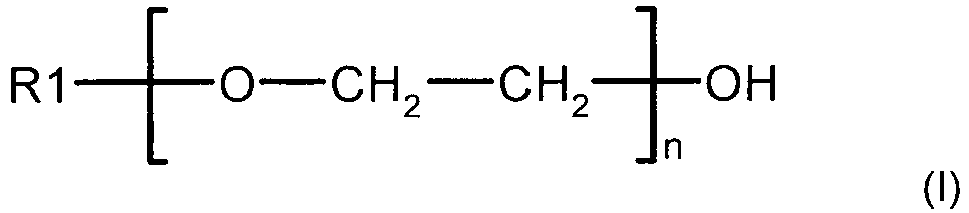
- R1 für eine unverzweigte oder verzweigte, gesättige oder ungesättigte C12-C28-Alkylgruppe, bevorzugt für eine gesättigte, unverzweigte C16- oder C18- Alkylgruppe, steht und
- n für eine ganze Zahl von 80 bis 120, bevorzugt für eine ganze Zahl von 85 bis 115, weiter bevorzugt für eine ganze Zahl von 90 bis 110 und besonders bevorzugt für eine ganze Zahl von 95 bis 105 steht.
- Zur Erzielung einer maximalen Geruchsabdeckung werden auch die langkettigen Fettalkohole (b2) und die ethoxylierten Fettalkohole (b4) der Formel (I) in einem optimierten Gewichtsverhältnis zueinander eingesetzt. Von Vorteil es in diesem Zusammenhang, wenn der Fettalkohol (b2) in größerer Menge als der ethoxylierte Fettalkhol (b4) eingesetzt wird.
- Wird dagegen der ethoxylierte Fettalkohol (b4) im Vergleich zum langkettigen Fettalkohol (b2) im Überschuss eingesetzt, so ist wieder eine Verschlechterung der geruchlichen Abdeckung zu beobachten.
- Aus diesem Grund ist eine weitere besonders bevorzugte Mehrkomponenten-Verpackungseinheit dadurch gekennzeichnet, dass die Zusammensetzung (B) den oder die Fettalkohole (b2) und den oder die ethoxylierten Fettalkohole (b4) der Formel (I) in einem Gewichtsverhältnis (b2)/(b4) von 10:1 bis 1:1, bevorzugt von 5:1 bis 1:1, weiter bevorzugt von 4:1 bis 1:1 und besonders bevorzugt von 3:1 bis 2:1 enthält.
- Das Gewichtsverhältnis (b2)/(b4) beziffert hierbei das Gewichtsverhältnis aus der Gesamtmenge aller in der Formulierung (B) enthaltenen langkettigen Fettalkohole (b2) zu der Gesamtmenge aller in der Formulierung (B) enthaltenen ethoxylierten Fettalkohole (b4) der Formel (I).
- Von besonderem Vorteil zur Lösung der erfindungsgemäßen Aufgabenstellung ist es auch wenn die Kohlenwasserstoffe (b3) und die ethoxylierten Fettalkohole (b4) der Formel (I) in bestimmten Gewichtsverhältnissen zueinander eingesetzt werden.
- Damit ist eine weitere besonders bevorzugte Mehrkomponenten-Verpackungseinheit (Kit-of-parts), dadurch gekennzeichnet, dass die Zusammensetzung (B) den oder die aliphatischen Kohlenwasserstoffe (b3) und den oder die ethoxylierten Fettalkohole (b4) in einem Gewichtsverhältnis (b3)/(b4) von 5:1 bis 1:5, bevorzugt von 3:1 bis 1:3, weiter bevorzugt von 2:1 bis 1:2 und besonders bevorzugt von 2:1 bis 1:1 enthält.
- In einer weiteren Ausführungsformen ist eine Mehrkomponenten-Verpackungseinheit besonders bevorzugt, umfassend zwei getrennt voneinander verpackte Zubereitungen (A) und (B),wobei
- (a) die Zubereitung (A) in einem kosmetischen Träger
- (a1) mindestens ein Oxidationsfarbstoffvorprodukt und
- (a2) Ammoniak enthält, und
- (b) die Zubereitung (B) in einem kosmetischen Träger
- (b1) Wasserstoffperoxid
- (b2) mindestens einen Fettalkohol aus der Gruppe Arachylalkohol (Eicosan-1-ol), Gadoleylalkohol ((9Z)-Eicos-9-en-1-ol), Arachidonalkohol ((5Z,8Z,11Z,14Z)-Eicosa-5,8,11,14-tetraen-1-ol), Heneicosylalkohol (Heneicosan-1-ol), Behenylalkohol (Docosan-1-ol), Erucylalkohol ((13Z)-Docos-13-en-1-ol) und/oder Brassidylalkohol ((13E)-Docosen-1-ol),
- (b3) mindestens einen Kohlenwasserstoff mit 8 bis 80 C-Atomen und
- (b4) mindestens einen ethoxylierten Fettalkohol der Formel (I) enthält,

- R1 für eine unverzweigte oder verzweigte, gesättige oder ungesättigte C12-C28-Alkylgruppe, bevorzugt für eine gesättigte, unverzweigte C16- oder C18- Alkylgruppe, steht und
- n für eine ganze Zahl von 80 bis 120, bevorzugt für eine ganze Zahl von 85 bis 115, weiter bevorzugt für eine ganze Zahl von 90 bis 110 und besonders bevorzugt für eine ganze Zahl von 95 bis 105 steht, und die Zubereitung (B) den oder die Fettalkohole (b2) und den oder die Kohlenwasserstoffe (b3) in einem Gewichtsverhältnis (b2)/(b3) von 15:1 bis 1:1, bevorzugt von 10:1 bis 1:1, weiter bevorzugt von 7:1 bis 1:1 und besonders bevorzugt von 3:1 bis 2:1 enthält.
- In einer weiteren Ausführungsformen ist eine Mehrkomponenten-Verpackungseinheit besonders bevorzugt, umfassend zwei getrennt voneinander verpackte Zubereitungen (A) und (B), wobei
- (a) die Zubereitung (A) in einem kosmetischen Träger
- (a1) mindestens ein Oxidationsfarbstoffvorprodukt und
- (a2) Ammoniak enthält, und
- (b) die Zubereitung (B) in einem kosmetischen Träger
- (b1) Wasserstoffperoxid
- (b2) mindestens einen Fettalkohol aus der Gruppe Arachylalkohol (Eicosan-1-ol), Gadoleylalkohol ((9Z)-Eicos-9-en-1-ol), Arachidonalkohol ((5Z,8Z,11Z,14Z)-Eicosa-5,8,11,14-tetraen-1-ol), Heneicosylalkohol (Heneicosan-1-ol), Behenylalkohol (Docosan-1-ol), Erucylalkohol ((13Z)-Docos-13-en-1-ol) und/oder Brassidylalkohol ((13E)-Docosen-1-ol),
- (b3) mindestens einen Kohlenwasserstoff mit 8 bis 80 C-Atomen und
- (b4) mindestens einen ethoxylierten Fettalkohol der Formel (I) enthält,

- R1 für eine unverzweigte oder verzweigte, gesättige oder ungesättigte C12-C28-Alkylgruppe, bevorzugt für eine gesättigte, unverzweigte C16- oder C18- Alkylgruppe, steht und
- n für eine ganze Zahl von 80 bis 120, bevorzugt für eine ganze Zahl von 85 bis 115, weiter bevorzugt für eine ganze Zahl von 90 bis 110 und besonders bevorzugt für eine ganze Zahl von 95 bis 105 steht, und die Zusammensetzung (B) den oder die Fettalkohole (b2) und den oder die ethoxylierten Fettalkohole (b4) der Formel (I) in einem Gewichtsverhältnis (b2)/(b4) von 10:1 bis 1:1, bevorzugt von 5:1 bis 1:1, weiter bevorzugt von 4:1 bis 1:1 und besonders bevorzugt von 3:1 bis 2:1 enthält.
- In einer weiteren Ausführungsformen ist eine Mehrkomponenten-Verpackungseinheit besonders bevorzugt, umfassend zwei getrennt voneinander verpackte Zubereitungen (A) und (B), wobei
- (a) die Zubereitung (A) in einem kosmetischen Träger
- (a1) mindestens ein Oxidationsfarbstoffvorprodukt und
- (a2) Ammoniak enthält, und
- (b) die Zubereitung (B) in einem kosmetischen Träger
- (b1) Wasserstoffperoxid
- (b2) mindestens einen Fettalkohol aus der Gruppe Arachylalkohol (Eicosan-1-ol), Gadoleylalkohol ((9Z)-Eicos-9-en-1-ol), Arachidonalkohol ((5Z,8Z,11Z,14Z)-Eicosa-5,8,11,14-tetraen-1-ol), Heneicosylalkohol (Heneicosan-1-ol), Behenylalkohol (Docosan-1-ol), Erucylalkohol ((13Z)-Docos-13-en-1-ol) und/oder Brassidylalkohol ((13E)-Docosen-1-ol),
- (b3) mindestens einen Kohlenwasserstoff mit 8 bis 80 C-Atomen und
- (b4) mindestens einen ethoxylierten Fettalkohol der Formel (I) enthält,

- R1 für eine unverzweigte oder verzweigte, gesättige oder ungesättigte C12-C28-Alkylgruppe, bevorzugt für eine gesättigte, unverzweigte C16- oder C18- Alkylgruppe, steht und
- n für eine ganze Zahl von 80 bis 120, bevorzugt für eine ganze Zahl von 85 bis 115, weiter bevorzugt für eine ganze Zahl von 90 bis 110 und besonders bevorzugt für eine ganze Zahl von 95 bis 105 steht, und die Zusammensetzung (B) den oder die Kohlenwasserstoffe (b3) und den oder die ethoxylierten Fettalkohole (b4) in einem Gewichtsverhältnis (b3)/(b4) von 5:1 bis 1:5, bevorzugt von 3:1 bis 1:3, weiter bevorzugt von 2:1 bis 1:2 und besonders bevorzugt von 2:1 bis 1:1 enthält.
- Der in der Zubereitung (A) enthaltene Ammoniak dient sowohl als Alkalisierungsmittel als auch als Quell- und Penetrationsmittel. Nach dem Wissen des Fachmanns hat die Reduktion des Ammoniak-Gehaltes generell eine schlechtere Quellung der Keratinfaser und im Zusammenhang damit auch eine schlechtere Penetrationsfähigkeit der Oxidationsfarbstoffvorprodukte in die Keratinfaser hinein zur Folge. Aus diesem Grund ist der teilweise Ersatz von Ammoniak durch ein anderes Alkalisierungsmittel (wie Alkanolamine, Carbonate oder basische Aminosäuren) im Regelfall mit einem Performanceverlust des Oxidationsfärbemittels verbunden und aus diesem Grund nicht wünschenswert. Es ist daher bevorzugt, wenn die Komponente (A) keine Alkanolamine, keine Carbonatsalze, keine Hydrogencarbonatsalze und keine basischen Aminosäuren enthält.
- Eine weitere bevorzugteMehrkomponenten-Verpackungseinheit (Kit-of-parts) ist daher dadurch gekennzeichnet, dass die Zubereitung (A) frei von Alkanolaminen ist.
- Unter Alkanolaminen sind aliphatische C1-C10-Alkylamine zu verstehen, die ein bis drei Hydroxygruppen tragen (wie beispielsweise Hydroxy-C1-C10-Alkylamine, Di(Hydroxy-C1-C5-alkyl)amine oder Tri(hydroxy-C1-C3-alkyl)amine). Als Beispiele für Alkanolamine können insbesondere Monoethanolamin, 2-Amino-2-methylpropanol und Triethanolamin genannt werden.
- Unter der Definition "frei von Alkanolaminen" werden in diesem Kontext die Zubereitungen (A) verstanden, die weniger als 0,2 Gew.-%, weiter bevorzugt weniger als 0,1 Gew.-%, noch weiter bevorzugt weniger als 0,05 Gew.-% und besonders bevorzugt weniger als 0,01 Gew.-% - bezogen auf das Gesamtgewicht der Zubereitung (A) - an Alkanolaminen enthalten.
- Eine weitere bevorzugteMehrkomponenten-Verpackungseinheit (Kit-of-parts) ist dadurch gekennzeichnet, dass die Zubereitung (A) frei von Natriumcarbonat, Natriumhydrogencarbonat, Kaliumcarbonat, Kaliumhydrogencarbonat, Magnesiumcarbonat, Magnesiumhydrogencarbonat, Ammoniumcarbonat und Ammoniumhydrogencarbonat ist.
- Unter der Definition "frei von Carbonaten" werden in diesem Kontext die Zubereitungen (A) verstanden, deren Gesamtgehalt an Natriumcarbonat, Natriumhydrogencarbonat, Kaliumcarbonat, Kaliumhydrogencarbonat, Magnesiumcarbonat, Magnesiumhydrogencarbonat, Ammoniumcarbonat und Ammoniumhydrogencarbonat unterhalb von 0,2 Gew.-%, weiter bevorzugt unterhalb von 0,1 Gew.-%, noch weiter bevorzugt unterhalb von 0,05 Gew.-% und besonders bevorzugt unterhalb von 0,01 Gew.-% - bezogen auf das Gesamtgewicht der Zubereitung (A) - liegt.
- Eine weitere bevorzugteMehrkomponenten-Verpackungseinheit (Kit-of-parts) ist dadurch gekennzeichnet, dass die Zubereitung (A) frei von den basischen Aminosäuren Arginin, Lysin, Ornithin und Histidin ist.
- Unter der Definition "frei von basischen Aminosäuren" werden in diesem Kontext die Zubereitungen (A) verstanden, deren Gesamtgehalt an Arginin, Lysin, Ornithin und Histidin unterhalb von 0,2 Gew.-%, bevorzugt unterhalb von 0,1 Gew.-%, weiter bevorzugt unterhalb von 0,05 Gew.-% und besonders bevorzugt unterhalb von 0,01 Gew.-% - bezogen auf das Gesamtgewicht der Zubereitung (A) - liegt.
- In einer weiteren bevorzugten Ausführungsform ist eine erfindungsgemäße Mehrkomponenten-Verpackungseinheit (Kit-of-parts) dadurch gekennzeichnet, dass
- die Zubereitung (A) kein Oxidationsmittel enthält und
- die Zubereitung (B) neben Wasserstoffperoxid kein weiteres Oxidationsmittel enthält.
- Die anwendungsbereiten oxidativen Farbänderungsmittel können weiterhin zusätzliche Wirk-, Hilfs- und Zusatzstoffe enthalten, um die Färbe- bzw. Aufhellleistung zu verbessern und weitere gewünschte Eigenschaften der Mittel einzustellen.
- Hierbei können die im folgenden genannten weiteren fakultativen Inhaltsstoffe in der Zubereitung (A) und/oder in der Zubereitung (B) der erfindugnsgemäßen Mehrkomponenten-Verpackungseinheit enthalten sein.
- Vorzugsweise werden die anwendungsbereiten Färbemittel als flüssige Zubereitung bereitgestellt und den Mitteln daher gegebenenfalls zusätzlich eine weitere oberflächenaktive Substanz zugesetzt, wobei solche oberflächenaktive Substanzen je nach Anwendungsgebiet als Tenside oder als Emulgatoren bezeichnet werden: Sie sind bevorzugt aus anionischen, zwitterionischen, amphoteren und nichtionischen Tensiden und Emulgatoren ausgewählt.
- Erfindungsgemäß geeignete Mittel sind dadurch gekennzeichnet, dass das Mittel zusätzlich mindestens ein anionisches Tensid enthält. Bevorzugte anionische Tenside sind Fettsäuren, Alkylsulfate, Alkylethersulfate und Ethercarbonsäuren mit 10 bis 20 C-Atomen in der Alkylgruppe und bis zu 16 Glykolethergruppen im Molekül.
- Erfindungsgemäß geeignete Mittel sind dadurch gekennzeichnet, dass das Mittel zusätzlich mindestens ein zwitterionisches Tensid enthält. Bevorzugte zwitterionische Tenside sind Betaine, N-Alkyl-N,N-dimethylammonium-glycinate, N-Acyl-aminopropyl-N,N-dimethylammoniumglycinate, und 2-Alkyl-3-carboxymethyl-3-hydroxyethyl-imidazoline. Ein bevorzugtes zwitterionisches Tensid ist unter der INCI-Bezeichnung Cocamidopropyl Betaine bekannt.
- Erfindungsgemäß geeignete Mittel sind dadurch gekennzeichnet, dass das Mittel zusätzlich mindestens ein amphoteres Tensid enthält. Bevorzugte amphotere Tenside sind N-Alkylglycine, N-Alkylpropionsäuren, N-Alkylaminobuttersäuren, N-Alkyliminodipropionsäuren, N-Hydroxyethyl-N-alkylamidopropylglycine, N-Alkyltaurine, N-Alkylsarcosine, 2-Alkylaminopropionsäuren und Alkylaminoessigsäuren. Besonders bevorzugte amphotere Tenside sind N-Kokosalkylaminopropionat, as Kokosacylaminoethylaminopropionat und C12-C18-Acylsarcosin.
- Weiterhin hat es sich als vorteilhaft erwiesen, wenn die Mittel weitere, nichtionogene grenzflächenaktive Stoffe, enthalten. Bevorzugte nichtionische Tenside sind Alkylpolyglykoside sowie Alkylenoxid-Anlagerungsprodukte an Fettalkohole und Fettsäuren mit jeweils 2 bis 30 Mol Ethylenoxid pro Mol Fettalkohol bzw. Fettsäure erwiesen. Zubereitungen mit hervorragenden Eigenschaften werden ebenfalls erhalten, wenn sie als nichtionische Tenside Fettsäureester von ethoxyliertem Glycerin enthalten.
- Die nichtionischen, zwitterionischen oder amphoteren Tenside werden in Anteilen von 0,1 bis 45 Gew.%, bevorzugt 1 bis 30 Gew.% und ganz besonders bevorzugt von 1 bis 15 Gew.%, bezogen auf die Gesamtmenge der anwendungsbereiten Mittel, eingesetzt.
- Die anwendungsbereiten Farbveränderungsmittel können auch mindestens ein Verdickungsmittel enthalten. Bezüglich dieser Verdickungsmittel bestehen keine prinzipiellen Einschränkungen. Es können sowohl organische als auch rein anorganische Verdickungsmittel zum Einsatz kommen.
- Geeignete Verdickungsmittel sind anionische, synthetische Polymere, kationische, synthetische Polymere, natürlich vorkommende Verdickungsmittel, wie nichtionische Guargums, Skleroglucangums oder Xanthangums, Gummi arabicum, Ghatti-Gummi, Karaya-Gummi, Tragant-Gummi, Carrageen-Gummi, Agar-Agar, Johannisbrotkernmehl, Pektine, Alginate, Stärke-Fraktionen und Derivate wie Amylose, Amylopektin und Dextrine, sowie Cellulosederivate, wie beispielsweise Methylcellulose, Carboxyalkylcellulosen und Hydroxyalkylcellulosen, nichtionische, vollsynthetische Polymere, wie Polyvinylalkohol oder Polyvinylpyrrolidinon; sowie anorganische Verdickungsmittel, insbesondere Schichtsilikate wie beispielsweise Bentonit, besonders Smektite, wie Montmorillonit oder Hectorit.
- Weiterhin hat es sich als vorteilhaft erweisen, wenn die Färbemittel, insbesondere wenn sie zusätzlich Wasserstoffperoxid enthalten, mindestens einen Stabilisator oder Komplexbildner enthalten. Besonders bevorzugte Stabilisatoren sind Phenacetin, Alkalibenzoate (Natriumbenzoat) und Salicylsäure. Weiterhin können alle Komplexbildner des Standes der Technik eingesetzt werden. Erfindungsgemäß bevorzugte Komplexbildner sind stickstoffhaltigen Polycarbonsäuren, insbesondere EDTA und EDDS, und Phosphonate, insbesondere 1-Hydroxyethan-1,1-diphosphonat (HEDP) und/oder Ethylendiamintetramethylenphosphonat (EDTMP) und/oder Diethylentriaminpentamethylenphosphonat (DTPMP) bzw. deren Natriumsalze.
- Ferner können die erfindungsgemäßen Mittel weitere Wirk-, Hilfs- und Zusatzstoffe enthalten, wie beispielsweise nichtionische Polymere wie beispielsweise Vinylpyrrolidinon/Vinylacrylat-Copolymere, Polyvinylpyrrolidinon, Vinylpyrrolidinon/Vinylacetat-Copolymere, Polyethylenglykole und Polysiloxane; zusätzliche Silikone wie flüchtige oder nicht flüchtige, geradkettige, verzweigte oder cyclische, vernetzte oder nicht vernetzte Polyalkylsiloxane (wie Dimethicone oder Cyclomethicone), Polyarylsiloxane und/oder Polyalkylarylsiloxane, insbesondere Polysiloxane mit organofunktionelle Gruppen, wie substituierten oder unsubstituierten Aminen (Amodimethicone), Carboxyl-, Alkoxy- und/oder Hydroxylgruppen (Dimethiconcopolyole), lineare Polysiloxan(A)-Polyoxyalkylen(B)-Blockcopolymere, gepfropften Silikonpolymere; kationische Polymere wie quaternisierte Celluloseether, Polysiloxane mit quaternären Gruppen, Dimethyldiallylammoniumchlorid-Polymere, Acrylamid-Dimethyldiallylammoniumchlorid-Copolymere, mit Diethylsulfat quaternierte Dimethylamino-ethylmethacrylat-Vinylpyrrolidinon-Copolymere, Vinylpyrrolidinon-Imidazolinium-methochlorid-Copolymere und quaternierter Polyvinylalkohol; zwitterionische und amphotere Polymere; anionische Polymere wie beispielsweise Polyacrylsäuren oder vernetzte Polyacrylsäuren; Strukturanten wie Glucose, Maleinsäure und Milchsäure, haarkonditionierende Verbindungen wie Phospholipide, beispielsweise Lecitin und Kephaline; Parfümöle, Dimethylisosorbid und Cyclodextrine; faserstrukturverbessernde Wirkstoffe, insbesondere Mono-, Di- und Oligosaccharide wie beispielsweise Glucose, Galactose, Fructose, Fruchtzucker und Lactose; Farbstoffe zum Anfärben des Mittels; Antischuppenwirkstoffe wie Piroctone Olamine, Zink Omadine und Climbazol; Aminosäuren und Oligopeptide; Proteinhydrolysate auf tierischer und/oder pflanzlicher Basis, sowie in Form ihrer Fettsäure-Kondensationsprodukte oder gegebenenfalls anionisch oder kationisch modifizierten Derivate; pflanzliche Öle; Lichtschutzmittel und UV-Blocker; Wirkstoffe wie Panthenol, Pantothensäure, Pantolacton, Allantoin, Pyrrolidinoncarbonsäuren und deren Salze sowie Bisabolol; Polyphenole, insbesondere Hydroxyzimtsäuren, 6,7-Dihydroxycumarine, Hydroxybenzoesäuren, Catechine, Tannine, Leukoanthocyanidine, Anthocyanidine, Flavanone, Flavone und Flavonole; Ceramide oder Pseudoceramide; Vitamine, Provitamine und Vitaminvorstufen; Pflanzenextrakte; Fette und Wachse wie Fettalkohole, Bienenwachs, Montanwachs und Paraffine; Quell- und Penetrationsstoffe wie Glycerin, Propylenglykolmonoethylether, Carbonate, Hydrogencarbonate, Guanidine, Harnstoffe sowie primäre, sekundäre und tertiäre Phosphate; Trübungsmittel wie Latex, Styrol/PVP- und Styrol/Acrylamid-Copolymere; Perlglanzmittel wie Ethylenglykolmono- und - distearat sowie PEG-3-distearat; Pigmente sowie Treibmittel wie Propan-Butan-Gemische, N2O, Dimethylether, CO2 und Luft.
- Die Auswahl dieser weiteren Stoffe wird der Fachmann gemäß der gewünschten Eigenschaften der Mittel treffen. Bezüglich weiterer fakultativer Komponenten sowie der eingesetzten Mengen dieser Komponenten wird ausdrücklich auf die dem Fachmann bekannten einschlägigen Handbücher verwiesen. Die zusätzlichen Wirk- und Hilfsstoffe werden in den erfindungsgemäßen Mitteln bevorzugt in Mengen von jeweils 0,0001 bis 25 Gew.-%, insbesondere von 0,0005 bis 15 Gew.-%, bezogen auf das Gesamtgewicht der Anwendungsmischung, eingesetzt.
- Kurz vor der Anwendung wird das anwendungsbereite Oxidationsfärbemittel durch Vermischen, (d.h. verschütteln, verrühren oder verquirlen) der beiden Zubereitungen (A) und (B) hergestellt.
- Enthält die erfindungsgemäße Mehrkomponenten-Verpackungseinheit mehr als zwei Komponenten, wird die Anwendungsmischung durch Vermischen der Zubereitung (A) und (B) sowie aller gegebenenfalls noch vorhandenen Komponenten (z.B. durch Vermischen der Zubereitungen (A), (B) und (C), oder durch Vermischen der Zubereitungen (A), (B), (C) und (D)) hergestellt. Da der Mischvorgang (d.h. das In-Kontakt-bringen der Oxidationsfarbsotffvorprodukte mit dem Oxdationsmittel) die Farbstoffbildungsreaktion initiiert, wird die Anwendungsformulierung in der Regel nach Möglichkeit direkt nach dem Mischvorgang auf die Keratinfasern appliziert.
- In einer bevorzugten Ausführungsform wird die Anwendungsmischung durch das Vermischen von zwei Zubereitungen (A) und (B) hergestellt.
- Üblicherweise werden die beiden Zubereitungen (A) und (B) in gleichen Mengen eingsetzt. In diesem Fall ergibt sich die Anwendungsmischung durch Vermischen der Zubereitungen (A) und (B) im Gewichtsverhältnis 1:1. Mischungsverhältnisse (A)/(B) von 3:1 bis 3:1 sind jedoch ebenfalls möglich und erfindungsgemäß.
- Ein weiterer Gegenstand der vorliegenden Erfindung ist daher ein Verfahren zum oxidativen Färben von keratinischen Fasern, umfassend die folgenden Schritte in der angegebenen Reihenfolge:
- (i) Vermischen von zwei getrennt voneinander verpackten Zubereitungen (A) und (B) einer Mehrkomponenten-Verpackungseinheit des ersten Erfindungsgegenstands zu einem anwendungsbereiten oxidativen Färbemittel,
- (ii) Anwendung des oxidativen Färbemittels auf keratinischen Fasern für einen Zeitraum von 1 bis 60 Minuten,
- (I) Abspülen des oxidativen Färbemittels.
- Eine weitere Ausführungsform ist auch ein Verafhren zum oxidativen Färben von keratinischen Fasern, umfassend die folgenden Schritte in der angegebenen Reihenfolge:
- (i) Vermischen von zwei getrennt voneinander verpackten Zubereitungen (A) und (B) einer Mehrkomponenten-Verpackungseinheit des ersten Erfindungsgegenstands im Mischungsverhältnis 3:1 bis 1:3, bevorzugt 2:1 bis 1:2 und besonders bevorzugt im Mischungsverhältnis 1:1,
- (ii) Anwendung des oxidativen Färbemittels auf keratinischen Fasern für einen Zeitraum von 1 bis 60 Minuten,
- (I) Abspülen des oxidativen Färbemittels.
- Bei Vermischen der Färbezubereitung (A) mit der Oxidationsmittelzubereitung (B) bildet sich eine Emulsion aus, bei welcher der Ammoniak geruchlich nur wenig wahrnehmbar ist. Überraschenderweise wurde hierbei für den Mischvorgang eine Zeitabhängigkeit festgestellt. So wurde herausgefunden, dass die Geruchsminimierung dann besonders effektiv ist, wenn die Zubereitung (B), welche die langkettigen Fettalkohole (b2) und die Kohlenwasserstoffe (b3) (sowie gegebenenfalls die ethoxylierten Fettalkohole (b4) der Formel (I)) enthält, mit der Zubereitung (A) für mindestens 5, besser mindestens 10 und noch besser mindestens 15 Sekunden vermischt wird.
- Eine besonders bevorzugte Ausführungsform ist daher ein Verfahren zum oxidativen Färben von keratinischen Fasern, welches dadurch gekennzeichnet ist, dass
- (i) die Zubereitungen (A) und (B) für einen Zeitraum von 5 bis 60 Sekunden, bevorzugt für einen Zeitraum von 10 bis 50 Sekunden und besonders bevorzugt für einen Zeitraum von 15 bis 40 Sekunden miteinander vermischt werden.
- Ein noch längerer Mischvorgang wirkt sich ebenfalls vorteilhaft auf die Geruchsreduktion aus, jedoch wird der Verbraucher aus Gründen des Anwenderkomforts die Zubereitungen (A) und (B) nicht länger als 60 Sekunden vermischen.
- Auch wenn gleich nach dem Vermischen die Farbstoffbildungsreaktion beginnt, so ist es hinsichtlich der geruchlichen Eigenschaften der Anwendungsformulierung doch von Vorteil, wenn die zuvor aus (A) und (B) hergestellte Anwendungsformulierung noch für einen Zeitraum von 20 Sekunden bis zu wenigen Minuten in der geschlossenen Applikationsflasche stehen oder ruhen gelassen wird, bevor mit der Applikation begonnen wird.
- Ein Zeitraum zwischen dem Ende des Vermischens (i) und dem Beginn der Anwendung (ii), der zwischen 20 Sekunden und 5 Minuten, bevorzugt zwischen 30 Sekunden und 4 Minuten und ganz besonders bevorzugt zwischen 40 Sekunden und 2 Minuten hat sich als der optimale Kompromiss herausgestellt, um sowohl den Ammoniak-Geruch optimal zu überdecken als auch das spätere Farbergebnis nicht nachteilig zu verändern.
- Eine ganz besonders bevorzugte Ausführungsform ist daher weiterhin ein erfindungsgemäßes Verfahren, welches dadurch gekennzeichnet ist, dass zwischen dem Vermischen der Zubereitungen (A) und (B) in Schritt (i) und dem Beginn der Anwendung in Schritt (ii) ein Zeitraum von 20 Sekunden bis 5 Minuten, bevorzugt ein Zeitraum von 30 Sekunden bis 4 Minuten und besonders bevorzugt ein Zeitraum von 40 Sekunden bis 2 Minuten liegt.
- Die erfindungsgemäßen Mehrkomponenten-Kits des ersten Gegenstands sind oxidative Färbemittel, welche sich dadurch auszeichnen, dass sie bei sehr guter Färbeleistung und hervorragenden Echtheitseigenschaften nur geringen Ammoniak-Geruch verströmen. Der Anwender kann somit die Haare intensiv und langenhaltend färben, nimmt während -der Anwendung jedoch keinen starken Ammoniak-Geruch war.
- Bezüglich weiterer bevorzugter Ausführungsformen des erfindungsgemäßen Verfahrens gilt mutatis mutandis das zu den erfindungsgemäßen Mitteln Gesagte.
- Es wurde die folgende Zubereitung (A) hergestellt:
Zubereitung A, Formulierungsbestandteile (Gew.-%) Lanette D [1] 9,00 Lorol C12-C18 techn. [2] 3,00 Texapon NSO [3] 11,00 Plantapon LGC Sorb [4] 5,00 Eumulgin B1 [5] 0,50 Ceteareth-20 [6] 0,50 Myristinsäure (Tetradecansäure) 0,50 Produkt W 37194 [7] 2,00 Kaliumhydroxid 1,05 Natriumsulfit 0,30 Vitamin C 0,05 Hydroxyethan-1,1-diphosphonsäure (60 % in Wasser) 0,20 Ammoniak (25 %ige wässrige Lösung) 5,80 p-Toluylendiamin, Sulfat 1,50 Resorcin 0,60 m-Aminophenol 0,20 3-Amino-2-methylamino-6-methoxypyridin 0,05 Wasser (dest) ad 100 [1] C16-C18-Fettalkohol (INCI-Bezeichnung: Cetearyl alcohol) (Cognis)
[2] C12-C18-Fettalkohol (INCI-Bezeichnung: Coconut alcohol) (Cognis)
[3] Natriumlaurylethersulfat, ethoxyliert mit 2 EO (wässrige Lösung, Gehalt Aktivsubstanz 27 Gew.-%)
[4] Laruylglucoside (10-20 Gew.-%), Natriumlaurylglucose Carboxylate (15-25 Gew.-%), Wasser (62 - 67 Gew.-%)
[5] C16-C18-Fettalkohol, ethoxyliert (12 EO) (INCI-Bezeichnung: Ceteareth-12) (BASF)
[6] C16-C18-Fettalkohol, ethoxyliert (20 EO)
[7] N,N,N-Trimethyl-3-[(1-oxo-2-propenyl)amino]-1-propanaminiumchloride, Polymer mit Natrium 2-Propenoat) (INCI: Acrylamidopropyltrimonium chloride /Acrylate Copolymer), 20 Gew.-%ige wässrige Lösung - Es wurden die folgenden Zubereitungen B hergestellt:
Zubereitung B, Formulierungsbestandteile V (Gew.-%) E (Gew.-%) Cetearylalkohol 1,80 3,70 Behenylalkohol --- 1,30 PEG-40 Castor Oil 0,40 ---- Paraffinium Liquidum --- 0,65 Natriumcetearylsulfat 0,20 --- Steareth-100 --- 0,60 Ceteareth-30 (C16-C18-Fettalkohol, ethoxyliert (30 EO) --- 0,50 Glyceryl Monostearat --- 0,50 Hydroxyethan-1,1-diphosphonsäure (60 % in Wasser) 0,25 0,25 Cocoamidopropylbetain (32 %ige Lösung in Wasser) 0,40 0,40 Dinatriumpyrophosphat 0,20 0,20 Wasserstoffperoxid (50 %ige Lösung in Wasser) 12,0 12,0 Wasser (dest.) ad 100 ad 100 - Die Zubereitung (A) und die Zubereitung (B) wurde jeweils im Gewichtsverhältnis 1:1 miteinander für 30 Sekunden in einer geschlossenen Applikationsflasche verschüttelt. Die aus der Zubereitungen (A) und der Vergleichsformulierung (B) hergestellte Zubereitung wurde direkt auf Haaren appliziert. Die aus der Zubereitung (A) und der erfindungsgemäßen Zubereitung (B) hergestellte Anwendungsmischung wurde zunächst für 2 Minuten in der geschlossenen Applikationsflasche stehen gelassen und dann auf Haaren appliziert.
- Jeweils 10 Minuten nach Beginn des Auftragens der jeweiligen Anwendungsmischungen auf das Haar wurde der Ammoniak-Geruch von jeweils 5 geschulten Personen bewertet. Die Bewertung erfolgte blind, was bedeutet, dass den Personen, die die Bewertung vornahmen, nicht bekannt war, welche Rezeptur sie gerade bewerteten. Aus den Einzelbewertungen wurde jeweils der Mittelwert gebildet.
- Der Ammoniak-Geruch wurde auf einer Skala von 0 (quasi kein Geruch wahrnehmbar) bis 10 (sehr starker Ammoniak-Geruch) bewertet.
Tabelle 4: Ammoniak-Geruch während der Anwendung A + B (Vergleich) A + B (erfindungsgemäß) Ammoniak-Abdeckung 5 3 - Es zeigt sich, dass der Ammoniak-Geruch bei Anwendung der erfindungsgemäßen Anwendungsformulierung als deutlich reduziert wahrgenommen wurde.
Claims (14)
- Mehrkomponenten-Verpackungseinheit (Kit-of-parts) zum oxidativen Färben von keratinischen Fasern, umfassend zwei getrennt voneinander verpackte Zubereitungen (A) und (B), wobei(a) die Zubereitung (A) in einem kosmetischen Träger(a1) mindestens ein Oxidationsfarbstoffvorprodukt und(a2) Ammoniakenthält, und(b) die Zubereitung (B) in einem kosmetischen Träger(b1) Wasserstoffperoxid(b2) mindestens einen Fettalkohol aus der Gruppe Arachylalkohol (Eicosan-1-ol), Gadoleylalkohol ((9Z)-Eicos-9-en-1-ol), Arachidonalkohol ((5Z,8Z,11Z,14Z)-Eicosa-5,8,11,14-tetraen-1-ol), Heneicosylalkohol (Heneicosan-1-ol), Behenylalkohol (Docosan-1-ol), Erucylalkohol ((13Z)-Docos-13-en-1-ol) und/oder Brassidylalkohol ((13E)-Docosen-1-ol),(b3) mindestens einen Kohlenwasserstoff mit 8 bis 80 C-Atomen und(b4) mindestens einen ethoxylierten Fettalkohol der Formel (I),enthält.
 R1 für eine unverzweigte oder verzweigte, gesättigte oder ungesättigte C12-C28-Alkylgruppe steht undn für eine ganze Zahl von 80 bis 120 steht,
 - Mehrkomponenten-Verpackungseinheit (Kit-of-parts) nach Anspruch 1, dadurch gekennzeichnet, dass die Zubereitung (B) als Fettalkohol(e) (b2) Arachylalkohol (Eicosan-1-ol) und/oder Behenylalkohol (Docosan-1-ol) in einer Gesamtmenge von 0,2 bis 6,4 Gew.-%, bevorzugt von 0,3 bis 4,4 Gew.-%, weiter bevorzugt von 0,4 bis 2,4 Gew.-% und besonders bevorzugt von 0,5 bis 1,4 Gew.-% - bezogen auf das Gesamtgewicht der Zubereitung (B) - enthält.
- Mehrkomponenten-Verpackungseinheit (Kit-of-parts) nach einem der Ansprüche 1 bis 2, dadurch gekennzeichnet, dass die Zubereitung (B) als Kohlenwasserstoff(e) (b3) ein oder mehrere Paraffinöle und/oder ein oder mehrere Paraffinwachse in einer Gesamtmenge von 0,1 bis 4,5 Gew.-%, bevorzugt von 0,2 bis 3,2 Gew.-%, weiter bevorzugt von 0,3 bis 1,8 Gew.-% und besonders bevorzugt von 0,4 bis 0,9 Gew.-% - bezogen auf das Gesamtgewicht der Zubereitung (B) - enthält.
- Mehrkomponenten-Verpackungseinheit (Kit-of-parts) nach einem der Ansprüche 1 bis 3, dadurch gekennzeichnet, dass die Zubereitung (B) den oder die Fettalkohole (b2) und den oder die Kohlenwasserstoffe (b3) in einem Gewichtsverhältnis (b2)/(b3) von 15:1 bis 1:1, bevorzugt von 10:1 bis 1:1, weiter bevorzugt von 7:1 bis 1:1 und besonders bevorzugt von 3:1 bis 2:1 enthält.
- Mehrkomponenten-Verpackungseinheit (Kit-of-parts) nach einem der Ansprüche 1 bis 4, dadurch gekennzeichnet, dass die Zubereitung (B) zusätzlich(b4) mindestens einen ethoxylierten Fettalkohol der Formel (I) enthält,
 R1 für eine unverzweigte oder verzweigte, gesättigte oder ungesättigte C12-C28-Alkylgruppe, bevorzugt für eine gesättigte, unverzweigte C16- oder C18- Alkylgruppe, steht undn für eine ganze Zahl von 85 bis 115, weiter bevorzugt für eine ganze Zahl von 90 bis 110 und besonders bevorzugt für eine ganze Zahl von 95 bis 105 steht.
 - Mehrkomponenten-Verpackungseinheit (Kit-of-parts) nach einem der Ansprüche 1 bis 5, dadurch gekennzeichnet, dass die Zubereitung (B) ein oder mehrere ethoxylierte Fettalkohole (b4) der Formel (I) in einer Gesamtmenge von 0,1 bis 5,5 Gew.-%, bevorzugt von 0,2 bis 3,8 Gew.-%, weiter bevorzugt von 0,3 bis 2,6 Gew.-% und besonders bevorzugt von 0,4 bis 1,1 Gew.-% - bezogen auf das Gesamtgewicht der Zubereitung (B) - enthält.
- Mehrkomponenten-Verpackungseinheit (Kit-of-parts) nach einem der Ansprüche 1 bis 6, dadurch gekennzeichnet, dass die Zubereitung (A) frei von ethoxylierten Fettalkoholen der Formel (I) ist.
- Mehrkomponenten-Verpackungseinheit (Kit-of-parts) nach einem der Ansprüche 1 bis 7, dadurch gekennzeichnet, dass die Zusammensetzung (B) den oder die Fettalkohole (b2) und den oder die ethoxylierten Fettalkohole (b4) der Formel (I) in einem Gewichtsverhältnis (b2)/(b4) von 10:1 bis 1:1, bevorzugt von 5:1 bis 1:1, weiter bevorzugt von 4:1 bis 1:1 und besonders bevorzugt von 3:1 bis 2:1 enthält.
- Mehrkomponenten-Verpackungseinheit (Kit-of-parts) nach einem der Ansprüche 1 bis 8, dadurch gekennzeichnet, dass die Zusammensetzung (B) den oder die Kohlenwasserstoffe (b3) und den oder die ethoxylierten Fettalkohole (b4) in einem Gewichtsverhältnis (b3)/(b4) von 5:1 bis 1:5, bevorzugt von 3:1 bis 1:3, weiter bevorzugt von 2:1 bis 1:2 und besonders bevorzugt von 2:1 bis 1:1 enthält.
- Mehrkomponenten-Verpackungseinheit (Kit-of-parts) nach einem der Ansprüche 1 bis 9, dadurch gekennzeichnet, dass die Zubereitung (A) frei von Alkanolaminen ist.
- Mehrkomponenten-Verpackungseinheit (Kit-of-parts) nach einem der Ansprüche 1 bis 10, dadurch gekennzeichnet, dass- die Zubereitung (A) kein Oxidationsmittel enthält und- die Zubereitung (B) neben Wasserstoffperoxid kein weiteres Oxidationsmittel enthält.
- Verfahren zum oxidativen Färben von keratinischen Fasern, umfassend die folgenden Schritte in der angegebenen Reihenfolge:(i) Vermischen von zwei getrennt voneinander verpackten Zubereitungen (A) und (B) einer Mehrkomponenten-Verpackungseinheit nach einem der Ansprüche 1 bis 11 zu einem anwendungsbereiten oxidativen Färbemittel,(ii) Anwendung des oxidativen Färbemittels auf keratinischen Fasern für einen Zeitraum von 1 bis 60 Minuten,(iii) Abspülen des oxidativen Färbemittels.
- Verfahren nach Anspruch 12, dadurch gekennzeichnet, dass(i) die Zubereitungen (A) und (B) für einen Zeitraum von 5 bis 60 Sekunden, bevorzugt für einen Zeitraum von 10 bis 50 Sekunden und besonders bevorzugt für einen Zeitraum von 15 bis 40 Sekunden miteinander vermischt werden.
- Verfahren nach einem der Ansprüche 12 oder 13, dadurch gekennzeichnet, dass zwischen dem Vermischen der Zubereitungen (A) und (B) in Schritt (i) und dem Beginn der Anwendung in Schritt (ii) ein Zeitraum von 20 Sekunden bis 5 Minuten, bevorzugt ein Zeitraum von 30 Sekunden bis 4 Minuten und besonders bevorzugt ein Zeitraum von 40 Sekunden bis 2 Minuten liegt.
Applications Claiming Priority (2)
| Application Number | Priority Date | Filing Date | Title |
|---|---|---|---|
| DE102013215583.2A DE102013215583A1 (de) | 2013-08-07 | 2013-08-07 | Mehrkomponenten-Verpackungseinheit zum oxidativen Färben von keratinischen Fasern mit reduziertem Ammoniak-Geruch |
| PCT/DE2014/200343 WO2015018412A2 (de) | 2013-08-07 | 2014-07-23 | Mehrkomponenten-verpackungseinheit zum oxidativen färben von keratinischen fasern mit reduziertem ammoniak-geruch |
Publications (2)
| Publication Number | Publication Date |
|---|---|
| EP3030217A2 EP3030217A2 (de) | 2016-06-15 |
| EP3030217B1 true EP3030217B1 (de) | 2018-11-21 |
Family
ID=51392029
Family Applications (1)
| Application Number | Title | Priority Date | Filing Date |
|---|---|---|---|
| EP14755012.3A Active EP3030217B1 (de) | 2013-08-07 | 2014-07-23 | Mehrkomponenten-verpackungseinheit zum oxidativen färben von keratinischen fasern mit reduziertem ammoniak-geruch |
Country Status (8)
| Country | Link |
|---|---|
| US (1) | US10045924B2 (de) |
| EP (1) | EP3030217B1 (de) |
| JP (1) | JP6419814B2 (de) |
| CN (1) | CN105555251B (de) |
| AU (1) | AU2014305103B2 (de) |
| CA (1) | CA2920374C (de) |
| DE (1) | DE102013215583A1 (de) |
| WO (1) | WO2015018412A2 (de) |
Families Citing this family (15)
| Publication number | Priority date | Publication date | Assignee | Title |
|---|---|---|---|---|
| JP2014088359A (ja) * | 2012-10-31 | 2014-05-15 | Henkel Japan Ltd | 2剤式毛髪化粧料 |
| EP2974712B1 (de) | 2014-07-14 | 2018-02-14 | Noxell Corporation | Haarbehandlungszusammensetzung, kit und verfahren dafür |
| DE102014224804A1 (de) | 2014-12-03 | 2016-06-09 | Henkel Ag & Co. Kgaa | Oxidationsfärbemittel |
| JP6847570B2 (ja) | 2014-12-16 | 2021-03-24 | ロレアル | O/wエマルション型組成物 |
| DE102014226747A1 (de) * | 2014-12-22 | 2016-06-23 | Henkel Ag & Co. Kgaa | "Geruchsreduzierender Entwickler für Oxidationsfärbemittel" |
| JP6906894B2 (ja) * | 2015-12-18 | 2021-07-21 | ロレアル | ケラチン繊維のための化粧用組成物及びその製造方法 |
| DE102016214716A1 (de) * | 2016-08-09 | 2018-04-05 | Henkel Ag & Co. Kgaa | Haarfärbemittel mit unilamellaren und multilamellaren Vesikeln |
| DE102016217188A1 (de) * | 2016-09-09 | 2018-03-15 | Henkel Ag & Co. Kgaa | Tensidhaltige Oxidationsmittelzusammensetzungen in Verpackungen aus Sperrschicht-Folien IV |
| DE102016217184A1 (de) * | 2016-09-09 | 2018-03-15 | Henkel Ag & Co. Kgaa | Tensidhaltige Oxidationsmittelzusammensetzungen in Verpackungen aus Sperrschicht-Folien II |
| KR102195214B1 (ko) * | 2017-03-29 | 2020-12-24 | 가부시키가이샤 만다무 | 염모료 조성물 |
| JP7089729B2 (ja) * | 2017-08-31 | 2022-06-23 | 株式会社アリミノ | 乳化物 |
| DE102019208904A1 (de) * | 2019-06-19 | 2020-12-24 | Henkel Ag & Co. Kgaa | "Mittel zum Färben von keratinischem Material mit Aminosilikon, farbgebender Verbindung, Konservierungsmittel und Fettbestandteil" |
| DE102019208901A1 (de) * | 2019-06-19 | 2020-12-24 | Henkel Ag & Co. Kgaa | Verfahren zum Färben von keratinischem Material |
| WO2020258220A1 (en) * | 2019-06-28 | 2020-12-30 | L'oreal | Cosmetic composition for the oxidative dyeing of keratin fibres |
| FR3124724B1 (fr) * | 2021-06-30 | 2024-07-26 | Oreal | Composition comprenant au moins un alkyl(poly)glycoside, au moins un alcool gras, au moins un acide gras, et au moins un agent alcalin |
Citations (1)
| Publication number | Priority date | Publication date | Assignee | Title |
|---|---|---|---|---|
| EP2915522A1 (de) * | 2012-10-31 | 2015-09-09 | Henkel AG & Co. KGaA | Zweiteiliges haarkosmetikum |
Family Cites Families (10)
| Publication number | Priority date | Publication date | Assignee | Title |
|---|---|---|---|---|
| JP5599127B2 (ja) | 2001-07-30 | 2014-10-01 | ホーユー株式会社 | 脱色剤組成物、染毛剤組成物及び縮毛矯正剤組成物 |
| WO2005110499A1 (en) | 2004-05-12 | 2005-11-24 | Quest International Services B.V. | Odor reduction compositions |
| AU2005311856A1 (en) | 2004-12-02 | 2006-06-08 | The Procter & Gamble Company | High level carbonate and/or oxidant hair colouring compositions |
| JP2008521925A (ja) | 2004-12-02 | 2008-06-26 | ザ プロクター アンド ギャンブル カンパニー | 毛髪染色組成物 |
| JP2007191459A (ja) | 2006-01-20 | 2007-08-02 | Number Three:Kk | 永久染毛剤組成物 |
| EP1878469B1 (de) * | 2006-07-12 | 2010-09-01 | The Procter & Gamble Company | Auf Gelnetzwerk-Emulgatoren basierende Verdickersysteme für Haarfärbe und Haaraufhellungszusammensetzungen |
| JP2008019220A (ja) * | 2006-07-14 | 2008-01-31 | Tamari Kagaku Kk | 2剤式毛髪脱色剤、および2剤式染毛剤 |
| JP2008156252A (ja) * | 2006-12-21 | 2008-07-10 | Hoyu Co Ltd | 酸化染毛剤 |
| JP2008290949A (ja) * | 2007-05-22 | 2008-12-04 | Kao Corp | 毛髪脱色又は染色用組成物 |
| JP5872265B2 (ja) * | 2011-11-29 | 2016-03-01 | 花王株式会社 | 酸化染毛料第1剤 |
-
2013
- 2013-08-07 DE DE102013215583.2A patent/DE102013215583A1/de not_active Withdrawn
-
2014
- 2014-07-23 EP EP14755012.3A patent/EP3030217B1/de active Active
- 2014-07-23 CA CA2920374A patent/CA2920374C/en active Active
- 2014-07-23 AU AU2014305103A patent/AU2014305103B2/en active Active
- 2014-07-23 JP JP2016532238A patent/JP6419814B2/ja active Active
- 2014-07-23 WO PCT/DE2014/200343 patent/WO2015018412A2/de not_active Ceased
- 2014-07-23 CN CN201480043884.7A patent/CN105555251B/zh active Active
-
2016
- 2016-02-05 US US15/016,367 patent/US10045924B2/en active Active
Patent Citations (1)
| Publication number | Priority date | Publication date | Assignee | Title |
|---|---|---|---|---|
| EP2915522A1 (de) * | 2012-10-31 | 2015-09-09 | Henkel AG & Co. KGaA | Zweiteiliges haarkosmetikum |
Also Published As
| Publication number | Publication date |
|---|---|
| JP2016527282A (ja) | 2016-09-08 |
| US20160151266A1 (en) | 2016-06-02 |
| CA2920374A1 (en) | 2015-02-12 |
| EP3030217A2 (de) | 2016-06-15 |
| CN105555251A (zh) | 2016-05-04 |
| AU2014305103A1 (en) | 2016-02-25 |
| CA2920374C (en) | 2022-01-04 |
| DE102013215583A1 (de) | 2015-02-12 |
| AU2014305103B2 (en) | 2019-04-18 |
| JP6419814B2 (ja) | 2018-11-07 |
| CN105555251B (zh) | 2019-04-02 |
| WO2015018412A2 (de) | 2015-02-12 |
| US10045924B2 (en) | 2018-08-14 |
| WO2015018412A3 (de) | 2015-04-09 |
Similar Documents
| Publication | Publication Date | Title |
|---|---|---|
| EP3030217B1 (de) | Mehrkomponenten-verpackungseinheit zum oxidativen färben von keratinischen fasern mit reduziertem ammoniak-geruch | |
| EP3166584B1 (de) | Verbesserte entfärbung von gefärbten keratinischen fasern | |
| EP2925284B1 (de) | Farbglanzmittel mit speziellen kationischen farbstoffen, tensiden und polymeren | |
| EP2794021B1 (de) | Färbemittel mit direktziehenden farbstoffen und phosphat-tensiden | |
| EP2931227B1 (de) | Reduzierung des ammoniakgeruchs in mitteln zum blondieren und/oder bleichen von keratinischen fasern | |
| EP2931211B1 (de) | Reduzierung des ammoniakgeruchs in mitteln zum oxidativen färben und/oder aufhellen von keratinischen fasern | |
| EP2345400B1 (de) | Blondierungen mit verringerter Haarschädigung | |
| EP2931212B1 (de) | Mittel zum färben und/oder aufhellen von keratinischen fasern ohne ammoniakgeruch | |
| DE102008061676A1 (de) | Neue Färbemittel | |
| EP3223787A1 (de) | Mittel zum färben von keratinischen fasern, enthaltend mindestens einen dimeren, dikationischen azofarbstoff und mindestens ein nichtionisches tensid | |
| DE102014224836A1 (de) | Färbemittel für keratinische Fasern enthaltend Basic Blue 124, Basic Red 51 und Basic Orange 31 | |
| FR3090353A1 (fr) | Agent de coloration par oxydation dans les tons rouges avec une réduction de la modification de la couleur du fait des ions cuivre | |
| EP3076927B1 (de) | Mittel zum oxidativen färben von haaren enthaltend spezielle kombinationen von entwicklern und kupplern | |
| WO2013092139A2 (de) | Färbemittel mit direktziehenden farbstoffen und amphotere tensiden | |
| EP3076929B1 (de) | "mittel zum färben von haaren enthaltend spezielle kombinationen von entwicklern und kupplern" | |
| EP3076933B1 (de) | Mittel zum oxidativen färben von haaren enthaltend spezielle kombinationen von entwicklern und kupplern | |
| WO2015082228A1 (de) | Mittel zum oxidativen färben von haaren enthaltend spezielle kombinationen von entwicklern und kupplern | |
| EP3897527A1 (de) | Oxidationsfärbemittel in rotnuancen mit verbesserter echtheit und verbesserter homogenität | |
| DE102019206171A1 (de) | Mittel zum oxidativen Färben von Haaren enthaltend spezielle Entwickler, Kuppler und Alkalisierungsmittel | |
| WO2015082183A1 (de) | "mittel zum oxidativen färben von haaren enthaltend spezielle kombinationen von entwicklern und kupplern" | |
| WO2015081944A1 (de) | Mittel zum oxidativen färben von haaren enthaltend spezielle kombinationen von entwicklern und kupplern | |
| WO2015082182A1 (de) | Mittel zum oxidativen färben von haaren enthaltend spezielle kombinationen von entwicklern und kupplern |
Legal Events
| Date | Code | Title | Description |
|---|---|---|---|
| PUAI | Public reference made under article 153(3) epc to a published international application that has entered the european phase |
Free format text: ORIGINAL CODE: 0009012 |
|
| 17P | Request for examination filed |
Effective date: 20160112 |
|
| AK | Designated contracting states |
Kind code of ref document: A2 Designated state(s): AL AT BE BG CH CY CZ DE DK EE ES FI FR GB GR HR HU IE IS IT LI LT LU LV MC MK MT NL NO PL PT RO RS SE SI SK SM TR |
|
| AX | Request for extension of the european patent |
Extension state: BA ME |
|
| DAX | Request for extension of the european patent (deleted) | ||
| STAA | Information on the status of an ep patent application or granted ep patent |
Free format text: STATUS: EXAMINATION IS IN PROGRESS |
|
| 17Q | First examination report despatched |
Effective date: 20170418 |
|
| GRAP | Despatch of communication of intention to grant a patent |
Free format text: ORIGINAL CODE: EPIDOSNIGR1 |
|
| STAA | Information on the status of an ep patent application or granted ep patent |
Free format text: STATUS: GRANT OF PATENT IS INTENDED |
|
| INTG | Intention to grant announced |
Effective date: 20180710 |
|
| GRAS | Grant fee paid |
Free format text: ORIGINAL CODE: EPIDOSNIGR3 |
|
| GRAA | (expected) grant |
Free format text: ORIGINAL CODE: 0009210 |
|
| STAA | Information on the status of an ep patent application or granted ep patent |
Free format text: STATUS: THE PATENT HAS BEEN GRANTED |
|
| AK | Designated contracting states |
Kind code of ref document: B1 Designated state(s): AL AT BE BG CH CY CZ DE DK EE ES FI FR GB GR HR HU IE IS IT LI LT LU LV MC MK MT NL NO PL PT RO RS SE SI SK SM TR |
|
| REG | Reference to a national code |
Ref country code: CH Ref legal event code: EP |
|
| REG | Reference to a national code |
Ref country code: IE Ref legal event code: FG4D Free format text: LANGUAGE OF EP DOCUMENT: GERMAN |
|
| REG | Reference to a national code |
Ref country code: DE Ref legal event code: R096 Ref document number: 502014010163 Country of ref document: DE |
|
| REG | Reference to a national code |
Ref country code: AT Ref legal event code: REF Ref document number: 1066699 Country of ref document: AT Kind code of ref document: T Effective date: 20181215 |
|
| REG | Reference to a national code |
Ref country code: NL Ref legal event code: MP Effective date: 20181121 |
|
| PG25 | Lapsed in a contracting state [announced via postgrant information from national office to epo] |
Ref country code: ES Free format text: LAPSE BECAUSE OF FAILURE TO SUBMIT A TRANSLATION OF THE DESCRIPTION OR TO PAY THE FEE WITHIN THE PRESCRIBED TIME-LIMIT Effective date: 20181121 Ref country code: LV Free format text: LAPSE BECAUSE OF FAILURE TO SUBMIT A TRANSLATION OF THE DESCRIPTION OR TO PAY THE FEE WITHIN THE PRESCRIBED TIME-LIMIT Effective date: 20181121 Ref country code: HR Free format text: LAPSE BECAUSE OF FAILURE TO SUBMIT A TRANSLATION OF THE DESCRIPTION OR TO PAY THE FEE WITHIN THE PRESCRIBED TIME-LIMIT Effective date: 20181121 Ref country code: IS Free format text: LAPSE BECAUSE OF FAILURE TO SUBMIT A TRANSLATION OF THE DESCRIPTION OR TO PAY THE FEE WITHIN THE PRESCRIBED TIME-LIMIT Effective date: 20190321 Ref country code: BG Free format text: LAPSE BECAUSE OF FAILURE TO SUBMIT A TRANSLATION OF THE DESCRIPTION OR TO PAY THE FEE WITHIN THE PRESCRIBED TIME-LIMIT Effective date: 20190221 Ref country code: NO Free format text: LAPSE BECAUSE OF FAILURE TO SUBMIT A TRANSLATION OF THE DESCRIPTION OR TO PAY THE FEE WITHIN THE PRESCRIBED TIME-LIMIT Effective date: 20190221 Ref country code: LT Free format text: LAPSE BECAUSE OF FAILURE TO SUBMIT A TRANSLATION OF THE DESCRIPTION OR TO PAY THE FEE WITHIN THE PRESCRIBED TIME-LIMIT Effective date: 20181121 Ref country code: FI Free format text: LAPSE BECAUSE OF FAILURE TO SUBMIT A TRANSLATION OF THE DESCRIPTION OR TO PAY THE FEE WITHIN THE PRESCRIBED TIME-LIMIT Effective date: 20181121 |
|
| PG25 | Lapsed in a contracting state [announced via postgrant information from national office to epo] |
Ref country code: NL Free format text: LAPSE BECAUSE OF FAILURE TO SUBMIT A TRANSLATION OF THE DESCRIPTION OR TO PAY THE FEE WITHIN THE PRESCRIBED TIME-LIMIT Effective date: 20181121 Ref country code: RS Free format text: LAPSE BECAUSE OF FAILURE TO SUBMIT A TRANSLATION OF THE DESCRIPTION OR TO PAY THE FEE WITHIN THE PRESCRIBED TIME-LIMIT Effective date: 20181121 Ref country code: SE Free format text: LAPSE BECAUSE OF FAILURE TO SUBMIT A TRANSLATION OF THE DESCRIPTION OR TO PAY THE FEE WITHIN THE PRESCRIBED TIME-LIMIT Effective date: 20181121 Ref country code: GR Free format text: LAPSE BECAUSE OF FAILURE TO SUBMIT A TRANSLATION OF THE DESCRIPTION OR TO PAY THE FEE WITHIN THE PRESCRIBED TIME-LIMIT Effective date: 20190222 Ref country code: PT Free format text: LAPSE BECAUSE OF FAILURE TO SUBMIT A TRANSLATION OF THE DESCRIPTION OR TO PAY THE FEE WITHIN THE PRESCRIBED TIME-LIMIT Effective date: 20190321 Ref country code: AL Free format text: LAPSE BECAUSE OF FAILURE TO SUBMIT A TRANSLATION OF THE DESCRIPTION OR TO PAY THE FEE WITHIN THE PRESCRIBED TIME-LIMIT Effective date: 20181121 |
|
| PG25 | Lapsed in a contracting state [announced via postgrant information from national office to epo] |
Ref country code: CZ Free format text: LAPSE BECAUSE OF FAILURE TO SUBMIT A TRANSLATION OF THE DESCRIPTION OR TO PAY THE FEE WITHIN THE PRESCRIBED TIME-LIMIT Effective date: 20181121 Ref country code: DK Free format text: LAPSE BECAUSE OF FAILURE TO SUBMIT A TRANSLATION OF THE DESCRIPTION OR TO PAY THE FEE WITHIN THE PRESCRIBED TIME-LIMIT Effective date: 20181121 Ref country code: IT Free format text: LAPSE BECAUSE OF FAILURE TO SUBMIT A TRANSLATION OF THE DESCRIPTION OR TO PAY THE FEE WITHIN THE PRESCRIBED TIME-LIMIT Effective date: 20181121 Ref country code: PL Free format text: LAPSE BECAUSE OF FAILURE TO SUBMIT A TRANSLATION OF THE DESCRIPTION OR TO PAY THE FEE WITHIN THE PRESCRIBED TIME-LIMIT Effective date: 20181121 |
|
| REG | Reference to a national code |
Ref country code: DE Ref legal event code: R097 Ref document number: 502014010163 Country of ref document: DE |
|
| PG25 | Lapsed in a contracting state [announced via postgrant information from national office to epo] |
Ref country code: SK Free format text: LAPSE BECAUSE OF FAILURE TO SUBMIT A TRANSLATION OF THE DESCRIPTION OR TO PAY THE FEE WITHIN THE PRESCRIBED TIME-LIMIT Effective date: 20181121 Ref country code: RO Free format text: LAPSE BECAUSE OF FAILURE TO SUBMIT A TRANSLATION OF THE DESCRIPTION OR TO PAY THE FEE WITHIN THE PRESCRIBED TIME-LIMIT Effective date: 20181121 Ref country code: EE Free format text: LAPSE BECAUSE OF FAILURE TO SUBMIT A TRANSLATION OF THE DESCRIPTION OR TO PAY THE FEE WITHIN THE PRESCRIBED TIME-LIMIT Effective date: 20181121 Ref country code: SM Free format text: LAPSE BECAUSE OF FAILURE TO SUBMIT A TRANSLATION OF THE DESCRIPTION OR TO PAY THE FEE WITHIN THE PRESCRIBED TIME-LIMIT Effective date: 20181121 |
|
| PLBE | No opposition filed within time limit |
Free format text: ORIGINAL CODE: 0009261 |
|
| STAA | Information on the status of an ep patent application or granted ep patent |
Free format text: STATUS: NO OPPOSITION FILED WITHIN TIME LIMIT |
|
| REG | Reference to a national code |
Ref country code: DE Ref legal event code: R084 Ref document number: 502014010163 Country of ref document: DE |
|
| 26N | No opposition filed |
Effective date: 20190822 |
|
| PG25 | Lapsed in a contracting state [announced via postgrant information from national office to epo] |
Ref country code: SI Free format text: LAPSE BECAUSE OF FAILURE TO SUBMIT A TRANSLATION OF THE DESCRIPTION OR TO PAY THE FEE WITHIN THE PRESCRIBED TIME-LIMIT Effective date: 20181121 |
|
| PG25 | Lapsed in a contracting state [announced via postgrant information from national office to epo] |
Ref country code: MC Free format text: LAPSE BECAUSE OF FAILURE TO SUBMIT A TRANSLATION OF THE DESCRIPTION OR TO PAY THE FEE WITHIN THE PRESCRIBED TIME-LIMIT Effective date: 20181121 |
|
| REG | Reference to a national code |
Ref country code: CH Ref legal event code: PL |
|
| PG25 | Lapsed in a contracting state [announced via postgrant information from national office to epo] |
Ref country code: TR Free format text: LAPSE BECAUSE OF FAILURE TO SUBMIT A TRANSLATION OF THE DESCRIPTION OR TO PAY THE FEE WITHIN THE PRESCRIBED TIME-LIMIT Effective date: 20181121 |
|
| REG | Reference to a national code |
Ref country code: BE Ref legal event code: MM Effective date: 20190731 |
|
| PG25 | Lapsed in a contracting state [announced via postgrant information from national office to epo] |
Ref country code: LU Free format text: LAPSE BECAUSE OF NON-PAYMENT OF DUE FEES Effective date: 20190723 Ref country code: BE Free format text: LAPSE BECAUSE OF NON-PAYMENT OF DUE FEES Effective date: 20190731 Ref country code: LI Free format text: LAPSE BECAUSE OF NON-PAYMENT OF DUE FEES Effective date: 20190731 Ref country code: CH Free format text: LAPSE BECAUSE OF NON-PAYMENT OF DUE FEES Effective date: 20190731 |
|
| PG25 | Lapsed in a contracting state [announced via postgrant information from national office to epo] |
Ref country code: IE Free format text: LAPSE BECAUSE OF NON-PAYMENT OF DUE FEES Effective date: 20190723 |
|
| REG | Reference to a national code |
Ref country code: AT Ref legal event code: MM01 Ref document number: 1066699 Country of ref document: AT Kind code of ref document: T Effective date: 20190723 |
|
| PG25 | Lapsed in a contracting state [announced via postgrant information from national office to epo] |
Ref country code: AT Free format text: LAPSE BECAUSE OF NON-PAYMENT OF DUE FEES Effective date: 20190723 |
|
| PG25 | Lapsed in a contracting state [announced via postgrant information from national office to epo] |
Ref country code: CY Free format text: LAPSE BECAUSE OF FAILURE TO SUBMIT A TRANSLATION OF THE DESCRIPTION OR TO PAY THE FEE WITHIN THE PRESCRIBED TIME-LIMIT Effective date: 20181121 |
|
| PG25 | Lapsed in a contracting state [announced via postgrant information from national office to epo] |
Ref country code: HU Free format text: LAPSE BECAUSE OF FAILURE TO SUBMIT A TRANSLATION OF THE DESCRIPTION OR TO PAY THE FEE WITHIN THE PRESCRIBED TIME-LIMIT; INVALID AB INITIO Effective date: 20140723 Ref country code: MT Free format text: LAPSE BECAUSE OF FAILURE TO SUBMIT A TRANSLATION OF THE DESCRIPTION OR TO PAY THE FEE WITHIN THE PRESCRIBED TIME-LIMIT Effective date: 20181121 |
|
| PG25 | Lapsed in a contracting state [announced via postgrant information from national office to epo] |
Ref country code: MK Free format text: LAPSE BECAUSE OF FAILURE TO SUBMIT A TRANSLATION OF THE DESCRIPTION OR TO PAY THE FEE WITHIN THE PRESCRIBED TIME-LIMIT Effective date: 20181121 |
|
| P01 | Opt-out of the competence of the unified patent court (upc) registered |
Effective date: 20230705 |
|
| PGFP | Annual fee paid to national office [announced via postgrant information from national office to epo] |
Ref country code: DE Payment date: 20250722 Year of fee payment: 12 |
|
| PGFP | Annual fee paid to national office [announced via postgrant information from national office to epo] |
Ref country code: GB Payment date: 20250722 Year of fee payment: 12 |
|
| PGFP | Annual fee paid to national office [announced via postgrant information from national office to epo] |
Ref country code: FR Payment date: 20250725 Year of fee payment: 12 |