EP3030507B1 - Actionnement d'un système de tri pour articles présentant des tailles variables - Google Patents
Actionnement d'un système de tri pour articles présentant des tailles variables Download PDFInfo
- Publication number
- EP3030507B1 EP3030507B1 EP14753197.4A EP14753197A EP3030507B1 EP 3030507 B1 EP3030507 B1 EP 3030507B1 EP 14753197 A EP14753197 A EP 14753197A EP 3030507 B1 EP3030507 B1 EP 3030507B1
- Authority
- EP
- European Patent Office
- Prior art keywords
- items
- loading
- carts
- support area
- oriented
- Prior art date
- Legal status (The legal status is an assumption and is not a legal conclusion. Google has not performed a legal analysis and makes no representation as to the accuracy of the status listed.)
- Active
Links
Images






Classifications
-
- B—PERFORMING OPERATIONS; TRANSPORTING
- B65—CONVEYING; PACKING; STORING; HANDLING THIN OR FILAMENTARY MATERIAL
- B65G—TRANSPORT OR STORAGE DEVICES, e.g. CONVEYORS FOR LOADING OR TIPPING, SHOP CONVEYOR SYSTEMS OR PNEUMATIC TUBE CONVEYORS
- B65G47/00—Article or material-handling devices associated with conveyors; Methods employing such devices
- B65G47/52—Devices for transferring articles or materials between conveyors i.e. discharging or feeding devices
-
- B—PERFORMING OPERATIONS; TRANSPORTING
- B07—SEPARATING SOLIDS FROM SOLIDS; SORTING
- B07C—POSTAL SORTING; SORTING INDIVIDUAL ARTICLES, OR BULK MATERIAL FIT TO BE SORTED PIECE-MEAL, e.g. BY PICKING
- B07C1/00—Measures preceding sorting according to destination
- B07C1/02—Forming articles into a stream; Arranging articles in a stream, e.g. spacing, orientating
-
- B—PERFORMING OPERATIONS; TRANSPORTING
- B65—CONVEYING; PACKING; STORING; HANDLING THIN OR FILAMENTARY MATERIAL
- B65G—TRANSPORT OR STORAGE DEVICES, e.g. CONVEYORS FOR LOADING OR TIPPING, SHOP CONVEYOR SYSTEMS OR PNEUMATIC TUBE CONVEYORS
- B65G47/00—Article or material-handling devices associated with conveyors; Methods employing such devices
- B65G47/74—Feeding, transfer, or discharging devices of particular kinds or types
- B65G47/94—Devices for flexing or tilting travelling structures; Throw-off carriages
- B65G47/96—Devices for tilting links or platform
Definitions
- the present invention relates to a method of operating a sorting system for receiving items at one or more loading locations and off-loading items at one or more off-loading locations, where the sorting system comprises a plurality of carts, said carts having at least one support area, which may be operated to load and off-load items, or where onboard or non-onboard means may be used to cause loading and off-loading of items, and where the loading and off-loading of items may be done both to starboard and port sides of a transport direction of the carts.
- the present invention relates to a method of operating a sorting system, where items to be sorted are pre-arranged and pre-oriented upstream in a conveying path, and diverted and loaded onto the carts, while maintaining the pre-arrangement and pre-orientation.
- EP 0 963 929 discloses a way of re-arranging the sequence of items, in order to place the items on a cross-belt sorter, so that starboard side and portside items are correctly loaded and located on the cart for off-loading. Also items size-wise suited for a single cart may be loaded. A, in a horizontal plane, turnable conveyor 8 is used for this. However, the conveyor takes up space and when two items are turned for switching place in the sequence, all transport belts need to stop during the turning, which is time consuming and may lead to empty carts passing the loading station.
- EP 0 700 844 discloses how items, which are too large to fit a cart, may be loaded onto two consecutive carts. However, a complex control system is required for operating the belts on the carts in relation to the sorter speed in order to precisely orient the item on the carts.
- US 6,478,138 B1 discloses a method according to the preamble of claim 1. Hence, an improved sorter system would be advantageous, and in particular a more efficient and/or reliable method of operating the sorter system would be advantageous. It is one object of the present invention to provide an improvement to the earlier presented art. Other objectives may be derived from the specification and figures.
- the present invention comprises a method of operating a sorting system for receiving items at one or more loading locations and off-loading items at one or more off-loading locations, according to appended claim 1.
- the present invention suggests in short to pre-arrange and pre-orient the items upstream to the loading of the items onto the support areas of the carts. This removes time consuming operations at zones of loading the items and may be done manually or by a combination of scanning, turning and moving equipment in order to prepare the items for downstream being loaded onto the support areas in a controlled and predetermined sequence.
- the diverter may maintain this configuration of the items, when diverting the items to an induction conveyor, where the induction conveyor keeps maintaining said configuration until the items are received by the support areas.
- the items are loaded precisely in a controlled, predetermined order, whereby the items may be safely transported by the carts to one or more off-loading positions, where they may be precisely off-loaded in a controlled manner.
- the method is suited for handling both small, medium and large size items with one sorting system.
- the items to be sorted may be pre-arranged as well as pre-oriented, in a way such that the items are arranged to fit to a support area, which comprise that before the items are transferred to the diverter, that one or more small items are arranged and being oriented in such a manner, that a total length and width in a horizontal plane of said one or more small items fit to a length and width of a support area. This enables a high degree of utilizing the space of the supporting areas.
- the pre-arranging of one or more small items to be sorted as well as pre-orienting the items, in a way such that the one or more small items are arranged to fit a support area comprises that before the items are transferred to the diverter, that the small items are oriented in such a manner, that said small items also are co-aligned with an orientation and arrangement, that fit to a longitudinal centerline of the support area, which is predetermined to receive said small items.
- the co-alignment of the small items with the longitudinal centerline of the support area ensures a well suited placement of the items on the support area, both for loading, transport and off-loading.
- a longitudinal centerline of a support area may be transverse or parallel to a moving direction of said support area.
- the pre-arranging of medium and large items as well as pre-orienting the items, in a way such that the items are arranged to fit to at least one support area comprise that before the items are transferred to the diverter, that medium and large items are arranged and oriented in such a manner, that a total length and width in a horizontal plane of medium and large items fit to a length and width of at least one support area. This enables a high degree of utilizing the space of the supporting areas.
- the prearranging of medium and large items to be sorted as well as pre-orienting the items, in a way such that the medium and large items are arranged to fit to at least one support area may comprise that before the items are transferred to the diverter, that said medium and large items oriented in such a manner, that said medium and large items are each also co-aligned with an orientation, that provides most distance from all sides of the at least one support area, which is predetermined to receive said medium and large items.
- the co-alignment of the medium and large items ensures a well suited placement of the items on the support area, both for loading, transport and off-loading by providing a centering of the items in relation to the support area or areas.
- the at least one induction conveyor is located adjacent to the diverter, where the induction conveyor receives pre-arranged and pre-oriented items, and conveys the items to the carts at an angle sideways and onto the carts corresponding to a sideways angle as received from the diverter. This ensures that the items stay pre-arranged and pre-oriented from the diverter to the induction conveyor and onto the carts. Also, this ensures a well suited placement of the items on the support area, both for loading, transport and off-loading.
- the conveying of the items with the induction conveyor is at a predetermined acceleration and speed and at an angle sideways and onto the carts, where the predetermined acceleration and speed of the induction conveyor is adapted to the speed of the carts, in order that the conveyed items are to be received by predetermined support areas.
- This ensures, that the pre-arrangement and the pre-orientation of the items maintained on the induction conveyor, also are maintained, when the items are received by the support areas.
- a non-adapted acceleration and speed of the induction conveyor would result in a slip or slide between the items and the support areas and thereby an imprecise loading of the items, which as aforementioned may result in lost items and imprecise off-loading.
- the diverted items that are diverted at an angle sideways to reach the support areas, where said angle sideways is different from and less than orthogonal relative to a transport direction of support areas, which are to receive one or more predetermined approaching items from the diverter.
- the angle sideways provides a transport direction vector component of the items parallel to the transport direction of the support areas, which eases the loading and receipt of the items on the support areas, as the time frame for the loading and receipt increases as the angle decreases. Hence, an acute angle sideways will be preferred.
- the pre-arranging of items to be sorted as well as pre-orienting the items, in a way such that the items are arranged to fit one or more support areas may include that a distance between the items is adapted, such that one or more predetermined support areas may receive one or more predetermined items.
- the distance between the items may vary on a downstream conveying route towards the carts due to varying conveying speed, but the distance should be adapted, when the items are received by the induction conveyor, such that small, medium and large item may be loaded onto predetermined support areas in a synchronized manner.
- a distance between the items may also be desired, when two items are loaded onto one or more support areas, and are to be off-loaded to different sides in relation to the moving direction of the support areas.
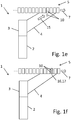
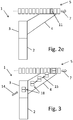
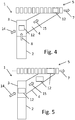
- FIGS. 1 - 6 , and 14 are schematic top views of various conveying and loading situations.
- Figures 7 to 13 are schematic views of details of components of the sorting system.
- Figures 1-6 show a sorting system, where the support areas are shorter in a transport direction of the support areas, than a width in the transverse direction.
- Figure 14 shows a sorting system, where the support areas are longer in a transport direction of the support areas, than a width in the transverse direction.
- Figs. 1a - show a sorter system 1 comprising a conveying system 2.
- the conveying system 2 is shown with only one conveyor, but may include any number of conveyors of any type suitable for conveying small items 10, medium items 11 and large items 12 downstream to a diverter 3.
- the sorting system 1 is adapted for receiving items at one or more loading locations and off-loading items at one or more off-loading locations (not shown).
- the sorting system comprises a plurality of carts, which are not shown in figs. 1a - If. Carts may be seen on figs. 8-12 . Instead is shown a number of support areas 5, which may belong to any number of carts. Hence, a cart may comprise one or more support areas 5.
- the transport direction of the support areas is indicated by the arrow 7.
- Adjacent to the diverter 3 is located an induction conveyor 4, which loads the items onto the support areas 5.
- the not shown carts are usually coupled together to form a train-like configuration, which may form an endless loop.
- fig. 1a is shown how two small items 10, which have been pre-arranged as well as pre-oriented, in a way such that the items 10 are arranged and oriented to fit a support area 5.
- the pre-arrangement and the pre-orientation have been performed e.g. manually or by suitable mechanical equipment before being received by the diverter 3.
- a direction of movement of the items 10 is indicated by the arrow 8.
- Figs. 2a- 2e show a sorter system 1 comprising a conveying system 2.
- the conveying system 2 is shown with only one conveyor but may include any number of conveyors of any type suitable for conveying items downstream to a diverter 3.
- the sorting system 1 is adapted for receiving items at one or more loading locations and off-loading items at one or more off-loading locations (not shown).
- the sorting system comprises a plurality of carts, which are not shown in figs. 2a - 2e . Carts may be seen on figs. 8-12 . Instead is shown a number of support areas 5, which may belong to a number of carts. The transport direction of the support areas is indicated by the arrow 7.
- Figs. 2a-2e show in principle a similar course of loading items onto a support area 5 as figs. 1a-1f . The only difference is that here it is medium items 11.
- Fig. 3 shows a sorter system 1 comprising a conveying system 2.
- the conveying system 2 conveys items downstream to a diverter 3.
- the sorting system 1 is adapted for receiving items at one or more loading locations and off-loading items at one or more off-loading locations (not shown).
- the sorting system comprises a plurality of carts, which are not shown in fig. 3 .
- the transport direction of the support areas is indicated by the arrow 7.
- Adjacent to the diverter 3 is located an induction conveyor 4, which loads the items onto the support areas 5.
- Fig. 3 shows in principle a similar course of loading items 18 onto a support area 5 as figs. 1a-1f and 2a-2e . However, in fig. 3 the items 18 are twin sets of medium items, but the same principle would apply to longer large items, being loaded onto two or more support areas 5.
- Fig. 4 shows a sorter system 1 similar to those of figs. 1a-1f , 2a-2e and 3 .
- the loaded items 12 are large items, which have a size that requires minimum two consecutive support areas for being loaded onto.
- fig. 5 where large items 12 are loaded onto three support areas 5.
- Fig. 6 shows how the sorting may take place during operation of the sorter system 1, where items 10, 11, 12 of varying size are continuously loaded onto support areas 5.
- Fig. 7a shows four support areas 5, where two items 12 are loaded onto two support areas 5.
- a transport direction is indicated by the arrow 7.
- conveying and off-loading the items are placed with an equal distance 19 to back and forward ends in the transport direction of the support areas 5, and preferably to all sides of the transport areas.
- a distance 20 between the items 12 is present in order to separate the items 12 for being off-loaded, or discharged, at off-loading location on a starboard and a port side, respectively. In case both items 12 are off-loaded to a same side, a distance 20 may not be necessary.
- Fig. 7b shows three support areas 5, where each has a longitudinal centerline 17. And where a medium item 11 has also a longitudinal centerline 16, such that the item 11 is placed as centered as possible, again to ensure safe loading, conveying and off-loading the items.
- a transport direction is indicated by the arrow 7.
- Figs. 8a and 8b show a tilt tray-type cart 21 having a tray 24 with a support area 5, frame 22 and wheels 23 adapted to fit to a not shown track.
- Fig. 8b shows the tilting of the tray 24 and support area 5. With dotted lines is shown a tilt to an opposite side.
- Fig. 9 shows a cross-belt-type cart 25 having a cross-belt 26 with a support area 5, frame 22 and wheels 23 adapted to fit to a not shown track.
- the belt may be run to the right hand side as well as a left hand side. This is used when loading and off-loading items from the support area 5.
- Fig. 10 shows a driven roller type cart 27 having driven rollers 28 with a support area 5, frame 22 and wheels 23 adapted to fit to a not shown track. As the arrow shows, the rollers may be run to the right hand side as well as a left hand side. This is used when loading and off-loading items from the support area 5.
- Fig. 11 shows a fixed tray type cart having a tray 24 with a support area 5, frame 22 and wheels 23 adapted to fit to a not shown track.
- external means are used.
- pneumatic cylinders 30 are used.
- any suitable kind of external pusher, drawer or guiding means may be used.
- the dotted lines indicate the left hand cylinder in its fully extended situation.
- An onboard device, not shown, may also be used, such as a pusher, drawer or any other actuator.
- Fig. 12 shows a driven spherical ball type cart 34 having driven balls 35 with a support area 5, frame 22 and wheels 23 adapted to fit to a not shown track. As the arrow shows, the balls may be driven to the right hand side as well as a left hand side. This is used when loading and off-loading items from the support area 5.
- Figs. 13a and 13b show variants of a diverter 3.
- a plurality of wheels 31 are adapted to receive items from a not shown conveyor. The items are received in the direction indicated by the arrow 8.
- Another plurality of wheels 32 may be raised slightly, or the wheels 31 lowered slightly, when an item may be stopped in order to be diverted using the wheels 32 and diverting the item at an angle indicated by the arrow 14.
- the diverter is fitted with driven spherical balls 33 instead of wheels 31, 32. Items may be received from a conveyor at an angle indicated by the arrow 8 and diverted at an angle indicated by the arrow 14.
- Both variants 13a and 13b may be controlled to divert one or more items received from a conveyor and onto an induction conveyor nonstop for enhanced capacity.
- the induction conveyor 4 may comprise driven cylindrical rollers for supporting and conveying the items to the support areas.
- a plurality of parallel driven belts or straps may be used for supporting and conveying the items to the support areas.
Landscapes
- Engineering & Computer Science (AREA)
- Mechanical Engineering (AREA)
- Branching, Merging, And Special Transfer Between Conveyors (AREA)
- Discharge Of Articles From Conveyors (AREA)
Claims (16)
- Méthode d'utilisation d'un système de tri (1) pour la réception d'articles à un ou plusieurs sites de chargement et le déchargement d'articles à un ou plusieurs sites de déchargement, le système de tri (1) comprenant une pluralité de chariots, lesdits chariots possédant au moins une zone de support (5), pouvant être actionnée pour charger et décharger des articles, ou des dispositifs à bord ou non à bord pouvant être utilisés pour donner lieu au chargement et au déchargement d'articles, et où le chargement et le déchargement d'articles peut être effectué tant à tribord qu'à bâbord d'une direction de transport (7) des chariots, la méthode comprenant- l'agencement préalable d'articles à trier, et l'orientation préalable des articles, de sorte que les articles puissent être agencés et orientés de façon à tenir dans une ou plusieurs zones de support (5),- l'acheminement des articles agencés et orientés préalablement en aval, vers les chariots du système de tri,- avant le chargement des articles sur les chariots, la réception des articles agencés et orientés préalablement à un partiteur (3) en fonction de leur taille :la méthode étant caractérisée en ce qu'elle comprend :- deux ou plusieurs articles (10) étant plus petits qu'une zone de support (5), et tenant sur au moins une partie de la taille d'une zone de support (5), et- des articles de taille moyenne (11) présentant une taille, telle que seul un article puisse être agencé pour tenir dans la taille d'une zone de support (5), et- un ou plusieurs articles de grande taille (12) présentant une taille, telle qu'un article est plus grand que la taille d'une zone de support individuelle (5), et est adapté pour tenir dans au moins deux zones de support consécutives (5),- après la réception des articles agencés et orientés préalablement au partiteur (3), le détournement des articles à un angle latéral à un transporteur par induction (4), tout en maintenant l'agencement et l'orientation préalables des articles au fur et à mesure qu'ils sont reçus par le partiteur (3),- et tout en maintenant l'agencement et l'orientation préalables des articles, le chargement des articles avec le transporteur par induction (4) sur la ou plusieurs zones de support de chariot (5), dans lesquelles doivent être reçus et être chargés un ou plusieurs des articles prédéterminés s'approchant, et, selon la taille de l'article,a. l'induction de deux ou plusieurs articles de petite taille agencés et orientés préalablement (10) jusqu'à ce que lesdits deux ou plusieurs articles de petite taille (10) soient reçus par une zone de support de chariot (5), etb. l'induction d'un article de taille moyenne (11) agencé et orienté préalablement jusqu'à ce que ledit article de taille moyenne soit reçu par une zone de support de chariot (5), etc. l'induction d'un ou plusieurs articles de grande taille (12) agencés et orientés préalablement jusqu'à ce que lesdits articles de grande taille (12) soient reçus par au moins deux zones de support de chariots (5) consécutives,- l'agencement préalable de deux ou plusieurs articles de petite taille (10) devant être triés, et l'orientation préalable des articles de sorte que les deux ou plusieurs articles de petite taille (10) soient agencés pour tenir dans une zone de support (5), comprenant le fait que préalablement au transfert des articles au partiteur (3), les articles de petite taille (10) sont orientés de telle façon que lesdits articles de petite taille (10) soient également alignés conjointement avec un agencement et une orientation correspondant à un axe longitudinal (17) de la zone de support (5), prédéterminé pour recevoir lesdits articles de petite taille (10).
- Méthode selon la revendication 1, l'agencement préalable d'articles à trier, et l'orientation préalable des articles, de sorte que les articles soient agencés pour tenir dans une ou plusieurs zones de support (5), comprenant le fait que préalablement au transfert des articles au partiteur (3), deux ou plusieurs articles de petite taille (10) sont agencés et orientés de telle façon qu'une longueur et une largeur totales, dans un plan horizontal, desdits deux ou plusieurs articles de petite taille (10) tiennent dans une longueur et une largeur d'une zone de support (5).
- Méthode selon la revendication 1, l'agencement préalable d'articles de taille moyenne (11) et de grand taille (12), ainsi que l'orientation préalable des articles, afin que les articles soient agencés pour tenir dans au moins une zone de support (5), comprenant le fait que préalablement au transfert des articles au partiteur (3), des articles de taille moyenne (11) et de grand taille (12) sont agencés et orientés de sorte qu'une longueur et une largeur totales, dans un plan horizontal, d'articles de taille moyenne (11) et de grand taille (12) tiennent dans une longueur et une largeur d'au moins une zone de support (5).
- Méthode selon la revendication 1 ou 3, l'agencement préalable d'articles de taille moyenne (11) et de grand taille (12) devant être triés, ainsi que l'orientation préalable des articles, afin que les articles de taille moyenne et de grand taille soient agencés pour tenir dans au moins une zone de support (5), comprenant le fait que préalablement au transfert des articles au partiteur (3), lesdits articles taille moyenne (11) et de grand taille (12) sont orientés de sorte que lesdits articles taille moyenne et de grand taille soient également alignés conjointement avec une orientation offrant une distance maximale de tous les côtés de l'au moins une zone de support (5), prédéterminée pour recevoir lesdits articles taille moyenne et de grand taille.
- Méthode selon une quelconque des revendications précédentes, au moins un transporteur par induction (4) étant situé dans une position adjacente au partiteur (3), le transporteur par induction recevant des articles agencés et orientés préalablement, et transportant les articles aux zones de support (5) à un angle latéral et sur les zones de support (5) correspondant à un angle latéral auquel ils sont reçus depuis le partiteur (3).
- Méthode selon une quelconque des revendications 1 à 5, le transport des articles à l'aide d'un transporteur par induction (4) s'effectuant avec une accélération et une vitesse prédéterminées, et à un angle latéral et sur les zones de support (5), l'accélération et la vitesse prédéterminées du transporteur par induction étant adaptées à la vitesse des zones de support (5), afin que les articles transportés soient reçus par des zones de support prédéterminées.
- Méthode selon une quelconque des revendications précédentes, les articles détournés étant détournés à un angle latéral pour atteindre les zones de support (5), ledit angle latéral étant différent et inférieur à un angle perpendiculaire à une direction de transport (7) de chariots de support, qui doivent recevoir un ou plusieurs articles prédéterminés s'approchant depuis le partiteur (3).
- Méthode selon une quelconque des revendications précédentes, l'agencement préalable d'articles à trier, ainsi que l'orientation préalable des articles, de telle façon que les articles soient agencés pour tenir dans une ou plusieurs zones de support (5), comprennent le fait qu'une distance entre les articles est adaptée afin qu'une ou plusieurs zones de support (5) prédéterminées puissent recevoir un ou plusieurs articles prédéterminés.
- Méthode selon une quelconque des revendications précédentes, les articles agencés et orientés préalablement, pendant leur transport vers et sur les zones de support (5), et passant d'un transporteur à un autre, ou sur une zone de support (5), le sont substantiellement à un même niveau vertical.
- Méthode selon une quelconque des revendications précédentes, une majorité des chariots du système de tri étant des chariots du type à bande transversale.
- Méthode selon la revendication 10, le chariot du type à bande transversale comprenant au moins deux bandes transversales.
- Méthode selon une quelconque des revendications 1 à 9, une majorité des chariots étant du type à rouleau cylindrique, adaptés pour déplacer des articles dans un ou plusieurs directions prédéterminées pour le chargement et le déchargement d'articles.
- Méthode selon une quelconque des revendications 1 à 9, une majorité des chariots du système de tri étant des chariots du type à plateau basculant (21).
- Méthode selon la revendication 13, une majorité des chariots du système de tri étant des chariots du type à plateau basculant (21), au moins un article étant agencé sur un bac, ledit bac étant agencé sur le plateau basculant.
- Méthode selon une quelconque des revendications 1 à 9, une majorité des chariots étant du type entraîné à boule sphérique (34) adapté pour déplacer des articles pour le chargement et le déchargement d'articles.
- Méthode selon une quelconque des revendications 1 à 9, une majorité des chariots du système de tri étant d'un type où la surface de support (5) est une surface fixe, et où les articles sont déchargés avec des dispositifs à bord et non à bord sélectionnés dans un groupe comprenant des dispositifs de poussée et de traction mécaniques, des dispositifs de poussée et de traction pneumatiques (30), des dispositifs de poussée et de traction électriques, tout type d'actionneur, ainsi que des dispositifs de guidage à fonctionnement en marche/arrêt.
Applications Claiming Priority (2)
| Application Number | Priority Date | Filing Date | Title |
|---|---|---|---|
| DKPA201370435 | 2013-08-08 | ||
| PCT/DK2014/050237 WO2015018422A1 (fr) | 2013-08-08 | 2014-08-07 | Actionnement d'un système de tri pour articles présentant des tailles variables |
Publications (2)
| Publication Number | Publication Date |
|---|---|
| EP3030507A1 EP3030507A1 (fr) | 2016-06-15 |
| EP3030507B1 true EP3030507B1 (fr) | 2018-10-10 |
Family
ID=51389837
Family Applications (1)
| Application Number | Title | Priority Date | Filing Date |
|---|---|---|---|
| EP14753197.4A Active EP3030507B1 (fr) | 2013-08-08 | 2014-08-07 | Actionnement d'un système de tri pour articles présentant des tailles variables |
Country Status (5)
| Country | Link |
|---|---|
| US (1) | US20160185533A1 (fr) |
| EP (1) | EP3030507B1 (fr) |
| CN (1) | CN105612116B (fr) |
| ES (1) | ES2704442T3 (fr) |
| WO (1) | WO2015018422A1 (fr) |
Families Citing this family (13)
| Publication number | Priority date | Publication date | Assignee | Title |
|---|---|---|---|---|
| EP3191386B1 (fr) * | 2014-09-09 | 2023-06-07 | Beumer Group A/S | Procédé et système pour établir un ordre d'une séquence d'alimentation |
| DE102015108895A1 (de) * | 2015-06-05 | 2016-12-08 | Focke & Co. (Gmbh & Co. Kg) | Verfahren und Vorrichtung zum Zuführen von Produkten in Behälter |
| CN105867197B (zh) * | 2016-05-31 | 2018-10-23 | 广东溢达纺织有限公司 | 纺织材料自动分拣贴收设备及方法 |
| CN106809633A (zh) * | 2017-02-21 | 2017-06-09 | 苏州金峰物联网技术有限公司 | 交叉带分拣机 |
| CN106955848B (zh) * | 2017-04-24 | 2019-03-15 | 常州工学院 | 一种基于视觉的交叉带小车智能落包方法 |
| CN108100694B (zh) * | 2018-02-05 | 2024-04-26 | 江苏冠超物流科技有限公司 | 复合分拣设备以及装卸货物设备 |
| CN109013356A (zh) * | 2018-10-11 | 2018-12-18 | 江苏展朔物联网科技有限公司 | 一种物流分拣系统 |
| CN109013357A (zh) * | 2018-10-11 | 2018-12-18 | 江苏展朔物联网科技有限公司 | 一种交叉带分拣系统 |
| CN111842171A (zh) * | 2019-04-29 | 2020-10-30 | 北京京东乾石科技有限公司 | 分拣小车及具有该分拣小车的分拣系统 |
| US11905125B1 (en) * | 2020-03-26 | 2024-02-20 | Material Handling Systems, Inc. | Parcel cart loading system |
| WO2022157797A1 (fr) * | 2021-01-25 | 2022-07-28 | Naman Jain | Système de pré-tri intégré |
| HUE071822T2 (hu) * | 2021-02-11 | 2025-09-28 | Trinovate B V | Válogató berendezés |
| GB2608793B (en) * | 2021-06-29 | 2025-04-02 | Hysort Ltd | A sorting and sequencing method and apparatus |
Family Cites Families (8)
| Publication number | Priority date | Publication date | Assignee | Title |
|---|---|---|---|---|
| IT1301696B1 (it) * | 1998-06-12 | 2000-07-07 | Cml Handling Technology S P A | Metodo ed apparecchiatura per il caricamento automatico di piu'oggetti ordinati, sulla stessa unita' di una macchina smistatrice |
| US20030221935A1 (en) * | 1998-12-01 | 2003-12-04 | Crisplant A/S | Conveyor/sorter system, a loading conveyor and a control system for such conveyors |
| WO2000032502A1 (fr) * | 1998-12-01 | 2000-06-08 | Crisplant A/S | Systeme de transporteur et de tri, transporteur de chargement et systeme de commande de tels transporteurs |
| US6478138B1 (en) * | 1999-10-04 | 2002-11-12 | Rapistan Systems Advertising Corp. | Double width crossbelt sorter |
| DE10049100A1 (de) * | 2000-09-27 | 2002-04-18 | Siemens Ag | Einschleuseeinrichtung mit Pufferfunktion für eine Stückgutsortieranlage |
| DE102007025553A1 (de) * | 2007-05-31 | 2008-12-04 | Siemens Ag | Steuervorrichtung, Sortieranlage sowie Sortierverfahren für Güter |
| PL388549A1 (pl) * | 2009-07-15 | 2011-01-17 | International Tobacco Machinery Poland Spółka Z Ograniczoną Odpowiedzialnością | Sposób bezpiecznego przekazywania segmentów filtrowych w procesie wytwarzania filtrów wielosegmentowych |
| DE102010022156A1 (de) * | 2010-05-20 | 2011-11-24 | Siemens Aktiengesellschaft | Förderanlageneinheit |
-
2014
- 2014-08-07 EP EP14753197.4A patent/EP3030507B1/fr active Active
- 2014-08-07 CN CN201480055368.6A patent/CN105612116B/zh active Active
- 2014-08-07 US US14/909,435 patent/US20160185533A1/en not_active Abandoned
- 2014-08-07 WO PCT/DK2014/050237 patent/WO2015018422A1/fr not_active Ceased
- 2014-08-07 ES ES14753197T patent/ES2704442T3/es active Active
Non-Patent Citations (1)
| Title |
|---|
| None * |
Also Published As
| Publication number | Publication date |
|---|---|
| CN105612116A (zh) | 2016-05-25 |
| WO2015018422A1 (fr) | 2015-02-12 |
| ES2704442T3 (es) | 2019-03-18 |
| CN105612116B (zh) | 2018-02-06 |
| US20160185533A1 (en) | 2016-06-30 |
| EP3030507A1 (fr) | 2016-06-15 |
Similar Documents
| Publication | Publication Date | Title |
|---|---|---|
| EP3030507B1 (fr) | Actionnement d'un système de tri pour articles présentant des tailles variables | |
| CN103842270B (zh) | 横带分拣系统 | |
| AU773306B2 (en) | Double width crossbelt sorter | |
| US9950875B2 (en) | Device and method for distributing and grouping containers | |
| US9421580B2 (en) | Picking system and method for picking articles | |
| CA2449143C (fr) | Systeme et procede de tri d'articles | |
| CN107777275B (zh) | 传送系统和用于在传送系统的传送道上运输件货的方法 | |
| EP3535206B1 (fr) | Goulottes de déviation dans des systèmes de transporteur de tri | |
| US20030221935A1 (en) | Conveyor/sorter system, a loading conveyor and a control system for such conveyors | |
| AU2002312958A1 (en) | System and method for sorting articles | |
| US10000346B2 (en) | Transporting element for a distributing conveyor of a sorter of a sorting installation | |
| AU1143901A (en) | Conveyor system with volume sharing | |
| US3735853A (en) | System for distributing pieces of load such as baggage, parcels etc. | |
| US20140356111A1 (en) | Method of handling objects in an airport and handling system | |
| EP3191386B1 (fr) | Procédé et système pour établir un ordre d'une séquence d'alimentation | |
| US9731327B2 (en) | Device for sorting objects | |
| CN222348080U (zh) | 分拣系统 |
Legal Events
| Date | Code | Title | Description |
|---|---|---|---|
| PUAI | Public reference made under article 153(3) epc to a published international application that has entered the european phase |
Free format text: ORIGINAL CODE: 0009012 |
|
| 17P | Request for examination filed |
Effective date: 20160209 |
|
| AK | Designated contracting states |
Kind code of ref document: A1 Designated state(s): AL AT BE BG CH CY CZ DE DK EE ES FI FR GB GR HR HU IE IS IT LI LT LU LV MC MK MT NL NO PL PT RO RS SE SI SK SM TR |
|
| AX | Request for extension of the european patent |
Extension state: BA ME |
|
| DAX | Request for extension of the european patent (deleted) | ||
| STAA | Information on the status of an ep patent application or granted ep patent |
Free format text: STATUS: EXAMINATION IS IN PROGRESS |
|
| 17Q | First examination report despatched |
Effective date: 20170315 |
|
| GRAP | Despatch of communication of intention to grant a patent |
Free format text: ORIGINAL CODE: EPIDOSNIGR1 |
|
| STAA | Information on the status of an ep patent application or granted ep patent |
Free format text: STATUS: GRANT OF PATENT IS INTENDED |
|
| INTG | Intention to grant announced |
Effective date: 20180323 |
|
| GRAS | Grant fee paid |
Free format text: ORIGINAL CODE: EPIDOSNIGR3 |
|
| GRAA | (expected) grant |
Free format text: ORIGINAL CODE: 0009210 |
|
| STAA | Information on the status of an ep patent application or granted ep patent |
Free format text: STATUS: THE PATENT HAS BEEN GRANTED |
|
| RAP1 | Party data changed (applicant data changed or rights of an application transferred) |
Owner name: BEUMER GROUP A/S |
|
| AK | Designated contracting states |
Kind code of ref document: B1 Designated state(s): AL AT BE BG CH CY CZ DE DK EE ES FI FR GB GR HR HU IE IS IT LI LT LU LV MC MK MT NL NO PL PT RO RS SE SI SK SM TR |
|
| REG | Reference to a national code |
Ref country code: GB Ref legal event code: FG4D |
|
| REG | Reference to a national code |
Ref country code: AT Ref legal event code: REF Ref document number: 1050966 Country of ref document: AT Kind code of ref document: T Effective date: 20181015 Ref country code: CH Ref legal event code: EP |
|
| REG | Reference to a national code |
Ref country code: IE Ref legal event code: FG4D |
|
| REG | Reference to a national code |
Ref country code: DE Ref legal event code: R096 Ref document number: 602014033837 Country of ref document: DE |
|
| REG | Reference to a national code |
Ref country code: NL Ref legal event code: FP |
|
| REG | Reference to a national code |
Ref country code: LT Ref legal event code: MG4D |
|
| REG | Reference to a national code |
Ref country code: AT Ref legal event code: MK05 Ref document number: 1050966 Country of ref document: AT Kind code of ref document: T Effective date: 20181010 |
|
| REG | Reference to a national code |
Ref country code: ES Ref legal event code: FG2A Ref document number: 2704442 Country of ref document: ES Kind code of ref document: T3 Effective date: 20190318 |
|
| PG25 | Lapsed in a contracting state [announced via postgrant information from national office to epo] |
Ref country code: FI Free format text: LAPSE BECAUSE OF FAILURE TO SUBMIT A TRANSLATION OF THE DESCRIPTION OR TO PAY THE FEE WITHIN THE PRESCRIBED TIME-LIMIT Effective date: 20181010 Ref country code: HR Free format text: LAPSE BECAUSE OF FAILURE TO SUBMIT A TRANSLATION OF THE DESCRIPTION OR TO PAY THE FEE WITHIN THE PRESCRIBED TIME-LIMIT Effective date: 20181010 Ref country code: PL Free format text: LAPSE BECAUSE OF FAILURE TO SUBMIT A TRANSLATION OF THE DESCRIPTION OR TO PAY THE FEE WITHIN THE PRESCRIBED TIME-LIMIT Effective date: 20181010 Ref country code: LV Free format text: LAPSE BECAUSE OF FAILURE TO SUBMIT A TRANSLATION OF THE DESCRIPTION OR TO PAY THE FEE WITHIN THE PRESCRIBED TIME-LIMIT Effective date: 20181010 Ref country code: AT Free format text: LAPSE BECAUSE OF FAILURE TO SUBMIT A TRANSLATION OF THE DESCRIPTION OR TO PAY THE FEE WITHIN THE PRESCRIBED TIME-LIMIT Effective date: 20181010 Ref country code: NO Free format text: LAPSE BECAUSE OF FAILURE TO SUBMIT A TRANSLATION OF THE DESCRIPTION OR TO PAY THE FEE WITHIN THE PRESCRIBED TIME-LIMIT Effective date: 20190110 Ref country code: IS Free format text: LAPSE BECAUSE OF FAILURE TO SUBMIT A TRANSLATION OF THE DESCRIPTION OR TO PAY THE FEE WITHIN THE PRESCRIBED TIME-LIMIT Effective date: 20190210 Ref country code: LT Free format text: LAPSE BECAUSE OF FAILURE TO SUBMIT A TRANSLATION OF THE DESCRIPTION OR TO PAY THE FEE WITHIN THE PRESCRIBED TIME-LIMIT Effective date: 20181010 Ref country code: BG Free format text: LAPSE BECAUSE OF FAILURE TO SUBMIT A TRANSLATION OF THE DESCRIPTION OR TO PAY THE FEE WITHIN THE PRESCRIBED TIME-LIMIT Effective date: 20190110 |
|
| PG25 | Lapsed in a contracting state [announced via postgrant information from national office to epo] |
Ref country code: PT Free format text: LAPSE BECAUSE OF FAILURE TO SUBMIT A TRANSLATION OF THE DESCRIPTION OR TO PAY THE FEE WITHIN THE PRESCRIBED TIME-LIMIT Effective date: 20190210 Ref country code: GR Free format text: LAPSE BECAUSE OF FAILURE TO SUBMIT A TRANSLATION OF THE DESCRIPTION OR TO PAY THE FEE WITHIN THE PRESCRIBED TIME-LIMIT Effective date: 20190111 Ref country code: RS Free format text: LAPSE BECAUSE OF FAILURE TO SUBMIT A TRANSLATION OF THE DESCRIPTION OR TO PAY THE FEE WITHIN THE PRESCRIBED TIME-LIMIT Effective date: 20181010 Ref country code: SE Free format text: LAPSE BECAUSE OF FAILURE TO SUBMIT A TRANSLATION OF THE DESCRIPTION OR TO PAY THE FEE WITHIN THE PRESCRIBED TIME-LIMIT Effective date: 20181010 Ref country code: AL Free format text: LAPSE BECAUSE OF FAILURE TO SUBMIT A TRANSLATION OF THE DESCRIPTION OR TO PAY THE FEE WITHIN THE PRESCRIBED TIME-LIMIT Effective date: 20181010 |
|
| REG | Reference to a national code |
Ref country code: DE Ref legal event code: R097 Ref document number: 602014033837 Country of ref document: DE |
|
| PG25 | Lapsed in a contracting state [announced via postgrant information from national office to epo] |
Ref country code: CZ Free format text: LAPSE BECAUSE OF FAILURE TO SUBMIT A TRANSLATION OF THE DESCRIPTION OR TO PAY THE FEE WITHIN THE PRESCRIBED TIME-LIMIT Effective date: 20181010 Ref country code: DK Free format text: LAPSE BECAUSE OF FAILURE TO SUBMIT A TRANSLATION OF THE DESCRIPTION OR TO PAY THE FEE WITHIN THE PRESCRIBED TIME-LIMIT Effective date: 20181010 |
|
| PLBE | No opposition filed within time limit |
Free format text: ORIGINAL CODE: 0009261 |
|
| STAA | Information on the status of an ep patent application or granted ep patent |
Free format text: STATUS: NO OPPOSITION FILED WITHIN TIME LIMIT |
|
| PG25 | Lapsed in a contracting state [announced via postgrant information from national office to epo] |
Ref country code: SK Free format text: LAPSE BECAUSE OF FAILURE TO SUBMIT A TRANSLATION OF THE DESCRIPTION OR TO PAY THE FEE WITHIN THE PRESCRIBED TIME-LIMIT Effective date: 20181010 Ref country code: RO Free format text: LAPSE BECAUSE OF FAILURE TO SUBMIT A TRANSLATION OF THE DESCRIPTION OR TO PAY THE FEE WITHIN THE PRESCRIBED TIME-LIMIT Effective date: 20181010 Ref country code: EE Free format text: LAPSE BECAUSE OF FAILURE TO SUBMIT A TRANSLATION OF THE DESCRIPTION OR TO PAY THE FEE WITHIN THE PRESCRIBED TIME-LIMIT Effective date: 20181010 Ref country code: SM Free format text: LAPSE BECAUSE OF FAILURE TO SUBMIT A TRANSLATION OF THE DESCRIPTION OR TO PAY THE FEE WITHIN THE PRESCRIBED TIME-LIMIT Effective date: 20181010 |
|
| 26N | No opposition filed |
Effective date: 20190711 |
|
| PG25 | Lapsed in a contracting state [announced via postgrant information from national office to epo] |
Ref country code: SI Free format text: LAPSE BECAUSE OF FAILURE TO SUBMIT A TRANSLATION OF THE DESCRIPTION OR TO PAY THE FEE WITHIN THE PRESCRIBED TIME-LIMIT Effective date: 20181010 |
|
| PG25 | Lapsed in a contracting state [announced via postgrant information from national office to epo] |
Ref country code: TR Free format text: LAPSE BECAUSE OF FAILURE TO SUBMIT A TRANSLATION OF THE DESCRIPTION OR TO PAY THE FEE WITHIN THE PRESCRIBED TIME-LIMIT Effective date: 20181010 |
|
| PG25 | Lapsed in a contracting state [announced via postgrant information from national office to epo] |
Ref country code: LU Free format text: LAPSE BECAUSE OF NON-PAYMENT OF DUE FEES Effective date: 20190807 Ref country code: CH Free format text: LAPSE BECAUSE OF NON-PAYMENT OF DUE FEES Effective date: 20190831 Ref country code: MC Free format text: LAPSE BECAUSE OF FAILURE TO SUBMIT A TRANSLATION OF THE DESCRIPTION OR TO PAY THE FEE WITHIN THE PRESCRIBED TIME-LIMIT Effective date: 20181010 Ref country code: LI Free format text: LAPSE BECAUSE OF NON-PAYMENT OF DUE FEES Effective date: 20190831 |
|
| REG | Reference to a national code |
Ref country code: BE Ref legal event code: MM Effective date: 20190831 |
|
| PG25 | Lapsed in a contracting state [announced via postgrant information from national office to epo] |
Ref country code: IE Free format text: LAPSE BECAUSE OF NON-PAYMENT OF DUE FEES Effective date: 20190807 |
|
| PG25 | Lapsed in a contracting state [announced via postgrant information from national office to epo] |
Ref country code: BE Free format text: LAPSE BECAUSE OF NON-PAYMENT OF DUE FEES Effective date: 20190831 |
|
| PG25 | Lapsed in a contracting state [announced via postgrant information from national office to epo] |
Ref country code: CY Free format text: LAPSE BECAUSE OF FAILURE TO SUBMIT A TRANSLATION OF THE DESCRIPTION OR TO PAY THE FEE WITHIN THE PRESCRIBED TIME-LIMIT Effective date: 20181010 |
|
| PG25 | Lapsed in a contracting state [announced via postgrant information from national office to epo] |
Ref country code: HU Free format text: LAPSE BECAUSE OF FAILURE TO SUBMIT A TRANSLATION OF THE DESCRIPTION OR TO PAY THE FEE WITHIN THE PRESCRIBED TIME-LIMIT; INVALID AB INITIO Effective date: 20140807 Ref country code: MT Free format text: LAPSE BECAUSE OF FAILURE TO SUBMIT A TRANSLATION OF THE DESCRIPTION OR TO PAY THE FEE WITHIN THE PRESCRIBED TIME-LIMIT Effective date: 20181010 |
|
| PG25 | Lapsed in a contracting state [announced via postgrant information from national office to epo] |
Ref country code: MK Free format text: LAPSE BECAUSE OF FAILURE TO SUBMIT A TRANSLATION OF THE DESCRIPTION OR TO PAY THE FEE WITHIN THE PRESCRIBED TIME-LIMIT Effective date: 20181010 |
|
| P01 | Opt-out of the competence of the unified patent court (upc) registered |
Effective date: 20230514 |
|
| PGFP | Annual fee paid to national office [announced via postgrant information from national office to epo] |
Ref country code: NL Payment date: 20250821 Year of fee payment: 12 |
|
| PGFP | Annual fee paid to national office [announced via postgrant information from national office to epo] |
Ref country code: ES Payment date: 20250926 Year of fee payment: 12 |
|
| PGFP | Annual fee paid to national office [announced via postgrant information from national office to epo] |
Ref country code: DE Payment date: 20250820 Year of fee payment: 12 |
|
| PGFP | Annual fee paid to national office [announced via postgrant information from national office to epo] |
Ref country code: IT Payment date: 20250825 Year of fee payment: 12 |
|
| PGFP | Annual fee paid to national office [announced via postgrant information from national office to epo] |
Ref country code: GB Payment date: 20250821 Year of fee payment: 12 |
|
| PGFP | Annual fee paid to national office [announced via postgrant information from national office to epo] |
Ref country code: FR Payment date: 20250829 Year of fee payment: 12 |