EP3032207B1 - Verfahren zur steigerung der thermischen wirkung einer heizvorrichtung sowie vorrichtung zur steigerung der thermischen wirkung einer heizvorrichtung - Google Patents
Verfahren zur steigerung der thermischen wirkung einer heizvorrichtung sowie vorrichtung zur steigerung der thermischen wirkung einer heizvorrichtung Download PDFInfo
- Publication number
- EP3032207B1 EP3032207B1 EP14833696.9A EP14833696A EP3032207B1 EP 3032207 B1 EP3032207 B1 EP 3032207B1 EP 14833696 A EP14833696 A EP 14833696A EP 3032207 B1 EP3032207 B1 EP 3032207B1
- Authority
- EP
- European Patent Office
- Prior art keywords
- heating device
- thermal efficiency
- improving thermal
- inorganic substance
- inorganic
- Prior art date
- Legal status (The legal status is an assumption and is not a legal conclusion. Google has not performed a legal analysis and makes no representation as to the accuracy of the status listed.)
- Not-in-force
Links
Images


Classifications
-
- F—MECHANICAL ENGINEERING; LIGHTING; HEATING; WEAPONS; BLASTING
- F28—HEAT EXCHANGE IN GENERAL
- F28F—DETAILS OF HEAT-EXCHANGE AND HEAT-TRANSFER APPARATUS, OF GENERAL APPLICATION
- F28F13/00—Arrangements for modifying heat-transfer, e.g. increasing, decreasing
-
- B—PERFORMING OPERATIONS; TRANSPORTING
- B32—LAYERED PRODUCTS
- B32B—LAYERED PRODUCTS, i.e. PRODUCTS BUILT-UP OF STRATA OF FLAT OR NON-FLAT, e.g. CELLULAR OR HONEYCOMB, FORM
- B32B18/00—Layered products essentially comprising ceramics, e.g. refractory products
-
- C—CHEMISTRY; METALLURGY
- C04—CEMENTS; CONCRETE; ARTIFICIAL STONE; CERAMICS; REFRACTORIES
- C04B—LIME, MAGNESIA; SLAG; CEMENTS; COMPOSITIONS THEREOF, e.g. MORTARS, CONCRETE OR LIKE BUILDING MATERIALS; ARTIFICIAL STONE; CERAMICS; REFRACTORIES; TREATMENT OF NATURAL STONE
- C04B35/00—Shaped ceramic products characterised by their composition; Ceramics compositions; Processing powders of inorganic compounds preparatory to the manufacturing of ceramic products
- C04B35/515—Shaped ceramic products characterised by their composition; Ceramics compositions; Processing powders of inorganic compounds preparatory to the manufacturing of ceramic products based on non-oxide ceramics
- C04B35/56—Shaped ceramic products characterised by their composition; Ceramics compositions; Processing powders of inorganic compounds preparatory to the manufacturing of ceramic products based on non-oxide ceramics based on carbides or oxycarbides
- C04B35/565—Shaped ceramic products characterised by their composition; Ceramics compositions; Processing powders of inorganic compounds preparatory to the manufacturing of ceramic products based on non-oxide ceramics based on carbides or oxycarbides based on silicon carbide
- C04B35/571—Shaped ceramic products characterised by their composition; Ceramics compositions; Processing powders of inorganic compounds preparatory to the manufacturing of ceramic products based on non-oxide ceramics based on carbides or oxycarbides based on silicon carbide obtained from Si-containing polymer precursors or organosilicon monomers
-
- C—CHEMISTRY; METALLURGY
- C04—CEMENTS; CONCRETE; ARTIFICIAL STONE; CERAMICS; REFRACTORIES
- C04B—LIME, MAGNESIA; SLAG; CEMENTS; COMPOSITIONS THEREOF, e.g. MORTARS, CONCRETE OR LIKE BUILDING MATERIALS; ARTIFICIAL STONE; CERAMICS; REFRACTORIES; TREATMENT OF NATURAL STONE
- C04B35/00—Shaped ceramic products characterised by their composition; Ceramics compositions; Processing powders of inorganic compounds preparatory to the manufacturing of ceramic products
- C04B35/515—Shaped ceramic products characterised by their composition; Ceramics compositions; Processing powders of inorganic compounds preparatory to the manufacturing of ceramic products based on non-oxide ceramics
- C04B35/56—Shaped ceramic products characterised by their composition; Ceramics compositions; Processing powders of inorganic compounds preparatory to the manufacturing of ceramic products based on non-oxide ceramics based on carbides or oxycarbides
- C04B35/565—Shaped ceramic products characterised by their composition; Ceramics compositions; Processing powders of inorganic compounds preparatory to the manufacturing of ceramic products based on non-oxide ceramics based on carbides or oxycarbides based on silicon carbide
- C04B35/573—Shaped ceramic products characterised by their composition; Ceramics compositions; Processing powders of inorganic compounds preparatory to the manufacturing of ceramic products based on non-oxide ceramics based on carbides or oxycarbides based on silicon carbide obtained by reaction sintering or recrystallisation
-
- C—CHEMISTRY; METALLURGY
- C04—CEMENTS; CONCRETE; ARTIFICIAL STONE; CERAMICS; REFRACTORIES
- C04B—LIME, MAGNESIA; SLAG; CEMENTS; COMPOSITIONS THEREOF, e.g. MORTARS, CONCRETE OR LIKE BUILDING MATERIALS; ARTIFICIAL STONE; CERAMICS; REFRACTORIES; TREATMENT OF NATURAL STONE
- C04B35/00—Shaped ceramic products characterised by their composition; Ceramics compositions; Processing powders of inorganic compounds preparatory to the manufacturing of ceramic products
- C04B35/515—Shaped ceramic products characterised by their composition; Ceramics compositions; Processing powders of inorganic compounds preparatory to the manufacturing of ceramic products based on non-oxide ceramics
- C04B35/58—Shaped ceramic products characterised by their composition; Ceramics compositions; Processing powders of inorganic compounds preparatory to the manufacturing of ceramic products based on non-oxide ceramics based on borides, nitrides, i.e. nitrides, oxynitrides, carbonitrides or oxycarbonitrides or silicides
- C04B35/584—Shaped ceramic products characterised by their composition; Ceramics compositions; Processing powders of inorganic compounds preparatory to the manufacturing of ceramic products based on non-oxide ceramics based on borides, nitrides, i.e. nitrides, oxynitrides, carbonitrides or oxycarbonitrides or silicides based on silicon nitride
- C04B35/589—Shaped ceramic products characterised by their composition; Ceramics compositions; Processing powders of inorganic compounds preparatory to the manufacturing of ceramic products based on non-oxide ceramics based on borides, nitrides, i.e. nitrides, oxynitrides, carbonitrides or oxycarbonitrides or silicides based on silicon nitride obtained from Si-containing polymer precursors or organosilicon monomers
-
- C—CHEMISTRY; METALLURGY
- C04—CEMENTS; CONCRETE; ARTIFICIAL STONE; CERAMICS; REFRACTORIES
- C04B—LIME, MAGNESIA; SLAG; CEMENTS; COMPOSITIONS THEREOF, e.g. MORTARS, CONCRETE OR LIKE BUILDING MATERIALS; ARTIFICIAL STONE; CERAMICS; REFRACTORIES; TREATMENT OF NATURAL STONE
- C04B35/00—Shaped ceramic products characterised by their composition; Ceramics compositions; Processing powders of inorganic compounds preparatory to the manufacturing of ceramic products
- C04B35/515—Shaped ceramic products characterised by their composition; Ceramics compositions; Processing powders of inorganic compounds preparatory to the manufacturing of ceramic products based on non-oxide ceramics
- C04B35/58—Shaped ceramic products characterised by their composition; Ceramics compositions; Processing powders of inorganic compounds preparatory to the manufacturing of ceramic products based on non-oxide ceramics based on borides, nitrides, i.e. nitrides, oxynitrides, carbonitrides or oxycarbonitrides or silicides
- C04B35/584—Shaped ceramic products characterised by their composition; Ceramics compositions; Processing powders of inorganic compounds preparatory to the manufacturing of ceramic products based on non-oxide ceramics based on borides, nitrides, i.e. nitrides, oxynitrides, carbonitrides or oxycarbonitrides or silicides based on silicon nitride
- C04B35/593—Shaped ceramic products characterised by their composition; Ceramics compositions; Processing powders of inorganic compounds preparatory to the manufacturing of ceramic products based on non-oxide ceramics based on borides, nitrides, i.e. nitrides, oxynitrides, carbonitrides or oxycarbonitrides or silicides based on silicon nitride obtained by pressure sintering
-
- C—CHEMISTRY; METALLURGY
- C04—CEMENTS; CONCRETE; ARTIFICIAL STONE; CERAMICS; REFRACTORIES
- C04B—LIME, MAGNESIA; SLAG; CEMENTS; COMPOSITIONS THEREOF, e.g. MORTARS, CONCRETE OR LIKE BUILDING MATERIALS; ARTIFICIAL STONE; CERAMICS; REFRACTORIES; TREATMENT OF NATURAL STONE
- C04B35/00—Shaped ceramic products characterised by their composition; Ceramics compositions; Processing powders of inorganic compounds preparatory to the manufacturing of ceramic products
- C04B35/622—Forming processes; Processing powders of inorganic compounds preparatory to the manufacturing of ceramic products
- C04B35/626—Preparing or treating the powders individually or as batches ; preparing or treating macroscopic reinforcing agents for ceramic products, e.g. fibres; mechanical aspects section B
- C04B35/628—Coating the powders or the macroscopic reinforcing agents
- C04B35/62844—Coating fibres
- C04B35/62847—Coating fibres with oxide ceramics
-
- C—CHEMISTRY; METALLURGY
- C04—CEMENTS; CONCRETE; ARTIFICIAL STONE; CERAMICS; REFRACTORIES
- C04B—LIME, MAGNESIA; SLAG; CEMENTS; COMPOSITIONS THEREOF, e.g. MORTARS, CONCRETE OR LIKE BUILDING MATERIALS; ARTIFICIAL STONE; CERAMICS; REFRACTORIES; TREATMENT OF NATURAL STONE
- C04B35/00—Shaped ceramic products characterised by their composition; Ceramics compositions; Processing powders of inorganic compounds preparatory to the manufacturing of ceramic products
- C04B35/622—Forming processes; Processing powders of inorganic compounds preparatory to the manufacturing of ceramic products
- C04B35/626—Preparing or treating the powders individually or as batches ; preparing or treating macroscopic reinforcing agents for ceramic products, e.g. fibres; mechanical aspects section B
- C04B35/628—Coating the powders or the macroscopic reinforcing agents
- C04B35/62844—Coating fibres
- C04B35/62847—Coating fibres with oxide ceramics
- C04B35/62849—Silica or silicates
-
- C—CHEMISTRY; METALLURGY
- C04—CEMENTS; CONCRETE; ARTIFICIAL STONE; CERAMICS; REFRACTORIES
- C04B—LIME, MAGNESIA; SLAG; CEMENTS; COMPOSITIONS THEREOF, e.g. MORTARS, CONCRETE OR LIKE BUILDING MATERIALS; ARTIFICIAL STONE; CERAMICS; REFRACTORIES; TREATMENT OF NATURAL STONE
- C04B35/00—Shaped ceramic products characterised by their composition; Ceramics compositions; Processing powders of inorganic compounds preparatory to the manufacturing of ceramic products
- C04B35/622—Forming processes; Processing powders of inorganic compounds preparatory to the manufacturing of ceramic products
- C04B35/626—Preparing or treating the powders individually or as batches ; preparing or treating macroscopic reinforcing agents for ceramic products, e.g. fibres; mechanical aspects section B
- C04B35/628—Coating the powders or the macroscopic reinforcing agents
- C04B35/62844—Coating fibres
- C04B35/62847—Coating fibres with oxide ceramics
- C04B35/62852—Alumina or aluminates
-
- C—CHEMISTRY; METALLURGY
- C04—CEMENTS; CONCRETE; ARTIFICIAL STONE; CERAMICS; REFRACTORIES
- C04B—LIME, MAGNESIA; SLAG; CEMENTS; COMPOSITIONS THEREOF, e.g. MORTARS, CONCRETE OR LIKE BUILDING MATERIALS; ARTIFICIAL STONE; CERAMICS; REFRACTORIES; TREATMENT OF NATURAL STONE
- C04B35/00—Shaped ceramic products characterised by their composition; Ceramics compositions; Processing powders of inorganic compounds preparatory to the manufacturing of ceramic products
- C04B35/622—Forming processes; Processing powders of inorganic compounds preparatory to the manufacturing of ceramic products
- C04B35/626—Preparing or treating the powders individually or as batches ; preparing or treating macroscopic reinforcing agents for ceramic products, e.g. fibres; mechanical aspects section B
- C04B35/628—Coating the powders or the macroscopic reinforcing agents
- C04B35/62844—Coating fibres
- C04B35/62857—Coating fibres with non-oxide ceramics
- C04B35/62865—Nitrides
- C04B35/62868—Boron nitride
-
- C—CHEMISTRY; METALLURGY
- C04—CEMENTS; CONCRETE; ARTIFICIAL STONE; CERAMICS; REFRACTORIES
- C04B—LIME, MAGNESIA; SLAG; CEMENTS; COMPOSITIONS THEREOF, e.g. MORTARS, CONCRETE OR LIKE BUILDING MATERIALS; ARTIFICIAL STONE; CERAMICS; REFRACTORIES; TREATMENT OF NATURAL STONE
- C04B35/00—Shaped ceramic products characterised by their composition; Ceramics compositions; Processing powders of inorganic compounds preparatory to the manufacturing of ceramic products
- C04B35/622—Forming processes; Processing powders of inorganic compounds preparatory to the manufacturing of ceramic products
- C04B35/626—Preparing or treating the powders individually or as batches ; preparing or treating macroscopic reinforcing agents for ceramic products, e.g. fibres; mechanical aspects section B
- C04B35/628—Coating the powders or the macroscopic reinforcing agents
- C04B35/62844—Coating fibres
- C04B35/62857—Coating fibres with non-oxide ceramics
- C04B35/62865—Nitrides
- C04B35/62871—Silicon nitride
-
- C—CHEMISTRY; METALLURGY
- C04—CEMENTS; CONCRETE; ARTIFICIAL STONE; CERAMICS; REFRACTORIES
- C04B—LIME, MAGNESIA; SLAG; CEMENTS; COMPOSITIONS THEREOF, e.g. MORTARS, CONCRETE OR LIKE BUILDING MATERIALS; ARTIFICIAL STONE; CERAMICS; REFRACTORIES; TREATMENT OF NATURAL STONE
- C04B35/00—Shaped ceramic products characterised by their composition; Ceramics compositions; Processing powders of inorganic compounds preparatory to the manufacturing of ceramic products
- C04B35/622—Forming processes; Processing powders of inorganic compounds preparatory to the manufacturing of ceramic products
- C04B35/626—Preparing or treating the powders individually or as batches ; preparing or treating macroscopic reinforcing agents for ceramic products, e.g. fibres; mechanical aspects section B
- C04B35/628—Coating the powders or the macroscopic reinforcing agents
- C04B35/62844—Coating fibres
- C04B35/62857—Coating fibres with non-oxide ceramics
- C04B35/62873—Carbon
-
- C—CHEMISTRY; METALLURGY
- C04—CEMENTS; CONCRETE; ARTIFICIAL STONE; CERAMICS; REFRACTORIES
- C04B—LIME, MAGNESIA; SLAG; CEMENTS; COMPOSITIONS THEREOF, e.g. MORTARS, CONCRETE OR LIKE BUILDING MATERIALS; ARTIFICIAL STONE; CERAMICS; REFRACTORIES; TREATMENT OF NATURAL STONE
- C04B35/00—Shaped ceramic products characterised by their composition; Ceramics compositions; Processing powders of inorganic compounds preparatory to the manufacturing of ceramic products
- C04B35/622—Forming processes; Processing powders of inorganic compounds preparatory to the manufacturing of ceramic products
- C04B35/626—Preparing or treating the powders individually or as batches ; preparing or treating macroscopic reinforcing agents for ceramic products, e.g. fibres; mechanical aspects section B
- C04B35/628—Coating the powders or the macroscopic reinforcing agents
- C04B35/62892—Coating the powders or the macroscopic reinforcing agents with a coating layer consisting of particles
-
- C—CHEMISTRY; METALLURGY
- C04—CEMENTS; CONCRETE; ARTIFICIAL STONE; CERAMICS; REFRACTORIES
- C04B—LIME, MAGNESIA; SLAG; CEMENTS; COMPOSITIONS THEREOF, e.g. MORTARS, CONCRETE OR LIKE BUILDING MATERIALS; ARTIFICIAL STONE; CERAMICS; REFRACTORIES; TREATMENT OF NATURAL STONE
- C04B35/00—Shaped ceramic products characterised by their composition; Ceramics compositions; Processing powders of inorganic compounds preparatory to the manufacturing of ceramic products
- C04B35/622—Forming processes; Processing powders of inorganic compounds preparatory to the manufacturing of ceramic products
- C04B35/626—Preparing or treating the powders individually or as batches ; preparing or treating macroscopic reinforcing agents for ceramic products, e.g. fibres; mechanical aspects section B
- C04B35/628—Coating the powders or the macroscopic reinforcing agents
- C04B35/62894—Coating the powders or the macroscopic reinforcing agents with more than one coating layer
-
- C—CHEMISTRY; METALLURGY
- C04—CEMENTS; CONCRETE; ARTIFICIAL STONE; CERAMICS; REFRACTORIES
- C04B—LIME, MAGNESIA; SLAG; CEMENTS; COMPOSITIONS THEREOF, e.g. MORTARS, CONCRETE OR LIKE BUILDING MATERIALS; ARTIFICIAL STONE; CERAMICS; REFRACTORIES; TREATMENT OF NATURAL STONE
- C04B35/00—Shaped ceramic products characterised by their composition; Ceramics compositions; Processing powders of inorganic compounds preparatory to the manufacturing of ceramic products
- C04B35/71—Ceramic products containing macroscopic reinforcing agents
- C04B35/78—Ceramic products containing macroscopic reinforcing agents containing non-metallic materials
- C04B35/80—Fibres, filaments, whiskers, platelets, or the like
-
- F—MECHANICAL ENGINEERING; LIGHTING; HEATING; WEAPONS; BLASTING
- F27—FURNACES; KILNS; OVENS; RETORTS
- F27D—DETAILS OR ACCESSORIES OF FURNACES, KILNS, OVENS OR RETORTS, IN SO FAR AS THEY ARE OF KINDS OCCURRING IN MORE THAN ONE KIND OF FURNACE
- F27D1/00—Casings; Linings; Walls; Roofs
- F27D1/04—Casings; Linings; Walls; Roofs characterised by the form, e.g. shape of the bricks or blocks used
- F27D1/042—Bricks shaped for use in regenerators
-
- F—MECHANICAL ENGINEERING; LIGHTING; HEATING; WEAPONS; BLASTING
- F27—FURNACES; KILNS; OVENS; RETORTS
- F27D—DETAILS OR ACCESSORIES OF FURNACES, KILNS, OVENS OR RETORTS, IN SO FAR AS THEY ARE OF KINDS OCCURRING IN MORE THAN ONE KIND OF FURNACE
- F27D17/00—Arrangements for using waste heat; Arrangements for using, or disposing of, waste gases
- F27D17/10—Arrangements for using waste heat
-
- F—MECHANICAL ENGINEERING; LIGHTING; HEATING; WEAPONS; BLASTING
- F27—FURNACES; KILNS; OVENS; RETORTS
- F27D—DETAILS OR ACCESSORIES OF FURNACES, KILNS, OVENS OR RETORTS, IN SO FAR AS THEY ARE OF KINDS OCCURRING IN MORE THAN ONE KIND OF FURNACE
- F27D17/00—Arrangements for using waste heat; Arrangements for using, or disposing of, waste gases
- F27D17/30—Arrangements for extraction or collection of waste gases; Hoods therefor
- F27D17/302—Constructional details of ancillary components, e.g. waste gas conduits or seals
-
- C—CHEMISTRY; METALLURGY
- C04—CEMENTS; CONCRETE; ARTIFICIAL STONE; CERAMICS; REFRACTORIES
- C04B—LIME, MAGNESIA; SLAG; CEMENTS; COMPOSITIONS THEREOF, e.g. MORTARS, CONCRETE OR LIKE BUILDING MATERIALS; ARTIFICIAL STONE; CERAMICS; REFRACTORIES; TREATMENT OF NATURAL STONE
- C04B2235/00—Aspects relating to ceramic starting mixtures or sintered ceramic products
- C04B2235/02—Composition of constituents of the starting material or of secondary phases of the final product
- C04B2235/50—Constituents or additives of the starting mixture chosen for their shape or used because of their shape or their physical appearance
- C04B2235/52—Constituents or additives characterised by their shapes
- C04B2235/5208—Fibers
- C04B2235/5216—Inorganic
- C04B2235/522—Oxidic
-
- C—CHEMISTRY; METALLURGY
- C04—CEMENTS; CONCRETE; ARTIFICIAL STONE; CERAMICS; REFRACTORIES
- C04B—LIME, MAGNESIA; SLAG; CEMENTS; COMPOSITIONS THEREOF, e.g. MORTARS, CONCRETE OR LIKE BUILDING MATERIALS; ARTIFICIAL STONE; CERAMICS; REFRACTORIES; TREATMENT OF NATURAL STONE
- C04B2235/00—Aspects relating to ceramic starting mixtures or sintered ceramic products
- C04B2235/02—Composition of constituents of the starting material or of secondary phases of the final product
- C04B2235/50—Constituents or additives of the starting mixture chosen for their shape or used because of their shape or their physical appearance
- C04B2235/52—Constituents or additives characterised by their shapes
- C04B2235/5208—Fibers
- C04B2235/5216—Inorganic
- C04B2235/522—Oxidic
- C04B2235/5228—Silica and alumina, including aluminosilicates, e.g. mullite
-
- C—CHEMISTRY; METALLURGY
- C04—CEMENTS; CONCRETE; ARTIFICIAL STONE; CERAMICS; REFRACTORIES
- C04B—LIME, MAGNESIA; SLAG; CEMENTS; COMPOSITIONS THEREOF, e.g. MORTARS, CONCRETE OR LIKE BUILDING MATERIALS; ARTIFICIAL STONE; CERAMICS; REFRACTORIES; TREATMENT OF NATURAL STONE
- C04B2235/00—Aspects relating to ceramic starting mixtures or sintered ceramic products
- C04B2235/02—Composition of constituents of the starting material or of secondary phases of the final product
- C04B2235/50—Constituents or additives of the starting mixture chosen for their shape or used because of their shape or their physical appearance
- C04B2235/52—Constituents or additives characterised by their shapes
- C04B2235/5208—Fibers
- C04B2235/5216—Inorganic
- C04B2235/524—Non-oxidic, e.g. borides, carbides, silicides or nitrides
- C04B2235/5244—Silicon carbide
-
- C—CHEMISTRY; METALLURGY
- C04—CEMENTS; CONCRETE; ARTIFICIAL STONE; CERAMICS; REFRACTORIES
- C04B—LIME, MAGNESIA; SLAG; CEMENTS; COMPOSITIONS THEREOF, e.g. MORTARS, CONCRETE OR LIKE BUILDING MATERIALS; ARTIFICIAL STONE; CERAMICS; REFRACTORIES; TREATMENT OF NATURAL STONE
- C04B2235/00—Aspects relating to ceramic starting mixtures or sintered ceramic products
- C04B2235/02—Composition of constituents of the starting material or of secondary phases of the final product
- C04B2235/50—Constituents or additives of the starting mixture chosen for their shape or used because of their shape or their physical appearance
- C04B2235/52—Constituents or additives characterised by their shapes
- C04B2235/5208—Fibers
- C04B2235/5216—Inorganic
- C04B2235/524—Non-oxidic, e.g. borides, carbides, silicides or nitrides
- C04B2235/5248—Carbon, e.g. graphite
-
- C—CHEMISTRY; METALLURGY
- C04—CEMENTS; CONCRETE; ARTIFICIAL STONE; CERAMICS; REFRACTORIES
- C04B—LIME, MAGNESIA; SLAG; CEMENTS; COMPOSITIONS THEREOF, e.g. MORTARS, CONCRETE OR LIKE BUILDING MATERIALS; ARTIFICIAL STONE; CERAMICS; REFRACTORIES; TREATMENT OF NATURAL STONE
- C04B2235/00—Aspects relating to ceramic starting mixtures or sintered ceramic products
- C04B2235/02—Composition of constituents of the starting material or of secondary phases of the final product
- C04B2235/50—Constituents or additives of the starting mixture chosen for their shape or used because of their shape or their physical appearance
- C04B2235/54—Particle size related information
- C04B2235/5418—Particle size related information expressed by the size of the particles or aggregates thereof
- C04B2235/5445—Particle size related information expressed by the size of the particles or aggregates thereof submicron sized, i.e. from 0,1 to 1 micron
-
- C—CHEMISTRY; METALLURGY
- C04—CEMENTS; CONCRETE; ARTIFICIAL STONE; CERAMICS; REFRACTORIES
- C04B—LIME, MAGNESIA; SLAG; CEMENTS; COMPOSITIONS THEREOF, e.g. MORTARS, CONCRETE OR LIKE BUILDING MATERIALS; ARTIFICIAL STONE; CERAMICS; REFRACTORIES; TREATMENT OF NATURAL STONE
- C04B2235/00—Aspects relating to ceramic starting mixtures or sintered ceramic products
- C04B2235/60—Aspects relating to the preparation, properties or mechanical treatment of green bodies or pre-forms
- C04B2235/616—Liquid infiltration of green bodies or pre-forms
-
- C—CHEMISTRY; METALLURGY
- C04—CEMENTS; CONCRETE; ARTIFICIAL STONE; CERAMICS; REFRACTORIES
- C04B—LIME, MAGNESIA; SLAG; CEMENTS; COMPOSITIONS THEREOF, e.g. MORTARS, CONCRETE OR LIKE BUILDING MATERIALS; ARTIFICIAL STONE; CERAMICS; REFRACTORIES; TREATMENT OF NATURAL STONE
- C04B2235/00—Aspects relating to ceramic starting mixtures or sintered ceramic products
- C04B2235/70—Aspects relating to sintered or melt-casted ceramic products
- C04B2235/74—Physical characteristics
- C04B2235/78—Grain sizes and shapes, product microstructures, e.g. acicular grains, equiaxed grains, platelet-structures
- C04B2235/785—Submicron sized grains, i.e. from 0,1 to 1 micron
-
- C—CHEMISTRY; METALLURGY
- C04—CEMENTS; CONCRETE; ARTIFICIAL STONE; CERAMICS; REFRACTORIES
- C04B—LIME, MAGNESIA; SLAG; CEMENTS; COMPOSITIONS THEREOF, e.g. MORTARS, CONCRETE OR LIKE BUILDING MATERIALS; ARTIFICIAL STONE; CERAMICS; REFRACTORIES; TREATMENT OF NATURAL STONE
- C04B2235/00—Aspects relating to ceramic starting mixtures or sintered ceramic products
- C04B2235/70—Aspects relating to sintered or melt-casted ceramic products
- C04B2235/80—Phases present in the sintered or melt-cast ceramic products other than the main phase
- C04B2235/85—Intergranular or grain boundary phases
-
- C—CHEMISTRY; METALLURGY
- C04—CEMENTS; CONCRETE; ARTIFICIAL STONE; CERAMICS; REFRACTORIES
- C04B—LIME, MAGNESIA; SLAG; CEMENTS; COMPOSITIONS THEREOF, e.g. MORTARS, CONCRETE OR LIKE BUILDING MATERIALS; ARTIFICIAL STONE; CERAMICS; REFRACTORIES; TREATMENT OF NATURAL STONE
- C04B2235/00—Aspects relating to ceramic starting mixtures or sintered ceramic products
- C04B2235/70—Aspects relating to sintered or melt-casted ceramic products
- C04B2235/94—Products characterised by their shape
-
- C—CHEMISTRY; METALLURGY
- C04—CEMENTS; CONCRETE; ARTIFICIAL STONE; CERAMICS; REFRACTORIES
- C04B—LIME, MAGNESIA; SLAG; CEMENTS; COMPOSITIONS THEREOF, e.g. MORTARS, CONCRETE OR LIKE BUILDING MATERIALS; ARTIFICIAL STONE; CERAMICS; REFRACTORIES; TREATMENT OF NATURAL STONE
- C04B2237/00—Aspects relating to ceramic laminates or to joining of ceramic articles with other articles by heating
- C04B2237/30—Composition of layers of ceramic laminates or of ceramic or metallic articles to be joined by heating, e.g. Si substrates
- C04B2237/32—Ceramic
- C04B2237/36—Non-oxidic
- C04B2237/365—Silicon carbide
-
- C—CHEMISTRY; METALLURGY
- C04—CEMENTS; CONCRETE; ARTIFICIAL STONE; CERAMICS; REFRACTORIES
- C04B—LIME, MAGNESIA; SLAG; CEMENTS; COMPOSITIONS THEREOF, e.g. MORTARS, CONCRETE OR LIKE BUILDING MATERIALS; ARTIFICIAL STONE; CERAMICS; REFRACTORIES; TREATMENT OF NATURAL STONE
- C04B2237/00—Aspects relating to ceramic laminates or to joining of ceramic articles with other articles by heating
- C04B2237/30—Composition of layers of ceramic laminates or of ceramic or metallic articles to be joined by heating, e.g. Si substrates
- C04B2237/32—Ceramic
- C04B2237/36—Non-oxidic
- C04B2237/368—Silicon nitride
-
- C—CHEMISTRY; METALLURGY
- C04—CEMENTS; CONCRETE; ARTIFICIAL STONE; CERAMICS; REFRACTORIES
- C04B—LIME, MAGNESIA; SLAG; CEMENTS; COMPOSITIONS THEREOF, e.g. MORTARS, CONCRETE OR LIKE BUILDING MATERIALS; ARTIFICIAL STONE; CERAMICS; REFRACTORIES; TREATMENT OF NATURAL STONE
- C04B2237/00—Aspects relating to ceramic laminates or to joining of ceramic articles with other articles by heating
- C04B2237/30—Composition of layers of ceramic laminates or of ceramic or metallic articles to be joined by heating, e.g. Si substrates
- C04B2237/32—Ceramic
- C04B2237/38—Fiber or whisker reinforced
-
- C—CHEMISTRY; METALLURGY
- C04—CEMENTS; CONCRETE; ARTIFICIAL STONE; CERAMICS; REFRACTORIES
- C04B—LIME, MAGNESIA; SLAG; CEMENTS; COMPOSITIONS THEREOF, e.g. MORTARS, CONCRETE OR LIKE BUILDING MATERIALS; ARTIFICIAL STONE; CERAMICS; REFRACTORIES; TREATMENT OF NATURAL STONE
- C04B2237/00—Aspects relating to ceramic laminates or to joining of ceramic articles with other articles by heating
- C04B2237/30—Composition of layers of ceramic laminates or of ceramic or metallic articles to be joined by heating, e.g. Si substrates
- C04B2237/32—Ceramic
- C04B2237/38—Fiber or whisker reinforced
- C04B2237/385—Carbon or carbon composite
-
- F—MECHANICAL ENGINEERING; LIGHTING; HEATING; WEAPONS; BLASTING
- F28—HEAT EXCHANGE IN GENERAL
- F28F—DETAILS OF HEAT-EXCHANGE AND HEAT-TRANSFER APPARATUS, OF GENERAL APPLICATION
- F28F2255/00—Heat exchanger elements made of materials having special features or resulting from particular manufacturing processes
- F28F2255/14—Heat exchanger elements made of materials having special features or resulting from particular manufacturing processes molded
-
- F—MECHANICAL ENGINEERING; LIGHTING; HEATING; WEAPONS; BLASTING
- F28—HEAT EXCHANGE IN GENERAL
- F28F—DETAILS OF HEAT-EXCHANGE AND HEAT-TRANSFER APPARATUS, OF GENERAL APPLICATION
- F28F2270/00—Thermal insulation; Thermal decoupling
Definitions
- the present invention relates to a method and apparatus for improving a thermal efficiency of a heating device that reduce an amount of heat flowing out from inside a heating furnace to the outside by installing an apparatus for improving thermal efficiency of a heating device in a pathway for heated gas of a heating device, for example, in an exhaust port of the heating furnace, or in a route for exhaust gas communicated with exhaust ports, and by the apparatus becoming heated by the passing heated gas (exhaust gas) and radiating, in the heating furnace, radiation heat from inside the heating furnace.
- Patent Literature 1 discloses a heat shielding and heat radiation reflecting device of a heating furnace.
- Patent Literature 3 discloses a thermal efficiency improvement method of a heat furnace, the method including arranging plate-like heat resistant members along the flow of the gas passing through the exhaust port of the heat furnace.
- the present invention has been made in view of the above circumstances, and an object thereof is to provide a method and apparatus for improving thermal efficiency of a heating device by and with which an apparatus for improving thermal efficiency of a heating device can be installed easily at an arbitrary position in a pathway for heated gas from a heating device and stably for a long period of time, and an amount of heat flowing out from inside the heating device to the outside is reduced by the apparatus radiating (putting back), inside the heating device, radiation heat from inside the heating device after being heated with passing heated gas.
- a method for improving thermal efficiency of a heating device includes: installing a heat-resistant inorganic conjugated molded product in and along a pathway for heated gas generated from a heating device without interrupting a flow of heated gas passing the pathway; heating the inorganic conjugated molded product with the heated gas; putting back into the heating device radiation heat from the heated inorganic conjugated molded product; and reducing an amount of heat that flows out from the heating device to the outside, the inorganic conjugated molded product being provided with an interior layer and an exterior layer, the exterior layer being formed of a coverture for inorganic materials that protects the interior layer from heated gas.
- the interior layer can be formed by a reinforcing material and a ceramic matrix, the reinforcing material being formed of a heat-resistant inorganic fiber, the ceramic matrix being filled in voids in the reinforcing material, and additionally, the reinforcing material can be formed having a cloth member or a processed fiber product.
- the inorganic conjugated molded product can be 1) a flat plate body, 2) a disk body, 3) an embedded body formed by embedding a plurality of flat-plate-shaped objects in a lattice pattern in planar view, 4) a cylindrical body, 5) a hollow circular-truncated-cone body, 6) a hollow polygonal columnar body, or 7) a structural body having wing-shaped members.
- the structural body having wing-shaped members refers to, for example, an impeller (a windmill) of an air blower, moving vanes (a rotary impeller) or fixed vanes (including a casing to which the fixed vanes become attached) for use in an axial flow blower or an axial flow compressor.
- the inorganic conjugated molded product can also be installed in the pathway through a supporting member.
- the cloth member in the case of the method for improving thermal efficiency of a heating device according to the first aspect of the present invention, it is preferable for the cloth member to be made from a woven fabric having a thickness of 0.2 mm or more and 10 mm or less and an aperture ratio of 30% or less, and the woven fabric may be any one of a plain weave, satin weave, twill weave, three-dimensional weave, and multiaxial weave.
- the cloth member can also be made from a non-woven fabric having a thickness of 1 mm or more and 10 mm or less and a void fraction of 50% or more and 97% or less.
- the cloth member can also be formed of a laminated product of cloth materials that is made by overlapping one or both of woven fabrics each having a thickness of 0.2 mm or more and 10 mm or less and an aperture ratio of 30% or less and non-woven fabrics each having a thickness of 1 mm or more and 10 mm or less and a void fraction of 50% or more and 97% or less.
- the processed fiber product can be a laminated product in which long fibers consisting of the heat-resistant inorganic fiber are parallelly aligned in one direction, or cut fibers (short fibers) consisting of the heat-resistant inorganic fiber and having lengths of 1 to 70 mm.
- the heat-resistant inorganic fiber is a conjugated inorganic fiber provided with a multilayer structure having an inner shell structure and an outer shell structure, and provided that each element of the following is in a first group: Al; Ti; Cr; Fe; Si; Co; Ni; Cu; Y; Zr; Nb; Tc; Ru; Rh; Pd; Ag; La; Ce; Pr; Nd; Pm; Sm; Eu; Gd; Tb; Dy; Ho; Er; Tm; Yb; Lu; Hf; Ta; Re; and Os
- the outer shell structure to be composed of a material A consisting of any one of (1) an oxide of one element selected from the first group, (2) a complex oxide consisting of two or more elements selected from the first group, (3) a solid solution oxide made of two or more elements selected from the first group, (4) the oxide and the complex oxide, (5) the oxide and the solid solution
- a value of thermal expansion coefficient of an inorganic substance forming the outer shell structure prefferably be within the range of ⁇ 10% of a value of thermal expansion coefficient of an inorganic substance forming the inner shell structure, and it is preferable for a thickness of the outer shell structure to be 0.2 ⁇ m or more and 10 ⁇ m or less.
- each element of Y, Yb, Er, Ho, and Dy is in a second group
- each element of Y, Yb, Er, Ho, Dy, Gd, Sm, Nd, and Lu is in a third group
- at least one element selected from the second group is represented by Q
- at least one element selected from the third group is represented by R
- the solid solution oxide composing the outer shell structure it is preferable for the solid solution oxide composing the outer shell structure to be of one or more of the following general formulae: Q 2 Si 2 O 7 ; QSiO 5 ; R 3 Al 5 O 12 ; and RAlO 3 .
- the inner shell structure is composed of an inorganic substance containing Si, C, O, and Me.
- the inner shell structure can be composed of an aggregate of crystalline ultrafine particles and an amorphous inorganic substance, the crystalline ultrafine particles containing 1) ⁇ -SiC, 2) MsC, and 3) a solid solution of the ⁇ -SiC and the MsC, and/or MsC 1-x (0 ⁇ x ⁇ 1), the crystalline ultrafine particles having a particle diameter of 700 nm or less, the amorphous inorganic substance containing Si, C, O, and Me, the Si, C, O, and Me existing between the crystalline ultrafine particles.
- the inner shell structure can also be composed of an amorphous inorganic substance containing Si, C, and O.
- the inner shell structure may also be composed of an aggregate of crystalline ultrafine particles of ⁇ -SiC having a particle diameter of 700 nm or less and an amorphous inorganic substance containing Si, C, and O, the Si, C, and O existing between the crystalline ultrafine particles.
- the inner shell structure can also be composed of a crystalline inorganic substance consisting of fine crystals of ⁇ -SiC.
- an intervening layer consisting of one or a combination of two or more of C, BN, Si 3 N 4 , a Si-N-based amorphous inorganic substance, and a Si-N-O-based amorphous inorganic substance and having a thickness of 0.1 to 3.0 ⁇ m to exist between the inner shell structure and the outer shell structure of the conjugated inorganic fiber.
- the heat-resistant inorganic fiber is composed of an inorganic substance containing Si, C, O, and Me.
- the heat-resistant inorganic fiber can also be composed of an inorganic substance containing Si, C, and O.
- the heat-resistant inorganic fiber may be composed of a crystalline inorganic substance consisting of fine crystals of ⁇ -SiC.
- the heat-resistant inorganic fiber can also be composed of an inorganic substance containing Al, Si, and O.
- the heat-resistant inorganic fiber in the case of the method for improving thermal efficiency of a heating device according to the first aspect of the present invention, it is preferable for the heat-resistant inorganic fiber to have a covering layer consisting of one or a combination of two or more of C, BN, Si 3 N 4 , a Si-N-based amorphous inorganic substance, and a Si-N-O-based amorphous inorganic substance, and having a thickness of 0.1 to 3.0 ⁇ m.
- the ceramic matrix inorganic product obtainable by pyrolyzing polymetallocarbosilane, and provided that one metal composition to be selected from Ti, Zr, and Al is represented by Md, it is preferable for the ceramic matrix to be composed of an inorganic substance containing Si, C, O, and Md.
- the ceramic matrix is an inorganic product obtainable by pyrolyzing polymetallocarbosilane, and provided that one metal composition to be selected from Ti, Zr, and Al is represented by Md, one metal composition to be selected from Ti, and Zr is represented by Mp, and a carbide of the Mp is represented by MpC, the ceramic matrix can be composed of an aggregate of crystalline ultrafine particles and an amorphous inorganic substance, the crystalline ultrafine particles containing 1) ⁇ -SiC, 2) MpC, and 3) a solid solution of the ⁇ -SiC and the MpC, and/or MpC 1-x (0 ⁇ x ⁇ 1), the crystalline ultrafine particles having a particle diameter of 700 nm or less, the amorphous inorganic substance containing Si, C, O, and Md, the Si, C, O, and Md existing between the crystalline ultrafine particles.
- the ceramic matrix is an inorganic product obtainable by pyrolyzing polycarbosilane, and may be composed of an aggregate of crystalline ultrafine particles of ⁇ -SiC having a particle diameter of 700 nm or less and an amorphous inorganic substance containing Si, C, and O, the Si, C, and O existing between the crystalline ultrafine particles, or may be composed of an amorphous inorganic substance consisting of Si, C, and O.
- the ceramic matrix is any one of a pyrolysate of polyaluminocarbosilane, a pyrolysate of polycarbosilane, a product of carbonization reaction between molten silicon and carbon, a product of carbonization reaction between molten silicon and a carbon compound, and a product of sintering reaction of a SiC fine powder containing a sintering additive, and can also be composed of a crystalline inorganic substance consisting of fine crystals of ⁇ -SiC.
- the ceramic matrix may be either 1) an inorganic product obtainable by pyrolyzing a silazane-based polymer containing Si and N, and composed of any one of a Si-N-based amorphous inorganic substance, a Si-N-O-based amorphous inorganic substance, Si 3 N 4 crystalline ultrafine particles, the Si-N-based amorphous inorganic substance and the Si 3 N 4 crystalline ultrafine particles, and the Si-N-O-based amorphous inorganic substance and the Si 3 N 4 crystalline ultrafine particles, or 2) composed of Si 3 N 4 crystalline ultrafine particles that are products of sintering reaction of a Si 3 N 4 fine powder containing a sintering additive.
- each element of Al, Ti, Cr, Fe, Si, Co, Ni, Cu, Y, Zr, Nb, Tc, Ru, Rh, Pd, Ag, La, Ce, Pr, Nd, Pm, Sm, Eu, Gd, Tb, Dy, Ho, Er, Tm, Yb, Lu, Hf, Ta, Re, and Os is in a first group
- it is preferable for the coverture for inorganic materials that forms the exterior layer to be composed of a material A consisting of any one of (1) an oxide of one element selected from the first group, (2) a complex oxide consisting of two or more elements selected from the first group, (3) a solid solution oxide of two or more elements selected from the first group, (4) the oxide and the complex oxide, (5) the oxide and the solid solution oxide, (6) the complex oxide and the solid solution oxide, and (7) the oxide, the complex oxide, and the solid solution oxide, and it is preferable for a
- each element of Y, Yb, Er, Ho, and Dy is in a second group
- each element of Y, Yb, Er, Ho, Dy, Gd, Sm, Nd, and Lu is in a third group
- at least one element selected from the second group is represented by Q
- at least one element selected from the third group is represented by R
- the solid solution oxide it is preferable for the solid solution oxide to be of one or more of the following general formulae: Q 2 Si 2 O 7 ; QSiO 5 ; R 3 Al 5 O 12 ; and RAlO 3 .
- An apparatus for improving thermal efficiency of a heating device is an apparatus for improving thermal efficiency of a heating device for use in the method for improving thermal efficiency of a heating device according to the first aspect of the present invention, and the interior layer of the inorganic conjugated molded product is formed by a reinforcing material and a ceramic matrix, the reinforcing material being formed of a heat-resistant inorganic fiber, the ceramic matrix being filled in voids in the reinforcing material, the reinforcing material further being formed having a cloth member or a processed fiber product.
- the inorganic conjugated molded product can be 1) a flat plate body, 2) a disk body, 3) an embedded body in which a plurality of flat-plate-shaped objects are embedded in a lattice pattern in planar view, 4) a cylindrical body, 5) a hollow circular-truncated-cone body, 6) a hollow polygonal columnar body, or 7) a structural body having wing-shaped members.
- the inorganic conjugated molded product can alternatively be installed in the pathway through a supporting member.
- the cloth member is made of a woven fabric having a thickness of 0.2 mm or more and 10 mm or less and an aperture ratio of 30% or less, and the woven fabric can be any one of a plain weave, satin weave, twill weave, three-dimensional weave, and multiaxial weave.
- the cloth member can also be made of a non-woven fabric having a thickness of 1 mm or more and 10 mm or less and a void fraction of 50% or more and 97% or less.
- the cloth member may also be formed of a laminated product of cloth materials that is made by overlapping either one or both of woven fabrics and non-woven fabrics, the woven fabrics each having a thickness of 0.2 mm or more and 10 mm or less and an aperture ratio of 30% or less, the non-woven fabrics each having a thickness of 1 mm or more and 10 mm or less and a void fraction of 50% or more and 97% or less.
- the processed fiber product can be either a laminated product in which long fibers consisting of the heat-resistant inorganic fiber are aligned parallel to one another in one direction, or short fibers consisting of the heat-resistant inorganic fiber and having lengths of 1 to 70 mm.
- the heat-resistant inorganic fiber is a conjugated inorganic fiber provided with a multilayer structure having an inner shell structure and an outer shell structure, and provided that each element of the following is in a first group: Al; Ti; Cr; Fe; Si; Co; Ni; Cu; Y; Zr; Nb; Tc; Ru; Rh; Pd; Ag; La; Ce; Pr; Nd; Pm; Sm; Eu; Gd; Tb; Dy; Ho; Er; Tm; Yb; Lu; Hf; Ta; Re; and Os
- the outer shell structure to be composed of a material A consisting of any one of (1) an oxide of one element selected from the first group, (2) a complex oxide consisting of two or more elements selected from the first group, (3) a solid solution oxide of two or more elements selected from the first group, (4) the oxide and the complex oxide, (5) the oxide and the solid solution oxide
- a value of thermal expansion coefficient of an inorganic substance forming the outer shell structure prefferably be within the range of ⁇ 10% of a value of thermal expansion coefficient of an inorganic substance forming the inner shell structure, and it is preferable for a thickness of the outer shell structure to be 0.2 ⁇ m or more and 10 ⁇ m or less.
- each element of Y, Yb, Er, Ho, and Dy is in a second group
- each element of Y, Yb, Er, Ho, Dy, Gd, Sm, Nd, and Lu is in a third group
- at least one element selected from the second group is represented by Q
- at least one element selected from the third group is represented by R
- the solid solution oxide it is preferable for the solid solution oxide to be of one or more of the following general formulae: Q 2 Si 2 O 7 ; QSiO 5 ; R 3 Al 5 O 12 ; and RAlO 3 .
- the inner shell structure is composed of an inorganic substance containing Si, C, O, and Me.
- the inner shell structure can be composed of an aggregate of crystalline ultrafine particles and an amorphous inorganic substance, the crystalline ultrafine particles containing 1) ⁇ -SiC, 2) MsC, and 3) a solid solution of the ⁇ -SiC and the MsC, and/or MsC 1-x (0 ⁇ x ⁇ 1), the crystalline ultrafine particles having a particle diameter of 700 nm or less, the amorphous inorganic substance containing Si, C, O, and Me, the Si, C, O, and Me existing between the crystalline ultrafine particles.
- the inner shell structure can also be composed of an amorphous inorganic substance containing Si, C, and O.
- the inner shell structure may also be composed of an aggregate of crystalline ultrafine particles of ⁇ -SiC having a particle diameter of 700 nm or less and an amorphous inorganic substance containing Si, C, and O, the Si, C, and O existing between the crystalline ultrafine particles.
- the inner shell structure can also be composed of a crystalline inorganic substance consisting of fine crystals of ⁇ -SiC.
- an intervening layer consisting of one or a combination of two or more of C, BN, Si 3 N 4 , a Si-N-based amorphous inorganic substance, and a Si-N-O-based amorphous inorganic substance and having a thickness of 0.1 to 3.0 ⁇ m to exist between the inner shell structure and the outer shell structure of the conjugated inorganic fiber.
- the heat-resistant inorganic fiber is composed of an inorganic substance containing Si, C, O, and Me.
- the heat-resistant inorganic fiber can be composed of an inorganic substance containing Si, C, and O.
- the heat-resistant inorganic fiber may alternatively be composed of a crystalline inorganic substance consisting of fine crystals of ⁇ -SiC.
- the heat-resistant inorganic fiber can also be composed of an inorganic substance containing Al, Si, and O.
- the heat-resistant inorganic fiber in the case of the apparatus for improving thermal efficiency of a heating device according to the second aspect of the present invention, it is preferable for the heat-resistant inorganic fiber to have a covering layer consisting of one or a combination of two or more of C, BN, Si 3 N 4 , a Si-N-based amorphous inorganic substance, and a Si-N-O-based amorphous inorganic substance, and having a thickness of 0.1 to 3.0 ⁇ m.
- the ceramic matrix is an inorganic product obtainable by pyrolyzing polymetallocarbosilane, and provided that one metal composition to be selected from Ti, Zr, and Al is represented by Md, it is preferable for the ceramic matrix to be composed of an inorganic substance containing Si, C, O, and Md.
- the ceramic matrix is an inorganic product obtainable by pyrolyzing polymetallocarbosilane, and provided that one metal composition to be selected from Ti, Zr, and Al is represented by Md, one metal composition to be selected from Ti and Zr, by Mp, and a carbide of the Mp, by MpC, the ceramic matrix can be composed of an aggregate of crystalline ultrafine particles and an amorphous inorganic substance, the crystalline ultrafine particles containing 1) ⁇ -SiC, 2) MpC, and 3) a solid solution of the ⁇ -SiC and the MpC, and/or MpC 1-x (0 ⁇ x ⁇ 1), the crystalline ultrafine particles having a particle diameter of 700 nm or less, the amorphous inorganic substance containing Si, C, O, and Md, the Si, C, O, and Md existing between the crystalline ultrafine particles.
- the ceramic matrix is an inorganic product obtainable by pyrolyzing polycarbosilane, and may be composed of an aggregate of crystalline ultrafine particles of ⁇ -SiC having a particle diameter of 700 nm or less and an amorphous inorganic substance containing Si, C, and O, the Si, C, and O existing between the crystalline ultrafine particles, or may be composed of an amorphous inorganic substance consisting of Si, C, and O.
- the ceramic matrix is any one of a pyrolysate of polyaluminocarbosilane, a pyrolysate of polycarbosilane, a product of carbonization reaction between molten silicon and carbon, a product of carbonization reaction between molten silicon and a carbon compound, and a product of sintering reaction of a SiC fine powder containing a sintering additive, and can also be composed of a crystalline inorganic substance consisting of fine crystals of ⁇ -SiC.
- the ceramic matrix may be either 1) an inorganic product obtainable by pyrolyzing a silazane-based polymer containing Si and N, and composed of any one of a Si-N-based amorphous inorganic substance, a Si-N-O-based amorphous inorganic substance, Si 3 N 4 crystalline ultrafine particles, the Si-N-based amorphous inorganic substance and the Si 3 N 4 crystalline ultrafine particles, and the Si-N-O-based amorphous inorganic substance and the Si 3 N 4 crystalline ultrafine particles, or 2) composed of Si 3 N 4 crystalline ultrafine particles which are products of sintering reaction of a Si 3 N 4 fine powder containing a sintering additive.
- each element of Al, Ti, Cr, Fe, Si, Co, Ni, Cu, Y, Zr, Nb, Tc, Ru, Rh, Pd, Ag, La, Ce, Pr, Nd, Pm, Sm, Eu, Gd, Tb, Dy, Ho, Er, Tm, Yb, Lu, Hf, Ta, Re, and Os is in a first group
- the coverture for inorganic materials that forms the exterior layer to be composed of a material A consisting of any one of (1) an oxide of one element selected from the first group, (2) a complex oxide consisting of two or more elements selected from the first group, (3) a solid solution oxide of two or more elements selected from the first group, (4) the oxide and the complex oxide, (5) the oxide and the solid solution oxide, (6) the complex oxide and the solid solution oxide, and (7) the oxide, the complex oxide, and the solid solution oxide, and it is preferable for a
- each element of Y, Yb, Er, Ho, and Dy is in a second group
- each element of Y, Yb, Er, Ho, Dy, Gd, Sm, Nd, and Lu is in a third group
- at least one element selected from the second group is represented by Q
- at least one element selected from the third group is represented by R
- the solid solution oxide it is preferable for the solid solution oxide to be of one or more of the following general formulae: Q 2 Si 2 O 7 ; QSiO 5 ; R 3 Al 5 O 12 ; and RAlO 3 .
- the inorganic conjugated molded product can easily be applied to a pathway for heated gas inside an existing heating device.
- the inorganic conjugated molded product is provided with the interior layer and the exterior layer consisting of the coverture for inorganic materials that protects the interior layer from heated gas, deterioration of the interior layer can be prevented, increasing the number of heating devices in which the inorganic conjugated molded product can be installed.
- the interior layer is formed by a reinforcing material and a ceramic matrix
- the reinforcing material formed of a heat-resistant inorganic fiber
- the ceramic matrix filled in the voids in the reinforcing material strength enhancement, toughness improvement, enhancement in resistance to thermal shock, and weight saving of the inorganic conjugated molded product can be achieved, enabling a temperature of the inorganic conjugated molded product to easily conform with fluctuations in temperature of heated gas.
- the interior layer is formed by a reinforcing material and a ceramic matrix
- the reinforcing material formed of a heat-resistant inorganic fiber, the ceramic matrix filled in the voids in the reinforcing material, by adjusting the form of the reinforcing material, an inorganic conjugated molded product having an intended form and size can be made easily.
- the inorganic conjugated molded product when the inorganic conjugated molded product is 1) a flat plate body, 2) a disk body, 3) an embedded body in which a plurality of flat-plate-shaped objects are embedded in a lattice pattern in planar view, 4) a cylindrical body, 5) a hollow circular-truncated-cone body, 6) a hollow polygonal columnar body, or 7) a structural body having wing-shaped members, by selecting an optimal form in accordance with the shape of the pathway for heated gas, the inorganic conjugated molded product can be heated efficiently by means of heated gas passing the pathway for heated gas.
- the inorganic conjugated molded product when the inorganic conjugated molded product is installed in the pathway through a supporting member, the inorganic conjugated molded product can be installed stably at an arbitrary position in the pathway.
- the cloth member is made of a woven fabric having a thickness of 0.2 mm or more and 10 mm or less and an aperture ratio of 30% or less
- interior layers (reinforcing materials) having various thicknesses can be made easily.
- the woven fabric is any one of a plain weave, satin weave, twill weave, three-dimensional weave, and multiaxial weave, by selecting the kind of woven fabric, an optimal interior layer (reinforcing material) suited for an intended purpose can be made.
- the cloth member is made of a non-woven fabric having a thickness of 1 mm or more and 10 mm or less and a void fraction of 50% or more and 97% or less, interior layers (reinforcing materials) having various thicknesses can be made easily.
- the cloth member is formed from a laminated product of cloth materials that is made by overlapping one or both of woven fabrics each having a thickness of 0.2 mm or more and 10 mm or less and an aperture ratio of 30% or less and non-woven fabrics each having a thickness of 1 mm or more and 10 mm or less and a void fraction of 50% or more and 97% or less, by changing the numbers of the woven fabrics and the non-woven fabrics, interior layers (reinforcing materials) of various thicknesses can be made easily.
- the processed fiber product is a laminated product in which long fibers consisting of the heat-resistant inorganic fiber are aligned parallel to one another in one direction, an interior layer (reinforcing material) having high strength can be made.
- the processed fiber product is made of short fibers consisting of a heat-resistant inorganic fiber and having lengths of 1 to 70 mm, an interior layer (reinforcing material) having a complex form can be made easily.
- the heat-resistant inorganic fiber is a conjugated inorganic fiber provided with a multilayer structure having an inner shell structure and an outer shell structure, provided that each element of Al, Ti, Cr, Fe, Si, Co, Ni, Cu, Y, Zr, Nb, Tc, Ru, Rh, Pd, Ag, La, Ce, Pr, Nd, Pm, Sm, Eu, Gd, Tb, Dy, Ho, Er, Tm, Yb, Lu, Hf, Ta, Re, and Os is in a first group
- the outer shell structure is composed of a material A consisting of any one of (1) an oxide of one element selected from the first group, (2) a complex oxide consisting of two or more elements selected from the first group, (3) a solid solution oxide of two or more elements selected from the first group, (4) the oxide and the complex oxide, (5) the
- each element of Y, Yb, Er, Ho, and Dy is in a second group
- each element of Y, Yb, Er, Ho, Dy, Gd, Sm, Nd, and Lu is in a third group
- at least one element selected from the second group is represented by Q
- at least one element selected from the third group is represented by R
- the solid solution oxide composing the outer shell structure is of one or more of the following general formulae: Q 2 Si 2 O 7 ; QSiO 5 ; R 3 Al 5 O 12 ; and RAlO 3
- heat resistance and corrosion resistance of the solid solution oxide (outer shell structure) can be enhanced.
- the inner shell structure is (1) composed of an inorganic substance containing Si, C, O, and Me, provided that the Me represents one metal composition to be selected from Ti, Zr, and Al, (2) provided that Me represents one metal composition to be selected from Ti, Zr, and Al, Ms represents one metal composition to be selected from Ti and Zr, and MsC represents a carbide of the Ms, composed of an aggregate of crystalline ultrafine particles and an amorphous inorganic substance, the crystalline ultrafine particles containing 1) ⁇ -SiC, 2) MsC, and 3) a solid solution of the ⁇ -SiC and the MsC, and/or MsC 1-x (0 ⁇ x ⁇ 1), the crystalline ultrafine particles having a particle diameter of 700 nm or less, the amorphous inorganic substance containing Si, C, O, and Me
- the heat-resistant inorganic fiber is (1) composed of an inorganic substance containing Si, C, O, and Me, provided that the Me represents one metal composition to be selected from Ti, Zr, and Al, (2) composed of an inorganic substance containing Si, C, and O, or (3) composed of a crystalline inorganic substance consisting of fine crystals of ⁇ -SiC, specific heat in the cloth member (reinforcing material) is small, and radiant efficiency of radiation heat can be enhanced upon being heated.
- the heat-resistant inorganic fiber is composed of an inorganic substance containing Al, Si, and O, although the radiant efficiency of radiation heat becomes inferior, deterioration of the cloth member (reinforcing material) can be prevented even when used in an oxidizing atmosphere.
- the heat-resistant inorganic fiber has a covering layer consisting of one or a combination of two or more of C, BN, Si 3 N 4 , a Si-N-based amorphous inorganic substance, and a Si-N-O-based amorphous inorganic substance, and having a thickness of 0.1 to 3.0 ⁇ m, since the covering layer works as a sliding layer between the heat-resistant inorganic fiber and the ceramic matrix, brittle fracture of the heat-resistant inorganic fiber can be prevented, and toughness of the inorganic conjugated molded product can be enhanced.
- the ceramic matrix is (1) an inorganic product obtainable by pyrolyzing polymetallocarbosilane, and composed of an inorganic substance containing Si, C, O, and Md, provided that the Md represents one metal composition to be selected from Ti, Zr, and Al, (2) an inorganic product obtainable by pyrolyzing polymetallocarbosilane, and composed of an aggregate of crystalline ultrafine particles and an amorphous inorganic substance, the crystalline ultrafine particles containing 1) ⁇ -SiC, 2) MpC, and 3) a solid solution of the ⁇ -SiC and the MpC, and/or MpC 1-x (0 ⁇ x ⁇ 1), the crystalline ultrafine particles having a particle diameter of 700 nm or less, the amorphous inorganic substance containing Si, C, O, and
- the ceramic matrix is 1) an inorganic product obtainable by pyrolyzing a silazane-based polymer containing Si and N, and composed of any one of a Si-N-based amorphous inorganic substance, a Si-N-O-based amorphous inorganic substance, Si 3 N 4 crystalline ultrafine particles, the Si-N-based amorphous inorganic substance and the Si 3 N 4 crystalline ultrafine particles, and the Si-N-O-based amorphous inorganic substance and the Si 3 N 4 crystalline ultrafine particles, or 2) composed of Si 3 N 4 crystalline ultrafine particles which are products of sintering reaction of a Si 3 N 4 fine powder containing a sintering additive, hardness and abrasion resistance of the ceramic matrix can be enhanced.
- each element of Al, Ti, Cr, Fe, Si, Co, Ni, Cu, Y, Zr, Nb, Tc, Ru, Rh, Pd, Ag, La, Ce, Pr, Nd, Pm, Sm, Eu, Gd, Tb, Dy, Ho, Er, Tm, Yb, Lu, Hf, Ta, Re, and Os is in a first group, when the coverture for inorganic materials that forms the exterior layer is composed of a material A consisting of any one of (1) an oxide of one element selected from the first group, (2) a complex oxide consisting of two or more elements selected from the first group, (3) a solid solution oxide of two or more elements selected from the first group, (4) the oxide and the complex oxide, (5) the oxide and the solid solution oxide, (6) the complex oxide and the solid solution oxide, and (7) the oxide, the complex
- each element of Y, Yb, Er, Ho, and Dy is in a second group
- each element of Y, Yb, Er, Ho, Dy, Gd, Sm, Nd, and Lu is in a third group
- at least one element selected from the second group is represented by Q
- at least one element selected from the third group is represented by R
- the solid solution oxide is of one or more of the following general formulae: Q 2 Si 2 O 7 ; QSiO 5 ; R 3 Al 5 O 12 ; and RAlO 3
- heat resistance and corrosion resistance of the solid solution oxide can be enhanced.
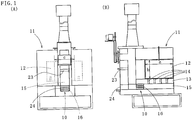
- an apparatus for improving thermal efficiency of a heating device (hereinafter simply referred to as the apparatus for improving thermal efficiency) 10 according to one embodiment of the present invention includes a heat-resistant inorganic conjugated molded product 16 to be arranged (directly inserted in a route for exhaust gas 15 without using a supporting member) in the route for exhaust gas 15 (an example of pathways for heated gas) communicated with each of exhaust ports 14 provided in plurality at, for example, a hearth part 13 of a heating chamber 12 in a heating furnace 11 which is an example of heating devices, and along the flow of exhaust gas (an example of heated gas) passing through the route for exhaust gas 15 in a manner that does not interrupt the flow of the exhaust gas, and to be heated by exhaust gas.
- Radiation heat radiated from the heated inorganic conjugated molded product 16 is thereby put back into the heating chamber 12 through the route for exhaust gas 15 and the exhaust ports 14, consequently decreasing heat that becomes flown out from the heating chamber 12 to the outside. Detailed descriptions will be given below.
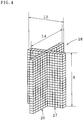
- the inorganic conjugated molded product 16 is, as illustrated in FIGS. 1(A), 1(B) , and 2 , an embedded body (an aggregate) in which a plurality of flat-plate-shaped objects 17 and 18 are embedded in a lattice pattern in planar view.
- an embedded body an aggregate
- exhaust gas flows along the flat-plate-shaped objects 17 and 18 and the sides of the route for exhaust gas 15.
- heat exchange is performed between the flat-plate-shaped objects 17 and the flat-plate-shaped objects 18, and the flat-plate-shaped objects 17 and 18 (the inorganic conjugated molded product 16) become heated.
- the inorganic conjugated molded product 16 can alternatively be fixed in the route for exhaust gas 15 through a supporting member instead of installing it directly in the route for exhaust gas 15.
- the supporting member is made using a heat-resistant iron-chromium wire and wire gauzes of the heat-resistant iron-chromium wire, a high-heat-resistant oxide (e.g., alumina), or a high-heat-resistant non-oxide (e.g., silicon carbide, silicon nitride, and sialon). Deformation of and damages to the supporting member under high temperature can thereby be prevented, enabling a stable usage of the supporting member for a long period of time.
- an inorganic conjugated molded product needs to be determined in accordance with the cross-sectional shape and length of a pathway in which the inorganic conjugated molded product becomes installed, and other than an embedded body, an inorganic conjugated molded product can be formed in the shape of, for example, a flat plate body, a disk body, a cylindrical body, a hollow circular-truncated-cone body having an aperture formed on both ends, a hollow polygonal columnar body having an aperture formed on both ends, or a structural body having wing-shaped members.
- the structural body having wing-shaped members refers to, for example, an inorganic conjugated molded product covering (shielding from heat) vanes of a fan installed in a pathway through which heated gas passes or an inorganic conjugated molded product forming vanes themselves, or an inorganic conjugated molded product forming a casing holding together a plurality of vane members that control the flow direction of heated gas passing the pathway.
- cuts 19 (of which each width T1 is larger than the thickness of each of the flat-plate-shaped objects 18 by 0.5 to 1 mm) each having a length half a length L1 of each of the flat-plate-shaped objects 17 are formed along the longitudinal direction.
- each of the flat-plate-shaped objects 18 at positions dividing a length W2 in the width direction of each of the flat-plate-shaped objects 18 into three equal parts, cuts 20 (of which each width T2 is larger than the thickness of each of the flat-plate-shaped objects 17 by 0.5 to 1 mm) each having a length half a length L2 of each of the flat-plate-shaped objects 18 are formed along the longitudinal direction.
- cuts 19 in the flat-plate-shaped objects 17 and the cuts 20 in the flat-plate-shaped objects 18 through insertion with respect to one another along the cuts 19 and 20, the inorganic conjugated molded product 16 illustrated in FIG. 2 becomes formed.
- each of the flat-plate-shaped objects 17 and 18 (i.e., the inorganic conjugated molded product 16) is provided with an interior layer and an exterior layer that consists of a coverture for inorganic materials protecting the interior layer from heated gas.
- the interior layer is formed of a reinforcing material and a ceramic matrix, the reinforcing material made of a cloth member formed of a heat-resistant inorganic fiber, the ceramic matrix filled in voids in the reinforcing material.
- a reinforcing material formed using a processed fiber product in which a heat-resistant inorganic fiber is used e.g., a laminated product in which long fibers consisting of a heat-resistant inorganic fiber are parallelly aligned in one direction, and an intricate body or oriented body of short fibers consisting of a heat-resistant inorganic fiber and having lengths of 1 to 70 mm
- a processed fiber product in which a heat-resistant inorganic fiber is used e.g., a laminated product in which long fibers consisting of a heat-resistant inorganic fiber are parallelly aligned in one direction, and an intricate body or oriented body of short fibers consisting of a heat-resistant inorganic fiber and having lengths of 1 to 70 mm
- a reinforcing material formed using a processed fiber product in which a heat-resistant inorganic fiber is used e.g., a laminated product in which long fibers consisting of a heat-resistant inorganic fiber are parallelly aligned
- the cloth member is made by cutting a cloth material formed from a woven fabric having a thickness of 0.2 to 10 mm and an aperture ratio of 30% or less or a non-woven fabric having a thickness of 1 to 10 mm and a void fraction of 50 to 97%.
- the woven fabric is any one of a plain weave, satin weave, twill weave, three-dimensional weave, and multiaxial weave. Due to this, by selecting the kind of woven fabric, an optimal cloth member suited for each intended purpose can be obtained.
- a cloth member can also be formed from a laminated product of cloth materials in which one or both of woven fabrics each having a thickness of 0.2 mm or more and 10 mm or less and an aperture ratio of 30% or less and non-woven fabrics each having a thickness of 1 mm or more and 10 mm or less and a void fraction of 50% or more and 97% or less are laminated.
- the cloth member is made by cutting a cloth material composed of a conjugated inorganic fiber (an example of heat-resistant inorganic fibers) consisting of a multilayer structure having an inner shell structure and an outer shell structure.
- the inner shell structure is composed of any one of (1) an inorganic substance containing Si, C, O, and Me, provided that the Me represents one metal composition to be selected from Ti, Zr, and Al, (2) provided that Me represents one metal composition to be selected from Ti, Zr, and Al, Ms represents one metal composition to be selected from Ti and Zr, and MsC represents a carbide of the Ms, an aggregate of crystalline ultrafine particles and an amorphous inorganic substance, the crystalline ultrafine particles containing 1) ⁇ -SiC, 2) MsC, and 3) a solid solution of the ⁇ -SiC and the MsC, and/or MsC 1-x (0 ⁇ x ⁇ 1), the crystalline ultrafine particles having a particle diameter of 700 nm or less, the amorphous inorganic substance
- the outer shell structure is composed of a material A consisting of any one of (1) an oxide of one element selected from the first group, (2) a complex oxide consisting of two or more elements selected from the first group, (3) a solid solution oxide of two or more elements selected from the first group, (4) the oxide and the complex oxide, (5) the oxide and the solid solution oxide, (6) the complex oxide and the solid solution oxide, and (7) the oxide, the complex oxide, and the solid solution oxide.
- a value of thermal expansion coefficient of an inorganic substance forming the outer shell structure is within the range of ⁇ 10% of a value of thermal expansion coefficient of an inorganic substance forming the inner shell structure, and the thickness of the outer shell structure is 0.2 ⁇ m or more and 10 ⁇ m or less. Peeling of the outer shell structure from the inner shell structure can thereby be prevented upon occurrence of temperature fluctuations in the conjugated inorganic fiber.
- each element of Y, Yb, Er, Ho, and Dy is in a second group
- each element of Y, Yb, Er, Ho, Dy, Gd, Sm, Nd, and Lu is in a third group
- at least one element selected from the second group is represented by Q
- at least one element selected from the third group is represented by R
- the solid solution oxide is of one or more of the following general formulae: Q 2 Si 2 O 7 ; QSiO 5 ; R 3 Al 5 O 12 ; and RAlO 3 . Heat resistance and corrosion resistance of the solid solution oxide (i.e., the outer shell structure) thereby becomes enhanced.
- an intervening layer consisting of one or a combination of two or more of C, BN, Si 3 N 4 , a Si-N-based amorphous inorganic substance, and a Si-N-O-based amorphous inorganic substance and having a thickness of 0.1 to 3.0 ⁇ m is made to exist between the inner shell structure and the outer shell structure. Brittle fracture of the inner shell structure can thereby be prevented.
- an interior layer becomes formed.
- a non-oxidizing atmosphere e.g., a nitrogen gas atmosphere
- the organosilicon compound can thereby be made to exist in the voids in the conjugated inorganic fiber forming the cloth member.
- the as-dried cloth member is heat-treated in a non-oxidizing atmosphere (e.g., a nitrogen gas atmosphere) at 1000 to 1900°C for 2 to 10 hours.
- a non-oxidizing atmosphere e.g., a nitrogen gas atmosphere
- a ceramic matrix obtainable from an organosilicon compound and consisting of an inorganic product can thereby be filled in the voids in the conjugated inorganic fiber.
- Performing further repetitions of the organosilicon compound impregnation and heat treatment on the cloth member having the voids in the conjugated inorganic fiber filled with the ceramic matrix can enhance filling rate of the ceramic matrix existing in the voids in the conjugated inorganic fiber.
- the ceramic matrix is composed of either (1) an inorganic substance containing Si, C, O, and Md, provided that the Md represents one metal composition to be selected from Ti, Zr, and Al, or (2) provided that Md represents one metal composition to be selected from Ti, Zr, and Al, Mp represents one metal composition to be selected from Ti and Zr, and MpC represents a carbide of the Mp, an aggregate of crystalline ultrafine particles and an amorphous inorganic substance, the crystalline ultrafine particles containing 1) ⁇ -SiC, 2) MpC, and 3) a solid solution of the ⁇ -SiC and the MpC, and/or MpC 1-x (0 ⁇ x ⁇ 1), the crystalline ultrafine particles having a particle diameter of 700 nm or less, the amorphous inorganic substance containing Si, C, O, and Md, the Si, C, O, and Md existing between the crystalline ultrafine particles.
- the ceramic matrix is composed of any one of (3) an aggregate of crystalline ultrafine particles of ⁇ -SiC having a particle diameter of 700 nm or less and an amorphous inorganic substance containing Si, C, and O, the Si, C, and O existing between crystalline ultrafine particles, (4) an amorphous inorganic substance consisting of Si, C, and O, and (5) a crystalline inorganic substance consisting of fine crystals of ⁇ -SiC.
- the ceramic matrix is composed of (6) a crystalline inorganic substance consisting of fine crystals of ⁇ -SiC.
- the ceramic matrix is also possible for the ceramic matrix to be composed of any one of (7) a crystalline inorganic substance consisting of fine crystals of ⁇ -SiC which are products of carbonization reaction obtained by injecting molten silicon into voids in a conjugated inorganic fiber after making carbon exist in the voids, (8) a crystalline inorganic substance consisting of fine crystals of ⁇ -SiC which are products of carbonization reaction obtained by injecting molten silicon and a carbon compound (e.g., methane or ethane) into the voids in the conjugated inorganic fiber and making the molten silicon and the carbon compound react with each other, and (9) a crystalline inorganic substance consisting of fine crystals of ⁇ -SiC which are products of sintering reaction obtained by filling a SiC fine powder containing a sintering agent into the voids in the conjugated inorganic fiber and applying heat.
- the organosilicon compound a silazane-based polymer containing Si and N is also usable.
- the ceramic matrix is composed of any one of (10) a Si-N-based amorphous inorganic substance, (11) a Si-N-O-based amorphous inorganic substance, (12) Si 3 N 4 -based crystalline ultrafine particles, (13) the Si-N-based amorphous inorganic substance and the Si 3 N 4 crystalline ultrafine particles, and (14) the Si-N-O-based amorphous inorganic substance and the Si 3 N 4 crystalline ultrafine particles.
- the ceramic matrix can also be composed of (15) any one of Si 3 N 4 crystalline ultrafine particles which are products of sintering reaction obtained by filling the voids in the conjugated inorganic fiber with a Si 3 N 4 fine powder containing a sintering agent and applying heat.
- the coverture for inorganic materials that forms the exterior layer is composed of a material A consisting of any one of (1) an oxide of one element selected from the first group, (2) a complex oxide consisting of two or more elements selected from the first group, (3) a solid solution oxide of two or more elements selected from the first group, (4) the oxide and the complex oxide, (5) the oxide and the solid solution oxide, (6) the complex oxide and the solid solution oxide, and (7) the oxide, the complex oxide, and the solid solution oxide.
- the thickness of the exterior layer is made to be 0.2 ⁇ m or more and 10 ⁇ m or less. Long-term durability of the inorganic conjugated molded
- each element of Y, Yb, Er, Ho, and Dy is in a second group
- each element of Y, Yb, Er, Ho, Dy, Gd, Sm, Nd, and Lu is in a third group
- at least one element selected from the second group is represented by Q
- at least one element selected from the third group is represented by R
- the solid solution oxide is of one or more of the following general formulae: Q 2 Si 2 O 7 ; QSiO 5 ; R 3 Al 5 O 12 ; and RAlO 3 . Heat resistance and corrosion resistance of the solid solution oxide (the coverture for inorganic materials) can thereby be enhanced.
- the exterior layer consisting of the coverture for inorganic materials protecting the interior layer from heated gas is formed by, for example, a method described below.
- the interior layer (the cloth member in a condition of having the voids filled with the ceramic matrix) is soaked in a solution in which a material A is dispersed to make a powder of the material A adhere to the surface of the interior layer by means of electrophoresis.
- the powder of the material A is made to become sintered and firmly fixed to the interior layer.
- a coverture for inorganic materials that consists of a sintered layer of the material A becomes formed on the outside of the interior layer as an exterior layer.
- Conditions for the heat treatment in a non-oxidizing atmosphere e.g., the kind of non-oxidizing atmosphere, heat-treatment temperature, duration of the heat-treatment, ambient pressure at the time of the heat-treatment and the like) are determined based on the composition of the material A.
- a cloth member M In place of the conjugated inorganic fiber forming the cloth member, it is possible to make a cloth member M from a cloth material M (in the case of a woven fabric, the thickness is 0.2 to 10 mm and the aperture ratio is 30% or less, and in the case of a non-woven fabric, the thickness is 1 to 10 mm and the void fraction is 50 to 97%) formed using (1) a heat-resistant inorganic fiber composed of an inorganic substance containing Si, C, O, and Me, provided that the Me represents one metal composition to be selected from Ti, Zr, and Al, (2) a heat-resistant inorganic fiber composed of an inorganic substance containing Si, C, and O, or (3) a heat-resistant inorganic fiber composed of a crystalline inorganic substance consisting of fine crystals of ⁇ -SiC.
- the one metal composition to be selected from Ti, Zr, and Al is represented by Md
- the one metal composition to be selected from Ti and Zr is represented by Mp
- a carbide of the Mp is represented by MpC
- the inorganic substance containing Si, C, O, and Me contains an aggregate of crystalline ultrafine particles and an amorphous inorganic substance
- the crystalline ultrafine particles having a particle diameter of 700 nm or less
- the amorphous inorganic substance containing Si, C, O, and Md the Si, C, O, and Md existing between the crystalline ultrafine particles.
- the inorganic substance containing Si, C, and O contains an aggregate of crystalline ultrafine particles of ⁇ -SiC having a particle diameter of 700 nm or less and an amorphous inorganic substance containing Si, C, and O, the Si, C, and O existing between the crystalline ultrafine particles.
- a method for filling a ceramic matrix in voids in the cloth member M can be performed in the same manner as the case of using a cloth member composed of a conjugated inorganic fiber.
- a chemical fiber e.g., a rayon fiber
- the cloth member M made by cutting the cloth material M becomes heat-treated in an inert gas atmosphere (a nitrogen gas atmosphere, preferably, an argon gas atmosphere) at a temperature of 800 to 1200°C for 0.5 to 5 hours and is made to be completely inorganic (the chemical fiber is decomposed and removed completely, or decomposed and removed partially, remnant is carbonized and the sizing agent is removed completely).
- a covering layer consisting of one or a combination of two or more of C, BN, Si 3 N 4 , a Si-N-based amorphous inorganic substance, and a Si-N-O-based amorphous inorganic substance, and having a thickness of 0.1 to 3.0 ⁇ m becomes provided to the surface of the heat-resistant inorganic fiber composing the cloth member M having been made to be completely inorganic. Marked reactions between the heat-resistant inorganic fiber and the ceramic matrix can thereby be prevented upon existence of the ceramic matrix in the voids in the cloth member M, preventing the deterioration of strength in the heat-resistant inorganic fiber.
- the cloth member M was made from the cloth material M formed using the heat-resistant inorganic fiber having neither an inner shell structure nor an outer shell structure, and the voids in the cloth member M were filled with the ceramic matrix.
- a sintered layer consisting of a material A firmly fixed to the surface of the heat-resistant inorganic fiber by making a powder of the material A adhere to the outside of the heat-resistant inorganic fiber forming the cloth member M by means of, for example, electrophoresis and performing heat treatment before filling the voids in the cloth member M with the ceramic matrix.
- the heat-resistant inorganic fiber forming the cloth member M can thereby be altered to the state of a conjugated inorganic fiber, and corrosion resistance of the heat-resistant inorganic fiber can be enhanced. It is preferable to make an intervening layer consisting of one or a combination of two or more of C, BN, Si 3 N 4 , a Si-N-based amorphous inorganic substance, and a Si-N-O-based amorphous inorganic substance and having a thickness of 0.1 to 3.0 ⁇ m exist on the surface of the heat-resistant inorganic fiber forming the cloth member M. Brittle fracture of the heat-resistant inorganic fiber can thereby be prevented.
- the inorganic conjugated molded product 16 (the flat-plate-shaped objects 17 and 18) thereby becomes heated efficiently, and by radiation heat radiated from the heated inorganic conjugated molded product 16, an area upstream of the position of installation of the inorganic conjugated molded product 16 in the route for exhaust gas 15 becomes heated and the temperature rises.
- the amount of radiation heat radiated from the area on the upstream side in the route for exhaust gas 15 increases, and part of the radiation heat enters into a heating chamber 12, which enables a reduction in the amount of heat that flows out from the heating furnace 11 to the outside.
- the inorganic conjugated molded product 16 is provided with the interior layer and the exterior layer consisting of the coverture for inorganic materials which protects the interior layer, provided that each element of Al, Ti, Cr, Fe, Si, Co, Ni, Cu, Y, Zr, Nb, Tc, Ru, Rh, Pd, Ag, La, Ce, Pr, Nd, Pm, Sm, Eu, Gd, Tb, Dy, Ho, Er, Tm, Yb, Lu, Hf, Ta, Re, and Os is in a first group, the coverture for inorganic materials forming the exterior layer is composed of a material A consisting of any one of (1) an oxide of one element selected from the first group, (2) a complex oxide consisting of two or more elements selected from the first group, (3) a solid solution oxide of two or more elements selected from the first group, (4) the oxide and the complex oxide, (5) the oxide and the solid solution oxide, (6) the complex oxide and the solid solution oxide, and (7) the oxide, the complex oxide, and the solid solution
- each element of Y, Yb, Er, Ho, and Dy is in a second group
- each element of Y, Yb, Er, Ho, Dy, Gd, Sm, Nd, and Lu is in a third group
- at least one element selected from the second group is represented by Q
- at least one element selected from the third group is represented by R
- the solid solution oxide is of one or more of the following general formulae: Q 2 Si 2 O 7 ; QSiO 5 ; R 3 Al 5 O 12 ; and RAlO 3
- heat resistance and corrosion resistance of the solid solution oxide i.e., the exterior layer
- the solid solution oxide i.e., the exterior layer
- the inorganic conjugated molded product can easily conform with the temperature fluctuation of heated gas regardless of the quality of material of the exterior layer, and at the same time, radiant efficiency of radiation heat can be enhanced upon reaching a high temperature. Also, since the inner shell structure and the outer shell structure of the conjugated inorganic fiber forming the reinforcing material for the interior layer each are formed by an inorganic substance of the above-described composition, peeling of the outer shell structure from the inner shell structure can be prevented even upon occurrence of temperature fluctuations in the outer shell structure, protecting the inner shell structure from heated gas and enhancing stability in the inner shell structure.
- a numeral 23 indicates a manual damper
- a numeral 24 indicates an aperture that is normally blocked by heat-resistant bricks.
- Respective measurements, a, b, and c, of the heating chamber 12 are, for example, 700 mm, 400 mm, and 455 mm, respectively. However, the present invention is not limited to these measurements.
- the aperture 24 functions as a cold air hole when the heat-resistant bricks are removed.
- Two base materials each having a length L1 of 320 mm and a width W1 of 200 mm and five base materials each having a length L2 of 320 mm and a width W2 of 110 mm were made by cutting a non-woven fabric (having a fiber diameter of 11 ⁇ m, a weight of 240g/m 2 and a void fraction of 95%, containing 20% by mass of rayon fiber which is an example of chemical fibers, and rolled in a roll-shape of 500 mm in width, 5 mm in thickness and 10 m in length) made using a heat-resistant inorganic fiber formed of an inorganic substance containing Si, C, O, and Zr.
- the base materials (pieces of the non-woven fabric) were set in a heat-treating furnace and heat-treated in an argon gas atmosphere at a temperature of 800°C for an hour to partially decompose and remove the rayon fiber contained in each of the base materials, carbonize the remainder, and concurrently remove a sizing agent (an organic substance) on each of the base materials (a first step).
- the heat-treated base materials were made to hold one another by means of two stainless wire gauzes that were to become anode electrodes, and arranged between two C/C composite cathode electrodes arranged opposed to each other with a distance in between inside a bathtub in which a dispersion solution (in which 100 parts of ethanol, 2.5 parts of fine powder of Y 2 SiO 5 , 0.02 parts of cyclohexanol-based dispersant, and 0.02 parts of polyvinyl butyral as a binder were added and ultrasonic dispersion was performed for preparation) in which a powder (a particle diameter of 1 ⁇ m or less) of yttrium monosilicate (Y 2 SiO 5 ) which is a solid solution oxide consisting of elements of Si and Y selected from the first group had been homogeneously dispersed in ethanol solvent was retained.
- a dispersion solution in which 100 parts of ethanol, 2.5 parts of fine powder of Y 2 SiO 5 , 0.02 parts of cyclohexan
- the heat-resistant inorganic fiber was changed to a conjugated inorganic fiber having an inner shell structure (consisting of an inorganic substance containing Si, C, O, and Zr) and an outer shell structure (yttrium monosilicate of 2 ⁇ m in thickness), and seven cloth members (two having a length L1 of 320 mm, a width W1 of 200 mm and a thickness of 5 mm, and the other five having a length L2 of
- the cloth members were soaked, under room temperature, in a solution in which 30 wt% of poly-zirconocarbosilane is uniformly dissolved in a xylene solvent, and then the cloth members were removed from the solution, the cloth members were dried in a nitrogen gas atmosphere at 150°C for 2 hours to remove the xylene solvent contained in the cloth members, and seven cloth members each containing (containing in voids in the cloth members) poly-zirconocarbosilane were made (a fifth step).
- the fifth step and the sixth step were repeated three more times, and compacts (having cuts, completed bodies) each formed of a reinforcing material for the cloth members (the non-woven fabric composed of a conjugated inorganic fiber) and the ceramic matrix consisting of the inorganic substance containing Si, C, O, and Zr, which are inorganic products obtainable by pyrolyzing poly-zirconocarbosilane, were made (an eighth step).
- the compacts obtained in the eighth step were tied to each other by two stainless wire gauzes to be anode electrodes, and the tied compacts were arranged in between two pieces of C/C composite cathode electrodes arranged opposed to each other with a distance in between inside a bathtub where a dispersion solution (to which 100 parts of ethanol, 2.5 parts of fine powder of Y 2 SiO 5 , 0.02 parts of cyclohexanol-based dispersant, and 0.02 parts of polyvinyl butyral as a binder were added and on which ultrasonic dispersion was performed for preparation) in which a powder (particle diameter of 1 ⁇ m or less) of yttrium monosilicate (Y 2 SiO 5 ) which is a solid solution oxide had been homogeneously dispersed in an ethanol solvent was retained. Then, at 25°C, direct voltage of 100 V was applied from a direct current stabilizing power supply for 30 minutes, and the powder of yttrium monosilicate was made to adhere to the
- the compacts After removing the compacts from the dispersion solution, draining the dispersion solution from the compacts, air drying the compacts for 2 hours, and hot-air drying the compacts in the atmosphere at 40°C for 6 hours (a tenth step), in an argon gas atmosphere under a slightly increased pressure of 0.5 MPa, the compacts were heat-treated at 1400°C for 3 hours, and the powder of yttrium monosilicate adhered to the surface of the compacts was sintered to make the powder firmly fixed to the compacts, and seven inorganic conjugated molded products (two having lengths L1 of 320 mm, widths W1 of 200 mm and thicknesses of 3 mm, and the other five having lengths L2 of 320 mm, widths W2 of 110 mm and thicknesses of 3 mm) each having an interior layer formed of a reinforcing material for a corresponding one of the cloth members (the non-woven fabric composed of a conjugated inorganic fiber) and the ceramic matrix consisting of
- the inorganic conjugated molded product 16 which is the apparatus for improving thermal efficiency of a heating device 10 was inserted in the route for exhaust gas 15 which is a pathway for heated gas, along the flow of heated gas.
- the high-temperature gas kiln is a gas kiln having an arched ceiling and provided with six (three pairs of) LPG venturi burners, and at the hearth portion 13, the exhaust ports 14 having widths of 19 to 29 mm and lengths of, for example, 200 mm to 450 mm are arranged side by side with one another.
- Heated gas in the furnace flows into the route for exhaust gas 15 through the exhaust ports 14, and after passing the inorganic conjugated molded product 16, the heated gas passes through a manual damper 23 provided on the downstream side of the route for exhaust gas 15 and becomes released to the outside. In-furnace pressure becomes fine-tuned by the manual damper 23.
- the total amount of LPG consumption in the case where an inorganic conjugated molded product was attached was 10080 liters (momentary average flow rate of LPG gas was 15 liters/min.), and the total amount of LPG consumption in the case where the inorganic conjugated molded product was not attached was 11424 liters (momentary average flow rate of LPG gas was 17 liters/min.). From this result, it was found that by the attachment of the inorganic conjugated molded product, LPG consumption rate can be reduced by approximately 11.8%, and the inorganic conjugated molded product shows a remarkable thermal-efficiency improving effect in a heating device.
- a cloth member having a length of 200 mm, a width of 60 mm and a thickness of 0.33 mm and two cloth members each having a length of 200 mm, a width of 30 mm and a thickness of 0.33 mm were cut out from a plain weave fabric (having a textile weight of 289 g/m 2 , a width of 500 mm, a thickness of 0.33 mm, and a length of 5 m and rolled in a roll-shape) composed of a heat-resistant inorganic fiber formed of an inorganic substance containing Si, C, and O (a first step).
- a plain weave fabric having a textile weight of 289 g/m 2 , a width of 500 mm, a thickness of 0.33 mm, and a length of 5 m and rolled in a roll-shape
- the cloth members from which the xylene solvent was removed were burned in the nitrogen gas atmosphere at 1200°C for an hour, and a Si-N-based (containing a slight amount of O) inorganic material (an amorphous inorganic substance consisting of Si and N, and/or Si 3 N 4 fine crystals) was made to coat the surface of the heat-resistant inorganic fiber composing the plain weave fabric which is the cloth members (a second step).
- a Si-N-based inorganic material an amorphous inorganic substance consisting of Si and N, and/or Si 3 N 4 fine crystals
- the cloth members (the plain weave fabric composed of the heat-resistant inorganic fiber coated with the Si-N-based inorganic material) obtained in the second step in a solution in which 30 wt% of polycarbosilane was homogeneously dissolved in a xylene solvent, the cloth members were taken out from the solution and dried in a nitrogen gas atmosphere at 150°C for two hours to remove the xylene solvent contained in the cloth members, and three cloth members containing (containing in voids in the cloth members) polycarbosilane were made (a third step).
- a compact (a completed body) formed of a reinforcing material for the cloth members (the plain weave fabric composed of an inorganic fiber coated with a Si-N-based inorganic material) and the ceramic matrix consisting of the inorganic substance containing Si, C, and O which are inorganic products obtainable by pyrolyzing polycarbosilane were made by repeating the third step and the fourth step two more times (a fifth step).
- the apparatus for improving thermal efficiency of a heating device 28 formed of the inorganic conjugated molded product obtained was, as illustrated in FIGS. 5 and 6 , inserted from an entrance side (in-furnace side) of an exhaust port 31 formed in the center of a ceiling portion 30 of an electric furnace 29 and having an inside diameter d of 60 mm and a height h of, for example, 450 mm, and in order to keep the inorganic conjugated molded product from being dislocated and coming off, the apparatus for improving thermal efficiency of a heating device 28 was attached (attached in a manner that makes one end of the inorganic conjugated molded product fit precisely with the entrance position of the exhaust port 31) while adjusting the conditions of the iron-chromium wire gauzes 26 and 27 holding the inorganic conjugated molded product in between.
- the electric furnace 29 was maintained (controlled by the temperature at a central portion of the electric furnace) at 800°C at all times, and air was flown into the electric furnace 29 from an air insertion slot 33 formed at a central portion of the hearth 32 of the electric furnace 29 at a flow rate of 1 liter/minute for 10 hours, and a rate of reduction in electricity consumption W1 in the electric furnace 29 at that time was studied.
- an amount of electricity consumption required to keep the electric furnace 29 at a constant temperature of 800°C while making air flow from the air insertion slot 33 at the central portion of the hearth 32 into the electric furnace 29 at a flow rate of 1 liter/minute without installing the apparatus for improving thermal efficiency inside the exhaust port 31 in the electric furnace 29 is represented by P0
- a rate of reduction in electricity consumption P1 was calculated by 100 ⁇ (P0-P1)/P0.
- the rate of reduction in electricity consumption indicated a value of 12%. This reduction rate did not change and remained constant for 10 hours.
- the fact that the inorganic conjugated molded product has an excellent radiation-heat radiation action was thereby confirmed, suggesting a large contribution to energy saving in the operation of the electric furnace 29, and a large contribution to a reduction in generation of CO 2 as a consequence.
- a base material having a length of 200 mm, a width of 60 mm and a thickness of 5 mm and two base materials each having a length of 200 mm, a width of 30 mm and a thickness of 5 mm were made by cutting a non-woven fabric (having a fiber diameter of 11 ⁇ m, a textile weight of 240 g/m 2 , and a void fraction of 95%, containing 20% by mass of a rayon fiber which is an example of chemical fibers, and rolled in a roll shape of 500 mm in width, 5 mm in thickness and 10 m in length) composed of a heat-resistant inorganic fiber formed of an inorganic substance containing Si, C, O, and Ti.
- the base materials were set up in a heat treatment furnace, and heat-treated in an argon gas atmosphere at 800°C for an hour to decompose and remove part of the rayon fiber contained in the base materials (the non-woven fabric), carbonize the remainder, and at the same time, remove a sizing agent (an organic matter) on the base materials (a first step).
- the heat-treated base materials were made to be tied to one another by means of two stainless wire gauzes that were to be anode electrodes, and the base materials made to be tied to one another were arranged in between two C/C composite cathode electrodes arranged opposed to each other with a distance in between inside a bathtub in which a dispersion solution (to which 100 parts of ethanol, 2.5 parts of zircon powder, 0.02 parts of cyclohexanol-based dispersant, and 0.02 parts of polyvinyl butyral as a binder were added and on which ultrasonic dispersion was performed for preparation) in which a powder (a particle diameter of 1 ⁇ m or less) of zircon (also referred to as zirconium monosilicate, ZrSiO 4 ) which is a solid solution oxide consisting of the elements of Si and Zr selected from the first group had been homogeneously dispersed in an ethanol solvent was retained.
- a dispersion solution to which 100 parts of ethanol, 2.5 parts of
- the heat-resistant inorganic fiber was changed to a conjugated inorganic fiber having an inner shell structure (composed of an inorganic substance containing Si, C, O, and Ti) and an outer shell structure (zircon having a thickness of 2 ⁇ m), and three cloth members (one having a length of 200 mm, a width of 60 mm and a thickness of 5 mm, the other two each having a length of 200 mm, a width of 30 mm and a thickness of 5 mm)
- a compact (a completed body) formed of a reinforcing material for the cloth members (the non-woven fabric composed of the conjugated inorganic fiber) and a ceramic matrix consisting of the inorganic substance containing Si, C, O, and Ti which are inorganic products obtainable from pyrolyzing polytitano carbosilane were made by repeating the fifth step and the sixth step four more times (a seventh step).
- An apparatus for improving thermal efficiency of a heating device consisting of an inorganic conjugated molded product embedded in a cross-shaped lattice pattern was made from the three inorganic conjugated molded products obtained in the eighth step by processing in the same manner as the ninth step in the experimental example 2 (a ninth step).
- a test to confirm the effect of the apparatus for improving thermal efficiency was performed in the exact same manner as that in the experimental example 2 except that the electric furnace was kept at a constant temperature of 1200°C instead of the constant temperature of 800°C of the experimental example 2, and except that air was flown into the electric furnace for 300 hours instead of the 10 hours of the experimental example 2.
- the present invention is not limited to the structures described in the above embodiments, and also includes other embodiments and variations conceivable within the scope of matters described in the scope of claims. Additionally, the present invention also includes those in which the constituent elements included in the present embodiments and constituent elements included in other embodiments and variations are combined. For example, in the present embodiments, a non-oxide-based heat-resistant inorganic fiber was used, however, a heat-resistant inorganic fiber composed of an inorganic substance containing Al, Si, and O can also be used.
Landscapes
- Engineering & Computer Science (AREA)
- Chemical & Material Sciences (AREA)
- Ceramic Engineering (AREA)
- Manufacturing & Machinery (AREA)
- Materials Engineering (AREA)
- Structural Engineering (AREA)
- Organic Chemistry (AREA)
- Inorganic Chemistry (AREA)
- General Engineering & Computer Science (AREA)
- Mechanical Engineering (AREA)
- Chemical Kinetics & Catalysis (AREA)
- Environmental & Geological Engineering (AREA)
- Physics & Mathematics (AREA)
- Thermal Sciences (AREA)
- Resistance Heating (AREA)
- Waste-Gas Treatment And Other Accessory Devices For Furnaces (AREA)
- Ceramic Products (AREA)
Claims (45)
- Verfahren zum Verbessern des thermischen Wirkungsgrads einer Heizvorrichtung, das aufweist:Installieren eines hitzebeständigen anorganischen konjugierten Formprodukts (16) in und entlang einem Weg (15) für von einer Heizvorrichtung (11) erzeugtes erhitztes Gas, ohne die Strömung des durch den Weg (15) hindurchströmenden erhitzten Gases zu unterbrechen,Erhitzen des anorganischen konjugierten Formprodukts (16) mit dem erhitzten Gas,Wiedereinbringen von Strahlungswärme vom erhitzten anorganischen konjugierten Formprodukt (16) in die Heizvorrichtung (11) undVerringern der von der Heizvorrichtung (11) nach außen strömenden Wärmemenge, wobei das anorganische konjugierte Formprodukt (16) mit einer Innenschicht und einer Außenschicht versehen ist, wobei die Außenschicht aus einer Abdeckung für anorganische Materialien, welche die Innenschicht vor erhitztem Gas schützt, gebildet ist,dadurch gekennzeichnet, dass die Innenschicht aus einem Verstärkungsmaterial und einer Keramikmatrix gebildet ist, das Verstärkungsmaterial aus einer hitzebeständigen anorganischen Faser gebildet ist und die Keramikmatrix in Hohlräume im Verstärkungsmaterial eingefüllt ist unddas Verstärkungsmaterial mit einem Tuchelement oder einem verarbeiteten Faserprodukt gebildet ist,wobei die Keramikmatrix (1) ein durch Pyrolysieren von Polymetallocarbosilan erhaltbares anorganisches Produkt, (2) ein durch Pyrolysieren von Polycarbosilan erhaltbares anorganisches Produkt, (3) ein Pyrolysat von Polyaluminocarbosilan, (4) ein Pyrolysat von Polycarbosilan, (5) ein Produkt einer Karbonisierungsreaktion zwischen geschmolzenem Silizium und Kohlenstoff, (6) ein Produkt einer Karbonisierungsreaktion zwischen geschmolzenem Silizium und einer Kohlenstoffverbindung, (7) ein Produkt einer Sinterreaktion eines einen Sinterzusatzstoff enthaltenden feinen SiC-Pulvers, (8) ein durch Pyrolysieren eines silazanbasierten Polymers, das Si und N enthält, erhaltbares anorganisches Produkt oder (9) kristalline ultrafeine Si3N4-Teilchen, die Produkte einer Sinterreaktion eines einen Sinterzusatzstoff enthaltenden feinen Si3N4-Pulvers sind, ist, undvorausgesetzt, dass jedes Element Al, Ti, Cr, Fe, Si, Co, Ni, Cu, Y, Zr, Nb, Tc, Ru, Rh, Pd, Ag, La, Ce, Pr, Nd, Pm, Sm, Eu, Gd, Tb, Dy, Ho, Er, Tm, Yb, Lu, Hf, Ta, Re und Os in einer ersten Gruppe ist, die Abdeckung für das die Außenschicht bildende anorganische Material aus einem Material A zusammengesetzt ist, das aus (1) einem Oxid eines aus der ersten Gruppe ausgewählten Elements, (2) einem aus zwei oder mehr aus der ersten Gruppe ausgewählten Elementen bestehenden komplexen Oxid, (3) einem Festlösungsoxid von zwei oder mehr aus der ersten Gruppe ausgewählten Elementen, (4) dem Oxid und dem komplexen Oxid, (5) dem Oxid und dem Festlösungsoxid, (6) dem komplexen Oxid und dem Festlösungsoxid oder (7) dem Oxid, dem komplexen Oxid und dem Festlösungsoxid besteht, unddie Dicke der Außenschicht wenigstens 0,2 µm und höchstens 10 µm beträgt.
- Verfahren zum Verbessern des thermischen Wirkungsgrads einer Heizvorrichtung nach Anspruch 1, wobei
die hitzebeständige anorganische Faser eine konjugierte anorganische Faser ist, die mit einer Mehrschichtstruktur versehen ist, welche eine Innenmantelstruktur und eine Außenmantelstruktur aufweist,
vorausgesetzt, dass jedes der folgenden Elemente Al; Ti; Cr; Fe; Si; Co; Ni; Cu; Y; Zr; Nb; Tc; Ru; Rh; Pd; Ag; La; Ce; Pr; Nd; Pm; Sm; Eu; Gd; Tb; Dy; Ho; Er; Tm; Yb; Lu; Hf; Ta; Re und Os in einer ersten Gruppe ist, die Außenmantelstruktur aus einem Material A zusammengesetzt ist, das aus (1) einem Oxid eines aus der ersten Gruppe ausgewählten Elements, (2) einem aus zwei oder mehr aus der ersten Gruppe ausgewählten Elementen bestehenden komplexen Oxid, (3) einem Festlösungsoxid von zwei oder mehr aus der ersten Gruppe ausgewählten Elementen, (4) dem Oxid und dem komplexen Oxid, (5) dem Oxid und dem Festlösungsoxid, (6) dem komplexen Oxid und dem Festlösungsoxid oder (7) dem Oxid, dem komplexen Oxid und dem Festlösungsoxid besteht,
der Wert des Wärmeausdehnungskoeffizienten einer die Außenmantelstruktur bildenden anorganischen Substanz innerhalb des Bereichs von ±10 % eines Werts des Wärmeausdehnungskoeffizienten einer die Innenmantelstruktur bildenden anorganischen Substanz liegt und
die Dicke der Außenmantelstruktur wenigstens 0,2 µm und höchstens 10 µm beträgt. - Verfahren zum Verbessern des thermischen Wirkungsgrads einer Heizvorrichtung nach Anspruch 2, wobei
vorausgesetzt, dass jedes Element Y, Yb, Er, Ho und Dy in einer zweiten Gruppe ist, jedes Element Y, Yb, Er, Ho, Dy, Gd, Sm, Nd und Lu in einer dritten Gruppe ist, wenigstens ein aus der zweiten Gruppe ausgewähltes Element durch Q repräsentiert ist und wenigstens ein aus der dritten Gruppe ausgewähltes Element durch R repräsentiert ist, das die Außenmantelstruktur bildende Festlösungsoxid einer oder mehreren der folgenden allgemeinen Formeln genügt: Q2Si2O7, QSiO5, R3Al5O12 und RAlO3. - Verfahren zum Verbessern des thermischen Wirkungsgrads einer Heizvorrichtung nach Anspruch 2 oder 3, wobei
vorausgesetzt, dass eine Metallzusammensetzung, die aus Ti, Zr und Al auszuwählen ist, durch Me repräsentiert ist, die Innenmantelstruktur aus einer Si, C, O und Me enthaltenden anorganischen Substanz besteht. - Verfahren zum Verbessern des thermischen Wirkungsgrads einer Heizvorrichtung nach Anspruch 2 oder 3, wobei
vorausgesetzt, dass eine aus Ti, Zr und Al auszuwählende Metallzusammensetzung durch Me repräsentiert ist, eine aus Ti und Zr auszuwählende Metallzusammensetzung durch Ms repräsentiert ist und ein Carbid von Ms durch MsC repräsentiert ist, die Innenmantelstruktur aus einem Aggregat kristalliner ultrafeiner Teilchen und einer amorphen anorganischen Substanz besteht, wobei die kristallinen ultrafeinen Teilchen 1) β-SiC, 2) MsC und 3) eine Festlösung von β-SiC und MsC und/oder MsC1-x (0 < x < 1) enthalten, die kristallinen ultrafeinen Teilchen einen Durchmesser von höchstens 700 nm aufweisen und die amorphe anorganische Substanz Si, C, O und Me enthält, wobei Si, C, O und Me zwischen den kristallinen ultrafeinen Teilchen existieren. - Verfahren zum Verbessern des thermischen Wirkungsgrads einer Heizvorrichtung nach Anspruch 2 oder 3, wobei
die Innenmantelstruktur aus einer Si, C und O enthaltenden amorphen anorganischen Substanz besteht. - Verfahren zum Verbessern des thermischen Wirkungsgrads einer Heizvorrichtung nach Anspruch 2 oder 3, wobei
die Innenmantelstruktur aus einem Aggregat kristalliner ultrafeiner Teilchen aus β-SiC mit einem Durchmesser von höchstens 700 nm und einer Si, C und O enthaltenden amorphen anorganischen Substanz besteht, wobei Si, C und O zwischen den kristallinen ultrafeinen Teilchen existieren. - Verfahren zum Verbessern des thermischen Wirkungsgrads einer Heizvorrichtung nach Anspruch 2 oder 3, wobei
die Innenmantelstruktur aus einer aus feinen β-SiC-Kristallen bestehenden kristallinen anorganischen Substanz zusammengesetzt ist. - Verfahren zum Verbessern des thermischen Wirkungsgrads einer Heizvorrichtung nach Anspruch 2 oder 3, wobei
eine Zwischenschicht, die aus einem oder einer Kombination aus zwei oder mehr von C, BN, Si3N4, einer Si-N-basierten amorphen anorganischen Substanz und einer Si-N-O-basierten amorphen anorganischen Substanz besteht und eine Dicke von 0,1 bis 3,0 µm aufweist, zwischen der Innenmantelstruktur und der Außenmantelstruktur der konjugierten anorganischen Faser existiert. - Verfahren zum Verbessern des thermischen Wirkungsgrads einer Heizvorrichtung nach Anspruch 1, wobei
vorausgesetzt, dass eine aus Ti, Zr und Al auszuwählende Metallzusammensetzung durch Me repräsentiert ist, die hitzebeständige anorganische Faser aus einer Si, C, O und Me enthaltenden anorganischen Substanz besteht. - Verfahren zum Verbessern des thermischen Wirkungsgrads einer Heizvorrichtung nach Anspruch 1, wobei
die hitzebeständige anorganische Faser aus einer Si, C und O enthaltenden anorganischen Substanz besteht. - Verfahren zum Verbessern des thermischen Wirkungsgrads einer Heizvorrichtung nach Anspruch 1, wobei
die hitzebeständige anorganische Faser aus einer aus feinen β-SiC-Kristallen bestehenden kristallinen anorganischen Substanz zusammengesetzt ist. - Verfahren zum Verbessern des thermischen Wirkungsgrads einer Heizvorrichtung nach Anspruch 1, wobei
die hitzebeständige anorganische Faser aus einer Al, Si und O enthaltenden anorganischen Substanz besteht. - Verfahren zum Verbessern des thermischen Wirkungsgrads einer Heizvorrichtung nach einem der Ansprüche 10 bis 13, wobei
die hitzebeständige anorganische Faser eine Deckschicht aufweist, die aus einem oder einer Kombination aus zweien oder mehreren von C, BN, Si3N4, einer Si-N-basierten amorphen anorganischen Substanz und einer Si-N-O-basierten amorphen anorganischen Substanz besteht und eine Dicke von 0,1 bis 3,0 µm aufweist. - Verfahren zum Verbessern des thermischen Wirkungsgrads einer Heizvorrichtung nach Anspruch 1, wobei
die Keramikmatrix das durch Pyrolysieren von Polymetallocarbosilan erhaltbare anorganische Produkt ist und
vorausgesetzt, dass eine aus Ti, Zr und Al auszuwählende Metallzusammensetzung durch Md repräsentiert ist, die Keramikmatrix aus einer Si, C, O und Md enthaltenden anorganischen Substanz besteht. - Verfahren zum Verbessern des thermischen Wirkungsgrads einer Heizvorrichtung nach Anspruch 1, wobei
die Keramikmatrix das durch Pyrolysieren von Polymetallocarbosilan erhaltbare anorganische Produkt ist und
vorausgesetzt, dass eine aus Ti, Zr und Al auszuwählende Metallzusammensetzung durch Md repräsentiert ist, eine aus Ti und Zr auszuwählende Metallzusammensetzung durch Mp repräsentiert ist und ein Carbid von Mp durch MpC repräsentiert ist, die Keramikmatrix aus einem Aggregat kristalliner ultrafeiner Teilchen und einer amorphen anorganischen Substanz besteht, wobei die kristallinen ultrafeinen Teilchen 1) β-SiC, 2) MpC und 3) eine Festlösung von β-SiC und MpC und/oder MpC1-x (0 < x < 1) enthalten, wobei die kristallinen ultrafeinen Teilchen einen Durchmesser von höchstens 700 nm aufweisen und die amorphe anorganische Substanz Si, C, O und Md enthält, wobei Si, C, O und Md zwischen den kristallinen ultrafeinen Teilchen existieren. - Verfahren zum Verbessern des thermischen Wirkungsgrads einer Heizvorrichtung nach Anspruch 1, wobei
die Keramikmatrix das durch Pyrolysieren von Polycarbosilan erhaltbare anorganische Produkt ist und aus einem Aggregat kristalliner ultrafeiner β-SiC-Teilchen mit einem Durchmesser von höchstens 700 nm und einer Si, C und O enthaltenden amorphen anorganischen Substanz besteht, wobei Si, C und O zwischen den kristallinen ultrafeinen Teilchen existieren, oder aus einer aus Si, C und O bestehenden amorphen anorganischen Substanz besteht. - Verfahren zum Verbessern des thermischen Wirkungsgrads einer Heizvorrichtung nach Anspruch 1, wobei
die Keramikmatrix das Pyrolisat von Polyaluminocarbosilan, das Pyrolysat von Polycarbosilan, das Produkt der Karbonisierungsreaktion zwischen geschmolzenem Silizium und Kohlenstoff, das Produkt der Karbonisierungsreaktion zwischen geschmolzenem Silizium und einer Kohlenstoffverbindung oder das Produkt einer Sinterreaktion eines einen Sinterzusatzstoff enthaltenden feinen SiC-Pulvers ist und aus einer aus feinen β-SiC-Kristallen bestehenden kristallinen anorganischen Substanz besteht. - Verfahren zum Verbessern des thermischen Wirkungsgrads einer Heizvorrichtung nach Anspruch 1, wobei
die Keramikmatrix das anorganische Produkt ist, das durch Pyrolysieren eines Si und N enthaltenden silazanbasierten Polymers erhaltbar ist und aus einer Si-N-basierten amorphen anorganischen Substanz, einer Si-N-O-basierten amorphen anorganischen Substanz, kristallinen ultrafeinen Si3N4-Teilchen, der Si-N-basierten amorphen anorganischen Substanz und den kristallinen ultrafeinen Si3N4-Teilchen oder der Si-N-O-basierten amorphen anorganischen Substanz und den kristallinen ultrafeinen Si3N4-Teilchen besteht. - Verfahren zum Verbessern des thermischen Wirkungsgrads einer Heizvorrichtung nach Anspruch 1, wobei
vorausgesetzt, dass jedes Element Y, Yb, Er, Ho und Dy in einer zweiten Gruppe ist, jedes Element Y, Yb, Er, Ho, Dy, Gd, Sm, Nd und Lu in einer dritten Gruppe ist, wenigstens ein aus der zweiten Gruppe ausgewähltes Element durch Q repräsentiert ist und wenigstens ein aus der dritten Gruppe ausgewähltes Element durch R repräsentiert ist, das Festlösungsoxid einer oder mehreren der folgenden allgemeinen Formeln genügt: Q2Si2O7, QSiO5, R3Al5O12 und RAlO3. - Vorrichtung zum Verbessern des thermischen Wirkungsgrads einer Heizvorrichtung zur Verwendung beim Verfahren zum Verbessern des thermischen Wirkungsgrads einer Heizvorrichtung nach Anspruch 1, wobei die Vorrichtung aufweist: die Innenschicht des aus einem Verstärkungsmaterial und einer Keramikmatrix gebildeten anorganischen konjugierten Formprodukts, wobei das Verstärkungsmaterial aus einer hitzebeständigen anorganischen Faser besteht und die Keramikmatrix in Hohlräume im Verstärkungsmaterial eingefüllt ist, wobei das Verstärkungsmaterial ferner mit einem Tuchelement oder einem verarbeiteten Faserprodukt gebildet ist,
wobei das anorganische konjugierte Formprodukt (16) 1) ein flacher Plattenkörper, 2) ein Scheibenkörper, 3) ein eingebetteter Körper, wobei mehrere flache plattenförmige Objekte (17, 18) in einer Draufsicht in ein Gittermuster eingebettet sind, 4) ein zylindrischer Körper, 5) ein hohler kreisförmiger abgeschnittener Kegelkörper, 6) ein hohler polygonaler Säulenkörper oder 7) ein Strukturkörper mit flügelförmigen Elementen ist. - Vorrichtung zum Verbessern des thermischen Wirkungsgrads einer Heizvorrichtung nach Anspruch 21, wobei
das anorganische konjugierte Formprodukt (16) durch ein Stützelement im Weg installiert ist. - Vorrichtung zum Verbessern des thermischen Wirkungsgrads einer Heizvorrichtung nach Anspruch 21, wobei
das Tuchelement aus einem Webstoff mit einer Dicke von wenigstens 0,2 mm und höchstens 10 mm und einem Öffnungsverhältnis von höchstens 30 % besteht und der Webstoff ein einfacher Webstoff, ein Satinwebstoff, ein Köperwebstoff, ein dreidimensionaler Webstoff oder ein mehrachsiger Webstoff ist. - Vorrichtung zum Verbessern des thermischen Wirkungsgrads einer Heizvorrichtung nach Anspruch 21, wobei
das Tuchelement aus einem Vlies mit einer Dicke von wenigstens 1 mm und höchstens 10 mm und einem Hohlraumanteil von wenigstens 50 % und höchstens 97 % besteht. - Vorrichtung zum Verbessern des thermischen Wirkungsgrads einer Heizvorrichtung nach Anspruch 21, wobei
das Tuchelement aus einem laminierten Produkt von Tuchmaterialien besteht, das durch Überlappen von Webstoffen und/oder Vliesen gebildet ist, wobei die Webstoffe jeweils eine Dicke von wenigstens 0,2 mm und höchstens 10 mm und ein Öffnungsverhältnis von höchstens 30 % aufweisen und die Vliese jeweils eine Dicke von wenigstens 1 mm und höchstens 10 mm und einen Hohlraumanteil von wenigstens 50 % und höchstens 97 % aufweisen. - Vorrichtung zum Verbessern des thermischen Wirkungsgrads einer Heizvorrichtung nach Anspruch 21, wobei
das verarbeitete Faserprodukt ein laminiertes Produkt ist, bei dem aus der hitzebeständigen anorganischen Faser bestehende lange Fasern parallel zueinander in einer Richtung ausgerichtet sind oder aus der hitzebeständigen anorganischen Faser bestehende kurze Fasern mit Längen von 1 bis 70 mm vorhanden sind. - Vorrichtung zum Verbessern des thermischen Wirkungsgrads einer Heizvorrichtung nach einem der Ansprüche 21 bis 26, wobei
die hitzebeständige anorganische Faser eine konjugierte anorganische Faser ist, die mit einer Mehrschichtstruktur versehen ist, welche eine Innenmantelstruktur und eine Außenmantelstruktur aufweist,
vorausgesetzt, dass jedes der folgenden Elemente Al; Ti; Cr; Fe; Si; Co; Ni; Cu; Y; Zr; Nb; Tc; Ru; Rh; Pd; Ag; La; Ce; Pr; Nd; Pm; Sm; Eu; Gd; Tb; Dy; Ho; Er; Tm; Yb; Lu; Hf; Ta; Re und Os in einer ersten Gruppe ist, die Außenmantelstruktur aus einem Material A zusammengesetzt ist, das aus (1) einem Oxid eines aus der ersten Gruppe ausgewählten Elements, (2) einem aus zwei oder mehr aus der ersten Gruppe ausgewählten Elementen bestehenden komplexen Oxid, (3) einem Festlösungsoxid von zwei oder mehr aus der ersten Gruppe ausgewählten Elementen, (4) dem Oxid und dem komplexen Oxid, (5) dem Oxid und dem Festlösungsoxid, (6) dem komplexen Oxid und dem Festlösungsoxid oder (7) dem Oxid, dem komplexen Oxid und dem Festlösungsoxid besteht,
der Wert des Wärmeausdehnungskoeffizienten einer die Außenmantelstruktur bildenden anorganischen Substanz innerhalb des Bereichs von ±10 % eines Werts des Wärmeausdehnungskoeffizienten einer die Innenmantelstruktur bildenden anorganischen Substanz liegt und
die Dicke der Außenmantelstruktur wenigstens 0,2 µm und höchstens 10 µm beträgt. - Vorrichtung zum Verbessern des thermischen Wirkungsgrads einer Heizvorrichtung nach Anspruch 27, wobei
vorausgesetzt, dass jedes Element Y, Yb, Er, Ho und Dy in einer zweiten Gruppe ist, jedes Element Y, Yb, Er, Ho, Dy, Gd, Sm, Nd und Lu in einer dritten Gruppe ist, wenigstens ein aus der zweiten Gruppe ausgewähltes Element durch Q repräsentiert ist und wenigstens ein aus der dritten Gruppe ausgewähltes Element durch R repräsentiert ist, das Festlösungsoxid einer oder mehreren der folgenden allgemeinen Formeln genügt: Q2Si2O7, QSiO5, R3Al5O12 und RAlO3. - Vorrichtung zum Verbessern des thermischen Wirkungsgrads einer Heizvorrichtung nach Anspruch 27 oder 28, wobei
vorausgesetzt, dass eine Metallzusammensetzung, die aus Ti, Zr und Al auszuwählen ist, durch Me repräsentiert ist, die Innenmantelstruktur aus einer Si, C, O und Me enthaltenden anorganischen Substanz besteht. - Vorrichtung zum Verbessern des thermischen Wirkungsgrads einer Heizvorrichtung nach Anspruch 27 oder 28, wobei
vorausgesetzt, dass eine aus Ti, Zr und Al auszuwählende Metallzusammensetzung durch Me repräsentiert ist, eine aus Ti und Zr auszuwählende Metallzusammensetzung durch Ms repräsentiert ist und ein Carbid von Ms durch MsC repräsentiert ist, die Innenmantelstruktur aus einem Aggregat kristalliner ultrafeiner Teilchen und einer amorphen anorganischen Substanz besteht, wobei die kristallinen ultrafeinen Teilchen 1) β-SiC, 2) MsC und 3) eine Festlösung von β-SiC und MsC und/oder MsC1-x (0 < x < 1) enthalten, die kristallinen ultrafeinen Teilchen einen Durchmesser von höchstens 700 nm aufweisen und die amorphe anorganische Substanz Si, C, O und Me enthält, wobei Si, C, O und Me zwischen den kristallinen ultrafeinen Teilchen existieren. - Vorrichtung zum Verbessern des thermischen Wirkungsgrads einer Heizvorrichtung nach Anspruch 27 oder 28, wobei
die Innenmantelstruktur aus einer Si, C und O enthaltenden amorphen anorganischen Substanz besteht. - Vorrichtung zum Verbessern des thermischen Wirkungsgrads einer Heizvorrichtung nach Anspruch 27 oder 28, wobei
die Innenmantelstruktur aus einem Aggregat kristalliner ultrafeiner Teilchen aus β-SiC mit einem Durchmesser von höchstens 700 nm und einer Si, C und O enthaltenden amorphen anorganischen Substanz besteht, wobei Si, C und O zwischen den kristallinen ultrafeinen Teilchen existieren. - Vorrichtung zum Verbessern des thermischen Wirkungsgrads einer Heizvorrichtung nach Anspruch 27 oder 28, wobei
die Innenmantelstruktur aus einer aus feinen β-SiC-Kristallen bestehenden kristallinen anorganischen Substanz zusammengesetzt ist. - Vorrichtung zum Verbessern des thermischen Wirkungsgrads einer Heizvorrichtung nach Anspruch 27 oder 28, wobei
eine Zwischenschicht, die aus einem oder einer Kombination aus zwei oder mehr von C, BN, Si3N4, einer Si-N-basierten amorphen anorganischen Substanz und einer Si-N-O-basierten amorphen anorganischen Substanz besteht und eine Dicke von 0,1 bis 3,0 µm aufweist, zwischen der Innenmantelstruktur und der Außenmantelstruktur der konjugierten anorganischen Faser existiert. - Vorrichtung zum Verbessern des thermischen Wirkungsgrads einer Heizvorrichtung nach einem der Ansprüche 21 bis 26, wobei
vorausgesetzt, dass eine aus Ti, Zr und Al auszuwählende Metallzusammensetzung durch Me repräsentiert ist, die hitzebeständige anorganische Faser aus einer Si, C, O und Me enthaltenden anorganischen Substanz besteht. - Vorrichtung zum Verbessern des thermischen Wirkungsgrads einer Heizvorrichtung nach einem der Ansprüche 21 bis 26, wobei
die hitzebeständige anorganische Faser aus einer Si, C und O enthaltenden anorganischen Substanz besteht. - Vorrichtung zum Verbessern des thermischen Wirkungsgrads einer Heizvorrichtung nach einem der Ansprüche 21 bis 26, wobei
die hitzebeständige anorganische Faser aus einer aus feinen β-SiC-Kristallen bestehenden kristallinen anorganischen Substanz besteht. - Vorrichtung zum Verbessern des thermischen Wirkungsgrads einer Heizvorrichtung nach einem der Ansprüche 21 bis 26, wobei
die hitzebeständige anorganische Faser aus einer Al, Si und O enthaltenden anorganischen Substanz besteht. - Vorrichtung zum Verbessern des thermischen Wirkungsgrads einer Heizvorrichtung nach einem der Ansprüche 35 bis 38, wobei
die hitzebeständige anorganische Faser eine Deckschicht aufweist, die aus einem oder einer Kombination aus zweien oder mehreren von C, BN, Si3N4, einer Si-N-basierten amorphen anorganischen Substanz und einer Si-N-O-basierten amorphen anorganischen Substanz besteht und eine Dicke von 0,1 bis 3,0 µm aufweist. - Vorrichtung zum Verbessern des thermischen Wirkungsgrads einer Heizvorrichtung nach einem der Ansprüche 21 bis 26, wobei
die Keramikmatrix das durch Pyrolysieren von Polymetallocarbosilan erhaltbare anorganische Produkt ist und
vorausgesetzt, dass eine aus Ti, Zr und Al auszuwählende Metallzusammensetzung durch Md repräsentiert ist, die Keramikmatrix aus einer Si, C, O und Md enthaltenden anorganischen Substanz besteht. - Vorrichtung zum Verbessern des thermischen Wirkungsgrads einer Heizvorrichtung nach einem der Ansprüche 21 bis 26, wobei
die Keramikmatrix das durch Pyrolysieren von Polymetallocarbosilan erhaltbare anorganische Produkt ist und
vorausgesetzt, dass eine aus Ti, Zr und Al auszuwählende Metallzusammensetzung durch Md repräsentiert ist, eine aus Ti und Zr auszuwählende Metallzusammensetzung durch Mp repräsentiert ist und ein Carbid von Mp durch MpC repräsentiert ist, die Keramikmatrix aus einem Aggregat kristalliner ultrafeiner Teilchen und einer amorphen anorganischen Substanz besteht, wobei die kristallinen ultrafeinen Teilchen 1) β-SiC, 2) MpC und 3) eine Festlösung von β-SiC und MpC und/oder MpC1-x (0 < x < 1) enthalten, wobei die kristallinen ultrafeinen Teilchen einen Durchmesser von höchstens 700 nm aufweisen und die amorphe anorganische Substanz Si, C, O und Md enthält, wobei Si, C, O und Md zwischen den kristallinen ultrafeinen Teilchen existieren. - Vorrichtung zum Verbessern des thermischen Wirkungsgrads einer Heizvorrichtung nach einem der Ansprüche 21 bis 26, wobei
die Keramikmatrix das durch Pyrolysieren von Polycarbosilan erhaltbare anorganische Produkt ist und aus einem Aggregat kristalliner ultrafeiner β-SiC-Teilchen mit einem Durchmesser von höchstens 700 nm und einer Si, C und O enthaltenden amorphen anorganischen Substanz besteht, wobei Si, C und O zwischen den kristallinen ultrafeinen Teilchen existieren, oder aus einer aus Si, C und O bestehenden amorphen anorganischen Substanz besteht. - Vorrichtung zum Verbessern des thermischen Wirkungsgrads einer Heizvorrichtung nach einem der Ansprüche 21 bis 26, wobei
die Keramikmatrix das Pyrolisat von Polyaluminocarbosilan, das Pyrolysat von Polycarbosilan, das Produkt der Karbonisierungsreaktion zwischen geschmolzenem Silizium und Kohlenstoff, das Produkt der Karbonisierungsreaktion zwischen geschmolzenem Silizium und einer Kohlenstoffverbindung oder das Produkt einer Sinterreaktion eines einen Sinterzusatzstoff enthaltenden feinen SiC-Pulvers ist und aus einer aus feinen β-SiC-Kristallen bestehenden kristallinen anorganischen Substanz besteht. - Vorrichtung zum Verbessern des thermischen Wirkungsgrads einer Heizvorrichtung nach einem der Ansprüche 21 bis 26, wobei
die Keramikmatrix das anorganische Produkt ist, das durch Pyrolysieren eines Si und N enthaltenden silazanbasierten Polymers erhaltbar ist und aus einer Si-N-basierten amorphen anorganischen Substanz, einer Si-N-O-basierten amorphen anorganischen Substanz, kristallinen ultrafeinen Si3N4-Teilchen, der Si-N-basierten amorphen anorganischen Substanz und den kristallinen ultrafeinen Si3N4-Teilchen oder der Si-N-O-basierten amorphen anorganischen Substanz und den kristallinen ultrafeinen Si3N4-Teilchen besteht. - Vorrichtung zum Verbessern des thermischen Wirkungsgrads einer Heizvorrichtung nach einem der Ansprüche 21 bis 26, wobei
vorausgesetzt, dass jedes Element Y, Yb, Er, Ho und Dy in einer zweiten Gruppe ist, jedes Element Y, Yb, Er, Ho, Dy, Gd, Sm, Nd und Lu in einer dritten Gruppe ist, wenigstens ein aus der zweiten Gruppe ausgewähltes Element durch Q repräsentiert ist und wenigstens ein aus der dritten Gruppe ausgewähltes Element durch R repräsentiert ist, das Festlösungsoxid einer oder mehreren der folgenden allgemeinen Formeln genügt: Q2Si2O7, QSiO5, R3Al5O12 und RAlO3.
Applications Claiming Priority (2)
| Application Number | Priority Date | Filing Date | Title |
|---|---|---|---|
| JP2013166612A JP5640123B1 (ja) | 2013-08-09 | 2013-08-09 | 加熱機器の熱効率改善方法及び加熱機器の熱効率改善装置 |
| PCT/JP2014/063849 WO2015019681A1 (ja) | 2013-08-09 | 2014-05-26 | 加熱機器の熱効率改善方法及び加熱機器の熱効率改善装置 |
Publications (3)
| Publication Number | Publication Date |
|---|---|
| EP3032207A1 EP3032207A1 (de) | 2016-06-15 |
| EP3032207A4 EP3032207A4 (de) | 2017-03-22 |
| EP3032207B1 true EP3032207B1 (de) | 2018-09-05 |
Family
ID=52145710
Family Applications (1)
| Application Number | Title | Priority Date | Filing Date |
|---|---|---|---|
| EP14833696.9A Not-in-force EP3032207B1 (de) | 2013-08-09 | 2014-05-26 | Verfahren zur steigerung der thermischen wirkung einer heizvorrichtung sowie vorrichtung zur steigerung der thermischen wirkung einer heizvorrichtung |
Country Status (4)
| Country | Link |
|---|---|
| US (1) | US10267579B2 (de) |
| EP (1) | EP3032207B1 (de) |
| JP (1) | JP5640123B1 (de) |
| WO (1) | WO2015019681A1 (de) |
Families Citing this family (3)
| Publication number | Priority date | Publication date | Assignee | Title |
|---|---|---|---|---|
| US20180085826A1 (en) * | 2016-09-28 | 2018-03-29 | Tyco Electronics Corporation | Method and device for controlling printing zone temperature |
| CA3083255A1 (en) | 2017-11-27 | 2019-05-31 | Ihi Corporation | Environment-resistive coated reinforcment fiber applicable to fiber-reinforced composite |
| EP3819280A1 (de) * | 2019-11-06 | 2021-05-12 | Orkli, S. Coop. | Kontinuierliche kompositoberflächen und brenneroberflächen |
Family Cites Families (15)
| Publication number | Priority date | Publication date | Assignee | Title |
|---|---|---|---|---|
| DE2952216C2 (de) * | 1979-12-22 | 1983-01-27 | Mannesmann AG, 4000 Düsseldorf | Verfahren und Vorrichtung zur Rückgewinnung und Wiederverwertung von Wärme aus den Abgasen metallurgischer Prozesse |
| US4666403A (en) * | 1986-08-06 | 1987-05-19 | Morgan Construction Company | Air preheating system for continuous fired furnace |
| US4966101A (en) * | 1988-05-17 | 1990-10-30 | Ube Industries, Ltd. | Fluidized bed apparatus |
| BR9402486A (pt) * | 1993-06-22 | 1995-01-24 | Praxair Technology Inc | Sistema de forna de re-radiação e método para a operação de um forno |
| US6572370B1 (en) * | 2002-03-07 | 2003-06-03 | Chris Hampden | Heat regulating unit |
| JP4325758B2 (ja) * | 2006-08-10 | 2009-09-02 | 財団法人特殊無機材料研究所 | 物品の省エネルギー加熱方法及び加熱炉 |
| JP3136873U (ja) * | 2007-08-14 | 2007-11-08 | 株式会社サン・フロンティア・テクノロジー | 高温ガス顕熱回収マット |
| FR2928846B1 (fr) * | 2008-03-20 | 2010-10-22 | Fondis Sa | Dispositif d'epuration a catalyseur des gaz et fumees de combustion d'un appareil de chauffage a combustible solide. |
| JP5523904B2 (ja) * | 2010-04-08 | 2014-06-18 | 株式会社超高温材料研究センター | 加熱炉の熱遮蔽兼熱輻射反射装置及びその製造方法 |
| JP5563360B2 (ja) * | 2010-04-26 | 2014-07-30 | 株式会社超高温材料研究センター | 通気性輻射熱反射体の製造方法 |
| JP4801789B1 (ja) * | 2010-10-07 | 2011-10-26 | 株式会社超高温材料研究センター | 加熱炉の熱効率改善方法及び加熱炉の熱効率改善装置 |
| JP5775746B2 (ja) * | 2011-05-26 | 2015-09-09 | 株式会社超高温材料研究センター | 熱処理炉の熱効率改善方法 |
| WO2015134804A1 (en) * | 2014-03-05 | 2015-09-11 | Lance Carl Grace | Emission reduction device for a wood heater |
| PL2942406T3 (pl) * | 2014-05-05 | 2016-08-31 | Refractory Intellectual Property Gmbh & Co Kg | Ognioodporny ceramiczny element do przedmuchiwania gazem |
| JP6691538B2 (ja) * | 2015-05-21 | 2020-04-28 | 日本碍子株式会社 | 熱交換部品 |
-
2013
- 2013-08-09 JP JP2013166612A patent/JP5640123B1/ja not_active Expired - Fee Related
-
2014
- 2014-05-26 US US14/910,714 patent/US10267579B2/en not_active Expired - Fee Related
- 2014-05-26 EP EP14833696.9A patent/EP3032207B1/de not_active Not-in-force
- 2014-05-26 WO PCT/JP2014/063849 patent/WO2015019681A1/ja not_active Ceased
Non-Patent Citations (1)
| Title |
|---|
| None * |
Also Published As
| Publication number | Publication date |
|---|---|
| EP3032207A1 (de) | 2016-06-15 |
| EP3032207A4 (de) | 2017-03-22 |
| JP2015034682A (ja) | 2015-02-19 |
| US20160187078A1 (en) | 2016-06-30 |
| JP5640123B1 (ja) | 2014-12-10 |
| WO2015019681A1 (ja) | 2015-02-12 |
| US10267579B2 (en) | 2019-04-23 |
Similar Documents
| Publication | Publication Date | Title |
|---|---|---|
| JP6430545B2 (ja) | コーティング部材、コーティング用材料、及び、コーティング部材の製造方法 | |
| JP6954685B2 (ja) | 炭化ケイ素繊維強化炭化ケイ素複合材料 | |
| JP7599674B2 (ja) | 炭化ケイ素セラミックス | |
| KR100590445B1 (ko) | 파형 복사 버너 그리드 및 복사 버너용 반사 스크린 | |
| US6365233B1 (en) | Silicon-doped boron nitride coated fibers in silicon melt infiltrated composites | |
| US10267579B2 (en) | Method and apparatus for improving thermal efficiency of heating device | |
| US11780780B2 (en) | Oxidation-resistant fiber coatings and related methods | |
| CN103201579B (zh) | 加热炉的热效率改善方法及加热炉的热效率改善装置 | |
| CN101591165B (zh) | 铬锆质红外辐射材料、其制备方法及其应用 | |
| EP1059274B1 (de) | Mit Silicium dotiertem Bornitrid beschichtete Fiber für Verbundwerkstoffe, die mit geschmolzenen Silicium infiltriert sind | |
| WO2011114810A1 (ja) | 繊維束用無機繊維及びその製造方法、その繊維束用無機繊維から構成される複合材料用無機繊維束、並びにその繊維束で強化されたセラミックス基複合材料 | |
| CN104602371B (zh) | 复合碳化硅电热元件及其生产方法 | |
| Yoshida et al. | Microstructure and mechanical properties of silicon carbide fiber-reinforced silicon carbide composite fabricated by electrophoretic deposition and hot-pressing | |
| JP2017024922A (ja) | セラミック複合材およびその製造方法 | |
| Mu et al. | Preparation and mechanical behavior of Yb2Si2O7 interphase in SiCf/SiC minicomposites | |
| WO2010143608A1 (ja) | 複合化無機繊維及びその製造方法、並びに複合化無機繊維加工品及びその製造方法 | |
| JP2011231959A (ja) | 通気性輻射熱反射体及びその製造方法 | |
| JP5775746B2 (ja) | 熱処理炉の熱効率改善方法 | |
| JP5523904B2 (ja) | 加熱炉の熱遮蔽兼熱輻射反射装置及びその製造方法 | |
| JP5427480B2 (ja) | 焼成用容器及び焼成用搬送台車 | |
| JPH11335183A (ja) | セラミックス複合体およびこれを用いた耐熱部材 | |
| JP2023127960A (ja) | 炭化ケイ素セラミックス及びその製造方法 | |
| JP4592926B2 (ja) | セラミックス層を有するヒータ | |
| JP2002270341A (ja) | 抵抗発熱体 | |
| JP2002175869A (ja) | セラミックヒータ |
Legal Events
| Date | Code | Title | Description |
|---|---|---|---|
| PUAI | Public reference made under article 153(3) epc to a published international application that has entered the european phase |
Free format text: ORIGINAL CODE: 0009012 |
|
| 17P | Request for examination filed |
Effective date: 20160309 |
|
| AK | Designated contracting states |
Kind code of ref document: A1 Designated state(s): AL AT BE BG CH CY CZ DE DK EE ES FI FR GB GR HR HU IE IS IT LI LT LU LV MC MK MT NL NO PL PT RO RS SE SI SK SM TR |
|
| AX | Request for extension of the european patent |
Extension state: BA ME |
|
| DAX | Request for extension of the european patent (deleted) | ||
| A4 | Supplementary search report drawn up and despatched |
Effective date: 20170217 |
|
| RIC1 | Information provided on ipc code assigned before grant |
Ipc: F27D 17/00 20060101AFI20170213BHEP Ipc: F28F 13/00 20060101ALI20170213BHEP Ipc: C04B 35/46 20060101ALI20170213BHEP Ipc: F27D 1/04 20060101ALI20170213BHEP |
|
| RIC1 | Information provided on ipc code assigned before grant |
Ipc: C04B 35/80 20060101ALI20180205BHEP Ipc: B32B 18/00 20060101ALI20180205BHEP Ipc: C04B 35/628 20060101ALI20180205BHEP Ipc: F27D 1/04 20060101ALI20180205BHEP Ipc: C04B 35/593 20060101ALI20180205BHEP Ipc: C04B 35/46 20060101ALI20180205BHEP Ipc: C04B 35/571 20060101ALI20180205BHEP Ipc: C04B 35/589 20060101ALI20180205BHEP Ipc: F27D 17/00 20060101AFI20180205BHEP Ipc: C04B 35/573 20060101ALI20180205BHEP Ipc: F28F 13/00 20060101ALI20180205BHEP |
|
| GRAP | Despatch of communication of intention to grant a patent |
Free format text: ORIGINAL CODE: EPIDOSNIGR1 |
|
| STAA | Information on the status of an ep patent application or granted ep patent |
Free format text: STATUS: GRANT OF PATENT IS INTENDED |
|
| INTG | Intention to grant announced |
Effective date: 20180321 |
|
| GRAS | Grant fee paid |
Free format text: ORIGINAL CODE: EPIDOSNIGR3 |
|
| GRAA | (expected) grant |
Free format text: ORIGINAL CODE: 0009210 |
|
| STAA | Information on the status of an ep patent application or granted ep patent |
Free format text: STATUS: THE PATENT HAS BEEN GRANTED |
|
| AK | Designated contracting states |
Kind code of ref document: B1 Designated state(s): AL AT BE BG CH CY CZ DE DK EE ES FI FR GB GR HR HU IE IS IT LI LT LU LV MC MK MT NL NO PL PT RO RS SE SI SK SM TR |
|
| REG | Reference to a national code |
Ref country code: GB Ref legal event code: FG4D |
|
| REG | Reference to a national code |
Ref country code: CH Ref legal event code: EP |
|
| REG | Reference to a national code |
Ref country code: AT Ref legal event code: REF Ref document number: 1038315 Country of ref document: AT Kind code of ref document: T Effective date: 20180915 |
|
| REG | Reference to a national code |
Ref country code: IE Ref legal event code: FG4D |
|
| REG | Reference to a national code |
Ref country code: DE Ref legal event code: R096 Ref document number: 602014032009 Country of ref document: DE |
|
| REG | Reference to a national code |
Ref country code: NL Ref legal event code: MP Effective date: 20180905 |
|
| REG | Reference to a national code |
Ref country code: LT Ref legal event code: MG4D |
|
| PG25 | Lapsed in a contracting state [announced via postgrant information from national office to epo] |
Ref country code: LT Free format text: LAPSE BECAUSE OF FAILURE TO SUBMIT A TRANSLATION OF THE DESCRIPTION OR TO PAY THE FEE WITHIN THE PRESCRIBED TIME-LIMIT Effective date: 20180905 Ref country code: RS Free format text: LAPSE BECAUSE OF FAILURE TO SUBMIT A TRANSLATION OF THE DESCRIPTION OR TO PAY THE FEE WITHIN THE PRESCRIBED TIME-LIMIT Effective date: 20180905 Ref country code: BG Free format text: LAPSE BECAUSE OF FAILURE TO SUBMIT A TRANSLATION OF THE DESCRIPTION OR TO PAY THE FEE WITHIN THE PRESCRIBED TIME-LIMIT Effective date: 20181205 Ref country code: NO Free format text: LAPSE BECAUSE OF FAILURE TO SUBMIT A TRANSLATION OF THE DESCRIPTION OR TO PAY THE FEE WITHIN THE PRESCRIBED TIME-LIMIT Effective date: 20181205 Ref country code: GR Free format text: LAPSE BECAUSE OF FAILURE TO SUBMIT A TRANSLATION OF THE DESCRIPTION OR TO PAY THE FEE WITHIN THE PRESCRIBED TIME-LIMIT Effective date: 20181206 Ref country code: FI Free format text: LAPSE BECAUSE OF FAILURE TO SUBMIT A TRANSLATION OF THE DESCRIPTION OR TO PAY THE FEE WITHIN THE PRESCRIBED TIME-LIMIT Effective date: 20180905 Ref country code: SE Free format text: LAPSE BECAUSE OF FAILURE TO SUBMIT A TRANSLATION OF THE DESCRIPTION OR TO PAY THE FEE WITHIN THE PRESCRIBED TIME-LIMIT Effective date: 20180905 |
|
| REG | Reference to a national code |
Ref country code: AT Ref legal event code: MK05 Ref document number: 1038315 Country of ref document: AT Kind code of ref document: T Effective date: 20180905 |
|
| PG25 | Lapsed in a contracting state [announced via postgrant information from national office to epo] |
Ref country code: AL Free format text: LAPSE BECAUSE OF FAILURE TO SUBMIT A TRANSLATION OF THE DESCRIPTION OR TO PAY THE FEE WITHIN THE PRESCRIBED TIME-LIMIT Effective date: 20180905 Ref country code: LV Free format text: LAPSE BECAUSE OF FAILURE TO SUBMIT A TRANSLATION OF THE DESCRIPTION OR TO PAY THE FEE WITHIN THE PRESCRIBED TIME-LIMIT Effective date: 20180905 Ref country code: HR Free format text: LAPSE BECAUSE OF FAILURE TO SUBMIT A TRANSLATION OF THE DESCRIPTION OR TO PAY THE FEE WITHIN THE PRESCRIBED TIME-LIMIT Effective date: 20180905 |
|
| PG25 | Lapsed in a contracting state [announced via postgrant information from national office to epo] |
Ref country code: IT Free format text: LAPSE BECAUSE OF FAILURE TO SUBMIT A TRANSLATION OF THE DESCRIPTION OR TO PAY THE FEE WITHIN THE PRESCRIBED TIME-LIMIT Effective date: 20180905 Ref country code: IS Free format text: LAPSE BECAUSE OF FAILURE TO SUBMIT A TRANSLATION OF THE DESCRIPTION OR TO PAY THE FEE WITHIN THE PRESCRIBED TIME-LIMIT Effective date: 20190105 Ref country code: AT Free format text: LAPSE BECAUSE OF FAILURE TO SUBMIT A TRANSLATION OF THE DESCRIPTION OR TO PAY THE FEE WITHIN THE PRESCRIBED TIME-LIMIT Effective date: 20180905 Ref country code: PL Free format text: LAPSE BECAUSE OF FAILURE TO SUBMIT A TRANSLATION OF THE DESCRIPTION OR TO PAY THE FEE WITHIN THE PRESCRIBED TIME-LIMIT Effective date: 20180905 Ref country code: EE Free format text: LAPSE BECAUSE OF FAILURE TO SUBMIT A TRANSLATION OF THE DESCRIPTION OR TO PAY THE FEE WITHIN THE PRESCRIBED TIME-LIMIT Effective date: 20180905 Ref country code: ES Free format text: LAPSE BECAUSE OF FAILURE TO SUBMIT A TRANSLATION OF THE DESCRIPTION OR TO PAY THE FEE WITHIN THE PRESCRIBED TIME-LIMIT Effective date: 20180905 Ref country code: RO Free format text: LAPSE BECAUSE OF FAILURE TO SUBMIT A TRANSLATION OF THE DESCRIPTION OR TO PAY THE FEE WITHIN THE PRESCRIBED TIME-LIMIT Effective date: 20180905 Ref country code: NL Free format text: LAPSE BECAUSE OF FAILURE TO SUBMIT A TRANSLATION OF THE DESCRIPTION OR TO PAY THE FEE WITHIN THE PRESCRIBED TIME-LIMIT Effective date: 20180905 Ref country code: CZ Free format text: LAPSE BECAUSE OF FAILURE TO SUBMIT A TRANSLATION OF THE DESCRIPTION OR TO PAY THE FEE WITHIN THE PRESCRIBED TIME-LIMIT Effective date: 20180905 |
|
| PG25 | Lapsed in a contracting state [announced via postgrant information from national office to epo] |
Ref country code: PT Free format text: LAPSE BECAUSE OF FAILURE TO SUBMIT A TRANSLATION OF THE DESCRIPTION OR TO PAY THE FEE WITHIN THE PRESCRIBED TIME-LIMIT Effective date: 20190105 Ref country code: SM Free format text: LAPSE BECAUSE OF FAILURE TO SUBMIT A TRANSLATION OF THE DESCRIPTION OR TO PAY THE FEE WITHIN THE PRESCRIBED TIME-LIMIT Effective date: 20180905 Ref country code: SK Free format text: LAPSE BECAUSE OF FAILURE TO SUBMIT A TRANSLATION OF THE DESCRIPTION OR TO PAY THE FEE WITHIN THE PRESCRIBED TIME-LIMIT Effective date: 20180905 |
|
| REG | Reference to a national code |
Ref country code: DE Ref legal event code: R097 Ref document number: 602014032009 Country of ref document: DE |
|
| PLBE | No opposition filed within time limit |
Free format text: ORIGINAL CODE: 0009261 |
|
| STAA | Information on the status of an ep patent application or granted ep patent |
Free format text: STATUS: NO OPPOSITION FILED WITHIN TIME LIMIT |
|
| PG25 | Lapsed in a contracting state [announced via postgrant information from national office to epo] |
Ref country code: DK Free format text: LAPSE BECAUSE OF FAILURE TO SUBMIT A TRANSLATION OF THE DESCRIPTION OR TO PAY THE FEE WITHIN THE PRESCRIBED TIME-LIMIT Effective date: 20180905 |
|
| PGFP | Annual fee paid to national office [announced via postgrant information from national office to epo] |
Ref country code: DE Payment date: 20190529 Year of fee payment: 6 |
|
| 26N | No opposition filed |
Effective date: 20190606 |
|
| PG25 | Lapsed in a contracting state [announced via postgrant information from national office to epo] |
Ref country code: SI Free format text: LAPSE BECAUSE OF FAILURE TO SUBMIT A TRANSLATION OF THE DESCRIPTION OR TO PAY THE FEE WITHIN THE PRESCRIBED TIME-LIMIT Effective date: 20180905 |
|
| PGFP | Annual fee paid to national office [announced via postgrant information from national office to epo] |
Ref country code: FR Payment date: 20190509 Year of fee payment: 6 |
|
| PGFP | Annual fee paid to national office [announced via postgrant information from national office to epo] |
Ref country code: GB Payment date: 20190528 Year of fee payment: 6 |
|
| REG | Reference to a national code |
Ref country code: CH Ref legal event code: PL |
|
| PG25 | Lapsed in a contracting state [announced via postgrant information from national office to epo] |
Ref country code: MC Free format text: LAPSE BECAUSE OF FAILURE TO SUBMIT A TRANSLATION OF THE DESCRIPTION OR TO PAY THE FEE WITHIN THE PRESCRIBED TIME-LIMIT Effective date: 20180905 Ref country code: LI Free format text: LAPSE BECAUSE OF NON-PAYMENT OF DUE FEES Effective date: 20190531 Ref country code: CH Free format text: LAPSE BECAUSE OF NON-PAYMENT OF DUE FEES Effective date: 20190531 |
|
| REG | Reference to a national code |
Ref country code: BE Ref legal event code: MM Effective date: 20190531 |
|
| PG25 | Lapsed in a contracting state [announced via postgrant information from national office to epo] |
Ref country code: LU Free format text: LAPSE BECAUSE OF NON-PAYMENT OF DUE FEES Effective date: 20190526 |
|
| PG25 | Lapsed in a contracting state [announced via postgrant information from national office to epo] |
Ref country code: TR Free format text: LAPSE BECAUSE OF FAILURE TO SUBMIT A TRANSLATION OF THE DESCRIPTION OR TO PAY THE FEE WITHIN THE PRESCRIBED TIME-LIMIT Effective date: 20180905 |
|
| PG25 | Lapsed in a contracting state [announced via postgrant information from national office to epo] |
Ref country code: IE Free format text: LAPSE BECAUSE OF NON-PAYMENT OF DUE FEES Effective date: 20190526 |
|
| PG25 | Lapsed in a contracting state [announced via postgrant information from national office to epo] |
Ref country code: BE Free format text: LAPSE BECAUSE OF NON-PAYMENT OF DUE FEES Effective date: 20190531 |
|
| REG | Reference to a national code |
Ref country code: DE Ref legal event code: R119 Ref document number: 602014032009 Country of ref document: DE |
|
| GBPC | Gb: european patent ceased through non-payment of renewal fee |
Effective date: 20200526 |
|
| PG25 | Lapsed in a contracting state [announced via postgrant information from national office to epo] |
Ref country code: FR Free format text: LAPSE BECAUSE OF NON-PAYMENT OF DUE FEES Effective date: 20200531 Ref country code: GB Free format text: LAPSE BECAUSE OF NON-PAYMENT OF DUE FEES Effective date: 20200526 |
|
| PG25 | Lapsed in a contracting state [announced via postgrant information from national office to epo] |
Ref country code: CY Free format text: LAPSE BECAUSE OF FAILURE TO SUBMIT A TRANSLATION OF THE DESCRIPTION OR TO PAY THE FEE WITHIN THE PRESCRIBED TIME-LIMIT Effective date: 20180905 Ref country code: DE Free format text: LAPSE BECAUSE OF NON-PAYMENT OF DUE FEES Effective date: 20201201 |
|
| PG25 | Lapsed in a contracting state [announced via postgrant information from national office to epo] |
Ref country code: HU Free format text: LAPSE BECAUSE OF FAILURE TO SUBMIT A TRANSLATION OF THE DESCRIPTION OR TO PAY THE FEE WITHIN THE PRESCRIBED TIME-LIMIT; INVALID AB INITIO Effective date: 20140526 Ref country code: MT Free format text: LAPSE BECAUSE OF FAILURE TO SUBMIT A TRANSLATION OF THE DESCRIPTION OR TO PAY THE FEE WITHIN THE PRESCRIBED TIME-LIMIT Effective date: 20180905 |
|
| PG25 | Lapsed in a contracting state [announced via postgrant information from national office to epo] |
Ref country code: MK Free format text: LAPSE BECAUSE OF FAILURE TO SUBMIT A TRANSLATION OF THE DESCRIPTION OR TO PAY THE FEE WITHIN THE PRESCRIBED TIME-LIMIT Effective date: 20180905 |