EP3032606B1 - Organische optoelektrische vorrichtung und anzeigevorrichtung - Google Patents
Organische optoelektrische vorrichtung und anzeigevorrichtung Download PDFInfo
- Publication number
- EP3032606B1 EP3032606B1 EP15196314.7A EP15196314A EP3032606B1 EP 3032606 B1 EP3032606 B1 EP 3032606B1 EP 15196314 A EP15196314 A EP 15196314A EP 3032606 B1 EP3032606 B1 EP 3032606B1
- Authority
- EP
- European Patent Office
- Prior art keywords
- group
- substituted
- unsubstituted
- combination
- compound
- Prior art date
- Legal status (The legal status is an assumption and is not a legal conclusion. Google has not performed a legal analysis and makes no representation as to the accuracy of the status listed.)
- Active
Links
- 0 CC(C1)C(C)C2C1C(C)C(C)C(C1)*C1**C(C1)C1C2 Chemical compound CC(C1)C(C)C2C1C(C)C(C)C(C1)*C1**C(C1)C1C2 0.000 description 20
- XWYFNQQHTKFVAG-UHFFFAOYSA-N C(C1)C=Cc(c2c3cccc2)c1[n]3-c1cccc(C(CC2)=Cc3c2c2ccccc2c2c3cccc2)c1 Chemical compound C(C1)C=Cc(c2c3cccc2)c1[n]3-c1cccc(C(CC2)=Cc3c2c2ccccc2c2c3cccc2)c1 XWYFNQQHTKFVAG-UHFFFAOYSA-N 0.000 description 1
- QZJYXARKAACRIK-UHFFFAOYSA-N CC(C(C1)c(cccc2)c2-c2c1ccc(-c(cc1)cc(c3ccccc33)c1[n]3-c(cc1)cc3c1c(cccc1)c1c1ccccc31)c2)c1cc(-c2ccccc2)nc(-c2ccccc2)c1 Chemical compound CC(C(C1)c(cccc2)c2-c2c1ccc(-c(cc1)cc(c3ccccc33)c1[n]3-c(cc1)cc3c1c(cccc1)c1c1ccccc31)c2)c1cc(-c2ccccc2)nc(-c2ccccc2)c1 QZJYXARKAACRIK-UHFFFAOYSA-N 0.000 description 1
- SFCOUMORJPPGEN-QHQSPSMQSA-N CC(C)=C(c1ccccc1)/N=C(/C)\N=C\c1ccccc1 Chemical compound CC(C)=C(c1ccccc1)/N=C(/C)\N=C\c1ccccc1 SFCOUMORJPPGEN-QHQSPSMQSA-N 0.000 description 1
- SDFLTYHTFPTIGX-UHFFFAOYSA-N C[n]1c(cccc2)c2c2c1cccc2 Chemical compound C[n]1c(cccc2)c2c2c1cccc2 SDFLTYHTFPTIGX-UHFFFAOYSA-N 0.000 description 1
- GKEUODMJRFDLJY-UHFFFAOYSA-N Cc1c(Cc2ccccc2-2)c-2ccc1 Chemical compound Cc1c(Cc2ccccc2-2)c-2ccc1 GKEUODMJRFDLJY-UHFFFAOYSA-N 0.000 description 1
- WPZAMLPONCHZMY-UHFFFAOYSA-N Cc1cc(-c2nc(-c3ccccc3)cc(-c3ccccc3)n2)ccc1 Chemical compound Cc1cc(-c2nc(-c3ccccc3)cc(-c3ccccc3)n2)ccc1 WPZAMLPONCHZMY-UHFFFAOYSA-N 0.000 description 1
- VHQSUVYTMKZESA-UHFFFAOYSA-N Cc1nc(-c2ccncc2)cc(-c2ccncc2)n1 Chemical compound Cc1nc(-c2ccncc2)cc(-c2ccncc2)n1 VHQSUVYTMKZESA-UHFFFAOYSA-N 0.000 description 1
- UDLSVPCJLUFCDS-UHFFFAOYSA-N Ic1nc(-c2ccccc2)cc(-c2ccccc2)n1 Chemical compound Ic1nc(-c2ccccc2)cc(-c2ccccc2)n1 UDLSVPCJLUFCDS-UHFFFAOYSA-N 0.000 description 1
- IENOQUQIVSMWGP-UHFFFAOYSA-N c(cc1)ccc1-[n]1c2c3[nH]c(cccc4)c4c3ccc2c2c1cccc2 Chemical compound c(cc1)ccc1-[n]1c2c3[nH]c(cccc4)c4c3ccc2c2c1cccc2 IENOQUQIVSMWGP-UHFFFAOYSA-N 0.000 description 1
- RSSYBQQTNBVETF-UHFFFAOYSA-N c(cc1)ccc1-c1cc(-[n]2c(ccc(-c(cc3)cc(c4ccccc44)c3[n]4-c(cc3)cc4c3c(cccc3)c3c3ccccc43)c3)c3c3ccccc23)nc(-c2ccccc2)c1 Chemical compound c(cc1)ccc1-c1cc(-[n]2c(ccc(-c(cc3)cc(c4ccccc44)c3[n]4-c(cc3)cc4c3c(cccc3)c3c3ccccc43)c3)c3c3ccccc23)nc(-c2ccccc2)c1 RSSYBQQTNBVETF-UHFFFAOYSA-N 0.000 description 1
- SPOFLBSAQMKRSF-UHFFFAOYSA-N c(cc1)ccc1-c1cc(-[n]2c(ccc(-c(cc3)cc(c4ccccc44)c3[n]4-c3nc(-c4ccccc4)cc(-c4ccccc4)c3)c3)c3c3ccccc23)nc(-c2ccccc2)c1 Chemical compound c(cc1)ccc1-c1cc(-[n]2c(ccc(-c(cc3)cc(c4ccccc44)c3[n]4-c3nc(-c4ccccc4)cc(-c4ccccc4)c3)c3)c3c3ccccc23)nc(-c2ccccc2)c1 SPOFLBSAQMKRSF-UHFFFAOYSA-N 0.000 description 1
Images

Classifications
-
- H—ELECTRICITY
- H10—SEMICONDUCTOR DEVICES; ELECTRIC SOLID-STATE DEVICES NOT OTHERWISE PROVIDED FOR
- H10K—ORGANIC ELECTRIC SOLID-STATE DEVICES
- H10K85/00—Organic materials used in the body or electrodes of devices covered by this subclass
- H10K85/60—Organic compounds having low molecular weight
- H10K85/649—Aromatic compounds comprising a hetero atom
- H10K85/657—Polycyclic condensed heteroaromatic hydrocarbons
- H10K85/6572—Polycyclic condensed heteroaromatic hydrocarbons comprising only nitrogen in the heteroaromatic polycondensed ring system, e.g. phenanthroline or carbazole
-
- C—CHEMISTRY; METALLURGY
- C09—DYES; PAINTS; POLISHES; NATURAL RESINS; ADHESIVES; COMPOSITIONS NOT OTHERWISE PROVIDED FOR; APPLICATIONS OF MATERIALS NOT OTHERWISE PROVIDED FOR
- C09K—MATERIALS FOR MISCELLANEOUS APPLICATIONS, NOT PROVIDED FOR ELSEWHERE
- C09K11/00—Luminescent materials, e.g. electroluminescent or chemiluminescent
- C09K11/02—Use of particular materials as binders, particle coatings or suspension media therefor
- C09K11/025—Use of particular materials as binders, particle coatings or suspension media therefor non-luminescent particle coatings or suspension media
-
- C—CHEMISTRY; METALLURGY
- C09—DYES; PAINTS; POLISHES; NATURAL RESINS; ADHESIVES; COMPOSITIONS NOT OTHERWISE PROVIDED FOR; APPLICATIONS OF MATERIALS NOT OTHERWISE PROVIDED FOR
- C09K—MATERIALS FOR MISCELLANEOUS APPLICATIONS, NOT PROVIDED FOR ELSEWHERE
- C09K11/00—Luminescent materials, e.g. electroluminescent or chemiluminescent
- C09K11/06—Luminescent materials, e.g. electroluminescent or chemiluminescent containing organic luminescent materials
-
- H—ELECTRICITY
- H10—SEMICONDUCTOR DEVICES; ELECTRIC SOLID-STATE DEVICES NOT OTHERWISE PROVIDED FOR
- H10K—ORGANIC ELECTRIC SOLID-STATE DEVICES
- H10K50/00—Organic light-emitting devices
- H10K50/10—OLEDs or polymer light-emitting diodes [PLED]
- H10K50/11—OLEDs or polymer light-emitting diodes [PLED] characterised by the electroluminescent [EL] layers
-
- H—ELECTRICITY
- H10—SEMICONDUCTOR DEVICES; ELECTRIC SOLID-STATE DEVICES NOT OTHERWISE PROVIDED FOR
- H10K—ORGANIC ELECTRIC SOLID-STATE DEVICES
- H10K50/00—Organic light-emitting devices
- H10K50/10—OLEDs or polymer light-emitting diodes [PLED]
- H10K50/14—Carrier transporting layers
-
- H—ELECTRICITY
- H10—SEMICONDUCTOR DEVICES; ELECTRIC SOLID-STATE DEVICES NOT OTHERWISE PROVIDED FOR
- H10K—ORGANIC ELECTRIC SOLID-STATE DEVICES
- H10K50/00—Organic light-emitting devices
- H10K50/10—OLEDs or polymer light-emitting diodes [PLED]
- H10K50/14—Carrier transporting layers
- H10K50/15—Hole transporting layers
-
- H—ELECTRICITY
- H10—SEMICONDUCTOR DEVICES; ELECTRIC SOLID-STATE DEVICES NOT OTHERWISE PROVIDED FOR
- H10K—ORGANIC ELECTRIC SOLID-STATE DEVICES
- H10K59/00—Integrated devices, or assemblies of multiple devices, comprising at least one organic light-emitting element covered by group H10K50/00
-
- H—ELECTRICITY
- H10—SEMICONDUCTOR DEVICES; ELECTRIC SOLID-STATE DEVICES NOT OTHERWISE PROVIDED FOR
- H10K—ORGANIC ELECTRIC SOLID-STATE DEVICES
- H10K85/00—Organic materials used in the body or electrodes of devices covered by this subclass
- H10K85/10—Organic polymers or oligomers
- H10K85/111—Organic polymers or oligomers comprising aromatic, heteroaromatic, or aryl chains, e.g. polyaniline, polyphenylene or polyphenylene vinylene
- H10K85/113—Heteroaromatic compounds comprising sulfur or selene, e.g. polythiophene
- H10K85/1135—Polyethylene dioxythiophene [PEDOT]; Derivatives thereof
-
- H—ELECTRICITY
- H10—SEMICONDUCTOR DEVICES; ELECTRIC SOLID-STATE DEVICES NOT OTHERWISE PROVIDED FOR
- H10K—ORGANIC ELECTRIC SOLID-STATE DEVICES
- H10K85/00—Organic materials used in the body or electrodes of devices covered by this subclass
- H10K85/30—Coordination compounds
- H10K85/341—Transition metal complexes, e.g. Ru(II)polypyridine complexes
- H10K85/342—Transition metal complexes, e.g. Ru(II)polypyridine complexes comprising iridium
-
- H—ELECTRICITY
- H10—SEMICONDUCTOR DEVICES; ELECTRIC SOLID-STATE DEVICES NOT OTHERWISE PROVIDED FOR
- H10K—ORGANIC ELECTRIC SOLID-STATE DEVICES
- H10K85/00—Organic materials used in the body or electrodes of devices covered by this subclass
- H10K85/60—Organic compounds having low molecular weight
- H10K85/615—Polycyclic condensed aromatic hydrocarbons, e.g. anthracene
-
- H—ELECTRICITY
- H10—SEMICONDUCTOR DEVICES; ELECTRIC SOLID-STATE DEVICES NOT OTHERWISE PROVIDED FOR
- H10K—ORGANIC ELECTRIC SOLID-STATE DEVICES
- H10K85/00—Organic materials used in the body or electrodes of devices covered by this subclass
- H10K85/60—Organic compounds having low molecular weight
- H10K85/615—Polycyclic condensed aromatic hydrocarbons, e.g. anthracene
- H10K85/622—Polycyclic condensed aromatic hydrocarbons, e.g. anthracene containing four rings, e.g. pyrene
-
- H—ELECTRICITY
- H10—SEMICONDUCTOR DEVICES; ELECTRIC SOLID-STATE DEVICES NOT OTHERWISE PROVIDED FOR
- H10K—ORGANIC ELECTRIC SOLID-STATE DEVICES
- H10K85/00—Organic materials used in the body or electrodes of devices covered by this subclass
- H10K85/60—Organic compounds having low molecular weight
- H10K85/649—Aromatic compounds comprising a hetero atom
- H10K85/654—Aromatic compounds comprising a hetero atom comprising only nitrogen as heteroatom
-
- H—ELECTRICITY
- H10—SEMICONDUCTOR DEVICES; ELECTRIC SOLID-STATE DEVICES NOT OTHERWISE PROVIDED FOR
- H10K—ORGANIC ELECTRIC SOLID-STATE DEVICES
- H10K85/00—Organic materials used in the body or electrodes of devices covered by this subclass
- H10K85/60—Organic compounds having low molecular weight
- H10K85/649—Aromatic compounds comprising a hetero atom
- H10K85/657—Polycyclic condensed heteroaromatic hydrocarbons
- H10K85/6576—Polycyclic condensed heteroaromatic hydrocarbons comprising only sulfur in the heteroaromatic polycondensed ring system, e.g. benzothiophene
-
- C—CHEMISTRY; METALLURGY
- C09—DYES; PAINTS; POLISHES; NATURAL RESINS; ADHESIVES; COMPOSITIONS NOT OTHERWISE PROVIDED FOR; APPLICATIONS OF MATERIALS NOT OTHERWISE PROVIDED FOR
- C09K—MATERIALS FOR MISCELLANEOUS APPLICATIONS, NOT PROVIDED FOR ELSEWHERE
- C09K2211/00—Chemical nature of organic luminescent or tenebrescent compounds
- C09K2211/10—Non-macromolecular compounds
- C09K2211/1003—Carbocyclic compounds
- C09K2211/1007—Non-condensed systems
-
- C—CHEMISTRY; METALLURGY
- C09—DYES; PAINTS; POLISHES; NATURAL RESINS; ADHESIVES; COMPOSITIONS NOT OTHERWISE PROVIDED FOR; APPLICATIONS OF MATERIALS NOT OTHERWISE PROVIDED FOR
- C09K—MATERIALS FOR MISCELLANEOUS APPLICATIONS, NOT PROVIDED FOR ELSEWHERE
- C09K2211/00—Chemical nature of organic luminescent or tenebrescent compounds
- C09K2211/10—Non-macromolecular compounds
- C09K2211/1018—Heterocyclic compounds
- C09K2211/1025—Heterocyclic compounds characterised by ligands
- C09K2211/1029—Heterocyclic compounds characterised by ligands containing one nitrogen atom as the heteroatom
-
- C—CHEMISTRY; METALLURGY
- C09—DYES; PAINTS; POLISHES; NATURAL RESINS; ADHESIVES; COMPOSITIONS NOT OTHERWISE PROVIDED FOR; APPLICATIONS OF MATERIALS NOT OTHERWISE PROVIDED FOR
- C09K—MATERIALS FOR MISCELLANEOUS APPLICATIONS, NOT PROVIDED FOR ELSEWHERE
- C09K2211/00—Chemical nature of organic luminescent or tenebrescent compounds
- C09K2211/10—Non-macromolecular compounds
- C09K2211/1018—Heterocyclic compounds
- C09K2211/1025—Heterocyclic compounds characterised by ligands
- C09K2211/1044—Heterocyclic compounds characterised by ligands containing two nitrogen atoms as heteroatoms
-
- C—CHEMISTRY; METALLURGY
- C09—DYES; PAINTS; POLISHES; NATURAL RESINS; ADHESIVES; COMPOSITIONS NOT OTHERWISE PROVIDED FOR; APPLICATIONS OF MATERIALS NOT OTHERWISE PROVIDED FOR
- C09K—MATERIALS FOR MISCELLANEOUS APPLICATIONS, NOT PROVIDED FOR ELSEWHERE
- C09K2211/00—Chemical nature of organic luminescent or tenebrescent compounds
- C09K2211/10—Non-macromolecular compounds
- C09K2211/1018—Heterocyclic compounds
- C09K2211/1025—Heterocyclic compounds characterised by ligands
- C09K2211/1088—Heterocyclic compounds characterised by ligands containing oxygen as the only heteroatom
-
- H—ELECTRICITY
- H10—SEMICONDUCTOR DEVICES; ELECTRIC SOLID-STATE DEVICES NOT OTHERWISE PROVIDED FOR
- H10K—ORGANIC ELECTRIC SOLID-STATE DEVICES
- H10K2101/00—Properties of the organic materials covered by group H10K85/00
- H10K2101/10—Triplet emission
-
- H—ELECTRICITY
- H10—SEMICONDUCTOR DEVICES; ELECTRIC SOLID-STATE DEVICES NOT OTHERWISE PROVIDED FOR
- H10K—ORGANIC ELECTRIC SOLID-STATE DEVICES
- H10K2101/00—Properties of the organic materials covered by group H10K85/00
- H10K2101/90—Multiple hosts in the emissive layer
-
- Y—GENERAL TAGGING OF NEW TECHNOLOGICAL DEVELOPMENTS; GENERAL TAGGING OF CROSS-SECTIONAL TECHNOLOGIES SPANNING OVER SEVERAL SECTIONS OF THE IPC; TECHNICAL SUBJECTS COVERED BY FORMER USPC CROSS-REFERENCE ART COLLECTIONS [XRACs] AND DIGESTS
- Y02—TECHNOLOGIES OR APPLICATIONS FOR MITIGATION OR ADAPTATION AGAINST CLIMATE CHANGE
- Y02E—REDUCTION OF GREENHOUSE GAS [GHG] EMISSIONS, RELATED TO ENERGY GENERATION, TRANSMISSION OR DISTRIBUTION
- Y02E10/00—Energy generation through renewable energy sources
- Y02E10/50—Photovoltaic [PV] energy
- Y02E10/549—Organic PV cells
-
- Y—GENERAL TAGGING OF NEW TECHNOLOGICAL DEVELOPMENTS; GENERAL TAGGING OF CROSS-SECTIONAL TECHNOLOGIES SPANNING OVER SEVERAL SECTIONS OF THE IPC; TECHNICAL SUBJECTS COVERED BY FORMER USPC CROSS-REFERENCE ART COLLECTIONS [XRACs] AND DIGESTS
- Y10—TECHNICAL SUBJECTS COVERED BY FORMER USPC
- Y10S—TECHNICAL SUBJECTS COVERED BY FORMER USPC CROSS-REFERENCE ART COLLECTIONS [XRACs] AND DIGESTS
- Y10S428/00—Stock material or miscellaneous articles
- Y10S428/917—Electroluminescent
Definitions
- An organic optoelectric device and a display device are disclosed.
- An organic optoelectric device is a device that converts electrical energy into photoenergy, and vice versa.
- An organic optoelectric device may be classified as follows in accordance with its driving principles.
- One is an optoelectric device where excitons are generated by photoenergy, separated into electrons and holes, and are transferred to different electrodes to generate electrical energy
- the other is a light emitting device where a voltage or a current is supplied to an electrode to generate photoenergy from electrical energy.
- Examples of an organic optoelectric device may be an organic photoelectric device, an organic light emitting diode, an organic solar cell and an organic photo conductor drum.
- US 2011/278555 A1 refers to a biscarbazole derivative, a material for an organic electroluminescence device, and an organic electroluminescence device using those.
- US 2014/357866 A1 refers to an organic electroluminescent compound and an organic electroluminescent device containing the same.
- WO 2014/054898 A1 refers to an organic electroluminescent compound and an organic electroluminescent device containing the same.
- US 2014/339518 A1 refers to an OLED including an emitter layer disposed between a cathode and an anode where the emitter layer includes a host material and a phosphorescent emitter material.
- a first hole transport layer is disposed between the emitter layer and the anode and a second hole transport layer is disposed between the first hole transport layer and the anode.
- the first hole transport layer includes a first hole transport material that is a carbazole type compound and the second hole transport layer includes a second hole transport material that is different from the first hole transport material.
- highcarbazole-based amorphous hole-transporting materials for organic light-emitting devices are disclosed in A-MONRAT THAENGTHONG ET AL, "Synthesis and characterization of highcarbazole-based amorphous hole-transporting materials for organic light-emitting devices", TETRAHEDRON LETTERS, PERGAMON, GB, vol. 52, no. 37, doi: 10.1016/ J.TETLET. 2011.07.002, ISSN 0040-4039, (20110701), pages 4749 - 4752 .
- an organic light emitting diode (OLED) has recently drawn attention due to an increase in demand for flat panel displays.
- Such an organic light emitting diode converts electrical energy into light by applying current to an organic light emitting material. It has a structure in which an organic layer is interposed between an anode and a cathode.
- a green organic light emitting diode having a long life-span is considered to be one of the critical factors for realizing a long life-span full color display. Accordingly, development of a long life-span green organic light emitting diode is being actively researched. In order to solve this problem, a green organic light emitting diode having high efficiency and a long life-span is provided in this invention.
- One embodiment provides an organic optoelectric device being capable of realizing having high efficiency.
- Another embodiment provides a display device including the organic optoelectric device.
- an organic optoelectric device includes an anode and a cathode facing each other, an emission layer between the anode and the cathode, a hole transport layer between the anode and the emission layer, and a hole transport auxiliary layer between the hole transport layer and the emission layer, wherein the emission layer includes at least one of a first compound including moieties represented by Chemical Formulae 1 to 3 sequentially linked and at least one of a second compound represented by Chemical Formula 4, and the hole transport auxiliary layer includes at least one of a third compound represented by Chemical Formula 5.
- X 1 is *-Y 1 -ET
- X 2 is *-Y 2 -Ar 1
- Y 1 and Y 2 are each independently a single bond, a substituted or unsubstituted C6 to C30 arylene group, a substituted or unsubstituted C2 to C30 heteroarylene group, or a combination thereof
- Ar 1 is a substituted or unsubstituted C6 to C30 aryl group, a substituted or unsubstituted C2 to C30 heteroaryl group, or a combination thereof
- L is a substituted or unsubstituted C2 or C3 alkenylene group or a substituted or unsubstituted C6 to C20 arylene group
- R 1 to R 4 are each independently hydrogen, deuterium, a substituted or unsubstituted C1 to C20 alkyl group, a substituted or unsubstituted C6 to C30 aryl group, a substituted or un
- a display device including the organic optoelectric device is provided.
- An organic optoelectric device having high efficiency may be realized.
- FIGS. 1 and 2 are cross-sectional views showing organic optoelectric devices according to one embodiment.
- substituted refers to one substituted with a substituent selected from deuterium, a halogen, a hydroxy group, an amino group, a substituted or unsubstituted C1 to C30 amine group, a nitro group, a substituted or unsubstituted C1 to C40 silyl group, a C1 to C30 alkyl group, a C1 to C10 alkylsilyl group, a C3 to C30 cycloalkyl group, a C2 to C30 heterocycloalkyl group, a C6 to C30 aryl group, a C2 to C30 heteroaryl group, a C1 to C20 alkoxy group, a fluoro group, a C1 to C10 trifluoroalkyl group such as a trifluoromethyl group, or a cyano group, instead of at least one hydrogen of a substituent or a compound.
- a substituent selected from deuterium, a halogen, a hydroxy
- the substituted C6 to C30 aryl group may be fused with another adjacent substituted C6 to C30 aryl group to form a substituted or unsubstituted fluorene ring.
- hetero refers to one including 1 to 3 hetero atoms selected from N, O, S, P, and Si, and remaining carbons in one compound or substituent.
- alkyl group refers to an aliphatic hydrocarbon group.
- the alkyl group may be "a saturated alkyl group” without any double bond or triple bond.
- the alkyl group may be a C1 to C30 alkyl group. More specifically, the alkyl group may be a C1 to C20 alkyl group or a C1 to C10 alkyl group.
- a C1 to C4 alkyl group may have 1 to 4 carbon atoms in an alkyl chain which may be selected from methyl, ethyl, propyl, iso-propyl, n-butyl, iso-butyl, sec-butyl, and t-butyl.
- alkyl group may be a methyl group, an ethyl group, a propyl group, an isopropyl group, a butyl group, an isobutyl group, a t-butyl group, a pentyl group, a hexyl group, a cyclopropyl group, a cyclobutyl group, a cyclopentyl group, a cyclohexyl group, and the like.
- aryl group refers to a substituent including all element of the cycle having p-orbitals which form conjugation, and may be monocyclic, polycyclic or fused ring polycyclic (i.e., rings sharing adjacent pairs of carbon atoms) functional group.
- heterocyclic group refers to one including at least one hetero atom selected from N, O, S, P and Si in a cyclic compound such as an aryl group, a cycloalkyl group, a fused ring thereof, or a combination thereof, and remaining carbons.
- a cyclic compound such as an aryl group, a cycloalkyl group, a fused ring thereof, or a combination thereof, and remaining carbons.
- the heterocyclic group is a fused ring, the entire or each ring of the heterocyclic group may include at least one hetero atom.
- the heterocyclic group may be a general concept including a heteroaryl group.
- the substituted or unsubstituted C6 to C30 aryl group and/or the substituted or unsubstituted C2 to C30 heterocyclic group may be a substituted or unsubstituted phenyl group, a substituted or unsubstituted naphthyl group, a substituted or unsubstituted anthracenyl group, a substituted or unsubstituted phenanthrylene group, a substituted or unsubstituted naphthacenyl group, a substituted or unsubstituted pyrenyl group, a substituted or unsubstituted biphenyl group, a substituted or unsubstituted p-terphenyl group, a substituted or unsubstituted m-terphenyl group, a substituted or unsubstituted chrysenyl group, a substituted or unsubstituted triphenylenyl group,
- hole characteristics refer to characteristics capable of donating an electron when an electric field is applied and that a hole formed in the anode is easily injected into the emission layer and transported in the emission layer due to conductive characteristics according to highest occupied molecular orbital (HOMO) level.
- HOMO highest occupied molecular orbital
- electron characteristics refer to characteristics capable of accepting an electron when an electric field is applied and that an electron formed in the cathode is easily injected into the emission layer and transported in the emission layer due to conductive characteristics according to lowest unoccupied molecular orbital (LUMO) level.
- LUMO lowest unoccupied molecular orbital
- the organic optoelectric device may be any device to convert electrical energy into photoenergy and vice versa without particular limitation, and may be, for example an organic photoelectric device, an organic light emitting diode, an organic solar cell, and an organic photo-conductor drum.
- an organic light emitting diode as one example of an organic optoelectric device is described, but the present invention can be applied to other organic optoelectric devices in the same way.
- FIG. 1 is a schematic cross-sectional view showing organic optoelectric devices according to one embodiment.
- an organic optoelectric device includes an anode 10 and a cathode 20 facing each other and an organic layer 30 between the anode 10 and the cathode 20.
- the anode 10 may be made of a conductor having a large work function to help hole injection, and may be for example metal, metal oxide and/or a conductive polymer.
- the anode 10 may be, for example a metal such as nickel, platinum, vanadium, chromium, copper, zinc, and gold or an alloy thereof; metal oxide such as zinc oxide, indium oxide, indium tin oxide (ITO), indium zinc oxide (IZO), and the like; a combination of metal and oxide such as ZnO and Al or SnO 2 and Sb; a conductive polymer such as poly(3-methylthiophene), poly(3,4-(ethylene-1,2-dioxy)thiophene) (PEDT), polypyrrole, and polyaniline, but is not limited thereto.
- a metal such as nickel, platinum, vanadium, chromium, copper, zinc, and gold or an alloy thereof
- metal oxide such as zinc oxide, indium oxide, indium tin oxide (ITO), indium zinc
- the cathode 20 may be made of a conductor having a small work function to help electron injection, and may be for example metal, metal oxide and/or a conductive polymer.
- the cathode 20 may be for example a metal or an alloy thereof such as magnesium, calcium, sodium, potassium, titanium, indium, yttrium, lithium, gadolinium, aluminum silver, tin, lead, cesium, barium, and the like; a multi-layer structure material such as LiF/Al, LiO 2 /Al, LiF/Ca, LiF/Al and BaF 2 /Ca, but is not limited thereto.
- the organic layer 30 includes a hole transport layer 31, an emission layer 32 and a hole transport auxiliary layer 33 between the hole transport layer 31 and the emission layer 32.
- the organic layer 30 may further include a hole injection layer 37 between the hole transport layer 31 and the anode 10, and an electron injection layer 36 between the electron transport layer 34 and the cathode 20.
- the hole injection layer 37 between the hole transport layer 31 and the anode 10 the improves interface characteristics an organic material used as the hole transport layer 31 and ITO used as the anode 10 and is coated on the ITO to smooth uneven upper surface of ITO.
- the hole injection layer 37 may be selected from materials having a median value between work functions of the ITO and HOMO of the hole transport layer 31 to adjust a difference between the work functions of the ITO and the HOMO of the hole transport layer 31 and particularly, materials having appropriate conductivity.
- the materials forming the hole injection layer 37 of the present invention may be N4,N4'-diphenyl-N4,N4'-bis(9-phenyl-9H-carbazol-3-yl)biphenyl-4,4'-diamine, but is not limited thereto.
- a conventional material of the hole injection layer 37 may be also used together, for example, copper phthlalocyanine (CuPc), aromatic amines such as N,N'-dinaphthyl-N,N'-phenyl-(1,1'-biphenyl)-4,4'-diamine (NPD), 4,4',4"-tris[methylphenyl(phenyl)amino] triphenyl amine (m-MTDATA), 4,4',4"-tris[1-naphthyl(phenyl)amino] triphenyl amine (1-TNATA), 4,4',4"-tris[2-naphthyl(phenyl)amino]triphenyl amine (2-TNATA), 1,3,5-tris[N-(4-diphenylaminophenyl)phenylamino] benzene (p-DPA-TDAB), a compound such 4,4'-bis[N-[4- ⁇ N,N-
- the electron injection layer 36 is disposed on the electron transport layer and thus, facilitates injection of electrons from a cathode and ultimately improves power efficiency and may, for example, include LiF, Liq, NaCl, CsF, Li 2 O, BaO and the like, which are conventionally used in a related art.
- the hole transport layer 31 facilitates hole transport from the anode 10 to the emission layer 32 and may be, for example, formed of an amine compound but is not limited thereto.
- the amine compound may include, for example at least one aryl group and/or heteroaryl group.
- the amine compound may be, for example represented by Chemical Formula a or Chemical Formula b, but is not limited thereto.
- Ar a to Ar g are each independently hydrogen, deuterium, a substituted or unsubstituted C1 to C20 alkyl group, a substituted or unsubstituted C6 to C30 aryl group, a substituted or unsubstituted C2 to C30 heteroaryl group, or a combination thereof, at least one of Ar a to Ar c and at least one of Ar d to Ar g are a substituted or unsubstituted C6 to C30 aryl group, a substituted or unsubstituted C2 to C30 heteroaryl group, or a combination thereof, and Ar h is a single bond, a substituted or unsubstituted C1 to C20 alkylene group, a substituted or unsubstituted C6 to C30 arylene group, a substituted or unsubstituted C2 to C30 heteroarylene group or a combination thereof.
- the electron transport layer 34 easily transports electrons from the cathode 20 to the emission layer 32 and may be formed of an organic compound containing an electron-accepting functional group (an electron-withdrawing group), a metal compound well accepting electrons, or a mixture thereof.
- the electron transport layer material may include aluminum trihydroxyquinoline (Alq 3 ), a 1,3,4-oxadiazole derivative of 2-(4-biphenylyl)-5-phenyl-1,3,4-oxadiazole (PBD), a quinoxaline derivative of 1,3,4-tris[(3-penyl-6-trifluoromethyl)quinoxaline-2-yl] benzene (TPQ), a triazole derivative and a triazine derivative of 8-(4-(4-(naphthalen-2-yl)-6-(naphthalen-3-yl)-1,3,5-triazin-2-yl)phenyl)quinoline), and the like, but is not limited thereto.
- the electron transport layer may include an organometallic compound represented by Chemical Formula c singularly or as a mixture with the electron transport layer material.
- Y includes a moiety where one selected from C, N, O and S directly bonds with M to form a single bond and a moiety where one selected from C, N, O and S forms a coordination bond with M, and is a chelated ligand with the single bond and the coordination bond
- the M is an alkali metal, an alkali earth metal, aluminum (Al), or boron (B) atom
- the OA is a monovalent ligand being capable of forming a single bond or a coordination bonding with the M
- the O is oxygen
- A is selected from a substituted or unsubstituted C1 to C30 alkyl group, a substituted or unsubstituted C5 to C50 aryl group, a substituted or unsubstituted C2 to C30 alkenyl group, a substituted or unsubstituted C2 to C20 alkynyl group, a substituted or unsubstituted C3 to C30 cycloal
- each Y is the same or different, and are independently one selected from Chemical Formula c1 to Chemical Formula c39, but is not limited thereto.
- R is the same or different and is each independently selected from hydrogen, deuterium, halogen, a cyano group, a substituted or unsubstituted C1 to C30 alkyl group, a substituted or unsubstituted C6 to C30 aryl group, a substituted or unsubstituted C3 to C30 heteroaryl group, a substituted or unsubstituted C1 to C30 alkoxy group, a substituted or unsubstituted C3 to C30 cycloalkyl group, a substituted or unsubstituted C2 to C30 alkenyl group, a substituted or unsubstituted C1 to C30 alkylamino group, a substituted or unsubstituted C1 to C30 alkylsilyl group, a substituted or unsubstituted C6 to C30 arylamino group and a substituted or unsubstituted C6 to
- the emission layer 32 is an organic layer emitting light and includes a host and a dopant when a doping system is adopted.
- the host mainly promotes a recombination of electrons and holes and holds excitons in an emission layer, while the dopant efficiently emits light from the excitons obtained from the recombination.
- the emission layer may include known hosts and dopants.
- the emission layer 32 includes at least two kinds of a host and a dopant, and the host includes a first compound having bipolar characteristics having relatively stronger electron characteristics and a second compound having bipolar characteristics having relatively stronger hole characteristics.
- the first compound is a compound having bipolar characteristics having relatively stronger electron characteristics, and may be represented by a sequential combination of moieties represented by Chemical Formulae 1 to 3.
- X 1 is *-Y 1 -ET
- X 2 is *-Y 2 -Ar 1
- Y 1 and Y 2 are each independently a single bond, a substituted or unsubstituted C6 to C30 arylene group, a substituted or unsubstituted C2 to C30 heteroarylene group, or a combination thereof
- Ar 1 is a substituted or unsubstituted C6 to C30 aryl group, a substituted or unsubstituted C2 to C30 heteroaryl group, or a combination thereof
- L is a substituted or unsubstituted C2 or C3 alkenylene group or a substituted or unsubstituted C6 to C20 arylene group
- R 1 to R 4 are each independently hydrogen, deuterium, a substituted or unsubstituted C1 to C20 alkyl group, a substituted or unsubstituted C6 to C30 aryl group, a substituted or
- X is N, C or CR a , at least one of X is N, R 5 , R 6 and R a are each independently hydrogen, deuterium, a substituted or unsubstituted C1 to C20 alkyl group, a substituted or unsubstituted C6 to C30 aryl group, a substituted or unsubstituted C2 to C30 heteroaryl group, or a combination thereof, and * is a linking point.
- the ET is a substituent being capable of transporting electrons, for example a heteroaryl group including at least one nitrogen except a carbazolyl group, such as a substituted or unsubstituted pyridinyl group, a substituted or unsubstituted pyrimidinyl group, a substituted or unsubstituted triazinyl group, a substituted or unsubstituted pyrazinyl group, a substituted or unsubstituted pyridazinyl group, a substituted or unsubstituted purinyl group, a substituted or unsubstituted quinolinyl group, a substituted or unsubstituted isoquinolinyl group, a substituted or unsubstituted phthalazinyl group, a substituted or unsubstituted naphpyridinyl group, a substituted or unsubstituted quinoxalinyl group, a substituted or un
- the ET may be one of substituents in Group 1.
- R 5 and R 6 are the same as described above.
- the X 1 may be, for example one of substituents listed in Group 2.
- the moiety represented by Chemical Formula 2 may be, for example represented by one of Chemical Formulae 2-1 to 2-3, but is not limited thereto.
- Ar 1 may be, for example a substituted or unsubstituted phenyl group, a substituted or unsubstituted biphenyl group, a substituted or unsubstituted terphenyl group, a substituted or unsubstituted naphthyl group, a substituted or unsubstituted anthracenyl group, a substituted or unsubstituted carbazolyl group, a substituted or unsubstituted benzofuranyl group, a substituted or unsubstituted benzothiophenyl group, a substituted or unsubstituted fluorenyl group, a substituted or unsubstituted dibenzofuranyl group, a substituted or unsubstituted dibenzothiophenyl group, or a combination thereof.
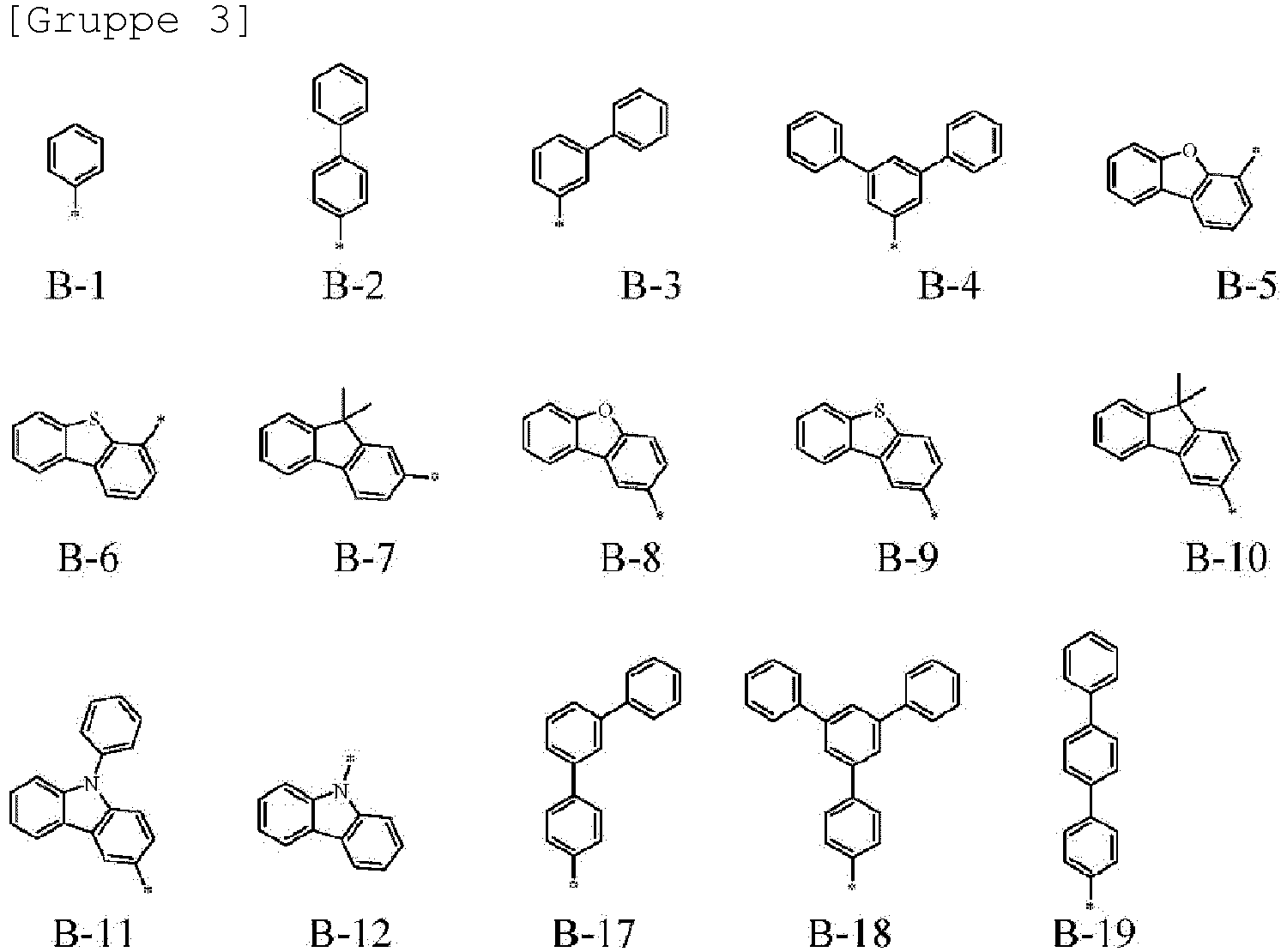
- the X 2 may be, for example one of substituents listed in Group 3, but is not limited thereto.
- the first compound may be, for example one of substituents listed in Group 4, but is not limited thereto.
- the first compound of the invention may be one of substituents listed in Group 4, X 1 is *-Y 1 -ET, X 2 is *-Y 2 -Ar 1 ,
- Y 1 and Y 2 are each independently a single bond, a substituted or unsubstituted C6 to C30 arylene group, or a combination thereof,
- Ar 1 is a substituted or unsubstituted phenyl group, a substituted or unsubstituted biphenyl group, a substituted or unsubstituted terphenyl group, a substituted or unsubstituted quaterphenyl group, a substituted or unsubstituted naphthalenyl group, a substituted or unsubstituted dibenzofuranyl group, a substituted or unsubstituted dibenzothiophenyl group, a substituted or unsubstituted fluorenyl group, or a substituted or unsubstituted carbazolyl group,
- X is N, C or CR a , at least one of X is N, R 5 , R 6 and R a are each independently hydrogen, deuterium, a substituted or unsubstituted C1 to C20 alkyl group, a substituted or unsubstituted C6 to C30 aryl group or a combination thereof, and * is a linking point.
- the first compound may be, for example one of compounds listed in Group 5, but is not limited thereto.
- One or more of the first compound may be used.
- the second compound includes at least one carbazolyl group, and may be represented by Chemical Formula 4.
- Y 3 is a single bond, a substituted or unsubstituted C6 to C30 arylene group, a substituted or unsubstituted C2 to C30 heteroarylene group, or a combination thereof
- Ar 2 is a substituted or unsubstituted C6 to C30 aryl group, substituted or unsubstitutedC2 to C30 heteroaryl group, or a combination thereof
- R 7 to R 10 are each independently hydrogen, deuterium, a substituted or unsubstituted C1 to C20 alkyl group, a substituted or unsubstituted C6 to C50 aryl group, a substituted or unsubstituted C2 to C50 heteroaryl group, or a combination thereof
- at least one of R 7 to R 10 and Ar 2 includes a substituted or unsubstituted triphenylene group or a substituted or unsubstituted carbazolyl group.
- the second compound may be, for example represented by at least one of Chemical Formulae 4-I to 4-III.
- Y 3a , Y 3b , Y 6 and Y 7 are each independently a single bond, a substituted or unsubstituted C6 to C30 arylene group, a substituted or unsubstituted C2 to C30 heteroarylene group, or a combination thereof
- Ar 2a , Ar 2b and Ar 5 are each independently a substituted or unsubstituted C6 to C30 aryl group, a substituted or unsubstituted C2 to C30 heteroaryl group, or a combination thereof
- R 7a , R 8a , R 7b , R 8b , R 7 to R 10 , and R 15 to R 26 are each independently hydrogen, deuterium, a substituted or unsubstituted C1 to C20 alkyl group, a substituted or unsubstituted C6 to C50 aryl group, a substituted or unsubstituted C2 to C50 heteroaryl group, or a
- the center core of biscarbazole of Chemical Formula 4-I may be one of structures listed in Group 6.
- the *-Y 3a -Ar 2a , and *-Y 3b -Ar 2b may be, for example one of substituents listed in Group 3.
- Ar 5 may be, for example a substituted or unsubstituted phenyl group, a substituted or unsubstituted biphenyl group, a substituted or unsubstituted terphenyl group, a substituted or unsubstituted naphthyl group, a substituted or unsubstituted anthracenyl group, a substituted or unsubstituted carbazolyl group, a substituted or unsubstituted benzofuranyl group, a substituted or unsubstituted benzothiophenyl group, a substituted or unsubstituted fluorenyl group, a substituted or unsubstituted dibenzothiophenyl group, a substituted or unsubstituted dibenzofuranyl group, a substituted or unsubstituted pyridinyl group, a substituted or unsubstituted pyrimidinyl group, or
- the second compound has bipolar characteristics that hole characteristics are relatively strong and may increase charge mobility and stability when used with the first compound for an emission layer and thus, remarkably improve luminous efficiency and life-span characteristics.
- the charge mobility may be controlled by adjusting a ratio between the second compound having hole characteristics and the first compound.
- the Ar 2 may be, for example, a substituted or unsubstituted phenyl group, a substituted or unsubstituted biphenyl group, a substituted or unsubstituted terphenyl group, a substituted or unsubstituted naphthyl group, a substituted or unsubstituted anthracenyl group, a substituted or unsubstituted triphenylene group, a substituted or unsubstituted carbazolyl group, a substituted or unsubstituted benzofuranyl group, a substituted or unsubstituted benzothiophenyl group, a substituted or unsubstituted fluorenyl group, a substituted or unsubstituted dibenzofuranyl group, a substituted or unsubstituted dibenzothiophenyl group, a substituted or unsubstituted pyridinyl group, a substituted or unsub
- the second compound may be, for example one of compounds listed in Group 7, but is not limited thereto.
- One or more of the second compound may be used.
- the emission layer 32 may simultaneously include the first compound and the second compound as a host and specifically, at least one from the first compound arranged in the group 4; and at least one from the second compounds represented by Chemical Formulae 4-I to 4-III. More specifically, the first compound represented by Chemical Formula 5c-1 in the group 4 and the second compound represented by Chemical Formula 4-I may be included.
- first compound and the second compound may be included for example in a weight ratio of about 1:10 to about 10:1, specifically, in a weight ratio of about 2:8 to about 8:2, in a weight ratio of about 3:7 to about 7:3, in a weight ratio of about 4:6 to about 6:4 and in a weight ratio of about 5:5.
- a weight ratio of about 1:10 to about 10:1 specifically, in a weight ratio of about 2:8 to about 8:2, in a weight ratio of about 3:7 to about 7:3, in a weight ratio of about 4:6 to about 6:4 and in a weight ratio of about 5:5.
- bipolar characteristics may be further effectively realized, and efficiency and a life-span are simultaneously improved.
- the emission layer 32 may further include at least one compound as a host other than the above first compound and the second compound.
- the emission layer 32 may further include a dopant.
- the dopant is a material that is mixed with the host in a small amount to cause light emission, and may be a material such as a metal complex that emits light by multiple excitation into a triplet or more.
- the dopant may be, for example an inorganic, organic, or organic/inorganic compound, and one or more kinds thereof may be used.
- the dopant may be a red, green, or blue dopant, for example a phosphorescent dopant.
- a phosphorescent dopant may be an organometal compound including Ir, Pt, Os, Ti, Zr, Hf, Eu, Tb, Tm, Fe, Co, Ni, Ru, Rh, Pd, or a combination thereof.
- the phosphorescent dopant may be, for example a compound represented by Chemical Formula Z, but is not limited thereto. [Chemical Formula Z] L 2 MX
- M is a metal
- L and X are the same or different, and are a ligand to form a complex compound with M.
- the M may be, for example Ir, Pt, Os, Ti, Zr, Hf, Eu, Tb, Tm, Fe, Co, Ni, Ru, Rh, Pd, or a combination thereof, and the L and X may be, for example a bidendate ligand.
- the hole transport auxiliary layer 33 includes a third compound having relatively strong hole characteristics.
- the hole transport auxiliary layer 33 includes the above third compound, reduce a HOMO energy level between the hole transport layer (HTL) 31 and the emission layer 32 to adjust hole injection characteristics, suppress accumulation of holes on the interface between the hole transport auxiliary layer 33 and the emission layer 32 and thus, deteriorate a quenching phenomenon that excitons are quenched on the interface by polaron. Accordingly, the device may be less degraded but stabilized and thus, may have improved efficiency and life-span.
- HTL hole transport layer
- the third compound may be a compound represented by Chemical Formula 5.
- R 11 to R 14 are each independently hydrogen, deuterium, a substituted or unsubstituted C1 to C30 alkyl group, a substituted or unsubstituted C6 to C30 aryl group, a substituted or unsubstituted C2 to C30 heteroaryl group, or a combination thereof
- Y 4 and Y 5 are each independently a single bond, a substituted or unsubstituted C6 to C30 arylene group, a substituted or unsubstituted C2 to C30 heteroarylene group, or a combination thereof
- Ar 3 and Ar 4 are each independently hydrogen, deuterium, a substituted or unsubstituted C1 to C30 alkyl group, a substituted or unsubstituted C3 to C30 cycloalkyl group, a substituted or unsubstituted C6 to C30 aryl group, a substituted or unsubstituted carbazolyl group, a substituted or unsubsti
- the third compound may be represented by one of Chemical Formulae 5-I to 5-VII according to a kind of an intermediate linking group.
- R 11 to R 14 , Y 4 and Y 5 , Ar 3 and Ar 4 are the same as described above.
- the Ar 3 and Ar 4 may be each independently selected from substituted or unsubstituted groups listed in Group 8.
- the third compound may be, for example one of compounds listed in Group 9, but is not limited thereto.
- an organic optoelectric device may simultaneously include an emission layer simultaneously including a first compound having strong electron characteristics and a second compound having strong hole characteristics and a hole transport auxiliary layer including a third compound having sufficient hole transport and thus capable of adjusting hole injection characteristics by decreasing a HOMO energy level between the hole transport layer (HTL) 31 and the emission layer 32 and strong hole transport characteristics.
- HTL hole transport layer
- These compounds are used together and thus, may reduce accumulation of holes on the interface between the hole transport auxiliary layer 33 and the emission layer 32 and resultantly, a quenching phenomenon that excitons are quenched by polaron. Accordingly, a device may be less degraded and stabilized and thus, improve efficiency and a life-span.
- the hole transport auxiliary layer is positioned between the emission layer and the hole transport layer (HTL) and thus, may adjust a HOMO energy level among the anode 10, the hole transport layer (HTL) 31 and the hole transport auxiliary layer 33 in tiers, efficiently transport holes, and resultantly contributes to improving efficiency and obtaining a long life-span.
- the emission layer may simultaneously include at least one first compound arranged in the group 4, at least one second compound represented by Chemical Formulas 4-I and 4-II, and one third compound represented by Chemical Formulae 5-II, 5-III and 5-V.
- the hole transport auxiliary layer 35 may be coated to be about 0.1 nm to about 20.0 nm in a deposit or inkjet process on the hole transport layer (HTL), for example, about 0.2 nm to about 10.0 nm, about 0.3 nm to about 5 nm, about 0.3 nm to about 2 nm, and about 0.4 nm to about 1.0 nm.
- HTL hole transport layer
- the organic layer 30 may further include an electron transport layer 34.
- the electron transport layer 34 makes electron transfer from the cathode 20 to the emission layer 32 easy, and may be omitted as needed.
- the organic layer 30 may optionally further include a hole injection layer (not shown) between the anode 10 and the hole transport layer 31 and/or an electron injection layer (not shown) between the cathode 20 and the electron transport layer 34.
- the organic light emitting diode may be applied to an organic light emitting diode (OLED) display.
- OLED organic light emitting diode
- a compound 1-121 as specific examples of a first compound represented by the following Reaction Scheme 1 may be synthesized through two steps.
- a glass substrate coated with ITO (indium tin oxide) to be 1500 A thick was ultrasonic wave-washed with a distilled water. Subsequently, the glass substrate was ultrasonic wave-washed with a solvent such as isopropyl alcohol, acetone, methanol, and the like, moved to a plasma cleaner, cleaned by using oxygen plasma for 10 minutes, and then, moved to a vacuum depositor.
- a solvent such as isopropyl alcohol, acetone, methanol, and the like
- the ITO transparent electrode was used as a positive electrode, a 700 ⁇ -thick hole injection layer (HIL) was formed thereon by vacuum-depositing N4,N4'-diphenyl-N4,N4'-bis(9-phenyl-9H-carbazol-3-yl)biphenyl-4,4'-diamine) (the compound A), and a hole transport layer (HTL) was formed thereto by depositing 1,4,5,8,9,11-hexaazatriphenylene-hexacarbonitrile (HAT-CN) (the compound B) to be 50 ⁇ thick and N-(biphenyl-4-yl)-9,9-dimethyl-N-(4-(9-phenyl-9H-carbazol-3-yl)phenyl)-9H-fluoren-2-amine) (the compound C) to be 700 ⁇ thick.
- HIL hole injection layer
- HTL hole transport layer
- a 320 ⁇ -thick hole transport auxiliary layer was formed by vacuum-depositing the compound 2-31 according to Synthesis Example 11. Subsequently, on the hole transport auxiliary layer, a 400 ⁇ -thick emission layer was formed by simultaneously using the compound 1-121 according to Synthesis Example 1 and the compound 2-132 according to Synthesis Example 7 as a host doping them with tris(4-methyl-2,5-diphenylpyridine)iridium (III) (the compound D) in an amount of 7 wt% as a dopant and vacuum-depositing the host doped with the dopant.
- the compound 1-122 and the compound 2-132 were used in a weight ratio of 1:1.
- a 300 ⁇ -thick electron transport layer (ETL) was formed by simultaneously vacuum-depositing 8-(4-(4-(naphthalen-2-yl)-6-(naphthalen-3-yl)-1,3,5-triazin-2-yl)phenyl)quinoline) (the compound E) and Liq in a ratio of 1:1, and on the electron transport layer (ETL), a cathode was formed by sequentially vacuum-depositing Liq to be 15 ⁇ thick and Al to be 1200 ⁇ thick, manufacturing an organic light emitting diode.
- ETL electron transport layer
- An organic light emitting diode was manufactured according to the same method as Example 1 except for using the compound 2-1 according to Synthesis Example 8 instead of the compound 2-132 for the emission layer.
- An organic light emitting diode was manufactured according to the same method as Example 1 except for using the compound 2-22 according to Synthesis Example 9 instead of the compound 2-132 for the emission layer.
- An organic light emitting diode was manufactured according to the same method as Example 1 except for using the compound 2-25 according to Synthesis Example 10 instead of the compound 2-132 for the emission layer.
- An organic light emitting diode was manufactured according to the same method as Example 1 except for using the compound 2-31 according to Synthesis Example 11 instead of the compound 2-132 for the emission layer.
- An organic light emitting diode was manufactured according to the same method as Example 1 except for using the compound 2-19 according to Synthesis Example 12 instead of the compound 2-31 for the hole transport auxiliary layer.
- An organic light emitting diode was manufactured according to the same method as Example 1 except for using the compound 2-108 according to Synthesis Example 13 instead of the compound 2-31 for the hole transport auxiliary layer.
- An organic light emitting diode was manufactured according to the same method as Example 1 except for using the compound 2-180 according to Synthesis Example 14 instead of the compound 2-31 for the hole transport auxiliary layer.
- An organic light emitting diode was manufactured according to the same method as Example 1 except for depositing the compound C to form a 1020 ⁇ thick hole transport layer (HTL) without the hole transport auxiliary layer.
- HTL thick hole transport layer
- An organic light emitting diode was manufactured according to the same method as Example 2 except for depositing the compound C to form a 1020 ⁇ thick hole transport layer (HTL) without the hole transport auxiliary layer.
- HTL thick hole transport layer
- An organic light emitting diode was manufactured according to the same method as Example 3 except for depositing the compound C to form a 1020 ⁇ thick hole transport layer (HTL) without the hole transport auxiliary layer.
- HTL thick hole transport layer
- An organic light emitting diode was manufactured according to the same method as Example 4 except for depositing the compound C to form a 1020 ⁇ thick hole transport layer (HTL) without the hole transport auxiliary layer.
- HTL thick hole transport layer
- An organic light emitting diode was manufactured according to the same method as Example 5 except for depositing the compound C to form a 1020 ⁇ -thick hole transport layer (HTL) without the hole transport auxiliary layer.
- HTL hole transport layer
- An organic light emitting diode was manufactured according to the same method as Example 1 except for depositing the compound C to form a 1020 ⁇ -thick hole transport layer (HTL) without the hole transport auxiliary layer and using the compound 1-121 instead of the mixture of the compound 1-121 and the compound 2-132 for the emission layer.
- HTL ⁇ -thick hole transport layer
- An organic light emitting diode was manufactured according to the same method as Example 1 except for depositing the compound C to form a 1020 ⁇ -thick hole transport layer (HTL) without the hole transport auxiliary layer and using only the compound 2-132 instead of the mixture of the compound 1-121 and the compound 2-132 for the emission layer.
- HTL hole transport layer
- the obtained organic light emitting diodes were measured for current value flowing in the unit device while increasing the voltage from 0 V to 10 V using a current-voltage meter (Keithley 2400), the measured current value was divided by area to provide the results.
- Luminance was measured by using a luminance meter (Minolta Cs-1000A), while the voltage of the organic light emitting diodes was increased from 0 V to 10 V.
- the organic light emitting diodes according to Examples 1 to 8 simultaneously showed remarkably improved driving voltage and luminous efficiency characteristics compared with the organic light emitting diodes according to Comparative Examples 1 and 2.
- the organic light emitting diodes according to Examples 1 to 8 showed improved luminous efficiency compared with the organic light emitting diodes according to Reference Examples 1 to 5.
Landscapes
- Chemical & Material Sciences (AREA)
- Physics & Mathematics (AREA)
- Engineering & Computer Science (AREA)
- Materials Engineering (AREA)
- Spectroscopy & Molecular Physics (AREA)
- Optics & Photonics (AREA)
- Organic Chemistry (AREA)
- Crystallography & Structural Chemistry (AREA)
- Inorganic Chemistry (AREA)
- Electroluminescent Light Sources (AREA)
Claims (15)
- Organische optoelektrische Vorrichtung, umfassend eine Anode (10) und eine Kathode (20), die einander gegenüberstehen, eine Emissionsschicht (32) zwischen der Anode (10) und der Kathode (20), eine Löchertransportschicht (31) zwischen der Anode (10) und der Emissionsschicht (32) und einer Löchertransport-Hilfsschicht (33) zwischen der Löchertransportschicht (31) und der Emissionsschicht (32), wobei die Emissionsschicht (32) wenigstens eine von einer ersten Verbindung, die sequenziell verknüpfte Einheiten enthält, die durch die chemischen Formeln 1 bis 3 dargestellt werden, und wenigstens eine von einer zweiten Verbindung, die durch die chemische Formel 4 dargestellt wird, umfasst, und die Löchertransport-Hilfsschicht (33) wenigstens eine von einer dritten Verbindung, die durch die chemische Formel 5 dargestellt wird, umfasst:
 X1 *-Y1-ET ist,X2 *-Y2-Ar1 ist,Y1 und Y2 jeweils unabhängig eine Einfachbindung, eine substituierte oder unsubstituierte C6- bis C30-Arylengruppe, eine substituierte oder unsubstituierte C2- bis C30-Heteroarylengruppe oder eine Kombination davon sind,Ar1 eine substituierte oder unsubstituierte C6- bis C30-Arylgruppe, eine substituierte oder unsubstituierte C2- bis C30-Heteroarylgruppe oder eine Kombination davon ist,L eine substituierte oder unsubstituierte C2- oder C3-Alkenylengruppe oder eine substituierte oder unsubstituierte C6- bis C20-Arylengruppe ist,R1 bis R4 jeweils unabhängig Wasserstoff, Deuterium, eine substituierte oder unsubstituierte C1- bis C20-Alkylgruppe, eine substituierte oder unsubstituierte C6- bis C30-Arylgruppe, eine substituierte oder unsubstituierte C2- bis C30-Heteroarylgruppe oder eine Kombination davon sind,ET durch die chemische Formel 1a dargestellt wird und* ein Verknüpfungspunkt ist,
 X N, C oder CRa ist,wenigstens eines der X N ist,R5, R6 und Ra jeweils unabhängig Wasserstoff, Deuterium, eine substituierte oder unsubstituierte C1- bis C20-Alkylgruppe, eine substituierte oder unsubstituierte C6- bis C30-Arylgruppe, eine substituierte oder unsubstituierte C2- bis C30-Heteroarylgruppe oder eine Kombination davon sind und* ein Verknüpfungspunkt ist,
 Y3 eine Einfachbindung, eine substituierte oder unsubstituierte C6- bis C30-Arylengruppe, eine substituierte oder unsubstituierte C2- bis C30-Heteroarylengruppe oder eine Kombination davon ist,Ar2 eine substituierte oder unsubstituierte C6- bis C30-Arylgruppe, eine substituierte oder unsubstituierte C2- bis C30-Heteroarylgruppe oder eine Kombination davon ist,R7 bis R10 jeweils unabhängig Wasserstoff, Deuterium, eine substituierte oder unsubstituierte C1- bis C20-Alkylgruppe, eine substituierte oder unsubstituierte C6- bis C50-Arylgruppe, eine substituierte oder unsubstituierte C2- bis C50-Heteroarylgruppe oder eine Kombination davon sind undwenigstens eines von R7 bis R10 und Ar2 eine substituierte oder unsubstituierte Triphenylengruppe oder eine substituierte oder unsubstituierte Carbazolylgruppe enthält,
 R11 bis R14 jeweils unabhängig Wasserstoff, Deuterium, eine substituierte oder unsubstituierte C1- bis C30-Alkylgruppe, eine substituierte oder unsubstituierte C6- bis C30-Arylgruppe, eine substituierte oder unsubstituierte C2- bis C30-Heteroarylgruppe oder eine Kombination davon sind,Y4 und Y5 jeweils unabhängig eine Einfachbindung, eine substituierte oder unsubstituierte C6- bis C30-Arylengruppe, eine substituierte oder unsubstituierte C2- bis C30-Heteroarylengruppe oder eine Kombination davon sind,Ar3 und Ar4 jeweils unabhängig Wasserstoff, Deuterium, eine substituierte oder unsubstituierte C1- bis C30-Alkylgruppe, eine substituierte oder unsubstituierte C3- bis C30-Cycloalkylgruppe, eine substituierte oder unsubstituierte C6- bis C30-Arylgruppe, eine substituierte oder unsubstituierte Carbazolylgruppe, eine substituierte oder unsubstituierte Dibenzofuranylgruppe, eine substituierte oder unsubstituierte Dibenzothiophenylgruppe, eine substituierte oder unsubstituierte C6- bis C30-Arylamingruppe, eine substituierte oder unsubstituierte C1- bis C30-Alkoxygruppe, eine substituierte oder unsubstituierte C3- bis C40-Silylgruppe, eine substituierte oder unsubstituierte C1- bis C30-Alkylthiogruppe, eine substituierte oder unsubstituierte C6- bis C30-Arylthiogruppe, ein Halogen, eine halogenhaltige Gruppe, eine Cyanogruppe, eine Hydroxygruppe, eine Aminogruppe, eine Nitrogruppe oder eine Kombination davon sind undn eine ganze Zahl in dem Bereich von 0 bis 4 ist,wobei "substituiert" bei den chemischen Formeln 1 bis 5 bedeutet, dass wenigstens ein Wasserstoff durch Deuterium, ein Halogen, eine Hydroxygruppe, eine Aminogruppe, eine substituierte oder unsubstituierte C1- bis C30-Amingruppe, eine Nitrogruppe, eine substituierte oder unsubstituierte C1- bis C40-Silylgruppe, eine C1-bis C30-Alkylgruppe, eine C3- bis C30-Cycloalkylgruppe, eine C2- bis C30-Heterocycloalkylgruppe, eine C6- bis C30-Arylgruppe, eine C2- bis C30-Heteroarylgruppe, eine C1- bis C20-Alkoxygruppe, eine Fluorgruppe, eine C1- bis C10-Trifluoralkylgruppe oder eine Cyanogruppe ersetzt ist.
 - Organische optoelektrische Vorrichtung gemäß Anspruch 1, wobei X1 der chemischen Formel 1 einer der in Gruppe 2 aufgelisteten Substituenten ist:

 * ein Verknüpfungspunkt ist.
 - Organische optoelektrische Vorrichtung gemäß Anspruch 1 oder 2, wobei die durch die chemische Formel 2 dargestellte Einheit durch eine der chemischen Formeln 2-1 bis 2-3 dargestellt wird:
 * ein Verknüpfungspunkt ist.
 - Organische optoelektrische Vorrichtung gemäß einem der Ansprüche 1 bis 3, wobei Ar1 eine substituierte oder unsubstituierte Phenylgruppe, eine substituierte oder unsubstituierte Biphenylgruppe, eine substituierte oder unsubstituierte Terphenylgruppe, eine substituierte oder unsubstituierte Naphthylgruppe, eine substituierte oder unsubstituierte Anthracenylgruppe, eine substituierte oder unsubstituierte Carbazolylgruppe, eine substituierte oder unsubstituierte Benzofuranylgruppe, eine substituierte oder unsubstituierte Benzothiophenylgruppe, eine substituierte oder unsubstituierte Fluorenylgruppe, eine substituierte oder unsubstituierte Dibenzothiophenylgruppe, eine substituierte oder unsubstituierte Dibenzofuranylgruppe oder eine Kombination davon ist.
- Organische optoelektrische Vorrichtung gemäß einem der Ansprüche 1 bis 4, wobei X2 der chemischen Formel 3 einer der in Gruppe 3 aufgelisteten Substituenten ist:
- Organische optoelektrische Vorrichtung gemäß einem der Ansprüche 1 bis 5, wobei die erste Verbindung einer der in Gruppe 4 aufgelisteten Substituenten ist:
 X1 *-Y1-ET ist,X2 *-Y2-Ar1 ist,Y1 und Y2 jeweils unabhängig eine Einfachbindung, eine substituierte oder unsubstituierte C6- bis C30-Arylengruppe, eine substituierte oder unsubstituierte C2- bis C30-Heteroarylengruppe oder eine Kombination davon sind,Ar1 eine substituierte oder unsubstituierte C6- bis C30-Arylgruppe, eine substituierte oder unsubstituierte C2- bis C30-Heteroarylgruppe oder eine Kombination davon ist,ET durch die chemische Formel 1a dargestellt wird und* ein Verknüpfungspunkt ist,
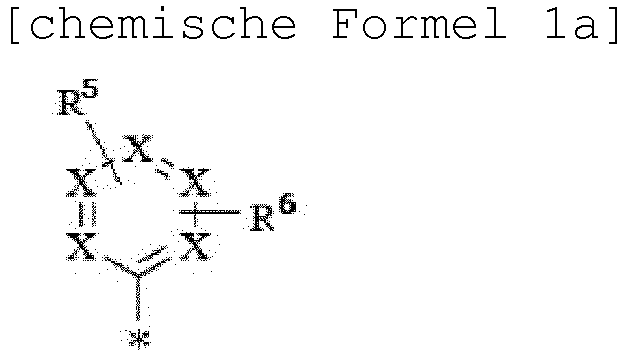 X N, C oder CRa ist,wenigstens eines der X N ist,R5, R6 und Ra jeweils unabhängig Wasserstoff, Deuterium, eine substituierte oder unsubstituierte C1- bis C20-Alkylgruppe, eine substituierte oder unsubstituierte C6- bis C30-Arylgruppe, eine substituierte oder unsubstituierte C2- bis C30-Heteroarylgruppe oder eine Kombination davon sind und* ein Verknüpfungspunkt ist.
 - Organische optoelektrische Vorrichtung gemäß einem der Ansprüche 1 bis 6, wobei
in Gruppe 4 X1 *-Y1-ET ist, X2 *-Y2-Ar1 ist,
Y1 und Y2 jeweils unabhängig eine Einfachbindung, eine substituierte oder unsubstituierte C6- bis C30-Arylengruppe oder eine Kombination davon sind,
Ar1 eine substituierte oder unsubstituierte Phenylgruppe, eine substituierte oder unsubstituierte Biphenylgruppe, eine substituierte oder unsubstituierte Terphenylgruppe, eine substituierte oder unsubstituierte Quaterphenylgruppe, eine substituierte oder unsubstituierte Naphthalenylgruppe, eine substituierte oder unsubstituierte Dibenzofuranylgruppe, eine substituierte oder unsubstituierte Dibenzothiophenylgruppe, eine substituierte oder unsubstituierte Fluorenylgruppe oder eine substituierte oder unsubstituierte Carbazolylgruppe ist,
ET durch die chemische Formel 1a dargestellt wird, X N, C oder CRa ist,wenigstens eines der X N ist,R5, R6 und Ra jeweils unabhängig Wasserstoff, Deuterium, eine substituierte oder unsubstituierte C1- bis C20-Alkylgruppe, eine substituierte oder unsubstituierte C6- bis C30-Arylgruppe oder eine Kombination davon sind und* ein Verknüpfungspunkt ist.
 - Organische optoelektrische Vorrichtung gemäß einem der Ansprüche 1 bis 7, wobei die zweite Verbindung durch wenigstens eine der chemischen Formeln 4-1 bis 4-III dargestellt wird:
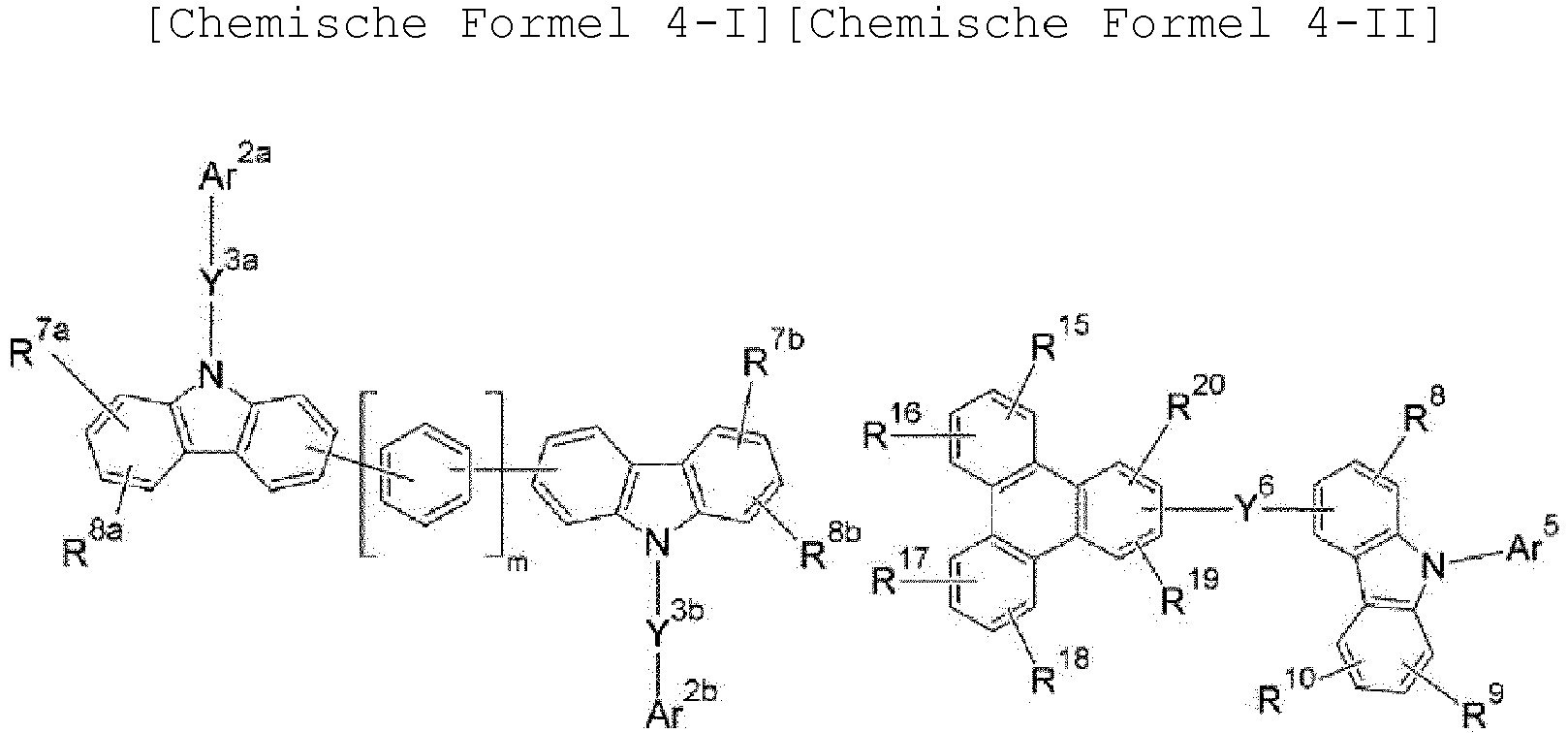
 Y3a, Y3b, Y6 und Y7 jeweils unabhängig eine Einfachbindung, eine substituierte oder unsubstituierte C6- bis C30-Arylengruppe, eine substituierte oder unsubstituierte C2- bis C30-Heteroarylengruppe oder eine Kombination davon sind,Ar2a, Ar2b und Ar5 jeweils unabhängig eine substituierte oder unsubstituierte C6- bis C30-Arylgruppe, eine substituierte oder unsubstituierte C2- bis C30-Heteroarylgruppe oder eine Kombination davon sind,R7a, R8a, R7b, R8b, R7 bis R10 und R15 bis R26 jeweils unabhängig Wasserstoff, Deuterium, eine substituierte oder unsubstituierte C1- bis C20-Alkylgruppe, eine substituierte oder unsubstituierte C6- bis C50-Arylgruppe, eine substituierte oder unsubstituierte C2- bis C50-Heteroarylgruppe oder eine Kombination davon sind undm eine ganze Zahl von 0 bis 4 ist.
 - Organische optoelektrische Vorrichtung gemäß einem der Ansprüche 1 bis 8, wobei die chemische Formel 4-1 eine der in Gruppe 6 aufgelisteten Strukturen ist und die *-Y3a-Ar2a und *-Y3b-Ar2b eine der in Gruppe 3 aufgelisteten Substituenten sind:


- Organische optoelektrische Vorrichtung gemäß einem der Ansprüche 1 bis 9, wobei Ar2 in der chemischen Formel 4 eine substituierte oder unsubstituierte Phenylgruppe, eine substituierte oder unsubstituierte Biphenylgruppe, eine substituierte oder unsubstituierte Terphenylgruppe, eine substituierte oder unsubstituierte Naphthylgruppe, eine substituierte oder unsubstituierte Anthracenylgruppe, eine substituierte oder unsubstituierte Carbazolylgruppe, eine substituierte oder unsubstituierte Benzofuranylgruppe, eine substituierte oder unsubstituierte Benzothiophenylgruppe, eine substituierte oder unsubstituierte Fluorenylgruppe, eine substituierte oder unsubstituierte Dibenzofuranylgruppe, eine substituierte oder unsubstituierte Dibenzothiophenylgruppe, eine substituierte oder unsubstituierte Pyridinylgruppe, eine substituierte oder unsubstituierte Pyrimidinylgruppe oder eine Kombination davon ist.
- Organische optoelektrische Vorrichtung gemäß einem der Ansprüche 1 bis 10, wobei die dritte Verbindung durch wenigstens eine der chemischen Formeln 5-1 bis 5-VII dargestellt wird:
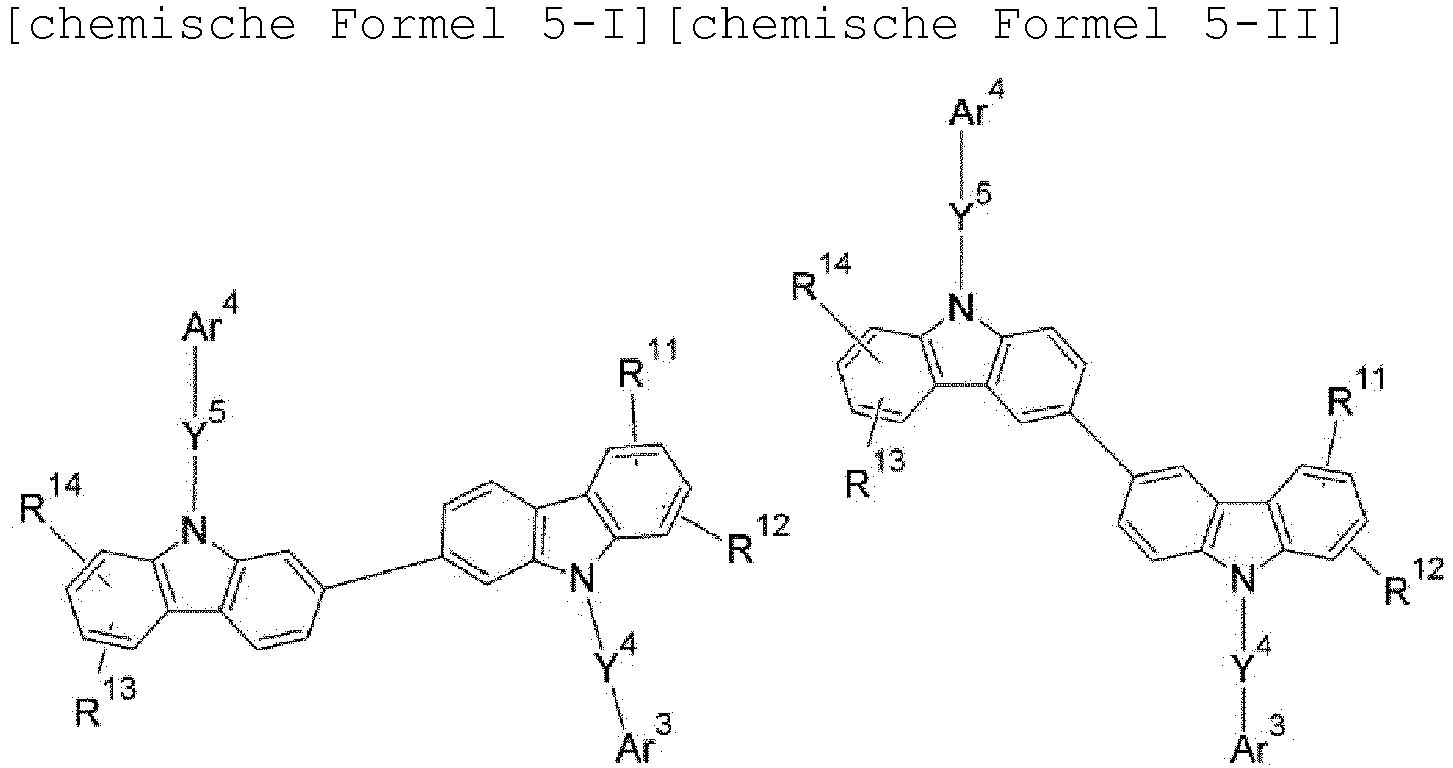


 R11 bis R14 jeweils unabhängig Wasserstoff, Deuterium, eine substituierte oder unsubstituierte C1- bis C30-Alkylgruppe, eine substituierte oder unsubstituierte C6- bis C30-Arylgruppe, eine substituierte oder unsubstituierte C2- bis C30-Heteroarylgruppe oder eine Kombination davon sind, Y4 und Y5 jeweils unabhängig eine Einfachbindung, eine substituierte oder unsubstituierte C6- bis C30-Arylengruppe, eine substituierte oder unsubstituierte C2- bis C30-Heteroarylengruppe oder eine Kombination davon sind,Ar3 und Ar4 jeweils unabhängig eine substituierte oder unsubstituierte Phenylgruppe, eine substituierte oder unsubstituierte Biphenylgruppe, eine substituierte oder unsubstituierte Terphenylgruppe, eine substituierte oder unsubstituierte Quarterphenylgruppe, eine substituierte oder unsubstituierte Fluorenylgruppe, eine substituierte oder unsubstituierte Dibenzofuranylgruppe, eine substituierte oder unsubstituierte Dibenzothiophenylgruppe, eine substituierte oder unsubstituierte Triphenylenylgruppe oder eine Kombination davon sind,wobei "substituiert" bei den chemischen Formeln 5-I bis 5-VII bedeutet, dass wenigstens ein Wasserstoff durch Deuterium, ein Halogen, eine Hydroxygruppe, eine Aminogruppe, eine C1- bis C30-Amingruppe, eine Nitrogruppe, eine C1- bis C40-Silylgruppe, eine C1- bis C30-Alkylgruppe, eine C1- bis C10-Alkylsilylgruppe, eine C3- bis C30-Cycloalkylgruppe, eine C2- bis C30-Heterocycloalkylgruppe, eine C6- bis C30-Arylgruppe, eine C2- bis C30-Heteroarylgruppe, eine C1- bis C20-Alkoxygruppe, eine Fluorgruppe, eine C1- bis C10-Trifluoralkylgruppe oder eine Cyanogruppe ersetzt ist.
 - Organische optoelektrische Vorrichtung gemäß einem der Ansprüche 1 bis 11, wobei die Ar3 und Ar4 jeweils unabhängig ausgewählt sind aus substituierten oder unsubstituierten Gruppen, die in Gruppe 8 aufgelistet sind:

- Organische optoelektrische Vorrichtung gemäß einem der Ansprüche 1 bis 12, wobei die Emissionsschicht wenigstens eine der in Gruppe 4 aufgelisteten ersten Verbindungen und
wenigstens eine der durch die chemischen Formeln 4-1 und 4-II dargestellten zweiten Verbindungen umfasst und
die Löchertransport-Hilfsschicht wenigstens eine der durch die chemischen Formeln 5-II, 5-III und 5-V dargestellten dritten Verbindungen umfasst:
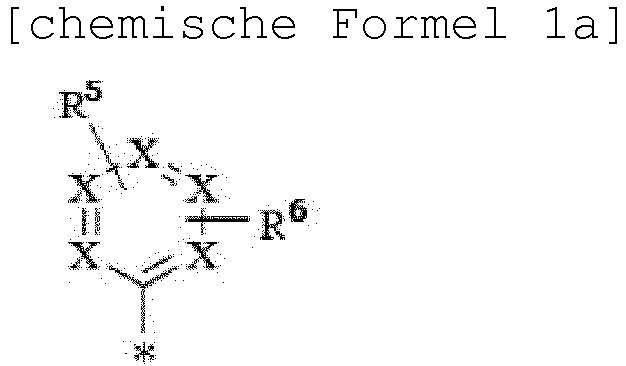 X N, C oder CRa ist,wenigstens eines der X N ist,R5, R6 und Ra jeweils unabhängig Wasserstoff, Deuterium, eine substituierte oder unsubstituierte C1- bis C20-Alkylgruppe, eine substituierte oder unsubstituierte C6- bis C30-Arylgruppe, eine substituierte oder unsubstituierte C2- bis C30-Heteroarylgruppe oder eine Kombination davon sind und * ein Verknüpfungspunkt ist,
 wobei in den chemischen Formeln 4-1 und 4-II Y3a, Y3b, Y6 und Y7 jeweils unabhängig eine Einfachbindung, eine substituierte oder unsubstituierte C6- bis C30-Arylengruppe, eine substituierte oder unsubstituierte C2- bis C30-Heteroarylengruppe oder eine Kombination davon sind,Ar2a, Ar2b und Ar5 jeweils unabhängig eine substituierte oder unsubstituierte C6- bis C30-Arylgruppe, eine substituierte oder unsubstituierte C2- bis C30-Heteroarylgruppe oder eine Kombination davon sind,R7a, R8a, R7b, R8b, R7 bis R10 und R15 bis R26 jeweils unabhängig Wasserstoff, Deuterium, eine substituierte oder unsubstituierte C1- bis C20-Alkylgruppe, eine substituierte oder unsubstituierte C6- bis C50-Arylgruppe, eine substituierte oder unsubstituierte C2- bis C50-Heteroarylgruppe oder eine Kombination davon sind undm eine ganze Zahl von 0 bis 4 ist,
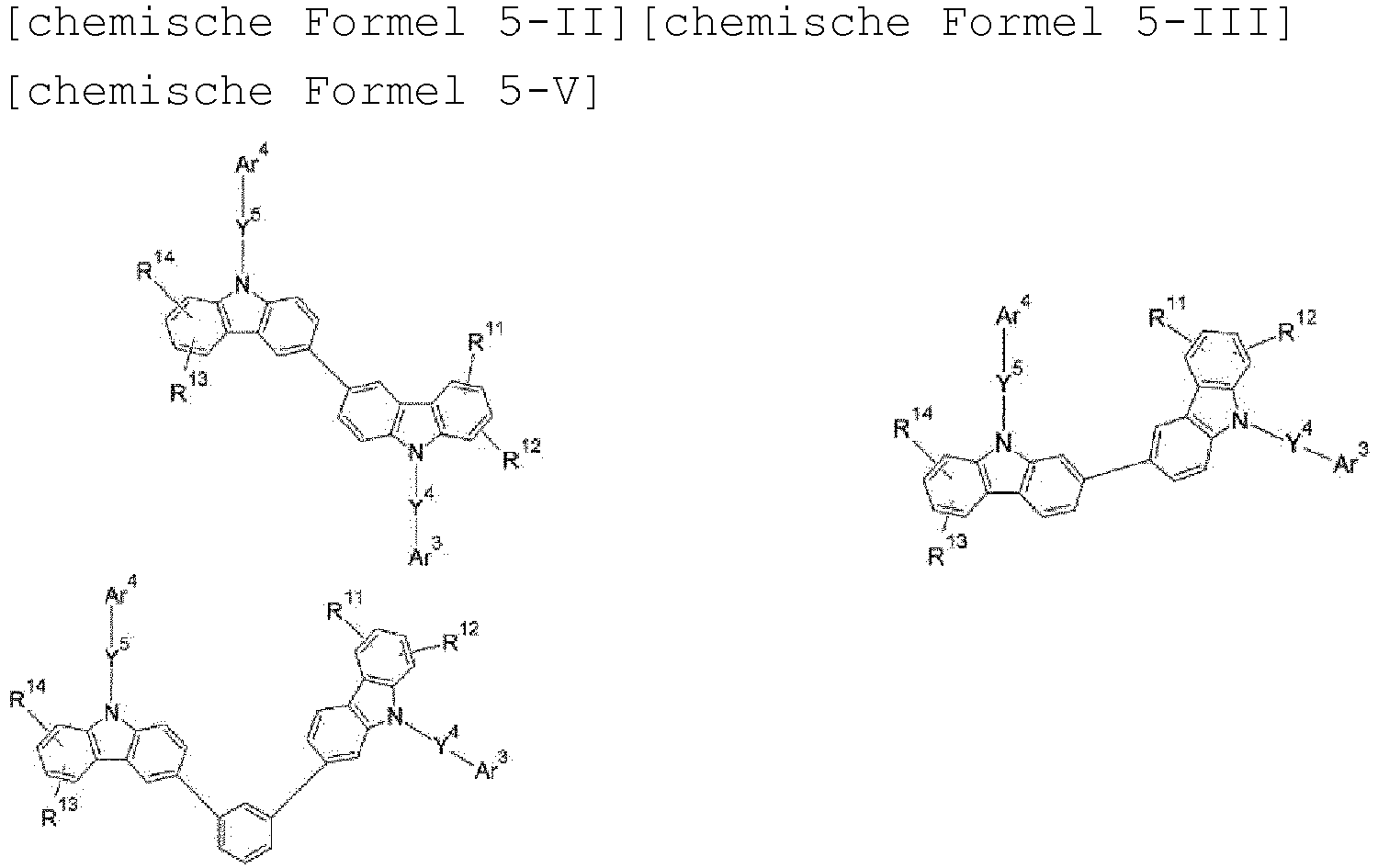 R11 bis R14 jeweils unabhängig Wasserstoff, Deuterium, eine substituierte oder unsubstituierte C1- bis C30-Alkylgruppe, eine substituierte oder unsubstituierte C6- bis C30-Arylgruppe, eine substituierte oder unsubstituierte C2- bis C30-Heteroarylgruppe oder eine Kombination davon sind undY4 und Y5 jeweils unabhängig eine Einfachbindung, eine substituierte oder unsubstituierte C6- bis C30-Arylengruppe, eine substituierte oder unsubstituierte C2- bis C30-Heteroarylengruppe oder eine Kombination davon sind,Ar3 und Ar4 jeweils unabhängig eine substituierte oder unsubstituierte Phenylgruppe, eine substituierte oder unsubstituierte Biphenylgruppe, eine substituierte oder unsubstituierte Terphenylgruppe, eine substituierte oder unsubstituierte Quarterphenylgruppe, eine substituierte oder unsubstituierte Fluorenylgruppe, eine substituierte oder unsubstituierte Dibenzofuranylgruppe, eine substituierte oder unsubstituierte Dibenzothiophenylgruppe, eine substituierte oder unsubstituierte Triphenylenylgruppe oder eine Kombination davon sind.
 - Organische optoelektrische Vorrichtung gemäß einem der Ansprüche 1 bis 13, wobei die Löchertransport-Hilfsschicht in Kontakt mit der Löchertransportschicht und der Emissionsschicht steht.
- Anzeigevorrichtung, umfassend die organische optoelektrische Vorrichtung gemäß einem der Ansprüche 1 bis 14.
Applications Claiming Priority (1)
| Application Number | Priority Date | Filing Date | Title |
|---|---|---|---|
| KR1020140176175A KR101818579B1 (ko) | 2014-12-09 | 2014-12-09 | 유기 광전자 소자 및 표시 장치 |
Publications (2)
| Publication Number | Publication Date |
|---|---|
| EP3032606A1 EP3032606A1 (de) | 2016-06-15 |
| EP3032606B1 true EP3032606B1 (de) | 2017-11-08 |
Family
ID=54979366
Family Applications (1)
| Application Number | Title | Priority Date | Filing Date |
|---|---|---|---|
| EP15196314.7A Active EP3032606B1 (de) | 2014-12-09 | 2015-11-25 | Organische optoelektrische vorrichtung und anzeigevorrichtung |
Country Status (6)
| Country | Link |
|---|---|
| US (1) | US20160163995A1 (de) |
| EP (1) | EP3032606B1 (de) |
| JP (1) | JP2016111346A (de) |
| KR (1) | KR101818579B1 (de) |
| CN (1) | CN105679946B (de) |
| TW (1) | TWI589671B (de) |
Families Citing this family (108)
| Publication number | Priority date | Publication date | Assignee | Title |
|---|---|---|---|---|
| KR102411748B1 (ko) * | 2014-03-17 | 2022-06-23 | 롬엔드하스전자재료코리아유한회사 | 전자 버퍼 재료 및 유기 전계 발광 소자 |
| KR101835501B1 (ko) * | 2014-08-13 | 2018-03-07 | 삼성에스디아이 주식회사 | 유기 광전자 소자 및 표시장치 |
| US11818949B2 (en) | 2015-04-06 | 2023-11-14 | Universal Display Corporation | Organic electroluminescent materials and devices |
| US11495749B2 (en) | 2015-04-06 | 2022-11-08 | Universal Display Corporation | Organic electroluminescent materials and devices |
| US20160293855A1 (en) * | 2015-04-06 | 2016-10-06 | Universal Display Corporation | Organic Electroluminescent Materials and Devices |
| JP6269896B1 (ja) | 2016-06-02 | 2018-01-31 | エム・テクニック株式会社 | 透明材用紫外線及び/又は近赤外線遮断剤組成物 |
| CN106565719B (zh) * | 2016-09-26 | 2019-04-23 | 北京大学深圳研究生院 | 一种疏水性oled主体材料、制备方法和应用 |
| US10340464B2 (en) * | 2016-11-10 | 2019-07-02 | Universal Display Corporation | Organic electroluminescent materials and devices |
| KR102037816B1 (ko) * | 2016-11-16 | 2019-10-29 | 삼성에스디아이 주식회사 | 유기 광전자 소자 및 표시 장치 |
| US10270039B2 (en) * | 2016-11-17 | 2019-04-23 | Semiconductor Energy Laboratory Co., Ltd. | Light-emitting element, display device, electronic device, and lighting device |
| KR102037817B1 (ko) * | 2016-11-24 | 2019-10-29 | 삼성에스디아이 주식회사 | 유기 광전자 소자 및 표시 장치 |
| KR101915716B1 (ko) * | 2016-12-20 | 2018-11-08 | 희성소재 (주) | 유기 발광 소자 및 유기 발광 소자의 유기물층용 조성물 |
| KR102498770B1 (ko) * | 2016-12-27 | 2023-02-10 | 닛테츠 케미컬 앤드 머티리얼 가부시키가이샤 | 유기 전계 발광 소자용 재료 및 유기 전계 발광 소자 |
| CN106631984B (zh) * | 2017-01-04 | 2019-04-16 | 濮阳惠成电子材料股份有限公司 | 一种9,9′-二取代基-3,3′-联咔唑的合成方法 |
| JP2020113558A (ja) * | 2017-03-29 | 2020-07-27 | 出光興産株式会社 | 有機エレクトロルミネッセンス素子、電子機器、及び化合物 |
| CN110574180B (zh) * | 2017-04-27 | 2022-11-15 | 日铁化学材料株式会社 | 有机电场发光元件与其制造方法 |
| US11117897B2 (en) * | 2017-05-01 | 2021-09-14 | Universal Display Corporation | Organic electroluminescent materials and devices |
| KR20180137772A (ko) | 2017-06-19 | 2018-12-28 | 삼성에스디아이 주식회사 | 유기 광전자 소자 및 표시 장치 |
| KR101947747B1 (ko) | 2018-05-04 | 2019-02-13 | 삼성에스디아이 주식회사 | 유기 광전자 소자용 화합물, 유기 광전자 소자용 조성물, 유기 광전자 소자 및 표시 장치 |
| US20190198772A1 (en) | 2017-06-22 | 2019-06-27 | Samsung Sdi Co., Ltd. | Compound for organic optoelectronic device, composition for organic optoelectronic device and organic optoelectronic device and display deivce |
| KR102008897B1 (ko) | 2017-06-22 | 2019-10-23 | 삼성에스디아이 주식회사 | 유기 광전자 소자 및 표시 장치 |
| US12098157B2 (en) | 2017-06-23 | 2024-09-24 | Universal Display Corporation | Organic electroluminescent materials and devices |
| US10968226B2 (en) * | 2017-06-23 | 2021-04-06 | Universal Display Corporation | Organic electroluminescent materials and devices |
| KR102162402B1 (ko) * | 2017-07-21 | 2020-10-06 | 삼성에스디아이 주식회사 | 유기 광전자 소자 및 표시 장치 |
| US11228010B2 (en) | 2017-07-26 | 2022-01-18 | Universal Display Corporation | Organic electroluminescent materials and devices |
| US11744142B2 (en) | 2017-08-10 | 2023-08-29 | Universal Display Corporation | Organic electroluminescent materials and devices |
| KR102199075B1 (ko) * | 2017-09-29 | 2021-01-07 | 삼성에스디아이 주식회사 | 유기 광전자 소자 및 표시 장치 |
| US12180230B2 (en) | 2017-11-28 | 2024-12-31 | University Of Southern California | Carbene compounds and organic electroluminescent devices |
| US11937503B2 (en) | 2017-11-30 | 2024-03-19 | Universal Display Corporation | Organic electroluminescent materials and devices |
| KR102138823B1 (ko) * | 2017-12-27 | 2020-07-28 | 삼성에스디아이 주식회사 | 유기 광전자 소자 및 표시 장치 |
| US11542289B2 (en) | 2018-01-26 | 2023-01-03 | Universal Display Corporation | Organic electroluminescent materials and devices |
| US11165028B2 (en) | 2018-03-12 | 2021-11-02 | Universal Display Corporation | Organic electroluminescent materials and devices |
| KR102171076B1 (ko) * | 2018-03-21 | 2020-10-28 | 삼성에스디아이 주식회사 | 유기 광전자 소자용 조성물, 유기 광전자 소자 및 표시 장치 |
| US20190372015A1 (en) * | 2018-06-05 | 2019-12-05 | Shanghai Nichem Fine Chemical Co., Ltd. | Compound and organic electronic device comprising the same |
| KR102777743B1 (ko) * | 2018-08-10 | 2025-03-11 | 삼성디스플레이 주식회사 | 유기 전계 발광 소자 및 유기 전계 발광 소자용 축합환 화합물 |
| US12453279B2 (en) | 2018-08-22 | 2025-10-21 | Universal Display Corporation | Organic electroluminescent materials and devices |
| US11997927B2 (en) | 2018-10-04 | 2024-05-28 | Lg Chem, Ltd. | Compound and organic light emitting diode comprising same |
| US11834459B2 (en) | 2018-12-12 | 2023-12-05 | Universal Display Corporation | Host materials for electroluminescent devices |
| US11737349B2 (en) | 2018-12-12 | 2023-08-22 | Universal Display Corporation | Organic electroluminescent materials and devices |
| US11780829B2 (en) | 2019-01-30 | 2023-10-10 | The University Of Southern California | Organic electroluminescent materials and devices |
| US12477890B2 (en) | 2019-02-01 | 2025-11-18 | Universal Display Corporation | Organic electroluminescent materials and devices |
| US12082428B2 (en) | 2019-03-12 | 2024-09-03 | Universal Display Corporation | OLED with triplet emitter and excited state lifetime less than 200 ns |
| JP2020158491A (ja) | 2019-03-26 | 2020-10-01 | ユニバーサル ディスプレイ コーポレイション | 有機エレクトロルミネセンス材料及びデバイス |
| US20200321537A1 (en) * | 2019-03-29 | 2020-10-08 | Samsung Electronics Co., Ltd. | Organic light-emitting device |
| KR102827516B1 (ko) * | 2019-04-17 | 2025-07-01 | 엘지디스플레이 주식회사 | 유기전계 발광소자 |
| US12281128B2 (en) | 2019-07-30 | 2025-04-22 | Universal Display Corporation | Organic electroluminescent materials and devices |
| US12139501B2 (en) | 2019-08-16 | 2024-11-12 | Universal Display Corporation | Organic electroluminescent materials and devices |
| KR102495274B1 (ko) * | 2019-10-01 | 2023-02-01 | 삼성에스디아이 주식회사 | 유기 광전자 소자 및 표시 장치 |
| US20210135130A1 (en) | 2019-11-04 | 2021-05-06 | Universal Display Corporation | Organic electroluminescent materials and devices |
| KR102555503B1 (ko) | 2019-11-14 | 2023-07-12 | 삼성에스디아이 주식회사 | 유기 광전자 소자용 화합물, 유기 광전자 소자용 조성물, 유기 광전자 소자 및 표시 장치 |
| KR20210058523A (ko) * | 2019-11-14 | 2021-05-24 | 삼성에스디아이 주식회사 | 유기 광전자 소자 및 표시 장치 |
| JP7488091B2 (ja) | 2019-11-14 | 2024-05-21 | ユニバーサル ディスプレイ コーポレイション | 有機エレクトロルミネセンス材料及びデバイス |
| KR102523030B1 (ko) * | 2019-11-14 | 2023-04-18 | 주식회사 엘지화학 | 신규한 헤테로 고리 화합물 및 이를 이용한 유기발광 소자 |
| US12538698B2 (en) | 2020-01-06 | 2026-01-27 | Universal Display Corporation | Organic electroluminescent materials and devices |
| US12426495B2 (en) | 2020-01-28 | 2025-09-23 | Universal Display Corporation | Organic electroluminescent materials and devices |
| KR102193015B1 (ko) | 2020-03-11 | 2020-12-18 | 주식회사 엘지화학 | 유기 발광 소자 |
| KR102785564B1 (ko) * | 2020-04-06 | 2025-03-27 | 삼성디스플레이 주식회사 | 발광 소자 및 이를 포함하는 전자 장치 |
| KR102645135B1 (ko) * | 2020-06-02 | 2024-03-06 | 삼성에스디아이 주식회사 | 유기 광전자 소자용 조성물, 유기 광전자 소자 및 표시 장치 |
| KR102689562B1 (ko) | 2020-06-09 | 2024-07-26 | 삼성에스디아이 주식회사 | 유기 광전자 소자용 조성물, 유기 광전자 소자 및 표시 장치 |
| EP3937268B1 (de) | 2020-07-10 | 2025-05-07 | Universal Display Corporation | Plasmonische oleds und vertikale dipolstrahler |
| EP3975280A1 (de) * | 2020-09-29 | 2022-03-30 | NIPPON STEEL Chemical & Material Co., Ltd. | Zusammensetzung für ein organisches elektrolumineszenzelement und organisches elektrolumineszenzelement |
| US12187748B2 (en) | 2020-11-02 | 2025-01-07 | Universal Display Corporation | Organic electroluminescent materials and devices |
| US12501829B2 (en) | 2020-11-04 | 2025-12-16 | Samsung Sdi Co., Ltd. | Compound for organic optoelectronic device, composition for organic optoelectronic device, organic optoelectronic device, and display device |
| US20220158096A1 (en) | 2020-11-16 | 2022-05-19 | Universal Display Corporation | Organic electroluminescent materials and devices |
| US20220165967A1 (en) | 2020-11-24 | 2022-05-26 | Universal Display Corporation | Organic electroluminescent materials and devices |
| US12325717B2 (en) | 2020-11-24 | 2025-06-10 | Universal Display Corporation | Organic electroluminescent materials and devices |
| US20240341179A1 (en) * | 2021-01-08 | 2024-10-10 | Nippon Steel Chemical & Material Co., Ltd. | Organic electroluminescent element and method for manufacturing same |
| US12575316B2 (en) | 2021-02-03 | 2026-03-10 | Universal Display Corporation | Organic electroluminescent materials and devices |
| CN113683628B (zh) * | 2021-02-09 | 2022-06-24 | 陕西莱特光电材料股份有限公司 | 有机电致发光材料、电子元件和电子装置 |
| EP4060758A3 (de) | 2021-02-26 | 2023-03-29 | Universal Display Corporation | Organische elektrolumineszente materialien und vorrichtungen |
| EP4059915B1 (de) | 2021-02-26 | 2025-12-24 | Universal Display Corporation | Organische elektrolumineszente materialien und vorrichtungen |
| US12606582B2 (en) | 2021-03-05 | 2026-04-21 | Universal Display Corporation | Organic electroluminescent materials and devices |
| US12428599B2 (en) | 2021-03-09 | 2025-09-30 | Universal Display Corporation | Organic electroluminescent materials and devices |
| US20220298190A1 (en) | 2021-03-12 | 2022-09-22 | Universal Display Corporation | Organic electroluminescent materials and devices |
| US12421262B2 (en) | 2021-03-15 | 2025-09-23 | Universal Display Corporation | Organic electroluminescent materials and devices |
| US20220340607A1 (en) | 2021-04-05 | 2022-10-27 | Universal Display Corporation | Organic electroluminescent materials and devices |
| US12480042B2 (en) | 2021-04-09 | 2025-11-25 | Universal Display Corporation | Organic electroluminescent materials and devices |
| EP4075531A1 (de) | 2021-04-13 | 2022-10-19 | Universal Display Corporation | Plasmonische oleds und vertikale dipolstrahler |
| US20220352478A1 (en) | 2021-04-14 | 2022-11-03 | Universal Display Corporation | Organic eletroluminescent materials and devices |
| US20220407020A1 (en) | 2021-04-23 | 2022-12-22 | Universal Display Corporation | Organic electroluminescent materials and devices |
| US20230006149A1 (en) | 2021-04-23 | 2023-01-05 | Universal Display Corporation | Organic electroluminescent materials and devices |
| US20230133787A1 (en) | 2021-06-08 | 2023-05-04 | University Of Southern California | Molecular Alignment of Homoleptic Iridium Phosphors |
| CN113402504B (zh) * | 2021-07-07 | 2023-07-28 | 清华大学 | 一种有机化合物及其应用及采用该化合物的有机电致发光器件 |
| CN113502156A (zh) * | 2021-07-08 | 2021-10-15 | 京东方科技集团股份有限公司 | 一种绿光发光组合物、绿光发光器件和显示装置 |
| KR102771990B1 (ko) * | 2021-07-13 | 2025-02-25 | 엘티소재주식회사 | 헤테로 고리 화합물, 이를 포함하는 유기 발광 소자, 이의 제조방법 및 유기물층용 조성물 |
| CN114213418B (zh) | 2021-07-30 | 2022-09-13 | 北京莱特众成光电材料科技有限公司 | 含氮化合物及包含其的有机电致发光器件和电子装置 |
| US12550611B2 (en) | 2021-08-03 | 2026-02-10 | Universal Display Corporation | Organic electroluminescent materials and devices |
| EP4151699A1 (de) | 2021-09-17 | 2023-03-22 | Universal Display Corporation | Organische elektrolumineszente materialien und vorrichtungen |
| US12473318B2 (en) | 2021-10-08 | 2025-11-18 | Universal Display Corporation | Organic electroluminescent materials and devices |
| US12509628B2 (en) | 2021-12-16 | 2025-12-30 | Universal Display Corporation | Organic electroluminescent materials and devices |
| US20230292592A1 (en) | 2022-03-09 | 2023-09-14 | Universal Display Corporation | Organic electroluminescent materials and devices |
| KR20230145832A (ko) * | 2022-04-11 | 2023-10-18 | 삼성에스디아이 주식회사 | 유기 광전자 소자용 화합물, 유기 광전자 소자용 조성물, 유기 광전자 소자 및 표시 장치 |
| US20230337516A1 (en) | 2022-04-18 | 2023-10-19 | Universal Display Corporation | Organic electroluminescent materials and devices |
| US20230389421A1 (en) | 2022-05-24 | 2023-11-30 | Universal Display Corporation | Organic electroluminescent materials and devices |
| EP4293001A1 (de) | 2022-06-08 | 2023-12-20 | Universal Display Corporation | Organische elektrolumineszente materialien und vorrichtungen |
| US20240016051A1 (en) | 2022-06-28 | 2024-01-11 | Universal Display Corporation | Organic electroluminescent materials and devices |
| US20240107880A1 (en) | 2022-08-17 | 2024-03-28 | Universal Display Corporation | Organic electroluminescent materials and devices |
| US20240180025A1 (en) | 2022-10-27 | 2024-05-30 | Universal Display Corporation | Organic electroluminescent materials and devices |
| US20240188419A1 (en) | 2022-10-27 | 2024-06-06 | Universal Display Corporation | Organic electroluminescent materials and devices |
| US20240188316A1 (en) | 2022-10-27 | 2024-06-06 | Universal Display Corporation | Organic electroluminescent materials and devices |
| US20240188319A1 (en) | 2022-10-27 | 2024-06-06 | Universal Display Corporation | Organic electroluminescent materials and devices |
| US20240196730A1 (en) | 2022-10-27 | 2024-06-13 | Universal Display Corporation | Organic electroluminescent materials and devices |
| KR20240094081A (ko) * | 2022-11-23 | 2024-06-25 | 삼성에스디아이 주식회사 | 유기 광전자 소자용 조성물, 유기 광전자 소자 및 표시 장치 |
| US20240247017A1 (en) | 2022-12-14 | 2024-07-25 | Universal Display Corporation | Organic electroluminescent materials and devices |
| JPWO2024171944A1 (de) * | 2023-02-16 | 2024-08-22 | ||
| WO2025051734A1 (en) | 2023-09-06 | 2025-03-13 | Merck Patent Gmbh | Materials for organic electroluminescent devices |
| US20250204239A1 (en) | 2023-12-15 | 2025-06-19 | Universal Display Corporation | Organic electroluminescent materials and devices |
| US20250204238A1 (en) | 2023-12-15 | 2025-06-19 | Universal Display Corporation | Organic electroluminscent materials and devices |
Family Cites Families (10)
| Publication number | Priority date | Publication date | Assignee | Title |
|---|---|---|---|---|
| JP2007042875A (ja) * | 2005-08-03 | 2007-02-15 | Fujifilm Holdings Corp | 有機電界発光素子 |
| KR20100103837A (ko) * | 2007-12-20 | 2010-09-28 | 조지아 테크 리서치 코포레이션 | 카바졸계 정공수송 및/또는 전자차단 물질 및/또는 호스트 고분자 물질 |
| US8221905B2 (en) * | 2007-12-28 | 2012-07-17 | Universal Display Corporation | Carbazole-containing materials in phosphorescent light emitting diodes |
| CN102439004A (zh) * | 2010-04-20 | 2012-05-02 | 出光兴产株式会社 | 双咔唑衍生物、有机电致发光元件用材料及使用其的有机电致发光元件 |
| WO2013022419A1 (en) * | 2011-08-05 | 2013-02-14 | Universal Display Corporation | Phosphorescent organic light emitting devices combined with hole transport material having high operating stability |
| KR20130061371A (ko) * | 2011-12-01 | 2013-06-11 | 롬엔드하스전자재료코리아유한회사 | 신규한 유기 발광 화합물 및 이를 채용하고 있는 유기 전계 발광 소자 |
| JP6361138B2 (ja) * | 2012-03-05 | 2018-07-25 | 東レ株式会社 | 発光素子 |
| CN104488105B (zh) * | 2012-07-25 | 2017-03-22 | 东丽株式会社 | 发光元件材料和发光元件 |
| KR20140044043A (ko) * | 2012-10-04 | 2014-04-14 | 롬엔드하스전자재료코리아유한회사 | 신규한 유기 전계 발광 화합물 및 이를 포함하는 유기 전계 발광 소자 |
| JP6295959B2 (ja) * | 2012-11-02 | 2018-03-20 | コニカミノルタ株式会社 | 有機エレクトロルミネッセンス素子、照明装置および表示装置 |
-
2014
- 2014-12-09 KR KR1020140176175A patent/KR101818579B1/ko active Active
-
2015
- 2015-09-25 CN CN201510622708.5A patent/CN105679946B/zh active Active
- 2015-10-05 TW TW104132654A patent/TWI589671B/zh active
- 2015-10-14 US US14/883,286 patent/US20160163995A1/en not_active Abandoned
- 2015-11-12 JP JP2015222485A patent/JP2016111346A/ja active Pending
- 2015-11-25 EP EP15196314.7A patent/EP3032606B1/de active Active
Non-Patent Citations (1)
| Title |
|---|
| None * |
Also Published As
| Publication number | Publication date |
|---|---|
| CN105679946B (zh) | 2018-07-24 |
| JP2016111346A (ja) | 2016-06-20 |
| KR20160069934A (ko) | 2016-06-17 |
| TWI589671B (zh) | 2017-07-01 |
| TW201621028A (zh) | 2016-06-16 |
| EP3032606A1 (de) | 2016-06-15 |
| US20160163995A1 (en) | 2016-06-09 |
| KR101818579B1 (ko) | 2018-01-15 |
| CN105679946A (zh) | 2016-06-15 |
Similar Documents
| Publication | Publication Date | Title |
|---|---|---|
| EP3032606B1 (de) | Organische optoelektrische vorrichtung und anzeigevorrichtung | |
| EP3664172B1 (de) | Verbindung für organische optoelektronische diode, organische optoelektronische diode und anzeigevorrichtung | |
| EP2860783B1 (de) | Organische optoelektrische Vorrichtung und Anzeigevorrichtung | |
| EP3015527B1 (de) | Organische verbindung für optoelektrische vorrichtung und zusammensetzung für optoelektrische vorrichtung und organische optoelektrische vorrichtung und anzeigevorrichtung | |
| EP3287505B1 (de) | Verbindung für organisches optoelektronisches element, organisches optoelektronisches element und anzeigevorrichtung | |
| EP3016169B1 (de) | Organische optoelektrische vorrichtung und anzeigevorrichtung | |
| EP3312255B1 (de) | Verbindung für eine organische optoelektrische vorrichtung, organische optoelektrische vorrichtung und anzeigevorrichtung | |
| EP2799515B1 (de) | Verbindung für eine organische optoelektronische vorrichtung, organische lichtemittierende diode damit und anzeigevorrichtung mit der organischen lichtemittierenden diode | |
| KR101565200B1 (ko) | 신규한 화합물 및 이를 이용한 유기 발광 소자 | |
| KR101772371B1 (ko) | 화합물 및 유기 전자 소자 | |
| EP2924020B1 (de) | Fluoranthenverbindung und organische elektronische vorrichtung damit | |
| TWI500604B (zh) | 有機光電元件用組成物及有機光電元件及顯示元件 | |
| EP3272833B1 (de) | Zusammensetzung für ein organisches fotoelektronisches element, organisches fotoelektronisches element und anzeigevorrichtung | |
| US10276804B2 (en) | Compound for organic optoelectronic element, organic optoelectronic element comprising same, and display device | |
| CN110088110B (zh) | 新型化合物及包含其的有机发光元件 | |
| CN102598344B (zh) | 有机场致发光元件 | |
| EP2796529B1 (de) | Verbindung für eine organische optoelektronische vorrichtung, organisches lichtemittierendes element damit und anzeigevorrichtung mit dem organischen lichtemittierenden element | |
| US20170084845A1 (en) | Organic optoelectronic device and display device | |
| EP2876104B1 (de) | Polycyclische verbindung und organische elektronische vorrichtung damit | |
| KR102144164B1 (ko) | 유기 전계 발광 소자 | |
| KR102110833B1 (ko) | 헤테로고리 화합물 및 이를 포함하는 유기 발광 소자 | |
| CN107732020B (zh) | 用于有机光电装置的组合物以及有机光电装置和显示装置 | |
| EP4273148A1 (de) | Verbindung für organisches optoelektronisches element, zusammensetzung für organisches optoelektronisches element, organisches optoelektronisches element und anzeigevorrichtung | |
| EP3670517A1 (de) | Polycyclische verbindung, zusammensetzung und organische elektrolumineszenzvorrichtung mit der polycyclischen verbindung oder der zusammensetzung | |
| US11690288B2 (en) | Composition for organic optoelectronic diode, organic optoelectronic diode, and display device |
Legal Events
| Date | Code | Title | Description |
|---|---|---|---|
| PUAI | Public reference made under article 153(3) epc to a published international application that has entered the european phase |
Free format text: ORIGINAL CODE: 0009012 |
|
| AK | Designated contracting states |
Kind code of ref document: A1 Designated state(s): AL AT BE BG CH CY CZ DE DK EE ES FI FR GB GR HR HU IE IS IT LI LT LU LV MC MK MT NL NO PL PT RO RS SE SI SK SM TR |
|
| AX | Request for extension of the european patent |
Extension state: BA ME |
|
| STAA | Information on the status of an ep patent application or granted ep patent |
Free format text: STATUS: REQUEST FOR EXAMINATION WAS MADE |
|
| 17P | Request for examination filed |
Effective date: 20161208 |
|
| RBV | Designated contracting states (corrected) |
Designated state(s): AL AT BE BG CH CY CZ DE DK EE ES FI FR GB GR HR HU IE IS IT LI LT LU LV MC MK MT NL NO PL PT RO RS SE SI SK SM TR |
|
| GRAP | Despatch of communication of intention to grant a patent |
Free format text: ORIGINAL CODE: EPIDOSNIGR1 |
|
| STAA | Information on the status of an ep patent application or granted ep patent |
Free format text: STATUS: GRANT OF PATENT IS INTENDED |
|
| INTG | Intention to grant announced |
Effective date: 20170606 |
|
| GRAS | Grant fee paid |
Free format text: ORIGINAL CODE: EPIDOSNIGR3 |
|
| GRAA | (expected) grant |
Free format text: ORIGINAL CODE: 0009210 |
|
| STAA | Information on the status of an ep patent application or granted ep patent |
Free format text: STATUS: THE PATENT HAS BEEN GRANTED |
|
| AK | Designated contracting states |
Kind code of ref document: B1 Designated state(s): AL AT BE BG CH CY CZ DE DK EE ES FI FR GB GR HR HU IE IS IT LI LT LU LV MC MK MT NL NO PL PT RO RS SE SI SK SM TR |
|
| REG | Reference to a national code |
Ref country code: GB Ref legal event code: FG4D |
|
| REG | Reference to a national code |
Ref country code: CH Ref legal event code: EP Ref country code: AT Ref legal event code: REF Ref document number: 944942 Country of ref document: AT Kind code of ref document: T Effective date: 20171115 |
|
| REG | Reference to a national code |
Ref country code: IE Ref legal event code: FG4D |
|
| REG | Reference to a national code |
Ref country code: DE Ref legal event code: R096 Ref document number: 602015005868 Country of ref document: DE |
|
| REG | Reference to a national code |
Ref country code: NL Ref legal event code: MP Effective date: 20171108 |
|
| REG | Reference to a national code |
Ref country code: LT Ref legal event code: MG4D |
|
| REG | Reference to a national code |
Ref country code: AT Ref legal event code: MK05 Ref document number: 944942 Country of ref document: AT Kind code of ref document: T Effective date: 20171108 |
|
| PG25 | Lapsed in a contracting state [announced via postgrant information from national office to epo] |
Ref country code: NO Free format text: LAPSE BECAUSE OF FAILURE TO SUBMIT A TRANSLATION OF THE DESCRIPTION OR TO PAY THE FEE WITHIN THE PRESCRIBED TIME-LIMIT Effective date: 20180208 Ref country code: NL Free format text: LAPSE BECAUSE OF FAILURE TO SUBMIT A TRANSLATION OF THE DESCRIPTION OR TO PAY THE FEE WITHIN THE PRESCRIBED TIME-LIMIT Effective date: 20171108 Ref country code: LT Free format text: LAPSE BECAUSE OF FAILURE TO SUBMIT A TRANSLATION OF THE DESCRIPTION OR TO PAY THE FEE WITHIN THE PRESCRIBED TIME-LIMIT Effective date: 20171108 Ref country code: ES Free format text: LAPSE BECAUSE OF FAILURE TO SUBMIT A TRANSLATION OF THE DESCRIPTION OR TO PAY THE FEE WITHIN THE PRESCRIBED TIME-LIMIT Effective date: 20171108 Ref country code: SE Free format text: LAPSE BECAUSE OF FAILURE TO SUBMIT A TRANSLATION OF THE DESCRIPTION OR TO PAY THE FEE WITHIN THE PRESCRIBED TIME-LIMIT Effective date: 20171108 Ref country code: FI Free format text: LAPSE BECAUSE OF FAILURE TO SUBMIT A TRANSLATION OF THE DESCRIPTION OR TO PAY THE FEE WITHIN THE PRESCRIBED TIME-LIMIT Effective date: 20171108 |
|
| PG25 | Lapsed in a contracting state [announced via postgrant information from national office to epo] |
Ref country code: GR Free format text: LAPSE BECAUSE OF FAILURE TO SUBMIT A TRANSLATION OF THE DESCRIPTION OR TO PAY THE FEE WITHIN THE PRESCRIBED TIME-LIMIT Effective date: 20180209 Ref country code: BG Free format text: LAPSE BECAUSE OF FAILURE TO SUBMIT A TRANSLATION OF THE DESCRIPTION OR TO PAY THE FEE WITHIN THE PRESCRIBED TIME-LIMIT Effective date: 20180208 Ref country code: HR Free format text: LAPSE BECAUSE OF FAILURE TO SUBMIT A TRANSLATION OF THE DESCRIPTION OR TO PAY THE FEE WITHIN THE PRESCRIBED TIME-LIMIT Effective date: 20171108 Ref country code: LV Free format text: LAPSE BECAUSE OF FAILURE TO SUBMIT A TRANSLATION OF THE DESCRIPTION OR TO PAY THE FEE WITHIN THE PRESCRIBED TIME-LIMIT Effective date: 20171108 Ref country code: AT Free format text: LAPSE BECAUSE OF FAILURE TO SUBMIT A TRANSLATION OF THE DESCRIPTION OR TO PAY THE FEE WITHIN THE PRESCRIBED TIME-LIMIT Effective date: 20171108 Ref country code: RS Free format text: LAPSE BECAUSE OF FAILURE TO SUBMIT A TRANSLATION OF THE DESCRIPTION OR TO PAY THE FEE WITHIN THE PRESCRIBED TIME-LIMIT Effective date: 20171108 Ref country code: IS Free format text: LAPSE BECAUSE OF FAILURE TO SUBMIT A TRANSLATION OF THE DESCRIPTION OR TO PAY THE FEE WITHIN THE PRESCRIBED TIME-LIMIT Effective date: 20180308 |
|
| PG25 | Lapsed in a contracting state [announced via postgrant information from national office to epo] |
Ref country code: CZ Free format text: LAPSE BECAUSE OF FAILURE TO SUBMIT A TRANSLATION OF THE DESCRIPTION OR TO PAY THE FEE WITHIN THE PRESCRIBED TIME-LIMIT Effective date: 20171108 Ref country code: DK Free format text: LAPSE BECAUSE OF FAILURE TO SUBMIT A TRANSLATION OF THE DESCRIPTION OR TO PAY THE FEE WITHIN THE PRESCRIBED TIME-LIMIT Effective date: 20171108 Ref country code: CY Free format text: LAPSE BECAUSE OF FAILURE TO SUBMIT A TRANSLATION OF THE DESCRIPTION OR TO PAY THE FEE WITHIN THE PRESCRIBED TIME-LIMIT Effective date: 20171108 Ref country code: EE Free format text: LAPSE BECAUSE OF FAILURE TO SUBMIT A TRANSLATION OF THE DESCRIPTION OR TO PAY THE FEE WITHIN THE PRESCRIBED TIME-LIMIT Effective date: 20171108 Ref country code: SK Free format text: LAPSE BECAUSE OF FAILURE TO SUBMIT A TRANSLATION OF THE DESCRIPTION OR TO PAY THE FEE WITHIN THE PRESCRIBED TIME-LIMIT Effective date: 20171108 |
|
| REG | Reference to a national code |
Ref country code: DE Ref legal event code: R097 Ref document number: 602015005868 Country of ref document: DE |
|
| PG25 | Lapsed in a contracting state [announced via postgrant information from national office to epo] |
Ref country code: IT Free format text: LAPSE BECAUSE OF FAILURE TO SUBMIT A TRANSLATION OF THE DESCRIPTION OR TO PAY THE FEE WITHIN THE PRESCRIBED TIME-LIMIT Effective date: 20171108 Ref country code: LU Free format text: LAPSE BECAUSE OF NON-PAYMENT OF DUE FEES Effective date: 20171125 Ref country code: RO Free format text: LAPSE BECAUSE OF FAILURE TO SUBMIT A TRANSLATION OF THE DESCRIPTION OR TO PAY THE FEE WITHIN THE PRESCRIBED TIME-LIMIT Effective date: 20171108 Ref country code: SM Free format text: LAPSE BECAUSE OF FAILURE TO SUBMIT A TRANSLATION OF THE DESCRIPTION OR TO PAY THE FEE WITHIN THE PRESCRIBED TIME-LIMIT Effective date: 20171108 Ref country code: PL Free format text: LAPSE BECAUSE OF FAILURE TO SUBMIT A TRANSLATION OF THE DESCRIPTION OR TO PAY THE FEE WITHIN THE PRESCRIBED TIME-LIMIT Effective date: 20171108 |
|
| REG | Reference to a national code |
Ref country code: BE Ref legal event code: MM Effective date: 20171130 |
|
| REG | Reference to a national code |
Ref country code: IE Ref legal event code: MM4A |
|
| PLBE | No opposition filed within time limit |
Free format text: ORIGINAL CODE: 0009261 |
|
| STAA | Information on the status of an ep patent application or granted ep patent |
Free format text: STATUS: NO OPPOSITION FILED WITHIN TIME LIMIT |
|
| PG25 | Lapsed in a contracting state [announced via postgrant information from national office to epo] |
Ref country code: MT Free format text: LAPSE BECAUSE OF NON-PAYMENT OF DUE FEES Effective date: 20171125 |
|
| REG | Reference to a national code |
Ref country code: FR Ref legal event code: ST Effective date: 20180905 |
|
| 26N | No opposition filed |
Effective date: 20180809 |
|
| PG25 | Lapsed in a contracting state [announced via postgrant information from national office to epo] |
Ref country code: IE Free format text: LAPSE BECAUSE OF NON-PAYMENT OF DUE FEES Effective date: 20171125 Ref country code: FR Free format text: LAPSE BECAUSE OF NON-PAYMENT OF DUE FEES Effective date: 20180108 |
|
| PG25 | Lapsed in a contracting state [announced via postgrant information from national office to epo] |
Ref country code: BE Free format text: LAPSE BECAUSE OF NON-PAYMENT OF DUE FEES Effective date: 20171130 Ref country code: SI Free format text: LAPSE BECAUSE OF FAILURE TO SUBMIT A TRANSLATION OF THE DESCRIPTION OR TO PAY THE FEE WITHIN THE PRESCRIBED TIME-LIMIT Effective date: 20171108 |
|
| PG25 | Lapsed in a contracting state [announced via postgrant information from national office to epo] |
Ref country code: MC Free format text: LAPSE BECAUSE OF FAILURE TO SUBMIT A TRANSLATION OF THE DESCRIPTION OR TO PAY THE FEE WITHIN THE PRESCRIBED TIME-LIMIT Effective date: 20171108 Ref country code: HU Free format text: LAPSE BECAUSE OF FAILURE TO SUBMIT A TRANSLATION OF THE DESCRIPTION OR TO PAY THE FEE WITHIN THE PRESCRIBED TIME-LIMIT; INVALID AB INITIO Effective date: 20151125 |
|
| REG | Reference to a national code |
Ref country code: CH Ref legal event code: PL |
|
| PG25 | Lapsed in a contracting state [announced via postgrant information from national office to epo] |
Ref country code: CH Free format text: LAPSE BECAUSE OF NON-PAYMENT OF DUE FEES Effective date: 20181130 Ref country code: LI Free format text: LAPSE BECAUSE OF NON-PAYMENT OF DUE FEES Effective date: 20181130 |
|
| PG25 | Lapsed in a contracting state [announced via postgrant information from national office to epo] |
Ref country code: MK Free format text: LAPSE BECAUSE OF FAILURE TO SUBMIT A TRANSLATION OF THE DESCRIPTION OR TO PAY THE FEE WITHIN THE PRESCRIBED TIME-LIMIT Effective date: 20171108 |
|
| PG25 | Lapsed in a contracting state [announced via postgrant information from national office to epo] |
Ref country code: TR Free format text: LAPSE BECAUSE OF FAILURE TO SUBMIT A TRANSLATION OF THE DESCRIPTION OR TO PAY THE FEE WITHIN THE PRESCRIBED TIME-LIMIT Effective date: 20171108 |
|
| PG25 | Lapsed in a contracting state [announced via postgrant information from national office to epo] |
Ref country code: PT Free format text: LAPSE BECAUSE OF FAILURE TO SUBMIT A TRANSLATION OF THE DESCRIPTION OR TO PAY THE FEE WITHIN THE PRESCRIBED TIME-LIMIT Effective date: 20171108 |
|
| PG25 | Lapsed in a contracting state [announced via postgrant information from national office to epo] |
Ref country code: AL Free format text: LAPSE BECAUSE OF FAILURE TO SUBMIT A TRANSLATION OF THE DESCRIPTION OR TO PAY THE FEE WITHIN THE PRESCRIBED TIME-LIMIT Effective date: 20171108 |
|
| GBPC | Gb: european patent ceased through non-payment of renewal fee |
Effective date: 20191125 |
|
| PG25 | Lapsed in a contracting state [announced via postgrant information from national office to epo] |
Ref country code: GB Free format text: LAPSE BECAUSE OF NON-PAYMENT OF DUE FEES Effective date: 20191125 |
|
| REG | Reference to a national code |
Ref country code: DE Ref legal event code: R079 Ref document number: 602015005868 Country of ref document: DE Free format text: PREVIOUS MAIN CLASS: H01L0051540000 Ipc: H10K0085000000 |
|
| P01 | Opt-out of the competence of the unified patent court (upc) registered |
Effective date: 20230528 |
|
| PGFP | Annual fee paid to national office [announced via postgrant information from national office to epo] |
Ref country code: DE Payment date: 20251104 Year of fee payment: 11 |