EP3033996A1 - Erfassung und anzeige von ungleichmässigen periodischen wellenformen - Google Patents
Erfassung und anzeige von ungleichmässigen periodischen wellenformen Download PDFInfo
- Publication number
- EP3033996A1 EP3033996A1 EP15200052.7A EP15200052A EP3033996A1 EP 3033996 A1 EP3033996 A1 EP 3033996A1 EP 15200052 A EP15200052 A EP 15200052A EP 3033996 A1 EP3033996 A1 EP 3033996A1
- Authority
- EP
- European Patent Office
- Prior art keywords
- display
- segments
- synchronized segments
- segment
- intensity
- Prior art date
- Legal status (The legal status is an assumption and is not a legal conclusion. Google has not performed a legal analysis and makes no representation as to the accuracy of the status listed.)
- Granted
Links
Images


Classifications
-
- A—HUMAN NECESSITIES
- A61—MEDICAL OR VETERINARY SCIENCE; HYGIENE
- A61B—DIAGNOSIS; SURGERY; IDENTIFICATION
- A61B5/00—Measuring for diagnostic purposes; Identification of persons
- A61B5/24—Detecting, measuring or recording bioelectric or biomagnetic signals of the body or parts thereof
- A61B5/316—Modalities, i.e. specific diagnostic methods
- A61B5/318—Heart-related electrical modalities, e.g. electrocardiography [ECG]
- A61B5/346—Analysis of electrocardiograms
- A61B5/349—Detecting specific parameters of the electrocardiograph cycle
-
- A—HUMAN NECESSITIES
- A61—MEDICAL OR VETERINARY SCIENCE; HYGIENE
- A61B—DIAGNOSIS; SURGERY; IDENTIFICATION
- A61B5/00—Measuring for diagnostic purposes; Identification of persons
- A61B5/74—Details of notification to user or communication with user or patient; User input means
- A61B5/7475—User input or interface means, e.g. keyboard, pointing device, joystick
-
- A—HUMAN NECESSITIES
- A61—MEDICAL OR VETERINARY SCIENCE; HYGIENE
- A61B—DIAGNOSIS; SURGERY; IDENTIFICATION
- A61B18/00—Surgical instruments, devices or methods for transferring non-mechanical forms of energy to or from the body
- A61B18/04—Surgical instruments, devices or methods for transferring non-mechanical forms of energy to or from the body by heating
- A61B18/12—Surgical instruments, devices or methods for transferring non-mechanical forms of energy to or from the body by heating by passing a current through the tissue to be heated, e.g. high-frequency current
- A61B18/14—Probes or electrodes therefor
- A61B18/1492—Probes or electrodes therefor having a flexible, catheter-like structure, e.g. for heart ablation
-
- A—HUMAN NECESSITIES
- A61—MEDICAL OR VETERINARY SCIENCE; HYGIENE
- A61B—DIAGNOSIS; SURGERY; IDENTIFICATION
- A61B5/00—Measuring for diagnostic purposes; Identification of persons
- A61B5/24—Detecting, measuring or recording bioelectric or biomagnetic signals of the body or parts thereof
- A61B5/25—Bioelectric electrodes therefor
- A61B5/279—Bioelectric electrodes therefor specially adapted for particular uses
- A61B5/28—Bioelectric electrodes therefor specially adapted for particular uses for electrocardiography [ECG]
- A61B5/283—Invasive
- A61B5/287—Holders for multiple electrodes, e.g. electrode catheters for electrophysiological study [EPS]
-
- A—HUMAN NECESSITIES
- A61—MEDICAL OR VETERINARY SCIENCE; HYGIENE
- A61B—DIAGNOSIS; SURGERY; IDENTIFICATION
- A61B5/00—Measuring for diagnostic purposes; Identification of persons
- A61B5/24—Detecting, measuring or recording bioelectric or biomagnetic signals of the body or parts thereof
- A61B5/316—Modalities, i.e. specific diagnostic methods
- A61B5/318—Heart-related electrical modalities, e.g. electrocardiography [ECG]
- A61B5/333—Recording apparatus specially adapted therefor
- A61B5/335—Recording apparatus specially adapted therefor using integrated circuit memory devices
-
- A—HUMAN NECESSITIES
- A61—MEDICAL OR VETERINARY SCIENCE; HYGIENE
- A61B—DIAGNOSIS; SURGERY; IDENTIFICATION
- A61B5/00—Measuring for diagnostic purposes; Identification of persons
- A61B5/24—Detecting, measuring or recording bioelectric or biomagnetic signals of the body or parts thereof
- A61B5/316—Modalities, i.e. specific diagnostic methods
- A61B5/318—Heart-related electrical modalities, e.g. electrocardiography [ECG]
- A61B5/333—Recording apparatus specially adapted therefor
- A61B5/336—Magnetic recording apparatus
-
- A—HUMAN NECESSITIES
- A61—MEDICAL OR VETERINARY SCIENCE; HYGIENE
- A61B—DIAGNOSIS; SURGERY; IDENTIFICATION
- A61B5/00—Measuring for diagnostic purposes; Identification of persons
- A61B5/24—Detecting, measuring or recording bioelectric or biomagnetic signals of the body or parts thereof
- A61B5/316—Modalities, i.e. specific diagnostic methods
- A61B5/318—Heart-related electrical modalities, e.g. electrocardiography [ECG]
- A61B5/339—Displays specially adapted therefor
-
- A—HUMAN NECESSITIES
- A61—MEDICAL OR VETERINARY SCIENCE; HYGIENE
- A61B—DIAGNOSIS; SURGERY; IDENTIFICATION
- A61B5/00—Measuring for diagnostic purposes; Identification of persons
- A61B5/24—Detecting, measuring or recording bioelectric or biomagnetic signals of the body or parts thereof
- A61B5/316—Modalities, i.e. specific diagnostic methods
- A61B5/318—Heart-related electrical modalities, e.g. electrocardiography [ECG]
- A61B5/346—Analysis of electrocardiograms
-
- A—HUMAN NECESSITIES
- A61—MEDICAL OR VETERINARY SCIENCE; HYGIENE
- A61B—DIAGNOSIS; SURGERY; IDENTIFICATION
- A61B5/00—Measuring for diagnostic purposes; Identification of persons
- A61B5/24—Detecting, measuring or recording bioelectric or biomagnetic signals of the body or parts thereof
- A61B5/316—Modalities, i.e. specific diagnostic methods
- A61B5/318—Heart-related electrical modalities, e.g. electrocardiography [ECG]
- A61B5/346—Analysis of electrocardiograms
- A61B5/349—Detecting specific parameters of the electrocardiograph cycle
- A61B5/35—Detecting specific parameters of the electrocardiograph cycle by template matching
-
- A—HUMAN NECESSITIES
- A61—MEDICAL OR VETERINARY SCIENCE; HYGIENE
- A61B—DIAGNOSIS; SURGERY; IDENTIFICATION
- A61B5/00—Measuring for diagnostic purposes; Identification of persons
- A61B5/24—Detecting, measuring or recording bioelectric or biomagnetic signals of the body or parts thereof
- A61B5/316—Modalities, i.e. specific diagnostic methods
- A61B5/318—Heart-related electrical modalities, e.g. electrocardiography [ECG]
- A61B5/346—Analysis of electrocardiograms
- A61B5/349—Detecting specific parameters of the electrocardiograph cycle
- A61B5/352—Detecting R peaks, e.g. for synchronising diagnostic apparatus; Estimating R-R interval
-
- A—HUMAN NECESSITIES
- A61—MEDICAL OR VETERINARY SCIENCE; HYGIENE
- A61B—DIAGNOSIS; SURGERY; IDENTIFICATION
- A61B5/00—Measuring for diagnostic purposes; Identification of persons
- A61B5/24—Detecting, measuring or recording bioelectric or biomagnetic signals of the body or parts thereof
- A61B5/316—Modalities, i.e. specific diagnostic methods
- A61B5/318—Heart-related electrical modalities, e.g. electrocardiography [ECG]
- A61B5/346—Analysis of electrocardiograms
- A61B5/349—Detecting specific parameters of the electrocardiograph cycle
- A61B5/361—Detecting fibrillation
-
- A—HUMAN NECESSITIES
- A61—MEDICAL OR VETERINARY SCIENCE; HYGIENE
- A61B—DIAGNOSIS; SURGERY; IDENTIFICATION
- A61B5/00—Measuring for diagnostic purposes; Identification of persons
- A61B5/24—Detecting, measuring or recording bioelectric or biomagnetic signals of the body or parts thereof
- A61B5/316—Modalities, i.e. specific diagnostic methods
- A61B5/318—Heart-related electrical modalities, e.g. electrocardiography [ECG]
- A61B5/346—Analysis of electrocardiograms
- A61B5/349—Detecting specific parameters of the electrocardiograph cycle
- A61B5/366—Detecting abnormal QRS complex, e.g. widening
-
- A—HUMAN NECESSITIES
- A61—MEDICAL OR VETERINARY SCIENCE; HYGIENE
- A61B—DIAGNOSIS; SURGERY; IDENTIFICATION
- A61B5/00—Measuring for diagnostic purposes; Identification of persons
- A61B5/24—Detecting, measuring or recording bioelectric or biomagnetic signals of the body or parts thereof
- A61B5/316—Modalities, i.e. specific diagnostic methods
- A61B5/369—Electroencephalography [EEG]
-
- A—HUMAN NECESSITIES
- A61—MEDICAL OR VETERINARY SCIENCE; HYGIENE
- A61B—DIAGNOSIS; SURGERY; IDENTIFICATION
- A61B5/00—Measuring for diagnostic purposes; Identification of persons
- A61B5/68—Arrangements of detecting, measuring or recording means, e.g. sensors, in relation to patient
- A61B5/6846—Arrangements of detecting, measuring or recording means, e.g. sensors, in relation to patient specially adapted to be brought in contact with an internal body part, i.e. invasive
- A61B5/6847—Arrangements of detecting, measuring or recording means, e.g. sensors, in relation to patient specially adapted to be brought in contact with an internal body part, i.e. invasive mounted on an invasive device
- A61B5/6852—Catheters
-
- A—HUMAN NECESSITIES
- A61—MEDICAL OR VETERINARY SCIENCE; HYGIENE
- A61B—DIAGNOSIS; SURGERY; IDENTIFICATION
- A61B5/00—Measuring for diagnostic purposes; Identification of persons
- A61B5/72—Signal processing specially adapted for physiological signals or for diagnostic purposes
- A61B5/7235—Details of waveform analysis
-
- G—PHYSICS
- G06—COMPUTING OR CALCULATING; COUNTING
- G06T—IMAGE DATA PROCESSING OR GENERATION, IN GENERAL
- G06T11/00—Two-dimensional [2D] image generation
- G06T11/20—Drawing from basic elements
- G06T11/26—Drawing of charts or graphs
-
- G—PHYSICS
- G06—COMPUTING OR CALCULATING; COUNTING
- G06T—IMAGE DATA PROCESSING OR GENERATION, IN GENERAL
- G06T11/00—Two-dimensional [2D] image generation
- G06T11/60—Creating or editing images; Combining images with text
-
- G—PHYSICS
- G09—EDUCATION; CRYPTOGRAPHY; DISPLAY; ADVERTISING; SEALS
- G09G—ARRANGEMENTS OR CIRCUITS FOR CONTROL OF INDICATING DEVICES USING STATIC MEANS TO PRESENT VARIABLE INFORMATION
- G09G5/00—Control arrangements or circuits for visual indicators common to cathode-ray tube indicators and other visual indicators
- G09G5/10—Intensity circuits
-
- G—PHYSICS
- G09—EDUCATION; CRYPTOGRAPHY; DISPLAY; ADVERTISING; SEALS
- G09G—ARRANGEMENTS OR CIRCUITS FOR CONTROL OF INDICATING DEVICES USING STATIC MEANS TO PRESENT VARIABLE INFORMATION
- G09G5/00—Control arrangements or circuits for visual indicators common to cathode-ray tube indicators and other visual indicators
- G09G5/36—Control arrangements or circuits for visual indicators common to cathode-ray tube indicators and other visual indicators characterised by the display of a graphic pattern, e.g. using an all-points-addressable [APA] memory
- G09G5/37—Details of the operation on graphic patterns
- G09G5/377—Details of the operation on graphic patterns for mixing or overlaying two or more graphic patterns
-
- G—PHYSICS
- G16—INFORMATION AND COMMUNICATION TECHNOLOGY [ICT] SPECIALLY ADAPTED FOR SPECIFIC APPLICATION FIELDS
- G16H—HEALTHCARE INFORMATICS, i.e. INFORMATION AND COMMUNICATION TECHNOLOGY [ICT] SPECIALLY ADAPTED FOR THE HANDLING OR PROCESSING OF MEDICAL OR HEALTHCARE DATA
- G16H40/00—ICT specially adapted for the management or administration of healthcare resources or facilities; ICT specially adapted for the management or operation of medical equipment or devices
- G16H40/60—ICT specially adapted for the management or administration of healthcare resources or facilities; ICT specially adapted for the management or operation of medical equipment or devices for the operation of medical equipment or devices
- G16H40/63—ICT specially adapted for the management or administration of healthcare resources or facilities; ICT specially adapted for the management or operation of medical equipment or devices for the operation of medical equipment or devices for local operation
-
- A—HUMAN NECESSITIES
- A61—MEDICAL OR VETERINARY SCIENCE; HYGIENE
- A61B—DIAGNOSIS; SURGERY; IDENTIFICATION
- A61B18/00—Surgical instruments, devices or methods for transferring non-mechanical forms of energy to or from the body
- A61B2018/00315—Surgical instruments, devices or methods for transferring non-mechanical forms of energy to or from the body for treatment of particular body parts
- A61B2018/00345—Vascular system
- A61B2018/00351—Heart
-
- A—HUMAN NECESSITIES
- A61—MEDICAL OR VETERINARY SCIENCE; HYGIENE
- A61B—DIAGNOSIS; SURGERY; IDENTIFICATION
- A61B18/00—Surgical instruments, devices or methods for transferring non-mechanical forms of energy to or from the body
- A61B2018/00636—Sensing and controlling the application of energy
- A61B2018/00642—Sensing and controlling the application of energy with feedback, i.e. closed loop control
-
- A—HUMAN NECESSITIES
- A61—MEDICAL OR VETERINARY SCIENCE; HYGIENE
- A61B—DIAGNOSIS; SURGERY; IDENTIFICATION
- A61B18/00—Surgical instruments, devices or methods for transferring non-mechanical forms of energy to or from the body
- A61B2018/00636—Sensing and controlling the application of energy
- A61B2018/00773—Sensed parameters
- A61B2018/00839—Bioelectrical parameters, e.g. ECG, EEG
-
- G—PHYSICS
- G06—COMPUTING OR CALCULATING; COUNTING
- G06T—IMAGE DATA PROCESSING OR GENERATION, IN GENERAL
- G06T2210/00—Indexing scheme for image generation or computer graphics
- G06T2210/41—Medical
-
- G—PHYSICS
- G09—EDUCATION; CRYPTOGRAPHY; DISPLAY; ADVERTISING; SEALS
- G09G—ARRANGEMENTS OR CIRCUITS FOR CONTROL OF INDICATING DEVICES USING STATIC MEANS TO PRESENT VARIABLE INFORMATION
- G09G2320/00—Control of display operating conditions
- G09G2320/10—Special adaptations of display systems for operation with variable images
-
- G—PHYSICS
- G09—EDUCATION; CRYPTOGRAPHY; DISPLAY; ADVERTISING; SEALS
- G09G—ARRANGEMENTS OR CIRCUITS FOR CONTROL OF INDICATING DEVICES USING STATIC MEANS TO PRESENT VARIABLE INFORMATION
- G09G2340/00—Aspects of display data processing
- G09G2340/12—Overlay of images, i.e. displayed pixel being the result of switching between the corresponding input pixels
-
- G—PHYSICS
- G09—EDUCATION; CRYPTOGRAPHY; DISPLAY; ADVERTISING; SEALS
- G09G—ARRANGEMENTS OR CIRCUITS FOR CONTROL OF INDICATING DEVICES USING STATIC MEANS TO PRESENT VARIABLE INFORMATION
- G09G2340/00—Aspects of display data processing
- G09G2340/14—Solving problems related to the presentation of information to be displayed
-
- G—PHYSICS
- G09—EDUCATION; CRYPTOGRAPHY; DISPLAY; ADVERTISING; SEALS
- G09G—ARRANGEMENTS OR CIRCUITS FOR CONTROL OF INDICATING DEVICES USING STATIC MEANS TO PRESENT VARIABLE INFORMATION
- G09G2380/00—Specific applications
- G09G2380/08—Biomedical applications
-
- G—PHYSICS
- G09—EDUCATION; CRYPTOGRAPHY; DISPLAY; ADVERTISING; SEALS
- G09G—ARRANGEMENTS OR CIRCUITS FOR CONTROL OF INDICATING DEVICES USING STATIC MEANS TO PRESENT VARIABLE INFORMATION
- G09G5/00—Control arrangements or circuits for visual indicators common to cathode-ray tube indicators and other visual indicators
Definitions
- the present invention relates generally to displays of a signal, and specifically to displays of an irregular, periodic signal.
- each periodic ECG signal may include one or more features that may only occur in some of the periodic signals, but not in every signal. Because of the irregularity of the signals, it is difficult to distinguish these features.
- Electroanatomic data representing electrical activity on a surface of an organ over a time period is stored.
- An interval within the time period is selected in response to a user selection.
- a visual representation of physiological information for the user selected interval is generated by applying at least one method to the electroanatomic data.
- the visual representation is spatially represented on a graphical representation of a predetermined region of the surface of the organ.
- U.S. Patent Application 2013/0245476, to Takizawa et al. whose disclosure is incorporated herein by reference, describes a cardiac muscle excitation waveform detector.
- the detector includes a waveform acquisition section that acquires, in a preset period, a waveform from an intracardiac electrocardiogram measured in the middle of occurrence of atrial fibrillation.
- the disclosure is stated to show a result of a mean conduction time that is calculated under an analysis technique described in the disclosure.
- An embodiment of the present invention provides a method for display, including:
- overlaying the respective graphical representations includes summing the display intensity of the synchronized segments at overlapping points of the synchronized segments.
- Summing the display intensity may include summing the display intensity for a selected portion of the synchronized segments, wherein the selected portion is smaller than the synchronized segments.
- overlaying the respective graphical representations includes summing the display intensity of the synchronized segments at points, of the synchronized segments, within a selected number of pixels of the display screen from each other.
- the selected annotation point is derived from a QRS complex of the heart signal.
- overlaying the respective graphical representations includes aligning respective baselines of the synchronized segments.
- overlaying the respective graphical representations includes aligning the selected annotation point of each of the synchronized segments with one another.
- apparatus including:
- each periodic ECG (electrocardiogram) signal may include one or more waveform features that only occur in some of the signals, but not in every signal. These irregularly recurring waveforms are periodic, in the sense that when they do recur, the recurrence is at approximately the same position (in time) in the signal. Because of the irregularity, the waveforms are difficult to distinguish.
- Embodiments of the present invention provide a method for viewing the ECG signals so that the irregularly recurring waveforms are made more visible.
- a set of signals is acquired from the heart of a subject, the set being taken over multiple heart cycles of the subject.
- a processor partitions the signals into a succession of synchronized segments, using a common annotation point as a start time for each of the segments.
- a typical segment uses a part of the QRS complex of the ECG signal as the start time, and the succeeding QRS complex as the end time, to define the segments.
- Graphical representations of the synchronized segments are overlaid on each other on a display screen, using the common annotation point as a registration point for the segments.
- the overlaid segments may also be overlaid on each other so that their baselines are aligned.
- the segments are presented on the display screen at a respective display time corresponding to a respective start time of the segment.
- each segment is displayed with a common initial display intensity, and the display intensity of each segment is decreased as a decaying function of time elapsed since the initial presentation of the segment on the display screen. There are thus typically a number of different signals with different intensities on the display screen.
- the display intensities of the overlapping points are summed.
- the summing emphasizes the irregularly recurring waveforms in the signals, making the waveforms significantly more visible than in prior art signal displays.
- Fig. 1 is a schematic illustration of a waveform display system 20, according to an embodiment of the present invention.
- System 20 is typically used during a medical procedure on a body organ, and in the description herein the body organ, by way of example, is assumed to comprise the heart, wherein the system is applied to display electrocardiogram (ECG) signals.
- ECG electrocardiogram
- the system is used when the heart is undergoing atrial fibrillation, and the ECG signals may be intra-cardiac signals or signals derived from a location external to the heart, such as from a patient's skin.
- ECG signals may be intra-cardiac signals or signals derived from a location external to the heart, such as from a patient's skin.
- system 20 may be used for other states of the heart, including a sinus rhythm state, or for other signals, such as electroencephalograph (EEG) signals.
- EEG electroencephalograph
- system 20 senses intra-cardiac ECG signals from a heart 22, using a probe 24.
- a distal end 26 of the probe is assumed to have an electrode 28 for sensing the signals.
- probe 24 comprises a catheter which is inserted into the body of a subject 30 during a cardiac procedure performed by a user 32 of system 20.
- user 32 is assumed to be a medical professional.
- System 20 may be controlled by a system processor 40, comprising a processing unit 42 communicating with an ECG module 44.
- Module 44 in turn comprises a waveform display module 46.
- Processor 40 may be mounted in a console 50, which comprises operating controls which typically include a pointing device such as a mouse or trackball.
- Professional 32 uses the pointing device to interact with the processor, which, as described below, may be used to present results produced by system 20 to the professional on a display screen 54.
- the screen displays results of analysis and processing of ECG signals by ECG module 44.
- the resultant ECG signals are presented on screen 54 in the form of a potential vs. time graph, and a schematic example 60 of such a graph is illustrated in Fig. 1 . (A more detailed graph is shown in Fig. 2 , described below.)
- the resultant ECG signals may also be used by processor 40 to derive other results associated with the ECG signals, such as a local activation time (LAT).
- LAT local activation time
- Processor 40 uses software stored in a memory of the processor to operate system 20.
- the software may be downloaded to processor 40 in electronic form, over a network, for example, or it may, alternatively or additionally, be provided and/or stored on non-transitory tangible media, such as magnetic, optical, or electronic memory.
- Processor 40 typically comprises other modules, such as a probe tracking module, a force module that measures a force on distal end 26, and an ablation module that provides regulated to power to electrode 28, or another electrode in the distal end.
- a probe tracking module such as a probe tracking module
- a force module that measures a force on distal end 26, and an ablation module that provides regulated to power to electrode 28, or another electrode in the distal end.
- ablation module that provides regulated to power to electrode 28, or another electrode in the distal end.
- Fig. 1 The Carto® system produced by Biosense Webster, of Diamond Bar, CA, uses such modules.
- Fig. 2 is a schematic potential vs. time graph 100 of an ECG signal derived from heart 22, according to an embodiment of the present invention.
- graph 100 illustrates six QRS complexes occurring in the ECG signal, the complexes repeating at substantially regular intervals, and dividing the signal into five segments 102, 104, 106, 108, and 110.
- a heart beating in sinus rhythm i.e., a "normal" heart, generates ECG signals that, except for minor variations between successive QRS complexes, comprise regular repeating substantially invariant segments.
- graph 100 is periodic, having repeating QRS complexes, successive segments are irregular.
- segments 102, 106, and 110 have respective peaks 120, 122, and 124 in the segments, whereas segments 104 and 108 have no such peaks.
- Such an irregular yet periodic waveform is typical of signals produced during some types of atrial fibrillation.
- Fig. 3 is a flowchart of steps performed by processor 40, together with modules 44 and 46, in implementing system 20, and Fig. 4 shows schematic graphs illustrating some of the actions executed in the steps, according to embodiments of the present invention.
- Fig. 2 is also used to illustrate some of the actions of the flowchart steps.
- processor 40 receives a series of heart signals, such as is illustrated by graph 100.
- a partition step 202 the processor partitions the series into a succession of segments, using a selected annotation point as a fiducial start time for each of the segments.
- the annotation point is derived from the signal received by electrode 28.
- the annotation point is derived from another ECG signal, which may be acquired by another electrode on the catheter, or alternatively as a body surface signal from a body surface electrode.
- the selected annotation points for the segments of graph 100 are assumed to be the peak of the QRS complex, and each segment is assumed to terminate at the next successive QRS complex.
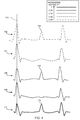
- the succession of segments 102, 104, 106, 108, and 110, after they have been partitioned, is illustrated in Fig. 4 .
- a synchronization step 204 the succession of segments is synchronized to the selected annotation point.
- the synchronization is illustrated in Fig. 4 by the peaks of the initial QRS complex of each segment being located on a vertical line 114.
- a display step 206 graphs of the successive synchronized segments are presented on display screen 54, the segments being aligned and overlaid with each other according to the selected annotation point.
- professional 32 selects the signal (different possible signals are described above in step 202) to be used for the selected annotation point, typically by preliminary observation of sets of overlaid segments, so as to determine the signal giving the most stable synchronization.
- the alignment also includes aligning an estimated baseline of each segment. Each segment is first presented with an initial display intensity at a display time corresponding to the start time of the segment.
- the display intensity of each segment is allowed to decay, according to a predetermined decay function of a time elapsed since the initial presentation.
- a typical decay function reduces the intensity linearly by 15% for the time period between adjacent segments, so that after seven time periods, the display intensity is zero, i.e., the segment is not displayed.
- any other convenient function may be used for the reduced intensity.
- Fig. 4 illustrates the different display intensities of the five segments of graph 100, according to the presentation times of the segments shown in Fig. 2 .
- the most recent segment is segment 110
- the elapsed time from presentation of each of the segments increases monotonically through segments 108, 106, 104, and 102, so that segment 102 has the largest elapsed time.
- Fig. 4 shows the different segments as being separated vertically. Since the elapsed times for the respective segments 108, 106, 104, and 102 increases, the display intensities of the segments decreases.
- segments 108, 106, 104, and 102 have respective intensities of 0.85, 0.7, 0.55, and 0.4.
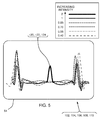
- Fig. 5 illustrates the different segments as they are overlaid on display screen 54, according to an embodiment of the present invention.
- processor 40 sums the intensities of overlapping points of the graph. The summing enhances the visibility of regions of the graphs that repeat on an irregular basis.
- peaks 120, 122, and 124 overlap, so that the intensity of the overlapped points is increased compared to the intensity of non-overlapped sections of the graphs.
- peaks 120, 122, and 124 have respective intensities 0.4, 0.7, and 1, so that the overlapped peaks have a nominal intensity of 2.1.
- Fig. 5 illustrates the overlapped peaks as having an intensity on screen 54 of 2.
- each segment is assigned an intensity according to the time elapsed on the display screen since its first presentment on the screen, and that where the segments overlap the intensities are summed.
- the intensity summation is only applied to a portion of each of the segments. Typically, the portion to which the summation applies is selected by professional 32.
- the professional may choose that the summation is only applied to the central 75% of each segment.
- This type of limitation allows system 20 to only enhance, by increasing their intensity, selected sections of the segments that are of interest to the professional, while not enhancing other sections, such as the start QRS complex and/or the end QRS complex, of the segments.
- the intensities may be configured to be summed if two or more segments have portions occupying pixels that are close to each other.
- the degree of closeness may be selected by professional 32, and may be, for example where portions are within a selected number, for example 2, of pixels of each other. Allowing this type of summation provides the professional with the ability to sum sections that are of interest, even if there are slight variations, typically due to noise, between the sections of interest.
- the result of the summation may be presented on screen 54 as one or more pixels, with the summed intensity, at a mean location of the pixels that are close to each other.
Landscapes
- Health & Medical Sciences (AREA)
- Life Sciences & Earth Sciences (AREA)
- Engineering & Computer Science (AREA)
- Cardiology (AREA)
- Physics & Mathematics (AREA)
- Biomedical Technology (AREA)
- Public Health (AREA)
- General Health & Medical Sciences (AREA)
- Medical Informatics (AREA)
- Surgery (AREA)
- Veterinary Medicine (AREA)
- Animal Behavior & Ethology (AREA)
- Heart & Thoracic Surgery (AREA)
- Molecular Biology (AREA)
- Pathology (AREA)
- Biophysics (AREA)
- Theoretical Computer Science (AREA)
- General Physics & Mathematics (AREA)
- Physiology (AREA)
- Computer Hardware Design (AREA)
- Primary Health Care (AREA)
- Psychiatry (AREA)
- Business, Economics & Management (AREA)
- General Business, Economics & Management (AREA)
- Epidemiology (AREA)
- Nuclear Medicine, Radiotherapy & Molecular Imaging (AREA)
- Otolaryngology (AREA)
- Plasma & Fusion (AREA)
- Psychology (AREA)
- Microelectronics & Electronic Packaging (AREA)
- Artificial Intelligence (AREA)
- Computer Vision & Pattern Recognition (AREA)
- Signal Processing (AREA)
- Measurement And Recording Of Electrical Phenomena And Electrical Characteristics Of The Living Body (AREA)
- Measuring And Recording Apparatus For Diagnosis (AREA)
Applications Claiming Priority (1)
| Application Number | Priority Date | Filing Date | Title |
|---|---|---|---|
| US14/571,708 US9681818B2 (en) | 2014-12-16 | 2014-12-16 | Detection and display of irregular periodic waveforms |
Publications (3)
| Publication Number | Publication Date |
|---|---|
| EP3033996A1 true EP3033996A1 (de) | 2016-06-22 |
| EP3033996C0 EP3033996C0 (de) | 2024-11-13 |
| EP3033996B1 EP3033996B1 (de) | 2024-11-13 |
Family
ID=54850025
Family Applications (1)
| Application Number | Title | Priority Date | Filing Date |
|---|---|---|---|
| EP15200052.7A Active EP3033996B1 (de) | 2014-12-16 | 2015-12-15 | Erfassung und anzeige von ungleichmässigen periodischen wellenformen |
Country Status (7)
| Country | Link |
|---|---|
| US (2) | US9681818B2 (de) |
| EP (1) | EP3033996B1 (de) |
| JP (1) | JP6707338B2 (de) |
| CN (1) | CN105686826B (de) |
| AU (1) | AU2015268705A1 (de) |
| CA (1) | CA2915240A1 (de) |
| IL (1) | IL242972B (de) |
Families Citing this family (17)
| Publication number | Priority date | Publication date | Assignee | Title |
|---|---|---|---|---|
| US11389232B2 (en) | 2006-06-28 | 2022-07-19 | Kardium Inc. | Apparatus and method for intra-cardiac mapping and ablation |
| US9119633B2 (en) | 2006-06-28 | 2015-09-01 | Kardium Inc. | Apparatus and method for intra-cardiac mapping and ablation |
| US8906011B2 (en) | 2007-11-16 | 2014-12-09 | Kardium Inc. | Medical device for use in bodily lumens, for example an atrium |
| US9198592B2 (en) | 2012-05-21 | 2015-12-01 | Kardium Inc. | Systems and methods for activating transducers |
| US10827977B2 (en) | 2012-05-21 | 2020-11-10 | Kardium Inc. | Systems and methods for activating transducers |
| US9017321B2 (en) | 2012-05-21 | 2015-04-28 | Kardium, Inc. | Systems and methods for activating transducers |
| US10368936B2 (en) | 2014-11-17 | 2019-08-06 | Kardium Inc. | Systems and methods for selecting, activating, or selecting and activating transducers |
| US10722184B2 (en) | 2014-11-17 | 2020-07-28 | Kardium Inc. | Systems and methods for selecting, activating, or selecting and activating transducers |
| WO2016112383A1 (en) | 2015-01-10 | 2016-07-14 | University Of Florida Research Foundation, Inc. | Simulation features combining mixed reality and modular tracking |
| IL250610B (en) * | 2017-02-14 | 2022-09-01 | Inna Luria | System and method for arrhythmia diagnosis |
| US11720817B2 (en) | 2019-07-01 | 2023-08-08 | Medical Informatics Corp. | Waveform annotator |
| JP7219182B2 (ja) * | 2019-07-22 | 2023-02-07 | マクセル株式会社 | 検出装置および検出方法 |
| CN113116358B (zh) * | 2019-12-30 | 2022-07-29 | 华为技术有限公司 | 心电图的显示方法、装置、终端设备和存储介质 |
| CA3215962A1 (en) | 2021-04-26 | 2022-11-03 | Roman Turovskiy | Circumferential ablation devices and methods |
| US12564440B2 (en) | 2021-04-26 | 2026-03-03 | Pulse Biosciences, Inc. | Multi-strut ablation and sensing catheter devices and methods |
| US12446944B2 (en) | 2021-04-26 | 2025-10-21 | Pulse Biosciences, Inc. | Mapping and ablation applicators |
| CN114847967B (zh) * | 2022-04-15 | 2025-08-01 | 无锡市中健科仪有限公司 | 动态心电图遗漏qrs波批量分析方法及系统 |
Citations (9)
| Publication number | Priority date | Publication date | Assignee | Title |
|---|---|---|---|---|
| US3457452A (en) * | 1965-04-30 | 1969-07-22 | Datascope Corp | Display of repetitive analog data |
| US3638066A (en) * | 1970-08-21 | 1972-01-25 | Thomas O Paine | Contourograph system for monitoring electrocardiograms |
| US5284152A (en) * | 1992-02-28 | 1994-02-08 | Hewlett-Packard Company | Method for displaying superimposed heartbeat waveforms |
| US20020091330A1 (en) * | 2000-11-10 | 2002-07-11 | C.R. Bard, Inc. | Methods for processing electrocardiac signals having superimposed complexes |
| US20040030257A1 (en) * | 2002-08-12 | 2004-02-12 | Besher Tabbara | System for adaptively deriving ECG chest lead signal data |
| WO2006123334A2 (en) * | 2005-05-17 | 2006-11-23 | Bio Signal Analysis Ltd. | Analysis of electrocardiogram signals |
| EP2030565A1 (de) * | 2007-09-02 | 2009-03-04 | Medicalgorithmics Sp. Z.O.O. | Systeme zur sicheren Remote-EKG-Überwachung ambulanter Patienten |
| WO2010054409A1 (en) | 2008-11-10 | 2010-05-14 | Cardioinsight Technologies, Inc. | Visualization of electrophysiology data |
| US20120204875A1 (en) * | 2011-02-15 | 2012-08-16 | General Electric Company | Method and apparatus for mechanical ventilation system with data display |
Family Cites Families (18)
| Publication number | Priority date | Publication date | Assignee | Title |
|---|---|---|---|---|
| JPS5233389A (en) * | 1975-09-09 | 1977-03-14 | Sanei Sokki Kk | Device for indicating living body signal |
| US7778688B2 (en) * | 1999-05-18 | 2010-08-17 | MediGuide, Ltd. | System and method for delivering a stent to a selected position within a lumen |
| US6912247B2 (en) * | 2000-03-23 | 2005-06-28 | Hitachi Kokusai Electric Inc. | Digital signal transmission system and method of displaying transmission condition in digital signal transmission system |
| US6821256B2 (en) * | 2001-02-01 | 2004-11-23 | Mayo Foundation For Medical Education And Research | Non-alternating beat-to-beat fluctuations in T wave morphology |
| WO2005008418A2 (en) * | 2003-07-11 | 2005-01-27 | C.R. Bard, Inc. | Multi-color overlay system for processing and displaying electrocardiac signals |
| BRPI0414345A (pt) * | 2003-09-12 | 2006-11-07 | Bodymedia Inc | método e aparelho para medição de parámetros relacionados com o coração |
| EP1809174A4 (de) * | 2004-10-05 | 2008-04-23 | Cuoretech Pty Ltd | Herzanalyseverfahren und gerät |
| CN100483138C (zh) * | 2004-12-24 | 2009-04-29 | 陈耀钧 | 单周期波形检测分析方法及系统 |
| US8229545B2 (en) | 2005-09-15 | 2012-07-24 | St. Jude Medical, Atrial Fibrillation Division, Inc. | System and method for mapping complex fractionated electrogram information |
| US7846104B2 (en) * | 2007-02-08 | 2010-12-07 | Heart Force Medical Inc. | Monitoring physiological condition and detecting abnormalities |
| US8494608B2 (en) * | 2008-04-18 | 2013-07-23 | Medtronic, Inc. | Method and apparatus for mapping a structure |
| CN101609107B (zh) * | 2009-05-27 | 2010-09-15 | 东南大学 | 多通道数字示波器实现波形荧光显示效果的方法 |
| CN101627907B (zh) * | 2009-07-17 | 2012-09-05 | 深圳迪美泰数字医学技术有限公司 | 心电信号分析处理装置及方法 |
| CN102053184B (zh) * | 2009-11-10 | 2014-06-25 | 北京普源精电科技有限公司 | 一种具有高波形捕获率的数字示波器及其控制方法 |
| CN102565482B (zh) * | 2010-12-31 | 2015-08-19 | 北京普源精电科技有限公司 | 数字示波器及其控制方法 |
| KR101892176B1 (ko) * | 2011-11-02 | 2018-08-28 | 삼성전자 주식회사 | 심전도 디스플레이 방법 및 이를 위한 사용자 인터페이스 장치 |
| JP5869925B2 (ja) | 2012-03-15 | 2016-02-24 | 日本光電工業株式会社 | 心筋興奮波形検出装置、および検出プログラム |
| CN102680755A (zh) * | 2012-05-08 | 2012-09-19 | 张兴杰 | 具有显示三维波形信息的高刷新率数字示波器 |
-
2014
- 2014-12-16 US US14/571,708 patent/US9681818B2/en active Active
-
2015
- 2015-12-07 IL IL242972A patent/IL242972B/en active IP Right Grant
- 2015-12-14 AU AU2015268705A patent/AU2015268705A1/en not_active Abandoned
- 2015-12-15 CA CA2915240A patent/CA2915240A1/en not_active Abandoned
- 2015-12-15 JP JP2015244100A patent/JP6707338B2/ja active Active
- 2015-12-15 EP EP15200052.7A patent/EP3033996B1/de active Active
- 2015-12-16 CN CN201510941422.3A patent/CN105686826B/zh active Active
-
2017
- 2017-04-18 US US15/490,522 patent/US9848833B2/en active Active
Patent Citations (9)
| Publication number | Priority date | Publication date | Assignee | Title |
|---|---|---|---|---|
| US3457452A (en) * | 1965-04-30 | 1969-07-22 | Datascope Corp | Display of repetitive analog data |
| US3638066A (en) * | 1970-08-21 | 1972-01-25 | Thomas O Paine | Contourograph system for monitoring electrocardiograms |
| US5284152A (en) * | 1992-02-28 | 1994-02-08 | Hewlett-Packard Company | Method for displaying superimposed heartbeat waveforms |
| US20020091330A1 (en) * | 2000-11-10 | 2002-07-11 | C.R. Bard, Inc. | Methods for processing electrocardiac signals having superimposed complexes |
| US20040030257A1 (en) * | 2002-08-12 | 2004-02-12 | Besher Tabbara | System for adaptively deriving ECG chest lead signal data |
| WO2006123334A2 (en) * | 2005-05-17 | 2006-11-23 | Bio Signal Analysis Ltd. | Analysis of electrocardiogram signals |
| EP2030565A1 (de) * | 2007-09-02 | 2009-03-04 | Medicalgorithmics Sp. Z.O.O. | Systeme zur sicheren Remote-EKG-Überwachung ambulanter Patienten |
| WO2010054409A1 (en) | 2008-11-10 | 2010-05-14 | Cardioinsight Technologies, Inc. | Visualization of electrophysiology data |
| US20120204875A1 (en) * | 2011-02-15 | 2012-08-16 | General Electric Company | Method and apparatus for mechanical ventilation system with data display |
Also Published As
| Publication number | Publication date |
|---|---|
| US9848833B2 (en) | 2017-12-26 |
| US20160166165A1 (en) | 2016-06-16 |
| EP3033996C0 (de) | 2024-11-13 |
| US9681818B2 (en) | 2017-06-20 |
| IL242972A0 (en) | 2016-04-21 |
| JP2016112420A (ja) | 2016-06-23 |
| US20170215817A1 (en) | 2017-08-03 |
| CN105686826A (zh) | 2016-06-22 |
| AU2015268705A1 (en) | 2016-06-30 |
| JP6707338B2 (ja) | 2020-06-10 |
| CA2915240A1 (en) | 2016-06-16 |
| EP3033996B1 (de) | 2024-11-13 |
| IL242972B (en) | 2018-07-31 |
| CN105686826B (zh) | 2021-01-01 |
Similar Documents
| Publication | Publication Date | Title |
|---|---|---|
| US9848833B2 (en) | Detection and display of irregular periodic wave forms | |
| US10076260B2 (en) | Integrated analysis of electrophysiological data | |
| US10004413B2 (en) | Signal analysis related to treatment sites | |
| US9095264B2 (en) | Method and system for identifying cardiac arrhythmia driver sites | |
| EP3451918B1 (de) | Detektion und analyse von elektrogrammen | |
| JP6300911B2 (ja) | 電位図の双方向活性化検出のための心臓マッピングのシステム及び方法 | |
| US20160242663A1 (en) | Signal characterization for detecting and/or analyzing driver activity | |
| KR20140114361A (ko) | 생체 리듬 장애에 연관된 규칙성을 판정하는 방법 및 시스템 | |
| JP2020199265A (ja) | 電気生理学的マップにおける一次及び二次活性化の視覚的区別 | |
| US10918301B2 (en) | Multiple rhythm template monitoring | |
| EP3888553B1 (de) | Ausbreitungskarte einer herzkammer mit bereichen mit fraktionierten elektrogrammen | |
| EP3185760B1 (de) | Signalcharakterisierung zur ermöglichung der therapieverabreichung | |
| US20200054233A1 (en) | Method for determining a plurality of action potentials in the heart |
Legal Events
| Date | Code | Title | Description |
|---|---|---|---|
| PUAI | Public reference made under article 153(3) epc to a published international application that has entered the european phase |
Free format text: ORIGINAL CODE: 0009012 |
|
| AK | Designated contracting states |
Kind code of ref document: A1 Designated state(s): AL AT BE BG CH CY CZ DE DK EE ES FI FR GB GR HR HU IE IS IT LI LT LU LV MC MK MT NL NO PL PT RO RS SE SI SK SM TR |
|
| AX | Request for extension of the european patent |
Extension state: BA ME |
|
| STAA | Information on the status of an ep patent application or granted ep patent |
Free format text: STATUS: REQUEST FOR EXAMINATION WAS MADE |
|
| 17P | Request for examination filed |
Effective date: 20161222 |
|
| RBV | Designated contracting states (corrected) |
Designated state(s): AL AT BE BG CH CY CZ DE DK EE ES FI FR GB GR HR HU IE IS IT LI LT LU LV MC MK MT NL NO PL PT RO RS SE SI SK SM TR |
|
| STAA | Information on the status of an ep patent application or granted ep patent |
Free format text: STATUS: EXAMINATION IS IN PROGRESS |
|
| 17Q | First examination report despatched |
Effective date: 20200928 |
|
| RAP3 | Party data changed (applicant data changed or rights of an application transferred) |
Owner name: BIOSENSE WEBSTER (ISRAEL) LTD. |
|
| REG | Reference to a national code |
Ref country code: DE Ref legal event code: R079 Free format text: PREVIOUS MAIN CLASS: A61B0005044000 Ipc: A61B0005287000 Ref country code: DE Ref legal event code: R079 Ref document number: 602015090384 Country of ref document: DE Free format text: PREVIOUS MAIN CLASS: A61B0005044000 Ipc: A61B0005287000 |
|
| GRAP | Despatch of communication of intention to grant a patent |
Free format text: ORIGINAL CODE: EPIDOSNIGR1 |
|
| STAA | Information on the status of an ep patent application or granted ep patent |
Free format text: STATUS: GRANT OF PATENT IS INTENDED |
|
| RIC1 | Information provided on ipc code assigned before grant |
Ipc: A61B 5/00 20060101ALN20230918BHEP Ipc: G06F 3/14 20060101ALN20230918BHEP Ipc: A61B 5/352 20210101ALI20230918BHEP Ipc: A61B 5/339 20210101ALI20230918BHEP Ipc: A61B 5/287 20210101AFI20230918BHEP |
|
| INTG | Intention to grant announced |
Effective date: 20231013 |
|
| GRAJ | Information related to disapproval of communication of intention to grant by the applicant or resumption of examination proceedings by the epo deleted |
Free format text: ORIGINAL CODE: EPIDOSDIGR1 |
|
| STAA | Information on the status of an ep patent application or granted ep patent |
Free format text: STATUS: EXAMINATION IS IN PROGRESS |
|
| INTC | Intention to grant announced (deleted) | ||
| RIC1 | Information provided on ipc code assigned before grant |
Ipc: A61B 5/00 20060101ALN20231222BHEP Ipc: G06F 3/14 20060101ALN20231222BHEP Ipc: A61B 5/352 20210101ALI20231222BHEP Ipc: A61B 5/339 20210101ALI20231222BHEP Ipc: A61B 5/287 20210101AFI20231222BHEP |
|
| GRAP | Despatch of communication of intention to grant a patent |
Free format text: ORIGINAL CODE: EPIDOSNIGR1 |
|
| STAA | Information on the status of an ep patent application or granted ep patent |
Free format text: STATUS: GRANT OF PATENT IS INTENDED |
|
| RIC1 | Information provided on ipc code assigned before grant |
Ipc: A61B 5/00 20060101ALN20240108BHEP Ipc: G06F 3/14 20060101ALN20240108BHEP Ipc: A61B 5/352 20210101ALI20240108BHEP Ipc: A61B 5/339 20210101ALI20240108BHEP Ipc: A61B 5/287 20210101AFI20240108BHEP |
|
| INTG | Intention to grant announced |
Effective date: 20240205 |
|
| GRAJ | Information related to disapproval of communication of intention to grant by the applicant or resumption of examination proceedings by the epo deleted |
Free format text: ORIGINAL CODE: EPIDOSDIGR1 |
|
| STAA | Information on the status of an ep patent application or granted ep patent |
Free format text: STATUS: EXAMINATION IS IN PROGRESS |
|
| INTC | Intention to grant announced (deleted) | ||
| RIC1 | Information provided on ipc code assigned before grant |
Ipc: A61B 5/00 20060101ALN20240528BHEP Ipc: G06F 3/14 20060101ALN20240528BHEP Ipc: A61B 5/352 20210101ALI20240528BHEP Ipc: A61B 5/339 20210101ALI20240528BHEP Ipc: A61B 5/287 20210101AFI20240528BHEP |
|
| GRAP | Despatch of communication of intention to grant a patent |
Free format text: ORIGINAL CODE: EPIDOSNIGR1 |
|
| STAA | Information on the status of an ep patent application or granted ep patent |
Free format text: STATUS: GRANT OF PATENT IS INTENDED |
|
| RIC1 | Information provided on ipc code assigned before grant |
Ipc: A61B 5/00 20060101ALN20240703BHEP Ipc: G06F 3/14 20060101ALN20240703BHEP Ipc: A61B 5/352 20210101ALI20240703BHEP Ipc: A61B 5/339 20210101ALI20240703BHEP Ipc: A61B 5/287 20210101AFI20240703BHEP |
|
| INTG | Intention to grant announced |
Effective date: 20240723 |
|
| GRAS | Grant fee paid |
Free format text: ORIGINAL CODE: EPIDOSNIGR3 |
|
| GRAA | (expected) grant |
Free format text: ORIGINAL CODE: 0009210 |
|
| STAA | Information on the status of an ep patent application or granted ep patent |
Free format text: STATUS: THE PATENT HAS BEEN GRANTED |
|
| AK | Designated contracting states |
Kind code of ref document: B1 Designated state(s): AL AT BE BG CH CY CZ DE DK EE ES FI FR GB GR HR HU IE IS IT LI LT LU LV MC MK MT NL NO PL PT RO RS SE SI SK SM TR |
|
| REG | Reference to a national code |
Ref country code: GB Ref legal event code: FG4D |
|
| REG | Reference to a national code |
Ref country code: CH Ref legal event code: EP |
|
| REG | Reference to a national code |
Ref country code: IE Ref legal event code: FG4D |
|
| REG | Reference to a national code |
Ref country code: DE Ref legal event code: R096 Ref document number: 602015090384 Country of ref document: DE |
|
| U01 | Request for unitary effect filed |
Effective date: 20241127 |
|
| U07 | Unitary effect registered |
Designated state(s): AT BE BG DE DK EE FI FR IT LT LU LV MT NL PT RO SE SI Effective date: 20241209 |
|
| U20 | Renewal fee for the european patent with unitary effect paid |
Year of fee payment: 10 Effective date: 20241205 |
|
| PG25 | Lapsed in a contracting state [announced via postgrant information from national office to epo] |
Ref country code: IS Free format text: LAPSE BECAUSE OF FAILURE TO SUBMIT A TRANSLATION OF THE DESCRIPTION OR TO PAY THE FEE WITHIN THE PRESCRIBED TIME-LIMIT Effective date: 20250313 Ref country code: HR Free format text: LAPSE BECAUSE OF FAILURE TO SUBMIT A TRANSLATION OF THE DESCRIPTION OR TO PAY THE FEE WITHIN THE PRESCRIBED TIME-LIMIT Effective date: 20241113 |
|
| PG25 | Lapsed in a contracting state [announced via postgrant information from national office to epo] |
Ref country code: ES Free format text: LAPSE BECAUSE OF FAILURE TO SUBMIT A TRANSLATION OF THE DESCRIPTION OR TO PAY THE FEE WITHIN THE PRESCRIBED TIME-LIMIT Effective date: 20241113 |
|
| PG25 | Lapsed in a contracting state [announced via postgrant information from national office to epo] |
Ref country code: NO Free format text: LAPSE BECAUSE OF FAILURE TO SUBMIT A TRANSLATION OF THE DESCRIPTION OR TO PAY THE FEE WITHIN THE PRESCRIBED TIME-LIMIT Effective date: 20250213 |
|
| PG25 | Lapsed in a contracting state [announced via postgrant information from national office to epo] |
Ref country code: GR Free format text: LAPSE BECAUSE OF FAILURE TO SUBMIT A TRANSLATION OF THE DESCRIPTION OR TO PAY THE FEE WITHIN THE PRESCRIBED TIME-LIMIT Effective date: 20250214 |
|
| PG25 | Lapsed in a contracting state [announced via postgrant information from national office to epo] |
Ref country code: PL Free format text: LAPSE BECAUSE OF FAILURE TO SUBMIT A TRANSLATION OF THE DESCRIPTION OR TO PAY THE FEE WITHIN THE PRESCRIBED TIME-LIMIT Effective date: 20241113 |
|
| PG25 | Lapsed in a contracting state [announced via postgrant information from national office to epo] |
Ref country code: RS Free format text: LAPSE BECAUSE OF FAILURE TO SUBMIT A TRANSLATION OF THE DESCRIPTION OR TO PAY THE FEE WITHIN THE PRESCRIBED TIME-LIMIT Effective date: 20250213 |
|
| PG25 | Lapsed in a contracting state [announced via postgrant information from national office to epo] |
Ref country code: SM Free format text: LAPSE BECAUSE OF FAILURE TO SUBMIT A TRANSLATION OF THE DESCRIPTION OR TO PAY THE FEE WITHIN THE PRESCRIBED TIME-LIMIT Effective date: 20241113 |
|
| PG25 | Lapsed in a contracting state [announced via postgrant information from national office to epo] |
Ref country code: SK Free format text: LAPSE BECAUSE OF FAILURE TO SUBMIT A TRANSLATION OF THE DESCRIPTION OR TO PAY THE FEE WITHIN THE PRESCRIBED TIME-LIMIT Effective date: 20241113 |
|
| PG25 | Lapsed in a contracting state [announced via postgrant information from national office to epo] |
Ref country code: CZ Free format text: LAPSE BECAUSE OF FAILURE TO SUBMIT A TRANSLATION OF THE DESCRIPTION OR TO PAY THE FEE WITHIN THE PRESCRIBED TIME-LIMIT Effective date: 20241113 |
|
| REG | Reference to a national code |
Ref country code: CH Ref legal event code: PL |
|
| PG25 | Lapsed in a contracting state [announced via postgrant information from national office to epo] |
Ref country code: MC Free format text: LAPSE BECAUSE OF FAILURE TO SUBMIT A TRANSLATION OF THE DESCRIPTION OR TO PAY THE FEE WITHIN THE PRESCRIBED TIME-LIMIT Effective date: 20241113 |
|
| PLBE | No opposition filed within time limit |
Free format text: ORIGINAL CODE: 0009261 |
|
| STAA | Information on the status of an ep patent application or granted ep patent |
Free format text: STATUS: NO OPPOSITION FILED WITHIN TIME LIMIT |
|
| PG25 | Lapsed in a contracting state [announced via postgrant information from national office to epo] |
Ref country code: CH Free format text: LAPSE BECAUSE OF NON-PAYMENT OF DUE FEES Effective date: 20241231 |
|
| 26N | No opposition filed |
Effective date: 20250814 |
|
| PG25 | Lapsed in a contracting state [announced via postgrant information from national office to epo] |
Ref country code: IE Free format text: LAPSE BECAUSE OF NON-PAYMENT OF DUE FEES Effective date: 20241215 |
|
| U20 | Renewal fee for the european patent with unitary effect paid |
Year of fee payment: 11 Effective date: 20251110 |
|
| PGFP | Annual fee paid to national office [announced via postgrant information from national office to epo] |
Ref country code: GB Payment date: 20251030 Year of fee payment: 11 |