EP3034052B1 - Elastische schulterorthese - Google Patents
Elastische schulterorthese Download PDFInfo
- Publication number
- EP3034052B1 EP3034052B1 EP15199983.6A EP15199983A EP3034052B1 EP 3034052 B1 EP3034052 B1 EP 3034052B1 EP 15199983 A EP15199983 A EP 15199983A EP 3034052 B1 EP3034052 B1 EP 3034052B1
- Authority
- EP
- European Patent Office
- Prior art keywords
- main body
- interaction element
- brace according
- brace
- joint
- Prior art date
- Legal status (The legal status is an assumption and is not a legal conclusion. Google has not performed a legal analysis and makes no representation as to the accuracy of the status listed.)
- Active
Links
Images

Classifications
-
- A—HUMAN NECESSITIES
- A61—MEDICAL OR VETERINARY SCIENCE; HYGIENE
- A61F—FILTERS IMPLANTABLE INTO BLOOD VESSELS; PROSTHESES; DEVICES PROVIDING PATENCY TO, OR PREVENTING COLLAPSING OF, TUBULAR STRUCTURES OF THE BODY, e.g. STENTS; ORTHOPAEDIC, NURSING OR CONTRACEPTIVE DEVICES; FOMENTATION; TREATMENT OR PROTECTION OF EYES OR EARS; BANDAGES, DRESSINGS OR ABSORBENT PADS; FIRST-AID KITS
- A61F5/00—Orthopaedic methods or devices for non-surgical treatment of bones or joints; Nursing devices ; Anti-rape devices
- A61F5/37—Restraining devices for the body or for body parts; Restraining shirts
- A61F5/3715—Restraining devices for the body or for body parts; Restraining shirts for attaching the limbs to other parts of the body
- A61F5/3723—Restraining devices for the body or for body parts; Restraining shirts for attaching the limbs to other parts of the body for the arms
-
- A—HUMAN NECESSITIES
- A61—MEDICAL OR VETERINARY SCIENCE; HYGIENE
- A61F—FILTERS IMPLANTABLE INTO BLOOD VESSELS; PROSTHESES; DEVICES PROVIDING PATENCY TO, OR PREVENTING COLLAPSING OF, TUBULAR STRUCTURES OF THE BODY, e.g. STENTS; ORTHOPAEDIC, NURSING OR CONTRACEPTIVE DEVICES; FOMENTATION; TREATMENT OR PROTECTION OF EYES OR EARS; BANDAGES, DRESSINGS OR ABSORBENT PADS; FIRST-AID KITS
- A61F5/00—Orthopaedic methods or devices for non-surgical treatment of bones or joints; Nursing devices ; Anti-rape devices
- A61F5/01—Orthopaedic devices, e.g. long-term immobilising or pressure directing devices for treating broken or deformed bones such as splints, casts or braces
- A61F5/0102—Orthopaedic devices, e.g. long-term immobilising or pressure directing devices for treating broken or deformed bones such as splints, casts or braces specially adapted for correcting deformities of the limbs or for supporting them; Ortheses, e.g. with articulations
- A61F5/0104—Orthopaedic devices, e.g. long-term immobilising or pressure directing devices for treating broken or deformed bones such as splints, casts or braces specially adapted for correcting deformities of the limbs or for supporting them; Ortheses, e.g. with articulations without articulation
- A61F5/0118—Orthopaedic devices, e.g. long-term immobilising or pressure directing devices for treating broken or deformed bones such as splints, casts or braces specially adapted for correcting deformities of the limbs or for supporting them; Ortheses, e.g. with articulations without articulation for the arms, hands or fingers
-
- A—HUMAN NECESSITIES
- A61—MEDICAL OR VETERINARY SCIENCE; HYGIENE
- A61F—FILTERS IMPLANTABLE INTO BLOOD VESSELS; PROSTHESES; DEVICES PROVIDING PATENCY TO, OR PREVENTING COLLAPSING OF, TUBULAR STRUCTURES OF THE BODY, e.g. STENTS; ORTHOPAEDIC, NURSING OR CONTRACEPTIVE DEVICES; FOMENTATION; TREATMENT OR PROTECTION OF EYES OR EARS; BANDAGES, DRESSINGS OR ABSORBENT PADS; FIRST-AID KITS
- A61F5/00—Orthopaedic methods or devices for non-surgical treatment of bones or joints; Nursing devices ; Anti-rape devices
- A61F5/01—Orthopaedic devices, e.g. long-term immobilising or pressure directing devices for treating broken or deformed bones such as splints, casts or braces
- A61F5/04—Devices for stretching or reducing fractured limbs; Devices for distractions; Splints
- A61F5/042—Devices for stretching or reducing fractured limbs; Devices for distractions; Splints for extension or stretching
- A61F5/048—Traction splints
-
- A—HUMAN NECESSITIES
- A61—MEDICAL OR VETERINARY SCIENCE; HYGIENE
- A61F—FILTERS IMPLANTABLE INTO BLOOD VESSELS; PROSTHESES; DEVICES PROVIDING PATENCY TO, OR PREVENTING COLLAPSING OF, TUBULAR STRUCTURES OF THE BODY, e.g. STENTS; ORTHOPAEDIC, NURSING OR CONTRACEPTIVE DEVICES; FOMENTATION; TREATMENT OR PROTECTION OF EYES OR EARS; BANDAGES, DRESSINGS OR ABSORBENT PADS; FIRST-AID KITS
- A61F5/00—Orthopaedic methods or devices for non-surgical treatment of bones or joints; Nursing devices ; Anti-rape devices
- A61F5/01—Orthopaedic devices, e.g. long-term immobilising or pressure directing devices for treating broken or deformed bones such as splints, casts or braces
- A61F5/04—Devices for stretching or reducing fractured limbs; Devices for distractions; Splints
- A61F5/05—Devices for stretching or reducing fractured limbs; Devices for distractions; Splints for immobilising
- A61F5/058—Splints
- A61F5/05841—Splints for the limbs
- A61F5/05858—Splints for the limbs for the arms
Definitions
- the present invention relates to an elastic brace for application on the joints of patients affected by joint diseases.
- the present invention can be particularly used for treating shoulder joint traumas.
- elastic braces for joints have a flexible or semi-rigid structure, adapted to provide a support able to limit the movement of the injured joint.
- elastic braces are split into two main groups, each one dedicated to a particular action on the joint.
- a first type of elastic brace is used in the sports field following anterior dislocation and sub dislocation of the humeral head.
- Such braces comprise a main portion made of elasticated fabric to be worn by the user so as to be wrapped around the area corresponding to the deltoid (shoulder).
- the main portion has a tubular end adapted to be wrapped around the humerus.
- Such end may have a closed section to be fitted onto the arm, or have an open band to be wrapped around and anchored to the humerus by means of special belts or Velcro® fastenings.
- the main portion also has an opposite strip to the tubular end adapted to be wrapped around the bust of the user so as to determine a traction action of the main portion towards the user's body.
- the strip is generally adjusted through traction and anchoring systems, for example using Velcro® to adapt the tensile force to the size of the user.
- two strips may also be provided, respectively passing below the arm pit and onto the opposite collarbone to the injured joint.
- braces described above act on the joint by actuating a stabilisation and immobilisation action on the joint which, as described above, is mainly used following anterior dislocations and sub dislocations of the humeral head.
- a second type of elastic brace is actually used for treating problems deriving from hemiplegia and/or hemiparesis, diseases which cause a gradual loss of motor activity. This leads to significant disadvantages both for the circulatory system and for the nerve plexuses, since both are subjected to continuous tensile stress in the downwards direction exerted by the paralysed limb.
- Braces used for pathological problems differ from the first type (braces mainly for sports use) since the structure is more rigid acting consistently on the traction action of the arm towards the shoulder joint.
- the tubular end is anchored to a large part of the arm, extending in some solutions also to the part of the forearm proximal to the elbow.
- some solutions of this type envisage the presence of elastic strips that are also coupled to the terminal portion of the tubular end so as to constrain the arm better, and support it, preventing tensile stress in the downwards direction.
- Such braces are, for example, disclosed in US 5,857,990 , which is regarded as the closest prior art, as well in US 5,628,725 , and US 4,550,724 .
- the elastic braces described above have significant disadvantages and limits to application.
- the braces are not versatile since they can be used for a specific purpose which may be that of containing the limb (for sports use), or retracting the arm (for therapeutic use) towards the shoulder.
- braces of the type described above comes from the poor adaptability to the different injuries that the joint may have and which can therefore lead to one or more pathological conditions or not.
- elastic braces even if they are generally adjustable according to the size of the joint (and the body of the user) are not adaptable according to the mechanical action, which may be more or less intense, to be actuated on the arm.
- the injury to the joint may improve or decline with the consequent need to adjust the tensile force of the arm and the precise position in which such a force is actuated.
- the technical objective underlying the present invention is to provide an elastic brace which obviates the drawbacks in the prior art as described above.
- an object of the present invention is to provide an elastic brace that is versatile and able to implement on the joint both a stabilisation and immobilisation action typically used following dislocations, and a traction action of the arm in order to treat pathologies that cause a gradual loss of motor activity.
- a further object of the present invention is to provide an elastic brace that is structurally simple, inexpensive, comfortable and easy to put on by the actual user.
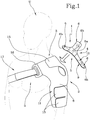
- brace 1 adapted to be applied to the shoulder of a user "U" for the treatment of pathologies confined to the acromioclavicular joint.
- the present invention may be applied to any joint in which a dual function is required, both for pathological treatment and for preservative action on the joint.
- the elastic brace comprises a main body 2, made of flexible material and in the form of a sheet to be wrapped at least partially around a respective joint to be treated.
- a main portion 2 coupled to the shoulder of the user "U" is illustrated by way of non-limiting example.
- the main body 2 is equipped with closing means 3 to be engaged in a stable way with the main body 2 itself on the joint.
- the brace 1 is also comprised of an anatomic interaction element 4 which can be associated with the main body 2 in a plurality of operating configurations, each of which corresponds to a respective mechanical action that the brace 1 performs on the joint.
- the interaction element 4 and the main body 2 are provided in two separate bodies that are coupled to one another reversibly so as to define a respective operating configuration.
- the coupling of the anatomic interaction element 4 onto the main body 2 takes place manually through appropriate coupling means 5 that will be described in more detail below.
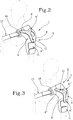
- the interaction element 4 can be switched between a first operating configuration ( figure 2 ) wherein it actuates a joint stabilisation action adapted to prevent anterior dislocations and sub dislocations of the humeral head, and a second operating condition ( figure 3 ) wherein it actuates a traction action of the limb to compensate for the dislocation of the humeral head.
- the interaction element 4 in the first configuration ( figure 2 ) is coupled to the main body 2 at a respective anterior zone to be wrapped around the acromioclavicular joint, part of the chest and the distal part of the deltoid.
- the interaction element 4 is instead coupled to the main body 2 at a respective proximal zone to the deltoid symmetrically with respect to the coronal plane.
- the interaction element 4 is arranged laterally to the user "U” at the deltoid (second operating configuration of figure 3 ), the limb is retracted towards the shoulder to abduct the shoulder into the correct position defining a therapeutic action.
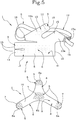
- the interaction element 4 comprises a plurality of end portions 6, extending reciprocally away from one another and each of which has an elongated conformation, defining a first common end 6a and a second distal end 6b from the first common end 6a.
- the interaction element 4 defines a substantially triangular shape wherein each angle is represented by the extension of the mentioned end portion.
- the centre of the triangle is instead defined by the mentioned first common end 6a.
- the interaction element 4 is defined by three end portions 6 equally spaced substantially at 120° from one another.
- end portions 6 may have the same dimensions or could have different dimensions according to the specific function. For that purpose, as illustrated in figure 5 , two end portions 6 are the same length, while a third portion 6 is shorter with respect to the first two.
- two end portions 6 are the same length and are shorter than a third portion 6.
- the reversible coupling means 5 comprise a plurality of zones 7 equipped with Velcro®, arranged respectively on an external visible surface 8 of the main body 2 and on each end 6a, 6b of the end portions 6.
- the external surface 8 of the main body 2 is made of a fabric equipped with a plurality of slots that can be coupled to a plurality of hooks projecting from the ends 6a, 6b of each end portion 6.
- the interaction element 4 in the first configuration illustrated in figure 2 has: a first end portion 6' arranged at an upper zone of the chest and extending towards the breast bone of the user "U”; a second end portion 6" arranged at the collar bone and extending towards the supraspinatus muscle; and a third end portion 6'" arranged at the deltoid and extending towards the arm.
- the first common end 6a of the end portions 6 is arranged on an anterior zone of the humeral head.
- the interaction element 4 has: a first end portion 6' arranged along the humerus and having a respective second distal end 6b with respect to the deltoid; a second end portion 6" arranged at the front part of the torso and extending towards the chest; and a third end portion 6'" arranged at the rear part of the torso and extending towards the trapezium.
- first common end 6a of the end portions 6 is arranged on the deltoid of the user "U".
- the present invention can be used particularly with a respective material obtained through a multi-layer sheet.
- Both the main body 2 and the interaction element 4 are obtained from a multi-layer sheet that guarantees excellent elasticity and mechanical resistance characteristics.
- the multi-layer sheet comprises an internal layer 9 made of fabric combined with carbon wire having an internal surface 10 to be in contact with the user's "U" skin.
- the multi-layer sheet further comprises an intermediate layer made of MTP foam (not shown in the appended figures) to allow the skin to breathe.
- the multi-layer sheet has an external layer 11 made of composite velcrable fabric with elastane.
- Such external layer 11 of the main body 2 defines the mentioned external visible surface 8.
- the hooks are afforded at the internal layer 9 of the anatomic interaction element 4.
- the main body 2 comprises a first portion 12 that can be wrapped around the user's humerus, and a second portion 13 that can be wrapped around the acromioclavicular joint.
- the first portion 12 has a substantially rectangular conformation, to be wrapped in a "tubular" way around the humerus.
- the second portion 13 is defined by two zones 13a, 13b, which can be moved towards one another to encircle the shoulder.
- a first zone 13a is arranged on the anterior part of the shoulder while a second zone 13b is arranged on a posterior part of the shoulder.
- the closing means 3 are comprised of a plurality of zones 14 equipped with Velcro® arranged on respective superimposable ends 15 of the first and second wrappable portion 12, 13.
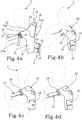
- the superimposable ends 15 of the first wrappable portion 12 are arranged at the biceps brachii ( figures 4a-4d ), while the superimposable ends 15 of the second wrappable portion 13 are arranged at the anterior deltoid ( figures 4a-4d ).
- the second wrappable portion 13 further comprises respective secondary ends 16 opposite the superimposable ends 15. Such secondary ends have coupling zones to an elastic strip 17 which during use is arranged around the user's "U" torso.
- the strip 17 is also equipped with a velcrable zone 17a applicable at the user's "U” chest to allow easy application and tightening of the whole brace 1 to the user's "U” body.
- a second end 16 is equipped with a slot into which the strip 17 passes and returns.
- the brace 1 is applicable by the actual user "U", only using their “free” hand, i.e. the hand of the arm not affected by the joint to be treated.
- the velcroed ends 15 of the first and second wrappable portions 12, 13 are superimposed.
- the relative position between the ends 15 is adjusted better ( figure 4c ) according to the mechanical action to be performed, the size of the limb and the comfort perceived by the user.
- the strip 17 is folded and closed onto itself by means of the return provided by the slot to actuate the stable locking of the main body 2 onto the torso and onto the user's "U” joint.
- the user sees to the positioning of the anatomic interaction element 4 according to the action that the brace must perform on the joint.
- the elastic brace 1 is still very versatile and able to actuate on the joint both a stabilisation and immobilisation action (used following dislocations), and a traction action of the arm to treat pathologies deriving from hemiplegia and/or hemiparesis which cause a gradual loss of motor activity.
- the anatomic interaction element 4 is coupled to the main body 2 to actuate a specific action on the joint.
- the coupling of the element 4 is also configurable according to the particular joint requirements and sizes, making the whole brace 1 particularly versatile and adaptable to any requirement, type and pathological severity.
- the brace 1 is also structurally simple, inexpensive since it is able to actuate a series of actions on the joint, and easy to put on. On this point, note that the user "U” is able to put the brace 1 on independently and adjust it hence providing special tolerability and comfort for the brace 1 itself.
Landscapes
- Health & Medical Sciences (AREA)
- Nursing (AREA)
- Orthopedic Medicine & Surgery (AREA)
- Engineering & Computer Science (AREA)
- Biomedical Technology (AREA)
- Heart & Thoracic Surgery (AREA)
- Vascular Medicine (AREA)
- Life Sciences & Earth Sciences (AREA)
- Animal Behavior & Ethology (AREA)
- General Health & Medical Sciences (AREA)
- Public Health (AREA)
- Veterinary Medicine (AREA)
- Orthopedics, Nursing, And Contraception (AREA)
Claims (15)
- Elastische Orthese (1), umfassend:- einen Hauptkörper (2), bestehend aus elastischem Material, der mindestens teilweise um ein jeweiliges zu behandelndes Schultergelenk gewickelt werden kann, und- Verschlussmittel (3), gekuppelt mit dem Hauptkörper (2), um den Hauptkörper (2) fest auf dem Gelenk zu befestigen;- ein anatomisches Interaktionselement (4), das ausgelegt ist, um mit dem Hauptkörper (2) in einer Vielzahl von Betriebskonfigurationen assoziiert zu werden,von denen eine jede einem jeweiligen mechanischen Vorgang entspricht, den die Orthese (1) am Gelenk durchführt,
wobei diese Betriebskonfigurationen eine erste Betriebskonfiguration umfassen, in der das Interaktionselement (4) einen Stabilisierungsvorgang am Gelenk durchführt, um eine anteriore Dislokation und eine Subdislokation des Humeruskopfs zu vermeiden, und eine zweite Betriebskonfiguration, in der das Interaktionselement (4) einen Zugvorgang auf der Gliedmaße durchführt, um die Dislokation des Humeruskopfs auszugleichen,
dadurch gekennzeichnet, dass das Interaktionselement (4) drei Endabschnitte (6) umfasst, die sich gegenseitig wegführend voneinander erstrecken, und von denen ein jeder eine verlängerte Beschaffenheit aufweist, definierend ein erstes gemeinsames Ende (6a) und ein zweites distales Ende (6b) vom ersten gemeinsamen Ende (6a), wobei das Interaktionselement (4) eine im Wesentlichen dreieckige Form definiert, wobei ein jeder Winkel dieser dreieckigen Form durch die Ausdehnung eines Endabschnitts (6) dargestellt ist und die Mitte der dreieckigen Form durch das erste gemeinsame Ende (6a) definiert ist. - Orthese nach dem vorhergehenden Anspruch, dadurch gekennzeichnet, dass das Interaktionselement (4) aus einem separaten Körper vom Hauptkörper (2) besteht und dass es zudem reversible Kupplungsmittel (5) zwischen dem Interaktionselement (4) und dem Hauptkörper (2) umfasst.
- Orthese nach Anspruch 1, dadurch gekennzeichnet, dass das Interaktionselement (4) in der ersten Konfiguration mit dem Hauptkörper (2) an einer jeweiligen frontseitigen Zone gekuppelt ist, die rund um das Acromio-Clavicular-Gelenk, einen Teil des Brustkorbs und den distalen Teil des Deltamuskels zu wickeln ist.
- Orthese nach Anspruch 3, dadurch gekennzeichnet, dass das Interaktionselement (4) in der zweiten Konfiguration mit dem Hauptkörper (2) an einer jeweiligen proximalen Zone zum Deltamuskel gekoppelt ist, symmetrisch zur Frontalebene.
- Orthese nach Anspruch 1, dadurch gekennzeichnet, dass die drei Endabschnitte (6) um 120° gleichabständig voneinander sind.
- Orthese nach Anspruch 2, dadurch gekennzeichnet, dass die reversiblen Kupplungsmittel (5) eine Vielzahl an Zonen (7) umfassen, die mit Velcro® versehen sind, angeordnet jeweils auf einer außenseitigen sichtbaren Oberfläche (8) des Hauptkörpers (2) und an einem jeden Ende (6a, 6b) der Endabschnitte (6).
- Orthese nach dem vorhergehenden Anspruch, dadurch gekennzeichnet, dass die außenseitige sichtbare Oberfläche (8) des Hauptkörpers (2) aus einem Gewebe besteht, versehen mit einer Vielzahl an Schlitzen, die mit einer Vielzahl an Haken gekuppelt werden können, die aus den Enden (6a, 6b) eines jeden Endabschnitts (6) hervorstehen.
- Orthese nach einem der Ansprüche 5 bis 7, dadurch gekennzeichnet, dass das Interaktionselement (4) ausgelegt ist, um in der ersten Konfiguration einen ersten Endabschnitt (6') aufzuweisen, angeordnet an einer oberen Zone des Brustkorbs und sich erstreckend hinführend zum Brustknochen des Nutzers, einen zweiten Endabschnitt (6"), angeordnet am Schlüsselbein und sich erstreckend hinführend zum M. supraspinatus, und einen dritten Endabschnitt (6"'), angeordnet am Deltamuskel und sich erstreckend hinführend zum Arm, wobei das erste gemeinsame Ende (6a) der Endabschnitte (6', 6", 6"') an einer frontseitigen Zone des Humeruskopfs angeordnet ist.
- Orthese nach einem der Ansprüche 5 bis 8, dadurch gekennzeichnet, dass das Interaktionselement (4) ausgelegt ist, um in der zweiten Konfiguration aufzuweisen: einen ersten Endabschnitt (6'), angeordnet entlang des Humerus und aufweisend ein jeweiliges zweites distales Ende (6b) im Vergleich zum Deltamuskel; einen zweiten Endabschnitt (6"), angeordnet am frontseitigen Teil des Rumpfs und sich erstreckend hinführend zum Brustkorb, und einen dritten Endabschnitt (6"'), angeordnet am rückseitigen Teil des Rumpfs und sich erstreckend hinführend zum Trapezmuskel, wobei das erste gemeinsame Ende (6a) der Endabschnitte (6', 6", 6"') am Deltamuskel angeordnet ist.
- Orthese nach einem der vorhergehenden Ansprüche, dadurch gekennzeichnet, dass der Hauptkörper (2) und das anatomische Interaktionselement (4) aus einer mehrschichtigen Bahn bestehen, umfassend: eine innere Schicht (9), bestehend aus einem Gewebe, kombiniert mit Kohlenstoffdraht, aufweisend eine innenseitige Oberfläche (10), um mit der Haut des Nutzers (U) in Berührung zu sein; eine Zwischenschicht, bestehend aus MTP-Schaumstoff, um der Haut die Atmung zu erlauben, und eine äußere Schicht (11), bestehend aus einem klettbaren Verbundgewebe mit Elastan.
- Orthese nach Anspruch 10, wobei dieser von Anspruch 7 abhängt, dadurch gekennzeichnet, dass die äußere Schicht (9) des Hauptkörpers (2) die außenseitige sichtbare Oberfläche (8) definiert und dass die Haken aus der inneren Schicht des anatomischen Interaktionselements (4) hervorstehen.
- Orthese nach einem der vorhergehenden Ansprüche, dadurch gekennzeichnet, dass der Hauptkörper (2) einen ersten Abschnitt (12) umfasst, ausgelegt, um um den Humerus des Nutzers gewickelt zu werden, und einen zweiten Abschnitt (13), ausgelegt, um um das Acromio-Clavicular-Gelenk gewickelt zu werden.
- Orthese nach dem vorhergehenden Anspruch, dadurch gekennzeichnet, dass die Verschlussmittel (3) eine Vielzahl an Zonen (14) aufweisen, die mit Velcro® ausgestattet sind, angeordnet auf jeweiligen übereinanderlagerbaren Enden (15) des ersten und zweiten wickelbaren Abschnitts (12, 13), wobei die übereinanderlagerbaren Enden (15) des ersten wickelbaren Abschnitts (12) in Verwendung am M. biceps brachii angeordnet sind und die übereinanderlagerbaren Enden (15) des zweiten wickelbaren Abschnitts (13) in Verwendung am vorderen Deltamuskel angeordnet sind.
- Orthese nach dem vorhergehenden Anspruch, dadurch gekennzeichnet, dass der zweite wickelbare Abschnitt (13) zudem jeweilige Sekundärenden (16) umfasst, die gegenständig zu den übereinanderlagerbaren Enden (15) angeordnet sind, und dass der Hauptkörper (2) zudem einen elastischen Streifen (17) umfasst, der mit den Sekundärenden (16) in Eingriff gelangen kann.
- Orthese nach dem vorhergehenden Anspruch, dadurch gekennzeichnet, dass der elastische Streifen (17) ausgelegt ist, um in Verwendung rund um den Rumpf des Nutzers angeordnet zu werden, sowie einen Klettverschluss (17a) aufweist, der am Brustkorb des effektiven Nutzers angebracht werden kann.
Applications Claiming Priority (1)
| Application Number | Priority Date | Filing Date | Title |
|---|---|---|---|
| ITMI20142164 | 2014-12-17 |
Publications (2)
| Publication Number | Publication Date |
|---|---|
| EP3034052A1 EP3034052A1 (de) | 2016-06-22 |
| EP3034052B1 true EP3034052B1 (de) | 2017-08-02 |
Family
ID=52472410
Family Applications (1)
| Application Number | Title | Priority Date | Filing Date |
|---|---|---|---|
| EP15199983.6A Active EP3034052B1 (de) | 2014-12-17 | 2015-12-15 | Elastische schulterorthese |
Country Status (1)
| Country | Link |
|---|---|
| EP (1) | EP3034052B1 (de) |
Cited By (2)
| Publication number | Priority date | Publication date | Assignee | Title |
|---|---|---|---|---|
| DE102021005994B4 (de) | 2021-12-04 | 2024-07-04 | Svetlana Kiefer | Orthese zur Stabilisierung einer Schulter, insbesondere eines Schlüsselbeins |
| US20240415687A1 (en) * | 2021-11-10 | 2024-12-19 | Ottobock Se & Co. Kgaa | Method for fastening an orthosis, and orthosis |
Families Citing this family (2)
| Publication number | Priority date | Publication date | Assignee | Title |
|---|---|---|---|---|
| KR101997350B1 (ko) * | 2017-11-06 | 2019-07-05 | 고려대학교 산학협력단 | 동결견용 어깨보호대 |
| GB2571735B (en) * | 2018-03-06 | 2022-02-23 | Dm Orthotics Ltd | Orthotic shoulder support |
Family Cites Families (5)
| Publication number | Priority date | Publication date | Assignee | Title |
|---|---|---|---|---|
| MA19428A1 (fr) * | 1981-04-28 | 1982-12-31 | Mohamed Berrehail | Gilet orthopedique de soutien et de contention dans le traitement des traumatises et des operes de l'epaule, de la ceinture scapulaire et du membre superieur |
| US5628725A (en) * | 1995-03-21 | 1997-05-13 | The Saunders Group, Inc. | Shoulder stabilizer methods |
| US5857990A (en) * | 1996-06-20 | 1999-01-12 | Maas; Richard D. | Orthopedic garment for dynamic scapular and acromio-clavicular stabilization, including dynamically enhancing proper posture |
| US20040193086A1 (en) * | 2003-03-28 | 2004-09-30 | Cofre Ruth P. | Dynamic position adjustment device for extremities of the human body |
| US8336118B2 (en) * | 2007-05-31 | 2012-12-25 | Nike, Inc. | Articles of apparel providing enhanced body position feedback |
-
2015
- 2015-12-15 EP EP15199983.6A patent/EP3034052B1/de active Active
Non-Patent Citations (1)
| Title |
|---|
| None * |
Cited By (2)
| Publication number | Priority date | Publication date | Assignee | Title |
|---|---|---|---|---|
| US20240415687A1 (en) * | 2021-11-10 | 2024-12-19 | Ottobock Se & Co. Kgaa | Method for fastening an orthosis, and orthosis |
| DE102021005994B4 (de) | 2021-12-04 | 2024-07-04 | Svetlana Kiefer | Orthese zur Stabilisierung einer Schulter, insbesondere eines Schlüsselbeins |
Also Published As
| Publication number | Publication date |
|---|---|
| EP3034052A1 (de) | 2016-06-22 |
Similar Documents
| Publication | Publication Date | Title |
|---|---|---|
| US11412794B2 (en) | Limb sleeves for body alignment | |
| JP6293169B2 (ja) | 大腿骨寛骨臼インピンジメントの症状を予防するための装具 | |
| JP2013503268A5 (de) | ||
| HK1244640A1 (en) | Athletic tights | |
| US11058569B2 (en) | Shoulder stabilization apparatus and methods | |
| CA2804084C (en) | Devices for applying tension to a patient shoulder and associated installation method | |
| EP3034052A1 (de) | Elastische orthese | |
| US6880489B2 (en) | Support for treatment of canine hip dysplasia and lumbosacral disorders | |
| JP2010509947A (ja) | 損傷した軟組織の負荷を支持するための器具 | |
| AU5942900A (en) | Bandage for relief of the musculature in muscle fibre tears | |
| KR101677269B1 (ko) | 탄력성을 보유한 어깨 보호대 | |
| RU2675741C2 (ru) | Усовершенствованный поясничный корсет | |
| KR20140091257A (ko) | 편마비 환자용 상체 지지장치 | |
| TWI662953B (zh) | 內衣 | |
| KR20090063297A (ko) | 목 보조기 | |
| US10188157B2 (en) | Insulated athletic support garment | |
| CN105208886B (zh) | 护膝 | |
| JP2576473Y2 (ja) | 腰痛帯 | |
| JP5592871B2 (ja) | 腰用サポーター | |
| RU2205616C1 (ru) | Ортопедический грудопоясничный корсет | |
| JP2015139605A (ja) | 腰用サポータ | |
| KR20130000452U (ko) | 허리보호대 | |
| CN106488755A (zh) | 动态腰椎复位系统 | |
| US20200368057A1 (en) | Upper Extremity Braces | |
| US20120289874A1 (en) | Spinal Posture Brace |
Legal Events
| Date | Code | Title | Description |
|---|---|---|---|
| PUAI | Public reference made under article 153(3) epc to a published international application that has entered the european phase |
Free format text: ORIGINAL CODE: 0009012 |
|
| AK | Designated contracting states |
Kind code of ref document: A1 Designated state(s): AL AT BE BG CH CY CZ DE DK EE ES FI FR GB GR HR HU IE IS IT LI LT LU LV MC MK MT NL NO PL PT RO RS SE SI SK SM TR |
|
| AX | Request for extension of the european patent |
Extension state: BA ME |
|
| 17P | Request for examination filed |
Effective date: 20161222 |
|
| RBV | Designated contracting states (corrected) |
Designated state(s): AL AT BE BG CH CY CZ DE DK EE ES FI FR GB GR HR HU IE IS IT LI LT LU LV MC MK MT NL NO PL PT RO RS SE SI SK SM TR |
|
| GRAP | Despatch of communication of intention to grant a patent |
Free format text: ORIGINAL CODE: EPIDOSNIGR1 |
|
| INTG | Intention to grant announced |
Effective date: 20170410 |
|
| GRAS | Grant fee paid |
Free format text: ORIGINAL CODE: EPIDOSNIGR3 |
|
| GRAA | (expected) grant |
Free format text: ORIGINAL CODE: 0009210 |
|
| AK | Designated contracting states |
Kind code of ref document: B1 Designated state(s): AL AT BE BG CH CY CZ DE DK EE ES FI FR GB GR HR HU IE IS IT LI LT LU LV MC MK MT NL NO PL PT RO RS SE SI SK SM TR |
|
| REG | Reference to a national code |
Ref country code: CH Ref legal event code: EP Ref country code: AT Ref legal event code: REF Ref document number: 913644 Country of ref document: AT Kind code of ref document: T Effective date: 20170815 |
|
| REG | Reference to a national code |
Ref country code: IE Ref legal event code: FG4D |
|
| REG | Reference to a national code |
Ref country code: DE Ref legal event code: R096 Ref document number: 602015003880 Country of ref document: DE |
|
| REG | Reference to a national code |
Ref country code: CH Ref legal event code: NV Representative=s name: BUGNION S.A., CH |
|
| REG | Reference to a national code |
Ref country code: NL Ref legal event code: MP Effective date: 20170802 |
|
| REG | Reference to a national code |
Ref country code: AT Ref legal event code: MK05 Ref document number: 913644 Country of ref document: AT Kind code of ref document: T Effective date: 20170802 |
|
| REG | Reference to a national code |
Ref country code: LT Ref legal event code: MG4D |
|
| REG | Reference to a national code |
Ref country code: FR Ref legal event code: PLFP Year of fee payment: 3 |
|
| PG25 | Lapsed in a contracting state [announced via postgrant information from national office to epo] |
Ref country code: NO Free format text: LAPSE BECAUSE OF FAILURE TO SUBMIT A TRANSLATION OF THE DESCRIPTION OR TO PAY THE FEE WITHIN THE PRESCRIBED TIME-LIMIT Effective date: 20171102 Ref country code: NL Free format text: LAPSE BECAUSE OF FAILURE TO SUBMIT A TRANSLATION OF THE DESCRIPTION OR TO PAY THE FEE WITHIN THE PRESCRIBED TIME-LIMIT Effective date: 20170802 Ref country code: SE Free format text: LAPSE BECAUSE OF FAILURE TO SUBMIT A TRANSLATION OF THE DESCRIPTION OR TO PAY THE FEE WITHIN THE PRESCRIBED TIME-LIMIT Effective date: 20170802 Ref country code: AT Free format text: LAPSE BECAUSE OF FAILURE TO SUBMIT A TRANSLATION OF THE DESCRIPTION OR TO PAY THE FEE WITHIN THE PRESCRIBED TIME-LIMIT Effective date: 20170802 Ref country code: HR Free format text: LAPSE BECAUSE OF FAILURE TO SUBMIT A TRANSLATION OF THE DESCRIPTION OR TO PAY THE FEE WITHIN THE PRESCRIBED TIME-LIMIT Effective date: 20170802 Ref country code: FI Free format text: LAPSE BECAUSE OF FAILURE TO SUBMIT A TRANSLATION OF THE DESCRIPTION OR TO PAY THE FEE WITHIN THE PRESCRIBED TIME-LIMIT Effective date: 20170802 Ref country code: LT Free format text: LAPSE BECAUSE OF FAILURE TO SUBMIT A TRANSLATION OF THE DESCRIPTION OR TO PAY THE FEE WITHIN THE PRESCRIBED TIME-LIMIT Effective date: 20170802 |
|
| PG25 | Lapsed in a contracting state [announced via postgrant information from national office to epo] |
Ref country code: LV Free format text: LAPSE BECAUSE OF FAILURE TO SUBMIT A TRANSLATION OF THE DESCRIPTION OR TO PAY THE FEE WITHIN THE PRESCRIBED TIME-LIMIT Effective date: 20170802 Ref country code: RS Free format text: LAPSE BECAUSE OF FAILURE TO SUBMIT A TRANSLATION OF THE DESCRIPTION OR TO PAY THE FEE WITHIN THE PRESCRIBED TIME-LIMIT Effective date: 20170802 Ref country code: IS Free format text: LAPSE BECAUSE OF FAILURE TO SUBMIT A TRANSLATION OF THE DESCRIPTION OR TO PAY THE FEE WITHIN THE PRESCRIBED TIME-LIMIT Effective date: 20171202 Ref country code: GR Free format text: LAPSE BECAUSE OF FAILURE TO SUBMIT A TRANSLATION OF THE DESCRIPTION OR TO PAY THE FEE WITHIN THE PRESCRIBED TIME-LIMIT Effective date: 20171103 Ref country code: ES Free format text: LAPSE BECAUSE OF FAILURE TO SUBMIT A TRANSLATION OF THE DESCRIPTION OR TO PAY THE FEE WITHIN THE PRESCRIBED TIME-LIMIT Effective date: 20170802 Ref country code: PL Free format text: LAPSE BECAUSE OF FAILURE TO SUBMIT A TRANSLATION OF THE DESCRIPTION OR TO PAY THE FEE WITHIN THE PRESCRIBED TIME-LIMIT Effective date: 20170802 Ref country code: BG Free format text: LAPSE BECAUSE OF FAILURE TO SUBMIT A TRANSLATION OF THE DESCRIPTION OR TO PAY THE FEE WITHIN THE PRESCRIBED TIME-LIMIT Effective date: 20171102 |
|
| PG25 | Lapsed in a contracting state [announced via postgrant information from national office to epo] |
Ref country code: RO Free format text: LAPSE BECAUSE OF FAILURE TO SUBMIT A TRANSLATION OF THE DESCRIPTION OR TO PAY THE FEE WITHIN THE PRESCRIBED TIME-LIMIT Effective date: 20170802 Ref country code: DK Free format text: LAPSE BECAUSE OF FAILURE TO SUBMIT A TRANSLATION OF THE DESCRIPTION OR TO PAY THE FEE WITHIN THE PRESCRIBED TIME-LIMIT Effective date: 20170802 Ref country code: CZ Free format text: LAPSE BECAUSE OF FAILURE TO SUBMIT A TRANSLATION OF THE DESCRIPTION OR TO PAY THE FEE WITHIN THE PRESCRIBED TIME-LIMIT Effective date: 20170802 |
|
| REG | Reference to a national code |
Ref country code: DE Ref legal event code: R097 Ref document number: 602015003880 Country of ref document: DE |
|
| PG25 | Lapsed in a contracting state [announced via postgrant information from national office to epo] |
Ref country code: EE Free format text: LAPSE BECAUSE OF FAILURE TO SUBMIT A TRANSLATION OF THE DESCRIPTION OR TO PAY THE FEE WITHIN THE PRESCRIBED TIME-LIMIT Effective date: 20170802 Ref country code: SK Free format text: LAPSE BECAUSE OF FAILURE TO SUBMIT A TRANSLATION OF THE DESCRIPTION OR TO PAY THE FEE WITHIN THE PRESCRIBED TIME-LIMIT Effective date: 20170802 Ref country code: SM Free format text: LAPSE BECAUSE OF FAILURE TO SUBMIT A TRANSLATION OF THE DESCRIPTION OR TO PAY THE FEE WITHIN THE PRESCRIBED TIME-LIMIT Effective date: 20170802 Ref country code: IT Free format text: LAPSE BECAUSE OF FAILURE TO SUBMIT A TRANSLATION OF THE DESCRIPTION OR TO PAY THE FEE WITHIN THE PRESCRIBED TIME-LIMIT Effective date: 20170802 |
|
| PLBE | No opposition filed within time limit |
Free format text: ORIGINAL CODE: 0009261 |
|
| STAA | Information on the status of an ep patent application or granted ep patent |
Free format text: STATUS: NO OPPOSITION FILED WITHIN TIME LIMIT |
|
| 26N | No opposition filed |
Effective date: 20180503 |
|
| PG25 | Lapsed in a contracting state [announced via postgrant information from national office to epo] |
Ref country code: SI Free format text: LAPSE BECAUSE OF FAILURE TO SUBMIT A TRANSLATION OF THE DESCRIPTION OR TO PAY THE FEE WITHIN THE PRESCRIBED TIME-LIMIT Effective date: 20170802 |
|
| REG | Reference to a national code |
Ref country code: IE Ref legal event code: MM4A |
|
| PG25 | Lapsed in a contracting state [announced via postgrant information from national office to epo] |
Ref country code: MT Free format text: LAPSE BECAUSE OF NON-PAYMENT OF DUE FEES Effective date: 20171215 Ref country code: LU Free format text: LAPSE BECAUSE OF NON-PAYMENT OF DUE FEES Effective date: 20171215 |
|
| REG | Reference to a national code |
Ref country code: BE Ref legal event code: MM Effective date: 20171231 |
|
| PG25 | Lapsed in a contracting state [announced via postgrant information from national office to epo] |
Ref country code: IE Free format text: LAPSE BECAUSE OF NON-PAYMENT OF DUE FEES Effective date: 20171215 |
|
| PG25 | Lapsed in a contracting state [announced via postgrant information from national office to epo] |
Ref country code: BE Free format text: LAPSE BECAUSE OF NON-PAYMENT OF DUE FEES Effective date: 20171231 |
|
| PG25 | Lapsed in a contracting state [announced via postgrant information from national office to epo] |
Ref country code: HU Free format text: LAPSE BECAUSE OF FAILURE TO SUBMIT A TRANSLATION OF THE DESCRIPTION OR TO PAY THE FEE WITHIN THE PRESCRIBED TIME-LIMIT; INVALID AB INITIO Effective date: 20151215 Ref country code: MC Free format text: LAPSE BECAUSE OF FAILURE TO SUBMIT A TRANSLATION OF THE DESCRIPTION OR TO PAY THE FEE WITHIN THE PRESCRIBED TIME-LIMIT Effective date: 20170802 |
|
| PG25 | Lapsed in a contracting state [announced via postgrant information from national office to epo] |
Ref country code: CY Free format text: LAPSE BECAUSE OF FAILURE TO SUBMIT A TRANSLATION OF THE DESCRIPTION OR TO PAY THE FEE WITHIN THE PRESCRIBED TIME-LIMIT Effective date: 20170802 |
|
| PG25 | Lapsed in a contracting state [announced via postgrant information from national office to epo] |
Ref country code: MK Free format text: LAPSE BECAUSE OF FAILURE TO SUBMIT A TRANSLATION OF THE DESCRIPTION OR TO PAY THE FEE WITHIN THE PRESCRIBED TIME-LIMIT Effective date: 20170802 |
|
| PG25 | Lapsed in a contracting state [announced via postgrant information from national office to epo] |
Ref country code: TR Free format text: LAPSE BECAUSE OF FAILURE TO SUBMIT A TRANSLATION OF THE DESCRIPTION OR TO PAY THE FEE WITHIN THE PRESCRIBED TIME-LIMIT Effective date: 20170802 |
|
| PG25 | Lapsed in a contracting state [announced via postgrant information from national office to epo] |
Ref country code: PT Free format text: LAPSE BECAUSE OF FAILURE TO SUBMIT A TRANSLATION OF THE DESCRIPTION OR TO PAY THE FEE WITHIN THE PRESCRIBED TIME-LIMIT Effective date: 20170802 |
|
| PG25 | Lapsed in a contracting state [announced via postgrant information from national office to epo] |
Ref country code: AL Free format text: LAPSE BECAUSE OF FAILURE TO SUBMIT A TRANSLATION OF THE DESCRIPTION OR TO PAY THE FEE WITHIN THE PRESCRIBED TIME-LIMIT Effective date: 20170802 |
|
| REG | Reference to a national code |
Ref country code: CH Ref legal event code: U11 Free format text: ST27 STATUS EVENT CODE: U-0-0-U10-U11 (AS PROVIDED BY THE NATIONAL OFFICE) Effective date: 20260101 |
|
| PGFP | Annual fee paid to national office [announced via postgrant information from national office to epo] |
Ref country code: GB Payment date: 20251223 Year of fee payment: 11 |
|
| PGFP | Annual fee paid to national office [announced via postgrant information from national office to epo] |
Ref country code: FR Payment date: 20251223 Year of fee payment: 11 |
|
| PGFP | Annual fee paid to national office [announced via postgrant information from national office to epo] |
Ref country code: DE Payment date: 20251229 Year of fee payment: 11 |
|
| PGFP | Annual fee paid to national office [announced via postgrant information from national office to epo] |
Ref country code: CH Payment date: 20260101 Year of fee payment: 11 |