EP3034663A1 - Tissu tissé - Google Patents
Tissu tissé Download PDFInfo
- Publication number
- EP3034663A1 EP3034663A1 EP14836923.4A EP14836923A EP3034663A1 EP 3034663 A1 EP3034663 A1 EP 3034663A1 EP 14836923 A EP14836923 A EP 14836923A EP 3034663 A1 EP3034663 A1 EP 3034663A1
- Authority
- EP
- European Patent Office
- Prior art keywords
- woven fabric
- yarn
- fabric according
- weaving
- temperature
- Prior art date
- Legal status (The legal status is an assumption and is not a legal conclusion. Google has not performed a legal analysis and makes no representation as to the accuracy of the status listed.)
- Granted
Links
Images

Classifications
-
- D—TEXTILES; PAPER
- D03—WEAVING
- D03D—WOVEN FABRICS; METHODS OF WEAVING; LOOMS
- D03D1/00—Woven fabrics designed to make specified articles
- D03D1/02—Inflatable articles
-
- B—PERFORMING OPERATIONS; TRANSPORTING
- B60—VEHICLES IN GENERAL
- B60R—VEHICLES, VEHICLE FITTINGS, OR VEHICLE PARTS, NOT OTHERWISE PROVIDED FOR
- B60R21/00—Arrangements or fittings on vehicles for protecting or preventing injuries to occupants or pedestrians in case of accidents or other traffic risks
- B60R21/02—Occupant safety arrangements or fittings, e.g. crash pads
- B60R21/16—Inflatable occupant restraints or confinements designed to inflate upon impact or impending impact, e.g. air bags
- B60R21/23—Inflatable members
- B60R21/235—Inflatable members characterised by their material
-
- D—TEXTILES; PAPER
- D03—WEAVING
- D03D—WOVEN FABRICS; METHODS OF WEAVING; LOOMS
- D03D15/00—Woven fabrics characterised by the material, structure or properties of the fibres, filaments, yarns, threads or other warp or weft elements used
- D03D15/30—Woven fabrics characterised by the material, structure or properties of the fibres, filaments, yarns, threads or other warp or weft elements used characterised by the structure of the fibres or filaments
- D03D15/37—Woven fabrics characterised by the material, structure or properties of the fibres, filaments, yarns, threads or other warp or weft elements used characterised by the structure of the fibres or filaments with specific cross-section or surface shape
-
- D—TEXTILES; PAPER
- D03—WEAVING
- D03D—WOVEN FABRICS; METHODS OF WEAVING; LOOMS
- D03D15/00—Woven fabrics characterised by the material, structure or properties of the fibres, filaments, yarns, threads or other warp or weft elements used
- D03D15/40—Woven fabrics characterised by the material, structure or properties of the fibres, filaments, yarns, threads or other warp or weft elements used characterised by the structure of the yarns or threads
- D03D15/44—Woven fabrics characterised by the material, structure or properties of the fibres, filaments, yarns, threads or other warp or weft elements used characterised by the structure of the yarns or threads with specific cross-section or surface shape
-
- B—PERFORMING OPERATIONS; TRANSPORTING
- B60—VEHICLES IN GENERAL
- B60R—VEHICLES, VEHICLE FITTINGS, OR VEHICLE PARTS, NOT OTHERWISE PROVIDED FOR
- B60R21/00—Arrangements or fittings on vehicles for protecting or preventing injuries to occupants or pedestrians in case of accidents or other traffic risks
- B60R21/02—Occupant safety arrangements or fittings, e.g. crash pads
- B60R21/16—Inflatable occupant restraints or confinements designed to inflate upon impact or impending impact, e.g. air bags
- B60R21/23—Inflatable members
- B60R21/235—Inflatable members characterised by their material
- B60R2021/23504—Inflatable members characterised by their material characterised by material
- B60R2021/23509—Fabric
-
- D—TEXTILES; PAPER
- D10—INDEXING SCHEME ASSOCIATED WITH SUBLASSES OF SECTION D, RELATING TO TEXTILES
- D10B—INDEXING SCHEME ASSOCIATED WITH SUBLASSES OF SECTION D, RELATING TO TEXTILES
- D10B2505/00—Industrial
- D10B2505/12—Vehicles
- D10B2505/124—Air bags
Definitions
- the present invention relates to a woven fabric suitable for an air bag or the like to be used as a bag in an air bag device as a device for protecting occupants during vehicle collision.
- a woven fabric that has excellent thermal stability suitable for use in an air bag or the like.
- Air bags that absorb and alleviate impact on the human body by deploying with gas upon collision continue to be implemented for occupant protection, with installation of curtain air bags or side air bags, knee air bags, rear air bags and the like, in addition to driver seat and passenger seat air bags, in vehicles. Furthermore, for pedestrian protection, air bags have also been proposed that are installed so as to expand out of the vehicle cabin.
- Such air bags are normally housed in a small folded state.
- gas generated by an inflator causes the folding to be pushed and spread out, while the cover section of the housing is ripped open and the air bag flies out, receiving the human body at a point where it has sufficiently deployed.
- Patent Document 1 describes an air bag woven fabric having a resin coating film, the coating being with a specific resin composition, whereby the melting point increases as measured with a differential scanning calorimeter, and damage is avoided during high-temperature deployment of the air bag.
- a method of providing a resin coating film on the fabric but for more high-speed deployment, it is advantageous to use a lightweight woven fabric without a resin coating film.
- Patent Document 1 Japanese Unexamined Patent Publication (Kokai) No. 2004-149992
- the present inventors have completed this invention upon finding that by increasing the mutual constraining force between the weaving yarns of a woven fabric, so that the melting behavior of the woven fabric is toward a higher temperature as measured with a differential scanning calorimeter, it is possible to obtain a woven fabric with excellent thermal stability.
- the invention provides the following.
- the woven fabric of the invention is a lightweight woven fabric without a resin coating film, and when used in an air bag, it has excellent suppression of high-pressure air permeability after exposure to heat, and excellent thermal stability including high avoidance of damage during high-temperature, high-pressure deployment.
- the woven fabric of the invention is composed of synthetic fiber, the synthetic fiber forming the woven fabric being fiber made of a thermoplastic resin, and for example, it may be selected from among polyamide fiber, polyester fiber and the like.
- Polyamide fiber forming the woven fabric may be fiber made of a resin such as polyamide 6, polyamide 6/6, polyamide 11, polyamide 12, polyamide 6/10, polyamide 6/12, polyamide 4/6, or their copolymers, or a mixture thereof.
- Particularly preferred as polyamide 6/6 fiber is fiber composed mainly of polyhexamethyleneadipamide resin.
- Polyhexamethyleneadipamide resin is a polyamide resin with a melting point of 250°C or higher, composed of 100% hexamethylenediamine and adipic acid, but fiber made of polyamide 6/6 resin to be used for the invention may be fiber made of a resin in which polyamide 6, polyamide 6/I, polyamide 6/10, polyamide 6,T or the like is copolymerized or blended with polyhexamethyleneadipamide, in a range such that the melting point of the resin is not below 250°C.
- Such synthetic fibers may include various commonly used additives for improving productivity in the thread production process or finishing process, or for improving the properties.
- heat stabilizers, antioxidants, light stabilizers, lubricating agents, antistatic agents, plasticizers, flame retardants and the like may be added.
- the synthetic fiber preferably has no more than 100 broken filaments per 10 8 m, resulting from filament breakage, so as to allow high-density weaving without sizing agent during warping.
- the air tangling is preferably from 5 to 30 times/m. If the air tangling is no greater than 30 times/m, converging of the filaments of the synthetic fiber in the woven fabric will be suitable, without excessive reduction in permeation of the coating resin into the woven fabric, thereby contributing to the adhesion and strength of the resin coating film. If the air tangling is 5 times/m or greater, loom stoppage caused by filament separation or filament breaking during the high-density weaving step will be prevented.
- the weaving yarn composed of the synthetic fiber is preferably conveyed to the warping step without attaching sizing, and after having been passed through the crude warping beam, it is rewound onto the assembled warping beam for use as the warp yarn. Also, a portion is supplied as weft yarn, and weaving is carried out.
- the raw yarn comprising synthetic fiber to be used for weaving has a tensile strength of preferably 8.0 cN/dtex or greater. It is more preferably 8.5 cN/dtex or greater.
- Synthetic fiber with high tensile strength is produced by high-temperature high-stretching, and contributes to increasing the tan ⁇ peak temperature in measurement of the viscoelasticity of the constituent threads.
- the tensile strength of the raw yarn comprising the synthetic fiber is preferably no greater than 10.0 cN/dtex. If the tensile strength is no greater than 10.0 cN/dtex, the fluff quality will be satisfactory and it will be easier to obtain fibers suitable for weaving.
- the weaving yarn forming the woven fabric preferably has a tan ⁇ peak temperature of 115°C or higher, where tan ⁇ exhibits a peak in measurement of the viscoelasticity. It is more preferably 120°C or higher.
- the tan ⁇ peak temperature is the temperature at which most of the molecular chains at the amorphous portions of the polymer begin to experience thermal motion. A higher peak-top temperature corresponds to higher thermal stability over time.
- a tan ⁇ peak temperature of 115°C or higher contributes to stable air permeability after passage of time with heat-treatment, and suppresses increase in air permeability. From the viewpoint of economical and easily obtainable synthetic fibers, the tan ⁇ peak temperature is preferably no higher than 150°C.
- the fineness of the synthetic fiber forming the woven fabric is preferably from 200 to 800 dtex.
- the synthetic fiber forming the woven fabric is multifilament yarn composed of multiple filaments, the fineness of the filements being preferably 1 to 8 dtex.
- a small filaments fineness of 8 dtex or smaller will facilitate obtainment of a woven fabric form with interlocking between the weaving yarn. If the filament fineness is 1 dtex or greater, filament damage will not be suffered during the processing step, and the mechanical properties of the woven fabric will not be impaired.
- the cross-sectional shape of a single filament is preferably essentially a circular cross-section. A flatter single thread cross-sectional shape will make it difficult to dynamically suppress the high-pressure air permeability of the woven fabric.
- a "circular cross-section” here means that the ratio of the long diameter and short diameter in a cross-section (the aspect ratio) is 0.8 to 1.0.
- the ratio of the amount of heat absorbed on the high-temperature side exceeds 45% of the overall heat absorbed. More preferably, it exceeds 50%. Even more preferably, it exceeds 55%.
- a sample of the woven fabric is heated from room temperature at 5°C/min, the endothermic curve upon melting is observed, the melting behavior is divided into low-temperature side melting and high-temperature side melting for reference temperatures, and the ratio of the high-temperature side melting endotherm is determined.
- the reference temperature is the maximum temperature of the melting endotherm when the constituent threads of the woven fabric obtained by disassembling the woven fabric have been observed by DSC under the same temperature elevating conditions.
- the maximum heat-absorption temperature is usually observed as the melting point.
- a high ratio of melting at a higher temperature than the melting point of the constituent yarns will suppress air permeation and increase damage avoidance during high-temperature deployment of the air bag. If the high temperature heat-absorbing sections have a large peak further toward the high temperature side than the melting point peak exhibited by the constituent yarn of the woven fabric, then presumably mutual constraint between the weaving yarn will result in crystal melting without heat absorption by relaxation of the orientation of the polymer chains of the weaving yarn.
- the low-temperature heat-absorbing sections often exhibit a narrow peak at the lower temperature than the melting point peak exhibited by the constituent yarns, thought to be due to the fact that they have relaxed heat orientation without constraint in the crimp structure of the woven fabric, so that heat absorption proceeds.
- With low heat absorption at lower temperature than the melting point of the constituent yarn there is less variation in air permeability upon passage of time with heat-treatment, and the allowable air permeability range is no longer exceeded.
- the ratio of the amount of heat absorbed on the high-temperature side is high, and preferably 100%, there is a limit to weaving yarn constraint by the woven fabric structure, and it is therefore up to about 80%.
- the ratio of the amount of heat absorbed on the high-temperature side is high and mutual constraint between the weaving yarn is high, then elongation of the woven fabric in the bias direction will be suppressed.
- the tensile elongation of a woven fabric is such that elongation is greater in the bias direction than in the weaving yarn direction, and the sections where the sewing lines of the air bag run along not the weaving yarn direction but rather the bias direction, are the sections of high gas leakage when stress has been applied by gas deployment. Consequently, a woven fabric with a high ratio of the amount of heat absorbed on the high-temperature side can yield an air bag with suppressed gas leakage.
- the sections where the sewing lines run along the bias direction have concentrated strain and constitute concentration points under the stress of gas deployment, but a woven fabric with a high ratio of the amount of heat absorbed on the high-temperature side can yield an air bag with suppressed damage at the sewn sections caused by stress concentration.
- a curved form where the weaving yarn is sufficiently interlocking is created by first setting a high warp yarn tension, creating effective beating conditions.
- the warp yarn tension is preferably 0.20 to 0.65 cN/dtex.
- a warp yarn tension of 0.20 cN/dtex or greater will increase the contact angle.
- a warp yarn tension of no greater than 0.65 cN/dtex will avoid occurrence of weaving impediments such as warp yarn breakage and the like. It is more preferably 0.25 to 0.55 cN/dtex.
- the warp yarn tension can be adjusted upon measuring the warp yarn tension between the warping beam and a back roller (tensioning roller).
- the curved form of the weaving yarn formed by weaving should be maintained throughout the subsequent steps in order to avoid relaxation.
- the loom used may be a water jet loom, airjet loom, rapier loom or the like. It is preferred to use a water jet loom among these, since it will allow control to a low amount of oil coverage without a subsequent scouring step.
- the cover factor of the woven fabric is preferably 2000 to 2600.
- the cover factor is the extent to which the yarns fill the plane, and if it is 2000 or greater the static air permeability will be suppressed. A cover factor of no greater than 2600 can avoid difficulties in the weaving step.
- the woven texture of the woven fabric is preferably a plain weave fabric with sole yarn, and basically of the same yarn for warp and weft.
- both the warp and weft may be woven by a double mat weave to obtain a plain weave fabric.
- the woven fabric of the invention preferably has constraint among the weaving yarn by spreading of filament bundle of warp or weft weaving yarn forming the woven fabric.
- the flatness of the weaving yarn is defined as the ratio of spread of the filaments in the planar direction of the woven fabric with respect to the spread of the filamenents in the thickness direction of the woven fabric (planar direction/thickness direction)
- the larger of the warp yarn flatness and weft yarn flatness is between 4.5 and 3.0, inclusive.
- the value is more preferably 3.5 or greater.
- the weaving yarn flatness is 3.0 or greater the filament groups will satisfactorily spread, and if either the warp yarn or weft yarn flatness is 3.0 or greater, this will contribute to mutual constraint of the warp yarn and weft yarn.
- it is effective to increase the warp yarn tension during weaving. Increasing the warp yarn tension results in firm mutual constraint among the warp and weft weaving yarn by increasing the flatness of the warp yarns.
- the weaving yarn is preferably supplied for weaving without twisting and without sizing.
- weaving yarn is woven as twisted yarn, the converging property of the filament group becomes too pronounced, with a weaving yarn flatness of less than 2.5, for example, and constraint of the warp and weft will not be firm.
- the curved form of the thoroughly interlocking weaving yarn formed in the weaving step tends to disappear by contraction of the synthetic fibers in hot water, and therefore care must be taken.
- a scouring method at a temperature of preferably no higher than 80°C, more preferably no higher than 60°C and even more preferably no higher than 50°C, in a widened state without application of stimulation such as rubbing.
- the scouring step is most preferably omitted.
- Drying treatment is at preferably no higher than 140°C and more preferably no higher than 120°C. The drying may also be carried out in stages. In addition, a cylinder dryer or a tenter apparatus may be used, and drying may even be carried out with a combination thereof.
- the woven fabric of the invention preferably has an oil content (oil adhesion rate), as extracted with cyclohexane, of 0.05 wt% to 0.20 wt% with respect to the woven fabric weight. It is more preferably 0.05 to 0.15 wt%. It is yet more preferably 0.05 to 0.10 wt%.
- a cyclohexane-extracted oil content of 0.05 wt% or greater can reduce abrasion on the surface of the weaving yarn filaments, and prevent loss of tear strength of the woven fabric. It can therefore increase the puncture resistance of the air bag.
- the spinning oil from the weaving yarn production step or the warping oil in the warping step for the warp yarn of the weaving yarn may be deoiled in a water jet loom step in which the woven fabric is produced, or the conditions for the scouring step after weaving may be set as appropriate, or oil may be added to the woven fabric for finishing.
- the spinning oil and warping oil are applied in suitable amounts by a water stream in the water jet loom step, and any separate scouring step is omitted.
- the air permeability of the woven fabric of the invention is preferably no greater than 0.3 cc/cm 2 /s, based on the Frazier method with a differential pressure of 125 Pa, and preferably as little air permeation as possible is detected.
- the woven fabric preferably has an air permeability of no greater than 0.5 cc/cm 2 /s and more preferably no greater than 0.3 cc/cm 2 /s after hot air oven treatment at 110°C for 100 hours. Preferably, no air permeability is detected.
- the woven fabric of the invention may be cut and assembled directly without resin finishing, for suitable use in an air bag.
- a sewn air bag comprising the woven fabric of the invention may be incorporated for use as an air bag module or air bag device.
- a polyhexamethyleneadipamide resin was melt spun and hot-drawn, and the obtained fiber with a strength of 8.5 cN/dtex were used as weaving yarn.
- the fiber contained 50 ppm copper and 1500 ppm iodine, added during resin polymerization.
- the yarn had a fineness of 470 dtex, with 136 filamenents, and a boiling water shrinkage ratio of 7.5%, and the number of tangles in water immersion was 15/m.
- the filaments were non-twisted, non-sized and aligned, and used for the warping beam, and for the weft thread, filaments were non-twisted, non-sized and directly supplied to the loom from the take-up package.
- the warp yarn tension on the loom was set to 0.40 cN/dtex, and a plain weave fabric was obtained at 400 rpm.
- the obtained woven fabric was dried with 4 pairs of cylinders at 120°C, without scouring, and then a pin tenter was used for finishing with 30 seconds of residence at 110°C, with a warp overfeed contraction of 0.5% and a tentering percentage of 0.5%.
- the looming density during weaving was adjusted to a finished fabric woven density of 53.0/2.54 cm for both warp and weft.
- the production conditions and evaluation results for the woven fabric are shown in Table 1.
- the oil adhesion rate of the woven fabric was 0.12 wt%, and deoiling was appropriately carried out with a water jet loom.
- the flatness of the filament bundle of warp yarn was higher than for the warp yarn, at 4.0 (In Examples 2 to 5 and Comparative Examples 1 to 4 as well, the flatness of the woven fabric yarn was highest for the warp thread).
- the tan ⁇ peak temperature was 125°C in measurement of the viscoelasticity of the constituent thread obtained by disassembling the woven fabric.
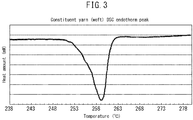
- the melting point (maximum heat absorption temperature) was 259.0°C for both warp and weft, and the ratio of the amount of heat absorbed on the high-temperature side of the melting point in the endothermic curve was 32% for both warp and weft ( Fig. 2 and Fig. 3 ).
- the ratio of the amount of heat absorbed on the high-temperature side was 54% ( Fig. 1 ).
- the woven fabric had low air permeability, which remained low even after passage of time with heat-treatment. Also, the air bag comprising the woven fabric had excellent suppression of air permeability with high-temperature deployment, and satisfactory thermal stability.
- Example 2 This was carried out in the same manner as Example 1, except that the warp yarn tension during weaving was 0.30 cN/dtex.
- the production conditions and evaluation results for the woven fabric are shown in Table 1.
- the air permeability after passage of time with heat-treatment tended to increase, but was sufficiently low air permeability.
- the suppression of air permeability with high-temperature deployment was also excellent.
- Example 2 This was carried out in the same manner as Example 1, except that a 1 minute scouring step with hot water at 50°C after weaving was added.
- the production conditions and evaluation results for the woven fabric are shown in Table 1.
- the air permeability after passage of time with heat-treatment tended to increase, but was low air permeability.
- the suppression of air permeability with high-temperature deployment was also excellent.
- Example 2 This was carried out in the same manner as Example 1, except that the raw yarn strength was 8.0 cN/dtex.
- the production conditions and evaluation results for the woven fabric are shown in Table 1.
- the tan ⁇ peak temperature of the woven fabric thread was 121°C.
- the air permeability after passage of time with heat-treatment tended to increase, but was sufficiently low air permeability.
- the suppression of air permeability with high-temperature deployment was also excellent.
- a woven fabric was obtained in the same manner as Example 1, except that the raw yarn strength was 8.0 cN/dtex and the boiling water shrinkage ratio was 10.5%.
- the production conditions and evaluation results for the woven fabric are shown in Table 1.
- the tan ⁇ peak temperature of the woven fabric thread was 115°C.
- the air permeability after passage of time with heat-treatment tended to increase, but was sufficiently low air permeability.
- the suppression of air permeability with high-temperature deployment was also excellent.
- a woven fabric was obtained in the same manner as Example 1, except that the warp thread tension during weaving was 0.25 cN/dtex, and a 3 minute scouring step with hot water at 90°C after weaving was added.
- the production conditions and evaluation results for the woven fabric are shown in Table 1.
- the air permeability increased after passage of time with heat-treatment.
- the suppression of air permeability with high-temperature deployment was also impaired.
- the ratio of the amount of heat absorbed on the high-temperature side was 36%. This resembled the melting endotherm curve of the constituent yarns, and an endothermic peak at the high-temperature side due to weaving yarn constraint was barely observed.
- a woven fabric was obtained in the same manner as Comparative Example 1, except that scouring was not carried out.
- the production conditions and evaluation results for the woven fabric are shown in Table 1.
- the air permeability increased after passage of time with heat-treatment.
- the suppression of air permeability with high-temperature deployment was also impaired.
- a woven fabric was obtained in the same manner as Example 1, except that the warp thread tension during weaving was 0.30 cN/dtex, and a 3 minute scouring step with hot water at 90°C was added after weaving.
- the production conditions and evaluation results for the woven fabric are shown in Table 1.
- the air permeability increased after passage of time with heat-treatment.
- the suppression of air permeability with high-temperature deployment was also impaired.
- a woven fabric was obtained in the same manner as Example 1, except that the raw yarn strength was 7.5 cN/dtex and the boiling water shrinkage ratio was 11.0%.
- the production conditions and evaluation results for the woven fabric are shown in Table 1.
- the tan ⁇ peak temperature of the woven fabric thread was 110°C.
- the air permeability increased after passage of time with heat-treatment. The suppression of air permeability with high-temperature deployment was also impaired.
- the woven fabric of the invention is suitable as a woven fabric for an air bag. It is most suitable as a woven fabric for an air bag to be used in a non-coated sewn air bag with excellent thermal stability.
Landscapes
- Engineering & Computer Science (AREA)
- Textile Engineering (AREA)
- Mechanical Engineering (AREA)
- Woven Fabrics (AREA)
- Air Bags (AREA)
Applications Claiming Priority (2)
| Application Number | Priority Date | Filing Date | Title |
|---|---|---|---|
| JP2013168134 | 2013-08-13 | ||
| PCT/JP2014/071273 WO2015022954A1 (fr) | 2013-08-13 | 2014-08-12 | Tissu tissé |
Publications (3)
| Publication Number | Publication Date |
|---|---|
| EP3034663A1 true EP3034663A1 (fr) | 2016-06-22 |
| EP3034663A4 EP3034663A4 (fr) | 2016-08-24 |
| EP3034663B1 EP3034663B1 (fr) | 2019-04-03 |
Family
ID=52468339
Family Applications (1)
| Application Number | Title | Priority Date | Filing Date |
|---|---|---|---|
| EP14836923.4A Active EP3034663B1 (fr) | 2013-08-13 | 2014-08-12 | Tissu tissé |
Country Status (8)
| Country | Link |
|---|---|
| US (1) | US10385482B2 (fr) |
| EP (1) | EP3034663B1 (fr) |
| JP (1) | JP5848855B2 (fr) |
| KR (1) | KR101902660B1 (fr) |
| CN (2) | CN107529565B (fr) |
| MX (1) | MX368238B (fr) |
| TR (1) | TR201905967T4 (fr) |
| WO (1) | WO2015022954A1 (fr) |
Families Citing this family (3)
| Publication number | Priority date | Publication date | Assignee | Title |
|---|---|---|---|---|
| CN105216735A (zh) * | 2015-10-21 | 2016-01-06 | 芜湖金鹏汽车部件有限公司 | 一种防高温汽车安全气囊 |
| WO2018072200A1 (fr) * | 2016-10-21 | 2018-04-26 | 嘉兴德永纺织品有限公司 | Métier à tisser, procédé de fabrication de textile, et textile à ultra-haute densité |
| CN112512871B (zh) * | 2018-08-08 | 2023-03-14 | 旭化成株式会社 | 气囊用多层膜和气囊 |
Family Cites Families (35)
| Publication number | Priority date | Publication date | Assignee | Title |
|---|---|---|---|---|
| US5098125A (en) * | 1990-06-08 | 1992-03-24 | Stern & Stern Industries, Inc. | Tube, airbag, and method of making the same |
| US5514471A (en) | 1993-02-23 | 1996-05-07 | Toray Industries, Inc. | High-strength polyamide fiber |
| JP3457739B2 (ja) * | 1994-06-29 | 2003-10-20 | 帝人株式会社 | ノンコートサイドエアーバッグ用織物 |
| DE59601852D1 (de) * | 1995-04-22 | 1999-06-17 | Akzo Nobel Nv | Getangeltes Synthesefilamentgarn für die Herstellung von technischen Geweben |
| FR2751980B1 (fr) * | 1996-08-02 | 1999-02-05 | Rhone Poulenc Chimie | Composition silicone pour l'enduction de substrats en matiere textile |
| US6022817A (en) * | 1997-06-06 | 2000-02-08 | E. I. Du Pont De Nemours And Company | Fabric for airbag |
| DE69840685D1 (de) * | 1997-11-28 | 2009-05-07 | Asahi Kasei Fibers Corp | Leichter luftsack |
| AU755986B2 (en) | 1998-07-27 | 2003-01-02 | Toyo Boseki Kabushiki Kaisha | Uncoated woven fabric for air bags |
| JP3716768B2 (ja) | 1998-07-27 | 2005-11-16 | 東洋紡績株式会社 | ノンコートエアバッグ用織物及びその製造方法 |
| JP3871103B2 (ja) * | 1999-02-15 | 2007-01-24 | 東レ株式会社 | エアバッグ用基布およびエアバッグ |
| US6429155B1 (en) * | 1999-06-17 | 2002-08-06 | Milliken & Company | Low permeability airbag cushions having film coatings of extremely low thickness |
| JP4106067B2 (ja) | 2000-04-07 | 2008-06-25 | 旭化成ケミカルズ株式会社 | コーティング布帛およびエアバッグ |
| JP3833119B2 (ja) | 2000-04-07 | 2006-10-11 | 旭化成ケミカルズ株式会社 | コーティング布帛およびエアバッグ |
| TWI230213B (en) * | 2000-08-17 | 2005-04-01 | Toray Industries | Base fabric for non-coated air bags, and fibers for air bags |
| JP4711378B2 (ja) | 2001-12-10 | 2011-06-29 | 東レ株式会社 | エアバッグ基布およびエアバッグ |
| JP2002363836A (ja) | 2002-04-05 | 2002-12-18 | Toray Ind Inc | ノンコートエアバッグ用基布 |
| JP4275385B2 (ja) | 2002-11-01 | 2009-06-10 | 旭化成ケミカルズ株式会社 | エアバック用基布 |
| JP2004156166A (ja) | 2002-11-06 | 2004-06-03 | Toray Ind Inc | 布帛とその製造方法 |
| JP2006183205A (ja) | 2004-12-28 | 2006-07-13 | Toray Ind Inc | エアバッグ用基布 |
| JP2006299411A (ja) | 2005-03-25 | 2006-11-02 | Toyota Motor Corp | 制振複合材料 |
| JP2006306312A (ja) * | 2005-04-28 | 2006-11-09 | Takata Corp | エアバッグ用基布及びエアバッグ装置 |
| JP2007310227A (ja) | 2006-05-19 | 2007-11-29 | Kyocera Mita Corp | レーザ照射タイミング制御回路、光走査装置、画像形成装置及びbd信号変換回路 |
| EP2042628B1 (fr) | 2006-06-23 | 2013-10-02 | Toray Industries, Inc. | Matériau textile pour coussins gonflables, coussins gonflables, et procédé de production de ce matériau textile |
| JP5088013B2 (ja) | 2006-06-23 | 2012-12-05 | 東レ株式会社 | エアバッグ用織物、エアバッグおよびエアバッグ用織物の製造方法 |
| EP2264235B1 (fr) * | 2008-03-10 | 2021-06-09 | Toray Industries, Inc. | Tissu de base pour coussin de sécurité gonflable |
| JP5365272B2 (ja) * | 2008-03-21 | 2013-12-11 | 東レ株式会社 | エアバッグ用織物およびエアバッグ用織物の製造方法 |
| EP2256237B1 (fr) * | 2008-03-26 | 2013-02-27 | Toray Industries, Inc. | Filament de polyamide 56 et structure de fibre et tissu de base de coussin de sécurité gonflable comprenant chacun celui-ci |
| JP5359714B2 (ja) * | 2009-09-09 | 2013-12-04 | 東レ株式会社 | エアバッグ用基布 |
| US8642489B2 (en) | 2009-11-09 | 2014-02-04 | Asahi Kasei Fibers Corporation | Airbag fabric and airbag |
| JP2011158743A (ja) | 2010-02-02 | 2011-08-18 | Konica Minolta Business Technologies Inc | 画像形成装置、画像形成装置の制御方法、及び画像形成装置の制御プログラム |
| EP2374923B1 (fr) * | 2010-04-09 | 2013-12-25 | Autoliv Development AB | Procédé de fabrication d'un airbag gonflable |
| EP2610377B9 (fr) | 2010-08-23 | 2017-08-02 | Asahi Kasei Kabushiki Kaisha | Tissu de base pour coussin de sécurité gonflable |
| CN104160086B (zh) * | 2012-03-09 | 2016-12-28 | 旭化成株式会社 | 气囊用基布 |
| US9868413B2 (en) * | 2012-12-17 | 2018-01-16 | Asahi Kasei Kabushiki Kaisha | Fabric for an air bag that maintains air permeability during high-pressure deployment at high speed |
| WO2015022981A1 (fr) | 2013-08-13 | 2015-02-19 | 旭化成せんい株式会社 | Tissu tissé enduit |
-
2014
- 2014-08-12 JP JP2015515749A patent/JP5848855B2/ja active Active
- 2014-08-12 TR TR2019/05967T patent/TR201905967T4/tr unknown
- 2014-08-12 MX MX2016001984A patent/MX368238B/es active IP Right Grant
- 2014-08-12 CN CN201710684995.1A patent/CN107529565B/zh active Active
- 2014-08-12 EP EP14836923.4A patent/EP3034663B1/fr active Active
- 2014-08-12 US US14/911,908 patent/US10385482B2/en active Active
- 2014-08-12 CN CN201480044853.3A patent/CN105452552B/zh active Active
- 2014-08-12 WO PCT/JP2014/071273 patent/WO2015022954A1/fr not_active Ceased
- 2014-08-12 KR KR1020167002609A patent/KR101902660B1/ko active Active
Also Published As
| Publication number | Publication date |
|---|---|
| TR201905967T4 (tr) | 2019-05-21 |
| CN107529565A (zh) | 2018-01-02 |
| CN107529565B (zh) | 2020-04-14 |
| JP5848855B2 (ja) | 2016-01-27 |
| CN105452552A (zh) | 2016-03-30 |
| MX2016001984A (es) | 2016-05-18 |
| EP3034663A4 (fr) | 2016-08-24 |
| EP3034663B1 (fr) | 2019-04-03 |
| JPWO2015022954A1 (ja) | 2017-03-02 |
| MX368238B (es) | 2019-09-25 |
| US20160194790A1 (en) | 2016-07-07 |
| US10385482B2 (en) | 2019-08-20 |
| WO2015022954A1 (fr) | 2015-02-19 |
| CN105452552B (zh) | 2018-01-30 |
| KR20160027112A (ko) | 2016-03-09 |
| KR101902660B1 (ko) | 2018-10-01 |
Similar Documents
| Publication | Publication Date | Title |
|---|---|---|
| KR101032792B1 (ko) | 에어백용 폴리에스테르 원단 및 그의 제조 방법 | |
| CN107407016B (zh) | 安全气囊用聚酯制基布、聚酯制安全气囊和安全气囊用聚酯制基布的制造方法 | |
| EP2610377B9 (fr) | Tissu de base pour coussin de sécurité gonflable | |
| CN107709641B (zh) | 安全气囊用基布、安全气囊及安全气囊用基布的制造方法 | |
| KR101802476B1 (ko) | 폴리에스테르 원단 및 그의 제조 방법 | |
| BR112015017604B1 (pt) | Tecido de airbag, airbag e método para produzir um tecido de airbag | |
| JPWO2019167820A1 (ja) | エアバッグ用ノンコート基布、エアバッグ用コーティング基布およびそれを用いたエアバッグ | |
| WO2020153446A1 (fr) | Tissu de base revêtu pour coussin de sécurité gonflable et coussin de sécurité gonflable le comprenant | |
| EP3034663B1 (fr) | Tissu tissé | |
| EP3034686B1 (fr) | Tissu tissé enduit | |
| JP7188393B2 (ja) | エアバッグ基布およびそれを含むエアバッグ | |
| JPWO2014123090A1 (ja) | エアバッグ用織物および織物ロール | |
| JP6694490B2 (ja) | エアバッグ用織物基布 | |
| KR20220002133A (ko) | 에어백 쿠션 및 그 제조방법 |
Legal Events
| Date | Code | Title | Description |
|---|---|---|---|
| PUAI | Public reference made under article 153(3) epc to a published international application that has entered the european phase |
Free format text: ORIGINAL CODE: 0009012 |
|
| 17P | Request for examination filed |
Effective date: 20160209 |
|
| AK | Designated contracting states |
Kind code of ref document: A1 Designated state(s): AL AT BE BG CH CY CZ DE DK EE ES FI FR GB GR HR HU IE IS IT LI LT LU LV MC MK MT NL NO PL PT RO RS SE SI SK SM TR |
|
| AX | Request for extension of the european patent |
Extension state: BA ME |
|
| RAP1 | Party data changed (applicant data changed or rights of an application transferred) |
Owner name: ASAHI KASEI KABUSHIKI KAISHA |
|
| A4 | Supplementary search report drawn up and despatched |
Effective date: 20160726 |
|
| RIC1 | Information provided on ipc code assigned before grant |
Ipc: D03D 15/00 20060101ALI20160720BHEP Ipc: B60R 21/235 20060101ALI20160720BHEP Ipc: D03D 1/02 20060101AFI20160720BHEP |
|
| 17Q | First examination report despatched |
Effective date: 20160812 |
|
| DAX | Request for extension of the european patent (deleted) | ||
| STAA | Information on the status of an ep patent application or granted ep patent |
Free format text: STATUS: EXAMINATION IS IN PROGRESS |
|
| GRAP | Despatch of communication of intention to grant a patent |
Free format text: ORIGINAL CODE: EPIDOSNIGR1 |
|
| STAA | Information on the status of an ep patent application or granted ep patent |
Free format text: STATUS: GRANT OF PATENT IS INTENDED |
|
| INTG | Intention to grant announced |
Effective date: 20181010 |
|
| GRAS | Grant fee paid |
Free format text: ORIGINAL CODE: EPIDOSNIGR3 |
|
| GRAA | (expected) grant |
Free format text: ORIGINAL CODE: 0009210 |
|
| STAA | Information on the status of an ep patent application or granted ep patent |
Free format text: STATUS: THE PATENT HAS BEEN GRANTED |
|
| RAP1 | Party data changed (applicant data changed or rights of an application transferred) |
Owner name: ASAHI KASEI KABUSHIKI KAISHA |
|
| AK | Designated contracting states |
Kind code of ref document: B1 Designated state(s): AL AT BE BG CH CY CZ DE DK EE ES FI FR GB GR HR HU IE IS IT LI LT LU LV MC MK MT NL NO PL PT RO RS SE SI SK SM TR |
|
| REG | Reference to a national code |
Ref country code: GB Ref legal event code: FG4D |
|
| REG | Reference to a national code |
Ref country code: CH Ref legal event code: EP Ref country code: AT Ref legal event code: REF Ref document number: 1115865 Country of ref document: AT Kind code of ref document: T Effective date: 20190415 |
|
| REG | Reference to a national code |
Ref country code: DE Ref legal event code: R096 Ref document number: 602014044152 Country of ref document: DE |
|
| REG | Reference to a national code |
Ref country code: IE Ref legal event code: FG4D |
|
| REG | Reference to a national code |
Ref country code: NL Ref legal event code: MP Effective date: 20190403 |
|
| REG | Reference to a national code |
Ref country code: LT Ref legal event code: MG4D |
|
| REG | Reference to a national code |
Ref country code: AT Ref legal event code: MK05 Ref document number: 1115865 Country of ref document: AT Kind code of ref document: T Effective date: 20190403 |
|
| PG25 | Lapsed in a contracting state [announced via postgrant information from national office to epo] |
Ref country code: NL Free format text: LAPSE BECAUSE OF FAILURE TO SUBMIT A TRANSLATION OF THE DESCRIPTION OR TO PAY THE FEE WITHIN THE PRESCRIBED TIME-LIMIT Effective date: 20190403 |
|
| PG25 | Lapsed in a contracting state [announced via postgrant information from national office to epo] |
Ref country code: AL Free format text: LAPSE BECAUSE OF FAILURE TO SUBMIT A TRANSLATION OF THE DESCRIPTION OR TO PAY THE FEE WITHIN THE PRESCRIBED TIME-LIMIT Effective date: 20190403 Ref country code: PT Free format text: LAPSE BECAUSE OF FAILURE TO SUBMIT A TRANSLATION OF THE DESCRIPTION OR TO PAY THE FEE WITHIN THE PRESCRIBED TIME-LIMIT Effective date: 20190803 Ref country code: ES Free format text: LAPSE BECAUSE OF FAILURE TO SUBMIT A TRANSLATION OF THE DESCRIPTION OR TO PAY THE FEE WITHIN THE PRESCRIBED TIME-LIMIT Effective date: 20190403 Ref country code: LT Free format text: LAPSE BECAUSE OF FAILURE TO SUBMIT A TRANSLATION OF THE DESCRIPTION OR TO PAY THE FEE WITHIN THE PRESCRIBED TIME-LIMIT Effective date: 20190403 Ref country code: FI Free format text: LAPSE BECAUSE OF FAILURE TO SUBMIT A TRANSLATION OF THE DESCRIPTION OR TO PAY THE FEE WITHIN THE PRESCRIBED TIME-LIMIT Effective date: 20190403 Ref country code: SE Free format text: LAPSE BECAUSE OF FAILURE TO SUBMIT A TRANSLATION OF THE DESCRIPTION OR TO PAY THE FEE WITHIN THE PRESCRIBED TIME-LIMIT Effective date: 20190403 Ref country code: HR Free format text: LAPSE BECAUSE OF FAILURE TO SUBMIT A TRANSLATION OF THE DESCRIPTION OR TO PAY THE FEE WITHIN THE PRESCRIBED TIME-LIMIT Effective date: 20190403 Ref country code: NO Free format text: LAPSE BECAUSE OF FAILURE TO SUBMIT A TRANSLATION OF THE DESCRIPTION OR TO PAY THE FEE WITHIN THE PRESCRIBED TIME-LIMIT Effective date: 20190703 |
|
| PG25 | Lapsed in a contracting state [announced via postgrant information from national office to epo] |
Ref country code: PL Free format text: LAPSE BECAUSE OF FAILURE TO SUBMIT A TRANSLATION OF THE DESCRIPTION OR TO PAY THE FEE WITHIN THE PRESCRIBED TIME-LIMIT Effective date: 20190403 Ref country code: LV Free format text: LAPSE BECAUSE OF FAILURE TO SUBMIT A TRANSLATION OF THE DESCRIPTION OR TO PAY THE FEE WITHIN THE PRESCRIBED TIME-LIMIT Effective date: 20190403 Ref country code: GR Free format text: LAPSE BECAUSE OF FAILURE TO SUBMIT A TRANSLATION OF THE DESCRIPTION OR TO PAY THE FEE WITHIN THE PRESCRIBED TIME-LIMIT Effective date: 20190704 Ref country code: RS Free format text: LAPSE BECAUSE OF FAILURE TO SUBMIT A TRANSLATION OF THE DESCRIPTION OR TO PAY THE FEE WITHIN THE PRESCRIBED TIME-LIMIT Effective date: 20190403 Ref country code: BG Free format text: LAPSE BECAUSE OF FAILURE TO SUBMIT A TRANSLATION OF THE DESCRIPTION OR TO PAY THE FEE WITHIN THE PRESCRIBED TIME-LIMIT Effective date: 20190703 |
|
| PG25 | Lapsed in a contracting state [announced via postgrant information from national office to epo] |
Ref country code: AT Free format text: LAPSE BECAUSE OF FAILURE TO SUBMIT A TRANSLATION OF THE DESCRIPTION OR TO PAY THE FEE WITHIN THE PRESCRIBED TIME-LIMIT Effective date: 20190403 Ref country code: IS Free format text: LAPSE BECAUSE OF FAILURE TO SUBMIT A TRANSLATION OF THE DESCRIPTION OR TO PAY THE FEE WITHIN THE PRESCRIBED TIME-LIMIT Effective date: 20190803 |
|
| REG | Reference to a national code |
Ref country code: DE Ref legal event code: R097 Ref document number: 602014044152 Country of ref document: DE |
|
| PG25 | Lapsed in a contracting state [announced via postgrant information from national office to epo] |
Ref country code: RO Free format text: LAPSE BECAUSE OF FAILURE TO SUBMIT A TRANSLATION OF THE DESCRIPTION OR TO PAY THE FEE WITHIN THE PRESCRIBED TIME-LIMIT Effective date: 20190403 Ref country code: SK Free format text: LAPSE BECAUSE OF FAILURE TO SUBMIT A TRANSLATION OF THE DESCRIPTION OR TO PAY THE FEE WITHIN THE PRESCRIBED TIME-LIMIT Effective date: 20190403 Ref country code: EE Free format text: LAPSE BECAUSE OF FAILURE TO SUBMIT A TRANSLATION OF THE DESCRIPTION OR TO PAY THE FEE WITHIN THE PRESCRIBED TIME-LIMIT Effective date: 20190403 Ref country code: DK Free format text: LAPSE BECAUSE OF FAILURE TO SUBMIT A TRANSLATION OF THE DESCRIPTION OR TO PAY THE FEE WITHIN THE PRESCRIBED TIME-LIMIT Effective date: 20190403 |
|
| PLBE | No opposition filed within time limit |
Free format text: ORIGINAL CODE: 0009261 |
|
| STAA | Information on the status of an ep patent application or granted ep patent |
Free format text: STATUS: NO OPPOSITION FILED WITHIN TIME LIMIT |
|
| PG25 | Lapsed in a contracting state [announced via postgrant information from national office to epo] |
Ref country code: IT Free format text: LAPSE BECAUSE OF FAILURE TO SUBMIT A TRANSLATION OF THE DESCRIPTION OR TO PAY THE FEE WITHIN THE PRESCRIBED TIME-LIMIT Effective date: 20190403 Ref country code: SM Free format text: LAPSE BECAUSE OF FAILURE TO SUBMIT A TRANSLATION OF THE DESCRIPTION OR TO PAY THE FEE WITHIN THE PRESCRIBED TIME-LIMIT Effective date: 20190403 |
|
| 26N | No opposition filed |
Effective date: 20200106 |
|
| GBPC | Gb: european patent ceased through non-payment of renewal fee |
Effective date: 20190812 |
|
| PG25 | Lapsed in a contracting state [announced via postgrant information from national office to epo] |
Ref country code: MC Free format text: LAPSE BECAUSE OF FAILURE TO SUBMIT A TRANSLATION OF THE DESCRIPTION OR TO PAY THE FEE WITHIN THE PRESCRIBED TIME-LIMIT Effective date: 20190403 Ref country code: CH Free format text: LAPSE BECAUSE OF NON-PAYMENT OF DUE FEES Effective date: 20190831 Ref country code: LI Free format text: LAPSE BECAUSE OF NON-PAYMENT OF DUE FEES Effective date: 20190831 Ref country code: SI Free format text: LAPSE BECAUSE OF FAILURE TO SUBMIT A TRANSLATION OF THE DESCRIPTION OR TO PAY THE FEE WITHIN THE PRESCRIBED TIME-LIMIT Effective date: 20190403 Ref country code: LU Free format text: LAPSE BECAUSE OF NON-PAYMENT OF DUE FEES Effective date: 20190812 |
|
| REG | Reference to a national code |
Ref country code: BE Ref legal event code: MM Effective date: 20190831 |
|
| PG25 | Lapsed in a contracting state [announced via postgrant information from national office to epo] |
Ref country code: FR Free format text: LAPSE BECAUSE OF NON-PAYMENT OF DUE FEES Effective date: 20190831 Ref country code: IE Free format text: LAPSE BECAUSE OF NON-PAYMENT OF DUE FEES Effective date: 20190812 |
|
| PG25 | Lapsed in a contracting state [announced via postgrant information from national office to epo] |
Ref country code: BE Free format text: LAPSE BECAUSE OF NON-PAYMENT OF DUE FEES Effective date: 20190831 Ref country code: GB Free format text: LAPSE BECAUSE OF NON-PAYMENT OF DUE FEES Effective date: 20190812 |
|
| PG25 | Lapsed in a contracting state [announced via postgrant information from national office to epo] |
Ref country code: CY Free format text: LAPSE BECAUSE OF FAILURE TO SUBMIT A TRANSLATION OF THE DESCRIPTION OR TO PAY THE FEE WITHIN THE PRESCRIBED TIME-LIMIT Effective date: 20190403 |
|
| PG25 | Lapsed in a contracting state [announced via postgrant information from national office to epo] |
Ref country code: HU Free format text: LAPSE BECAUSE OF FAILURE TO SUBMIT A TRANSLATION OF THE DESCRIPTION OR TO PAY THE FEE WITHIN THE PRESCRIBED TIME-LIMIT; INVALID AB INITIO Effective date: 20140812 Ref country code: MT Free format text: LAPSE BECAUSE OF FAILURE TO SUBMIT A TRANSLATION OF THE DESCRIPTION OR TO PAY THE FEE WITHIN THE PRESCRIBED TIME-LIMIT Effective date: 20190403 |
|
| PG25 | Lapsed in a contracting state [announced via postgrant information from national office to epo] |
Ref country code: MK Free format text: LAPSE BECAUSE OF FAILURE TO SUBMIT A TRANSLATION OF THE DESCRIPTION OR TO PAY THE FEE WITHIN THE PRESCRIBED TIME-LIMIT Effective date: 20190403 |
|
| P01 | Opt-out of the competence of the unified patent court (upc) registered |
Effective date: 20230515 |
|
| PGFP | Annual fee paid to national office [announced via postgrant information from national office to epo] |
Ref country code: DE Payment date: 20250702 Year of fee payment: 12 |
|
| PGFP | Annual fee paid to national office [announced via postgrant information from national office to epo] |
Ref country code: TR Payment date: 20250730 Year of fee payment: 12 |
|
| PGFP | Annual fee paid to national office [announced via postgrant information from national office to epo] |
Ref country code: CZ Payment date: 20250723 Year of fee payment: 12 |