EP3034992A2 - Projektor für strukturierte beleuchtung, und 3d-scanner, der einen solchen projektor enthält - Google Patents
Projektor für strukturierte beleuchtung, und 3d-scanner, der einen solchen projektor enthält Download PDFInfo
- Publication number
- EP3034992A2 EP3034992A2 EP15200256.4A EP15200256A EP3034992A2 EP 3034992 A2 EP3034992 A2 EP 3034992A2 EP 15200256 A EP15200256 A EP 15200256A EP 3034992 A2 EP3034992 A2 EP 3034992A2
- Authority
- EP
- European Patent Office
- Prior art keywords
- spectral
- mask
- projector
- optical
- lines
- Prior art date
- Legal status (The legal status is an assumption and is not a legal conclusion. Google has not performed a legal analysis and makes no representation as to the accuracy of the status listed.)
- Granted
Links
Images









Classifications
-
- G—PHYSICS
- G03—PHOTOGRAPHY; CINEMATOGRAPHY; ANALOGOUS TECHNIQUES USING WAVES OTHER THAN OPTICAL WAVES; ELECTROGRAPHY; HOLOGRAPHY
- G03B—APPARATUS OR ARRANGEMENTS FOR TAKING PHOTOGRAPHS OR FOR PROJECTING OR VIEWING THEM; APPARATUS OR ARRANGEMENTS EMPLOYING ANALOGOUS TECHNIQUES USING WAVES OTHER THAN OPTICAL WAVES; ACCESSORIES THEREFOR
- G03B21/00—Projectors or projection-type viewers; Accessories therefor
- G03B21/14—Details
- G03B21/20—Lamp housings
-
- H—ELECTRICITY
- H04—ELECTRIC COMMUNICATION TECHNIQUE
- H04N—PICTORIAL COMMUNICATION, e.g. TELEVISION
- H04N13/00—Stereoscopic video systems; Multi-view video systems; Details thereof
- H04N13/20—Image signal generators
- H04N13/204—Image signal generators using stereoscopic image cameras
-
- G—PHYSICS
- G01—MEASURING; TESTING
- G01B—MEASURING LENGTH, THICKNESS OR SIMILAR LINEAR DIMENSIONS; MEASURING ANGLES; MEASURING AREAS; MEASURING IRREGULARITIES OF SURFACES OR CONTOURS
- G01B11/00—Measuring arrangements characterised by the use of optical techniques
- G01B11/24—Measuring arrangements characterised by the use of optical techniques for measuring contours or curvatures
- G01B11/25—Measuring arrangements characterised by the use of optical techniques for measuring contours or curvatures by projecting a pattern, e.g. one or more lines, moiré fringes on the object
- G01B11/2513—Measuring arrangements characterised by the use of optical techniques for measuring contours or curvatures by projecting a pattern, e.g. one or more lines, moiré fringes on the object with several lines being projected in more than one direction, e.g. grids, patterns
-
- G—PHYSICS
- G02—OPTICS
- G02B—OPTICAL ELEMENTS, SYSTEMS OR APPARATUS
- G02B27/00—Optical systems or apparatus not provided for by any of the groups G02B1/00 - G02B26/00, G02B30/00
- G02B27/10—Beam splitting or combining systems
-
- G—PHYSICS
- G02—OPTICS
- G02B—OPTICAL ELEMENTS, SYSTEMS OR APPARATUS
- G02B5/00—Optical elements other than lenses
- G02B5/04—Prisms
-
- G—PHYSICS
- G02—OPTICS
- G02B—OPTICAL ELEMENTS, SYSTEMS OR APPARATUS
- G02B5/00—Optical elements other than lenses
- G02B5/18—Diffraction gratings
- G02B5/1842—Gratings for image generation
-
- G—PHYSICS
- G03—PHOTOGRAPHY; CINEMATOGRAPHY; ANALOGOUS TECHNIQUES USING WAVES OTHER THAN OPTICAL WAVES; ELECTROGRAPHY; HOLOGRAPHY
- G03B—APPARATUS OR ARRANGEMENTS FOR TAKING PHOTOGRAPHS OR FOR PROJECTING OR VIEWING THEM; APPARATUS OR ARRANGEMENTS EMPLOYING ANALOGOUS TECHNIQUES USING WAVES OTHER THAN OPTICAL WAVES; ACCESSORIES THEREFOR
- G03B17/00—Details of cameras or camera bodies; Accessories therefor
- G03B17/48—Details of cameras or camera bodies; Accessories therefor adapted for combination with other photographic or optical apparatus
- G03B17/54—Details of cameras or camera bodies; Accessories therefor adapted for combination with other photographic or optical apparatus with projector
-
- G—PHYSICS
- G03—PHOTOGRAPHY; CINEMATOGRAPHY; ANALOGOUS TECHNIQUES USING WAVES OTHER THAN OPTICAL WAVES; ELECTROGRAPHY; HOLOGRAPHY
- G03B—APPARATUS OR ARRANGEMENTS FOR TAKING PHOTOGRAPHS OR FOR PROJECTING OR VIEWING THEM; APPARATUS OR ARRANGEMENTS EMPLOYING ANALOGOUS TECHNIQUES USING WAVES OTHER THAN OPTICAL WAVES; ACCESSORIES THEREFOR
- G03B21/00—Projectors or projection-type viewers; Accessories therefor
- G03B21/14—Details
- G03B21/20—Lamp housings
- G03B21/2006—Lamp housings characterised by the light source
- G03B21/2013—Plural light sources
-
- H—ELECTRICITY
- H04—ELECTRIC COMMUNICATION TECHNIQUE
- H04N—PICTORIAL COMMUNICATION, e.g. TELEVISION
- H04N13/00—Stereoscopic video systems; Multi-view video systems; Details thereof
- H04N13/20—Image signal generators
- H04N13/204—Image signal generators using stereoscopic image cameras
- H04N13/254—Image signal generators using stereoscopic image cameras in combination with electromagnetic radiation sources for illuminating objects
-
- H—ELECTRICITY
- H04—ELECTRIC COMMUNICATION TECHNIQUE
- H04N—PICTORIAL COMMUNICATION, e.g. TELEVISION
- H04N13/00—Stereoscopic video systems; Multi-view video systems; Details thereof
- H04N13/20—Image signal generators
- H04N13/271—Image signal generators wherein the generated image signals comprise depth maps or disparity maps
-
- H—ELECTRICITY
- H04—ELECTRIC COMMUNICATION TECHNIQUE
- H04N—PICTORIAL COMMUNICATION, e.g. TELEVISION
- H04N9/00—Details of colour television systems
- H04N9/12—Picture reproducers
- H04N9/31—Projection devices for colour picture display, e.g. using electronic spatial light modulators [ESLM]
- H04N9/3102—Projection devices for colour picture display, e.g. using electronic spatial light modulators [ESLM] using two-dimensional electronic spatial light modulators
- H04N9/3105—Projection devices for colour picture display, e.g. using electronic spatial light modulators [ESLM] using two-dimensional electronic spatial light modulators for displaying all colours simultaneously, e.g. by using two or more electronic spatial light modulators
-
- H—ELECTRICITY
- H04—ELECTRIC COMMUNICATION TECHNIQUE
- H04N—PICTORIAL COMMUNICATION, e.g. TELEVISION
- H04N9/00—Details of colour television systems
- H04N9/12—Picture reproducers
- H04N9/31—Projection devices for colour picture display, e.g. using electronic spatial light modulators [ESLM]
- H04N9/3141—Constructional details thereof
- H04N9/315—Modulator illumination systems
- H04N9/3167—Modulator illumination systems for polarizing the light beam
Definitions
- the present application relates to a structured light projector, including a structured light projector for a three-dimensional scanner, and a three-dimensional scanner comprising such a projector.
- Three-dimensional scanners are devices that measure the geometric coordinates (x, y, z) of each point on the surface of a scene or object.
- the result of the measurement is often considered as a so-called "depth map" of the pictorial scene because the depth (or distance) z is generally expressed as a function of the position (x, y) in a Cartesian coordinate system.
- Depth maps thus collected can then be used to build three-dimensional computer images (digital objects) for various purposes.
- CMMs three-dimensional measuring machines
- Others allow the measurement without physical contact, such as stereoscopic systems based on the use of two cameras, slightly spaced and pointing to the same scene, for which the depth is deduced from the geometric deformation between the two images .
- Three-dimensional "structured light” scanners are a specific family of three-dimensional contactless scanners. These scanners consist of a projector of light, generally realized on the principle of a video projector or constituted of a laser system generating fringes of interferences (for the technique known as "phase-shifting"), and of less a camera geometrically offset from the projector to achieve a stereoscopic configuration.
- the projector projects a so-called “structured” pattern of light, in one or two geometric dimensions (for example a line or an image) and optionally colored, on the surface to be measured.
- the camera positioned at a distance from the projector called “stereoscopic base", acquires and records an image of the scene.
- the projected structured pattern is made up of elementary patterns (referred to as “structured elements” in this document) appropriately selected so that it is possible to detect them in the acquired image.
- the geometric position (x, y, z) of each point on the surface of the observed scene is obtained by a method of triangulation between the projection and imaging directions of each structured element.
- Patterns used in three-dimensional structured light scanners are usually projected in black-and-white, grayscale, color, or a combination of the three effects (this is discussed, for example, in J. Geng, "Structured-Light 3D surface imaging: a tutorial", Advances in Optics and Photonics 3, pp. 128-160, 2011 ).
- so-called “multiple-shot” methods of sequential (temporally) pattern projections for example, so-called “phase shifting", "binary patterns” or "gray coding” techniques.
- Non-sequential techniques involve projecting a multitude of structured elements that are sufficiently different from one another to be identifiable in the image acquired by the camera. These structured elements may be, for example, bands whose colors are defined by a sequence called "De Bruijn", or else coded point clouds (see J. Geng, 2011).
- the depth map produced by the three-dimensional scanners with structured light of the prior art using non-sequential techniques can be biased or incomplete near these singular forms because some projected structural elements are only partially observable (ie partially masked) or too deformed, and are therefore not always identifiable in the image acquired by the camera.
- the three-dimensional scanners with structured light of the prior art essentially make it possible to produce the depth map of the imaged scene, or even possibly to have information on its appearance (color, texture, etc.), but they do not provide no quantitative data to infer the nature of the constituent materials of the elements of the scene.
- a method is proposed in patent applications US 2014/0028800 and US 2014/0028801 . It is based on a theoretical use of a spectral spectral light projection device and an imaging device for measuring the spectrum of light reflected (or scattered) by the surface of the scene or of the observed object. The structuring of the pattern is carried out in the spectral domain rather than in the geometric, colorimetric and / or temporal domains. The spectral information reflected by the surface of the elements of the scene is useful data to determine the nature of the observed materials.
- the object of the present application is to at least partially solve the aforementioned problems for projecting structured light in the spectral range.
- a structured light projector comprising a spectral encoding device of light beam in which the optical coding of the light beam is for example provided by a component which can be passive (for example an optical mask) or active (for example a DMD cell).
- the mask advantageously comprises at least m / 5 different encodings in the m columns.
- an encoding is advantageously repeated in at most 5 columns.
- the m columns of the sub-pattern defined by the lines "1" to "n” comprise encodings all different from each other.
- each column is then easily identifiable in terms of positioning, it is a configuration of the mask with a minimum of ambiguity.
- the number of columns "m” is equal to "2 ⁇ n", n the number of lines.
- the lines of the sub-pattern defined by the lines "1" to "n” include encodings representing a succession of powers of 2.
- the lines of the sub-pattern considered comprise an encoding representing a succession of periodic structures whose number of periods, from one line to another, is equal to 2 0 , 2 1 , 2 2 , ..., 2 n-1 .
- This provides a simple encoding while ensuring that all columns have a different encoding from the others.
- the encoding device comprises for example a matrix arrangement of reflecting zones and absorbing zones.
- the encoding device comprises a matrix arrangement of transparent zones and opaque zones.
- the encoding device comprises for example an opto-electronic system consisting of pixels whose optical transparency is electronically controllable, the mask then being formed by the optoelectronic system.
- Such optoelectronic system particularly convenient in the context of the present invention is for example a liquid crystal display (LCD - Liquid Crystal Display).
- LCD liquid crystal display
- the encoding device comprises for example an opto-electronic system consisting of pixels whose optical reflectivity is electronically controllable, the mask then being formed by the optoelectronic system.
- Such an opto-electronic system particularly convenient in the context of the present invention is for example a matrix of micro-mirrors (DMD Digital Micromirror Display).
- the projector's light source comprises a source of natural light or a source of artificial light.
- it may be a continuous artificial light source, for example a filament or incandescent lamp, a halogen lamp, an LED, or other.
- the spectral decomposition optical system and the spectral recombination optical system are the same optical system traversed in one direction and in the opposite direction by the beam.
- Such a configuration makes the projector more compact by minimizing the number of components for its realization.
- the projector has a diaphragm.
- the diaphragm is for example positioned between the light source and the spectral decomposition optical system. It is for example configured to geometrically delimit the beam.
- the projector comprises a converging mirror and / or a converging lens positioned between the light source and the optical spectral decomposition system on an optical path of the beam, or even between the light source and the diaphragm, as appropriate .
- the spectral decomposition optical system comprises an optical prism. It can also include an optical network.
- the projector has at least one objective.
- the objective comprises for example a convergent lens, or a mirror, for example a convergent mirror.
- the objective is then positioned after the spectral decomposition optical system on an optical path of the beam.
- the projector comprises a convergent lens and a mirror positioned before the spectral decomposition optical system on an optical path of the beam.
- the mirror is then for example configured to send the beam in a different direction depending on the compactness needs to be given to the projector.
- the spectral recombination optical system comprises an optical prism. It can also include an optical network.
- the projector has at least one objective.
- the objective comprises for example a convergent lens, or a mirror, for example a convergent mirror.
- the objective is positioned before the spectral recombination optical system on an optical path of the beam.
- the projector comprises a mirror and a convergent lens positioned after the spectral recombination optical system, for example after the prism, on an optical path of the beam.
- the mirror is then for example configured to send the beam in a different direction depending on the compactness needs to be given to the projector.
- a three-dimensional structured light scanner comprising a projector and a detection device
- the projector is a projector as described above, comprising all or some of the characteristics mentioned above.
- the detection device is a multi-spectral camera.
- the camera comprises at least 4 spectral channels.
- the camera is for example arranged at a determined distance from the projector, called "stereoscopic base”.
- the multi-spectral camera comprises at least 6 spectral channels, or even 8 or even 9.
- the multi-spectral camera is configured to use a number of spectral channels equal to a number of spectral channels defined by the mask of the encoding device.
- the three-dimensional scanner in particular to increase the performance of the scanner when the device encoder is not controllable electronically, also has an electronically controllable secondary light source whose spectrum is continuous between the minimum wavelength ( ⁇ min) and the maximum wavelength ( ⁇ max), by example a camera flash, to illuminate the scene temporarily to enrich the reflectance measurement of the elements of the scene by one or more acquisition (s) of image (s) with the multi-spectral camera.
- an electronically controllable secondary light source whose spectrum is continuous between the minimum wavelength ( ⁇ min) and the maximum wavelength ( ⁇ max), by example a camera flash, to illuminate the scene temporarily to enrich the reflectance measurement of the elements of the scene by one or more acquisition (s) of image (s) with the multi-spectral camera.
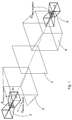
- the optical system of decomposition 3, the encoding device 5 and the spectral recombination optical system 8 are represented in line on the same optical axis but in practice it can of course be otherwise given the offsets or deviations of the light beam can be introduced by the optical components constituting these elements, or for the sake of compactness or arrangement of the elements of the projector.
- the function of the spectral recombination optical system 8 may possibly be provided by the optical spectral decomposition system 3 if the headlamp is designed so that the light passes twice through the spectral decomposition optical system 3: for example, once in a meaning and once in reverse return.
- the spectral recombination optical system 8 and the spectral decomposition optical system 3 can themselves be formed of the same elements, in the same physical entity.
- the elements of the projector are possibly configured to encode an incident beam "optimal" geometrically, that is to say that the incident beam is optimized, materialized by a beam-jig 2 (see figures 1 , 2a and 2b ).
- the beam-jig 2 considered here is centered on the optical input axis (Oz) of the projector.
- it has a rectangular section (S beam-jig ), substantially perpendicular to the optical input axis (Oz), and centered on the axis (Oz) at a so-called focusing or concentration point, denoted E.
- This section (S beam template ) is here positioned at a distance from the spectral decomposition optical system 3, denoted (d beam-jig ), on the optical input axis (Oz), considered between the point E and an input at a point O, the optical spectral decomposition system 3.
- the beam-jig 2 at the output of the "waist” is further configured to have two angular apertures ⁇ beam-jig and ⁇ beam-jig (represented Figures 2a and 2b ) in two directions, respectively here Oy, which here represents a vertical direction, and Ox, which represents here a horizontal direction, orthogonal to each other and to the axis (Oz).
- a beam template is considered by default but it could of course be the incident beam not geometrically delimited, as will be described later.
- the optional function of focusing the light beam on the multiplicative coding device 5 of the spectral decomposition optical system 3 consists in integrally forming the image of the "waist" (ie of the section S beam-jig ) on the device 5.
- the position of the "waist" of the beam is, in the sense of geometrical optics, a real object for the spectral decomposition optical system 3.
- the present invention is not limited to this input beam configuration . It also applies if the position of the "waist” is virtual for the optical system 3 or if the "waist" is located at infinity.
- the spectral decomposition optical system 3 would comprise a substantially divergent optical system, whereas this spectral decomposition optical system 3 is essentially convergent in the case of the figure 1 where the "waist" is a real object for the optical system of spectral decomposition 3.
- the spectral decomposition optical system 3 would possibly be essentially convergent and the coding device multiplicative 5 would for example be positioned at the image focus of the optical spectral decomposition system 3, according to the dimensions of the image of the section S beam-jig (by the optical spectral decomposition system 3) and the mask of the device of encoding 5 for example.
- the function of focusing / concentrating the light beam on the multiplicative coding device 5 of the optical spectral decomposition system 3 is generally an advantage for producing a projector whose spectral encoding richness is optimized, that is to say that the rate of correlation between the spectral encodings of the different structured elements obtained at the output of the spectral encoding device of light beams 5 is sufficiently weak. Nevertheless, some less powerful or versatile configurations can be considered without this function.
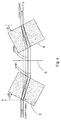
- a projector comprising a first glass plate with flat and parallel faces (whose faces are inclined relative to the axis Oy by an angle + ⁇ about the axis (Ox)) to separate geometrically the incident rays as a function of their wavelength (that is to say forming the optical spectral decomposition system 3), a multiplicative coding device 5 used in transmission (for example an optical mask), and a second glass slide with flat and parallel faces (whose faces are inclined with respect to the axis Oy of angle equal to - ⁇ around the axis (Ox)) to spectrally recombine the incident rays (that is to say forming the spectral recombination optical system 8).
- the example shown on the figure 4 takes again the principle illustrated on the figure 3 detailing the paths taken by the wavelength beam ⁇ min and the wavelength beam ⁇ max in a preferred configuration in which these beams are juxtaposed along a line constituting a boundary.
- the light constituting the incident beam is for example polychromatic: its spectrum may be discrete (i.e. consisting of a finite number of wavelengths) or continuous.
- the spectral range can extend in the ultraviolet and / or visible and / or infrared domains depending on the application.
- the beam can therefore come from a natural source (sun, daylight, etc.) or artificial (incandescent lamp, polychromatic LED, game of several quasi-monochromatic LEDs, set of several laser diodes, etc.).
- the projector is advantageously optically configured for a given range of wavelengths, noted here [ ⁇ min- ⁇ max].
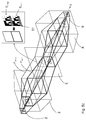
- the figures 5a and 5b respectively represent the optical propagation of light in the above-mentioned main optical components of the projector for the maximum wavelength ( ⁇ max) and the minimum wavelength ( ⁇ min) of the incident beam, in particular when the latter is materialized by the beam-gauge 2.
- the spectral dispersion of the incident rays is assumed to be a vertical angular deflection produced at the input of the spectral decomposition optical system 3 and the image of the waist of the beam pattern is formed on the multiplicative coding device 5 for example by an optical system.
- convergent for example a transmission lens or a mirror in reflection
- the spectral dispersion is achieved before the image recovery by the convergent optical system these two functions can also be performed in reverse order.
- the figure 5c illustrates the combined propagation of these two extreme beams.
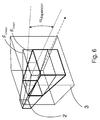
- the spectral dispersion dispersion angle ⁇ introduced into the optical spectral decomposition system 3 between the beams F ⁇ min and F ⁇ max is represented on the figure 6 .
- the optical characteristics of the optical spectral decomposition system 3 are configured so that these two extreme beams, denoted F ⁇ min and F ⁇ max , intersect, meet, the mask of the encoding device 5 according to two identical rectangular sections (denoted S ⁇ min and S ⁇ max respectively) and juxtaposed along the direction of the spectral dispersion of the beam (in this example, we assume that the wavelength dispersion places F ⁇ min at a vertical position lower than that of F ⁇ max ).
- juxtaposition is the preferred configuration of the invention, but the invention also applies if the intersecting zones partially overlap or are distant from one another.
- the correlation rate between the spectral encodings contained in the output beam of the projector is higher than in the case of the juxtaposition of these two areas.
- the richness of the spectral encoding decreases with the increase of this correlation rate. For example, in an extreme case where the angular deflection of the incident rays in the spectral decomposition optical system 3 would not be wavelength dependent, the intersection zones would overlap completely and each spectral channel would cross ("see"). ) the same area of the multiplicative coding device 5.
- Each spectral channel would be encoded by the same information and the correlation rate would be equal to 1.
- the richness of the spectral encoding can be preserved by adapting the coding pattern multiplicative to the geometry of the luminous figure obtained on the multiplicative coding device 5. Such a configuration however renders the interpretation of the measurements more delicate.
- the spectral recombination optical system 8 for spectrally "recombining" the light beam completely compensates for the spectral dispersion of the incident rays initially introduced by the optical spectral decomposition system 3: the beams F ⁇ min and F ⁇ max totally recombine.
- the spectral recombination is performed before an image recovery by a system. optical convergent but these two functions can also be performed in the reverse order.
- the output beam 9 obtained at the output of the optical spectral recombination system 8 is centered on the optical axis of the latter (here the same axis (Oz)) and is focused at a given position of this axis.
- Its section, here also rectangular, S ' beam-jig (schematized on the figure 1 in particular) is substantially perpendicular to the output optical axis, and its focal point is denoted E '(also shown in FIG. figure 1 especially).
- the planes of sections S beam-jig and S ' beam template are optically conjugated by the elements of the projector located between them.
- the image S 'beam-template template section S-beam is formed in a real image space of the optical system spectral recombination 8, but it is possible to form it in the imaginary image space (by a adapted choice of elements of the spectral recombination optical system 8) if the application requires it.
- FIG. 5a An example of a mask 51 of the multiplicative coding device 5 is represented at the location of these two sections S ⁇ min and S ⁇ max on the figures 5a , 5b and 5c : this is a binary encoding mask for which the black areas of the mask represent light-opaque parts (in a mask case operating in transmission, these areas corresponding to absorbing areas in a mask case) operating in reflection), equivalent to the multiplicative value 0 of the luminous flux passing therethrough, and the white areas represent the transparent parts (in the case of a mask operating in transmission, these zones corresponding to reflecting zones in the case of a mask operating in reflection), equivalent to the multiplicative value 1.
- the columns of the mask are oriented in the direction related to the spectral dispersion of the beam, ie the vertical direction in these figures (the axis (Oy)), and the lines are perpendicular to the direction of the beam. columns, ie oriented here in the horizontal transverse direction (the axis (Ox)).
- the mask 51 encodes the two beams F ⁇ min and F ⁇ max identically.
- This example of encoding thus presents a repetition of a basic pattern (the upper half or the lower half of the mask) following the direction associated with the spectral dispersion of the beam: in this document, it is for example referred to this particular type of encoding under the name "double coding” or "double masking".
- the basic pattern of the double mask contains here 16 binary values of a canonical base of degree 4, here in ascending order from left to right on the figures 5a , 5b and 5c (ie for each column from the left according to the lines starting from the top one, for example: 0000, 0001, 0010, ..., 1111), whose 4 bits are respectively associated with the four lines of the pattern.
- the operating principle of the multiplicative coding device 5 is presented on the Figures 8 to 13 based on this example coding pattern.
- the magnification of the spectral decomposition optical system 3 and that of the spectral recombination optical system 8 are here positive and equal to 1 (as represented on FIG. figure 8 ), and the optical transmissions of these two devices are equal to 1 over all of their useful optical fields. The variation of these magnifications and the optical transmissions with the wavelength are also neglected.
- the angular deflection introduced by the spectral decomposition optical system 3 is assumed to be linear with the wavelength and the dispersion dispersion dispersion angle ⁇ introduced between the beams F ⁇ min and F ⁇ max is considered to be sufficiently weak.
- the mathematical formulation of the spectral encoding of the beam in the context of the small angle approximation (ie we can assume that tan ( ⁇ dispersion ) ⁇ ⁇ dispersion ).
- (x n , y n ) and (x ' n , y' n ) are the normalized values of the coordinates of the points located on sections S beam-jig and S ' beam-jig respectively (as shown in FIG. figure 8 ).
- the multiplicative function (between 0 and 1) of the multiplicative coding device 5 is denoted M (x " n , y" n ) on the figure 8 , with (x " n , y" n ) the normalized values of the coordinates of the points located on the useful coding area (rectangular area represented in dashed lines on the figure 8 ), that is to say the mask.
- This product is the formulation of the spectral encoding of the beam.
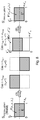
- This spectral encoding is illustrated on the figure 9 along an abscissa line x '0 (corresponding for example to the 6 th column of the double binary mask) of the image obtained at the output of the optical spectral recombination system:
- the function F' (x '0, y ' n , ⁇ n ) represents the spectral content of the light beam along this line (to limit the graphical representation to the physical phenomenon to be illustrated, the function F' (x ' 0 , y' n , ⁇ n ) is represented by assuming that the function F (x n , y n , ⁇ n ) constant at every point of the section S beam-template and over the range of wavelength [ ⁇ min, ⁇ max]).
- the areas of the double coding mask respectively traversed by the beams F 1 to F 5 are represented on the figure 10 (areas excluding hatched parts).
- This image consists of the combination of the five beams F 1 to F 5 , each of which has been encoded by the area of the double mask that it has crossed.
- each of lines L1 to L4 contains the set of numbers, 0000 to 1111, of the binary canonical base of degree 4.
- the image 91 formed at the section S ' beam-jig of the output beam 9 (see figure 13 ) is always segmented into 16 columns as in the case of the image ( figure 11 ) produced by the incident light beam whose light spectrum consisted of the five discrete wavelengths ⁇ 1 to ⁇ 5 , however, the line segmentation is no longer present because the spectral content of the light in this image follows a variation along the vertical axis (illustrated in figure 9 at a position with abscissa x '0 data) described by the formulation of the spectral encoding of the beam mentioned above.
- the number of coding spectral channels can therefore be increased or reduced by simply changing the number of lines of the basic pattern of the double mask.
- the new wavelength ⁇ 2bis is then greater than the old wavelength ⁇ 2 , the wavelengths ⁇ 1 , ⁇ 3 , ⁇ 4 and ⁇ 5 remain unchanged and, consequently, the new C 1bis channel is wider than the old C 1 channel, and the new C 2bis channel is narrower than the previous C 2 channel, while the C 3 and C 4 channels remain identical.
- the dual mask represented in the present example of the spectral encoding device of light beams 5 and schematized in FIG. figures 5a , 5b , 5c , 9 , 10 and 12 also presupposes that the optical spectral decomposition system 3 of this example operates in the linear approximation with respect to the dispersion, as mentioned above: the dispersion angle, for a given wavelength, is indeed assumed to be constant in the field optical beam-2, that is to say, it does not vary with the direction of the incident ray.
- the spectral recombination optical system 8 makes it possible to "recombine" spectrally the light beam by completely offsetting the geometric separation of incident rays that has been introduced by the spectral decomposition optical system 3 as a function of wavelengths.
- This is the preferred configuration of the present invention because it provides optimal spectral encoding in terms of encoding richness and encoding light output.
- the present invention also applies to the case where the compensation is partial, but in this case, the richness of the spectral encoding is maximum only on the area of the output image in which are superimposed all the lengths of the spectral range [ ⁇ min- ⁇ max].
- the light located outside this zone which does not consist of all the wavelengths of the incident beam, is not spectrally encoded over the entire spectral range [ ⁇ min- ⁇ max].
- the light level is lower in this zone than in the one where all the lengths of the spectral range [ ⁇ min- ⁇ max] are superimposed.
- the total repetition of the basic pattern is the preferred configuration of the present invention, but the invention is also applicable if the repetition of the pattern is partial or possibly if there is no repetition at all.
- patterns can be chosen so as to ensure a sufficiently high spectral encoding richness.
- a pattern consisting of the basic pattern of the dual binary mask of the figure 10 and a complementary pattern, as shown for example on the figure 14 .
- the encoding richness remains as high as with the double binary mask of the figure 10 , as illustrated by the new function F '(x' 0 , y ' n , ⁇ n ) obtained, also represented on the figure 14 .
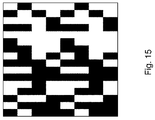
- FIG. 15 Another example of a mask is represented on the figure 15 .
- Such a mask corresponds to the previously represented mask whose columns have been mixed. Thus, all the columns remain different from each other, which is a preferred mask configuration in the context of the present invention.
- a coding pattern that is not organized in rows and columns (for example, any known content pattern).
- the segmentation in spectral channels is not induced by the coding pattern itself, but can be provided by the detection device (for example a multispectral camera) of the system in which the encoding device is used. spectral light beams.
- a spectrally structured light projector comprises an optical coupling between a light source, for example as described above, positioned as input projector and a projection optical system configured to project the produced image onto a scene to be observed.
- a light source for example as described above
- a projection optical system configured to project the produced image onto a scene to be observed.
- the projected pattern consists of a multitude of spectrally structured light bands whose correlation rate between the encodings the spectral bands of the different light bands is small enough to be able to easily distinguish the bands from each other.
- the number of spectral channels is equal to "n” and the image produced by the projector is segmented into 2 n structured light strips.
- the number n of lines of the basic pattern is preferably at least 4, or better still at least 5, and advantageously greater or equal to 7, for example between 7 and 14.
- the figure 16 schematically shows the structure of a projector according to an embodiment of the present invention.
- the spectrally structured light projector is represented in a view from above, for example as if it were placed on a laboratory optical table.
- the projector would be arranged horizontally.
- the projector comprises for example here in series a light source 10, a spectral decomposition optical system 3, an encoding device 5, a spectral recombination optical system 8 and a projection optical system 150.
- the light source 10 comprises for example an incandescent lamp, for example Osram brand (model ECL-669-BO, power 210 W).
- the projector here comprises a reflecting plane mirror 20. It further comprises here an optical condenser 30 to optimize the amount of light collected from the source, and, optionally, a diaphragm 40 to facilitate adjustments and / or geometrically delimit the beam.
- the condenser 30 is configured to focus the light on the diaphragm 40, which is for example metallic. Its opening has for example here for dimensions 10 x 7.5 mm 2 (height x width). These elements are of course optional and independent in the sense or only a part of them can be present. These three elements present here are for example arranged in series between the light source 10 and the spectral decomposition optical system 3.
- the rectangular opening of the diaphragm 40 makes it possible to materialize the section S beam-template previously described according to an exemplary embodiment.
- the lamp of the light source 10 and the condenser 30 are for example those of a video projector of the brand ACER (registered trademark), model X1173a DLP.
- the spectral decomposition optical system 3 comprises, for example, a prism 70 here.
- the prism 70 is here configured to spectrally and angularly scatter the beam that reaches it.
- the prism 70 is for example Crown LaK10 glass (Schott) and angle 60 °.
- its input face is for example oriented at 25 ° with respect to the axis of the incident beam that reaches it.
- the projector comprises an objective lens 50, which comprises for example a convergent lens, and a plane mirror 60, arranged between the diaphragm 40 and the optical spectral decomposition system 3.
- an objective lens 50 which comprises for example a convergent lens
- a plane mirror 60 arranged between the diaphragm 40 and the optical spectral decomposition system 3.
- the image of the diaphragm 40 is formed at infinity using the objective 50.
- the diaphragm is positioned at the object focus of the objective 50.
- the plane mirror 60 which allows to improve the compactness of the device, then directs the beam towards the prism 70.
- the normal of the mirror is oriented at about 26 ° with respect to the axis of the incident beam.
- the projector comprises an objective 80, here disposed between the optical spectral decomposition system 3 and the encoding device 5, which is configured to focus the scattered light by the optical spectral decomposition system 3, in a given plane where is positioned the encoding device 5.
- the aforementioned plan is therefore for example located at the focus image of the objective 80.
- the objectives 50 and 80 are possibly identical. They are for example Clairaut type, with a numerical aperture equal to f / 3 and a focal length of 150 mm.
- the multiplicative coding device 5 also sometimes referred to herein as the multiplicative coding device, may operate in reflection or in transmission. Here, it works in reflection. This allows for example to make the device more compact.
- the encoding device 5 comprises a mask 90 which is for example formed here by a DMD cell.
- the DMD cell is, for example, a Texas-Instrument DMD cell with a useful optical field height x width of 10 x 15 mm 2 and SVGA resolution 800 x 600.
- the DMD cell is positioned perpendicular to the mean axis of the incident beam and oriented so that its height h (10 mm) is parallel to the length (about 10 mm) of the image of the diaphragm on the DMD cell and that its width (15 mm) is oriented in the direction related to the spectral dispersion of the light source.
- the mask 90 used is a so-called “double” mask, as described above, whose repetition is effected in the direction related to the direction of spectral dispersion, that is to say in the horizontal direction transverse to the incident beam in this embodiment.
- the "lines” of the mask 90 follow each other in the horizontal direction while the “columns” of the mask follow one another in the vertical direction.
- the mask 90 is further configured so that its width (2 * L), that is to say its dimension taken according to the dispersion of the beam, is equal to twice the width L of the diaphragm 40 while its height is equal to that of the diaphragm 40.
- the mask 90 shown on the left of the figure 16 is a dual and binary mask, that is to say black (absorbing light) or white (reflecting light in case of reflection operation) according to the zone (which corresponds here respectively to the minimum or maximum value of the range of control values of the DMD cell).
- this dual coding pattern is for example the image displayed on the DMD cell via a computer connected to the projector.
- the aforementioned spectral channels C 1 to C 7 may differ in spectral width: the spectral ranges ( in nm) C 1 to C 7 spectral channels are for example here [400-419], [419-442], [442-470], [470-504], [504-547], [547-603] and [603-680] respectively.
- Lines # 1 to # 7, corresponding to the left half of the mask shown figure 16 which forms a first sub-pattern, would then be illuminated by the wavelength beam ⁇ min
- the lines # 8 to # 14, corresponding to the right half of the mask shown figure 16 which forms a second sub-pattern would then be illuminated by the wavelength beam ⁇ max.
- the demarcation d f between the lines n ° 7 and n ° 8, visualized by a mixed line would be well superimposed on the border between the beams of wavelength ⁇ min and ⁇ max.
- the lines of the first sub-pattern have been mixed, in the sense that they do not follow each other in the order of the powers of 2, they are for example arranged in the following order: 2 ⁇ 2, 2 ⁇ 4, 2 ⁇ 6, 2 ⁇ 7, 2 ⁇ 5, 2 ⁇ 3, 2 ⁇ 1.
- the basic pattern left half or right half of the double coding pattern represented on the figure 16 because in this example the two sub-patterns are identical
- the basic canonical pattern of the dual bitmask does not necessarily need to be organized by increasing values as in the case of Figures 9 to 14 : Any inline and column swapping in this basic pattern does not reduce the richness of the spectral encoding.
- the second sub-pattern being here identical to the first sub-pattern, it therefore comprises the same mixture of lines.
- the optical beam is reflected in a non-coplanar direction with the plane of the diagram (the beam is directed a little downwards).
- the angle between the mean axis of the incident beam and the horizontal projection of the reflected beam is about 16 °.
- the projector comprises a plane mirror 100.
- the angle between the horizontal projections of the normal to the plane mirror 100 and the average axis of the incident beam from the multiplicative coding device 5 is about 29 °.
- the projector comprises the spectral recombination optical system 8.
- the spectral recombination optical system 8 is configured to recombine into a recombined beam the spectrum that is spectrally decomposed and encoded by the encoding device 5. for example, includes a prism 130.
- the projector comprises in series an objective 110, the prism 130 of the spectral recombination optical system 8, a plane mirror 120 and an objective 140 which are respectively identical to the elements 80, 3, 60 and 50 arranged in reverse order. That is to say, for example, that the objectives 110 and 80 are identical, the prism 130 is identical to the prism 70 and its input face is oriented at 25 ° with respect to the mean axis of the incident beam which comes from of the objective 110, the plane mirror 120, whose normal is oriented at about 47 ° with respect to the mean axis of the incident beam from the prism 130, is identical to the plane mirror 60, and the objective 140 is identical to the 50.
- the plane where the mask 90 is positioned is located at the object focus of the objective 110.
- the elements 100, 110, 8, 120 and 140 thus make it possible, on the one hand, to recombine the light dispersed by the elements 50, 60, 3 and 80 and encoded by the multiplicative coding device 5, and on the other hand to form an intermediate image 40 'of the diaphragm 40 at a determined position while limiting a size of the projector.
- the image 40 'obtained here then has the following properties: its dimensions are 10 ⁇ 7.5 mm 2 and is segmented into 27 spectrally structured horizontal light bands.
- the spectral structuring is such that whatever the (fine) vertical section considered of this image, it is composed of 27 elements / structured pixels of spectral encodings different from each other.
- the intermediate image 40 ' is finally projected onto the scene to be studied using the projection optical system 150.
- the projection optical system 150 comprises, for example, a lens whose focal length is approximately 30 mm.
- the projected field obtained then measures approximately 100 x 75 cm 2 (height x width) at 3 meters from distance from the lens 150.
- the coding pattern of the multiplicative coding device 5 is binary and the spectral recombination optical system 8 spectrally recombines the light beam by completely offsetting the geometric separation of the incident radiation dependent on the wavelength which has been introduced by the spectral decomposition optical system 3.
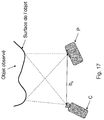
- the figure 17 schematically represents a three-dimensional structured light scanner according to an exemplary embodiment of the present invention. It comprises a projector, here positioned right side, and a detection device, here positioned left side, at a distance b s of the projector, called "stereoscopic base”.
- the detection device used is here for example a SPECIM brand mirror-spinning hyperspectral camera (model Kappa DX4 PS); it has 256 pixels (the columns of the image) x 512 pixels (the lines of the image).
- the camera is for example positioned above the projector, the projection axis of the projector and that of the camera lens then being in the same vertical plane, but of course they could be arranged next to each other. the other.
- the stereoscopic base (the distance b s ) is then vertical and here, for example equal to 10 cm.
- An interesting option is, for example, to perform the acquisition on the 7 spectral channels C 1 to C 7 in order to respect the wavelength segmentation induced by the geometry of the mask used.
- the evaluation measurements were carried out in a room of approximately 4 x 5 m 2 , illuminated by uniformly distributed halogen-type ceiling lighting and approximately 600 W of total power.
- a large sheet of white paper, glued on a rigid support to form a flat screen and a metallic object covered with a matt beige paint and whose dimensions were approximately 20 x 20 x 20 cm 3 (it was about occurrence of a laboratory light source frame) were successively used to perform the evaluation tests. They were positioned at a distance of about 1.5 m from the camera.
- FIG 18 Some images of the white screen ( figure 18c ) and the metal object ( figure 18d ) obtained with the hyperspectral camera are provided in figure 18 (acquisition channels C ' 1 to C' 5 only for the sake of simplification).
- the field of the camera is smaller than the field of the projector.
- the camera offset and the signal level related to ambient lighting were subtracted.
- the effect of the projected beam lobe, ie the spatial non-uniformity of its flux has been corrected: the image of the apparent lobe observed by the camera is obtained by projecting on the plane screen a non-encoded incident beam, that is to say for example using the DMD cell as a plane mirror without occulting (even partially) some rays.
- the double encoding pattern used is represented in figure 18a (which is the canonical base 7 described in connection with the figure 16 ).
- the rotation of the pattern, with respect to the horizontal direction of the figure, is intended to reproduce the rotation induced by the optical configuration of acquisition of the hyperspectral camera: the "columns" of the camera sensor were not vertical in the test implemented.
- Figures 18c and 18d representing respectively the case of the plane screen and the metal object
- These areas of mask are convolved by a blur which is induced by the spectral width (here 40 mm for example) of the spectral channels of the camera.
- This blur is similar to a motion blur in the direction associated with the spectral dispersion since a wavelength shift results in a geometric shift of the projected mask area as shown in FIG. figure 5c (but also the figure 10 ).
Landscapes
- Physics & Mathematics (AREA)
- Engineering & Computer Science (AREA)
- General Physics & Mathematics (AREA)
- Multimedia (AREA)
- Signal Processing (AREA)
- Optics & Photonics (AREA)
- Computer Vision & Pattern Recognition (AREA)
- Electromagnetism (AREA)
- Length Measuring Devices By Optical Means (AREA)
- Testing, Inspecting, Measuring Of Stereoscopic Televisions And Televisions (AREA)
- Projection Apparatus (AREA)
Applications Claiming Priority (1)
| Application Number | Priority Date | Filing Date | Title |
|---|---|---|---|
| FR1462551A FR3030066B1 (fr) | 2014-12-16 | 2014-12-16 | Projecteur de lumiere structuree et scanner tridimensionnel comportant un tel projecteur |
Publications (3)
| Publication Number | Publication Date |
|---|---|
| EP3034992A2 true EP3034992A2 (de) | 2016-06-22 |
| EP3034992A3 EP3034992A3 (de) | 2016-07-06 |
| EP3034992B1 EP3034992B1 (de) | 2017-11-29 |
Family
ID=53491560
Family Applications (1)
| Application Number | Title | Priority Date | Filing Date |
|---|---|---|---|
| EP15200256.4A Active EP3034992B1 (de) | 2014-12-16 | 2015-12-15 | Projektor für strukturierte beleuchtung, und 3d-scanner, der einen solchen projektor enthält |
Country Status (6)
| Country | Link |
|---|---|
| US (1) | US9479757B2 (de) |
| EP (1) | EP3034992B1 (de) |
| JP (1) | JP6626335B2 (de) |
| CN (1) | CN105700280B (de) |
| ES (1) | ES2659865T3 (de) |
| FR (1) | FR3030066B1 (de) |
Cited By (1)
| Publication number | Priority date | Publication date | Assignee | Title |
|---|---|---|---|---|
| EP3367335A1 (de) | 2017-02-21 | 2018-08-29 | YVI-Labs | Verfahren und vorrichtung zum nicht kontakten 3d-objekt-scannen |
Families Citing this family (22)
| Publication number | Priority date | Publication date | Assignee | Title |
|---|---|---|---|---|
| US10241244B2 (en) | 2016-07-29 | 2019-03-26 | Lumentum Operations Llc | Thin film total internal reflection diffraction grating for single polarization or dual polarization |
| EP3288253A1 (de) * | 2016-08-25 | 2018-02-28 | Thomson Licensing | Verfahren und vorrichtung zur erzeugung von daten, die für eine bokeh im zusammenhang mit lichtfelddaten repräsentativ sind |
| EP3516328B1 (de) * | 2016-09-21 | 2023-05-03 | Philip M. Johnson | Kontaktlose koordinatenmessmaschine mit hybridem cyclischem binär-codiertem strukturierten licht |
| CN106500628B (zh) * | 2016-10-19 | 2019-02-19 | 杭州思看科技有限公司 | 一种含有多个不同波长激光器的三维扫描方法及扫描仪 |
| CN106500627B (zh) * | 2016-10-19 | 2019-02-01 | 杭州思看科技有限公司 | 含有多个不同波长激光器的三维扫描方法及扫描仪 |
| US10033988B2 (en) * | 2016-10-31 | 2018-07-24 | Verizon Patent And Licensing Inc. | Methods and systems for capturing depth data using frequency-segregated structured light |
| DK3367053T3 (da) | 2017-02-27 | 2021-05-10 | Kulzer & Co Gmbh | 3d-scanner med gyroskopsensor |
| CN109425292B (zh) * | 2017-08-29 | 2020-06-16 | 西安知微传感技术有限公司 | 基于一维线结构光的三维测量系统标定装置及方法 |
| DE102017215850B4 (de) * | 2017-09-08 | 2019-12-24 | Robert Bosch Gmbh | Verfahren zur Herstellung eines diffraktiven optischen Elements, LIDAR-System mit einem diffraktiven optischen Element und Kraftfahrzeug mit einem LIDAR-System |
| US10502593B1 (en) * | 2018-06-07 | 2019-12-10 | Philip M. Johnson | Linear and rotary multitrack absolute position encoder and methods using the same |
| KR102546320B1 (ko) | 2018-06-18 | 2023-06-22 | 삼성전자주식회사 | 구조광 프로젝터 및 이를 포함하는 전자 장치 |
| JP6907277B2 (ja) * | 2018-08-30 | 2021-07-21 | コグネックス・コーポレイション | 歪みが低減された物体の3次元再構成を生成するための方法及び装置 |
| US10901092B1 (en) * | 2018-10-02 | 2021-01-26 | Facebook Technologies, Llc | Depth sensing using dynamic illumination with range extension |
| US10896516B1 (en) * | 2018-10-02 | 2021-01-19 | Facebook Technologies, Llc | Low-power depth sensing using dynamic illumination |
| US10924727B2 (en) * | 2018-10-10 | 2021-02-16 | Avalon Holographics Inc. | High-performance light field display simulator |
| CN111381426B (zh) * | 2018-12-29 | 2021-12-31 | 深圳光峰科技股份有限公司 | 光源系统及投影设备 |
| WO2020168094A1 (en) * | 2019-02-15 | 2020-08-20 | Nikon Corporation | Simultaneous depth profile and spectral measurement |
| CN113341635A (zh) * | 2020-02-18 | 2021-09-03 | 苏州佳世达光电有限公司 | 投影装置的测距调焦方法 |
| CN112967348A (zh) * | 2021-04-01 | 2021-06-15 | 深圳大学 | 基于一维扫描结构光系统的三维重建方法及其相关组件 |
| CN113409379B (zh) * | 2021-06-30 | 2022-08-02 | 奥比中光科技集团股份有限公司 | 一种光谱反射率的确定方法、装置及设备 |
| EP4160140A1 (de) * | 2021-10-04 | 2023-04-05 | VoxelSensors SRL | System zur dreidimensionalen bildgebung |
| CN116753087B (zh) * | 2023-06-21 | 2026-02-27 | 中北大学 | 基于掩模技术的图谱合一测试结构 |
Citations (6)
| Publication number | Priority date | Publication date | Assignee | Title |
|---|---|---|---|---|
| US6247814B1 (en) | 1999-09-03 | 2001-06-19 | Primax Electronics Ltd. | Projecting device for displaying electronic images |
| US20040085634A1 (en) | 2000-03-23 | 2004-05-06 | Kurt Stahl | Color video projection system employing reflective liquid crystal display devices |
| WO2006096598A2 (en) | 2005-03-04 | 2006-09-14 | Colorlink Inc. | Four panel projection system |
| US20100156958A1 (en) | 2006-02-13 | 2010-06-24 | Long Yang | Methods and systems for multiple primary color display |
| US20100315596A1 (en) | 2006-12-18 | 2010-12-16 | Youngshik Yoon | Wide color gamut projector |
| US20140028801A1 (en) | 2012-07-30 | 2014-01-30 | Canon Kabushiki Kaisha | Multispectral Binary Coded Projection |
Family Cites Families (14)
| Publication number | Priority date | Publication date | Assignee | Title |
|---|---|---|---|---|
| JPH10170239A (ja) * | 1996-10-08 | 1998-06-26 | Matsushita Electric Ind Co Ltd | 3次元形状計測装置 |
| JP3884321B2 (ja) * | 2001-06-26 | 2007-02-21 | オリンパス株式会社 | 3次元情報取得装置、3次元情報取得における投影パターン、及び、3次元情報取得方法 |
| JP2005084266A (ja) * | 2003-09-05 | 2005-03-31 | Kawasaki Heavy Ind Ltd | 光制御装置および光制御方法 |
| WO2005122596A1 (en) * | 2004-06-08 | 2005-12-22 | Actuality Systems, Inc. | Optical scanning assembly |
| US20070115484A1 (en) * | 2005-10-24 | 2007-05-24 | Peisen Huang | 3d shape measurement system and method including fast three-step phase shifting, error compensation and calibration |
| US8531650B2 (en) * | 2008-07-08 | 2013-09-10 | Chiaro Technologies LLC | Multiple channel locating |
| FR2938330A1 (fr) * | 2008-11-07 | 2010-05-14 | Michelin Soc Tech | Evaluation du relief de la surface d'un pneumatique par stereovision active |
| US8908958B2 (en) * | 2009-09-03 | 2014-12-09 | Ron Kimmel | Devices and methods of generating three dimensional (3D) colored models |
| US8754954B2 (en) * | 2011-05-16 | 2014-06-17 | National Research Council Of Canada | High resolution high contrast edge projection |
| US9170098B2 (en) * | 2011-07-13 | 2015-10-27 | Faro Technologies, Inc. | Device and method using a spatial light modulator to find 3D coordinates of an object |
| CN107806826B (zh) * | 2012-03-26 | 2021-10-26 | 螳螂慧视科技有限公司 | 三维照相机及其投影仪 |
| US9207070B2 (en) * | 2012-05-24 | 2015-12-08 | Qualcomm Incorporated | Transmission of affine-invariant spatial mask for active depth sensing |
| DE102013105828A1 (de) * | 2012-06-08 | 2013-12-12 | Perceptron, Inc. | Hybrid sensor |
| JP2014055814A (ja) * | 2012-09-11 | 2014-03-27 | Keyence Corp | 形状測定装置、形状測定方法および形状測定プログラム |
-
2014
- 2014-12-16 FR FR1462551A patent/FR3030066B1/fr active Active
-
2015
- 2015-12-11 JP JP2015242142A patent/JP6626335B2/ja active Active
- 2015-12-15 EP EP15200256.4A patent/EP3034992B1/de active Active
- 2015-12-15 ES ES15200256.4T patent/ES2659865T3/es active Active
- 2015-12-16 US US14/970,683 patent/US9479757B2/en active Active
- 2015-12-16 CN CN201511036203.7A patent/CN105700280B/zh active Active
Patent Citations (7)
| Publication number | Priority date | Publication date | Assignee | Title |
|---|---|---|---|---|
| US6247814B1 (en) | 1999-09-03 | 2001-06-19 | Primax Electronics Ltd. | Projecting device for displaying electronic images |
| US20040085634A1 (en) | 2000-03-23 | 2004-05-06 | Kurt Stahl | Color video projection system employing reflective liquid crystal display devices |
| WO2006096598A2 (en) | 2005-03-04 | 2006-09-14 | Colorlink Inc. | Four panel projection system |
| US20100156958A1 (en) | 2006-02-13 | 2010-06-24 | Long Yang | Methods and systems for multiple primary color display |
| US20100315596A1 (en) | 2006-12-18 | 2010-12-16 | Youngshik Yoon | Wide color gamut projector |
| US20140028801A1 (en) | 2012-07-30 | 2014-01-30 | Canon Kabushiki Kaisha | Multispectral Binary Coded Projection |
| US20140028800A1 (en) | 2012-07-30 | 2014-01-30 | Canon Kabushiki Kaisha | Multispectral Binary Coded Projection |
Non-Patent Citations (1)
| Title |
|---|
| J. GENG: "Structured-Light 3D surface imaging: a tutorial", ADVANCES IN OPTICS AND PHOTONICS, vol. 3, 2011, pages 128 - 160 |
Cited By (1)
| Publication number | Priority date | Publication date | Assignee | Title |
|---|---|---|---|---|
| EP3367335A1 (de) | 2017-02-21 | 2018-08-29 | YVI-Labs | Verfahren und vorrichtung zum nicht kontakten 3d-objekt-scannen |
Also Published As
| Publication number | Publication date |
|---|---|
| EP3034992B1 (de) | 2017-11-29 |
| FR3030066B1 (fr) | 2017-12-22 |
| EP3034992A3 (de) | 2016-07-06 |
| CN105700280A (zh) | 2016-06-22 |
| ES2659865T3 (es) | 2018-03-19 |
| FR3030066A1 (fr) | 2016-06-17 |
| CN105700280B (zh) | 2019-11-19 |
| JP6626335B2 (ja) | 2019-12-25 |
| US9479757B2 (en) | 2016-10-25 |
| US20160173855A1 (en) | 2016-06-16 |
| JP2016136132A (ja) | 2016-07-28 |
Similar Documents
| Publication | Publication Date | Title |
|---|---|---|
| EP3034992B1 (de) | Projektor für strukturierte beleuchtung, und 3d-scanner, der einen solchen projektor enthält | |
| US9541381B2 (en) | Surface topography interferometer with surface color | |
| US7659991B2 (en) | Colorimetric three-dimensional microscopy | |
| EP3765835A1 (de) | Momentanellipsometer oder streumessgerät und zugehöriges messverfahren | |
| EP3742135B1 (de) | Hyperspektrale monopixel-bildgebung mit zeitlicher auflösung | |
| Xu et al. | A hyperspectral projector for simultaneous 3D spatial and hyperspectral imaging via structured illumination | |
| EP1771714B1 (de) | Verfahren zur Prüfung einer optischen Komponente der ophthalmischen Industrie | |
| FR3066816A1 (fr) | Dispositif optique de mesure de la courbure d'une surface reflechissante | |
| WO2002037157A2 (fr) | Microscope pour objets diffractants | |
| FR2923006A1 (fr) | Dispositif optique pour l'observation de details structurels millimetriques ou submillimetriques d'un objet a comportement speculaire | |
| FR3132352A1 (fr) | Procédés et systèmes opto-informatiques d’inspection en lumière traversante d’un récipient en verre | |
| EP2984443B1 (de) | Dreidimensionales bilderfassungssystem | |
| WO2023052732A1 (fr) | Procede et dispositif d'inspection pour des recipients deplaces selon une trajectoire rectiligne | |
| FR3075401A1 (fr) | Microscopie 3d spectrale en champ large | |
| EP2681604A2 (de) | Hochauflösendes bildgebungssystem | |
| WO2021019136A1 (fr) | Dispositif d'inspection d'une surface d'un objet | |
| EP3117181A1 (de) | Verfahren zur bestimmung von dreidimensionalen bildern eines objektes | |
| EP4034863B1 (de) | System und verfahren zum steuern der farbe eines sich bewegenden gegenstandes | |
| Kilcullen | Development and Applications of a Single-Pixel Imaging Platform for Three-Dimensional, Real-Time, Ultrahigh-Speed, and Terahertz Imaging | |
| FR3113131A1 (fr) | Dispositif et procédé d'inspection en transmission de récipients comportant au moins une source de lumière à diode électroluminescente | |
| CH420661A (fr) | Appareil spectrométrique | |
| EP4261497A1 (de) | Topographisches messverfahren und topographische messmaschine | |
| EP3298440A1 (de) | Bildgenerator, insbesondere für head-up-anzeigevorrichtung | |
| WO2016181068A1 (fr) | Système optique d'acquisition d'informations sur une surface | |
| FR2996996A1 (fr) | Procede et dispositif d'evaluation des effets de l'application d'un produit cosmetique sur un visage |
Legal Events
| Date | Code | Title | Description |
|---|---|---|---|
| PUAI | Public reference made under article 153(3) epc to a published international application that has entered the european phase |
Free format text: ORIGINAL CODE: 0009012 |
|
| PUAL | Search report despatched |
Free format text: ORIGINAL CODE: 0009013 |
|
| AK | Designated contracting states |
Kind code of ref document: A2 Designated state(s): AL AT BE BG CH CY CZ DE DK EE ES FI FR GB GR HR HU IE IS IT LI LT LU LV MC MK MT NL NO PL PT RO RS SE SI SK SM TR |
|
| AX | Request for extension of the european patent |
Extension state: BA ME |
|
| AK | Designated contracting states |
Kind code of ref document: A3 Designated state(s): AL AT BE BG CH CY CZ DE DK EE ES FI FR GB GR HR HU IE IS IT LI LT LU LV MC MK MT NL NO PL PT RO RS SE SI SK SM TR |
|
| AX | Request for extension of the european patent |
Extension state: BA ME |
|
| RIC1 | Information provided on ipc code assigned before grant |
Ipc: G01B 11/25 20060101AFI20160531BHEP Ipc: G02B 27/22 20060101ALI20160531BHEP Ipc: G03B 21/20 20060101ALI20160531BHEP Ipc: G02B 27/10 20060101ALI20160531BHEP |
|
| STAA | Information on the status of an ep patent application or granted ep patent |
Free format text: STATUS: REQUEST FOR EXAMINATION WAS MADE |
|
| 17P | Request for examination filed |
Effective date: 20161208 |
|
| RBV | Designated contracting states (corrected) |
Designated state(s): AL AT BE BG CH CY CZ DE DK EE ES FI FR GB GR HR HU IE IS IT LI LT LU LV MC MK MT NL NO PL PT RO RS SE SI SK SM TR |
|
| REG | Reference to a national code |
Ref country code: DE Ref legal event code: R079 Ref document number: 602015006329 Country of ref document: DE Free format text: PREVIOUS MAIN CLASS: G01B0011250000 Ipc: G02B0005040000 |
|
| RIC1 | Information provided on ipc code assigned before grant |
Ipc: G02B 5/04 20060101AFI20170509BHEP Ipc: G01B 11/25 20060101ALI20170509BHEP Ipc: G03B 17/54 20060101ALI20170509BHEP Ipc: G02B 5/18 20060101ALI20170509BHEP Ipc: H04N 9/31 20060101ALI20170509BHEP Ipc: H04N 13/02 20060101ALI20170509BHEP Ipc: G02B 27/22 20060101ALI20170509BHEP Ipc: G02B 27/10 20060101ALI20170509BHEP |
|
| GRAP | Despatch of communication of intention to grant a patent |
Free format text: ORIGINAL CODE: EPIDOSNIGR1 |
|
| STAA | Information on the status of an ep patent application or granted ep patent |
Free format text: STATUS: GRANT OF PATENT IS INTENDED |
|
| INTG | Intention to grant announced |
Effective date: 20170623 |
|
| RIN1 | Information on inventor provided before grant (corrected) |
Inventor name: MICHEL, REMI Inventor name: PARTOUCHE-SEBBAN, DAVID |
|
| GRAS | Grant fee paid |
Free format text: ORIGINAL CODE: EPIDOSNIGR3 |
|
| GRAA | (expected) grant |
Free format text: ORIGINAL CODE: 0009210 |
|
| STAA | Information on the status of an ep patent application or granted ep patent |
Free format text: STATUS: THE PATENT HAS BEEN GRANTED |
|
| AK | Designated contracting states |
Kind code of ref document: B1 Designated state(s): AL AT BE BG CH CY CZ DE DK EE ES FI FR GB GR HR HU IE IS IT LI LT LU LV MC MK MT NL NO PL PT RO RS SE SI SK SM TR |
|
| REG | Reference to a national code |
Ref country code: CH Ref legal event code: EP |
|
| REG | Reference to a national code |
Ref country code: AT Ref legal event code: REF Ref document number: 950901 Country of ref document: AT Kind code of ref document: T Effective date: 20171215 |
|
| REG | Reference to a national code |
Ref country code: IE Ref legal event code: FG4D Free format text: LANGUAGE OF EP DOCUMENT: FRENCH |
|
| REG | Reference to a national code |
Ref country code: FR Ref legal event code: PLFP Year of fee payment: 3 |
|
| REG | Reference to a national code |
Ref country code: DE Ref legal event code: R096 Ref document number: 602015006329 Country of ref document: DE |
|
| REG | Reference to a national code |
Ref country code: ES Ref legal event code: FG2A Ref document number: 2659865 Country of ref document: ES Kind code of ref document: T3 Effective date: 20180319 |
|
| REG | Reference to a national code |
Ref country code: NL Ref legal event code: MP Effective date: 20171129 |
|
| REG | Reference to a national code |
Ref country code: LT Ref legal event code: MG4D |
|
| REG | Reference to a national code |
Ref country code: AT Ref legal event code: MK05 Ref document number: 950901 Country of ref document: AT Kind code of ref document: T Effective date: 20171129 |
|
| PG25 | Lapsed in a contracting state [announced via postgrant information from national office to epo] |
Ref country code: SE Free format text: LAPSE BECAUSE OF FAILURE TO SUBMIT A TRANSLATION OF THE DESCRIPTION OR TO PAY THE FEE WITHIN THE PRESCRIBED TIME-LIMIT Effective date: 20171129 Ref country code: FI Free format text: LAPSE BECAUSE OF FAILURE TO SUBMIT A TRANSLATION OF THE DESCRIPTION OR TO PAY THE FEE WITHIN THE PRESCRIBED TIME-LIMIT Effective date: 20171129 Ref country code: NO Free format text: LAPSE BECAUSE OF FAILURE TO SUBMIT A TRANSLATION OF THE DESCRIPTION OR TO PAY THE FEE WITHIN THE PRESCRIBED TIME-LIMIT Effective date: 20180228 Ref country code: LT Free format text: LAPSE BECAUSE OF FAILURE TO SUBMIT A TRANSLATION OF THE DESCRIPTION OR TO PAY THE FEE WITHIN THE PRESCRIBED TIME-LIMIT Effective date: 20171129 |
|
| PG25 | Lapsed in a contracting state [announced via postgrant information from national office to epo] |
Ref country code: AT Free format text: LAPSE BECAUSE OF FAILURE TO SUBMIT A TRANSLATION OF THE DESCRIPTION OR TO PAY THE FEE WITHIN THE PRESCRIBED TIME-LIMIT Effective date: 20171129 Ref country code: HR Free format text: LAPSE BECAUSE OF FAILURE TO SUBMIT A TRANSLATION OF THE DESCRIPTION OR TO PAY THE FEE WITHIN THE PRESCRIBED TIME-LIMIT Effective date: 20171129 Ref country code: GR Free format text: LAPSE BECAUSE OF FAILURE TO SUBMIT A TRANSLATION OF THE DESCRIPTION OR TO PAY THE FEE WITHIN THE PRESCRIBED TIME-LIMIT Effective date: 20180301 Ref country code: LV Free format text: LAPSE BECAUSE OF FAILURE TO SUBMIT A TRANSLATION OF THE DESCRIPTION OR TO PAY THE FEE WITHIN THE PRESCRIBED TIME-LIMIT Effective date: 20171129 Ref country code: RS Free format text: LAPSE BECAUSE OF FAILURE TO SUBMIT A TRANSLATION OF THE DESCRIPTION OR TO PAY THE FEE WITHIN THE PRESCRIBED TIME-LIMIT Effective date: 20171129 Ref country code: BG Free format text: LAPSE BECAUSE OF FAILURE TO SUBMIT A TRANSLATION OF THE DESCRIPTION OR TO PAY THE FEE WITHIN THE PRESCRIBED TIME-LIMIT Effective date: 20180228 |
|
| PG25 | Lapsed in a contracting state [announced via postgrant information from national office to epo] |
Ref country code: NL Free format text: LAPSE BECAUSE OF FAILURE TO SUBMIT A TRANSLATION OF THE DESCRIPTION OR TO PAY THE FEE WITHIN THE PRESCRIBED TIME-LIMIT Effective date: 20171129 |
|
| PG25 | Lapsed in a contracting state [announced via postgrant information from national office to epo] |
Ref country code: DK Free format text: LAPSE BECAUSE OF FAILURE TO SUBMIT A TRANSLATION OF THE DESCRIPTION OR TO PAY THE FEE WITHIN THE PRESCRIBED TIME-LIMIT Effective date: 20171129 Ref country code: EE Free format text: LAPSE BECAUSE OF FAILURE TO SUBMIT A TRANSLATION OF THE DESCRIPTION OR TO PAY THE FEE WITHIN THE PRESCRIBED TIME-LIMIT Effective date: 20171129 Ref country code: CY Free format text: LAPSE BECAUSE OF FAILURE TO SUBMIT A TRANSLATION OF THE DESCRIPTION OR TO PAY THE FEE WITHIN THE PRESCRIBED TIME-LIMIT Effective date: 20171129 Ref country code: SK Free format text: LAPSE BECAUSE OF FAILURE TO SUBMIT A TRANSLATION OF THE DESCRIPTION OR TO PAY THE FEE WITHIN THE PRESCRIBED TIME-LIMIT Effective date: 20171129 |
|
| REG | Reference to a national code |
Ref country code: DE Ref legal event code: R097 Ref document number: 602015006329 Country of ref document: DE |
|
| PG25 | Lapsed in a contracting state [announced via postgrant information from national office to epo] |
Ref country code: PL Free format text: LAPSE BECAUSE OF FAILURE TO SUBMIT A TRANSLATION OF THE DESCRIPTION OR TO PAY THE FEE WITHIN THE PRESCRIBED TIME-LIMIT Effective date: 20171129 Ref country code: RO Free format text: LAPSE BECAUSE OF FAILURE TO SUBMIT A TRANSLATION OF THE DESCRIPTION OR TO PAY THE FEE WITHIN THE PRESCRIBED TIME-LIMIT Effective date: 20171129 Ref country code: SM Free format text: LAPSE BECAUSE OF FAILURE TO SUBMIT A TRANSLATION OF THE DESCRIPTION OR TO PAY THE FEE WITHIN THE PRESCRIBED TIME-LIMIT Effective date: 20171129 |
|
| REG | Reference to a national code |
Ref country code: IE Ref legal event code: MM4A |
|
| PG25 | Lapsed in a contracting state [announced via postgrant information from national office to epo] |
Ref country code: MT Free format text: LAPSE BECAUSE OF FAILURE TO SUBMIT A TRANSLATION OF THE DESCRIPTION OR TO PAY THE FEE WITHIN THE PRESCRIBED TIME-LIMIT Effective date: 20171129 Ref country code: LU Free format text: LAPSE BECAUSE OF NON-PAYMENT OF DUE FEES Effective date: 20171215 |
|
| PLBE | No opposition filed within time limit |
Free format text: ORIGINAL CODE: 0009261 |
|
| STAA | Information on the status of an ep patent application or granted ep patent |
Free format text: STATUS: NO OPPOSITION FILED WITHIN TIME LIMIT |
|
| REG | Reference to a national code |
Ref country code: BE Ref legal event code: MM Effective date: 20171231 |
|
| PG25 | Lapsed in a contracting state [announced via postgrant information from national office to epo] |
Ref country code: IE Free format text: LAPSE BECAUSE OF NON-PAYMENT OF DUE FEES Effective date: 20171215 |
|
| 26N | No opposition filed |
Effective date: 20180830 |
|
| PG25 | Lapsed in a contracting state [announced via postgrant information from national office to epo] |
Ref country code: SI Free format text: LAPSE BECAUSE OF FAILURE TO SUBMIT A TRANSLATION OF THE DESCRIPTION OR TO PAY THE FEE WITHIN THE PRESCRIBED TIME-LIMIT Effective date: 20171129 Ref country code: BE Free format text: LAPSE BECAUSE OF NON-PAYMENT OF DUE FEES Effective date: 20171231 |
|
| PG25 | Lapsed in a contracting state [announced via postgrant information from national office to epo] |
Ref country code: HU Free format text: LAPSE BECAUSE OF FAILURE TO SUBMIT A TRANSLATION OF THE DESCRIPTION OR TO PAY THE FEE WITHIN THE PRESCRIBED TIME-LIMIT; INVALID AB INITIO Effective date: 20151215 Ref country code: MC Free format text: LAPSE BECAUSE OF FAILURE TO SUBMIT A TRANSLATION OF THE DESCRIPTION OR TO PAY THE FEE WITHIN THE PRESCRIBED TIME-LIMIT Effective date: 20171129 |
|
| REG | Reference to a national code |
Ref country code: CH Ref legal event code: PL |
|
| PG25 | Lapsed in a contracting state [announced via postgrant information from national office to epo] |
Ref country code: MK Free format text: LAPSE BECAUSE OF FAILURE TO SUBMIT A TRANSLATION OF THE DESCRIPTION OR TO PAY THE FEE WITHIN THE PRESCRIBED TIME-LIMIT Effective date: 20171129 |
|
| PG25 | Lapsed in a contracting state [announced via postgrant information from national office to epo] |
Ref country code: CH Free format text: LAPSE BECAUSE OF NON-PAYMENT OF DUE FEES Effective date: 20181231 Ref country code: LI Free format text: LAPSE BECAUSE OF NON-PAYMENT OF DUE FEES Effective date: 20181231 |
|
| PG25 | Lapsed in a contracting state [announced via postgrant information from national office to epo] |
Ref country code: TR Free format text: LAPSE BECAUSE OF FAILURE TO SUBMIT A TRANSLATION OF THE DESCRIPTION OR TO PAY THE FEE WITHIN THE PRESCRIBED TIME-LIMIT Effective date: 20171129 |
|
| PG25 | Lapsed in a contracting state [announced via postgrant information from national office to epo] |
Ref country code: PT Free format text: LAPSE BECAUSE OF FAILURE TO SUBMIT A TRANSLATION OF THE DESCRIPTION OR TO PAY THE FEE WITHIN THE PRESCRIBED TIME-LIMIT Effective date: 20171129 |
|
| PG25 | Lapsed in a contracting state [announced via postgrant information from national office to epo] |
Ref country code: AL Free format text: LAPSE BECAUSE OF FAILURE TO SUBMIT A TRANSLATION OF THE DESCRIPTION OR TO PAY THE FEE WITHIN THE PRESCRIBED TIME-LIMIT Effective date: 20171129 Ref country code: IS Free format text: LAPSE BECAUSE OF FAILURE TO SUBMIT A TRANSLATION OF THE DESCRIPTION OR TO PAY THE FEE WITHIN THE PRESCRIBED TIME-LIMIT Effective date: 20180329 |
|
| P01 | Opt-out of the competence of the unified patent court (upc) registered |
Effective date: 20230517 |
|
| PGFP | Annual fee paid to national office [announced via postgrant information from national office to epo] |
Ref country code: GB Payment date: 20251229 Year of fee payment: 11 |
|
| PGFP | Annual fee paid to national office [announced via postgrant information from national office to epo] |
Ref country code: FR Payment date: 20251222 Year of fee payment: 11 |
|
| PGFP | Annual fee paid to national office [announced via postgrant information from national office to epo] |
Ref country code: CZ Payment date: 20251202 Year of fee payment: 11 |
|
| PGFP | Annual fee paid to national office [announced via postgrant information from national office to epo] |
Ref country code: ES Payment date: 20260119 Year of fee payment: 11 |
|
| PGFP | Annual fee paid to national office [announced via postgrant information from national office to epo] |
Ref country code: DE Payment date: 20251222 Year of fee payment: 11 |
|
| PGFP | Annual fee paid to national office [announced via postgrant information from national office to epo] |
Ref country code: IT Payment date: 20251231 Year of fee payment: 11 |