EP3038430B1 - Datenübertragungssystem und -verfahren, die gleichzeitig eine land- und eine satellitenverbindung nutzen - Google Patents
Datenübertragungssystem und -verfahren, die gleichzeitig eine land- und eine satellitenverbindung nutzen Download PDFInfo
- Publication number
- EP3038430B1 EP3038430B1 EP15201678.8A EP15201678A EP3038430B1 EP 3038430 B1 EP3038430 B1 EP 3038430B1 EP 15201678 A EP15201678 A EP 15201678A EP 3038430 B1 EP3038430 B1 EP 3038430B1
- Authority
- EP
- European Patent Office
- Prior art keywords
- access
- data
- network
- networks
- layer
- Prior art date
- Legal status (The legal status is an assumption and is not a legal conclusion. Google has not performed a legal analysis and makes no representation as to the accuracy of the status listed.)
- Active
Links
Images

Classifications
-
- H—ELECTRICITY
- H04—ELECTRIC COMMUNICATION TECHNIQUE
- H04W—WIRELESS COMMUNICATION NETWORKS
- H04W88/00—Devices specially adapted for wireless communication networks, e.g. terminals, base stations or access point devices
- H04W88/08—Access point devices
- H04W88/10—Access point devices adapted for operation in multiple networks, e.g. multi-mode access points
-
- H—ELECTRICITY
- H04—ELECTRIC COMMUNICATION TECHNIQUE
- H04B—TRANSMISSION
- H04B1/00—Details of transmission systems, not covered by a single one of groups H04B3/00 - H04B13/00; Details of transmission systems not characterised by the medium used for transmission
- H04B1/38—Transceivers, i.e. devices in which transmitter and receiver form a structural unit and in which at least one part is used for functions of transmitting and receiving
- H04B1/3822—Transceivers, i.e. devices in which transmitter and receiver form a structural unit and in which at least one part is used for functions of transmitting and receiving specially adapted for use in vehicles
-
- H—ELECTRICITY
- H04—ELECTRIC COMMUNICATION TECHNIQUE
- H04B—TRANSMISSION
- H04B7/00—Radio transmission systems, i.e. using radiation field
- H04B7/14—Relay systems
- H04B7/15—Active relay systems
- H04B7/185—Space-based or airborne stations; Stations for satellite systems
- H04B7/1851—Systems using a satellite or space-based relay
-
- H—ELECTRICITY
- H04—ELECTRIC COMMUNICATION TECHNIQUE
- H04W—WIRELESS COMMUNICATION NETWORKS
- H04W88/00—Devices specially adapted for wireless communication networks, e.g. terminals, base stations or access point devices
- H04W88/02—Terminal devices
- H04W88/06—Terminal devices adapted for operation in multiple networks or having at least two operational modes, e.g. multi-mode terminals
-
- H—ELECTRICITY
- H04—ELECTRIC COMMUNICATION TECHNIQUE
- H04W—WIRELESS COMMUNICATION NETWORKS
- H04W88/00—Devices specially adapted for wireless communication networks, e.g. terminals, base stations or access point devices
- H04W88/12—Access point controller devices
-
- H—ELECTRICITY
- H04—ELECTRIC COMMUNICATION TECHNIQUE
- H04W—WIRELESS COMMUNICATION NETWORKS
- H04W88/00—Devices specially adapted for wireless communication networks, e.g. terminals, base stations or access point devices
- H04W88/16—Gateway arrangements
-
- H—ELECTRICITY
- H04—ELECTRIC COMMUNICATION TECHNIQUE
- H04B—TRANSMISSION
- H04B7/00—Radio transmission systems, i.e. using radiation field
- H04B7/14—Relay systems
- H04B7/15—Active relay systems
- H04B7/185—Space-based or airborne stations; Stations for satellite systems
- H04B7/18502—Airborne stations
- H04B7/18504—Aircraft used as relay or high altitude atmospheric platform
Definitions
- the invention lies in the field of telecommunications, and more particularly in the field of telecommunications systems dedicated to the control and command of drones.
- It aims to propose a system, and the associated method, allowing the joint and coordinated use of a satellite link and a terrestrial wireless link in a telecommunications network, for the bidirectional transmission of data.
- the invention describes the architecture of a real-time distributed hybrid station allowing the implementation of such a system.
- Segregated spaces are reserved spaces, often military, subject to specific rules, and in which civilian equipment, such as civil or commercial aviation aircraft, does not fit.
- the opening of non-segregated airspace to drones poses many technological problems, such as that of the reliability of anti-collision mechanisms, or that of the reliability of the telecommunications systems used for control and command.
- the telecommunication systems used will therefore have to meet strict criteria in terms of performance (packet error rate, network latency, useful throughput, overall system availability, continuity of service).
- the object of the invention consists in improving the reliability of communications by proposing a hybrid telecommunications system based simultaneously on a terrestrial link and on a satellite link.
- the DVB-SH (English acronym for Digital Video Broadcasting - Satellite Handheld) standards designating a standard for digital video broadcasting by satellite to a portable receiver, also known under the designation ETSI EN 302 583) and DVB-NGH (English acronym for Digital Video Broadcasting - Next Generation Handheld, evolution of the DVB-SH standard, also known under the designation ETSI EN 302 755), offer a hybrid satellite / terrestrial data link.
- hybridization is considered at the level of the physical layer (layer 1 of the OSI model (acronym for Open Systems Interconnections, or interconnection of open systems)) only.
- the principle consists of using, on the satellite link and on the terrestrial link, a waveform using OFDM modulation (English acronym for Orthogonal Frequency Division Multiplexing, or orthogonal frequency division multiplexing) associated with the use of turbo codes. .
- OFDM modulation English acronym for Orthogonal Frequency Division Multiplexing, or orthogonal frequency division multiplexing
- the transmission is done on the terrestrial link and the satellite link so that the two signals are received simultaneously by the terminal, and recombined by means of an MRC algorithm (English acronym for Maximal-Ratio Combining, or combination at maximum ratio), in order to improve the link budget and therefore the reliability of the link.
- MRC algorithm English acronym for Maximal-Ratio Combining, or combination at maximum ratio
- the two radio links must therefore be synchronized, the use of an OFDM modulation making it possible to support a limited time shift between the two links.
- a first drawback relating to these standards stems from the fact that OFDM modulations have spectral occupancy and energy consumption properties which are not suited to satellite communications.
- a second drawback is that the time shift supported by OFDM modulation does not make it possible to support excessive variations in mobility.
- the standards are therefore suitable for use to a fixed or low mobility terminal, but not to an implementation in a context of high mobility such as aeronautical communications.
- the European program SESAR (acronym for Single European Sky Air traffic management Research, or research program on air traffic management in the Single European Sky) introduces the concept of "multi-link concept", in which the link used is selected between the terrestrial link and the satellite link according to parameters such as the quality of each of the links.
- This concept is described in David Fernandez et al. : “Satellite Communications Data Link Solution for Long Term Air Traffic Management”, Fourth SESAR Innovation Days, November 1, 2014 .
- the links are considered to be independent, the routing or the duplication of the flows being carried out in the core network. There is therefore no hybridization of the system as such, which leads to the presence of a link establishment time when switching from one link to another, can cause significant variations in latencies. . In addition, some data during transmission may be lost during this switchover.
- This mechanism is also presented in the European patent application EP 1 335 530 A1 , and in the American patent application US 2014/0105129 A1 .
- the invention therefore proposes a system suitable for communications to and from drones, jointly using a satellite link and a terrestrial link.
- the hybridization between the two links is done at the level of the network layer (layer 3 of the OSI model) and the data link layer (layer 2 of the OSI model), in order to improve the reliability of the link. data and guarantee the continuity of communications.
- the invention can also be applied to any type of system simultaneously having two distinct communication links.
- the functions of the network layer and the functions of the data link layer of data transmission are adapted according to the selected access network (s).
- the present invention also consists of a system for bidirectional transmission of data in a telecommunications network comprising at least two distinct access networks to a mobile terminal.
- the system is characterized by the fact that it comprises at least one gateway as defined above, called the hybridization gateway, and in that each of the access networks comprises at least one access gateway configured to perform at least functions of the physical layer of said data transmission.
- the access gateways of the data transmission system are configured to further perform data transmission planning functions.
- At least one of the access networks is a satellite network.
- At least one of the access networks is a terrestrial network.
- the mobile terminal is a drone.
- At least two of said access networks use different communication standards.
- the access gateways are configured to provide the hybridization gateway with information regarding the quality of the access networks to which they belong.
- the functions of the data link layer and the functions of the network layer, implemented by the hybridization gateway during the transmission of data to or from the mobile terminal, are adapted according to the access network (s) selected during the step of selecting the access network (s) to be used.
- At least one of the access networks is a satellite network.
- At least one of the access networks is a terrestrial network.
- the mobile terminal is a drone.
- At least two of said access networks use different communication standards.
- Communications in a telecommunications network are generally organized according to the OSI model (acronym for Open Systems Interaction).
- This model describes the communications in the form of a layered architecture, each of the layers performing its own services.
- the four so-called “high” layers are application layers oriented towards specific programs. They deal in particular with data coding, synchronization of exchanges, and end-to-end communications between processes.
- Layer 4 - Transport is the link between the upper layers and the lower layers.
- the figure 1 illustrates a telecommunications network having several access networks according to the state of the art, as defined in the European program SESAR.
- Such a telecommunications network 100 can for example have a terrestrial communication system 110 and a satellite communication system 120.
- the terrestrial communication system comprises two access networks 111 and 112 intended for an on-board terminal 130, each of the access networks comprising at least one terrestrial access gateway 113 and 114, generally called base stations.
- the satellite communication system has, in the example, only one satellite access network 121 comprising a satellite access gateway 122 and a satellite 123, but could have several.
- Each of the access networks makes it possible to route messages between a land terminal 140 and a mobile terminal 130 on board an aircraft, the aircraft possibly being a drone.
- the telecommunications network includes a so-called multi-link gateway 150 responsible for supervising each of the communication systems 110 and 120, in order to select the communication system most able to ensure the correct transmission of data.
- this interconnection network is called EATMN (acronym for European Air Traffic Management Network). It interconnects all the ATCC centers (acronym for Air Traffic Control Center) located in the airports, where the air traffic controllers are located, to the onboard ground communication systems. It is made up of several interconnected routers 161 and possibly several interconnected subnets.
- the interconnection network is therefore an entry point for the data coming from the user terminal, and vice versa.
- the multi-link gateway 150 is connected to the various communication systems via the interconnection network.
- the routing tables of the interconnection network are updated to take into account the loss of the link to the primary access network and identify a better path between the multi-gateway. links and the mobile terminal via the secondary access network.
- Each of the communication systems operates independently. In particular, they can use different frequencies, or frequency bands, as well as different communication standards, or waveforms.
- all the access gateways take charge, by means of internal signaling exchanges in the system, of the functions of resource allocation / release, of mobility management between the different gateways, choice of flow rates, as well as all the functions relating to the input / output of terminals in the system, their mobility, and the evolution of the link quality.
- the gateways of the various access networks are in charge of carrying out the processing operations relating to all the lower layers of the OSI model.
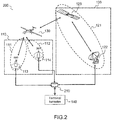
- the figure 2 illustrates a first embodiment of a telecommunications network 200 comprising several access networks from and to a mobile terminal 130 according to the invention.
- the various access gateways 113, 114 and 122 are directly connected to a gateway called hybridization gateway 210.
- the hybridization gateway is directly connected to the various access networks and to the mobile terminal 130. It is a single access point to each of the access networks, and implements in real time the functions traditionally specific to each of these access networks.
- the hybridization gateway is connected to each of the access gateways 113, 114 and 121, through point-to-point connections, or IP networks. Each of these links is made using separate ports. In this way, switching from one network to another is done instantly from the hybridization station, switching the port used to transmit the data. Contrary to the state of the art, the switchover does not depend on the convergence of the updating of the routing tables in the IP network. Failover is instantaneous and therefore introduces no latency.
- the hybridization gateway 210 performs the hybridization of the various systems at the level of the network layer and of the data link layer. It is in charge of the control and management of all access networks, the selection of the network (s) to be used for transmission, the implementation of the functions of the network layer, and the implementation. implement functions of the data link layer.
- Network control includes the allocation, release, and reallocation of resources on each of the communication systems, monitoring and analysis of variations in the quality of each of the access networks, signaling control, including the control of the modulation and coding schemes used, the control of mobility, and the control of redundancy.
- the mobility control being performed at the hybridization gateway it makes it possible to control the mobility within a communication system (such as for example the control of intra-cell mobility in a terrestrial communication system or intra satellite spot in a satellite communication system) but also between the different communication systems (such as between the terrestrial communication system 110 and the satellite communication system 120).
- a communication system such as for example the control of intra-cell mobility in a terrestrial communication system or intra satellite spot in a satellite communication system
- the different communication systems such as between the terrestrial communication system 110 and the satellite communication system 120.
- the hybridization gateway is also in charge of redundancy control.
- the packets can be duplicated between the two paths, so as to increase their probability of good reception, or transmitted using both paths, so as to reduce their latency.
- the control of redundancy also applies to the control of redundant devices, described by figure 3 .
- the selection of the network (s) to be used can be made according to information on the quality of the access networks, by means of QoS information feedback (acronym for Quality of Service, or quality of service), or on the basis of other criteria such as the geographical position of the mobile terminal, the availability of networks, or equipment failure.
- QoS information feedback ascronym for Quality of Service, or quality of service
- the hybridization gateway also performs network layer and data link layer functions.
- the 110 and 120 communication systems can use different frequencies, frequency bands, and communication standards, such as the DVB-T standard (acronym for Digital Video Broadcasting - Terrestrial) for the terrestrial system and the DVB-S standard. (acronym for DVB - Satellite) for the satellite system.
- DVB-T acronym for Digital Video Broadcasting - Terrestrial
- DVB-S acronym for DVB - Satellite
- the functions of the network layer consist in particular in making the adaptation between the IP network and the specific data link layer of the system (translation of the IP address into MAC address and translation of the classes of services), and are adapted to the standards of communication used.
- the functions of the data link layer are also adapted to the communication standard used. They include the splitting and encapsulation of the data into packets adapted to the physical layer, and the addition of signaling making it possible to reconstitute the data on reception. They also include the control functions of errors, for example according to the ARQ (acronym for Automatic Repeat reQuest) or H-ARQ (English term for Hybrid ARQ) methods, which make it possible to acknowledge the correct reception of data packets.
- ARQ acronym for Automatic Repeat reQuest
- H-ARQ English term for Hybrid ARQ
- the realization of the acknowledgment mechanisms by the hybridization gateway makes it possible, in the event of switchover from one network to another, to acknowledge on the new network the packets (in English LPDU for Link layer Packet Data Unit) in progress. 'acknowledgment on the previously used network. In this way, there is no loss of data, and therefore no re-transmissions necessary.
- the hybridization gateway performs the functions of planning data transmissions. These functions correspond to the management of the transmission instants, and the synchronization of the frames.
- the access gateways dedicated to each of the access networks perform the functions of the physical layer, including the encoding, modulation, and transmission of the packets routed by the hybridization gateway.
- the gateways can also implement the transmission instants planning functions, relating to the data link layer. .
- the invention therefore makes it possible to improve the availability and reliability of a communication system, since it makes it possible to switch from one network to another in a completely transparent manner for the end user, without modifying the latencies of the network, or packet loss.
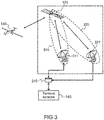
- the figure 3 illustrates a second embodiment of a telecommunications network comprising several access networks according to the invention.
- the telecommunications network 300 has two redundant satellite access networks 310 and 320, each including a satellite access gateway 311 and 321.
- the hybridization gateway 210 can switch instantly to the second gateway without loss of context or of data.
- the physical resources used (such as the frequency for example) being identical, the switchover is carried out transparently for the mobile terminal. This operating mode is particularly useful for satellite links, for which the availability of satellites 123 is low, and therefore particularly affected by loss of packets and retransmissions.
- the second embodiment, illustrated by figure 2 , and the third embodiment, illustrated by figure 3 can be implemented simultaneously in the same telecommunications network.
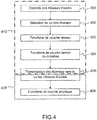
- the figure 4 illustrates an example of implementation of the method according to the invention for transmitting data from a user terminal 140 to a mobile terminal 130 in a hybrid telecommunications network comprising several distinct access networks to a mobile terminal.
- This method is intended to be implemented on real-time computing devices included in a hybridization gateway 210 as well as in each of the access gateways 113, 114 and 122. These devices can be various hardware and / or software elements. , such as for example computer programs or dedicated electronic circuits.
- the method can be executed by a reprogrammable computing machine (a processor or a microcontroller for example) executing a program comprising a sequence of instructions, or by a dedicated computing machine (for example a set of logic gates such as an FPGA or an ASIC, or any other hardware module).
- a reprogrammable computing machine a processor or a microcontroller for example
- a dedicated computing machine for example a set of logic gates such as an FPGA or an ASIC, or any other hardware module.
- the method consists in carrying out a first step 401 for controlling all of the access networks by the hybridization gateway.
- this control comprises at least the management of the radio resources of each of the communication systems, the supervision of the signaling, and in particular of the quality and availability of the various links, the management of the mobility, and the management of the communication. redundancy.
- a second step 402 for selecting the access network (s) to be used is carried out by the hybridization gateway. This step is based on the supervision of the signaling carried out during step 401.
- a third step 403 of applying the functions of the network layer to the data received from a user terminal is performed by the hybridization gateway. This step is adapted according to the communication standards used by the access network (s) selected during step 402, and makes it possible to convert the data into layer 3 data.
- a fourth step 404 for applying the functions of the data link layer is performed by the hybridization gateway. This step is adapted as a function of the communication standards used by the access network (s) selected during step 402, and makes it possible to convert the layer 3 data into layer 2 data packets.
- a fifth step 405 of transmitting layer 2 data packets from the hybridization gateway to the access gateway (s) selected during step 402 is carried out.
- This step consists in sending the data through the hybridization gateway and in receiving them through the access gateway (s). If the link between the hybridization gateway and the access gateway (s) is an IP link, this step comprises the encapsulation of the layer 2 data packets in IP messages by the hybridization gateway, and the de- encapsulation of IP messages by the access gateway (s).
- a sixth step 406 for applying the functions of the physical layer is performed by the access gateway (s) selected during step 402 on the layer 2 data packets.
- This step comprises applying the different algorithms. layer, such as error correcting code, interleaving and modulation, and transmission over the radio link of layer 1 data packets.
- the hybridization gateway is therefore in charge of executing steps 410 comprising steps 401, 402, 403, 404 and transmitting the data from step 405.
- the access gateways are therefore in charge of executing steps 420 including receiving the data from step 405, and step 406.
- the implementation of the method according to the invention for transmitting data from a mobile terminal 130 to a user terminal 140 repeats steps 401 and 402 performed by the hybridization gateway, and successively executes the mirror operations of steps 406, 405, 404 and 403.
Landscapes
- Engineering & Computer Science (AREA)
- Computer Networks & Wireless Communication (AREA)
- Signal Processing (AREA)
- Physics & Mathematics (AREA)
- Astronomy & Astrophysics (AREA)
- Aviation & Aerospace Engineering (AREA)
- General Physics & Mathematics (AREA)
- Mobile Radio Communication Systems (AREA)
- Radio Relay Systems (AREA)
Claims (17)
- Gateway (210), genannt Hybridisierungs-Gateway, bestimmt zur bidirektionalen Übertragung von Daten mit einem mobilen Endgerät (130) in einem Telekommunikationsnetz (200), beinhaltend mindestens zwei unterschiedliche Zugangsnetze (111, 112, 121) zum mobilen Endgerät, wobei das Hybridisierungs-Gateway konfiguriert ist, um einen Zugangspunkt zu jedem der Zugangsnetze zu bilden, und um mindestens Folgendes auszuführen:• Kontrollfunktionen für sämtliche Zugangsnetze,• Auswahlfunktionen des oder der für die Datenübertragung an das mobile Endgerät zu verwendenden Zugangsnetze(s),wobei das Hybridisierungs-Gateway dadurch gekennzeichnet ist, dass es zudem konfiguriert ist, um Folgendes auszuführen:• sämtliche Netzwerkschichtfunktionen der Datenübertragung, angepasst an das oder die ausgewählte(n) Zugangsnetz(e), und• sämtliche Datenverbindungsschichtfunktionen der Datenübertragung, angepasst an das oder die ausgewählte(n) Zugangsnetz(e).
- Hybridisierungs-Gateway nach Anspruch 1, bei welchem:• die ausgeführten Netzwerkfunktionen es ermöglichen, die zu übertragenen Daten in Daten der Schicht 3 zu konvertieren, angepasst an das oder die ausgewählte(n) Zugangsnetz(e),• die ausgeführten Datenverbindungsschichtfunktionen es ermöglichen, die Daten der Schicht 3 in Datenpakete der Schicht 2 zu konvertieren, angepasst an das oder die ausgewählte(n) Zugangsnetz(e).
- Hybridisierungs-Gateway nach einem der vorhergehenden Ansprüche, bei welchem die Kontrollfunktionen sämtlicher Zugangsnetze Folgendes beinhalten:• Zuweisung von Funkressourcen an jedes der Zugangsnetze,• Kontrolle der Funkverbindungen eines jeden der Zugangsnetze,• Kontrolle der Signalisierung eines jeden der Zugangsnetze,• Kontrolle der Mobilität des mobilen Endgerätes innerhalb des Telekommunikationsnetzwerkes (200), und• Kontrolle der Redundanz der zur Datenübertragung zu verwendenden Zugangsnetze.
- Hybridisierungs-Gateway nach einem der vorhergehenden Ansprüche, bei welchem die Datenverbindungsschichtfunktionen Folgendes beinhalten:• Verkapselungsfunktionen der Daten,• Kontrollfunktionen der Übertragungsfehler an jedes der Zugangsnetze und• Planungsfunktionen der Datenübertragungen.
- Hybridisierungs-Gateway nach einem der vorhergehenden Ansprüche, bei welchem die Datenverbindungsschichtfunktionen, welche durch das Hybridisierungs-Gateway umgesetzt werden, die Kontrolle der Übertragungsfehler an jedem der Zugangsnetze beinhalten, wobei das Hybridisierungs-Gateway konfiguriert ist, um beim Umschalten zwischen zwei Zugangsnetzen am neuen Netz die im vorherigen Netz in Quittierung begriffenen Daten zu quittieren.
- Bidirektionales Datenübertragungssystem mit einem mobilen Endgerät (130) in einem Telekommunikationsnetz (200), beinhaltend mindestens zwei unterschiedliche Zugangsnetze (111, 112, 121) zu dem mobilen Endgerät, dadurch gekennzeichnet, dass es mindestens ein Hybridisierungs-Gateway (210) nach einem der vorhergehenden Ansprüche beinhaltet, und dadurch, dass jedes der Zugangsnetze mindestens ein Zugangs-Gateway (113, 114, 122) beinhaltet, welches konfiguriert ist, um mindestens Funktionen der physischen Schicht der Datenübertragung auszuführen.
- Datenübertragungssystem nach Anspruch 6, bei welchem die Zugangs-Gateways (113, 114, 122) konfiguriert sind, zudem Planungsfunktionen der Datenübertragungen auszuführen.
- Datenübertragungssystem nach einem der Ansprüche 6 bis 7, bei welchem mindestens eines der Zugangsnetze (121) ein Satellitennetz ist.
- Datenübertragungssystem nach einem der Ansprüche 6 bis 8, bei welchem mindestens eines der Zugangsnetze (111, 112) ein terrestrisches Netz ist.
- Datenübertragungssystem nach einem der Ansprüche 6 bis 9, bei welchem das mobile Endgerät (130) an Bord einer Drohne mitgeführt wird.
- Datenübertragungssystem nach einem der Ansprüche 7 bis 10, bei welchem mindestens zwei der Zugangsnetze (113, 114, 122) unterschiedliche Kommunikationsstandards verwenden.
- Datenübertragungssystem nach einem der Ansprüche 6 bis 11, bei welchem die Zugangs-Gateways (113, 114, 122) konfiguriert sind, um dem Hybridisierungs-Gateway (210) Informationen zur Qualität der Zugangsnetze bereitzustellen, zu welchen sie gehören.
- Bidirektionales Datenübertragungsverfahren mit einem mobilen Endgerät in einem Telekommunikationsnetz, beinhaltend mindestens zwei unterschiedliche Zugangsnetze zum mobilen Endgerät und ein Hybridisierungs-Gateway, das einen Zugangspunkt zu jedem der Zugangsnetze bildet, wobei die Zugangsnetze jeweils mindestens ein Zugangs-Gateway beinhalten, wobei das Datenübertragungsverfahren mindestens folgende Schritte beinhaltet:• Kontrolle (401), durch das Hybridisierungs-Gateway, sämtlicher Zugangsnetze, und• Auswahl (402), durch das Hybridisierungs-Gateway, des oder der für die Datenübertragung zu verwendenden Zugangsnetze(s),wobei das Datenübertragungsverfahren dadurch gekennzeichnet ist, dass es zudem, bei der Datenübertragung an das mobile Endgerät, mindestens folgende Schritte beinhaltet:• Umsetzung (403), durch das Hybridisierungs-Gateway, sämtlicher Funktionen der Netzwerkschicht, angepasst an das oder die ausgewählte(n) Zugangsnetz(e), an den zu übertragenden Daten, zum Erzielen der Daten der Schicht 3,• Umsetzung (404), durch das Hybridisierungs-Gateway, sämtlicher Datenverbindungsschichtfunktionen, angepasst an das oder die ausgewählte(n) Zugangsnetz(e), an den Daten der Schicht 3, zum Erzielen der Datenpakete der Schicht 2,• Übertragung (405) der Datenpakete der Schicht 2 an das oder die ausgewählte(n) Zugangsnetz(e), und• Umsetzung (406), durch jedes der Zugangs-Gateways des oder der ausgewählten Zugangsnetze(s), der Funktionen der physischen Schicht, zum Erzielen der Datenpakete der Schicht 1, welche von den Zugangs-Gateways ausgesendet werden,und dadurch, dass es bei der Datenübertragung von dem mobilen Endgerät mindestens folgende Schritte beinhaltet:• Empfang von Datenpaketen der Schicht 1, durch jedes der Zugangs-Gateways des oder der ausgewählten Zugangsnetze(s), und Umsetzung der Funktionen der physischen Schicht, zum Erzielen der Datenpakete der Schicht 2,• Übertragung der Datenpakete der Schicht 2 an das Hybridisierungs-Gateway,• Umsetzung, durch das Hybridisierungs-Gateway, der Datenverbindungsschichtfunktionen, angepasst an das oder die ausgewählte(n) Zugangsnetz(e), an den Datenpaketen der Schicht 2, zum Erzielen der Daten der Schicht 3, und• Umsetzung, durch das Hybridisierungs-Gateway, der Funktionen der Netzwerkschicht, angepasst an das oder die ausgewählte(n) Zugangsnetz(e), an den zu übertragenden Daten.
- Datenübertragungsverfahren nach Anspruch 13, bei welchem mindestens eines der Zugangsnetze (121) ein Satellitennetz ist.
- Datenübertragungsverfahren nach einem der Ansprüche 13 und 14, bei welchem mindestens eines der Zugangsnetze (111, 112) ein terrestrisches Netz ist.
- Datenübertragungsverfahren nach einem der Ansprüche 13 bis 15, bei welchem das mobile Endgerät (130) an Bord einer Drohne mitgeführt wird.
- Datenübertragungsverfahren nach einem der Ansprüche 13 bis 16, bei welchem mindestens zwei der Zugangsnetze (113, 114, 122) unterschiedliche Kommunikationsstandards verwenden.
Applications Claiming Priority (1)
| Application Number | Priority Date | Filing Date | Title |
|---|---|---|---|
| FR1402968A FR3030992B1 (fr) | 2014-12-23 | 2014-12-23 | Systeme et procede de transmission de donnees utilisant conjointement une liaison terrestre et une liaison satellitaire |
Publications (2)
| Publication Number | Publication Date |
|---|---|
| EP3038430A1 EP3038430A1 (de) | 2016-06-29 |
| EP3038430B1 true EP3038430B1 (de) | 2020-11-11 |
Family
ID=53177523
Family Applications (1)
| Application Number | Title | Priority Date | Filing Date |
|---|---|---|---|
| EP15201678.8A Active EP3038430B1 (de) | 2014-12-23 | 2015-12-21 | Datenübertragungssystem und -verfahren, die gleichzeitig eine land- und eine satellitenverbindung nutzen |
Country Status (5)
| Country | Link |
|---|---|
| US (1) | US20160182111A1 (de) |
| EP (1) | EP3038430B1 (de) |
| CA (1) | CA2915857C (de) |
| ES (1) | ES2846101T3 (de) |
| FR (1) | FR3030992B1 (de) |
Families Citing this family (5)
| Publication number | Priority date | Publication date | Assignee | Title |
|---|---|---|---|---|
| US10694455B2 (en) * | 2017-06-29 | 2020-06-23 | Ayla Networks, Inc. | Connectivity state optimization to devices in a mobile environment |
| CN113300751B (zh) * | 2020-02-21 | 2022-07-22 | 大唐移动通信设备有限公司 | 移动信关站、通信卫星、低轨卫星通信系统及使用方法 |
| CN114793130A (zh) * | 2021-08-16 | 2022-07-26 | 航天时代飞鹏有限公司 | 一种大型无人运输机超视距语音对话方法 |
| CN113904977A (zh) * | 2021-10-13 | 2022-01-07 | 中国电信股份有限公司 | 多链路网关数据传输方法、装置、电子设备和可读介质 |
| CN115802430B (zh) * | 2022-10-31 | 2023-09-22 | 航天科工空间工程网络技术发展(杭州)有限公司 | 基于移动性切换链路网关的方法、卫星网络系统及介质 |
Citations (1)
| Publication number | Priority date | Publication date | Assignee | Title |
|---|---|---|---|---|
| US20100296497A1 (en) * | 2009-05-22 | 2010-11-25 | Jeyhan Karaoguz | Hybrid network controller for femtocells and access points |
Family Cites Families (9)
| Publication number | Priority date | Publication date | Assignee | Title |
|---|---|---|---|---|
| NL1014294C2 (nl) * | 2000-02-04 | 2001-08-07 | Ocu Technologies B V | Smeltinrichting en een inkjetprinter voorzien van een dergelijke smeltinrichting. |
| EP1335530A1 (de) * | 2002-02-12 | 2003-08-13 | Evolium S.A.S. | Verfahren zur Bereitstellung Makro-Diversity für Zweimoden- Funkkommunikationsendegerät |
| US20140105129A1 (en) * | 2008-12-16 | 2014-04-17 | Orange Sa | Packet radio communications system |
| US7969930B2 (en) * | 2006-11-30 | 2011-06-28 | Kyocera Corporation | Apparatus, system and method for managing wireless local area network service based on a location of a multi-mode portable communication device |
| WO2010113267A1 (ja) * | 2009-03-31 | 2010-10-07 | 富士通株式会社 | 無線通信ネットワークにおける中継局、基地局、中継方法、及び通信方法 |
| US9276663B2 (en) * | 2009-04-17 | 2016-03-01 | Viasat, Inc. | Layer-2 connectivity from switch to access node/gateway |
| US8750266B2 (en) * | 2009-11-25 | 2014-06-10 | Alcatel Lucent | Dual transmission for communication networks |
| GB2514057B (en) * | 2012-12-12 | 2020-12-23 | Pismo Labs Technology Ltd | Method and system to reduce wireless network packets for centralized layer two network |
| US20160050011A1 (en) * | 2014-08-18 | 2016-02-18 | Sunlight Photonics Inc. | Distributed airborne communication systems |
-
2014
- 2014-12-23 FR FR1402968A patent/FR3030992B1/fr not_active Expired - Fee Related
-
2015
- 2015-12-18 US US14/975,163 patent/US20160182111A1/en not_active Abandoned
- 2015-12-21 CA CA2915857A patent/CA2915857C/en active Active
- 2015-12-21 ES ES15201678T patent/ES2846101T3/es active Active
- 2015-12-21 EP EP15201678.8A patent/EP3038430B1/de active Active
Patent Citations (1)
| Publication number | Priority date | Publication date | Assignee | Title |
|---|---|---|---|---|
| US20100296497A1 (en) * | 2009-05-22 | 2010-11-25 | Jeyhan Karaoguz | Hybrid network controller for femtocells and access points |
Also Published As
| Publication number | Publication date |
|---|---|
| ES2846101T3 (es) | 2021-07-28 |
| CA2915857C (en) | 2023-10-31 |
| EP3038430A1 (de) | 2016-06-29 |
| FR3030992B1 (fr) | 2016-12-23 |
| BR102015032269A8 (pt) | 2021-09-21 |
| BR102015032269A2 (pt) | 2016-08-09 |
| CA2915857A1 (en) | 2016-06-23 |
| US20160182111A1 (en) | 2016-06-23 |
| FR3030992A1 (fr) | 2016-06-24 |
Similar Documents
| Publication | Publication Date | Title |
|---|---|---|
| Darwish et al. | LEO satellites in 5G and beyond networks: A review from a standardization perspective | |
| EP3782337B1 (de) | Aufrechterhaltung und verteilung eines zustands aufgrund von vorübergehenden ausfällen in einem netzwerk mit gemeinsam genutzter bandbreite | |
| US12597990B2 (en) | Systems and method for 5G-based non-geostationary satellite systems (NGSOs) with inter-satellite links | |
| Marsch et al. | 5G System Design | |
| EP3038430B1 (de) | Datenübertragungssystem und -verfahren, die gleichzeitig eine land- und eine satellitenverbindung nutzen | |
| US20220141685A1 (en) | Method and system for enabling low-latency data communication by aggregating a plurality of network interfaces | |
| CN116827420A (zh) | 卫星数据管理方法、装置、设备及存储介质 | |
| US11228946B2 (en) | Communication method and device | |
| US20250080214A1 (en) | Dynamic cu-du association in non-terrestrial networks with non-transparent satellites | |
| EP3247149A1 (de) | Sanftes umschaltverfahren zu einer vielzahl von zugangsstationen, das in einem räumlichen telekommunikationssystem umgesetzt wird | |
| EP3038275A1 (de) | Verfahren zur signalsynchronisierung in einer satelliten- und bodenverbindung, und entsprechende architektur | |
| US12375988B2 (en) | Low latency schedule-driven handovers | |
| JP2019205156A (ja) | バーチャルルーティングエリア(vra)を使用した非静止軌道(ngso)システムのためのモバイルルーティング | |
| WO2024012378A1 (zh) | 一种通信方法及装置 | |
| CN117835226A (zh) | 一种被用于无线通信的方法和设备 | |
| Rigano et al. | Mitigating naval network instabilities with disruption toler | |
| WO2025049526A1 (en) | Resource-efficient multicast in non-terrestrial networks with non-transparent satellites | |
| AU2016301035A1 (en) | Method for discovering a node of an ad hoc network | |
| CN114095873A (zh) | 一种被用于无线通信的节点中的方法和装置 | |
| US20260019815A1 (en) | Resource management for radio access network utilizing virtualized distributed units | |
| CN115567986B (zh) | 基于负载均衡的通信网络 | |
| Pencheva et al. | 5G System Support for Mission Critical Communications | |
| WO2025049530A1 (en) | Dynamic cu-du association in non-terrestrial networks with non-transparent satellites | |
| Nguyen et al. | Network of networks for the Tactile Internet | |
| Lee et al. | File transfer framework with multipath transfer in heterogeneous networks for disaster recovery |
Legal Events
| Date | Code | Title | Description |
|---|---|---|---|
| PUAI | Public reference made under article 153(3) epc to a published international application that has entered the european phase |
Free format text: ORIGINAL CODE: 0009012 |
|
| AK | Designated contracting states |
Kind code of ref document: A1 Designated state(s): AL AT BE BG CH CY CZ DE DK EE ES FI FR GB GR HR HU IE IS IT LI LT LU LV MC MK MT NL NO PL PT RO RS SE SI SK SM TR |
|
| AX | Request for extension of the european patent |
Extension state: BA ME |
|
| STAA | Information on the status of an ep patent application or granted ep patent |
Free format text: STATUS: REQUEST FOR EXAMINATION WAS MADE |
|
| 17P | Request for examination filed |
Effective date: 20161202 |
|
| RBV | Designated contracting states (corrected) |
Designated state(s): AL AT BE BG CH CY CZ DE DK EE ES FI FR GB GR HR HU IE IS IT LI LT LU LV MC MK MT NL NO PL PT RO RS SE SI SK SM TR |
|
| STAA | Information on the status of an ep patent application or granted ep patent |
Free format text: STATUS: EXAMINATION IS IN PROGRESS |
|
| 17Q | First examination report despatched |
Effective date: 20170411 |
|
| GRAP | Despatch of communication of intention to grant a patent |
Free format text: ORIGINAL CODE: EPIDOSNIGR1 |
|
| STAA | Information on the status of an ep patent application or granted ep patent |
Free format text: STATUS: GRANT OF PATENT IS INTENDED |
|
| RIC1 | Information provided on ipc code assigned before grant |
Ipc: H04B 7/185 20060101ALI20190605BHEP Ipc: H04W 88/16 20090101AFI20190605BHEP |
|
| INTG | Intention to grant announced |
Effective date: 20190627 |
|
| GRAJ | Information related to disapproval of communication of intention to grant by the applicant or resumption of examination proceedings by the epo deleted |
Free format text: ORIGINAL CODE: EPIDOSDIGR1 |
|
| STAA | Information on the status of an ep patent application or granted ep patent |
Free format text: STATUS: EXAMINATION IS IN PROGRESS |
|
| INTC | Intention to grant announced (deleted) | ||
| GRAS | Grant fee paid |
Free format text: ORIGINAL CODE: EPIDOSNIGR3 |
|
| STAA | Information on the status of an ep patent application or granted ep patent |
Free format text: STATUS: GRANT OF PATENT IS INTENDED |
|
| GRAP | Despatch of communication of intention to grant a patent |
Free format text: ORIGINAL CODE: EPIDOSNIGR1 |
|
| INTG | Intention to grant announced |
Effective date: 20191205 |
|
| GRAA | (expected) grant |
Free format text: ORIGINAL CODE: 0009210 |
|
| STAA | Information on the status of an ep patent application or granted ep patent |
Free format text: STATUS: THE PATENT HAS BEEN GRANTED |
|
| AK | Designated contracting states |
Kind code of ref document: B1 Designated state(s): AL AT BE BG CH CY CZ DE DK EE ES FI FR GB GR HR HU IE IS IT LI LT LU LV MC MK MT NL NO PL PT RO RS SE SI SK SM TR |
|
| REG | Reference to a national code |
Ref country code: GB Ref legal event code: FG4D Free format text: NOT ENGLISH |
|
| REG | Reference to a national code |
Ref country code: CH Ref legal event code: EP |
|
| REG | Reference to a national code |
Ref country code: AT Ref legal event code: REF Ref document number: 1334681 Country of ref document: AT Kind code of ref document: T Effective date: 20201115 |
|
| REG | Reference to a national code |
Ref country code: DE Ref legal event code: R096 Ref document number: 602015061802 Country of ref document: DE |
|
| REG | Reference to a national code |
Ref country code: IE Ref legal event code: FG4D Free format text: LANGUAGE OF EP DOCUMENT: FRENCH |
|
| REG | Reference to a national code |
Ref country code: NL Ref legal event code: MP Effective date: 20201111 |
|
| REG | Reference to a national code |
Ref country code: AT Ref legal event code: MK05 Ref document number: 1334681 Country of ref document: AT Kind code of ref document: T Effective date: 20201111 |
|
| PG25 | Lapsed in a contracting state [announced via postgrant information from national office to epo] |
Ref country code: FI Free format text: LAPSE BECAUSE OF FAILURE TO SUBMIT A TRANSLATION OF THE DESCRIPTION OR TO PAY THE FEE WITHIN THE PRESCRIBED TIME-LIMIT Effective date: 20201111 Ref country code: RS Free format text: LAPSE BECAUSE OF FAILURE TO SUBMIT A TRANSLATION OF THE DESCRIPTION OR TO PAY THE FEE WITHIN THE PRESCRIBED TIME-LIMIT Effective date: 20201111 Ref country code: NO Free format text: LAPSE BECAUSE OF FAILURE TO SUBMIT A TRANSLATION OF THE DESCRIPTION OR TO PAY THE FEE WITHIN THE PRESCRIBED TIME-LIMIT Effective date: 20210211 Ref country code: PT Free format text: LAPSE BECAUSE OF FAILURE TO SUBMIT A TRANSLATION OF THE DESCRIPTION OR TO PAY THE FEE WITHIN THE PRESCRIBED TIME-LIMIT Effective date: 20210311 Ref country code: GR Free format text: LAPSE BECAUSE OF FAILURE TO SUBMIT A TRANSLATION OF THE DESCRIPTION OR TO PAY THE FEE WITHIN THE PRESCRIBED TIME-LIMIT Effective date: 20210212 |
|
| PG25 | Lapsed in a contracting state [announced via postgrant information from national office to epo] |
Ref country code: IS Free format text: LAPSE BECAUSE OF FAILURE TO SUBMIT A TRANSLATION OF THE DESCRIPTION OR TO PAY THE FEE WITHIN THE PRESCRIBED TIME-LIMIT Effective date: 20210311 Ref country code: PL Free format text: LAPSE BECAUSE OF FAILURE TO SUBMIT A TRANSLATION OF THE DESCRIPTION OR TO PAY THE FEE WITHIN THE PRESCRIBED TIME-LIMIT Effective date: 20201111 Ref country code: SE Free format text: LAPSE BECAUSE OF FAILURE TO SUBMIT A TRANSLATION OF THE DESCRIPTION OR TO PAY THE FEE WITHIN THE PRESCRIBED TIME-LIMIT Effective date: 20201111 Ref country code: LV Free format text: LAPSE BECAUSE OF FAILURE TO SUBMIT A TRANSLATION OF THE DESCRIPTION OR TO PAY THE FEE WITHIN THE PRESCRIBED TIME-LIMIT Effective date: 20201111 Ref country code: BG Free format text: LAPSE BECAUSE OF FAILURE TO SUBMIT A TRANSLATION OF THE DESCRIPTION OR TO PAY THE FEE WITHIN THE PRESCRIBED TIME-LIMIT Effective date: 20210211 Ref country code: AT Free format text: LAPSE BECAUSE OF FAILURE TO SUBMIT A TRANSLATION OF THE DESCRIPTION OR TO PAY THE FEE WITHIN THE PRESCRIBED TIME-LIMIT Effective date: 20201111 |
|
| REG | Reference to a national code |
Ref country code: LT Ref legal event code: MG9D |
|
| PG25 | Lapsed in a contracting state [announced via postgrant information from national office to epo] |
Ref country code: HR Free format text: LAPSE BECAUSE OF FAILURE TO SUBMIT A TRANSLATION OF THE DESCRIPTION OR TO PAY THE FEE WITHIN THE PRESCRIBED TIME-LIMIT Effective date: 20201111 |
|
| REG | Reference to a national code |
Ref country code: ES Ref legal event code: FG2A Ref document number: 2846101 Country of ref document: ES Kind code of ref document: T3 Effective date: 20210728 |
|
| PG25 | Lapsed in a contracting state [announced via postgrant information from national office to epo] |
Ref country code: LT Free format text: LAPSE BECAUSE OF FAILURE TO SUBMIT A TRANSLATION OF THE DESCRIPTION OR TO PAY THE FEE WITHIN THE PRESCRIBED TIME-LIMIT Effective date: 20201111 Ref country code: SK Free format text: LAPSE BECAUSE OF FAILURE TO SUBMIT A TRANSLATION OF THE DESCRIPTION OR TO PAY THE FEE WITHIN THE PRESCRIBED TIME-LIMIT Effective date: 20201111 Ref country code: RO Free format text: LAPSE BECAUSE OF FAILURE TO SUBMIT A TRANSLATION OF THE DESCRIPTION OR TO PAY THE FEE WITHIN THE PRESCRIBED TIME-LIMIT Effective date: 20201111 Ref country code: SM Free format text: LAPSE BECAUSE OF FAILURE TO SUBMIT A TRANSLATION OF THE DESCRIPTION OR TO PAY THE FEE WITHIN THE PRESCRIBED TIME-LIMIT Effective date: 20201111 Ref country code: EE Free format text: LAPSE BECAUSE OF FAILURE TO SUBMIT A TRANSLATION OF THE DESCRIPTION OR TO PAY THE FEE WITHIN THE PRESCRIBED TIME-LIMIT Effective date: 20201111 Ref country code: CZ Free format text: LAPSE BECAUSE OF FAILURE TO SUBMIT A TRANSLATION OF THE DESCRIPTION OR TO PAY THE FEE WITHIN THE PRESCRIBED TIME-LIMIT Effective date: 20201111 |
|
| REG | Reference to a national code |
Ref country code: CH Ref legal event code: PL |
|
| REG | Reference to a national code |
Ref country code: DE Ref legal event code: R097 Ref document number: 602015061802 Country of ref document: DE |
|
| PG25 | Lapsed in a contracting state [announced via postgrant information from national office to epo] |
Ref country code: DK Free format text: LAPSE BECAUSE OF FAILURE TO SUBMIT A TRANSLATION OF THE DESCRIPTION OR TO PAY THE FEE WITHIN THE PRESCRIBED TIME-LIMIT Effective date: 20201111 Ref country code: MC Free format text: LAPSE BECAUSE OF FAILURE TO SUBMIT A TRANSLATION OF THE DESCRIPTION OR TO PAY THE FEE WITHIN THE PRESCRIBED TIME-LIMIT Effective date: 20201111 |
|
| PLBE | No opposition filed within time limit |
Free format text: ORIGINAL CODE: 0009261 |
|
| STAA | Information on the status of an ep patent application or granted ep patent |
Free format text: STATUS: NO OPPOSITION FILED WITHIN TIME LIMIT |
|
| 26N | No opposition filed |
Effective date: 20210812 |
|
| PG25 | Lapsed in a contracting state [announced via postgrant information from national office to epo] |
Ref country code: AL Free format text: LAPSE BECAUSE OF FAILURE TO SUBMIT A TRANSLATION OF THE DESCRIPTION OR TO PAY THE FEE WITHIN THE PRESCRIBED TIME-LIMIT Effective date: 20201111 Ref country code: IE Free format text: LAPSE BECAUSE OF NON-PAYMENT OF DUE FEES Effective date: 20201221 Ref country code: NL Free format text: LAPSE BECAUSE OF FAILURE TO SUBMIT A TRANSLATION OF THE DESCRIPTION OR TO PAY THE FEE WITHIN THE PRESCRIBED TIME-LIMIT Effective date: 20201111 |
|
| PG25 | Lapsed in a contracting state [announced via postgrant information from national office to epo] |
Ref country code: SI Free format text: LAPSE BECAUSE OF FAILURE TO SUBMIT A TRANSLATION OF THE DESCRIPTION OR TO PAY THE FEE WITHIN THE PRESCRIBED TIME-LIMIT Effective date: 20201111 Ref country code: CH Free format text: LAPSE BECAUSE OF NON-PAYMENT OF DUE FEES Effective date: 20201231 Ref country code: LI Free format text: LAPSE BECAUSE OF NON-PAYMENT OF DUE FEES Effective date: 20201231 |
|
| PG25 | Lapsed in a contracting state [announced via postgrant information from national office to epo] |
Ref country code: IS Free format text: LAPSE BECAUSE OF FAILURE TO SUBMIT A TRANSLATION OF THE DESCRIPTION OR TO PAY THE FEE WITHIN THE PRESCRIBED TIME-LIMIT Effective date: 20210311 Ref country code: TR Free format text: LAPSE BECAUSE OF FAILURE TO SUBMIT A TRANSLATION OF THE DESCRIPTION OR TO PAY THE FEE WITHIN THE PRESCRIBED TIME-LIMIT Effective date: 20201111 Ref country code: MT Free format text: LAPSE BECAUSE OF FAILURE TO SUBMIT A TRANSLATION OF THE DESCRIPTION OR TO PAY THE FEE WITHIN THE PRESCRIBED TIME-LIMIT Effective date: 20201111 Ref country code: CY Free format text: LAPSE BECAUSE OF FAILURE TO SUBMIT A TRANSLATION OF THE DESCRIPTION OR TO PAY THE FEE WITHIN THE PRESCRIBED TIME-LIMIT Effective date: 20201111 |
|
| PG25 | Lapsed in a contracting state [announced via postgrant information from national office to epo] |
Ref country code: MK Free format text: LAPSE BECAUSE OF FAILURE TO SUBMIT A TRANSLATION OF THE DESCRIPTION OR TO PAY THE FEE WITHIN THE PRESCRIBED TIME-LIMIT Effective date: 20201111 |
|
| PGFP | Annual fee paid to national office [announced via postgrant information from national office to epo] |
Ref country code: DE Payment date: 20251119 Year of fee payment: 11 |
|
| PGFP | Annual fee paid to national office [announced via postgrant information from national office to epo] |
Ref country code: GB Payment date: 20251113 Year of fee payment: 11 |
|
| PGFP | Annual fee paid to national office [announced via postgrant information from national office to epo] |
Ref country code: IT Payment date: 20251126 Year of fee payment: 11 |
|
| PGFP | Annual fee paid to national office [announced via postgrant information from national office to epo] |
Ref country code: LU Payment date: 20251215 Year of fee payment: 11 Ref country code: FR Payment date: 20251124 Year of fee payment: 11 |
|
| PGFP | Annual fee paid to national office [announced via postgrant information from national office to epo] |
Ref country code: BE Payment date: 20251117 Year of fee payment: 11 |
|
| PGFP | Annual fee paid to national office [announced via postgrant information from national office to epo] |
Ref country code: ES Payment date: 20260115 Year of fee payment: 11 |