EP3040280A1 - Verfahren und System zur Luftbetankung - Google Patents
Verfahren und System zur Luftbetankung Download PDFInfo
- Publication number
- EP3040280A1 EP3040280A1 EP14382579.2A EP14382579A EP3040280A1 EP 3040280 A1 EP3040280 A1 EP 3040280A1 EP 14382579 A EP14382579 A EP 14382579A EP 3040280 A1 EP3040280 A1 EP 3040280A1
- Authority
- EP
- European Patent Office
- Prior art keywords
- drag
- drogue
- refuelling
- probe
- hose
- Prior art date
- Legal status (The legal status is an assumption and is not a legal conclusion. Google has not performed a legal analysis and makes no representation as to the accuracy of the status listed.)
- Withdrawn
Links
- 238000000034 method Methods 0.000 title claims abstract description 35
- 239000000523 sample Substances 0.000 claims abstract description 74
- 230000008878 coupling Effects 0.000 claims abstract description 45
- 238000010168 coupling process Methods 0.000 claims abstract description 45
- 238000005859 coupling reaction Methods 0.000 claims abstract description 45
- 238000009987 spinning Methods 0.000 claims description 3
- 238000013459 approach Methods 0.000 abstract description 8
- 230000008901 benefit Effects 0.000 description 5
- 230000001276 controlling effect Effects 0.000 description 4
- 238000001514 detection method Methods 0.000 description 4
- 230000008569 process Effects 0.000 description 4
- 239000000446 fuel Substances 0.000 description 3
- 230000003068 static effect Effects 0.000 description 3
- 238000003780 insertion Methods 0.000 description 2
- 230000037431 insertion Effects 0.000 description 2
- 238000011084 recovery Methods 0.000 description 2
- 230000009471 action Effects 0.000 description 1
- 230000008859 change Effects 0.000 description 1
- 230000000052 comparative effect Effects 0.000 description 1
- 230000001143 conditioned effect Effects 0.000 description 1
- 230000001419 dependent effect Effects 0.000 description 1
- 238000006073 displacement reaction Methods 0.000 description 1
- 230000007613 environmental effect Effects 0.000 description 1
- 230000004048 modification Effects 0.000 description 1
- 238000012986 modification Methods 0.000 description 1
- 230000001105 regulatory effect Effects 0.000 description 1
- 230000000630 rising effect Effects 0.000 description 1
- 238000012549 training Methods 0.000 description 1
- 238000012546 transfer Methods 0.000 description 1
Images

Classifications
-
- B—PERFORMING OPERATIONS; TRANSPORTING
- B64—AIRCRAFT; AVIATION; COSMONAUTICS
- B64D—EQUIPMENT FOR FITTING IN OR TO AIRCRAFT; FLIGHT SUITS; PARACHUTES; ARRANGEMENT OR MOUNTING OF POWER PLANTS OR PROPULSION TRANSMISSIONS IN AIRCRAFT
- B64D39/00—Refuelling during flight
-
- B—PERFORMING OPERATIONS; TRANSPORTING
- B64—AIRCRAFT; AVIATION; COSMONAUTICS
- B64D—EQUIPMENT FOR FITTING IN OR TO AIRCRAFT; FLIGHT SUITS; PARACHUTES; ARRANGEMENT OR MOUNTING OF POWER PLANTS OR PROPULSION TRANSMISSIONS IN AIRCRAFT
- B64D39/00—Refuelling during flight
- B64D39/04—Adaptations of hose construction
Definitions
- the present invention belongs to the field of air to air refuelling, in particular to the field of improving the connection probe-drogue.
- Air to air refuelling is a very complex operation, as both the tanker and the receiver aircraft are flying, and this fact raises a great amount of circumstances that may disturb the positioning of said aircrafts: speed of aircrafts, swirls, clouds, etc. Further, the extremely narrow tolerance allowed in this operation makes it quite delicate.
- a tanker aircraft comprises a hose to provide fuel to a receiver aircraft.
- a drogue is attached at the end of the hose comprising a coupling element that is connected to a probe comprised in the receiving aircraft. Refuelling operations with the hose & drogue method involve several phases:
- the drogue comprises a canopy, which provides aerodynamic force.
- a low-speed drogue or a high-speed drogue will be chosen to provide the required drag in the hose standby stage.
- Some systems aim to modify the shape of the canopy of the drogue to use the same drogue in both scenarios, but they are not actively controlled neither provide a drag adjustment on demand.
- the drogue may be damaged, either by the probe impact in the contact phase, if the receiver aircraft is not very careful in this stage, or during the contact stage, because the probe, when being inserted in the drogue, causes the hose to lose tension and, due to the drum trend to keep the hose taut, causes a whiplash wave that may result in damaging or even breaking the probe.
- a damaged drogue may produce aerodynamic instabilities that may prevent the hose from being recovered.
- the present invention provides an alternative solution for the aforementioned problems, by a method for air to air refuelling according to claim 1, a drogue according to claim 7, and a refuelling system according to claim 10.
- a method for air to air refuelling according to claim 1 a method for air to air refuelling according to claim 1, a drogue according to claim 7, and a refuelling system according to claim 10.
- preferred embodiments of the invention are defined.
- the invention provides a refuelling method for being used in refuelling operations by a refuelling system from a tanker aircraft, the refuelling system comprising, a hose, a drogue further comprising, a drogue canopy, and a variable drag device, the method comprising the step of actuating actively on the drag device, varying the total drag, being the total drag the sum of the drag from the drag device and the drag from the drogue canopy, by varying the drag caused by said drag device .
- variable drag device is suitable for being actively controlled during one of the steps of a refuelling operation.
- control of said total drag D allows the refuelling operation to be performed in a more effective way, in order to achieve a better coupling between the two aircraft involved. Furthermore, the active control of the drag device, during the refuelling method allows achieving the sufficient drag for the operation to be completed with a smaller drogue canopy than those used in the state of the art for the same operation.
- the drag of the drogue canopy, D drogue canopy depends on the canopy's geometry, therefore it may be considered a fixed value during the refuelling operation. This drag value shall vary when the canopy is replaced by a canopy with different geometric characteristics.
- the refuelling method further comprises a step of coupling, for connecting the drogue to a probe, which comprises actuating on the drag device for achieving a maximum total drag.
- this method is a new way of performing the contact operation in which the receiver aircraft may remain stationary or moving forward at very low relative speed with respect to the hose, different from current state of the art that requires that the receiver's probe to hit the hose drogue or coupling with an important relative speed to achieve locking.
- Said movement of the receiver aircraft can be achieved at low relative speed as the actuation on the drag device allows the total drag to increase considerably, causing the movement of the drogue which results in its coupling to the receiver's probe.
- the refuelling method further comprises, before the step of coupling, a step of detecting the presence of the probe of a receiving aircraft entering the drogue.
- the detection of the probe when said probe is entering the drogue allows the total drag to be adjusted in order to have the appropriate value to produce the movement of the drogue which ensures the coupling between hose and probe.
- the refuelling system further comprises a probe sensor
- the refuelling method comprises a step of detecting the presence of a probe by means of the probe sensor.
- the probe sensor allows the step of detection to be fulfilled in a more reliable way, furthermore allowing the variation of the drag produced by the drag device, and therefore of the total drag, D, in order to be adjusted to the real value of total drag needed.
- the probe sensor detects the probe once said probe is located inside the drogue canopy, in the vicinity of the coupling member, then fulfilling the variation of the total drag D.
- This method avoids the hit between the drogue canopy and the probe, therefore avoiding the damage of the drogue canopy. If the probe is misaligned with the principal axis, common both for the hose and the drogue, the lecture of the probe sensor will not allow the drag device to produce drag, so the movement of the drogue towards the probe will not happen, thus avoiding any contact between the probe and the drogue canopy.
- the refuelling method comprises actuating on the drag device by means of a drag controller:
- the actuation of the drag controller in a programmed way at any time provides the control of the total drag in a constant way when performing a refuelling operation.
- Said program considers both environmental conditions as well as the position lecture of the sensor, or only said lecture of the sensor.
- the actuation of the drag controller depending on the probe sensor of the refuelling system allows the total drag to be controlled in a more efficient way, as it is regulated depending on the position of both aircrafts and the conditions of the atmosphere.
- the actuation can also be performed both by a program at any time of the refuelling operation, along with the variable conditions of said operation as described before, and which are known to the system by means of the probe sensor. This combined actuation allows the drag device to be controlled by the drag controller both in a constant and efficient way.
- a smaller drogue canopy can be used thanks to the drag controller, as it provides the additional drag needed when required at each refuelling phase by actuating the drag device.
- an increment of aerodynamic force on the drogue is needed to help the hose to be taken out from the hose drum.
- the coupling between the probe and the drogue can be performed acting on said drogue, instead of on the probe of the receiver, due to a drag rising carried out by the drag device throughout the drag controller. This possibility minimizes the possibility that a mechanical wave can travel through the hose because the hose vane is not shortened.
- the refuelling method further comprises a step where the drag device is not actuated, being the drag from the drag device zero and therefore causing the total drag to be minimum.
- the non-actuation on the drag device during part of the refuelling operation allows the drag from the drag device to be null, causing the total drag to be minimum, being the drag from the drogue canopy a dependant value of its geometry and therefore fixed during the refuelling operation.
- Said minimum value of the total drag is given by the fixed value of the drag of the drogue canopy, which can be therefore dimensioned in accordance to said minimum value.
- the drogue canopy is smaller in size than the canopies from the current state of the art, as the total drag needed for every step of the refuelling system is achieved by means of the active actuation of the drag device.
- the drogue is advantageously smaller and lower in weight.
- the invention provides a drogue, comprising a drogue canopy, a coupling member, a drag device and union means adapted to be coupled to a hose, the drogue adapted for being used in an air to air refuelling system of a receiver aircraft and also adapted for carrying out the steps of the preceding method .
- Said drogue comprises the elements affecting the total drag, being these the drogue canopy and the drag device.
- the drogue canopy is united to the hose by means of the coupling member throughout the union means.
- the drag device allows modifying the total drag by means of modifying its own aerodynamic drag, when actuated.
- the drogue comprises a drag device placed on the coupling member.
- placing said drag device on the coupling member allows the drag device to be independent from the drogue canopy, being therefore the total drag the sum of two independent values of drag, exerted in the same direction.
- the drogue is also adapted for actively varying the drag continuously during the refuelling operation.
- a continuous and active variation provides a reliable control of the drag from the drag assembly and therefore from the total drag.
- the invention provides a refuelling system comprising a hose and a drogue .
- the refuelling system comprises a hose and a drogue according to the drogue on the second inventive step.
- the addition of a drogue of said characteristics to an already known refuelling system allows said new system to perform the steps of the method already presented.
- the refuelling system comprises a probe sensor.
- the refuelling system comprises a probe sensor placed on the coupling member.
- placing a sensor on the coupling member allows the system to detect the insertion of the receiver's probe in the coupling member of the drogue and, based on that detection, an increase of the total drag will be generated throughout the drag device.
- the refuelling system further comprises a drag controller adapted to control the drag device of the drogue such that the drag controller controls the total drag.
- the drag controller will allow modification of the aerodynamic drag of the drag device, therefore modifying the total drag. This action is performed according to a command from the drag device control system included in the drag controller.
- the refuelling system further comprises a drag device of the drogue comprising a turbine, the spinning speed thereof being controlled by the drag controller, thus causing a total drag increase or decrease.
- a turbine not only allows controlling the drag from the drag device, and therefore the total drag, but also obtaining electric power to be used on electronic devices comprised on the refuelling system, for example, at the end of the hose.
- the refuelling system further comprises a drag device of the drogue comprising a frustoconical element adapted to be opened or closed, causing a total drag increase or decrease.
- said element allows controlling the drag from the drag device, and therefore the total drag.
- the frustoconical element presents an axial configuration, and is placed concentrically with the coupling member axis.
- Said element arranges an axially displaceable cone which modifies the total drag by modifying the outlet area of the aerodynamic current passing through a cylindrical fairing.
- the refuelling system further comprises a drag device of the drogue comprising a plurality of spoilers adapted to be opened or closed with circular symmetry, causing a total drag increase or decrease.
- said element allows controlling the drag from the drag device, and therefore the total drag.
- the spoilers are configured as variable angle petal deflectors.
- the refuelling system further comprises the drogue further comprising a coupling member with a probe sensor, and the drag device of the drogue is adapted to provide energy to at least one of the drag controller and the probe sensor.
- the drag device's configuration can provide electric power to be used on electronic devices comprised on the refuelling system, such as the drag controller and the probe sensor.
- obtaining said needed power from the drag device avoids generating it on any other aircraft system, therefore allowing the drogue to be self-sustaining.
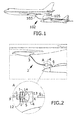
- Figure 1 presents a refuelling system (102) known in the state of art.
- This refuelling system (102) comprises a hose (103), a drogue (104) and a probe (105).
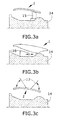
- FIG 2 shows a refuelling system (2) comprising a drag device (1) according to an embodiment of the invention.
- the refuelling system (2) comprises a hose (3) and a drogue (4).
- the detailed view A in Figure 2 shows a drogue (4) according to an embodiment of the invention, said drogue (4) comprising a drogue canopy (13), said drag device (1) and a coupling member (14) with a probe sensor (5).
- the drogue (4) further comprises union means (12) which are located between the hose (3) and the coupling member (14).
- the union means (12) allow the drogue (4) throughout the coupling member (14) to be united to the hose (3).
- the union means (12) are, for example, a ball and socket joint.
- the coupling member (14) along with the probe sensor (5) located on it are protected by a fairing.
- the drogue (4) further comprises a drag controller (not shown) which allows controlling the drag device (1) in a way that said drag controller is adapted to cause the drag produced by the drag device (1) to change according to the air speed of the receiver aircraft, thus varying the total drag, D.
- a drag controller (not shown) which allows controlling the drag device (1) in a way that said drag controller is adapted to cause the drag produced by the drag device (1) to change according to the air speed of the receiver aircraft, thus varying the total drag, D.
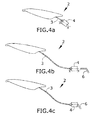
- the drag device (1) comprises a turbine (15) with blades, the spinning speed thereof is controlled by the drag controller (not shown), thus causing a drag increase or decrease of the drag of the drag device, D drag device .
- a side view of this embodiment is shown in Figure 3a .
- the drag device (1) comprises a frustoconical element (16) adapted to be moved along the body of the coupling member (14), thus causing a ram duct to be opened or closed so causing a drag increase or decrease of the value of the drag of the drag device, D drag device .
- a side view of this embodiment is shown in Figure 3b .
- the drag device (1) comprises a plurality of spoilers (17) adapted to be opened or closed with circular symmetry around the body of the coupling member (14), thus causing a drag increase or decrease of the value of the drag of the drag device, D drag device .
- a side view of this embodiment is shown in Figure 3c .
- the receiving aircraft comprises a probe (6), which is intended to be coupled to the coupling member (14) of the drogue (4).
- the presence of a drag device (1) according to the invention in a refuelling system (2) makes the drogue canopy (13) need not to be as big as in the event of a refuelling system (2) without a drag device (1) according to the invention, as said drag device (1) makes unnecessary that the drogue canopy (13), by means of varying its size, provides the drag needed in all the steps of the refuelling operation, as total drag, D, of the drogue (4) is caused both by the drogue canopy (13) and by the drag device (1).
- the drag device (1) is adapted to provide energy to other elements during all the process of refuelling, since the deployment of the hose (3) until the decoupling of the probe (6) and the coupling member (14) of the drogue (4).
- these elements are the drag controller and the probe sensor (5).
- the detection is accomplished by aligning both the probe (6) and the coupling member (14), particularly the hole of the coupling member (14), once the probe (6) has pierced the drogue canopy (13).
- the total drag, D by means of the variation of the drag of the drag device, is increased once the probe sensor (5) has detected the probe (6) surrounding the coupling member (14) and not only on the surroundings of the drogue canopy (13) as in this position said canopy could be damaged.
- the probe sensor (5) is therefore placed on the coupling member (14) in order to be able to detect the instant when the probe (6) is in the correct position, around the coupling member (14) therefore sending the signal to the drag device (1) for increasing its drag value.
- the drag device (1) further comprises a drag controller, not shown in the figures.
- the drag controller is suitable for actuating on the drag device (1), changing the value of the drag provided by the drag device (1) according to an optimal value set for each step of the refuelling process.
- the receiver aircraft does not need to perform a sudden impulse to approach the drogue (4) with its probe (6), as it is the drogue (4) itself which approaches to the probe (6) of the receiver aircraft.
- This movement has several further advantages:
- the first one is the removal of the whiplash caused by a loss of tension in the hose immediately after the contact and displacement of the receiver during said contact, therefore reducing the distance between both aircrafts, which is compensated in part by the movement of the hose drum in the refuelling methods disclosed in the state of the art.
- the probe (105) pushes the hose (103) and makes this latter becoming temporarily loose.
- the hose drum detects this lack of stress in the hose (103), it pulls the hose (103) to keep it taut.
- the drogue (4) is taut during all the process, and the drum does not pull the hose (3), so no whiplash is caused to it.
- the drogue (4) is able to anticipate the pull of the hose drum, in order to reduce said whiplash, so the receiver shall not approach the tanker, so the vain is not reduced.
- Another advantage is that the coupling is achieved in a faster and safer way, as it is much faster and safer that the end of a hose (3) approaches an aircraft than an aircraft approaches the end of a hose (3).
- the aircraft is asked for keeping its position, instead of carrying out an approaching manoeuvre.
- drogue canopies (13) are not jeopardized by a badly calculated impulse of the receiver aircraft.
- the probe (105) could easily damage the drogue (104). This situation does not happen with the refuelling system (2) according to the invention.
- a refuelling operation in a particular embodiment comprises:
- the first line (205) representing the drag caused by a refuelling system according to the invention presents different values reachable by a refuelling system (2) according to the invention.
- the second line (206) representing the drag caused by a refuelling system of the prior art is a constant line.
- Drag device (1) of the invention This wide range of drag values is acceptable by the drag device (1) of the invention, while the drogues known in the state of art are not able to provide such a wide range of drag values.
- Figure 6 show a comparative graph showing a first drag line (301) provided by a high speed drogue known from the state of art and a second drag line (302) provided by a low speed drogue known from the state of art.
- a third drag line (303) represents the drag values provided by the drag device (1) of the invention, as a function of KCAS.
Landscapes
- Engineering & Computer Science (AREA)
- Aviation & Aerospace Engineering (AREA)
- Measuring Fluid Pressure (AREA)
Priority Applications (1)
| Application Number | Priority Date | Filing Date | Title |
|---|---|---|---|
| EP14382579.2A EP3040280A1 (de) | 2014-12-30 | 2014-12-30 | Verfahren und System zur Luftbetankung |
Applications Claiming Priority (1)
| Application Number | Priority Date | Filing Date | Title |
|---|---|---|---|
| EP14382579.2A EP3040280A1 (de) | 2014-12-30 | 2014-12-30 | Verfahren und System zur Luftbetankung |
Publications (1)
| Publication Number | Publication Date |
|---|---|
| EP3040280A1 true EP3040280A1 (de) | 2016-07-06 |
Family
ID=52338954
Family Applications (1)
| Application Number | Title | Priority Date | Filing Date |
|---|---|---|---|
| EP14382579.2A Withdrawn EP3040280A1 (de) | 2014-12-30 | 2014-12-30 | Verfahren und System zur Luftbetankung |
Country Status (1)
| Country | Link |
|---|---|
| EP (1) | EP3040280A1 (de) |
Cited By (3)
| Publication number | Priority date | Publication date | Assignee | Title |
|---|---|---|---|---|
| CN107284678A (zh) * | 2017-07-19 | 2017-10-24 | 胡俊 | 一种航天器空中加油调节装置 |
| WO2018235071A1 (en) | 2017-06-18 | 2018-12-27 | Israel Aerospace Industries Ltd. | System and method for refueling air vehicles |
| US11465768B2 (en) | 2017-07-10 | 2022-10-11 | Israel Aerospace Industries Ltd. | Refueling device |
Citations (4)
| Publication number | Priority date | Publication date | Assignee | Title |
|---|---|---|---|---|
| US6994294B2 (en) * | 2003-08-29 | 2006-02-07 | Smiths Aerospace, Inc. | Stabilization of a drogue body |
| US20100001124A1 (en) * | 2005-12-22 | 2010-01-07 | Feldmann Michael S | Controllable drogue |
| US20130168497A1 (en) * | 2012-01-04 | 2013-07-04 | Israel Aerospace Industries Ltd. | Systems and methods for air vehicles |
| US20140306063A1 (en) * | 2013-04-11 | 2014-10-16 | The Boeing Company | Aerial refueling system and method |
-
2014
- 2014-12-30 EP EP14382579.2A patent/EP3040280A1/de not_active Withdrawn
Patent Citations (4)
| Publication number | Priority date | Publication date | Assignee | Title |
|---|---|---|---|---|
| US6994294B2 (en) * | 2003-08-29 | 2006-02-07 | Smiths Aerospace, Inc. | Stabilization of a drogue body |
| US20100001124A1 (en) * | 2005-12-22 | 2010-01-07 | Feldmann Michael S | Controllable drogue |
| US20130168497A1 (en) * | 2012-01-04 | 2013-07-04 | Israel Aerospace Industries Ltd. | Systems and methods for air vehicles |
| US20140306063A1 (en) * | 2013-04-11 | 2014-10-16 | The Boeing Company | Aerial refueling system and method |
Cited By (8)
| Publication number | Priority date | Publication date | Assignee | Title |
|---|---|---|---|---|
| WO2018235071A1 (en) | 2017-06-18 | 2018-12-27 | Israel Aerospace Industries Ltd. | System and method for refueling air vehicles |
| KR20200019723A (ko) * | 2017-06-18 | 2020-02-24 | 이스라엘 에어로스페이스 인더스트리즈 리미티드 | 공중 비행체 급유를 위한 시스템 및 방법 |
| EP3642114A4 (de) * | 2017-06-18 | 2021-03-17 | Israel Aerospace Industries Ltd. | System und verfahren zum auftanken von flugzeugen |
| IL253015B1 (en) * | 2017-06-18 | 2023-03-01 | Israel Aerospace Ind Ltd | System and method for refueling aerial vehicles |
| IL253015B2 (en) * | 2017-06-18 | 2023-07-01 | Israel Aerospace Ind Ltd | System and method for refueling aerial vehicles |
| US11919655B2 (en) | 2017-06-18 | 2024-03-05 | Israel Aerospace Industries Ltd. | System and method for refueling air vehicles |
| US11465768B2 (en) | 2017-07-10 | 2022-10-11 | Israel Aerospace Industries Ltd. | Refueling device |
| CN107284678A (zh) * | 2017-07-19 | 2017-10-24 | 胡俊 | 一种航天器空中加油调节装置 |
Similar Documents
| Publication | Publication Date | Title |
|---|---|---|
| US6824105B2 (en) | Drogue for in-flight refueling | |
| US7887010B2 (en) | Controllable refueling drogues and associated systems and methods | |
| US5779191A (en) | Pylon flap for increasing negative pitching moments | |
| EP3842345B1 (de) | System zur luft-zu-luft-betankung und verfahren zur erzeugung von aerodynamischen radialen lasten an einem schlauchende | |
| US9227735B2 (en) | Aerial refueling system and method | |
| EP2835313B1 (de) | Mehrzwecktankausleger | |
| EP1765670B2 (de) | Luftbetankungssystem und verfahren zur erleichterung der nottrennung der luftbetankungssystembauteile | |
| EP3642114B1 (de) | System und verfahren zum auftanken von flugzeugen | |
| EP3040280A1 (de) | Verfahren und System zur Luftbetankung | |
| US9969502B2 (en) | In-flight refueling method and system for controlling motion of the hose and drogue | |
| US20160075441A1 (en) | Aerial refueling navigable device, system and method | |
| EP1762492A2 (de) | Systeme und Verfahren zur Steuerung einer Luftbetankungsvorrichtung | |
| EP3842346B1 (de) | Luft-luft-kupplung | |
| US7246774B2 (en) | In-flight refueling system, boom, and method for extending range of motion of an in-flight refueling boom | |
| EP3342716A1 (de) | Flugzeugbetankungsauslegersystem mit düsensicherheitsmitteln | |
| EP2933185A1 (de) | Luftbetankungssystem für flügel | |
| US8220746B1 (en) | Broad speed range inflatable drogue canopy | |
| US7201348B1 (en) | Cruise missile recovery system | |
| EP2415671B1 (de) | Verfahren und vorrichtung für vorgänge mit einem ausleger zur auftankung während des fluges | |
| US8746623B2 (en) | Method and device for generating an optimum aerodynamic configuration of an aircraft during a flight | |
| JP6195207B2 (ja) | 無人飛行機の狭地での発進及び回収方法 | |
| KR101775842B1 (ko) | 항공기 장착물의 동시 분리장치 | |
| US11597531B2 (en) | Magnetic refueling boom positioning | |
| CN120288246A (zh) | 具有多降落伞安全降落系统的分体式飞行器 | |
| KR20250046924A (ko) | 비행장치 안전 회수 시스템 및 그 방법 |
Legal Events
| Date | Code | Title | Description |
|---|---|---|---|
| PUAI | Public reference made under article 153(3) epc to a published international application that has entered the european phase |
Free format text: ORIGINAL CODE: 0009012 |
|
| AK | Designated contracting states |
Kind code of ref document: A1 Designated state(s): AL AT BE BG CH CY CZ DE DK EE ES FI FR GB GR HR HU IE IS IT LI LT LU LV MC MK MT NL NO PL PT RO RS SE SI SK SM TR |
|
| AX | Request for extension of the european patent |
Extension state: BA ME |
|
| STAA | Information on the status of an ep patent application or granted ep patent |
Free format text: STATUS: THE APPLICATION IS DEEMED TO BE WITHDRAWN |
|
| 18D | Application deemed to be withdrawn |
Effective date: 20170110 |