EP3040431A1 - Nckel-messing-becken mit niedrigem nickelgehalt - Google Patents
Nckel-messing-becken mit niedrigem nickelgehalt Download PDFInfo
- Publication number
- EP3040431A1 EP3040431A1 EP15203088.8A EP15203088A EP3040431A1 EP 3040431 A1 EP3040431 A1 EP 3040431A1 EP 15203088 A EP15203088 A EP 15203088A EP 3040431 A1 EP3040431 A1 EP 3040431A1
- Authority
- EP
- European Patent Office
- Prior art keywords
- nickel
- weight
- cymbal
- percent
- brass
- Prior art date
- Legal status (The legal status is an assumption and is not a legal conclusion. Google has not performed a legal analysis and makes no representation as to the accuracy of the status listed.)
- Withdrawn
Links
- PXHVJJICTQNCMI-UHFFFAOYSA-N Nickel Chemical compound [Ni] PXHVJJICTQNCMI-UHFFFAOYSA-N 0.000 title claims abstract description 124
- 239000010956 nickel silver Substances 0.000 title claims abstract description 93
- 229910052759 nickel Inorganic materials 0.000 title claims abstract description 62
- HCHKCACWOHOZIP-UHFFFAOYSA-N Zinc Chemical compound [Zn] HCHKCACWOHOZIP-UHFFFAOYSA-N 0.000 claims abstract description 42
- 229910052725 zinc Inorganic materials 0.000 claims abstract description 42
- 239000011701 zinc Substances 0.000 claims abstract description 42
- RYGMFSIKBFXOCR-UHFFFAOYSA-N Copper Chemical compound [Cu] RYGMFSIKBFXOCR-UHFFFAOYSA-N 0.000 claims abstract description 35
- 229910052802 copper Inorganic materials 0.000 claims abstract description 35
- 239000010949 copper Substances 0.000 claims abstract description 35
- 238000000034 method Methods 0.000 claims abstract description 22
- XEEYBQQBJWHFJM-UHFFFAOYSA-N Iron Chemical compound [Fe] XEEYBQQBJWHFJM-UHFFFAOYSA-N 0.000 claims description 10
- 229910052742 iron Inorganic materials 0.000 claims description 5
- PWHULOQIROXLJO-UHFFFAOYSA-N Manganese Chemical compound [Mn] PWHULOQIROXLJO-UHFFFAOYSA-N 0.000 claims description 4
- ATJFFYVFTNAWJD-UHFFFAOYSA-N Tin Chemical compound [Sn] ATJFFYVFTNAWJD-UHFFFAOYSA-N 0.000 claims description 4
- 229910052748 manganese Inorganic materials 0.000 claims description 4
- 239000011572 manganese Substances 0.000 claims description 4
- 229910052718 tin Inorganic materials 0.000 claims description 4
- 239000000463 material Substances 0.000 description 9
- 229910052751 metal Inorganic materials 0.000 description 8
- 239000002184 metal Substances 0.000 description 8
- 229910001369 Brass Inorganic materials 0.000 description 7
- 229910000906 Bronze Inorganic materials 0.000 description 7
- 239000010951 brass Substances 0.000 description 7
- 238000004519 manufacturing process Methods 0.000 description 6
- 239000010974 bronze Substances 0.000 description 5
- KUNSUQLRTQLHQQ-UHFFFAOYSA-N copper tin Chemical compound [Cu].[Sn] KUNSUQLRTQLHQQ-UHFFFAOYSA-N 0.000 description 5
- 229910045601 alloy Inorganic materials 0.000 description 3
- 239000000956 alloy Substances 0.000 description 3
- 238000005096 rolling process Methods 0.000 description 3
- 229910001128 Sn alloy Inorganic materials 0.000 description 2
- 230000004075 alteration Effects 0.000 description 2
- 230000008901 benefit Effects 0.000 description 2
- 230000006872 improvement Effects 0.000 description 2
- 238000002844 melting Methods 0.000 description 2
- 230000008018 melting Effects 0.000 description 2
- 230000004048 modification Effects 0.000 description 2
- 238000012986 modification Methods 0.000 description 2
- OAICVXFJPJFONN-UHFFFAOYSA-N Phosphorus Chemical compound [P] OAICVXFJPJFONN-UHFFFAOYSA-N 0.000 description 1
- 229910052793 cadmium Inorganic materials 0.000 description 1
- BDOSMKKIYDKNTQ-UHFFFAOYSA-N cadmium atom Chemical compound [Cd] BDOSMKKIYDKNTQ-UHFFFAOYSA-N 0.000 description 1
- 238000005266 casting Methods 0.000 description 1
- 238000005520 cutting process Methods 0.000 description 1
- 238000005516 engineering process Methods 0.000 description 1
- 238000010438 heat treatment Methods 0.000 description 1
- 239000011133 lead Substances 0.000 description 1
- WPBNNNQJVZRUHP-UHFFFAOYSA-L manganese(2+);methyl n-[[2-(methoxycarbonylcarbamothioylamino)phenyl]carbamothioyl]carbamate;n-[2-(sulfidocarbothioylamino)ethyl]carbamodithioate Chemical compound [Mn+2].[S-]C(=S)NCCNC([S-])=S.COC(=O)NC(=S)NC1=CC=CC=C1NC(=S)NC(=O)OC WPBNNNQJVZRUHP-UHFFFAOYSA-L 0.000 description 1
- 150000002739 metals Chemical class 0.000 description 1
- MOFOBJHOKRNACT-UHFFFAOYSA-N nickel silver Chemical compound [Ni].[Ag] MOFOBJHOKRNACT-UHFFFAOYSA-N 0.000 description 1
- 238000009527 percussion Methods 0.000 description 1
- 229910052698 phosphorus Inorganic materials 0.000 description 1
- 239000011574 phosphorus Substances 0.000 description 1
- 238000003825 pressing Methods 0.000 description 1
- 230000008569 process Effects 0.000 description 1
- 238000007493 shaping process Methods 0.000 description 1
- 229910052709 silver Inorganic materials 0.000 description 1
- 239000004332 silver Substances 0.000 description 1
- 238000009987 spinning Methods 0.000 description 1
- 230000002123 temporal effect Effects 0.000 description 1
- 239000011135 tin Substances 0.000 description 1
Images

Classifications
-
- G—PHYSICS
- G10—MUSICAL INSTRUMENTS; ACOUSTICS
- G10D—STRINGED MUSICAL INSTRUMENTS; WIND MUSICAL INSTRUMENTS; ACCORDIONS OR CONCERTINAS; PERCUSSION MUSICAL INSTRUMENTS; AEOLIAN HARPS; SINGING-FLAME MUSICAL INSTRUMENTS; MUSICAL INSTRUMENTS NOT OTHERWISE PROVIDED FOR
- G10D13/00—Percussion musical instruments; Details or accessories therefor
- G10D13/01—General design of percussion musical instruments
- G10D13/06—Castanets, cymbals, triangles, tambourines without drumheads or other single-toned percussion musical instruments
-
- C—CHEMISTRY; METALLURGY
- C22—METALLURGY; FERROUS OR NON-FERROUS ALLOYS; TREATMENT OF ALLOYS OR NON-FERROUS METALS
- C22C—ALLOYS
- C22C9/00—Alloys based on copper
- C22C9/04—Alloys based on copper with zinc as the next major constituent
-
- G—PHYSICS
- G10—MUSICAL INSTRUMENTS; ACOUSTICS
- G10D—STRINGED MUSICAL INSTRUMENTS; WIND MUSICAL INSTRUMENTS; ACCORDIONS OR CONCERTINAS; PERCUSSION MUSICAL INSTRUMENTS; AEOLIAN HARPS; SINGING-FLAME MUSICAL INSTRUMENTS; MUSICAL INSTRUMENTS NOT OTHERWISE PROVIDED FOR
- G10D13/00—Percussion musical instruments; Details or accessories therefor
- G10D13/01—General design of percussion musical instruments
- G10D13/06—Castanets, cymbals, triangles, tambourines without drumheads or other single-toned percussion musical instruments
- G10D13/063—Cymbals
-
- G—PHYSICS
- G10—MUSICAL INSTRUMENTS; ACOUSTICS
- G10D—STRINGED MUSICAL INSTRUMENTS; WIND MUSICAL INSTRUMENTS; ACCORDIONS OR CONCERTINAS; PERCUSSION MUSICAL INSTRUMENTS; AEOLIAN HARPS; SINGING-FLAME MUSICAL INSTRUMENTS; MUSICAL INSTRUMENTS NOT OTHERWISE PROVIDED FOR
- G10D13/00—Percussion musical instruments; Details or accessories therefor
- G10D13/10—Details of, or accessories for, percussion musical instruments
- G10D13/24—Material for manufacturing percussion musical instruments; Treatment of the material
Definitions
- the present application relates generally to cymbals and in particular, to a new and improved material from which a cymbal may be formed.
- Cymbals are metallic percussion instruments that have been used in various forms for centuries, and have typically been made from bronze.
- a cymbal comprising a nickel brass primarily comprising copper and further comprising zinc and nickel, wherein the nickel brass comprises between 3 and 9 percent nickel by weight.
- a method of producing a cymbal comprising forming the cymbal from a nickel brass primarily comprising copper and further comprising zinc and nickel, wherein the nickel brass comprises between 3 and 9 percent nickel by weight.
- cymbals are typically made from a bronze alloy, which comprise copper and tin in addition to small amounts of other metals such as silver.
- the most prevalent cymbal bronze alloys include an 80% copper and 20% tin alloy (sometimes called “B20") and a 92% copper and 8% tin alloy (sometimes called “B8").
- cymbals may also, in some cases, be formed from brass (an alloy comprising primarily copper and zinc).
- the acoustic properties of a brass cymbal are generally not as desirable to a musician as those of a bronze cymbal; however, brass is generally less costly than bronze. Accordingly, brass may sometimes be used to produce cheaper, so-called "entry level” cymbals.
- These cymbals are often made from a brass alloy that comprises nickel in addition to copper and zinc (sometimes called “nickel silver” or “nickel brass”).
- Such nickel brass cymbals typically include around 12% nickel by weight (with the remainder being entirely, or almost entirely, copper and zinc) and provide a more pleasing tone with a greater sustain when struck compared with a pure brass cymbal.
- the nickel may also provide anti-tarnish (and/or anti-patina) properties.
- a nickel brass cymbal formed from around 6% nickel by weight has comparable acoustic performance yet substantially lower cost than a nickel brass cymbal comprising 12% nickel.
- Previously available nickel brass cymbals comprise at least 12% nickel by weight, and it has been appreciated by the inventor that, contrary to belief within the cymbal industry, an acoustically comparable cymbal may be formed with substantially less nickel content that retains much of the acoustic performance of the higher nickel content cymbals. Since nickel is generally more expensive than copper or zinc, a nickel brass cymbal including around 6% nickel may be less costly than a comparable nickel brass cymbal including around 12% nickel.
- a cymbal may be formed from nickel brass that includes materials other than copper, zinc and nickel in an amount that is less than one percent by weight of the cymbal.
- the nickel brass may primarily comprise copper and may additionally include zinc and nickel such that the copper, zinc and nickel together make up at least 99 percent by weight of the nickel brass. Additional materials may include, but are not limited to, tin, phosphorus, iron, lead, manganese, cadmium, or combinations thereof.
- a cymbal may be formed from nickel brass having a yield strength greater than 50 ksi and less than 100 ksi.
- a nickel brass may have any suitable yield strength in addition to comprising any of the copper, zinc and nickel amounts discussed herein.
- a cymbal may comprise a nickel brass primarily comprising copper and zinc and comprising 6 percent nickel by weight, wherein the nickel brass has a yield strength greater than 50 ksi and less than 100 ksi.
- a cymbal may be formed from nickel brass primarily comprising copper and comprising between 20 and 28 percent zinc by weight and between 3 and 9 percent nickel by weight. According to some embodiments, a cymbal may be formed from nickel brass primarily comprising copper and comprising between 22 and 26 percent zinc by weight and between 4 and 8 percent nickel by weight. According to some embodiments, a cymbal may be formed from nickel brass primarily comprising copper and comprising between 23 and 25 percent zinc by weight and between 5 and 7 percent nickel by weight. According to some embodiments, a cymbal may be formed from nickel brass primarily comprising copper and comprising approximately 24 percent zinc by weight and approximately 6 percent nickel by weight.
- a cymbal may be formed from nickel brass primarily comprising copper and comprising between 18 and 22 percent zinc by weight and between 4 and 6 percent nickel by weight. According to some embodiments, a cymbal may be formed from nickel brass primarily comprising copper and comprising between 19.2 and 20.2 percent zinc by weight and between 4.7 and 5.3 percent nickel by weight. According to some embodiments, a cymbal may be formed from nickel brass comprising between 72 and 76 percent copper by weight and between 1.6 and 2.2 percent nickel by weight. According to some embodiments, a cymbal may be formed from nickel brass comprising between 69 and 71 percent copper by weight and between 5.7 and 6.3 percent nickel by weight. According to some embodiments, a cymbal may be formed from nickel brass primarily comprising copper and comprising approximately 24.5 percent zinc by weight and approximately 5.5 percent nickel by weight.
- FIG. 1 depicts a cross-section of an illustrative cymbal suitable for practicing some embodiments.
- FIG. 1 illustrates regions typically associated with metal cymbals, including a region in the center of the cymbal sometimes referred to as a "cup” or a “bell,” and a region extending outward from the cup region, sometimes referred to as the "bow” region.
- nickel brass cymbals discussed herein may be of any suitable size and/or shape, though may in some embodiments have the general form shown in FIG. 1 .
- the specific dimensions of each region may be of any suitable size, however, both in terms of absolute sizes and relative sizes.
- a cymbal having a small or negligible cup region may be used with embodiments described herein.
- Cymbal 101 may comprise a combination of materials, though may preferably be primarily formed from a nicked brass, examples of which are described herein.
- cymbal 101 is constructed from a material that is suitably rigid so as to produce sounds when struck and/or has a hardness such that repeated strikes of the cymbal will not significantly dent or damage the material.
- cymbal 101 comprises a nickel brass primarily comprising copper and further comprising zinc and nickel. As discussed above, the amount of nickel may be less than 12 percent by weight of the nickel brass, such as between 3 and 9 percent by weight.
- Cymbal 101 may be of any suitable size and/or shape.
- cymbal 100 is circular when viewed from above, and has the cross-section as shown.
- cymbal 100 is not limited to cymbals that have this particular shape or cross-section, and it will be appreciated that the cymbal depicted in FIG. 1 is provided merely as one example.
- cymbal 100 may be of any suitable size, including diameters between 6 inches and 30 inches, and thicknesses between 1 mm and 10 mm.
- cymbal 100 is of a size and shape corresponding to a particular categorization of cymbal types, including but not limited to cymbals commonly known as a ride, a crash, a hi-hat, a crash/ride, a splash, a China cymbal, and/or a marching cymbal. It will be appreciated that cymbal types, including those indicated above, may be formed in a variety of shapes and sizes, and that the types indicated are broad categorizations known to those of skill in the art.
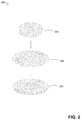
- FIG. 2 illustrates a method of manufacturing a nickel brass cymbal, according to some embodiments.
- One or more steps illustrated in method 200 may be similar, and/or substantially identical to, steps that may be followed in the production of a conventional bronze cymbal. Accordingly, any suitable steps and/or techniques that may be employed in the production of a conventional bronze cymbal may be utilized in method 200. It will be appreciated that while not every possible technique that may be utilized to produce the nickel brass cymbal described herein is described below, any suitable technique or techniques known to those skilled in the art may be employed in the process of manufacturing the nickel brass cymbal, including both those discussed below and any not discussed below.
- Method 200 begins with step 201 in which a slab of nickel brass from which a cymbal will be made, is formed and/or provided.
- the nickel brass may comprise copper, zinc and nickel in any suitable amounts, examples of which are provided herein.
- the nickel brass may comprise approximately 70 percent copper by weight, approximately 24 percent zinc by weight and approximately 6 percent nickel by weight.
- the nickel brass in step 201 may be provided in any suitable way, including by melting (e.g. by melting and casting nickel brass) and/or by rolling nickel brass into a slab.
- the nickel brass slab is rolled or otherwise shaped into the general shape of the cymbal being formed.
- the nickel brass slab may be rolled into a flatter disc and then cut into the shape of a circle.
- Step 202 may be performed in any suitable way, and may include a step of heating up the nickel brass slab prior to rolling. Any number of rolling operations may be performed, and in any number of directions. For instance, the nickel brass slab may be rolled a plurality of times in different directions before it is cut.
- the metal disc is shaped into the final shape of the nickel brass cymbal.
- Shaping may include, but is not limited to, cupping (forming a cup or bell shape in the center of the cymbal), cutting a hole in the center of the cymbal, lathing (e.g. shaving metal from the surface of the cymbal), hammering, backbending, pressing, buffing, metal spinning, shear forming, or any combination thereof, in any suitable sequence.
- ranges of metal content are discussed herein, they are intended to encompass the endpoints of those ranges. For instance, where a material is indicated as comprising between 5 and 10 percent of a metal by weight, the material may include any amount of that metal between 5 and 10 percent by weight in addition to including 5 percent by weight or 10 percent by weight.
- the invention may be embodied as a method of manufacture, of which an example has been provided.
- the acts performed as part of the method may be ordered in any suitable way. Accordingly, embodiments may be constructed in which acts are performed in an order different than illustrated, which may include performing some acts simultaneously, even though shown as sequential acts in illustrative embodiments.
Landscapes
- Engineering & Computer Science (AREA)
- Chemical & Material Sciences (AREA)
- Physics & Mathematics (AREA)
- Acoustics & Sound (AREA)
- Multimedia (AREA)
- Materials Engineering (AREA)
- Mechanical Engineering (AREA)
- Metallurgy (AREA)
- Organic Chemistry (AREA)
- Conductive Materials (AREA)
- Forging (AREA)
Applications Claiming Priority (2)
| Application Number | Priority Date | Filing Date | Title |
|---|---|---|---|
| US201462098193P | 2014-12-30 | 2014-12-30 | |
| US14/743,186 US20160189693A1 (en) | 2014-12-30 | 2015-06-18 | Nickel brass cymbal having low nickel content |
Publications (1)
| Publication Number | Publication Date |
|---|---|
| EP3040431A1 true EP3040431A1 (de) | 2016-07-06 |
Family
ID=55450938
Family Applications (1)
| Application Number | Title | Priority Date | Filing Date |
|---|---|---|---|
| EP15203088.8A Withdrawn EP3040431A1 (de) | 2014-12-30 | 2015-12-30 | Nckel-messing-becken mit niedrigem nickelgehalt |
Country Status (2)
| Country | Link |
|---|---|
| US (2) | US20160189693A1 (de) |
| EP (1) | EP3040431A1 (de) |
Families Citing this family (1)
| Publication number | Priority date | Publication date | Assignee | Title |
|---|---|---|---|---|
| DE102024207821A1 (de) * | 2024-08-16 | 2026-02-19 | Roland Meinl Musikinstrumente Gmbh & Co. Kg | Verfahren zum Herstellen eines Beckens, insbesondere eines Ride-Beckens, mit geformtem Klangbild, insbesondere mit besonders engem Frequenzbereich und kurzer Abklingzeit, Becken mit geformtem Klangbild und System |
Citations (4)
| Publication number | Priority date | Publication date | Assignee | Title |
|---|---|---|---|---|
| DE836567C (de) * | 1948-08-18 | 1952-05-15 | Dr Eugen Vaders | Verwendung von Kupfer-Silizium-Zink-Legierungen fuer Glocken, Schellen und aehnliche langgeraete |
| DD155083A1 (de) * | 1980-12-06 | 1982-05-12 | Peter Ruddeck | Mangan-aluminium-mehrstoffbronze fuer glocken |
| EP0300181A2 (de) * | 1987-07-24 | 1989-01-25 | Paiste Ag | Zimbel |
| WO2005093244A1 (de) * | 2004-03-17 | 2005-10-06 | Federal-Mogul Nürnberg GmbH | Kolben für einen verbrennungsmotor, verfahren zur herstellung eines kolbens sowie verwendung einer kupferlegierung zur herstellung eines kolbens |
-
2015
- 2015-06-18 US US14/743,186 patent/US20160189693A1/en not_active Abandoned
- 2015-12-30 EP EP15203088.8A patent/EP3040431A1/de not_active Withdrawn
-
2018
- 2018-11-29 US US16/204,822 patent/US20190172431A1/en not_active Abandoned
Patent Citations (4)
| Publication number | Priority date | Publication date | Assignee | Title |
|---|---|---|---|---|
| DE836567C (de) * | 1948-08-18 | 1952-05-15 | Dr Eugen Vaders | Verwendung von Kupfer-Silizium-Zink-Legierungen fuer Glocken, Schellen und aehnliche langgeraete |
| DD155083A1 (de) * | 1980-12-06 | 1982-05-12 | Peter Ruddeck | Mangan-aluminium-mehrstoffbronze fuer glocken |
| EP0300181A2 (de) * | 1987-07-24 | 1989-01-25 | Paiste Ag | Zimbel |
| WO2005093244A1 (de) * | 2004-03-17 | 2005-10-06 | Federal-Mogul Nürnberg GmbH | Kolben für einen verbrennungsmotor, verfahren zur herstellung eines kolbens sowie verwendung einer kupferlegierung zur herstellung eines kolbens |
Also Published As
| Publication number | Publication date |
|---|---|
| US20160189693A1 (en) | 2016-06-30 |
| US20190172431A1 (en) | 2019-06-06 |
Similar Documents
| Publication | Publication Date | Title |
|---|---|---|
| WO2015115150A1 (ja) | 複合部材、及び複合部材の製造方法 | |
| US8973243B2 (en) | Manufacturing method of an integrally forged golf club head | |
| EP1947218A1 (de) | Metallhandwerkzeug und Verfahren zu seiner Herstellung | |
| JP2017087294A (ja) | 切断端面を有する表面処理鋼板の部品およびその切断加工方法 | |
| CN110177633B (zh) | 具有切断端面的表面处理钢板的部件及其制造方法 | |
| CN103692150B (zh) | 一体成型锻造高尔夫球杆头的制造方法 | |
| US20190172431A1 (en) | Nickel brass cymbal having low nickel content | |
| JP2010172909A (ja) | 圧延板、および圧延板の製造方法 | |
| JP2010075931A (ja) | フランジを備えた筒状金属部品のプレス成形方法 | |
| JP2002321021A (ja) | 疲労特性,端面耐食性に優れた加工製品及び加工方法 | |
| US10601025B2 (en) | Single punch method of making battery plates for lead-acid batteries | |
| JP2018171439A (ja) | アイアンゴルフクラブヘッドの製造方法、アイアンゴルフクラブヘッド、及びアイアンゴルフクラブ | |
| TW201412361A (zh) | 一體成型鍛造高爾夫球桿頭製造方法 | |
| JP2006224121A (ja) | 鋼板打ち抜き用工具及びそれを用いた打ち抜き方法 | |
| JP2006289491A (ja) | 耐割れ特性に優れた高強度鋼薄板の加工方法及び切断加工用切断刃 | |
| JP6680055B2 (ja) | ワイヤ放電加工用電極線 | |
| JP2011005534A (ja) | 異形断面条の製造方法 | |
| JP2010005651A (ja) | 金属製断面ハット型形状部材のプレス成形用金型およびプレス成形方法 | |
| KR20130000197A (ko) | 납축전지용 기판과 그 제조 방법 | |
| TW201900314A (zh) | 線放電加工用電極線 | |
| JP6728915B2 (ja) | ワイヤ放電加工用電極線 | |
| JP2006088191A (ja) | 疲労特性に優れた成形後打ち抜き端面を有する自動車用部品およびその製造方法 | |
| JP2014210050A (ja) | バット基材の製造方法及び打球用バット | |
| US8853515B1 (en) | Reversible cymbal | |
| WO2004016450A1 (en) | Method for the production of coins or tokens and coins or tokens thus obtained |
Legal Events
| Date | Code | Title | Description |
|---|---|---|---|
| PUAI | Public reference made under article 153(3) epc to a published international application that has entered the european phase |
Free format text: ORIGINAL CODE: 0009012 |
|
| 17P | Request for examination filed |
Effective date: 20151230 |
|
| AK | Designated contracting states |
Kind code of ref document: A1 Designated state(s): AL AT BE BG CH CY CZ DE DK EE ES FI FR GB GR HR HU IE IS IT LI LT LU LV MC MK MT NL NO PL PT RO RS SE SI SK SM TR |
|
| AX | Request for extension of the european patent |
Extension state: BA ME |
|
| STAA | Information on the status of an ep patent application or granted ep patent |
Free format text: STATUS: THE APPLICATION HAS BEEN WITHDRAWN |
|
| 18W | Application withdrawn |
Effective date: 20190521 |