EP3041710B1 - Methode pour la maneuvre un vehicule - Google Patents
Methode pour la maneuvre un vehicule Download PDFInfo
- Publication number
- EP3041710B1 EP3041710B1 EP14747948.9A EP14747948A EP3041710B1 EP 3041710 B1 EP3041710 B1 EP 3041710B1 EP 14747948 A EP14747948 A EP 14747948A EP 3041710 B1 EP3041710 B1 EP 3041710B1
- Authority
- EP
- European Patent Office
- Prior art keywords
- image
- vehicle
- time
- manoeuvring
- region
- Prior art date
- Legal status (The legal status is an assumption and is not a legal conclusion. Google has not performed a legal analysis and makes no representation as to the accuracy of the status listed.)
- Active
Links
Images


Classifications
-
- G—PHYSICS
- G08—SIGNALLING
- G08G—TRAFFIC CONTROL SYSTEMS
- G08G1/00—Traffic control systems for road vehicles
- G08G1/16—Anti-collision systems
- G08G1/168—Driving aids for parking, e.g. acoustic or visual feedback on parking space
-
- B—PERFORMING OPERATIONS; TRANSPORTING
- B60—VEHICLES IN GENERAL
- B60R—VEHICLES, VEHICLE FITTINGS, OR VEHICLE PARTS, NOT OTHERWISE PROVIDED FOR
- B60R1/00—Optical viewing arrangements; Real-time viewing arrangements for drivers or passengers using optical image capturing systems, e.g. cameras or video systems specially adapted for use in or on vehicles
- B60R1/20—Real-time viewing arrangements for drivers or passengers using optical image capturing systems, e.g. cameras or video systems specially adapted for use in or on vehicles
- B60R1/22—Real-time viewing arrangements for drivers or passengers using optical image capturing systems, e.g. cameras or video systems specially adapted for use in or on vehicles for viewing an area outside the vehicle, e.g. the exterior of the vehicle
- B60R1/23—Real-time viewing arrangements for drivers or passengers using optical image capturing systems, e.g. cameras or video systems specially adapted for use in or on vehicles for viewing an area outside the vehicle, e.g. the exterior of the vehicle with a predetermined field of view
-
- B—PERFORMING OPERATIONS; TRANSPORTING
- B62—LAND VEHICLES FOR TRAVELLING OTHERWISE THAN ON RAILS
- B62D—MOTOR VEHICLES; TRAILERS
- B62D15/00—Steering not otherwise provided for
- B62D15/02—Steering position indicators ; Steering position determination; Steering aids
- B62D15/029—Steering assistants using warnings or proposing actions to the driver without influencing the steering system
-
- G—PHYSICS
- G06—COMPUTING OR CALCULATING; COUNTING
- G06V—IMAGE OR VIDEO RECOGNITION OR UNDERSTANDING
- G06V20/00—Scenes; Scene-specific elements
- G06V20/50—Context or environment of the image
- G06V20/56—Context or environment of the image exterior to a vehicle by using sensors mounted on the vehicle
- G06V20/58—Recognition of moving objects or obstacles, e.g. vehicles or pedestrians; Recognition of traffic objects, e.g. traffic signs, traffic lights or roads
- G06V20/586—Recognition of moving objects or obstacles, e.g. vehicles or pedestrians; Recognition of traffic objects, e.g. traffic signs, traffic lights or roads of parking space
-
- B—PERFORMING OPERATIONS; TRANSPORTING
- B60—VEHICLES IN GENERAL
- B60R—VEHICLES, VEHICLE FITTINGS, OR VEHICLE PARTS, NOT OTHERWISE PROVIDED FOR
- B60R2300/00—Details of viewing arrangements using cameras and displays, specially adapted for use in a vehicle
- B60R2300/80—Details of viewing arrangements using cameras and displays, specially adapted for use in a vehicle characterised by the intended use of the viewing arrangement
- B60R2300/806—Details of viewing arrangements using cameras and displays, specially adapted for use in a vehicle characterised by the intended use of the viewing arrangement for aiding parking
Definitions
- the invention relates to a maneuvering assistance system with a method for maneuvering a vehicle, in particular for maneuvering a vehicle into a parking space.
- parking aids for vehicles z. B. known for cars are commonly provided by maneuver assistance systems and methods of maneuvering vehicles.
- More cost-effective reversing camera-based maneuvering assistance systems provide the ability to track the area behind the vehicle while reversing on a screen. Areas that are not detected by the rear view camera, for example, the areas laterally next to the vehicle, thus can not be displayed. Therefore, in particular at the end of the parking maneuver in such rear-view camera-based maneuvering assistance systems, the boundary lines or other structures bounding or marking the parking space are no longer detected by the maneuvering assistance system and thus are no longer displayed on the screen.
- surround view systems are known from the prior art. Such surround view systems are typically based on multiple, e.g., 3 to 6, cameras and provide good all-round visibility, which can be displayed on a screen of a maneuvering assistance system. Such Manövrierassistsysteme therefore allow a precise alignment of a vehicle Park lines or other parking space limiting structures. The disadvantage of such surround view systems, however, the higher cost due to multiple cameras.
- a device for processing environmental images of a vehicle and a recording medium which are able to derive an image scene, which has left the field of view of a rear view camera of a vehicle rear view camera, and to display an image of an area behind the vehicle, the contains derived image scene.
- An image processing unit first performs a coordinate transformation of a captured image to produce a bird's eye view image. Two chronologically consecutive bird's eye images are generated as the bird's eye image, and a coincident region of the two images is extracted. Based on this matching area, a moving area is extracted which has left the current field of view of the reversing camera. An image of the matching area and the moving area is displayed on a monitor. In this way, it is possible to display an image that also contains a scene that has left the current field of view of the rear view camera.
- a vehicle environment monitoring system comprising an image pickup device, a storage device, an image forming device, and a reproducing device.
- the image capturing device captures the image of at least part of the area surrounding the vehicle.
- the storage device stores the image taken by the image pickup device.
- the image forming device generates a synthesized image for reproduction using a last image taken last by the image pickup device and a preceding image taken before that last image.
- the synthesized image is displayed in the playback device.
- the image forming device reduces the degree of visibility of an image area associated with the previous image after a lapse of time after the previous image has been taken.
- a front camera and a rear camera each provide a sequence of images.
- the current shots of the front camera and the rear camera with previous shots combined with the front camera and the rear camera, wherein the preceding shots are gradually hidden after a predetermined period of time.
- the apparatus comprises: an image pickup device for acquiring an environment image; a storage medium for storing the surrounding image or information about an environmental data containing surrounding object, the storage medium pre-storing a vehicle image; a screen having a real-time rendering section for rendering thereon the surrounding image having uncorrected image distortions of the surrounding image, and a change display section for displaying thereon the vehicle image and a change image generated based on the change data; and a display section configured to superimpose the vehicle image and the change image provided with the distortion of the surrounding image such that the surrounding object shown in the change image is continuously connected to the object shown in the surrounding image.
- a jump in the representation of objects eg parking space markings
- the apparatus comprises a CPU for obtaining image data from a camera mounted on a vehicle, an image memory for storing the acquired image data as recorded data, and an image processor for recognizing an object based on the image data.
- the image processor determines when to display a parking assist image to visualize an area hidden in a blind spot of the camera, based on a position of the object when it is in the blind spot of the camera, and reproduces the parking assist image by using both current, current, recorded at the current position of the vehicle image data and the recorded data of the blind spot hidden area of the camera, together with an indicator for displaying the current position of the vehicle on a display device.
- An arrangement for reproducing a synthesized image of a selected area around a vehicle is known.
- the arrangement is intended to assist a driver of the vehicle, and comprises processing means adapted to operate in the presence of at least initial information representing the Possibility to signal that the vehicle is starting a maneuver to obtain groups of image data representative of interim images obtained at continuous times in at least one capture area partially surrounding the vehicle and a selected area, and further configured to such a maneuver a point in time actually begins to provide a representation of a synthetic image in a selected view of the selected area at that time, the synthetic image being formed starting with the obtained groups of image data and being capable of being displayed on an on-vehicle screen.
- the closest prior art is in the US 2003/0165255 A1 to see.
- the vehicle may be any vehicle, in particular road vehicle.
- the vehicle is a car, a truck or a bus.
- the areas for example, the first area and the second area, which are captured by means of images at different times, outside areas, that is, areas outside the vehicle to understand.
- these are horizontal or three-dimensional areas.
- the respective areas are to be understood in each case as those areas which are detected or can be detected by an image acquisition system, for example a camera, on or in the vehicle.
- the first area and the second area could each be the rear area of a vehicle which is detected by a reversing camera at the respective time.
- step a) the rear area of a vehicle detectable by a reversing camera is detected as the first area at a first time by means of a first image.
- suitable algorithms for example an algorithm for line detection
- a first element within this first region is detected in step b) in the first image.
- the first image or the image information of the first image is stored or buffered.
- step c) a second area, for example the area which can be detected by a reversing camera of a vehicle at that time, is detected by means of a second image.
- the vehicle is no longer in the same place at the second time as at the first time.
- the vehicle has moved between the first time and the second time, for example, moved backwards.
- the second area is not identical to the first area, that is, the second area is at least partially or partially outside the first area.
- the first area and the second area might overlap one another.
- the first region and the second region could adjoin one another.
- step d) the position of the detected first element at the second time is calculated by means of suitable algorithms. Since the detected first element is located in the part of the first region which does not overlap with the second region, and thus lies outside the second region at the second time, the second element can no longer be detected by an image acquisition system, for example a reversing camera become. The position of the first element at the second time is therefore calculated. Alternatively or additionally, in step d) the position of the first image is calculated relative to the second time. In step e), at this calculated position, the first image and / or the first element is inserted and displayed as a virtual element, for example as a line drawing, in the second image.
- a virtual element for example as a line drawing
- the respective images are preferably displayed on the screen or monitor in the vehicle at the respective time.
- the displayed images preferably comprise more than just the area recorded at this time.
- the position of the first element outside the second area is also displayed as a virtual first element.
- the vehicle or at least the current position of the vehicle is additionally displayed in the images, for example the first image and the second image, as another virtual element.
- the time intervals of the times may have any suitable time interval.
- these time intervals can be in the seconds or milliseconds range.
- an area detected by a camera as well as the elements detected in this area can be projected continuously into the area outside the area covered by the camera. This gives a driver the opportunity to align themselves with, for example, static structures in the image.
- a current camera image can thus be supplemented by virtual auxiliary lines, the position of which was calculated by previously detected visible lines.
- the calculation or conversion can preferably be carried out on a 3D processor (GPU) of a head unit of the vehicle or of the maneuvering assistance system.
- GPU 3D processor
- step f) at least one second element within the second region is detected in the second image.
- step f) the second image or the image information of the second image is stored or buffered.
- a third area is preferably detected by means of a third image at a third time, wherein the third area lies at least partially outside the second area and preferably also partially outside the first area.
- the third time is preferably after the first and second times.
- step h) preferably the position of the second element detected in the second image at the second time is calculated with reference to the third time. In this case, the position of the second element detected in the second image at the second time is outside the third range.
- step h) the position of the second image is calculated with reference to the third time. Furthermore, in a next step, the second image and / or the second element is preferably inserted and displayed in the third image as a virtual second element at the position calculated in step h).
- the respective steps are repeated at predetermined time intervals. Furthermore, it would be possible to repeat the respective steps in each case when the vehicle has moved by a predetermined distance, or has been moved.
- contiguous or partially overlapping further regions can be detected by means of further images at successive times.
- further elements within these further regions can be detected in the further images and the respective positions of the further elements in each case calculated with reference to the following time and inserted as virtual further elements in the current image and displayed in this.
- the impression arises that the vehicle is virtually pushed or moved over the areas detected at earlier times.
- the method for maneuvering a vehicle is based only on a reversing and / or forward driving camera (front camera).
- the lateral areas next to the vehicle can thus not be detected by cameras.
- this process may continue to display elements from areas that are no longer detectable.
- the elements are so-called static structures, for example a parking space defining or characterizing structures.
- these static structures for example, lines such. B. a parking lot or a parking space limiting lines, which are located on the floor represent.
- characteristic structures could be static structures within the parking space, for example, manhole covers or gutters.
- these elements are also areas of larger or longer structures which are completely or partially captured by the image acquisition system, for example a camera, at the respective time.
- the static structures could be, for example, curbs, parking vehicles, bollards, railings, walls or other structures bounding a parking space.
- the part of the first area detected by the first image and not overlapping with the second area is displayed in the second image and outside the second area.
- the projected image parts are identified as virtual structures.
- a certain area of the picture is not so-called "live” information.
- image parts could comic-like (3D-Art-Map) be shown as a line drawing, ghost or gradient image.
- the calculation of the position of the first element detected in the first image at the first time takes place with respect to the second time, based on a motion compensation.
- the calculation of the position takes place taking into account the movement of the vehicle between the respective times, for example the first time and the second time.
- the calculation of the position is based on a translation of the vehicle. Translation is a movement in which all points of a rigid body, in this case the vehicle, undergo the same displacement. In this case, therefore, both the distance traveled, ie distance, as well as direction (for example, when cornering) detected.
- the calculation of the position is preferably based on the yaw angle of a camera arranged in or on the vehicle or the yaw angle of the vehicle.
- the yaw angle is understood to be the angle of a rotational movement or rotational movement of the camera or of the vehicle about its or its vertical axis or vertical axis.
- the change in direction of a vehicle that has taken place between the respective points in time during the motion compensation can thus be taken into account.
- the calculation of the position is preferably also based on a pitch angle and / or roll angle of the camera or of the vehicle.
- the pitch angle is understood to be the angle of a rotational movement or rotational movement of the camera or of the vehicle about its or its transverse axis.
- Under the roll angle is the roll angle and thus the angle of a rotational movement, or rotational movement, to understand the camera or the vehicle about its or its longitudinal axis.
- a height change of the vehicle or of the camera relative to the road plane in the motion compensation can be taken into account.
- image information for example, images acquired and recorded at an earlier point in time, are taken into account and used.
- additional image information can be inserted and displayed in the current image.
- these may also be so-called act external image information.
- External image information can be provided for example on storage media or by online map services.
- a maneuvering assistance system in particular for parking, is provided for a vehicle, wherein the maneuvering assistance system is based on a previously described method for maneuvering a vehicle.
- the maneuvering assistance system has a first image acquisition means arranged on or in the vehicle and in the rear region of the vehicle for detecting the first region by means of a first image.
- the first image acquisition means is a first camera, in particular a reversing camera. It is thus preferably provided that the first image acquisition means is directed substantially to the rear.
- the maneuvering assistance system has a second image acquisition means arranged on or in the vehicle and in the front region of the vehicle for detecting the first region by means of the first image.
- the second image acquisition system is a forward-looking camera.
- the second image acquisition means is directed substantially forward.
- the maneuvering assistance system By providing a second image acquisition means, for example a second camera, which is directed to the front, the maneuvering assistance system not only provides an assistance system for the reverse travel of a vehicle, but also for the forward travel of a vehicle. For example, by a forward-facing camera, a parking maneuver when driving forwards a vehicle can be displayed on a screen. In this case, all the above-described features of a method for maneuvering a vehicle, even when using a forward-facing camera, are provided.
- the maneuvering assistance system has no more than one or two image acquisition means, in particular cameras.
- the maneuvering assistance system further comprises means, in particular sensors, for detecting the intrinsic movement, in particular the translation, of the vehicle.
- the proper movement of the vehicle can preferably by means of sensors and / or determined using odometry, inertial sensors, steering angles or directly from the image.
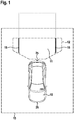
- FIG. 1 a vehicle 10 is shown at the beginning of a parking maneuver. Both in the rear region of the vehicle 10 and in the front region of the vehicle 10 are each an image capture means 25, 26, namely a respective camera arranged.
- the first region 12 at the first time 14 is marked by dashed lines when the vehicle 10 is being reversed by the first image acquisition means 25 and can be detected.
- the parking space 11 is bounded by lines drawn on the ground. The lying outside the first area 12 lines are dotted in FIG. 1 characterized.
- the first elements 15 detected by the first image acquisition means 25 at the first time 14 within the first area 12 each represent a section of the lines of the parking space boundary marked on the ground.
- FIG. 2 the vehicle 10 is shown at the second time 18. Between the first time 14 and the second time 18, the vehicle was moved backwards in the direction of the parking space 11.
- the second area 16 detected at the second time 18 is again indicated by a dashed line.
- the first elements 15 are no longer detected within the second area 16 by the first image acquisition means 25 at the second time 18.
- the position of these first elements 15 was calculated using algorithms based on motion compensation for the second time point 18.
- These first elements 15 are in FIG. 2 at the second time 18 as virtual first elements 20 are indicated by a dashed line.
- the second elements 19 within the second area 16 are detected by the first image capture means 25 at the second time 18.
- the vehicle 10 is shown at a third time 23.
- the virtual second elements 24 are also drawn in a line-like manner at the third time 23.
- the third elements 27 detected by the first image acquisition means 25 at the third time 23 represent the end region of the marking of the parking space 11.
- the vehicle 10 is driven approximately halfway into the parking space 11 at the third time point 23.
- the third area 21, namely the end area of the parking space 11 can be detected by the first image-capturing means 25, namely the reversing camera, the complete marking or limitation of the parking space 11 is displayed in the third image 22.
- FIG. 4 shows a sequence of several consecutive images in a parking maneuver of a vehicle 10 when reversing.
- the individual images represent successive points in time.
- the parking space 11 is again marked by markings (lines) on the floor.
- the respectively detected lines, which at the present time are outside the current area, are identified as virtual elements in a line-like manner.
Landscapes
- Engineering & Computer Science (AREA)
- Multimedia (AREA)
- Mechanical Engineering (AREA)
- Physics & Mathematics (AREA)
- General Physics & Mathematics (AREA)
- Theoretical Computer Science (AREA)
- Chemical & Material Sciences (AREA)
- Combustion & Propulsion (AREA)
- Transportation (AREA)
- Closed-Circuit Television Systems (AREA)
- Image Processing (AREA)
- Image Analysis (AREA)
Claims (8)
- Système d'assistance à la manoeuvre (100), notamment pour l'entrée en stationnement, pour un véhicule (10), le système d'assistance à la manoeuvre se basant sur un procédé pour manoeuvrer un véhicule (10), notamment pour manoeuvrer un véhicule (10) dans un emplacement de stationnement (11), comprenant les étapes suivantes :a) acquisition d'une première zone (12) au moyen d'une première image (13) à un premier instant (14) ;b) détection d'au moins un premier élément (12) à l'intérieur de la première zone (12) dans la première image (13) et/ou enregistrement de la première image (13) ;c) acquisition d'une deuxième zone (16) au moyen d'une deuxième image (17) à un deuxième instant (18), la deuxième zone (16) se trouvant au moins partiellement à l'extérieur de la première zone (12) et le deuxième instant (18) étant postérieur dans le temps au premier instant (14) ;d) calcul de la position du premier élément (15) détecté dans la première image (13) au premier instant (14) en référence au deuxième instant (18), la position se trouvant en-dehors de la deuxième zone (16), et/ou calcul de la position de la première image (13) en référence au deuxième instant (18) ; ete) insertion et affichage de la première image (13) et/ou du premier élément (15) à la position calculée à l'étape d) dans la deuxième image (17) en tant que premier élément virtuel (20),le système d'assistance à la manoeuvre (100) possédant, sur ou dans le véhicule (10) et dans la zone arrière du véhicule (10), un premier moyen d'acquisition d'images (25) destiné à acquérir la première zone (12) au moyen de la première image (13), le premier moyen d'acquisition d'images (25) étant sensiblement orienté vers l'arrière,
caractérisé en ce que le système d'assistance à la manoeuvre (100) possède, sur ou dans le véhicule (10) et dans la zone avant du véhicule (10), un deuxième moyen d'acquisition d'images (26) destiné à acquérir la première zone (12) au moyen de la première image (13), le deuxième moyen d'acquisition d'images (26) étant sensiblement orienté vers l'avant. - Système d'assistance à la manoeuvre selon la revendication 1, caractérisé en ce que le système d'assistance à la manoeuvre (100) ne possède pas plus qu'un premier moyen d'acquisition d'images (25), notamment une caméra de recul ou une caméra frontale, ou le système d'assistance à la manoeuvre (100) ne possède pas plus que deux moyens d'acquisition d'images (25, 26), notamment une caméra de recul et une caméra frontale.
- Système d'assistance à la manoeuvre selon la revendication 1 à 2, caractérisé en ce que le système d'assistance à la manoeuvre (100) possède des moyens, notamment des capteurs, pour détecter le mouvement propre, notamment la translation, du véhicule (10).
- Système d'assistance à la manoeuvre selon la revendication 1, 2 ou 3, caractérisé en ce que le système d'assistance à la manoeuvre se base sur un procédé pour manoeuvrer comprenant les étapes supplémentaires suivantes :f) détection d'au moins un deuxième élément (19) à l'intérieur de la deuxième zone (16) dans la deuxième image (17) et/ou enregistrement de la deuxième image (17) ;g) acquisition d'une troisième zone (21) au moyen d'une troisième image (22) à un troisième instant (23), la troisième zone (21) se trouvant au moins partiellement à l'extérieur de la deuxième zone (16) et le troisième instant (23) étant postérieur dans le temps au premier instant (14) et au deuxième instant (18) ;h) calcul de la position du deuxième élément (19) détecté dans la deuxième image (17) au deuxième instant (18) en référence au troisième instant (23), la position se trouvant en-dehors de la troisième zone (21), et/ou calcul de la position de la deuxième image (17) en référence au deuxième troisième (23) ; eti) insertion et affichage de la deuxième image (17) et/ou du deuxième élément (19) à la position calculée à l'étape h) dans la deuxième troisième (22) en tant que deuxième élément virtuel (24).
- Système d'assistance à la manoeuvre selon la revendication 4, caractérisé en ce que le système d'assistance à la manoeuvre se base sur un procédé pour manoeuvrer, avec lequel les étapes f) à i) sont répétées dans des intervalles de temps prédéfinis, ce par quoi des zones supplémentaires mutuellement adjacentes ou se chevauchant partiellement sont acquises au moyen d'images supplémentaires à des instants successifs, et les images supplémentaires sont enregistrées et/ou des éléments supplémentaires sont détectés à l'intérieur des zones supplémentaires dans les images supplémentaires, et les positions des images et/ou des éléments supplémentaires sont respectivement calculées en référence à l'instant suivant et insérées puis affichées en tant qu'éléments virtuels supplémentaires dans l'image actuelle.
- Système d'assistance à la manoeuvre selon l'une des revendications précédentes, caractérisé en ce que le système d'assistance à la manoeuvre se base sur un procédé pour manoeuvrer, avec lequel le premier élément (15) et/ou le deuxième élément (19) et/ou les éléments supplémentaires sont des structures statiques, notamment des lignes, des bordures de trottoir, des véhicules en stationnement, des bornes ou d'autres structures délimitant et/ou identifiant un emplacement de stationnement.
- Système d'assistance à la manoeuvre selon l'une des revendications précédentes, caractérisé en ce que le système d'assistance à la manoeuvre se base sur un procédé pour manoeuvrer, avec lequel la partie de la première zone (12) acquise par la première image (13) et ne chevauchant par la deuxième zone (16) est affichée dans la deuxième image (17) et en-dehors de la deuxième zone (16).
- Système d'assistance à la manoeuvre selon l'une des revendications précédentes, caractérisé en ce que le système d'assistance à la manoeuvre se base sur un procédé pour manoeuvrer, avec lequel le calcul de la position du premier élément (15) détecté dans la première image (13) au premier instant (14) en référence au deuxième instant (18) se base sur une compensation du mouvement, et se base notamment sur une translation du véhicule (10) et/ou un angle de lacet du véhicule ou d'une caméra (25, 26) disposée dans ou sur le véhicule (10) et/ou un angle d'inclinaison du véhicule ou d'une caméra (25, 26) disposée dans ou sur le véhicule (10) et/ou un angle de roulis du véhicule ou d'une caméra (25, 26) disposée dans ou sur le véhicule (10).
Applications Claiming Priority (2)
| Application Number | Priority Date | Filing Date | Title |
|---|---|---|---|
| DE201310217699 DE102013217699A1 (de) | 2013-09-05 | 2013-09-05 | Verfahren zum Manövrieren eines Fahrzeuges |
| PCT/EP2014/066954 WO2015032578A1 (fr) | 2013-09-05 | 2014-08-07 | Procédé permettant de manœuvrer un véhicule |
Publications (2)
| Publication Number | Publication Date |
|---|---|
| EP3041710A1 EP3041710A1 (fr) | 2016-07-13 |
| EP3041710B1 true EP3041710B1 (fr) | 2017-10-11 |
Family
ID=51292973
Family Applications (1)
| Application Number | Title | Priority Date | Filing Date |
|---|---|---|---|
| EP14747948.9A Active EP3041710B1 (fr) | 2013-09-05 | 2014-08-07 | Methode pour la maneuvre un vehicule |
Country Status (5)
| Country | Link |
|---|---|
| US (1) | US20160207459A1 (fr) |
| EP (1) | EP3041710B1 (fr) |
| CN (1) | CN105517843B (fr) |
| DE (1) | DE102013217699A1 (fr) |
| WO (1) | WO2015032578A1 (fr) |
Families Citing this family (2)
| Publication number | Priority date | Publication date | Assignee | Title |
|---|---|---|---|---|
| DE102018207976A1 (de) | 2018-05-22 | 2019-11-28 | Continental Automotive Gmbh | Verfahren und Vorrichtung zum Anzeigen einer Fahrzeugumgebung |
| DE102018210877A1 (de) | 2018-07-03 | 2020-01-09 | Robert Bosch Gmbh | Verfahren zur Unterstützung bei einem Rangiermanöver eines Gespanns aus Zugfahrzeug und Anhänger, System und Gespann |
Family Cites Families (6)
| Publication number | Priority date | Publication date | Assignee | Title |
|---|---|---|---|---|
| JP4156214B2 (ja) * | 2001-06-13 | 2008-09-24 | 株式会社デンソー | 車両周辺画像処理装置及び記録媒体 |
| JP4809019B2 (ja) * | 2005-08-31 | 2011-11-02 | クラリオン株式会社 | 車両用障害物検出装置 |
| JP4815993B2 (ja) * | 2005-10-19 | 2011-11-16 | アイシン・エィ・ダブリュ株式会社 | 駐車支援方法及び駐車支援装置 |
| JP4321543B2 (ja) * | 2006-04-12 | 2009-08-26 | トヨタ自動車株式会社 | 車両周辺監視装置 |
| JP4914458B2 (ja) * | 2009-02-12 | 2012-04-11 | 株式会社日本自動車部品総合研究所 | 車両周辺表示装置 |
| FR2977550B1 (fr) * | 2011-07-08 | 2013-08-09 | Peugeot Citroen Automobiles Sa | Dispositif d'aide pour mettre a la disposition d'un conducteur, de facon anticipee, une image de synthese representative d'une zone choisie entourant son vehicule |
-
2013
- 2013-09-05 DE DE201310217699 patent/DE102013217699A1/de not_active Withdrawn
-
2014
- 2014-08-07 EP EP14747948.9A patent/EP3041710B1/fr active Active
- 2014-08-07 WO PCT/EP2014/066954 patent/WO2015032578A1/fr not_active Ceased
- 2014-08-07 US US14/914,686 patent/US20160207459A1/en not_active Abandoned
- 2014-08-07 CN CN201480048752.3A patent/CN105517843B/zh active Active
Non-Patent Citations (1)
| Title |
|---|
| None * |
Also Published As
| Publication number | Publication date |
|---|---|
| WO2015032578A1 (fr) | 2015-03-12 |
| CN105517843B (zh) | 2019-01-08 |
| CN105517843A (zh) | 2016-04-20 |
| US20160207459A1 (en) | 2016-07-21 |
| DE102013217699A1 (de) | 2015-03-05 |
| EP3041710A1 (fr) | 2016-07-13 |
Similar Documents
| Publication | Publication Date | Title |
|---|---|---|
| DE102009005505B4 (de) | Verfahren und Vorrichtung zur Erzeugung eines Abbildes der Umgebung eines Kraftfahrzeugs | |
| DE102017130566B4 (de) | Sichtsystem zur Erfassung einer Fahrzeugumgebung und Spiegelersatzsystem für ein Fahrzeug mit einem Sichtsystem | |
| EP2929518B1 (fr) | Procédé et dispositif côté véhicule permettant de détecter et d'afficher des places de stationnement pour un véhicule | |
| DE102006003538B3 (de) | Verfahren zum Zusammenfügen mehrerer Bildaufnahmen zu einem Gesamtbild in der Vogelperspektive | |
| EP3328686B1 (fr) | Méthode et dispositif pour l'affichage de la région entourant un ensemble véhicule et remorque | |
| EP2805183B1 (fr) | Procédé et dispositif de visualisation de l'environnement d'un véhicule | |
| DE102010035772B4 (de) | System und Verfahren zum Liefern von Leitinformation für einen Fahrer eines Fahrzeugs | |
| DE102010051206A1 (de) | Verfahren zum Erzeugen eines Bilds einer Fahrzeugumgebung und Abbildungsvorrichtung | |
| DE102013220477B4 (de) | Verfahren und Vorrichtung zur Korrektur einer bildlichen Darstellung einer Fahrzeugumgebung | |
| DE102014018040A1 (de) | Sichtsystem | |
| DE102011120814A1 (de) | Verfahren und Vorrichtung zur Bestimmung eines Winkels zwischen einem Zugfahrzeug und einen damit gekoppelten Anhänger | |
| DE102018108751B4 (de) | Verfahren, System und Vorrichtung zum Erhalten von 3D-Information von Objekten | |
| DE102017109445A1 (de) | Kalibration einer Fahrzeug-Kameraeinrichtung in Fahrzeuglängsrichtung oder Fahrzeugquerrichtung | |
| DE102017123226A1 (de) | Verfahren zum Bestimmen einer kritischen Höhe eines vorausliegenden Streckenabschnitts für ein Fahrzeug, das ein Zugfahrzeug und einen Anhänger umfasst | |
| DE102010051204A1 (de) | Verfahren zum Darstellen eines Hindernisses und Abbildungsvorrichtung | |
| EP2996327B1 (fr) | Systeme de vue environnante pour vehicules dote d'appareils de montage | |
| WO2017198429A1 (fr) | Détermination de données d'environnement de véhicule | |
| EP3833576B1 (fr) | Systeme de camera de surveillance | |
| EP2603403B1 (fr) | Methode d'affichage d'images sur un panneau d'affichage dans un véhicule automobile, système d'aide à la conduite et véhicule | |
| EP3041710B1 (fr) | Methode pour la maneuvre un vehicule | |
| WO2014202496A1 (fr) | Procédé d'affichage d'informations relatives à l'environnement dans un véhicule | |
| DE102021133199A1 (de) | Verfahren und Fahrerassistenzsystem zur Berücksichtigung von Objekten beim Fahren entlang einer Trajektorie | |
| WO2023012096A1 (fr) | Procédé et dispositif de génération de carte pour un véhicule permettant de produire une carte haute résolution d'une surface de sol dans un environnement de véhicule | |
| DE112016001238B4 (de) | Fahrzeugumgebungsbildanzeigesteuerungsvorrichtung und fahrzeugumgebungsbildanzeigesteuerungsprogramm | |
| DE102014225673B4 (de) | Verfahren und System zur Darstellung einer Positionierungshilfe für ein Fahrzeug |
Legal Events
| Date | Code | Title | Description |
|---|---|---|---|
| PUAI | Public reference made under article 153(3) epc to a published international application that has entered the european phase |
Free format text: ORIGINAL CODE: 0009012 |
|
| 17P | Request for examination filed |
Effective date: 20160405 |
|
| AK | Designated contracting states |
Kind code of ref document: A1 Designated state(s): AL AT BE BG CH CY CZ DE DK EE ES FI FR GB GR HR HU IE IS IT LI LT LU LV MC MK MT NL NO PL PT RO RS SE SI SK SM TR |
|
| AX | Request for extension of the european patent |
Extension state: BA ME |
|
| DAX | Request for extension of the european patent (deleted) | ||
| GRAP | Despatch of communication of intention to grant a patent |
Free format text: ORIGINAL CODE: EPIDOSNIGR1 |
|
| RIC1 | Information provided on ipc code assigned before grant |
Ipc: B60Q 9/00 20060101AFI20170424BHEP Ipc: B62D 15/02 20060101ALI20170424BHEP Ipc: G06K 9/00 20060101ALI20170424BHEP Ipc: B60R 1/00 20060101ALI20170424BHEP |
|
| INTG | Intention to grant announced |
Effective date: 20170529 |
|
| GRAS | Grant fee paid |
Free format text: ORIGINAL CODE: EPIDOSNIGR3 |
|
| GRAA | (expected) grant |
Free format text: ORIGINAL CODE: 0009210 |
|
| AK | Designated contracting states |
Kind code of ref document: B1 Designated state(s): AL AT BE BG CH CY CZ DE DK EE ES FI FR GB GR HR HU IE IS IT LI LT LU LV MC MK MT NL NO PL PT RO RS SE SI SK SM TR |
|
| REG | Reference to a national code |
Ref country code: GB Ref legal event code: FG4D Free format text: NOT ENGLISH |
|
| REG | Reference to a national code |
Ref country code: CH Ref legal event code: EP |
|
| REG | Reference to a national code |
Ref country code: IE Ref legal event code: FG4D Free format text: LANGUAGE OF EP DOCUMENT: GERMAN |
|
| REG | Reference to a national code |
Ref country code: AT Ref legal event code: REF Ref document number: 935705 Country of ref document: AT Kind code of ref document: T Effective date: 20171115 |
|
| REG | Reference to a national code |
Ref country code: DE Ref legal event code: R096 Ref document number: 502014005790 Country of ref document: DE |
|
| REG | Reference to a national code |
Ref country code: NL Ref legal event code: MP Effective date: 20171011 |
|
| REG | Reference to a national code |
Ref country code: LT Ref legal event code: MG4D |
|
| PG25 | Lapsed in a contracting state [announced via postgrant information from national office to epo] |
Ref country code: NL Free format text: LAPSE BECAUSE OF FAILURE TO SUBMIT A TRANSLATION OF THE DESCRIPTION OR TO PAY THE FEE WITHIN THE PRESCRIBED TIME-LIMIT Effective date: 20171011 |
|
| PG25 | Lapsed in a contracting state [announced via postgrant information from national office to epo] |
Ref country code: FI Free format text: LAPSE BECAUSE OF FAILURE TO SUBMIT A TRANSLATION OF THE DESCRIPTION OR TO PAY THE FEE WITHIN THE PRESCRIBED TIME-LIMIT Effective date: 20171011 Ref country code: LT Free format text: LAPSE BECAUSE OF FAILURE TO SUBMIT A TRANSLATION OF THE DESCRIPTION OR TO PAY THE FEE WITHIN THE PRESCRIBED TIME-LIMIT Effective date: 20171011 Ref country code: SE Free format text: LAPSE BECAUSE OF FAILURE TO SUBMIT A TRANSLATION OF THE DESCRIPTION OR TO PAY THE FEE WITHIN THE PRESCRIBED TIME-LIMIT Effective date: 20171011 Ref country code: NO Free format text: LAPSE BECAUSE OF FAILURE TO SUBMIT A TRANSLATION OF THE DESCRIPTION OR TO PAY THE FEE WITHIN THE PRESCRIBED TIME-LIMIT Effective date: 20180111 Ref country code: ES Free format text: LAPSE BECAUSE OF FAILURE TO SUBMIT A TRANSLATION OF THE DESCRIPTION OR TO PAY THE FEE WITHIN THE PRESCRIBED TIME-LIMIT Effective date: 20171011 |
|
| PG25 | Lapsed in a contracting state [announced via postgrant information from national office to epo] |
Ref country code: GR Free format text: LAPSE BECAUSE OF FAILURE TO SUBMIT A TRANSLATION OF THE DESCRIPTION OR TO PAY THE FEE WITHIN THE PRESCRIBED TIME-LIMIT Effective date: 20180112 Ref country code: IS Free format text: LAPSE BECAUSE OF FAILURE TO SUBMIT A TRANSLATION OF THE DESCRIPTION OR TO PAY THE FEE WITHIN THE PRESCRIBED TIME-LIMIT Effective date: 20180211 Ref country code: BG Free format text: LAPSE BECAUSE OF FAILURE TO SUBMIT A TRANSLATION OF THE DESCRIPTION OR TO PAY THE FEE WITHIN THE PRESCRIBED TIME-LIMIT Effective date: 20180111 Ref country code: LV Free format text: LAPSE BECAUSE OF FAILURE TO SUBMIT A TRANSLATION OF THE DESCRIPTION OR TO PAY THE FEE WITHIN THE PRESCRIBED TIME-LIMIT Effective date: 20171011 Ref country code: RS Free format text: LAPSE BECAUSE OF FAILURE TO SUBMIT A TRANSLATION OF THE DESCRIPTION OR TO PAY THE FEE WITHIN THE PRESCRIBED TIME-LIMIT Effective date: 20171011 Ref country code: HR Free format text: LAPSE BECAUSE OF FAILURE TO SUBMIT A TRANSLATION OF THE DESCRIPTION OR TO PAY THE FEE WITHIN THE PRESCRIBED TIME-LIMIT Effective date: 20171011 |
|
| REG | Reference to a national code |
Ref country code: DE Ref legal event code: R097 Ref document number: 502014005790 Country of ref document: DE |
|
| PG25 | Lapsed in a contracting state [announced via postgrant information from national office to epo] |
Ref country code: EE Free format text: LAPSE BECAUSE OF FAILURE TO SUBMIT A TRANSLATION OF THE DESCRIPTION OR TO PAY THE FEE WITHIN THE PRESCRIBED TIME-LIMIT Effective date: 20171011 Ref country code: SK Free format text: LAPSE BECAUSE OF FAILURE TO SUBMIT A TRANSLATION OF THE DESCRIPTION OR TO PAY THE FEE WITHIN THE PRESCRIBED TIME-LIMIT Effective date: 20171011 Ref country code: CZ Free format text: LAPSE BECAUSE OF FAILURE TO SUBMIT A TRANSLATION OF THE DESCRIPTION OR TO PAY THE FEE WITHIN THE PRESCRIBED TIME-LIMIT Effective date: 20171011 Ref country code: DK Free format text: LAPSE BECAUSE OF FAILURE TO SUBMIT A TRANSLATION OF THE DESCRIPTION OR TO PAY THE FEE WITHIN THE PRESCRIBED TIME-LIMIT Effective date: 20171011 |
|
| PLBE | No opposition filed within time limit |
Free format text: ORIGINAL CODE: 0009261 |
|
| STAA | Information on the status of an ep patent application or granted ep patent |
Free format text: STATUS: NO OPPOSITION FILED WITHIN TIME LIMIT |
|
| REG | Reference to a national code |
Ref country code: FR Ref legal event code: PLFP Year of fee payment: 5 |
|
| PG25 | Lapsed in a contracting state [announced via postgrant information from national office to epo] |
Ref country code: PL Free format text: LAPSE BECAUSE OF FAILURE TO SUBMIT A TRANSLATION OF THE DESCRIPTION OR TO PAY THE FEE WITHIN THE PRESCRIBED TIME-LIMIT Effective date: 20171011 Ref country code: RO Free format text: LAPSE BECAUSE OF FAILURE TO SUBMIT A TRANSLATION OF THE DESCRIPTION OR TO PAY THE FEE WITHIN THE PRESCRIBED TIME-LIMIT Effective date: 20171011 Ref country code: SM Free format text: LAPSE BECAUSE OF FAILURE TO SUBMIT A TRANSLATION OF THE DESCRIPTION OR TO PAY THE FEE WITHIN THE PRESCRIBED TIME-LIMIT Effective date: 20171011 |
|
| 26N | No opposition filed |
Effective date: 20180712 |
|
| PG25 | Lapsed in a contracting state [announced via postgrant information from national office to epo] |
Ref country code: MT Free format text: LAPSE BECAUSE OF FAILURE TO SUBMIT A TRANSLATION OF THE DESCRIPTION OR TO PAY THE FEE WITHIN THE PRESCRIBED TIME-LIMIT Effective date: 20171011 |
|
| PG25 | Lapsed in a contracting state [announced via postgrant information from national office to epo] |
Ref country code: SI Free format text: LAPSE BECAUSE OF FAILURE TO SUBMIT A TRANSLATION OF THE DESCRIPTION OR TO PAY THE FEE WITHIN THE PRESCRIBED TIME-LIMIT Effective date: 20171011 |
|
| PG25 | Lapsed in a contracting state [announced via postgrant information from national office to epo] |
Ref country code: MC Free format text: LAPSE BECAUSE OF FAILURE TO SUBMIT A TRANSLATION OF THE DESCRIPTION OR TO PAY THE FEE WITHIN THE PRESCRIBED TIME-LIMIT Effective date: 20171011 |
|
| REG | Reference to a national code |
Ref country code: CH Ref legal event code: PL |
|
| GBPC | Gb: european patent ceased through non-payment of renewal fee |
Effective date: 20180807 |
|
| PG25 | Lapsed in a contracting state [announced via postgrant information from national office to epo] |
Ref country code: LI Free format text: LAPSE BECAUSE OF NON-PAYMENT OF DUE FEES Effective date: 20180831 Ref country code: CH Free format text: LAPSE BECAUSE OF NON-PAYMENT OF DUE FEES Effective date: 20180831 Ref country code: LU Free format text: LAPSE BECAUSE OF NON-PAYMENT OF DUE FEES Effective date: 20180807 |
|
| REG | Reference to a national code |
Ref country code: BE Ref legal event code: MM Effective date: 20180831 |
|
| REG | Reference to a national code |
Ref country code: IE Ref legal event code: MM4A |
|
| PG25 | Lapsed in a contracting state [announced via postgrant information from national office to epo] |
Ref country code: IE Free format text: LAPSE BECAUSE OF NON-PAYMENT OF DUE FEES Effective date: 20180807 |
|
| PG25 | Lapsed in a contracting state [announced via postgrant information from national office to epo] |
Ref country code: BE Free format text: LAPSE BECAUSE OF NON-PAYMENT OF DUE FEES Effective date: 20180831 |
|
| PG25 | Lapsed in a contracting state [announced via postgrant information from national office to epo] |
Ref country code: GB Free format text: LAPSE BECAUSE OF NON-PAYMENT OF DUE FEES Effective date: 20180807 |
|
| PG25 | Lapsed in a contracting state [announced via postgrant information from national office to epo] |
Ref country code: TR Free format text: LAPSE BECAUSE OF FAILURE TO SUBMIT A TRANSLATION OF THE DESCRIPTION OR TO PAY THE FEE WITHIN THE PRESCRIBED TIME-LIMIT Effective date: 20171011 |
|
| PG25 | Lapsed in a contracting state [announced via postgrant information from national office to epo] |
Ref country code: PT Free format text: LAPSE BECAUSE OF FAILURE TO SUBMIT A TRANSLATION OF THE DESCRIPTION OR TO PAY THE FEE WITHIN THE PRESCRIBED TIME-LIMIT Effective date: 20171011 |
|
| PG25 | Lapsed in a contracting state [announced via postgrant information from national office to epo] |
Ref country code: CY Free format text: LAPSE BECAUSE OF FAILURE TO SUBMIT A TRANSLATION OF THE DESCRIPTION OR TO PAY THE FEE WITHIN THE PRESCRIBED TIME-LIMIT Effective date: 20171011 Ref country code: HU Free format text: LAPSE BECAUSE OF FAILURE TO SUBMIT A TRANSLATION OF THE DESCRIPTION OR TO PAY THE FEE WITHIN THE PRESCRIBED TIME-LIMIT; INVALID AB INITIO Effective date: 20140807 Ref country code: MK Free format text: LAPSE BECAUSE OF NON-PAYMENT OF DUE FEES Effective date: 20171011 |
|
| PG25 | Lapsed in a contracting state [announced via postgrant information from national office to epo] |
Ref country code: AL Free format text: LAPSE BECAUSE OF FAILURE TO SUBMIT A TRANSLATION OF THE DESCRIPTION OR TO PAY THE FEE WITHIN THE PRESCRIBED TIME-LIMIT Effective date: 20171011 |
|
| REG | Reference to a national code |
Ref country code: AT Ref legal event code: MM01 Ref document number: 935705 Country of ref document: AT Kind code of ref document: T Effective date: 20190807 |
|
| PG25 | Lapsed in a contracting state [announced via postgrant information from national office to epo] |
Ref country code: AT Free format text: LAPSE BECAUSE OF NON-PAYMENT OF DUE FEES Effective date: 20190807 |
|
| PGFP | Annual fee paid to national office [announced via postgrant information from national office to epo] |
Ref country code: IT Payment date: 20250829 Year of fee payment: 12 |
|
| PGFP | Annual fee paid to national office [announced via postgrant information from national office to epo] |
Ref country code: FR Payment date: 20250821 Year of fee payment: 12 |
|
| PGFP | Annual fee paid to national office [announced via postgrant information from national office to epo] |
Ref country code: DE Payment date: 20251021 Year of fee payment: 12 |