EP3042919A2 - Schnellaktivierungskatalysator - Google Patents
Schnellaktivierungskatalysator Download PDFInfo
- Publication number
- EP3042919A2 EP3042919A2 EP16153015.9A EP16153015A EP3042919A2 EP 3042919 A2 EP3042919 A2 EP 3042919A2 EP 16153015 A EP16153015 A EP 16153015A EP 3042919 A2 EP3042919 A2 EP 3042919A2
- Authority
- EP
- European Patent Office
- Prior art keywords
- silica support
- alkaline
- chromium
- aging
- silica
- Prior art date
- Legal status (The legal status is an assumption and is not a legal conclusion. Google has not performed a legal analysis and makes no representation as to the accuracy of the status listed.)
- Granted
Links
Images


Classifications
-
- C—CHEMISTRY; METALLURGY
- C08—ORGANIC MACROMOLECULAR COMPOUNDS; THEIR PREPARATION OR CHEMICAL WORKING-UP; COMPOSITIONS BASED THEREON
- C08F—MACROMOLECULAR COMPOUNDS OBTAINED BY REACTIONS ONLY INVOLVING CARBON-TO-CARBON UNSATURATED BONDS
- C08F10/00—Homopolymers and copolymers of unsaturated aliphatic hydrocarbons having only one carbon-to-carbon double bond
-
- B—PERFORMING OPERATIONS; TRANSPORTING
- B01—PHYSICAL OR CHEMICAL PROCESSES OR APPARATUS IN GENERAL
- B01J—CHEMICAL OR PHYSICAL PROCESSES, e.g. CATALYSIS OR COLLOID CHEMISTRY; THEIR RELEVANT APPARATUS
- B01J21/00—Catalysts comprising the elements, oxides, or hydroxides of magnesium, boron, aluminium, carbon, silicon, titanium, zirconium, or hafnium
- B01J21/06—Silicon, titanium, zirconium or hafnium; Oxides or hydroxides thereof
- B01J21/08—Silica
-
- B—PERFORMING OPERATIONS; TRANSPORTING
- B01—PHYSICAL OR CHEMICAL PROCESSES OR APPARATUS IN GENERAL
- B01J—CHEMICAL OR PHYSICAL PROCESSES, e.g. CATALYSIS OR COLLOID CHEMISTRY; THEIR RELEVANT APPARATUS
- B01J23/00—Catalysts comprising metals or metal oxides or hydroxides, not provided for in group B01J21/00
- B01J23/16—Catalysts comprising metals or metal oxides or hydroxides, not provided for in group B01J21/00 of arsenic, antimony, bismuth, vanadium, niobium, tantalum, polonium, chromium, molybdenum, tungsten, manganese, technetium or rhenium
- B01J23/24—Chromium, molybdenum or tungsten
- B01J23/26—Chromium
-
- B—PERFORMING OPERATIONS; TRANSPORTING
- B01—PHYSICAL OR CHEMICAL PROCESSES OR APPARATUS IN GENERAL
- B01J—CHEMICAL OR PHYSICAL PROCESSES, e.g. CATALYSIS OR COLLOID CHEMISTRY; THEIR RELEVANT APPARATUS
- B01J37/00—Processes, in general, for preparing catalysts; Processes, in general, for activation of catalysts
- B01J37/02—Impregnation, coating or precipitation
- B01J37/0201—Impregnation
- B01J37/0207—Pretreatment of the support
-
- B—PERFORMING OPERATIONS; TRANSPORTING
- B01—PHYSICAL OR CHEMICAL PROCESSES OR APPARATUS IN GENERAL
- B01J—CHEMICAL OR PHYSICAL PROCESSES, e.g. CATALYSIS OR COLLOID CHEMISTRY; THEIR RELEVANT APPARATUS
- B01J37/00—Processes, in general, for preparing catalysts; Processes, in general, for activation of catalysts
- B01J37/02—Impregnation, coating or precipitation
- B01J37/03—Precipitation; Co-precipitation
- B01J37/036—Precipitation; Co-precipitation to form a gel or a cogel
-
- B—PERFORMING OPERATIONS; TRANSPORTING
- B01—PHYSICAL OR CHEMICAL PROCESSES OR APPARATUS IN GENERAL
- B01J—CHEMICAL OR PHYSICAL PROCESSES, e.g. CATALYSIS OR COLLOID CHEMISTRY; THEIR RELEVANT APPARATUS
- B01J37/00—Processes, in general, for preparing catalysts; Processes, in general, for activation of catalysts
- B01J37/06—Washing
-
- B—PERFORMING OPERATIONS; TRANSPORTING
- B01—PHYSICAL OR CHEMICAL PROCESSES OR APPARATUS IN GENERAL
- B01J—CHEMICAL OR PHYSICAL PROCESSES, e.g. CATALYSIS OR COLLOID CHEMISTRY; THEIR RELEVANT APPARATUS
- B01J35/00—Catalysts, in general, characterised by their form or physical properties
- B01J35/60—Catalysts, in general, characterised by their form or physical properties characterised by their surface properties or porosity
- B01J35/61—Surface area
- B01J35/615—100-500 m2/g
-
- B—PERFORMING OPERATIONS; TRANSPORTING
- B01—PHYSICAL OR CHEMICAL PROCESSES OR APPARATUS IN GENERAL
- B01J—CHEMICAL OR PHYSICAL PROCESSES, e.g. CATALYSIS OR COLLOID CHEMISTRY; THEIR RELEVANT APPARATUS
- B01J35/00—Catalysts, in general, characterised by their form or physical properties
- B01J35/60—Catalysts, in general, characterised by their form or physical properties characterised by their surface properties or porosity
- B01J35/63—Pore volume
- B01J35/638—Pore volume more than 1.0 ml/g
-
- B—PERFORMING OPERATIONS; TRANSPORTING
- B01—PHYSICAL OR CHEMICAL PROCESSES OR APPARATUS IN GENERAL
- B01J—CHEMICAL OR PHYSICAL PROCESSES, e.g. CATALYSIS OR COLLOID CHEMISTRY; THEIR RELEVANT APPARATUS
- B01J35/00—Catalysts, in general, characterised by their form or physical properties
- B01J35/60—Catalysts, in general, characterised by their form or physical properties characterised by their surface properties or porosity
- B01J35/64—Pore diameter
- B01J35/647—2-50 nm
-
- C—CHEMISTRY; METALLURGY
- C08—ORGANIC MACROMOLECULAR COMPOUNDS; THEIR PREPARATION OR CHEMICAL WORKING-UP; COMPOSITIONS BASED THEREON
- C08F—MACROMOLECULAR COMPOUNDS OBTAINED BY REACTIONS ONLY INVOLVING CARBON-TO-CARBON UNSATURATED BONDS
- C08F110/00—Homopolymers of unsaturated aliphatic hydrocarbons having only one carbon-to-carbon double bond
- C08F110/02—Ethene
Definitions
- the present disclosure generally relates to catalysts comprising chromium and a support and methods of preparing and activating same.
- Chromium supported catalysts are used for the polymerization of olefin polymers. Catalyst manufacturers prepare such catalysts by placing the chromium on a support such as silica or silica-titania. The support helps to stabilize the activity of the chromium and allows the catalyst to be shipped in an inactive form to the purchaser. Once the catalyst arrives at a polymer manufacturing site, it is activated for use in the polymerization process. Activation of these catalysts usually employ large and expensive equipment which are used to thermally treat the inactive compositions at high temperatures for extended time periods.
- a method of preparing a catalyst comprising aging a silica support in an alkaline solution to produce an alkaline aged silica support, removing at least a portion of the alkaline solution from the alkaline aged silica support to produce a dried silica support, and activating the silica support to produce a catalyst composition, wherein alkaline aging lowers the surface area of the silica support to less than about 50% of the original value and wherein activation of the silica support is carried out in batches of equal to or greater than about 500 lbs for a time period of less than about 8 hours.
- Also disclosed herein is a method of preparing a polymer comprising alkaline aging a silica support material, adding chromium to the silica support material prior to the alkaline aging, after the alkaline aging, or both to form a chromium-silica support, rapidly activating the chromium-silica support produce an activated olefin polymerization catalyst, contacting the activated olefin polymerization catalyst with at least one monomer in a reaction zone under conditions suitable to produce a polymer, and recovering the polymer.
- a method of preparing a polymer comprising alkaline aging a silica support material, adding chromium to the silica support material prior to the alkaline aging, after the alkaline aging, or both to form a chromium-silica support, and rapidly activating the chromium-silica support produce an activated olefin polymerization catalyst, wherein rapidly activating chromium-silica support comprises heating the a temperature of equal to or greater than about 700 °C for a time period of less than about 8 hours.
- a method of preparing a catalyst comprising providing a supported chromium composition, chemically fusing the support material to produce a fused supported chromium composition, and rapidly activating the precursor catalyst composition to produce an activated olefin polymerization catalyst.
- a method of preparing a catalyst comprising aging a silica hydrogel in an alkaline solution to produce an alkaline aged silica hydrogel, removing at least a portion of the alkaline solution from the alkaline aged silica hydrogel to produce a silica xerogel, and activating the silica xerogel to produce a catalyst composition, wherein the catalyst composition has a surface area of less than about 300 m 2 /g and wherein activation of the silica xerogel is carried out in batches of equal to or greater than about 500 lbs for a time period of less than about 8 hours.
- Disclosed herein are methods of preparing a catalyst comprising contacting a composition comprising aging a silica support in an alkaline solution to produce an alkaline aged silica support; removing at least a portion of the alkaline solution from the alkaline aged silica support to produce a dried silica support; and activating the silica support to produce a catalyst composition.
- Processes for the subsequent activation of said silica support may be carried out for a reduced time period when compared to compositions prepared in the absence of an alkaline treatment.
- catalyst compositions prepared by the methodologies disclosed herein and subsequently activated are referred to as rapidly activated catalyst compositions (RACCs). The various catalyst components and the methods of preparation and activation of same are described in more detail herein.
- the RACC comprises a support.
- the support may be an inorganic oxide such as silica, or silica-titania.
- the support may further comprise other ingredients that do not adversely affect the RACC such as alumina, aluminophosphates, boria, magnesia, thoria, zirconia, ceria, clay, zeolites, or combinations thereof.
- the support comprises silica.
- Silica supports may be prepared using any suitable means.
- the silica support may be prepared by contacting an aqueous solution of an alkali metal silicate with an acid to form a silica hydrogel.
- the support comprises silica-titania.
- the silica-titania support may be prepared using any suitable method such as co-gelation, heterogeneous coprecipitation, and surface impregnation of silica with a titanium-containing compound such as TiCl 3 or TiCl 4 .
- the silica-titania support may have a surface area ranging from about 250 m 2 /g to about 600 m 2 /g and a pore volume ranging from about 1.0 cc/g to about 3.0 cc/g.
- the support e.g., silica or silica titania
- the support may be present in the in an amount of equal to or greater than about 90 percent (%) by total weight of the RACC, alternatively equal to or greater than about 95%, alternatively equal to or greater than about 98%.
- the RACC comprises chromium which may be introduced to the RACC via contacting of a chromium-containing compound with the support.
- the chromium-containing compound may be one or more compounds comprising chromium in the hexavalent oxidation state (hereinafter Cr(VI)) or comprising a material suitable for conversion to Cr(VI).
- the chromium-containing compound comprises a water-soluble chromium compound; alternatively the chromium-containing compound comprises a hydrocarbon-soluble chromium compound.
- the chromium-containing compound may be a chromium (II) compound, chromium (III) compound, or combinations thereof.
- Suitable chromium (III) compounds include, but are not limited to, chromium carboxylates, chromium naphthenates, chromium halides, chromium pyrrolides, chromium benzoates, chromium dionates, chromium nitrates, chromium sulfates, or combinations thereof.
- chromium (III) compounds include, but are not limited to, chromium (III) isooctanoate, chromium (III) 2,2,6,6-tetramethylheptanedionate, chromium (III) naphthenate, chromium (III) chloride, chromium (III) tris(2-ethylhexanoate), chromic fluoride, chromium (III) oxy-2-ethylhexanoate, chromium (III) dichloroethylhexanoate, chromium (III) acetylacetonate, chromium (III) acetate, chromium (111) butyrate, chromium (III) neopentanoate, chromium (III) laurate, chromium (III) sulfate, chromium (III) oxalate, chromium (III) benzoate, chromium
- Suitable chromium (II) compounds include, but are not limited to, chromous fluoride, chromous chloride, chromous bromide, chromous iodide, chromium (II) bis(2-ethylhexanoate), chromium (II) acetate, chromium (II) butyrate, chromium (II) neopentanoate, chromium (II) laurate, chromium (II) stearate, chromium (II) oxalate, chromium (II) benzoate, chromium (II) pyrrolide(s), chromous sulfate, or combinations thereof.
- chromium-containing compounds examples include tertiary butyl chromate in a hydrocarbon liquid; chromium trioxide in water; chromium acetate in water; chromium nitrate in alcohol; zerovalent organochromium compounds such as pi bonded chromium complexes, for example, dicumene chromium and dibenzene chromium; or combinations thereof.
- Pi bonded chromium complexes are described in U.S. Pat. No. 3,976,632 , which is incorporated by reference herein in its entirety.
- Chromium may be present in the RACC in an amount of from about 0.1% to about 10% based on the final weight of the RACC, alternatively from about 0.2% to about 2%, or about 1%.
- a method 100 may initiate at block 110 with the formation of a hydrogel.
- a hydrogel is a network of silicate chains that are insoluble in water and may be found as a colloidal gel in which water is the dispersion medium.
- the hydrogel is comprised of the support material (e.g., silica or silica-titania).
- the support material e.g., silica or silica-titania.
- the hydrogel comprises silica.
- a silica hydrogel may be formed by contacting an alkali metal silicate such as sodium silicate with an acid such as sulfuric acid. The contacting may be carried out under suitable conditions for example by means of mixing or agitating.
- the silica hydrogel may be further washed with water and/or with any suitable compound such as ammonium salt (e.g., ammonium nitrate, etc) or diluted acid to reduce the alkali metal content of the silica hydrogel. The washing may be carried out several times or until a user desired result is achieved.
- the silica hydrogel may then be contacted with an alkaline solution, block 120, comprising one or more basic compounds (e.g., bases, buffer) having a pH of from about 8 to about 13, alternatively from about 9 to about 12, alternatively from about 9 to about 10 at a temperature of from about 60 °C to about 90 °C, or from about 70 °C to about 85 °C, or at about 80 °C.
- an alkaline solution comprising one or more basic compounds (e.g., bases, buffer) having a pH of from about 8 to about 13, alternatively from about 9 to about 12, alternatively from about 9 to about 10 at a temperature of from about 60 °C to about 90 °C, or from about 70 °C to about 85 °C, or at about 80 °C.
- Treatment of the silica hydrogel by exposure to an alkaline solution under the conditions described herein is termed alkaline aging.
- the alkaline solution may be comprised of any components which provide a solution pH in the disclosed ranges
- the alkaline solution may comprise ammonium hydroxide, potassium hydroxide, sodium hydroxide, trialkylammonium hydroxide, sodium silicate and the like.
- suitable compounds and amounts effective to provide a solution in the disclosed pH ranges may be utilized.
- Alkaline aging of the silica hydrogel may be carried out for a time period sufficient to lower the surface area of the silica support to less than about 50% of the original value, alternatively to less than about 45% of the original value, alternatively to less than about 40% of the original value, alternatively to less than about 35% of the original value of the surface area of an otherwise similar material that has not been alkaline aged.
- the xerogel is first dried at 200-400°C to remove adsorbed components.
- the support may comprise a silica support which, if dried in it's virgin (not alkaline aged) state, would produce a surface area of about 600 m 2 /g.
- alkaline aging may reduce the surface area of the support to less than about 300 m 2 /g, alternatively to less than about 280 m 2 /g, alternatively to less than about 250 m 2 /g, alternatively to less than about 225 m 2 /g.
- the alkaline aging is carried out for a period of time of from about 1 hour to about 24 hours, or from about 2 hours to about 10 hours, or from about 3 hours to about 6 hours.
- the composition comprising a silica hydrogel and an aqueous alkaline solution may be further processed to remove all or a portion of the aqueous solution from the composition, block 130.
- the composition may be dried using standard techniques such as thermal treatment, spray drying, or contacting with a volatile liquid organic solvent.
- volatile liquid organic solvents include without limitation methyl isobutylketone, ethyl acetate, sec-butyl alcohol, n-propyl alcohol, butyraldehyde, diisobutyl ether, isopropyl acetate, 3-methyl-1-butanol, 1-pentanol, 2-pentanol, 1-hexanol or combinations thereof.
- Drying of the silica material may convert the silica hydrogel to a silica xerogel and the resultant alkaline-aged, dried silica material is hereinafter termed a precursor catalyst composition (PCC).
- the PCC may subsequently be activated to form a RACC, block 140. Activation of the precursor composition may be carried out in as will be described later herein.
- Chromium may be added to the precursor catalyst composition (e.g., a silica support, a silica-titania support) at any time during the synthesis process.
- the silica support e.g., hydrogel and/or xerogel
- a chromium containing compound prior to, during, and/or after alkaline aging.
- a silica hydrogel and/or xerogel is contacted with a chromium-containing compound prior to alkaline aging; alternatively a silica hydrogel and/or xerogel that is subjected to alkaline aging may be contacted with a chromium-containing compound of the type previously described herein following alkaline aging; or combinations thereof.
- a Cr-silica material or support is formed upon contact of a silica-containing support with a chromium-containing compound.
- a Cr-silica hydrogel is alkaline aged and subsequently converted to a silica-Cr xerogel.
- the PCC is activated to produce an active catalyst, alternatively an active polymerization catalyst.
- the PCCs of the present disclosure may be activated using various types of activator equipment. Any vessel or apparatus may be utilized to activate the PCC including for example rotary calciners, static pan driers, or fluidized beds. Such equipment may operate in a static, batch, or continuous mode. For the static or batch mode, a vessel or apparatus containing the catalyst bed may be subjected sequentially to various stages of the activation process. For the continuous mode, the stages of the process can occur in a series of zones through which the PCC passes on its path through the activation apparatus.
- the PCC is activated in a fluidized bed activator.
- gas may flow upward through a grid plate containing many small holes upon which the PCC is positioned.
- the gas may contain various compounds to create a desirable process conditions.
- the PCC may be mixed in the gas as it flows creating a fluid-like flow. This is often referred to as fluidization or fluidizing.
- the activation may further comprise heating the PCC to a desired temperature in one or more stages.
- stages refers to heating the PCC to a desired temperature and holding the temperature for a period of time.
- a stage may be performed when the PCC is in a stationary position or by moving the PCC through various locations and may comprise a ramp up time to a desired temperature and holding the PCC at that temperature for a certain hold time.
- the ramp up times may be the same or different, for example the ramp up time may be instantaneous (e.g., preheated environment) to less than about 3 hours.
- PCCs of the type described herein typically utilize large volumes, termed commercial batches, of these materials (e.g., 100 to 1500 pounds) and require slowly heating these materials over extended periods of time to elevated temperatures (e.g., 800°C).
- the alkaline aging process is carried out by a commercial catalyst manufacturer in a commercial catalyst manufacturing facility, the catalyst is transported, and the activation process is carried out by a commercial polymer producer in a commercial polymerization process unit.
- the PCC is activated in commercial batches wherein each batch comprises equal to or greater than about 500 lbs of catalyst, alternatively equal to or greater than about 750 lbs, alternatively equal to or greater than about 1000 lbs, alternatively equal to or greater than about 1250 lbs.
- the temperature(s) at which the PCC is activated may be adjusted to achieve a user desired result.
- the temperature(s) may be in a range of from about 400 °C to about 1000 °C, alternatively from about 600 °C to about 900 °C, alternatively from about 750 °C to about 900 °C.
- Activation of a PCC prepared as described herein may be carried out rapidly, for example in a reduced amount of time when compared to an otherwise similar composition that was not subjected to the treatments described herein.
- the PCC may be activated for a time period of less than about 8 hours at the maximum temperature, alternatively less than about 7 hours, alternatively less than about 6 hours, alternatively less about 5 hours, alternatively less than about 4 hours, alternatively less than about 3 hours, alternatively less than about 2 hours, alternatively less than about 1 hour. If two or more stages are used, the total hold time is the summation of hold times for all the stages at the maximum temperature. Thermal activation in stages is described further in U.S. Patent No. 4,022,580 and U.S. Patent Application Pub. No. 2005/0255987 A1 published on November 17, 2005 , each of which is incorporated by reference in its entirety herein.
- activation of the PCC results in dehydroxylation and annealing of the support material, which can further lower the surface area.
- the alkaline aging step is enhanced and properly adjusted, one can achieve some of the same benefits of high temperature activation for long time periods. Therefore, enhanced alkaline aging can permit shorter activation times, increased activation efficiency and higher equipment output.
- Activation also causes oxidation of any of the trivalent form of chromium (Cr(III)) to the hexavalent form (Cr(VI)) and then stabilization of the Cr(VI) form.
- stabilization refers to the activation process resulting in the Cr(VI) form of the catalyst.
- the activation process may convert from about 10 to about 100% of Cr(III) to Cr(VI), or from about 30 to about 80%, or from about 35 to about 65% and yield from about 0.1 to about 1% Cr(VI), from about 0.2 to about 0.9%, or from about 0.3 to about 0.65%.
- RACCs of the type described herein display a decreased surface area and an increased pore diameter when compared to an otherwise similar catalyst prepared in the absence of an alkaline treatment. In some embodiments, RACCs of the type described herein display an increased pore volume when compared to an otherwise similar catalyst prepared in the absence of an alkaline treatment.
- the surface area of the RACC may range from about 100 meters squared per gram (m 2 /g) to about 600 m 2 /g, or from about 200 m 2 /g to about 400 m 2 /g, or from about 250 m 2 /g to about 350 m 2 /g.
- the pore diameter of the RACC ranges from about 50 Angstroms ( ⁇ ) to about 400 ⁇ , or from about 100 ⁇ to about 350 A, or from about 200 ⁇ to about 300 A. In yet another embodiment, the pore volume of the RACC ranges from about 1 cubic centimeter per gram (cc/g) to about 3, cc/g or from about 1.2 cc/g to about 2.5, cc/g or from about 1.5 cc/g to about 2 cc/g.
- the catalysts and resins of the present invention are intended for any olefin polymerization method using various types of polymerization reactors.
- polymerization reactor includes any polymerization reactor capable of polymerizing olefin monomers to produce homopolymers or copolymers. Such homopolymers and copolymers are referred to as resins or polymers.
- the various types of reactors include those that may be referred to as batch, slurry, gas-phase, solution, high pressure, tubular or autoclave reactors.
- Gas phase reactors may comprise fluidized bed reactors or staged horizontal reactors.
- Slurry reactors may comprise vertical or horizontal loops.
- High pressure reactors may comprise autoclave or tubular reactors.
- Reactor types can include batch or continuous processes. Continuous processes could use intermittent or continuous product discharge. Processes may also include partial or full direct recycle of un-reacted monomer, un-reacted comonomer, and/or diluent.
- Polymerization reactor systems of the present invention may comprise one type of reactor in a system or multiple reactors of the same or different type.
- Production of polymers in multiple reactors may include several stages in at least two separate polymerization reactors interconnected by a transfer device making it possible to transfer the polymers resulting from the first polymerization reactor into the second reactor.
- the desired polymerization conditions in one of the reactors may be different from the operating conditions of the other reactors.
- polymerization in multiple reactors may include the manual transfer of polymer from one reactor to subsequent reactors for continued polymerization.
- Multiple reactor systems may include any combination including, but not limited to, multiple loop reactors, multiple gas reactors, a combination of loop and gas reactors, multiple high pressure reactors or a combination of high pressure with loop and/or gas reactors. The multiple reactors may be operated in series or in parallel.
- the polymerization reactor system may comprise at least one loop slurry reactor comprising vertical or horizontal loops.
- Monomer, diluent, catalyst and optionally any comonomer may be continuously fed to a loop reactor where polymerization occurs.
- continuous processes may comprise the continuous introduction of a monomer, a catalyst, and a diluent into a polymerization reactor and the continuous removal from this reactor of a suspension comprising polymer particles and the diluent.
- Reactor effluent may be flashed to remove the solid polymer from the liquids that comprise the diluent, monomer and/or comonomer.
- Various technologies may be used for this separation step including but not limited to, flashing that may include any combination of heat addition and pressure reduction; separation by cyclonic action in either a cyclone or hydrocyclone; or separation by centrifugation.
- a typical slurry polymerization process (also known as the particle form process), is disclosed, for example, in U.S. Patent Nos. 3,248,179 , 4,501,885 , 5,565,175 , 5,575,979 , 6,239,235 , 6,262,191 and 6,833,415 , each of which is incorporated by reference in its entirety herein.
- Suitable diluents used in slurry polymerization include, but are not limited to, the monomer being polymerized and hydrocarbons that are liquids under reaction conditions.
- suitable diluents include, but are not limited to, hydrocarbons such as propane, cyclohexane, isobutane, n-butane, n-pentane, isopentane, neopentane, and n-hexane.
- Some loop polymerization reactions can occur under bulk conditions where no diluent is used.
- An example is polymerization of propylene monomer as disclosed in U.S. Patent Nos. 5,455,314 , which is incorporated by reference herein in its entirety.
- the polymerization reactor may comprise at least one gas phase reactor.
- Such systems may employ a continuous recycle stream containing one or more monomers continuously cycled through a fluidized bed in the presence of the catalyst under polymerization conditions.
- a recycle stream may be withdrawn from the fluidized bed and recycled back into the reactor.
- polymer product may be withdrawn from the reactor and new or fresh monomer may be added to replace the polymerized monomer.
- Such gas phase reactors may comprise a process for multi-step gas-phase polymerization of olefins, in which olefins are polymerized in the gaseous phase in at least two independent gas-phase polymerization zones while feeding a catalyst-containing polymer formed in a first polymerization zone to a second polymerization zone.
- One type of gas phase reactor is disclosed in U.S. Patent Nos. 5,352,749 , 4,588,790 and 5,436,304 , each of which is incorporated by reference in its entirety herein.
- a high pressure polymerization reactor may comprise a tubular reactor or an autoclave reactor.
- Tubular reactors may have several zones where fresh monomer, initiators, or catalysts are added.
- Monomer may be entrained in an inert gaseous stream and introduced at one zone of the reactor.
- Initiators, catalysts, and/or catalyst components may be entrained in a gaseous stream and introduced at another zone of the reactor.
- the gas streams may be intermixed for polymerization. Heat and pressure may be employed appropriately to obtain optimal polymerization reaction conditions.
- the polymerization reactor may comprise a solution polymerization reactor wherein the monomer is contacted with the catalyst composition by suitable stirring or other means.
- a carrier comprising an inert organic diluent or excess monomer may be employed.
- the monomer may be brought in the vapor phase into contact with the catalytic reaction product, in the presence or absence of liquid material.
- the polymerization zone is maintained at temperatures and pressures that will result in the formation of a solution of the polymer in a reaction medium. Agitation may be employed to obtain better temperature control and to maintain uniform polymerization mixtures throughout the polymerization zone. Adequate means are utilized for dissipating the exothermic heat of polymerization.
- Polymerization reactors suitable for the present invention may further comprise any combination of at least one raw material feed system, at least one feed system for catalyst or catalyst components, and/or at least one polymer recovery system.
- Suitable reactor systems for the present invention may further comprise systems for feedstock purification, catalyst storage and preparation, extrusion, reactor cooling, polymer recovery, fractionation, recycle, storage, loadout, laboratory analysis, and process control.
- Conditions that are controlled for polymerization efficiency and to provide resin properties include temperature, pressure and the concentrations of various reactants.
- Polymerization temperature can affect catalyst productivity, polymer molecular weight and molecular weight distribution.
- Suitable polymerization temperature may be any temperature below the de-polymerization temperature according to the Gibbs Free energy equation. Typically this includes from about 60 °C to about 280 °C, for example, and from about 70 °C to about 110 °C, depending upon the type of polymerization reactor.
- Suitable pressures will also vary according to the reactor and polymerization type.
- the pressure for liquid phase polymerizations in a loop reactor is typically less than 1000 psig.
- Pressure for gas phase polymerization is usually at about 200 - 500 psig.
- High pressure polymerization in tubular or autoclave reactors is generally run at about 20,000 to 75,000 psig.
- Polymerization reactors can also be operated in a supercritical region occurring at generally higher temperatures and pressures. Operation above the critical point of a pressure/temperature diagram (supercritical phase) may offer advantages.
- the concentration of various reactants can be controlled to produce resins with certain physical and mechanical properties.
- the proposed end-use product that will be formed by the resin and the method of forming that product determines the desired resin properties.
- Mechanical properties include tensile, flexural, impact, creep, stress relaxation and hardness tests.
- Physical properties include density, molecular weight, molecular weight distribution, melting temperature, glass transition temperature, temperature melt of crystallization, density, stereoregularity, crack growth, long chain branching and rheological measurements.
- the concentrations of monomer, co-monomer, hydrogen, co-catalyst, modifiers, and electron donors are important in producing these resin properties.
- Comonomer is used to control product density.
- Hydrogen can be used to control product molecular weight.
- Cocatalysts can be used to alkylate, scavenge poisons and control molecular weight.
- Modifiers can be used to control product properties and electron donors affect stereoregularity.
- the concentration of poisons is minimized because poisons impact the reactions and product properties.
- the polymer or resin may be formed into various articles, including, but not limited to, bottles, drums, toys, household containers, utensils, film products, drums, fuel tanks, pipes, geomembranes, and liners.
- Various processes may be used to form these articles, including, but not limited to, blow molding, extrusion molding, rotational molding, thermoforming, cast molding and the like.
- additives and modifiers can be added to the polymer to provide better processing during manufacturing and for desired properties in the end product.
- Additives include surface modifiers such as slip agents, antiblocks, tackifiers; antioxidants such as primary and secondary antioxidants; pigments; processing aids such as waxes/oils and fluoroelastomers; and special additives such as fire retardants, antistats, scavengers, absorbers, odor enhancers, and degradation agents.
- Catalysts prepared in accordance with the present disclosure may be used for the polymerization of olefins, for example, alpha-olefins.
- a RACC is contacted with one or more olefins in a reaction zone under suitable reaction conditions (e.g., temperature, pressure, etc.) to polymerize the olefins.
- suitable reaction conditions e.g., temperature, pressure, etc.
- Linear or branched alpha-olefins having 2 to 30 carbon atoms can be used as the olefins raw material.
- Specific examples of the alpha-olefins may include ethylene, propylene, 1-butene, 1-hexene, 1-octene, 3-methyl-1-butene, 4-methyl-1-pentene or the like.
- Polyethylene homopolymers and copolymers of ethylene with other mono-olefins may be produced in the manner described above using the catalyst (i.e., RACC) prepared as described herein.
- the RACC is used to produce a polyethylene homopolymer, alternatively a high density polyethylene.
- Polymer resins produced as disclosed herein may be formed into articles of manufacture or end use articles using techniques such as extrusion, blow molding, injection molding, fiber spinning, thermoforming, and casting.
- a polymer resin may be extruded into a sheet, which is then thermoformed into an end use article such as a container, a cup, a tray, a pallet, a toy, or a component of another product.
- Examples of other end use articles into which the polymer resins may be formed include pipes, films, bottles, fibers, and so forth.
- the RACC may exhibit a polymerization activity comparable to that of an otherwise similar catalyst prepared in the absence an alkaline treatment.
- the polymerization activity refers to the grams of polymer produced per gram of solid catalyst charged per hour (g/g-h).
- the RACC has a polymerization activity of equal to or greater than about 1000 g/g-h, or equal to or greater than about 2000 g/g-h, or equal to or greater than about 2500 g/g-h.
- the RACC produces polymer having a melt index of from about 0.1 to about 10, alternatively from about 0.2 to about 5, alternatively from about 0.3 to about 1.5.
- the melt index (MI) refers to the amount of a polymer which can be forced through an extrusion rheometer orifice of 0.0825 inch diameter when subjected to a force of 2160 grams in ten minutes at 190°C, as determined in accordance with ASTM D 1238.
- the RACC may be used to produce polymers having a density of greater than about 0.945 cc/g, alternatively greater than about 0.950 cc/g, alternatively greater than about 0.955 cc/g.
- Polymers prepared using RACCs of the type described herein may also display an increased high load melt index.
- the high load melt index refers to the rate of flow of a molten polymer resin through an orifice of 0.0825 inches diameter when subjected to a force of 21,600 grams at 190°C, as determined in accordance with ASTM D 1238.
- the RACC produces polymer having a high load melt index of equal to or greater than about 10, alternatively equal to or greater than about 50.
- Polymers produced using the RACC prepared by the methodologies disclosed herein may be further characterized by an increased long chain branching and may exhibit a reduced die swell.
- Die swell refers to a phenomenon in which polymers swell in undesirable directions when passing through the exit port of an extruder.
- the RACC produces polymer having die swell of from about 5 % to about 50% when compared to an otherwise similar catalyst prepared in the absence an alkaline treatment, alternatively from about 10% to about 30%, alternatively from about 10% to about 25%.
- Polymers produced using the RACC prepared by the methodologies described herein may be further characterized as having a decreased rheological breadth when compared to polymers prepared using an otherwise similar catalyst lacking an alkaline treatment.
- Rheological breadth refers to the breadth of the transition region between Newtonian and power-law type shear rate for a polymer or the frequency dependence of the viscosity of the polymer.
- the rheological breadth is a function of the relaxation time distribution of a polymer resin, which in turn is a function of the resin molecular structure or architecture.
- the production of RACCs by the methodologies disclosed herein may result in improvements in manufacturing efficiency due to a decrease in the catalyst activation time.
- moisture, released during the activation process may hydrolyze Cr(VI) resulting in the decomposition of Cr(VI) to Cr(III).
- commercial activation processes generally proceed over extended periods of time in order to achieve Cr(VI) stabilization. Typical commercial activation processes require approximately 36 hours to achieve a targeted maximum temperature and are held at these temperatures for a period ranging from about 12 to about 15 hours resulting an approximate conversion of 40% of Cr(III) to Cr(VI).
- the alkaline solution treatment disclosed herein may fuse the silica particles, thus simulating similar results obtained by a prolonged activation period with longer hold time. Both processes create a fusion of silica particles which increases the strength of the matrix and decreases the surface area while increasing the pore radius of the RACCs.
- the RACCs described herein result in catalysts that require less activation time when compared to similar catalysts lacking alkaline treatment.
- the activation time for the RACCs described herein may be reduced by equal to or greater than about 10%, or equal to or greater than about 25%, or equal to or greater than about 50%, or equal to or greater than about 70% when compared to an otherwise similar catalyst lacking the additional alkaline treatment.
- ethylene was added to the reactor to equal a fixed pressure, normally 550 psig, which was maintained during the experiment.
- the stirring was allowed to continue for the specified time, usually around one hour, and the activity was noted by recording the flow of ethylene into the reactor to maintain the set pressure.
- the ethylene flow was stopped and the reactor slowly depressurized and opened to recover a granular polymer powder. In all cases the reactor was clean with no indication of any wall scale, coating or other forms of fouling.
- the polymer powder was then removed and weighed. Activity was specified as grams of polymer produced per gram of solid catalyst charged per hour.
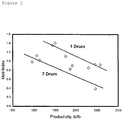
- Figure 2 is a plot of polymer melt index as a function of the productivity of the catalyst. As shown in Figure 2 , the polymer melt index decreased as the amount of catalyst charge increased.
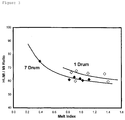
- Figure 3 is a plot of the ratio of high load melt index to melt index (HLMI/MI ratio as a function of polymer melt index. Referring to Figure 3 , the elasticity of the resin was also impacted as the amount of catalyst charged increased. Specifically, a decrease in the HLMI/MI ratio was observed as the amount of catalyst charged increased.
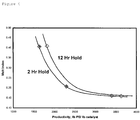
- Shortening the hold time was also observed to impact the elasticity as shown in Figure 5 where the HLMI/MI ratio of the polymer decreased as the hold time at the targeted activation temperature decreased. The results indicate that shortening hold time at the targeted activation temperature resulted in catalyst that had not been fully activated.
- Samples 4 Three samples of silica-titania hydrogel, designated Samples 4, 5, and 6, were prepared. Sample 4 was not treated with an alkaline solution, while Samples 5 and 6 were treated with NH 4 OH at 80°C for 28 hours. All samples were then dried by a final rinse in n-propyl alcohol followed by activation at 800°C for a period of 6 hours. The surface area (SA), pore volume (PV) and the pore radius of the catalyst samples were determined.
- SA surface area
- PV pore volume
- the catalysts were used to produce polymer compositions as described in Example 1 and the polymerization activity of the catalysts as well as the melt index (MI), high load melt index (HLMI), and HLMI/MI ratio of the polymers produced were determined and the results are tabulated in Table 2.
- Table 2 Sample Treatment SA PV Pore Radius, A MI HLMI HLMI/MI Activity g/g/hr 4 Not treated 452 1.96 173 0.47 29.1 61.5 3001 5 NH 4 OH 335 1.99 237 1.37 81.7 59.7 1563 6 NH 4 OH 335 1.99 237 1.35 71.1 52.8 3174
- alkaline treatment of the silica-titania hydrogel decreased the surface area while increasing the pore radius of the catalyst.
- the polymers produced from these alkaline treated catalysts displayed an increased melt index.
- the HLMI/MI ratio of the polymer was observed to only decrease slightly despite a large increase in melt index. Thus, the trend indicated an increase in the elasticity of the polymer.
- Samples 7 and 8 Two samples of silica-titania hydrogel, designated Samples 7 and 8, were prepared. Sample 7 was not treated with a alkaline solution while Sample 8 was treated with NH 4 OH at 80°C for 28 hours. Both samples were then dried in an oven at a temperature of 110°C for a period of 8 hours, followed by activation at 800°C for a period of 6 hours. The surface area (SA), pore volume (PV), pore radius and polymerization activity of these catalyst samples were determined. The catalysts were used to produce polymeric compositions as described in Example 1 and the melt index (MI), high load melt index (HLMI), HLMI/MI ratio, and a-eta of the polymeric compositions were determined.
- MI melt index
- HLMI high load melt index
- HLMI/MI ratio a-eta of the polymeric compositions were determined.
- R R L +k* (R U -R L ), wherein k is a variable ranging from 1 percent to 100 percent with a 1 percent increment, i.e., k is 1 percent, 2 percent, 3 percent, 4 percent, 5 percent, owing 50 percent, 51 percent, 52 percent, whereas, 95 percent, 96 percent, 97 percent, 98 percent, 99 percent, or 100 percent.
- any numerical range defined by two R numbers as defined in the above is also specifically disclosed.
- Use of the term "optionally” with respect to any element of a claim is intended to mean that the subject element is required, or alternatively, is not required. Both alternatives are intended to be within the scope of the claim.
- Use of broader terms such as comprises, includes, having, etc. should be understood to provide support for narrower terms such as consisting of, consisting essentially of, comprised substantially of, etc.
Landscapes
- Chemical & Material Sciences (AREA)
- Organic Chemistry (AREA)
- Chemical Kinetics & Catalysis (AREA)
- Materials Engineering (AREA)
- Engineering & Computer Science (AREA)
- Medicinal Chemistry (AREA)
- Polymers & Plastics (AREA)
- Health & Medical Sciences (AREA)
- Dispersion Chemistry (AREA)
- Transition And Organic Metals Composition Catalysts For Addition Polymerization (AREA)
- Addition Polymer Or Copolymer, Post-Treatments, Or Chemical Modifications (AREA)
- Polymerization Catalysts (AREA)
- Catalysts (AREA)
- Silicon Compounds (AREA)
Applications Claiming Priority (2)
| Application Number | Priority Date | Filing Date | Title |
|---|---|---|---|
| US11/963,530 US8183173B2 (en) | 2007-12-21 | 2007-12-21 | Fast activating catalyst |
| EP08869028.4A EP2231722B1 (de) | 2007-12-21 | 2008-12-09 | Schnellaktivierungskatalysator |
Related Parent Applications (2)
| Application Number | Title | Priority Date | Filing Date |
|---|---|---|---|
| EP08869028.4A Division EP2231722B1 (de) | 2007-12-21 | 2008-12-09 | Schnellaktivierungskatalysator |
| EP08869028.4A Division-Into EP2231722B1 (de) | 2007-12-21 | 2008-12-09 | Schnellaktivierungskatalysator |
Publications (3)
| Publication Number | Publication Date |
|---|---|
| EP3042919A2 true EP3042919A2 (de) | 2016-07-13 |
| EP3042919A3 EP3042919A3 (de) | 2016-08-24 |
| EP3042919B1 EP3042919B1 (de) | 2018-02-14 |
Family
ID=40517736
Family Applications (2)
| Application Number | Title | Priority Date | Filing Date |
|---|---|---|---|
| EP16153015.9A Active EP3042919B1 (de) | 2007-12-21 | 2008-12-09 | Schnellaktivierungskatalysator |
| EP08869028.4A Active EP2231722B1 (de) | 2007-12-21 | 2008-12-09 | Schnellaktivierungskatalysator |
Family Applications After (1)
| Application Number | Title | Priority Date | Filing Date |
|---|---|---|---|
| EP08869028.4A Active EP2231722B1 (de) | 2007-12-21 | 2008-12-09 | Schnellaktivierungskatalysator |
Country Status (13)
| Country | Link |
|---|---|
| US (1) | US8183173B2 (de) |
| EP (2) | EP3042919B1 (de) |
| KR (1) | KR101524330B1 (de) |
| CN (1) | CN101903419B (de) |
| AR (1) | AR069713A1 (de) |
| AU (1) | AU2008343937A1 (de) |
| BR (1) | BRPI0821766B1 (de) |
| CA (1) | CA2710163C (de) |
| CL (1) | CL2008003747A1 (de) |
| ES (2) | ES2668368T3 (de) |
| HU (1) | HUE039190T2 (de) |
| MX (1) | MX2010006971A (de) |
| WO (1) | WO2009085100A2 (de) |
Families Citing this family (23)
| Publication number | Priority date | Publication date | Assignee | Title |
|---|---|---|---|---|
| US8183173B2 (en) | 2007-12-21 | 2012-05-22 | Chevron Phillips Chemical Company Lp | Fast activating catalyst |
| CN102791372A (zh) * | 2010-03-17 | 2012-11-21 | 出光兴产株式会社 | 烯烃的低聚反应用催化剂 |
| US8396600B2 (en) | 2010-07-23 | 2013-03-12 | Chevron Phillips Chemical Company Lp | Prediction and control solution for polymerization reactor operation |
| US8399580B2 (en) | 2010-08-11 | 2013-03-19 | Chevron Philips Chemical Company Lp | Additives to chromium catalyst mix tank |
| US9023967B2 (en) * | 2011-11-30 | 2015-05-05 | Chevron Phillips Chemical Company Lp | Long chain branched polymers and methods of making same |
| US9096699B2 (en) * | 2011-12-02 | 2015-08-04 | Chevron Phillips Chemical Company Lp | Methods of preparing a catalyst |
| US9376511B2 (en) | 2013-03-13 | 2016-06-28 | Chevron Phillips Chemical Company Lp | Polymerization catalysts and polymers |
| EP3013870B1 (de) * | 2013-06-24 | 2023-10-25 | Saudi Basic Industries Corporation | Verfahren zur herstellung eines blasgeformter artikels auf der basis von polyethylen hoher dichte, hergestellt mit katalysatoren auf der basis von titaniertem chrom |
| US20150050742A1 (en) * | 2013-08-16 | 2015-02-19 | Cdti | Analysis of Occurrence of Corrosion Products with ZPGM and PGM Catalysts Coated on Metallic Substrates |
| US10213766B2 (en) | 2015-09-18 | 2019-02-26 | Chevron Phillips Chemical Company Lp | Methods of preparing a catalyst |
| US9988468B2 (en) | 2016-09-30 | 2018-06-05 | Chevron Phillips Chemical Company Lp | Methods of preparing a catalyst |
| US11267914B2 (en) | 2016-12-29 | 2022-03-08 | Chevron Phillips Chemical Company Lp | Methods of preparing a catalyst |
| US20200369803A1 (en) | 2016-12-29 | 2020-11-26 | Chevron Phillips Chemical Company Lp | Methods of Preparing a Catalyst |
| US10654953B2 (en) * | 2016-12-29 | 2020-05-19 | Chevron Phillips Chemical Company Lp | Methods of preparing a catalyst |
| US10287369B2 (en) | 2017-04-24 | 2019-05-14 | Chevron Phillips Chemical Company Lp | Methods of preparing a catalyst |
| US10323109B2 (en) | 2017-11-17 | 2019-06-18 | Chevron Phillips Chemical Company Lp | Methods of preparing a catalyst utilizing hydrated reagents |
| US10513570B2 (en) | 2017-11-17 | 2019-12-24 | Chevron Phillips Chemical Company Lp | Methods of preparing a catalyst |
| US10722874B2 (en) | 2018-04-16 | 2020-07-28 | Chevron Phillips Chemical Company Lp | Methods of preparing a catalyst utilizing hydrated reagents |
| US11266976B2 (en) * | 2018-04-16 | 2022-03-08 | Chevron Phillips Chemical Company Lp | Methods of preparing a catalyst with low HRVOC emissions |
| US10543480B2 (en) | 2018-04-16 | 2020-01-28 | Chevron Phillips Chemical Company Lp | Methods of preparing a catalyst utilizing hydrated reagents |
| WO2020094714A1 (en) * | 2018-11-08 | 2020-05-14 | Rhodia Operations | Precipitated silica and process for its manufacture |
| GB201903452D0 (en) | 2019-03-13 | 2019-04-24 | Lucite Int Uk Ltd | A catalyst and a process for the production of ethylenically unsaturated carboxylic acids for esters |
| GB201905293D0 (en) | 2019-04-15 | 2019-05-29 | Johnson Matthey Plc | Copper-containing catalysts |
Citations (14)
| Publication number | Priority date | Publication date | Assignee | Title |
|---|---|---|---|---|
| US3248179A (en) | 1962-02-26 | 1966-04-26 | Phillips Petroleum Co | Method and apparatus for the production of solid polymers of olefins |
| US3976632A (en) | 1974-12-04 | 1976-08-24 | Phillips Petroleum Company | Reactivation of organochromium olefin polymerization catalyst in presence of oxygen |
| US4022580A (en) | 1973-05-07 | 1977-05-10 | Phillips Petroleum Company | Catalyst activation |
| US4501885A (en) | 1981-10-14 | 1985-02-26 | Phillips Petroleum Company | Diluent and inert gas recovery from a polymerization process |
| US4588790A (en) | 1982-03-24 | 1986-05-13 | Union Carbide Corporation | Method for fluidized bed polymerization |
| US5352749A (en) | 1992-03-19 | 1994-10-04 | Exxon Chemical Patents, Inc. | Process for polymerizing monomers in fluidized beds |
| US5436304A (en) | 1992-03-19 | 1995-07-25 | Exxon Chemical Patents Inc. | Process for polymerizing monomers in fluidized beds |
| US5455314A (en) | 1994-07-27 | 1995-10-03 | Phillips Petroleum Company | Method for controlling removal of polymerization reaction effluent |
| US5565175A (en) | 1990-10-01 | 1996-10-15 | Phillips Petroleum Company | Apparatus and method for producing ethylene polymer |
| US5575979A (en) | 1991-03-04 | 1996-11-19 | Phillips Petroleum Company | Process and apparatus for separating diluents from solid polymers utilizing a two-stage flash and a cyclone separator |
| US6239235B1 (en) | 1997-07-15 | 2001-05-29 | Phillips Petroleum Company | High solids slurry polymerization |
| US6262191B1 (en) | 1999-03-09 | 2001-07-17 | Phillips Petroleum Company | Diluent slip stream to give catalyst wetting agent |
| US6833415B2 (en) | 1998-03-20 | 2004-12-21 | Exxonmobil Chemical Patents, Inc. | Continuous slurry polymerization process and appparatus |
| US20050255987A1 (en) | 2004-05-12 | 2005-11-17 | Chevron Phillips Chemical Company Lp | Methods of activating chromium catalysts |
Family Cites Families (28)
| Publication number | Priority date | Publication date | Assignee | Title |
|---|---|---|---|---|
| US3362946A (en) * | 1964-06-01 | 1968-01-09 | Phillips Petroleum Co | Method of treating supported chromium oxide catalyst and polymerization therewith |
| US3281405A (en) * | 1964-10-05 | 1966-10-25 | Phillips Petroleum Co | Catalyst and process for polymerizing ethylene |
| US3446754A (en) * | 1965-12-03 | 1969-05-27 | Nat Distillers Chem Corp | Catalyst activation |
| US3629216A (en) * | 1968-05-14 | 1971-12-21 | Mitsubishi Chem Ind | Process for the polymerization of olefins |
| US3806500A (en) * | 1972-07-21 | 1974-04-23 | Union Carbide Corp | Polymerization with thermally aged catalyst |
| US4041224A (en) * | 1975-11-19 | 1977-08-09 | Chemplex Company | Catalyst, method and polymerization processes |
| US4151122A (en) * | 1977-12-05 | 1979-04-24 | Phillips Petroleum Company | Reduction and reoxidation of cogel or self-reduced catalyst |
| US4296001A (en) * | 1980-02-06 | 1981-10-20 | Phillips Petroleum Company | Titanium impregnated silica-chromium catalysts |
| US4397769A (en) * | 1981-04-02 | 1983-08-09 | Phillips Petroleum Company | Olefin polymerization catalyst |
| US4436882A (en) * | 1982-01-20 | 1984-03-13 | Phillips Petroleum Company | Polymerization process utilizing a catalyst prepared by aging of a chromium-containing gel at high pH |
| US4405501A (en) * | 1982-01-20 | 1983-09-20 | Phillips Petroleum Company | Aging of chromium-containing gel at high pH |
| US5200478A (en) * | 1983-04-04 | 1993-04-06 | Solvay S.A. | Method for activating supported chromium oxide catalysts and olefin polymerization process carried out therewith |
| US4547557A (en) * | 1984-07-09 | 1985-10-15 | Phillips Petroleum Company | Silica-titania cogel from two-step hydrolysis |
| US4981831A (en) * | 1988-07-25 | 1991-01-01 | Phillips Petroleum Company | Twice-aged porous inorganic oxides, catalysts, and polymerization processes |
| US5006506A (en) * | 1989-12-21 | 1991-04-09 | Mobil Oil Corporation | Modified chromium-containing catalyst composition for polymerizing olefins and method of preparing the catalyst composition |
| US5183792A (en) | 1991-11-26 | 1993-02-02 | Allied-Signal Inc. | Catalyst for making polyethylene |
| US5576263A (en) * | 1993-12-28 | 1996-11-19 | Phillips Petroleum Company | Chromium catalyst compositions and ethylene polymerization processes therewith |
| EP0857737A1 (de) | 1997-02-07 | 1998-08-12 | Fina Research S.A. | Herstellung von schlagfestem Polyethylen |
| EP0882740A1 (de) * | 1997-06-06 | 1998-12-09 | Fina Research S.A. | Titanisierte Chrom-Katalysatore für die Herstellung von Polyethylen mit verbesserter Umweltspannungsrissbeständigkeit |
| US6204346B1 (en) | 1998-12-17 | 2001-03-20 | Phillips Petroleum Co. | Polymerization process |
| BE1012566A3 (fr) * | 1999-03-23 | 2000-12-05 | Solvay | Procede pour la production de polymeres de l'ethylene. |
| DE19914751A1 (de) * | 1999-03-31 | 2000-10-05 | Elenac Gmbh | Verfahren und Vorrichtung zur kontinuierlichen Behandlung von Katalysatoren und Katalysatorträger |
| DE19914752A1 (de) * | 1999-03-31 | 2000-10-05 | Elenac Gmbh | Verfahren zur diskontinuierlichen, thermischen Behandlung von Katalysatormaterial |
| EP1162210A1 (de) * | 2000-06-08 | 2001-12-12 | ATOFINA Research | Multimodales Polyethylen hergestellt mit Hilfe eines mehrschichtigen Chromkatalysators |
| US7381778B2 (en) * | 2002-06-06 | 2008-06-03 | Exxonmobil Chemical Patents Inc. | Method of preparing a treated support |
| US7223823B2 (en) * | 2002-06-06 | 2007-05-29 | Exxon Mobil Chemical Patents Inc. | Catalyst system and process |
| US7384885B2 (en) * | 2003-03-31 | 2008-06-10 | Exxonmobil Chemical Patents Inc. | Catalyst activation and resins therefrom |
| US8183173B2 (en) | 2007-12-21 | 2012-05-22 | Chevron Phillips Chemical Company Lp | Fast activating catalyst |
-
2007
- 2007-12-21 US US11/963,530 patent/US8183173B2/en active Active
-
2008
- 2008-12-09 ES ES16153015.9T patent/ES2668368T3/es active Active
- 2008-12-09 WO PCT/US2008/013497 patent/WO2009085100A2/en not_active Ceased
- 2008-12-09 AU AU2008343937A patent/AU2008343937A1/en not_active Abandoned
- 2008-12-09 EP EP16153015.9A patent/EP3042919B1/de active Active
- 2008-12-09 ES ES08869028.4T patent/ES2573938T3/es active Active
- 2008-12-09 CN CN2008801219822A patent/CN101903419B/zh active Active
- 2008-12-09 EP EP08869028.4A patent/EP2231722B1/de active Active
- 2008-12-09 HU HUE16153015A patent/HUE039190T2/hu unknown
- 2008-12-09 MX MX2010006971A patent/MX2010006971A/es active IP Right Grant
- 2008-12-09 BR BRPI0821766-1A patent/BRPI0821766B1/pt active IP Right Grant
- 2008-12-09 KR KR1020107013663A patent/KR101524330B1/ko active Active
- 2008-12-09 CA CA2710163A patent/CA2710163C/en active Active
- 2008-12-16 CL CL2008003747A patent/CL2008003747A1/es unknown
- 2008-12-16 AR ARP080105472A patent/AR069713A1/es active IP Right Grant
Patent Citations (14)
| Publication number | Priority date | Publication date | Assignee | Title |
|---|---|---|---|---|
| US3248179A (en) | 1962-02-26 | 1966-04-26 | Phillips Petroleum Co | Method and apparatus for the production of solid polymers of olefins |
| US4022580A (en) | 1973-05-07 | 1977-05-10 | Phillips Petroleum Company | Catalyst activation |
| US3976632A (en) | 1974-12-04 | 1976-08-24 | Phillips Petroleum Company | Reactivation of organochromium olefin polymerization catalyst in presence of oxygen |
| US4501885A (en) | 1981-10-14 | 1985-02-26 | Phillips Petroleum Company | Diluent and inert gas recovery from a polymerization process |
| US4588790A (en) | 1982-03-24 | 1986-05-13 | Union Carbide Corporation | Method for fluidized bed polymerization |
| US5565175A (en) | 1990-10-01 | 1996-10-15 | Phillips Petroleum Company | Apparatus and method for producing ethylene polymer |
| US5575979A (en) | 1991-03-04 | 1996-11-19 | Phillips Petroleum Company | Process and apparatus for separating diluents from solid polymers utilizing a two-stage flash and a cyclone separator |
| US5436304A (en) | 1992-03-19 | 1995-07-25 | Exxon Chemical Patents Inc. | Process for polymerizing monomers in fluidized beds |
| US5352749A (en) | 1992-03-19 | 1994-10-04 | Exxon Chemical Patents, Inc. | Process for polymerizing monomers in fluidized beds |
| US5455314A (en) | 1994-07-27 | 1995-10-03 | Phillips Petroleum Company | Method for controlling removal of polymerization reaction effluent |
| US6239235B1 (en) | 1997-07-15 | 2001-05-29 | Phillips Petroleum Company | High solids slurry polymerization |
| US6833415B2 (en) | 1998-03-20 | 2004-12-21 | Exxonmobil Chemical Patents, Inc. | Continuous slurry polymerization process and appparatus |
| US6262191B1 (en) | 1999-03-09 | 2001-07-17 | Phillips Petroleum Company | Diluent slip stream to give catalyst wetting agent |
| US20050255987A1 (en) | 2004-05-12 | 2005-11-17 | Chevron Phillips Chemical Company Lp | Methods of activating chromium catalysts |
Non-Patent Citations (3)
| Title |
|---|
| C. A. HIEBER; H. H. CHIANG, RHEOL. ACTA, vol. 28, 1989, pages 321 |
| C.A. HIEBER; H.H. CHIANG, POLYM. ENG. SCI., vol. 32, 1992, pages 931 |
| R. B. BIRD; R. C. ARMSTRONG; O. HASSEGER: "Dynamics of Polymeric Liquids, Volume 1, Fluid Mechanics, 2nd Edition,", vol. 1, 1987, JOHN WILEY & SONS |
Also Published As
| Publication number | Publication date |
|---|---|
| HUE039190T2 (hu) | 2018-12-28 |
| AR069713A1 (es) | 2010-02-10 |
| WO2009085100A2 (en) | 2009-07-09 |
| CA2710163C (en) | 2016-04-05 |
| EP3042919B1 (de) | 2018-02-14 |
| ES2573938T3 (es) | 2016-06-13 |
| WO2009085100A3 (en) | 2009-10-22 |
| CN101903419B (zh) | 2012-12-05 |
| MX2010006971A (es) | 2010-10-05 |
| CN101903419A (zh) | 2010-12-01 |
| AU2008343937A1 (en) | 2009-07-09 |
| BRPI0821766B1 (pt) | 2018-08-14 |
| CA2710163A1 (en) | 2009-07-09 |
| EP2231722A2 (de) | 2010-09-29 |
| BRPI0821766A2 (pt) | 2015-06-16 |
| EP2231722B1 (de) | 2016-03-23 |
| US8183173B2 (en) | 2012-05-22 |
| KR101524330B1 (ko) | 2015-05-29 |
| CL2008003747A1 (es) | 2010-12-24 |
| ES2668368T3 (es) | 2018-05-17 |
| KR20100109909A (ko) | 2010-10-11 |
| US20090163681A1 (en) | 2009-06-25 |
| EP3042919A3 (de) | 2016-08-24 |
Similar Documents
| Publication | Publication Date | Title |
|---|---|---|
| EP2231722B1 (de) | Schnellaktivierungskatalysator | |
| US9879101B2 (en) | Long chain branched polymers and methods of making same | |
| EP2205350B1 (de) | Verfahren zur herstellung eines polymerisationskatalysators | |
| US9376511B2 (en) | Polymerization catalysts and polymers | |
| US20200239608A1 (en) | Methods of Preparing a Catalyst | |
| US8697599B2 (en) | Methods of preparing a polymerization catalyst |
Legal Events
| Date | Code | Title | Description |
|---|---|---|---|
| PUAI | Public reference made under article 153(3) epc to a published international application that has entered the european phase |
Free format text: ORIGINAL CODE: 0009012 |
|
| AC | Divisional application: reference to earlier application |
Ref document number: 2231722 Country of ref document: EP Kind code of ref document: P |
|
| AK | Designated contracting states |
Kind code of ref document: A2 Designated state(s): AT BE BG CH CY CZ DE DK EE ES FI FR GB GR HR HU IE IS IT LI LT LU LV MC MT NL NO PL PT RO SE SI SK TR |
|
| AX | Request for extension of the european patent |
Extension state: AL BA MK RS |
|
| PUAL | Search report despatched |
Free format text: ORIGINAL CODE: 0009013 |
|
| AK | Designated contracting states |
Kind code of ref document: A3 Designated state(s): AT BE BG CH CY CZ DE DK EE ES FI FR GB GR HR HU IE IS IT LI LT LU LV MC MT NL NO PL PT RO SE SI SK TR |
|
| AX | Request for extension of the european patent |
Extension state: AL BA MK RS |
|
| RIC1 | Information provided on ipc code assigned before grant |
Ipc: C08F 4/69 20060101ALI20160720BHEP Ipc: C08F 4/02 20060101ALI20160720BHEP Ipc: C08F 10/00 20060101AFI20160720BHEP |
|
| STAA | Information on the status of an ep patent application or granted ep patent |
Free format text: STATUS: REQUEST FOR EXAMINATION WAS MADE |
|
| STAA | Information on the status of an ep patent application or granted ep patent |
Free format text: STATUS: EXAMINATION IS IN PROGRESS |
|
| 17P | Request for examination filed |
Effective date: 20170223 |
|
| RBV | Designated contracting states (corrected) |
Designated state(s): AT BE BG CH CY CZ DE DK EE ES FI FR GB GR HR HU IE IS IT LI LT LU LV MC MT NL NO PL PT RO SE SI SK TR |
|
| 17Q | First examination report despatched |
Effective date: 20170323 |
|
| GRAP | Despatch of communication of intention to grant a patent |
Free format text: ORIGINAL CODE: EPIDOSNIGR1 |
|
| STAA | Information on the status of an ep patent application or granted ep patent |
Free format text: STATUS: GRANT OF PATENT IS INTENDED |
|
| INTG | Intention to grant announced |
Effective date: 20170623 |
|
| GRAJ | Information related to disapproval of communication of intention to grant by the applicant or resumption of examination proceedings by the epo deleted |
Free format text: ORIGINAL CODE: EPIDOSDIGR1 |
|
| STAA | Information on the status of an ep patent application or granted ep patent |
Free format text: STATUS: EXAMINATION IS IN PROGRESS |
|
| GRAR | Information related to intention to grant a patent recorded |
Free format text: ORIGINAL CODE: EPIDOSNIGR71 |
|
| GRAS | Grant fee paid |
Free format text: ORIGINAL CODE: EPIDOSNIGR3 |
|
| STAA | Information on the status of an ep patent application or granted ep patent |
Free format text: STATUS: GRANT OF PATENT IS INTENDED |
|
| INTC | Intention to grant announced (deleted) | ||
| INTG | Intention to grant announced |
Effective date: 20171113 |
|
| GRAA | (expected) grant |
Free format text: ORIGINAL CODE: 0009210 |
|
| STAA | Information on the status of an ep patent application or granted ep patent |
Free format text: STATUS: THE PATENT HAS BEEN GRANTED |
|
| AC | Divisional application: reference to earlier application |
Ref document number: 2231722 Country of ref document: EP Kind code of ref document: P |
|
| AK | Designated contracting states |
Kind code of ref document: B1 Designated state(s): AT BE BG CH CY CZ DE DK EE ES FI FR GB GR HR HU IE IS IT LI LT LU LV MC MT NL NO PL PT RO SE SI SK TR |
|
| REG | Reference to a national code |
Ref country code: GB Ref legal event code: FG4D |
|
| REG | Reference to a national code |
Ref country code: CH Ref legal event code: EP |
|
| REG | Reference to a national code |
Ref country code: IE Ref legal event code: FG4D |
|
| REG | Reference to a national code |
Ref country code: DE Ref legal event code: R096 Ref document number: 602008054061 Country of ref document: DE Ref country code: AT Ref legal event code: REF Ref document number: 969780 Country of ref document: AT Kind code of ref document: T Effective date: 20180315 |
|
| REG | Reference to a national code |
Ref country code: NL Ref legal event code: FP |
|
| REG | Reference to a national code |
Ref country code: ES Ref legal event code: FG2A Ref document number: 2668368 Country of ref document: ES Kind code of ref document: T3 Effective date: 20180517 |
|
| REG | Reference to a national code |
Ref country code: AT Ref legal event code: MK05 Ref document number: 969780 Country of ref document: AT Kind code of ref document: T Effective date: 20180214 |
|
| REG | Reference to a national code |
Ref country code: DE Ref legal event code: R082 Ref document number: 602008054061 Country of ref document: DE Representative=s name: FLACH BAUER & PARTNER PATENTANWAELTE MBB, DE Ref country code: DE Ref legal event code: R082 Ref document number: 602008054061 Country of ref document: DE Representative=s name: FLACH BAUER STAHL PATENTANWAELTE PARTNERSCHAFT, DE |
|
| PG25 | Lapsed in a contracting state [announced via postgrant information from national office to epo] |
Ref country code: LT Free format text: LAPSE BECAUSE OF FAILURE TO SUBMIT A TRANSLATION OF THE DESCRIPTION OR TO PAY THE FEE WITHIN THE PRESCRIBED TIME-LIMIT Effective date: 20180214 Ref country code: CY Free format text: LAPSE BECAUSE OF FAILURE TO SUBMIT A TRANSLATION OF THE DESCRIPTION OR TO PAY THE FEE WITHIN THE PRESCRIBED TIME-LIMIT Effective date: 20180214 Ref country code: HR Free format text: LAPSE BECAUSE OF FAILURE TO SUBMIT A TRANSLATION OF THE DESCRIPTION OR TO PAY THE FEE WITHIN THE PRESCRIBED TIME-LIMIT Effective date: 20180214 Ref country code: FI Free format text: LAPSE BECAUSE OF FAILURE TO SUBMIT A TRANSLATION OF THE DESCRIPTION OR TO PAY THE FEE WITHIN THE PRESCRIBED TIME-LIMIT Effective date: 20180214 Ref country code: NO Free format text: LAPSE BECAUSE OF FAILURE TO SUBMIT A TRANSLATION OF THE DESCRIPTION OR TO PAY THE FEE WITHIN THE PRESCRIBED TIME-LIMIT Effective date: 20180514 |
|
| PG25 | Lapsed in a contracting state [announced via postgrant information from national office to epo] |
Ref country code: BG Free format text: LAPSE BECAUSE OF FAILURE TO SUBMIT A TRANSLATION OF THE DESCRIPTION OR TO PAY THE FEE WITHIN THE PRESCRIBED TIME-LIMIT Effective date: 20180514 Ref country code: AT Free format text: LAPSE BECAUSE OF FAILURE TO SUBMIT A TRANSLATION OF THE DESCRIPTION OR TO PAY THE FEE WITHIN THE PRESCRIBED TIME-LIMIT Effective date: 20180214 Ref country code: GR Free format text: LAPSE BECAUSE OF FAILURE TO SUBMIT A TRANSLATION OF THE DESCRIPTION OR TO PAY THE FEE WITHIN THE PRESCRIBED TIME-LIMIT Effective date: 20180515 Ref country code: LV Free format text: LAPSE BECAUSE OF FAILURE TO SUBMIT A TRANSLATION OF THE DESCRIPTION OR TO PAY THE FEE WITHIN THE PRESCRIBED TIME-LIMIT Effective date: 20180214 Ref country code: SE Free format text: LAPSE BECAUSE OF FAILURE TO SUBMIT A TRANSLATION OF THE DESCRIPTION OR TO PAY THE FEE WITHIN THE PRESCRIBED TIME-LIMIT Effective date: 20180214 |
|
| PG25 | Lapsed in a contracting state [announced via postgrant information from national office to epo] |
Ref country code: RO Free format text: LAPSE BECAUSE OF FAILURE TO SUBMIT A TRANSLATION OF THE DESCRIPTION OR TO PAY THE FEE WITHIN THE PRESCRIBED TIME-LIMIT Effective date: 20180214 Ref country code: PL Free format text: LAPSE BECAUSE OF FAILURE TO SUBMIT A TRANSLATION OF THE DESCRIPTION OR TO PAY THE FEE WITHIN THE PRESCRIBED TIME-LIMIT Effective date: 20180214 Ref country code: EE Free format text: LAPSE BECAUSE OF FAILURE TO SUBMIT A TRANSLATION OF THE DESCRIPTION OR TO PAY THE FEE WITHIN THE PRESCRIBED TIME-LIMIT Effective date: 20180214 |
|
| REG | Reference to a national code |
Ref country code: DE Ref legal event code: R097 Ref document number: 602008054061 Country of ref document: DE |
|
| PG25 | Lapsed in a contracting state [announced via postgrant information from national office to epo] |
Ref country code: DK Free format text: LAPSE BECAUSE OF FAILURE TO SUBMIT A TRANSLATION OF THE DESCRIPTION OR TO PAY THE FEE WITHIN THE PRESCRIBED TIME-LIMIT Effective date: 20180214 Ref country code: SK Free format text: LAPSE BECAUSE OF FAILURE TO SUBMIT A TRANSLATION OF THE DESCRIPTION OR TO PAY THE FEE WITHIN THE PRESCRIBED TIME-LIMIT Effective date: 20180214 Ref country code: CZ Free format text: LAPSE BECAUSE OF FAILURE TO SUBMIT A TRANSLATION OF THE DESCRIPTION OR TO PAY THE FEE WITHIN THE PRESCRIBED TIME-LIMIT Effective date: 20180214 |
|
| PLBE | No opposition filed within time limit |
Free format text: ORIGINAL CODE: 0009261 |
|
| STAA | Information on the status of an ep patent application or granted ep patent |
Free format text: STATUS: NO OPPOSITION FILED WITHIN TIME LIMIT |
|
| REG | Reference to a national code |
Ref country code: HU Ref legal event code: AG4A Ref document number: E039190 Country of ref document: HU |
|
| 26N | No opposition filed |
Effective date: 20181115 |
|
| PG25 | Lapsed in a contracting state [announced via postgrant information from national office to epo] |
Ref country code: SI Free format text: LAPSE BECAUSE OF FAILURE TO SUBMIT A TRANSLATION OF THE DESCRIPTION OR TO PAY THE FEE WITHIN THE PRESCRIBED TIME-LIMIT Effective date: 20180214 |
|
| REG | Reference to a national code |
Ref country code: CH Ref legal event code: PL |
|
| PG25 | Lapsed in a contracting state [announced via postgrant information from national office to epo] |
Ref country code: LU Free format text: LAPSE BECAUSE OF NON-PAYMENT OF DUE FEES Effective date: 20181209 Ref country code: MC Free format text: LAPSE BECAUSE OF FAILURE TO SUBMIT A TRANSLATION OF THE DESCRIPTION OR TO PAY THE FEE WITHIN THE PRESCRIBED TIME-LIMIT Effective date: 20180214 |
|
| REG | Reference to a national code |
Ref country code: IE Ref legal event code: MM4A |
|
| PG25 | Lapsed in a contracting state [announced via postgrant information from national office to epo] |
Ref country code: IE Free format text: LAPSE BECAUSE OF NON-PAYMENT OF DUE FEES Effective date: 20181209 |
|
| PG25 | Lapsed in a contracting state [announced via postgrant information from national office to epo] |
Ref country code: LI Free format text: LAPSE BECAUSE OF NON-PAYMENT OF DUE FEES Effective date: 20181231 Ref country code: CH Free format text: LAPSE BECAUSE OF NON-PAYMENT OF DUE FEES Effective date: 20181231 |
|
| PG25 | Lapsed in a contracting state [announced via postgrant information from national office to epo] |
Ref country code: MT Free format text: LAPSE BECAUSE OF NON-PAYMENT OF DUE FEES Effective date: 20181209 |
|
| PG25 | Lapsed in a contracting state [announced via postgrant information from national office to epo] |
Ref country code: TR Free format text: LAPSE BECAUSE OF FAILURE TO SUBMIT A TRANSLATION OF THE DESCRIPTION OR TO PAY THE FEE WITHIN THE PRESCRIBED TIME-LIMIT Effective date: 20180214 |
|
| PG25 | Lapsed in a contracting state [announced via postgrant information from national office to epo] |
Ref country code: PT Free format text: LAPSE BECAUSE OF FAILURE TO SUBMIT A TRANSLATION OF THE DESCRIPTION OR TO PAY THE FEE WITHIN THE PRESCRIBED TIME-LIMIT Effective date: 20180214 |
|
| PG25 | Lapsed in a contracting state [announced via postgrant information from national office to epo] |
Ref country code: IS Free format text: LAPSE BECAUSE OF FAILURE TO SUBMIT A TRANSLATION OF THE DESCRIPTION OR TO PAY THE FEE WITHIN THE PRESCRIBED TIME-LIMIT Effective date: 20180614 |
|
| P01 | Opt-out of the competence of the unified patent court (upc) registered |
Effective date: 20230519 |
|
| PGFP | Annual fee paid to national office [announced via postgrant information from national office to epo] |
Ref country code: NL Payment date: 20251119 Year of fee payment: 18 |
|
| PGFP | Annual fee paid to national office [announced via postgrant information from national office to epo] |
Ref country code: DE Payment date: 20251126 Year of fee payment: 18 |
|
| PGFP | Annual fee paid to national office [announced via postgrant information from national office to epo] |
Ref country code: GB Payment date: 20251119 Year of fee payment: 18 |
|
| PGFP | Annual fee paid to national office [announced via postgrant information from national office to epo] |
Ref country code: IT Payment date: 20251119 Year of fee payment: 18 |
|
| PGFP | Annual fee paid to national office [announced via postgrant information from national office to epo] |
Ref country code: HU Payment date: 20251212 Year of fee payment: 18 Ref country code: FR Payment date: 20251120 Year of fee payment: 18 |
|
| PGFP | Annual fee paid to national office [announced via postgrant information from national office to epo] |
Ref country code: BE Payment date: 20251119 Year of fee payment: 18 |
|
| PGFP | Annual fee paid to national office [announced via postgrant information from national office to epo] |
Ref country code: ES Payment date: 20260102 Year of fee payment: 18 |