EP3043264A1 - Fahrzeugsteuerungssystem, insbesondere für luftfahrzeug - Google Patents
Fahrzeugsteuerungssystem, insbesondere für luftfahrzeug Download PDFInfo
- Publication number
- EP3043264A1 EP3043264A1 EP16150492.3A EP16150492A EP3043264A1 EP 3043264 A1 EP3043264 A1 EP 3043264A1 EP 16150492 A EP16150492 A EP 16150492A EP 3043264 A1 EP3043264 A1 EP 3043264A1
- Authority
- EP
- European Patent Office
- Prior art keywords
- module
- peripheral
- function
- modules
- control system
- Prior art date
- Legal status (The legal status is an assumption and is not a legal conclusion. Google has not performed a legal analysis and makes no representation as to the accuracy of the status listed.)
- Withdrawn
Links
Images


Classifications
-
- G—PHYSICS
- G06—COMPUTING OR CALCULATING; COUNTING
- G06F—ELECTRIC DIGITAL DATA PROCESSING
- G06F11/00—Error detection; Error correction; Monitoring
- G06F11/07—Responding to the occurrence of a fault, e.g. fault tolerance
- G06F11/14—Error detection or correction of the data by redundancy in operations
- G06F11/1402—Saving, restoring, recovering or retrying
- G06F11/1415—Saving, restoring, recovering or retrying at system level
- G06F11/142—Reconfiguring to eliminate the error
-
- G—PHYSICS
- G05—CONTROLLING; REGULATING
- G05D—SYSTEMS FOR CONTROLLING OR REGULATING NON-ELECTRIC VARIABLES
- G05D1/00—Control of position, course, altitude or attitude of land, water, air or space vehicles, e.g. using automatic pilots
- G05D1/0011—Control of position, course, altitude or attitude of land, water, air or space vehicles, e.g. using automatic pilots associated with a remote control arrangement
-
- G—PHYSICS
- G05—CONTROLLING; REGULATING
- G05D—SYSTEMS FOR CONTROLLING OR REGULATING NON-ELECTRIC VARIABLES
- G05D1/00—Control of position, course, altitude or attitude of land, water, air or space vehicles, e.g. using automatic pilots
- G05D1/0055—Control of position, course, altitude or attitude of land, water, air or space vehicles, e.g. using automatic pilots with safety arrangements
- G05D1/0077—Control of position, course, altitude or attitude of land, water, air or space vehicles, e.g. using automatic pilots with safety arrangements using redundant signals or controls
-
- G—PHYSICS
- G06—COMPUTING OR CALCULATING; COUNTING
- G06F—ELECTRIC DIGITAL DATA PROCESSING
- G06F11/00—Error detection; Error correction; Monitoring
- G06F11/07—Responding to the occurrence of a fault, e.g. fault tolerance
- G06F11/0703—Error or fault processing not based on redundancy, i.e. by taking additional measures to deal with the error or fault not making use of redundancy in operation, in hardware, or in data representation
- G06F11/0706—Error or fault processing not based on redundancy, i.e. by taking additional measures to deal with the error or fault not making use of redundancy in operation, in hardware, or in data representation the processing taking place on a specific hardware platform or in a specific software environment
- G06F11/0736—Error or fault processing not based on redundancy, i.e. by taking additional measures to deal with the error or fault not making use of redundancy in operation, in hardware, or in data representation the processing taking place on a specific hardware platform or in a specific software environment in functional embedded systems, i.e. in a data processing system designed as a combination of hardware and software dedicated to performing a certain function
- G06F11/0739—Error or fault processing not based on redundancy, i.e. by taking additional measures to deal with the error or fault not making use of redundancy in operation, in hardware, or in data representation the processing taking place on a specific hardware platform or in a specific software environment in functional embedded systems, i.e. in a data processing system designed as a combination of hardware and software dedicated to performing a certain function in a data processing system embedded in automotive or aircraft systems
-
- G—PHYSICS
- G06—COMPUTING OR CALCULATING; COUNTING
- G06F—ELECTRIC DIGITAL DATA PROCESSING
- G06F11/00—Error detection; Error correction; Monitoring
- G06F11/07—Responding to the occurrence of a fault, e.g. fault tolerance
- G06F11/0703—Error or fault processing not based on redundancy, i.e. by taking additional measures to deal with the error or fault not making use of redundancy in operation, in hardware, or in data representation
- G06F11/0793—Remedial or corrective actions
-
- G—PHYSICS
- G06—COMPUTING OR CALCULATING; COUNTING
- G06F—ELECTRIC DIGITAL DATA PROCESSING
- G06F11/00—Error detection; Error correction; Monitoring
- G06F11/07—Responding to the occurrence of a fault, e.g. fault tolerance
- G06F11/16—Error detection or correction of the data by redundancy in hardware
- G06F11/20—Error detection or correction of the data by redundancy in hardware using active fault-masking, e.g. by switching out faulty elements or by switching in spare elements
- G06F11/2017—Error detection or correction of the data by redundancy in hardware using active fault-masking, e.g. by switching out faulty elements or by switching in spare elements where memory access, memory control or I/O control functionality is redundant
-
- G—PHYSICS
- G06—COMPUTING OR CALCULATING; COUNTING
- G06F—ELECTRIC DIGITAL DATA PROCESSING
- G06F11/00—Error detection; Error correction; Monitoring
- G06F11/07—Responding to the occurrence of a fault, e.g. fault tolerance
- G06F11/14—Error detection or correction of the data by redundancy in operations
- G06F11/1479—Generic software techniques for error detection or fault masking
- G06F11/1489—Generic software techniques for error detection or fault masking using recovery blocks
-
- G—PHYSICS
- G06—COMPUTING OR CALCULATING; COUNTING
- G06F—ELECTRIC DIGITAL DATA PROCESSING
- G06F11/00—Error detection; Error correction; Monitoring
- G06F11/07—Responding to the occurrence of a fault, e.g. fault tolerance
- G06F11/16—Error detection or correction of the data by redundancy in hardware
- G06F11/20—Error detection or correction of the data by redundancy in hardware using active fault-masking, e.g. by switching out faulty elements or by switching in spare elements
- G06F11/202—Error detection or correction of the data by redundancy in hardware using active fault-masking, e.g. by switching out faulty elements or by switching in spare elements where processing functionality is redundant
- G06F11/2023—Failover techniques
- G06F11/2025—Failover techniques using centralised failover control functionality
-
- G—PHYSICS
- G06—COMPUTING OR CALCULATING; COUNTING
- G06F—ELECTRIC DIGITAL DATA PROCESSING
- G06F11/00—Error detection; Error correction; Monitoring
- G06F11/07—Responding to the occurrence of a fault, e.g. fault tolerance
- G06F11/16—Error detection or correction of the data by redundancy in hardware
- G06F11/20—Error detection or correction of the data by redundancy in hardware using active fault-masking, e.g. by switching out faulty elements or by switching in spare elements
- G06F11/202—Error detection or correction of the data by redundancy in hardware using active fault-masking, e.g. by switching out faulty elements or by switching in spare elements where processing functionality is redundant
- G06F11/2035—Error detection or correction of the data by redundancy in hardware using active fault-masking, e.g. by switching out faulty elements or by switching in spare elements where processing functionality is redundant without idle spare hardware
-
- G—PHYSICS
- G06—COMPUTING OR CALCULATING; COUNTING
- G06F—ELECTRIC DIGITAL DATA PROCESSING
- G06F2201/00—Indexing scheme relating to error detection, to error correction, and to monitoring
- G06F2201/85—Active fault masking without idle spares
Definitions
- the present invention relates to the field of embedded control systems for vehicles, in particular for aircraft and more particularly for drones.
- UAVs are small in size or small, with little room for embedded electronics.
- closed and integrated systems have conventionally been developed in order to reduce the size, the weight, the wiring and the connections. .
- the US 2012/0210160 describes, for a motor vehicle, a method for dynamically allocating tasks and signals in an integrated static architecture.
- a redundancy architecture specifies the level of redundancy required of sensors, actuators, computers, and applications.
- a signal / event reconfiguration manager reallocates the faulty module task to a standby redundant module. This method uses a principle of traditional redundancy of electronic and software components.
- the object of the present invention is to provide an improved control system for vehicles, in particular for aircraft and drones.
- the invention is particularly interested in the architecture of an embedded control system and in particular provides a system whose architecture is modular and secure.
- At least one of the peripheral modules is configured to, by means of its sensor, perform its main function and, on request, perform a predetermined secondary function corresponding to the main function of another peripheral module of the system, these two peripheral modules are not redundant in the conventional sense.
- control unit is configured to implement a guarding process whose function is: to check the operating status of each of the peripheral modules and, in the event of a peripheral module failure, evaluate the possibility, and if necessary, to carry out the mission in a degraded mode, by activating a secondary function in a non-faulty and non-redundant peripheral module of the defective module, for use by the control unit in substitution of the main function data of the defective peripheral module.
- the on-board control system according to the invention therefore has an innovative architecture that exploits a guardian process configured to react with the rest of the architecture.
- a particularly interesting aspect also is the use of certain peripheral modules which are designed to determine information corresponding to a main function, and perform a predetermined secondary function corresponding to the main function of another peripheral module of the system.
- the guardian process will therefore be able to call on a non-faulty peripheral module, programmed to execute a secondary function corresponding to the primary function.
- the term "correspondent" is understood here as capable of providing data on the same parameter, for example speed, position, altitude, etc. It will also be noted that in the system, the non-faulty peripheral module capable of providing the secondary function corresponding to the main function of the faulty module, is not a redundant module of the faulty module.
- the non-faulty peripheral module providing the secondary function is therefore a different module, having a specific sensor for the measurement of a parameter, as its main function, which is different from the parameter provided by the main function of the faulty module to which it come to supply.
- the secondary function thus results from the exploitation of the measurement signals delivered by the sensor of the peripheral module required for the main function, but from which other information can be derived, generally by calculation, estimates and / or approximations, typically with a precision lower.
- the present system is integrated into an avionics system, which will then typically include a plurality of peripheral modules such as; GPS, altimeter, IMU, HRS, etc.
- peripheral modules such as; GPS, altimeter, IMU, HRS, etc.
- the main function of the GPS module is the determination of position, and thus delivers under this main function the position of the aircraft.
- the altimeter has for main function altitude determination.
- the GPS module is preferably configured to be able to also determine the altitude of the aircraft.
- the guarding process which knows the main and secondary functions of the different modules, can therefore, in the event of failure of the altimeter module, activate the secondary function of the GPS module to use the altitude information instead of that of the faulty altimeter module.
- redundancy In conventional avionics systems, the principle of redundancy is generally used on critical modules; that is to say, there are two or three peripheral modules performing the same function (which may be identical or similar design). If a sensor, respectively a peripheral module, becomes faulty, there remains one or two other peripheral modules dedicated to the same function. In drones, on the other hand, redundancy is often not possible for reasons of space, cost, weight and energy consumption.
- the system according to the invention is therefore particularly advantageous because the secondary function of a peripheral module will allow the mission to continue by delivering information corresponding to the main function of another defective peripheral module, although these two modules are not identical. not redundant (that is, they have different main functions for measuring different parameters). However, since the accuracy of this secondary function will generally be lower than that of the faulty module, (for example, the altitude measurement using GPS is less accurate than with the altimeter), the system is then " degraded mode ".
- Conducting the mission in degraded mode will usually involve adjusting certain system parameters to account for reduced accuracy when using the secondary function data.
- the guardian process evaluates the possibility of continuing the mission with the complete loss of the defective peripheral module; and in particular, if the mission can not be continued without the defective peripheral module, the guardian process triggers an emergency stop procedure. In addition, if the mission can be continued without said defective peripheral module, in a degraded control mode, then the guardian process invites the user to decide whether to continue the mission or to terminate it.
- the guarding process advantageously triggers an error situation recovery routine, preferably comprising at least one of the following actions: restart of the sensor or of the peripheral module, reset of communication with the peripheral module, asks the other peripheral modules for their communication status.
- At least one peripheral module is configured to perform at least one other secondary function corresponding to the primary function of another peripheral module of the system.
- Peripheral modules are usually in the form of an electronic card.
- an application process corresponding to each peripheral module is executed in a dedicated partition of the memory of the control module.
- the system comprising at least a portion of the following peripheral modules: IMU, GPS, HRS, altimeter, pitot, Doppler radar, and each of these peripheral modules is configured to operate a main function and at least a secondary function.
- the present invention is particularly advantageous in its application to the control systems of avionics. Of particular note are the following aspects.
- the guardian process has a supervisory and master role in the architecture by monitoring the proper functioning of the control system.
- the action of the guardian process in this architecture is essential for: checking the execution status of the different processes and being able to restart (and preferably even debugging in case of problems during the execution of certain processes); controlling the state of the shared memory (for example by CRCs at the end of each segment) to avoid a problem of memory corruption and thus be able to react to rather by decreasing the impacts; for semaphore analysis for access to memory with the ability to unblock a situation of instability, etc.
- Modularity Almost all known autopilot systems are based on closed architectures that can not be modified or modified by the manufacturer.
- the control system according to the invention has an architecture that allows the integration of new peripheral modules, or the replacement of modules by others.
- this framework of modularity it is important to mention the possibility of adding a communication space for the payload so that it can also use shared memory for exchanges between it and the other processes and the ground station ( in the case of drones).
- Modify a peripheral module The modularity of the architecture of the present system makes it possible to change the functionalities of the system with the technological advances. For example, the arrival of the Galileo satellite positioning system will bring new positioning modules that are more precise and more efficient than those based on the GPS system. In this evolutionary framework, to replace an already integrated GPS module with a new Galileo positioning module, it will be enough to code a new interface process for this Galileo module while keeping the generic interface of all the processes, and the new Galileo module. can be taken into account in the system.
- the modular architecture of the present control system makes it possible to gain efficiency in execution because only the necessary modules are those that are executed. Compared to thread architectures, this architecture allows you to run only the necessary codes, thus avoiding hundreds or thousands of unnecessary conditions typical in rate programming in single-threaded software.
- the term "drone” designates any remotely piloted aircraft circulating without any person on board, and generally capable of loading a load.
- the flight can be done in direct sight by a ground operator (the remote pilot), via the command and control system on the ground.
- the drone evolves preferably in an "automatic” way, that is to say that its evolution in flight was programmed by whatever means before the beginning of the flight, and / or is put in day during the flight, and that all or part of the flight is carried out without direct intervention of the operator, except exception or mode of emergency control.
- two modules are said to be redundant when they have the same function, thus here the same main function in the system, to provide measurement data on the same parameter ( eg speed, position %) and with substantially the same precision / quality.
- two redundant modules can be of identical or similar design (a similar module is for example a module manufactured by another supplier based on a sensor of another technology, but for the measurement of the same parameter, with substantially the same precision).
- two modules are said to be non-redundant when they are of different design for different main functions.
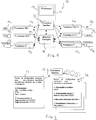
- the Figure 1 is a block diagram of the present control system 10.
- the reference sign 12 generally indicates a control unit forming the core of the system and comprising a computer with at least one processor 14, as well as a shared memory 16.
- a a number of peripheral modules 18 1 to 18 n are connected to the control unit 12.
- the control unit and the peripheral modules are generally in the form of electronic cards, the peripheral modules being connected to the card of the control unit. But peripheral modules can be remotely connected to the board of the control unit, or integrated in it.
- the control unit 12 is programmed to conduct a mission.
- the mission may consist of operating the vehicle, or the part of the vehicle with which it is associated, during the time of use of the vehicle.
- the control unit receives, processes and transmits data from and to the modules.
- each module is in the form of an electronic card carrying the means (sensors, calculation means, etc.) required to implement the function or functions assigned to this module.
- the calculator is and is configured as a partitioned system. It therefore comprises a shared memory 16, the partition being advantageously operated spatially and temporally.
- the principle of partitioning is well known in computing and conventionally applied in the field of avionics; this technology as such will not be described further. Thus all appropriate partitioning technologies can be employed.
- Each peripheral module is associated with a corresponding process 20 1 ... 20 n , which is linked to an own partition of the shared memory 16.
- process refers generally and in its conventional sense to a program in progress.
- the control system implements a variety of processes, which it can initiate and terminate. Subsequently, the processes 20i associated with the peripheral modules are called the "application process” or simply "process”.
- the PG manages the application processes 20 i as well as other latent processes that can be started when needed.
- the flight control process runs in a dedicated partition of the memory 16.
- the system may include several flight control programs, with a single flight control process in execution. This makes it possible to perform flights even in degraded cases where the aerodynamics have changed or when the actuators do not behave in a nominal way.
- control system is particularly distinguished by the increased capacity of a software layer of the so-called "guardian process” control unit 22 (also noted PG), to react with the rest of the architecture .
- the guardian process (whose execution starts as a priority) ingests one or more configuration files that define operating characteristics that may be considered during execution, such as for example: potential problems during communication with the external device, behavior to take in case of system degradation, etc.
- this configuration file adds a description of the data structures used by the processes associated with the peripheral modules to allow the guardian process to verify the integrity of the data in memory during checks.
- This configuration file is fully compatible with the opening feature of the system because the end user can create these configuration files in a personal way respecting the adopted formalism.
- the figure 2 illustrates in a general way this principle of configuration.
- a main configuration file 24 of the guardian process includes a definition of the various functions (peripheral module and associated applications), as well as the dedicated memory segments, etc.
- the guardian process also reads a configuration file 26 for the application process corresponding to each of the peripheral modules 18 i .
- These configuration files 26 specify the modules, data structures, execution parameters, etc.
- the control system is intended to constitute and configure part of an aircraft avionics system, particularly for a drone.
- the architecture of this system is simple and efficient in design.
- the custodial process ensures that the system functions properly and implements, as far as possible, a strategy for providing surrogate data when a peripheral module fails.
- the system includes the following peripheral modules: IMU, GPS, HRS, altimeter, pitot, Doppler radar, communication, tachometer, energy indicators, servo control.
- peripheral modules IMU, GPS, HRS, altimeter, pitot, Doppler radar, communication, tachometer, energy indicators, servo control.
- Table I summarizes, for each peripheral module, the main function, designating the purpose of this function ( Name column) and the determination principle ( method column).
- the IMU inertial unit its main objective is to determine the attitude of the aircraft, and this determination is made by means of dedicated sensors (generally accelerometers and 3-axis gyroscope, in particular of the MEMS type ).
- a portion of these peripheral modules are configured to perform at least one secondary function (secondary function (1) and (2), which provides information of the same nature as another of the peripheral modules with which they are not redundant.
- secondary function (1) and (2) which provides information of the same nature as another of the peripheral modules with which they are not redundant.
- the PG knows that it can, in case of failure of the GPS module, use in substitution positioning data provided by the IMU module, or in case of HRS module failure, substitute route data provided by the IMU module.
- the IMU, GPS, HRS, altimeter, pitot and Doppler radar modules are advantageously configured to include at least one secondary function listed in Table I, so that this secondary function can be used by the PG when needed.
- Table II describes the different functions that the flight system needs to fly the aircraft.
- the main module providing the information in the nominal operating mode (main module) and, where appropriate, a secondary module (1) capable of supplying substitution data for the same function in a degraded level mode are defined. 1, and optionally a 2nd one secondary module (2) adapted to provide substitute data for the same function in a degraded mode of level 2.
- configuration files are used for the PG and for the modules, these files providing the functions and exchanges.
- These configuration files preferably use XML technology for coding information.
- this file defines that the main function (nominal mode) of the IMU is to provide the attitude information, but also delivers, in accordance with the secondary functions in degraded mode, position and altitude information.
- gradient modes of operation can be declared in case the main mode can no longer be applied in a nominal fashion.
- the actuators there is a defined nominal control mode, but two other modes that can be launched in case of malfunction in the management of the pitch information and which will allow to adapt the mode of behavior of the system to the anomalies found. Therefore, the guardian process will have the possibility to start the execution of these modes in substitution of the nominal mode if the events arrived specify it.
- redundancy If the redundancy is cold, you must also indicate in the other file of the redundant process that you should not start the execution to avoid consuming machine time without needing. This case may occur in telemetry and remote control management, because the start of the task is fast enough to give a sense of transparency in the management of redundancy.
Landscapes
- Engineering & Computer Science (AREA)
- Theoretical Computer Science (AREA)
- Physics & Mathematics (AREA)
- General Physics & Mathematics (AREA)
- Quality & Reliability (AREA)
- General Engineering & Computer Science (AREA)
- Aviation & Aerospace Engineering (AREA)
- Radar, Positioning & Navigation (AREA)
- Remote Sensing (AREA)
- Automation & Control Theory (AREA)
- Position Fixing By Use Of Radio Waves (AREA)
- Navigation (AREA)
Applications Claiming Priority (1)
| Application Number | Priority Date | Filing Date | Title |
|---|---|---|---|
| FR1550121A FR3031407B1 (fr) | 2015-01-07 | 2015-01-07 | Systeme de commande de vehicule, notamment aerien |
Publications (1)
| Publication Number | Publication Date |
|---|---|
| EP3043264A1 true EP3043264A1 (de) | 2016-07-13 |
Family
ID=53491595
Family Applications (1)
| Application Number | Title | Priority Date | Filing Date |
|---|---|---|---|
| EP16150492.3A Withdrawn EP3043264A1 (de) | 2015-01-07 | 2016-01-07 | Fahrzeugsteuerungssystem, insbesondere für luftfahrzeug |
Country Status (2)
| Country | Link |
|---|---|
| EP (1) | EP3043264A1 (de) |
| FR (1) | FR3031407B1 (de) |
Cited By (10)
| Publication number | Priority date | Publication date | Assignee | Title |
|---|---|---|---|---|
| CN108398957A (zh) * | 2017-02-08 | 2018-08-14 | 空客直升机 | 飞行器自动驾驶系统和方法以及飞行器 |
| CN109726029A (zh) * | 2017-10-27 | 2019-05-07 | 波音公司 | 利用图形转换时间数据的交通工具故障检测系统及方法 |
| CN110109441A (zh) * | 2019-04-15 | 2019-08-09 | 北京航天自动控制研究所 | 一种激光惯组故障预测方法和系统 |
| FR3083884A1 (fr) * | 2018-07-16 | 2020-01-17 | Airbus Helicopters | Procede de gestion d'un systeme de pilotage automatique equipant un aeronef |
| CN112346906A (zh) * | 2019-08-08 | 2021-02-09 | 丰鸟航空科技有限公司 | 无人机守护进程处理方法、装置、设备、及存储介质 |
| CN112596535A (zh) * | 2020-12-14 | 2021-04-02 | 一飞(海南)科技有限公司 | 无人机多传感器三余度飞行控制系统、方法及存储介质 |
| CN114684172A (zh) * | 2020-12-29 | 2022-07-01 | 罗伯特·博世有限公司 | 具有传感器ecu分散式降级管理的高级驾驶员辅助系统 |
| US11749122B1 (en) * | 2019-12-12 | 2023-09-05 | Amazon Technologies, Inc. | Multi-device redundant flight controller |
| US11780603B2 (en) | 2020-11-02 | 2023-10-10 | Ge Aviation Systems Llc | Method for resiliency in compute resources in avionics |
| US12030671B2 (en) | 2022-10-15 | 2024-07-09 | Beta Air, Llc | System and method for effector reboot on an electric aircraft during flight |
Families Citing this family (1)
| Publication number | Priority date | Publication date | Assignee | Title |
|---|---|---|---|---|
| CN109814537B (zh) * | 2019-03-01 | 2022-02-11 | 中国航空无线电电子研究所 | 一种无人机地面站健康评估方法 |
Citations (3)
| Publication number | Priority date | Publication date | Assignee | Title |
|---|---|---|---|---|
| EP0535761A2 (de) * | 1991-10-04 | 1993-04-07 | AEROSPATIALE Société Nationale Industrielle | Verfahren zur Fehlererkennung und -passivierung in einer Datenverarbeitungsanlage und zu seiner Durchführung geeignete Datenverarbeitungsanlage |
| US20120210160A1 (en) | 2011-02-10 | 2012-08-16 | Gm Global Technology Oeperations Llc | Method of dynamic allocation on a statically allocated and embedded software architecture |
| US20140157041A1 (en) * | 2011-05-17 | 2014-06-05 | Saab Ab | Distributed avionics system and method for backup handling in an avionics system |
-
2015
- 2015-01-07 FR FR1550121A patent/FR3031407B1/fr not_active Expired - Fee Related
-
2016
- 2016-01-07 EP EP16150492.3A patent/EP3043264A1/de not_active Withdrawn
Patent Citations (3)
| Publication number | Priority date | Publication date | Assignee | Title |
|---|---|---|---|---|
| EP0535761A2 (de) * | 1991-10-04 | 1993-04-07 | AEROSPATIALE Société Nationale Industrielle | Verfahren zur Fehlererkennung und -passivierung in einer Datenverarbeitungsanlage und zu seiner Durchführung geeignete Datenverarbeitungsanlage |
| US20120210160A1 (en) | 2011-02-10 | 2012-08-16 | Gm Global Technology Oeperations Llc | Method of dynamic allocation on a statically allocated and embedded software architecture |
| US20140157041A1 (en) * | 2011-05-17 | 2014-06-05 | Saab Ab | Distributed avionics system and method for backup handling in an avionics system |
Cited By (18)
| Publication number | Priority date | Publication date | Assignee | Title |
|---|---|---|---|---|
| EP3361344A1 (de) * | 2017-02-08 | 2018-08-15 | Airbus Helicopters | System und verfahren zur automatischen steuerung eines luftfahrzeugs, und luftfahrzeug |
| US10528046B2 (en) | 2017-02-08 | 2020-01-07 | Airbus Helicopters | Aircraft autopilot system and method, and an aircraft |
| CN108398957A (zh) * | 2017-02-08 | 2018-08-14 | 空客直升机 | 飞行器自动驾驶系统和方法以及飞行器 |
| CN109726029A (zh) * | 2017-10-27 | 2019-05-07 | 波音公司 | 利用图形转换时间数据的交通工具故障检测系统及方法 |
| CN109726029B (zh) * | 2017-10-27 | 2024-05-24 | 波音公司 | 利用图形转换时间数据的交通工具故障检测系统及方法 |
| US11119508B2 (en) | 2018-07-16 | 2021-09-14 | Airbus Helicopters | Method of managing an autopilot system fitted to an aircraft |
| FR3083884A1 (fr) * | 2018-07-16 | 2020-01-17 | Airbus Helicopters | Procede de gestion d'un systeme de pilotage automatique equipant un aeronef |
| EP3598305A1 (de) | 2018-07-16 | 2020-01-22 | Airbus Helicopters | Verwaltungsverfahren eines automatischen steuerungssystems an bord eines luftfahrzeugs |
| CN110109441A (zh) * | 2019-04-15 | 2019-08-09 | 北京航天自动控制研究所 | 一种激光惯组故障预测方法和系统 |
| CN110109441B (zh) * | 2019-04-15 | 2020-11-10 | 北京航天自动控制研究所 | 一种激光惯组故障预测方法和系统 |
| CN112346906A (zh) * | 2019-08-08 | 2021-02-09 | 丰鸟航空科技有限公司 | 无人机守护进程处理方法、装置、设备、及存储介质 |
| CN112346906B (zh) * | 2019-08-08 | 2024-08-02 | 重庆丰鸟无人机研究院有限公司 | 无人机守护进程处理方法、装置、设备、及存储介质 |
| US11749122B1 (en) * | 2019-12-12 | 2023-09-05 | Amazon Technologies, Inc. | Multi-device redundant flight controller |
| US11780603B2 (en) | 2020-11-02 | 2023-10-10 | Ge Aviation Systems Llc | Method for resiliency in compute resources in avionics |
| CN112596535A (zh) * | 2020-12-14 | 2021-04-02 | 一飞(海南)科技有限公司 | 无人机多传感器三余度飞行控制系统、方法及存储介质 |
| CN112596535B (zh) * | 2020-12-14 | 2025-09-12 | 一飞(海南)科技有限公司 | 无人机多传感器三余度飞行控制系统、方法及存储介质 |
| CN114684172A (zh) * | 2020-12-29 | 2022-07-01 | 罗伯特·博世有限公司 | 具有传感器ecu分散式降级管理的高级驾驶员辅助系统 |
| US12030671B2 (en) | 2022-10-15 | 2024-07-09 | Beta Air, Llc | System and method for effector reboot on an electric aircraft during flight |
Also Published As
| Publication number | Publication date |
|---|---|
| FR3031407B1 (fr) | 2018-03-02 |
| FR3031407A1 (fr) | 2016-07-08 |
Similar Documents
| Publication | Publication Date | Title |
|---|---|---|
| EP3043264A1 (de) | Fahrzeugsteuerungssystem, insbesondere für luftfahrzeug | |
| US11915598B2 (en) | Fleet management of unmanned aerial vehicles and flight authorization system | |
| US10124893B1 (en) | Prognostics and health management system | |
| US11747360B2 (en) | Neural network system whose training is based on a combination of model and flight information for estimation of aircraft air data | |
| EP2810156B1 (de) | Verfahren und systeme zur anforderung und abrufen von flugzeugdaten während des fluges eines flugzeuges | |
| EP2810183A1 (de) | Verfahren und systeme für flugzeuggesundheits- und trendüberwachung | |
| EP3361344B1 (de) | System und verfahren zur automatischen steuerung eines luftfahrzeugs, und luftfahrzeug | |
| FR3046273A1 (fr) | Architecture ouverte pour systeme de gestion de vol | |
| CA2619143A1 (fr) | Procede de surveillance des moteurs d'avion | |
| FR2916530A1 (fr) | Procede et dispositif pour surveiller une indication de position d'un aeronef. | |
| FR2935186A1 (fr) | Procede et dispositif d'aide au diagnostic et a la decision d'exploitation d'un aeronef | |
| FR2991486A1 (fr) | Procede et dispositif d'assistance au suivi de mission d'un aeronef | |
| EP3179328A2 (de) | Verfahren und vorrichtung zur steuerung eines luftfahrzeugs | |
| EP3232417B1 (de) | Sicherung der sequenzierung des flugplans eines luftfahrzeugs | |
| FR3108999A1 (fr) | système DE SIMULATION EMBARQUE DE FONCTIONS AVIONIQUES | |
| Islam et al. | Adam: Adaptive monitoring of runtime anomalies in small uncrewed aerial systems | |
| EP1876425A2 (de) | Notinstrument für ein Flugzeuginstrumentenbrett mit betriebsicherer Wartung | |
| CN110832737A (zh) | 控制方法、无人机和计算机可读存储介质 | |
| FR3068796A1 (fr) | Procede et systeme pour determiner une degradation de performance d'un dispositif electronique connecte a un reseau de communication | |
| US20230286666A1 (en) | In-flight drone structure modification | |
| FR2922011A1 (fr) | Instrument de secours pour aeronef. | |
| Prabhu et al. | Robust fault detection and diagnosis of primary air data sensors in the presence of atmospheric turbulence | |
| WO2024097760A2 (en) | Customized preoperational graphical user interface and remote vehicle monitoring for aircraft systems check | |
| Dunham et al. | Unmanned aerial systems health monitoring architecture | |
| US20080099602A1 (en) | System and method for detecting ground contact status of an air vehicle |
Legal Events
| Date | Code | Title | Description |
|---|---|---|---|
| PUAI | Public reference made under article 153(3) epc to a published international application that has entered the european phase |
Free format text: ORIGINAL CODE: 0009012 |
|
| AK | Designated contracting states |
Kind code of ref document: A1 Designated state(s): AL AT BE BG CH CY CZ DE DK EE ES FI FR GB GR HR HU IE IS IT LI LT LU LV MC MK MT NL NO PL PT RO RS SE SI SK SM TR |
|
| AX | Request for extension of the european patent |
Extension state: BA ME |
|
| RIN1 | Information on inventor provided before grant (corrected) |
Inventor name: GARCIA ACERO, MAURO |
|
| STAA | Information on the status of an ep patent application or granted ep patent |
Free format text: STATUS: REQUEST FOR EXAMINATION WAS MADE |
|
| 17P | Request for examination filed |
Effective date: 20161228 |
|
| RBV | Designated contracting states (corrected) |
Designated state(s): AL AT BE BG CH CY CZ DE DK EE ES FI FR GB GR HR HU IE IS IT LI LT LU LV MC MK MT NL NO PL PT RO RS SE SI SK SM TR |
|
| STAA | Information on the status of an ep patent application or granted ep patent |
Free format text: STATUS: EXAMINATION IS IN PROGRESS |
|
| 17Q | First examination report despatched |
Effective date: 20191115 |
|
| STAA | Information on the status of an ep patent application or granted ep patent |
Free format text: STATUS: THE APPLICATION IS DEEMED TO BE WITHDRAWN |
|
| 18D | Application deemed to be withdrawn |
Effective date: 20210803 |