EP3044151B1 - Système de commande de destination - Google Patents
Système de commande de destination Download PDFInfo
- Publication number
- EP3044151B1 EP3044151B1 EP13795449.1A EP13795449A EP3044151B1 EP 3044151 B1 EP3044151 B1 EP 3044151B1 EP 13795449 A EP13795449 A EP 13795449A EP 3044151 B1 EP3044151 B1 EP 3044151B1
- Authority
- EP
- European Patent Office
- Prior art keywords
- destination
- booked
- elevator
- call
- control system
- Prior art date
- Legal status (The legal status is an assumption and is not a legal conclusion. Google has not performed a legal analysis and makes no representation as to the accuracy of the status listed.)
- Not-in-force
Links
- 238000000034 method Methods 0.000 claims description 18
- 230000002596 correlated effect Effects 0.000 claims description 12
- 230000001419 dependent effect Effects 0.000 claims description 6
- 230000006870 function Effects 0.000 description 18
- 238000010586 diagram Methods 0.000 description 7
- 230000008901 benefit Effects 0.000 description 4
- 230000000875 corresponding effect Effects 0.000 description 4
- 238000012790 confirmation Methods 0.000 description 3
- 230000008569 process Effects 0.000 description 3
- 230000006399 behavior Effects 0.000 description 2
- 230000008859 change Effects 0.000 description 2
- 238000005265 energy consumption Methods 0.000 description 2
- 238000005457 optimization Methods 0.000 description 2
- 230000005540 biological transmission Effects 0.000 description 1
- 230000001276 controlling effect Effects 0.000 description 1
- 230000003247 decreasing effect Effects 0.000 description 1
- 238000001514 detection method Methods 0.000 description 1
- 230000002542 deteriorative effect Effects 0.000 description 1
- 230000004069 differentiation Effects 0.000 description 1
- 230000000694 effects Effects 0.000 description 1
- 238000011156 evaluation Methods 0.000 description 1
- 239000003550 marker Substances 0.000 description 1
- 230000004044 response Effects 0.000 description 1
- 238000000926 separation method Methods 0.000 description 1
Images

Classifications
-
- B—PERFORMING OPERATIONS; TRANSPORTING
- B66—HOISTING; LIFTING; HAULING
- B66B—ELEVATORS; ESCALATORS OR MOVING WALKWAYS
- B66B1/00—Control systems of elevators in general
- B66B1/24—Control systems with regulation, i.e. with retroactive action, for influencing travelling speed, acceleration, or deceleration
- B66B1/2408—Control systems with regulation, i.e. with retroactive action, for influencing travelling speed, acceleration, or deceleration where the allocation of a call to an elevator car is of importance, i.e. by means of a supervisory or group controller
- B66B1/2458—For elevator systems with multiple shafts and a single car per shaft
-
- B—PERFORMING OPERATIONS; TRANSPORTING
- B66—HOISTING; LIFTING; HAULING
- B66B—ELEVATORS; ESCALATORS OR MOVING WALKWAYS
- B66B1/00—Control systems of elevators in general
- B66B1/34—Details, e.g. call counting devices, data transmission from car to control system, devices giving information to the control system
- B66B1/46—Adaptations of switches or switchgear
- B66B1/468—Call registering systems
-
- B—PERFORMING OPERATIONS; TRANSPORTING
- B66—HOISTING; LIFTING; HAULING
- B66B—ELEVATORS; ESCALATORS OR MOVING WALKWAYS
- B66B2201/00—Aspects of control systems of elevators
- B66B2201/10—Details with respect to the type of call input
- B66B2201/103—Destination call input before entering the elevator car
-
- B—PERFORMING OPERATIONS; TRANSPORTING
- B66—HOISTING; LIFTING; HAULING
- B66B—ELEVATORS; ESCALATORS OR MOVING WALKWAYS
- B66B2201/00—Aspects of control systems of elevators
- B66B2201/40—Details of the change of control mode
- B66B2201/404—Details of the change of control mode by cost function evaluation
-
- B—PERFORMING OPERATIONS; TRANSPORTING
- B66—HOISTING; LIFTING; HAULING
- B66B—ELEVATORS; ESCALATORS OR MOVING WALKWAYS
- B66B2201/00—Aspects of control systems of elevators
- B66B2201/40—Details of the change of control mode
- B66B2201/405—Details of the change of control mode by input of special passenger or passenger group
-
- B—PERFORMING OPERATIONS; TRANSPORTING
- B66—HOISTING; LIFTING; HAULING
- B66B—ELEVATORS; ESCALATORS OR MOVING WALKWAYS
- B66B2201/00—Aspects of control systems of elevators
- B66B2201/40—Details of the change of control mode
- B66B2201/46—Switches or switchgear
- B66B2201/4607—Call registering systems
- B66B2201/463—Wherein the call is registered through physical contact with the elevator system
-
- B—PERFORMING OPERATIONS; TRANSPORTING
- B66—HOISTING; LIFTING; HAULING
- B66B—ELEVATORS; ESCALATORS OR MOVING WALKWAYS
- B66B2201/00—Aspects of control systems of elevators
- B66B2201/40—Details of the change of control mode
- B66B2201/46—Switches or switchgear
- B66B2201/4607—Call registering systems
- B66B2201/4653—Call registering systems wherein the call is registered using portable devices
-
- B—PERFORMING OPERATIONS; TRANSPORTING
- B66—HOISTING; LIFTING; HAULING
- B66B—ELEVATORS; ESCALATORS OR MOVING WALKWAYS
- B66B2201/00—Aspects of control systems of elevators
- B66B2201/40—Details of the change of control mode
- B66B2201/46—Switches or switchgear
- B66B2201/4607—Call registering systems
- B66B2201/4676—Call registering systems for checking authorization of the passengers
Definitions
- the present invention relates to a destination control system of an elevator group wherein a destination call is input via at least one destination call input device to the destination control system to be allocated to at least one of the elevators of at least one elevator group of an elevator system to service the destination call.
- the advantage of destination control systems in the allocation of landing calls to the elevators of an elevator group is that the elevator control knows the departure floor as well as the destination floor and is accordingly aware of the complete traffic routes in the elevator system which facilitates the allocation of elevators to landing calls.
- destination control systems also offer the option of pre-booked destination calls which do not only include the departure floor and the destination floor but also a correlated operation time for the destination call.
- the destination control system knows already at a very early stage about the presence of landing calls and is accordingly able to coordinate the traffic in an elevator system as to better meet the criteria of a cost function which is generally used in for an optimal allocation of landing calls to the elevators.
- This cost function usually comprises parameters as passenger waiting time, passenger ride time, total journey time, energy consumption, etc.
- the allocation of landing calls with an allocation algorithm using cost functions is per se known and shall not be explained in greater detail.
- the cost function ensures a call allocation which selects the elevator which is best adapted to serve a call under the considerations of the optimization criteria of the cost function.
- a destination control system according to the preamble of claim 1 or claim 12 is disclosed in US 2006/065490 A1 .
- a problem with destination control systems comprising pre-booking function arise in that on one hand a pre-booking function is only adopted by few users and on the other hand the pre-booked calls are sometimes used by persons which have not booked the call and are thus not entitled to use the pre-booked ride in the elevator car.
- each pre-booked destination call does not only comprise the departure floor and the destination floor as well as a correlated time for the pre-booked destination call but also a correlated identifier of the user which has booked the pre-booked destination call.
- This identifier is input by the user e.g. manually via the keyboard of a destination input panel.
- the identifier may further be input by using an identifier card or identifier tag or by using individual destination call input devices as e.g. mobile devices, e.g. mobile phones, in which case the identification of the mobile device allows the transmission or detection of the identifier of the user via the identity of the individual destination call input device.
- a pre-booked call is always linked to an individual person.
- the priority handling can in the simplest embodiment only differentiate between pre-booked calls and non pre-booked (instantaneous) calls.
- a higher priority in call allocation of a pre-booked call can be obtained by different measures.
- the priority of a pre-booked call may be increased by reserving at least one particular elevator in the elevator system or a certain space in a least one elevator of the elevator system exclusively to pre-booked calls.
- the destination control system can adjust the weighting coefficients of the parameters of a cost function used in the call allocation for a pre-booked call differently than for an instantaneous call, which leads to the change of parameters as passenger waiting time, riding time etc.. In this case the passenger waiting time or riding time or total journey time of a pre-booked call can be reduced. This correlates to a kind of VIP-status for pre-booked calls.
- At least one identification reader is provided at least in the vicinity of the elevators of the at least one elevator group of the elevator system.
- the identification reader can for example be located in the elevator lobby or in front of the single elevators or inside the elevators.
- the identification reader can be provided in connection with an access gate (e.g. rotating access hub) to the reserved elevator so that only persons having issued a pre-booked call within a certain period, e.g. within the next 5 minutes, are admitted to the reserved particular elevator or to a certain reserved space in an elevator.
- the provision of the identification reader also has the advantage that pre-booked calls can be confirmed when being used by the correct user, i.e. the user who has issued the call. This can be important in connection with a reward system of the inventive destination call control system, particularly if the reward system is made user-individual, which is explained hereinafter.
- the priority can be made dependent on the number of confirmed pre-booked call in the past and or on the number of the unused pre-booked call in the past. The priority of each user can be adjusted individually to the above mentioned call history of a user.
- the destination control system comprises a memory for the travel/call history of individual users to allow an evaluation of the behaviour of the user in connection with the elevator system. This allows a correlated grouping of the user into priority categories of the destination call control or even the assigning of an individual priority to each user.
- the travel history may comprise in a simple embodiment only the number of rides in the elevator system based on pre-booked calls. But the travel history can also comprise additional data, e.g. the total number of rides in the elevator system, the relation of pre-booked calls to non pre-booked calls in the number of rides, the number or portion of confirmed and unused pre-booked calls, the riding time of the pre-booked calls etc.
- the priority of the allocation of a pre-booked destination call can be made dependent on the number of confirmed and/or unused pre-booked calls issued by the individual users.
- the individual priority may for example be the admittance to particular reserved elevators (also here several reserved elevators for different priorities can be provided) or the allocation of individual weighting coefficients for the parameters of a cost function which is used in the call allocation algorithm. With the individual weighting coefficients the individual users can be assigned a shorter waiting time, riding time and/or total journey time.
- Each confirmation of a pre-booked destination call by the user may lead to the increase of his priority of whereas each non-use of a pre-booked call may lead to a decrease of his priority.
- the allocation handling of the individual persons using the elevator group can be monitored so that repeated booking of pre-booked destination calls can be rewarded with a higher priority in the call allocation.
- the user of an elevator system gets an immediate response of the elevator system in service quality to his pre-booking behaviour. This is important particularly in high-rise elevators having a lot of landing floors, e.g. more than 50, and may be different zones to obtain their destination.
- the elevator systems of such buildings usually have several elevator groups which serve different zones in the building.
- elevators in the other elevator groups are also reserved for the pre-booked call, whereby the allocation time considers the travel of the previous elevator to a transfer floor of the elevator system, which is served by two adjacent elevator groups.
- the elevator group control may comprise a multi-group control which coordinates the travel via several elevator groups.
- the arrangement of a control for the elevator system e.g. the separation of an elevator group control in a coordinating multi-group control and/or several combined or separated elevator group controls is performed by the skilled person in course of his routine skills.
- each user of the elevator system may be allocated an individual priority and the destination call input device may include a display for indicating an allocated elevator as well as for indicating the allocated priority to the user in which case he gets immediate information about his priority status in the elevator system.
- the assigning of a certain priority to a user may not only have an effect on the individual weighting coefficients for the parameters of the cost function or the reservation of complete elevators but also to the reservation of certain elevator space in at least one of the elevators of the elevator system so that always sufficient place in the elevators is reserved for pre-booking users.
- the invention is preferably advantageous in nowadays elevators wherein the size of the building and the number of landings increases as well as the number of pre-booked calls. As also the time frame of the pre-bookings gets longer, it becomes increasingly important and useful to use the advanced allocation system of the invention.
- Pre-booked calls can be grouped and scheduled also according to several other factors for example for security or energy-saving purposes:
- the inventive pre-booking system is able to handle access rights of the persons in a desired way so that for example pre-booked calls made by persons whose access rights are in conflict with each other are not scheduled and allocated to the same elevator.
- the invention also allows a high consideration of energy optimization in the pre-ordered or pre-booked calls which are allocated in such a manner that the overall energy consumption of the elevator system is minimized.
- the allocation of destination calls is carried out under use of a cost function wherein different allocation parameters are provided with different weighting coefficients which are to be considered in the allocation decision, whereby the weighting coefficient of the passenger waiting time and/or riding time of a pre-booked call is increased with respect to the corresponding weight coefficient of a non pre-booked destination call.
- a cost function wherein different allocation parameters are provided with different weighting coefficients which are to be considered in the allocation decision, whereby the weighting coefficient of the passenger waiting time and/or riding time of a pre-booked call is increased with respect to the corresponding weight coefficient of a non pre-booked destination call.
- At least one particular elevator of the elevator group is reserved for pre-booked calls and preferably also a part of the capacity of the elevators in the elevator group(s) of the elevator system is reserved for pre-booked calls.
- the number of reserved elevators can be set dynamically in accordance with the dynamics of the portion of pre-booked calls to non-pre-booked calls.
- the at least one particular reserved elevator is located in an access-controlled area where only users get access having an identifier related to a pre-booked destination call in the near future.
- the identification reader is in this case preferably located in connection with an access control, i.e. in connection with a fence or hub of the access controlled area.
- the destination call input devices may comprise mobile devices as for example smartphones, terminals or computers which are individually used by the users of the elevator system or by destination input panels located in connection with the elevator group. As far as the destination call input devices are individual, they may be adapted to automatically issue the identifier in connection with a pre-booked call to the destination control system. As far as the destination call input device is publically available as e.g. destination input panels, an identifier has to be input with the issue of a pre-booked call. In any way, the destination control system includes a wired or wireless input node for the different destination call input devices. This arrangement ensures a reliable and safe input of pre-booked calls as well as of non-pre-booked calls into the destination control system.
- the destination control system is in a non-claimed embodiment usually implemented as an algorithm on a microprocessor system.
- the destination control system is usually part of an elevator group control or multi-group control for controlling at least one elevator group or an elevator system comprising several elevator groups, e.g. in high-rise buildings having different elevator groups in different zones of the building.
- the destination control system comprises a cancellation option of a pre-booked call up to a preset time period before the operating time of the pre-booked call. Via this measure, it is possible for the elevator user to cancel a pre-booked call without deteriorating his priority in the pre-booking call system. With the cancellation, the pre-booked call is eliminated from the call allocation system before the call is operated in the allocation system.
- the preset time period before the operating time of the pre-booked call is at least the waiting time for the pre-booked call or a time window of the allocation algorithm within which pre-booked calls are entered into the allocation system before the indicated operation time of the allocation (desired allocation time).
- the invention further relates to a method for allocating elevator calls to elevators in an elevator system having at least one elevator group with several elevators, wherein a destination call is input via at least one destination call input device into a destination control system to be allocated to at least one of the elevators of the elevator group to service the destination call.
- a desired operating time of a so-called pre-booked destination call can be issued so that destination call data comprises the departure floor, the destination floor, a correlated operating time for the pre-booked destination call as well as a correlated identifier of the user issuing the pre-booked destination call.
- the pre-booked destination calls are allocated with a higher priority to the elevators of the elevator group than the non-pre-booked destination calls, and with the serving of a pre-booked destination call, the identifier of the elevator user having issued the pre-booked destination call is prompted to confirm the correct use of the pre-booked destination call.
- the method provides the same advantages as already mentioned with the inventive destination control system, i.e. to ensure the serving of pre-booked destination calls with a high priority compared to destination calls which are not pre-booked (instantaneous destination calls).
- the use of the pre-booked call is confirmed by reading an identifier of the elevator user. Via this measure, it can be ensured that the pre-booked call is indeed used by the correct person and it can be ensured that the use of pre-booked calls leads to a better service in the elevator system than instantaneous destination calls.
- an access control can be carried out which allows only the users of active pre-booked calls to enter the reserved elevator or area. Via this method, the misuse of pre-booked calls by unauthorized persons can be efficiently eliminated.
- each user is assigned an individual priority which in the use of the elevator system whereby the priority is dependent on the number of confirmed pre-booked calls stored in a memory of the user's service history of the elevator system.
- the individual priority may directly affect individual weighting coefficients of the parameters of a cost function of an allocation algorithm as e.g. passenger waiting time and/or passenger riding time so that for users with a high priority, the allocation function leads to a better result with respect to these parameters.
- the destination control system issues upon the registration of a pre-booked call given by an individual destination call input device a confirmation message to said individual destination call input device, which allows the user to get a confirmation of his call mad by an individual destination call input device, e.g. a mobile device, mobile phone, tablet or a computer. This enhances the user comfort of the system for the users of individual destination call input devices.
- an individual destination call input device e.g. a mobile device, mobile phone, tablet or a computer.
- the destination control system issues - after having made the allocation for the pre-booked call - a message to said individual destination call input device comprising the allocated elevator. Also this measure enhances the service quality of the elevator system for passengers using individual destination call input devices. Of course, this message may advantageously be issued close to the pre-booked service time.
- Fig. 1 shows an elevator system 10 having a first elevator group 12 consisting of four elevators 14, 16, 18, 20 which are connected to an elevator group control 22 comprising a destination control system 24.
- a further elevator group 26 may be connected to the elevator group control 22 which other elevator group 26 may be arranged in a different zone of the building.
- the connection of a further elevator group 26 to the elevator group control 22 is optional.
- the elevator group control 22 comprises an input node 28 to which destination input panels 30 in the different elevator lobbies and several individual computers or terminals 32 are connected via bus/LAN.
- a wireless access point 34 is connected to the input node 28 which wireless access point 34 is able to communicate via individual mobile devices 36, e.g. smartphones.
- the fourth elevator 20 of the first elevator group 12 is a particular elevator reserved for pre-booked calls.
- This particular reserved elevator 20 is located in an access controlled area which is separated via a fence structure 38 whereby an access hub of said fence structure is provided in the vicinity of an identification reader 40 to allow access to the particular reserved elevator 20 only for the users of active pre-booked calls.
- Active pre-booked calls are pre-booked calls which are to be served within a certain time frame of e.g. 5 minutes.
- the elevator system of Fig. 1 works as follows:
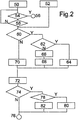
- Fig. 2 shows an optional flow diagram for pre-booked calls and non-pre-booked calls.
- Box 50 is the start box for a pre-booked call wherein the elevator system, i.e. the elevator group control 22 of the elevator system, obtains the departure floor, the destination floor, the operating time of the call allocation as well as an identifier of the user having issued the pre-booked call.
- Box 52 is the start box for a non-pre-booked call, i.e. an instantaneous destination call which only comprises the departure floor, the destination floor and optionally identification data of the user.
- decision field 54 it is prompted whether the pre-booked destination call has meanwhile been cancelled. If yes, the procedure stops at end marker 56.
- the flow diagram proceeds to decision field 58 wherein the operating time of the pre-booked call is compared with the actual time and it is decided whether the pre-booked call is to be allocated. If no, the process goes back to field 54. If yes, the flow diagram proceeds to decision field 60. Non-pre-booked calls process directly from Box 52 to decision field 60. In decision field 60, it is prompted whether the active call is a pre-booked call. If yes, the flow diagram proceeds to decision field 62 wherein it is checked whether a particular reserved elevator 20 comprises enough space to serve the call. If yes, an allocation procedure for this particular reserved elevator 20 is performed in field 64.
- the flow diagram proceeds from decision field 62 to operation field 66 where the identifier of the elevator user is retrieved and the corresponding user-individual priority is obtained to retrieve the priority of the destination call.
- the individual priority assigned to the destination call in operation field 66 leads in operation field 68 to a call allocation of all other elevators except the particular elevator 20 with a set of individual weighting coefficients leading to a better performance of the call allocation for this pre-booked destination call of the individual user.
- a negative result leads to the operation field 70 in which a normal call allocation within all elevators of the elevator system except the particular elevator 20 is performed with normal weighting coefficients of the parameters of the cost function corresponding to a low priority of the instantaneous destination call.
- the operation fields 70 and 68 connect ahead of operation field 72 in which the allocated elevator is indicated in a display of the destination input panel 30 or in a display of a mobile device 36.
- decision field 74 it is again prompted, if the pending destination call is a pre-booked call. If not, the allocation ends at end field 76. yes, the allocation process advances to decision field 78 in which it is prompted if the pre-booked call has been confirmed. If yes, the priority of the individual user is increased in operation field 80. If not, the priority of the individual user is decreased in operation field 82. Afterwards, the allocation procedure ends in the end field 76.
- the pre-booking user gets a place in the particular reserved elevator 20, if available.
- the allocation procedure still leads to an individual allocation with better weighting coefficients for the passenger sensitive parameters of the cost function of the allocation algorithm as passenger waiting time and passenger riding time which will lead to a better service than any instantaneous destination call.
- the decision field 62 and the operation field 64 can be omitted.
Landscapes
- Engineering & Computer Science (AREA)
- Automation & Control Theory (AREA)
- Computer Networks & Wireless Communication (AREA)
- Elevator Control (AREA)
Claims (15)
- Système de commande de destination (24) d'un système d'ascenseurs (10) ayant au moins un groupe d'ascenseurs (12, 26), dans lequel un appel de destination est entré par le biais d'au moins un dispositif d'entrée d'appel de destination (30, 32, 36) vers le système de commande de destination à attribuer à au moins un des ascenseurs (14, 16, 18, 20) du groupe d'ascenseurs pour desservir l'appel de destination, caractérisé en ce que le dispositif d'entrée d'appel de destination comporte en outre une entrée optionnelle pour une durée de fonctionnement souhaitée d'un appel de destination dit « pré-réservé » et le système de commande de destination est configuré pour gérer les appels de destination à partir de données d'appels de destination comprenant l'étage de départ, l'étage de destination, une durée de fonctionnement corrélée pour l'appel de destination pré-réservé ainsi qu'un identifiant corrélé de l'utilisateur qui a émis l'appel de destination pré-réservé,
dans lequel système de commande de destination les appels de destination pré-réservés sont attribués aux ascenseurs du groupe d'ascenseurs avec une priorité plus élevée que les appels de destination non pré-réservés, et
dans lequel système de commande de destination au moins un lecteur d'identification (40) est agencé au moins à proximité des ascenseurs (14, 16, 18, 20) afin d'obtenir un identifiant entré par l'utilisateur de l'ascenseur, et un appel de destination pré-réservé est confirmé par le système de commande de destination uniquement après avoir vérifié que l'identifiant obtenu par le lecteur d'identification correspond à l'identifiant corrélé à l'appel de destination pré-réservé. - Système de commande de destination (24) selon la revendication 1, ledit système de commande de destination ayant une mémoire pour l'historique des déplacements d'utilisateurs individuels dans le système d'ascenseurs.
- Système de commande de destination (24) selon la revendication 2, dans lequel la priorité d'attribution d'un appel de destination pré-réservé est individuelle à utilisateur et dépendante du nombre d'appels de destination pré-réservés non utilisés et/ou confirmés émis par l'utilisateur.
- Système de commande de destination (24) selon la revendication 2 ou 3, dans lequel chaque utilisateur se voit attribuer une priorité individuelle et le dispositif d'entrée d'appel de destination (30, 32, 36) comporte un écran pour indiquer la priorité attribuée à l'utilisateur.
- Système de commande de destination (24) selon une quelconque des revendications précédentes, dans lequel au moins un ascenseur particulier (20) du groupe d'ascenseurs (12) est réservé aux appels de destination pré-réservés.
- Système de commande de destination selon la revendication 5, dans lequel une commande d'accès (38, 40) est agencée pour l'ascenseur particulier (20) qui comprend un lecteur d'identification (40).
- Système de commande de destination (24) selon une quelconque des revendications précédentes, dans lequel une partie de la capacité de l'ascenseur (14, 16, 18, 20) est réservée aux appels de destination pré-réservés.
- Système de commande de destination (24) selon une quelconque des revendications précédentes, dans lequel le dispositif d'entrée d'appel de destination est un dispositif mobile (36), un terminal (32) ou un tableau d'entrée de destination (30) et le système de commande de destination (24) est relié à un noeud d'entrée filaire et/ou sans fil (28) pour la liaison des dispositifs d'entrée d'appels de destination.
- Système de commande de destination (24) selon une quelconque des revendications précédentes, dans lequel la zone d'accès à un ascenseur réservé particulier (20) est restreinte (38, 40) et l'accès à ladite zone est uniquement possible aux utilisateurs ayant un identifiant corrélé à un appel de destination pré-réservé dans un délai limité.
- Commande de groupe d'ascenseurs (22) comprenant un système de commande de destination (24) selon une quelconque des revendications précédentes.
- Système d'ascenseurs (10) ayant au moins un groupe d'ascenseurs (12, 26) comprenant une commande de groupe d'ascenseurs (22) avec un système de commande de destination (24) selon une quelconque des revendications précédentes.
- Procédé d'attribution d'appels de destination à des ascenseurs (14, 16, 18, 20) dans un système d'ascenseurs (10) ayant au moins un groupe d'ascenseurs (12, 26) avec plusieurs ascenseurs, dans lequel un appel de destination est entré par le biais d'au moins un dispositif d'entrée d'appel de destination (30, 32, 36) dans un système de commande de destination (24) à attribuer à au moins un des ascenseurs du groupe d'ascenseurs pour desservir l'appel de destination,
caractérisé en ce qu'une durée de fonctionnement souhaitée d'un appel de destination dit « pré-réservé » peut être émise de sorte que les données d'appels de destination comprennent l'étage de départ, l'étage de destination, une durée de fonctionnement corrélée à l'appel de destination pré-réservé ainsi qu'un identifiant corrélé de l'utilisateur émettant l'appel de destination pré-réservé, dans lequel les appels de destination pré-réservés sont attribués avec une priorité plus élevée (66, 68) aux ascenseurs du groupe d'ascenseurs que les appels de destination non pré-réservés, et
en ce que, avec la desserte de l'appel de destination pré-réservé, l'identifiant de l'utilisateur de l'ascenseur qui a émis l'appel de destination pré-réservé est demandé à l'utilisateur pour confirmer la bonne utilisation de l'appel de destination pré-réservé. - Procédé selon la revendication 12, dans lequel au moins un ascenseur particulier (20) ou au moins une certaine zone dans au moins un ascenseur est réservé(e) aux appels de destination pré-réservés et l'accès audit ascenseur particulier ou à ladite certaine zone est uniquement autorisé après avoir récupéré le bon identifiant pour un appel de destination pré-réservé à desservir dans un certain délai.
- Procédé selon la revendication 12 ou 13, dans lequel chaque utilisateur se voit affecter une priorité individuelle (80, 82) qui est dépendante du nombre d'appels de destination pré-réservés confirmés.
- Procédé selon une quelconque des revendications 12 à 14, dans lequel le système de commande de destination émet, après avoir fait l'attribution de l'appel pré-réservé, un message avec l'ascenseur attribué audit dispositif d'entrée d'appel de destination individuel (32, 36).
Applications Claiming Priority (1)
| Application Number | Priority Date | Filing Date | Title |
|---|---|---|---|
| PCT/EP2013/074032 WO2015070926A1 (fr) | 2013-11-18 | 2013-11-18 | Système de commande de destination |
Publications (2)
| Publication Number | Publication Date |
|---|---|
| EP3044151A1 EP3044151A1 (fr) | 2016-07-20 |
| EP3044151B1 true EP3044151B1 (fr) | 2017-08-30 |
Family
ID=49641731
Family Applications (1)
| Application Number | Title | Priority Date | Filing Date |
|---|---|---|---|
| EP13795449.1A Not-in-force EP3044151B1 (fr) | 2013-11-18 | 2013-11-18 | Système de commande de destination |
Country Status (5)
| Country | Link |
|---|---|
| US (1) | US10766737B2 (fr) |
| EP (1) | EP3044151B1 (fr) |
| JP (1) | JP6347845B2 (fr) |
| CN (1) | CN105722780B (fr) |
| WO (1) | WO2015070926A1 (fr) |
Cited By (1)
| Publication number | Priority date | Publication date | Assignee | Title |
|---|---|---|---|---|
| EP4323298A1 (fr) * | 2021-04-14 | 2024-02-21 | KONE Corporation | Commande d'ascenseur |
Families Citing this family (22)
| Publication number | Priority date | Publication date | Assignee | Title |
|---|---|---|---|---|
| US10934132B2 (en) | 2015-06-10 | 2021-03-02 | Inventio Ag | Lift system with predictive call production |
| US10427909B2 (en) * | 2015-06-19 | 2019-10-01 | Otis Elevator Company | User-controlled elevator allocation for independent service |
| WO2018059677A1 (fr) * | 2016-09-28 | 2018-04-05 | Kone Corporation | Procédé d'attribution d'appels d'ascenseur et système d'ascenseur |
| US10647544B2 (en) | 2017-06-05 | 2020-05-12 | Otis Elevator Company | Elevator notifications on mobile device associated with user identification device |
| DE102017219744A1 (de) * | 2017-11-07 | 2019-05-09 | Thyssenkrupp Ag | Personenfördervorrichtung mit Überwachungseinrichtung |
| CN110228733B (zh) * | 2018-03-06 | 2022-08-09 | 奥的斯电梯公司 | 电梯服务请求的授权管理和授权请求 |
| KR102114745B1 (ko) * | 2018-03-21 | 2020-05-25 | 현대엘리베이터주식회사 | 일정연계 기반의 승강기 자동호출 장치 및 방법 |
| EP3556703B1 (fr) * | 2018-04-19 | 2022-06-01 | Otis Elevator Company | Enregistrement d'appel électronique pour ascenseur |
| US11919742B2 (en) * | 2018-06-19 | 2024-03-05 | Otis Elevator Company | Mobile car operating panel |
| CN110626891B (zh) * | 2018-06-25 | 2023-09-05 | 奥的斯电梯公司 | 用于改进的电梯调度的系统和方法 |
| US12098057B2 (en) | 2018-09-14 | 2024-09-24 | Otis Elevator Company | Validation of elevator call passenger boarding |
| CN112839889B (zh) * | 2018-10-16 | 2023-11-24 | 通力股份公司 | 用于控制目的地呼叫的显示的界面设备、电梯系统和方法 |
| US12330906B2 (en) * | 2018-10-22 | 2025-06-17 | Otis Elevator Company | System and method for prioritizing service to remote elevator calls based on proximity to elevator lobby |
| US12030741B2 (en) * | 2019-03-25 | 2024-07-09 | Otis Elevator Company | Processing multiple elevator service requests |
| EP3999462A1 (fr) * | 2019-07-19 | 2022-05-25 | KONE Corporation | Attribution d'appel d'ascenseur |
| US12459782B2 (en) * | 2020-03-05 | 2025-11-04 | Otis Elevator Company | Receiver-less device positioning |
| CN116472567A (zh) * | 2020-11-12 | 2023-07-21 | 因温特奥股份公司 | 建筑物的带有用于电梯系统的等候区的建筑物系统 |
| US12428259B2 (en) * | 2021-03-18 | 2025-09-30 | International Business Machines Corporation | Occupant-based intelligent elevator actions |
| WO2022219225A1 (fr) * | 2021-04-14 | 2022-10-20 | Kone Corporation | Commande de multiples écrans associés à un système d'ascenseur |
| CN113173468B (zh) * | 2021-05-18 | 2023-05-26 | 日立楼宇技术(广州)有限公司 | 一种召梯方法、装置及电梯控制系统 |
| EP4416098B1 (fr) * | 2021-10-15 | 2026-01-28 | KONE Corporation | Commande d'ascenseur |
| CN115477209B (zh) * | 2022-09-23 | 2023-10-17 | 日立楼宇技术(广州)有限公司 | 一种召梯方法、装置、设备及存储介质 |
Family Cites Families (18)
| Publication number | Priority date | Publication date | Assignee | Title |
|---|---|---|---|---|
| US5307903A (en) * | 1988-01-29 | 1994-05-03 | Hitachi, Ltd. | Method and system of controlling elevators and method and apparatus of inputting requests to the control system |
| JPH09315708A (ja) * | 1996-05-29 | 1997-12-09 | Otis Elevator Co | 群管理エレベーター |
| ZA200101798B (en) * | 2000-03-20 | 2001-09-11 | Inventio Ag | Method for operating an elevator. |
| JP4027622B2 (ja) * | 2001-07-25 | 2007-12-26 | 株式会社日立製作所 | エレベーターの運行制御装置 |
| JP2003312947A (ja) * | 2002-04-18 | 2003-11-06 | Hitachi Software Eng Co Ltd | エレベータサービスシステム |
| FI115521B (fi) * | 2004-06-28 | 2005-05-31 | Kone Corp | Hissijärjestely |
| US7353915B2 (en) * | 2004-09-27 | 2008-04-08 | Otis Elevator Company | Automatic destination entry system with override capability |
| FI20041690A0 (fi) * | 2004-12-30 | 2004-12-30 | Kone Corp | Hissijärjestelmä |
| FI20050130A0 (fi) * | 2005-02-04 | 2005-02-04 | Kone Corp | Hissijärjestelmä |
| JP4874713B2 (ja) * | 2006-05-26 | 2012-02-15 | 三菱電機株式会社 | エレベーター遠隔操作装置 |
| KR100898916B1 (ko) * | 2007-04-02 | 2009-05-26 | 최성식 | 엘리베이터 시스템 및 그 제어방법 |
| WO2009024853A1 (fr) * | 2007-08-21 | 2009-02-26 | De Groot Pieter J | Système de commande d'ascenseur de destination intelligent |
| US8505692B2 (en) * | 2008-09-18 | 2013-08-13 | Mitsubishi Electric Corporation | Elevator system |
| EP3241795A1 (fr) * | 2009-07-15 | 2017-11-08 | Mitsubishi Electric Corporation | Système d'ascenseur |
| KR101301361B1 (ko) * | 2009-09-02 | 2013-08-29 | 미쓰비시덴키 가부시키가이샤 | 엘리베이터 시스템 |
| CN103097270B (zh) * | 2010-09-10 | 2015-04-29 | 三菱电机株式会社 | 电梯的运转装置 |
| US9592994B2 (en) * | 2011-10-14 | 2017-03-14 | Inventio Ag | Energy management for elevator system with multiple cars |
| EP2597063A1 (fr) * | 2011-11-22 | 2013-05-29 | Inventio AG | Réservations d'ascenseur au moyen du temps d'arrivée à la destination |
-
2013
- 2013-11-18 WO PCT/EP2013/074032 patent/WO2015070926A1/fr not_active Ceased
- 2013-11-18 JP JP2016553709A patent/JP6347845B2/ja not_active Expired - Fee Related
- 2013-11-18 CN CN201380080955.6A patent/CN105722780B/zh not_active Expired - Fee Related
- 2013-11-18 EP EP13795449.1A patent/EP3044151B1/fr not_active Not-in-force
-
2016
- 2016-05-02 US US15/143,779 patent/US10766737B2/en not_active Expired - Fee Related
Cited By (1)
| Publication number | Priority date | Publication date | Assignee | Title |
|---|---|---|---|---|
| EP4323298A1 (fr) * | 2021-04-14 | 2024-02-21 | KONE Corporation | Commande d'ascenseur |
Also Published As
| Publication number | Publication date |
|---|---|
| JP2016537284A (ja) | 2016-12-01 |
| US10766737B2 (en) | 2020-09-08 |
| JP6347845B2 (ja) | 2018-06-27 |
| CN105722780A (zh) | 2016-06-29 |
| HK1222632A1 (zh) | 2017-07-07 |
| EP3044151A1 (fr) | 2016-07-20 |
| WO2015070926A1 (fr) | 2015-05-21 |
| US20160244295A1 (en) | 2016-08-25 |
| CN105722780B (zh) | 2017-11-14 |
Similar Documents
| Publication | Publication Date | Title |
|---|---|---|
| EP3044151B1 (fr) | Système de commande de destination | |
| CN104379478B (zh) | 电梯设备、系统操作方法和其计算机可读取的存储介质 | |
| US10035679B2 (en) | Elevator control system using meeting information to control car destinations | |
| CN107567422B (zh) | 用于分配电梯轿厢内的空间的系统与方法 | |
| US9896303B2 (en) | Method for controlling elevator cars | |
| CN103010872B (zh) | 电梯的组管理系统 | |
| AU2011217154B2 (en) | Elevator system | |
| CN103764533B (zh) | 具有动态运输分布解决方案的升降机系统 | |
| CN111847149B (zh) | 电梯目的层分配方法 | |
| HK1246262A1 (en) | System and method for allocating space inside elevator cars | |
| JPWO2013190691A1 (ja) | エレベーターシステム | |
| JP2020066513A (ja) | エレベーターシステム | |
| JP7165518B2 (ja) | 車両の配車を管理するためのシステム、方法、及びプログラム | |
| JP6567074B2 (ja) | エレベータの群管理制御装置および群管理制御方法 | |
| CN111268521B (zh) | 升降梯被动独占调度方法 | |
| JP7461277B2 (ja) | エレベーター群管理制御装置及び乗り場混雑回避制御方法。 | |
| WO2009084077A1 (fr) | Système d'ascenseur | |
| JP2559424B2 (ja) | エレベーターの制御装置 | |
| HK1222632B (en) | Destination control system | |
| JP2023164122A (ja) | エレベーター管理システム及び方法 | |
| JP6799161B2 (ja) | エレベーター装置 | |
| JP2004123242A (ja) | エレベータ群管理システム及び方法 | |
| EP4416098B1 (fr) | Commande d'ascenseur | |
| JP2023164121A (ja) | エレベーター管理システム及び方法 | |
| JP2023164127A (ja) | エレベーター管理システム及び方法 |
Legal Events
| Date | Code | Title | Description |
|---|---|---|---|
| PUAI | Public reference made under article 153(3) epc to a published international application that has entered the european phase |
Free format text: ORIGINAL CODE: 0009012 |
|
| 17P | Request for examination filed |
Effective date: 20160412 |
|
| AK | Designated contracting states |
Kind code of ref document: A1 Designated state(s): AL AT BE BG CH CY CZ DE DK EE ES FI FR GB GR HR HU IE IS IT LI LT LU LV MC MK MT NL NO PL PT RO RS SE SI SK SM TR |
|
| AX | Request for extension of the european patent |
Extension state: BA ME |
|
| DAX | Request for extension of the european patent (deleted) | ||
| REG | Reference to a national code |
Ref country code: DE Ref legal event code: R079 Ref document number: 602013025881 Country of ref document: DE Free format text: PREVIOUS MAIN CLASS: B66B0001240000 Ipc: B66B0001460000 |
|
| GRAP | Despatch of communication of intention to grant a patent |
Free format text: ORIGINAL CODE: EPIDOSNIGR1 |
|
| STAA | Information on the status of an ep patent application or granted ep patent |
Free format text: STATUS: GRANT OF PATENT IS INTENDED |
|
| RIC1 | Information provided on ipc code assigned before grant |
Ipc: B66B 1/24 20060101ALI20170428BHEP Ipc: B66B 1/46 20060101AFI20170428BHEP |
|
| INTG | Intention to grant announced |
Effective date: 20170522 |
|
| RAP1 | Party data changed (applicant data changed or rights of an application transferred) |
Owner name: KONE CORPORATION |
|
| GRAS | Grant fee paid |
Free format text: ORIGINAL CODE: EPIDOSNIGR3 |
|
| GRAA | (expected) grant |
Free format text: ORIGINAL CODE: 0009210 |
|
| STAA | Information on the status of an ep patent application or granted ep patent |
Free format text: STATUS: THE PATENT HAS BEEN GRANTED |
|
| AK | Designated contracting states |
Kind code of ref document: B1 Designated state(s): AL AT BE BG CH CY CZ DE DK EE ES FI FR GB GR HR HU IE IS IT LI LT LU LV MC MK MT NL NO PL PT RO RS SE SI SK SM TR |
|
| REG | Reference to a national code |
Ref country code: GB Ref legal event code: FG4D |
|
| RIN1 | Information on inventor provided before grant (corrected) |
Inventor name: SALMIKUUKKA, JUKKA |
|
| REG | Reference to a national code |
Ref country code: CH Ref legal event code: EP |
|
| REG | Reference to a national code |
Ref country code: AT Ref legal event code: REF Ref document number: 923329 Country of ref document: AT Kind code of ref document: T Effective date: 20170915 |
|
| REG | Reference to a national code |
Ref country code: IE Ref legal event code: FG4D |
|
| REG | Reference to a national code |
Ref country code: DE Ref legal event code: R096 Ref document number: 602013025881 Country of ref document: DE |
|
| REG | Reference to a national code |
Ref country code: FR Ref legal event code: PLFP Year of fee payment: 5 |
|
| REG | Reference to a national code |
Ref country code: NL Ref legal event code: MP Effective date: 20170830 |
|
| REG | Reference to a national code |
Ref country code: LT Ref legal event code: MG4D |
|
| REG | Reference to a national code |
Ref country code: AT Ref legal event code: MK05 Ref document number: 923329 Country of ref document: AT Kind code of ref document: T Effective date: 20170830 |
|
| PG25 | Lapsed in a contracting state [announced via postgrant information from national office to epo] |
Ref country code: SE Free format text: LAPSE BECAUSE OF FAILURE TO SUBMIT A TRANSLATION OF THE DESCRIPTION OR TO PAY THE FEE WITHIN THE PRESCRIBED TIME-LIMIT Effective date: 20170830 Ref country code: FI Free format text: LAPSE BECAUSE OF FAILURE TO SUBMIT A TRANSLATION OF THE DESCRIPTION OR TO PAY THE FEE WITHIN THE PRESCRIBED TIME-LIMIT Effective date: 20170830 Ref country code: NO Free format text: LAPSE BECAUSE OF FAILURE TO SUBMIT A TRANSLATION OF THE DESCRIPTION OR TO PAY THE FEE WITHIN THE PRESCRIBED TIME-LIMIT Effective date: 20171130 Ref country code: HR Free format text: LAPSE BECAUSE OF FAILURE TO SUBMIT A TRANSLATION OF THE DESCRIPTION OR TO PAY THE FEE WITHIN THE PRESCRIBED TIME-LIMIT Effective date: 20170830 Ref country code: LT Free format text: LAPSE BECAUSE OF FAILURE TO SUBMIT A TRANSLATION OF THE DESCRIPTION OR TO PAY THE FEE WITHIN THE PRESCRIBED TIME-LIMIT Effective date: 20170830 Ref country code: AT Free format text: LAPSE BECAUSE OF FAILURE TO SUBMIT A TRANSLATION OF THE DESCRIPTION OR TO PAY THE FEE WITHIN THE PRESCRIBED TIME-LIMIT Effective date: 20170830 |
|
| PG25 | Lapsed in a contracting state [announced via postgrant information from national office to epo] |
Ref country code: ES Free format text: LAPSE BECAUSE OF FAILURE TO SUBMIT A TRANSLATION OF THE DESCRIPTION OR TO PAY THE FEE WITHIN THE PRESCRIBED TIME-LIMIT Effective date: 20170830 Ref country code: LV Free format text: LAPSE BECAUSE OF FAILURE TO SUBMIT A TRANSLATION OF THE DESCRIPTION OR TO PAY THE FEE WITHIN THE PRESCRIBED TIME-LIMIT Effective date: 20170830 Ref country code: GR Free format text: LAPSE BECAUSE OF FAILURE TO SUBMIT A TRANSLATION OF THE DESCRIPTION OR TO PAY THE FEE WITHIN THE PRESCRIBED TIME-LIMIT Effective date: 20171201 Ref country code: RS Free format text: LAPSE BECAUSE OF FAILURE TO SUBMIT A TRANSLATION OF THE DESCRIPTION OR TO PAY THE FEE WITHIN THE PRESCRIBED TIME-LIMIT Effective date: 20170830 Ref country code: IS Free format text: LAPSE BECAUSE OF FAILURE TO SUBMIT A TRANSLATION OF THE DESCRIPTION OR TO PAY THE FEE WITHIN THE PRESCRIBED TIME-LIMIT Effective date: 20171230 Ref country code: BG Free format text: LAPSE BECAUSE OF FAILURE TO SUBMIT A TRANSLATION OF THE DESCRIPTION OR TO PAY THE FEE WITHIN THE PRESCRIBED TIME-LIMIT Effective date: 20171130 |
|
| PG25 | Lapsed in a contracting state [announced via postgrant information from national office to epo] |
Ref country code: NL Free format text: LAPSE BECAUSE OF FAILURE TO SUBMIT A TRANSLATION OF THE DESCRIPTION OR TO PAY THE FEE WITHIN THE PRESCRIBED TIME-LIMIT Effective date: 20170830 |
|
| PG25 | Lapsed in a contracting state [announced via postgrant information from national office to epo] |
Ref country code: CZ Free format text: LAPSE BECAUSE OF FAILURE TO SUBMIT A TRANSLATION OF THE DESCRIPTION OR TO PAY THE FEE WITHIN THE PRESCRIBED TIME-LIMIT Effective date: 20170830 Ref country code: DK Free format text: LAPSE BECAUSE OF FAILURE TO SUBMIT A TRANSLATION OF THE DESCRIPTION OR TO PAY THE FEE WITHIN THE PRESCRIBED TIME-LIMIT Effective date: 20170830 Ref country code: RO Free format text: LAPSE BECAUSE OF FAILURE TO SUBMIT A TRANSLATION OF THE DESCRIPTION OR TO PAY THE FEE WITHIN THE PRESCRIBED TIME-LIMIT Effective date: 20170830 Ref country code: PL Free format text: LAPSE BECAUSE OF FAILURE TO SUBMIT A TRANSLATION OF THE DESCRIPTION OR TO PAY THE FEE WITHIN THE PRESCRIBED TIME-LIMIT Effective date: 20170830 |
|
| PG25 | Lapsed in a contracting state [announced via postgrant information from national office to epo] |
Ref country code: IT Free format text: LAPSE BECAUSE OF FAILURE TO SUBMIT A TRANSLATION OF THE DESCRIPTION OR TO PAY THE FEE WITHIN THE PRESCRIBED TIME-LIMIT Effective date: 20170830 Ref country code: SM Free format text: LAPSE BECAUSE OF FAILURE TO SUBMIT A TRANSLATION OF THE DESCRIPTION OR TO PAY THE FEE WITHIN THE PRESCRIBED TIME-LIMIT Effective date: 20170830 Ref country code: SK Free format text: LAPSE BECAUSE OF FAILURE TO SUBMIT A TRANSLATION OF THE DESCRIPTION OR TO PAY THE FEE WITHIN THE PRESCRIBED TIME-LIMIT Effective date: 20170830 Ref country code: EE Free format text: LAPSE BECAUSE OF FAILURE TO SUBMIT A TRANSLATION OF THE DESCRIPTION OR TO PAY THE FEE WITHIN THE PRESCRIBED TIME-LIMIT Effective date: 20170830 |
|
| REG | Reference to a national code |
Ref country code: DE Ref legal event code: R097 Ref document number: 602013025881 Country of ref document: DE |
|
| PG25 | Lapsed in a contracting state [announced via postgrant information from national office to epo] |
Ref country code: MC Free format text: LAPSE BECAUSE OF FAILURE TO SUBMIT A TRANSLATION OF THE DESCRIPTION OR TO PAY THE FEE WITHIN THE PRESCRIBED TIME-LIMIT Effective date: 20170830 |
|
| PLBE | No opposition filed within time limit |
Free format text: ORIGINAL CODE: 0009261 |
|
| STAA | Information on the status of an ep patent application or granted ep patent |
Free format text: STATUS: NO OPPOSITION FILED WITHIN TIME LIMIT |
|
| PG25 | Lapsed in a contracting state [announced via postgrant information from national office to epo] |
Ref country code: CH Free format text: LAPSE BECAUSE OF NON-PAYMENT OF DUE FEES Effective date: 20171130 Ref country code: LI Free format text: LAPSE BECAUSE OF NON-PAYMENT OF DUE FEES Effective date: 20171130 |
|
| 26N | No opposition filed |
Effective date: 20180531 |
|
| PG25 | Lapsed in a contracting state [announced via postgrant information from national office to epo] |
Ref country code: SI Free format text: LAPSE BECAUSE OF FAILURE TO SUBMIT A TRANSLATION OF THE DESCRIPTION OR TO PAY THE FEE WITHIN THE PRESCRIBED TIME-LIMIT Effective date: 20170830 Ref country code: LU Free format text: LAPSE BECAUSE OF NON-PAYMENT OF DUE FEES Effective date: 20171118 |
|
| REG | Reference to a national code |
Ref country code: BE Ref legal event code: MM Effective date: 20171130 |
|
| REG | Reference to a national code |
Ref country code: IE Ref legal event code: MM4A |
|
| PG25 | Lapsed in a contracting state [announced via postgrant information from national office to epo] |
Ref country code: MT Free format text: LAPSE BECAUSE OF NON-PAYMENT OF DUE FEES Effective date: 20171118 |
|
| PG25 | Lapsed in a contracting state [announced via postgrant information from national office to epo] |
Ref country code: IE Free format text: LAPSE BECAUSE OF NON-PAYMENT OF DUE FEES Effective date: 20171118 |
|
| PG25 | Lapsed in a contracting state [announced via postgrant information from national office to epo] |
Ref country code: BE Free format text: LAPSE BECAUSE OF NON-PAYMENT OF DUE FEES Effective date: 20171130 |
|
| PG25 | Lapsed in a contracting state [announced via postgrant information from national office to epo] |
Ref country code: HU Free format text: LAPSE BECAUSE OF FAILURE TO SUBMIT A TRANSLATION OF THE DESCRIPTION OR TO PAY THE FEE WITHIN THE PRESCRIBED TIME-LIMIT; INVALID AB INITIO Effective date: 20131118 |
|
| PG25 | Lapsed in a contracting state [announced via postgrant information from national office to epo] |
Ref country code: CY Free format text: LAPSE BECAUSE OF FAILURE TO SUBMIT A TRANSLATION OF THE DESCRIPTION OR TO PAY THE FEE WITHIN THE PRESCRIBED TIME-LIMIT Effective date: 20170830 |
|
| PG25 | Lapsed in a contracting state [announced via postgrant information from national office to epo] |
Ref country code: MK Free format text: LAPSE BECAUSE OF FAILURE TO SUBMIT A TRANSLATION OF THE DESCRIPTION OR TO PAY THE FEE WITHIN THE PRESCRIBED TIME-LIMIT Effective date: 20170830 |
|
| PG25 | Lapsed in a contracting state [announced via postgrant information from national office to epo] |
Ref country code: TR Free format text: LAPSE BECAUSE OF FAILURE TO SUBMIT A TRANSLATION OF THE DESCRIPTION OR TO PAY THE FEE WITHIN THE PRESCRIBED TIME-LIMIT Effective date: 20170830 |
|
| PG25 | Lapsed in a contracting state [announced via postgrant information from national office to epo] |
Ref country code: PT Free format text: LAPSE BECAUSE OF FAILURE TO SUBMIT A TRANSLATION OF THE DESCRIPTION OR TO PAY THE FEE WITHIN THE PRESCRIBED TIME-LIMIT Effective date: 20170830 |
|
| PG25 | Lapsed in a contracting state [announced via postgrant information from national office to epo] |
Ref country code: AL Free format text: LAPSE BECAUSE OF FAILURE TO SUBMIT A TRANSLATION OF THE DESCRIPTION OR TO PAY THE FEE WITHIN THE PRESCRIBED TIME-LIMIT Effective date: 20170830 |
|
| PGFP | Annual fee paid to national office [announced via postgrant information from national office to epo] |
Ref country code: GB Payment date: 20211119 Year of fee payment: 9 Ref country code: DE Payment date: 20211118 Year of fee payment: 9 Ref country code: FR Payment date: 20211122 Year of fee payment: 9 |
|
| REG | Reference to a national code |
Ref country code: DE Ref legal event code: R119 Ref document number: 602013025881 Country of ref document: DE |
|
| GBPC | Gb: european patent ceased through non-payment of renewal fee |
Effective date: 20221118 |
|
| PG25 | Lapsed in a contracting state [announced via postgrant information from national office to epo] |
Ref country code: GB Free format text: LAPSE BECAUSE OF NON-PAYMENT OF DUE FEES Effective date: 20221118 Ref country code: DE Free format text: LAPSE BECAUSE OF NON-PAYMENT OF DUE FEES Effective date: 20230601 |
|
| PG25 | Lapsed in a contracting state [announced via postgrant information from national office to epo] |
Ref country code: FR Free format text: LAPSE BECAUSE OF NON-PAYMENT OF DUE FEES Effective date: 20221130 |