EP3044822B1 - Suspension aqueuse épaisse de cathode pour batterie au lithium-ion - Google Patents
Suspension aqueuse épaisse de cathode pour batterie au lithium-ion Download PDFInfo
- Publication number
- EP3044822B1 EP3044822B1 EP14844016.7A EP14844016A EP3044822B1 EP 3044822 B1 EP3044822 B1 EP 3044822B1 EP 14844016 A EP14844016 A EP 14844016A EP 3044822 B1 EP3044822 B1 EP 3044822B1
- Authority
- EP
- European Patent Office
- Prior art keywords
- water
- nmc532
- ion battery
- lithium ion
- based binder
- Prior art date
- Legal status (The legal status is an assumption and is not a legal conclusion. Google has not performed a legal analysis and makes no representation as to the accuracy of the status listed.)
- Active
Links
Images






Classifications
-
- H—ELECTRICITY
- H01—ELECTRIC ELEMENTS
- H01M—PROCESSES OR MEANS, e.g. BATTERIES, FOR THE DIRECT CONVERSION OF CHEMICAL ENERGY INTO ELECTRICAL ENERGY
- H01M4/00—Electrodes
- H01M4/02—Electrodes composed of, or comprising, active material
- H01M4/62—Selection of inactive substances as ingredients for active masses, e.g. binders, fillers
- H01M4/621—Binders
- H01M4/622—Binders being polymers
- H01M4/623—Binders being polymers fluorinated polymers
-
- B—PERFORMING OPERATIONS; TRANSPORTING
- B60—VEHICLES IN GENERAL
- B60L—PROPULSION OF ELECTRICALLY-PROPELLED VEHICLES; SUPPLYING ELECTRIC POWER FOR AUXILIARY EQUIPMENT OF ELECTRICALLY-PROPELLED VEHICLES; ELECTRODYNAMIC BRAKE SYSTEMS FOR VEHICLES IN GENERAL; MAGNETIC SUSPENSION OR LEVITATION FOR VEHICLES; MONITORING OPERATING VARIABLES OF ELECTRICALLY-PROPELLED VEHICLES; ELECTRIC SAFETY DEVICES FOR ELECTRICALLY-PROPELLED VEHICLES
- B60L50/00—Electric propulsion with power supplied within the vehicle
- B60L50/50—Electric propulsion with power supplied within the vehicle using propulsion power supplied by batteries or fuel cells
- B60L50/60—Electric propulsion with power supplied within the vehicle using propulsion power supplied by batteries or fuel cells using power supplied by batteries
- B60L50/64—Constructional details of batteries specially adapted for electric vehicles
-
- B—PERFORMING OPERATIONS; TRANSPORTING
- B60—VEHICLES IN GENERAL
- B60L—PROPULSION OF ELECTRICALLY-PROPELLED VEHICLES; SUPPLYING ELECTRIC POWER FOR AUXILIARY EQUIPMENT OF ELECTRICALLY-PROPELLED VEHICLES; ELECTRODYNAMIC BRAKE SYSTEMS FOR VEHICLES IN GENERAL; MAGNETIC SUSPENSION OR LEVITATION FOR VEHICLES; MONITORING OPERATING VARIABLES OF ELECTRICALLY-PROPELLED VEHICLES; ELECTRIC SAFETY DEVICES FOR ELECTRICALLY-PROPELLED VEHICLES
- B60L58/00—Methods or circuit arrangements for monitoring or controlling batteries or fuel cells, specially adapted for electric vehicles
- B60L58/40—Methods or circuit arrangements for monitoring or controlling batteries or fuel cells, specially adapted for electric vehicles for controlling a combination of batteries and fuel cells
-
- C—CHEMISTRY; METALLURGY
- C01—INORGANIC CHEMISTRY
- C01G—COMPOUNDS CONTAINING METALS NOT COVERED BY SUBCLASSES C01D OR C01F
- C01G53/00—Compounds of nickel
- C01G53/40—Complex oxides containing nickel and at least one other metal element
- C01G53/42—Complex oxides containing nickel and at least one other metal element containing alkali metals, e.g. LiNiO2
- C01G53/44—Complex oxides containing nickel and at least one other metal element containing alkali metals, e.g. LiNiO2 containing manganese
- C01G53/50—Complex oxides containing nickel and at least one other metal element containing alkali metals, e.g. LiNiO2 containing manganese of the type (MnO2)n-, e.g. Li(NixMn1-x)O2 or Li(MyNixMn1-x-y)O2
-
- H—ELECTRICITY
- H01—ELECTRIC ELEMENTS
- H01M—PROCESSES OR MEANS, e.g. BATTERIES, FOR THE DIRECT CONVERSION OF CHEMICAL ENERGY INTO ELECTRICAL ENERGY
- H01M10/00—Secondary cells; Manufacture thereof
- H01M10/05—Accumulators with non-aqueous electrolyte
- H01M10/052—Li-accumulators
- H01M10/0525—Rocking-chair batteries, i.e. batteries with lithium insertion or intercalation in both electrodes; Lithium-ion batteries
-
- H—ELECTRICITY
- H01—ELECTRIC ELEMENTS
- H01M—PROCESSES OR MEANS, e.g. BATTERIES, FOR THE DIRECT CONVERSION OF CHEMICAL ENERGY INTO ELECTRICAL ENERGY
- H01M4/00—Electrodes
- H01M4/02—Electrodes composed of, or comprising, active material
- H01M4/13—Electrodes for accumulators with non-aqueous electrolyte, e.g. for lithium-accumulators; Processes of manufacture thereof
- H01M4/131—Electrodes based on mixed oxides or hydroxides, or on mixtures of oxides or hydroxides, e.g. LiCoOx
-
- H—ELECTRICITY
- H01—ELECTRIC ELEMENTS
- H01M—PROCESSES OR MEANS, e.g. BATTERIES, FOR THE DIRECT CONVERSION OF CHEMICAL ENERGY INTO ELECTRICAL ENERGY
- H01M4/00—Electrodes
- H01M4/02—Electrodes composed of, or comprising, active material
- H01M4/13—Electrodes for accumulators with non-aqueous electrolyte, e.g. for lithium-accumulators; Processes of manufacture thereof
- H01M4/131—Electrodes based on mixed oxides or hydroxides, or on mixtures of oxides or hydroxides, e.g. LiCoOx
- H01M4/1315—Electrodes based on mixed oxides or hydroxides, or on mixtures of oxides or hydroxides, e.g. LiCoOx containing halogen atoms, e.g. LiCoOxFy
-
- H—ELECTRICITY
- H01—ELECTRIC ELEMENTS
- H01M—PROCESSES OR MEANS, e.g. BATTERIES, FOR THE DIRECT CONVERSION OF CHEMICAL ENERGY INTO ELECTRICAL ENERGY
- H01M4/00—Electrodes
- H01M4/02—Electrodes composed of, or comprising, active material
- H01M4/13—Electrodes for accumulators with non-aqueous electrolyte, e.g. for lithium-accumulators; Processes of manufacture thereof
- H01M4/139—Processes of manufacture
- H01M4/1391—Processes of manufacture of electrodes based on mixed oxides or hydroxides, or on mixtures of oxides or hydroxides, e.g. LiCoOx
-
- H—ELECTRICITY
- H01—ELECTRIC ELEMENTS
- H01M—PROCESSES OR MEANS, e.g. BATTERIES, FOR THE DIRECT CONVERSION OF CHEMICAL ENERGY INTO ELECTRICAL ENERGY
- H01M4/00—Electrodes
- H01M4/02—Electrodes composed of, or comprising, active material
- H01M4/36—Selection of substances as active materials, active masses, active liquids
- H01M4/362—Composites
- H01M4/366—Composites as layered products
-
- H—ELECTRICITY
- H01—ELECTRIC ELEMENTS
- H01M—PROCESSES OR MEANS, e.g. BATTERIES, FOR THE DIRECT CONVERSION OF CHEMICAL ENERGY INTO ELECTRICAL ENERGY
- H01M4/00—Electrodes
- H01M4/02—Electrodes composed of, or comprising, active material
- H01M4/36—Selection of substances as active materials, active masses, active liquids
- H01M4/48—Selection of substances as active materials, active masses, active liquids of inorganic oxides or hydroxides
- H01M4/50—Selection of substances as active materials, active masses, active liquids of inorganic oxides or hydroxides of manganese
- H01M4/505—Selection of substances as active materials, active masses, active liquids of inorganic oxides or hydroxides of manganese of mixed oxides or hydroxides containing manganese for inserting or intercalating light metals, e.g. LiMn2O4 or LiMn2OxFy
-
- H—ELECTRICITY
- H01—ELECTRIC ELEMENTS
- H01M—PROCESSES OR MEANS, e.g. BATTERIES, FOR THE DIRECT CONVERSION OF CHEMICAL ENERGY INTO ELECTRICAL ENERGY
- H01M4/00—Electrodes
- H01M4/02—Electrodes composed of, or comprising, active material
- H01M4/36—Selection of substances as active materials, active masses, active liquids
- H01M4/48—Selection of substances as active materials, active masses, active liquids of inorganic oxides or hydroxides
- H01M4/52—Selection of substances as active materials, active masses, active liquids of inorganic oxides or hydroxides of nickel, cobalt or iron
- H01M4/525—Selection of substances as active materials, active masses, active liquids of inorganic oxides or hydroxides of nickel, cobalt or iron of mixed oxides or hydroxides containing iron, cobalt or nickel for inserting or intercalating light metals, e.g. LiNiO2, LiCoO2 or LiCoOxFy
-
- B—PERFORMING OPERATIONS; TRANSPORTING
- B60—VEHICLES IN GENERAL
- B60L—PROPULSION OF ELECTRICALLY-PROPELLED VEHICLES; SUPPLYING ELECTRIC POWER FOR AUXILIARY EQUIPMENT OF ELECTRICALLY-PROPELLED VEHICLES; ELECTRODYNAMIC BRAKE SYSTEMS FOR VEHICLES IN GENERAL; MAGNETIC SUSPENSION OR LEVITATION FOR VEHICLES; MONITORING OPERATING VARIABLES OF ELECTRICALLY-PROPELLED VEHICLES; ELECTRIC SAFETY DEVICES FOR ELECTRICALLY-PROPELLED VEHICLES
- B60L2240/00—Control parameters of input or output; Target parameters
- B60L2240/10—Vehicle control parameters
- B60L2240/36—Temperature of vehicle components or parts
-
- B—PERFORMING OPERATIONS; TRANSPORTING
- B60—VEHICLES IN GENERAL
- B60L—PROPULSION OF ELECTRICALLY-PROPELLED VEHICLES; SUPPLYING ELECTRIC POWER FOR AUXILIARY EQUIPMENT OF ELECTRICALLY-PROPELLED VEHICLES; ELECTRODYNAMIC BRAKE SYSTEMS FOR VEHICLES IN GENERAL; MAGNETIC SUSPENSION OR LEVITATION FOR VEHICLES; MONITORING OPERATING VARIABLES OF ELECTRICALLY-PROPELLED VEHICLES; ELECTRIC SAFETY DEVICES FOR ELECTRICALLY-PROPELLED VEHICLES
- B60L2240/00—Control parameters of input or output; Target parameters
- B60L2240/40—Drive Train control parameters
- B60L2240/54—Drive Train control parameters related to batteries
- B60L2240/545—Temperature
-
- C—CHEMISTRY; METALLURGY
- C01—INORGANIC CHEMISTRY
- C01P—INDEXING SCHEME RELATING TO STRUCTURAL AND PHYSICAL ASPECTS OF SOLID INORGANIC COMPOUNDS
- C01P2004/00—Particle morphology
- C01P2004/01—Particle morphology depicted by an image
- C01P2004/03—Particle morphology depicted by an image obtained by SEM
-
- C—CHEMISTRY; METALLURGY
- C01—INORGANIC CHEMISTRY
- C01P—INDEXING SCHEME RELATING TO STRUCTURAL AND PHYSICAL ASPECTS OF SOLID INORGANIC COMPOUNDS
- C01P2004/00—Particle morphology
- C01P2004/50—Agglomerated particles
-
- C—CHEMISTRY; METALLURGY
- C01—INORGANIC CHEMISTRY
- C01P—INDEXING SCHEME RELATING TO STRUCTURAL AND PHYSICAL ASPECTS OF SOLID INORGANIC COMPOUNDS
- C01P2004/00—Particle morphology
- C01P2004/60—Particles characterised by their size
- C01P2004/62—Submicrometer sized, i.e. from 0.1-1 micrometer
-
- C—CHEMISTRY; METALLURGY
- C01—INORGANIC CHEMISTRY
- C01P—INDEXING SCHEME RELATING TO STRUCTURAL AND PHYSICAL ASPECTS OF SOLID INORGANIC COMPOUNDS
- C01P2004/00—Particle morphology
- C01P2004/80—Particles consisting of a mixture of two or more inorganic phases
-
- C—CHEMISTRY; METALLURGY
- C01—INORGANIC CHEMISTRY
- C01P—INDEXING SCHEME RELATING TO STRUCTURAL AND PHYSICAL ASPECTS OF SOLID INORGANIC COMPOUNDS
- C01P2006/00—Physical properties of inorganic compounds
- C01P2006/40—Electric properties
-
- H—ELECTRICITY
- H01—ELECTRIC ELEMENTS
- H01M—PROCESSES OR MEANS, e.g. BATTERIES, FOR THE DIRECT CONVERSION OF CHEMICAL ENERGY INTO ELECTRICAL ENERGY
- H01M4/00—Electrodes
- H01M4/02—Electrodes composed of, or comprising, active material
- H01M2004/021—Physical characteristics, e.g. porosity, surface area
-
- H—ELECTRICITY
- H01—ELECTRIC ELEMENTS
- H01M—PROCESSES OR MEANS, e.g. BATTERIES, FOR THE DIRECT CONVERSION OF CHEMICAL ENERGY INTO ELECTRICAL ENERGY
- H01M4/00—Electrodes
- H01M4/02—Electrodes composed of, or comprising, active material
- H01M2004/026—Electrodes composed of, or comprising, active material characterised by the polarity
- H01M2004/028—Positive electrodes
-
- H—ELECTRICITY
- H01—ELECTRIC ELEMENTS
- H01M—PROCESSES OR MEANS, e.g. BATTERIES, FOR THE DIRECT CONVERSION OF CHEMICAL ENERGY INTO ELECTRICAL ENERGY
- H01M2220/00—Batteries for particular applications
- H01M2220/20—Batteries in motive systems, e.g. vehicle, ship, plane
-
- Y—GENERAL TAGGING OF NEW TECHNOLOGICAL DEVELOPMENTS; GENERAL TAGGING OF CROSS-SECTIONAL TECHNOLOGIES SPANNING OVER SEVERAL SECTIONS OF THE IPC; TECHNICAL SUBJECTS COVERED BY FORMER USPC CROSS-REFERENCE ART COLLECTIONS [XRACs] AND DIGESTS
- Y02—TECHNOLOGIES OR APPLICATIONS FOR MITIGATION OR ADAPTATION AGAINST CLIMATE CHANGE
- Y02E—REDUCTION OF GREENHOUSE GAS [GHG] EMISSIONS, RELATED TO ENERGY GENERATION, TRANSMISSION OR DISTRIBUTION
- Y02E60/00—Enabling technologies; Technologies with a potential or indirect contribution to GHG emissions mitigation
- Y02E60/10—Energy storage using batteries
-
- Y—GENERAL TAGGING OF NEW TECHNOLOGICAL DEVELOPMENTS; GENERAL TAGGING OF CROSS-SECTIONAL TECHNOLOGIES SPANNING OVER SEVERAL SECTIONS OF THE IPC; TECHNICAL SUBJECTS COVERED BY FORMER USPC CROSS-REFERENCE ART COLLECTIONS [XRACs] AND DIGESTS
- Y02—TECHNOLOGIES OR APPLICATIONS FOR MITIGATION OR ADAPTATION AGAINST CLIMATE CHANGE
- Y02T—CLIMATE CHANGE MITIGATION TECHNOLOGIES RELATED TO TRANSPORTATION
- Y02T10/00—Road transport of goods or passengers
- Y02T10/60—Other road transportation technologies with climate change mitigation effect
- Y02T10/70—Energy storage systems for electromobility, e.g. batteries
-
- Y—GENERAL TAGGING OF NEW TECHNOLOGICAL DEVELOPMENTS; GENERAL TAGGING OF CROSS-SECTIONAL TECHNOLOGIES SPANNING OVER SEVERAL SECTIONS OF THE IPC; TECHNICAL SUBJECTS COVERED BY FORMER USPC CROSS-REFERENCE ART COLLECTIONS [XRACs] AND DIGESTS
- Y02—TECHNOLOGIES OR APPLICATIONS FOR MITIGATION OR ADAPTATION AGAINST CLIMATE CHANGE
- Y02T—CLIMATE CHANGE MITIGATION TECHNOLOGIES RELATED TO TRANSPORTATION
- Y02T90/00—Enabling technologies or technologies with a potential or indirect contribution to GHG emissions mitigation
- Y02T90/40—Application of hydrogen technology to transportation, e.g. using fuel cells
Definitions
- the invention relates to water-based electrode coating technologies for positive electrodes of lithium ion rechargeable batteries.
- a lithium ion battery is basically a jellyroll, impregnated with electrolyte, attached to current connectors, and inserted into a battery case.
- a jellyroll consists of at least a negative electrode (anode) a porous electrically insulating membrane (separator) and a positive electrode (cathode).
- an electrode is a metal foil (or substrate) coated on both sides by an electro active composite.
- the electro active composite is porous and consists of particles of the active material, it contains a binder to glue the particles to each other and onto the substrate and it contains a conductive additive to increase the electrical conductivity. The porosity will - after battery assembly - be filled by electrolyte.
- the negative electrode typically consists of a copper foil as current collector, the active composite consists of typically >90% graphite type carbon, the remaining ⁇ 10% consist of binder as well as conductive additives.
- the traditional electrode preparation technology is a wet coating process, where viscous slurry is coated onto the current collector substrate.
- the slurry is a NMP (N-Methyl-pyrrolidone) organic solvent based dispersion.
- the binder typically a PVDF (Polyvinylidene fluoride) based copolymer, is dissolved in the solvent and conductive additives as well as the electro-active electrode material are suspended in the slurry.
- NMP/PVDF based slurries have good visco- mechanical properties which allow high quality industrial coating at high coating speed, typically several km per hour.
- PVDF is not the best binder but very suitable for the organic NMP based coating technology.
- An important aspect of PVDF as binder is the so-called swelling ability.
- the electrolytes used in the battery cannot dissolve but soften the PVDF binder.
- the resulting "swollen" PVDF has Li ionic conductivity. After drying the electrode, parts of the active material particles are covered by PVDF. If PVDF would not be an ionic insulator, the surface coverage would block the transport of lithium. Due to the ion conductive properties of the swollen polymer, and despite of PVDF coverage, a good capacity and rate performance is achieved.
- NMP is flammable and has some toxicity. NMP vapors are of major concern due to inhalation and explosion danger, and cannot be released to the environment in large quantities.
- NMP has a relatively high evaporation temperature, so drying the electrode is performed at relatively high temperature (e.g. 120°C). Due to the cost and environmental reasons, NMP needs to be recycled out of the hot drying gas. Recycling can be done by condensation, but requires energy and relatively expensive installations. The flammability of NMP demands that equipment is explosion-safe, which further increases its cost. Therefore it was attempted to replace the organic NMP based coating process by a water-based coating process. The attempts have been fully successful for the negative electrode (anode).
- a typical water-based slurry for anode coating is prepared as follows: CMC (carboxymethyl cellulose) is dissolved in water - for improving the visco-mechanical properties - allowing for industrial coating operations. At the same time CMC acts as surfactant for the (normally hydrophobic) graphite based carbon electro-active material and the carbon conductive additive. After electrode drying CMC remains, acting as binder, but CMC is brittle. To soften the electrode, make it more elastic and to improve the adhesion between substrate and coating layer SBR (styrene-butadiene rubber) fine particles are added as binder to the slurry. The binder particles do not dissolve.
- SBR styrene-butadiene rubber
- Such advanced SBR latex binders can be obtained from e.g. JSR Corporation (Tokyo, Japan).
- cathodes In the case of the positive electrode (cathode) a similar approach is desired. Similar to the anode technology, in the case of cathodes, water-based coatings will decrease cost and be environmentally friendlier. However, contrary to anodes, water-based coating for cathodes is more difficult. The main issue is the fact that many cathode materials are not inert in water, which causes problems and complicates the implementation of water-based coating process for cathodes. An example of the use of the water-based coating technology for preparing cathodes can be found in US2013-0034651 . Within the battery, cathodes are at high voltage (when measured versus Li/Li+).
- a lithium-ion secondary battery which has a positive electrode formed of active material and a binder in an aqueous solvent.
- a surface of the positive electrode active material is coated by a hydrophobic coating and the binder dissolves or disperses in the aqueous solvent.
- the positive electrode active material powder has secondary particles ranging from approximately 1 ⁇ m to 15 ⁇ m, and is formed by agglomeration of a large number of microparticles of active material.
- the positive electrode active material coated by a water-repellent resin can be obtained by preparing a paste-like mixture by dispersing and mixing the material and a water-repellent resin, such as PVDF, in an appropriate solvent and drying the paste-like mixture between 100° C and 180° C.
- a long battery live is related to 2 properties: (a) small loss of capacity during storage and (b) high cycle stability.
- DCR direct current resistance
- the present invention aims to provide water-based coating compositions for positive electrodes that are particularly suitable for these automotive battery applications, especially in view of the DCR problems cited before.
- the invention provides a water-based lithium ion battery cathode slurry comprising a conductive agent and/or a water-based binder and comprising a cathode active material comprising a lithium transition metal oxide powder wherein the lithium transition metal oxide powder consists of agglomerates of primary particles, the primary particles comprising a coating layer comprising a polymer.
- the coating layer may be hydrophobic.
- the polymer is a fluorine-containing polymer comprising at least 50 wt% of fluorine.
- the coating comprises a first inner and a second outer coating layer, the second outer layer comprising the fluorine-containing polymer, and the first inner layer consisting of a reaction product of the fluorine-containing polymer and the surface of the primary particles.
- the invention also provides a water-based lithium ion battery cathode slurry comprising a cathode active material comprising a lithium transition metal oxide powder wherein the lithium transition metal oxide powder consists of agglomerates of primary particles, the primary particles comprising a coating layer comprising a polymer, wherein the polymer is a fluorine-containing polymer comprising at least 50 wt% of fluorine, and wherein the coating comprises a first inner and a second outer coating layer, the second outer layer comprising the fluorine-containing polymer, and the first inner layer consisting of a reaction product of the fluorine-containing polymer and the surface of the primary particles.
- the reaction product may comprise LiF.
- the lithium in LiF may originate from the primary particles surface.
- the fluorine in the reaction product comprising LiF may originate from partially decomposed fluorine-containing polymer present in the second outer layer.
- the first inner coating layer consists of a LiF film with a thickness of at least 0.5 nm, preferably at least 0.8 nm, and most preferably at least 1 nm.
- the fluorine-containing polymer may be either one of PVDF, PVDF-HFP or PTFE, and the fluorine-containing polymer is preferably composed of agglomerated primary particles having an average particle size of between 0.2 and 0.5 ⁇ m.
- the lithium transition metal oxide has the general formula Li 1+a M 1-a O 2 ⁇ b M ' k S m with -0.03 ⁇ a ⁇ 0.06, b ⁇ 0.02, M being a metal based composition, wherein at least 95% of M consists of either one or more elements of the group Ni, Mn, Co, Mg and Ti; and wherein M' consists of either one or more elements of the group Ca, Sr, Y, La, Ce and Zr, with 0 ⁇ k ⁇ 0.1, k being expressed in wt%; and 0 ⁇ m ⁇ 0.6, m being expressed in mol%.
- the conductive agent may be Super-P or graphite and the water-based binder may be such as Carboxymethyl Cellulose (CMC) or Fluorine Acrylate polymer (FAP).
- CMC Carboxymethyl Cellulose
- FAP Fluorine Acrylate polymer
- the invention can provide the use of the water-based lithium ion battery cathode slurry of any of the embodiments described above, in the manufacturing of a cathode for a lithium ion battery, wherein the cathode comprises an aluminum substrate. Also the invention can provide the use of the water-based lithium ion battery cathode slurry of any of the embodiments described above, in the manufacturing of a lithium ion battery for automotive applications.
- the current invention discloses a double shell coated Ni-Mn-Co or NMC based cathode material for application in a water-based coating.
- the outer shell is a polymer
- the inner shell is a thin film of LiF.
- Such a material is known from WO2011-054440 , where the structure, advantages and methods for preparing it are discussed in detail.
- the outer shell increases the water stability of the cathode material. Less surface coverage of water will correlate with less damage to the cathode and less ion exchange, the ion exchange not being desired, since it is responsible for the increase of the pH of the slurry and the strong pH recovery, as will be discussed in detail below.
- the inner shell is LiF and originates from the reaction between the polymer and the residual base present on or near the surface of the cathode material.
- the reaction effectively decomposes the surface base thus reducing the base potential of the cathode material.
- NMP N-Methyl-pyrrolidone organic solvent based dispersion.
- This patent is concerned with the uptake of water vapor and CO 2 from the environment by exposure of the material to air, during the storage time between powder sintering and incorporation in an electrode in the battery makers' factory.
- the cathodes of interest are Ni-Mn-Co or NMC based cathode material.
- Their general composition is Li[Li x M 1-x ]O 2 where M is Ni 1-a-b Mn a Co b .
- NMC lithium oxide compositions
- M can further be doped by up to 5 mol% of a dopant A, which may be one or more selected from Mg, Al, Ti, Zr, Ca, Ce, Cr, W, Si, Fe, Nb, Sn, Zn, V and B.
- These materials have a layered crystal structure.
- the structure is tightly related to the MOOH structure. That means that when NMC is immersed in water, a certain amount of Li will undergo ion exchange for protons, which we refer to as the "base potential" of the NMC. The dissolved Li causes an increase of the pH of the water. Depending on the NMC composition, its surface area and the amount of water, the ion exchange will equilibrate and result in an increased value for pH.
- the invention addresses the two main problems that are expected in this respect:
- a water-based NMC slurry especially if the Ni:Mn ratio in the NMC is high, is a relatively concentrated alkaline LiOH solution. Even in the few minutes between coating and drying the water-based slurry can severely corrode the aluminum current collector foil.
- Solution (b) focuses on a decrease of the pH of the water-based slurry through acid addition. In this way the slurry can be coated and aluminum foil is not corroded. However, after adding the acid, the slurry has not reached a steady state, and the pH will recover - its value will start to increase again.
- This "pH recovery" is typical for NMC and will be stronger when the base potential of the NMC is higher, for example for a higher Ni:Mn NMC.
- Other cathode materials like LiCoO 2 , LiMn 2 O 4 based spinel and olivine LiFePO 4 have either less base potential or show fewer tendencies for pH recovery. The risk of pH recovery causes the need for the slurry to be coated immediately.
- NMC cathode materials with "intermediate high" NMC like 532, with 1 ⁇ Ni:Mn ⁇ 4, and more particularly 1.2 ⁇ Ni:Mn ⁇ 2.
- These cathode materials - due to low their cost per Ah of capacity - are presently used in low end batteries.
- the competition on cost is very strong so a cost saving by applying water-based coating process becomes important, also for the low end applications.
- intermediate high NMC cathodes like 532 are promising for water-based coating because the needed reduction of base content in the slurry is limited, and a slight reduction of base content or an improvement of water stability can be sufficient to allow a successful water-based coating.
- the present invention is particularly interesting.
- Another aspect in the invention is the stability of the slurry dispersion.
- An industrial coating operation requires that the slurry remains well dispersed during coating.
- a dispersion can be stable or can tend to agglomerate.
- a pH region exists where a dispersion is stable, but if the pH changes the slurry can become unstable.
- the invention provides NMC cathode materials with less interaction with water, giving more freedom to adjust the pH of the slurry in a way to stabilize the dispersion and avoid agglomeration.
- the electrode active material When applying a traditional organic NMP/PVDF based coating the electrode active material might be partially coated by PVDF binder. In the battery the PVDF coating will swell in the electrolyte, thus becoming conductive for Li ions. Similar, after water-based coating, when using a CMC thickener, after drying the electro active cathode material can be partially or fully coated by CMC. Contrary to PVDF however, CMC does not swell in the electrolyte and tends to create a surface layer with low Li ionic conductivity. This layer causes an increased DCR resistance.
- the invention addresses the key issue to develop water-based coating technology which results in a low DCR resistance and to reduce the increase of DCR during battery operation.
- the current invention teaches that the existence of a polymer surface which can swell in electrolyte creates additional diffusion paths that can reduce the DC resistance.
- the cathode particles are connected by a flexible polymer which allows for some elasticity.
- the elasticity is provided by addition of rubber particles (SBR in the case of anodes).
- SBR rubber particles
- FAP fluorinated acrylic latex
- Example 1 The organic NMP based coating process is described in Example 1.
- the water-based coating process is described in Example 2.
- the prepared positive electrodes are assembled with a negative electrode (anode) which is typically a graphite type carbon, and a porous electrically insulating membrane (separator).
- anode typically a graphite type carbon
- a porous electrically insulating membrane separatator
- the full cell is prepared by the following major steps: (a) electrode slitting (b) electrode drying (c) jellyroll winding (d) packaging.
- the present invention shows the results for (a) cycle stability, (b) capacity and rate capability, (c) bulging, (d) storage test and (e) DCR resistance tests.
- NMC532 is a relatively cheap cathode material; it has a medium high base content.
- NMC 532 has a relatively high capacity, about 170 mAh/g at 4.3V, tested at 0.1C rate.
- NMC with lower Ni content usually has lower base and therefore allows more easy water-based coating.
- lower base containing cathode materials like NMC111 also tend to have lower reversible capacity. Therefore NMC532 is a good compromise of low metal cost, feasibility to coat by water-based process and acceptable high capacity.
- the invention will be illustrated in the following examples.
- Example 1 demonstrates how water-based coatings result in many changes compared to normal NMP based coating.
- the influence of the different steps and chemicals e.g. influence of CMC binder or effect of water exposure
- This is done by preparing different cathode materials, all originating from the same type of precursor, which is a mass production NMC532 powder.
- the cathode materials are then coated using the conventional organic NMP based coating process and full pouch cells are assembled.
- the selection of chemicals, amount of chemicals added as well as process conditions are chosen to simulate a typical water-based coating. Table 1.1 shows the design of experiment.
- Table 1.1 Sample list of water-based binder components coated NMC532
- Example Description for product 1A Reference (NMC532) NMC 1B Water washed sample of 1A NMC+H 2 O 1C FAP (1.0wt%) coated 1A NMC+H 2 O+FAP 1D CMC (1.0wt%) coated 1A NMC+ H 2 O+CMC 1E FAP (1.0wt%) & CMC (1.0wt%) coated 1A NMC+H 2 O+CMC+FAP
- the reference NMC532 was manufactured on a mass production (MP) line of Umicore (Korea), by the following steps: (a) Blending of lithium and Nickel-Manganese-Cobalt precursors; (b) Synthesizing in an oxidizing atmosphere; and (c) Milling. The detailed explanation of each step is as follows:
- Example 1B is prepared to investigate the influence of water exposure.
- the water exposure is similar as slurry making followed by drying in the water-based coating process.
- the powder used for the water exposure is the same MP grade and practically identically to sample 1A.
- Example 1B is prepared by the following major steps: (a) Immersing the MP powder sample into water; and (b) Drying.
- Example 1C is prepared to investigate the influence of water exposure together with an addition of FAP binder.
- the exposure is related to slurry making followed by drying of the water-based coating process.
- the powder used is the same MP grade and practically identically to sample 1A.
- Example 1C is prepared by the following major steps: (a) Wet mixing of NMC532 (99%) with water-based binder component (1%) and water; (b) Drying; and (c) Grinding.
- Example 1D is prepared to investigate the influence of water exposure together with an addition of CMC (viscosity changing binder additive).
- the exposure is related to slurry making followed by drying of the water-based coating process.
- the powder used is the same MP grade and practically identically to sample 1A.
- Example 1D is prepared by the following major steps: (a) Wet mixing of NMC532 (99 wt%) with CMC (1 wt%) and water; (b) Drying; and (c) Grinding.
- Example 1E is prepared to investigate the influence of water exposure together with both binder components, FAP and CMC.
- the exposure is similar as slurry making followed by drying of the water-based coating process.
- the powder used is the same MP grade and practically identically to sample 1A.
- Example 1E is prepared by the following major steps: (a) Wet mixing of NMC532 (98%) with water-based binder component (1+1%) and water; (b) Drying; and (c) Grinding.
- a slurry is prepared by mixing 700g of NMC532 of Example 1A (or the exposed samples of Example 1B -1E) with NMP, 7.29g of graphite, 7.29g of super P® (conductive carbon black of Timcal) and 145.8g of 10wt% PVDF based binder in NMP solution. The mixture is mixed for 2.5 hrs in a planetary mixer. During mixing additional NMP is added. The mixture is transferred to a dispersion mixer and mixed for 1.5 hrs under further NMP addition. A typical total amount of NMP used is 230 g. The final solid content in the slurry is about 70wt%.
- the slurry is transferred to a coating line. Double coated electrodes are prepared. Electrodes are visually inspected as well as investigated under the microscope. No pinholes are detected, and no evidence for alumina corrosion is detected. The electrode surface is smooth. The electrode loading is 16.1 g/cm 2 . The electrodes are compacted by a roll press to achieve an electrode density of about 3.2 g/cm 3 . The electrodes are used to prepare pouch cell type full cells as described before.
- Tables 1.2 to 1.7 list the detailed results of the full cell testing.
- Figures 1.1 - 1.6 show the data of the tables in figures.
- Table 1.2 shows results for the reversible capacity and rate performance, tested at 25°C. The reversible capacity is per weight of treated sample, the weight of water-based binder components is included, the weight of carbon additive and PVDF, originating from the NMP based coating is of course excluded.
- Figure 1.1 summarizes the results of Table1.2.
- Table 1.3 shows the temperature properties ranging from performance at -20°C to 60°C.
- the data in the table are expressed in % obtained capacity after immersing fully charged (at 25°C) cells into a temperature chamber and measuring discharge capacity at 0.5C rate after temperature equilibration.
- Figure 1.2 summarizes the results of Table 1.3.
- Table 1.4 shows results for a bulging test. Fully charged cells are inserted into a pre-heated oven at 90°C and kept at 90°C for 4hrs, after which the thickness is measured and compared to the initial cell thickness.
- Tables 1.6 and 1.7 show the results of storage at 60°C for 3 months.
- Table 1.6 shows the recovery capacity.
- Table 1.7 gives the retention capacity.
- Two fully charged cells are inserted in a chamber heated at 60°C. After 1 month, the cells are removed, and at 25°C the cells are discharged (delivering the retention capacity) then recharged and discharged, the 2 nd discharge yielding the recovered capacity.
- the charge/discharge cycle is performed at a 1C/1C rate. After this, the cell are charged again, and the storage is continued, and after the 2 nd month recovery and retention data are measured. The same is repeated after 3 months.
- Figure 1.5 and 1.6 summarize the obtained data.
- Figures 1.7 and 1.8 display the cycle stability at 25°C or at 45°C.
- the figures show the discharge capacity ratio (compared with initial discharge capacity at 1C discharge rate) during cycling at 1C/1C charge/discharge cycling, each 50 th cycle is at a slower rate (1C/0.2C charge/discharge).
- Table 1.2 Capacity and rate capability results (NMP based binder full cell) of water-based binder coated NMC532
- Table 1.3 Temperature properties results (NMP based binder full cell) of water-based binder coated NMC532
- Example 2B This Example will compare the performance of full cells containing positive electrodes which are prepared by a water-based coating process (Example 2B) versus the conventional electrodes originating from a NMP + PVDF based coating process (Example 2A).
- the conventional electrodes are prepared as described in Example 1.
- a slurry was prepared by mixing 96 wt% of NMC532 powder, 1.5 wt% of Super-P and 1 wt% of Graphite as a conductive agent, 0.7 wt% of Carboxymethyl Cellulose (CMC) and 1 wt% of Fluorine Acrylate polymer (FAP) as a water-based binder to the mixture.
- This mixing procedure is divided into two steps; the first step is slow speed mixing using a planetary mixing machine for about 2.5hrs. The speed of the first mixing step is about 100rpm.
- the second step is high speed mixing, using a dispersion mixing machine for about 1hr. The speed of the second mixing step is about 4000rpm.
- the prepared slurry is coated in a coating machine on aluminum foil.
- the electrode is made with a fixed loading weight, length and width.
- the coating temperature was 60°C (in the machine).
- the electrode is pressed with a pressing machine obtaining an electrode density of 3.2g/cm 3 .
- the prepared electrode is dried at 85°C for 8 hrs in a vacuum oven.
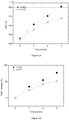
- Electrochemical testing Tables 2.1 - 2.4 summarize the results of the electrochemical cell properties. Figures 2.1 - 2.7 shows the data of the tables.
- Table 2.1 and Figure 2.1 show the results for the reversible capacity and rate performance, tested at 25°C.
- NMC532 has a similar capacity in the NMP based binder system and the water-based binder system.
- Table 2.3 and 2.4 show the results of storage at 60°C for 3 months.
- Table 2.3 shows the recovery capacity
- Table 2.4 gives the retention capacity.
- the test protocol is the same as in Example 1.
- NMC532 sample in the water-based binder system has results comparable to the NMC532 in the NMP based binder system.
- Figures 2.6 and 2.7 display the cycle stability at 25°C and at 45°C respectively.
- the figures show the discharge capacity ratio (compared with initial discharge capacity at 1C discharge rate) during cycling at 1C/1C charge discharge cycling, each 50 th cycle is at slower rate (1C/0.2C charge/discharge).
- the cycle stability at room temperature of the cells with water-based electrodes is slightly better compared to the NMP based binder system.
- T (45°C) cells with water-based coated electrodes show a clearly better result.
- water-based coating technology can be applied for NMC compounds for automotive applications.
- the water-based binder system has a slightly lower, but still acceptable rate performance.
- the example compares results of a second full cell lot 3B2 with that of 3B1.
- the example demonstrates that the results of Example 2 are reproducible. Additional properties like bulging or low temperature performance are measured.
- Tables 3.1 - 3.6 summarize the results of the tests.
- Figures 3.1-3.8 shows the data of the tables.
- Example Reference used in Figures 3.1-3.7 3A 1A AL521 3B1 AL634 3B2 AL777
- Table 3.1 shows results for the reversible capacity and rate performance, tested at 25°C.
- Figure 3.1 summarizes the results of table 1.
- Example 3B2 shows similar capacity as Example 3B1.
- Tables 3.2 and 3.3 compare full cells containing positive electrodes which are prepared by a water-based coating process (Example 3B2) versus the conventional electrodes originating from a NMP + PVDF based coating process (Example 3A, which is the same material as Example 1A).
- Table 3.2 shows the temperature properties ranging from performance at -20°C to 60°C. The data in the table are expressed in % obtained capacity after immersing the fully charged (at 25°C) cells into a temperature chamber and measuring the discharge capacity at 0.5C rate, after temperature equilibration.
- Figure 3.2 summarizes the results of Table 3.2.
- Tables 3.5 and 3.6 show the results of storage at 60°C for 3 months.
- Table 3.5 shows the retention capacity
- table 3.6 gives the recovery capacity.
- Figures 3.5 and 3.6 summarize the obtained data.
- Example 3B2 gives similar or slightly improved results compared with Example 3B1.
- Figures 3.7 and 3.8 display cycle stability at 25°C or at 45°C.
- the protocol is the same as in Example 2, and the results are reproducible.
- Example 3B2 confirms the results of Example 3B1. Particularly Example 3B2 confirms that water-based coating shows lower DCR, good storage properties and good cycle live, although the rate performance is poor. It can also be concluded that to apply water-based coating especially bulging, rate performance as well as low T performance should still be improved.
- Table 3.1 Capacity and rate capability of NMC532 in NMP based binder system and water-based binder system Example Description Capacity (mAh/g) Rate capability (%) 0.2C 0.5C 1.0C 2.0C 3.0C 4.0C 3B1 Water-based binder system 157.3 100.0 96.5 92.9 81.2 57.9 37.7 3B2 156.1 100.0 96.6 92.9 81.7 58.9 36.5
- the double shell coated NMC has an inner shell consisting of LiF.
- the LiF is the result of a reaction of a fluorinated polymer with the soluble base present on the surface of the uncoated material. Due to the consumption of this surface base the total base content (as measured by pH titration) is lowered. The lower base content should cause lower bulging than uncoated NMC.
- the outer shell is a hydrophobic polymer. During water-based slurry making the outer polymer shell protects at least parts of the NMC surface from water exposure. After battery assembly the hydrophobic polymer swells in electrolyte, and the surface becomes ion conductive.
- the double shell NMC532 in the Examples is prepared by the following major steps: (a) blending of lithium Ni-Mn-Co oxide and fluorine containing polymer precursor; and (b) firing in an oxidizing atmosphere.
- the detailed explanation of each step is as follows:
- Two samples (4B & 4D) are prepared according to step (a) and (b) from two different NMC532 precursor samples (4A & 4C).
- 4A is a precursor sample being a mass production material nearly identical to Example 1A
- 4C is a NMC532 sample from a pilot line and has a higher soluble base content than the normal mass production.
- Table 4.1 summarizes the sample history. Soluble base is measured by pH titration. To measure the pH, 7.5g of sample are immersed in 100 ml of water. Under stirring the surface impurities such as Li 2 CO 3 and LiOH dissolve. Additionally an ion exchange reaction replacing Li+ (in the solid) for H+ (in the water) takes place. After 10 min stirring a clear liquid is obtained by filtering.
- Example 5 shows that a double shell coating causes less pH recovery.
- NMC with a higher Ni content has higher capacity but also a higher content of soluble base.
- the soluble base causes serious problems because it severely corrodes the aluminum current collector foil.
- the on-set of aluminum foil corrosion can easily be detected by the observation of pin holes. These pin holes originate from hydrogen gas evolution when the still wet, warm, and as drying proceeds increasingly basic coating layer attacks the aluminum foil.
- the pH of the coating slurry is reduced by acid addition.
- NMC532 such as in Example 1A was used for slurry making.
- a water-based slurry was prepared similar as in Example 2 with the exception that no sulfuric acid was added.
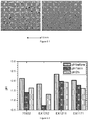
- the electrodes were visually inspected. Additionally the electrodes were inspected by SEM microscopy (not compacted by roll pressing) - see Figure 5.1 , left picture. The electrode shows damage - pin holes appear. Pin holes originate from hydrogen evolution after base attack to aluminum. In some cases damage to the alumina foil can be detected. Apparently aluminum corrosion happened.
- SEM micrographs of coated electrodes, Figure 5.1 , right picture shows the result of the acid addition: Al corrosion is avoided, there are no pin holes, and the electrode surface is smooth.
- a significant problem is the pH recovery. Immediately after acid addition the pH reduces, but then it gradually recovers due to ion exchange reactions between the water and the outer surface of the bulk. The recovery is highly unwanted because the changing pH changes slurry properties during the coating process, thus causing process stability issues at mass production, and ultimately it will cause aluminum corrosion.
- double shell coated NMC532 generally has a lower pH than the uncoated reference.
- high base NMC (5C) has high pH before acid addition and the recovered pH is also high.
- the same amount of acid causes a significantly lower pH (see 5D).
- This Example shows a comparison of double shell coated NMC and reference NMC in water-based binder system. Normal NMC as well as double shell coated NMC are tested as cathode material in wound pouch type full cells. The positive electrodes in these cells are obtained by the water-based coating technology.
- This example compares the performance of the double shell coated NMC with that of the reference.
- the reference sample also was the precursor for the double shell coating process.
- Example 6A is the reference, and is the same material as in Example 3B2. Expressed in a simplified way, the core of the reference NMC and of the double shell coated NMC is the same. Table 6.1 gives the overview of the used samples.
- Tables 6.2 to 6.7 Tables 6.2&6.3: the coating type is the water-based binder system.
- Figure 6.1 to 6.8 display the data of the tables.
- Example Product Type Coating type 6A ( 3B2) NMC532
- Table 6.2 and Figure 6.1 show capacity and rate performance results.
- Table 6.3 and Figure 6.2 show temperature properties.
- the double shell NMC532 has a slightly lower capacity and lower rate capability than the NMC532 reference sample in the water-based binder system full cell test.
- the double shell NMC532 and reference NMC532 have similar temperature properties in water-based binder system full cell test.
- the slight loss of capacity and slightly lower rate performance can be explained by the presence of the double shell, which does not contribute to the reversible capacity and acts as an additional resistive layer.
- Table 6.4 shows results of the bulging test.
- the performance of the double shell coated NMC is similar to that of the reference.
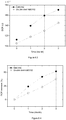
- Table 6.5 and Figures 6.3 and 6.4 show the initial DCR and the DCR increase rate during storage.
- Double shell coated NMC shows an excellent performance.
- the double shell coated NMC has (a) a lower initial DCR and (b) a much lower increase rate.
- Tables 6.6 and 6.7 and Figure 6.5 show the performance after storage.
- the double shell coated NMC shows excellent storage properties; it has the highest retention of recovered capacity.
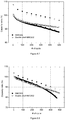
- Figures 6.7 and 6.8 show the results for cycle stability. At 25°C double shell coated NMC shows significantly improved cycle stability, also at 45°C the double shell coated NMC has better performance compared to the result for the NMC reference.
- double shell coated NMC when applied by water-based coating technology, generally shows similar, slightly better or significant improved performance compared with the NMC reference. Especially important for automotive applications which require high pulse power is the decrease of DCR as well the reduction of DCR increase during operation. Since automotive batteries need to last a long time a high cycle stability as well as a stable recovered capacity during storage is required. Clearly double shell coated NMC532, compared with non-coated NMC532 shows lower DCR, less DCR increase, less loss of recovered capacity and significantly improved cycle stability. This makes the current invention especially suitable for automotive applications.
- Table 6.2 Capacity and rate capability results (Water-based binder full cell) of NMC532 and double shell NMC532 Example Product Type Capacity (mAh/g) Rate capability (%) 0.2C 0.5C 1.0C 2.0C 3.0C 4.0C 6A NMC532 156.1 100.0 96.6 92.9 81.7 58.9 36.5 6B Double shell NMC532 154.3 100.0 96.8 93.4 79.8 54.1 34.0
- Table 6.3 Temperature properties (Water-based binder full cell) of NMC532 and double shell NMC532 Example Product Type Temperature properties -20°C -10°C 0°C 25°C 40°C 60°C 6A NMC532 40.4 68.6 83.8 100.0 104.9 106.8 6B Double shell NMC532 41.0 69.2 82.9 100.0 104.5 105.4
- Table 6.4 Bulging properties (Water-based binder full cell) of NMC532 and double shell NMC532 Example Product Type Bulging (%) 6A NMC532
Landscapes
- Chemical & Material Sciences (AREA)
- Engineering & Computer Science (AREA)
- Chemical Kinetics & Catalysis (AREA)
- Electrochemistry (AREA)
- General Chemical & Material Sciences (AREA)
- Inorganic Chemistry (AREA)
- Materials Engineering (AREA)
- Composite Materials (AREA)
- Organic Chemistry (AREA)
- Life Sciences & Earth Sciences (AREA)
- Sustainable Development (AREA)
- Sustainable Energy (AREA)
- Power Engineering (AREA)
- Transportation (AREA)
- Mechanical Engineering (AREA)
- Manufacturing & Machinery (AREA)
- Battery Electrode And Active Subsutance (AREA)
- Cell Electrode Carriers And Collectors (AREA)
Claims (13)
- Suspension de cathode à base d'eau pour batterie au lithium-ion comprenant un agent conducteur et/ou un liant à base d'eau et comprenant un matériau actif de cathode comprenant une poudre d'oxyde de métal de transition et de lithium, dans laquelle la poudre d'oxyde de métal de transition et de lithium est constituée d'agglomérats de particules primaires, les particules primaires comprenant une couche de revêtement comprenant un polymère, le polymère étant un polymère contenant du fluor comprenant au moins 50 % en poids de fluor, dans laquelle la couche de revêtement comprend une première couche de revêtement interne et une seconde couche de revêtement externe, la seconde couche externe comprenant le polymère contenant du fluor, et la première couche interne étant constituée d'un produit de réaction du polymère contenant du fluor et de la surface des particules primaires.
- Suspension de cathode à base d'eau pour batterie au lithium-ion selon la revendication 1, dans laquelle la couche de revêtement est hydrophobe.
- Suspension de cathode à base d'eau pour batterie au lithium-ion selon la revendication 1 ou 2, dans laquelle le produit de réaction comprend du LiF.
- Suspension de cathode à base d'eau pour batterie au lithium-ion selon la revendication 3, dans laquelle le lithium dans le LiF provient de la surface des particules primaires.
- Suspension de cathode à base d'eau pour batterie au lithium-ion selon les revendications 3 ou 4, dans laquelle le fluor dans le produit de réaction comprenant du LiF provient de polymère contenant du fluor partiellement décomposé présent dans la seconde couche externe.
- Suspension de cathode à base d'eau pour batterie au lithium-ion selon l'une quelconque des revendications 1 à 4, dans laquelle la première couche de revêtement interne est constituée d'un film de LiF avec une épaisseur d'au moins 0,5 nm.
- Suspension de cathode pour batterie au lithium-ion selon l'une quelconque des revendications 1 à 6, dans laquelle l'oxyde de métal de transition et de lithium a la formule générale Li1+aM1-aO2+b M'k Sm avec -0,03 < a < 0,06, b < 0,02, dans laquelle M =NixMnyCoz, avec x > 0, y > 0, z > 0 ; x + y + z = 1 ; et x/y ≥ 1 et dans laquelle M' est constitué de l'un ou l'autre parmi un ou plusieurs éléments du groupe Ca, Sr, Y, La, Ce et Zr, avec 0 ≤ k ≤ 0,1, k étant exprimé en % en poids ; et 0 ≤ m ≤ 0,6, m étant exprimé en % en moles.
- Suspension de cathode à base d'eau pour batterie au lithium-ion selon la revendication 7, dans laquelle 0,33 ≤ x ≤ 0,7 et 0,1 < z < 0,35.
- Suspension de cathode à base d'eau pour batterie au lithium-ion selon la revendication 7, dans laquelle 0,4 ≤ x ≤ 0,6 et x/y > 1.
- Suspension de cathode à base d'eau pour batterie au lithium-ion selon la revendication 1, dans laquelle le polymère contenant du fluor est l'un de PVDF, PVDF-HFP ou PTFE.
- Suspension de cathode à base d'eau pour batterie au lithium-ion selon l'une quelconque des revendications précédentes comprenant un agent conducteur et un liant à base d'eau.
- Utilisation de la suspension de cathode à base d'eau pour batterie au lithium-ion selon l'une quelconque des revendications 1 à 6, dans la fabrication d'une cathode pour une batterie à l'ion lithium, dans laquelle la cathode comprend un substrat en aluminium.
- Utilisation de la suspension de cathode à base d'eau pour batterie au lithium-ion selon l'une quelconque des revendications 1 à 6, dans la fabrication d'une batterie au lithium-ion pour automobile.
Priority Applications (1)
| Application Number | Priority Date | Filing Date | Title |
|---|---|---|---|
| EP14844016.7A EP3044822B1 (fr) | 2013-09-12 | 2014-08-22 | Suspension aqueuse épaisse de cathode pour batterie au lithium-ion |
Applications Claiming Priority (3)
| Application Number | Priority Date | Filing Date | Title |
|---|---|---|---|
| EP13184077 | 2013-09-12 | ||
| EP14844016.7A EP3044822B1 (fr) | 2013-09-12 | 2014-08-22 | Suspension aqueuse épaisse de cathode pour batterie au lithium-ion |
| PCT/IB2014/064018 WO2015036882A2 (fr) | 2013-09-12 | 2014-08-22 | Suspension aqueuse épaisse de cathode pour batterie au lithium-ion |
Publications (3)
| Publication Number | Publication Date |
|---|---|
| EP3044822A2 EP3044822A2 (fr) | 2016-07-20 |
| EP3044822A4 EP3044822A4 (fr) | 2017-03-08 |
| EP3044822B1 true EP3044822B1 (fr) | 2018-06-13 |
Family
ID=49123787
Family Applications (1)
| Application Number | Title | Priority Date | Filing Date |
|---|---|---|---|
| EP14844016.7A Active EP3044822B1 (fr) | 2013-09-12 | 2014-08-22 | Suspension aqueuse épaisse de cathode pour batterie au lithium-ion |
Country Status (7)
| Country | Link |
|---|---|
| US (1) | US20160218356A1 (fr) |
| EP (1) | EP3044822B1 (fr) |
| JP (1) | JP2016530692A (fr) |
| KR (1) | KR20160048957A (fr) |
| CN (1) | CN105531856A (fr) |
| TW (1) | TWI521777B (fr) |
| WO (1) | WO2015036882A2 (fr) |
Families Citing this family (21)
| Publication number | Priority date | Publication date | Assignee | Title |
|---|---|---|---|---|
| CN108352531B (zh) * | 2015-11-19 | 2021-08-31 | 日本瑞翁株式会社 | 锂离子二次电池用电极 |
| US10707531B1 (en) | 2016-09-27 | 2020-07-07 | New Dominion Enterprises Inc. | All-inorganic solvents for electrolytes |
| DE102016224382A1 (de) * | 2016-12-07 | 2018-06-07 | Volkswagen Aktiengesellschaft | Verfahren zum Herstellen einer Elektrodenpaste für eine Elektrode sowie einer Elektrode für eine Lithium-Ionen-Zelle und einer Lithium-Ionen-Zelle |
| JP6610531B2 (ja) * | 2016-12-27 | 2019-11-27 | トヨタ自動車株式会社 | リチウムイオン二次電池用正極の製造方法およびリチウムイオン二次電池用正極 |
| KR102447390B1 (ko) * | 2017-08-31 | 2022-09-27 | 에이일이삼 시스템즈, 엘엘씨 | 전기화학적 활성 분말의 금속화 방법 |
| CN110085865B (zh) * | 2018-01-26 | 2021-07-23 | 财团法人工业技术研究院 | 水溶液锂离子电池及用于其中的电极 |
| DE102018114009A1 (de) * | 2018-06-12 | 2019-12-12 | Volkswagen Aktiengesellschaft | Aktivmaterialkörper für einen Akkumulator |
| ES2998238T3 (en) * | 2018-07-24 | 2025-02-19 | Fund Cidetec | Eco-friendly aqueous procedure to obtain high voltage cathode for li-ion batteries |
| DE102018215808A1 (de) * | 2018-09-18 | 2020-03-19 | Volkswagen Aktiengesellschaft | Verfahren zur Herstellung einer Lithium-Ionen-Zelle |
| CN112673497B (zh) * | 2018-09-27 | 2024-10-25 | 松下知识产权经营株式会社 | 二次电池用正极活性物质和二次电池 |
| WO2020068134A1 (fr) | 2018-09-30 | 2020-04-02 | Seeo, Inc. | Particules de matériau de cathode à haute énergie ayant des surfaces d'oxyfluorure pour traitement aqueux |
| DE102018219589A1 (de) | 2018-11-15 | 2020-05-20 | Volkswagen Aktiengesellschaft | Slurryherstellung auf Wasserbasis mit Kathodenaktivmaterial, das mit einem Festelektrolyten beschichtet ist, Herstellung einer Elektrode daraus und Herstellung einer Lithium-Ionen-Batteriezelle |
| CN114008831A (zh) | 2018-11-22 | 2022-02-01 | 斐源有限公司 | 用于电化学电池的具有层状双氢氧化物的隔膜 |
| DE102018221319A1 (de) | 2018-12-10 | 2020-06-10 | Volkswagen Aktiengesellschaft | Slurryherstellung auf Wasserbasis mit Kathodenaktivmaterial, das mit einem Festelektrolyten beschichtet ist, Herstellung einer Elektrode daraus und Herstellung einer Lithium-Ionen-Batteriezelle |
| DE102019114806A1 (de) * | 2019-06-03 | 2020-12-03 | Value & Intellectual Properties Management Gmbh | Verfahren zur Herstellung elektrischer oder elektronischer Bauteile oder Schaltungen auf einem flexiblen flächigen Träger |
| WO2020248188A1 (fr) | 2019-06-13 | 2020-12-17 | Greenovelty Energy Co. Limited | Procédé de préparation de cathode pour batterie secondaire |
| EP3809489A1 (fr) | 2019-10-14 | 2021-04-21 | ETH Zurich | Préparation de suspension aqueuse de cathode pour la fabrication de cathodes de batteries de type lithium-ion |
| US20230036765A1 (en) * | 2019-12-26 | 2023-02-02 | Lg Energy Solution, Ltd. | Aqueous Slurry for Positive Electrode, Positive Electrode Composition, Lithium-Ion Secondary Battery Including Said Positive Electrode Composition, and Methods for Manufacturing Same |
| WO2021184392A1 (fr) | 2020-03-20 | 2021-09-23 | Guangdong Haozhi Technology Co. Limited | Procédé de préparation d'une cathode pour batterie secondaire |
| CN112838208B (zh) * | 2021-01-09 | 2023-09-12 | 厦门厦钨新能源材料股份有限公司 | 锂离子电池正极材料的制备方法及应用 |
| FR3149136B1 (fr) | 2023-05-23 | 2025-05-02 | Accumulateurs Fixes | Composition de matieres actives d’electrode a base de phosphate lithie |
Family Cites Families (9)
| Publication number | Priority date | Publication date | Assignee | Title |
|---|---|---|---|---|
| CN100370643C (zh) * | 2004-12-27 | 2008-02-20 | 深圳市比克电池有限公司 | 锂离子电池正极片制造方法、用该方法制造的正极片和锂离子电池 |
| AU2010254037B2 (en) * | 2009-05-29 | 2014-05-01 | Arkema Inc. | Aqueous polyvinylidene fluoride composition |
| BR112012010448A2 (pt) * | 2009-11-05 | 2016-03-08 | Umicore Nv | pó de óxido de metal de transição de lítio para uso em uma bateria recarregável, processo para cobrir o mesmo, e, uso de um pó de óxido de metal de transição de lítio |
| US8852452B2 (en) * | 2009-11-05 | 2014-10-07 | Umicore | Core-shell lithium transition metal oxides |
| JP5697906B2 (ja) * | 2010-06-24 | 2015-04-08 | 株式会社日本触媒 | 二次電池用電極水系組成物 |
| WO2012111116A1 (fr) * | 2011-02-16 | 2012-08-23 | トヨタ自動車株式会社 | Batterie secondaire à lithium ion et procédé pour la produire |
| CN103563133B (zh) * | 2011-05-31 | 2016-08-17 | 日本瑞翁株式会社 | 锂二次电池正极用复合粒子、锂二次电池正极用复合粒子的制造方法、锂二次电池用正极的制造方法、锂二次电池用正极、及锂二次电池 |
| US10079388B2 (en) * | 2011-07-15 | 2018-09-18 | Solvay Specialty Polymers Italy S.P.A. | Aqueous vinylidene fluoride-(meth)acrylic co-polymer latex, electrode and lithium ion secondary battery using the same |
| KR101497912B1 (ko) * | 2012-01-17 | 2015-03-05 | 주식회사 엘지화학 | 양극 활물질 및 이를 포함하는 리튬 이차전지 |
-
2014
- 2014-08-12 TW TW103127618A patent/TWI521777B/zh active
- 2014-08-22 WO PCT/IB2014/064018 patent/WO2015036882A2/fr not_active Ceased
- 2014-08-22 CN CN201480050185.5A patent/CN105531856A/zh active Pending
- 2014-08-22 KR KR1020167008452A patent/KR20160048957A/ko not_active Ceased
- 2014-08-22 EP EP14844016.7A patent/EP3044822B1/fr active Active
- 2014-08-22 US US15/021,095 patent/US20160218356A1/en not_active Abandoned
- 2014-08-22 JP JP2016542403A patent/JP2016530692A/ja active Pending
Non-Patent Citations (1)
| Title |
|---|
| None * |
Also Published As
| Publication number | Publication date |
|---|---|
| TWI521777B (zh) | 2016-02-11 |
| WO2015036882A2 (fr) | 2015-03-19 |
| CN105531856A (zh) | 2016-04-27 |
| JP2016530692A (ja) | 2016-09-29 |
| EP3044822A4 (fr) | 2017-03-08 |
| TW201513445A (zh) | 2015-04-01 |
| KR20160048957A (ko) | 2016-05-04 |
| US20160218356A1 (en) | 2016-07-28 |
| WO2015036882A3 (fr) | 2015-06-11 |
| EP3044822A2 (fr) | 2016-07-20 |
Similar Documents
| Publication | Publication Date | Title |
|---|---|---|
| EP3044822B1 (fr) | Suspension aqueuse épaisse de cathode pour batterie au lithium-ion | |
| Kim et al. | Use of natural binders and ionic liquid electrolytes for greener and safer lithium-ion batteries | |
| EP4333104A1 (fr) | Cathode pour batterie tout solide et batterie tout solide la comprenant | |
| Loeffler et al. | Polyurethane binder for aqueous processing of Li-ion battery electrodes | |
| CN111919315A (zh) | 用于包含微粒非原纤化粘结剂的干电极膜的组合物和方法 | |
| EP4152441A1 (fr) | Batterie entièrement solide comprenant du silicium (si) en tant que matériau actif d'anode | |
| JP6269369B2 (ja) | 非水電解液二次電池およびその製造方法 | |
| EP3267518B1 (fr) | Pile, bloc-piles et alimentation sans coupure | |
| CN101807714A (zh) | 非水电解质二次电池及其制造方法 | |
| CN102024953A (zh) | 锂-二硫化铁电池的正极材料及电池 | |
| EP3827470B1 (fr) | Procédure aqueuse respectueuse de l'environnement pour obtenir une cathode haute tension pour batteries lithium-ion | |
| Radloff et al. | Water-based LiNi0. 83Co0. 12Mn0. 05O2 electrodes with excellent cycling stability fabricated using unconventional binders | |
| Sim et al. | A study on long-term cycling performance by external pressure change for pouch-type lithium metal batteries | |
| EP4336599A1 (fr) | Liant modifié, composition de liant, procédé de préparation, barbotine pour électrode négative, feuille d'électrode négative, batterie secondaire, module de batterie, bloc-batterie et dispositif électrique | |
| EP3734721B1 (fr) | Procédé de fabrication d'un matériau actif d'électrode positive pour batterie secondaire à électrolyte non aqueux | |
| EP4498446A1 (fr) | Boue pour électrodes positives de batteries au lithium-ion | |
| KR101491540B1 (ko) | 금속 산화막이 코팅된 전극 및 이의 제조방법 | |
| EP4318631A1 (fr) | Électrode négative pour batteries secondaires à électrolyte non aqueux, séparateur pour batteries secondaires à électrolyte non aqueux, et batterie secondaire à électrolyte non aqueux | |
| Bigoni et al. | New formulations of high-voltage cathodes for Li-ion batteries with water-processable binders | |
| Xu et al. | Influence of HDI as a cathode film-forming additive on the performance of LiFe 0.2 Mn 0.8 PO 4/C cathode | |
| CN116315186B (zh) | 一种电池 | |
| TWI879336B (zh) | 製造二次鹼性離子電能儲存裝置的厚電極膜之製程 | |
| KR100502531B1 (ko) | 무수 전해질 전지용 전극의 제조방법 | |
| US20260031357A1 (en) | Electrodes for Energy Storage Device Comprising Binders having Hydrophilic Functionality | |
| US20250243080A1 (en) | Core-shell nanoparticles and methods of fabrication thereof |
Legal Events
| Date | Code | Title | Description |
|---|---|---|---|
| PUAI | Public reference made under article 153(3) epc to a published international application that has entered the european phase |
Free format text: ORIGINAL CODE: 0009012 |
|
| 17P | Request for examination filed |
Effective date: 20160412 |
|
| AK | Designated contracting states |
Kind code of ref document: A2 Designated state(s): AL AT BE BG CH CY CZ DE DK EE ES FI FR GB GR HR HU IE IS IT LI LT LU LV MC MK MT NL NO PL PT RO RS SE SI SK SM TR |
|
| AX | Request for extension of the european patent |
Extension state: BA ME |
|
| DAX | Request for extension of the european patent (deleted) | ||
| A4 | Supplementary search report drawn up and despatched |
Effective date: 20170208 |
|
| RIC1 | Information provided on ipc code assigned before grant |
Ipc: H01M 4/1391 20100101ALI20170202BHEP Ipc: H01M 4/525 20100101ALI20170202BHEP Ipc: H01M 4/36 20060101ALI20170202BHEP Ipc: H01M 4/02 20060101ALN20170202BHEP Ipc: H01M 10/052 20100101AFI20170202BHEP Ipc: H01M 4/13915 20100101ALI20170202BHEP Ipc: H01M 4/505 20100101ALI20170202BHEP Ipc: H01M 4/1315 20100101ALI20170202BHEP Ipc: H01M 4/131 20100101ALI20170202BHEP Ipc: B60L 11/18 20060101ALN20170202BHEP Ipc: H01M 4/62 20060101ALI20170202BHEP Ipc: C01G 53/00 20060101ALI20170202BHEP |
|
| REG | Reference to a national code |
Ref country code: DE Ref legal event code: R079 Ref document number: 602014027138 Country of ref document: DE Free format text: PREVIOUS MAIN CLASS: H01M0004480000 Ipc: H01M0004360000 |
|
| GRAP | Despatch of communication of intention to grant a patent |
Free format text: ORIGINAL CODE: EPIDOSNIGR1 |
|
| RIC1 | Information provided on ipc code assigned before grant |
Ipc: H01M 4/36 20060101AFI20180301BHEP Ipc: H01M 4/525 20100101ALI20180301BHEP Ipc: H01M 4/505 20100101ALI20180301BHEP Ipc: H01M 4/1391 20100101ALI20180301BHEP Ipc: C01G 53/00 20060101ALI20180301BHEP Ipc: H01M 4/02 20060101ALN20180301BHEP Ipc: B60L 11/18 20060101ALI20180301BHEP Ipc: H01M 4/62 20060101ALI20180301BHEP Ipc: H01M 10/052 20100101ALI20180301BHEP Ipc: H01M 4/131 20100101ALI20180301BHEP |
|
| INTG | Intention to grant announced |
Effective date: 20180314 |
|
| RIC1 | Information provided on ipc code assigned before grant |
Ipc: B60L 11/18 20060101ALI20180306BHEP Ipc: H01M 4/36 20060101AFI20180306BHEP Ipc: H01M 4/62 20060101ALI20180306BHEP Ipc: H01M 4/131 20100101ALI20180306BHEP Ipc: C01G 53/00 20060101ALI20180306BHEP Ipc: H01M 4/525 20100101ALI20180306BHEP Ipc: H01M 4/505 20100101ALI20180306BHEP Ipc: H01M 4/02 20060101ALN20180306BHEP Ipc: H01M 4/1391 20100101ALI20180306BHEP Ipc: H01M 10/052 20100101ALI20180306BHEP |
|
| GRAS | Grant fee paid |
Free format text: ORIGINAL CODE: EPIDOSNIGR3 |
|
| GRAA | (expected) grant |
Free format text: ORIGINAL CODE: 0009210 |
|
| AK | Designated contracting states |
Kind code of ref document: B1 Designated state(s): AL AT BE BG CH CY CZ DE DK EE ES FI FR GB GR HR HU IE IS IT LI LT LU LV MC MK MT NL NO PL PT RO RS SE SI SK SM TR |
|
| REG | Reference to a national code |
Ref country code: GB Ref legal event code: FG4D |
|
| REG | Reference to a national code |
Ref country code: CH Ref legal event code: EP Ref country code: AT Ref legal event code: REF Ref document number: 1009399 Country of ref document: AT Kind code of ref document: T Effective date: 20180615 |
|
| REG | Reference to a national code |
Ref country code: IE Ref legal event code: FG4D |
|
| REG | Reference to a national code |
Ref country code: DE Ref legal event code: R096 Ref document number: 602014027138 Country of ref document: DE |
|
| REG | Reference to a national code |
Ref country code: FR Ref legal event code: PLFP Year of fee payment: 5 |
|
| REG | Reference to a national code |
Ref country code: NL Ref legal event code: MP Effective date: 20180613 |
|
| REG | Reference to a national code |
Ref country code: LT Ref legal event code: MG4D |
|
| PG25 | Lapsed in a contracting state [announced via postgrant information from national office to epo] |
Ref country code: LT Free format text: LAPSE BECAUSE OF FAILURE TO SUBMIT A TRANSLATION OF THE DESCRIPTION OR TO PAY THE FEE WITHIN THE PRESCRIBED TIME-LIMIT Effective date: 20180613 Ref country code: ES Free format text: LAPSE BECAUSE OF FAILURE TO SUBMIT A TRANSLATION OF THE DESCRIPTION OR TO PAY THE FEE WITHIN THE PRESCRIBED TIME-LIMIT Effective date: 20180613 Ref country code: CY Free format text: LAPSE BECAUSE OF FAILURE TO SUBMIT A TRANSLATION OF THE DESCRIPTION OR TO PAY THE FEE WITHIN THE PRESCRIBED TIME-LIMIT Effective date: 20180613 Ref country code: BG Free format text: LAPSE BECAUSE OF FAILURE TO SUBMIT A TRANSLATION OF THE DESCRIPTION OR TO PAY THE FEE WITHIN THE PRESCRIBED TIME-LIMIT Effective date: 20180913 Ref country code: NO Free format text: LAPSE BECAUSE OF FAILURE TO SUBMIT A TRANSLATION OF THE DESCRIPTION OR TO PAY THE FEE WITHIN THE PRESCRIBED TIME-LIMIT Effective date: 20180913 Ref country code: FI Free format text: LAPSE BECAUSE OF FAILURE TO SUBMIT A TRANSLATION OF THE DESCRIPTION OR TO PAY THE FEE WITHIN THE PRESCRIBED TIME-LIMIT Effective date: 20180613 Ref country code: SE Free format text: LAPSE BECAUSE OF FAILURE TO SUBMIT A TRANSLATION OF THE DESCRIPTION OR TO PAY THE FEE WITHIN THE PRESCRIBED TIME-LIMIT Effective date: 20180613 |
|
| PG25 | Lapsed in a contracting state [announced via postgrant information from national office to epo] |
Ref country code: GR Free format text: LAPSE BECAUSE OF FAILURE TO SUBMIT A TRANSLATION OF THE DESCRIPTION OR TO PAY THE FEE WITHIN THE PRESCRIBED TIME-LIMIT Effective date: 20180914 Ref country code: LV Free format text: LAPSE BECAUSE OF FAILURE TO SUBMIT A TRANSLATION OF THE DESCRIPTION OR TO PAY THE FEE WITHIN THE PRESCRIBED TIME-LIMIT Effective date: 20180613 Ref country code: HR Free format text: LAPSE BECAUSE OF FAILURE TO SUBMIT A TRANSLATION OF THE DESCRIPTION OR TO PAY THE FEE WITHIN THE PRESCRIBED TIME-LIMIT Effective date: 20180613 Ref country code: RS Free format text: LAPSE BECAUSE OF FAILURE TO SUBMIT A TRANSLATION OF THE DESCRIPTION OR TO PAY THE FEE WITHIN THE PRESCRIBED TIME-LIMIT Effective date: 20180613 |
|
| REG | Reference to a national code |
Ref country code: AT Ref legal event code: MK05 Ref document number: 1009399 Country of ref document: AT Kind code of ref document: T Effective date: 20180613 |
|
| PG25 | Lapsed in a contracting state [announced via postgrant information from national office to epo] |
Ref country code: NL Free format text: LAPSE BECAUSE OF FAILURE TO SUBMIT A TRANSLATION OF THE DESCRIPTION OR TO PAY THE FEE WITHIN THE PRESCRIBED TIME-LIMIT Effective date: 20180613 |
|
| PG25 | Lapsed in a contracting state [announced via postgrant information from national office to epo] |
Ref country code: PL Free format text: LAPSE BECAUSE OF FAILURE TO SUBMIT A TRANSLATION OF THE DESCRIPTION OR TO PAY THE FEE WITHIN THE PRESCRIBED TIME-LIMIT Effective date: 20180613 Ref country code: SK Free format text: LAPSE BECAUSE OF FAILURE TO SUBMIT A TRANSLATION OF THE DESCRIPTION OR TO PAY THE FEE WITHIN THE PRESCRIBED TIME-LIMIT Effective date: 20180613 Ref country code: RO Free format text: LAPSE BECAUSE OF FAILURE TO SUBMIT A TRANSLATION OF THE DESCRIPTION OR TO PAY THE FEE WITHIN THE PRESCRIBED TIME-LIMIT Effective date: 20180613 Ref country code: CZ Free format text: LAPSE BECAUSE OF FAILURE TO SUBMIT A TRANSLATION OF THE DESCRIPTION OR TO PAY THE FEE WITHIN THE PRESCRIBED TIME-LIMIT Effective date: 20180613 Ref country code: IS Free format text: LAPSE BECAUSE OF FAILURE TO SUBMIT A TRANSLATION OF THE DESCRIPTION OR TO PAY THE FEE WITHIN THE PRESCRIBED TIME-LIMIT Effective date: 20181013 Ref country code: AT Free format text: LAPSE BECAUSE OF FAILURE TO SUBMIT A TRANSLATION OF THE DESCRIPTION OR TO PAY THE FEE WITHIN THE PRESCRIBED TIME-LIMIT Effective date: 20180613 Ref country code: EE Free format text: LAPSE BECAUSE OF FAILURE TO SUBMIT A TRANSLATION OF THE DESCRIPTION OR TO PAY THE FEE WITHIN THE PRESCRIBED TIME-LIMIT Effective date: 20180613 |
|
| PG25 | Lapsed in a contracting state [announced via postgrant information from national office to epo] |
Ref country code: SM Free format text: LAPSE BECAUSE OF FAILURE TO SUBMIT A TRANSLATION OF THE DESCRIPTION OR TO PAY THE FEE WITHIN THE PRESCRIBED TIME-LIMIT Effective date: 20180613 Ref country code: IT Free format text: LAPSE BECAUSE OF FAILURE TO SUBMIT A TRANSLATION OF THE DESCRIPTION OR TO PAY THE FEE WITHIN THE PRESCRIBED TIME-LIMIT Effective date: 20180613 |
|
| REG | Reference to a national code |
Ref country code: DE Ref legal event code: R097 Ref document number: 602014027138 Country of ref document: DE |
|
| PG25 | Lapsed in a contracting state [announced via postgrant information from national office to epo] |
Ref country code: MC Free format text: LAPSE BECAUSE OF FAILURE TO SUBMIT A TRANSLATION OF THE DESCRIPTION OR TO PAY THE FEE WITHIN THE PRESCRIBED TIME-LIMIT Effective date: 20180613 |
|
| REG | Reference to a national code |
Ref country code: CH Ref legal event code: PL |
|
| PLBE | No opposition filed within time limit |
Free format text: ORIGINAL CODE: 0009261 |
|
| STAA | Information on the status of an ep patent application or granted ep patent |
Free format text: STATUS: NO OPPOSITION FILED WITHIN TIME LIMIT |
|
| PG25 | Lapsed in a contracting state [announced via postgrant information from national office to epo] |
Ref country code: CH Free format text: LAPSE BECAUSE OF NON-PAYMENT OF DUE FEES Effective date: 20180831 Ref country code: LI Free format text: LAPSE BECAUSE OF NON-PAYMENT OF DUE FEES Effective date: 20180831 Ref country code: LU Free format text: LAPSE BECAUSE OF NON-PAYMENT OF DUE FEES Effective date: 20180822 |
|
| REG | Reference to a national code |
Ref country code: BE Ref legal event code: MM Effective date: 20180831 |
|
| 26N | No opposition filed |
Effective date: 20190314 |
|
| GBPC | Gb: european patent ceased through non-payment of renewal fee |
Effective date: 20180913 |
|
| PG25 | Lapsed in a contracting state [announced via postgrant information from national office to epo] |
Ref country code: SI Free format text: LAPSE BECAUSE OF FAILURE TO SUBMIT A TRANSLATION OF THE DESCRIPTION OR TO PAY THE FEE WITHIN THE PRESCRIBED TIME-LIMIT Effective date: 20180613 Ref country code: DK Free format text: LAPSE BECAUSE OF FAILURE TO SUBMIT A TRANSLATION OF THE DESCRIPTION OR TO PAY THE FEE WITHIN THE PRESCRIBED TIME-LIMIT Effective date: 20180613 |
|
| PG25 | Lapsed in a contracting state [announced via postgrant information from national office to epo] |
Ref country code: BE Free format text: LAPSE BECAUSE OF NON-PAYMENT OF DUE FEES Effective date: 20180831 |
|
| PG25 | Lapsed in a contracting state [announced via postgrant information from national office to epo] |
Ref country code: GB Free format text: LAPSE BECAUSE OF NON-PAYMENT OF DUE FEES Effective date: 20180913 |
|
| PG25 | Lapsed in a contracting state [announced via postgrant information from national office to epo] |
Ref country code: AL Free format text: LAPSE BECAUSE OF FAILURE TO SUBMIT A TRANSLATION OF THE DESCRIPTION OR TO PAY THE FEE WITHIN THE PRESCRIBED TIME-LIMIT Effective date: 20180613 |
|
| PG25 | Lapsed in a contracting state [announced via postgrant information from national office to epo] |
Ref country code: MT Free format text: LAPSE BECAUSE OF NON-PAYMENT OF DUE FEES Effective date: 20180822 |
|
| PG25 | Lapsed in a contracting state [announced via postgrant information from national office to epo] |
Ref country code: TR Free format text: LAPSE BECAUSE OF FAILURE TO SUBMIT A TRANSLATION OF THE DESCRIPTION OR TO PAY THE FEE WITHIN THE PRESCRIBED TIME-LIMIT Effective date: 20180613 |
|
| PG25 | Lapsed in a contracting state [announced via postgrant information from national office to epo] |
Ref country code: PT Free format text: LAPSE BECAUSE OF FAILURE TO SUBMIT A TRANSLATION OF THE DESCRIPTION OR TO PAY THE FEE WITHIN THE PRESCRIBED TIME-LIMIT Effective date: 20180613 |
|
| PG25 | Lapsed in a contracting state [announced via postgrant information from national office to epo] |
Ref country code: HU Free format text: LAPSE BECAUSE OF FAILURE TO SUBMIT A TRANSLATION OF THE DESCRIPTION OR TO PAY THE FEE WITHIN THE PRESCRIBED TIME-LIMIT; INVALID AB INITIO Effective date: 20140822 Ref country code: IE Free format text: LAPSE BECAUSE OF NON-PAYMENT OF DUE FEES Effective date: 20180822 Ref country code: MK Free format text: LAPSE BECAUSE OF NON-PAYMENT OF DUE FEES Effective date: 20180613 |
|
| P01 | Opt-out of the competence of the unified patent court (upc) registered |
Effective date: 20230626 |
|
| PGFP | Annual fee paid to national office [announced via postgrant information from national office to epo] |
Ref country code: DE Payment date: 20250624 Year of fee payment: 12 |
|
| PGFP | Annual fee paid to national office [announced via postgrant information from national office to epo] |
Ref country code: FR Payment date: 20250703 Year of fee payment: 12 |