EP3045228B1 - Mikroflotationsanlage mit einer Entspannungsventilanordnung und Verfahren zum Betreiben einer Mikroflotationsanlage - Google Patents
Mikroflotationsanlage mit einer Entspannungsventilanordnung und Verfahren zum Betreiben einer Mikroflotationsanlage Download PDFInfo
- Publication number
- EP3045228B1 EP3045228B1 EP15150884.3A EP15150884A EP3045228B1 EP 3045228 B1 EP3045228 B1 EP 3045228B1 EP 15150884 A EP15150884 A EP 15150884A EP 3045228 B1 EP3045228 B1 EP 3045228B1
- Authority
- EP
- European Patent Office
- Prior art keywords
- size distribution
- expansion valve
- microflotation
- dispersion water
- valve arrangement
- Prior art date
- Legal status (The legal status is an assumption and is not a legal conclusion. Google has not performed a legal analysis and makes no representation as to the accuracy of the status listed.)
- Active
Links
Images

Classifications
-
- B—PERFORMING OPERATIONS; TRANSPORTING
- B01—PHYSICAL OR CHEMICAL PROCESSES OR APPARATUS IN GENERAL
- B01D—SEPARATION
- B01D17/00—Separation of liquids, not provided for elsewhere, e.g. by thermal diffusion
- B01D17/02—Separation of non-miscible liquids
- B01D17/0205—Separation of non-miscible liquids by gas bubbles or moving solids
-
- B—PERFORMING OPERATIONS; TRANSPORTING
- B01—PHYSICAL OR CHEMICAL PROCESSES OR APPARATUS IN GENERAL
- B01D—SEPARATION
- B01D19/00—Degasification of liquids
- B01D19/0063—Regulation, control including valves and floats
-
- B—PERFORMING OPERATIONS; TRANSPORTING
- B03—SEPARATION OF SOLID MATERIALS USING LIQUIDS OR USING PNEUMATIC TABLES OR JIGS; MAGNETIC OR ELECTROSTATIC SEPARATION OF SOLID MATERIALS FROM SOLID MATERIALS OR FLUIDS; SEPARATION BY HIGH-VOLTAGE ELECTRIC FIELDS
- B03D—FLOTATION; DIFFERENTIAL SEDIMENTATION
- B03D1/00—Flotation
- B03D1/02—Froth-flotation processes
- B03D1/028—Control and monitoring of flotation processes; computer models therefor
-
- B—PERFORMING OPERATIONS; TRANSPORTING
- B03—SEPARATION OF SOLID MATERIALS USING LIQUIDS OR USING PNEUMATIC TABLES OR JIGS; MAGNETIC OR ELECTROSTATIC SEPARATION OF SOLID MATERIALS FROM SOLID MATERIALS OR FLUIDS; SEPARATION BY HIGH-VOLTAGE ELECTRIC FIELDS
- B03D—FLOTATION; DIFFERENTIAL SEDIMENTATION
- B03D1/00—Flotation
- B03D1/14—Flotation machines
- B03D1/1431—Dissolved air flotation machines
-
- B—PERFORMING OPERATIONS; TRANSPORTING
- B03—SEPARATION OF SOLID MATERIALS USING LIQUIDS OR USING PNEUMATIC TABLES OR JIGS; MAGNETIC OR ELECTROSTATIC SEPARATION OF SOLID MATERIALS FROM SOLID MATERIALS OR FLUIDS; SEPARATION BY HIGH-VOLTAGE ELECTRIC FIELDS
- B03D—FLOTATION; DIFFERENTIAL SEDIMENTATION
- B03D1/00—Flotation
- B03D1/14—Flotation machines
- B03D1/1443—Feed or discharge mechanisms for flotation tanks
-
- B—PERFORMING OPERATIONS; TRANSPORTING
- B03—SEPARATION OF SOLID MATERIALS USING LIQUIDS OR USING PNEUMATIC TABLES OR JIGS; MAGNETIC OR ELECTROSTATIC SEPARATION OF SOLID MATERIALS FROM SOLID MATERIALS OR FLUIDS; SEPARATION BY HIGH-VOLTAGE ELECTRIC FIELDS
- B03D—FLOTATION; DIFFERENTIAL SEDIMENTATION
- B03D1/00—Flotation
- B03D1/14—Flotation machines
- B03D1/24—Pneumatic
- B03D1/245—Injecting gas through perforated or porous area
-
- B—PERFORMING OPERATIONS; TRANSPORTING
- B01—PHYSICAL OR CHEMICAL PROCESSES OR APPARATUS IN GENERAL
- B01D—SEPARATION
- B01D21/00—Separation of suspended solid particles from liquids by sedimentation
- B01D21/0024—Inlets or outlets provided with regulating devices, e.g. valves, flaps
-
- B—PERFORMING OPERATIONS; TRANSPORTING
- B01—PHYSICAL OR CHEMICAL PROCESSES OR APPARATUS IN GENERAL
- B01D—SEPARATION
- B01D35/00—Filtering devices having features not specifically covered by groups B01D24/00 - B01D33/00, or for applications not specifically covered by groups B01D24/00 - B01D33/00; Auxiliary devices for filtration; Filter housing constructions
- B01D35/14—Safety devices specially adapted for filtration; Devices for indicating clogging
- B01D35/157—Flow control valves: Damping or calibrated passages
- B01D35/1573—Flow control valves
-
- B—PERFORMING OPERATIONS; TRANSPORTING
- B03—SEPARATION OF SOLID MATERIALS USING LIQUIDS OR USING PNEUMATIC TABLES OR JIGS; MAGNETIC OR ELECTROSTATIC SEPARATION OF SOLID MATERIALS FROM SOLID MATERIALS OR FLUIDS; SEPARATION BY HIGH-VOLTAGE ELECTRIC FIELDS
- B03D—FLOTATION; DIFFERENTIAL SEDIMENTATION
- B03D1/00—Flotation
- B03D1/001—Flotation agents
- B03D1/004—Organic compounds
- B03D1/008—Organic compounds containing oxygen
-
- C—CHEMISTRY; METALLURGY
- C02—TREATMENT OF WATER, WASTE WATER, SEWAGE, OR SLUDGE
- C02F—TREATMENT OF WATER, WASTE WATER, SEWAGE, OR SLUDGE
- C02F1/00—Treatment of water, waste water, or sewage
- C02F1/24—Treatment of water, waste water, or sewage by flotation
Definitions
- the invention relates to a microflotation plant with a flotation basin into which dispersion water enriched with a gas is introduced via a dispersion water feed line in which an expansion valve is arranged.
- a dispersion water feed line in which an expansion valve is arranged.
- microbubbles form, which rise slowly in the flotation basin and thereby accumulate on impurities and transport them to the surface of the flotation basin.
- Such microflot systems are suitable for cleaning a wide variety of wastewater and are basically characterized by a largely maintenance-free and cost-effective operation.
- the amount of dispersion water supplied to the flotation basin can be adjusted by a single adjustment of a relaxation valve.
- a guideline is that for a satisfactory cleaning about 10 liters of water dispersion per kg of solids content of the wastewater must be supplied.
- microflotation system which achieves optimum cleaning action under varying operating conditions and at the same time operates particularly efficiently, as well as a corresponding method for operating a microflotation system.
- dispersion water is supplied to the flotation basin via the dispersion-water feed line.
- This is water that is under increased pressure and in which a gas is dissolved, ideally with a saturation concentration.
- the gas can be in particular air.
- the dispersion water flows through the expansion valve assembly, with the pressure dropping substantially to ambient pressure, resulting in the desired microbubble formation.
- the flow rate of the dispersion water through the dispersion water supply is adjustable by means of the adjustment.
- This attitude has a significant Influence on the size spectrum of the gas bubbles created during the relaxation.
- the gas bubbles for the most part diameter in the range of about 20 microns to about 50 microns.
- the resulting size spectrum is influenced by a large number of fluctuating and elusive parameters. These include, but are not limited to, the pH, salinity, fat / oil content, chemical oxygen demand (COD), turbidity, redox potential, oxygen content and solids content of the water used to make the dispersion water.
- the stated properties of the water can be greatly influenced, inter alia, by the composition of the wastewater to be treated.
- the parameters mentioned can directly or indirectly influence the size distribution of the gas bubbles, for example by a more or less pronounced impairment or promotion of the solubility of the gas in the water.
- a measuring device is arranged downstream of the expansion valve arrangement, with which a size distribution of the gas bubbles is detected.
- An electronic control sets the flow rate depending on the detected size distribution.
- the size distribution of the gas bubbles is meant a relative frequency of different gas bubble sizes.
- the absolute frequency of the gas bubbles of different sizes and / or the total volume of the gas bubbles be recorded.
- the total amount of gas introduced can also be recorded and, if necessary, adjusted in order to achieve optimum cleaning efficiency and efficiency.
- the electronic controller is configured to reduce the flow rate when the size distribution exceeds a predetermined size measure.
- a size measure are different statistical characteristics of the detected size distribution, for example, an average of the bubble size, a median size distribution or a statistical measure of the width of the size distribution.
- the electronic control is designed to regulate the size distribution to a predetermined desired size by controlling the flow rate. For example, a target value for the mean bubble size or for a median of the bubble size or for another statistical characteristic of the size distribution can be specified. On the basis of the detected size distribution, the actual value of this size measure is determined and compared with the desired size dimension. Deviations are counteracted by appropriate control of the flow rate. In this way, the Mikroflotationsstrom always with a perceived optimal size distribution of the gas bubbles are operated, which increases the same cleaning performance and efficiency.
- the measuring device has a particle counter.
- Particle counters are known from other industrial applications and can be used to detect the size distribution of particles, ie solids, in liquids or gases. It is also possible to record the size distribution of very fine liquid droplets in dispersions. The inventor has recognized that such particle counter can also be used to detect the size distribution of gas bubbles in liquids. Using a particle counter the desired detection of the size distribution of the gas bubbles is inexpensive and reliable possible.
- the measuring device is designed to detect the size distribution by means of laser diffraction.
- the supplied dispersion water is illuminated with the gas bubbles with laser light and it is detected a diffraction pattern.
- the size distribution can be determined.
- a commercially available measuring device that works on this principle is the process particle size measuring device "Insitec Wet" by the English company Malvern Instruments Ltd.
- the measuring device is arranged between the expansion valve arrangement and a dispersion water inlet of the flotation basin. This allows a particularly meaningful characterization of the gas bubbles, since mixing with the wastewater to be cleaned within the flotation basin is avoided. In principle, however, an arrangement of the measuring device is also conceivable within the flotation basin.
- the dispersion water supply line to a branch line through which a partial flow of the dispersion water is guided, and the measuring device is arranged in the branch line.
- the branch line branches off downstream of the expansion valve arrangement from the dispersion water supply line. Downstream of the arranged in the branch line measuring device, the branch line can open directly into the flotation basin.
- the branch line downstream of the measuring device can again be combined with a line section of the dispersion water feed line arranged downstream of a branch point, so that the main stream and partial stream can be introduced jointly into the flotation basin via a dispersion water feed.
- the branch line forms a bypass.
- the microflotation plant has a reactor vessel which has a water inlet and is designed to enrich for water supplied via the water inlet under increased pressure with a gas and the dispersion water thus formed at a Dispersionswasserauslauf, which is connected to the dispersion water supply, available put. In this way, the treatment of the dispersion water is included in the micro-ligation plant.
- the expansion valve arrangement has an expansion valve with an adjustable opening degree
- the adjustment device has an actuator with which the degree of opening can be adjusted.
- the actuator may be, for example, a stepper motor.
- the expansion valve can, for example be a cone valve. In this way, the flow rate can be adjusted with simple means accurately and reliably.
- the method can be used in particular for operating a microflotation system having the features of one of claims 1 to 9.
- a microflotation system having the features of one of claims 1 to 9.
- the flow rate of the expansion valve assembly By automatically controlling the flow rate of the expansion valve assembly, it is meant that the flow rate may optionally be made over a long period of time without manual intervention, particularly from the electronic control discussed above.
- the flow rate is reduced when the size distribution exceeds a predetermined size measure.
- the size distribution is controlled by controlling the flow rate to a predetermined desired size.
- the supplied dispersion water is divided into a partial flow and a main flow and the detection of the size distribution takes place in the partial flow.
- a laser diffraction image is evaluated for detecting the size distribution.
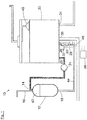
- the micro-ligation system 10 in FIG. 1 has a reactor vessel 12, which is supplied via a water inlet 14 water.
- a gas in particular air
- a gas line 16 is fed to the reactor vessel 12 via a gas line 16.
- the gas is mixed with the water, so that the gas dissolves in the water.
- a gas cushion 42 Above the indicated water level is a gas cushion 42.
- the ideally saturated with the gas water is referred to as dispersion water and can be removed from the reactor vessel 12 via the dispersion water outlet 18.
- the water inlet 14 is connected via a line to a clear water outlet 20 of a flotation basin 22 of the micro-ligation system.
- a pump 24 is arranged in the line.
- the flotation basin 22 also has a dispersion water inlet 26, which is connected to the dispersion water outlet 18 of the reactor vessel 12 via a dispersion water supply line 44, in which an expansion valve arrangement 28 is arranged. In this way, the dispersion water is supplied to the flotation tank 22.
- the dirty water to be cleaned is fed to the flotation tank 22 via a dirty water inlet 36.
- the purified wastewater can be added to the flotation basin 22 are taken over the other clear water outlet 34 for further use.
- a measuring device 32 for detecting a size distribution of the generated gas bubbles is arranged downstream of the expansion valve assembly 28 .
- the measuring device 32 has a particle counter, not shown, which detects the size distribution of the gas bubbles by means of laser diffraction.
- the measuring device 32 is arranged in a branch line 30, which branches off from the dispersion water supply line 44 downstream of the expansion valve arrangement 28. Downstream of the measuring device 32, the branch line 30 is again combined with the dispersion water supply line 44, which leads a main stream of the dispersion water between the two connection points with the branch line. Partial flow and main flow of the dispersion water are introduced via the dispersion water inlet 26 into the flotation basin 22.
- the measuring device 32 is connected to an electronic control 38.
- the expansion valve arrangement 28 has an adjusting device 46, which is also connected to the electronic control 38.
- the two compounds mentioned are indicated by dashed lines.
- the electronic controller 38 is designed to set the flow rate of the expansion valve assembly 28 as a function of a size distribution of the gas bubbles detected by the measuring device 32.
- FIG. 2 shows by way of example a diagram of a size distribution of the generated gas bubbles detected by the measuring device 32.
- the diameter of the gas bubbles is plotted in microns.
- the left, vertical axis refers to the graph drawn in the diagram with a solid line and shows the cumulative volume of gas bubbles in percent. For example, it can be seen from the graph that the gas bubbles with a diameter of 50 ⁇ m or less make up about 50% of the total gas volume.
- the vertical axis on the right refers to the bar drawn in the diagram and describes the volume frequency of the gas bubbles in percent.
- the longest bar shown in the diagram shows that the gas bubbles of the diameter area associated with this bar on the x-axis have a volume-related frequency of about 24%.
- the diagram shows that a meaningful characterization of the size distribution of the gas bubbles is possible with the aid of the measuring device - in the example shown here a conventional particle counter was used.
Landscapes
- Engineering & Computer Science (AREA)
- Life Sciences & Earth Sciences (AREA)
- Biotechnology (AREA)
- General Engineering & Computer Science (AREA)
- Chemical & Material Sciences (AREA)
- Chemical Kinetics & Catalysis (AREA)
- Physics & Mathematics (AREA)
- Thermal Sciences (AREA)
- Physical Water Treatments (AREA)
- Physical Or Chemical Processes And Apparatus (AREA)
Description
- Die Erfindung betrifft eine Mikroflotationsanlage mit einem Flotationsbecken, in das mit einem Gas angereichertes Dispersionswasser über eine Dispersionswasserzuleitung eingeleitet wird, in der ein Entspannungsventil angeordnet ist. Bei der Entspannung des Dispersionswassers bilden sich Mikroblasen, die langsam in dem Flotationsbecken aufsteigen und sich dabei an Verunreinigungen anlagern und diese an die Oberfläche des Flotationsbeckens transportieren. Solche Mikroflotationsanlagen sind zur Reinigung der unterschiedlichsten Abwässer geeignet und zeichnen sich grundsätzlich durch einen weitgehend wartungsfreien und kostengünstigen Betrieb aus.
Bei den meisten bekannten Mikroflotationsanlagen kann die Menge des dem Flotationsbecken zugeführten Dispersionswassers durch eine einmalige Einstellung eines Entspannungsventils justiert werden. Ein Richtwert lautet, dass für eine zufriedenstellende Reinigung etwa 10 Liter Dispersionswasser pro Kilogramm Feststoffgehalt des Abwassers zugeführt werden müssen.
Aus demUS-Patent Nr. 5,693,222 ist bekannt geworden, eine Trübung des in einer Mikroflotationsanlage gereinigten Abwassers zu messen und bei starker Trübung ein Entspannungsventil so anzusteuern, dass mehr Gas zugeführt wird. Auf diese Weise wird ein optimales Gas-Feststoff-Verhältnis angestrebt. - Aus Kim Sung-Joon et al. "Microbubble-inducing characteristics depending on various nozzle and pressure in dissolved air flotation process", KSCE Journal of Civil Engineering (2015) 19(3):558-563 (DOI: 10.1007/s12205-013-0514-7) ist bekannt, die Mikroblasengrößenverteilung zu messen und sie in Abhängigkeit der Düsenöffnungsgröße der DAF Düse oder in Abhängigkeit des Sättigungsdrucks zu regeln.
- Aus Takahashi et al. "Fundamental study of bubble formation in dissolved air flotation", Journal of Chemical Engineering of Japan, (1979) Vol. 12, No. 4, p. 275-280 (DOI: 10.1252/ jcej. 12.275) ist bekannt, dass zahlreiche Einflussgrößen die Mikroblasenbildung beeinflussen.
- Davon ausgehend ist es die Aufgabe der Erfindung, eine Mikroflotationsanlage zur Verfügung zu stellen, die unter wechselnden Betriebsbedingungen eine optimale Reinigungswirkung erzielt und zugleich besonders effizient arbeitet, sowie ein entsprechendes Verfahren zum Betreiben einer Mikroflotationsanlage.
- Diese Aufgabe wird gelöst durch die Mikroflotationsanlage mit den Merkmalen des Anspruchs 1. Vorteilhafte Ausgestaltungen sind in den sich anschließenden Unteransprüchen angegeben.
- Die Mikroflotationsanlage hat
- ein Flotationsbecken, das eine Dispersionswasserzuleitung aufweist, in der eine Entspannungsventilanordnung angeordnet ist,
- eine Verstelleinrichtung, mit der eine Durchflussmenge der Entspannungsventilanordnung einstellbar ist, und
- eine elektronische Steuerung, die mit der Verstelleinrichtung verbunden ist, wobei
- stromabwärts der Entspannungsventilanordnung eine Messeinrichtung zur Erfassung einer Größenverteilung von Gasblasen angeordnet ist und
- die elektronische Steuerung mit der Messeinrichtung verbunden und dazu ausgebildet ist, die Durchflussmenge in Abhängigkeit von einer mit der Messeinrichtung erfassten Größenverteilung einzustellen.
- Im Betrieb der Mikroflotationsanlage wird dem Flotationsbecken über die Dispersionswasserzuleitung Dispersionswasser zugeführt. Dabei handelt es sich um Wasser, das unter einem erhöhten Druck steht und in dem ein Gas gelöst ist, im Idealfall mit einer Sättigungskonzentration. Das Gas kann insbesondere Luft sein. Auf dem Weg in das Flotationsbecken strömt das Dispersionswasser durch die Entspannungsventilanordnung, wobei der Druck im Wesentlichen bis auf den Umgebungsdruck absinkt, was zu der erwünschten Mikroblasenbildung führt.
- Die Durchflussmenge des Dispersionswassers durch die Dispersionswasserzuleitung ist mit Hilfe der Verstelleinrichtung einstellbar. Diese Einstellung hat einen maßgeblichen Einfluss auf das Größenspektrum der bei der Entspannung entstehenden Gasblasen. Für viele Anwendungen ist es von Vorteil, wenn die Gasblasen zum Großteil Durchmesser im Bereich von etwa 20 µm bis etwa 50 µm aufweisen. Tatsächlich wird das sich einstellende Größenspektrum jedoch von einer Vielzahl schwankender und schwer erfassbarer Parameter beeinflusst. Hierzu zählen unter anderem der pH-Wert, der Salzgehalt, der Fett-/Ölgehalt, der chemische Sauerstoffbedarf (CSB), die Trübung, das Redoxpotential, der Sauerstoffgehalt und der Feststoffgehalt des zur Herstellung des Dispersionswassers verwendeten Wassers. Da dieses Wasser häufig einem Klarwasserauslauf des Flotationsbeckens entnommen wird, können die genannten Eigenschaften des Wassers unter anderem stark durch die Zusammensetzung des zu behandelnden Abwassers beeinflusst werden. Die genannten Parameter können die Größenverteilung der Gasblasen unmittelbar oder mittelbar beeinflussen, beispielsweise durch eine mehr oder weniger ausgeprägte Beeinträchtigung oder Förderung der Löslichkeit des Gases in dem Wasser.
- Bei der Erfindung ist stromabwärts der Entspannungsventilanordnung eine Messeinrichtung angeordnet, mit der eine Größenverteilung der Gasblasen erfasst wird. Eine elektronische Steuerung stellt die Durchflussmenge in Abhängigkeit der erfassten Größenverteilung ein. Auf diese Weise kann einer unerwünschten Veränderung der Größenverteilung, die beispielsweise infolge einer veränderten Zusammensetzung des zu reinigenden Abwassers auftreten kann, entgegengewirkt werden. Dadurch kann die Mikroflotationsanlage stets mit einer zu einer optimalen Reinigungswirkung und größtmöglichen Effizienz führenden Größenverteilung der Gasblasen betrieben werden.
- Mit der Größenverteilung der Gasblasen ist eine relative Häufigkeit unterschiedlicher Gasblasengrößen gemeint. Zusätzlich kann auch die absolute Häufigkeit der Gasblasen unterschiedlicher Größen und/oder das Gesamtvolumen der Gasblasen erfasst werden. In diesem Fall kann auch die insgesamt eingeleitete Gasmenge erfasst und ggf. angepasst werden, um eine optimale Reinigungswirkung und Effizienz zu erzielen.
- In einer Ausgestaltung ist die elektronische Steuerung dazu ausgebildet, die Durchflussmenge zu verringern, wenn die Größenverteilung ein vorgegebenes Größenmaß überschreitet. Als Größenmaß eignen sich unterschiedliche statistische Kennwerte der erfassten Größenverteilung, beispielsweise ein Mittelwert der Blasengroße, ein Median der Größenverteilung oder ein statistisches Maß für die Breite der Größenverteilung. Diese Ausgestaltung beruht auf der Erkenntnis, dass übergroße Blasen insbesondere dann entstehen, wenn es bei der Aufbereitung des Dispersionswassers zu einer Übersättigung gekommen ist. Durch das Verringern der Durchflussmenge kann diesem Effekt entgegengewirkt werden, weil der Druck stromaufwärts der Entspannungsventilanordnung - insbesondere in einem zur Aufbereitung des Dispersionswassers verwendeten Reaktorbehälter - ansteigt, sodass das Wasser mehr Gas aufnehmen kann. Im Ergebnis wird eine Übersättigung des Dispersionswassers vermieden und die Größenverteilung der entstehenden Gasblasen verschiebt sich hin zu kleineren Gasblasen.
- In einer Ausgestaltung ist die elektronische Steuerung dazu ausgebildet, durch Steuern der Durchflussmenge die Größenverteilung auf ein vorgegebenes Soll-Größenmaß zu regeln. Beispielsweise kann ein Sollwert für die mittlere Blasengröße oder für einen Median der Blasengröße oder für einen sonstigen statistischen Kennwert der Größenverteilung vorgegeben werden. Auf Grundlage der erfassten Größenverteilung wird der Istwert dieses Größenmaßes bestimmt und mit dem Soll-Größenmaß verglichen. Abweichungen wird durch entsprechendes Steuern der Durchflussmenge entgegengewirkt. Auf diese Weise kann die Mikroflotationsanlage stets mit einer als optimal erkannten Größenverteilung der Gasblasen betrieben werden, was gleichermaßen die Reinigungsleistung und die Effizienz steigert.
- In einer Ausgestaltung weist die Messeinrichtung einen Partikelzähler auf. Partikelzähler sind aus anderen industriellen Anwendungen bekannt und können zum Erfassen der Größenverteilung von Partikeln, also Feststoffen, in Flüssigkeiten oder Gasen verwendet werden. Ebenfalls möglich ist eine Erfassung der Größenverteilung von feinsten Flüssigkeitströpfchen in Dispersionen. Der Erfinder hat erkannt, dass derartige Partikelzähler auch zur Erfassung der Größenverteilung von Gasblasen in Flüssigkeiten eingesetzt werden können. Unter Verwendung eines Partikelzählers ist die gewünschte Erfassung der Größenverteilung der Gasblasen kostengünstig und zuverlässig möglich.
- In einer Ausgestaltung ist die Messeinrichtung dazu ausgebildet, die Größenverteilung mittels Laserbeugung zu erfassen. Hierzu wird das zugeführte Dispersionswasser mit den Gasblasen mit Laserlicht beleuchtet und es wird ein Beugungsbild erfasst. Durch mathematische Auswertung des Beugungsbilds kann die Größenverteilung ermittelt werden. Eine kommerziell erhältliche Messeinrichtung, die nach diesem Prinzip arbeitet, ist das Prozess-Partikelgrößenmessgerät "Insitec Wet" des englischen Anbieters Malvern Instruments Ltd.
- In einer Ausgestaltung ist die Messeinrichtung zwischen der Entspannungsventilanordnung und einem Dispersionswasserzulauf des Flotationsbeckens angeordnet. Dies ermöglicht eine besonders aussagekräftige Charakterisierung der Gasblasen, da eine Durchmischung mit dem zu reinigenden Abwasser innerhalb des Flotationsbeckens vermieden wird. Grundsätzlich ist eine Anordnung der Messeinrichtung jedoch auch innerhalb des Flotationsbeckens denkbar.
- In einer Ausgestaltung weist die Dispersionswasserzuleitung eine Abzweigleitung auf, durch die ein Teilstrom des Dispersionswassers geführt wird, und die Messeinrichtung ist in der Abzweigleitung angeordnet. Dies ermöglicht eine gezielte Anpassung insbesondere der Strömungsgeschwindigkeit und des Strömungsquerschnitts des für die Messung herangezogenen Dispersionswassers an den optimalen Messbereich der Messeinrichtung und kann das Erfassen der Größenverteilung vereinfachen. Die Abzweigleitung zweigt stromabwärts der Entspannungsventilanordnung von der Dispersionswasserzuleitung ab. Stromabwärts der in der Abzweigleitung angeordneten Messeinrichtung kann die Abzweigleitung unmittelbar in das Flotationsbecken münden. Alternativ kann die Abzweigleitung stromabwärts der Messeinrichtung wieder mit einem stromabwärts eines Abzweigpunkts angeordneten Leitungsabschnitts der Dispersionswasserzuleitung vereinigt werden, sodass Hauptstrom und Teilstrom gemeinsam über einen Dispersionswasserzulauf in das Flotationsbecken eingeleitet werden können. In diesem Fall bildet die Abzweigleitung einen Bypass.
- In einer Ausgestaltung weist die Mikroflotationsanlage einen Reaktorbehälter auf, der einen Wasserzulauf aufweist und dazu ausgebildet ist, über den Wasserzulauf zugeführtes Wasser unter erhöhtem Druck mit einem Gas anzureichern und das so gebildete Dispersionswasser an einem Dispersionswasserauslauf, der mit der Dispersionswasserzuleitung verbunden ist, zur Verfügung zu stellen. Auf diese Weise wird die Aufbereitung des Dispersionswassers in die Mikroflotationsanlage einbezogen.
- In einer Ausgestaltung weist die Entspannungsventilanordnung ein Entspannungsventil mit einem verstellbaren Öffnungsgrad auf und die Verstelleinrichtung weist einen Stellantrieb auf, mit dem der Öffnungsgrad verstellbar ist. Der Stellantrieb kann beispielsweise ein Schrittmotor sein. Das Entspannungsventil kann beispielsweise ein Kegelventil sein. Auf diese Weise kann die Durchflussmenge mit einfachen Mitteln exakt und zuverlässig eingestellt werden.
- Die oben genannte Aufgabe wird ebenfalls gelöst durch das Verfahren mit den Merkmalen des Anspruchs 10. Vorteilhafte Ausgestaltungen des Verfahrens sind in den sich anschließenden Unteransprüchen angegeben.
- Das Verfahren dient zum Betreiben einer Mikroflotationsanlage und weist die folgenden Schritte auf:
- Zuführen von Dispersionswasser über eine Entspannungsventilanordnung in ein Flotationsbecken,
- Erfassen einer Größenverteilung von Gasblasen stromabwärts der Entspannungsventilanordnung mit einer Messeinrichtung,
- automatisches Steuern einer Durchflussmenge der Entspannungsventilanordnung in Abhängigkeit von der erfassten Größenverteilung.
- Das Verfahren kann insbesondere zum Betreiben einer Mikroflotationsanlage mit den Merkmalen eines der Ansprüche 1 bis 9 eingesetzt werden. Zur Erläuterung der Merkmale und Vorteile des Verfahrens wird auf die vorstehenden Erläuterungen der Mikroflotationsanlage verwiesen, die entsprechend gelten. Insbesondere kann jedes der im Zusammenhang mit der Mikroflotationsanlage erläuterten Merkmale mit dem Verfahren kombiniert werden.
- Mit einem automatischen Steuern der Durchflussmenge der Entspannungsventilanordnung ist gemeint, dass die Durchflussmenge wahlweise über einen längeren Zeitraum ohne einen manuellen Eingriff vorgenommen werden kann, insbesondere von der vorstehend bereits erläuterten elektronischen Steuerung.
- In einer Ausgestaltung wird die Durchflussmenge verringert, wenn die Größenverteilung ein vorgegebenes Größenmaß überschreitet. Hierzu wird auf die vorstehenden Erläuterungen der korrespondierenden Merkmale der Mikroflotationsanlage verwiesen.
- In einer Ausgestaltung wird die Größenverteilung durch Steuern der Durchflussmenge auf ein vorgegebenes Soll-Größenmaß geregelt. Hierzu wird auf die vorstehenden Erläuterungen der korrespondierenden Merkmale der Mikroflotationsanlage verwiesen.
- In einer Ausgestaltung wird das zugeführte Dispersionswasser in einen Teilstrom und einen Hauptstrom aufgeteilt und das Erfassen der Größenverteilung erfolgt in dem Teilstrom. Hierzu wird auf die vorstehenden Erläuterungen im Zusammenhang mit der Abzweigleitung verwiesen, die entsprechend gelten.
- In einer Ausgestaltung wird zum Erfassen der Größenverteilung ein Laserbeugungsbild ausgewertet. Auch hierzu wird auf die vorstehenden Erläuterungen zur Laserbeugung verwiesen.
- Die Erfindung wird nachfolgend anhand eines in Figuren dargestellten Ausführungsbeispiels näher erläutert.
- Fig. 1
- zeigt eine erfindungsgemäße Mikroflotationsanlage in einer schematischen Darstellung.
- Fig. 2
- zeigt ein Diagramm zu einer erfassten Größenverteilung der erzeugten Gasblasen.
- Die Mikroflotationsanlage 10 in
Figur 1 weist einen Reaktorbehälter 12 auf, dem über einen Wasserzulauf 14 Wasser zugeführt wird. Über eine Gasleitung 16 wird dem Reaktorbehälter 12 außerdem ein Gas, insbesondere Luft, zugeführt. In dem Reaktorbehälter 12, der unter einem erhöhten Druck steht, beispielsweise im Bereich von 1,5 bar bis 4 bar, wird das Gas mit dem Wasser gemischt, sodass sich das Gas in dem Wasser löst. Oberhalb des angedeuteten Wasserspiegels befindet sich ein Gaspolster 42. Das im Idealfall mit dem Gas gesättigte Wasser wird als Dispersionswasser bezeichnet und kann dem Reaktorbehälter 12 über den Dispersionswasserauslauf 18 entnommen werden. - Der Wasserzulauf 14 ist über eine Leitung mit einem Klarwasserauslauf 20 eines Flotationsbeckens 22 der Mikroflotationsanlage verbunden. In der Leitung ist eine Pumpe 24 angeordnet. Das Flotationsbecken 22 weist außerdem einen Dispersionswasserzulauf 26 auf, der über eine Dispersionswasserzuleitung 44, in der eine Entspannungsventilanordnung 28 angeordnet ist, mit dem Dispersionswasserauslauf 18 des Reaktorbehälters 12 verbunden ist. Auf diese Weise wird das Dispersionswasser dem Flotationsbecken 22 zugeführt.
- Beim Durchströmen der Entspannungsventilanordnung 28 kommt es zu einer Druckentspannung und infolgedessen zu einer Bildung von Mikroblasen, die in dem Flotationsbecken 22 langsam aufsteigen, sich dabei an Verunreinigungen anlagern und diese an die Oberfläche tragen. Dort wird das sich auf diese Weise bildende Flotat von einer Räumeinrichtung 40 abgesaugt.
- Das zu reinigende Schmutzwasser wird dem Flotationsbecken 22 über einen Schmutzwasserzulauf 36 zugeführt. Das gereinigte Abwasser kann dem Flotationsbecken 22 über den weiteren Klarwasserauslauf 34 zur weiteren Verwendung entnommen werden.
- Bei der Erfindung ist stromabwärts der Entspannungsventilanordnung 28 eine Messeinrichtung 32 zur Erfassung einer Größenverteilung der erzeugten Gasblasen angeordnet. Die Messeinrichtung 32 weist einen nicht dargestellten Partikelzähler auf, der die Größenverteilung der Gasblasen mittels Laserbeugung erfasst.
- Die Messeinrichtung 32 ist in einer Abzweigleitung 30 angeordnet, die stromabwärts der Entspannungsventilanordnung 28 von der Dispersionswasserzuleitung 44 abzweigt. Stromabwärts der Messeinrichtung 32 wird die Abzweigleitung 30 wieder mit der Dispersionswasserzuleitung 44, die zwischen den beiden Verbindungspunkten mit der Abzweigleitung einen Hauptstrom des Dispersionswassers führt, vereint. Teilstrom und Hauptstrom des Dispersionswassers werden über den Dispersionswasserzulauf 26 in das Flotationsbecken 22 eingeleitet.
- Die Messeinrichtung 32 ist mit einer elektronischen Steuerung 38 verbunden. Die Entspannungsventilanordnung 28 weist eine Verstelleinrichtung 46 auf, die ebenfalls mit der elektronischen Steuerung 38 verbunden ist. Die beiden genannten Verbindungen sind durch gestrichelte Linien angedeutet.
- Die elektronische Steuerung 38 ist dazu ausgebildet, die Durchflussmenge der Entspannungsventilanordnung 28 in Abhängigkeit einer von der Messeinrichtung 32 erfassten Größenverteilung der Gasblasen einzustellen.
-
Figur 2 zeigt beispielhaft ein Diagramm einer von der Messeinrichtung 32 erfassten Größenverteilung der erzeugten Gasblasen. Auf der horizontalen Achse ist der Durchmesser der Gasblasen in Mikrometer aufgetragen. Die linke, vertikale Achse bezieht sich auf die in dem Diagramm mit einer durchgezogenen Linie eingezeichnete Kurve und zeigt das kumulative Volumen der Gasblasen in Prozent. Beispielsweise lässt sich der Kurve entnehmen, dass die Gasblasen mit einem Durchmesser von 50 µm oder weniger etwa 50 % des gesamten Gasvolumens ausmachen. - Die rechts aufgetragene, vertikale Achse bezieht sich auf die in dem Diagramm eingezeichneten Balken und beschreibt die Volumenfrequenz der Gasblasen in Prozent. Der längste in dem Diagramm gezeigte Balken zeigt, dass die Gasblasen des auf der x-Achse diesem Balken zugeordneten Durchmesserbereichs eine volumenbezogene Häufigkeit von etwa 24% aufweisen.
- Das Diagramm zeigt, dass mit Hilfe der Messeinrichtung - im gezeigten Beispiel wurde hierzu ein herkömmlicher Partikelzähler eingesetzt - eine aussagekräftige Charakterisierung der Größenverteilung der Gasblasen möglich ist.
-
- 10
- Mikroflotationsanlage
- 12
- Reaktorbehälter
- 14
- Wasserzulauf
- 16
- Gasleitung
- 18
- Dispersionswasserauslauf
- 20
- Klarwasserauslauf
- 22
- Flotationsbecken
- 24
- Pumpe
- 26
- Dispersionswasserzulauf
- 28
- Entspannungsventilanordnung
- 30
- Abzweigleitung
- 32
- Messeinrichtung
- 34
- Schmutzwasserzulauf
- 36
- Klarwasserauslauf
- 38
- elektronische Steuerung
- 40
- Räumeinrichtung
- 42
- Gaspolster
- 44
- Dispersionswasserzuleitung
- 46
- Verstelleinrichtung
Claims (14)
- Mikroflotationsanlage (10) mit• einem Flotationsbecken (22), das eine Dispersionswasserzuleitung (44) aufweist, in der eine Entspannungsventilanordnung (28) angeordnet ist,• einer Verstelleinrichtung (46), mit der eine Durchflussmenge der Entspannungsventilanordnung (28) einstellbar ist, und• einer elektronischen Steuerung (38), die mit der Verstelleinrichtung (46) verbunden ist, dadurch gekennzeichnet, dass• stromabwärts der Entspannungsventilanordnung (28) eine Messeinrichtung (32) zur Erfassung einer Größenverteilung von Gasblasen angeordnet ist und• die elektronische Steuerung (38) mit der Messeinrichtung (32) verbunden und dazu ausgebildet ist, die Durchflussmenge in Abhängigkeit von einer mit der Messeinrichtung (32) erfassten Größenverteilung einzustellen.
- Mikroflotationsanlage (10) nach Anspruch 1, dadurch gekennzeichnet, dass die elektronische Steuerung (38) dazu ausgebildet ist, die Durchflussmenge zu verringern, wenn die Größenverteilung ein vorgegebenes Größenmaß überschreitet.
- Mikroflotationsanlage (10) nach Anspruch 1 oder 2, dadurch gekennzeichnet, dass die elektronische Steuerung (38) dazu ausgebildet ist, durch Steuern der Durchflussmenge die Größenverteilung auf ein vorgegebenes Soll-Größenmaß zu regeln.
- Mikroflotationsanlage (10) nach einem der Ansprüche 1 bis 3, dadurch gekennzeichnet, dass die Messeinrichtung (32) einen Partikelzähler aufweist.
- Mikroflotationsanlage (10) nach einem der Ansprüche 1 bis 4, dadurch gekennzeichnet, dass die Messeinrichtung (32) dazu ausgebildet ist, die Größenverteilung mittels Laserbeugung zu erfassen.
- Mikroflotationsanlage (10) nach einem der Ansprüche 1 bis 5, dadurch gekennzeichnet, dass die Messeinrichtung (32) zwischen der Entspannungsventilanordnung (28) und einem Dispersionswasserzulauf (26) des Flotationsbeckens (22) angeordnet ist.
- Mikroflotationsanlage (10) nach einem der Ansprüche 1 bis 6, dadurch gekennzeichnet, dass die Dispersionswasserzuleitung (46) eine Abzweigleitung (30) aufweist, durch die ein Teilstrom des Dispersionswassers geführt wird, und dass die Messeinrichtung (32) in der Abzweigleitung (30) angeordnet ist.
- Mikroflotationsanlage (10) nach einem der Ansprüche 1 bis 7, gekennzeichnet durch einen Reaktorbehälter (12), der einen Wasserzulauf (14) aufweist und dazu ausgebildet ist, über den Wasserzulauf (14) zugeführtes Wasser unter erhöhtem Druck mit einem Gas anzureichern und das so gebildete Dispersionswasser an einem Dispersionswasserauslauf (18), der mit der Dispersionswasserzuleitung (44) verbunden ist, zur Verfügung zu stellen.
- Mikroflotationsanlage (10) nach einem der Ansprüche 1 bis 8, dadurch gekennzeichnet, dass die Entspannungsventilanordnung (28) ein Entspannungsventil mit einem verstellbaren Öffnungsgrad und die Verstelleinrichtung (46) einen Stellantrieb aufweist, mit dem der Öffnungsgrad verstellbar ist.
- Verfahren zum Betreiben einer Mikroflotationsanlage (10) mit den folgenden Schritten:• Zuführen von Dispersionswasser über eine Entspannungsventilanordnung (28) in ein Flotationsbecken (22),• Erfassen einer Größenverteilung von Gasblasen stromabwärts der Entspannungsventilanordnung (28) mit einer Messeinrichtung (32),• automatisches Steuern einer Durchflussmenge der Entspannungsventilanordnung (28) in Abhängigkeit von der erfassten Größenverteilung.
- Verfahren nach Anspruch 10, dadurch gekennzeichnet, dass die Durchflussmenge verringert wird, wenn die Größenverteilung ein vorgegebenes Größenmaß überschreitet.
- Verfahren nach Anspruch 10 oder 11, dadurch gekennzeichnet, dass die Größenverteilung durch Steuern der Durchflussmenge auf ein vorgegebenes Soll-Größenmaß geregelt wird.
- Verfahren nach einem der Ansprüche 10 bis 12, dadurch gekennzeichnet, dass das zugeführte Dispersionswasser in einen Teilstrom und einen Hauptstrom aufgeteilt wird und das Erfassen der Größenverteilung in dem Teilstrom erfolgt.
- Verfahren nach einem der Ansprüche 10 bis 13, dadurch gekennzeichnet, dass zum Erfassen der Größenverteilung ein Laserbeugungsbild ausgewertet wird.
Priority Applications (5)
| Application Number | Priority Date | Filing Date | Title |
|---|---|---|---|
| EP15150884.3A EP3045228B8 (de) | 2015-01-13 | 2015-01-13 | Mikroflotationsanlage mit einer Entspannungsventilanordnung und Verfahren zum Betreiben einer Mikroflotationsanlage |
| PCT/EP2015/074221 WO2016113007A1 (de) | 2015-01-13 | 2015-10-20 | Mikroflotationsanlage mit einer entspannungsventilanordnung und verfahren zum betreiben einer mikroflotationsanlage |
| US15/543,048 US10040074B2 (en) | 2015-01-13 | 2015-10-20 | Microflotation system having an expansion valve assembly and method for operating a microflotation system |
| HK17105005.3A HK1231434B (en) | 2015-01-13 | 2015-10-20 | Microflotation system having an expansion valve assembly and method for operating a microflotation system |
| CN201580021592.8A CN106413903B (zh) | 2015-01-13 | 2015-10-20 | 具泄压阀装置的微浮选设备及操作微浮选设备的方法 |
Applications Claiming Priority (1)
| Application Number | Priority Date | Filing Date | Title |
|---|---|---|---|
| EP15150884.3A EP3045228B8 (de) | 2015-01-13 | 2015-01-13 | Mikroflotationsanlage mit einer Entspannungsventilanordnung und Verfahren zum Betreiben einer Mikroflotationsanlage |
Publications (3)
| Publication Number | Publication Date |
|---|---|
| EP3045228A1 EP3045228A1 (de) | 2016-07-20 |
| EP3045228B1 true EP3045228B1 (de) | 2017-11-29 |
| EP3045228B8 EP3045228B8 (de) | 2018-01-24 |
Family
ID=52345083
Family Applications (1)
| Application Number | Title | Priority Date | Filing Date |
|---|---|---|---|
| EP15150884.3A Active EP3045228B8 (de) | 2015-01-13 | 2015-01-13 | Mikroflotationsanlage mit einer Entspannungsventilanordnung und Verfahren zum Betreiben einer Mikroflotationsanlage |
Country Status (4)
| Country | Link |
|---|---|
| US (1) | US10040074B2 (de) |
| EP (1) | EP3045228B8 (de) |
| CN (1) | CN106413903B (de) |
| WO (1) | WO2016113007A1 (de) |
Cited By (1)
| Publication number | Priority date | Publication date | Assignee | Title |
|---|---|---|---|---|
| EP4717676A1 (de) * | 2024-09-25 | 2026-04-01 | MicroBubbles GmbH | Verfahren und mikroflotationsanlage zur entfernung von verunreinigungen aus einem gewässer |
Families Citing this family (4)
| Publication number | Priority date | Publication date | Assignee | Title |
|---|---|---|---|---|
| EP3341331B1 (de) | 2015-08-27 | 2020-06-17 | Services Petroliers Schlumberger | Blasengrössenüberwachung und -steuerung |
| JP6238254B2 (ja) * | 2016-05-12 | 2017-11-29 | 株式会社明治 | 固液分離装置の固液分離カラム内における固液分布検出方法及び検出装置 |
| CN112138857B (zh) * | 2020-09-16 | 2022-05-10 | 合肥欣畅源光电科技有限公司 | 一种建筑垃圾分选系统 |
| EP3991851A1 (de) * | 2020-11-02 | 2022-05-04 | Roland Damann | Mikroflotationsanlage zur behandlung eines gewässers |
Citations (1)
| Publication number | Priority date | Publication date | Assignee | Title |
|---|---|---|---|---|
| WO2016018504A1 (en) * | 2014-07-29 | 2016-02-04 | MikroFlot Technologies LLC | Low energy microbubble generation by supplying pulsating gas to a porous diffuser |
Family Cites Families (8)
| Publication number | Priority date | Publication date | Assignee | Title |
|---|---|---|---|---|
| US3542675A (en) * | 1968-07-26 | 1970-11-24 | Combustion Eng | Water treatment |
| US3870635A (en) * | 1972-12-13 | 1975-03-11 | Improved Machinery Inc | Apparatus for clarifying an influent water |
| US5693222A (en) | 1996-05-03 | 1997-12-02 | Baker Hughes Incorporated | Apparatus and method for improved high-efficiency dissolved air flotation fluid processing |
| KR100845785B1 (ko) * | 2007-05-29 | 2008-07-11 | (주)지앤지코리아 | 미세기포 발생장치 및 미세기포 발생방법 |
| DE102011005031A1 (de) * | 2011-03-03 | 2012-09-06 | Siemens Aktiengesellschaft | Flotationsvorrichtung, Verfahren zum Betreiben der Flotationsvorrichtung sowie deren Verwendung |
| DE102011077104A1 (de) * | 2011-06-07 | 2012-12-13 | Siemens Aktiengesellschaft | Verfahren zur Gewinnung von metallhaltigen Wertstoffen aus einem metallhaltige Wertstoffe enthaltenden suspensionsartigen Massestrom |
| CN102381739B (zh) * | 2011-09-23 | 2013-01-09 | 北京建筑工程学院 | 一种加压水泵与透平释气器同轴的溶气释气装置 |
| CN203890088U (zh) * | 2014-05-12 | 2014-10-22 | 辽宁华霆环保科技有限公司 | 一种高效溶气气浮系统 |
-
2015
- 2015-01-13 EP EP15150884.3A patent/EP3045228B8/de active Active
- 2015-10-20 CN CN201580021592.8A patent/CN106413903B/zh active Active
- 2015-10-20 WO PCT/EP2015/074221 patent/WO2016113007A1/de not_active Ceased
- 2015-10-20 US US15/543,048 patent/US10040074B2/en active Active
Patent Citations (1)
| Publication number | Priority date | Publication date | Assignee | Title |
|---|---|---|---|---|
| WO2016018504A1 (en) * | 2014-07-29 | 2016-02-04 | MikroFlot Technologies LLC | Low energy microbubble generation by supplying pulsating gas to a porous diffuser |
Cited By (2)
| Publication number | Priority date | Publication date | Assignee | Title |
|---|---|---|---|---|
| EP4717676A1 (de) * | 2024-09-25 | 2026-04-01 | MicroBubbles GmbH | Verfahren und mikroflotationsanlage zur entfernung von verunreinigungen aus einem gewässer |
| WO2026068201A1 (de) * | 2024-09-25 | 2026-04-02 | Microbubbles Gmbh | Verfahren und mikroflotationsanlage zur entfernung von verunreinigungen aus einem gewässer |
Also Published As
| Publication number | Publication date |
|---|---|
| HK1231434A1 (zh) | 2017-12-22 |
| CN106413903B (zh) | 2019-06-21 |
| CN106413903A (zh) | 2017-02-15 |
| US20180001328A1 (en) | 2018-01-04 |
| EP3045228A1 (de) | 2016-07-20 |
| US10040074B2 (en) | 2018-08-07 |
| EP3045228B8 (de) | 2018-01-24 |
| WO2016113007A1 (de) | 2016-07-21 |
Similar Documents
| Publication | Publication Date | Title |
|---|---|---|
| EP3045228A1 (de) | Mikroflotationsanlage mit einer Entspannungsventilanordnung und Verfahren zum Betreiben einer Mikroflotationsanlage | |
| DE10104012C2 (de) | Vorrichtung zur Aerosolerzeugung | |
| DE2818127C2 (de) | Verfahren und Vorrichtung zur Ultrafiltration von Flüssigkeitsgemischen | |
| DE69506714T2 (de) | Druckreduziersystem und -verfahren | |
| EP3156133A1 (de) | Mikroflotationsanlage und verfahren zum betreiben einer mikroflotationsanlage | |
| EP3023159B1 (de) | Mikroflotationsanlage mit einer entspannungsventilanordnung und verfahren zum betreiben einer mikroflotationsanlage | |
| DE102010003507A1 (de) | Gaspermeationsanlage und Verfahren zur Gaspermeation | |
| DE69915664T2 (de) | Regelung der beschickung eines filters | |
| DE102014115192A1 (de) | Verfahren und System zur Bestimmung und Kontrolle von Prozessparametern in einem Flotationsbehälter | |
| WO1996041675A1 (de) | Verfahren und vorrichtung zur regelung einer umkehrosmoseanlage zur wasseraufbereitung | |
| EP2411578B1 (de) | Verfahren zum entschäumen und/oder entlüften von prozessflüssigkeiten einer papiermaschine | |
| WO2008116530A1 (de) | Vorrichtung zur kontinuierlichen anreicherung von gasen in wasser | |
| DE4141993C2 (de) | Verfahren und Vorrichtung zur Aufarbeitung von Öl-Wasser-Emulsionen mit geregelter Gaszufuhr | |
| DE69511076T2 (de) | Methode und einrichtung zur behandlung einer zu reinigenden und in eine flotationsvorrichtung einzuführenden flüssigkeitsstrom | |
| DE933261C (de) | Vorrichtung und Verfahren zum Konzentrieren oder Klassieren von in einer Fluessigkeit suspendierten Partikeln | |
| EP2138570B1 (de) | Vorrichtung und Verfahren zum koninuierlichen Abführen von partikelarmer Lösung aus einem Bioreaktor | |
| DE102009012189B4 (de) | Verfahren und Abwasserreinigungsanlage zur Behandlung von Abwässern der Ölfrüchte- und Getreideverarbeitung | |
| EP0328035A2 (de) | Anordnung zur Behandlung von Industrieabwässern | |
| DE102008031411A1 (de) | Verfahren zur Steuerung oder Regelung einer Flotationsanlage | |
| DE102013220361A1 (de) | Verfahren zur Erzeugung eines dispergierten Fluidgemischs | |
| EP3072577A1 (de) | Verfahren und eine vorrichtung zur behandlung einer flüssigkeit | |
| DD149656A5 (de) | Verfahren und vorrichtung zur wasserreinigung und/oder-belueftung durch entspannungsflotation | |
| DE202017102309U1 (de) | Mikroflotationssystem mit einer Vielzahl von Mikroflotationsanlagen | |
| DE10217927B4 (de) | Einrichtung zur Erzeugung eines Aerosols | |
| EP2060674A1 (de) | Verfahren zum Entschäumen und/oder Entlüften von Prozessflüssigkeiten einer Papiermaschine |
Legal Events
| Date | Code | Title | Description |
|---|---|---|---|
| PUAI | Public reference made under article 153(3) epc to a published international application that has entered the european phase |
Free format text: ORIGINAL CODE: 0009012 |
|
| AK | Designated contracting states |
Kind code of ref document: A1 Designated state(s): AL AT BE BG CH CY CZ DE DK EE ES FI FR GB GR HR HU IE IS IT LI LT LU LV MC MK MT NL NO PL PT RO RS SE SI SK SM TR |
|
| AX | Request for extension of the european patent |
Extension state: BA ME |
|
| STAA | Information on the status of an ep patent application or granted ep patent |
Free format text: STATUS: REQUEST FOR EXAMINATION WAS MADE |
|
| 17P | Request for examination filed |
Effective date: 20161220 |
|
| RBV | Designated contracting states (corrected) |
Designated state(s): AL AT BE BG CH CY CZ DE DK EE ES FI FR GB GR HR HU IE IS IT LI LT LU LV MC MK MT NL NO PL PT RO RS SE SI SK SM TR |
|
| GRAP | Despatch of communication of intention to grant a patent |
Free format text: ORIGINAL CODE: EPIDOSNIGR1 |
|
| STAA | Information on the status of an ep patent application or granted ep patent |
Free format text: STATUS: GRANT OF PATENT IS INTENDED |
|
| INTG | Intention to grant announced |
Effective date: 20170718 |
|
| GRAS | Grant fee paid |
Free format text: ORIGINAL CODE: EPIDOSNIGR3 |
|
| GRAA | (expected) grant |
Free format text: ORIGINAL CODE: 0009210 |
|
| STAA | Information on the status of an ep patent application or granted ep patent |
Free format text: STATUS: THE PATENT HAS BEEN GRANTED |
|
| GRAT | Correction requested after decision to grant or after decision to maintain patent in amended form |
Free format text: ORIGINAL CODE: EPIDOSNCDEC |
|
| AK | Designated contracting states |
Kind code of ref document: B1 Designated state(s): AL AT BE BG CH CY CZ DE DK EE ES FI FR GB GR HR HU IE IS IT LI LT LU LV MC MK MT NL NO PL PT RO RS SE SI SK SM TR |
|
| REG | Reference to a national code |
Ref country code: CH Ref legal event code: EP |
|
| REG | Reference to a national code |
Ref country code: AT Ref legal event code: REF Ref document number: 949896 Country of ref document: AT Kind code of ref document: T Effective date: 20171215 |
|
| REG | Reference to a national code |
Ref country code: IE Ref legal event code: FG4D Free format text: LANGUAGE OF EP DOCUMENT: GERMAN |
|
| REG | Reference to a national code |
Ref country code: DE Ref legal event code: R096 Ref document number: 502015002419 Country of ref document: DE |
|
| REG | Reference to a national code |
Ref country code: FR Ref legal event code: PLFP Year of fee payment: 4 |
|
| REG | Reference to a national code |
Ref country code: NL Ref legal event code: FP |
|
| REG | Reference to a national code |
Ref country code: CH Ref legal event code: NV Representative=s name: ISLER AND PEDRAZZINI AG, CH |
|
| REG | Reference to a national code |
Ref country code: LT Ref legal event code: MG4D |
|
| PG25 | Lapsed in a contracting state [announced via postgrant information from national office to epo] |
Ref country code: ES Free format text: LAPSE BECAUSE OF FAILURE TO SUBMIT A TRANSLATION OF THE DESCRIPTION OR TO PAY THE FEE WITHIN THE PRESCRIBED TIME-LIMIT Effective date: 20171129 Ref country code: NO Free format text: LAPSE BECAUSE OF FAILURE TO SUBMIT A TRANSLATION OF THE DESCRIPTION OR TO PAY THE FEE WITHIN THE PRESCRIBED TIME-LIMIT Effective date: 20180228 Ref country code: FI Free format text: LAPSE BECAUSE OF FAILURE TO SUBMIT A TRANSLATION OF THE DESCRIPTION OR TO PAY THE FEE WITHIN THE PRESCRIBED TIME-LIMIT Effective date: 20171129 Ref country code: SE Free format text: LAPSE BECAUSE OF FAILURE TO SUBMIT A TRANSLATION OF THE DESCRIPTION OR TO PAY THE FEE WITHIN THE PRESCRIBED TIME-LIMIT Effective date: 20171129 Ref country code: LT Free format text: LAPSE BECAUSE OF FAILURE TO SUBMIT A TRANSLATION OF THE DESCRIPTION OR TO PAY THE FEE WITHIN THE PRESCRIBED TIME-LIMIT Effective date: 20171129 |
|
| PG25 | Lapsed in a contracting state [announced via postgrant information from national office to epo] |
Ref country code: HR Free format text: LAPSE BECAUSE OF FAILURE TO SUBMIT A TRANSLATION OF THE DESCRIPTION OR TO PAY THE FEE WITHIN THE PRESCRIBED TIME-LIMIT Effective date: 20171129 Ref country code: GR Free format text: LAPSE BECAUSE OF FAILURE TO SUBMIT A TRANSLATION OF THE DESCRIPTION OR TO PAY THE FEE WITHIN THE PRESCRIBED TIME-LIMIT Effective date: 20180301 Ref country code: BG Free format text: LAPSE BECAUSE OF FAILURE TO SUBMIT A TRANSLATION OF THE DESCRIPTION OR TO PAY THE FEE WITHIN THE PRESCRIBED TIME-LIMIT Effective date: 20180228 Ref country code: LV Free format text: LAPSE BECAUSE OF FAILURE TO SUBMIT A TRANSLATION OF THE DESCRIPTION OR TO PAY THE FEE WITHIN THE PRESCRIBED TIME-LIMIT Effective date: 20171129 Ref country code: RS Free format text: LAPSE BECAUSE OF FAILURE TO SUBMIT A TRANSLATION OF THE DESCRIPTION OR TO PAY THE FEE WITHIN THE PRESCRIBED TIME-LIMIT Effective date: 20171129 |
|
| PG25 | Lapsed in a contracting state [announced via postgrant information from national office to epo] |
Ref country code: CZ Free format text: LAPSE BECAUSE OF FAILURE TO SUBMIT A TRANSLATION OF THE DESCRIPTION OR TO PAY THE FEE WITHIN THE PRESCRIBED TIME-LIMIT Effective date: 20171129 Ref country code: SK Free format text: LAPSE BECAUSE OF FAILURE TO SUBMIT A TRANSLATION OF THE DESCRIPTION OR TO PAY THE FEE WITHIN THE PRESCRIBED TIME-LIMIT Effective date: 20171129 Ref country code: DK Free format text: LAPSE BECAUSE OF FAILURE TO SUBMIT A TRANSLATION OF THE DESCRIPTION OR TO PAY THE FEE WITHIN THE PRESCRIBED TIME-LIMIT Effective date: 20171129 Ref country code: EE Free format text: LAPSE BECAUSE OF FAILURE TO SUBMIT A TRANSLATION OF THE DESCRIPTION OR TO PAY THE FEE WITHIN THE PRESCRIBED TIME-LIMIT Effective date: 20171129 Ref country code: CY Free format text: LAPSE BECAUSE OF FAILURE TO SUBMIT A TRANSLATION OF THE DESCRIPTION OR TO PAY THE FEE WITHIN THE PRESCRIBED TIME-LIMIT Effective date: 20171129 |
|
| REG | Reference to a national code |
Ref country code: DE Ref legal event code: R097 Ref document number: 502015002419 Country of ref document: DE |
|
| PG25 | Lapsed in a contracting state [announced via postgrant information from national office to epo] |
Ref country code: IT Free format text: LAPSE BECAUSE OF FAILURE TO SUBMIT A TRANSLATION OF THE DESCRIPTION OR TO PAY THE FEE WITHIN THE PRESCRIBED TIME-LIMIT Effective date: 20171129 Ref country code: RO Free format text: LAPSE BECAUSE OF FAILURE TO SUBMIT A TRANSLATION OF THE DESCRIPTION OR TO PAY THE FEE WITHIN THE PRESCRIBED TIME-LIMIT Effective date: 20171129 Ref country code: PL Free format text: LAPSE BECAUSE OF FAILURE TO SUBMIT A TRANSLATION OF THE DESCRIPTION OR TO PAY THE FEE WITHIN THE PRESCRIBED TIME-LIMIT Effective date: 20171129 Ref country code: SM Free format text: LAPSE BECAUSE OF FAILURE TO SUBMIT A TRANSLATION OF THE DESCRIPTION OR TO PAY THE FEE WITHIN THE PRESCRIBED TIME-LIMIT Effective date: 20171129 |
|
| PG25 | Lapsed in a contracting state [announced via postgrant information from national office to epo] |
Ref country code: MT Free format text: LAPSE BECAUSE OF FAILURE TO SUBMIT A TRANSLATION OF THE DESCRIPTION OR TO PAY THE FEE WITHIN THE PRESCRIBED TIME-LIMIT Effective date: 20171129 |
|
| PLBE | No opposition filed within time limit |
Free format text: ORIGINAL CODE: 0009261 |
|
| STAA | Information on the status of an ep patent application or granted ep patent |
Free format text: STATUS: NO OPPOSITION FILED WITHIN TIME LIMIT |
|
| PG25 | Lapsed in a contracting state [announced via postgrant information from national office to epo] |
Ref country code: LU Free format text: LAPSE BECAUSE OF NON-PAYMENT OF DUE FEES Effective date: 20180113 |
|
| REG | Reference to a national code |
Ref country code: IE Ref legal event code: MM4A |
|
| 26N | No opposition filed |
Effective date: 20180830 |
|
| REG | Reference to a national code |
Ref country code: BE Ref legal event code: MM Effective date: 20180131 |
|
| PG25 | Lapsed in a contracting state [announced via postgrant information from national office to epo] |
Ref country code: BE Free format text: LAPSE BECAUSE OF NON-PAYMENT OF DUE FEES Effective date: 20180131 Ref country code: SI Free format text: LAPSE BECAUSE OF FAILURE TO SUBMIT A TRANSLATION OF THE DESCRIPTION OR TO PAY THE FEE WITHIN THE PRESCRIBED TIME-LIMIT Effective date: 20171129 |
|
| REG | Reference to a national code |
Ref country code: DE Ref legal event code: R082 Ref document number: 502015002419 Country of ref document: DE Representative=s name: HAUCK PATENTANWALTSPARTNERSCHAFT MBB, DE Ref country code: DE Ref legal event code: R081 Ref document number: 502015002419 Country of ref document: DE Owner name: DAMANN, ROLAND, DE Free format text: FORMER OWNER: DAMANN, ROLAND, 33106 PADERBORN, DE Ref country code: DE Ref legal event code: R081 Ref document number: 502015002419 Country of ref document: DE Owner name: DAMANN, VOLKER, DE Free format text: FORMER OWNER: DAMANN, ROLAND, 33106 PADERBORN, DE |
|
| PG25 | Lapsed in a contracting state [announced via postgrant information from national office to epo] |
Ref country code: IE Free format text: LAPSE BECAUSE OF NON-PAYMENT OF DUE FEES Effective date: 20180113 |
|
| REG | Reference to a national code |
Ref country code: CH Ref legal event code: PUEA Owner name: DAMANN, ROLAND, DE Free format text: FORMER OWNER: DAMANN, ROLAND, DE |
|
| REG | Reference to a national code |
Ref country code: GB Ref legal event code: 732E Free format text: REGISTERED BETWEEN 20190131 AND 20190206 |
|
| REG | Reference to a national code |
Ref country code: NL Ref legal event code: PD Owner name: DAMANN, ROLAND; DE Free format text: DETAILS ASSIGNMENT: CHANGE OF OWNER(S), ASSIGNMENT; FORMER OWNER NAME: DAMANN, ROLAND Effective date: 20190201 |
|
| PG25 | Lapsed in a contracting state [announced via postgrant information from national office to epo] |
Ref country code: MC Free format text: LAPSE BECAUSE OF FAILURE TO SUBMIT A TRANSLATION OF THE DESCRIPTION OR TO PAY THE FEE WITHIN THE PRESCRIBED TIME-LIMIT Effective date: 20171129 |
|
| PG25 | Lapsed in a contracting state [announced via postgrant information from national office to epo] |
Ref country code: TR Free format text: LAPSE BECAUSE OF FAILURE TO SUBMIT A TRANSLATION OF THE DESCRIPTION OR TO PAY THE FEE WITHIN THE PRESCRIBED TIME-LIMIT Effective date: 20171129 |
|
| PG25 | Lapsed in a contracting state [announced via postgrant information from national office to epo] |
Ref country code: PT Free format text: LAPSE BECAUSE OF FAILURE TO SUBMIT A TRANSLATION OF THE DESCRIPTION OR TO PAY THE FEE WITHIN THE PRESCRIBED TIME-LIMIT Effective date: 20171129 |
|
| PG25 | Lapsed in a contracting state [announced via postgrant information from national office to epo] |
Ref country code: MK Free format text: LAPSE BECAUSE OF NON-PAYMENT OF DUE FEES Effective date: 20171129 Ref country code: HU Free format text: LAPSE BECAUSE OF FAILURE TO SUBMIT A TRANSLATION OF THE DESCRIPTION OR TO PAY THE FEE WITHIN THE PRESCRIBED TIME-LIMIT; INVALID AB INITIO Effective date: 20150113 |
|
| PG25 | Lapsed in a contracting state [announced via postgrant information from national office to epo] |
Ref country code: AL Free format text: LAPSE BECAUSE OF FAILURE TO SUBMIT A TRANSLATION OF THE DESCRIPTION OR TO PAY THE FEE WITHIN THE PRESCRIBED TIME-LIMIT Effective date: 20171129 Ref country code: IS Free format text: LAPSE BECAUSE OF FAILURE TO SUBMIT A TRANSLATION OF THE DESCRIPTION OR TO PAY THE FEE WITHIN THE PRESCRIBED TIME-LIMIT Effective date: 20180329 |
|
| REG | Reference to a national code |
Ref country code: AT Ref legal event code: MM01 Ref document number: 949896 Country of ref document: AT Kind code of ref document: T Effective date: 20200113 |
|
| PG25 | Lapsed in a contracting state [announced via postgrant information from national office to epo] |
Ref country code: AT Free format text: LAPSE BECAUSE OF NON-PAYMENT OF DUE FEES Effective date: 20200113 |
|
| P01 | Opt-out of the competence of the unified patent court (upc) registered |
Effective date: 20230530 |
|
| REG | Reference to a national code |
Ref country code: NL Ref legal event code: PD Owner name: ENVI-PLAN INGENIEURGESELLSCHAFT MBH; DE Free format text: DETAILS ASSIGNMENT: CHANGE OF OWNER(S), ASSIGNMENT; FORMER OWNER NAME: VOLKER DAMANN Effective date: 20250110 |
|
| REG | Reference to a national code |
Ref country code: GB Ref legal event code: 732E Free format text: REGISTERED BETWEEN 20250116 AND 20250122 |
|
| REG | Reference to a national code |
Ref country code: CH Ref legal event code: U11 Free format text: ST27 STATUS EVENT CODE: U-0-0-U10-U11 (AS PROVIDED BY THE NATIONAL OFFICE) Effective date: 20260201 |
|
| PGFP | Annual fee paid to national office [announced via postgrant information from national office to epo] |
Ref country code: NL Payment date: 20260121 Year of fee payment: 12 |
|
| PGFP | Annual fee paid to national office [announced via postgrant information from national office to epo] |
Ref country code: GB Payment date: 20260122 Year of fee payment: 12 |
|
| PGFP | Annual fee paid to national office [announced via postgrant information from national office to epo] |
Ref country code: DE Payment date: 20260312 Year of fee payment: 12 |
|
| PGFP | Annual fee paid to national office [announced via postgrant information from national office to epo] |
Ref country code: FR Payment date: 20260121 Year of fee payment: 12 |
|
| PGFP | Annual fee paid to national office [announced via postgrant information from national office to epo] |
Ref country code: CH Payment date: 20260201 Year of fee payment: 12 |