EP3046295B1 - Procédé et appareil de commande de trajet de trafic en réseau - Google Patents
Procédé et appareil de commande de trajet de trafic en réseau Download PDFInfo
- Publication number
- EP3046295B1 EP3046295B1 EP14851634.7A EP14851634A EP3046295B1 EP 3046295 B1 EP3046295 B1 EP 3046295B1 EP 14851634 A EP14851634 A EP 14851634A EP 3046295 B1 EP3046295 B1 EP 3046295B1
- Authority
- EP
- European Patent Office
- Prior art keywords
- routing
- node
- network
- routing node
- border
- Prior art date
- Legal status (The legal status is an assumption and is not a legal conclusion. Google has not performed a legal analysis and makes no representation as to the accuracy of the status listed.)
- Active
Links
Images



Classifications
-
- H—ELECTRICITY
- H04—ELECTRIC COMMUNICATION TECHNIQUE
- H04L—TRANSMISSION OF DIGITAL INFORMATION, e.g. TELEGRAPHIC COMMUNICATION
- H04L45/00—Routing or path finding of packets in data switching networks
- H04L45/02—Topology update or discovery
- H04L45/04—Interdomain routing, e.g. hierarchical routing
-
- H—ELECTRICITY
- H04—ELECTRIC COMMUNICATION TECHNIQUE
- H04L—TRANSMISSION OF DIGITAL INFORMATION, e.g. TELEGRAPHIC COMMUNICATION
- H04L45/00—Routing or path finding of packets in data switching networks
- H04L45/02—Topology update or discovery
-
- H—ELECTRICITY
- H04—ELECTRIC COMMUNICATION TECHNIQUE
- H04L—TRANSMISSION OF DIGITAL INFORMATION, e.g. TELEGRAPHIC COMMUNICATION
- H04L45/00—Routing or path finding of packets in data switching networks
- H04L45/12—Shortest path evaluation
- H04L45/123—Evaluation of link metrics
-
- H—ELECTRICITY
- H04—ELECTRIC COMMUNICATION TECHNIQUE
- H04L—TRANSMISSION OF DIGITAL INFORMATION, e.g. TELEGRAPHIC COMMUNICATION
- H04L45/00—Routing or path finding of packets in data switching networks
- H04L45/20—Hop count for routing purposes, e.g. TTL
-
- H—ELECTRICITY
- H04—ELECTRIC COMMUNICATION TECHNIQUE
- H04L—TRANSMISSION OF DIGITAL INFORMATION, e.g. TELEGRAPHIC COMMUNICATION
- H04L45/00—Routing or path finding of packets in data switching networks
- H04L45/42—Centralised routing
Definitions
- the present invention relates to the field of computer technologies, and in particular, to a method and an apparatus for controlling a network traffic path.
- a border gateway protocol (Border Gateway Protocol, referred to as BGP) is a dynamic routing protocol used between autonomous systems (Autonomous System, referred to as AS).
- BGP speakers interchanging messages call each other a peer.
- a BGP speaker only advertises routing used by the BGP speaker to a peer, so that when data flow from the BGP speaker to the peer, only a data ingress routing node connected to the BGP speaker and a data egress routing node connected to the peer may be configured.
- a routing node through which data pass when flowing from the data ingress routing node to the data egress routing node is selected by a route reflector. All routing nodes between the data ingress routing node and the data egress routing node are neighbor nodes of the route reflector, resulting in a technical problem that, when the routing node through which data pass when flowing from the data ingress routing node to the data egress routing node is selected, and when the route reflector selects a next hop routing node of a routing node, the next hop routing node is not adjacent to the selected routing node, and thus an adjacent node cannot be selected as the next hop routing node of the routing node neighbor by neighbor.
- a BGP gateway uses the UPDATE message to advertise a path to a given destination to the BGP peer.
- X has listed in its BGP table such a path X Y 1 Y 2 Y 3 Z from itself to Z. This means that X knows that it can send datagrams to Z through the ASs X, Y 1 , Y 2 , and Y 3 , Z.
- WO2010105698 discloses that in a multi-domain network each domain, or Autonomous System, has a route calculation entity which is responsible for computing paths between domains on behalf of clients.
- the route calculation entity sends advertisement messages to a route calculation entity in another domain.
- the advertisement message carries at least one of: inter-domain resource information and aggregated intradomain information, such as simplified topology information or cumulative traffic engineering metrics.
- the inter-domain resource information can be inter-domain route or reachability information which is normally discarded by a routing protocol such as the Border Gateway Protocol and can include inter-domain Traffic Engineering information such as reservable bandwidth.
- US2013259465 discloses hybrid packet-optical private network systems and methods for a private and dedicated multi-point Ethernet Private Local Network (EPLAN).
- the network systems and methods include a Layer 1 infrastructure service with the inclusion of reserved, dedicated packet switch capacity upon which clients can build their personal, private packet networks.
- packet networking methods are not used to partition the isolated LAN connectivity.
- dedicated Ethernet Private LANs EPLs
- VSIs dedicated virtual switching instances
- Each VSI is partitioned from the remainder of its packet switch fabric as a dedicated, private resource for a specific EPLAN.
- a packet network is then built by the customer on top of the private EPLAN bandwidth and operated as an isolated, private network with no influence by other carrier's network resources.
- EP2487844A1 discloses a control unit and method for dynamically controlling the routing within a network, wherein it discloses that when receive a request for an unknown path, the request is interpreted by the request processing entity of the DCU 407 AND sent to the PCE for calculation. The computed path is then transferred to the dynamic flow controller which realizes the path by setting or modifying the appropriate table entries int eh network elements.
- a request 501 to get an unknown path to a destination is received at the DCU client of an edge router.
- the DCU client sends an unknown path request to the DCU, where the request is interpreted by the request processing entity.
- the request processing entity sends a further request to calculate a path to the PCE which calculates the best current path for the destination taking into account resource and polity management.
- the path (NE_1...NE_n) is calculated, the TED is updated and a message to establish the path is sent to the DFC module of the DCU.
- US 2011/261825 A1 discloses an openflow communication system and openflow communication method.
- the method includes that an open flow controller generates a registration flow entry which is strored in a flow table of a specific openflow switch arranged on a route of the communication flow.
- An encapsulated packet is generated by relating the registration flow entry and an ordinary packet.
- the specific openflow switch extracts the registration flow entry from the encapsulated packet in response to the reception of the encapsulated packet to produce a new flow entry and executes the action shown in the new flow entry.
- Embodiments of the present application provide a method and an apparatus for controlling a network traffic path, so as to solve a technical problem in the prior art that an adjacent node cannot be selected as a next hop routing node of a routing node neighbor by neighbor.
- the invention is defined by the independent claims.
- the dependent claims define advantageous embodiments.
- a method for controlling a network traffic path including: receiving, by a routing controller, routing advertisement information from a first network to a second network; determining, by the routing controller, a path between a first border node of a third network and a second border node of the third network according to the routing advertisement information, wherein the path comprises the first border node, the second border node and routing nodes between the first border node and the second border node, the first border node communicates with the first network, and the second border node communicates with the second network, wherein a configured next hop routing node for each determined routing node between the first border node and the second border node in the path is directly connected to a corresponded determined routing node; and sending, by the routing controller, to each determined routing node between the first border node and the second border node in the path, a route between the configured next hop routing node for each determined routing node and each determined routing node.
- the determining, by the routing controller, a path between a first border node of a third network and a second border node of the third network according to the routing advertisement information specifically comprises: determining, by the routing controller, the routing nodes comprised in the path according to the routing advertisement information and received routing plan information between the first border node and the second border node, wherein the routing plan information comprise information of at least one routing node between the first border node and the second border node, and the determined routing nodes between the first border node and the second border node comprise the at least one routing node.
- the determining, by the routing controller, the routing nodes comprised in the path according to the routing advertisement information and received routing plan information between the first border node and the second border node specifically comprises: determining, by the routing controller, the routing nodes in the path between the first border node and the second border node conforming to a preset constraint condition according to the routing advertisement information and the received routing plan information between the first border node and the second border node.
- the determining, by the routing controller, the routing nodes in the path between the first border node and the second border node conforming to a preset constraint condition according to the routing advertisement information and the received routing plan information between the first border node and the second border node specifically comprises: selecting, by the routing controller, a routing node communicating with the second border node; executing, by the routing controller, the following operations for the selected routing node until the selected routing node communicates with the first border node; determining, by the routing controller, whether a routing node in the at least one routing node exists in routing nodes connected to the selected routing node; when determining that the routing node in the at least one routing node exists in the routing nodes connected to the selected routing node, selecting the routing node in the at least one routing node as a next hop routing node; when determining that the routing node in the at least one routing node does not exist in the routing nodes connected to the selected routing
- the determining, by the routing controller, a path between a first border node of a third network and a second border node of the third network according to the routing advertisement information specifically comprises: determining, by the routing controller, the routing nodes in the path between the first border node and the second border node conforming to a preset constraint condition according to the routing advertisement information.
- the determining, by the routing controller, the routing nodes in the path between the first border node and the second border node conforming to a preset constraint condition according to the routing advertisement information comprises: selecting, by the routing controller, a routing node communicating with the second border node; executing, by the routing controller, the following operation for each selected routing node until the selected routing node communicates with the first border node: selecting, by the routing controller, a routing node conforming to the preset constraint condition from routing nodes connected to the selected routing node communicating with the second border node as a next hop routing node.
- selecting, by the routing controller, a routing node conforming to the preset constraint condition from routing nodes connected to the selected routing node communicating with the second border node as a next hop routing node comprises: when data of a plurality of the second networks need to be transmitted to the first network, for the second network, determining, by the routing controller, a routing node conforming to the preset constraint condition from at least one unselected routing node connected to the selected routing node communicating with the second border node as the next hop routing node.
- a second aspect of the present invention provides an apparatus for controlling a network traffic path, including: a receiving unit, configured to receive routing advertisement information from a first network to a second network; a routing determining unit, configured to receive the routing advertisement information sent by the receiving unit, and determine a path between a first border node of a third network and a second border node of the third network according to the routing advertisement information, wherein the path comprises the first border node, the second border node and routing nodes between the first border node and the second border node, the first border node communicates with the first network, and the second border node communicates with the second network, wherein a configured next hop routing node for each determined routing node between the first border node and the second border node in the path is directly connected to a corresponded determined routing node; and a configuring unit, configured to send to each determined routing node between the first border node and the second border node in the path, a route between the configured next hop routing node for each determined routing node and each determined routing no
- the routing determining unit includes a first routing determining subunit, configured to determine the routing nodes included in the path according to the routing advertisement information and received routing plan information between the first border node and the second border node, wherein the routing plan information comprise information of at least one routing node between the first border node and the second border node, and the determined routing nodes between the first border node and the second border node comprise the at least one routing node.
- the first routing determining subunit is specifically configured to determine the routing nodes in the path between the first border node and the second border node conforming to a preset constraint condition according to the routing advertisement information and the received routing plan information between border node and the second border node.
- the first routing determining subunit is specifically configured to select a routing node communicating with the second border node, execute the following operations for the selected routing node until the selected routing node communicates with the first border node, determine whether a routing node in the at least one routing node exists in routing nodes connected to the selected routing node, when determining that the routing node in the at least one routing node exists in the routing nodes connected to the selected routing node, select a routing node in the at least one routing node as a next hop routing node, when determining that the routing node in the at least one routing node does not exist in the routing nodes connected to the selected routing node, select a routing node conforming to the preset constraint condition from the routing nodes connected to the selected routing node as a next hop routing node.
- the routing determining unit includes a second routing determining subunit, configured to determine the routing nodes in the path between the first border node and the second border node conforming to a preset constraint condition according to the routing advertisement information.
- the second routing determining subunit is specifically configured to select a routing node communicating with the second border node, execute the following operation for each selected routing node until the selected routing node communicates with the first border node, select a routing node conforming to the preset constraint condition from routing nodes connected to the selected routing node communicating with the second border node as a next hop routing node.
- the configuring unit is further configured to, when data of a plurality of the second networks need to be transmitted to the first network, for the second network, select a routing node conforming to the preset constraint condition from at least one unselected routing node connected to the selected routing node communicating with the second border node as the next hop routing node.
- a third aspect, not claimed, of the present invention provides an apparatus for controlling a network traffic path, including: a receiver, configured to receive routing advertisement information from a first network to a second network; a controller, configured to determine a path between a first border node of a third network and a second border node of the third network according to the routing advertisement information, wherein the path comprises the first border node, the second border node and routing nodes between the first border node and the second border node, the first border node communicates with the first network, and the second border node communicates with the second network, wherein a configured next hop routing node for each determined routing node between the first border node and the second border node in the path is directly connected to a corresponded determined routing node; and configured to send to each determined routing node between the first border node and the second border node in the path, a route between the configured next hop routing node for each determined routing node and each determined routing node.
- the controller is specifically configured to determine the routing nodes comprised in the path according to the routing advertisement information and received routing plan information between the first border node and the second border node, wherein the routing plan information comprise information of at least one routing node between the first border node and the second border node, and the determined routing nodes between the first border node and the second border node comprise the at least one routing node.
- the controller is specifically configured to determine the routing nodes in the path between the first border node and the second border node conforming to a preset constraint condition according to the routing advertisement information and the received routing plan information between the first border node and the second border node.
- the controller is specifically configured to: select a routing node communicating with the second border node; execute the following operations for the selected routing node until the selected routing node communicates with the first border node; determine whether a routing node in the at least one routing node exists in routing nodes connected to the selected routing node; when determining that a routing node in the at least one routing node exists, select a routing node in the at least one routing node as a next hop routing node; when determining that a routing node in the at least one routing node does not exist, select a routing node conforming to the preset constraint condition from the routing nodes connected to the selected routing node as a next hop routing node.
- the controller is further configured to determine the routing nodes in the path between the first border node and the second border node conforming to a preset constraint condition according to the routing advertisement information.
- the controller is specifically configured to select a routing node communicating with the second border node, execute the following operation for each selected routing node until the selected routing node communicates with the first border node, select a routing node conforming to the preset constraint condition from routing nodes connected to the selected routing node communicating with the second border node as a next hop routing node.
- the controller is further configured to, when data of a plurality of the second networks need to be transmitted to the first network, for the second network, select a routing node conforming to the preset constraint condition from at least one unselected routing node connected to the selected routing node communicating with the second border node as the next hop routing node.
- the present invention has the following beneficial effects.
- technical solutions of the present application include: receiving the routing advertisement information from the first network to the second network, determining all the routing nodes included in the path through which the data pass when flowing from the second network to the first network according to the routing advertisement information, and configuring the next hop routing node for each determined routing node. Since the next hop routing node is configured for each determined routing node in the technical solutions of the present application, when the data arrive at each determined routing node, the data will be automatically transmitted to the next hop routing node, and thus the technical problem in the prior art that the adjacent node cannot be selected as the next hop routing node of the routing node neighbor by neighbor is solved.
- a technical solution provided by an embodiment of the present invention includes: receiving routing advertisement information from a first network to a second network, determining all routing nodes included in a path through which data pass when flowing from the second network to the first network according to the routing advertisement information, and configuring a next hop routing node for each determined routing node, so that when the dada arrive at the each determined routing node, the data may be automatically transmitted to the next hop routing node, thus a technical problem in the prior art that an adjacent node cannot be selected as a next hop routing node of a routing node neighbor by neighbor is solved, and a technical effect of selecting the next hop routing node of the routing node as the adjacent node neighbor by neighbor is achieved.
- the adjacent node may be selected as the next hop routing node of the routing node neighbor by neighbor, when a network traffic in a routing node is heavier, the routing node may be excluded from the determined routing nodes, and thus fine and flexible traffic dispersion may be achieved.
- a first embodiment of the present invention provides a method for controlling a network traffic path, and as shown in Fig. 1 , specific processing procedures of the method is as follows:
- the routing advertisement information from the first network to the second network is received.
- the first network and the second network are metropolitan area networks
- the two metropolitan area networks communicate through a backbone network, for example, a metropolitan area network of Chengdu and a metropolitan area network of Beijing are connected through a 163 backbone network, and when the first network performs routing advertisement to the second network, routing advertisement information generated when the first network performs the routing advertisement to the second network is received.
- the first network is a metropolitan area network A and the second network is a metropolitan area network B
- the metropolitan area network A performs routing advertisement on an IP of the metropolitan area network A, for example, 200.1.1.240, 200.1.1.244, 200.1.2.240, 200.1.2.244, 200.1.3.240, or the like, to the metropolitan area network B, and routing advertisement information generated when the metropolitan area network A performs routing advertisement to the metropolitan area network B, including an IP address of the metropolitan area network A and an IP address of the metropolitan area network B, and/or, IP addresses of all routing nodes through which data pass when flowing from the metropolitan area network A to the metropolitan area network B, is received.
- step 102 is executed, in the step, all the routing nodes included in the path through which the data pass when flowing from the second network to the first network are determined according to the routing advertisement information.
- all the routing nodes through which the data pass when flowing from the second network to the first network may be obtained according to the routing advertisement information, and a path is selected from all the routing nodes, so that the data may be transmitted from the second network to the first network through the path.
- all the determined routing nodes absolutely include the routing node of the first network and the routing node of the second network, and the routing node of the first network may be determined as a destination node.
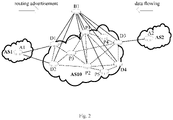
- a metropolitan area network AS1 performs routing advertisement to a metropolitan area network AS2, a routing controller B1 obtains all routing nodes through which data need to pass when flowing from AS2 to AS1 according to routing advertisement information of AS1, where AS1 and AS2 are connected through a backbone network AS10, and all the routing nodes include routing nodes D1, D2, D3 and D4, routing nodes P1, P2, P3, P4 and P5, a routing node A1 of AS1 and a routing node A2 of AS2.
- the data may be transmitted from AS2 to AS1 through multiple paths, for example, the multiple paths may be A2->D3->P4->P1->D1->A1, A2 ⁇ D3 ⁇ P3 ⁇ D1 ⁇ A1, A2 ⁇ D3 ⁇ P3 ⁇ D2 ⁇ A1, A2 ⁇ D3 ⁇ P4 ⁇ P1 ⁇ P3 ⁇ D1 ⁇ A1, A2 ⁇ D3 ⁇ P4 ⁇ P1 ⁇ P3 ⁇ D2 ⁇ A1, A2 ⁇ D3 ⁇ P2 ⁇ P3 ⁇ D1 ⁇ A1, A2->D3->P2->P3->D2->A1, and the like.
- a path may be randomly selected from the multiple paths as a path of the data flowing from AS2 to AS1. Assuming that a path randomly selected from the multiple paths is A2->D3->P3->D1->A1, and then all routing nodes included in the path through which the data pass when flowing from AS2 to AS1 are determined as A2, D3, P3, D1 and A1.
- all the routing nodes included in the path through which the data pass when flowing from the second network to the first network may also be determined according to the routing advertisement information and received routing plan information between the first network and the second network, where plan nodes in the routing plan information include N routing node(s) between the first network and the second network, and the determined routing nodes include the N routing node(s), and N is a positive integer.
- the routing plan information may be obtained before the first network performs the routing advertisement to the second network, may also be obtained in a process of performing the routing advertisement and may also be obtained after performing the routing advertisement, which is not specifically limited in the present application.
- the N routing nodes refer to nodes through which the data must pass when flowing from the second network to the first network, a value of N may be 2, 5, 10, 30, or the like.
- the N routing node refers to a node through which the data must pass when flowing from the second network to the first network, a value of N may be 1.
- the N routing node may be a part or all of the routing nodes through which the data pass when flowing from the second network to the first network, and when the N routing node is a part of the routing nodes through which the data pass when flowing from the second network to the first network, a routing node through which the data pass when flowing from the second network to the first network and conforming to a preset constraint condition may be determined according to the routing advertisement information and the received routing plan information between the first network and the second network.
- some other nodes may also be randomly selected from routing nodes between the first network and the second network, for enabling the data to flow from the second network to the first network through the other nodes and the N routing node.
- the N routing nodes are all of the routing nodes through which the data pass when flowing from the second network to the first network.
- the metropolitan area network AS1 performs routing advertisement to the metropolitan area network AS2, the routing controller B1 obtains all the routing nodes through which the data need to pass when flowing from AS2 to AS1 according to the routing advertisement information of AS1, where AS1 and AS2 are connected through the backbone network AS10, and all the routing nodes include the routing nodes D1, D2, D3 and D4, the routing nodes P1, P2, P3, P4 and P5, the routing node A1 of AS1 and the routing node A2 of AS2.
- routing controller B1 When plan nodes of the routing plan information of the data flowing from AS2 to AS1 received by the routing controller B1 are D3 -> P4 -> P1 -> D1, the routing controller B1 has two routing table entries destining for DEST_IP:
- the routing controller B1 executes requirements of the plan nodes, detects that it has a route satisfying that an egress is D1, and then translates a path into a route of each node on the path.
- the N routing node is a part of the routing nodes through which the data pass when flowing from the second network to the first network.
- paths may be selected by the routing controller B1 are: A2->D3->P3 ->D1->A1, A2->D3->P3->D2->A1, A2 ⁇ D3 ⁇ P4 ⁇ P1 ->P3 ->D1 ->A1, A2->D3->P4 ->P1 ->P3 ->D2 ->A1.
- the determining all the routing nodes included in the path through which the data pass when flowing from the second network to the first network according to the routing advertisement information and the received routing plan information between the first network and the second network specifically includes: determining a routing node through which the data pass when flowing from the second network to the first network and conforming to a preset constraint condition according to the routing advertisement information and the received routing plan information between the first network and the second network.
- a route may also be determined according to the above-mentioned manner.
- the preset constraint condition may be a condition constraining one or more of a bandwidth, a routing cost, a reliability, a time delay, a load and the like.
- the preset constraint condition may be that the bandwidth is not less than 10M and the routing cost is the lowest, and may also only be that the bandwidth is not less than 20M or the routing cost is the lowest.
- the determining the routing nodes through which the data pass when flowing from the second network to the first network and conforming to the preset constraint condition according to the routing advertisement information and the received routing plan information between the first network and the second network specifically includes the following steps.
- the above-mentioned steps include:
- step 301 the routing node connected to the second network is selected.
- the routing node connected to AS2 is D3, therefore the routing node connected to AS2 may be determined as D3.
- step 302 is executed, since the routing node connected to AS2 is D3, such parameters as a bandwidth parameter from the routing node A2 of AS2 to D3 and the like satisfy the preset constraint condition, and it is taken as an example that the preset constraint condition is that the routing cost is the lowest.
- step 3021 is executed to determine whether a routing node in the N routing node exists in the routing nodes connected to the selected routing node.
- routing nodes connected to D3 include P2, P3, P4 and D4, thus whether P2, P3, P4 and D4 include a routing node in the N routing node is determined, since the N routing node is P3, and P2, P3, P4 and D4 include P3, so step 3022 is executed to determine P3 as a next hop routing node of D3.
- step 3021 is executed to determine whether a routing node in the N routing node exists in the routing nodes connected to the selected routing node.
- step 3023 is executed to select a routing node conforming to the preset constraint condition from the routing nodes connected to the selected routing node as the next hop routing node.
- D1 since D1 is connected to the routing node A1 of AS1, the path of the data flowing from AS2 to AS1 may be determined as A2->D3->P3->D1 ->A1.
- the routing node through which the data pass when flowing from the second network to the first network and conforming to the preset constraint condition may be determined according to the routing advertisement information.
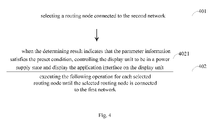
- determining the routing node through which the data pass when flowing from the second network to the first network and conforming to the preset constraint condition according to the routing advertisement information specifically includes the following steps.
- the above-mentioned steps include:
- step 401 the routing node connected to the second network is selected.
- the routing node connected to AS2 may be determined as D3.
- step 402 is executed, since the routing node connected to AS2 is D3, such parameters as a bandwidth parameter from the routing node A2 of AS2 to D3 and the like satisfy the preset constraint condition, and it is taken as an example that the preset constraint condition is that the routing cost is the lowest.
- step 4021 is executed to select a routing node conforming to the preset constraint condition from the routing nodes connected to the selected routing node as the next hop routing node.
- the preset constraint condition is that the bandwidth is not less than 10M and the reliability is not less than 80%, referring to Fig.
- routing nodes connected to D3 include P2, P3, P4 and D4, when P2 and P3 satisfy the preset constraint condition, a routing node may be randomly selected from P2 and P3 as a next hop routing node of D3, and a routing node may also be selected from P2 and P3 according to a routing algorithm, where a path between the routing node and D3 is an optimal path.
- routing nodes connected to D3 when selecting routing nodes connected to D3, according to a routing table entry in the routing controller B1, it may be obtained that the routing nodes connected to D3 include P2, P3, P4 and D4, a routing node conforming to the preset constraint condition is selected from P1, D1, D2 and P2 as a next hop routing node.
- routing nodes connected to P3 include P1, D1, D2 and P2, and a routing node conforming to the preset constraint condition is selected from P1, D1, D2 and P2 as the next hop routing node.
- D1 since D1 is connected to the routing node A1 of AS1, and the data flow from AS2 to AS1, resulting in that A1 is a destination node, then a next hop routing node of D1 may be determined as A1, and a path of the data flowing from AS2 to AS1 is A2->D3->P3->D1->A1.
- the path of the data flowing from AS2 to AS1 since each determined routing satisfies the preset constraint condition, the path of the data flowing from AS2 to AS1 may conform to the preset constraint condition, moreover, a routing cost of the determined routing may be the lowest, and the data may be transmitted more stably and quickly.
- selecting a next hop routing node from all the routing nodes specifically includes: selecting the next hop routing node from all the routing nodes with the selected routing node removed.
- routing nodes connected to D3 include P2, P3, P4 and D4, when P3 has been selected, then a next hop routing node of D3 is selected from P2, P4 and D4, accordingly each traffic path is free of a crossing condition, so that a condition that a plurality of traffic paths are forked after generating an aggregation point may be avoided, and a technical effect of no aggregation point of the plurality of traffic paths is achieved.
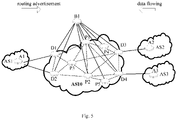
- the following step is executed at first: respectively selecting a routing node D3 connected to AS2 and a routing node D4 connected to AS3, where both D3 and D4 conform to a preset constraint condition, and it is taken as an example that the preset constraint condition is that the routing cost is the lowest.
- routing nodes connected to D3 are P4, P3, P2 and D4, since D4 has been selected, a routing node having the lowest cost with D3 is selected from P4, P3 and P2, if a cost between P4 and D3 is 5, a cost between P3 and D3 is 3, and a cost between P3 and D3 is 10, since 3 ⁇ 5 ⁇ 10, P3 is selected as a next hop routing node of D3.
- routing nodes connected to D4 are D3, P1, P2 and P5, since D3 has been selected, a routing node having the lowest cost with D4 is selected from P1, P2 and P5, if a cost between P1 and D4 is 6, a cost between P2 and D4 is 4, and a cost between P5 and D4 is 9, since 4 ⁇ 6 ⁇ 9, P2 is selected as a next hop routing node of D4.
- routing nodes connected to P3 are P1, D1, D2, D3 and P2, since P2 and D3 have been selected, a routing node having the lowest cost with P3 is selected from P1, D1 and D2, if a cost between P1 and P3 is 20, a cost between D1 and P3 is 7, and a cost between D2 and P3 is 15, since 7 ⁇ 15 ⁇ 20, D1 is selected as a next hop routing node of P3.
- routing nodes connected to P2 are D3, P1, P3, D2, P5 and D4, since D4, D3 and P3 have been selected, a routing node having the lowest cost with P2 is selected from P1, D2 and P5, if a cost between P1 and P2 is 13, a cost between D1 and P2 is 1, and a cost between D2 and P2 is 35, since 1 ⁇ 13 ⁇ 35, D2 is selected as a next hop routing node of P2.
- a next hop routing node of D1 may be determined as A1, and a path of the data flowing from AS2 to AS1 is A2 ⁇ D3 ⁇ P3 ⁇ D1 ⁇ A1.
- a next hop routing node of D1 may be determined as A1, and a path of the data flowing from AS3 to AS1 is A3->D4->P2->D2->A1, so that two obtained traffic paths have no aggregation point, and a technical effect of no aggregation point of a plurality of traffic paths is achieved.
- step 103 is executed, in the step, the next hop routing node is configured for each determined routing node, where the next hop routing node is a node in all the routing nodes included in the path and is adjacent to the routing node for which the next hop routing node is configured, and the routing node for which the next hop routing node is configured does not include the routing node of the first network or the routing node of the second network.
- the routing node of the first network is a destination node and the routing node of the second network is a starting node, resulting in that all the routing nodes included in the determined path absolutely include the routing node of the first network and the routing node of the second network, and that the routing node of the first network has no next hop routing node
- an executive body of the method for controlling a network traffic path cannot control the routing node of the second network in general, therefore after determining all the routing nodes included in the path through which the data pass when flowing from the second network to the first network, the routing node of the first network and the routing node of the second network need to be removed, and then the next hop routing node is configured for each determined routing node, so that when the data arrive at each determined routing node, each determined routing node automatically transmits the data to the next hop routing node, so as to improve a data forwarding efficiency.
- the next hop routing node is a node in all the routing nodes included in the path and is adjacent to the routing node for which the next hop routing node is configured, namely, representing that the next hop routing node and the routing node for which the next hop routing node is configured are mutual neighbor nodes
- the neighbor nodes means nodes in which a routing node is directly connected to another routing node, and when a routing node and another routing node are mutual neighbor nodes, it may be determined that the routing node and another routing node are adjacent nodes.
- routing nodes directly connected to D3 are P4, P3, P2 and D4, then it may be determined that D3 and P4 are mutual neighbor nodes, D3 and P3 are also mutual neighbor nodes, D3 and P2 are also mutual neighbor nodes, and D3 and D4 are also mutual neighbor nodes.
- routing nodes directly connected to P3 are P1, D1, D2, D3 and P2, then it may be determined that P3 and P1 are mutual neighbor nodes, P3 and D1 are also mutual neighbor nodes, P3 and D2 are also mutual neighbor nodes, P3 and D3 are also mutual neighbor nodes, P3 and P2 are also mutual neighbor nodes.
- P3, P4 and P5 are not directly connected, resulting in that P3 and P4 are not neighbor nodes, namely, representing that P3 and P4 are not adjacent nodes, and that P3 and P5 are not neighbor nodes, namely, representing that P3 and P5 are not adjacent nodes.
- a routing controller B1 when determining a path of data flowing from AS2 to AS1 as A2->D3->P3->D1->A1, a routing controller B1 sends the following route to D3:
- the routing controller B1 has configured a next hop route for D3 as P3, resulting in that D3 will directly transmit the data to P3, when P3 receives the data, since the routing controller B1 has configured a next hop route for P3 as D1, P3 will directly transmit the data to D1, and then D1 directly transmits the data to AS1.
- a technical effect of selecting a next hop routing node of a routing node as an adjacent node neighbor by neighbor is achieved, and since the adjacent node may be selected as the next hop routing node of the routing node neighbor by neighbor, when a network traffic in a routing node is heavier, the routing node may be excluded from the determined routing nodes, and thus fine and flexible traffic dispersion may be achieved.
- the routing controller B1 when determining a path of data flowing from AS3 to AS1 as A3->D4->P2->D2->A1, the routing controller B1 sends the following route to D4:
- the routing controller B1 has configured a next hop route for D4 as P2, resulting in that D4 will directly transmit the data to P2, when P2 receives the data, since the routing controller B1 has already configured a next hop route for P2 as D2, P2 will directly transmit the data to D2, and then D2 directly transmits the data to AS1.
- a technical effect of selecting a next hop routing node of a routing node as an adjacent node neighbor by neighbor is achieved, and since the adjacent node may be selected as the next hop routing node of the routing node neighbor by neighbor, when a network traffic in a routing node is heavier, the routing node may be excluded from the determined routing nodes, and thus fine and flexible traffic dispersion may be achieved.
- the following operation is executed for each routing node in the N routing node: detecting whether each routing node in the N routing node has been selected.
- each routing node in the N routing node when each routing node in the N routing node is not selected, all the routing nodes included in the path through which the data pass when flowing from the second network to the first network are determined; and otherwise, prompt information is sent to prompt that the routing plan information is incorrect.
- plan nodes in routing plan information of data flowing from AS2 to AS1 are D3->P3->D1, and a routing path through which data pass when flowing from AS3 to AS1 is A3->D4->P2 ->P3->D2->A1, whether each routing node in D3, P3 and D1 has been selected is detected, since P3 has been selected, voice data "the routing plan information is incorrect" are sent to a user, to prompt that the routing plan information is incorrect, and information that P3 has been selected may also be sent to a client, so as to reset the routing plan information; and if the routing path through which the data pass when flowing from AS3 to AS1 is A3->D4->P2->D2->A1, since each routing node in D3, P3 and D1 is not selected, routing nodes through which the data pass when flowing from AS2 to AS1 may be determined as A2 ⁇ D3 ⁇ P3 ⁇ D1 ⁇ A1.
- the plan nodes included in the routing plan information may be checked, accordingly each traffic path is free of a crossing condition, so that a condition that a plurality of traffic paths are forked after generating an aggregation point may be avoided, and a technical effect of no aggregation point of the plurality of traffic paths is achieved.
- the technical solution of the present application includes: receiving the routing advertisement information from the first network to the second network, determining all the routing nodes included in the path through which the data pass when flowing from the second network to the first network according to the routing advertisement information, and configuring the next hop routing node for each determined routing node. Since the next hop routing node is configured for each determined routing node in the technical solution of the present application, when the data arrive at each determined routing node, the data will be automatically transmitted to the next hop routing node, and thus the technical problem in the prior art that the adjacent node cannot be selected as the next hop routing node of the routing node neighbor by neighbor is solved.
- the apparatus includes: a receiving unit 601, configured to receive routing advertisement information from a first network to a second network; a routing determining unit 602, configured to receive the routing advertisement information sent by the receiving unit 601, and determine all routing nodes included in a path through which data pass when flowing from the second network to the first network according to the routing advertisement information; and a configuring unit 603, configured to receive all the determined routing nodes sent by the routing determining unit 602, and configure a next hop routing node for each determined routing node, where the next hop routing node is a node in all the routing nodes included in the path and is adjacent to the routing node for which the next hop routing node is configured, and the routing node for which the next hop routing node is configured does not include a routing node of the first network or a routing node of the second network.
- all the determined routing nodes absolutely include the routing node of the first network and the routing node of the second network, and the routing node of the first network may be determined as a destination node.
- the receiving unit 601 may obtain all the routing nodes through which data pass when flowing from the second network to the first network according to the routing advertisement information and select a path from all the routing nodes, so that the data may be transmitted from the second network to the first network through the path.
- the routing determining unit 602 includes a first routing determining subunit 604, configured to determine all the routing nodes included in the path through which the data pass when flowing from the second network to the first network according to the routing advertisement information and received routing plan information between the first network and the second network, where plan nodes in the routing plan information include N routing node between the first network and the second network, and the determined routing nodes include the N routing node, and N is a positive integer.
- the routing plan information may be obtained before the first network performs routing advertisement to the second network, may also be obtained in a process of performing the routing advertisement and may also be obtained after performing the routing advertisement, which is not specifically limited in the present application.
- the N routing nodes refer to nodes through which the data must pass when flowing from the second network to the first network, a value of N may be 2, 5, 10, 30, or the like.
- the N routing node refers to a node through which the data must pass when flowing from the second network to the first network, a value of N may be 1.
- the N routing node(s) may be a part or all of the routing nodes through which the data pass when flowing from the second network to the first network.
- the first routing determining subunit 604 is configured to determine a routing node through which the data pass when flowing from the second network to the first network and conforming to a preset constraint condition according to the routing advertisement information and the received routing plan information between the first network and the second network.
- some other nodes may also be randomly selected from routing nodes between the first network and the second network, for enabling the data to flow from the second network to the first network through the other nodes and the N routing node(s).
- the first routing determining subunit 604 is specifically configured to select a routing node connected to the second network, execute the following operations for each selected routing node until the selected routing node is connected to the first network, determine whether a routing node in the N routing node(s) exists in routing nodes connected to the selected routing node, when determining that the routing node in the N routing node(s) exists in the routing nodes connected to the selected routing node, select the routing node in the N routing node(s) as a next hop routing node, when determining that a routing node in the N routing node(s) does not exist in the routing nodes connected to the selected routing node, select a routing node conforming to the preset constraint condition from the routing nodes connected to the selected routing node as a next hop routing node.
- the preset constraint condition may be a condition constraining one or more of a bandwidth, a routing cost, a reliability, a time delay, a load and the like.
- the preset constraint condition may be that the bandwidth is not less than 10M and the routing cost is the lowest, and may also only be that the bandwidth is not less than 20M or the routing cost is the lowest.
- routing node connected to AS2 may be determined as D3, taking it as an example that the preset constraint condition is that the routing cost is the lowest, with respect to the selected routing node D3, when selecting routing nodes connected to D3, according to a routing table entry in the routing controller B1, it may be obtained that the routing nodes connected to D3 include P2, P3, P4 and D4, thus whether P2, P3, P4 and D4 include a routing node in the N routing node(s) is determined, since the N routing node(s) is P3, and P2, P3, P4 and D4 include P3, so P3 is determined as a next hop routing node of D3.
- routing nodes connected to P3 include P1, D1, D2 and P2, since the N routing node(s) is P3, it may be determined that the P1, D1, D2 and P2 do not include a routing node in the N routing node(s), and then a routing node conforming to the preset constraint condition is selected from the routing nodes connected to the selected routing node as the next hop routing node. Moreover, since the data need to flow from AS2 to AS1, P1 and P2 may be removed from the routing nodes P1, D1, D2 and P2 connected to P3, and the next hop routing node is selected from D1 and D2.
- D1 since D1 is connected to the routing node A1 of AS1, the path of the data flowing from AS2 to AS1 may be determined as A2->D3->P3->D1 ->A1.
- the routing determining unit 602 includes a second routing determining subunit 605, configured to determine a routing node through which the data pass when flowing from the second network to the first network and conforming to a preset constraint condition according to the routing advertisement information.
- the second routing determining subunit 605 is specifically configured to select a routing node connected to the second network, execute the following operation for each selected routing node until the selected routing node is connected to the first network, select a routing node conforming to the preset constraint condition from routing nodes connected to the selected routing node as a next hop routing node.
- the preset constraint condition is that the bandwidth is not less than 10M and the reliability is not less than 80%, referring to Fig.
- routing nodes connected to D3 include P2, P3, P4 and D4, when P2 and P3 satisfy the preset constraint condition, a routing node may be randomly selected from P2 and P3 as a next hop routing node of D3, and a routing node may also be selected from P2 and P3 according to a routing algorithm, where a path between the routing node and D3 is an optimal path.
- the configuring unit 603 is further configured to, when data of a plurality of the second networks need to be transmitted to the first network, for the second network, select a routing node conforming to the preset constraint condition from all unselected routing nodes connected to the selected routing node as the next hop routing node.
- routing nodes connected to D3 include P2, P3, P4 and D4, when P3 has been selected, then a next hop routing node of D3 is selected from P2, P4 and D4, accordingly each traffic path is free of a crossing condition, so that a condition that a plurality of traffic paths are forked after generating an aggregation point may be avoided, and a technical effect of no aggregation point of the plurality of traffic paths is achieved.
- the technical solution of the present application includes: receiving the routing advertisement information from the first network to the second network, determining all the routing nodes included in the path through which the data pass when flowing from the second network to the first network according to the routing advertisement information, and configuring the next hop routing node for each determined routing node. Since the next hop routing node is configured for each determined routing node in the technical solution of the present application, when the data arrive at each determined routing node, the data will be automatically transmitted to the next hop routing node, and thus the technical problem in the prior art that the adjacent node cannot be selected as the next hop routing node of the routing node neighbor by neighbor is solved.
- the third comparative embodiment of the present invention provides an apparatus for controlling a network traffic path.
- the apparatus includes: a receiver 701, configured to receive routing advertisement information from a first network to a second network; and a controller 702, configured to determine all routing nodes included in a path through which data pass when flowing from the second network to the first network according to the routing advertisement information, and configure a next hop routing node for each determined routing node, where the next hop routing node is a node in all the routing nodes included in the path and is adjacent to the routing node for which the next hop routing node is configured, and the routing node for which the next hop routing node is configured does not include a routing node of the first network or a routing node of the second network.
- the receiver 701 may be an electronic device such as a WIFI module, an antenna, or the like, and further, the controller 702 may be a single processing chip and may also be integrated in a processor of the apparatus.
- all the determined routing nodes absolutely include the routing node of the first network and the routing node of the second network, and the routing node of the first network may be determined as a destination node.
- the apparatus may obtain all the routing nodes through which data pass when flowing from the second network to the first network according to the routing advertisement information and select a path from all the routing nodes, so that the data may be transmitted from the second network to the first network through the path.
- the controller 702 is specifically configured to determine all the routing nodes included in the path through which the data pass when flowing from the second network to the first network according to the routing advertisement information and received routing plan information between the first network and the second network, where plan nodes in the routing plan information include N routing node(s) between the first network and the second network, and the determined routing nodes include the N routing node(s), and N is a positive integer.
- the routing plan information may be obtained before the first network performs routing advertisement to the second network, may also be obtained in a process of performing the routing advertisement and may also be obtained after performing the routing advertisement, which is not specifically limited in the present application.
- the N routing nodes refer to nodes through which the data must pass when flowing from the second network to the first network, a value of N may be 2, 5, 10, 30, or the like.
- the N routing node refers to a node through which the data must pass when flowing from the second network to the first network, a value of N may be 1.
- the N routing node(s) may be a part or all of the routing nodes in the routing nodes through which the data pass when flowing from the second network to the first network.
- the controller 702 is specifically configured to determine a routing node through which the data pass when flowing from the second network to the first network and conforming to a preset constraint condition according to the routing advertisement information and the received routing plan information between the first network and the second network.
- some other nodes may also be randomly selected from routing nodes between the first network and the second network, for enabling the data to flow from the second network to the first network through the other nodes and the N routing node(s).
- the controller 702 is specifically configured to select a routing node connected to the second network, execute the following operations for each selected routing node until the selected routing node is connected to the first network, determine whether a routing node in the N routing node(s) exists in routing nodes connected to the selected routing node, when determining that the routing node in the N routing node(s) exists in the routing nodes connected to the selected routing node, select the routing node in the N routing node(s) as a next hop routing node, when determining that a routing node in the N routing node(s) does not exist in the routing nodes connected to the selected routing node, select a routing node conforming to the preset constraint condition from the routing nodes connected to the selected routing node as a next hop routing node.
- the preset constraint condition may be a condition constraining one or more of a bandwidth, a routing cost, a reliability, a time delay, a load and the like.
- the preset constraint condition may be that the bandwidth is not less than 10M and the routing cost is the lowest, and may also only be that the bandwidth is not less than 20M or the routing cost is the lowest.
- the controller 702 is further configured to determine a routing node through which the data pass when flowing from the second network to the first network and conforming to a preset constraint condition according to the routing advertisement information.
- the controller 702 is specifically configured to select a routing node connected to the second network, execute the following operation for each selected routing node until the selected routing node is connected to the first network, select a routing node conforming to the preset constraint condition from routing nodes connected to the selected routing node as a next hop routing node.
- the preset constraint condition is that the bandwidth is not less than 10M and the reliability is not less than 80%, referring to Fig.
- routing nodes connected to D3 include P2, P3, P4 and D4, when P2 and P3 both satisfy the preset constraint condition, a routing node may be randomly selected from P2 and P3 as a next hop routing node of D3, and a routing node may also be selected from P2 and P3 according to a routing algorithm, where a path between the routing node and D3 is an optimal path.
- the controller 702 is further configured to, when data of a plurality of the second networks need to be transmitted to the first network, for the second network, select a routing node conforming to the preset constraint condition from all unselected routing nodes connected to the selected routing node as the next hop routing node.
- routing nodes connected to D3 include P2, P3, P4 and D4, when P3 has been selected, then a next hop routing node of D3 is selected from P2, P4 and D4, accordingly each traffic path is free of a crossing condition, so that a condition that a plurality of traffic paths are forked after generating an aggregation point may be avoided, and a technical effect of no aggregation point of the plurality of traffic paths is achieved.
- the technical solution of the present application includes: receiving the routing advertisement information from the first network to the second network, determining all the routing nodes included in the path through which the data pass when flowing from the second network to the first network according to the routing advertisement information, and configuring the next hop routing node for each determined routing node. Since the next hop routing node is configured for each determined routing node in the technical solution of the present application, when the data arrive at each determined routing node, the data will be automatically transmitted to the next hop routing node, and thus the technical problem in the prior art that the adjacent node cannot be selected as the next hop routing node of the routing node neighbor by neighbor is solved.
- the embodiments of the present invention may be provided as a method, an apparatus (device) or a computer program product. Therefore, the present invention may adopt the forms of complete hardware embodiments, complete software embodiments or combined embodiments of software and hardware. Moreover, the present invention may adopt the form of a computer program product implemented on one or multiple computer available storage media (including, but not limited to, a disk storage, a CD-ROM, an optical memory or the like) including computer available program codes.
- the present invention is described in accordance with the method, the apparatus (device) in the embodiments of the present invention and a flowchart and/or a block diagram of the computer program product.
- computer program instructions may achieve each flow and/or block in the flowchart and/or the block diagram and the combination of the flows and/or blocks in the flowchart and/or the block diagram.
- These computer program instructions may be provided to a general-purpose computer, a special-purpose computer, an embedded processor or processors of other programmable data processing devices to generate a machine, such that the instructions executed by the computers or the processors of the other programmable data processing devices generate apparatuses used for achieving appointed functions in one flow or multiple flows of the flowchart and/or one block or multiple blocks of the block diagram.
- These computer program instructions may also be stored in a computer readable memory capable of guiding the computers or the other programmable data processing devices to work in particular manners, such that the instructions stored in the computer readable memory generate products including instruction apparatuses, and the instruction apparatuses realize the appointed functions in one flow or multiple flows of the flowchart and/or one block or multiple blocks of the block diagram.
- These computer program instructions may also be loaded onto the computers or other programmable data processing devices, to execute a series of operation steps on the computers or other programmable data processing devices to produce processing generated by the computers, such that the instructions executed on the computers or other programmable data processing devices provide steps used for achieving the appointed functions in one flow or multiple flows of the flowchart and/or one block or multiple blocks of the block diagram.
Landscapes
- Engineering & Computer Science (AREA)
- Computer Networks & Wireless Communication (AREA)
- Signal Processing (AREA)
- Data Exchanges In Wide-Area Networks (AREA)
- Mobile Radio Communication Systems (AREA)
Claims (14)
- Procédé de commande d'un chemin de trafic de réseau, comprenant :la réception (101), par un contrôleur de routage, d'informations d'annonce de routage depuis un premier réseau vers un deuxième réseau et d'informations de plan de routage entre le premier réseau et le deuxième réseau pour fournir une condition de contrainte prédéfinie, les informations de plan de routage comprenant N nœud(s) de routage, N étant un entier positif, à travers lequel ou lesquels les données doivent passer lorsqu'elles circulent depuis le deuxième réseau vers le premier réseau ;la détermination (102), par le contrôleur de routage, d'un chemin entre un premier nœud limitrophe d'un troisième réseau et un second nœud limitrophe du troisième réseau en fonction des informations d'annonce de routage, le chemin comprenant le premier nœud limitrophe communiquant avec le premier réseau, le second nœud limitrophe communiquant avec le deuxième réseau et un ou plusieurs nœuds de routage dans le troisième réseau entre le premier nœud limitrophe et le second nœud limitrophe, dans lequel un nœud de routage de saut suivant configuré pour un nœud de routage déterminé du chemin déterminé est connecté directement au nœud de routage déterminé du chemin déterminé, et dans lequel le nœud de routage de saut suivant configuré pour le nœud de routage déterminé est compris dans les un ou plusieurs nœuds de routage dans le troisième réseau ;dans lequel la détermination comprend une détermination (3021) qu'un nœud de routage dans le(s) N nœud(s) de routage existe ou non dans des nœuds de routage connectés au nœud de routage sélectionné, quand il est déterminé que le nœud de routage dans le N nœud de routage existe dans les nœuds de routage connectés au nœud de routage sélectionné, la sélection (3022) du nœud de routage dans le(s) N nœud(s) de routage en tant que nœud de routage de saut suivant et quand il est déterminé que le nœud de routage dans le(s) N nœud(s) de routage n'existe pas dans les nœuds de routage connectés au nœud de routage sélectionné, la sélection (3023) d'un nœud de routage conformément à la condition de contrainte prédéfinie parmi les nœuds de routage connectés au nœud de routage sélectionné en tant que nœud de routage de saut suivant ; etl'envoi, par le contrôleur de routage, d'une route entre le nœud de routage de saut suivant configuré pour le nœud de routage déterminé et le nœud de routage déterminé au nœud de routage déterminé.
- Procédé selon la revendication 1, dans lequel la détermination, par le contrôleur de routage, d'un chemin entre un premier nœud limitrophe du troisième réseau et un second nœud limitrophe du troisième réseau en fonction des informations d'annonce de routage, comprend spécifiquement :la détermination, par le contrôleur de routage, des un ou plusieurs nœuds de routage compris dans le chemin en fonction des informations d'annonce de routage et des informations de plan de routage reçues entre le premier nœud limitrophe et le second nœud limitrophe,dans lequel les informations de plan de routage comprennent des informations d'au moins un nœud de routage entre le premier nœud limitrophe et le second nœud limitrophe, et les un ou plusieurs nœuds de routage déterminés entre le premier nœud limitrophe et le second nœud limitrophe comprennent l'au moins un nœud de routage.
- Procédé selon la revendication 2, dans lequel la détermination, par le contrôleur de routage, des un ou plusieurs nœuds de routage compris dans le chemin en fonction des informations d'annonce de routage et des informations de plan de routage reçues entre le premier nœud limitrophe et le second nœud limitrophe, comprend spécifiquement : la détermination, par le contrôleur de routage, des un ou plusieurs nœuds de routage dans le chemin entre le premier nœud limitrophe et le second nœud limitrophe conformément à une condition de contrainte prédéfinie en fonction des informations d'annonce de routage et des informations de plan de routage reçues entre le premier nœud limitrophe et le second nœud limitrophe.
- Procédé selon la revendication 3, dans lequel la détermination, par le contrôleur de routage, des un ou plusieurs nœuds de routage dans le chemin entre le premier nœud limitrophe et le second nœud limitrophe conformément à une condition de contrainte prédéfinie en fonction des informations d'annonce de routage et des informations de plan de routage reçues entre le premier nœud limitrophe et le second nœud limitrophe, comprend spécifiquement :la sélection, par le contrôleur de routage, d'un nœud de routage communiquant avec le second nœud limitrophe ;l'exécution, par le contrôleur de routage, des opérations suivantes pour le nœud de routage sélectionné jusqu'à ce que le nœud de routage sélectionné communique avec le premier nœud limitrophe ;la détermination, par le contrôleur de routage, qu'un nœud de routage existe ou non dans l'au moins un nœud de routage connecté au nœud de routage sélectionné ;quand il est déterminé que le nœud de routage existe dans l'au moins un nœud de routage connecté au nœud de routage sélectionné, la sélection, par le contrôleur de routage, du nœud de routage dans l'au moins un nœud de routage en tant que nœud de routage de saut suivant ;quand il est déterminé que le nœud de routage n'existe pas dans l'au moins un nœud de routage connecté au nœud de routage sélectionné, la sélection, par le contrôleur de routage, d'un nœud de routage conformément à la condition de contrainte prédéfinie parmi l'au moins un nœud de routage connecté au nœud de routage sélectionné en tant que nœud de routage de saut suivant.
- Procédé selon la revendication 1, dans lequel la détermination, par le contrôleur de routage, d'un chemin entre un premier nœud limitrophe du troisième réseau et un second nœud limitrophe du troisième réseau en fonction des informations d'annonce de routage, comprend spécifiquement :
la détermination, par le contrôleur de routage, des un ou plusieurs nœuds de routage dans le chemin entre le premier nœud limitrophe et le second nœud limitrophe conformément à une condition de contrainte prédéfinie en fonction des informations d'annonce de routage. - Procédé selon la revendication 5, dans lequel la détermination, par le contrôleur de routage, des un ou plusieurs nœuds de routage dans le chemin entre le premier nœud limitrophe et le second nœud limitrophe conformément à une condition de contrainte prédéfinie en fonction des informations d'annonce de routage, comprend :la sélection, par le contrôleur de routage, d'un nœud de routage communiquant avec le second nœud limitrophe ;l'exécution, par le contrôleur de routage, de l'opération suivante pour le nœud de routage sélectionné jusqu'à ce que le nœud de routage sélectionné communique avec le premier nœud limitrophe :
la sélection, par le contrôleur de routage, d'un nœud de routage conformément à la condition de contrainte prédéfinie parmi au moins un nœud de routage connecté au nœud de routage sélectionné communiquant avec le second nœud limitrophe en tant que nœud de routage de saut suivant. - Procédé selon la revendication 6, dans lequel la sélection, par le contrôleur de routage, d'un nœud de routage conformément à la condition de contrainte prédéfinie parmi au moins un nœud de routage connecté au nœud de routage sélectionné communiquant avec le second nœud limitrophe en tant que nœud de routage de saut suivant, comprend quand des données du deuxième réseau doivent être transmises au premier réseau, pour le deuxième réseau, la détermination, par le contrôleur de routage, d'un nœud de routage conformément à la condition de contrainte prédéfinie parmi au moins un nœud de routage non sélectionné connecté au nœud de routage sélectionné communiquant avec le second nœud limitrophe en tant que nœud de routage de saut suivant.
- Appareil de commande d'un chemin de trafic de réseau, comprenant :une unité de réception (601), configurée pour recevoir des informations d'annonce de routage depuis un premier réseau vers un deuxième réseau et des informations de plan de routage entre le premier réseau et le deuxième réseau pour fournir une condition de contrainte prédéfinie, les informations de plan de routage comprenant N nœud(s) de routage, N étant un entier positif, à travers lequel ou lesquels les données doivent passer lorsqu'elles circulent depuis le deuxième réseau vers le premier réseau ;une unité de détermination de routage (602), configurée pour recevoir les informations d'annonce de routage envoyées par l'unité de réception (601), et déterminer un chemin entre un premier nœud limitrophe d'un troisième réseau et un second nœud limitrophe du troisième réseau en fonction des informations d'annonce de routage, le chemin comprenant le premier nœud limitrophe communiquant avec le premier réseau, le second nœud limitrophe communiquant avec le deuxième réseau et un ou plusieurs nœuds de routage dans le troisième réseau entre le premier nœud limitrophe et le second nœud limitrophe,dans lequel un nœud de routage de saut suivant configuré pour un nœud de routage déterminé du chemin déterminé est connecté directement au nœud de routage déterminé du chemin déterminé, et dans lequel le nœud de routage de saut suivant configuré pour le nœud de routage déterminé est compris dans les un ou plusieurs nœuds de routage dans le troisième réseau ;dans lequel l'unité de détermination de routage (602) est configurée en outre pour déterminer qu'un nœud de routage dans le(s) N nœud(s) de routage existe ou non dans des nœuds de routage connectés au nœud de routage sélectionné, et quand il est déterminé que le nœud de routage dans le N nœud de routage existe dans les nœuds de routage connectés au nœud de routage sélectionné, sélectionner le nœud de routage dans le(s) N nœud(s) de routage en tant que nœud de routage de saut suivant et quand il est déterminé que le nœud de routage dans le(s) N nœud(s) de routage n'existe pas dans les nœuds de routage connectés au nœud de routage sélectionné, sélectionner (3023) un nœud de routage conformément à la condition de contrainte prédéfinie parmi les nœuds de routage connectés au nœud de routage sélectionné en tant que nœud de routage de saut suivant etune unité de configuration (603), configurée pour envoyer une route entre le nœud de routage de saut suivant configuré pour le nœud de routage déterminé et le nœud de routage déterminé au nœud de routage déterminé.
- Appareil selon la revendication 8, dans lequel l'unité de détermination de routage (602) comprend une première sous-unité de détermination de routage (604), configurée pour déterminer les un ou plusieurs nœuds de routage compris dans le chemin en fonction des informations d'annonce de routage et des informations de plan de routage reçues entre le premier nœud limitrophe et le second nœud limitrophe, les informations de plan de routage comprenant des informations d'au moins un nœud de routage entre le premier nœud limitrophe et le second nœud limitrophe, et les un ou plusieurs nœuds de routage déterminés entre le premier nœud limitrophe et le second nœud limitrophe comprenant l'au moins un nœud de routage.
- Appareil selon la revendication 9, dans lequel la première sous-unité de détermination de routage (604) est configurée spécifiquement pour déterminer les uns ou plusieurs nœuds de routage dans le chemin entre le premier nœud limitrophe et le second nœud limitrophe conformément à une condition de contrainte prédéfinie en fonction des informations d'annonce de routage et des informations de plan de routage reçues entre le premier nœud limitrophe et le second nœud limitrophe.
- Appareil selon la revendication 10, dans lequel la première sous-unité de détermination de routage (604) est spécifiquement configurée pour sélectionner un nœud de routage communiquant avec le second nœud limitrophe, exécuter les opérations suivantes pour le nœud de routage sélectionné jusqu'à ce que le nœud de routage sélectionné communique avec le premier nœud limitrophe, déterminer qu'un nœud de routage existe ou non dans l'au moins un nœud de routage connecté au nœud de routage sélectionné, quand il est déterminé que le nœud de routage existe dans l'au moins un nœud de routage connecté au nœud de routage sélectionné, sélectionner le nœud de routage dans l'au moins un nœud de routage en tant que nœud de routage de saut suivant, quand il est déterminé que le nœud de routage n'existe pas dans l'au moins un nœud de routage connecté au nœud de routage sélectionné, sélectionner un nœud de routage conformément à la condition de contrainte prédéfinie parmi l'au moins un nœud de routage connecté au nœud de routage sélectionné en tant que nœud de routage de saut suivant.
- Appareil selon la revendication 8, dans lequel l'unité de détermination de routage (602) comprend une seconde sous-unité de détermination de routage (605), configurée pour déterminer les un ou plusieurs nœuds de routage dans le chemin entre le premier nœud limitrophe et le second nœud limitrophe conformément à une condition de contrainte prédéfinie en fonction des informations d'annonce de routage.
- Appareil selon la revendication 12, dans lequel la seconde sous-unité de détermination de routage (605) est spécifiquement configurée pour sélectionner un nœud de routage communiquant avec le second nœud limitrophe, exécuter les opérations suivantes pour le nœud de routage sélectionné jusqu'à ce que le nœud de routage sélectionné communique avec le premier nœud limitrophe, sélectionner un nœud de routage conformément à la condition de contrainte prédéfinie parmi au moins un nœud de routage connecté au nœud de routage sélectionné communiquant avec le second nœud limitrophe en tant que nœud de routage de saut suivant.
- Appareil selon la revendication 11 ou 13, dans lequel l'unité de configuration (603) est en outre configurée pour, quand des données du deuxième réseau doivent être transmises au premier réseau, pour le deuxième réseau, sélectionner un nœud de routage conformément à la condition de contrainte prédéfinie parmi au moins un nœud de routage non sélectionné connecté au nœud de routage sélectionné communiquant avec le second nœud limitrophe en tant que nœud de routage de saut suivant.
Priority Applications (1)
| Application Number | Priority Date | Filing Date | Title |
|---|---|---|---|
| EP22163803.4A EP4089982B1 (fr) | 2013-10-11 | 2014-09-26 | Procédé et appareil de commande de trajet de trafic de réseau |
Applications Claiming Priority (2)
| Application Number | Priority Date | Filing Date | Title |
|---|---|---|---|
| CN201310474162.4A CN104579992B (zh) | 2013-10-11 | 2013-10-11 | 一种控制网络流量路径的方法及装置 |
| PCT/CN2014/087487 WO2015051709A1 (fr) | 2013-10-11 | 2014-09-26 | Procédé et appareil de commande de trajet de trafic en réseau |
Related Child Applications (2)
| Application Number | Title | Priority Date | Filing Date |
|---|---|---|---|
| EP22163803.4A Division EP4089982B1 (fr) | 2013-10-11 | 2014-09-26 | Procédé et appareil de commande de trajet de trafic de réseau |
| EP22163803.4A Division-Into EP4089982B1 (fr) | 2013-10-11 | 2014-09-26 | Procédé et appareil de commande de trajet de trafic de réseau |
Publications (3)
| Publication Number | Publication Date |
|---|---|
| EP3046295A1 EP3046295A1 (fr) | 2016-07-20 |
| EP3046295A4 EP3046295A4 (fr) | 2016-10-05 |
| EP3046295B1 true EP3046295B1 (fr) | 2022-08-17 |
Family
ID=52812519
Family Applications (2)
| Application Number | Title | Priority Date | Filing Date |
|---|---|---|---|
| EP22163803.4A Active EP4089982B1 (fr) | 2013-10-11 | 2014-09-26 | Procédé et appareil de commande de trajet de trafic de réseau |
| EP14851634.7A Active EP3046295B1 (fr) | 2013-10-11 | 2014-09-26 | Procédé et appareil de commande de trajet de trafic en réseau |
Family Applications Before (1)
| Application Number | Title | Priority Date | Filing Date |
|---|---|---|---|
| EP22163803.4A Active EP4089982B1 (fr) | 2013-10-11 | 2014-09-26 | Procédé et appareil de commande de trajet de trafic de réseau |
Country Status (4)
| Country | Link |
|---|---|
| US (3) | US10812368B2 (fr) |
| EP (2) | EP4089982B1 (fr) |
| CN (1) | CN104579992B (fr) |
| WO (1) | WO2015051709A1 (fr) |
Families Citing this family (3)
| Publication number | Priority date | Publication date | Assignee | Title |
|---|---|---|---|---|
| CN104579992B (zh) * | 2013-10-11 | 2018-05-29 | 华为技术有限公司 | 一种控制网络流量路径的方法及装置 |
| CN104954894B (zh) * | 2015-06-26 | 2019-03-26 | 网宿科技股份有限公司 | 一种视频流量引导方法、装置及一种电子设备 |
| CN108462639B (zh) * | 2016-12-13 | 2020-04-28 | 腾讯科技(深圳)有限公司 | 自治系统中的流量传输控制方法和系统 |
Citations (3)
| Publication number | Priority date | Publication date | Assignee | Title |
|---|---|---|---|---|
| US20110261825A1 (en) * | 2009-03-09 | 2011-10-27 | Nec Corporation | OpenFlow COMMUNICATION SYSTEM AND OpenFlow COMMUNICATION METHOD |
| EP2487844A1 (fr) * | 2011-02-02 | 2012-08-15 | Alcatel Lucent | Unité de contrôle et procédé pour le contrôle dynamique de l'acheminement dans un réseau |
| US20130259465A1 (en) * | 2011-07-07 | 2013-10-03 | Ciena Corporation | Ethernet private local area network systems and methods |
Family Cites Families (14)
| Publication number | Priority date | Publication date | Assignee | Title |
|---|---|---|---|---|
| CN100388717C (zh) * | 2002-08-27 | 2008-05-14 | 华为技术有限公司 | 在三层网络中查找路由下一跳的方法 |
| US8693323B1 (en) * | 2004-04-05 | 2014-04-08 | Verizon Business Global Llc | System and method for managing communications in an access network |
| US20060291446A1 (en) * | 2005-06-24 | 2006-12-28 | Donald Caldwell | Systems, methods, and devices for managing routing |
| CN1893419A (zh) | 2005-07-06 | 2007-01-10 | 华为技术有限公司 | 一种路由更新方法 |
| WO2007047867A2 (fr) * | 2005-10-20 | 2007-04-26 | Cisco Technology, Inc. | Construction et mise en oeuvre de pistes de sauvegarde dans des systemes autonomes |
| US7769888B2 (en) * | 2007-06-15 | 2010-08-03 | Silver Spring Networks, Inc. | Method and system for providing network and routing protocols for utility services |
| CN101076029B (zh) * | 2007-07-12 | 2011-05-11 | 中兴通讯股份有限公司 | 一种边界网关协议递归路由更新的方法 |
| US8451750B2 (en) * | 2008-10-01 | 2013-05-28 | Cisco Technology, Inc. | Validation of routes advertised by border gateway protocol |
| EP2409459A1 (fr) * | 2009-03-16 | 2012-01-25 | Telefonaktiebolaget L M Ericsson (PUBL) | Messages publicitaires inter-domaines dans des réseaux multi-domaines |
| US8773992B2 (en) * | 2010-10-11 | 2014-07-08 | At&T Intellectual Property I, L.P. | Methods and apparatus for hierarchical routing in communication networks |
| WO2011116724A2 (fr) * | 2011-04-29 | 2011-09-29 | 华为技术有限公司 | Procédé, dispositif et système pour le diagnostic de défauts de réseau |
| US9307044B2 (en) * | 2012-03-28 | 2016-04-05 | At&T Intellectual Property I, L.P. | System and method for routing content based on real-time feedback |
| US9306800B2 (en) * | 2013-05-10 | 2016-04-05 | Telefonaktiebolaget L M Ericsson (Publ) | Inter-domain fast reroute methods and network devices |
| CN104579992B (zh) * | 2013-10-11 | 2018-05-29 | 华为技术有限公司 | 一种控制网络流量路径的方法及装置 |
-
2013
- 2013-10-11 CN CN201310474162.4A patent/CN104579992B/zh active Active
-
2014
- 2014-09-26 EP EP22163803.4A patent/EP4089982B1/fr active Active
- 2014-09-26 WO PCT/CN2014/087487 patent/WO2015051709A1/fr not_active Ceased
- 2014-09-26 EP EP14851634.7A patent/EP3046295B1/fr active Active
-
2016
- 2016-04-08 US US15/094,621 patent/US10812368B2/en active Active
-
2020
- 2020-09-28 US US17/035,239 patent/US11528216B2/en active Active
-
2022
- 2022-11-11 US US17/985,647 patent/US11805047B2/en active Active
Patent Citations (3)
| Publication number | Priority date | Publication date | Assignee | Title |
|---|---|---|---|---|
| US20110261825A1 (en) * | 2009-03-09 | 2011-10-27 | Nec Corporation | OpenFlow COMMUNICATION SYSTEM AND OpenFlow COMMUNICATION METHOD |
| EP2487844A1 (fr) * | 2011-02-02 | 2012-08-15 | Alcatel Lucent | Unité de contrôle et procédé pour le contrôle dynamique de l'acheminement dans un réseau |
| US20130259465A1 (en) * | 2011-07-07 | 2013-10-03 | Ciena Corporation | Ethernet private local area network systems and methods |
Non-Patent Citations (1)
| Title |
|---|
| KEITH W. ROSS ET AL: "Point-toPoint Routing in the Internet", 12 January 2004 (2004-01-12), XP055297502, Retrieved from the Internet <URL:http://www2.ic.uff.br/~michael/kr1999/4-network/4_05-routinet.htm> [retrieved on 20160824] * |
Also Published As
| Publication number | Publication date |
|---|---|
| EP4089982A1 (fr) | 2022-11-16 |
| EP3046295A4 (fr) | 2016-10-05 |
| WO2015051709A1 (fr) | 2015-04-16 |
| US11528216B2 (en) | 2022-12-13 |
| EP4089982B1 (fr) | 2025-06-04 |
| US10812368B2 (en) | 2020-10-20 |
| EP3046295A1 (fr) | 2016-07-20 |
| US11805047B2 (en) | 2023-10-31 |
| US20160226750A1 (en) | 2016-08-04 |
| CN104579992A (zh) | 2015-04-29 |
| US20210099377A1 (en) | 2021-04-01 |
| US20230084470A1 (en) | 2023-03-16 |
| CN104579992B (zh) | 2018-05-29 |
Similar Documents
| Publication | Publication Date | Title |
|---|---|---|
| USRE49108E1 (en) | Simple topology transparent zoning in network communications | |
| EP2587750B1 (fr) | Adressage du problème de flux importants pour trajet multiple à coût égal dans le centre de données | |
| US10097372B2 (en) | Method for resource optimized network virtualization overlay transport in virtualized data center environments | |
| US9667524B2 (en) | Method to check health of automatically discovered controllers in software defined networks (SDNs) | |
| JP6250825B2 (ja) | データネットワークに最大冗長木(maximally redundant tree)をデプロイする方法およびシステム | |
| EP2892188B1 (fr) | Procédé pour déterminer un trajet d'envoi de paquets, dispositif de réseau et dispositif de commande | |
| EP3399703B1 (fr) | Procédé pour mettre en uvre un équilibrage de charge, appareil et système de réseau | |
| US10164872B2 (en) | Explicit control of aggregation links via IS-IS | |
| EP3459214B1 (fr) | Procédé et appareil d'acheminement de segments et de routage rsvp-te dans des réseaux sdn de transport | |
| EP3989512B1 (fr) | Procédé de contrôle de réacheminement de trafic, dispositif et système | |
| US8667174B2 (en) | Method and system for survival of data plane through a total control plane failure | |
| US20230084470A1 (en) | Method and apparatus for controlling network traffic path | |
| CN103117925A (zh) | 数据报文转发处理方法及装置 | |
| US9398553B2 (en) | Technique for improving LDP-IGP synchronization | |
| EP2944058A1 (fr) | Technique pour la commande des chemins explicites | |
| CN104348744B (zh) | 一种路径计算方法及路径计算单元 | |
| CN111245716A (zh) | 域间路由方法、设备和系统 | |
| CN114513445B (zh) | 一种发送报文的方法及装置 |
Legal Events
| Date | Code | Title | Description |
|---|---|---|---|
| PUAI | Public reference made under article 153(3) epc to a published international application that has entered the european phase |
Free format text: ORIGINAL CODE: 0009012 |
|
| 17P | Request for examination filed |
Effective date: 20160415 |
|
| AK | Designated contracting states |
Kind code of ref document: A1 Designated state(s): AL AT BE BG CH CY CZ DE DK EE ES FI FR GB GR HR HU IE IS IT LI LT LU LV MC MK MT NL NO PL PT RO RS SE SI SK SM TR |
|
| AX | Request for extension of the european patent |
Extension state: BA ME |
|
| A4 | Supplementary search report drawn up and despatched |
Effective date: 20160901 |
|
| RIC1 | Information provided on ipc code assigned before grant |
Ipc: H04L 12/733 20130101ALI20160826BHEP Ipc: H04L 12/801 20130101AFI20160826BHEP Ipc: H04L 12/751 20130101ALI20160826BHEP Ipc: H04L 12/717 20130101ALI20160826BHEP Ipc: H04L 12/721 20130101ALI20160826BHEP Ipc: H04L 12/715 20130101ALI20160826BHEP |
|
| RAP1 | Party data changed (applicant data changed or rights of an application transferred) |
Owner name: HUAWEI TECHNOLOGIES CO., LTD. |
|
| DAX | Request for extension of the european patent (deleted) | ||
| STAA | Information on the status of an ep patent application or granted ep patent |
Free format text: STATUS: EXAMINATION IS IN PROGRESS |
|
| 17Q | First examination report despatched |
Effective date: 20190201 |
|
| GRAP | Despatch of communication of intention to grant a patent |
Free format text: ORIGINAL CODE: EPIDOSNIGR1 |
|
| STAA | Information on the status of an ep patent application or granted ep patent |
Free format text: STATUS: GRANT OF PATENT IS INTENDED |
|
| INTG | Intention to grant announced |
Effective date: 20211105 |
|
| GRAS | Grant fee paid |
Free format text: ORIGINAL CODE: EPIDOSNIGR3 |
|
| GRAJ | Information related to disapproval of communication of intention to grant by the applicant or resumption of examination proceedings by the epo deleted |
Free format text: ORIGINAL CODE: EPIDOSDIGR1 |
|
| GRAL | Information related to payment of fee for publishing/printing deleted |
Free format text: ORIGINAL CODE: EPIDOSDIGR3 |
|
| STAA | Information on the status of an ep patent application or granted ep patent |
Free format text: STATUS: EXAMINATION IS IN PROGRESS |
|
| REG | Reference to a national code |
Ref country code: DE Ref legal event code: R079 Ref document number: 602014084664 Country of ref document: DE Free format text: PREVIOUS MAIN CLASS: H04L0012801000 Ipc: H04L0045020000 |
|
| GRAP | Despatch of communication of intention to grant a patent |
Free format text: ORIGINAL CODE: EPIDOSNIGR1 |
|
| STAA | Information on the status of an ep patent application or granted ep patent |
Free format text: STATUS: GRANT OF PATENT IS INTENDED |
|
| INTC | Intention to grant announced (deleted) | ||
| RIC1 | Information provided on ipc code assigned before grant |
Ipc: H04L 45/12 20220101ALI20220323BHEP Ipc: H04L 45/00 20220101ALI20220323BHEP Ipc: H04L 45/42 20220101ALI20220323BHEP Ipc: H04L 45/02 20220101AFI20220323BHEP |
|
| INTG | Intention to grant announced |
Effective date: 20220414 |
|
| GRAS | Grant fee paid |
Free format text: ORIGINAL CODE: EPIDOSNIGR3 |
|
| GRAA | (expected) grant |
Free format text: ORIGINAL CODE: 0009210 |
|
| STAA | Information on the status of an ep patent application or granted ep patent |
Free format text: STATUS: THE PATENT HAS BEEN GRANTED |
|
| AK | Designated contracting states |
Kind code of ref document: B1 Designated state(s): AL AT BE BG CH CY CZ DE DK EE ES FI FR GB GR HR HU IE IS IT LI LT LU LV MC MK MT NL NO PL PT RO RS SE SI SK SM TR |
|
| REG | Reference to a national code |
Ref country code: CH Ref legal event code: EP |
|
| REG | Reference to a national code |
Ref country code: DE Ref legal event code: R096 Ref document number: 602014084664 Country of ref document: DE |
|
| REG | Reference to a national code |
Ref country code: IE Ref legal event code: FG4D |
|
| REG | Reference to a national code |
Ref country code: AT Ref legal event code: REF Ref document number: 1512909 Country of ref document: AT Kind code of ref document: T Effective date: 20220915 |
|
| REG | Reference to a national code |
Ref country code: NL Ref legal event code: MP Effective date: 20220817 |
|
| REG | Reference to a national code |
Ref country code: LT Ref legal event code: MG9D |
|
| PG25 | Lapsed in a contracting state [announced via postgrant information from national office to epo] |
Ref country code: SE Free format text: LAPSE BECAUSE OF FAILURE TO SUBMIT A TRANSLATION OF THE DESCRIPTION OR TO PAY THE FEE WITHIN THE PRESCRIBED TIME-LIMIT Effective date: 20220817 Ref country code: RS Free format text: LAPSE BECAUSE OF FAILURE TO SUBMIT A TRANSLATION OF THE DESCRIPTION OR TO PAY THE FEE WITHIN THE PRESCRIBED TIME-LIMIT Effective date: 20220817 Ref country code: PT Free format text: LAPSE BECAUSE OF FAILURE TO SUBMIT A TRANSLATION OF THE DESCRIPTION OR TO PAY THE FEE WITHIN THE PRESCRIBED TIME-LIMIT Effective date: 20221219 Ref country code: NO Free format text: LAPSE BECAUSE OF FAILURE TO SUBMIT A TRANSLATION OF THE DESCRIPTION OR TO PAY THE FEE WITHIN THE PRESCRIBED TIME-LIMIT Effective date: 20221117 Ref country code: NL Free format text: LAPSE BECAUSE OF FAILURE TO SUBMIT A TRANSLATION OF THE DESCRIPTION OR TO PAY THE FEE WITHIN THE PRESCRIBED TIME-LIMIT Effective date: 20220817 Ref country code: LV Free format text: LAPSE BECAUSE OF FAILURE TO SUBMIT A TRANSLATION OF THE DESCRIPTION OR TO PAY THE FEE WITHIN THE PRESCRIBED TIME-LIMIT Effective date: 20220817 Ref country code: LT Free format text: LAPSE BECAUSE OF FAILURE TO SUBMIT A TRANSLATION OF THE DESCRIPTION OR TO PAY THE FEE WITHIN THE PRESCRIBED TIME-LIMIT Effective date: 20220817 Ref country code: FI Free format text: LAPSE BECAUSE OF FAILURE TO SUBMIT A TRANSLATION OF THE DESCRIPTION OR TO PAY THE FEE WITHIN THE PRESCRIBED TIME-LIMIT Effective date: 20220817 Ref country code: ES Free format text: LAPSE BECAUSE OF FAILURE TO SUBMIT A TRANSLATION OF THE DESCRIPTION OR TO PAY THE FEE WITHIN THE PRESCRIBED TIME-LIMIT Effective date: 20220817 |
|
| REG | Reference to a national code |
Ref country code: AT Ref legal event code: MK05 Ref document number: 1512909 Country of ref document: AT Kind code of ref document: T Effective date: 20220817 |
|
| PG25 | Lapsed in a contracting state [announced via postgrant information from national office to epo] |
Ref country code: PL Free format text: LAPSE BECAUSE OF FAILURE TO SUBMIT A TRANSLATION OF THE DESCRIPTION OR TO PAY THE FEE WITHIN THE PRESCRIBED TIME-LIMIT Effective date: 20220817 Ref country code: IS Free format text: LAPSE BECAUSE OF FAILURE TO SUBMIT A TRANSLATION OF THE DESCRIPTION OR TO PAY THE FEE WITHIN THE PRESCRIBED TIME-LIMIT Effective date: 20221217 Ref country code: HR Free format text: LAPSE BECAUSE OF FAILURE TO SUBMIT A TRANSLATION OF THE DESCRIPTION OR TO PAY THE FEE WITHIN THE PRESCRIBED TIME-LIMIT Effective date: 20220817 Ref country code: GR Free format text: LAPSE BECAUSE OF FAILURE TO SUBMIT A TRANSLATION OF THE DESCRIPTION OR TO PAY THE FEE WITHIN THE PRESCRIBED TIME-LIMIT Effective date: 20221118 |
|
| PG25 | Lapsed in a contracting state [announced via postgrant information from national office to epo] |
Ref country code: SM Free format text: LAPSE BECAUSE OF FAILURE TO SUBMIT A TRANSLATION OF THE DESCRIPTION OR TO PAY THE FEE WITHIN THE PRESCRIBED TIME-LIMIT Effective date: 20220817 Ref country code: RO Free format text: LAPSE BECAUSE OF FAILURE TO SUBMIT A TRANSLATION OF THE DESCRIPTION OR TO PAY THE FEE WITHIN THE PRESCRIBED TIME-LIMIT Effective date: 20220817 Ref country code: DK Free format text: LAPSE BECAUSE OF FAILURE TO SUBMIT A TRANSLATION OF THE DESCRIPTION OR TO PAY THE FEE WITHIN THE PRESCRIBED TIME-LIMIT Effective date: 20220817 Ref country code: CZ Free format text: LAPSE BECAUSE OF FAILURE TO SUBMIT A TRANSLATION OF THE DESCRIPTION OR TO PAY THE FEE WITHIN THE PRESCRIBED TIME-LIMIT Effective date: 20220817 Ref country code: AT Free format text: LAPSE BECAUSE OF FAILURE TO SUBMIT A TRANSLATION OF THE DESCRIPTION OR TO PAY THE FEE WITHIN THE PRESCRIBED TIME-LIMIT Effective date: 20220817 |
|
| REG | Reference to a national code |
Ref country code: CH Ref legal event code: PL |
|
| REG | Reference to a national code |
Ref country code: DE Ref legal event code: R097 Ref document number: 602014084664 Country of ref document: DE |
|
| REG | Reference to a national code |
Ref country code: BE Ref legal event code: MM Effective date: 20220930 |
|
| PG25 | Lapsed in a contracting state [announced via postgrant information from national office to epo] |
Ref country code: SK Free format text: LAPSE BECAUSE OF FAILURE TO SUBMIT A TRANSLATION OF THE DESCRIPTION OR TO PAY THE FEE WITHIN THE PRESCRIBED TIME-LIMIT Effective date: 20220817 Ref country code: MC Free format text: LAPSE BECAUSE OF FAILURE TO SUBMIT A TRANSLATION OF THE DESCRIPTION OR TO PAY THE FEE WITHIN THE PRESCRIBED TIME-LIMIT Effective date: 20220817 Ref country code: EE Free format text: LAPSE BECAUSE OF FAILURE TO SUBMIT A TRANSLATION OF THE DESCRIPTION OR TO PAY THE FEE WITHIN THE PRESCRIBED TIME-LIMIT Effective date: 20220817 |
|
| PLBE | No opposition filed within time limit |
Free format text: ORIGINAL CODE: 0009261 |
|
| STAA | Information on the status of an ep patent application or granted ep patent |
Free format text: STATUS: NO OPPOSITION FILED WITHIN TIME LIMIT |
|
| PG25 | Lapsed in a contracting state [announced via postgrant information from national office to epo] |
Ref country code: LU Free format text: LAPSE BECAUSE OF NON-PAYMENT OF DUE FEES Effective date: 20220926 Ref country code: AL Free format text: LAPSE BECAUSE OF FAILURE TO SUBMIT A TRANSLATION OF THE DESCRIPTION OR TO PAY THE FEE WITHIN THE PRESCRIBED TIME-LIMIT Effective date: 20220817 |
|
| 26N | No opposition filed |
Effective date: 20230519 |
|
| PG25 | Lapsed in a contracting state [announced via postgrant information from national office to epo] |
Ref country code: LI Free format text: LAPSE BECAUSE OF NON-PAYMENT OF DUE FEES Effective date: 20220930 Ref country code: IE Free format text: LAPSE BECAUSE OF NON-PAYMENT OF DUE FEES Effective date: 20220926 Ref country code: FR Free format text: LAPSE BECAUSE OF NON-PAYMENT OF DUE FEES Effective date: 20221017 Ref country code: CH Free format text: LAPSE BECAUSE OF NON-PAYMENT OF DUE FEES Effective date: 20220930 |
|
| PG25 | Lapsed in a contracting state [announced via postgrant information from national office to epo] |
Ref country code: SI Free format text: LAPSE BECAUSE OF FAILURE TO SUBMIT A TRANSLATION OF THE DESCRIPTION OR TO PAY THE FEE WITHIN THE PRESCRIBED TIME-LIMIT Effective date: 20220817 |
|
| PG25 | Lapsed in a contracting state [announced via postgrant information from national office to epo] |
Ref country code: BE Free format text: LAPSE BECAUSE OF NON-PAYMENT OF DUE FEES Effective date: 20220930 |
|
| PG25 | Lapsed in a contracting state [announced via postgrant information from national office to epo] |
Ref country code: HU Free format text: LAPSE BECAUSE OF FAILURE TO SUBMIT A TRANSLATION OF THE DESCRIPTION OR TO PAY THE FEE WITHIN THE PRESCRIBED TIME-LIMIT; INVALID AB INITIO Effective date: 20140926 |
|
| PG25 | Lapsed in a contracting state [announced via postgrant information from national office to epo] |
Ref country code: CY Free format text: LAPSE BECAUSE OF FAILURE TO SUBMIT A TRANSLATION OF THE DESCRIPTION OR TO PAY THE FEE WITHIN THE PRESCRIBED TIME-LIMIT Effective date: 20220817 |
|
| PG25 | Lapsed in a contracting state [announced via postgrant information from national office to epo] |
Ref country code: MK Free format text: LAPSE BECAUSE OF FAILURE TO SUBMIT A TRANSLATION OF THE DESCRIPTION OR TO PAY THE FEE WITHIN THE PRESCRIBED TIME-LIMIT Effective date: 20220817 Ref country code: IT Free format text: LAPSE BECAUSE OF FAILURE TO SUBMIT A TRANSLATION OF THE DESCRIPTION OR TO PAY THE FEE WITHIN THE PRESCRIBED TIME-LIMIT Effective date: 20220817 |
|
| PG25 | Lapsed in a contracting state [announced via postgrant information from national office to epo] |
Ref country code: TR Free format text: LAPSE BECAUSE OF FAILURE TO SUBMIT A TRANSLATION OF THE DESCRIPTION OR TO PAY THE FEE WITHIN THE PRESCRIBED TIME-LIMIT Effective date: 20220817 |
|
| PG25 | Lapsed in a contracting state [announced via postgrant information from national office to epo] |
Ref country code: BG Free format text: LAPSE BECAUSE OF FAILURE TO SUBMIT A TRANSLATION OF THE DESCRIPTION OR TO PAY THE FEE WITHIN THE PRESCRIBED TIME-LIMIT Effective date: 20220817 |
|
| PG25 | Lapsed in a contracting state [announced via postgrant information from national office to epo] |
Ref country code: MT Free format text: LAPSE BECAUSE OF FAILURE TO SUBMIT A TRANSLATION OF THE DESCRIPTION OR TO PAY THE FEE WITHIN THE PRESCRIBED TIME-LIMIT Effective date: 20220817 |
|
| PGFP | Annual fee paid to national office [announced via postgrant information from national office to epo] |
Ref country code: DE Payment date: 20250730 Year of fee payment: 12 |
|
| PGFP | Annual fee paid to national office [announced via postgrant information from national office to epo] |
Ref country code: GB Payment date: 20250807 Year of fee payment: 12 |