EP3046786B1 - Installation de chauffage, ventilation et/ou climatisation pour habitacle de véhicule automobile - Google Patents
Installation de chauffage, ventilation et/ou climatisation pour habitacle de véhicule automobile Download PDFInfo
- Publication number
- EP3046786B1 EP3046786B1 EP14761840.9A EP14761840A EP3046786B1 EP 3046786 B1 EP3046786 B1 EP 3046786B1 EP 14761840 A EP14761840 A EP 14761840A EP 3046786 B1 EP3046786 B1 EP 3046786B1
- Authority
- EP
- European Patent Office
- Prior art keywords
- air
- air distribution
- volute
- installation according
- passenger compartment
- Prior art date
- Legal status (The legal status is an assumption and is not a legal conclusion. Google has not performed a legal analysis and makes no representation as to the accuracy of the status listed.)
- Active
Links
Images

Classifications
-
- B—PERFORMING OPERATIONS; TRANSPORTING
- B60—VEHICLES IN GENERAL
- B60H—ARRANGEMENTS OF HEATING, COOLING, VENTILATING OR OTHER AIR-TREATING DEVICES SPECIALLY ADAPTED FOR PASSENGER OR GOODS SPACES OF VEHICLES
- B60H1/00—Heating, cooling or ventilating devices
- B60H1/00007—Combined heating, ventilating, or cooling devices
- B60H1/00021—Air flow details of HVAC devices
- B60H1/00064—Air flow details of HVAC devices for sending air streams of different temperatures into the passenger compartment
-
- B—PERFORMING OPERATIONS; TRANSPORTING
- B60—VEHICLES IN GENERAL
- B60H—ARRANGEMENTS OF HEATING, COOLING, VENTILATING OR OTHER AIR-TREATING DEVICES SPECIALLY ADAPTED FOR PASSENGER OR GOODS SPACES OF VEHICLES
- B60H1/00—Heating, cooling or ventilating devices
- B60H1/00357—Air-conditioning arrangements specially adapted for particular vehicles
- B60H1/00385—Air-conditioning arrangements specially adapted for particular vehicles for vehicles having an electrical drive, e.g. hybrid or fuel cell
- B60H1/00392—Air-conditioning arrangements specially adapted for particular vehicles for vehicles having an electrical drive, e.g. hybrid or fuel cell for electric vehicles having only electric drive means
-
- B—PERFORMING OPERATIONS; TRANSPORTING
- B60—VEHICLES IN GENERAL
- B60H—ARRANGEMENTS OF HEATING, COOLING, VENTILATING OR OTHER AIR-TREATING DEVICES SPECIALLY ADAPTED FOR PASSENGER OR GOODS SPACES OF VEHICLES
- B60H1/00—Heating, cooling or ventilating devices
- B60H1/00457—Ventilation unit, e.g. combined with a radiator
- B60H1/00471—The ventilator being of the radial type, i.e. with radial expulsion of the air
-
- B—PERFORMING OPERATIONS; TRANSPORTING
- B60—VEHICLES IN GENERAL
- B60H—ARRANGEMENTS OF HEATING, COOLING, VENTILATING OR OTHER AIR-TREATING DEVICES SPECIALLY ADAPTED FOR PASSENGER OR GOODS SPACES OF VEHICLES
- B60H1/00—Heating, cooling or ventilating devices
- B60H1/00507—Details, e.g. mounting arrangements, desaeration devices
- B60H1/00557—Details of ducts or cables
- B60H1/00564—Details of ducts or cables of air ducts
-
- B—PERFORMING OPERATIONS; TRANSPORTING
- B60—VEHICLES IN GENERAL
- B60H—ARRANGEMENTS OF HEATING, COOLING, VENTILATING OR OTHER AIR-TREATING DEVICES SPECIALLY ADAPTED FOR PASSENGER OR GOODS SPACES OF VEHICLES
- B60H1/00—Heating, cooling or ventilating devices
- B60H1/00642—Control systems or circuits; Control members or indication devices for heating, cooling or ventilating devices
- B60H1/00664—Construction or arrangement of damper doors
- B60H1/00671—Damper doors moved by rotation; Grilles
- B60H1/00678—Damper doors moved by rotation; Grilles the axis of rotation being in the door plane, e.g. butterfly doors
-
- B—PERFORMING OPERATIONS; TRANSPORTING
- B60—VEHICLES IN GENERAL
- B60H—ARRANGEMENTS OF HEATING, COOLING, VENTILATING OR OTHER AIR-TREATING DEVICES SPECIALLY ADAPTED FOR PASSENGER OR GOODS SPACES OF VEHICLES
- B60H1/00—Heating, cooling or ventilating devices
- B60H1/22—Heating, cooling or ventilating devices the heat source being other than the propulsion plant
- B60H1/2215—Heating, cooling or ventilating devices the heat source being other than the propulsion plant the heat being derived from electric heaters
- B60H1/2221—Heating, cooling or ventilating devices the heat source being other than the propulsion plant the heat being derived from electric heaters arrangements of electric heaters for heating an intermediate liquid
-
- B—PERFORMING OPERATIONS; TRANSPORTING
- B60—VEHICLES IN GENERAL
- B60H—ARRANGEMENTS OF HEATING, COOLING, VENTILATING OR OTHER AIR-TREATING DEVICES SPECIALLY ADAPTED FOR PASSENGER OR GOODS SPACES OF VEHICLES
- B60H1/00—Heating, cooling or ventilating devices
- B60H1/00007—Combined heating, ventilating, or cooling devices
- B60H1/00021—Air flow details of HVAC devices
- B60H2001/00078—Assembling, manufacturing or layout details
- B60H2001/00085—Assembling, manufacturing or layout details of air intake
-
- B—PERFORMING OPERATIONS; TRANSPORTING
- B60—VEHICLES IN GENERAL
- B60H—ARRANGEMENTS OF HEATING, COOLING, VENTILATING OR OTHER AIR-TREATING DEVICES SPECIALLY ADAPTED FOR PASSENGER OR GOODS SPACES OF VEHICLES
- B60H1/00—Heating, cooling or ventilating devices
- B60H1/00007—Combined heating, ventilating, or cooling devices
- B60H1/00021—Air flow details of HVAC devices
- B60H2001/00078—Assembling, manufacturing or layout details
- B60H2001/00092—Assembling, manufacturing or layout details of air deflecting or air directing means inside the device
-
- B—PERFORMING OPERATIONS; TRANSPORTING
- B60—VEHICLES IN GENERAL
- B60H—ARRANGEMENTS OF HEATING, COOLING, VENTILATING OR OTHER AIR-TREATING DEVICES SPECIALLY ADAPTED FOR PASSENGER OR GOODS SPACES OF VEHICLES
- B60H1/00—Heating, cooling or ventilating devices
- B60H1/00007—Combined heating, ventilating, or cooling devices
- B60H1/00021—Air flow details of HVAC devices
- B60H2001/00114—Heating or cooling details
- B60H2001/00135—Deviding walls for separate air flows
Definitions
- the present invention relates to a heating, ventilation and / or air conditioning installation for a passenger compartment of a motor vehicle allowing the control of the air flow temperature in one or more zones of the passenger compartment of a motor vehicle.
- the document DE 199 54 308 A1 describes such an installation.
- a motor vehicle is commonly equipped with a heating, ventilation and / or air conditioning installation which is intended to regulate the aerothermal parameters of the air distributed in the passenger compartment, in particular the temperature of a flow of air delivered. by installation inside the passenger compartment.
- the installation comprises a housing delimited by partitions through which are formed openings, including at least one air inlet and at least one air distribution mouth.
- the box generally houses a motor-fan group also called a blower to circulate the air flow from the air inlet to the air distribution mouth.
- the housing also houses heat treatment means for heating and / or cooling the air flow prior to its distribution inside the passenger compartment through the air distribution mouth.
- the heat treatment means may include an evaporator which is intended to cool the air passing through it, and a radiator, possibly associated with an additional radiator, which is intended to heat the air passing through it.
- the installation may also include several flaps to control the passage of air through distribution outlets corresponding to ventilation or ventilation outlets opening in the passenger compartment of the vehicle, or even to a defrost outlet / demisting in particular of the vehicle windshield.
- the air circulating in such an installation can be a flow of outside air, or the air flow coming from the passenger compartment circulating again in the installation, this is called a recirculated or recirculating air flow. , or a mixture both.
- a mixing flap can distribute the proportion of outside air and the proportion of recycled air.
- drier outside air than recirculated air should preferably be blown into the passenger compartment.
- two-level installations that is to say comprising two air distribution channels housing the heat treatment means of a conventional installation to ensure thermal comfort in the passenger compartment, and each level can be supplied by an air flow of the same origin or of separate origin.
- the supply of external air flow and / or of recycled air flow can be selected as required, for example by sending a flow of external air to the windshield to respond to the problem of fogging. vehicle windows, in particular the windshield, and by sending a flow of recycled air to the foot ventilation outlets in the passenger compartment for faster heating.
- Such a system is restrictive because it requires bypass ducts to separate the air flows and distribute, for example, a recirculated air flow in the second level forming for example a lower part of the installation while a flow of fresh outside air must be distributed in the first level in this case forming the upper part of the installation.
- the presence of the bypass conduits implies a larger bulk of the installation in the vehicle.
- such a system has one or more flaps to distribute the air flows and is therefore more complex.
- the invention therefore aims to provide an improved installation to at least partially resolve the drawbacks of the prior art.
- This solution makes it possible to set up a suction dedicated to recycling at the level of the second air intake channel.
- the invention thus proposes to distribute to the air outlets, air flows which may, depending on the case, have a distinct origin or a common origin. More specifically, an air flow coming from the first air intake channel which can be supplied either by an external air flow or by a recycled air flow, or even a mixture of the two, can be distributed to one or more first air outlets at the first air distribution channel.
- an air flow of origin separate from the first air flow and totally recycled can be directed to a second air outlet separated from the first outlets air, at the second air distribution channel.
- the permanent recycling of part of the air flow distributed in the passenger compartment makes it possible to meet a need for rapid heating of the air while, for reasons of demisting, for example a flow of fresh outside air or mixed with recycled air can be sent to the windshield.
- the motor-fan unit comprises a wheel having a bowl made of solid material and extending between the first part and the second part of the motor-fan group.
- the bowl makes it possible to divide the motor-fan group in two and thus ensures separation of the air flows from the first air intake channel and the second air intake channel from the origin of the air flows. air.
- the motor-fan unit comprises first blades extending from an external peripheral edge of the bowl towards a first external peripheral edge of the wheel and second blades extending opposite to the first blades from the outer peripheral edge of the bowl to a second outer peripheral edge of the wheel.
- the motor-fan unit has two separate opposite suction regions.
- the second suction region is dedicated to specific recycling.
- This volute is separated into two volumes thus defining an upper part and a lower part.
- the upper part communicates with the first air intake channel corresponding to a conventional air inlet which can be supplied by outside air and / or recycled air, which passes through the volute then is introduced into the first air distribution channel to the outlets, for example defrost and head ventilation in the passenger compartment.
- a conventional air inlet which can be supplied by outside air and / or recycled air, which passes through the volute then is introduced into the first air distribution channel to the outlets, for example defrost and head ventilation in the passenger compartment.
- the lower part communicates with the second air intake channel corresponding to the specific recycling in order to introduce a flow of air which is always recycled into the second air distribution channel up to an outlet, for example for aerating the feet in the cabin.
- the sealing means may comprise a wall arranged between the two volumes of the volute and a means for holding the wall in the volute.
- the wall allows you to easily partition the scroll.
- the holding means is made in one piece with the wall.
- the sealing means may comprise a substantially cylindrical peripheral skirt forming a support for the wall and received in a housing complementary to the volute.
- said installation comprises at least one flow shutter arranged in the second air intake channel so as to adjust the air flow of the recirculated air flow.
- the flow shutter dedicated to permanent recycling makes it possible to manage the flow of the recirculated air flow, for example as a function of vehicle parameters such as the speed of the vehicle.
- the installation comprises a partition wall arranged between the first air distribution channel and the second air distribution channel.
- the installation comprises means for heat treatment of air flows arranged in the first air distribution channel and in the second air distribution channel. Said heat treatment means are common to the two air distribution channels.
- Said heat treatment means may respectively comprise an internal partition for separating the air flows passing through the first air distribution channel and the second air distribution channel.
- the partition between the two distribution channels and the internal partitions at the level of the heat treatment means allowing the separation between the two air flows until delivery into the respective air outlets.
- a switching flap can be arranged to put the two air distribution channels in communication, for example to send a larger quantity of air to one of the air outlets.
- said at least one first outlet is a defrost outlet oriented towards the windshield of said vehicle or a passenger head ventilation outlet in the passenger compartment of said vehicle, and the second outlet is an outlet ventilation oriented towards the feet of passengers in the passenger compartment.
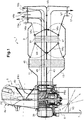
- the figure 1 is a schematic view of a heating, ventilation and / or air conditioning installation 1 intended to equip a motor vehicle to regulate the aerothermal parameters of the air flow distributed in one or more zones of the passenger compartment of the vehicle.
- the housing 3 comprises a first intake mouth 4a for the introduction of an external air flow FE coming from outside the vehicle into the first air intake channel 5 allowing its circulation in the internal volume delimited through the housing 3.
- the box 3 also includes a second inlet mouth 4b for the introduction of a first flow of recycled air FR1 coming from the passenger compartment of the vehicle and circulating again in the internal volume delimited by the box 3.
- the air inlets can be reversed, that is to say that the recycled air FR1 can be applied to the inlet 4a and the outside air FE to the inlet 4b.
- the first air intake channel 5 can be supplied both by the external air flow FE or the first recycled air flow FR1 as well as by a mixture of the two external air flows FE and recycled FR1.
- the outside air flow FE and the first recycling air flow FR1 can be mixed with each other in the first air intake channel 5.
- an air mixing device such as a first mixing flap V1 pivotally mounted allows the outside air flow FE and the first recycled air flow FR1 to be distributed in the desired proportion. first air intake channel 5.
- the mixing flap V1 is movable between two extreme closing positions. In a first closed position called the recycling position, the mixing flap V1 prohibits the passage of the outside air flow FE towards the first air intake channel 5 while allowing a passage of the first recycled air flow FR1 towards the first air intake channel 5. In the second closed position called the external position, the mixing flap V1 prevents the passage of the flow of recycled air FR1 to the first air intake channel 5 while authorizing a passage of the external air flow FE towards the first air intake channel 5.
- the mixing flap V1 is arranged in such a way that it calibrates, in intermediate positions, the proportion of the flow of outside air FE and the first flow of recycled air FR1 entering the first air intake channel 5 .
- the stroke of the first flap V1 is shown diagrammatically by dotted lines starting from the end of the first flap V1 on the figure 1 .
- the second air intake channel 7 is reserved for the introduction of a second flow of recycled air FR2 coming from the passenger compartment and circulating again in the installation 1.
- Different positions of the second flap V2 for managing the flow rate of the second flow of recycled air FR2 are illustrated by way of example on the figure 1 .
- the flow management can be done by way of example depending on the speed of the vehicle.
- the flow rate of this specific recycling can be between 10% and 50% of the flow rate of the aspirated air flow coming from the first air intake channel 5.
- the flow shutter V2 must not be completely closed because a certain amount of air must be allowed to cool the engine.
- the motor-fan unit also called a blower 9 is arranged so as to circulate an air flow from the first air intake channel 5 or from the second air intake channel 7 in the installation 1 and subsequently to the air outlets 15a, 15b and 17, for example a defrosting / defogging outlet 15a, a head ventilation outlet 15b and a foot ventilation mouth 17.
- the air delivered through the defrosting / defogging mouth 15a makes it possible to supply one or more nozzles arranged at the level of the vehicle windshield.
- the head ventilation outlet 15b makes it possible to ventilate an upper zone of the passenger compartment while the foot ventilation outlet 17 makes it possible to ventilate a lower zone of the passenger compartment.
- the blower 9 is arranged downstream of the first intake channel 5 in the direction of flow of the outside air flow FE and the first recycled air flow FR1 so as to circulate an air flow from the first air intake channel 5 in installation 1, more precisely in the first air distribution channel 11, and subsequently towards the outlets 15a and 15b.
- the blower 9 is also arranged downstream of the second intake channel 7 in the direction of flow of the second recycled air flow FR2 so as to circulate an air flow from the second air intake channel 7 in installation 1, more precisely in the second air distribution channel 13, and subsequently towards outlet 17.
- the blower 9 makes it possible to introduce into the first air distribution channel 11 either outside air FE taken from outside the passenger compartment, or re-circulating air taken from inside the passenger compartment says first recirculated air flow FR1, or a mixture of the two, and in the second air distribution channel 13 a permanent recirculated air stream taken from inside the passenger compartment says second air flow recycled FR2.
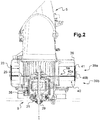
- the lower part 9b is therefore dedicated to permanent recycling.
- This lower part 9b for permanent recycling can be between 10% and 35% in height of the blower 9.
- the blower 9 comprises a fan and a motor 21 capable of driving the fan in rotation around a drive axis I.
- the fan comprises a wheel 23.
- the electric motor 21 is capable of driving the wheel 23 in rotation so as to set in motion an air flow in the installation 1.
- the wheel 23 is cylindrical.
- the wheel 23 better visible on the figure 3 presents a bowl 25.
- the bowl 25 is made of solid material, so as to form a sealed separation between the upper part 9a of the blower and the lower part 9b of the blower 9. This separation produced by the bowl 25 prevents the flow of air from the first channel air intake 5 to be introduced into the second distribution channel 13 through the lower part 9b of the blower 9, and conversely prevents the air flow from the second air intake channel 7 from being introduced in the first distribution channel 11 through the upper part 9a of the blower 9.
- the bowl 25 comprises substantially in its middle a hub 27 whose function is to mechanically connect the wheel 23 to a drive shaft 29.
- the bowl 25 also has an external peripheral edge 30.
- the wheel 23 also has blades or fins 31, 33 on its periphery.
- first blades 31 extend from the outer peripheral edge 30 of the bowl 25 towards a first outer peripheral edge 35 of the wheel 23 and second blades 33 extend from the outer peripheral edge 30 of the bowl 25 opposite the first blades 31 towards a second external peripheral border 37.
- the blower 9 therefore has a first open end face A delimited by the first external peripheral border 35 and a second open end face B opposite to the first end face A open and delimited by the second external peripheral border 37.
- the blower 9 has a first air suction region and a second air suction region. According to the illustrated embodiment, the first air suction region is located on the side of the first end face A of the cylindrical wheel and the second air suction region is located on the side of the second face end B of the cylindrical wheel.
- the blower wheel 23 draws air through its two opposite open end faces A and B.
- the air coming from the first air intake channel 5 is evacuated by the side of the upper part 9a of the blower in a direction perpendicular to the direction of entry of the air through the first end face A opened.
- the recycled air FR2 coming from the second air intake channel 7 is evacuated through the side of the lower part 9b of the blower 9 according to a direction perpendicular to the direction of entry of the air through the second open end face B.
- the motor 21 comprises a cage 38 which delimits an internal volume of the motor 21.
- the motor 21 includes the motor shaft 29 which passes through the cage 38 on either side along the axis I. According to the example illustrated, the motor shaft 29 opens out on one side of the motor 21 more significantly than on the other side and passes through the hub 27 of the bowl 25 of the wheel 23 to rotate the wheel 23.
- the housing 3 comprises a volute 39 housing the blower 9.
- the volute 39 is divided into two volumes: a first volume 39a comprising the upper part 9a of the blower 9 and a second volume 39b comprising the lower part 9b of the blower 9.
- the second volume 39b is therefore dedicated to permanent recycling and can be between 10% and 35% in height of the volute 39.
- the volute 39 includes a sealing means 40 arranged between the two volumes 39a and 39b.
- This sealing means 40 comprises a wall 40a separating the two volumes 39a and 39b.
- the wall 40a is permanently arranged in the volute 39 to separate the two air flows from the first intake channel 5 and the second intake channel 7, thereby allowing permanent recycling of the air flow at the level of the second distribution channel 13.
- the wall 40a is arranged in a fixed position in the volute 39 around the blower 9.
- the wall 40a at the blower 9 therefore allows separation into two parts from the origin of the incoming air flows before distribution in the respective channels 11 or 13.
- the sealing means 40 further comprises a means 40b for holding the wall 40a in the volute 39.
- the holding means 40b is made in one piece with the wall 40a.
- the sealing means 40 may comprise a peripheral skirt 40b, of substantially cylindrical shape in the example illustrated.
- the peripheral skirt 40b is connected to the wall 40a by extending substantially vertically with respect to the plane defined by the wall 40a on each side of the wall 40a.
- the peripheral skirt 40b extends more on the side of the wall 40a opposite the first volume 39a of volute communicating with the first air intake channel 5.
- the peripheral skirt 40b can be made in one piece with the wall 40a.
- peripheral skirt 40b is received in a corresponding housing of the volute 39.
- this housing is defined by shoulders 41 on the side walls of the volute 39.
- the cylindrical peripheral skirt 40b thus forms a means holding the wall 40a in the volute 39.
- An installation 1 has been described above with a single wheel 23 driven by a motor 21 for introducing air both into the first air distribution channel 11 and into the second air distribution channel 13. may alternatively provide an installation comprising two wheels respectively associated with an air distribution channel 11 or 13.
- the two air distribution channels 11 and 13 are also separated by a partition 43 arranged between the two air distribution channels 11 and 13.
- the partition 43 is airtight.
- the housing 3 therefore comprises two stages separated by this partition 43; the first stage defining the first air distribution channel 11 and the second stage defining the second air distribution channel 13.
- the air flow sucked by the upper part 9a of the blower 9 coming from the first air intake channel 5 flows in the first distribution channel 11 towards the outlets 15a, 15b without aeraulic communication with the second air distribution channel 13.
- the flow of recycled air FR2 sucked in by the second part 9b of the blower 9 coming from the second air intake channel 7 s flows in the second air distribution channel 13 to the outlet 17 without air communication with the first air distribution channel 11.
- the partition 43 may not extend over the entire length of the housing 3 and provision may be made for a switching flap V3 .
- the flap V3 is pivotally mounted between a closed position as illustrated on the figure 1 and an open position allowing communication between the two air distribution channels 11 and 13.
- the housing 3 also houses heat treatment means 45, 47 of the air prior to its evacuation from the housing 3 to the passenger compartment.
- the heat treatment means 45, 47 are arranged in the first air distribution duct 11 and in the second distribution duct 13. More specifically, the heat treatment means 45, 47 are common to the two air distribution channels 11 and 13.
- the heat treatment means 45, 47 can respectively comprise an internal partition 49, 51 making it possible to separate the air flows coming from the first 5 or from the second 7 air intake channel and passing through the treatment means thermal 45 and 47.
- the heat treatment means 45, 47 are in particular an evaporator 45 provided for cooling the air passing through it and a heating device such as a radiator 47 able to heat this air.
- the radiator 47 is possibly associated with electrical resistors of the resistance type with a positive temperature coefficient, commonly known as “PTC”.
- the heating device can be an air-water exchanger, or air oil, that is to say in which there is a heat exchange between air and water or oil.
- distribution flaps V4 1 , V4 2 ; V5 1 , V5 2 can be arranged upstream and downstream of the radiator 47.
- the flap V4 1 arranged upstream of the radiator 47 and the flap V5 1 arranged downstream of the radiator 47 according to the direction of flow of the air flow from the first channel air intake 5 are suitable for authorizing or preventing the passage of the air flow leaving the evaporator 45 through the radiator 47.
- the air flow leaving the evaporator 45 can bypass the radiator 47.
- the shutters V4 1 and V5 1 are pivotally mounted between two extreme positions allowing or preventing the passage of all the air flow leaving the evaporator through the radiator 47.
- the shutters V4 1 and V5 1 can be controlled in intermediate positions so as to distribute a flow of air to be heated in the radiator 47 and a flow of air not to be heated which does not pass through the radiator 47.
- the flap V4 2 arranged upstream of the radiator 47 and the flap V5 2 arranged downstream of the radiator 47 in the direction of flow of the recycled air flow FR2 in coming from the second air intake channel 7 are capable of authorizing or preventing the passage of the air flow leaving the evaporator 45 through the radiator 47.
- the air flow leaving the evaporator 45 can bypass the radiator 47.
- the shutters V4 2 and V5 2 are pivotally mounted between two extreme positions allowing or preventing the passage of all the air flow leaving the evaporator through the radiator 47.
- the shutters V4 2 and V5 2 can be controlled in intermediate positions so as to distribute a flow of air to be heated in the radiator 47 and a flow of air not to be heated which does not pass through the radiator 47.
- each air outlet 15a, 15b, 17 can be provided with a respective air distribution flap V6a, V6b, and V7 which is operable between an open position in which the air distribution flap V6a, V6b, and V7 allows an air passage through the air outlet 15a, 15b, 17 that the air distribution flap V6a, V6b, and V7 equips and a position closure in which the air distribution flap V6a, V6b, and V7 prohibits such passage.
- such an installation 1 comprising a two-stage housing 3 makes it possible to manage the air by using the first air intake channel 5 only for the first stage by taking outside, recycled air or a mixture of the two , and always taking air directly from the passenger compartment for the second floor.
- the first stage feeds in particular the high ventilation outlets and the defrosting / demisting outlets, while the second stage feeds the low ventilation outlets arriving at the users' feet.
- the air flow for the first stage can be distributed according to the needs for defrosting and / or thermal comfort in the passenger compartment, in particular one can send more air flow outside, consequently drier than a flow of recirculating air, to avoid fogging of the windshield for example.
- the two air flows are separated from the start by dividing the blower 9 so that it is not necessary to provide a complicated air management system with shutters to allow recycling of the air flow for the second stage of the housing 3.
- the separation between the two stages of the housing 3 can be done in a simple manner using a partition 43 between the two air distribution channels 11, 13.
Landscapes
- Engineering & Computer Science (AREA)
- Physics & Mathematics (AREA)
- Thermal Sciences (AREA)
- Mechanical Engineering (AREA)
- Life Sciences & Earth Sciences (AREA)
- Sustainable Development (AREA)
- Sustainable Energy (AREA)
- Air-Conditioning For Vehicles (AREA)
- Structures Of Non-Positive Displacement Pumps (AREA)
- Air-Conditioning Room Units, And Self-Contained Units In General (AREA)
Description
- La présente invention concerne une installation de chauffage, ventilation et/ou climatisation pour un habitacle de véhicule automobile permettant le contrôle de la température de flux d'air dans une ou plusieurs zones de l'habitacle d'un véhicule automobile. Le document
DE 199 54 308 A1 décrit une telle installation. - Un véhicule automobile est couramment équipé d'une installation de chauffage, de ventilation et/ou de climatisation qui est destinée à réguler les paramètres aérothermiques de l'air distribué dans l'habitacle, en particulier la température d'un flux d'air délivré par l'installation à l'intérieur de l'habitacle.
- Dans sa généralité, l'installation comprend un boîtier délimité par des cloisons à travers lesquelles sont ménagées des ouvertures, dont au moins une entrée d'air et au moins une bouche de distribution d'air.
- De façon connue, le boîtier loge généralement un groupe moto-ventilateur également appelé pulseur pour faire circuler le flux d'air depuis l'entrée d'air vers la bouche de distribution d'air. Le boîtier loge aussi des moyens de traitement thermique pour réchauffer et/ou refroidir le flux d'air préalablement à sa distribution à l'intérieur de l'habitacle à travers la bouche de distribution d'air. À titre d'exemple, les moyens de traitement thermique peuvent comprendre un évaporateur qui est destiné à refroidir l'air le traversant, et un radiateur, éventuellement associé à un radiateur additionnel, qui est destiné à réchauffer l'air qui le traverse.
- L'installation peut de plus comprendre plusieurs volets pour contrôler le passage d'air à travers des bouches de distribution correspondant à des sorties d'aération ou de ventilation s'ouvrant dans l'habitacle du véhicule, ou encore à une sortie de dégivrage/désembuage notamment du pare-brise du véhicule.
- Par ailleurs, l'air circulant dans une telle installation peut être un flux d'air extérieur, ou le flux d'air provenant de l'habitacle circulant de nouveau dans l'installation, on parle alors de flux d'air recyclé ou recirculant, ou encore un mélange des deux. Un volet de mixage peut répartir la proportion d'air extérieur et la proportion d'air recyclé.
- Lorsque la température extérieure est basse et si le flux d'air provenant de l'habitacle est recyclé pour le chauffage de l'habitacle, il existe un risque d'apparition de buée sur les vitres du véhicule, notamment sur le pare-brise. En effet, la présence des passagers dans l'habitacle contribue à charger le flux d'air recyclé en humidité qui, après un certain temps d'utilisation, se condense sur les vitres dès lors que la température extérieure permet d'atteindre le point de rosée.
- Afin d'éviter ce problème, de l'air extérieur plus sec que de l'air recyclé doit de préférence être soufflé dans l'habitacle.
- Cependant, cette solution n'est pas adaptée pour un véhicule électrique, car la température de l'air extérieur étant basse, une grande puissance électrique est nécessaire pour réaliser le chauffage, et le temps d'autonomie électrique du véhicule peut être réduit.
- Au contraire, afin de réduire la consommation électrique le recyclage de l'air de l'habitacle pour réaliser le chauffage est préférable.
- Pour remédier à ces problèmes, on connaît des installations à deux niveaux, c'est-à-dire comprenant deux canaux de distribution d'air logeant les moyens de traitement thermique d'une installation classique pour assurer le confort thermique dans l'habitacle, et chaque niveau peut être alimenté par un flux d'air de même origine ou d'origine distincte.
- Ainsi, l'alimentation en flux d'air extérieur et/ou en flux d'air recyclé peut être sélectionnée en fonction des besoins, par exemple en envoyant un flux d'air extérieur vers le pare-brise pour répondre au problème d'embuage des vitres du véhicule, notamment du pare-brise, et en envoyant un flux d'air recyclé vers des sorties d'aération des pieds dans l'habitacle pour un chauffage plus rapide.
- Cependant, cette solution nécessite un système de gestion des flux d'air pour répartir les flux d'air extérieur et recyclé selon les besoins.
- Un tel système est contraignant car requiert des conduits de contournement pour séparer les flux d'air et distribuer par exemple un flux d'air recyclé dans le deuxième niveau formant par exemple une partie inférieure de l'installation tandis qu'un flux d'air extérieur neuf doit être distribué dans le premier niveau formant dans ce cas la partie supérieure de l'installation. La présence des conduits de contournement implique un encombrement plus important de l'installation dans le véhicule.
- De plus, un tel système comporte un ou plusieurs volets pour répartir les flux d'air et est donc plus complexe.
- L'invention a donc pour objectif de proposer une installation améliorée permettant de résoudre au moins partiellement les inconvénients de l'art antérieur.
- À cet effet, l'invention a pour objet une installation de chauffage, ventilation et/ou climatisation pour un habitacle de véhicule automobile comprenant :
- un premier canal d'admission d'air,
- un premier canal de distribution d'air comprenant au moins une première sortie d'air dans l'habitacle et communiquant avec le premier canal d'admission d'air, et
- un deuxième canal de distribution d'air comprenant une deuxième sortie d'air, ladite installation comprenant en outre un deuxième canal d'admission réservé à un flux d'air recyclé provenant de l'habitacle et en communication aéraulique avec le deuxième canal de distribution d'air, de façon à alimenter le deuxième canal de distribution d'air uniquement par le flux d'air recyclé provenant du deuxième canal d'admission d'air.
caractérisée en ce que le boîtier comprend une première bouche d'admission pour l'introduction d'un flux d'air extérieur et une deuxième bouche d'admission pour l'introduction d'un premier flux d'air recyclé dans le premier canal d'admission d'air. - Cette solution permet d'implanter une aspiration dédiée au recyclage au niveau du deuxième canal d'admission d'air.
- L'invention propose ainsi de distribuer vers les sorties d'air, des flux d'air qui peuvent présenter selon le cas une origine distincte ou une origine commune. Plus précisément, un flux d'air provenant du premier canal d'admission d'air pouvant être alimenté soit par un flux d'air extérieur, soit par un flux d'air recyclé, soit encore un mélange des deux, peut être distribué vers une ou plusieurs premières sorties d'air au niveau du premier canal de distribution d'air.
- Au contraire, un flux d'air d'origine distincte du premier flux d'air et totalement recyclé peut être dirigé vers une deuxième sortie d'air séparée des premières sorties d'air, au niveau du deuxième canal de distribution d'air.
- Le recyclage permanent d'une partie du flux d'air distribué dans l'habitacle permet de répondre à un besoin de chauffage rapide de l'air tandis que pour des raisons de désembuage par exemple un flux d'air extérieur neuf ou mélangé avec de l'air recyclé peut être envoyé vers le pare-brise.
- Avec cette solution, il n'est pas nécessaire de prévoir de conduits de contournement d'un flux d'air pour être distribué de façon sélective dans un canal de distribution d'air.
- De plus, l'origine des flux d'air distribués dans chaque canal étant distincte, il n'est pas non plus nécessaire de prévoir de volets pour la répartition de ces deux flux d'air devant alimenter d'une part le premier canal de distribution d'air et d'autre part le deuxième canal de distribution d'air.
- Selon un aspect de l'invention, l'installation comprend un groupe moto-ventilateur apte à introduire de l'air dans le premier canal de distribution d'air et dans le deuxième canal de distribution d'air, et comprenant :
- une première partie communiquant d'une part avec le premier canal d'admission d'air et d'autre part avec le premier canal de distribution d'air, et
- une deuxième partie communiquant d'une part avec le deuxième canal d'admission d'un flux d'air recyclé et d'autre part avec le deuxième canal de distribution d'air.
- Le recyclage spécifique est implanté du côté du groupe moto-ventilateur. Ce recyclage spécifique fonctionne toujours dès que le groupe moto-ventilateur est actionné.
- Selon un mode de réalisation, le groupe moto-ventilateur comprend une roue présentant un bol réalisé en matériau plein et s'étendant entre la première partie et la deuxième partie du groupe moto-ventilateur. Le bol permet de diviser en deux le groupe moto-ventilateur et assure ainsi une séparation des flux d'air provenant du premier canal d'admission d'air et du deuxième canal d'admission d'air dès l'origine des flux d'air.
- Selon un aspect de l'invention, le groupe moto-ventilateur comprend des premières pales s'étendant depuis un bord périphérique externe du bol vers une première bordure périphérique externe de la roue et des secondes pales s'étendant à l'opposé des premières pales depuis le bord périphérique externe du bol vers une deuxième bordure périphérique externe de la roue.
- Le groupe moto-ventilateur présente deux régions d'aspiration opposées distinctes. La deuxième région d'aspiration est dédiée au recyclage spécifique.
- Selon un autre aspect de l'invention, l'installation comprend :
- une volute logeant le groupe moto-ventilateur et
- un moyen d'étanchéité séparant la volute en deux volumes, le premier volume de volute comprenant la première partie du groupe moto-ventilateur, et le deuxième volume de volute comprenant la deuxième partie du groupe moto-ventilateur.
- Cette volute est séparée en deux volumes définissant ainsi une partie supérieure et une partie inférieure.
- La partie supérieure communique avec le premier canal d'admission d'air correspondant à une entrée d'air classique pouvant être alimenté par de l'air extérieur et/ou de l'air recyclé, qui passe par la volute puis est introduit dans le premier canal de distribution d'air jusqu'aux sorties par exemple de dégivrage et d'aération de tête dans l'habitacle.
- La partie inférieure communique avec le deuxième canal d'admission d'air correspondant au recyclage spécifique pour introduire un flux d'air toujours recyclé dans le deuxième canal de distribution d'air jusqu'à une sortie par exemple d'aération des pieds dans l'habitacle.
- Le moyen d'étanchéité peut comprendre une paroi agencée entre les deux volumes de la volute et un moyen de maintien de la paroi dans la volute. La paroi permet de partitionner de façon simple la volute.
- Selon un mode de réalisation, le moyen de maintien est réalisé d'une seule pièce avec la paroi.
- Le moyen d'étanchéité peut comprendre une jupe périphérique sensiblement cylindrique formant maintien de la paroi et reçu dans un logement complémentaire de la volute.
- Selon un mode de réalisation, ladite installation comprend au moins un volet de débit agencé dans le deuxième canal d'admission d'air de façon à régler le débit d'air du flux d'air recyclé. Le volet de débit dédié au recyclage permanent permet de gérer le débit du flux d'air recyclé, par exemple en fonction de paramètres du véhicule tel que la vitesse du véhicule.
- Selon un aspect de l'invention, l'installation comprend une cloison de séparation agencée entre le premier canal de distribution d'air et le deuxième canal de distribution d'air.
- Selon un autre aspect de l'invention, l'installation comprend des moyens de traitement thermique de flux d'air agencés dans le premier canal de distribution d'air et dans le deuxième canal de distribution d'air. Lesdits moyens de traitement thermique sont communs aux deux canaux de distribution d'air.
- Lesdits moyens de traitement thermique peuvent comporter respectivement une cloison interne de séparation des flux d'air traversant le premier canal de distribution d'air et le deuxième canal de distribution d'air.
- La cloison entre les deux canaux de distribution et les cloisons internes au niveau des moyens de traitement thermique permettant la séparation entre les deux flux d'air jusqu'à la délivrance dans les sorties d'air respectives.
- Selon un mode de réalisation de l'invention, un volet de commutation peut être agencé pour mettre en communication les deux canaux de distribution d'air, par exemple pour envoyer une quantité d'air plus importante vers une des sorties d'air.
- Selon un mode de réalisation particulier, ladite au moins une première sortie est une sortie de dégivrage orientée vers le pare-brise dudit véhicule ou une sortie d'aération de tête des passagers dans l'habitacle dudit véhicule, et la deuxième sortie est une sortie d'aération orientée vers les pieds des passagers dans l'habitacle.
- En envoyant uniquement un flux d'air recyclé vers les pieds, le chauffage peut être réalisé plus rapidement. La proportion d'air extérieur neuf et d'air recyclé à diriger vers les sorties de dégivrage/désembuage et d'aération de tête peut être répartie selon les besoins de dégivrage.
- D'autres caractéristiques et avantages de l'invention apparaîtront plus clairement à la lecture de la description suivante, donnée à titre d'exemple illustratif et non limitatif, et des dessins annexés parmi lesquels :
- la
figure 1 est une vue en coupe d'une installation de chauffage, ventilation et/ou climatisation à deux étages selon l'invention, - la
figure 2 est une vue schématique d'une volute de l'installation de lafigure 1 comprenant un groupe moto-ventilateur, - la
figure 3 est une vue de la roue du groupe moto-ventilateur de lafigure 2 , - la
figure 4a est une première vue en perspective de la roue de lafigure 3 , et - la
figure 4b est une deuxième vue en perspective de la roue de lafigure 3 . - Dans ces figures, les éléments sensiblement identiques portent les mêmes références.
- La
figure 1 est une vue schématique d'une installation 1 de chauffage, de ventilation et/ou de climatisation destinée à équiper un véhicule automobile pour réguler les paramètres aérothermiques du flux d'air distribué dans une ou plusieurs zones de l'habitacle du véhicule. - L'installation 1 comporte un boîtier 3 comprenant :
- un premier canal d'admission d'air 5,
- un deuxième canal d'admission d'air 7,
- une groupe moto-ventilateur 9 également appelé pulseur pour introduire de l'air dans l'installation 1,
- un premier canal de distribution d'air 11,
- un second canal de distribution d'air 13, et
- plusieurs sorties d'air 15a, 15b et 17.
- Le boîtier 3 comprend une première bouche d'admission 4a pour l'introduction d'un flux d'air extérieur FE provenant de l'extérieur du véhicule dans le premier canal d'admission d'air 5 permettant sa circulation dans le volume interne délimité par le boîtier 3.
- Le boîtier 3 comprend aussi une deuxième bouche d'admission 4b pour l'introduction d'un premier flux d'air recyclé FR1 provenant de l'habitacle du véhicule et circulant de nouveau dans le volume interne délimité par le boîtier 3.
- Bien entendu, les entrées d'air peuvent être inversées, c'est-à-dire que l'air recyclé FR1 peut être appliqué à l'entrée 4a et l'air extérieur FE à l'entrée 4b.
- Le premier canal d'admission d'air 5 peut être alimenté aussi bien par le flux d'air extérieur FE ou le premier flux d'air recyclé FR1 que par un mélange des deux flux d'air extérieur FE et recyclé FR1. Le flux d'air extérieur FE et le premier flux d'air de recyclage FR1 sont susceptibles d'être mélangés l'un avec l'autre dans le premier canal d'admission d'air 5.
- À cet effet, un organe de mixage d'air, tel qu'un premier volet de mixage V1, monté pivotant permet de répartir en proportion voulue le flux d'air extérieur FE et le premier flux d'air recyclé FR1 à introduire dans le premier canal d'admission d'air 5.
- Le volet de mixage V1 est mobile entre deux positions extrêmes de fermeture. Dans une première position de fermeture dite position de recyclage, le volet de mixage V1 interdit le passage du flux d'air extérieur FE vers le premier canal d'admission d'air 5 tout en autorisant un passage du premier flux d'air recyclé FR1 vers le premier canal d'admission d'air 5. Dans la deuxième position de fermeture dite position extérieure, le volet de mixage V1 interdit le passage du flux d'air recyclé FR1 vers le premier canal d'admission d'air 5 tout en autorisant un passage du flux d'air extérieur FE vers le premier canal d'admission d'air 5.
- Le volet de mixage V1 est agencé de telle façon qu'il calibre, dans des positions intermédiaires, la proportion du flux d'air extérieur FE et du premier flux d'air recyclé FR1 entrant dans le premier canal d'admission d'air 5.
- La course du premier volet V1 est schématisée par des pointillés partant de l'extrémité du premier volet V1 sur la
figure 1 . - Le deuxième canal d'admission d'air 7 est quant à lui réservé à l'introduction d'un deuxième flux d'air recyclé FR2 provenant de l'habitacle et circulant de nouveau dans l'installation 1.
- On peut prévoir un deuxième volet V2 agencé dans le deuxième canal d'admission d'air 7. Il s'agit d'un volet de débit monté pivotant de façon à contrôler le débit du deuxième flux d'air recyclé FR2.
- Différentes positions du deuxième volet V2 pour gérer le débit du deuxième flux d'air recyclé FR2 sont illustrées à titre d'exemple sur la
figure 1 . La gestion du débit peut se faire à titre d'exemple suivant la vitesse du véhicule. - Le débit de ce recyclage spécifique peut être compris entre 10 % et 50 % du débit du flux d'air aspiré provenant du premier canal d'admission d'air 5.
- Cependant, le volet de débit V2 ne doit pas être entièrement fermé car il faut laisser passer une certaine quantité d'air pour le refroidissement du moteur.
- Le groupe moto-ventilateur également appelé pulseur 9 est agencé de manière à faire circuler un flux d'air depuis le premier canal d'admission d'air 5 ou depuis le deuxième canal d'admission d'air 7 dans l'installation 1 et par la suite vers les sorties d'air 15a, 15b et 17, par exemple une sortie de dégivrage/désembuage 15a, une sortie d'aération de tête 15b et une bouche d'aération de pieds 17.
- L'air délivré à travers la bouche de dégivrage/désembuage 15a permet d'alimenter une ou plusieurs buses agencées au niveau du pare-brise du véhicule. La sortie d'aération de tête 15b permet de ventiler une zone supérieure de l'habitacle tandis que la sortie d'aération de pieds 17 permet de ventiler une zone inférieure de l'habitacle.
- Plus précisément, le pulseur 9 est agencé en aval du premier canal d'admission 5 selon le sens d'écoulement du flux d'air extérieur FE et du premier flux d'air recyclé FR1 de manière à faire circuler un flux d'air depuis le premier canal d'admission d'air 5 dans l'installation 1, plus précisément dans le premier canal de distribution d'air 11, et par la suite vers les sorties 15a et 15b.
- Le pulseur 9 est également agencé en aval du deuxième canal d'admission 7 selon le sens d'écoulement du deuxième flux d'air recyclé FR2 de manière à faire circuler un flux d'air depuis le deuxième canal d'admission d'air 7 dans l'installation 1, plus précisément dans le deuxième canal de distribution d'air 13, et par la suite vers la sortie 17.
- Le pulseur 9 permet d'introduire dans le premier canal de distribution d'air 11 soit de l'air extérieur FE prélevé à l'extérieur de l'habitacle, soit de l'air re-circulant prélevé à l'intérieur de l'habitacle dit premier flux d'air recyclé FR1, soit encore un mélange des deux, et dans le deuxième canal de distribution d'air 13 un flux d'air recyclé permanent prélevé à l'intérieur de l'habitacle dit deuxième flux d'air recyclé FR2.
- À cet effet, comme cela est mieux visible sur la
figure 2 , le pulseur 9 présente : - une première partie 9a dite partie supérieure communiquant avec le premier canal d'admission d'air 5 et avec le premier canal de distribution d'air 11 et
- une deuxième partie 9b dite partie inférieure communiquant avec le deuxième canal d'admission d'air 7 et avec le deuxième canal de distribution d'air 13.
- La partie inférieure 9b est donc dédiée au recyclage permanent. Cette partie inférieure 9b pour le recyclage permanent peut être comprise entre 10 % et 35 % en hauteur du pulseur 9.
- Plus précisément, le pulseur 9 comprend un ventilateur et un moteur 21 apte à entraîner en rotation le ventilateur autour d'un axe d'entraînement I.
- Le ventilateur comprend une roue 23. Le moteur électrique 21 est apte à entraîner en rotation la roue 23 de façon à mettre en mouvement un flux d'air dans l'installation 1.
- Selon le mode de réalisation illustré la roue 23 est cylindrique.
- La roue 23 mieux visible sur la
figure 3 présente un bol 25. - Le bol 25 est réalisé en matériau plein, de manière à former une séparation étanche entre la partie supérieure 9a du pulseur et la partie inférieure 9b du pulseur 9. Cette séparation réalisée par le bol 25 empêche au flux d'air provenant du premier canal d'admission d'air 5 d'être introduit dans le deuxième canal de distribution 13 par la partie inférieure 9b du pulseur 9, et inversement empêche au flux d'air provenant du deuxième canal d'admission d'air 7 d'être introduit dans le premier canal de distribution 11 par la partie supérieure 9a du pulseur 9.
- Le bol 25 comporte sensiblement en son milieu un moyeu 27 dont la fonction est de relier mécaniquement la roue 23 à un arbre moteur 29. Le bol 25 présente de plus un bord périphérique externe 30.
- Par ailleurs, la roue 23 présente en outre sur son pourtour des pales ou ailettes 31, 33.
- En référence aux
figures 3 et 4a, 4b , des premières pales 31 s'étendent depuis le bord périphérique externe 30 du bol 25 vers une première bordure périphérique externe 35 de la roue 23 et des secondes pales 33 s'étendent depuis le bord périphérique externe 30 du bol 25 à l'opposé des premières pales 31 vers une deuxième bordure périphérique externe 37. - Le pulseur 9 présente donc une première face d'extrémité A ouverte délimitée par la première bordure périphérique externe 35 et une deuxième face d'extrémité B ouverte opposée à la première face d'extrémité A ouverte et délimitée par la deuxième bordure périphérique externe 37.
- Le pulseur 9 présente une première région d'aspiration d'air et une deuxième région d'aspiration d'air. Selon le mode de réalisation illustré, la première région d'aspiration d'air est située du côté de la première face d'extrémité A de la roue cylindrique et la deuxième région d'aspiration d'air est située du côté de la deuxième face d'extrémité B de la roue cylindrique. La roue 23 de pulseur aspire l'air par ses deux faces d'extrémité A et B ouvertes opposées.
- Dans l'exemple illustré sur la
figure 1 , l'air provenant du premier canal d'admission d'air 5 est évacué par le côté de la partie supérieure 9a du pulseur selon une direction perpendiculaire à la direction d'entrée de l'air à travers la première face d'extrémité A ouverte. De même, l'air recyclé FR2 provenant du deuxième canal d'admission d'air 7 est évacué par le côté de la partie inférieure 9b du pulseur9 selon une direction perpendiculaire à la direction d'entrée de l'air à travers la deuxième face d'extrémité B ouverte. - Concernant le moteur 21, en se référant de nouveau à la
figure 2 , le moteur 21 comprend une cage 38 qui délimite un volume interne du moteur 21. - Le moteur 21 comprend l'arbre moteur 29 qui traverse la cage 38 de part et d'autre selon l'axe I. Selon l'exemple illustré, l'arbre moteur 29 débouche d'un côté du moteur 21 de manière plus importante que de l'autre côté et passe à travers le moyeu 27 du bol 25 de la roue 23 pour entraîner en rotation la roue 23.
- Par ailleurs, le boîtier 3 comprend une volute 39 logeant le pulseur 9.
- La volute 39 est divisée en deux volumes : un premier volume 39a comprenant la partie supérieure 9a du pulseur 9 et un deuxième volume 39b comprenant la partie inférieure 9b du pulseur 9.
- Le deuxième volume 39b est donc dédié au recyclage permanent et peut être compris entre 10 % et 35 % en hauteur de la volute 39.
- Afin d'empêcher toute communication aéraulique entre la partie supérieure 9a et la partie inférieure 9b, la volute 39 comporte un moyen d'étanchéité 40 agencé entre les deux volumes 39a et 39b.
- Ce moyen d'étanchéité 40 comprend une paroi 40a séparant les deux volumes 39a et 39b.
- La paroi 40a est agencée de façon permanente dans la volute 39 pour séparer les deux flux d'air provenant du premier canal d'admission 5 et du deuxième canal d'admission 7, en permettant ainsi un recyclage permanent du flux d'air au niveau du deuxième canal de distribution 13. La paroi 40a est agencée en position fixe dans la volute 39 autour du pulseur 9.
- La paroi 40a au niveau du pulseur 9 permet donc une séparation en deux parties dès l'origine des flux d'air entrants avant distribution dans les canaux respectifs 11 ou 13.
- Le moyen d'étanchéité 40 comprend en outre un moyen de maintien 40b de la paroi 40a dans la volute 39.
- Selon le mode de réalisation illustré le moyen de maintien 40b est réalisé d'une seule pièce avec la paroi 40a.
- À titre d'exemple, le moyen d'étanchéité 40 peut comprendre une jupe périphérique 40b, de forme sensiblement cylindrique dans l'exemple illustré. La jupe périphérique 40b est raccordée à la paroi 40a en s'étendant sensiblement verticalement par rapport au plan défini par la paroi 40a de chaque côté de la paroi 40a. Dans l'exemple illustré sur la
figure 2 , la jupe périphérique 40b s'étend plus du côté de la paroi 40a en regard du premier volume 39a de volute communiquant avec le premier canal d'admission d'air 5. - La jupe périphérique 40b peut être réalisée d'une seule pièce avec la paroi 40a.
- De plus, la jupe périphérique 40b est reçue dans un logement correspondant de la volute 39. Selon l'exemple illustré, ce logement est défini par des épaulements 41 sur les parois latérales de la volute 39. La jupe périphérique cylindrique 40b forme ainsi un moyen de maintien de la paroi 40a dans la volute 39.
- On a décrit ci-dessus une installation 1 avec une seule roue 23 entraînée par un moteur 21 pour introduire de l'air aussi bien dans le premier canal de distribution d'air 11 que dans le deuxième canal de distribution d'air 13. On peut prévoir en variante une installation comprenant deux roues respectivement associées à un canal de distribution d'air 11 ou 13.
- En ce qui concerne les deux canaux de distribution d'air 11 et 13, en se référant de nouveau à la
figure 1 , ils sont également séparés par une cloison de séparation 43 agencée entre les deux canaux de distribution d'air 11 et 13. La cloison de séparation 43 est étanche à l'air. - Le boîtier 3 comprend donc deux étages séparés par cette cloison 43 ; le premier étage définissant le premier canal de distribution d'air 11 et le deuxième étage définissant le deuxième canal de distribution d'air 13.
- Ainsi, le flux d'air aspiré par la partie supérieure 9a du pulseur 9 provenant du premier canal d'admission d'air 5 s'écoule dans le premier canal de distribution 11 vers les sorties 15a, 15b sans communication aéraulique avec le deuxième canal de distribution d'air 13. De même, le flux d'air recyclé FR2 aspiré par la deuxième partie 9b du pulseur 9 provenant du deuxième canal d'admission d'air 7 s'écoule dans le deuxième canal de distribution d'air 13 vers la sortie 17 sans communication aéraulique avec le premier canal de distribution d'air 11.
- Toutefois, dans le cas où une communication entre les deux canaux de distribution d'air 11 et 13 est voulue, la cloison de séparation 43 peut ne pas s'étendre sur toute la longueur du boîtier 3 et on peut prévoir un volet de commutation V3. Le volet V3 est monté pivotant entre une position de fermeture telle qu'illustrée sur la
figure 1 et une position d'ouverture permettant une communication entre les deux canaux de distribution d'air 11 et 13. - Cela peut être avantageux lorsqu'une plus grande quantité d'air est souhaitée par exemple au niveau des pieds des passagers.
- Par ailleurs, le boîtier 3 loge également des moyens de traitement thermique 45, 47 de l'air préalablement à son évacuation hors du boîtier 3 vers l'habitacle.
- Les moyens de traitement thermique 45, 47 sont agencés dans le premier conduit de distribution d'air 11 et dans le deuxième conduit de distribution 13. Plus précisément, les moyens de traitement thermique 45, 47 sont communs aux deux canaux de distribution d'air 11 et 13.
- Dans ce cas, les moyens de traitement thermique 45, 47 peuvent comprendre respectivement une cloison interne 49, 51 permettant de séparer les flux d'air provenant du premier 5 ou du deuxième 7 canal d'admission d'air et traversant les moyens de traitement thermique 45 et 47.
- Les moyens de traitement thermique 45, 47 sont notamment un évaporateur 45 prévu pour refroidir l'air qui le traverse et un dispositif de chauffage tel qu'un radiateur 47 apte à réchauffer cet air. Le radiateur 47 est éventuellement associé à des résistances électriques de type résistance à coefficient de température positif, communément dénommées « CTP ». Le dispositif de chauffage peut être un échangeur de type air eau, ou air huile, c'est-à-dire dans lequel il y a un échange thermique entre l'air et de l'eau ou de l'huile.
- Dans chaque canal de distribution d'air 11, 13, des volets de répartition V41, V42 ; V51, V52 peuvent être agencés en amont et en aval du radiateur 47.
- Dans le premier canal de distribution d'air 11, le volet V41 agencé en amont du radiateur 47 et le volet V51 agencé en aval du radiateur 47 selon le sens d'écoulement du flux d'air en provenance du premier canal d'admission d'air 5 sont aptes à autoriser ou empêcher le passage du flux d'air en sortie de l'évaporateur 45 à travers le radiateur 47. Ainsi, le flux d'air en sortie de l'évaporateur 45 peut by-passer le radiateur 47.
- Les volets V41 et V51 sont montés pivotants entre deux positions extrêmes autorisant ou empêchant le passage de tout le flux d'air en sortie de l'évaporateur à travers le radiateur 47. Les volets V41 et V51 peuvent être pilotés dans des positions intermédiaires de façon à répartir un flux d'air à chauffer dans le radiateur 47 et un flux d'air à ne pas chauffer ne traversant pas le radiateur 47.
- Les courses des volets V41 et V51 sont schématisées en pointillés sur la
figure 1 . - De façon similaire, dans le deuxième canal de distribution d'air 13, le volet V42 agencé en amont du radiateur 47 et le volet V52 agencé en aval du radiateur 47 selon le sens d'écoulement du flux d'air recyclé FR2 en provenance du deuxième canal d'admission d'air 7 sont aptes à autoriser ou empêcher le passage du flux d'air en sortie de l'évaporateur 45 à travers le radiateur 47. Ainsi, le flux d'air en sortie de l'évaporateur 45 peut by-passer le radiateur 47.
- Les volets V42 et V52 sont montés pivotants entre deux positions extrêmes autorisant ou empêchant le passage de tout le flux d'air en sortie de l'évaporateur à travers le radiateur 47. Les volets V42 et V52 peuvent être pilotés dans des positions intermédiaires de façon à répartir un flux d'air à chauffer dans le radiateur 47 et un flux d'air à ne pas chauffer ne traversant pas le radiateur 47.
- Les courses des volets V42 et V52 sont schématisées en pointillés sur la
figure 1 . - Enfin, chaque sortie d'air 15a, 15b, 17 peut être pourvue d'un volet de distribution d'air respectif V6a, V6b, et V7 qui est manœuvrable entre une position d'ouverture dans laquelle le volet de distribution d'air V6a, V6b, et V7 autorise un passage d'air à travers la sortie d'air 15a, 15b, 17 que le volet de distribution d'air V6a, V6b, et V7 équipe et une position de fermeture dans laquelle le volet de distribution d'air V6a, V6b, et V7 interdit un tel passage.
- Ainsi, une telle installation 1 comprenant un boîtier 3 à deux étages permet de gérer l'air en utilisant le premier canal d'admission d'air 5 uniquement pour le premier étage en prélevant de l'air extérieur, recyclé ou un mélange des deux, et en prélevant toujours directement dans l'habitacle l'air pour le deuxième étage.
- Le premier étage alimente notamment les sorties d'aération hautes et les sorties de dégivrage / désembuage, tandis que le deuxième étage alimente les sorties d'aération basses arrivant au niveau des pieds des usagers.
- En recyclant en permanence le flux d'air à destination des pieds, on obtient un chauffage plus rapide. Le flux d'air pour le premier étage peut être réparti selon les besoins de dégivrage et/ou du confort thermique dans l'habitacle, notamment on peut envoyer plus de flux d'air extérieur, en conséquence plus sec qu'un flux d'air recirculant, pour éviter l'embuage du pare-brise par exemple.
- Les deux flux d'air sont séparés dès l'origine en divisant le pulseur 9 de sorte qu'il n'est pas nécessaire de prévoir un système de gestion d'air compliqué avec des volets pour permettre un recyclage du flux d'air pour le deuxième étage du boîtier 3.
- La séparation entre les deux étages du boîtier 3 peut se faire de façon simple à l'aide d'une cloison 43 entre les deux canaux de distribution d'air 11, 13.
Claims (12)
- Installation de chauffage, ventilation et/ou climatisation pour un habitacle de véhicule automobile comportant un boitier (3) comprenant :- un premier canal d'admission d'air (5),- un premier canal de distribution d'air (11) comprenant au moins une première sortie d'air (15a, 15b) dans l'habitacle et communiquant avec le premier canal d'admission d'air (5), et- un deuxième canal de distribution d'air (13) comprenant une deuxième sortie d'air (17),
ladite installation (1) comprend en outre un deuxième canal d'admission (7) réservé à un deuxième flux d'air recyclé (FR2) provenant de l'habitacle et en communication aéraulique avec le deuxième canal de distribution d'air (13), de façon à alimenter le deuxième canal de distribution d'air (13) uniquement par le deuxième flux d'air recyclé (FR2) provenant du deuxième canal d'admission d'air (7), charactérisée en ce que le boitier (3) comprend une première bouche d'admission (4a) pour l'introduction d'un flux d'air extérieur (FE) et une deuxième bouche d'admission (4b) pour l'introduction d'un premier flux d'air recyclé (FR1) dans le premier canal d'admission d'air (5), - Installation selon la revendication 1, comprenant un groupe moto-ventilateur (9) apte à introduire de l'air dans le premier canal de distribution d'air (11) et dans le deuxième canal de distribution d'air (13), et comprenant :- une première partie (9a) communiquant d'une part avec le premier canal d'admission d'air (5) et d'autre part avec le premier canal de distribution d'air (11), et- une deuxième partie (9b) communiquant d'une part avec le deuxième canal d'admission (7) d'un deuxième flux d'air recyclé (FR2) et d'autre part avec le deuxième canal de distribution d'air (13).
- Installation selon la revendication 2, dans laquelle le groupe moto-ventilateur (9) comprend une roue (23) présentant un bol (25) réalisé en matériau plein et s'étendant entre la première partie (9a) et la deuxième partie (9b) du groupe moto-ventilateur (9).
- Installation selon la revendication 3, dans laquelle le groupe moto-ventilateur (9) comprend des premières pales (31) s'étendant depuis un bord périphérique externe (30) du bol vers une première bordure périphérique externe (35) de la roue (23) et des secondes pales (33) s'étendant à l'opposé des premières pales (31) depuis le bord périphérique externe (30) du bol vers une deuxième bordure périphérique externe (37) de la roue (23).
- Installation selon l'une des revendications 2 à 4, comprenant :- une volute (39) logeant le groupe moto-ventilateur (9) et- un moyen d'étanchéité (40) séparant la volute (39) en deux volumes (39a, 39b), le premier volume (39a) de volute comprenant la première partie (9a) du groupe moto-ventilateur (9), et le deuxième volume (39b) de volute comprenant la deuxième partie (9b) du groupe moto-ventilateur (9).
- Installation selon la revendication 5, dans laquelle le moyen d'étanchéité (40) comprend une paroi (40a) agencée entre les deux volumes (39a, 39b) de la volute (39) et un moyen de maintien de la paroi (40a) dans la volute (39).
- Installation selon la revendication 6, dans laquelle le moyen de maintien est réalisé d'une seule pièce avec la paroi (40a).
- Installation selon l'une des revendications 6 ou 7, dans laquelle le moyen d'étanchéité (40) comprend une jupe périphérique (40b) sensiblement cylindrique formant maintien de la paroi (40a) et reçu dans un logement complémentaire de la volute (39).
- Installation selon l'une quelconque des revendications précédentes, comprenant au moins un volet (V2) de débit agencé dans le deuxième canal d'admission d'air (7) de façon à régler le débit d'air du deuxième flux d'air recyclé (FR2).
- Installation selon l'une quelconque des revendications précédentes, comprenant une cloison de séparation (43) agencée entre le premier canal de distribution d'air (11) et le deuxième canal de distribution d'air (13).
- Installation selon l'une quelconque des revendications précédentes, comprenant des moyens de traitement thermique (45, 47) de flux d'air agencés dans le premier canal de distribution d'air (11) et dans le deuxième canal de distribution d'air (13), lesdits moyens de traitement thermique (45, 47) :- sont communs aux deux canaux de distribution d'air (11, 13) et- comportent respectivement une cloison interne (49, 51) de séparation des flux d'air traversant le premier canal de distribution d'air (11) et le deuxième canal de distribution d'air (13).
- Installation selon l'une quelconque des revendications précédentes, dans laquelle ladite au moins une première sortie est une sortie de dégivrage (15a) orientée vers le pare-brise dudit véhicule ou une sortie d'aération de tête (15b) des passagers dans l'habitacle dudit véhicule, et la deuxième sortie (17) est une sortie d'aération orientée vers les pieds des passagers dans l'habitacle.
Applications Claiming Priority (2)
| Application Number | Priority Date | Filing Date | Title |
|---|---|---|---|
| FR1358990A FR3010660B1 (fr) | 2013-09-19 | 2013-09-19 | Installation de chauffage, ventilation et/ou climatisation pour habitacle de vehicule automobile |
| PCT/EP2014/069156 WO2015039924A1 (fr) | 2013-09-19 | 2014-09-09 | Installation de chauffage, ventilation et/ou climatisation pour habitacle de véhicule automobile |
Publications (2)
| Publication Number | Publication Date |
|---|---|
| EP3046786A1 EP3046786A1 (fr) | 2016-07-27 |
| EP3046786B1 true EP3046786B1 (fr) | 2020-01-08 |
Family
ID=49911645
Family Applications (1)
| Application Number | Title | Priority Date | Filing Date |
|---|---|---|---|
| EP14761840.9A Active EP3046786B1 (fr) | 2013-09-19 | 2014-09-09 | Installation de chauffage, ventilation et/ou climatisation pour habitacle de véhicule automobile |
Country Status (6)
| Country | Link |
|---|---|
| US (1) | US20160229258A1 (fr) |
| EP (1) | EP3046786B1 (fr) |
| JP (1) | JP6258473B2 (fr) |
| CN (1) | CN105555563B (fr) |
| FR (1) | FR3010660B1 (fr) |
| WO (1) | WO2015039924A1 (fr) |
Families Citing this family (11)
| Publication number | Priority date | Publication date | Assignee | Title |
|---|---|---|---|---|
| JP6201621B2 (ja) * | 2013-10-21 | 2017-09-27 | 株式会社デンソー | 車両用空調ユニット |
| KR101822287B1 (ko) * | 2016-07-04 | 2018-01-26 | 현대자동차주식회사 | 차량용 공조시스템 |
| DE102016215395A1 (de) * | 2016-08-17 | 2018-02-22 | Ford Global Technologies, Llc | Verfahren zum Steuern eines Heizungs-, Lüftungs- und Klimaanlagen-Systems eines Fahrzeugs |
| KR101836694B1 (ko) * | 2016-09-12 | 2018-03-08 | 현대자동차주식회사 | 내-외기 분리 유동 제어가 가능한 자동차용 공조 장치 |
| US20190381861A1 (en) * | 2018-05-07 | 2019-12-19 | Atieva, Inc. | Climate Control System for Increased Electric Vehicle Range |
| FR3085625A1 (fr) * | 2018-09-07 | 2020-03-13 | Valeo Systemes Thermiques | Boitier pour dispositif de chauffage, ventilation et/ou climatisation d'un vehicule automobile |
| FR3087709B1 (fr) * | 2018-10-26 | 2020-12-18 | Valeo Systemes Thermiques | Dispositif de chauffage, ventilation et/ou climatisation pour vehicule automobile |
| KR102650503B1 (ko) * | 2018-12-26 | 2024-03-22 | 한온시스템 주식회사 | 차량용 공조장치의 송풍유닛 |
| FR3103262B1 (fr) | 2019-11-15 | 2021-10-29 | Valeo Systemes Thermiques | Dispositif de chauffage, ventilation et/ou climatisation pour véhicule automobile |
| DE102019219536A1 (de) * | 2019-12-13 | 2021-06-17 | Mahle International Gmbh | Belüftungsvorrichtung |
| CN113864046B (zh) * | 2021-11-09 | 2025-10-28 | 重庆宗申通用动力机械有限公司 | 一种发电机 |
Citations (1)
| Publication number | Priority date | Publication date | Assignee | Title |
|---|---|---|---|---|
| US20120207593A1 (en) * | 2011-02-14 | 2012-08-16 | Denso Corporation | Blower unit |
Family Cites Families (19)
| Publication number | Priority date | Publication date | Assignee | Title |
|---|---|---|---|---|
| DE59100066D1 (de) * | 1991-07-17 | 1993-04-29 | Siemens Ag | Heiz- und/oder klimageraet mit luftseitiger temperatureinstellung fuer ein kraftfahrzeug. |
| US5309731A (en) * | 1991-12-27 | 1994-05-10 | Nippondenso Co., Ltd. | Air conditioning apparatus |
| FR2693409B1 (fr) * | 1992-07-09 | 1994-08-19 | Valeo Thermique Habitacle | Dispositif de chauffage-ventilation et/ou de climatisation de l'habitacle d'un véhicule automobile. |
| JP3692572B2 (ja) * | 1995-10-12 | 2005-09-07 | 株式会社デンソー | 空調装置 |
| US6352102B1 (en) * | 1996-10-07 | 2002-03-05 | Denso Corporation | Air conditioning apparatus for vehicle |
| JPH10119533A (ja) * | 1996-10-22 | 1998-05-12 | Denso Corp | 車両用空調装置 |
| US6119463A (en) * | 1998-05-12 | 2000-09-19 | Amerigon | Thermoelectric heat exchanger |
| JP2000016051A (ja) * | 1998-07-07 | 2000-01-18 | Denso Corp | 車両空調用遠心式送風機 |
| JP3293573B2 (ja) * | 1998-11-18 | 2002-06-17 | 株式会社デンソー | 車両用空調装置 |
| DE19954308C2 (de) * | 1999-11-11 | 2003-11-13 | Daimler Chrysler Ag | Klimaanlage für Fahrgastzellen von Fahrzeugen |
| JP2002036850A (ja) * | 2000-07-24 | 2002-02-06 | Denso Corp | 車両用空調装置の送風ユニット |
| JP4971628B2 (ja) * | 2005-12-12 | 2012-07-11 | カルソニックカンセイ株式会社 | 送風機取付構造 |
| JP4950502B2 (ja) * | 2006-02-10 | 2012-06-13 | カルソニックカンセイ株式会社 | 送風ユニット |
| JP5180696B2 (ja) * | 2008-06-19 | 2013-04-10 | カルソニックカンセイ株式会社 | 車両用空調装置 |
| US9174511B2 (en) * | 2009-07-10 | 2015-11-03 | Keihin Corporation | Vehicular air conditioning apparatus |
| US20110033287A1 (en) * | 2009-08-10 | 2011-02-10 | Lindner Bjoern Gerd | Blower scroll having an aspirator venturi |
| JP5625993B2 (ja) * | 2011-02-22 | 2014-11-19 | 株式会社デンソー | 車両用空調装置 |
| US9308799B2 (en) * | 2011-03-29 | 2016-04-12 | Denso International America, Inc. | Variable evaporator outlet air pressure distribution |
| DE102012004655B4 (de) * | 2012-03-02 | 2023-08-31 | Valeo Klimasysteme Gmbh | Gebläsebaugruppe für eine Fahrzeugklimaanlage, Fahrzeugklimaanlage und Verfahren zum Betrieb einer Fahrzeugklimaanlage |
-
2013
- 2013-09-19 FR FR1358990A patent/FR3010660B1/fr not_active Expired - Fee Related
-
2014
- 2014-09-09 WO PCT/EP2014/069156 patent/WO2015039924A1/fr not_active Ceased
- 2014-09-09 EP EP14761840.9A patent/EP3046786B1/fr active Active
- 2014-09-09 US US15/021,732 patent/US20160229258A1/en not_active Abandoned
- 2014-09-09 CN CN201480051848.5A patent/CN105555563B/zh active Active
- 2014-09-09 JP JP2016515405A patent/JP6258473B2/ja active Active
Patent Citations (1)
| Publication number | Priority date | Publication date | Assignee | Title |
|---|---|---|---|---|
| US20120207593A1 (en) * | 2011-02-14 | 2012-08-16 | Denso Corporation | Blower unit |
Also Published As
| Publication number | Publication date |
|---|---|
| WO2015039924A1 (fr) | 2015-03-26 |
| US20160229258A1 (en) | 2016-08-11 |
| CN105555563A (zh) | 2016-05-04 |
| FR3010660B1 (fr) | 2016-12-30 |
| JP6258473B2 (ja) | 2018-01-10 |
| JP2016532590A (ja) | 2016-10-20 |
| CN105555563B (zh) | 2018-04-13 |
| FR3010660A1 (fr) | 2015-03-20 |
| EP3046786A1 (fr) | 2016-07-27 |
Similar Documents
| Publication | Publication Date | Title |
|---|---|---|
| EP3046786A1 (fr) | Installation de chauffage, ventilation et/ou climatisation pour habitacle de véhicule automobile | |
| EP2709863B1 (fr) | Appareil de chauffage, ventilation et/ou climatisation comprenant un canal de circulation d'air contournant un échangeur de chaleur | |
| EP4021744B1 (fr) | Dispostif de chauffage, ventilation et/ou climatisation pour véhicule automobile | |
| EP2889168B1 (fr) | Dispositif de chauffage, ventilation et/ou climatisation | |
| EP3077678A1 (fr) | Pulseur d'aspiration destiné à un dispositif de chauffage, ventilation et/ou climatisation d'un vehicule automobile | |
| WO2015059036A1 (fr) | Installation de chauffage, ventilation et/ou climatisation pour un habitacle de véhicule automobile | |
| WO2017009055A1 (fr) | Dispositif de chauffage, ventilation et/ou climatisation pour vehicule automobile, module additionnel et procede d'assemblage correspondants | |
| EP3921193B1 (fr) | Dispositif de chauffage, ventilation et/ou climatisation pour vehicule automobile | |
| EP2119582B1 (fr) | Appareil et installation de chauffage, ventilation, et/ou de climatisation d'un véhicule automobile | |
| WO2017103358A1 (fr) | Pulseur d'aspiration destine a un dispositif de chauffage, ventilation et/ou climatisation d'un vehicule automobile et dispositif de chauffage, ventilation et/ou climatisation | |
| EP4136331B1 (fr) | Dispositif de chauffage, ventilation et/ou climatisation pour vehicule automobile | |
| WO2018020106A1 (fr) | Organe de regulation d'un flux d'air pour un dispositif de chauffage, ventilation et/ou climatisation pour vehicule automobile | |
| EP2858842A1 (fr) | Installation de conditionnement thermique d'un habitacle d'un véhicule, notamment un véhicule électrique | |
| FR3037866A1 (fr) | Dispositif de chauffage, ventilation et/ou climatisation pour vehicule automobile | |
| FR3082785A1 (fr) | Boitier d’entree d’air et dispositif de chauffage, ventilation et/ou climatisation et vehicule automobile associes | |
| EP3077232B1 (fr) | Boitier d'entrée d'air pour un système de chauffage, ventilation et/ou climatisation à faible contre pression | |
| EP2106941B1 (fr) | Appareil de chauffage, ventilation et/ou climatisation pour véhicule automobile. | |
| EP2836381B1 (fr) | Dispositif de conditionnement thermique d'un habitacle de véhicule. | |
| EP4135989A1 (fr) | Dispositif de chauffage, ventilation et/ou climatisation pour vehicule automobile | |
| WO2013182703A1 (fr) | Système de conditionnement thermique d'un habitacle d'un véhicule, notamment un véhicule électrique | |
| FR3014027A1 (fr) | Installation de chauffage, ventilation et/ou climatisation pour habitacle de vehicule automobile | |
| EP4313641A1 (fr) | Dispositif de traitement thermique d'air pour véhicule a gestion de temperature améliorée | |
| FR3087709A1 (fr) | Dispositif de chauffage, ventilation et/ou climatisation pour vehicule automobile | |
| EP3077233B1 (fr) | Boitier d'entree d'air pour un systeme de chauffage, ventilation et/ou climatisation maintenant un flux d'air recycle avec l'arrivee d'air frais | |
| FR3035192A1 (fr) | Dispositif de generation d'un flux d'air et installation de chauffage, ventilation et/ou climatisation |
Legal Events
| Date | Code | Title | Description |
|---|---|---|---|
| PUAI | Public reference made under article 153(3) epc to a published international application that has entered the european phase |
Free format text: ORIGINAL CODE: 0009012 |
|
| 17P | Request for examination filed |
Effective date: 20160222 |
|
| AK | Designated contracting states |
Kind code of ref document: A1 Designated state(s): AL AT BE BG CH CY CZ DE DK EE ES FI FR GB GR HR HU IE IS IT LI LT LU LV MC MK MT NL NO PL PT RO RS SE SI SK SM TR |
|
| AX | Request for extension of the european patent |
Extension state: BA ME |
|
| DAX | Request for extension of the european patent (deleted) | ||
| STAA | Information on the status of an ep patent application or granted ep patent |
Free format text: STATUS: EXAMINATION IS IN PROGRESS |
|
| 17Q | First examination report despatched |
Effective date: 20180321 |
|
| GRAP | Despatch of communication of intention to grant a patent |
Free format text: ORIGINAL CODE: EPIDOSNIGR1 |
|
| STAA | Information on the status of an ep patent application or granted ep patent |
Free format text: STATUS: GRANT OF PATENT IS INTENDED |
|
| INTG | Intention to grant announced |
Effective date: 20190912 |
|
| GRAS | Grant fee paid |
Free format text: ORIGINAL CODE: EPIDOSNIGR3 |
|
| GRAA | (expected) grant |
Free format text: ORIGINAL CODE: 0009210 |
|
| STAA | Information on the status of an ep patent application or granted ep patent |
Free format text: STATUS: THE PATENT HAS BEEN GRANTED |
|
| AK | Designated contracting states |
Kind code of ref document: B1 Designated state(s): AL AT BE BG CH CY CZ DE DK EE ES FI FR GB GR HR HU IE IS IT LI LT LU LV MC MK MT NL NO PL PT RO RS SE SI SK SM TR |
|
| REG | Reference to a national code |
Ref country code: GB Ref legal event code: FG4D Free format text: NOT ENGLISH |
|
| REG | Reference to a national code |
Ref country code: CH Ref legal event code: EP |
|
| REG | Reference to a national code |
Ref country code: DE Ref legal event code: R096 Ref document number: 602014059696 Country of ref document: DE |
|
| REG | Reference to a national code |
Ref country code: IE Ref legal event code: FG4D Free format text: LANGUAGE OF EP DOCUMENT: FRENCH |
|
| REG | Reference to a national code |
Ref country code: AT Ref legal event code: REF Ref document number: 1222242 Country of ref document: AT Kind code of ref document: T Effective date: 20200215 |
|
| REG | Reference to a national code |
Ref country code: NL Ref legal event code: MP Effective date: 20200108 |
|
| REG | Reference to a national code |
Ref country code: LT Ref legal event code: MG4D |
|
| PG25 | Lapsed in a contracting state [announced via postgrant information from national office to epo] |
Ref country code: NO Free format text: LAPSE BECAUSE OF FAILURE TO SUBMIT A TRANSLATION OF THE DESCRIPTION OR TO PAY THE FEE WITHIN THE PRESCRIBED TIME-LIMIT Effective date: 20200408 Ref country code: FI Free format text: LAPSE BECAUSE OF FAILURE TO SUBMIT A TRANSLATION OF THE DESCRIPTION OR TO PAY THE FEE WITHIN THE PRESCRIBED TIME-LIMIT Effective date: 20200108 Ref country code: RS Free format text: LAPSE BECAUSE OF FAILURE TO SUBMIT A TRANSLATION OF THE DESCRIPTION OR TO PAY THE FEE WITHIN THE PRESCRIBED TIME-LIMIT Effective date: 20200108 Ref country code: PT Free format text: LAPSE BECAUSE OF FAILURE TO SUBMIT A TRANSLATION OF THE DESCRIPTION OR TO PAY THE FEE WITHIN THE PRESCRIBED TIME-LIMIT Effective date: 20200531 Ref country code: NL Free format text: LAPSE BECAUSE OF FAILURE TO SUBMIT A TRANSLATION OF THE DESCRIPTION OR TO PAY THE FEE WITHIN THE PRESCRIBED TIME-LIMIT Effective date: 20200108 Ref country code: LT Free format text: LAPSE BECAUSE OF FAILURE TO SUBMIT A TRANSLATION OF THE DESCRIPTION OR TO PAY THE FEE WITHIN THE PRESCRIBED TIME-LIMIT Effective date: 20200108 |
|
| PG25 | Lapsed in a contracting state [announced via postgrant information from national office to epo] |
Ref country code: GR Free format text: LAPSE BECAUSE OF FAILURE TO SUBMIT A TRANSLATION OF THE DESCRIPTION OR TO PAY THE FEE WITHIN THE PRESCRIBED TIME-LIMIT Effective date: 20200409 Ref country code: HR Free format text: LAPSE BECAUSE OF FAILURE TO SUBMIT A TRANSLATION OF THE DESCRIPTION OR TO PAY THE FEE WITHIN THE PRESCRIBED TIME-LIMIT Effective date: 20200108 Ref country code: SE Free format text: LAPSE BECAUSE OF FAILURE TO SUBMIT A TRANSLATION OF THE DESCRIPTION OR TO PAY THE FEE WITHIN THE PRESCRIBED TIME-LIMIT Effective date: 20200108 Ref country code: LV Free format text: LAPSE BECAUSE OF FAILURE TO SUBMIT A TRANSLATION OF THE DESCRIPTION OR TO PAY THE FEE WITHIN THE PRESCRIBED TIME-LIMIT Effective date: 20200108 Ref country code: BG Free format text: LAPSE BECAUSE OF FAILURE TO SUBMIT A TRANSLATION OF THE DESCRIPTION OR TO PAY THE FEE WITHIN THE PRESCRIBED TIME-LIMIT Effective date: 20200408 Ref country code: IS Free format text: LAPSE BECAUSE OF FAILURE TO SUBMIT A TRANSLATION OF THE DESCRIPTION OR TO PAY THE FEE WITHIN THE PRESCRIBED TIME-LIMIT Effective date: 20200508 |
|
| REG | Reference to a national code |
Ref country code: DE Ref legal event code: R097 Ref document number: 602014059696 Country of ref document: DE |
|
| PG25 | Lapsed in a contracting state [announced via postgrant information from national office to epo] |
Ref country code: RO Free format text: LAPSE BECAUSE OF FAILURE TO SUBMIT A TRANSLATION OF THE DESCRIPTION OR TO PAY THE FEE WITHIN THE PRESCRIBED TIME-LIMIT Effective date: 20200108 Ref country code: CZ Free format text: LAPSE BECAUSE OF FAILURE TO SUBMIT A TRANSLATION OF THE DESCRIPTION OR TO PAY THE FEE WITHIN THE PRESCRIBED TIME-LIMIT Effective date: 20200108 Ref country code: SK Free format text: LAPSE BECAUSE OF FAILURE TO SUBMIT A TRANSLATION OF THE DESCRIPTION OR TO PAY THE FEE WITHIN THE PRESCRIBED TIME-LIMIT Effective date: 20200108 Ref country code: ES Free format text: LAPSE BECAUSE OF FAILURE TO SUBMIT A TRANSLATION OF THE DESCRIPTION OR TO PAY THE FEE WITHIN THE PRESCRIBED TIME-LIMIT Effective date: 20200108 Ref country code: DK Free format text: LAPSE BECAUSE OF FAILURE TO SUBMIT A TRANSLATION OF THE DESCRIPTION OR TO PAY THE FEE WITHIN THE PRESCRIBED TIME-LIMIT Effective date: 20200108 Ref country code: EE Free format text: LAPSE BECAUSE OF FAILURE TO SUBMIT A TRANSLATION OF THE DESCRIPTION OR TO PAY THE FEE WITHIN THE PRESCRIBED TIME-LIMIT Effective date: 20200108 Ref country code: SM Free format text: LAPSE BECAUSE OF FAILURE TO SUBMIT A TRANSLATION OF THE DESCRIPTION OR TO PAY THE FEE WITHIN THE PRESCRIBED TIME-LIMIT Effective date: 20200108 |
|
| PLBE | No opposition filed within time limit |
Free format text: ORIGINAL CODE: 0009261 |
|
| STAA | Information on the status of an ep patent application or granted ep patent |
Free format text: STATUS: NO OPPOSITION FILED WITHIN TIME LIMIT |
|
| REG | Reference to a national code |
Ref country code: AT Ref legal event code: MK05 Ref document number: 1222242 Country of ref document: AT Kind code of ref document: T Effective date: 20200108 |
|
| 26N | No opposition filed |
Effective date: 20201009 |
|
| PG25 | Lapsed in a contracting state [announced via postgrant information from national office to epo] |
Ref country code: IT Free format text: LAPSE BECAUSE OF FAILURE TO SUBMIT A TRANSLATION OF THE DESCRIPTION OR TO PAY THE FEE WITHIN THE PRESCRIBED TIME-LIMIT Effective date: 20200108 Ref country code: AT Free format text: LAPSE BECAUSE OF FAILURE TO SUBMIT A TRANSLATION OF THE DESCRIPTION OR TO PAY THE FEE WITHIN THE PRESCRIBED TIME-LIMIT Effective date: 20200108 |
|
| PG25 | Lapsed in a contracting state [announced via postgrant information from national office to epo] |
Ref country code: PL Free format text: LAPSE BECAUSE OF FAILURE TO SUBMIT A TRANSLATION OF THE DESCRIPTION OR TO PAY THE FEE WITHIN THE PRESCRIBED TIME-LIMIT Effective date: 20200108 Ref country code: SI Free format text: LAPSE BECAUSE OF FAILURE TO SUBMIT A TRANSLATION OF THE DESCRIPTION OR TO PAY THE FEE WITHIN THE PRESCRIBED TIME-LIMIT Effective date: 20200108 |
|
| PG25 | Lapsed in a contracting state [announced via postgrant information from national office to epo] |
Ref country code: MC Free format text: LAPSE BECAUSE OF FAILURE TO SUBMIT A TRANSLATION OF THE DESCRIPTION OR TO PAY THE FEE WITHIN THE PRESCRIBED TIME-LIMIT Effective date: 20200108 |
|
| REG | Reference to a national code |
Ref country code: CH Ref legal event code: PL |
|
| GBPC | Gb: european patent ceased through non-payment of renewal fee |
Effective date: 20200909 |
|
| REG | Reference to a national code |
Ref country code: BE Ref legal event code: MM Effective date: 20200930 |
|
| PG25 | Lapsed in a contracting state [announced via postgrant information from national office to epo] |
Ref country code: LU Free format text: LAPSE BECAUSE OF NON-PAYMENT OF DUE FEES Effective date: 20200909 |
|
| PG25 | Lapsed in a contracting state [announced via postgrant information from national office to epo] |
Ref country code: CH Free format text: LAPSE BECAUSE OF NON-PAYMENT OF DUE FEES Effective date: 20200930 Ref country code: BE Free format text: LAPSE BECAUSE OF NON-PAYMENT OF DUE FEES Effective date: 20200930 Ref country code: IE Free format text: LAPSE BECAUSE OF NON-PAYMENT OF DUE FEES Effective date: 20200909 Ref country code: LI Free format text: LAPSE BECAUSE OF NON-PAYMENT OF DUE FEES Effective date: 20200930 Ref country code: GB Free format text: LAPSE BECAUSE OF NON-PAYMENT OF DUE FEES Effective date: 20200909 |
|
| PG25 | Lapsed in a contracting state [announced via postgrant information from national office to epo] |
Ref country code: TR Free format text: LAPSE BECAUSE OF FAILURE TO SUBMIT A TRANSLATION OF THE DESCRIPTION OR TO PAY THE FEE WITHIN THE PRESCRIBED TIME-LIMIT Effective date: 20200108 Ref country code: MT Free format text: LAPSE BECAUSE OF FAILURE TO SUBMIT A TRANSLATION OF THE DESCRIPTION OR TO PAY THE FEE WITHIN THE PRESCRIBED TIME-LIMIT Effective date: 20200108 Ref country code: CY Free format text: LAPSE BECAUSE OF FAILURE TO SUBMIT A TRANSLATION OF THE DESCRIPTION OR TO PAY THE FEE WITHIN THE PRESCRIBED TIME-LIMIT Effective date: 20200108 |
|
| PG25 | Lapsed in a contracting state [announced via postgrant information from national office to epo] |
Ref country code: MK Free format text: LAPSE BECAUSE OF FAILURE TO SUBMIT A TRANSLATION OF THE DESCRIPTION OR TO PAY THE FEE WITHIN THE PRESCRIBED TIME-LIMIT Effective date: 20200108 Ref country code: AL Free format text: LAPSE BECAUSE OF FAILURE TO SUBMIT A TRANSLATION OF THE DESCRIPTION OR TO PAY THE FEE WITHIN THE PRESCRIBED TIME-LIMIT Effective date: 20200108 |
|
| P01 | Opt-out of the competence of the unified patent court (upc) registered |
Effective date: 20230528 |
|
| PGFP | Annual fee paid to national office [announced via postgrant information from national office to epo] |
Ref country code: DE Payment date: 20250916 Year of fee payment: 12 |
|
| PGFP | Annual fee paid to national office [announced via postgrant information from national office to epo] |
Ref country code: FR Payment date: 20250929 Year of fee payment: 12 |