EP3046925B2 - Procédé de préparation de carbamatoorganosilanes - Google Patents
Procédé de préparation de carbamatoorganosilanes Download PDFInfo
- Publication number
- EP3046925B2 EP3046925B2 EP14771839.9A EP14771839A EP3046925B2 EP 3046925 B2 EP3046925 B2 EP 3046925B2 EP 14771839 A EP14771839 A EP 14771839A EP 3046925 B2 EP3046925 B2 EP 3046925B2
- Authority
- EP
- European Patent Office
- Prior art keywords
- reaction
- radical
- radicals
- process according
- temperature
- Prior art date
- Legal status (The legal status is an assumption and is not a legal conclusion. Google has not performed a legal analysis and makes no representation as to the accuracy of the status listed.)
- Active
Links
Classifications
-
- C—CHEMISTRY; METALLURGY
- C07—ORGANIC CHEMISTRY
- C07F—ACYCLIC, CARBOCYCLIC OR HETEROCYCLIC COMPOUNDS CONTAINING ELEMENTS OTHER THAN CARBON, HYDROGEN, HALOGEN, OXYGEN, NITROGEN, SULFUR, SELENIUM OR TELLURIUM
- C07F7/00—Compounds containing elements of Groups 4 or 14 of the Periodic Table
- C07F7/02—Silicon compounds
- C07F7/08—Compounds having one or more C—Si linkages
- C07F7/18—Compounds having one or more C—Si linkages as well as one or more C—O—Si linkages
- C07F7/1804—Compounds having Si-O-C linkages
- C07F7/1872—Preparation; Treatments not provided for in C07F7/20
- C07F7/1892—Preparation; Treatments not provided for in C07F7/20 by reactions not provided for in C07F7/1876 - C07F7/1888
-
- C—CHEMISTRY; METALLURGY
- C07—ORGANIC CHEMISTRY
- C07F—ACYCLIC, CARBOCYCLIC OR HETEROCYCLIC COMPOUNDS CONTAINING ELEMENTS OTHER THAN CARBON, HYDROGEN, HALOGEN, OXYGEN, NITROGEN, SULFUR, SELENIUM OR TELLURIUM
- C07F7/00—Compounds containing elements of Groups 4 or 14 of the Periodic Table
- C07F7/02—Silicon compounds
- C07F7/08—Compounds having one or more C—Si linkages
- C07F7/18—Compounds having one or more C—Si linkages as well as one or more C—O—Si linkages
- C07F7/1804—Compounds having Si-O-C linkages
Definitions
- the invention relates to a process for the preparation of carbamatoorganosilanes from corresponding aminoorganosilanes and dialkyl carbonate.
- a further disadvantage of the processes described in the prior art is either moderate yields of 78-92% ( US 6,673,954 ) or relatively large amounts (approx. 2%) of unreacted aminosilanes (EP 0 583 581 ).
- Unreacted aminosilanes in particular represent a major problem, since on the one hand they are difficult to remove from the product and on the other hand they react with the carbamatosilanes in their most important application, namely the synthesis of the corresponding isocyanatosilanes, which leads to urea-biuret or even oligomeric or polymeric by-products.
- the invention is based on the completely surprising discovery that the reaction rate can only be increased to a very limited extent by increasing the reaction temperature, particularly at the preferred lower catalyst contents. On the contrary, it was found that the reaction comes to a near complete standstill if the reaction temperature is too high for a longer period of time.
- the process according to the invention solves this dilemma by carrying out large parts of the reaction during a first period at a lower temperature range, which is then followed by a second period at a higher temperature in which the reaction is completed before the reaction stops due to the higher reaction temperature.
- the process according to the invention is characterized in that at the end of the reaction in the reaction product mixture there is preferably a residual content of aminoorganosilane (AS) of less than 1 mol%, particularly preferably of less than 0.5 mol%, in particular less than 0.3 mol%, based on the total content of aminoorganosilane (AS) and carbamatoorganosilanes (CS).
- AS aminoorganosilane
- CS carbamatoorganosilanes
- radicals R 1 are alkyl radicals, such as the methyl, ethyl, n-propyl, isopropyl, 1-n-butyl, 2-n-butyl, isobutyl, tert-butyl, n-pentyl, isopentyl, neopentyl, tert-pentyl radical; hexyl radicals, such as the n-hexyl radical; heptyl radicals, such as the n-heptyl radical; octyl radicals, such as the n-octyl radical, isooctyl radicals and the 2,2,4-trimethylpentyl radical; nonyl radicals, such as the n-nonyl radical; decyl radicals, such as the n-decyl radical; dodecyl radicals, such as the n-dodecyl radical; octadecyl radicals, such as
- substituted radicals R 1 are haloalkyl radicals, such as the 3,3,3-trifluoro-n-propyl radical, the 2,2,2,2',2',2'-hexafluoroisopropyl radical and the heptafluoroisopropyl radical, and haloaryl radicals, such as the o-, m- and p-chlorophenyl radical.
- the radical R 1 is preferably an unsubstituted or halogen-substituted, monovalent hydrocarbon radical having 1 to 6 carbon atoms, particularly preferably an alkyl radical having 1 or 4 carbon atoms, in particular the ethyl or methyl radical.
- radicals R 5 are the radicals indicated for R 1.
- the radical R 5 is preferably an unsubstituted or halogen-substituted monovalent hydrocarbon radical having 1 to 6 carbon atoms, particularly preferably an alkyl radical having 1 or 4 carbon atoms, in particular the ethyl or methyl radical.
- R 1 and R 5 are particularly preferably identical, with both R 1 and R 5 being particularly preferably ethyl or methyl radicals.
- radicals R 4 are, independently of one another, the radicals given for R 1 .
- the radicals R 4 are an unsubstituted or halogen-substituted, monovalent hydrocarbon radical having 1 to 6 carbon atoms, particularly preferably an alkyl radical having 1 to 4 carbon atoms, in particular the ethyl or methyl radical.
- radicals R 4 , R 1 and R 5 are identical, and particularly preferably all of these radicals are either ethyl or methyl radicals.
- radicals R 3 are the radicals given for R 1.
- the radical R 3 is preferably an unsubstituted or halogen-substituted, monovalent hydrocarbon radical having 1 to 6 carbon atoms, particularly preferably an alkyl radical having 1 or 4 carbon atoms, in particular the methyl radical.
- R 2 radicals are divalent alkylene radicals with 1 to 20 carbon atoms, such as methylene, ethylene, n-propylene, butylene, pentylene, hexylene, heptylene, octylene, nonylene or n-decylene radicals.
- the radicals mentioned can also have further alkyl substituents such as methyl, ethyl or propyl substituents. Halogen substituents, eg chlorine or bromine substituents, are also possible.
- the R 2 radicals can also be divalent cyclic radicals, eg cyclopentylene, cyclohexylene or phenyl radicals. These can also have the alkyl or halogen substituents mentioned above.
- the radicals R 2 are preferably alkylene radicals having one to 6 carbon atoms, particularly preferably butylene, 2-methylpropylene, propylene and methylene, in particular propylene and methylene.
- variable x preferably has the value 2 or 3.
- the temperature during the earlier reaction period (P1) is at least 50 °C.
- the temperature during the later reaction period (P2) is at least 20 °C higher than during the earlier period (P1).
- the preferred temperature range during the second period (P2) is between 70 and 100 °C.
- the components aminosilane (AS), dialkyl carbonate (DAC) and catalyst (K) are fully combined before or during the first reaction period (P1).
- the period (P1) lasts at least an additional 30 minutes, particularly preferably at least an additional 45 minutes, before the reaction mixture is heated and the period (P2) begins.
- carbamatosilanes (CS) of the general formula (3) are N -(3-trimethoxysilylpropyl) -O- methylcarbamate, N- (3-triethoxysilylpropyl) -O -ethylcarbamate, N- (3-methyldimethoxysilylpropyl) -O- methylcarbamate, N- (3-Methyldiethoxysilylpropyl) -O - ethylcarbamate, N- (trimethoxysilylmethyl) -O -methylcarbamate, N- (triethoxysilylmethyl)-O-ethylcarbamate, N- (methyldimethoxysilylmethyl) -O- methylcarbamate and N- (methyldiethoxysilylmethyl) -O- ethyl carbamate, in particular N -(3-trimethoxysilylpropyl) -O -methylcarbamate
- carbamatosilanes are preferably prepared from aminosilanes (AS) of the general formula (4) and dialkyl carbonates (DAC) of the general formula (5), which have exactly the same radicals R 1 to R 4 and the same variable x as the resulting carbamatosilane (CS).
- the radical R 5 in the dialkyl carbonate (DAC) preferably has the same meaning as the radical R 1 .
- the aminosilanes (AS) and the dialkyl carbonates (DAC) are preferably used in a ratio of 1.0:0.9 to 1.0:3.0, particularly preferably in a ratio of 1.0:1.0 to 1.0:2.0, in particular in a ratio of 1.0:1.0 to 1.0:1.5.
- a ratio between aminosilane (AS) and dialkyl carbonate (DAC) of 1:1.1 to 1:1.4 represents a particularly preferred optimum.
- Metal alcoholates in particular alkali or alkaline earth metal alcoholates, are preferably used as catalyst (K).
- Particularly preferred catalysts are sodium methoxide, sodium ethoxide, potassium methoxide, potassium ethoxide, calcium methoxide or calcium ethoxide.
- an alcoholate is used whose alkyl group corresponds to the radicals R 4 in formula (3) This is particularly advantageous when all radicals R 1 , R 4 and R 5 are identical.
- the catalyst can be used in bulk or in the form of a solution, in particular in the form of an alcoholic solution.
- a solution in particular in the form of an alcoholic solution.
- the alkyl groups of the alcohol and the alkoxide are preferably identical.
- Suitable catalyst solutions with typically 10-33% solution of the metal alkoxide in the corresponding alcohol are commercially available and are particularly preferred because of their easy dosing.
- the content of the catalyst (K) is at most 0.2 wt. %, particularly preferably at most 0.19 wt. %, in particular at most 0.15 wt. %, in each case based on the weight of the total reaction mixture.
- the reaction mixture contains, in addition to the components aminosilane (AS), dialkyl carbonate (DAC) and catalyst (K), other substances such as solvents in amounts of at most 50% by weight, particularly preferably at most 30% by weight, in particular at most 15% by weight, based in each case on the total reaction mixture.
- the reaction mixture contains no other components, in particular no other solvents, apart from the reactants and the catalyst (K) and any solvent present in which the catalyst (K) was dissolved.
- the reaction mixture is preferably neutralized by adding an acid.
- this can be any acid.
- organic acids in particular carboxylic acids, such as formic acid, Acetic acid, propionic acid, butyric acid, citric acid, oxalic acid, tartaric acid, benzoic acid, ammonium acetate, ammonium formate or alkylammonium compounds such as triethylammonium chloride, as well as inorganic acids such as hydrochloric acid, sulfuric acid, phosphoric acid, partially esterified sulfuric or phosphoric acid, toluenesulfonic acid, nitric acid or ammonium compounds such as ammonium sulfate, ammonium chloride.
- anhydrous acids are used.
- the acid is added in an amount such that there are 0.8 to 10 moles, particularly preferably 0.9 to 2, in particular 0.99 to 1.5 moles of acidic functions per mole of basic functions in the catalyst (K).
- the acid is added in an amount such that the pH of the reaction mixture changes from strongly alkaline to acidic, weakly acidic, neutral or weakly basic, depending on the acid used.
- the pH can be determined, for example, using a pH electrode or by bringing a sample of the reaction mixture into contact with a moistened pH paper.
- the neutralization can be carried out at room temperature or at elevated temperatures. In a particularly preferred process, the neutralization is carried out immediately after the end of the reaction, without the reaction mixture being heated or cooled significantly, ie by more than 10 °C. In the industrial process, this has the advantage that no additional times are required for heating and cooling processes.
- the subsequent distillative removal of the low boilers can be started immediately afterwards without any significant warm-up or cool-down steps, i.e. temperature changes of more than 10 °C.
- the preferably solid neutralization product from the catalyst is preferably removed by a filtration step.
- the amount of catalyst salt is so small that this filtration is unproblematic, e.g. by not taking place in the form of a separate filtration step, but rather the reaction mixture is simply drained from the reaction vessel via a filter built into the pipeline.
- the alcohol released during the reaction and any excess dialkyl carbonate (DAC) used are preferably removed by distillation. This can be done immediately after the reaction by distilling the low boilers to be removed directly from the reaction mixture, but also in a separate distillation step, e.g. via a thin-film or falling-film evaporator. The distillation can also be carried out in the presence of the neutralized but not yet removed catalyst (K).
- the process according to the invention can be carried out both batchwise and continuously. This applies both to the actual reaction and to the processing steps described. It is also conceivable that only individual process steps are carried out continuously, e.g. that the reaction is continuous but the processing is carried out batchwise. Conversely, the reaction can of course also be carried out batchwise, while subsequent processing steps - in particular the distillative removal of the low boilers - are carried out continuously.
- the process according to the invention has the advantage that the carbamatosilane (CS) is obtained in a high purity of preferably >95%, in particular >97%, even without further purification steps.
- the process according to the invention has the advantage that it delivers very good space-time yields and is therefore cost-effective.
- the process according to the invention has the advantage that it requires the specified very low catalyst contents, which makes the removal of the neutralized, usually solid and salt-form catalyst very easy.
- the process according to the invention has the advantage that it leads to very high conversion rates and very low residual contents of unreacted aminosilane (AS).
- the method according to the invention has the advantage of being very simple and robust.
- the carbamatosilane (CS) produced by the process according to the invention can be used without further purification steps in moisture-curing systems, e.g. in silane-curing adhesives and sealants, as a water scavenger and/or adhesion promoter.
- a preferred use of the carbamatosilane (CS) produced by the process according to the invention is further processing to corresponding isocyanatosilanes. This is carried out via thermal cleavage of the carbamate group to the respective isocyanate and methanol. Suitable processes are described in EP 2 097 426 described.
- a mixture of 275.1 g (3.054 mol) of dimethyl carbonate and 3.14 g of a 30 wt. % solution of sodium methoxide in methanol (corresponds to 0.94 g of pure sodium methoxide) is placed in a 1 l four-necked flask with dropping funnel, Liebig condenser, KPG stirrer and thermometer and heated to 55 °C. At this temperature, 456.3 g (2.545 mol) of aminopropyltrimethoxysilane are added within 30 min. Slight cooling is required to maintain the temperature.
- the mixture is then stirred for 1 h at 55 °C and then heated to 80 °C. The mixture is kept at this temperature for a further 2 hours.
- the low boilers are removed from the neutralized reaction mixture by distillation.
- the pressure gradually reduced to as little as one mbar, while the bottom temperature initially remains at 80 °C and is finally increased again to 110 °C.
- the distillation is complete as soon as no more distillate passes over.
- An analysis of the distillate using GC and/or 1 H-NMR shows that the distillate consists almost exclusively (ie more than 99%) of the released methanol and the excess dimethyl carbonate used.
- Example 2 The procedure is the same as in Example 1. However, this time a mixture of 456.3 g (2.545 mol) of aminopropyltrimethoxysilane and 3.14 g of a 30 wt. % solution of sodium methoxide in methanol (corresponds to 0.94 g of pure sodium methoxide) is introduced and heated to 55 °C. At this temperature, 275.1 g (3.054 mol) of Dimethyl carbonate is added. To maintain the temperature, slight cooling is required.
- Example 2 The procedure is the same as in Example 1. However, this time a reaction temperature of 40 °C is set from the beginning. This means that the aminopropyltrimethoxysilane is added at this temperature and then stirred for 3 hours at this temperature.
- Table 1 shows the contents of unreacted 3-aminopropyltrimethoxysilane after the respective stirring time.
- Table 1 Stirring time: 1h Stirring time: 2h Stirring time: 3h
- Example 1 stirring conditions: 1 h at 55 °C, 2 h at 80 ° 15.2% 0.0% 0.0%
- Example 2 stirring conditions: 1 h at 55 °C, 2 h at 80 ° 5.6% 0.0% 0.0%
- Example 3 stirring conditions: 3 h at 80 °C * 9.1% 8.3% 8.3%
- Example 4 stirring conditions: 3 h under reflux * 51.2% 45.9% 41.1%
- Example 5 stirring conditions: 3 h at 55 °C * 14.6% 8.3% 4.8%
- Example 6 stirring conditions: 3 h at 40 °C * 20.6% 14.5% 10.0%
- Example 7 stirring conditions: 3 h at 80 °C * 5.2% 4.9% 4.8% *not according to the invention
- a mixture of 522.7 g (1.781 mol) of aminopropyltriethoxysilane and 2.80 g of a 30 wt. % solution of sodium ethanolate in ethanol (corresponds to 0.83 g of pure sodium ethanolate) is placed in a 2 l four-necked flask with dropping funnel, Liebig condenser, KPG stirrer and thermometer and heated to 55 °C. At this temperature, 252.6 g (2,138 mol) of diethyl carbonate are added within 30 min. Slight cooling is required to maintain the temperature.
- the mixture is then stirred for 2 hours at 55 °C and then heated to 80 °C. The mixture is kept at this temperature for a further 2 hours.
- the low boilers are removed from the neutralized reaction mixture by distillation. To do this, the pressure is gradually reduced to as little as one mbar, while the bottom temperature initially remains at 80 °C and is finally increased again to 130 °C. Distillation is complete as soon as no more distillate passes over.
- An analysis of the distillate using GC and/or 1H-NMR shows that the distillate consists almost exclusively (i.e. more than 99%) of the ethanol released during the reaction and the excess diethyl carbonate used.
- a pale yellow product with a purity of 97.9% is obtained.
- the residual content of the aminopropyltriethoxysilane used is 0.8%.
- the yield is very high (>97%) in relation to the aminosilane used.
Landscapes
- Chemical & Material Sciences (AREA)
- Organic Chemistry (AREA)
- Chemical Kinetics & Catalysis (AREA)
Claims (8)
- Procédé pour la préparation de carbamatoorganosilanes (CS) de formule générale (3)
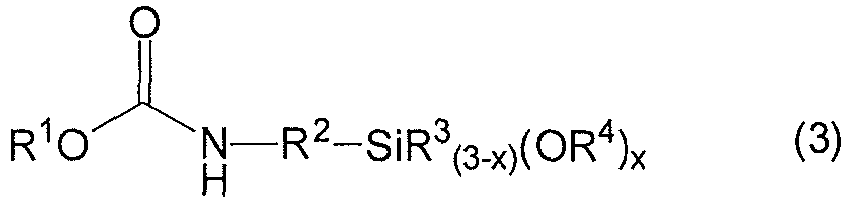 dans lequel un aminoorganosilane (AS) de formule générale (4),
NH2-R2-SiR3 (3-x)(OR4)x (4)
est transformé avec un carbonate de dialkyle (DAC) de formule générale (5), en présence d'un catalyseur basique (K),R1, R3, R4 et R5 pouvant être identiques ou différents et représentant à chaque fois un radical hydrocarboné monovalent, non substitué ou substitué,R2 représentant un radical hydrocarboné divalent, non substitué ou substitué, etx signifiant un nombre 1, 2 ou 3,dans lequel, il existe, pendant la réaction, une période (P1), au cours de laquelle la température de réaction se situe, pendant une durée d'au moins 30 minutes, dans une plage de 45 à 65 °C et il existe une période de réaction (P2) ultérieure dans le temps, au cours de laquelle la température de réaction se situe entre 70 et 130 °C et est supérieure d'au moins 15 °C à celle pendant la période (P1) .
 - Procédé selon la revendication 1, dans lequel le radical R5 représente un radical hydrocarboné non substitué monovalent comprenant 1 à 6 atomes de carbone.
- Procédé selon l'une quelconque des revendications précédentes, dans lequel le radical R4 représente un radical alkyle non substitué comprenant 1 à 4 atomes de carbone.
- Procédé selon l'une quelconque des revendications précédentes, dans lequel le radical R2 représente un radical alkylène non substitué comprenant un à 6 atomes de carbone.
- Procédé selon l'une quelconque des revendications précédentes, dans lequel la température pendant la période de réaction (P2) est supérieure d'au moins 20°C à celle pendant la période antérieure (P1).
- Procédé selon l'une quelconque des revendications précédentes, dans lequel les aminosilanes (AS) de formule générale (4) et les carbonates de dialkyle (DAC) de formule générale (5) sont utilisés en un rapport de 1,0:1,0 à 1,0:2,0.
- Procédé selon l'une quelconque des revendications précédentes, dans lequel on utilise, comme catalyseur (K), des alcoolates de métal.
- Procédé selon l'une quelconque des revendications précédentes, dans lequel la teneur en catalyseur (K) est d'au plus 0,2 % en poids, par rapport au poids de la totalité du mélange réactionnel.
Applications Claiming Priority (2)
| Application Number | Priority Date | Filing Date | Title |
|---|---|---|---|
| DE102013218972.9A DE102013218972A1 (de) | 2013-09-20 | 2013-09-20 | Verfahren zur Herstellung von Carbamatoorganosilanen |
| PCT/EP2014/069818 WO2015040070A1 (fr) | 2013-09-20 | 2014-09-17 | Procédé de préparation de carbamatoorganosilanes |
Publications (3)
| Publication Number | Publication Date |
|---|---|
| EP3046925A1 EP3046925A1 (fr) | 2016-07-27 |
| EP3046925B1 EP3046925B1 (fr) | 2017-05-31 |
| EP3046925B2 true EP3046925B2 (fr) | 2024-10-16 |
Family
ID=51589283
Family Applications (1)
| Application Number | Title | Priority Date | Filing Date |
|---|---|---|---|
| EP14771839.9A Active EP3046925B2 (fr) | 2013-09-20 | 2014-09-17 | Procédé de préparation de carbamatoorganosilanes |
Country Status (4)
| Country | Link |
|---|---|
| US (1) | US9914744B2 (fr) |
| EP (1) | EP3046925B2 (fr) |
| DE (1) | DE102013218972A1 (fr) |
| WO (1) | WO2015040070A1 (fr) |
Families Citing this family (4)
| Publication number | Priority date | Publication date | Assignee | Title |
|---|---|---|---|---|
| JP6631407B2 (ja) * | 2016-05-20 | 2020-01-15 | 信越化学工業株式会社 | カルバマトアルキルシランの製造方法 |
| EP3263616B8 (fr) * | 2016-06-27 | 2020-01-15 | Evonik Operations GmbH | Moyens de revêtement fonctionnalisés par un alkoxysilane et contenant un allophanate |
| EP3263618A1 (fr) * | 2016-06-27 | 2018-01-03 | Evonik Degussa GmbH | Allophanates fonctionnalisés avec des alokoxysilanes |
| CN111732604B (zh) * | 2020-04-29 | 2024-03-29 | 浙江皇马科技股份有限公司 | 一种3-三甲氧基硅烷氨基甲酸甲酯的制备方法 |
Citations (1)
| Publication number | Priority date | Publication date | Assignee | Title |
|---|---|---|---|---|
| US5218133A (en) † | 1992-08-20 | 1993-06-08 | Union Carbide Chemicals & Plastics Technology Corporation | Process for making a silylisocyanurate |
Family Cites Families (5)
| Publication number | Priority date | Publication date | Assignee | Title |
|---|---|---|---|---|
| US5220047A (en) | 1990-09-17 | 1993-06-15 | Union Carbide Chemicals & Plastics Technology Corporation | Carbamate silicon compounds as latent coupling agents and process for preparation and use |
| US6284911B1 (en) * | 1999-06-29 | 2001-09-04 | Wright Chemical Corporation | Synthesis of vinyl carbonates for use in producing vinyl carbamates |
| US6673954B1 (en) | 2003-02-19 | 2004-01-06 | General Electric Company | Process for the preparation of N-silylorganocarbamates |
| US7060849B1 (en) | 2005-09-15 | 2006-06-13 | General Electric Company | Method for production of isocyanatosilanes |
| DE102006057118A1 (de) | 2006-12-04 | 2008-06-05 | Wacker Chemie Ag | Verfahren zur Herstellung von Isocyanatoorganosilanen |
-
2013
- 2013-09-20 DE DE102013218972.9A patent/DE102013218972A1/de not_active Withdrawn
-
2014
- 2014-09-17 EP EP14771839.9A patent/EP3046925B2/fr active Active
- 2014-09-17 US US15/023,374 patent/US9914744B2/en active Active
- 2014-09-17 WO PCT/EP2014/069818 patent/WO2015040070A1/fr not_active Ceased
Patent Citations (1)
| Publication number | Priority date | Publication date | Assignee | Title |
|---|---|---|---|---|
| US5218133A (en) † | 1992-08-20 | 1993-06-08 | Union Carbide Chemicals & Plastics Technology Corporation | Process for making a silylisocyanurate |
Also Published As
| Publication number | Publication date |
|---|---|
| EP3046925A1 (fr) | 2016-07-27 |
| US20160200745A1 (en) | 2016-07-14 |
| EP3046925B1 (fr) | 2017-05-31 |
| DE102013218972A1 (de) | 2015-03-26 |
| US9914744B2 (en) | 2018-03-13 |
| WO2015040070A1 (fr) | 2015-03-26 |
Similar Documents
| Publication | Publication Date | Title |
|---|---|---|
| EP3221324B1 (fr) | Préparation d'organosilanes à fonctionnalité isocyanate | |
| DE69104312T2 (de) | Verfahren zur Herstellung von Hydroxyamiden. | |
| EP0638575B1 (fr) | Procédé de préparation de diorganodialcoxysilanes | |
| EP3046925B2 (fr) | Procédé de préparation de carbamatoorganosilanes | |
| EP2748148A1 (fr) | Procédé de purification de pyrazoles | |
| DE2349496A1 (de) | Verfahren zur herstellung von dl-threobeta-p-methylsulfonylphenylserinderivaten | |
| EP3655413B1 (fr) | Fabrication de glufosinate par conversion de 3-[n-butoxy(méthyl)phosphoryl]-1-cyanopropylacétate en une mélange de n-butyl(3-amino-3-cyanopropyl)-méthylphosphinate et la sel d'ammonium d'acid phosphinique (3-amino-3-cyanopropyl)-méthyl | |
| AT391691B (de) | Verfahren zur herstellung von kohlensaeureestern, die sich von ungesaettigten alkoholen und mehrwertigen alkoholen ableiten | |
| EP2455385B1 (fr) | Procédé de fabrication de carbamato-organosilanes | |
| CH702298B1 (de) | Verfahren zur Herstellung von Cyanoalkylpropionat-Derivaten. | |
| WO2018137874A1 (fr) | Procédé de préparation d'acide dihydrolipoïque | |
| DE102012210556A1 (de) | Verfahren zur Reduktion von Carbonsäureestern oder –lactonen | |
| CH661928A5 (de) | Verfahren zur herstellung funktionell substituierter silane. | |
| EP0845470A2 (fr) | Procédé continu pour la préparation de carbonyloxysilanes | |
| DE3303815C2 (fr) | ||
| EP2072499B1 (fr) | Procédé de fabrication de l'éster dialkyle de l'acide thiodiglycolique | |
| EP2139863A2 (fr) | Procédé de production d'esters d'acide (méth)acrylique d'imidazoles n-hydroxyalkylés | |
| DE69011977T2 (de) | In bezug auf die Umwelt sicheres Verfahren zur Herstellung eines bestimmten Dialkylamins. | |
| EP0076379B1 (fr) | Procédé de préparation des esters d'acides 4-alkoxyacétylacétiques | |
| DE19941283A1 (de) | Verfahren zur Herstellung von chloridarmen oder chloridfreien Alkoxysilanen | |
| DE4009709A1 (de) | Optisch aktive verbindung und verfahren zu ihrer herstellung | |
| DE69813388T2 (de) | Verfahren zur Herstellung von 2,4-Oxazolidindion | |
| DE2117028A1 (de) | Verfahren zum Silylieren von organi sehen Verbindungen | |
| EP0193066B1 (fr) | Cétosultames et leur procédé de préparation | |
| EP0107132B1 (fr) | Procédé de préparation d'acides hydroxy-1 alcanephosphoniques-1 |
Legal Events
| Date | Code | Title | Description |
|---|---|---|---|
| PUAI | Public reference made under article 153(3) epc to a published international application that has entered the european phase |
Free format text: ORIGINAL CODE: 0009012 |
|
| 17P | Request for examination filed |
Effective date: 20160315 |
|
| AK | Designated contracting states |
Kind code of ref document: A1 Designated state(s): AL AT BE BG CH CY CZ DE DK EE ES FI FR GB GR HR HU IE IS IT LI LT LU LV MC MK MT NL NO PL PT RO RS SE SI SK SM TR |
|
| AX | Request for extension of the european patent |
Extension state: BA ME |
|
| DAX | Request for extension of the european patent (deleted) | ||
| GRAP | Despatch of communication of intention to grant a patent |
Free format text: ORIGINAL CODE: EPIDOSNIGR1 |
|
| STAA | Information on the status of an ep patent application or granted ep patent |
Free format text: STATUS: GRANT OF PATENT IS INTENDED |
|
| INTG | Intention to grant announced |
Effective date: 20170215 |
|
| GRAS | Grant fee paid |
Free format text: ORIGINAL CODE: EPIDOSNIGR3 |
|
| GRAA | (expected) grant |
Free format text: ORIGINAL CODE: 0009210 |
|
| STAA | Information on the status of an ep patent application or granted ep patent |
Free format text: STATUS: THE PATENT HAS BEEN GRANTED |
|
| AK | Designated contracting states |
Kind code of ref document: B1 Designated state(s): AL AT BE BG CH CY CZ DE DK EE ES FI FR GB GR HR HU IE IS IT LI LT LU LV MC MK MT NL NO PL PT RO RS SE SI SK SM TR |
|
| REG | Reference to a national code |
Ref country code: CH Ref legal event code: EP Ref country code: GB Ref legal event code: FG4D Free format text: NOT ENGLISH |
|
| REG | Reference to a national code |
Ref country code: AT Ref legal event code: REF Ref document number: 897358 Country of ref document: AT Kind code of ref document: T Effective date: 20170615 |
|
| REG | Reference to a national code |
Ref country code: IE Ref legal event code: FG4D Free format text: LANGUAGE OF EP DOCUMENT: GERMAN |
|
| REG | Reference to a national code |
Ref country code: DE Ref legal event code: R096 Ref document number: 502014004045 Country of ref document: DE |
|
| REG | Reference to a national code |
Ref country code: NL Ref legal event code: FP |
|
| REG | Reference to a national code |
Ref country code: FR Ref legal event code: PLFP Year of fee payment: 4 |
|
| REG | Reference to a national code |
Ref country code: LT Ref legal event code: MG4D |
|
| PG25 | Lapsed in a contracting state [announced via postgrant information from national office to epo] |
Ref country code: ES Free format text: LAPSE BECAUSE OF FAILURE TO SUBMIT A TRANSLATION OF THE DESCRIPTION OR TO PAY THE FEE WITHIN THE PRESCRIBED TIME-LIMIT Effective date: 20170531 Ref country code: FI Free format text: LAPSE BECAUSE OF FAILURE TO SUBMIT A TRANSLATION OF THE DESCRIPTION OR TO PAY THE FEE WITHIN THE PRESCRIBED TIME-LIMIT Effective date: 20170531 Ref country code: HR Free format text: LAPSE BECAUSE OF FAILURE TO SUBMIT A TRANSLATION OF THE DESCRIPTION OR TO PAY THE FEE WITHIN THE PRESCRIBED TIME-LIMIT Effective date: 20170531 Ref country code: NO Free format text: LAPSE BECAUSE OF FAILURE TO SUBMIT A TRANSLATION OF THE DESCRIPTION OR TO PAY THE FEE WITHIN THE PRESCRIBED TIME-LIMIT Effective date: 20170831 Ref country code: LT Free format text: LAPSE BECAUSE OF FAILURE TO SUBMIT A TRANSLATION OF THE DESCRIPTION OR TO PAY THE FEE WITHIN THE PRESCRIBED TIME-LIMIT Effective date: 20170531 Ref country code: GR Free format text: LAPSE BECAUSE OF FAILURE TO SUBMIT A TRANSLATION OF THE DESCRIPTION OR TO PAY THE FEE WITHIN THE PRESCRIBED TIME-LIMIT Effective date: 20170901 |
|
| PG25 | Lapsed in a contracting state [announced via postgrant information from national office to epo] |
Ref country code: SE Free format text: LAPSE BECAUSE OF FAILURE TO SUBMIT A TRANSLATION OF THE DESCRIPTION OR TO PAY THE FEE WITHIN THE PRESCRIBED TIME-LIMIT Effective date: 20170531 Ref country code: BG Free format text: LAPSE BECAUSE OF FAILURE TO SUBMIT A TRANSLATION OF THE DESCRIPTION OR TO PAY THE FEE WITHIN THE PRESCRIBED TIME-LIMIT Effective date: 20170831 Ref country code: RS Free format text: LAPSE BECAUSE OF FAILURE TO SUBMIT A TRANSLATION OF THE DESCRIPTION OR TO PAY THE FEE WITHIN THE PRESCRIBED TIME-LIMIT Effective date: 20170531 Ref country code: IS Free format text: LAPSE BECAUSE OF FAILURE TO SUBMIT A TRANSLATION OF THE DESCRIPTION OR TO PAY THE FEE WITHIN THE PRESCRIBED TIME-LIMIT Effective date: 20170930 Ref country code: LV Free format text: LAPSE BECAUSE OF FAILURE TO SUBMIT A TRANSLATION OF THE DESCRIPTION OR TO PAY THE FEE WITHIN THE PRESCRIBED TIME-LIMIT Effective date: 20170531 |
|
| PG25 | Lapsed in a contracting state [announced via postgrant information from national office to epo] |
Ref country code: RO Free format text: LAPSE BECAUSE OF FAILURE TO SUBMIT A TRANSLATION OF THE DESCRIPTION OR TO PAY THE FEE WITHIN THE PRESCRIBED TIME-LIMIT Effective date: 20170531 Ref country code: SK Free format text: LAPSE BECAUSE OF FAILURE TO SUBMIT A TRANSLATION OF THE DESCRIPTION OR TO PAY THE FEE WITHIN THE PRESCRIBED TIME-LIMIT Effective date: 20170531 Ref country code: EE Free format text: LAPSE BECAUSE OF FAILURE TO SUBMIT A TRANSLATION OF THE DESCRIPTION OR TO PAY THE FEE WITHIN THE PRESCRIBED TIME-LIMIT Effective date: 20170531 Ref country code: CZ Free format text: LAPSE BECAUSE OF FAILURE TO SUBMIT A TRANSLATION OF THE DESCRIPTION OR TO PAY THE FEE WITHIN THE PRESCRIBED TIME-LIMIT Effective date: 20170531 Ref country code: DK Free format text: LAPSE BECAUSE OF FAILURE TO SUBMIT A TRANSLATION OF THE DESCRIPTION OR TO PAY THE FEE WITHIN THE PRESCRIBED TIME-LIMIT Effective date: 20170531 |
|
| PG25 | Lapsed in a contracting state [announced via postgrant information from national office to epo] |
Ref country code: IT Free format text: LAPSE BECAUSE OF FAILURE TO SUBMIT A TRANSLATION OF THE DESCRIPTION OR TO PAY THE FEE WITHIN THE PRESCRIBED TIME-LIMIT Effective date: 20170531 Ref country code: PL Free format text: LAPSE BECAUSE OF FAILURE TO SUBMIT A TRANSLATION OF THE DESCRIPTION OR TO PAY THE FEE WITHIN THE PRESCRIBED TIME-LIMIT Effective date: 20170531 Ref country code: SM Free format text: LAPSE BECAUSE OF FAILURE TO SUBMIT A TRANSLATION OF THE DESCRIPTION OR TO PAY THE FEE WITHIN THE PRESCRIBED TIME-LIMIT Effective date: 20170531 |
|
| REG | Reference to a national code |
Ref country code: DE Ref legal event code: R026 Ref document number: 502014004045 Country of ref document: DE |
|
| PLBI | Opposition filed |
Free format text: ORIGINAL CODE: 0009260 |
|
| PLAX | Notice of opposition and request to file observation + time limit sent |
Free format text: ORIGINAL CODE: EPIDOSNOBS2 |
|
| 26 | Opposition filed |
Opponent name: MOMENTIVE PERFORMANCE MATERIALS, INC. Effective date: 20180228 |
|
| REG | Reference to a national code |
Ref country code: CH Ref legal event code: PL |
|
| PG25 | Lapsed in a contracting state [announced via postgrant information from national office to epo] |
Ref country code: MC Free format text: LAPSE BECAUSE OF FAILURE TO SUBMIT A TRANSLATION OF THE DESCRIPTION OR TO PAY THE FEE WITHIN THE PRESCRIBED TIME-LIMIT Effective date: 20170531 |
|
| REG | Reference to a national code |
Ref country code: IE Ref legal event code: MM4A |
|
| PG25 | Lapsed in a contracting state [announced via postgrant information from national office to epo] |
Ref country code: LU Free format text: LAPSE BECAUSE OF NON-PAYMENT OF DUE FEES Effective date: 20170917 |
|
| PLBB | Reply of patent proprietor to notice(s) of opposition received |
Free format text: ORIGINAL CODE: EPIDOSNOBS3 |
|
| PG25 | Lapsed in a contracting state [announced via postgrant information from national office to epo] |
Ref country code: IE Free format text: LAPSE BECAUSE OF NON-PAYMENT OF DUE FEES Effective date: 20170917 Ref country code: CH Free format text: LAPSE BECAUSE OF NON-PAYMENT OF DUE FEES Effective date: 20170930 Ref country code: LI Free format text: LAPSE BECAUSE OF NON-PAYMENT OF DUE FEES Effective date: 20170930 |
|
| REG | Reference to a national code |
Ref country code: FR Ref legal event code: PLFP Year of fee payment: 5 |
|
| PG25 | Lapsed in a contracting state [announced via postgrant information from national office to epo] |
Ref country code: MT Free format text: LAPSE BECAUSE OF FAILURE TO SUBMIT A TRANSLATION OF THE DESCRIPTION OR TO PAY THE FEE WITHIN THE PRESCRIBED TIME-LIMIT Effective date: 20170531 |
|
| GBPC | Gb: european patent ceased through non-payment of renewal fee |
Effective date: 20180917 |
|
| PG25 | Lapsed in a contracting state [announced via postgrant information from national office to epo] |
Ref country code: HU Free format text: LAPSE BECAUSE OF FAILURE TO SUBMIT A TRANSLATION OF THE DESCRIPTION OR TO PAY THE FEE WITHIN THE PRESCRIBED TIME-LIMIT; INVALID AB INITIO Effective date: 20140917 |
|
| PG25 | Lapsed in a contracting state [announced via postgrant information from national office to epo] |
Ref country code: SI Free format text: LAPSE BECAUSE OF FAILURE TO SUBMIT A TRANSLATION OF THE DESCRIPTION OR TO PAY THE FEE WITHIN THE PRESCRIBED TIME-LIMIT Effective date: 20170531 |
|
| PG25 | Lapsed in a contracting state [announced via postgrant information from national office to epo] |
Ref country code: CY Free format text: LAPSE BECAUSE OF FAILURE TO SUBMIT A TRANSLATION OF THE DESCRIPTION OR TO PAY THE FEE WITHIN THE PRESCRIBED TIME-LIMIT Effective date: 20170531 Ref country code: GB Free format text: LAPSE BECAUSE OF NON-PAYMENT OF DUE FEES Effective date: 20180917 |
|
| PG25 | Lapsed in a contracting state [announced via postgrant information from national office to epo] |
Ref country code: MK Free format text: LAPSE BECAUSE OF FAILURE TO SUBMIT A TRANSLATION OF THE DESCRIPTION OR TO PAY THE FEE WITHIN THE PRESCRIBED TIME-LIMIT Effective date: 20170531 |
|
| PG25 | Lapsed in a contracting state [announced via postgrant information from national office to epo] |
Ref country code: TR Free format text: LAPSE BECAUSE OF FAILURE TO SUBMIT A TRANSLATION OF THE DESCRIPTION OR TO PAY THE FEE WITHIN THE PRESCRIBED TIME-LIMIT Effective date: 20170531 |
|
| APBM | Appeal reference recorded |
Free format text: ORIGINAL CODE: EPIDOSNREFNO |
|
| APBP | Date of receipt of notice of appeal recorded |
Free format text: ORIGINAL CODE: EPIDOSNNOA2O |
|
| APAH | Appeal reference modified |
Free format text: ORIGINAL CODE: EPIDOSCREFNO |
|
| PG25 | Lapsed in a contracting state [announced via postgrant information from national office to epo] |
Ref country code: PT Free format text: LAPSE BECAUSE OF FAILURE TO SUBMIT A TRANSLATION OF THE DESCRIPTION OR TO PAY THE FEE WITHIN THE PRESCRIBED TIME-LIMIT Effective date: 20170531 |
|
| APBQ | Date of receipt of statement of grounds of appeal recorded |
Free format text: ORIGINAL CODE: EPIDOSNNOA3O |
|
| PG25 | Lapsed in a contracting state [announced via postgrant information from national office to epo] |
Ref country code: AL Free format text: LAPSE BECAUSE OF FAILURE TO SUBMIT A TRANSLATION OF THE DESCRIPTION OR TO PAY THE FEE WITHIN THE PRESCRIBED TIME-LIMIT Effective date: 20170531 |
|
| REG | Reference to a national code |
Ref country code: AT Ref legal event code: MM01 Ref document number: 897358 Country of ref document: AT Kind code of ref document: T Effective date: 20190917 |
|
| PG25 | Lapsed in a contracting state [announced via postgrant information from national office to epo] |
Ref country code: AT Free format text: LAPSE BECAUSE OF NON-PAYMENT OF DUE FEES Effective date: 20190917 |
|
| APBU | Appeal procedure closed |
Free format text: ORIGINAL CODE: EPIDOSNNOA9O |
|
| PLAY | Examination report in opposition despatched + time limit |
Free format text: ORIGINAL CODE: EPIDOSNORE2 |
|
| PLBC | Reply to examination report in opposition received |
Free format text: ORIGINAL CODE: EPIDOSNORE3 |
|
| PLAP | Information related to despatch of examination report in opposition + time limit deleted |
Free format text: ORIGINAL CODE: EPIDOSDORE2 |
|
| PLAT | Information related to reply to examination report in opposition deleted |
Free format text: ORIGINAL CODE: EPIDOSDORE3 |
|
| PLAY | Examination report in opposition despatched + time limit |
Free format text: ORIGINAL CODE: EPIDOSNORE2 |
|
| PLBC | Reply to examination report in opposition received |
Free format text: ORIGINAL CODE: EPIDOSNORE3 |
|
| RAP4 | Party data changed (patent owner data changed or rights of a patent transferred) |
Owner name: WACKER CHEMIE AG |
|
| REG | Reference to a national code |
Ref country code: DE Ref legal event code: R081 Ref document number: 502014004045 Country of ref document: DE Owner name: WACKER CHEMIE AG, DE Free format text: FORMER OWNER: WACKER CHEMIE AG, 81737 MUENCHEN, DE |
|
| PUAH | Patent maintained in amended form |
Free format text: ORIGINAL CODE: 0009272 |
|
| STAA | Information on the status of an ep patent application or granted ep patent |
Free format text: STATUS: PATENT MAINTAINED AS AMENDED |
|
| 27A | Patent maintained in amended form |
Effective date: 20241016 |
|
| AK | Designated contracting states |
Kind code of ref document: B2 Designated state(s): AL AT BE BG CH CY CZ DE DK EE ES FI FR GB GR HR HU IE IS IT LI LT LU LV MC MK MT NL NO PL PT RO RS SE SI SK SM TR |
|
| REG | Reference to a national code |
Ref country code: DE Ref legal event code: R102 Ref document number: 502014004045 Country of ref document: DE |
|
| P01 | Opt-out of the competence of the unified patent court (upc) registered |
Free format text: CASE NUMBER: UPC_APP_119511/2023 Effective date: 20230510 |
|
| REG | Reference to a national code |
Ref country code: NL Ref legal event code: FP |
|
| PGFP | Annual fee paid to national office [announced via postgrant information from national office to epo] |
Ref country code: DE Payment date: 20250919 Year of fee payment: 12 |
|
| PGFP | Annual fee paid to national office [announced via postgrant information from national office to epo] |
Ref country code: NL Payment date: 20250918 Year of fee payment: 12 |
|
| PGFP | Annual fee paid to national office [announced via postgrant information from national office to epo] |
Ref country code: BE Payment date: 20250918 Year of fee payment: 12 |
|
| PGFP | Annual fee paid to national office [announced via postgrant information from national office to epo] |
Ref country code: FR Payment date: 20250922 Year of fee payment: 12 |