EP3047728A1 - Dispositif d'alimentation, sa programmation et son utilisation pour l'alimentation de porcelets et procédé d'alimentation des animaux - Google Patents
Dispositif d'alimentation, sa programmation et son utilisation pour l'alimentation de porcelets et procédé d'alimentation des animaux Download PDFInfo
- Publication number
- EP3047728A1 EP3047728A1 EP16152081.2A EP16152081A EP3047728A1 EP 3047728 A1 EP3047728 A1 EP 3047728A1 EP 16152081 A EP16152081 A EP 16152081A EP 3047728 A1 EP3047728 A1 EP 3047728A1
- Authority
- EP
- European Patent Office
- Prior art keywords
- dosing
- feed
- curve
- microprocessor
- tilt
- Prior art date
- Legal status (The legal status is an assumption and is not a legal conclusion. Google has not performed a legal analysis and makes no representation as to the accuracy of the status listed.)
- Granted
Links
Images



Classifications
-
- A—HUMAN NECESSITIES
- A01—AGRICULTURE; FORESTRY; ANIMAL HUSBANDRY; HUNTING; TRAPPING; FISHING
- A01K—ANIMAL HUSBANDRY; AVICULTURE; APICULTURE; PISCICULTURE; FISHING; REARING OR BREEDING ANIMALS, NOT OTHERWISE PROVIDED FOR; NEW BREEDS OF ANIMALS
- A01K5/00—Feeding devices for stock or game ; Feeding wagons; Feeding stacks
- A01K5/02—Automatic devices
- A01K5/0275—Automatic devices with mechanisms for delivery of measured doses
-
- A—HUMAN NECESSITIES
- A01—AGRICULTURE; FORESTRY; ANIMAL HUSBANDRY; HUNTING; TRAPPING; FISHING
- A01K—ANIMAL HUSBANDRY; AVICULTURE; APICULTURE; PISCICULTURE; FISHING; REARING OR BREEDING ANIMALS, NOT OTHERWISE PROVIDED FOR; NEW BREEDS OF ANIMALS
- A01K5/00—Feeding devices for stock or game ; Feeding wagons; Feeding stacks
- A01K5/02—Automatic devices
- A01K5/0258—Automatic devices with endless screws
Definitions
- the present invention relates to a feeder for periodic dispensing of dry-feed to animals, especially piglet, where the dosing is done automatically according to a preprogrammed dosing-sequence.
- the invention also relates to use and programming of such a feeder and a method of feeding animals, especially piglets.
- German patent document DE3738156 discloses a number of feeders with a screw conveyor in the bottom of the feeders for dispensing feed.
- the screw conveyor of each feeder is driven by an actuator which by cable is connected to a control at a distance to the feeder.
- Each of the control units is electrically connected to a respective actuator and collectively electronically connected to a common central computer for controlling different feeders. This has the advantage that the feeding by a feeder can be carefully adapted to the individual animals or groups of animals.
- the feeder is programmed for periodic dispensing of dry-feed for animals.
- dry-feed includes pelleted or granulated feed and feed in powdered form; and the term dry-feed is also used here for vitamin supplements, which, for example, are provided for piglets as powder in their first 8-10 days of life before supply of regular dry-feed.
- the feeder comprises a feed container for accommodating the dry-feed and comprises a mechanical dosing device, for example a conveyor screw, which when activated is configured for dispensing dry-feed from the feed container to a feed outlet, for example a spout, which ends at a feeding location, accessible to one or a plurality of animals.
- the feeder also includes a control module with a microprocessor that is digitally connected to a digital data memory.
- the control unit for example provided at or on the feed container, is functionally connected to the dosing device for periodic activation and de-activation of it in order to dispense predetermined portions of the dry-feed according to a preprogrammed dosing-sequence stored in the digital data memory and executed by the microprocessor.
- the dry-feed is dispensed several times daily to the animals, for example pigs, sows, poultry, horses, cattle, mink or fish.
- the feeder is universal and can be used for many different animals.
- the feeder is used to feed special rations to calves, lambs or other young animals or to give fish vitamin and mineral supplements. Special attention is given its use for the rearing of piglets, which is described in greater detail below by way of example.
- the use of the feeder or method is not limited to piglets, only.
- the dosing-sequence follows a predetermined dosing-curve, also called the feeding curve, over a period, for example a period of several days, weeks or months, with dosing amounts that vary in dependence of the moment of dispense within this period.
- the dosing-curve can be represented by a curve in a coordinate system having a first axis with an abscissa representing time, for example number of days from a start date, and a second axis with an ordinate representing the amount of food per feeding, for example feed weight or feed volume; or the ordinate is given by an arbitrary scaling factor.
- the shape of a specific dosing-curve is fixed but the dosing-curve can be shifted vertically in the coordinate system in dependence on the number of pigs or other animals in the pen or other factors that require increasing or decreasing the feed per feeding.
- the control module includes a display and a keypad in electronic connection with the microprocessor. By the keypad, programming of the microprocessor can be performed, and the display provides a status message or a feedback when programming. It is known to program a computer for controlling the feed installations with regard to the dosing. However, in order to facilitate the task of programming and to meet the farmers or the staff who do not have the expertise or motivation to undertake conventional and relatively complex programming in a typical computer-controlled feeding installation, there is hereinafter provided an improvement by simplifying the programming to very few required steps that are intuitively clear and easy to understand and carry out, particularly in relation to rearing of piglets but also in relation to rearing of other animals.
- the keypad comprises a pushbutton or tilt-switch for programming the microprocessor such that only a single press on the pushbutton or a simple tilt of the tilt-switch results in a programming of the microprocessor to increase the dosing amount for the predetermined dosing-curve by a predetermined value, for example a relative percentage of a basic value, without changing the general trajectory of the dosing-curve.
- a predetermined value for example a relative percentage of a basic value
- a pushbutton or tilt-switch either the same or another pushbutton, such that only a single press on the pushbutton or a simple tilt of the tilt-switch results in a programming of the microprocessor to decrease the dosing amount for the predetermined dosing-curve by a predetermined value without changing the general trajectory of the dosing-curve.
- the result of the press of such a second pushbutton or tilt of the tilt-switch can then be understood accordingly as a step-wise displacement of the entire dosing-curve towards a lower dosing amount. For example, multiple presses or tilts lead to multiple displacements of the dosing-curve.
- An example of an embodiment in which the same pushbutton is used to increase or decrease the dosing amount comprises a tilt-switch in addition to the pushbutton, wherein the tilt-switch is in a first orientation for increasing the dosing amount, for example, an upward orientation of the tilt-switch, and in a second orientation for decreasing the amount, for example, a downward orientation, and where a single press of one pushbutton increases or decreases, respectively, the dosing amount, depending on the orientation of the tilt-switch.
- Another example of an embodiment in which the same pushbutton is used to increase or decrease the dosing amount comprises pushbutton in which a short press shifts the dosing-curve towards a higher dosing amount and a long press shifts the dosing-curve towards a lower dosing amount.
- buttons on the keypad or even only a single tilt-switch by which the service personnel or the farmer can increase or decrease the feed supply by a predetermined factor or a predetermined relative amount relatively to a normal value.
- a simple press of a pushbutton for example a pushbutton with an upward arrow, in the keypad implies that the curve's values are increased by a certain percentage
- pressing another pushbutton for example a pushbutton with a downward arrow, in the keypad implies a reduction of the curve's values by a certain percentage
- the percentage is 5% or 10% of the curve's basic values.
- three presses on an upward arrow imply an increase by 3 times 10% to 130% of the curve's basic values.
- farmers can reduce the increased feed supply again by three presses on a downward arrow, which reduces the curve by 3 times 10% of the curve basic values. In this way, an extremely simple and intuitive programming of the microprocessor is achieved.
- an upward or downward tilt of a tilt-switch can result in increase, respectively, decrease of the feed supply.
- Such increase or decrease of the dosing amount without changing the general trajectory of the dosing-curve if, optionally, related to predetermined levels of the dosing-curve. For example, a change towards high or lower dosing amounts shifts the curve between predetermined levels but keep the general shape of the curve.
- a single pushbutton is used to increase or decrease the feed supply by a predetermined factor, or a predetermined relative amount from a normal value.
- the feed can be increased by vertical shift of the dosing-curve in a number of levels, for example level 0 to 9, in a cyclic manner. This means that the levels are increased step-wise by repeated presses until a maximum value, for example level 9, after which a further press leads to a shift of the curve to a minimum value, for example level 0, after which further repeated presses increase the level of the curve again.
- a base curve has level 5 with the possibility of increasing or decreasing the level, as needed.
- Such an increase or decrease of the feed supply may be needed if the number of piglets in a pen increases or decreases or if the piglets have diarrhea, or there break out other diseases in the pen.
- the two pushbuttons are arranged such that simultaneous pressing of both pushbuttons deletes a performed programming in order to return to the original programming.
- the same two pushbuttons are used for selecting functions in a function menu, for example, to select among other curve trajectories.
- buttons with an indicator such as an upward or downward arrow, for respectively increasing or decreasing the feed supply with a specific value
- buttons in their appearance clearly differ from the two pushbuttons with the indicators.
- a keypad with only two buttons which simplifies the feeding process for the user.
- the display is in this case arranged to indicate this increase or decrease.
- the display is only used for indicating a level of the dosing-curve.
- the display indicates also the current feeding-day on the curve, where the curve starts at day-number 1 and continues until a maximum day-number, for example 21, 28 or 35 days.
- the display can also specify these other functions.
- a third pushbutton or tilt-switch for switching between functions, where one of the features is a choice between several preset dosing-curves with different shapes. It gives the farmer or the staff the opportunity to choose among a variety of dosing-curves in the microprocessor and the option to choose the level of feed supply.
- a selection can be made between the different dosing-curves only by using the two pushbuttons or the tilt-switch. For example, a long press causes switching between dosing-curves, while a short press causes an step-wise level change of the dosing-curve and thereby increases respectively decreases the feed supply.
- the keypad is adapted to only being able to be used to adjust the level of a dosing-curve up and down. In other embodiments, it is also possible on the keypad to select a particular among multiple dosing-curve trajectories. Optionally, there is no possibility of other functions on the keypad. This makes operation very simple.
- a pushbutton is used to select the start day-number on the curve.
- the feeder shall not necessarily start with day-number 1 on the dosing-curve, it is advantageous to be able to choose the day-number at which the feed curve should start or continue.
- a new feeder that is to be used in a pen of piglets that are 10 days of age, the curve should not start from the beginning but begin at the curve's tenth day.
- the feeder is provided with a second button, for example the second of two buttons, which is used to adjust the day-number of the curve.
- the feeder comprises only two pushbuttons or tilt-switches, one of which relates to the vertical shift of the curve and the other to the selection of the day-number in the feeding curve.
- the pushbuttons are, respectively, configured for stepwise increasing/decreasing the level of the curve and the day-number on the curve. Selecting a curve level and a day-number takes place in a cyclic manner during repeated pressing, such that a numerical sequence, for example from 0 to 9 for the curve level and from 1 to 28 or 1 to 35 for the day-number, starts again when the minimum or maximum level is reached, depending on whether a press increases or decreases the curve level curve or day-number.
- control module also comprises a wireless transmitter in electronic connection to the microprocessor and configured for receiving the dosing-sequence as digital data from a computer.
- the microprocessor is configured for storing the received dosing-sequence in the data memory.
- a dosing-curve is transferred wirelessly in the form of a dosing-sequence from a central computer or another computer, for example a smartphone, to the control module.
- the display and keypad are advantageously located at or on the feed container or in the immediate vicinity, for example, at a distance of less than three meters from the feed container. It is then advantageous if the feed container is visible from the display and the keypad.
- control module comprises an outer shell which houses the display and the keypad and is disposed at or on an outer side of the feed container.
- the control module comprises an outer shell which houses the display and the keypad and is disposed at or on an outer side of the feed container.
- the outer shell also houses the microprocessor, data memory, and an actuator that is mechanically connected to the dosing device, for example a conveyor screw, and wherein the actuator is functionally connected to the microprocessor.
- the microprocessor is then arranged to start and stop the actuator according to the dosing-program stored in the data memory.
- the dosing device is a conveyor screw provided in the feed container, one end of the conveyor screw being mechanically connected to the actuator in the outer shell and the opposite end of the conveyor screw being provided at a feed outlet, for example connected to the feed outlet.
- a stirring element in the feed container is advantageous for stirring the dry-feed, so as to prevent clogging.
- the stirring element is also driven by the actuator.
- the stirring element comprises a wheel with shovels or pegs, for instance resilient pegs, that during rotation of the wheel shovel through the dry-feed.
- the stirring element for example the wheel, may be provided removably so that it can be installed or removed from the feed container according to the type of dry-feed.
- the stirring element comprises a sprocket wheel having teeth engaged with the screw conveyor for rotation of the sprocket by rotation of the screw conveyor, wherein an arm, for example a flexible arm, is fastened to the sprocket for by rotation of the sprocket to shovel through the dry-feed.
- an arm for example a flexible arm
- an infrared sensor which is electronically connected to an alarm device that sends an alarm signal if the contents of the feed container drops below a predetermined level.
- an alarm is given as an audio signal or a visual signal or both.
- the infrared sensor is connected to the microprocessor.
- the alarm is transmitted to a central computer and/or to a smartphone, where the responsible person can read the alarm and take the necessary steps for refilling the dry-feed in the feed container.
- the feeder is of a general nature and the volume of the feed container can vary. In some embodiments, in particular for feed supplementing of piglets, the feed container has a volume of between 1 and 10 liters. In such cases, the feed containers are relatively small. However, the feeder principle is of general character and can be dimensioned as needed and according to the specific use. Also, in case that the sow must have a feed supplement with high vitamin content, there is only needed a relatively small feed container.
- control module contains one or more batteries, which drive the actuator and provide electric power to the electronics, particularly the microprocessor and data memory.
- batteries which drive the actuator and provide electric power to the electronics, particularly the microprocessor and data memory. This means that there is no necessity for other power sources, especially a power supply by cables. This makes installation easy and flexible.
- the battery or batteries are housed within the outer shell with the actuator and the electronic components. This technical solution is particularly applicable for relatively small versions of the feeder.
- feed supplement is given while there is no chance to suckle, the strongest piglets will also push the smaller away from the feed supplement, which means that the smallest piglets will neither get milk from the sow nor feed supplement from the feeder.
- the feed dispense must be adjusted so that it occurs simultaneously with the periods when the sow lies down to give milk. This means in practice that a feed-sequence must match the daily rhythm and also be in agreement with the increased need for supplements by the piglets during the first several weeks long period of growth.
- the feed supplement during the period in which there normally is being suckled, has the advantage that it accustoms the piglets to solid food. This prevents weight loss by the piglets lose in a transition phase.
- Possible sequences that follow the increased need for feeding during growth is an aspect of the dosing-curve that is discussed in the following with some examples, where the period is divided into a first part of the period, hereinafter exemplified as a first sub-period or a first phase and a second part of the period, hereinafter exemplified as a second sub-period, or second phase.
- the term sub-period and phase will, typically, not be identical and, typically, not have the same lengths.
- the dosing-curve has a shape which is convex (upwards hollow) in a first sub-period and concave (downwards hollow) in the second sub-period of the dosing-sequence.
- the first sub-period is typically between 25% and 75% of the entire period, for example between 50% and 70%.That implies in practice that the increase of feed rises during the first sub-period and is reduced again in the second sub-period. This way, the curve develops from a fairly flat form to a steeper curve before deflecting again towards a more flat form.
- the amount of daily dispensed dry-feed from the feeder according to the dosing-sequence increases in a first phase of the period with a first increase and in a second phase of the period with a second increase, wherein the second gain is significantly larger than the first increase, for example, at least two or at least three times as high as the first increase.
- the two phases are equally long or approximately equally long and divide the period into two halves.
- the dosing-curve is defined by a first approximately linear increase in a first phase and a subsequent second approximately linear increase in a second phase, wherein the second increase is significantly higher than the first increase.
- the slope of the approximate linear trajectory in the second phase is several times larger than in the first phase. In some cases, it is at least twice as large, for example at least 3 times as large or at least 5 times as large, or at least 8 times as large.
- the first phase extends over the first 9-13 days of the period where regular feed is supplied.
- the second phase extends over the rest of the period in which regular feed is supplied, for example over equally long time as the first phase. In combination, it is thus possible to have a simplified feeding curve in the two successive phases of the period, which is following substantially linear trajectories, where the linear trajectory in the second phase, however, has a significantly higher slope.
- the invention comprises the following method for automatically feeding animals, especially piglets, with a feeder that comprises a control module, a feed container and a mechanical dosing device for dispensing dosed volumes of dry-feed from the feed container.
- the feeder is advantageously of the type described above.
- the method then comprises programming a microprocessor in the control module for successive dosing of varying amounts of dry food over a period, for example several days, weeks, or even months, and the dispensing thereof from the feeder.
- This programming comprises storing these varying amounts of dry food as a dosing-sequence in a digital data memory that is electronically connected to the microprocessor, wherein the microprocessor is functionally connected to the mechanical dosing device and controls this by activation and de-activation for dispensing dry food according to the dosing-sequence.
- the period is divided into a first sub-period for feeding and in continuation thereof a second sub-period for feeding, which together constitute the period.
- the period is divided, as described above, into two phases, wherein the dosing-curve for feeding in each of the phases follows an approximately linear trajectory, however, in the second phase the linear trajectory being significantly steeper.
- this method is especially useful for feeding during breeding of piglets.
- the daily amounts in the dosing-sequence are divided into 8-12 portions dispensed between intervals of two to three hours in order to follow a pattern of a sow's milk delivery to piglets.
- vitamins in powder form are provided to newborn piglets in the first 9 days after birth, which is not yet regular feed supply, as the actual feed supply starts on the tenth day after birth.
- the above-described dosing-curve trajectory concerns the regular feed supply in this case.
- dosing-curve should be understood as a general and broad illustrative term, including non-continuous curves, also including histograms as an example of a non-continuous curve.
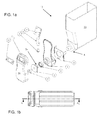
- FIG. 1a shows a feeder 12 in an exploded illustration, which essentially comprises a feed container 13 and a control module 1.
- the feed container 13 is open upwards for filling the dry-feed for animals, for example granular animal feed, into the feed container 13.
- the opening can be covered by a lid 13a, as shown in FIG. 3 .
- a screw conveyor for controlled dispensing of the feed for feeding animals, such as pigs, sows, poultry, horses, cattle, mink and fish.
- the feed container 13 has a rectangular horizontal cross-section with three vertical walls and a fourth wall having a vertically extending top and a slight inclination towards the lower part, where the wall is again vertically and wherein it is possible to connect a drive shaft to the conveyor screw. Onto this fourth wall, the control module 1 is fastened.
- the screw conveyor which is not shown in Fig. 1a , is seated in a pilot bearing 8 and connected to a first bevel gear 2 via a connection 2a, as shown in FIG. 2 .
- the first bevel gear wheel 2 is horizontally journaled and driven by an actuator 4 via a second bevel gear wheel 3, which is vertically journaled.
- the first bevel gear wheel 2 is rotationally supported by a plain bearing 7.
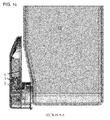
- FIG. 1c is a cross-sectional view with a section as illustrated in FIG. 1b .
- a gasket 6, as illustrated in FIG. 1a ensures smooth running of the conveyor screw and the first bevel gear wheel 2.
- the plain bearing 7, the first bevel gear wheel 2, the second bevel gear wheel 3 and the rotary-actuator 4 are housed inside the control module's outer shell 20 which is closed by a rear panel 5.
- An example of a method of assembly for the outer shell 20 and rear panel 5 is illustrated in FIG. 2 , where the rear panel 5 includes holes 22 for bolts 21, which by engagement in the outer shell 20 holds the rear panel 5.
- the control module 1 is fixed to the feed container 13 by means of a bracket 10.
- apertures 20a in the outer shell 20 for a keypad 9a and a display 9b are provided. These apertures 20a are covered by a keypad foil 11 on the outside of the outer shell 20, which gives simple information for the use of the pushbuttons, for example, an upward arrow and a downward arrow as illustrated in FIG. 2 .
- a control unit 9 On the opposite side of these apertures 20a, there is provided a control unit 9.
- This control unit 9 includes a printed circuit board with electronic components 9c, such as digital data memory and microprocessor, and also a keypad 9a and a display 9b.
- the data memory there are stored programs for dispensing of the granular feed. For example, the program comprises a sequence for the dispensing several daily servings.
- These servings may be equally large or vary. For animal rearing, it is necessary to increase the amount of feed along with the growing over a longer period of several weeks or even months. In some embodiments, there are stored curve trajectories for the dispensing of the feed over a period of several weeks. A periodic feedings is carried out during the day, and the total daily amount of feed is increased over a period of weeks along with the weight gain of the piglets.
- the keypad 9a is used to manually select a dosing-curve among several differently shaped dosing-curves. In some embodiments, the keypad 9a is used to manually increase or decrease the amount that is dispensed according to the dosing-curve. For example, if it is found that the programmed dosing-curve does not lead to a sufficient discharge of feed, the farmer can, by means of the keypad, increase the discharge of feed in a way such that the overall shape of the dosing-curve is maintained but the curve's values for the dispensing are multiplied by a given factor.
- a press on the keypad on an upwards arrow implies that the dosing-curve's values are increased by a certain percentage
- a press on the keypad on a downwards arrow implies the reduction of the dosing-curve's values by a certain percentage.
- the increase or decrease by a certain percentage is a fraction of some fixed basic values.
- the percentage is 5% or 10% of the curve's basic values.
- the farmer can reduce the increased feed supply again by three presses a downwards arrow, which reduces the curve with 3 times 10% of the curve basic values.
- Such curve trajectories in the data memory can be stored from the factory or added later.
- curve trajectories can be added wirelessly from a computer, for example, a PC, laptop, tablet PC or smartphone.
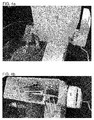
- FIG. 4a shows a possible embodiment in which the dry-feed 24 is dispensed from the feed container via a spout 14.
- the amount of feed 24 to be dispensed is determined by the screw conveyor 15 at the bottom of the feed container 13, which is best shown in FIG. 4c .
- an embodiment is provided, as illustrated in FIG. 4a-d , with a sprocket 16 having teeth engaged with the screw conveyor 15 for rotating the sprocket 16 by the rotation of the conveyor screw 15.
- the sprocket 16 is supported on a cross-shaft 17 in the feed container 13, the cross shaft 17 being held by the walls of the feed container 13.
- Two flexible arms 18 are fastened to the sprocket 16 by means of cross connections 19, such that the arms 18, upon rotation of the sprocket 16, shovel through the dry-feed 24 and thereby prevent clogging and which also ensures that the dry-feed 24 surrounds the screw conveyor 15 near the spout 14 in order to ensure accurate dosing without interruption during dispensing.
- the sprocket 16 can be taken out when there is no need for it, which is typically the case when fed with pellet feed.
- FIG. 5a , 5b and 5c show a slightly different embodiment in which there is also provided a container 13 in which the bottom has a screw conveyor 15 to transport the dry-feed, especially granulated feed, to a spout 14.
- the sprocket 16 having teeth in engagement with the screw conveyor 15 for rotating the sprocket 16 by rotation of the screw conveyor 15.
- the sprocket 16 is carried on a cross shaft 17 provided in the feed container, where the cross shaft 17 is fastened to some bearings 25 in the feed container 13 walls.
- Two flexible arms 18 are fastened to the sprocket 16 by means of cross connections 19, such that the arms 18, upon rotation of the sprocket 16, shovel through the dry-feed 24.
- the sprocket can be provided with a different number of arms, for example one arm or three arms.
- this feeder is designed for easy manual removal of the sprocket 16 from the container.
- the sprocket 16 is resiliently clamped between two bearings 25 and can be released from the bearings 25 by pressing the container 13 walls resiliently apart.
- the drive of the conveyor screw 15 by a rotary actuator 4 is slightly different in FIG. 5a than in FIG. 1a .
- a power cable 26 is used to supply electric current to the control module 1 and the rotary actuator 4, both being accommodated in the outer shell 20 upon assembly.
- a keypad is shown with two pushbuttons.
- a first one of the pushbuttons is used to shift the dosing-curve vertically between levels.
- repeated pressing of one pushbutton repeatedly increases the feeding by shifting the dosing-curve vertically among a number of levels, for example ten levels from level 0 to 9, in a cyclic manner. That is, the levels increased up to a maximum level value, for example 9, when the pushbutton is pressed repeatedly, after which a further press shifts the dosing-curve to a minimum level value, for example, level 0.
- the second of the two pushbuttons is configured to shift the feeding-day, which is the actual entrance day in the dosing-curve.
- the feeder should not start with day one on the dosing-curve, why is advantageous to select the day from which the feed curve has to start or commence.
- a new feeder to be used for a litter of pigs that are 15 days old should not start dispensing according to the curve from the very beginning of the curve but should start with a dispense day that corresponds to the fifteenth day in the life of the piglets.
- a first part 28 of the display 9b is related to the first pushbutton and indicates the level of the dosing-curve, for example among predetermined levels expressed by the numbers 0 to 9.
- Another Part 29 of the display 9b indicates the actual feed-day on the dosing-curve and is related to the second pushbutton.
- FIG. 6 shows an example of an optimized dosing-curve for piglets feeding.
- This dosing-curve serves as the basic curve for the feeding and would be stored in the data memory of the control module.
- the basic curve has a first sub-period in which it is convex (upwards hollow), which means that the curve's slope is increasing, after which the curve turns to a slight concave course (downwards hollow), where the slope is decreasing.
- the exact method of feeding thus, includes increasing the daily amount of feed for a number of piglets, the increase per day rising until a time when the increase per day falls again, which in FIG. 6 is towards the end of the period.
- the dosing-curve in FIG. 6 can be much simplified by an approximation using two linear trajectories with a first approximately linear increase in a first phase of about 10 days and a subsequent second approximately linear increase in a second phase of about 10 days It is observed from FIG. 6 that the second increase is significant higher than the first increase.
- the shown linear trajectories have a slope that increases by a factor of 3 around day 17 and 18. In combination, it is thus possible to provide a simplified dosing-curve with two successive phases in the period, each phase following a substantially linear trajectory where the slope of the linear trajectory, however, increases significantly in the second phase relatively to the first phase.
- a programming of a dosing-curve to be stored in the database and executed by the microprocessor is relatively simple if the dosing curves are approximated by linear trajectories, especially, if the approximation is done with only two linear trajectories, as illustrated in FIG. 6 .
- the curve in Fig. 6 is primarily intended for piglets, but has a universal character and can therefore be used also for the rearing of other animal cubs. In this case, the values at the y-axis, however, are adapted to the size of the cubs.
- the feeding can be increased or decreased corresponding to a parallel shift up or down of the base curve, as indicated by the two arrows in FIG. 6 .
- two keys are used with, respectively, an upwards arrow and a downwards arrow, as exemplified above in relation to FIG. 1 , or a single pushbutton is used with a cyclic change of curve, as exemplified above in connection with FIG. 6 .
- this parallel shift can be carried out by a single press on one of the pushbuttons or by pressing repeatedly, wherein each press leads to an incremental parallel shift up or down by a fixed value as described above.
- the curve obtained by a two-step shift-up by a fixed value can be done by two presses on one of the pushbuttons.
- the curves obtained by downwards shift of the basic curve is obtained by one or more repeated presses on the second of the pushbuttons or by pressing the first of the pushbuttons a number of times through a cyclic sequence.
- the first pushbutton is configured for downwards shift of the dosing-curve when exposed to a long press. If a single button is used for a cyclic shift, it will allow other functions for a further pushbutton, for example, the choice of the feed-day as described above.
- a tilt-switch in which a tilt up or down causes an increase respectively decrease of the dosing, or of the feed-day.
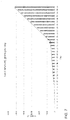
- FIG. 7 A slightly different dosing-curve is shown in FIG. 7 , where the dosing-curve is presented as a histogram, seeing that the term dosing-curve is to be understood in general terms.
- the piglets birthday corresponds to day 1.
- the days numbered 2-9 correspond to an introduction period where, for instance, iron supplements are fed three times a day, but no regular food yet for the piglets. Feeding of regular feed takes place from the tenth day after birth. From that day on, the amount of regular feed is gradually increased daily. Accordingly, the dosing-curve for regular feed in FIG. 7 is the histogram-curve from day 10 to day 35.
- dispensing occurs 10 times a day with a feeding every two hours and a break between midnight and 6 o-clock in the morning. Also in this case, the feeding per day follows a fixed dosing-curve that dispenses daily amounts depending on the day as calculated from the day of birth of the piglets.
- the feeder is programmed to start with a dosing-curve in level 5, and the farmer can then adjust the curve level up or down as required by pressing one of the pushbuttons, for instance one of the two pushbuttons, as already explained above.
- the histogram dosing-curve for regular feed in FIG. 7 which is the curve from day 10 to day 35, also has two phases of the dosing-curve having very different slopes for dispensing.
- the two phases are on either side of the feed-day 23, which is the midpoint of the actual dosing-curve.
- the dosing-curve in the first phase from day 10 to day 22 has a much smaller increase than in the second phase from day 24 to day 35.
- the two phases have approximately the same length, unless the feeding is interrupted before days 35, which is not uncommon because the feeding period, in some cases, has to be limited to fewer days, for example 28 or 30 days.
- the dosing-curve has in both phases a substantially linear trajectory, as indicated in FIG. 7 and similarly to the curve of FIG. 6 .
- the shift in the slope for the two approximately linear trajectories is much more significant in FIG. 7 than in FIG. 6 .
- the slope in FIG. 7 increases by more than a factor of 10, rather with a factor of 12.
Landscapes
- Life Sciences & Earth Sciences (AREA)
- Environmental Sciences (AREA)
- Birds (AREA)
- Animal Husbandry (AREA)
- Biodiversity & Conservation Biology (AREA)
- Feeding And Watering For Cattle Raising And Animal Husbandry (AREA)
Priority Applications (2)
| Application Number | Priority Date | Filing Date | Title |
|---|---|---|---|
| RS20191017A RS59099B1 (sr) | 2015-01-20 | 2016-01-20 | Hranilica, njeno programiranje i primena za hranjenje prasića, i postupak za hranjenje životinja |
| PL16152081T PL3047728T3 (pl) | 2015-01-20 | 2016-01-20 | Dozownik, jego programowanie i zastosowanie do karmienia prosięcia oraz sposób karmienia zwierząt |
Applications Claiming Priority (1)
| Application Number | Priority Date | Filing Date | Title |
|---|---|---|---|
| DKPA201570028 | 2015-01-20 |
Publications (2)
| Publication Number | Publication Date |
|---|---|
| EP3047728A1 true EP3047728A1 (fr) | 2016-07-27 |
| EP3047728B1 EP3047728B1 (fr) | 2019-05-22 |
Family
ID=55174594
Family Applications (1)
| Application Number | Title | Priority Date | Filing Date |
|---|---|---|---|
| EP16152081.2A Active EP3047728B1 (fr) | 2015-01-20 | 2016-01-20 | Dispositif d'alimentation, sa programmation et son utilisation pour l'alimentation de porcelets et procédé d'alimentation des animaux |
Country Status (6)
| Country | Link |
|---|---|
| EP (1) | EP3047728B1 (fr) |
| DK (1) | DK3047728T3 (fr) |
| ES (1) | ES2743787T3 (fr) |
| LT (1) | LT3047728T (fr) |
| PL (1) | PL3047728T3 (fr) |
| RS (1) | RS59099B1 (fr) |
Cited By (3)
| Publication number | Priority date | Publication date | Assignee | Title |
|---|---|---|---|---|
| CN109258498A (zh) * | 2018-11-26 | 2019-01-25 | 浙江省农业科学院 | 一种畜牧用节食型单体饲养喂食装置 |
| US11484006B2 (en) | 2016-12-27 | 2022-11-01 | Delaval Holding Ab | Animal feeding device, a food container to be housed therein, and a milking system including such a feeding device |
| CN116434914A (zh) * | 2023-04-21 | 2023-07-14 | 珠海市它物云科技有限公司 | 妊娠母猪的精准饲喂量的计算方法、计算机装置和计算机可读存储介质 |
Citations (3)
| Publication number | Priority date | Publication date | Assignee | Title |
|---|---|---|---|---|
| US4640229A (en) * | 1985-02-28 | 1987-02-03 | Chore-Time Equipment, Inc. | Apparatus for feeding livestock |
| US5299529A (en) * | 1993-03-23 | 1994-04-05 | Peter Ramirez | Automatic feeder for dogs and other animals |
| EP1260136A2 (fr) * | 2001-05-23 | 2002-11-27 | Lely Research Holding AG | Dispositif pour la distribution de nourriture à des animaux |
-
2016
- 2016-01-20 PL PL16152081T patent/PL3047728T3/pl unknown
- 2016-01-20 ES ES16152081T patent/ES2743787T3/es active Active
- 2016-01-20 LT LTEP16152081.2T patent/LT3047728T/lt unknown
- 2016-01-20 EP EP16152081.2A patent/EP3047728B1/fr active Active
- 2016-01-20 RS RS20191017A patent/RS59099B1/sr unknown
- 2016-01-20 DK DK16152081.2T patent/DK3047728T3/da active
Patent Citations (3)
| Publication number | Priority date | Publication date | Assignee | Title |
|---|---|---|---|---|
| US4640229A (en) * | 1985-02-28 | 1987-02-03 | Chore-Time Equipment, Inc. | Apparatus for feeding livestock |
| US5299529A (en) * | 1993-03-23 | 1994-04-05 | Peter Ramirez | Automatic feeder for dogs and other animals |
| EP1260136A2 (fr) * | 2001-05-23 | 2002-11-27 | Lely Research Holding AG | Dispositif pour la distribution de nourriture à des animaux |
Cited By (4)
| Publication number | Priority date | Publication date | Assignee | Title |
|---|---|---|---|---|
| US11484006B2 (en) | 2016-12-27 | 2022-11-01 | Delaval Holding Ab | Animal feeding device, a food container to be housed therein, and a milking system including such a feeding device |
| CN109258498A (zh) * | 2018-11-26 | 2019-01-25 | 浙江省农业科学院 | 一种畜牧用节食型单体饲养喂食装置 |
| CN116434914A (zh) * | 2023-04-21 | 2023-07-14 | 珠海市它物云科技有限公司 | 妊娠母猪的精准饲喂量的计算方法、计算机装置和计算机可读存储介质 |
| CN116434914B (zh) * | 2023-04-21 | 2023-11-14 | 珠海市它物云科技有限公司 | 妊娠母猪的精准饲喂量的计算方法、计算机装置和计算机可读存储介质 |
Also Published As
| Publication number | Publication date |
|---|---|
| DK3047728T3 (da) | 2019-08-12 |
| LT3047728T (lt) | 2019-07-25 |
| ES2743787T3 (es) | 2020-02-20 |
| RS59099B1 (sr) | 2019-09-30 |
| PL3047728T3 (pl) | 2019-11-29 |
| EP3047728B1 (fr) | 2019-05-22 |
Similar Documents
| Publication | Publication Date | Title |
|---|---|---|
| EP2605640B1 (fr) | Appareil de distribution d'aliments pour animaux et système de distribution d'aliments pour animaux | |
| US6367417B1 (en) | Electronically controlled animal food dispenser | |
| EP2345324B1 (fr) | Distributeur d'aliments | |
| CA1253407A (fr) | Dispositif d'alimentation des bestiaux | |
| EP3047728B1 (fr) | Dispositif d'alimentation, sa programmation et son utilisation pour l'alimentation de porcelets et procédé d'alimentation des animaux | |
| US20050011465A1 (en) | Automatic pet food dispensing device | |
| US20200396959A1 (en) | Automatic living food dispenser | |
| EP2134161B1 (fr) | Système et procédé d'alimentation | |
| US7415941B1 (en) | Feeding and/or drinking column on behalf of animals | |
| US20090255474A1 (en) | Automatic aquarium feeder | |
| US4878455A (en) | Device and method for supplying, very accurately metered, a quanitity of food to small livestock | |
| WO1995010180A1 (fr) | Procede et appareil utilises pour nourrir des chevaux | |
| EP0622988B1 (fr) | Dispositif d'alimentation | |
| US4491086A (en) | Automatic animal feeding device | |
| EP1203528A2 (fr) | Dispositif de dosage et de réglage d'alimentation pour auges | |
| US12514222B2 (en) | Automatic pet feeder | |
| KR20160044888A (ko) | 축산용 자동 사료공급장치 | |
| SE464161B (sv) | Saett och apparat foer utfodring av flera i samma inhaengnad loesgaaende djur | |
| CN214853533U (zh) | 一种新型自动喂食器 | |
| JP2002360096A (ja) | 動物への飼料供給装置 | |
| JPS6156965B2 (fr) | ||
| CN223403042U (zh) | 一种用于猪仔养殖的喂食设备 | |
| WO1992020220A1 (fr) | Procede et appareil pour nourrir les cochons | |
| CZ138094A3 (en) | Mixing and dosing apparatus for agricultural feed-stuffs | |
| EP2898768B1 (fr) | Installation pour affourager des porcelets |
Legal Events
| Date | Code | Title | Description |
|---|---|---|---|
| PUAI | Public reference made under article 153(3) epc to a published international application that has entered the european phase |
Free format text: ORIGINAL CODE: 0009012 |
|
| AK | Designated contracting states |
Kind code of ref document: A1 Designated state(s): AL AT BE BG CH CY CZ DE DK EE ES FI FR GB GR HR HU IE IS IT LI LT LU LV MC MK MT NL NO PL PT RO RS SE SI SK SM TR |
|
| AX | Request for extension of the european patent |
Extension state: BA ME |
|
| STAA | Information on the status of an ep patent application or granted ep patent |
Free format text: STATUS: REQUEST FOR EXAMINATION WAS MADE |
|
| 17P | Request for examination filed |
Effective date: 20170126 |
|
| RBV | Designated contracting states (corrected) |
Designated state(s): AL AT BE BG CH CY CZ DE DK EE ES FI FR GB GR HR HU IE IS IT LI LT LU LV MC MK MT NL NO PL PT RO RS SE SI SK SM TR |
|
| GRAP | Despatch of communication of intention to grant a patent |
Free format text: ORIGINAL CODE: EPIDOSNIGR1 |
|
| STAA | Information on the status of an ep patent application or granted ep patent |
Free format text: STATUS: GRANT OF PATENT IS INTENDED |
|
| INTG | Intention to grant announced |
Effective date: 20181218 |
|
| GRAS | Grant fee paid |
Free format text: ORIGINAL CODE: EPIDOSNIGR3 |
|
| GRAA | (expected) grant |
Free format text: ORIGINAL CODE: 0009210 |
|
| STAA | Information on the status of an ep patent application or granted ep patent |
Free format text: STATUS: THE PATENT HAS BEEN GRANTED |
|
| AK | Designated contracting states |
Kind code of ref document: B1 Designated state(s): AL AT BE BG CH CY CZ DE DK EE ES FI FR GB GR HR HU IE IS IT LI LT LU LV MC MK MT NL NO PL PT RO RS SE SI SK SM TR |
|
| RAP1 | Party data changed (applicant data changed or rights of an application transferred) |
Owner name: UNITRON A/S |
|
| REG | Reference to a national code |
Ref country code: GB Ref legal event code: FG4D |
|
| REG | Reference to a national code |
Ref country code: CH Ref legal event code: EP |
|
| REG | Reference to a national code |
Ref country code: IE Ref legal event code: FG4D |
|
| REG | Reference to a national code |
Ref country code: DE Ref legal event code: R096 Ref document number: 602016014144 Country of ref document: DE |
|
| REG | Reference to a national code |
Ref country code: AT Ref legal event code: REF Ref document number: 1134955 Country of ref document: AT Kind code of ref document: T Effective date: 20190615 |
|
| REG | Reference to a national code |
Ref country code: NO Ref legal event code: T2 Effective date: 20190522 |
|
| REG | Reference to a national code |
Ref country code: RO Ref legal event code: EPE |
|
| REG | Reference to a national code |
Ref country code: DK Ref legal event code: T3 Effective date: 20190808 |
|
| REG | Reference to a national code |
Ref country code: NL Ref legal event code: FP |
|
| REG | Reference to a national code |
Ref country code: SE Ref legal event code: TRGR |
|
| PG25 | Lapsed in a contracting state [announced via postgrant information from national office to epo] |
Ref country code: FI Free format text: LAPSE BECAUSE OF FAILURE TO SUBMIT A TRANSLATION OF THE DESCRIPTION OR TO PAY THE FEE WITHIN THE PRESCRIBED TIME-LIMIT Effective date: 20190522 Ref country code: PT Free format text: LAPSE BECAUSE OF FAILURE TO SUBMIT A TRANSLATION OF THE DESCRIPTION OR TO PAY THE FEE WITHIN THE PRESCRIBED TIME-LIMIT Effective date: 20190922 Ref country code: AL Free format text: LAPSE BECAUSE OF FAILURE TO SUBMIT A TRANSLATION OF THE DESCRIPTION OR TO PAY THE FEE WITHIN THE PRESCRIBED TIME-LIMIT Effective date: 20190522 Ref country code: HR Free format text: LAPSE BECAUSE OF FAILURE TO SUBMIT A TRANSLATION OF THE DESCRIPTION OR TO PAY THE FEE WITHIN THE PRESCRIBED TIME-LIMIT Effective date: 20190522 |
|
| REG | Reference to a national code |
Ref country code: SK Ref legal event code: T3 Ref document number: E 31833 Country of ref document: SK |
|
| PG25 | Lapsed in a contracting state [announced via postgrant information from national office to epo] |
Ref country code: GR Free format text: LAPSE BECAUSE OF FAILURE TO SUBMIT A TRANSLATION OF THE DESCRIPTION OR TO PAY THE FEE WITHIN THE PRESCRIBED TIME-LIMIT Effective date: 20190823 Ref country code: BG Free format text: LAPSE BECAUSE OF FAILURE TO SUBMIT A TRANSLATION OF THE DESCRIPTION OR TO PAY THE FEE WITHIN THE PRESCRIBED TIME-LIMIT Effective date: 20190822 |
|
| REG | Reference to a national code |
Ref country code: AT Ref legal event code: MK05 Ref document number: 1134955 Country of ref document: AT Kind code of ref document: T Effective date: 20190522 |
|
| PG25 | Lapsed in a contracting state [announced via postgrant information from national office to epo] |
Ref country code: EE Free format text: LAPSE BECAUSE OF FAILURE TO SUBMIT A TRANSLATION OF THE DESCRIPTION OR TO PAY THE FEE WITHIN THE PRESCRIBED TIME-LIMIT Effective date: 20190522 Ref country code: CZ Free format text: LAPSE BECAUSE OF FAILURE TO SUBMIT A TRANSLATION OF THE DESCRIPTION OR TO PAY THE FEE WITHIN THE PRESCRIBED TIME-LIMIT Effective date: 20190522 Ref country code: AT Free format text: LAPSE BECAUSE OF FAILURE TO SUBMIT A TRANSLATION OF THE DESCRIPTION OR TO PAY THE FEE WITHIN THE PRESCRIBED TIME-LIMIT Effective date: 20190522 |
|
| REG | Reference to a national code |
Ref country code: DE Ref legal event code: R097 Ref document number: 602016014144 Country of ref document: DE |
|
| PG25 | Lapsed in a contracting state [announced via postgrant information from national office to epo] |
Ref country code: SM Free format text: LAPSE BECAUSE OF FAILURE TO SUBMIT A TRANSLATION OF THE DESCRIPTION OR TO PAY THE FEE WITHIN THE PRESCRIBED TIME-LIMIT Effective date: 20190522 |
|
| PLBE | No opposition filed within time limit |
Free format text: ORIGINAL CODE: 0009261 |
|
| STAA | Information on the status of an ep patent application or granted ep patent |
Free format text: STATUS: NO OPPOSITION FILED WITHIN TIME LIMIT |
|
| PG25 | Lapsed in a contracting state [announced via postgrant information from national office to epo] |
Ref country code: TR Free format text: LAPSE BECAUSE OF FAILURE TO SUBMIT A TRANSLATION OF THE DESCRIPTION OR TO PAY THE FEE WITHIN THE PRESCRIBED TIME-LIMIT Effective date: 20190522 |
|
| 26N | No opposition filed |
Effective date: 20200225 |
|
| PG25 | Lapsed in a contracting state [announced via postgrant information from national office to epo] |
Ref country code: SI Free format text: LAPSE BECAUSE OF FAILURE TO SUBMIT A TRANSLATION OF THE DESCRIPTION OR TO PAY THE FEE WITHIN THE PRESCRIBED TIME-LIMIT Effective date: 20190522 |
|
| PG25 | Lapsed in a contracting state [announced via postgrant information from national office to epo] |
Ref country code: MC Free format text: LAPSE BECAUSE OF FAILURE TO SUBMIT A TRANSLATION OF THE DESCRIPTION OR TO PAY THE FEE WITHIN THE PRESCRIBED TIME-LIMIT Effective date: 20190522 |
|
| PG25 | Lapsed in a contracting state [announced via postgrant information from national office to epo] |
Ref country code: IE Free format text: LAPSE BECAUSE OF NON-PAYMENT OF DUE FEES Effective date: 20200120 |
|
| PG25 | Lapsed in a contracting state [announced via postgrant information from national office to epo] |
Ref country code: MT Free format text: LAPSE BECAUSE OF FAILURE TO SUBMIT A TRANSLATION OF THE DESCRIPTION OR TO PAY THE FEE WITHIN THE PRESCRIBED TIME-LIMIT Effective date: 20190522 Ref country code: CY Free format text: LAPSE BECAUSE OF FAILURE TO SUBMIT A TRANSLATION OF THE DESCRIPTION OR TO PAY THE FEE WITHIN THE PRESCRIBED TIME-LIMIT Effective date: 20190522 |
|
| PG25 | Lapsed in a contracting state [announced via postgrant information from national office to epo] |
Ref country code: MK Free format text: LAPSE BECAUSE OF FAILURE TO SUBMIT A TRANSLATION OF THE DESCRIPTION OR TO PAY THE FEE WITHIN THE PRESCRIBED TIME-LIMIT Effective date: 20190522 Ref country code: IS Free format text: LAPSE BECAUSE OF FAILURE TO SUBMIT A TRANSLATION OF THE DESCRIPTION OR TO PAY THE FEE WITHIN THE PRESCRIBED TIME-LIMIT Effective date: 20190922 |
|
| P01 | Opt-out of the competence of the unified patent court (upc) registered |
Effective date: 20230524 |
|
| PGFP | Annual fee paid to national office [announced via postgrant information from national office to epo] |
Ref country code: LV Payment date: 20251231 Year of fee payment: 11 |
|
| REG | Reference to a national code |
Ref country code: CH Ref legal event code: U11 Free format text: ST27 STATUS EVENT CODE: U-0-0-U10-U11 (AS PROVIDED BY THE NATIONAL OFFICE) Effective date: 20260201 |
|
| PGFP | Annual fee paid to national office [announced via postgrant information from national office to epo] |
Ref country code: LU Payment date: 20260127 Year of fee payment: 11 Ref country code: NL Payment date: 20260126 Year of fee payment: 11 |
|
| PGFP | Annual fee paid to national office [announced via postgrant information from national office to epo] |
Ref country code: SE Payment date: 20260127 Year of fee payment: 11 |
|
| PGFP | Annual fee paid to national office [announced via postgrant information from national office to epo] |
Ref country code: LT Payment date: 20251231 Year of fee payment: 11 Ref country code: GB Payment date: 20260127 Year of fee payment: 11 |
|
| PGFP | Annual fee paid to national office [announced via postgrant information from national office to epo] |
Ref country code: ES Payment date: 20260202 Year of fee payment: 11 |
|
| PGFP | Annual fee paid to national office [announced via postgrant information from national office to epo] |
Ref country code: NO Payment date: 20260128 Year of fee payment: 11 Ref country code: DE Payment date: 20260128 Year of fee payment: 11 Ref country code: DK Payment date: 20260126 Year of fee payment: 11 |
|
| PGFP | Annual fee paid to national office [announced via postgrant information from national office to epo] |
Ref country code: RO Payment date: 20260113 Year of fee payment: 11 Ref country code: IT Payment date: 20260121 Year of fee payment: 11 Ref country code: BE Payment date: 20260127 Year of fee payment: 11 |
|
| PGFP | Annual fee paid to national office [announced via postgrant information from national office to epo] |
Ref country code: RS Payment date: 20260105 Year of fee payment: 11 |
|
| PGFP | Annual fee paid to national office [announced via postgrant information from national office to epo] |
Ref country code: FR Payment date: 20260126 Year of fee payment: 11 |
|
| PGFP | Annual fee paid to national office [announced via postgrant information from national office to epo] |
Ref country code: CH Payment date: 20260201 Year of fee payment: 11 |
|
| PGFP | Annual fee paid to national office [announced via postgrant information from national office to epo] |
Ref country code: PL Payment date: 20260102 Year of fee payment: 11 |
|
| PGFP | Annual fee paid to national office [announced via postgrant information from national office to epo] |
Ref country code: SK Payment date: 20260102 Year of fee payment: 11 |