EP3049253B1 - Document de valeur et procédé pour en vérifier l'existence - Google Patents
Document de valeur et procédé pour en vérifier l'existence Download PDFInfo
- Publication number
- EP3049253B1 EP3049253B1 EP14777522.5A EP14777522A EP3049253B1 EP 3049253 B1 EP3049253 B1 EP 3049253B1 EP 14777522 A EP14777522 A EP 14777522A EP 3049253 B1 EP3049253 B1 EP 3049253B1
- Authority
- EP
- European Patent Office
- Prior art keywords
- measurement
- substance
- luminescent
- spectroscopic method
- agglomerates
- Prior art date
- Legal status (The legal status is an assumption and is not a legal conclusion. Google has not performed a legal analysis and makes no representation as to the accuracy of the status listed.)
- Active
Links
Images


Classifications
-
- G—PHYSICS
- G07—CHECKING-DEVICES
- G07D—HANDLING OF COINS OR VALUABLE PAPERS, e.g. TESTING, SORTING BY DENOMINATIONS, COUNTING, DISPENSING, CHANGING OR DEPOSITING
- G07D7/00—Testing specially adapted to determine the identity or genuineness of valuable papers or for segregating those which are unacceptable, e.g. banknotes that are alien to a currency
- G07D7/20—Testing patterns thereon
- G07D7/202—Testing patterns thereon using pattern matching
- G07D7/2041—Matching statistical distributions, e.g. of particle sizes orientations
-
- B—PERFORMING OPERATIONS; TRANSPORTING
- B42—BOOKBINDING; ALBUMS; FILES; SPECIAL PRINTED MATTER
- B42D—BOOKS; BOOK COVERS; LOOSE LEAVES; PRINTED MATTER CHARACTERISED BY IDENTIFICATION OR SECURITY FEATURES; PRINTED MATTER OF SPECIAL FORMAT OR STYLE NOT OTHERWISE PROVIDED FOR; DEVICES FOR USE THEREWITH AND NOT OTHERWISE PROVIDED FOR; MOVABLE-STRIP WRITING OR READING APPARATUS
- B42D25/00—Information-bearing cards or sheet-like structures characterised by identification or security features; Manufacture thereof
- B42D25/20—Information-bearing cards or sheet-like structures characterised by identification or security features; Manufacture thereof characterised by a particular use or purpose
- B42D25/29—Securities; Bank notes
-
- B—PERFORMING OPERATIONS; TRANSPORTING
- B42—BOOKBINDING; ALBUMS; FILES; SPECIAL PRINTED MATTER
- B42D—BOOKS; BOOK COVERS; LOOSE LEAVES; PRINTED MATTER CHARACTERISED BY IDENTIFICATION OR SECURITY FEATURES; PRINTED MATTER OF SPECIAL FORMAT OR STYLE NOT OTHERWISE PROVIDED FOR; DEVICES FOR USE THEREWITH AND NOT OTHERWISE PROVIDED FOR; MOVABLE-STRIP WRITING OR READING APPARATUS
- B42D25/00—Information-bearing cards or sheet-like structures characterised by identification or security features; Manufacture thereof
- B42D25/30—Identification or security features, e.g. for preventing forgery
-
- B—PERFORMING OPERATIONS; TRANSPORTING
- B42—BOOKBINDING; ALBUMS; FILES; SPECIAL PRINTED MATTER
- B42D—BOOKS; BOOK COVERS; LOOSE LEAVES; PRINTED MATTER CHARACTERISED BY IDENTIFICATION OR SECURITY FEATURES; PRINTED MATTER OF SPECIAL FORMAT OR STYLE NOT OTHERWISE PROVIDED FOR; DEVICES FOR USE THEREWITH AND NOT OTHERWISE PROVIDED FOR; MOVABLE-STRIP WRITING OR READING APPARATUS
- B42D25/00—Information-bearing cards or sheet-like structures characterised by identification or security features; Manufacture thereof
- B42D25/30—Identification or security features, e.g. for preventing forgery
- B42D25/36—Identification or security features, e.g. for preventing forgery comprising special materials
- B42D25/378—Special inks
-
- G—PHYSICS
- G07—CHECKING-DEVICES
- G07D—HANDLING OF COINS OR VALUABLE PAPERS, e.g. TESTING, SORTING BY DENOMINATIONS, COUNTING, DISPENSING, CHANGING OR DEPOSITING
- G07D7/00—Testing specially adapted to determine the identity or genuineness of valuable papers or for segregating those which are unacceptable, e.g. banknotes that are alien to a currency
- G07D7/06—Testing specially adapted to determine the identity or genuineness of valuable papers or for segregating those which are unacceptable, e.g. banknotes that are alien to a currency using wave or particle radiation
-
- G—PHYSICS
- G07—CHECKING-DEVICES
- G07D—HANDLING OF COINS OR VALUABLE PAPERS, e.g. TESTING, SORTING BY DENOMINATIONS, COUNTING, DISPENSING, CHANGING OR DEPOSITING
- G07D7/00—Testing specially adapted to determine the identity or genuineness of valuable papers or for segregating those which are unacceptable, e.g. banknotes that are alien to a currency
- G07D7/06—Testing specially adapted to determine the identity or genuineness of valuable papers or for segregating those which are unacceptable, e.g. banknotes that are alien to a currency using wave or particle radiation
- G07D7/12—Visible light, infrared or ultraviolet radiation
Definitions
- the invention relates to a value document such as a banknote and a method for checking the presence thereof.
- the authenticity assurance of value documents by means of luminescent substances has long been known. Preference is given to using rare earth-doped host lattices, wherein the absorption and emission ranges can be varied within a wide range by suitable tuning of rare earth metal and host lattice.
- the use of magnetic and electrically conductive materials for authenticity assurance is known per se. Magnetism, electrical conductivity and luminescence emission are mechanically detectable by commercially available measuring devices, and luminescence is also visual in sufficient intensity when emitted in the visible range.
- the security against counterfeiting can be increased, for example, by using not only one feature substance but several feature substances in combination, for example a luminescent substance and a magnetic substance, or a luminescent substance and a substance influencing the luminescence properties.
- the DE 10 2005 047 609 A1 describes feature substances for authenticity assurance of value documents which contain a luminescent substance and at least one further substance, which is preferably magnetically or electrically conductive.
- the luminescent substance is in particle form and is surrounded by a shell formed from nanoparticles.
- the properties of the feature substance result from the interaction of the luminescence emission properties of the luminescent substance and the properties of the nanoparticles.
- the patent document EP 1 826 730 A2 discloses a value document with luminescent, particulate agglomerates emitting different wavelengths.
- the present invention has the object to provide an improved with respect to the counterfeit security document of value and a method for checking the presence of the same.
- the measured values of locations in the immediate vicinity of the measured values below the specific threshold value are also not used for the authenticity determination.
- Documents of value within the scope of the invention are items such as banknotes, checks, stocks, tokens, identity cards, passports, credit cards, documents and other documents, labels, seals, and items to be protected, such as CDs, packaging and the like.
- the preferred application is banknotes, which are based in particular on a paper substrate.
- Luminescent substances are used as standard for securing banknotes.
- a luminescent authentication feature e.g. is introduced at various locations in the paper of a banknote, the luminescence signals of the feature at the various locations naturally subject to certain fluctuations.
- Spectroscopic types can be, for example, according to the excitation energy of the electromagnetic Divide radiation.
- nuclear magnetic resonance (NMR) spectroscopy is based on exciting electromagnetic radiation having a wavelength in a range of 1 m to 100 m, ie radio waves.
- Electron spin resonance spectroscopy (ESR) is based on exciting electromagnetic radiation with a wavelength in the range of 1 cm to 1 m.
- the microwave spectroscopy is based on an exciting electromagnetic radiation having a wavelength in a range of 1 mm to 10 cm.
- Submillimeter wave spectroscopy is based on exciting electromagnetic radiation having a wavelength in the range of 100 ⁇ m to 1 mm (also known as terahertz radiation).
- Vibrational spectroscopy in particular Raman spectroscopy, more particularly SER (Surface Enhanced Raman) spectroscopy or SERR (Surface Enhanced Resonant Raman) spectroscopy, is particularly based on exciting electromagnetic radiation having a wavelength in a range of 200 nm to 3 ⁇ m , preferably in a range from 780 nm to 3 ⁇ m, ie near infrared radiation.
- Infrared spectroscopy in particular SEIRA (Surface Enhanced Infrared Absorption), is based on an exciting wavelength in the range from 800 nm to 1 mm, preferably 3 ⁇ m to 1 mm, ie medium and far infrared radiation.
- SEIRA Surface Enhanced Infrared Absorption
- the present invention is based on the finding that a targeted generation of mixed, particulate agglomerates of a first non-luminescent substance on the one hand and a second non-luminescent substance on the other hand, each of which can be detected spectroscopically, the effect of a statistical correlation of the intensity fluctuations of the measured signal intensities both Substances result. In this way it is possible to distinguish the samples according to the invention by evaluating the agglomerate-related signal correlation of non-correlating authenticity features.
- Non-correlating authenticity features are in particular the mixtures of two different non-luminescent, spectroscopically detectable substances, which are each untreated and powdery.
- the use of the above effect leads to an increase in the security against forgery, because non-correlating feature signals can be recognized as "spurious".
- the number of possible codings can be increased.
- the four distinguishable variants (A + B) can additionally be additionally separated by means of a targeted particulate agglomeration of respectively two or three of the feature substances. , C / A, (B + C) / (A + C), B / (A + B + C) are generated, with the signals of the substances within a bracket correlating with each other.
- the particulate agglomerates according to the invention each contain at least two different solid homogeneous phases, the first solid homogeneous phase being based on a first non-luminescent substance which can be detected by a spectroscopic method (also referred to herein as the "first non-luminescent feature substance") and the second solid homogeneous phase on a second non-luminescent, by means of a spectroscopic method detectable substance (also referred to herein as "second non-luminescent feature substance").
- the exciting electromagnetic radiation of the spectroscopic method may in particular have a wavelength in a range of 200 nm to 100 m, preferably 780 nm to 100 m.
- the particulate agglomerates are non-planar or platelet-like, but three-dimensionally expanded, in particular spherical or globular (for example elliptical) or fractal. This provides a direct analysis of the different solid homogeneous phases with simple methods such as e.g. complicated by light microscopy.
- non-luminescent feature substance means that the spectroscopically detectable feature substance is not a luminescent pigment, as is typically used in the prior art for securing banknotes and other value documents.
- the adhesion of the two substances, in the form of solid homogeneous phases, must be sufficiently strong that no separation of the two substances takes place during storage and processing, at least not in a degree disturbing the production of safety features.
- the particulate agglomerates according to the invention may in particular be core / shell particles, particle agglomerates, encapsulated particle agglomerates or particles enveloped by nanoparticles. Particle agglomerates and encapsulated particle agglomerates are particularly preferred.
- the shell or capsule can be based on an inorganic or organic Material based (eg inorganic oxide or organic polymer). A shell of inorganic oxides, eg SiO 2 , is preferred.
- the agglomerates are preferably prepared by a special process in which the different security features (ie the different non-luminescent substances) are mixed in a salt-containing aqueous solution at low shear forces and then an aqueous silicate solution is added.
- the silicate solution is neutralized by a likewise added or already contained in the aqueous salt solution acid source and connects by the resulting SiO 2, the individual particles of security features to solid agglomerates.
- an agglomerate may contain individual particles of two or more security features (luminescent or non-luminescent) and, in addition, individual particles of one or more inactive materials which are themselves not security features.
- the non-luminescent, detectable by a certain spectroscopic method substance of the first and second solid homogeneous phase of the particulate agglomerate is preferably a nuclear magnetic resonance spectroscopy (NMR), nuclear quadrupole (NQR), electron spin resonance spectroscopy (ESR), SER (Surface Enhanced Raman) spectroscopy or SEIRA (Surface Enhanced Infrared Absorption) spectroscopy.
- NMR nuclear magnetic resonance spectroscopy
- NQR nuclear quadrupole
- ESR electron spin resonance spectroscopy
- SEIRA Surface Enhanced Raman Absorption
- the non-luminescent substance detectable by NMR spectroscopy will hereinafter also be referred to as "NMR-active substance” or “NMR-tag”.
- the non-luminescent substance detectable by ESR spectroscopy will hereinafter also be referred to as “ESR-active substance” or “ESR-tag”.
- the non-luminescent substance detectable by NQR spectroscopy will hereinafter also be referred to as "NQR-active substance” or “NQR-tag”.
- the non-luminescent substance detectable by SER spectroscopy will hereinafter also be referred to as "SERS active substance” or "SERS tag”.
- the non-luminescent substance of the first solid homogeneous phase and the non-luminescent substance of the second solid homogeneous phase may in particular be of the following five types of substances, namely a substance detectable by nuclear magnetic resonance spectroscopy, a substance detectable by means of electron spin resonance spectroscopy, a substance detectable by nuclear quadrupole resonance spectroscopy, a material detectable by means of SER (Surface Enhanced Raman) spectroscopy and a substance detectable by means of SEIRA (Surface Enhanced Infrared Absorption) spectroscopy, with the proviso that the nature of the non-luminescent substance of the first solid homogeneous phase with the species of the non-luminescent substance of the second solid homogeneous phase is identical.
- the two non-luminescent substances e.g., NMR 1 and NMR 2 must differ in signal position of the measurement signal.
- the non-luminescent substance of the first solid homogeneous phase and the non-luminescent substance of the second solid homogeneous phase are of the following five types of substances, namely a substance detectable by nuclear magnetic resonance spectroscopy, a substance detectable by means of electron spin resonance spectroscopy, by means of nuclear quadrupole resonance spectroscopy detectable substance, a substance detectable by means of SER (Surface Enhanced Raman) spectroscopy and a substance detectable by means of SEIRA (Surface Enhanced Infrared Absorption) spectroscopy, with the proviso that the nature of the non-luminescent substance of the first solid homogeneous phase is different as the type of non-luminescent substance of the second solid homogeneous phase (eg an NMR-substance and a SERS-substance).
- a substance detectable by nuclear magnetic resonance spectroscopy a substance detectable by means of electron spin resonance spectroscopy, by means of nuclear quadrupole resonance spectroscopy detectable substance
- the particulate agglomerate may be e.g. be such that one combines NMR tags and SERS tags together in the form of a particle agglomerate. If a simple mixture of NMR tags and SERS tags were introduced into the (paper) substrate of a value document, both types of particles could be randomly distributed in the substrate. In such a random distribution, there is no correlation between the measured NMR signals and the measured SERS signals. If, on the other hand, an agglomerate of both particle types is introduced into the substrate of a value document, the two signals correlate with one another. Sites with relatively high NMR signals also show increased SERS signals, sites with relatively low NMR signals also show reduced SERS signals.
- a separation of the two substances is to be prevented.
- a simple mixture of very different particles such as NMR tags of size 5 to 10 ⁇ m and SERS tags of size 100 nm
- a different incorporation behavior for example into a paper substrate, can take place.
- these include the enrichment at different points (eg at the paper fiber surface or in fiber spaces due to different surface charge of the particles), a different dispersion behavior (eg clumping of the SERS tags in water), different retention properties (Eg different degrees of retention in the paper web of a paper machine) or a mechanical segregation (eg a size separation by shaking movements during transport of a container with powdered feature substances).
- ESR-active substances as a security feature inter alia for banknotes is known in the art (see, for example US 4,376,264 A . US 5,149,946 A and DE 195 18 086 A ).
- the EP 0 775 324 B1 describes the use of substances as a safety feature, which are excited by resonance in the high-frequency range without additional applied electric or magnetic fields ("zero field"). These include in particular NQR-active substances.
- Particulate safety features based on microwave absorbers are eg in the EP 2 505 619 A1 described.
- a different picture results when two different feature substances, for example a first non-luminescent feature substance and a second non-luminescent feature substance, are combined to form a particulate agglomerate (see FIG. 1 ).
- a particulate agglomerate obtained by agglomerating a mixture of feature substances "A" and "B" would combine both types of feature substances.
- the measurement signal intensities of the feature substances "A" and "B” are compared schematically at four locations of a paper substrate, the densely dotted areas symbolizing high signal intensities and the less densely dotted areas symbolizing less high signal intensities.
- Feature substances "A” and “B”, each having a high measurement signal intensity are used in low amount. This results in some areas giving a high “Signal A” and some areas having a high “Signal B”. There is no relationship between the two signals, i. no statistical correlation.
- the term "pure substance agglomerate” is understood to mean an agglomerate which has only particles of a single particle type.
- Particulate agglomerates obtainable from particles "A” and particles "B” are used.
- the starting materials A and B may each have a high or a low intensity. This results in areas with increased “signal A” and at the same time increased “signal B” and areas with low “signal A” and at the same time low “signal B”. In other words, there is a statistical correlation between the two signals.
- the in FIG. 2 The right-to-left relationship between "Signal A” and “Signal B” is not necessarily directly proportional.
- the particulate agglomerates are ideally, but not necessarily, comprised of 50% Particles A and 50% Particles B. It is possible that a production method results in particulate agglomerates having a random internal distribution of feature substances A and B.
- agglomerate compositions can be formed which consist on average of ten feature substance particles and include agglomerates having a composition "5A + 5B", but also "3A + 7B" and "7A + 3B” etc.
- the ratio of the intensities between "A” and "B” at arbitrary locations of the sheet is within a very narrow range of values, which is a property which is advantageous for checking the authenticity and also allows the distinction between correlating and non-correlating systems.
- the correlation can be detected at the microscopic level, ie for individual particles. For this purpose, a single agglomerate or a group of agglomerates is examined and it is checked whether they respectively show the properties of the individual substances "A" and "B" used for the construction of the agglomerates.
- Correlation especially linear correlation (correlation coefficient according to Bravais-Pearson). This type of calculation is particularly suitable for two-dimensional normal distributions. It is preferable to previously remove quantile signal outliers from the statistics.
- the above correlation function can be calculated with respect to the measured values obtained and their amount compared with a threshold value.
- an existing statistical correlation and thus authenticity is recognized if the amount is> 0.3, preferably> 0.5, and particularly preferably> 0.7.
- Example 2 Method with several steps, with the aim of evaluating the length-to-width ratio of the point clouds obtained from the measured data (see FIG. 5 ). To minimize the influence of "outliers", In each case, the 25% of the highest or lowest signal values were ignored. Correlating point clouds are elongated and have a pronounced length-to-width ratio; in uncorrelated point clouds, their length and width are about the same.
- the following procedure can be used for evaluating the authenticity of a value document:
- the measurement data of the two spectroscopic methods (which are possibly identical) are obtained.
- the measurement data are normalized.
- a transformation of the coordinate axes takes place, preferably a rotation through 45 ° in order to minimize the scattering of the data points along a coordinate axis.
- the quantiles are determined in the direction of the two new coordinate axes, preferably the quartiles, and set their distances or differences in relation to each other. By comparing this ratio with previously determined threshold values, the authenticity of the value document is determined.
- FIG. 6 shows a comparison between the measurement signals of two non-correlating feature substances in an unprinted paper substrate and after overprinting with a striped pattern.
- the overprinting eg by absorption of the radiation used for the excitation, reduces the signal intensity of the two features used.
- attenuation of the signal occurs at the overprinted points, causing a spatial correlation of the signal intensities of both feature substances. This results in a similar effect, as achieved by the use of particulate agglomerates according to the invention.
- an additional at a certain emission wavelength luminescent or separately with the detectable component introduced into the value document of the spectroscopic method, which is non-correlating (correction component).
- a suitable, third non-correlating component and normalizing by its signal intensity for example, all of the disturbing effects described above disappear.
- luminescent substances which have particularly small or ideally no spatially dependent fluctuations in the luminescence intensity in an unmodified paper substrate, ie would have a spatially homogeneous luminous intensity without additional influences.
- the periodic weakening caused by the overprinted stripe pattern influences the third component in addition to the first two feature substances.
- the introduction of the above-mentioned third component is undesirable, for example for reasons of cost, other methods can be used depending on the application.
- the measurement signal intensity in an unmodified paper substrate is usually above a certain threshold, it will be due to overprinting effects or thickness changes in the paper substrate etc. below this threshold value, corresponding data points from the analysis can be eliminated.
- This method is particularly useful in cases of abrupt and sharp intensity changes, such as overprinting with sharply defined lines and areas, but less for gradual gradations of color with a smooth transition or filigree patterns.
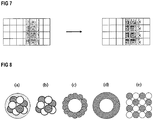
- the measured regions are locally close to one another, it is advantageous to likewise eliminate all adjacent measuring points when the threshold falls below the threshold value at a measuring point (cf. FIG. 7 ). As a result, partially overprinted measurement areas at the boundary of an overprinted area are excluded, even if their intensities are above the threshold value due to the only incomplete overprinting.
- particulate agglomerates according to the invention are described below in connection with the FIG. 8 described with reference to preferred embodiments.
- a number of production methods are suitable for producing the particulate agglomerates according to the invention starting from a first non-luminescent feature substance and a second non-luminescent feature substance (and optionally one or more further luminescent or non-luminescent feature substances).
- the previously isolated particles are caused to assemble into a larger unit.
- the way The larger unit obtained is then fixed so that the particles can no longer separate from each other during use as a security feature. It is crucial that the larger units contain as much as possible equal parts of both (or of the three or more) feature substances, with most production methods a random statistical mixture of the particles is obtained.
- the agglomerates contain only one particle type. This can e.g. then take place if the different feature substances are not sufficiently mixed before the assembly process, or the pooling of similar substances is favored by surface effects or the like. In the normal case, or if the synthesis procedures are carried out correctly, however, such effects are negligible.
- the particle size (D99) of the agglomerates is therefore preferably in the range from 1 to 100 ⁇ m, more preferably from 5 to 30 ⁇ m, very particularly preferably from 10 to 20 ⁇ m.
- macroscopic carrier bodies in which the different feature substances are incorporated for example planchettes or mottled fibers, can be used instead of the described particle agglomerates.
- These carrier bodies can then have sizes in excess of 100 ⁇ m in individual or all room dimensions, eg have sizes in the millimeter range.
- the particles from which the agglomerate is composed should be significantly smaller than the agglomerate, since with decreasing size a higher number of particles per agglomerate can be incorporated. A higher number of incorporated particles increases the likelihood of finding a "suitable distribution" of both types of particles in the agglomerate.
- agglomerate which consists of 10000 (or "infinitely many") individual particles, then the probability that all particles are coincidentally identical, arbitrarily small.
- the probability that all particles are coincidentally identical arbitrarily small.
- small to medium size particles e.g. with a particle size between 1 and 5 microns, used.
- the ratio of the two substances A and B, from which the agglomerates are prepared is ideally 1: 1, if both substances have the same intensity and grain size.
- an adaptation of this ratio may be advantageous. It may also be necessary under certain circumstances to adjust the quantitative ratio in order, for example, to generate a specific desired mean intensity ratio of both signals in the end product.
- the units referred to as "agglomerates” are, according to one variant, a disordered cluster of adhering particles which have been fixed or permanently "stuck together" (see FIG. 8 a and b). This can be done, for example, by coating with a polymer or silica layer (see, for example, US Pat WO 2006/072380 A2 ), or by linking the particle surfaces with each other via chemical groups, etc. happen. Such agglomerates are technically relatively easy to produce and are therefore preferred. According to another variant, the particles can have a different structure without losing functionality (see FIG. 8c, d and e). Under certain circumstances, alternative embodiments, such as ordered agglomerates or core-shell systems, may have advantageous properties (eg, a controlled particle distribution). However, their synthesis is usually more complex.
- the particulate agglomerates used according to the invention can be incorporated in the value document itself, in particular in the paper substrate. Additionally or alternatively, the particulate agglomerates may be applied to the value document, e.g. be printed.
- the value document substrate need not necessarily be a paper substrate, it could also be a plastic substrate or a substrate having both paper components and plastic components.
- Raman-active substance is the polydiacetylene of Example 12 of the document US 5,324,567 used.
- the ESR-active substance used is a strontium titanate doped with 1000 ppm of manganese, as described in the document US 4,376,264 is described. Both substances are present as particles with average particle sizes in the range 1-5 microns.
- the produced agglomerates are then added to the paper pulp during sheet production so that the agglomerates are contained in the resulting sheet in a mass fraction of 0.1 weight percent.
- the intensity of the signal of the respective security features is determined (intensity of the Raman signal or intensity of the ESR signal).
- the measured signal intensities of the two different security features correlate with each other.
- ESR-active substance a 1000 ppm chromium-doped strontium titanate is used, as in the document US 4,376,264 is described.
- the produced agglomerates are then added to the paper pulp during sheet production so that the agglomerates are contained in the resulting sheet in a mass fraction of 0.1 weight percent.
- the intensity of the signal of the respective security features is determined (intensity of the ESR signal or intensity of the SERS signal).
- the measured signal intensities of the two different security features correlate with each other.
- a single particle analysis can be performed.
- the ESR properties of a single agglomerate in the sheet can be e.g. be examined with a suitable ESR microscope.
- the SERS properties of a single agglomerate can be studied, for example, by a suitable TERS (Tip-Enhanced Raman Spectroscopy) setup or a Raman microscope. Both the specific ESR properties and the specific SERS properties of the security features used as starting materials can be detected in the individual particles of the agglomerates produced.
- the first zero-field active substance used is a manganese ferrite, as in Example 2 of the document WO 96/05522 A is described.
- the second zero-field active substance used is an isotopically labeled yttrium oxychloride.
- the use of isotope-labeled chlorine-containing substances as zero-field active safety features is generally in writing WO 03/014700 A2 described. Both substances have average particle sizes below 5 microns.
- 16.5 g of the first zero-field active substance and 16.5 g of the second zero-field active substance are dispersed in 245 g of water.
- the produced agglomerates are then added to the paper pulp during sheet production so that the agglomerates are contained in the resulting sheet in a mass fraction of 0.1 weight percent.
- the intensity of the respective NQR signal of the two safety features used as starting materials is determined at several different points on the sheet.
- the measured signal intensities of the two security features correlate with each other.
Landscapes
- Physics & Mathematics (AREA)
- General Physics & Mathematics (AREA)
- Health & Medical Sciences (AREA)
- General Health & Medical Sciences (AREA)
- Toxicology (AREA)
- Business, Economics & Management (AREA)
- Finance (AREA)
- Accounting & Taxation (AREA)
- Engineering & Computer Science (AREA)
- Computer Vision & Pattern Recognition (AREA)
- Investigating, Analyzing Materials By Fluorescence Or Luminescence (AREA)
- Inspection Of Paper Currency And Valuable Securities (AREA)
- Investigating Materials By The Use Of Optical Means Adapted For Particular Applications (AREA)
Claims (11)
- Document de valeur comprenant des agglomérats particulaires qui renferment respectivement au moins deux différentes phases homogènes, la première phase homogène reposant sur une première substance non luminescente détectable par un procédé spectroscopique, et la deuxième phase homogène reposant sur une deuxième substance non luminescente détectable par un procédé spectroscopique, cependant que la substance non luminescente de la première phase homogène et la substance non luminescente de la deuxième phase homogène sont sélectionnées parmi les cinq types de substances suivants, à savoir une substance détectable par spectroscopie de résonance magnétique nucléaire, une substance détectable par spectroscopie de résonance de spin électronique, une substance détectable par spectroscopie de résonance quadripolaire nucléaire, une substance détectable par spectroscopie SER (Surface Enhanced Raman) et une substance détectable par spectroscopie SEIRA (Surface Enhanced Infrared Absorption), et cependant que, lors d'une évaluation de valeurs de mesure pouvant être obtenues par une mesure propre à l'endroit, effectuée à différents endroits du document de sécurité, de la première intensité du signal de mesure causée par la première substance et utilisée comme base du procédé spectroscopique, et de la deuxième intensité du signal de mesure causée par la deuxième substance et utilisée comme base du procédé spectroscopique, il y a une corrélation statistique entre les premières intensités de signal de mesure et les deuxièmes intensités du signal de mesure, cependant qu'il y a une corrélation statistique quand, après le calcul d'une fonction statistique de corrélation relative aux valeurs de mesure obtenues et après comparaison de leur montant avec une valeur seuil pour une fonction de corrélation d'un montant normalisé à une plage de valeurs de 0 à 1, l'existence d'une corrélation statistique est reconnue quand le montant est > 0,3.
- Document de valeur selon la revendication 1, cependant que le procédé spectroscopique approprié à la détectabilité de la première substance non luminescente et le procédé spectroscopique approprié à la détectabilité de la deuxième substance non luminescente sont identiques, cependant que, de préférence, le rayonnement électromagnétique excitant du procédé spectroscopique est un rayonnement d'ondes radio, de micro-ondes, térahertz ou infrarouge.
- Document de valeur selon la revendication 2, cependant que le type de la substance non luminescente de la première phase homogène est identique au type de la substance non luminescente de la deuxième phase homogène.
- Document de valeur selon la revendication 1, cependant que le premier procédé spectroscopique approprié à la détectabilité de la première substance non luminescente et le deuxième procédé spectroscopique approprié à la détectabilité de la deuxième substance non luminescente sont différents, cependant que, de préférence, le rayonnement électromagnétique excitant du premier procédé spectroscopique et le rayonnement électromagnétique excitant du deuxième procédé spectroscopique sont choisis parmi les quatre types de rayonnement suivants rayonnement d'ondes radio, de micro-ondes, térahertz ou infrarouge, à condition que le type du rayonnement électromagnétique excitant du premier procédé spectroscopique est autre que le type du rayonnement électromagnétique excitant du deuxième procédé spectroscopique.
- Document de valeur selon la revendication 4, cependant que le type de la substance non luminescente de la première phase homogène est autre que le type de la substance non luminescente de la deuxième phase homogène.
- Document de valeur selon une des revendications de 1 à 5, cependant que les agglomérats sont choisis parmi le groupe consistant en particules noyau-coque, agglomérats de particules, agglomérats de particules encapsulés et particules enveloppées de nanoparticules.
- Document de valeur selon une des revendications de 1 à 6, cependant que les agglomérats particulaires présentent une taille de grain D99 située entre 1 micromètre et 100 micromètres, de préférence entre 5 micromètres et 30 micromètres, particulièrement de préférence entre 10 micromètres et 20 micromètres.
- Document de valeur selon une des revendications de 1 à 7, cependant que, en plus des agglomérats particulaires, un composant de correction non corrélé est inséré dans ou appliqué sur le document de valeur en concentration uniforme, ledit composant étant luminescent à une longueur déterminée d'onde d'émission ou étant séparément détectable par un procédé spectroscopique.
- Procédé de vérification de la présence ou de l'authenticité d'un document de valeur selon une des revendications de 1 à 8, comprenant :a) l'excitation de la substance non luminescente, décelable par un procédé spectroscopique, de la première phase homogène, et l'excitation de la substance non luminescente, décelable par un procédé spectroscopique, de la deuxième phase homogène ;b) la saisie à résolution locale de valeurs de mesure pour les premières intensité du signal de mesure et deuxièmes intensités du signal de mesure causées par les substances non luminescentes et utilisées comme base du procédé spectroscopique respectif, afin de produire des premières paires de valeurs de mesure intensité de signal de mesure/endroit et des deuxièmes paires de valeurs de mesure intensité de signal de mesure/endroit ;c) la vérification pour discerner s'il y a une corrélation statistique entre les premières intensités de signal de mesure et les deuxièmes intensités du signal de mesure, cependant qu'il y a une corrélation statistique quand, après le calcul d'une fonction statistique de corrélation relative aux valeurs de mesure obtenues et après comparaison de leur montant avec une valeur seuil pour une fonction de corrélation d'un montant normalisé à une plage de valeurs de 0 à 1, l'existence d'une corrélation statistique est reconnue quand le montant est > 0,3.
- Procédé selon la revendication 9, cependant que les valeurs de mesure pour les premières intensité du signal de mesure et les deuxièmes intensités du signal de mesure causées par les substances non luminescentes et utilisées comme base du procédé spectroscopique respectif, sont, lors d'une étape intermédiaire, converties en valeurs de mesure corrigées.
- Procédé selon la revendication 9, cependant que ce sont uniquement les valeurs de mesure pour les premières intensité du signal de mesure et les deuxièmes intensités du signal de mesure causées par les substances non luminescentes et utilisées comme base du procédé spectroscopique respectif qui se situent respectivement dans les limites d'une plage de valeurs déterminée, en particulier au-dessus d'une valeur seuil déterminée, qui sont utilisées pour la détermination de l'authenticité.
Applications Claiming Priority (2)
| Application Number | Priority Date | Filing Date | Title |
|---|---|---|---|
| DE102013016134.7A DE102013016134A1 (de) | 2013-09-27 | 2013-09-27 | Wertdokument und Verfahren zur Überprüfung des Vorliegens desselben |
| PCT/EP2014/002643 WO2015043761A2 (fr) | 2013-09-27 | 2014-09-29 | Document de valeur et procédé pour en vérifier l'existence |
Publications (2)
| Publication Number | Publication Date |
|---|---|
| EP3049253A2 EP3049253A2 (fr) | 2016-08-03 |
| EP3049253B1 true EP3049253B1 (fr) | 2018-02-21 |
Family
ID=51655685
Family Applications (1)
| Application Number | Title | Priority Date | Filing Date |
|---|---|---|---|
| EP14777522.5A Active EP3049253B1 (fr) | 2013-09-27 | 2014-09-29 | Document de valeur et procédé pour en vérifier l'existence |
Country Status (5)
| Country | Link |
|---|---|
| US (1) | US9542788B2 (fr) |
| EP (1) | EP3049253B1 (fr) |
| DE (1) | DE102013016134A1 (fr) |
| ES (1) | ES2665152T3 (fr) |
| WO (1) | WO2015043761A2 (fr) |
Families Citing this family (6)
| Publication number | Priority date | Publication date | Assignee | Title |
|---|---|---|---|---|
| DE102014016858A1 (de) * | 2014-02-19 | 2015-08-20 | Giesecke & Devrient Gmbh | Sicherheitsmerkmal und Verwendung desselben, Wertdokument und Verfahren zur Prüfung der Echtheit desselben |
| CN111612965B (zh) * | 2020-05-19 | 2022-04-01 | 武汉卓目科技有限公司 | 使用安全线磁性编码进行面额识别的方法、装置及设备 |
| DE102020007707A1 (de) | 2020-12-16 | 2022-06-23 | Giesecke+Devrient Currency Technology Gmbh | Sensorelement und Vorrichtung für die Echtheitsprüfung eines Datenträgers mit einem Spinresonanz-Merkmal |
| DE102023119364A1 (de) | 2023-07-21 | 2025-01-23 | Giesecke+Devrient Currency Technology Gmbh | Sicherheitsmerkmal, Druckfarbe, Wertdokument und Wertdokumentsystem |
| DE102023119363A1 (de) * | 2023-07-21 | 2025-01-23 | Giesecke+Devrient Currency Technology Gmbh | Sicherheitsmerkmal, Druckfarbe, Wertdokument und Echtheitsüberprüfungsverfahren |
| DE102023126565A1 (de) * | 2023-09-28 | 2025-04-03 | Giesecke+Devrient Currency Technology Gmbh | Sicherheitsmerkmal, Wertdokument und Druckfarbe |
Family Cites Families (28)
| Publication number | Priority date | Publication date | Assignee | Title |
|---|---|---|---|---|
| NL8000734A (nl) | 1980-02-06 | 1981-09-01 | Houtum & Palm Papierfab | Langs fysische weg identificeerbaar papier. |
| ES8203280A1 (es) * | 1980-05-30 | 1982-04-01 | Gao Ges Automation Org | Perfeccionamientos en la fabricacion de papel moneda y simi-lares |
| ES2014990B3 (es) | 1985-12-05 | 1990-08-01 | The Wiggins Teape Group Ltd | Papel para documentos de valor |
| FR2653251A1 (fr) | 1989-10-13 | 1991-04-19 | Centre Nat Rech Scient | Procede d'authentification d'un objet par resonance paramagnetique electronique appareillage pour sa mise en óoeuvre et objet utilisable avec le procede. |
| GB9002360D0 (en) | 1990-02-02 | 1990-04-04 | De La Rue Co Plc | Ink composition and components thereof |
| IL110597A (en) | 1994-08-09 | 2002-11-10 | Micro Tag Temed Ltd | Method of marking, verifying and / or identifying an object and an instrument for performing the method |
| DE19518086A1 (de) | 1995-05-17 | 1996-11-21 | Taplick Thomas Dr | Verfahren zur Kennzeichnung von flächenhaften Gebilden zum Schutz gegen Fälschung |
| GB9609793D0 (en) | 1996-05-10 | 1996-07-17 | Ciba Geigy Ag | Pigment compositions |
| WO2001013119A1 (fr) | 1999-08-17 | 2001-02-22 | Luminex Corporation | Encapsulation de particules fluorescentes |
| US6610351B2 (en) | 2000-04-12 | 2003-08-26 | Quantag Systems, Inc. | Raman-active taggants and their recognition |
| ES2312314T5 (es) * | 2000-05-16 | 2017-07-18 | Sicpa Holding Sa | Método, dispositivo y sistema de seguridad, todos para autenticar una marcación |
| US6750756B2 (en) | 2001-08-08 | 2004-06-15 | Theragenics Corporation | Use of isotopes to provide information to an article |
| US20040183004A1 (en) * | 2003-03-20 | 2004-09-23 | Accu-Sort Systems, Inc. | Method and device for identification and authentication of an object |
| WO2005113705A1 (fr) | 2004-05-21 | 2005-12-01 | Oxonica Limited | Particules luminescentes composites |
| DE102004027416A1 (de) * | 2004-06-04 | 2005-12-22 | Basf Ag | Verfahren zum Markieren von Materialien |
| DE102005019980A1 (de) * | 2005-04-27 | 2006-11-02 | Basf Ag | Kodierte Mikropartikeln enthaltende transparente Verbunde, Verfahren zu ihrer Herstellung und ihre Verwendung |
| WO2006086008A2 (fr) | 2004-08-05 | 2006-08-17 | Nanoplex Technologies, Inc. | Nanoparticules utilisees en tant que traceurs invisibles sur de la monnaie, des billets de banque et autres documents similaires |
| EP1815443A2 (fr) | 2004-11-18 | 2007-08-08 | Giesecke & Devrient GmbH | Documents de valeur, production et verification de documents de valeur |
| DE102004063217A1 (de) | 2004-12-29 | 2006-07-13 | Giesecke & Devrient Gmbh | Sicherheitsmerkmal für Wertdokumente |
| DE102005047609A1 (de) | 2005-10-05 | 2007-04-12 | Giesecke & Devrient Gmbh | Echtheitssicherung von Wertdokumenten mittels Merkmalsstoffen |
| DE102006008245A1 (de) * | 2006-02-22 | 2007-08-30 | Giesecke & Devrient Gmbh | Sicherheitsmerkmal für Wertdokumente |
| DE102006043107A1 (de) | 2006-09-07 | 2008-03-20 | Bundesdruckerei Gmbh | Sicherheits- und/oder Wertdokument mit SERS-aktiven Partikeln |
| US9239327B2 (en) | 2009-05-18 | 2016-01-19 | Sicpa Holding Sa | Particles comprising hollow surface-enhanced spectroscopy (SES)-active core for long wavelength SERS |
| DE102009056634A1 (de) | 2009-12-02 | 2011-06-09 | Giesecke & Devrient Gmbh | Festkörperpartikel mit Siliciabeschichtung |
| PL2550513T3 (pl) | 2010-03-22 | 2017-06-30 | Sicpa Holding Sa | Selektywne pod względem długości fali nanoznaczniki sers |
| US20110228264A1 (en) | 2010-03-22 | 2011-09-22 | Cabot Security Materials Inc. | SERS Nanotags With Improved Buoyancy in Liquids |
| US20120156491A1 (en) | 2010-06-18 | 2012-06-21 | Cabot Security Materials Inc. | SERS Reporter Molecules and Methods |
| FR2973390B1 (fr) | 2011-04-01 | 2015-01-02 | Seb Sa | Article culinaire anti-rayures et procede de fabrication d'un tel article |
-
2013
- 2013-09-27 DE DE102013016134.7A patent/DE102013016134A1/de not_active Withdrawn
-
2014
- 2014-09-29 EP EP14777522.5A patent/EP3049253B1/fr active Active
- 2014-09-29 ES ES14777522.5T patent/ES2665152T3/es active Active
- 2014-09-29 US US15/023,597 patent/US9542788B2/en active Active
- 2014-09-29 WO PCT/EP2014/002643 patent/WO2015043761A2/fr not_active Ceased
Also Published As
| Publication number | Publication date |
|---|---|
| US20160232735A1 (en) | 2016-08-11 |
| US9542788B2 (en) | 2017-01-10 |
| WO2015043761A3 (fr) | 2015-06-25 |
| WO2015043761A2 (fr) | 2015-04-02 |
| EP3049253A2 (fr) | 2016-08-03 |
| DE102013016134A1 (de) | 2015-04-02 |
| ES2665152T3 (es) | 2018-04-24 |
Similar Documents
| Publication | Publication Date | Title |
|---|---|---|
| EP2869997B1 (fr) | Document de valeur, procédé de contrôle de la présence dudit document de valeur et système de documents de valeur | |
| EP3049253B1 (fr) | Document de valeur et procédé pour en vérifier l'existence | |
| EP3107739B1 (fr) | Signe de sécurité et son utilisation, document de valeur et procédé de vérification de l'authenticité de celui-ci | |
| WO1999038703A1 (fr) | Document de valeur imprime comportant une caracteristique d'authenticite luminescente | |
| EP2512821A1 (fr) | Caractéristique d'authenticité se présentant sous la forme de substances luminescentes | |
| EP3850594B1 (fr) | Système de documents de valeur | |
| EP2591067A1 (fr) | Caractéristique de sécurité | |
| EP2655549B1 (fr) | Caractéristiques de sécurité | |
| EP3049503B1 (fr) | Document de valeur et procédé pour en vérifier l'existence | |
| EP2994315B1 (fr) | Procédé de marquage d'une matière pour signe de sécurité, signe de sécurité, document de valeur et procédé de vérification de celui-ci | |
| EP2901427B1 (fr) | Procédé pour vérifier un document de valeur, document de valeur, son utilisation et système de documents de valeur | |
| DE102004034189A1 (de) | Wertdokument | |
| EP2901426B1 (fr) | Procédé pour la production d'un document de valeur | |
| EP3487712B1 (fr) | Signe de sécurité et document de valeur | |
| DE102012019249A1 (de) | Verfahren zur Prüfung eines Wertdokuments, Wertdokument, Verwendung desselben und Wertdokumentsystem |
Legal Events
| Date | Code | Title | Description |
|---|---|---|---|
| PUAI | Public reference made under article 153(3) epc to a published international application that has entered the european phase |
Free format text: ORIGINAL CODE: 0009012 |
|
| 17P | Request for examination filed |
Effective date: 20160428 |
|
| AK | Designated contracting states |
Kind code of ref document: A2 Designated state(s): AL AT BE BG CH CY CZ DE DK EE ES FI FR GB GR HR HU IE IS IT LI LT LU LV MC MK MT NL NO PL PT RO RS SE SI SK SM TR |
|
| AX | Request for extension of the european patent |
Extension state: BA ME |
|
| DAX | Request for extension of the european patent (deleted) | ||
| RIC1 | Information provided on ipc code assigned before grant |
Ipc: G07D 7/12 20160101ALI20170531BHEP Ipc: G07D 7/202 20160101ALI20170531BHEP Ipc: B42D 25/30 20140101AFI20170531BHEP Ipc: G07D 7/04 20160101ALI20170531BHEP Ipc: G07D 7/06 20060101ALI20170531BHEP Ipc: B42D 25/378 20140101ALI20170531BHEP Ipc: B42D 25/29 20140101ALI20170531BHEP |
|
| RAP1 | Party data changed (applicant data changed or rights of an application transferred) |
Owner name: GIESECKE+DEVRIENT CURRENCY TECHNOLOGY GMBH |
|
| GRAP | Despatch of communication of intention to grant a patent |
Free format text: ORIGINAL CODE: EPIDOSNIGR1 |
|
| INTG | Intention to grant announced |
Effective date: 20170905 |
|
| GRAS | Grant fee paid |
Free format text: ORIGINAL CODE: EPIDOSNIGR3 |
|
| GRAA | (expected) grant |
Free format text: ORIGINAL CODE: 0009210 |
|
| AK | Designated contracting states |
Kind code of ref document: B1 Designated state(s): AL AT BE BG CH CY CZ DE DK EE ES FI FR GB GR HR HU IE IS IT LI LT LU LV MC MK MT NL NO PL PT RO RS SE SI SK SM TR |
|
| REG | Reference to a national code |
Ref country code: GB Ref legal event code: FG4D Free format text: NOT ENGLISH |
|
| REG | Reference to a national code |
Ref country code: CH Ref legal event code: EP |
|
| REG | Reference to a national code |
Ref country code: AT Ref legal event code: REF Ref document number: 971290 Country of ref document: AT Kind code of ref document: T Effective date: 20180315 |
|
| REG | Reference to a national code |
Ref country code: IE Ref legal event code: FG4D Free format text: LANGUAGE OF EP DOCUMENT: GERMAN |
|
| REG | Reference to a national code |
Ref country code: DE Ref legal event code: R096 Ref document number: 502014007351 Country of ref document: DE |
|
| REG | Reference to a national code |
Ref country code: CH Ref legal event code: NV Representative=s name: PATENTANWAELTE SCHAAD, BALASS, MENZL AND PARTN, CH |
|
| REG | Reference to a national code |
Ref country code: ES Ref legal event code: FG2A Ref document number: 2665152 Country of ref document: ES Kind code of ref document: T3 Effective date: 20180424 |
|
| REG | Reference to a national code |
Ref country code: SE Ref legal event code: TRGR |
|
| REG | Reference to a national code |
Ref country code: NL Ref legal event code: MP Effective date: 20180221 |
|
| REG | Reference to a national code |
Ref country code: LT Ref legal event code: MG4D |
|
| PG25 | Lapsed in a contracting state [announced via postgrant information from national office to epo] |
Ref country code: NL Free format text: LAPSE BECAUSE OF FAILURE TO SUBMIT A TRANSLATION OF THE DESCRIPTION OR TO PAY THE FEE WITHIN THE PRESCRIBED TIME-LIMIT Effective date: 20180221 Ref country code: CY Free format text: LAPSE BECAUSE OF FAILURE TO SUBMIT A TRANSLATION OF THE DESCRIPTION OR TO PAY THE FEE WITHIN THE PRESCRIBED TIME-LIMIT Effective date: 20180221 Ref country code: LT Free format text: LAPSE BECAUSE OF FAILURE TO SUBMIT A TRANSLATION OF THE DESCRIPTION OR TO PAY THE FEE WITHIN THE PRESCRIBED TIME-LIMIT Effective date: 20180221 Ref country code: NO Free format text: LAPSE BECAUSE OF FAILURE TO SUBMIT A TRANSLATION OF THE DESCRIPTION OR TO PAY THE FEE WITHIN THE PRESCRIBED TIME-LIMIT Effective date: 20180521 Ref country code: FI Free format text: LAPSE BECAUSE OF FAILURE TO SUBMIT A TRANSLATION OF THE DESCRIPTION OR TO PAY THE FEE WITHIN THE PRESCRIBED TIME-LIMIT Effective date: 20180221 Ref country code: HR Free format text: LAPSE BECAUSE OF FAILURE TO SUBMIT A TRANSLATION OF THE DESCRIPTION OR TO PAY THE FEE WITHIN THE PRESCRIBED TIME-LIMIT Effective date: 20180221 |
|
| PG25 | Lapsed in a contracting state [announced via postgrant information from national office to epo] |
Ref country code: GR Free format text: LAPSE BECAUSE OF FAILURE TO SUBMIT A TRANSLATION OF THE DESCRIPTION OR TO PAY THE FEE WITHIN THE PRESCRIBED TIME-LIMIT Effective date: 20180522 Ref country code: RS Free format text: LAPSE BECAUSE OF FAILURE TO SUBMIT A TRANSLATION OF THE DESCRIPTION OR TO PAY THE FEE WITHIN THE PRESCRIBED TIME-LIMIT Effective date: 20180221 Ref country code: BG Free format text: LAPSE BECAUSE OF FAILURE TO SUBMIT A TRANSLATION OF THE DESCRIPTION OR TO PAY THE FEE WITHIN THE PRESCRIBED TIME-LIMIT Effective date: 20180521 Ref country code: LV Free format text: LAPSE BECAUSE OF FAILURE TO SUBMIT A TRANSLATION OF THE DESCRIPTION OR TO PAY THE FEE WITHIN THE PRESCRIBED TIME-LIMIT Effective date: 20180221 |
|
| REG | Reference to a national code |
Ref country code: FR Ref legal event code: PLFP Year of fee payment: 5 |
|
| PG25 | Lapsed in a contracting state [announced via postgrant information from national office to epo] |
Ref country code: MT Free format text: LAPSE BECAUSE OF FAILURE TO SUBMIT A TRANSLATION OF THE DESCRIPTION OR TO PAY THE FEE WITHIN THE PRESCRIBED TIME-LIMIT Effective date: 20180221 |
|
| PG25 | Lapsed in a contracting state [announced via postgrant information from national office to epo] |
Ref country code: RO Free format text: LAPSE BECAUSE OF FAILURE TO SUBMIT A TRANSLATION OF THE DESCRIPTION OR TO PAY THE FEE WITHIN THE PRESCRIBED TIME-LIMIT Effective date: 20180221 Ref country code: PL Free format text: LAPSE BECAUSE OF FAILURE TO SUBMIT A TRANSLATION OF THE DESCRIPTION OR TO PAY THE FEE WITHIN THE PRESCRIBED TIME-LIMIT Effective date: 20180221 Ref country code: AL Free format text: LAPSE BECAUSE OF FAILURE TO SUBMIT A TRANSLATION OF THE DESCRIPTION OR TO PAY THE FEE WITHIN THE PRESCRIBED TIME-LIMIT Effective date: 20180221 Ref country code: EE Free format text: LAPSE BECAUSE OF FAILURE TO SUBMIT A TRANSLATION OF THE DESCRIPTION OR TO PAY THE FEE WITHIN THE PRESCRIBED TIME-LIMIT Effective date: 20180221 |
|
| REG | Reference to a national code |
Ref country code: DE Ref legal event code: R097 Ref document number: 502014007351 Country of ref document: DE |
|
| PG25 | Lapsed in a contracting state [announced via postgrant information from national office to epo] |
Ref country code: DK Free format text: LAPSE BECAUSE OF FAILURE TO SUBMIT A TRANSLATION OF THE DESCRIPTION OR TO PAY THE FEE WITHIN THE PRESCRIBED TIME-LIMIT Effective date: 20180221 Ref country code: SM Free format text: LAPSE BECAUSE OF FAILURE TO SUBMIT A TRANSLATION OF THE DESCRIPTION OR TO PAY THE FEE WITHIN THE PRESCRIBED TIME-LIMIT Effective date: 20180221 Ref country code: SK Free format text: LAPSE BECAUSE OF FAILURE TO SUBMIT A TRANSLATION OF THE DESCRIPTION OR TO PAY THE FEE WITHIN THE PRESCRIBED TIME-LIMIT Effective date: 20180221 Ref country code: CZ Free format text: LAPSE BECAUSE OF FAILURE TO SUBMIT A TRANSLATION OF THE DESCRIPTION OR TO PAY THE FEE WITHIN THE PRESCRIBED TIME-LIMIT Effective date: 20180221 |
|
| PLBE | No opposition filed within time limit |
Free format text: ORIGINAL CODE: 0009261 |
|
| STAA | Information on the status of an ep patent application or granted ep patent |
Free format text: STATUS: NO OPPOSITION FILED WITHIN TIME LIMIT |
|
| 26N | No opposition filed |
Effective date: 20181122 |
|
| PG25 | Lapsed in a contracting state [announced via postgrant information from national office to epo] |
Ref country code: SI Free format text: LAPSE BECAUSE OF FAILURE TO SUBMIT A TRANSLATION OF THE DESCRIPTION OR TO PAY THE FEE WITHIN THE PRESCRIBED TIME-LIMIT Effective date: 20180221 |
|
| PG25 | Lapsed in a contracting state [announced via postgrant information from national office to epo] |
Ref country code: MC Free format text: LAPSE BECAUSE OF FAILURE TO SUBMIT A TRANSLATION OF THE DESCRIPTION OR TO PAY THE FEE WITHIN THE PRESCRIBED TIME-LIMIT Effective date: 20180221 |
|
| REG | Reference to a national code |
Ref country code: BE Ref legal event code: MM Effective date: 20180930 |
|
| REG | Reference to a national code |
Ref country code: IE Ref legal event code: MM4A |
|
| PG25 | Lapsed in a contracting state [announced via postgrant information from national office to epo] |
Ref country code: LU Free format text: LAPSE BECAUSE OF NON-PAYMENT OF DUE FEES Effective date: 20180929 |
|
| PG25 | Lapsed in a contracting state [announced via postgrant information from national office to epo] |
Ref country code: IE Free format text: LAPSE BECAUSE OF NON-PAYMENT OF DUE FEES Effective date: 20180929 |
|
| PG25 | Lapsed in a contracting state [announced via postgrant information from national office to epo] |
Ref country code: BE Free format text: LAPSE BECAUSE OF NON-PAYMENT OF DUE FEES Effective date: 20180930 |
|
| PG25 | Lapsed in a contracting state [announced via postgrant information from national office to epo] |
Ref country code: TR Free format text: LAPSE BECAUSE OF FAILURE TO SUBMIT A TRANSLATION OF THE DESCRIPTION OR TO PAY THE FEE WITHIN THE PRESCRIBED TIME-LIMIT Effective date: 20180221 |
|
| PG25 | Lapsed in a contracting state [announced via postgrant information from national office to epo] |
Ref country code: PT Free format text: LAPSE BECAUSE OF FAILURE TO SUBMIT A TRANSLATION OF THE DESCRIPTION OR TO PAY THE FEE WITHIN THE PRESCRIBED TIME-LIMIT Effective date: 20180221 |
|
| PG25 | Lapsed in a contracting state [announced via postgrant information from national office to epo] |
Ref country code: MK Free format text: LAPSE BECAUSE OF NON-PAYMENT OF DUE FEES Effective date: 20180221 Ref country code: HU Free format text: LAPSE BECAUSE OF FAILURE TO SUBMIT A TRANSLATION OF THE DESCRIPTION OR TO PAY THE FEE WITHIN THE PRESCRIBED TIME-LIMIT; INVALID AB INITIO Effective date: 20140929 |
|
| PG25 | Lapsed in a contracting state [announced via postgrant information from national office to epo] |
Ref country code: IS Free format text: LAPSE BECAUSE OF FAILURE TO SUBMIT A TRANSLATION OF THE DESCRIPTION OR TO PAY THE FEE WITHIN THE PRESCRIBED TIME-LIMIT Effective date: 20180621 |
|
| P01 | Opt-out of the competence of the unified patent court (upc) registered |
Effective date: 20230520 |
|
| REG | Reference to a national code |
Ref country code: CH Ref legal event code: U11 Free format text: ST27 STATUS EVENT CODE: U-0-0-U10-U11 (AS PROVIDED BY THE NATIONAL OFFICE) Effective date: 20251001 |
|
| PGFP | Annual fee paid to national office [announced via postgrant information from national office to epo] |
Ref country code: DE Payment date: 20250919 Year of fee payment: 12 |
|
| PGFP | Annual fee paid to national office [announced via postgrant information from national office to epo] |
Ref country code: GB Payment date: 20250923 Year of fee payment: 12 |
|
| PGFP | Annual fee paid to national office [announced via postgrant information from national office to epo] |
Ref country code: FR Payment date: 20250924 Year of fee payment: 12 Ref country code: AT Payment date: 20250918 Year of fee payment: 12 |
|
| PGFP | Annual fee paid to national office [announced via postgrant information from national office to epo] |
Ref country code: SE Payment date: 20250922 Year of fee payment: 12 |
|
| PGFP | Annual fee paid to national office [announced via postgrant information from national office to epo] |
Ref country code: IT Payment date: 20250930 Year of fee payment: 12 |
|
| PGFP | Annual fee paid to national office [announced via postgrant information from national office to epo] |
Ref country code: CH Payment date: 20251001 Year of fee payment: 12 |
|
| PGFP | Annual fee paid to national office [announced via postgrant information from national office to epo] |
Ref country code: ES Payment date: 20251020 Year of fee payment: 12 |