EP3052507B1 - Procédé pour l'hydroboration trans-sélective d'alkynes internes - Google Patents
Procédé pour l'hydroboration trans-sélective d'alkynes internes Download PDFInfo
- Publication number
- EP3052507B1 EP3052507B1 EP14781135.0A EP14781135A EP3052507B1 EP 3052507 B1 EP3052507 B1 EP 3052507B1 EP 14781135 A EP14781135 A EP 14781135A EP 3052507 B1 EP3052507 B1 EP 3052507B1
- Authority
- EP
- European Patent Office
- Prior art keywords
- alkyl
- chain
- hydrocarbon
- carbon atoms
- optionally
- Prior art date
- Legal status (The legal status is an assumption and is not a legal conclusion. Google has not performed a legal analysis and makes no representation as to the accuracy of the status listed.)
- Active
Links
- 0 CC(C)(C)OC(N(CCCCC=C([*+])CCCCN(Cc1ccccc1)C(OC(C)(C)C)=O)Cc1ccccc1)=O Chemical compound CC(C)(C)OC(N(CCCCC=C([*+])CCCCN(Cc1ccccc1)C(OC(C)(C)C)=O)Cc1ccccc1)=O 0.000 description 6
Images


Classifications
-
- C—CHEMISTRY; METALLURGY
- C07—ORGANIC CHEMISTRY
- C07F—ACYCLIC, CARBOCYCLIC OR HETEROCYCLIC COMPOUNDS CONTAINING ELEMENTS OTHER THAN CARBON, HYDROGEN, HALOGEN, OXYGEN, NITROGEN, SULFUR, SELENIUM OR TELLURIUM
- C07F5/00—Compounds containing elements of Groups 3 or 13 of the Periodic Table
- C07F5/02—Boron compounds
- C07F5/025—Boronic and borinic acid compounds
-
- B—PERFORMING OPERATIONS; TRANSPORTING
- B01—PHYSICAL OR CHEMICAL PROCESSES OR APPARATUS IN GENERAL
- B01J—CHEMICAL OR PHYSICAL PROCESSES, e.g. CATALYSIS OR COLLOID CHEMISTRY; THEIR RELEVANT APPARATUS
- B01J31/00—Catalysts comprising hydrides, coordination complexes or organic compounds
- B01J31/16—Catalysts comprising hydrides, coordination complexes or organic compounds containing coordination complexes
- B01J31/22—Organic complexes
- B01J31/2282—Unsaturated compounds used as ligands
- B01J31/2295—Cyclic compounds, e.g. cyclopentadienyls
-
- C—CHEMISTRY; METALLURGY
- C07—ORGANIC CHEMISTRY
- C07B—GENERAL METHODS OF ORGANIC CHEMISTRY; APPARATUS THEREFOR
- C07B59/00—Introduction of isotopes of elements into organic compounds ; Labelled organic compounds per se
- C07B59/004—Acyclic, carbocyclic or heterocyclic compounds containing elements other than carbon, hydrogen, halogen, oxygen, nitrogen, sulfur, selenium or tellurium
-
- C—CHEMISTRY; METALLURGY
- C07—ORGANIC CHEMISTRY
- C07F—ACYCLIC, CARBOCYCLIC OR HETEROCYCLIC COMPOUNDS CONTAINING ELEMENTS OTHER THAN CARBON, HYDROGEN, HALOGEN, OXYGEN, NITROGEN, SULFUR, SELENIUM OR TELLURIUM
- C07F5/00—Compounds containing elements of Groups 3 or 13 of the Periodic Table
- C07F5/02—Boron compounds
-
- B—PERFORMING OPERATIONS; TRANSPORTING
- B01—PHYSICAL OR CHEMICAL PROCESSES OR APPARATUS IN GENERAL
- B01J—CHEMICAL OR PHYSICAL PROCESSES, e.g. CATALYSIS OR COLLOID CHEMISTRY; THEIR RELEVANT APPARATUS
- B01J2231/00—Catalytic reactions performed with catalysts classified in B01J31/00
- B01J2231/30—Addition reactions at carbon centres, i.e. to either C-C or C-X multiple bonds
- B01J2231/32—Addition reactions to C=C or C-C triple bonds
- B01J2231/323—Hydrometalation, e.g. bor-, alumin-, silyl-, zirconation or analoguous reactions like carbometalation, hydrocarbation
-
- B—PERFORMING OPERATIONS; TRANSPORTING
- B01—PHYSICAL OR CHEMICAL PROCESSES OR APPARATUS IN GENERAL
- B01J—CHEMICAL OR PHYSICAL PROCESSES, e.g. CATALYSIS OR COLLOID CHEMISTRY; THEIR RELEVANT APPARATUS
- B01J2531/00—Additional information regarding catalytic systems classified in B01J31/00
- B01J2531/80—Complexes comprising metals of Group VIII as the central metal
- B01J2531/82—Metals of the platinum group
- B01J2531/821—Ruthenium
-
- C—CHEMISTRY; METALLURGY
- C07—ORGANIC CHEMISTRY
- C07B—GENERAL METHODS OF ORGANIC CHEMISTRY; APPARATUS THEREFOR
- C07B2200/00—Indexing scheme relating to specific properties of organic compounds
- C07B2200/09—Geometrical isomers
-
- C—CHEMISTRY; METALLURGY
- C07—ORGANIC CHEMISTRY
- C07B—GENERAL METHODS OF ORGANIC CHEMISTRY; APPARATUS THEREFOR
- C07B2200/00—Indexing scheme relating to specific properties of organic compounds
- C07B2200/13—Crystalline forms, e.g. polymorphs
Definitions
- the present invention refers to a process for the trans-selective hydroboration of internal alkynes and the so-obtained products.
- the hydroboration of alkynes is an indispensable method for the synthesis of alkenylboron reagents that find extensive use in preparative chemistry, most notably as nucleophiles in various types of transition metal catalyzed C-C-bond forming reactions ( Hall, D. G. (Ed.), Boronic acids. Preparation, applications in organic synthesis and medicine. Wiley-VCH, 2005 ).
- the Suzuki cross coupling reaction is arguably the most important application of organoboron reagents in general and alkenylboron reagents in particular ( Suzuki, A., Angew. Chem. Int. Ed. 50, 6723-6737 (2011 )).
- Hydroboration proceeds concertedly via a four-center transition state A that delivers the hydrogen and the boron residue to the same ⁇ -face of the substrate as shown in Figure 1 at the top.
- This stereochemical course is under stringent frontier-orbital control and converts internal alkynes - with high fidelity - into Z -configured alkenylboron derivatives, independent of the chosen borane reagent ( Brown, H. C. Hydroboration. W. A. Benjamin, Inc., New York, 1962 ).
- US4731463 refers to a process for hydroboronizing alkenes or alkynes with catecholborane (1,3,2-benzodioxaborolane) optionally in the presence of an added organic solvent the reaction which is catalyzed by a complex compound having one of the formulas: (I) RhCI(CO)x[E(C6H5)3]3-x' wherein "E” is arsenic or phosphorous and "x" equals 0 or 1, (II) [RhCl(alkene)2]2' (III) [(C6H5)3P]3 3Ru(CO)CIH or (IV) [(C6H5)3P]3RuCI2, particularly suitable catalysts are, e.g. tris (triphenylphosphine)rhodium(I) chloride and bis(cyclooctadiene)rhodium(
- US2006142503 describes a process for functionalizing isobutene polymers having terminal olefinic unsaturation by treating with the reaction product of a borane source with from 0.5 to 1.8 equivalents of an alkene having a molecular weight of less than 250 per mole of borane or by treating the isobutene polymer with the borane source in the presence of the alkene.
- Metallacarboranes used in hydroboration reactions are disclosed by Hong Yan et al. in Journal of Organometallic Chemistry 680 (2003) 66-80 .
- the present invention is directed to a process for highly stereoselective trans -hydroboration of internal alkynes comprising the steps of reacting an alkyne of the formula I with a borane of the formula X 1 X 2 BH in the presence of a ruthenium catalyst to yield an alkene of the general formula ( II ): In the alkyne of the general formula ( I ) and in the alkene of the general formula ( II ), respectively,
- R 1 and R 2 may be the same or different and may each be selected from straight chain or branched chain aliphatic hydrocarbons having 1 to 20 carbon atoms optionally including heteroatoms and/or aromatic hydrocarbons in the chain or aromatic hydrocarbons having 5 to 20 carbon atoms, optionally having one or more substituents selected from C 1 -C 20 -alkyl, C 5 -C 8 -heterocycloalkyl or C 6 to C 20 aromatic hydrocarbon, C 5 to C 20 heteroaromatic hydrocarbon or aryl-(C 1 -C 6 )-alkyl, heteroaryl-(C 1 -C 6 )-alkyl, or heteroatoms, or R 1 and R 2 together form an aliphatic hydrocarbon chain structure having 8 to 20 carbon atoms, optionally including heteroatoms and/or aromatic hydrocarbons in the chain and/or optionally having one or more substituents selected from C 1 -C 20 -alkyl, C 5 -C 8 -heterocycl
- the borane of the formula X 1 X 2 BH is selected from the group of dialkyl boranes or di(alkoxy)boranes wherein X 1 and X 2 may be the same or different and may each be selected from straight chain, branched chain or cyclic aliphatic hydrocarbons, preferably having 1 to 20, preferably 1 to 16 carbon atoms, or X 1 and X 2 together form an aliphatic hydrocarbon chain having 2 to 20 carbon atoms, preferably 2 to 10 carbon atoms in the chain, said aliphatic hydrocarbon group or chain optionally bound to the boron via an -O-bridge and optionally including heteroatoms in the chain and/or optionally having one or more substituents selected from C 1 -C 20 -alkyl, C 5 -C 8 -heterocycloalkyl or C 6 to C 20 aromatic hydrocarbon, C 1 to C 20 heteroaromatic hydrocarbon or aryl-(C 1 -C 6 )-alkyl, heteroaryl
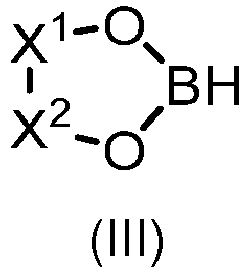
- X 1 and X 2 are each bound to the boron atom via an -O-bridge and form -together with the -O-bridges- a hydrocarbon ring having 2 to 12 carbon atoms, said hydrocarbon ring optionally being substituted by one or more substituents selected from heterosubstituents, C 1 to C 6 straight chain, branched chain or cyclic aliphatic hydrocarbons, said hydrocarbon heterocyclic ring structure having 2 to 12 carbon atoms beingrepresented by the general formula:
- the borane of the formula X 1 X 2 BH is represented by the formula in which X1 and X2 form a C 1 to C 6 -hydrocarbon chain being bound to the boron atom via-O-bridges and being substituted by hydrogen, methyl, ethyl, propyl, butyl or isomers thereof.
- a simple example is pin-H as represented by the following formula: or its analogues having 3 or 4 carbon atoms in the chain and being substituted by hydrogen or lower alkyl.
- the catalyst used in the inventive process is a cyclopentadienyl-coordinated ruthenium complex containing the following substructure: wherein R cp1 to R cp5 may be the same or different and may each be selected from hydrogen or from straight chain, branched chain or cyclic aliphatic hydrocarbons, preferably having 1 to 20 carbon atoms, optionally including heteroatoms and/or aromatic hydrocarbons in the chain and/or optionally having one or more substituents selected from C 1 -C 20 -alkyl, heterocycloalkyl, C 5 to C 20 aromatic hydrocarbon, C 5 to C 20 heteroaromatic hydrocarbon or aryl-(C 1 -C 6 )-alkyl, heteroaryl-(C 1 -C 6 )-alkyl or heteroatoms and wherein further ligands are coordinated to the central atom Ruthenium.
- Said ligands L are generally known in the state of art and serve for stabilizing the Ru-complex by sharing electrons with the Ru orbitals. Thus, they can be selected from electron-donating ligands/substituents, for example such as hydrogen, halogen, CH 3 CN, cycloalkyldiene having 8 to 12 carbon atoms,
- the solvent used in the inventive process should be a low donor solvent and may be selected from aliphatic, cycloaliphatic solvents, esters, ethers, ketones or mixtures thereof which may be substituted by one or more heteroatoms such as hexane, CHCl 3 , CH 2 Cl 2 , CH 3 CN, ethyl acetate, acetone, THF, diethyl ether or methyl tert -butyl ether, as long as they are not detrimental to the catalysed reaction. If the alkyne of the formula (I) itself is a liquid or in a liquid state, there might be no need for a separate solvent.
- the catalyst is generally used in a molar ratio of 0,1 to 10 mol-%, preferably 1 to 5 mol-% referred to the alkyne of the general formula (I).
- the inventive process can be carried out in a temperature range from -20°C to 100°C, preferably at ambient temperature of between 0° and 30°C, and it proceeds at normal pressure already. If needed, the reaction can be carried out in a protective atmosphere such as argon.
- R S 3 may be, independently from each other, the same or different and may be each an aliphatic, heteroaliphatic, aromatic or heteroaromatic group, each optionally being further substituted by one or more heterosubstituents, aliphatic, heteroaliphatic, aromatic or heteroaromatic groups.
- C 1 -C 20 -alkyl can be straight chain or branched and has 1, 2, 3, 4, 5, 6, 7, 8, 9, 10, 11, 12, 13, 14, 15, 16, 17, 18, 19 or 20 carbon atoms.
- Alkyl might be lower alkyl such as C 1 -C 6 -alkyl, in particular methyl, ethyl, propyl, isopropyl, butyl, isobutyl, sec-butyl or tert-butyl, likewise pentyl, 1-, 2- or 3-methylpropyl, 1,1-, 1,2- or 2,2-dimethylpropyl, 1-ethylpropyl, hexyl, 1-, 2, 3- or 4-methylpentyl, 1,1-, 1,2-, 1,3-, 2,2-, 2,3- or 3,3-dimethylbutyl, 1- or 2-ethylbutyl, 1-ethyl-1-methylpropyl, 1-ethyl-2-methylpropyl, 1,1,2- or 1,2,2-trimethylpropyl.
- Cycloalkyl might preferably be C 3 -C 10 -alkyl and may be cyclopropyl, cyclobutyl, cyclopentyl, cyclohexyl or cycloheptyl.
- Alkenyl might be C 2 -C 20 alkenyl.
- Alkynyl might be C 2 -C 20 alkynyl.
- Halogen is F, Cl, Br or I.
- Alkoxy is preferably C 2 -C 10 alkoxy such as methoxy, ethoxy, propoxy, iso-propoxy, tert -butoxy etc.
- Heterocycloalkyl having one or more heteroatoms selected from among N, O and S is preferably 2,3-dihydro-2-, -3-, -4- or -5-furyl, 2,5-dihydro-2-, -3-, -4- or -5-furyl, tetrahydro-2- or -3-furyl, 1,3-dioxolan-4-yl, tetrahydro-2- or -3-thienyl, 2,3-dihydro-1-, -2-, -3-, -4- or -5-pyrrolyl, 2,5-dihydro-1-, -2-, -3-, -4- or -5-pyrrolyl, 1-, 2- or 3-pyrrolidinyl, tetrahydro-1-, -2- or -4-imidazolyl, 2,3-dihydro-1-, -2-, -3-, -4- or -5-pyrazolyl, tetrahydro-1
- Optionally substituted means unsubstituted or monosubstituted, disubstituted, trisubstituted, tetrasubstituted, pentasubstituted, or even further substituted for each hydrogen on the hydrocarbon.
- Aryl might be phenyl, naphthyl, biphenyl, anthracenyl, and other polycondensed aromatic systems.
- Aryl-(C 1 -C 6 )-alkyl might be benzyl or substituted benzyl.
- Heteroaryl having one or more heteroatoms selected from among N, O and S is preferably 2- or 3-furyl, 2- or 3-thienyl, 1-, 2- or 3-pyrrolyl, 1-, 2-, 4- or 5-imidazolyl, 1-, 3-, 4- or 5-pyrazolyl, 2-, 4- or 5-oxazolyl, 3-, 4- or 5-isoxazolyl, 2-, 4- or 5-thiazolyl, 3-, 4- or 5-isothiazolyl, 2-, 3- or 4-pyridyl, 2-, 4-, 5- or 6-pyrimidinyl, also preferably 1,2,3-triazol-1-, -4- or -5-yl, 1,2,4-triazol-1-, -3- or -5-yl, 1- or 5-tetrazolyl, 1,2,3-oxadiazol-4- or -5-yl, 1,2,4-oxadiazol-3- or -5-yl, 1,3,4-thiadiazol-2- or -5-yl, 1,2,4-thiadiazol-3-
- the inventors have carried out an initial screening of catalysts and boranes for the trans -hydroboration of internal alkynes. The results are indicated in the following Table 1. Table 1. Initial screening of catalysts and boranes for the trans -hydroboration of internal alkynes.
- arylalkynes bearing electron withdrawing groups (-CF 3 , -COOMe) on the aromatic ring reacted well, although they took longer to reach full conversion.
- arylalkynes bearing electron withdrawing groups (-CF 3 , -COOMe) on the aromatic ring reacted well, although they took longer to reach full conversion.
- Particularly noteworthy in this context is the successful trans -hydroboration of sulfur-containing substrates. Though electron rich, the thiophilicity of ruthenium outweighs ⁇ -complex formation and seems to direct the catalyst towards the triple bond. In any case, the compatibility of an unhindered thioether or a thiophene unit with a reaction catalyzed by a soft transition metal species is quite remarkable.
- This smooth C-C-bond formation is obviously outperformed by the trans -hydroboration presented herein.
- the invention is further illustrated by the general method for trans -hydroboration as shown in Example 1 and further exemplified in the subsequent Examples 2 to 26 for various products of the trans -hydroboration of internal alkynes.
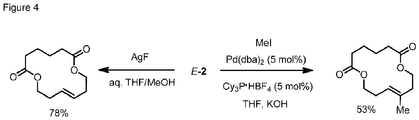
- lodomethane (10.6 ⁇ L, 0.170 mmol) and KOH (24 mg, 0.426 mmol) were added to a solution of Pd(dba) 2 (4.08 mg, 0.007 mmol, 5 mol%), [HCy 3 P]BF 4 (7.84 mg, 0.021 mmol, 15 mol%) and alkenyl boronate E -2 (50 mg, 0.142 mmol) in THF (1 mL) under argon. After stirring for 12 h at ambient temperature, the mixture was poured into diethyl ether (20 mL) before it was filtered through a pad of silica, which was carefully rinsed with diethyl ether (3 x 5 mL).
Landscapes
- Chemical & Material Sciences (AREA)
- Organic Chemistry (AREA)
- Inorganic Chemistry (AREA)
- Engineering & Computer Science (AREA)
- Materials Engineering (AREA)
- Chemical Kinetics & Catalysis (AREA)
- Catalysts (AREA)
- Low-Molecular Organic Synthesis Reactions Using Catalysts (AREA)
- Organic Low-Molecular-Weight Compounds And Preparation Thereof (AREA)
Claims (11)
- Procédé de trans-hydroboration hautement sélective d'alcynes internes comprenant les étapes de réaction d'un alcyne de formule I :

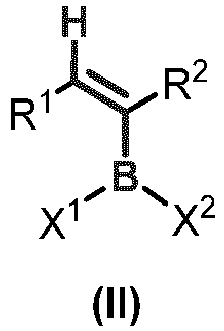 R1 et R2 peuvent être identiques ou différents et peuvent chacun être choisis parmi :a. des groupes hydrocarbures aliphatiques à chaîne linéaire ou à chaîne ramifiée, ayant de préférence 1 à 20 atomes de carbone, ou hydrocarbures aliphatiques cycliques, ayant de préférence 3 à 20 atomes de carbone, lesdits groupes hydrocarbures aliphatiques comprenant éventuellement des hétéroatomes et/ou des groupes hydrocarbures aromatiques et/ou hydrocarbures hétéroaromatiques dans la chaîne et/ou ayant un ou plusieurs substituants choisis parmi des groupes alkyle en C1 à C20, hétérocycloalkyle en C5 à C8, ouhydrocarbure aromatique en C6 à C20, hydrocarbure hétéroaromatique en C5 à C20 ou aryl-(alkyle en C1 à C6), hétéroaryl-(akyle en C1 à C6), ou hétéroatomes, oub. hydrocarbures aromatiques ayant 5 à 20 atomes de carbone ou hydrocarbures hétéroaromatiques ayant 1 à 20 atomes de carbone, lesdits groupes hydrocarbures aromatiques ou hétéroaromatiques ayant un ou plusieurs substituants choisis parmi des groupes alkyle en C1 à C20, hétérocycloalkyle en C5 à C8 ou hydrocarbure aromatique en C6 à C20, hydrocarbure hétéroaromatique en C5 à C20 ou aryl-(alkyle en C1 à C6), hétéroaryl-(alkyle en C1 à C6), hétéroatomes, ouR1 et R2 forment ensemble une chaîne d'hydrocarbure aliphatique ayant 4 à 30 atomes de carbone, comprenant éventuellement des hétéroatomes et/ou des groupes hydrocarbures aromatiques dans la chaîne et/ou éventuellement ayant un ou plusieurs substituants choisis parmi des groupes alkyle en C1 à C20, hétérocycloalkyle en C5 à C8 ou hydrocarbure aromatique en C6 à C20, hydrocarbure hétéroaromatique en C5 à C20 ou aryl-(alkyle en C1 à C6), hétéroaryl-(alkyle en C1 à C6), ladite chaîne d'hydrocarbure aliphatique étant éventuellement substituée par un ou plusieurs substituants choisi parmi des hétérosubstituants, une chaîne linéaire, une chaîne ramifiée, des groupes hydrocarbures en C1 à C20 aliphatiques cycliques, hydrocarbure aromatique en C6 à C20, hydrocarbure hétéroaromatique en C5 à C20, aryl-(alkyle en C1 à C6) ou hétéroaryl-(alkyle en C1 à C6) ou hétéroatomes ;où le borane de formule X1X2BH est choisi dans le groupe des dialkyl boranes ou di(alcoxy)boranes où X1 et X2 peuvent être identiques ou différents et peuvent chacun être choisis parmi une chaîne linéaire, une chaîne ramifiée ou des groupes hydrocarbures aliphatiques cycliques, ayant de préférence 1 à 20, de préférence 1 à 16 atomes de carbone, ou X1 et X2 ensemble forment une chaîne d'hydrocarbure aliphatique ayant 2 à 20 atomes de carbone, de préférence 2 à 10 atomes de carbone dans la chaîne, ledit groupe ou chaîne d'hydrocarbure aliphatique éventuellement lié au bore via un pont -O- et comprenant éventuellement des hétéroatomes dans la chaîne et/ou ayant éventuellement un ou plusieurs substituants choisis parmi des groupes alkyle en C1 à C20, hétérocycloalkyle en C5 à C8 ou hydrocarbure aromatique en C6 à C20, hydrocarbure hétéroaromatique en C1 à C20 ou aryl-(alkyle en C1 à C6), hétéroaryl-(alkyle en C1 à C6), ayant des groupes identiques ou différents avec 2 à 12 atomes de carbone ou hétéroatomes ; etoù le catalyseur utilisé dans le procédé de l'invention est un complexe de ruthénium à coordination cyclopentadiényle contenant la sous-structure suivante :
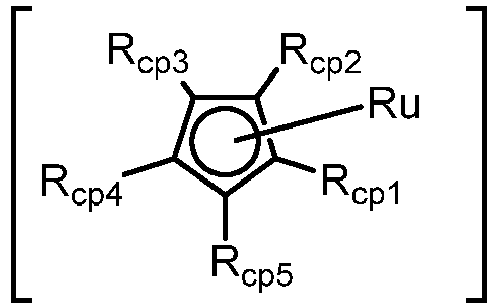 dans laquelle Rcp1 à Rcp5 peuvent être identiques ou différents et peuvent chacun être choisis parmi un atome d'hydrogène ou parmi une chaîne linéaire, une chaîne ramifiée ou des groupes hydrocarbures aliphatiques cycliques, ayant de préférence 1 à 20 atomes de carbone, comprenant éventuellement des hétéroatomes et/ou des groupes hydrocarbures aromatiques dans la chaîne et/ou ayant éventuellement un ou plusieurs substituants choisis parmi des groupes alkyle en C1 à C20, hétérocycloalkyle, hydrocarbure aromatique en C5 à C20, hydrocarbure hétéroaromatique en C5 à C20 ou aryl-(alkyle en C1 à C6), hétéroaryl-(alkyle en C1 à C6) ou des hétéroatomes et où en outre des ligands donneurs d'électrons L sont coordonnés à l'atome central de ruthénium.
 - Procédé de trans-hydroboration hautement stéréosélective d'alcynes internes selon la revendication 1 dans lequel, dans les formules (I) et (II) :R1 et R2 peuvent être identiques ou différents et peuvent chacun être choisis parmi des groupes hydrocarbures aliphatiques à chaîne linéaire ou à chaîne ramifiée ayant 1 à 20 atomes de carbone comprenant éventuellement des hétéroatomes et/ou des groupes hydrocarbures aromatiques dans la chaîne ou des groupes hydrocarbures aromatiques ayant 5 à 20 atomes de carbone ayant éventuellement un ou plusieurs substituants choisis parmi des groupes alkyle en C1 à C20, hétérocycloalkyle en C5 à C8 ou hydrocarbure aromatique en C6 à C20, hydrocarbure hétéroaromatique en C5 à C20 ou aryl-(alkyle en C1 à C6), hétéroaryl-(alkyle en C1 à C6), ou hétéroatomes, ouR1 et R2 forment ensemble une structure de chaîne hydrocarbure aliphatique ayant 8 à 20 atomes de carbone, comprenant éventuellement des hétéroatomes et/ou des groupes hydrocarbures aromatiques dans la chaîne et/ou ayant éventuellement un ou plusieurs substituants choisis parmi des groupes alkyle en C1 à C20, hétérocycloalkyle en C5 à C8 ou hydrocarbure aromatique en C6 à C20, hydrocarbure hétéroaromatique en C5 à C20 ou aryl-(alkyle en C1 à C6), hétéroaryl-(alkyle en C1 à C6), ladite structure de chaîne étant éventuellement substituée par un ou plusieurs substituants choisis parmi des hétérosubstituants, une chaîne linéaire, une chaîne ramifiée, des groupes hydrocarbures en C1 à C20 aliphatiques cycliques, hydrocarbure aromatique en C6 à C20, hydrocarbure hétéroaromatique en C5 à C20, aryl-(alkyle en C1 à C6) ou hétéroaryl-(alkyle en C1 à C6).
- Procédé de trans-hydroboration hautement stéréosélective d'alcynes internes selon les revendications 1 ou 2, dans lequel, dans la formule X1X2BH, X1 et X2 sont chacun liés à l'atome de bore via un pont -O- et forment un cycle hydrocarbure ayant 2 à 12 atomes de carbone, ledit cycle hydrocarbure étant éventuellement substitué par un ou plusieurs substituants choisis parmi des hétérosubstituants, une chaîne linéaire en C1 à C6, une chaîne ramifiée ou des groupes hydrocarbures aliphatiques cycliques, tels que représentés par la formule générale (III) :
- Procédé de trans-hydroboration hautement stéréosélective d'alcynes internes selon la revendication 3 dans lequel, dans la formule X1X2BH, X1 et X2 sont chacun liés à l'atome de bore via un pont -O- et forment un cycle hydrocarbure ayant 2 à 12 atomes de carbone, ledit cycle hydrocarbure étant éventuellement substitué par un ou plusieurs substituants choisis parmi un atome d'hydrogène, des groupes méthyle, éthyle, propyle, butyle ou leurs isomères.
- Procédé de trans-hydroboration hautement stéréosélective d'alcynes internes selon les revendications 1 à 4, dans lequel le pinacolborane (pin-H, 4,4,5,5-tétraméthyl-1,3,2-dioxaborolane) est utilisé comme borane dans la formule X1X2BH :

- Procédé de trans-hydroboration hautement stéréosélective d'alcynes internes selon les revendications 1 à 4, dans lequel le 4,4,6-triméthyl-1,3,2-dioxaborinane est utilisé comme borane dans la formule X1X2BH :

- Procédé de trans-hydroboration hautement stéréosélective d'alcynes internes selon l'une quelconque des revendications 1 à 6 dans lequel le catalyseur est [Cp*RuL3]X où Cp* = n5-C5R5cp avec chaque Rcp étant H ou un groupe alkyle inférieur, de préférence CH3, et L étant le ligand identique ou différent et étant choisi parmi les ligands donneurs d'électrons, de préférence choisis parmi un atome d'hydrogène, d'halogène, un groupe CH3CN, cycloalkyldiène ayant 8 à 12 atomes de carbone et X est un contre-ion anionique.
- Procédé de trans-hydroboration hautement stéréosélective d'alcynes internes selon l'une quelconque des revendications 1 à 6 dans lequel le complexe suivant est utilisé comme catalyseur :

- Procédé de trans-hydroboration hautement stéréosélective d'alcynes internes selon l'une quelconque des revendications 7 ou 8 dans lequel le contre-ion anionique est choisi parmi PF6 -, SbF6 -, BF4 -, ClO4 -, F3CCOO-, Tf2N-, (Tf = trifluorométhanesulfonyle), TfO-, [B[3,5-(CF3)2CeH3]4]-, B(C6F5)4 - ou Al(OC(CF3)3)4 -.
- Procédé de trans-hydroboration hautement stéréosélective d'alcynes internes selon l'une quelconque des revendications 1 à 6 dans lequel le catalyseur est choisi parmi les complexes suivants :
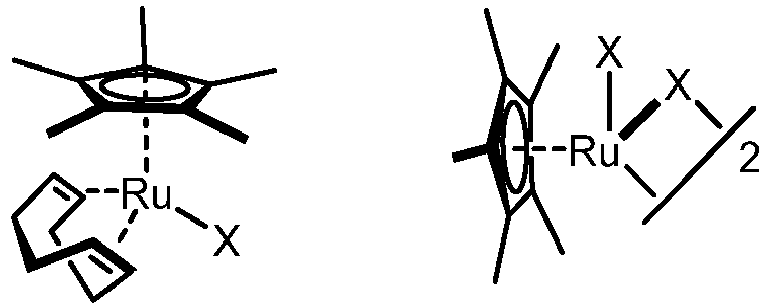
- Utilisation d'un catalyseur de ruthénium comprenant un complexe de ruthénium à coordination cyclopentadiényle contenant la sous-structure suivante :

Priority Applications (1)
| Application Number | Priority Date | Filing Date | Title |
|---|---|---|---|
| EP14781135.0A EP3052507B1 (fr) | 2013-10-01 | 2014-09-30 | Procédé pour l'hydroboration trans-sélective d'alkynes internes |
Applications Claiming Priority (3)
| Application Number | Priority Date | Filing Date | Title |
|---|---|---|---|
| EP13186892.9A EP2857405A1 (fr) | 2013-10-01 | 2013-10-01 | Procédé pour l'hydroboration trans-sélective d'alkynes internes |
| PCT/EP2014/070993 WO2015049257A1 (fr) | 2013-10-01 | 2014-09-30 | Procédé d'hydroboration trans-selective d'alkynes internes |
| EP14781135.0A EP3052507B1 (fr) | 2013-10-01 | 2014-09-30 | Procédé pour l'hydroboration trans-sélective d'alkynes internes |
Publications (2)
| Publication Number | Publication Date |
|---|---|
| EP3052507A1 EP3052507A1 (fr) | 2016-08-10 |
| EP3052507B1 true EP3052507B1 (fr) | 2019-02-13 |
Family
ID=49322190
Family Applications (2)
| Application Number | Title | Priority Date | Filing Date |
|---|---|---|---|
| EP13186892.9A Withdrawn EP2857405A1 (fr) | 2013-10-01 | 2013-10-01 | Procédé pour l'hydroboration trans-sélective d'alkynes internes |
| EP14781135.0A Active EP3052507B1 (fr) | 2013-10-01 | 2014-09-30 | Procédé pour l'hydroboration trans-sélective d'alkynes internes |
Family Applications Before (1)
| Application Number | Title | Priority Date | Filing Date |
|---|---|---|---|
| EP13186892.9A Withdrawn EP2857405A1 (fr) | 2013-10-01 | 2013-10-01 | Procédé pour l'hydroboration trans-sélective d'alkynes internes |
Country Status (8)
| Country | Link |
|---|---|
| US (1) | US9802965B2 (fr) |
| EP (2) | EP2857405A1 (fr) |
| JP (1) | JP6351713B2 (fr) |
| CN (1) | CN105612163B (fr) |
| CA (1) | CA2925058C (fr) |
| DK (1) | DK3052507T3 (fr) |
| ES (1) | ES2724459T3 (fr) |
| WO (1) | WO2015049257A1 (fr) |
Families Citing this family (5)
| Publication number | Priority date | Publication date | Assignee | Title |
|---|---|---|---|---|
| CR20210175A (es) | 2018-09-18 | 2021-06-01 | Nikang Therapeutics Inc | Derivados de anillo tricíclico condensado como inhibidores de la fosfatasa de homología a src 2 (shp2) |
| CN112010881B (zh) * | 2019-05-30 | 2021-09-03 | 中国科学院兰州化学物理研究所 | 一种烯基硼化合物及其制备方法与应用 |
| CN112010882B (zh) * | 2019-05-31 | 2021-09-14 | 武汉大学 | 立体选择性制备3,5-双取代环己烯类化合物的方法及应用 |
| CN111943967B (zh) * | 2020-08-14 | 2023-03-28 | 温州大学 | 一种合成烯基硼酸酯类化合物的方法 |
| CN115322211B (zh) * | 2022-07-18 | 2025-02-25 | 香港科技大学深圳研究院 | 烯基取代-α-羟基硼酸酯化合物的制备方法 |
Family Cites Families (3)
| Publication number | Priority date | Publication date | Assignee | Title |
|---|---|---|---|---|
| DE3528320A1 (de) | 1985-08-07 | 1987-02-12 | Metallgesellschaft Ag | Verfahren zur hydroborierung von alkenen und alkinen |
| DE10303275A1 (de) | 2003-01-28 | 2004-07-29 | Basf Ag | Funktionalisierung von ungesättigten Isobutenpolymeren durch Hydroborierung |
| EP2443128B1 (fr) | 2009-06-19 | 2017-12-20 | LEK Pharmaceuticals d.d. | Nouvelle voie de synthèse pour la préparation d'esters boronique alpha-aminé |
-
2013
- 2013-10-01 EP EP13186892.9A patent/EP2857405A1/fr not_active Withdrawn
-
2014
- 2014-09-30 CA CA2925058A patent/CA2925058C/fr active Active
- 2014-09-30 US US15/026,374 patent/US9802965B2/en not_active Expired - Fee Related
- 2014-09-30 ES ES14781135T patent/ES2724459T3/es active Active
- 2014-09-30 EP EP14781135.0A patent/EP3052507B1/fr active Active
- 2014-09-30 WO PCT/EP2014/070993 patent/WO2015049257A1/fr not_active Ceased
- 2014-09-30 JP JP2016519376A patent/JP6351713B2/ja not_active Expired - Fee Related
- 2014-09-30 CN CN201480054445.6A patent/CN105612163B/zh not_active Expired - Fee Related
- 2014-09-30 DK DK14781135.0T patent/DK3052507T3/en active
Non-Patent Citations (1)
| Title |
|---|
| None * |
Also Published As
| Publication number | Publication date |
|---|---|
| ES2724459T3 (es) | 2019-09-11 |
| CA2925058A1 (fr) | 2015-04-09 |
| EP3052507A1 (fr) | 2016-08-10 |
| JP6351713B2 (ja) | 2018-07-04 |
| JP2016536280A (ja) | 2016-11-24 |
| CN105612163A (zh) | 2016-05-25 |
| EP2857405A1 (fr) | 2015-04-08 |
| WO2015049257A1 (fr) | 2015-04-09 |
| CA2925058C (fr) | 2020-10-13 |
| US20160244466A1 (en) | 2016-08-25 |
| CN105612163B (zh) | 2018-05-22 |
| US9802965B2 (en) | 2017-10-31 |
| DK3052507T3 (en) | 2019-04-23 |
Similar Documents
| Publication | Publication Date | Title |
|---|---|---|
| US11491474B2 (en) | Chromium complex and catalyst therefrom | |
| EP3052507B1 (fr) | Procédé pour l'hydroboration trans-sélective d'alkynes internes | |
| KR102740741B1 (ko) | 키랄성 포스포르아미드이미데이트 및 이의 유도체 | |
| AU2013209048B2 (en) | Chiral imidodiphosphates and derivatives thereof | |
| CA2928148C (fr) | Procede d'hydrostannation trans-selective d'alcynes par catalyse au ruthenium | |
| US9962690B2 (en) | N-substituted pyridiniophosphines, processes for their preparation and their use | |
| WO2026012663A1 (fr) | Procédé de préparation d'un adduit diels-alder énantiomérique pur |
Legal Events
| Date | Code | Title | Description |
|---|---|---|---|
| PUAI | Public reference made under article 153(3) epc to a published international application that has entered the european phase |
Free format text: ORIGINAL CODE: 0009012 |
|
| 17P | Request for examination filed |
Effective date: 20160414 |
|
| AK | Designated contracting states |
Kind code of ref document: A1 Designated state(s): AL AT BE BG CH CY CZ DE DK EE ES FI FR GB GR HR HU IE IS IT LI LT LU LV MC MK MT NL NO PL PT RO RS SE SI SK SM TR |
|
| AX | Request for extension of the european patent |
Extension state: BA ME |
|
| DAX | Request for extension of the european patent (deleted) | ||
| STAA | Information on the status of an ep patent application or granted ep patent |
Free format text: STATUS: EXAMINATION IS IN PROGRESS |
|
| 17Q | First examination report despatched |
Effective date: 20170330 |
|
| GRAP | Despatch of communication of intention to grant a patent |
Free format text: ORIGINAL CODE: EPIDOSNIGR1 |
|
| STAA | Information on the status of an ep patent application or granted ep patent |
Free format text: STATUS: GRANT OF PATENT IS INTENDED |
|
| INTG | Intention to grant announced |
Effective date: 20180904 |
|
| GRAS | Grant fee paid |
Free format text: ORIGINAL CODE: EPIDOSNIGR3 |
|
| GRAA | (expected) grant |
Free format text: ORIGINAL CODE: 0009210 |
|
| STAA | Information on the status of an ep patent application or granted ep patent |
Free format text: STATUS: THE PATENT HAS BEEN GRANTED |
|
| AK | Designated contracting states |
Kind code of ref document: B1 Designated state(s): AL AT BE BG CH CY CZ DE DK EE ES FI FR GB GR HR HU IE IS IT LI LT LU LV MC MK MT NL NO PL PT RO RS SE SI SK SM TR |
|
| REG | Reference to a national code |
Ref country code: GB Ref legal event code: FG4D |
|
| REG | Reference to a national code |
Ref country code: CH Ref legal event code: EP Ref country code: AT Ref legal event code: REF Ref document number: 1096154 Country of ref document: AT Kind code of ref document: T Effective date: 20190215 |
|
| REG | Reference to a national code |
Ref country code: IE Ref legal event code: FG4D |
|
| REG | Reference to a national code |
Ref country code: DE Ref legal event code: R096 Ref document number: 602014041023 Country of ref document: DE |
|
| REG | Reference to a national code |
Ref country code: DK Ref legal event code: T3 Effective date: 20190415 |
|
| REG | Reference to a national code |
Ref country code: SE Ref legal event code: TRGR |
|
| REG | Reference to a national code |
Ref country code: NL Ref legal event code: MP Effective date: 20190213 |
|
| REG | Reference to a national code |
Ref country code: LT Ref legal event code: MG4D |
|
| PG25 | Lapsed in a contracting state [announced via postgrant information from national office to epo] |
Ref country code: NL Free format text: LAPSE BECAUSE OF FAILURE TO SUBMIT A TRANSLATION OF THE DESCRIPTION OR TO PAY THE FEE WITHIN THE PRESCRIBED TIME-LIMIT Effective date: 20190213 |
|
| PG25 | Lapsed in a contracting state [announced via postgrant information from national office to epo] |
Ref country code: FI Free format text: LAPSE BECAUSE OF FAILURE TO SUBMIT A TRANSLATION OF THE DESCRIPTION OR TO PAY THE FEE WITHIN THE PRESCRIBED TIME-LIMIT Effective date: 20190213 Ref country code: LT Free format text: LAPSE BECAUSE OF FAILURE TO SUBMIT A TRANSLATION OF THE DESCRIPTION OR TO PAY THE FEE WITHIN THE PRESCRIBED TIME-LIMIT Effective date: 20190213 Ref country code: PT Free format text: LAPSE BECAUSE OF FAILURE TO SUBMIT A TRANSLATION OF THE DESCRIPTION OR TO PAY THE FEE WITHIN THE PRESCRIBED TIME-LIMIT Effective date: 20190613 Ref country code: NO Free format text: LAPSE BECAUSE OF FAILURE TO SUBMIT A TRANSLATION OF THE DESCRIPTION OR TO PAY THE FEE WITHIN THE PRESCRIBED TIME-LIMIT Effective date: 20190513 |
|
| PG25 | Lapsed in a contracting state [announced via postgrant information from national office to epo] |
Ref country code: HR Free format text: LAPSE BECAUSE OF FAILURE TO SUBMIT A TRANSLATION OF THE DESCRIPTION OR TO PAY THE FEE WITHIN THE PRESCRIBED TIME-LIMIT Effective date: 20190213 Ref country code: RS Free format text: LAPSE BECAUSE OF FAILURE TO SUBMIT A TRANSLATION OF THE DESCRIPTION OR TO PAY THE FEE WITHIN THE PRESCRIBED TIME-LIMIT Effective date: 20190213 Ref country code: LV Free format text: LAPSE BECAUSE OF FAILURE TO SUBMIT A TRANSLATION OF THE DESCRIPTION OR TO PAY THE FEE WITHIN THE PRESCRIBED TIME-LIMIT Effective date: 20190213 Ref country code: GR Free format text: LAPSE BECAUSE OF FAILURE TO SUBMIT A TRANSLATION OF THE DESCRIPTION OR TO PAY THE FEE WITHIN THE PRESCRIBED TIME-LIMIT Effective date: 20190514 Ref country code: IS Free format text: LAPSE BECAUSE OF FAILURE TO SUBMIT A TRANSLATION OF THE DESCRIPTION OR TO PAY THE FEE WITHIN THE PRESCRIBED TIME-LIMIT Effective date: 20190613 Ref country code: BG Free format text: LAPSE BECAUSE OF FAILURE TO SUBMIT A TRANSLATION OF THE DESCRIPTION OR TO PAY THE FEE WITHIN THE PRESCRIBED TIME-LIMIT Effective date: 20190513 |
|
| REG | Reference to a national code |
Ref country code: ES Ref legal event code: FG2A Ref document number: 2724459 Country of ref document: ES Kind code of ref document: T3 Effective date: 20190911 |
|
| REG | Reference to a national code |
Ref country code: AT Ref legal event code: MK05 Ref document number: 1096154 Country of ref document: AT Kind code of ref document: T Effective date: 20190213 |
|
| PG25 | Lapsed in a contracting state [announced via postgrant information from national office to epo] |
Ref country code: EE Free format text: LAPSE BECAUSE OF FAILURE TO SUBMIT A TRANSLATION OF THE DESCRIPTION OR TO PAY THE FEE WITHIN THE PRESCRIBED TIME-LIMIT Effective date: 20190213 Ref country code: RO Free format text: LAPSE BECAUSE OF FAILURE TO SUBMIT A TRANSLATION OF THE DESCRIPTION OR TO PAY THE FEE WITHIN THE PRESCRIBED TIME-LIMIT Effective date: 20190213 Ref country code: CZ Free format text: LAPSE BECAUSE OF FAILURE TO SUBMIT A TRANSLATION OF THE DESCRIPTION OR TO PAY THE FEE WITHIN THE PRESCRIBED TIME-LIMIT Effective date: 20190213 Ref country code: AL Free format text: LAPSE BECAUSE OF FAILURE TO SUBMIT A TRANSLATION OF THE DESCRIPTION OR TO PAY THE FEE WITHIN THE PRESCRIBED TIME-LIMIT Effective date: 20190213 Ref country code: SK Free format text: LAPSE BECAUSE OF FAILURE TO SUBMIT A TRANSLATION OF THE DESCRIPTION OR TO PAY THE FEE WITHIN THE PRESCRIBED TIME-LIMIT Effective date: 20190213 |
|
| REG | Reference to a national code |
Ref country code: NL Ref legal event code: NE Effective date: 20191104 |
|
| REG | Reference to a national code |
Ref country code: DE Ref legal event code: R097 Ref document number: 602014041023 Country of ref document: DE |
|
| PG25 | Lapsed in a contracting state [announced via postgrant information from national office to epo] |
Ref country code: PL Free format text: LAPSE BECAUSE OF FAILURE TO SUBMIT A TRANSLATION OF THE DESCRIPTION OR TO PAY THE FEE WITHIN THE PRESCRIBED TIME-LIMIT Effective date: 20190213 Ref country code: SM Free format text: LAPSE BECAUSE OF FAILURE TO SUBMIT A TRANSLATION OF THE DESCRIPTION OR TO PAY THE FEE WITHIN THE PRESCRIBED TIME-LIMIT Effective date: 20190213 |
|
| PLBE | No opposition filed within time limit |
Free format text: ORIGINAL CODE: 0009261 |
|
| STAA | Information on the status of an ep patent application or granted ep patent |
Free format text: STATUS: NO OPPOSITION FILED WITHIN TIME LIMIT |
|
| PG25 | Lapsed in a contracting state [announced via postgrant information from national office to epo] |
Ref country code: AT Free format text: LAPSE BECAUSE OF FAILURE TO SUBMIT A TRANSLATION OF THE DESCRIPTION OR TO PAY THE FEE WITHIN THE PRESCRIBED TIME-LIMIT Effective date: 20190213 |
|
| 26N | No opposition filed |
Effective date: 20191114 |
|
| PG25 | Lapsed in a contracting state [announced via postgrant information from national office to epo] |
Ref country code: SI Free format text: LAPSE BECAUSE OF FAILURE TO SUBMIT A TRANSLATION OF THE DESCRIPTION OR TO PAY THE FEE WITHIN THE PRESCRIBED TIME-LIMIT Effective date: 20190213 |
|
| PG25 | Lapsed in a contracting state [announced via postgrant information from national office to epo] |
Ref country code: TR Free format text: LAPSE BECAUSE OF FAILURE TO SUBMIT A TRANSLATION OF THE DESCRIPTION OR TO PAY THE FEE WITHIN THE PRESCRIBED TIME-LIMIT Effective date: 20190213 |
|
| PG25 | Lapsed in a contracting state [announced via postgrant information from national office to epo] |
Ref country code: MC Free format text: LAPSE BECAUSE OF FAILURE TO SUBMIT A TRANSLATION OF THE DESCRIPTION OR TO PAY THE FEE WITHIN THE PRESCRIBED TIME-LIMIT Effective date: 20190213 |
|
| PG25 | Lapsed in a contracting state [announced via postgrant information from national office to epo] |
Ref country code: LU Free format text: LAPSE BECAUSE OF NON-PAYMENT OF DUE FEES Effective date: 20190930 |
|
| REG | Reference to a national code |
Ref country code: NL Ref legal event code: FP Ref country code: NL Ref legal event code: NG |
|
| PG25 | Lapsed in a contracting state [announced via postgrant information from national office to epo] |
Ref country code: CY Free format text: LAPSE BECAUSE OF FAILURE TO SUBMIT A TRANSLATION OF THE DESCRIPTION OR TO PAY THE FEE WITHIN THE PRESCRIBED TIME-LIMIT Effective date: 20190213 |
|
| PG25 | Lapsed in a contracting state [announced via postgrant information from national office to epo] |
Ref country code: HU Free format text: LAPSE BECAUSE OF FAILURE TO SUBMIT A TRANSLATION OF THE DESCRIPTION OR TO PAY THE FEE WITHIN THE PRESCRIBED TIME-LIMIT; INVALID AB INITIO Effective date: 20140930 Ref country code: MT Free format text: LAPSE BECAUSE OF FAILURE TO SUBMIT A TRANSLATION OF THE DESCRIPTION OR TO PAY THE FEE WITHIN THE PRESCRIBED TIME-LIMIT Effective date: 20190213 |
|
| PG25 | Lapsed in a contracting state [announced via postgrant information from national office to epo] |
Ref country code: NL Free format text: LAPSE BECAUSE OF FAILURE TO SUBMIT A TRANSLATION OF THE DESCRIPTION OR TO PAY THE FEE WITHIN THE PRESCRIBED TIME-LIMIT Effective date: 20190213 |
|
| PGRI | Patent reinstated in contracting state [announced from national office to epo] |
Ref country code: NL Effective date: 20210428 |
|
| PG25 | Lapsed in a contracting state [announced via postgrant information from national office to epo] |
Ref country code: MK Free format text: LAPSE BECAUSE OF FAILURE TO SUBMIT A TRANSLATION OF THE DESCRIPTION OR TO PAY THE FEE WITHIN THE PRESCRIBED TIME-LIMIT Effective date: 20190213 |
|
| P01 | Opt-out of the competence of the unified patent court (upc) registered |
Effective date: 20230528 |
|
| PGFP | Annual fee paid to national office [announced via postgrant information from national office to epo] |
Ref country code: NL Payment date: 20230920 Year of fee payment: 10 Ref country code: IE Payment date: 20230920 Year of fee payment: 10 Ref country code: GB Payment date: 20230920 Year of fee payment: 10 |
|
| PGFP | Annual fee paid to national office [announced via postgrant information from national office to epo] |
Ref country code: SE Payment date: 20230920 Year of fee payment: 10 Ref country code: FR Payment date: 20230928 Year of fee payment: 10 Ref country code: DK Payment date: 20230925 Year of fee payment: 10 Ref country code: DE Payment date: 20230920 Year of fee payment: 10 Ref country code: BE Payment date: 20230920 Year of fee payment: 10 |
|
| PGFP | Annual fee paid to national office [announced via postgrant information from national office to epo] |
Ref country code: ES Payment date: 20231124 Year of fee payment: 10 |
|
| PGFP | Annual fee paid to national office [announced via postgrant information from national office to epo] |
Ref country code: IT Payment date: 20230927 Year of fee payment: 10 Ref country code: CH Payment date: 20231001 Year of fee payment: 10 |
|
| REG | Reference to a national code |
Ref country code: DE Ref legal event code: R119 Ref document number: 602014041023 Country of ref document: DE |
|
| REG | Reference to a national code |
Ref country code: DK Ref legal event code: EBP Effective date: 20240930 |
|
| REG | Reference to a national code |
Ref country code: CH Ref legal event code: PL |
|
| REG | Reference to a national code |
Ref country code: NL Ref legal event code: MM Effective date: 20241001 |
|
| GBPC | Gb: european patent ceased through non-payment of renewal fee |
Effective date: 20240930 |
|
| REG | Reference to a national code |
Ref country code: SE Ref legal event code: EUG |
|
| PG25 | Lapsed in a contracting state [announced via postgrant information from national office to epo] |
Ref country code: NL Free format text: LAPSE BECAUSE OF NON-PAYMENT OF DUE FEES Effective date: 20241001 |
|
| PG25 | Lapsed in a contracting state [announced via postgrant information from national office to epo] |
Ref country code: DE Free format text: LAPSE BECAUSE OF NON-PAYMENT OF DUE FEES Effective date: 20250401 |
|
| PG25 | Lapsed in a contracting state [announced via postgrant information from national office to epo] |
Ref country code: GB Free format text: LAPSE BECAUSE OF NON-PAYMENT OF DUE FEES Effective date: 20240930 |
|
| REG | Reference to a national code |
Ref country code: BE Ref legal event code: MM Effective date: 20240930 |
|
| PG25 | Lapsed in a contracting state [announced via postgrant information from national office to epo] |
Ref country code: BE Free format text: LAPSE BECAUSE OF NON-PAYMENT OF DUE FEES Effective date: 20240930 Ref country code: IT Free format text: LAPSE BECAUSE OF NON-PAYMENT OF DUE FEES Effective date: 20240930 |
|
| PG25 | Lapsed in a contracting state [announced via postgrant information from national office to epo] |
Ref country code: FR Free format text: LAPSE BECAUSE OF NON-PAYMENT OF DUE FEES Effective date: 20240930 |
|
| PG25 | Lapsed in a contracting state [announced via postgrant information from national office to epo] |
Ref country code: CH Free format text: LAPSE BECAUSE OF NON-PAYMENT OF DUE FEES Effective date: 20240930 |
|
| PG25 | Lapsed in a contracting state [announced via postgrant information from national office to epo] |
Ref country code: IE Free format text: LAPSE BECAUSE OF NON-PAYMENT OF DUE FEES Effective date: 20240930 |
|
| PG25 | Lapsed in a contracting state [announced via postgrant information from national office to epo] |
Ref country code: DK Free format text: LAPSE BECAUSE OF NON-PAYMENT OF DUE FEES Effective date: 20240930 |
|
| PG25 | Lapsed in a contracting state [announced via postgrant information from national office to epo] |
Ref country code: SE Free format text: LAPSE BECAUSE OF NON-PAYMENT OF DUE FEES Effective date: 20241001 |
|
| REG | Reference to a national code |
Ref country code: ES Ref legal event code: FD2A Effective date: 20251106 |
|
| PG25 | Lapsed in a contracting state [announced via postgrant information from national office to epo] |
Ref country code: ES Free format text: LAPSE BECAUSE OF NON-PAYMENT OF DUE FEES Effective date: 20241001 |