EP3052837B1 - Procédé et agencement permettant d'adapter le rapport de démarrage d'un véhicule - Google Patents
Procédé et agencement permettant d'adapter le rapport de démarrage d'un véhicule Download PDFInfo
- Publication number
- EP3052837B1 EP3052837B1 EP13779129.9A EP13779129A EP3052837B1 EP 3052837 B1 EP3052837 B1 EP 3052837B1 EP 13779129 A EP13779129 A EP 13779129A EP 3052837 B1 EP3052837 B1 EP 3052837B1
- Authority
- EP
- European Patent Office
- Prior art keywords
- vehicle
- starting gear
- gear
- control unit
- speed
- Prior art date
- Legal status (The legal status is an assumption and is not a legal conclusion. Google has not performed a legal analysis and makes no representation as to the accuracy of the status listed.)
- Active
Links
Images


Classifications
-
- B—PERFORMING OPERATIONS; TRANSPORTING
- B60—VEHICLES IN GENERAL
- B60W—CONJOINT CONTROL OF VEHICLE SUB-UNITS OF DIFFERENT TYPE OR DIFFERENT FUNCTION; CONTROL SYSTEMS SPECIALLY ADAPTED FOR HYBRID VEHICLES; ROAD VEHICLE DRIVE CONTROL SYSTEMS FOR PURPOSES NOT RELATED TO THE CONTROL OF A PARTICULAR SUB-UNIT
- B60W30/00—Purposes of road vehicle drive control systems not related to the control of a particular sub-unit, e.g. of systems using conjoint control of vehicle sub-units
- B60W30/14—Adaptive cruise control
-
- B—PERFORMING OPERATIONS; TRANSPORTING
- B60—VEHICLES IN GENERAL
- B60W—CONJOINT CONTROL OF VEHICLE SUB-UNITS OF DIFFERENT TYPE OR DIFFERENT FUNCTION; CONTROL SYSTEMS SPECIALLY ADAPTED FOR HYBRID VEHICLES; ROAD VEHICLE DRIVE CONTROL SYSTEMS FOR PURPOSES NOT RELATED TO THE CONTROL OF A PARTICULAR SUB-UNIT
- B60W10/00—Conjoint control of vehicle sub-units of different type or different function
- B60W10/02—Conjoint control of vehicle sub-units of different type or different function including control of driveline clutches
-
- B—PERFORMING OPERATIONS; TRANSPORTING
- B60—VEHICLES IN GENERAL
- B60W—CONJOINT CONTROL OF VEHICLE SUB-UNITS OF DIFFERENT TYPE OR DIFFERENT FUNCTION; CONTROL SYSTEMS SPECIALLY ADAPTED FOR HYBRID VEHICLES; ROAD VEHICLE DRIVE CONTROL SYSTEMS FOR PURPOSES NOT RELATED TO THE CONTROL OF A PARTICULAR SUB-UNIT
- B60W10/00—Conjoint control of vehicle sub-units of different type or different function
- B60W10/10—Conjoint control of vehicle sub-units of different type or different function including control of change-speed gearings
- B60W10/11—Stepped gearings
-
- B—PERFORMING OPERATIONS; TRANSPORTING
- B60—VEHICLES IN GENERAL
- B60W—CONJOINT CONTROL OF VEHICLE SUB-UNITS OF DIFFERENT TYPE OR DIFFERENT FUNCTION; CONTROL SYSTEMS SPECIALLY ADAPTED FOR HYBRID VEHICLES; ROAD VEHICLE DRIVE CONTROL SYSTEMS FOR PURPOSES NOT RELATED TO THE CONTROL OF A PARTICULAR SUB-UNIT
- B60W30/00—Purposes of road vehicle drive control systems not related to the control of a particular sub-unit, e.g. of systems using conjoint control of vehicle sub-units
- B60W30/14—Adaptive cruise control
- B60W30/16—Control of distance between vehicles, e.g. keeping a distance to preceding vehicle
- B60W30/17—Control of distance between vehicles, e.g. keeping a distance to preceding vehicle with provision for special action when the preceding vehicle comes to a halt, e.g. stop and go
-
- F—MECHANICAL ENGINEERING; LIGHTING; HEATING; WEAPONS; BLASTING
- F16—ENGINEERING ELEMENTS AND UNITS; GENERAL MEASURES FOR PRODUCING AND MAINTAINING EFFECTIVE FUNCTIONING OF MACHINES OR INSTALLATIONS; THERMAL INSULATION IN GENERAL
- F16H—GEARING
- F16H61/00—Control functions within control units of change-speed- or reversing-gearings for conveying rotary motion ; Control of exclusively fluid gearing, friction gearing, gearings with endless flexible members or other particular types of gearing
- F16H61/02—Control functions within control units of change-speed- or reversing-gearings for conveying rotary motion ; Control of exclusively fluid gearing, friction gearing, gearings with endless flexible members or other particular types of gearing characterised by the signals used
- F16H61/0202—Control functions within control units of change-speed- or reversing-gearings for conveying rotary motion ; Control of exclusively fluid gearing, friction gearing, gearings with endless flexible members or other particular types of gearing characterised by the signals used the signals being electric
- F16H61/0204—Control functions within control units of change-speed- or reversing-gearings for conveying rotary motion ; Control of exclusively fluid gearing, friction gearing, gearings with endless flexible members or other particular types of gearing characterised by the signals used the signals being electric for gearshift control, e.g. control functions for performing shifting or generation of shift signal
- F16H61/0213—Control functions within control units of change-speed- or reversing-gearings for conveying rotary motion ; Control of exclusively fluid gearing, friction gearing, gearings with endless flexible members or other particular types of gearing characterised by the signals used the signals being electric for gearshift control, e.g. control functions for performing shifting or generation of shift signal characterised by the method for generating shift signals
-
- B—PERFORMING OPERATIONS; TRANSPORTING
- B60—VEHICLES IN GENERAL
- B60W—CONJOINT CONTROL OF VEHICLE SUB-UNITS OF DIFFERENT TYPE OR DIFFERENT FUNCTION; CONTROL SYSTEMS SPECIALLY ADAPTED FOR HYBRID VEHICLES; ROAD VEHICLE DRIVE CONTROL SYSTEMS FOR PURPOSES NOT RELATED TO THE CONTROL OF A PARTICULAR SUB-UNIT
- B60W2420/00—Indexing codes relating to the type of sensors based on the principle of their operation
- B60W2420/40—Photo, light or radio wave sensitive means, e.g. infrared sensors
- B60W2420/408—Radar; Laser, e.g. lidar
-
- B—PERFORMING OPERATIONS; TRANSPORTING
- B60—VEHICLES IN GENERAL
- B60W—CONJOINT CONTROL OF VEHICLE SUB-UNITS OF DIFFERENT TYPE OR DIFFERENT FUNCTION; CONTROL SYSTEMS SPECIALLY ADAPTED FOR HYBRID VEHICLES; ROAD VEHICLE DRIVE CONTROL SYSTEMS FOR PURPOSES NOT RELATED TO THE CONTROL OF A PARTICULAR SUB-UNIT
- B60W2554/00—Input parameters relating to objects
- B60W2554/80—Spatial relation or speed relative to objects
-
- B—PERFORMING OPERATIONS; TRANSPORTING
- B60—VEHICLES IN GENERAL
- B60W—CONJOINT CONTROL OF VEHICLE SUB-UNITS OF DIFFERENT TYPE OR DIFFERENT FUNCTION; CONTROL SYSTEMS SPECIALLY ADAPTED FOR HYBRID VEHICLES; ROAD VEHICLE DRIVE CONTROL SYSTEMS FOR PURPOSES NOT RELATED TO THE CONTROL OF A PARTICULAR SUB-UNIT
- B60W2554/00—Input parameters relating to objects
- B60W2554/80—Spatial relation or speed relative to objects
- B60W2554/802—Longitudinal distance
-
- B—PERFORMING OPERATIONS; TRANSPORTING
- B60—VEHICLES IN GENERAL
- B60W—CONJOINT CONTROL OF VEHICLE SUB-UNITS OF DIFFERENT TYPE OR DIFFERENT FUNCTION; CONTROL SYSTEMS SPECIALLY ADAPTED FOR HYBRID VEHICLES; ROAD VEHICLE DRIVE CONTROL SYSTEMS FOR PURPOSES NOT RELATED TO THE CONTROL OF A PARTICULAR SUB-UNIT
- B60W2710/00—Output or target parameters relating to a particular sub-units
- B60W2710/02—Clutches
- B60W2710/021—Clutch engagement state
-
- B—PERFORMING OPERATIONS; TRANSPORTING
- B60—VEHICLES IN GENERAL
- B60W—CONJOINT CONTROL OF VEHICLE SUB-UNITS OF DIFFERENT TYPE OR DIFFERENT FUNCTION; CONTROL SYSTEMS SPECIALLY ADAPTED FOR HYBRID VEHICLES; ROAD VEHICLE DRIVE CONTROL SYSTEMS FOR PURPOSES NOT RELATED TO THE CONTROL OF A PARTICULAR SUB-UNIT
- B60W2710/00—Output or target parameters relating to a particular sub-units
- B60W2710/10—Change speed gearings
- B60W2710/1005—Transmission ratio engaged
-
- B—PERFORMING OPERATIONS; TRANSPORTING
- B60—VEHICLES IN GENERAL
- B60Y—INDEXING SCHEME RELATING TO ASPECTS CROSS-CUTTING VEHICLE TECHNOLOGY
- B60Y2200/00—Type of vehicle
- B60Y2200/10—Road Vehicles
- B60Y2200/14—Trucks; Load vehicles, Busses
- B60Y2200/142—Heavy duty trucks
-
- F—MECHANICAL ENGINEERING; LIGHTING; HEATING; WEAPONS; BLASTING
- F16—ENGINEERING ELEMENTS AND UNITS; GENERAL MEASURES FOR PRODUCING AND MAINTAINING EFFECTIVE FUNCTIONING OF MACHINES OR INSTALLATIONS; THERMAL INSULATION IN GENERAL
- F16H—GEARING
- F16H61/00—Control functions within control units of change-speed- or reversing-gearings for conveying rotary motion ; Control of exclusively fluid gearing, friction gearing, gearings with endless flexible members or other particular types of gearing
- F16H61/02—Control functions within control units of change-speed- or reversing-gearings for conveying rotary motion ; Control of exclusively fluid gearing, friction gearing, gearings with endless flexible members or other particular types of gearing characterised by the signals used
- F16H61/0202—Control functions within control units of change-speed- or reversing-gearings for conveying rotary motion ; Control of exclusively fluid gearing, friction gearing, gearings with endless flexible members or other particular types of gearing characterised by the signals used the signals being electric
- F16H61/0204—Control functions within control units of change-speed- or reversing-gearings for conveying rotary motion ; Control of exclusively fluid gearing, friction gearing, gearings with endless flexible members or other particular types of gearing characterised by the signals used the signals being electric for gearshift control, e.g. control functions for performing shifting or generation of shift signal
- F16H61/0213—Control functions within control units of change-speed- or reversing-gearings for conveying rotary motion ; Control of exclusively fluid gearing, friction gearing, gearings with endless flexible members or other particular types of gearing characterised by the signals used the signals being electric for gearshift control, e.g. control functions for performing shifting or generation of shift signal characterised by the method for generating shift signals
- F16H2061/0218—Calculation or estimation of the available ratio range, i.e. possible gear ratios, e.g. for prompting a driver with a display
-
- F—MECHANICAL ENGINEERING; LIGHTING; HEATING; WEAPONS; BLASTING
- F16—ENGINEERING ELEMENTS AND UNITS; GENERAL MEASURES FOR PRODUCING AND MAINTAINING EFFECTIVE FUNCTIONING OF MACHINES OR INSTALLATIONS; THERMAL INSULATION IN GENERAL
- F16H—GEARING
- F16H61/00—Control functions within control units of change-speed- or reversing-gearings for conveying rotary motion ; Control of exclusively fluid gearing, friction gearing, gearings with endless flexible members or other particular types of gearing
- F16H61/02—Control functions within control units of change-speed- or reversing-gearings for conveying rotary motion ; Control of exclusively fluid gearing, friction gearing, gearings with endless flexible members or other particular types of gearing characterised by the signals used
- F16H61/0202—Control functions within control units of change-speed- or reversing-gearings for conveying rotary motion ; Control of exclusively fluid gearing, friction gearing, gearings with endless flexible members or other particular types of gearing characterised by the signals used the signals being electric
- F16H61/0204—Control functions within control units of change-speed- or reversing-gearings for conveying rotary motion ; Control of exclusively fluid gearing, friction gearing, gearings with endless flexible members or other particular types of gearing characterised by the signals used the signals being electric for gearshift control, e.g. control functions for performing shifting or generation of shift signal
- F16H61/0213—Control functions within control units of change-speed- or reversing-gearings for conveying rotary motion ; Control of exclusively fluid gearing, friction gearing, gearings with endless flexible members or other particular types of gearing characterised by the signals used the signals being electric for gearshift control, e.g. control functions for performing shifting or generation of shift signal characterised by the method for generating shift signals
- F16H2061/023—Drive-off gear selection, i.e. optimising gear ratio for drive off of a vehicle
-
- F—MECHANICAL ENGINEERING; LIGHTING; HEATING; WEAPONS; BLASTING
- F16—ENGINEERING ELEMENTS AND UNITS; GENERAL MEASURES FOR PRODUCING AND MAINTAINING EFFECTIVE FUNCTIONING OF MACHINES OR INSTALLATIONS; THERMAL INSULATION IN GENERAL
- F16H—GEARING
- F16H59/00—Control inputs to control units of change-speed- or reversing-gearings for conveying rotary motion
- F16H59/60—Inputs being a function of ambient conditions
Definitions
- the present invention relates to a method and arrangement for adapting the starting gear of a heavy vehicle having an automated manual transmission.
- the invention further relates to a computer program adapted to perform such a method when said program is run on a computer, and a computer program product comprising such program code means stored on a computer readable medium.
- the method is advantageous for vehicles travelling in long queues or heavy traffic with several stops and starts.
- Modern vehicles are often provided with a cruise control system in order to improve the comfort of a driver.
- Some cruise control system are provided with further functions, such as an adaptive control system that uses distance measuring equipment to monitor the distance to a vehicle in front of the own vehicle, in order to be able to adapt the cruise speed to the speed of the vehicle in front.
- Such a system will improve the safety of the cruise control system since a minimum distance or a minimum time interval will be maintained to the vehicle in front.
- Some systems will also brake the vehicle if the minimum distance or the minimum time interval is not maintained, or if the distance to the vehicle in front decreases at a certain rate.
- the cruise control system may be adapted to maintain a set speed by using only the propulsion torque from an engine, or by also using the brakes of the vehicle.
- a further function of the cruise control system of the vehicle may be an economy drive setting, in which the regulating parameters of the cruise control system are ruled by economy.
- the distance or time interval to a vehicle in front may be measured in different ways, but a radar device is often used.
- Many heavy vehicles are also provided with an automated manual transmission (AMT), which is a manual transmission provided with one or two clutches which are engaged and disengaged automatically. In this way, an automated gear change is provided without the need to use a regular automatic transmission having a torque converter. By using an AMT, the weight and complexity of the transmission is reduced, and reduced fuel consumption is also possible.
- AMT automated manual transmission
- An adaptive cruise control may also give input to the control unit of the AMT such that the cruise control can use also the transmission to maintain the set cruise speed.
- the start gear is selected automatically even though it is possible for the driver to select a specific start gear.
- the control system detects vehicle parameters such as load of the vehicle, type of engine, engine performance, inclination, selected driving mode, etc and pre-selects a suitable starting gear.
- the starting gear is normally selected as high as possible in order to improve the comfort for the driver and to reduce the number of gear changes.
- Such a control system and method is known from US 2004/0025617 disclosing the features of the preamble of claims 1 and 7. There are however occasion where such a behaviour can be improved. There is thus a need for an improved method and arrangement for adapting the starting gear of a heavy vehicle.
- An object of the invention is therefore to provide an improved method for adapting the starting gear of an automated manual transmission in a heavy vehicle.
- a further object of the invention is to provide an improved arrangement for adapting the starting gear of an automated manual transmission in a heavy vehicle.
- the problem is solved in that the starting gear is lowered from the pre-selected starting gear in dependency on a movement behaviour of a vehicle in front of the heavy vehicle.
- the starting gear of an automated manual transmission in a heavy vehicle can be adapted to the current traffic situation.
- the starting gear is determined and set by a control unit of the vehicle.
- the starting gear is normally selected depending on different vehicle parameters, such as total weight of the vehicle, the load, the trailer configuration, engine performance etc.
- the starting gear is selected such that, with the given vehicle parameters, the vehicle will be able to perform a proper start cycle without too much clutch slippage.
- the inventive method is especially useful when the vehicle is standing in a queue.
- the adaptation of the starting gear is done by lowering the starting gear from a pre-selected starting gear in dependency of the movement behaviour of the vehicle in front.
- a starting gear can be selected such that the vehicle will reach the estimated speed of the vehicle in front with the starting gear, when the clutch is fully engaged.
- the starting gear is lowered by one or more gears.
- the advantage of lowering the starting gear is that the clutch will be fully engaged when the starting cycle is completed.
- the starting gear can be used also when the vehicle continue to travel in the queue, such that an unnecessary shift down must not be made after the start cycle, or such that unnecessary clutch slippage is avoided.
- the adapted starting gear is preferably selected depending on the type of movement behaviour of the vehicle in front. If the movement behaviour of the vehicle in front is an acceleration, the rate of acceleration is used to determine if and how much the starting gear is to be lowered in order to be able to perform a proper start cycle. If the movement behaviour of the vehicle in front is a substantially constant speed, the selected starting gear is selected such that the own vehicle will reach a speed that corresponds to the vehicle in front when the start cycle is completed. On the other hand, if the movement behaviour of the vehicle in front is such that it is determined that the pre-selected starting gear is the best choice, an adaptation of the starting gear is not made. This may e.g. be the case if the vehicle in front accelerates with a relatively high rate or if the distance to the vehicle in front is relatively long.
- the determination of when to adapt the starting gear by selecting a lower starting gear, and by how much the starting gear is lowered, is preferably governed by predetermined threshold values based on the movement behaviour of the vehicle in front.
- the problem is solved in that the arrangement comprises means for detecting a movement behaviour of a vehicle in front of the heavy vehicle, and that the control unit is adapted to lower the starting gear from the pre-selected starting gear depending on the detected movement behaviour of the vehicle in front.
- the arrangement comprises a control unit adapted to pre-select a starting gear depending on vehicle parameters of the heavy vehicle and means for detecting movement behaviour of a vehicle in front of the heavy vehicle.
- the control unit is adapted to lower the starting gear from the pre-selected starting gear depending on the detected movement behaviour of the vehicle in front.
- the control unit may e.g. be a transmission control unit which preferably interacts with an adaptive cruise control unit, or may be integrated in the adaptive cruise control unit.
- the control unit may also be a stand-alone control unit or it may be integrated in any suitable control unit.
- the means for detecting movement behaviour of a vehicle in front is preferably a radar, even though other technical solutions such as image detection, a laser scanner or a radio transmission between the vehicle in front and the vehicle behind in order to send information about the movement behavior, are also possible solutions.
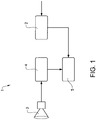
- FIG. 1 shows a schematic arrangement for adapting the starting gear of an automated manual transmission in a heavy vehicle
- Fig. 2 shows a vehicle comprising such an arrangement
- the vehicle 10 comprises an engine 11, a transmission 12, a transmission control unit 5 and an arrangement 1.
- the arrangement 1 comprises a vehicle control unit 2 which may be a standalone control unit or may be integrated e.g. as a software module in another electronic control unit in the vehicle.
- the vehicle control unit 2 is adapted to collect and forward information regarding vehicle parameters to the transmission control unit 5.
- the transmission control unit 5 is adapted to further receive information regarding the movement behaviour of the vehicle in front and to use this information to pre-select a starting gear for the vehicle.
- the arrangement 1 further comprises an adaptive cruise control electronic control unit 4 which may be either a standalone control unit comprising the adaptive cruise control system or may also be integrated e.g. as a software module in another electronic control unit in the vehicle.
- the vehicle control unit 2 and the adaptive cruise control unit 4 are here described as two separate units but they may be combined in a single unit or may both be integrated in another control unit.
- the arrangement 1 further comprises distance means 3 for detecting a movement behaviour of a vehicle in front of the heavy vehicle.
- the distance means for detecting movement behaviour of a vehicle in front is preferably a radar, even though as mentioned above other technical solutions are also possible.
- the transmission control unit 5 receives information from e.g. the vehicle control unit 2 regarding various vehicle parameters.
- the vehicle control unit forwards the information that is relevant for the determination of a starting gear that is to be used when the vehicle starts to the transmission control unit 5.
- vehicle parameters are e.g. total weight of the vehicle, the load of the vehicle, the trailer configuration, type of engine etc.
- Further parameters that may influence the determination of a starting gear are e.g. road inclination, ambient weather etc.
- the starting gear is selected by the transmission control unit 5 such that the highest possible starting gear is used for the given vehicle parameters, and for the given available energy. In this way, the vehicle will be able to perform a proper start cycle without too much clutch slippage.
- the amount that the accelerator pedal is pressed down i.e. the ordered start energy
- the accelerator pedal is pressed down by a relatively high amount, a regular start cycle will be selected, in which the clutch is fully engaged. If the driver presses the accelerator pedal only by a small amount, the clutch will not be engaged fully, and the vehicle will move slowly by using clutch slippage. This type of start is used when the vehicle should move small distances, e.g. when marshalling, and is not used for normal driving.
- the adaptive cruise control unit 4 is connected to a distance means 3 for detecting movement behaviour of a vehicle in front.
- This distance means is normally used by the adaptive cruise control unit to control the distance or time gap to a vehicle in front when cruising on a highway. At still stand, before a start cycle is commenced, the distance means is used to detect movement behaviour of a vehicle in front.
- the pre-selected starting gear will be used for the start cycle.
- a case may be e.g. when there is no vehicle in front, if the distance to the vehicle in front is longer than a predefined distance or if the vehicle in front is accelerating at a high rate. In this case, the pre-selected starting gear will be used for the start cycle.
- the pre-selected starting gear is in this example determined by the transmission control unit 5.
- the decision to lower the starting gear may in one example be determined by the transmission control unit 5 based on the movement behaviour information of the vehicle in front received from the adaptive cruise control unit 4.
- the decision to lower the starting gear may in another example be determined by the adaptive cruise control unit 4 based on the movement behaviour information of the vehicle in front, after which a request for lowering the starting gear is sent to the transmission control unit 5.
- the movement behaviour may be either an acceleration, a constant speed or a retardation. If the movement behaviour is a constant speed, which is common when driving in a queue, the speed that the vehicle will reach by using the pre-selected starting gear, i.e. the pre-selected starting gear speed, is determined and is compared with a threshold value derived from the movement behaviour of the vehicle in front. In this case, the threshold value may e.g. be the speed of the vehicle in front or a speed slightly higher than the speed of the vehicle in front. If the movement behaviour is an acceleration, the amount of acceleration is used to determine a threshold value. If the movement behaviour is a retardation, a start cycle is probably aborted.
- the starting gear will be lowered by e.g. one gear and the speed that will be reached by using this gear is determined.
- This new speed value is compared to the threshold value and if the new speed value is lower than the threshold value, the lowered starting gear is selected. This starting gear value is used by the transmission control unit as the new starting gear.
- the starting gear will be lowered by another gear and a new comparison will be performed. This will continue until a starting gear that will give a speed value below the threshold value is found. It is also possible to use a predetermined map comprising speed values, starting gears and vehicle parameters to determine a suitable starting gear.
- the invention is especially useful when the vehicle is standing in a queue.
- the adaptation of the starting gear is done by lowering the starting gear from a pre-selected starting gear in dependency of the movement behaviour of the vehicle in front. In this way, a starting gear can be selected such that the vehicle will reach the estimated speed of the vehicle in front with the selected starting gear when the clutch is fully engaged.
- a normal starting gear would be gear 4 or 5.
- the lowest possible speed of the vehicle for a given gear can be estimated from the fact that the idle rotational speed of the engine is approximately 600 rpm.
- a somewhat higher engine speed is used to determine the speed at a given gear, since it is unpractical to run at the idle speed of the vehicle.
- a lowest engine speed of approximately 800 rpm is used, which gives a suitable speed margin. It is thus of advantage to use a starting gear that will give a speed that corresponds to the speed of the queue at a relatively low engine speed.
- Fig. 3 shows a schematic flow chart of a method for adapting the starting gear of an automated manual transmission in a heavy vehicle according to the invention. The method is performed by the arrangement comprising a control unit and means for detecting a movement behaviour of a vehicle in front of the heavy vehicle.
- step 100 the vehicle is halted and is standing still.
- the drive selector is in drive mode and the clutch of the automated manual transmission is disengaged such that there is no driving connection between the engine and the gear box of the vehicle.
- the transmission control unit receives information from other vehicle control units 2 regarding different vehicle parameters that will influence the start cycle of the vehicle, and may also receive information regarding ambient conditions.
- a pre-selected starting gear is determined from this information by the transmission control unit 5. In this example, gear 5 will be the pre-selected starting gear.
- the transmission control unit receives information regarding the movement behaviour of the vehicle in front.
- the information is in this example obtained from a radar mounted in the front of the vehicle and forwarded to the transmission control unit from the adaptive cruise control unit.
- the signals obtained from the radar are used by the adaptive cruise control unit to determine the movement behaviour of the vehicle in front.
- the movement behaviour of the vehicle in front may also be determined directly in the radar unit or in another control unit. It is also possible to let the adaptive cruise control unit or another control unit determine if the starting gear needs to be adapted. In this case, the speed estimations is performed by the adaptive cruise control unit or the other control unit, and a request to lower the starting gear is sent to the transmission control unit when required.
- step 120 the speed that the vehicle will reach when the start cycle is completed with the pre-selected starting gear is compared with a threshold value, which may be an estimated speed of the vehicle ahead. If the start cycle speed is lower than the threshold value, the pre-selected starting gear will be used as starting gear in step 200. If the start cycle speed is higher than the threshold value, the starting gear will have to be adapted.
- a threshold value which may be an estimated speed of the vehicle ahead.
- step 130 the starting gear is lowered by one gear, e.g. from gear 5 to gear 4.
- a control unit estimates the speed that the vehicle will reach with the new gear, i.e. gear 4, when the start cycle is completed. This speed is compared with the threshold value in step 140. If the start cycle speed is lower than the threshold value, this starting gear will be used as starting gear in step 200. If the start cycle speed is still higher than the threshold value, the starting gear will have to be further adapted.
- step 150 the starting gear is lowered by one more gear, e.g. from gear 4 to gear 3.
- a control unit estimates the speed that the vehicle will reach with the new gear, i.e. gear 3, when the start cycle is completed. This speed is compared with the threshold value in step 160. If the start cycle speed is lower than the threshold value, this starting gear will be used as starting gear in step 200. If the start cycle speed is still higher than the threshold value, the starting gear will be further adapted in similar methods steps until gear 1 is reached and there is no lower gear to select. Most probably, a starting gear of at least 3 will normally be selected since lower gears are mostly used in extreme situations. However, should the queue move very slowly, gear 1 may have to be used as starting gear.
- the start cycle is performed in step 200.
- the vehicle can continue driving in the queue without having to make another gear change. Should the speed of the queue increase, the transmission will shift up in a normal way. Should the speed decrease somewhat, the vehicle will continue to drive with the selected gear until the speed of the engine drops to a shift down level.
Landscapes
- Engineering & Computer Science (AREA)
- Mechanical Engineering (AREA)
- Transportation (AREA)
- General Engineering & Computer Science (AREA)
- Automation & Control Theory (AREA)
- Chemical & Material Sciences (AREA)
- Combustion & Propulsion (AREA)
- Control Of Transmission Device (AREA)
- Control Of Driving Devices And Active Controlling Of Vehicle (AREA)
Claims (15)
- Procédé d'adaptation du rapport de démarrage d'une transmission manuelle automatisée dans un véhicule poids lourd, où un rapport de démarrage présélectionné est sélectionné par une unité de commande en fonction de paramètres de véhicule du véhicule poids lourd, caractérisé en ce que le rapport de démarrage est réduit à partir du rapport de démarrage présélectionné par l'unité de commande en fonction d'un comportement de déplacement d'un véhicule en avant du véhicule poids lourd.
- Procédé selon la revendication 1, caractérisé en ce que le comportement de déplacement d'un véhicule en avant est une accélération.
- Procédé selon la revendication 1, caractérisé en ce que le comportement de déplacement d'un véhicule en avant est une vitesse constante.
- Procédé selon l'une quelconque des revendications précédentes, caractérisé en ce que le rapport de démarrage présélectionné est réduit d'un rapport lorsque la vitesse que le véhicule atteindra avec le rapport de démarrage présélectionné est au-dessus d'une valeur seuil prédéterminée.
- Procédé selon la revendication 4, caractérisé en ce que le rapport de démarrage présélectionné est réduit de deux rapports lorsque la vitesse que le véhicule atteindra avec un rapport de démarrage réduit d'un rapport est au-dessus de la valeur seuil prédéterminée.
- Procédé selon l'une quelconque des revendications précédentes, caractérisé en ce que le rapport de démarrage adapté est sélectionné de sorte que l'embrayage de la transmission sera complètement engagé lorsque le véhicule a atteint une vitesse correspondant à la vitesse estimée du véhicule en avant.
- Agencement d'adaptation du rapport de démarrage d'une transmission manuelle automatisée dans un véhicule poids lourd, où l'agencement (1) comprend une unité de commande de transmission (5) adaptée pour présélectionner un rapport de démarrage en fonction de paramètres de véhicule du véhicule poids lourd, caractérisé en ce que l'agencement comprend un moyen à distance (3) pour détecter un comportement de déplacement d'un véhicule en avant du véhicule poids lourd, et en ce que l'unité de commande de transmission (5) est adaptée pour réduire le rapport de démarrage à partir du rapport de démarrage présélectionné en fonction du comportement de déplacement détecté du véhicule en avant.
- Agencement selon la revendication 7, caractérisé en ce que le moyen à distance (3) pour détecter un comportement de déplacement d'un véhicule en avant est un radar.
- Agencement selon l'une quelconque des revendications 7 et 8, caractérisé en ce que le comportement de déplacement d'un véhicule en avant est une accélération.
- Agencement selon l'une quelconque des revendications 7 à 9, caractérisé en ce que le comportement de déplacement d'un véhicule en avant est une vitesse constante.
- Agencement selon l'une quelconque des revendications 7 à 10, caractérisé en ce que l'unité de commande de transmission (5) est adaptée pour réduire le rapport de démarrage présélectionné d'un rapport lorsque la vitesse que le véhicule atteindra avec le rapport de démarrage présélectionné est au-dessus d'une valeur seuil prédéterminée.
- Agencement selon l'une quelconque des revendications 7 à 11, caractérisé en ce que l'unité de commande de transmission est adaptée pour réduire le rapport de démarrage présélectionné de deux rapports lorsque la vitesse que le véhicule atteindra avec un rapport de démarrage réduit d'un rapport est au-dessus d'une valeur seuil prédéterminée.
- Véhicule, comprenant un agencement selon l'une quelconque des revendications 7 à 12.
- Programme informatique comprenant un moyen de code de programme réalisant toutes les étapes de l'une quelconque des revendications 1 à 6 lorsque ledit programme est exécuté sur un ordinateur.
- Produit de programme informatique comprenant un moyen de code de programme stocké sur un support lisible par ordinateur et réalisant toutes les étapes de l'une quelconque des revendications 1 à 6 lorsque ledit produit de programme est exécuté sur un ordinateur.
Applications Claiming Priority (1)
| Application Number | Priority Date | Filing Date | Title |
|---|---|---|---|
| PCT/EP2013/002951 WO2015048980A1 (fr) | 2013-10-02 | 2013-10-02 | Procédé et agencement permettant d'adapter le rapport de démarrage d'un véhicule |
Publications (2)
| Publication Number | Publication Date |
|---|---|
| EP3052837A1 EP3052837A1 (fr) | 2016-08-10 |
| EP3052837B1 true EP3052837B1 (fr) | 2017-11-29 |
Family
ID=49385204
Family Applications (1)
| Application Number | Title | Priority Date | Filing Date |
|---|---|---|---|
| EP13779129.9A Active EP3052837B1 (fr) | 2013-10-02 | 2013-10-02 | Procédé et agencement permettant d'adapter le rapport de démarrage d'un véhicule |
Country Status (6)
| Country | Link |
|---|---|
| US (1) | US10077049B2 (fr) |
| EP (1) | EP3052837B1 (fr) |
| JP (1) | JP6401253B2 (fr) |
| CN (1) | CN105659002B (fr) |
| BR (1) | BR112016007333B1 (fr) |
| WO (1) | WO2015048980A1 (fr) |
Cited By (1)
| Publication number | Priority date | Publication date | Assignee | Title |
|---|---|---|---|---|
| WO2026077663A1 (fr) * | 2024-10-10 | 2026-04-16 | Zf Friedrichshafen Ag | Procédé de détermination d'un rapport de démarrage dans une transmission automatisée d'un véhicule utilitaire |
Families Citing this family (3)
| Publication number | Priority date | Publication date | Assignee | Title |
|---|---|---|---|---|
| SE542810C2 (en) * | 2018-05-29 | 2020-07-14 | Scania Cv Ab | A method and an apparatus for selecting a gear in a motor vehicle approaching an intersection |
| SE547714C2 (en) * | 2024-03-25 | 2025-11-11 | Scania Cv Ab | Method of Controlling Operation of a Vehicle, Computer Program, Computer-Readable Medium, Control Arrangement, and Vehicle |
| SE547712C2 (en) * | 2024-03-25 | 2025-11-11 | Scania Cv Ab | Method of Controlling Operation of a Vehicle, Computer Program, Computer-Readable Medium, Control Arrangement, and Vehicle |
Family Cites Families (18)
| Publication number | Priority date | Publication date | Assignee | Title |
|---|---|---|---|---|
| JPH02212231A (ja) * | 1989-02-10 | 1990-08-23 | Mazda Motor Corp | 自動変速機の制御装置 |
| GB0018184D0 (en) * | 2000-07-26 | 2000-09-13 | Eaton Corp | Automatic selection of start gear |
| SE525479C2 (sv) * | 2003-07-10 | 2005-03-01 | Volvo Lastvagnar Ab | Metod för optimering av bromsförlopp i fordon |
| JP2005106164A (ja) * | 2003-09-30 | 2005-04-21 | Mitsubishi Fuso Truck & Bus Corp | 車両の自動変速機 |
| JP4517710B2 (ja) * | 2004-04-26 | 2010-08-04 | トヨタ自動車株式会社 | 変速機の制御装置 |
| DE102005045017A1 (de) | 2005-09-21 | 2007-03-22 | Robert Bosch Gmbh | Verfahren und Fahrerassistenzsystem zur sensorbasierten Anfahrtsteuerung eines Kraftfahrzeugs |
| DE102005050277A1 (de) | 2005-10-20 | 2007-04-26 | Robert Bosch Gmbh | Abstands- und Geschwindigkeitsregler mit Stauerkennung |
| DE102006042419A1 (de) * | 2006-09-09 | 2008-03-27 | Zf Friedrichshafen Ag | Vorausschauendes Fahren mit ACC |
| DE102007009829B4 (de) * | 2007-02-28 | 2014-09-18 | Bayerische Motoren Werke Aktiengesellschaft | Kraftfahrzeug mit einem Abstandsregelsystem |
| US8401750B2 (en) | 2008-02-28 | 2013-03-19 | Volvo Lastvagnar Ab | Method and device for automatic or semiautomatic selection of a better starting gear in a vehicle |
| JP5551701B2 (ja) | 2008-08-28 | 2014-07-16 | ボルボ ラストバグナー アーベー | 車両の発進ギアを選択するための方法およびデバイス |
| US20110166754A1 (en) * | 2010-01-04 | 2011-07-07 | Gm Global Technology Operations, Inc. | Cruise control system with improved fuel economy |
| SE534650C2 (sv) | 2010-02-01 | 2011-11-08 | Scania Cv Ab | Förfarande och system för styrning av en växellåda |
| DE102011001533B4 (de) * | 2010-03-30 | 2022-02-17 | Subaru Corporation | Fahrunterstützungsvorrichtung für ein Fahrzeug |
| JP5729539B2 (ja) * | 2010-11-24 | 2015-06-03 | 三菱ふそうトラック・バス株式会社 | オートクルーズ制御装置 |
| JP2013151993A (ja) * | 2012-01-25 | 2013-08-08 | Toyota Motor Corp | 車両制御装置 |
| US8880309B1 (en) * | 2013-04-12 | 2014-11-04 | Toyota Motor Engineering & Manufacturing North America, Inc. | System and method for controlling a transmission |
| GB2527510B (en) * | 2014-06-23 | 2016-12-14 | Jaguar Land Rover Ltd | Launch speed ratio selection in an automatic transmission |
-
2013
- 2013-10-02 BR BR112016007333-9A patent/BR112016007333B1/pt not_active IP Right Cessation
- 2013-10-02 CN CN201380080062.1A patent/CN105659002B/zh active Active
- 2013-10-02 EP EP13779129.9A patent/EP3052837B1/fr active Active
- 2013-10-02 JP JP2016519821A patent/JP6401253B2/ja not_active Expired - Fee Related
- 2013-10-02 US US15/023,195 patent/US10077049B2/en active Active
- 2013-10-02 WO PCT/EP2013/002951 patent/WO2015048980A1/fr not_active Ceased
Cited By (1)
| Publication number | Priority date | Publication date | Assignee | Title |
|---|---|---|---|---|
| WO2026077663A1 (fr) * | 2024-10-10 | 2026-04-16 | Zf Friedrichshafen Ag | Procédé de détermination d'un rapport de démarrage dans une transmission automatisée d'un véhicule utilitaire |
Also Published As
| Publication number | Publication date |
|---|---|
| BR112016007333B1 (pt) | 2021-02-17 |
| WO2015048980A1 (fr) | 2015-04-09 |
| EP3052837A1 (fr) | 2016-08-10 |
| JP2016533458A (ja) | 2016-10-27 |
| JP6401253B2 (ja) | 2018-10-10 |
| US10077049B2 (en) | 2018-09-18 |
| CN105659002B (zh) | 2018-12-25 |
| US20160229400A1 (en) | 2016-08-11 |
| CN105659002A (zh) | 2016-06-08 |
| BR112016007333A2 (pt) | 2017-08-01 |
Similar Documents
| Publication | Publication Date | Title |
|---|---|---|
| US10155519B2 (en) | Device for controlling shift of vehicle and method for controlling shift using the same | |
| EP2800670B1 (fr) | Procédé et système destinés à contrôler une distance de conduite | |
| US10501087B2 (en) | Method and arrangement for determining the speed behaviour of a leading vehicle | |
| US10906547B2 (en) | Controlling engine idle sailing in a vehicle using relative vehicle speed | |
| JP6919316B2 (ja) | 車両制御装置 | |
| JP6776968B2 (ja) | 走行制御装置、車両および走行制御方法 | |
| KR101693947B1 (ko) | 하이브리드 차량의 회생제동시 운전점 제어 방법 | |
| JP2014520703A (ja) | 車両の走行抵抗の決定 | |
| US10363932B2 (en) | SSC-SCC system for increasing SSC distance using SSC and method for controlling the same | |
| EP3052837B1 (fr) | Procédé et agencement permettant d'adapter le rapport de démarrage d'un véhicule | |
| US9120468B2 (en) | Auxiliary braking device of vehicle | |
| US20130166164A1 (en) | Gear selection device for a motor vehicle | |
| US20110190992A1 (en) | Method for the control of an automatic transmission of a motor vehicle, control device for an automatic transmission of a motor vehicle and motor vehicle | |
| JP7005904B2 (ja) | 走行制御装置、車両および走行制御方法 | |
| JP6965524B2 (ja) | 走行制御装置、車両および走行制御方法 | |
| US11352006B2 (en) | Travel control device, vehicle, and travel control method | |
| KR101734252B1 (ko) | 차량 자동변속기 제어 시스템 및 그 방법 | |
| KR20170063085A (ko) | 차량의 변속 제어 장치 및 이를 이용한 변속 제어 방법 | |
| US20180209813A1 (en) | Method For Operating A Vehicle, In Particular A Commercial Vehicle | |
| KR101469387B1 (ko) | 자동화 수동변속기를 탑재한 차량의 감속 제어시스템과 그 방법 | |
| JP6958082B2 (ja) | 走行制御装置、車両および走行制御方法 | |
| KR102483014B1 (ko) | 타력감속도 추정을 통한 제동 제어 방법 | |
| US10533661B2 (en) | Method for controlling vehicle equipped with automatic transmission | |
| JP6930124B2 (ja) | 走行制御装置、及び車輌 |
Legal Events
| Date | Code | Title | Description |
|---|---|---|---|
| PUAI | Public reference made under article 153(3) epc to a published international application that has entered the european phase |
Free format text: ORIGINAL CODE: 0009012 |
|
| 17P | Request for examination filed |
Effective date: 20160317 |
|
| AK | Designated contracting states |
Kind code of ref document: A1 Designated state(s): AL AT BE BG CH CY CZ DE DK EE ES FI FR GB GR HR HU IE IS IT LI LT LU LV MC MK MT NL NO PL PT RO RS SE SI SK SM TR |
|
| AX | Request for extension of the european patent |
Extension state: BA ME |
|
| DAX | Request for extension of the european patent (deleted) | ||
| RIN1 | Information on inventor provided before grant (corrected) |
Inventor name: BJERNETUN, JOHAN Inventor name: ERIKSSON, ANDERS |
|
| GRAP | Despatch of communication of intention to grant a patent |
Free format text: ORIGINAL CODE: EPIDOSNIGR1 |
|
| INTG | Intention to grant announced |
Effective date: 20170612 |
|
| GRAS | Grant fee paid |
Free format text: ORIGINAL CODE: EPIDOSNIGR3 |
|
| GRAA | (expected) grant |
Free format text: ORIGINAL CODE: 0009210 |
|
| AK | Designated contracting states |
Kind code of ref document: B1 Designated state(s): AL AT BE BG CH CY CZ DE DK EE ES FI FR GB GR HR HU IE IS IT LI LT LU LV MC MK MT NL NO PL PT RO RS SE SI SK SM TR |
|
| REG | Reference to a national code |
Ref country code: CH Ref legal event code: EP |
|
| REG | Reference to a national code |
Ref country code: AT Ref legal event code: REF Ref document number: 950683 Country of ref document: AT Kind code of ref document: T Effective date: 20171215 |
|
| REG | Reference to a national code |
Ref country code: IE Ref legal event code: FG4D |
|
| REG | Reference to a national code |
Ref country code: DE Ref legal event code: R096 Ref document number: 602013030139 Country of ref document: DE |
|
| REG | Reference to a national code |
Ref country code: SE Ref legal event code: TRGR |
|
| REG | Reference to a national code |
Ref country code: NL Ref legal event code: MP Effective date: 20171129 |
|
| REG | Reference to a national code |
Ref country code: LT Ref legal event code: MG4D |
|
| REG | Reference to a national code |
Ref country code: AT Ref legal event code: MK05 Ref document number: 950683 Country of ref document: AT Kind code of ref document: T Effective date: 20171129 |
|
| PG25 | Lapsed in a contracting state [announced via postgrant information from national office to epo] |
Ref country code: LT Free format text: LAPSE BECAUSE OF FAILURE TO SUBMIT A TRANSLATION OF THE DESCRIPTION OR TO PAY THE FEE WITHIN THE PRESCRIBED TIME-LIMIT Effective date: 20171129 Ref country code: ES Free format text: LAPSE BECAUSE OF FAILURE TO SUBMIT A TRANSLATION OF THE DESCRIPTION OR TO PAY THE FEE WITHIN THE PRESCRIBED TIME-LIMIT Effective date: 20171129 Ref country code: FI Free format text: LAPSE BECAUSE OF FAILURE TO SUBMIT A TRANSLATION OF THE DESCRIPTION OR TO PAY THE FEE WITHIN THE PRESCRIBED TIME-LIMIT Effective date: 20171129 Ref country code: NO Free format text: LAPSE BECAUSE OF FAILURE TO SUBMIT A TRANSLATION OF THE DESCRIPTION OR TO PAY THE FEE WITHIN THE PRESCRIBED TIME-LIMIT Effective date: 20180228 |
|
| PG25 | Lapsed in a contracting state [announced via postgrant information from national office to epo] |
Ref country code: AT Free format text: LAPSE BECAUSE OF FAILURE TO SUBMIT A TRANSLATION OF THE DESCRIPTION OR TO PAY THE FEE WITHIN THE PRESCRIBED TIME-LIMIT Effective date: 20171129 Ref country code: RS Free format text: LAPSE BECAUSE OF FAILURE TO SUBMIT A TRANSLATION OF THE DESCRIPTION OR TO PAY THE FEE WITHIN THE PRESCRIBED TIME-LIMIT Effective date: 20171129 Ref country code: BG Free format text: LAPSE BECAUSE OF FAILURE TO SUBMIT A TRANSLATION OF THE DESCRIPTION OR TO PAY THE FEE WITHIN THE PRESCRIBED TIME-LIMIT Effective date: 20180228 Ref country code: GR Free format text: LAPSE BECAUSE OF FAILURE TO SUBMIT A TRANSLATION OF THE DESCRIPTION OR TO PAY THE FEE WITHIN THE PRESCRIBED TIME-LIMIT Effective date: 20180301 Ref country code: HR Free format text: LAPSE BECAUSE OF FAILURE TO SUBMIT A TRANSLATION OF THE DESCRIPTION OR TO PAY THE FEE WITHIN THE PRESCRIBED TIME-LIMIT Effective date: 20171129 Ref country code: LV Free format text: LAPSE BECAUSE OF FAILURE TO SUBMIT A TRANSLATION OF THE DESCRIPTION OR TO PAY THE FEE WITHIN THE PRESCRIBED TIME-LIMIT Effective date: 20171129 |
|
| PG25 | Lapsed in a contracting state [announced via postgrant information from national office to epo] |
Ref country code: NL Free format text: LAPSE BECAUSE OF FAILURE TO SUBMIT A TRANSLATION OF THE DESCRIPTION OR TO PAY THE FEE WITHIN THE PRESCRIBED TIME-LIMIT Effective date: 20171129 |
|
| PG25 | Lapsed in a contracting state [announced via postgrant information from national office to epo] |
Ref country code: EE Free format text: LAPSE BECAUSE OF FAILURE TO SUBMIT A TRANSLATION OF THE DESCRIPTION OR TO PAY THE FEE WITHIN THE PRESCRIBED TIME-LIMIT Effective date: 20171129 Ref country code: DK Free format text: LAPSE BECAUSE OF FAILURE TO SUBMIT A TRANSLATION OF THE DESCRIPTION OR TO PAY THE FEE WITHIN THE PRESCRIBED TIME-LIMIT Effective date: 20171129 Ref country code: SK Free format text: LAPSE BECAUSE OF FAILURE TO SUBMIT A TRANSLATION OF THE DESCRIPTION OR TO PAY THE FEE WITHIN THE PRESCRIBED TIME-LIMIT Effective date: 20171129 Ref country code: CZ Free format text: LAPSE BECAUSE OF FAILURE TO SUBMIT A TRANSLATION OF THE DESCRIPTION OR TO PAY THE FEE WITHIN THE PRESCRIBED TIME-LIMIT Effective date: 20171129 Ref country code: CY Free format text: LAPSE BECAUSE OF FAILURE TO SUBMIT A TRANSLATION OF THE DESCRIPTION OR TO PAY THE FEE WITHIN THE PRESCRIBED TIME-LIMIT Effective date: 20171129 |
|
| REG | Reference to a national code |
Ref country code: DE Ref legal event code: R097 Ref document number: 602013030139 Country of ref document: DE |
|
| PG25 | Lapsed in a contracting state [announced via postgrant information from national office to epo] |
Ref country code: PL Free format text: LAPSE BECAUSE OF FAILURE TO SUBMIT A TRANSLATION OF THE DESCRIPTION OR TO PAY THE FEE WITHIN THE PRESCRIBED TIME-LIMIT Effective date: 20171129 Ref country code: IT Free format text: LAPSE BECAUSE OF FAILURE TO SUBMIT A TRANSLATION OF THE DESCRIPTION OR TO PAY THE FEE WITHIN THE PRESCRIBED TIME-LIMIT Effective date: 20171129 Ref country code: SM Free format text: LAPSE BECAUSE OF FAILURE TO SUBMIT A TRANSLATION OF THE DESCRIPTION OR TO PAY THE FEE WITHIN THE PRESCRIBED TIME-LIMIT Effective date: 20171129 Ref country code: RO Free format text: LAPSE BECAUSE OF FAILURE TO SUBMIT A TRANSLATION OF THE DESCRIPTION OR TO PAY THE FEE WITHIN THE PRESCRIBED TIME-LIMIT Effective date: 20171129 |
|
| PLBE | No opposition filed within time limit |
Free format text: ORIGINAL CODE: 0009261 |
|
| STAA | Information on the status of an ep patent application or granted ep patent |
Free format text: STATUS: NO OPPOSITION FILED WITHIN TIME LIMIT |
|
| REG | Reference to a national code |
Ref country code: FR Ref legal event code: PLFP Year of fee payment: 6 |
|
| 26N | No opposition filed |
Effective date: 20180830 |
|
| PG25 | Lapsed in a contracting state [announced via postgrant information from national office to epo] |
Ref country code: SI Free format text: LAPSE BECAUSE OF FAILURE TO SUBMIT A TRANSLATION OF THE DESCRIPTION OR TO PAY THE FEE WITHIN THE PRESCRIBED TIME-LIMIT Effective date: 20171129 |
|
| REG | Reference to a national code |
Ref country code: CH Ref legal event code: PL |
|
| GBPC | Gb: european patent ceased through non-payment of renewal fee |
Effective date: 20181002 |
|
| REG | Reference to a national code |
Ref country code: BE Ref legal event code: MM Effective date: 20181031 |
|
| PG25 | Lapsed in a contracting state [announced via postgrant information from national office to epo] |
Ref country code: LU Free format text: LAPSE BECAUSE OF NON-PAYMENT OF DUE FEES Effective date: 20181002 Ref country code: MC Free format text: LAPSE BECAUSE OF FAILURE TO SUBMIT A TRANSLATION OF THE DESCRIPTION OR TO PAY THE FEE WITHIN THE PRESCRIBED TIME-LIMIT Effective date: 20171129 |
|
| REG | Reference to a national code |
Ref country code: IE Ref legal event code: MM4A |
|
| PG25 | Lapsed in a contracting state [announced via postgrant information from national office to epo] |
Ref country code: LI Free format text: LAPSE BECAUSE OF NON-PAYMENT OF DUE FEES Effective date: 20181031 Ref country code: CH Free format text: LAPSE BECAUSE OF NON-PAYMENT OF DUE FEES Effective date: 20181031 Ref country code: BE Free format text: LAPSE BECAUSE OF NON-PAYMENT OF DUE FEES Effective date: 20181031 |
|
| PG25 | Lapsed in a contracting state [announced via postgrant information from national office to epo] |
Ref country code: GB Free format text: LAPSE BECAUSE OF NON-PAYMENT OF DUE FEES Effective date: 20181002 Ref country code: IE Free format text: LAPSE BECAUSE OF NON-PAYMENT OF DUE FEES Effective date: 20181002 |
|
| PG25 | Lapsed in a contracting state [announced via postgrant information from national office to epo] |
Ref country code: MT Free format text: LAPSE BECAUSE OF NON-PAYMENT OF DUE FEES Effective date: 20181002 |
|
| PG25 | Lapsed in a contracting state [announced via postgrant information from national office to epo] |
Ref country code: TR Free format text: LAPSE BECAUSE OF FAILURE TO SUBMIT A TRANSLATION OF THE DESCRIPTION OR TO PAY THE FEE WITHIN THE PRESCRIBED TIME-LIMIT Effective date: 20171129 |
|
| PG25 | Lapsed in a contracting state [announced via postgrant information from national office to epo] |
Ref country code: PT Free format text: LAPSE BECAUSE OF FAILURE TO SUBMIT A TRANSLATION OF THE DESCRIPTION OR TO PAY THE FEE WITHIN THE PRESCRIBED TIME-LIMIT Effective date: 20171129 |
|
| PG25 | Lapsed in a contracting state [announced via postgrant information from national office to epo] |
Ref country code: HU Free format text: LAPSE BECAUSE OF FAILURE TO SUBMIT A TRANSLATION OF THE DESCRIPTION OR TO PAY THE FEE WITHIN THE PRESCRIBED TIME-LIMIT; INVALID AB INITIO Effective date: 20131002 Ref country code: MK Free format text: LAPSE BECAUSE OF NON-PAYMENT OF DUE FEES Effective date: 20171129 |
|
| PG25 | Lapsed in a contracting state [announced via postgrant information from national office to epo] |
Ref country code: AL Free format text: LAPSE BECAUSE OF FAILURE TO SUBMIT A TRANSLATION OF THE DESCRIPTION OR TO PAY THE FEE WITHIN THE PRESCRIBED TIME-LIMIT Effective date: 20171129 Ref country code: IS Free format text: LAPSE BECAUSE OF FAILURE TO SUBMIT A TRANSLATION OF THE DESCRIPTION OR TO PAY THE FEE WITHIN THE PRESCRIBED TIME-LIMIT Effective date: 20180329 |
|
| PGFP | Annual fee paid to national office [announced via postgrant information from national office to epo] |
Ref country code: SE Payment date: 20231023 Year of fee payment: 11 Ref country code: FR Payment date: 20231026 Year of fee payment: 11 |
|
| REG | Reference to a national code |
Ref country code: SE Ref legal event code: EUG |
|
| PG25 | Lapsed in a contracting state [announced via postgrant information from national office to epo] |
Ref country code: FR Free format text: LAPSE BECAUSE OF NON-PAYMENT OF DUE FEES Effective date: 20241031 |
|
| PG25 | Lapsed in a contracting state [announced via postgrant information from national office to epo] |
Ref country code: SE Free format text: LAPSE BECAUSE OF NON-PAYMENT OF DUE FEES Effective date: 20241003 |
|
| PGFP | Annual fee paid to national office [announced via postgrant information from national office to epo] |
Ref country code: DE Payment date: 20251028 Year of fee payment: 13 |