EP3053996A1 - Endoskoplinsenreiniger - Google Patents
Endoskoplinsenreiniger Download PDFInfo
- Publication number
- EP3053996A1 EP3053996A1 EP14846871.3A EP14846871A EP3053996A1 EP 3053996 A1 EP3053996 A1 EP 3053996A1 EP 14846871 A EP14846871 A EP 14846871A EP 3053996 A1 EP3053996 A1 EP 3053996A1
- Authority
- EP
- European Patent Office
- Prior art keywords
- endoscope
- cleaner
- endoscopic
- antifoulant
- attachment
- Prior art date
- Legal status (The legal status is an assumption and is not a legal conclusion. Google has not performed a legal analysis and makes no representation as to the accuracy of the status listed.)
- Withdrawn
Links
Images

Classifications
-
- A—HUMAN NECESSITIES
- A61—MEDICAL OR VETERINARY SCIENCE; HYGIENE
- A61B—DIAGNOSIS; SURGERY; IDENTIFICATION
- A61B1/00—Instruments for performing medical examinations of the interior of cavities or tubes of the body by visual or photographical inspection, e.g. endoscopes; Illuminating arrangements therefor
- A61B1/12—Instruments for performing medical examinations of the interior of cavities or tubes of the body by visual or photographical inspection, e.g. endoscopes; Illuminating arrangements therefor with cooling or rinsing arrangements
- A61B1/126—Instruments for performing medical examinations of the interior of cavities or tubes of the body by visual or photographical inspection, e.g. endoscopes; Illuminating arrangements therefor with cooling or rinsing arrangements provided with means for cleaning in-use
-
- A—HUMAN NECESSITIES
- A61—MEDICAL OR VETERINARY SCIENCE; HYGIENE
- A61B—DIAGNOSIS; SURGERY; IDENTIFICATION
- A61B1/00—Instruments for performing medical examinations of the interior of cavities or tubes of the body by visual or photographical inspection, e.g. endoscopes; Illuminating arrangements therefor
- A61B1/00064—Constructional details of the endoscope body
- A61B1/00071—Insertion part of the endoscope body
- A61B1/0008—Insertion part of the endoscope body characterised by distal tip features
- A61B1/00089—Hoods
-
- A—HUMAN NECESSITIES
- A61—MEDICAL OR VETERINARY SCIENCE; HYGIENE
- A61B—DIAGNOSIS; SURGERY; IDENTIFICATION
- A61B1/00—Instruments for performing medical examinations of the interior of cavities or tubes of the body by visual or photographical inspection, e.g. endoscopes; Illuminating arrangements therefor
- A61B1/00064—Constructional details of the endoscope body
- A61B1/00071—Insertion part of the endoscope body
- A61B1/0008—Insertion part of the endoscope body characterised by distal tip features
- A61B1/00091—Nozzles
-
- A—HUMAN NECESSITIES
- A61—MEDICAL OR VETERINARY SCIENCE; HYGIENE
- A61B—DIAGNOSIS; SURGERY; IDENTIFICATION
- A61B1/00—Instruments for performing medical examinations of the interior of cavities or tubes of the body by visual or photographical inspection, e.g. endoscopes; Illuminating arrangements therefor
- A61B1/012—Instruments for performing medical examinations of the interior of cavities or tubes of the body by visual or photographical inspection, e.g. endoscopes; Illuminating arrangements therefor characterised by internal passages or accessories therefor
- A61B1/018—Instruments for performing medical examinations of the interior of cavities or tubes of the body by visual or photographical inspection, e.g. endoscopes; Illuminating arrangements therefor characterised by internal passages or accessories therefor for receiving instruments
-
- C—CHEMISTRY; METALLURGY
- C11—ANIMAL OR VEGETABLE OILS, FATS, FATTY SUBSTANCES OR WAXES; FATTY ACIDS THEREFROM; DETERGENTS; CANDLES
- C11D—DETERGENT COMPOSITIONS; USE OF SINGLE SUBSTANCES AS DETERGENTS; SOAP OR SOAP-MAKING; RESIN SOAPS; RECOVERY OF GLYCEROL
- C11D1/00—Detergent compositions based essentially on surface-active compounds; Use of these compounds as a detergent
- C11D1/66—Non-ionic compounds
- C11D1/74—Carboxylates or sulfonates esters of polyoxyalkylene glycols
-
- C—CHEMISTRY; METALLURGY
- C11—ANIMAL OR VEGETABLE OILS, FATS, FATTY SUBSTANCES OR WAXES; FATTY ACIDS THEREFROM; DETERGENTS; CANDLES
- C11D—DETERGENT COMPOSITIONS; USE OF SINGLE SUBSTANCES AS DETERGENTS; SOAP OR SOAP-MAKING; RESIN SOAPS; RECOVERY OF GLYCEROL
- C11D1/00—Detergent compositions based essentially on surface-active compounds; Use of these compounds as a detergent
- C11D1/66—Non-ionic compounds
- C11D1/825—Mixtures of compounds all of which are non-ionic
-
- C—CHEMISTRY; METALLURGY
- C11—ANIMAL OR VEGETABLE OILS, FATS, FATTY SUBSTANCES OR WAXES; FATTY ACIDS THEREFROM; DETERGENTS; CANDLES
- C11D—DETERGENT COMPOSITIONS; USE OF SINGLE SUBSTANCES AS DETERGENTS; SOAP OR SOAP-MAKING; RESIN SOAPS; RECOVERY OF GLYCEROL
- C11D7/00—Compositions of detergents based essentially on non-surface-active compounds
- C11D7/22—Organic compounds
- C11D7/26—Organic compounds containing oxygen
- C11D7/265—Carboxylic acids or salts thereof
-
- A—HUMAN NECESSITIES
- A61—MEDICAL OR VETERINARY SCIENCE; HYGIENE
- A61B—DIAGNOSIS; SURGERY; IDENTIFICATION
- A61B17/00—Surgical instruments, devices or methods
- A61B17/00234—Surgical instruments, devices or methods for minimally invasive surgery
- A61B2017/00238—Type of minimally invasive operation
- A61B2017/00269—Type of minimally invasive operation endoscopic mucosal resection EMR
-
- C—CHEMISTRY; METALLURGY
- C11—ANIMAL OR VEGETABLE OILS, FATS, FATTY SUBSTANCES OR WAXES; FATTY ACIDS THEREFROM; DETERGENTS; CANDLES
- C11D—DETERGENT COMPOSITIONS; USE OF SINGLE SUBSTANCES AS DETERGENTS; SOAP OR SOAP-MAKING; RESIN SOAPS; RECOVERY OF GLYCEROL
- C11D1/00—Detergent compositions based essentially on surface-active compounds; Use of these compounds as a detergent
- C11D1/66—Non-ionic compounds
- C11D1/667—Neutral esters, e.g. sorbitan esters
-
- C—CHEMISTRY; METALLURGY
- C11—ANIMAL OR VEGETABLE OILS, FATS, FATTY SUBSTANCES OR WAXES; FATTY ACIDS THEREFROM; DETERGENTS; CANDLES
- C11D—DETERGENT COMPOSITIONS; USE OF SINGLE SUBSTANCES AS DETERGENTS; SOAP OR SOAP-MAKING; RESIN SOAPS; RECOVERY OF GLYCEROL
- C11D2111/00—Cleaning compositions characterised by the objects to be cleaned; Cleaning compositions characterised by non-standard cleaning or washing processes
- C11D2111/10—Objects to be cleaned
- C11D2111/14—Hard surfaces
- C11D2111/20—Industrial or commercial equipment, e.g. reactors, tubes or engines
Definitions
- the present invention relates to a cleaner for cleaning various types of medical endoscopes, including laryngoscopes, bronchoscopes, upper gastrointestinal endoscopes, lower gastrointestinal endoscopes, duodenoscopes, enteroscopes, colonoscopes, capsule endoscopes, thoracoscopes, laparoscopes, cystoscopes, cholangioscopes, arthroscopes, spinal endoscopes, angioscopes, epiduroscopes, magnifying endoscopes, ultrasonic endoscopes, side-viewing endoscopes, oblique-viewing endoscopes, etc.
- the present invention relates to a cleaner for cleaning such various types of endoscopes inside a living body during a surgical procedure.
- the present invention also relates to an antifoulant useful for antifouling treatment of such an endoscope before use.
- Endoscopic diagnosis and treatment are applied to, for example, nasal cavity, pharynx, larynx, esophagus, trachea, bronchus, upper and lower gastrointestinal tract, thorax, abdominal cavity, renal pelvis and ureter, bile duct, joints, spine, blood vessels, subdural space, etc.
- Patent Literature 1 discloses a cleaner for an endoscope, comprising a nonionic surfactant and an enzyme
- Patent Literature 2 discloses a cleaning composition for medical devices, comprising a nonionic polymer, a nonionic surfactant, ethylenediaminetetraacetic acid and monoethanolamine.
- the cleaning ability of these cleaners is not effective enough for removing the debris from the lens.
- An endoscope hood is sometimes attached to ensure a clear endoscopic view.
- An endoscope hood (attachment) is a cap to be attached to the distal end of an endoscope.
- An endoscope hood has regained attention as a necessary tool for magnification endoscopy and therapeutic endoscopy, which have recently been widely performed.
- Such an endoscope hood (attachment) also suffers from the same problem as an endoscope lens. That is, debris composed of blood, body fluid, gastric juice, saliva and cell debris as well as of fatty tissue released by resection of the affected site accumulates on the hood and results in a blurred endoscopic view. Therefore, there has also been a demand for the development of an endoscope hood cleaner with high cleaning ability and high safety for use inside a living body.
- An object of the present invention is therefore to reduce the burden on a physician and the patient in endoscopic diagnosis and treatment and to provide a cleaner to be used inside a living body during an endoscopic surgical procedure.
- Another object of the present invention is to provide a cleaner with a high ability to clean debris from an endoscope lens and/or an endoscope hood (attachment).
- a further object of the present invention is to provide an antifoulant useful for antifouling treatment of an endoscope and/or endoscopic accessories, such as an endoscope lens and/or an endoscope hood (attachment).
- the present invention relates to the following.
- the present invention also includes a method for cleaning an endoscope and/or endoscopic accessories (in particular, an endoscope lens and/or an endoscope hood (attachment)) with the cleaner inside a living body during an endoscopic surgical procedure [or a method for cleaning an endoscope and/or endoscopic accessories (in particular, an endoscope lens and/or an endoscope hood (attachment)) to remove accumulated debris thereon (for example, blood, body fluid, gastric juice, saliva, cell debris, fatty tissue, etc.)].
- a method for cleaning an endoscope and/or endoscopic accessories in particular, an endoscope lens and/or an endoscope hood (attachment)
- accumulated debris thereon for example, blood, body fluid, gastric juice, saliva, cell debris, fatty tissue, etc.
- the present invention also includes an antifoulant for antifouling treatment of an endoscope and/or endoscopic accessories (in particular, an endoscope lens and/or an endoscope hood (attachment)).
- the antifoulant is an agent (composition) that is applied to an endoscope or endoscopic accessories (in particular, an endoscope lens and/or an endoscope hood (attachment)) outside a living body before they are inserted into the body, thereby reducing or preventing the accumulation of debris on the endoscope or the endoscopic accessories inside the living body during an endoscopic surgical procedure.
- the components of the antifoulant may be the same as those contained in the above cleaner.
- the antifoulant may typically comprise (i) a nonionic surfactant with an HLB of 1 to 11 and (ii) a nonionic surfactant with an HLB of 11 to 20.
- the antifoulant may further comprise an antifoulant builder (such as the same components as those used as detergent builders, for example, sodium hydrogen carbonate).
- an antifoulant builder such as the same components as those used as detergent builders, for example, sodium hydrogen carbonate.
- the present invention also includes a method for subjecting an endoscope and/or endoscopic accessories (in particular, an endoscope lens and/or an endoscope hood (attachment)) to antifouling treatment with the antifoulant [or a method for reducing or preventing the accumulation of debris (for example, blood, body fluid, gastric juice, saliva, cell debris, fatty tissue, etc.) on an endoscope and/or endoscopic accessories (in particular, an endoscope lens and/or an endoscope hood (attachment)) inside a living body during an endoscopic surgical procedure, the method comprising subjecting the endoscope and/or the endoscopic accessories to antifouling treatment before the surgical procedure].
- an endoscope and/or endoscopic accessories in particular, an endoscope lens and/or an endoscope hood (attachment)
- the method may be combined with the above cleaning method. That is, the above methods may be a combined method comprising subjecting an endoscope and/or endoscopic accessories (in particular, an endoscope lens and/or an endoscope hood (attachment)) to antifouling treatment with the antifoulant before use, and then cleaning the endoscope and/or the endoscopic accessories (in particular, the endoscope lens and/or the endoscope hood (attachment)) inside a living body during an endoscopic surgical procedure [or a method for preventing the accumulation of debris on an endoscope and/or endoscopic accessories (in particular, an endoscope lens and/or an endoscope hood (attachment)) and removing debris inside a living body during an endoscopic surgical procedure, the method comprising cleaning the endoscope and/or the endoscopic accessories before and during the surgical procedure].
- an endoscope and/or endoscopic accessories in particular, an endoscope lens and/or an endoscope hood (attachment)
- the method comprising cleaning the endoscope and/
- the endoscopic surgical procedure in the present invention (in particular, in use of the cleaner or the cleaning method, or the antifoulant or the antifouling treatment method) is not particularly limited, and may be, for example, endoscopic mucosal resection (EMR) or endoscopic submucosal dissection (ESD).
- EMR endoscopic mucosal resection
- ESD endoscopic submucosal dissection
- ESD is a surgical operation for tumors located in sites inaccessible to resection by EMR or for large tumors. ESD requires longer hours of operation and is thus more susceptible to the accumulation of debris. Hence the present invention may be appropriately used in, in particular, ESD.
- the present invention provides a cleaner that is highly safe for use inside a living body so that the cleaner can be used inside a living body during an endoscopic surgical procedure.
- the cleaner of the present invention has a high ability to clean debris from an endoscope and/or endoscopic accessories (in particular, from an endoscope lens and/or an endoscope hood) and provides antifogging effect to an endoscope lens.
- the present invention also provides an antifoulant useful for antifouling treatment of an endoscope and/or endoscopic accessories (in particular, an endoscope lens and/or an endoscope hood (attachment)) outside a living body before they are inserted into the body for an endoscopic surgical procedure.
- the antifoulant has excellent antifouling ability and reduces or prevents the accumulation of debris on an endoscope lens and/or an endoscope hood (attachment).
- the present invention greatly reduces the burden on a physician and the patient during an endoscopic surgical procedure.
- the present invention relates to a cleaner for an endoscope, the cleaner being used inside a living body during an endoscopic surgical procedure.
- the term "endoscopic surgical procedure" herein includes any types of diagnosis, treatment and prevention using an endoscope.
- the cleaner of the present invention comprises a cleaning component in such a manner that high safety for use inside a living body is ensured and that the cleaner exhibits a sufficient ability to clean debris from an endoscope lens and/or an endoscope hood (attachment).
- the cleaning component is not particularly limited, and the cleaner may comprise various types of known cleaning components. Such cleaning components can also be used as antifouling components as described later.
- the cleaner of the present invention may comprise a surfactant, but it is not essential.
- the cleaner of the present invention may comprise, if desired, one or more of a detergent builder (hereinafter also called a builder), a preservative, a solubilizing agent or an emulsifier, a viscosity modifier and an antioxidant.
- a detergent builder hereinafter also called a builder
- the builder is not particularly limited, and may be an inorganic builder or an organic builder.
- the inorganic builder include carbonates, sulfates, hydrochlorides, phosphates, and borates of alkali metals and alkaline earth metals and boric acid. More specific examples thereof include sodium hydroxide, sodium sulfate, magnesium sulfate, sodium chloride, magnesium chloride, carbonates (such as sodium carbonate), hydrogen carbonates (such as sodium hydrogen carbonate), phosphates (such as sodium phosphate, sodium monohydrogen phosphate, sodium dihydrogen phosphate, dipotassium phosphate, and potassium dihydrogen phosphate), sodium tripolyphosphate, sodium pyrophosphate, potassium pyrophosphate, sodium hexametaphosphate, borax, boric acid, magnesium carbonate, calcium carbonate, and calcium sulfate. Of these, preferred are sodium hydrogen carbonate, sodium phosphate, sodium monohydrogen phosphate, and potassium dihydrogen phosphate due to their ability to increase the cleaning effect.
- organic builder examples include carboxylic acids, hydroxycarboxylic acids, polycarboxylic acids, hydroxypolycarboxylic acids and salts thereof, and aminocarboxylic acids, aminopolycarboxylic acids, and salts thereof, each having 2 to 10 carbon atoms. More specific examples thereof include organic acids such as citric acid, malic acid, succinic acid, maleic acid, fumaric acid, gluconic acid and adipic acid and salts thereof; and aminopolycarboxylic acids such as ethylenediaminetetraacetic acid and nitrilotriacetic acid and salts thereof. Examples of the organic builder further include sugars such as glucose, sucrose, fructose, and lactose; and ureas.
- these builders can be used alone or in combination of two or more of them.
- the builders can also serve as a pH adjuster.
- the builders can also be used as an antifouling component (or an antifoulant builder) as described later.
- the amount of the builder(s) contained in the cleaner is not particularly limited, and may be, for example, typically less than 3% by mass based on the total mass of the cleaner, and to sufficiently achieve the intended effects, the amount is preferably 0.01 to 0.6% by mass and more preferably 0.05 to 0.3% by mass.
- the preservative is not particularly limited and examples thereof include benzoic acid and salts thereof, salicylic acid and salts thereof, sorbic acid and salts thereof, dehydroacetic acid and salts thereof, p-hydroxybenzoic acid esters such as p-hydroxybenzoic acid alkyl esters (e.g., methylparaben, ethylparaben, propylparaben, butylparaben, etc.), 2,4,4'-trichloro-2'-hydroxydiphenyl ether, 3,3,4'-trichlorocarbanilide, hexachlorophene, benzalkonium chloride, phenoxyethanol, hinokitiol, resorcin, ethanol, 1,3-butylene glycol, isopropylmethylphenol, and polyhydric alcohols such as 1,3-butylene glycol, 1,2-pentanediol, 1,2-hexanediol, and 1,2-octanediol
- salts examples include sodium salts, potassium salts, magnesium salts, calcium salts, and ammonium salts.
- methylparaben, propylparaben, ethanol, etc. are preferred in view of safety to a living body.
- the solubilizing agent or the emulsifier is not particularly limited and examples thereof include dimethylisosorbide, transcutol, ethyl alcohol, isopropyl alcohol, polyethylene glycol, propylene glycol, castor oil, isopropyl myristate, octyldodecanol, isocetyl alcohol, oleyl alcohol, oleyl cetyl alcohol; triglycerides of medium-chain fatty acids derived from plants, such as caprylic triglyceride and capric triglyceride, Miglyols (R), which is a mixture of propylene glycol dicaprylate and propylene glycol dicaprate, Neobee M-5, which is a mixture of caprylic triglyceride and capric triglyceride; polysorbates such as polysorbate 20, polysorbate 40, polysorbate 60, and polysorbate 80; sorbitans such as sorbitan laurate, sorbitan
- the viscosity modifier is not particularly limited and examples thereof include cetyl alcohol, stearyl alcohol, cetyl stearyl alcohol, myristyl alcohol, xanthan gum, VEEGUM (magnesium aluminum silicate), carbomer, glyceryl stearate, hydrogenated castor oil, cetyl palmitate, stearic acid, a combination of synthetic and semisynthetic wax, a combination of glyceryl stearate, stearyl alcohol, cetyl palmitate, and cocoglycerides blend, and a combination of glyceryl hydroxystearate, cetyl palmitate, and trihydroxystearin blend. These viscosity modifiers may be used alone or in combination of two or more of them.
- the antioxidant used in the present invention is not particularly limited and examples thereof include ascorbic acid, phosphate derivatives of ascorbic acid, and salts thereof, stearic acid esters, tocopherol and derivatives thereof, butylated hydroxytoluene (BHT), butylated hydroxyanisole (BHA), hydroxytyrosol, p-hydroxyanisole, propyl gallate, sesamol, sesamolin, and gossypol.
- BHT butylated hydroxytoluene
- BHA butylated hydroxyanisole
- propyl gallate sesamol, sesamolin, and gossypol.
- the solvent used for the production of the cleaner of the present invention is not particularly limited and examples thereof include water, and lower alcohols, ether alcohols, glycols and ketones, each of which has 1 to 6 carbon atoms, such as methanol, ethanol, propanol, isopropyl alcohol, ethylene glycol, propylene glycol, diethylene glycol, methyl glycol, ethyl glycol, butyl glycol, glycerol, concentrated glycerol, acetone, and methyl ethyl ketone.
- the water may be tap water, purified water, sterile purified water, or sterile water. Of these solvents, water, in particular, purified water, sterile purified water, and sterile water are preferred in view of safety to a living body.
- the pH of the cleaner of the present invention is not particularly limited, and may be, for example, typically 3 to 12, and is preferably 4 to 10 and more preferably 6 to 9, in view of safety to a living body and in order to enhance the cleaning effect.
- the viscosity of the cleaner of the present invention is not particularly limited, and may be, for example, typically 1 to 500 mPa ⁇ s, and is preferably 1 to 200 mPa ⁇ s in view of clinical convenience.
- One embodiment of the present invention relates to the cleaner comprising a surfactant as a cleaning component.
- the surfactant used in the present invention may be any surfactant as long as the effects of the present invention are achieved.
- the surfactant may be, for example, a combination of nonionic surfactants with different HLBs values.
- the hydrophile-lipophile balance (HLB) herein is an index indicating the hydrophilicity of a nonionic surfactant.
- the HLB value can be calculated by any of the following formulas: molecular weight of hydrophilic group moieties / molecular weight of surfactant ⁇ 100 / 5 , weight of hydrophilic groups / weight of hydrophobic groups + weight of hydrophilic groups ⁇ 100 / 5 , or percent by weight of hydrophilic groups ⁇ 1 / 5 .
- the HLB value ranges from 0 to 20, and an HLB value closer to 20 indicates higher hydrophilicity.
- the cleaner comprises (i) a nonionic surfactant with an HLB of 1 to 11 and (ii) a nonionic surfactant with an HLB of 11 to 20 (for example, 12 to 19, preferably 13 to 18).
- the nonionic surfactant (i) is not particularly limited and examples thereof include the following (the numbers in the brackets ([ ]) represent the HLB values) : monoglyceride [2. 8 to 3.5], sorbitan monocaprylate [9.6], sorbitan monolaurate [8.6], sorbitan monopalmitate [6.7], sorbitan monostearate [4.7], sorbitan monooleate [4.3], sorbitan trioleate [1.8], sorbitan trioleate with 20 mol EO [11.0], sorbitan monooleate with 5 mol EO [10.0], sorbitan monostearate with 4 mol EO [9.6], polysorbate 65 [10.5], polyethylene glycol (200) monolaurate [9.8], polyethylene glycol (200) monostearate [8.5], polyethylene glycol (200) monooleate [8.4], polyethylene glycol (200) dilaurate [6.6], polyethylene glycol (400) dilaurate [
- the nonionic surfactant (ii) is not particularly limited and examples thereof include the following: sorbitan monolaurate with 4 mol EO [13.3], sorbitan monolaurate with 20 mol EO [16.7], sorbitan monopalmitate with 20 mol EO [15.6], sorbitan monostearate with 20 mol EO [14.9], sorbitan monooleate with 20 mol EO [15.0], polysorbate 20 [16.0 to 16.9], polysorbate 40 [15.6 to 16.0], polysorbate 60 [14.9 to 15.7], polysorbate 80 [15.0 to 15.7], polyethylene glycol (400) monolaurate [13.1], polyethylene glycol (600) monolaurate [14.8], polyethylene glycol (1000) monolaurate [16.5], polyethylene glycol (400) monostearate [11.9], polyethylene glycol (600) monostearate [13.8], polyethylene glycol (1000) monostearate [15.8], polyethylene glycol (400)
- surfactants may be used alone or in combination of two or more of them.
- these surfactants in view of safety to a living body, preferred are decaglycerol monocaprylate [16.0], decaglycerol monolaurate [14.8], hexaglycerol monooleate [11.6], decaglycerol monolaurate [15.6], decaglycerol monomyristate [14.6], sucrose stearate [15 to 16], sucrose palmitate [15 to 16], sucrose myristate [16], sucrose oleate [15], sucrose laurate [about 16], etc.
- EO represents ethylene oxide
- the total amount of the nonionic surfactants contained in the cleaner is typically 0.1 to 40% by mass, preferably 1 to 35% by mass, more preferably 3 to 30% by mass, and particularly preferably 5% by mass or more (for example, 5 to 40% by mass, preferably 6 to 35% by mass, and further more preferably 7 to 30% by mass), based on the total weight of the cleaner.
- the cleaner containing the nonionic surfactants in such a total amount exhibits a sufficient cleaning effect and is sufficiently safe for use inside a living body.
- the total amount of the surfactants may be appropriately selected depending on the combination of the surfactants to be used.
- the ratio of the nonionic surfactants (i):(ii) contained in the cleaner is, in terms of mass, typically 2:1 to 1:10, preferably 1:1 to 1:9, and more preferably 1:2 to 1:7.
- the cleaner containing the surfactants in such a ratio exhibits high cleaning effect.
- the combined HLB value of the nonionic surfactants (i) and (ii) is typically 11.1 to 16.0, preferably 13.0 to 15.5, and more preferably 13.6 to 15.3.
- the cleaner containing the surfactants with such a combined HLB value exhibits high cleaning effect.
- the nonionic surfactants (i) and (ii) contained in the cleaner of the present invention has a combined HLB value of 13.6 to 15.3, a mass ratio (i):(ii) of 1:2 to 1:7, and a total amount of 3 to 30% by mass based on the total amount of the cleaner.
- the nonionic surfactant (i) is at least one type selected from the group consisting of diglycerol monocaprylate, tetraglycerol monooleate, and tetraglycerol monolaurate, and that the nonionic surfactant (ii) is at least one type selected from the group consisting of decaglycerol monocaprylate, decaglycerol monolaurate, hexaglycerol monooleate, decaglycerol monolaurate, and decaglycerol monomyristate.
- the cleaner of the present invention comprising the surfactant (s) as a cleaning component may comprise, if desired, a builder, a preservative, a solubilizing agent or an emulsifier, a viscosity modifier, an antioxidant, a defoaming agent, etc.
- the builder, the preservative, the solubilizing agent or the emulsifier, the viscosity modifier, and the antioxidant may be the same as those described above.
- the solvent to be used and the viscosity and pH of the cleaner may also be the same as those described above.
- the ratio of the detergent builder (for example, an inorganic builder such as sodium hydrogen carbonate) relative to 100 parts by mass of the surfactant (s) may be selected from the range of, for example, about 0.01 to 100 parts by mass (for example, about 0 . 03 to 50 parts by mass), and is preferably about 0.05 to 30 parts by mass, more preferably about 0.1 to 20 parts by mass, and particularly preferably about 0.5 to 20 parts by mass (for example, about 1 to 10 parts by mass).
- the defoaming agent is not particularly limited and examples thereof include alcohols (such as methanol, ethanol, 1-propanol, 2-propanol, lauryl alcohol, and stearyl alcohol) and silicone compounds (such as dimethyl silicone, fluorosilicone, and polyether silicone). Of these defoaming agents, dimethyl silicone is preferred due to its defoaming performance and in view of safety to a living body.
- alcohols such as methanol, ethanol, 1-propanol, 2-propanol, lauryl alcohol, and stearyl alcohol
- silicone compounds such as dimethyl silicone, fluorosilicone, and polyether silicone.
- dimethyl silicone is preferred due to its defoaming performance and in view of safety to a living body.
- the cleaner comprising no surfactant.
- the components in the cleaner of the present invention are not particularly limited, and the cleaner may comprise, as a cleaning component, for example, an inorganic compound such as a carbonate, a sulfate, a hydrochloride, a phosphate or a borate of an alkali metal or an alkaline earth metal, or boric acid; or an organic compound such as a carboxylic acid, a hydroxycarboxylic acid, a polycarboxylic acid or a hydroxypolycarboxylic acid, or a salt thereof, or an aminocarboxylic acid or an aminopolycarboxylic acid, or a salt thereof, each having 2 to 10 carbon atoms.
- an inorganic compound such as a carbonate, a sulfate, a hydrochloride, a phosphate or a borate of an alkali metal or an alkaline earth metal, or boric acid
- an organic compound such as a carboxylic acid, a
- the inorganic compound used as a cleaning component is not particularly limited and specific examples thereof include sodium sulfate, magnesium sulfate, sodium chloride, magnesium chloride, sodium carbonate, sodium hydrogen carbonate, sodium phosphate, sodium monohydrogen phosphate, sodium dihydrogen phosphate, sodium tripolyphosphate, sodium pyrophosphate, potassium pyrophosphate, sodium hexametaphosphate, borax, boric acid, magnesium carbonate, calcium carbonate, and calcium sulfate.
- the organic compound used as a cleaning component is not particularly limited and specific examples thereof include carboxylic acids, hydroxycarboxylic acids, polycarboxylic acids, hydroxypolycarboxylic acids and salts thereof, and aminocarboxylic acids, aminopolycarboxylic acids, and salts thereof, each having 2 to 10 carbon atoms. More specific examples thereof include organic acids such as citric acid, malic acid, succinic acid, maleic acid, fumaric acid, gluconic acid and adipic acid and salts thereof; and aminopolycarboxylic acids such as ethylenediaminetetraacetic acid and nitrilotriacetic acid and salts thereof. Examples of the organic compound further include sugars such as glucose, sucrose, fructose, and lactose; and ureas.
- the above cleaning components may be used alone or in combination of two or more of them.
- two or more of the cleaning components are preferably used in combination.
- the combination of the cleaning components is not particularly limited and examples of thereof include a combination of sodium hydrogen carbonate and sodium hexametaphosphate and a combination of sodium hydrogen carbonate and sodium citrate. In the present invention, such a combination of the cleaning components may be used together with a surfactant.
- the total amount of the cleaning components contained in the cleaner is not particularly limited and may be, for example, 0.01 to 10% by mass based on the total amount of the cleaner of the present invention.
- the blending ratio may be any ratio as long as the cleaning effect is sufficiently achieved.
- the blending ratio in terms of mass may be 1:1 to 1:5.
- the cleaning component (s) preferably also serves as a buffering agent.
- the cleaner of the present invention comprising no surfactant may further comprise, if desired, an alkali for the purpose of adjusting the pH.
- an alkali for the purpose of adjusting the pH.
- the alkali include sodium hydroxide, potassium hydroxide, lithium hydroxide, sodium carbonate, potassium carbonate, ammonium carbonate, and a combination thereof.
- the cleaner of the present invention comprising no surfactant may comprise, if desired, a builder, a preservative, a solubilizing agent or an emulsifier, a viscosity modifier, an antioxidant, etc.
- the builder, the preservative, the solubilizing agent or the emulsifier, the viscosity modifier and the antioxidant may be the same as those described above.
- the solvent to be used and the viscosity and pH of the cleaner may also be the same as those described above.
- the cleaner of the present invention comprising no surfactant hardly foams during cleaning even without the addition of a defoaming agent.
- the cleaner of the present invention (comprising or not comprising a surfactant) is suitable for the removal of debris accumulated on an endoscope and/or endoscopic accessories (in particular, an endoscope lens and/or an endoscope hood (attachment)) inside a living body during an endoscopic surgical procedure.
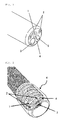
- the delivery of the cleaner for the removal of debris from an endoscope lens can be done by any means, including, for example, an air/water nozzle (hereinafter simply called "a water nozzle”, see numeral 5 in Fig. 1 ), a forceps channel (see numeral 3 in Fig. 1 ), a water-jet nozzle (see numeral 4 of Fig. 1 ), etc. of an endoscope.
- the delivery means may be appropriately selected depending on the purpose.
- the endoscope hood (attachment) in the present invention is not particularly limited, and may be, for example, an attachment that is attached to an endoscope as shown in numeral 6 of the schematic view in Fig. 2 .
- the material, color, shape, etc. of the endoscope hood may be appropriately selected as desired.
- Specific examples of the endoscope hood (attachment) include slit & hole type or straight type of Elastic Touch (registered trademark) made by Top Corporation; various types of hoods of Mole Cap (registered trademark) made by Top Corporation; etc.
- the removal of debris from the endoscope lens and the endoscope hood (attachment) is preferably done by, for example, spraying the cleaner on the endoscope hood (attachment) from a spray nozzle etc. inserted through the forceps channel.
- the spray nozzle is not particularly limited, and specific examples thereof include the spray nozzle of Fine Jet (registered trademark) made by Top Corporation, etc.
- the removal of debris is done by, for example, deflecting the distal end upward with its face up and injecting the cleaner from the forceps channel so that the cleaner is kept in the endoscope hood (attachment) (i.e., the endoscope lens is kept immersed in the cleaner) ; or pressing the edge of the endoscope hood (attachment) against the inner wall of a cavity of a living body and injecting the cleaner so that the hood is filled with the cleaner.
- the cleaner kept in the hood may be stirred with, for example, a stirring stick etc. inserted through the forceps channel.
- the cleaner of the present invention after used to remove the debris from an endoscope lens and/or an endoscope hood (attachment) also exhibits a function of providing antifogging effect to the endoscope lens and/or the endoscope hood (attachment).
- a physician can remove debris from an endoscope lens and/or an endoscope hood (attachment) during a surgical procedure without withdrawing the endoscope outside the body.
- the physician does not need to stop the procedure, and consequently the burden on the physician and the patient is greatly reduced.
- the cleaner (or its components) of the present invention can also be used as an antifoulant (a surface treating agent, an antifouling treatment agent, or a surface protective agent) for an endoscope and/or endoscopic accessories (or endoscope attachments), in particular, for an endoscope lens and/or an endoscope hood (attachment).
- an antifoulant a surface treating agent, an antifouling treatment agent, or a surface protective agent
- an endoscope lens and/or an endoscope hood, etc. may be subjected to antifouling treatment using the cleaner (or its components) as an antifoulant [i.e., antifouling treatment in which, for example, the cleaner is applied to an endoscope lens and/or an endoscope hood (or the cleaner is allowed to adhere thereto)] outside a living body before the endoscope is inserted into the body.
- This antifouling treatment reduces or prevents the accumulation of various debris components (for example, fat etc.) on the endoscope lens and/or the endoscope hood (attachment), etc. inside the living body during an endoscopic surgical procedure.
- the antifoulant can also provide antifogging effect to an endoscope lens and/or an endoscope hood (attachment), etc. Therefore, the antifoulant of the present invention can also be used as an antifogging agent (an antifouling and antifogging agent).
- the components of the antifoulant may be the same as those of the above cleaner, and their content ratios are the same as described above.
- a surfactant is particularly suitable as an antifouling component.
- the antifoulant may comprise, as an antifouling component, the above-described surfactant, for example, a surfactant combination of (i) a nonionic surfactant with an HLB of 1 to 11 and (ii) a nonionic surfactant with an HLB of 11 to 20 (for example, 12 to 19, preferably 13 to 18).
- the total amount of the nonionic surfactants may be typically 0.1 to 40% by mass, and is preferably 1 to 35% by mass, more preferably 3 to 30% by mass, and particularly preferably 5% by mass or more (for example, 5 to 40% by mass, preferably 6 to 35% by mass, and further more preferably 7 to 30% by mass), based on the total weight of the antifoulant.
- the ratio of the nonionic surfactants (i):(ii) contained in the antifoulant may be, in terms of mass, typically 2:1 to 1:10, preferably 1:1 to 1:9, more preferably 1:2 to 1:7.
- the combined HLB value of the nonionic surfactants (i) and (ii) may be typically 11.1 to 16.0, and is preferably 13.0 to 15.5, and more preferably 13.6 6 to 15.3.
- the nonionic surfactants (i) and (ii) contained in the antifoulant of the present invention may have a combined HLB value of 13.6 to 15.3, a mass ratio of 1:2 to 1: 7, and a total amount of 3 to 30% by mass based on the total amount of the cleaner.
- the antifoulant may comprise the above-described builder (sodium hydrogen carbonate etc.) as an antifoulant builder.
- the ratio of the antifoulant builder relative to 100 parts by mass of the surfactant (s) can be selected from the range of about 0.01 to 100 parts by mass (for example, about 0.03 to 50 parts by mass), and is preferably about 0.05 to 30 parts by mass, more preferably about 0.1 to 20 parts by mass, and in particular may be about 0.5 to 20 parts by mass (for example, about 1 to 10 parts by mass).
- the antifoulant of the present invention may be the same as the above cleaner in terms of the components, their ratios, etc., except for its use in which the antifoulant is applied to an endoscope and/or endoscopic accessories (in particular, an endoscope lens and/or an endoscope hood (attachment)) outside a living body. Therefore, the above description of the components, their ratios, etc. regarding the cleaner can be applied to the antifoulant, by replacing the terms “cleaner” and “cleaning” with the terms "antifoulant” and “antifouling”, respectively.
- the application of the antifoulant can be done by any method as long as the antifoulant is applied to or allowed to adhere to an endoscope and/or endoscopic accessories (in particular, an endoscope lens and/or an endoscope hood (attachment)).
- Examples of the method include coating, spraying and immersion, but are not limited thereto.
- Table 1 the unit of the numerical values in the formulas is gram (g). The same is applied to Tables 2 to 6.
- Purified water in an amount of 100 g was used as a cleaner.
- Cleaning rate % absorbance after washed with purified water / absorbance after washed with cleaner ⁇ 100
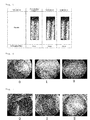
- Test Example 3 The results of Test Example 3 are shown in Fig. 3 .
- Comparative Example 7 hardly removed the debris whereas all of the cleaners of Examples 27 to 30 showed high debris removal rates of 70% or more.
- Test Example 4 The results of Test Example 4 are shown in Fig. 4 .
- Test Example 5 The results of Test Example 5 are shown in Fig. 5 .
- Examples 33 and 34 showed high antifogging effect.
- antifouling treatment was given to an endoscope lens.
- the antifouling treatment was performed by applying the antifoulant to the surface of the endoscope lens with a cotton swab.
- ESD endoscopic submucosal dissection
- ESD was performed using an endoscope that was subjected to antifouling treatment in the same manner as in Example 35 except for using, instead of the cleaner of Example 15, a commercially available endoscopic antifogging agent for use in natural orifice ("SL cleaner” made by Sugiura Laboratory, Inc.; components: linear alkylbenzene sulfonate (anionic surfactant), polyoxyethylene alkyl ether, and ethanol). Endoscopic images obtained during and after the submucosal dissection were observed and evaluated.
- SL cleaner endoscopic antifogging agent for use in natural orifice
- Example 35 The results obtained in Examples 35 and 36 are summarized in the following table.
- the "%" for each grade means the percentage out of all patients.
- Table 7 Amount of fat in submucosal adipose tissue Accumulation of debris after submucosal dissection Grade 0 (%) Grade 1 (%) Grade 2 (%) Grade 1+2 (%) p value Grade 0 (%) Grade 1 (%) Grade 2 (%) Grade 1+2 (%) p value Ex. 35 47.8 39.1 13.0 52.1 NS 85.9 12.0 2.1 14.1 ⁇ 0.01 Ex. 36 51.5 39.8 8.7 48.5 67.0 24.3 8.7 33.0 Ex.: Example
- the antifouling treatment successfully reduced the accumulation of debris on the endoscope lens after the ESD of the patients.
- the amount of fat in the submucosal adipose tissue in the patients was similar (not significant (NS)) between Example 35 and Example 36, but Example 35 using the antifoulant containing the specific surfactants as antifouling components significantly reduced the accumulation of debris on the endoscope lens compared with Example 36 using the commercially available endoscopic antifoulant for use in natural orifice.
- Example 36 From the patients in Example 36, five cases determined as Grade 1 and five cases determined as Grade 2 in terms of the accumulation of debris after submucosal dissection were selected, and the cleaning effect of the cleaner of Example 15 on an endoscope lens (and an endoscope hood (attachment)) was further evaluated inside the bodies of these patients.
- the cleaning was performed as follows. The distal end of the endoscope was deflected upward with its face up, and the cleaner of Example 15 was injected from the forceps channel so that the cleaner was kept in the endoscope hood (attachment) for 30 seconds (i.e., the endoscope lens was kept immersed in the cleaner for 30 seconds).
- the present invention provides a cleaner for an endoscope, the cleaner being used inside a living body during an endoscopic surgical procedure.
- the cleaner of the present invention can be used to clean debris from an endoscope lens and/or an endoscope hood (attachment) inside a living body, which feature greatly reduces the burden on a physician and the patient during an endoscopic surgical procedure.
- the cleaner of the present invention improves the antifogging properties of an endoscope lens and/or an endoscope hood (attachment), and thereby increases the usability of an endoscopic surgical procedure.
- the present invention also provides an antifoulant to be used for an endoscope lens and/or an endoscope hood (attachment) before an endoscopic surgical procedure.
- the antifoulant reduces or prevents the accumulation of debris on the endoscope lens and/or the endoscope hood (attachment).
Landscapes
- Life Sciences & Earth Sciences (AREA)
- Health & Medical Sciences (AREA)
- Chemical & Material Sciences (AREA)
- Engineering & Computer Science (AREA)
- Surgery (AREA)
- Chemical Kinetics & Catalysis (AREA)
- Oil, Petroleum & Natural Gas (AREA)
- Wood Science & Technology (AREA)
- Organic Chemistry (AREA)
- Pathology (AREA)
- Heart & Thoracic Surgery (AREA)
- Optics & Photonics (AREA)
- Biophysics (AREA)
- Radiology & Medical Imaging (AREA)
- Physics & Mathematics (AREA)
- Biomedical Technology (AREA)
- Nuclear Medicine, Radiotherapy & Molecular Imaging (AREA)
- Medical Informatics (AREA)
- Molecular Biology (AREA)
- Animal Behavior & Ethology (AREA)
- General Health & Medical Sciences (AREA)
- Public Health (AREA)
- Veterinary Medicine (AREA)
- Emergency Medicine (AREA)
- Detergent Compositions (AREA)
Applications Claiming Priority (2)
| Application Number | Priority Date | Filing Date | Title |
|---|---|---|---|
| JP2013203998 | 2013-09-30 | ||
| PCT/JP2014/075950 WO2015046532A1 (ja) | 2013-09-30 | 2014-09-29 | 内視鏡レンズクリーナー |
Publications (2)
| Publication Number | Publication Date |
|---|---|
| EP3053996A1 true EP3053996A1 (de) | 2016-08-10 |
| EP3053996A4 EP3053996A4 (de) | 2017-05-31 |
Family
ID=52743653
Family Applications (1)
| Application Number | Title | Priority Date | Filing Date |
|---|---|---|---|
| EP14846871.3A Withdrawn EP3053996A4 (de) | 2013-09-30 | 2014-09-29 | Endoskoplinsenreiniger |
Country Status (5)
| Country | Link |
|---|---|
| US (1) | US10264957B2 (de) |
| EP (1) | EP3053996A4 (de) |
| JP (1) | JP6504404B2 (de) |
| CN (1) | CN105849244B (de) |
| WO (1) | WO2015046532A1 (de) |
Cited By (2)
| Publication number | Priority date | Publication date | Assignee | Title |
|---|---|---|---|---|
| EP4093259A4 (de) * | 2020-01-20 | 2024-04-10 | Advanced Health Solutions LLC | Zusammensetzungen und verfahren zum verbessern der sichtbarkeit des gastrointestinaltrakts bei endoskopieverfahren |
| US12115206B2 (en) | 2020-01-20 | 2024-10-15 | Advanced Health Solutions LLC | Compositions and methods for improving gastrointestinal function |
Families Citing this family (31)
| Publication number | Priority date | Publication date | Assignee | Title |
|---|---|---|---|---|
| DE10154163A1 (de) | 2001-11-03 | 2003-05-22 | Advanced Med Tech | Vorrichtung zum Aufrichten und Stabilisieren der Wirbelsäule |
| US8979931B2 (en) | 2006-12-08 | 2015-03-17 | DePuy Synthes Products, LLC | Nucleus replacement device and method |
| US20090088789A1 (en) | 2007-09-28 | 2009-04-02 | O'neil Michael J | Balloon With Shape Control For Spinal Procedures |
| US9387009B2 (en) | 2007-10-05 | 2016-07-12 | DePuy Synthes Products, Inc. | Dilation system and method of using the same |
| US9622779B2 (en) | 2011-10-27 | 2017-04-18 | DePuy Synthes Products, Inc. | Method and devices for a sub-splenius / supra-levator scapulae surgical access technique |
| WO2013067179A2 (en) | 2011-11-01 | 2013-05-10 | Synthes Usa, Llc | Dilation system |
| US9265490B2 (en) | 2012-04-16 | 2016-02-23 | DePuy Synthes Products, Inc. | Detachable dilator blade |
| US9480855B2 (en) | 2012-09-26 | 2016-11-01 | DePuy Synthes Products, Inc. | NIR/red light for lateral neuroprotection |
| US9980737B2 (en) | 2014-08-04 | 2018-05-29 | Medos International Sarl | Flexible transport auger |
| CN107072521B (zh) | 2014-08-14 | 2020-10-27 | 直观外科手术操作公司 | 用于清洁内窥镜器械的系统和方法 |
| US9924979B2 (en) | 2014-09-09 | 2018-03-27 | Medos International Sarl | Proximal-end securement of a minimally invasive working channel |
| US10111712B2 (en) | 2014-09-09 | 2018-10-30 | Medos International Sarl | Proximal-end securement of a minimally invasive working channel |
| US10264959B2 (en) | 2014-09-09 | 2019-04-23 | Medos International Sarl | Proximal-end securement of a minimally invasive working channel |
| US10786264B2 (en) | 2015-03-31 | 2020-09-29 | Medos International Sarl | Percutaneous disc clearing device |
| US11744447B2 (en) | 2015-09-04 | 2023-09-05 | Medos International | Surgical visualization systems and related methods |
| CN113143355A (zh) | 2015-09-04 | 2021-07-23 | 美多斯国际有限公司 | 多护罩脊柱进入系统 |
| US11672562B2 (en) | 2015-09-04 | 2023-06-13 | Medos International Sarl | Multi-shield spinal access system |
| US10987129B2 (en) | 2015-09-04 | 2021-04-27 | Medos International Sarl | Multi-shield spinal access system |
| US12150636B2 (en) | 2015-09-04 | 2024-11-26 | Medos International Sárl | Surgical instrument connectors and related methods |
| US11439380B2 (en) | 2015-09-04 | 2022-09-13 | Medos International Sarl | Surgical instrument connectors and related methods |
| US10299838B2 (en) | 2016-02-05 | 2019-05-28 | Medos International Sarl | Method and instruments for interbody fusion and posterior fixation through a single incision |
| BR112019016349A2 (pt) * | 2017-02-08 | 2020-04-07 | Buckman Laboratories Int Inc | formulação química e método para controlar a sujeira em uma coluna de destilação |
| WO2019226855A1 (en) * | 2018-05-23 | 2019-11-28 | Board Of Regents, The University Of Texas System | Devices, systems and methods for cleaning of elongated instrument surface |
| CN109380281A (zh) * | 2018-09-30 | 2019-02-26 | 刘家鹤 | 一种具有防雾功能的内窥镜消毒剂 |
| US11013530B2 (en) | 2019-03-08 | 2021-05-25 | Medos International Sarl | Surface features for device retention |
| US11241252B2 (en) | 2019-03-22 | 2022-02-08 | Medos International Sarl | Skin foundation access portal |
| US11129727B2 (en) | 2019-03-29 | 2021-09-28 | Medos International Sari | Inflatable non-distracting intervertebral implants and related methods |
| US11813026B2 (en) | 2019-04-05 | 2023-11-14 | Medos International Sarl | Systems, devices, and methods for providing surgical trajectory guidance |
| US11154187B2 (en) | 2019-05-29 | 2021-10-26 | Peter H. Kwon | Apparatus and method for in vivo cleaning of an optical lens of a surgical visualization device |
| US11376301B2 (en) * | 2020-01-20 | 2022-07-05 | Advanced Health Solutions LLC | Compositions and methods for improving visibility of the gastrointestinal tract for endoscopy procedures |
| US11771517B2 (en) | 2021-03-12 | 2023-10-03 | Medos International Sarl | Camera position indication systems and methods |
Family Cites Families (32)
| Publication number | Priority date | Publication date | Assignee | Title |
|---|---|---|---|---|
| GB1492938A (en) * | 1974-01-11 | 1977-11-23 | Procter & Gamble Ltd | Low sudsing detergent compositions |
| US4436653A (en) * | 1981-04-06 | 1984-03-13 | The Procter & Gamble Company | Stable liquid detergent compositions |
| US4767617A (en) * | 1986-07-31 | 1988-08-30 | A-Veda Corporation | Opacifying composition and hair treating composition with process of using same |
| NL8702779A (nl) | 1987-11-20 | 1989-06-16 | Philips Nv | Inrichting voor het weergeven van een binair digitaal signaal, met een uitleeskop met speciaal gekozen spleetlengte. |
| JPH0546722Y2 (de) * | 1988-04-26 | 1993-12-08 | ||
| DE69321789T2 (de) | 1992-08-12 | 1999-06-10 | Seiko Epson Corp., Tokio/Tokyo | Verfahren und Vorrichtung für Tintenstrahlaufzeichnung |
| JP3428689B2 (ja) | 1992-08-12 | 2003-07-22 | セイコーエプソン株式会社 | インクジェット記録方法および装置 |
| US5392766A (en) * | 1993-10-06 | 1995-02-28 | Innerdyne Medical, Inc. | System and method for cleaning viewing scope lenses |
| US6193986B1 (en) * | 1997-02-25 | 2001-02-27 | The Nisshin Oil Mills, Ltd. | Oily composition with increased stability and process for producing the same |
| JPH1129793A (ja) * | 1997-07-11 | 1999-02-02 | Kao Corp | 液体漂白剤組成物 |
| US6110502A (en) * | 1998-02-19 | 2000-08-29 | Mcneil-Ppc, Inc. | Method for producing water dispersible sterol formulations |
| JP2001031999A (ja) | 1999-07-19 | 2001-02-06 | Clean Chemical Kk | 洗浄剤組成物 |
| US7273607B2 (en) * | 2002-07-01 | 2007-09-25 | Karl G. Schakel, legal representative | Health enhancement method |
| US20050119141A1 (en) * | 2003-12-01 | 2005-06-02 | Irene Quenville | Stability enhancement of solutions containing antimicrobial agents |
| US20060293559A1 (en) * | 2005-06-24 | 2006-12-28 | Grice George D Iii | Disposable scope cleaner and method of using same |
| WO2008084828A1 (ja) * | 2007-01-11 | 2008-07-17 | Kaneka Corporation | 補酵素q10粒子の製造方法 |
| US20080292560A1 (en) * | 2007-01-12 | 2008-11-27 | Dov Tamarkin | Silicone in glycol pharmaceutical and cosmetic compositions with accommodating agent |
| US8636982B2 (en) * | 2007-08-07 | 2014-01-28 | Foamix Ltd. | Wax foamable vehicle and pharmaceutical compositions thereof |
| JP5166808B2 (ja) * | 2007-09-25 | 2013-03-21 | 花王株式会社 | 洗浄機内のバイオフィルム生成抑制方法 |
| JP5317466B2 (ja) | 2007-12-14 | 2013-10-16 | 花王株式会社 | 医療器具用洗浄剤組成物 |
| US7491362B1 (en) * | 2008-01-28 | 2009-02-17 | Ecolab Inc. | Multiple enzyme cleaner for surgical instruments and endoscopes |
| US20100017339A1 (en) * | 2008-02-05 | 2010-01-21 | Professional Capital Services, LLC | System and methods for ETF 401(k) trading |
| JP2010037512A (ja) | 2008-08-08 | 2010-02-18 | Nikko Chemical Co Ltd | 食器用及び/又は食品用洗浄剤 |
| US9156010B2 (en) * | 2008-09-23 | 2015-10-13 | Bio-Rad Laboratories, Inc. | Droplet-based assay system |
| JP5507461B2 (ja) * | 2008-09-30 | 2014-05-28 | 富士フイルム株式会社 | セラミド分散物及びその製造方法 |
| WO2010068265A1 (en) | 2008-12-10 | 2010-06-17 | Minimally Invasive Devices, Llc | Systems and methods for optimizing and maintaining visualization of a surgical field during the use of surgical scopes |
| JP2010235801A (ja) * | 2009-03-31 | 2010-10-21 | Inui Medics Corp | 洗浄剤組成物 |
| EP2600759A4 (de) * | 2010-08-04 | 2013-08-28 | Minimally Invasive Devices Llc | Systeme und verfahren zur optimierung und bewahrung der ansicht eines chirurgischen felds während der verwendung von chirurgischen endoskopen |
| CN103119144B (zh) | 2010-09-14 | 2014-08-27 | 日油株式会社 | 一种抗菌洗涤剂组合物 |
| US9675065B2 (en) * | 2011-02-14 | 2017-06-13 | Truox, Inc. | Biocide and bleach compositions and related methods |
| EP2854557B1 (de) * | 2012-05-24 | 2015-12-02 | Unilever N.V. | Luftdurchsetztes öl mit saccharose-fettsäureester und hydrophobin |
| JP2014051444A (ja) * | 2012-09-06 | 2014-03-20 | Lion Corp | 2層分離型液体口腔用組成物 |
-
2014
- 2014-09-29 EP EP14846871.3A patent/EP3053996A4/de not_active Withdrawn
- 2014-09-29 WO PCT/JP2014/075950 patent/WO2015046532A1/ja not_active Ceased
- 2014-09-29 CN CN201480053993.7A patent/CN105849244B/zh not_active Expired - Fee Related
- 2014-09-29 JP JP2015539437A patent/JP6504404B2/ja active Active
- 2014-09-29 US US15/025,678 patent/US10264957B2/en active Active
Cited By (2)
| Publication number | Priority date | Publication date | Assignee | Title |
|---|---|---|---|---|
| EP4093259A4 (de) * | 2020-01-20 | 2024-04-10 | Advanced Health Solutions LLC | Zusammensetzungen und verfahren zum verbessern der sichtbarkeit des gastrointestinaltrakts bei endoskopieverfahren |
| US12115206B2 (en) | 2020-01-20 | 2024-10-15 | Advanced Health Solutions LLC | Compositions and methods for improving gastrointestinal function |
Also Published As
| Publication number | Publication date |
|---|---|
| JP6504404B2 (ja) | 2019-04-24 |
| US10264957B2 (en) | 2019-04-23 |
| US20160235284A1 (en) | 2016-08-18 |
| JPWO2015046532A1 (ja) | 2017-03-09 |
| CN105849244B (zh) | 2019-05-17 |
| EP3053996A4 (de) | 2017-05-31 |
| WO2015046532A1 (ja) | 2015-04-02 |
| CN105849244A (zh) | 2016-08-10 |
Similar Documents
| Publication | Publication Date | Title |
|---|---|---|
| US10264957B2 (en) | Endoscope lens cleaner | |
| Aaronson et al. | Endoscopic treatment of reflux: migration of Teflon to the lungs and brain | |
| US7993635B2 (en) | Menthol-containing formulation | |
| TW200306210A (en) | Cleansing cosmetic | |
| Stenquist et al. | Fourth branchial pouch sinus with recurrent deep cervical abscesses successfully treated with trichloroacetic acid cauterization | |
| WO2004020562A1 (en) | A composition for disinfecting or washing medical instruments and a process for the preparation thereof | |
| CN111718687B (zh) | 医用镜面防雾液及其制备方法、医用镜面防雾膜及其制备方法、防雾方法和医疗器械 | |
| EP2142112B1 (de) | System zur einstufung von kolonpolypen | |
| KR20110083108A (ko) | 외과용 마커조성물 | |
| US11160882B2 (en) | Indirect chromoendoscopy with an oral indigo carmine base preparation | |
| CN117137421A (zh) | 用于外科手术器械的清洁系统及其清洁方法 | |
| EUS | New method of esophageal endoscopic ultrasonography with injected gel: Endoscopic ultrasonography-gel filling method | |
| JP2022112776A (ja) | 食道冷却剤 | |
| US12453742B2 (en) | Bowel cleansing chemical composition and associated use therefore | |
| CN116370442A (zh) | 药物组合物、药物组合物的稳定化方法、以及评价药物组合物的保存稳定性的方法 | |
| WO2024028975A1 (ja) | 食道冷却剤 | |
| Demirogullari et al. | Effects of Hyperosmolar Agents–Lactulose, Lactitol, Sodium Phosphate and Polyethylene Glycol–on Cecal Coliform Bacteria during Traditional Bowel Cleansing: An Experimental Study in Rats | |
| US20250134619A1 (en) | Radiopaque ink formulation | |
| US11147824B1 (en) | Colonic irrigation composition | |
| CN116350807A (zh) | 用于与内窥镜同步使用的祛泡液及其制备和使用方法 | |
| CN202620296U (zh) | 硬式内镜移动消毒装置 | |
| CN119280433A (zh) | 一种胃镜检查中消化道黏膜防絮凝祛泡剂及其配制方法 | |
| CN115353860A (zh) | 医用内窥镜防雾剂 | |
| Evan et al. | 1135: Apatite Deposits in Collecting Duct Lumens Produce Epithelial Cell Injury and Interstitial Inflammation in Patients Forming Brushite Renal Stones | |
| Kim et al. | 1134: Stone Events are Proportional to Papillary Plaque Coverage |
Legal Events
| Date | Code | Title | Description |
|---|---|---|---|
| PUAI | Public reference made under article 153(3) epc to a published international application that has entered the european phase |
Free format text: ORIGINAL CODE: 0009012 |
|
| 17P | Request for examination filed |
Effective date: 20160428 |
|
| AK | Designated contracting states |
Kind code of ref document: A1 Designated state(s): AL AT BE BG CH CY CZ DE DK EE ES FI FR GB GR HR HU IE IS IT LI LT LU LV MC MK MT NL NO PL PT RO RS SE SI SK SM TR |
|
| AX | Request for extension of the european patent |
Extension state: BA ME |
|
| DAX | Request for extension of the european patent (deleted) | ||
| RIC1 | Information provided on ipc code assigned before grant |
Ipc: C11D 1/825 20060101ALI20170418BHEP Ipc: C11D 1/74 20060101AFI20170418BHEP |
|
| A4 | Supplementary search report drawn up and despatched |
Effective date: 20170428 |
|
| STAA | Information on the status of an ep patent application or granted ep patent |
Free format text: STATUS: THE APPLICATION IS DEEMED TO BE WITHDRAWN |
|
| 18D | Application deemed to be withdrawn |
Effective date: 20171128 |