EP3055523B1 - Procédé de formation d'une cuve d'huile structurelle par moulage à noyau perdu - Google Patents
Procédé de formation d'une cuve d'huile structurelle par moulage à noyau perdu Download PDFInfo
- Publication number
- EP3055523B1 EP3055523B1 EP14789939.7A EP14789939A EP3055523B1 EP 3055523 B1 EP3055523 B1 EP 3055523B1 EP 14789939 A EP14789939 A EP 14789939A EP 3055523 B1 EP3055523 B1 EP 3055523B1
- Authority
- EP
- European Patent Office
- Prior art keywords
- oil pan
- structural
- polymeric material
- forming
- pan
- Prior art date
- Legal status (The legal status is an assumption and is not a legal conclusion. Google has not performed a legal analysis and makes no representation as to the accuracy of the status listed.)
- Not-in-force
Links
- 238000000465 moulding Methods 0.000 title claims description 34
- 238000000034 method Methods 0.000 title claims description 33
- 239000000463 material Substances 0.000 claims description 96
- 229910052751 metal Inorganic materials 0.000 claims description 25
- 239000002184 metal Substances 0.000 claims description 25
- 239000012744 reinforcing agent Substances 0.000 claims description 17
- 239000000835 fiber Substances 0.000 claims description 13
- 229920002292 Nylon 6 Polymers 0.000 claims description 12
- 229920000049 Carbon (fiber) Polymers 0.000 claims description 10
- 239000004917 carbon fiber Substances 0.000 claims description 10
- 239000004952 Polyamide Substances 0.000 claims description 8
- 229920002647 polyamide Polymers 0.000 claims description 8
- 239000003365 glass fiber Substances 0.000 claims description 6
- VNWKTOKETHGBQD-UHFFFAOYSA-N methane Chemical compound C VNWKTOKETHGBQD-UHFFFAOYSA-N 0.000 claims description 4
- 238000010998 test method Methods 0.000 claims description 2
- OKTJSMMVPCPJKN-UHFFFAOYSA-N Carbon Chemical compound [C] OKTJSMMVPCPJKN-UHFFFAOYSA-N 0.000 claims 1
- 229910052799 carbon Inorganic materials 0.000 claims 1
- 239000011521 glass Substances 0.000 claims 1
- 239000012760 heat stabilizer Substances 0.000 description 8
- 239000004609 Impact Modifier Substances 0.000 description 7
- 239000000314 lubricant Substances 0.000 description 7
- 229920006097 Ultramide® Polymers 0.000 description 6
- 229920002302 Nylon 6,6 Polymers 0.000 description 5
- 239000002131 composite material Substances 0.000 description 5
- 229920000642 polymer Polymers 0.000 description 5
- 229910052782 aluminium Inorganic materials 0.000 description 4
- XAGFODPZIPBFFR-UHFFFAOYSA-N aluminium Chemical compound [Al] XAGFODPZIPBFFR-UHFFFAOYSA-N 0.000 description 4
- 230000005540 biological transmission Effects 0.000 description 4
- 239000007769 metal material Substances 0.000 description 4
- 229920000571 Nylon 11 Polymers 0.000 description 3
- 229920000299 Nylon 12 Polymers 0.000 description 3
- 229920003189 Nylon 4,6 Polymers 0.000 description 3
- 229920000305 Nylon 6,10 Polymers 0.000 description 3
- 229920000572 Nylon 6/12 Polymers 0.000 description 3
- 229920006152 PA1010 Polymers 0.000 description 3
- 239000000654 additive Substances 0.000 description 3
- 229920006131 poly(hexamethylene isophthalamide-co-terephthalamide) Polymers 0.000 description 3
- NLKNQRATVPKPDG-UHFFFAOYSA-M potassium iodide Chemical compound [K+].[I-] NLKNQRATVPKPDG-UHFFFAOYSA-M 0.000 description 3
- 244000198134 Agave sisalana Species 0.000 description 2
- ZOXJGFHDIHLPTG-UHFFFAOYSA-N Boron Chemical compound [B] ZOXJGFHDIHLPTG-UHFFFAOYSA-N 0.000 description 2
- VTYYLEPIZMXCLO-UHFFFAOYSA-L Calcium carbonate Chemical compound [Ca+2].[O-]C([O-])=O VTYYLEPIZMXCLO-UHFFFAOYSA-L 0.000 description 2
- VYPSYNLAJGMNEJ-UHFFFAOYSA-N Silicium dioxide Chemical compound O=[Si]=O VYPSYNLAJGMNEJ-UHFFFAOYSA-N 0.000 description 2
- 229910052796 boron Inorganic materials 0.000 description 2
- OSGAYBCDTDRGGQ-UHFFFAOYSA-L calcium sulfate Chemical compound [Ca+2].[O-]S([O-])(=O)=O OSGAYBCDTDRGGQ-UHFFFAOYSA-L 0.000 description 2
- 238000013037 co-molding Methods 0.000 description 2
- 239000003086 colorant Substances 0.000 description 2
- 238000002485 combustion reaction Methods 0.000 description 2
- 229920001577 copolymer Polymers 0.000 description 2
- 238000004519 manufacturing process Methods 0.000 description 2
- 150000002739 metals Chemical class 0.000 description 2
- IOLCXVTUBQKXJR-UHFFFAOYSA-M potassium bromide Chemical compound [K+].[Br-] IOLCXVTUBQKXJR-UHFFFAOYSA-M 0.000 description 2
- 229920005989 resin Polymers 0.000 description 2
- 239000011347 resin Substances 0.000 description 2
- 239000004575 stone Substances 0.000 description 2
- 239000000126 substance Substances 0.000 description 2
- NKNQXCZWYOZFLT-XAVROVCUSA-N (4s)-4-[4-[(2r)-1-amino-2-methylbutyl]triazol-1-yl]-5-[4-[4-[4-[(2s)-2-[4-[(2r)-1-amino-2-methylbutyl]triazol-1-yl]-4-carboxybutanoyl]piperazin-1-yl]-6-[2-[2-(2-prop-2-ynoxyethoxy)ethoxy]ethylamino]-1,3,5-triazin-2-yl]piperazin-1-yl]-5-oxopentanoic acid;h Chemical compound Cl.N1=NC(C(N)[C@H](C)CC)=CN1[C@@H](CCC(O)=O)C(=O)N1CCN(C=2N=C(N=C(NCCOCCOCCOCC#C)N=2)N2CCN(CC2)C(=O)[C@H](CCC(O)=O)N2N=NC(=C2)C(N)[C@H](C)CC)CC1 NKNQXCZWYOZFLT-XAVROVCUSA-N 0.000 description 1
- 239000005995 Aluminium silicate Substances 0.000 description 1
- 239000004215 Carbon black (E152) Substances 0.000 description 1
- 229910021595 Copper(I) iodide Inorganic materials 0.000 description 1
- 229920002943 EPDM rubber Polymers 0.000 description 1
- 229920003317 Fusabond® Polymers 0.000 description 1
- 229920000914 Metallic fiber Polymers 0.000 description 1
- BPQQTUXANYXVAA-UHFFFAOYSA-N Orthosilicate Chemical compound [O-][Si]([O-])([O-])[O-] BPQQTUXANYXVAA-UHFFFAOYSA-N 0.000 description 1
- 229910000831 Steel Inorganic materials 0.000 description 1
- PNEYBMLMFCGWSK-UHFFFAOYSA-N aluminium oxide Inorganic materials [O-2].[O-2].[O-2].[Al+3].[Al+3] PNEYBMLMFCGWSK-UHFFFAOYSA-N 0.000 description 1
- 235000012211 aluminium silicate Nutrition 0.000 description 1
- 150000001408 amides Chemical class 0.000 description 1
- 229920005601 base polymer Polymers 0.000 description 1
- 230000015572 biosynthetic process Effects 0.000 description 1
- 229910000019 calcium carbonate Inorganic materials 0.000 description 1
- 239000006229 carbon black Substances 0.000 description 1
- 238000005266 casting Methods 0.000 description 1
- 230000015556 catabolic process Effects 0.000 description 1
- 230000000052 comparative effect Effects 0.000 description 1
- 150000001875 compounds Chemical class 0.000 description 1
- 238000001816 cooling Methods 0.000 description 1
- LSXDOTMGLUJQCM-UHFFFAOYSA-M copper(i) iodide Chemical compound I[Cu] LSXDOTMGLUJQCM-UHFFFAOYSA-M 0.000 description 1
- 239000007822 coupling agent Substances 0.000 description 1
- 238000006731 degradation reaction Methods 0.000 description 1
- 229920001971 elastomer Polymers 0.000 description 1
- 239000000806 elastomer Substances 0.000 description 1
- 150000002148 esters Chemical class 0.000 description 1
- HEAMQYHBJQWOSS-UHFFFAOYSA-N ethene;oct-1-ene Chemical compound C=C.CCCCCCC=C HEAMQYHBJQWOSS-UHFFFAOYSA-N 0.000 description 1
- HQQADJVZYDDRJT-UHFFFAOYSA-N ethene;prop-1-ene Chemical group C=C.CC=C HQQADJVZYDDRJT-UHFFFAOYSA-N 0.000 description 1
- 229920006228 ethylene acrylate copolymer Polymers 0.000 description 1
- 229920001038 ethylene copolymer Polymers 0.000 description 1
- 150000002191 fatty alcohols Chemical class 0.000 description 1
- 239000012530 fluid Substances 0.000 description 1
- 239000000446 fuel Substances 0.000 description 1
- 229930195733 hydrocarbon Natural products 0.000 description 1
- 150000002430 hydrocarbons Chemical class 0.000 description 1
- 230000006698 induction Effects 0.000 description 1
- 238000001746 injection moulding Methods 0.000 description 1
- 230000003993 interaction Effects 0.000 description 1
- 229920000554 ionomer Polymers 0.000 description 1
- NLYAJNPCOHFWQQ-UHFFFAOYSA-N kaolin Chemical compound O.O.O=[Al]O[Si](=O)O[Si](=O)O[Al]=O NLYAJNPCOHFWQQ-UHFFFAOYSA-N 0.000 description 1
- 229910001092 metal group alloy Inorganic materials 0.000 description 1
- 239000010445 mica Substances 0.000 description 1
- 229910052618 mica group Inorganic materials 0.000 description 1
- 239000000203 mixture Substances 0.000 description 1
- RKISUIUJZGSLEV-UHFFFAOYSA-N n-[2-(octadecanoylamino)ethyl]octadecanamide Chemical compound CCCCCCCCCCCCCCCCCC(=O)NCCNC(=O)CCCCCCCCCCCCCCCCC RKISUIUJZGSLEV-UHFFFAOYSA-N 0.000 description 1
- 239000002245 particle Substances 0.000 description 1
- 230000000704 physical effect Effects 0.000 description 1
- 239000000049 pigment Substances 0.000 description 1
- 239000004033 plastic Substances 0.000 description 1
- 229920003023 plastic Polymers 0.000 description 1
- 229920005996 polystyrene-poly(ethylene-butylene)-polystyrene Polymers 0.000 description 1
- 239000000843 powder Substances 0.000 description 1
- 238000004064 recycling Methods 0.000 description 1
- 239000011435 rock Substances 0.000 description 1
- 229920006395 saturated elastomer Polymers 0.000 description 1
- 235000003441 saturated fatty acids Nutrition 0.000 description 1
- 150000004671 saturated fatty acids Chemical class 0.000 description 1
- 239000000377 silicon dioxide Substances 0.000 description 1
- 238000004088 simulation Methods 0.000 description 1
- 239000000344 soap Substances 0.000 description 1
- 239000007787 solid Substances 0.000 description 1
- 239000010935 stainless steel Substances 0.000 description 1
- 229910001220 stainless steel Inorganic materials 0.000 description 1
- 230000003068 static effect Effects 0.000 description 1
- 239000010959 steel Substances 0.000 description 1
- 229920003048 styrene butadiene rubber Polymers 0.000 description 1
- 239000000454 talc Substances 0.000 description 1
- 229910052623 talc Inorganic materials 0.000 description 1
- 229920001897 terpolymer Polymers 0.000 description 1
- 235000021122 unsaturated fatty acids Nutrition 0.000 description 1
- 150000004670 unsaturated fatty acids Chemical class 0.000 description 1
- 239000010456 wollastonite Substances 0.000 description 1
- 229910052882 wollastonite Inorganic materials 0.000 description 1
Images




Classifications
-
- B—PERFORMING OPERATIONS; TRANSPORTING
- B29—WORKING OF PLASTICS; WORKING OF SUBSTANCES IN A PLASTIC STATE IN GENERAL
- B29C—SHAPING OR JOINING OF PLASTICS; SHAPING OF MATERIAL IN A PLASTIC STATE, NOT OTHERWISE PROVIDED FOR; AFTER-TREATMENT OF THE SHAPED PRODUCTS, e.g. REPAIRING
- B29C41/00—Shaping by coating a mould, core or other substrate, i.e. by depositing material and stripping-off the shaped article; Apparatus therefor
- B29C41/02—Shaping by coating a mould, core or other substrate, i.e. by depositing material and stripping-off the shaped article; Apparatus therefor for making articles of definite length, i.e. discrete articles
- B29C41/14—Dipping a core
-
- B—PERFORMING OPERATIONS; TRANSPORTING
- B29—WORKING OF PLASTICS; WORKING OF SUBSTANCES IN A PLASTIC STATE IN GENERAL
- B29C—SHAPING OR JOINING OF PLASTICS; SHAPING OF MATERIAL IN A PLASTIC STATE, NOT OTHERWISE PROVIDED FOR; AFTER-TREATMENT OF THE SHAPED PRODUCTS, e.g. REPAIRING
- B29C41/00—Shaping by coating a mould, core or other substrate, i.e. by depositing material and stripping-off the shaped article; Apparatus therefor
- B29C41/02—Shaping by coating a mould, core or other substrate, i.e. by depositing material and stripping-off the shaped article; Apparatus therefor for making articles of definite length, i.e. discrete articles
- B29C41/22—Making multilayered or multicoloured articles
-
- B—PERFORMING OPERATIONS; TRANSPORTING
- B29—WORKING OF PLASTICS; WORKING OF SUBSTANCES IN A PLASTIC STATE IN GENERAL
- B29C—SHAPING OR JOINING OF PLASTICS; SHAPING OF MATERIAL IN A PLASTIC STATE, NOT OTHERWISE PROVIDED FOR; AFTER-TREATMENT OF THE SHAPED PRODUCTS, e.g. REPAIRING
- B29C41/00—Shaping by coating a mould, core or other substrate, i.e. by depositing material and stripping-off the shaped article; Apparatus therefor
- B29C41/34—Component parts, details or accessories; Auxiliary operations
- B29C41/38—Moulds, cores or other substrates
- B29C41/40—Cores
-
- B—PERFORMING OPERATIONS; TRANSPORTING
- B29—WORKING OF PLASTICS; WORKING OF SUBSTANCES IN A PLASTIC STATE IN GENERAL
- B29C—SHAPING OR JOINING OF PLASTICS; SHAPING OF MATERIAL IN A PLASTIC STATE, NOT OTHERWISE PROVIDED FOR; AFTER-TREATMENT OF THE SHAPED PRODUCTS, e.g. REPAIRING
- B29C41/00—Shaping by coating a mould, core or other substrate, i.e. by depositing material and stripping-off the shaped article; Apparatus therefor
- B29C41/34—Component parts, details or accessories; Auxiliary operations
- B29C41/42—Removing articles from moulds, cores or other substrates
-
- F—MECHANICAL ENGINEERING; LIGHTING; HEATING; WEAPONS; BLASTING
- F01—MACHINES OR ENGINES IN GENERAL; ENGINE PLANTS IN GENERAL; STEAM ENGINES
- F01M—LUBRICATING OF MACHINES OR ENGINES IN GENERAL; LUBRICATING INTERNAL COMBUSTION ENGINES; CRANKCASE VENTILATING
- F01M11/00—Component parts, details or accessories, not provided for in, or of interest apart from, groups F01M1/00 - F01M9/00
- F01M11/0004—Oilsumps
-
- B—PERFORMING OPERATIONS; TRANSPORTING
- B29—WORKING OF PLASTICS; WORKING OF SUBSTANCES IN A PLASTIC STATE IN GENERAL
- B29K—INDEXING SCHEME ASSOCIATED WITH SUBCLASSES B29B, B29C OR B29D, RELATING TO MOULDING MATERIALS OR TO MATERIALS FOR MOULDS, REINFORCEMENTS, FILLERS OR PREFORMED PARTS, e.g. INSERTS
- B29K2077/00—Use of PA, i.e. polyamides, e.g. polyesteramides or derivatives thereof, as moulding material
-
- B—PERFORMING OPERATIONS; TRANSPORTING
- B29—WORKING OF PLASTICS; WORKING OF SUBSTANCES IN A PLASTIC STATE IN GENERAL
- B29K—INDEXING SCHEME ASSOCIATED WITH SUBCLASSES B29B, B29C OR B29D, RELATING TO MOULDING MATERIALS OR TO MATERIALS FOR MOULDS, REINFORCEMENTS, FILLERS OR PREFORMED PARTS, e.g. INSERTS
- B29K2307/00—Use of elements other than metals as reinforcement
- B29K2307/04—Carbon
-
- B—PERFORMING OPERATIONS; TRANSPORTING
- B29—WORKING OF PLASTICS; WORKING OF SUBSTANCES IN A PLASTIC STATE IN GENERAL
- B29K—INDEXING SCHEME ASSOCIATED WITH SUBCLASSES B29B, B29C OR B29D, RELATING TO MOULDING MATERIALS OR TO MATERIALS FOR MOULDS, REINFORCEMENTS, FILLERS OR PREFORMED PARTS, e.g. INSERTS
- B29K2309/00—Use of inorganic materials not provided for in groups B29K2303/00 - B29K2307/00, as reinforcement
- B29K2309/08—Glass
-
- B—PERFORMING OPERATIONS; TRANSPORTING
- B29—WORKING OF PLASTICS; WORKING OF SUBSTANCES IN A PLASTIC STATE IN GENERAL
- B29K—INDEXING SCHEME ASSOCIATED WITH SUBCLASSES B29B, B29C OR B29D, RELATING TO MOULDING MATERIALS OR TO MATERIALS FOR MOULDS, REINFORCEMENTS, FILLERS OR PREFORMED PARTS, e.g. INSERTS
- B29K2995/00—Properties of moulding materials, reinforcements, fillers, preformed parts or moulds
- B29K2995/0012—Properties of moulding materials, reinforcements, fillers, preformed parts or moulds having particular thermal properties
- B29K2995/0017—Heat stable
-
- B—PERFORMING OPERATIONS; TRANSPORTING
- B29—WORKING OF PLASTICS; WORKING OF SUBSTANCES IN A PLASTIC STATE IN GENERAL
- B29K—INDEXING SCHEME ASSOCIATED WITH SUBCLASSES B29B, B29C OR B29D, RELATING TO MOULDING MATERIALS OR TO MATERIALS FOR MOULDS, REINFORCEMENTS, FILLERS OR PREFORMED PARTS, e.g. INSERTS
- B29K2995/00—Properties of moulding materials, reinforcements, fillers, preformed parts or moulds
- B29K2995/0037—Other properties
- B29K2995/0089—Impact strength or toughness
-
- B—PERFORMING OPERATIONS; TRANSPORTING
- B29—WORKING OF PLASTICS; WORKING OF SUBSTANCES IN A PLASTIC STATE IN GENERAL
- B29L—INDEXING SCHEME ASSOCIATED WITH SUBCLASS B29C, RELATING TO PARTICULAR ARTICLES
- B29L2031/00—Other particular articles
- B29L2031/712—Containers; Packaging elements or accessories, Packages
-
- F—MECHANICAL ENGINEERING; LIGHTING; HEATING; WEAPONS; BLASTING
- F01—MACHINES OR ENGINES IN GENERAL; ENGINE PLANTS IN GENERAL; STEAM ENGINES
- F01M—LUBRICATING OF MACHINES OR ENGINES IN GENERAL; LUBRICATING INTERNAL COMBUSTION ENGINES; CRANKCASE VENTILATING
- F01M11/00—Component parts, details or accessories, not provided for in, or of interest apart from, groups F01M1/00 - F01M9/00
- F01M11/0004—Oilsumps
- F01M2011/0008—Oilsumps with means for reducing vibrations
-
- F—MECHANICAL ENGINEERING; LIGHTING; HEATING; WEAPONS; BLASTING
- F01—MACHINES OR ENGINES IN GENERAL; ENGINE PLANTS IN GENERAL; STEAM ENGINES
- F01M—LUBRICATING OF MACHINES OR ENGINES IN GENERAL; LUBRICATING INTERNAL COMBUSTION ENGINES; CRANKCASE VENTILATING
- F01M11/00—Component parts, details or accessories, not provided for in, or of interest apart from, groups F01M1/00 - F01M9/00
- F01M11/0004—Oilsumps
- F01M2011/002—Oilsumps with means for improving the stiffness
-
- F—MECHANICAL ENGINEERING; LIGHTING; HEATING; WEAPONS; BLASTING
- F01—MACHINES OR ENGINES IN GENERAL; ENGINE PLANTS IN GENERAL; STEAM ENGINES
- F01M—LUBRICATING OF MACHINES OR ENGINES IN GENERAL; LUBRICATING INTERNAL COMBUSTION ENGINES; CRANKCASE VENTILATING
- F01M11/00—Component parts, details or accessories, not provided for in, or of interest apart from, groups F01M1/00 - F01M9/00
- F01M11/0004—Oilsumps
- F01M2011/0058—Fastening to the transmission
-
- F—MECHANICAL ENGINEERING; LIGHTING; HEATING; WEAPONS; BLASTING
- F01—MACHINES OR ENGINES IN GENERAL; ENGINE PLANTS IN GENERAL; STEAM ENGINES
- F01M—LUBRICATING OF MACHINES OR ENGINES IN GENERAL; LUBRICATING INTERNAL COMBUSTION ENGINES; CRANKCASE VENTILATING
- F01M11/00—Component parts, details or accessories, not provided for in, or of interest apart from, groups F01M1/00 - F01M9/00
- F01M11/0004—Oilsumps
- F01M2011/0091—Oilsumps characterised by used materials
Definitions
- the subject disclosure generally relates to a method of forming a structural oil pan via lost core molding and a structural oil pan formed by said method.
- Articles which require chemical resistance, impact resistance, and structural integrity are often formed from metals such as steel and aluminum.
- metals such as steel and aluminum.
- alternatives to metal, such as polymeric materials are now being considered for use in forming such articles formed from metal.
- Articles formed from polymeric materials weigh less and are often less expensive than articles formed from metal.
- articles formed from polymeric materials must often meet or exceed stringent, predetermined design requirements for chemical resistance, impact resistance, as well as various structural and acoustic requirements over a range of temperatures.
- Oil pans (fluid reservoirs) for internal combustion engines are a specific example of such an article formed from metal.
- composite oil pans formed from polymeric materials and metal have been proposed.
- metal, in particular metal brackets, in these composite oil pans is still required to meet the stringent, predetermined design requirements for oil pans.
- WO 2010/100124 A1 discloses a structural oil pan formed from a polymeric material comprising a bracket portion configured for mounting the vehicle and a pan portion integrated with said bracket US 6 584 950 discloses a method for forming a structural oil pan according to the preamble of claim 1.
- a method of forming a structural oil pan via lost core molding comprises a bracket portion configured for mounting to the vehicle, a pan portion integrated with the bracket portion and defining an oil reservoir, and a structural section formed via lost core molding and defining a cavity.
- the method comprises the step of lost core molding by forming a metal core, molding the bracket portion and/or the pan portion about the metal core, and removing the metal core to form the structural section in at least one of the bracket portion and the pan portion.
- the method also includes the step of co-molding the bracket portion and the pan portion together to form the structural oil pan.
- a structural oil pan (hereinafter referred to as both "oil pan” or “structural oil pan”) is shown generally at 20.
- the oil pan 20 in all embodiments of this invention is formed via lost core molding.
- the oil pan 20 is formed, or manufactured from, a polymeric material, i.e., a plastic material.
- the polymeric material can be neat, i.e., virgin, uncompounded resin, or that the polymeric material can be an engineered product where the resin is compounded with other components, for example with select additives to improve certain physical properties.
- additives include, but are not limited to, lubricants, reinforcing agents, impact modifiers, coupling agents, and colorants, such as pigments and the like.
- the polymeric material includes a polymer, such as a polyamide.
- the polymer is present in the polymeric material in an amount of from about 10 to about 90, alternatively from 20 to 80, alternatively from 30 to 70, alternatively from 45 to 65, alternatively from 50 to 60, parts by weight based on a total weight of the polymeric material.
- the amount of polymer present in the polymeric material may vary outside of the ranges above, but is typically both whole and fractional values within these ranges.
- the polyamide is selected from the group of polyamide 6, polyamide 66, polyamide 46, polyamide 610, polyamide 6I/6T, polyamide 11, polyamide 12, polyamide 1010, polyamide 612, and combinations thereof.
- polymeric materials other than polyamides may also be used to manufacture the oil pan 20.
- the polymeric material typically comprises a reinforcing agent for imparting durability and rigidity to the polymeric material.
- the reinforcing agent may be particulate in form, or may be fibrous in form.
- Non-limiting examples of reinforcing agents in particulate form include wollastonite, calcium carbonate, calcium sulfate, kaolin, mica, silica, talc, carbon black, and/or alumina silicate.
- Non-limiting examples of reinforcing agents in fibrous form include glass fibers, carbon fibers, metallic fibers (e.g. stainless steel), polymeric fibers, sisal, and/or boron.
- the fibers of the reinforcing agent may vary in size (e.g. length, diameter, etc.) and may be coated or uncoated.
- the reinforcing agent comprises a plurality of fibers.
- the reinforcing agent can be selected from the group of fibers, particles, and combinations thereof.
- the reinforcing agent comprises carbon fibers.
- the reinforcing agent can comprise fibers of other materials, such as metal, polymers, sisal, or boron.
- the fibers have an average diameter of less than 13, alternatively less than 10, alternatively from 1 to 5, micrometers. In various embodiments, the fibers have an average length of from 0.1 to 20, alternatively from 0.1 to 13, alternatively from 0.1 to 1, alternatively from 1 to 10, alternatively from 1 to 5, mm. In one embodiment, the fibers comprise "short' carbon fibers having a length of less than 1 mm. In another embodiment, the fibers comprise "long" carbon fibers having a length of greater than 1 mm.
- the polymeric material or the fibers themselves may include other components to encourage bonding between the polymeric material and the fibers.
- Suitable glass fibers are commercially available from PPG Industries Inc. under the trade name CHOPVANTAGE®.
- Suitable carbon fibers are commercially available from Toho-Tenax of Rockwood, TN under the trade name TENAX®.
- the reinforcing agent When employed, the reinforcing agent is present in an amount of from 15 to 65, alternatively from 25 to 50, alternatively from 30 to 40, alternatively from 45 to 55, parts by weight based on a total weight of the polymeric material.
- the amount of reinforcing agent present in the polymeric material may vary outside of the ranges above, but is typically both whole and fractional values within these ranges.
- the polymeric material may comprise an impact modifier for imparting excellent impact resistance to the polymeric material.
- the impact modifier is present in an amount of from 1 to 20, alternatively from 3 to 15, alternatively from 4 to 10 parts by weight based on a total weight of the polymeric material. If present, the amount of impact modifier present in the polymeric material may vary outside of the ranges above, but is typically both whole and fractional values within these ranges.
- the impact modifier is selected from the group of elastomers, ionomers, ethylene copolymers, ethylene-propylene copolymers, ethylene-propylene-diene terpolymers, ethylene-octene copolymers, ethylene-acrylate copolymers, styrenebutadiene copolymer, styrene-ethylene/butylene-styrene terpolymers and combinations thereof.
- the impact modifier comprises at least one of ethylene octene, ethylene propylene, or combinations thereof. Suitable impact modifiers are commercially available from DuPont Company of Wilmington, DE under the trade name FUSABOND®.
- the polymeric material may also comprise a heat stabilizer for imparting resistance to thermal degradation of the polymeric material.
- the heat stabilizer is present in an amount of from 0.01 to 1, alternatively from 0.01 to 0.6, alternatively from 0.08 to 0.2 parts by weight based on a total weight of the polymeric material. If present, the amount of heat stabilizer present in the polymeric material may vary outside of the ranges above, but is typically both whole and fractional values within these ranges.
- the heat stabilizer may be selected from the group of organic heat stabilizers, inorganic heat stabilizers, and combinations thereof.
- the heat stabilizer comprises at least one of cuprous iodide, potassium iodide, potassium bromide, or combinations thereof.
- Suitable heat stabilizers are commercially available from Ajay North America of Powder Springs, GA under the trade name IODEAL®.
- the polymeric material may comprise a lubricating agent for allowing the polymeric material to be removed from a mold during formation of the oil pan 20.
- the lubricating agent is present in an amount of from 0.01 to 1, alternatively from 0.1 to 0.8, alternatively from 0.2 to 0.6, parts by weight based on a total weight of the polymeric material. If present, the amount of lubricating agent present in the polymeric material may vary outside of the ranges above, but is typically both whole and fractional values within these ranges.
- the lubricating agent may be selected from the group of hydrocarbon wax, paraffins, metal soaps, saturated and unsaturated fatty acids, fatty alcohols, esters, amides, and combinations thereof.
- the lubricating agent comprises N,N'-ethylene bis-stearamide. Suitable lubricating agents are commercially available from Lonza Incorporated of Fair Lawn, NJ under the trade name ACRAWAX®.
- the polymeric material may comprise colorants and other additives.
- the polymeric material is durable and resistant to fracturing upon impact with an object, such as a stone, over a wide range of temperatures varying in the ranges of minus 40°C to 150°C.
- the polymeric material typically has: a modulus of elasticity (Young's Modulus) of from 2,000 to 50,000 MPa; a fatigue strength of from 10 to 120 MPa; a drop weight unnotched impact strength of from 40 to 113 kJ/m 2 ; a notched impact strength of from 10 to 35 kJ/m 2 .
- Suitable polymeric materials are commercially available from BASF Corporation of Florham Park, NJ under the trade name ULTRAMID®.
- the oil pan 20 may be formed from more than one polymeric material.
- an oil pan 20 has an exterior surface 22, an interior surface 24 defining an oil reservoir 26, and a bracket portion 28.
- the bracket portion 28 of the oil pan 20 is formed from a first polymeric material and the remaining portion of the oil pan 20 (e.g. a pan portion 29 as described below) is formed from a second polymeric material as described additionally below.
- the first polymeric material comprises a polyamide selected from the group of polyamide 6, polyamide 66, polyamide 46, polyamide 610, polyamide 6I/6T, polyamide 11, polyamide 12, polyamide 1010, polyamide 612, and combinations thereof.
- the first polymeric material comprises polyamide 6, polyamide 66, or combinations thereof.
- the first polymeric material comprises polyamide 6.
- the first polymeric material comprises "long" carbon fiber having: an average diameter of less than 10, alternatively form 2 to 10, micrometers; and an average length of greater than 1.0, alternatively from 1.0 to 30, mm.
- carbon fibers of about 24.5 mm are compounded with polyamide and then break upon processing to result in an average length of from 3 to 6 mm.
- the first polymeric material can comprise greater than 35, alternatively from 40 to 70, alternatively from 45 to 55, parts by weight of the "long" carbon fiber based on 100 parts by weight of the first polymeric material.
- the first polymeric material is a type of polymeric material and the ranges set forth above for the polymeric material also apply.
- Suitable first polymeric materials are commercially available from BASF Corporation of Florham Park, NJ under the trade name ULTRAMID®.
- ULTRAMID® One specific example of a suitable first polymeric material is ULTRAMID XA3321.
- the second polymeric material comprises a polyamide selected from the group of polyamide 6, polyamide 66, polyamide 46, polyamide 610, polyamide 6I/6T, polyamide 11, polyamide 12, polyamide 1010, polyamide 612, and combinations thereof.
- the second polymeric material comprises polyamide 6, polyamide 66, or combinations thereof.
- the second polymeric material comprises polyamide 6.
- the second polymeric material comprises "short" glass fiber having: an average diameter of less than 10, alternatively form 2 to 10, micrometers; and an average length of less than 1.0, alternatively from 0.1 to 1, mm.
- the second polymeric material can comprise greater than 20, alternatively from 25 to 45, alternatively from 30 to 40, parts by weight of the "short" glass fiber based on 100 parts by weight of the second polymeric material.
- the second polymeric material is a type of polymeric material and the ranges set forth above for the polymeric material also apply.
- the second polymeric material is resistant to fracturing upon impact with an object, such as a stone, over a wide range of temperatures.
- the second polymeric material has an Izod notched impact strength of greater than 15 KJ/m 2 at 23°C and greater than 10 KJ/m 2 at -40°C when tested in accordance with ISO Test method 179/1eA.
- Suitable second polymeric materials are commercially available from BASF Corporation of Florham Park, NJ under the trade name ULTRAMID®.
- ULTRAMID® One specific example of a suitable second polymeric material is ULTRAMID B3ZG7 OSI.
- first and second polymeric materials described above can be the same or different.
- the first and second polymeric materials can both include, for example, polyamide 6.
- the second polymeric material is different than the first polymeric material with respect to the content of the respective reinforcing agent.
- both the first and second polymeric materials may include polyamide 6, yet the first polymeric material may include carbon fiber as its reinforcing agent, and the second polymeric material may include glass fiber as its reinforcing agent.
- the first and second polymeric materials are per se different (due to the reinforcing agent content), even though they both include polyamide 6 as their base polymer.
- the oil pan 20 is 'integrally' formed from polymeric material.
- integral it is meant that the oil pan 20 is not a metal-polymer composite, but is formed substantially from a polymeric material or formed substantially from polymeric materials.
- the oil pan 20 includes the bracket portion 28 configured for mounting to the vehicle, and the pan portion 29 integrated with the bracket portion 28 and defining the oil reservoir 26.
- the oil pan 20 also includes a structural section 30 defining a cavity 32 within at least one of the bracket portion 28 and the pan portion 29 for reducing vibration.
- the structural section 30 may be in only the bracket portion 28, only in the pan portion 29, or in both the bracket portion 28 and the pan portion 29.
- the structural section 30 is disposed in the bracket portion 28 such that the cavity 32 is defined within the bracket portion 28.
- the structural section 30 is disposed in the pan portion 29 such that the cavity 32 is defined within the pan portion 29.
- the structural section 30 has a cross-sectional shape selected from the group of rectangular, triangular, ovular, and circular. Because the cavity 32 is defined by the structural section 30, the shape of the cavity 32 follows the shape of the structural section 30.
- the cavity 32 also has a cross-sectional shape selected from the group of rectangular, triangular, ovular, and circular.
- the structural section 30 is a box section having a rectangular cross-sectional shape.
- the structural section 30 itself includes a box top, a box bottom, and two box lateral sides as illustrated in the Figures.
- the structural section 30 and cavity 32 defined therein is particularly effective when included in the bracket portion 28 which is co-molded, in one example over molded, onto the exterior surface 22 of the pan portion 29.
- the structural section 30 and cavity 32 therein impacts, i.e., improves, the overall rigidity and acoustic properties of the oil pan 20.
- the structural section 30 and cavity 32 thereof are formed via lost core molding, as is described in detail below.
- the oil pan 20 for an internal combustion engine is shown in the Figures. It should be understood that the oil pan 20 may be for any type of vehicle, such as an automobile, a boat, a plane, a tractor, etc. Depending upon the specific use of the oil pan 20, the oil pan 20 may have to meet specific impact resistance and acoustic design requirements.
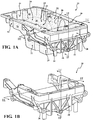
- FIG. 1 a perspective front view an embodiment of the oil pan 20 is shown having the exterior surface 22, the interior surface 24 defining the oil reservoir 26, and the bracket portion 28.
- the bracket portion 28 includes the structural section 30 defining the cavity 32.
- the pan portion 29 of this embodiment includes a floor 34 having an interior surface 36 and an exterior surface 38.
- the floor also has a first floor end and a second floor end opposite the first floor end.
- the oil pan 20 of this embodiment also includes a front wall 40 having an interior surface 42 and an exterior surface 44. This front wall 40 extends outwardly from the first floor end of the floor 34.
- the oil pan 20 of this first embodiment also includes a back wall 46 having an interior surface 48 and an exterior surface 50. This back wall 46 extends outwardly from the second floor end of the floor 34 in generally the same direction as the front wall 40.
- the oil pan 20 of this embodiment also includes a pair of side walls 52 each having an interior surface 54 and an exterior surface 56.
- the side walls 52 extending outwardly from the floor 34 in generally the same direction as the front and back walls 40, 46.
- the side walls 52 extend substantially parallel with one another. Further, the side walls 52 are connected to, and substantially perpendicular with, the front and back walls 40, 46. As such, the interior surfaces 36 of the floor 34 and the walls 40, 46, 52 define the oil reservoir 26.
- the front wall 40 faces a front of the vehicle and the back wall 46 faces a rear of the vehicle.
- the oil reservoir 26 typically has a depth D1 which is less at the front wall 40 than a depth D2 at the back wall 46 for functional purposes such as impact resistance and aerodynamics.
- the orientation of the oil pan 20 in a vehicle can change, depending on the vehicle.
- the terms "front wall” and “back wall” are not limiting in scope since the orientation of the oil pan 20 can change while the concepts herein remain.
- the front wall 40 and the floor 34 of the oil pan 20 face the front of the vehicle, the front wall 40 and the floor 34 are the most likely to be impacted by an object such as a rock.
- the back wall 46 is often mounted to the engine block and interfaces with a transmission housing of the vehicle, the structural integrity and acoustic properties of the back wall 46 and, if included, the bracket portion 28 of the oil pan 20, must be optimal.
- the structural section 30 and cavity 32 reduce vibrations and improve the rigidity and acoustic performance of the oil pan 20 in the vehicle. Of course, the existence of the cavity 32, also reduces the weight of the oil pan 20 which, when used in a vehicle, equates to fuel savings.
- the structural section 30 may be disposed in the pan portion 29, such as in at least one of the walls of the pan portion 29. In one embodiment, structural section 30 is disposed in the side walls 52 and the back wall 46 of the pan portion 29.
- the bracket portion 28 is integrated with the side walls 52 and the back wall 46 of the pan portion 29.
- the structural section 30 is disposed in the bracket portion 28 adjacent to the exterior surface 56 of at least one of the walls of the pan portion 29.
- the structural section 30 is disposed in the bracket portion 28 adjacent to the exterior surfaces 54, 56 of the side walls 52 and the exterior surface 50 of the back wall 46 of the pan portion 29.
- the structural section 30 and cavity 32 reduce vibrations and improve the rigidity and acoustic performance of the oil pan 20 in the vehicle.
- the structural section 30 can be located anywhere within the bracket portion 28 and the pan portion 29.
- the structural section 30 can be continuous or discontinuous.
- the structural oil pan 20 can include one, continuous structural section 30, and therefore one continuous cavity 32, or can include more than one structural section 30, and therefore more than one cavity 32.
- Both the bracket portion 28 and the pan portion 29 can include the structural section 30.
- the structural section 30 can wrap around the entire exterior surface of the oil pan 20, spanning one, two, three, or all four sides of the oil pan 20.
- the structural section 30 can span an entire, or partial, length and/or width of the sides of the oil pan 20.
- the structural section 30 can be located anywhere in the bracket portion 28 and/or the pan portion 29.
- Figures 1B , 1C , and ID are perspective views of the isolated bracket portion 28 of the oil pan 20 of Figure 1A .
- Figure IE is a perspective cross-sectional view of the bracket portion 28 and the structural section 30 and cavity 32 thereof of the oil pan 20 of Figure 1A taken along line 1E-1E.
- Figure IF is a perspective cross-sectional view of the bracket portion 28 and the structural section 30 and cavity 32 thereof of the oil pan 20 of Figure 1A taken along line 1F-1F.
- the structural section 30 can be on the side walls 52 and/or the back wall 46.
- Figure 1G is a top view and Figure 1H is a bottom view of the isolated bracket portion 28 and structural section 30 of the oil pan 20 of Figure 1A .
- Figure 1I is a side view and Figure 1J is an end view of the isolated bracket portion 28 and structural section 30 of the oil pan 20 of Figure 1A .
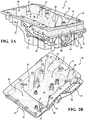
- the oil pan 20 of Figure 2A is similar to the oil pan 20 of Figure 1A .
- this embodiment of the oil pan 20 includes continuous fiber reinforced tape 58.
- Suitable CFRT is commercially available from BASF Corporation of Florham Park, NJ under the trade name ULTRACompTM.
- the ULTRACompTM is applied to the exterior surface 24 of the oil pan 20 on the bracket portion 28.
- Figure 2B is a perspective top view of the oil pan 20 of Figure 2A .
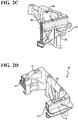
- Figures 2C and 2D are perspective cross-sectional views of the bracket portion 28 and the structural section 30 and cavity 32 thereof of the oil pan 20 of Figure 2A taken along lines 2C-2C, and 2D-2D, respectively.
- Figure 3A is a perspective front view of another embodiment of the oil pan 20.
- the oil pan 20 of this embodiment includes a cross brace 60 for additional structural rigidity.
- the bracket portion 28 of the oil pan 20 of this embodiment does not include the structural section 30 and cavity 32 thereof. Rather, the back wall 46 of the oil pan 20 of this embodiment thereof includes the structural section 30 and cavity 32 thereof.
- Figure 3B is a perspective front view of the isolated bracket portion 28 of the oil pan 20 of Figure 3A
- Figure 3C is a perspective top view of the oil pan 20 of Figure 3A .
- the subject disclosure is directed to a method of forming the structural oil pan 20 via lost core molding.
- the structural oil pan 20 is just as described in the Figures, the description above, and the Examples.
- the method of forming the structural oil pan 20 via lost core molding comprises the step of forming a metal core.
- the metal core can be formed by casting or molding a metal material into a desired shape.
- the shape of the metal core determines the shape of the cavity 32 disposed in the structural section 30 of the oil pan 20.
- the metal core can be formed with any suitable metal material/metal alloy known in the art. In one embodiment, the metal material is reusable/recycleable.
- the method of forming the structural oil pan 20 via lost core molding also includes the step of molding the bracket portion 28 and/or the pan portion 29 about the metal core. This step is typically conducted with injection molding equipment. That is, in this step, the core is placed in a mold and the polymeric material is molded about the core in a desired configuration.
- the method of forming the structural oil pan 20 via lost core molding includes the step of cooling the bracket portion 28 and/or the pan portion 29 having the metal core.
- the method of forming the structural oil pan 20 via lost core molding also includes the step of removing the metal core to form the structural section 30 having the cavity 32 therein in at least one of the bracket portion 28 and the pan portion 29.
- the metal core is typically melted through the use of induction heat.
- the method of forming the structural oil pan 20 via lost core molding includes the step of recycling the metal material for future use.
- the method also includes the step of co-molding the bracket portion and the pan portion together to form the structural oil pan 20.
- the bracket portion 28 and the pan portion 29 can be co-molded together to form the structural oil pan 20 directly or with various methods known in the art for improving the adhesion between co-molded bodies.
- the oil pan 20 of Figure 1A is analyzed for normal modes or noise, vibration, and harshnesss ("NVH") acoustic performance with software having the trade name ABAQUS® which is commercially available from Dassault Systems of Waltham, MA.
- the software predicts the NVH performance of any vibration body or vibration bodies.
- the vibration body is the oil pan 20 of Figure 1A in a vehicle.
- the analysis was conducted in comparative view of an analysis of a composite oil pan comprising an aluminum bracket and a polymeric oil pan.
- Table 1 shows an FEA model including the boundary conditions utilized.
- the individual masses of both the engine block and the transmission housing were modeled at the center-of-gravity ("c.g.") locations for these components, using point masses with ABAQUS®. These e.g. locations of both these components (i.e., the engine block and the transmission housing) were connected via a spring element with 40 KN/mm stiffness. This modeling represented the stiffness interaction between these two components.
- the mass of the transmission housing was distributed on the bolt holes on the back wall 46 of the engine block and the oil pan 20.
- the rear face of the engine block was modeled using a rigid plate.
- the bolts on a flange perimeter of the oil pan 20 were constrained in all degrees-of-freedom ("dof").
- oil pans 20 of Figure 1A modeled were approximately 50% lighter than the all current production, aluminum oil pan, and approximately 20% lighter than a composite oil pan comprising an aluminum bracket and a polymeric oil pan.
- the oil pan of Figure 1A performed well at high temperature (120°C). Utilizing ULTRAMID® XA3321(LCF50) material along with positioning the structural section 30 on the bracket portion 28 helped the NVH performance at 120°C.
- any ranges and subranges relied upon in describing various embodiments of the present disclosure independently and collectively fall within the scope of the appended claims, and are understood to describe and contemplate all ranges including whole and/or fractional values therein, even if such values are not expressly written herein.
- One of skill in the art readily recognizes that the enumerated ranges and subranges sufficiently describe and enable various embodiments of the present disclosure, and such ranges and subranges may be further delineated into relevant halves, thirds, quarters, fifths, and so on.
- a range "of from 0.1 to 0.9" may be further delineated into a lower third, i.e., from 0.1 to 0.3, a middle third, i.e., from 0.4 to 0.6, and an upper third, i.e., from 0.7 to 0.9, which individually and collectively are within the scope of the appended claims, and may be relied upon individually and/or collectively and provide adequate support for specific embodiments within the scope of the appended claims.
- a range such as "at least,” “greater than,” “less than,” “no more than,” and the like, it is to be understood that such language includes subranges and/or an upper or lower limit.
- a range of "at least 10" inherently includes a subrange of from at least 10 to 35, a subrange of from at least 10 to 25, a subrange of from 25 to 35, and so on, and each subrange may be relied upon individually and/or collectively and provides adequate support for specific embodiments within the scope of the appended claims.
- an individual number within a disclosed range may be relied upon and provides adequate support for specific embodiments within the scope of the appended claims.
- a range "of from 1 to 9" includes various individual integers, such as 3, as well as individual numbers including a decimal point (or fraction), such as 4.1, which may be relied upon and provide adequate support for specific embodiments within the scope of the appended claims.
Landscapes
- Engineering & Computer Science (AREA)
- Mechanical Engineering (AREA)
- General Engineering & Computer Science (AREA)
- Lubrication Details And Ventilation Of Internal Combustion Engines (AREA)
- Cylinder Crankcases Of Internal Combustion Engines (AREA)
- Compositions Of Macromolecular Compounds (AREA)
- Moulds For Moulding Plastics Or The Like (AREA)
Claims (15)
- Procédé de formation d'un carter d'huile structurel par l'intermédiaire d'un moulage à noyau perdu, le carter d'huile structurel étant constitué d'un matériau polymère comprenant une partie support monobloc (28) d'une seule pièce avec le carter d'huile structurel conçue pour un montage sur un véhicule, une partie carter (29) intégrée à la partie support monobloc (28) et faisant partie intégrante de celle-ci et définissant un réservoir d'huile (26), la partie support (28) et la partie carter (29) étant comoulées ensemble pour former le carter d'huile structurel (20),
caractérisé en ce que ledit carter d'huile structurel comprend une section structurelle (30) formée par le biais du moulage à noyau perdu et définissant une cavité fermée (32), ledit procédé comportant les étapes consistant à :I. réaliser un moulage à noyau perdu en :
formant un noyau métallique ;
moulant la partie support monobloc (28) et/ou la partie carter (29) autour du noyau métallique ; et
éliminant le noyau métallique pour former la section structurelle (30) avec ladite cavité fermée en son sein dans la partie support monobloc (28) et/ou la partie carter (29). - Procédé de formation d'un carter d'huile structurel par l'intermédiaire d'un moulage à noyau perdu selon la revendication 1 dans lequel la section structurelle (30) est disposée dans la partie support monobloc (28) de sorte que la cavité fermée (32) soit définie dans la partie support monobloc (28).
- Procédé de formation d'un carter d'huile structurel par l'intermédiaire d'un moulage à noyau perdu selon la revendication 1 dans lequel la section structurelle (30) est disposée dans la partie carter (29) de sorte que la cavité fermée (32) soit définie dans la partie carter (29).
- Procédé de formation d'un carter d'huile structurel par l'intermédiaire d'un moulage à noyau perdu selon l'une quelconque des revendications 1 à 3 dans lequel la section structurelle (30) présente une forme de coupe transversale choisie dans le groupe consistant en rectangle, triangle, ovale et cercle.
- Procédé de formation d'un carter d'huile structurel par l'intermédiaire d'un moulage à noyau perdu selon l'une quelconque des revendications 1 à 4 dans lequel la section structurelle (30) est une section en caisson présentant une forme de coupe transversale rectangulaire.
- Procédé de formation d'un carter d'huile structurel par l'intermédiaire d'un moulage à noyau perdu selon l'une quelconque des revendications précédentes dans lequel le matériau polymère comprend un polyamide et/ou un agent de renforcement comprenant une fibre choisie entre le carbone, le verre et des combinaisons de ceux-ci.
- Procédé de formation d'un carter d'huile structurel par l'intermédiaire d'un moulage à noyau perdu selon l'une quelconque des revendications précédentes dans lequel le matériau polymère est en outre défini en tant que premier matériau polymère et un second matériau polymère différent du premier matériau polymère, et dans lequel la partie support monobloc (28) comprend le premier matériau polymère, et la partie carter (29) comprend le second matériau polymère.
- Procédé de formation d'un carter d'huile structurel par l'intermédiaire d'un moulage à noyau perdu selon la revendication 7 dans lequel :le premier matériau polymère comprend du polyamide 6 et une fibre de carbone ; et/oule second matériau polymère comprend du polyamide 6 et une fibre de verre.
- Procédé de formation d'un carter d'huile structurel par l'intermédiaire d'un moulage à noyau perdu selon la revendication 7 ou 8 dans lequel le second matériau polymère présente une résistance au choc Izod d'éprouvettes entaillées supérieure à 15 kJ/m2 à 23 °C et supérieure à 10 kJ/m2 à -40 °C lors d'un test réalisé conformément à la méthode de test ISO 179/1eA.
- Procédé de formation d'un carter d'huile structurel par l'intermédiaire d'un moulage à noyau perdu selon l'une quelconque des revendications précédentes dans lequel la partie carter (29) comprend :un fond (34) possédant une surface intérieure (36) et une surface extérieure (38) et une première extrémité de fond et une seconde extrémité de fond, la seconde extrémité de fond étant en regard de la première extrémité de fond ;une paroi avant (40) possédant une surface intérieure (42) et une surface extérieure (44), et s'étendant vers l'extérieur depuis la première extrémité de fond du fond (34) ;une paroi arrière (46) possédant une surface intérieure (48) et une surface extérieure (50), et s'étendant vers l'extérieur depuis la seconde extrémité de fond du fond (34) ; etune paire de parois latérales (52) possédant chacune une surface intérieure (54) et une surface extérieure (56), et s'étendant vers l'extérieur depuis le fond (34), les parois latérales s'étendant sensiblement parallèlement entre elles et étant reliées aux parois avant et arrière et sensiblement perpendiculaires à celles-ci ;dans lequel les surfaces intérieures du fond (34) et les parois délimitent le réservoir d'huile (26).
- Procédé de formation d'un carter d'huile structurel par l'intermédiaire d'un moulage à noyau perdu selon la revendication 10 dans lequel la section structurelle (30) est disposée dans au moins une des parois de la partie carter (29).
- Procédé de formation d'un carter d'huile structurel par l'intermédiaire d'un moulage à noyau perdu selon la revendication 10 dans lequel la section structurelle (30) est disposée dans les parois latérales (52) et la paroi arrière (46) de la partie carter (29).
- Procédé de formation d'un carter d'huile structurel par l'intermédiaire d'un moulage à noyau perdu selon la revendication 10 dans lequel la partie support (28) est intégrée aux parois latérales (52) et à la paroi arrière (46) de la partie carter (29).
- Procédé de formation d'un carter d'huile structurel par l'intermédiaire d'un moulage à noyau perdu selon la revendication 13 dans lequel la section structurelle (30) est disposée dans la partie support monobloc (28) de façon adjacente à la surface extérieure d'au moins une des parois de la partie carter (29).
- Carter d'huile structurel formé par le procédé de moulage à noyau perdu selon l'une quelconque des revendications précédentes.
Applications Claiming Priority (2)
| Application Number | Priority Date | Filing Date | Title |
|---|---|---|---|
| US201361888430P | 2013-10-08 | 2013-10-08 | |
| PCT/US2014/059751 WO2015054420A1 (fr) | 2013-10-08 | 2014-10-08 | Procédé de formation d'une cuve d'huile structurelle par moulage à noyau perdu |
Publications (2)
| Publication Number | Publication Date |
|---|---|
| EP3055523A1 EP3055523A1 (fr) | 2016-08-17 |
| EP3055523B1 true EP3055523B1 (fr) | 2019-07-31 |
Family
ID=51799321
Family Applications (1)
| Application Number | Title | Priority Date | Filing Date |
|---|---|---|---|
| EP14789939.7A Not-in-force EP3055523B1 (fr) | 2013-10-08 | 2014-10-08 | Procédé de formation d'une cuve d'huile structurelle par moulage à noyau perdu |
Country Status (7)
| Country | Link |
|---|---|
| US (1) | US10195770B2 (fr) |
| EP (1) | EP3055523B1 (fr) |
| JP (1) | JP6099822B2 (fr) |
| KR (1) | KR101766610B1 (fr) |
| CN (1) | CN105814291B (fr) |
| BR (1) | BR112016007638A2 (fr) |
| WO (1) | WO2015054420A1 (fr) |
Families Citing this family (5)
| Publication number | Priority date | Publication date | Assignee | Title |
|---|---|---|---|---|
| JP6809252B2 (ja) * | 2017-01-24 | 2021-01-06 | スズキ株式会社 | オイルパン |
| GB2562784A (en) * | 2017-05-26 | 2018-11-28 | Jaguar Land Rover Ltd | A sump, a vehicle comprising a sump, and a method of manufacturing a sump |
| JP7168400B2 (ja) * | 2018-09-28 | 2022-11-09 | ダイハツ工業株式会社 | 内燃機関のオイルパン |
| USD979622S1 (en) * | 2020-09-08 | 2023-02-28 | Holley Performance Products, Inc. | Oil pan |
| USD1059448S1 (en) * | 2022-11-23 | 2025-01-28 | Holley Performance Products, Inc. | Oil pan |
Family Cites Families (32)
| Publication number | Priority date | Publication date | Assignee | Title |
|---|---|---|---|---|
| US3449482A (en) | 1964-10-23 | 1969-06-10 | Union Carbide Corp | Method for forming molded ribbed panels |
| US4105236A (en) | 1974-07-10 | 1978-08-08 | Volkswagenwerk Aktiengesellschaft | Shock absorbing body |
| US3941157A (en) | 1974-07-24 | 1976-03-02 | Barnett Louis H | High strength multiple passageway plastic conduit |
| CA1069298A (fr) | 1977-08-04 | 1980-01-08 | Roderick A. Cooper | Semelle d'une botte de ski de randonnee |
| JPH01126412A (ja) | 1987-11-10 | 1989-05-18 | Sumitomo Chem Co Ltd | 繊維強化樹脂製伝動軸用パイプの製造方法 |
| DE3830966C1 (fr) | 1988-09-12 | 1989-05-11 | Dr.Ing.H.C. F. Porsche Ag, 7000 Stuttgart, De | |
| FR2745034B1 (fr) * | 1996-02-21 | 1998-04-03 | Coutier Moulage Gen Ind | Carter insonorise pour motorisation et son procede de fabrication |
| DE19619977C2 (de) | 1996-05-17 | 1998-07-02 | Daimler Benz Ag | Ölwanne für eine Brennkraftmaschine |
| DE19818590C2 (de) | 1998-04-25 | 2000-03-23 | Daimler Chrysler Ag | Ölwanne |
| DE10008692C2 (de) | 2000-02-24 | 2002-03-14 | Ibs Filtran Kunststoff Metall | Ölwanne für Motoren oder Getriebe |
| US6705270B1 (en) | 2000-04-26 | 2004-03-16 | Basf Corporation | Oil pan module for internal combustion engines |
| DE10026113B4 (de) | 2000-05-26 | 2013-07-04 | GM Global Technology Operations LLC (n. d. Ges. d. Staates Delaware) | Brennkraftmaschine mit einem zwischen Kurbelraum und Ölwanne angeordneten Ölabweisteil |
| MY137444A (en) | 2000-12-21 | 2009-01-30 | Petroliam Nasional Berhad | Oil pan for automobile engine |
| US6523561B2 (en) | 2001-01-24 | 2003-02-25 | Federal-Mogul World Wide, Inc. | Snap-together filter system for transmission oil pan and method of manufacture |
| US6588557B2 (en) | 2001-04-04 | 2003-07-08 | Daimlerchrysler Corporation | Blow molded (HIC) formation with energy buffers |
| DE10119937A1 (de) | 2001-04-23 | 2002-11-14 | Joma Polytec Kunststofftechnik | Mehrteiliges Gehäuse sowie Ölwannenanordnung für eine Maschine |
| JP4176330B2 (ja) | 2001-06-19 | 2008-11-05 | 内浜化成株式会社 | オイルミストセパレータ |
| US6550440B1 (en) | 2002-01-17 | 2003-04-22 | Ford Global Technologies, Llc | Acoustic suppression arrangement for a component undergoing induced vibration |
| US7344670B2 (en) * | 2002-03-28 | 2008-03-18 | Build A Mold Limited | Lost core plastic molding process for transferring, positioning and molding inserts into a plastic part |
| US6584950B1 (en) * | 2002-05-29 | 2003-07-01 | Bayer Corporation | Oil pan |
| JP2004132317A (ja) * | 2002-10-11 | 2004-04-30 | Mitsubishi Motors Corp | オイルパン |
| JP2004316664A (ja) | 2003-04-10 | 2004-11-11 | Yed:Kk | エンジンにおけるオイルポンプ用チェーンテンショナー装置 |
| DE10332171B4 (de) * | 2003-07-15 | 2010-09-23 | Carcoustics Techconsult Gmbh | Schallisolierendes Gehäuseteil aus Kunststoff für Brennkraftmaschinen oder Fahrzeuggetriebe |
| JP2005271816A (ja) | 2004-03-25 | 2005-10-06 | Tokai Rubber Ind Ltd | 自動車室内用衝撃吸収部材 |
| ITBS20050067A1 (it) | 2005-06-06 | 2006-12-07 | Franco Benussi | Coppa olio per motore di veicoli e suo metodo di realizzazione |
| US7219642B1 (en) * | 2006-02-10 | 2007-05-22 | Gm Global Technology Operations, Inc. | Powertrain assembly and integral truss oil pan therefor |
| DE102007040665A1 (de) * | 2007-08-27 | 2009-03-05 | Mann + Hummel Gmbh | Ölwanne |
| JP2010084561A (ja) * | 2008-09-30 | 2010-04-15 | Toyoda Gosei Co Ltd | オイルパン構造 |
| EP2177340B1 (fr) | 2008-10-07 | 2011-09-07 | E.I. Dupont De Nemours And Company | Procédé de noyau perdu pour la production d'articles creux |
| WO2010100124A1 (fr) * | 2009-03-04 | 2010-09-10 | Dsm Ip Assets B.V. | Carter d'huile |
| DE102009055157A1 (de) | 2009-12-22 | 2011-06-30 | ElringKlinger AG, 72581 | Verfahren zum Herstellen eines Grundkörpers einer Ölwanne und durch ein solches Verfahren hergestellter Grundkörper einer Ölwanne |
| US20140069940A1 (en) * | 2012-09-12 | 2014-03-13 | GM Global Technology Operations LLC | Reinforced oil pan assembly and method thereof |
-
2014
- 2014-10-08 KR KR1020167011748A patent/KR101766610B1/ko not_active Expired - Fee Related
- 2014-10-08 US US15/027,730 patent/US10195770B2/en not_active Expired - Fee Related
- 2014-10-08 WO PCT/US2014/059751 patent/WO2015054420A1/fr not_active Ceased
- 2014-10-08 CN CN201480066959.3A patent/CN105814291B/zh not_active Expired - Fee Related
- 2014-10-08 BR BR112016007638A patent/BR112016007638A2/pt not_active Application Discontinuation
- 2014-10-08 JP JP2016521701A patent/JP6099822B2/ja not_active Expired - Fee Related
- 2014-10-08 EP EP14789939.7A patent/EP3055523B1/fr not_active Not-in-force
Non-Patent Citations (1)
| Title |
|---|
| None * |
Also Published As
| Publication number | Publication date |
|---|---|
| US10195770B2 (en) | 2019-02-05 |
| KR20160057491A (ko) | 2016-05-23 |
| EP3055523A1 (fr) | 2016-08-17 |
| WO2015054420A1 (fr) | 2015-04-16 |
| KR101766610B1 (ko) | 2017-08-23 |
| WO2015054420A8 (fr) | 2015-06-04 |
| JP6099822B2 (ja) | 2017-03-22 |
| BR112016007638A2 (pt) | 2017-08-01 |
| CN105814291A (zh) | 2016-07-27 |
| US20160263782A1 (en) | 2016-09-15 |
| JP2016536503A (ja) | 2016-11-24 |
| CN105814291B (zh) | 2018-02-27 |
Similar Documents
| Publication | Publication Date | Title |
|---|---|---|
| EP3055523B1 (fr) | Procédé de formation d'une cuve d'huile structurelle par moulage à noyau perdu | |
| US10012117B2 (en) | Structural oil pan | |
| CN103052776B (zh) | 车辆用冷却水贮存箱的支承构造 | |
| US10203012B2 (en) | Unit mount, in particular for a motor vehicle | |
| CN110696640B (zh) | 压铸铝制托架 | |
| CN108352477A (zh) | 作为电动车辆受应力构件的电气部件承载件 | |
| US20120251788A1 (en) | Article having impact resistant surface | |
| CN108528542B (zh) | 一种电池保护板及车辆 | |
| JP2010180930A (ja) | 防振装置 | |
| EP2014882A2 (fr) | Article doté d'une surface résistante aux chocs | |
| KR101836399B1 (ko) | 차량용 서브프레임의 제조방법 | |
| Türközü et al. | Low-Velocity Stone Impact Simulation of Glass Fiber Reinforced Thermoplastics for Diesel Engine Oil Pans under Different Temperature Conditions | |
| CN208101694U (zh) | 一种悬置装置及包含有该悬置装置的减振总成 | |
| RU2472648C1 (ru) | Многослойное армированное виброшумодемпфирующее покрытие панели кузова автотранспортного средства | |
| DE102019203830B3 (de) | Anordnung eines Aggregatelagers | |
| JP6366444B2 (ja) | トルクロッドの防振構造 | |
| JP2009204048A (ja) | 車両用制振装置 | |
| Hwang et al. | Interior Booming Noise Development for Non-BSM Diesel Engine Vehicles | |
| CA2815638A1 (fr) | Article presentant une surface resistante aux chocs | |
| Zouani et al. | NVH development of lightweight polymer engines oil pans for gasoline | |
| JP6350907B2 (ja) | 変速機 | |
| JP2026064155A (ja) | 防振構造体、熱可塑性樹脂組成物を使用する方法及び自動車マウント部品 | |
| CN117067898A (zh) | 混动系统的四点支撑结构 | |
| JP2010101375A (ja) | 防振装置 | |
| JP2019111764A (ja) | マウント部材 |
Legal Events
| Date | Code | Title | Description |
|---|---|---|---|
| PUAI | Public reference made under article 153(3) epc to a published international application that has entered the european phase |
Free format text: ORIGINAL CODE: 0009012 |
|
| 17P | Request for examination filed |
Effective date: 20160509 |
|
| AK | Designated contracting states |
Kind code of ref document: A1 Designated state(s): AL AT BE BG CH CY CZ DE DK EE ES FI FR GB GR HR HU IE IS IT LI LT LU LV MC MK MT NL NO PL PT RO RS SE SI SK SM TR |
|
| AX | Request for extension of the european patent |
Extension state: BA ME |
|
| DAX | Request for extension of the european patent (deleted) | ||
| STAA | Information on the status of an ep patent application or granted ep patent |
Free format text: STATUS: EXAMINATION IS IN PROGRESS |
|
| 17Q | First examination report despatched |
Effective date: 20170509 |
|
| GRAP | Despatch of communication of intention to grant a patent |
Free format text: ORIGINAL CODE: EPIDOSNIGR1 |
|
| STAA | Information on the status of an ep patent application or granted ep patent |
Free format text: STATUS: GRANT OF PATENT IS INTENDED |
|
| INTG | Intention to grant announced |
Effective date: 20190219 |
|
| GRAS | Grant fee paid |
Free format text: ORIGINAL CODE: EPIDOSNIGR3 |
|
| GRAA | (expected) grant |
Free format text: ORIGINAL CODE: 0009210 |
|
| STAA | Information on the status of an ep patent application or granted ep patent |
Free format text: STATUS: THE PATENT HAS BEEN GRANTED |
|
| AK | Designated contracting states |
Kind code of ref document: B1 Designated state(s): AL AT BE BG CH CY CZ DE DK EE ES FI FR GB GR HR HU IE IS IT LI LT LU LV MC MK MT NL NO PL PT RO RS SE SI SK SM TR |
|
| REG | Reference to a national code |
Ref country code: CH Ref legal event code: EP Ref country code: GB Ref legal event code: FG4D |
|
| REG | Reference to a national code |
Ref country code: AT Ref legal event code: REF Ref document number: 1161126 Country of ref document: AT Kind code of ref document: T Effective date: 20190815 |
|
| REG | Reference to a national code |
Ref country code: IE Ref legal event code: FG4D |
|
| REG | Reference to a national code |
Ref country code: DE Ref legal event code: R096 Ref document number: 602014050929 Country of ref document: DE |
|
| REG | Reference to a national code |
Ref country code: NL Ref legal event code: MP Effective date: 20190731 |
|
| REG | Reference to a national code |
Ref country code: LT Ref legal event code: MG4D |
|
| REG | Reference to a national code |
Ref country code: AT Ref legal event code: MK05 Ref document number: 1161126 Country of ref document: AT Kind code of ref document: T Effective date: 20190731 |
|
| PG25 | Lapsed in a contracting state [announced via postgrant information from national office to epo] |
Ref country code: LT Free format text: LAPSE BECAUSE OF FAILURE TO SUBMIT A TRANSLATION OF THE DESCRIPTION OR TO PAY THE FEE WITHIN THE PRESCRIBED TIME-LIMIT Effective date: 20190731 Ref country code: AT Free format text: LAPSE BECAUSE OF FAILURE TO SUBMIT A TRANSLATION OF THE DESCRIPTION OR TO PAY THE FEE WITHIN THE PRESCRIBED TIME-LIMIT Effective date: 20190731 Ref country code: HR Free format text: LAPSE BECAUSE OF FAILURE TO SUBMIT A TRANSLATION OF THE DESCRIPTION OR TO PAY THE FEE WITHIN THE PRESCRIBED TIME-LIMIT Effective date: 20190731 Ref country code: SE Free format text: LAPSE BECAUSE OF FAILURE TO SUBMIT A TRANSLATION OF THE DESCRIPTION OR TO PAY THE FEE WITHIN THE PRESCRIBED TIME-LIMIT Effective date: 20190731 Ref country code: NO Free format text: LAPSE BECAUSE OF FAILURE TO SUBMIT A TRANSLATION OF THE DESCRIPTION OR TO PAY THE FEE WITHIN THE PRESCRIBED TIME-LIMIT Effective date: 20191031 Ref country code: FI Free format text: LAPSE BECAUSE OF FAILURE TO SUBMIT A TRANSLATION OF THE DESCRIPTION OR TO PAY THE FEE WITHIN THE PRESCRIBED TIME-LIMIT Effective date: 20190731 Ref country code: PT Free format text: LAPSE BECAUSE OF FAILURE TO SUBMIT A TRANSLATION OF THE DESCRIPTION OR TO PAY THE FEE WITHIN THE PRESCRIBED TIME-LIMIT Effective date: 20191202 Ref country code: BG Free format text: LAPSE BECAUSE OF FAILURE TO SUBMIT A TRANSLATION OF THE DESCRIPTION OR TO PAY THE FEE WITHIN THE PRESCRIBED TIME-LIMIT Effective date: 20191031 Ref country code: NL Free format text: LAPSE BECAUSE OF FAILURE TO SUBMIT A TRANSLATION OF THE DESCRIPTION OR TO PAY THE FEE WITHIN THE PRESCRIBED TIME-LIMIT Effective date: 20190731 |
|
| PG25 | Lapsed in a contracting state [announced via postgrant information from national office to epo] |
Ref country code: RS Free format text: LAPSE BECAUSE OF FAILURE TO SUBMIT A TRANSLATION OF THE DESCRIPTION OR TO PAY THE FEE WITHIN THE PRESCRIBED TIME-LIMIT Effective date: 20190731 Ref country code: IS Free format text: LAPSE BECAUSE OF FAILURE TO SUBMIT A TRANSLATION OF THE DESCRIPTION OR TO PAY THE FEE WITHIN THE PRESCRIBED TIME-LIMIT Effective date: 20191130 Ref country code: LV Free format text: LAPSE BECAUSE OF FAILURE TO SUBMIT A TRANSLATION OF THE DESCRIPTION OR TO PAY THE FEE WITHIN THE PRESCRIBED TIME-LIMIT Effective date: 20190731 Ref country code: GR Free format text: LAPSE BECAUSE OF FAILURE TO SUBMIT A TRANSLATION OF THE DESCRIPTION OR TO PAY THE FEE WITHIN THE PRESCRIBED TIME-LIMIT Effective date: 20191101 Ref country code: AL Free format text: LAPSE BECAUSE OF FAILURE TO SUBMIT A TRANSLATION OF THE DESCRIPTION OR TO PAY THE FEE WITHIN THE PRESCRIBED TIME-LIMIT Effective date: 20190731 Ref country code: ES Free format text: LAPSE BECAUSE OF FAILURE TO SUBMIT A TRANSLATION OF THE DESCRIPTION OR TO PAY THE FEE WITHIN THE PRESCRIBED TIME-LIMIT Effective date: 20190731 |
|
| PG25 | Lapsed in a contracting state [announced via postgrant information from national office to epo] |
Ref country code: TR Free format text: LAPSE BECAUSE OF FAILURE TO SUBMIT A TRANSLATION OF THE DESCRIPTION OR TO PAY THE FEE WITHIN THE PRESCRIBED TIME-LIMIT Effective date: 20190731 |
|
| PG25 | Lapsed in a contracting state [announced via postgrant information from national office to epo] |
Ref country code: DK Free format text: LAPSE BECAUSE OF FAILURE TO SUBMIT A TRANSLATION OF THE DESCRIPTION OR TO PAY THE FEE WITHIN THE PRESCRIBED TIME-LIMIT Effective date: 20190731 Ref country code: PL Free format text: LAPSE BECAUSE OF FAILURE TO SUBMIT A TRANSLATION OF THE DESCRIPTION OR TO PAY THE FEE WITHIN THE PRESCRIBED TIME-LIMIT Effective date: 20190731 Ref country code: RO Free format text: LAPSE BECAUSE OF FAILURE TO SUBMIT A TRANSLATION OF THE DESCRIPTION OR TO PAY THE FEE WITHIN THE PRESCRIBED TIME-LIMIT Effective date: 20190731 Ref country code: EE Free format text: LAPSE BECAUSE OF FAILURE TO SUBMIT A TRANSLATION OF THE DESCRIPTION OR TO PAY THE FEE WITHIN THE PRESCRIBED TIME-LIMIT Effective date: 20190731 Ref country code: IT Free format text: LAPSE BECAUSE OF FAILURE TO SUBMIT A TRANSLATION OF THE DESCRIPTION OR TO PAY THE FEE WITHIN THE PRESCRIBED TIME-LIMIT Effective date: 20190731 |
|
| PGFP | Annual fee paid to national office [announced via postgrant information from national office to epo] |
Ref country code: DE Payment date: 20191227 Year of fee payment: 6 |
|
| PG25 | Lapsed in a contracting state [announced via postgrant information from national office to epo] |
Ref country code: SM Free format text: LAPSE BECAUSE OF FAILURE TO SUBMIT A TRANSLATION OF THE DESCRIPTION OR TO PAY THE FEE WITHIN THE PRESCRIBED TIME-LIMIT Effective date: 20190731 Ref country code: CZ Free format text: LAPSE BECAUSE OF FAILURE TO SUBMIT A TRANSLATION OF THE DESCRIPTION OR TO PAY THE FEE WITHIN THE PRESCRIBED TIME-LIMIT Effective date: 20190731 Ref country code: SK Free format text: LAPSE BECAUSE OF FAILURE TO SUBMIT A TRANSLATION OF THE DESCRIPTION OR TO PAY THE FEE WITHIN THE PRESCRIBED TIME-LIMIT Effective date: 20190731 Ref country code: MC Free format text: LAPSE BECAUSE OF FAILURE TO SUBMIT A TRANSLATION OF THE DESCRIPTION OR TO PAY THE FEE WITHIN THE PRESCRIBED TIME-LIMIT Effective date: 20190731 Ref country code: IS Free format text: LAPSE BECAUSE OF FAILURE TO SUBMIT A TRANSLATION OF THE DESCRIPTION OR TO PAY THE FEE WITHIN THE PRESCRIBED TIME-LIMIT Effective date: 20200224 |
|
| REG | Reference to a national code |
Ref country code: CH Ref legal event code: PL |
|
| REG | Reference to a national code |
Ref country code: DE Ref legal event code: R097 Ref document number: 602014050929 Country of ref document: DE |
|
| PLBE | No opposition filed within time limit |
Free format text: ORIGINAL CODE: 0009261 |
|
| STAA | Information on the status of an ep patent application or granted ep patent |
Free format text: STATUS: NO OPPOSITION FILED WITHIN TIME LIMIT |
|
| PG2D | Information on lapse in contracting state deleted |
Ref country code: IS |
|
| PG25 | Lapsed in a contracting state [announced via postgrant information from national office to epo] |
Ref country code: CH Free format text: LAPSE BECAUSE OF NON-PAYMENT OF DUE FEES Effective date: 20191031 Ref country code: LI Free format text: LAPSE BECAUSE OF NON-PAYMENT OF DUE FEES Effective date: 20191031 Ref country code: LU Free format text: LAPSE BECAUSE OF NON-PAYMENT OF DUE FEES Effective date: 20191008 Ref country code: IS Free format text: LAPSE BECAUSE OF FAILURE TO SUBMIT A TRANSLATION OF THE DESCRIPTION OR TO PAY THE FEE WITHIN THE PRESCRIBED TIME-LIMIT Effective date: 20191030 |
|
| 26N | No opposition filed |
Effective date: 20200603 |
|
| REG | Reference to a national code |
Ref country code: BE Ref legal event code: MM Effective date: 20191031 |
|
| PG25 | Lapsed in a contracting state [announced via postgrant information from national office to epo] |
Ref country code: BE Free format text: LAPSE BECAUSE OF NON-PAYMENT OF DUE FEES Effective date: 20191031 Ref country code: SI Free format text: LAPSE BECAUSE OF FAILURE TO SUBMIT A TRANSLATION OF THE DESCRIPTION OR TO PAY THE FEE WITHIN THE PRESCRIBED TIME-LIMIT Effective date: 20190731 |
|
| GBPC | Gb: european patent ceased through non-payment of renewal fee |
Effective date: 20191031 |
|
| PG25 | Lapsed in a contracting state [announced via postgrant information from national office to epo] |
Ref country code: GB Free format text: LAPSE BECAUSE OF NON-PAYMENT OF DUE FEES Effective date: 20191031 Ref country code: IE Free format text: LAPSE BECAUSE OF NON-PAYMENT OF DUE FEES Effective date: 20191008 Ref country code: FR Free format text: LAPSE BECAUSE OF NON-PAYMENT OF DUE FEES Effective date: 20191031 |
|
| REG | Reference to a national code |
Ref country code: DE Ref legal event code: R119 Ref document number: 602014050929 Country of ref document: DE |
|
| PG25 | Lapsed in a contracting state [announced via postgrant information from national office to epo] |
Ref country code: CY Free format text: LAPSE BECAUSE OF FAILURE TO SUBMIT A TRANSLATION OF THE DESCRIPTION OR TO PAY THE FEE WITHIN THE PRESCRIBED TIME-LIMIT Effective date: 20190731 |
|
| PG25 | Lapsed in a contracting state [announced via postgrant information from national office to epo] |
Ref country code: DE Free format text: LAPSE BECAUSE OF NON-PAYMENT OF DUE FEES Effective date: 20210501 Ref country code: MT Free format text: LAPSE BECAUSE OF FAILURE TO SUBMIT A TRANSLATION OF THE DESCRIPTION OR TO PAY THE FEE WITHIN THE PRESCRIBED TIME-LIMIT Effective date: 20190731 Ref country code: HU Free format text: LAPSE BECAUSE OF FAILURE TO SUBMIT A TRANSLATION OF THE DESCRIPTION OR TO PAY THE FEE WITHIN THE PRESCRIBED TIME-LIMIT; INVALID AB INITIO Effective date: 20141008 |
|
| PG25 | Lapsed in a contracting state [announced via postgrant information from national office to epo] |
Ref country code: MK Free format text: LAPSE BECAUSE OF FAILURE TO SUBMIT A TRANSLATION OF THE DESCRIPTION OR TO PAY THE FEE WITHIN THE PRESCRIBED TIME-LIMIT Effective date: 20190731 |