EP3057320A1 - Procédé et appareil de filtres à boucle destinés à une mise en oeuvre matérielle efficace - Google Patents
Procédé et appareil de filtres à boucle destinés à une mise en oeuvre matérielle efficace Download PDFInfo
- Publication number
- EP3057320A1 EP3057320A1 EP16155745.9A EP16155745A EP3057320A1 EP 3057320 A1 EP3057320 A1 EP 3057320A1 EP 16155745 A EP16155745 A EP 16155745A EP 3057320 A1 EP3057320 A1 EP 3057320A1
- Authority
- EP
- European Patent Office
- Prior art keywords
- boundary
- sao
- image unit
- current image
- loop
- Prior art date
- Legal status (The legal status is an assumption and is not a legal conclusion. Google has not performed a legal analysis and makes no representation as to the accuracy of the status listed.)
- Withdrawn
Links
Images


Classifications
-
- H—ELECTRICITY
- H04—ELECTRIC COMMUNICATION TECHNIQUE
- H04N—PICTORIAL COMMUNICATION, e.g. TELEVISION
- H04N19/00—Methods or arrangements for coding, decoding, compressing or decompressing digital video signals
- H04N19/80—Details of filtering operations specially adapted for video compression, e.g. for pixel interpolation
-
- H—ELECTRICITY
- H04—ELECTRIC COMMUNICATION TECHNIQUE
- H04N—PICTORIAL COMMUNICATION, e.g. TELEVISION
- H04N19/00—Methods or arrangements for coding, decoding, compressing or decompressing digital video signals
- H04N19/10—Methods or arrangements for coding, decoding, compressing or decompressing digital video signals using adaptive coding
- H04N19/102—Methods or arrangements for coding, decoding, compressing or decompressing digital video signals using adaptive coding characterised by the element, parameter or selection affected or controlled by the adaptive coding
- H04N19/117—Filters, e.g. for pre-processing or post-processing
-
- H—ELECTRICITY
- H04—ELECTRIC COMMUNICATION TECHNIQUE
- H04N—PICTORIAL COMMUNICATION, e.g. TELEVISION
- H04N19/00—Methods or arrangements for coding, decoding, compressing or decompressing digital video signals
- H04N19/10—Methods or arrangements for coding, decoding, compressing or decompressing digital video signals using adaptive coding
- H04N19/134—Methods or arrangements for coding, decoding, compressing or decompressing digital video signals using adaptive coding characterised by the element, parameter or criterion affecting or controlling the adaptive coding
- H04N19/136—Incoming video signal characteristics or properties
-
- H—ELECTRICITY
- H04—ELECTRIC COMMUNICATION TECHNIQUE
- H04N—PICTORIAL COMMUNICATION, e.g. TELEVISION
- H04N19/00—Methods or arrangements for coding, decoding, compressing or decompressing digital video signals
- H04N19/10—Methods or arrangements for coding, decoding, compressing or decompressing digital video signals using adaptive coding
- H04N19/134—Methods or arrangements for coding, decoding, compressing or decompressing digital video signals using adaptive coding characterised by the element, parameter or criterion affecting or controlling the adaptive coding
- H04N19/136—Incoming video signal characteristics or properties
- H04N19/14—Coding unit complexity, e.g. amount of activity or edge presence estimation
-
- H—ELECTRICITY
- H04—ELECTRIC COMMUNICATION TECHNIQUE
- H04N—PICTORIAL COMMUNICATION, e.g. TELEVISION
- H04N19/00—Methods or arrangements for coding, decoding, compressing or decompressing digital video signals
- H04N19/10—Methods or arrangements for coding, decoding, compressing or decompressing digital video signals using adaptive coding
- H04N19/169—Methods or arrangements for coding, decoding, compressing or decompressing digital video signals using adaptive coding characterised by the coding unit, i.e. the structural portion or semantic portion of the video signal being the object or the subject of the adaptive coding
- H04N19/17—Methods or arrangements for coding, decoding, compressing or decompressing digital video signals using adaptive coding characterised by the coding unit, i.e. the structural portion or semantic portion of the video signal being the object or the subject of the adaptive coding the unit being an image region, e.g. an object
- H04N19/176—Methods or arrangements for coding, decoding, compressing or decompressing digital video signals using adaptive coding characterised by the coding unit, i.e. the structural portion or semantic portion of the video signal being the object or the subject of the adaptive coding the unit being an image region, e.g. an object the region being a block, e.g. a macroblock
-
- H—ELECTRICITY
- H04—ELECTRIC COMMUNICATION TECHNIQUE
- H04N—PICTORIAL COMMUNICATION, e.g. TELEVISION
- H04N19/00—Methods or arrangements for coding, decoding, compressing or decompressing digital video signals
- H04N19/10—Methods or arrangements for coding, decoding, compressing or decompressing digital video signals using adaptive coding
- H04N19/169—Methods or arrangements for coding, decoding, compressing or decompressing digital video signals using adaptive coding characterised by the coding unit, i.e. the structural portion or semantic portion of the video signal being the object or the subject of the adaptive coding
- H04N19/182—Methods or arrangements for coding, decoding, compressing or decompressing digital video signals using adaptive coding characterised by the coding unit, i.e. the structural portion or semantic portion of the video signal being the object or the subject of the adaptive coding the unit being a pixel
-
- H—ELECTRICITY
- H04—ELECTRIC COMMUNICATION TECHNIQUE
- H04N—PICTORIAL COMMUNICATION, e.g. TELEVISION
- H04N19/00—Methods or arrangements for coding, decoding, compressing or decompressing digital video signals
- H04N19/42—Methods or arrangements for coding, decoding, compressing or decompressing digital video signals characterised by implementation details or hardware specially adapted for video compression or decompression, e.g. dedicated software implementation
- H04N19/423—Methods or arrangements for coding, decoding, compressing or decompressing digital video signals characterised by implementation details or hardware specially adapted for video compression or decompression, e.g. dedicated software implementation characterised by memory arrangements
-
- H—ELECTRICITY
- H04—ELECTRIC COMMUNICATION TECHNIQUE
- H04N—PICTORIAL COMMUNICATION, e.g. TELEVISION
- H04N19/00—Methods or arrangements for coding, decoding, compressing or decompressing digital video signals
- H04N19/80—Details of filtering operations specially adapted for video compression, e.g. for pixel interpolation
- H04N19/82—Details of filtering operations specially adapted for video compression, e.g. for pixel interpolation involving filtering within a prediction loop
-
- H—ELECTRICITY
- H04—ELECTRIC COMMUNICATION TECHNIQUE
- H04N—PICTORIAL COMMUNICATION, e.g. TELEVISION
- H04N19/00—Methods or arrangements for coding, decoding, compressing or decompressing digital video signals
- H04N19/85—Methods or arrangements for coding, decoding, compressing or decompressing digital video signals using pre-processing or post-processing specially adapted for video compression
- H04N19/86—Methods or arrangements for coding, decoding, compressing or decompressing digital video signals using pre-processing or post-processing specially adapted for video compression involving reduction of coding artifacts, e.g. of blockiness
Definitions
- the present invention relates to video coding system.
- the present invention relates to method and apparatus for reduction of Sample Adaptive Offset (SAO) and Adaptive Loop Filter (ALF) line buffers associated with video coding systems incorporating virtual boundary for SAO and ALF.
- SAO Sample Adaptive Offset
- ALF Adaptive Loop Filter
- Motion estimation is an effective Inter-frame coding technique to exploit temporal redundancy in video sequences.
- Motion-compensated Inter-frame coding has been widely used in various international video coding standards
- the motion estimation adopted in various coding standards is often a block-based technique, where motion information such as coding mode and motion vector is determined for each macroblock or similar block configuration.
- Intra-coding is also adaptively applied, where the picture is processed without reference to any other picture.
- the Inter-predicted or Intra-predicted residues are usually further processed by transformation, quantization, and entropy coding to generate a compressed video bitstream.
- coding artifacts are introduced, particularly in the quantization process.
- additional processing has been applied to reconstructed video to enhance picture quality in newer coding systems.
- the additional processing is often configured in an in-loop operation so that the encoder and decoder may derive the same reference pictures to achieve improved system performance.
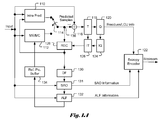
- Fig. 1A illustrates an exemplary adaptive Inter/Intra video coding system incorporating in-loop processing.
- Motion Estimation (ME)/Motion Compensation (MC) 112 is used to provide prediction data based on video data from other picture or pictures.
- Switch 114 selects Intra Prediction 110 or Inter-prediction data and the selected prediction data is supplied to Adder 116 to form prediction errors, also called residues.
- the prediction error is then processed by Transformation (T) 118 followed by Quantization (Q) 120.
- T Transformation
- Q Quantization
- the transformed and quantized residues are then coded by Entropy Encoder 122 to form a video bitstream corresponding to the compressed video data.
- the bitstream associated with the transform coefficients is then packed with side information such as motion, mode, and other information associated with the image area.
- the side information may also be subject to entropy coding to reduce required bandwidth. Accordingly, the data associated with the side information are provided to Entropy Encoder 122 as shown in Fig. 1A .
- Entropy Encoder 122 When an Inter-prediction mode is used, a reference picture or pictures have to be reconstructed at the encoder end as well. Consequently, the transformed and quantized residues are processed by Inverse Quantization (IQ) 124 and Inverse Transformation (IT) 126 to recover the residues. The residues are then added back to prediction data 136 at Reconstruction (REC) 128 to reconstruct video data.
- the reconstructed video data may be stored in Reference Picture Buffer 134 and used for prediction of other frames.
- incoming video data undergoes a series of processing in the encoding system.
- the reconstructed video data from REC 128 may be subject to various impairments due to a series of processing. Accordingly, various in-loop processing is applied to the reconstructed video data before the reconstructed video data are stored in the Reference Picture Buffer134 in order to improve video quality.
- HEVC High Efficiency Video Coding
- Deblocking Filter (DF) 130, Sample Adaptive Offset (SAO) 131 and Adaptive Loop Filter (ALF) 132 have been developed to enhance picture quality.
- the in-loop filter information may have to be incorporated in the bitstream so that a decoder can properly recover the required information.
- DF 130 is applied to the reconstructed video first; SAO 131 is then applied to DF-processed video; and ALF 132 is applied to SAO-processed video.
- HEVC High Efficiency Video Coding
- AVS2 AVS2
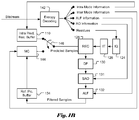
- Fig. 1B illustrates a system block diagram of a corresponding video decoder including deblocking filter, sample adaptive offset and adaptive loop filter. Since the encoder also contains a local decoder for reconstructing the video data, some decoder components are already used in the encoder except for the entropy decoder 142. Furthermore, only motion compensation 144 is required for the decoder side. The switch 146 selects Intra-prediction or Inter-prediction and the selected prediction data are supplied to reconstruction (REC) 128 to be combined with recovered residues. Besides performing entropy decoding on compressed video data, entropy decoding 142 is also responsible for entropy decoding of side information and provides the side information to respective blocks.
- REC reconstruction
- Intra mode information is provided to Intra-prediction 110
- Inter mode information is provided to motion compensation 144
- adaptive offset information is provided to SAO 131
- adaptive loop filter information is provided to ALF 132
- residues are provided to inverse quantization 124.
- the residues are processed by IQ 124, IT 126 and subsequent reconstruction process to reconstruct the video data.
- reconstructed video data from REC 128 undergo a series ofprocessing including IQ 124 and IT 126 as shown in Fig. 1B and are subject to intensity shift.
- the reconstructed video data are further processed by DF 130, SAO 131 and ALF 132.
- LCU Largest Coding Unit
- CTU Coding Tree Unit
- the LCU is adaptively partitioned into coding units using quadtree.
- the DF is applies to 8x8 block boundaries. For each 8x8 block, horizontal filtering across horizontal block boundaries is first applied, and then vertical filtering across horizontal block boundaries is applied.
- Fig. 2A illustrates an example of DF processing for the luma component in HEVC, where block boundary 210 with 4 boundary pixels on each side of the block boundary are involved. The boundary may correspond to a vertical boundary or a horizontal boundary.
- the boundary pixels are designated as q0, q1, q2 and q3, and p0, p1, p2 and p3, where q0 and p0 are two pixels immediately adjacent to the boundary.
- 4 pixels of each side are involved in filter parameter derivation, and up to3 pixels on each side (i.e., p0, p1, p2 or q0, q1, q2) can be modified after filtering.
- unfiltered reconstructed pixels are used for filter parameter derivation and are used as source pixels for filtering.
- DF processed intermediate pixels i.e.
- pixels after horizontal filtering are used for filter parameter derivation and also used as source pixel for filtering.
- the DF processing for the chroma component in HEVC 2 boundary pixels on each side of the block boundary are involved and only 1 pixel may be modified (i.e., p0 or q0).
- Fig. 2B illustrates an example of DF processing for the luma component in AVS2, where block boundary 220 with 3 boundary pixels on each side of the block boundary are involved.
- the boundary pixels are designated as q0, q1 and q2, and p0, p1 and p2, where q0 and p0 are two pixels immediately adjacent to the boundary.
- DF processing of a chroma block boundary two pixels of each side are involved in filter parameter derivation.
- the DF processing may modify all involved boundary pixels. In other words, 3 luma pixels and 2 chroma pixels on each size of the block boundary may be modified.
- SAO Sample adaptive offset
- HEVC High Efficiency Video Coding
- AVS2 Sample adaptive offset (SAO) types according to HEVC and AVS2 are shown in Fig. 3 , where four SAO types are used corresponding to four orientations at 0°, 90°, 135°, and 45°.
- SAO is a per-pixel in-loop filtering.
- SAO parameters are updated for each LCU or CTU.
- SAO orientation type pixel classification is first done to classify pixels into different groups (also called categories or classes) as according to the classification conditions shown in Table 1. After classification, each reconstructed and DF processed pixel is compensated by an offset value based on the orientation type selected and the classification result.
- the conditions for the SAO classification as shown in Table 1 can be implemented by comparing the center pixel with two neighboring pixels individually.
- the conditions for classification checks whether the center pixel is greater than, smaller than or equal to one of the neighboring pixels.
- the three comparison results may be represented by a 2-bit data for each comparison result.
- the SAO parameters such as pixel offset values and SAO types can be determined adaptively for each CTU.
- the SAO parameter boundary is the same as the CTU boundary.
- SAO process for all pixels share the same SAO types and offset values. Since SAO is applied to DF processed pixels, the SAO process for a current CTU has to wait for the DF process to complete for the current CTU. However, the pixels around the CTU boundary cannot be processed by DF until the reconstructed video data around the CTU boundary on the other side of the CTU boundary are ready. Due to such data dependency, AVS2 adopted shifted SAO parameter boundaries.
- Fig. 4 illustrates an example of SAO parameter boundary shift according to the AVS2 standard.
- the SAO parameter boundary example 410 corresponds to the HEVC case, where the SAO parameter boundary is aligned with the CTU boundary.
- the SAO parameter boundary 420 corresponds to the AVS2 case, where the SAO parameter boundary is shifted left and up with respect to the CTU boundary by xS and yS respectively.
- Adaptive Loop Filtering (ALF) 132 is a video coding tool to enhance picture quality.
- ALF has been evaluated during the development stage of HEVC. However, ALF is not adopted in the current HEVC standard. Nevertheless, it is being incorporated into AVS2.
- a 17-tap symmetric ALF filter is being used for AVS2 as shown in Fig. 5 .
- the 17-tap symmetric ALF filter implies that the filter operation for a current pixel may require data from 3 following lines. When these lines are from another CTU, particular the CTU in a following CTU row, the ALF process has to be delayed till the following related data are available. This implies the need for line buffer to temporarily store the related data in the current CTU for later processing.
- FIG. 6 illustrates an example of ALF virtual boundary for the luma component according to AVS2, where the ALF processing for selected pixels (i.e., a, b, c and d) are shown.
- Line 610 represents the CTU boundary between CTU X and CTU Y.
- Line 620 represents the luma ALF virtual boundary, which is located at 4 lines (i.e., yC-4) above the CTU boundary (i.e., yC) according to AVS2.
- the ALF virtual boundary is located 3 lines (i.e., yC-3) above the CTU boundary according to AVS2 ( Information Technology - Advanced Media Coding Part2: Video Final Committee Draft, Audio and Video Coding Standard Workgroup of China, Feb. 7, 2015, Document: N2120.D3).
- AVS2 Information Technology - Advanced Media Coding Part2: Video Final Committee Draft, Audio and Video Coding Standard Workgroup of China, Feb. 7, 2015, Document: N2120.D3
- the ALF process is applied during the CTU X processing stage.
- the ALF process for pixels a, b and c only uses information above the virtual boundary.
- the ALF process is applied during the CTU Y processing stage and only uses information below the virtual boundary.
- the use of virtual boundary to restrict data dependency can help to reduce the requirement on the line buffer capacity.
- DF, SAO and ALF process involves neighboring data.
- CTU has been used as a unit for coding process.
- the data dependency has to be managed carefully to minimize line buffer. Since the DF, SAO and ALF processes are applied to each CTU sequentially, the corresponding hardware implementation may be arranged in a pipeline fashion.
- Fig. 7 illustrates an example of data dependency associated with the DF, SAO and ALF processes for an AVS2 decoder.
- the CTU based processing order 700 is shown in Fig. 7 and the CTU boundary between CTU X and CTU Y is indicated by reference number 705.
- the reconstructed video from reconstruction block 710 is processed by DF 720, SAO 730 and ALF 740.
- the output from ALF 740 is stored in a decoded frame buffer.
- Diagram 725 illustrates the DF processing status at the end ofDF processing stage for CTU X. Luma pixels above line 722 and chroma pixels above line 724 are DF processed. Luma pixels below line 722 and chroma pixels below line 732 cannot be processed during DF processing stage for CTU X since involved pixels on the other side of block boundary (i.e., below CTU boundary 705) are not available yet.
- Diagram 735 illustrates the SAO processing status at the end of SAO processing stage for CTU X.
- Luma pixels above line 732 and chroma pixels above line 734 are SAO processed, where line 732 and line 734 are aligned.
- Diagram 745 illustrates the ALF processing status at the end of ALF processing stage the CTU X. Again, the luma pixels below line 732 and the chroma pixels below line 734 cannot be processed by SAO for CTU X yet since it involves SAO parameter signaled in the CTU Y, which is not yet processed by VLD.
- Luma pixels above line 742 (luma ALF virtual boundary) are ALF processed according to the AVS2 draft standard. Chroma pixels above line 744 (chroma ALF virtual boundary) would be ALF processed.
- the ALF process for the chroma component cannot be performed for chroma lines A through D during the CTU X processing stage.
- the ALF process for pixel 746 will use pixel 748. Since chromapixel 748 is below the chroma SAO parameter boundary 734, chroma pixel 748 is not SAO processed yet for the CTU X processing stage. Therefore, even though it is above the chroma ALF virtual boundary, chroma pixel 746 cannot be ALF processed.
- the 6 lines of chroma samples with picture width have to be stored in line buffer, which is usually implemented using embedded memory and such implementation would result in high chip cost. Therefore, it is desirable to develop a method and apparatus that can reduce the required line buffer associated with in-loop filtering processes, such as DF, SAO, ALF, any other in-loop filtering process or combination thereof. Furthermore, for different SAO parameter boundaries, the system will switch between different SAO parameters. This will increase system complexity and power consumption. Therefore, it is desirable to develop in-loop filtering processes, such as DF, SAO, ALF , any other in-loop filtering process, or combination thereof, with proper system parameter design to reduce line buffer requirement, system complexity, system power consumption, or any combination thereof. In yet another aspect, it is desirable to develop method and apparatus for performance and cost efficient loop filter processing including DF, SAO and ALF for any video coding system incorporating such loop filter processing.
- a method and apparatus for loop filter processing of reconstructed video are disclosed.
- the present invention manipulates SAO parameter boundary by shifting it in horizontal and vertical directions according to a respective goal.
- deblocking filter (DF) process is first applied to reconstructed pixels, where DF processing modifies up to m pixels at each side of a horizontal edge corresponding to an image unit boundary between two image units.
- the sample adaptive offset (SAO) process is applied to DF-processed pixels of current image unit according to one or more SAO parameters.
- All or a part of pixels within SAO parameter boundary of current image unit share the same SAO parameters.
- Thevertical SAO parameter boundary of current image unit is shifted-left by xs lines from a vertical boundary of current image unit and the horizontal SAO parameter boundary of current image unit is shifted-up by ys lines from a horizontal boundary of current image unit.
- the spatial-loop-filter process is then applied to SAO-processed pixels above a spatial-loop-filterrestricted boundary of current image unit according to one or morespatial-loop-filter parameters.
- the spatial-loop-filterrestricted boundary of current image unit is shifted-up by yv lines from the bottom boundary of current image unit.
- m, xs, ys, and yv are set to positive integers, xs is always greater than m, ys is greater than or equal to 0, ys is always smaller than yv, and yvis determined according to m.
- Each image unit may correspond to a coding tree unit (CTU).
- the spatial-loop-filter process may correspond to adaptive loop filter (ALF) process.
- the DF process, the SAO process, and the spatial-loop-filter process are applied to the luma component and chroma component separately with individual m denoted as M and N, individual xs denoted as xS and xSC, individual ys denoted as yS and ySC, and individual yv denoted as yV and yVC respectively.
- yS and ySCcan be equal to 0.
- M is equal to 3 and N is equal to 2.
- yS is equal to ySC
- yVis equal toyVC
- yVC isgreaterthan MAX(M,N).
- yV and yVC are equal to MAX(M,N)+1
- yS and ySC can be an integer from 0 to MAX(M,N).
- M is equal to 3 and N is equal to 2.
- the sign data generated from comparing a current pixel in a current line processed during a current processing stage for the current image unit with a neighboring pixel in an adjacent line to be processed during in a subsequent processing stage are stored.
- Each sign data corresponds to "greater than”, “less than” or “equal to”.
- Each sign data can be stored in 2 bits.
- FIG. 8 illustrates the processing status at the end of DF processing stage for CTU X.
- Luma pixels above line 822 i.e., luma DF boundary
- chroma pixels above line 824 i.e., chroma DF boundary
- M indicates the maximum number of luma pixels
- N indicates the maximum number of chroma pixels on each side of the block boundary that can be updated by the DF process.
- CTU boundary 805 is also a block boundary.
- Diagram 835 illustrates the SAO processing status at the end of SAO processing stage for CTU X.
- Luma pixels above line 832 i.e., luma SAO parameter boundary
- chroma pixels above line 834 i.e., chroma SAO parameter boundary
- line 832 and line 834 are aligned due to the SAO parameter boundary shift proposed in AVS2 standard.
- SAO parameter boundary is shifted by (xS, yS) for the luma component and (xSC, ySC) for the chroma component.
- the top boundary of SAO parameter is shifted to (yC - yS) for the luma component and shifted to (yC - ySC) for the chroma component as indicated in Fig. 8 .
- SAO parameter boundary shift is also applied to the x-direction.
- SAO parameters are determined based on CTU in the HEVC standard.
- the SAO parameters are determined based on the pixels that are DF processed and ready for SAO processing.
- the SAO parameter boundary according to the conventional approach is the same as the DF processed pixel boundary ready for SAO processing.
- the DF processed pixel boundary ready for SAO processing is referred as a SAO processing boundary.
- Diagram 845 illustrates the ALF processing status at the end of ALF processing stage for CTU X.
- Luma pixels above line 842 i.e., luma ALF virtual boundary
- Chroma pixels above line 844 i.e., chroma ALF virtual boundary
- ALF virtual boundary is (yC - yV) for the luma component and (yC - yVC) for the chroma component, where yV and yVC correspond to the boundary vertical shifts for the luma and chroma components respectively.
- the number (i.e., M and N) of boundary pixels to be updated are 3 and 2 for the luma and chroma components respectively.
- the SAO parameter boundary vertical offsets correspond to 4 for both luma and chroma components.
- the vertical shifts for the ALF virtual boundaries i.e., yV and yVC
- yV and yVC are 4 and 3 for the luma and chroma components respectively.
- a method to manipulate SAO parameter boundary by shifting it in horizontal and vertical directions according to a respective goal is disclosed, which has different SAO parameter boundary and SAO processing boundary.
- the SAO parameter boundary and SAO processing boundary are always the same.
- vertical SAO parameter boundary keeps equal to the SAO processing boundary, but the horizontal SAO parameter boundary can be different from the SAO processing boundary.
- the SAO processing boundary is selected according to the locations of DF processed pixel data.
- Fig. 9 illustrates an example of different horizontal SAO parameter and processing boundaries according to the present invention.
- the horizontal SAO parameter boundary 912 is the same as the CTU horizontal boundary 910.
- the horizontal SAO processing boundary 920 is located at 1 line above the deblocking boundary 930.
- the SAO processing is based on the SAO parameters within (i.e., above) the SAO parameter boundary for CTU X.
- the SAO processing is also based on SAO parameter for CTU X according to the present invention since pixel 950 is within (i.e., above) the horizontal SAO processing boundary 920.
- pixel 950 in line D is SAO processed based on SAO parameter for CTU Y.
- an image is partitioned into CTUs and each CTU is partitioned into one or more coding units (CUs).
- the DF, SAO and ALF processes are applied to block boundaries to reduce artifacts at or near block boundaries.
- the DF, SAO and ALF processes at CTU boundaries which are also block boundaries, will require line buffers to store information across CTU row boundaries.
- the image may also be partitioned into other image units, such as macroblock or tile, for coding process.
- the line buffer issue associated with CTU boundaries also exists in image unit boundaries.
- ALF filter is used as an example in the above illustration, the present invention is applicable to any spatial loop filter.
- a two-dimensional FIR (finite impulse response) filter with as set of spatial loop filter parameters can be used to replace the ALF.
- a restricted spatial loop filter boundary can be used to restrict the spatial loop filter processing to use only SAO processed data within the restricted spatial loop filter boundary.
- the restricted spatial loop filter boundary can be located aty lines above the CTU boundary. The spatial loop filter will be applied to the SAO processed pixels above the restricted spatial loop filter boundary and will only use the SAO processed pixels above the restricted spatial loop filter boundary as input to the spatial loop filter.
- Fig. 9 is intended to illustrate an example of the present invention, where the horizontal SAO parameter boundary 912 does not have to be the same as the CTU horizontal boundary 910.
- the horizontal SAO parameter boundary 912 can be anywhere starting from the CTU horizontal boundary 910 up to 1 line below the horizontal SAO processing boundary 920.
- SAO parameter information needed for SAO processing may have to be buffered since the SAO operation for pixels in this region is based on SAO parameter information of CTU X.
- SAO parameter can be coded in merge-up or merge-left syntax, which also needs to buffer SAO parameter for a whole CTU row, so the storage for SAO parameter can be shared.
- the present invention can be applied to the luma component and the chroma component if the underlying video data corresponds to color video data.
- the major impact on line buffer requirement is due to the storage requirement for boundary loop filter processing from one CTU row to the next CTU row. Since a picture may be very wide, the corresponding line buffer size may be very large.
- a goal of the present invention is to reduce the line buffer requirement for loop filter processing across CTU boundary between two CTU rows.
- the impact on line buffer requirement is very small if any.
- the processing status for corresponding DF, SAO and ALF processes are indicated by respective reference numbers 1025, 1035 and 1045.
- Some of the loop processing boundaries are the same as those in Fig. 8 .
- the same reference numbers as Fig. 8 may be used to indicate the same loop processing boundaries.
- Fig. 10 also indicates the SAO processing boundaries for the luma and chroma components, where the SAO processing vertical offset for the luma component (vS') is 4 and the SAO processing vertical offset for the chroma component (vSC') is 3.
- the SAO parameter boundaries 1032 and 1034 for the luma and chroma components are located at 1 line below the respective SAO processing boundaries 1036 and 1038.
- the offset of the SAO parameter boundary in the horizontal direction is always the same as SAO processing boundary.
- the horizontal offsets xS and xSC of the SAO parameter boundary for the luma and chroma components is the same as the offsets of the SAO processing boundaries in the horizontal direction.
- the SAO parameter boundaries for the luma and chroma components are the same in order to favor a regular memory access behavior.
- the ALF virtual boundaries for the luma and chroma components are also the same.
- the ALF virtual boundaries are at least 1 line above the respective SAO parameter boundaries.
- the processing status for corresponding DF, SAO and ALF processes are indicated by respective reference numbers 1125, 1135 and 1145.
- Some of the loop processing boundaries are the same as those in Fig. 8 .
- the same reference numbers as Fig. 8 may be used to indicate the same loop processing boundaries.
- it also indicates the SAO processing boundaries for the luma and chroma components, where the SAO processing boundary vertical offsets for the luma and chroma components (vS' and vSC') are equal to 4.
- the processing status for corresponding DF, SAO and ALF processes are indicated by respective reference numbers 1125, 1135 and 1145.
- Some of the loop processing boundaries are the same as those in
- the SAO parameter boundaries 1132 and 1134 for the luma and chroma components are located at 2 lines below the respective SAO processing boundaries 1136 and 1138.
- the ALF virtual boundaries 1142 and 1144 for the luma and chroma components are also indicated.
- the SAO parameter boundary in the horizontal direction is always the same as the SAO processing boundary in the horizontal direction.
- the pixel data within current CTU processing boundaries may be used for later SAO processing.
- the line D in Fig. 9 will be processed in the pipeline stage for CTU Y.
- the SAO processing on line D will need data in line C that are processed in SAO processing stage for CTU X.
- the SAO classification process compares the center pixel value with two individual neighboring pixels. The comparison determines whether the center pixel is larger than, smaller than or equal to one selected neighboring pixel.
- the comparison results are already available when line C was SAO processed at the pipeline stage for CTU X, since line D will be SAO processed with the same SAO parameter as line C due to the non-aligned SAO parameter boundary and processing boundary.
- the result of the comparison between a pixel line C and a neighboring pixel line D can be represented by a 2-bit data for each pixel to indicate one of the three comparison results.
- the 2-bit sign data is much smaller than storing a whole pixel, which is typically 8 bits or more. Accordingly, the cost of the line buffer can be substantially reduced.
- the loop filter processing boundary design as disclosed above can be used to overcome the large line buffer requirement issue due to data dependency in coding systems, such as AVS2 system, utilizing loop filters including DF, SAO and ALF.
- the present invention is also applicable to any advanced video coding systems incorporating DF, SAO and ALF.
- Table 2 compares the line buffer requirementsamong the conventional AVS2 standard and the embodiments of the present invention.
- all above implementations require 3 lines for each of the luma and chroma components to store data for deblocking filter.
- SAO processing all systems require to store line D and Line C data for each of the luma and chroma components.
- comparison results between line C and line D can be stored to reduce storage requirement.
- only 2 bits are required to store each comparison results.
- 6 lines of SAO results would be stored for ALF processing on the chroma component.
- Systems incorporating any embodiment of the present invention can remove the need for these6 lines of buffer for ALF processing of the chroma component.
- the total numbers of lines required for DF, SAO and ALF are 16, 7.5 and 8.5 for the conventional AVS2, the first embodiment, and the second embodiment, where both embodiments achieve additional memory saving by storing the signs for comparison results involved in the SAO processing.In other words, the first and second embodiments can reduce the line buffer requirement by 8.5 and 7.5 lines.
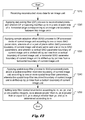
- Fig. 12 illustrates an exemplary flowchart for a coding system incorporating an embodiment of the present invention, where the system aligns loop filter related boundaries to reduce line buffer requirement.
- the system receives reconstructed video data for an image unit as shown in step 1210.
- the reconstructed video data may be retrieved from memory (e.g., computer memory, buffer (RAM or DRAM) or other media) or from a processor.
- Deblocking filter (DF) process is then applied to reconstructed pixels in step 1220.
- the DF processing modifies up to up to m pixels at each side of a horizontal edge corresponding to an image unit boundary between two image units.
- Sample adaptive offset (SAO) process is applied to DF-processed pixels of current image unit according to one or more SAO parameters in step 1230.
- All or a part of pixels within SAO parameter boundary of current image unit share same said one or more SAO parameters.
- Thevertical SAO parameter boundary of current image unit is shifted-left by xs lines from a vertical boundary of current image unit and the horizontal SAO parameter boundary of current image unit is shifted-up by ys lines from a horizontal boundary of current image unit.
- Spatial-loop-filter process is applied to SAO-processed pixels above a spatial-loop-filterrestricted boundary of current image unit according to one or morespatial-loop-filter parameters in step 1240, where the spatial-loop-filterrestricted boundary of current image unit is shifted-up by yv lines from a bottom boundary of current image unit.
- the loop filter related boundaries are set according to: m, xs, ys, and yv are positive integers, xs is always greater than m, ys is greater than or equal to 0, ys is always smaller than yv, and yvis determined according to m as shown in step 1250.
- Embodiment of the present invention as described above may be implemented in various hardware, software codes, or a combination of both.
- an embodiment of the present invention can be one or more electronic circuits integrated into a video compression chip or program code integrated into video compression software to perform the processing described herein.
- An embodiment of the present invention may also be program code to be executed on a Digital Signal Processor (DSP) to perform the processing described herein.
- DSP Digital Signal Processor
- the invention may also involve a number of functions to be performed by a computer processor, a digital signal processor, a microprocessor, or field programmable gate array (FPGA). These processors can be configured to perform particular tasks according to the invention, by executing machine-readable software code or firmware code that defines the particular methods embodied by the invention.
- the software code or firmware code may be developed in different programming languages and different formats or styles.
- the software code may also be compiled for different target platforms.
- different code formats, styles and languages of software codes and other means of configuring code to perform the tasks in accordance with the invention will not depart from the spirit and scope of the invention.
Landscapes
- Engineering & Computer Science (AREA)
- Multimedia (AREA)
- Signal Processing (AREA)
- Compression Or Coding Systems Of Tv Signals (AREA)
Applications Claiming Priority (2)
| Application Number | Priority Date | Filing Date | Title |
|---|---|---|---|
| US201562115755P | 2015-02-13 | 2015-02-13 | |
| US15/015,552 US20160241881A1 (en) | 2015-02-13 | 2016-02-04 | Method and Apparatus of Loop Filters for Efficient Hardware Implementation |
Publications (1)
| Publication Number | Publication Date |
|---|---|
| EP3057320A1 true EP3057320A1 (fr) | 2016-08-17 |
Family
ID=55359453
Family Applications (1)
| Application Number | Title | Priority Date | Filing Date |
|---|---|---|---|
| EP16155745.9A Withdrawn EP3057320A1 (fr) | 2015-02-13 | 2016-02-15 | Procédé et appareil de filtres à boucle destinés à une mise en oeuvre matérielle efficace |
Country Status (2)
| Country | Link |
|---|---|
| US (1) | US20160241881A1 (fr) |
| EP (1) | EP3057320A1 (fr) |
Cited By (11)
| Publication number | Priority date | Publication date | Assignee | Title |
|---|---|---|---|---|
| WO2019200277A1 (fr) * | 2018-04-12 | 2019-10-17 | Qualcomm Incorporated | Décalage adaptatif d'échantillon (sao) compatible avec un matériel et filtre de boucle adaptatif (alf) pour codage vidéo |
| WO2021057946A1 (fr) * | 2019-09-27 | 2021-04-01 | Beijing Bytedance Network Technology Co., Ltd. | Filtrage en boucle adaptatif entre différentes unités vidéo |
| US11032542B2 (en) * | 2017-01-11 | 2021-06-08 | Interdigital Vc Holdings, Inc. | Method and a device for image encoding and decoding |
| US11490082B2 (en) | 2019-06-14 | 2022-11-01 | Beijing Bytedance Network Technology Co., Ltd. | Handling video unit boundaries and virtual boundaries based on color format |
| US11553179B2 (en) | 2019-07-09 | 2023-01-10 | Beijing Bytedance Network Technology Co., Ltd. | Sample determination for adaptive loop filtering |
| US11589042B2 (en) | 2019-07-11 | 2023-02-21 | Beijing Bytedance Network Technology Co., Ltd. | Sample padding in adaptive loop filtering |
| US11652998B2 (en) | 2019-09-22 | 2023-05-16 | Beijing Bytedance Network Technology Co., Ltd. | Padding process in adaptive loop filtering |
| US11700368B2 (en) | 2019-07-15 | 2023-07-11 | Beijing Bytedance Network Technology Co., Ltd. | Classification in adaptive loop filtering |
| US11706462B2 (en) | 2019-10-10 | 2023-07-18 | Beijing Bytedance Network Technology Co., Ltd | Padding process at unavailable sample locations in adaptive loop filtering |
| US12003712B2 (en) | 2019-06-14 | 2024-06-04 | Beijing Bytedance Network Technology Co., Ltd | Handling video unit boundaries and virtual boundaries |
| US12621445B2 (en) | 2019-07-09 | 2026-05-05 | Beijing Bytedance Network Technology Co., Ltd. | Sample determination for adaptive loop filtering |
Families Citing this family (15)
| Publication number | Priority date | Publication date | Assignee | Title |
|---|---|---|---|---|
| US11044473B2 (en) * | 2018-12-21 | 2021-06-22 | Qualcomm Incorporated | Adaptive loop filtering classification in video coding |
| KR20250107970A (ko) * | 2018-12-23 | 2025-07-14 | 후아웨이 테크놀러지 컴퍼니 리미티드 | 인코더, 디코더 및 적응 루프 필터를 사용한 대응 방법들 |
| CN113711612B (zh) | 2019-04-20 | 2023-05-26 | 北京字节跳动网络技术有限公司 | 视频编解码中的色度语法元素的信令 |
| CN115567707B (zh) | 2019-05-30 | 2025-05-13 | 抖音视界有限公司 | 一种处理视频数据的方法、装置、介质 |
| US11070848B2 (en) * | 2019-06-24 | 2021-07-20 | Tencent America LLC | Method for efficient signaling of virtual boundary for loop filtering control |
| US11641465B2 (en) * | 2019-07-25 | 2023-05-02 | Hfi Innovation Inc. | Method and apparatus of cross-component adaptive loop filtering with virtual boundary for video coding |
| US11303890B2 (en) * | 2019-09-05 | 2022-04-12 | Qualcomm Incorporated | Reusing adaptive loop filter (ALF) sub-picture boundary processing for raster-scan slice boundaries |
| US11425405B2 (en) * | 2019-11-15 | 2022-08-23 | Qualcomm Incorporated | Cross-component adaptive loop filter in video coding |
| FI4047933T3 (fi) | 2019-11-18 | 2024-08-20 | Lg Electronics Inc | Suodatuspohjainen kuvankoodauslaite ja menetelmä |
| JP7393550B2 (ja) | 2019-12-11 | 2023-12-06 | 北京字節跳動網絡技術有限公司 | クロス成分適応ループフィルタリングのためのサンプルパディング |
| WO2021155778A1 (fr) * | 2020-02-03 | 2021-08-12 | Beijing Bytedance Network Technology Co., Ltd. | Filtre de boucle adaptatif inter-composantes |
| US11394967B2 (en) | 2020-04-26 | 2022-07-19 | Tencent America LLC | Geometric cross-component filtering |
| EP4173290A4 (fr) * | 2020-06-30 | 2024-01-10 | Beijing Bytedance Network Technology Co., Ltd. | Emplacement de limite pour filtrage à boucle adaptatif |
| CN114501035B (zh) * | 2022-01-26 | 2024-02-13 | 百果园技术(新加坡)有限公司 | 视频编解码滤波处理方法、系统、设备及存储介质 |
| CN116962688A (zh) * | 2022-04-20 | 2023-10-27 | 腾讯科技(深圳)有限公司 | 环路滤波方法、视频编解码方法、装置、介质及电子设备 |
Citations (1)
| Publication number | Priority date | Publication date | Assignee | Title |
|---|---|---|---|---|
| WO2014023207A1 (fr) * | 2012-08-06 | 2014-02-13 | Mediatek Inc. | Procédé et appareil pour décalage adaptatif d'échantillon dans un décodeur vidéo |
Family Cites Families (1)
| Publication number | Priority date | Publication date | Assignee | Title |
|---|---|---|---|---|
| US20130032252A1 (en) * | 2011-08-04 | 2013-02-07 | Institute Of Metal Research Chinese Academy Of Science | Amorphous nickel-free zirconium alloy |
-
2016
- 2016-02-04 US US15/015,552 patent/US20160241881A1/en not_active Abandoned
- 2016-02-15 EP EP16155745.9A patent/EP3057320A1/fr not_active Withdrawn
Patent Citations (1)
| Publication number | Priority date | Publication date | Assignee | Title |
|---|---|---|---|---|
| WO2014023207A1 (fr) * | 2012-08-06 | 2014-02-13 | Mediatek Inc. | Procédé et appareil pour décalage adaptatif d'échantillon dans un décodeur vidéo |
Non-Patent Citations (8)
| Title |
|---|
| "Advanced Video Coding Systems", 1 January 2015, SPRINGER, article GAO ET AL: "Chapter 7 - In-Loop Filter", pages: 115 - 134, XP055278569 * |
| "Information Technology - Advanced Media Coding Part2: Video Final Committee Draft", AUDIO AND VIDEO CODING STANDARD WORKGROUP OF CHINA, 7 February 2015 (2015-02-07) |
| CHEN JIE ET AL: "Sample adaptive offset in AVS2 video standard", 2014 IEEE VISUAL COMMUNICATIONS AND IMAGE PROCESSING CONFERENCE, IEEE, 7 December 2014 (2014-12-07), pages 69 - 72, XP032741238, DOI: 10.1109/VCIP.2014.7051506 * |
| CHIA-YANG TSAI ET AL: "Adaptive Loop Filtering for Video Coding", IEEE JOURNAL OF SELECTED TOPICS IN SIGNAL PROCESSING, vol. 7, no. 6, 1 December 2013 (2013-12-01), US, pages 934 - 945, XP055265962, ISSN: 1932-4553, DOI: 10.1109/JSTSP.2013.2271974 * |
| CHIH-MING FU ET AL: "Sample Adaptive Offset in the HEVC Standard", IEEE TRANSACTIONS ON CIRCUITS AND SYSTEMS FOR VIDEO TECHNOLOGY, IEEE SERVICE CENTER, PISCATAWAY, NJ, US, vol. 22, no. 12, 1 December 2012 (2012-12-01), pages 1755 - 1764, XP011487153, ISSN: 1051-8215, DOI: 10.1109/TCSVT.2012.2221529 * |
| C-Y CHEN ET AL: "Non-CE8.c.7: Single-source SAO and ALF virtual boundary processing with cross9x9", 7. JCT-VC MEETING; 98. MPEG MEETING; 21-11-2011 - 30-11-2011; GENEVA; (JOINT COLLABORATIVE TEAM ON VIDEO CODING OF ISO/IEC JTC1/SC29/WG11 AND ITU-T SG.16 ); URL: HTTP://WFTP3.ITU.INT/AV-ARCH/JCTVC-SITE/,, no. JCTVC-G212, 8 November 2011 (2011-11-08), XP030110196 * |
| ESENLIK S ET AL: "Grid displacements for ALF", 100. MPEG MEETING; 30-4-2012 - 4-5-2012; GENEVA; (MOTION PICTURE EXPERT GROUP OR ISO/IEC JTC1/SC29/WG11),, no. m24408, 28 April 2012 (2012-04-28), XP030052753 * |
| ESENLIK S ET AL: "Grid displacements for in-loop filtering", 97. MPEG MEETING; 18-7-2011 - 22-7-2011; TORINO; (MOTION PICTURE EXPERT GROUP OR ISO/IEC JTC1/SC29/WG11),, no. m20691, 15 July 2011 (2011-07-15), XP030049254 * |
Cited By (20)
| Publication number | Priority date | Publication date | Assignee | Title |
|---|---|---|---|---|
| US11032542B2 (en) * | 2017-01-11 | 2021-06-08 | Interdigital Vc Holdings, Inc. | Method and a device for image encoding and decoding |
| WO2019200277A1 (fr) * | 2018-04-12 | 2019-10-17 | Qualcomm Incorporated | Décalage adaptatif d'échantillon (sao) compatible avec un matériel et filtre de boucle adaptatif (alf) pour codage vidéo |
| US12003712B2 (en) | 2019-06-14 | 2024-06-04 | Beijing Bytedance Network Technology Co., Ltd | Handling video unit boundaries and virtual boundaries |
| US11490082B2 (en) | 2019-06-14 | 2022-11-01 | Beijing Bytedance Network Technology Co., Ltd. | Handling video unit boundaries and virtual boundaries based on color format |
| US12526407B2 (en) | 2019-06-14 | 2026-01-13 | Beijing Bytedance Network Technology Co., Ltd. | Handling video unit boundaries and virtual boundaries |
| US12621445B2 (en) | 2019-07-09 | 2026-05-05 | Beijing Bytedance Network Technology Co., Ltd. | Sample determination for adaptive loop filtering |
| US11553179B2 (en) | 2019-07-09 | 2023-01-10 | Beijing Bytedance Network Technology Co., Ltd. | Sample determination for adaptive loop filtering |
| US11831869B2 (en) | 2019-07-09 | 2023-11-28 | Beijing Bytedance Network Technology Co., Ltd. | Sample determination for adaptive loop filtering |
| US11589042B2 (en) | 2019-07-11 | 2023-02-21 | Beijing Bytedance Network Technology Co., Ltd. | Sample padding in adaptive loop filtering |
| US12120297B2 (en) | 2019-07-11 | 2024-10-15 | Beijing Bytedance Network Technology Co., Ltd. | Sample padding in adaptive loop filtering |
| US12425585B2 (en) | 2019-07-15 | 2025-09-23 | Beijing Bytedance Network Technology Co., Ltd. | Classification in adaptive loop filtering |
| US11700368B2 (en) | 2019-07-15 | 2023-07-11 | Beijing Bytedance Network Technology Co., Ltd. | Classification in adaptive loop filtering |
| US12273527B2 (en) | 2019-09-22 | 2025-04-08 | Beijing Bytedance Network Technology Co., Ltd. | Padding process in adaptive loop filtering |
| US11671594B2 (en) | 2019-09-22 | 2023-06-06 | Beijing Bytedance Network Technology Co., Ltd. | Selective application of sample padding in adaptive loop filtering |
| US11652998B2 (en) | 2019-09-22 | 2023-05-16 | Beijing Bytedance Network Technology Co., Ltd. | Padding process in adaptive loop filtering |
| US12155825B2 (en) | 2019-09-27 | 2024-11-26 | Beijing Bytedance Network Technology Co., Ltd. | Adaptive loop filtering between different video units |
| US11683488B2 (en) | 2019-09-27 | 2023-06-20 | Beijing Bytedance Network Technology Co., Ltd. | Adaptive loop filtering between different video units |
| WO2021057946A1 (fr) * | 2019-09-27 | 2021-04-01 | Beijing Bytedance Network Technology Co., Ltd. | Filtrage en boucle adaptatif entre différentes unités vidéo |
| US11706462B2 (en) | 2019-10-10 | 2023-07-18 | Beijing Bytedance Network Technology Co., Ltd | Padding process at unavailable sample locations in adaptive loop filtering |
| US12382105B2 (en) | 2019-10-10 | 2025-08-05 | Beijing Bytedance Network Technology Co., Ltd. | Padding process at unavailable sample locations in adaptive loop filtering |
Also Published As
| Publication number | Publication date |
|---|---|
| US20160241881A1 (en) | 2016-08-18 |
Similar Documents
| Publication | Publication Date | Title |
|---|---|---|
| EP3057320A1 (fr) | Procédé et appareil de filtres à boucle destinés à une mise en oeuvre matérielle efficace | |
| US10306246B2 (en) | Method and apparatus of loop filters for efficient hardware implementation | |
| EP2708027B1 (fr) | Procédé et appareil pour une réduction de tampon de filtre en boucle | |
| AU2012327672B2 (en) | Method and apparatus for non-cross-tile loop filtering | |
| US8913656B2 (en) | Method and apparatus for in-loop filtering | |
| EP2697973B1 (fr) | Procédé et appareil de filtrage à boucle à travers des frontières de tranches ou de pavés | |
| KR102755171B1 (ko) | 비디오 코딩에서 비선형 적응적 루프 필터링을 위한 방법 및 장치 | |
| US9967563B2 (en) | Method and apparatus for loop filtering cross tile or slice boundaries | |
| US10003798B2 (en) | Method and apparatus for reduction of deblocking filter | |
| US9344717B2 (en) | Method and apparatus for sample adaptive offset in a video decoder | |
| WO2021046096A1 (fr) | Procédé et appareil de filtrage à boucle adaptative au niveau d'une limite d'image et de sous-image dans un codage vidéo | |
| CN106131552A (zh) | 采用自适应偏置处理编码视频的方法和装置 | |
| US20150326886A1 (en) | Method and apparatus for loop filtering | |
| EP2767089A1 (fr) | Procédé et appareil de filtrage à boucle | |
| CN103051892B (zh) | 内嵌式回路滤波方法以及内嵌式回路滤波装置 | |
| EP2880861B1 (fr) | Procédé et appareil de traitement vidéo incorporant un déblocage et un décalage adaptatif d'échantillons | |
| CN107040778A (zh) | 环路滤波方法以及环路滤波装置 | |
| US20200021849A1 (en) | Devices and methods for video coding |
Legal Events
| Date | Code | Title | Description |
|---|---|---|---|
| PUAI | Public reference made under article 153(3) epc to a published international application that has entered the european phase |
Free format text: ORIGINAL CODE: 0009012 |
|
| AK | Designated contracting states |
Kind code of ref document: A1 Designated state(s): AL AT BE BG CH CY CZ DE DK EE ES FI FR GB GR HR HU IE IS IT LI LT LU LV MC MK MT NL NO PL PT RO RS SE SI SK SM TR |
|
| AX | Request for extension of the european patent |
Extension state: BA ME |
|
| STAA | Information on the status of an ep patent application or granted ep patent |
Free format text: STATUS: REQUEST FOR EXAMINATION WAS MADE |
|
| 17P | Request for examination filed |
Effective date: 20170217 |
|
| RBV | Designated contracting states (corrected) |
Designated state(s): AL AT BE BG CH CY CZ DE DK EE ES FI FR GB GR HR HU IE IS IT LI LT LU LV MC MK MT NL NO PL PT RO RS SE SI SK SM TR |
|
| STAA | Information on the status of an ep patent application or granted ep patent |
Free format text: STATUS: EXAMINATION IS IN PROGRESS |
|
| STAA | Information on the status of an ep patent application or granted ep patent |
Free format text: STATUS: THE APPLICATION HAS BEEN WITHDRAWN |
|
| 17Q | First examination report despatched |
Effective date: 20190313 |
|
| 18W | Application withdrawn |
Effective date: 20190321 |