EP3058023B1 - Suspension de cellulose, procédé de production de ladite suspension et son utilisation - Google Patents
Suspension de cellulose, procédé de production de ladite suspension et son utilisation Download PDFInfo
- Publication number
- EP3058023B1 EP3058023B1 EP14835469.9A EP14835469A EP3058023B1 EP 3058023 B1 EP3058023 B1 EP 3058023B1 EP 14835469 A EP14835469 A EP 14835469A EP 3058023 B1 EP3058023 B1 EP 3058023B1
- Authority
- EP
- European Patent Office
- Prior art keywords
- cellulose
- suspension
- nmmo
- weight
- wrv
- Prior art date
- Legal status (The legal status is an assumption and is not a legal conclusion. Google has not performed a legal analysis and makes no representation as to the accuracy of the status listed.)
- Not-in-force
Links
Images




Classifications
-
- C—CHEMISTRY; METALLURGY
- C08—ORGANIC MACROMOLECULAR COMPOUNDS; THEIR PREPARATION OR CHEMICAL WORKING-UP; COMPOSITIONS BASED THEREON
- C08J—WORKING-UP; GENERAL PROCESSES OF COMPOUNDING; AFTER-TREATMENT NOT COVERED BY SUBCLASSES C08B, C08C, C08F, C08G or C08H
- C08J3/00—Processes of treating or compounding macromolecular substances
- C08J3/02—Making solutions, dispersions, lattices or gels by other methods than by solution, emulsion or suspension polymerisation techniques
-
- C—CHEMISTRY; METALLURGY
- C08—ORGANIC MACROMOLECULAR COMPOUNDS; THEIR PREPARATION OR CHEMICAL WORKING-UP; COMPOSITIONS BASED THEREON
- C08B—POLYSACCHARIDES; DERIVATIVES THEREOF
- C08B1/00—Preparatory treatment of cellulose for making derivatives thereof, e.g. pre-treatment, pre-soaking, activation
- C08B1/003—Preparation of cellulose solutions, i.e. dopes, with different possible solvents, e.g. ionic liquids
-
- C—CHEMISTRY; METALLURGY
- C08—ORGANIC MACROMOLECULAR COMPOUNDS; THEIR PREPARATION OR CHEMICAL WORKING-UP; COMPOSITIONS BASED THEREON
- C08J—WORKING-UP; GENERAL PROCESSES OF COMPOUNDING; AFTER-TREATMENT NOT COVERED BY SUBCLASSES C08B, C08C, C08F, C08G or C08H
- C08J3/00—Processes of treating or compounding macromolecular substances
- C08J3/02—Making solutions, dispersions, lattices or gels by other methods than by solution, emulsion or suspension polymerisation techniques
- C08J3/03—Making solutions, dispersions, lattices or gels by other methods than by solution, emulsion or suspension polymerisation techniques in aqueous media
- C08J3/075—Macromolecular gels
-
- C—CHEMISTRY; METALLURGY
- C08—ORGANIC MACROMOLECULAR COMPOUNDS; THEIR PREPARATION OR CHEMICAL WORKING-UP; COMPOSITIONS BASED THEREON
- C08L—COMPOSITIONS OF MACROMOLECULAR COMPOUNDS
- C08L1/00—Compositions of cellulose, modified cellulose or cellulose derivatives
- C08L1/02—Cellulose; Modified cellulose
-
- C—CHEMISTRY; METALLURGY
- C08—ORGANIC MACROMOLECULAR COMPOUNDS; THEIR PREPARATION OR CHEMICAL WORKING-UP; COMPOSITIONS BASED THEREON
- C08J—WORKING-UP; GENERAL PROCESSES OF COMPOUNDING; AFTER-TREATMENT NOT COVERED BY SUBCLASSES C08B, C08C, C08F, C08G or C08H
- C08J3/00—Processes of treating or compounding macromolecular substances
- C08J3/12—Powdering or granulating
-
- C—CHEMISTRY; METALLURGY
- C08—ORGANIC MACROMOLECULAR COMPOUNDS; THEIR PREPARATION OR CHEMICAL WORKING-UP; COMPOSITIONS BASED THEREON
- C08J—WORKING-UP; GENERAL PROCESSES OF COMPOUNDING; AFTER-TREATMENT NOT COVERED BY SUBCLASSES C08B, C08C, C08F, C08G or C08H
- C08J3/00—Processes of treating or compounding macromolecular substances
- C08J3/12—Powdering or granulating
- C08J3/122—Pulverisation by spraying
-
- D—TEXTILES; PAPER
- D21—PAPER-MAKING; PRODUCTION OF CELLULOSE
- D21C—PRODUCTION OF CELLULOSE BY REMOVING NON-CELLULOSE SUBSTANCES FROM CELLULOSE-CONTAINING MATERIALS; REGENERATION OF PULPING LIQUORS; APPARATUS THEREFOR
- D21C5/00—Other processes for obtaining cellulose, e.g. cooking cotton linters ; Processes characterised by the choice of cellulose-containing starting materials
- D21C5/005—Treatment of cellulose-containing material with microorganisms or enzymes
-
- C—CHEMISTRY; METALLURGY
- C08—ORGANIC MACROMOLECULAR COMPOUNDS; THEIR PREPARATION OR CHEMICAL WORKING-UP; COMPOSITIONS BASED THEREON
- C08J—WORKING-UP; GENERAL PROCESSES OF COMPOUNDING; AFTER-TREATMENT NOT COVERED BY SUBCLASSES C08B, C08C, C08F, C08G or C08H
- C08J2301/00—Characterised by the use of cellulose, modified cellulose or cellulose derivatives
- C08J2301/02—Cellulose; Modified cellulose
Definitions
- the present invention relates to an economical process for the preparation of a phase-stable suspension of cellulose II in water with high water retention capacity and the production of cellulose particles.
- Such suspensions are often referred to as "gel" and in the present invention, both terms are to be understood as synonymous.
- fibers and other shaped articles can be obtained from a solution of cellulose in an aqueous organic solvent by the so-called lyocell process.
- a solvent in particular, an aqueous solution of NMMO (N-methyl-morpholine-N-oxide) has been used for more than twenty years on a commercial scale. In the corresponding production plants, spinning masses with about 13% by weight of cellulose are usually used.
- a preferred cellulosic raw material is pulp, but also other cellulosic raw materials such as e.g. Cotton linters can be used depending on the circumstances.
- WO2013 / 006876A1 describe the preparation of a cellulose gel with cellulose II structure from 2% lyocell spinning mass.
- the spinning mass can be precipitated in water in a stirred reactor.
- the spinning mass is cooled freely below its solidification temperature and the solidified cellulose solution is comminuted to a granulate.
- the cellulose granules thus produced are washed NMMO-free and then comminuted with a consistency of 2% cellulose in demineralized water by means of wet grinding in a colloid mill. This results in a microsuspension which has a stable, gel-like character.
- the properties of the cellulose gel are described by the water retention capacity (WRV) and the particle size by means of laser diffraction.
- WRV water retention capacity
- a major disadvantage of gel preparation from 2% lyocell spinning mass is the high cost of NMMO recovery. Compared with a 13% dope, the NMMO recovery costs are more than 6 times higher due to the lower cellulose / NMMO ratio at 2% dope of about 1: 6. This applies both to the variable and fixed operating costs (energy costs, etc.) as well as the investment costs and depreciation.
- WO2009 / 036480 A1 describes the preparation of substantially spherical cellulose II powder by grinding of lyocell precipitated, NMMO free washed and dried cellulose granules.
- the resulting cellulose II powder consists of average particle sizes of 1 - 400 microns.
- a lyocell dope is coagulated with water in a granulator to form an irregular granulate having a particle size of 0.5-1.5 mm.
- This granules are washed with water NMMO-free and dried.
- the dry granules are ground in a first coarse grinding with impact mills or long-gap mills to particle sizes with an average diameter of 50-200 microns.
- average particle sizes of at least 5 ⁇ m are then produced. This fine grinding is very time-consuming, whereby the capacities are very low and therefore very expensive.
- WO 2004/043329 A2 describes the preparation and application of cellulose microbeads with a diameter of about 15 microns.
- the preparation is carried out by precipitation of the cellulose from a mixture of viscose and sodium polyacrylate with subsequent acid hydrolysis.
- the US patent US 5024831 also describes spherical cellulose particles having an average diameter of 3 - 50 ⁇ m and refers to various Japanese patents for their production.
- the particles described therein consist partly of cellulose derivatives and cellulose II due to the precipitation from the viscose process.
- the object of this prior art was to provide a cellulosic suspension which is more economical to produce and process better than cellulosic suspensions of the prior art.
- a further object was to provide a suitable process for preparing such a suspension and novel uses for it, in particular those processes and uses in which there are no undesirable accompanying substances in addition to the cellulose.
- the solution to the above-described problem consists in a phase-stable suspension of underivatized cellulose II in water with high Water retention capacity (WRV), which has a cellulose concentration between 0.1 and 4.0 wt .-% and in which the viscosity (in [Pa * s] at a shear rate 50 s -1 ) and the water retention capacity (in%) depending from the cellulose concentration x (in% by weight, based on the total amount of the suspension), have the following relationship: Viscosity at 50 s - 1 / WRV * 10000 ⁇ .4038 * x 2.8132
- the property range according to the invention is also limited downwards by the relationship: Viscosity at 50 s - 1 / WRV * 10000 > 0.0201 * x 2,366
- a cellulose concentration in the suspension is between 0.5 and 5.0% by weight, more preferably between 1.0 and 4.0% by weight.
- the suspension disclosed here differs significantly in the property profile, for example, from the in WO2013 / 006876A1 represented cellulose II suspensions, which are made of 2% dope, in particular by a significantly higher water retention capacity (WRV) and a lower viscosity level.
- WRV water retention capacity
- This combination of properties that could be achieved for the first time in the cellulosic suspension according to the invention significantly increases both the performance of the suspension preparation and its processability.
- WRV water retention capacity
- suspensions are preferred in which the viscosity (in [Pa * s] at a shear rate 50 s -1 ) and the water retention capacity (in%) depend on the cellulose concentration x (in% by weight, based on the total amount of the suspension ) have the following relationship: Viscosity at 50 s - 1 / WRV * 10000 ⁇ .3057 * x 2.5698
- cellulose II suspensions having the abovementioned properties whose WRV is between 500 and 5000%, particularly preferably between 1000 and 4000.
- the material obtained can basically have different shapes. For example, these may be granules, fibers, fleece-like, fibrous or even sponge-like structures. The least expense is when - for example, with an underwater granulator or a granulator - a coarse granules is produced.
- step d. used as an enzyme an endoglucanase or a mixture of endo- and exoglucanases.
- the enzyme concentration in step d. should preferably be 0.1 to 10.0 wt .-%.
- the comminution in step e. is preferably carried out in a crushing unit, such as another granulator, a colloid mill or a refiner.
- the shaped bodies formed In the precipitation of lyocell spinning masses with cellulose concentrations according to the invention in water or water / NMMO mixtures, the shaped bodies formed have a more or less compact outer skin structure depending on the precipitation conditions used. These are always cellulose II structures with different ratios of crystalline and amorphous areas.
- WO2013 / 006876A1 The wet grinding described, for example, with a colloid mill, it was not possible to produce microsuspensions from such material obtained by precipitation of 10 - 15 wt .-% strength cellulose solution.
- a high-pressure homogenizer is used in the last comminution step.
- Characteristic of this type of device is that the crushing is done not by shear, impact or rotor-stator principles, but by a spontaneous relaxation of the high-pressure grinding fluid and the cavitation and turbulence occurring.
- the method according to the invention works particularly effectively if in step f. the pressure in the high-pressure homogenizer between 100 and 2000 bar.
- the high-pressure homogenizer it should be operated in the form of a loop reactor.
- the suspension between 1 and 10 times, preferably 1 to 4 times, passed through the high-pressure homogenizer.
- the suspension heats up strongly. In order to avoid damage to the suspension, it may therefore be appropriate to provide a cooling possibility in the suspension circuit, for example by installing a heat exchanger.
- the process according to the invention is of particular interest if the production of the suspension can be carried out with a dope which is also suitable for staple fiber production. Therefore, it is advantageous if in step a. of the inventive method, the cellulose concentration in the spinning mass 12 to 14 wt .-% is.
- substantially spherical cellulose particles having a cellulose II structure, a spherical shape and an average diameter x 50 of 1 to 4 ⁇ m, wherein the formation of the cellulose particles takes place according to the invention by spray drying.
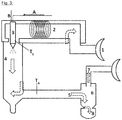
- the substrate to be dried ie the cellulosic suspension according to the invention is atomized via a nozzle into fine droplets.
- the droplets are discharged with the hot air stream into a separation cyclone and thereby water is evaporated.
- the particle structure can be influenced by various parameters such as the cellulose concentration, the size of the spray nozzle or the difference between the supply and extract air temperatures.
- the resulting cellulose particles have an approximately spherical shape and a average diameter of ⁇ 1-5 microns.
- the approximately spherical shape is mainly expressed by the axial ratio (I: d) between 1 and 2.5.
- the surface of the particles is irregular and clearly visible in the microscope are corners and edges; however, the particles show no fibrous fuzziness or fibrils in the microscope. So they are not balls with a smooth surface.
- Water Retention is a reading that indicates how much water is retained by a sample after centrifugation. Water retention is expressed as a percentage of dry weight.
- the following devices are used: Laboratory centrifuge, for example from Hettich, glass-sinter crucible 15 ml with porosity 4, eg type ROBU H11 made of borosilicate glass 3.3; Eppendorf pipette; Eppendorf pipette tips 10 ml; Support sleeves adapted to the glass sinter crucibles (made from cut off centrifuge cups) - see Fig. 10 ; Convection oven; Analytical balance.
- the samples must be well shaken before analysis. It must be ensured that there are no water residues in the support sleeves before the measurement.
- Eight clean, dry and numbered glass sinter crucibles are weighed - Accuracy 0.0001g.
- the support sleeves and glass sinter crucibles are placed in the centrifuge cups. 5 ml each of the suspensions to be determined are pipetted into a sintered glass crucible with an Eppendorf pipette. It is then spun off for 15 minutes at 3000 rpm in the laboratory centrifuge. The crucibles must be wiped down immediately after centrifuging. Thereafter, the crucibles on the analytical balance are immediately weighed and the total weight recorded. The accuracy must be 0.0001g.
- the crucibles are then dried for 4 h at 105 ° C in a convection oven and min. Cool for 30 minutes in a desiccator calmly. The samples are then reweighed dry (accuracy 0.0001g). The determination is carried out fourfold.
- the crucibles should be thoroughly cleaned after analysis with hot water (60-70 ° C) and chromic acid. The subsequent drying of the crucible takes place for 4 h at 105 ° C in a convection oven.
- the viscosities were determined using a Malvern Kinexus rheometer with a cone-plate measuring system (CP4 / 40 S0687 SS) at a shear rate of 50 s -1 .
- a 13% lyocell spinning mass is coagulated with an underwater granulator in 50% NMMO as Whyllbadmedium to a spherical granules, the granules separated from the precipitation vessel, washed with demineralized (VE) water NMMO-free and centrifuged from the remaining wash water.
- the moist granules are treated at a liquor ratio of 1:15 with 1% enzyme (endoglucanase Novozym 476) 90 min at 60 ° C with gentle stirring. The enzyme is then separated off, washed out and centrifuged off. By briefly heating to 90 ° C remaining enzyme is deactivated.
- This granulate is then pre-ground at a consistency of 2% cellulose in deionized water with a colloid mill IKA MK2000 / 10 for 15 min and further formed via a high pressure homogenizer GEA Niro Soavi NS 1001L-2K at 1000 bar and 4 passes to a microemulsion.
- the resulting material has a WRV of 1661% and is stable for more than 2 weeks without phase separation.
- a 13% lyocell spinning mass is coagulated with a granulator in water as Klallbadmedium to an irregular granules, separated from the precipitation vessel, washed with deionized water NMMO-free and centrifuged off the remaining wash water.
- the moist granules are at a Liquor ratio of 1:15 with 1% enzyme (endoglucanase Novozym 476) 90 min at 60 ° C with gentle stirring. The enzyme is then separated off, washed out and centrifuged off. By briefly heating to 90 ° C, the remaining enzyme is deactivated in the wet granules.
- This granulate is then pre-ground at a consistency of 2 wt.% Cellulose in deionized water with a colloid mill for 15 min and further formed via a high pressure homogenizer at 1000 bar and 5 passes to a microemulsion.
- the material obtained has a WRV of 1524% and is stable for more than 2 weeks without phase separation.
- a 13% lyocell spinning mass is coagulated with a granulator in water as the precipitation medium to an irregular granules, separated from the precipitation vessel, washed with deionized water NMMO-free and centrifuged off the remaining wash water.
- the suspension of the moist granules is diluted to 1, 2, 3 or 4 wt.% Cellulose with deionized water, 1% enzyme (Novozym 476), based on dry cellulose added and in a colloid mill for 90 min at 50 ° C. treated. By briefly heating to 90 ° C, the remaining enzyme is deactivated.
- WRV and viscosity are shown in Table 1.
- Table 1 Cellulose concentration [%] Water retention WRV [%] Viscosity at shear rate 50 / s [Pas] GEA-57C 1 3499 0.0232 GEA-58C 2 2422 0.098 GEA-59C 3 2228 0.154 GEA-60C 4 1686 0.282 cellulosic suspension [Weight%] Cell. WRV [%] Visc.
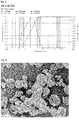
- Fig. 2 shows the position of the suspensions according to the invention from Example 3 (solid line) compared to the boundary lines of the inventive region (dotted lines, to the respective equation) and also the position of a suspension of the prior art, the WO2013 / 006876A1 (dashed line).
- cellulose microsuspensions with different cellulose contents were dried under different conditions in a laboratory spray dryer (Büchi Mini Spray Dryer B-290).
- the determination of the particle size distribution of the samples obtained therefrom was carried out by means of laser diffraction in ethanol (measuring instrument from Helos).
- a cellulosic microsuspension according to the invention prepared according to Example 2 with 2% by weight cellulose content was dried at 180 ° C. supply air temperature and 62 ° C. exhaust air temperature.
- the nozzle size was 1.5 mm.
- Fig. 4 shows the particle size distribution.
- a cellulose microsuspension according to the invention prepared according to Example 2 with 0.25 wt .-% cellulose content was dried at 220 ° C supply air and 124 ° C exhaust air temperature.
- the nozzle size was 1.5 mm.
- Fig. 5 shows the particle size distribution
- Fig. 6 SEM micrographs of the prepared particles. The particles have a substantially spherical but non-spherical shape with an irregular surface. The microfoto clearly shows corners and edges.
- a cellulose microsuspension according to the invention prepared according to Example 2 with 0.5 wt .-% cellulose content was dried at 180 ° C supply air and 83 ° C exhaust air temperature.
- the nozzle size was 1.4 mm.
- Fig. 7 shows the particle size distribution.
- a cellulosic microsuspension according to the invention prepared according to Example 2 with 4% by weight cellulose content and 0.04% Sokolan PA30CL as emulsifier was dried at 180 ° C. supply air and 72 ° C. exhaust air temperature.
- the nozzle size was 1.4 mm.
- Fig. 8 shows the particle size distribution.
- Fig. 9 the pictorial representation in the REM.
Landscapes
- Chemical & Material Sciences (AREA)
- Organic Chemistry (AREA)
- Chemical Kinetics & Catalysis (AREA)
- Medicinal Chemistry (AREA)
- Polymers & Plastics (AREA)
- Health & Medical Sciences (AREA)
- Dispersion Chemistry (AREA)
- Biochemistry (AREA)
- Life Sciences & Earth Sciences (AREA)
- Engineering & Computer Science (AREA)
- Materials Engineering (AREA)
- Microbiology (AREA)
- Processes Of Treating Macromolecular Substances (AREA)
- Polysaccharides And Polysaccharide Derivatives (AREA)
- Artificial Filaments (AREA)
Claims (6)
- Procédé pour la production d'une suspension aqueuse à phase stable de cellulose II à capacité élevée de rétention en eau, caractérisée par les étapes suivantes :a. Production suivant le procédé Lyocell d'une pâte textile contenant entre 10 et 15 % en poids de cellulose,b. Précipitation de la cellulose, permettant d'obtenir une matière contenant du NMMO et de la cellulose,c. Lavage de la matière jusqu'à ce que celle-ci soit sensiblement exempte de NMMO,d. Traitement enzymatique de la matière humide, lavée et exempte de NMMO, au moyen d'une endoglucanase ou d'un mélange d'endoglucanases et d'exoglucanases,e. Fragmentation dans une unité de fragmentation, permettant d'obtenir une suspension grossière de cellulose,f. Micro-fragmentation dans un homogénéisateur à haute pression jusqu'à obtention d'une micro-suspension stable.
- Procédé selon la revendication 1, la concentration en enzymes à l'étape d. étant de 0,1 à 10,0 % en poids par référence à la quantité de cellulose.
- Procédé selon la revendication 1, la pression dans l'homogénéisateur à haute pression étant comprise entre 100 et 2000 bars à l'étape f.
- Procédé selon la revendication 1, faisant passer la suspension entre 1 et 10 fois, de préférence entre 1 et 4 fois, par l'homogénéisateur à haute pression à l'étape f.
- Procédé selon la revendication 1, la concentration de la cellulose à l'étape a. étant de 12 à 14 % en poids.
- Procédé selon la revendication 1 pour la production de particules à structure cellulosique II, de forme sphérique et d'un diamètre moyen x50 de 1 à 4 µm, caractérisé par l'atomisation ultérieure.
Applications Claiming Priority (2)
| Application Number | Priority Date | Filing Date | Title |
|---|---|---|---|
| ATA796/2013A AT515174B1 (de) | 2013-10-15 | 2013-10-15 | Cellulosesuspension, Verfahren zu ihrer Herstellung und Verwendung |
| PCT/AT2014/000203 WO2015054712A2 (fr) | 2013-10-15 | 2014-11-14 | Suspension de cellulose, procédé de production de ladite suspension et son utilisation |
Publications (2)
| Publication Number | Publication Date |
|---|---|
| EP3058023A2 EP3058023A2 (fr) | 2016-08-24 |
| EP3058023B1 true EP3058023B1 (fr) | 2018-10-31 |
Family
ID=52462088
Family Applications (1)
| Application Number | Title | Priority Date | Filing Date |
|---|---|---|---|
| EP14835469.9A Not-in-force EP3058023B1 (fr) | 2013-10-15 | 2014-11-14 | Suspension de cellulose, procédé de production de ladite suspension et son utilisation |
Country Status (7)
| Country | Link |
|---|---|
| US (2) | US9822188B2 (fr) |
| EP (1) | EP3058023B1 (fr) |
| JP (1) | JP6453868B2 (fr) |
| KR (1) | KR102342799B1 (fr) |
| CN (1) | CN105814119B (fr) |
| AT (1) | AT515174B1 (fr) |
| WO (1) | WO2015054712A2 (fr) |
Families Citing this family (4)
| Publication number | Priority date | Publication date | Assignee | Title |
|---|---|---|---|---|
| AT517020B1 (de) | 2015-02-06 | 2020-02-15 | Chemiefaser Lenzing Ag | Recycling von cellulosischen Kunstfasern |
| ES2827832T3 (es) | 2015-06-01 | 2021-05-24 | Dupont Ind Biosciences Usa Llc | Fíbridos de poli alfa-1,3-glucano y usos de los mismos y procesos para hacer fíbridos de poli alfa-1,3-glucano |
| JP2018083923A (ja) * | 2016-11-25 | 2018-05-31 | 旭化成株式会社 | セルロース分散液、セルロース分散液の製造方法、成形体組成物、成形体、及び成形体組成物の製造方法 |
| CN109265710B (zh) * | 2018-08-08 | 2023-06-23 | 武汉水木弘新材料有限公司 | 尺寸均匀的纤维素微球及其制备方法 |
Family Cites Families (57)
| Publication number | Priority date | Publication date | Assignee | Title |
|---|---|---|---|---|
| DE907051C (de) | 1949-11-01 | 1954-02-11 | Rayonier Inc | Verfahren zur Herstellung von Viskose aus Baumwolle, insbesondere Linters |
| AT287905B (de) | 1968-09-20 | 1971-02-10 | Chemiefaser Lenzing Ag | Verfahren zur Herstellung von Faden aus regenerierter Cellulose |
| US4946953A (en) | 1986-10-16 | 1990-08-07 | Kanebo, Ltd. | Fine cellulose particles and process for production thereof employing coagulated viscose |
| JP2627642B2 (ja) | 1988-06-11 | 1997-07-09 | チッソ株式会社 | 粉末化粧料 |
| AT392972B (de) | 1988-08-16 | 1991-07-25 | Chemiefaser Lenzing Ag | Verfahren zur herstellung von loesungen von cellulose sowie einrichtung zur durchfuehrung des verfahrens |
| US5331801A (en) | 1992-01-24 | 1994-07-26 | Eco Fibre Canada Inc. | Recycled yarns from textile waste and the manufacturing process therefor |
| ATA53792A (de) | 1992-03-17 | 1995-02-15 | Chemiefaser Lenzing Ag | Verfahren zur herstellung cellulosischer formkörper, vorrichtung zur durchführung des verfahrens sowie verwendung einer spinnvorrichtung |
| US6010594A (en) | 1993-03-03 | 2000-01-04 | Ahlstrom Machinery Corporation | Method of bleaching pulp with chlorine-free chemicals wherein a complexing agent is added immediately after an ozone bleach stage |
| US5447603A (en) * | 1993-07-09 | 1995-09-05 | The Dow Chemical Company | Process for removing metal ions from liquids |
| US5369861A (en) | 1994-01-21 | 1994-12-06 | Burlington Industries, Inc. | Process for recycling denim waste |
| US5481864A (en) | 1994-07-11 | 1996-01-09 | Wright; Herbert J. | Cloth scrap recycling method |
| AT401392B (de) | 1994-09-05 | 1996-08-26 | Chemiefaser Lenzing Ag | Verfahren zur herstellung eines cellulosischen formkörpers |
| DE4444245C1 (de) | 1994-12-13 | 1996-07-04 | Hoechst Ag | Verfahren zum Recycling von gefärbten, cellulosischen Abfallprodukten zu Fasern |
| AT401779B (de) | 1995-02-02 | 1996-11-25 | Chemiefaser Lenzing Ag | Verfahren zur herstellung cellulosischer formkörper und regenerierte lösung |
| AT408547B (de) | 1995-09-26 | 2001-12-27 | Chemiefaser Lenzing Ag | Verfahren zum transportieren einer lösung von cellulose in einem wässrigen tertiären aminoxid |
| US6306334B1 (en) | 1996-08-23 | 2001-10-23 | The Weyerhaeuser Company | Process for melt blowing continuous lyocell fibers |
| US6471727B2 (en) | 1996-08-23 | 2002-10-29 | Weyerhaeuser Company | Lyocell fibers, and compositions for making the same |
| JPH1088432A (ja) * | 1996-09-09 | 1998-04-07 | Toa Boshoku Kk | ウール等と酵素処理溶剤紡糸セルロース繊維との混紡織・編物とその製造法 |
| AU4968497A (en) | 1996-11-21 | 1998-06-10 | Toyo Boseki Kabushiki Kaisha | Regenerated cellulosic fibers and process for producing the same |
| AT407997B (de) | 1999-08-10 | 2001-07-25 | Chemiefaser Lenzing Ag | Gefärbte cellulosische formkörper |
| US6458162B1 (en) | 1999-08-13 | 2002-10-01 | Vita Special Purpose Corporation | Composite shaped bodies and methods for their production and use |
| US7052578B2 (en) | 2000-01-28 | 2006-05-30 | Martin Marietta Magnesia Specialties, Inc. | Process employing magnesium hydroxide in peroxide bleaching of mechanical pulp |
| DE10016307C2 (de) * | 2000-03-31 | 2002-05-08 | Thueringisches Inst Textil | Verfahren zur Herstellung und Verarbeitung einer Celluloselösung |
| US6378179B1 (en) | 2001-01-05 | 2002-04-30 | Gary F. Hirsch | System and method for reconstituting fibers from recyclable waste material |
| DE10102334C2 (de) | 2001-01-19 | 2003-12-04 | Thueringisches Inst Textil | Verfahren zur Herstellung von regulären, monodispersen Celluloseperlen und ihre Verwendung |
| US7132469B2 (en) | 2002-06-28 | 2006-11-07 | Reinforced Polymers, Inc. | Molding compositions with solid thermoplastic elastomer thickeners and products obtained therefrom |
| US20040131690A1 (en) | 2002-09-20 | 2004-07-08 | Lynch Maurice Gerard | Beads and methods of preparation |
| AU2003274052A1 (en) | 2002-11-12 | 2004-06-03 | L'oreal | Use of cellulose microbeads to make the skin matt |
| FI117393B (fi) | 2003-01-10 | 2006-09-29 | Kemira Oyj | Menetelmä selluloosakuitumateriaalin valkaisemiseksi |
| AT503625B1 (de) * | 2006-04-28 | 2013-10-15 | Chemiefaser Lenzing Ag | Wasserstrahlverfestigtes produkt enthaltend cellulosische fasern |
| DE102006033591B4 (de) * | 2006-07-18 | 2008-10-16 | Thüringisches Institut für Textil- und Kunststoff-Forschung e.V. | Verfahren zur Stabilisierung der Spinnlösung bei der Herstellung von cellulosischen Verbundformkörpern |
| FI119375B (fi) | 2007-02-02 | 2008-10-31 | Kemira Oyj | Uusi koostumus ja menetelmä kuitumateriaalin käsittelemiseksi |
| US20100209708A1 (en) | 2007-09-17 | 2010-08-19 | Basf Se | Crosslinked cellulose beads |
| AT505904B1 (de) * | 2007-09-21 | 2009-05-15 | Chemiefaser Lenzing Ag | Cellulosesuspension und verfahren zu deren herstellung |
| AT505905B1 (de) | 2007-09-21 | 2009-05-15 | Chemiefaser Lenzing Ag | Cellulosepulver und verfahren zu seiner herstellung |
| WO2009065891A1 (fr) | 2007-11-22 | 2009-05-28 | Basf Se | Production de particules sphériques à partir de solutions contenant un solvant miscible à l'eau selon le procédé de granulation sous l'eau |
| AT507758A1 (de) | 2008-12-23 | 2010-07-15 | Chemiefaser Lenzing Ag | Yarn and threads from blends of fibres and articles therefrom |
| EP4105380A1 (fr) | 2009-03-30 | 2022-12-21 | FiberLean Technologies Limited | Procédé de production de suspensions de cellulose nanofibrillaire |
| WO2011077446A1 (fr) | 2009-12-23 | 2011-06-30 | Varun Gambhir | Recyclage de tissus en coton |
| WO2011118746A1 (fr) * | 2010-03-26 | 2011-09-29 | 日本製紙株式会社 | Procédé de fabrication de nanofibres cellulosiques |
| GB2493866B (en) | 2010-04-12 | 2017-06-07 | Enova Textile And Apparel Llc | Process for using recycled waste cotton material in producing a textile product and textile products produced from waste cotton material |
| EP2589689B1 (fr) | 2010-06-30 | 2018-02-28 | Kolon Industries, Inc. | Dope pour le filage de fibre cellulosique à haute ténacité, procédé pour la préparation de fibre de filament cellulosique à haute ténacité utilisant un tel dope, et procédé pour la préparation de fibre courte de fibre cellulosique à haute ténacité |
| EP2683858B1 (fr) | 2011-03-08 | 2017-09-13 | SAPPI Netherlands Services B.V. | Procédé de filage à sec de cellulose neutre et modifiée au plan anionique |
| CN102677230A (zh) | 2011-03-12 | 2012-09-19 | 咸立强 | 一种环境无害化生产再生棉的方法 |
| CN102199310B (zh) | 2011-05-17 | 2013-01-02 | 东华大学 | 一种废旧涤棉混纺织物中含棉成分的回收方法 |
| AT511624B1 (de) * | 2011-07-13 | 2014-02-15 | Chemiefaser Lenzing Ag | Cellulose ii suspension, deren herstellung und daraus gebildete strukturen |
| AR088787A1 (es) | 2011-08-30 | 2014-07-10 | Cargill Inc | Composicion de pulpa |
| CN102660791A (zh) | 2012-04-15 | 2012-09-12 | 广东巨洋环保科技有限公司 | 一种旧衣服回收利用方法 |
| CN104379833B (zh) | 2012-05-28 | 2016-05-11 | 索德拉细胞公司 | 新工艺及通过该工艺制造的溶解浆 |
| US20150291762A1 (en) | 2012-07-06 | 2015-10-15 | Nippon Paper Industries Co., Ltd. | Recycled fiber and recycled fiber molding |
| CN103103847B (zh) * | 2013-01-18 | 2016-01-20 | 中南林业科技大学 | 一种生物酶解与机械剪切联合制备纤维素纳米晶体的方法 |
| CN103060937B (zh) * | 2013-01-29 | 2015-06-10 | 武汉大学 | 纤维素纳米纤维的制备方法 |
| US20160369456A1 (en) | 2014-04-17 | 2016-12-22 | Evrnu, Spc | Methods and systems for processing cellulose-containing materials and isolating cellulose molecules; methods for regenerating cellulosic fibers |
| AT515180B1 (de) | 2013-10-15 | 2016-06-15 | Chemiefaser Lenzing Ag | Dreidimensionaler cellulosischer Formkörper, Verfahren zu seiner Herstellung und seine Verwendung |
| CN103556235A (zh) * | 2013-10-28 | 2014-02-05 | 山东英利实业有限公司 | 一种纤维素纤维纺丝原液的制备工艺 |
| AT515152B1 (de) | 2013-11-26 | 2015-12-15 | Chemiefaser Lenzing Ag | Verfahren zum Vorbehandeln von rückgewonnenen Baumwollfasern zur Verwendung bei der Herstellung von Formkörpern aus regenerierter Cellulose |
| TWI667378B (zh) | 2014-01-03 | 2019-08-01 | 奧地利商蘭精股份有限公司 | 纖維素纖維 |
-
2013
- 2013-10-15 AT ATA796/2013A patent/AT515174B1/de not_active IP Right Cessation
-
2014
- 2014-11-14 EP EP14835469.9A patent/EP3058023B1/fr not_active Not-in-force
- 2014-11-14 US US15/027,937 patent/US9822188B2/en not_active Expired - Fee Related
- 2014-11-14 CN CN201480056115.0A patent/CN105814119B/zh active Active
- 2014-11-14 WO PCT/AT2014/000203 patent/WO2015054712A2/fr not_active Ceased
- 2014-11-14 KR KR1020167012513A patent/KR102342799B1/ko active Active
- 2014-11-14 JP JP2016521749A patent/JP6453868B2/ja not_active Expired - Fee Related
-
2017
- 2017-08-28 US US15/688,178 patent/US10513564B2/en active Active
Non-Patent Citations (1)
| Title |
|---|
| None * |
Also Published As
| Publication number | Publication date |
|---|---|
| KR20170071445A (ko) | 2017-06-23 |
| CN105814119A (zh) | 2016-07-27 |
| JP2016535123A (ja) | 2016-11-10 |
| US9822188B2 (en) | 2017-11-21 |
| WO2015054712A3 (fr) | 2015-07-23 |
| WO2015054712A2 (fr) | 2015-04-23 |
| KR102342799B1 (ko) | 2021-12-22 |
| US20180044439A1 (en) | 2018-02-15 |
| JP6453868B2 (ja) | 2019-01-16 |
| US20160237171A1 (en) | 2016-08-18 |
| CN105814119B (zh) | 2018-11-30 |
| US10513564B2 (en) | 2019-12-24 |
| EP3058023A2 (fr) | 2016-08-24 |
| AT515174B1 (de) | 2019-05-15 |
| US20170283512A9 (en) | 2017-10-05 |
| AT515174A1 (de) | 2015-06-15 |
Similar Documents
| Publication | Publication Date | Title |
|---|---|---|
| DE69731986T2 (de) | Zusammensetzung von Nanofibrillen von Cellulose mit carboxylierter Cellulose mit hohem Substitutionsgrad | |
| EP2190917B1 (fr) | Suspension de cellulose et son procédé de préparation | |
| DE69704360T2 (de) | Zusammensetzung enthaltend nanofibrillen von cellulose und carboxylierte cellulose mit niedriegem substitutionsgrad | |
| AT505905B1 (de) | Cellulosepulver und verfahren zu seiner herstellung | |
| DE3047351C2 (fr) | ||
| DE69024284T2 (de) | Feinteilige Zellulosematerialsuspension und Verfahren zu ihrer Herstellung | |
| EP1012204B1 (fr) | Micro particules spheriques contenant des polysaccharides lineaires | |
| EP0759038B1 (fr) | Procede de production d'une suspension de cellulose | |
| EP3212846B1 (fr) | Fibres de lyocell à fibrillation rapide et leur utilisation | |
| AT511624B1 (de) | Cellulose ii suspension, deren herstellung und daraus gebildete strukturen | |
| EP3058023B1 (fr) | Suspension de cellulose, procédé de production de ladite suspension et son utilisation | |
| WO2007128268A2 (fr) | Procédé de production de fibres cellulosiques multicomposant | |
| EP2191046A1 (fr) | Fibre lyocell | |
| DE69807514T2 (de) | Verwendung von mikrofibrillierter cellulose in trockener form in lebensmitteln | |
| DE69923853T2 (de) | Verfahren zur herstellung eines kristallinen seidenpulvers | |
| EP3559013A1 (fr) | Fabrication de particules de lignine | |
| AT518061B1 (de) | Modifizierte Viskosefaser | |
| DE10216273A1 (de) | Polymerzusammensetzung mit einem biologisch abbaubaren Polymer und einem Material aus Kräutern der Familia Asteraceae und/oder dessen Extrakten und/oder einem oder mehrerer Inhaltsstoffe davon | |
| DE3885660T2 (de) | Verfahren zur Herstellung feiner Kieselsäurepartikel. | |
| WO2015095902A1 (fr) | Procédé de production de particules de carbone | |
| CN121081327A (zh) | 一种以破壁松花粉为pickering乳化剂的乳液及其制备方法 |
Legal Events
| Date | Code | Title | Description |
|---|---|---|---|
| PUAI | Public reference made under article 153(3) epc to a published international application that has entered the european phase |
Free format text: ORIGINAL CODE: 0009012 |
|
| 17P | Request for examination filed |
Effective date: 20160517 |
|
| AK | Designated contracting states |
Kind code of ref document: A2 Designated state(s): AL AT BE BG CH CY CZ DE DK EE ES FI FR GB GR HR HU IE IS IT LI LT LU LV MC MK MT NL NO PL PT RO RS SE SI SK SM TR |
|
| AX | Request for extension of the european patent |
Extension state: BA ME |
|
| 17Q | First examination report despatched |
Effective date: 20170404 |
|
| DAX | Request for extension of the european patent (deleted) | ||
| GRAP | Despatch of communication of intention to grant a patent |
Free format text: ORIGINAL CODE: EPIDOSNIGR1 |
|
| INTG | Intention to grant announced |
Effective date: 20180517 |
|
| GRAS | Grant fee paid |
Free format text: ORIGINAL CODE: EPIDOSNIGR3 |
|
| GRAA | (expected) grant |
Free format text: ORIGINAL CODE: 0009210 |
|
| AK | Designated contracting states |
Kind code of ref document: B1 Designated state(s): AL AT BE BG CH CY CZ DE DK EE ES FI FR GB GR HR HU IE IS IT LI LT LU LV MC MK MT NL NO PL PT RO RS SE SI SK SM TR |
|
| REG | Reference to a national code |
Ref country code: CH Ref legal event code: EP Ref country code: GB Ref legal event code: FG4D Free format text: NOT ENGLISH |
|
| REG | Reference to a national code |
Ref country code: AT Ref legal event code: REF Ref document number: 1059316 Country of ref document: AT Kind code of ref document: T Effective date: 20181115 |
|
| REG | Reference to a national code |
Ref country code: DE Ref legal event code: R096 Ref document number: 502014009958 Country of ref document: DE |
|
| REG | Reference to a national code |
Ref country code: IE Ref legal event code: FG4D Free format text: LANGUAGE OF EP DOCUMENT: GERMAN |
|
| REG | Reference to a national code |
Ref country code: SE Ref legal event code: TRGR |
|
| REG | Reference to a national code |
Ref country code: NL Ref legal event code: MP Effective date: 20181031 |
|
| REG | Reference to a national code |
Ref country code: LT Ref legal event code: MG4D |
|
| REG | Reference to a national code |
Ref country code: NO Ref legal event code: T2 Effective date: 20181031 |
|
| PG25 | Lapsed in a contracting state [announced via postgrant information from national office to epo] |
Ref country code: ES Free format text: LAPSE BECAUSE OF FAILURE TO SUBMIT A TRANSLATION OF THE DESCRIPTION OR TO PAY THE FEE WITHIN THE PRESCRIBED TIME-LIMIT Effective date: 20181031 Ref country code: IS Free format text: LAPSE BECAUSE OF FAILURE TO SUBMIT A TRANSLATION OF THE DESCRIPTION OR TO PAY THE FEE WITHIN THE PRESCRIBED TIME-LIMIT Effective date: 20190228 Ref country code: PL Free format text: LAPSE BECAUSE OF FAILURE TO SUBMIT A TRANSLATION OF THE DESCRIPTION OR TO PAY THE FEE WITHIN THE PRESCRIBED TIME-LIMIT Effective date: 20181031 Ref country code: BG Free format text: LAPSE BECAUSE OF FAILURE TO SUBMIT A TRANSLATION OF THE DESCRIPTION OR TO PAY THE FEE WITHIN THE PRESCRIBED TIME-LIMIT Effective date: 20190131 Ref country code: LT Free format text: LAPSE BECAUSE OF FAILURE TO SUBMIT A TRANSLATION OF THE DESCRIPTION OR TO PAY THE FEE WITHIN THE PRESCRIBED TIME-LIMIT Effective date: 20181031 Ref country code: LV Free format text: LAPSE BECAUSE OF FAILURE TO SUBMIT A TRANSLATION OF THE DESCRIPTION OR TO PAY THE FEE WITHIN THE PRESCRIBED TIME-LIMIT Effective date: 20181031 Ref country code: HR Free format text: LAPSE BECAUSE OF FAILURE TO SUBMIT A TRANSLATION OF THE DESCRIPTION OR TO PAY THE FEE WITHIN THE PRESCRIBED TIME-LIMIT Effective date: 20181031 |
|
| PG25 | Lapsed in a contracting state [announced via postgrant information from national office to epo] |
Ref country code: GR Free format text: LAPSE BECAUSE OF FAILURE TO SUBMIT A TRANSLATION OF THE DESCRIPTION OR TO PAY THE FEE WITHIN THE PRESCRIBED TIME-LIMIT Effective date: 20190201 Ref country code: NL Free format text: LAPSE BECAUSE OF FAILURE TO SUBMIT A TRANSLATION OF THE DESCRIPTION OR TO PAY THE FEE WITHIN THE PRESCRIBED TIME-LIMIT Effective date: 20181031 Ref country code: RS Free format text: LAPSE BECAUSE OF FAILURE TO SUBMIT A TRANSLATION OF THE DESCRIPTION OR TO PAY THE FEE WITHIN THE PRESCRIBED TIME-LIMIT Effective date: 20181031 Ref country code: AL Free format text: LAPSE BECAUSE OF FAILURE TO SUBMIT A TRANSLATION OF THE DESCRIPTION OR TO PAY THE FEE WITHIN THE PRESCRIBED TIME-LIMIT Effective date: 20181031 Ref country code: PT Free format text: LAPSE BECAUSE OF FAILURE TO SUBMIT A TRANSLATION OF THE DESCRIPTION OR TO PAY THE FEE WITHIN THE PRESCRIBED TIME-LIMIT Effective date: 20190301 |
|
| REG | Reference to a national code |
Ref country code: CH Ref legal event code: PL |
|
| PG25 | Lapsed in a contracting state [announced via postgrant information from national office to epo] |
Ref country code: LU Free format text: LAPSE BECAUSE OF NON-PAYMENT OF DUE FEES Effective date: 20181114 Ref country code: CZ Free format text: LAPSE BECAUSE OF FAILURE TO SUBMIT A TRANSLATION OF THE DESCRIPTION OR TO PAY THE FEE WITHIN THE PRESCRIBED TIME-LIMIT Effective date: 20181031 Ref country code: IT Free format text: LAPSE BECAUSE OF FAILURE TO SUBMIT A TRANSLATION OF THE DESCRIPTION OR TO PAY THE FEE WITHIN THE PRESCRIBED TIME-LIMIT Effective date: 20181031 Ref country code: DK Free format text: LAPSE BECAUSE OF FAILURE TO SUBMIT A TRANSLATION OF THE DESCRIPTION OR TO PAY THE FEE WITHIN THE PRESCRIBED TIME-LIMIT Effective date: 20181031 |
|
| REG | Reference to a national code |
Ref country code: DE Ref legal event code: R097 Ref document number: 502014009958 Country of ref document: DE |
|
| REG | Reference to a national code |
Ref country code: BE Ref legal event code: MM Effective date: 20181130 |
|
| REG | Reference to a national code |
Ref country code: IE Ref legal event code: MM4A |
|
| PG25 | Lapsed in a contracting state [announced via postgrant information from national office to epo] |
Ref country code: SM Free format text: LAPSE BECAUSE OF FAILURE TO SUBMIT A TRANSLATION OF THE DESCRIPTION OR TO PAY THE FEE WITHIN THE PRESCRIBED TIME-LIMIT Effective date: 20181031 Ref country code: RO Free format text: LAPSE BECAUSE OF FAILURE TO SUBMIT A TRANSLATION OF THE DESCRIPTION OR TO PAY THE FEE WITHIN THE PRESCRIBED TIME-LIMIT Effective date: 20181031 Ref country code: EE Free format text: LAPSE BECAUSE OF FAILURE TO SUBMIT A TRANSLATION OF THE DESCRIPTION OR TO PAY THE FEE WITHIN THE PRESCRIBED TIME-LIMIT Effective date: 20181031 Ref country code: MC Free format text: LAPSE BECAUSE OF FAILURE TO SUBMIT A TRANSLATION OF THE DESCRIPTION OR TO PAY THE FEE WITHIN THE PRESCRIBED TIME-LIMIT Effective date: 20181031 Ref country code: LI Free format text: LAPSE BECAUSE OF NON-PAYMENT OF DUE FEES Effective date: 20181130 Ref country code: SK Free format text: LAPSE BECAUSE OF FAILURE TO SUBMIT A TRANSLATION OF THE DESCRIPTION OR TO PAY THE FEE WITHIN THE PRESCRIBED TIME-LIMIT Effective date: 20181031 Ref country code: CH Free format text: LAPSE BECAUSE OF NON-PAYMENT OF DUE FEES Effective date: 20181130 |
|
| PLBE | No opposition filed within time limit |
Free format text: ORIGINAL CODE: 0009261 |
|
| STAA | Information on the status of an ep patent application or granted ep patent |
Free format text: STATUS: NO OPPOSITION FILED WITHIN TIME LIMIT |
|
| GBPC | Gb: european patent ceased through non-payment of renewal fee |
Effective date: 20190131 |
|
| 26N | No opposition filed |
Effective date: 20190801 |
|
| PG25 | Lapsed in a contracting state [announced via postgrant information from national office to epo] |
Ref country code: FR Free format text: LAPSE BECAUSE OF NON-PAYMENT OF DUE FEES Effective date: 20181231 Ref country code: IE Free format text: LAPSE BECAUSE OF NON-PAYMENT OF DUE FEES Effective date: 20181114 Ref country code: SI Free format text: LAPSE BECAUSE OF FAILURE TO SUBMIT A TRANSLATION OF THE DESCRIPTION OR TO PAY THE FEE WITHIN THE PRESCRIBED TIME-LIMIT Effective date: 20181031 |
|
| PG25 | Lapsed in a contracting state [announced via postgrant information from national office to epo] |
Ref country code: BE Free format text: LAPSE BECAUSE OF NON-PAYMENT OF DUE FEES Effective date: 20181130 |
|
| PG25 | Lapsed in a contracting state [announced via postgrant information from national office to epo] |
Ref country code: GB Free format text: LAPSE BECAUSE OF NON-PAYMENT OF DUE FEES Effective date: 20190131 |
|
| PG25 | Lapsed in a contracting state [announced via postgrant information from national office to epo] |
Ref country code: MT Free format text: LAPSE BECAUSE OF FAILURE TO SUBMIT A TRANSLATION OF THE DESCRIPTION OR TO PAY THE FEE WITHIN THE PRESCRIBED TIME-LIMIT Effective date: 20181031 |
|
| PG25 | Lapsed in a contracting state [announced via postgrant information from national office to epo] |
Ref country code: TR Free format text: LAPSE BECAUSE OF FAILURE TO SUBMIT A TRANSLATION OF THE DESCRIPTION OR TO PAY THE FEE WITHIN THE PRESCRIBED TIME-LIMIT Effective date: 20181031 |
|
| PG25 | Lapsed in a contracting state [announced via postgrant information from national office to epo] |
Ref country code: HU Free format text: LAPSE BECAUSE OF FAILURE TO SUBMIT A TRANSLATION OF THE DESCRIPTION OR TO PAY THE FEE WITHIN THE PRESCRIBED TIME-LIMIT; INVALID AB INITIO Effective date: 20141114 Ref country code: MK Free format text: LAPSE BECAUSE OF NON-PAYMENT OF DUE FEES Effective date: 20181031 Ref country code: CY Free format text: LAPSE BECAUSE OF FAILURE TO SUBMIT A TRANSLATION OF THE DESCRIPTION OR TO PAY THE FEE WITHIN THE PRESCRIBED TIME-LIMIT Effective date: 20181031 |
|
| REG | Reference to a national code |
Ref country code: AT Ref legal event code: MM01 Ref document number: 1059316 Country of ref document: AT Kind code of ref document: T Effective date: 20191114 |
|
| PG25 | Lapsed in a contracting state [announced via postgrant information from national office to epo] |
Ref country code: AT Free format text: LAPSE BECAUSE OF NON-PAYMENT OF DUE FEES Effective date: 20191114 |
|
| PGFP | Annual fee paid to national office [announced via postgrant information from national office to epo] |
Ref country code: SE Payment date: 20221118 Year of fee payment: 9 Ref country code: NO Payment date: 20221123 Year of fee payment: 9 Ref country code: FI Payment date: 20221121 Year of fee payment: 9 Ref country code: DE Payment date: 20221123 Year of fee payment: 9 |
|
| REG | Reference to a national code |
Ref country code: DE Ref legal event code: R119 Ref document number: 502014009958 Country of ref document: DE |
|
| REG | Reference to a national code |
Ref country code: SE Ref legal event code: EUG |
|
| PG25 | Lapsed in a contracting state [announced via postgrant information from national office to epo] |
Ref country code: NO Free format text: LAPSE BECAUSE OF NON-PAYMENT OF DUE FEES Effective date: 20231130 Ref country code: FI Free format text: LAPSE BECAUSE OF NON-PAYMENT OF DUE FEES Effective date: 20231114 |
|
| PG25 | Lapsed in a contracting state [announced via postgrant information from national office to epo] |
Ref country code: SE Free format text: LAPSE BECAUSE OF NON-PAYMENT OF DUE FEES Effective date: 20231115 |
|
| PG25 | Lapsed in a contracting state [announced via postgrant information from national office to epo] |
Ref country code: DE Free format text: LAPSE BECAUSE OF NON-PAYMENT OF DUE FEES Effective date: 20240601 |
|
| PG25 | Lapsed in a contracting state [announced via postgrant information from national office to epo] |
Ref country code: DE Free format text: LAPSE BECAUSE OF NON-PAYMENT OF DUE FEES Effective date: 20240601 |