EP3059261B1 - Verfahren zur herstellung eines katalysators zur olefinpolymerisierung und polymerisation - Google Patents
Verfahren zur herstellung eines katalysators zur olefinpolymerisierung und polymerisation Download PDFInfo
- Publication number
- EP3059261B1 EP3059261B1 EP16154812.8A EP16154812A EP3059261B1 EP 3059261 B1 EP3059261 B1 EP 3059261B1 EP 16154812 A EP16154812 A EP 16154812A EP 3059261 B1 EP3059261 B1 EP 3059261B1
- Authority
- EP
- European Patent Office
- Prior art keywords
- transition metal
- catalyst
- trichloride
- solvent
- titanium
- Prior art date
- Legal status (The legal status is an assumption and is not a legal conclusion. Google has not performed a legal analysis and makes no representation as to the accuracy of the status listed.)
- Active
Links
Images
Classifications
-
- C—CHEMISTRY; METALLURGY
- C08—ORGANIC MACROMOLECULAR COMPOUNDS; THEIR PREPARATION OR CHEMICAL WORKING-UP; COMPOSITIONS BASED THEREON
- C08F—MACROMOLECULAR COMPOUNDS OBTAINED BY REACTIONS ONLY INVOLVING CARBON-TO-CARBON UNSATURATED BONDS
- C08F10/00—Homopolymers and copolymers of unsaturated aliphatic hydrocarbons having only one carbon-to-carbon double bond
- C08F10/02—Ethene
-
- C—CHEMISTRY; METALLURGY
- C08—ORGANIC MACROMOLECULAR COMPOUNDS; THEIR PREPARATION OR CHEMICAL WORKING-UP; COMPOSITIONS BASED THEREON
- C08F—MACROMOLECULAR COMPOUNDS OBTAINED BY REACTIONS ONLY INVOLVING CARBON-TO-CARBON UNSATURATED BONDS
- C08F2410/00—Features related to the catalyst preparation, the catalyst use or to the deactivation of the catalyst
- C08F2410/06—Catalyst characterized by its size
Definitions
- the present invention relates to a process for preparing catalyst using magnesium based precursor along with transition metal for the polymerization of ethylene.
- Ziegler-Natta catalyst systems are well known for their capability to polymerize olefins. They in general consist of a support which mostly is magnesium based onto which titanium component has been added along with organic compound known as internal donor. This catalyst when combined with co-catalyst and/or external donor comprise of the complete ZN catalyst system. Various internal donors are incorporated during catalyst synthesis to enhance specific properties of the polyethylene catalyst. Internal donors like tetrahydrofuran, ethyl benzoate, tetraethoxysilane, dimethylformamide are well known commercially used in polyethylene catalyst. US 4859749 describes two-stage polymerization process using a modified supported catalyst for ethylene polymers.
- the supported catalyst used is formed by reaction of a magnesium alcoholate with a titanium-IV compound in suspension and subsequent reaction with a halogen-containing organoaluminum compound and activation of the solid thus obtained by an aluminum trialkyl or aluminum isoprenyl.
- This catalyst has the disadvantage of generating higher amount of undesirable side products which act as either poison and hence lowers the catalyst activity or generate low molecular weight polyethylene which leads to fouling.
- US 5260245 describes a catalyst for producing higher flow index linear low density polyethylene with relatively narrower molecular weight distributions using catalyst which is formed by treating silica having reactive OH groups with a dialkylmagnesium in a solvent.
- This invention relates to the in-situ generation of internal donor due to the addition of carbonyl compound.
- CN 104974283 describes the catalyst component obtained by loading magnesium/titanium-containing solid with at least one inorganic titanium compound, at least one organic titanium compound, at least one electron donor compound and at least one activator.
- the magnesium titanium-containing solid is prepared by the following method: dissolving magnesium compound in a solvent system comprising organic epoxy compound and organophosphorus compound to form a homogeneous solution, and co-precititating with titanium compound and one or more organic ester compound in the presence of composite co-precipitant.
- the catalyst component has relatively narrow particle size distribution and small av. particle size.
- the catalyst has high activity and high hydrogen response, and can get polymer with low fines content.
- This invention also describes the usage of organic ester as internal donor to improve catalyst property.
- US 6803338 describes the solid titanium catalyst used for homo- and co-polymerization of ethylene, having excellent in catalytic activity and producing polymers with a high bulk density and less polymer soluble in the medium.
- the solid titanium catalyst is produced by Step (i) producing a magnesium solution by contact-reacting a halogenated magnesium compound and alcohol, Step (ii) reacting the solution with a phosphorus compound and an ester compound having at least one hydroxy group, and Step (iii) adding thereto a mixture of a titanium compound and a silicon compound.
- the present invention provides a process for preparing catalyst for polymerization of ethylene using magnesium based precursor along with transition metal.
- the said catalyst is prepared using single contact with transition metal compound and no internal donor is added during the preparation.
- the amount of transition metal compound used in the present invention is lower than the amount which is generally used for the polyethylene catalyst synthesis.
- the said catalyst is highly active for ethylene polymerization and exhibits excellent hydrogen response with improved hexane soluble due to negligible production of side/by products.
- the present invention provides a process for preparing catalyst for the polymerization of ethylene consisting essentially of the steps of:
- the solvent is aromatic or aliphatic and polar or non polar in nature, and is selected from group comprising of benzene, decane, kerosene, ethyl benzene, chlorobenzene, dichlorobenzene, toluene, o-chlorotoluene, xylene, dichloromethane, chloroform, cyclohexane and combination thereof.
- the contact time with the solvent in step (i) is immediate to 5h.
- the contact temperature with the solvent in step (i) is from 10°C to 200°C.
- the magnesium based precursor is liquid or solid in nature.
- magnesium based precursor When the magnesium based precursor is liquid in nature, it is prepared by contacting magnesium source with organohalide and alcohol in presence of the solvent in a single step.
- the magnesium based precursor When the magnesium based precursor is solid in nature it is prepared by first contacting the magnesium source with organohalide in presence of solvating agent as the first step and then followed by addition of alcohol.
- the transition metal compound is represented by M(OR) p X 4-p , where M is selected from a group comprising of Ti, V, Zr, and Hf,; X is a halogen atom; R is a hydrocarbon group and p is an integer having value equal or less than 4, the transition metal compound is selected from a group comprising of transition metal tetrahalide, alkoxy transition metal trihalide/aryloxy transition metal trihalide, dialkoxy transition metal dihalide, trialkoxy transition metal monohalide, tetraalkoxy transition metal, and mixtures thereof; wherein:
- the contact temperature with the transition metal compound in step (ii) is between -50°C and 150°C.
- the titanium compound is added in amounts ranging from 1 to 20 moles with respect to one mole of magnesium.
- the transition metal compound is used either neat or in solvent and wherein the solvent is selected from a group comprising of chlorinated aromatic hydrocarbon, non chlorinated aromatic hydrocarbon, chlorinated aliphatic hydrocarbon, non chlorinated aliphatic hydrocarbon and combination thereof.
- the solvent comprises from 40 to 60 volume percent and selected from a group comprising of benzene, decane, kerosene, ethyl benzene, chlorobenzene, dichlorobenzene, toluene, o-chlorotoluene, xylene, dichloromethane, chloroform, cyclohexane and combination thereof.
- the contact temperature with the transition metal compound in step (ii) is between -50°C and 150°C and heating is instigated at a rate of 0.1 to 10.0°C/minute.
- the catalyst obtained by the present process comprises 1.0 wt % to 14 wt% of titanium and 10 wt% to 20 wt% of magnesium.
- the present invention also provides a process for preparation of a catalyst system, said process comprising contacting the catalyst with at least one cocatalyst, and optionally with an external electron donor to obtain the catalyst system.
- the present invention also provides a process of polymerizing and/or copolymerizing of ethylene to obtain a polyethylene said process comprising the step of contacting an ethylene under a polymerizing condition with the catalyst system.
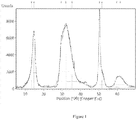
- Figure 1 XRD of the catalyst of the present invention.
- the present invention discloses the process of preparation of catalyst for the polymerization of ethylene where the magnesium based precursor is contacted with transition metal.
- the said catalyst is able to polymerize olefins with high activity and excellent hydrogen response.
- the present invention describes the process of preparation of catalyst.
- the solid catalyst is prepared through the process which requires contacting magnesium based precursor with transition metal.
- the magnesium based precursor used in the present invention is prepared through the process as described in WO2014/045260 and WO2014/045259 .
- the magnesium based precursor contains magnesium and may be liquid or solid in nature.
- the magnesium based precursor is liquid in nature and prepared by contacting magnesium source with organohalide and alcohol in presence of the solvent in a single step.
- the magnesium based precursor is solid in nature and is prepared by first contacting the magnesium source with organohalide in presence of solvating agent as the first step and then followed by addition of alcohol.
- the solid magnesium based precursor is obtained either by removal of solvating agent or by precipitation methodology.
- the present invention describes the process of preparation of catalyst.
- the solid catalyst is prepared through the process which requires contacting magnesium based precursor with transition metal in presence of solvent.
- the magnesium based precursor is contacted with solvent prior to transition metal contact.
- the solvent can be aromatic or aliphatic and polar or non polar in nature, examples are benzene, decane, kerosene, ethyl benzene, chlorobenzene, dichlorobenzene, toluene, o-chlorotoluene, xylene, dichloromethane, chloroform, cyclohexane.
- the contact time with the solvent is immediate to 5h. In one of the preferred embodiment the contact time with the solvent is immediate to 1h. In one of the more preferred embodiment the contact time with the solvent is immediate to 0.5h.
- the contact temperature is from 10°C to 200°C. In one of the preferred embodiment, the contact temperature is from 20°C to 120°C.
- the magnesium based precursor is contacted with the solvent where either the precursor can be added to the solvent or solvent can be added to the precursor.
- the magnesium based precursor in the solvent is treated with transition metal selected from compounds represented by M(OR) p X 4-p , where M is a transition metal and is selected from a group comprising of Ti, V, Zr, and Hf, preferably Ti; X is a halogen atom; R is a hydrocarbon group and p is an integer having value equal or less than 4.
- transition metal selected from compounds represented by M(OR) p X 4-p , where M is a transition metal and is selected from a group comprising of Ti, V, Zr, and Hf, preferably Ti; X is a halogen atom; R is a hydrocarbon group and p is an integer having value equal or less than 4.
- the transition metal compound represented by M(OR) p X 4-p is selected from a group comprising of transition metal tetrahalide, alkoxy transition metal trihalide/aryloxy transition metal trihalide, dialkoxy transition metal dihalide, trialkoxy transition metal monohalide, tetraalkoxy transition metal, and mixtures thereof; wherein:
- the contact temperature with the transition metal compound is between about -50°C and about 150°C. In one of the preferred embodiment, the contact temperature with the transition metal compound is between about -30°C and about 120°C.
- the titanium to magnesium mole ratios used for catalyst synthesis are about 20 to 80 moles.
- the titanium compound is added in amounts ranging from about at least 1 to 20 moles, with respect to one mole of magnesium.
- the titanium compound is added in amounts ranging from about at least 5 to 15 moles, with respect to one mole of magnesium.
- usage of higher titanium compound is neither advantageous nor detrimental to catalyst synthesis process.
- the contact of the magnesium based precursor with transition metal compound is generally twice or more. In the present invention, the contact of the magnesium based precursor with transition metal compound in presence of the solvent is single.
- the transition metal compound can be used either neat or in solvent which can be chlorinated or non chlorinated aromatic or aliphatic in nature, examples are benzene, decane, kerosene, ethyl benzene, chlorobenzene, dichlorobenzene, toluene, o-chlorotoluene, xylene, dichloromethane, chloroform, cyclohexane, comprising from 40 to 60 volume percent.
- this treatment is either one shot or dropwise or controlled.
- this reaction system is gradually heated to the temperature effective to carry out the reaction, preferably from about -50°C and about 150°C.
- reaction system is gradually heated to the temperature effective to carry out the reaction from about -30°C and about 120°C.
- the heating is instigated at a rate of 0.1 to 10.0°C/minute, or at a rate of 1 to 5.0°C/minute.
- the resultant is the solid component in the solvent comprising of magnesium, transition metal and halogen components.
- the resulting solid component comprising of magnesium, transition metal and halogen can be separated from the reaction mixture either by filtration or decantation and washed with solvent to remove unreacted component and other side products.
- the resultant solid component is washed one or more time with chlorinated or non chlorinated aromatic or aliphatic solvent
- chlorinated or non chlorinated aromatic or aliphatic solvent examples are benzene, decane, kerosene, ethyl benzene, chlorobenzene, dichlorobenzene, toluene, o-chlorotoluene, xylene at temperature from about 80°C to about 120°C.
- the solid catalyst is separated from the above solvent either by filtration or decantation and finally washed with inert solvent to remove unreacted component and other side products.
- the resultant solid material is washed one or more times with inert solvent which is typically a hydrocarbon including, aliphatic hydrocarbon like isopentane, isooctane, hexane, pentane or isohexane.
- inert solvent typically a hydrocarbon including, aliphatic hydrocarbon like isopentane, isooctane, hexane, pentane or isohexane.
- the resulting solid mixture is washed one or more times with inert hydrocarbon based solvent preferably, hexane at temperature from about 20°C to about 80°C.
- the resulting solid mixture is washed at temperature from about 25°C to about 70°C.
- the solid catalyst can be separated and dried or slurried in a hydrocarbon specifically heavy hydrocarbon such as mineral oil for further storage or use.
- the catalyst includes from about 1.0 wt % to 14 wt% of titanium and magnesium is from about 10 wt% to 20 wt %.
- the catalyst synthesis process as described in the present invention is a simple process where harsh chemicals based on transition metals are used in relatively lesser amount. It is also the advantage of this process that it doesn't require higher temperatures and longer time periods for catalyst synthesis.
- XRD measurement of representative catalyst which is synthesized from the process described in present invention provided following features: 1) 9-18°: broad peak, 2) 27-38°: broad peak, 3) 43° broad halo, 4) 48-54°: broad peak, and 5) 57-67°: broad halo.
- the present invention provides the catalyst system for polymerization and/or copolymerization of ethylene.
- the method of polymerization process is provided where the catalyst system is contacted with ethylene typically in the presence of hydrogen, under polymerization conditions.
- the catalyst system includes the said catalyst, organoaluminum compounds and/or external electron donors.
- the co-catalyst may include hydrides, organoaluminum, lithium, zinc, tin, cadmium, beryllium, magnesium, and combinations thereof.
- the preferred co-catalyst is organoaluminum compounds.
- the organoaluminum compounds include alkylaluminums such as trialkylaluminum such as preferably triethylaluminum, triisopropylaluminum, triisobutylaluminum, tri-n-butylaluminum, tri-n-hexylaluminum, tri-n-octylaluminum; trialkenylaluminums such as triisoprenyl aluminum; dialkylaluminum halides such as diethylaluminum chloride, dibutylaluminum chloride, diisobutylaluminum chloride and diethyl aluminum bromide; alkylaluminum sesquihalides such as ethylaluminum sesquichloride, butylaluminum sesquichloride and ethylaluminum sesquibromide; dialkylaluminum hydrides such as diethylaluminum hydride and dibutylaluminum hydride; partially hydrogen
- the mole ratio of aluminum to titanium is from about 5:1 to about 500:1. In one of the preferred embodiment, the mole ratio of aluminum to titanium is from about 10:1 to about 250:1. In one of the most preferred embodiment, the mole ratio of aluminum to titanium is from about 25:1 to about 100:1. In one embodiment, the ethylene is polymerized under mild conditions in an inert hydrocarbon medium.
- inert hydrocarbon medium include aliphatic hydrocarbons such as propane, butane, isobutane, pentane, hexane, heptane, octane, decane, dodecane and kerosene; alicyclic hydrocarbons such as cyclopentane, cyclohexane and methylcyclopentane; aromatic hydrocarbons such as benzene, toluene and xylene, liquid olefins and mixtures thereof.
- aliphatic hydrocarbons such as propane, butane, isobutane, pentane, hexane, heptane, octane, decane, dodecane and kerosene
- alicyclic hydrocarbons such as cyclopentane, cyclohexane and methylcyclopentane
- aromatic hydrocarbons such as benzene, toluene and xylene, liquid o
- the catalyst system is contacted with olefin under polymerization conditions to produce desired polymer products.
- the polymerization process can be carried out such as by slurry polymerization using an inert hydrocarbon solvent as a diluent, or bulk polymerization using the liquid monomer as a reaction medium and in gas-phase operating in one or more fluidized or mechanically agitated bed reactors.
- polymerization is carried out as such.
- the copolymerization is carried out using at least two polymerization zones.
- said catalyst can be used to produce, the following products such as high-density polyethylene (HDPE, having a density higher than 0.940 g/cm 3 ), which includes ethylene homopolymer and copolymer of ethylene and ⁇ -olefins having 3 to 12 carbon atoms; linear low-density polyethylene (LLDPE, having a density lower than 0.940 g/cm 3 ), and very low density and ultra low density polyethylene (VLDPE and ULDPE, having a density lower than 0.920 g/cm 3 , and as low as 0.880 g/cm 3 ), consisting of the copolymer of ethylene and one or more ⁇ -olefins having 3 to 12 carbon atoms, wherein the molar content of the unit derived from ethylene is higher than 80%; elastomeric copolymer of ethylene and propylene, and elastomeric terpolymers of ethylene, propylene and butene-1 as well as di
- the polymerization is carried out at a temperature from 0 to 250° C, preferably from 20 to 200° C.
- operation pressure is usually in the range of from 5 to 100 bar preferably from 10 to 50 bar.
- the operation pressure in slurry polymerization is usually in the range of from 1 to 10 bar, preferably from 2 to 7 bar.
- the operation pressure in solution polymerization is usually in the range of from 1 to 10 bar, preferably from 2 to 7 bar.
- Hydrogen can be used to control the molecular weight of polymers.
- the catalyst described in the present invention provides polyethylene with narrow particle size distribution, excellent bulk density and broad molecular weight distribution.
- the described catalyst can be directly added to the reactor for polymerization or can be prepolymerized i.e. catalyst is subjected to a polymerization at lower conversion extent before being added to polymerization reactor.
- Prepolymerization can be performed with ethylene where the conversion is controlled in the range from 0.2 to 500 gram polymer per gram catalyst.
- the inventors surprisingly found that the described catalyst shows excellent hydrogen response even in the absence of internal donor and/or external donor with broad molecular weight distributions.
- the polyethylenes produced by the said described catalyst have melt flow indexes (M1, measured according to ASTM standard D 1238)) from about 0.001 to about 3,000 dg/min, preferably from about 0.005 to about 1,000 dg/min, more preferably, from about 0.02 to about 10 dg/min.
- the melt flow ratio (MFR) or I 21.6 /I 2.16 is determined by ASTM standard D1238 where I 21.6 is a melt index of the polymer measure at 190°C under a load of 21.6 kg and I 2.16 . is a melt index of the polymer measure at 190°C under a load of 2.16 kg. Higher MFR indicates a broad molecular weight distribution.
- the polyethylenes produced by the said described catalyst show higher MFR.
- the present invention provides the catalyst system.
- the catalysts system when polymerizes ethylene provides polyethylene having bulk densities (BD) of at least about 0.35 cc/g.
- Example 1 Liquid magnesium based precursor
- Example 2 Solid magnesium based precursor
- Catalyst synthesis PEC#123, PEC#124, PEC#125 and PEC#135 are comparative examples Cat No MGP# Solvent for Dispersion Titanation Mg wt% Ti wt% D50 PEC#31 MGP#106 chlorobenzene 2 h @ 110°C 16.8 7.5 10.5 PEC#113 MGP#175 (4.6 g) chlorobenzene 1 h @ 110°C 15.2 5.9 10.3 PEC#114 MGP#175 (4.4 g) chlorobenzene 4 h @ 110°C 19.0 7.0 11.0 PEC#115 MGP#175 (4.5 g) chlorobenzene 2 h @ 110°C 15.7 5.8 10.7 PEC#116 MGP#175 (4.5 g) chlorobenzene 2 h @ 110°C 30 ml TiCl 4 14.5 6.6 11.5 PEC#117 MGP#176 (4.6 g) chlorobenzene 2 h @ 110°C 19.5 6.2 16.3 PEC
- Table 4 describes the catalyst synthesized using same precursor and under similar conditions Table 4:
- PEC#160 is a comparative example Cat No MGP# Solvent for Dispersion Titanation Mg wt% Ti wt% D50 microns
- PEC#156 MGP#PM-007 (6.6g) chlorobenzene 2 h @ 110°C 18.2 5.3 10.2
- PEC#160 MGP#PM-007 (6.6g) Ethyl benzoate as internal donor chlorobenzene 2 h @ 110°C 20.1 2.5 20.4
- the catalyst mean particle size (D50) increases.
- PEC#160 is a comparative example CATALYST POLYMERIZATION POLYMER ANALYSIS Cat No Cat wt (mg) Al/Ti ratio H2 Kg/cm 2 Activity kgPE/gcat MFI @5 kg dg/min MFR I 21.6 /I 2.16 Hexane Solubles wt% Bulk density g/cc PEC#156 50.0 80 1 2.9 20.1 36 0.3 0.42 PEC#160 50.4 80 1 1.5 1.7 ND* 0.2 0.41
- Ethylene polymerization PEC#123, PEC#124, PEC#125 and PEC#135 are comparative examples
- Table 7 shows the hydrogen response of the said catalyst of the present invention
- Table 7 CATALYST POLYMERIZATION POLYMER ANALYSIS Cat No Cat wt (mg) Al/Ti ratio H2 Kg/cm 2 Activity kgPE/gcat MFI @5 kg dg/min MFR I 21.6 /I 2.16 Hexane Solubles wt% Bulk density g/cc PEC#174 50.4 80 0.5 2.3 2.8 ND* 0.3 0.39 50.3 80 1 2.2 19.4 ND* 0.4 0.38 50.4 80 1.5 1.7 64.8 ND* 1.2 0.37 50.0 80 2 1.3 119.5 ND* 1.6 0.37
- the said catalyst of the present invention shows good hydrogen response as indicated above in the table. As the concentration of the hydrogen is increased, the activity of the catalyst lowers while the melt flow increases indicating that lower molecular weight polyethylene is being formed at higher hydrogen concentrations but the hexane solubles does not increase beyond 2 wt%.
- the said catalyst of the present invention was evaluated for copolymerization of ethylene with 1-butene.
- Table 8 describes the polymerization conditions and the polymer analysis data. The trend of the addition of the monomer was 1-butene followed by hydrogen and then ethylene. 1-butene was charged through MFC and catalyst was charged at 10 °C.
Landscapes
- Chemical & Material Sciences (AREA)
- Health & Medical Sciences (AREA)
- Chemical Kinetics & Catalysis (AREA)
- Medicinal Chemistry (AREA)
- Polymers & Plastics (AREA)
- Organic Chemistry (AREA)
- Transition And Organic Metals Composition Catalysts For Addition Polymerization (AREA)
- Engineering & Computer Science (AREA)
- Materials Engineering (AREA)
Claims (13)
- Verfahren zur Herstellung eines Katalysators für die Polymerisation von Ethylen, das im Wesentlichen aus den folgenden Schritten besteht:(i) Kontaktieren einer auf Magnesium basierenden Vorstufe mit einem Lösungsmittel und(ii) dann Kontaktieren der auf Magnesium basierenden Vorstufe in dem Lösungsmittel mit einer Übergangsmetallverbindung zum Erhalt des Katalysators,wobei es sich bei Schritt (ii) um einen einzigen Kontaktschritt handelt und
wobei während der Herstellung des Katalysators kein interner Elektronendonator zugegeben wird und wobei die auf Magnesium basierende Vorstufe flüssig oder fest ist und
wobei die flüssige auf Magnesium basierende Vorstufe durch Kontaktieren einer Magnesiumquelle mit einem Organohalogenid und einem Alkohol in Gegenwart des Lösungsmittels in einem einzigen Schritt hergestellt wird oder
wobei die feste auf Magnesium basierende Vorstufe hergestellt wird, indem man zunächst als ersten Schritt die Magnesiumquelle in Gegenwart eines Solvatisierungsmittels mit einem Organohalogenid kontaktiert und dann einen Alkohol zugibt. - Verfahren nach Anspruch 1, bei dem das Lösungsmittel aromatisch oder aliphatisch und polar oder unpolar ist und aus der Gruppe bestehend aus Benzol, Decan, Kerosin, Ethylbenzol, Chlorbenzol, Dichlorbenzol, Toluol, o-Chlortoluol, Xylol, Dichlormethan, Chloroform, Cyclohexan und einer Kombination davon ausgewählt wird.
- Verfahren nach Anspruch 1, bei dem die Kontaktzeit mit dem Lösungsmittel in Schritt (i) unmittelbar bis 5 h beträgt.
- Verfahren nach Anspruch 1, bei dem die Kontakttemperatur mit dem Lösungsmittel in Schritt (i) 10 °C bis 200 °C beträgt.
- Verfahren nach Anspruch 1, bei dem die Übergangsmetallverbindung durch M(OR)pX4-p wiedergegeben wird, wobei M aus der Gruppe bestehend aus Ti, V, Zr und Hf ausgewählt ist; X für ein Halogenatom steht; R für eine Kohlenwasserstoffgruppe steht und p für eine ganze Zahl mit einem Wert gleich oder kleiner als 4 steht, die Übergangsmetallverbindung aus der Gruppe bestehend aus einem Übergangsmetalltetrahalogenid, einem Alkoxyübergangsmetalltrihalogenid/Aryloxyübergangsmetalltrihalogenid, Dialkoxyübergangsmetalldihalogenid, Trialkoxyübergangsmetallmonohalogenid, Tetraalkoxyübergangsmetall und Mischungen davon ausgewählt ist; wobei:(a) das Übergangsmetalltetrahalogenid aus der Gruppe bestehend aus Titantetrachlorid, Titantetrabromid, Titantetraiodid, Vanadiumtetrachlorid, Vanadiumtetrabromid, Vanadiumtetraiodid, Zirconiumtetrachlorid, Zirconiumtetrabromid, Zirconiumtetraiodid, Hafniumtetrachlorid, Hafniumtetrabromid und Hafniumtetraiodid ausgewählt ist;(b) das Alkoxyübergangsmetalltrihalogenid/Aryloxyübergangsmetalltrihalogenid aus der Gruppe bestehend aus Methoxytitantrichlorid, Ethoxytitantrichlorid, Butoxytitantrichlorid, Phenoxytitantrichlorid, Methoxyvanadiumtrichlorid, Ethoxyvanadiumtrichlorid, Butoxyvanadiumtrichlorid, Phenoxyvanadiumtrichlorid, Methoxyzirconiumtrichlorid, Ethoxyzirconiumtrichlorid, Butoxyzirconiumtrichlorid, Phenoxyzirconiumtrichlorid, Methoxyhafniumtrichlorid, Ethoxyhafniumtrichlorid, Butoxyhafniumtrichlorid und Phenoxyhafniumtrichlorid ausgewählt ist;(c) das Dialkoxyübergangsmetalldihalogenid aus der Gruppe bestehend aus Diethoxytitandichlorid, Diethoxyvanadiumdichlorid, Diethoxyzirconiumdichlorid und Diethoxyhafniumdichlorid ausgewählt ist;(d) das Trialkoxyübergangsmetallmonohalogenid aus der Gruppe bestehend aus Triethoxytitanchlorid, Triethoxyvanadiumchlorid, Triethoxyzirconiumchlorid und Triethoxyhafniumchlorid ausgewählt ist;(e) das Tetraalkoxyübergangsmetall aus der Gruppe bestehend aus Tetrabutoxytitan, Tetraethoxytitan, Tetrabutoxyvanadium, Tetraethoxyvanadium, Tetrabutoxyzirconium, Tetraethoxyzirconium, Tetrabutoxyhafnium und Tetraethoxyhafnium ausgewählt ist.
- Verfahren nach Anspruch 1, bei dem die Kontakttemperatur mit der Übergangsmetallverbindung in Schritt (ii) zwischen -50 °C und 150 °C liegt.
- Verfahren nach Anspruch 1, bei dem die Titanverbindung in Mengen von 1 bis 20 Mol, bezogen auf ein Mol Magnesium, zugegeben wird.
- Verfahren nach Anspruch 1, bei die dem Übergangsmetallverbindung entweder in Substanz oder in einem Lösungsmittel verwendet wird und wobei das Lösungsmittel aus der Gruppe bestehend aus einem chlorierten aromatischen Kohlenwasserstoff, einem nicht chlorierten aromatischen Kohlenwasserstoff, einem chlorierten aliphatischen Kohlenstoff, einem nichtchlorierten aliphatischen Kohlenwasserstoff einer Kombination davon ausgewählt wird.
- Verfahren nach Anspruch 1, bei dem das Lösungsmittel 40 bis 60 Volumenprozent umfasst und aus der Gruppe bestehend aus Benzol, Decan, Kerosin, Ethylbenzol, Chlorbenzol, Dichlorbenzol, Toluol, o-Chlortoluol, Xylol, Dichlormethan, Chloroform, Cyclohexan und einer Kombination davon ausgewählt wird.
- Verfahren nach Anspruch 1, bei dem die Kontakttemperatur mit der Übergangsmetallverbindung in Schritt (ii) zwischen -50 °C und 150 °C liegt und mit einer Rate von 0,1 bis 10,0 °C/Minute mit dem Erwärmen begonnen wird.
- Verfahren nach Anspruch 1, bei dem der so erhaltene Katalysator 1,0 Gew.-% bis 14 Gew.-% Titan und 10 Gew.-% bis 20 Gew.-% Magnesium umfasst.
- Verfahren zur Herstellung eines Katalysatorsystems, bei dem man den gemäß Anspruch 1 erhaltenen Katalysator mit mindestens einem Cokatalysator und gegebenenfalls mit einem externen Elektronendonator kontaktiert, was das Katalysatorsystem ergibt.
- Verfahren zur Polymerisation und/oder Copolymerisation von Ethylen zu einem Polyethylen, bei dem man ein Ethylen unter einer Polymerisationsbedingung mit dem gemäß Anspruch 12 erhaltenen Katalysatorsystem kontaktiert.
Applications Claiming Priority (1)
| Application Number | Priority Date | Filing Date | Title |
|---|---|---|---|
| IN591MU2015 | 2015-02-23 |
Publications (2)
| Publication Number | Publication Date |
|---|---|
| EP3059261A1 EP3059261A1 (de) | 2016-08-24 |
| EP3059261B1 true EP3059261B1 (de) | 2018-10-03 |
Family
ID=56690273
Family Applications (1)
| Application Number | Title | Priority Date | Filing Date |
|---|---|---|---|
| EP16154812.8A Active EP3059261B1 (de) | 2015-02-23 | 2016-02-09 | Verfahren zur herstellung eines katalysators zur olefinpolymerisierung und polymerisation |
Country Status (5)
| Country | Link |
|---|---|
| US (1) | US9758602B2 (de) |
| EP (1) | EP3059261B1 (de) |
| JP (1) | JP6282299B2 (de) |
| ES (1) | ES2700449T3 (de) |
| SA (1) | SA116370319B1 (de) |
Families Citing this family (1)
| Publication number | Priority date | Publication date | Assignee | Title |
|---|---|---|---|---|
| RU2674440C1 (ru) * | 2017-12-20 | 2018-12-10 | Федеральное государственное бюджетное учреждение науки Институт катализа им. Г.К. Борескова Сибирского отделения Российской академии наук (ИК СО РАН) | Способ получения катализатора и способ полимеризации олефинов с его использованием |
Family Cites Families (13)
| Publication number | Priority date | Publication date | Assignee | Title |
|---|---|---|---|---|
| US4314912A (en) | 1977-02-03 | 1982-02-09 | The Dow Chemical Company | High efficiency, high temperature catalyst for polymerizing olefins |
| JPS5556111A (en) * | 1978-10-20 | 1980-04-24 | Nippon Oil Co Ltd | Preparation of copolymer |
| JPS57151601A (en) * | 1981-03-16 | 1982-09-18 | Idemitsu Kosan Co Ltd | Polymerization of olefins |
| IT1210855B (it) * | 1982-02-12 | 1989-09-29 | Assoreni Ora Enichem Polimeri | Polimeri dell'etilene a struttura lineare e processi per la loro preparazione. |
| US4719271A (en) * | 1982-05-21 | 1988-01-12 | Phillips Petroleum Company | Polymerization of olefins |
| DE3723526A1 (de) | 1987-07-16 | 1989-01-26 | Hoechst Ag | Verfahren zur herstellung eines polyolefins mit einer breiten molmassenverteilung |
| TW302375B (de) * | 1992-10-05 | 1997-04-11 | Mitsui Petroleum Chemicals Ind | |
| US5260245A (en) | 1992-10-19 | 1993-11-09 | Mobil Oil Corporation | High activity polyethylene catalysts |
| DE4306382A1 (de) * | 1993-03-02 | 1994-09-08 | Hoechst Ag | Verfahren zur Herstellung eines Poly-1-olefins |
| KR100359932B1 (ko) | 2000-06-15 | 2002-11-07 | 삼성종합화학주식회사 | 에틸렌 중합 및 공중합용 촉매 |
| JP6026661B2 (ja) | 2012-09-24 | 2016-11-16 | インディアン オイル コーポレーション リミテッド | 触媒用前駆体を調製するプロセス、触媒組成物を調製するプロセス、触媒系を調製するプロセス、及び、オレフィンを重合するおよび共重合するうちの少なくとも一方である方法 |
| EP3653631A1 (de) | 2012-09-24 | 2020-05-20 | INDIAN OIL CORPORATION Ltd. | Prozesse für die herstellung von olefin polimerisationskatalysatoren die auf der behandlung von festen organomagnesiumverbindungen mit titan einheiten basieren |
| CN104974283B (zh) | 2014-04-11 | 2017-03-22 | 中国石油化工股份有限公司 | 用于乙烯聚合反应的催化剂组分及其催化剂和制备方法 |
-
2016
- 2016-02-09 EP EP16154812.8A patent/EP3059261B1/de active Active
- 2016-02-09 ES ES16154812T patent/ES2700449T3/es active Active
- 2016-02-16 SA SA116370319A patent/SA116370319B1/ar unknown
- 2016-02-22 JP JP2016031024A patent/JP6282299B2/ja active Active
- 2016-02-23 US US15/051,459 patent/US9758602B2/en active Active
Non-Patent Citations (1)
| Title |
|---|
| None * |
Also Published As
| Publication number | Publication date |
|---|---|
| ES2700449T3 (es) | 2019-02-15 |
| US9758602B2 (en) | 2017-09-12 |
| JP6282299B2 (ja) | 2018-02-21 |
| SA116370319B1 (ar) | 2018-03-11 |
| EP3059261A1 (de) | 2016-08-24 |
| JP2016176057A (ja) | 2016-10-06 |
| US20160244537A1 (en) | 2016-08-25 |
Similar Documents
| Publication | Publication Date | Title |
|---|---|---|
| CN104870495B (zh) | 用于乙烯聚合的负载齐格勒‑纳塔主催化剂 | |
| CN100471882C (zh) | 喷雾干燥的混合金属齐格勒催化剂组合物 | |
| EP2897966B1 (de) | Organometallverbindung in fester form, verfahren zu ihrer herstellung und ihre verwendung | |
| CA2510679A1 (en) | Polymerization catalysts comprising titanium and magnesium | |
| US5968862A (en) | Transition metal-magnesium catalyst precursors for the polymerization of olefins | |
| EP3555150B1 (de) | Katalysatorkomponenten zur olefinpolymerisierung und daraus gewonnenen katalysatoren | |
| US7582712B1 (en) | Alpha-olefins polymerization catalyst | |
| EP3162819B1 (de) | Verbesserte ziegler-natta-synthese und verfahren dafür | |
| US7618913B2 (en) | Highly active alpha-olefin copolymerization catalyst system | |
| US4866021A (en) | Catalyst composition for preparing high density, broad molecular weight distribution alpha-olefin polymers | |
| CN102482371A (zh) | 用于烯烃聚合的催化剂组分 | |
| US9758602B2 (en) | Catalyst for olefin polymerization and polymerization thereof | |
| US5034483A (en) | Process for preparing high density, broad molecular weight distribution alpha-olefin polymers | |
| WO2004072122A2 (en) | The preparation of a magnesium halide support for olefin polymerization and a catalyst composition using the same | |
| US4972033A (en) | Olefin polymerization process for preparing high density or linear low density polymers of controlled molecular weight distribution | |
| US5852141A (en) | Prepolymer for the polymerization of olefins combining a number of solid catalytic components | |
| EP1231223B1 (de) | Verfahren zur Olefinpolymerisation | |
| JP7445722B2 (ja) | オレフィン重合用触媒の調製方法 | |
| US5075271A (en) | Olefin polymerization process for preparing high density or linear low density polymers of controlled molecular weight distribution | |
| KR101885812B1 (ko) | 마찰저항 감소 폴리머를 제조하는 방법 및 이의 용도 | |
| KR100532071B1 (ko) | 분자량분포에서 고분자 테일을 갖는 에틸렌 중합체 및 공중합체 제조방법 | |
| JP7596357B2 (ja) | チーグラー・ナッタ触媒および水素化触媒を使用する溶液プロセスにおけるエチレンの重合 | |
| WO2012096404A1 (en) | Solid catalyst component for olefin polymerization | |
| CN102459362B (zh) | 用于烯烃聚合的催化剂组分以及由其所获得的催化剂 | |
| KR100546500B1 (ko) | 분자량 분포에서 고분자 테일을 갖는 에틸렌 중합체 및 공중합체 제조방법 |
Legal Events
| Date | Code | Title | Description |
|---|---|---|---|
| PUAI | Public reference made under article 153(3) epc to a published international application that has entered the european phase |
Free format text: ORIGINAL CODE: 0009012 |
|
| 17P | Request for examination filed |
Effective date: 20160209 |
|
| AK | Designated contracting states |
Kind code of ref document: A1 Designated state(s): AL AT BE BG CH CY CZ DE DK EE ES FI FR GB GR HR HU IE IS IT LI LT LU LV MC MK MT NL NO PL PT RO RS SE SI SK SM TR |
|
| AX | Request for extension of the european patent |
Extension state: BA ME |
|
| GRAP | Despatch of communication of intention to grant a patent |
Free format text: ORIGINAL CODE: EPIDOSNIGR1 |
|
| STAA | Information on the status of an ep patent application or granted ep patent |
Free format text: STATUS: GRANT OF PATENT IS INTENDED |
|
| INTG | Intention to grant announced |
Effective date: 20180606 |
|
| GRAS | Grant fee paid |
Free format text: ORIGINAL CODE: EPIDOSNIGR3 |
|
| GRAA | (expected) grant |
Free format text: ORIGINAL CODE: 0009210 |
|
| STAA | Information on the status of an ep patent application or granted ep patent |
Free format text: STATUS: THE PATENT HAS BEEN GRANTED |
|
| AK | Designated contracting states |
Kind code of ref document: B1 Designated state(s): AL AT BE BG CH CY CZ DE DK EE ES FI FR GB GR HR HU IE IS IT LI LT LU LV MC MK MT NL NO PL PT RO RS SE SI SK SM TR |
|
| REG | Reference to a national code |
Ref country code: GB Ref legal event code: FG4D |
|
| REG | Reference to a national code |
Ref country code: CH Ref legal event code: EP Ref country code: AT Ref legal event code: REF Ref document number: 1048492 Country of ref document: AT Kind code of ref document: T Effective date: 20181015 |
|
| REG | Reference to a national code |
Ref country code: IE Ref legal event code: FG4D Ref country code: DE Ref legal event code: R096 Ref document number: 602016006123 Country of ref document: DE |
|
| REG | Reference to a national code |
Ref country code: NL Ref legal event code: MP Effective date: 20181003 |
|
| REG | Reference to a national code |
Ref country code: ES Ref legal event code: FG2A Ref document number: 2700449 Country of ref document: ES Kind code of ref document: T3 Effective date: 20190215 |
|
| REG | Reference to a national code |
Ref country code: LT Ref legal event code: MG4D |
|
| REG | Reference to a national code |
Ref country code: AT Ref legal event code: MK05 Ref document number: 1048492 Country of ref document: AT Kind code of ref document: T Effective date: 20181003 |
|
| PG25 | Lapsed in a contracting state [announced via postgrant information from national office to epo] |
Ref country code: NL Free format text: LAPSE BECAUSE OF FAILURE TO SUBMIT A TRANSLATION OF THE DESCRIPTION OR TO PAY THE FEE WITHIN THE PRESCRIBED TIME-LIMIT Effective date: 20181003 |
|
| PG25 | Lapsed in a contracting state [announced via postgrant information from national office to epo] |
Ref country code: AT Free format text: LAPSE BECAUSE OF FAILURE TO SUBMIT A TRANSLATION OF THE DESCRIPTION OR TO PAY THE FEE WITHIN THE PRESCRIBED TIME-LIMIT Effective date: 20181003 Ref country code: HR Free format text: LAPSE BECAUSE OF FAILURE TO SUBMIT A TRANSLATION OF THE DESCRIPTION OR TO PAY THE FEE WITHIN THE PRESCRIBED TIME-LIMIT Effective date: 20181003 Ref country code: PL Free format text: LAPSE BECAUSE OF FAILURE TO SUBMIT A TRANSLATION OF THE DESCRIPTION OR TO PAY THE FEE WITHIN THE PRESCRIBED TIME-LIMIT Effective date: 20181003 Ref country code: LT Free format text: LAPSE BECAUSE OF FAILURE TO SUBMIT A TRANSLATION OF THE DESCRIPTION OR TO PAY THE FEE WITHIN THE PRESCRIBED TIME-LIMIT Effective date: 20181003 Ref country code: BG Free format text: LAPSE BECAUSE OF FAILURE TO SUBMIT A TRANSLATION OF THE DESCRIPTION OR TO PAY THE FEE WITHIN THE PRESCRIBED TIME-LIMIT Effective date: 20190103 Ref country code: LV Free format text: LAPSE BECAUSE OF FAILURE TO SUBMIT A TRANSLATION OF THE DESCRIPTION OR TO PAY THE FEE WITHIN THE PRESCRIBED TIME-LIMIT Effective date: 20181003 Ref country code: CZ Free format text: LAPSE BECAUSE OF FAILURE TO SUBMIT A TRANSLATION OF THE DESCRIPTION OR TO PAY THE FEE WITHIN THE PRESCRIBED TIME-LIMIT Effective date: 20181003 Ref country code: FI Free format text: LAPSE BECAUSE OF FAILURE TO SUBMIT A TRANSLATION OF THE DESCRIPTION OR TO PAY THE FEE WITHIN THE PRESCRIBED TIME-LIMIT Effective date: 20181003 Ref country code: IS Free format text: LAPSE BECAUSE OF FAILURE TO SUBMIT A TRANSLATION OF THE DESCRIPTION OR TO PAY THE FEE WITHIN THE PRESCRIBED TIME-LIMIT Effective date: 20190203 Ref country code: NO Free format text: LAPSE BECAUSE OF FAILURE TO SUBMIT A TRANSLATION OF THE DESCRIPTION OR TO PAY THE FEE WITHIN THE PRESCRIBED TIME-LIMIT Effective date: 20190103 |
|
| PG25 | Lapsed in a contracting state [announced via postgrant information from national office to epo] |
Ref country code: RS Free format text: LAPSE BECAUSE OF FAILURE TO SUBMIT A TRANSLATION OF THE DESCRIPTION OR TO PAY THE FEE WITHIN THE PRESCRIBED TIME-LIMIT Effective date: 20181003 Ref country code: GR Free format text: LAPSE BECAUSE OF FAILURE TO SUBMIT A TRANSLATION OF THE DESCRIPTION OR TO PAY THE FEE WITHIN THE PRESCRIBED TIME-LIMIT Effective date: 20190104 Ref country code: PT Free format text: LAPSE BECAUSE OF FAILURE TO SUBMIT A TRANSLATION OF THE DESCRIPTION OR TO PAY THE FEE WITHIN THE PRESCRIBED TIME-LIMIT Effective date: 20190203 Ref country code: AL Free format text: LAPSE BECAUSE OF FAILURE TO SUBMIT A TRANSLATION OF THE DESCRIPTION OR TO PAY THE FEE WITHIN THE PRESCRIBED TIME-LIMIT Effective date: 20181003 Ref country code: SE Free format text: LAPSE BECAUSE OF FAILURE TO SUBMIT A TRANSLATION OF THE DESCRIPTION OR TO PAY THE FEE WITHIN THE PRESCRIBED TIME-LIMIT Effective date: 20181003 |
|
| REG | Reference to a national code |
Ref country code: DE Ref legal event code: R097 Ref document number: 602016006123 Country of ref document: DE |
|
| PG25 | Lapsed in a contracting state [announced via postgrant information from national office to epo] |
Ref country code: DK Free format text: LAPSE BECAUSE OF FAILURE TO SUBMIT A TRANSLATION OF THE DESCRIPTION OR TO PAY THE FEE WITHIN THE PRESCRIBED TIME-LIMIT Effective date: 20181003 |
|
| PLBE | No opposition filed within time limit |
Free format text: ORIGINAL CODE: 0009261 |
|
| STAA | Information on the status of an ep patent application or granted ep patent |
Free format text: STATUS: NO OPPOSITION FILED WITHIN TIME LIMIT |
|
| PG25 | Lapsed in a contracting state [announced via postgrant information from national office to epo] |
Ref country code: SK Free format text: LAPSE BECAUSE OF FAILURE TO SUBMIT A TRANSLATION OF THE DESCRIPTION OR TO PAY THE FEE WITHIN THE PRESCRIBED TIME-LIMIT Effective date: 20181003 Ref country code: SM Free format text: LAPSE BECAUSE OF FAILURE TO SUBMIT A TRANSLATION OF THE DESCRIPTION OR TO PAY THE FEE WITHIN THE PRESCRIBED TIME-LIMIT Effective date: 20181003 Ref country code: EE Free format text: LAPSE BECAUSE OF FAILURE TO SUBMIT A TRANSLATION OF THE DESCRIPTION OR TO PAY THE FEE WITHIN THE PRESCRIBED TIME-LIMIT Effective date: 20181003 Ref country code: RO Free format text: LAPSE BECAUSE OF FAILURE TO SUBMIT A TRANSLATION OF THE DESCRIPTION OR TO PAY THE FEE WITHIN THE PRESCRIBED TIME-LIMIT Effective date: 20181003 |
|
| 26N | No opposition filed |
Effective date: 20190704 |
|
| REG | Reference to a national code |
Ref country code: CH Ref legal event code: PL |
|
| PG25 | Lapsed in a contracting state [announced via postgrant information from national office to epo] |
Ref country code: MC Free format text: LAPSE BECAUSE OF FAILURE TO SUBMIT A TRANSLATION OF THE DESCRIPTION OR TO PAY THE FEE WITHIN THE PRESCRIBED TIME-LIMIT Effective date: 20181003 Ref country code: SI Free format text: LAPSE BECAUSE OF FAILURE TO SUBMIT A TRANSLATION OF THE DESCRIPTION OR TO PAY THE FEE WITHIN THE PRESCRIBED TIME-LIMIT Effective date: 20181003 Ref country code: LU Free format text: LAPSE BECAUSE OF NON-PAYMENT OF DUE FEES Effective date: 20190209 |
|
| REG | Reference to a national code |
Ref country code: BE Ref legal event code: MM Effective date: 20190228 |
|
| REG | Reference to a national code |
Ref country code: IE Ref legal event code: MM4A |
|
| PG25 | Lapsed in a contracting state [announced via postgrant information from national office to epo] |
Ref country code: CH Free format text: LAPSE BECAUSE OF NON-PAYMENT OF DUE FEES Effective date: 20190228 Ref country code: LI Free format text: LAPSE BECAUSE OF NON-PAYMENT OF DUE FEES Effective date: 20190228 |
|
| PG25 | Lapsed in a contracting state [announced via postgrant information from national office to epo] |
Ref country code: IE Free format text: LAPSE BECAUSE OF NON-PAYMENT OF DUE FEES Effective date: 20190209 |
|
| PG25 | Lapsed in a contracting state [announced via postgrant information from national office to epo] |
Ref country code: BE Free format text: LAPSE BECAUSE OF NON-PAYMENT OF DUE FEES Effective date: 20190228 Ref country code: FR Free format text: LAPSE BECAUSE OF NON-PAYMENT OF DUE FEES Effective date: 20190228 |
|
| PG25 | Lapsed in a contracting state [announced via postgrant information from national office to epo] |
Ref country code: TR Free format text: LAPSE BECAUSE OF FAILURE TO SUBMIT A TRANSLATION OF THE DESCRIPTION OR TO PAY THE FEE WITHIN THE PRESCRIBED TIME-LIMIT Effective date: 20181003 |
|
| PG25 | Lapsed in a contracting state [announced via postgrant information from national office to epo] |
Ref country code: MT Free format text: LAPSE BECAUSE OF NON-PAYMENT OF DUE FEES Effective date: 20190209 |
|
| GBPC | Gb: european patent ceased through non-payment of renewal fee |
Effective date: 20200209 |
|
| PG25 | Lapsed in a contracting state [announced via postgrant information from national office to epo] |
Ref country code: GB Free format text: LAPSE BECAUSE OF NON-PAYMENT OF DUE FEES Effective date: 20200209 |
|
| PG25 | Lapsed in a contracting state [announced via postgrant information from national office to epo] |
Ref country code: CY Free format text: LAPSE BECAUSE OF FAILURE TO SUBMIT A TRANSLATION OF THE DESCRIPTION OR TO PAY THE FEE WITHIN THE PRESCRIBED TIME-LIMIT Effective date: 20181003 |
|
| PG25 | Lapsed in a contracting state [announced via postgrant information from national office to epo] |
Ref country code: HU Free format text: LAPSE BECAUSE OF FAILURE TO SUBMIT A TRANSLATION OF THE DESCRIPTION OR TO PAY THE FEE WITHIN THE PRESCRIBED TIME-LIMIT; INVALID AB INITIO Effective date: 20160209 |
|
| PG25 | Lapsed in a contracting state [announced via postgrant information from national office to epo] |
Ref country code: MK Free format text: LAPSE BECAUSE OF FAILURE TO SUBMIT A TRANSLATION OF THE DESCRIPTION OR TO PAY THE FEE WITHIN THE PRESCRIBED TIME-LIMIT Effective date: 20181003 |
|
| PGFP | Annual fee paid to national office [announced via postgrant information from national office to epo] |
Ref country code: ES Payment date: 20260302 Year of fee payment: 11 |
|
| PGFP | Annual fee paid to national office [announced via postgrant information from national office to epo] |
Ref country code: DE Payment date: 20260303 Year of fee payment: 11 |
|
| PGFP | Annual fee paid to national office [announced via postgrant information from national office to epo] |
Ref country code: IT Payment date: 20260227 Year of fee payment: 11 |