EP3059276A1 - Verfahren zur herstellung eines dekorierten blattes und dessen verwendung - Google Patents
Verfahren zur herstellung eines dekorierten blattes und dessen verwendung Download PDFInfo
- Publication number
- EP3059276A1 EP3059276A1 EP16158974.2A EP16158974A EP3059276A1 EP 3059276 A1 EP3059276 A1 EP 3059276A1 EP 16158974 A EP16158974 A EP 16158974A EP 3059276 A1 EP3059276 A1 EP 3059276A1
- Authority
- EP
- European Patent Office
- Prior art keywords
- printing
- nonwoven fabric
- aqueous dispersion
- cover layer
- impregnated
- Prior art date
- Legal status (The legal status is an assumption and is not a legal conclusion. Google has not performed a legal analysis and makes no representation as to the accuracy of the status listed.)
- Granted
Links
Images

Classifications
-
- C—CHEMISTRY; METALLURGY
- C08—ORGANIC MACROMOLECULAR COMPOUNDS; THEIR PREPARATION OR CHEMICAL WORKING-UP; COMPOSITIONS BASED THEREON
- C08J—WORKING-UP; GENERAL PROCESSES OF COMPOUNDING; AFTER-TREATMENT NOT COVERED BY SUBCLASSES C08B, C08C, C08F, C08G or C08H
- C08J5/00—Manufacture of articles or shaped materials containing macromolecular substances
- C08J5/24—Impregnating materials with prepolymers which can be polymerised in situ, e.g. manufacture of prepregs
-
- B—PERFORMING OPERATIONS; TRANSPORTING
- B32—LAYERED PRODUCTS
- B32B—LAYERED PRODUCTS, i.e. PRODUCTS BUILT-UP OF STRATA OF FLAT OR NON-FLAT, e.g. CELLULAR OR HONEYCOMB, FORM
- B32B29/00—Layered products comprising a layer of paper or cardboard
- B32B29/06—Layered products comprising a layer of paper or cardboard specially treated, e.g. surfaced, parchmentised
-
- D—TEXTILES; PAPER
- D21—PAPER-MAKING; PRODUCTION OF CELLULOSE
- D21H—PULP COMPOSITIONS; PREPARATION THEREOF NOT COVERED BY SUBCLASSES D21C OR D21D; IMPREGNATING OR COATING OF PAPER; TREATMENT OF FINISHED PAPER NOT COVERED BY CLASS B31 OR SUBCLASS D21G; PAPER NOT OTHERWISE PROVIDED FOR
- D21H25/00—After-treatment of paper not provided for in groups D21H17/00 - D21H23/00
- D21H25/02—Chemical or biochemical treatment
-
- B—PERFORMING OPERATIONS; TRANSPORTING
- B32—LAYERED PRODUCTS
- B32B—LAYERED PRODUCTS, i.e. PRODUCTS BUILT-UP OF STRATA OF FLAT OR NON-FLAT, e.g. CELLULAR OR HONEYCOMB, FORM
- B32B3/00—Layered products comprising a layer with external or internal discontinuities or unevennesses, or a layer of non-planar shape; Layered products comprising a layer having particular features of form
- B32B3/26—Layered products comprising a layer with external or internal discontinuities or unevennesses, or a layer of non-planar shape; Layered products comprising a layer having particular features of form characterised by a particular shape of the outline of the cross-section of a continuous layer; characterised by a layer with cavities or internal voids ; characterised by an apertured layer
- B32B3/30—Layered products comprising a layer with external or internal discontinuities or unevennesses, or a layer of non-planar shape; Layered products comprising a layer having particular features of form characterised by a particular shape of the outline of the cross-section of a continuous layer; characterised by a layer with cavities or internal voids ; characterised by an apertured layer characterised by a layer formed with recesses or projections, e.g. hollows, grooves, protuberances, ribs
-
- B—PERFORMING OPERATIONS; TRANSPORTING
- B32—LAYERED PRODUCTS
- B32B—LAYERED PRODUCTS, i.e. PRODUCTS BUILT-UP OF STRATA OF FLAT OR NON-FLAT, e.g. CELLULAR OR HONEYCOMB, FORM
- B32B37/00—Methods or apparatus for laminating, e.g. by curing or by ultrasonic bonding
- B32B37/14—Methods or apparatus for laminating, e.g. by curing or by ultrasonic bonding characterised by the properties of the layers
- B32B37/16—Methods or apparatus for laminating, e.g. by curing or by ultrasonic bonding characterised by the properties of the layers with all layers existing as coherent layers before laminating
- B32B37/18—Methods or apparatus for laminating, e.g. by curing or by ultrasonic bonding characterised by the properties of the layers with all layers existing as coherent layers before laminating involving the assembly of discrete sheets or panels only
-
- B—PERFORMING OPERATIONS; TRANSPORTING
- B32—LAYERED PRODUCTS
- B32B—LAYERED PRODUCTS, i.e. PRODUCTS BUILT-UP OF STRATA OF FLAT OR NON-FLAT, e.g. CELLULAR OR HONEYCOMB, FORM
- B32B38/00—Ancillary operations in connection with laminating processes
- B32B38/0036—Heat treatment
- B32B38/004—Heat treatment by physically contacting the layers, e.g. by the use of heated platens or rollers
-
- B—PERFORMING OPERATIONS; TRANSPORTING
- B32—LAYERED PRODUCTS
- B32B—LAYERED PRODUCTS, i.e. PRODUCTS BUILT-UP OF STRATA OF FLAT OR NON-FLAT, e.g. CELLULAR OR HONEYCOMB, FORM
- B32B38/00—Ancillary operations in connection with laminating processes
- B32B38/06—Embossing
-
- B—PERFORMING OPERATIONS; TRANSPORTING
- B32—LAYERED PRODUCTS
- B32B—LAYERED PRODUCTS, i.e. PRODUCTS BUILT-UP OF STRATA OF FLAT OR NON-FLAT, e.g. CELLULAR OR HONEYCOMB, FORM
- B32B38/00—Ancillary operations in connection with laminating processes
- B32B38/08—Impregnating
-
- B—PERFORMING OPERATIONS; TRANSPORTING
- B32—LAYERED PRODUCTS
- B32B—LAYERED PRODUCTS, i.e. PRODUCTS BUILT-UP OF STRATA OF FLAT OR NON-FLAT, e.g. CELLULAR OR HONEYCOMB, FORM
- B32B38/00—Ancillary operations in connection with laminating processes
- B32B38/14—Printing or colouring
- B32B38/145—Printing
-
- B—PERFORMING OPERATIONS; TRANSPORTING
- B41—PRINTING; LINING MACHINES; TYPEWRITERS; STAMPS
- B41F—PRINTING MACHINES OR PRESSES
- B41F1/00—Platen presses, i.e. presses in which printing is effected by at least one essentially-flat pressure-applying member co-operating with a flat type-bed
-
- B—PERFORMING OPERATIONS; TRANSPORTING
- B41—PRINTING; LINING MACHINES; TYPEWRITERS; STAMPS
- B41J—TYPEWRITERS; SELECTIVE PRINTING MECHANISMS, i.e. MECHANISMS PRINTING OTHERWISE THAN FROM A FORME; CORRECTION OF TYPOGRAPHICAL ERRORS
- B41J2/00—Typewriters or selective printing mechanisms characterised by the printing or marking process for which they are designed
-
- B—PERFORMING OPERATIONS; TRANSPORTING
- B44—DECORATIVE ARTS
- B44C—PRODUCING DECORATIVE EFFECTS; MOSAICS; TARSIA WORK; PAPERHANGING
- B44C5/00—Processes for producing special ornamental bodies
- B44C5/04—Ornamental plaques, e.g. decorative panels, decorative veneers
- B44C5/0446—Ornamental plaques, e.g. decorative panels, decorative veneers bearing graphical information
-
- C—CHEMISTRY; METALLURGY
- C08—ORGANIC MACROMOLECULAR COMPOUNDS; THEIR PREPARATION OR CHEMICAL WORKING-UP; COMPOSITIONS BASED THEREON
- C08J—WORKING-UP; GENERAL PROCESSES OF COMPOUNDING; AFTER-TREATMENT NOT COVERED BY SUBCLASSES C08B, C08C, C08F, C08G or C08H
- C08J5/00—Manufacture of articles or shaped materials containing macromolecular substances
- C08J5/24—Impregnating materials with prepolymers which can be polymerised in situ, e.g. manufacture of prepregs
- C08J5/245—Impregnating materials with prepolymers which can be polymerised in situ, e.g. manufacture of prepregs using natural fibres
-
- D—TEXTILES; PAPER
- D21—PAPER-MAKING; PRODUCTION OF CELLULOSE
- D21H—PULP COMPOSITIONS; PREPARATION THEREOF NOT COVERED BY SUBCLASSES D21C OR D21D; IMPREGNATING OR COATING OF PAPER; TREATMENT OF FINISHED PAPER NOT COVERED BY CLASS B31 OR SUBCLASS D21G; PAPER NOT OTHERWISE PROVIDED FOR
- D21H17/00—Non-fibrous material added to the pulp, characterised by its constitution; Paper-impregnating material characterised by its constitution
- D21H17/20—Macromolecular organic compounds
- D21H17/33—Synthetic macromolecular compounds
-
- D—TEXTILES; PAPER
- D21—PAPER-MAKING; PRODUCTION OF CELLULOSE
- D21H—PULP COMPOSITIONS; PREPARATION THEREOF NOT COVERED BY SUBCLASSES D21C OR D21D; IMPREGNATING OR COATING OF PAPER; TREATMENT OF FINISHED PAPER NOT COVERED BY CLASS B31 OR SUBCLASS D21G; PAPER NOT OTHERWISE PROVIDED FOR
- D21H17/00—Non-fibrous material added to the pulp, characterised by its constitution; Paper-impregnating material characterised by its constitution
- D21H17/20—Macromolecular organic compounds
- D21H17/33—Synthetic macromolecular compounds
- D21H17/34—Synthetic macromolecular compounds obtained by reactions only involving carbon-to-carbon unsaturated bonds
-
- D—TEXTILES; PAPER
- D21—PAPER-MAKING; PRODUCTION OF CELLULOSE
- D21H—PULP COMPOSITIONS; PREPARATION THEREOF NOT COVERED BY SUBCLASSES D21C OR D21D; IMPREGNATING OR COATING OF PAPER; TREATMENT OF FINISHED PAPER NOT COVERED BY CLASS B31 OR SUBCLASS D21G; PAPER NOT OTHERWISE PROVIDED FOR
- D21H25/00—After-treatment of paper not provided for in groups D21H17/00 - D21H23/00
- D21H25/04—Physical treatment, e.g. heating, irradiating
- D21H25/06—Physical treatment, e.g. heating, irradiating of impregnated or coated paper
-
- D—TEXTILES; PAPER
- D21—PAPER-MAKING; PRODUCTION OF CELLULOSE
- D21H—PULP COMPOSITIONS; PREPARATION THEREOF NOT COVERED BY SUBCLASSES D21C OR D21D; IMPREGNATING OR COATING OF PAPER; TREATMENT OF FINISHED PAPER NOT COVERED BY CLASS B31 OR SUBCLASS D21G; PAPER NOT OTHERWISE PROVIDED FOR
- D21H27/00—Special paper not otherwise provided for, e.g. made by multi-step processes
- D21H27/18—Paper- or board-based structures for surface covering
- D21H27/22—Structures being applied on the surface by special manufacturing processes, e.g. in presses
- D21H27/26—Structures being applied on the surface by special manufacturing processes, e.g. in presses characterised by the overlay sheet or the top layers of the structures
- D21H27/28—Structures being applied on the surface by special manufacturing processes, e.g. in presses characterised by the overlay sheet or the top layers of the structures treated to obtain specific resistance properties, e.g. against wear or weather
-
- B—PERFORMING OPERATIONS; TRANSPORTING
- B32—LAYERED PRODUCTS
- B32B—LAYERED PRODUCTS, i.e. PRODUCTS BUILT-UP OF STRATA OF FLAT OR NON-FLAT, e.g. CELLULAR OR HONEYCOMB, FORM
- B32B2255/00—Coating on the layer surface
- B32B2255/12—Coating on the layer surface on paper layer
-
- B—PERFORMING OPERATIONS; TRANSPORTING
- B32—LAYERED PRODUCTS
- B32B—LAYERED PRODUCTS, i.e. PRODUCTS BUILT-UP OF STRATA OF FLAT OR NON-FLAT, e.g. CELLULAR OR HONEYCOMB, FORM
- B32B2255/00—Coating on the layer surface
- B32B2255/26—Polymeric coating
-
- B—PERFORMING OPERATIONS; TRANSPORTING
- B32—LAYERED PRODUCTS
- B32B—LAYERED PRODUCTS, i.e. PRODUCTS BUILT-UP OF STRATA OF FLAT OR NON-FLAT, e.g. CELLULAR OR HONEYCOMB, FORM
- B32B2260/00—Layered product comprising an impregnated, embedded, or bonded layer wherein the layer comprises an impregnation, embedding, or binder material
- B32B2260/02—Composition of the impregnated, bonded or embedded layer
- B32B2260/028—Paper layer
-
- B—PERFORMING OPERATIONS; TRANSPORTING
- B32—LAYERED PRODUCTS
- B32B—LAYERED PRODUCTS, i.e. PRODUCTS BUILT-UP OF STRATA OF FLAT OR NON-FLAT, e.g. CELLULAR OR HONEYCOMB, FORM
- B32B2260/00—Layered product comprising an impregnated, embedded, or bonded layer wherein the layer comprises an impregnation, embedding, or binder material
- B32B2260/04—Impregnation, embedding, or binder material
- B32B2260/046—Synthetic resin
-
- B—PERFORMING OPERATIONS; TRANSPORTING
- B32—LAYERED PRODUCTS
- B32B—LAYERED PRODUCTS, i.e. PRODUCTS BUILT-UP OF STRATA OF FLAT OR NON-FLAT, e.g. CELLULAR OR HONEYCOMB, FORM
- B32B2262/00—Composition or structural features of fibres which form a fibrous or filamentary layer or are present as additives
- B32B2262/06—Vegetal fibres
- B32B2262/062—Cellulose fibres, e.g. cotton
-
- B—PERFORMING OPERATIONS; TRANSPORTING
- B32—LAYERED PRODUCTS
- B32B—LAYERED PRODUCTS, i.e. PRODUCTS BUILT-UP OF STRATA OF FLAT OR NON-FLAT, e.g. CELLULAR OR HONEYCOMB, FORM
- B32B2305/00—Condition, form or state of the layers or laminate
- B32B2305/72—Cured, e.g. vulcanised, cross-linked
-
- B—PERFORMING OPERATIONS; TRANSPORTING
- B32—LAYERED PRODUCTS
- B32B—LAYERED PRODUCTS, i.e. PRODUCTS BUILT-UP OF STRATA OF FLAT OR NON-FLAT, e.g. CELLULAR OR HONEYCOMB, FORM
- B32B2307/00—Properties of the layers or laminate
- B32B2307/40—Properties of the layers or laminate having particular optical properties
- B32B2307/402—Coloured
- B32B2307/4023—Coloured on the layer surface, e.g. ink
-
- B—PERFORMING OPERATIONS; TRANSPORTING
- B32—LAYERED PRODUCTS
- B32B—LAYERED PRODUCTS, i.e. PRODUCTS BUILT-UP OF STRATA OF FLAT OR NON-FLAT, e.g. CELLULAR OR HONEYCOMB, FORM
- B32B2307/00—Properties of the layers or laminate
- B32B2307/40—Properties of the layers or laminate having particular optical properties
- B32B2307/402—Coloured
- B32B2307/404—Multi-coloured
-
- B—PERFORMING OPERATIONS; TRANSPORTING
- B32—LAYERED PRODUCTS
- B32B—LAYERED PRODUCTS, i.e. PRODUCTS BUILT-UP OF STRATA OF FLAT OR NON-FLAT, e.g. CELLULAR OR HONEYCOMB, FORM
- B32B2307/00—Properties of the layers or laminate
- B32B2307/70—Other properties
- B32B2307/714—Inert, i.e. inert to chemical degradation, corrosion
-
- B—PERFORMING OPERATIONS; TRANSPORTING
- B32—LAYERED PRODUCTS
- B32B—LAYERED PRODUCTS, i.e. PRODUCTS BUILT-UP OF STRATA OF FLAT OR NON-FLAT, e.g. CELLULAR OR HONEYCOMB, FORM
- B32B2307/00—Properties of the layers or laminate
- B32B2307/70—Other properties
- B32B2307/718—Weight, e.g. weight per square meter
-
- B—PERFORMING OPERATIONS; TRANSPORTING
- B32—LAYERED PRODUCTS
- B32B—LAYERED PRODUCTS, i.e. PRODUCTS BUILT-UP OF STRATA OF FLAT OR NON-FLAT, e.g. CELLULAR OR HONEYCOMB, FORM
- B32B2307/00—Properties of the layers or laminate
- B32B2307/70—Other properties
- B32B2307/732—Dimensional properties
- B32B2307/734—Dimensional stability
-
- B—PERFORMING OPERATIONS; TRANSPORTING
- B32—LAYERED PRODUCTS
- B32B—LAYERED PRODUCTS, i.e. PRODUCTS BUILT-UP OF STRATA OF FLAT OR NON-FLAT, e.g. CELLULAR OR HONEYCOMB, FORM
- B32B2307/00—Properties of the layers or laminate
- B32B2307/70—Other properties
- B32B2307/75—Printability
-
- B—PERFORMING OPERATIONS; TRANSPORTING
- B32—LAYERED PRODUCTS
- B32B—LAYERED PRODUCTS, i.e. PRODUCTS BUILT-UP OF STRATA OF FLAT OR NON-FLAT, e.g. CELLULAR OR HONEYCOMB, FORM
- B32B2310/00—Treatment by energy or chemical effects
- B32B2310/08—Treatment by energy or chemical effects by wave energy or particle radiation
- B32B2310/0806—Treatment by energy or chemical effects by wave energy or particle radiation using electromagnetic radiation
- B32B2310/0825—Treatment by energy or chemical effects by wave energy or particle radiation using electromagnetic radiation using IR radiation
-
- B—PERFORMING OPERATIONS; TRANSPORTING
- B32—LAYERED PRODUCTS
- B32B—LAYERED PRODUCTS, i.e. PRODUCTS BUILT-UP OF STRATA OF FLAT OR NON-FLAT, e.g. CELLULAR OR HONEYCOMB, FORM
- B32B2310/00—Treatment by energy or chemical effects
- B32B2310/08—Treatment by energy or chemical effects by wave energy or particle radiation
- B32B2310/0806—Treatment by energy or chemical effects by wave energy or particle radiation using electromagnetic radiation
- B32B2310/0831—Treatment by energy or chemical effects by wave energy or particle radiation using electromagnetic radiation using UV radiation
-
- B—PERFORMING OPERATIONS; TRANSPORTING
- B32—LAYERED PRODUCTS
- B32B—LAYERED PRODUCTS, i.e. PRODUCTS BUILT-UP OF STRATA OF FLAT OR NON-FLAT, e.g. CELLULAR OR HONEYCOMB, FORM
- B32B2310/00—Treatment by energy or chemical effects
- B32B2310/08—Treatment by energy or chemical effects by wave energy or particle radiation
- B32B2310/0806—Treatment by energy or chemical effects by wave energy or particle radiation using electromagnetic radiation
- B32B2310/0862—Treatment by energy or chemical effects by wave energy or particle radiation using electromagnetic radiation using microwave
-
- B—PERFORMING OPERATIONS; TRANSPORTING
- B32—LAYERED PRODUCTS
- B32B—LAYERED PRODUCTS, i.e. PRODUCTS BUILT-UP OF STRATA OF FLAT OR NON-FLAT, e.g. CELLULAR OR HONEYCOMB, FORM
- B32B2451/00—Decorative or ornamental articles
-
- B—PERFORMING OPERATIONS; TRANSPORTING
- B44—DECORATIVE ARTS
- B44C—PRODUCING DECORATIVE EFFECTS; MOSAICS; TARSIA WORK; PAPERHANGING
- B44C5/00—Processes for producing special ornamental bodies
- B44C5/04—Ornamental plaques, e.g. decorative panels, decorative veneers
- B44C5/0469—Ornamental plaques, e.g. decorative panels, decorative veneers comprising a decorative sheet and a core formed by one or more resin impregnated sheets of paper
-
- C—CHEMISTRY; METALLURGY
- C08—ORGANIC MACROMOLECULAR COMPOUNDS; THEIR PREPARATION OR CHEMICAL WORKING-UP; COMPOSITIONS BASED THEREON
- C08J—WORKING-UP; GENERAL PROCESSES OF COMPOUNDING; AFTER-TREATMENT NOT COVERED BY SUBCLASSES C08B, C08C, C08F, C08G or C08H
- C08J2300/00—Characterised by the use of unspecified polymers
- C08J2300/24—Thermosetting resins
-
- D—TEXTILES; PAPER
- D21—PAPER-MAKING; PRODUCTION OF CELLULOSE
- D21H—PULP COMPOSITIONS; PREPARATION THEREOF NOT COVERED BY SUBCLASSES D21C OR D21D; IMPREGNATING OR COATING OF PAPER; TREATMENT OF FINISHED PAPER NOT COVERED BY CLASS B31 OR SUBCLASS D21G; PAPER NOT OTHERWISE PROVIDED FOR
- D21H17/00—Non-fibrous material added to the pulp, characterised by its constitution; Paper-impregnating material characterised by its constitution
- D21H17/20—Macromolecular organic compounds
- D21H17/33—Synthetic macromolecular compounds
- D21H17/46—Synthetic macromolecular compounds obtained otherwise than by reactions only involving carbon-to-carbon unsaturated bonds
- D21H17/47—Condensation polymers of aldehydes or ketones
- D21H17/49—Condensation polymers of aldehydes or ketones with compounds containing hydrogen bound to nitrogen
-
- D—TEXTILES; PAPER
- D21—PAPER-MAKING; PRODUCTION OF CELLULOSE
- D21H—PULP COMPOSITIONS; PREPARATION THEREOF NOT COVERED BY SUBCLASSES D21C OR D21D; IMPREGNATING OR COATING OF PAPER; TREATMENT OF FINISHED PAPER NOT COVERED BY CLASS B31 OR SUBCLASS D21G; PAPER NOT OTHERWISE PROVIDED FOR
- D21H27/00—Special paper not otherwise provided for, e.g. made by multi-step processes
- D21H27/18—Paper- or board-based structures for surface covering
-
- D—TEXTILES; PAPER
- D21—PAPER-MAKING; PRODUCTION OF CELLULOSE
- D21H—PULP COMPOSITIONS; PREPARATION THEREOF NOT COVERED BY SUBCLASSES D21C OR D21D; IMPREGNATING OR COATING OF PAPER; TREATMENT OF FINISHED PAPER NOT COVERED BY CLASS B31 OR SUBCLASS D21G; PAPER NOT OTHERWISE PROVIDED FOR
- D21H27/00—Special paper not otherwise provided for, e.g. made by multi-step processes
- D21H27/30—Multi-ply
-
- Y—GENERAL TAGGING OF NEW TECHNOLOGICAL DEVELOPMENTS; GENERAL TAGGING OF CROSS-SECTIONAL TECHNOLOGIES SPANNING OVER SEVERAL SECTIONS OF THE IPC; TECHNICAL SUBJECTS COVERED BY FORMER USPC CROSS-REFERENCE ART COLLECTIONS [XRACs] AND DIGESTS
- Y10—TECHNICAL SUBJECTS COVERED BY FORMER USPC
- Y10T—TECHNICAL SUBJECTS COVERED BY FORMER US CLASSIFICATION
- Y10T156/00—Adhesive bonding and miscellaneous chemical manufacture
- Y10T156/10—Methods of surface bonding and/or assembly therefor
- Y10T156/1002—Methods of surface bonding and/or assembly therefor with permanent bending or reshaping or surface deformation of self sustaining lamina
- Y10T156/1039—Surface deformation only of sandwich or lamina [e.g., embossed panels]
- Y10T156/1041—Subsequent to lamination
Definitions
- the invention relates to a method for producing a decorated sheet, as it is used in the production of decorative laminates with other layers, such as support layers of wood, wood-based materials, plastics and cover or protective layers. Such decorative laminates are used for example as wall or floor coverings and furniture.
- the invention also relates to the use of the decorated sheet for the production of a decorative laminate.
- the decor may imitate another material, such as wood, ceramic, natural or artificial stone, or consider artistic or practical considerations.
- the decor is protected from wear by a more or less transparent thermoset layer. It is also customary to provide the surface of this cover layer with a structure which is spatially related to the decor, simulates the surface structure of the mimicked material and is referred to as a synchronous pore.
- the decor is conventionally realized in the form of a printed or otherwise patterned paper or other cellulosic nonwoven fabric impregnated with a curable lacquer or resin and placed between the support and a wear-inhibiting outer cover layer.
- the production of the impregnated decor paper requires separate printing and impregnation operations, which are usually performed in factories outside of the actual laminate production and represent a significant cost factor. It is also required that the Impregnating the decorative paper with the paint or resin of the top layer is compatible, which can not be expected in particular at the meeting of paint and resin.
- the decorative papers often lose their flexibility through impregnation and can no longer be rolled up, but must be handled in the form of sheets which are cut to the size of the wearer.
- DE 17 04 598 A describes a process for the continuous production of fiber-reinforced plastic films, wherein nonwoven fabrics are impregnated with a resin having self-crosslinking groups and then subjected to a heat and pressure treatment.
- DE 101 34 302 Cl discloses a process for producing a prepreg for the production of decorative laminates wherein a thermosetting resin is applied to uncoated paper and the prepreg is adjusted to a residual moisture of about 3% leaving the resin uncrosslinked.
- WO 2010/089086 AI describes a method for the production of decorative paper, wherein the paper is printed and then an aliphatic, polycarbonate-containing anionic polyurethane dispersion is applied. Thereafter, the paper is impregnated with an aminoplast resin. This is intended to save impregnating resin, reduce the growth of the paper when impregnated with amino-resin and improve the light fastness of the decorative paper.
- the invention has as its object to provide a method for producing a decorated sheet of a cellulose fleece, which results in a complete and water-resistant impregnation of the cellulose and can be carried out in a simpler manner compared to the prior art.
- the nonwoven fabric of cellulose fibers used according to the invention preferably contains no further impregnating agents, except, if appropriate, a small amount of binder for stabilizing the nonwoven, its basis weight being generally between 50 and 200 g / m 2 .
- the nonwoven fabric is a paper.
- a preferred range for the basis weight of the paper is between 70 and 100 g / m 2 .
- Well usable are known in the technical field of decorated surfaces printing base papers. These are generally unimpregnated and may be colored and contain pigments to mask the color and texture of the untreated substrate.
- the nonwoven fabric of cellulose fibers can be impregnated in the process according to the invention in a printed or unprinted state.
- the crosslinkable polymer is crosslinked by UV irradiation and cured.
- the décor must be printed on the impregnated and dried nonwoven prior to irradiation.
- An advantage of this second embodiment is that up to 50% less ink is needed to print the decor than when printing a non-impregnated nonwoven fabric. This may be due to the fact that the entire printing ink remains on the surface of impregnated web and is not absorbed into the interior of the web where it is no longer visible.
- Another advantage of printing on the impregnated and dried but not yet irradiated web is the clearer and sharper printed image. Apparently, the ink tends to bleed less than when printing on raw paper.
- the polymer which can be crosslinked by UV radiation in the process according to the invention is in the form of an aqueous dispersion which may optionally contain suitable surface-active substances as dispersant.
- the polymer may be a copolymer comprising crosslinkable comonomers, for example ethylenically unsaturated compounds such as acrylates and methacrylates, which also have ethylenically unsaturated groups after the polymerization, for example as acrylic acid esters of polyhydric alcohols.
- the crosslinkable polymer preferably comprises urethane units which can be synthesized from diisocyanates and diols in a known manner. Particularly suitable are anionic dispersions.
- polymers which, in addition to the crosslinkable comonomer and the urethane units, also comprise ester units.
- the polymer may be present as a block copolymer.
- polyester blocks can be incorporated into the copolymer by using as diol a preferably aliphatic polyester diol.
- the aqueous dispersion of the UV-crosslinkable polymer according to the invention preferably has a solids content of at least 35 percent by weight.
- the dispersion may contain other auxiliaries, for example defoamers and thickeners.
- the surface coverage of the polymer dispersion is preferably such that a dry application of 10-40, more preferably 10-20 g / m 2 of polymer results. In general, a higher grammage and a larger pore volume of the cellulosic nonwoven require a higher polymer coverage.
- the impregnation of the nonwoven fabric can be carried out by known methods, for example immersing the nonwoven fabric in the polymer dispersion. However, preference is given to dosing processes which enable precise control of the surface application, for example roller application or curtain coating. When roller application is preferred Impregnating pressed with a counter-pressure roller in the nonwoven fabric. It is also possible to use a doctor blade technique, such as in paper-coating machines. Roll coating is preferred using rolls of stainless steel or hard rubber.
- the viscosity of the polymer dispersion can be increased with suitable thickening agents, for example with polyurethane-based agents.
- the aqueous dispersion medium is removed by drying.
- the drying can be done physically, for example by infrared radiation, heated air, for example in circulating air or jet dryers, microwaves, heated rolls or by a combination of these methods. It is advantageous to exceed the film-forming temperature of the dispersed polymer because it improves the water resistance of the impregnated non-woven fabric.
- the aqueous dispersion medium removed during drying also includes, in addition to water itself, any optional polar auxiliary dispersants, such as, for example, alcohols.
- the impregnated cellulose nonwoven in the dried state is flexible and tack-free, so that it can be rolled up without problems and stored and transported for further use.
- the cellulosic web can be cut at any stage of the process of the invention, for example, to suit the width of the impregnating or printing device or to the dimensions of the support plate provided for the production of the decorative laminate.
- a digital printing process because it does not work with a prefabricated printing form whose pattern is repeated regularly, Because of these repetitions, the imitation of natural materials such as wood succeed only imperfectly. It would be uneconomical to change the printing form after each print in order to avoid the impression of repetition.
- digital printing on the other hand, it is possible to stock a large number of different patterns in digital form and to alternate with one another without the set-up times otherwise required for changing the printing form. This advantage can also be used if, during ongoing production, the material to be imitated is changed, for example, another type of wood is to be selected.
- Another advantage of the digital printing process is that they usually work without contact. This makes it possible to avoid that the impregnated and dried, but not yet UV-irradiated cellulose fleece is superficially damaged.
- a printing method for example, ink jet method with fixed or moving printhead, laser printing method, for example, monochrome or multicolor toner powders, and heat transfer methods in question.
- the use of radiation-curable printing inks is advantageous because in the case of the UV irradiation, which is necessary in any case for the evaluation of the impregnation, there is an intensive connection of the printing inks with the impregnating agent in the nonwoven.
- other printing inks for example based on water or solvent, are also suitable according to the invention.
- carrier plate is any suitable material in question, such as wood, wood materials such as chipboard and fiberboard, plywood, sheets of thermosetting and thermoplastic plastics, sheets of biological fiber materials such as hemp fibers, cellulose fibers (paper, cardboard and the like) or straw, ceramic materials such as fired Clay, concrete, gypsum and dressing materials from two or more of the substances mentioned, for example plasterboard or fiber-reinforced plastics.
- wood wood materials such as chipboard and fiberboard, plywood, sheets of thermosetting and thermoplastic plastics, sheets of biological fiber materials such as hemp fibers, cellulose fibers (paper, cardboard and the like) or straw, ceramic materials such as fired Clay, concrete, gypsum and dressing materials from two or more of the substances mentioned, for example plasterboard or fiber-reinforced plastics.
- an adhesive or glue is preferably used.
- hot melt adhesive dispersion adhesive, two-component adhesive, urea-formaldehyde glue, optionally with a hardener.
- the effect of the adhesive or glue may be enhanced by the application of pressure and / or heat.
- a cover layer is applied to the decorated sheet fastened to the support plate.
- All the materials and methods known in the art are suitable for this purpose.
- a so-called overlay can be used, which usually consists of a cellulose fleece impregnated with a synthetic resin, for example an aminoplast.
- a cellulose-free topcoat for example by an aqueous solution of an aminoplast or a Apply aminoplast precursor to the decorative layer and dry.
- the cover layer can also be formed from optionally radiation-curable lacquers. In this case, the cover layer can receive its final hardness by irradiation.
- wear-reducing components may be incorporated, for example hard particles of corundum, silicon carbide, glass and the like.
- the cover layer consists of an aminoplast resin or a precursor thereto, for example an oligomer of an amino and an aldehyde compound, such as melamine or formaldehyde.
- this material must still undergo a heat treatment, which is conveniently carried out under pressure.
- the entire layer package comprising carrier plate, decorated sheet and cover layer is pressed and / or heated. This can be done for example in a so-called short-cycle press or continuously in a double-belt press.
- a surface structure for example for imitation of wood pores, can be embossed into the surface of the cover layer.
- An advantage of the method according to the invention is that the decorated sheet, if it has been printed with a decor before impregnation, undergoes no dimensional change as a result of the impregnation and drying, so that the printed decoration with the surface structure remains locally in each position,
- a paper web with a weight per unit area of 80 g / m 2 is passed through a pair of rolls in which both rolls are coated by means of a doctor device with 20 g / m 2 of a dispersion of a urethane-acrylic lacquer-ester copolymer with 50 weight percent solids become. Upon collision with the paper, the dispersion is pressed into the paper. After application, the paper web is passed through a dryer in which the web is irradiated with infrared and aerated. After passing through the dryer, the web passes through a printing station where a four-color decor is printed on one side of the web by a digital ink jet printing process.
- the decorated sheet thus produced is now waterproof and can be wound and stored. Alternatively, it may also be immediately glued, optionally in continuous operation, to an HDF plate using a urea-formaldehyde glue. Also in this state, the intermediate product, that is, the support plate with the decorated sheet attached thereto may optionally be stored until further use.
- an aqueous solution of a melamine-formaldehyde resin precursor is now applied to the decorated surface, dried, and pressed in a short-cycle press at about 170 ° C for 20 s. In this case, a pore structure which is synchronous with the decor is impressed into the surface by means of a embossing plate.
- FIG. 1 the successive steps in the first exemplary embodiment of the method according to the invention are shown.
- the underlined designations represent a method sequence according to the invention which makes the invention particularly advantageously usable.
- the cellulose nonwoven which may be, for example, an unprinted paper, in particular a printing base paper, impregnated with the impregnating agent according to the invention.
- the impregnated cellulose fleece is dried.
- the fleece can be rolled up and stored or even printed.
- it is now glued to a carrier plate and printed by means of a preferably digital printing process with a decorative pattern.
- This step is followed by UV irradiation until the impregnation has cured sufficiently.
- a cover layer for example an overlay (carrier layer impregnated with cover layer material), a solution of a resin precursor or else an optionally radiation-curable lacquer, can be applied to the decorative pattern.
- the cover layer is connected to the support plate and the decorative layer in a heatable press under pressure and / or heat, optionally with a structured press plate, a surface structure is embossed into the surface of the cover layer.
- one process step can be immediately followed by the other, so that it is possible to work continuously, which allows considerable cost advantages in the case of large batches.
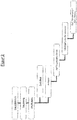
- FIG. 2 an embodiment of a particular non-inventive method is exemplified.
- the layer package can now in turn be treated with pressure and / or heat, wherein optionally also a structure is embossed in the surface.
Landscapes
- Chemical & Material Sciences (AREA)
- Engineering & Computer Science (AREA)
- Chemical Kinetics & Catalysis (AREA)
- Materials Engineering (AREA)
- Organic Chemistry (AREA)
- Health & Medical Sciences (AREA)
- Medicinal Chemistry (AREA)
- Polymers & Plastics (AREA)
- Manufacturing & Machinery (AREA)
- General Chemical & Material Sciences (AREA)
- Thermal Sciences (AREA)
- Life Sciences & Earth Sciences (AREA)
- Biochemistry (AREA)
- Physics & Mathematics (AREA)
- Mechanical Engineering (AREA)
- Laminated Bodies (AREA)
- Application Of Or Painting With Fluid Materials (AREA)
- Floor Finish (AREA)
- Reinforced Plastic Materials (AREA)
Abstract
- Bereitstellung eines unbedruckten Vliesstoffes aus Zellulosefasern,
- Imprägnieren des Vliesstoffs mit einer wässrigen Dispersion eines durch UV-Strahlung vernetzbaren Polymers,
- Entfernen des wässrigen Dispersionsmediums aus dem imprägnierten Vliesstoff durch Trocknung,
- Drucken eines Dekors auf eine Seite des getrockneten imprägnierten Vliesstoffs,
- Härten des Polymers im Vliesstoff durch Vernetzung mittels UV-Bestrahlung,
wobei der Vliesstoff vor dem Bedrucken auf einer Trägerplatte befestigt wird.
Description
- Die Erfindung betrifft ein Verfahren zur Herstellung eines dekorierten Blattes, wie es bei der Herstellung von dekorativen Laminaten mit anderen Schichten, beispielsweise Trägerschichten aus Holz, Holzwerkstoffen, Kunststoffen sowie Deck- oder Schutzschichten Verwendung findet. Solche dekorativen Laminate werden beispielsweise als Wand- oder Bodenbeläge und beim Möbelbau verwendet. Die Erfindung betrifft außerdem die Verwendung des dekorierten Blattes zur Herstellung eines dekorativen Laminats.
- Bei solchen Laminaten kann das Dekor einen anderen Werkstoff imitieren, beispielsweise Holz, Keramik, Natur- oder Kunststein, oder künstlerische oder praktische Gesichtspunkte berücksichtigen. Gewöhnlich wird das Dekor durch eine mehr oder weniger durchsichtige Duroplastschicht vor Verschleiß geschützt. Es ist auch üblich, die Oberfläche dieser Deckschicht mit einer Struktur zu versehen, die in räumlicher Beziehung zum Dekor steht, die Oberflächenstruktur des imitierten Werkstoffs nachbildet und als Synchronpore bezeichnet wird.
- Das Dekor wird herkömmlich in Form eines bedruckten oder anders mit einem Muster versehenen Papiers oder anderen Cellulosevlieses realisiert, das mit einem aushärtbaren Lack oder Kunstharz imprägniert ist und zwischen dem Träger und einer verschleißhindernden äußeren Deckschicht angeordnet wird. Üblicherweise erfordert das Herstellen des imprägnierten Dekorpapiers gesonderte Arbeitsgänge des Druckens und Imprägnierens, die meist in Betrieben außerhalb der eigentlichen Laminatherstellung durchgeführt werden und einen erheblichen Kostenfaktor darstellen. Es ist außerdem erforderlich, dass der Imprägnierstoff des Dekorpapiers mit dem Lack oder Kunstharz der Deckschicht verträglich ist, was insbesondere beim Zusammentreffen von Lack und Kunstharz nicht vorausgesetzt werden kann.
- Ein weiteres Problem dieser Technologie besteht darin, dass beim Imprägnieren des Dekorpapiers dieses eine Änderung der Abmessung erfährt, die im weiteren Verfahren berücksichtigt werden muss, wenn die räumliche Beziehung zwischen Dekor und Oberflächenstruktur (Synchronpore) erhalten bleiben soll. Dies gestaltet sich insbesondere dann schwierig, wenn das Produkt häufig gewechselt wird.
- Mit Aminoplast imprägnierte Dekorpapiere sind auch empfindlich gegen Wasser, das unter Umgehung der Deckschicht von einer Schnittkante her in das Laminat eindringt. Für Anwendungen in Nassbereichen müssen solche Laminatelemente auch an den Seitenkanten speziell gegen eindringendes Wasser versiegelt werden.
- Schließlich verlieren die Dekorpapiere durch das Imprägnieren häufig ihre Flexibilität und können nicht mehr aufgerollt, sondern müssen in Form von Blättern gehandhabt werden, die auf das Maß des Trägers zugeschnitten sind.
-
DE 17 04 598 A beschreibt ein Verfahren zur kontinuierlichen Herstellung faserverstärkter Kunststofffolien, wobei Faservliese mit einem Kunstharz mit selbstvernetzenden Gruppen imprägniert und anschließend einer Wärme- und Druckbehandlung unterworfen werden. -
DE 101 34 302 Cl offenbart ein Verfahren zur Herstellung eines Vorimprägnats für die Produktion von dekorativen Laminaten, wobei auf ein nicht gestrichenes Papier ein thermisch härtbares Harz aufgebracht und das Vorimprägnat auf eine Restfeuchte von etwa 3 % eingestellt wird, wobei das Harz unvernetzt bleibt. -
WO 2010/089086 AI beschreibt ein Verfahren zur Herstellung von Dekorpapier, wobei das Papier bedruckt wird und danach eine aliphatische, polycarbonathaltige anionische Polyurethandispersion aufgebracht wird. Danach wird das Papier mit einem Aminoplastharz imprägniert. Hierdurch soll Imprägnierharz eingespart, das Wachstum des Papieres beim Imprägnieren mit Aminopiastharz vermindert und die Lichtechtheit des Dekorpapiers verbessert werden. - Die Erfindung stellt sich die Aufgabe, ein Verfahren zur Herstellung eines dekorierten Blattes aus einem Cellulosevlies anzugeben, welches eine vollständige und wasserbeständige Imprägnierung der Zellulose ergibt und auf eine gegenüber dem Stand der Technik einfachere Weise ausgeführt werden kann.
- Diese Aufgabe wird durch ein Verfahren nach dem Hauptanspruch gelöst.
- Es wird somit ein Verfahren zur Herstellung eines dekorierten Blattes vorgeschlagen, umfassend die Schritte
- Bereitstellung eines unbedruckten Vliesstoffes aus Zellulosefasern,
- Imprägnieren des Vliesstoffs mit einer wässrigen Dispersion eines durch UV-Strahlung vernetzbaren Polymers,
- Entfernen des wässrigen Dispersionsmediums aus dem imprägnierten Vliesstoff durch Trocknung,
- Drucken eines Dekors auf eine Seite des getrockneten imprägnierten Vliesstoffs,
- Härten des Polymers im Vliesstoff durch Vernetzung mittels UV-Bestrahlung,
- Es wurde nämlich gefunden, dass bei der Verwendung der wässrigen Dispersion eines durch UV-Strahlung vernetzbaren Polymers als Imprägnierungsmittel, Trocknen des Imprägnats und Härten des Polymers durch Vernetzung mittels UV-Bestrahlung auf einfache Weise ein dekoriertes Blatt erhalten werden kann, das keine Dimensionsänderung gegenüber dem ursprünglichen Zellulosevlies aufweist, mit den in anderen Schichten, beispielsweise Deckschichten, des dekorativen Laminats verwendeten Harzen, insbesondere Aminoplasten, verträglich ist und eine gute Bindung eingeht, und das vollständig wasserfest ist,
- Der erfindungsgemäß verwendete Vliesstoff aus Zellulosefasern enthält bevorzugt außer gegebenenfalls einer geringen Menge Bindemittel für die Stabilisierung des Vlieses keine weiteren Imprägniermittel, sein Flächengewicht liegt im Allgemeinen zwischen 50 und 200 g/m2. Besonders bevorzugt ist der Vliesstoff ein Papier. Ein bevorzugter Bereich für das Flächengewicht des Papiers liegt zwischen 70 und 100 g/m2. Gut verwendbar sind die auf dem technischen Gebiet der dekorierten Oberflächen bekannten Druckbasispapiere. Diese sind im Allgemeinen nicht imprägniert und können gefärbt sein und Pigmentstoffe enthalten, damit sie die Farbe und Struktur des unbehandelten Trägerwerkstoffs kaschieren.
- Der Vliesstoff aus Zellulosefasern kann im erfindungsgemäßen Verfahren in bedrucktem oder unbedrucktem Zustand imprägniert werden. Im ersten Falle wird nach dem Imprägnieren und Trocknen das vernetzbare Polymer durch UV-Bestrahlung vernetzt und ausgehärtet. Im zweiten Fall muss vor dem Bestrahlen das Dekor auf den imprägnierten und getrockneten Vliesstoff aufgedruckt werden. Ein Vorteil dieser zweiten Ausführungsform besteht darin, dass für das Drucken des Dekors bis zu 50 % weniger Farbe benötigt wird, als beim Bedrucken eines nicht imprägnierten Vliesstoffes. Das beruht möglicherweise darauf, dass die gesamte Druckfarbe an der Oberfläche imprägnierten Vlieses bleibt und nicht ins Innere des Vlieses aufgesaugt wird, wo sie nicht mehr sichtbar ist. Ein weiterer Vorteil des Druckens auf das imprägnierte und getrocknete, aber noch nicht bestrahlte Vlies ist das klarere und schärfere Druckbild. Offenbar neigt die Druckfarbe dabei weniger zum Verlaufen als beim Drucken auf rohes Papier.
- Das im erfindungsgemäßen Verfahren verwendete durch UV- Strahlung vernetzbare Polymer liegt in Form einer wässrigen Dispersion vor, die gegebenenfalls geeignete oberflächenaktive Substanzen als Dispergiermittel enthalten kann. Das Polymer kann ein Copolymer sein, das vernetzbare Comonomere, beispielsweise ethylenisch ungesättigte Verbindungen wie Acrylate und Methacrylate umfasst, die auch nach der Polymerisation noch ethylenisch ungesättigte Gruppen aufweisen, beispielsweise als Acrylsäureester mehrwertiger Alkohole.
- Bevorzugt umfasst das vernetzbare Polymer neben den ethylenisch ungesättigten Comonomeren Urethaneinheiten, die in bekannter Weise aus Diisocyanaten und Diolen aufgebaut werden können. Brauchbar sind insbesondere anionische Dispersionen.
- Weiter bevorzugt sind Polymere, die neben dem vernetzbaren Comonomer und den Urethaneinheiten noch Estereinheiten umfassen. Das Polymer kann als Block-Copolymer vorliegen. Beispielsweise können Polyesterblöcke in das Copolymer eingefügt werden, indem man als Diol ein bevorzugt aliphatisches Polyesterdiol verwendet.
- Die erfindungsgemäß verwendete wässrige Dispersion des durch UV-Strahlung vernetzbaren Polymers hat bevorzugt einen Feststoffgehalt von mindestens 35 Gewichtsprozenten. Die Dispersion kann weitere Hilfsmittel enthalten, beispielsweise Entschäumer und Verdickungsmittel. Der Flächenauftrag der Polymerdispersion wird bevorzugt so bemessen, dass sich ein Trockenauftrag von 10-40, besonders bevorzugt 10-20 g/m2 Polymer ergibt. Im Allgemeinen erfordern eine höhere Grammatur und ein größeres Porenvolumen des Cellulosevlieses einen höheren Polymerauftrag.
- Das Imprägnieren des Vliesstoffes kann mit bekannten Verfahren durchgeführt werden, beispielsweise Eintauchen des Vliesstoffes in die Polymerdispersion. Bevorzugt werden jedoch dosierende Verfahren, die eine präzise Steuerung des Flächenauftrags ermöglichen, beispielsweise Walzenauftrag oder Vorhanggießen. Beim Walzenauftrag wird bevorzugt das Imprägniermittel mit einer Gegendruckwalze in den Vliesstoff hineingedrückt. Möglich ist auch die Anwendung einer Rakeltechnik wie etwa in Papierstrichmaschinen. Bevorzugt wird ein Walzenauftrag unter Verwendung von Walzen aus Edelstahl oder Hartgummi.
- Zum Imprägnieren kann die Viskosität der Polymerdispersion mit geeigneten Verdickungsmitteln erhöht werden, beispielsweise mit Mitteln auf Polyurethanbasis.
- Nach dem Imprägnieren des Vliesstoffes wird das wässrige Dispersionsmedium durch Trocknen entfernt. Das Trocknen kann auf physikalische Weise, beispielsweise durch Infrarotbestrahlung, erwärmte Luft, beispielsweise in Umluft- oder Düsentrocknern, Mikrowellen, beheizte Walzen oder durch eine Kombination dieser Verfahren erfolgen. Es ist vorteilhaft, wenn dabei die Filmbildungstemperatur des dispergierten Polymers überschritten wird, weil dadurch die Wasserfestigkeit des imprägnierten Vliesstoffes verbessert wird. Zu dem beim Trocknen entfernten wässrigen Dispersionsmedium gehören neben Wasser selbst auch gegebenenfalls vorhandene polare Hilfsdispersionsmittel, wie beispielsweise Alkohole.
- Es ist ein besonderer Vorteil des erfindungsgemäßen Verfahrens, dass das imprägnierte Cellulosevlies im getrockneten Zustand biegsam und klebfrei ist, so dass es ohne Probleme aufgerollt und zur weiteren Verwendung gelagert und transportiert werden kann. Bei Bedarf kann das Cellulosevlies in jedem Stadium des erfindungsgemäßen Verfahrens zugeschnitten werden, beispielsweise um es an die Breite der Imprägnier- oder Druckvorrichtung oder an die Maße der für die Herstellung des dekorativen Laminats vorgesehenen Trägerplatte anzupassen.
- Wenn der Vliesstoff vor dem Imprägnieren noch nicht bedruckt worden war, dann geschieht dies erfindungsgemäß nach dem Imprägnieren, aber vor der Vernetzung durch UV-Bestrahlung. Es hat sich gezeigt, dass nach der Bestrahlung die Haftung der Druckfarben unbefriedigend ist. Als Druckverfahren kommen in erster Linie Offsetdruck, Flexodruck und digitale Verfahren, wie Tintenstrahl-, Transfer- oder Laserdruck infrage.
- Besonders bevorzugt ist dabei ein digitales Druckverfahren, weil dabei nicht mit einer vorgefertigten Druckform gearbeitet wird, deren Muster sich regelmäßig wiederholt, Wegen dieser Wiederholungen gelingt die Imitation natürlicher Werkstoffe wie Holz nur unvollkommen. Es wäre unwirtschaftlich, nach jedem Druck die Druckform zu wechseln, um den Eindruck der Wiederholung zu vermeiden. Mit dem Digitaldruck ist es dagegen möglich, eine große Anzahl verschiedener Muster in digitaler Form vorrätig zu halten und ohne die sonst für den Wechsel der Druckform aufzuwendende Rüstzeiten miteinander abwechseln zu lassen. Dieser Vorteil wird auch dann nutzbar, wenn bei laufender Produktion der zu imitierende Werkstoff geändert, beispielsweise eine andere Holzart gewählt werden soll.
- Vorteilhaft bei den digitalen Druckverfahren ist auch, dass sie meist berührungsfrei arbeiten. Dadurch lässt sich vermeiden, dass das imprägnierte und getrocknete, aber noch nicht mit UV bestrahlte Cellulosevlies oberflächlich beschädigt wird. Als Druckverfahren kommen beispielsweise Tintenstrahl-verfahren mit feststehendem oder bewegtem Druckkopf, Laserdruckverfahren, beispielsweise mit einfarbigen oder mehrfarbigen Tonerpulvern, und Wärmeübertragungsverfahren infrage. Die Verwendung von strahlungshärtbaren Druckfarben ist vorteilhaft, weil bei der ohnehin zur Auswertung der Imprägnierung notwendigen UV-Bestrahlung eine intensive Verbindung der Druckfarben mit dem Imprägniermittel im Vlies erfolgt. Erfindungsgemäß geeignet sind aber auch andere Druckfarben, beispielsweise auf Wasser- oder Lösemittelbasis.
- Zur Erzeugung spezieller visueller Effekte ist es auch möglich, das Dekor in zwei Arbeitsgängen, d.h. vor und nach dem Imprägnieren, zu drucken. Dies kann vorteilhaft sein, wenn beispielsweise metallisch reflektierende oder opaleszierende Druckfarben verwendet werden.
- Zur Erfindung gehört auch die Verwendung eines erfindungsgemäßen dekorierten Blattes in einem Verfahren zur Herstellung eines dekorativen Laminats. Ein solches Verfahren umfasst zumindest den weiteren Schritt:
- Anbringen einer Deckschicht auf dem dekorierten Blatt.
- Als Trägerplatte kommt jedes geeignete Material infrage, wie beispielsweise Holz, Holzwerkstoffe wie Span- und Faserplatten, Sperrholz, Platten aus duroplastischen und thermoplastische Kunststoffen, Platten aus biologischen Fasermaterialien wie Hanffasern, Zellulosefasem (Papier, Pappe und dergleichen) oder Stroh, keramische Materialien wie gebrannter Ton, Beton, Gips sowie Verbandmaterialien aus zwei oder mehreren der genannten Stoffe, beispielsweise Gipskartonplatten oder faserverstärkte Kunststoffe. Bei Trägerplatten mit stärkeren Unebenheiten auf der Oberfläche kann es erforderlich sein, vor dem Befestigen des dekorierten Blattes eine Grundierungs- Schicht zum Ausgleich dieser Unebenheiten anzubringen.
- Zum Befestigen des dekorierten Blattes auf der Trägerplatte wird vorzugsweise ein Klebstoff oder Leim verwendet. Beispiele sind Heißkleber, Dispersionskleber, ZweikomponentenKleber, Harnstoff-Formaldehydleim, gegebenenfalls mit einem Härter. Soweit notwendig oder vorteilhaft, kann die Wirkung des Klebstoffes oder Leims durch Anwendung von Druck und/oder Wärme verstärkt werden.
- Zum Schutz des Dekors wird eine Deckschicht auf dem auf der Trägerplatte befestigten dekorierten Blatt angebracht, Hierzu eignen sich alle im Stand der Technik bekannten Materialien und Verfahren. Beispielsweise kann ein so genanntes Overlay verwendet werden, das gewöhnlich aus einem mit einem Kunstharz, beispielsweise einem Aminoplast, getränkten Cellulosevlies besteht. Andererseits ist es auch möglich, eine cellulosefreie Deckschicht aufzutragen, beispielsweise indem man eine wässrige Lösung eines Aminoplastes oder einer Aminoplastvorstufe auf die Dekorschicht aufträgt und trocknet. Es ist auch möglich, ein Pulver eines Kunstharz oder einer Harzvorstufe auf das dekorative Blatt aufzustreuen und durch zumindest teilweise Schmelzen eine zusammenhängende Schicht zu erzeugen. Die Deckschicht kann auch aus gegebenenfalls strahlungshärtbaren Lacken gebildet werden. In diesem Fall kann die Deckschicht durch Bestrahlung ihre Endhärte erhalten. In die Deckschicht können Verschleiß mindernde Bestandteile inkorporiert werden, beispielsweise harte Teilchen aus Korund, Siliziumkarbid, Glas und dergleichen.
- Bevorzugt besteht die Deckschicht aus einem Aminoplastharz oder einer Vorstufe dazu, beispielsweise einem Oligomer aus einer Amino- und einer Aldehydverbindung, wie Melamin bzw. Formaldehyd. Um die Endhärte zu erreichen, muss dieses Material noch einer Wärmebehandlung unterzogen werden, die zweckmäßig unter Druck erfolgt. Hierzu wird bevorzugt das ganze Schichtpaket, umfassend Trägerplatte, dekoriertes Blatt und Deckschicht gepresst und/oder erhitzt. Dies kann beispielsweise in einer so genannten Kurztaktpresse oder auch kontinuierlich in einer Doppelbandpresse erfolgen. Vor dem Pressen oder während des Pressens kann, beispielsweise mittels eines geeigneten Prägeblechs, eine Oberflächenstruktur, beispielsweise zur Imitation von Holzporen, in die Oberfläche der Deckschicht eingeprägt werden. Ein Vorteil des erfindungsgemäßen Verfahrens besteht darin, dass das dekorierte Blatt, wenn es vor dem Imprägnieren mit einem Dekor bedruckt wurde, durch das Imprägnieren und Trocknen keine Dimensionsänderung erfährt, so dass das aufgedruckte Dekor mit der Oberflächenstruktur an jeder Stelle in örtlicher Übereinstimmung bleibt,
- Nachstehend wird ein Ausführungsbeispiel eines Verfahrens zur Herstellung eines dekorierten Blattes beschrieben.
- Eine Papierbahn mit einem Flächengewicht von 80 g/m2 wird durch ein Walzenpaar geführt, bei dem beide Walzen mittels einer Rakelvorrichtung mit je 20 g/m2 einer Dispersion eines Urethan-Acryllack-Ester-Copolymers mit 50 Gewichtsprozent Feststoffanteil beschichtet werden. Beim Zusammentreffen mit dem Papier wird die Dispersion in das Papier eingepresst. Nach dem Auftragen wird die Papierbahn durch einen Trockner geleitet, in dem die Bahn mit Infrarot bestrahlt und belüftet wird. Nach Passieren des Trockners durchläuft die Bahn eine Druckstation, in der ein vierfarbiges Dekor mittels eines digitalen Tintenstrahldruckverfahrens auf eine Seite der Bahn aufgedruckt wird. Danach wird die Bahn von beiden Seiten einer UV- Bestrahlung unterworfen. Das so erzeugte dekorierte Blatt ist nun wasserfest und kann aufgewickelt und gelagert werden. Alternativ kann es auch sofort, gegebenenfalls in kontinuierlichem Betrieb, mit einer HDF- Platte unter Verwendung eines Harnstoff-Formaldehyd-Leims verleimt werden. Auch in diesem Zustand kann das Zwischenprodukt, das heißt die Trägerplatte mit dem darauf befestigten dekorierten Blatt, gegebenenfalls bis zur weiteren Verwendung gelagert werden. Zur Fertigstellung eines dekorativen Laminats wird nun noch eine wässrige Lösung einer Melamin-Formaldehyd-Harzvorstufe auf die dekorierte Oberfläche aufgetragen, getrocknet, und in einer Kurztaktpresse bei etwa 170 °C 20 s lang gepresst. Dabei wird mittels eines Prägeblechs eine mit dem Dekor synchrone Porenstruktur in die Oberfläche eingeprägt.
- Die Erfindung wird anhand von einem in den beigefügten Figuren dargestellten Ausführungsbeispiel im Folgenden näher beschrieben. Es zeigen
-
Figur 1 eine erste Ausführungsform des erfindungsgemäßen Verfahrens mit einem unbedruckten Zellulosevlies, -
Figur 2 eine zweite Ausführungsform des erfindungsgemäßen Verfahrens mit einem bereits bedruckten Dekorpapier. - In
Figur 1 sind die aufeinanderfolgenden Schritte bei der ersten beispielhaften Ausführungsform des erfindungsgemäßen Verfahrens dargestellt. Dabei stellen die unterstrichenen Bezeichnungen einen erfindungsgemäßen Verfahrensablauf dar, der die Erfindung besonders vorteilhaft nutzbar macht. Zunächst wird das Cellulosevlies, das zum Beispiel ein unbedrucktes Papier, insbesondere ein Druckbasispapier, sein kann, mit dem erfindungsgemäßen Imprägniermittel imprägniert. Danach wird das imprägnierte Cellulosevlies getrocknet. In diesem Zustand kann das Vlies aufgerollt und gelagert oder auch bereits bedruckt werden. Bevorzugt wird es aber nun auf eine Trägerplatte aufgeklebt und mittels eines bevorzugt digitalen Druckverfahrens mit einem dekorativen Muster bedruckt. An diesen Schritt schließt sich eine UV-Bestrahlung an, bis die Imprägnierung hinreichend ausgehärtet ist. Nun kann eine Deckschicht, beispielsweise ein Overlay (mit Deckschichtmaterial imprägnierte Trägerschicht), eine Lösung einer Harzvorstufe oder auch ein gegebenenfalls strahlungshärtbarer Lack, auf dem dekorativen Muster angebracht werden. Die Deckschicht wird schließlich mit der Trägerplatte und der Dekorschicht in einer beheizbaren Presse unter Druck und/oder Wärme verbunden, wobei gegebenenfalls noch mit einem strukturierten Pressblech eine Oberflächenstruktur in die Oberfläche der Deckschicht eingeprägt wird. Bei diesem bevorzugten Verfahrensablauf kann sich ein Verfahrensschritt unmittelbar an den anderen anschließen, so dass kontinuierlich gearbeitet werden kann, was bei großen Losen beträchtliche Kostenvorteile ermöglicht. Andererseits kann man das imprägnierte und getrocknete Cellulosevlies in insbesondere nicht erfindungsgemäßer Weise aufrollen und Zwischenlagern, bevor man es bedruckt, mit UV bestrahlt, auf die Trägerplatte aufklebt und gegebenenfalls die Deckschicht anbringt und den Schichtverbund presst und prägt. Hierbei ist es vorteilhaft, dass auch nach dem Bedrucken und der UV-Bestrahlung das Dekormaterial noch aufgerollt und gelagert werden kann. Dies erleichtert beispielsweise die Fertigung von kleinen Losen mit häufigeren Produktwechseln. Es ist auch möglich, den Fertigungsprozess nach dem Aufkleben der Dekorschicht auf die Trägerplatte zu unterbrechen und das Zwischenprodukt zu lagern. - In
Figur 2 ist eine Ausführungsform eines insbesondere nicht erfindungsgemäßen Verfahrens beispielhaft dargestellt. Hier geht man von bereits bedrucktem Dekorpapier aus. Dieses wird zunächst mit dem Mittel imprägniert, getrocknet und der UV-Bestrahlung unterzogen. Bevorzugt (unterstrichene Verfahrensschritte) wird es nun aufgerollt und zur weiteren Verwendung zwischengelagert. Es kann aber auch sofort oder nach Zwischenlagerung auf eine Trägerplatte geklebt und eine Deckschicht, beispielsweise wie oben beschrieben, angebracht werden. Das Schichtpaket kann nun wiederum mit Druck und/oder Wärme behandelt werden, wobei gegebenenfalls auch eine Struktur in die Oberfläche eingeprägt wird.
Claims (10)
- Verfahren zur Herstellung eines dekorierten Blattes, umfassend die Schritte- Bereitstellung eines unbedruckten Vliesstoffes aus Zellulosefasern,- Imprägnieren des Vliesstoffs mit einer wässrigen Dispersion eines durch UV-Strahlung vernetzbaren Polymers,- Entfernen des wässrigen Dispersionsmediums aus dem imprägnierten Vliesstoff durch Trocknung,- Drucken eines Dekors auf eine Seite des getrockneten imprägnierten Vliesstoffs,- Härten des Polymers im Vliesstoff durch Vernetzung mittels UV-Bestrahlung,wobei der Vliesstoff vor dem Bedrucken auf einer Trägerplatte befestigt wird.
- Verfahren nach Anspruch 1, dadurch gekennzeichnet, dass das durch UV-Strahlung vernetzbare Polymer ein Copolymer ist, das zumindest Urethan- und ethylenisch ungesättigte Einheiten aufweist.
- Verfahren nach Anspruch 2, dadurch gekennzeichnet, dass das durch UV-Strahlung vernetzbare Polymer zusätzlich Estereinheiten aufweist.
- Verfahren nach einem der vorangehenden Ansprüche, dadurch gekennzeichnet, dass als Vliesstoff ein unbedrucktes Papier verwendet wird.
- Verfahren nach einem der vorangehenden Ansprüche, dadurch gekennzeichnet, dass die wässrige Dispersion einen Feststoffgehalt von mindestens 35 Gewichtsprozent hat.
- Verfahren nach einem der vorangehenden Ansprüche, dadurch gekennzeichnet, dass die Trocknung durch Infrarotbestrahlung, erwärmte Luft, Mikrowellen und/oder beheizte Walzen erfolgt.
- Verfahren nach einem der vorangehenden Ansprüche, dadurch gekennzeichnet, dass das Bedrucken mittels Offsetdruck/ Flexodruck und/oder eines digitalen Druckverfahrens erfolgt.
- Verfahren nach Anspruch 7, dadurch gekennzeichnet, dass das Bedrucken mittels eines Tintenstrahl-, Transfer- oder Laserdruckverfahrens erfolgt.
- Verwendung eines nach einem der Ansprüche 1 bis 8 hergestellten dekorierten Blattes in einem Verfahren zur Herstellung eines dekorativen Laminats, umfassend den Schritt- Anbringen einer Deckschicht auf dem dekorierten Blatt.
- Verwendung nach Anspruch 9, dadurch gekennzeichnet, dass nach dem Anbringen der Deckschicht das Schichtpaket gepresst und/oder erhitzt und/oder die Oberfläche der Deckschicht geprägt wird.
Priority Applications (1)
| Application Number | Priority Date | Filing Date | Title |
|---|---|---|---|
| PL16158974T PL3059276T3 (pl) | 2012-05-10 | 2013-05-06 | Sposób wytwarzania dekorowanego arkusza i jego zastosowanie |
Applications Claiming Priority (2)
| Application Number | Priority Date | Filing Date | Title |
|---|---|---|---|
| DE102012207845A DE102012207845A1 (de) | 2012-05-10 | 2012-05-10 | Verfahren zur Herstellung eines dekorierten Blattes und dessen Verwendung |
| EP13721337.7A EP2847258B1 (de) | 2012-05-10 | 2013-05-06 | Verfahren zur herstellung eines dekorierten blattes und dessen verwendung |
Related Parent Applications (2)
| Application Number | Title | Priority Date | Filing Date |
|---|---|---|---|
| EP13721337.7A Division-Into EP2847258B1 (de) | 2012-05-10 | 2013-05-06 | Verfahren zur herstellung eines dekorierten blattes und dessen verwendung |
| EP13721337.7A Division EP2847258B1 (de) | 2012-05-10 | 2013-05-06 | Verfahren zur herstellung eines dekorierten blattes und dessen verwendung |
Publications (2)
| Publication Number | Publication Date |
|---|---|
| EP3059276A1 true EP3059276A1 (de) | 2016-08-24 |
| EP3059276B1 EP3059276B1 (de) | 2017-12-20 |
Family
ID=48326304
Family Applications (2)
| Application Number | Title | Priority Date | Filing Date |
|---|---|---|---|
| EP16158974.2A Active EP3059276B1 (de) | 2012-05-10 | 2013-05-06 | Verfahren zur herstellung eines dekorierten blattes und dessen verwendung |
| EP13721337.7A Active EP2847258B1 (de) | 2012-05-10 | 2013-05-06 | Verfahren zur herstellung eines dekorierten blattes und dessen verwendung |
Family Applications After (1)
| Application Number | Title | Priority Date | Filing Date |
|---|---|---|---|
| EP13721337.7A Active EP2847258B1 (de) | 2012-05-10 | 2013-05-06 | Verfahren zur herstellung eines dekorierten blattes und dessen verwendung |
Country Status (18)
| Country | Link |
|---|---|
| US (1) | US10815621B2 (de) |
| EP (2) | EP3059276B1 (de) |
| JP (1) | JP6089097B2 (de) |
| KR (1) | KR101953426B1 (de) |
| CN (2) | CN106182987B (de) |
| AU (1) | AU2013258170B2 (de) |
| BR (1) | BR112014026478B1 (de) |
| CA (1) | CA2866855C (de) |
| CL (1) | CL2014002930A1 (de) |
| DE (1) | DE102012207845A1 (de) |
| ES (2) | ES2613843T3 (de) |
| MX (1) | MX348990B (de) |
| PL (2) | PL2847258T3 (de) |
| PT (2) | PT2847258T (de) |
| RU (1) | RU2588624C1 (de) |
| TR (1) | TR201802496T4 (de) |
| UA (1) | UA110890C2 (de) |
| WO (1) | WO2013167533A1 (de) |
Families Citing this family (9)
| Publication number | Priority date | Publication date | Assignee | Title |
|---|---|---|---|---|
| PL236570B1 (pl) * | 2014-10-16 | 2021-01-25 | Schattdecor Spolka Z Ograniczona Odpowiedzialnoscia | Sposób wytwarzania trójwymiarowych powierzchni strukturalnych zwłaszcza na płytach drewnopochodnych |
| DE102015208267A1 (de) * | 2015-05-05 | 2016-11-10 | Homag Holzbearbeitungssysteme Gmbh | Verfahren und Vorrichtung zum Versehen einer Werkstückfläche mit einem Dekor |
| EP3040476B1 (de) * | 2015-07-10 | 2018-05-09 | SWISS KRONO Tec AG | Schichtstoff zum beschichten eines plattenförmigen holzwerkstoffs und verfahren zum herstellen des schichtstoffs |
| JP6845551B2 (ja) * | 2016-08-30 | 2021-03-17 | セイショク株式会社 | 成形品及びその製造方法 |
| CN109863276B (zh) | 2016-09-23 | 2021-11-12 | 肖氏工业集团公司 | 弹性地板产品及其制造方法 |
| ES2928303T3 (es) * | 2020-07-09 | 2022-11-16 | Transf Sau | Procedimiento de fabricación de un folio decorativo |
| DE102024107040A1 (de) | 2024-03-12 | 2025-09-18 | Hans Schmid GmbH & Co. KG | Verbundplatte sowie Verfahren zur Herstellung einer Verbundplatte |
| CN119145123A (zh) * | 2024-09-13 | 2024-12-17 | 浙江恒邦非织造布科技有限公司 | 一种环保型非织造复合装饰布及其制备工艺 |
| WO2026078496A1 (en) * | 2024-10-11 | 2026-04-16 | Unilin, Bv | Decorative panel and method for making a decorative panel |
Citations (9)
| Publication number | Priority date | Publication date | Assignee | Title |
|---|---|---|---|---|
| DE1704598A1 (de) | 1967-11-28 | 1971-05-19 | Decorit Industrieberatung Gmbh | Verfahren zur kontinuierlichen Herstellung faserverstaerkter Kunststoffolien |
| JPS5086571A (de) * | 1973-12-03 | 1975-07-11 | ||
| EP0745478A2 (de) * | 1995-05-31 | 1996-12-04 | Forbo- Resopal GmbH | Verfahren zur Oberflächenmodifizierung von Substraten |
| JPH09188997A (ja) * | 1996-01-10 | 1997-07-22 | Toppan Printing Co Ltd | 表面強化化粧紙及びその製造方法 |
| JP2001129957A (ja) * | 1999-11-05 | 2001-05-15 | Dainippon Printing Co Ltd | 化粧材 |
| DE10134302C1 (de) | 2001-07-14 | 2002-12-12 | Technocell Dekor Gmbh & Co Kg | Vorimprägnat, Verfahren zu dessen Herstellung sowie daraus erhältliche Dekorimprägnate oder dekorative Beschichtungswerkstoffe |
| EP1319524A1 (de) * | 2001-12-12 | 2003-06-18 | Ackner, Friedrich | Dekorfolien mit grosser Oberflächenhärte und hohen Kratz- und Abriebfestigkeiten sowie Verfahren zu deren Herstellung |
| DE102004034790A1 (de) * | 2003-07-17 | 2005-02-03 | Kunz Holding Gmbh & Co. Kg | Blatt- oder bahnförmige dekorative Beschichtungsfolie sowie Verfahren zum Herstellen einer solchen |
| WO2010089086A1 (de) | 2009-02-04 | 2010-08-12 | Okt Germany Gmbh | Verfahren zur herstellung von dekorpapier sowie dekorpapier |
Family Cites Families (12)
| Publication number | Priority date | Publication date | Assignee | Title |
|---|---|---|---|---|
| JP3248425B2 (ja) * | 1996-04-24 | 2002-01-21 | 凸版印刷株式会社 | 表面強化化粧紙とその製造方法 |
| JP3198952B2 (ja) * | 1996-11-12 | 2001-08-13 | 凸版印刷株式会社 | 硬化性樹脂化粧板 |
| JP4108833B2 (ja) * | 1998-07-09 | 2008-06-25 | 大日本印刷株式会社 | 化粧材の製造法 |
| FR2826674B1 (fr) * | 2001-06-28 | 2003-09-05 | Arjo Wiggins Sa | Procede de realisation d'une feuille imprimable comportant des motifs holographiques |
| DE202005000556U1 (de) * | 2005-01-13 | 2005-05-04 | Kunz-Holding Gmbh & Co. Kg | Bahnförmige Beschichtungsfolie |
| WO2008134823A1 (en) * | 2007-05-07 | 2008-11-13 | Depco-Trh Pty Ltd | Improvements in the manufacture of b-stage resin impregnated papers or non-wovens |
| DE102007026170A1 (de) | 2007-06-04 | 2008-12-11 | Akzenta Paneele + Profile Gmbh | Laminierte Dekorplatte und Verfahren zu deren Herstellung |
| AU2008337508B2 (en) * | 2007-12-17 | 2012-03-15 | Technocell Dekor Gmbh & Co. Kg | Compressible decorative paper impregnating agent which can be printed by the inkjet method |
| NL1036705C2 (nl) * | 2009-03-13 | 2010-09-14 | Trespa Int Bv | Werkwijze ter vervaardiging van een met hars geïmpregneerd decorpapier alsmede een decorpaneel. |
| JP5813352B2 (ja) * | 2010-04-09 | 2015-11-17 | 富士フイルム株式会社 | インク組成物及びその製造方法、インクセット、並びに画像形成方法 |
| DE102011080300A1 (de) | 2011-08-02 | 2013-02-07 | Surface Technologies Gmbh & Co. Kg | Verfahren zur Herstellung einer dekorierten Wand-, Decken- oder Fußbodenplatte |
| NL2007494C2 (nl) * | 2011-09-28 | 2013-04-02 | Trespa Int Bv | Werkwijze ter vervaardiging van een decoratieve film alsmede een decorpaneel. |
-
2012
- 2012-05-10 DE DE102012207845A patent/DE102012207845A1/de not_active Ceased
-
2013
- 2013-05-06 KR KR1020147029628A patent/KR101953426B1/ko active Active
- 2013-05-06 WO PCT/EP2013/059388 patent/WO2013167533A1/de not_active Ceased
- 2013-05-06 JP JP2015507561A patent/JP6089097B2/ja active Active
- 2013-05-06 CA CA2866855A patent/CA2866855C/en active Active
- 2013-05-06 TR TR2018/02496T patent/TR201802496T4/tr unknown
- 2013-05-06 CN CN201610724837.XA patent/CN106182987B/zh active Active
- 2013-05-06 BR BR112014026478-3A patent/BR112014026478B1/pt active IP Right Grant
- 2013-05-06 AU AU2013258170A patent/AU2013258170B2/en active Active
- 2013-05-06 EP EP16158974.2A patent/EP3059276B1/de active Active
- 2013-05-06 EP EP13721337.7A patent/EP2847258B1/de active Active
- 2013-05-06 PT PT137213377T patent/PT2847258T/pt unknown
- 2013-05-06 PL PL13721337T patent/PL2847258T3/pl unknown
- 2013-05-06 RU RU2014149708/05A patent/RU2588624C1/ru active
- 2013-05-06 US US14/389,930 patent/US10815621B2/en active Active
- 2013-05-06 PT PT161589742T patent/PT3059276T/pt unknown
- 2013-05-06 ES ES13721337.7T patent/ES2613843T3/es active Active
- 2013-05-06 MX MX2014012785A patent/MX348990B/es active IP Right Grant
- 2013-05-06 CN CN201380020396.XA patent/CN104245805B/zh active Active
- 2013-05-06 PL PL16158974T patent/PL3059276T3/pl unknown
- 2013-05-06 ES ES16158974.2T patent/ES2661314T3/es active Active
- 2013-06-05 UA UAA201412726A patent/UA110890C2/uk unknown
-
2014
- 2014-10-29 CL CL2014002930A patent/CL2014002930A1/es unknown
Patent Citations (9)
| Publication number | Priority date | Publication date | Assignee | Title |
|---|---|---|---|---|
| DE1704598A1 (de) | 1967-11-28 | 1971-05-19 | Decorit Industrieberatung Gmbh | Verfahren zur kontinuierlichen Herstellung faserverstaerkter Kunststoffolien |
| JPS5086571A (de) * | 1973-12-03 | 1975-07-11 | ||
| EP0745478A2 (de) * | 1995-05-31 | 1996-12-04 | Forbo- Resopal GmbH | Verfahren zur Oberflächenmodifizierung von Substraten |
| JPH09188997A (ja) * | 1996-01-10 | 1997-07-22 | Toppan Printing Co Ltd | 表面強化化粧紙及びその製造方法 |
| JP2001129957A (ja) * | 1999-11-05 | 2001-05-15 | Dainippon Printing Co Ltd | 化粧材 |
| DE10134302C1 (de) | 2001-07-14 | 2002-12-12 | Technocell Dekor Gmbh & Co Kg | Vorimprägnat, Verfahren zu dessen Herstellung sowie daraus erhältliche Dekorimprägnate oder dekorative Beschichtungswerkstoffe |
| EP1319524A1 (de) * | 2001-12-12 | 2003-06-18 | Ackner, Friedrich | Dekorfolien mit grosser Oberflächenhärte und hohen Kratz- und Abriebfestigkeiten sowie Verfahren zu deren Herstellung |
| DE102004034790A1 (de) * | 2003-07-17 | 2005-02-03 | Kunz Holding Gmbh & Co. Kg | Blatt- oder bahnförmige dekorative Beschichtungsfolie sowie Verfahren zum Herstellen einer solchen |
| WO2010089086A1 (de) | 2009-02-04 | 2010-08-12 | Okt Germany Gmbh | Verfahren zur herstellung von dekorpapier sowie dekorpapier |
Non-Patent Citations (3)
| Title |
|---|
| DATABASE WPI Week 197552, Derwent World Patents Index; AN 1975-85476W, XP002711479 * |
| DATABASE WPI Week 199739, Derwent World Patents Index; AN 1997-420800, XP002711478 * |
| DATABASE WPI Week 200141, Derwent World Patents Index; AN 2001-387240, XP002758626 * |
Also Published As
Similar Documents
| Publication | Publication Date | Title |
|---|---|---|
| EP3059276B1 (de) | Verfahren zur herstellung eines dekorierten blattes und dessen verwendung | |
| DE102009044802B4 (de) | Verfahren und Vorrichtung zur Erzeugung einer dreidimensionalen Oberflächenstruktur auf einem Werkstück | |
| EP2452829B1 (de) | Verfahren zum Aufbringen eines Dekors auf eine Holzwerkstoffplatte | |
| DE102007013132B4 (de) | Verfahren zum Herstellen eines flächigen, bedruckten Bauteils | |
| EP2739487B1 (de) | Verfahren zur herstellung einer dekorierten wand-, decken- oder fussbodenplatte | |
| DE602004008226T2 (de) | Verfahren zur Herstellung eines Laminates | |
| EP2242646A1 (de) | Verfahren zur herstellung eines laminats | |
| EP2223800B1 (de) | Dekorprodukt, Verfahren zum Herstellen eines Dekorprodukts und Verwendung eines Dekorprodukts zum Herstellen einer dekorierten Trägerfläche | |
| EP3288688A1 (de) | Verfahren zur herstellung von strukturierten oberflächen und derart strukturierte gegenstände | |
| EP3725519A2 (de) | Verfahren zur herstellung einer tiefmatten werkstückoberfläche, z. b. einer möbel oder fussbodenfläche, sowie werkstückoberfläche | |
| EP3059020B1 (de) | Verfahren zur Herstellung einer Holzwerkstoffplatte, insbesondere einer mit einer Dekorschicht versehenen Holzwerkstoffplatte | |
| DE102015110268A1 (de) | Verfahren zur Herstellung eines Strukturgebermaterials sowie Strukturgebermaterial | |
| DE102013112275B4 (de) | Verfahren zur Herstellung eines dekorativen Laminates | |
| EP3403847B1 (de) | Verfahren zur herstellung einer mehrschichtigen materialbahn mit dekorsynchron strukturierter oberfläche sowie die verwendung derselben | |
| DE102012111809B4 (de) | Dekoratives Oberflächenmaterial für Fußböden und Möbel sowie Verfahren zu dessen Herstellung | |
| EP2179864B1 (de) | Verfahren zum Veredeln einer Trägerplatte | |
| EP4624189A1 (de) | Verfahren und vorrichtung zur herstellung eines schichtstoffes, insbesondere eines laminates in einer cpl-presse mit einer zu einem dekor synchronen struktur | |
| DE102012111825B4 (de) | Oberflächenmaterial für Fußböden und Möbel sowie Verfahren zu dessen Herstellung |
Legal Events
| Date | Code | Title | Description |
|---|---|---|---|
| PUAI | Public reference made under article 153(3) epc to a published international application that has entered the european phase |
Free format text: ORIGINAL CODE: 0009012 |
|
| AC | Divisional application: reference to earlier application |
Ref document number: 2847258 Country of ref document: EP Kind code of ref document: P |
|
| AK | Designated contracting states |
Kind code of ref document: A1 Designated state(s): AL AT BE BG CH CY CZ DE DK EE ES FI FR GB GR HR HU IE IS IT LI LT LU LV MC MK MT NL NO PL PT RO RS SE SI SK SM TR |
|
| AX | Request for extension of the european patent |
Extension state: BA ME |
|
| STAA | Information on the status of an ep patent application or granted ep patent |
Free format text: STATUS: REQUEST FOR EXAMINATION WAS MADE |
|
| 17P | Request for examination filed |
Effective date: 20170213 |
|
| RBV | Designated contracting states (corrected) |
Designated state(s): AL AT BE BG CH CY CZ DE DK EE ES FI FR GB GR HR HU IE IS IT LI LT LU LV MC MK MT NL NO PL PT RO RS SE SI SK SM TR |
|
| GRAP | Despatch of communication of intention to grant a patent |
Free format text: ORIGINAL CODE: EPIDOSNIGR1 |
|
| STAA | Information on the status of an ep patent application or granted ep patent |
Free format text: STATUS: GRANT OF PATENT IS INTENDED |
|
| INTG | Intention to grant announced |
Effective date: 20170710 |
|
| GRAS | Grant fee paid |
Free format text: ORIGINAL CODE: EPIDOSNIGR3 |
|
| GRAA | (expected) grant |
Free format text: ORIGINAL CODE: 0009210 |
|
| STAA | Information on the status of an ep patent application or granted ep patent |
Free format text: STATUS: THE PATENT HAS BEEN GRANTED |
|
| AC | Divisional application: reference to earlier application |
Ref document number: 2847258 Country of ref document: EP Kind code of ref document: P |
|
| AK | Designated contracting states |
Kind code of ref document: B1 Designated state(s): AL AT BE BG CH CY CZ DE DK EE ES FI FR GB GR HR HU IE IS IT LI LT LU LV MC MK MT NL NO PL PT RO RS SE SI SK SM TR |
|
| REG | Reference to a national code |
Ref country code: GB Ref legal event code: FG4D Free format text: NOT ENGLISH |
|
| REG | Reference to a national code |
Ref country code: CH Ref legal event code: EP |
|
| REG | Reference to a national code |
Ref country code: IE Ref legal event code: FG4D Free format text: LANGUAGE OF EP DOCUMENT: GERMAN |
|
| REG | Reference to a national code |
Ref country code: AT Ref legal event code: REF Ref document number: 956332 Country of ref document: AT Kind code of ref document: T Effective date: 20180115 |
|
| REG | Reference to a national code |
Ref country code: DE Ref legal event code: R096 Ref document number: 502013009087 Country of ref document: DE |
|
| REG | Reference to a national code |
Ref country code: PT Ref legal event code: SC4A Ref document number: 3059276 Country of ref document: PT Date of ref document: 20180305 Kind code of ref document: T Free format text: AVAILABILITY OF NATIONAL TRANSLATION Effective date: 20180227 |
|
| REG | Reference to a national code |
Ref country code: NL Ref legal event code: FP |
|
| REG | Reference to a national code |
Ref country code: ES Ref legal event code: FG2A Ref document number: 2661314 Country of ref document: ES Kind code of ref document: T3 Effective date: 20180328 |
|
| PG25 | Lapsed in a contracting state [announced via postgrant information from national office to epo] |
Ref country code: NO Free format text: LAPSE BECAUSE OF FAILURE TO SUBMIT A TRANSLATION OF THE DESCRIPTION OR TO PAY THE FEE WITHIN THE PRESCRIBED TIME-LIMIT Effective date: 20180320 Ref country code: SE Free format text: LAPSE BECAUSE OF FAILURE TO SUBMIT A TRANSLATION OF THE DESCRIPTION OR TO PAY THE FEE WITHIN THE PRESCRIBED TIME-LIMIT Effective date: 20171220 Ref country code: FI Free format text: LAPSE BECAUSE OF FAILURE TO SUBMIT A TRANSLATION OF THE DESCRIPTION OR TO PAY THE FEE WITHIN THE PRESCRIBED TIME-LIMIT Effective date: 20171220 Ref country code: LT Free format text: LAPSE BECAUSE OF FAILURE TO SUBMIT A TRANSLATION OF THE DESCRIPTION OR TO PAY THE FEE WITHIN THE PRESCRIBED TIME-LIMIT Effective date: 20171220 |
|
| REG | Reference to a national code |
Ref country code: LT Ref legal event code: MG4D |
|
| REG | Reference to a national code |
Ref country code: FR Ref legal event code: PLFP Year of fee payment: 6 |
|
| PG25 | Lapsed in a contracting state [announced via postgrant information from national office to epo] |
Ref country code: RS Free format text: LAPSE BECAUSE OF FAILURE TO SUBMIT A TRANSLATION OF THE DESCRIPTION OR TO PAY THE FEE WITHIN THE PRESCRIBED TIME-LIMIT Effective date: 20171220 Ref country code: HR Free format text: LAPSE BECAUSE OF FAILURE TO SUBMIT A TRANSLATION OF THE DESCRIPTION OR TO PAY THE FEE WITHIN THE PRESCRIBED TIME-LIMIT Effective date: 20171220 Ref country code: BG Free format text: LAPSE BECAUSE OF FAILURE TO SUBMIT A TRANSLATION OF THE DESCRIPTION OR TO PAY THE FEE WITHIN THE PRESCRIBED TIME-LIMIT Effective date: 20180320 Ref country code: GR Free format text: LAPSE BECAUSE OF FAILURE TO SUBMIT A TRANSLATION OF THE DESCRIPTION OR TO PAY THE FEE WITHIN THE PRESCRIBED TIME-LIMIT Effective date: 20180321 Ref country code: LV Free format text: LAPSE BECAUSE OF FAILURE TO SUBMIT A TRANSLATION OF THE DESCRIPTION OR TO PAY THE FEE WITHIN THE PRESCRIBED TIME-LIMIT Effective date: 20171220 |
|
| PG25 | Lapsed in a contracting state [announced via postgrant information from national office to epo] |
Ref country code: SK Free format text: LAPSE BECAUSE OF FAILURE TO SUBMIT A TRANSLATION OF THE DESCRIPTION OR TO PAY THE FEE WITHIN THE PRESCRIBED TIME-LIMIT Effective date: 20171220 Ref country code: EE Free format text: LAPSE BECAUSE OF FAILURE TO SUBMIT A TRANSLATION OF THE DESCRIPTION OR TO PAY THE FEE WITHIN THE PRESCRIBED TIME-LIMIT Effective date: 20171220 Ref country code: CY Free format text: LAPSE BECAUSE OF FAILURE TO SUBMIT A TRANSLATION OF THE DESCRIPTION OR TO PAY THE FEE WITHIN THE PRESCRIBED TIME-LIMIT Effective date: 20171220 |
|
| PG25 | Lapsed in a contracting state [announced via postgrant information from national office to epo] |
Ref country code: SM Free format text: LAPSE BECAUSE OF FAILURE TO SUBMIT A TRANSLATION OF THE DESCRIPTION OR TO PAY THE FEE WITHIN THE PRESCRIBED TIME-LIMIT Effective date: 20171220 Ref country code: RO Free format text: LAPSE BECAUSE OF FAILURE TO SUBMIT A TRANSLATION OF THE DESCRIPTION OR TO PAY THE FEE WITHIN THE PRESCRIBED TIME-LIMIT Effective date: 20171220 Ref country code: IS Free format text: LAPSE BECAUSE OF FAILURE TO SUBMIT A TRANSLATION OF THE DESCRIPTION OR TO PAY THE FEE WITHIN THE PRESCRIBED TIME-LIMIT Effective date: 20180420 |
|
| REG | Reference to a national code |
Ref country code: DE Ref legal event code: R097 Ref document number: 502013009087 Country of ref document: DE |
|
| PG25 | Lapsed in a contracting state [announced via postgrant information from national office to epo] |
Ref country code: MT Free format text: LAPSE BECAUSE OF FAILURE TO SUBMIT A TRANSLATION OF THE DESCRIPTION OR TO PAY THE FEE WITHIN THE PRESCRIBED TIME-LIMIT Effective date: 20171220 |
|
| PLBE | No opposition filed within time limit |
Free format text: ORIGINAL CODE: 0009261 |
|
| STAA | Information on the status of an ep patent application or granted ep patent |
Free format text: STATUS: NO OPPOSITION FILED WITHIN TIME LIMIT |
|
| PG25 | Lapsed in a contracting state [announced via postgrant information from national office to epo] |
Ref country code: DK Free format text: LAPSE BECAUSE OF FAILURE TO SUBMIT A TRANSLATION OF THE DESCRIPTION OR TO PAY THE FEE WITHIN THE PRESCRIBED TIME-LIMIT Effective date: 20171220 |
|
| 26N | No opposition filed |
Effective date: 20180921 |
|
| PG25 | Lapsed in a contracting state [announced via postgrant information from national office to epo] |
Ref country code: MC Free format text: LAPSE BECAUSE OF FAILURE TO SUBMIT A TRANSLATION OF THE DESCRIPTION OR TO PAY THE FEE WITHIN THE PRESCRIBED TIME-LIMIT Effective date: 20171220 |
|
| REG | Reference to a national code |
Ref country code: IE Ref legal event code: MM4A |
|
| PG25 | Lapsed in a contracting state [announced via postgrant information from national office to epo] |
Ref country code: SI Free format text: LAPSE BECAUSE OF FAILURE TO SUBMIT A TRANSLATION OF THE DESCRIPTION OR TO PAY THE FEE WITHIN THE PRESCRIBED TIME-LIMIT Effective date: 20171220 |
|
| PG25 | Lapsed in a contracting state [announced via postgrant information from national office to epo] |
Ref country code: LU Free format text: LAPSE BECAUSE OF NON-PAYMENT OF DUE FEES Effective date: 20180506 |
|
| PG25 | Lapsed in a contracting state [announced via postgrant information from national office to epo] |
Ref country code: IE Free format text: LAPSE BECAUSE OF NON-PAYMENT OF DUE FEES Effective date: 20180506 |
|
| PG25 | Lapsed in a contracting state [announced via postgrant information from national office to epo] |
Ref country code: MK Free format text: LAPSE BECAUSE OF NON-PAYMENT OF DUE FEES Effective date: 20171220 Ref country code: HU Free format text: LAPSE BECAUSE OF FAILURE TO SUBMIT A TRANSLATION OF THE DESCRIPTION OR TO PAY THE FEE WITHIN THE PRESCRIBED TIME-LIMIT; INVALID AB INITIO Effective date: 20130506 |
|
| PG25 | Lapsed in a contracting state [announced via postgrant information from national office to epo] |
Ref country code: AL Free format text: LAPSE BECAUSE OF FAILURE TO SUBMIT A TRANSLATION OF THE DESCRIPTION OR TO PAY THE FEE WITHIN THE PRESCRIBED TIME-LIMIT Effective date: 20171220 |
|
| P01 | Opt-out of the competence of the unified patent court (upc) registered |
Effective date: 20230526 |
|
| PGFP | Annual fee paid to national office [announced via postgrant information from national office to epo] |
Ref country code: NL Payment date: 20250521 Year of fee payment: 13 |
|
| PGFP | Annual fee paid to national office [announced via postgrant information from national office to epo] |
Ref country code: PL Payment date: 20250505 Year of fee payment: 13 Ref country code: DE Payment date: 20250527 Year of fee payment: 13 |
|
| PGFP | Annual fee paid to national office [announced via postgrant information from national office to epo] |
Ref country code: ES Payment date: 20250627 Year of fee payment: 13 Ref country code: GB Payment date: 20250527 Year of fee payment: 13 |
|
| PGFP | Annual fee paid to national office [announced via postgrant information from national office to epo] |
Ref country code: BE Payment date: 20250521 Year of fee payment: 13 Ref country code: IT Payment date: 20250527 Year of fee payment: 13 |
|
| PGFP | Annual fee paid to national office [announced via postgrant information from national office to epo] |
Ref country code: PT Payment date: 20250429 Year of fee payment: 13 |
|
| PGFP | Annual fee paid to national office [announced via postgrant information from national office to epo] |
Ref country code: FR Payment date: 20250528 Year of fee payment: 13 |
|
| PGFP | Annual fee paid to national office [announced via postgrant information from national office to epo] |
Ref country code: CH Payment date: 20250601 Year of fee payment: 13 |
|
| PGFP | Annual fee paid to national office [announced via postgrant information from national office to epo] |
Ref country code: AT Payment date: 20250522 Year of fee payment: 13 |
|
| PGFP | Annual fee paid to national office [announced via postgrant information from national office to epo] |
Ref country code: TR Payment date: 20250429 Year of fee payment: 13 |
|
| PGFP | Annual fee paid to national office [announced via postgrant information from national office to epo] |
Ref country code: CZ Payment date: 20250429 Year of fee payment: 13 |