EP3059657A1 - Appareil d'entrée et dispositif électronique pourvu de ce dernier - Google Patents
Appareil d'entrée et dispositif électronique pourvu de ce dernier Download PDFInfo
- Publication number
- EP3059657A1 EP3059657A1 EP14853751.7A EP14853751A EP3059657A1 EP 3059657 A1 EP3059657 A1 EP 3059657A1 EP 14853751 A EP14853751 A EP 14853751A EP 3059657 A1 EP3059657 A1 EP 3059657A1
- Authority
- EP
- European Patent Office
- Prior art keywords
- section
- input
- input device
- detection surface
- support
- Prior art date
- Legal status (The legal status is an assumption and is not a legal conclusion. Google has not performed a legal analysis and makes no representation as to the accuracy of the status listed.)
- Granted
Links
Images


Classifications
-
- G—PHYSICS
- G06—COMPUTING OR CALCULATING; COUNTING
- G06F—ELECTRIC DIGITAL DATA PROCESSING
- G06F1/00—Details not covered by groups G06F3/00 - G06F13/00 and G06F21/00
- G06F1/16—Constructional details or arrangements
- G06F1/1613—Constructional details or arrangements for portable computers
- G06F1/163—Wearable computers, e.g. on a belt
-
- G—PHYSICS
- G06—COMPUTING OR CALCULATING; COUNTING
- G06F—ELECTRIC DIGITAL DATA PROCESSING
- G06F3/00—Input arrangements for transferring data to be processed into a form capable of being handled by the computer; Output arrangements for transferring data from processing unit to output unit, e.g. interface arrangements
- G06F3/01—Input arrangements or combined input and output arrangements for interaction between user and computer
-
- G—PHYSICS
- G06—COMPUTING OR CALCULATING; COUNTING
- G06F—ELECTRIC DIGITAL DATA PROCESSING
- G06F3/00—Input arrangements for transferring data to be processed into a form capable of being handled by the computer; Output arrangements for transferring data from processing unit to output unit, e.g. interface arrangements
- G06F3/01—Input arrangements or combined input and output arrangements for interaction between user and computer
- G06F3/011—Arrangements for interaction with the human body, e.g. for user immersion in virtual reality
-
- G—PHYSICS
- G06—COMPUTING OR CALCULATING; COUNTING
- G06F—ELECTRIC DIGITAL DATA PROCESSING
- G06F3/00—Input arrangements for transferring data to be processed into a form capable of being handled by the computer; Output arrangements for transferring data from processing unit to output unit, e.g. interface arrangements
- G06F3/01—Input arrangements or combined input and output arrangements for interaction between user and computer
- G06F3/017—Gesture based interaction, e.g. based on a set of recognized hand gestures
-
- G—PHYSICS
- G06—COMPUTING OR CALCULATING; COUNTING
- G06F—ELECTRIC DIGITAL DATA PROCESSING
- G06F3/00—Input arrangements for transferring data to be processed into a form capable of being handled by the computer; Output arrangements for transferring data from processing unit to output unit, e.g. interface arrangements
- G06F3/01—Input arrangements or combined input and output arrangements for interaction between user and computer
- G06F3/03—Arrangements for converting the position or the displacement of a member into a coded form
- G06F3/033—Pointing devices displaced or positioned by the user, e.g. mice, trackballs, pens or joysticks; Accessories therefor
- G06F3/0354—Pointing devices displaced or positioned by the user, e.g. mice, trackballs, pens or joysticks; Accessories therefor with detection of two-dimensional [2D] relative movements between the device, or an operating part thereof, and a plane or surface, e.g. 2D mice, trackballs, pens or pucks
- G06F3/03547—Touch pads, in which fingers can move on a surface
-
- G—PHYSICS
- G06—COMPUTING OR CALCULATING; COUNTING
- G06F—ELECTRIC DIGITAL DATA PROCESSING
- G06F3/00—Input arrangements for transferring data to be processed into a form capable of being handled by the computer; Output arrangements for transferring data from processing unit to output unit, e.g. interface arrangements
- G06F3/01—Input arrangements or combined input and output arrangements for interaction between user and computer
- G06F3/03—Arrangements for converting the position or the displacement of a member into a coded form
- G06F3/041—Digitisers, e.g. for touch screens or touch pads, characterised by the transducing means
-
- G—PHYSICS
- G06—COMPUTING OR CALCULATING; COUNTING
- G06F—ELECTRIC DIGITAL DATA PROCESSING
- G06F3/00—Input arrangements for transferring data to be processed into a form capable of being handled by the computer; Output arrangements for transferring data from processing unit to output unit, e.g. interface arrangements
- G06F3/01—Input arrangements or combined input and output arrangements for interaction between user and computer
- G06F3/03—Arrangements for converting the position or the displacement of a member into a coded form
- G06F3/041—Digitisers, e.g. for touch screens or touch pads, characterised by the transducing means
- G06F3/0416—Control or interface arrangements specially adapted for digitisers
-
- G—PHYSICS
- G06—COMPUTING OR CALCULATING; COUNTING
- G06F—ELECTRIC DIGITAL DATA PROCESSING
- G06F3/00—Input arrangements for transferring data to be processed into a form capable of being handled by the computer; Output arrangements for transferring data from processing unit to output unit, e.g. interface arrangements
- G06F3/01—Input arrangements or combined input and output arrangements for interaction between user and computer
- G06F3/03—Arrangements for converting the position or the displacement of a member into a coded form
- G06F3/041—Digitisers, e.g. for touch screens or touch pads, characterised by the transducing means
- G06F3/044—Digitisers, e.g. for touch screens or touch pads, characterised by the transducing means by capacitive means
- G06F3/0445—Digitisers, e.g. for touch screens or touch pads, characterised by the transducing means by capacitive means using two or more layers of sensing electrodes, e.g. using two layers of electrodes separated by a dielectric layer
-
- G—PHYSICS
- G06—COMPUTING OR CALCULATING; COUNTING
- G06F—ELECTRIC DIGITAL DATA PROCESSING
- G06F3/00—Input arrangements for transferring data to be processed into a form capable of being handled by the computer; Output arrangements for transferring data from processing unit to output unit, e.g. interface arrangements
- G06F3/01—Input arrangements or combined input and output arrangements for interaction between user and computer
- G06F3/03—Arrangements for converting the position or the displacement of a member into a coded form
- G06F3/041—Digitisers, e.g. for touch screens or touch pads, characterised by the transducing means
- G06F3/044—Digitisers, e.g. for touch screens or touch pads, characterised by the transducing means by capacitive means
- G06F3/0446—Digitisers, e.g. for touch screens or touch pads, characterised by the transducing means by capacitive means using a grid-like structure of electrodes in at least two directions, e.g. using row and column electrodes
-
- G—PHYSICS
- G06—COMPUTING OR CALCULATING; COUNTING
- G06F—ELECTRIC DIGITAL DATA PROCESSING
- G06F3/00—Input arrangements for transferring data to be processed into a form capable of being handled by the computer; Output arrangements for transferring data from processing unit to output unit, e.g. interface arrangements
- G06F3/01—Input arrangements or combined input and output arrangements for interaction between user and computer
- G06F3/03—Arrangements for converting the position or the displacement of a member into a coded form
- G06F3/041—Digitisers, e.g. for touch screens or touch pads, characterised by the transducing means
- G06F3/044—Digitisers, e.g. for touch screens or touch pads, characterised by the transducing means by capacitive means
- G06F3/0447—Position sensing using the local deformation of sensor cells
-
- G—PHYSICS
- G06—COMPUTING OR CALCULATING; COUNTING
- G06F—ELECTRIC DIGITAL DATA PROCESSING
- G06F3/00—Input arrangements for transferring data to be processed into a form capable of being handled by the computer; Output arrangements for transferring data from processing unit to output unit, e.g. interface arrangements
- G06F3/01—Input arrangements or combined input and output arrangements for interaction between user and computer
- G06F3/048—Interaction techniques based on graphical user interfaces [GUI]
- G06F3/0487—Interaction techniques based on graphical user interfaces [GUI] using specific features provided by the input device, e.g. functions controlled by the rotation of a mouse with dual sensing arrangements, or of the nature of the input device, e.g. tap gestures based on pressure sensed by a digitiser
- G06F3/0488—Interaction techniques based on graphical user interfaces [GUI] using specific features provided by the input device, e.g. functions controlled by the rotation of a mouse with dual sensing arrangements, or of the nature of the input device, e.g. tap gestures based on pressure sensed by a digitiser using a touch-screen or digitiser, e.g. input of commands through traced gestures
- G06F3/04883—Interaction techniques based on graphical user interfaces [GUI] using specific features provided by the input device, e.g. functions controlled by the rotation of a mouse with dual sensing arrangements, or of the nature of the input device, e.g. tap gestures based on pressure sensed by a digitiser using a touch-screen or digitiser, e.g. input of commands through traced gestures for inputting data by handwriting, e.g. gesture or text
-
- G—PHYSICS
- G06—COMPUTING OR CALCULATING; COUNTING
- G06F—ELECTRIC DIGITAL DATA PROCESSING
- G06F3/00—Input arrangements for transferring data to be processed into a form capable of being handled by the computer; Output arrangements for transferring data from processing unit to output unit, e.g. interface arrangements
- G06F3/16—Sound input; Sound output
-
- G—PHYSICS
- G08—SIGNALLING
- G08C—TRANSMISSION SYSTEMS FOR MEASURED VALUES, CONTROL OR SIMILAR SIGNALS
- G08C17/00—Arrangements for transmitting signals characterised by the use of a wireless electrical link
-
- G—PHYSICS
- G08—SIGNALLING
- G08C—TRANSMISSION SYSTEMS FOR MEASURED VALUES, CONTROL OR SIMILAR SIGNALS
- G08C17/00—Arrangements for transmitting signals characterised by the use of a wireless electrical link
- G08C17/02—Arrangements for transmitting signals characterised by the use of a wireless electrical link using a radio link
-
- G—PHYSICS
- G06—COMPUTING OR CALCULATING; COUNTING
- G06F—ELECTRIC DIGITAL DATA PROCESSING
- G06F2203/00—Indexing scheme relating to G06F3/00 - G06F3/048
- G06F2203/048—Indexing scheme relating to G06F3/048
- G06F2203/04808—Several contacts: gestures triggering a specific function, e.g. scrolling, zooming, right-click, when the user establishes several contacts with the surface simultaneously; e.g. using several fingers or a combination of fingers and pen
-
- G—PHYSICS
- G06—COMPUTING OR CALCULATING; COUNTING
- G06F—ELECTRIC DIGITAL DATA PROCESSING
- G06F3/00—Input arrangements for transferring data to be processed into a form capable of being handled by the computer; Output arrangements for transferring data from processing unit to output unit, e.g. interface arrangements
- G06F3/01—Input arrangements or combined input and output arrangements for interaction between user and computer
- G06F3/016—Input arrangements with force or tactile feedback as computer generated output to the user
-
- G—PHYSICS
- G08—SIGNALLING
- G08C—TRANSMISSION SYSTEMS FOR MEASURED VALUES, CONTROL OR SIMILAR SIGNALS
- G08C2201/00—Transmission systems of control signals via wireless link
- G08C2201/30—User interface
-
- G—PHYSICS
- G08—SIGNALLING
- G08C—TRANSMISSION SYSTEMS FOR MEASURED VALUES, CONTROL OR SIMILAR SIGNALS
- G08C2201/00—Transmission systems of control signals via wireless link
- G08C2201/30—User interface
- G08C2201/32—Remote control based on movements, attitude of remote control device
-
- G—PHYSICS
- G08—SIGNALLING
- G08C—TRANSMISSION SYSTEMS FOR MEASURED VALUES, CONTROL OR SIMILAR SIGNALS
- G08C2201/00—Transmission systems of control signals via wireless link
- G08C2201/90—Additional features
- G08C2201/93—Remote control using other portable devices, e.g. mobile phone, PDA, laptop
Definitions
- the present technology relates to a user wearable input device and electronic apparatus including the same.
- Patent Document 1 discloses an input device including capacitative elements.
- the input device has a configuration that can detect pressing of a detection surface by a manipulator such as a finger.
- Patent Document 1 Japanese Patent Application Laid-open No. 2011-170659
- the electronic apparatus requires optimal portability, i.e., the electronic apparatus has to be readily available as necessary and does not obstruct the user's movements.
- an object of the present technology is to provide an input device having optimal portability and electronic apparatus including the same.
- An input device includes an input section, a control section, a power supply section, and a support section.
- the input section has a detection surface, and outputs a detection signal corresponding to a pressing position and a pressing amount on a detection surface.
- the control section determines the pressing position and the pressing amount based on the detection signal.
- the power supply section supplies electricity to the input section and the control section.
- the support section is user wearable, and supports the input section, the control section, and the power supply section.
- the input device may accept an input operation by user's pressing, and may be carried hands-free.
- the support section may be concatenated such that the input device is wearable on a user's arm.
- the detection surface may be formed at least one of an outer peripheral surface and an inner peripheral surface of the support section.
- the input device is wearable on a user's arm, whereby the user will be able to use the input device when necessary.
- the support section may support the input section, the control section, and the power supply section, and have a plurality of concatenated plate units.
- the input device can be concatenated.
- the support section may further include a hinge section that concatenates the plate units.
- the user can feel a comfortable fitting of the input device.
- a plurality of the plate units may include an input unit for supporting the input section, a control unit for supporting the control section, and a power supply unit for supporting the power supply section.
- each plate unit can have each function of the input device, the input device can be simply constituted.
- the input unit may have a plurality of the input units.
- the control section may determine the pressing position and the pressing amount per the plurality of input units.
- the input operation is possible by combining a plurality of the input units, thereby increasing flexibility of the input operation.
- the support section may include an elastically deformable C-shaped frame section.
- the input device may be ring-shaped.
- the input section may be configured to output a detection signal corresponding to an input operation of squeezing and pressing the detection surface in its own plane direction.
- the input device may further include a communication section supported by the support section and capable of transmitting an operation signal generated based on the pressing position and the pressing amount by the control section to an external device.
- the communication section may receive a signal from the external device.
- the control section may generate a control signal based on a signal received by the communication section.
- the input device can output corresponding to the signal from the external device.
- the input device may further include a notification section supported by the support section and configured to perform a notification based on the control signal.
- the notification section may include at least one of a light-emitting element, a sound-emitting element and a vibration element.
- the input device can perform a notification to a user corresponding to the signal from the external device.
- the input unit may further include a sensor substrate and an intermediate layer.
- the sensor substrate has a plurality of capacitative elements that are placed facing to the detection surface and are arranged in a matrix.
- the intermediate layer is placed between the detection surface and the sensor substrate and has a plurality of structures configured to deformably support the detection surface.
- the input unit may further include a conductive layer placed between the detection surface and the intermediate layer.
- the input unit can detect the pressing position and the pressing amount on the detection surface by a mutual capacitance method.
- the detection surface may include an input guide section configured by at least one of an image and a convex-concave shape.
- the input device can perform an input operation by a user to a correct position on the detection surface.
- the input unit may further include a display section on which the detection surface is provided and configured to display an image on the detection surface under control by the control section.
- the input device 1 can correspond to a variety of input operations by changing images displayed on the display section.
- An electronic apparatus includes an input section, a control section, a power supply section, a support section, and a display device.
- the input section has a detection surface, and outputs a detection signal corresponding to a pressing position and a pressing amount on a detection surface.
- the control section determines the pressing position and the pressing amount based on the detection signal.
- the power supply section supplies electricity to the input section and the control section.
- the support section is user wearable, and supports the input section, the control section, and the power supply section.
- the display device displays an image corresponding to the operation signal.
- the input device may accept an input operation by user's pressing, and may be carried hands-free.
- an input device having optimal portability and an electronic apparatus including the input device.
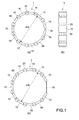
- Fig. 1(a) and Fig. 1(c) each is a side view diagram of an input device 1 according to a first embodiment of the present technology.
- Fig. 1(b) is a plan-view diagram of the input device 1.
- Fig. 1(a) and Fig. 1(b) each shows a status in which the input device 1 is in not use.
- Fig. 1(c) shows a status in which the input device 1 is in use.
- the input device 1 includes input units 10, a control unit 50, a notification unit 60, a power supply unit 70, hinge sections 20, a connection section 30, and wiring sections 40.
- the input device 1 is wearable similar to a wristwatch, and is wearable on a user's arm.
- the input device 1 constitutes a flat plate unit where eight input units 10, one control unit 50, one notification unit 60 and one power supply unit 70 are arranged along an outer periphery of a user's arm. In this manner, the user can carry the input device 1 hands-free.
- the hinge sections 20 constitute support sections for articulating the plate units (the input units 10, the control unit 50, the notification unit 60, the power supply unit 70). Each hinge section 20 supports two adjacent plate units such that an angle therebetween can be changed. Therefore, in the input device 1, the angle between the adjacent plate units can be changed corresponding to the shape of the user's arm, thereby providing a comfortable fitting.
- connection section 30 connects the plate units placed at both ends among a plurality of the plate units concatenated into one by the hinge sections 20. In this way, the input device 1 becomes ring-shaped.
- the plate units, the hinge sections 20 and the connection section 30 constitute a ring-shaped section of the input device 1.
- the connection section 30 is constituted of an elastic rubber material, for example.
- the connection section 30 is not limited to the configuration, and may have any configuration that the plate units placed at both ends can be connected.
- the connection section 30 may be a buckle used in a typical wristwatch.
- An inner diameter ⁇ A of the input device 1 not in use shown in Fig. 1(a) is set to be smaller than an inner diameter of a typical user's arm.
- the user wears the input device 1 on the arm by extending the connection section 30 from the status shown in Fig. 1(a) to the inner diameter through which a user's fist can be inserted.
- the inner diameter ⁇ B of the input device 1 worn by the user's arm shown in Fig. 1(c) is greater than the inner diameter ⁇ A, and the input device 1 is firmly fixed to the user's arm by an elastic force of the connection section 30.
- the wiring sections 40 are provided for electrically connecting adjacent plate units. That is to say, eight input units 10, one control unit 50, one notification unit 60 and one power supply unit 70 are mutually electrically connected by the wiring sections 40.
- the wiring sections 40 are constituted by a flexible print circuit, for example.
- the power supply unit 70 is adjacent to the connection section 30.
- the notification unit 60 is adjacent to the power supply unit 70
- the control unit 50 is adjacent to the notification unit 60. Since the input units 10 are preferably placed at the position where the user easily perform the input operation, the power supply unit 70, the notification unit 60 and the control unit 50 are tried to be placed at the position where the user is difficult to perform the input operation. Note that the input units 10, the control unit 50, the notification unit 60 and the power supply unit 70 are not limited to the configuration, and may constitute any plate units of the input device 1.
- Each input unit 10 can receive the input operation from the user.
- a plurality of the input units 10 may be used individually for different input operations, and may be used integrated.
- Each input unit 10 outputs a detection signal to the control unit 50 based on the user's input operation.
- the power supply unit 70 supplies electricity to the input units 10, the control unit 50 and the notification unit 60.
- the power supply unit 70 includes an power storage element and a power supply circuit, for example.
- Non-limiting examples of the power storage element applicable to the power supply unit 70 includes a lithium ion cell and a lithium polymer cell.
- the power supply unit 70 may include a power generation element such as a solar cell.
- the control unit 50 controls the input units 10, the notification unit 60 and the power supply unit 70.
- the control unit 50 typically includes a computer having CPU/MPU, a memory and the like.
- the control unit 50 includes a communication section for communicating with an electronic apparatus main body and an external device such as other input device 1.
- the electronic apparatus being capable of communicating with the input units 10 includes a smartphone and a portable audio player, and the like.
- the control unit 50 can transmit an operation signal generated based on the detection signal from the input units 10 to the electronic apparatus main body and other input device 1 by the communication section. Also, the control unit 50 receives the signal from the electronic apparatus main body and other input device 1, and can drive the input units 10, the notification unit 60 and the power supply unit 70 based on the signal received.
- the notification unit 60 a variety of parts for notifying the user are mounted. Examples of the parts mounted to the notification unit 60 include a sound-emitting element, a light-emitting element and a vibration element, for example.
- the notification unit 60 notifies a user by sound, light or vibration under the control by the control unit 50.
- the notification unit 60 having the sound-emitting element can notify a user of information based on a sound-emitting status of the sound-emitting element (tone color, sound-emitting time, type of melody, etc.).
- a sound-emitting status of the sound-emitting element tone color, sound-emitting time, type of melody, etc.
- a light-emitting diode is used, for example.
- the notification unit 60 having the light-emitting element can notify a user of information based on a light-emitting status of the light-emitting element (light-emitting intensity, light-emitting time, blink speed, blink pattern, etc.).
- a vibration motor is used, for example.
- the notification unit 60 having the vibration element can notify a user of information based on a vibration status of the vibration element (vibration intensity, vibration time, vibration frequency, etc.).
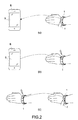
- Fig. 2 is a diagram illustrating a method of using the input device 1.
- the input device 1 can communicate with one electronic apparatus main body B pairing communicated with the input device 1, as shown in Fig. 2(a) and Fig. 2(b) , and can also communicate with the other input device 1 pairing communicated with the input device 1, as shown in Fig. 2(c) .
- Fig. 2 (a) shows a status in which the input device 1 is transmitting to the electronic apparatus main body B an operation signal based on an input operation by a user's finger f to the input device 1.
- the electronic apparatus main body B receives the operation signal from the input device 1, and exerts a variety of functions based on the operation signal received.
- the functions of the electronic apparatus main body B operable by the input device 1 are not especially limited. Examples of the functions of the electronic apparatus main body B include a display change of a screen S, receiving of e-mails, acquisition of positional information, switching speech and non-speech or the like.
- Fig. 2(b) shows a status in which the input device 1 receives the signal transmitting from the electronic apparatus main body B.
- the input device 1 notifies a user corresponding to the signal from the electronic apparatus main body B by the notification unit 60.
- the input device 1 adds vibration by the notification unit 60 when the input device 1 receives the signal showing that an e-mail is received from the electronic apparatus main body B.
- Fig. 2(c) shows that a status in which users wearing the input device 1 communicates with each other.
- the input device 1 on which one user performs the input operation transmits the operation signal
- the other input device 1 of the other user receives the operation signal and performs a notification based on the operation signal received.
- the input device 1 can make the communication between the users by utilizing light, sound, vibration or the like.
- the input device 1 includes a function that requires no communication with the external device such as the above-described electronic apparatus main body B and the other input device 1. For example, a user can see a cell's residual power of the power supply unit 70 by performing the input operation on the input device 1. In this case, when the cell's residual power of the input device 1 is small, melody is generated by the notification unit 60. In this way, the user can charge the input device 1 before the cell's residual power is short.
- Fig. 3 and Fig. 4 show an input unit 10.
- Fig. 3 is a plan-view diagram
- Fig. 4 is a cross sectional-view diagrams along an A-A' line in Fig. 3 .
- the input unit 10 has a substantially square plate shape.
- the input unit 10 has a concave case 11 and a sensor section 12 housed within the case 11.
- the case 11 forms a concave portion by a square plate bottom 11a and a side wall 11b provided along an outer periphery of the bottom 11a.
- the case 11 is formed of a resin material having rigidity and an insulation property.
- the sensor 12 has a sensor substrate 13, an intermediate layer 16, a conductive layer 17, and an outer layer 18.
- the outer layer 18 defines an external form of the input unit 10 together with the case 11.
- An outer surface (top surface) of the outer layer 18 constitutes a detection surface 18a that receives the input operation from the user.
- the sensor substrate 13 has a plurality of first electrode wires 14 and a plurality of second electrode wires 15 placed facing to a plurality of the first electrode wires 14 and intersecting with a plurality of the first electrode wires 14.
- the electrode wires 14, 15 constitute capacitative elements on the intersecting points. Accordingly, the sensor substrate 13 has a configuration that the capacitative elements are arranged in a matrix. An electrostatic capacity in each capacitative element of the substrate 13 changes depending on a distance between the sensor substrate 13 and the conductive layer 17.
- the outer layer 18 is formed of a resin material having flexibility.
- the conductive layer 17 is formed at an inner surface (lower surface) of the outer layer 18.
- the intermediate layer 16 is placed between the conductive layer 17 and the sensor substrate 13.
- the intermediate layer 16 is constructed of a plurality of columnar structures 16a sandwiched between the conductive layer 17 and the sensor substrate 13.
- the structures 16a are formed of a resin material having flexibility, for example.
- the conductive layer 17 is grounded and has a reference potential.
- the input unit 10 outputs a detection signal corresponding to the electrostatic capacity of the sensor substrate 13 to the control unit 50 (see Fig. 1 ).
- the control unit 50 determines a pressing position on the detection surface 18a and a pressing amount in the pressing position based on the detection signal from the input unit 10. In this way, the control unit 50 can calculate an operation position on the detection surface 18a, a pressing force to the detection surface 18a, a rolling reduction speed of the detection surface 18a, a moving distance of the finger f, a moving speed of the finger f and the like.
- the control unit 50 recognizes the input operation performed on the detection surface 18a based on the calculation results, and generates the operation signal that is associated with the input operation.
- the detection signal is generated when the detection surface 18a is pressed, but the detection signal is not generated when the user touches the detection surface 18a by mistake with no intention to perform the input operation. Accordingly, the input unit 10 prevents the user from doing erroneous operation.
- the detection signal is generated by the deformation of the conductive layer 17 accompanied by pressing the detection surface 18a. Accordingly, the input operation of the detection surface 18a can be performed not by a conductive manipulator such as the user's finger f and a stylus but by a user's hand, for example, wearing a glove. In addition, in the input unit 10, even when water droplets are attached to the detection surface 18a, the detection signal is less influenced. Furthermore, the input operation can be performed under water.
- the conductive layer 17 is not essential. Also, although the input unit 10 is constituted to form a sensor in a mutual capacitance method, the input unit 10 may be constituted to form a sensor in a self-capacitance method.
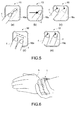
- Figs. 5 to 7 each is a diagram showing an operation example of the input device 1.
- Fig. 5(a) shows an input operation in which the detection surface 18a of the input unit 10 is pressed by the user's finger f to move the finger f on the detection surface 18a.
- the input operation for example, depending on the moving distance and the moving speed of the finger f, a pointer within the screen S of the electronic apparatus main body B (see Fig. 2 (a) and Fig. 2(b) ) can be moved.
- Fig. 5(b) shows an input operation in which the detection surface 18a of the input unit 10 is pressed by the user's finger f to move the finger f in one direction.
- the input operation for example, when the moving speed of the finger f exceeds a predetermined threshold value, the screen S in the display device of the electronic apparatus main body B can be moved to the moving direction of the finger f.
- Fig. 5(c) shows an input operation in which two positions on the detection surface 18a of the input unit 10 are pressed successively by the user's finger f.
- the input operation for example, depending on the distance between the two positions and the pressing force, a specific area within the screen S of the electronic apparatus main body B can be selected.
- Fig. 5(d) shows an input operation in which the detection surface 18a of the input unit 10 is pressed by two user's fingers f to change a distance between the two fingers f.
- the input operation for example, depending on the distance between the two fingers f and a change speed of the distance, the screen S of the electronic apparatus main body B can be zoomed in or zoomed out.
- Fig. 5(e) shows an input operation in which the detection surface 18a of the input unit 10 is pressed by the user's two fingers f.
- the input operation for example, depending on a deviation of a pressing timing and a difference in pressing forces by the two fingers f, the display in the screen S of the electronic apparatus main body B can be changed.
- control unit 50 not only generates individual operation signals for the respective input units 10, but also generates operation signals corresponding to multiple input operations to a plurality of the input units 10.
- the multiple input operations include an input operation by an order of pressing a plurality of the input units 10, for example.
- the input device 1 can be constituted such that the user can perform the input operation on successive detection surfaces 18a of a plurality of adjacent input units 10.
- Fig. 6 shows an input operation in which the user holds the input device 1 worn on one hand by an opposite hand.
- the control unit 50 can recognize the input operation when three or more input units 10 are pressed at the same time.
- a clock within the screen S of the electronic apparatus main body B can be enlarged and displayed.
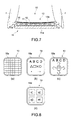
- Fig. 7 shows an input operation in which the user picks the case 11 of the input unit 10 with one's fingers. More specifically, both ends of the detection surface 18a of the sensor section 12 are pressed (squeezed) via the side wall 11b of the case 11. At this time, the detection surface 18a is squeezed and pressed in its own plane direction, thereby flexing the detection surface 18a. This causes a characteristic change in the electrostatic capacity of the sensor substrate 13.
- the control unit 50 can recognize the input operation by the characteristic change in the electrostatic capacity. By the input operation, a display mode of the screen S of the electronic apparatus main body B can be switched.
- Fig. 8 and Fig. 9 illustrate the detection surface 18a.
- the detection surface 18a has an input guide section for easily finding the position on the detection surface 18a.
- Fig. 8(a) to Fig. 8(d) and Fig. 9(a) each is a plan-view diagram of the input unit 10
- Fig. 9(b) is a side view diagram of the input unit 10.
- Images are drawn in the detection surfaces 18a shown in Fig. 8 .
- the images in the detection surface 18a are correlated with the positions in the detection surface 18a.
- the input device 1 is constituted such that when the images in the detection surface 18a are pressed, the control unit 50 generates the operation signal relating to the images.
- the input unit 10 may be constituted such that the outer layer 18 is a display section that displays the images on the detection surface 18a under the control unit 50.
- the input device 1 may change the images displayed on the detection surface 18a of each input unit 10 as appropriate.
- the images displayed on the detection surface 18a are correlated with the positions on the detection surface 18a.
- Such an input device 1 is constituted such that when the images displayed on the detection surface 18a are pressed, the control unit 50 generates an operation signal relating to the images.
- a grid is displayed on the detection surface 18a.
- the user will be able to press a more precise position on the detection surface 18a by means of the grid on the detection surface 18a
- other images may be displayed in addition to the grid.
- Fig. 8(b) characters, symbols and arrows are displayed on the detection surface 18a.
- the control unit 50 generates the operation signal correlated with the characters, the symbols and the arrows pressed based on the input operation.
- FIG. 8(c) an image of a jog dial and images of arrow keys are displayed on the detection surface 18a in addition to the characters.
- the screen S of the electronic apparatus main body B (see Fig. 2(a) and Fig. 2(b) ) can be scrolled, for example.
- a pointer within the screen S of the electronic apparatus main body B can be moved corresponding to the arrow keys.
- Fig. 8(d) four areas a1, a2, a3, a4 classified by colors are provided on the detection surface 18a.
- the user can more intuitively recognize the position on the detection surface 18a. In this way, the user will be able to press a more precise position of the detection surface 18a.
- Protrusions 18b each having a convex-concave shape are provided on the detection surface 18a shown in Fig. 9 .
- the user can recognize the protrusions 18b by touching. Accordingly, the user can press a precise position within the detection surface 18a without seeing the detection surface 18a.
- An input device 101 according to a second embodiment of the present technology is different from the input device 1 according to the first embodiment only as to the configuration of the input unit 110. Descriptions about the configurations of the input device 101 common to those according to the first embodiment will be omitted as appropriate.
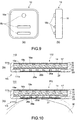
- Fig. 10 is cross sectional-view diagrams of the input unit 110 of the input device 101
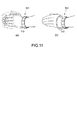
- Fig. 11 is diagrams illustrating a method of operating the input device 101.
- the input unit 110 includes an intermediate layer 26, a conductive layer 27, and an outer layer 28 provided on the sensor substrate 13 opposite to the intermediate layer 16, the conductive layer 17 and the outer layer 18.
- the intermediate layer 26 is constituted by a plurality of columnar structures 26a sandwiched between the conductive layer 27 and the sensor substrate 13.
- An opening is formed at a central are of a bottom 111a of the case 111, and the outer layer 28 is exposed from the opening.
- An outer surface (lower surface) of the outer layer 28 is constituted as a detection surface 28a on which the user presses. That is to say, the input device 101 includes the detection surface 18a arranged along an outer peripheral surface and a detection surface 28a arranged along an inner peripheral surface. Note that the input device 101 may be constituted such that the detection surface 18a at an outer peripheral surface side is omitted.
- the control unit 50 when the detection surface 18a accepts an input operation and the conductive layer 17 becomes closer to the sensor substrate 13, the electrostatic capacity of sensor substrate 13 changes. Furthermore, in the input unit 110, when the detection surface 28a is pressed and the conductive layer 27 becomes closer to the sensor substrate 13, the electrostatic capacity of sensor substrate 13 changes. In the input unit 110, the control unit 50 generates the operation signal based on the input operation of the detection surface 18a, and generates the operation signal based on the pressing to the detection surface 28b.
- the detection surface 28a of the input unit 110 is positioned at an inner periphery of the input device 101 and is therefore contacted with a user's arm wearing the input device 101. Accordingly, as shown in Fig. 10(b) , a pressing status of the detection surface 28a in each input unit 110 changes depending on an action of the user's arm. This changes the electrostatic capacity of the sensor substrate 13, whereby the control unit 50 can recognize the action of the user's arm as the input operation.
- Fig. 11(a) shows the input operation in which the user shakes the wrist
- Fig. 11(b) shows the input operation in which the user rotates the wrist.
- the outer layer 18 of the input unit 110 may be constituted as the display section that can display images or videos on the detection surface 18a.
- the display section is driven by the control signal generated by the control unit 50.
- the display section can display an image showing that an e-mail is received from the electronic apparatus main body B or a latest news video, for example.
- the display section is constituted by known displays such as a crystal liquid display and an organic EL (Electro-Luminescence) display.
- the control unit 50 can drive the display section independently for each input unit 110, and can drive the display section by taking all detection surfaces 18a of all input units 110 as one display section.
- the control unit 50 can display character images for each detection surface 18a of each input unit 110, and can display a long and narrow image and a character string image for all detection surfaces 18a of all input units 110.
- a certain pressing status by the user's arm is generated on each detection surface 28a at an inner peripheral surface side.
- the control unit 50 detects the certain pressing status on each detection surface 28a and recognizes that the input device 101 is worn by the user's arm, the operation signal can be generated.
- the control unit 50 can drive the display section, for example, by the operation signal.
- control unit 50 can recognize an attitude of the input device 101 for the arm based on the pressing status for each detection surface 28a. Specifically, the control unit 50 can recognize the rotation of the input device 101 to the user's arm in a circumferential direction. In this way, the control unit 50 can change the image displayed by each input unit 110 depending on the attitude of the input device 101. For example, the control unit 50 can continue to display a clock image on the display section of the input unit 110 nearest the predetermined position of the arm when the input device 101 rotates around the arm in the circumferential direction.
- An input device 201 according to a third embodiment of the present technology is different from the input device 1 according to the first embodiment only as to the configuration described below. Descriptions about the configurations of the input device 201 common to those according to the first embodiment will be omitted as appropriate.
- Fig. 12(a) and Fig. 12(c) each is a side view diagram of the input device 201 according to the third embodiment of the present technology
- Fig. 12(b) is a plan-view diagram of the input device 201
- Fig. 12(a) and Fig. 12(b) each shows a status in which the input device 201 is in not use
- Fig. 12(c) shows a status in which the input device 201 is in use.
- the input device 201 includes input units 210, a control unit 250, a notification unit 260, a power supply unit 270, linkage sections 220, a connection section 230, and wiring sections 240.
- the linkage sections 220 constitutes support sections that concatenate plate units (the input units 210, the control unit 250, the notification unit 260, the power supply unit 270). Each linkage section 220 is provided as a sheet by the material having flexibility similar to the connection section 230, and supports adjacent two plate units. Each of the linkage section 220 and the connection section may be provided independently, or all of the linkage sections 220 and the connection section 230 may be integrated and concatenated in ring shape. Also, the linkage sections 220 and the wiring sections 240 may be integrated and constituted by a flexible print circuit.
- An inner diameter ⁇ A of the input device 201 not in use shown in Fig. 12(a) is set to be smaller than an inner diameter of a typical user's arm.
- the user wears the input device 201 on the arm by extending the connection section 230 from the status shown in Fig. 12(a) to the inner diameter through which a user's fist can be inserted.
- the inner diameter ⁇ B of the input device 201 worn by the user's arm shown in Fig. 12(c) is greater than the inner diameter ⁇ A, and the input device 201 is firmly fixed to the user's arm by elastic forces of the connection section 230 and the linkage section 220.
- the input device 201 can be worn by the user's arm including no mechanical structure such as a hinge section. Accordingly, in the input device 201, parts costs and manufacturing costs are reduced.
- An input device 301 according to a fourth embodiment of the present technology is different from the input device 1 according to the first embodiment only as to the configuration described below. Descriptions about the configurations of the input device 301 common to those according to the first embodiment will be omitted as appropriate.
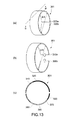
- Fig. 13(a) and Fig. 13(b) each is a perspective diagram of the input device 301 according to the fourth embodiment of the present technology.
- Fig. 13(c) is a cross sectional-view diagram of the input unit 301 along a B-B' line in Fig. 13(a).
- Fig. 13(a) and Fig. 13(c) each shows a status in which the input device 301 is in not use.
- Fig. 13(b) shows a status in which the input device 301 is in use.
- the input device 301 includes an input unit 310, a control unit 350, a notification unit 360, a power supply unit 370 and a frame section 320.
- the input unit 310, the control unit 350, the notification unit 360, the power supply unit 370 and the frame section 320 are integrated in a C shape with an elastically deformable material such as polycarbonate and acrylic.
- the frame section 320 constitutes a support section that supports the input unit 310, the control unit 350, the notification unit 360 and the power supply unit 370.
- the frame section 320 has ends 320a, 320b spaced each other.
- the input unit 310 is formed in a uniform thickness of about several mm in the whole circumference.
- the input unit 310, the control unit 350, the notification unit 360 and the power supply unit 370 are formed in an arc shape as shown in Fig. 13(c) and are electrically connected to each other.
- the input device 301 may be constituted by a plurality of input units 310.
- the plurality of the input units 310 may be placed side-by-side, or may be placed spaced apart.
- the detection surface of each input unit 310 is placed at least either of an outer peripheral surface and an inner peripheral surface of the input device 301.
- An inner diameter ⁇ A of the input device 301 not in use shown in Fig. 13(a) is set to be smaller than an inner diameter of a typical user's arm.
- the user wears the input device 301 on the arm by extending the ends 320a, 320b of the frame section 320 from the status shown in Fig. 12(a) to the inner diameter through which a user's fist can be inserted.
- the inner diameter ⁇ B of the input device 301 worn by the user's arm shown in Fig. 13(b) is greater than the inner diameter ⁇ A, and the input device 301 is firmly fixed to the user's arm by elastic forces of the input unit 310, the control unit 350, the notification unit 360, the power supply unit 370 and the frame section 320.
- the configuration of the input unit is not limited to have the sensor substrate including a plurality of capacitative elements and the intermediate layer placed between the detection surface and the sensor substrate, and may be that the detection signal may be output corresponding to the pressing position and the pressing amount on the detection surface.
- the input unit may have a configuration that a touch sensor, a pressure-sensitive sensor and a mechanical switch may be combined.
- the input device may be wearable on a part of a user's body other than the user's arm.
- the input device may be wearable on a user's finger, ankle or head.
- the present technology may have the following configurations.
Landscapes
- Engineering & Computer Science (AREA)
- Theoretical Computer Science (AREA)
- General Engineering & Computer Science (AREA)
- Physics & Mathematics (AREA)
- General Physics & Mathematics (AREA)
- Human Computer Interaction (AREA)
- Computer Networks & Wireless Communication (AREA)
- Computer Hardware Design (AREA)
- Health & Medical Sciences (AREA)
- Audiology, Speech & Language Pathology (AREA)
- General Health & Medical Sciences (AREA)
- User Interface Of Digital Computer (AREA)
- Position Input By Displaying (AREA)
Applications Claiming Priority (2)
| Application Number | Priority Date | Filing Date | Title |
|---|---|---|---|
| JP2013215507A JP2015079328A (ja) | 2013-10-16 | 2013-10-16 | 入力装置及びこれを備えた電子機器 |
| PCT/JP2014/004031 WO2015056376A1 (fr) | 2013-10-16 | 2014-07-31 | Appareil d'entrée et dispositif électronique pourvu de ce dernier |
Publications (3)
| Publication Number | Publication Date |
|---|---|
| EP3059657A1 true EP3059657A1 (fr) | 2016-08-24 |
| EP3059657A4 EP3059657A4 (fr) | 2017-05-10 |
| EP3059657B1 EP3059657B1 (fr) | 2019-01-30 |
Family
ID=52827841
Family Applications (1)
| Application Number | Title | Priority Date | Filing Date |
|---|---|---|---|
| EP14853751.7A Not-in-force EP3059657B1 (fr) | 2013-10-16 | 2014-07-31 | Appareil d'entrée et dispositif électronique pourvu de ce dernier |
Country Status (4)
| Country | Link |
|---|---|
| US (1) | US10540034B2 (fr) |
| EP (1) | EP3059657B1 (fr) |
| JP (1) | JP2015079328A (fr) |
| WO (1) | WO2015056376A1 (fr) |
Families Citing this family (8)
| Publication number | Priority date | Publication date | Assignee | Title |
|---|---|---|---|---|
| CN107111281B (zh) * | 2014-11-18 | 2020-12-11 | 索尼公司 | 可穿戴装置 |
| US10185363B2 (en) | 2014-11-28 | 2019-01-22 | Semiconductor Energy Laboratory Co., Ltd. | Electronic device |
| US11536619B2 (en) * | 2016-09-13 | 2022-12-27 | Sony Corporation | Sensor, band, electronic device, and wristwatch-type electronic device |
| WO2018061937A1 (fr) * | 2016-09-28 | 2018-04-05 | ソニー株式会社 | Dispositif de détection et dispositif électronique |
| US11000760B2 (en) | 2017-01-11 | 2021-05-11 | Sony Interactive Entertainment Inc. | Controller |
| CN106909228B (zh) * | 2017-05-08 | 2020-06-26 | 电子科技大学 | 一种利用头部扭动感应的定位输入装置 |
| WO2019230634A1 (fr) * | 2018-05-29 | 2019-12-05 | 信越ポリマー株式会社 | Capteur tactile sensible à la pression et module de capteur tactile sensible à la pression |
| US20250009085A1 (en) * | 2023-07-07 | 2025-01-09 | Oura Health Oy | C-ring form factor for wearable ring device with adjustable size |
Family Cites Families (35)
| Publication number | Priority date | Publication date | Assignee | Title |
|---|---|---|---|---|
| US5305181A (en) * | 1989-05-15 | 1994-04-19 | Norand Corporation | Arm or wrist mounted terminal with a flexible housing |
| US6211860B1 (en) | 1994-07-06 | 2001-04-03 | Hewlett-Packard Company | Pressure sensitive electronic device |
| JP4189709B2 (ja) | 1999-05-13 | 2008-12-03 | ソニー株式会社 | モーションキャプチャー装置 |
| DE60040268D1 (de) * | 1999-11-11 | 2008-10-30 | Swatch Group Man Serv Ag | Elektronische armbanduhr mit einer, in einem biegsamen armband, eingebauten leiterplatte |
| GB0004688D0 (en) * | 2000-02-28 | 2000-04-19 | Radley Smith Philip J | Bracelet |
| JP2002050997A (ja) * | 2000-07-31 | 2002-02-15 | Seiko Instruments Inc | 腕携帯情報装置 |
| US7453936B2 (en) * | 2001-11-09 | 2008-11-18 | Sony Corporation | Transmitting apparatus and method, receiving apparatus and method, program and recording medium, and transmitting/receiving system |
| JP2003337541A (ja) | 2002-05-17 | 2003-11-28 | Toshiba Matsushita Display Technology Co Ltd | 着用型表示装置 |
| GB2411337B (en) | 2004-02-27 | 2006-12-06 | Simon Richard Daniel | Modular interface strap for multi-unit wristband and necklace assemblies |
| WO2006046526A1 (fr) | 2004-10-26 | 2006-05-04 | National University Corporation The University Of Electro-Communications | Dispositif d’entree |
| KR100891774B1 (ko) * | 2007-09-03 | 2009-04-07 | 삼성전자주식회사 | 인터페이스 기능을 향상시키기 위한 이동통신 단말기 및방법 |
| JP2008010008A (ja) | 2007-08-09 | 2008-01-17 | Sony Corp | 表示装置および表示方法、並びにプログラムおよび記録媒体 |
| US20100214243A1 (en) * | 2008-07-15 | 2010-08-26 | Immersion Corporation | Systems and Methods For Interpreting Physical Interactions With A Graphical User Interface |
| KR101546774B1 (ko) * | 2008-07-29 | 2015-08-24 | 엘지전자 주식회사 | 휴대 단말기 및 그 동작제어 방법 |
| US8098141B2 (en) * | 2009-02-27 | 2012-01-17 | Nokia Corporation | Touch sensitive wearable band apparatus and method |
| JP5100738B2 (ja) | 2009-04-22 | 2012-12-19 | 株式会社ジャパンディスプレイイースト | 入力装置、およびそれを備えた表示装置 |
| JP5413235B2 (ja) | 2010-02-19 | 2014-02-12 | ソニー株式会社 | センサ装置及び情報処理装置 |
| JP5606242B2 (ja) * | 2010-09-24 | 2014-10-15 | 株式会社ジャパンディスプレイ | 表示装置 |
| US20120203076A1 (en) * | 2011-02-08 | 2012-08-09 | Jean Pierre Fatta | Portable Physiological Data Monitoring Device |
| US8641306B2 (en) | 2011-08-16 | 2014-02-04 | Argotext | Wristwatch keyboard |
| US8467270B2 (en) | 2011-10-26 | 2013-06-18 | Google Inc. | Smart-watch with user interface features |
| KR20130069066A (ko) * | 2011-12-16 | 2013-06-26 | 삼성전자주식회사 | 디스플레이 장치 및 그 디스플레이 방법 |
| US8947382B2 (en) * | 2012-02-28 | 2015-02-03 | Motorola Mobility Llc | Wearable display device, corresponding systems, and method for presenting output on the same |
| US20130271355A1 (en) * | 2012-04-13 | 2013-10-17 | Nokia Corporation | Multi-segment wearable accessory |
| US9395583B2 (en) * | 2012-06-06 | 2016-07-19 | Apple Inc. | Column spacer design for a display incorporating a third metal layer |
| US9081542B2 (en) * | 2012-08-28 | 2015-07-14 | Google Technology Holdings LLC | Systems and methods for a wearable touch-sensitive device |
| US9392851B2 (en) * | 2012-10-30 | 2016-07-19 | Bin Wai Lam | Methods, systems, and apparatuses for incorporating wireless headsets, terminals, and communication devices into fashion accessories and jewelry |
| US10528135B2 (en) * | 2013-01-14 | 2020-01-07 | Ctrl-Labs Corporation | Wearable muscle interface systems, devices and methods that interact with content displayed on an electronic display |
| US10152082B2 (en) * | 2013-05-13 | 2018-12-11 | North Inc. | Systems, articles and methods for wearable electronic devices that accommodate different user forms |
| US20150138699A1 (en) * | 2013-11-15 | 2015-05-21 | Semiconductor Energy Laboratory Co., Ltd. | Electronic device |
| US20150177891A1 (en) * | 2013-12-19 | 2015-06-25 | Nokia Corporation | Wearable apparatus skin input |
| KR20160103072A (ko) * | 2013-12-24 | 2016-08-31 | 폴리에라 코퍼레이션 | 가요성 전자 부품용 지지 구조체 |
| US9317155B2 (en) * | 2013-12-27 | 2016-04-19 | Intel Corporation | Ruggedized wearable electronic device for wireless communication |
| TWD165563S (zh) * | 2014-04-08 | 2015-01-21 | 緯創資通股份有限公司 | 穿戴式電子裝置之部分 |
| US9454180B2 (en) * | 2014-07-22 | 2016-09-27 | International Business Machines Corporation | Wearable flexible interface with interlocking modules |
-
2013
- 2013-10-16 JP JP2013215507A patent/JP2015079328A/ja active Pending
-
2014
- 2014-07-31 EP EP14853751.7A patent/EP3059657B1/fr not_active Not-in-force
- 2014-07-31 WO PCT/JP2014/004031 patent/WO2015056376A1/fr not_active Ceased
- 2014-07-31 US US15/026,831 patent/US10540034B2/en active Active
Also Published As
| Publication number | Publication date |
|---|---|
| US20160239135A1 (en) | 2016-08-18 |
| JP2015079328A (ja) | 2015-04-23 |
| US10540034B2 (en) | 2020-01-21 |
| EP3059657A4 (fr) | 2017-05-10 |
| WO2015056376A1 (fr) | 2015-04-23 |
| EP3059657B1 (fr) | 2019-01-30 |
Similar Documents
| Publication | Publication Date | Title |
|---|---|---|
| US10540034B2 (en) | Input device having optimum portability and electronic apparatus including the same | |
| US11150734B2 (en) | Haptic structure for providing localized haptic output | |
| CN205910637U (zh) | 电子设备及剪切力传感器 | |
| CN114741007B (zh) | 具有力传感器的输入设备 | |
| EP2975497B1 (fr) | Dispositif terminal, procédé de commande de dispositif terminal, et programme | |
| US20190073077A1 (en) | Portable terminal including touch pressure detector on side thereof | |
| KR102471819B1 (ko) | 압전 소자를 이용하여, 압력 감지 및 초음파 신호를 송수신하는 센서 모듈을 포함하는 전자 장치 | |
| US20190131812A1 (en) | Portable electronic device | |
| US20130191741A1 (en) | Methods and Apparatus for Providing Feedback from an Electronic Device | |
| CN101907926B (zh) | 输入辅助设备和电子设备 | |
| CN106557218A (zh) | 用于电子设备的输入机构的接近检测 | |
| CN110472399B (zh) | 电子设备及其控制方法 | |
| JP6249108B2 (ja) | 操作入力装置 | |
| CN112578902A (zh) | 用于控制电子设备的手指可穿戴输入组件 | |
| CN103631369A (zh) | 电子设备以及控制方法 | |
| KR20160088491A (ko) | 가변 디스플레이 장치 | |
| KR20160096902A (ko) | 밴드형 센서 및 이를 포함하는 웨어러블 디바이스 | |
| CN110456940B (zh) | 电子设备及其控制方法 | |
| CN102004599A (zh) | 具有输入装置的电子设备 | |
| KR20160097117A (ko) | 웨어러블 디바이스 | |
| CN110286805B (zh) | 电子设备及其控制方法 | |
| KR101376194B1 (ko) | 시촉각 정보 제공 장치 및 방법 | |
| JP6950700B2 (ja) | センシング装置および電子機器 | |
| CN110300226B (zh) | 电子设备及其手电筒的控制方法 | |
| US9958908B2 (en) | Miniaturized touch keyboard structure |
Legal Events
| Date | Code | Title | Description |
|---|---|---|---|
| PUAI | Public reference made under article 153(3) epc to a published international application that has entered the european phase |
Free format text: ORIGINAL CODE: 0009012 |
|
| 17P | Request for examination filed |
Effective date: 20160406 |
|
| AK | Designated contracting states |
Kind code of ref document: A1 Designated state(s): AL AT BE BG CH CY CZ DE DK EE ES FI FR GB GR HR HU IE IS IT LI LT LU LV MC MK MT NL NO PL PT RO RS SE SI SK SM TR |
|
| AX | Request for extension of the european patent |
Extension state: BA ME |
|
| DAX | Request for extension of the european patent (deleted) | ||
| A4 | Supplementary search report drawn up and despatched |
Effective date: 20170412 |
|
| RIC1 | Information provided on ipc code assigned before grant |
Ipc: G06F 3/041 20060101ALI20170406BHEP Ipc: G06F 3/01 20060101AFI20170406BHEP |
|
| GRAP | Despatch of communication of intention to grant a patent |
Free format text: ORIGINAL CODE: EPIDOSNIGR1 |
|
| STAA | Information on the status of an ep patent application or granted ep patent |
Free format text: STATUS: GRANT OF PATENT IS INTENDED |
|
| INTG | Intention to grant announced |
Effective date: 20180907 |
|
| GRAS | Grant fee paid |
Free format text: ORIGINAL CODE: EPIDOSNIGR3 |
|
| GRAA | (expected) grant |
Free format text: ORIGINAL CODE: 0009210 |
|
| STAA | Information on the status of an ep patent application or granted ep patent |
Free format text: STATUS: THE PATENT HAS BEEN GRANTED |
|
| AK | Designated contracting states |
Kind code of ref document: B1 Designated state(s): AL AT BE BG CH CY CZ DE DK EE ES FI FR GB GR HR HU IE IS IT LI LT LU LV MC MK MT NL NO PL PT RO RS SE SI SK SM TR |
|
| REG | Reference to a national code |
Ref country code: GB Ref legal event code: FG4D |
|
| REG | Reference to a national code |
Ref country code: CH Ref legal event code: EP |
|
| REG | Reference to a national code |
Ref country code: AT Ref legal event code: REF Ref document number: 1093775 Country of ref document: AT Kind code of ref document: T Effective date: 20190215 |
|
| REG | Reference to a national code |
Ref country code: IE Ref legal event code: FG4D |
|
| REG | Reference to a national code |
Ref country code: DE Ref legal event code: R096 Ref document number: 602014040563 Country of ref document: DE |
|
| REG | Reference to a national code |
Ref country code: LT Ref legal event code: MG4D |
|
| REG | Reference to a national code |
Ref country code: NL Ref legal event code: MP Effective date: 20190130 |
|
| PG25 | Lapsed in a contracting state [announced via postgrant information from national office to epo] |
Ref country code: FI Free format text: LAPSE BECAUSE OF FAILURE TO SUBMIT A TRANSLATION OF THE DESCRIPTION OR TO PAY THE FEE WITHIN THE PRESCRIBED TIME-LIMIT Effective date: 20190130 Ref country code: NO Free format text: LAPSE BECAUSE OF FAILURE TO SUBMIT A TRANSLATION OF THE DESCRIPTION OR TO PAY THE FEE WITHIN THE PRESCRIBED TIME-LIMIT Effective date: 20190430 Ref country code: LT Free format text: LAPSE BECAUSE OF FAILURE TO SUBMIT A TRANSLATION OF THE DESCRIPTION OR TO PAY THE FEE WITHIN THE PRESCRIBED TIME-LIMIT Effective date: 20190130 Ref country code: NL Free format text: LAPSE BECAUSE OF FAILURE TO SUBMIT A TRANSLATION OF THE DESCRIPTION OR TO PAY THE FEE WITHIN THE PRESCRIBED TIME-LIMIT Effective date: 20190130 Ref country code: PT Free format text: LAPSE BECAUSE OF FAILURE TO SUBMIT A TRANSLATION OF THE DESCRIPTION OR TO PAY THE FEE WITHIN THE PRESCRIBED TIME-LIMIT Effective date: 20190530 Ref country code: ES Free format text: LAPSE BECAUSE OF FAILURE TO SUBMIT A TRANSLATION OF THE DESCRIPTION OR TO PAY THE FEE WITHIN THE PRESCRIBED TIME-LIMIT Effective date: 20190130 Ref country code: PL Free format text: LAPSE BECAUSE OF FAILURE TO SUBMIT A TRANSLATION OF THE DESCRIPTION OR TO PAY THE FEE WITHIN THE PRESCRIBED TIME-LIMIT Effective date: 20190130 Ref country code: SE Free format text: LAPSE BECAUSE OF FAILURE TO SUBMIT A TRANSLATION OF THE DESCRIPTION OR TO PAY THE FEE WITHIN THE PRESCRIBED TIME-LIMIT Effective date: 20190130 |
|
| REG | Reference to a national code |
Ref country code: AT Ref legal event code: MK05 Ref document number: 1093775 Country of ref document: AT Kind code of ref document: T Effective date: 20190130 |
|
| PG25 | Lapsed in a contracting state [announced via postgrant information from national office to epo] |
Ref country code: GR Free format text: LAPSE BECAUSE OF FAILURE TO SUBMIT A TRANSLATION OF THE DESCRIPTION OR TO PAY THE FEE WITHIN THE PRESCRIBED TIME-LIMIT Effective date: 20190501 Ref country code: RS Free format text: LAPSE BECAUSE OF FAILURE TO SUBMIT A TRANSLATION OF THE DESCRIPTION OR TO PAY THE FEE WITHIN THE PRESCRIBED TIME-LIMIT Effective date: 20190130 Ref country code: HR Free format text: LAPSE BECAUSE OF FAILURE TO SUBMIT A TRANSLATION OF THE DESCRIPTION OR TO PAY THE FEE WITHIN THE PRESCRIBED TIME-LIMIT Effective date: 20190130 Ref country code: IS Free format text: LAPSE BECAUSE OF FAILURE TO SUBMIT A TRANSLATION OF THE DESCRIPTION OR TO PAY THE FEE WITHIN THE PRESCRIBED TIME-LIMIT Effective date: 20190530 Ref country code: LV Free format text: LAPSE BECAUSE OF FAILURE TO SUBMIT A TRANSLATION OF THE DESCRIPTION OR TO PAY THE FEE WITHIN THE PRESCRIBED TIME-LIMIT Effective date: 20190130 Ref country code: BG Free format text: LAPSE BECAUSE OF FAILURE TO SUBMIT A TRANSLATION OF THE DESCRIPTION OR TO PAY THE FEE WITHIN THE PRESCRIBED TIME-LIMIT Effective date: 20190430 |
|
| PG25 | Lapsed in a contracting state [announced via postgrant information from national office to epo] |
Ref country code: DK Free format text: LAPSE BECAUSE OF FAILURE TO SUBMIT A TRANSLATION OF THE DESCRIPTION OR TO PAY THE FEE WITHIN THE PRESCRIBED TIME-LIMIT Effective date: 20190130 Ref country code: EE Free format text: LAPSE BECAUSE OF FAILURE TO SUBMIT A TRANSLATION OF THE DESCRIPTION OR TO PAY THE FEE WITHIN THE PRESCRIBED TIME-LIMIT Effective date: 20190130 Ref country code: RO Free format text: LAPSE BECAUSE OF FAILURE TO SUBMIT A TRANSLATION OF THE DESCRIPTION OR TO PAY THE FEE WITHIN THE PRESCRIBED TIME-LIMIT Effective date: 20190130 Ref country code: CZ Free format text: LAPSE BECAUSE OF FAILURE TO SUBMIT A TRANSLATION OF THE DESCRIPTION OR TO PAY THE FEE WITHIN THE PRESCRIBED TIME-LIMIT Effective date: 20190130 Ref country code: IT Free format text: LAPSE BECAUSE OF FAILURE TO SUBMIT A TRANSLATION OF THE DESCRIPTION OR TO PAY THE FEE WITHIN THE PRESCRIBED TIME-LIMIT Effective date: 20190130 Ref country code: SK Free format text: LAPSE BECAUSE OF FAILURE TO SUBMIT A TRANSLATION OF THE DESCRIPTION OR TO PAY THE FEE WITHIN THE PRESCRIBED TIME-LIMIT Effective date: 20190130 Ref country code: AL Free format text: LAPSE BECAUSE OF FAILURE TO SUBMIT A TRANSLATION OF THE DESCRIPTION OR TO PAY THE FEE WITHIN THE PRESCRIBED TIME-LIMIT Effective date: 20190130 |
|
| REG | Reference to a national code |
Ref country code: DE Ref legal event code: R097 Ref document number: 602014040563 Country of ref document: DE |
|
| PG25 | Lapsed in a contracting state [announced via postgrant information from national office to epo] |
Ref country code: SM Free format text: LAPSE BECAUSE OF FAILURE TO SUBMIT A TRANSLATION OF THE DESCRIPTION OR TO PAY THE FEE WITHIN THE PRESCRIBED TIME-LIMIT Effective date: 20190130 |
|
| PLBE | No opposition filed within time limit |
Free format text: ORIGINAL CODE: 0009261 |
|
| STAA | Information on the status of an ep patent application or granted ep patent |
Free format text: STATUS: NO OPPOSITION FILED WITHIN TIME LIMIT |
|
| PG25 | Lapsed in a contracting state [announced via postgrant information from national office to epo] |
Ref country code: AT Free format text: LAPSE BECAUSE OF FAILURE TO SUBMIT A TRANSLATION OF THE DESCRIPTION OR TO PAY THE FEE WITHIN THE PRESCRIBED TIME-LIMIT Effective date: 20190130 |
|
| 26N | No opposition filed |
Effective date: 20191031 |
|
| PG25 | Lapsed in a contracting state [announced via postgrant information from national office to epo] |
Ref country code: SI Free format text: LAPSE BECAUSE OF FAILURE TO SUBMIT A TRANSLATION OF THE DESCRIPTION OR TO PAY THE FEE WITHIN THE PRESCRIBED TIME-LIMIT Effective date: 20190130 Ref country code: MC Free format text: LAPSE BECAUSE OF FAILURE TO SUBMIT A TRANSLATION OF THE DESCRIPTION OR TO PAY THE FEE WITHIN THE PRESCRIBED TIME-LIMIT Effective date: 20190130 |
|
| REG | Reference to a national code |
Ref country code: CH Ref legal event code: PL |
|
| GBPC | Gb: european patent ceased through non-payment of renewal fee |
Effective date: 20190731 |
|
| PG25 | Lapsed in a contracting state [announced via postgrant information from national office to epo] |
Ref country code: TR Free format text: LAPSE BECAUSE OF FAILURE TO SUBMIT A TRANSLATION OF THE DESCRIPTION OR TO PAY THE FEE WITHIN THE PRESCRIBED TIME-LIMIT Effective date: 20190130 |
|
| REG | Reference to a national code |
Ref country code: BE Ref legal event code: MM Effective date: 20190731 |
|
| PG25 | Lapsed in a contracting state [announced via postgrant information from national office to epo] |
Ref country code: GB Free format text: LAPSE BECAUSE OF NON-PAYMENT OF DUE FEES Effective date: 20190731 |
|
| PG25 | Lapsed in a contracting state [announced via postgrant information from national office to epo] |
Ref country code: BE Free format text: LAPSE BECAUSE OF NON-PAYMENT OF DUE FEES Effective date: 20190731 Ref country code: LU Free format text: LAPSE BECAUSE OF NON-PAYMENT OF DUE FEES Effective date: 20190731 Ref country code: LI Free format text: LAPSE BECAUSE OF NON-PAYMENT OF DUE FEES Effective date: 20190731 Ref country code: CH Free format text: LAPSE BECAUSE OF NON-PAYMENT OF DUE FEES Effective date: 20190731 |
|
| PG25 | Lapsed in a contracting state [announced via postgrant information from national office to epo] |
Ref country code: FR Free format text: LAPSE BECAUSE OF NON-PAYMENT OF DUE FEES Effective date: 20190731 |
|
| PG25 | Lapsed in a contracting state [announced via postgrant information from national office to epo] |
Ref country code: IE Free format text: LAPSE BECAUSE OF NON-PAYMENT OF DUE FEES Effective date: 20190731 |
|
| PG25 | Lapsed in a contracting state [announced via postgrant information from national office to epo] |
Ref country code: CY Free format text: LAPSE BECAUSE OF FAILURE TO SUBMIT A TRANSLATION OF THE DESCRIPTION OR TO PAY THE FEE WITHIN THE PRESCRIBED TIME-LIMIT Effective date: 20190130 |
|
| PG25 | Lapsed in a contracting state [announced via postgrant information from national office to epo] |
Ref country code: MT Free format text: LAPSE BECAUSE OF FAILURE TO SUBMIT A TRANSLATION OF THE DESCRIPTION OR TO PAY THE FEE WITHIN THE PRESCRIBED TIME-LIMIT Effective date: 20190130 Ref country code: HU Free format text: LAPSE BECAUSE OF FAILURE TO SUBMIT A TRANSLATION OF THE DESCRIPTION OR TO PAY THE FEE WITHIN THE PRESCRIBED TIME-LIMIT; INVALID AB INITIO Effective date: 20140731 |
|
| PG25 | Lapsed in a contracting state [announced via postgrant information from national office to epo] |
Ref country code: MK Free format text: LAPSE BECAUSE OF FAILURE TO SUBMIT A TRANSLATION OF THE DESCRIPTION OR TO PAY THE FEE WITHIN THE PRESCRIBED TIME-LIMIT Effective date: 20190130 |
|
| P01 | Opt-out of the competence of the unified patent court (upc) registered |
Effective date: 20230527 |
|
| PGFP | Annual fee paid to national office [announced via postgrant information from national office to epo] |
Ref country code: DE Payment date: 20230620 Year of fee payment: 10 |
|
| REG | Reference to a national code |
Ref country code: DE Ref legal event code: R119 Ref document number: 602014040563 Country of ref document: DE |
|
| PG25 | Lapsed in a contracting state [announced via postgrant information from national office to epo] |
Ref country code: DE Free format text: LAPSE BECAUSE OF NON-PAYMENT OF DUE FEES Effective date: 20250201 |