EP3060917B1 - Dosages pour analytes macromoléculaires - Google Patents
Dosages pour analytes macromoléculaires Download PDFInfo
- Publication number
- EP3060917B1 EP3060917B1 EP14856561.7A EP14856561A EP3060917B1 EP 3060917 B1 EP3060917 B1 EP 3060917B1 EP 14856561 A EP14856561 A EP 14856561A EP 3060917 B1 EP3060917 B1 EP 3060917B1
- Authority
- EP
- European Patent Office
- Prior art keywords
- small molecule
- binding partner
- analyte
- macromolecular
- bound
- Prior art date
- Legal status (The legal status is an assumption and is not a legal conclusion. Google has not performed a legal analysis and makes no representation as to the accuracy of the status listed.)
- Active
Links
Images

Classifications
-
- G—PHYSICS
- G01—MEASURING; TESTING
- G01N—INVESTIGATING OR ANALYSING MATERIALS BY DETERMINING THEIR CHEMICAL OR PHYSICAL PROPERTIES
- G01N33/00—Investigating or analysing materials by specific methods not covered by groups G01N1/00 - G01N31/00
- G01N33/48—Biological material, e.g. blood, urine; Haemocytometers
- G01N33/50—Chemical analysis of biological material, e.g. blood, urine; Testing involving biospecific ligand binding methods; Immunological testing
- G01N33/53—Immunoassay; Biospecific binding assay; Materials therefor
- G01N33/543—Immunoassay; Biospecific binding assay; Materials therefor with an insoluble carrier for immobilising immunochemicals
- G01N33/54393—Improving reaction conditions or stability, e.g. by coating or irradiation of surface, by reduction of non-specific binding, by promotion of specific binding
-
- G—PHYSICS
- G01—MEASURING; TESTING
- G01N—INVESTIGATING OR ANALYSING MATERIALS BY DETERMINING THEIR CHEMICAL OR PHYSICAL PROPERTIES
- G01N33/00—Investigating or analysing materials by specific methods not covered by groups G01N1/00 - G01N31/00
- G01N33/48—Biological material, e.g. blood, urine; Haemocytometers
- G01N33/50—Chemical analysis of biological material, e.g. blood, urine; Testing involving biospecific ligand binding methods; Immunological testing
- G01N33/53—Immunoassay; Biospecific binding assay; Materials therefor
- G01N33/543—Immunoassay; Biospecific binding assay; Materials therefor with an insoluble carrier for immobilising immunochemicals
-
- G—PHYSICS
- G01—MEASURING; TESTING
- G01N—INVESTIGATING OR ANALYSING MATERIALS BY DETERMINING THEIR CHEMICAL OR PHYSICAL PROPERTIES
- G01N33/00—Investigating or analysing materials by specific methods not covered by groups G01N1/00 - G01N31/00
- G01N33/48—Biological material, e.g. blood, urine; Haemocytometers
- G01N33/50—Chemical analysis of biological material, e.g. blood, urine; Testing involving biospecific ligand binding methods; Immunological testing
- G01N33/53—Immunoassay; Biospecific binding assay; Materials therefor
- G01N33/543—Immunoassay; Biospecific binding assay; Materials therefor with an insoluble carrier for immobilising immunochemicals
- G01N33/54306—Solid-phase reaction mechanisms
-
- G—PHYSICS
- G01—MEASURING; TESTING
- G01N—INVESTIGATING OR ANALYSING MATERIALS BY DETERMINING THEIR CHEMICAL OR PHYSICAL PROPERTIES
- G01N33/00—Investigating or analysing materials by specific methods not covered by groups G01N1/00 - G01N31/00
- G01N33/48—Biological material, e.g. blood, urine; Haemocytometers
- G01N33/50—Chemical analysis of biological material, e.g. blood, urine; Testing involving biospecific ligand binding methods; Immunological testing
- G01N33/53—Immunoassay; Biospecific binding assay; Materials therefor
- G01N33/543—Immunoassay; Biospecific binding assay; Materials therefor with an insoluble carrier for immobilising immunochemicals
- G01N33/544—Immunoassay; Biospecific binding assay; Materials therefor with an insoluble carrier for immobilising immunochemicals the carrier being organic
- G01N33/545—Synthetic resin
-
- G—PHYSICS
- G01—MEASURING; TESTING
- G01N—INVESTIGATING OR ANALYSING MATERIALS BY DETERMINING THEIR CHEMICAL OR PHYSICAL PROPERTIES
- G01N33/00—Investigating or analysing materials by specific methods not covered by groups G01N1/00 - G01N31/00
- G01N33/48—Biological material, e.g. blood, urine; Haemocytometers
- G01N33/50—Chemical analysis of biological material, e.g. blood, urine; Testing involving biospecific ligand binding methods; Immunological testing
- G01N33/53—Immunoassay; Biospecific binding assay; Materials therefor
- G01N33/566—Immunoassay; Biospecific binding assay; Materials therefor using specific carrier or receptor proteins as ligand binding reagents where possible specific carrier or receptor proteins are classified with their target compounds
-
- G—PHYSICS
- G01—MEASURING; TESTING
- G01N—INVESTIGATING OR ANALYSING MATERIALS BY DETERMINING THEIR CHEMICAL OR PHYSICAL PROPERTIES
- G01N33/00—Investigating or analysing materials by specific methods not covered by groups G01N1/00 - G01N31/00
- G01N33/48—Biological material, e.g. blood, urine; Haemocytometers
- G01N33/50—Chemical analysis of biological material, e.g. blood, urine; Testing involving biospecific ligand binding methods; Immunological testing
- G01N33/68—Chemical analysis of biological material, e.g. blood, urine; Testing involving biospecific ligand binding methods; Immunological testing involving proteins, peptides or amino acids
- G01N33/6854—Immunoglobulins
Definitions
- the present invention relates generally to compositions and methods useful for determining the presence or absence of analytes, in particular, macromolecular analytes.
- EP 0 351 248 A2 and WO 01/27621 A2 are directed to an immunoassay method for the detection or measurement of substrates in biological fluids such as blood, serum, or plasma. Samples such as blood, e.g., serum, typically have a myriad of antibodies present in the sample. Methods are known for detection of antibodies against specific antigens.
- an assay for a macromolecular analyte such as an antibody that does not utilize a reagent that binds to all macromolecular substances in a sample.
- the assay should minimize the number of reagents necessary to measure the macromolecular analyte of interest that is present in a sample.
- Object of the present invention is a method of determining a macromolecular analyte in a sample suspected of containing the macromolecular analyte.
- the method comprises combining in a medium the sample and a conjugate reagent comprising a small molecule and a binding partner for the macromolecular analyte,combining the conjugate reagent and a labeled binding partner for the small molecule, and examining the conjugate reagent or the medium for an amount of labeled binding partner for the small molecule that is bound to the small molecule and relating the amount thereof to the amount of the macromolecular analyte in the sample.
- the macromolecular analyte when present, binds to the binding partner for the macromolecular analyte. It has a size or a shape or a combination of both size and shape that hinders the ability of the binding partner for the small molecule to bind to the small molecule when the small molecule is part of the reagent that also comprises the binding partner that is specific for the macromolecular substance.
- the macromolecular analyte has a molecular weight of at least 5000 and is selected from the group consisting of antibodies, enzymes, hormones, polynucleotides, and carbohydrates.
- the small molecule is an organic molecule that has a molecular weight in the range of from 100 to 2000, comprises functional groups that are reactive with the binding partner for the macromolecular analyte and is bound to the binding partner for the macromolecular analyte.
- the conjugate reagent further comprises a support to which the small molecule and the binding partner for the macromolecular analyte are bound.
- the macromolecular analyte is preferably an antibody analyte
- the binding partner for the macromolecular analyte is an antigen that binds to the antibody analyte
- the small molecule and the small molecule and the antigen that binds to the antibody analyte are bound to a support
- the method further comprising: incubating the medium under conditions for binding of the labeled binding partner to the small molecule, and examining the support or the medium for an amount of labeled binding partner for the small molecule bound to the small molecule and relating the amount thereof to the amount of the antibody analyte in the sample.
- the small molecule is preferably selected from the group consisting of biotin, desthiobiotin, dinitrophenol, digoxin, digoxigenin, rhodamine, and fluorescein.
- the label of the labeled binding partner is selected from the group consisting of enzymes, fluorescers, chemiluminescers, bioluminescers, electroluminescers, sensitizers, and radioactive materials.
- the sample may be a body excretion, body aspirant, body excisant or body extractant.
- the method is preferably a homogeneous assay method.
- the support is e.g. a non-magnetic particle, a magnetic particle, a plate, or a tube.
- the support may comprise a label which is interactive with the label of the labeled binding partner.
- the small molecule and the antigen that binds to the antibody analyte are bound to a particle, the method further comprising: incubating the medium under conditions for binding of the labeled binding partner to the small molecule, and examining the support or the medium for an amount of labeled binding partner bound to the small molecule and relating the amount thereof to the amount of the antibody analyte in the sample.
- the labeled binding partner is preferably labeled with a particle comprising a sensitizer label and the particle having bound thereto a small molecule comprises a chemiluminescent label.
- the particle having bound thereto a small molecule is preferably a magnetic particle.
- the small molecule is bound to the antigen, which is bound to the particle.
- Examples in accordance with the principles described herein provide a simple format for an assay for a macromolecular analyte such as, for example, a human antibody, which avoids the challenge of singling out the macromolecular analyte of interest from all the myriad macromolecular substances present in a patient sample.
- Examples in accordance with the principles described herein eliminate the need for non-covalent or covalent binding of a reagent to substantially all of the macromolecular substances present in a sample to be evaluated for a macromolecular analyte of interest. The use of such a reagent is avoided along with its associated cost and potential interference issues.
- a reagent system is employed wherein the reagents do not include a reagent that binds, either covalently or non-covalently, substantially all of the macromolecular substances present in a sample. Therefore, the reagent system is substantially free from a reagent that non-covalently or covalently binds to essentially all of the macromolecular substances in a sample. Examples in accordance with the principles described herein use a reagent system where the only interaction of a macromolecular analyte is with a specific binding partner for the macromolecular analyte.
- the only interaction of the antibody analyte is an antibody-antigen interaction where the target antibody of a sample recognizes a specific antigen employed in a reagent system in accordance with the principles described herein.
- the specific antigen may be immobilized on a solid support. Through attraction of the sample antibody to the specific antigen, the antibody will physically block or sterically hinder the availability of a small molecule to a binding partner for the small molecule, which may be labeled or capable of being labeled (i.e., comprises a moiety that binds to a label such as, for example, a member of a specific binding pair).
- a zero-level sample with no antibody will have high signal generation, and increasing amounts of antibody in the sample will progressively reduce the amount of signal generated from the label.
- analyte refers to a component of interest; the compound or composition to be detected.
- the analyte is a member of a specific binding pair.
- macromolecular analyte(s) refers to a substance that has a size or a shape or a combination of both size and shape that hinders the ability of a binding partner for a small molecule to bind to the small molecule when the small molecule is part of a reagent that also comprises a binding partner (for example, antigenic material) that is specific for the macromolecular substance.
- the macromolecular analytes are polymeric molecules that have a molecular weight (weight average molecular weight) of at least 5,000, or at least about 10,000, or at least about 50,000, or at least about 100,000, or at least about 500,000, or at least about 1,000,000, for example.
- the molecular weight may be in a range of 5,000 to about 10,000,000 or more, or 10,000 to about 10,000,000 or more, or about 10,000 to about 8,000,000, or about 10,000 to about 6,000,000, or about 10,000 to about 5,000,000 or about 10,000 to about 4,000,000, or about 10,000 to about 3,000,000 or about 10,000 to about 2,000,000, or about 10,000 to about 1,000,000, or about 50,000 to about 10,000,000 or more, or about 50,000 to about 8,000,000, or about 50,000 to about 6,000,000, or about 50,000 to about 5,000,000 or about 50,000 to about 4,000,000, or about 50,000 to about 3,000,000 or about 50,000 to about 2,000,000, or about 50,000 to about 1,000,000, or about 100,000 to about 10,000,000 or more, or about 100,000 to about 8,000,000, or about 100,000 to about 6,000,000, or about 100,000 to about 5,000,000 or about 100,000 to about 4,000,000, or about 100,000 to about 3,000,000 or about 100,000 to about 2,000,000, or about 100,000 to about 1,000,000, or about 100,000 to about 10,000,000 or more, or about 100,000 to about 8,000,000, or about 100,000 to about 6,000,000, or about 100,000 to about 5,000,000 or
- Macromolecular analytes may be, for example, poly(amino acids), i.e., polypeptides and proteins; carbohydrates, e.g., polysaccharides; or nucleic acids; and combinations thereof. Such combinations include, but are not limited to, components of bacteria, viruses, chromosomes, genes, mitochondria, nuclei, and cell membranes, for example.
- the poly(amino acid) category the poly(amino acids) of interest are from 5,000 to 5,000,000 molecular weight, or from about 20,000 to 1,000,000 molecular weight; among hormones of interest, the molecular weights will usually range from 5,000 to 60,000 molecular weight.
- the macromolecular analytes are selected from the group consisting of antibodies, enzymes, hormones, polynucleotides, and carbohydrates.
- proteins include, for example, immunoglobulins, cytokines, enzymes, hormones, cancer antigens, nutritional markers, tissue specific antigens, for example.
- proteins include, by way of illustration and not limitation, protamines, histones, albumins, globulins, scleroproteins, phosphoproteins, mucoproteins, chromoproteins, lipoproteins, nucleoproteins, glycoproteins, T-cell receptors, proteoglycans, HLA, unclassified proteins, e.g., somatotropin, prolactin, insulin, pepsin, proteins found in human plasma, blood clotting factors, protein hormones such as, e.g., follicle-stimulating hormone, luteinizing hormone, luteotropin, prolactin, chorionic gonadotropin, tissue hormones, cytokines, cancer antigens such as, e.g.,
- the molecular weights range from about 10,000 to about 2 x 10 8 , or from about 10,000 to about 10 6 .
- the molecular weights vary from about 160,000 to about 10 6 .
- Molecular weights of enzymes are in the range from about 10,000 to about 1,000,000.
- Natural receptors vary widely, generally being at least about 25,000 molecular weight and may be about 10 6 or higher molecular weight, including such materials as avidin, DNA, RNA, thyroxine binding globulin, thyroxine binding prealbumin, and transcortin, for example.
- the term macromolecular analyte further includes polynucleotide analytes such as m-RNA, r-RNA, t-RNA, DNA, and DNA-RNA duplexes, for example.
- the sample to be tested may be non-biological or biological.
- “Non-biological samples” are those that do not relate to a biological material and include, for example, soil samples, water samples, air samples, samples of other gases and mineral samples.
- the phrase "biological sample” refers to any biological material such as, for example, body fluid, body tissue, body compounds and culture media.
- the sample may be a solid, semi-solid or a fluid (a liquid or a gas) from any source.
- the sample may be a body excretion, a body aspirant, a body excisant or a body extractant.
- the body may be, for example, mammalian, reptilian, fish, plant, fungal, or bacterial.
- the sample is that of a mammal and in some embodiments the body is a human body.
- Body excretions are those substances that are excreted from a body (although they also may be obtained by excision or extraction) such as, for example, urine, feces, stool, vaginal mucus, semen, tears, breath, sweat, blister fluid and inflammatory exudates.
- Body excisants are those materials that are excised from a body such as, for example, skin, hair and tissue samples including biopsies from organs and other body parts.
- Body aspirants are those materials that are aspirated from a body such as, for example, mucus, saliva and sputum.
- Body extractants are those materials that are extracted from a body such as, for example, whole blood, plasma, serum, spinal fluid, cerebral spinal fluid, lymphatic fluid, synovial fluid and peritoneal fluid.
- the reagent employed in the determination of a macromolecular analyte comprises a conjugate of a small molecule and a binding partner for the macromolecular analyte.
- a reagent employed in the determination of a macromolecular analyte comprises a support having bound thereto a small molecule and a binding partner for the macromolecular analyte, which may be bound individually to the support or may be bound as a conjugate of the small molecule and a binding partner for the macromolecular analyte.
- the support may be solid or semi-solid and may be comprised of an organic or inorganic, water insoluble material, which may be transparent or partially transparent.
- the solid support can have any of a number of shapes such as, for example, particulate, including beads and particles, film, membrane, tube including hollow fiber, well, strip, rod, and planar surfaces such as, e.g., plate.
- the solid support may or may not be suspendable in the medium in which it is employed. Examples of a suspendable solid support include polymeric materials such as latex particles and magnetic particles.
- solid support compositions include polymers, such as poly (vinyl chloride), polyacrylamide, polyacrylate, polyethylene, polypropylene, poly-(4-methylbutene), polystyrene, polymethacrylate, poly(ethylene terephthalate), nylon, and poly(vinyl butyrate), for example; either used by themselves or in conjunction with other materials.
- polymers such as poly (vinyl chloride), polyacrylamide, polyacrylate, polyethylene, polypropylene, poly-(4-methylbutene), polystyrene, polymethacrylate, poly(ethylene terephthalate), nylon, and poly(vinyl butyrate), for example; either used by themselves or in conjunction with other materials.
- the support is a particle.
- the particles generally have an average diameter of about 0.02 to about 100 microns, or about 0.05 to about 100 microns, or about 0.1 to about 100 microns, or about 0.5 to about 100 microns, or about 0.02 to about 50 microns, or about 0.05 to about 50 microns, or about 0.1 to about 50 microns, or about 0.5 to about 50 microns, or about 0.02 to about 20 microns, or about 0.05 to about 20 microns, or about 0.1 to about 20 microns, or about 0.5 to about 20 microns, for example.
- the particles have an average diameter from about 0.05 microns to about 20 microns or from about 0.3 microns to about 10 microns, or about 0.3 microns to about 5 microns, for example.
- the particles are latex particles or magnetic particles, e.g., chrome particles.
- the small molecule is an organic molecule that has a molecular weight less than 2000, or less than about 1500, or less than about 1000, or less than about 500, or less than about 400, or less than about 300, for example.
- the small molecule has a molecular weight in the range of about 100 to 2,000, or about 100 to about 1,500, or about 100 to about 1,000, or about 100 to about 500, or about 100 to about 400, or about 100 to about 300, or about 100 to about 200, or about 200 to about 2,000, or about 200 to about 1,500, or about 200 to about 1,000, or about 200 to about 500, or about 200 to about 400, or about 200 to about 300, for example.
- small molecule-binding partner for the small molecule pairs examples include biotin-binding partner for biotin (e.g., avidin, streptavidin, or antibody for biotin), desthiobiotin-binding partner for desthiobiotin (e.g., avidin, streptavidin, or antibody for desthiobiotin), digoxin-binding partner for digoxin (e.g., antibody for digoxin, etc.), fluorescein-binding partner for fluorescein (antibody for fluorescein, etc.), rhodamine-binding partner for rhodamine (e.g., antibody for rhodamine), and peptide-binding partner for the peptide (antibody for the peptide, etc.), for example.
- biotin-binding partner for biotin e.g., avidin, streptavidin, or antibody for biotin
- desthiobiotin-binding partner for desthiobiotin e.
- binding partner refers to a molecule that is a member of a specific binding pair.
- a member of a specific binding pair is one of two different molecules having an area on the surface or in a cavity, which specifically binds to and is thereby defined as complementary with a particular spatial and polar organization of the other molecule.
- the members of the specific binding pair may be members of an immunological pair such as antigen-antibody or hapten-antibody, biotin-avidin, hormones-hormone receptors, enzyme-substrate, nucleic acid duplexes, IgG-protein A, and polynucleotide pairs such as DNA-DNA, DNA-RNA, for example.
- the binding partner for the small molecule may be bound, either covalently or non-covalently, to a label to form a labeled binding partner for the small molecule or to a moiety to which the label may become bound.
- the label may be any molecule that is involved either directly or indirectly in the generation of a signal in the assay that corresponds to the presence of the analyte in a sample.
- the label is part of a signal producing system, which may have one or more components, at least one component being the label.
- the signal producing system generates a signal that relates to the presence of an analyte in a sample.
- the signal producing system includes all of the reagents required to produce a measurable signal.
- components of the signal producing system include, but are not limited to, substrates, enhancers, activators, chemiluminescent compounds, cofactors, inhibitors, scavengers, metal ions, specific binding substances required for binding of signal generating substances, for example.
- Other components of the signal producing system may be coenzymes, substances that react with enzymic products, other enzymes and catalysts, for example.
- the label is capable of being detected directly or is detectable indirectly through, for example, a specific binding reaction that binds the label to a moiety that comprises a signal-generating component that produces a detectable signal.
- the label may be isotopic or non-isotopic, and can be, by way of illustration and not limitation, a polynucleotide coding for a catalyst, a promoter, a dye, a fluorescent molecule, a chemiluminescent molecule, a sensitizer including photosensitizers, an enzyme, a coenzyme, an enzyme substrate, a radioactive moiety, a small organic molecule, an amplifiable polynucleotide sequence, a support such as, for example, a particle such as, e.g., a latex or carbon particle, a metal sol, a crystallite, a liposome, a cell, a microtiter plate, for example.
- the label of the labeled binding partner is selected from the group consisting of enzymes, fluorescers, chemiluminescers, sensitizers, bioluminescers, electroluminescers, and radioactive moieties.
- the support further comprises a binding partner for the macromolecular analyte, the nature of which is dependent upon the nature of the macromolecular analyte.
- the binding partner for the antibody may be an antigen that specifically binds to the antibody, i.e., a specific antigen for the antibody analyte.
- the binding partner for the enzyme may be a substrate for the enzyme.
- the binding partner for the polynucleotide may be a second polynucleotide that is complementary to the first polynucleotide.
- the small molecule and the binding partner for the macromolecular analyte may each be associated individually with the support or the small molecule may be bound to the binding partner for the macromolecular analyte, which is associated with the support.
- the manner of association of the small molecule and/or the binding partner for the macromolecular analyte with a support depends on one or more of the nature of the support, the nature of the small molecule and the binding partner for the macromolecular analyte, the surface area and porosity of the support and the nature of any solvent employed, for example.
- the association may be by adsorption of the small molecule and/or the binding partner for the macromolecular analyte by the support, covalent bonding of the small molecule and/or the binding partner for the macromolecular analyte to the support, non-covalent bonding of the small molecule and/or the binding partner for the macromolecular analyte to the support by means of binding pair members (e.g., avidin-biotin and digoxin-antibody for digoxin), for example.
- binding pair members e.g., avidin-biotin and digoxin-antibody for digoxin
- a reactive functionality or functional group on one or more of the small molecule, the binding partner for the macromolecular analyte and the support may be employed to link the small molecule and/or the binding partner for the macromolecular analyte to one another and/or to the support.
- Functional groups on the small molecule and/or the binding partner for the macromolecular analyte may be present naturally or may be introduced synthetically and are discussed more fully below.
- conjugate refers to a compound formed by the covalent joining of two or more chemical compounds.
- the nature of the functional groups employed is dependent on one or more of the nature of the support, the nature of the functional group on a small molecule and/or the binding partner for the macromolecular analyte, the nature of any coating such as, for example, a polysaccharide on the support, and flexibility in incorporation of functional groups on the support, for example.
- the functional groups may be naturally present or may be introduced synthetically by techniques that are well known in the art.
- the term "functional group” refers to a functionality that can react with a corresponding reactive functionality on another molecule to form a covalent bond. Such reactive functionalities include, by way of illustration and not limitation, aldehyde, carboxy, amino, imino, sulfhydryl and hydroxy, for example.
- a large number of suitable functional groups are available for attaching to amino groups (amine reactive functional groups), carboxy groups (carboxy reactive functional groups), sulfhydryls (sulfhydryl reactive functional groups), and alcohols (alcohol reactive functional groups), for example.
- Such functional groups include, but are not limited to, activated esters including, e.g., carboxylic esters, imidic esters, sulfonic esters and phosphate esters; activated nitrites; aldehydes; ketones; maleimides; haloalkylamides; and alkylating agents, for example.
- a linking group which may comprise a chain of from 1 to about 60 or more atoms, or 1 to about 50 atoms, or 1 to about 40 atoms, or 1 to 30 atoms, or about 1 to about 20 atoms, or about 1 to about 10 atoms, or about 5 to about 60 or more atoms, or about 5 to about 50 atoms, or about 5 to about 40 atoms, or about 5 to 30 atoms, or about 5 to about 20 atoms, or about 5 to about 10 atoms, each independently selected from the group normally consisting of carbon, oxygen, sulfur, nitrogen, and phosphorous, usually carbon and oxygen.
- the number of heteroatoms in the linking group may range from about 0 to about 8, from about 1 to about 6, or about 2 to about 4, and include heteroatoms that may be present in a functional group on the linking group.
- the atoms of the linking group may be substituted with atoms other than hydrogen such as, for example, one or more of carbon, oxygen and nitrogen in the form of, e.g., alkyl, aryl, aralkyl, hydroxyl, alkoxy, aryloxy, or aralkoxy groups.
- the length of a particular linking group can be selected arbitrarily to provide for convenience of synthesis with the proviso that there is minimal interference caused by the linking group with the ability of the linked molecules to perform their particular function such as, for example, their function in an assay.
- the linking group may be aliphatic or aromatic.
- oxygen will normally be present as oxy or oxo, bonded to carbon, sulfur, nitrogen or phosphorous; sulfur will be present as thioether or thiono; nitrogen will normally be present as nitro, nitroso or amino, normally bonded to carbon, oxygen, sulfur or phosphorous; phosphorous will be bonded to carbon, sulfur, oxygen or nitrogen, usually as phosphonate and phosphate mono- or diester.
- linking group may include esters, thioesters, amides, thioamides, ethers, ureas, thioureas, guanidines, azo groups, thioethers, carboxylate and so forth.
- the linking group may also be a macro-molecule such as polyethers, polysaccharides, peptides, proteins, nucleotides, and dendrimers.
- a small molecule is bound to the binding partner for the macromolecular analyte to form a conjugate rather than being bound directly to the support.
- the small molecule and the binding partner for the macromolecular analyte may each contain a functionality that is reactive with one another.
- Such functionalities include those mentioned above for binding the small molecule and/or the binding partner for the macromolecular analyte to a support.
- the sample and a conjugate reagent comprising a small molecule and a binding partner for the macromolecular analyte, which may or may not be bound to a support, are combined in a medium, which may be an assay medium.
- the assay medium is an aqueous buffered medium having a moderate pH.
- the aqueous medium may be solely water or may include from 0.1 to about 40 volume percent of a cosolvent such as, for example, a water miscible organic solvent, e.g., an alcohol, an ether or an amide.
- the pH for the medium will usually be in the range of about 4 to about 11, or in the range of about 5 to about 10, or in the range of about 6.5 to about 9.5, for example.
- the pH utilized is often the result of a compromise between optimum binding of the binding members of any specific binding pairs and the pH optimum for other reagents of the assay such as members of the signal producing system, for example.
- Various buffers may be used to achieve the desired pH and maintain the pH during the determination.
- Illustrative buffers include, by way of illustration and not limitation, borate, phosphate, carbonate, Tris (tris(hydroxymethyl)-aminomethane), barbital, PIPES, HEPES, MES, ACES, MOPS, and BICINE, for example.
- the particular buffer employed is not critical, but in an individual assay one or another buffer may be preferred.
- the medium may comprise one or more of stabilizers for the medium and for the reagents employed and salts to increase the ionic strength, for example.
- the medium may include proteins such as, e.g., albumins; organic solvents such as, e.g., formamide; quaternary ammonium salts; polyanions such as, e.g., dextran sulfate; binding enhancers, e.g., polyalkylene glycols; polysaccharides such as, e.g., dextran, trehalose, or the like.
- the medium may also comprise agents for preventing the formation of blood clots. Such agents are well known in the art and include, for example, EDTA, EGTA, citrate and heparin.
- the medium may also comprise one or more preservatives as are known in the art such as, for example, sodium azide, neomycin sulfate, PROCLIN® 300 and Streptomycin. Any of the above materials, if employed, is present in a concentration or amount sufficient to achieve the desired effect or function.
- the conjugate reagent and the labeled binding partner for the small molecule are combined.
- the sample, the conjugate reagent and the labeled binding partner for the small molecule are combined sequentially and, in some examples, the sample, the conjugate reagent and the labeled binding partner are combined substantially simultaneously.
- the simplest order of addition is to add all the materials simultaneously and examine the medium or the conjugate reagent for an amount of signal as in a homogeneous assay.
- the reagents can be combined sequentially.
- one or more incubation periods may be employed between the combining steps.
- one or more incubation periods may be applied to the medium at one or more intervals including any intervals between additions of various reagents for determining the macromolecular analyte.
- the nature of the incubation periods e.g., duration and temperature
- the medium is incubated at a temperature and for a time sufficient for binding of binding partners to occur and for the binding and reaction of various other reagents to occur. Moderate temperatures are normally employed for carrying out the method.
- Incubation temperatures may range from about 5°C to about 70°C, or from about 15°C to about 70°C, or from about 20°C to about 45°C, for example.
- the time period for an incubation is about 0.2 seconds to about 6 hours, or about 2 seconds to about 1 hour, or about 1 to about 5 minutes, for example.
- the time period depends on the temperature of the medium and the rate of binding of the various reagents, which is determined by the association rate constant, the concentration, the binding constant and dissociation rate constant.
- the conjugate reagent or the medium is examined for an amount of labeled binding partner bound to the small molecule.
- the reagent or the medium is examined for an amount of signal from the label of the labeled binding partner for the small molecule.
- a known, controlled quantity of the labeled binding partner for the small molecule may be employed, which is in excess of the maximum amount of macromolecular analyte expected to be present in a sample. In either approach, measuring the amount of signal from the label allows measuring an amount of macromolecular analyte in the sample.
- the phrase "measuring the amount of macromolecular analyte” refers to the quantitative, semiquantitative and qualitative determination of the macromolecular analyte. Methods that are quantitative, semiquantitative and qualitative, as well as all other methods for determining the macromolecular analyte, are considered to be methods of measuring the amount of the macromolecular analyte. For example, a method, which merely detects the presence or absence of the macromolecular analyte in a sample suspected of containing the macromolecular analyte, is considered to be included within the scope of the present invention. The terms “detecting” and “determining,” as well as other common synonyms for measuring, are contemplated within the scope of the present invention.
- sample suspected of containing the analyte includes determining whether or not an analyte is present in a sample. Thus, the phrase applies to both determining the presence or absence of analyte in the sample. Included within the scope of the phrase is analyzing a sample that is not suspected of containing the analyte.
- the examination of the conjugate reagent or the medium involves detection of a signal from the conjugate reagent or the medium.
- the presence and/or amount of the signal are related to the presence and/or amount of the macromolecular analyte in the sample.
- the particular mode of detection depends on one or more of the nature of the particular assay system employed and the nature of the signal producing system member(s) employed including the label.
- there are numerous methods by which a label can be employed to result in the generation of a signal which in some embodiments is detectable by external means.
- Activation of a signal producing system depends on the nature of the signal producing system members. Luminescence or light produced as a result of activation of the signal producing system can be measured visually, photographically, actinometrically, spectrophotometrically or by any other convenient means to determine the amount thereof, which is related to the amount of macromolecular analyte in the medium.
- the examination for presence and/or amount of the signal also includes the detection of the signal, which is generally merely a step in which the signal is read.
- the signal is normally read using an instrument, the nature of which depends on the nature of the signal.
- the instrument may be a spectrophotometer, fluorometer, absorption spectrometer, luminometer, chemiluminometer, and the like.
- Temperatures during measurements generally range from about 10°C to about 70°C or from about 20°c to about 45°C, or about 20°C to about 25°C. In some embodiments the temperature during measurement is substantially constant. In one approach standard curves are formed using known concentrations of the analyte. Calibrators and other controls may also be used.
- the concentration of macromolecular analyte that may be assayed generally varies from about 10 -5 to about 10 -17 M, more usually from about 10 -6 to about 10 -14 M. Considerations, such as whether the assay is qualitative, semi-quantitative or quantitative (relative to the amount of macromolecular analyte present in the sample), the particular detection technique and the concentration of the macromolecular analyte normally determine the concentrations of the various reagents.
- the concentration range of interest of the macromolecular analyte will generally determine the concentrations of the various reagents in the assay medium. However, the final concentration of each of the reagents is normally determined empirically to optimize the sensitivity of the assay over the range.
- a variation in concentration of macromolecular analyte that is of significance should provide an accurately measurable signal difference. Considerations such as the nature of the signal producing system and the nature of the analytes normally determine the concentrations of the various reagents.
- the following discussion is by way of illustration and not limitation. Approaches in accordance with the principles described herein may be employed in any assay format that permits a method that is in accordance with the principles described herein.
- the assay format should allow for binding of a binding partner for a macromolecular analyte to the macromolecular analyte where the binding blocks or sterically hinders the binding between a small molecule associated with the binding partner for the macromolecular analyte and a binding partner for the small molecule.
- the assays can be performed either without separation (homogeneous) or with separation (heterogeneous) of any of the assay components or products and may be manual or automated. Heterogeneous assays usually involve one or more separation steps and can be competitive or non-competitive.
- the assays involve the binding between members of a specific binding pair.
- the specific binding pair members in many instances are members of an immunological pair such as antigen-antibody and the assays are referred to as immunoassays.
- immunoassays involve labeled reagents.
- Immunoassays that involve labeled reagents include, but are not limited to, chemiluminescence immunoassays, enzyme immunoassays, fluorescence polarization immunoassays, radioimmunoassays, inhibition assay, induced luminescence assays, and fluorescent oxygen channeling assays, for example. Included within the scope of assays that may be employed are immunoassays using a limited concentration of one of the assay reagents and immunoassays that use of an excess of one or more of the principal reagents.
- the assays can be performed either without separation (homogeneous) or with separation (heterogeneous) of any of the assay components or products.
- Homogeneous immunoassays are exemplified by the EMIT® assay (Siemens Healthcare Diagnostics Inc., Deerfield, IL) disclosed in Rubenstein, et al., U.S. Patent No. 3,817,837 , column 3, line 6 to column 6, line 64; the induced luminescence immunoassay ("LOCI® technology") disclosed in U.S. Pat. No. 5,340,716 (Ullman, et al. ); immunofluorescence methods such as those disclosed in Ullman, et al., U.S. Patent No.
- EMIA enzyme modulator mediated immunoassay
- SFIA substrate labeled fluorescence immunoassay
- CEDIA combined enzyme donor immunoassays
- PETINIA particle enhanced turbidimetric inhibition immunoassays
- PETIA particle enhanced turbidimetric immunoassay
- assays include the sol particle immunoassay ("SPIA”), the disperse dye immunoassay ("DIA”); the metalloimmunoassay (“MIA”); the enzyme membrane immunoassays ("EMIA”); luminoimmunoassays ("LIA”); and so forth.
- SPIA sol particle immunoassay
- DIA disperse dye immunoassay
- MIA metalloimmunoassay
- EMIA enzyme membrane immunoassays
- LIA luminoimmunoassays
- Other types of assays include immunosensor assays involving the monitoring of the changes in the optical, acoustic and electrical properties of a reagent upon the binding of an analyte.
- Such assays include, for example, optical immunosensor assays, acoustic immunosensor assays, semiconductor immunosensor assays, electrochemical transducer immunosensor assays, potentiometric immunosensor assays, and amperometric electrode as
- a conjugate reagent comprising a small molecule and a binding partner for a macromolecular analyte are combined with a medium containing the sample suspected of containing the macromolecular analyte where a labeled binding partner for the small molecule is also included. If macromolecular analyte is present, the macromolecular analyte binds to the binding partner for the macromolecular thereby sterically hindering and blocking the binding of the labeled binding partner for the small molecule to the small molecule of the conjugate reagent. In this example, a decrease in signal from the label is realized. The signal may be determined by conventional techniques and a reduction in the amount of signal is related to the amount of the macromolecular analyte in the sample. Depending on the nature of a particular assay format employed, an increase in signal may be observed.
- the signal producing system members may be related in that activation of one member of the signal producing system produces a product such as, e.g., light, which results in activation of another member of the signal producing system.
- a sample suspected of containing a macromolecular analyte in a suitable medium is contacted with a support having bound thereto a small molecule and a binding partner for the macromolecular analyte; the support comprises a label.
- the medium is incubated for a period of time.
- the support is contacted with a labeled binding partner for the small molecule that comprises a second label where a product of the activation of one of the labels is reactive with the other of the labels.
- the support is examined for the presence of a signal, which is related to the presence or amount of analyte.
- a sample suspected of containing a macromolecular analyte in a suitable medium is contacted with a support having bound thereto a small molecule and a binding partner for the macromolecular analyte.
- the medium is incubated for a period of time.
- the support is separated from the medium and washed to remove unbound materials.
- the support is contacted with a labeled binding partner for the small molecule. After an incubation period, the support is examined for the presence of a signal from the label, which is related to the presence or amount of analyte.
- the members of the signal producing system comprise a sensitizer such as, for example, a photosensitizer, and a chemiluminescent composition where activation of the sensitizer results in a product that activates the chemiluminescent composition.
- a sensitizer such as, for example, a photosensitizer
- a chemiluminescent composition where activation of the sensitizer results in a product that activates the chemiluminescent composition.
- One signal producing system member generates a detectable signal that relates to the amount of bound and/or unbound signal producing system member, i.e. the amount of signal producing system member bound or not bound to the conjugate reagent or to an agent that reflects the amount of the macromolecular analyte to be detected.
- the label employed, for example, in labeled binding partner for the small molecule may be one of either the sensitizer reagent or the chemiluminescent reagent or may be an specific binding pair member that binds to a complementary specific binding pair member that comprises either the sensitizer or the chemiluminescent reagent.
- the other of the labels e.g., sensitizer or chemiluminescent reagent, may be bound to the conjugate reagent comprising the small molecule and the binding partner for the macromolecular analyte.
- An embodiment of such an assay is the induced luminescence immunoassay (LOCI® assay). As indicated above, the induced luminescence immunoassay is described in U.S. Pat. No. 5,340,716 (Ullman ).
- a chemiluminescent compound is a compound that is chemically activatable and, as a result of such activation, emits light at a certain wavelength.
- chemiluminescers include olefins capable of reacting with singlet oxygen or a peroxide to form hydroperoxides or dioxetanes, which can decompose to ketones or carboxylic acid derivatives; stable dioxetanes which can decompose by the action of light; acetylenes which can react with singlet oxygen to form diketones; hydrazones or hydrazides that can form azo compounds or azo carbonyls such as luminol; and aromatic compounds that can form endoperoxides, for example.
- the chemiluminescers directly or indirectly cause the emission of light.
- a sensitizer is a molecule, usually a compound, for generation of a reactive intermediate such as, for example, singlet oxygen, for activation of a chemiluminescent compound.
- the sensitizer is a photosensitizer.
- Other sensitizers that can be chemi-activated include, by way of example and not limitation, other substances and compositions that can produce singlet oxygen with or, less preferably, without activation by an external light source. For example, certain compounds have been shown to catalyze the conversion of hydrogen peroxide to singlet oxygen and water.
- photosensitizers compounds that are not true sensitizers but which on excitation by heat, light, ionizing radiation, or chemical activation will release a molecule of singlet oxygen.
- Members of this class of compounds include, for example, the endoperoxides such as 1,4-biscarboxyethyl-1,4-naphthalene endoperoxide, 9,10-diphenylanthracene-9,10-endoperoxide and 5,6,11,12-tetraphenyl naphthalene 5,12-endoperoxide. Heating or direct absorption of light by these compounds releases singlet oxygen.
- a photosensitizer is a sensitizer for activation of a photoactive compound, for example, by generation of singlet oxygen by excitation with light.
- the photosensitizers are photoactivatable and include, e.g., dyes and aromatic compounds, and are usually compounds comprised of covalently bonded atoms, usually with multiple conjugated double or triple bonds.
- the compounds should absorb light in the wavelength range of 200 to 1,100 nm, or 300 to 1,000 nm, or 450 to 950 nm, with an extinction coefficient at its absorbance maximum greater than 500 M -1 cm -1 , or greater than 5,000 M -1 cm -1 , or greater than 50,000 M -1 cm -1 , at the excitation wavelength.
- Photosensitizers should be relatively photostable and, preferably, not react efficiently with singlet oxygen.
- photosensitizers include acetone, benzophenone, 9-thioxanthone, eosin, 9,10-dibromoanthracene, methylene blue, metallo-porphyrins, such as hematoporphyrin, phthalocyanines, chlorophylls, rose bengal, and buckminsterfullerene, for example, and derivatives of these compounds.
- the assay uses a particle associated with a chemiluminescent reagent where the particle has a small molecule (e.g., biotin) and a binding partner for the macromolecular analyte bound to the particle.
- a second particle is employed that is labeled with a photosensitizer and has a binding partner for the small molecule bound thereto such as, for example, a binding partner for biotin such as, e.g., avidin or streptavidin (photosensitizer reagent).
- the chemiluminescent reagent comprising the small molecule and the binding partner for the macromolecular analyte binds to macromolecular analyte and, as a result, the binding of the binding partner for the small molecule of the photosensitizer reagent to the small molecule of the chemiluminescent reagent is blocked, thereby reducing the amount of the photosensitizer reagent the becomes bound to the chemiluminescent reagent.
- the more macromolecular analyte in the sample the greater is the reduction in the signal produced by the photosensitizer and the chemiluminescent compound coming into close proximity by virtue of binding of the binding partner for the small molecule with the small molecule of the chemiluminescent reagent.
- the photosensitizer generates singlet oxygen and activates the chemiluminescent reagent when the two labels are in close proximity.
- the activated chemiluminescent reagent subsequently produces light.
- the amount of light produced is inversely related to the amount of the complex formed between the photosensitizer reagent and the chemiluminescent reagent, which in turn is related to the amount of macromolecular analyte present in a sample.
- a photosensitizer particle is employed that is conjugated to avidin or streptavidin.
- a biotinylated binding partner for the macromolecular analyte is employed as part of a particle reagent that is labeled with a chemiluminescent reagent.
- the reaction medium is incubated to allow the binding partner for the macromolecular analyte to bind to the macromolecular analyte and to allow the photosensitizer particles to bind to the biotinylated macromolecular analyte by virtue of the binding between avidin and biotin.
- the medium is irradiated with light to excite the photosensitizer, which is capable in its excited state of activating oxygen to a singlet state. Because the chemiluminescent reagent is now in close proximity to the photosensitizer by virtue of the presence of the analyte, it is activated by the singlet oxygen and emits luminescence. The medium is then examined for the presence and/or the amount of luminescence or light emitted, the presence thereof being related to the presence and/or amount of the analyte.
- an assay format for detection of a macromolecular analyte is an assay format utilizing a magnetic particle such as, for example, a chrome particle.
- a magnetic particle such as, for example, a chrome particle.
- chrome particles to which are bound a small molecule and a binding partner for the macromolecular analyte, are employed.
- a reagent comprising a labeled binding partner for the small molecule is also employed where the label is, by way of illustration and not limitation, an enzyme such as, for example, an acridinium ester.
- the magnetic particle reagent is combined with a sample suspected of containing the macromolecular analyte, which, if present, binds to the binding partner for the macromolecular analyte of the magnetic particle reagent.
- the reagent comprising the labeled binding partner for the small molecule is added and the medium is incubated. Then, a magnet is applied, which pulls all of the magnetic particles out of the suspension, and either the magnetic particles or the supernatant is transferred to a final reaction container.
- the magnetic particles or the supernatant is examined for the amount of signal from the label, which is then related to the amount of macromolecular analyte in the sample.
- the label is an enzyme
- a substrate for the enzyme is added, and enzyme activity is measured spectrophotometrically as a change in absorbance over time.
- the amount of this signal is related to the amount of macromolecular analyte in the sample.
- the amount of signal is inversely proportional to the amount of macromolecular analyte in the sample.
- the amount of signal is directly proportional to the amount of macromolecular analyte in the sample.
- the sample and reagents are provided in combination in the medium. While the order of addition of reagents to the medium may be varied, there will be certain preferences for some embodiments of the assay formats described herein. The simplest order of addition, of course, is to add all the materials simultaneously and determine the effect that the assay medium has on the signal as in a homogeneous assay. Alternatively, each of the reagents, or groups of reagents, can be combined sequentially. In some embodiments, an incubation step may be involved subsequent to each addition as discussed above. In heterogeneous assays, washing steps may also be employed after one or more incubation steps.
- Kits comprising reagents for conducting assays
- kits for carrying out an assay for a macromolecular analyte in accordance with the principles described herein and other reagents for conducting a particular assay for a macromolecular analyte may be present in a kit useful for conveniently performing an assay for the determination of a macromolecular analyte.
- a kit comprises in packaged combination a conjugate reagent comprising a small molecule and a binding partner for the macromolecular analyte.
- the conjugate reagent may be a liquid phase or a solid phase reagent where the conjugate reagent also comprises a support.
- the kit may also comprise a labeled binding partner for the small molecule and may also include members of a signal producing system other than the label.
- the kit may further include other reagents for performing the assay, the nature of which depend upon the particular assay format.
- the reagents may each be in separate containers or various reagents can be combined in one or more containers depending on the cross-reactivity and stability of the reagents.
- the kit can further include other separately packaged reagents for conducting an assay such as additional specific binding pair members, signal producing system members and ancillary reagents, for example.
- the relative amounts of the various reagents in the kits can be varied widely to provide for concentrations of the reagents that substantially optimize the reactions that need to occur during the assay methods and further to optimize substantially the sensitivity of an assay.
- one or more of the reagents in the kit can be provided as a dry powder, usually lyophilized, including excipients, which on dissolution will provide for a reagent solution having the appropriate concentrations for performing a method or assay utilizing embodiments of the present conjugates.
- the kit can further include a written description of a method as described above.
- first and second are used solely for the purpose of differentiating between two items such as, for example, “first label” and “second label,” or “first sbp member” and “second sbp member” and are not meant to imply any sequence or order or importance to one item over another or any order of addition, for example.
- substantially when not specifically defined above varies with the context as understood by those skilled in the relevant art and generally means at least 70%, or at least 80%, or least 90%, or at least 95%, or at least 99%, or 100%.
- an ELISA assay format was employed to quantitate anti-BSA antibodies in an immunized mouse serum sample, i.e., serum from mice that were previously inoculated with a BSA-based immunogen.
- Biotinylated BSA was produced and immobilized onto an ELISA plate to serve as a capture phase for the anti-BSA antibodies of the sample, with subsequent signal generation provided by a commercially-available streptavidin-HRP conjugate.
- reagents were purchased from Sigma-Aldrich (Milwaukee, WI) and used as received.
- bovine serum albumin was derivatized with biotinylation reagents through primary amines and thiol groups.
- biotinylation reagents 60 mg bovine serum albumin (Millipore Corp., Kankakee IL) was dissolved at a concentration of 10 mg/mL in 10 mM sodium phosphate pH 7.0/300 mM NaCl, and then divided into 3 x 20 mg aliquots.
- NHS-PEG 4 -biotin Thermo Scientific, Rockford IL
- the mixtures were allowed to react at room temperature for 3 hrs, and then the mixtures were purified into the same pH 7 buffer over a 1.6 x 28 cm SEPHADEX® G-25 (GE Healthcare BioSciences, Uppsala, Sweden) column. Protein concentration of the product was determined by absorbance at A280 nm.
- BSA thiol-derivatized material
- Iodoacetyl-PEG 2 -biotin (Thermo Scientific, Rockford IL) was added in an amount sufficient for a 20:1 molar challenge ratio of biotin to protein.
- the mixture was allowed to react at room temperature overnight, then the mixture was fractionated over a 21.2 x 300 mm BIOSEP® SEC-S3000 column (Phenomenex, Torrance CA) into 10 mM sodium phosphate pH 7.0/300 mM NaCl; the monomer 66 kDa fractions were pooled. Protein concentration of the product was determined by absorbance at A280 nm.
- Fig. 1 indicates the results for each of the four biotinylated BSA materials produced, expressed as the A650 of the non-immunized serum response subtracted from that of the immunized response versus serum dilution.
- a decreasing difference with respect to sample dilution results from increasing signal generation due to reduced amounts of anti-BSA sample antibodies physically blocking the binding of biotin of the biotinylated BSA with the streptavidin of the streptavidin-HRP conjugate.
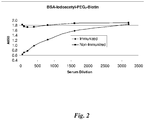
- Fig. 2 is a re-plot of the data for the best-performing material from above, the BSA-iodoacetyl-PEG 2 -biotin (thiol-derivatized), expressed as A650 versus serum dilution for both immunized and non-immunized serum.
- the non-immunized sample is shown to give a steadily high signal regardless of dilution, as there is no anti-BSA antibody present in the sample to block the binding of the streptavidin-HRP conjugate to the immobilized biotinylated BSA.
- the immunized sample shows a low signal from a low dilution of sample due to the blocking effect of the anti-BSA antibodies present in the sample, with steadily rising signal with increasing dilution due to decreasing amounts of blocking of binding of the biotin of the biotinylated BSA with the streptavidin of the streptavidin-HRP conjugate.
Landscapes
- Health & Medical Sciences (AREA)
- Life Sciences & Earth Sciences (AREA)
- Immunology (AREA)
- Engineering & Computer Science (AREA)
- Chemical & Material Sciences (AREA)
- Urology & Nephrology (AREA)
- Hematology (AREA)
- Biomedical Technology (AREA)
- Molecular Biology (AREA)
- Medicinal Chemistry (AREA)
- Analytical Chemistry (AREA)
- Cell Biology (AREA)
- Pathology (AREA)
- Food Science & Technology (AREA)
- Biotechnology (AREA)
- Physics & Mathematics (AREA)
- Microbiology (AREA)
- Biochemistry (AREA)
- General Health & Medical Sciences (AREA)
- General Physics & Mathematics (AREA)
- Chemical Kinetics & Catalysis (AREA)
- Proteomics, Peptides & Aminoacids (AREA)
- Investigating Or Analysing Biological Materials (AREA)
- Investigating Or Analysing Materials By The Use Of Chemical Reactions (AREA)
Claims (13)
- Procédé de détermination d'un analyte macromoléculaire dans un échantillon suspecté de contenir l'analyte macromoléculaire, le procédé comprenant les étapes consistant à :(a) combiner dans un milieu l'échantillon et un réactif conjugué comprenant une petite molécule et un partenaire de liaison pour l'analyte macromoléculaire,(b) combiner le réactif conjugué et un partenaire de liaison étiqueté pour la petite molécule, et(c) examiner le réactif conjugué ou le milieu pour une quantité de partenaire de liaison étiqueté pour la petite molécule qui est liée à la petite molécule et associer la quantité de celui-ci à la quantité de l'analyte macromoléculaire dans l'échantillon,où ledit analyte macromoléculaire, quand il existe, se lie au partenaire de liaison de l'analyte macromoléculaire et a une taille ou une forme ou une combinaison des deux tailles et formes qui empêche le partenaire de liaison de la petite molécule de se lier à la petite molécule lorsque la petite molécule fait partie du réactif qui comprend également le partenaire de liaison qui est spécifique pour la substance macromoléculaire, dans laquelle l'analyte macromoléculaire a un poids moléculaire d'au moins 5000 et est choisi dans le groupe constitué par les anticorps, les enzymes, les hormones, les polynucléotides et les glucides, et
où la petite molécule est une molécule organique qui a un poids moléculaire compris entre 100 et 2000, comprend des groupes fonctionnels qui sont réactifs avec le partenaire de liaison pour l'analyte macromoléculaire et est lié au partenaire de liaison pour l'analyte macromoléculaire. - Procédé selon la revendication 1, dans lequel le réactif conjugué comprend en outre un support auquel la petite molécule et le partenaire de liaison de l'analyte macromoléculaire sont liés.
- Procédé selon la revendication 1, dans lequel l'analyte macromoléculaire est un analyte d'anticorps, le partenaire de liaison pour l'analyte macromoléculaire est un antigène qui se lie à l'analyte d'anticorps, et la petite molécule et l'antigène qui se lie à l'analyte d'anticorps sont liés à un support, le procédé comprenant en outre les étapes consistant à :incuber le milieu dans des conditions de liaison du partenaire de liaison étiqueté à la petite molécule, etexaminer le support ou le milieu pour une quantité de partenaire de liaison étiqueté qui est liée à la petite molécule et associer la quantité de celui-ci à la quantité de l'analyte d'anticorps dans l'échantillon.
- Procédé selon la revendication 1 ou 3, dans lequel la petite molécule est choisie dans le groupe constitué de la biotine, la desthiobiotine, le dinitrophénol, la digoxine, la digoxigénine, la rhodamine et la fluorescéine.
- Procédé selon la revendication 1 ou 3, dans lequel l'étiquette du partenaire de liaison étiqueté est choisie dans le groupe consistant d'enzymes, de fluorescents, de chimiluminescents, de bioluminescents, d'électroluminescents, de sensibilisateurs et de matières radioactives.
- Procédé selon la revendication 1 ou 3, dans lequel l'échantillon est une excrétion corporelle, un aspirant corporel, un excisant corporel ou un extractant corporel.
- Procédé selon la revendication 1 ou 3, dans lequel le procédé est un procédé d'essai homogène.
- Procédé selon la revendication 2 ou 3, dans lequel le support est une particule non magnétique, une particule magnétique, une plaque ou un tube.
- Procédé selon la revendication 2 ou 3, dans lequel le support comprend une étiquette où l'étiquette est interactive avec l'étiquette du partenaire de liaison étiqueté.
- Procédé selon la revendication 1, dans lequel
la petite molécule et l'antigène qui se lie à l'analyte d'anticorps sont liés à une particule,
le procédé comprenant en outre les étapes consistant à :incuber le milieu dans des conditions de liaison du partenaire de liaison étiqueté à la petite molécule, etexaminer le support ou le milieu pour une quantité de partenaire de liaison étiqueté qui est liée à la petite molécule et associer la quantité de celui-ci à la quantité de l'analyte d'anticorps dans l'échantillon. - Procédé selon la revendication 10, dans lequel le partenaire de liaison étiqueté est étiqueté avec une particule comprenant une étiquette du sensibilisateur et la particule à laquelle est liée une petite molécule comprend une étiquette chimiluminescente.
- Procédé selon la revendication 10, dans lequel la particule à laquelle est liée une petite molécule est une particule magnétique.
- Procédé selon la revendication 10, dans lequel la petite molécule est liée à l'antigène qui est lié à la particule.
Applications Claiming Priority (2)
| Application Number | Priority Date | Filing Date | Title |
|---|---|---|---|
| US201361894931P | 2013-10-24 | 2013-10-24 | |
| PCT/US2014/061489 WO2015061260A1 (fr) | 2013-10-24 | 2014-10-21 | Dosages pour analytes macromoléculaires |
Publications (3)
| Publication Number | Publication Date |
|---|---|
| EP3060917A1 EP3060917A1 (fr) | 2016-08-31 |
| EP3060917A4 EP3060917A4 (fr) | 2016-11-16 |
| EP3060917B1 true EP3060917B1 (fr) | 2019-05-15 |
Family
ID=52993434
Family Applications (1)
| Application Number | Title | Priority Date | Filing Date |
|---|---|---|---|
| EP14856561.7A Active EP3060917B1 (fr) | 2013-10-24 | 2014-10-21 | Dosages pour analytes macromoléculaires |
Country Status (4)
| Country | Link |
|---|---|
| US (2) | US20160252507A1 (fr) |
| EP (1) | EP3060917B1 (fr) |
| ES (1) | ES2742308T3 (fr) |
| WO (1) | WO2015061260A1 (fr) |
Families Citing this family (1)
| Publication number | Priority date | Publication date | Assignee | Title |
|---|---|---|---|---|
| CN115136006A (zh) * | 2020-03-04 | 2022-09-30 | 美国西门子医学诊断股份有限公司 | 放大免疫测定信号的方法 |
Family Cites Families (15)
| Publication number | Priority date | Publication date | Assignee | Title |
|---|---|---|---|---|
| US3817837A (en) | 1971-05-14 | 1974-06-18 | Syva Corp | Enzyme amplification assay |
| US3996345A (en) | 1974-08-12 | 1976-12-07 | Syva Company | Fluorescence quenching with immunological pairs in immunoassays |
| US4233402A (en) | 1978-04-05 | 1980-11-11 | Syva Company | Reagents and method employing channeling |
| CA1335880C (fr) | 1988-07-14 | 1995-06-13 | Thomas P. O'connor | Detection d'anticorps et d'antigenes dans le cadre d'un dosage immunologique |
| US5101015A (en) | 1989-04-10 | 1992-03-31 | Abbott Laboratories | Reagents for an amphetamine-class fluorescence polarization immunoassay |
| US5340716A (en) | 1991-06-20 | 1994-08-23 | Snytex (U.S.A.) Inc. | Assay method utilizing photoactivated chemiluminescent label |
| WO2001027621A2 (fr) | 1999-10-07 | 2001-04-19 | Pharmacia Corporation | DOSAGE IMMUNOENZYMATIQUE D'INHIBITION (iELISA) PERMETTANT DE DETECTER ET QUANTIFIER LES ANTICORPS PRESENTS DANS DES PRELEVEMENTS BIOLOGIQUES |
| US6703248B1 (en) * | 1999-12-15 | 2004-03-09 | Dade Behring Marburg Gmbh | Particles for diagnostic and therapeutic use |
| US20050003459A1 (en) * | 2002-01-30 | 2005-01-06 | Krutzik Siegfried Richard | Multi-purpose optical analysis disc for conducting assays and related methods for attaching capture agents |
| ATE511645T1 (de) * | 2006-03-17 | 2011-06-15 | Biomarin Pharm Inc | Testverfahren zum nachweis von antikörpern gegen lysosomenenzyme |
| US7695929B2 (en) | 2006-11-01 | 2010-04-13 | Ventana Medical Systems, Inc. | Haptens, hapten conjugates, compositions thereof and method for their preparation and use |
| WO2008083323A1 (fr) * | 2006-12-29 | 2008-07-10 | Invitrogen Corporation | Appareil de détection |
| ES2311423B1 (es) | 2007-07-27 | 2010-01-07 | Inmunologia Y Genetica Aplicada, S.A. | Inmunoensayo de doble reconocimiento para la deteccion de anticuerpos. |
| US20090258435A1 (en) | 2008-04-15 | 2009-10-15 | Siemens Healthcare Diagnostics Inc., A Corporation Of California | Biotin-receptor reagents for sensitivity modulation in assays |
| CA2735543C (fr) | 2008-09-02 | 2017-05-02 | Alison Jane Basile | Procede de detection d'anticorps specifiques a un antigene dans des echantillons biologiques |
-
2014
- 2014-10-21 EP EP14856561.7A patent/EP3060917B1/fr active Active
- 2014-10-21 US US15/030,086 patent/US20160252507A1/en not_active Abandoned
- 2014-10-21 WO PCT/US2014/061489 patent/WO2015061260A1/fr not_active Ceased
- 2014-10-21 ES ES14856561T patent/ES2742308T3/es active Active
-
2019
- 2019-03-01 US US16/289,776 patent/US10725034B2/en active Active
Non-Patent Citations (1)
| Title |
|---|
| None * |
Also Published As
| Publication number | Publication date |
|---|---|
| ES2742308T3 (es) | 2020-02-13 |
| US10725034B2 (en) | 2020-07-28 |
| US20190195870A1 (en) | 2019-06-27 |
| US20160252507A1 (en) | 2016-09-01 |
| WO2015061260A1 (fr) | 2015-04-30 |
| EP3060917A4 (fr) | 2016-11-16 |
| EP3060917A1 (fr) | 2016-08-31 |
Similar Documents
| Publication | Publication Date | Title |
|---|---|---|
| EP2839286B1 (fr) | Composés et procédés de préparation de réactifs conjugués | |
| US9347947B2 (en) | Immunoassays employing non-particulate chemiluminescent reagent | |
| US12111310B2 (en) | Pretreatment agent in non-agglutination assays | |
| US20090258435A1 (en) | Biotin-receptor reagents for sensitivity modulation in assays | |
| CN102575156B (zh) | 检测中所用的颗粒中的信号生成的稳定化 | |
| US10725034B2 (en) | Assays for macromolecular analytes | |
| US10088490B2 (en) | Assay for analytes using multiple receptors | |
| WO2008057767A2 (fr) | Réduction de liaison non spécifique dans des dosages immunologiques | |
| US10191069B2 (en) | Accurate assay measurement of hydrophobic haptenic analytes | |
| US8394647B2 (en) | Reducing non-covalently bound polysaccharide on supports | |
| EP2742352A2 (fr) | Détection de stéroïdes sexuels | |
| CN102928406A (zh) | 检测苏丹红的磁颗粒化学发光试剂盒及其应用 | |
| EP2997039A1 (fr) | Formulations liquides stabilisées contenant des récepteurs | |
| US20140356885A1 (en) | Reducing Non-Specifically Bound Molecules on Supports | |
| CN102928592A (zh) | 检测群勃龙的磁颗粒化学发光试剂盒及其应用 | |
| WO2014120647A1 (fr) | Rapport de signal dans des calibreurs de dosage |
Legal Events
| Date | Code | Title | Description |
|---|---|---|---|
| PUAI | Public reference made under article 153(3) epc to a published international application that has entered the european phase |
Free format text: ORIGINAL CODE: 0009012 |
|
| 17P | Request for examination filed |
Effective date: 20160524 |
|
| AK | Designated contracting states |
Kind code of ref document: A1 Designated state(s): AL AT BE BG CH CY CZ DE DK EE ES FI FR GB GR HR HU IE IS IT LI LT LU LV MC MK MT NL NO PL PT RO RS SE SI SK SM TR |
|
| AX | Request for extension of the european patent |
Extension state: BA ME |
|
| A4 | Supplementary search report drawn up and despatched |
Effective date: 20161019 |
|
| RIC1 | Information provided on ipc code assigned before grant |
Ipc: G01N 33/566 20060101ALI20161013BHEP Ipc: G01N 33/68 20060101ALI20161013BHEP Ipc: G01N 33/543 20060101AFI20161013BHEP |
|
| DAX | Request for extension of the european patent (deleted) | ||
| STAA | Information on the status of an ep patent application or granted ep patent |
Free format text: STATUS: EXAMINATION IS IN PROGRESS |
|
| 17Q | First examination report despatched |
Effective date: 20171013 |
|
| GRAP | Despatch of communication of intention to grant a patent |
Free format text: ORIGINAL CODE: EPIDOSNIGR1 |
|
| STAA | Information on the status of an ep patent application or granted ep patent |
Free format text: STATUS: GRANT OF PATENT IS INTENDED |
|
| INTG | Intention to grant announced |
Effective date: 20181129 |
|
| GRAS | Grant fee paid |
Free format text: ORIGINAL CODE: EPIDOSNIGR3 |
|
| GRAA | (expected) grant |
Free format text: ORIGINAL CODE: 0009210 |
|
| STAA | Information on the status of an ep patent application or granted ep patent |
Free format text: STATUS: THE PATENT HAS BEEN GRANTED |
|
| AK | Designated contracting states |
Kind code of ref document: B1 Designated state(s): AL AT BE BG CH CY CZ DE DK EE ES FI FR GB GR HR HU IE IS IT LI LT LU LV MC MK MT NL NO PL PT RO RS SE SI SK SM TR |
|
| REG | Reference to a national code |
Ref country code: CH Ref legal event code: EP |
|
| REG | Reference to a national code |
Ref country code: DE Ref legal event code: R096 Ref document number: 602014046997 Country of ref document: DE |
|
| REG | Reference to a national code |
Ref country code: IE Ref legal event code: FG4D |
|
| REG | Reference to a national code |
Ref country code: NL Ref legal event code: MP Effective date: 20190515 |
|
| REG | Reference to a national code |
Ref country code: LT Ref legal event code: MG4D |
|
| PG25 | Lapsed in a contracting state [announced via postgrant information from national office to epo] |
Ref country code: NL Free format text: LAPSE BECAUSE OF FAILURE TO SUBMIT A TRANSLATION OF THE DESCRIPTION OR TO PAY THE FEE WITHIN THE PRESCRIBED TIME-LIMIT Effective date: 20190515 Ref country code: AL Free format text: LAPSE BECAUSE OF FAILURE TO SUBMIT A TRANSLATION OF THE DESCRIPTION OR TO PAY THE FEE WITHIN THE PRESCRIBED TIME-LIMIT Effective date: 20190515 Ref country code: PT Free format text: LAPSE BECAUSE OF FAILURE TO SUBMIT A TRANSLATION OF THE DESCRIPTION OR TO PAY THE FEE WITHIN THE PRESCRIBED TIME-LIMIT Effective date: 20190915 Ref country code: SE Free format text: LAPSE BECAUSE OF FAILURE TO SUBMIT A TRANSLATION OF THE DESCRIPTION OR TO PAY THE FEE WITHIN THE PRESCRIBED TIME-LIMIT Effective date: 20190515 Ref country code: LT Free format text: LAPSE BECAUSE OF FAILURE TO SUBMIT A TRANSLATION OF THE DESCRIPTION OR TO PAY THE FEE WITHIN THE PRESCRIBED TIME-LIMIT Effective date: 20190515 Ref country code: HR Free format text: LAPSE BECAUSE OF FAILURE TO SUBMIT A TRANSLATION OF THE DESCRIPTION OR TO PAY THE FEE WITHIN THE PRESCRIBED TIME-LIMIT Effective date: 20190515 Ref country code: NO Free format text: LAPSE BECAUSE OF FAILURE TO SUBMIT A TRANSLATION OF THE DESCRIPTION OR TO PAY THE FEE WITHIN THE PRESCRIBED TIME-LIMIT Effective date: 20190815 Ref country code: FI Free format text: LAPSE BECAUSE OF FAILURE TO SUBMIT A TRANSLATION OF THE DESCRIPTION OR TO PAY THE FEE WITHIN THE PRESCRIBED TIME-LIMIT Effective date: 20190515 |
|
| PG25 | Lapsed in a contracting state [announced via postgrant information from national office to epo] |
Ref country code: RS Free format text: LAPSE BECAUSE OF FAILURE TO SUBMIT A TRANSLATION OF THE DESCRIPTION OR TO PAY THE FEE WITHIN THE PRESCRIBED TIME-LIMIT Effective date: 20190515 Ref country code: GR Free format text: LAPSE BECAUSE OF FAILURE TO SUBMIT A TRANSLATION OF THE DESCRIPTION OR TO PAY THE FEE WITHIN THE PRESCRIBED TIME-LIMIT Effective date: 20190816 Ref country code: LV Free format text: LAPSE BECAUSE OF FAILURE TO SUBMIT A TRANSLATION OF THE DESCRIPTION OR TO PAY THE FEE WITHIN THE PRESCRIBED TIME-LIMIT Effective date: 20190515 Ref country code: BG Free format text: LAPSE BECAUSE OF FAILURE TO SUBMIT A TRANSLATION OF THE DESCRIPTION OR TO PAY THE FEE WITHIN THE PRESCRIBED TIME-LIMIT Effective date: 20190815 |
|
| REG | Reference to a national code |
Ref country code: AT Ref legal event code: MK05 Ref document number: 1134058 Country of ref document: AT Kind code of ref document: T Effective date: 20190515 |
|
| PG25 | Lapsed in a contracting state [announced via postgrant information from national office to epo] |
Ref country code: AT Free format text: LAPSE BECAUSE OF FAILURE TO SUBMIT A TRANSLATION OF THE DESCRIPTION OR TO PAY THE FEE WITHIN THE PRESCRIBED TIME-LIMIT Effective date: 20190515 Ref country code: DK Free format text: LAPSE BECAUSE OF FAILURE TO SUBMIT A TRANSLATION OF THE DESCRIPTION OR TO PAY THE FEE WITHIN THE PRESCRIBED TIME-LIMIT Effective date: 20190515 Ref country code: SK Free format text: LAPSE BECAUSE OF FAILURE TO SUBMIT A TRANSLATION OF THE DESCRIPTION OR TO PAY THE FEE WITHIN THE PRESCRIBED TIME-LIMIT Effective date: 20190515 Ref country code: RO Free format text: LAPSE BECAUSE OF FAILURE TO SUBMIT A TRANSLATION OF THE DESCRIPTION OR TO PAY THE FEE WITHIN THE PRESCRIBED TIME-LIMIT Effective date: 20190515 Ref country code: CZ Free format text: LAPSE BECAUSE OF FAILURE TO SUBMIT A TRANSLATION OF THE DESCRIPTION OR TO PAY THE FEE WITHIN THE PRESCRIBED TIME-LIMIT Effective date: 20190515 Ref country code: EE Free format text: LAPSE BECAUSE OF FAILURE TO SUBMIT A TRANSLATION OF THE DESCRIPTION OR TO PAY THE FEE WITHIN THE PRESCRIBED TIME-LIMIT Effective date: 20190515 |
|
| REG | Reference to a national code |
Ref country code: ES Ref legal event code: FG2A Ref document number: 2742308 Country of ref document: ES Kind code of ref document: T3 Effective date: 20200213 |
|
| REG | Reference to a national code |
Ref country code: DE Ref legal event code: R097 Ref document number: 602014046997 Country of ref document: DE |
|
| PG25 | Lapsed in a contracting state [announced via postgrant information from national office to epo] |
Ref country code: SM Free format text: LAPSE BECAUSE OF FAILURE TO SUBMIT A TRANSLATION OF THE DESCRIPTION OR TO PAY THE FEE WITHIN THE PRESCRIBED TIME-LIMIT Effective date: 20190515 Ref country code: IT Free format text: LAPSE BECAUSE OF FAILURE TO SUBMIT A TRANSLATION OF THE DESCRIPTION OR TO PAY THE FEE WITHIN THE PRESCRIBED TIME-LIMIT Effective date: 20190515 |
|
| PLBE | No opposition filed within time limit |
Free format text: ORIGINAL CODE: 0009261 |
|
| STAA | Information on the status of an ep patent application or granted ep patent |
Free format text: STATUS: NO OPPOSITION FILED WITHIN TIME LIMIT |
|
| PG25 | Lapsed in a contracting state [announced via postgrant information from national office to epo] |
Ref country code: TR Free format text: LAPSE BECAUSE OF FAILURE TO SUBMIT A TRANSLATION OF THE DESCRIPTION OR TO PAY THE FEE WITHIN THE PRESCRIBED TIME-LIMIT Effective date: 20190515 |
|
| 26N | No opposition filed |
Effective date: 20200218 |
|
| PG25 | Lapsed in a contracting state [announced via postgrant information from national office to epo] |
Ref country code: PL Free format text: LAPSE BECAUSE OF FAILURE TO SUBMIT A TRANSLATION OF THE DESCRIPTION OR TO PAY THE FEE WITHIN THE PRESCRIBED TIME-LIMIT Effective date: 20190515 |
|
| PG25 | Lapsed in a contracting state [announced via postgrant information from national office to epo] |
Ref country code: MC Free format text: LAPSE BECAUSE OF FAILURE TO SUBMIT A TRANSLATION OF THE DESCRIPTION OR TO PAY THE FEE WITHIN THE PRESCRIBED TIME-LIMIT Effective date: 20190515 Ref country code: SI Free format text: LAPSE BECAUSE OF FAILURE TO SUBMIT A TRANSLATION OF THE DESCRIPTION OR TO PAY THE FEE WITHIN THE PRESCRIBED TIME-LIMIT Effective date: 20190515 |
|
| REG | Reference to a national code |
Ref country code: CH Ref legal event code: PL |
|
| PG25 | Lapsed in a contracting state [announced via postgrant information from national office to epo] |
Ref country code: LI Free format text: LAPSE BECAUSE OF NON-PAYMENT OF DUE FEES Effective date: 20191031 Ref country code: LU Free format text: LAPSE BECAUSE OF NON-PAYMENT OF DUE FEES Effective date: 20191021 Ref country code: CH Free format text: LAPSE BECAUSE OF NON-PAYMENT OF DUE FEES Effective date: 20191031 |
|
| REG | Reference to a national code |
Ref country code: BE Ref legal event code: MM Effective date: 20191031 |
|
| PG25 | Lapsed in a contracting state [announced via postgrant information from national office to epo] |
Ref country code: BE Free format text: LAPSE BECAUSE OF NON-PAYMENT OF DUE FEES Effective date: 20191031 |
|
| PG25 | Lapsed in a contracting state [announced via postgrant information from national office to epo] |
Ref country code: IE Free format text: LAPSE BECAUSE OF NON-PAYMENT OF DUE FEES Effective date: 20191021 |
|
| PG25 | Lapsed in a contracting state [announced via postgrant information from national office to epo] |
Ref country code: CY Free format text: LAPSE BECAUSE OF FAILURE TO SUBMIT A TRANSLATION OF THE DESCRIPTION OR TO PAY THE FEE WITHIN THE PRESCRIBED TIME-LIMIT Effective date: 20190515 |
|
| PG25 | Lapsed in a contracting state [announced via postgrant information from national office to epo] |
Ref country code: IS Free format text: LAPSE BECAUSE OF FAILURE TO SUBMIT A TRANSLATION OF THE DESCRIPTION OR TO PAY THE FEE WITHIN THE PRESCRIBED TIME-LIMIT Effective date: 20190915 |
|
| PG25 | Lapsed in a contracting state [announced via postgrant information from national office to epo] |
Ref country code: HU Free format text: LAPSE BECAUSE OF FAILURE TO SUBMIT A TRANSLATION OF THE DESCRIPTION OR TO PAY THE FEE WITHIN THE PRESCRIBED TIME-LIMIT; INVALID AB INITIO Effective date: 20141021 Ref country code: MT Free format text: LAPSE BECAUSE OF FAILURE TO SUBMIT A TRANSLATION OF THE DESCRIPTION OR TO PAY THE FEE WITHIN THE PRESCRIBED TIME-LIMIT Effective date: 20190515 |
|
| PG25 | Lapsed in a contracting state [announced via postgrant information from national office to epo] |
Ref country code: MK Free format text: LAPSE BECAUSE OF FAILURE TO SUBMIT A TRANSLATION OF THE DESCRIPTION OR TO PAY THE FEE WITHIN THE PRESCRIBED TIME-LIMIT Effective date: 20190515 |
|
| REG | Reference to a national code |
Ref country code: DE Ref legal event code: R082 Ref document number: 602014046997 Country of ref document: DE |
|
| PGFP | Annual fee paid to national office [announced via postgrant information from national office to epo] |
Ref country code: GB Payment date: 20251111 Year of fee payment: 12 |
|
| PGFP | Annual fee paid to national office [announced via postgrant information from national office to epo] |
Ref country code: FR Payment date: 20251020 Year of fee payment: 12 |
|
| PGFP | Annual fee paid to national office [announced via postgrant information from national office to epo] |
Ref country code: ES Payment date: 20260119 Year of fee payment: 12 |
|
| PGFP | Annual fee paid to national office [announced via postgrant information from national office to epo] |
Ref country code: DE Payment date: 20251219 Year of fee payment: 12 |