EP3061354A1 - Fibre alimentaire - Google Patents
Fibre alimentaire Download PDFInfo
- Publication number
- EP3061354A1 EP3061354A1 EP15730682.0A EP15730682A EP3061354A1 EP 3061354 A1 EP3061354 A1 EP 3061354A1 EP 15730682 A EP15730682 A EP 15730682A EP 3061354 A1 EP3061354 A1 EP 3061354A1
- Authority
- EP
- European Patent Office
- Prior art keywords
- dietary fiber
- terminal
- dietary
- sugar
- food item
- Prior art date
- Legal status (The legal status is an assumption and is not a legal conclusion. Google has not performed a legal analysis and makes no representation as to the accuracy of the status listed.)
- Granted
Links
Images
Classifications
-
- C—CHEMISTRY; METALLURGY
- C12—BIOCHEMISTRY; BEER; SPIRITS; WINE; VINEGAR; MICROBIOLOGY; ENZYMOLOGY; MUTATION OR GENETIC ENGINEERING
- C12G—WINE; PREPARATION THEREOF; ALCOHOLIC BEVERAGES; PREPARATION OF ALCOHOLIC BEVERAGES NOT PROVIDED FOR IN SUBCLASSES C12C OR C12H
- C12G3/00—Preparation of other alcoholic beverages
- C12G3/04—Preparation of other alcoholic beverages by mixing, e.g. for preparation of liqueurs
- C12G3/06—Preparation of other alcoholic beverages by mixing, e.g. for preparation of liqueurs with flavouring ingredients
-
- A—HUMAN NECESSITIES
- A23—FOODS OR FOODSTUFFS; TREATMENT THEREOF, NOT COVERED BY OTHER CLASSES
- A23L—FOODS, FOODSTUFFS OR NON-ALCOHOLIC BEVERAGES, NOT OTHERWISE PROVIDED FOR; PREPARATION OR TREATMENT THEREOF
- A23L2/00—Non-alcoholic beverages; Dry compositions or concentrates therefor; Preparation or treatment thereof
- A23L2/38—Other non-alcoholic beverages
- A23L2/382—Other non-alcoholic beverages fermented
-
- A—HUMAN NECESSITIES
- A23—FOODS OR FOODSTUFFS; TREATMENT THEREOF, NOT COVERED BY OTHER CLASSES
- A23L—FOODS, FOODSTUFFS OR NON-ALCOHOLIC BEVERAGES, NOT OTHERWISE PROVIDED FOR; PREPARATION OR TREATMENT THEREOF
- A23L2/00—Non-alcoholic beverages; Dry compositions or concentrates therefor; Preparation or treatment thereof
- A23L2/52—Adding ingredients
-
- A—HUMAN NECESSITIES
- A23—FOODS OR FOODSTUFFS; TREATMENT THEREOF, NOT COVERED BY OTHER CLASSES
- A23L—FOODS, FOODSTUFFS OR NON-ALCOHOLIC BEVERAGES, NOT OTHERWISE PROVIDED FOR; PREPARATION OR TREATMENT THEREOF
- A23L2/00—Non-alcoholic beverages; Dry compositions or concentrates therefor; Preparation or treatment thereof
- A23L2/52—Adding ingredients
- A23L2/54—Mixing with gases
-
- A—HUMAN NECESSITIES
- A23—FOODS OR FOODSTUFFS; TREATMENT THEREOF, NOT COVERED BY OTHER CLASSES
- A23L—FOODS, FOODSTUFFS OR NON-ALCOHOLIC BEVERAGES, NOT OTHERWISE PROVIDED FOR; PREPARATION OR TREATMENT THEREOF
- A23L2/00—Non-alcoholic beverages; Dry compositions or concentrates therefor; Preparation or treatment thereof
- A23L2/52—Adding ingredients
- A23L2/56—Flavouring or bittering agents
-
- A—HUMAN NECESSITIES
- A23—FOODS OR FOODSTUFFS; TREATMENT THEREOF, NOT COVERED BY OTHER CLASSES
- A23L—FOODS, FOODSTUFFS OR NON-ALCOHOLIC BEVERAGES, NOT OTHERWISE PROVIDED FOR; PREPARATION OR TREATMENT THEREOF
- A23L33/00—Modifying nutritive qualities of foods; Dietetic products; Preparation or treatment thereof
- A23L33/20—Reducing nutritive value; Dietetic products with reduced nutritive value
- A23L33/21—Addition of substantially indigestible substances, e.g. dietary fibres
-
- A—HUMAN NECESSITIES
- A61—MEDICAL OR VETERINARY SCIENCE; HYGIENE
- A61P—SPECIFIC THERAPEUTIC ACTIVITY OF CHEMICAL COMPOUNDS OR MEDICINAL PREPARATIONS
- A61P1/00—Drugs for disorders of the alimentary tract or the digestive system
- A61P1/04—Drugs for disorders of the alimentary tract or the digestive system for ulcers, gastritis or reflux esophagitis, e.g. antacids, inhibitors of acid secretion, mucosal protectants
-
- A—HUMAN NECESSITIES
- A61—MEDICAL OR VETERINARY SCIENCE; HYGIENE
- A61P—SPECIFIC THERAPEUTIC ACTIVITY OF CHEMICAL COMPOUNDS OR MEDICINAL PREPARATIONS
- A61P1/00—Drugs for disorders of the alimentary tract or the digestive system
- A61P1/10—Laxatives
-
- A—HUMAN NECESSITIES
- A61—MEDICAL OR VETERINARY SCIENCE; HYGIENE
- A61P—SPECIFIC THERAPEUTIC ACTIVITY OF CHEMICAL COMPOUNDS OR MEDICINAL PREPARATIONS
- A61P3/00—Drugs for disorders of the metabolism
-
- A—HUMAN NECESSITIES
- A61—MEDICAL OR VETERINARY SCIENCE; HYGIENE
- A61P—SPECIFIC THERAPEUTIC ACTIVITY OF CHEMICAL COMPOUNDS OR MEDICINAL PREPARATIONS
- A61P3/00—Drugs for disorders of the metabolism
- A61P3/04—Anorexiants; Antiobesity agents
-
- A—HUMAN NECESSITIES
- A61—MEDICAL OR VETERINARY SCIENCE; HYGIENE
- A61P—SPECIFIC THERAPEUTIC ACTIVITY OF CHEMICAL COMPOUNDS OR MEDICINAL PREPARATIONS
- A61P3/00—Drugs for disorders of the metabolism
- A61P3/06—Antihyperlipidemics
-
- A—HUMAN NECESSITIES
- A61—MEDICAL OR VETERINARY SCIENCE; HYGIENE
- A61P—SPECIFIC THERAPEUTIC ACTIVITY OF CHEMICAL COMPOUNDS OR MEDICINAL PREPARATIONS
- A61P3/00—Drugs for disorders of the metabolism
- A61P3/08—Drugs for disorders of the metabolism for glucose homeostasis
- A61P3/10—Drugs for disorders of the metabolism for glucose homeostasis for hyperglycaemia, e.g. antidiabetics
-
- C—CHEMISTRY; METALLURGY
- C08—ORGANIC MACROMOLECULAR COMPOUNDS; THEIR PREPARATION OR CHEMICAL WORKING-UP; COMPOSITIONS BASED THEREON
- C08B—POLYSACCHARIDES; DERIVATIVES THEREOF
- C08B30/00—Preparation of starch, degraded or non-chemically modified starch, amylose, or amylopectin
- C08B30/12—Degraded, destructured or non-chemically modified starch, e.g. mechanically, enzymatically or by irradiation; Bleaching of starch
- C08B30/18—Dextrin, e.g. yellow canari, white dextrin, amylodextrin or maltodextrin; Methods of depolymerisation, e.g. by irradiation or mechanically
-
- C—CHEMISTRY; METALLURGY
- C12—BIOCHEMISTRY; BEER; SPIRITS; WINE; VINEGAR; MICROBIOLOGY; ENZYMOLOGY; MUTATION OR GENETIC ENGINEERING
- C12C—BEER; PREPARATION OF BEER BY FERMENTATION; PREPARATION OF MALT FOR MAKING BEER; PREPARATION OF HOPS FOR MAKING BEER
- C12C12/00—Processes specially adapted for making special kinds of beer
-
- C—CHEMISTRY; METALLURGY
- C12—BIOCHEMISTRY; BEER; SPIRITS; WINE; VINEGAR; MICROBIOLOGY; ENZYMOLOGY; MUTATION OR GENETIC ENGINEERING
- C12C—BEER; PREPARATION OF BEER BY FERMENTATION; PREPARATION OF MALT FOR MAKING BEER; PREPARATION OF HOPS FOR MAKING BEER
- C12C5/00—Other raw materials for the preparation of beer
- C12C5/02—Additives for beer
-
- C—CHEMISTRY; METALLURGY
- C12—BIOCHEMISTRY; BEER; SPIRITS; WINE; VINEGAR; MICROBIOLOGY; ENZYMOLOGY; MUTATION OR GENETIC ENGINEERING
- C12G—WINE; PREPARATION THEREOF; ALCOHOLIC BEVERAGES; PREPARATION OF ALCOHOLIC BEVERAGES NOT PROVIDED FOR IN SUBCLASSES C12C OR C12H
- C12G3/00—Preparation of other alcoholic beverages
-
- C—CHEMISTRY; METALLURGY
- C12—BIOCHEMISTRY; BEER; SPIRITS; WINE; VINEGAR; MICROBIOLOGY; ENZYMOLOGY; MUTATION OR GENETIC ENGINEERING
- C12G—WINE; PREPARATION THEREOF; ALCOHOLIC BEVERAGES; PREPARATION OF ALCOHOLIC BEVERAGES NOT PROVIDED FOR IN SUBCLASSES C12C OR C12H
- C12G2200/00—Special features
- C12G2200/21—Wine additives, e.g. flavouring or colouring agents
Definitions
- the present invention relates to a dietary fiber in which the ratio of aldoses present as terminal sugars is largely reduced, in particular, a specific dietary fiber in which the ratio of anhydrosugars and/or sugar alcohols present as terminal sugars is high, and a method for producing such a dietary fiber.
- the present invention relates to a dietary fiber-based material and a food item each comprising such a dietary fiber.
- Patent Literature 1 An indigestible dextrin was developed by improvement of pyrodextrins, which had never been expected to be used as a dietary fiber due to their pungent smell etc.
- an improved indigestible dextrin with a reduced amount of colored substances and a reduced pungent smell is also known, and such improvements can be done by increasing the indigestible fraction content and the dietary fiber content (Patent Literature 2).
- this novel indigestible dextrin contains 90% or more of indigestible components and 20% or more of dietary fibers relative to the components other than glucose, and can be obtained by hydrolyzing pyrodextrins with ⁇ -amylase and glucoamylase, and separating and removing the digestible fraction by ion-exchange resin chromatography.
- polydextrose As a dietary fiber other than indigestible dextrin, for example, polydextrose is also known, which was created in a new food material development project aiming to provide safe, easy-to-use and low-calorie food materials (Non Patent Literature 1).
- Polydextrose is a polyglucose and is synthesized, for example, from a mixture of about 89% of dextrose, 10% of sorbitol and 1% of citric acid (Patent Literature 3).
- Polydextrose has a slightly bitter taste and for this reason, its application to foods has been limited.
- the bitterness of polydextrose is attributed to the presence of anhydroglucose, and it is known that the color and anhydroglucose content of polydextrose can be reduced by addition of a specific solvent (s) and treatment with a bleaching agent approved for use in foods (Patent Literature 4).
- Anhydroglucose ( ⁇ -1,6-anhydroglucose) is also called levoglucosan and is a kind of sugar widely present in food materials such as polydextrose (Non Patent Literature 2).
- the anhydroglucose content of polydextrose is known to be generally less than about 4% (Non Patent Literature 1).
- levoglucosan is known to be effective for slow solidification of starch gels (Non Patent Literature 2).
- the present invention has been made in order to solve the above-mentioned problems and is intended to provide an improved dietary fiber having less adverse effects on the taste of food, and to also provide a method for producing the improved dietary fiber.
- the present invention is intended to provide a dietary fiber-containing food item which retains its original good taste.
- the present inventors conducted intensive research to solve the above-mentioned problems.
- the present inventors focused on the terminal sugars of polysaccharides constituting a dietary fiber, and investigated the relation between the terminal sugars and the taste of the dietary fiber.
- the present inventors obtained the following findings: surprisingly, the bitterness and unpleasant aftertaste of dietary fibers can be restrained by reducing the amount of aldehyde groups in the terminal sugars; and a dietary fiber obtained in the above manner has an improved taste (flavor and taste), and even when blended with food, does not disturb the original good taste (flavor and taste) of the food.
- the present inventors completed the present invention.
- the terminal sugars include an aldose and sugar derivatives such as an anhydrosugar and a sugar alcohol.
- the aldose can have a cyclic or straight-chain structure, and both a cyclic hemiacetal structure and a straight-chain aldehyde structure are present at equilibrium.
- the dietary fiber of the present invention has terminal sugars (terminal groups) (or consists of polysaccharides having a terminal sugar) and is characterized in that the ratio of aldoses relative to the total of the terminal sugars is 10% or less (for example, 4% or less).
- the dietary fiber of the present invention may have, in particular, anhydrosugars and/or sugar alcohols as terminal sugars not having any aldehyde group.
- Such a dietary fiber may be, for example, the one for which the value of the following (A) is 0.1 or less (0 to 0.1).
- A X / X + Y + Z (In the formula, X represents the number of sugar chains in which the terminal sugar is an aldose (or the number of aldoses relative to the total of the terminal sugars), Y represents the number of sugar chains in which the terminal sugar is an anhydrosugar (or the number of anhydrosugars relative to the total of the terminal sugars), and Z represents the number of sugar chains in which the terminal sugar is a sugar alcohol (or the number of sugar alcohols relative to the total of the terminal sugars).
- the above-described dietary fiber may be the one for which the value(s) of the following (B) and/or (C) is 0.6 to 1.
- the dietary fiber of the present invention may be indigestible dextrin or polydextrose (in other words, a dietary fiber produced from indigestible dextrin or polydextrose as a raw material).
- the indigestible dextrin may be, for example, a dietary fiber for which the value (s) of the above (B) and/or (c) is 0.8 to 1, and in particular, a dietary fiber for which the value of the above (B) is 0.9 to 1.
- Typical examples of the indigestible dextrin include a dietary fiber for which the value of the above (A) is 0 to 0.04, the value of the above (B) is 0.95 to 1, and the value of the above (C) is 0.95 to 1.
- the polydextrose may be, for example, a dietary fiber for which the value of the above (B) is 0.6 to 1 (for example, 0.7 to 1).
- Typical examples of the polydextrose include a dietary fiber for which the value of the above (A) is 0 to 0.04, the value of the above (B) is 0.75 to 1, and the value of the above (C) is 0.9 to 1.
- the present invention includes a dietary fiber-based material comprising the above-described dietary fiber.
- the dietary fiber-based material comprises the above-described dietary fiber as a dietary fiber (dietary fiber component).
- the dietary fiber-based material may comprise, for example, 90% by weight or more (for example, 96% by weight or more) of the above-described dietary fiber relative to the total of dietary fibers having terminal sugars.
- the above-described dietary fiber in the dietary fiber-based material may be, for example, indigestible dextrin and/or polydextrose, and in particular, indigestible dextrin.
- the dietary fiber of the present invention has a restrained bitterness and thus is a useful dietary fiber as a supplementary ingredient for food.
- the present invention therefore includes a food additive (for example, a beverage additive (e.g. an additive for alcoholic beverages)) which is composed of the above-described dietary fiber (or dietary fiber-based material).
- the dietary fiber and the dietary fiber-based material of the present invention can be produced from, for example, a dietary fiber or a dietary fiber-based material each having reducing terminals.
- a typical method for producing the dietary fiber and the dietary fiber-based material of the present invention may be a method in which a dietary fiber or a dietary fiber-based material (indigestible dextrin, polydextrose, etc.) each having aldoses as terminal sugars is subjected to at least one treatment selected from reducing treatment, heat treatment and acid treatment.
- the present invention also includes a food item comprising the dietary fiber or the dietary fiber-based material.
- the food item may comprise 1% by weight or more (for example, 2% by weight or more) of the dietary fiber or the dietary fiber-based material.
- the food item may be a beverage.
- the beverage may be an alcoholic beverage (for example, a beverage with an alcohol content of 1% or more) or a beverage containing carbon dioxide gas (carbonated beverage).
- the beverage may be a malt fermented beverage (beer etc.).
- the beverage may be a whiskey (for example, bourbon whisky), in particular a highball (whiskey-containing carbonated beverage).
- an improved dietary fiber which has less adverse effects on the taste of food (for example, less unpleasant aftertaste, specifically less bitterness) due to the reduced ratio of aldoses present as terminal sugars, and a method for producing the improved dietary fiber can be provided.
- a dietary fiber-containing food item which retains its original good taste can be provided.
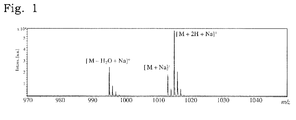
- Fig. 1 is an enlarged view of the MS spectrum of reference product D in the m/z range of 970 to 1050.
- the dietary fiber which can be used in the present invention is a glucose polymer-based dietary fiber.
- a glucose polymer-based dietary fiber for example, indigestible dextrin, polydextrose, ⁇ -glucan, mannan, pectin, etc. are included.
- cellulose which is a polymer of ⁇ -glucose, and hemicellulose are also included.
- indigestible dextrin and polydextrose are particularly preferred.
- the dietary fiber in the present invention can be quantified by the high-performance liquid chromatography (HPLC) or the Prosky method specified in the "Nutrition Labelling Standards (the Public Notice of the Ministry of Health, Labour and Welfare No. 176 (2003))".
- the dietary fiber used may be of one kind or any combination of two or more kinds.
- the dietary fiber (polysaccharides) of the present invention has a low ratio of aldoses present as terminal sugars, as mentioned above.
- the ratio of aldoses relative to the total of the terminal sugars in the dietary fiber of the present invention can be about 20% or less (for example, about 15% or less), and may be usually 10% or less (for example, 7% or less), preferably 5% or less, more preferably 4% or less, and in particular 3% or less (for example 2% or less, preferably 1% or less).
- the ratio of aldoses in the terminal sugars of the dietary fiber of the present invention is decreased as described above. This is achieved by conversion of terminal aldoses into different structures (or different terminal sugars) by chemical modification etc.
- the structures different from aldose are not particularly limited, but particularly preferred are an anhydrosugars (for example, 1,6-anhydrosugar) structure, and a sugar alcohol (or alcohol) structure.
- the anhydrosugar is a dehydrated product of a sugar and has an ether bond formed by dehydration between two hydroxyl groups (for example, a hemiacetal hydroxyl group and another hydroxyl group) of the sugar.
- hydroxyl groups for example, a hemiacetal hydroxyl group and another hydroxyl group
- glucose is known to be transformed into ⁇ -1,6-anhydrosugar (levoglucosan) by intramolecular dehydration condensation of the C1 hydroxyl group and the C6 hydroxyl group, which are spatially close to each other in terms of the steric configuration.
- the an hydrosugar can be formed by heat treatment, acid treatment, etc. as described later.
- the sugar alcohol can be formed by, for example, reduction of the terminal aldehyde group.
- the terminal sugar is glucose
- sorbitol is formed by such a reduction.
- the terminal sugars of the dietary fiber may mainly include an aldose, an anhydrosugar and a sugar alcohol.
- the value of the following (A), which is a measure of the radio of aldoses present as terminal sugars, may be for example 0 to 0.2 (for example, 0 to 0.15), preferably 0 to 0.1 (for example, 0 to 0.07), more preferably 0 to 0.05, in particular 0 to 0.04, and particularly preferably 0 to 0.03 (for example 0 to 0.02, preferably 0 to 0.01).
- A X / X + Y + Z (In the formula, X represents the number of sugar chains in which the terminal sugar is an aldose, Y represents the number of sugar chains in which the terminal sugar is an anhydrosugar, and Z represents the number of sugar chains in which the terminal sugar is a sugar alcohol.)
- X can be said to be the number of aldoses relative to the total of the terminal sugars.
- Y can be said to be the number of anhydrosugars relative to the total of the terminal sugars
- Z can also be said to be the number of sugar alcohols relative to the total of the terminal sugars.
- the value of the following (A'), which is a measure of the ratio of anhydrosugars and/or sugar alcohols present as terminal sugars may be for example 0.8 to 1 (for example, 0.85 to 1), preferably 0.9 to 1 (for example, 0.93 to 1), more preferably 0.95 to 1, in particular 0.96 to 1, and particularly preferably 0.97 to 1 (for example 0.98 to 1, preferably 0.99 to 1).
- a ′ Y + Z / X + Y + Z (In the formulae, X, Y and Z are as defined above.)
- the value of the following (B), which is a measure of the ratio of anhydrosugars to aldoses present as terminal sugars, may be for example 0.5 to 1, preferably 0.6 to 1 (for example, 0.65 to 1), more preferably 0.7 to 1, and in particular 0.8 to 1.
- B Y / X + Y (In the formulae, X and Y are as defined above.)
- the value of the above (B) may be adjusted as appropriate depending on the kind of the dietary fiber.
- the value of (B) for indigestible dextrin may be 0.8 to 1, preferably 0.9 to 1, and more preferably 0.95 to 1.
- the value of (B) for polydextrose may be in particular 0.6 to 1 (for example, 0.65 to 0.99), preferably 0.7 to 1 (for example, 0.7 to 0.95), and more preferably 0.75 to 1 (for example, 0.75 to 0.9).
- the value of the following (C), which is a measure of the ratio of sugar alcohols to aldoses present as terminal sugars, may be for example 0.5 to 1, preferably 0.6 to 1 (for example, 0.65 to 1), more preferably 0.7 to 1, and in particular 0.8 to 1.
- C Z / X + Z (In the formulae, X and Z are as defined above.)
- the value of the above (C) may be adjusted as appropriate depending on the kind of the dietary fiber.
- the value of (B) for indigestible dextrin or polydextrose may be 0.8 to 1, preferably 0.9 to 1, and more preferably 0.95 to 1.
- the present invention also includes a dietary fiber-based material comprising the above-described dietary fiber.
- the dietary fiber-based material is not particularly limited as long as it comprises the above-described dietary fiber, but preferred is for example a dietary fiber-based material in which the dietary fiber content (or indigestible fraction content) is 70% by weight or more relative to the solid content (excluding water) by weight.
- a higher dietary fiber content of the dietary fiber-based material is more desirable.
- the dietary fiber content is preferably 75% by weight or more, and more preferably 80% by weight or more.
- the dietary fiber content of the dietary fiber-based material is expressed as the weight percentage (%) of the dietary fiber relative to the weight of the total solids (excluding water), and the water content is not particularly taken into consideration. That is, for example, in the case where a dietary fiber-based material with a water content of 10% by weight has a dietary fiber content of 90% by weight in a dried powder form, the actual weight ratio of the dietary fiber to the total weight of the material is 81% by weight, but in this description, the dietary fiber content is described as 90% by weight.
- the dietary fibers which constitute the dietary fiber-based material have to contain a dietary fiber having terminal sugars, but may contain other dietary fibers (for example, non-polysaccharide dietary fibers (lignin etc.).
- the ratio of the above-described dietary fiber (a dietary fiber with a low ratio of aldoses present as terminal sugars) relative to the total of dietary fibers having terminal sugars can be about 75% by weight or more (for example, 80% by weight or more), may be usually 85% by weight or more (for example, 90% by weight or more), more preferably 95% by weight or more (for example, 96% by weight or more), in particular 97% by weight or more (for example, 98% by weight or more), and may be 100% by weight.
- the dietary fiber-based material is not subject to any limitation on its form and may be in a solid or liquid form, but preferred is a powder form in view of ease of measuring and dispensing, water solubility and storage stability.
- the water content in the powder form is set to preferably 15% by weight or less, and more preferably 10% by weight or less in view of storage stability.
- a liquid form can be preferably used without any particular problem.
- the water content in the liquid form is not particularly limited, but is preferably 20 to 40% by weight, for example.
- the method for producing the dietary fiber of the present invention is not particularly limited as long as the method can reduce the amount of aldehyde groups in the reducing terminals.
- the dietary fiber of the present invention can be obtained by performing a treatment for removal or conversion (change) of aldehyde groups in the course of a production process of dietary fibers from carbohydrates.
- a dietary fiber having aldoses as terminal sugars may be subjected to a treatment for removal or conversion (change) of aldehyde groups for production of the dietary fiber of the present invention.
- a reducing terminal can be converted into an anhydrosugar. That is, heat or acid treatment promotes etherification of the reducing terminal through dehydration between two hydroxyl groups, resulting in the formation of an anhydrosugar.
- the dietary fiber with a low ratio of aldoses present as terminal sugars can be obtained in the production process, the dietary fiber with a low ratio of aldoses present as terminal sugars can be processed into the dietary fiber of the present invention.
- processing examples include separation treatment (preparative separation, and separation by fractionation), reducing treatment, heat treatment and acid treatment. These treatments may be employed alone or in a combination of two or more kinds.
- the separation treatment can be selected as appropriate depending on the difference in chemical species of the terminal sugar, i.e., the chemical difference between an aldose and other terminal sugars (a sugar alcohol, an anhydrosugar, etc.).
- an ion-exchange resin ion-exchanger
- ion-exchanger may be used for separation of the dietary fiber of the present invention from a mixture of the dietary fiber of the present invention and other dietary fibers (dietary fiber mixture).
- the ion-exchange resin includes a cation-exchange resin and an anion-exchange resin.
- the cation-exchange resin include Dowex 50WX8 (manufactured by the Dow Chemical Company), and DIAION (registered trademark) series UBK8, UBK10 and UBK12 (manufactured by Mitsubishi Chemical Corporation).
- the anion-exchange resin include DIAION UBA120 (manufactured by Mitsubishi Chemical Corporation), and Dowex 1X8, Dowex 22 and Dowex 66 (manufactured by the Dow Chemical Company).
- the reducing treatment can convert an aldehyde group into an alcohol group (an aldose into a sugar alcohol).
- Specific examples of the reducing treatment include a method using a reducing agent such as NaBH 4 and LiAlH 4 ; and a method using hydrogen as a reducing agent in the presence of a catalyst such as nickel, ruthenium, palladium and platinum. These methods are known to the skilled person and both may be used in the present invention.
- the heat or acid treatment of a dietary fiber can convert a reducing terminal into an anhydrosugar.
- the method for quantifying the terminal sugars of dietary fibers is not particularly limited, and for example, such quantification can be preferably performed by using a mass spectrometer etc. as a detector.
- the mass spectrometer is not particularly limited as long as it is suitable for ionization of dietary fibers and detection of the product ions. In the present invention, the mass spectrometer may be sometimes called an MS detector.
- a dietary fiber having a sugar alcohol as the terminal sugar has a larger molecular weight by the mass of two hydrogen atoms (that is, by 2) than that of a dietary fiber having an aldose as the terminal sugar.
- a dietary fiber having an anhydrosugar as the terminal sugar has a smaller molecular weight by the mass of one water molecule (that is, by 18) than that of a dietary fiber having an aldose as the terminal sugar.
- the ratio of the numbers of molecules of these different dietary fibers can be determined by calculating the ratio of the mass spectral peak height or area of a dietary fiber having a sugar alcohol or an anhydrosugar as the terminal sugar relative to that of a dietary fiber having an aldose as the terminal sugar. In this case, it is preferable to compare the peaks in the same degree of polymerization because the ionizability of a dietary fiber is somewhat variable with its molecular weight.
- the dietary fibers For the quantification of the terminal sugars, all or a part of the dietary fibers may be used. When a part of the dietary fibers are used for quantification, it is optional and preferable that the dietary fibers used therefor are selected based on their MS detectability, etc.
- the dietary fiber of the present invention is used as in particular a supplementary ingredient for food.
- the dietary fiber of the present has a restrained bitterness and thus can be added to food without impairing the taste of the food. Therefore, the dietary fiber of the present invention can be used in particular as a food additive.
- the effect of the present invention is to reduce the bitter taste, unpleasant aftertaste, stimulating sensation, irritation of some kind and unpleasant flavor of dietary fibers.
- taste and flavor of dietary fibers for example, "having a pungent smell and an unpleasant flavor” (Patent Literature 1), and “having a slightly bitter taste” (Patent Literature 3) are used.
- Such a difference in descriptions can be partly attributed to the concentration of dietary fibers in food.
- a slightly bitter taste of dietary fibers is recognized as an unpleasant aftertaste or associated with stimulating sensation etc. , and thus described as an unpleasant flavor.
- the bitter taste, unpleasant aftertaste, stimulating sensation, unpleasant flavor, etc. of dietary fibers may be collectively described as bitterness. That is, the effect of the present invention can be described as the reduction of the bitterness of dietary fibers.
- the present invention includes a composition comprising the above-described dietary fiber.
- a composition comprising the above-described dietary fiber.
- Such a composition can be used as a food item (food and beverage item), a pharmaceutical product, a quasi drug, etc.
- Examples of the food item include foods, beverages, seasonings, functional foods (foods with health-promoting benefits), health foods, nutritional supplementary foods, foods for specified health use and supplements.
- the foods may be frozen foods, chilled foods, retort pouch foods, instant foods or the like.
- the foods may be the ones that can be prepared just before use (for example, powders to be dissolved in coffee, tea, juice, yogurt, soup, etc.; powders to be mixed with ingredients for cooking; etc.).
- the beverages may be dairy beverages, alcoholic beverages, carbonated beverages or the like.
- the foods include rice dishes, noodles (fresh noodles, dried noodles, instant noodles, etc.), bread, other flour-based products, curry roux, stew roux, dairy products (ice cream etc.), processed dairy products, milk, soft drinks, carbonated beverages, green tea, black tea, oolong tea, coffee, cocoa, refined sake, beer, low-malt beer, synthetic sake, sweet cooking sake, wine, shochu (distilled spirit), whiskey, vegetable juice, seasonings (miso (fermented soybean paste), soy sauce, vinegar, umami seasoning, dressing, sauce, mayonnaise, etc.), processed fishery products (fish paste, fish ham, fish sausage, dried bonito, preserved foods boiled in sweetened soy sauce, etc.), croquette, hamburg steak, shumai (steamed meat dumpling), gyoza (meat and vegetable dumpling), gratin, instant soup, instant curry, instant miso soup, instant coffee, and confectioneries (Japanese-style confectionery, Japanese-style wet confectionery, Japanese-style half-
- the dietary fiber of the present invention is not affected by alcohol or carbon dioxide gas, and thus may be added to an alcoholic beverage (alcohol-containing beverage) or a carbonated beverage (carbon dioxide gas-containing beverage) among others.
- the alcoholic beverage may be carbonated.
- the alcoholic beverage will be explained in more detail.
- alcohol means ethyl alcohol (ethanol) unless otherwise stated.
- Alcohol content means the volume percentage (%) of the alcohol in an aqueous alcoholic solution.
- the alcohol that can be used in the present invention is not particularly limited.
- the alcohol include brewing alcohol; spirits (for example, spirits such as gin, vodka, rum, tequila and new spirits, material alcohol, etc.); liqueurs; whiskeys (for example, bourbon whiskey, Scotch whisky, highballs (whiskey highballs), etc.); brandies; and shochu (multiple-distilled shochu (also called Korui shochu) and single-distilled shochu (also called Otsurui shochu )).
- Other examples are brewed beverages (refined sake, wines, malt fermented beverages (beers etc.), makgoli, etc.).
- the alcohol concentration in the alcoholic beverage is not particularly limited.
- the dietary fiber of the present invention is preferably used in so-called low-alcohol beverages because the reduced bitterness and easy intake of the dietary fiber is highly advantageous in such beverages.
- the alcohol content is preferably 10 v/v% or less for an advantageous effect of the present invention. More preferred is 8 v/v% or less, and still more preferred is 5 v/v% or less. Even when the alcohol content exceeds 10 v/v%, it causes no particular problems for the effect of the present invention, but alcoholic beverages with such a high alcohol content may be unsuitable as a beverage for convenient intake of dietary fibers.
- the lower limit of the alcohol content is not particularly set, but in a preferable embodiment, the alcohol content is 1 v/v% or more.
- the alcohol-containing beverage in the present invention can contain carbon dioxide gas (that is, can be carbonated).
- the pressure of the carbon dioxide gas in the carbon dioxide gas-containing beverage of the present invention is preferably such a level that the carbon dioxide gas-containing beverage gives a refreshing feeling when consumed.
- the suitable pressure of the carbon dioxide gas is 0.5 to 3.0 kgf/cm 2 , and more preferably 1.5 to 3.0 kgf/cm 2 as measured by a method usually known to the skilled person.
- the percentage of the dietary fiber of the present invention blended in a composition is not particularly limited as long as the dietary fiber does not disturb the original good taste of food.
- the effect of the present invention can be exerted at a percentage of 0.1% by weight or more, but the percentage of the dietary fiber may be preferably 0.5% by weight or more, more preferably 1% by weight or more (for example, 1.5 to 50% by weight), and most preferably 2% by weight or more (for example, 2 to 30% by weight or more).
- a dietary fiber blended at a higher percentage with food has a greater influence on the original good taste of the food.
- the present invention is more advantageous.
- the effect of the present invention can be exerted at a percentage of 0.1% by weight or more, but for example, the percentage of the dietary fiber may be 1% by weight or more (for example, 1.5 to 20% by weight), and preferably 2% by weight or more (for example, 2 to 10% by weight).
- the anion-exchange resin used was Amberlite IRA-400 (OH - form) (manufactured by the Dow Chemical Company), and the cation-exchange resin used was Amberlite IR-120 (H + form) (manufactured by the Dow Chemical Company).
- the reaction mixture was first passed through the cation-exchange resin at a pH of 2, elution was performed with Milli-Q water, the obtained dietary fiber-containing fraction was passed through the anion-exchange resin, and elution was performed with Milli-Q water.
- the eluate was concentrated in an evaporator and dried in a freeze dryer to give about 12 g of a dietary fiber-based material powder (test sample A).
- test sample E The latter half portion of the eluate was directly concentrated in an evaporator and dried in a freeze dryer to give about 4.6 g of a dietary fiber-based material powder (test sample E).
- the dietary fibers in the dietary fiber-based materials obtained in Production Examples 1 to 3 (test samples A to E) and commercial dietary fiber-based materials (reference products A to E) were analyzed, and aldoses, anhydrosugars and sugar alcohols as the terminal sugars were quantified.
- the reference products A to E are as follows.
- the terminal sugars of reference product D were quantified in the following manner.
- reference product D was performed by matrix-assisted laser desorption/ionization time-of-flight mass spectrometry (MALDI-TOF MS), which is suitable for analysis of dietary fibers such as sugar polymers.
- MALDI-TOF MS matrix-assisted laser desorption/ionization time-of-flight mass spectrometry
- a dietary fiber solution For preparation of a dietary fiber solution, 10 mg of the dietary fiber was weighed out and dissolved in 0.2 mL of Milli-Q water, and about 1 mg of sodium trifluoroacetate as an ionizing agent was added in order to produce sodium adduct ions as analyte ions.
- a matrix solution 30 mg of 2,5-dihydroxybenzoic acid (DHB), which can assist optimal ionization of dietary fiber-based materials, was dissolved in 1 mL of a mixed solvent of Milli-Q water/acetonitrile (1/1 v/v) .
- DDB 2,5-dihydroxybenzoic acid
- a one-microliter droplet of the dietary fiber solution was mixed with the same volume droplet of the matrix solution on a stainless steel plate for MALDI, and the mixture was dried in a vacuum dryer to prepare a mixed crystal as a measurement sample for MALDI.
- MS spectra were acquired using Ultraflex III MALDI-TOF/TOF MS (manufactured by Bruker Corporation). Each spectrum was generated by accumulating the data from 2000 or more laser shots. The fluence of the irradiation laser beam was appropriately adjusted so as to ensure acquisition of proper mass spectra, i.e., mass spectra with a signal-to-noise ratio of 50 or more and a resolution of 5000 or more.
- the MS spectrum is shown in Fig. 1 .
- test samples A to E and other reference products were quantified.
- test samples A to E and reference products A to E were rated by sensory evaluation of the respective aqueous solutions.
- the sensory evaluation focused on the bitterness and unpleasant aftertaste of dietary fibers, which are problems to be solved in the present invention.
- the results of the rating by the five panelists were averaged. When the average score is 1 or more and less than 2, the rating is represented as “poor”; when the average score is 2 or more and less than 3, the rating is represented as “fair”; and when the average score is 3 or more and 4 or less, the rating is represented as "good”.
- the 3-point evaluation results were used as the final evaluation results.
- parameter (A) i.e., X/(X + Y + Z)
- parameter (A') i.e., (Y+Z)/(X+Y+Z)
- Test samples A to D which had a small value of parameter (A) (mostly 0.1 or less), were all rated as "good” in the sensory evaluation.
- test sample E and reference products A to E which had a large value of parameter (A) (mostly more than 0.1), were all rated as “poor” (that is, bitterness and unpleasant aftertaste were sensed) in the sensory evaluation.
- parameter (B) i.e., Y/(X + Y)
- parameter (C) i.e., Z/(X + Z)
- the table shows that when the value of at least parameter (B) or (C) is large, the result of the sensory evaluation tends to be "good”.
- parameter (A) (or parameter (A')), and parameter (B) and/or (C) are related to the bitterness and unpleasant aftertaste of dietary fibers.
- Example 1 Next shown is an example in which model carbonated beverages (alcohol concentration: about 8%) which mimicked whiskey highballs were experimentally produced and subjected to sensory evaluation.
- the sensory evaluation focused on the bitterness and unpleasant aftertaste of dietary fibers, which are problems to be solved in the present invention.
- the dietary fiber (dietary fiber-based material) of the present invention has a restrained or reduced bitterness, and thus is a useful dietary fiber as a supplementary ingredient for food (food additive) etc.
Landscapes
- Chemical & Material Sciences (AREA)
- Health & Medical Sciences (AREA)
- Life Sciences & Earth Sciences (AREA)
- Engineering & Computer Science (AREA)
- Organic Chemistry (AREA)
- Food Science & Technology (AREA)
- General Health & Medical Sciences (AREA)
- Bioinformatics & Cheminformatics (AREA)
- Polymers & Plastics (AREA)
- Biochemistry (AREA)
- Nutrition Science (AREA)
- Wood Science & Technology (AREA)
- General Engineering & Computer Science (AREA)
- Genetics & Genomics (AREA)
- Zoology (AREA)
- Chemical Kinetics & Catalysis (AREA)
- Medicinal Chemistry (AREA)
- Pharmacology & Pharmacy (AREA)
- Public Health (AREA)
- Veterinary Medicine (AREA)
- Animal Behavior & Ethology (AREA)
- Diabetes (AREA)
- Nuclear Medicine, Radiotherapy & Molecular Imaging (AREA)
- General Chemical & Material Sciences (AREA)
- Obesity (AREA)
- Hematology (AREA)
- Microbiology (AREA)
- Materials Engineering (AREA)
- Crystallography & Structural Chemistry (AREA)
- Mycology (AREA)
- Endocrinology (AREA)
- Emergency Medicine (AREA)
- Child & Adolescent Psychology (AREA)
- Coloring Foods And Improving Nutritive Qualities (AREA)
- Non-Alcoholic Beverages (AREA)
- Alcoholic Beverages (AREA)
- Distillation Of Fermentation Liquor, Processing Of Alcohols, Vinegar And Beer (AREA)
- Pharmaceuticals Containing Other Organic And Inorganic Compounds (AREA)
Applications Claiming Priority (2)
| Application Number | Priority Date | Filing Date | Title |
|---|---|---|---|
| JP2014266551A JP6320911B2 (ja) | 2014-12-26 | 2014-12-26 | 食物繊維 |
| PCT/JP2015/050525 WO2016103737A1 (fr) | 2014-12-26 | 2015-01-09 | Fibre alimentaire |
Publications (3)
| Publication Number | Publication Date |
|---|---|
| EP3061354A1 true EP3061354A1 (fr) | 2016-08-31 |
| EP3061354A4 EP3061354A4 (fr) | 2016-08-31 |
| EP3061354B1 EP3061354B1 (fr) | 2019-03-06 |
Family
ID=53887058
Family Applications (1)
| Application Number | Title | Priority Date | Filing Date |
|---|---|---|---|
| EP15730682.0A Active EP3061354B1 (fr) | 2014-12-26 | 2015-01-09 | Fibre alimentaire |
Country Status (6)
| Country | Link |
|---|---|
| US (1) | US10982179B2 (fr) |
| EP (1) | EP3061354B1 (fr) |
| JP (1) | JP6320911B2 (fr) |
| KR (1) | KR102403527B1 (fr) |
| CN (1) | CN106998783B (fr) |
| WO (1) | WO2016103737A1 (fr) |
Families Citing this family (2)
| Publication number | Priority date | Publication date | Assignee | Title |
|---|---|---|---|---|
| KR20140071507A (ko) * | 2010-08-17 | 2014-06-11 | 엠앤케이홀딩스 주식회사 | 예측 블록 생성 장치 |
| JP7750642B2 (ja) * | 2019-09-26 | 2025-10-07 | アサヒビール株式会社 | 炭酸アルコール飲料及び炭酸アルコール飲料の飲み味及び香味を改善する方法 |
Family Cites Families (16)
| Publication number | Priority date | Publication date | Assignee | Title |
|---|---|---|---|---|
| JPS4622233Y1 (fr) | 1967-06-13 | 1971-07-31 | ||
| US3876794A (en) | 1972-12-20 | 1975-04-08 | Pfizer | Dietetic foods |
| US4622233A (en) | 1984-12-06 | 1986-11-11 | Pfizer Inc. | Preparation and use of a highly purified polydextrose |
| KR0135075B1 (ko) | 1988-10-07 | 1998-04-20 | 마쓰따니 히데지로 | 식이섬유를 함유한 덱스트린의 제조방법 |
| JPH02100695A (ja) | 1988-10-07 | 1990-04-12 | Matsutani Kagaku Kogyo Kk | 難消化性デキストリンの製造法 |
| JPH0443624A (ja) | 1990-06-11 | 1992-02-13 | Matsushita Electron Corp | 半導体装置の製造方法 |
| EP0572424B1 (fr) * | 1991-02-20 | 1996-11-20 | Pfizer Inc. | Polydextrose reduit |
| JP3053997B2 (ja) | 1992-07-10 | 2000-06-19 | 松谷化学工業株式会社 | 難消化性デキストリン |
| JP4099308B2 (ja) | 2000-04-25 | 2008-06-11 | 三菱商事フードテック株式会社 | 可食期間の長い冷菓 |
| FR2822645B1 (fr) * | 2001-03-30 | 2005-03-11 | Roquette Freres | Composition pour nutrition enterale comprenant des fibres |
| JP4000283B2 (ja) | 2002-08-07 | 2007-10-31 | 丸善製薬株式会社 | 甘草油性抽出物の可溶化組成物、並びに飲料、液状調味料、化粧品及び医薬部外品 |
| JP2005287454A (ja) * | 2004-04-02 | 2005-10-20 | Matsutani Chem Ind Ltd | 保健機能付与飲食品及び飲食品へ保健機能を付与する方法 |
| JP5322387B2 (ja) * | 2004-10-08 | 2013-10-23 | 松谷化学工業株式会社 | 食後の血中における中性脂肪の上昇抑制剤及びそれを含有する食品 |
| JP2009017867A (ja) * | 2007-07-13 | 2009-01-29 | Sato Shokuhin Kogyo Kk | 難消化性デキストリン含有インスタント茶の製造法 |
| JP2009028019A (ja) * | 2007-07-24 | 2009-02-12 | Sato Shokuhin Kogyo Kk | 難消化性デキストリン含有コーヒーエキス粉末の製造法 |
| JP2013252075A (ja) * | 2012-06-05 | 2013-12-19 | Sanei Gen Ffi Inc | 高甘味度甘味料に起因する可食組成物の味質改善方法 |
-
2014
- 2014-12-26 JP JP2014266551A patent/JP6320911B2/ja active Active
-
2015
- 2015-01-09 US US15/539,287 patent/US10982179B2/en active Active
- 2015-01-09 WO PCT/JP2015/050525 patent/WO2016103737A1/fr not_active Ceased
- 2015-01-09 EP EP15730682.0A patent/EP3061354B1/fr active Active
- 2015-01-09 KR KR1020177020280A patent/KR102403527B1/ko active Active
- 2015-01-09 CN CN201580065552.3A patent/CN106998783B/zh active Active
Also Published As
| Publication number | Publication date |
|---|---|
| EP3061354B1 (fr) | 2019-03-06 |
| WO2016103737A1 (fr) | 2016-06-30 |
| EP3061354A4 (fr) | 2016-08-31 |
| KR102403527B1 (ko) | 2022-05-27 |
| JP2016123334A (ja) | 2016-07-11 |
| US10982179B2 (en) | 2021-04-20 |
| CN106998783A (zh) | 2017-08-01 |
| US20170349867A1 (en) | 2017-12-07 |
| KR20170098899A (ko) | 2017-08-30 |
| CN106998783B (zh) | 2021-07-06 |
| JP6320911B2 (ja) | 2018-05-09 |
Similar Documents
| Publication | Publication Date | Title |
|---|---|---|
| Vidal et al. | The mouth-feel properties of polysaccharides and anthocyanins in a wine like medium | |
| EP2350110B1 (fr) | Nouveaux glycosides de stéviol | |
| KR101395549B1 (ko) | 알코올 제로 맥주 유사 맥아 음료 및 그의 제조 방법 | |
| JP6144019B2 (ja) | 低pH飲料 | |
| TWI638606B (zh) | Low pH beverage | |
| KR100902299B1 (ko) | 구강내 자극 물질 | |
| CN111093394A (zh) | 改善消费品的味道 | |
| KR102146896B1 (ko) | 알룰로스를 이용한, 알코올성 음료의 알코올감의 개선 방법 | |
| KR20160091436A (ko) | 톡 쏘는 맛이 부여된 논알코올의 맥주 맛 음료 | |
| CN101677604A (zh) | 一种用于食品的抗氧化剂 | |
| JP2016168048A (ja) | 食物繊維 | |
| EP3061354B1 (fr) | Fibre alimentaire | |
| EP4023074B1 (fr) | Boisson contenant de l'acide malique, son procédé de production et procédé pour conférer une saveur/un arôme de céréales à une boisson contenant de l'acide malique | |
| JP6950114B2 (ja) | 食物繊維 | |
| JP6912531B2 (ja) | 食物繊維 | |
| KR100651248B1 (ko) | 복분자의 미숙과 및 완숙과를 이용한 음료, 쨈 및 연육용소스의 제조방법 | |
| EP3524065B1 (fr) | Édulcorant contenant une composition de stevia traitée par enzyme et ayant une sucrosité améliorée | |
| JP7539805B2 (ja) | 発酵ビールテイスト飲料及びその製造方法 | |
| KR20230123942A (ko) | 논알코올 맥주맛 음료, 논알코올 맥주맛 음료의 제조 방법, 및, 논알코올 맥주맛 음료의 쓴맛의 질을 개선하는 방법 | |
| EP3906787A1 (fr) | Composition comprenant du stévioside transglycosylé et du rébaudioside a transglycosylé | |
| JP6896491B2 (ja) | 呈味向上効果を有する難消化性グルカン | |
| JPH03101690A (ja) | アルコール刺激臭暖和剤 | |
| JP2026004162A (ja) | 容器詰めアルコール飲料およびその製造方法 | |
| TWI519244B (zh) | Beef-flavored beer flavored beverages | |
| CN120082412A (zh) | 板栗露酒及其酿造方法 |
Legal Events
| Date | Code | Title | Description |
|---|---|---|---|
| PUAI | Public reference made under article 153(3) epc to a published international application that has entered the european phase |
Free format text: ORIGINAL CODE: 0009012 |
|
| 17P | Request for examination filed |
Effective date: 20150701 |
|
| A4 | Supplementary search report drawn up and despatched |
Effective date: 20160219 |
|
| AK | Designated contracting states |
Kind code of ref document: A1 Designated state(s): AL AT BE BG CH CY CZ DE DK EE ES FI FR GB GR HR HU IE IS IT LI LT LU LV MC MK MT NL NO PL PT RO RS SE SI SK SM TR |
|
| AX | Request for extension of the european patent |
Extension state: BA ME |
|
| STAA | Information on the status of an ep patent application or granted ep patent |
Free format text: STATUS: EXAMINATION IS IN PROGRESS |
|
| 17Q | First examination report despatched |
Effective date: 20170419 |
|
| DAX | Request for extension of the european patent (deleted) | ||
| GRAP | Despatch of communication of intention to grant a patent |
Free format text: ORIGINAL CODE: EPIDOSNIGR1 |
|
| STAA | Information on the status of an ep patent application or granted ep patent |
Free format text: STATUS: GRANT OF PATENT IS INTENDED |
|
| RIC1 | Information provided on ipc code assigned before grant |
Ipc: A23L 33/21 20160101AFI20180801BHEP Ipc: C12C 5/02 20060101ALI20180801BHEP Ipc: A23L 2/52 20060101ALI20180801BHEP Ipc: C08B 30/18 20060101ALI20180801BHEP Ipc: A23L 2/38 20060101ALI20180801BHEP Ipc: C12C 12/00 20060101ALI20180801BHEP Ipc: C12G 3/06 20060101ALI20180801BHEP Ipc: C08B 37/00 20060101ALI20180801BHEP Ipc: A23L 2/56 20060101ALI20180801BHEP Ipc: A23L 2/54 20060101ALI20180801BHEP Ipc: C12G 3/00 20060101ALI20180801BHEP |
|
| INTG | Intention to grant announced |
Effective date: 20180823 |
|
| GRAS | Grant fee paid |
Free format text: ORIGINAL CODE: EPIDOSNIGR3 |
|
| GRAA | (expected) grant |
Free format text: ORIGINAL CODE: 0009210 |
|
| STAA | Information on the status of an ep patent application or granted ep patent |
Free format text: STATUS: THE PATENT HAS BEEN GRANTED |
|
| RIN1 | Information on inventor provided before grant (corrected) |
Inventor name: KAGEYAMA, NORIHIKO Inventor name: WATANABE, TAKEHIRO Inventor name: YAMAGAKI, TOHRU Inventor name: SHIMAMOTO, KEIKO |
|
| AK | Designated contracting states |
Kind code of ref document: B1 Designated state(s): AL AT BE BG CH CY CZ DE DK EE ES FI FR GB GR HR HU IE IS IT LI LT LU LV MC MK MT NL NO PL PT RO RS SE SI SK SM TR |
|
| REG | Reference to a national code |
Ref country code: GB Ref legal event code: FG4D |
|
| REG | Reference to a national code |
Ref country code: CH Ref legal event code: EP Ref country code: AT Ref legal event code: REF Ref document number: 1103376 Country of ref document: AT Kind code of ref document: T Effective date: 20190315 |
|
| REG | Reference to a national code |
Ref country code: IE Ref legal event code: FG4D |
|
| REG | Reference to a national code |
Ref country code: DE Ref legal event code: R096 Ref document number: 602015025837 Country of ref document: DE |
|
| REG | Reference to a national code |
Ref country code: NL Ref legal event code: MP Effective date: 20190306 |
|
| REG | Reference to a national code |
Ref country code: LT Ref legal event code: MG4D |
|
| PG25 | Lapsed in a contracting state [announced via postgrant information from national office to epo] |
Ref country code: SE Free format text: LAPSE BECAUSE OF FAILURE TO SUBMIT A TRANSLATION OF THE DESCRIPTION OR TO PAY THE FEE WITHIN THE PRESCRIBED TIME-LIMIT Effective date: 20190306 Ref country code: NO Free format text: LAPSE BECAUSE OF FAILURE TO SUBMIT A TRANSLATION OF THE DESCRIPTION OR TO PAY THE FEE WITHIN THE PRESCRIBED TIME-LIMIT Effective date: 20190606 Ref country code: LT Free format text: LAPSE BECAUSE OF FAILURE TO SUBMIT A TRANSLATION OF THE DESCRIPTION OR TO PAY THE FEE WITHIN THE PRESCRIBED TIME-LIMIT Effective date: 20190306 |
|
| PG25 | Lapsed in a contracting state [announced via postgrant information from national office to epo] |
Ref country code: BG Free format text: LAPSE BECAUSE OF FAILURE TO SUBMIT A TRANSLATION OF THE DESCRIPTION OR TO PAY THE FEE WITHIN THE PRESCRIBED TIME-LIMIT Effective date: 20190606 Ref country code: GR Free format text: LAPSE BECAUSE OF FAILURE TO SUBMIT A TRANSLATION OF THE DESCRIPTION OR TO PAY THE FEE WITHIN THE PRESCRIBED TIME-LIMIT Effective date: 20190607 Ref country code: NL Free format text: LAPSE BECAUSE OF FAILURE TO SUBMIT A TRANSLATION OF THE DESCRIPTION OR TO PAY THE FEE WITHIN THE PRESCRIBED TIME-LIMIT Effective date: 20190306 Ref country code: LV Free format text: LAPSE BECAUSE OF FAILURE TO SUBMIT A TRANSLATION OF THE DESCRIPTION OR TO PAY THE FEE WITHIN THE PRESCRIBED TIME-LIMIT Effective date: 20190306 Ref country code: HR Free format text: LAPSE BECAUSE OF FAILURE TO SUBMIT A TRANSLATION OF THE DESCRIPTION OR TO PAY THE FEE WITHIN THE PRESCRIBED TIME-LIMIT Effective date: 20190306 Ref country code: RS Free format text: LAPSE BECAUSE OF FAILURE TO SUBMIT A TRANSLATION OF THE DESCRIPTION OR TO PAY THE FEE WITHIN THE PRESCRIBED TIME-LIMIT Effective date: 20190306 |
|
| REG | Reference to a national code |
Ref country code: AT Ref legal event code: MK05 Ref document number: 1103376 Country of ref document: AT Kind code of ref document: T Effective date: 20190306 |
|
| PG25 | Lapsed in a contracting state [announced via postgrant information from national office to epo] |
Ref country code: RO Free format text: LAPSE BECAUSE OF FAILURE TO SUBMIT A TRANSLATION OF THE DESCRIPTION OR TO PAY THE FEE WITHIN THE PRESCRIBED TIME-LIMIT Effective date: 20190306 Ref country code: IT Free format text: LAPSE BECAUSE OF FAILURE TO SUBMIT A TRANSLATION OF THE DESCRIPTION OR TO PAY THE FEE WITHIN THE PRESCRIBED TIME-LIMIT Effective date: 20190306 Ref country code: SK Free format text: LAPSE BECAUSE OF FAILURE TO SUBMIT A TRANSLATION OF THE DESCRIPTION OR TO PAY THE FEE WITHIN THE PRESCRIBED TIME-LIMIT Effective date: 20190306 Ref country code: CZ Free format text: LAPSE BECAUSE OF FAILURE TO SUBMIT A TRANSLATION OF THE DESCRIPTION OR TO PAY THE FEE WITHIN THE PRESCRIBED TIME-LIMIT Effective date: 20190306 Ref country code: EE Free format text: LAPSE BECAUSE OF FAILURE TO SUBMIT A TRANSLATION OF THE DESCRIPTION OR TO PAY THE FEE WITHIN THE PRESCRIBED TIME-LIMIT Effective date: 20190306 Ref country code: ES Free format text: LAPSE BECAUSE OF FAILURE TO SUBMIT A TRANSLATION OF THE DESCRIPTION OR TO PAY THE FEE WITHIN THE PRESCRIBED TIME-LIMIT Effective date: 20190306 Ref country code: AL Free format text: LAPSE BECAUSE OF FAILURE TO SUBMIT A TRANSLATION OF THE DESCRIPTION OR TO PAY THE FEE WITHIN THE PRESCRIBED TIME-LIMIT Effective date: 20190306 Ref country code: PT Free format text: LAPSE BECAUSE OF FAILURE TO SUBMIT A TRANSLATION OF THE DESCRIPTION OR TO PAY THE FEE WITHIN THE PRESCRIBED TIME-LIMIT Effective date: 20190706 |
|
| PG25 | Lapsed in a contracting state [announced via postgrant information from national office to epo] |
Ref country code: PL Free format text: LAPSE BECAUSE OF FAILURE TO SUBMIT A TRANSLATION OF THE DESCRIPTION OR TO PAY THE FEE WITHIN THE PRESCRIBED TIME-LIMIT Effective date: 20190306 Ref country code: SM Free format text: LAPSE BECAUSE OF FAILURE TO SUBMIT A TRANSLATION OF THE DESCRIPTION OR TO PAY THE FEE WITHIN THE PRESCRIBED TIME-LIMIT Effective date: 20190306 |
|
| REG | Reference to a national code |
Ref country code: DE Ref legal event code: R097 Ref document number: 602015025837 Country of ref document: DE |
|
| PG25 | Lapsed in a contracting state [announced via postgrant information from national office to epo] |
Ref country code: AT Free format text: LAPSE BECAUSE OF FAILURE TO SUBMIT A TRANSLATION OF THE DESCRIPTION OR TO PAY THE FEE WITHIN THE PRESCRIBED TIME-LIMIT Effective date: 20190306 Ref country code: IS Free format text: LAPSE BECAUSE OF FAILURE TO SUBMIT A TRANSLATION OF THE DESCRIPTION OR TO PAY THE FEE WITHIN THE PRESCRIBED TIME-LIMIT Effective date: 20190706 |
|
| PLBE | No opposition filed within time limit |
Free format text: ORIGINAL CODE: 0009261 |
|
| STAA | Information on the status of an ep patent application or granted ep patent |
Free format text: STATUS: NO OPPOSITION FILED WITHIN TIME LIMIT |
|
| PG25 | Lapsed in a contracting state [announced via postgrant information from national office to epo] |
Ref country code: DK Free format text: LAPSE BECAUSE OF FAILURE TO SUBMIT A TRANSLATION OF THE DESCRIPTION OR TO PAY THE FEE WITHIN THE PRESCRIBED TIME-LIMIT Effective date: 20190306 |
|
| 26N | No opposition filed |
Effective date: 20191209 |
|
| PG25 | Lapsed in a contracting state [announced via postgrant information from national office to epo] |
Ref country code: SI Free format text: LAPSE BECAUSE OF FAILURE TO SUBMIT A TRANSLATION OF THE DESCRIPTION OR TO PAY THE FEE WITHIN THE PRESCRIBED TIME-LIMIT Effective date: 20190306 |
|
| PG25 | Lapsed in a contracting state [announced via postgrant information from national office to epo] |
Ref country code: TR Free format text: LAPSE BECAUSE OF FAILURE TO SUBMIT A TRANSLATION OF THE DESCRIPTION OR TO PAY THE FEE WITHIN THE PRESCRIBED TIME-LIMIT Effective date: 20190306 |
|
| REG | Reference to a national code |
Ref country code: DE Ref legal event code: R119 Ref document number: 602015025837 Country of ref document: DE |
|
| PG25 | Lapsed in a contracting state [announced via postgrant information from national office to epo] |
Ref country code: MC Free format text: LAPSE BECAUSE OF FAILURE TO SUBMIT A TRANSLATION OF THE DESCRIPTION OR TO PAY THE FEE WITHIN THE PRESCRIBED TIME-LIMIT Effective date: 20190306 |
|
| REG | Reference to a national code |
Ref country code: CH Ref legal event code: PL |
|
| GBPC | Gb: european patent ceased through non-payment of renewal fee |
Effective date: 20200109 |
|
| REG | Reference to a national code |
Ref country code: BE Ref legal event code: MM Effective date: 20200131 |
|
| PG25 | Lapsed in a contracting state [announced via postgrant information from national office to epo] |
Ref country code: DE Free format text: LAPSE BECAUSE OF NON-PAYMENT OF DUE FEES Effective date: 20200801 Ref country code: LU Free format text: LAPSE BECAUSE OF NON-PAYMENT OF DUE FEES Effective date: 20200109 Ref country code: GB Free format text: LAPSE BECAUSE OF NON-PAYMENT OF DUE FEES Effective date: 20200109 |
|
| PG25 | Lapsed in a contracting state [announced via postgrant information from national office to epo] |
Ref country code: LI Free format text: LAPSE BECAUSE OF NON-PAYMENT OF DUE FEES Effective date: 20200131 Ref country code: BE Free format text: LAPSE BECAUSE OF NON-PAYMENT OF DUE FEES Effective date: 20200131 Ref country code: CH Free format text: LAPSE BECAUSE OF NON-PAYMENT OF DUE FEES Effective date: 20200131 |
|
| PG25 | Lapsed in a contracting state [announced via postgrant information from national office to epo] |
Ref country code: IE Free format text: LAPSE BECAUSE OF NON-PAYMENT OF DUE FEES Effective date: 20200109 |
|
| PG25 | Lapsed in a contracting state [announced via postgrant information from national office to epo] |
Ref country code: MT Free format text: LAPSE BECAUSE OF FAILURE TO SUBMIT A TRANSLATION OF THE DESCRIPTION OR TO PAY THE FEE WITHIN THE PRESCRIBED TIME-LIMIT Effective date: 20190306 Ref country code: CY Free format text: LAPSE BECAUSE OF FAILURE TO SUBMIT A TRANSLATION OF THE DESCRIPTION OR TO PAY THE FEE WITHIN THE PRESCRIBED TIME-LIMIT Effective date: 20190306 |
|
| PG25 | Lapsed in a contracting state [announced via postgrant information from national office to epo] |
Ref country code: MK Free format text: LAPSE BECAUSE OF FAILURE TO SUBMIT A TRANSLATION OF THE DESCRIPTION OR TO PAY THE FEE WITHIN THE PRESCRIBED TIME-LIMIT Effective date: 20190306 |
|
| P01 | Opt-out of the competence of the unified patent court (upc) registered |
Effective date: 20230509 |
|
| PGFP | Annual fee paid to national office [announced via postgrant information from national office to epo] |
Ref country code: FI Payment date: 20250114 Year of fee payment: 11 |
|
| PGFP | Annual fee paid to national office [announced via postgrant information from national office to epo] |
Ref country code: FR Payment date: 20251128 Year of fee payment: 12 |