EP3063214B1 - Film de xyloglucane - Google Patents
Film de xyloglucane Download PDFInfo
- Publication number
- EP3063214B1 EP3063214B1 EP14792458.3A EP14792458A EP3063214B1 EP 3063214 B1 EP3063214 B1 EP 3063214B1 EP 14792458 A EP14792458 A EP 14792458A EP 3063214 B1 EP3063214 B1 EP 3063214B1
- Authority
- EP
- European Patent Office
- Prior art keywords
- xyloglucan
- film
- film according
- modified
- galactose
- Prior art date
- Legal status (The legal status is an assumption and is not a legal conclusion. Google has not performed a legal analysis and makes no representation as to the accuracy of the status listed.)
- Active
Links
- LSIMLFPGDDRHBE-UHFFFAOYSA-N C=[O]CC(C(C(C1O)[O]=C)O)OC1OC(C1[O](=C)=C)C(OCC(C(C(C2[O]=C)O)[O](C(C(C3[O]=C)O)OC(COC(C(C4[O](=C)=C)[O]=C)OCC4O)C3[O]=C)=C)OC2OC(C(COC(C(C2[O]=C)OC(C(C3O)O)OC(C4)C3[O]=[O]4=C)OCC2[O]=C)OC(C2O)[O](C(C(C[O]=C)OC(C3[O]=C)O)C3O)=C)C2[O]=C)OCC1[O]=C Chemical compound C=[O]CC(C(C(C1O)[O]=C)O)OC1OC(C1[O](=C)=C)C(OCC(C(C(C2[O]=C)O)[O](C(C(C3[O]=C)O)OC(COC(C(C4[O](=C)=C)[O]=C)OCC4O)C3[O]=C)=C)OC2OC(C(COC(C(C2[O]=C)OC(C(C3O)O)OC(C4)C3[O]=[O]4=C)OCC2[O]=C)OC(C2O)[O](C(C(C[O]=C)OC(C3[O]=C)O)C3O)=C)C2[O]=C)OCC1[O]=C LSIMLFPGDDRHBE-UHFFFAOYSA-N 0.000 description 1
- LFDLHLFOYPSJJE-UHFFFAOYSA-N C=[O]CC(C(C(C1[O]=C)O)[O](C(C(C2O)O)OC(C[O](C(C(C3[O](=C)=C)O)OCC3O)=C)C2OC(C(C2[O]=C)[O]=C)OC(COC3OCC4[O](=C)=[O]C4C3[O]=C)C2OC(C(C2[O](=C)=C)O)OC(C[O](C(C(C3[O](=C)=C)O)OCC3O)=C)C2O)=C)OC1O Chemical compound C=[O]CC(C(C(C1[O]=C)O)[O](C(C(C2O)O)OC(C[O](C(C(C3[O](=C)=C)O)OCC3O)=C)C2OC(C(C2[O]=C)[O]=C)OC(COC3OCC4[O](=C)=[O]C4C3[O]=C)C2OC(C(C2[O](=C)=C)O)OC(C[O](C(C(C3[O](=C)=C)O)OCC3O)=C)C2O)=C)OC1O LFDLHLFOYPSJJE-UHFFFAOYSA-N 0.000 description 1
- QLMKUMLYKOIMFT-ZMJLEKMZSA-N CC(/C=C(\C(O)OCC(C(C(C1O)O)OC(C(C2O)O)OC(COC(C(C3O)OC(C(C4O)O)OC(CO)C4O)OCC3O)C2OC(C(C2O)O)OC(COC(/C(/O)=C(\C(C)O)/O)O)C2O)OC1OC(CCO)/C(/O)=C(\C(O)O)/O)/O)O Chemical compound CC(/C=C(\C(O)OCC(C(C(C1O)O)OC(C(C2O)O)OC(COC(C(C3O)OC(C(C4O)O)OC(CO)C4O)OCC3O)C2OC(C(C2O)O)OC(COC(/C(/O)=C(\C(C)O)/O)O)C2O)OC1OC(CCO)/C(/O)=C(\C(O)O)/O)/O)O QLMKUMLYKOIMFT-ZMJLEKMZSA-N 0.000 description 1
- WFDZHWQOYWXARZ-UPIHDQIYSA-N CC(/C=C(\C(O)OCC(CC(O)OC(C(COC(/C(/OC(C(C(C1O)O)O)=[O]C1=O)=C(\C(C)O)/O)O)OC(C1O)OC(CCO)/C=C(\C(O)O)/O)C1O)C(C(O)=O)OC(C(C1O)O)OC(COC(/C(/O)=C(\C(C)O)/O)O)C1O)/OC(C(C1O)O)OC(CO)C1O)O Chemical compound CC(/C=C(\C(O)OCC(CC(O)OC(C(COC(/C(/OC(C(C(C1O)O)O)=[O]C1=O)=C(\C(C)O)/O)O)OC(C1O)OC(CCO)/C=C(\C(O)O)/O)C1O)C(C(O)=O)OC(C(C1O)O)OC(COC(/C(/O)=C(\C(C)O)/O)O)C1O)/OC(C(C1O)O)OC(CO)C1O)O WFDZHWQOYWXARZ-UPIHDQIYSA-N 0.000 description 1
- 0 CC(C=C[C@@](O)OCC(C(C(C1O)O)OC(C(*2O)O)OC(COC(C(C3O)O)OCC3O)C2O)OC1OC(C(C12O)O)C1(COC(C(C1O)O)OCC1O)OC2OC(C(CO)OC(C1O)O)C1O)O Chemical compound CC(C=C[C@@](O)OCC(C(C(C1O)O)OC(C(*2O)O)OC(COC(C(C3O)O)OCC3O)C2O)OC1OC(C(C12O)O)C1(COC(C(C1O)O)OCC1O)OC2OC(C(CO)OC(C1O)O)C1O)O 0.000 description 1
Images



Classifications
-
- C—CHEMISTRY; METALLURGY
- C08—ORGANIC MACROMOLECULAR COMPOUNDS; THEIR PREPARATION OR CHEMICAL WORKING-UP; COMPOSITIONS BASED THEREON
- C08J—WORKING-UP; GENERAL PROCESSES OF COMPOUNDING; AFTER-TREATMENT NOT COVERED BY SUBCLASSES C08B, C08C, C08F, C08G or C08H
- C08J5/00—Manufacture of articles or shaped materials containing macromolecular substances
- C08J5/18—Manufacture of films or sheets
-
- C—CHEMISTRY; METALLURGY
- C08—ORGANIC MACROMOLECULAR COMPOUNDS; THEIR PREPARATION OR CHEMICAL WORKING-UP; COMPOSITIONS BASED THEREON
- C08B—POLYSACCHARIDES; DERIVATIVES THEREOF
- C08B37/00—Preparation of polysaccharides not provided for in groups C08B1/00 - C08B35/00; Derivatives thereof
- C08B37/0006—Homoglycans, i.e. polysaccharides having a main chain consisting of one single sugar, e.g. colominic acid
- C08B37/0057—Homoglycans, i.e. polysaccharides having a main chain consisting of one single sugar, e.g. colominic acid beta-D-Xylans, i.e. xylosaccharide, e.g. arabinoxylan, arabinofuronan, pentosans; (beta-1,3)(beta-1,4)-D-Xylans, e.g. rhodymenans; Hemicellulose; Derivatives thereof
-
- C—CHEMISTRY; METALLURGY
- C09—DYES; PAINTS; POLISHES; NATURAL RESINS; ADHESIVES; COMPOSITIONS NOT OTHERWISE PROVIDED FOR; APPLICATIONS OF MATERIALS NOT OTHERWISE PROVIDED FOR
- C09D—COATING COMPOSITIONS, e.g. PAINTS, VARNISHES OR LACQUERS; FILLING PASTES; CHEMICAL PAINT OR INK REMOVERS; INKS; CORRECTING FLUIDS; WOODSTAINS; PASTES OR SOLIDS FOR COLOURING OR PRINTING; USE OF MATERIALS THEREFOR
- C09D105/00—Coating compositions based on polysaccharides or on their derivatives, not provided for in groups C09D101/00 or C09D103/00
- C09D105/14—Hemicellulose; Derivatives thereof
-
- C—CHEMISTRY; METALLURGY
- C08—ORGANIC MACROMOLECULAR COMPOUNDS; THEIR PREPARATION OR CHEMICAL WORKING-UP; COMPOSITIONS BASED THEREON
- C08J—WORKING-UP; GENERAL PROCESSES OF COMPOUNDING; AFTER-TREATMENT NOT COVERED BY SUBCLASSES C08B, C08C, C08F, C08G or C08H
- C08J2305/00—Characterised by the use of polysaccharides or of their derivatives not provided for in groups C08J2301/00 or C08J2303/00
- C08J2305/14—Hemicellulose; Derivatives thereof
Definitions
- the present invention relates to films comprising at least 50 wt% xyloglucan, based on the dry weight of the film, wherein the xyloglucan comprises 9-11 mol% galactose residues, and the film has an oxygen permeability at 80 %RH and 23 °C of not more than 7 cm 3 ⁇ m 1 m -2 day -1 kPa -1 , as well as a method for making such films and its use as an oxygen barrier.
- Oxygen barrier and mechanical properties at high humidity are often critical in materials design for food packaging. Transmission of oxygen through food packages is important reason for food degradation and has effect on the shelf-life of the products ( A L Brody, et al., Journal of Food Science, 2008, 73, R107 ; and J Lagaron, et al., Materials Science and Technology, 2004, 20, 1 ).
- Traditional barrier layer has been aluminium in foil or metallised form ( Y Leterrier, Progress in Materials Science, 2003, 48, 1 ).
- barrier polymers such as poly(vinylidene chloride) (PVDC), poly(ethylene vinyl alcohol) (EVOH), poly(vinyl alcohol) (PVOH) and polyamide (PA) have sufficient properties, but are made from petroleum resources ( G Strupinsky et al., A Twenty-Year Retrospective on Plastics: Oxygen Barrier Packaging Materials, San Francisco, CA, 1998 ). Therefore, materials from renewable resources would be preferable for packaging applications.
- PVDC poly(vinylidene chloride)
- EVOH poly(ethylene vinyl alcohol)
- PVH poly(vinyl alcohol)
- PA polyamide
- High molar mass xyloglucan from tamarind seed waste has good film-forming and mechanical properties and remarkable oxygen barrier performance, at least at low humidity conditions ( J Kochumalayil, et al., Journal of Materials Chemistry, 2010, 20, 4321 ; J J Kochumalayil, et al., Biomacromolecules, 2013, 14, 84 ; J J Kochumalayil, Doctoral Thesis, ISSN 1654-1081, ISBN 978-91-7501-528-6 ; WO 2011/040871 ; and WO 2012/150904 ).
- the oxygen permeability of xyloglucan (XG) at 50 %RH is 0.5-2 cm 3 ⁇ m 1 m -2 day -1 kPa -1 and is comparable to commercial barrier polymers such as PVOH or hemicelluloses derived from wood (Hansen, 2008). Mechanical properties and film forming characteristics of XG are more favourable than for wood hemicelluloses due to much higher molar mass.
- WO 2012/150904 the oxygen barrier properties of xyloglucan coatings at high humidity was enhanced by creating a nanocomposite with a layered sodium-montmorillonite (MMT).
- MMT layered sodium-montmorillonite
- the present invention aims to fulfil the above-identified need as well as other significant drawbacks within the art through providing films comprising xyloglucan.
- the present invention relates to films comprising at least 50 wt% xyloglucan, based on the dry weight of the film, characterized in that the xyloglucan comprises 9-11 mol% of galactose residues, and that the oxygen permeability of the film at 80 %RH and 23 °C is not more than 7 cm 3 ⁇ m 1 m -2 day -1 kPa -1 .
- the present invention relates to a method for making a film according to the present invention, the method comprising
- the present invention relates to the use of a film comprising a xyloglucan as an oxygen barrier, wherein the xyloglucan comprises at most 11 mol% of galactose residues.
- Xyloglucan has a cellulose backbone with ⁇ -(1 ⁇ 4)- linked D-glucopyranose and up to 75% of glucose residues are substituted at O -6 position with ⁇ -D-xylopyranose branches. Some of these xylose residues are further substituted by an additional ⁇ -D-galactopyranose-rings ( M J Gidley, et al., Carbohydrate Research, 1991, 214, 299 ; and H Urakawa, et al., Trends in Glycoscience and Glycotechnology, 2002, 14, 355 ) so that the branch contains two sugar residues.
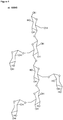
- the basic repeat unit of tamarind seed XG can then be described in terms of four oligosaccharides, which differ in the number and distribution of galactose residues. They are conveniently represented as XXXG, XLXG, XXLG, and XLLG, where X represents a Xyl p ( ⁇ 1 ⁇ 6)-Glc p side residue, L represents a Gal p ( ⁇ 1 ⁇ 2)Xyl p ( ⁇ 1 ⁇ 6)Glc p side residue, and G represents a backbone Glcp residue (see Figure 1 ) ( S C Fry, et al., Physiologia Plantarum, 1993, 89, 1 ).
- Xyloglucans are found as storage polysaccharides in seeds and tubers and also as cross-linking glycans in the cell wall of plants.
- the xyloglucan polymers may derive from the seeds of the brown pod-like fruits from the tamarind tree ( Tamarindus indica ).
- Other sources may be flour obtained from for instance Detarium senegalense, Afzelia africana, and Jatoba.
- the xyloglucan polymer is soluble in water, yielding a highly viscous solution.
- the present invention relates to films comprising at least 50 wt% xyloglucan, based on the dry weight of the film, characterized in that the xyloglucan comprises 9-11 mol% galactose residues, and that the oxygen permeability of the film at 80 %RH and 23 °C is not more than 7 cm 3 ⁇ m 1 m -2 day -1 kPa -1 , as well as a method for making such films and their use as oxygen barrier, for example in packaging materials.
- One object of the present invention is to provide a film comprising a xyloglucan, characterized in that the xyloglucan comprises 9-11 mol%, or at most 10 mol%, of galactose residues.
- the galactose content of the xyloglucan used in the films according to the present invention can be determined by acid hydrolysis of the xyloglucan to individual sugar molecules using 70% sulphuric acid according to ASTM, E1758-01 (2003) Determination of carbohydrates in biomass by high performance liquid chromatography, In: Annual Book of ASTM Standards, 11; followed by analysis of the hydrolysates with high performance anion exchange chromatography equipped with Pulsed Amperometric Detector (HPAEC-PAD, Dionex ICS-3000) and using standard solutions of glucose, xylose and galactose for calibration ( J J Kochumalayil, et al., Carbohydrate Polymers, 2013, 93, 466 ).
- HPAEC-PAD Pulsed Amperometric Detector
- the xyloglucan used in a film according to the present invention comprises at least 9 mol% of galactose residues.
- a film according to the present invention may have an oxygen permeability at 80 %RH and 23 °C that is not more than 7 cm 3 ⁇ m 1 m -2 day -1 kPa -1 , or not more than 3 cm 3 ⁇ m 1 m -2 day -1 kPa -1 , or not more than 2 cm 3 ⁇ m 1 m -2 day -1 kPa -1 .
- the films comprising xyloglucan according to the present invention may optionally comprise plasticizers such as glycerol, xylitol, sorbitol, maltitol, sucrose, glucose, fructose, xylose, polyethylene glycol, propylene glycol, butanediol, glycerine, urea or any combination thereof.
- plasticizers such as glycerol, xylitol, sorbitol, maltitol, sucrose, glucose, fructose, xylose, polyethylene glycol, propylene glycol, butanediol, glycerine, urea or any combination thereof.
- plasticizers such as glycerol, xylitol, sorbitol, maltitol, sucrose, glucose, fructose, xylose, polyethylene glycol, propylene glycol, butanediol, glycerine, urea or any
- the films comprising xyloglucan according to the present invention may optionally comprise nanoparticles in order to for example improve barrier properties, mechanical properties or to add functionality to the films.
- the nanoparticles may be inorganic such as silica nanoparticles or clay, where clay shall be understood to pertain phyllosilicates or sheet silicates including but not limited to sodium- montmorillonite, kaolinite, chlorite and mica.
- the nanoparticles may also be organic including but not limited to nanofibrillated cellulose and cellulose nanocrystals.
- the films comprising xyloglucan according to the present invention may optionally also comprise other polymers including but not limited to hemicelluloses, lignin, lignosulfonates, cellulose derivatives, starch and other biopolymers or synthetic polymers.
- the films according to the present invention may comprise at least 50 wt%, at least 60 wt%, at least 70 wt%, at least 80 wt%, at least 90 wt%, at least 95 wt%, or at least 98 wt% xyloglucan based on the dry weight of the film.
- the xyloglucan used in films according to the present invention may have a molecular weight of at least 10 kDa, at least 50 kDa, at least 100 kDa, at least 500 kDa, or at least 1 MDa. Further, the xyloglucan may have the molecular weight of 10 kDa - 2MDa, 50 kDa - 2MDa, 100 kDa - 2 MDa, 500 kDa - 2 MDa, or 1MDa - 2 MDa.
- the xyloglucan could also comprise a mixture of xyloglucans having different molecular weights or a distribution of molecular weights. A higher molecular weight has the advantage in that the film prepared from such xyloglucan will be less brittle, meaning that the amount of plasticizer may be reduced or even not required.
- An advantage with films according to the present invention comprising a xyloglucan comprising 9-11 mol% galactose residues is that the chains of such xyloglucan may pack closer in the film, which provides less moisture uptake by the xyloglucan and less solubility in water of the xyloglucan and thus provide an improved oxygen barrier and mechanical properties of the film at high relative humidity.
- a further advantage with the films according to the present invention comprising xyloglucan comprising 9-11 mol% galactose residues is that the increase in the packing of XG oligosaccharide segments means a decreased free volume and therefore the films will have high mechanical and oxygen barrier properties even in a high humidity compared with films prepared from xyloglucan comprising more galactose residues.
- the xyloglucan used in the film according to the present invention may be a modified xyloglucan (modified XG) obtained by partial removal of galactose residues, for example by enzymatic digestion of xyloglucan with an enzyme, such as beta-galactosidase.
- Organic solvents can be avoided in the preparation of the modified XG, i.e. to achieve hydrophobic XG.
- modified XG up to 43% of the galactose residues may be removed from xyloglucan obtained from Tamarindus indica.
- the films comprising XG comprising 9-11 mol% galactose residues according to the present invention have significantly reduced solubility in water, or may even be insoluble in water.
- XG comprising 9-11 mol% galactose residues may be re-dissolved in water by a simple process of mechanical homogenization, such as with a high shear mixer or in a microfluidizer; and optionally together with sonication.
- the xyloglucan comprising 9-11 mol% galactose residues may also be dissolved in organic solvents, ionic solvents, or ionic liquids, or mixtures of these solvents with each other or with water, such as dimethylsulphoxide, N-methylmorpholine N-oxide, dimethylformamide, dimethylacetamide, dimethylacetamide/LiCl, 1,3-dimethyl-3,4,5,6-tetrahydro-2(1H)-pyrimidinone, NaOH (aq), LiOH/urea, NaOH/urea, ammonium hydroxide.
- organic solvents such as dimethylsulphoxide, N-methylmorpholine N-oxide, dimethylformamide, dimethylacetamide, dimethylacetamide/LiCl, 1,3-dimethyl-3,4,5,6-tetrahydro-2(1H)-pyrimidinone, NaOH (aq), LiOH/urea, NaOH/urea, ammonium hydroxide.
- a further advantage is that the elastic modulus is increased, such as from 4.6 GPa for non-modified xyloglucan from Tamarindus indica up to 5.4 GPa for XG comprising 9-11 mol% galactose residues at 50 %RH. Also the elastic modulus is better preserved for films of modified XG at high humidity. Moreover, at 80 %RH, XG films prepared from XG comprising 9-11 mol% galactose residues may have a very low oxygen permeability, such as in the order of 1.5 cm 3 ⁇ m 1 m -2 day -1 kPa -1 . The better preservation of mechanical and barrier properties of XG comprising 9-11 mol% galactose residues is very significant in applications such as food packaging.
- Another object of the present invention is a method for making a film according to the present invention comprising a xyloglucan comprising 9-11 mol%, or 9-10 mol%, of galactose residues, the method comprising
- the method for making a film according to the present invention may comprise the steps of
- the solvent for dissolving the xyloglucan in step a) may be water, but also organic solvents, ionic solvents, ionic liquids, or mixtures of such solvents with each other or with water may be used, such as dimethyl sulfoxide (DMSO), N-methylmorpholine N-oxide, dimethylformamide, dimethylacetamide, dimethylacetamide/LiCl, 1,3-dimethyl-3,4,5,6-tetrahydro-2(1H)-pyrimidinone, NaOH (aq), LiOH/urea, NaOH/urea, ammonium hydroxide.
- DMSO dimethyl sulfoxide
- N-methylmorpholine N-oxide dimethylformamide
- dimethylacetamide dimethylacetamide/LiCl
- 1,3-dimethyl-3,4,5,6-tetrahydro-2(1H)-pyrimidinone NaOH (aq)
- LiOH/urea LiOH/urea
- the time suitable/needed for the treatment of xyloglucan in step b) for removing a desired proportion of the side chain galactose residues depends on the conditions for the reaction, such as the enzyme concentration, pH, ionic strength and temperature.
- the side chain galactose residues in xyloglucan may be removed by an enzyme, such as beta-galactosidase (EC 3.2.1.23).
- beta-galactosidase EC 3.2.1.23
- Different organisms, such as Aspergillus oryzae, can be the source of beta-galactosidase.
- the enzyme may be allowed to react with the xyloglucan at a suitable enzyme concentration, such as between 0 and 250 mg enzyme/g of solid xyloglucan, preferably between and including 5 and 150 mg enzyme/g of solid xyloglucan, or more preferably between 10 and 100 mg enzyme/g of solid xyloglucan, or more preferably between 15 and 50 mg enzyme/g of solid xyloglucan or more preferably between 20 and 30 mg enzyme/g of solid xyloglucan.
- a suitable enzyme concentration such as between 0 and 250 mg enzyme/g of solid xyloglucan, preferably between and including 5 and 150 mg enzyme/g of solid xyloglucan, or more preferably between 10 and 100 mg enzyme/g of solid xyloglucan, or more preferably between 15 and 50 mg enzyme/g of solid xyloglucan or more preferably between 20 and 30 mg enzyme/g of solid xyloglucan.
- the enzyme may be allowed to react with the xyloglucan at a suitable temperature for the enzyme, such as at a temperature of from 10 to 60 °C, or 15 to 50 °C, or 20 to 50 °C, or 20 to 40 °C, or 30 °C.
- the enzyme may be allowed to react with the xyloglucan at a suitable pH for the enzyme, such as at a pH of from 2 to 9, or from 3 to 8, or from 3.5 to 7, or from 4 to 5, or at pH 4.5.
- the enzyme may be allowed to react with the xyloglucan at a suitable ionic strength for the enzyme, such as between and including 0 and 200 mM, or between and including 10 and 100 mM, or between and including 30 and 60 mM, or at 50 mM.
- a suitable ionic strength for the enzyme such as between and including 0 and 200 mM, or between and including 10 and 100 mM, or between and including 30 and 60 mM, or at 50 mM.
- the time for treatment of the xyloglucan with the enzyme depends on the conditions for the reaction, such as the enzyme concentration, pH, ionic strength and temperature.
- the time for treatment of the xyloglucan with the enzyme may be at least 20 h, at least 30 h, at least 30 h, at least 50 h, or at least 60 h, for removal of the galactose residues.
- the reaction in step b) may be terminated by deactivation of the enzyme, such as by heating, for example to 90 °C.
- Beta-galactosidase obtained from other sources than Aspergillus oryzae may require different reaction conditions, concentrations, temperatures, pH and ionic strength.
- the modified XG obtained in step b) may be precipitated, for example in ethanol, optionally followed by washing, such as in ethanol; and/or drying, for example in a vacuum oven, for example at 50 °C for 24 h.
- the making of the film in step c) may include re-dissolving the modified xyloglucan obtained in step b).
- the modified XG may be re-dissolved in water together with mechanical homogenization, such as with a high shear mixer or in a microfluidizer; and optionally together with sonication.
- the modified xyloglucan may also be dissolved in organic solvents, ionic solvents, ionic liquids, or mixtures of these solvents with each other or with water; such as in dimethylsulphoxide (DMSO), N-methylmorpholine N-oxide, dimethylformamide, dimethylacetamide, 1,3-dimethyl-3,4,5,6-tetrahydro-2(1H)-pyrimidinone, NaOH (aq), ammonium hydroxide, dimethylacetamide/LiCl, LiOH/urea, NaOH/urea.
- DMSO dimethylsulphoxide
- N-methylmorpholine N-oxide dimethylformamide
- dimethylacetamide 1,3-dimethyl-3,4,5,6-tetrahydro-2(1H)-pyrimidinone
- NaOH (aq) sodium ammonium hydroxide
- dimethylacetamide/LiCl LiOH/urea
- NaOH/urea NaOH/urea
- the making of the film in step c) may be made by casting of, such as solvent casting or film casting; or coating with; the dissolved modified xyloglucan.
- the present invention also relates to the use of a film according to the present invention as an oxygen barrier, such as in a food packaging.
- the low oxygen permeability of the film according to the present invention even at high humidity makes it useful as an oxygen barrier, especially in packaging. Because of the possibility to produce the film without organic solvents and other possibly noxious substances, it is particularly suitable for use in food packaging.
- the present green methodology of enzyme hydrolysis of galactose side chains can be utilized for similar galactose - containing hemicelluloses such as galactoglucomannan in order to decrease the moisture sensitivity of such barrier materials at high humidity.
- the method according to the present invention could also be applicable for molecular tailoring of other polymers with limited solubility in water, and yet with low moisture sorption and preserved physical properties at high humidity.
- ⁇ -galactosidase from Aspergillus oryzae, Sigma Aldrich
- 5 ml of MilliQ water was added to the XG solution.
- the reaction mixtures were kept at 30 °C for different treatment times - 24 h, 51 h and 64h.
- the reactions were terminated after specified times by heating at 90°C for 30 min. to deactivate the enzyme.
- the modified XGs (mXG) were purified by precipitation and washing in ethanol and dried in a vacuum oven at 50 °C for 24 h.
- the modified XG samples were insoluble or sparingly soluble in water with 64 h treated samples least soluble in water.
- the samples including non-modified xyloglucan from Tamarindus indica and modified XGs where the amount of galactose residues have been reduced were mixed in 50 ml water under magnetic stirring overnight.
- the solutions were Ultra-turrax at 9500 rpm for 15 min. followed by sonication for 5 min. The cycle was repeated thrice, when most of the particle aggregates were soluble.
- the resultant solutions were centrifuged at 4000 rpm for 20 min. to remove any particle aggregates and the clear solution is used for film preparation.
- the above solutions were spread over Teflon-coated Petri dishes and placed on a leveled oven shelf at 35°C overnight and the dried films were peeled off for further characterizations.
- MALDI-TOF-MS Matrix-assisted laser desorption/ionization time-of-flight mass spectrometry (MALDI-TOF-MS) was performed on Ultraflex MALDI-TOF workstation (Bruker Daltonics, Bremen, Germany) equipped with a nitrogen laser (337 nm) and operated in positive reflector mode. About 2 mg of enzyme digested samples were dissolved in 1ml of MilliQ water and 3 ⁇ L of sample solution was mixed with 6 ⁇ L of matrix (5 mg of 2, 5-dihydroxy benzoic acid in 0.5 ml acetone) and spread over a MALDI-TOF plate (Bruker Daltonics) and air-dried. The ions were accelerated with a laser power of 21 kV.
- Cellulase enzyme from Trichoderma reesei (EC 3.2.1.4) (Sigma Aldrich). About 80 mg of XG and modified XG samples were dissolved in 8
- Tensile properties The tensile properties of conditioned films were measured using an Instron 5944 system in tensile mode equipped with a 50 N load cell. The specimens were thin rectangular strips with a thickness of 30 ⁇ m, the width X length was 5 mm X 60 mm and the gauge length was 40 mm. The samples were conditioned at desired humidity - 50 %RH and 92 %RH - at 23 °C for at least one week. The stress-strain curves of specimen samples were recorded at room temperature and 50 %RH at a strain rate of 10% / min. The elastic modulus was taken as the slope of the initial linear elastic region of the stress-strain curve and the tensile strength was determined as the tensile stress at specimen break.
- DMTA Dynamic mechanical thermal analysis
- Oxygen permeability The oxygen transmission rate (OTR) measurements were performed using Oxygen Permeation Analyzer (Systech 8001, Systech Instruments Ltd., UK) at 23 °C using 100% oxygen as test gas and nitrogen as carrier gas. Tests were done at dry condition and at 80 %RH in both N 2 and O 2 flow. The active area of measurement was 5 cm 2 by using an aluminium mask. Oxygen permeability was estimated as the arithmetic product of OTR and thickness of the film.
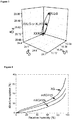
- ⁇ D , ⁇ P , and ⁇ H are calculated for individual oligosaccharides XXXG, XXLG/XLXG, and XLLG present in XG using a group contribution approach.
- ⁇ is expressed as a point in a three dimensional space with ⁇ D , ⁇ P , and ⁇ H in x-, y-, and z- axis respectively.
- Ra 2 4 ⁇ D 2 ⁇ ⁇ D 1 + ⁇ P 2 ⁇ ⁇ P 1 + ⁇ H 2 ⁇ ⁇ H 1 Ra for (XXXG-XXLG) and (XXXG-XLLG) were determined to get an idea of the affinity of XXXG oligosaccharides to other oligosaccharides with one and two galactose substitutions respectively.
- a smaller distance between oligosaccharide components indicates a larger affinity and stronger intermolecular interaction in this system
- XG has a unique composition of four oligosaccharides, viz. XXXG, XXLG, XLXG and XLLG, where XXXG has no galactose substitution, whereas XXLG/XLXG has mono- and XLLG has di- galactose substitutions.
- a qualitative picture using MALDI-TOF MS analysis ( Fig. 2 ) showed that the intensity of XXXG and XXLG / XLXG fragments increases with time of enzyme treatment.
- the concentration of galactose residues at XXLG / XLXG and XLLG oligosaccharides decreases and the amount of XXXG and XXLG / XLXG oligosaccharides in XG chains is increased.
- the modified XG chains thus consist of a large fraction of galactose-free oligosaccharides.
- the designations mXG34%, and mXG43% for modified XG samples refer to the amount of galactose removed after enzyme treatment.
- Moisture uptake of XG and modified XG at different relative humidities are given in Fig. 4 .
- the designations mXG41%, and mXG43% for modified XG samples refer to the amount of galactose removed after enzyme treatment.
- Modified XGs showed strong reduction in moisture uptake in all humidity ranges.
- a candidate polymer needs low moisture uptake at high humidity, for example at 80 %RH.
- the moisture uptake in this domain is higher since capillary condensation may start to dominate, and most polysaccharides show a sharp increase in moisture sorption in this region.
- modified mXG43% samples showed 40 % decrease in moisture uptake compared to non-modified xyloglucan from Tamarindus indica. Since the effective number of polar-OH groups in non-modified xyloglucan from Tamarindus indica and modified XGs is similar, this is a consequence of lowered water solubility and probably decreased free volume related to galactose removal.
- Fig. 5 The effect of galactose removal on mechanical properties of films conditioned at 50 %RH and 92 %RH is given in Table 3 and typical stress-strain diagrams are presented in Fig. 5 .
- Fig. 5 the designations mXG34%, mXG41%, and mXG43% for modified XG samples refer to the amount of galactose removed after enzyme treatment.
- Designations mXG34%, mXG41%, and mXG43% for modified XG samples in Table 3 above refer to the amount of galactose removed after enzyme treatment.
- Elastic modulus for XG was 4.6 GPa and tensile strength was 78 MPa.
- the modified XGs did not show a uniform trend in stress-strain behaviour for samples conditioned at 50 %RH.
- the relationship between galactose removal and tensile properties is complex.
- the molecular conformations in the cast XGs may be sensitive to differences in solution properties and details in the casting procedure.
- the Young's modulus increased significantly from 4.6 GPa to 5.4 GPa and 5.1 GPa for mXG41% and mXG43% samples respectively.
- the lower moisture uptake in the modified XGs is certainly one explanation. It is likely that intermolecular interactions may also be increased by shortening of the XG branches. It is interesting that the mXG41% shows significantly improved modulus and yield strength compared with the XG reference.
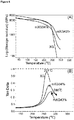
- thermo-mechanical studies revealed that non-modified XG from Tamarindus indica shows a slight increase in storage modulus before the glass transition at 261 °C.
- modified XGs showed a steady decrease in storage modulus until the glass transition temperature was reached. The difference is due to differences in molecular mobility in modified XGs as a result of galactose removal.
- the glass transition temperature increased from 261 °C for non-modified XG from Tamarindus indica up to 280 °C with galactose removal ( Fig. 6 ). This is consistent with reduced free volume in the polymer as the XG branches are shortened.
- Xyloglucan can be considered as water-soluble although individual chains are not completely hydrated ( D R Picout, et al., Biomacromolecules, 2003, 4, 799 ). From a practical point of view, the high molar mass XG is sufficiently soluble to be processed as a water solution. The presence of side chains - single xylose and two ring xylose-galactose combinations - has significant effect on the hydration and solubility of XG (Urakawa, 2002). Enzymatic removal of galactose side chains resulted in aggregation of XG chains. As the amount of galactose removal was increased, the resulting material was insoluble in water.
Landscapes
- Chemical & Material Sciences (AREA)
- Engineering & Computer Science (AREA)
- Materials Engineering (AREA)
- Organic Chemistry (AREA)
- Life Sciences & Earth Sciences (AREA)
- Health & Medical Sciences (AREA)
- Manufacturing & Machinery (AREA)
- Polymers & Plastics (AREA)
- Chemical Kinetics & Catalysis (AREA)
- Medicinal Chemistry (AREA)
- Wood Science & Technology (AREA)
- General Health & Medical Sciences (AREA)
- Molecular Biology (AREA)
- Biochemistry (AREA)
- Manufacture Of Macromolecular Shaped Articles (AREA)
- Polysaccharides And Polysaccharide Derivatives (AREA)
- General Preparation And Processing Of Foods (AREA)
Claims (14)
- Film comprenant au moins 50 % en poids de xyloglucane, sur la base du poids à sec du film, caractérisé en ce que le xyloglucane comprend de 9 à 11 % en moles de résidus galactose, et en ce que la perméabilité à l'oxygène du film à 80 % d'HR et à 23 °C n'est pas supérieure à 7 cm3µm1m-2jour-1kPa-1.
- Film selon la revendication 1, caractérisé en ce que le xyloglucane comprend au maximum 10 % en moles de résidus galactose.
- Film selon l'une quelconque des revendications 1 à 2, caractérisé en ce que la perméabilité à l'oxygène du film à 80 % d'HR et à 23 °C n'est pas supérieure à 3 cm3µm1m-2jour-1kPa-1.
- Film selon l'une quelconque des revendications 1 à 3, caractérisé en ce que la perméabilité à l'oxygène du film à 80 % d'HR et à 23 °C n'est pas supérieure à 2 cm3µm1m-2jour-1kPa-1.
- Film selon l'une quelconque des revendications 1 à 4, comprenant en outre des plastifiants tels que le glycérol, le xylitol, le sorbitol, le maltitol, le saccharose, le glucose, le fructose, le xylose, le polyéthylène glycol, le propylène glycol, le butanediol, la glycérine, l'urée ou une quelconque combinaison de ceux-ci.
- Film selon l'une quelconque des revendications 1 à 5, comprenant en outre des nanoparticules inorganiques ou organiques, telles que des nanoparticules de silice ; une argile, telle que la montmorillonite de sodium, la kaolinite, du chlorite et du mica ; de la cellulose nanofibrillée ; et des nanocristaux de cellulose.
- Film selon l'une quelconque des revendications 1 à 6, comprenant en outre d'autres polymères incluant, mais ne se limitant pas à ceux-ci, des hémicelluloses, de la lignine, des lignosulfonates, des dérivés de cellulose, de l'amidon et d'autres biopolymères ou polymères synthétiques.
- Film selon l'une quelconque des revendications 1 à 7, dans lequel le xyloglucane a un poids moléculaire d'au moins 10 kDa.
- Film selon l'une quelconque des revendications 1 à 8, dans lequel le xyloglucane a un poids moléculaire d'au moins 1 MDa.
- Film selon l'une quelconque des revendications 1 à 9, dans lequel le xyloglucane comprend un mélange de xyloglucanes avec différents poids moléculaires ou une distribution de poids moléculaires.
- Procédé de préparation d'un film selon l'une quelconque des revendications 1 à 10, le procédé comprenanta) la dissolution du xyloglucane dans un solvant,b) le retrait de résidus galactose de chaîne latérale de la chaîne xyloglucane afin d'obtenir un xyloglucane modifié,c) la préparation d'un film à base du xyloglucane modifié obtenu dans l'étape b).
- Procédé selon la revendication 11, dans lequel le retrait de résidus galactose de chaîne latérale dans l'étape b) est effectué en faisant réagir le xyloglucane dissout avec une enzyme telle que la bêta-galactosidase.
- Utilisation d'un film selon l'une quelconque des revendications 1 à 12 en tant que barrière pour l'oxygène.
- Utilisation selon la revendication 13 dans un emballage alimentaire.
Priority Applications (1)
| Application Number | Priority Date | Filing Date | Title |
|---|---|---|---|
| PL14792458T PL3063214T3 (pl) | 2013-10-29 | 2014-10-29 | Folia ksyloglukanowa |
Applications Claiming Priority (2)
| Application Number | Priority Date | Filing Date | Title |
|---|---|---|---|
| SE1351283 | 2013-10-29 | ||
| PCT/EP2014/073239 WO2015063163A1 (fr) | 2013-10-29 | 2014-10-29 | Film de xyloglucane |
Publications (2)
| Publication Number | Publication Date |
|---|---|
| EP3063214A1 EP3063214A1 (fr) | 2016-09-07 |
| EP3063214B1 true EP3063214B1 (fr) | 2019-07-31 |
Family
ID=51844711
Family Applications (1)
| Application Number | Title | Priority Date | Filing Date |
|---|---|---|---|
| EP14792458.3A Active EP3063214B1 (fr) | 2013-10-29 | 2014-10-29 | Film de xyloglucane |
Country Status (6)
| Country | Link |
|---|---|
| US (1) | US10035890B2 (fr) |
| EP (1) | EP3063214B1 (fr) |
| CN (1) | CN105873991B (fr) |
| BR (1) | BR112016009429B1 (fr) |
| PL (1) | PL3063214T3 (fr) |
| WO (1) | WO2015063163A1 (fr) |
Families Citing this family (5)
| Publication number | Priority date | Publication date | Assignee | Title |
|---|---|---|---|---|
| US20140065406A1 (en) * | 2011-05-04 | 2014-03-06 | Kth Holding Ab | Oxygen barrier for packaging applications |
| KR102464132B1 (ko) * | 2016-05-16 | 2022-11-07 | 이슘 리서치 디벨롭먼트 컴퍼니 오브 더 히브루 유니버시티 오브 예루살렘 엘티디. | 개선된 나노결정질 셀룰로오스 물질 및 제형 및 그로부터 제조된 제품 |
| CN113045787A (zh) * | 2021-04-07 | 2021-06-29 | 陕西科技大学 | 一种光限幅特性的纳米纤维素液晶纸的制备方法 |
| BR112023025737A2 (pt) | 2021-06-09 | 2024-02-27 | Soane Mat Llc | Artigos de fabricação compreendendo elementos de nanocelulose |
| CN114467942A (zh) * | 2022-01-21 | 2022-05-13 | 赤天化科技集团有限公司 | 一种含精甲霜灵的复合菌剂及其应用 |
Family Cites Families (6)
| Publication number | Priority date | Publication date | Assignee | Title |
|---|---|---|---|---|
| US7311933B2 (en) * | 2004-04-13 | 2007-12-25 | Eastman Kodak Company | Packaging material for inhibiting microbial growth |
| PL2483335T3 (pl) * | 2009-09-29 | 2019-10-31 | Stora Enso Oyj | Folie ksyloglukanowe |
| US20110229698A1 (en) * | 2010-03-19 | 2011-09-22 | E2E Materials, Inc. | Biodegradable resin composites |
| US20140065406A1 (en) | 2011-05-04 | 2014-03-06 | Kth Holding Ab | Oxygen barrier for packaging applications |
| EP2698429A1 (fr) | 2012-08-17 | 2014-02-19 | Centre National de la Recherche Scientifique (CNRS) | Support pour la culture de cellules adhérentes et procédé pour leur détachement |
| US9187865B2 (en) * | 2012-11-30 | 2015-11-17 | Api Intellectual Property Holdings, Llc | Processes and apparatus for producing nanocellulose, and compositions and products produced therefrom |
-
2014
- 2014-10-29 US US15/032,284 patent/US10035890B2/en active Active
- 2014-10-29 CN CN201480059690.6A patent/CN105873991B/zh active Active
- 2014-10-29 EP EP14792458.3A patent/EP3063214B1/fr active Active
- 2014-10-29 PL PL14792458T patent/PL3063214T3/pl unknown
- 2014-10-29 WO PCT/EP2014/073239 patent/WO2015063163A1/fr not_active Ceased
- 2014-10-29 BR BR112016009429-8A patent/BR112016009429B1/pt active IP Right Grant
Non-Patent Citations (1)
| Title |
|---|
| None * |
Also Published As
| Publication number | Publication date |
|---|---|
| PL3063214T3 (pl) | 2020-02-28 |
| BR112016009429A2 (pt) | 2021-07-06 |
| US10035890B2 (en) | 2018-07-31 |
| US20160251488A1 (en) | 2016-09-01 |
| BR112016009429B1 (pt) | 2021-09-14 |
| WO2015063163A1 (fr) | 2015-05-07 |
| CN105873991A (zh) | 2016-08-17 |
| EP3063214A1 (fr) | 2016-09-07 |
| CN105873991B (zh) | 2019-02-12 |
Similar Documents
| Publication | Publication Date | Title |
|---|---|---|
| Kochumalayil et al. | Water-soluble hemicelluloses for high humidity applications–enzymatic modification of xyloglucan for mechanical and oxygen barrier properties | |
| Xu et al. | Use of xylooligosaccharides (XOS) in hemicelluloses/chitosan-based films reinforced by cellulose nanofiber: Effect on physicochemical properties | |
| EP3063214B1 (fr) | Film de xyloglucane | |
| EP3092267B1 (fr) | Production de films de poly alpha -1,3-glucane | |
| Kochumalayil et al. | Tamarind seed xyloglucan–a thermostable high-performance biopolymer from non-food feedstock | |
| CN100335532C (zh) | 包含半纤维素的聚合物膜或涂层 | |
| Dong et al. | Effect of polyol plasticizers on properties and microstructure of soluble soybean polysaccharide edible films | |
| Zhang et al. | Preparation and characterization of a transparent amorphous cellulose film | |
| Kochumalayil et al. | Regioselective modification of a xyloglucan hemicellulose for high-performance biopolymer barrier films | |
| Alcântara et al. | Bionanocomposites based on polysaccharides and fibrous clays for packaging applications | |
| Sundberg et al. | Effect of xylan content on mechanical properties in regenerated cellulose/xylan blend films from ionic liquid | |
| Niazi et al. | Mechanical and thermal properties of carboxymethyl fibers (CMF)/PVA based nanocomposite membranes | |
| Queirós et al. | Development of carboxymethyl xylan films with functional properties | |
| Thangavelu et al. | Development and characterization of pullulan‐carboxymethyl cellulose blend film for packaging applications | |
| Bergström et al. | Plasticized xyloglucan for improved toughness—Thermal and mechanical behaviour | |
| Stoklosa et al. | Evaluation of arabinoxylan isolated from sorghum bran, biomass, and bagasse for film formation | |
| Liu et al. | Mechanical and water vapor barrier properties of bagasse hemicellulose-based films | |
| Chen et al. | Influence of ammonium zirconium carbonate on properties of poly (vinyl alcohol)/xylan composite films | |
| Marismandani et al. | Development and characterization of biobased alginate/glycerol/virgin coconut oil as biodegradable packaging | |
| Cybulska et al. | Influence of pectin and hemicelluloses on physical properties of bacterial cellulose | |
| Alfindee et al. | Preparation and characterization of polymer blends based on carboxymethyl cellulose, polyvinyl alcohol, and polyvinylpyrrolidone | |
| WO2014062129A1 (fr) | Modification régiosélective d'une hémicellulose de xyloglucane de films barrières en biopolymère à haute performance | |
| EP2483335B1 (fr) | Films de xyloglucane | |
| Julkapli et al. | Degradability of kenaf dust-filled chitosan biocomposites | |
| Hu et al. | Fabrication of an all-polysaccharide composite film from hemicellulose and methylcellulose |
Legal Events
| Date | Code | Title | Description |
|---|---|---|---|
| PUAI | Public reference made under article 153(3) epc to a published international application that has entered the european phase |
Free format text: ORIGINAL CODE: 0009012 |
|
| 17P | Request for examination filed |
Effective date: 20160524 |
|
| AK | Designated contracting states |
Kind code of ref document: A1 Designated state(s): AL AT BE BG CH CY CZ DE DK EE ES FI FR GB GR HR HU IE IS IT LI LT LU LV MC MK MT NL NO PL PT RO RS SE SI SK SM TR |
|
| AX | Request for extension of the european patent |
Extension state: BA ME |
|
| DAX | Request for extension of the european patent (deleted) | ||
| STAA | Information on the status of an ep patent application or granted ep patent |
Free format text: STATUS: EXAMINATION IS IN PROGRESS |
|
| 17Q | First examination report despatched |
Effective date: 20180619 |
|
| GRAP | Despatch of communication of intention to grant a patent |
Free format text: ORIGINAL CODE: EPIDOSNIGR1 |
|
| STAA | Information on the status of an ep patent application or granted ep patent |
Free format text: STATUS: GRANT OF PATENT IS INTENDED |
|
| INTG | Intention to grant announced |
Effective date: 20190218 |
|
| RAP1 | Party data changed (applicant data changed or rights of an application transferred) |
Owner name: STORA ENSO OYJ |
|
| GRAS | Grant fee paid |
Free format text: ORIGINAL CODE: EPIDOSNIGR3 |
|
| GRAA | (expected) grant |
Free format text: ORIGINAL CODE: 0009210 |
|
| STAA | Information on the status of an ep patent application or granted ep patent |
Free format text: STATUS: THE PATENT HAS BEEN GRANTED |
|
| AK | Designated contracting states |
Kind code of ref document: B1 Designated state(s): AL AT BE BG CH CY CZ DE DK EE ES FI FR GB GR HR HU IE IS IT LI LT LU LV MC MK MT NL NO PL PT RO RS SE SI SK SM TR |
|
| REG | Reference to a national code |
Ref country code: CH Ref legal event code: EP Ref country code: GB Ref legal event code: FG4D |
|
| REG | Reference to a national code |
Ref country code: AT Ref legal event code: REF Ref document number: 1160827 Country of ref document: AT Kind code of ref document: T Effective date: 20190815 |
|
| REG | Reference to a national code |
Ref country code: IE Ref legal event code: FG4D |
|
| REG | Reference to a national code |
Ref country code: DE Ref legal event code: R096 Ref document number: 602014050935 Country of ref document: DE |
|
| REG | Reference to a national code |
Ref country code: CH Ref legal event code: NV Representative=s name: VALIPAT S.A. C/O BOVARD SA NEUCHATEL, CH |
|
| REG | Reference to a national code |
Ref country code: SE Ref legal event code: TRGR |
|
| REG | Reference to a national code |
Ref country code: NO Ref legal event code: T2 Effective date: 20190731 |
|
| REG | Reference to a national code |
Ref country code: NL Ref legal event code: MP Effective date: 20190731 |
|
| REG | Reference to a national code |
Ref country code: LT Ref legal event code: MG4D |
|
| REG | Reference to a national code |
Ref country code: AT Ref legal event code: MK05 Ref document number: 1160827 Country of ref document: AT Kind code of ref document: T Effective date: 20190731 |
|
| PG25 | Lapsed in a contracting state [announced via postgrant information from national office to epo] |
Ref country code: PT Free format text: LAPSE BECAUSE OF FAILURE TO SUBMIT A TRANSLATION OF THE DESCRIPTION OR TO PAY THE FEE WITHIN THE PRESCRIBED TIME-LIMIT Effective date: 20191202 Ref country code: AT Free format text: LAPSE BECAUSE OF FAILURE TO SUBMIT A TRANSLATION OF THE DESCRIPTION OR TO PAY THE FEE WITHIN THE PRESCRIBED TIME-LIMIT Effective date: 20190731 Ref country code: LT Free format text: LAPSE BECAUSE OF FAILURE TO SUBMIT A TRANSLATION OF THE DESCRIPTION OR TO PAY THE FEE WITHIN THE PRESCRIBED TIME-LIMIT Effective date: 20190731 Ref country code: BG Free format text: LAPSE BECAUSE OF FAILURE TO SUBMIT A TRANSLATION OF THE DESCRIPTION OR TO PAY THE FEE WITHIN THE PRESCRIBED TIME-LIMIT Effective date: 20191031 Ref country code: NL Free format text: LAPSE BECAUSE OF FAILURE TO SUBMIT A TRANSLATION OF THE DESCRIPTION OR TO PAY THE FEE WITHIN THE PRESCRIBED TIME-LIMIT Effective date: 20190731 Ref country code: HR Free format text: LAPSE BECAUSE OF FAILURE TO SUBMIT A TRANSLATION OF THE DESCRIPTION OR TO PAY THE FEE WITHIN THE PRESCRIBED TIME-LIMIT Effective date: 20190731 |
|
| PG25 | Lapsed in a contracting state [announced via postgrant information from national office to epo] |
Ref country code: GR Free format text: LAPSE BECAUSE OF FAILURE TO SUBMIT A TRANSLATION OF THE DESCRIPTION OR TO PAY THE FEE WITHIN THE PRESCRIBED TIME-LIMIT Effective date: 20191101 Ref country code: IS Free format text: LAPSE BECAUSE OF FAILURE TO SUBMIT A TRANSLATION OF THE DESCRIPTION OR TO PAY THE FEE WITHIN THE PRESCRIBED TIME-LIMIT Effective date: 20191130 Ref country code: LV Free format text: LAPSE BECAUSE OF FAILURE TO SUBMIT A TRANSLATION OF THE DESCRIPTION OR TO PAY THE FEE WITHIN THE PRESCRIBED TIME-LIMIT Effective date: 20190731 Ref country code: AL Free format text: LAPSE BECAUSE OF FAILURE TO SUBMIT A TRANSLATION OF THE DESCRIPTION OR TO PAY THE FEE WITHIN THE PRESCRIBED TIME-LIMIT Effective date: 20190731 Ref country code: RS Free format text: LAPSE BECAUSE OF FAILURE TO SUBMIT A TRANSLATION OF THE DESCRIPTION OR TO PAY THE FEE WITHIN THE PRESCRIBED TIME-LIMIT Effective date: 20190731 Ref country code: ES Free format text: LAPSE BECAUSE OF FAILURE TO SUBMIT A TRANSLATION OF THE DESCRIPTION OR TO PAY THE FEE WITHIN THE PRESCRIBED TIME-LIMIT Effective date: 20190731 |
|
| PG25 | Lapsed in a contracting state [announced via postgrant information from national office to epo] |
Ref country code: TR Free format text: LAPSE BECAUSE OF FAILURE TO SUBMIT A TRANSLATION OF THE DESCRIPTION OR TO PAY THE FEE WITHIN THE PRESCRIBED TIME-LIMIT Effective date: 20190731 |
|
| PG25 | Lapsed in a contracting state [announced via postgrant information from national office to epo] |
Ref country code: IT Free format text: LAPSE BECAUSE OF FAILURE TO SUBMIT A TRANSLATION OF THE DESCRIPTION OR TO PAY THE FEE WITHIN THE PRESCRIBED TIME-LIMIT Effective date: 20190731 Ref country code: DK Free format text: LAPSE BECAUSE OF FAILURE TO SUBMIT A TRANSLATION OF THE DESCRIPTION OR TO PAY THE FEE WITHIN THE PRESCRIBED TIME-LIMIT Effective date: 20190731 Ref country code: EE Free format text: LAPSE BECAUSE OF FAILURE TO SUBMIT A TRANSLATION OF THE DESCRIPTION OR TO PAY THE FEE WITHIN THE PRESCRIBED TIME-LIMIT Effective date: 20190731 Ref country code: RO Free format text: LAPSE BECAUSE OF FAILURE TO SUBMIT A TRANSLATION OF THE DESCRIPTION OR TO PAY THE FEE WITHIN THE PRESCRIBED TIME-LIMIT Effective date: 20190731 |
|
| PG25 | Lapsed in a contracting state [announced via postgrant information from national office to epo] |
Ref country code: MC Free format text: LAPSE BECAUSE OF FAILURE TO SUBMIT A TRANSLATION OF THE DESCRIPTION OR TO PAY THE FEE WITHIN THE PRESCRIBED TIME-LIMIT Effective date: 20190731 Ref country code: IS Free format text: LAPSE BECAUSE OF FAILURE TO SUBMIT A TRANSLATION OF THE DESCRIPTION OR TO PAY THE FEE WITHIN THE PRESCRIBED TIME-LIMIT Effective date: 20200224 Ref country code: CZ Free format text: LAPSE BECAUSE OF FAILURE TO SUBMIT A TRANSLATION OF THE DESCRIPTION OR TO PAY THE FEE WITHIN THE PRESCRIBED TIME-LIMIT Effective date: 20190731 Ref country code: SM Free format text: LAPSE BECAUSE OF FAILURE TO SUBMIT A TRANSLATION OF THE DESCRIPTION OR TO PAY THE FEE WITHIN THE PRESCRIBED TIME-LIMIT Effective date: 20190731 Ref country code: SK Free format text: LAPSE BECAUSE OF FAILURE TO SUBMIT A TRANSLATION OF THE DESCRIPTION OR TO PAY THE FEE WITHIN THE PRESCRIBED TIME-LIMIT Effective date: 20190731 |
|
| REG | Reference to a national code |
Ref country code: DE Ref legal event code: R097 Ref document number: 602014050935 Country of ref document: DE |
|
| PLBE | No opposition filed within time limit |
Free format text: ORIGINAL CODE: 0009261 |
|
| STAA | Information on the status of an ep patent application or granted ep patent |
Free format text: STATUS: NO OPPOSITION FILED WITHIN TIME LIMIT |
|
| PG2D | Information on lapse in contracting state deleted |
Ref country code: IS |
|
| PG25 | Lapsed in a contracting state [announced via postgrant information from national office to epo] |
Ref country code: LU Free format text: LAPSE BECAUSE OF NON-PAYMENT OF DUE FEES Effective date: 20191029 Ref country code: IS Free format text: LAPSE BECAUSE OF FAILURE TO SUBMIT A TRANSLATION OF THE DESCRIPTION OR TO PAY THE FEE WITHIN THE PRESCRIBED TIME-LIMIT Effective date: 20191030 |
|
| 26N | No opposition filed |
Effective date: 20200603 |
|
| REG | Reference to a national code |
Ref country code: BE Ref legal event code: MM Effective date: 20191031 |
|
| PG25 | Lapsed in a contracting state [announced via postgrant information from national office to epo] |
Ref country code: BE Free format text: LAPSE BECAUSE OF NON-PAYMENT OF DUE FEES Effective date: 20191031 Ref country code: SI Free format text: LAPSE BECAUSE OF FAILURE TO SUBMIT A TRANSLATION OF THE DESCRIPTION OR TO PAY THE FEE WITHIN THE PRESCRIBED TIME-LIMIT Effective date: 20190731 |
|
| PG25 | Lapsed in a contracting state [announced via postgrant information from national office to epo] |
Ref country code: IE Free format text: LAPSE BECAUSE OF NON-PAYMENT OF DUE FEES Effective date: 20191029 |
|
| PG25 | Lapsed in a contracting state [announced via postgrant information from national office to epo] |
Ref country code: CY Free format text: LAPSE BECAUSE OF FAILURE TO SUBMIT A TRANSLATION OF THE DESCRIPTION OR TO PAY THE FEE WITHIN THE PRESCRIBED TIME-LIMIT Effective date: 20190731 |
|
| PG25 | Lapsed in a contracting state [announced via postgrant information from national office to epo] |
Ref country code: MT Free format text: LAPSE BECAUSE OF FAILURE TO SUBMIT A TRANSLATION OF THE DESCRIPTION OR TO PAY THE FEE WITHIN THE PRESCRIBED TIME-LIMIT Effective date: 20190731 Ref country code: HU Free format text: LAPSE BECAUSE OF FAILURE TO SUBMIT A TRANSLATION OF THE DESCRIPTION OR TO PAY THE FEE WITHIN THE PRESCRIBED TIME-LIMIT; INVALID AB INITIO Effective date: 20141029 |
|
| PG25 | Lapsed in a contracting state [announced via postgrant information from national office to epo] |
Ref country code: MK Free format text: LAPSE BECAUSE OF FAILURE TO SUBMIT A TRANSLATION OF THE DESCRIPTION OR TO PAY THE FEE WITHIN THE PRESCRIBED TIME-LIMIT Effective date: 20190731 |
|
| PGFP | Annual fee paid to national office [announced via postgrant information from national office to epo] |
Ref country code: FI Payment date: 20250923 Year of fee payment: 12 |
|
| PGFP | Annual fee paid to national office [announced via postgrant information from national office to epo] |
Ref country code: NO Payment date: 20250925 Year of fee payment: 12 |
|
| PGFP | Annual fee paid to national office [announced via postgrant information from national office to epo] |
Ref country code: GB Payment date: 20250923 Year of fee payment: 12 |
|
| PGFP | Annual fee paid to national office [announced via postgrant information from national office to epo] |
Ref country code: FR Payment date: 20250925 Year of fee payment: 12 |
|
| PGFP | Annual fee paid to national office [announced via postgrant information from national office to epo] |
Ref country code: SE Payment date: 20250923 Year of fee payment: 12 |
|
| REG | Reference to a national code |
Ref country code: CH Ref legal event code: U11 Free format text: ST27 STATUS EVENT CODE: U-0-0-U10-U11 (AS PROVIDED BY THE NATIONAL OFFICE) Effective date: 20251101 |
|
| PGFP | Annual fee paid to national office [announced via postgrant information from national office to epo] |
Ref country code: DE Payment date: 20250923 Year of fee payment: 12 |
|
| PGFP | Annual fee paid to national office [announced via postgrant information from national office to epo] |
Ref country code: CH Payment date: 20251101 Year of fee payment: 12 |
|
| PGFP | Annual fee paid to national office [announced via postgrant information from national office to epo] |
Ref country code: PL Payment date: 20251014 Year of fee payment: 12 |