EP3064370A2 - Roue porteuse et rayon de roue, en particulier pour un velo - Google Patents
Roue porteuse et rayon de roue, en particulier pour un velo Download PDFInfo
- Publication number
- EP3064370A2 EP3064370A2 EP16158821.5A EP16158821A EP3064370A2 EP 3064370 A2 EP3064370 A2 EP 3064370A2 EP 16158821 A EP16158821 A EP 16158821A EP 3064370 A2 EP3064370 A2 EP 3064370A2
- Authority
- EP
- European Patent Office
- Prior art keywords
- spoke
- section
- central region
- region
- thickness
- Prior art date
- Legal status (The legal status is an assumption and is not a legal conclusion. Google has not performed a legal analysis and makes no representation as to the accuracy of the status listed.)
- Granted
Links
Images

Classifications
-
- B—PERFORMING OPERATIONS; TRANSPORTING
- B60—VEHICLES IN GENERAL
- B60B—VEHICLE WHEELS; CASTORS; AXLES FOR WHEELS OR CASTORS; INCREASING WHEEL ADHESION
- B60B1/00—Spoked wheels; Spokes thereof
- B60B1/02—Wheels with wire or other tension spokes
- B60B1/0261—Wheels with wire or other tension spokes characterised by spoke form
-
- B—PERFORMING OPERATIONS; TRANSPORTING
- B60—VEHICLES IN GENERAL
- B60B—VEHICLE WHEELS; CASTORS; AXLES FOR WHEELS OR CASTORS; INCREASING WHEEL ADHESION
- B60B1/00—Spoked wheels; Spokes thereof
- B60B1/003—Spoked wheels; Spokes thereof specially adapted for bicycles
-
- B—PERFORMING OPERATIONS; TRANSPORTING
- B60—VEHICLES IN GENERAL
- B60B—VEHICLE WHEELS; CASTORS; AXLES FOR WHEELS OR CASTORS; INCREASING WHEEL ADHESION
- B60B1/00—Spoked wheels; Spokes thereof
- B60B1/02—Wheels with wire or other tension spokes
- B60B1/0246—Wheels with wire or other tension spokes characterised by cross-section of the spoke, e.g. polygon or elliptic shape
-
- B—PERFORMING OPERATIONS; TRANSPORTING
- B60—VEHICLES IN GENERAL
- B60B—VEHICLE WHEELS; CASTORS; AXLES FOR WHEELS OR CASTORS; INCREASING WHEEL ADHESION
- B60B1/00—Spoked wheels; Spokes thereof
- B60B1/02—Wheels with wire or other tension spokes
- B60B1/0261—Wheels with wire or other tension spokes characterised by spoke form
- B60B1/0269—Wheels with wire or other tension spokes characterised by spoke form the spoke being curved or deformed over substantial part of length
-
- B—PERFORMING OPERATIONS; TRANSPORTING
- B60—VEHICLES IN GENERAL
- B60B—VEHICLE WHEELS; CASTORS; AXLES FOR WHEELS OR CASTORS; INCREASING WHEEL ADHESION
- B60B1/00—Spoked wheels; Spokes thereof
- B60B1/02—Wheels with wire or other tension spokes
- B60B1/04—Attaching spokes to rim or hub
- B60B1/043—Attaching spokes to rim
-
- B—PERFORMING OPERATIONS; TRANSPORTING
- B60—VEHICLES IN GENERAL
- B60B—VEHICLE WHEELS; CASTORS; AXLES FOR WHEELS OR CASTORS; INCREASING WHEEL ADHESION
- B60B1/00—Spoked wheels; Spokes thereof
-
- B—PERFORMING OPERATIONS; TRANSPORTING
- B60—VEHICLES IN GENERAL
- B60B—VEHICLE WHEELS; CASTORS; AXLES FOR WHEELS OR CASTORS; INCREASING WHEEL ADHESION
- B60B2360/00—Materials; Physical forms thereof
- B60B2360/10—Metallic materials
-
- B—PERFORMING OPERATIONS; TRANSPORTING
- B60—VEHICLES IN GENERAL
- B60B—VEHICLE WHEELS; CASTORS; AXLES FOR WHEELS OR CASTORS; INCREASING WHEEL ADHESION
- B60B2900/00—Purpose of invention
- B60B2900/10—Reduction of
- B60B2900/112—Costs
-
- B—PERFORMING OPERATIONS; TRANSPORTING
- B60—VEHICLES IN GENERAL
- B60B—VEHICLE WHEELS; CASTORS; AXLES FOR WHEELS OR CASTORS; INCREASING WHEEL ADHESION
- B60B2900/00—Purpose of invention
- B60B2900/10—Reduction of
- B60B2900/121—Resisting forces
- B60B2900/1216—Resisting forces due to air-drag
-
- Y—GENERAL TAGGING OF NEW TECHNOLOGICAL DEVELOPMENTS; GENERAL TAGGING OF CROSS-SECTIONAL TECHNOLOGIES SPANNING OVER SEVERAL SECTIONS OF THE IPC; TECHNICAL SUBJECTS COVERED BY FORMER USPC CROSS-REFERENCE ART COLLECTIONS [XRACs] AND DIGESTS
- Y02—TECHNOLOGIES OR APPLICATIONS FOR MITIGATION OR ADAPTATION AGAINST CLIMATE CHANGE
- Y02T—CLIMATE CHANGE MITIGATION TECHNOLOGIES RELATED TO TRANSPORTATION
- Y02T10/00—Road transport of goods or passengers
- Y02T10/80—Technologies aiming to reduce greenhouse gasses emissions common to all road transportation technologies
- Y02T10/88—Optimized components or subsystems, e.g. lighting, actively controlled glasses
Definitions
- the present invention relates to a spoke and a wheel equipped with at least one such spoke, in particular for a bicycle or another at least partially muscle-operated two-wheeler.
- Knickets are disadvantages that these, in turn, considerably increase the crosswind sensitivity, so that bicycles equipped with them can be steered worse under the influence of wind, so that the use of so-called knife spokes is also limited.
- An impeller according to the invention is intended for use on an at least partially muscle-operated bicycle and has a hub and a rim.
- the hub is connected to the rim via a variety of spokes.
- At least one of the spokes has a spoke body with two ends remote from each other.
- the first or hub-side end is connected to the hub and the second or rim-side end is connected to the rim.
- the spoke body is elongate and has at least one longitudinal region in a longitudinal direction of the spoke body with a flattened cross section received in a longitudinal plane.
- the spoke body has, in a first end section, a first end section thickness transversely to the longitudinal plane at the first or hub-side end.
- the spoke body has, in a second end section, a second end section thickness at the second or rim-side end transversely to the longitudinal plane.
- the spoke body has a first one located closer to the first end portion than the second end portion Center region transverse to the longitudinal plane to a first central region thickness, which is smaller than the first end portion thickness.
- the spoke body has the flattened cross-section in a second central region arranged closer to the second end section than to the first end section, which has a second central region thickness transverse to the longitudinal plane which is smaller than the first central region thickness.
- the impeller according to the invention has many advantages, since the impeller allows a significantly reduced wind resistance, at the same time the cross wind sensitivity is not increased over a conventional impeller with consistently the same spoke thickness.
- the production is simple and inexpensive.
- the first or hub-side end of the spoke body is intended to be connected to the hub and the second or rim-side end of the spoke body is intended to be connected to the rim.
- the “hub-side end” may also be referred to as a “first end” or as a “first hub-side end” or as a “hub-side first end” and respectively designates the hub of the spoke body facing and fixed to the hub.
- rim-side end may also be referred to as “second end” or as “second rim-side end” or “rim-side second end” and denotes respectively the rim facing and fastened there end of the spoke body.
- the second central region with the flattened cross section is located radially further outside than the first central region.
- the flattened cross section of the second central region lies radially further outward and is thus exposed to greater peripheral speeds than the first central region having a preferably round or substantially round cross section.
- the wheel equipped with such a spoke rolls on the ground or the road.
- the impeller At the lowest point of the impeller there is a relative speed of 0 to the surrounding air or the ground.
- the uppermost point of the impeller or at the uppermost point of the uppermost spoke there is essentially twice the relative speed of the actual travel speed relative to the surrounding air.
- the hub is respectively connected to the hub side end of a plurality of the spokes and the rim is respectively connected to the rim end of the plurality of spokes.
- This is very advantageous because the flattened cross-section in the second central region is arranged radially further outward than the first central region with a preferably substantially round cross-section.
- the air resistance grows quadratically with the relative speed between spoke and air.
- the air resistance is consequently reduced in a particularly advantageous manner.
- An impeller with spokes, which in the first central region a z. B. round cross-section with smaller central region thickness compared to the first End section thickness, is advantageous.
- a wheel equipped in this way is aerodynamic where it is needed and has a small crosswind face where the aerodynamics in the direction of travel are less critical.
- first central region thickness first central region thickness
- second central region thickness second central region thickness
- the flattened cross-section of the spoke body is aligned in each case substantially parallel to a plane spanned by the rim.
- Substantially parallel in the sense of the present invention is also a certain inclination of z. B. preferably up to 10 ° or in particular up to 20 ° or possibly up to 30 ° to the longitudinal direction. A certain obliqueness is normal and often desired.
- the second central area is aligned with the flattened cross section (substantially) in the running plane and thus reduces the wind resistance and not increased.
- An increase could occur if the flattened area were completely or substantially transverse to the direction of travel of a bicycle equipped with such an impeller.
- a spoke according to the invention has a spoke body and is intended for use on an impeller of an at least partially muscle-operated bicycle.
- the spoke body has two ends remote from each other, with a first hub-side end intended to be connected to a hub.
- the second rim-side end is intended to be connected to a rim.
- the spoke body is of elongate design and has at least one flattened cross-section, at least one longitudinal region in a longitudinal direction of the spoke body, which is accommodated at least substantially in a longitudinal plane.
- the spoke body has, in a first end section, a first end section thickness at the first hub-side end transversely to the longitudinal plane.
- the spoke body has, in a second end portion at the second rim side end, a second end portion thickness transverse to the longitudinal plane.
- the spoke body has, in a first central region arranged closer to the first end section than to the second end section, transversely to the longitudinal plane a first central region thickness which is smaller than the first end section thickness.
- the spoke body has the flattened cross-section in a second middle region arranged closer to the second end section than to the first end section.
- the second center region has a second midregion thickness transverse to the longitudinal plane which is smaller than the first midregion thickness.
- the flattened cross section is arranged in the longitudinal plane.
- the spoke according to the invention also has many advantages.
- a significant advantage of the spoke according to the invention is that the spoke body in the first central region has a first central region thickness which is smaller than the first end section thickness. As a result, the wind resistance is reduced in the first center area.
- the spoke body in the second middle region has the flattened cross-section which has a second central region thickness transverse to the longitudinal plane, which is even smaller than the first mid-range thickness.
- the second middle region thickness is smaller than in the first middle region and also smaller than the first end section thickness.
- the flattened cross section may be completely aligned within or parallel to the longitudinal plane. But it is also possible that the flattened cross section of the spoke body in the first central region does not extend completely within the longitudinal plane or parallel to the longitudinal plane, for example, if the first central region has a slight curvature or is slightly helical. In this case, in all cases, the flattened region does not extend transversely to the longitudinal plane, but at most within a range of +/- 30 ° and in particular +/- 20 ° and preferably +/- 10 ° relative to the longitudinal plane. Particularly preferred is at least one longitudinal edge of the flattened cross section within the manufacturing accuracy of the spoke body parallel to the longitudinal plane.
- the spoke body here has two mutually remote ends, namely a first end and a second end.
- the first end is for the purposes of the invention, the hub-side end and may also be referred to as "first end”, “hub-side end”, “first hub-side end” and “hub-side first end”.
- the names are interchangeable.
- the second end is in the context of the invention, the rim-side end and can also be used as “second “End”, “rim-side end”, “second rim-side end” and “rim-side second end” are also interchangeable in the definition of the invention.
- the spoke body has a constant cross-section over at least one longitudinal section.
- the longitudinal section is taken from a group of longitudinal sections which comprises the first end section and the second end section and the first center section and the second center section.
- a constant cross section is understood here to mean a substantially constant cross section. This means that small cross-sectional changes of, for example, less than 10% and in particular less than 5% over the length of the longitudinal section are disregarded and are still regarded as a constant cross section. Preferably, changes in cross section over the length of the longitudinal section are in a dimensional range of less than 5% and in particular less than 2%.
- the spoke body has a continuous and / or stepped transition region between at least two longitudinal sections. It is also possible that two or more similar or differently formed transition regions are provided between two adjacent longitudinal sections. However, two adjacent longitudinal sections or longitudinal zones are particularly preferably connected to one another by a continuous or stepped transition region. At least one transition region and preferably all transition regions are preferably formed short in the longitudinal direction of the spoke body. Preferably, all transition regions are shorter than 20 mm and in particular shorter than 15 mm.
- the transition region between the first central region and the second central region preferably extends over a length of less than 15 mm and in particular less than 10 mm.
- the transition region between the first middle region and the second central region is preferably shorter than 10% of the length of the first central region.
- a length of the transitional region between the first central region and the second central region is 5% +/- 3% of the length of the first central region, but may also be even shorter.
- the length of at least one transition region and preferably all transition regions is smaller than a length of at least one, and in particular the shortest end portion.
- a stepped or edged transition between the end portions and the transition areas is possible.
- the spoke body transversely to its longitudinal direction and within the longitudinal plane in the first central region has a first central region width which is smaller than the second central region width in the second central region.
- the flattened cross-section in the second central region is achieved by embossing the second central region.
- the spoke according to the invention is easy to manufacture.
- the second midregion width is greater than a first end portion width in the first end portion and or the second midregion width is greater than a second end portion width in the second end portion.
- first end section and the second end section and the first center section have identically formed cross-sections.
- similarly shaped cross-sections is understood to mean that the cross-sectional shapes are the same in shape, but it is possible for the individual elements to be of the same design End portions and the first central region have different cross-sectional dimensions.
- first end portion and the second end portion have the same cross-sections.
- the cross sections of at least the first end region and the second end region are each round and in particular substantially round.
- the cross section in the first central region is also round.
- the spoke is made of an originally round or substantially trained profile, wherein the central regions are in particular tapered by a drawing process or local hammering and / or a cold forging process and / or another processing step or machining operation, so that after the drawing process or Processing process, two end portions with larger diameters and, for example, a homogeneous central region with a reduced diameter is present.
- the spoke is not made from a round original profile, but from an oval, square or other cross-sectional profile.
- the flattened cross-section in the second central region has an at least approximately oval and / or (multi) angular and / or elliptical and / or wing-shaped with rounded corners formed cross-sectional shape.
- the second central region extends over a length of between about 1/3 and about 2/3 of a length of the spoke body.
- the second central region extends over about 35-55% of the length of the spoke body, and more preferably over between about 45% and 55% of the length of the spoke body.
- a significant reduction of wind resistance is achieved while the crosswind sensitivity is not or only very moderately increased or even can be reduced by reducing the dimensions.
- the spoke body has at least one of the two ends of an external thread and / or a fastening means with an external thread to connect the spoke body with the rim and / or the hub.
- the spoke body has at least one of the two ends of a spoke head to connect the spoke body via the spine head with the hub and / or the rim.
- the spoke head can be rotationally symmetrical, mirror-symmetrical or point-symmetrical.
- the spoke head may be formed, for example, hemispherical or spherical. It is also possible a T-shaped configuration of the spoke head.
- the spoke head is T-shaped and / or has a "T-head".
- T-shaped spoke head With such a T-shaped spoke head, the spoke can be accommodated on or in the hub against rotation. This guarantees the right and, in particular, optimal orientation of the spoke relative to the direction of travel.
- the impeller is equipped with at least one spoke as described above.
- the invention provides an advantageous spoke and a favorable impeller, whereby the wind resistance can be reduced while the crosswind sensitivity be reduced or not or only slightly increased.
- the production is very simple and inexpensive.
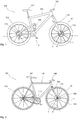
- FIG. 1 The bicycle has two wheels 101, 102, namely a front wheel 101 and a rear wheel 102. Further, a frame 103, a fork 104, a rear shock 105, a handlebar 106 and a saddle 107 is provided. As drive 112 pedals and here a derailleur are provided. The front wheel 101 and the rear wheel 102 are respectively attached to dropouts 113 on the fork 104 and the frame 103, respectively.
- FIG. 2 shows a highly schematic side view of a road bike or touring bike as a two-wheeler 100, the bicycle in turn has an inventive front wheel 101 and an inventive rear wheel 102 as wheels.
- the wheels are attached to the dropouts 113.
- the front wheel and the rear wheel 101, 102 each have a rim 110 and spokes 1 according to the invention.
- the spokes 1 are shown only schematically on the basis of the magnification and will be discussed in detail below with reference to the other figures.
- the wheels 101 and 102 in the Figures 1 and 2 each have a plurality of spokes 1.
- the spokes 1 are connected to the first and hub-side ends 3 with the hub 108 and with the second or rim-side ends 4 with the rim 110.
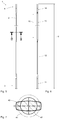
- FIGS. 3 and 4 a spoke 1 according to the invention of an impeller 101 or 102 is shown in a longitudinal view and in a side view.
- FIG. 3 shows a schematic and in particular in the longitudinal direction 5 is not shown to scale a view of a spoke 1 in the direction of travel. Transverse to the plane of representation extends the longitudinal plane 6 along which a bicycle 100 equipped with such a spoke is moved.
- the spoke 1 has at the hub-side end 3 via a spoke head 10 and at the rim-side end 4 via an external thread 9, which for screwing with a here in FIG. 3 not shown spoke nipple is used.
- the first or hub-side end 3 of the spoke body 2 is fixed to the hub 108 and the spoke body 2 extends outwardly from the hub 108 to the second or rim-side end 4 where the external thread 9 is then fitted with a spoke nipple (not shown). attached to the rim 110.
- the spoke body 2 here has a first end section 11 adjacent to the first or hub-side end 3, a first middle section 12, a second middle section 13 and a second end section 14. Between the first end section 11 and A transition region 51 is provided in the first middle region 12, and a transition region 52 is provided between the first middle region 12 and the second middle region 13. Between the second central region 13 and the second end portion 14, a transition region 53 is arranged.
- the spoke 1 has fasteners other than spoke heads and threads on the end portions 11 and 14 or to secure the spoke via other suitable fastening means to the hub or the rim.
- the spoke 1 has a spoke head at the hub-side end and an external thread at the rim-side end.
- the first end section 11, the second end section 14 and the first central region 12 have here in each case round cross-sections 41, 42 and 44.
- the cross sections 41 and 44 are preferably identical here. That is, the first end portion thickness 21 in the first end portion 11 substantially coincides with the second end portion thickness 24 at the second end portion 14.
- first central region thickness 22 at the first central region 12 is significantly lower.
- first end section thickness 21 here is 2.0 mm, as well as the second end section thickness 24 at the second end section 14.
- the first middle section thickness 22 in the first central section 12, however, is only 1.5 mm here.
- the second central region 13 which is located closer to the second end section 14 than the first central region 12, the second central region 13 has a second central region thickness 23 that is significantly smaller than the first central region thickness 22 of the first central region 12.
- the second central region thickness is 23 is only about 0.9 mm and is thus less than half as thick as the first end portion thickness 21 or the second end portion thickness 24, whereby a very significant reduction in wind resistance is achieved.
- FIG. 3 hatches the respective cross-sectional shapes in the respective sections or areas. Clearly recognizable that in the first end portion 11 is a substantially round trained cross-section 41 is present. Likewise, in the first central region 12 there is a substantially round cross-section 42. Also, the cross section 44 in the second end portion 14 is formed substantially round.
- cross section 43 is flattened in the second central region 13, as is apparent from the dashed cross-section 43.
- FIG. 4 shows a schematic side view of the spoke 1 FIG. 3 , where due to the round-shaped end portions 11 and 14 and the round first central area 12 there is a substantially same view.
- the view of the second central region 13, in which the flattened cross section 43 of the second central region 13 can be seen from the side, is significantly different. While, in the first end portion 11, the first end portion thickness 21 of the first end portion width 31 and the second end portion 14 correspond to the second end portion thickness 24 of the second end portion width 34 and the first center portion 12 correspond to the first middle portion thickness 22 of the first middle portion width 32 due to the round configurations
- the second central region width 33 significantly from the second central region thickness 23 from.
- the central region width 33 in the exemplary embodiment is approximately 2.3 mm and is therefore more than twice as large as the second middle region thickness 23 with approximately 0.9 mm.
- transition areas 51, 52, 53 a gradual transition between the respective sections or areas takes place.
- the transition regions 51, 52 and 53 are considerably shorter in the longitudinal direction 5 of the spoke body 2 than the central regions 12 and 13 and here also shorter than the end sections 11 and 14.
- the transition region 52 measures one here Length of between about 5 mm and 10 mm.
- the transitional regions 51 and 53 are here somewhat longer than the transitional region 52.
- An axial length of the transition regions 51 and 53 along the spoke body 2 is preferably between 5 mm and 15 mm.
- FIG. 5 shows a longitudinal view and FIG. 6 a side view of another spoke 1 in an approximately scale illustration, with a portion of the length was cut away.
- the length 15 of the second central region 13 with the flattened cross section 43 is preferably between about 2/3 and about 1/3 of the length 8 of a spoke body 2.
- the second central region 15 is slightly less than half the length of the entire spoke body 2 on.
- a length 8 of the entire spoke 1, ie from the end portion 11 to the end portion 14 depends on the application and the installation situation. In a specific case, the length 8 of the spoke body 290 mm, but depending on the rim and mounting position, etc. up to z. B. 10% or 20% shorter or longer.
- a length 15 of the second central region 13 including the transition regions 51 and 52 may be 152 mm in a specific case. The length of the transition regions 51 and 52 is preferably less than 15 mm in each case and may also be 10 mm or less, so that a length of the second middle region may be approximately 130 mm +/- 10 mm.
- FIG. 7 shows a schematic cross section through the spoke 1 from FIGS. 5 and 6 , wherein the cross section 43 is shown hatched in the second central region 13.
- the round cross-section 42 in the first central region 12 is drawn through.
- the second central region 13 is achieved by an embossing or another forming process of a region which originally has a circular cross-section 42.
- embossing the round material is brought into the illustrated flattened shape.
- a flattened shape is prepared, the z. B. approximately oval, elliptical or rectangular or wing-shaped may be formed.
- the cross-section 41 is still shown in dashed lines from the first end portion 11. From the originally homogeneous body in the longitudinal direction is by a machining operation or z. B. a drawing process, a body made in the central regions 12 and 13 has a reduced cross-section, while in the first end portion 11 and the second end portion 14 still the original diameter is maintained. Subsequently, in the second central region 13, the spoke body 12 is stamped, so that the flattened cross-section 43 results there.
Landscapes
- Engineering & Computer Science (AREA)
- Mechanical Engineering (AREA)
- Tires In General (AREA)
- Structures Of Non-Positive Displacement Pumps (AREA)
- Wind Motors (AREA)
- Turbine Rotor Nozzle Sealing (AREA)
Applications Claiming Priority (1)
| Application Number | Priority Date | Filing Date | Title |
|---|---|---|---|
| DE102015103327.5A DE102015103327A1 (de) | 2015-03-06 | 2015-03-06 | Speiche, insbesondere für ein Fahrrad |
Publications (3)
| Publication Number | Publication Date |
|---|---|
| EP3064370A2 true EP3064370A2 (fr) | 2016-09-07 |
| EP3064370A3 EP3064370A3 (fr) | 2017-07-05 |
| EP3064370B1 EP3064370B1 (fr) | 2021-06-23 |
Family
ID=55486559
Family Applications (1)
| Application Number | Title | Priority Date | Filing Date |
|---|---|---|---|
| EP16158821.5A Active EP3064370B1 (fr) | 2015-03-06 | 2016-03-04 | Roue porteuse et rayon de roue, en particulier pour un velo |
Country Status (3)
| Country | Link |
|---|---|
| US (1) | US9731546B2 (fr) |
| EP (1) | EP3064370B1 (fr) |
| DE (1) | DE102015103327A1 (fr) |
Cited By (1)
| Publication number | Priority date | Publication date | Assignee | Title |
|---|---|---|---|---|
| DE102021125903A1 (de) | 2021-10-06 | 2023-04-06 | Dt Swiss Ag | Speiche und Verfahren zur Herstellung einer Speiche |
Families Citing this family (4)
| Publication number | Priority date | Publication date | Assignee | Title |
|---|---|---|---|---|
| US9878745B2 (en) * | 2012-12-21 | 2018-01-30 | Garth L. Magee | Upper wheel fairing reducing critical vehicle drag |
| DE102017110161B4 (de) * | 2017-05-10 | 2025-11-06 | Dt Swiss Ag | Laufrad und Speiche für ein wenigstens teilweise muskelbetriebenes Fahrrad |
| US10029511B2 (en) | 2015-03-06 | 2018-07-24 | Dt Swiss Inc. | Wheel and spoke, in particular for a bicycle |
| FR3057491B1 (fr) * | 2016-10-14 | 2019-06-14 | Mavic Sas | Rayon pour roue de cycle et procede de fabrication d'un tel rayon |
Family Cites Families (12)
| Publication number | Priority date | Publication date | Assignee | Title |
|---|---|---|---|---|
| US1560565A (en) * | 1922-05-24 | 1925-11-10 | James H Graham | Wire spoke for wheels |
| JPS5048560U (fr) | 1973-08-31 | 1975-05-13 | ||
| US5350221A (en) | 1991-07-11 | 1994-09-27 | Edo Sports Inc. | Fiber reinforced spoke for wheels of bicycles, wheelchairs and the like, and method of making same |
| IT1287211B1 (it) * | 1996-03-04 | 1998-08-04 | Alpina Raggi Spa | Raggio per ruote e metodo di produzione del medesimo |
| US5779323A (en) * | 1997-04-25 | 1998-07-14 | Giant Manufacturing Co., Ltd. | Spoked wheel with aerodynamic and rigidity imparting spokes |
| FR2767285B1 (fr) * | 1997-08-13 | 1999-10-15 | Mavic Sa | Rayon pour roue de cycle, roue de cycle et procedes de fabrication |
| BE1011343A6 (nl) * | 1997-08-28 | 1999-07-06 | Piminvest Naamloze Vennootscha | Spaak, wiel dat van dergelijke spaken is voorzien en werkwijze voor het vervaardigen van dergelijke spaken. |
| US20040174066A1 (en) * | 2001-09-28 | 2004-09-09 | Rolf Dietrich | Spoke for a tensioned spoked wheel assembly |
| DE602004012378T2 (de) * | 2004-01-27 | 2009-04-23 | Campagnolo S.R.L. | Speiche für Fahrradrad und Fahrradrad eine solche Speiche enthaltend sowie Herstellverfahren für eine solche Speiche |
| DE602004021555D1 (de) | 2004-01-27 | 2009-07-30 | Campagnolo Srl | Speiche für ein Fahrrad, Rad und Verfahren zur Herstellung einer solchen Speiche |
| ITMI20062215A1 (it) * | 2006-11-20 | 2008-05-21 | Campagnolo Srl | Ruota di bicicletta raggio e mozzo per tale ruota e metodo di assemblaggio della ruota |
| DE602007006149D1 (de) * | 2007-02-06 | 2010-06-10 | Holland Mechanics Bv | Speiche |
-
2015
- 2015-03-06 DE DE102015103327.5A patent/DE102015103327A1/de not_active Withdrawn
-
2016
- 2016-03-04 US US15/061,619 patent/US9731546B2/en active Active
- 2016-03-04 EP EP16158821.5A patent/EP3064370B1/fr active Active
Non-Patent Citations (1)
| Title |
|---|
| None |
Cited By (2)
| Publication number | Priority date | Publication date | Assignee | Title |
|---|---|---|---|---|
| DE102021125903A1 (de) | 2021-10-06 | 2023-04-06 | Dt Swiss Ag | Speiche und Verfahren zur Herstellung einer Speiche |
| EP4163029A1 (fr) | 2021-10-06 | 2023-04-12 | DT Swiss AG | Rayon et procédé de fabrication d'un rayon |
Also Published As
| Publication number | Publication date |
|---|---|
| US9731546B2 (en) | 2017-08-15 |
| EP3064370A3 (fr) | 2017-07-05 |
| EP3064370B1 (fr) | 2021-06-23 |
| DE102015103327A1 (de) | 2016-09-08 |
| US20160257164A1 (en) | 2016-09-08 |
Similar Documents
| Publication | Publication Date | Title |
|---|---|---|
| EP0494277B1 (fr) | Jante pour roue a rayons arriere de bicyclette | |
| EP3064370B1 (fr) | Roue porteuse et rayon de roue, en particulier pour un velo | |
| DE29700974U1 (de) | Nippel für eine Radspeiche | |
| EP3909789B1 (fr) | Composants de roue porteuse, en particulier pour bicyclettes | |
| EP2769851B1 (fr) | Roue mobile pour véhicules entraînés au moins partiellement par la force musculaire, notamment pour vélos | |
| DE102011015962B4 (de) | Nabe für ein Fahrrad | |
| EP3287298A1 (fr) | Moyeu et série de moyeux | |
| DE102020103129A1 (de) | Nabe insbesondere für Fahrräder | |
| EP4163029B1 (fr) | Rayon et procédé de fabrication d'un rayon | |
| WO2022167398A1 (fr) | Coque de jante et roue pour vélo de transport de charge | |
| DE102014105049A1 (de) | Gabelkomponente für ein wenigstens teilweise muskelbetriebenes Fahrrad | |
| EP3238951B1 (fr) | Moyeu et roue | |
| DE102019103016A1 (de) | Hinterradnabe für Fahrräder mit vergrößerter Übersetzung | |
| EP3067222B1 (fr) | Jante de velo tout-terrain | |
| DE202015101124U1 (de) | Speiche, insbesondere für ein Fahrrad | |
| DE10132005A1 (de) | Rad für Fahrzeuge | |
| DE102017110161B4 (de) | Laufrad und Speiche für ein wenigstens teilweise muskelbetriebenes Fahrrad | |
| DE102010054657B4 (de) | Felge aus Faserverbundwerkstoff für wenigstens teilweise muskelbetriebene Zweiräder | |
| DE102013004286A1 (de) | Fahrradfelge | |
| DE202015003518U1 (de) | Fahrradradsicherungsanordnung | |
| DE102023129987A1 (de) | Nabeneinrichtung für ein wenigstens teilweise muskelbetriebenes Fahrrad | |
| EP4610057A1 (fr) | Composant de roue pour une bicyclette | |
| DE9002082U1 (de) | Verbindungskonstruktion zur Koppelung zweier Fahrräder zu einem Doppelfahrrad mit drei hintereinander angeordneten Laufrädern | |
| EP4385750A1 (fr) | Jante pour bicyclette entraînée au moins partiellement par la force musculaire | |
| DE102022120163A1 (de) | Bremsscheibe für eine Scheibenbremse eines Leichtfahrzeugs und Verfahren zur Herstellung der Bremsscheibe |
Legal Events
| Date | Code | Title | Description |
|---|---|---|---|
| PUAI | Public reference made under article 153(3) epc to a published international application that has entered the european phase |
Free format text: ORIGINAL CODE: 0009012 |
|
| AK | Designated contracting states |
Kind code of ref document: A2 Designated state(s): AL AT BE BG CH CY CZ DE DK EE ES FI FR GB GR HR HU IE IS IT LI LT LU LV MC MK MT NL NO PL PT RO RS SE SI SK SM TR |
|
| AX | Request for extension of the european patent |
Extension state: BA ME |
|
| PUAL | Search report despatched |
Free format text: ORIGINAL CODE: 0009013 |
|
| AK | Designated contracting states |
Kind code of ref document: A3 Designated state(s): AL AT BE BG CH CY CZ DE DK EE ES FI FR GB GR HR HU IE IS IT LI LT LU LV MC MK MT NL NO PL PT RO RS SE SI SK SM TR |
|
| AX | Request for extension of the european patent |
Extension state: BA ME |
|
| RIC1 | Information provided on ipc code assigned before grant |
Ipc: B60B 1/02 20060101ALI20170530BHEP Ipc: B60B 1/04 20060101ALI20170530BHEP Ipc: B60B 1/00 20060101AFI20170530BHEP |
|
| STAA | Information on the status of an ep patent application or granted ep patent |
Free format text: STATUS: REQUEST FOR EXAMINATION WAS MADE |
|
| 17P | Request for examination filed |
Effective date: 20171229 |
|
| RBV | Designated contracting states (corrected) |
Designated state(s): AL AT BE BG CH CY CZ DE DK EE ES FI FR GB GR HR HU IE IS IT LI LT LU LV MC MK MT NL NO PL PT RO RS SE SI SK SM TR |
|
| GRAP | Despatch of communication of intention to grant a patent |
Free format text: ORIGINAL CODE: EPIDOSNIGR1 |
|
| STAA | Information on the status of an ep patent application or granted ep patent |
Free format text: STATUS: GRANT OF PATENT IS INTENDED |
|
| INTG | Intention to grant announced |
Effective date: 20210120 |
|
| GRAS | Grant fee paid |
Free format text: ORIGINAL CODE: EPIDOSNIGR3 |
|
| GRAA | (expected) grant |
Free format text: ORIGINAL CODE: 0009210 |
|
| STAA | Information on the status of an ep patent application or granted ep patent |
Free format text: STATUS: THE PATENT HAS BEEN GRANTED |
|
| AK | Designated contracting states |
Kind code of ref document: B1 Designated state(s): AL AT BE BG CH CY CZ DE DK EE ES FI FR GB GR HR HU IE IS IT LI LT LU LV MC MK MT NL NO PL PT RO RS SE SI SK SM TR |
|
| REG | Reference to a national code |
Ref country code: GB Ref legal event code: FG4D Free format text: NOT ENGLISH |
|
| REG | Reference to a national code |
Ref country code: CH Ref legal event code: EP |
|
| REG | Reference to a national code |
Ref country code: DE Ref legal event code: R096 Ref document number: 502016013260 Country of ref document: DE Ref country code: AT Ref legal event code: REF Ref document number: 1403994 Country of ref document: AT Kind code of ref document: T Effective date: 20210715 |
|
| REG | Reference to a national code |
Ref country code: IE Ref legal event code: FG4D Free format text: LANGUAGE OF EP DOCUMENT: GERMAN |
|
| REG | Reference to a national code |
Ref country code: LT Ref legal event code: MG9D |
|
| PG25 | Lapsed in a contracting state [announced via postgrant information from national office to epo] |
Ref country code: FI Free format text: LAPSE BECAUSE OF FAILURE TO SUBMIT A TRANSLATION OF THE DESCRIPTION OR TO PAY THE FEE WITHIN THE PRESCRIBED TIME-LIMIT Effective date: 20210623 Ref country code: LT Free format text: LAPSE BECAUSE OF FAILURE TO SUBMIT A TRANSLATION OF THE DESCRIPTION OR TO PAY THE FEE WITHIN THE PRESCRIBED TIME-LIMIT Effective date: 20210623 Ref country code: HR Free format text: LAPSE BECAUSE OF FAILURE TO SUBMIT A TRANSLATION OF THE DESCRIPTION OR TO PAY THE FEE WITHIN THE PRESCRIBED TIME-LIMIT Effective date: 20210623 Ref country code: BG Free format text: LAPSE BECAUSE OF FAILURE TO SUBMIT A TRANSLATION OF THE DESCRIPTION OR TO PAY THE FEE WITHIN THE PRESCRIBED TIME-LIMIT Effective date: 20210923 |
|
| PG25 | Lapsed in a contracting state [announced via postgrant information from national office to epo] |
Ref country code: LV Free format text: LAPSE BECAUSE OF FAILURE TO SUBMIT A TRANSLATION OF THE DESCRIPTION OR TO PAY THE FEE WITHIN THE PRESCRIBED TIME-LIMIT Effective date: 20210623 Ref country code: GR Free format text: LAPSE BECAUSE OF FAILURE TO SUBMIT A TRANSLATION OF THE DESCRIPTION OR TO PAY THE FEE WITHIN THE PRESCRIBED TIME-LIMIT Effective date: 20210924 Ref country code: RS Free format text: LAPSE BECAUSE OF FAILURE TO SUBMIT A TRANSLATION OF THE DESCRIPTION OR TO PAY THE FEE WITHIN THE PRESCRIBED TIME-LIMIT Effective date: 20210623 Ref country code: SE Free format text: LAPSE BECAUSE OF FAILURE TO SUBMIT A TRANSLATION OF THE DESCRIPTION OR TO PAY THE FEE WITHIN THE PRESCRIBED TIME-LIMIT Effective date: 20210623 Ref country code: NO Free format text: LAPSE BECAUSE OF FAILURE TO SUBMIT A TRANSLATION OF THE DESCRIPTION OR TO PAY THE FEE WITHIN THE PRESCRIBED TIME-LIMIT Effective date: 20210923 |
|
| REG | Reference to a national code |
Ref country code: NL Ref legal event code: MP Effective date: 20210623 |
|
| PG25 | Lapsed in a contracting state [announced via postgrant information from national office to epo] |
Ref country code: EE Free format text: LAPSE BECAUSE OF FAILURE TO SUBMIT A TRANSLATION OF THE DESCRIPTION OR TO PAY THE FEE WITHIN THE PRESCRIBED TIME-LIMIT Effective date: 20210623 Ref country code: CZ Free format text: LAPSE BECAUSE OF FAILURE TO SUBMIT A TRANSLATION OF THE DESCRIPTION OR TO PAY THE FEE WITHIN THE PRESCRIBED TIME-LIMIT Effective date: 20210623 Ref country code: SM Free format text: LAPSE BECAUSE OF FAILURE TO SUBMIT A TRANSLATION OF THE DESCRIPTION OR TO PAY THE FEE WITHIN THE PRESCRIBED TIME-LIMIT Effective date: 20210623 Ref country code: SK Free format text: LAPSE BECAUSE OF FAILURE TO SUBMIT A TRANSLATION OF THE DESCRIPTION OR TO PAY THE FEE WITHIN THE PRESCRIBED TIME-LIMIT Effective date: 20210623 Ref country code: ES Free format text: LAPSE BECAUSE OF FAILURE TO SUBMIT A TRANSLATION OF THE DESCRIPTION OR TO PAY THE FEE WITHIN THE PRESCRIBED TIME-LIMIT Effective date: 20210623 Ref country code: RO Free format text: LAPSE BECAUSE OF FAILURE TO SUBMIT A TRANSLATION OF THE DESCRIPTION OR TO PAY THE FEE WITHIN THE PRESCRIBED TIME-LIMIT Effective date: 20210623 Ref country code: NL Free format text: LAPSE BECAUSE OF FAILURE TO SUBMIT A TRANSLATION OF THE DESCRIPTION OR TO PAY THE FEE WITHIN THE PRESCRIBED TIME-LIMIT Effective date: 20210623 Ref country code: PT Free format text: LAPSE BECAUSE OF FAILURE TO SUBMIT A TRANSLATION OF THE DESCRIPTION OR TO PAY THE FEE WITHIN THE PRESCRIBED TIME-LIMIT Effective date: 20211025 |
|
| PG25 | Lapsed in a contracting state [announced via postgrant information from national office to epo] |
Ref country code: PL Free format text: LAPSE BECAUSE OF FAILURE TO SUBMIT A TRANSLATION OF THE DESCRIPTION OR TO PAY THE FEE WITHIN THE PRESCRIBED TIME-LIMIT Effective date: 20210623 |
|
| REG | Reference to a national code |
Ref country code: DE Ref legal event code: R097 Ref document number: 502016013260 Country of ref document: DE |
|
| PG25 | Lapsed in a contracting state [announced via postgrant information from national office to epo] |
Ref country code: DK Free format text: LAPSE BECAUSE OF FAILURE TO SUBMIT A TRANSLATION OF THE DESCRIPTION OR TO PAY THE FEE WITHIN THE PRESCRIBED TIME-LIMIT Effective date: 20210623 |
|
| PLBE | No opposition filed within time limit |
Free format text: ORIGINAL CODE: 0009261 |
|
| STAA | Information on the status of an ep patent application or granted ep patent |
Free format text: STATUS: NO OPPOSITION FILED WITHIN TIME LIMIT |
|
| 26N | No opposition filed |
Effective date: 20220324 |
|
| PG25 | Lapsed in a contracting state [announced via postgrant information from national office to epo] |
Ref country code: AL Free format text: LAPSE BECAUSE OF FAILURE TO SUBMIT A TRANSLATION OF THE DESCRIPTION OR TO PAY THE FEE WITHIN THE PRESCRIBED TIME-LIMIT Effective date: 20210623 |
|
| PG25 | Lapsed in a contracting state [announced via postgrant information from national office to epo] |
Ref country code: IT Free format text: LAPSE BECAUSE OF FAILURE TO SUBMIT A TRANSLATION OF THE DESCRIPTION OR TO PAY THE FEE WITHIN THE PRESCRIBED TIME-LIMIT Effective date: 20210623 |
|
| PG25 | Lapsed in a contracting state [announced via postgrant information from national office to epo] |
Ref country code: MC Free format text: LAPSE BECAUSE OF FAILURE TO SUBMIT A TRANSLATION OF THE DESCRIPTION OR TO PAY THE FEE WITHIN THE PRESCRIBED TIME-LIMIT Effective date: 20210623 |
|
| REG | Reference to a national code |
Ref country code: CH Ref legal event code: PL |
|
| GBPC | Gb: european patent ceased through non-payment of renewal fee |
Effective date: 20220304 |
|
| REG | Reference to a national code |
Ref country code: BE Ref legal event code: MM Effective date: 20220331 |
|
| PG25 | Lapsed in a contracting state [announced via postgrant information from national office to epo] |
Ref country code: LU Free format text: LAPSE BECAUSE OF NON-PAYMENT OF DUE FEES Effective date: 20220304 Ref country code: LI Free format text: LAPSE BECAUSE OF NON-PAYMENT OF DUE FEES Effective date: 20220331 Ref country code: IE Free format text: LAPSE BECAUSE OF NON-PAYMENT OF DUE FEES Effective date: 20220304 Ref country code: GB Free format text: LAPSE BECAUSE OF NON-PAYMENT OF DUE FEES Effective date: 20220304 Ref country code: FR Free format text: LAPSE BECAUSE OF NON-PAYMENT OF DUE FEES Effective date: 20220331 Ref country code: CH Free format text: LAPSE BECAUSE OF NON-PAYMENT OF DUE FEES Effective date: 20220331 |
|
| PG25 | Lapsed in a contracting state [announced via postgrant information from national office to epo] |
Ref country code: BE Free format text: LAPSE BECAUSE OF NON-PAYMENT OF DUE FEES Effective date: 20220331 |
|
| REG | Reference to a national code |
Ref country code: AT Ref legal event code: MM01 Ref document number: 1403994 Country of ref document: AT Kind code of ref document: T Effective date: 20220304 |
|
| P01 | Opt-out of the competence of the unified patent court (upc) registered |
Effective date: 20230517 |
|
| PG25 | Lapsed in a contracting state [announced via postgrant information from national office to epo] |
Ref country code: AT Free format text: LAPSE BECAUSE OF NON-PAYMENT OF DUE FEES Effective date: 20220304 |
|
| PG25 | Lapsed in a contracting state [announced via postgrant information from national office to epo] |
Ref country code: HU Free format text: LAPSE BECAUSE OF FAILURE TO SUBMIT A TRANSLATION OF THE DESCRIPTION OR TO PAY THE FEE WITHIN THE PRESCRIBED TIME-LIMIT; INVALID AB INITIO Effective date: 20160304 |
|
| PG25 | Lapsed in a contracting state [announced via postgrant information from national office to epo] |
Ref country code: MK Free format text: LAPSE BECAUSE OF FAILURE TO SUBMIT A TRANSLATION OF THE DESCRIPTION OR TO PAY THE FEE WITHIN THE PRESCRIBED TIME-LIMIT Effective date: 20210623 Ref country code: CY Free format text: LAPSE BECAUSE OF FAILURE TO SUBMIT A TRANSLATION OF THE DESCRIPTION OR TO PAY THE FEE WITHIN THE PRESCRIBED TIME-LIMIT Effective date: 20210623 |
|
| PG25 | Lapsed in a contracting state [announced via postgrant information from national office to epo] |
Ref country code: MT Free format text: LAPSE BECAUSE OF FAILURE TO SUBMIT A TRANSLATION OF THE DESCRIPTION OR TO PAY THE FEE WITHIN THE PRESCRIBED TIME-LIMIT Effective date: 20210623 |
|
| PG25 | Lapsed in a contracting state [announced via postgrant information from national office to epo] |
Ref country code: TR Free format text: LAPSE BECAUSE OF FAILURE TO SUBMIT A TRANSLATION OF THE DESCRIPTION OR TO PAY THE FEE WITHIN THE PRESCRIBED TIME-LIMIT Effective date: 20210623 |
|
| PGFP | Annual fee paid to national office [announced via postgrant information from national office to epo] |
Ref country code: DE Payment date: 20260326 Year of fee payment: 11 |