EP3064484A1 - Herstellung von 2,2'-biarylen in gegenwart von molybdän(v)-chlorid - Google Patents
Herstellung von 2,2'-biarylen in gegenwart von molybdän(v)-chlorid Download PDFInfo
- Publication number
- EP3064484A1 EP3064484A1 EP16158245.7A EP16158245A EP3064484A1 EP 3064484 A1 EP3064484 A1 EP 3064484A1 EP 16158245 A EP16158245 A EP 16158245A EP 3064484 A1 EP3064484 A1 EP 3064484A1
- Authority
- EP
- European Patent Office
- Prior art keywords
- alkyl
- aryl
- phenol
- independently selected
- substituted
- Prior art date
- Legal status (The legal status is an assumption and is not a legal conclusion. Google has not performed a legal analysis and makes no representation as to the accuracy of the status listed.)
- Granted
Links
- GICWIDZXWJGTCI-UHFFFAOYSA-I molybdenum pentachloride Chemical compound Cl[Mo](Cl)(Cl)(Cl)Cl GICWIDZXWJGTCI-UHFFFAOYSA-I 0.000 title claims abstract description 15
- 238000002360 preparation method Methods 0.000 title claims abstract description 9
- 150000005347 biaryls Chemical class 0.000 title description 15
- 125000003118 aryl group Chemical group 0.000 claims abstract description 41
- RTZKZFJDLAIYFH-UHFFFAOYSA-N ether Substances CCOCC RTZKZFJDLAIYFH-UHFFFAOYSA-N 0.000 claims abstract description 37
- IMHDGJOMLMDPJN-UHFFFAOYSA-N biphenyl-2,2'-diol Chemical class OC1=CC=CC=C1C1=CC=CC=C1O IMHDGJOMLMDPJN-UHFFFAOYSA-N 0.000 claims abstract description 24
- 238000000034 method Methods 0.000 claims description 38
- JPJALAQPGMAKDF-UHFFFAOYSA-N selenium dioxide Chemical compound O=[Se]=O JPJALAQPGMAKDF-UHFFFAOYSA-N 0.000 claims description 32
- 239000002904 solvent Substances 0.000 claims description 27
- ISWSIDIOOBJBQZ-UHFFFAOYSA-N Phenol Chemical compound OC1=CC=CC=C1 ISWSIDIOOBJBQZ-UHFFFAOYSA-N 0.000 claims description 21
- YMWUJEATGCHHMB-UHFFFAOYSA-N Dichloromethane Chemical compound ClCCl YMWUJEATGCHHMB-UHFFFAOYSA-N 0.000 claims description 20
- 230000008569 process Effects 0.000 claims description 20
- 125000004400 (C1-C12) alkyl group Chemical group 0.000 claims description 15
- JUJWROOIHBZHMG-UHFFFAOYSA-N Pyridine Chemical compound C1=CC=NC=C1 JUJWROOIHBZHMG-UHFFFAOYSA-N 0.000 claims description 12
- 125000000217 alkyl group Chemical group 0.000 claims description 12
- 150000001875 compounds Chemical class 0.000 claims description 9
- 239000011541 reaction mixture Substances 0.000 claims description 9
- 239000002253 acid Substances 0.000 claims description 8
- ZMXDDKWLCZADIW-UHFFFAOYSA-N N,N-Dimethylformamide Chemical compound CN(C)C=O ZMXDDKWLCZADIW-UHFFFAOYSA-N 0.000 claims description 6
- YXFVVABEGXRONW-UHFFFAOYSA-N Toluene Chemical compound CC1=CC=CC=C1 YXFVVABEGXRONW-UHFFFAOYSA-N 0.000 claims description 6
- UMJSCPRVCHMLSP-UHFFFAOYSA-N pyridine Natural products COC1=CC=CN=C1 UMJSCPRVCHMLSP-UHFFFAOYSA-N 0.000 claims description 6
- XTHFKEDIFFGKHM-UHFFFAOYSA-N Dimethoxyethane Chemical compound COCCOC XTHFKEDIFFGKHM-UHFFFAOYSA-N 0.000 claims description 4
- SMWDFEZZVXVKRB-UHFFFAOYSA-N Quinoline Chemical compound N1=CC=CC2=CC=CC=C21 SMWDFEZZVXVKRB-UHFFFAOYSA-N 0.000 claims description 4
- WYURNTSHIVDZCO-UHFFFAOYSA-N Tetrahydrofuran Chemical compound C1CCOC1 WYURNTSHIVDZCO-UHFFFAOYSA-N 0.000 claims description 4
- 150000001412 amines Chemical class 0.000 claims description 2
- SBZXBUIDTXKZTM-UHFFFAOYSA-N diglyme Chemical compound COCCOCCOC SBZXBUIDTXKZTM-UHFFFAOYSA-N 0.000 claims description 2
- YLQBMQCUIZJEEH-UHFFFAOYSA-N tetrahydrofuran Natural products C=1C=COC=1 YLQBMQCUIZJEEH-UHFFFAOYSA-N 0.000 claims description 2
- 238000006243 chemical reaction Methods 0.000 abstract description 36
- 150000002989 phenols Chemical class 0.000 abstract description 14
- 239000000126 substance Substances 0.000 abstract description 6
- HIXDQWDOVZUNNA-UHFFFAOYSA-N 2-(3,4-dimethoxyphenyl)-5-hydroxy-7-methoxychromen-4-one Chemical compound C=1C(OC)=CC(O)=C(C(C=2)=O)C=1OC=2C1=CC=C(OC)C(OC)=C1 HIXDQWDOVZUNNA-UHFFFAOYSA-N 0.000 abstract 1
- -1 organic devices Substances 0.000 description 27
- 239000000047 product Substances 0.000 description 17
- 239000002585 base Substances 0.000 description 12
- 238000010168 coupling process Methods 0.000 description 11
- 238000005859 coupling reaction Methods 0.000 description 11
- 239000003570 air Substances 0.000 description 10
- 230000008878 coupling Effects 0.000 description 10
- XEKOWRVHYACXOJ-UHFFFAOYSA-N Ethyl acetate Chemical compound CCOC(C)=O XEKOWRVHYACXOJ-UHFFFAOYSA-N 0.000 description 9
- 238000004821 distillation Methods 0.000 description 8
- 150000002170 ethers Chemical class 0.000 description 8
- 230000015572 biosynthetic process Effects 0.000 description 7
- 239000007800 oxidant agent Substances 0.000 description 7
- 238000003786 synthesis reaction Methods 0.000 description 7
- IJGRMHOSHXDMSA-UHFFFAOYSA-N Atomic nitrogen Chemical compound N#N IJGRMHOSHXDMSA-UHFFFAOYSA-N 0.000 description 6
- 239000006227 byproduct Substances 0.000 description 6
- 239000000460 chlorine Substances 0.000 description 6
- 230000007717 exclusion Effects 0.000 description 6
- NROCGZAZNBWWMM-UHFFFAOYSA-N 2-(2-hydroxy-3,5-dimethylphenyl)selanyl-4,6-dimethylphenol Chemical compound CC=1C(=C(C=C(C1)C)[Se]C1=C(C(=CC(=C1)C)C)O)O NROCGZAZNBWWMM-UHFFFAOYSA-N 0.000 description 5
- YCKRFDGAMUMZLT-UHFFFAOYSA-N Fluorine atom Chemical compound [F] YCKRFDGAMUMZLT-UHFFFAOYSA-N 0.000 description 5
- 238000005481 NMR spectroscopy Methods 0.000 description 5
- 125000000732 arylene group Chemical group 0.000 description 5
- 230000008901 benefit Effects 0.000 description 5
- 229910052794 bromium Inorganic materials 0.000 description 5
- 238000001914 filtration Methods 0.000 description 5
- 229910052731 fluorine Inorganic materials 0.000 description 5
- 239000007787 solid Substances 0.000 description 5
- 125000006736 (C6-C20) aryl group Chemical group 0.000 description 4
- XBDTZNMRTRPDKH-UHFFFAOYSA-N 2-(2-hydroxy-3,5-dimethylphenyl)-4,6-dimethylphenol Chemical compound CC1=CC(C)=C(O)C(C=2C(=C(C)C=C(C)C=2)O)=C1 XBDTZNMRTRPDKH-UHFFFAOYSA-N 0.000 description 4
- XKRFYHLGVUSROY-UHFFFAOYSA-N Argon Chemical compound [Ar] XKRFYHLGVUSROY-UHFFFAOYSA-N 0.000 description 4
- ZAMOUSCENKQFHK-UHFFFAOYSA-N Chlorine atom Chemical compound [Cl] ZAMOUSCENKQFHK-UHFFFAOYSA-N 0.000 description 4
- 125000002252 acyl group Chemical group 0.000 description 4
- 125000004453 alkoxycarbonyl group Chemical group 0.000 description 4
- 239000003054 catalyst Substances 0.000 description 4
- 229910052801 chlorine Inorganic materials 0.000 description 4
- ZUOUZKKEUPVFJK-UHFFFAOYSA-N diphenyl Chemical compound C1=CC=CC=C1C1=CC=CC=C1 ZUOUZKKEUPVFJK-UHFFFAOYSA-N 0.000 description 4
- 229910052739 hydrogen Inorganic materials 0.000 description 4
- 239000003446 ligand Substances 0.000 description 4
- 238000004519 manufacturing process Methods 0.000 description 4
- XLYOFNOQVPJJNP-UHFFFAOYSA-N water Chemical compound O XLYOFNOQVPJJNP-UHFFFAOYSA-N 0.000 description 4
- 238000001644 13C nuclear magnetic resonance spectroscopy Methods 0.000 description 3
- 238000005160 1H NMR spectroscopy Methods 0.000 description 3
- 241001655883 Adeno-associated virus - 1 Species 0.000 description 3
- ZOXJGFHDIHLPTG-UHFFFAOYSA-N Boron Chemical compound [B] ZOXJGFHDIHLPTG-UHFFFAOYSA-N 0.000 description 3
- WKBOTKDWSSQWDR-UHFFFAOYSA-N Bromine atom Chemical compound [Br] WKBOTKDWSSQWDR-UHFFFAOYSA-N 0.000 description 3
- TZHJCMBKKNEMCW-UHFFFAOYSA-N COC1=C(C=C(C=C1OC)OC)[Se]C1=C(C(=CC(=C1)OC)OC)OC Chemical compound COC1=C(C=C(C=C1OC)OC)[Se]C1=C(C(=CC(=C1)OC)OC)OC TZHJCMBKKNEMCW-UHFFFAOYSA-N 0.000 description 3
- XDTMQSROBMDMFD-UHFFFAOYSA-N Cyclohexane Chemical compound C1CCCCC1 XDTMQSROBMDMFD-UHFFFAOYSA-N 0.000 description 3
- ZMANZCXQSJIPKH-UHFFFAOYSA-N Triethylamine Chemical compound CCN(CC)CC ZMANZCXQSJIPKH-UHFFFAOYSA-N 0.000 description 3
- 229910052796 boron Inorganic materials 0.000 description 3
- GDTBXPJZTBHREO-UHFFFAOYSA-N bromine Substances BrBr GDTBXPJZTBHREO-UHFFFAOYSA-N 0.000 description 3
- 239000003480 eluent Substances 0.000 description 3
- 239000011737 fluorine Substances 0.000 description 3
- 229910052757 nitrogen Inorganic materials 0.000 description 3
- 231100000331 toxic Toxicity 0.000 description 3
- 230000002588 toxic effect Effects 0.000 description 3
- 125000006652 (C3-C12) cycloalkyl group Chemical group 0.000 description 2
- 125000006707 (C3-C12) heterocycloalkyl group Chemical group 0.000 description 2
- HZNVUJQVZSTENZ-UHFFFAOYSA-N 2,3-dichloro-5,6-dicyano-1,4-benzoquinone Chemical compound ClC1=C(Cl)C(=O)C(C#N)=C(C#N)C1=O HZNVUJQVZSTENZ-UHFFFAOYSA-N 0.000 description 2
- KUFFULVDNCHOFZ-UHFFFAOYSA-N 2,4-xylenol Chemical compound CC1=CC=C(O)C(C)=C1 KUFFULVDNCHOFZ-UHFFFAOYSA-N 0.000 description 2
- MNVMYTVDDOXZLS-UHFFFAOYSA-N 4-methoxyguaiacol Natural products COC1=CC=C(O)C(OC)=C1 MNVMYTVDDOXZLS-UHFFFAOYSA-N 0.000 description 2
- KRHYYFGTRYWZRS-UHFFFAOYSA-N Fluorane Chemical compound F KRHYYFGTRYWZRS-UHFFFAOYSA-N 0.000 description 2
- KDLHZDBZIXYQEI-UHFFFAOYSA-N Palladium Chemical compound [Pd] KDLHZDBZIXYQEI-UHFFFAOYSA-N 0.000 description 2
- HEDRZPFGACZZDS-MICDWDOJSA-N Trichloro(2H)methane Chemical compound [2H]C(Cl)(Cl)Cl HEDRZPFGACZZDS-MICDWDOJSA-N 0.000 description 2
- 239000012080 ambient air Substances 0.000 description 2
- 229910052786 argon Inorganic materials 0.000 description 2
- QVGXLLKOCUKJST-UHFFFAOYSA-N atomic oxygen Chemical compound [O] QVGXLLKOCUKJST-UHFFFAOYSA-N 0.000 description 2
- 235000010290 biphenyl Nutrition 0.000 description 2
- 239000004305 biphenyl Substances 0.000 description 2
- 229910052799 carbon Inorganic materials 0.000 description 2
- 125000003178 carboxy group Chemical group [H]OC(*)=O 0.000 description 2
- 238000002474 experimental method Methods 0.000 description 2
- 229910052736 halogen Inorganic materials 0.000 description 2
- 238000009815 homocoupling reaction Methods 0.000 description 2
- 229910052740 iodine Inorganic materials 0.000 description 2
- BDAGIHXWWSANSR-UHFFFAOYSA-N methanoic acid Natural products OC=O BDAGIHXWWSANSR-UHFFFAOYSA-N 0.000 description 2
- 239000012074 organic phase Substances 0.000 description 2
- 230000001590 oxidative effect Effects 0.000 description 2
- 229910052760 oxygen Inorganic materials 0.000 description 2
- 239000001301 oxygen Substances 0.000 description 2
- BASFCYQUMIYNBI-UHFFFAOYSA-N platinum Chemical compound [Pt] BASFCYQUMIYNBI-UHFFFAOYSA-N 0.000 description 2
- 239000007858 starting material Substances 0.000 description 2
- 125000001424 substituent group Chemical group 0.000 description 2
- 125000004642 (C1-C12) alkoxy group Chemical group 0.000 description 1
- 125000004169 (C1-C6) alkyl group Chemical group 0.000 description 1
- 125000004209 (C1-C8) alkyl group Chemical group 0.000 description 1
- 0 *c(c(*)c1*)c(*)c(*)c1O Chemical compound *c(c(*)c1*)c(*)c(*)c1O 0.000 description 1
- 125000005919 1,2,2-trimethylpropyl group Chemical group 0.000 description 1
- DLFXWDJAIBAVOY-UHFFFAOYSA-N 1,2,4-trimethoxy-5-(2,4,5-trimethoxyphenyl)benzene Chemical group C1=C(OC)C(OC)=CC(OC)=C1C1=CC(OC)=C(OC)C=C1OC DLFXWDJAIBAVOY-UHFFFAOYSA-N 0.000 description 1
- 125000005918 1,2-dimethylbutyl group Chemical group 0.000 description 1
- 125000006218 1-ethylbutyl group Chemical group [H]C([H])([H])C([H])([H])C([H])([H])C([H])(*)C([H])([H])C([H])([H])[H] 0.000 description 1
- 125000005916 2-methylpentyl group Chemical group 0.000 description 1
- 125000003542 3-methylbutan-2-yl group Chemical group [H]C([H])([H])C([H])(*)C([H])(C([H])([H])[H])C([H])([H])[H] 0.000 description 1
- OSWFIVFLDKOXQC-UHFFFAOYSA-N 4-(3-methoxyphenyl)aniline Chemical compound COC1=CC=CC(C=2C=CC(N)=CC=2)=C1 OSWFIVFLDKOXQC-UHFFFAOYSA-N 0.000 description 1
- OKTJSMMVPCPJKN-UHFFFAOYSA-N Carbon Chemical compound [C] OKTJSMMVPCPJKN-UHFFFAOYSA-N 0.000 description 1
- UNYRULLBEFEDBF-UHFFFAOYSA-N Cc(cc1Sc2cc(C)cc(C)c2O)cc(C)c1O Chemical compound Cc(cc1Sc2cc(C)cc(C)c2O)cc(C)c1O UNYRULLBEFEDBF-UHFFFAOYSA-N 0.000 description 1
- 229910006069 SO3H Inorganic materials 0.000 description 1
- VYPSYNLAJGMNEJ-UHFFFAOYSA-N Silicium dioxide Chemical compound O=[Si]=O VYPSYNLAJGMNEJ-UHFFFAOYSA-N 0.000 description 1
- 229910021536 Zeolite Inorganic materials 0.000 description 1
- AIXDNALSRKWKDG-UHFFFAOYSA-I [Br].[Mo](Cl)(Cl)(Cl)(Cl)Cl Chemical compound [Br].[Mo](Cl)(Cl)(Cl)(Cl)Cl AIXDNALSRKWKDG-UHFFFAOYSA-I 0.000 description 1
- 239000013543 active substance Substances 0.000 description 1
- 238000006555 catalytic reaction Methods 0.000 description 1
- 230000008859 change Effects 0.000 description 1
- 238000006880 cross-coupling reaction Methods 0.000 description 1
- 125000002704 decyl group Chemical group [H]C([H])([H])C([H])([H])C([H])([H])C([H])([H])C([H])([H])C([H])([H])C([H])([H])C([H])([H])C([H])([H])C([H])([H])* 0.000 description 1
- 239000011903 deuterated solvents Substances 0.000 description 1
- 238000010586 diagram Methods 0.000 description 1
- 239000010432 diamond Substances 0.000 description 1
- 229910003460 diamond Inorganic materials 0.000 description 1
- HNPSIPDUKPIQMN-UHFFFAOYSA-N dioxosilane;oxo(oxoalumanyloxy)alumane Chemical compound O=[Si]=O.O=[Al]O[Al]=O HNPSIPDUKPIQMN-UHFFFAOYSA-N 0.000 description 1
- 239000000975 dye Substances 0.000 description 1
- 238000002848 electrochemical method Methods 0.000 description 1
- 230000007613 environmental effect Effects 0.000 description 1
- 125000001495 ethyl group Chemical group [H]C([H])([H])C([H])([H])* 0.000 description 1
- 235000019253 formic acid Nutrition 0.000 description 1
- 239000007789 gas Substances 0.000 description 1
- 229910021397 glassy carbon Inorganic materials 0.000 description 1
- 229910002804 graphite Inorganic materials 0.000 description 1
- 239000010439 graphite Substances 0.000 description 1
- LHGVFZTZFXWLCP-UHFFFAOYSA-N guaiacol Chemical compound COC1=CC=CC=C1O LHGVFZTZFXWLCP-UHFFFAOYSA-N 0.000 description 1
- 238000001052 heteronuclear multiple bond coherence spectrum Methods 0.000 description 1
- 238000005570 heteronuclear single quantum coherence Methods 0.000 description 1
- 125000002887 hydroxy group Chemical group [H]O* 0.000 description 1
- 125000000959 isobutyl group Chemical group [H]C([H])([H])C([H])(C([H])([H])[H])C([H])([H])* 0.000 description 1
- 125000004491 isohexyl group Chemical group C(CCC(C)C)* 0.000 description 1
- 125000001972 isopentyl group Chemical group [H]C([H])([H])C([H])(C([H])([H])[H])C([H])([H])C([H])([H])* 0.000 description 1
- 125000001449 isopropyl group Chemical group [H]C([H])([H])C([H])(*)C([H])([H])[H] 0.000 description 1
- 150000002576 ketones Chemical class 0.000 description 1
- 239000007788 liquid Substances 0.000 description 1
- 239000004973 liquid crystal related substance Substances 0.000 description 1
- 229910052751 metal Inorganic materials 0.000 description 1
- 239000002184 metal Substances 0.000 description 1
- VNWKTOKETHGBQD-UHFFFAOYSA-N methane Chemical compound C VNWKTOKETHGBQD-UHFFFAOYSA-N 0.000 description 1
- 125000002496 methyl group Chemical group [H]C([H])([H])* 0.000 description 1
- 238000002156 mixing Methods 0.000 description 1
- 239000000203 mixture Substances 0.000 description 1
- 125000004108 n-butyl group Chemical group [H]C([H])([H])C([H])([H])C([H])([H])C([H])([H])* 0.000 description 1
- 125000003136 n-heptyl group Chemical group [H]C([H])([H])C([H])([H])C([H])([H])C([H])([H])C([H])([H])C([H])([H])C([H])([H])* 0.000 description 1
- 125000001280 n-hexyl group Chemical group C(CCCCC)* 0.000 description 1
- 125000000740 n-pentyl group Chemical group [H]C([H])([H])C([H])([H])C([H])([H])C([H])([H])C([H])([H])* 0.000 description 1
- 125000001971 neopentyl group Chemical group [H]C([*])([H])C(C([H])([H])[H])(C([H])([H])[H])C([H])([H])[H] 0.000 description 1
- 125000001400 nonyl group Chemical group [H]C([*])([H])C([H])([H])C([H])([H])C([H])([H])C([H])([H])C([H])([H])C([H])([H])C([H])([H])C([H])([H])[H] 0.000 description 1
- 125000002524 organometallic group Chemical group 0.000 description 1
- 229910052763 palladium Inorganic materials 0.000 description 1
- 125000003538 pentan-3-yl group Chemical group [H]C([H])([H])C([H])([H])C([H])(*)C([H])([H])C([H])([H])[H] 0.000 description 1
- 239000012071 phase Substances 0.000 description 1
- 125000001997 phenyl group Chemical group [H]C1=C([H])C([H])=C(*)C([H])=C1[H] 0.000 description 1
- 229910052697 platinum Inorganic materials 0.000 description 1
- 231100000614 poison Toxicity 0.000 description 1
- 239000010970 precious metal Substances 0.000 description 1
- 125000001436 propyl group Chemical group [H]C([*])([H])C([H])([H])C([H])([H])[H] 0.000 description 1
- 230000001681 protective effect Effects 0.000 description 1
- 239000002994 raw material Substances 0.000 description 1
- 230000009467 reduction Effects 0.000 description 1
- 125000002914 sec-butyl group Chemical group [H]C([H])([H])C([H])([H])C([H])(*)C([H])([H])[H] 0.000 description 1
- 239000000741 silica gel Substances 0.000 description 1
- 229910002027 silica gel Inorganic materials 0.000 description 1
- 238000001228 spectrum Methods 0.000 description 1
- 238000003756 stirring Methods 0.000 description 1
- 238000006467 substitution reaction Methods 0.000 description 1
- 125000000999 tert-butyl group Chemical group [H]C([H])([H])C(*)(C([H])([H])[H])C([H])([H])[H] 0.000 description 1
- 125000001973 tert-pentyl group Chemical group [H]C([H])([H])C([H])([H])C(*)(C([H])([H])[H])C([H])([H])[H] 0.000 description 1
- 239000003440 toxic substance Substances 0.000 description 1
- 230000009466 transformation Effects 0.000 description 1
- 238000000844 transformation Methods 0.000 description 1
- 229910052723 transition metal Inorganic materials 0.000 description 1
- 150000003624 transition metals Chemical class 0.000 description 1
- 239000010457 zeolite Substances 0.000 description 1
Images


Classifications
-
- C—CHEMISTRY; METALLURGY
- C07—ORGANIC CHEMISTRY
- C07C—ACYCLIC OR CARBOCYCLIC COMPOUNDS
- C07C41/00—Preparation of ethers; Preparation of compounds having groups, groups or groups
- C07C41/01—Preparation of ethers
- C07C41/18—Preparation of ethers by reactions not forming ether-oxygen bonds
- C07C41/30—Preparation of ethers by reactions not forming ether-oxygen bonds by increasing the number of carbon atoms, e.g. by oligomerisation
-
- C—CHEMISTRY; METALLURGY
- C07—ORGANIC CHEMISTRY
- C07C—ACYCLIC OR CARBOCYCLIC COMPOUNDS
- C07C37/00—Preparation of compounds having hydroxy or O-metal groups bound to a carbon atom of a six-membered aromatic ring
-
- C—CHEMISTRY; METALLURGY
- C07—ORGANIC CHEMISTRY
- C07C—ACYCLIC OR CARBOCYCLIC COMPOUNDS
- C07C37/00—Preparation of compounds having hydroxy or O-metal groups bound to a carbon atom of a six-membered aromatic ring
- C07C37/11—Preparation of compounds having hydroxy or O-metal groups bound to a carbon atom of a six-membered aromatic ring by reactions increasing the number of carbon atoms
-
- C—CHEMISTRY; METALLURGY
- C07—ORGANIC CHEMISTRY
- C07C—ACYCLIC OR CARBOCYCLIC COMPOUNDS
- C07C37/00—Preparation of compounds having hydroxy or O-metal groups bound to a carbon atom of a six-membered aromatic ring
- C07C37/11—Preparation of compounds having hydroxy or O-metal groups bound to a carbon atom of a six-membered aromatic ring by reactions increasing the number of carbon atoms
- C07C37/14—Preparation of compounds having hydroxy or O-metal groups bound to a carbon atom of a six-membered aromatic ring by reactions increasing the number of carbon atoms by addition reactions, i.e. reactions involving at least one carbon-to-carbon unsaturated bond
-
- C—CHEMISTRY; METALLURGY
- C07—ORGANIC CHEMISTRY
- C07C—ACYCLIC OR CARBOCYCLIC COMPOUNDS
- C07C391/00—Compounds containing selenium
- C07C391/02—Compounds containing selenium having selenium atoms bound to carbon atoms of six-membered aromatic rings
-
- C—CHEMISTRY; METALLURGY
- C07—ORGANIC CHEMISTRY
- C07C—ACYCLIC OR CARBOCYCLIC COMPOUNDS
- C07C41/00—Preparation of ethers; Preparation of compounds having groups, groups or groups
- C07C41/01—Preparation of ethers
- C07C41/18—Preparation of ethers by reactions not forming ether-oxygen bonds
Definitions
- the invention is concerned with the preparation of 2,2'-biaryls, in particular of 2,2'-biphenols.
- the starting substances used are optionally two aryls or two phenols or a 2,2'-selenobiaryl ether.
- 2,2'-Birayl refers to compounds in which two aryl groups are linked together via a single bond.
- the simplest biaryl is biphenyl. It is shown in Scheme 0.
- a 2,2'-biphenol is a 2,2'-biaryl substituted with at least two OH groups and also referred to as 2,2'-dihydroxybiaryl.
- Biphenols and biaryls serve as building blocks for catalytically active substances and are therefore of industrial interest.
- Biaryls are important building blocks for liquid crystals, organic devices, dyes, ligands for metal catalysts, and find applications even in medical fields, as these structures are ubiquitous in biologically active, naturally occurring products (cf. R. Noyori, Chem. Soc. Rev. 1989, 18, 187 such as I. Cepanec, Synthesis of Biaryls, Elsevier, New York, 2004 ).
- the 2,2'-biphenols can be used therefor; see. WO 2005/042547 , These are mainly used as ligand components for catalysts.
- the biphenol can be used, for example, as a ligand building block in enantioselective catalysis (cf. Y. Chen, S. Yekta, AK Yudin, Chem. Rev. 2003, 103, 3155-3211 ; JM Brunel Chem. Rev. 2005, 105, 857-898 ; S. Kobayashi, Y. Mori, JS Fossey, Chem. Rev. 2011, 11, 2626-2704 ).
- Biaryls or biphenols can be prepared by direct coupling of arylene or phenols to corresponding biaryl or biphenol derivatives.
- aryls and phenols in this context mean both unsubstituted and substituted compounds. The substitution takes place here on the benzene ring.
- the object of the invention was to provide a process for preparing 2,2'-biaryls, in particular 2,2'-biphenols, by coupling corresponding aryls or phenols, which can be carried out industrially.
- as few as possible by-products such as selenobiaryl ether should be produced.
- the process should also conserve resources and therefore get along as possible without bromine and boron.
- the use of fluorinated solvents should also be avoided.
- molybdenum (V) chloride appears to act as the second oxidant besides the selenium dioxide, perhaps even catalytically. Although it is consumed in the reaction, it is not incorporated into the biaryls or phenols. It is therefore needed only in small quantities. Since molybdenum (V) chloride (MoCl 5 ) itself is biocompatible and does not form toxic by-products in the reaction system, the benefits of the additional use of MoCl 5 prevail.
- a problem with the use of selenium dioxide is that the corresponding 2,2'-Selenobiarylether and the corresponding Pummerer ketone can be obtained in large quantities as a by-product. If the reaction is unfavorable, it may even happen that the 2,2'-selenobiaryl ether is the main product of the reaction. This undesirable reaction behavior is suppressed by the addition of MoCl 5 .
- reaction can be shifted by adding a base or an acid or a halogenated solvent in the direction of the respective desired product (see applications of 26.05.2014).
- the reaction can be selectively shifted in the direction of the 2,2'-selenobiaryl ether by addition of a base having a pKb value in the range of 8 to 11, whereas the reaction is modified by addition of an acid having a pKa value in the range of 0, 0 to 5.0 or a halogenated solvent can be selectively shifted in the direction of the 2,2'-biphenols.
- the invention therefore provides a process for the preparation of 2,2'-biarylene in which a reaction mixture containing a first aryl, a second aryl and selenium dioxide is heated, the first aryl containing the second aryl being added to the corresponding 2,2'-biaryl compound. Biaryl is reacted, wherein the reaction mixture additionally contains molybdenum (V) chloride.
- reaction mixture The order in which the two aryls, selenium dioxide and MoCl 5 are added to the reaction mixture is insignificant.
- other components may also be present in the reaction mixture such as, for example, solvent, acid or base.
- the method is at least one Radical R 11 , R 12 , R 13 , R 14 , R 15 or R 16 : -O- (C 1 -C 12 ) -alkyl,
- R 11 , R 13 , R 14 are selected from: -O- (C 1 -C 12 ) -alkyl.
- R 13, R 14 are selected from: -O-CH 3 .
- the first aryl corresponds to the second aryl, so the two aryls are identical.
- This variant is thus a homocoupling of two identical aryls.
- the ortho-ortho coupling gives rise to the desired 2,2'-biarylene.
- the 2,2'-biphenol is sought as the main product, since biphenols are valuable building blocks for the synthesis of ligands for organometallic complex catalysts and other applications.
- a particularly preferred embodiment of the invention thus serves to prepare 2,2'-biphenols.
- This is thus characterized in that the first aryl is a first phenol, that the second aryl is a second phenol, and that the first phenol with the second phenol is the corresponding 2,2'-biphenol is implemented.
- (C 1 -C 12 ) -alkyl comprises straight-chain and branched alkyl groups. These are preferably unsubstituted straight-chain or branched (C 1 -C 8 ) -alkyl groups and very preferably (C 1 -C 6 ) -alkyl groups.
- Examples of (C 1 -C 12 ) -alkyl groups are, in particular, methyl, ethyl, propyl, isopropyl, n-butyl, isobutyl, sec-butyl, tert-butyl, n-pentyl, 2-pentyl, 2-methylbutyl -, 3-methylbutyl, 1,2-dimethylpropyl, 1,1-dimethylpropyl, 2,2-dimethylpropyl, 1-ethylpropyl, n-hexyl, 2-hexyl, 2-methylpentyl, 3-methylpentyl -, 4-methylpentyl, 1,1-dimethylbutyl, 1,2-dimethylbutyl, 2,2-dimethylbutyl, 1,3-dimethylbutyl, 2,3-dimethylbutyl, 3,3-dimethylbutyl, 1 , 1,2-trimethylpropyl, 1,2,2-trimethylpropyl, 1-ethylbut
- the first phenol corresponds to the second phenol.
- the first phenol and the second phenol are therefore identical.
- this variant is a homocoupling of two identical phenols.
- the ortho-ortho coupling gives rise to the desired 2,2'-biphenols.
- 2,2'-biaryls can be formed not only by coupling the aryls but also by reacting 2,2'-selenobiaryl ethers, but only in the presence of MoCl 5 . Since the presence of the molybdenum (V) chloride is also essential to success here, and the same biaryls are formed, this is based on a common inventive concept, namely the preparation of 2,2'-biaryls in the presence of molybdenum (V) chloride.
- Another object of the invention is therefore a process for the preparation of 2,2'-biarylene, in which a 2,2'-Selenobiarylether is heated in the presence of molybdenum (V) chloride and converted to a 2,2'-biaryl.
- R 23 , R 24 , R 25 , R 26 , R 27 , R 28 , R 29 , R 30 , R 31 are each independently selected from: -H, - (C 1 -C 12 ) alkyl , -O- (C 1 -C 12 ) -alkyl.
- R 23 , R 31 are selected from: -OH.
- R 23 , R 31 are -OCH 3 .
- the reaction of the selenobiaryl ether to the biaryl occurs at temperature in the range of 50 ° C to 110 ° C.
- the range of 60 ° C to 100 ° C is preferable, and the range of 70 ° C to 90 ° C is particularly preferable.
- the reaction can be carried out in the presence of a base to promote the reaction towards the desired products.
- the base used should have a pKb in the range of 8 to 11.
- the base could be pyridine, quinoline, or Amine base such as triethylamine or act dimethylformamide. Particularly preferred is pyridine.
- the reaction mixture may also include a solvent such as tetrahydrofuran, ethylene glycol dimethyl ether, bis (2-methoxyethyl) ether, diethyl ether, toluene. All of these solvents are fluorine free and therefore readily available. The purpose of the solvent is to ensure good mixing and stirrability of the various components with each other.
- a solvent such as tetrahydrofuran, ethylene glycol dimethyl ether, bis (2-methoxyethyl) ether, diethyl ether, toluene. All of these solvents are fluorine free and therefore readily available. The purpose of the solvent is to ensure good mixing and stirrability of the various components with each other.
- the base is used as a solvent.
- the base is therefore solvent at the same time; Base and solvent the identical substance. This allows pyridine, which is why the reaction is also preferably carried out in the presence of pyridine.
- reaction systems described here are not susceptible to moist ambient air, ie a mixture of water vapor, oxygen and nitrogen, possibly even in addition, liquid water. Therefore, it is not necessary to work under exclusion of air, which considerably simplifies the implementation of the reaction and makes it industrially feasible. The possibility of carrying out the process in the presence of moist air is therefore of particular interest.
- the selenium dioxide is added in a molar ratio based on the sum of the first and second aryl, which is in a range of 0.25 to 1.2.
- the range of 0.25 to 0.9 is preferable, and the range of 0.4 to 0.7 is particularly preferable.
- selenium dioxide can be used in a substoichiometric amount represents a further advantage over the reaction described in the prior art with other inorganic oxidizing agents such as AlCl 3 , FeCl 3 or MnO 2. Basically, selenium dioxide should not be consumed in large quantities, therefore its substoichiometric use is preferred.
- V molybdenum (V) chloride
- the reaction is carried out over a period in the range of 5 minutes to 24 hours.
- the range of 15 minutes to 12 hours is preferable, and the range of 15 minutes to 6 hours is particularly preferable.
- the NMR spectroscopic investigations were carried out on multicore resonance spectrometers of the type AC 300 or AV II 400 from Bruker , Analytical Messtechnik, Düsseldorf.
- the solvent used was CDCl 3 .
- the 1 H and 13 C spectra were calibrated according to the residual content of non-deuterated solvent according to the NMR Solvent Data Chart from Cambridge Isotopes Laboratories, USA.
- the assignment of the 1 H and 13 C signals was carried out in part by means of H, H-COZY, H, H-NOESY, H, C-HSQC and H, C-HMBC spectra.
- the chemical shifts are given as ⁇ values in ppm.
- the selenobiaryl ether 1 (500 mg, 1.56 mmol) was dissolved in dichloromethane (10 mL). At 22 ° C, molybdenum pentachloride in dichloromethane (935 mg in 2 mL, 3.42 mmol) was added. To terminate the reaction, water (10 mL) was added after 20 min. The organic phase was separated and the solvent was distilled in vacuo. The distillation residue was taken up in the eluent and added to the filtration column. With cyclohexane: ethyl acetate (95: 5), the product was washed from the filtration column and freed by distillation by distillation. Product 3 could be obtained in small quantities.
- the selenobiaryl ether 2 (500 mg, 1.21 mmol) was dissolved in dichloromethane (10 mL). At 22 ° C, molybdenum pentachloride in dichloromethane (727 mg in 1.5 mL, 2.66 mmol) was added. To terminate the reaction, water (10 mL) was added after 20 min. The organic phase was separated and the solvent was distilled in vacuo. The distillation residue was taken up in the eluent and added to a filtration column. With cyclohexane: ethyl acetate (95: 5), the product was washed from the filtration column and collected in fractions which were removed by distillation from the mobile phase.
Landscapes
- Chemical & Material Sciences (AREA)
- Organic Chemistry (AREA)
- Chemical Kinetics & Catalysis (AREA)
- Organic Low-Molecular-Weight Compounds And Preparation Thereof (AREA)
Abstract
Description
- Die Erfindung befasst sich mit der Herstellung von 2,2'-Biarylen, insbesondere von 2,2'-Biphenolen. Als Ausgangssubstanzen werden wahlweise zwei Aryle bzw. zwei Phenole oder ein 2,2'-Selenobiarylether verwendet.
- Als 2,2'-Birayl bezeichnet man Verbindungen, bei denen zwei Arylgruppen über eine Einfachbindung miteinander verknüpft sind. Das einfachste Biaryl ist Biphenyl. Es ist in Schema 0 dargestellt.

- Ein 2,2'-Biphenol ist ein mit mindestens zwei OH-Gruppen subsituiertes 2,2'-Biaryl und werden auch als 2,2'-Dihydroxybiaryle bezeichnet.
- Biphenole und Biaryle dienen als Synthesebausteine für katalytisch wirksame Substanzen und sind daher von industriellem Interesse. Biaryle stellen wichtige Bausteine für Flüssigkristalle, organische Vorrichtungen, Farbstoffe, Liganden für Metallkatalysatoren und finden sogar in medizinischen Bereichen Anwendungen, da diese Strukturen allgegenwärtig in biologisch aktiven, natürlich vorkommenden Produkten sind (vgl. R. Noyori, Chem. Soc. Rev. 1989, 18, 187 sowie I. Cepanec, Synthesis of Biaryls, Elsevier, New York, 2004). Insbesondere die 2,2'-Biphenole können dafür verwendetet werden; vgl.
WO 2005/042547 . Diese finden vor allem als Ligandkomponenten für Katalysatoren Anwendung. Dabei kann das Biphenol beispielsweise als Ligandenbaustein in der enantioselektiven Katalyse verwendet werden (vgl. Y. Chen, S. Yekta, A. K. Yudin, Chem. Rev. 2003, 103, 3155-3211; J. M. Brunel Chem. Rev. 2005, 105, 857-898; S. Kobayashi, Y. Mori, J. S. Fossey, Chem. Rev. 2011, 11, 2626-2704). - Biaryle bzw. Biphenole lassen sich durch direkte Kupplung von Arylen bzw. Phenolen zu entsprechenden Biaryl- bzw. Biphenolderivaten herstellen.
- Unter den Oberbegriffen Aryle und Phenole sind in diesem Zusammenhang sowohl unsubstituierte, also auch substituierte Verbindungen zu verstehen. Die Substitution erfolgt hierbei am Benzolring.
- Die Kupplung von Arylen bzw. Phenolen zu den entsprechenden Biaryl- bzw. Biphenolderivaten stellt eine große Herausforderung dar, da diese Reaktionen oftmals weder regio- noch chemoselektiv sind.
- Die Synthese dieser Biphenole ist u.a. mittels elektrochemischer Verfahren möglich. Hierbei wurden Kohlenstoffelektroden wie Graphit, Glaskohlenstoff, Bor-dotierter Diamant oder Edelmetalle wie Platin verwendet; vgl.
WO2010139687A1 undWO2010023258A1 . Nachteiteilig bei diesen elektrochemischen Verfahren sind die zum Teil teuren Apparaturen, die extra angefertigt werden müssen. Weiterhin ist eine Hochskalierung auf den Tonnenmaßstab, wie er in der Industrie üblicherweise benötigt wird, zum Teil sehr aufwändig und in einigen Fällen sogar unmöglich. - Die direkte Kreuzkupplung ungeschützter Phenolderivate unter klassischen organischen Bedingungen ist bisher nur bei wenigen Beispielen gelungen. Hierfür wurden meist überstöchiometrische Mengen an anorganischen Oxidationsmitteln wie AlCl3, FeCl3, MnO2 oder das organische 2,3-Dichlor-5,6-dicyano-1,4-benzochinon verwendet; vgl. G. Sartori, R. Maggi, F. Bigi, M. Grandi, J. Org. Chem. 1993, 58, 7271.
- Alternativ werden solche Kupplungsreaktionen in einer mehrstufigen Sequenz durchgeführt. Hierbei werden Abgangsfunktionalitäten und oft giftige, komplizierte Übergangsmetallkatalysatoren, welche beispielsweise auf Palladium basieren, verwendet; vgl. L. Ackermann, Modern Arylation Methods, Wiley-VCH, Weinheim, 2009, X. Chen, K. M. Engle, D.-H. Wang, J.-Q. Yu, Angew. Chem. Int. Ed. 2009, 48, 5094-511, I. V. Seregin, V. Gevorgyan, Chem. Soc. Rev. 2007, 36, 1173-1193, G. Dyker, Handbook of C-H Transformations, Wiley-VCH, Weinheim, 2005.
- Ein großer Nachteil der oben genannten Methoden zur Phenol-Kupplung ist die Notwendigkeit trockener Lösungsmittel und des Luftausschlusses. Beides bedeutet einen großen Aufwand, gerade, wenn das Verfahren großtechnisch eingesetzt werden soll.
- Des Weiteren treten bei den im Stand der Technik beschriebenen Reaktionen oft toxische Nebenprodukte auf, die vom gewünschten Produkt aufwendig abgetrennt und teuer entsorgt werden müssen. Durch knapper werdende Rohstoffe (z.B. Bor und Brom) und die steigende Relevanz des Umweltschutzes steigt der Preis für solche Transformationen. Vor allem bei der Nutzung von mehrstufigen Sequenzen ist ein Wechsel von verschiedenen Lösungsmitteln notwendig, was einen hohen Aufwand darstellt und einen zusätzlichen Kostenfaktor bedeutet.
- Das Problem der kostentreibenden Erforderlichkeit des Luftabschlusses wurde bereits gelöst durch die Verwendung von Selendioxid als Oxidationsmittel:
- So beschreibt die zum Anmeldezeitpunkt noch nicht offen gelegte
DE102014209967A1 vom 26.05.2014 die Herstellung von 2,2'-Biphenolen unter Verwendung von Selendioxid in Gegenwart einer Säure. Nachteil dieses Weges ist, dass je nach Reaktionsbedingungen auch Selenobiarylether als Nebenkomponenten entstehen. Diese müssen dann ggf. aufwendig abgetrennt werden, was das Verfahren natürlich in einer großtechnischen Umsetzung deutlich verteuert. - Die ebenfalls noch unveröffentlichte
DE102014209976A1 vom selben Tage zeigt, dass anstelle der Säure ein fluoriertes Lösemittel eingesetzt werden kann, um zwei Phenole ohne Luftabschluss zu entsprechenden Biphenolen zu kuppeln. Die fluorierten Lösemittel sind aber besonders schwierig zu handhaben, insbesondere bei einem großtechnischen Einsatz, da je nach Bedingungen Flusssäure entsteht. Das ist aus sicherheitstechnischen Gründen überaus schwierig. Hinzu kommt, dass die Herstellung der fluorierten Lösemittel aufwendig und deren Einsatz entsprechend kostenintensiv ist. - Im Lichte dieses Standes der Technik lag der Erfindung die Aufgabe zu Grunde ein Verfahren zur Herstellung von 2,2'-Biarylen, insbesondere von 2,2'-Biphenolen durch Kupplung entsprechender Aryle bzw. Phenole anzugeben, welches sich industriell durchführen lässt. Dies bedeutet insbesondere, dass sich damit die gewünschten Substanzen selektiv im Tonnenmaßstab herstellen lassen, ohne dabei unbotmäßig toxische Substanzen handhaben und/oder entsorgen zu müssen. Des Weiteren sollten möglichst wenig unnütze Nebenprodukte wie etwa Selenobiarylether entstehen. Das Verfahren sollte auch Ressourcen schonend sein und deswegen möglichst ohne Brom und Bor auskommen. Auch der Einsatz von fluorierten Lösemitteln ist zu vermeiden. Schließlich ist es weiterhin wünschenswert, ohne Luftabschluss arbeiten zu können.
- Gelöst wurde diese Aufgabe dadurch, die Kupplung der Aryle / Phenole weiterhin in Gegenwart von Selendioxid durchgeführt wird, jedoch zusätzlich unter der Zugabe von Molybdän-(V)-chlorid.
- Es hat sich nämlich gezeigt, dass die Gegenwart des Molybdän-(V)-chlorids neben dem Selendioxid im Reaktionsgemisch die Anwesenheit eines fluorierten Lösemittels oder einer Säure überraschenderweise verzichtbar macht. Auch kann der Prozess dank des Molybdän-(V)-chlorids Brom- und Bor-frei durchgeführt werden. Dies ist beispielsweise bei klassischen palladiumkatalysierten Kupplungen nicht möglich, da dort u.a. brom- oder borhaltige Abgangsfunktionalitäten eingesetzt werden müssen. Ansonsten würde die Reaktion nicht durchführbar sein.
- Das Molybdän-(V)-chlorid wirkt offenbar neben dem Selendioxid als zweites Oxidationsmittel, vielleicht darüber hinaus sogar katalytisch. Es wird in der Reaktion zwar verbraucht, nicht aber in die Biaryle bzw. Phenole eingebaut. Es wird deswegen nur in geringen Mengen benötigt. Da Molybdän-(V)-chlorid (MoCl5) selbst biokompartibel ist und in dem Reaktionssystem auch keine toxischen Nebenprodukte bildet, überwiegen die Vorteile des zusätzlichen Einsatzes von MoCl5.
- Ein Problem beim Einsatz von Selendioxid ist, dass der entsprechende 2,2'-Selenobiarylether und das entsprechende Pummerer-Keton in großen Mengen als Nebenprodukt anfallen können. Bei ungünstiger Reaktionsführung kann es sogar vorkommen, dass der 2,2'-Selenobiarylether das Hauptprodukt der Reaktion darstellt. Dieses unerwünschte Reaktionsverhalten wird durch die Zugabe des MoCl5 unterdrückt.
- Durch Zugabe von Selendioxid als Oxidationsmittel können abhängig von den Reaktionsbedingungen 2,2'-Biphenole oder 2,2'-Selenobiarylether als Hauptprodukte der Reaktion anfallen. Diese Reaktionsschemata sind in
Figur 1 dargestellt. Hierbei handelt es sich um ein Schema, das Arylen zeigt. Ein analoges Schema ist jedoch auch mit Phenole denkbar. - In früheren Arbeiten wurde gefunden, dass sich die Reaktion durch Zugabe einer Base beziehungsweise einer Säure oder eines halogenierten Lösungsmittels in Richtung des jeweils gewünschten Produktes verschieben lässt (vgl. Anmeldungen vom 26.05.2014). Die Reaktion lässt sich durch Zugabe einer Base mit einem pKb-Wert im Bereich von 8 bis 11 gezielt in die Richtung des 2,2'-Selenobiarylether verschieben, wohingegen sich die Reaktion durch Zugabe einer Säure mit einem pKs-Wert im Bereich von 0,0 bis 5,0 oder eines halogenierten Lösungsmittels gezielt in die Richtung der 2,2'-Biphenole verschieben lässt.
- Es wurde nun gefunden, dass sich die Reaktion durch Zugabe einer Base und eines zweiten Oxidationsmittels wie MoCl5 gezielt in die Richtung des 2,2'-Biphenols verschieben lässt. Ohne Zusatz des zweiten Oxidationsmittels würde hingegen ein 2,2'- Selenobiarylether entstehen. In dem vorliegenden Fall wird das 2,2'-Biphenol bzw. 2,2'-Biaryl als Hauptprodukt angestrebt, sodass die unerwünschte Reaktion in Richtung des Selenobiarylether durch die erfindungsgemäßen Maßnahmen unterdrückt wird.
- Weitere Vorteile gegenüber der im Stand der Technik beschriebenen Verfahren sind, dass dabei nicht unter Feuchtigkeits- oder Sauerstoffausschluss gearbeitet werden muss. Dies stellt einen deutlichen Vorteil gegenüber anderen Syntheserouten dar. Diese direkte Methode der C,C-Kupplung ist ein effizientes und selektives Verfahren, welches sich in vorteilhafter Weise von den bestehenden mehrstufigen Syntheserouten abhebt.
- Nicht umgesetzte Edukte sowie eingesetzte Lösungsmittel können destillativ zurückgewonnen und für weitere Reaktionen verwendet werden. Somit erfüllt das erfindungsgemäße Verfahren die Erfordernisse eines ökonomischen, großtechnischen Verfahrens.
- Gegenstand der Erfindung ist mithin ein Verfahren zur Herstellung von 2,2'-Biarylen, bei welchem ein Reaktionsgemisch enthaltend ein erstes Aryl, ein zweites Aryl und Selendioxid erwärmt wird, wobei das erste Aryl mit dem zweiten Aryl zu dem entsprechenden 2,2'-Biaryl umgesetzt wird, wobei das Reaktionsgemisch zusätzlich Molybdän(V)-chlorid enthält.
- In welcher Reihenfolge die beiden Aryle, das Selendioxid und das MoCl5 zu dem Reaktionsgemisch hinzuzugefügt werden, ist unerheblich. Grundsätzlich können auch weitere Komponenten in dem Reaktionsgemisch wie beispielsweise Lösungsmittel, Säure oder Base enthalten sein.
- Vorzugsweise handelt es sich bei dem bei dem ersten Aryl und/oder bei dem zweiten Aryl um eine Verbindung gemäß der allgemeinen Formel I:
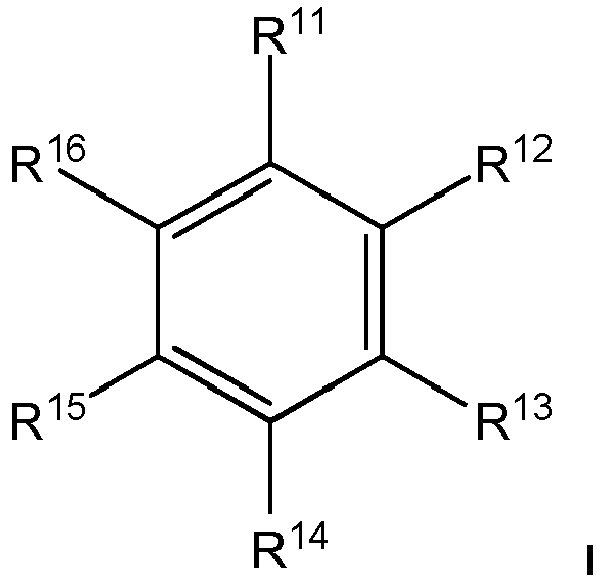
- -H, -(C1-C12)-Alkyl, -O-(C1-C12)-Alkyl, -(C6-C20)-Aryl, -O-(C6-C20)-Aryl, -Cl, -F, -I, -OC=O-(C1-C12)-Alkyl, -NH2, -N[(C1-C12)-Alkyl]2;
- Weiter vorzugsweise sind R11, R12, R13, R14, R15, R16 jeweils unabhängig voneinander ausgewählt aus:
- -H, -(C1-C12)-Alkyl, -O-(C1-C12)-Alkyl, -(C6-C20)-Aryl, -O-(C6-C20)-Aryl, -Cl, -F, -I,
- In einer speziellen Ausführungsform des Verfahrens ist mindestens ein
Rest R11, R12, R13, R14, R15 oder R16 :
-O-(C1-C12)-Alkyl,
- In einer noch spezielleren Ausführungsform des Verfahrens sind R11, R13, R14 ausgewählt aus:
-O-(C1-C12)-Alkyl.
- In der speziellsten Ausführungsform des Verfahrens sind R11, R13, R14 ausgewählt aus:
-O-CH3.
- In einer Variante des Verfahrens entspricht das erste Aryl dem zweiten Aryl, die beiden Aryle sind also identisch. Bei dieser Variante handelt es sich also um eine Homokupplung zweier gleicher Aryle. Durch die ortho-ortho-Kupplung entstehen so die gewünschten 2,2'-Biarylen.
- In dem vorliegenden Fall wird das 2,2'-Biphenol als Hauptprodukt angestrebt, da Biphenole wertvolle Bausteine zur Synthese von Liganden für metallorganische Komplexkatalysatoren sind und andere Anwendungen sind.
- Eine besonders bevorzugte Ausführungsform der Erfindung dient demnach der Herstellung von 2,2'-Biphenolen. Diese ist folglich dadurch gekennzeichnet, dass es sich bei dem ersten Aryl um ein erstes Phenol handelt, dass es sich bei dem zweiten Aryl um ein zweites Phenol handelt, und dass das erste Phenol mit dem zweiten Phenol zu dem entsprechenden 2,2'-Biphenol umgesetzt wird.
- Bei dem ersten Phenol und/oder bei dem zweiten Phenol handelt es sich vorzugsweise um eine Verbindung gemäß der allgemeinen Formel II:

- -H, -(C1-C12)-Alkyl, -O-(C1-C12)-Alkyl, -(C6-C20)-Aryl, -O-(C6-C20)-Aryl, -Cl, -F, -I, -OC=O-(C1-C12)-Alkyl,
- Vorzugsweise sollten R1, R2, R3, R4, R5 jeweils unabhängig voneinander ausgewählt sind aus:
- -H, -(C1-C12)-Alkyl, -O-(C1-C12)-Alkyl, -(C6-C20)-Aryl, -O-(C6-C20)-Aryl, -Cl, -F, -I,
- (C1-C12)-Alkyl und O-(C1-C12)-Alkyl können jeweils unsubstituiert oder durch einen oder mehrere gleiche oder verschiedene Reste substituiert sein, die ausgewählt sind aus:
- (C3-C12)-Cycloalkyl, (C3-C12)-Heterocycloalkyl, (C6-C20)-Aryl, Fluor, Chlor, Cyano, Formyl, Acyl oder Alkoxycarbonyl.
- (C6-C20)-Aryl und O-(C6-C20)-Aryl können jeweils unsubstituiert oder durch einen oder mehrere gleiche oder verschiedene Reste substituiert sein, die ausgewählt sind aus:
- -H, -(C1-C12)-Alkyl, -O-(C1-C12)-Alkyl, -O-(C6-C20)-Aryl, -(C6-C20)-Aryl, -Halogen (wie Cl, F, Br, I), - COO-(C1-C12)-Alkyl, -CONH-(C1-C12)-Alkyl, -(C6-C20)-Aryl-CON[(C1-C12)-Alkyl]2, -CO-(C1-C12)-Alkyl, -CO-(C6-C20)-Aryl, -COOH, -OH, -SO3H; -SO3Na, -NO2, -CN, -NH2, -N[(C1-C12)-Alkyl]2.
- Im Rahmen der Erfindung umfasst der Ausdruck (C1-C12)-Alkyl geradkettige und verzweigte Alkylgruppen. Vorzugsweise handelt es sich dabei um unsubstituierte geradkettige oder verzweigte (C1-C8)-Alkylgruppen und ganz bevorzugt (C1-C6)-Alkylgruppen. Beispiele für (C1-C12)-Alkylgruppen sind insbesondere Methyl, Ethyl, Propyl, Isopropyl, n-Butyl, iso-Butyl, sec.-Butyl, tert.-Butyl, n-Pentyl, 2-Pentyl, 2-Methylbutyl-, 3-Methylbutyl-, 1,2-Dimethylpropyl-, 1,1-Dimethylpropyl, 2,2-Dimethylpropyl-, 1-Ethylpropyl-, n-Hexyl-, 2-Hexyl-, 2-Methylpentyl-, 3-Methylpentyl-, 4-Methylpentyl-, 1,1-Dimethylbutyl-, 1,2-Dimethylbutyl-, 2,2-Dimethylbutyl-, 1,3-Dimethylbutyl-, 2,3-Dimethylbutyl-, 3,3-Dimethylbutyl-, 1,1,2-Trimethylpropyl-, 1,2,2-Trimethylpropyl-, 1-Ethylbutyl-, 1-Ethyl-2-methylpropyl-, n-Heptyl-, 2-Heptyl-, 3-Heptyl-, 2-Ethylpentyl-, 1-Propylbutyl-, n-Octyl-, 2-Ethylhexyl-, 2-Propylheptyl-, Nonyl-, Decyl.
- Die Erläuterungen zum Ausdruck -(C1-C12)-Alkyl gelten auch für die Alkylgruppen in -O-(C1-C12)-Alkyl, also in -(C1-C12)-Alkoxy. Vorzugsweise handelt es sich dabei um unsubstituierte geradkettige oder verzweigte -(C1-C6)-Alkoxygruppen.
- Substituierte (C1-C12)-Alkylgruppen und substituierte (C1-C12)-Alkoxygruppen können in Abhängigkeit von ihrer Kettenlänge, einen oder mehrere Substituenten aufweisen. Die Substituenten sind vorzugsweise unabhängig voneinander ausgewählt sind aus:
- -(C3-C12)-Cycloalkyl, -(C3-C12)-Heterocycloalkyl, -(C6-C20)-Aryl, Fluor, Chlor, Cyano, Formyl, Acyl oder Alkoxycarbonyl,
- In einer Variante des Verfahrens entspricht das erste Phenol dem zweiten Phenol. Das erste Phenol und das zweite Phenol sind mithin identisch Bei dieser Variante handelt es sich also um eine Homokupplung zweier gleicher Phenole. Durch die ortho-ortho-Kupplung entstehen so die gewünschten 2,2'-Biphenole.
- Im Rahmen der vorliegenden Arbeiten wurde zusätzlich gefunden, dass sich 2,2'-Biaryle nicht nur durch Kopplung der Aryle, sondern auch durch Umsetzung von 2,2'-Selenobiarylethern bilden lassen, allerdings nur in Gegenwart von MoCl5. Da die Anwesenheit des Molybdän-(V)-Chlorids auch hier erfolgswesentlich ist, und dieselben Biaryle entstehen, liegt insoweit ein gemeinsames erfinderisches Konzept zu Grunde, nämlich die Herstellung von 2,2'-Biarylen in Gegenwart von Molybdän(V)-chlorid.
- Ein weiterer Gegenstand der Erfindung ist mithin ein Verfahren zur Herstellung von 2,2'-Biarylen, bei welchem ein 2,2'-Selenobiarylether in Gegenwart von Molybdän(V)-chlorid erwärmt und zu einem 2,2'-Biaryl umgesetzt wird.
- Die erforderlichen 2,2'-Selenobiarylether waren bereits im Rahmen früherer Arbeiten gefunden worden; vgl.
DE102014209974A1 , ebenfalls am 26.05.2014 eingereicht und daher zum Anmeldezeitpunkt noch unveröffentlicht. - Bisher wurden die 2,2'-Selenobiarylether als unnütze Nebenprodukte angesehen, die aufwendig abgetrennt und entsorgt werden mussten. Dank des nun gefundenen Reaktionsweg lassen sich diese 2,2'-Selenobiarylether fortan als Edukte für die gewünschten 2,2'-Biaryle verwenden, sodass sie kein unerwünschtes Nebenprodukt mehr darstellen, sondern vielmehr ein weiteres Wertprodukt.
- Durch die Zugabe des MoCl5 zu 2,2'-Selenobiarylethern lassen sich als die korrespondierenden 2,2'-Biaryle bilden. Das zugehörige Reaktionsschema ist in
Figur 2 dargestellt. Auch hier wurde der Einfachheit halber lediglich ein Schema mit Arylen dargestellt. Analoges gilt jedoch für Phenole. - Es wurde gefunden, dass sich ausgehend vom 2,2'- Selenobiarylether die Reaktion durch Zugabe des MoCl5 gezielt in die Richtung des 2,2'-Biaryls oder 2,2'-Biphenols verschieben lässt. Dies ist besonders vorteilhaft, da diese Verbindungen im Vergleich zu den korrespondierenden 2,2'- Selenobiarylethern die interessanteren Produkte mit einer Vielzahl von großtechnischen Anwendungsgebieten aufweist.
- Bei dem 2,2'-Selenobiarylether handelt es sich vorzugsweise um eine Verbindung gemäß der allgemeinen Formel III:

- -H, -(C1-C12)-Alkyl, -O-(C1-C12)-Alkyl, -(C6-C20)-Aryl, -O-(C6-C20)-Aryl, - Cl, -F, -I, -OC=O-(C1-C12)-Alkyl, -NH2, -N[(C1-C12)-Alkyl]2; OH;
- Weiter vorzugsweise sollten R23, R24, R25, R26, R27, R28, R29, R30, R31 jeweils unabhängig voneinander ausgewählt sind aus:
- -H, -(C1-C12)-Alkyl, -O-(C1-C12)-Alkyl, -(C6-C20)-Aryl, -O-(C6-C20)-Aryl, -Cl, -F, -I, -OH.
- Ganz besonders bevorzugt sind R23, R24, R25, R26, R27, R28, R29, R30, R31 jeweils unabhängig voneinander ausgewählt sind aus: -H, -(C1-C12)-Alkyl, -O-(C1-C12)-Alkyl.
- In einer Variante des Verfahrens sind R23, R24, R25, R26, R27, R28, R29, R30, R31 jeweils unabhängig voneinander ausgewählt sind aus:
- -H, -(C1-C12)-Alkyl, -O-(C1-C12)-Alkyl, OH;
- In einer speziellen Variante des Verfahrens sind R23, R24, R25, R26, R27, R28, R29, R30, R31 jeweils unabhängig voneinander ausgewählt sind aus:
- -H, -(C1-C12)-Alkyl, -O-(C1-C12)-Alkyl,
- In einer noch spezielleren Ausführungsform des Verfahrens sind R23, R31 ausgewählt aus:
-OH.
- In der speziellsten Ausführungsform sind R23, R31 -OCH3.
- Die Reaktion des Selenobiarylether zu dem Biaryl erfolgt bei Temperatur in dem Bereich von 50 °C bis 110 °C. Hierbei ist der Bereich von 60 °C bis 100 °C bevorzugt, und der Bereich von 70 °C bis 90 °C besonders bevorzugt.
- Unabhängig davon, ob die Biaryle bzw. Biphenole aus zwei Arylen/Phenolen oder aus dem 2,2'-Selenobiarylether hergestellt wird, sollte die Reaktion unter den folgenden Randbedingungen durchgeführt werden:
- Auf die Anwesenheit eines fluorierten Lösemittels und/oder einer Säure sollte tunlichst verzichtet werden. Beides ist im Labormaßstab zwar möglich, im industriellen Maßstab jedoch nicht praktikabel.
- Gleichwohl kann die Reaktion durchgeführt werden in Anwesenheit einer Base um die Reaktion in Richtung der gewünschten Produkte zu begünstigen. Die verwendete Base sollte einen pKb-Wert im Bereich von 8 bis 11 haben. Bei der Base könnte es sich um Pyridin, um Chinolin, um eine Aminbase wie beispielsweise Triethylamin oder um Dimethylformamid handeln. Besonders bevorzugt ist Pyridin.
- Neben der Base kann das Reaktionsgemisch auch ein Lösemittel umfassen, wie beispielsweise Tetrahydrofuran, Ethylenglycoldimethylether, Bis(2-methoxyethyl)ether, Diethylether, Toluol. Alle diese Lösemittel sind frei von Fluor und daher gut verfügbar. Der Zweck des Lösemittels besteht darin, eine gute Vermischung und Rührbarkeit der verschiedenen Komponenten miteinander zu gewährleisten.
- Ganz besonders bevorzugt wird die Base als Lösemittel verwendet. Die Base ist also gleichzeitig Lösungsmittel; Base und Lösemittel die identische Substanz. Dies erlaubt Pyridin, weswegen die Reaktion auch bevorzugt in Anwesenheit von Pyridin durchgeführt wird.
- Ein besonderer Vorteil der hier beschriebenen Reaktionssysteme ist, dass diese nicht anfällig sind gegen feuchte Umgebungsluft, also einem Gemisch aus Wasserdampf, Sauerstoff und Stickstoff, ggf. sogar zusätzlich auch flüssiges Wasser. Deswegen braucht nicht unter Luftabschluss gearbeitet zu werden, was die Durchführung der Reaktion erheblich vereinfacht und erst industriell praktikabel macht. Die Möglichkeit, das Verfahren in Anwesenheit feuchter Luft durchzuführen, ist daher von besonderem Interesse.
- Vorzugsweise wird das Selendioxid in einem molaren Verhältnis bezogen auf die Summe des ersten und des zweiten Aryls zugegeben, welches in einem Bereich von 0,25 bis 1,2 liegt. Hierbei ist der Bereich von 0,25 bis 0,9 bevorzugt, und der Bereich von 0,4 bis 0,7 besonders bevorzugt.
- Dass das Selendioxid in einer unterstöchiometrischen Menge eingesetzt werden kann, stellt einen weiteren Vorteil gegenüber der im Stand der Technik beschriebenen Reaktion mit anderen anorganischen Oxidationsmitteln wie beispielsweise AlCl3, FeCl3 oder MnO2 dar. Grundsätzlich sollte Selendioxid nicht in großem Mengen konsumiert werden, weswegen sein unterstöchiometrischer Einsatz bevorzugt ist.
- Hinsichtlich der Menge des zuzusetzenden Molybdän-(V)-Chlorids lassen sich folgende Angaben machen: 0,01 bis 0,6 Äquivalente, bevorzugt 0,05 bis 0,2 Äquivalente bezogen auf das Edukt.
- Vorzugsweise erfolgt die Reaktion über einen Zeitraum im Bereich von 5 Minuten bis 24 Stunden. Hierbei ist der Bereich von 15 Minuten bis 12 Stunden bevorzugt, und der Bereich von 15 Minuten bis 6 Stunden besonders bevorzugt.
- Im Folgenden wird die Erfindung anhand von Ausführungsbeispielen näher erläutert.
- Die NMR-spektroskopischen Untersuchungen wurden an Multikernresonanzspektrometern des Typs AC 300 oder AV II 400 der Firma Bruker, Analytische Messtechnik, Karlsruhe, durchgeführt. Als Lösungsmittel wurde CDCl3 verwendet. Die 1H- und 13C-Spektren wurden gemäß dem Restgehalt an nicht deuteriertem Lösungsmittel nach der NMR Solvent Data Chart der Fa. Cambridge Isotopes Laboratories, USA, kalibriert. Die Zuordnung der 1H- und 13C-Signale erfolgte teilweise mit Hilfe von H,H-COSY, H,H-NOESY, H,C-HSQC und H,C-HMBC-Spektren. Die chemischen Verschiebungen sind als δ-Werte in ppm angegeben. Für die Multiplizitäten der NMR-Signale wurden folgende Abkürzungen verwendet: s (Singulett), bs (breites Singulett), d (Dublett), t (Triplett), q (Quartett), m (Multiplett), dd (Dublett von Dublett), dt (Dublett von Triplett), tq (Triplett von Quartett). Alle Kopplungskonstanten J wurden mit der Anzahl der eingeschlossenen Bindungen in Hertz (Hz) angegeben. Die bei der Signalzuordnung angegebene Nummerierung entspricht der in den Formelschemata angegebenen Bezifferung, die nicht mit der IUPAC-Nomenklatur übereinstimmen muss.
- Das jeweilige Phenol oder Methoxyphenol wurde im entsprechenden Lösungsmittel gelöst (8.2 m). Das Reaktionsgemisch wurde auf 60 oder 85 °C erhitzt und Selendioxid (0.6 Äquivalente) wurde unter Rühren zugegeben. Das Lösungsmittel wurde im Vakuum destilliert (Temperatur <70° C). Eine Fritte wurde zum Filtrieren der festen Bestandteile genutzt und dafür mit 2,5 cm (unten) Kieselgel und 2,5 cm Zeolith (oben) befüllt. Der Destillationsrückstand wurde im Laufmittel aufgenommen und auf die Filtrationssäule geben. Mit Cyclohexan:Essigester (95:5) wurde das Produkt von der Fritte gewaschen in Fraktionen gesammelt und destillativ vom Laufmittel befreit
-

- Die Durchführung der Reaktion erfolgte gemäß AAV1 in einem verschraubbaren Reagenzglas. Hierzu wurde 2,4-Dimethylphenol (1.00 g, 8.2 mmol) und Selendioxid (0.54 g, 4.9 mmol) in Pyridin (1 mL, 8.2 m) gelöst und 5h auf 60 °C erhitzt. Das Produkt 1 (0.50 g, 3.1 mmol, 38%) wurde als farbloser kristalliner Feststoff erhalten.
GC (hart, HP-5): tR= 14.2 min. 1H-NMR (400 MHz, CDCl3): δ = 7.12 (s, 2H, 6-H), 6.91 (s, 2H, 4-H), 5.97 (s,2H, OH), 2.23 (s, 6H, 3-CH3) 2.23 (s, 6H, 5-CH3) ppm. 13C-NMR (100 MHz, CDCl3): 151.7 (C-2), 133.2 (C-3), 133.1 (C-5), 130.4 (C-4), 124.2 (C-6), 114.9 (C-1), 20.3 (5-CH3), 16.5 (3-CH3) ppm. 77Se-NMR (76 MHz, CDCl3): δ = 163.36 ppm. MS (ESI+): m/z = 345,04 [M+Na]+, 667,08 [2M+Na]+. -

-

- Die Durchführung der Reaktion erfolgte gemäß AAV1 in einem verschraubbaren Reagenzglas. Hierzu wurde 2,4-Dimethylphenol (1.00 g, 8.2 mmol) und Selendioxid (0.54 g, 4.9 mmol) in Ameisensäure (1 mL, 8.2 m) gelöst und 2h auf 70 °C erhitzt. Das Produkt 3 (0.61 g, 5.0 mmol, 61 %) wurde als beiger kristalliner Feststoff erhalten.
Referenz im Laborjournal (MMI-): 394, 395, 397, 400, 427, 443, 474. - Der Selenobiarylether 1 (500 mg, 1.56 mmol) wurde in Dichlormethan (10 mL) gelöst. Bei 22 °C wurde Molybdänpentachlorid in Dichlormethan (935 mg in 2 mL, 3.42 mmol) zugegeben. Zum Beenden der Reaktion wurde nach 20 min Wasser (10 mL) zugegeben. Die organische Phase wurde abgetrennt und das Lösungsmittel wurde im Vakuum destilliert. Der Destillationsrückstand wurde im Laufmittel aufgenommen und auf die Filtrationssäule geben. Mit Cyclohexan:Essigester (95:5) wurde das Produkt von der Filtrationssäule gewaschen und destillativ vom Laufmittel befreit. Das Produkt 3 konnte in kleinen Mengen erhalten werden.
- GC (hart, HP-5): tR= 12.3 min. Rf= 0.2 (CH:EE 98:2). 1H-NMR (300 MHz, CDCl3): δ = 7.00 (s,2H, 6-H), 6.87 (s, 2H, 4-H), 5.07 (s,2H, OH), 2.27 (s, 12H, 3-CH3, 5-CH3) ppm. 13C-NMR (75 MHz, CDCl3): δ = 149.2 (C-2),132.1 (C-4), 130.0 (C-5), 128.5 (C-6), 125.1 (C-3), 122.1 (C-1), 20.4 (5-CH3), 16.2 (3-CH3) ppm. HRMS (ESI+) m/z für C29H34O4Na [M + Na]+ berechnet: 469.2355, gefunden 469.2352.
-

- Der Selenobiarylether 2 (500 mg, 1.21 mmol) wurde in Dichlormethan (10 mL) gelöst. Bei 22 °C wurde Molybdänpentachlorid in Dichlormethan (727 mg in 1.5 mL, 2.66 mmol) zugegeben. Zum Beenden der Reaktion wurde nach 20 min Wasser (10 mL) zugegeben. Die organische Phase wurde abgetrennt und das Lösungsmittel wurde im Vakuum destilliert. Der Destillationsrückstand wurde im Laufmittel aufgenommen und auf eine Filtrationssäule geben. Mit Cyclohexan:Essigester (95:5) wurde das Produkt von der Filtrationssäule gewaschen und in Fraktionen gesammelt die destillativ vom Laufmittel befreit wurden. Das Produkt 4 (399 mg, 1.19 mmol, 99%) wurde als beiger kristalliner Feststoff erhalten.
GC (hart, HP-5): tR= 15.3 min. 1H-NMR (400 MHz, CDCl3): δ = 6.82 (s, 2H), 6.63 (s, 2H), 3.93 (s, 6H), 3.84 (s, 6H), 3.76 (s, 6H) ppm. 13C-NMR (101 MHz, CDCl3): δ = 151.38, 148.93, 143.02, 119.05, 115.45, 98.50, 57.04, 56.68, 56.25 ppm. - Die Ergebnisse zeigen, dass das erfindungsgemäße Verfahren eine Syntheseroute darstellt, mit welcher 2,2'-Biaryle selektiv, in guter Ausbeute ausgehend von den 2,2'-Selenobiarylethern hergestellt werden können.
- Beachtlich ist, dass die verwendeten Substanzen im Vorfeld nicht getrocknet wurden und die Arbeiten auch nicht unter inerten Bedingungen durchgeführt wurden. Normalerweise würde man - wenn man unter Luftausschluss arbeitet - alle Lösemittel und Feststoffe vorher trocknen und in so genannten Schlenkkolben arbeiten. Schlenkkolben sind Reaktionsgefäße, die erst evakuiert und dann mit Argon oder Stickstoff gefüllt werden bis die Luft verdrängt ist, sodass man letztendlich nur unter Schutzgas (Argon/Stickstoff) arbeitet. Dies wurde in den vorliegenden Versuchen nicht gemacht. Folglich wurden alle Versuche in Gegenwart feuchter Luft, also der Umgebungsluft des Labors durchgeführt. Es steht somit zu erwarten, dass auch bei der erfindungsgemäßen Produktion der Biaryle / Biphenole im Tonnenmaßstab kein Luftabschluss notwendig sein wird, wodurch eine erhebliche Verfahrensvereinfachung und Kostenreduktion erzielt werden wird.
und wobei die genannten Alkyl- und Arylgruppen substituiert sein können aber nicht müssen, und mindestens ein Rest R11, R12, R13, R14, R15 oder R16 gleich -H ist.
und mindestens ein Rest R11, R12, R13, R14, R15 oder R16 gleich -H ist.
wobei die genannten Alkyl- und Arylgruppen substituiert sein können aber nicht müssen,
und wobei mindestens R1 oder R5 gleich -H ist.
und wobei mindestens R1 oder R5 gleich -H ist.
und wobei die genannten Alkyl- und Arylgruppen substituiert sein können aber nicht müssen.
Claims (15)
- Verfahren zur Herstellung von 2,2'-Biarylen, bei welchem ein Reaktionsgemisch enthaltend ein erstes Aryl, ein zweites Aryl und Selendioxid erwärmt wird, wobei das erste Aryl mit dem zweiten Aryl zu dem entsprechenden 2,2'-Biaryl umgesetzt wird, dadurch gekennzeichnet, dass das Reaktionsgemisch zusätzlich Molybdän(V)-chlorid enthält.
- Verfahren nach Anspruch 1, dadurch gekennzeichnet, dass es sich bei dem ersten Aryl und/oder bei dem zweiten Aryl um eine Verbindung gemäß der allgemeinen Formel I handelt:
 -H, -(C1-C12)-Alkyl, -O-(C1-C12)-Alkyl, -(C6-C20)-Aryl, -O-(C6-C20)-Aryl, -Cl, -F, -I, -OC=O-(C1-C12)-Alkyl, -NH2, -N[(C1-C12)-Alkyl]2;wobei zwei benachbarte Reste können zu einem kondensierten System miteinander verbunden sein können aber nicht müssen,
und wobei die genannten Alkyl- und Arylgruppen substituiert sein können aber nicht müssen, und mindestens ein Rest R11, R12, R13, R14, R15 oder R16 gleich -H ist. - Verfahren nach Anspruch 2, dadurch gekennzeichnet, dass R11, R12, R13, R14, R15, R16 jeweils unabhängig voneinander ausgewählt aus:-H, -(C1-C12)-Alkyl, -O-(C1-C12)-Alkyl, -(C6-C20)-Aryl, -O-(C6-C20)-Aryl, -Cl, -F, -I,wobei die genannten Alkyl- und Arylgruppen substituiert sein können aber nicht müssen, und mindestens ein Rest R11, R12, R13, R14, R15 oder R16 gleich -H ist.
- Verfahren nach Anspruch 2 oder 3, dadurch gekennzeichnet, dass das erste Aryl und das zweite Aryl identisch sind.
- Verfahren nach Anspruch 1 zur Herstellung von 2,2'-Biphenolen, dadurch gekennzeichnet, dass es sich bei dem ersten Aryl um ein erstes Phenol handelt, dass es sich bei dem zweiten Aryl um ein zweites Phenol handelt, und dass das erste Phenol mit dem zweiten Phenol zu dem entsprechenden 2,2'-Biphenol umgesetzt wird.
- Verfahren nach Anspruch 5, dadurch gekennzeichnet, dass es sich bei dem ersten Phenol und/oder bei dem zweiten Phenol um eine Verbindung gemäß der allgemeinen Formel II handelt:
 -H, -(C1-C12)-Alkyl, -O-(C1-C12)-Alkyl, -(C6-C20)-Aryl, -O-(C6-C20)-Aryl, -Cl, -F, -I, -OC=O-(C1-C12)-Alkyl,wobei zwei benachbarte Reste zu einem kondensierten System miteinander verbunden sein können aber nicht müssen,
wobei die genannten Alkyl- und Arylgruppen substituiert sein können aber nicht müssen, und wobei mindestens R1 oder R5 gleich -H ist. - Verfahrens nach den Anspruch 6, wobei
R1, R2, R3, R4, R5 jeweils unabhängig voneinander ausgewählt sind aus:-H, -(C1-C12)-Alkyl, -O-(C1-C12)-Alkyl, -(C6-C20)-Aryl, -O-(C6-C20)-Aryl, -Cl, -F, -I,wobei die genannten Alkyl- und Arylgruppen substituiert sein können, aber nicht müssen, und wobei mindestens R1 oder R5 gleich -H ist. - Verfahren nach Anspruch 6 oder 7, dadurch gekennzeichnet, dass das erste Phenol und das zweite Phenol identisch sind.
- Verfahren zur Herstellung von 2,2'-Biarylen, dadurch gekennzeichnet, dass ein 2,2'-Selenobiarylether in Gegenwart von Molybdän(V)-chlorid erwärmt und zu einem 2,2'-Biaryl umgesetzt wird.
- Verfahren nach Anspruch 11,
wobei es sich bei dem 2,2'-Selenobiarylether um eine Verbindung gemäß der allgemeinen Formel III handelt: -H, -(C1-C12)-Alkyl, -O-(C1-C12)-Alkyl, -(C6-C20)-Aryl, -O-(C6-C20)-Aryl, - Cl, -F, -I, -OC=O-(C1-C12)-Alkyl, -NH2, -N[(C1-C12)-Alkyl]2; OH;wobei zwei benachbarte Reste zu einem kondensierten System miteinander verbunden sein können aber nicht müssen,
und wobei die genannten Alkyl- und Arylgruppen substituiert sein können aber nicht müssen. - Verfahren nach Anspruch 10,
wobei R23, R24, R25, R26, R27, R28, R29, R30, R31 jeweils unabhängig voneinander ausgewählt sind aus:-H, -(C1-C12)-Alkyl, -O-(C1-C12)-Alkyl, -(C6-C20)-Aryl, -O-(C6-C20)-Aryl, -Cl, -F, -I, -OH. - Verfahren nach Anspruch 10 oder 11,
wobei R23, R24, R25, R26, R27, R28, R29, R30, R31 jeweils unabhängig voneinander ausgewählt sind aus: -H, -(C1-C12)-Alkyl, -O-(C1-C12)-Alkyl. - Verfahren nach Anspruch 1 oder einem der Ansprüche 2 bis 13, durchgeführt in Abwesenheit eines fluorierten Lösemittels und/oder in Abwesenheit einer Säure.
- Verfahren nach Anspruch 1 oder einem der Ansprüche 2 bis 13 durchgeführt in Anwesenheit einer Base ausgewählt aus Pyridin, Chinolin, Aminbasen, Dimethylformamid und/oder in Anwesenheit eines Lösemittels ausgewählt aus Tetrahydrofuran, Ethylenglycoldimethylether, Bis(2-methoxyethyl)ether, Diethylether, Toluol.
- Verfahren nach Anspruch 1 oder einem der Ansprüche 2 bis 14, durchgeführt in Anwesenheit feuchter Luft.
Applications Claiming Priority (1)
| Application Number | Priority Date | Filing Date | Title |
|---|---|---|---|
| DE102015203967 | 2015-03-05 |
Publications (2)
| Publication Number | Publication Date |
|---|---|
| EP3064484A1 true EP3064484A1 (de) | 2016-09-07 |
| EP3064484B1 EP3064484B1 (de) | 2018-06-20 |
Family
ID=55453082
Family Applications (1)
| Application Number | Title | Priority Date | Filing Date |
|---|---|---|---|
| EP16158245.7A Not-in-force EP3064484B1 (de) | 2015-03-05 | 2016-03-02 | Herstellung von 2,2'-biarylen in gegenwart von molybdän(v)-chlorid |
Country Status (5)
| Country | Link |
|---|---|
| US (1) | US20160257634A1 (de) |
| EP (1) | EP3064484B1 (de) |
| CN (1) | CN105936621A (de) |
| MY (1) | MY177863A (de) |
| SG (1) | SG10201601501QA (de) |
Cited By (1)
| Publication number | Priority date | Publication date | Assignee | Title |
|---|---|---|---|---|
| US20150329651A1 (en) * | 2012-12-20 | 2015-11-19 | Versalis S.P.A. | Process for the preparation of (co) polymers of conjugated dienes in the presence of a catalytic system comprising a bis-imine complex of cobalt |
Families Citing this family (19)
| Publication number | Priority date | Publication date | Assignee | Title |
|---|---|---|---|---|
| EP3095776A1 (de) | 2015-05-20 | 2016-11-23 | Evonik Degussa GmbH | Kupplung von einem Phenol und einem Aren unter Verwendung von Selendioxid |
| PT3384049T (pt) | 2015-12-03 | 2023-08-18 | Regeneron Pharma | Método de associação de variantes genéticas com um resultado clínico em doentes que sofrem de degeneração macular relacionada à idade tratados com anti-vegf |
| EP3246303B8 (de) | 2016-05-19 | 2020-01-01 | Evonik Operations GmbH | Herstellung von n-pentanal aus butenarmen einsatzstoffgemischen |
| US10245578B2 (en) | 2016-11-09 | 2019-04-02 | Evonik Degussa Gmbh | Chromium- and nickel-free hydrogenation of hydroformylation mixtures |
| JP7340327B2 (ja) | 2017-12-01 | 2023-09-07 | エボニック オペレーションズ ゲーエムベーハー | アルデヒドiiiからアルコールを得る方法 |
| ZA201808002B (en) | 2017-12-01 | 2019-08-28 | Evonik Degussa Gmbh | Method for obtaining alcohols from aldehydes |
| ZA201808003B (en) | 2017-12-01 | 2019-08-28 | Evonik Degussa Gmbh | Method for obtaining alcohols from aldehydes ii |
| US10882028B2 (en) | 2018-03-14 | 2021-01-05 | Evonik Operations Gmbh | Ni-containing catalyst for the oligomerization of olefins |
| US10882027B2 (en) | 2018-03-14 | 2021-01-05 | Evonik Operations Gmbh | Process for producing an oligomerization catalyst |
| US10850261B2 (en) | 2018-03-14 | 2020-12-01 | Evonik Operations Gmbh | Oligomerization catalyst and process for the production thereof |
| US11253844B2 (en) | 2018-03-14 | 2022-02-22 | Evonik Operations Gmbh | Oligomerization catalyst and process for the production thereof |
| US11519020B2 (en) | 2018-05-25 | 2022-12-06 | Regeneron Pharmaceuticals, Inc. | Methods of associating genetic variants with a clinical outcome in patients suffering from age-related macular degeneration treated with anti-VEGF |
| US10633302B2 (en) | 2018-07-25 | 2020-04-28 | Evonik Operations Gmbh | Process for oligomerization of butene with determination of the proportion of acidic catalysis |
| US10647650B2 (en) | 2018-10-05 | 2020-05-12 | Evonik Operations Gmbh | Process for hydroformylating short-chain olefins using a heterogenized catalyst system without ionic liquid |
| US10654784B2 (en) | 2018-10-05 | 2020-05-19 | Evonik Operations Gmbh | Process for hydroformylating short-chain olefins in the gas phase |
| US11365171B2 (en) | 2019-06-12 | 2022-06-21 | Evonik Operations Gmbh | Process for preparing an ester by alkoxycarbonylation |
| US11440863B2 (en) | 2019-06-12 | 2022-09-13 | Evonik Operations Gmbh | Process for preparing an alcohol from hydrocarbons |
| US12064755B2 (en) | 2019-06-12 | 2024-08-20 | Evonik Oxeno Gmbh & Co. Kg | Process for separating one or more components from a mixture |
| US11008275B2 (en) | 2019-06-12 | 2021-05-18 | Evonik Operations Gmbh | Process for preparing carboxylic acids or salts thereof from hydrocarbons |
Citations (4)
| Publication number | Priority date | Publication date | Assignee | Title |
|---|---|---|---|---|
| WO2005042547A1 (de) | 2003-10-30 | 2005-05-12 | Basf Aktiengesellschaft | Sterisch anspruchsvolle chelatphosphinitphosphitliganden, katalysator, umfassend wenigstens einen nickel (0) komplex stabilisiert durch diesen liganden sowie ein verfahren zur herstellung von nitrilen |
| WO2010023258A1 (de) | 2008-09-01 | 2010-03-04 | Basf Se | Verfahren zur anodischen dehydrodimerisierung von substituierten arylalkoholen |
| WO2010139687A1 (de) | 2009-06-05 | 2010-12-09 | Basf Se | Verfahren zur herstellung von unsymmetrischen biarylalkoholen |
| DE102014209976A1 (de) | 2014-05-26 | 2015-11-26 | Evonik Degussa Gmbh | Verfahren zur Herstellung von 2,2'-Biphenolen unter Verwendung von Selendioxid und halogeniertem Lösungsmittel |
Family Cites Families (1)
| Publication number | Priority date | Publication date | Assignee | Title |
|---|---|---|---|---|
| DE102011002639A1 (de) * | 2011-01-13 | 2012-07-19 | Evonik Oxeno Gmbh | Verfahren zur Herstellung von Biphephos |
-
2016
- 2016-02-29 SG SG10201601501QA patent/SG10201601501QA/en unknown
- 2016-03-02 EP EP16158245.7A patent/EP3064484B1/de not_active Not-in-force
- 2016-03-02 US US15/058,426 patent/US20160257634A1/en not_active Abandoned
- 2016-03-04 MY MYPI2016700773A patent/MY177863A/en unknown
- 2016-03-04 CN CN201610249019.9A patent/CN105936621A/zh active Pending
Patent Citations (4)
| Publication number | Priority date | Publication date | Assignee | Title |
|---|---|---|---|---|
| WO2005042547A1 (de) | 2003-10-30 | 2005-05-12 | Basf Aktiengesellschaft | Sterisch anspruchsvolle chelatphosphinitphosphitliganden, katalysator, umfassend wenigstens einen nickel (0) komplex stabilisiert durch diesen liganden sowie ein verfahren zur herstellung von nitrilen |
| WO2010023258A1 (de) | 2008-09-01 | 2010-03-04 | Basf Se | Verfahren zur anodischen dehydrodimerisierung von substituierten arylalkoholen |
| WO2010139687A1 (de) | 2009-06-05 | 2010-12-09 | Basf Se | Verfahren zur herstellung von unsymmetrischen biarylalkoholen |
| DE102014209976A1 (de) | 2014-05-26 | 2015-11-26 | Evonik Degussa Gmbh | Verfahren zur Herstellung von 2,2'-Biphenolen unter Verwendung von Selendioxid und halogeniertem Lösungsmittel |
Non-Patent Citations (14)
| Title |
|---|
| CEPANEC: "Synthesis of Biaryls", 2004, ELSEVIER |
| DANIELA MIRK ET AL: "Oxidative Coupling of Alkylated Anisole Derivatives Using MoCl 5", SYNLETT, no. 11, 1 January 2004 (2004-01-01), DE, pages 1970 - 1974, XP055284779, ISSN: 0936-5214, DOI: 10.1055/s-2004-830870 * |
| G. DYKER: "Handbook of C-H Transformations", 2005, WILEY-VCH |
| G. SARTORI; R. MAGGI; F. BIGI; M. GRANDI, J. ORG. CHEM., vol. 58, 1993, pages 7271 |
| J. M. BRUNEL, CHEM. REV., vol. 105, 2005, pages 857 - 898 |
| L. ACKERMANN: "Modern Arylation Methods", 2009, WILEY-VCH |
| R. NOYORI, CHEM. SOC. REV., vol. 18, 1989, pages 187 |
| S. KOBAYASHI; Y. MORI; J. S. FOSSEY, CHEM. REV., vol. 11, 2011, pages 2626 - 2704 |
| SIEGFRIED R WALDVOGEL: "The Reaction Pattern of the MoCl 5 -Mediated Oxidative Aryl-aryl Coupling", SYNLETT, 1 January 2002 (2002-01-01), pages 622 - 623, XP055284782, Retrieved from the Internet <URL:https://www.thieme-connect.com/products/ejournals/pdf/10.1055/s-2002-22708.pdf> [retrieved on 20160630] * |
| SIEGFRIED R. WALDVOGEL ET AL: "Oxidative transformation of aryls using molybdenum pentachloride", CHEMICAL COMMUNICATIONS - CHEMCOM, vol. 48, no. 73, 1 January 2012 (2012-01-01), GB, pages 9109 - 9119, XP055284791, ISSN: 1359-7345, DOI: 10.1039/c2cc33925k * |
| TAPAN KANTI PAINE ET AL: "Manganese complexes of mixed O, X, O-donor ligands (X = S or Se): synthesis, characterization and catalytic reactivity", DALTON TRANSACTIONS, no. 15, 1 January 2003 (2003-01-01), pages 3136 - 3143, XP055215909, ISSN: 1477-9226, DOI: 10.1039/b304765m * |
| V. SEREGIN; V. GEVORGYAN, CHEM. SOC. REV., vol. 36, 2007, pages 1173 - 1193 |
| X. CHEN; K. M. ENGLE; D.-H. WANG; J.-Q. YU, ANGEW. CHEM. INT. ED., vol. 48, 2009, pages 5094 - 511 |
| Y. CHEN; S. YEKTA; A. K. YUDIN, CHEM. REV., vol. 103, 2003, pages 3155 - 3211 |
Cited By (1)
| Publication number | Priority date | Publication date | Assignee | Title |
|---|---|---|---|---|
| US20150329651A1 (en) * | 2012-12-20 | 2015-11-19 | Versalis S.P.A. | Process for the preparation of (co) polymers of conjugated dienes in the presence of a catalytic system comprising a bis-imine complex of cobalt |
Also Published As
| Publication number | Publication date |
|---|---|
| EP3064484B1 (de) | 2018-06-20 |
| US20160257634A1 (en) | 2016-09-08 |
| MY177863A (en) | 2020-09-23 |
| CN105936621A (zh) | 2016-09-14 |
| SG10201601501QA (en) | 2016-10-28 |
Similar Documents
| Publication | Publication Date | Title |
|---|---|---|
| EP3064484B1 (de) | Herstellung von 2,2'-biarylen in gegenwart von molybdän(v)-chlorid | |
| EP2949637B1 (de) | Verfahren zur herstellung von 2,2 -biphenolen unter verwendung von selendioxid und halogeniertem lösungsmittel | |
| EP2949646A1 (de) | Verfahren zur herstellung von 2,2'-selenobiarylethern oder 4,4'-selenobiarylethern unter verwendung von selendioxid | |
| DE69919845T2 (de) | Asymmetrische ringschluss-metathese reaktionen | |
| EP2949638B1 (de) | Verfahren zur herstellung von 2,2 -biphenolen unter verwendung von selendioxid | |
| EP1200373A1 (de) | Verfahren zur herstellung von biarylen unter palladaphosphacyclobutan-katalyse | |
| EP3145938B1 (de) | Verfahren zur herstellung von monophosphiten | |
| DE2634419A1 (de) | Verfahren zur herstellung von aromatischen aethern | |
| EP3148960A1 (de) | Verfahren zur herstellung von unsymmetrischen biphenolen mittels einsatz von selendioxid | |
| DE10140857A1 (de) | Verfahren zur Herstellung von Aryl- und Alkyl-Bor-Verbindungen in Mikroreaktoren | |
| EP3095779B1 (de) | Kupplung von zwei arenen mit selendioxid zu einem selenobiarylether | |
| EP1285925A1 (de) | Verfahren zur Herstellung von Aryl- und Alkyl-Bor-Verbindungen in Mikroreaktoren | |
| DE69033574T2 (de) | Verfahren zur Herstellung von Norcamphandicarbonitrilen | |
| DE10131810A1 (de) | Verfahren zur Herstellung von optisch aktiven Cyanhydrinen und deren korrespondierenden Säuren | |
| DE102005040752A1 (de) | Eisen-katalysierte allylische Alkylierung | |
| DE69907703T2 (de) | Allylische substituierungsreaktionen | |
| DE69920049T2 (de) | Herstellung von alkalimetall-substituierten borohydridreagenzien | |
| EP3095776A1 (de) | Kupplung von einem Phenol und einem Aren unter Verwendung von Selendioxid | |
| DE102006055716A1 (de) | Imidazo(1,5-b)pyridazin-amido-Liganden und deren Komplexverbindungen | |
| DE69111280T2 (de) | Verfahren zur Herstellung von Methylphenyltrisiloxan. | |
| WO2003004157A2 (de) | Optisch aktive katalysatoren enthaltend einen salenliganden und vanadium (iv), ihre herstellung und ihre verwendung zur herstellung von cyanhydrinen | |
| WO2004031110A2 (de) | Isomerisierung von chiral einheitlichen o,o'-dihydroxy-biphenylderivaten | |
| EP0778281B1 (de) | Verfahren zur Herstellung methylenverbrückter Heteroverbindungen sowie neue Bis(diorganylphosphino)methane | |
| DE19954485A1 (de) | Neuartige immobilisierte Ionic Liquids, ihre Darstellung und Verwendung | |
| EP3178827A1 (de) | Heterozyklische selena-biphosphite sowie verfahren zu deren herstellung |
Legal Events
| Date | Code | Title | Description |
|---|---|---|---|
| PUAI | Public reference made under article 153(3) epc to a published international application that has entered the european phase |
Free format text: ORIGINAL CODE: 0009012 |
|
| 17P | Request for examination filed |
Effective date: 20160302 |
|
| AK | Designated contracting states |
Kind code of ref document: A1 Designated state(s): AL AT BE BG CH CY CZ DE DK EE ES FI FR GB GR HR HU IE IS IT LI LT LU LV MC MK MT NL NO PL PT RO RS SE SI SK SM TR |
|
| AX | Request for extension of the european patent |
Extension state: BA ME |
|
| GRAP | Despatch of communication of intention to grant a patent |
Free format text: ORIGINAL CODE: EPIDOSNIGR1 |
|
| STAA | Information on the status of an ep patent application or granted ep patent |
Free format text: STATUS: GRANT OF PATENT IS INTENDED |
|
| RIC1 | Information provided on ipc code assigned before grant |
Ipc: C07C 37/11 20060101AFI20180105BHEP Ipc: C07C 39/15 20060101ALI20180105BHEP Ipc: C07C 391/02 20060101ALI20180105BHEP Ipc: C07C 41/30 20060101ALI20180105BHEP Ipc: C07C 43/205 20060101ALI20180105BHEP |
|
| INTG | Intention to grant announced |
Effective date: 20180131 |
|
| GRAS | Grant fee paid |
Free format text: ORIGINAL CODE: EPIDOSNIGR3 |
|
| GRAA | (expected) grant |
Free format text: ORIGINAL CODE: 0009210 |
|
| STAA | Information on the status of an ep patent application or granted ep patent |
Free format text: STATUS: THE PATENT HAS BEEN GRANTED |
|
| AK | Designated contracting states |
Kind code of ref document: B1 Designated state(s): AL AT BE BG CH CY CZ DE DK EE ES FI FR GB GR HR HU IE IS IT LI LT LU LV MC MK MT NL NO PL PT RO RS SE SI SK SM TR |
|
| REG | Reference to a national code |
Ref country code: GB Ref legal event code: FG4D Free format text: NOT ENGLISH |
|
| REG | Reference to a national code |
Ref country code: IE Ref legal event code: FG4D Free format text: LANGUAGE OF EP DOCUMENT: GERMAN |
|
| REG | Reference to a national code |
Ref country code: AT Ref legal event code: REF Ref document number: 1010491 Country of ref document: AT Kind code of ref document: T Effective date: 20180715 |
|
| REG | Reference to a national code |
Ref country code: DE Ref legal event code: R096 Ref document number: 502016001277 Country of ref document: DE |
|
| REG | Reference to a national code |
Ref country code: NL Ref legal event code: MP Effective date: 20180620 |
|
| PG25 | Lapsed in a contracting state [announced via postgrant information from national office to epo] |
Ref country code: LT Free format text: LAPSE BECAUSE OF FAILURE TO SUBMIT A TRANSLATION OF THE DESCRIPTION OR TO PAY THE FEE WITHIN THE PRESCRIBED TIME-LIMIT Effective date: 20180620 Ref country code: NO Free format text: LAPSE BECAUSE OF FAILURE TO SUBMIT A TRANSLATION OF THE DESCRIPTION OR TO PAY THE FEE WITHIN THE PRESCRIBED TIME-LIMIT Effective date: 20180920 Ref country code: SE Free format text: LAPSE BECAUSE OF FAILURE TO SUBMIT A TRANSLATION OF THE DESCRIPTION OR TO PAY THE FEE WITHIN THE PRESCRIBED TIME-LIMIT Effective date: 20180620 Ref country code: FI Free format text: LAPSE BECAUSE OF FAILURE TO SUBMIT A TRANSLATION OF THE DESCRIPTION OR TO PAY THE FEE WITHIN THE PRESCRIBED TIME-LIMIT Effective date: 20180620 Ref country code: BG Free format text: LAPSE BECAUSE OF FAILURE TO SUBMIT A TRANSLATION OF THE DESCRIPTION OR TO PAY THE FEE WITHIN THE PRESCRIBED TIME-LIMIT Effective date: 20180920 |
|
| REG | Reference to a national code |
Ref country code: LT Ref legal event code: MG4D |
|
| PG25 | Lapsed in a contracting state [announced via postgrant information from national office to epo] |
Ref country code: GR Free format text: LAPSE BECAUSE OF FAILURE TO SUBMIT A TRANSLATION OF THE DESCRIPTION OR TO PAY THE FEE WITHIN THE PRESCRIBED TIME-LIMIT Effective date: 20180921 Ref country code: RS Free format text: LAPSE BECAUSE OF FAILURE TO SUBMIT A TRANSLATION OF THE DESCRIPTION OR TO PAY THE FEE WITHIN THE PRESCRIBED TIME-LIMIT Effective date: 20180620 Ref country code: LV Free format text: LAPSE BECAUSE OF FAILURE TO SUBMIT A TRANSLATION OF THE DESCRIPTION OR TO PAY THE FEE WITHIN THE PRESCRIBED TIME-LIMIT Effective date: 20180620 Ref country code: HR Free format text: LAPSE BECAUSE OF FAILURE TO SUBMIT A TRANSLATION OF THE DESCRIPTION OR TO PAY THE FEE WITHIN THE PRESCRIBED TIME-LIMIT Effective date: 20180620 |
|
| PG25 | Lapsed in a contracting state [announced via postgrant information from national office to epo] |
Ref country code: NL Free format text: LAPSE BECAUSE OF FAILURE TO SUBMIT A TRANSLATION OF THE DESCRIPTION OR TO PAY THE FEE WITHIN THE PRESCRIBED TIME-LIMIT Effective date: 20180620 |
|
| PG25 | Lapsed in a contracting state [announced via postgrant information from national office to epo] |
Ref country code: RO Free format text: LAPSE BECAUSE OF FAILURE TO SUBMIT A TRANSLATION OF THE DESCRIPTION OR TO PAY THE FEE WITHIN THE PRESCRIBED TIME-LIMIT Effective date: 20180620 Ref country code: SK Free format text: LAPSE BECAUSE OF FAILURE TO SUBMIT A TRANSLATION OF THE DESCRIPTION OR TO PAY THE FEE WITHIN THE PRESCRIBED TIME-LIMIT Effective date: 20180620 Ref country code: EE Free format text: LAPSE BECAUSE OF FAILURE TO SUBMIT A TRANSLATION OF THE DESCRIPTION OR TO PAY THE FEE WITHIN THE PRESCRIBED TIME-LIMIT Effective date: 20180620 Ref country code: PL Free format text: LAPSE BECAUSE OF FAILURE TO SUBMIT A TRANSLATION OF THE DESCRIPTION OR TO PAY THE FEE WITHIN THE PRESCRIBED TIME-LIMIT Effective date: 20180620 Ref country code: IS Free format text: LAPSE BECAUSE OF FAILURE TO SUBMIT A TRANSLATION OF THE DESCRIPTION OR TO PAY THE FEE WITHIN THE PRESCRIBED TIME-LIMIT Effective date: 20181020 Ref country code: CZ Free format text: LAPSE BECAUSE OF FAILURE TO SUBMIT A TRANSLATION OF THE DESCRIPTION OR TO PAY THE FEE WITHIN THE PRESCRIBED TIME-LIMIT Effective date: 20180620 |
|
| PG25 | Lapsed in a contracting state [announced via postgrant information from national office to epo] |
Ref country code: IT Free format text: LAPSE BECAUSE OF FAILURE TO SUBMIT A TRANSLATION OF THE DESCRIPTION OR TO PAY THE FEE WITHIN THE PRESCRIBED TIME-LIMIT Effective date: 20180620 Ref country code: ES Free format text: LAPSE BECAUSE OF FAILURE TO SUBMIT A TRANSLATION OF THE DESCRIPTION OR TO PAY THE FEE WITHIN THE PRESCRIBED TIME-LIMIT Effective date: 20180620 Ref country code: SM Free format text: LAPSE BECAUSE OF FAILURE TO SUBMIT A TRANSLATION OF THE DESCRIPTION OR TO PAY THE FEE WITHIN THE PRESCRIBED TIME-LIMIT Effective date: 20180620 |
|
| REG | Reference to a national code |
Ref country code: DE Ref legal event code: R097 Ref document number: 502016001277 Country of ref document: DE |
|
| PLBE | No opposition filed within time limit |
Free format text: ORIGINAL CODE: 0009261 |
|
| STAA | Information on the status of an ep patent application or granted ep patent |
Free format text: STATUS: NO OPPOSITION FILED WITHIN TIME LIMIT |
|
| 26N | No opposition filed |
Effective date: 20190321 |
|
| PG25 | Lapsed in a contracting state [announced via postgrant information from national office to epo] |
Ref country code: DK Free format text: LAPSE BECAUSE OF FAILURE TO SUBMIT A TRANSLATION OF THE DESCRIPTION OR TO PAY THE FEE WITHIN THE PRESCRIBED TIME-LIMIT Effective date: 20180620 |
|
| PG25 | Lapsed in a contracting state [announced via postgrant information from national office to epo] |
Ref country code: SI Free format text: LAPSE BECAUSE OF FAILURE TO SUBMIT A TRANSLATION OF THE DESCRIPTION OR TO PAY THE FEE WITHIN THE PRESCRIBED TIME-LIMIT Effective date: 20180620 |
|
| REG | Reference to a national code |
Ref country code: DE Ref legal event code: R119 Ref document number: 502016001277 Country of ref document: DE |
|
| PG25 | Lapsed in a contracting state [announced via postgrant information from national office to epo] |
Ref country code: MC Free format text: LAPSE BECAUSE OF FAILURE TO SUBMIT A TRANSLATION OF THE DESCRIPTION OR TO PAY THE FEE WITHIN THE PRESCRIBED TIME-LIMIT Effective date: 20180620 |
|
| REG | Reference to a national code |
Ref country code: CH Ref legal event code: PL |
|
| PG25 | Lapsed in a contracting state [announced via postgrant information from national office to epo] |
Ref country code: LU Free format text: LAPSE BECAUSE OF NON-PAYMENT OF DUE FEES Effective date: 20190302 Ref country code: AL Free format text: LAPSE BECAUSE OF FAILURE TO SUBMIT A TRANSLATION OF THE DESCRIPTION OR TO PAY THE FEE WITHIN THE PRESCRIBED TIME-LIMIT Effective date: 20180620 |
|
| REG | Reference to a national code |
Ref country code: BE Ref legal event code: MM Effective date: 20190331 |
|
| PG25 | Lapsed in a contracting state [announced via postgrant information from national office to epo] |
Ref country code: CH Free format text: LAPSE BECAUSE OF NON-PAYMENT OF DUE FEES Effective date: 20190331 Ref country code: DE Free format text: LAPSE BECAUSE OF NON-PAYMENT OF DUE FEES Effective date: 20191001 Ref country code: LI Free format text: LAPSE BECAUSE OF NON-PAYMENT OF DUE FEES Effective date: 20190331 Ref country code: IE Free format text: LAPSE BECAUSE OF NON-PAYMENT OF DUE FEES Effective date: 20190302 |
|
| PG25 | Lapsed in a contracting state [announced via postgrant information from national office to epo] |
Ref country code: BE Free format text: LAPSE BECAUSE OF NON-PAYMENT OF DUE FEES Effective date: 20190331 Ref country code: FR Free format text: LAPSE BECAUSE OF NON-PAYMENT OF DUE FEES Effective date: 20190331 |
|
| PG25 | Lapsed in a contracting state [announced via postgrant information from national office to epo] |
Ref country code: TR Free format text: LAPSE BECAUSE OF FAILURE TO SUBMIT A TRANSLATION OF THE DESCRIPTION OR TO PAY THE FEE WITHIN THE PRESCRIBED TIME-LIMIT Effective date: 20180620 |
|
| PG25 | Lapsed in a contracting state [announced via postgrant information from national office to epo] |
Ref country code: PT Free format text: LAPSE BECAUSE OF FAILURE TO SUBMIT A TRANSLATION OF THE DESCRIPTION OR TO PAY THE FEE WITHIN THE PRESCRIBED TIME-LIMIT Effective date: 20181022 Ref country code: MT Free format text: LAPSE BECAUSE OF FAILURE TO SUBMIT A TRANSLATION OF THE DESCRIPTION OR TO PAY THE FEE WITHIN THE PRESCRIBED TIME-LIMIT Effective date: 20180620 |
|
| GBPC | Gb: european patent ceased through non-payment of renewal fee |
Effective date: 20200302 |
|
| PG25 | Lapsed in a contracting state [announced via postgrant information from national office to epo] |
Ref country code: GB Free format text: LAPSE BECAUSE OF NON-PAYMENT OF DUE FEES Effective date: 20200302 |
|
| PG25 | Lapsed in a contracting state [announced via postgrant information from national office to epo] |
Ref country code: CY Free format text: LAPSE BECAUSE OF FAILURE TO SUBMIT A TRANSLATION OF THE DESCRIPTION OR TO PAY THE FEE WITHIN THE PRESCRIBED TIME-LIMIT Effective date: 20180620 |
|
| PG25 | Lapsed in a contracting state [announced via postgrant information from national office to epo] |
Ref country code: HU Free format text: LAPSE BECAUSE OF FAILURE TO SUBMIT A TRANSLATION OF THE DESCRIPTION OR TO PAY THE FEE WITHIN THE PRESCRIBED TIME-LIMIT; INVALID AB INITIO Effective date: 20160302 |
|
| REG | Reference to a national code |
Ref country code: AT Ref legal event code: MM01 Ref document number: 1010491 Country of ref document: AT Kind code of ref document: T Effective date: 20210302 |
|
| PG25 | Lapsed in a contracting state [announced via postgrant information from national office to epo] |
Ref country code: MK Free format text: LAPSE BECAUSE OF FAILURE TO SUBMIT A TRANSLATION OF THE DESCRIPTION OR TO PAY THE FEE WITHIN THE PRESCRIBED TIME-LIMIT Effective date: 20180620 |
|
| PG25 | Lapsed in a contracting state [announced via postgrant information from national office to epo] |
Ref country code: AT Free format text: LAPSE BECAUSE OF NON-PAYMENT OF DUE FEES Effective date: 20210302 |