EP3064500A2 - Einzelmolekül und organische solarzelle damit - Google Patents
Einzelmolekül und organische solarzelle damit Download PDFInfo
- Publication number
- EP3064500A2 EP3064500A2 EP14858489.9A EP14858489A EP3064500A2 EP 3064500 A2 EP3064500 A2 EP 3064500A2 EP 14858489 A EP14858489 A EP 14858489A EP 3064500 A2 EP3064500 A2 EP 3064500A2
- Authority
- EP
- European Patent Office
- Prior art keywords
- group
- substituted
- unsubstituted
- present specification
- same
- Prior art date
- Legal status (The legal status is an assumption and is not a legal conclusion. Google has not performed a legal analysis and makes no representation as to the accuracy of the status listed.)
- Granted
Links
- 0 C*(C(S)=C(*)c1c(*)c(C(c2c-3c(*C4(*)c5c-6[s]c7c5[s]c(C)c7*)c4c-6c2*)=*)c-3[s]1)=C Chemical compound C*(C(S)=C(*)c1c(*)c(C(c2c-3c(*C4(*)c5c-6[s]c7c5[s]c(C)c7*)c4c-6c2*)=*)c-3[s]1)=C 0.000 description 11
- LWQXUKAKSAPGGT-UHFFFAOYSA-N CCCCC(CC)CN(C(c1ccc[s]1)=C(C1=C(c2ccc(-c3ccc(-c4ccc(C(N(CC(CC)CCCC)C(C5=C(c6ccc[s]6)N6CC(CC)CCCC)=O)=C5C6=O)[s]4)[s]3)[s]2)N2CC(CC)CCCC)C2=O)C1=O Chemical compound CCCCC(CC)CN(C(c1ccc[s]1)=C(C1=C(c2ccc(-c3ccc(-c4ccc(C(N(CC(CC)CCCC)C(C5=C(c6ccc[s]6)N6CC(CC)CCCC)=O)=C5C6=O)[s]4)[s]3)[s]2)N2CC(CC)CCCC)C2=O)C1=O LWQXUKAKSAPGGT-UHFFFAOYSA-N 0.000 description 1
- WBRFTNZPYPVGBJ-UHFFFAOYSA-N CCCCCCCCOc(c1c2cc(-c3ccc(C(N(CC(CC)CCCC)C(C4=C(c5ccc(-c6ccc(-c7ccc(CCCCCC)[s]7)[s]6)[s]5)N5CC(CC)CCCC)=O)=C4C5=O)[s]3)[s]1)c(cc(-c1ccc(C(N(CC(CC)CCCC)C(C3=C(c4ccc(-c5ccc(-c6ccc(CCCCCC)[s]6)[s]5)[s]4)N4CC(CC)CCCC)=O)=C3C4=O)[s]1)[s]1)c1c2OCCCCCCCC Chemical compound CCCCCCCCOc(c1c2cc(-c3ccc(C(N(CC(CC)CCCC)C(C4=C(c5ccc(-c6ccc(-c7ccc(CCCCCC)[s]7)[s]6)[s]5)N5CC(CC)CCCC)=O)=C4C5=O)[s]3)[s]1)c(cc(-c1ccc(C(N(CC(CC)CCCC)C(C3=C(c4ccc(-c5ccc(-c6ccc(CCCCCC)[s]6)[s]5)[s]4)N4CC(CC)CCCC)=O)=C3C4=O)[s]1)[s]1)c1c2OCCCCCCCC WBRFTNZPYPVGBJ-UHFFFAOYSA-N 0.000 description 1
Images













Classifications
-
- C—CHEMISTRY; METALLURGY
- C07—ORGANIC CHEMISTRY
- C07D—HETEROCYCLIC COMPOUNDS
- C07D519/00—Heterocyclic compounds containing more than one system of two or more relevant hetero rings condensed among themselves or condensed with a common carbocyclic ring system not provided for in groups C07D453/00 or C07D455/00
-
- A—HUMAN NECESSITIES
- A61—MEDICAL OR VETERINARY SCIENCE; HYGIENE
- A61K—PREPARATIONS FOR MEDICAL, DENTAL OR TOILETRY PURPOSES
- A61K31/00—Medicinal preparations containing organic active ingredients
- A61K31/33—Heterocyclic compounds
- A61K31/395—Heterocyclic compounds having nitrogen as a ring hetero atom, e.g. guanethidine or rifamycins
- A61K31/435—Heterocyclic compounds having nitrogen as a ring hetero atom, e.g. guanethidine or rifamycins having six-membered rings with one nitrogen as the only ring hetero atom
- A61K31/44—Non condensed pyridines; Hydrogenated derivatives thereof
- A61K31/445—Non condensed piperidines, e.g. piperocaine
- A61K31/4523—Non condensed piperidines, e.g. piperocaine containing further heterocyclic ring systems
- A61K31/454—Non condensed piperidines, e.g. piperocaine containing further heterocyclic ring systems containing a five-membered ring with nitrogen as a ring hetero atom, e.g. pimozide, domperidone
-
- C—CHEMISTRY; METALLURGY
- C07—ORGANIC CHEMISTRY
- C07D—HETEROCYCLIC COMPOUNDS
- C07D409/00—Heterocyclic compounds containing two or more hetero rings, at least one ring having sulfur atoms as the only ring hetero atoms
- C07D409/14—Heterocyclic compounds containing two or more hetero rings, at least one ring having sulfur atoms as the only ring hetero atoms containing three or more hetero rings
-
- C—CHEMISTRY; METALLURGY
- C07—ORGANIC CHEMISTRY
- C07D—HETEROCYCLIC COMPOUNDS
- C07D487/00—Heterocyclic compounds containing nitrogen atoms as the only ring hetero atoms in the condensed system, not provided for by groups C07D451/00 - C07D477/00
- C07D487/02—Heterocyclic compounds containing nitrogen atoms as the only ring hetero atoms in the condensed system, not provided for by groups C07D451/00 - C07D477/00 in which the condensed system contains two hetero rings
- C07D487/04—Ortho-condensed systems
-
- C—CHEMISTRY; METALLURGY
- C07—ORGANIC CHEMISTRY
- C07D—HETEROCYCLIC COMPOUNDS
- C07D495/00—Heterocyclic compounds containing in the condensed system at least one hetero ring having sulfur atoms as the only ring hetero atoms
- C07D495/02—Heterocyclic compounds containing in the condensed system at least one hetero ring having sulfur atoms as the only ring hetero atoms in which the condensed system contains two hetero rings
- C07D495/04—Ortho-condensed systems
-
- H—ELECTRICITY
- H10—SEMICONDUCTOR DEVICES; ELECTRIC SOLID-STATE DEVICES NOT OTHERWISE PROVIDED FOR
- H10K—ORGANIC ELECTRIC SOLID-STATE DEVICES
- H10K85/00—Organic materials used in the body or electrodes of devices covered by this subclass
- H10K85/60—Organic compounds having low molecular weight
- H10K85/615—Polycyclic condensed aromatic hydrocarbons, e.g. anthracene
- H10K85/621—Aromatic anhydride or imide compounds, e.g. perylene tetra-carboxylic dianhydride or perylene tetracarboxylic di-imide
-
- H—ELECTRICITY
- H10—SEMICONDUCTOR DEVICES; ELECTRIC SOLID-STATE DEVICES NOT OTHERWISE PROVIDED FOR
- H10K—ORGANIC ELECTRIC SOLID-STATE DEVICES
- H10K85/00—Organic materials used in the body or electrodes of devices covered by this subclass
- H10K85/60—Organic compounds having low molecular weight
- H10K85/649—Aromatic compounds comprising a hetero atom
- H10K85/655—Aromatic compounds comprising a hetero atom comprising only sulfur as heteroatom
-
- H—ELECTRICITY
- H10—SEMICONDUCTOR DEVICES; ELECTRIC SOLID-STATE DEVICES NOT OTHERWISE PROVIDED FOR
- H10K—ORGANIC ELECTRIC SOLID-STATE DEVICES
- H10K85/00—Organic materials used in the body or electrodes of devices covered by this subclass
- H10K85/60—Organic compounds having low molecular weight
- H10K85/649—Aromatic compounds comprising a hetero atom
- H10K85/657—Polycyclic condensed heteroaromatic hydrocarbons
- H10K85/6576—Polycyclic condensed heteroaromatic hydrocarbons comprising only sulfur in the heteroaromatic polycondensed ring system, e.g. benzothiophene
-
- H—ELECTRICITY
- H10—SEMICONDUCTOR DEVICES; ELECTRIC SOLID-STATE DEVICES NOT OTHERWISE PROVIDED FOR
- H10K—ORGANIC ELECTRIC SOLID-STATE DEVICES
- H10K30/00—Organic devices sensitive to infrared radiation, light, electromagnetic radiation of shorter wavelength or corpuscular radiation
- H10K30/30—Organic devices sensitive to infrared radiation, light, electromagnetic radiation of shorter wavelength or corpuscular radiation comprising bulk heterojunctions, e.g. interpenetrating networks of donor and acceptor material domains
-
- H—ELECTRICITY
- H10—SEMICONDUCTOR DEVICES; ELECTRIC SOLID-STATE DEVICES NOT OTHERWISE PROVIDED FOR
- H10K—ORGANIC ELECTRIC SOLID-STATE DEVICES
- H10K30/00—Organic devices sensitive to infrared radiation, light, electromagnetic radiation of shorter wavelength or corpuscular radiation
- H10K30/50—Photovoltaic [PV] devices
-
- H—ELECTRICITY
- H10—SEMICONDUCTOR DEVICES; ELECTRIC SOLID-STATE DEVICES NOT OTHERWISE PROVIDED FOR
- H10K—ORGANIC ELECTRIC SOLID-STATE DEVICES
- H10K85/00—Organic materials used in the body or electrodes of devices covered by this subclass
- H10K85/20—Carbon compounds, e.g. carbon nanotubes or fullerenes
- H10K85/211—Fullerenes, e.g. C60
- H10K85/215—Fullerenes, e.g. C60 comprising substituents, e.g. PCBM
-
- H—ELECTRICITY
- H10—SEMICONDUCTOR DEVICES; ELECTRIC SOLID-STATE DEVICES NOT OTHERWISE PROVIDED FOR
- H10K—ORGANIC ELECTRIC SOLID-STATE DEVICES
- H10K85/00—Organic materials used in the body or electrodes of devices covered by this subclass
- H10K85/60—Organic compounds having low molecular weight
- H10K85/649—Aromatic compounds comprising a hetero atom
- H10K85/657—Polycyclic condensed heteroaromatic hydrocarbons
-
- H—ELECTRICITY
- H10—SEMICONDUCTOR DEVICES; ELECTRIC SOLID-STATE DEVICES NOT OTHERWISE PROVIDED FOR
- H10K—ORGANIC ELECTRIC SOLID-STATE DEVICES
- H10K85/00—Organic materials used in the body or electrodes of devices covered by this subclass
- H10K85/60—Organic compounds having low molecular weight
- H10K85/649—Aromatic compounds comprising a hetero atom
- H10K85/657—Polycyclic condensed heteroaromatic hydrocarbons
- H10K85/6572—Polycyclic condensed heteroaromatic hydrocarbons comprising only nitrogen in the heteroaromatic polycondensed ring system, e.g. phenanthroline or carbazole
-
- Y—GENERAL TAGGING OF NEW TECHNOLOGICAL DEVELOPMENTS; GENERAL TAGGING OF CROSS-SECTIONAL TECHNOLOGIES SPANNING OVER SEVERAL SECTIONS OF THE IPC; TECHNICAL SUBJECTS COVERED BY FORMER USPC CROSS-REFERENCE ART COLLECTIONS [XRACs] AND DIGESTS
- Y02—TECHNOLOGIES OR APPLICATIONS FOR MITIGATION OR ADAPTATION AGAINST CLIMATE CHANGE
- Y02E—REDUCTION OF GREENHOUSE GAS [GHG] EMISSIONS, RELATED TO ENERGY GENERATION, TRANSMISSION OR DISTRIBUTION
- Y02E10/00—Energy generation through renewable energy sources
- Y02E10/50—Photovoltaic [PV] energy
- Y02E10/549—Organic PV cells
Definitions
- the present disclosure relates to a single molecule and an organic solar cell including the same.
- An organic solar cell is a device capable of directly converting solar energy to electric energy by applying a photovoltaic effect.
- Solar cells are divided into inorganic solar cells and organic solar cells depending on the materials forming a thin film.
- Typical solar cells are fabricated using a p-n junction by doping crystalline silicon (Si), an inorganic semiconductor.
- Electrons are holes generated by light absorption spread to p-n junction points, are accelerated by the electric field, and move to an electrode. Power conversion efficiency of this process is defined as a ratio of power given to an external circuit and solar power put into a solar cell, and the ratio has been accomplished up to 24% when measured under a currently standardized hypothetical solar irradiation condition.
- existing inorganic solar cells already has a limit in economic feasibility and material supplies, and therefore, organic material semiconductor solar cells that are easily processed, inexpensive and have various functionality have been highly favored as a long-term alternative energy source.
- An object of the present specification is to provide a single molecule and an organic solar cell including the same.
- the present specification provides a single molecule employing the following Chemical Formula 1 as an end unit, including two or more units selected from the group consisting of units represented by the following Chemical Formula 2, wherein the selected two or more units are the same as or different from each other.
- an organic solar cell including a first electrode; a second electrode provided opposite to the first electrode; and one or more organic material layers provided between the first electrode and the second electrode, and including a photoactive layer, wherein one or more layers of the organic material layers include the single molecule described above.
- a single molecule of the present specification may be used as a material of an organic material layer of an organic solar cell, and the organic solar cell using the single molecule may exhibit excellent properties in an open voltage increase, an efficiency increase and the like.
- the single molecule according to one embodiment of the present specification has a deep HOMO level, a small band gap, and high charge mobility, therefore, may exhibit excellent properties.
- the single molecule according to one embodiment of the present specification may be used either alone or as a mixture with other materials in an organic solar cell, may improve efficiency, and may improve the lifespan properties of a device by thermal stability of the compound.
- a 'unit' in the present specification is a structure included in a single molecule, and means a structure in which a monomer binds in a single molecule by polymerization.
- the single molecule further includes one or more units selected from the group consisting of units represented by the following Chemical Formula 3.
- Chemical Formula 3 In Chemical Formula 3,
- the repetition number of units in the single molecule other than the end unit of Chemical Formula 1 is 2 to 10.
- the purity of the single molecule is 90% to 99.99%.
- a term "substituted or unsubstituted" in the present specification means being substituted with one, two or more substituents selected from the group consisting of deuterium; a halogen group; an alkyl group; an alkenyl group; an alkoxy group; a cycloalkyl group; a silyl group; an arylalkenyl group; an aryloxy group; an alkylthioxy group; an alkylsulfoxy group; an arylsulfoxy group; a boron group; an alkylamine group; an aralkylamine group; an arylamine group; a heteroaryl group; a carbazole group; an arylamine group; an aryl group; a nitrile group; a nitro group; a hydroxyl group and a heteroring group, or being substituted with a substituent linking two or more substituents among the substituents illustrated above, or having no substituents.
- a substituent linking two or more substituents may include a biphenyl group.
- a biphenyl group may be an aryl group, or interpreted as a substituent linking two phenyl groups.
- the term means being substituted with a substituent linking two or more substituents among the substituents illustrated above.
- a substituent linking two or more substituents may include a biphenyl group.
- a biphenyl group may be an aryl group, or interpreted as a substituent linking two phenyl groups.
- substitution means a hydrogen atom bonding to a carbon atom of a compound is changed to another substituent, and the position of substitution is not limited as long as it is a position at which a hydrogen atom is substituted, that is, a position at which a substituent may substitute, and when two or more substituents substitute, the two or more substituents may be the same as or different from each other.
- the number of carbon atoms of the imide group is not particularly limited, but is preferably 1 to 25. Specifically, compounds having the following structures may be included, but the compound is not limited thereto.
- the nitrogen of the amide group may be once or twice substituted with hydrogen, a linear, branched or cyclic alkyl group having 1 to 25 carbon atoms, or an aryl group having 6 to 25 carbon atoms.
- compounds having the following structural formulae may be included, but the compound is not limited thereto.
- the alkyl group may be linear or branched, and the number of carbon atoms is not particularly limited, but is preferably 1 to 50. Specific examples thereof include methyl, ethyl, propyl, n-propyl, isopropyl, butyl, n-butyl, isobutyl, tert-butyl, sec-butyl, 1-methyl-butyl, 1-ethyl-butyl, pentyl, n-pentyl, isopentyl, neopentyl, tert-pentyl, hexyl, n-hexyl, 1-methylpentyl, 2-methylpentyl, 4-methyl-2-pentyl, 3,3-dimethylbutyl, 2-ethylbutyl, heptyl, n-heptyl, 1-methylhexyl, cyclopentylmethyl, cyclohexylmethyl, octyl,
- the cycloalkyl group is not particularly limited, but preferably has 3 to 60 carbon atoms.
- Specific examples thereof include cyclopropyl, cyclobutyl, cyclopentyl, 3-methylcyclopentyl, 2,3-dimethylcyclopentyl, cyclohexyl, 3-methylcyclohexyl, 4-methylcyclohexyl, 2,3-dimethylcyclohexyl, 3,4,5-trimethylcyclohexyl, 4-tert-butylcyclohexyl, cycloheptyl, cyclooctyl and the like, but are not limited thereto.
- the alkoxy group may be linear, branched or cyclic.
- the number of carbon atoms of the alkoxy group is not particularly limited, but is preferably 1 to 20. Specific examples thereof may include methoxy, ethoxy, n-propoxy, isopropoxy, i-propyloxy, n-butoxy, isobutoxy, tert-butoxy, sec-butoxy, n-pentyloxy, neopentyloxy, isopentyloxy, n-hexyloxy, 3,3-dimethylbutyloxy, 2-ethylbutyloxy, n-octyloxy, n-nonyloxy, n-decyloxy, benzyloxy, p-methylbenzyloxy and the like, but are not limited thereto.
- the alkenyl group may be linear or branched, and although not particularly limited thereto, the number of carbon atoms is preferably 2 to 40. Specific examples thereof may include vinyl, 1-propenyl, isopropenyl, 1-butenyl, 2-butenyl, 3-butenyl, 1-pentenyl, 2-pentenyl, 3-pentenyl, 3-methyl-1-butenyl, 1,3-butadienyl, allyl, 1-phenylvinyl-1-yl, 2-phenylvinyl-1-yl, 2,2-diphenylvinyl-1-yl, 2-phenyl-2-(naphthyl-1-yl)vinyl-1-yl, 2,2-bis(diphenyl-1-yl)vinyl-1-yl, a stilbenyl group, a styrenyl group and the like, but are not limited thereto.
- the aryl group may be a monocyclic aryl group or a multicyclic aryl group, and includes a case in which an alkyl group having 1 to 25 carbon atoms or an alkoxy group having 1 to 25 carbon atoms is substituted.
- the aryl group in the present specification may mean an aromatic ring.
- the aryl group is a monocyclic aryl group
- the number of carbon atoms is not particularly limited, but is preferably 6 to 25.
- Specific examples of the monocyclic aryl group may include a phenyl group, a biphenyl group, a terphenyl and the like, but are not limited thereto.
- the number of carbon atoms is not particularly limited, but is preferably 10 to 24.
- Specific example of the multicyclic aryl group may include a naphthyl group, an anthracenyl group, a phenanthryl group, a pyrenyl group, a perylenyl group, a crycenyl group, a fluorenyl group and the like, but are not limited thereto.
- the fluorenyl group has a structure in which two cyclic organic compounds are linked through one atom.
- the fluorenyl group may be substituted, and adjacent substituents may bond to each other to form a ring.
- fluorenyl group may be substituted, and the like may be included.
- the structure is not limited thereto.
- the silyl group specifically includes a trimethylsilyl group, a triethylsilyl group, a t-butyldimethylsilyl group, a vinyldimethylsilyl group, a propyldimethylsilyl group, a triphenylsilyl group, a diphenylsilyl group, a phenylsilyl group and the like, but is not limited thereto.
- the number of carbon atoms of the amine group is not particularly limited, but is preferably 1 to 30.
- Specific examples of the amine group include a methylamine group, a dimethylamine group, an ethylamine group, a diethylamine group, a phenylamine group, a naphthylamine group, a biphenylamine group, an anthracenylamine group, a 9-methyl-anthracenylamine group, a diphenylamine group, a phenylnaphthylamine group, a ditolylamine group, a phenyltolylamine group, a triphenylamine group and the like, but are not limited thereto.
- examples of the arylamine group include a substituted or unsubstituted monoarylamine group, a substituted or unsubstituted diarylamine group, or a substituted or unsubstituted triarylamine group.
- the aryl group in the arylamine group may be a monocyclic aryl group or a multicyclic aryl group.
- the arylamine group including two or more aryl groups may include monocyclic aryl groups, multicyclic aryl groups, or monocyclic aryl groups and multicyclic aryl groups at the same time.
- arylamine group examples include phenylamine, naphthylamine, biphenylamine, anthracenylamine, 3-methyl-phenylamine, 4-methyl-naphthylamine, 2-methyl-biphenylamine, 9-methyl-anthracenylamine, a diphenylamine group, a phenylnaphthylamine group, a ditolylamine group, a phenyltolylamine group, carbazole, a triphenylamine group and the like, but are not limited thereto.
- the heteroring group includes one or more atoms that are not carbon, which are heteroatoms, and specifically, the heteroatom may include one or more atoms selected from the group consisting of O, N, Se, S and the like.
- the number of carbon atoms of the heteroring group is not particularly limited, but is preferably 2 to 60.
- heteroring group examples include a thiophene group, a furan group, a pyrrole group, an imidazole group, a thiazole group, an oxazole group, an oxadiazole group, a triazole group, a pyridyl group, a bipyridyl group, a pyrimidyl group, a triazine group, a triazole group, an acridyl group, a pyridazine group, a pyrazinyl group, a qinolinyl group, a quinazoline group, a quinoxalinyl group, a phthalazinyl group, a pyridopyrimidinyl group, a pyridopyrazinyl group, a pyrazinopyrazinyl group, an isoquinoline group, an indole group, a carbazole group, a benzoxazole group, a
- the aryl group in the aryloxy group, the arylthioxy group, the arylsulfoxy group and the aralkylamine group is the same as the examples of the aryl group described above.
- Specific examples of the aryloxy group include phenoxy, p-tolyloxy, m-tolyloxy, 3,5-dimethyl-phenoxy, 2,4,6-trimethylphenoxy, p-tert-butylphenoxy, 3-biphenyloxy, 4-biphenyloxy, 1-naphthyloxy, 2-naphthyloxy, 4-methyl-1-naphthyloxy, 5-methyl-2-naphthyloxy, 1-anthryloxy, 2-anthryloxy, 9-anthryloxy, 1-phenanthryloxy, 3-phenanthryloxy, 9-phenanthryloxy and the like
- examples of the arylthioxy group include a phenylthioxy group, a 2-methylphenylthioxy group,
- heteroaryl group in the heteroarylamine group may be selected from the examples of the heteroring group described above.
- the alkyl group in the alkylthioxy group and the alkylsulfoxy group is the same as the examples of the alkyl group described above.
- Specific examples of the alkylthioxy group include a methylthioxy group, an ethylthioxy group, a tert-butylthioxy group, a hexylthioxy group, an octylthioxy group and the like
- examples of the alkylsulfoxy group include a methylsulfoxy group, an ethylsulfoxy group, a propylsulfoxy group, a butylsulfoxy group and the like, but the examples are not limited thereto.
- X1 is S.
- Chemical Formula 1 is represented by the following Chemical Formula 1-1.
- Chemical Formula 1-1 a and R1 to R3 are the same as those defined above.
- a is 2.
- Chemical Formula 1 may be represented by the following chemical formula.
- R3 is a substituted or unsubstituted linear or branched alkyl group.
- R3 is a substituted or unsubstituted linear or branched alkyl group having 1 to 30 carbon atoms.
- R3 is a hexyl group.
- R1 is hydrogen
- R2 is hydrogen
- X2 is S.
- X5 is S.
- X3 is NR.
- X4 is NR.
- X is O.
- X' is O.
- Y1 is N.
- Y2 is N.
- Y3 is N.
- Y4 is N.
- Y5 is N.
- X8 is S.
- X9 is S.
- X12 is S.
- X13 is S.
- X14 is NR.
- X15 is NR.
- X16 is S.
- X17 is S.
- X is O.
- X' is O.
- X" is O.
- X'" is O.
- X18 is S.
- X19 is S.
- X20 is S.
- X21 is S.
- Y8 is N.
- Y9 is N.
- Y10 is N.
- Y11 is N.
- X22 is NR.
- X23 is NR.
- R29 is hydrogen
- R30 is hydrogen
- the unit represented by Chemical Formula 2 is selected from units represented by the following Chemical Formula 2-1.
- Chemical Formula 2-1 In Chemical Formula 2-1,
- R40 to R43 are a substituted or unsubstituted linear or branched alkyl group.
- R4 is hydrogen
- R5 is hydrogen
- R6 is hydrogen
- R7 is hydrogen
- R51 is a substituted or unsubstituted linear or branched alkyl group.
- R51 is a 2-ethylhexyl group.
- R52 is a substituted or unsubstituted linear or branched alkyl group.
- R52 is a 2-ethylhexyl group.
- R53 is a substituted or unsubstituted linear or branched alkyl group.
- R53 is a 2-ethylhexyl group.
- R54 is a substituted or unsubstituted linear or branched alkyl group.
- R54 is a 2-ethylhexyl group.
- R8 is a substituted or unsubstituted linear or branched alkyl group.
- R8 is a 2-ethylhexyl group.
- R9 is a substituted or unsubstituted linear or branched alkyl group.
- R9 is a 2-ethylhexyl group.
- R13 is a halogen group.
- R13 is a fluorine group.
- R14 is a halogen group.
- R14 is a fluorine group.
- R12 is a substituted or unsubstituted linear or branched alkyl group.
- R12 is a 2-butyloctyl group.
- R19 is hydrogen
- R20 is hydrogen
- R21 is hydrogen
- R22 is hydrogen
- R23 is hydrogen
- R24 is hydrogen
- R25 is hydrogen
- R26 is hydrogen
- R and R' are the same as or different from each other, and each independently a substituted or unsubstituted linear or branched alkyl group; a substituted or unsubstituted linear or branched alkoxy group; a substituted or unsubstituted aryl group; or a substituted or unsubstituted heteroring group.
- X36 is S.
- X34 is S.
- X35 is S.
- Y16 is CR
- Y17 is CR
- X37 is S.
- X38 is S.
- X39 is CR"R'.
- X40 is O.
- X25 is S.
- X27 is S.
- X26 is SiR"R'.
- X26 is GeR"R'.
- X26 is NR.
- X28 is S.
- X29 is SiR"R'.
- X29 is CR"R'.
- X30 is SiR"R'.
- X30 is CR"R'".
- X31 is S.
- X32 is S.
- X33 is S.
- Y14 is CR
- Y15 is CR
- X41 is S.
- X42 is S.
- R is a substituted or unsubstituted linear or branched alkyl group.
- R is a 3,7-dimethyloctyl group.
- R is a 2-ethylhexyl group.
- R" is a substituted or unsubstituted linear or branched alkoxy group.
- R" is a 2-ethylhectoxy group.
- R" is an octoxy group.
- R" is a substituted or unsubstituted linear or branched alkyl group.
- R" is a 3,7-dimethyloctyl group.
- R" is a 2-ethylhexyl group.
- R'" is a substituted or unsubstituted linear or branched alkyl group.
- R"' is a 3,7-dimethyloctyl group.
- R'" is a 2-ethylhexyl group.
- R" is a substituted or unsubstituted alkoxy group.
- R" is a substituted or unsubstituted heteroring group including one or more of N, O and S atoms.
- R" is a substituted or unsubstituted thiophene group.
- R" is a thiophene group substituted with an alkyl group.
- R" is a thiophene group substituted with a hexyl group.
- R" is a thiophene group substituted with a 2-ethylhexyl group.
- R" is a substituted or unsubstituted aryl group.
- R" is a substituted or unsubstituted phenyl group.
- R" is a phenyl group substituted with an alkyl group.
- R" is a phenyl group substituted with a hexyl group.
- R"' is a substituted or unsubstituted aryl group.
- R'" is a substituted or unsubstituted phenyl group.
- R'" is a phenyl group substituted with an alkyl group.
- R"' is a phenyl group substituted with a hexyl group.
- the unit represented by Chemical Formula 3 is selected from units represented by the following Chemical Formula 3-1.
- Chemical Formula 3-1 In Chemical Formula 3-1,
- R41 is hydrogen
- R42 is hydrogen
- R75 is a substituted or unsubstituted linear or branched alkyl group.
- R75 is a 2-ethylhexyl group.
- R75 is a hexyl group.
- R76 is a substituted or unsubstituted linear or branched alkyl group.
- R76 is a 2-ethylhexyl group.
- R76 is a hexyl group.
- R77 is a substituted or unsubstituted linear or branched alkyl group.
- R77 is an octyl group.
- R77 is a 2-ethylhexyl group.
- R78 is a substituted or unsubstituted linear or branched alkyl group.
- R78 is an octyl group.
- R78 is a 2-ethylhexyl group.
- R79 is a substituted or unsubstituted linear or branched alkyl group.
- R79 is a 3,7-dimethyloctyl group.
- R80 is a substituted or unsubstituted linear or branched alkyl group.
- R80 is a 3,7-dimethyloctyl group.
- R60 is a substituted or unsubstituted linear or branched alkyl group.
- R60 is a 2-ethylhexyl group.
- R61 is a substituted or unsubstituted linear or branched alkyl group.
- R61 is a 2-ethylhexyl group.
- R62 is a substituted or unsubstituted linear or branched alkyl group.
- R62 is a 2-ethylhexyl group.
- R63 is a substituted or unsubstituted linear or branched alkyl group.
- R63 is a 2-ethylhexyl group.
- R64 is a substituted or unsubstituted linear or branched alkyl group.
- R64 is a 2-ethylhexyl group.
- R65 is a substituted or unsubstituted linear or branched alkyl group.
- R65 is a 2-ethylhexyl group.
- R66 is a substituted or unsubstituted linear or branched alkyl group.
- R66 is a 2-ethylhexyl group.
- R67 is a substituted or unsubstituted linear or branched alkyl group.
- R67 is a 2-ethylhexyl group.
- R68 is a substituted or unsubstituted linear or branched alkyl group.
- R68 is a 2-ethylhexyl group.
- R69 is a substituted or unsubstituted aryl group.
- R69 is a substituted or unsubstituted phenyl group.
- R69 is a phenyl group substituted with an alkyl group.
- R69 is a phenyl group substituted with a hexyl group.
- R70 is a substituted or unsubstituted aryl group.
- R70 is a substituted or unsubstituted phenyl group.
- R70 is a phenyl group substituted with an alkyl group.
- R70 is a phenyl group substituted with a hexyl group.
- R71 is a substituted or unsubstituted aryl group.
- R71 is a substituted or unsubstituted phenyl group.
- R71 is a phenyl group substituted with an alkyl group.
- R71 is a phenyl group substituted with a hexyl group.
- R72 is a substituted or unsubstituted aryl group.
- R72 is a substituted or unsubstituted phenyl group.
- R72 is a phenyl group substituted with an alkyl group.
- R72 is a phenyl group substituted with a hexyl group.
- R73 is a substituted or unsubstituted linear or branched alkyl group.
- R73 is an octyl group.
- R74 is a substituted or unsubstituted linear or branched alkyl group.
- R74 is an octyl group.
- R43 is hydrogen
- R44 is hydrogen
- R31 is hydrogen
- R32 is hydrogen
- R33 is hydrogen
- R34 is hydrogen
- R35 is hydrogen
- R36 is hydrogen
- R37 is hydrogen
- R38 is hydrogen
- the single molecule is represented by any one of the following Chemical Formula 4 to Chemical Formula 6.
- Chemical Formula 4 A-(B)I-(C)m-(B')n-A'
- Chemical Formula 5 A-(C)o-(B)p-(C")q-A'
- Chemical Formula 6 A-(C)r-(B)s-(C)t-(B')u-(C")v-A'
- a and A' are the same as or different from each other, and each independently an end unit represented by Chemical Formula 1, B and B' are the same as or different from each other, and each independently a unit represented by Chemical Formula 2, C, C' and C" are the same as or different from each other, and each independently a unit represented by Chemical Formula 3, 1 is a repetition number of units, and 0 ⁇ 1 ⁇ 10, m is a repetition number of units, and 0 ⁇ m ⁇ 10, n is a repetition number of units, and 0 ⁇ 1 ⁇ 10, 1+n ⁇ 2, 2 ⁇ 1+m+n ⁇ 10, o is a repetition number of units, and 0 ⁇ o ⁇ 10, p is a repetition number of units, and 2 ⁇ p ⁇ 10, q is a repetition number of units, and 0 ⁇ q ⁇ 10, 2 ⁇ o+p+q ⁇ 10, r is a repetition number of units, and 0 ⁇ r ⁇ 10, s is a repetition number of units, and 0 ⁇
- the single molecule is represented by any one of the following Chemical Formula 7 to the following Chemical Formula 21.
- a, R1 to R9, R12 to R14, and R19 to R22 are the same as those defined above, a' has the same definition as a, R1' to R9', R12' to R14' , and R19' to R22' are the same as or different from each other, and each independently have the same definition as R1 to R9, R12 to R14, and R19 to R22, R31 to R44, R41', R42', R41", R42", R41'", R42'", R51, R52, R51', R52', and R60 to R80 are the same as or different from each other, and each independently hydrogen; deuterium; a halogen group; a nitrile group; a nitro group; an imide group; an amide group; a hydroxyl group; a substituted or unsubstituted alkyl group; a substituted or unsubstituted cycloalkyl group; a substituted or un
- the single molecule may be any one of the following single molecules.
- the molecular weight of the single molecule is 100 g/mol to 20,000 g/mol. In another embodiment, the molecular weight of the single molecule is 500 g/mol to 10,000 g/mol.
- the single molecule may be prepared based on the preparation examples described below.
- the end unit represented by Chemical Formula 1 is prepared by substituting one side of the ring including an a number of X1 with a reactive group, and substituting the other side with an end group.
- the single molecule according to one embodiment of the present specification may be prepared by additionally substituting the space between the prepared two end units with a unit represented by Chemical Formula 2, or a unit represented by Chemical Formula 2 and a unit represented by Chemical Formula 3.
- Single molecules other than Single molecules 1 to 17 may be prepared according to one embodiment of the present specification by changing the unit represented by Chemical Formula 2 and Chemical Formula 3 and substituents thereof as necessary.
- the single molecule according to the present specification may be prepared using a multi-step chemical reaction. After monomers are prepared through an alkylation reaction, a Grignard reaction, a Suzuki coupling reaction, a Stille coupling reaction and the like, final single molecules may be prepared through a carbon-carbon coupling reaction such as a Stille coupling reaction.
- a substituent to introduce is a boronic acid or a boronic ester compound
- a Suzuki coupling reaction may be used
- a substituent to introduce is a tributyltin compound
- a Stille coupling reaction may be used, however, the method is not limited thereto.
- One embodiment of the present specification provides an organic solar cell including a first electrode; a second electrode provided opposite to the first electrode; and one or more organic material layers provided between the first electrode and the second electrode and including a photoactive layer, wherein one or more layers of the organic material layer include the single molecule.
- An organic solar cell includes a first electrode, a photoactive layer and a second electrode.
- the organic solar cell may further include a substrate, a hole transfer layer and/or an electron transfer layer.
- the organic solar cell when the organic solar cell receives photons from an external light source, electrons and holes are generated between an electron donor and an electron acceptor. The generated holes are transferred to an anode through the electron donor layer.
- the organic material layer includes a hole transfer layer, a hole injection layer, or a layer carrying out hole transfer and hole injection at the same time, and the hole transfer layer, the hole injection layer, or the layer carrying out hole transfer and hole injection at the same time includes the single molecule.
- the organic material layer includes an electron injection layer, an electron transfer layer, or a layer carrying out electron injection and electron transfer at the same time, and the electron injection layer, the electron transfer layer, or the layer carrying out electron injection and electron transfer at the same time includes the single molecule.
- FIG. 38 is a diagram showing a laminated structure of an organic solar cell according to one embodiment of the present specification.
- the organic solar cell when the organic solar cell receives photons from an external light source, electrons and holes are generated between an electron donor and an electron acceptor. The generated holes are transferred to an anode through the electron donor layer.
- the organic solar cell may further include additional organic material layers.
- the organic solar cell may reduce the number of organic material layers by using an organic material having various functions at the same time.
- the first electrode is an anode
- the second electrode is a cathode
- the first electrode is a cathode
- the second electrode is an anode
- the organic solar cell may have a structure in which a cathode, a photoactive layer and an anode are arranged in consecutive order, or may have a structure in which an anode, a photoactive layer and a cathode are arranged in consecutive order, however, the structure is not limited thereto.
- the organic solar cell may have a structure in which an anode, a hole transfer layer, a photoactive layer, an electron transfer layer and a cathode are arranged in consecutive order, or may have a structure in which a cathode, an electron transfer layer, a photoactive layer, a hole transfer layer and an anode are arranged in consecutive order, however, the structure is not limited thereto.
- the organic solar cell has a normal structure.
- the organic solar cell has an inverted structure.
- the organic solar cell has a tandem structure.
- the organic solar cell according to one embodiment of the present invention may have one, two or more photoactive layers.
- a buffer layer may be provided between a photoactive layer and a hole transfer layer, or between a photoactive layer and an electron transfer layer.
- a hole transfer layer may be further provided between an anode and a hole transfer layer.
- an electron transfer layer may be further provided between a cathode and an electron transfer layer.
- the photoactive layer includes one, two or more selected from the group consisting of an electron donor and an electron acceptor, and the electron donor material includes the single molecule.
- the electron acceptor material may be selected from the group consisting of fullerene, fullerene derivatives, bathocuproine, semiconductor elements, semiconductor compounds, and a combination thereof. Specifically, one, two or more selected from the group consisting of fullerene, fullerene derivatives ((6,6)-phenyl-C 61 -butyric acid-methylester (PCBM) or (6,6)-phenyl-C 61 -butyric acid-cholesteryl ester (PCBCR), perylene, polybenzimidazole (PBI), and 3,4,9,10-perylene-tetracarboxylic bis-benzimidazole (PTCBI) may be included, however, the electron acceptor material is not limited thereto.
- the electron donor and the electron acceptor form a bulk heterojunction (BHJ).
- the electron donor material and the electron acceptor material are mixed in a ratio (w/w) of 1:10 to 10:1.
- a Bulk heterojunction means an electron donor material and an electron acceptor material being mixed together in a photoactive layer.
- the photoactive layer has a bilayer structure including an n-type organic material layer and a p-type organic material layer, and the p-type organic material layer includes the single molecule.
- the substrate in the present specification may include a glass substrate or a transparent plastic substrate, which has excellent transparency, surface smoothness, handling easiness and water resistance, but is not limited thereto, and substrates typically used for organic solar cells may be used without limit. Specific examples thereof include glass, polyethylene terphthalate (PET), polyethylene naphthalate (PEN), polypropylene (PP), polyimide (PI), triacetyl cellulose (TAC) and the like, but are not limited thereto.
- PET polyethylene terphthalate
- PEN polyethylene naphthalate
- PP polypropylene
- PI polyimide
- TAC triacetyl cellulose
- the anode electrode may include a material that is transparent and has excellent conductivity, but the material is not limited thereto.
- the anode material include metals such as vanadium, chromium, copper, zinc or gold, or alloys thereof; metal oxides such as zinc oxides, indium oxides, indium tin oxides (ITO) or indium zinc oxides (IZO); and a combination of metals and oxides such as ZnO:Al or SnO 2 :Sb; conductive polymers such as poly(3-methylthiophene), poly[3,4-(ethylene-1,2-dioxy)thiophene] (PEDOT), polypyrrole and polyaniline, and the like, but are not limited thereto.
- the method of forming the anode electrode is not particularly limited, however, the anode electrode may be formed by being applied to one surface of a substrate or coated in the form of a film using a method such as sputtering, E-beam, thermal deposition, spin coating, screen printing, ink jet printing, doctor blade or gravure printing.
- the result may go through processes of cleaning, dehydrating and modifying to be hydrophilic.
- the ITO substrate is dried for 1 to 30 minutes at 100 to 150°C, preferably for 10 minutes at 120°C, on a heating plate in order to remove moisture, and when the substrate is completely cleaned, the surface of the substrate is modified to be hydrophilic.
- IPA isopropyl alcohol
- the junctional surface potential may be maintained at a level suitable for the surface potential of a photoactive layer.
- a polymer thin film may be readily formed on an anode electrode, and the quality of the thin film may be improved.
- Preprocessing technologies for an anode electrode include
- One of the methods described above may be selected depending on the condition of an anode electrode or a substrate. However, it is commonly preferable to prevent the leave of oxygen on the surface of an anode electrode or a substrate and to suppress the remaining of moisture and organic materials as much as possible, no matter which method is used. In this case, practical effects of the preprocessing may be maximized.
- a method of oxidizing the surface through the ozone generated by UV rays may be used.
- a patterned ITO substrate may be fully dried by baking the patterned ITO substrate on a hot plate after being ultrasonic cleaned, and the patterned ITO substrate is introduced into a chamber and then may be cleaned by the ozone generated by reacting oxygen gas with UV light using a UV lamp.
- the method of surface modification of the patterned ITO substrate in the present specification is not particularly limited, and any method oxidizing a substrate may be used.
- the cathode electrode may include a metal having small work function, but is not limited thereto. Specific examples thereof may include metals such as magnesium, calcium, sodium, potassium, titanium, indium, yttrium, lithium, gadolinium, aluminum, silver, tin and lead, or alloys thereof; or multilayer structure materials such as LiF/Al, LiO 2 /Al, LiF/Fe, Al:Li, Al:BaF 2 and Al:BaF 2 :Ba, but are not limited thereto.
- metals such as magnesium, calcium, sodium, potassium, titanium, indium, yttrium, lithium, gadolinium, aluminum, silver, tin and lead, or alloys thereof; or multilayer structure materials such as LiF/Al, LiO 2 /Al, LiF/Fe, Al:Li, Al:BaF 2 and Al:BaF 2 :Ba, but are not limited thereto.
- the cathode electrode may be formed by being deposited inside a thermal depositor having a vacuum degree of 5x10 -7 torr or less, but the formation is not limited to this method.
- the hole transfer layer and/or the electron transfer layer material play a role of efficiently transferring the electrons and the holes separated in a photoactive layer to an electrode, and the material is not particularly limited.
- the hole transfer layer material may include PEDOT:PSS (Poly(3,4-ethylenediocythiophene) doped with poly (styrenesulfonic acid)), molybdenum oxides (MoO x ); vanadium oxides (V 2 O 5 ); nickel oxides (NiO); tungsten oxides (WO x ), and the like, but is not limited thereto.
- PEDOT:PSS Poly(3,4-ethylenediocythiophene) doped with poly (styrenesulfonic acid)
- MoO x molybdenum oxides
- V 2 O 5 vanadium oxides
- NiO nickel oxides
- WO x tungsten oxides
- the electron transfer layer material may include electron-extracting metal oxides, and may specifically include a metal complex of 8-hydroxyquinoline; a complex including Alq 3 ; a metal complex including Liq; LiF; Ca; titanium oxides (TiO x ); zinc oxides (ZnO); cesium carbonate (Cs 2 CO 3 ), and the like, but is not limited thereto.
- the photoactive layer may be formed by dissolving a photoactive material such as an electron donor and/or an electron acceptor in an organic solvent, and then applying the solution using a method such as spin coating, dip coating, screen printing, spray coating, doctor blade and brush painting, but the method is not limited thereto.
- a photoactive material such as an electron donor and/or an electron acceptor in an organic solvent
- FIG. 1 is a diagram showing an NMR spectrum of the compound obtained in Example 1.
- Monomer 2 was synthesized using a method described in the Journal of Polymer Science Part A: Polymer Chemistry, 49, 1155-1162 (2011 ).
- FIG. 2 is a diagram showing an NMR spectrum of the compound obtained in Example 2.
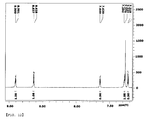
- FIG. 3 is a diagram showing an NMR spectrum of the compound obtained in Example 3.
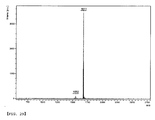
- FIG. 4 is a diagram showing an MS spectrum of the compound obtained in Example 3.
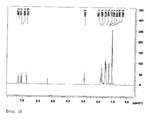
- FIG. 5 is a diagram showing an NMR spectrum of the compound obtained in Example 4.
- FIG. 6 is a diagram showing an MS spectrum of the compound obtained in Example 4.
- FIG. 7 is a diagram showing an NMR spectrum of the compound obtained in Example 5.
- FIG. 8 is a diagram showing an MS spectrum of the compound obtained in Example 5.
- FIG. 9 is a diagram showing an NMR spectrum of the compound obtained in Example 6.
- FIG. 10 is a diagram showing an NMR spectrum of 2,5-diethylhexyl-3,6-dithiophen-2-ylpyrrolo[3,4-c]pyrrole-1,4-dione obtained in Example 7.
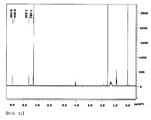
- FIG. 11 is a diagram showing an NMR spectrum of the compound prepared in Example 8.
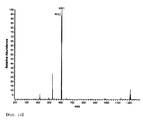
- FIG. 12 is a diagram showing an MS spectrum of the compound prepared in Example 8.
- FIG. 13 is a diagram showing an MS spectrum of the compound obtained in Example 9.
- FIG. 14 is a diagram showing an MS spectrum of the compound obtained in Example 10.
- FIG. 15 is a diagram showing an MS spectrum of the compound obtained in Example 11.
- FIG. 16 is a diagram showing an MS spectrum of the compound obtained in Example 12.
- FIG. 17 is a diagram showing an NMR spectrum of Compound E obtained in Example 13.
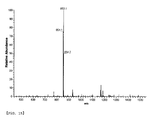
- FIG. 18 is a diagram showing an MS spectrum of Single molecule 1 prepared in Example 14.
- FIG. 24 is a diagram showing a UV-Vis absorption spectrum in a film phase in which the chlorobenzene solution of Single molecule 1 of Example 14 was heat treated.
- the film-phase UV absorption spectrum of FIG. 24 was analyzed using a UV-Vis absorption spectrometer after dissolving the compound in chlorobenzene to have a concentration of 1 wt%, dropping this solution on a glass substrate, spin coating the sample for 60 seconds at 1000 rpm, and heat treating the result at 25°C, 100°C, 150°C and 170°C.
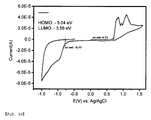
- FIG. 25 is a diagram showing an electrochemical measurement result (cyclic voltametry) of Single molecule 1 prepared in Example 14.
- the electrochemical measurement (cyclic voltametry) of FIG. 25 was analyzed using a three-electrode system in which a glassy carbon working electrode, an Ag/Agcl reference electrode, and a Pt electrode were put in an electrolyte solution dissolving Bu 4 NBF 4 in acetonitrile to have a concentration of 0.1 M.
- the compound was coated on the working electrode using a drop casting method.
- FIG. 19 is a diagram showing an MS spectrum of Single molecule 3 prepared in Example 16.
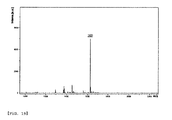
- FIG. 20 is a diagram showing an MS spectrum of Single molecule 4 prepared in Example 17.
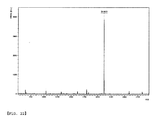
- FIG. 21 is a diagram showing an MS spectrum of Single molecule 5 prepared in Example 18.
- FIG. 22 is a diagram showing an MS spectrum of Single molecule 6 prepared in Example 19.
- FIG. 23 is a diagram showing an MS spectrum of Compound 7-1 prepared in Example 20.
- FIG. 26 is a diagram showing high performance liquid chromatography (HPLC) of Compound 7-1 prepared in Example 20.
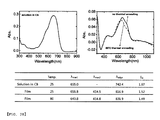
- FIG. 27 shows a UV-Vis absorption spectrum of Compound 7-1 of Example 20 in a chlorobenzene solution and in a film phase in which the chlorobenzene solution is heat treated.
- the UV absorption spectrum of FIG. 27 was was analyzed using a UV-Vis absorption spectrometer of 1) the absorption spectrum of a sample dissolving the compound in chlorobenzene to have a concentration of 1 wt%, and 2) the film-phase UV absorption spectrum after dissolving the compound in chlorobenzene to have a concentration of 1 wt%, dropping this solution on a glass substrate, spin coating the sample for 60 seconds at 1000 rpm, and heat treating the result at 80°C.
- FIG. 28 is a diagram showing an MS spectrum of Compound 7-2 obtained in Example 20.
- FIG. 29 is a diagram showing an electrochemical measurement result (cyclic voltametry) of Compound 7-2 obtained in Example 20.
- the electrochemical measurement (cyclic voltametry) of FIG. 29 was analyzed using a three-electrode system in which a glassy carbon working electrode, an Ag/Agcl reference electrode, and a Pt electrode were put in an electrolyte solution dissolving Bu 4 NBF 4 in acetonitrile to have a concentration of 0.1 M.
- the compound was coated on the working electrode using a drop casting method.
- a composite solution was prepared by dissolving Single molecule 1 prepared in Example 14 and PCBM in chlorobenzene (CB) in a ratio of 60:40 (w/w ratio).
- CB chlorobenzene
- the concentration was adjusted to 2.0 wt%
- the organic solar cell employed an ITO/PEDOT:PSS/photoactive layer/Al structure.
- the glass substrate coated with ITO was ultrasonic cleaned using distilled water, acetone and 2-propanol, and after the ITO surface was ozone treated for 10 minutes, the surface was spin-coated with PEDOT:PSS (baytrom P) to a thickness of 45 nm, and then heat treated for 10 minutes at 120°C.
- the compound-PCBM composite solution was filtered using a PP syringe filter of 0.45 ⁇ m, then spin-coated, and deposited with Al to a thickness of 200 nm using a thermal evaporator under a vacuum of 3x10 -8 torr, and as a result, the organic solar cell was fabricated
- a composite solution was prepared by dissolving single molecule 2 prepared in Example 15 and PCBM in chlorobenzene (CB) in a ratio of 60:40 (w/w ratio).
- CB chlorobenzene
- the concentration was adjusted to 3.0 wt%
- the organic solar cell employed an ITO/PEDOT:PSS/photoactive layer/Al structure.
- the glass substrate coated with ITO was ultrasonic cleaned using distilled water, acetone and 2-propanol, and after the ITO surface was ozone treated for 10 minutes, the surface was spin-coated with PEDOT:PSS (baytrom P) to a thickness of 45 nm, and then heat treated for 10 minutes at 120°C.
- the compound-PCBM composite solution was filtered using a PP syringe filter of 0.45 ⁇ m, then spin-coated, and deposited with Al to a thickness of 200 nm using a thermal evaporator under a vacuum of 3x10 -8 torr, and as a result, the organic solar cell was fabricated.
- a composite solution was prepared by dissolving Single molecule 3 prepared in Example 16 and PCBM in chlorobenzene (CB) in a ratio of 60:40 (w/w ratio).
- CB chlorobenzene
- the concentration was adjusted to 3.0 wt%
- the organic solar cell employed an ITO/PEDOT:PSS/photoactive layer/Al structure.
- the glass substrate coated with ITO was ultrasonic cleaned using distilled water, acetone and 2-propanol, and after the ITO surface was ozone treated for 10 minutes, the surface was spin-coated with PEDOT:PSS (baytrom P) to a thickness of 45 nm, and then heat treated for 10 minutes at 120°C.
- the compound-PCBM composite solution was filtered using a PP syringe filter of 0.45 ⁇ m, then spin-coated, and deposited with Al to a thickness of 200 nm using a thermal evaporator under a vacuum of 3x10 -8 torr, and as a result, the organic solar cell was fabricated.
- a composite solution was prepared by dissolving Single molecule 4 prepared in Example 17 and PCBM in chlorobenzene (CB) in a ratio of 60:40 (w/w ratio).
- CB chlorobenzene
- the concentration was adjusted to 3.0 wt%
- the organic solar cell employed an ITO/PEDOT:PSS/photoactive layer/Al structure.
- the glass substrate coated with ITO was ultrasonic cleaned using distilled water, acetone and 2-propanol, and after the ITO surface was ozone treated for 10 minutes, the surface was spin-coated with PEDOT:PSS (baytrom P) to a thickness of 45 nm, and then heat treated for 10 minutes at 120°C.
- the compound-PCBM composite solution was filtered using a PP syringe filter of 0.45 ⁇ m, then spin-coated, and deposited with Al to a thickness of 200 nm using a thermal evaporator under a vacuum of 3x10 -8 torr, and as a result, the organic solar cell was fabricated.
- a composite solution was prepared by dissolving single molecule 5 prepared in Example 18 and PCBM in chlorobenzene (CB) in a ratio of 60:40 (w/w ratio).
- CB chlorobenzene
- the concentration was adjusted to 3.0 wt%
- the organic solar cell employed an ITO/PEDOT:PSS/photoactive layer/Al structure.
- the glass substrate coated with ITO was ultrasonic cleaned using distilled water, acetone and 2-propanol, and after the ITO surface was ozone treated for 10 minutes, the surface was spin-coated with PEDOT:PSS (baytrom P) to a thickness of 45 nm, and then heat treated for 10 minutes at 120°C.
- the compound-PCBM composite solution was filtered using a PP syringe filter of 0.45 ⁇ m, then spin-coated, and deposited with Al to a thickness of 200 nm using a thermal evaporator under a vacuum of 3x10 -8 torr, and as a result, the organic solar cell was fabricated.
- a composite solution was prepared by dissolving single molecule 6 prepared in Example 19 and PCBM in chlorobenzene (CB) in a ratio of 60:40 (w/w ratio).
- CB chlorobenzene
- the concentration was adjusted to 3.0 wt%
- the organic solar cell employed an ITO/PEDOT:PSS/photoactive layer/Al structure.
- the glass substrate coated with ITO was ultrasonic cleaned using distilled water, acetone and 2-propanol, and after the ITO surface was ozone treated for 10 minutes, the surface was spin-coated with PEDOT:PSS (baytrom P) to a thickness of 45 nm, and then heat treated for 10 minutes at 120°C.
- the compound-PCBM composite solution was filtered using a PP syringe filter of 0.45 ⁇ m, then spin-coated, and deposited with Al to a thickness of 200 nm using a thermal evaporator under a vacuum of 3x10 -8 torr, and as a result, the organic solar cell was fabricated.
- a composite solution was prepared by dissolving single molecule 7 prepared in Example 20 and PCBM in chlorobenzene (CB) in a ratio of 60:40 (w/w ratio).
- CB chlorobenzene
- the concentration was adjusted to 3.0 wt%
- the organic solar cell employed an ITO/PEDOT:PSS/photoactive layer/Al structure.
- the glass substrate coated with ITO was ultrasonic cleaned using distilled water, acetone and 2-propanol, and after the ITO surface was ozone treated for 10 minutes, the surface was spin-coated with PEDOT:PSS (baytrom P) to a thickness of 45 nm, and then heat treated for 10 minutes at 120°C.
- the compound-PCBM composite solution was filtered using a PP syringe filter of 0.45 ⁇ m, then spin-coated, and deposited with Al to a thickness of 200 nm using a thermal evaporator under a vacuum of 3x10 -8 torr, and as a result, the organic solar cell was fabricated.
- a composite solution was prepared by dissolving P3HT and PC 61 BM in chlorobenzene (CB) in a ratio of 1:1 (w/w ratio).
- CB chlorobenzene
- concentration was adjusted to 3.0 wt%
- the organic solar cell employed an ITO/PEDOT:PSS/photoactive layer/Al structure.
- the glass substrate coated with ITO was ultrasonic cleaned using distilled water, acetone and 2-propanol, and after the ITO surface was ozone treated for 10 minutes, the surface was spin-coated with PEDOT:PSS (baytrom P) to a thickness of 45 nm, and then heat treated for 10 minutes at 120°C.
- the compound-PCBM composite solution was filtered using a PP syringe filter of 0.45 ⁇ m, then spin-coated, and deposited with Al to a thickness of 200 nm using a thermal evaporator under a vacuum of 3x10 -8 torr, and as a result, the organic solar cell was fabricated.
- V OC means an open voltage
- J SC means a short-circuit current
- FF means a fill factor
- PCE means energy conversion efficiency.
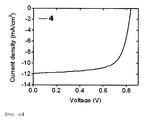
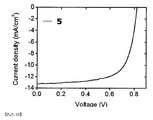
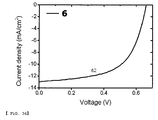
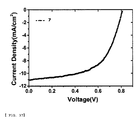
- the open voltage and the short-circuit current are each an x-axis and a y-axis intercept in the four quadrants of a voltage-current density curve, and as these two values increase, solar cell efficiency is preferably enhanced.
- the fill factor is a value dividing the rectangle area that may be drawn inside the curve by the product of the short-circuit current and the open voltage. The energy conversion efficiency may be obtained when these three values are divided by the irradiated light, and it is preferable as the value is higher.
- FIG. 30 is a diagram showing the current density by voltage of the organic solar cell including Single molecule 1 prepared in Example 14.
- FIG. 31 is a diagram showing the current density by voltage of the organic solar cell including Single molecule 2 prepared in Example 15.
- FIG. 32 is a diagram showing the current density by voltage of the organic solar cell including Single molecule 3 prepared in Example 16.
- FIG. 33 is a diagram showing the current density by voltage of the organic solar cell including Single molecule 4 prepared in Example 17.
- FIG. 34 is a diagram showing the current density by voltage of the organic solar cell including Single molecule 5 prepared in Example 18.
- FIG. 35 is a diagram showing the current density by voltage of the organic solar cell including Single molecule 6 prepared in Example 19.
- FIG. 36 is a diagram showing the current density by voltage of the organic solar cell including Single molecule 7 prepared in Example 20.
- FIG. 37 is a diagram showing the current density by voltage of the organic solar cell according to Comparative Example 1.
Landscapes
- Chemical & Material Sciences (AREA)
- Organic Chemistry (AREA)
- Materials Engineering (AREA)
- Engineering & Computer Science (AREA)
- Spectroscopy & Molecular Physics (AREA)
- Physics & Mathematics (AREA)
- Health & Medical Sciences (AREA)
- Veterinary Medicine (AREA)
- General Health & Medical Sciences (AREA)
- Public Health (AREA)
- Animal Behavior & Ethology (AREA)
- Life Sciences & Earth Sciences (AREA)
- Epidemiology (AREA)
- Pharmacology & Pharmacy (AREA)
- Medicinal Chemistry (AREA)
- Photovoltaic Devices (AREA)
- Heterocyclic Carbon Compounds Containing A Hetero Ring Having Oxygen Or Sulfur (AREA)
- Nitrogen And Oxygen Or Sulfur-Condensed Heterocyclic Ring Systems (AREA)
- Low-Molecular Organic Synthesis Reactions Using Catalysts (AREA)
- Addition Polymer Or Copolymer, Post-Treatments, Or Chemical Modifications (AREA)
Applications Claiming Priority (2)
| Application Number | Priority Date | Filing Date | Title |
|---|---|---|---|
| KR20130128237 | 2013-10-28 | ||
| PCT/KR2014/009791 WO2015064937A2 (ko) | 2013-10-28 | 2014-10-17 | 단분자 및 이를 포함하는 유기 태양 전지 |
Publications (3)
| Publication Number | Publication Date |
|---|---|
| EP3064500A2 true EP3064500A2 (de) | 2016-09-07 |
| EP3064500A4 EP3064500A4 (de) | 2017-08-02 |
| EP3064500B1 EP3064500B1 (de) | 2021-08-25 |
Family
ID=53005341
Family Applications (1)
| Application Number | Title | Priority Date | Filing Date |
|---|---|---|---|
| EP14858489.9A Active EP3064500B1 (de) | 2013-10-28 | 2014-10-17 | Einzelmolekül und organische solarzelle damit |
Country Status (7)
| Country | Link |
|---|---|
| US (1) | US20160272656A1 (de) |
| EP (1) | EP3064500B1 (de) |
| JP (1) | JP2016538272A (de) |
| KR (1) | KR101702183B1 (de) |
| CN (1) | CN105683193B (de) |
| TW (1) | TWI665204B (de) |
| WO (1) | WO2015064937A2 (de) |
Cited By (2)
| Publication number | Priority date | Publication date | Assignee | Title |
|---|---|---|---|---|
| EP3812383A1 (de) | 2019-10-24 | 2021-04-28 | Sumitomo Chemical Co., Ltd | Verbindung |
| WO2023172010A1 (ko) * | 2022-03-07 | 2023-09-14 | 한국화학연구원 | 근적외선 흡수가 가능한 n-형 유기 반도체 화합물 및 이를 포함하는 유기광검출기 |
Families Citing this family (10)
| Publication number | Priority date | Publication date | Assignee | Title |
|---|---|---|---|---|
| JP6297891B2 (ja) * | 2014-04-01 | 2018-03-20 | 株式会社リコー | 有機材料及び光電変換素子 |
| KR101732310B1 (ko) * | 2015-06-03 | 2017-05-02 | 주식회사 엘지화학 | 중합체 및 이를 포함하는 유기 전자 소자 |
| WO2017057747A1 (ja) * | 2015-09-30 | 2017-04-06 | 富士フイルム株式会社 | 有機半導体膜形成用組成物、化合物、有機半導体膜、有機半導体素子 |
| CN110300748B (zh) * | 2017-01-17 | 2022-08-12 | 香港科技大学 | 基于呋喃和噻吩的π-功能发光体 |
| US11239437B2 (en) * | 2017-05-11 | 2022-02-01 | Lg Chem, Ltd. | Photoactive layer and organic solar cell including same |
| KR102235223B1 (ko) * | 2017-11-28 | 2021-04-02 | 주식회사 엘지화학 | 광활성층 및 이를 포함하는 유기태양전지 |
| US10290432B1 (en) * | 2018-02-13 | 2019-05-14 | Nano And Advanced Materials Institute Limited | Method for forming perovskite solar cell with printable carbon electrode |
| KR102471839B1 (ko) * | 2018-03-30 | 2022-11-28 | 주식회사 엘지화학 | 헤테로환 화합물, 이를 포함하는 유기 전자 소자 및 이를 이용한 유기 전자 소자의 제조 방법 |
| CN109776576B (zh) * | 2019-03-12 | 2020-07-28 | 徐州工程学院 | 吡咯并吡咯二酮-苯并噻二唑基共轭衍生物及其制备方法和应用 |
| JP7791662B2 (ja) * | 2020-07-22 | 2025-12-24 | 住友化学株式会社 | 化合物及びこれを用いた光電変換素子 |
Family Cites Families (20)
| Publication number | Priority date | Publication date | Assignee | Title |
|---|---|---|---|---|
| US7910684B2 (en) * | 2007-09-06 | 2011-03-22 | Xerox Corporation | Diketopyrrolopyrrole-based derivatives for thin film transistors |
| CN101889016B (zh) * | 2007-10-09 | 2014-02-12 | 巴斯夫欧洲公司 | 吡咯并吡咯衍生物、其制备及用途 |
| CN101835821B (zh) * | 2007-10-25 | 2013-05-01 | 巴斯夫欧洲公司 | 作为有机半导体的酮基吡咯 |
| CN102159618B (zh) * | 2008-09-19 | 2014-11-12 | 默克专利股份有限公司 | 衍生自苯并双(噻咯并噻吩)的聚合物和它们作为有机半导体的应用 |
| EP2350160B1 (de) * | 2008-10-31 | 2018-04-11 | Basf Se | Diketopyrrolopyrrol-polymere zur verwendung in organischen feldeffekttransistoren |
| JP5655267B2 (ja) * | 2008-11-10 | 2015-01-21 | 東レ株式会社 | キノキサリン化合物、これを用いた電子供与性有機材料、光起電力素子用材料および光起電力素子 |
| US20100326525A1 (en) * | 2009-03-26 | 2010-12-30 | Thuc-Quyen Nguyen | Molecular semiconductors containing diketopyrrolopyrrole and dithioketopyrrolopyrrole chromophores for small molecule or vapor processed solar cells |
| JP2012073346A (ja) * | 2010-09-28 | 2012-04-12 | Kyocera Mita Corp | 電子写真感光体 |
| EP2621927B1 (de) * | 2010-09-29 | 2020-02-12 | Basf Se | Auf diketopyrrolopyrrolen basierende halbleiter |
| WO2012165128A1 (ja) | 2011-05-27 | 2012-12-06 | 住友化学株式会社 | 高分子化合物及び有機光電変換素子 |
| JP6165135B2 (ja) * | 2011-06-22 | 2017-07-19 | ビーエーエスエフ ソシエタス・ヨーロピアBasf Se | 有機半導体素子内で使用するためのジケトピロロピロールオリゴマー |
| CN104094435B (zh) * | 2011-09-02 | 2017-02-22 | 巴斯夫欧洲公司 | 二酮基吡咯并吡咯低聚物和包含二酮基吡咯并吡咯低聚物的组合物 |
| KR101374070B1 (ko) * | 2012-03-08 | 2014-03-14 | 한국과학기술연구원 | 트리페닐아민 유도체 및 이를 포함하는 유기 태양 전지 |
| US20130247989A1 (en) * | 2012-03-23 | 2013-09-26 | The Regents Of The University Of California | Inert solution-processable molecular chromophores for organic electronic devices |
| CN102816177B (zh) * | 2012-07-25 | 2015-07-01 | 中国科学院化学研究所 | 喹吖啶酮硼酸酯及其制备方法与应用 |
| CN103087083A (zh) * | 2013-01-17 | 2013-05-08 | 中国科学院宁波材料技术与工程研究所 | 一种吡咯并吡咯二酮衍生物及其制备方法和应用 |
| JP2014177409A (ja) * | 2013-03-13 | 2014-09-25 | Idemitsu Kosan Co Ltd | アントラジチオフェン化合物、アントラジチオフェン化合物を含む有機薄膜太陽電池材料、及び該有機薄膜太陽電池材料を用いた有機薄膜太陽電池 |
| CN103288848B (zh) * | 2013-06-28 | 2016-02-03 | 中国科学院宁波材料技术与工程研究所 | 苯并三噻吩类化合物及其制备方法和用途 |
| CN103304568B (zh) * | 2013-06-28 | 2015-11-18 | 中国科学院宁波材料技术与工程研究所 | 三聚吲哚类化合物及其制备方法和用途 |
| JP2015065266A (ja) * | 2013-09-25 | 2015-04-09 | 東洋インキScホールディングス株式会社 | 有機薄膜太陽電池素子用材料およびその用途 |
-
2014
- 2014-10-17 JP JP2016526822A patent/JP2016538272A/ja active Pending
- 2014-10-17 EP EP14858489.9A patent/EP3064500B1/de active Active
- 2014-10-17 WO PCT/KR2014/009791 patent/WO2015064937A2/ko not_active Ceased
- 2014-10-17 CN CN201480059416.9A patent/CN105683193B/zh active Active
- 2014-10-17 US US15/031,227 patent/US20160272656A1/en not_active Abandoned
- 2014-10-17 KR KR1020140140560A patent/KR101702183B1/ko active Active
- 2014-10-22 TW TW103136467A patent/TWI665204B/zh active
Cited By (5)
| Publication number | Priority date | Publication date | Assignee | Title |
|---|---|---|---|---|
| EP3812383A1 (de) | 2019-10-24 | 2021-04-28 | Sumitomo Chemical Co., Ltd | Verbindung |
| WO2021079140A1 (en) | 2019-10-24 | 2021-04-29 | Sumitomo Chemical Co., Ltd | Molecular materials based on phenoxyazine core for heterojunction organic solar cells |
| CN114585627A (zh) * | 2019-10-24 | 2022-06-03 | 住友化学株式会社 | 用于异质结有机太阳能电池的基于苯氧基吖嗪核心的分子材料 |
| US12232415B2 (en) | 2019-10-24 | 2025-02-18 | Sumitomo Chemical Co., Ltd. | Molecular materials based on phenoxyazine core for heterojunction organic solar cells |
| WO2023172010A1 (ko) * | 2022-03-07 | 2023-09-14 | 한국화학연구원 | 근적외선 흡수가 가능한 n-형 유기 반도체 화합물 및 이를 포함하는 유기광검출기 |
Also Published As
| Publication number | Publication date |
|---|---|
| WO2015064937A9 (ko) | 2018-04-12 |
| US20160272656A1 (en) | 2016-09-22 |
| CN105683193A (zh) | 2016-06-15 |
| TWI665204B (zh) | 2019-07-11 |
| CN105683193B (zh) | 2018-09-18 |
| WO2015064937A3 (ko) | 2015-06-25 |
| EP3064500B1 (de) | 2021-08-25 |
| JP2016538272A (ja) | 2016-12-08 |
| KR20150048636A (ko) | 2015-05-07 |
| WO2015064937A2 (ko) | 2015-05-07 |
| KR101702183B1 (ko) | 2017-02-06 |
| EP3064500A4 (de) | 2017-08-02 |
| TW201529586A (zh) | 2015-08-01 |
Similar Documents
| Publication | Publication Date | Title |
|---|---|---|
| EP3064500B1 (de) | Einzelmolekül und organische solarzelle damit | |
| EP3235847B1 (de) | Polymer und organische solarzelle damit | |
| EP3135678B1 (de) | Heterocyclische verbindung und organische solarzelle damit | |
| EP3473627B1 (de) | Heterocyclische verbindung und organische elektronische vorrichtung damit | |
| EP3260456B1 (de) | Thiophen abkömmling und organische solarzelle dieses enthaltend | |
| EP3121211B1 (de) | Polymer und organische solarzelle damit | |
| EP3012279A1 (de) | Copolymer und organische solarzelle damit | |
| EP3557641B1 (de) | Organische solarzelle | |
| EP3018160A1 (de) | Copolymer und organische solarzelle damit | |
| KR20170003234A (ko) | 축합고리 및 이를 포함하는 유기 태양 전지 | |
| EP3048123B1 (de) | Copolymer und organische solarzelle damit | |
| EP3290422B1 (de) | Verbindung und organische solarzelle damit | |
| EP3103801B1 (de) | Fullerenderivat, organische solarzelle damit und herstellungsverfahren dafür | |
| EP3124519B1 (de) | Copolymer und organische solarzelle damit | |
| KR20190142948A (ko) | 중합체, 이를 포함하는 조성물 및 이를 포함하는 유기 태양 전지 | |
| EP3305826B1 (de) | Polymer und organisches elektronisches element damit | |
| KR102771283B1 (ko) | 유기 태양 전지의 유기물층용 조성물, 이를 이용한 유기 태양 전지의 제조방법 및 유기 태양 전지 |
Legal Events
| Date | Code | Title | Description |
|---|---|---|---|
| PUAI | Public reference made under article 153(3) epc to a published international application that has entered the european phase |
Free format text: ORIGINAL CODE: 0009012 |
|
| 17P | Request for examination filed |
Effective date: 20160425 |
|
| AK | Designated contracting states |
Kind code of ref document: A2 Designated state(s): AL AT BE BG CH CY CZ DE DK EE ES FI FR GB GR HR HU IE IS IT LI LT LU LV MC MK MT NL NO PL PT RO RS SE SI SK SM TR |
|
| AX | Request for extension of the european patent |
Extension state: BA ME |
|
| DAX | Request for extension of the european patent (deleted) | ||
| A4 | Supplementary search report drawn up and despatched |
Effective date: 20170704 |
|
| RIC1 | Information provided on ipc code assigned before grant |
Ipc: C07D 487/04 20060101ALI20170627BHEP Ipc: C07D 495/04 20060101ALN20170627BHEP Ipc: C07D 519/00 20060101ALN20170627BHEP Ipc: H01L 51/46 20060101AFI20170627BHEP |
|
| STAA | Information on the status of an ep patent application or granted ep patent |
Free format text: STATUS: EXAMINATION IS IN PROGRESS |
|
| 17Q | First examination report despatched |
Effective date: 20200804 |
|
| RIC1 | Information provided on ipc code assigned before grant |
Ipc: C07D 519/00 20060101ALN20210204BHEP Ipc: C07D 487/04 20060101ALI20210204BHEP Ipc: H01L 51/46 20060101AFI20210204BHEP Ipc: C07D 495/04 20060101ALN20210204BHEP |
|
| REG | Reference to a national code |
Ref country code: DE Ref legal event code: R079 Ref document number: 602014079739 Country of ref document: DE Free format text: PREVIOUS MAIN CLASS: C07D0487040000 Ipc: H01L0051460000 |
|
| GRAP | Despatch of communication of intention to grant a patent |
Free format text: ORIGINAL CODE: EPIDOSNIGR1 |
|
| STAA | Information on the status of an ep patent application or granted ep patent |
Free format text: STATUS: GRANT OF PATENT IS INTENDED |
|
| RIC1 | Information provided on ipc code assigned before grant |
Ipc: C07D 495/04 20060101ALN20210428BHEP Ipc: C07D 519/00 20060101ALN20210428BHEP Ipc: C07D 487/04 20060101ALI20210428BHEP Ipc: H01L 51/46 20060101AFI20210428BHEP |
|
| INTG | Intention to grant announced |
Effective date: 20210520 |
|
| GRAS | Grant fee paid |
Free format text: ORIGINAL CODE: EPIDOSNIGR3 |
|
| GRAA | (expected) grant |
Free format text: ORIGINAL CODE: 0009210 |
|
| STAA | Information on the status of an ep patent application or granted ep patent |
Free format text: STATUS: THE PATENT HAS BEEN GRANTED |
|
| AK | Designated contracting states |
Kind code of ref document: B1 Designated state(s): AL AT BE BG CH CY CZ DE DK EE ES FI FR GB GR HR HU IE IS IT LI LT LU LV MC MK MT NL NO PL PT RO RS SE SI SK SM TR |
|
| REG | Reference to a national code |
Ref country code: CH Ref legal event code: EP |
|
| REG | Reference to a national code |
Ref country code: IE Ref legal event code: FG4D Ref country code: AT Ref legal event code: REF Ref document number: 1424705 Country of ref document: AT Kind code of ref document: T Effective date: 20210915 |
|
| REG | Reference to a national code |
Ref country code: DE Ref legal event code: R096 Ref document number: 602014079739 Country of ref document: DE |
|
| REG | Reference to a national code |
Ref country code: LT Ref legal event code: MG9D |
|
| REG | Reference to a national code |
Ref country code: NL Ref legal event code: MP Effective date: 20210825 |
|
| REG | Reference to a national code |
Ref country code: AT Ref legal event code: MK05 Ref document number: 1424705 Country of ref document: AT Kind code of ref document: T Effective date: 20210825 |
|
| PG25 | Lapsed in a contracting state [announced via postgrant information from national office to epo] |
Ref country code: HR Free format text: LAPSE BECAUSE OF FAILURE TO SUBMIT A TRANSLATION OF THE DESCRIPTION OR TO PAY THE FEE WITHIN THE PRESCRIBED TIME-LIMIT Effective date: 20210825 Ref country code: RS Free format text: LAPSE BECAUSE OF FAILURE TO SUBMIT A TRANSLATION OF THE DESCRIPTION OR TO PAY THE FEE WITHIN THE PRESCRIBED TIME-LIMIT Effective date: 20210825 Ref country code: SE Free format text: LAPSE BECAUSE OF FAILURE TO SUBMIT A TRANSLATION OF THE DESCRIPTION OR TO PAY THE FEE WITHIN THE PRESCRIBED TIME-LIMIT Effective date: 20210825 Ref country code: LT Free format text: LAPSE BECAUSE OF FAILURE TO SUBMIT A TRANSLATION OF THE DESCRIPTION OR TO PAY THE FEE WITHIN THE PRESCRIBED TIME-LIMIT Effective date: 20210825 Ref country code: AT Free format text: LAPSE BECAUSE OF FAILURE TO SUBMIT A TRANSLATION OF THE DESCRIPTION OR TO PAY THE FEE WITHIN THE PRESCRIBED TIME-LIMIT Effective date: 20210825 Ref country code: BG Free format text: LAPSE BECAUSE OF FAILURE TO SUBMIT A TRANSLATION OF THE DESCRIPTION OR TO PAY THE FEE WITHIN THE PRESCRIBED TIME-LIMIT Effective date: 20211125 Ref country code: NO Free format text: LAPSE BECAUSE OF FAILURE TO SUBMIT A TRANSLATION OF THE DESCRIPTION OR TO PAY THE FEE WITHIN THE PRESCRIBED TIME-LIMIT Effective date: 20211125 Ref country code: PT Free format text: LAPSE BECAUSE OF FAILURE TO SUBMIT A TRANSLATION OF THE DESCRIPTION OR TO PAY THE FEE WITHIN THE PRESCRIBED TIME-LIMIT Effective date: 20211227 Ref country code: FI Free format text: LAPSE BECAUSE OF FAILURE TO SUBMIT A TRANSLATION OF THE DESCRIPTION OR TO PAY THE FEE WITHIN THE PRESCRIBED TIME-LIMIT Effective date: 20210825 Ref country code: ES Free format text: LAPSE BECAUSE OF FAILURE TO SUBMIT A TRANSLATION OF THE DESCRIPTION OR TO PAY THE FEE WITHIN THE PRESCRIBED TIME-LIMIT Effective date: 20210825 |
|
| PG25 | Lapsed in a contracting state [announced via postgrant information from national office to epo] |
Ref country code: PL Free format text: LAPSE BECAUSE OF FAILURE TO SUBMIT A TRANSLATION OF THE DESCRIPTION OR TO PAY THE FEE WITHIN THE PRESCRIBED TIME-LIMIT Effective date: 20210825 Ref country code: LV Free format text: LAPSE BECAUSE OF FAILURE TO SUBMIT A TRANSLATION OF THE DESCRIPTION OR TO PAY THE FEE WITHIN THE PRESCRIBED TIME-LIMIT Effective date: 20210825 Ref country code: GR Free format text: LAPSE BECAUSE OF FAILURE TO SUBMIT A TRANSLATION OF THE DESCRIPTION OR TO PAY THE FEE WITHIN THE PRESCRIBED TIME-LIMIT Effective date: 20211126 |
|
| PG25 | Lapsed in a contracting state [announced via postgrant information from national office to epo] |
Ref country code: NL Free format text: LAPSE BECAUSE OF FAILURE TO SUBMIT A TRANSLATION OF THE DESCRIPTION OR TO PAY THE FEE WITHIN THE PRESCRIBED TIME-LIMIT Effective date: 20210825 |
|
| PG25 | Lapsed in a contracting state [announced via postgrant information from national office to epo] |
Ref country code: DK Free format text: LAPSE BECAUSE OF FAILURE TO SUBMIT A TRANSLATION OF THE DESCRIPTION OR TO PAY THE FEE WITHIN THE PRESCRIBED TIME-LIMIT Effective date: 20210825 |
|
| REG | Reference to a national code |
Ref country code: DE Ref legal event code: R097 Ref document number: 602014079739 Country of ref document: DE |
|
| REG | Reference to a national code |
Ref country code: CH Ref legal event code: PL |
|
| PG25 | Lapsed in a contracting state [announced via postgrant information from national office to epo] |
Ref country code: SM Free format text: LAPSE BECAUSE OF FAILURE TO SUBMIT A TRANSLATION OF THE DESCRIPTION OR TO PAY THE FEE WITHIN THE PRESCRIBED TIME-LIMIT Effective date: 20210825 Ref country code: SK Free format text: LAPSE BECAUSE OF FAILURE TO SUBMIT A TRANSLATION OF THE DESCRIPTION OR TO PAY THE FEE WITHIN THE PRESCRIBED TIME-LIMIT Effective date: 20210825 Ref country code: RO Free format text: LAPSE BECAUSE OF FAILURE TO SUBMIT A TRANSLATION OF THE DESCRIPTION OR TO PAY THE FEE WITHIN THE PRESCRIBED TIME-LIMIT Effective date: 20210825 Ref country code: EE Free format text: LAPSE BECAUSE OF FAILURE TO SUBMIT A TRANSLATION OF THE DESCRIPTION OR TO PAY THE FEE WITHIN THE PRESCRIBED TIME-LIMIT Effective date: 20210825 Ref country code: CZ Free format text: LAPSE BECAUSE OF FAILURE TO SUBMIT A TRANSLATION OF THE DESCRIPTION OR TO PAY THE FEE WITHIN THE PRESCRIBED TIME-LIMIT Effective date: 20210825 Ref country code: AL Free format text: LAPSE BECAUSE OF FAILURE TO SUBMIT A TRANSLATION OF THE DESCRIPTION OR TO PAY THE FEE WITHIN THE PRESCRIBED TIME-LIMIT Effective date: 20210825 |
|
| REG | Reference to a national code |
Ref country code: BE Ref legal event code: MM Effective date: 20211031 |
|
| PG25 | Lapsed in a contracting state [announced via postgrant information from national office to epo] |
Ref country code: MC Free format text: LAPSE BECAUSE OF FAILURE TO SUBMIT A TRANSLATION OF THE DESCRIPTION OR TO PAY THE FEE WITHIN THE PRESCRIBED TIME-LIMIT Effective date: 20210825 |
|
| PLBE | No opposition filed within time limit |
Free format text: ORIGINAL CODE: 0009261 |
|
| STAA | Information on the status of an ep patent application or granted ep patent |
Free format text: STATUS: NO OPPOSITION FILED WITHIN TIME LIMIT |
|
| PG25 | Lapsed in a contracting state [announced via postgrant information from national office to epo] |
Ref country code: LU Free format text: LAPSE BECAUSE OF NON-PAYMENT OF DUE FEES Effective date: 20211017 Ref country code: IT Free format text: LAPSE BECAUSE OF FAILURE TO SUBMIT A TRANSLATION OF THE DESCRIPTION OR TO PAY THE FEE WITHIN THE PRESCRIBED TIME-LIMIT Effective date: 20210825 Ref country code: BE Free format text: LAPSE BECAUSE OF NON-PAYMENT OF DUE FEES Effective date: 20211031 |
|
| 26N | No opposition filed |
Effective date: 20220527 |
|
| PG25 | Lapsed in a contracting state [announced via postgrant information from national office to epo] |
Ref country code: SI Free format text: LAPSE BECAUSE OF FAILURE TO SUBMIT A TRANSLATION OF THE DESCRIPTION OR TO PAY THE FEE WITHIN THE PRESCRIBED TIME-LIMIT Effective date: 20210825 Ref country code: LI Free format text: LAPSE BECAUSE OF NON-PAYMENT OF DUE FEES Effective date: 20211031 Ref country code: CH Free format text: LAPSE BECAUSE OF NON-PAYMENT OF DUE FEES Effective date: 20211031 |
|
| PG25 | Lapsed in a contracting state [announced via postgrant information from national office to epo] |
Ref country code: FR Free format text: LAPSE BECAUSE OF NON-PAYMENT OF DUE FEES Effective date: 20211025 |
|
| PG25 | Lapsed in a contracting state [announced via postgrant information from national office to epo] |
Ref country code: IE Free format text: LAPSE BECAUSE OF NON-PAYMENT OF DUE FEES Effective date: 20211017 |
|
| REG | Reference to a national code |
Ref country code: DE Ref legal event code: R079 Ref document number: 602014079739 Country of ref document: DE Free format text: PREVIOUS MAIN CLASS: H01L0051460000 Ipc: H10K0085000000 |
|
| PG25 | Lapsed in a contracting state [announced via postgrant information from national office to epo] |
Ref country code: HU Free format text: LAPSE BECAUSE OF FAILURE TO SUBMIT A TRANSLATION OF THE DESCRIPTION OR TO PAY THE FEE WITHIN THE PRESCRIBED TIME-LIMIT; INVALID AB INITIO Effective date: 20141017 |
|
| PG25 | Lapsed in a contracting state [announced via postgrant information from national office to epo] |
Ref country code: CY Free format text: LAPSE BECAUSE OF FAILURE TO SUBMIT A TRANSLATION OF THE DESCRIPTION OR TO PAY THE FEE WITHIN THE PRESCRIBED TIME-LIMIT Effective date: 20210825 |
|
| PG25 | Lapsed in a contracting state [announced via postgrant information from national office to epo] |
Ref country code: MK Free format text: LAPSE BECAUSE OF FAILURE TO SUBMIT A TRANSLATION OF THE DESCRIPTION OR TO PAY THE FEE WITHIN THE PRESCRIBED TIME-LIMIT Effective date: 20210825 |
|
| PG25 | Lapsed in a contracting state [announced via postgrant information from national office to epo] |
Ref country code: MT Free format text: LAPSE BECAUSE OF FAILURE TO SUBMIT A TRANSLATION OF THE DESCRIPTION OR TO PAY THE FEE WITHIN THE PRESCRIBED TIME-LIMIT Effective date: 20210825 |
|
| PGFP | Annual fee paid to national office [announced via postgrant information from national office to epo] |
Ref country code: GB Payment date: 20250922 Year of fee payment: 12 |
|
| PG25 | Lapsed in a contracting state [announced via postgrant information from national office to epo] |
Ref country code: TR Free format text: LAPSE BECAUSE OF FAILURE TO SUBMIT A TRANSLATION OF THE DESCRIPTION OR TO PAY THE FEE WITHIN THE PRESCRIBED TIME-LIMIT Effective date: 20210825 |
|
| PGFP | Annual fee paid to national office [announced via postgrant information from national office to epo] |
Ref country code: DE Payment date: 20250922 Year of fee payment: 12 |