EP3065090A2 - Procédé d'apprentissage et support d'enregistrement d'arrière-plan - Google Patents
Procédé d'apprentissage et support d'enregistrement d'arrière-plan Download PDFInfo
- Publication number
- EP3065090A2 EP3065090A2 EP16157040.3A EP16157040A EP3065090A2 EP 3065090 A2 EP3065090 A2 EP 3065090A2 EP 16157040 A EP16157040 A EP 16157040A EP 3065090 A2 EP3065090 A2 EP 3065090A2
- Authority
- EP
- European Patent Office
- Prior art keywords
- neural network
- classes
- coarse
- detailed
- learning
- Prior art date
- Legal status (The legal status is an assumption and is not a legal conclusion. Google has not performed a legal analysis and makes no representation as to the accuracy of the status listed.)
- Granted
Links
Images






Classifications
-
- G—PHYSICS
- G06—COMPUTING OR CALCULATING; COUNTING
- G06F—ELECTRIC DIGITAL DATA PROCESSING
- G06F18/00—Pattern recognition
- G06F18/20—Analysing
- G06F18/21—Design or setup of recognition systems or techniques; Extraction of features in feature space; Blind source separation
- G06F18/214—Generating training patterns; Bootstrap methods, e.g. bagging or boosting
-
- G—PHYSICS
- G06—COMPUTING OR CALCULATING; COUNTING
- G06V—IMAGE OR VIDEO RECOGNITION OR UNDERSTANDING
- G06V10/00—Arrangements for image or video recognition or understanding
- G06V10/70—Arrangements for image or video recognition or understanding using pattern recognition or machine learning
- G06V10/82—Arrangements for image or video recognition or understanding using pattern recognition or machine learning using neural networks
-
- G—PHYSICS
- G06—COMPUTING OR CALCULATING; COUNTING
- G06F—ELECTRIC DIGITAL DATA PROCESSING
- G06F18/00—Pattern recognition
- G06F18/20—Analysing
- G06F18/24—Classification techniques
-
- G—PHYSICS
- G06—COMPUTING OR CALCULATING; COUNTING
- G06F—ELECTRIC DIGITAL DATA PROCESSING
- G06F18/00—Pattern recognition
- G06F18/20—Analysing
- G06F18/24—Classification techniques
- G06F18/243—Classification techniques relating to the number of classes
- G06F18/24317—Piecewise classification, i.e. whereby each classification requires several discriminant rules
-
- G—PHYSICS
- G06—COMPUTING OR CALCULATING; COUNTING
- G06F—ELECTRIC DIGITAL DATA PROCESSING
- G06F18/00—Pattern recognition
- G06F18/20—Analysing
- G06F18/24—Classification techniques
- G06F18/243—Classification techniques relating to the number of classes
- G06F18/24323—Tree-organised classifiers
-
- G—PHYSICS
- G06—COMPUTING OR CALCULATING; COUNTING
- G06K—GRAPHICAL DATA READING; PRESENTATION OF DATA; RECORD CARRIERS; HANDLING RECORD CARRIERS
- G06K7/00—Methods or arrangements for sensing record carriers, e.g. for reading patterns
- G06K7/10—Methods or arrangements for sensing record carriers, e.g. for reading patterns by electromagnetic radiation, e.g. optical sensing; by corpuscular radiation
- G06K7/14—Methods or arrangements for sensing record carriers, e.g. for reading patterns by electromagnetic radiation, e.g. optical sensing; by corpuscular radiation using light without selection of wavelength, e.g. sensing reflected white light
- G06K7/1404—Methods for optical code recognition
- G06K7/146—Methods for optical code recognition the method including quality enhancement steps
- G06K7/1482—Methods for optical code recognition the method including quality enhancement steps using fuzzy logic or natural solvers, such as neural networks, genetic algorithms and simulated annealing
-
- G—PHYSICS
- G06—COMPUTING OR CALCULATING; COUNTING
- G06N—COMPUTING ARRANGEMENTS BASED ON SPECIFIC COMPUTATIONAL MODELS
- G06N3/00—Computing arrangements based on biological models
- G06N3/02—Neural networks
- G06N3/04—Architecture, e.g. interconnection topology
- G06N3/045—Combinations of networks
-
- G—PHYSICS
- G06—COMPUTING OR CALCULATING; COUNTING
- G06N—COMPUTING ARRANGEMENTS BASED ON SPECIFIC COMPUTATIONAL MODELS
- G06N3/00—Computing arrangements based on biological models
- G06N3/02—Neural networks
- G06N3/04—Architecture, e.g. interconnection topology
- G06N3/0464—Convolutional networks [CNN, ConvNet]
-
- G—PHYSICS
- G06—COMPUTING OR CALCULATING; COUNTING
- G06N—COMPUTING ARRANGEMENTS BASED ON SPECIFIC COMPUTATIONAL MODELS
- G06N3/00—Computing arrangements based on biological models
- G06N3/02—Neural networks
- G06N3/08—Learning methods
- G06N3/088—Non-supervised learning, e.g. competitive learning
-
- G—PHYSICS
- G06—COMPUTING OR CALCULATING; COUNTING
- G06N—COMPUTING ARRANGEMENTS BASED ON SPECIFIC COMPUTATIONAL MODELS
- G06N3/00—Computing arrangements based on biological models
- G06N3/02—Neural networks
- G06N3/08—Learning methods
- G06N3/09—Supervised learning
-
- G—PHYSICS
- G06—COMPUTING OR CALCULATING; COUNTING
- G06V—IMAGE OR VIDEO RECOGNITION OR UNDERSTANDING
- G06V10/00—Arrangements for image or video recognition or understanding
- G06V10/40—Extraction of image or video features
- G06V10/44—Local feature extraction by analysis of parts of the pattern, e.g. by detecting edges, contours, loops, corners, strokes or intersections; Connectivity analysis, e.g. of connected components
- G06V10/443—Local feature extraction by analysis of parts of the pattern, e.g. by detecting edges, contours, loops, corners, strokes or intersections; Connectivity analysis, e.g. of connected components by matching or filtering
- G06V10/449—Biologically inspired filters, e.g. difference of Gaussians [DoG] or Gabor filters
- G06V10/451—Biologically inspired filters, e.g. difference of Gaussians [DoG] or Gabor filters with interaction between the filter responses, e.g. cortical complex cells
- G06V10/454—Integrating the filters into a hierarchical structure, e.g. convolutional neural networks [CNN]
-
- G—PHYSICS
- G06—COMPUTING OR CALCULATING; COUNTING
- G06V—IMAGE OR VIDEO RECOGNITION OR UNDERSTANDING
- G06V10/00—Arrangements for image or video recognition or understanding
- G06V10/70—Arrangements for image or video recognition or understanding using pattern recognition or machine learning
- G06V10/764—Arrangements for image or video recognition or understanding using pattern recognition or machine learning using classification, e.g. of video objects
-
- G—PHYSICS
- G06—COMPUTING OR CALCULATING; COUNTING
- G06N—COMPUTING ARRANGEMENTS BASED ON SPECIFIC COMPUTATIONAL MODELS
- G06N3/00—Computing arrangements based on biological models
- G06N3/02—Neural networks
-
- G—PHYSICS
- G06—COMPUTING OR CALCULATING; COUNTING
- G06T—IMAGE DATA PROCESSING OR GENERATION, IN GENERAL
- G06T2207/00—Indexing scheme for image analysis or image enhancement
- G06T2207/20—Special algorithmic details
- G06T2207/20081—Training; Learning
Definitions
- the present disclosure relates to a learning method and a recording medium, and more particularly, to a method of learning a classifier including a neural network and configured to classify images and a recording medium therefor.
- NPL 1 discloses an image recognition technique capable of performing a high-accuracy image recognition using a plurality of convolutional neural network classifiers.
- a method of learning a classifier for classifying an image includes performing a first process in which a coarse class classifier configured with a first neural network is made to classify a plurality of images given as a set of images each attached with a label indicating a detailed class into a plurality of coarse classes including a plurality of detailed classes and is then made to learn a first feature that is a feature common in each of the coarse classes, and performing a second process in which a detailed class classifier is made to classify the set of images into a plurality of detailed classes and is then made to learn a second feature that is a feature common in each of the detailed classes, the detailed class classifier configured with a second neural network that is the same in terms of layers other than a final layer as, but different in terms of the final layer from, the first neural network made to perform the learning in the first process.
- the present disclosure makes it possible to realize a method of learning a classifier capable of accurately recognizing an image with an improved image recognition processing speed, a recording medium therefor, and the like.
- the image recognition technique generally includes following two steps:
- a feature value extraction filter used in the extraction process is designed manually.
- image capturing environments have been established, and it has become possible to practically collect a large amount of learning data via the Internet.
- infrastructure has been established in terms of large-scale computer environments such as GPU or the like.
- investigation has been performed on methods of automatically designing a feature value extraction filter.
- One of such methods is called deep learning.
- investigation has been performed on a convolutional neural network in which a feature value extraction filter is used in a convolutional filtering process on a two-dimensional image.
- the convolutional neural network is suitable for image recognition.
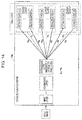
- NPL 1 discloses techniques associated with a configuration of a classifier and a learning method using deep learning. Referring to Fig. 16 , the classifier disclosed in NPL 1 is described below. Fig. 16 is a diagram illustrating a configuration of a conventional classifier and a conventional learning method.
- the classifer shown in Fig. 16 includes a coarse class classifier 900 and detailed class classifiers 901, 902, and 903. Note that the detailed class classifier is also called a fine class classifier.
- the coarse class classifier 900 is a classifier that coarsely classifies objects into coarse classes, for example, a dog, a cat, and the like.
- the detailed class classifiers 901, 902, and 903 are classifiers that classify objects into detailed classes, for example, Shiba dog, corgi dog, tortoiseshell cat, and the like. By making the detailed class classifiers 901, 902, and 903 perform learning particular classes, it is possible to obtain capabilities of such detailed class classification.
- the detailed class classifiers 901, 902, and 903 that perform the detailed class classification in terms of, for example, Shiba dog, corgi dog, tortoiseshell cat, and the like are connected to an output of the coarse class classifier 900 that performs the coarse class classification in terms of, for example, dog, cat, and the like.
- the coarse class classifier 900 recognizes that the image is of a dog.
- a detailed class classifier having high ability in terms of classification of a dog class is selected. More specifically, for example, the detailed class classifier 901 is selected, and the detailed class classifier 901 determines that the image is of a corgi dog.
- the classifier disclosed in the NPL 1 a plurality of detailed class classifiers are connected to an output of a coarse class classifier, which results in an increase in a size of a neural network (that is, an increase in the number of neurons and the number of couplings).
- a greater amount of calculation is needed, which results in a reduction in the processing speed of the image recognition.
- the classifier disclosed in NPL 1 when an error occurs in the classification by the coarse class classifier, the following detailed classification process is performed by a detailed class classifier optimized for a wrong coarse class, which results in a reduction in correct answer rate in terms of the classification.
- a method of learning a classifier for classifying an image includes performing a first process in which a coarse class classifier configured with a first neural network is made to classify a plurality of images given as a set of images each attached with a label indicating a detailed class into a plurality of coarse classes including a plurality of detailed classes and is then made to learn a first feature that is a feature common in each of the coarse classes, and performing a second process in which a detailed class classifer is made to classify the set of images into a plurality of detailed classes and is then made to learn a second feature that is a feature common in each of the detailed classes, the detailed class classifier configured with a second neural network that is the same in terms of layers other than a final layer as, but different in terms of the final layer from, the first neural network made to perform the learning in the first process.
- the present disclosure makes it possible to maintain the size of the neural network structure. Therefore, the present disclosure makes it possible to perform a high-accuracy image recognition without reducing a processing speed of the image recognition (classification) process compared with a processing speed of the conventional technique.
- the first process may include a first design process and a first learning process, the first design process including designing the first neural network so as to include as many neurons in the final layer as there are coarse classes generated based on contents of labels indicating the respective detailed classes, the first learning process including making the coarse class classifier configured with the designed first neural network acquire the set of images and learn the first feature
- the second process may include a second design process and a second learning process, the second design process including designing the second neural network such that the neurons in the final layer of the first neural network made to perform the learning in the first process are changed by neurons whose number is the same as the number of detailed classes and the resultant neural network is employed as the second neural network, the second learning process including making the detailed class classifier configured with the designed second neural network acquire the set of images and learn the second feature thereby learning the classifier.
- the second neural network may be designed such that the neurons in the final layer of the first neural network made to perform the learning in the first learning process are replaced with neurons whose number is the same as the number of detailed classes and the resultant neural network is employed as the second neural network.
- the detailed class classifier and the coarse class classifier each may be configured using a third neural network
- the method may further include a third design process before the first process, the third design process including designing the third neural network such that a final layer of the third neural network includes neurons whose number is equal to or greater than the sum of the number of coarse classes and the number of detailed classes, wherein in the first design process, the first neural network may be given by the third neural network but in the final layer of the third neural network, particular neurons whose number is equal to the number of coarse classes are selected and only the selected neurons are used thereby designing the first neural network so as to include as many neurons in the final layer as there are coarse classes generated based on contents of labels indicating the respective detailed classes, and in the second design process, the second neural network may be given by the third neural network but in the final layer of the third neural network, particular neurons which are different from the neurons employed as the neurons in the final layer of the first neural network and whose number is equal to the number of detailed classes are used thereby designing the second neural network obtained by changing the neurons
- the second design process may further include setting a weight of the final layer of the second neural network to a random number, the weight indicating a coupling efficiency between the final layer of the second neural network and a layer immediately in front of the final layer.
- the second design process may further include setting a second weight of the final layer of the second neural network based on a first weight of the final layer of the first neural network, the first weight indicating a coupling efficiency, obtained via the learning in the first learning process, between the final layer of the first neural network and the layer immediately in front of the final layer, the second weight indicating a coupling efficiency between the final layer of the second neural network and the layer immediately in front of the final layer, the second weight determined by proportionally dividing the first weight according to a relationship between the plurality of coarse classes and the plurality of detailed classes included in the plurality of coarse classes.
- the method may further include storing, as the classifier, the detailed class classifier made to learn the second feature in the second process.
- the first process may further include generating the plurality of coarse classes based on contents of labels attached to respective images in the plurality of images.
- the first process may further include generating the plurality of coarse classes based on similarity of each image in the plurality of images.
- the method may further include performing a third process in which a third coarse class classifier configured with a third neural network is made to classify the set of images into a plurality of third coarse classes including a plurality of detailed classes and is then made to learn a third feature that is a feature common in each third coarse class in the plurality of third coarse class, wherein the first process includes a first learning process in which the detailed class classifier, configured with the first neural network that is the same in terms of layers other than the final layer as but different in terms of the final layer from the third neural network made to perform the learning in the third process, is made to classify the set of images into the plurality of coarse classes and learn the first feature of each detailed class, and wherein each coarse class in the plurality of coarse classes includes a plurality of third coarse classes and thus includes a plurality of detailed classes included in the plurality of third coarse classes.
- a third coarse class classifier configured with a third neural network is made to classify the set of images into a plurality of third coarse classes including a plurality of detailed classes
- At least one of the first process and the second process may be performed by a processor.
- a classifier 10 according to a first embodiment is described below as to a learning method and the like with reference to drawings.
- Fig. 1 is a block diagram illustrating an example of a configuration of a learning system 1 according to a first embodiment.
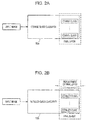
- Fig. 2A is a diagram illustrating a configuration of a coarse class classifier 10a used in a learning process performed by the learning system 1 according to the first embodiment.
- Fig. 2B is a diagram illustrating a configuration of a detailed class classifier 10b used in a learning process performed by the learning system 1 according to the first embodiment.
- the detailed class classifier is also called a fine class classifier.
- Fig. 3A is a diagram illustrating an example of a first neural network used as a coarse class classifier 10a shown in Fig. 2A .
- Fig. 3B is a diagram illustrating an example of a second neural network used as a detailed class classifier 10b shown in Fig. 2B .
- a learning system 1 shown in Fig. 1 includes an information acquisition unit 2, a classifier design unit 3, a classifier learning unit 4, and a storage unit 5, and is configured to learn the classifier 10 that classifies images.
- the information acquisition unit 2 acquires a data set of a plurality of images (a set of images) prepared in advance, that is, a set of images each attached with a label indicating a detailed class. Furthermore, the information acquisition unit 2 acquires a coarse class classifier 10a stored in the storage unit 5, that is, a first neural network (parameters indicating a structure, a threshold value, a weight, a coupling state, and the like) used to realize the coarse class classifier 10a stored in the storage unit 5.
- a first neural network parameters indicating a structure, a threshold value, a weight, a coupling state, and the like
- the classifier learning unit 4 learns the classifier 10 by performing a learning process (coarse class learning) on the coarse class classifier 10a shown in Fig. 2A and a learning process (detailed class learning) on the detailed class classifier 10b shown in Fig. 2B using a coarse-to-fine approach in the image recognition technique.
- the classifier learning unit 4 controls the coarse class classifier 10a including a first neural network designed by the classifier design unit 3 to acquire a set of images respective attached with detailed classes.
- the classifier learning unit 4 then controls the coarse class classifier 10a to perform coarse class learning so as to classify the set of images into a plurality of coarse classes including a plurality of detailed classes and learn a first feature that is a feature common in each of the coarse classes.
- the classifier learning unit 4 may store, in the storage unit 5, the coarse class classifier 10a made to perform the coarse class learning, that is, the first neural network (parameters indicating the structure, the threshold value, the weight, the coupling state, and the like) used to realize the coarse class classifier 10a.
- the classifier learning unit 4 also controls the detailed class classifier 10b to acquire the set of images described above, wherein the detailed class classifier 10b is configured with a second neural network designed by the classifier design unit 3 so as to be the same in terms of layer other than the final layer as but different in terms of the final layer from the first neural network made to perform the coarse class learning.
- the classifier learning unit 4 then controls the detailed class classifier 10b to perform detailed class learning so as to classify the set of images into detailed classes and learn a second feature that is a feature common in each detailed class.
- the classifier learning unit 4 stores the detailed class classifier 10b made to perform the detailed class learning as the classifier 10 in the storage unit 5, that is, the classifier learning unit 4 stores the second neural network (parameters indicating the structure, the threshold value, the weight, the coupling state, and the like) used to realize the detailed class classifier 10b as the classifier 10 in the storage unit 5.
- the classifier learning unit 4 employs a multi-stage (two stage, in the present example) approach in learning the classifier 10.
- the classifier design unit 3 determines the number of outputs (the number of neurons) such that the number of outputs is equal to the number of detailed classes or the number of generated coarse classes, and designs the configuration and the parameters for the coarse class classifier 10a or the detailed class classifier 10b.
- the classifier design unit 3 designs the coarse class classifier 10a such that the final layer of the first neural network of the coarse class classifier 10a has as many neurons as there are coarse classes generated based on contents of labels indicating the detailed classes.
- the classifier design unit 3 designs the first neural network including an input layer, an intermediate layer, and a final layer, for example, as illustrated in Fig. 3A , and employs the resultant first neural network as the coarse class classifier 10a shown in Fig. 2A .
- the number of neurons of the final layer of the first neural network is set to be equal to the number of coarse classes.
- the classifier design unit 3 designs the second neural network such that the neurons of the final layer of the first neural network of the coarse class classifier 10a made to perform the coarse class learning are replaced by neurons whose number is equal to the number of detailed classes, and the resultant neural network is employed as the second neural network.
- the classifier design unit 3 designs the second neural network such that the neurons of the final layer of the first neural network made to perform the coarse class learning are replaced by neurons whose number is equal to the number of detailed classes, and the resultant neural network is employed as the second neural network.
- the classifier design unit 3 may employ a random value as a weight indicating a coupling efficiency between the final layer of the second neural network and a layer immediately before the final layer.
- the classifier design unit 3 designs the second neural network so as to include an input layer, an intermediate layer, and a final layer, for example, as illustrated in Fig. 3B , and employs the resultant second neural network as the detailed class classifier 10b shown in Fig. 2B .
- the second neural network is designed by replacing the final layer thereof such that the second neural network and the first neural network are the same in terms of layers other than their final layers but different only in terms of their final layers and such that the final layer of the second neural network has as many neurons as there are detailed classes.
- the weight indicating the coupling efficiency between the final layer of the second neural network and the layer immediately before the final layer is learned (additionally learned) when the detailed class learning is performed, and thus the weight may be set to an arbitrary value, for example, a random number.
- the storage unit 5 stores the classifier 10 (the coarse class classifier 10a) made to perform the coarse class learning. That is, the storage unit 5 stores the first neural network (the parameters indicating the structure, the threshold value, the weight, the coupling state, and the like) of the coarse class classifier 10a. Furthermore, the storage unit 5 stores the classifier 10 (the detailed class classifier 10b) made to perform the detailed class learning. That is, the storage unit 5 stores the second neural network (the parameters indicating the structure, the threshold value, the weight, the coupling state, and the like) of the detailed class classifier 10b.
- Fig. 4 is a diagram illustrating a configuration in performing a recognition process by the classifier 10 according to the first embodiment.
- the classifier 10 is a classifier for classifying images, and more particularly, when an object to be classified (an input image) is input, the classifier 10 performs a recognition process and a classification process, and outputs a result thereof (a classification result).
- the classifier 10 is configured as illustrated in Fig. 4 , that is, the classifier 10 is the same in configuration as the detailed class classifier 10b made to perform the detailed class learning.
- the classifier 10 is configured using a neural network with a small size (in terms of the number of neurons and the number of couplings), and the learning system 1 performs multi-stage learning based on a coarse-to-fine approach in the image recognition, and thus it is possible to achieve high accuracy and high speed in the image recognition (classification).
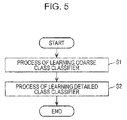
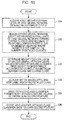
- Fig. 5 is a flow chart illustrating a learning process according to the first embodiment.
- a 2-stage learning process is performed as the multi-stage learning process.
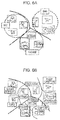
- Fig. 6A illustrates an example of a result of a coarse class learning according to the first embodiment.
- Fig. 6B illustrates an example of a result of a detailed class learning according to the first embodiment.
- step S1 the learning system 1 performs a learning process (coarse class learning) in terms of the coarse class classifier 10a.
- the learning system 1 controls the coarse class classifier 10a configured with the first neural network to classify a set of images attached with labels respectively indicating detailed classes into a plurality of coarse classes including a plurality of detailed classes, and learn a first feature that is a feature common in each of the coarse classes. More specifically, for example, as illustrated in Fig. 6A , the learning system 1 controls the coarse class classifier 10a to classify a set of images given as an image data set into coarse classes such as dog, bird, machine, etc., (that is, to determine boundaries between them), and further extract a feature (a first feature) common among images attached with labels indicating detailed classes belonging to the same coarse class. The learning system 1 then controls the coarse class classifier 10a to perform learning (coarse class learning) so as to recognize the extracted first feature.
- coarse classifier 10a configured with the first neural network to classify a set of images attached with labels respectively indicating detailed classes into a plurality of coarse classes including a plurality of detailed classes, and learn a first feature that is a feature
- step S2 the learning system 1 performs a learning process (a detailed class learning process) in terms of the detailed class classifier 10b.
- learning of the classifier 10 is performed by controlling the detailed class classifier 10b configured with the second neural network that is the same in terms of layers other than the final layer but different in terms of the final layer from the first neural network made to perform the learning in step S1 such that the detailed class classifier 10b classifies the set of images into detailed classes and learn a second feature that is a feature common in each of the detailed classes.
- the learning system 1 controls the detailed class classifier 10b to set initial values to the set of images given as the image data set in terms of coarse classes such as dog, bird, machine and the like classified in step S1 (among which borderlines were drawn).
- the learning system 1 further controls the detailed class classifier 10b to divide the coarse classes into detailed classes (among which borderlines are drawn) such as corgi, Rottweiler, golden retriever, radio, printer, computer, white stork, albatross, ruddy turnstone, and the like and extract a feature (a second feature) common in each of the resultant detailed classes.
- the learning system 1 then controls the detailed class classifier 10b to perform learning (detailed class learning) so as to recognize the extracted second feature.
- step S1 coarse class learning
- step S2 detailed class learning
- Fig. 7 is a flow chart illustrating an example of the detailed process in step S1 in Fig. 5 .
- step S1 first, the learning system 1 designs the first neural network in the coarse class classifier 10a such that the final layer thereof includes as many neurons as there are coarse classes generated based on contents of labels indicating the detailed classes (S11). That is, the learning system 1 designs the first neural network of the coarse class classifier 10a.
- the learning system 1 then acquires a set of images each attached with a label indicating a detailed class (S12).
- the learning system 1 controls the coarse class classifier 10a configured with the designed first neural network to acquire the set of images and learn the first feature (S13). More specifically, the coarse class classifier 10a performs learning (coarse class learning) so as to recognize the first feature thereby learning parameters indicating a threshold value, a weight, a coupling state, and the like for the first neural network to recognize the first feature.
- learning coarse class learning
- the learning system 1 stores, in the storage unit 5, the coarse class classifier 10a made to learn the first feature in step S13, that is, the learning system 1 stores the first neural network used to realize the coarse class classifier 10a (S14).
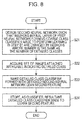
- Fig. 8 is a flow chart illustrating an example of the detailed process in step S2 in Fig. 5 .
- step S2 the learning system 1 designs the second neural network used to realize the detailed class classifier 10b such that the neurons of the final layer of the first neural network of the coarse class classifier 10a used to realize the coarse class classifier 10a made to perform the learning in step S1 are replaced by neurons whose number is equal to the number of detailed classes and the resultant neural network is employed as the second neural network (S21).
- the learning system 1 designs the second neural network by directly employing the first neural network (the parameters indicating the structure, the threshold value, the weight, the coupling state, and the like) of the coarse class classifier 10a made to perform the learning in step S1 except for the final layer, and employing the resultant second neural network as the detailed class classifier 10b.
- the learning system 1 then changes the neurons in the final layer of the second neural network such that there are as many neurons as there are detailed classes.
- the learning system 1 designs the second neural network such that the neurons of the final layer of the first neural network are replaced by neurons whose number is equal to the number of detailed classes and the resultant neural network is employed as the second neural network.
- the learning system 1 acquires, from the outside, a set of images each attached with a label indicating a detailed class (S22). More specifically, the learning system 1 acquires the same set of images as the set of images acquired in step S12.
- the learning system 1 controls the detailed class classifier 10b configured with the designed second neural network to acquire the above-described set of images and learn the second feature (S23). More specifically, the detailed class classifier 10b performs learning (detailed class learning) so as to recognize the second feature thereby learning parameters indicating a threshold value, a weight, a coupling state, and the like for second neural network to recognize the second feature.
- learning failed class learning
- the learning system 1 stores the detailed class classifier 10b made to learn the second feature in step S23 as the classifier 10 in the storage unit 5. That is, the learning system 1 stores the second neural network (the parameters indicating the structure, the threshold value, the weight, the coupling state, and the like) used to realize the detailed class classifier 10b as the classifier 10 in the storage unit 5 (S14).
- the second neural network the parameters indicating the structure, the threshold value, the weight, the coupling state, and the like
- the first embodiment makes it possible to realize the method of learning the classifier capable of performing high-accuracy image recognition without reducing a processing speed in the image recognition compared with a processing speed of the conventional technique.
- the detailed class classifier 10b is made to learn detailed classes such that an initial value of the learning is given by a result of the coarse class learning performed by the coarse class classifier 10a configured with the neural network that is the same as the detailed class classifier 10b except for the final layer (that is, the multi-stage learning is performed).
- the same neural network is used in both the coarse class learning and the detailed class learning while only changing the number of outputs (the number of neurons in the final layer) between the coarse class learning and the detailed class learning.
- the detailed class learning is performed using the detailed class classifier 10b configured with the neural network for which the same parameters as those obtained in the coarse class learning are set to layers other than the final layer.
- the multi-stage learning is performed without changing the structure of the layers, other than the final layer, of the neural network of the classifier 10 (that is, while maintaining the size of the layers other than the final layer).
- the classifier 10 is configured to perform the 2-stage learning.
- the number of states in the multi-stage learning may be three or greater.
- the learning system 1 controls a third coarse class classifier configured with a third neural network to classify the set of images into a plurality of third coarse classes including a plurality of detailed classes and learn a third feature that is a feature common in each of the third coarse classes. Furthermore, the learning system 1 controls the detailed class classifier 10b configured with the first neural network which is the same in terms of layers other than the final layer as but different in terms of the final layer from the third neural network made to learn the third feature such that the set of images are classified into the coarse classes and a first feature of each detailed class is learned. Note that when each coarse class in the plurality of coarse classes includes a plurality of third coarse classes and thus includes a plurality of detailed classes included in the plurality of third coarse classes.
- the classifier 10 is allowed to perform multi-stage learning via three or more stages. This method is useful in particular when the image set includes so many images attached with labels indicating detailed classes that use of one-stage coarse class classification would results in many outputs (neurons in the final layer).
- the learning system 1 designs the coarse class classifier 10a using coarse classes generated based on contents of labels indicating detailed classes.
- the learning system 1 may generate coarse classes based on contents of labels indicating detailed classes.
- the learning system 1 may perform a learning process according to a first modification as described below.
- Fig. 9A is a block diagram illustrating an example of a configuration of a learning system 1A according to the first modification.
- Fig. 9B is a block diagram illustrating an example of a detailed configuration of a coarse class generation unit 6 shown in Fig. 9A . Elements similar to those in Fig. 1 are denoted by similar reference numerals, and a further description thereof is omitted.
- the learning system 1A shown in Fig. 9A is different in configuration from the learning system 1 shown in Fig. 1 in that the learning system 1A additionally includes a coarse class generation unit 6.
- the coarse class generation unit 6 generates a plurality of coarse classes based on contents of labels indicating detailed classes assigned to respective images in the image set described above. Alternatively, the coarse class generation unit 6 may generate a plurality of coarse classes based on similarity of each image in the image set described above. Configuration of Coarse Class Generation Unit 6
- the coarse class generation unit 6 includes, for example, a coarse class generation processing unit 61 and a coarse class label application unit 62, as shown in Fig. 9B .
- the coarse class generation processing unit 61 may perform, for example, unsupervised clustering to classify a plurality of images given as the set of images into a plurality of coarse classes thereby generating the plurality of the coarse classes.
- the coarse class generation processing unit 61 classifies a plurality of images given as the image set into a plurality of coarse classes based on contents of labels indicating detailed classes attached to the respective images in the set images or based on similarity of each image in the plurality of images given as the set of images.
- the coarse class generation processing unit 61 generates names or the like uniquely identifying the respective obtained coarse classes. That is, the coarse class generation processing unit 61 is capable of generating the plurality of coarse classes in the above-described manner.
- the coarse class label application unit 62 attaches labels indicating coarse classes classified by the coarse class generation processing unit 61 to the respective images given as the set of images attached with labels indicating detailed classes.
- step S2 The two-stage learning process performed by the learning system 1A is similar to that described above with reference to Fig. 5 , and the detailed process of the detailed class learning (step S2) is similar to that described above with reference to Fig. 8 , and thus further descriptions thereof are omitted. Thus the following description is focused on differences from the first embodiment.
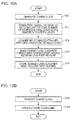
- Fig. 10A is a flow chart illustrating an example of a detailed process of coarse class learning (step S1) according to the first modification.
- Fig. 10B is a flow chart illustrating an example of a detailed process of step S10 in Fig. 10A . Elements similar to those shown in Fig. 7 are denoted by similar symbols, and a further description thereof is omitted.
- step S10 the learning system 1A makes the coarse class generation unit 6 generate a plurality of coarse classes based on contents of labels indicating detailed classes attached to the respective images in the plurality of images given as the set of images set described above.
- the learning system 1A may make the coarse class generation unit 6 generate a plurality of coarse class based on similarity of each image in the plurality of images given as the image set described above.
- step 10 learning system 1A performs a coarse class generation process (S101).
- the learning system 1 A makes the coarse class generation processing unit 61 acquire, from the outside, a set of images attached with labels indicating detailed classes.
- the learning system 1A then makes the coarse class generation processing unit 61 classify a plurality of images In the acquired set of images into a plurality of coarse classes thereby generating the plurality of coarse classes.
- the learning system 1A performs a coarse class label application process (S102).
- the coarse class label application unit 62 attaches labels indicating the coarse classes classified in step S101 to the respective images in the plurality of images given as the set of images each attached with a label indicating a detailed class.
- the final layer of the second neural network is designed, by way of example but not limitation, by exchanging (replacing) the final layer of the first neural network.
- the third neural network may be used as the first neural network and the second neural network such that neurons are selected from the neurons of the final layer of the third neural network and only the selected neurons are used in the final layer. In this case, neurons selected and used in the final layer are changed between the first neural network and the second neural network. This modification (that is, the second modification) is described in further detail below.
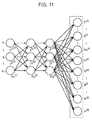
- Fig. 11 is a diagram illustrating an example of a third neural network according to the second modification.
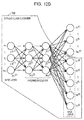
- Fig. 12A is a diagram illustrating an example of a first neural network 10c used to realize a coarse class classifier according to the second modification.
- Fig. 12B is a diagram illustrating an example of a second neural network 10d used to realize a detailed class classifier according to the second modification. Elements similar to those in Fig. 2A or Fig. 2B are denoted by similar reference symbols, and a further detailed description thereof is omitted.
- the coarse class classifier 10c and the detailed class classifier 10d are realized using the third neural network such as that illustrated in Fig. 11 .
- the final layer of the third neural network includes neurons whose number is equal to or greater than the sum of the number of coarse classes and the number of detailed classes.
- the coarse class classifier 10c is realized using the first neural network that is realized fully using the layers other than the final layer of the third neural network shown in Fig. 11 and using part of the final layer. More specifically, the first neural network used to realize the coarse class classifier 10c is given by the third neural network but in the final layer thereof, particular neurons whose number is equal to the number of coarse classes are selected from the neurons of the final layer and only the selected neurons are used.
- the second neural network used to realize the detailed class classifier 10d is given, as illustrated in Fig. 12B , by the third neural network shown in Fig. 11 but the layers other than the final layer and part of the final layer remaining without being used in the final layer of first neural network are used. More specifically, the second neural network used to realize the detailed class classifier 10d is given by the third neural network but in the final layer thereof, particular neurons which are different from the neurons employed as the neurons in the final layer of the first neural network and whose number is equal to the number of detailed classes are used.
- the learning system 1 performs a learning process such as that described above with reference to Fig. 5 using the coarse class classifier 10c and the detailed class classifier 10d configured in the above-described manner.
- the learning process according to the present modification includes, before the learning process on the coarse class classifier 10c in step S1, an additional step of designing the third neural network so as to include, in its final layer, as many neurons as the sum of the number of coarse classes and the number of detailed class, or more, as illustrated, for example, in Fig. 11 .
- the learning system 1 designs the first neural network in step S1 in which the first neural network used to realize the coarse class classifier 10c is given by the third neural network but in the final layer thereof, particular neurons whose number is equal to the number of coarse classes are selected and only the selected neurons are used thereby achieving the first neural network whose final layer includes as many neurons as there are coarse classes generated based on contents of labels indicating detailed classes.
- the learning system 1 of the present modification designs the second neural network in step S2 in which the second neural network used to realize the detailed class classifier 10d is given by the third neural network but in the final layer thereof, particular neurons which are different from the neurons employed as the neurons in the final layer of the first neural network and whose number is equal to the number of detailed classes are used thereby achieving the second neural network that is the same as the first neural network made to perform the learning in step S1 except that the neurons in the final layer is changed by the neuron whose number is equal to the number of detailed classes.
- the weight for the final layer of the second neural network is set, by way of example but not limitation, to a random number.
- the weight for the final layer of the second neural network may be set based on the weight for the final layer of the first neural network made to learn the coarse classes and the relationship between the detailed classes and the coarse classes. This alternative setting is described below focusing on differences from the first embodiment.
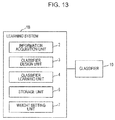
- Fig. 13 is a block diagram illustrating an example of a configuration of a learning system 1 B according to a second embodiment.
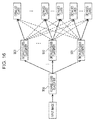
- Fig. 14 is a diagram illustrating a configuration of a detailed class classifier 10e used in a learning process performed by the learning system 1 B according to the second embodiment.
- a, b, k, a1 to al, b1 to bm, and k1 to kn are positive integers.
- elements similar to those in Fig. 1 are denoted by similar reference symbols, and a further description thereof is omitted.
- the learning system 1 B shown in Fig. 13 includes an information acquisition unit 2, a classifier design unit 3, a classifier learning unit 4, a storage unit 5, and a weight setting unit 7.
- the learning system 1 B shown in Fig. 13 is different from the learning system 1 shown in Fig. 1 in that the weight setting unit 7 is additionally provided.
- the weight setting unit 7 calculates the weight for the new final layer, that is, the weight for the final layer of the second neural network. More specifically, the weight setting unit 7 determines the weight as follows. The first weight for the final layer of the first neural network indicating the coupling efficiency between the final layer of the first neural network of the coarse class classifier 10a obtained via the process of learning the coarse classes and the layer immediately in front of the final layer is divided proportionally in accordance with the relationship between the plurality of coarse classes and the plurality of detailed classes included in the plurality of coarse classes. Thereafter, using the value calculated in the above-described manner, the weight setting unit 7 sets the second weight for the final layer of the second neural network indicating the coupling efficiency between the final layer of the second neural network and the layer immediately in front of the final layer.
- Fig. 14 shows Wa, Wb,..., Wk as first weights, and Wa1 to Wal, Wb1 to Wbm,..., Wk1 to Wkn as second weights. Furthermore, Fig. 14 also shows a plurality of coarse classes (coarse class a, coarse class b,..., coarse class k) output from neurons of the final layer of the first neural network, and a plurality of detailed classes (detailed classes a1 to al, detailed classes b1 to bm,..., detailed classes k1 to kn) output from neurons of the final layer of the second neural network.
- coarse classes coarse class b,..., coarse class k
- detailed classes detailed classes a1 to al, detailed classes b1 to bm,..., detailed classes k1 to kn
- the weight setting unit 7 obtains the first weights for the final layer of the first neural network via the learning on the first neural network in terms of the coarse classes, that is, the weight setting unit 7 obtains first weights Wa, Wb,..., Wk for the neurons in the final layer that respectively output coarse class a, coarse class b,..., coarse class k.
- the plurality of coarse classes (coarse class a, coarse class b,..., coarse class k) are replaced with the plurality of detailed classes (detailed classes a1 to al, detailed classes b1 to bm,..., detailed classes k1 to kn) included in the plurality of coarse classes (coarse class a, coarse class b,..., coarse class k).
- the weight setting unit 7 calculates values by proportionally dividing the acquired first weights Wa, Wb,..., Wk by the number (l, m,..., n) of detailed classes included in the corresponding coarse classes based on the relationship among the plurality of detailed classes (detailed classes a1 to ai, detailed classes b1 to bm,..., detailed classes k1 to kn) included in the plurality of coarse classes (coarse class a, coarse class b,... coarse class k).
- Fig. 15 is a flow chart illustrating an example of a detailed class learning (step S2) according to the second embodiment.
- step S32, steps S34 to S36 are similar to steps S21 to S24 described above with reference to Fig. 8 , and thus a further description thereof is omitted.
- step S31 the learning system 1 B controls the weight setting unit 7 to acquire the first weights for the final layer of the first neural network used to realize the coarse class classifier 10a, wherein the first weights are obtained when the coarse class classifier 10a is made to learn the coarse classes in step S10.
- step S33 the learning system 1B sets the weight setting unit 7 in terms of the second weights for the final layer of the second neural network used to realize the detailed class classifier 10b by using the values obtained by proportionally dividing the acquired first weights according to the relationship between the detailed classes and the coarse classes.
- the relationship between the detailed classes and the coarse classes is the relationship between the plurality of coarse classes and the plurality of detailed classes included in the plurality of coarse classes. In the specific example described above, the relationship is the number of detailed classes included in each coarse class. Effects
- the present embodiment makes it possible to realize the method of learning the classifier capable of performing high-accuracy image recognition without reducing a processing speed in the image recognition compared with a processing speed of the conventional technique.
- the learning method according to the second embodiment includes an additional process, in addition to the process of the learning method according to the first embodiment, to set the weights for the final layer of the detailed class classifier 10b used in the detailed class classification process, based on the weights for the final layer of the coarse class classifier 10a obtained via the coarse class classification process in the learning process. This makes it possible to improve the accuracy of the image recognition by the classifier 10 and the processing speed of the image recognition.
- the learning method according to the present disclosure has been described above with reference to the first embodiment, the first modification, the second modification, and the second embodiment. Note that there is no particular restriction on an entity or an apparatus that performs each process. Processes may be performed by a processor or the like disposed in a particular local apparatus or by a cloud server or the like disposed at a location different from the location of the local apparatus, as described below.
- the present disclosure may be applied to a method of learning a classifier that classifies an image and a recording medium therefor, and more particularly, to an image capturing apparatus such as a digital camera, a movie camera, a monitor camera, an in-vehicle camera, a wearable camera, and the like in which an object recognition method or system is implemented to analyze an image to accurately recognize what kind of object is included in the image.
- an image capturing apparatus such as a digital camera, a movie camera, a monitor camera, an in-vehicle camera, a wearable camera, and the like in which an object recognition method or system is implemented to analyze an image to accurately recognize what kind of object is included in the image.
Landscapes
- Engineering & Computer Science (AREA)
- Theoretical Computer Science (AREA)
- Physics & Mathematics (AREA)
- Evolutionary Computation (AREA)
- Artificial Intelligence (AREA)
- General Physics & Mathematics (AREA)
- Data Mining & Analysis (AREA)
- Life Sciences & Earth Sciences (AREA)
- Computer Vision & Pattern Recognition (AREA)
- Health & Medical Sciences (AREA)
- General Health & Medical Sciences (AREA)
- General Engineering & Computer Science (AREA)
- Software Systems (AREA)
- Computing Systems (AREA)
- Molecular Biology (AREA)
- Biomedical Technology (AREA)
- Evolutionary Biology (AREA)
- Bioinformatics & Cheminformatics (AREA)
- Bioinformatics & Computational Biology (AREA)
- Mathematical Physics (AREA)
- Multimedia (AREA)
- Computational Linguistics (AREA)
- Biophysics (AREA)
- Medical Informatics (AREA)
- Databases & Information Systems (AREA)
- Biodiversity & Conservation Biology (AREA)
- Automation & Control Theory (AREA)
- Toxicology (AREA)
- Electromagnetism (AREA)
- Quality & Reliability (AREA)
- Fuzzy Systems (AREA)
- Image Analysis (AREA)
- Information Retrieval, Db Structures And Fs Structures Therefor (AREA)
Applications Claiming Priority (2)
| Application Number | Priority Date | Filing Date | Title |
|---|---|---|---|
| JP2015044838 | 2015-03-06 | ||
| JP2015214657 | 2015-10-30 |
Publications (3)
| Publication Number | Publication Date |
|---|---|
| EP3065090A2 true EP3065090A2 (fr) | 2016-09-07 |
| EP3065090A3 EP3065090A3 (fr) | 2017-01-25 |
| EP3065090B1 EP3065090B1 (fr) | 2020-11-04 |
Family
ID=55453033
Family Applications (1)
| Application Number | Title | Priority Date | Filing Date |
|---|---|---|---|
| EP16157040.3A Active EP3065090B1 (fr) | 2015-03-06 | 2016-02-24 | Procédé d'apprentissage et support d'enregistrement d'arrière-plan |
Country Status (4)
| Country | Link |
|---|---|
| US (1) | US9779354B2 (fr) |
| EP (1) | EP3065090B1 (fr) |
| JP (1) | JP6671028B2 (fr) |
| CN (1) | CN105938558B (fr) |
Cited By (3)
| Publication number | Priority date | Publication date | Assignee | Title |
|---|---|---|---|---|
| WO2018159666A1 (fr) * | 2017-03-01 | 2018-09-07 | Omron Corporation | Appareil d'apprentissage, appareil d'utilisation de résultat d'apprentissage, procédé d'apprentissage et programme d'apprentissage |
| EP3557521A4 (fr) * | 2016-12-19 | 2020-08-05 | Kabushiki Kaisha Yaskawa Denki | Processeur et contrôleur de reconnaissance d'image de dispositif industriel |
| US20220172024A1 (en) * | 2020-11-30 | 2022-06-02 | Oracle International Corporation | Information Technology Service Incident Ticket Assignment |
Families Citing this family (50)
| Publication number | Priority date | Publication date | Assignee | Title |
|---|---|---|---|---|
| US9971958B2 (en) * | 2016-06-01 | 2018-05-15 | Mitsubishi Electric Research Laboratories, Inc. | Method and system for generating multimodal digital images |
| JP6633462B2 (ja) * | 2016-06-29 | 2020-01-22 | 株式会社東芝 | 情報処理装置および情報処理方法 |
| US10140979B2 (en) * | 2016-08-10 | 2018-11-27 | Conduent Business Services, Llc | Modeling a class posterior probability of context dependent phonemes in a speech recognition system |
| KR102824640B1 (ko) * | 2016-09-07 | 2025-06-25 | 삼성전자주식회사 | 뉴럴 네트워크에 기초한 인식 장치 및 뉴럴 네트워크의 트레이닝 방법 |
| KR20180092778A (ko) | 2017-02-10 | 2018-08-20 | 한국전자통신연구원 | 실감정보 제공 장치, 영상분석 서버 및 실감정보 제공 방법 |
| JP7195264B2 (ja) * | 2017-03-14 | 2022-12-23 | トゥプル,インコーポレイテッド | 段階的な機械学習を使用する自動化された意思決定 |
| JP6725452B2 (ja) * | 2017-05-26 | 2020-07-22 | 日本電信電話株式会社 | 分類装置、分類方法および分類プログラム |
| US10346724B2 (en) * | 2017-06-22 | 2019-07-09 | Waymo Llc | Rare instance classifiers |
| US11488060B2 (en) | 2017-07-25 | 2022-11-01 | The University Of Tokyo | Learning method, learning program, learning device, and learning system |
| JP6729516B2 (ja) | 2017-07-27 | 2020-07-22 | トヨタ自動車株式会社 | 識別装置 |
| JP7294768B2 (ja) * | 2017-08-04 | 2023-06-20 | オムロン株式会社 | 画像処理システム |
| GB2570433A (en) * | 2017-09-25 | 2019-07-31 | Nissan Motor Mfg Uk Ltd | Machine vision system |
| JP7224757B2 (ja) | 2017-10-13 | 2023-02-20 | キヤノン株式会社 | 診断支援装置、情報処理方法、診断支援システム及びプログラム |
| US11132605B2 (en) | 2017-11-20 | 2021-09-28 | International Business Machines Corporation | Cardinal sine as an activation function for universal classifier training data |
| CN108229543A (zh) * | 2017-12-22 | 2018-06-29 | 中国科学院深圳先进技术研究院 | 图像分类模型设计方法及装置 |
| US11829866B1 (en) * | 2017-12-27 | 2023-11-28 | Intuit Inc. | System and method for hierarchical deep semi-supervised embeddings for dynamic targeted anomaly detection |
| KR102329592B1 (ko) | 2017-12-30 | 2021-11-19 | 미디어 그룹 코 엘티디 | 재료 인식을 기반으로 하는 음식 준비 방법 및 시스템 |
| US10679330B2 (en) * | 2018-01-15 | 2020-06-09 | Tata Consultancy Services Limited | Systems and methods for automated inferencing of changes in spatio-temporal images |
| JP6766839B2 (ja) | 2018-03-14 | 2020-10-14 | オムロン株式会社 | 検査システム、画像識別システム、識別システム、識別器生成システム、及び学習データ生成装置 |
| CN111902827B (zh) * | 2018-03-26 | 2024-11-05 | 松下知识产权经营株式会社 | 一种处理方法及利用了它的处理装置 |
| JP7166784B2 (ja) * | 2018-04-26 | 2022-11-08 | キヤノン株式会社 | 情報処理装置、情報処理方法及びプログラム |
| JP7048423B2 (ja) * | 2018-06-07 | 2022-04-05 | 大日本印刷株式会社 | 商品特定装置、プログラム及び学習方法 |
| JP7056406B2 (ja) * | 2018-06-22 | 2022-04-19 | 日本電信電話株式会社 | センサノード及びデータセンタとして機能する装置、センサネットワーク、通信方法及びプログラム |
| CN112384892A (zh) * | 2018-07-09 | 2021-02-19 | 富士通株式会社 | 信息处理装置、信息处理方法以及信息处理程序 |
| JP6757378B2 (ja) | 2018-08-28 | 2020-09-16 | 株式会社モルフォ | 画像識別装置、画像識別方法及び画像識別プログラム |
| JP6986503B2 (ja) * | 2018-09-10 | 2021-12-22 | 日立Astemo株式会社 | 電子制御装置、ニューラルネットワーク更新システム |
| CN109190643A (zh) * | 2018-09-14 | 2019-01-11 | 华东交通大学 | 基于卷积神经网络中药识别方法及电子设备 |
| CN109406118B (zh) * | 2018-10-15 | 2020-05-19 | 华中科技大学 | 一种基于层次卷积神经网络的机械故障预测方法 |
| US10474713B1 (en) * | 2018-10-26 | 2019-11-12 | StradVision, Inc. | Learning method and learning device using multiple labeled databases with different label sets and testing method and testing device using the same |
| CN109766928B (zh) * | 2018-12-21 | 2020-04-17 | 创新奇智(重庆)科技有限公司 | 一种基于图像的物体分类方法、系统和电子设备 |
| US10867210B2 (en) * | 2018-12-21 | 2020-12-15 | Waymo Llc | Neural networks for coarse- and fine-object classifications |
| JP6991960B2 (ja) * | 2018-12-28 | 2022-01-13 | Kddi株式会社 | 画像認識装置、画像認識方法及びプログラム |
| JP7111088B2 (ja) * | 2019-01-24 | 2022-08-02 | カシオ計算機株式会社 | 画像検索装置、学習方法及びプログラム |
| JP7286333B2 (ja) * | 2019-02-06 | 2023-06-05 | キヤノン株式会社 | 情報処理装置、情報処理装置の制御方法およびプログラム |
| DE102019125000A1 (de) * | 2019-09-17 | 2021-03-18 | Basler Ag | Verfahren zur bildverarbeitung durch ein neuronales netzwerk und verfahren zum trainieren eines neuronalen netzwerks |
| KR102312657B1 (ko) * | 2019-11-18 | 2021-10-15 | 아이브스 주식회사 | 인공지능을 이용한 음원 분류 장치 및 그 방법 |
| US12367597B2 (en) | 2020-01-15 | 2025-07-22 | Rensselaer Polytechnic Institute | Trackerless 2D ultrasound frame to 3D image volume registration |
| JP7371776B2 (ja) * | 2020-05-21 | 2023-10-31 | 株式会社Ihi | 画像分類装置、画像分類方法、及び、画像分類プログラム |
| CN111680753A (zh) * | 2020-06-10 | 2020-09-18 | 创新奇智(上海)科技有限公司 | 一种数据标注方法、装置、电子设备及存储介质 |
| JP7227188B2 (ja) * | 2020-07-01 | 2023-02-21 | 株式会社モリタ製作所 | 識別装置、識別システム、識別方法、および識別用プログラム |
| DE112020007472T5 (de) * | 2020-07-28 | 2023-05-11 | Mitsubishi Electric Corporation | Lernnutzungssystem, nutzungsvorrichtung, lernvorrichtung, programm und lernnutzungsverfahren |
| KR102236615B1 (ko) * | 2020-07-31 | 2021-04-06 | 주식회사 웨이센 | 복합 특성 분류와 공통 국소화를 위한 신경망 모델의 학습 방법 및 장치 |
| CN114071106B (zh) * | 2020-08-10 | 2023-07-04 | 合肥君正科技有限公司 | 一种低功耗设备冷启动快速白平衡方法 |
| CN112183639B (zh) * | 2020-09-30 | 2022-04-19 | 四川大学 | 一种矿物图像识别与分类方法 |
| US20220254144A1 (en) * | 2021-02-05 | 2022-08-11 | Home Depot Product Authority, Llc | Product image classification |
| CN115883831A (zh) * | 2021-08-05 | 2023-03-31 | 华为技术有限公司 | 编解码方法和装置 |
| CN113642679B (zh) * | 2021-10-13 | 2021-12-28 | 山东凤和凰城市科技有限公司 | 多种类数据识别方法 |
| KR102635607B1 (ko) * | 2021-11-04 | 2024-02-08 | 중앙대학교 산학협력단 | 코스-투-파인 컨볼루션 뉴럴 네트워크 기반 다중 레이블 클래스 분류 방법 및 장치 |
| KR20230105303A (ko) | 2022-01-03 | 2023-07-11 | 주식회사 에스아이에이 | 모호한 라벨을 이용한 객체 예측 모델 학습 방법 |
| KR102437285B1 (ko) * | 2022-01-03 | 2022-08-29 | 주식회사 에스아이에이 | 모호한 라벨을 이용한 객체 예측 모델 학습 방법 |
Family Cites Families (28)
| Publication number | Priority date | Publication date | Assignee | Title |
|---|---|---|---|---|
| US5313532A (en) * | 1990-01-23 | 1994-05-17 | Massachusetts Institute Of Technology | Recognition of patterns in images |
| DE4100500A1 (de) * | 1991-01-10 | 1992-07-16 | Bodenseewerk Geraetetech | Signalverarbeitungsanordnung zur klassifizierung von objekten aufgrund der signale von sensoren |
| US5359699A (en) * | 1991-12-02 | 1994-10-25 | General Electric Company | Method for using a feed forward neural network to perform classification with highly biased data |
| JP2722906B2 (ja) * | 1991-12-27 | 1998-03-09 | ダイキン工業株式会社 | 未知数量推定方法およびその装置 |
| US5311600A (en) * | 1992-09-29 | 1994-05-10 | The Board Of Trustees Of The Leland Stanford Junior University | Method of edge detection in optical images using neural network classifier |
| US5619619A (en) * | 1993-03-11 | 1997-04-08 | Kabushiki Kaisha Toshiba | Information recognition system and control system using same |
| KR0170656B1 (ko) * | 1994-08-17 | 1999-03-30 | 김광호 | 필기체문자 인식방법 및 장치 |
| US5835633A (en) * | 1995-11-20 | 1998-11-10 | International Business Machines Corporation | Concurrent two-stage multi-network optical character recognition system |
| US6009418A (en) * | 1996-05-02 | 1999-12-28 | Cooper; David L. | Method and apparatus for neural networking using semantic attractor architecture |
| US5995651A (en) * | 1996-07-11 | 1999-11-30 | Duke University | Image content classification methods, systems and computer programs using texture patterns |
| WO1998029833A1 (fr) * | 1996-12-25 | 1998-07-09 | Hitachi, Ltd. | Appareil et procede de reconnaissance de formes |
| US6650779B2 (en) * | 1999-03-26 | 2003-11-18 | Georgia Tech Research Corp. | Method and apparatus for analyzing an image to detect and identify patterns |
| US7016885B1 (en) * | 2001-08-28 | 2006-03-21 | University Of Central Florida Research Foundation, Inc. | Self-designing intelligent signal processing system capable of evolutional learning for classification/recognition of one and multidimensional signals |
| US7752151B2 (en) * | 2002-06-05 | 2010-07-06 | Knowmtech, Llc | Multilayer training in a physical neural network formed utilizing nanotechnology |
| KR100442835B1 (ko) * | 2002-08-13 | 2004-08-02 | 삼성전자주식회사 | 인공 신경망을 이용한 얼굴 인식 방법 및 장치 |
| US7440600B2 (en) * | 2003-04-23 | 2008-10-21 | Carestream Health, Inc. | System and method for assigning mammographic view and laterality to individual images in groups of digitized mammograms |
| US7272261B2 (en) * | 2004-06-04 | 2007-09-18 | Xerox Corporation | Method and system for classifying scanned-media |
| US7620819B2 (en) * | 2004-10-04 | 2009-11-17 | The Penn State Research Foundation | System and method for classifying regions of keystroke density with a neural network |
| WO2006081547A1 (fr) * | 2005-01-27 | 2006-08-03 | Cambridge Research And Instrumentation, Inc. | Classification de caracteristiques d'images |
| CN101082836A (zh) * | 2007-06-29 | 2007-12-05 | 华中科技大学 | 一种整合语音输入和手写输入功能的汉字输入系统 |
| US20090110062A1 (en) * | 2007-10-30 | 2009-04-30 | The Hong Kong University Of Science And Technology | Optimal heegard-berger coding schemes |
| US8199999B2 (en) * | 2008-06-17 | 2012-06-12 | Cambridge Research & Instrumentation, Inc. | Image classifier training |
| CN101667252B (zh) * | 2009-10-15 | 2011-07-20 | 哈尔滨工业大学 | 基于art2a-dwnn的通信信号调制方式的分类识别方法 |
| CN101957920B (zh) * | 2010-09-08 | 2012-07-11 | 中国人民解放军国防科学技术大学 | 基于数字视频的车牌查找方法 |
| CN103310227A (zh) * | 2012-03-16 | 2013-09-18 | 上海联影医疗科技有限公司 | 基于神经网络的自动窗宽窗位提取方法 |
| CN102855479A (zh) * | 2012-07-24 | 2013-01-02 | 苏州工业园区七星电子有限公司 | 一种印刷体汉字识别系统 |
| CN104346622A (zh) * | 2013-07-31 | 2015-02-11 | 富士通株式会社 | 卷积神经网络分类器及其分类方法和训练方法 |
| US9129190B1 (en) * | 2013-12-04 | 2015-09-08 | Google Inc. | Identifying objects in images |
-
2016
- 2016-02-19 CN CN201610094433.7A patent/CN105938558B/zh active Active
- 2016-02-24 EP EP16157040.3A patent/EP3065090B1/fr active Active
- 2016-02-25 JP JP2016034784A patent/JP6671028B2/ja active Active
- 2016-02-25 US US15/053,642 patent/US9779354B2/en active Active
Non-Patent Citations (1)
| Title |
|---|
| Z. YAN; V. JAGADEESH; D. DECOSTE; W. DI; R. PIRAMUTHU: "HD-CNN: Hierarchical Deep Convolutional Neural Network for Image Classification", A CONFERENCE PAPER AT ICLR, December 2014 (2014-12-01), Retrieved from the Internet <URL:http://arxiv.org/pdf/1410.0736v2.pdf> |
Cited By (5)
| Publication number | Priority date | Publication date | Assignee | Title |
|---|---|---|---|---|
| EP3557521A4 (fr) * | 2016-12-19 | 2020-08-05 | Kabushiki Kaisha Yaskawa Denki | Processeur et contrôleur de reconnaissance d'image de dispositif industriel |
| US11004191B2 (en) | 2016-12-19 | 2021-05-11 | Kabushiki Kaisha Yaskawa Denki | Industrial device image recognition processor and controller |
| WO2018159666A1 (fr) * | 2017-03-01 | 2018-09-07 | Omron Corporation | Appareil d'apprentissage, appareil d'utilisation de résultat d'apprentissage, procédé d'apprentissage et programme d'apprentissage |
| US20220172024A1 (en) * | 2020-11-30 | 2022-06-02 | Oracle International Corporation | Information Technology Service Incident Ticket Assignment |
| US12205009B2 (en) * | 2020-11-30 | 2025-01-21 | Oracle International Corporation | Information technology service incident ticket assignment |
Also Published As
| Publication number | Publication date |
|---|---|
| JP2017084320A (ja) | 2017-05-18 |
| JP6671028B2 (ja) | 2020-03-25 |
| EP3065090A3 (fr) | 2017-01-25 |
| US9779354B2 (en) | 2017-10-03 |
| EP3065090B1 (fr) | 2020-11-04 |
| CN105938558A (zh) | 2016-09-14 |
| US20160260014A1 (en) | 2016-09-08 |
| CN105938558B (zh) | 2021-02-09 |
Similar Documents
| Publication | Publication Date | Title |
|---|---|---|
| US9779354B2 (en) | Learning method and recording medium | |
| CN110909725B (zh) | 识别文本的方法、装置、设备及存储介质 | |
| JP6397986B2 (ja) | 画像オブジェクト領域の認識方法及び装置 | |
| US11663502B2 (en) | Information processing apparatus and rule generation method | |
| US10395136B2 (en) | Image processing apparatus, image processing method, and recording medium | |
| JP5214760B2 (ja) | 学習装置、方法及びプログラム | |
| CN113255694A (zh) | 训练图像特征提取模型和提取图像特征的方法、装置 | |
| US9053358B2 (en) | Learning device for generating a classifier for detection of a target | |
| CN105760488B (zh) | 基于多层次特征融合的图像表达方法和装置 | |
| CN109815492A (zh) | 一种基于识别模型的意图识别方法、识别设备及介质 | |
| WO2021072876A1 (fr) | Procédé et appareil de classification d'images d'identification, dispositif informatique et support de stockage lisible | |
| CN104915632A (zh) | 事件检测装置以及事件检测方法 | |
| CN108460427A (zh) | 一种分类模型训练方法、装置以及分类方法及装置 | |
| JP2016099734A (ja) | 画像処理装置、情報処理方法及びプログラム | |
| CN117992765B (zh) | 基于动态新兴标记的偏标签学习方法、装置、设备及介质 | |
| US20190164078A1 (en) | Information processing system, information processing method, and recording medium | |
| US20180342071A1 (en) | Moving object tracking apparatus, moving object tracking method, and computer program product | |
| CN112508062B (zh) | 一种开集数据的分类方法、装置、设备及存储介质 | |
| US20200311389A1 (en) | Domain adaptation-based object recognition apparatus and method | |
| US9058748B2 (en) | Classifying training method and apparatus using training samples selected at random and categories | |
| US20170039451A1 (en) | Classification dictionary learning system, classification dictionary learning method and recording medium | |
| KR102342967B1 (ko) | 문맥 정보를 활용하는 분류기 및 이의 분류 방법 | |
| KR20150103443A (ko) | 멀티클래스 분류 장치, 그 방법 및 컴퓨터 프로그램이 기록된 기록매체 | |
| US20240233328A1 (en) | Non-transitory computer-readable recording medium, determination method, and information processing apparatus | |
| CN111488400A (zh) | 数据分类方法、装置和计算机可读存储介质 |
Legal Events
| Date | Code | Title | Description |
|---|---|---|---|
| PUAI | Public reference made under article 153(3) epc to a published international application that has entered the european phase |
Free format text: ORIGINAL CODE: 0009012 |
|
| AK | Designated contracting states |
Kind code of ref document: A2 Designated state(s): AL AT BE BG CH CY CZ DE DK EE ES FI FR GB GR HR HU IE IS IT LI LT LU LV MC MK MT NL NO PL PT RO RS SE SI SK SM TR |
|
| AX | Request for extension of the european patent |
Extension state: BA ME |
|
| PUAL | Search report despatched |
Free format text: ORIGINAL CODE: 0009013 |
|
| AK | Designated contracting states |
Kind code of ref document: A3 Designated state(s): AL AT BE BG CH CY CZ DE DK EE ES FI FR GB GR HR HU IE IS IT LI LT LU LV MC MK MT NL NO PL PT RO RS SE SI SK SM TR |
|
| AX | Request for extension of the european patent |
Extension state: BA ME |
|
| RIC1 | Information provided on ipc code assigned before grant |
Ipc: G06K 9/62 20060101ALI20161216BHEP Ipc: G06N 3/04 20060101AFI20161216BHEP |
|
| STAA | Information on the status of an ep patent application or granted ep patent |
Free format text: STATUS: REQUEST FOR EXAMINATION WAS MADE |
|
| 17P | Request for examination filed |
Effective date: 20170710 |
|
| RBV | Designated contracting states (corrected) |
Designated state(s): AL AT BE BG CH CY CZ DE DK EE ES FI FR GB GR HR HU IE IS IT LI LT LU LV MC MK MT NL NO PL PT RO RS SE SI SK SM TR |
|
| STAA | Information on the status of an ep patent application or granted ep patent |
Free format text: STATUS: EXAMINATION IS IN PROGRESS |
|
| 17Q | First examination report despatched |
Effective date: 20190206 |
|
| GRAP | Despatch of communication of intention to grant a patent |
Free format text: ORIGINAL CODE: EPIDOSNIGR1 |
|
| STAA | Information on the status of an ep patent application or granted ep patent |
Free format text: STATUS: GRANT OF PATENT IS INTENDED |
|
| INTG | Intention to grant announced |
Effective date: 20200805 |
|
| GRAS | Grant fee paid |
Free format text: ORIGINAL CODE: EPIDOSNIGR3 |
|
| GRAA | (expected) grant |
Free format text: ORIGINAL CODE: 0009210 |
|
| STAA | Information on the status of an ep patent application or granted ep patent |
Free format text: STATUS: THE PATENT HAS BEEN GRANTED |
|
| AK | Designated contracting states |
Kind code of ref document: B1 Designated state(s): AL AT BE BG CH CY CZ DE DK EE ES FI FR GB GR HR HU IE IS IT LI LT LU LV MC MK MT NL NO PL PT RO RS SE SI SK SM TR |
|
| REG | Reference to a national code |
Ref country code: GB Ref legal event code: FG4D |
|
| REG | Reference to a national code |
Ref country code: CH Ref legal event code: EP |
|
| REG | Reference to a national code |
Ref country code: AT Ref legal event code: REF Ref document number: 1331759 Country of ref document: AT Kind code of ref document: T Effective date: 20201115 |
|
| REG | Reference to a national code |
Ref country code: IE Ref legal event code: FG4D |
|
| REG | Reference to a national code |
Ref country code: DE Ref legal event code: R096 Ref document number: 602016046981 Country of ref document: DE |
|
| REG | Reference to a national code |
Ref country code: NL Ref legal event code: MP Effective date: 20201104 |
|
| REG | Reference to a national code |
Ref country code: AT Ref legal event code: MK05 Ref document number: 1331759 Country of ref document: AT Kind code of ref document: T Effective date: 20201104 |
|
| PG25 | Lapsed in a contracting state [announced via postgrant information from national office to epo] |
Ref country code: NO Free format text: LAPSE BECAUSE OF FAILURE TO SUBMIT A TRANSLATION OF THE DESCRIPTION OR TO PAY THE FEE WITHIN THE PRESCRIBED TIME-LIMIT Effective date: 20210204 Ref country code: PT Free format text: LAPSE BECAUSE OF FAILURE TO SUBMIT A TRANSLATION OF THE DESCRIPTION OR TO PAY THE FEE WITHIN THE PRESCRIBED TIME-LIMIT Effective date: 20210304 Ref country code: RS Free format text: LAPSE BECAUSE OF FAILURE TO SUBMIT A TRANSLATION OF THE DESCRIPTION OR TO PAY THE FEE WITHIN THE PRESCRIBED TIME-LIMIT Effective date: 20201104 Ref country code: FI Free format text: LAPSE BECAUSE OF FAILURE TO SUBMIT A TRANSLATION OF THE DESCRIPTION OR TO PAY THE FEE WITHIN THE PRESCRIBED TIME-LIMIT Effective date: 20201104 Ref country code: GR Free format text: LAPSE BECAUSE OF FAILURE TO SUBMIT A TRANSLATION OF THE DESCRIPTION OR TO PAY THE FEE WITHIN THE PRESCRIBED TIME-LIMIT Effective date: 20210205 |
|
| PG25 | Lapsed in a contracting state [announced via postgrant information from national office to epo] |
Ref country code: AT Free format text: LAPSE BECAUSE OF FAILURE TO SUBMIT A TRANSLATION OF THE DESCRIPTION OR TO PAY THE FEE WITHIN THE PRESCRIBED TIME-LIMIT Effective date: 20201104 Ref country code: ES Free format text: LAPSE BECAUSE OF FAILURE TO SUBMIT A TRANSLATION OF THE DESCRIPTION OR TO PAY THE FEE WITHIN THE PRESCRIBED TIME-LIMIT Effective date: 20201104 Ref country code: BG Free format text: LAPSE BECAUSE OF FAILURE TO SUBMIT A TRANSLATION OF THE DESCRIPTION OR TO PAY THE FEE WITHIN THE PRESCRIBED TIME-LIMIT Effective date: 20210204 Ref country code: SE Free format text: LAPSE BECAUSE OF FAILURE TO SUBMIT A TRANSLATION OF THE DESCRIPTION OR TO PAY THE FEE WITHIN THE PRESCRIBED TIME-LIMIT Effective date: 20201104 Ref country code: IS Free format text: LAPSE BECAUSE OF FAILURE TO SUBMIT A TRANSLATION OF THE DESCRIPTION OR TO PAY THE FEE WITHIN THE PRESCRIBED TIME-LIMIT Effective date: 20210304 Ref country code: LV Free format text: LAPSE BECAUSE OF FAILURE TO SUBMIT A TRANSLATION OF THE DESCRIPTION OR TO PAY THE FEE WITHIN THE PRESCRIBED TIME-LIMIT Effective date: 20201104 Ref country code: PL Free format text: LAPSE BECAUSE OF FAILURE TO SUBMIT A TRANSLATION OF THE DESCRIPTION OR TO PAY THE FEE WITHIN THE PRESCRIBED TIME-LIMIT Effective date: 20201104 |
|
| REG | Reference to a national code |
Ref country code: LT Ref legal event code: MG9D |
|
| PG25 | Lapsed in a contracting state [announced via postgrant information from national office to epo] |
Ref country code: HR Free format text: LAPSE BECAUSE OF FAILURE TO SUBMIT A TRANSLATION OF THE DESCRIPTION OR TO PAY THE FEE WITHIN THE PRESCRIBED TIME-LIMIT Effective date: 20201104 |
|
| PG25 | Lapsed in a contracting state [announced via postgrant information from national office to epo] |
Ref country code: LT Free format text: LAPSE BECAUSE OF FAILURE TO SUBMIT A TRANSLATION OF THE DESCRIPTION OR TO PAY THE FEE WITHIN THE PRESCRIBED TIME-LIMIT Effective date: 20201104 Ref country code: SM Free format text: LAPSE BECAUSE OF FAILURE TO SUBMIT A TRANSLATION OF THE DESCRIPTION OR TO PAY THE FEE WITHIN THE PRESCRIBED TIME-LIMIT Effective date: 20201104 Ref country code: EE Free format text: LAPSE BECAUSE OF FAILURE TO SUBMIT A TRANSLATION OF THE DESCRIPTION OR TO PAY THE FEE WITHIN THE PRESCRIBED TIME-LIMIT Effective date: 20201104 Ref country code: CZ Free format text: LAPSE BECAUSE OF FAILURE TO SUBMIT A TRANSLATION OF THE DESCRIPTION OR TO PAY THE FEE WITHIN THE PRESCRIBED TIME-LIMIT Effective date: 20201104 Ref country code: RO Free format text: LAPSE BECAUSE OF FAILURE TO SUBMIT A TRANSLATION OF THE DESCRIPTION OR TO PAY THE FEE WITHIN THE PRESCRIBED TIME-LIMIT Effective date: 20201104 Ref country code: SK Free format text: LAPSE BECAUSE OF FAILURE TO SUBMIT A TRANSLATION OF THE DESCRIPTION OR TO PAY THE FEE WITHIN THE PRESCRIBED TIME-LIMIT Effective date: 20201104 |
|
| REG | Reference to a national code |
Ref country code: DE Ref legal event code: R097 Ref document number: 602016046981 Country of ref document: DE |
|
| PG25 | Lapsed in a contracting state [announced via postgrant information from national office to epo] |
Ref country code: DK Free format text: LAPSE BECAUSE OF FAILURE TO SUBMIT A TRANSLATION OF THE DESCRIPTION OR TO PAY THE FEE WITHIN THE PRESCRIBED TIME-LIMIT Effective date: 20201104 |
|
| PLBE | No opposition filed within time limit |
Free format text: ORIGINAL CODE: 0009261 |
|
| STAA | Information on the status of an ep patent application or granted ep patent |
Free format text: STATUS: NO OPPOSITION FILED WITHIN TIME LIMIT |
|
| PG25 | Lapsed in a contracting state [announced via postgrant information from national office to epo] |
Ref country code: MC Free format text: LAPSE BECAUSE OF FAILURE TO SUBMIT A TRANSLATION OF THE DESCRIPTION OR TO PAY THE FEE WITHIN THE PRESCRIBED TIME-LIMIT Effective date: 20201104 |
|
| 26N | No opposition filed |
Effective date: 20210805 |
|
| GBPC | Gb: european patent ceased through non-payment of renewal fee |
Effective date: 20210224 |
|
| REG | Reference to a national code |
Ref country code: BE Ref legal event code: MM Effective date: 20210228 |
|
| PG25 | Lapsed in a contracting state [announced via postgrant information from national office to epo] |
Ref country code: IT Free format text: LAPSE BECAUSE OF FAILURE TO SUBMIT A TRANSLATION OF THE DESCRIPTION OR TO PAY THE FEE WITHIN THE PRESCRIBED TIME-LIMIT Effective date: 20201104 Ref country code: CH Free format text: LAPSE BECAUSE OF NON-PAYMENT OF DUE FEES Effective date: 20210228 Ref country code: AL Free format text: LAPSE BECAUSE OF FAILURE TO SUBMIT A TRANSLATION OF THE DESCRIPTION OR TO PAY THE FEE WITHIN THE PRESCRIBED TIME-LIMIT Effective date: 20201104 Ref country code: NL Free format text: LAPSE BECAUSE OF FAILURE TO SUBMIT A TRANSLATION OF THE DESCRIPTION OR TO PAY THE FEE WITHIN THE PRESCRIBED TIME-LIMIT Effective date: 20201104 Ref country code: LU Free format text: LAPSE BECAUSE OF NON-PAYMENT OF DUE FEES Effective date: 20210224 Ref country code: LI Free format text: LAPSE BECAUSE OF NON-PAYMENT OF DUE FEES Effective date: 20210228 |
|
| PG25 | Lapsed in a contracting state [announced via postgrant information from national office to epo] |
Ref country code: SI Free format text: LAPSE BECAUSE OF FAILURE TO SUBMIT A TRANSLATION OF THE DESCRIPTION OR TO PAY THE FEE WITHIN THE PRESCRIBED TIME-LIMIT Effective date: 20201104 |
|
| PG25 | Lapsed in a contracting state [announced via postgrant information from national office to epo] |
Ref country code: GB Free format text: LAPSE BECAUSE OF NON-PAYMENT OF DUE FEES Effective date: 20210224 Ref country code: IE Free format text: LAPSE BECAUSE OF NON-PAYMENT OF DUE FEES Effective date: 20210224 Ref country code: FR Free format text: LAPSE BECAUSE OF NON-PAYMENT OF DUE FEES Effective date: 20210228 |
|
| PG25 | Lapsed in a contracting state [announced via postgrant information from national office to epo] |
Ref country code: IS Free format text: LAPSE BECAUSE OF FAILURE TO SUBMIT A TRANSLATION OF THE DESCRIPTION OR TO PAY THE FEE WITHIN THE PRESCRIBED TIME-LIMIT Effective date: 20210304 |
|
| PG25 | Lapsed in a contracting state [announced via postgrant information from national office to epo] |
Ref country code: BE Free format text: LAPSE BECAUSE OF NON-PAYMENT OF DUE FEES Effective date: 20210228 |
|
| PG25 | Lapsed in a contracting state [announced via postgrant information from national office to epo] |
Ref country code: HU Free format text: LAPSE BECAUSE OF FAILURE TO SUBMIT A TRANSLATION OF THE DESCRIPTION OR TO PAY THE FEE WITHIN THE PRESCRIBED TIME-LIMIT; INVALID AB INITIO Effective date: 20160224 |
|
| PG25 | Lapsed in a contracting state [announced via postgrant information from national office to epo] |
Ref country code: CY Free format text: LAPSE BECAUSE OF FAILURE TO SUBMIT A TRANSLATION OF THE DESCRIPTION OR TO PAY THE FEE WITHIN THE PRESCRIBED TIME-LIMIT Effective date: 20201104 |
|
| PG25 | Lapsed in a contracting state [announced via postgrant information from national office to epo] |
Ref country code: MK Free format text: LAPSE BECAUSE OF FAILURE TO SUBMIT A TRANSLATION OF THE DESCRIPTION OR TO PAY THE FEE WITHIN THE PRESCRIBED TIME-LIMIT Effective date: 20201104 |
|
| PG25 | Lapsed in a contracting state [announced via postgrant information from national office to epo] |
Ref country code: MT Free format text: LAPSE BECAUSE OF FAILURE TO SUBMIT A TRANSLATION OF THE DESCRIPTION OR TO PAY THE FEE WITHIN THE PRESCRIBED TIME-LIMIT Effective date: 20201104 |
|
| PG25 | Lapsed in a contracting state [announced via postgrant information from national office to epo] |
Ref country code: TR Free format text: LAPSE BECAUSE OF FAILURE TO SUBMIT A TRANSLATION OF THE DESCRIPTION OR TO PAY THE FEE WITHIN THE PRESCRIBED TIME-LIMIT Effective date: 20201104 |
|
| PGFP | Annual fee paid to national office [announced via postgrant information from national office to epo] |
Ref country code: DE Payment date: 20260218 Year of fee payment: 11 |