EP3065106A1 - Kalibrierung von plenoptischen abbildungssystemen mittels fourier-transformation - Google Patents
Kalibrierung von plenoptischen abbildungssystemen mittels fourier-transformation Download PDFInfo
- Publication number
- EP3065106A1 EP3065106A1 EP16155951.3A EP16155951A EP3065106A1 EP 3065106 A1 EP3065106 A1 EP 3065106A1 EP 16155951 A EP16155951 A EP 16155951A EP 3065106 A1 EP3065106 A1 EP 3065106A1
- Authority
- EP
- European Patent Office
- Prior art keywords
- slice
- row
- plenoptic
- superpixels
- image
- Prior art date
- Legal status (The legal status is an assumption and is not a legal conclusion. Google has not performed a legal analysis and makes no representation as to the accuracy of the status listed.)
- Granted
Links
Images




Classifications
-
- G—PHYSICS
- G06—COMPUTING OR CALCULATING; COUNTING
- G06T—IMAGE DATA PROCESSING OR GENERATION, IN GENERAL
- G06T7/00—Image analysis
- G06T7/80—Analysis of captured images to determine intrinsic or extrinsic camera parameters, i.e. camera calibration
-
- H—ELECTRICITY
- H04—ELECTRIC COMMUNICATION TECHNIQUE
- H04N—PICTORIAL COMMUNICATION, e.g. TELEVISION
- H04N23/00—Cameras or camera modules comprising electronic image sensors; Control thereof
- H04N23/50—Constructional details
- H04N23/55—Optical parts specially adapted for electronic image sensors; Mounting thereof
-
- G—PHYSICS
- G03—PHOTOGRAPHY; CINEMATOGRAPHY; ANALOGOUS TECHNIQUES USING WAVES OTHER THAN OPTICAL WAVES; ELECTROGRAPHY; HOLOGRAPHY
- G03B—APPARATUS OR ARRANGEMENTS FOR TAKING PHOTOGRAPHS OR FOR PROJECTING OR VIEWING THEM; APPARATUS OR ARRANGEMENTS EMPLOYING ANALOGOUS TECHNIQUES USING WAVES OTHER THAN OPTICAL WAVES; ACCESSORIES THEREFOR
- G03B41/00—Special techniques not covered by groups G03B31/00 - G03B39/00; Apparatus therefor
-
- G—PHYSICS
- G06—COMPUTING OR CALCULATING; COUNTING
- G06T—IMAGE DATA PROCESSING OR GENERATION, IN GENERAL
- G06T7/00—Image analysis
- G06T7/80—Analysis of captured images to determine intrinsic or extrinsic camera parameters, i.e. camera calibration
- G06T7/85—Stereo camera calibration
-
- H—ELECTRICITY
- H04—ELECTRIC COMMUNICATION TECHNIQUE
- H04N—PICTORIAL COMMUNICATION, e.g. TELEVISION
- H04N13/00—Stereoscopic video systems; Multi-view video systems; Details thereof
- H04N13/20—Image signal generators
- H04N13/204—Image signal generators using stereoscopic image cameras
- H04N13/246—Calibration of cameras
-
- H—ELECTRICITY
- H04—ELECTRIC COMMUNICATION TECHNIQUE
- H04N—PICTORIAL COMMUNICATION, e.g. TELEVISION
- H04N13/00—Stereoscopic video systems; Multi-view video systems; Details thereof
- H04N13/20—Image signal generators
- H04N13/296—Synchronisation thereof; Control thereof
-
- G—PHYSICS
- G06—COMPUTING OR CALCULATING; COUNTING
- G06T—IMAGE DATA PROCESSING OR GENERATION, IN GENERAL
- G06T2207/00—Indexing scheme for image analysis or image enhancement
- G06T2207/10—Image acquisition modality
- G06T2207/10052—Images from lightfield camera
-
- G—PHYSICS
- G06—COMPUTING OR CALCULATING; COUNTING
- G06T—IMAGE DATA PROCESSING OR GENERATION, IN GENERAL
- G06T2207/00—Indexing scheme for image analysis or image enhancement
- G06T2207/20—Special algorithmic details
- G06T2207/20048—Transform domain processing
- G06T2207/20056—Discrete and fast Fourier transform, [DFT, FFT]
Definitions
- This disclosure relates generally to plenoptic imaging systems and, more particularly, to the calibration of plenoptic imaging systems.
- the plenoptic imaging system has recently received increased attention. It can be used to recalculate a different focus point or point of view of an object, based on digital processing of the captured plenoptic image.
- the plenoptic imaging system also finds application in multi-modal imaging, using a multi-modal filter array in the pupil plane of the primary imaging module. Each filter is imaged at the sensor, effectively producing a multiplexed image of the object for each imaging modality of the filter array.
- Other applications for plenoptic imaging systems include varying depth of field imaging and high dynamic range imaging.
- the architecture of a plenoptic imaging system is different from that of a conventional imaging system, and therefore requires different calibration and processing procedures.
- Several challenges are found in the processing of plenoptic images.
- the alignment of the microlens array is never perfect and the effect of rotation of the microlens array relative to the sensor array is quite observable. This rotation introduces a large amount of difficulties for image reconstruction because the data points do not fall onto a regular sampling grid.
- different focus settings may be used.
- a change in focus affects the angle of the incident light which can impact the effective pitch of the image towards its periphery, by a small but cognizable amount.
- the plenoptic imaging system includes a detector array that is subdivided into superpixels.
- a plenoptic image captured by the detector array of the plenoptic imaging system is accessed.
- For a row of superpixels a slice is selected through the row, the selected slice having a Fourier transform with a stronger fundamental component compared to other slices through the row.
- a pitch of the row of superpixels is determined based on a frequency of the fundamental component of the selected slice.
- a rotation of the row of superpixels is determined based on a rotation of the plenoptic image relative to the selected slice.
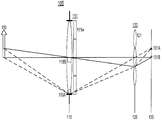
- FIGS. 1A-1D are diagrams of a plenoptic imaging system 100 according to an embodiment.
- the plenoptic imaging system 100 captures a plenoptic image of an object 150.
- the plenoptic imaging system 100 includes an image-forming optical module 105, which in FIG. 1 is represented by a single lens element although it is understood that the optical module 105 could contain multiple elements and/or non-lens elements (e.g., mirrors).
- the optical module 105 forms a conventional optical image 160 of object 150.
- the optical module 105 may also be referred to as the primary imaging module, subsystem or system.
- the optical image 160 is formed at an image plane 125 of the optical module 105.
- the optical module 105 is characterized by a pupil 117 and pupil plane 115, which in FIG. 1 is represented by a physical aperture stop co-located with the single lens element. In more complex optical modules 105, the pupil 117 and pupil plane 115 need not be co-located with any of the optical elements within the
- a detector array would be located at image plane 125 to capture the optical image 160.
- the pupil 117 may be divided into different regions 111w-z (only region 111w is labeled in FIG. 1A ) to help illustrate the concepts discussed below with regard to FIGs. 1B-1D .
- a micro-imaging array 120 of micro-imaging elements 121 is located at the image plane 125.
- the micro-imaging elements 121 are shown as microlenses. Other elements can also be used, for example, an array of pinholes.
- the detector array 130 is located behind (i.e., optically downstream of) the micro-imaging array 120. More specifically, the detector array 130 is positioned in a conjugate plane 135 to the pupil plane 115. That is, each micro-imaging element 121 creates an image of the pupil plane 115 at the conjugate plane 135, which image is captured by the detector array 130.
- each microlens 121 forms an image 170 of the pupil at the detector plane 135.
- the image of the pupil is captured by a subset of detectors 131 in the detector array 130.
- Each micronlens 121 forms its own image 170.
- the overall plenoptic image formed at detector plane 135 will include an array of superpixels 170, one for each microlens 121.
- This arrayed imaging effectively subdivides the detector array into superpixels 133, each of which contains multiple detectors 131.
- Each microlens 121 images the pupil onto the corresponding superpixel 133, with each pupil image then captured by detectors in the corresponding superpixel.
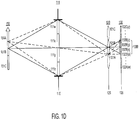
- each individual detector 131 can be projected through a microlens 121 to a corresponding location 119 in the pupil plane 115.
- the microlens 121 collects light from the corresponding location 119.
- FIG. 1B shows the projection of detector 131A through the center microlens to location 119A, and the projection of detector 131B to location 119B.
- the projection 119 of the detector preferably is magnified by at least 10x relative to the actual detector size 131.
- Each detector 131 collects light from one region (e.g., region 111w) that travels through one microlens 121.
- the micro-imaging array 120 is located in a conjugate plane to the object 150, so there is also an imaging relationship between the object 150 and the micro-imaging array 120. Therefore, the light incident on a microlens is light originating from a portion of the object, not from the entire object.
- a filter array is located at the pupil plane and each region 111 corresponds to a different filter. In that case, each detector 131 collects the light from a corresponding portion of the object (as determined by the extent of the microlens), as filtered by the corresponding filter 111.
- microlens 121B will image all of the regions 111 (at least the portion that falls within the pupil) onto subarray 133B.
- region 111w will be imaged by microlens 121B onto subpixel 132B(w), region 111x onto subpixel 132B(x), and so on for the other filter/subpixel pairs, and for the other microlenses 121.
- detectors 131 that fall entirely within subpixel 132B(w) those detectors will detect light coming from subobject 151B passing through region 111w. The same is true for the other subpixels 132A(w) - 132C(z).
- the imaging system is a "lightfield" imaging system because the rays collected by a detector are a function of not only their position in the object plane (as is the case in conventional imaging systems), but also a function of their position in the pupil plane.
- a processing module 180 collects the data from the detector array 130 and processes it accordingly.
- the digital processing unit 180 may reorder the data, collecting together the data from subpixels 132A(w), 132B(w) and 132C(w) in order to form an image of the entire object for light passing through region (or filter) 111w. The same can be done for regions 111x,y,z.
- Other types of processing can also be performed, since the captured lightfield includes information with respect to both the pupil plane and the object.
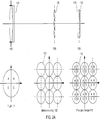
- FIG. 2A is a diagram illustrating plenoptic imaging when the pupil 117 and the micro-imaging array 120 are perfectly aligned with the detector array 130.
- the pupil 117 is circular and divided into four regions A-D, for example a circular lens used in conjunction with a four-quadrant filter array.
- the micro-imaging array 120 is a 3x3 array of microlenses 121.
- the micro-imaging array 120 is defined by the center of each microlens, in addition to the clear aperture for each microlens.
- the microlenses are perfectly aligned so that their centers lie on a square grid, as shown by the dashed lines.
- the resulting plenoptic image 175 is a 3x3 array of superpixels 170 of the pupil (i.e., superpixels). Magnification and inversion are ignored for clarity.
- the center of each image 170 lies on a square grid determined by the square grid defining the centers of the microlenses.
- the thick x and y axes in FIG. 2A show the local coordinate systems as defined relative to the detector array.
- the thick x and y axes show the position of the plenoptic image 175 relative to the detector array.
- the alignment of the plenoptic image 175 with the detector array 130 determines which detectors correspond to which superpixels and subpixels. In FIG. 2A , the plenoptic image 175 is perfectly aligned with the detector array.
- FIG. 2B is a diagram illustrating the effect of a misaligned micro-imaging array 120.
- the thick x and y axes show the original aligned positions of the components.
- the micro-imaging array 120 is rotated. This rotates the square grid that defines the location of each image 170 in the plenoptic image. However, each image 170 is not itself rotated (assuming that the microlenses themselves are rotationally symmetric). That is, each image 170 is translated to a new location due to the rotation of the underlying square grid. The rotation may be due to, e.g., a misalignment of the microlenses 121 during manufacturing. Whatever the cause, the rotation affects the perfect square grid of FIG. 2A . The new centers of the microlenses define a new grid.
- calibration typically includes determining a rotation of the plenoptic image relative to the detector array 130. Determining the rotation is important, because if it is not accounted for errors in view extraction occur. Calibration also mainly includes determining a pitch (i.e., size) of the superpixels relative to the detector array 130.
- the imaging plenoptic system 100 performs super resolution techniques on the extracted views. Accordingly, it is important to have accurate pitch as it affects the super resolution techniques. Rotation and pitch can be affected by positioning of the microlens array 120 relative to the detector array 130, but can also be affected by other factors, for example a change in focus setting. Also, since super resolution techniques are to be applied, it is imperative for the pitch to have a high granularity in terms of subpixel. Hence it becomes very important to find the exact pitch and represent it in non-integer pixel terms.
- FIG. 3 is a flow diagram of one method for calibrating a plenoptic imaging system 100.
- the process of FIG. 3 is performed by the plenoptic imaging system 100 (e.g., via the processing module 180).
- Other modules may perform some or all of the steps of the process in other embodiments.
- embodiments may include different and/or additional steps, or perform the steps in different orders.
- the plenoptic imaging system 100 captures 310 a reference plenoptic image.
- the plenoptic imaging system images an object (e.g., a white card that when imaged fills the detector array 130) that is uniformly illuminated to create the reference plenoptic image.
- object e.g., a white card that when imaged fills the detector array 130
- each microlens 121 forms an image or superpixel 170 of the pupil 117 at the detector plane 135.
- a reference plenoptic image generated in the manner described above is a two-dimensional array of images or superpixels, one for each microlens 121.
- Different one-dimensional slices can be taken through the reference two-dimensional plenoptic image.
- a slice is a row of raw sensor data which has been upscaled based on the precision requirement for the pitch (e.g., 8x, 16x upscale). Again, the slice with the highest spectral power is selected.
- the selected slice is used to determine 330 the pitch and rotation of that portion of the plenoptic image relative to the detector array 130.
- the pitch is determined based on a fundamental frequency of the Fourier transform of the selected slice. For example, pitch may be determined by dividing a fundamental frequency associated with the highest spectral power by a size of the sample. In some embodiments, the size of the sample takes into account spectral leakage.
- the rotation is determined based on the rotation of the selected slice.
- the rest of the plenoptic image may be assumed to have the same pitch and rotation.
- the process may be repeated 340 for different locations in the plenoptic image (i.e., different rows of superpixels) to determine the pitch and rotation for each location.
- the slice is for a row that spans the entire plenoptic image
- it may be assumed that the pitch and rotation are constant across the entire row.
- a different pitch and rotation may be determined for each of the multiple slices (i.e., a piecewise solution). Interpolation can also be used when there are multiple sample points.
- Pitch may also be determined for different directions. The pitch in x and y are different due to hexagonal packing but the other pitch can be determined using simple geometry.
- identifying a slice typically uses two or more variables: offset of the slice, rotation of the slice, possibly length of the slice. These variables can be optimized separately or together. For example, FIG. 4 first selects offset and then rotation. In an alternate approach, both of these variables may be optimized together.
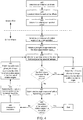
- FIG. 4 is a flow diagram of an embodiment for selecting 320 a slice, as discussed in FIG. 3 .
- the process of FIG. 4 is performed by the plenoptic imaging system 100 (e.g., via the processing module 180).
- Other modules may perform some or all of the steps of the process in other embodiments.
- embodiments may include different and/or additional steps, or perform the steps in different orders.
- the data values for data provided in FIG. 4 are just examples, and that the data values are for a particular main lens (e.g., optical module 105) and camera sensor (e.g., detector array 130). If some other main lens with a different focal value and/or other camera sensor is used the data values may differ.
- the process shown in FIG. 4 can be divided into two phases.
- the first phase includes steps lower than 410.
- This phase considers slices at different offsets within a row of superpixels.
- the slices are parallel to each other and span the row of superpixels.
- the one-dimensional slices are first defined 402 and then constructed 405.
- the slice with the highest spectral power (e.g., a stronger fundamental component compared to other slices) is selected 407.
- the second phase includes steps 410 and higher.
- the reference plenoptic image is rotated to different angles relative to the slice selected in the first phase and the best rotation angle is selected.
- An initial set of rotation angles at an initial resolution is determined 410.
- the initial set of rotation angles bracket zero radians and are at the initial resolution.
- the initial resolution controls the separation between adjacent rotation angles.
- an initial resolution may be 0.001 radians, and the set of rotations angles maybe [-0.010, -0.009, ... 0.000 ... 0.009,0.010].
- the size of the bracket is 21 rotation angles. In other embodiments, the size of the bracket and/or the initial resolution may be larger or smaller.
- the reference plenoptic image is rotated 412 relative to the slice to a first rotation angle.
- the slice samples different portions of the plenoptic reference image. Accordingly, each rotation angle corresponds to a slice sampling a different portion of the plenoptic reference image.
- the spectral power of the slice is determined 415 and adjusted for spectral leakage. This is done by taking a Discrete Fourier Transform (DFT) of the slice, and determining the spectral power of the slice using the output of the DFT.
- DFT Discrete Fourier Transform
- the DFT of the slice results in a slight smearing of the output in the frequency spectrum.
- Spectral leakage is essentially unwanted frequency components that are introduced into the output of the DFT because the slice is finite in length.
- the frequency components generally manifest as sudden frequency jumps or some other high frequency phenomena which can mask the desired frequency components.
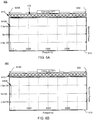
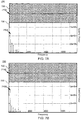
- Spectral leakage is adjusted by performing a spectral hunt - as illustrated below with regard to FIGS. 6A-6D .
- a spectral power e.g., using a DFT of the slice
- the correct frequency components e.g., those corresponding to pitch of the micro-lenses
- a start point corresponding to the start of the slice and an end point corresponding to an end of the slice are determined.
- a spectral power for the slice inclusive of the start point and end point is determined.
- the start point is shifted by one pixel towards the end point, in effect dropping the previous start point from the slice, and the spectral power for the now slightly smaller slice is determined.
- This process of shifting the start point and determining a spectral power of the increasingly truncated slice is repeated until a threshold number of pixels have been dropped. Accordingly, a plurality of spectrum power are generated that each correspond to different sizes of the slice.
- the threshold number of pixels are such that the dropped portion of the slice spans two adjacent superpixels.
- a spectral power, of the plurality of spectral powers, that has the highest spectral power of frequency components is selected, which correspond to the pitch of the plenoptic image.
- step 420 determines whether spectral powers have been determined for all the rotation angles in the initial set of rotation angles. If not, the reference plenoptic image is rotated 425 relative to the slice to a different rotation angle. Continuing with the example above, the plenoptic image may be rotated such that it is at -.009 radians relative to the slice selected in the first phase. The process flow then moves to step 415 and determines a spectral power of the slice at the different rotation angle. The process continues such that spectral powers are determined for the slice at all the rotation angles in the set of rotation angles. Note, that in this embodiment, the determined spectral powers all have been adjusted for spectral leakage. In alternate embodiments, the calibration module does not adjust the spectral power of spectral leakage.
- a rotation angle that is associated with a highest spectral power is selected 430.
- the rotation angle with the highest spectral power, of the initial set of rotation angles may be -0.006 radians, which would then be selected (see Table 1 below).
- Step 435 determines whether the resolution of the selected rotation angle is greater than or equal to a threshold value.
- the threshold value determines how precisely the angle of rotation is determined. For example, a threshold value might be 0.00001 radians. If the resolution of the selected rotation angle is greater than or equal to the threshold value, the process ends. Otherwise, if the resolution of the selected rotation angle is less than the threshold value, the resolution is increased 440, for example by a factor of 10. Continuing with the example, above, the resolution would now be 0.0001 radians instead of 0.001 radians.
- Step 445 determines a finer set of rotation angles at the increased resolution.
- the finer set of rotation angles bracket the previously selected rotation angle (selected at step 430).
- the calibration module would bracket -0.006 radians (i.e., the previously selected rotation angle) by rotation angles at the increased resolution of 0.0001 radians.
- the finer set of rotations angles may be [-0.0070, -0.0069, ... -0.0060 ..., -0.0051, -0.0050].
- the reference plenoptic image is rotated 450 relative to the slice to a first rotation angle of the finer set of rotation angles.
- the plenoptic image may be rotated such that it is at -0.0070 radians relative to the slice selected in the first phase.
- the process flow then moves to step 415, and via steps 415, 420, 425, 430, and 435 determines spectral powers for the slice at each rotation angle of the finer set of rotation angles and selects 430 a rotation angle of the finer set of rotation angles with the highest adjusted power.
- a rotation angle of -0.0063 radians may have the highest adjusted spectral power.
- step 435 determines whether the resolution of the selected rotation angle is greater than or equal to a threshold value, and if the resolution of the selected rotation angle is still less than the threshold value, the process flow would move to step 440. In this manner, the calibration process is able to rapidly identify a rotation angle to very fine degree in an iterative manner.
- the process ends and moves to step 330 of FIG. 3 .
- Table 1 illustrates the results of steps 410-450 to select a rotation angle with the highest spectral power for a particular reference image for a particular main lens (e.g., optical module 105) and camera sensor (e.g., detector array 130). If a main lens with other focal values and/or other camera sensors are used the values may differ.
- main lens e.g., optical module 105
- camera sensor e.g., detector array 130
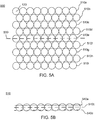
- FIGs. 5A and 5B illustrate the first phase of FIG. 4 .
- FIG. 5A is a diagram illustrating an example reference plenoptic image 500.
- the micro imaging array 120 is a 9 x 9 array of hexagonally-packed microlenses 121.
- the reference plenoptic image 500 includes a 9 x 9 array of hexagonally-packed superpixels 170.
- the 9 x 9 array is comprised of 9 rows 510a-i that each includes nine superpixels for each of the corresponding microlenses in the micro-imaging array 120.
- the first phase of FIG. 4 finds a slice 530 of the reference plenoptic image 500 whose Fourier transform has the highest spectral power in the reference plenoptic image.
- FIG. 5B is a diagram illustrating slice offset using a row 510 of superpixels 170 from the reference plenoptic image 500 in FIG. 5A .
- the spectral power of a slice varies with its offset within a row.
- the reference plenoptic image 500 is a mostly periodic array of superpixels 170 of the pupil 117.
- the offset of a slice through a row 510 of superpixels 170 affects the spectral power associated with the slice.
- the row 510 may include a slice 540a through a top portion of the row 510, a slice 540b through the middle of the row 510, and a slice 540c through a bottom portion of the row 510.
- the spectral power of the slices 540a, 540b, and 540c are all different from each other, and for the row 510 there is one slice that has a higher spectral power than other slices within the row 510.
- the slice 540b may have the highest spectral power.
- slices may span the row 510 or a portion thereof at a non-zero angle relative to the row (e.g., if a slice is rotated relative to the row 510).
- FIG. 6B is a diagram 660 illustrating a spectral power of the slice 610 of FIG. 6A with 'x' pixels dropped.
- This DFT of the slice 610 is calculated from a start point 620B to the end point 630.
- the difference between the start point 620A and the start point 620B are 'x' pixels have been dropped from the slice 610.
- the spectral component 640B has a higher spectral component than 640A.
- FIG. 6C is a diagram 670 illustrating a maximum spectral power for the slice 610 of FIG. 6A with 'n' pixels dropped.
- the DFT of the slice 610 is calculated from a start point 620C to the end point 630.
- the difference between the start point 610A and the start point 610C are 'n' pixels which have been dropped from the slice 610, and 'n' is greater than 'x.
- the spectral component 640C has a higher spectral component than 640A and 640B in FIG 6A and 6B .
- FIG. 6D is a diagram 680 illustrating a spectral power for the slice 610 of FIG. 6A with more than 'n' pixels dropped.
- the DFT of the slice 610 is calculated from a start point 620D to the end point 630.
- the difference between the start point 620A and the start point 620D is more than 'n' pixels.
- the spectral component 640D has a lower spectral component than 640C in FIG. 6C . Accordingly, in this example, spectral component 640C corresponds to the fundamental frequency.
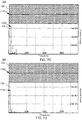
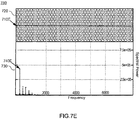
- FIGs. 7A-E illustrate how the spectral power of a slice varies with rotation angle.
- FIG. 7A is a diagram 700 illustrating a spectral power of a slice 710A of a portion 720 of the plenoptic reference image calculated at a rotation angle of -0.004 radians.
- the diagram 700 includes the portion 720 of the plenoptic reference image and a spectral power chart 730.
- the portion 720 is rotated with respect to the slice 710A by a rotation angle of -0.004 radians, and the size of the slice 710A is adjusted for spectral leakage as described previously.
- the chart 730 illustrates a dominant spectral component 740A at the rotation angle of -0.004 radians.
- FIG. 7B is a diagram 750 illustrating a spectral power of a slice 710B of the portion 720 of the plenoptic reference image calculated at a rotation angle of -0.005 radians.
- the portion 720 is rotated with respect to the slice 710B by a rotation angle of -0.005 radians.
- the chart 730 illustrates a dominant spectral component 740B at the rotation angle of -0.005 radians. Note, that the dominant spectral component 740B has a higher power than that of 740A in FIG. 7A .
- FIG. 7C is a diagram 760 illustrating a spectral power of a slice 710C of the portion 720 of the plenoptic reference image calculated at a rotation angle of -0.006 radians.
- the portion 720 is rotated with respect to the slice 710C by a rotation angle of -0.006 radians.
- the chart 730 illustrates a dominant spectral component 740C at the rotation angle of -0.006 radians. Note, that for this example the rotation angle of -0.006 radians results in the largest dominant spectral component 740C.
- FIGs. 7D and E illustrate how the power of the dominant component decreases as the rotation angle moves away from -0.006 radians.
- FIG. 7D is a diagram 770 illustrating a spectral power of a slice 710D of the portion 720 of the plenoptic reference image calculated at a rotation angle of -0.007 radians. The portion 720 is rotated with respect to the slice 710D by a rotation angle of -0.007 radians.
- the chart 730 illustrates a dominant spectral component 740D at the rotation angle of -0.007 radians. Additionally, FIG.
- FIG. 7E is a diagram 780 illustrating a spectral power of a slice 710E of the portion 720 of the plenoptic reference image calculated at a rotation angle of -0.008 radians.
- the portion 720 is rotated with respect to the slice 710E by a rotation angle of -0.008 radians.
- the chart 730 illustrates a dominant spectral component 740E at the rotation angle of -0.008 radians. Note, that the dominant spectral component 740C in FIG. 7C has a higher power than that of 740C, 740D as well as 740A and 740B.
- One beneficial effect of the calibration processes discussed above with regard to FIGs. 3 and 4 is that they also account for any variation in effective pitch for a given focal length.
- rotation angle of the plenoptic image relative to the detector array 130 typically does not change with change in focus.
- a change in focus affects the angle of incident light which can affect the pitch determination.
- the plenoptic imaging system 100 performs the calibration described above with reference to FIGs. 3 and 4 , for different possible focus settings, and accordingly determines a pitch value for different focus settings.
- the plenoptic imaging system 100 is able to select the correct pitch value based on a given focus setting.
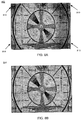
- FIG. 8A is an image 800 outputted by the plenoptic imaging system 100 that does not account for a change in pitch caused by focus setting. Note, the fading 810 in the periphery of the image.
- FIG. 8B is an image 850 outputted by the plenoptic imaging system 100 that does calibrate for a change in pitch caused by focus setting.
- the calibration of the plenoptic imaging system 100 described above may be performed by different entities and/or at different times.
- the calibration may be performed at the factory, by a user of the plenoptic imaging system 100 in the field, automatically performed by the plenoptic imaging device 100, etc.
- the plenoptic imaging system 100 may be configured to perform a calibration when a new image-forming optical module 105 is attached to the plenoptic imaging system 100.
- calibrating the alignment of the micro-imaging array 120 to the detector array 130 and calibrating the pitch of each microlens 121 in terms of sensor pixel size are both performed systematically (e.g., via processes described above with reference to FIGs. 3 and 4 ) for every plenoptic imaging system 100.
- plenoptic imaging system 100 should be recalibrated. In some embodiments calibrating the pitch parameters due to focus ring settings is performed once for a family of plenoptic imaging systems 100.
- calibration of the plenoptic imaging system 100 corrects view extraction and aids in super resolution techniques.
- calibration includes alignment of the micro-imaging array 120 with respect to the detector array 130 which corrects view extraction errors by accounting for incorrect views generated by the intermingling of views.
- calibrating the pitch of each microlens 121 in terms of sensor pixel size aids in super resolution techniques by taking advantage of sub-pixel data.
- calibrating the change in pitch parameters due to focus ring settings is to correct fading around the periphery of the image and/or other distortions to the image by accounting for the impact that change in focus of the lens has on the angle of light being captured.
- optical module can be used, including reflective and catadioptric systems.
- the optical module is preferably telecentric.
- terms such as "light” and “optical” are not meant to be limited to the visible or purely optical regions of the electromagnetic spectrum, but are meant to also include regions such as the ultraviolet and infrared (but not be limited to these).
- any reference to "one embodiment” or “an embodiment” means that a particular element, feature, structure, or characteristic described in connection with the embodiment is included in at least one embodiment.
- the appearances of the phrase “in one embodiment” in various places in the specification are not necessarily all referring to the same embodiment.
Landscapes
- Engineering & Computer Science (AREA)
- Multimedia (AREA)
- Signal Processing (AREA)
- Physics & Mathematics (AREA)
- General Physics & Mathematics (AREA)
- Computer Vision & Pattern Recognition (AREA)
- Theoretical Computer Science (AREA)
- Studio Devices (AREA)
- Image Processing (AREA)
- Spectrometry And Color Measurement (AREA)
Applications Claiming Priority (1)
| Application Number | Priority Date | Filing Date | Title |
|---|---|---|---|
| US14/638,907 US9613417B2 (en) | 2015-03-04 | 2015-03-04 | Calibration of plenoptic imaging systems using fourier transform |
Publications (2)
| Publication Number | Publication Date |
|---|---|
| EP3065106A1 true EP3065106A1 (de) | 2016-09-07 |
| EP3065106B1 EP3065106B1 (de) | 2018-08-22 |
Family
ID=55404594
Family Applications (1)
| Application Number | Title | Priority Date | Filing Date |
|---|---|---|---|
| EP16155951.3A Not-in-force EP3065106B1 (de) | 2015-03-04 | 2016-02-16 | Kalibrierung von plenoptischen abbildungssystemen mittels fourier-transformation |
Country Status (4)
| Country | Link |
|---|---|
| US (1) | US9613417B2 (de) |
| EP (1) | EP3065106B1 (de) |
| JP (1) | JP6112245B2 (de) |
| CN (1) | CN105939442B (de) |
Families Citing this family (10)
| Publication number | Priority date | Publication date | Assignee | Title |
|---|---|---|---|---|
| US10110869B2 (en) | 2017-03-08 | 2018-10-23 | Ricoh Company, Ltd. | Real-time color preview generation for plenoptic imaging systems |
| US10043289B1 (en) | 2017-03-08 | 2018-08-07 | Ricoh Company, Ltd. | Automatic centroid determination of microlens arrays in plenoptic imaging systems |
| US10304172B2 (en) * | 2017-06-01 | 2019-05-28 | Ricoh Company, Ltd. | Optical center detection in plenoptic imaging systems |
| US10332269B2 (en) | 2017-06-23 | 2019-06-25 | Ricoh Company, Ltd. | Color correction of preview images for plenoptic imaging systems |
| US10552942B2 (en) | 2017-09-08 | 2020-02-04 | Ricoh Company, Ltd. | Reducing color artifacts in plenoptic imaging systems |
| US10802117B2 (en) | 2018-01-24 | 2020-10-13 | Facebook Technologies, Llc | Systems and methods for optical demodulation in a depth-sensing device |
| US10735640B2 (en) | 2018-02-08 | 2020-08-04 | Facebook Technologies, Llc | Systems and methods for enhanced optical sensor devices |
| US10805594B2 (en) * | 2018-02-08 | 2020-10-13 | Facebook Technologies, Llc | Systems and methods for enhanced depth sensor devices |
| AU2019221088B2 (en) * | 2018-02-19 | 2024-11-21 | Queensland Eye Institute Foundation | Method and system for calibrating a plenoptic camera system |
| US11367220B1 (en) * | 2020-08-27 | 2022-06-21 | Edge 3 Technologies | Localization of lens focus parameter estimation and subsequent camera calibration |
Citations (4)
| Publication number | Priority date | Publication date | Assignee | Title |
|---|---|---|---|---|
| US8244058B1 (en) * | 2008-05-30 | 2012-08-14 | Adobe Systems Incorporated | Method and apparatus for managing artifacts in frequency domain processing of light-field images |
| US20130127901A1 (en) * | 2010-08-27 | 2013-05-23 | Todor G. Georgiev | Methods and Apparatus for Calibrating Focused Plenoptic Camera Data |
| EP2736262A2 (de) * | 2012-11-26 | 2014-05-28 | Ricoh Company, Ltd. | Kalibrierung von plenotpischem Abbildungssystem |
| US20140239071A1 (en) * | 2013-02-28 | 2014-08-28 | Hand Held Products, Inc. | Indicia reading terminals and methods for decoding decodable indicia employing light field imaging |
Family Cites Families (7)
| Publication number | Priority date | Publication date | Assignee | Title |
|---|---|---|---|---|
| US6987805B1 (en) * | 1999-09-24 | 2006-01-17 | Lsi Logic Corporation | Macroblock level intrarefresh technique for encoded video |
| CN101426085B (zh) * | 2004-10-01 | 2012-10-03 | 小利兰·斯坦福大学托管委员会 | 成像装置及其方法 |
| JP2012205014A (ja) * | 2011-03-24 | 2012-10-22 | Casio Comput Co Ltd | 撮像装置の製造装置及び製造方法、並びに撮像装置 |
| JP5882789B2 (ja) * | 2012-03-01 | 2016-03-09 | キヤノン株式会社 | 画像処理装置、画像処理方法、及びプログラム |
| FR2994735B1 (fr) * | 2012-08-22 | 2014-08-01 | Onera (Off Nat Aerospatiale) | Procede et dispositif d'imagerie telemetrique |
| JP6126474B2 (ja) * | 2013-06-28 | 2017-05-10 | キヤノン株式会社 | 撮像装置及びその制御方法 |
| US9538075B2 (en) * | 2013-12-30 | 2017-01-03 | Indiana University Research And Technology Corporation | Frequency domain processing techniques for plenoptic images |
-
2015
- 2015-03-04 US US14/638,907 patent/US9613417B2/en not_active Expired - Fee Related
-
2016
- 2016-02-16 EP EP16155951.3A patent/EP3065106B1/de not_active Not-in-force
- 2016-02-29 CN CN201610111899.3A patent/CN105939442B/zh not_active Expired - Fee Related
- 2016-03-03 JP JP2016041413A patent/JP6112245B2/ja not_active Expired - Fee Related
Patent Citations (4)
| Publication number | Priority date | Publication date | Assignee | Title |
|---|---|---|---|---|
| US8244058B1 (en) * | 2008-05-30 | 2012-08-14 | Adobe Systems Incorporated | Method and apparatus for managing artifacts in frequency domain processing of light-field images |
| US20130127901A1 (en) * | 2010-08-27 | 2013-05-23 | Todor G. Georgiev | Methods and Apparatus for Calibrating Focused Plenoptic Camera Data |
| EP2736262A2 (de) * | 2012-11-26 | 2014-05-28 | Ricoh Company, Ltd. | Kalibrierung von plenotpischem Abbildungssystem |
| US20140239071A1 (en) * | 2013-02-28 | 2014-08-28 | Hand Held Products, Inc. | Indicia reading terminals and methods for decoding decodable indicia employing light field imaging |
Non-Patent Citations (1)
| Title |
|---|
| GORDON WETZSTEIN ET AL: "Computational Plenoptic Imaging", COMPUTER GRAPHICS FORUM, vol. 30, no. 8, December 2011 (2011-12-01), pages 2397 - 2426, XP055016210, ISSN: 0167-7055, DOI: 10.1111/j.1467-8659.2011.02073.x * |
Also Published As
| Publication number | Publication date |
|---|---|
| CN105939442B (zh) | 2019-08-16 |
| JP2016174357A (ja) | 2016-09-29 |
| JP6112245B2 (ja) | 2017-04-12 |
| EP3065106B1 (de) | 2018-08-22 |
| CN105939442A (zh) | 2016-09-14 |
| US9613417B2 (en) | 2017-04-04 |
| US20160260205A1 (en) | 2016-09-08 |
Similar Documents
| Publication | Publication Date | Title |
|---|---|---|
| EP3065106B1 (de) | Kalibrierung von plenoptischen abbildungssystemen mittels fourier-transformation | |
| US10127682B2 (en) | System and methods for calibration of an array camera | |
| EP2398224B1 (de) | Abbildungsanordnungen und zugehörige Verfahren | |
| JP5929553B2 (ja) | 画像処理装置、撮像装置、画像処理方法およびプログラム | |
| EP2736262A2 (de) | Kalibrierung von plenotpischem Abbildungssystem | |
| US8976240B2 (en) | Spatially-varying spectral response calibration data | |
| CN105939443B (zh) | 一种用于产生物体的图像的光场成像系统和方法 | |
| JP6292327B2 (ja) | プレノプティック撮像システムの深度及び視差のマッピングを較正するための方法及びコンピュータプログラム | |
| US10043289B1 (en) | Automatic centroid determination of microlens arrays in plenoptic imaging systems | |
| Delley et al. | Fast full-field modulation transfer function analysis for photographic lens quality assessment | |
| CN110443750B (zh) | 检测视频序列中的运动的方法 | |
| EP2306397A1 (de) | Verfahren und System zur Optimierung der Linsenaberrationserkennung | |
| US10552942B2 (en) | Reducing color artifacts in plenoptic imaging systems | |
| HK1163996B (en) | Imaging arrangements and methods therefor |
Legal Events
| Date | Code | Title | Description |
|---|---|---|---|
| PUAI | Public reference made under article 153(3) epc to a published international application that has entered the european phase |
Free format text: ORIGINAL CODE: 0009012 |
|
| 17P | Request for examination filed |
Effective date: 20160216 |
|
| AK | Designated contracting states |
Kind code of ref document: A1 Designated state(s): AL AT BE BG CH CY CZ DE DK EE ES FI FR GB GR HR HU IE IS IT LI LT LU LV MC MK MT NL NO PL PT RO RS SE SI SK SM TR |
|
| AX | Request for extension of the european patent |
Extension state: BA ME |
|
| REG | Reference to a national code |
Ref country code: DE Ref legal event code: R079 Ref document number: 602016004867 Country of ref document: DE Free format text: PREVIOUS MAIN CLASS: G06T0007000000 Ipc: G06T0007800000 |
|
| RIC1 | Information provided on ipc code assigned before grant |
Ipc: G06T 7/80 20170101AFI20180206BHEP |
|
| GRAP | Despatch of communication of intention to grant a patent |
Free format text: ORIGINAL CODE: EPIDOSNIGR1 |
|
| STAA | Information on the status of an ep patent application or granted ep patent |
Free format text: STATUS: GRANT OF PATENT IS INTENDED |
|
| INTG | Intention to grant announced |
Effective date: 20180321 |
|
| GRAS | Grant fee paid |
Free format text: ORIGINAL CODE: EPIDOSNIGR3 |
|
| GRAA | (expected) grant |
Free format text: ORIGINAL CODE: 0009210 |
|
| STAA | Information on the status of an ep patent application or granted ep patent |
Free format text: STATUS: THE PATENT HAS BEEN GRANTED |
|
| AK | Designated contracting states |
Kind code of ref document: B1 Designated state(s): AL AT BE BG CH CY CZ DE DK EE ES FI FR GB GR HR HU IE IS IT LI LT LU LV MC MK MT NL NO PL PT RO RS SE SI SK SM TR |
|
| REG | Reference to a national code |
Ref country code: GB Ref legal event code: FG4D |
|
| REG | Reference to a national code |
Ref country code: CH Ref legal event code: EP |
|
| REG | Reference to a national code |
Ref country code: AT Ref legal event code: REF Ref document number: 1033363 Country of ref document: AT Kind code of ref document: T Effective date: 20180915 |
|
| REG | Reference to a national code |
Ref country code: IE Ref legal event code: FG4D |
|
| REG | Reference to a national code |
Ref country code: DE Ref legal event code: R096 Ref document number: 602016004867 Country of ref document: DE |
|
| REG | Reference to a national code |
Ref country code: NL Ref legal event code: MP Effective date: 20180822 |
|
| REG | Reference to a national code |
Ref country code: LT Ref legal event code: MG4D |
|
| PG25 | Lapsed in a contracting state [announced via postgrant information from national office to epo] |
Ref country code: FI Free format text: LAPSE BECAUSE OF FAILURE TO SUBMIT A TRANSLATION OF THE DESCRIPTION OR TO PAY THE FEE WITHIN THE PRESCRIBED TIME-LIMIT Effective date: 20180822 Ref country code: LT Free format text: LAPSE BECAUSE OF FAILURE TO SUBMIT A TRANSLATION OF THE DESCRIPTION OR TO PAY THE FEE WITHIN THE PRESCRIBED TIME-LIMIT Effective date: 20180822 Ref country code: SE Free format text: LAPSE BECAUSE OF FAILURE TO SUBMIT A TRANSLATION OF THE DESCRIPTION OR TO PAY THE FEE WITHIN THE PRESCRIBED TIME-LIMIT Effective date: 20180822 Ref country code: BG Free format text: LAPSE BECAUSE OF FAILURE TO SUBMIT A TRANSLATION OF THE DESCRIPTION OR TO PAY THE FEE WITHIN THE PRESCRIBED TIME-LIMIT Effective date: 20181122 Ref country code: GR Free format text: LAPSE BECAUSE OF FAILURE TO SUBMIT A TRANSLATION OF THE DESCRIPTION OR TO PAY THE FEE WITHIN THE PRESCRIBED TIME-LIMIT Effective date: 20181123 Ref country code: RS Free format text: LAPSE BECAUSE OF FAILURE TO SUBMIT A TRANSLATION OF THE DESCRIPTION OR TO PAY THE FEE WITHIN THE PRESCRIBED TIME-LIMIT Effective date: 20180822 Ref country code: NL Free format text: LAPSE BECAUSE OF FAILURE TO SUBMIT A TRANSLATION OF THE DESCRIPTION OR TO PAY THE FEE WITHIN THE PRESCRIBED TIME-LIMIT Effective date: 20180822 Ref country code: NO Free format text: LAPSE BECAUSE OF FAILURE TO SUBMIT A TRANSLATION OF THE DESCRIPTION OR TO PAY THE FEE WITHIN THE PRESCRIBED TIME-LIMIT Effective date: 20181122 Ref country code: IS Free format text: LAPSE BECAUSE OF FAILURE TO SUBMIT A TRANSLATION OF THE DESCRIPTION OR TO PAY THE FEE WITHIN THE PRESCRIBED TIME-LIMIT Effective date: 20181222 |
|
| REG | Reference to a national code |
Ref country code: AT Ref legal event code: MK05 Ref document number: 1033363 Country of ref document: AT Kind code of ref document: T Effective date: 20180822 |
|
| PG25 | Lapsed in a contracting state [announced via postgrant information from national office to epo] |
Ref country code: LV Free format text: LAPSE BECAUSE OF FAILURE TO SUBMIT A TRANSLATION OF THE DESCRIPTION OR TO PAY THE FEE WITHIN THE PRESCRIBED TIME-LIMIT Effective date: 20180822 Ref country code: HR Free format text: LAPSE BECAUSE OF FAILURE TO SUBMIT A TRANSLATION OF THE DESCRIPTION OR TO PAY THE FEE WITHIN THE PRESCRIBED TIME-LIMIT Effective date: 20180822 Ref country code: AL Free format text: LAPSE BECAUSE OF FAILURE TO SUBMIT A TRANSLATION OF THE DESCRIPTION OR TO PAY THE FEE WITHIN THE PRESCRIBED TIME-LIMIT Effective date: 20180822 |
|
| PG25 | Lapsed in a contracting state [announced via postgrant information from national office to epo] |
Ref country code: ES Free format text: LAPSE BECAUSE OF FAILURE TO SUBMIT A TRANSLATION OF THE DESCRIPTION OR TO PAY THE FEE WITHIN THE PRESCRIBED TIME-LIMIT Effective date: 20180822 Ref country code: CZ Free format text: LAPSE BECAUSE OF FAILURE TO SUBMIT A TRANSLATION OF THE DESCRIPTION OR TO PAY THE FEE WITHIN THE PRESCRIBED TIME-LIMIT Effective date: 20180822 Ref country code: IT Free format text: LAPSE BECAUSE OF FAILURE TO SUBMIT A TRANSLATION OF THE DESCRIPTION OR TO PAY THE FEE WITHIN THE PRESCRIBED TIME-LIMIT Effective date: 20180822 Ref country code: EE Free format text: LAPSE BECAUSE OF FAILURE TO SUBMIT A TRANSLATION OF THE DESCRIPTION OR TO PAY THE FEE WITHIN THE PRESCRIBED TIME-LIMIT Effective date: 20180822 Ref country code: AT Free format text: LAPSE BECAUSE OF FAILURE TO SUBMIT A TRANSLATION OF THE DESCRIPTION OR TO PAY THE FEE WITHIN THE PRESCRIBED TIME-LIMIT Effective date: 20180822 Ref country code: RO Free format text: LAPSE BECAUSE OF FAILURE TO SUBMIT A TRANSLATION OF THE DESCRIPTION OR TO PAY THE FEE WITHIN THE PRESCRIBED TIME-LIMIT Effective date: 20180822 Ref country code: PL Free format text: LAPSE BECAUSE OF FAILURE TO SUBMIT A TRANSLATION OF THE DESCRIPTION OR TO PAY THE FEE WITHIN THE PRESCRIBED TIME-LIMIT Effective date: 20180822 |
|
| PGFP | Annual fee paid to national office [announced via postgrant information from national office to epo] |
Ref country code: DE Payment date: 20190219 Year of fee payment: 4 |
|
| REG | Reference to a national code |
Ref country code: DE Ref legal event code: R097 Ref document number: 602016004867 Country of ref document: DE |
|
| PG25 | Lapsed in a contracting state [announced via postgrant information from national office to epo] |
Ref country code: DK Free format text: LAPSE BECAUSE OF FAILURE TO SUBMIT A TRANSLATION OF THE DESCRIPTION OR TO PAY THE FEE WITHIN THE PRESCRIBED TIME-LIMIT Effective date: 20180822 Ref country code: SK Free format text: LAPSE BECAUSE OF FAILURE TO SUBMIT A TRANSLATION OF THE DESCRIPTION OR TO PAY THE FEE WITHIN THE PRESCRIBED TIME-LIMIT Effective date: 20180822 Ref country code: SM Free format text: LAPSE BECAUSE OF FAILURE TO SUBMIT A TRANSLATION OF THE DESCRIPTION OR TO PAY THE FEE WITHIN THE PRESCRIBED TIME-LIMIT Effective date: 20180822 |
|
| PGFP | Annual fee paid to national office [announced via postgrant information from national office to epo] |
Ref country code: FR Payment date: 20190220 Year of fee payment: 4 |
|
| PLBE | No opposition filed within time limit |
Free format text: ORIGINAL CODE: 0009261 |
|
| STAA | Information on the status of an ep patent application or granted ep patent |
Free format text: STATUS: NO OPPOSITION FILED WITHIN TIME LIMIT |
|
| 26N | No opposition filed |
Effective date: 20190523 |
|
| PG25 | Lapsed in a contracting state [announced via postgrant information from national office to epo] |
Ref country code: SI Free format text: LAPSE BECAUSE OF FAILURE TO SUBMIT A TRANSLATION OF THE DESCRIPTION OR TO PAY THE FEE WITHIN THE PRESCRIBED TIME-LIMIT Effective date: 20180822 |
|
| REG | Reference to a national code |
Ref country code: CH Ref legal event code: PL |
|
| PG25 | Lapsed in a contracting state [announced via postgrant information from national office to epo] |
Ref country code: MC Free format text: LAPSE BECAUSE OF FAILURE TO SUBMIT A TRANSLATION OF THE DESCRIPTION OR TO PAY THE FEE WITHIN THE PRESCRIBED TIME-LIMIT Effective date: 20180822 Ref country code: LU Free format text: LAPSE BECAUSE OF NON-PAYMENT OF DUE FEES Effective date: 20190216 |
|
| REG | Reference to a national code |
Ref country code: BE Ref legal event code: MM Effective date: 20190228 |
|
| REG | Reference to a national code |
Ref country code: IE Ref legal event code: MM4A |
|
| PG25 | Lapsed in a contracting state [announced via postgrant information from national office to epo] |
Ref country code: CH Free format text: LAPSE BECAUSE OF NON-PAYMENT OF DUE FEES Effective date: 20190228 Ref country code: LI Free format text: LAPSE BECAUSE OF NON-PAYMENT OF DUE FEES Effective date: 20190228 |
|
| PG25 | Lapsed in a contracting state [announced via postgrant information from national office to epo] |
Ref country code: IE Free format text: LAPSE BECAUSE OF NON-PAYMENT OF DUE FEES Effective date: 20190216 |
|
| PG25 | Lapsed in a contracting state [announced via postgrant information from national office to epo] |
Ref country code: BE Free format text: LAPSE BECAUSE OF NON-PAYMENT OF DUE FEES Effective date: 20190228 |
|
| PG25 | Lapsed in a contracting state [announced via postgrant information from national office to epo] |
Ref country code: TR Free format text: LAPSE BECAUSE OF FAILURE TO SUBMIT A TRANSLATION OF THE DESCRIPTION OR TO PAY THE FEE WITHIN THE PRESCRIBED TIME-LIMIT Effective date: 20180822 |
|
| PG25 | Lapsed in a contracting state [announced via postgrant information from national office to epo] |
Ref country code: PT Free format text: LAPSE BECAUSE OF FAILURE TO SUBMIT A TRANSLATION OF THE DESCRIPTION OR TO PAY THE FEE WITHIN THE PRESCRIBED TIME-LIMIT Effective date: 20181222 Ref country code: MT Free format text: LAPSE BECAUSE OF NON-PAYMENT OF DUE FEES Effective date: 20190216 |
|
| REG | Reference to a national code |
Ref country code: DE Ref legal event code: R119 Ref document number: 602016004867 Country of ref document: DE |
|
| GBPC | Gb: european patent ceased through non-payment of renewal fee |
Effective date: 20200216 |
|
| PG25 | Lapsed in a contracting state [announced via postgrant information from national office to epo] |
Ref country code: FR Free format text: LAPSE BECAUSE OF NON-PAYMENT OF DUE FEES Effective date: 20200229 Ref country code: DE Free format text: LAPSE BECAUSE OF NON-PAYMENT OF DUE FEES Effective date: 20200901 Ref country code: GB Free format text: LAPSE BECAUSE OF NON-PAYMENT OF DUE FEES Effective date: 20200216 |
|
| PG25 | Lapsed in a contracting state [announced via postgrant information from national office to epo] |
Ref country code: CY Free format text: LAPSE BECAUSE OF FAILURE TO SUBMIT A TRANSLATION OF THE DESCRIPTION OR TO PAY THE FEE WITHIN THE PRESCRIBED TIME-LIMIT Effective date: 20180822 |
|
| PG25 | Lapsed in a contracting state [announced via postgrant information from national office to epo] |
Ref country code: HU Free format text: LAPSE BECAUSE OF FAILURE TO SUBMIT A TRANSLATION OF THE DESCRIPTION OR TO PAY THE FEE WITHIN THE PRESCRIBED TIME-LIMIT; INVALID AB INITIO Effective date: 20160216 |
|
| PG25 | Lapsed in a contracting state [announced via postgrant information from national office to epo] |
Ref country code: MK Free format text: LAPSE BECAUSE OF FAILURE TO SUBMIT A TRANSLATION OF THE DESCRIPTION OR TO PAY THE FEE WITHIN THE PRESCRIBED TIME-LIMIT Effective date: 20180822 |