EP3065207A1 - Verfahren zur herstellung eines anodenaktivmaterials und damit hergestelltes anodenaktivmaterial für eine lithiumsekundärbatterie - Google Patents
Verfahren zur herstellung eines anodenaktivmaterials und damit hergestelltes anodenaktivmaterial für eine lithiumsekundärbatterie Download PDFInfo
- Publication number
- EP3065207A1 EP3065207A1 EP14854871.2A EP14854871A EP3065207A1 EP 3065207 A1 EP3065207 A1 EP 3065207A1 EP 14854871 A EP14854871 A EP 14854871A EP 3065207 A1 EP3065207 A1 EP 3065207A1
- Authority
- EP
- European Patent Office
- Prior art keywords
- lithium
- active material
- cathode active
- transition metal
- metal oxide
- Prior art date
- Legal status (The legal status is an assumption and is not a legal conclusion. Google has not performed a legal analysis and makes no representation as to the accuracy of the status listed.)
- Granted
Links
Images

Classifications
-
- H—ELECTRICITY
- H01—ELECTRIC ELEMENTS
- H01M—PROCESSES OR MEANS, e.g. BATTERIES, FOR THE DIRECT CONVERSION OF CHEMICAL ENERGY INTO ELECTRICAL ENERGY
- H01M4/00—Electrodes
- H01M4/02—Electrodes composed of, or comprising, active material
- H01M4/36—Selection of substances as active materials, active masses, active liquids
- H01M4/362—Composites
- H01M4/366—Composites as layered products
-
- H—ELECTRICITY
- H01—ELECTRIC ELEMENTS
- H01M—PROCESSES OR MEANS, e.g. BATTERIES, FOR THE DIRECT CONVERSION OF CHEMICAL ENERGY INTO ELECTRICAL ENERGY
- H01M4/00—Electrodes
- H01M4/02—Electrodes composed of, or comprising, active material
- H01M4/04—Processes of manufacture in general
- H01M4/0402—Methods of deposition of the material
-
- H—ELECTRICITY
- H01—ELECTRIC ELEMENTS
- H01M—PROCESSES OR MEANS, e.g. BATTERIES, FOR THE DIRECT CONVERSION OF CHEMICAL ENERGY INTO ELECTRICAL ENERGY
- H01M4/00—Electrodes
- H01M4/02—Electrodes composed of, or comprising, active material
- H01M4/04—Processes of manufacture in general
- H01M4/0471—Processes of manufacture in general involving thermal treatment, e.g. firing, sintering, backing particulate active material, thermal decomposition, pyrolysis
-
- H—ELECTRICITY
- H01—ELECTRIC ELEMENTS
- H01M—PROCESSES OR MEANS, e.g. BATTERIES, FOR THE DIRECT CONVERSION OF CHEMICAL ENERGY INTO ELECTRICAL ENERGY
- H01M4/00—Electrodes
- H01M4/02—Electrodes composed of, or comprising, active material
- H01M4/04—Processes of manufacture in general
- H01M4/049—Manufacturing of an active layer by chemical means
- H01M4/0497—Chemical precipitation
-
- H—ELECTRICITY
- H01—ELECTRIC ELEMENTS
- H01M—PROCESSES OR MEANS, e.g. BATTERIES, FOR THE DIRECT CONVERSION OF CHEMICAL ENERGY INTO ELECTRICAL ENERGY
- H01M4/00—Electrodes
- H01M4/02—Electrodes composed of, or comprising, active material
- H01M4/13—Electrodes for accumulators with non-aqueous electrolyte, e.g. for lithium-accumulators; Processes of manufacture thereof
- H01M4/131—Electrodes based on mixed oxides or hydroxides, or on mixtures of oxides or hydroxides, e.g. LiCoOx
-
- H—ELECTRICITY
- H01—ELECTRIC ELEMENTS
- H01M—PROCESSES OR MEANS, e.g. BATTERIES, FOR THE DIRECT CONVERSION OF CHEMICAL ENERGY INTO ELECTRICAL ENERGY
- H01M4/00—Electrodes
- H01M4/02—Electrodes composed of, or comprising, active material
- H01M4/13—Electrodes for accumulators with non-aqueous electrolyte, e.g. for lithium-accumulators; Processes of manufacture thereof
- H01M4/139—Processes of manufacture
- H01M4/1391—Processes of manufacture of electrodes based on mixed oxides or hydroxides, or on mixtures of oxides or hydroxides, e.g. LiCoOx
-
- H—ELECTRICITY
- H01—ELECTRIC ELEMENTS
- H01M—PROCESSES OR MEANS, e.g. BATTERIES, FOR THE DIRECT CONVERSION OF CHEMICAL ENERGY INTO ELECTRICAL ENERGY
- H01M4/00—Electrodes
- H01M4/02—Electrodes composed of, or comprising, active material
- H01M4/36—Selection of substances as active materials, active masses, active liquids
- H01M4/48—Selection of substances as active materials, active masses, active liquids of inorganic oxides or hydroxides
-
- H—ELECTRICITY
- H01—ELECTRIC ELEMENTS
- H01M—PROCESSES OR MEANS, e.g. BATTERIES, FOR THE DIRECT CONVERSION OF CHEMICAL ENERGY INTO ELECTRICAL ENERGY
- H01M4/00—Electrodes
- H01M4/02—Electrodes composed of, or comprising, active material
- H01M4/36—Selection of substances as active materials, active masses, active liquids
- H01M4/48—Selection of substances as active materials, active masses, active liquids of inorganic oxides or hydroxides
- H01M4/485—Selection of substances as active materials, active masses, active liquids of inorganic oxides or hydroxides of mixed oxides or hydroxides for inserting or intercalating light metals, e.g. LiTi2O4 or LiTi2OxFy
-
- H—ELECTRICITY
- H01—ELECTRIC ELEMENTS
- H01M—PROCESSES OR MEANS, e.g. BATTERIES, FOR THE DIRECT CONVERSION OF CHEMICAL ENERGY INTO ELECTRICAL ENERGY
- H01M4/00—Electrodes
- H01M4/02—Electrodes composed of, or comprising, active material
- H01M4/36—Selection of substances as active materials, active masses, active liquids
- H01M4/48—Selection of substances as active materials, active masses, active liquids of inorganic oxides or hydroxides
- H01M4/50—Selection of substances as active materials, active masses, active liquids of inorganic oxides or hydroxides of manganese
- H01M4/505—Selection of substances as active materials, active masses, active liquids of inorganic oxides or hydroxides of manganese of mixed oxides or hydroxides containing manganese for inserting or intercalating light metals, e.g. LiMn2O4 or LiMn2OxFy
-
- H—ELECTRICITY
- H01—ELECTRIC ELEMENTS
- H01M—PROCESSES OR MEANS, e.g. BATTERIES, FOR THE DIRECT CONVERSION OF CHEMICAL ENERGY INTO ELECTRICAL ENERGY
- H01M4/00—Electrodes
- H01M4/02—Electrodes composed of, or comprising, active material
- H01M4/36—Selection of substances as active materials, active masses, active liquids
- H01M4/48—Selection of substances as active materials, active masses, active liquids of inorganic oxides or hydroxides
- H01M4/52—Selection of substances as active materials, active masses, active liquids of inorganic oxides or hydroxides of nickel, cobalt or iron
- H01M4/525—Selection of substances as active materials, active masses, active liquids of inorganic oxides or hydroxides of nickel, cobalt or iron of mixed oxides or hydroxides containing iron, cobalt or nickel for inserting or intercalating light metals, e.g. LiNiO2, LiCoO2 or LiCoOxFy
-
- H—ELECTRICITY
- H01—ELECTRIC ELEMENTS
- H01M—PROCESSES OR MEANS, e.g. BATTERIES, FOR THE DIRECT CONVERSION OF CHEMICAL ENERGY INTO ELECTRICAL ENERGY
- H01M4/00—Electrodes
- H01M4/02—Electrodes composed of, or comprising, active material
- H01M4/36—Selection of substances as active materials, active masses, active liquids
- H01M4/58—Selection of substances as active materials, active masses, active liquids of inorganic compounds other than oxides or hydroxides, e.g. sulfides, selenides, tellurides, halogenides or LiCoFy; of polyanionic structures, e.g. phosphates, silicates or borates
- H01M4/5825—Oxygenated metallic salts or polyanionic structures, e.g. borates, phosphates, silicates, olivines
-
- H—ELECTRICITY
- H01—ELECTRIC ELEMENTS
- H01M—PROCESSES OR MEANS, e.g. BATTERIES, FOR THE DIRECT CONVERSION OF CHEMICAL ENERGY INTO ELECTRICAL ENERGY
- H01M4/00—Electrodes
- H01M4/02—Electrodes composed of, or comprising, active material
- H01M4/62—Selection of inactive substances as ingredients for active masses, e.g. binders, fillers
-
- C—CHEMISTRY; METALLURGY
- C01—INORGANIC CHEMISTRY
- C01P—INDEXING SCHEME RELATING TO STRUCTURAL AND PHYSICAL ASPECTS OF SOLID INORGANIC COMPOUNDS
- C01P2006/00—Physical properties of inorganic compounds
- C01P2006/40—Electric properties
-
- H—ELECTRICITY
- H01—ELECTRIC ELEMENTS
- H01M—PROCESSES OR MEANS, e.g. BATTERIES, FOR THE DIRECT CONVERSION OF CHEMICAL ENERGY INTO ELECTRICAL ENERGY
- H01M10/00—Secondary cells; Manufacture thereof
- H01M10/05—Accumulators with non-aqueous electrolyte
- H01M10/052—Li-accumulators
-
- H—ELECTRICITY
- H01—ELECTRIC ELEMENTS
- H01M—PROCESSES OR MEANS, e.g. BATTERIES, FOR THE DIRECT CONVERSION OF CHEMICAL ENERGY INTO ELECTRICAL ENERGY
- H01M4/00—Electrodes
- H01M4/02—Electrodes composed of, or comprising, active material
- H01M2004/026—Electrodes composed of, or comprising, active material characterised by the polarity
- H01M2004/028—Positive electrodes
-
- H—ELECTRICITY
- H01—ELECTRIC ELEMENTS
- H01M—PROCESSES OR MEANS, e.g. BATTERIES, FOR THE DIRECT CONVERSION OF CHEMICAL ENERGY INTO ELECTRICAL ENERGY
- H01M4/00—Electrodes
- H01M4/02—Electrodes composed of, or comprising, active material
- H01M4/13—Electrodes for accumulators with non-aqueous electrolyte, e.g. for lithium-accumulators; Processes of manufacture thereof
- H01M4/139—Processes of manufacture
- H01M4/1397—Processes of manufacture of electrodes based on inorganic compounds other than oxides or hydroxides, e.g. sulfides, selenides, tellurides, halogenides or LiCoFy
-
- H—ELECTRICITY
- H01—ELECTRIC ELEMENTS
- H01M—PROCESSES OR MEANS, e.g. BATTERIES, FOR THE DIRECT CONVERSION OF CHEMICAL ENERGY INTO ELECTRICAL ENERGY
- H01M4/00—Electrodes
- H01M4/02—Electrodes composed of, or comprising, active material
- H01M4/36—Selection of substances as active materials, active masses, active liquids
- H01M4/58—Selection of substances as active materials, active masses, active liquids of inorganic compounds other than oxides or hydroxides, e.g. sulfides, selenides, tellurides, halogenides or LiCoFy; of polyanionic structures, e.g. phosphates, silicates or borates
-
- Y—GENERAL TAGGING OF NEW TECHNOLOGICAL DEVELOPMENTS; GENERAL TAGGING OF CROSS-SECTIONAL TECHNOLOGIES SPANNING OVER SEVERAL SECTIONS OF THE IPC; TECHNICAL SUBJECTS COVERED BY FORMER USPC CROSS-REFERENCE ART COLLECTIONS [XRACs] AND DIGESTS
- Y02—TECHNOLOGIES OR APPLICATIONS FOR MITIGATION OR ADAPTATION AGAINST CLIMATE CHANGE
- Y02E—REDUCTION OF GREENHOUSE GAS [GHG] EMISSIONS, RELATED TO ENERGY GENERATION, TRANSMISSION OR DISTRIBUTION
- Y02E60/00—Enabling technologies; Technologies with a potential or indirect contribution to GHG emissions mitigation
- Y02E60/10—Energy storage using batteries
Definitions
- the present invention relates to a manufacturing method of a cathode active material, and cathode active material for lithium secondary battery manufactured thereby.
- Lithium secondary batteries have been widely used as power sources of portable devices after they have emerged as small, lightweight, and high-capacity batteries since 1991. Recently, in line with the rapid development of electronics, communications, and computer industries, camcorders, mobile phones, and notebook PCs have appeared and undergone continuous and remarkable development. Accordingly, the demand for lithium secondary batteries as a power source for driving these portable electronic information and communication devices has increased day by day.
- Lithium secondary batteries have limitations in that their lifetime rapidly decreases as charge and discharge are repeated. In particular, the above limitations are more severe at high temperature. The reason for this is due to a phenomenon that occurs when an electrolyte is decomposed or an active material is degraded due to moisture in the battery or other effects, and the internal resistance of the battery increases.
- the impurities may not only affect aging in a step of preparing an electrode slurry during the process of fabricating an electrode of a lithium secondary battery, but may also cause a swelling phenomenon in the lithium secondary battery by reacting with an electrolyte solution that is injected into the lithium secondary battery.
- Examples of the above method may include a method of coating the surface of a cathode active material by mixing the cathode active material with H 3 BO 3 by shaking several times using a shaker.
- H 3 BO 3 particles may agglomerate on the surface of the cathode active material.
- a method of coating a cathode active material by mixing the cathode active material and H 3 BO 3 using mechanical compositing equipment, for example, a NobiltaTM device.
- mechanical compositing equipment for example, a NobiltaTM device.
- an amount of a coating layer included in the cathode active material is not increased when H 3 BO 3 is added in a predetermined amount or more, there may be limitations in the reaction process.
- An aspect of the present invention provides a method of preparing a cathode active material which may transform lithium impurities present in a lithium transition metal oxide into a structurally stable lithium boron oxide by performing a heat treatment using a boron-containing compound.
- cathode active material which includes a coating layer including a lithium boron oxide on the surface of the lithium transition metal oxide, by the method of preparing a cathode active material.
- Another aspect of the present invention provides a cathode and a lithium secondary battery including the cathode active material.
- a method of preparing a cathode active material including coating a surface of a lithium transition metal oxide with a lithium boron oxide by dry mixing the lithium transition metal oxide and a boron-containing compound and performing a heat treatment.
- a cathode active material including: a lithium transition metal oxide; and a coating layer including a lithium boron oxide on a surface of the lithium transition metal oxide.
- a cathode including the cathode active material.
- a lithium secondary battery including the cathode.
- a method of preparing a cathode active material according to an embodiment of the present invention may easily transform lithium impurities present in a lithium transition metal oxide into a structurally stable lithium boron oxide by performing a heat treatment near the melting point of a boron-containing compound.
- a coating layer may be formed in which the lithium boron oxide is uniformly coated on the surface of the lithium transition metal oxide in an amount proportional to the used amount of the boron-containing compound even at a low heat treatment temperature.
- a method of preparing a cathode active material may include coating a surface of a lithium transition metal oxide with a lithium boron oxide by dry mixing the lithium transition metal oxide and a boron-containing compound and performing a heat treatment.
- the method of preparing a cathode active material according to the embodiment of the present invention may easily transform lithium impurities present in a lithium transition metal oxide into a structurally stable lithium boron oxide by dry mixing the lithium transition metal oxide and a boron-containing compound and performing a heat treatment, in particular, near a melting point of the boron-containing compound. Also, a coating layer may be formed in which the lithium boron oxide is uniformly coated on the surface of the lithium transition metal oxide in an amount proportional to the used amount of the boron-containing compound even at a low heat treatment temperature.
- the boron-containing compound may be any one selected from the group consisting of H 3 BO 3 , B 2 O 3 , C 6 H 5 B(OH) 2 , (C 6 H 5 O) 3 B, [CH 3 (CH 2 ) 3 O] 3 B, C 13 H 19 BO 3 , C 3 H 9 B 3 O 6 , and (C 3 H 7 O) 3 B, or a mixture of two or more thereof.
- a method of forming a coating layer on the surface of the lithium transition metal oxide may include a dry mixing method and a wet mixing method.
- a wet mixing method In the case that the wet mixing method is used, a more uniform coating layer formed on the surface of the lithium transition metal oxide may be obtained.
- the boron-containing compound must be used in a state of an aqueous solution, and in this case, there is a possibility that damage to the lithium transition metal oxide occurs due to the aqueous solution.
- the boron-containing compound is dry mixed with the lithium transition metal oxide and a heat treatment is performed near the melting point of the boron-containing compound to melt and flow the boron-containing compound, the advantage of the wet mixing method, i.e., a uniform coating layer, may be realized without causing the damage to the lithium transition metal oxide, i.e., the limitation of the wet mixing method.
- the boron-containing compound for example, H 3 BO 3
- H 3 BO 3 begins to be melted while being softened at low temperature, for example, in a temperature range of about 130°C to about 160°C.
- the boron-containing compound may react with at least a portion of lithium impurities present in the lithium transition metal oxide while being melted and flowing by the heat treatment, the boron-containing compound may be easily transformed into a lithium boron oxide to be coated on the surface of the lithium transition metal oxide.
- the lithium impurities present in the lithium transition metal oxide may be reduced by the transformation of the lithium impurities into the lithium boron oxide.
- the heat treatment is performed in a temperature range of 130°C to 300°C, near the melting point of the boron-containing compound, and may be performed in a temperature range of 130°C to 200°C, for example, for 3 hours to 10 hours.
- the heat treatment temperature is less than 130°C
- the boron-containing compound since the boron-containing compound is not sufficiently melted, the boron-containing compound may remain as it is or may not form a uniform coating layer even if it is transformed into the lithium boron oxide.
- the heat treatment temperature is greater than 300°C, since the reaction may be excessively fast due to the high temperature, a uniform coating layer may not be formed on the surface of the lithium transition metal oxide.
- a coating layer may be formed in which the lithium boron oxide is uniformly coated on the surface of the lithium transition metal oxide in an amount proportional to the used amount of the boron-containing compound.
- the dry mixing may be performed by a mortar grinder mixing method and a mechanical milling method.
- a mechanical milling method For example, it may be desirable to use the mechanical milling method to form a uniform coating layer.
- lithium transition metal oxide and boron-containing compound are uniformly mixed using a mortar, and a heat treatment may then be performed in the above heat treatment temperature range.
- the mechanical milling method may mix lithium transition metal oxide and boron-containing compound by mechanical attrition using a roll mill, ball mill, high energy ball mill, planetary mill, stirred ball mill, vibrating mill, or jet mill, and for example, compressive stress may be mechanically applied by rotating at a speed of 100 rpm to 1,500 rpm.
- the lithium transition metal oxide and boron-containing compound are mixed by the mechanical milling method, and then the mixture may be heat treated in the above temperature range or mixing and heat treatment may be simultaneously performed in the above milling device.
- the mechanical milling method instead of the mortar grinder mixing method, may be used to form a uniform coating layer.
- an amount of the boron-containing compound used is in a range of 0.05 wt% to 1 wt% and may be in a range of 0.1 wt% to 0.8 wt% based on a total weight of the lithium transition metal oxide.
- an amount of elemental boron (B) included in the coating layer of the cathode active material may be increased as the amount of the boron-containing compound used is increased within the above range.
- a portion of the elemental B of the lithium boron oxide may be doped into the lithium transition metal oxide by the heat treatment, and the amount of the B may have a concentration gradient gradually decreasing from the surface of the lithium transition metal oxide to the inside thereof.
- the present invention provides a cathode active material which includes a lithium transition metal oxide; and a coating layer including a lithium boron oxide on a surface of the lithium transition metal oxide.
- the coating layer may include elemental B in an amount of 100 ppm to 2,000 ppm, for example, 250 ppm to 1,100 ppm.
- the lithium boron oxide included in the coating layer may be included in an amount of 0.05 wt% to 1 wt%, for example, 0.1 wt% to 0.8 wt% based on a total weight of the cathode active material.
- the amount of the lithium boron oxide is less than 0.05 wt%, since a thickness of the coating layer formed on the surface of the lithium transition metal oxide may be decreased, an effect of suppressing side reactions between electrolytes during charge and discharge may be insignificant.
- the amount of the lithium boron oxide is greater than 1 wt%, since the thickness of the coating layer may be increased due to the excessive amount of the lithium boron oxide, electrochemical properties of a lithium secondary battery may be reduced due to the resulting increase in resistance.
- the lithium boron oxide may be LiBO 2 , Li 2 B 4 O 7 , or a mixture thereof.
- the thickness of the coating layer may be in a range of 10 nm to 1,000 nm.
- a typically used lithium transition metal oxide may be used as the lithium transition metal oxide, and examples of the lithium transition metal oxide may be any one selected from the group consisting of a lithium-cobalt-based oxide, a lithium-manganese-based oxide, a lithium-nickel-manganese-based oxide, a lithium-manganese-cobalt-based oxide, and a lithium-nickel-manganese-cobalt-based oxide, or a mixture of two or more thereof.
- the lithium impurities which may be present in the surface of the lithium transition metal oxide, may include at least one of LiOH and Li 2 CO 3 .
- the lithium impurities having the following Chemical Formula 2 may be included in the lithium transition metal oxide: ⁇ Chemical Formula 2> (1-s-t) [Li(Li a Mn (1-a-x-z) Ni x Co z )O 2 ] ⁇ s[Li 2 CO 3 ] ⁇ t [LiOH] where 0 ⁇ a ⁇ 0.3, 0 ⁇ x ⁇ 0.9, 0 ⁇ z ⁇ 0.6, 0 ⁇ s ⁇ 0.05, and 0 ⁇ t ⁇ 0.05.
- the lithium impurities present in the lithium transition metal oxide may be included in an amount of 0.1 wt% to 0.6 wt% based on the total weight of the lithium transition metal oxide.
- the amount of the lithium impurities in the lithium transition metal oxide may be decreased by about 30% to about 70%, for example, about 40% to about 70% in comparison to the amount of the lithium impurities before the lithium impurities are transformed into the lithium boron oxide.
- the lithium impurities present in the lithium transition metal oxide according to the present invention may be included in an amount of less than 0.3 wt% based on the total weight of the cathode active material.
- the reason for this is that since the lithium impurities, such as LiOH or Li 2 CO 3 , may have high reactivity with the electrolyte, a swelling phenomenon may excessively occur in the case that the amount of the lithium impurities present in the lithium transition metal oxide is 0.3 wt% or more.
- a trace amount of the elemental B of the lithium boron oxide may be further included by doping into the lithium transition metal oxide.
- the lithium transition metal oxide is doped with a portion of the elemental B of the lithium boron oxide
- the lithium transition metal oxide for example, is represented by Chemical Formula 3 below.
- Chemical Formula 3 Li 1+a LNi x Mn y Co z B w M v ] O 2-c A c
- M is any one selected from the group consisting of Al, Zr, Zn, Ti, Mg, Ga, and In, or two or more elements thereof;
- w may have a concentration gradient gradually decreasing from the surface of the lithium transition metal oxide to the inside thereof.
- the present invention provides a cathode including the cathode active material.
- the present invention provides a cathode including the cathode active material.
- the cathode may be prepared according to a typical method known in the art. For example, a binder, a conductive agent, and a dispersant, if necessary, as well as a solvent are mixed with a cathode active material and stirred to prepare a slurry, and a metal current collector is then coated with the slurry and pressed. Thereafter, the cathode may be prepared by drying the metal current collector.
- any metal may be used as the metal current collector so long as it is a metal having high conductivity as well as no reactivity in a voltage range of the battery to which the slurry of the cathode active material may be easily adhered.
- Non-limiting examples of the cathode collector may include aluminum, nickel, or a foil prepared by a combination thereof.
- An organic solvent such as N-methylpyrrolidone (NMP), dimethylformamide (DMF), acetone, and dimethylacetamide, or water may be used as the solvent for forming the cathode.
- NMP N-methylpyrrolidone
- DMF dimethylformamide
- acetone acetone
- dimethylacetamide or water
- An amount of the solvent used may be sufficient if the solvent may dissolve and disperse the cathode active material, the binder, and the conductive agent in consideration of a coating thickness of the slurry and manufacturing yield.
- binder polymers such as a polyvinylidene fluoride-hexafluoropropylene copolymer (PVDF-co-HFP), polyvinylidene fluoride, polyacrylonitrile, polymethylmethacrylate, polyvinyl alcohol, carboxymethyl cellulose (CMC), starch, hydroxypropyl cellulose, regenerated cellulose, polyvinylpyrrolidone, tetrafluoroethylene, polyethylene, polypropylene, polyacrylic acid, an ethylenepropylene-diene monomer (EPDM), a sulfonated EPDM, a styrene-butadiene rubber (SBR), a fluorine rubber, poly(acrylic acid), polymers in which hydrogens thereof are substituted with Li, sodium (Na), or Ca, or various copolymers, may be used as the binder.
- PVDF-co-HFP polyvinylidene fluoride-hexafluoropropylene copolymer
- the conductive agent may include a conductive material such as: graphite such as natural graphite and artificial graphite; carbon black such as carbon black, acetylene black, Ketjen black, channel black, furnace black, lamp black, and thermal black; conductive fibers such as carbon fibers and metal fibers; conductive tubes such as carbon nanotubes; metal powder such as fluorocarbon powder, aluminum powder, and nickel powder; conductive whiskers such as zinc oxide whiskers and potassium titanate whiskers; conductive metal oxide such as titanium oxide; or polyphenylene derivatives.
- a conductive material such as: graphite such as natural graphite and artificial graphite; carbon black such as carbon black, acetylene black, Ketjen black, channel black, furnace black, lamp black, and thermal black; conductive fibers such as carbon fibers and metal fibers; conductive tubes such as carbon nanotubes; metal powder such as fluorocarbon powder, aluminum powder, and nickel powder; conductive whiskers such as zinc oxide whiskers and potassium titanate whiskers;
- the present invention provides a lithium secondary battery including the cathode, an anode, and a separator disposed between the cathode and the anode.
- a carbon material, lithium metal, silicon, or tin, which may intercalate and deintercalate lithium ions, may be typically used as an anode active material that is used in the anode according to an embodiment of the present invention.
- the anode collector is generally fabricated to have a thickness of 3 ⁇ m to 500 ⁇ m.
- the anode collector is not particularly limited so long as it has conductivity without causing adverse chemical changes in the batteries.
- the anode collector may be formed of, for example, copper, stainless steel, aluminum, nickel, titanium, baked carbon, copper or stainless steel that is surface-treated with one of carbon, nickel, titanium, silver, or the like, an aluminum-cadmium alloy, or the like.
- a binder and a conductive agent which are typically used in the art, may be used in the anode.
- An anode active material and the above additives are mixed and stirred to prepare an anode active material composition.
- a current collector is coated therewith and pressed to prepare the anode.
- the separator is disposed between the cathode and the anode, and a thin insulating film having high ion permeability and mechanical strength may be used as the separator. Since the separator is known in the art, the detailed descriptions thereof are omitted in the present specification.
- a shape of the lithium secondary battery of the present invention is not particularly limited, and for example, a cylindrical type using a can, a prismatic type, a pouch type, or a coin type may be used.
- the lithium secondary battery according to the present invention may not only be used in a battery cell that is used as a power source of a small device, but may also be used as a unit cell in a medium and large sized battery module including a plurality of battery cells.
- the medium and large sized device may be an electric vehicle, a hybrid electric vehicle, a plug-in hybrid electric vehicle, or a power storage system, but the medium and large sized device is not limited thereto.
- Li 2 CO 3 Li 2 CO 3
- LiNi 0.78 Mn 0.11 Co 0.11 O 2 LiNi 0.78 Mn 0.11 Co 0.11 O 2 was prepared by sintering the mixture in a temperature range of about 800°C to about 900°C for 10 hours in air.
- LiNi 0.78 Mn 0.11 Co 0.11 O 2 and H 3 BO 3 were weighed at a weight ratio of 100:0.17 and mixed with a dry mixer (CYCLOMIX, HOSOKAWA Micron Corporation) to obtain mixed powder. The powder thus obtained was heat treated at 150°C for 5 hours in an oxygen atmosphere. A cathode active material including LiBO 2 and Li 2 B 4 O 7 in the surface of LiNi 0.78 Mn 0.11 Co 0.11 O 2 was obtained by the above method. A thickness of the coating layer was 150 nm.
- a cathode active material was prepared in the same manner as in Example 1 except that LiNi 0.78 Mn 0.11 Co 0.11 O 2 and H 3 BO 3 were used at a weight ratio of 100:0.34.
- a thickness of the coating layer was 230 nm.
- a cathode active material was prepared in the same manner as in Example 1 except that LiNi 0.78 Mn 0.11 Co 0.11 O 2 and H 3 BO 3 were used at a weight ratio of 100:0.68.
- a thickness of the coating layer was 300 nm.
- a cathode active material was prepared in the same manner as in Example 1 except that LiNi 0.78 Mn 0.11 Co 0.11 O 2 and H 3 BO 3 were used at a weight ratio of 100:0.09 and a heat treatment was not performed.
- a thickness of the coating layer was 100 nm.
- a cathode active material was prepared in the same manner as in Comparative Example 1 except that LiNi 0.78 Mn 0.11 Co 0.11 O 2 and H 3 BO 3 were used at a weight ratio of 100:0.17.
- a thickness of the coating layer was 150 nm.
- a cathode active material was prepared in the same manner as in Comparative Example 1 except that LiNi 0.78 Mn 0.11 Co 0.11 O 2 and H 3 BO 3 were used at a weight ratio of 100:0.34.
- a thickness of the coating layer was 160 nm.
- a cathode mixture slurry was prepared by adding 94 wt% of the cathode active material, 3 wt% of carbon black as a conductive agent, and 3 wt% of PVdF as a binder to N-methyl-2-pyrrolidone (NMP) as a solvent.
- NMP N-methyl-2-pyrrolidone
- An about 20 ⁇ m thick aluminum (Al) thin film as a cathode collector was coated with the cathode mixture slurry and dried, and the Al thin film was then roll-pressed to prepare a cathode.
- An anode active material slurry was prepared by mixing 96.3 wt% of carbon powder as an anode active material, 1.0 wt% of super-p as a conductive agent, and 1.5 wt% of styrene-butadiene rubber (SBR) and 1.2 wt% of carboxymethyl cellulose (CMC) as a binder, and adding the mixture to NMP as a solvent.
- SBR styrene-butadiene rubber
- CMC carboxymethyl cellulose
- a 10 ⁇ m thick copper (Cu) thin film as an anode collector was coated with the anode active material slurry and dried, and the Cu thin film was then roll-pressed to prepare an anode.
- a 1 M LiPF 6 non-aqueous electrolyte solution was prepared by adding LiPF 6 to a non-aqueous electrolyte solvent that was prepared by mixing ethylene carbonate and diethyl carbonate, as an electrolyte, at a volume ratio of 30:70.
- a mixed separator of polyethylene and polypropylene was disposed between the cathode and anode thus prepared, and a polymer type battery was then prepared by a typical method. Then, the preparation of each lithium secondary battery was completed by injecting the prepared non-aqueous electrolyte solution.
- Lithium secondary batteries were prepared in the same manner as in Example 4 except that the cathode active materials prepared in Examples 2 and 3 were respectively used.
- Lithium secondary batteries were prepared in the same manner as in Example 4 except that the cathode active materials prepared in Comparative Examples 1 to 3 were respectively used.
- the coating layers of the cathode active materials prepared in Examples 1 to 3 and Comparative Examples 1 to 3 were analyzed by inductively coupled plasma-atomic emission spectroscopy (ICP-AES).
- each of the cathode active materials prepared in Examples 1 to 3 and Comparative Examples 1 to 3 was sampled, 2 ml of distilled water and 3 ml of concentrated nitric acid were added thereto, and each sample was dissolved after closing a lid. After the sample was completely dissolved, the solution was diluted by adding 50 ml of ultrapure water thereto. Thereafter, the diluted solution was again diluted in 10 times and then analyzed with an inductively coupled plasma-atomic emission spectrometer (ICP-AES).
- ICP-AES inductively coupled plasma-atomic emission spectrometer
- the ICP-AES (ICP 5300DV, PerkinElmer Inc.) was operated under the following conditions: Forward Power 1,300 W; Torch Height 15 mm, Plasma Gas Flow Rate 15.00 L/min; Sample Gas Flow Rate 0.8 L/min; Auxiliary Gas Flow Rate 0.20 L/min; and Pumping Speed 1.5 ml/min.
- ICP 5300DV PerkinElmer Inc.
- Table 1 the amounts of elemental B included in the coating layers of the cathode active materials prepared in Examples 1 to 3 and Comparative Examples 1 to 3 are presented in Table 1 below.
- the amount of the elemental B included in the cathode active material was also increased from 275 ppm to 1,110 ppm similar to the theoretical value as the amount of the H 3 BO 3 used was increased from 0.17 wt% to 0.68 wt%.
- the heat treatment was not performed as in the comparative examples, it may be understood that the amount of the elemental B included in the cathode active material was not increased when adding H 3 BO 3 in a predetermined amount or more.
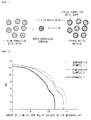
- FIG. 2 is a graph comparing the amounts of lithium impurities reduced in respective cathode active materials of Example 1 and Comparative Examples 1 and 2.
- Example 1 was about 11.6 ml
- Comparative Example 1 was 15 ml
- Comparative Example 2 was about 14.2 ml.
- Example 1 was decreased by about 20% or more in comparison to Comparative Examples 1 and 2.
- FIG. 3 is a graph illustrating the results of measuring capacity characteristics after high-temperature storage (60°C) of the lithium secondary batteries of Example 5 and Comparative Example 4 according to Experimental Example 3.
- Example 5 cathode active material of Example 2
- Comparative Example 4 cathode active material of Comparative Example 1
- CC/CV constant current/constant voltage
- a slope of a capacity retention ratio of the lithium secondary battery of Example 5 of the present invention was slower than that of the lithium secondary battery of Comparative Example 4 to a storage time of 4 weeks. Specifically, it may be understood that the capacity retention ratio of the lithium secondary battery of Example 5 was increased by about 3% at a storage time of 4 weeks in comparison to that of the lithium secondary battery of Comparative Example 4.
- a resistance increase rate of the lithium secondary battery of Example 5 was decreased by about 25% in comparison to that of the lithium secondary battery of Comparative Example 4. It may be understood that the decrease in the resistance increase rate to about 25% may also affect output characteristics. That is, it may be understood that the lithium secondary battery of Example 5 may exhibit excellent output characteristics due to the decrease in the resistance increase rate.
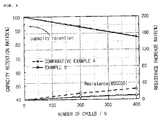
- the lithium secondary batteries of Example 5 and Comparative Example 4 were charged at 1 C to 4.15 V/30 mA at 45°C under a constant current/constant voltage (CC/CV) condition and then discharged at a constant current (CC) of 2 C to a voltage of 2.5 V to measure discharge capacities. The charge and discharge were repeated 1 to 400 cycles and the measured discharge capacities are presented in FIG. 4 .
- CC/CV constant current/constant voltage
- the lithium secondary battery of Example 5 of the present invention exhibited the slope of the capacity retention ratio similar to that of Comparative Example 4 to the 400 th cycle.
- the resistance increase rate of the lithium secondary battery of Example 5 was decreased by about 7% at the 400 th cycle in comparison to that of the lithium secondary battery of Comparative Example 4. It may be understood that the decrease in the resistance increase rate may also affect output characteristics. That is, it may be understood that the lithium secondary battery of Example 5 may exhibit excellent output characteristics due to the decrease in the resistance increase rate.
Landscapes
- Chemical & Material Sciences (AREA)
- General Chemical & Material Sciences (AREA)
- Chemical Kinetics & Catalysis (AREA)
- Electrochemistry (AREA)
- Inorganic Chemistry (AREA)
- Engineering & Computer Science (AREA)
- Composite Materials (AREA)
- Manufacturing & Machinery (AREA)
- Materials Engineering (AREA)
- Crystallography & Structural Chemistry (AREA)
- Battery Electrode And Active Subsutance (AREA)
Applications Claiming Priority (2)
| Application Number | Priority Date | Filing Date | Title |
|---|---|---|---|
| KR20130129617 | 2013-10-29 | ||
| PCT/KR2014/010257 WO2015065046A1 (ko) | 2013-10-29 | 2014-10-29 | 양극 활물질의 제조방법, 및 이에 의해 제조된 리튬 이차전지용 양극 활물질 |
Publications (3)
| Publication Number | Publication Date |
|---|---|
| EP3065207A1 true EP3065207A1 (de) | 2016-09-07 |
| EP3065207A4 EP3065207A4 (de) | 2016-10-26 |
| EP3065207B1 EP3065207B1 (de) | 2017-08-30 |
Family
ID=53004559
Family Applications (1)
| Application Number | Title | Priority Date | Filing Date |
|---|---|---|---|
| EP14854871.2A Active EP3065207B1 (de) | 2013-10-29 | 2014-10-29 | Verfahren zur herstellung eines kathodenaktivmaterials und damit hergestelltes kathodenaktivmaterial für eine lithiumsekundärbatterie |
Country Status (7)
| Country | Link |
|---|---|
| US (2) | US10056605B2 (de) |
| EP (1) | EP3065207B1 (de) |
| JP (1) | JP6284542B2 (de) |
| KR (1) | KR101651338B1 (de) |
| CN (1) | CN104781960B (de) |
| TW (1) | TWI609519B (de) |
| WO (1) | WO2015065046A1 (de) |
Cited By (4)
| Publication number | Priority date | Publication date | Assignee | Title |
|---|---|---|---|---|
| US20180205084A1 (en) * | 2017-01-17 | 2018-07-19 | Samsung Electronics Co., Ltd. | Electrode active material, lithium secondary battery containing the electrode active material, and method of preparing the ode active material |
| EP3349276A3 (de) * | 2017-01-17 | 2018-09-26 | Samsung Electronics Co., Ltd. | Elektrodenaktivmaterial, lithiumsekundärbatterie mit dem elektrodenaktivmaterial und verfahren zur herstellung des elektrodenaktivmaterials |
| EP4201889A4 (de) * | 2020-10-27 | 2025-06-11 | Ecopro Bm Co., Ltd. | Verfahren zur herstellung eines positivelektrodenaktivmaterials für eine lithiumsekundärbatterie |
| EP4329012A4 (de) * | 2021-09-27 | 2025-06-18 | LG Chem, Ltd. | Kathodenadditiv für lithiumsekundärbatterie, verfahren zur herstellung davon, kathode damit und lithiumsekundärbatterie |
Families Citing this family (92)
| Publication number | Priority date | Publication date | Assignee | Title |
|---|---|---|---|---|
| JP6187655B2 (ja) * | 2015-08-25 | 2017-08-30 | 日亜化学工業株式会社 | 非水電解液二次電池用正極活物質及びその製造方法 |
| CN107636869B (zh) * | 2015-09-30 | 2020-10-20 | 松下知识产权经营株式会社 | 二次电池用正极活性物质 |
| EP3246973B1 (de) * | 2015-11-13 | 2019-02-20 | Hitachi Metals, Ltd. | Positivelektrodenmaterial für lithium-ionen-sekundärbatterie, verfahren zur herstellung davon und lithium-ionen-sekundärbatterie |
| KR102004457B1 (ko) * | 2015-11-30 | 2019-07-29 | 주식회사 엘지화학 | 이차전지용 양극활물질 및 이를 포함하는 이차전지 |
| WO2017150506A1 (ja) * | 2016-02-29 | 2017-09-08 | 三井金属鉱業株式会社 | リチウム二次電池用正極活物質 |
| WO2017150522A1 (ja) * | 2016-02-29 | 2017-09-08 | 三井金属鉱業株式会社 | リチウム二次電池用正極活物質 |
| KR101980103B1 (ko) | 2016-03-03 | 2019-05-21 | 주식회사 엘지화학 | 리튬 이차전지용 양극활물질 및 이의 제조 방법 |
| PL3312914T3 (pl) * | 2016-03-22 | 2019-05-31 | Lg Chemical Ltd | Masa czynna anody do akumulatora i zawierający ją akumulator |
| US12237505B2 (en) * | 2016-03-30 | 2025-02-25 | Panasonic Intellectual Property Management Co., Ltd. | Positive electrode active material for nonaqueous electrolyte secondary batteries, method for producing positive electrode active material for nonaqueous electrolyte secondary batteries, and nonaqueous electrolyte secondary battery |
| KR102066266B1 (ko) * | 2016-03-31 | 2020-01-14 | 주식회사 엘지화학 | 리튬 코발트 산화물을 포함하는 코어 및 붕소와 불소를 포함하는 코팅층을 포함하는 양극 활물질 입자 및 이의 제조 방법 |
| KR102665407B1 (ko) * | 2016-04-15 | 2024-05-09 | 삼성에스디아이 주식회사 | 리튬 이차 전지용 양극 활물질 및 이를 포함하는 리튬 이차 전지 |
| KR102665408B1 (ko) * | 2016-04-15 | 2024-05-09 | 삼성에스디아이 주식회사 | 리튬 이차 전지용 양극 활물질 및 이를 포함하는 리튬 이차 전지 |
| KR102665406B1 (ko) * | 2016-04-15 | 2024-05-09 | 삼성에스디아이 주식회사 | 리튬 이차 전지용 양극 활물질 및 이를 포함하는 리튬 이차 전지 |
| US11024836B2 (en) * | 2016-05-16 | 2021-06-01 | Sumitomo Metal Mining Co., Ltd. | Positive electrode active material for non-aqueous electrolyte secondary battery and method for manufacturing the same, positive electrode mixed material paste for non-aqueous electrolyte secondary battery, and non-aqueous electrolyte secondary battery |
| KR102072221B1 (ko) | 2016-06-17 | 2020-03-02 | 주식회사 엘지화학 | 도펀트의 농도 구배가 있는 리튬 이차전지용 양극 활물질 |
| JP6642710B2 (ja) * | 2016-06-30 | 2020-02-12 | 日立金属株式会社 | リチウム二次電池用正極材料、それを用いたリチウム二次電池用正極及びリチウム二次電池 |
| JP7103222B2 (ja) * | 2016-08-29 | 2022-07-20 | 住友金属鉱山株式会社 | 非水系電解質二次電池用正極活物質とその製造方法、非水系電解質二次電池用正極合材ペーストおよび非水系電解質二次電池 |
| KR101886514B1 (ko) * | 2016-10-17 | 2018-08-07 | 현대자동차주식회사 | 전고체 전지용 코어-쉘 구조의 전극 활물질의 제조방법 |
| KR101919531B1 (ko) * | 2016-12-22 | 2018-11-16 | 주식회사 포스코 | 양극 활물질, 이의 제조 방법, 및 이를 포함하는 리튬 이차 전지 |
| CN109643794B (zh) * | 2017-02-02 | 2021-11-23 | 株式会社Lg化学 | 二次电池用正极活性材料及其制备方法 |
| KR102237951B1 (ko) * | 2017-03-21 | 2021-04-08 | 주식회사 엘지화학 | 이차 전지용 양극 활물질, 그 제조방법, 이를 포함하는 양극 및 이차 전지 |
| KR102207523B1 (ko) * | 2017-06-21 | 2021-01-25 | 주식회사 엘지화학 | 리튬 이차전지 |
| WO2019040533A1 (en) * | 2017-08-22 | 2019-02-28 | A123 Systems Llc | GLASS COATING OF LITHIUM TETRABORATE ON CATHODE MATERIALS TO IMPROVE CYCLING SAFETY AND STABILITY |
| JP7215423B2 (ja) * | 2017-08-25 | 2023-01-31 | 住友金属鉱山株式会社 | 非水系電解質二次電池用正極活物質とその製造方法、及び、非水系電解質二次電池とその製造方法 |
| CN111279528B (zh) | 2017-08-25 | 2023-07-07 | 住友金属矿山株式会社 | 非水系电解质二次电池用正极活性物质及其制法、正极复合材糊料及非水系电解质二次电池 |
| JP7062158B2 (ja) * | 2017-09-19 | 2022-05-06 | エルジー エナジー ソリューション リミテッド | 二次電池用正極活物質及びこれを含むリチウム二次電池 |
| WO2019059653A1 (ko) * | 2017-09-19 | 2019-03-28 | 주식회사 엘지화학 | 이차전지용 양극 활물질 및 이를 포함하는 리튬 이차전지 |
| KR102213174B1 (ko) * | 2017-10-12 | 2021-02-05 | 주식회사 엘지화학 | 리튬 이차전지용 양극 활물질, 이의 제조방법, 이를 포함하는 리튬 이차전지용 양극 및 리튬 이차전지 |
| WO2019074305A2 (ko) * | 2017-10-12 | 2019-04-18 | 주식회사 엘지화학 | 리튬 이차전지용 양극 활물질, 이의 제조방법, 이를 포함하는 리튬 이차전지용 양극 및 리튬 이차전지 |
| KR102132878B1 (ko) | 2017-10-20 | 2020-07-10 | 주식회사 엘지화학 | 리튬 이차전지용 양극 활물질, 이의 제조방법, 이를 포함하는 리튬 이차전지용 양극 및 리튬 이차전지 |
| US12176532B2 (en) | 2017-10-20 | 2024-12-24 | Lg Chem, Ltd. | Positive electrode active material for lithium secondary battery, method of preparing the same, and positive electrode for lithium secondary battery and lithium secondary battery which include the positive electrode active material |
| KR102298293B1 (ko) | 2017-10-20 | 2021-09-07 | 주식회사 엘지화학 | 리튬 이차전지용 양극 활물질, 이의 제조방법, 이를 포함하는 리튬 이차전지용 양극 및 리튬 이차전지 |
| KR102177798B1 (ko) | 2017-11-16 | 2020-11-12 | 주식회사 엘지화학 | 이차전지용 양극 활물질, 그 제조방법 및 이를 포함하는 리튬 이차전지 |
| JP7049551B2 (ja) * | 2017-11-21 | 2022-04-07 | エルジー エナジー ソリューション リミテッド | 二次電池用正極材及びこれを含むリチウム二次電池 |
| KR102345015B1 (ko) * | 2017-11-22 | 2021-12-28 | 주식회사 엘지에너지솔루션 | 리튬 이차전지용 양극재에 포함되는 비가역 첨가제, 이의 제조방법, 및 이 및 포함하는 양극재 |
| KR102424398B1 (ko) | 2020-09-24 | 2022-07-21 | 삼성에스디아이 주식회사 | 리튬 이차 전지용 양극, 그 제조 방법, 및 이를 포함한 리튬 이차 전지 |
| KR102853967B1 (ko) | 2021-05-28 | 2025-09-01 | 삼성에스디아이 주식회사 | 리튬 이차 전지용 양극 활물질, 이의 제조 방법 및 이를 포함하는 리튬 이차 전지 |
| US11777075B2 (en) | 2017-12-04 | 2023-10-03 | Samsung Sdi Co., Ltd. | Positive active material for rechargeable lithium battery, preparing method thereof and rechargeable lithium battery comprising positive electrode including positive active material |
| US11670754B2 (en) | 2017-12-04 | 2023-06-06 | Samsung Sdi Co., Ltd. | Positive active material for rechargeable lithium battery, preparing method thereof and rechargeable lithium battery comprising positive electrode including positive active material |
| US10847781B2 (en) | 2017-12-04 | 2020-11-24 | Samsung Sdi Co., Ltd. | Positive active material for rechargeable lithium battery, preparing method thereof and rechargeable lithium battery comprising positive electrode including positive active material |
| US11522189B2 (en) | 2017-12-04 | 2022-12-06 | Samsung Sdi Co., Ltd. | Positive electrode for rechargeable lithium battery, preparing method thereof, and rechargeable lithium battery comprising positive electrode |
| KR102010929B1 (ko) * | 2017-12-26 | 2019-08-16 | 주식회사 포스코 | 리튬 이차 전지용 양극 활물질, 이의 제조 방법, 및 이를 포함하는 리튬 이차 전지 |
| KR102698845B1 (ko) * | 2017-12-27 | 2024-08-26 | 주식회사 엘지에너지솔루션 | 리튬 이차 전지용 양극 활물질, 이의 제조 방법, 이를 포함하는 양극 및 리튬 이차 전지 |
| US11870070B2 (en) * | 2018-01-24 | 2024-01-09 | Lg Energy Solution, Ltd. | Positive electrode active material for secondary battery, method of preparing the same, and lithium secondary battery including the positive electrode active material |
| KR102288290B1 (ko) * | 2018-02-23 | 2021-08-10 | 주식회사 엘지화학 | 이차전지용 양극 활물질, 그 제조방법 및 이를 포함하는 리튬 이차전지 |
| JP7332611B2 (ja) * | 2018-02-26 | 2023-08-23 | ユミコア | Liイオンバッテリー用の正極スラリー |
| KR102231062B1 (ko) | 2018-03-09 | 2021-03-23 | 주식회사 엘지화학 | 양극 활물질, 그 제조 방법, 이를 포함하는 양극 및 이차전지 |
| KR102288293B1 (ko) | 2018-06-20 | 2021-08-10 | 주식회사 엘지화학 | 리튬 이차 전지용 양극 활물질 및 리튬 이차 전지 |
| KR102288295B1 (ko) | 2018-06-20 | 2021-08-10 | 주식회사 엘지화학 | 리튬 이차 전지용 양극 활물질 및 리튬 이차 전지 |
| KR102290959B1 (ko) * | 2018-06-20 | 2021-08-19 | 주식회사 엘지화학 | 리튬 이차 전지용 양극 활물질 및 리튬 이차 전지 |
| KR101964716B1 (ko) | 2018-06-26 | 2019-04-02 | 에스케이이노베이션 주식회사 | 리튬 이차 전지용 양극 활물질 및 이를 포함하는 리튬 이차 전지 |
| PL3836259T3 (pl) * | 2018-09-28 | 2022-09-19 | Lg Chem, Ltd. | Materiał czynny elektrody dodatniej dla akumulatora, sposób jego wytwarzania i zawierający go akumulator litowy |
| US10777843B2 (en) | 2018-10-31 | 2020-09-15 | Nissan North America, Inc. | Regenerated lithium-ion cathode materials having modified surfaces |
| KR102658763B1 (ko) | 2018-11-30 | 2024-04-19 | 주식회사 엘지에너지솔루션 | 양극 활물질, 상기 양극 활물질을 포함하는 양극 및 리튬 이차전지 |
| KR102217302B1 (ko) * | 2018-11-30 | 2021-02-18 | 주식회사 포스코 | 리튬 이차 전지용 양극 첨가제, 이의 제조방법, 이를 포함하는 리튬 이차 전지용 양극 및 이를 포함하는 리튬 이차 전지 |
| US12040473B2 (en) | 2018-12-10 | 2024-07-16 | Lg Energy Solution, Ltd. | Positive electrode for secondary battery, method for manufacturing same, and lithium secondary battery including same |
| KR102640161B1 (ko) * | 2018-12-10 | 2024-02-26 | 주식회사 엘지에너지솔루션 | 이차전지용 양극, 이의 제조 방법 및 이를 포함하는 리튬 이차전지 |
| WO2020197197A1 (ko) * | 2019-03-22 | 2020-10-01 | 주식회사 엘지화학 | 황화물계 전고체 전지용 양극 활물질 입자 |
| US11575116B2 (en) | 2019-03-22 | 2023-02-07 | Lg Energy Solution, Ltd. | Positive electrode active material particle for sulfide-based all-solid-state batteries |
| JP6659893B1 (ja) | 2019-04-12 | 2020-03-04 | 住友化学株式会社 | リチウム金属複合酸化物粉末及びリチウム二次電池用正極活物質 |
| JP6630863B1 (ja) * | 2019-04-12 | 2020-01-15 | 住友化学株式会社 | リチウム金属複合酸化物粉末、リチウム二次電池用正極活物質 |
| JP6630865B1 (ja) | 2019-04-12 | 2020-01-15 | 住友化学株式会社 | リチウム複合金属酸化物粉末及びリチウム二次電池用正極活物質 |
| WO2021025370A1 (ko) * | 2019-08-06 | 2021-02-11 | 주식회사 엘 앤 에프 | 리튬 이차전지용 양극 활물질 |
| KR102781582B1 (ko) | 2019-09-09 | 2025-03-12 | 에스케이온 주식회사 | 리튬 이차 전지용 양극 활물질 및 이의 제조방법 |
| KR102292889B1 (ko) * | 2019-10-10 | 2021-08-24 | 주식회사 에코프로비엠 | 리튬 복합 산화물 및 이를 포함하는 리튬 이차전지 |
| KR102764324B1 (ko) * | 2019-10-11 | 2025-02-07 | 주식회사 엘지화학 | 양극 활물질의 제조 방법, 양극 활물질, 이를 포함하는 양극 및 이차전지 |
| WO2021107684A1 (ko) * | 2019-11-28 | 2021-06-03 | 주식회사 엘지화학 | 리튬 이차전지용 양극 활물질의 제조 방법 및 상기 방법에 의해 제조된 리튬 이차전지용 양극 활물질 |
| CN114730867B (zh) * | 2019-12-06 | 2025-04-29 | 株式会社Lg新能源 | 制造二次电池用正极材料的方法 |
| US12537188B2 (en) | 2019-12-20 | 2026-01-27 | Posco Holdings Inc. | Positive electrode active material, method of preparing the same, and lithium secondary battery including the same |
| US12597612B2 (en) * | 2020-02-21 | 2026-04-07 | Gs Yuasa International Ltd. | Nonaqueous electrolyte energy storage device, and method for manufacturing nonaqueous electrolyte energy storage device |
| WO2021187961A1 (ko) * | 2020-03-20 | 2021-09-23 | 주식회사 엘지화학 | 이차전지용 양극 활물질 및 이를 포함하는 리튬 이차전지 |
| JP7468621B2 (ja) * | 2020-03-27 | 2024-04-16 | 株式会社村田製作所 | 二次電池 |
| KR102691304B1 (ko) * | 2020-04-17 | 2024-08-05 | 주식회사 엘지화학 | 양극 활물질의 제조방법 |
| KR102749968B1 (ko) | 2020-06-12 | 2025-01-03 | 주식회사 에코프로비엠 | 양극 활물질 및 이를 포함하는 리튬 이차전지 |
| EP4148826A4 (de) * | 2020-06-12 | 2024-09-18 | Ecopro Bm Co., Ltd. | Kathodenaktivmaterial und lithiumsekundärbatterie damit |
| KR102397756B1 (ko) | 2020-09-02 | 2022-05-13 | 주식회사 에코프로비엠 | 양극 활물질 및 이를 포함하는 리튬 이차전지 |
| WO2022051982A1 (zh) * | 2020-09-10 | 2022-03-17 | 宁德时代新能源科技股份有限公司 | 电极活性材料及其制备方法及电极、电池和装置 |
| KR20220055678A (ko) * | 2020-10-27 | 2022-05-04 | 주식회사 에코프로비엠 | 양극 활물질 및 이를 포함하는 리튬 이차전지 |
| KR20230110521A (ko) | 2020-11-18 | 2023-07-24 | 닛산 가가쿠 가부시키가이샤 | 이차 전지 전극용 첨가제 |
| EP4002510A1 (de) * | 2020-11-23 | 2022-05-25 | Samsung SDI Co., Ltd. | Positives aktivmaterial für wiederaufladbare lithiumbatterie, herstellungsverfahren dafür und wiederaufladbare lithiumbatterie mit positivelektrode mit positivem aktivmaterial |
| EP4246623A4 (de) * | 2020-11-30 | 2024-06-12 | LG Energy Solution, Ltd. | Kathodenaktivmaterial für lithiumsekundärbatterie, herstellungsverfahren dafür und lithiumsekundärbatterie damit |
| CN116601782A (zh) * | 2020-12-08 | 2023-08-15 | 应用材料公司 | 预锂化及不含锂金属的阳极涂层 |
| CN115667892B (zh) * | 2020-12-22 | 2025-05-27 | 株式会社Lg化学 | 引入正极活性材料中的硼的含量和分布的分析方法 |
| CN112897544B (zh) * | 2021-01-29 | 2022-07-12 | 格尔木藏格锂业有限公司 | 盐湖碳酸锂生产中排放的含硼废水生产高纯度硼砂的方法 |
| KR102941559B1 (ko) * | 2021-05-31 | 2026-03-18 | 에스케이온 주식회사 | 리튬 이차 전지용 양극 활물질, 이의 제조방법 및 이를 포함하는 리튬 이차 전지 |
| EP4207374A4 (de) * | 2021-08-13 | 2024-08-21 | Lg Chem, Ltd. | Positivelektrodenaktivmaterial für lithiumsekundärbatterie und verfahren zur herstellung davon |
| KR102684671B1 (ko) * | 2021-11-03 | 2024-07-15 | 주식회사 엘지에너지솔루션 | 양극재, 이를 포함하는 양극 및 리튬 이차전지 |
| US20250273655A1 (en) * | 2021-12-03 | 2025-08-28 | Lg Chem, Ltd. | Positive Electrode Active Material and Method for Producing the Same |
| JP7802526B2 (ja) | 2021-12-27 | 2026-01-20 | エルジー エナジー ソリューション リミテッド | 正極活物質、正極活物質スラリー、正極、リチウムイオン二次電池、及び正極活物質の製造方法 |
| CN115000384B (zh) * | 2022-07-01 | 2025-08-05 | 湖南顺隆新能源科技有限公司 | 一种富锂锰基正极材料及其制备方法 |
| SE2351078A1 (en) * | 2023-09-15 | 2025-03-16 | Northvolt Ab | Composite cathode and methods for forming the same |
| KR20250094460A (ko) * | 2023-12-18 | 2025-06-25 | 포스코홀딩스 주식회사 | 리튬 이차전지용 양극 활물질 및 이의 제조방법 |
Family Cites Families (26)
| Publication number | Priority date | Publication date | Assignee | Title |
|---|---|---|---|---|
| JP3195175B2 (ja) | 1994-11-11 | 2001-08-06 | 株式会社東芝 | 非水溶媒二次電池 |
| KR100696619B1 (ko) | 2000-09-25 | 2007-03-19 | 삼성에스디아이 주식회사 | 리튬 이차 전지용 양극 활물질 및 그 제조 방법 |
| JP3723444B2 (ja) | 2000-12-07 | 2005-12-07 | 三洋電機株式会社 | リチウム二次電池用正極及びその製造方法並びにリチウム二次電池 |
| US20020119372A1 (en) | 2001-02-28 | 2002-08-29 | Meijie Zhang | Use of lithium borate in non-aqueous rechargeable lithium batteries |
| US20020119375A1 (en) * | 2001-02-28 | 2002-08-29 | Meijie Zhang | Use of lithium borate in non-aqueous rechargeable lithium batteries |
| US7241532B2 (en) * | 2002-03-28 | 2007-07-10 | Mitsubishi Chemical Corporation | Positive-electrode material for lithium secondary battery, secondary battery employing the same, and process for producing positive-electrode material for lithium secondary battery |
| US7294435B2 (en) * | 2003-05-15 | 2007-11-13 | Nichia Corporation | Positive electrode active material for nonaqueous electrolyte secondary battery, positive electrode mixture for nonaqueous electrolyte secondary battery, and nonaqueous electrolyte secondary battery |
| US7566479B2 (en) * | 2003-06-23 | 2009-07-28 | Lg Chem, Ltd. | Method for the synthesis of surface-modified materials |
| CN100429812C (zh) * | 2003-12-05 | 2008-10-29 | 日产自动车株式会社 | 非水电解质锂离子电池的正极材料及采用它的电池 |
| US20100047691A1 (en) * | 2006-10-25 | 2010-02-25 | Sumitomo Chemical Company, Limited | Lithium secondary battery |
| EP2337125A1 (de) * | 2006-12-26 | 2011-06-22 | Mitsubishi Chemical Corporation | Lithium-Übergangsmetall-Pulver und Methode zu seiner Herstellung |
| KR100923442B1 (ko) * | 2007-08-01 | 2009-10-27 | 주식회사 엘 앤 에프 | 신규 양극 활물질 |
| EP2214232B1 (de) | 2007-10-23 | 2012-02-08 | Mitsui Mining & Smelting Co., Ltd | Lithium-übergangsmetalloxid des spinelltyps |
| KR100999109B1 (ko) | 2008-06-05 | 2010-12-07 | 한양대학교 산학협력단 | 리튬 이차 전지용 양극 활물질, 그의 제조 방법 및 그를포함하는 리튬 이차 전지 |
| KR20110122095A (ko) * | 2009-02-05 | 2011-11-09 | 에이지씨 세이미 케미칼 가부시키가이샤 | 리튬 이온 2 차 전지용 정극 활물질용의 표면 수식 리튬 함유 복합 산화물 및 그 제조 방법 |
| JP2011171113A (ja) * | 2010-02-18 | 2011-09-01 | Sanyo Electric Co Ltd | リチウム二次電池用正極活物質及びその製造方法並びにそれを用いたリチウム二次電池 |
| JP5622525B2 (ja) | 2010-10-29 | 2014-11-12 | 株式会社日立製作所 | リチウムイオン二次電池 |
| KR101264333B1 (ko) * | 2011-01-12 | 2013-05-14 | 삼성에스디아이 주식회사 | 양극활물질, 이를 채용한 양극과 리튬전지 및 그 제조방법 |
| WO2012111116A1 (ja) * | 2011-02-16 | 2012-08-23 | トヨタ自動車株式会社 | リチウムイオン二次電池及びその製造方法 |
| JP5002824B1 (ja) | 2011-03-02 | 2012-08-15 | 独立行政法人産業技術総合研究所 | リチウム二次電池用負極材料及びその製造方法、並びにリチウム二次電池用負極及びリチウム二次電池 |
| US9214674B2 (en) * | 2011-05-26 | 2015-12-15 | Toyota Jidosha Kabushiki Kaisha | Coated active material and lithium solid state battery |
| WO2012164760A1 (ja) * | 2011-06-01 | 2012-12-06 | トヨタ自動車株式会社 | 電極活物質の製造方法及び電極活物質 |
| JP6052176B2 (ja) * | 2011-08-05 | 2016-12-27 | 旭硝子株式会社 | リチウムイオン二次電池用正極活物質 |
| KR101409191B1 (ko) * | 2012-03-26 | 2014-06-19 | 한국세라믹기술원 | 리튬이차전지용 양극 활물질의 제조방법 |
| JP6286855B2 (ja) * | 2012-04-18 | 2018-03-07 | 日亜化学工業株式会社 | 非水電解液二次電池用正極組成物 |
| CN102723459B (zh) | 2012-06-20 | 2014-08-27 | 东莞新能源科技有限公司 | 一种锂离子二次电池及其正极片 |
-
2014
- 2014-10-29 CN CN201480002930.9A patent/CN104781960B/zh active Active
- 2014-10-29 US US14/437,079 patent/US10056605B2/en active Active
- 2014-10-29 EP EP14854871.2A patent/EP3065207B1/de active Active
- 2014-10-29 WO PCT/KR2014/010257 patent/WO2015065046A1/ko not_active Ceased
- 2014-10-29 KR KR1020140148344A patent/KR101651338B1/ko active Active
- 2014-10-29 TW TW103137539A patent/TWI609519B/zh active
- 2014-10-29 JP JP2015545401A patent/JP6284542B2/ja active Active
-
2018
- 2018-08-08 US US16/058,594 patent/US10529985B2/en active Active
Cited By (5)
| Publication number | Priority date | Publication date | Assignee | Title |
|---|---|---|---|---|
| US20180205084A1 (en) * | 2017-01-17 | 2018-07-19 | Samsung Electronics Co., Ltd. | Electrode active material, lithium secondary battery containing the electrode active material, and method of preparing the ode active material |
| EP3349276A3 (de) * | 2017-01-17 | 2018-09-26 | Samsung Electronics Co., Ltd. | Elektrodenaktivmaterial, lithiumsekundärbatterie mit dem elektrodenaktivmaterial und verfahren zur herstellung des elektrodenaktivmaterials |
| US10892488B2 (en) | 2017-01-17 | 2021-01-12 | Samsung Electronics Co., Ltd. | Electrode active material, lithium secondary battery containing the electrode active material, and method of preparing the electrode active material |
| EP4201889A4 (de) * | 2020-10-27 | 2025-06-11 | Ecopro Bm Co., Ltd. | Verfahren zur herstellung eines positivelektrodenaktivmaterials für eine lithiumsekundärbatterie |
| EP4329012A4 (de) * | 2021-09-27 | 2025-06-18 | LG Chem, Ltd. | Kathodenadditiv für lithiumsekundärbatterie, verfahren zur herstellung davon, kathode damit und lithiumsekundärbatterie |
Also Published As
| Publication number | Publication date |
|---|---|
| CN104781960B (zh) | 2018-03-06 |
| WO2015065046A1 (ko) | 2015-05-07 |
| EP3065207B1 (de) | 2017-08-30 |
| KR101651338B1 (ko) | 2016-08-25 |
| KR20150050458A (ko) | 2015-05-08 |
| TW201539846A (zh) | 2015-10-16 |
| US20160013476A1 (en) | 2016-01-14 |
| US10529985B2 (en) | 2020-01-07 |
| JP2015536558A (ja) | 2015-12-21 |
| CN104781960A (zh) | 2015-07-15 |
| US20180351169A1 (en) | 2018-12-06 |
| TWI609519B (zh) | 2017-12-21 |
| JP6284542B2 (ja) | 2018-02-28 |
| US10056605B2 (en) | 2018-08-21 |
| EP3065207A4 (de) | 2016-10-26 |
Similar Documents
| Publication | Publication Date | Title |
|---|---|---|
| US10529985B2 (en) | Cathode active material for lithium secondary battery | |
| EP3041071B1 (de) | Verbundpartikel aus lithiumübergangsmetall, verfahren zu ihrer herstellung und positive aktivmaterialien damit | |
| KR101816945B1 (ko) | 양극 활물질, 이의 제조방법, 및 이를 포함하는 리튬 이차전지 | |
| EP3719883B1 (de) | Negativelektrodenaktivmaterial für lithiumsekundärbatterie, negativelektrode damit für lithiumsekundärbatterie und lithiumsekundärbatterie | |
| EP3567661B1 (de) | Kathodenaktivmaterial für sekundärbatterie und lithiumsekundärbatterie damit | |
| EP3331065A1 (de) | Nickelbasiertes aktivmaterial für lithiumsekundärbatterie, verfahren zur herstellung von nickelbasiertem aktivmaterial und lithiumsekundärbatterie mit positivelektrode mit dem nickelbasierten aktivmaterial | |
| US11440807B2 (en) | Positive electrode active material for secondary battery, method of preparing the same, and lithium secondary battery including the positive electrode active material | |
| EP3644415A2 (de) | Positivelektrodenmaterial für eine lithium-sekundärbatterie, verfahren zur herstellung davon und positivelektrode für eine lithium-sekundärbatterie und lithium-sekundärbatterie damit | |
| EP4174026A1 (de) | Kathodenaktivmaterial und herstellungsverfahren dafür | |
| EP4047693A1 (de) | Aktives kathodenmaterial für lithiumsekundärbatterie und verfahren zur herstellung von aktivem kathodenmaterial | |
| CN110662718A (zh) | 制备二次电池用正极活性材料的方法和使用其的二次电池 | |
| KR101959761B1 (ko) | 양극 활물질의 제조방법, 및 이에 의해 제조된 리튬 이차전지용 양극 활물질 | |
| US20240234713A1 (en) | Positive Electrode Material, Preparation Method Thereof, And Lithium Secondary Battery Including The Positive Electrode Material | |
| EP4718527A1 (de) | Positivelektrodenaktivmaterial und herstellungsverfahren dafür | |
| EP4632843A1 (de) | Kathodenaktivmaterial und kathode und lithiumsekundärbatterie damit | |
| KR101792305B1 (ko) | 양극 활물질, 이의 제조방법, 및 이를 포함하는 리튬 이차전지 | |
| CN116670855A (zh) | 正极活性材料、包含其的正极和锂二次电池 | |
| EP4231376A1 (de) | Lithiumfestkörpersekundärbatterie und verfahren zur herstellung davon | |
| KR100824931B1 (ko) | 활물질. 그 제조방법 및 이를 구비한 리튬 이차 전지 | |
| KR101835165B1 (ko) | 리튬 전이금속 산화물 입자를 포함하는 양극 활물질 및 이의 제조방법 |
Legal Events
| Date | Code | Title | Description |
|---|---|---|---|
| PUAI | Public reference made under article 153(3) epc to a published international application that has entered the european phase |
Free format text: ORIGINAL CODE: 0009012 |
|
| 17P | Request for examination filed |
Effective date: 20150424 |
|
| AK | Designated contracting states |
Kind code of ref document: A1 Designated state(s): AL AT BE BG CH CY CZ DE DK EE ES FI FR GB GR HR HU IE IS IT LI LT LU LV MC MK MT NL NO PL PT RO RS SE SI SK SM TR |
|
| AX | Request for extension of the european patent |
Extension state: BA ME |
|
| A4 | Supplementary search report drawn up and despatched |
Effective date: 20160922 |
|
| RIC1 | Information provided on ipc code assigned before grant |
Ipc: H01M 4/36 20060101AFI20160916BHEP Ipc: H01M 4/505 20100101ALI20160916BHEP Ipc: H01M 4/62 20060101ALI20160916BHEP Ipc: H01M 10/052 20100101ALN20160916BHEP Ipc: H01M 4/525 20100101ALI20160916BHEP |
|
| DAX | Request for extension of the european patent (deleted) | ||
| REG | Reference to a national code |
Ref country code: DE Ref legal event code: R079 Ref document number: 602014014010 Country of ref document: DE Free format text: PREVIOUS MAIN CLASS: H01M0004480000 Ipc: H01M0004360000 |
|
| RIC1 | Information provided on ipc code assigned before grant |
Ipc: H01M 4/525 20100101ALI20170403BHEP Ipc: H01M 4/36 20060101AFI20170403BHEP Ipc: H01M 4/505 20100101ALI20170403BHEP Ipc: H01M 10/052 20100101ALN20170403BHEP Ipc: H01M 4/62 20060101ALI20170403BHEP |
|
| RIC1 | Information provided on ipc code assigned before grant |
Ipc: H01M 4/505 20100101ALI20170407BHEP Ipc: H01M 10/052 20100101ALN20170407BHEP Ipc: H01M 4/525 20100101ALI20170407BHEP Ipc: H01M 4/36 20060101AFI20170407BHEP Ipc: H01M 4/62 20060101ALI20170407BHEP |
|
| GRAP | Despatch of communication of intention to grant a patent |
Free format text: ORIGINAL CODE: EPIDOSNIGR1 |
|
| INTG | Intention to grant announced |
Effective date: 20170523 |
|
| GRAS | Grant fee paid |
Free format text: ORIGINAL CODE: EPIDOSNIGR3 |
|
| GRAA | (expected) grant |
Free format text: ORIGINAL CODE: 0009210 |
|
| AK | Designated contracting states |
Kind code of ref document: B1 Designated state(s): AL AT BE BG CH CY CZ DE DK EE ES FI FR GB GR HR HU IE IS IT LI LT LU LV MC MK MT NL NO PL PT RO RS SE SI SK SM TR |
|
| REG | Reference to a national code |
Ref country code: GB Ref legal event code: FG4D |
|
| REG | Reference to a national code |
Ref country code: CH Ref legal event code: EP |
|
| REG | Reference to a national code |
Ref country code: AT Ref legal event code: REF Ref document number: 924436 Country of ref document: AT Kind code of ref document: T Effective date: 20170915 |
|
| REG | Reference to a national code |
Ref country code: IE Ref legal event code: FG4D |
|
| REG | Reference to a national code |
Ref country code: FR Ref legal event code: PLFP Year of fee payment: 4 |
|
| REG | Reference to a national code |
Ref country code: DE Ref legal event code: R096 Ref document number: 602014014010 Country of ref document: DE |
|
| REG | Reference to a national code |
Ref country code: NL Ref legal event code: MP Effective date: 20170830 |
|
| REG | Reference to a national code |
Ref country code: LT Ref legal event code: MG4D |
|
| REG | Reference to a national code |
Ref country code: AT Ref legal event code: MK05 Ref document number: 924436 Country of ref document: AT Kind code of ref document: T Effective date: 20170830 |
|
| PG25 | Lapsed in a contracting state [announced via postgrant information from national office to epo] |
Ref country code: AT Free format text: LAPSE BECAUSE OF FAILURE TO SUBMIT A TRANSLATION OF THE DESCRIPTION OR TO PAY THE FEE WITHIN THE PRESCRIBED TIME-LIMIT Effective date: 20170830 Ref country code: LT Free format text: LAPSE BECAUSE OF FAILURE TO SUBMIT A TRANSLATION OF THE DESCRIPTION OR TO PAY THE FEE WITHIN THE PRESCRIBED TIME-LIMIT Effective date: 20170830 Ref country code: NO Free format text: LAPSE BECAUSE OF FAILURE TO SUBMIT A TRANSLATION OF THE DESCRIPTION OR TO PAY THE FEE WITHIN THE PRESCRIBED TIME-LIMIT Effective date: 20171130 Ref country code: HR Free format text: LAPSE BECAUSE OF FAILURE TO SUBMIT A TRANSLATION OF THE DESCRIPTION OR TO PAY THE FEE WITHIN THE PRESCRIBED TIME-LIMIT Effective date: 20170830 Ref country code: FI Free format text: LAPSE BECAUSE OF FAILURE TO SUBMIT A TRANSLATION OF THE DESCRIPTION OR TO PAY THE FEE WITHIN THE PRESCRIBED TIME-LIMIT Effective date: 20170830 Ref country code: SE Free format text: LAPSE BECAUSE OF FAILURE TO SUBMIT A TRANSLATION OF THE DESCRIPTION OR TO PAY THE FEE WITHIN THE PRESCRIBED TIME-LIMIT Effective date: 20170830 |
|
| PG25 | Lapsed in a contracting state [announced via postgrant information from national office to epo] |
Ref country code: BG Free format text: LAPSE BECAUSE OF FAILURE TO SUBMIT A TRANSLATION OF THE DESCRIPTION OR TO PAY THE FEE WITHIN THE PRESCRIBED TIME-LIMIT Effective date: 20171130 Ref country code: IS Free format text: LAPSE BECAUSE OF FAILURE TO SUBMIT A TRANSLATION OF THE DESCRIPTION OR TO PAY THE FEE WITHIN THE PRESCRIBED TIME-LIMIT Effective date: 20171230 Ref country code: LV Free format text: LAPSE BECAUSE OF FAILURE TO SUBMIT A TRANSLATION OF THE DESCRIPTION OR TO PAY THE FEE WITHIN THE PRESCRIBED TIME-LIMIT Effective date: 20170830 Ref country code: RS Free format text: LAPSE BECAUSE OF FAILURE TO SUBMIT A TRANSLATION OF THE DESCRIPTION OR TO PAY THE FEE WITHIN THE PRESCRIBED TIME-LIMIT Effective date: 20170830 Ref country code: ES Free format text: LAPSE BECAUSE OF FAILURE TO SUBMIT A TRANSLATION OF THE DESCRIPTION OR TO PAY THE FEE WITHIN THE PRESCRIBED TIME-LIMIT Effective date: 20170830 Ref country code: GR Free format text: LAPSE BECAUSE OF FAILURE TO SUBMIT A TRANSLATION OF THE DESCRIPTION OR TO PAY THE FEE WITHIN THE PRESCRIBED TIME-LIMIT Effective date: 20171201 |
|
| PG25 | Lapsed in a contracting state [announced via postgrant information from national office to epo] |
Ref country code: NL Free format text: LAPSE BECAUSE OF FAILURE TO SUBMIT A TRANSLATION OF THE DESCRIPTION OR TO PAY THE FEE WITHIN THE PRESCRIBED TIME-LIMIT Effective date: 20170830 |
|
| PG25 | Lapsed in a contracting state [announced via postgrant information from national office to epo] |
Ref country code: DK Free format text: LAPSE BECAUSE OF FAILURE TO SUBMIT A TRANSLATION OF THE DESCRIPTION OR TO PAY THE FEE WITHIN THE PRESCRIBED TIME-LIMIT Effective date: 20170830 Ref country code: RO Free format text: LAPSE BECAUSE OF FAILURE TO SUBMIT A TRANSLATION OF THE DESCRIPTION OR TO PAY THE FEE WITHIN THE PRESCRIBED TIME-LIMIT Effective date: 20170830 Ref country code: PL Free format text: LAPSE BECAUSE OF FAILURE TO SUBMIT A TRANSLATION OF THE DESCRIPTION OR TO PAY THE FEE WITHIN THE PRESCRIBED TIME-LIMIT Effective date: 20170830 Ref country code: CZ Free format text: LAPSE BECAUSE OF FAILURE TO SUBMIT A TRANSLATION OF THE DESCRIPTION OR TO PAY THE FEE WITHIN THE PRESCRIBED TIME-LIMIT Effective date: 20170830 |
|
| PG25 | Lapsed in a contracting state [announced via postgrant information from national office to epo] |
Ref country code: EE Free format text: LAPSE BECAUSE OF FAILURE TO SUBMIT A TRANSLATION OF THE DESCRIPTION OR TO PAY THE FEE WITHIN THE PRESCRIBED TIME-LIMIT Effective date: 20170830 Ref country code: SK Free format text: LAPSE BECAUSE OF FAILURE TO SUBMIT A TRANSLATION OF THE DESCRIPTION OR TO PAY THE FEE WITHIN THE PRESCRIBED TIME-LIMIT Effective date: 20170830 Ref country code: IT Free format text: LAPSE BECAUSE OF FAILURE TO SUBMIT A TRANSLATION OF THE DESCRIPTION OR TO PAY THE FEE WITHIN THE PRESCRIBED TIME-LIMIT Effective date: 20170830 Ref country code: MC Free format text: LAPSE BECAUSE OF FAILURE TO SUBMIT A TRANSLATION OF THE DESCRIPTION OR TO PAY THE FEE WITHIN THE PRESCRIBED TIME-LIMIT Effective date: 20170830 Ref country code: SM Free format text: LAPSE BECAUSE OF FAILURE TO SUBMIT A TRANSLATION OF THE DESCRIPTION OR TO PAY THE FEE WITHIN THE PRESCRIBED TIME-LIMIT Effective date: 20170830 |
|
| REG | Reference to a national code |
Ref country code: CH Ref legal event code: PL Ref country code: DE Ref legal event code: R097 Ref document number: 602014014010 Country of ref document: DE |
|
| PLBE | No opposition filed within time limit |
Free format text: ORIGINAL CODE: 0009261 |
|
| STAA | Information on the status of an ep patent application or granted ep patent |
Free format text: STATUS: NO OPPOSITION FILED WITHIN TIME LIMIT |
|
| REG | Reference to a national code |
Ref country code: IE Ref legal event code: MM4A |
|
| PG25 | Lapsed in a contracting state [announced via postgrant information from national office to epo] |
Ref country code: LI Free format text: LAPSE BECAUSE OF NON-PAYMENT OF DUE FEES Effective date: 20171031 Ref country code: CH Free format text: LAPSE BECAUSE OF NON-PAYMENT OF DUE FEES Effective date: 20171031 Ref country code: LU Free format text: LAPSE BECAUSE OF NON-PAYMENT OF DUE FEES Effective date: 20171029 |
|
| 26N | No opposition filed |
Effective date: 20180531 |
|
| REG | Reference to a national code |
Ref country code: BE Ref legal event code: MM Effective date: 20171031 |
|
| PG25 | Lapsed in a contracting state [announced via postgrant information from national office to epo] |
Ref country code: BE Free format text: LAPSE BECAUSE OF NON-PAYMENT OF DUE FEES Effective date: 20171031 Ref country code: SI Free format text: LAPSE BECAUSE OF FAILURE TO SUBMIT A TRANSLATION OF THE DESCRIPTION OR TO PAY THE FEE WITHIN THE PRESCRIBED TIME-LIMIT Effective date: 20170830 |
|
| REG | Reference to a national code |
Ref country code: FR Ref legal event code: PLFP Year of fee payment: 5 |
|
| PG25 | Lapsed in a contracting state [announced via postgrant information from national office to epo] |
Ref country code: MT Free format text: LAPSE BECAUSE OF NON-PAYMENT OF DUE FEES Effective date: 20171029 |
|
| PG25 | Lapsed in a contracting state [announced via postgrant information from national office to epo] |
Ref country code: IE Free format text: LAPSE BECAUSE OF NON-PAYMENT OF DUE FEES Effective date: 20171029 |
|
| PG25 | Lapsed in a contracting state [announced via postgrant information from national office to epo] |
Ref country code: HU Free format text: LAPSE BECAUSE OF FAILURE TO SUBMIT A TRANSLATION OF THE DESCRIPTION OR TO PAY THE FEE WITHIN THE PRESCRIBED TIME-LIMIT; INVALID AB INITIO Effective date: 20141029 |
|
| PG25 | Lapsed in a contracting state [announced via postgrant information from national office to epo] |
Ref country code: CY Free format text: LAPSE BECAUSE OF FAILURE TO SUBMIT A TRANSLATION OF THE DESCRIPTION OR TO PAY THE FEE WITHIN THE PRESCRIBED TIME-LIMIT Effective date: 20170830 |
|
| PG25 | Lapsed in a contracting state [announced via postgrant information from national office to epo] |
Ref country code: MK Free format text: LAPSE BECAUSE OF FAILURE TO SUBMIT A TRANSLATION OF THE DESCRIPTION OR TO PAY THE FEE WITHIN THE PRESCRIBED TIME-LIMIT Effective date: 20170830 |
|
| PG25 | Lapsed in a contracting state [announced via postgrant information from national office to epo] |
Ref country code: TR Free format text: LAPSE BECAUSE OF FAILURE TO SUBMIT A TRANSLATION OF THE DESCRIPTION OR TO PAY THE FEE WITHIN THE PRESCRIBED TIME-LIMIT Effective date: 20170830 |
|
| PG25 | Lapsed in a contracting state [announced via postgrant information from national office to epo] |
Ref country code: PT Free format text: LAPSE BECAUSE OF FAILURE TO SUBMIT A TRANSLATION OF THE DESCRIPTION OR TO PAY THE FEE WITHIN THE PRESCRIBED TIME-LIMIT Effective date: 20170830 |
|
| PG25 | Lapsed in a contracting state [announced via postgrant information from national office to epo] |
Ref country code: AL Free format text: LAPSE BECAUSE OF FAILURE TO SUBMIT A TRANSLATION OF THE DESCRIPTION OR TO PAY THE FEE WITHIN THE PRESCRIBED TIME-LIMIT Effective date: 20170830 |
|
| REG | Reference to a national code |
Ref country code: DE Ref legal event code: R081 Ref document number: 602014014010 Country of ref document: DE Owner name: LG ENERGY SOLUTION LTD., KR Free format text: FORMER OWNER: LG CHEM. LTD., SEOUL, KR Ref country code: DE Ref legal event code: R081 Ref document number: 602014014010 Country of ref document: DE Owner name: LG ENERGY SOLUTION, LTD., KR Free format text: FORMER OWNER: LG CHEM. LTD., SEOUL, KR |
|
| P01 | Opt-out of the competence of the unified patent court (upc) registered |
Effective date: 20230323 |
|
| REG | Reference to a national code |
Ref country code: GB Ref legal event code: 732E Free format text: REGISTERED BETWEEN 20230824 AND 20230831 |
|
| REG | Reference to a national code |
Ref country code: DE Ref legal event code: R081 Ref document number: 602014014010 Country of ref document: DE Owner name: LG ENERGY SOLUTION, LTD., KR Free format text: FORMER OWNER: LG ENERGY SOLUTION LTD., SEOUL, KR |
|
| PGFP | Annual fee paid to national office [announced via postgrant information from national office to epo] |
Ref country code: GB Payment date: 20250922 Year of fee payment: 12 |
|
| PGFP | Annual fee paid to national office [announced via postgrant information from national office to epo] |
Ref country code: FR Payment date: 20250925 Year of fee payment: 12 |
|
| PGFP | Annual fee paid to national office [announced via postgrant information from national office to epo] |
Ref country code: DE Payment date: 20250922 Year of fee payment: 12 |