EP3065324A1 - Procédé et dispositif de traitement de données de point d'échantillonnage de signal - Google Patents
Procédé et dispositif de traitement de données de point d'échantillonnage de signal Download PDFInfo
- Publication number
- EP3065324A1 EP3065324A1 EP14797749.0A EP14797749A EP3065324A1 EP 3065324 A1 EP3065324 A1 EP 3065324A1 EP 14797749 A EP14797749 A EP 14797749A EP 3065324 A1 EP3065324 A1 EP 3065324A1
- Authority
- EP
- European Patent Office
- Prior art keywords
- sampling point
- signal sampling
- point data
- domain signal
- data
- Prior art date
- Legal status (The legal status is an assumption and is not a legal conclusion. Google has not performed a legal analysis and makes no representation as to the accuracy of the status listed.)
- Withdrawn
Links
Images


Classifications
-
- H—ELECTRICITY
- H04—ELECTRIC COMMUNICATION TECHNIQUE
- H04L—TRANSMISSION OF DIGITAL INFORMATION, e.g. TELEGRAPHIC COMMUNICATION
- H04L27/00—Modulated-carrier systems
- H04L27/32—Carrier systems characterised by combinations of two or more of the types covered by groups H04L27/02, H04L27/10, H04L27/18 or H04L27/26
- H04L27/34—Amplitude- and phase-modulated carrier systems, e.g. quadrature-amplitude modulated carrier systems
- H04L27/3405—Modifications of the signal space to increase the efficiency of transmission, e.g. reduction of the bit error rate, bandwidth, or average power
-
- H—ELECTRICITY
- H03—ELECTRONIC CIRCUITRY
- H03M—CODING; DECODING; CODE CONVERSION IN GENERAL
- H03M7/00—Conversion of a code where information is represented by a given sequence or number of digits to a code where the same, similar or subset of information is represented by a different sequence or number of digits
- H03M7/30—Compression; Expansion; Suppression of unnecessary data, e.g. redundancy reduction
- H03M7/3059—Digital compression and data reduction techniques where the original information is represented by a subset or similar information, e.g. lossy compression
-
- H—ELECTRICITY
- H03—ELECTRONIC CIRCUITRY
- H03M—CODING; DECODING; CODE CONVERSION IN GENERAL
- H03M7/00—Conversion of a code where information is represented by a given sequence or number of digits to a code where the same, similar or subset of information is represented by a different sequence or number of digits
- H03M7/30—Compression; Expansion; Suppression of unnecessary data, e.g. redundancy reduction
- H03M7/3068—Precoding preceding compression, e.g. Burrows-Wheeler transformation
-
- H—ELECTRICITY
- H04—ELECTRIC COMMUNICATION TECHNIQUE
- H04L—TRANSMISSION OF DIGITAL INFORMATION, e.g. TELEGRAPHIC COMMUNICATION
- H04L27/00—Modulated-carrier systems
- H04L27/26—Systems using multi-frequency codes
- H04L27/2601—Multicarrier modulation systems
- H04L27/2626—Arrangements specific to the transmitter only
- H04L27/2627—Modulators
- H04L27/2634—Inverse fast Fourier transform [IFFT] or inverse discrete Fourier transform [IDFT] modulators in combination with other circuits for modulation
Definitions
- the present invention relates to the technical field of processing of signal sampling point data (called as IQ data for short, herein I-channel data refer to real part data of signal sampling point data, and Q-channel data refer to imaginary part data of signal sampling point data) of a CPRI (Common Public Radio Interface) in an LTE (Long Term Evolution) base station system, in particular to a method and device for processing IQ data of a CPRI in an LTE base station system.
- IQ data Signal sampling point data
- I-channel data refer to real part data of signal sampling point data
- Q-channel data refer to imaginary part data of signal sampling point data
- CPRI Common Public Radio Interface
- LTE Long Term Evolution
- An LTE base station device is a distributed base station and consists of an eBBU (Evolved Building Base band Unit) and an eRRU (Evolved Radio Remote Unit), wherein the eBBU and the eRRU are connected through an optical fiber or a cable, and data interaction between the eBBU and the eRRU is performed by using common public radio interface protocol.
- eBBU Evolved Building Base band Unit
- eRRU Evolved Radio Remote Unit
- the LTE system supports a radio network technology which uses OFDM (Orthogonal Frequency Division Multiplexing) technology and MIMO (Multiple Input Multiple Output) technology as a core.
- OFDM signals are signals superposed with random amplitudes and phases and usually have a higher PAPR (Peak to Average Power Ratio), most signal peaks are within a very small range and only a very few of signal peaks fluctuate greatly.
- PAPR Peak to Average Power Ratio
- Frequency-domain characteristics of IQ data of the CPRI interface in the LTE system have the similar characteristics, most signal peaks are within a very small range and only a very few of signal peaks fluctuate greatly. If common same bit number coding is adopted, the maximum value of signals decides bit number of coding, and high bits are 0 when other small-amplitude signals are encoded. As a result, the coding efficiency is extremely low and the transmission burden is increased.
- the basic principle of a block floating point coding algorithm is to make corresponding scale adjustment to a data block and then perform scale recovery after calculation is completed.
- Block exponent adjustment is performed on a data block with a length of N and ineffective high-bit sign extension bits in a mantissa are removed, such that the data block shares the same exponent.
- addition and multiplication operations are performed on the data block, an additional exponent operation does not need to be performed, addition and multiplication operations are performed only on the mantissa, and it is as convenient as fixed-point operation. Since only one sign bit is reserved when block exponent adjustment is performed on the data block, a limited bit length can be fully utilized and the accuracy is improved.
- the introduction of the shared exponent further obtains a larger dynamic range than a fixed-point manner, and it is decided by the number of the high-bit sign extension bits of the data with the maximum absolute value in the data block.
- Block floating point coding divides signal samples into groups (or called as blocks), then an exponent is solved for each group of samples and a mantissa is encoded, therefore forming a compressed block.
- encoding the mantissa and the exponent respectively increases the additional compression, it reduces the error caused by compression.
- exponent coding a joint coding manner of two or more exponent differences can also be adopted, and a better compression effect can be realized by reducing the number of bits used for each exponent coding.
- Block floating point coding can avoid the situation that all data are expressed by using fixed bit number, and block floating point coding is very suitable for the coding of IQ frequency-domain data in the LTE system.
- the related art has no solution of compression with respect to time-domain and frequency-domain joint characteristics of the CPRI data in the LTE radio base station system.
- the technical problem to be solved by the embodiments of the present invention is to provide a method and device for processing IQ data, so as to reduce transmission bandwidth and simultaneously reduce the costs of transmission devices.
- a method for processing signal sampling point data includes:
- the method further includes:
- the step of transforming time-domain signal sampling point data to be transmitted into frequency-domain signal sampling point data includes:
- the method further includes:
- the step of encoding the frequency-domain signal sampling point data includes:
- a device for processing signal sampling point data includes a transformation module and an encoding module, wherein:
- the device for processing signal sampling point data further includes a buffer module, wherein:
- the device for processing signal sampling point data further includes a generation module, wherein the transformation module is configured to transform the time-domain signal sampling point data to be transmitted into frequency-domain signal sampling point data according to the following way: transforming the time-domain signal sampling point data into the frequency-domain signal sampling point data through Fast Fourier Transformation; and the generation module is configured to extract effective sampling points of the frequency-domain signal sampling point data according to respective symmetric characteristics of the real part data and the imaginary part data, and generate a frequency-domain signal sampling point data stream.
- the transformation module is configured to transform the time-domain signal sampling point data to be transmitted into frequency-domain signal sampling point data according to the following way: transforming the time-domain signal sampling point data into the frequency-domain signal sampling point data through Fast Fourier Transformation; and the generation module is configured to extract effective sampling points of the frequency-domain signal sampling point data according to respective symmetric characteristics of the real part data and the imaginary part data, and generate a frequency-domain signal sampling point data stream.
- the device for processing signal sampling point data further includes an amplitude compression module, wherein:
- the encoding module is configured to encode the frequency-domain signal sampling point data according to the following way:
- a method for processing signal sampling point data includes:
- the method further includes:
- the step of transforming the decoded frequency-domain signal sampling point data into the time-domain signal sampling point data includes:
- a device for processing signal sampling point data includes a decoding module and an inverse transformation module, wherein:
- the device for processing signal sampling point data further includes a recovery module, wherein:
- the inverse transformation module is configured to transform the decoded frequency-domain signal sampling point data into time-domain signal sampling point data according to the following way:
- the method and the device for processing IQ data in the technical solution use the frequency-domain characteristics of IQ data in an LTE system, firstly transform time-domain IQ data into frequency-domain IQ data, remove redundant information, then perform encoding and reduce the number of encoded points at a sending terminal to realize more effective compression of CPRI data in the LTE system, satisfy requirements on transmission bandwidth of current transmission access networks, and can realize quick and controlled high-efficiency compression and decompression functions of CPRI data in an LTE radio base station system.
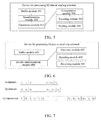
- FIG. 2 is a flowchart of a method for processing IQ data at a sending terminal according to the embodiment of the present invention. As shown in FIG. 2 , the method includes the following steps:
- FIG. 3 is a flowchart of a method for processing IQ data at a receiving terminal according to the embodiment of the present invention. As shown in FIG. 3 , the method includes the following steps:
- FIG. 4 is a principle diagram of a system for processing IQ data according to the embodiment of the present invention.
- a sending terminal device may include:
- a receiving terminal device may include:
- the present invention is to primarily use the frequency-domain characteristics of the IQ data in the LTE system, and firstly transform the time-domain IQ data into frequency-domain IQ data, remove redundant information, and then perform encoding and reduce the number of encoded points at the sending terminal to realize more effective compression. Therefore, the decoded frequency-domain IQ data are transformed inversely into the time-domain IQ data correspondingly at the receiving terminal.
- FIG. 5 is a schematic diagram of a device for processing IQ data at a sending terminal according to the embodiment of the present invention. As shown in FIG. 5 , the device includes:
- a transformation module 502 is configured to transform the interleaved time-domain IQ data into frequency-domain IQ data; in this embodiment, the transformation module can perform FFT (Fast Fourier Transformation) on the interleaved IQ time-domain data to obtain the frequency-domain IQ data.
- FFT Fast Fourier Transformation
- a generation module 503 is configured to extract effective sampling points of the frequency-domain IQ data according to respective symmetric characteristics of the I-channel data and the Q-channel data, and generate a frequency-domain IQ data stream; in this embodiment, the effective points are extracted from the frequency-domain I-channel and Q-channel data, and both the lengths of output I-channel and that of Q-channel data are B+1.
- An amplitude compression module or a compression module 504 is configured to perform amplitude compression on the frequency-domain IQ data and generate an amplitude compression factor F and compressed IQ data.
- An encoding module 505 is configured to encode the compressed IQ data; in this embodiment, block floating point coding can be respectively performed on the I-channel and Q-channel data, except the first data, whose amplitudes have been compressed, and encoded data and first input data are outputted;
- a sending module 506 is configured to send the amplitude compression factor F and the encoded IQ data.
- FIG. 6 is a schematic diagram of a device for processing IQ data at a receiving terminal according to the embodiment of the present invention. As shown in FIG. 6 , the device includes:
- the embodiment of the present invention further provides a system for processing IQ data.
- the system includes the device for processing IQ data at the sending terminal and the device for processing IQ data at the receiving terminal.
- I-channel and Q-channel data are not respectively compressed but are interleaved to obtain a buffer data block I_1 Q_1 I_2 Q_2...I_64 Q_64.
- FFT is performed on the obtained 128 point real signals, and after transformation, block floating point coding only needs to be performed respectively on real parts and imaginary parts of the first point to the 65th point.
- Block floating point coding is performed respectively on I-channel effective signals and Q-channel effective signals obtained after FFT.
- the size of a buffer zone of the I-channel and Q-channel excluding the first data is 64, and 64 sample values are read at one time to perform block floating point coding.
- 64-dimension data are divided into 16 data blocks, each having 4 data.
- the maximum values Block_max of the 16 data blocks are respectively determined.
- an exponent of each block is determined through formulas (1) and (2) as follows: 2 n_exp ⁇ 1 ⁇ Block_max 2 n_exp ⁇ Block_max
- amplitude increase is the "inverse" of the amplitude compression
- inverse FFT is the "inverse" of FFT, which are not introduced here.
- Decoding is the "inverse" of encoding, data obtained after decoding are points from the first point to the 65th point, and for real parts, the points from the second point to the 64th point only need to be turned over with respect to the 65th point to obtain points from the 66th point to the 128th point, i.e., the 66th point is equal to the 64th point, the 67th point is equal to the 63th point, and the 68th point is equal to the 62th point; and for imaginary parts, the points from the second point to the 64th point only need to be turned over with respect to the 65th point and the sign is reversed to obtain the points from the 66th point to the 128th point, i.e., the 66th point and the 64th point are equal in size and opposite in sign, the 67th point and the 63th point are equal in size and opposite in sign, and the 68th point and the 62th point are equal in size and opposite in sign.
- I and Q interleaved data blocks can still be very well compressed to about 10bit in a nearly lossless compression manner, and an EVM (Error Vector Magnitude) caused thereby is 0.044207%.
- EVM values measured by experiments at different amplitude compression factors F are as shown in Table 2.
- Table 2 Relationship between F and EVM values Compression factor 1 2 4 8 16 32 64 128 256 IQ data (time-domain ) average bit number 16 16 16 16 16 16 16 16 16 16 Average bit number after encoding 10.3125 9.3438 8.4375 7.5625 6.5625 5.8438 5.0313 4.4375 3.7813 Compression rate (%) 64.4531 58.3988 52.734 4 47.265 6 41.015 6 36.523 8 31.445 6 27.734 4 23.633 1 EVM value (%) 0.04420 7 0.08203 7 0.1792 1 0.3274 7 0.7393 6 1.3016 2.4617 4.7238 7.802
- the embodiments of the present invention combine FFT with block floating point coding, in combination with frequency-domain characteristics of data, it is to remove redundant information, reduce the number of encoded points and realize more effective compression. Compared with the existing compression technique, the compression effect of the embodiments of the present invention is more remarkable, and with the development of hardware, the space for improvement is greater.
- the embodiments of the present invention can further adopt other coding solutions according to the frequency-domain statistical characteristics of the IQ data in the LTE system, such as FBAQ (Fuzzy Block Adaptive Quantization) coding, BAVQ (Block Adaptive Vector Quantization) coding and BFPQ (Block Floating Point Quantization) coding and the like, and it is expected to further improve the compression performance.
- FBAQ Fuzzy Block Adaptive Quantization
- BAVQ Block Adaptive Vector Quantization
- BFPQ Block Floating Point Quantization
- the method and the device for processing IQ data in the technical solution use the frequency-domain characteristics of IQ data in an LTE system, firstly transform time-domain IQ data into frequency-domain IQ data, remove redundant information, then perform encoding and reduce the number of encoded points and at a sending terminal to realize more effective compression of CPRI data in the LTE system to satisfy requirements on transmission bandwidth of current transmission access networks, and realize quick and controlled high-efficiency compression and decompression functions of CPRI data in an LTE radio base station system. Therefore, the present invention has very strong industrial applicability.
Landscapes
- Engineering & Computer Science (AREA)
- Computer Networks & Wireless Communication (AREA)
- Signal Processing (AREA)
- Theoretical Computer Science (AREA)
- Physics & Mathematics (AREA)
- Discrete Mathematics (AREA)
- General Physics & Mathematics (AREA)
- Mathematical Physics (AREA)
- Compression, Expansion, Code Conversion, And Decoders (AREA)
- Digital Transmission Methods That Use Modulated Carrier Waves (AREA)
Applications Claiming Priority (2)
| Application Number | Priority Date | Filing Date | Title |
|---|---|---|---|
| CN201310659571.1A CN104702369B (zh) | 2013-12-06 | 2013-12-06 | 一种处理信号样点数据的方法及装置 |
| PCT/CN2014/078557 WO2014183709A1 (fr) | 2013-12-06 | 2014-05-27 | Procédé et dispositif de traitement de données de point d'échantillonnage de signal |
Publications (2)
| Publication Number | Publication Date |
|---|---|
| EP3065324A1 true EP3065324A1 (fr) | 2016-09-07 |
| EP3065324A4 EP3065324A4 (fr) | 2016-09-07 |
Family
ID=51897768
Family Applications (1)
| Application Number | Title | Priority Date | Filing Date |
|---|---|---|---|
| EP14797749.0A Withdrawn EP3065324A4 (fr) | 2013-12-06 | 2014-05-27 | Procédé et dispositif de traitement de données de point d'échantillonnage de signal |
Country Status (4)
| Country | Link |
|---|---|
| EP (1) | EP3065324A4 (fr) |
| JP (1) | JP6223575B2 (fr) |
| CN (1) | CN104702369B (fr) |
| WO (1) | WO2014183709A1 (fr) |
Cited By (7)
| Publication number | Priority date | Publication date | Assignee | Title |
|---|---|---|---|---|
| WO2020122780A1 (fr) * | 2018-12-10 | 2020-06-18 | Telefonaktiebolaget Lm Ericsson (Publ) | Transfert efficace de données d'échantillon iq |
| WO2021150594A1 (fr) * | 2020-01-20 | 2021-07-29 | Parsons Corporation | Extraction et stockage iq à bande étroite |
| WO2022177481A1 (fr) * | 2021-02-18 | 2022-08-25 | Telefonaktiebolaget Lm Ericsson (Publ) | Codage et décodage de données complexes |
| US11489542B2 (en) | 2018-11-20 | 2022-11-01 | Samsung Electronics Co., Ltd. | Method, device and system for data compression and decompression |
| US11569848B2 (en) | 2020-04-17 | 2023-01-31 | Parsons Corporation | Software-defined radio linking systems |
| US11605166B2 (en) | 2019-10-16 | 2023-03-14 | Parsons Corporation | GPU accelerated image segmentation |
| US11619700B2 (en) | 2020-04-07 | 2023-04-04 | Parsons Corporation | Retrospective interferometry direction finding |
Families Citing this family (4)
| Publication number | Priority date | Publication date | Assignee | Title |
|---|---|---|---|---|
| CN108092669B (zh) * | 2017-12-28 | 2020-06-16 | 厦门大学 | 一种基于离散余弦变换的自适应数据压缩方法及系统 |
| CN109194667B (zh) * | 2018-09-18 | 2022-03-11 | 上海创远仪器技术股份有限公司 | 基于频域检测的实现iq数据信号数据压缩与传输功能的装置 |
| CN114666236B (zh) * | 2022-03-29 | 2024-05-14 | 北京扬铭科技发展有限责任公司 | 一种全自动信号检测识别报警方法 |
| CN118132522B (zh) * | 2024-05-10 | 2024-07-19 | 成都联屹科技有限公司 | 数据压缩装置、方法及芯片 |
Family Cites Families (12)
| Publication number | Priority date | Publication date | Assignee | Title |
|---|---|---|---|---|
| WO1992012607A1 (fr) * | 1991-01-08 | 1992-07-23 | Dolby Laboratories Licensing Corporation | Codeur/decodeur pour champs sonores a dimensions multiples |
| JPH075896A (ja) * | 1993-06-17 | 1995-01-10 | Victor Co Of Japan Ltd | データ圧縮、伸長方法 |
| JP2007274048A (ja) * | 2006-03-30 | 2007-10-18 | Fujitsu Ltd | 無線通信装置及び無線ユニット |
| US8005152B2 (en) * | 2008-05-21 | 2011-08-23 | Samplify Systems, Inc. | Compression of baseband signals in base transceiver systems |
| JP2010166509A (ja) * | 2009-01-19 | 2010-07-29 | Fujitsu Ltd | フレーム変換方法及びエントランス無線装置 |
| JP5135282B2 (ja) * | 2009-05-14 | 2013-02-06 | 株式会社日立製作所 | 無線基地局装置 |
| US8301803B2 (en) * | 2009-10-23 | 2012-10-30 | Samplify Systems, Inc. | Block floating point compression of signal data |
| US9059778B2 (en) * | 2011-01-07 | 2015-06-16 | Integrated Device Technology Inc. | Frequency domain compression in a base transceiver system |
| JP5719249B2 (ja) * | 2011-07-19 | 2015-05-13 | 京セラ株式会社 | 分離型無線基地局における伝送システム、伝送方法、ベースバンド処理装置 |
| CN103139129B (zh) * | 2011-12-05 | 2016-09-28 | 上海贝尔股份有限公司 | 多载波调制信号的压缩/解压方法及压缩器/解压器 |
| CN103312413B (zh) * | 2012-03-14 | 2016-04-20 | 普天信息技术研究院有限公司 | Lte基站光纤时延补偿的数据缓存方法、系统及装置 |
| CN102801681B (zh) * | 2012-08-01 | 2017-06-06 | 大唐移动通信设备有限公司 | 数据传输方法及分布式基站 |
-
2013
- 2013-12-06 CN CN201310659571.1A patent/CN104702369B/zh active Active
-
2014
- 2014-05-27 EP EP14797749.0A patent/EP3065324A4/fr not_active Withdrawn
- 2014-05-27 JP JP2016536569A patent/JP6223575B2/ja active Active
- 2014-05-27 WO PCT/CN2014/078557 patent/WO2014183709A1/fr not_active Ceased
Cited By (12)
| Publication number | Priority date | Publication date | Assignee | Title |
|---|---|---|---|---|
| US11489542B2 (en) | 2018-11-20 | 2022-11-01 | Samsung Electronics Co., Ltd. | Method, device and system for data compression and decompression |
| WO2020122780A1 (fr) * | 2018-12-10 | 2020-06-18 | Telefonaktiebolaget Lm Ericsson (Publ) | Transfert efficace de données d'échantillon iq |
| WO2020122772A1 (fr) * | 2018-12-10 | 2020-06-18 | Telefonaktiebolaget Lm Ericsson (Publ) | Transmission de données de paire de valeurs dans des systèmes de réseau |
| US20220029651A1 (en) * | 2018-12-10 | 2022-01-27 | Telefonaktiebolaget Lm Ericsson (Publ) | Data transmission of value pair in network systems |
| US11632139B2 (en) | 2018-12-10 | 2023-04-18 | Telefonaktiebolaget Lm Ericsson (Publ) | Efficient transfer of IQ sample data |
| US11637574B2 (en) * | 2018-12-10 | 2023-04-25 | Telefonaktiebolaget Lm Ericsson (Publ) | Data transmission of value pair in network systems |
| US11605166B2 (en) | 2019-10-16 | 2023-03-14 | Parsons Corporation | GPU accelerated image segmentation |
| WO2021150594A1 (fr) * | 2020-01-20 | 2021-07-29 | Parsons Corporation | Extraction et stockage iq à bande étroite |
| US11619700B2 (en) | 2020-04-07 | 2023-04-04 | Parsons Corporation | Retrospective interferometry direction finding |
| US11569848B2 (en) | 2020-04-17 | 2023-01-31 | Parsons Corporation | Software-defined radio linking systems |
| WO2022177481A1 (fr) * | 2021-02-18 | 2022-08-25 | Telefonaktiebolaget Lm Ericsson (Publ) | Codage et décodage de données complexes |
| US12483272B2 (en) | 2021-02-18 | 2025-11-25 | Telefonaktiebolaget Lm Ericsson (Publ) | Encoding and decoding complex data |
Also Published As
| Publication number | Publication date |
|---|---|
| CN104702369A (zh) | 2015-06-10 |
| JP2016539582A (ja) | 2016-12-15 |
| WO2014183709A1 (fr) | 2014-11-20 |
| CN104702369B (zh) | 2019-10-11 |
| EP3065324A4 (fr) | 2016-09-07 |
| JP6223575B2 (ja) | 2017-11-01 |
Similar Documents
| Publication | Publication Date | Title |
|---|---|---|
| EP3065324A1 (fr) | Procédé et dispositif de traitement de données de point d'échantillonnage de signal | |
| US10230394B2 (en) | Methods for compressing and decompressing IQ data, and associated devices | |
| US8842724B1 (en) | Data compression and decompression method between digital unit and radio unit in cloud radio access network | |
| US9220004B2 (en) | Radio unit, baseband processing unit and base station system | |
| CN105763287B (zh) | 数据传输方法及装置 | |
| WO2014029260A1 (fr) | Procédé et dispositif de compression, d'émission et de décompression de données | |
| CN113676190A (zh) | 一种Polar码编码方法、装置 | |
| CN105027520A (zh) | 针对无线电基站的复值ofdm数据压缩和解压缩 | |
| US20190173490A1 (en) | Apparatus and method for data compression and decompression based on calculation of error vector magnitude | |
| EP3242418A1 (fr) | Système de réseau optique passif (pon) de fronthaul sans fil, dispositif de réseau optique et procédé | |
| CN103873877A (zh) | 远程桌面的图像传输方法及装置 | |
| CN101945286A (zh) | 压缩编码方法、解码解压方法、装置和通信系统 | |
| CN108092669B (zh) | 一种基于离散余弦变换的自适应数据压缩方法及系统 | |
| CN106416166B (zh) | 处理数据的方法和通信设备 | |
| CN110476357A (zh) | 极化码传输方法和装置 | |
| CN108242968B (zh) | 一种信道编码方法及信道编码装置 | |
| CN103888146A (zh) | 一种数据压缩的方法、装置和通信设备 | |
| CN104113394B (zh) | 通信调制信号的压缩及解压方法 | |
| He et al. | A compression scheme for LTE baseband signal in C-RAN | |
| CN115720350B (zh) | 一种数据压缩、解压缩方法及通信装置 | |
| You | Near-lossless compression/decompression algorithms for digital data transmitted over fronthaul in C-RAN | |
| Yu et al. | The compression of wireless base station LTE-IR data using adaptive frequency domain floating-point coding | |
| CN104702952B (zh) | 一种图像数据压缩方法 | |
| JP2020145518A (ja) | 符号化装置及び復号装置 | |
| Oh et al. | Adaptive bit truncation and restoration for baseband signal compression |
Legal Events
| Date | Code | Title | Description |
|---|---|---|---|
| PUAI | Public reference made under article 153(3) epc to a published international application that has entered the european phase |
Free format text: ORIGINAL CODE: 0009012 |
|
| 17P | Request for examination filed |
Effective date: 20160531 |
|
| A4 | Supplementary search report drawn up and despatched |
Effective date: 20160728 |
|
| AK | Designated contracting states |
Kind code of ref document: A1 Designated state(s): AL AT BE BG CH CY CZ DE DK EE ES FI FR GB GR HR HU IE IS IT LI LT LU LV MC MK MT NL NO PL PT RO RS SE SI SK SM TR |
|
| AX | Request for extension of the european patent |
Extension state: BA ME |
|
| DAX | Request for extension of the european patent (deleted) | ||
| 17Q | First examination report despatched |
Effective date: 20190417 |
|
| STAA | Information on the status of an ep patent application or granted ep patent |
Free format text: STATUS: THE APPLICATION HAS BEEN WITHDRAWN |
|
| 18W | Application withdrawn |
Effective date: 20190524 |