EP3066914A1 - Substrat pour la culture des plantes - Google Patents
Substrat pour la culture des plantes Download PDFInfo
- Publication number
- EP3066914A1 EP3066914A1 EP16159879.2A EP16159879A EP3066914A1 EP 3066914 A1 EP3066914 A1 EP 3066914A1 EP 16159879 A EP16159879 A EP 16159879A EP 3066914 A1 EP3066914 A1 EP 3066914A1
- Authority
- EP
- European Patent Office
- Prior art keywords
- cover layer
- layer
- substrate
- central
- central layer
- Prior art date
- Legal status (The legal status is an assumption and is not a legal conclusion. Google has not performed a legal analysis and makes no representation as to the accuracy of the status listed.)
- Withdrawn
Links
- 239000000758 substrate Substances 0.000 title claims abstract description 168
- 241000196324 Embryophyta Species 0.000 claims abstract description 68
- 235000008216 herbs Nutrition 0.000 claims abstract description 19
- 235000007849 Lepidium sativum Nutrition 0.000 claims abstract description 17
- 244000211187 Lepidium sativum Species 0.000 claims abstract description 17
- 238000010276 construction Methods 0.000 claims abstract description 17
- 239000010410 layer Substances 0.000 claims description 262
- 235000015097 nutrients Nutrition 0.000 claims description 13
- 239000000203 mixture Substances 0.000 claims description 11
- 239000002356 single layer Substances 0.000 claims description 7
- 229920002678 cellulose Polymers 0.000 claims description 6
- 239000001913 cellulose Substances 0.000 claims description 6
- 239000000853 adhesive Substances 0.000 claims description 5
- 230000001070 adhesive effect Effects 0.000 claims description 5
- 230000000694 effects Effects 0.000 claims description 3
- 230000002522 swelling effect Effects 0.000 claims description 3
- 238000010521 absorption reaction Methods 0.000 description 24
- 230000008961 swelling Effects 0.000 description 22
- 239000007788 liquid Substances 0.000 description 19
- 239000000463 material Substances 0.000 description 16
- XLYOFNOQVPJJNP-UHFFFAOYSA-N water Substances O XLYOFNOQVPJJNP-UHFFFAOYSA-N 0.000 description 14
- 239000000835 fiber Substances 0.000 description 13
- 238000004873 anchoring Methods 0.000 description 8
- 239000000126 substance Substances 0.000 description 8
- 235000013311 vegetables Nutrition 0.000 description 8
- 230000015572 biosynthetic process Effects 0.000 description 6
- 239000002131 composite material Substances 0.000 description 6
- 238000005520 cutting process Methods 0.000 description 4
- 239000012530 fluid Substances 0.000 description 4
- 239000008187 granular material Substances 0.000 description 4
- 230000000704 physical effect Effects 0.000 description 3
- 229910002651 NO3 Inorganic materials 0.000 description 2
- NHNBFGGVMKEFGY-UHFFFAOYSA-N Nitrate Chemical compound [O-][N+]([O-])=O NHNBFGGVMKEFGY-UHFFFAOYSA-N 0.000 description 2
- 229910019142 PO4 Inorganic materials 0.000 description 2
- ZLMJMSJWJFRBEC-UHFFFAOYSA-N Potassium Chemical compound [K] ZLMJMSJWJFRBEC-UHFFFAOYSA-N 0.000 description 2
- 239000004744 fabric Substances 0.000 description 2
- 239000002657 fibrous material Substances 0.000 description 2
- 238000005470 impregnation Methods 0.000 description 2
- 238000011835 investigation Methods 0.000 description 2
- 238000004519 manufacturing process Methods 0.000 description 2
- 238000000034 method Methods 0.000 description 2
- NBIIXXVUZAFLBC-UHFFFAOYSA-K phosphate Chemical compound [O-]P([O-])([O-])=O NBIIXXVUZAFLBC-UHFFFAOYSA-K 0.000 description 2
- 239000010452 phosphate Substances 0.000 description 2
- 229910052700 potassium Inorganic materials 0.000 description 2
- 239000011591 potassium Substances 0.000 description 2
- 238000003825 pressing Methods 0.000 description 2
- 238000004064 recycling Methods 0.000 description 2
- 239000011265 semifinished product Substances 0.000 description 2
- 239000000470 constituent Substances 0.000 description 1
- 230000001419 dependent effect Effects 0.000 description 1
- 238000010586 diagram Methods 0.000 description 1
- 238000005516 engineering process Methods 0.000 description 1
- 230000014759 maintenance of location Effects 0.000 description 1
- 239000000047 product Substances 0.000 description 1
Images

Classifications
-
- A—HUMAN NECESSITIES
- A01—AGRICULTURE; FORESTRY; ANIMAL HUSBANDRY; HUNTING; TRAPPING; FISHING
- A01G—HORTICULTURE; CULTIVATION OF VEGETABLES, FLOWERS, RICE, FRUIT, VINES, HOPS OR SEAWEED; FORESTRY; WATERING
- A01G24/00—Growth substrates; Culture media; Apparatus or methods therefor
- A01G24/40—Growth substrates; Culture media; Apparatus or methods therefor characterised by their structure
- A01G24/44—Growth substrates; Culture media; Apparatus or methods therefor characterised by their structure in block, mat or sheet form
-
- A—HUMAN NECESSITIES
- A01—AGRICULTURE; FORESTRY; ANIMAL HUSBANDRY; HUNTING; TRAPPING; FISHING
- A01G—HORTICULTURE; CULTIVATION OF VEGETABLES, FLOWERS, RICE, FRUIT, VINES, HOPS OR SEAWEED; FORESTRY; WATERING
- A01G24/00—Growth substrates; Culture media; Apparatus or methods therefor
- A01G24/20—Growth substrates; Culture media; Apparatus or methods therefor based on or containing natural organic material
- A01G24/22—Growth substrates; Culture media; Apparatus or methods therefor based on or containing natural organic material containing plant material
- A01G24/27—Pulp, e.g. bagasse
-
- A—HUMAN NECESSITIES
- A01—AGRICULTURE; FORESTRY; ANIMAL HUSBANDRY; HUNTING; TRAPPING; FISHING
- A01G—HORTICULTURE; CULTIVATION OF VEGETABLES, FLOWERS, RICE, FRUIT, VINES, HOPS OR SEAWEED; FORESTRY; WATERING
- A01G24/00—Growth substrates; Culture media; Apparatus or methods therefor
- A01G24/40—Growth substrates; Culture media; Apparatus or methods therefor characterised by their structure
- A01G24/44—Growth substrates; Culture media; Apparatus or methods therefor characterised by their structure in block, mat or sheet form
- A01G24/46—Growth substrates; Culture media; Apparatus or methods therefor characterised by their structure in block, mat or sheet form multi-layered
Definitions
- the invention relates to a substrate for the cultivation of plants, in particular herbs, preferably cress, comprising a substrate body, and the use of such a substrate for the cultivation of plants, especially herbs, preferably cress.
- Substrates for the cultivation of plants or their use for the cultivation of plants is or are known per se.
- Such substrates typically include a substrate having a certain liquid absorption capacity, in which plants, in particular herbs, such. As cress, respectively corresponding seeds, seedlings, etc. can be used and grown.
- the grown plants are removed from the substrate body. Removal of grown plants is typically done by clipping, i. H. through one or more cutting operations.
- a known example of a corresponding substrate comprises a granular, d. H. formed from a granule, substrate body.
- difficulties arise in particular in connection with the removal of grown-up plants. Difficulties are given in particular for not clean cut plants, which are pulled out of the substrate body. Due to the intimate connection between the plants and the granules in this case adhering to the plants granules constituents can be released from the substrate body. Corresponding granule components must be removed from the plants with comparatively high expenditure.
- the invention has for its object to provide a contrast improved substrate for the cultivation of plants, especially herbs, preferably cress.
- the object is achieved by a substrate for the cultivation of plants, in particular herbs, preferably cress, according to claim 1 and the use of a corresponding substrate for the cultivation of plants, in particular herbs, preferably cress, according to claim 13.
- the dependent claims relate to advantageous embodiments of the substrate or the use.
- the substrate described herein is for the cultivation of plants, especially herbaceous plants or herbs such. As cress or the like, trained or furnished.
- herbaceous plants by means of the substrate depending on the geometrical-constructive interpretation or dimensioning in principle, of course, other plant species, such. As flower or vegetable plants are grown.
- the substrate comprises a substrate main body.
- a corresponding substrate base body is structurally such that on and / or in these seeds, seedlings, etc. can be and / or be incorporated, which grow by appropriate nutrient addition, in particular water, to corresponding plants. Have the plants reached a certain growth, these, z. B. by one or more cutting operations, are removed from the substrate body.
- a corresponding substrate body typically has a planar, d. H. essentially two-dimensional, ribbon or sheet-like geometric shape.
- a corresponding substrate body has a single or multilayer, d. H. typically two or three layers, build up. Consequently, a corresponding substrate base body and thus also a corresponding substrate can be designated or considered as a single-layer or multi-layer product.
- a single-layer construction of a corresponding substrate base body results from at least one central position.
- a multilayer construction of a corresponding substrate base body results from a special arrangement of at least one central layer and at least one cover layer.
- the central layer can be arranged or formed on a cover layer (two-layer construction).
- the central layer can also be arranged or formed between a first cover layer and a second cover layer (three-layer construction).
- a first cover layer typically forms a first outer surface or surface of the substrate main body or of the substrate. If no further cover layer is present, the central layer forms a second outer surface or surface of the substrate main body or of the substrate opposite the first outer surface or surface of the substrate main body. Alternatively, an (additional) second cover layer typically forms a second outer surface or surface of the substrate main body or the substrate opposite the first outer surface or surface of the substrate main body.
- a first outer or surface of the substrate main body may form an upper side of the substrate main body or the substrate, a second outer or surface of the substrate main body may form an underside of the substrate main body or the substrate, or vice versa.
- the central layer can also have a multilayer construction. So it's possible that the central layer is formed of a plurality of stacked or formed central layer elements.
- corresponding cover layers can also have a multilayer construction. It is therefore also possible that a corresponding cover layer is formed from a plurality of superimposed or formed cover layer elements.
- the central layer as well as corresponding cover layers, if present, is formed from pure pulp or are.
- pulp is generally a fiber material or fibrous material with a certain moisture or liquid absorption capacity, in particular water absorption capacity to understand.
- Pure pulp is to be understood as meaning that the pulp is formed (almost) exclusively from the actual pulp material, ie. H. in addition to the actual pulp material no (or little more) additional (s) components, such as. B. residues from pulp recycling processes contains. It follows that a pure pulp is typically not a recycled material but typically a so-called virgin pulp. In all cases, the pulp may contain (additionally) other or further biodegradable or harmless substances.
- a corresponding pulp may optionally be formed from a plurality of (different) pulp materials or comprise a plurality of (different) pulp materials.
- Corresponding pulp materials may differ in their respective chemical properties, i. H. differ their pulp chemistry or chemical structure, or with respect to their respective physical, especially mechanical, properties.
- the physical or mechanical properties of respective pulp materials result in particular from the respective fiber parameters, i. H. z. Fiber arrangement, fiber density, fiber length, fiber strength, etc., of the respective pulp; Consequently, corresponding pulp materials can also differ with regard to corresponding fiber parameters.
- the pulp may in principle be vegetable or synthetic. It is expedient to use plant-based pulps. The use of cellulose or cellulosic pulps is preferred. The above-mentioned virgin pulp may therefore suitably be fresh cellulose, as used for example for the production of tissue paper.
- the substrate or its use has the following advantages, in particular with respect to the prior art described at the beginning: Due to the formation of the substrate base body or the central layer forming it and, if present, cover layers of pure cellulose, this is comparatively light and has a high moisture content. or liquid absorption capacity, in particular water absorption capacity, on. Moreover, the use of pure pulp makes it possible to anchor expelled roots of corresponding plants in the substrate base body, so that it is not to be feared that components of the substrate main body will detach from the substrate base body when growing grown-up plants. Pure pulp is also inexpensive as an endless or mass-produced goods and thus economically producible.
- the described flat geometric shape of the substrate body is easy to handle, storable and transportable. The good handleability or transportability results, in particular, from the fact that pure pulp is foldable into a multiplicity of different geometries or can be rolled up onto a carrier body.
- Corresponding cover layers can be made more dimensionally stable in comparison to the central layer, so that the cover layers, in particular during swelling, exert a certain shape-retaining effect on the central layer. In this way, it can be ensured that the central layer, which tends to fray or dissolve, is kept in shape, in particular also when swelling.
- the cover layers can thus be formed from a dimensionally stable (re) n or dimensionally stable (er) formed pulp.
- the mechanical properties of the layers result, in particular, from corresponding fiber parameters of the pulp, so that it is possible to influence the dimensional stability and shape retention of the cover layers by means of corresponding fiber parameters of the pulp.
- corresponding cover layers (also) of a pressed or textile-like, in particular woven or knitted, bundled pulp and the central layer can be formed from a non-pressed or less pressed, in particular loose, preferably knitted, pulp.
- Different degrees of pressing also result in differences in the structural Properties, in particular the mechanical properties and the dimensional stability, corresponding cover layers and the central position.
- Corresponding cover layers are (in particular) dimensionally stable, in particular also during swelling.
- Corresponding cover layers may have a higher density compared to the central layer.
- the density of a pulp is typically proportional to its mechanical stability, in particular its tensile strength.
- these give the substrate base body-similar to a sandwich structure known from lightweight construction-a high specific mechanical stability. Since the density is typically also a parameter influencing the swelling capacity of respective layers, the swelling capacity of respective layers can also be influenced in a targeted manner via the density of respective layers.
- the central layer additionally forms special anchoring or hooking possibilities for anchoring or entangling the roots of corresponding plants growing in the substrate.
- the basis weight is also a parameter influencing the mechanical properties and the swelling capacity of respective layers.
- Corresponding cover layers may (in addition) have a lower basis weight compared to the central layer.
- the cover layers z.
- a basis weight in a range between 5 and 50 g / m 2 in particular a basis weight in a range between 10 and 20 g / m 2
- the central layer may have a basis weight in a range between 1 and 3000 g / m 2 , in particular a basis weight in a range between 200 and 500 g / m 2 .
- the central layer in combination with a low (re) n density
- Corresponding cover layers may have a smaller thickness compared to the central layer.
- the formation of corresponding cover layers with a, in particular compared to the central position, small thickness contributes to a relatively compact construction of the substrate body.
- the total thickness of a substrate body is in a range between 0.5 and 35 mm, in particular between 1 and 5 mm, based on the dry state of the substrate.
- the thickness of the central layer may be in a range between 0.5 and 34 mm, in particular between 0.5 and 4.5 mm. Of course, exceptions are also conceivable here.
- the central position or the layers In connection with the use of pure pulp to form the Substrate basic body forming central position or layers has already been mentioned a certain moisture or fluid absorption capacity, in particular water absorption capacity, the central position or the layers. From the moisture or liquid absorption capacity, in particular water absorption capacity, results, as shown, a certain swelling capacity of the central layer or the layers.
- the central position or possess the layers when exposed to a liquid, especially water, or when exposed to a humid atmosphere, eg. As in a steam atmosphere, the ability to absorb or store a certain amount of liquid or moisture.
- absorbed or stored liquid or moisture can be delivered to the means of the substrate to be grown plants, especially herbs, respectively corresponding seeds or seedlings.
- Corresponding cover layers may differ in their moisture or fluid absorption capacity and thus their swelling capacity from the central position.
- corresponding cover layers have different swelling properties compared with the central layer, wherein the cover layers have a lower swelling capacity and thus moisture or liquid absorption capacity, in particular water absorption capacity, compared to the central layer. Consequently, the structural properties of corresponding cover layers are less affected by the absorption of moisture or liquid and a concomitant swelling compared to the central position; appropriate cover layers remain (even) in the swollen state dimensionally stable.
- the central layer is typically the layer which receives the majority of a total amount of moisture or fluid that can be received in the substrate body.
- the preferred knit-like design of the central layer which enables a particularly high and rapid absorption of moisture or liquid, in particular water absorption.
- corresponding cover layers if any, and the central layer are not loose on each other, but are stably mit- or interconnected to form a substrate body forming multilayer composite.
- corresponding cover layers may be present as pre-compressed semi-finished products to a specific basis weight, before they are connected to the central layer for forming the substrate main body.
- a first cover layer or a second cover layer can therefore be connected to the central layer in each case at least in sections, positively and / or non-positively and / or materially. Accordingly, a positive connection between a cover layer and the central layer can be formed by means of a hook and loop connection. A frictional connection between a cover layer and the central layer can be formed by means of a press connection. A cohesive connection between a cover layer and the central layer can be formed by means of an adhesive bond. The same applies to the connection of cover layers mit- or with each other.
- a Velcro or hook connection for example, by on the central position and corresponding cover layers, if present, formed positive-locking elements, for. B. in the form of Velcro or hook elements, and corresponding form-fitting elements, for. B. in the form of loop elements, be realized. It is conceivable alternatively or additionally, separate form-fitting elements, for. B. in the form of corresponding Velcro or hook and loop elements to arrange between layers to be joined.
- An adhesive bond can, for. B. on a biodegradable or well-tolerated adhesive, eg. B. based on strength, be realized.
- corresponding cover layers can be the same or different in their chemical or physical properties.
- the chemical or physical properties of corresponding cover layers can therefore be individually adjusted to a specific requirement profile of the substrate.
- the central layer and / or at least one cover layer may be at least partially offset with at least one nutrient composition for a respective plant.
- a corresponding nutrient composition it may, for. B. be a nitrate, phosphate and / or potassium solution.
- a corresponding nutrient composition is typically tailored to the plants to be grown in the substrate.
- a corresponding nutrient composition can also be in the form of a, z. As gelatinous or gel-like, impregnation of respective layers.
- central layer comprising a plurality of central layer elements arranged one above another or formed
- at least one central layer element is provided with a corresponding nutrient composition.
- the substrate body Due to the formation of the substrate from pure pulp, generally from biodegradable or harmless material, it is also possible that the substrate or the substrate body in total or single or multiple layers of the substrate body are used together with the plants in a bed or the like can or can.
- a composite of the substrate body comprising several layers can therefore be at least partially dissolved beforehand and corresponding layers dissolved from the composite together with the layers located therein, ie. H. z. B. hooked or rooted, plants are used in a bed or the like.
- the plants do not necessarily have to be removed from the substrate body, which means a particularly gentle handling of the plants.
- the invention also relates to the use of a substrate comprising a single-layer or multi-layer structure comprising a central layer of pure pulp comprising substrate substrate for the cultivation of plants, in particular herbs, preferably cress.
- the substrate used may comprise a substrate body having a multilayer structure.
- the substrate base body may have a multilayer structure, consisting of a first cover layer of pure pulp and the at least one central layer, which is arranged or formed on the first cover layer.
- the substrate base body may have a multilayer structure consisting of a first cover layer of pure pulp, a second cover layer of a pulp and the at least one central layer which is arranged or formed between the first cover layer and the second cover layer.
- a suitable substrate is outstandingly suitable for the cultivation of plants, in particular herbaceous plants or herbs, preferably cress, flower or vegetable plants, etc. This results in the advantages described above in connection with the substrate.
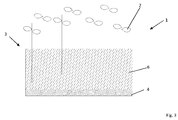
- Fig. 1 shows a schematic diagram of a substrate 1 for the cultivation of herbaceous plants 2, in particular herbs, preferably cress, according to an embodiment of the invention in a perspective view.
- the substrate 1 comprises a planar, ie substantially two-dimensional, band or sheet-like substrate base body 3.
- the substrate base body 3 is structurally such that on and / or in these seeds, seedlings, etc. can be up and / or introduced or can be, which grow by appropriate nutrient addition, in particular water, to corresponding herbaceous plants 2.
- the substrate body 3 has a multilayer, ie three-layer structure.
- the multilayer construction of the substrate base body 3 results from a special arrangement of two cover layers 4, 5 and a central layer 6.
- the central layer 6 is arranged between the cover layers 4, 5.
- a first cover layer 4 forms a first outer surface or surface of the substrate main body 3 or of the substrate 1
- a second cover layer 5 forms a second outer surface or surface of the substrate main body 3 or of the substrate opposite the first outer surface or surface of the substrate main body 3 1.
- the second outer surface or surface of the substrate main body 3 forms the underside of the substrate main body 3 or the substrate 1.
- both the cover layers 4, 5 and the central layer 6 are formed of pure pulp.
- pulp is formed (almost) exclusively from the actual pulp material, ie in addition to the actual pulp material no (or little more) additional (s) components, such as. B. residues from pulp recycling processes contains.
- the pure pulp is so-called fresh pulp.
- the pulp may contain (additionally) other or further biodegradable or harmless substances.
- the pulp may be formed from a plurality of (different) pulp materials or comprise a plurality of (different) pulp materials.
- Corresponding pulp materials may differ in their respective chemical properties, i. H. their pulp chemistry or chemical structure, or their respective mechanical properties differ.
- the mechanical properties of respective pulp materials result in particular from the respective fiber parameters, i. H. z.
- the pulp may in principle be vegetable or synthetic.
- plant-based pulps, in particular cellulose or cellulosic pulps is preferred. Particularly useful is the use of fresh cellulose, as used for example for the production of tissue paper.
- the cover layers 4, 5 are dimensionally stable in comparison to the central layer 6, so that the cover layers 4, 5, in particular also during swelling, exert a certain shape-retaining effect on the central layer 6. In this way, it can be ensured that the central layer 6, which typically tends to fray or dissolve, is held in shape, in particular even during swelling.
- the cover layers 4, 5 are therefore formed in comparison to the central layer 6 of a dimensionally stable (re) n or dimensionally stable (er) trained pulp.
- the cover layers 4, 5 are made of pressed or textile-like, d. H. z. B. formed in the manner of a fabric or knitted fabric, combined pulp and the central layer 6 of non-pressed loose or knitted pulp. Due to the pressing or textile-like summary, the cover layers 4, 5, in particular also during swelling, are (substantially) dimensionally stable.
- the cover layers 4, 5 have in the in the Fig. 1, 2 shown embodiment compared to the central layer 6 has a higher density.
- the density of a pulp is typically proportional to its mechanical stability, in particular its tensile strength.
- Since the density also typically influences the swelling capacity of respective layers 4, 5, 6 Parameter is, on the density of respective layers 4, 5, 6 and the swelling capacity of respective layers 4, 5, 6 are selectively influenced.
- the central layer 6 shows a high swelling capacity.
- the central layer 6 forms by means of a comparatively low (re) density special anchoring or hooking possibilities for anchoring or entanglement of the roots of corresponding herbaceous plants 2 growing in the substrate 1.
- the basis weight is also a parameter influencing the mechanical properties and the swelling capacity of respective layers 4, 5, 6.
- the cover layers 4, 5 have in comparison to the central layer 6 on a lower basis weight. Specifically, in the embodiments shown in the figures, the cover layers 4, 5 have a basis weight in a range between 10 and 20 g / m 2 .
- the central layer 6 has a basis weight in a range between 200 and 500 g / m 2 . Also by the relatively higher basis weight in combination with a low (re) n density, the central layer 6 shows a high swelling capacity and forms the mentioned special anchoring or hooking possibilities for anchoring or entangling the roots of corresponding plants 2 growing in the substrate 1.
- the cover layers 4, 5 in comparison to the central layer 6 have a smaller thickness.
- the formation of the cover layers 4, 5 with a, in particular compared to the central layer 6, small (re) n thickness contributes to a relatively compact construction of the substrate body 3 at.
- the total thickness of a substrate base body 3 is in a range between 0.5 and 35 mm, in particular between 1 and 5 mm.
- the thickness of the central layer 6 may be in a range between 0.5 and 34 mm, in particular between 0.5 and 4.5 mm.
- the cover layers 4, 5 differ, as indicated, in their moisture or liquid absorption capacity and thus their swelling capacity from the central layer 6.
- the cover layers 4, 5 have in comparison to the central layer 6 other swelling properties, namely a lower swelling capacity and thus moisture or liquid absorption capacity, in particular water absorption capacity, on.
- the structural properties of the cover layers 4, 5 less affected by the absorption of moisture or liquid and a concomitant swelling compared to the central layer 6; the cover layers 4, 5 remain in the swollen state (essentially) dimensionally stable.
- the central layer 6 is typically the layer which receives the majority of a total quantity of moisture or liquid that can be absorbed or absorbed in the substrate base body 3.
- the loose or knit-like design of the central layer 6 is again to mention, which allows a particularly high and fast moisture or fluid intake, especially water absorption.
- cover layers 4, 5 and the central layer 6 do not lie loosely on one another, but are stably connected to one another or connected to one another while forming a multilayer composite forming the substrate main body 3.
- the cover layers 4, 5 can be present as semi-finished products pre-compressed to a specific basis weight, before they are joined to the central layer 6 to form the substrate main body 3.
- the first cover layer 4 and the second cover layer 5 are thus each at least partially positively and / or non-positively and / or materially connected to the central layer 6.
- a positive connection between the cover layers 4, 5 and the central layer 6 may be formed by means of a hook and loop connection.
- a frictional connection between the cover layers 4, 5 and the central layer 6 may be formed by means of a press connection.
- An integral connection between the cover layers 4, 5 and the central layer 6 can be formed by means of an adhesive bond. The same applies to the connection of the cover layers 4, 5 mit- or with each other. In the in the Fig. 1, 2 embodiment shown, the layers 4, 5, 6 are non-positively pressed together.
- At least one cover layer 4, 5 and / or the central layer 6 may be at least partially offset with a nutrient composition for a respective herbaceous plant 2.
- a nutrient composition for a respective herbaceous plant 2.
- it may, for. B. a nitrate, Phosphate and / or potassium solution act.
- a corresponding nutrient composition is typically matched to the plants 2 to be grown in the substrate 1.
- a corresponding nutrient composition can also be in the form of a, z. As gelatinous or gel-like, impregnation of respective layers 4, 5, 6 are present.
- a central layer 6 comprising a plurality of central layer elements arranged one above the other or formed one above the other
- at least one central layer element is provided with a suitable nutrient composition.
- This is expedient in particular with regard to the cultivation of flowers or vegetables or the cultivation of corresponding seedlings or a corresponding use of the substrate 1.
- Fig. 3 shows a sectional view through a substrate 1 according to another embodiment of the invention. Unlike in the Fig. 1, 2 In the embodiment shown, the substrate main body 3 has only a two-layered construction. The two-layer structure of the substrate main body 3 results from a special arrangement of a first cover layer 4 and the central layer 6. The central layer 6 is arranged on the first cover layer 4.
- the first cover layer 4 forms a first outer surface or surface of the substrate main body 3 or of the substrate 1
- the central layer 6 forms a second outer surface or surface of the substrate main body 3 or of the substrate 1 opposite the first outer surface or surface of the substrate main body 3
- the first outer layer or surface of the substrate main body 3 forms the underside of the substrate main body 3 or of the substrate 1, ie, the first cover layer 4 forms a kind of support for the central layer 6.
- the second outer or surface of the substrate main body 3 forms the upper side of the Substrate main body 3 and the substrate 1.
- a reverse configuration is also conceivable here.
- a substrate body 3 may also have a single-layer structure.
- a single-layered substrate base body 3 is formed solely from a corresponding central position 6.
- the herbaceous plants 2 as soon as they have reached a certain growth, z. B. can be removed from the substrate body 3 by one or more cutting operations. Due to the formation of the substrate 1 from pure pulp or from biodegradable or harmless material, it is also possible that the substrate 1 or the substrate body 3 total or single or multiple layers 4, 5, 6 of the substrate body 3 together with the plants 2 in a bed or The like can be used. A composite of the substrate base body 3 comprising several layers 4, 5, 6 can therefore be at least partially dissolved beforehand and corresponding layers 4, 5, 6 dissolved from the composite together with the plants 2 located therein, ie hooked or rooted, into a bed or the like can be used. The plants 2 need not necessarily be removed from the substrate body 1, which means a particularly gentle handling of the plants 2.
- the invention also relates to the use of a single or multi-layered construction, comprising at least one central layer 6 of pure pulp, substrate substrate 3 comprising substrate 1 for the cultivation of plants 2, especially herbaceous plants or herbs, preferably Cress, flower or vegetable plants.
- a corresponding substrate 1 is outstandingly suitable for the cultivation of plants 2, in particular herbs, preferably cress, as well as flowers or vegetables.
Landscapes
- Life Sciences & Earth Sciences (AREA)
- Environmental Sciences (AREA)
- Cultivation Of Plants (AREA)
- Cultivation Receptacles Or Flower-Pots, Or Pots For Seedlings (AREA)
Applications Claiming Priority (1)
| Application Number | Priority Date | Filing Date | Title |
|---|---|---|---|
| DE102015003168.6A DE102015003168B3 (de) | 2015-03-13 | 2015-03-13 | Substrat für den Anbau von Pflanzen |
Publications (1)
| Publication Number | Publication Date |
|---|---|
| EP3066914A1 true EP3066914A1 (fr) | 2016-09-14 |
Family
ID=56072164
Family Applications (1)
| Application Number | Title | Priority Date | Filing Date |
|---|---|---|---|
| EP16159879.2A Withdrawn EP3066914A1 (fr) | 2015-03-13 | 2016-03-11 | Substrat pour la culture des plantes |
Country Status (2)
| Country | Link |
|---|---|
| EP (1) | EP3066914A1 (fr) |
| DE (1) | DE102015003168B3 (fr) |
Cited By (1)
| Publication number | Priority date | Publication date | Assignee | Title |
|---|---|---|---|---|
| DE102020119767A1 (de) | 2020-07-27 | 2022-01-27 | Dreesen Frische Kräuter GmbH & Co. KG | Pflanzenwachstumssubstrat |
Families Citing this family (1)
| Publication number | Priority date | Publication date | Assignee | Title |
|---|---|---|---|---|
| US11596109B2 (en) * | 2019-10-22 | 2023-03-07 | Joao Luis Pinto Fonseca dos Reis | High density plant growth systems and methods |
Citations (12)
| Publication number | Priority date | Publication date | Assignee | Title |
|---|---|---|---|---|
| DE2655287A1 (de) * | 1976-12-07 | 1978-06-08 | Mielke Wilhelmine | Torfzylinder mit weicher pikierzone |
| US5081791A (en) * | 1985-11-29 | 1992-01-21 | Beghin-Say S.A. | Support for out-of-ground cultivation comprising superabsorbent particles and method of production |
| DE9408854U1 (de) * | 1994-05-10 | 1994-08-25 | Hofmann, Klaus, 97320 Albertshofen | Vorrichtung für den Anbau von Keimsprossenpflanzen |
| WO1994022287A1 (fr) * | 1993-03-30 | 1994-10-13 | Västsallat Ab | Substrat de culture |
| DE29818178U1 (de) | 1997-11-18 | 1999-02-11 | Maksimow, Alexander, 48565 Steinfurt | Saugfähige Faserstoffbahn |
| WO2000067549A1 (fr) * | 1999-05-05 | 2000-11-16 | Terraseed Limited | Milieu de germination de semences |
| EP1210866A2 (fr) * | 2000-12-04 | 2002-06-05 | Blieninger Holzspäne GmbH | Corps moulé compressé |
| EP1305991A1 (fr) * | 2001-10-26 | 2003-05-02 | Yuen Foong Yu Paper MFG Company, Limited | Papier multiusage, fabrication et application de ce dernier |
| DE202004007052U1 (de) * | 2004-05-03 | 2004-06-24 | Mcairlaid's Vliesstoffe Gmbh & Co. Kg | Bahnförmiger Samenträger zur Herstellung eines Pflanzenbewuchses |
| US7059083B2 (en) * | 2003-02-12 | 2006-06-13 | Gp Cellulose, Llc | Seedbed for growing vegetation |
| US20090019765A1 (en) * | 2007-07-18 | 2009-01-22 | 6062 Holdings, Llc | Plant growth medium |
| US20140182198A1 (en) * | 2012-12-26 | 2014-07-03 | Blue Norther Investments, LLC | Water Retention Agent and Preservation Method |
-
2015
- 2015-03-13 DE DE102015003168.6A patent/DE102015003168B3/de not_active Expired - Fee Related
-
2016
- 2016-03-11 EP EP16159879.2A patent/EP3066914A1/fr not_active Withdrawn
Patent Citations (13)
| Publication number | Priority date | Publication date | Assignee | Title |
|---|---|---|---|---|
| DE2655287A1 (de) * | 1976-12-07 | 1978-06-08 | Mielke Wilhelmine | Torfzylinder mit weicher pikierzone |
| US5081791A (en) * | 1985-11-29 | 1992-01-21 | Beghin-Say S.A. | Support for out-of-ground cultivation comprising superabsorbent particles and method of production |
| WO1994022287A1 (fr) * | 1993-03-30 | 1994-10-13 | Västsallat Ab | Substrat de culture |
| DE9408854U1 (de) * | 1994-05-10 | 1994-08-25 | Hofmann, Klaus, 97320 Albertshofen | Vorrichtung für den Anbau von Keimsprossenpflanzen |
| DE29818178U1 (de) | 1997-11-18 | 1999-02-11 | Maksimow, Alexander, 48565 Steinfurt | Saugfähige Faserstoffbahn |
| WO1999025281A1 (fr) | 1997-11-18 | 1999-05-27 | Alexander Maksimow | Procede et dispositif pour produire une bande de materiau fibreux a base de fibres de cellulose, s'utilisant dans le domaine des articles d'hygiene |
| WO2000067549A1 (fr) * | 1999-05-05 | 2000-11-16 | Terraseed Limited | Milieu de germination de semences |
| EP1210866A2 (fr) * | 2000-12-04 | 2002-06-05 | Blieninger Holzspäne GmbH | Corps moulé compressé |
| EP1305991A1 (fr) * | 2001-10-26 | 2003-05-02 | Yuen Foong Yu Paper MFG Company, Limited | Papier multiusage, fabrication et application de ce dernier |
| US7059083B2 (en) * | 2003-02-12 | 2006-06-13 | Gp Cellulose, Llc | Seedbed for growing vegetation |
| DE202004007052U1 (de) * | 2004-05-03 | 2004-06-24 | Mcairlaid's Vliesstoffe Gmbh & Co. Kg | Bahnförmiger Samenträger zur Herstellung eines Pflanzenbewuchses |
| US20090019765A1 (en) * | 2007-07-18 | 2009-01-22 | 6062 Holdings, Llc | Plant growth medium |
| US20140182198A1 (en) * | 2012-12-26 | 2014-07-03 | Blue Norther Investments, LLC | Water Retention Agent and Preservation Method |
Cited By (1)
| Publication number | Priority date | Publication date | Assignee | Title |
|---|---|---|---|---|
| DE102020119767A1 (de) | 2020-07-27 | 2022-01-27 | Dreesen Frische Kräuter GmbH & Co. KG | Pflanzenwachstumssubstrat |
Also Published As
| Publication number | Publication date |
|---|---|
| DE102015003168B3 (de) | 2016-06-16 |
Similar Documents
| Publication | Publication Date | Title |
|---|---|---|
| DE19523406C1 (de) | Aus mehreren Schichten bestehendes Vegetationselement | |
| DE60123578T2 (de) | Fixierungsband für samen zur kontrolle des keimprozesses | |
| EP0512272A1 (fr) | Support de plantes | |
| DE2902562A1 (de) | Pflanzsode | |
| DE2656294A1 (de) | Verfahren zur herstellung eines flaechenhaften saattraegers | |
| DE3885414T2 (de) | Vielfachtopf für die Züchtung und Verpflanzung von Sämlingen sowie Verfahren zu seiner Herstellung. | |
| DE102015003168B3 (de) | Substrat für den Anbau von Pflanzen | |
| EP3790376B1 (fr) | Procédé permettant l'enracinement commun sans substrat d'une pluralité de boutures non racinées | |
| AT393931B (de) | Erosionsschutz- und pflanzmatte | |
| DE1900628A1 (de) | Pflanzenzieheinrichtung und Verfahren zur Herstellung derselben | |
| DE2537056C3 (de) | Bodenbedeckung für Pflanzungen, Baumschulen oder dergl. | |
| EP1331842A1 (fr) | Recipient pour plantation | |
| DE2129498A1 (de) | Vorrichtung zur Zuechtung von Setzlingen | |
| DE9409438U1 (de) | Selbsttragender Besatz für Innenabdeckungen von Fahrzeugdecken | |
| WO2000001216A1 (fr) | Element vegetal destine a etre place sur des surfaces liees a de la terre | |
| DE2938033A1 (de) | Aus einem einschichtigen faserband bestehendes faservlies | |
| DE3828843A1 (de) | Transportable, schnellanwachsende rasenmatte sowie verfahren zu ihrer herstellung und anwendung | |
| DD155245A5 (de) | Verfahren und verpackungsmittel zum pflanzfertigen verpacken wurzelnackter zier-,nutz-oder wildgehoelze | |
| EP0857417A2 (fr) | Pot à plante | |
| DE7936342U1 (de) | Pflanzballen | |
| DE2230639A1 (de) | Saemlingsbehaeltereinheit und verfahren zu deren herstellung | |
| WO2022058950A1 (fr) | Chaîne de palissage de plantes biodégradable | |
| EP2792237B1 (fr) | Composition, dispositif d'élevage et procédé d'élevage de Spathius exarator | |
| Dennaoui | Salafistische Überbietungsdiskurse | |
| DE2813059A1 (de) | Vorrichtung zum verwahren von pflanzenwurzeln oder -samen bzw. -keimlingen |
Legal Events
| Date | Code | Title | Description |
|---|---|---|---|
| PUAI | Public reference made under article 153(3) epc to a published international application that has entered the european phase |
Free format text: ORIGINAL CODE: 0009012 |
|
| AK | Designated contracting states |
Kind code of ref document: A1 Designated state(s): AL AT BE BG CH CY CZ DE DK EE ES FI FR GB GR HR HU IE IS IT LI LT LU LV MC MK MT NL NO PL PT RO RS SE SI SK SM TR |
|
| AX | Request for extension of the european patent |
Extension state: BA ME |
|
| TPAC | Observations filed by third parties |
Free format text: ORIGINAL CODE: EPIDOSNTIPA |
|
| 17P | Request for examination filed |
Effective date: 20161214 |
|
| RBV | Designated contracting states (corrected) |
Designated state(s): AL AT BE BG CH CY CZ DE DK EE ES FI FR GB GR HR HU IE IS IT LI LT LU LV MC MK MT NL NO PL PT RO RS SE SI SK SM TR |
|
| 17Q | First examination report despatched |
Effective date: 20170309 |
|
| 19U | Interruption of proceedings before grant |
Effective date: 20181016 |
|
| 19W | Proceedings resumed before grant after interruption of proceedings |
Effective date: 20190603 |
|
| RAP1 | Party data changed (applicant data changed or rights of an application transferred) |
Owner name: BHG BAYERISCHE HANDELSGESELLSCHAFT MBH |
|
| STAA | Information on the status of an ep patent application or granted ep patent |
Free format text: STATUS: THE APPLICATION IS DEEMED TO BE WITHDRAWN |
|
| 18D | Application deemed to be withdrawn |
Effective date: 20191003 |