EP3066945A1 - Schale mit innenzunge - Google Patents
Schale mit innenzunge Download PDFInfo
- Publication number
- EP3066945A1 EP3066945A1 EP16000505.4A EP16000505A EP3066945A1 EP 3066945 A1 EP3066945 A1 EP 3066945A1 EP 16000505 A EP16000505 A EP 16000505A EP 3066945 A1 EP3066945 A1 EP 3066945A1
- Authority
- EP
- European Patent Office
- Prior art keywords
- tongue
- ski boot
- medial
- edge
- lateral
- Prior art date
- Legal status (The legal status is an assumption and is not a legal conclusion. Google has not performed a legal analysis and makes no representation as to the accuracy of the status listed.)
- Withdrawn
Links
Images




Classifications
-
- A—HUMAN NECESSITIES
- A43—FOOTWEAR
- A43B—CHARACTERISTIC FEATURES OF FOOTWEAR; PARTS OF FOOTWEAR
- A43B5/00—Footwear for sporting purposes
- A43B5/04—Ski or like boots
- A43B5/0427—Ski or like boots characterised by type or construction details
- A43B5/0476—Front-entry skiboots
-
- A—HUMAN NECESSITIES
- A43—FOOTWEAR
- A43B—CHARACTERISTIC FEATURES OF FOOTWEAR; PARTS OF FOOTWEAR
- A43B5/00—Footwear for sporting purposes
- A43B5/04—Ski or like boots
- A43B5/0427—Ski or like boots characterised by type or construction details
- A43B5/047—Ski or like boots characterised by type or construction details provided with means to improve walking with the skiboot
-
- A—HUMAN NECESSITIES
- A43—FOOTWEAR
- A43B—CHARACTERISTIC FEATURES OF FOOTWEAR; PARTS OF FOOTWEAR
- A43B23/00—Uppers; Boot legs; Stiffeners; Other single parts of footwear
- A43B23/26—Tongues for shoes
-
- A—HUMAN NECESSITIES
- A43—FOOTWEAR
- A43B—CHARACTERISTIC FEATURES OF FOOTWEAR; PARTS OF FOOTWEAR
- A43B5/00—Footwear for sporting purposes
- A43B5/04—Ski or like boots
- A43B5/0405—Linings, paddings or insertions; Inner boots
Definitions
- the invention relates to a shoe for skiing, especially for skiing downhill. More specifically, the invention relates to ski boots which comprise a rigid shell made of plastic material inside which is inserted an inner liner made of flexible material.
- the shell consists of a shell bottom, a hood and an articulated collar.
- the lower shell has a large longitudinal opening that extends from the top of the shoe to the front of the foot. This opening has two side edges that do not overlap.
- the hood is hinged to the hull at the forefoot and is intended to cover the longitudinal opening of the hull As the hood is placed above the hull, its forward tilting completely releases the hull. longitudinal opening. It is in this position of the hood that can be done very easily the boot by the skier. Indeed, the latter can easily slide his foot into the opening, which extends far forward.
- the skier With such a shoe, the skier must not exert a very important effort to spread the side edges of the opening. This construction is still used, especially for ski touring boots because it offers good ease of entry and loosening. However, this is still a poor performance shoe.
- the hood is a bulky piece whose rough aesthetics no longer satisfy the practitioners.
- the most widely used construction is the so-called alpine shoe with overlap or alpine shoe with overlapping flaps.
- the lateral edges of the longitudinal opening overlap.
- These shoes are particularly popular for ski racing and for all high-performance alpine skiing. Indeed, friction is generated between the two flaps when they are pressed against each other. It is thanks to these friction that these shoes offer a good transmission of efforts, especially during the forward bending of the skier's leg.
- the big disadvantage of these shoes is the difficulty of putting on and the difficulty of tightening.
- the inner liner placed in such a shell is equipped with a rigid plate for distributing the forces generated by the tightening of the clamping loops.
- the distribution plate is constituted by a plate made of molded or injected plastic which is sewn on the tongue of the liner.
- the distribution plate In the end, no less than three layers of plastic overlap the skier's instep. So that shoes overlap are rather heavy, rather uncomfortable and rather bulky.
- the present invention aims to improve the construction of alpine ski boots. Its purpose is to provide an alpine ski boot that does not have the disadvantages of prior art constructions. These include providing a shoe that is both powerful in which the transmission of effort from the leg to the forefoot and the ski is effective, comfortable, light, not bulky, that is to say close foot, and easy to put on.
- a ski boot comprising a rigid rod consisting of a shell bottom equipped with a rigid tongue and surmounted by an articulated collar; wherein the shell bottom has a wide opening extending from the top of the stem towards the front of the foot, said opening separating a lateral edge from a medial edge, which extend parallel to one another; to the other without overlapping, and in which the rigid tongue is wider than said opening and it comprises a lateral wing, respectively a medial wing, placed under the lateral edge, respectively the medial edge.
- the shoe 1 according to the invention is an alpine ski boot, comprising a rigid shell made of plastic material.
- the plastics that are suitable for the manufacture of such a hull are Polyamide, Polypropylene, Polyurethane, Polyester, etc ...
- the rigidity of the hull is a necessary condition for alpine skiing practices to the extent that the efforts that must exercise the skier on his skis to drive them are not only important, but must necessarily transit through the shoe and ski bindings. In practice, it will be possible to choose materials having a flexural modulus of between 200 and 1800 MPa, preferably between 200 and 1000 MPa.
- An inner liner 2 is inserted into the shell for comfort.
- This shoe 2 is made by assembling various elements such as flexible panels of fabrics or plastics, which may be optionally in the form of foam.
- the shell itself, can constitute the assembly of different elements.
- the shell comprises in particular a bottom shell 3, an articulated collar 4 and a tongue 5.
- These three elements constitute the main rigid armature of the shell, which is completed by other components that do not will not all be described in detail later.
- the bottom shell 3 is made by injection molding of a polyurethane whose flexural modulus is between 200 and 1000 MPa.
- the shell bottom 3 comprises the sole 31 and the flanks 32 of the lower part of the upper of the shoe.
- the upper part of the shell bottom is constituted by a wide opening 33.
- the front portion 331 of this opening extends to the front of the foot.
- the front portion of the opening 331 is delimited, on the one hand, laterally by a lateral edge 322, and a medial edge 323, and on the other hand, longitudinally by the posterior end of the shell 321.
- the shell 321, is the part of the shell bottom that covers and wraps the end of the user's foot.
- the lateral edge 322 and the medial edge 323 do not overlap.
- the anterior portion of the opening is largely gaping, even without the need to exert effort to spread the flanks of the hull.
- the lateral and medial edges are substantially parallel to each other and there is, between them, a gap of between 2 and 6 cm, this gap constituting the width of the opening.
- the collar 4 is fixed on the shell bottom 3, so as to pivot relative thereto about an axis coinciding with the axis of articulation of the malleolus. During the walking phases, the collar can then follow the rotation of the leg of the user. The collar is also likely to be attached to the rear of the shell bottom to be able to block the rotation of the collar, especially during ski phases.
- the collar 4 comprises two flaps 42, 43. These flaps are large. Thus, when the shoe is closed they come to rest on one another and completely cover an upper portion of the tongue.
- the tongue 5 consists of a part obtained by injection of a thermoplastic material.
- This material may be of the same type as that used to make the shell bottom. It is preferably made in one piece from the front of the shoe to the top thereof to ensure good transmission of effort from the user's leg to the forefoot.
- the tongue has a cooperating element with fixing means at the bottom of the shell. In the embodiment described here, it is an opening 55 in which a rivet 8 will be inserted.
- any other fastening means can be envisaged without departing from the scope of the invention.
- the front end 56 of the tongue in which the opening 55 is made, is fixed above the shell 321.
- This feature significantly improves the distribution of the forces that are transmitted from the tongue downwards. hull, especially during forward bending phases,
- the attachment of the tongue from above saves volume inside the hull.
- the internal volume thus gained can be used to improve the comfort or the insulation because one can use more cushioning layer or insulation for the same interior volume.
- This construction can also reduce the external volume of the front portion of the bottom of the hull. In which case, it has a ski boot with improved aesthetics because it seems refined compared to the ski boots of the prior art.
- the tongue also has two slots 56 at its top which serve to fix a traction strap 57.
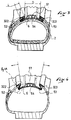
- the tongue has a central plate 51 which extends over almost the entire length of the tongue and which is bordered on each side by wings, a lateral wing 52 and a medial wing 53. As can be seen in FIG. Figures 3 and 4 , in a cross section the plate 51 is raised relative to the wings.
- ribs 54 from the underside of the tray fill the space behind the tray so as to provide a bearing surface of the tongue on the inner shoe which has a regular curvature. The ribs 54 also extend over almost the entire length of the tongue.
- the wings of the tongue are intended to be placed under the lateral and medial edges when the shoe is closed and the closures hooks are tight. It is thus realized two overlapping parallel over the entire lower part of the tongue, that is to say the part facing the side edges 322 and medial 323. There is, on the medial side of the shoe, the overlap of the medial edge 323 on the medial wing 53 and the lateral side, the overlap of the lateral edge 322 on the lateral wing 52.
- Each of the two parallel overlaps has a width L, measured in a transverse plane, of between 8 and 30 mm, preferably between 10 and 25 mm. They are on the other hand spaced from each other by a distance D between 25 and 60 mm.
- the overlaps constitute a pair of two parallel reinforcements which begin in the upper part of the shell bottom and extend into the before foot. This pair of reinforcement has the effect of stiffening the shoe all of the bottom shell.
- central plate 51 and the ribs 64 also contribute to stiffening the boot, especially since they avoid deformations of the tongue 5 when the skier bends forward.
- a flexible panel 6 is attached to the lateral edge and the medial edge of the opening 33. It is preferably placed on the outer face of the shell bottom and passes below the tongue. It is thus realized a bellows 61 which guarantees the tightness of the shoe. The snow and water can not penetrate the shoe, even when the shoe is not closed and the two side edges are spaced from each other to facilitate the introduction of the foot of the user.
- the figure 6 shows a partial internal view of the tongue 5. It can be seen that the bellows 61 present in the lower part of the flexible panel 6 is extended upwardly by an apron 62.
- the apron 62 has substantially the shape of a triangle. At the top of this apron 62, there are provided means for fixing the latter on the tongue 5. In this case, in the embodiment described, it is a main rivet 63.
- the main rivet 63 For fixing the tongue 6 to the flexible panel 6, one can optionally associate the main rivet 63 with two side rivets 64.
- the attachment of the apron 62 on the tongue by the main fastening means is performed in the upper half-portion of the tongue, above the area corresponding to the instep.
- the other fixing means constituted in this case by the two lateral rivets are placed lower on the tongue, approximately in the maximum curvature zone thereof. This is the area where, starting from the forefoot, the tongue moves from a mainly horizontal orientation, even slightly inclined, to a mainly vertical orientation.
- the flexible panel 6 is little or not expandable.
- the flexible panel acts as a brake for the tongue 5 when the user pulls on the traction strap 57 to spread it.
- the length of the apron 62 is chosen so that when the maximum opening of the tongue, there is always somewhere along the length of the wings a frontal contact between the edge of the lateral and medial edges and the edge of the wings.
- the figure 4 shows in section, the shell bottom and the tongue when the hooks 37 are loosened or open.
- the flanks 32 of the hull bottom then find their position in the free state.
- the user can increase the opening thereof by exerting a pull upward and forward on the strap 57.
- the edges of the tongue come to rest on the lateral and medial edges 322, 323 and separate them from each other.
- the Figure 4A shows in section an alternative embodiment of the invention. To facilitate understanding, the actual position of the cup of the Figure 4A is spotted on the figure 4 .
- additional means are provided to prevent the tongue 5 from leaving its location.
- These retention means 9 of the tongue 5 consist of a band 91 fixed on the one hand to the lateral edge 322 and on the other hand to the tongue 5. Fixing both ends of the band can be made by any suitable means, rivet, gluing, seam, screw / nut.
- an orifice 521 is formed on the tongue 5 between the plate 51 and the lateral flange 52.
- the band 91 is fixed on the lateral edge 322, then it is slid through the orifice 521. It is The choice of the length of the band 91 is judiciously made so that the amplitude of the relative movement between the lateral edge 322 and the tongue 5 is limited. Thus, it is impossible for the side wing 52 to pass over the side edge.
- the presence of retention means 9 on the lateral / medial side only is sufficient to prevent the lower part of the tongue from being pulled out of its normal position under the lateral 322 and medial 323 edges.
- the retention means 9 may be placed under one of the hooks 37 so as to be virtually invisible.
- the figure 5 shows a perspective view of the boot inside the shoe of the invention.
- it is constituted by an assembly of various flexible panels which may be fabrics, nonwoven webs, plastic films and flexible foam panels.
- it comprises a long front portion 21 without opening, while two vertical slots 22, 23 take their origin in the instep and extend to the top of the liner.
- the two vertical slots 22, 23 delimit a tongue portion 25 of liner.
- the slipper does not have, as is the case in slippers for modern high-performance alpine ski boots, rigid distribution plate. Indeed, the outer surface of a front portion 24 of the liner is made from flexible materials. The front portion 24 corresponds to the portion of the liner which is under the tongue 5, when the liner is inserted into the bottom of the shell.
Landscapes
- Health & Medical Sciences (AREA)
- General Health & Medical Sciences (AREA)
- Physical Education & Sports Medicine (AREA)
- Footwear And Its Accessory, Manufacturing Method And Apparatuses (AREA)
Applications Claiming Priority (1)
| Application Number | Priority Date | Filing Date | Title |
|---|---|---|---|
| FR1500474A FR3033476B1 (fr) | 2015-03-12 | 2015-03-12 | Coque a languette interne |
Publications (1)
| Publication Number | Publication Date |
|---|---|
| EP3066945A1 true EP3066945A1 (de) | 2016-09-14 |
Family
ID=53794249
Family Applications (1)
| Application Number | Title | Priority Date | Filing Date |
|---|---|---|---|
| EP16000505.4A Withdrawn EP3066945A1 (de) | 2015-03-12 | 2016-03-02 | Schale mit innenzunge |
Country Status (3)
| Country | Link |
|---|---|
| US (1) | US20160262487A1 (de) |
| EP (1) | EP3066945A1 (de) |
| FR (1) | FR3033476B1 (de) |
Cited By (1)
| Publication number | Priority date | Publication date | Assignee | Title |
|---|---|---|---|---|
| CN112823045A (zh) * | 2018-12-27 | 2021-05-18 | 王雷 | 基于弧形弹簧而具有弹性转动机制的滑雪靴 |
Families Citing this family (9)
| Publication number | Priority date | Publication date | Assignee | Title |
|---|---|---|---|---|
| US10455877B2 (en) * | 2016-03-11 | 2019-10-29 | Nike, Inc. | Waistband for article of apparel |
| FR3065153B1 (fr) * | 2017-04-12 | 2019-06-28 | Salomon Sas | Chaussure a tige amelioree |
| US10327500B2 (en) | 2017-08-28 | 2019-06-25 | ProAdvent LLC | Ski boot dynamic support strap |
| USD848137S1 (en) | 2017-08-28 | 2019-05-14 | ProAdvent LLC | Retention element for ski boot liner |
| USD1007110S1 (en) | 2022-03-23 | 2023-12-12 | Mountain Origins Design LLC | Footwear |
| USD1033862S1 (en) | 2022-03-23 | 2024-07-09 | Mountain Origins Design LLC | Footwear |
| USD1007826S1 (en) | 2022-03-23 | 2023-12-19 | Mountain Origins Design LLC | Footwear |
| USD1008611S1 (en) | 2022-03-23 | 2023-12-26 | Mountain Origins Design LLC | Footwear |
| USD1007825S1 (en) | 2022-03-23 | 2023-12-19 | Mountain Origins Design LLC | Footwear |
Citations (6)
| Publication number | Priority date | Publication date | Assignee | Title |
|---|---|---|---|---|
| FR2022964A1 (de) * | 1968-11-09 | 1970-08-07 | Hornung Gerhard | |
| FR2129074A5 (de) * | 1971-02-18 | 1972-10-27 | Riddell | |
| DE3924240A1 (de) * | 1988-12-19 | 1990-06-28 | Josef Lederer | Schuh stichwort: oberrandtasche |
| EP0657115A1 (de) * | 1993-12-07 | 1995-06-14 | TECNICA S.p.A | Schliessvorrichtung für Sportschuh, insbesondere für Schischuh |
| EP2382886A1 (de) * | 2010-04-29 | 2011-11-02 | Salomon S.A.S. | Schuh zum Alpinskifahren |
| US20120167418A1 (en) * | 2010-12-30 | 2012-07-05 | Sport Maska Inc. | Skate boot tongue |
Family Cites Families (12)
| Publication number | Priority date | Publication date | Assignee | Title |
|---|---|---|---|---|
| US3722112A (en) * | 1969-08-21 | 1973-03-27 | Riddell | Ski boot construction |
| AT348896B (de) * | 1974-06-20 | 1979-03-12 | Martin Hans | Verschluss fuer skischuhe |
| DE2800187A1 (de) * | 1977-01-07 | 1978-07-13 | Hans Martin | Ski- und eislaufschuh |
| US4360979A (en) * | 1978-03-15 | 1982-11-30 | Spademan Richard George | Sport shoe with a dynamic adjustable cuff assembly |
| IT8162016U1 (it) * | 1981-12-24 | 1983-06-24 | Dolomite Spa | Scarpone da sci con hambetto elasticamente inclinabile in avanti |
| FR2691884B1 (fr) * | 1992-06-04 | 1994-08-12 | Salomon Sa | Chaussure de ski à fermeture étanche. |
| IT1266126B1 (it) * | 1993-10-07 | 1996-12-20 | Nordica Spa | Struttura di scarponi da sci a calzabilita' migliorata |
| FR2714269B1 (fr) * | 1993-12-24 | 1996-03-01 | Salomon Sa | Chaussure de ski alpin. |
| US6226898B1 (en) * | 1999-05-28 | 2001-05-08 | K-2 Corporation | Downhill ski boot with dual liner |
| EP1307117A1 (de) * | 2000-08-10 | 2003-05-07 | BENETTON GROUP S.p.A. | Sportschuh |
| US20050204585A1 (en) * | 2004-03-16 | 2005-09-22 | Malvin Loveridge | Expandable tongue for articulated boots |
| IT1396334B1 (it) * | 2009-10-13 | 2012-11-16 | Ober Alp Spa | Scarpone da sci, in particolare da sci alpinismo. |
-
2015
- 2015-03-12 FR FR1500474A patent/FR3033476B1/fr active Active
-
2016
- 2016-03-02 EP EP16000505.4A patent/EP3066945A1/de not_active Withdrawn
- 2016-03-11 US US15/067,546 patent/US20160262487A1/en not_active Abandoned
Patent Citations (6)
| Publication number | Priority date | Publication date | Assignee | Title |
|---|---|---|---|---|
| FR2022964A1 (de) * | 1968-11-09 | 1970-08-07 | Hornung Gerhard | |
| FR2129074A5 (de) * | 1971-02-18 | 1972-10-27 | Riddell | |
| DE3924240A1 (de) * | 1988-12-19 | 1990-06-28 | Josef Lederer | Schuh stichwort: oberrandtasche |
| EP0657115A1 (de) * | 1993-12-07 | 1995-06-14 | TECNICA S.p.A | Schliessvorrichtung für Sportschuh, insbesondere für Schischuh |
| EP2382886A1 (de) * | 2010-04-29 | 2011-11-02 | Salomon S.A.S. | Schuh zum Alpinskifahren |
| US20120167418A1 (en) * | 2010-12-30 | 2012-07-05 | Sport Maska Inc. | Skate boot tongue |
Cited By (2)
| Publication number | Priority date | Publication date | Assignee | Title |
|---|---|---|---|---|
| CN112823045A (zh) * | 2018-12-27 | 2021-05-18 | 王雷 | 基于弧形弹簧而具有弹性转动机制的滑雪靴 |
| CN112823045B (zh) * | 2018-12-27 | 2023-03-14 | 王雷 | 基于弧形弹簧而具有弹性转动机制的滑雪靴 |
Also Published As
| Publication number | Publication date |
|---|---|
| FR3033476A1 (fr) | 2016-09-16 |
| FR3033476B1 (fr) | 2019-07-05 |
| US20160262487A1 (en) | 2016-09-15 |
Similar Documents
| Publication | Publication Date | Title |
|---|---|---|
| FR3033476B1 (fr) | Coque a languette interne | |
| EP0710451B1 (de) | Sportschuh | |
| EP1174048B1 (de) | Spannvorrichtung für Schuhwerk | |
| EP1013185B1 (de) | Sportschuh | |
| EP0740908B1 (de) | Schuh zum Betreiben eines Wintersports | |
| FR2743264A1 (fr) | Botte de snowboard | |
| FR3106039A1 (fr) | Dispositif de serrage pour chaussure | |
| EP0770339B1 (de) | Schuh für Gleitsporten | |
| EP2572599A1 (de) | Schale für Skischuh mit Spoiler | |
| EP0774218B1 (de) | Rollschuh | |
| EP0916273B1 (de) | Schischuh | |
| EP0753267B1 (de) | Schneegleitbrett mit einer Innenschale und einem schwenkbaren steifen Hinterteil | |
| EP0972462B1 (de) | Sportschuh | |
| FR2776896A1 (fr) | Chaussure de sport a ossature rigide partiellement recouverte | |
| FR2914156A1 (fr) | Chaussure de sport. | |
| EP3123884B1 (de) | Sohle eines gleitsportschuhs | |
| EP3000342B1 (de) | Innenschuh mit erhöhtem Polster für Sportschuhe | |
| FR3141042A1 (fr) | Chaussure de sport équipée d’une sangle de serrage | |
| FR2769799A1 (fr) | Chaussure pour sport de glisse, en particulier chaussure de ski | |
| EP3598912B1 (de) | Skischuh mit innenschuh | |
| EP1319347B1 (de) | Innenschuh für Schuh für Gleitsportarten | |
| FR3076984A1 (fr) | Chausson interieur pour chaussure de sport | |
| WO2003073881A1 (fr) | Chaussures de course pour patinage | |
| CA2271321A1 (fr) | Chaussure de sport a ossature interne rigide | |
| FR2926702A1 (fr) | Nouveau type de chausson interne pour chaussure a coque rigide du genre chaussure de ski. |
Legal Events
| Date | Code | Title | Description |
|---|---|---|---|
| PUAI | Public reference made under article 153(3) epc to a published international application that has entered the european phase |
Free format text: ORIGINAL CODE: 0009012 |
|
| AK | Designated contracting states |
Kind code of ref document: A1 Designated state(s): AL AT BE BG CH CY CZ DE DK EE ES FI FR GB GR HR HU IE IS IT LI LT LU LV MC MK MT NL NO PL PT RO RS SE SI SK SM TR |
|
| AX | Request for extension of the european patent |
Extension state: BA ME |
|
| 17P | Request for examination filed |
Effective date: 20170310 |
|
| 17Q | First examination report despatched |
Effective date: 20190909 |
|
| STAA | Information on the status of an ep patent application or granted ep patent |
Free format text: STATUS: THE APPLICATION IS DEEMED TO BE WITHDRAWN |
|
| 18D | Application deemed to be withdrawn |
Effective date: 20200603 |