EP3067948A1 - Leitfähiges Polymer in organischem Lösungsmittel mit fluorierter Verbindung - Google Patents
Leitfähiges Polymer in organischem Lösungsmittel mit fluorierter Verbindung Download PDFInfo
- Publication number
- EP3067948A1 EP3067948A1 EP15158257.4A EP15158257A EP3067948A1 EP 3067948 A1 EP3067948 A1 EP 3067948A1 EP 15158257 A EP15158257 A EP 15158257A EP 3067948 A1 EP3067948 A1 EP 3067948A1
- Authority
- EP
- European Patent Office
- Prior art keywords
- composition according
- composition
- fluorinated compound
- organic solvent
- copolymer
- Prior art date
- Legal status (The legal status is an assumption and is not a legal conclusion. Google has not performed a legal analysis and makes no representation as to the accuracy of the status listed.)
- Granted
Links
Images
Classifications
-
- B—PERFORMING OPERATIONS; TRANSPORTING
- B32—LAYERED PRODUCTS
- B32B—LAYERED PRODUCTS, i.e. PRODUCTS BUILT-UP OF STRATA OF FLAT OR NON-FLAT, e.g. CELLULAR OR HONEYCOMB, FORM
- B32B27/00—Layered products comprising a layer of synthetic resin
- B32B27/06—Layered products comprising a layer of synthetic resin as the main or only constituent of a layer, which is next to another layer of the same or of a different material
-
- C—CHEMISTRY; METALLURGY
- C08—ORGANIC MACROMOLECULAR COMPOUNDS; THEIR PREPARATION OR CHEMICAL WORKING-UP; COMPOSITIONS BASED THEREON
- C08L—COMPOSITIONS OF MACROMOLECULAR COMPOUNDS
- C08L53/00—Compositions of block copolymers containing at least one sequence of a polymer obtained by reactions only involving carbon-to-carbon unsaturated bonds; Compositions of derivatives of such polymers
- C08L53/02—Compositions of block copolymers containing at least one sequence of a polymer obtained by reactions only involving carbon-to-carbon unsaturated bonds; Compositions of derivatives of such polymers of vinyl-aromatic monomers and conjugated dienes
- C08L53/025—Compositions of block copolymers containing at least one sequence of a polymer obtained by reactions only involving carbon-to-carbon unsaturated bonds; Compositions of derivatives of such polymers of vinyl-aromatic monomers and conjugated dienes modified
-
- B—PERFORMING OPERATIONS; TRANSPORTING
- B32—LAYERED PRODUCTS
- B32B—LAYERED PRODUCTS, i.e. PRODUCTS BUILT-UP OF STRATA OF FLAT OR NON-FLAT, e.g. CELLULAR OR HONEYCOMB, FORM
- B32B27/00—Layered products comprising a layer of synthetic resin
- B32B27/28—Layered products comprising a layer of synthetic resin comprising synthetic resins not wholly covered by any one of the sub-groups B32B27/30 - B32B27/42
- B32B27/281—Layered products comprising a layer of synthetic resin comprising synthetic resins not wholly covered by any one of the sub-groups B32B27/30 - B32B27/42 comprising polyimides
-
- B—PERFORMING OPERATIONS; TRANSPORTING
- B32—LAYERED PRODUCTS
- B32B—LAYERED PRODUCTS, i.e. PRODUCTS BUILT-UP OF STRATA OF FLAT OR NON-FLAT, e.g. CELLULAR OR HONEYCOMB, FORM
- B32B27/00—Layered products comprising a layer of synthetic resin
- B32B27/28—Layered products comprising a layer of synthetic resin comprising synthetic resins not wholly covered by any one of the sub-groups B32B27/30 - B32B27/42
- B32B27/286—Layered products comprising a layer of synthetic resin comprising synthetic resins not wholly covered by any one of the sub-groups B32B27/30 - B32B27/42 comprising polysulphones; polysulfides
-
- B—PERFORMING OPERATIONS; TRANSPORTING
- B32—LAYERED PRODUCTS
- B32B—LAYERED PRODUCTS, i.e. PRODUCTS BUILT-UP OF STRATA OF FLAT OR NON-FLAT, e.g. CELLULAR OR HONEYCOMB, FORM
- B32B27/00—Layered products comprising a layer of synthetic resin
- B32B27/30—Layered products comprising a layer of synthetic resin comprising vinyl (co)polymers; comprising acrylic (co)polymers
-
- B—PERFORMING OPERATIONS; TRANSPORTING
- B32—LAYERED PRODUCTS
- B32B—LAYERED PRODUCTS, i.e. PRODUCTS BUILT-UP OF STRATA OF FLAT OR NON-FLAT, e.g. CELLULAR OR HONEYCOMB, FORM
- B32B27/00—Layered products comprising a layer of synthetic resin
- B32B27/30—Layered products comprising a layer of synthetic resin comprising vinyl (co)polymers; comprising acrylic (co)polymers
- B32B27/302—Layered products comprising a layer of synthetic resin comprising vinyl (co)polymers; comprising acrylic (co)polymers comprising aromatic vinyl (co)polymers, e.g. styrenic (co)polymers
-
- B—PERFORMING OPERATIONS; TRANSPORTING
- B32—LAYERED PRODUCTS
- B32B—LAYERED PRODUCTS, i.e. PRODUCTS BUILT-UP OF STRATA OF FLAT OR NON-FLAT, e.g. CELLULAR OR HONEYCOMB, FORM
- B32B27/00—Layered products comprising a layer of synthetic resin
- B32B27/30—Layered products comprising a layer of synthetic resin comprising vinyl (co)polymers; comprising acrylic (co)polymers
- B32B27/304—Layered products comprising a layer of synthetic resin comprising vinyl (co)polymers; comprising acrylic (co)polymers comprising vinyl halide (co)polymers, e.g. PVC, PVDC, PVF, PVDF
-
- B—PERFORMING OPERATIONS; TRANSPORTING
- B32—LAYERED PRODUCTS
- B32B—LAYERED PRODUCTS, i.e. PRODUCTS BUILT-UP OF STRATA OF FLAT OR NON-FLAT, e.g. CELLULAR OR HONEYCOMB, FORM
- B32B27/00—Layered products comprising a layer of synthetic resin
- B32B27/32—Layered products comprising a layer of synthetic resin comprising polyolefins
-
- B—PERFORMING OPERATIONS; TRANSPORTING
- B32—LAYERED PRODUCTS
- B32B—LAYERED PRODUCTS, i.e. PRODUCTS BUILT-UP OF STRATA OF FLAT OR NON-FLAT, e.g. CELLULAR OR HONEYCOMB, FORM
- B32B27/00—Layered products comprising a layer of synthetic resin
- B32B27/32—Layered products comprising a layer of synthetic resin comprising polyolefins
- B32B27/325—Layered products comprising a layer of synthetic resin comprising polyolefins comprising polycycloolefins
-
- B—PERFORMING OPERATIONS; TRANSPORTING
- B32—LAYERED PRODUCTS
- B32B—LAYERED PRODUCTS, i.e. PRODUCTS BUILT-UP OF STRATA OF FLAT OR NON-FLAT, e.g. CELLULAR OR HONEYCOMB, FORM
- B32B27/00—Layered products comprising a layer of synthetic resin
- B32B27/34—Layered products comprising a layer of synthetic resin comprising polyamides
-
- B—PERFORMING OPERATIONS; TRANSPORTING
- B32—LAYERED PRODUCTS
- B32B—LAYERED PRODUCTS, i.e. PRODUCTS BUILT-UP OF STRATA OF FLAT OR NON-FLAT, e.g. CELLULAR OR HONEYCOMB, FORM
- B32B27/00—Layered products comprising a layer of synthetic resin
- B32B27/36—Layered products comprising a layer of synthetic resin comprising polyesters
-
- B—PERFORMING OPERATIONS; TRANSPORTING
- B32—LAYERED PRODUCTS
- B32B—LAYERED PRODUCTS, i.e. PRODUCTS BUILT-UP OF STRATA OF FLAT OR NON-FLAT, e.g. CELLULAR OR HONEYCOMB, FORM
- B32B27/00—Layered products comprising a layer of synthetic resin
- B32B27/36—Layered products comprising a layer of synthetic resin comprising polyesters
- B32B27/365—Layered products comprising a layer of synthetic resin comprising polyesters comprising polycarbonates
-
- C—CHEMISTRY; METALLURGY
- C08—ORGANIC MACROMOLECULAR COMPOUNDS; THEIR PREPARATION OR CHEMICAL WORKING-UP; COMPOSITIONS BASED THEREON
- C08L—COMPOSITIONS OF MACROMOLECULAR COMPOUNDS
- C08L41/00—Compositions of homopolymers or copolymers of compounds having one or more unsaturated aliphatic radicals, each having only one carbon-to-carbon double bond, and at least one being terminated by a bond to sulfur or by a heterocyclic ring containing sulfur; Compositions of derivatives of such polymers
-
- C—CHEMISTRY; METALLURGY
- C08—ORGANIC MACROMOLECULAR COMPOUNDS; THEIR PREPARATION OR CHEMICAL WORKING-UP; COMPOSITIONS BASED THEREON
- C08L—COMPOSITIONS OF MACROMOLECULAR COMPOUNDS
- C08L61/00—Compositions of condensation polymers of aldehydes or ketones; Compositions of derivatives of such polymers
-
- C—CHEMISTRY; METALLURGY
- C09—DYES; PAINTS; POLISHES; NATURAL RESINS; ADHESIVES; COMPOSITIONS NOT OTHERWISE PROVIDED FOR; APPLICATIONS OF MATERIALS NOT OTHERWISE PROVIDED FOR
- C09D—COATING COMPOSITIONS, e.g. PAINTS, VARNISHES OR LACQUERS; FILLING PASTES; CHEMICAL PAINT OR INK REMOVERS; INKS; CORRECTING FLUIDS; WOODSTAINS; PASTES OR SOLIDS FOR COLOURING OR PRINTING; USE OF MATERIALS THEREFOR
- C09D141/00—Coating compositions based on homopolymers or copolymers of compounds having one or more unsaturated aliphatic radicals, each having only one carbon-to-carbon double bond, and at least one being terminated by a bond to sulfur or by a heterocyclic ring containing sulfur; Coating compositions based on derivatives of such polymers
-
- C—CHEMISTRY; METALLURGY
- C09—DYES; PAINTS; POLISHES; NATURAL RESINS; ADHESIVES; COMPOSITIONS NOT OTHERWISE PROVIDED FOR; APPLICATIONS OF MATERIALS NOT OTHERWISE PROVIDED FOR
- C09D—COATING COMPOSITIONS, e.g. PAINTS, VARNISHES OR LACQUERS; FILLING PASTES; CHEMICAL PAINT OR INK REMOVERS; INKS; CORRECTING FLUIDS; WOODSTAINS; PASTES OR SOLIDS FOR COLOURING OR PRINTING; USE OF MATERIALS THEREFOR
- C09D153/00—Coating compositions based on block copolymers containing at least one sequence of a polymer obtained by reactions only involving carbon-to-carbon unsaturated bonds; Coating compositions based on derivatives of such polymers
- C09D153/02—Vinyl aromatic monomers and conjugated dienes
- C09D153/025—Vinyl aromatic monomers and conjugated dienes modified
-
- C—CHEMISTRY; METALLURGY
- C09—DYES; PAINTS; POLISHES; NATURAL RESINS; ADHESIVES; COMPOSITIONS NOT OTHERWISE PROVIDED FOR; APPLICATIONS OF MATERIALS NOT OTHERWISE PROVIDED FOR
- C09D—COATING COMPOSITIONS, e.g. PAINTS, VARNISHES OR LACQUERS; FILLING PASTES; CHEMICAL PAINT OR INK REMOVERS; INKS; CORRECTING FLUIDS; WOODSTAINS; PASTES OR SOLIDS FOR COLOURING OR PRINTING; USE OF MATERIALS THEREFOR
- C09D161/00—Coating compositions based on condensation polymers of aldehydes or ketones; Coating compositions based on derivatives of such polymers
-
- C—CHEMISTRY; METALLURGY
- C09—DYES; PAINTS; POLISHES; NATURAL RESINS; ADHESIVES; COMPOSITIONS NOT OTHERWISE PROVIDED FOR; APPLICATIONS OF MATERIALS NOT OTHERWISE PROVIDED FOR
- C09D—COATING COMPOSITIONS, e.g. PAINTS, VARNISHES OR LACQUERS; FILLING PASTES; CHEMICAL PAINT OR INK REMOVERS; INKS; CORRECTING FLUIDS; WOODSTAINS; PASTES OR SOLIDS FOR COLOURING OR PRINTING; USE OF MATERIALS THEREFOR
- C09D5/00—Coating compositions, e.g. paints, varnishes or lacquers, characterised by their physical nature or the effects produced; Filling pastes
- C09D5/24—Electrically-conducting paints
-
- H—ELECTRICITY
- H10—SEMICONDUCTOR DEVICES; ELECTRIC SOLID-STATE DEVICES NOT OTHERWISE PROVIDED FOR
- H10K—ORGANIC ELECTRIC SOLID-STATE DEVICES
- H10K50/00—Organic light-emitting devices
- H10K50/10—OLEDs or polymer light-emitting diodes [PLED]
- H10K50/17—Carrier injection layers
-
- H—ELECTRICITY
- H10—SEMICONDUCTOR DEVICES; ELECTRIC SOLID-STATE DEVICES NOT OTHERWISE PROVIDED FOR
- H10K—ORGANIC ELECTRIC SOLID-STATE DEVICES
- H10K85/00—Organic materials used in the body or electrodes of devices covered by this subclass
- H10K85/10—Organic polymers or oligomers
- H10K85/111—Organic polymers or oligomers comprising aromatic, heteroaromatic, or aryl chains, e.g. polyaniline, polyphenylene or polyphenylene vinylene
-
- H—ELECTRICITY
- H10—SEMICONDUCTOR DEVICES; ELECTRIC SOLID-STATE DEVICES NOT OTHERWISE PROVIDED FOR
- H10K—ORGANIC ELECTRIC SOLID-STATE DEVICES
- H10K85/00—Organic materials used in the body or electrodes of devices covered by this subclass
- H10K85/10—Organic polymers or oligomers
- H10K85/111—Organic polymers or oligomers comprising aromatic, heteroaromatic, or aryl chains, e.g. polyaniline, polyphenylene or polyphenylene vinylene
- H10K85/113—Heteroaromatic compounds comprising sulfur or selene, e.g. polythiophene
- H10K85/1135—Polyethylene dioxythiophene [PEDOT]; Derivatives thereof
-
- H—ELECTRICITY
- H10—SEMICONDUCTOR DEVICES; ELECTRIC SOLID-STATE DEVICES NOT OTHERWISE PROVIDED FOR
- H10K—ORGANIC ELECTRIC SOLID-STATE DEVICES
- H10K85/00—Organic materials used in the body or electrodes of devices covered by this subclass
- H10K85/10—Organic polymers or oligomers
- H10K85/151—Copolymers
-
- H—ELECTRICITY
- H10—SEMICONDUCTOR DEVICES; ELECTRIC SOLID-STATE DEVICES NOT OTHERWISE PROVIDED FOR
- H10K—ORGANIC ELECTRIC SOLID-STATE DEVICES
- H10K85/00—Organic materials used in the body or electrodes of devices covered by this subclass
- H10K85/40—Organosilicon compounds, e.g. TIPS pentacene
-
- B—PERFORMING OPERATIONS; TRANSPORTING
- B32—LAYERED PRODUCTS
- B32B—LAYERED PRODUCTS, i.e. PRODUCTS BUILT-UP OF STRATA OF FLAT OR NON-FLAT, e.g. CELLULAR OR HONEYCOMB, FORM
- B32B2250/00—Layers arrangement
- B32B2250/44—Number of layers variable across the laminate
-
- B—PERFORMING OPERATIONS; TRANSPORTING
- B32—LAYERED PRODUCTS
- B32B—LAYERED PRODUCTS, i.e. PRODUCTS BUILT-UP OF STRATA OF FLAT OR NON-FLAT, e.g. CELLULAR OR HONEYCOMB, FORM
- B32B2255/00—Coating on the layer surface
- B32B2255/10—Coating on the layer surface on synthetic resin layer or on natural or synthetic rubber layer
-
- B—PERFORMING OPERATIONS; TRANSPORTING
- B32—LAYERED PRODUCTS
- B32B—LAYERED PRODUCTS, i.e. PRODUCTS BUILT-UP OF STRATA OF FLAT OR NON-FLAT, e.g. CELLULAR OR HONEYCOMB, FORM
- B32B2255/00—Coating on the layer surface
- B32B2255/26—Polymeric coating
-
- B—PERFORMING OPERATIONS; TRANSPORTING
- B32—LAYERED PRODUCTS
- B32B—LAYERED PRODUCTS, i.e. PRODUCTS BUILT-UP OF STRATA OF FLAT OR NON-FLAT, e.g. CELLULAR OR HONEYCOMB, FORM
- B32B2307/00—Properties of the layers or laminate
- B32B2307/20—Properties of the layers or laminate having particular electrical or magnetic properties, e.g. piezoelectric
- B32B2307/202—Conductive
-
- B—PERFORMING OPERATIONS; TRANSPORTING
- B32—LAYERED PRODUCTS
- B32B—LAYERED PRODUCTS, i.e. PRODUCTS BUILT-UP OF STRATA OF FLAT OR NON-FLAT, e.g. CELLULAR OR HONEYCOMB, FORM
- B32B2457/00—Electrical equipment
- B32B2457/12—Photovoltaic modules
-
- B—PERFORMING OPERATIONS; TRANSPORTING
- B32—LAYERED PRODUCTS
- B32B—LAYERED PRODUCTS, i.e. PRODUCTS BUILT-UP OF STRATA OF FLAT OR NON-FLAT, e.g. CELLULAR OR HONEYCOMB, FORM
- B32B2457/00—Electrical equipment
- B32B2457/20—Displays, e.g. liquid crystal displays, plasma displays
-
- B—PERFORMING OPERATIONS; TRANSPORTING
- B32—LAYERED PRODUCTS
- B32B—LAYERED PRODUCTS, i.e. PRODUCTS BUILT-UP OF STRATA OF FLAT OR NON-FLAT, e.g. CELLULAR OR HONEYCOMB, FORM
- B32B2457/00—Electrical equipment
- B32B2457/20—Displays, e.g. liquid crystal displays, plasma displays
- B32B2457/206—Organic displays, e.g. OLED
-
- B—PERFORMING OPERATIONS; TRANSPORTING
- B32—LAYERED PRODUCTS
- B32B—LAYERED PRODUCTS, i.e. PRODUCTS BUILT-UP OF STRATA OF FLAT OR NON-FLAT, e.g. CELLULAR OR HONEYCOMB, FORM
- B32B2457/00—Electrical equipment
- B32B2457/20—Displays, e.g. liquid crystal displays, plasma displays
- B32B2457/208—Touch screens
-
- C—CHEMISTRY; METALLURGY
- C08—ORGANIC MACROMOLECULAR COMPOUNDS; THEIR PREPARATION OR CHEMICAL WORKING-UP; COMPOSITIONS BASED THEREON
- C08G—MACROMOLECULAR COMPOUNDS OBTAINED OTHERWISE THAN BY REACTIONS ONLY INVOLVING UNSATURATED CARBON-TO-CARBON BONDS
- C08G2261/00—Macromolecular compounds obtained by reactions forming a carbon-to-carbon link in the main chain of the macromolecule
- C08G2261/30—Monomer units or repeat units incorporating structural elements in the main chain
- C08G2261/32—Monomer units or repeat units incorporating structural elements in the main chain incorporating heteroaromatic structural elements in the main chain
- C08G2261/322—Monomer units or repeat units incorporating structural elements in the main chain incorporating heteroaromatic structural elements in the main chain non-condensed
- C08G2261/3223—Monomer units or repeat units incorporating structural elements in the main chain incorporating heteroaromatic structural elements in the main chain non-condensed containing one or more sulfur atoms as the only heteroatom, e.g. thiophene
-
- Y—GENERAL TAGGING OF NEW TECHNOLOGICAL DEVELOPMENTS; GENERAL TAGGING OF CROSS-SECTIONAL TECHNOLOGIES SPANNING OVER SEVERAL SECTIONS OF THE IPC; TECHNICAL SUBJECTS COVERED BY FORMER USPC CROSS-REFERENCE ART COLLECTIONS [XRACs] AND DIGESTS
- Y02—TECHNOLOGIES OR APPLICATIONS FOR MITIGATION OR ADAPTATION AGAINST CLIMATE CHANGE
- Y02E—REDUCTION OF GREENHOUSE GAS [GHG] EMISSIONS, RELATED TO ENERGY GENERATION, TRANSMISSION OR DISTRIBUTION
- Y02E10/00—Energy generation through renewable energy sources
- Y02E10/50—Photovoltaic [PV] energy
- Y02E10/549—Organic PV cells
Definitions
- the present invention relates to a composition
- a composition comprising at least one organic solvent a), at least one conductive polymer b), at least one fluorinated compound c), at least one polymeric anion d), wherein the at least one polymeric anion d) comprises a copolymer.
- the invention relates to a process for the production of the composition, to a layered structure comprising the composition, to a process for the production of the layered structure, to a device, especially an OLED, comprising the layered structure and to a use of the composition in a layered structure.
- Conductive polymers are increasingly gaining in economic importance, since polymers offer advantages over metals with regard to processability, weight and the selective adjustment of properties by means of chemical modification.
- Examples of known ⁇ -conjugated polymers are polypyrroles, polythiophenes, polyanilines, polyacetylenes, polyphenylenes and poly(p-phenylene vinylenes).
- Layers of conductive polymers are widely used technically, for example as polymeric counter-electrodes in capacitors or for through-hole plating in printed circuit boards.
- Conductive polymers are produced by chemical or electrochemical oxidation from monomeric precursors, such as for example from optionally substituted thiophenes, pyrroles and anilines and optionally oligomeric derivatives thereof. Chemical oxidative polymerisation in particular is widespread, since it is technically simple to carry out in a liquid medium or on diverse substrates.
- poly(ethylene-3,4-dioxythiophene) PEDOT or PEDT
- PEDOT or PEDT poly(ethylene-3,4-dioxythiophene)
- EDOT or EDT chemical polymerisation of ethylene-3,4-dioxythiophene
- a survey of numerous poly(alkylene-3,4-dioxythiophene) derivatives, in particular poly(ethylene-3,4-dioxythiophene) derivatives, their monomer units, syntheses and applications is provided by L. Groenendaal, F. Jonas, D. Freitag, H. Pielartzik & J. R. Reynolds, Adv. Mater. 12, (2000) p. 481-494 .
- Dispersions of PEDOT with polyanions such as for example polystyrene sulphonic acid (PSS), as disclosed for example in EP 0 440 957 A2 , have acquired particular importance in industry. These dispersions can be used to produce transparent, conductive films which have found numerous applications, for example as an antistatic coating or as a hole-injection layer in organic light-emitting diodes (OLEDs), as shown in EP 1 227 529 A2 .
- PES polystyrene sulphonic acid
- OLEDs organic light-emitting diodes
- aqueous PEDOT/PSS dispersions have the disadvantage that the efficiency and the lifetime of OLEDs with hole-injection layers produced from these dispersions is often insufficient.
- PEDOT/PSS dispersions are used to produce hole-injection layers in OLEDs the luminance of the OLEDs decreases comparatively quickly in some circumstances.
- WO 2012/059215 A1 discloses compositions comprising a water-immiscible organic solvent and complexes that are based on a polythiophene and a sulphonated synthetic rubber. These non-aqueous compositions can be used for the formation of a hole-injection layer in an OLED.
- the lifetime of such OLEDs is significantly larger than the lifetime of OLEDs the hole-injection layer has been prepared by means of aqueous PEDOT/PSS-dispersions as disclosed in EP 1 227 529 A2 .
- EP 1 227 529 A2 discloses compositions comprising a water-immiscible organic solvent and complexes that are based on a polythiophene and a sulphonated synthetic rubber.
- These non-aqueous compositions can be used for the formation of a hole-injection layer in an OLED.
- the lifetime of such OLEDs is significantly larger than the lifetime of OLEDs the hole-injection layer has been prepared by means of aque
- compositions comprising electrically conductive polymers such as PEDOT that is basically free of water and that can be used to prepare a hole-injection layer in an OLED or an electrically conductive layer in a solar cell and that, compared to the compositions known form the prior art, helps to improve the performance, in particular the life-time and the efficiency of these devices.
- electrically conductive polymers such as PEDOT that is basically free of water and that can be used to prepare a hole-injection layer in an OLED or an electrically conductive layer in a solar cell and that, compared to the compositions known form the prior art, helps to improve the performance, in particular the life-time and the efficiency of these devices.
- the invention relates to a composition
- a composition comprising:
- composition according to the present invention is preferably a liquid composition, wherein the composition, depending on the chemical nature and the relative amount of the components comprised therein, can be a solution, a dispersion or an emulsion.
- the at least one organic solvent a) is selected from the group consisting of an aprotic, a polar, a non-polar and a non-polar, aprotic organic solvent or a mixture of at least two of these.
- the at least one organic solvent a) has a relative permittivity of below 20, preferably below 15 and most preferably below 10.
- Permittivity values for solvents can be found in standard handbooks such as " Handbook of Chemistry and Physics", 95th Edition, 2014, CRC press, ISBN 9781482208672
- Suitable organic solvents a) are
- the composition according to the present invention comprises two or more organic solvents a), in particular a solvent mixture comprising two different kinds of organic solvents, i. e. a first solvent a1) and a second solvent a2).
- the first organic solvent a1) is an aprotic, polar organic solvent or solvent system.
- the second organic solvent a2) is an aprotic, non-polar organic solvent or solvent system.
- the first organic solvent a1) is selected from the group comprising an ether (preferably one of the ethers mentioned above), an ester (preferably one of the esters mentioned above), a siloxane (preferably one of the siloxanes mentioned above), a halogenated aromatic hydrocarbon (preferably one of the halogenated aromatic hydrocarbons mentioned above), a perfluorinated solvent (preferably one of the a perfluorinated solvents mentioned above), or a combination of at least two thereof.
- the second organic solvent a2) is a mixture of a cyclic organic solvent, preferably a cyclic hydrocarbon such as cyclohexane, and a linear organic solvent, preferably a linear hydrocarbon such as heptane.
- the weight ratio of the cyclic organic solvent to the linear organic solvent is in the range of from 0.5 : 1.5 to 1.5 : 0.5, preferably in the range of from 0.6 : 1.4 to 1.4 : 0.6 and more preferably in the range of from 0.7 : 1.3 to 1.3 : 0.7.
- the weight ratio of the first organic solvent a1) to the second organic solvent a2) is in the range from 2 : 1 to 10 : 1, or preferably in the range from 2.5 : 1 to 9 : 1, or preferably in the range from 3 : 1 to 8 : 1.
- the weight ratio of the first organic solvent a1) to the cyclic organic solvent and the linear organic solvent is in the range from 5 : 1: 1 to 20 : 1 : 1, or preferably in the range from 7 : 1 : 1 to 15 : 1 : 1.
- the composition comprises the at least one organic solvent a) in an amount of from 70 to 99.5 wt.-%, or preferably in an amount of from 75 to 99 wt.-%, or preferably in an amount of from 80 to 97.5 wt.-%, in each case based on the total weight of the composition.
- these amounts refer to the total amount of organic solvent.
- a conductive polymer b) conjugated polymers such as polypyrroles, polythiophenes, polyanilines, polyacetylenes or polyphenylenes can be used.
- the at least one conductive polymer b) comprises polythiophene.
- the at least one conductive polymer b) therefore comprises a polythiophene.
- Preferred polythiophenes are those having repeating units of the general formula (III) or (IV) or a combination of units of the general formulas (III) and (IV), preferably a polythiophene with repeating units of the general formula (IV): wherein
- Polythiophenes having recurring units of the general formula (IV) wherein A represents an optionally substituted C 2 -C 3 -alkylene radical and x represents 0 or 1 are particularly preferred.
- poly is to be understood as meaning that the polymer or polythiophene comprises more than one identical or different recurring unit of the general formulae (III) and (IV).
- the polythiophenes can optionally also comprise other recurring units, but it is preferable for at least 50 %, particularly preferably at least 75 % and most preferably at least 95 % of all the recurring units of the polythiophene to have the general formula (III) and/or (IV), preferably the general formula (IV).
- the percentage figures stated above are intended here to express the numerical content of the units of the structural formula (III) and (IV) in the total number of monomer units in the foreign-doped conductive polymer.
- the polythiophenes comprise a total of n recurring units of the general formula (III) and/or (IV), preferably of the general formula (IV), wherein n is an integer from 2 to 2,000, preferably 2 to 100.
- the recurring units of the general formula (III) and/or (IV), preferably of the general formula (IV) can in each case be identical or different within a polythiophene. Polythiophenes having in each case identical recurring units of the general formula (IV) are preferred.
- At least 50 %, particularly preferably at least 75 %, still more preferably at least 95 % and most preferably 100 % of all the recurring units of the polythiophene are 3,4-ethylenedioxythiophene units.
- the at least one conductive polymer b) therefore is poly(3,4-ethylenedioxythiophene).
- the polythiophenes preferably in each case carry H on the end groups.
- C 1 -C 5 -alkylene radicals A are preferably methylene, ethylene, n-propylene, n-butylene or n-pentylene.
- C 1 -C 18 -Alkyl radicals R preferably represent linear or branched C 1 -C 18 -alkyl radicals, such as methyl, ethyl, n- or iso-propyl, n-, iso-, sec- or tert-butyl, n-pentyl, 1-methylbutyl, 2-methylbutyl, 3-methylbutyl, 1-ethylpropyl, 1,1-dimethylpropyl, 1,2-dimethylpropyl, 2,2-dimethylpropyl, n-hexyl, n-heptyl, n-octyl, 2-ethylhexyl, n-nonyl, n-decyl, n-undecyl,
- radicals A and/or of the radicals R of formulas (III) or (IV) for example alkyl, cycloalkyl, aryl, aralkyl, alkoxy, halogen, ether, thioether, disulphide, sulphoxide, sulphone, sulphonate, amino, aldehyde, keto, carboxylic acid ester, carboxylic acid, carbonate, carboxylate, cyano, alkylsilane and alkoxysilane groups and carboxamide groups.
- the polythiophenes are preferably cationic, "cationic” relating only to the charges on the polythiophene main chain.
- the positive charges are not shown in the formulae, since their precise number and position cannot be determined absolutely. However, the number of positive charges is at least 1 and at most n, where n is the total number of all recurring units (identical or different) within the polythiophene.
- the cationic polythiophenes require anions as counter-ions.
- the at least one conductive polymer b) in the composition to comprise a cationic polythiophene, which is present in the form of a salt or a complex of the cationic polythiophene and a counter-ion, preferably in the form of a salt or a complex of a poly(3,4-alkylenedioxythiophene) and a counter-ion, wherein monomeric and at least one polymeric anion d) can be used as the counter-ions.
- the polymeric anion d) as described in more detail later is the counter-ion for the cationic polythiophene and the cationic polythiophene and the polymeric anion d) are present in the form of a polythiophene : polymeric anion-complex.
- the composition comprises the at least one conductive polymer b) in an amount of from 0.1 to 4 wt.-%, or preferably 0.2 to 3.9 wt.-%, or preferably 0.5 to 3.5 wt.-%, based on the total weight of the composition. If the composition comprises two or more conductive polymer b), these amounts refer to the total amount of conductive polymers.
- the composition according to the invention comprises at least one fluorinated compound c).
- the composition may comprise more than one fluorinated compound, but it is also possible two add two or more different fluorinated compounds. According to the invention, if the phrase "fluorinated compound" is used, the sum of all fluorinated compounds is meant.
- a fluorinated compound is any compound with at least one carbon atom which is bound to an F atom, also called a fluorinated carbon.
- the at least one fluorinated compound c) comprises F atoms in the range from 2 to 20, or preferably in the range from 3 to 18, or preferably in the range from 5 to 15.
- the fluorinated carbons are bound to each other.
- the fluorinated carbons are at one end of the at least one fluorinated compound c).
- the at least one fluorinated compound c) comprises at least one carbon atom which is not a fluorinated carbon.
- the at least one fluorinated compound c) comprises at least one aliphatic or aromatic residue in which at least 10 %, preferably at least 25 % even more preferably at least 50 % of the hydrogen atoms are substituted by fluorine atoms.
- the at least one fluorinated compound c) has a molecular weight of less than 2,100 g/mol, preferably less than 1,600 g/mol and even more preferably less than 1,000 g/mol.
- a low-molecular weight fluorinated compound c) comprises 2 to 20 fluorine atoms, preferably 2 to 15 fluorine atoms and even more preferably 3 to 10 fluorine atoms.
- the at least one fluorinated compound c) has a molecular weight of more than 5,000 g/mol, preferably or more than 10,000 g/mol and more preferably more than 50,000 g/mol.
- a high-molecular weight fluorinated compound c) comprises more than 20 fluorine atoms, preferably more than 40 fluorine atoms and more preferably more than 60 fluorine atoms.
- the at least one fluorinated compound c) preferably has a vapor pressure of less than 40 mbar, preferably less than 20 mbar and more preferably less than 10 mbar (in each case determined at a temperature of 100 °C). It is furthermore preferred that the at least one fluorinated compound c) is soluble in an organic solvent having a permittivity value of less than 20, preferably in methyl-tert.-butylether (also known as MTBE).
- Soluble in this context means that at least 0.05 g, preferably at least 0.1 g and more preferably at least 0.5 g of the at least one fluorinated compound c) is soluble in the organic solvent having a permittivity value of less than 20, preferably in methyl-tert.-butylether.
- the fluorinated compound c) is a non-ionic compound.
- the at least one fluorinated compound c) has a structure according to formula (IIa) or (IIb): wherein
- the fluorinated compound is a mono-, di- or trialkoxysilane, in which at least one fluorinated aliphatic or a fluorinated aromatic group is bond to the Si atom.
- moiety R 1 is preferably a linear alkyl group with at least one F atom.
- the linear alkyl group comprises carbon atoms in the range from of 6 to 12.
- at least half of the carbon atoms of the moiety R 1 are fluorinated carbons.
- R 1 , R 2 , R 3 and R 4 comprise linear hydrocarbons.
- R 1 is an aliphatic or an aromatic group in which at least 10 %, preferably at least 25 %, more preferably at least 50 % of the hydrogen atoms are substituted by fluorine atoms of the hydrogen atoms are substituted by an F atom.
- R 1 is a C 1 -C 18 alkyl group in which at least 10 % of the hydrogen atoms are substituted by fluorine atoms.
- a is 0 and b, c and d are 1.
- moieties R 2 , R 3 and R 4 are a C 1 -C 5 -alkyl group, preferably a methyl group or a ethyl group and moiety R 1 is an optionally branched alkyl group selected from the group consisting of -C 1 H 2 F 1 , -C 1 H 1 F 2 , -C 2 H 4 F 1 ,-C 2 H 3 F 2 , -C 2 H 2 F 3 , -C 3 H 6 F 1 , -C 3 H 5 F 2 , -C 3 H 4 F 3 , -C 3 H 3 F 4 , -C 3 H 2 F 5 , -C 4 H 8 F 1 , -C 4 H 7 F 2 , -C 4 H 6 F 3 ,-C 4 H 5 F 4 , -C 4 H 4 F 5 , -C 4 H 3 F 6 , -C 4 H 2 F 7 , -C 5 H 10 F 1 , C 5
- a suitable example of a fluorinated compound of formula (IIa) is 1H,1H,2H,2H-perfluorodecyl triethoxysilane.
- the at least one fluorinated compound c) is a polymeric fluorinated compound.
- Suitable polymeric fluorinated compounds are homopolymers comprising fluorinated monomer units or copolymers comprising fluorinated and non-fluorinated monomer units, wherein these homo- or copolymers preferably have a molecular weight of more than 5,000 g/mol, preferably or more than 10,000 g/mol and more preferably more than 50,000 g/mol.
- these high-molecular weight compounds it is furthermore preferred that at least 10%, more preferably at least 20% and even more preferably at least 40 % of the hydrogen atoms are substituted by fluorine atoms.
- fluoroalkyl (meth)acrylate fluoroalkylsulfoamidoethyl (meth)acrylate, fluoroalkylamidoethyl (meth)-acrylate, fluoroalkyl (meth)acrylamide, fluoroalkylpropyl (meth)acrylate, fluoroalkylethyl poly(alkyleneoxide) (meth)acrylate, fluoro-alkylsulfoethyl (meth)acrylate, fluoroalkylethyl vinyl ether, fluoroalkylethyl poly(ethyleneoxide) vinyl ether; pentafluoro styrene, fluoroalkyl styrene, fluorinated ⁇ -olefins, perfluorobutadiene, 1-fluoroalkylperfluorobut
- the fluorinated polymeric compound is a polymeric fluorinated aromatic compound.
- a polymeric fluorinated aromatic compound are polypentafluorostyrene or pentafluorostyrene/tert.-butylstyrene-copolymers, for example those having a pentafluorostyrene/tert.-butylstyrene ratio of 90 : 10.
- the composition comprises the at least one fluorinated compound c) in an amount in the range of from 0.05 to 10 wt.-%, or preferably in the range of from 0.2 to 9 wt.-%, or preferably in the range of from 0.5 to 8 wt.-%, based on the total weight of the composition. If the composition comprises two or more fluorinated compounds, these amounts refer to the total amount of fluorinated compounds.
- the composition according to the present invention comprises a polymeric anion, wherein the at least one polymeric anion is a copolymer comprising ionic and non-ionic repeating units.
- the copolymer can be selected from the group consisting of a statistical copolymer, an alternating copolymer, a di-block copolymer, a multi-block copolymer, a graft copolymer, a gradient copolymer, or a combination of at least two thereof, wherein a block-copolymer is particularly preferred.
- the number and the arrangement of the ionic and the non-ionic repeating units of the copolymer is not limited as far as the function of the at least one polymeric anion d) building the counter part to the at least one conductive polymer b) is ensured.
- the copolymer preferably comprises at least one ionic repeating unit and at least two non-ionic repeating units.
- the ionic repeating units and the non-ionic repeating units can be distributed over the copolymer randomly or uniformly. Varying arrangements of different ionic repeating units and nonionic repeating units are possible in the copolymer.
- the copolymer can has a structure according to the general formula (Ia) or (Ib) or (Ic): [(A) a - (B) b ] d (Ia) or ⁇ (C) c - (B) b - (A) a -(B) e - (C) f ⁇ d (Ib) or [(B) b - (A) a - (B) e ] d (Ic) wherein
- Formula (Ia) shows one possible arrangement of ionic repeating units A and non-ionic repeating units B, wherein in the structure of the copolymer the ionic repeating unit A and the nonionic repeating unit B can each be present in varying numbers at different sections of the polymer strand.
- An alternative to the structure of formula (Ia) is the structure of formula (Ib), where B and C represent different types of ionic repeating units, or the structure of formula (Ic).
- the digit d in formula (Ib) is 1.
- the digits a and d in formula (Ib) are 1.
- the digits a, b, c and d of formula (Ib) are 1.
- the digit d in formula (Ia) is 1.
- the digits a and d in formula (Ia) are 1.
- the digits a, b and d of formula (Ia) are 1.
- the digit d in formula (Ic) is 1.
- the digits a and d in formula (Ic) are 1.
- the digits a, b, e and d of formula (Ic) are 1.
- the number of repeating units A, B or C can vary at different positions of the copolymer strand.
- the ionic repeating unit in the copolymer may be represented by different kinds of ionic repeating units.
- the kind of ionic repeating units or non-ionic repeating units may vary at different positions of the copolymer strand.
- A may represent any combination of ionic repeating units and/or B may represent any combination of non-ionic repeating units.
- the copolymer comprises at least two different kinds of ionic repeating units, wherein the at least two different kinds of ionic repeating units are distributed randomly over the copolymer strand.
- the copolymer comprises at least two kinds of non-ionic repeating units, wherein the at least two different kinds of non-ionic repeating units are distributed randomly over the copolymer strand.
- the copolymer comprises non-ionic repeating units at its ends.
- the number of the ionic repeating units is smaller than the number of the non-ionic repeating units.
- the number of the ionic repeating units is in the range of from 1 to 10, preferably in the range from 1 to 8, or preferably in the range from 1 to 5.
- the number of the non-ionic repeating units is in the range of from 1 to 100, preferably in the range from 1 to 50, or preferably in the range from 1 to 20.
- the ratio of the number of the ionic repeating units to the number of the non-ionic repeating units is in the range of from 1 : 2 to 1 : 20 or preferably in the range of from 1 : 2.5 to 1 : 15, or preferably in the range of from 1 : 3 to 1 : 12.
- the ionic repeating unit comprises an acidic group, preferably selected from the group consisting of a carboxylate, a sulfate, a sulfonate, a phosphate, a phosphonate or a mixture of at least two thereof.
- the ionic repeating unit comprises a sulfonate as functional group.
- the ionic repeating unit is derived from a monomer selected from the group consisting of acrylate, methacrylate, maleic acrylate, styrenesulphonate, styrenedisulfonate, vinylsulphonate or a combination of at least two thereof.
- the monomer is styrenesulphonate.
- the sulphonation of the ionic unit may be performed before or after the polymerization of the at least one polymeric anion d).
- the sulphonation is performed after the polymerization of the at least one polymeric anion d).
- the non-ionic repeating unit is derived from a monomer selected from the group consisting of an alkylene group, a cycloalkylene group, an arylene group, an aralkylene group, a siloxane or a combination of at least two thereof, wherein the groups may optionally be substituted.
- the monomers the non-ionic repeating units are derived from may comprise branched hydrocarbon groups.
- the monomers the non-ionic repeating units are derived from may comprise substituted hydrocarbons.
- the substituted hydrocarbon is a hydrocarbon with at least one hetero atom selected from the group consisting of N, P, S, Si, O, Cl, F, J, Br, or a combination of at least two thereof.
- the alkylene group may be any alkyl group the person skilled in the art would select for the composition.
- the alkylene group is optionally branched and selected from the group consisting of an ethylene group, a propylene group, a butylene group, a pentylene group, a hexylene group, a heptylene group, an octylene group or a combination of at least two thereof.
- the arylene group may be any aryl group the person skilled in the art would select for the composition.
- the arylene group is optionally substituted and selected from the group consisting of a phenyl ethene group (styrene), a phenyl propene group, a phenyl butene group, a phenyl pentene group or a combination of at least two thereof.
- the arylene group is a substituted phenylene group, wherein the substituent is selected from the group consisting of a tert-butyl group, a methyl group, an ethyl group or a combination of at least two thereof.
- the polymeric anion d) comprises polymerized sulfonated monomer units and polymerized non-sulfonated monomer units and wherein molar ratio of the non-sulfonated units is at least 5 %, preferably at least 20 % and most preferably at least 40 % in each case based on the total amount of monomer units in the copolymer.
- Suitable copolymers comprising polymerized styrene monomer units at least a part of which is sulfonated and polymerized non-sulfonated units are, for example, disclosed in DE 10 2008 023008 A1 .
- the polymeric anion that is obtained in Example 7 of DE 10 2008 023008 A1 can be considered as a particularly suitable polymeric anion d) in the present invention.
- the polymeric anion d) is a block-copolymer comprising polymerized sulfonated units and polymerized non-sulfonated units and wherein molar ratio of the non-sulfonated units is at least 5 %, preferably at least 20 % and most preferably at least 40 % in each case based on the total amount of monomer units in the copolymer.
- the polymeric anion d) is a block-copolymer comprising polymerized sulfonated polystyrene units and polymerized non-sulfonated units and wherein molar ratio of the non-sulfonated units is at least 5 %, preferably at least 20 % and most preferably at least 40 % in each case based on the total amount of monomer units in the copolymer.
- the polymeric anion d) is a hydrogenated styrene block copolymer with at least three blocks A, B and C, according to formula (Ib), wherein I1.
- block A corresponds to a at least partially sulphonated polystyrene block;
- block B corresponds to a block of hydrogenated cis-polyisoprene with n from 10 to 1000 or a block of hydrogenated trans polyisoprene with n from 10 to 1000 or a mixture thereof;
- block C corresponds to a polystyrene block which is at least partially substituted with tert-butyl groups.
- the polystyrene block representing block C is substituted with a tert-butyl group to an extent of 1 to 70 %, or preferably to an extent of 5 to 60 %, or preferably to an extent of 10 to 50 %, based on the amount of phenyl units of the styrene group, whereby each phenyl unit is preferably substituted only at one position.
- the phenyl unit of the polystyrene is substituted in a way that the tert butyl group is situated at the p-position of the phenyl unit.
- Particularly preferred polymeric anions d) are hydrogenated or unhydrogenated, preferably hydrogenated styrene-isoprene block copolymers with the structure C-B-A-B-C, in which the block C corresponds to a polystyrene block which is at least partially substituted with tert-butyl groups, the block B corresponds to a hydrogenated or unhydrogenated, preferably however to a hydrogenated polyisoprene block (a fully hydrogenated polyisoprene block corresponds chemically to a block of alternating copolymerised ethylen-propylene units) and the block A corresponds to an at least partially sulphonated polystyrene block.
- the lengths of the blocks A, B and C is preferably at least 5 monomer units, particularly preferably at least 10 units and most preferably at least 20 units.
- Such copolymers are for example obtainable from the company Kraton Polymers, Houston, USA, under the product name NEXAR ® .
- the molecular weight of the at least one polymeric anion d) is in the range of from 1,000 to 2,000,000 g/mol, preferably in the range from of 5,000 to 600,000 g/mol, or preferably in the range of from 10,000 to 400,000 g/mol.
- the molecular weight is determined by gel permeation chromatography using polymers of defined molecular weights, in particular using polystyrene in the case of solutions in water-immiscible solvents or using polystyrene sulphonic acid in the case of water-miscible solvents.
- the composition according to the present invention comprises the at least one polymeric anion d) in an amount of from 0.05 to 13 wt.-%, preferably from 0.2 to 12 wt.-% and most preferably from 0.5 to 10 wt.-%, in each case based on the total amount of the composition. If the composition comprises two or more polymer anions d), these amounts refer to the total amount of polymer anions.
- the composition according to the present invention may comprise at least one further additive e).
- the at least one additive e) is preferably selected from the group consisting of binders, crosslinking agents, viscosity modifiers, pH regulators, additives which increase the conductivity, antioxidants, additives which modify work function, auxiliary solvents which are required, for example, for homogeneous mixing of the individual components or a mixture of two or more of these additives.
- the above mentioned additives are present in the composition in an amount of from 0 to 6 wt.-%, preferably in an amount of from 0.01 to 2.5 wt.-% and most preferably in an amount of from 0.1 to 2 wt.-%, in each case based on the total amount of the composition. If the composition comprises two or more additives e), these amounts refer to the total amount of additives.
- composition according to the present invention in particular the composition that comprises a salt or a complex of a polythiophene as the conductive polymer b) and the polymeric anion d
- the salt or the complex are prepared by oxidatively polymerizing the monomers on which the conductive polymer b) is based, particularly preferred 3,4-ethylenedioxythiophene, in the presence of the polymeric anion d) ion in the at least one organic solvent a).
- the monomers are oxidatively polymerized in the presence of the polymeric anion d) in a protic solvent, particularly preferred in water, and the protic solvent is then substituted by the at least one organic solvent a).
- Such a solvent-substitution process is, for example, disclosed in US 6,692,662 B2 .
- the at least one fluorinated compound c) can be added before, during or after the monomers on which the conductive polymer b) is based are/have been oxidatively polymerized in the presence of a polymeric anion d).
- the monomers on which the polythiophene is based is oxidatively polymerized in the presence of the polymeric anion d) ion in the at least one organic solvent a) and the at least one fluorinated compound c) is added after the formation of the conductive polymer : polymeric anion-complex.
- Oxidising agents that are suitable for the oxidative polymerisation of the monomers on which the conjugated polymers are based can be used as oxidising agents.
- inexpensive and easy-to-handle oxidising agents are preferred, for example iron(III) salts such as FeCl 3 , Fe(ClO 4 ) 3 and the iron(III) salts of organic acids and of inorganic acids comprising organic radicals.
- the iron(III) salts of sulphuric acid hemiesters of C 1 -C 20 alkanols, for example the Fe(III) salt of lauryl sulphate, are cited by way of example as iron(III) salts of inorganic acids comprising organic radicals.
- iron(III) salts of organic acids the Fe(III) salts of C 1 -C 20 alkyl sulphonic acids, such as methane- and dodecane-sulphonic acid; aliphatic C 1 -C 20 carboxylic acids such as 2-ethylhexyl carboxylic acid; aliphatic perfluorocarboxylic acids, such as trifluoroacetic acid and perfluorooctanoic acid; aliphatic dicarboxylic acids such as oxalic acid and above all of aromatic sulphonic acids optionally substituted with C 1 -C 20 alkyl groups, such as benzenesulphonic acid, p-toluenesulphonic acid and dodecylbenzenesulphonic acid.
- C 1 -C 20 alkyl sulphonic acids such as methane- and dodecane-sulphonic acid
- aliphatic C 1 -C 20 carboxylic acids such as 2-ethylhexy
- the iron(III) salts of organic acid have the big applicational advantage that they are partially or completely soluble in organic solvents and in particular in water-immiscible organic solvents.
- Organic peroxides such as for example tert-butyl peroxide, diisobutyryl peroxide, di-n-propyl peroxydicarbonate, didecanoyl peroxide, dibenzoyl peroxide, tert-butyl peroxybenzoate, di-tert-amyl peroxide can also be used as oxidising agents.
- the preferred oxidizing agent also depends on the solubility of the oxidizing agent in the organic solvent a).
- the weight ratio of the at least one conductive polymer b), preferably of the polythiophene, to the at least one polymeric anion d) (polythiophene : polymeric anion) in the composition is preferably in a range from 1 : 0.1 to 1 : 100, or preferably in a range from 1 : 0.2 to 1 : 20 and particularly preferably in a range from 1 : 0.5 to 1 : 10.
- the water content of the composition according to the present invention is not more than 2 wt.-%, preferably not more than 0.5 wt.-%, or preferably not more than 0.3 wt.-%, based on the total weight of the composition.
- the water content is determined by the test method disclosed herein (the test method "Water content measurement by Karl-Fischer titration" ).
- a contribution towards solving at least a part of the above mentioned objects is also made by a layered structure comprising the following layers:
- Preferred conductive polymers b), polymeric anions d) and fluorinated compounds c) are those polymers, anions and compounds that have already been mentioned as preferred conductive polymers b), polymeric anions d) and fluorinated compounds c) in connection with the composition according to the present invention.
- Plastic films in particular are preferred as the substrate in this context, most particularly preferably transparent plastic films, which conventionally have a thickness in a range from 5 to 5000 ⁇ m, particularly preferably in a range from 10 to 2500 ⁇ m and most preferably in a range from 100 to 1000 ⁇ m.
- plastic films can be based for example on polymers such as polycarbonates, polyesters such as for example PET and PEN (polyethylene terephthalate and polyethylene naphthalene dicarboxylate), copolycarbonates, polysulphones, polyether sulphones (PES), polyimides, polyamides, polyethylene, polypropylene or cyclic polyolefins or cyclic olefin copolymers (COC), polyvinyl chloride, polystyrene, hydrogenated styrene polymers or hydrogenated styrene copolymers.
- substrates based in particular on metals or metal oxides are also suitable as substrates, such as for example ITO layers (indium-tin-oxide layers) or the like. Glass too can be used as a substrate.
- the conductivity of the layered structure made by superimposing a glass substrate with a composition according to the invention and drying the thus obtained layer structure for 3 minutes at 200°C on a hot plate is preferably at least 10 -6 S/cm, more preferably at least 10 -4 S/cm and most preferably at least 10 -3 S/cm.
- the first layer of the layered structure comprises the at least one fluorinated compound c) in an amount in a range from 5 to 80 wt.-%, or preferably in a range from 10 to 60 wt.-%, or preferably in a range from 20 to 50 wt.-%, based on the total weight of the composition.
- the layered structure displays at least one, preferably all of the following properties:
- a contribution towards solving at least a part of the above mentioned objects is also made by a process for the production of a layered structure, comprising the process steps:
- Preferred substrates are those that have been mentioned in connection with the layered structure according to the present invention.
- Superimposing at least a part of the substrate surface with the composition according to the invention in process step II) can be accomplished by known methods, for example by spin coating, dipping, pouring, dropping on, injecting, spraying, film transfer application, knife application, spreading or printing, for example inkjet, screen, intaglio, offset or pad printing, in a wet film thickness of 0.1 ⁇ m to 250 ⁇ m, preferably in a wet film thickness of 0.5 ⁇ m to 50 ⁇ m.
- composition according to the invention is not directly applied to the substrate.
- the substrate can be at least partially covered with one or two additional layers before it is superimposed with the composition in process step II).
- Suitable additional layers that can be mentioned in this context comprise a photoactive layer or inorganic hole transport layers such as layers comprising nickel oxide, molybdenum oxide or wolfram oxide, organic hole transporting layers such as layers comprising spiro-OMeTAD (2,2',7,7'-tetra-kis-(N,N-di-pmethoxyphenylamine)-9,9'-spirobifluorene)), P3HT (poly(3-hexylthiophene)), PCPDTBT (Poly[2,1,3-benzothiadiazole-4,7-diyl[4,4-bis(2-ethylhexyl)-4H-cyclopenta[2,1-b:3,4-b']dithiophene-2,6-diyl]]), PVK (poly(N-vinylcarbazole)), HTM-TFSI (1-hexyl-3-methylimidazolium bis(trifluoromethylsul
- Additional layers can also be based on a material selected from the group consisting of CuI (copper iodide), polyanilline, CuSCN (copper(I) thiocyanate), 4,4',4"-Tris[phenyl(m-tolyl) amino] triphenylamine (m-MTDATA), poly- and oligo-triarylamine (PTAA) and carbazole based small molecules.
- a material selected from the group consisting of CuI (copper iodide), polyanilline, CuSCN (copper(I) thiocyanate), 4,4',4"-Tris[phenyl(m-tolyl) amino] triphenylamine (m-MTDATA), poly- and oligo-triarylamine (PTAA) and carbazole based small molecules.
- the at least one organic solvent a) is at least partially removed from the composition superimposed in process step II), thereby obtaining an electrically conductive layer superimposed on the substrate.
- Partial removal of the at least one organic solvent a) can be achieved by simply drying the superimposed layer, preferably by heating the substrate and / or the optional additional layers to a temperature in the range from 10 to 230 °C, wherein the drying conditions are of course dependent from the boiling point of the at least one organic solvent a).
- the temperature is selected in a range of from 20 to 200 °C. It is, however, also possible to at least partially remove the at least one organic solvent a) by means of IR- or vacuum drying.
- a contribution towards solving at least a part of the above mentioned objects is also made by a layered structure obtained by the process for the production of a layered structure according to the invention.
- the device is an electronic device, especially an electroluminescent device.
- Electroluminescent devices may form the main part of displays, like OLEDs or touchscreens, or solar cells, like organic solar cells or hybrid solar cells.
- the device is selected from the group consisting of an OLED, a display, an organic solar cell, a hybrid solar cell, a field effect transistor, a touchscreen or a thermoelectric generator or a combination of at least a two thereof.
- the OLED As an example of a device according to the invention, an OLED is described in detail.
- the OLED, the hole-injection layer of which has been prepared using the composition according to the present invention can, for example, exhibit any of the following layer structures (a) to (h):
- the layer structures (a) to (h) can be embodied either with the anode located next to the substrate, the substrate being, for example, glass or a transparent plastic film, or with the cathode located next to the substrate.
- the anode layer is preferably based on indium tin oxide, indium zinc oxide, fluorine-doped tin oxide, tungsten trioxide, titanium dioxide, molybdenum trioxide, aluminium zinc oxide, gallium indium zinc oxide, aluminium, silver, palladium, copper, gold, platinum, and alloys thereof, for example silver- palladium-copper and molybdenum-chrome.
- Suitable materials for the emitter layer are conjugated polymers such as polyphenylene-vinylenes and/or polyfluorenes, for example, the polyparaphenylenevinylene derivatives and polyfluorene derivatives described in WO-A-90/13148 , or emitters from the class of low molecular emitters, also termed "small molecules " in technical circles, such as aluminium complexes, such as, for example, tris(8-hydroxyquinolinato)aluminium (Alq 3 ), fluorescence dyes, e.g. quinacridones, or phosphorescent emitters such as, for example, Ir(ppy) 3 . Further suitable materials for the emitter layer are described e.g. in DE-A-196 27 071 . Particularly preferred as emitter layer, according to the invention, is tris(8-hydroxyquinolinato)aluminium (Alq 3 ).
- the injection layer are single Ca layers or a stack structure consisting of a Ca layer and another layer, which consists of one or more materials selected from the group IA and IIA metals of the periodic table, excluding Ca, which exhibit a work function from 1.5 to 3.0 eV, and oxides, halogenides and carbonates thereof.
- group IA metals of the periodic table which exhibit a work function from 1.5 to 3.0 eV, and oxides, halogenides and carbonates thereof are lithium, lithium fluoride, sodium oxide, lithium oxide and lithium carbonate.
- Examples of group IIA metals of the periodic table, excluding Ca, which exhibit a work function from 1.5 to 3.0 eV, and oxides, halogenides and carbonates thereof, are strontium, magnesium oxide, magnesium fluoride, strontium fluoride, barium fluoride, strontium oxide and magnesium carbonate.
- the electron transport layer can consist of materials such as, for example, oxadiazol derivatives, anthraquinodimethane or derivatives thereof, benzoquinone or derivatives thereof, naphthoquinone or derivatives thereof, anthraquinone or derivatives thereof, tetracyanoanthraquinodimethane or derivatives thereof, fluorenone derivatives, diphenyldicyanoethylene or derivatives thereof, diphenoquinone derivatives and metal complexes of 8-hydroxyquinoline or derivatives thereof, polyquinoline or derivatives thereof, polyquinoxaline or derivatives thereof or polyfluorene or derivatives thereof.
- materials such as, for example, oxadiazol derivatives, anthraquinodimethane or derivatives thereof, benzoquinone or derivatives thereof, naphthoquinone or derivatives thereof, anthraquinone or derivatives thereof, tetracyanoanthraquinodimethane or derivatives thereof, fluorenone derivatives
- Particularly suitable materials for the cathode layer are transparent or translucent materials with a relatively low work function (preferably lower than 4.0 eV).
- this type of material are metals, such as lithium (Li), sodium (Na), potassium (K), rubidium (Rb), caesium (Cs), Be, magnesium (Mg), calcium (Ca), strontium (Sr), barium (Ba), aluminium (Al), scandium (Sc), vanadium (V), Zn, yttrium (Y), indium (In), cerium (Ce), samarium (Sm), Eu, Tb and ytterbium (Yb); alloys consisting of two or more of these metals; alloys consisting of one or more of these metals and one or more metals selected from Au, Ag, Pt, Cu, manganese (Mn), titanium (Ti), cobalt (Co), nickel (Ni), wolfram (W) and tin (Sn); graphite or graphite intercalation compounds;
- the application of the emitter layer, of the electron injection layer and of the cathode injection layer can be carried out in a manner known to a person skilled in the art, preferably through vapour coating such as is described, for instance, in WO-A-2009/0170244 .
- a contribution towards solving at least a part of the above mentioned objects is also made by a use of the composition according to the invention in an electrically conductive layer of a layered structure according to the invention for increasing the device-service-life-time.
- the device-service-life-time in connection with the invention is defined as the life-time of the device after its last production step.
- a contribution towards solving at least a part of the above mentioned objects is also made by a use of the composition according to the invention for the preparation of a hole-injection layer of an OLED.
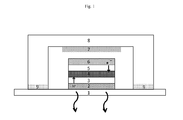
- the PEDOT hole-injection layer (3) can be prepared with the composition according to the present invention.
- the viscosity is measured using a Rheometer (Haake RV1).
- the rheometer is equipped with a thermostat, a DG 43 beaker (Haake) and a DG 43 rotary (Haake). 12 ml of the dispersion are filled into the beaker. The temperature is fixed at 20°C using the thermostat. In order to equilibrate the temperature the liquid is kept at a sheer-rate of 50s-1 for 240 seconds. Subsequently the sheer-rate is increase to 100 s -1 or 700s -1 (see each measurement). The liquid is then kept for 30 seconds at this sheer-rate. Over the next 30 seconds 30 viscosity measurements are made at the above mentioned sheer-rate (1 measurement/second). The average of those 30 measurements is the final viscosity value.
- the solids content was determined gravimetric using a precision scale (Mettler AE 240).
- the bottle is then placed in a fume hood without a lit for about 3 hours to allow the evaporation of volatile solvents at room temperature.
- the bottle is placed in a drying oven with ventilation (Memmert UNB200) at 100°C for 16 hours.
- a drying oven with ventilation Milrt UNB200
- the water content is determined by Karl Fischer titration.
- a Metrohm 787 KF Titrino with a 703 titration stand is used to this end.
- the titration vessel is filled with analytical grade methanol so that about 1 cm of the platinum electrode is submerged.
- approximately 5 ml of Hydranal buffer acid is pipetted in.
- the titration cell is automatically dried by starting the KFT program. Preparation is complete when the message "KFT conditioned" appears.
- Approximately 5 ml of the dispersion to be analysed is then introduced into the titration vessel using a syringe and the exact mass of the dispersion used is determined by back-weighing the syringe.
- the titration is then started.
- the measured value is determined as the mean of three individual measurements.
- the dispersion was spin-coated on ozonized ITO, dried for 15 min at 200°C and the work function was determined via Kelvin probe force microscopy.
- ITO-precoated and pre-patterned by etching, pattern: 2 ⁇ 4 parallel ITO stripes, 2 mm wide to allow for 8 individually connected diodes, OPTREX) glass substrates (5 cm ⁇ 5 cm) are cleaned by the following process before use:
- HIL hole injection layer
- the composition is first filtered by a 0.45 ⁇ m PVDF syringe filter and then applied onto the above mentioned substrate or electrode layer (layer sequence glass substrate/ITO).
- the coating composition was applied onto the electrode by means of a pipette to completely cover the area. Excess dispersion was spun off by spin coating. Thereafter, a drying process on a hot-plate was carried out in one step: 5 min at 200 °C in air. This leads to an approximately 50 nm thick homogenous layer.
- the layer thickness was measured by profilometer (Tencor, Al-phastep 500).
- the ITO substrate which was coated by the dispersion of invention in the previous step is now transferred into to a vacuum vapour deposition chamber (Univex 350, Leypold).
- a vacuum vapour deposition chamber Univex 350, Leypold
- NPB hole transport layer N,N'-bis(naphthalene-1-yl)-N,N'-bis(phenyl)benzidine
- Alq3 tris-(8-hydroxyquinoline)aluminium
- the pressure during deposition is ⁇ 5 ⁇ 10 -6 mbar.
- the deposition rate is 1 Angstrom/s. Rate and layer thickness are monitored by quartz crystal microbalances (QCMs).
- the layer system is then transferred to a glovebox with nitrogen and integrated vacuum deposition system (Edwards) and metallised with metal electrodes.
- the substrate is placed on a shadow mask with the layer system facing downwards.
- the shadow mask comprises of 2 mm wide rectangular slots, which cross the ITO strips at right angles.
- Under a pressure of ⁇ 5 ⁇ 10 -6 mbar a 0.3 nm thick LiF layer followed by a 200 nm thick aluminium layer are deposited in succession from two evaporation boats.
- the deposition rates are 1 Angstrom/s for LiF and 10 Angstrom/s for Al.
- the surface area of the individual OLEDs is 4.0 mm 2 .
- the devices are then encapsulated with a special cover glass providing a void on the inside.
- the two electrodes of the OLED are connected to (brought into contact with) a power supply using electrical wires and contact pins.
- the positive pole is connected to the ITO electrode, the negative pole to the metal electrode.
- the OLED current and the electroluminescence intensity are plotted against the voltage.
- the electroluminescence is detected with a photodiode (EG&G C30809) calibrated with a luminance meter (Minolta LS-100) to absolute luminance.
- the electrical conductivity means the inverse of the specific resistance.
- the specific resistance is calculated from the product of surface resistance and layer thickness of the conductive polymer layer.
- the surface resistance is determined for conductive polymers in accordance with DIN EN ISO 3915.
- the polymer to be investigated is applied as a homogeneous film by means of a spin coater to a glass substrate 50 mm ⁇ 50 mm in size thoroughly cleaned by the abovementioned substrate cleaning process.
- the coating composition was applied onto the electrode by means of a pipette to completely cover the area. Excess dispersion was spun off by spin coating using the same conditions as in the section "Application of the hole injection layer (HIL): PEDOT : counterion layer.” This leads to an approximately 50 nm thick homogenous layer for all materials.
- HIL hole injection layer
- silver electrodes of 2.0 cm length at a distance of 2.0 cm are vapour-deposited on to the polymer layer via a shadow mask.
- the square region of the layer between the electrodes is then separated electrically from the remainder of the layer by scratching two lines with a scalpel.
- the surface resistance is measured between the Ag electrodes with the aid of an ohmmeter (Keithley 614).
- the thickness of the polymer layer is determined with the aid of a Stylus Profilometer (Dektac 150, Veeco) at the places scratched away.
- Example 1 PEDOT : counterion-complex in MTBE without fluorinated compound (comparative example)
- Solids content 2.1 % (gravimetric) Water content: 0.2% (Karl-Fischer-Titration) Solvent composition: 88% methyl tert-butyl ether, 6% cyclohexane, 6% n-heptane; Ratio PEDOT : counter-ion: 1 : 3 (w/w) Work function: 4.87 eV (Kelvin Probe)
- Example 2 PEDOT : counterion-complex in MTBE without fluorinated compound (comparative example)
- Example 1 100 g of Example 1 are mixed with 200 g of methyl tert-butyl ether. The material is filtered through 0.45 ⁇ m.
- Solvent composition 96% methyl tert-butyl ether, 2% cyclohexane, 2% n-heptane; Conductivity: 2.1 ⁇ 10 -4 S/cm
- Example 3 PEDOT : counterion-complex in MTBE with fluorinated compound (inventive example)
- Example 4 PEDOT : counterion-complex in butyl benzoate without fluorinated additive (comparative example)
- Solvent composition 100% butyl benzoate Conductivity: 2.0 ⁇ 10 -3 S/cm
- Example 5 PEDOT : counterion-complex in butyl benzoate with fluorinated compound (inventive example)
- Example 6 OLED-Device testing of example 2 and 3 as hole injection layer
- the dispersion from Examples 2 and 3 were used to prepare OLEDs.
- the film thickness of the layers according to the invention was 50 nm.
- the graphs plotting current and electroluminescence against voltage and the lifetime measurements for the OLEDs are compared.
- For the OLED diode characteristics at the lifetime measurement the values for voltage and luminance are extracted at constant current 48mA/cm 2 (forward bias).
- the efficacy at U 0 is calculated as the quotient of L 0 /current I.
- Table 1 OLED characteristics for example 3 containing a small molecule fluorinated compound according to the invention and example 2 as a reference comparing voltage and luminance at constant current of 48 mA/cm 2 at time 0 h and after 150 h as a life time measurement.
- the example demonstrates that the dispersions according to example 3 shows a great improvement as hole injection with lower initial voltage, less voltage increase over time and improved life-time stability compared to example 2.
- Example 7 OLED device testing of example 4 and 5
- the dispersions from Example 4 and 5 were used to prepare OLEDs.
- the film thickness of the layers according to the invention was 50 nm.
- the graphs plotting current and electroluminescence against voltage and the lifetime measurements for the OLEDs are compared.
- the values for voltage and luminance are extracted at constant current 48 mA/cm 2 (forward bias).
- the efficacy at U 0 is calculated as the quotient of L 0 /current I.
- Table 2 OLED characteristics for example 4 and 5 comparing voltage and luminance at constant current of 48 mA/cm 2 at time 0 h and after 150 h as a life time measurement.
- Example 5 (inventive) 5.95 1069 2.23 6.34
- the example demonstrates that the dispersions according to example 5 shows a great improvement as hole injection with lower initial voltage, less voltage increase over time and improved life-time stability compared to example 4.
Landscapes
- Chemical & Material Sciences (AREA)
- Engineering & Computer Science (AREA)
- Materials Engineering (AREA)
- Organic Chemistry (AREA)
- Wood Science & Technology (AREA)
- Life Sciences & Earth Sciences (AREA)
- Chemical Kinetics & Catalysis (AREA)
- Health & Medical Sciences (AREA)
- Medicinal Chemistry (AREA)
- Polymers & Plastics (AREA)
- Physics & Mathematics (AREA)
- Optics & Photonics (AREA)
- Compositions Of Macromolecular Compounds (AREA)
- Electroluminescent Light Sources (AREA)
Priority Applications (7)
| Application Number | Priority Date | Filing Date | Title |
|---|---|---|---|
| EP15158257.4A EP3067948B1 (de) | 2015-03-09 | 2015-03-09 | Leitfähiges Polymer in organischem Lösungsmittel mit fluorierter nichtionischer Verbindung |
| TW105106877A TWI699396B (zh) | 2015-03-09 | 2016-03-07 | 導電聚合物在包含經氟化化合物的有機溶劑中 |
| KR1020177027096A KR102185767B1 (ko) | 2015-03-09 | 2016-03-09 | 플루오르화된 화합물을 갖는 유기 용매 내 전도성 중합체 |
| US15/554,345 US10283715B2 (en) | 2015-03-09 | 2016-03-09 | Conductive polymer in organic solvent with fluorinated compound |
| JP2017544753A JP6804791B2 (ja) | 2015-03-09 | 2016-03-09 | フッ素化化合物を有する有機溶媒中の導電性ポリマー |
| CN201680014501.2A CN107408628B (zh) | 2015-03-09 | 2016-03-09 | 在具有氟化化合物的有机溶剂中的导电聚合物 |
| PCT/EP2016/055057 WO2016142437A1 (en) | 2015-03-09 | 2016-03-09 | Conductive polymer in organic solvent with fluorinated compound |
Applications Claiming Priority (1)
| Application Number | Priority Date | Filing Date | Title |
|---|---|---|---|
| EP15158257.4A EP3067948B1 (de) | 2015-03-09 | 2015-03-09 | Leitfähiges Polymer in organischem Lösungsmittel mit fluorierter nichtionischer Verbindung |
Publications (2)
| Publication Number | Publication Date |
|---|---|
| EP3067948A1 true EP3067948A1 (de) | 2016-09-14 |
| EP3067948B1 EP3067948B1 (de) | 2018-08-08 |
Family
ID=52629460
Family Applications (1)
| Application Number | Title | Priority Date | Filing Date |
|---|---|---|---|
| EP15158257.4A Active EP3067948B1 (de) | 2015-03-09 | 2015-03-09 | Leitfähiges Polymer in organischem Lösungsmittel mit fluorierter nichtionischer Verbindung |
Country Status (7)
| Country | Link |
|---|---|
| US (1) | US10283715B2 (de) |
| EP (1) | EP3067948B1 (de) |
| JP (1) | JP6804791B2 (de) |
| KR (1) | KR102185767B1 (de) |
| CN (1) | CN107408628B (de) |
| TW (1) | TWI699396B (de) |
| WO (1) | WO2016142437A1 (de) |
Families Citing this family (14)
| Publication number | Priority date | Publication date | Assignee | Title |
|---|---|---|---|---|
| KR102258172B1 (ko) | 2017-09-29 | 2021-05-28 | 주식회사 엘지에너지솔루션 | 배터리 모듈 및 이를 포함하는 배터리 팩 |
| KR102683952B1 (ko) * | 2018-07-04 | 2024-07-12 | 닛산 가가쿠 가부시키가이샤 | 전하수송성 조성물 |
| EP3834217A4 (de) | 2018-08-10 | 2022-05-11 | KYOCERA AVX Components Corporation | Festelektrolytkondensator mit intrinsisch leitfähigem polymer |
| US11114250B2 (en) | 2018-08-10 | 2021-09-07 | Avx Corporation | Solid electrolytic capacitor formed from conductive polymer particles |
| JP7426986B2 (ja) | 2018-08-10 | 2024-02-02 | キョーセラ・エイブイエックス・コンポーネンツ・コーポレーション | ポリアニリンを含む固体電解キャパシタ |
| CN113196429A (zh) | 2018-12-11 | 2021-07-30 | 阿维科斯公司 | 含有本征导电聚合物的固体电解电容器 |
| CN110358397B (zh) * | 2019-06-21 | 2021-02-09 | 深圳市圳力液体分离科技有限公司 | 一种空气中防油涂层快速切换制备水中防油涂层的方法 |
| CN114521278A (zh) | 2019-09-18 | 2022-05-20 | 京瓷Avx元器件公司 | 用于高电压下使用的固体电解电容器 |
| DE112020006028T5 (de) | 2019-12-10 | 2022-10-06 | KYOCERA AVX Components Corporation | Festelektrolytkondensator, der eine Vorbeschichtung und ein intrinsisch leitfähiges Polymer enthält |
| WO2021119088A1 (en) | 2019-12-10 | 2021-06-17 | Avx Corporation | Tantalum capacitor with increased stability |
| US11631548B2 (en) | 2020-06-08 | 2023-04-18 | KYOCERA AVX Components Corporation | Solid electrolytic capacitor containing a moisture barrier |
| US11903304B2 (en) | 2020-12-11 | 2024-02-13 | Raynergy Tek Incorporation | Photodiode comprising fluropolymer compound |
| EP4012793A1 (de) | 2020-12-14 | 2022-06-15 | Raynergy Tek Incorporation | Lichtdiode |
| CN113054107B (zh) * | 2021-02-05 | 2022-10-21 | 广州追光科技有限公司 | 一种用于有机太阳能电池涂布的有机溶液组合 |
Citations (14)
| Publication number | Priority date | Publication date | Assignee | Title |
|---|---|---|---|---|
| EP0339340A2 (de) | 1988-04-22 | 1989-11-02 | Bayer Ag | Neue Polythiophene, Verfahren zu ihrer Herstellung und ihre Verwendung |
| WO1990013148A1 (en) | 1989-04-20 | 1990-11-01 | Cambridge Research And Innovation Limited | Electroluminescent devices |
| EP0440957A2 (de) | 1990-02-08 | 1991-08-14 | Bayer Ag | Neue Polythiophen-Dispersionen, ihre Herstellung und ihre Verwendung |
| DE19627071A1 (de) | 1996-07-05 | 1998-01-08 | Bayer Ag | Elektrolumineszierende Anordnungen |
| EP1003178A1 (de) * | 1998-11-05 | 2000-05-24 | Eastman Kodak Company | Leitfähige Fluorocarbonpolymere und Herstellungsverfahren |
| EP1227529A2 (de) | 2001-01-26 | 2002-07-31 | Bayer Ag | Elektrolumineszierende Anordnungen |
| US6692662B2 (en) | 2001-02-16 | 2004-02-17 | Elecon, Inc. | Compositions produced by solvent exchange methods and uses thereof |
| US20060180810A1 (en) * | 2005-02-14 | 2006-08-17 | Lee Tae-Woo | Composition of conducting polymer and organic opto-electronic device employing the same |
| US20080020208A1 (en) * | 2006-06-07 | 2008-01-24 | Lee Tae-Woo | Conducting polymer composition, conductive film formed using the conducting polymer composition, and electronic device including the conductive film |
| WO2009017024A1 (ja) | 2007-07-31 | 2009-02-05 | Sumitomo Chemical Company, Limited | 有機エレクトロルミネッセンス装置の製造方法 |
| WO2009069990A2 (en) * | 2007-11-30 | 2009-06-04 | Cheil Industries Inc. | Conductive polymer compound and organic photoelectric device including same |
| DE102008023008A1 (de) | 2008-05-09 | 2009-11-12 | H.C. Starck Gmbh | Neuartige Polythiophene-Polyanion-Komplexe in unpolaren organischen Lösungsmitteln |
| WO2012059215A1 (en) | 2010-11-03 | 2012-05-10 | Heraeus Precious Metals Gmbh & Co. Kg | Pedot dispersions in organic solvents |
| US20130328018A1 (en) * | 2012-06-12 | 2013-12-12 | Academia Sinica | Fluorine-modification process and applications thereof |
Family Cites Families (21)
| Publication number | Priority date | Publication date | Assignee | Title |
|---|---|---|---|---|
| WO2003048229A1 (en) | 2001-12-04 | 2003-06-12 | Agfa-Gevaert | Composition containing a polymer or copolymer of a 3,4-dialkoxythiophene and non-aqueous solvent |
| US6867281B2 (en) | 2003-03-26 | 2005-03-15 | The United States Of America As Represented By The Secretary Of The Navy | Highly conducting and transparent thin films formed from new fluorinated derivatives of 3,4-ethylenedioxythiophene |
| US8257614B2 (en) * | 2003-11-04 | 2012-09-04 | Sipix Imaging, Inc. | Electrophoretic dispersions |
| DE102004037542A1 (de) | 2004-08-03 | 2006-02-23 | Chemetall Gmbh | Verfahren zum Schützen einer metallischen Oberfläche mit einer korrosionsinhibierenden Beschichtung |
| KR101294892B1 (ko) * | 2005-06-27 | 2013-08-09 | 이 아이 듀폰 디 네모아 앤드 캄파니 | 전기 전도성 중합체 조성물 |
| KR101139052B1 (ko) | 2005-12-06 | 2012-04-30 | 삼성전자주식회사 | 불소를 포함하는 유기절연체 조성물 및 이를 이용한 유기박막 트랜지스터 |
| CN101548405B (zh) | 2006-08-21 | 2011-10-26 | 爱克发-格法特公司 | 用于制造有机导电层、图案或印刷物的紫外光聚合组合物 |
| US20080116414A1 (en) * | 2006-11-22 | 2008-05-22 | 3M Innovative Properties Company | Fluorochemical composition for treatment of a fibrous substrate |
| JP5254347B2 (ja) | 2007-10-24 | 2013-08-07 | メルク パテント ゲーエムベーハー | 光電子デバイス |
| JP2010146726A (ja) * | 2007-11-30 | 2010-07-01 | Kyoritsu Kagaku Sangyo Kk | 導電性組成物 |
| US10105875B2 (en) | 2008-08-21 | 2018-10-23 | Cam Holding Corporation | Enhanced surfaces, coatings, and related methods |
| JP2010159365A (ja) * | 2009-01-09 | 2010-07-22 | Shin Etsu Polymer Co Ltd | 導電性高分子溶液、導電性積層体および入力デバイス |
| WO2010112680A1 (fr) | 2009-03-31 | 2010-10-07 | Hutchinson | Films ou revetements transparents conducteurs |
| JP2011048358A (ja) | 2009-07-31 | 2011-03-10 | Fujifilm Corp | 反射防止フィルム、偏光板、及び画像表示装置 |
| JP5492486B2 (ja) | 2009-07-31 | 2014-05-14 | 富士フイルム株式会社 | 光学積層体 |
| JP5692228B2 (ja) | 2010-07-02 | 2015-04-01 | コニカミノルタ株式会社 | 有機光電変換素子およびそれを用いた太陽電池 |
| WO2012029618A1 (ja) * | 2010-08-31 | 2012-03-08 | 協立化学産業株式会社 | 電池又は電気二重層キャパシタ集電体コート用導電性組成物、電池又は電気二重層キャパシタ集電体、電池および電気二重層キャパシタ |
| US8687347B2 (en) * | 2011-01-12 | 2014-04-01 | Avx Corporation | Planar anode for use in a wet electrolytic capacitor |
| JP2013125316A (ja) * | 2011-12-13 | 2013-06-24 | Mitsubishi Rayon Co Ltd | 静電容量方式タッチパネル用導電性透明積層体、静電容量方式タッチパネルおよび画像表示装置 |
| EP2828345B1 (de) * | 2012-03-22 | 2016-10-05 | 3M Innovative Properties Company | Hartbeschichtungszusammensetzung auf basis von polymethylmethacrylat und beschichteter artikel |
| WO2014078825A1 (en) * | 2012-11-19 | 2014-05-22 | 3M Innovative Properties Company | Composition including a fluorinated polymer and a non-fluorinated polymer and methods of making and using the same |
-
2015
- 2015-03-09 EP EP15158257.4A patent/EP3067948B1/de active Active
-
2016
- 2016-03-07 TW TW105106877A patent/TWI699396B/zh active
- 2016-03-09 US US15/554,345 patent/US10283715B2/en active Active
- 2016-03-09 KR KR1020177027096A patent/KR102185767B1/ko active Active
- 2016-03-09 WO PCT/EP2016/055057 patent/WO2016142437A1/en not_active Ceased
- 2016-03-09 JP JP2017544753A patent/JP6804791B2/ja active Active
- 2016-03-09 CN CN201680014501.2A patent/CN107408628B/zh active Active
Patent Citations (14)
| Publication number | Priority date | Publication date | Assignee | Title |
|---|---|---|---|---|
| EP0339340A2 (de) | 1988-04-22 | 1989-11-02 | Bayer Ag | Neue Polythiophene, Verfahren zu ihrer Herstellung und ihre Verwendung |
| WO1990013148A1 (en) | 1989-04-20 | 1990-11-01 | Cambridge Research And Innovation Limited | Electroluminescent devices |
| EP0440957A2 (de) | 1990-02-08 | 1991-08-14 | Bayer Ag | Neue Polythiophen-Dispersionen, ihre Herstellung und ihre Verwendung |
| DE19627071A1 (de) | 1996-07-05 | 1998-01-08 | Bayer Ag | Elektrolumineszierende Anordnungen |
| EP1003178A1 (de) * | 1998-11-05 | 2000-05-24 | Eastman Kodak Company | Leitfähige Fluorocarbonpolymere und Herstellungsverfahren |
| EP1227529A2 (de) | 2001-01-26 | 2002-07-31 | Bayer Ag | Elektrolumineszierende Anordnungen |
| US6692662B2 (en) | 2001-02-16 | 2004-02-17 | Elecon, Inc. | Compositions produced by solvent exchange methods and uses thereof |
| US20060180810A1 (en) * | 2005-02-14 | 2006-08-17 | Lee Tae-Woo | Composition of conducting polymer and organic opto-electronic device employing the same |
| US20080020208A1 (en) * | 2006-06-07 | 2008-01-24 | Lee Tae-Woo | Conducting polymer composition, conductive film formed using the conducting polymer composition, and electronic device including the conductive film |
| WO2009017024A1 (ja) | 2007-07-31 | 2009-02-05 | Sumitomo Chemical Company, Limited | 有機エレクトロルミネッセンス装置の製造方法 |
| WO2009069990A2 (en) * | 2007-11-30 | 2009-06-04 | Cheil Industries Inc. | Conductive polymer compound and organic photoelectric device including same |
| DE102008023008A1 (de) | 2008-05-09 | 2009-11-12 | H.C. Starck Gmbh | Neuartige Polythiophene-Polyanion-Komplexe in unpolaren organischen Lösungsmitteln |
| WO2012059215A1 (en) | 2010-11-03 | 2012-05-10 | Heraeus Precious Metals Gmbh & Co. Kg | Pedot dispersions in organic solvents |
| US20130328018A1 (en) * | 2012-06-12 | 2013-12-12 | Academia Sinica | Fluorine-modification process and applications thereof |
Non-Patent Citations (3)
| Title |
|---|
| "Handbook of Chemistry and Physics, 95th ed.", 2014, CRC PRESS, ISBN: 9781482208672 |
| L. GROENENDAAL; F. JONAS; D. FREIT-AG; H. PIELARTZIK; J. R. REYNOLDS, ADV. MATER, vol. 12, 2000, pages 481 - 494 |
| V. KABANOV, RUSSIAN CHEMICAL REVIEWS, vol. 74, 2005, pages 3 - 20 |
Also Published As
| Publication number | Publication date |
|---|---|
| WO2016142437A1 (en) | 2016-09-15 |
| JP6804791B2 (ja) | 2020-12-23 |
| CN107408628B (zh) | 2020-12-29 |
| TW201704323A (zh) | 2017-02-01 |
| US10283715B2 (en) | 2019-05-07 |
| KR20170127475A (ko) | 2017-11-21 |
| EP3067948B1 (de) | 2018-08-08 |
| CN107408628A (zh) | 2017-11-28 |
| TWI699396B (zh) | 2020-07-21 |
| KR102185767B1 (ko) | 2020-12-03 |
| US20180182965A1 (en) | 2018-06-28 |
| JP2018510936A (ja) | 2018-04-19 |
Similar Documents
| Publication | Publication Date | Title |
|---|---|---|
| EP3067948B1 (de) | Leitfähiges Polymer in organischem Lösungsmittel mit fluorierter nichtionischer Verbindung | |
| TWI470024B (zh) | 導電聚合物之磺化反應及有機發光二極體(oled)、光伏特與靜電耗散(esd)裝置 | |
| CN103493145B (zh) | 聚合物组合物、聚合物膜、聚合物凝胶和聚合物泡沫、以及含有所述膜、凝胶和泡沫的电子装置 | |
| JP5324217B2 (ja) | 導電性ポリマー組成物 | |
| KR101710213B1 (ko) | 변형된 평탄화제 및 장치 | |
| KR101372135B1 (ko) | 개선된 유기 발광 다이오드를 위한 폴리티오펜 제형물 | |
| CN103189440B (zh) | 处于有机溶剂中的pedot分散体 | |
| EP2250207B1 (de) | Planierungsmittel und vorrichtungen | |
| CN101423670B (zh) | 导电聚合物-成膜添加剂制剂 | |
| US20140217334A1 (en) | Doping conjugated polymers and devices | |
| MXPA05001553A (es) | Formulaciones de politiofeno para la mejora de los diodos luminiscentes, organicos. | |
| US20160312006A1 (en) | Polymer compositions, films, gels, and foams containing sulfonylimide salts, and electronic devices containing such films, gels, and foams | |
| MXPA05001554A (es) | Formulaciones de politiofeno para mejorar diodos luminiscentes, organicos. | |
| KR20150074171A (ko) | OLEDs에서 고 전도도 및 고 효율의 투명층 및 이들의 생산 공정 | |
| Kim et al. | The effects of octylthiophene ratio on the performance of thiophene based polymer light-emitting diodes | |
| EP3886194A2 (de) | Fluorierte aromatische kleine moleküle als funktionale additive zur dispergierung von leitfähigen polymeren | |
| WO2017216570A1 (en) | Nanoparticles | |
| HK1240607A1 (en) | Doping conjugated polymers and devices |
Legal Events
| Date | Code | Title | Description |
|---|---|---|---|
| PUAI | Public reference made under article 153(3) epc to a published international application that has entered the european phase |
Free format text: ORIGINAL CODE: 0009012 |
|
| AK | Designated contracting states |
Kind code of ref document: A1 Designated state(s): AL AT BE BG CH CY CZ DE DK EE ES FI FR GB GR HR HU IE IS IT LI LT LU LV MC MK MT NL NO PL PT RO RS SE SI SK SM TR |
|
| AX | Request for extension of the european patent |
Extension state: BA ME |
|
| STAA | Information on the status of an ep patent application or granted ep patent |
Free format text: STATUS: REQUEST FOR EXAMINATION WAS MADE |
|
| 17P | Request for examination filed |
Effective date: 20170303 |
|
| RBV | Designated contracting states (corrected) |
Designated state(s): AL AT BE BG CH CY CZ DE DK EE ES FI FR GB GR HR HU IE IS IT LI LT LU LV MC MK MT NL NO PL PT RO RS SE SI SK SM TR |
|
| REG | Reference to a national code |
Ref country code: DE Ref legal event code: R079 Ref document number: 602015014498 Country of ref document: DE Free format text: PREVIOUS MAIN CLASS: H01L0051000000 Ipc: C08L0025160000 |
|
| GRAP | Despatch of communication of intention to grant a patent |
Free format text: ORIGINAL CODE: EPIDOSNIGR1 |
|
| STAA | Information on the status of an ep patent application or granted ep patent |
Free format text: STATUS: GRANT OF PATENT IS INTENDED |
|
| RIC1 | Information provided on ipc code assigned before grant |
Ipc: C08L 25/18 20060101ALI20180205BHEP Ipc: C08L 41/00 20060101ALI20180205BHEP Ipc: H01L 51/54 20060101ALI20180205BHEP Ipc: C08L 25/16 20060101AFI20180205BHEP |
|
| INTG | Intention to grant announced |
Effective date: 20180302 |
|
| GRAS | Grant fee paid |
Free format text: ORIGINAL CODE: EPIDOSNIGR3 |
|
| GRAA | (expected) grant |
Free format text: ORIGINAL CODE: 0009210 |
|
| STAA | Information on the status of an ep patent application or granted ep patent |
Free format text: STATUS: THE PATENT HAS BEEN GRANTED |
|
| AK | Designated contracting states |
Kind code of ref document: B1 Designated state(s): AL AT BE BG CH CY CZ DE DK EE ES FI FR GB GR HR HU IE IS IT LI LT LU LV MC MK MT NL NO PL PT RO RS SE SI SK SM TR |
|
| REG | Reference to a national code |
Ref country code: GB Ref legal event code: FG4D |
|
| REG | Reference to a national code |
Ref country code: CH Ref legal event code: EP Ref country code: AT Ref legal event code: REF Ref document number: 1026940 Country of ref document: AT Kind code of ref document: T Effective date: 20180815 |
|
| REG | Reference to a national code |
Ref country code: IE Ref legal event code: FG4D |
|
| REG | Reference to a national code |
Ref country code: DE Ref legal event code: R096 Ref document number: 602015014498 Country of ref document: DE |
|
| REG | Reference to a national code |
Ref country code: NL Ref legal event code: MP Effective date: 20180808 |
|
| REG | Reference to a national code |
Ref country code: LT Ref legal event code: MG4D |
|
| REG | Reference to a national code |
Ref country code: AT Ref legal event code: MK05 Ref document number: 1026940 Country of ref document: AT Kind code of ref document: T Effective date: 20180808 |
|
| PG25 | Lapsed in a contracting state [announced via postgrant information from national office to epo] |
Ref country code: GR Free format text: LAPSE BECAUSE OF FAILURE TO SUBMIT A TRANSLATION OF THE DESCRIPTION OR TO PAY THE FEE WITHIN THE PRESCRIBED TIME-LIMIT Effective date: 20181109 Ref country code: NO Free format text: LAPSE BECAUSE OF FAILURE TO SUBMIT A TRANSLATION OF THE DESCRIPTION OR TO PAY THE FEE WITHIN THE PRESCRIBED TIME-LIMIT Effective date: 20181108 Ref country code: BG Free format text: LAPSE BECAUSE OF FAILURE TO SUBMIT A TRANSLATION OF THE DESCRIPTION OR TO PAY THE FEE WITHIN THE PRESCRIBED TIME-LIMIT Effective date: 20181108 Ref country code: AT Free format text: LAPSE BECAUSE OF FAILURE TO SUBMIT A TRANSLATION OF THE DESCRIPTION OR TO PAY THE FEE WITHIN THE PRESCRIBED TIME-LIMIT Effective date: 20180808 Ref country code: IS Free format text: LAPSE BECAUSE OF FAILURE TO SUBMIT A TRANSLATION OF THE DESCRIPTION OR TO PAY THE FEE WITHIN THE PRESCRIBED TIME-LIMIT Effective date: 20181208 Ref country code: PL Free format text: LAPSE BECAUSE OF FAILURE TO SUBMIT A TRANSLATION OF THE DESCRIPTION OR TO PAY THE FEE WITHIN THE PRESCRIBED TIME-LIMIT Effective date: 20180808 Ref country code: NL Free format text: LAPSE BECAUSE OF FAILURE TO SUBMIT A TRANSLATION OF THE DESCRIPTION OR TO PAY THE FEE WITHIN THE PRESCRIBED TIME-LIMIT Effective date: 20180808 Ref country code: RS Free format text: LAPSE BECAUSE OF FAILURE TO SUBMIT A TRANSLATION OF THE DESCRIPTION OR TO PAY THE FEE WITHIN THE PRESCRIBED TIME-LIMIT Effective date: 20180808 Ref country code: FI Free format text: LAPSE BECAUSE OF FAILURE TO SUBMIT A TRANSLATION OF THE DESCRIPTION OR TO PAY THE FEE WITHIN THE PRESCRIBED TIME-LIMIT Effective date: 20180808 Ref country code: LT Free format text: LAPSE BECAUSE OF FAILURE TO SUBMIT A TRANSLATION OF THE DESCRIPTION OR TO PAY THE FEE WITHIN THE PRESCRIBED TIME-LIMIT Effective date: 20180808 Ref country code: SE Free format text: LAPSE BECAUSE OF FAILURE TO SUBMIT A TRANSLATION OF THE DESCRIPTION OR TO PAY THE FEE WITHIN THE PRESCRIBED TIME-LIMIT Effective date: 20180808 |
|
| PG25 | Lapsed in a contracting state [announced via postgrant information from national office to epo] |
Ref country code: AL Free format text: LAPSE BECAUSE OF FAILURE TO SUBMIT A TRANSLATION OF THE DESCRIPTION OR TO PAY THE FEE WITHIN THE PRESCRIBED TIME-LIMIT Effective date: 20180808 Ref country code: HR Free format text: LAPSE BECAUSE OF FAILURE TO SUBMIT A TRANSLATION OF THE DESCRIPTION OR TO PAY THE FEE WITHIN THE PRESCRIBED TIME-LIMIT Effective date: 20180808 Ref country code: LV Free format text: LAPSE BECAUSE OF FAILURE TO SUBMIT A TRANSLATION OF THE DESCRIPTION OR TO PAY THE FEE WITHIN THE PRESCRIBED TIME-LIMIT Effective date: 20180808 |
|
| PG25 | Lapsed in a contracting state [announced via postgrant information from national office to epo] |
Ref country code: EE Free format text: LAPSE BECAUSE OF FAILURE TO SUBMIT A TRANSLATION OF THE DESCRIPTION OR TO PAY THE FEE WITHIN THE PRESCRIBED TIME-LIMIT Effective date: 20180808 Ref country code: CZ Free format text: LAPSE BECAUSE OF FAILURE TO SUBMIT A TRANSLATION OF THE DESCRIPTION OR TO PAY THE FEE WITHIN THE PRESCRIBED TIME-LIMIT Effective date: 20180808 Ref country code: IT Free format text: LAPSE BECAUSE OF FAILURE TO SUBMIT A TRANSLATION OF THE DESCRIPTION OR TO PAY THE FEE WITHIN THE PRESCRIBED TIME-LIMIT Effective date: 20180808 Ref country code: ES Free format text: LAPSE BECAUSE OF FAILURE TO SUBMIT A TRANSLATION OF THE DESCRIPTION OR TO PAY THE FEE WITHIN THE PRESCRIBED TIME-LIMIT Effective date: 20180808 Ref country code: RO Free format text: LAPSE BECAUSE OF FAILURE TO SUBMIT A TRANSLATION OF THE DESCRIPTION OR TO PAY THE FEE WITHIN THE PRESCRIBED TIME-LIMIT Effective date: 20180808 |
|
| REG | Reference to a national code |
Ref country code: DE Ref legal event code: R097 Ref document number: 602015014498 Country of ref document: DE |
|
| PG25 | Lapsed in a contracting state [announced via postgrant information from national office to epo] |
Ref country code: SM Free format text: LAPSE BECAUSE OF FAILURE TO SUBMIT A TRANSLATION OF THE DESCRIPTION OR TO PAY THE FEE WITHIN THE PRESCRIBED TIME-LIMIT Effective date: 20180808 Ref country code: DK Free format text: LAPSE BECAUSE OF FAILURE TO SUBMIT A TRANSLATION OF THE DESCRIPTION OR TO PAY THE FEE WITHIN THE PRESCRIBED TIME-LIMIT Effective date: 20180808 Ref country code: SK Free format text: LAPSE BECAUSE OF FAILURE TO SUBMIT A TRANSLATION OF THE DESCRIPTION OR TO PAY THE FEE WITHIN THE PRESCRIBED TIME-LIMIT Effective date: 20180808 |
|
| PLBE | No opposition filed within time limit |
Free format text: ORIGINAL CODE: 0009261 |
|
| STAA | Information on the status of an ep patent application or granted ep patent |
Free format text: STATUS: NO OPPOSITION FILED WITHIN TIME LIMIT |
|
| 26N | No opposition filed |
Effective date: 20190509 |
|
| PG25 | Lapsed in a contracting state [announced via postgrant information from national office to epo] |
Ref country code: SI Free format text: LAPSE BECAUSE OF FAILURE TO SUBMIT A TRANSLATION OF THE DESCRIPTION OR TO PAY THE FEE WITHIN THE PRESCRIBED TIME-LIMIT Effective date: 20180808 |
|
| PG25 | Lapsed in a contracting state [announced via postgrant information from national office to epo] |
Ref country code: MC Free format text: LAPSE BECAUSE OF FAILURE TO SUBMIT A TRANSLATION OF THE DESCRIPTION OR TO PAY THE FEE WITHIN THE PRESCRIBED TIME-LIMIT Effective date: 20180808 |
|
| REG | Reference to a national code |
Ref country code: CH Ref legal event code: PL |
|
| PG25 | Lapsed in a contracting state [announced via postgrant information from national office to epo] |
Ref country code: LU Free format text: LAPSE BECAUSE OF NON-PAYMENT OF DUE FEES Effective date: 20190309 |
|
| PG25 | Lapsed in a contracting state [announced via postgrant information from national office to epo] |
Ref country code: IE Free format text: LAPSE BECAUSE OF NON-PAYMENT OF DUE FEES Effective date: 20190309 Ref country code: LI Free format text: LAPSE BECAUSE OF NON-PAYMENT OF DUE FEES Effective date: 20190331 Ref country code: CH Free format text: LAPSE BECAUSE OF NON-PAYMENT OF DUE FEES Effective date: 20190331 |
|
| PG25 | Lapsed in a contracting state [announced via postgrant information from national office to epo] |
Ref country code: TR Free format text: LAPSE BECAUSE OF FAILURE TO SUBMIT A TRANSLATION OF THE DESCRIPTION OR TO PAY THE FEE WITHIN THE PRESCRIBED TIME-LIMIT Effective date: 20180808 |
|
| PG25 | Lapsed in a contracting state [announced via postgrant information from national office to epo] |
Ref country code: PT Free format text: LAPSE BECAUSE OF FAILURE TO SUBMIT A TRANSLATION OF THE DESCRIPTION OR TO PAY THE FEE WITHIN THE PRESCRIBED TIME-LIMIT Effective date: 20181208 Ref country code: MT Free format text: LAPSE BECAUSE OF NON-PAYMENT OF DUE FEES Effective date: 20190309 |
|
| PG25 | Lapsed in a contracting state [announced via postgrant information from national office to epo] |
Ref country code: CY Free format text: LAPSE BECAUSE OF FAILURE TO SUBMIT A TRANSLATION OF THE DESCRIPTION OR TO PAY THE FEE WITHIN THE PRESCRIBED TIME-LIMIT Effective date: 20180808 |
|
| PG25 | Lapsed in a contracting state [announced via postgrant information from national office to epo] |
Ref country code: HU Free format text: LAPSE BECAUSE OF FAILURE TO SUBMIT A TRANSLATION OF THE DESCRIPTION OR TO PAY THE FEE WITHIN THE PRESCRIBED TIME-LIMIT; INVALID AB INITIO Effective date: 20150309 |
|
| PG25 | Lapsed in a contracting state [announced via postgrant information from national office to epo] |
Ref country code: MK Free format text: LAPSE BECAUSE OF FAILURE TO SUBMIT A TRANSLATION OF THE DESCRIPTION OR TO PAY THE FEE WITHIN THE PRESCRIBED TIME-LIMIT Effective date: 20180808 |
|
| P01 | Opt-out of the competence of the unified patent court (upc) registered |
Effective date: 20230530 |
|
| REG | Reference to a national code |
Ref country code: BE Ref legal event code: PD Owner name: HERAEUS EPURIO GMBH; DE Free format text: DETAILS ASSIGNMENT: CHANGE OF OWNER(S), OTHER; FORMER OWNER NAME: HERAEUS DEUTSCHLAND GMBH & CO. KG Effective date: 20240520 |
|
| REG | Reference to a national code |
Ref country code: DE Ref legal event code: R081 Ref document number: 602015014498 Country of ref document: DE Owner name: HERAEUS EPURIO GMBH, DE Free format text: FORMER OWNER: HERAEUS DEUTSCHLAND GMBH & CO. KG, 63450 HANAU, DE |
|
| PGFP | Annual fee paid to national office [announced via postgrant information from national office to epo] |
Ref country code: GB Payment date: 20260324 Year of fee payment: 12 |
|
| PGFP | Annual fee paid to national office [announced via postgrant information from national office to epo] |
Ref country code: DE Payment date: 20260319 Year of fee payment: 12 |
|
| PGFP | Annual fee paid to national office [announced via postgrant information from national office to epo] |
Ref country code: BE Payment date: 20260319 Year of fee payment: 12 |
|
| PGFP | Annual fee paid to national office [announced via postgrant information from national office to epo] |
Ref country code: FR Payment date: 20260320 Year of fee payment: 12 |