EP3068443B1 - Residualisierungsvernetzer und verwendungen davon - Google Patents
Residualisierungsvernetzer und verwendungen davon Download PDFInfo
- Publication number
- EP3068443B1 EP3068443B1 EP14862412.5A EP14862412A EP3068443B1 EP 3068443 B1 EP3068443 B1 EP 3068443B1 EP 14862412 A EP14862412 A EP 14862412A EP 3068443 B1 EP3068443 B1 EP 3068443B1
- Authority
- EP
- European Patent Office
- Prior art keywords
- alkyl
- aryl
- optionally substituted
- alk
- integer
- Prior art date
- Legal status (The legal status is an assumption and is not a legal conclusion. Google has not performed a legal analysis and makes no representation as to the accuracy of the status listed.)
- Active
Links
- 0 CCCC(C)C1C=*CC1CCC(C)(C)C Chemical compound CCCC(C)C1C=*CC1CCC(C)(C)C 0.000 description 10
- WMCLXBZXCGWGGM-MJLDYBAESA-N CN([C@H](CCC(O)=O)C(N[C@H](CCCO)C(N[C@H](CCC(O)O)C(N[C@H](CCCCNC(c1cc(I)ccc1)=O)C(O)=O)=O)=O)=O)C(CCCCNC(C(CC1)CCC1C(ON(C(CC1)O)C1=O)=O)=O)=O Chemical compound CN([C@H](CCC(O)=O)C(N[C@H](CCCO)C(N[C@H](CCC(O)O)C(N[C@H](CCCCNC(c1cc(I)ccc1)=O)C(O)=O)=O)=O)=O)C(CCCCNC(C(CC1)CCC1C(ON(C(CC1)O)C1=O)=O)=O)=O WMCLXBZXCGWGGM-MJLDYBAESA-N 0.000 description 1
- VFQMLQCKWUVYQS-UHFFFAOYSA-N CNC(CN1CCN(CC(O)=O)CCN(CC(O)=O)CCN(CC(O)=O)CC1)=O Chemical compound CNC(CN1CCN(CC(O)=O)CCN(CC(O)=O)CCN(CC(O)=O)CC1)=O VFQMLQCKWUVYQS-UHFFFAOYSA-N 0.000 description 1
- PAHGUZZJYNVTTK-XDAJTCOGSA-N C[C@@H](CC(N[C@H](CC(N(CCCCNC(c1cc(I)ccc1)=O)CC(O)=O)=O)CC(O)=O)=O)NC(C[C@H](CC(O)=O)NC(c1cc(C(ON(C(CC2)=O)C2=O)=O)ccc1)=O)=O Chemical compound C[C@@H](CC(N[C@H](CC(N(CCCCNC(c1cc(I)ccc1)=O)CC(O)=O)=O)CC(O)=O)=O)NC(C[C@H](CC(O)=O)NC(c1cc(C(ON(C(CC2)=O)C2=O)=O)ccc1)=O)=O PAHGUZZJYNVTTK-XDAJTCOGSA-N 0.000 description 1
- SPSRXBRBFVUPBQ-MUDLNLHZSA-N OC(CCC1=O)N1OC(C(CC1)CCC1C(N(CCN(CCN(CCN[C@H](CCCCNC(c1cc(I)ccc1)=O)C(O)=O)CC(O)=O)CC(O)=O)CC(O)=O)=O)=O Chemical compound OC(CCC1=O)N1OC(C(CC1)CCC1C(N(CCN(CCN(CCN[C@H](CCCCNC(c1cc(I)ccc1)=O)C(O)=O)CC(O)=O)CC(O)=O)CC(O)=O)=O)=O SPSRXBRBFVUPBQ-MUDLNLHZSA-N 0.000 description 1
- GKRNPRBLSKXGEU-NDOQNZECSA-N OC(CC[C@H](C(N[C@H](CCC(O)=O)C(N[C@H](CCC(O)=O)C(N[C@H](CCCCNC(c1cc(I)ccc1)=O)C(O)=O)=O)=O)=O)NC(CCCCNC(C(CC1)CCC1C(ON(C(CC1)=O)C1=O)=O)=O)=O)=O Chemical compound OC(CC[C@H](C(N[C@H](CCC(O)=O)C(N[C@H](CCC(O)=O)C(N[C@H](CCCCNC(c1cc(I)ccc1)=O)C(O)=O)=O)=O)=O)NC(CCCCNC(C(CC1)CCC1C(ON(C(CC1)=O)C1=O)=O)=O)=O)=O GKRNPRBLSKXGEU-NDOQNZECSA-N 0.000 description 1
- MPAIOPKMTRLMJW-VEYUFSJPSA-N OC(CC[C@H](C(N[C@H](CCC(O)=O)C(N[C@H](CCC(O)=O)C(N[C@H](CCCCNC(c1cccc(I)c1)=O)C(O)=O)=O)=O)=O)NC(CCCCC(ON(C(CC1)=O)C1=O)=O)=O)=O Chemical compound OC(CC[C@H](C(N[C@H](CCC(O)=O)C(N[C@H](CCC(O)=O)C(N[C@H](CCCCNC(c1cccc(I)c1)=O)C(O)=O)=O)=O)=O)NC(CCCCC(ON(C(CC1)=O)C1=O)=O)=O)=O MPAIOPKMTRLMJW-VEYUFSJPSA-N 0.000 description 1
- DAUFAJNGQSPRMB-UYFZYRCMSA-N OC(CC[C@H](C(N[C@H](CCC(O)=O)C(N[C@H](CCCCNC(c1cc(I)ccc1)=O)C(O)=O)=O)=O)NC([C@@H](CCC(O)=O)NC(C(CC1)CCC1C(ON(C(CC1)=O)C1=O)=O)=O)=O)=O Chemical compound OC(CC[C@H](C(N[C@H](CCC(O)=O)C(N[C@H](CCCCNC(c1cc(I)ccc1)=O)C(O)=O)=O)=O)NC([C@@H](CCC(O)=O)NC(C(CC1)CCC1C(ON(C(CC1)=O)C1=O)=O)=O)=O)=O DAUFAJNGQSPRMB-UYFZYRCMSA-N 0.000 description 1
- TWJGRLNSEANFIW-FPCALVHFSA-N OC(CC[C@H](C(N[C@H](CCC(O)=O)C(N[C@H](CCCCNC(c1cc(I)cnc1)=O)C(O)=O)=O)=O)NC([C@@H](CCC(O)=O)NC(c1cc(C(ON(C(CC2)=O)C2=O)=O)ccc1)=O)=O)=O Chemical compound OC(CC[C@H](C(N[C@H](CCC(O)=O)C(N[C@H](CCCCNC(c1cc(I)cnc1)=O)C(O)=O)=O)=O)NC([C@@H](CCC(O)=O)NC(c1cc(C(ON(C(CC2)=O)C2=O)=O)ccc1)=O)=O)=O TWJGRLNSEANFIW-FPCALVHFSA-N 0.000 description 1
- DAUFAJNGQSPRMB-AAQJMMJTSA-N OC(CC[C@H](C(N[C@H](CCC(O)=O)C(N[C@H](CCCCNC(c1cccc(I)c1)=O)C(O)=O)=O)=O)NC([C@@H](CCC(O)=O)NC([C@H](CC1)CC[C@@H]1C(ON(C(CC1)=O)C1=O)=O)=O)=O)=O Chemical compound OC(CC[C@H](C(N[C@H](CCC(O)=O)C(N[C@H](CCCCNC(c1cccc(I)c1)=O)C(O)=O)=O)=O)NC([C@@H](CCC(O)=O)NC([C@H](CC1)CC[C@@H]1C(ON(C(CC1)=O)C1=O)=O)=O)=O)=O DAUFAJNGQSPRMB-AAQJMMJTSA-N 0.000 description 1
- KNIIYDXXWNZXPR-CXDXLJMYSA-N OC(CC[C@H](C(N[C@H](CCC(O)=O)C(N[C@H](CCCCNC(c1cccc(I)c1)=O)C(O)=O)=O)=O)NC([C@@H](CCC(O)=O)NC(c1cc(C(Oc(c(F)c(cc2F)F)c2F)=O)ccc1)=O)=O)=O Chemical compound OC(CC[C@H](C(N[C@H](CCC(O)=O)C(N[C@H](CCCCNC(c1cccc(I)c1)=O)C(O)=O)=O)=O)NC([C@@H](CCC(O)=O)NC(c1cc(C(Oc(c(F)c(cc2F)F)c2F)=O)ccc1)=O)=O)=O KNIIYDXXWNZXPR-CXDXLJMYSA-N 0.000 description 1
- MPTSMSPHFYTHML-UHFFFAOYSA-N OC(CN(CCN(CC(NCCCCNC(CCCCC(ON(C(CC1)=O)C1=O)=O)=O)=O)CC(O)=O)CCN(CC(N(CCCCNC(c1cccc(I)c1)=O)CC(O)=O)=O)CC(O)=O)=O Chemical compound OC(CN(CCN(CC(NCCCCNC(CCCCC(ON(C(CC1)=O)C1=O)=O)=O)=O)CC(O)=O)CCN(CC(N(CCCCNC(c1cccc(I)c1)=O)CC(O)=O)=O)CC(O)=O)=O MPTSMSPHFYTHML-UHFFFAOYSA-N 0.000 description 1
- PJYUOFMZCMSATR-PBNRZORXSA-N OC(C[C@@H](CC(N[C@H](CCCCNC(c1cccc(I)c1)=O)C(O)=O)=O)NC(CCNC(C[C@H](CC(O)=O)NC(C(CC1)CCC1C(ON(C(CC1)=O)C1=O)=O)=O)=O)=O)=O Chemical compound OC(C[C@@H](CC(N[C@H](CCCCNC(c1cccc(I)c1)=O)C(O)=O)=O)NC(CCNC(C[C@H](CC(O)=O)NC(C(CC1)CCC1C(ON(C(CC1)=O)C1=O)=O)=O)=O)=O)=O PJYUOFMZCMSATR-PBNRZORXSA-N 0.000 description 1
Images


Classifications
-
- A—HUMAN NECESSITIES
- A61—MEDICAL OR VETERINARY SCIENCE; HYGIENE
- A61K—PREPARATIONS FOR MEDICAL, DENTAL OR TOILETRY PURPOSES
- A61K51/00—Preparations containing radioactive substances for use in therapy or testing in vivo
- A61K51/02—Preparations containing radioactive substances for use in therapy or testing in vivo characterised by the carrier, i.e. characterised by the agent or material covalently linked or complexing the radioactive nucleus
- A61K51/04—Organic compounds
- A61K51/08—Peptides, e.g. proteins, carriers being peptides, polyamino acids, proteins
- A61K51/10—Antibodies or immunoglobulins; Fragments thereof, the carrier being an antibody, an immunoglobulin or a fragment thereof, e.g. a camelised human single domain antibody or the Fc fragment of an antibody
- A61K51/1093—Antibodies or immunoglobulins; Fragments thereof, the carrier being an antibody, an immunoglobulin or a fragment thereof, e.g. a camelised human single domain antibody or the Fc fragment of an antibody conjugates with carriers being antibodies
-
- A—HUMAN NECESSITIES
- A61—MEDICAL OR VETERINARY SCIENCE; HYGIENE
- A61K—PREPARATIONS FOR MEDICAL, DENTAL OR TOILETRY PURPOSES
- A61K45/00—Medicinal preparations containing active ingredients not provided for in groups A61K31/00 - A61K41/00
- A61K45/06—Mixtures of active ingredients without chemical characterisation, e.g. antiphlogistics and cardiaca
-
- A—HUMAN NECESSITIES
- A61—MEDICAL OR VETERINARY SCIENCE; HYGIENE
- A61K—PREPARATIONS FOR MEDICAL, DENTAL OR TOILETRY PURPOSES
- A61K51/00—Preparations containing radioactive substances for use in therapy or testing in vivo
- A61K51/02—Preparations containing radioactive substances for use in therapy or testing in vivo characterised by the carrier, i.e. characterised by the agent or material covalently linked or complexing the radioactive nucleus
- A61K51/04—Organic compounds
- A61K51/08—Peptides, e.g. proteins, carriers being peptides, polyamino acids, proteins
- A61K51/088—Peptides, e.g. proteins, carriers being peptides, polyamino acids, proteins conjugates with carriers being peptides, polyamino acids or proteins
-
- A—HUMAN NECESSITIES
- A61—MEDICAL OR VETERINARY SCIENCE; HYGIENE
- A61K—PREPARATIONS FOR MEDICAL, DENTAL OR TOILETRY PURPOSES
- A61K51/00—Preparations containing radioactive substances for use in therapy or testing in vivo
- A61K51/02—Preparations containing radioactive substances for use in therapy or testing in vivo characterised by the carrier, i.e. characterised by the agent or material covalently linked or complexing the radioactive nucleus
- A61K51/04—Organic compounds
- A61K51/08—Peptides, e.g. proteins, carriers being peptides, polyamino acids, proteins
- A61K51/10—Antibodies or immunoglobulins; Fragments thereof, the carrier being an antibody, an immunoglobulin or a fragment thereof, e.g. a camelised human single domain antibody or the Fc fragment of an antibody
- A61K51/1027—Antibodies or immunoglobulins; Fragments thereof, the carrier being an antibody, an immunoglobulin or a fragment thereof, e.g. a camelised human single domain antibody or the Fc fragment of an antibody against receptors, cell-surface antigens or cell-surface determinants
- A61K51/103—Antibodies or immunoglobulins; Fragments thereof, the carrier being an antibody, an immunoglobulin or a fragment thereof, e.g. a camelised human single domain antibody or the Fc fragment of an antibody against receptors, cell-surface antigens or cell-surface determinants against receptors for growth factors or receptors for growth regulators
-
- A—HUMAN NECESSITIES
- A61—MEDICAL OR VETERINARY SCIENCE; HYGIENE
- A61K—PREPARATIONS FOR MEDICAL, DENTAL OR TOILETRY PURPOSES
- A61K51/00—Preparations containing radioactive substances for use in therapy or testing in vivo
- A61K51/02—Preparations containing radioactive substances for use in therapy or testing in vivo characterised by the carrier, i.e. characterised by the agent or material covalently linked or complexing the radioactive nucleus
- A61K51/04—Organic compounds
- A61K51/08—Peptides, e.g. proteins, carriers being peptides, polyamino acids, proteins
- A61K51/10—Antibodies or immunoglobulins; Fragments thereof, the carrier being an antibody, an immunoglobulin or a fragment thereof, e.g. a camelised human single domain antibody or the Fc fragment of an antibody
- A61K51/1045—Antibodies or immunoglobulins; Fragments thereof, the carrier being an antibody, an immunoglobulin or a fragment thereof, e.g. a camelised human single domain antibody or the Fc fragment of an antibody against animal or human tumor cells or tumor cell determinants
Definitions
- Biological molecules targeting proteins that undergo internalization offer a number of advantages. When labeled with either a diagnostic or therapeutic agent they carry the label/prosthetic group inside the cell and once inside the conjugate can enhance contrast for diagnostic agents and/or deliver its therapeutic effects. The process of internalization can also enhance cytotoxic potency as in the case of radioimmunotherapy when radioisotopes with short effective ranges are used.
- Labeled biological molecules or conjugates are typically prepared by using a linker to append the label to the biological molecule so that minimal damage is done to the compound and affinity is maintained for the target.
- Biological molecules labeled in this fashion and then internalized can undergo rapid intracellular degradation. This is an enzyme-catalyzed event that breaks the conjugate down into small peptides and/or individual amino acids. As a result the label is liberated from the conjugate and often egresses from the target cells. In the case of diagnostic agents this significantly lowers target to non-target ratios and with respect to therapeutic agents this can lead to significant undesirable off target toxicity.
- Residualizing linkers are designed to retain the label intracellularly after lysosomal degradation of the internalized biological conjugate. This results in overall greater retention in the cells leading to better target-to-non-target ratios and therapeutic effects.
- the present invention is directed to linkers that minimize egress of the label by attaching it to a metabolically resistant negatively charged or zwitterionic backbone that can easily be attached to biological molecules.
- the linkers described herein are comprised of three parts including a linker component, a residualizing backbone and the detection agent. All three components are easily assembled in three simple versatile synthetic steps following preparation of the polyanionic or zwitterionic backbone that is comprised of different classes of compounds including alpha and beta glutamic acid residues for polyanionic species, and a polyamine backbone wherein the secondary amines have been derivatized with short-chain acidic residues to generate zwitterionic species.
- Linker components include those which are linear, cyclic or aromatic with an activated terminus to react with free amine groups on biological compounds.
- the label includes radiohalogens, radiometals or luminescent compounds.
- the invention features a conjugate including a polypeptide linked to a detection agent, the conjugate having the structure: or a salt thereof,
- the invention features a compound having the structure: or a salt thereof,
- a method of producing a polypeptide conjugate including reacting a compound of formula II: with a polypeptide, wherein the polypeptide has one or more primary amine groups, under conditions to produce a compound of formula I: or a salt thereof,
- the radionuclide is 18 F, 75 Br, 76 Br, 77 Br, 123 I, 124 I, 125 I, 131 I, or 211 At.
- B is an organic moiety including an optionally substituted aryl, an optionally substituted heteroaryl, or an optionally substituted hetereocyclic.
- B has the structure: wherein R 8 is a radionuclide, wherein the radionuclide is 18 F, 75 Br, 76 Br, 77 Br, 123 I, 124 I, 125 I, 131 I, or 211 At.
- B has the structure: wherein the iodine atom is 123 I, 124 I, 125 I, or 131 I.
- B has the structure of: wherein a metal is chelated to the structure.
- L 4 is optionally substituted C1-C6 alkyl (e.g., n-butyl) or absent.
- R 5 is L 4 -B and R 6 and R 7 are both hydrogen.
- R 6 is L 4 -B and R 5 and R 7 are both hydrogen.
- L 2 is L 4 -B
- R 5 and R 7 are hydrogen
- R 6 is optionally substituted C1-C6 heteroalkyl (e.g., ).
- L 2 is selected from optionally substituted C1-C6 alkyl (e.g., n-butyl), optionally substituted C1-C6 heteroalkyl (e.g., ), optionally substituted C3-C10 cycloalkyl (e.g., cyclohexyl), optionally substituted aryl (e.g., phenyl), and optionally substituted C2-C100 polyethylene glycol (e.g., ).
- optionally substituted C1-C6 alkyl e.g., n-butyl
- optionally substituted C1-C6 heteroalkyl e.g., )
- optionally substituted C3-C10 cycloalkyl e.g., cyclohexyl
- optionally substituted aryl e.g., phenyl
- optionally substituted C2-C100 polyethylene glycol e.g., ).
- L 1 is absent or optionally substituted C3-C10 cycloalkyl.
- L 1 is absent and m is 0.
- L 1 is optionally substituted C3-C10 cycloalkyl (e.g., cyclohexyl) and m is 1.
- L 3 is absent.
- L 3 is optionally substituted C1-C6 alkyl (e.g., methylene).
- R 1 is hydrogen
- R 2 is -CH 2 CO 2 H or -CH 2 CH 2 CO 2 H.
- R 1 is -CH 2 CO 2 H.
- n 0.
- n 1
- R 9 is -CO 2 H
- o 3.
- the polypeptide is an antibody, or an antigen-binding fragment thereof.
- the antibody, or antigen-binding fragment thereof specifically binds insulin-like growth factor-1 receptor (IGF1R).
- IGF1R insulin-like growth factor-1 receptor
- the antibody, or antibody-binding fragment thereof includes a heavy chain variable domain including at least one, two, or all three complementarity determining regions (CDRs) selected from:
- the antibody, or antibody-binding fragment thereof includes a light chain variable domain including at least one, two, or all three CDRs selected from:
- the antibody, or antibody-binding fragment thereof includes a heavy chain variable domain and a light chain variable domain including at least one, two, three, four, five, or all six CDRs selected from:
- the heavy chain variable domain includes the amino acid sequence of SEQ ID NO: 7.
- the light chain variable domain includes the amino acid sequence of SEQ ID NO: 8.
- the antibody, or antigen-binding fragment thereof includes a heavy chain including the amino acid sequence of SEQ ID NO: 9.
- the antibody, or antigen-binding fragment thereof includes a light chain including the amino acid sequence of SEQ ID NO: 10.
- the antibody, or antigen-binding fragment thereof is figitumumab, cixutumumab, AMG479, BIIB022, SCH717454, or R1507.
- the antibody, or antibody-binding fragment thereof substantially binds to the same epitope as figitumumab.
- the conjugate has the structure: wherein the iodine atom is 123 I, 124 I, 125 I, or 131 I.
- the conjugate has the structure: wherein a metal is chelated to the structure.
- the compound of Formula II has the structure: wherein the iodine atom is 123 I, 124 I, 125 I, or 131 I.
- the compound of Formula II has the structure: wherein a metal is chelated to the structure.
- the invention features a pharmaceutical composition including any of the foregoing conjugates and a pharmaceutically acceptable excipient.
- the invention features any of the foregoing conjugates or pharmaceutical compositions for use in a method of treating cancer, the method including administering to a subject in need thereof any of the foregoing conjugates or pharmaceutical compositions.
- the invention features any of the foregoing conjugates or pharmaceutical compositions for use in a method of treating cancer, the method including administering to a subject in need thereof a first dose of any of the foregoing conjugates or pharmaceutical compositions in an amount effective for radiation treatment planning, followed by administering a second dose of any of the foregoing conjugates or pharmaceutical compositions in a therapeutically effective amount.
- the conjugate or composition administered in the first dose and the conjugate or composition administered in the second dose are the same.
- the conjugate or composition administered in the first dose and the conjugate or composition administered in the second dose are different.
- the cancer is a solid tumor cancer (e.g., breast cancer, non-small cell lung cancer, prostate cancer, pancreatic cancer, head and neck cancer, colon cancer, sarcoma, or adrenocortical carcinoma).
- a solid tumor cancer e.g., breast cancer, non-small cell lung cancer, prostate cancer, pancreatic cancer, head and neck cancer, colon cancer, sarcoma, or adrenocortical carcinoma.
- the method further includes administering an antiproliferative.
- any of the foregoing conjugates or compositions and the antiproliferative are administered within 28 days (e.g., within 14, 7, 6, 5, 4, 3, 2, or 1 day(s)) of each other.
- acyl represents a hydrogen or an alkyl group (e.g., a haloalkyl group), as defined herein, that is attached to the parent molecular group through a carbonyl group, as defined herein, and is exemplified by formyl (i.e., a carboxyaldehyde group), acetyl, trifluoroacetyl, propionyl, butanoyl and the like.
- exemplary unsubstituted acyl groups include from 1 to 7, from 1 to 11, or from 1 to 21 carbons.
- the alkyl group is further substituted with 1, 2, 3, or 4 substituents as described herein.
- alkyl is inclusive of both straight chain and branched chain saturated groups from 1 to 20 carbons (e.g., from 1 to 10 or from 1 to 6), unless otherwise specified.
- Alkyl groups are exemplified by methyl, ethyl, n- and iso-propyl, n-, sec-, iso- and tert-butyl, neopentyl, and the like, and may be optionally substituted with one, two, three, or, in the case of alkyl groups of two carbons or more, four substituents independently selected from the group consisting of: (1) C 1-6 alkoxy; (2) C 1-6 alkylsulfinyl; (3) amino, as defined herein (e.g., unsubstituted amino (i.e., -NH 2 ) or a substituted amino (i.e., -N(R N1 ) 2 , where R N1 is as defined for amino); (4) C 6-10 aryl-
- alkylene and the prefix "alk-,” as used herein, represent a saturated divalent hydrocarbon group derived from a straight or branched chain saturated hydrocarbon by the removal of two hydrogen atoms, and is exemplified by methylene, ethylene, isopropylene, and the like.
- C x-y alkylene and the prefix “C x-y alk-” represent alkylene groups having between x and y carbons.
- Exemplary values for x are 1, 2, 3, 4, 5, and 6, and exemplary values for y are 2, 3, 4, 5, 6, 7, 8, 9, 10, 12, 14, 16, 18, or 20 (e.g., C 1-6 , C 1-10 , C 2-20 , C 2-6 , C 2-10 , or C 2-20 alkylene).
- the alkylene can be further substituted with 1, 2, 3, or 4 substituent groups as defined herein for an alkyl group.
- alkenyl represents monovalent straight or branched chain groups of, unless otherwise specified, from 2 to 20 carbons (e.g., from 2 to 6 or from 2 to 10 carbons) containing one or more carbon-carbon double bonds and is exemplified by ethenyl, 1-propenyl, 2-propenyl, 2-methyl-1-propenyl, 1-butenyl, 2-butenyl, and the like. Alkenyls include both cis and trans isomers.
- Alkenyl groups may be optionally substituted with 1, 2, 3, or 4 substituent groups that are selected, independently, from amino, aryl, cycloalkyl, or heterocyclyl (e.g., heteroaryl), as defined herein, or any of the exemplary alkyl substituent groups described herein.
- alkynyl represents monovalent straight or branched chain groups from 2 to 20 carbon atoms (e.g., from 2 to 4, from 2 to 6, or from 2 to 10 carbons) containing a carbon-carbon triple bond and is exemplified by ethynyl, 1-propynyl, and the like.
- Alkynyl groups may be optionally substituted with 1, 2, 3, or 4 substituent groups that are selected, independently, from aryl, cycloalkyl, or heterocyclyl (e.g., heteroaryl), as defined herein, or any of the exemplary alkyl substituent groups described herein.
- amino represents -N(R N1 ) 2 , wherein each R N1 is, independently, H, OH, NO 2 , N(R N2 ) 2 , SO 2 OR N2 , SO 2 R N2 , SOR N2 , an N -protecting group, alkyl, alkenyl, alkynyl, alkoxy, aryl, alkaryl, cycloalkyl, alkcycloalkyl, carboxyalkyl (e.g., optionally substituted with an O -protecting group, such as optionally substituted arylalkoxycarbonyl groups or any described herein), sulfoalkyl, acyl (e.g., acetyl, trifluoroacetyl, or others described herein), alkoxycarbonylalkyl (e.g., optionally substituted with an O -protecting group, such as optionally substituted arylalkoxycarbonyl groups or any
- amino groups of the invention can be an unsubstituted amino (i.e., -NH 2 ) or a substituted amino (i.e., - N(R N1 ) 2 )-
- amino is -NH 2 or -NHR N1
- R N1 is, independently, OH, NO 2 , NH 2 , NR N2 2 , SO 2 OR N2 , SO 2 R N2 , SOR N2 , alkyl, carboxyalkyl, sulfoalkyl, acyl (e.g., acetyl, trifluoroacetyl, or others described herein), alkoxycarbonylalkyl (e.g., t-butoxycarbonylalkyl) or aryl, and each R N2 can be H, C 1-20 alkyl (e.g., C 1-6 alkyl), or C 6-10 aryl.
- amino acid refers to a molecule having a side chain, an amino group, and an acid group (e.g., a carboxy group of -CO 2 H or a sulfo group of -SO 3 H), wherein the amino acid is attached to the parent molecular group by the side chain, amino group, or acid group (e.g., the side chain).
- the amino acid is attached to the parent molecular group by a carbonyl group, where the side chain or amino group is attached to the carbonyl group.
- Exemplary side chains include an optionally substituted alkyl, aryl, heterocyclyl, alkaryl, alkheterocyclyl, aminoalkyl, carbamoylalkyl, and carboxyalkyl.
- Exemplary amino acids include alanine, arginine, asparagine, aspartic acid, cysteine, glutamic acid, glutamine, glycine, histidine, hydroxynorvaline, isoleucine, leucine, lysine, methionine, norvaline, ornithine, phenylalanine, proline, pyrrolysine, selenocysteine, serine, taurine, threonine, tryptophan, tyrosine, and valine.
- Amino acid groups may be optionally substituted with one, two, three, or, in the case of amino acid groups of two carbons or more, four substituents independently selected from the group consisting of: (1) C 1-6 alkoxy; (2) C 1-6 alkylsulfinyl; (3) amino, as defined herein (e.g., unsubstituted amino (i.e., -NH 2 ) or a substituted amino (i.e., -N(R N1 ) 2 , where R N1 is as defined for amino); (4) C 6-10 aryl-C 1-6 alkoxy; (5) azido; (6) halo; (7) (C 2-9 heterocyclyl)oxy; (8) hydroxy; (9) nitro; (10) oxo (e.g., carboxyaldehyde or acyl); (11) C 1-7 spirocyclyl; (12) thioalkoxy; (13) thiol; (14) -CO 2 R A' , where R A'
- aryl represents a mono-, bicyclic, or multicyclic carbocyclic ring system having one or two aromatic rings and is exemplified by phenyl, naphthyl, 1,2-dihydronaphthyl, 1,2,3,4-tetrahydronaphthyl, anthracenyl, phenanthrenyl, fluorenyl, indanyl, indenyl, and the like, and may be optionally substituted with 1, 2, 3, 4, or 5 substituents independently selected from the group consisting of: (1) C 1-7 acyl (e.g., carboxyaldehyde); (2) C 1-20 alkyl (e.g., C 1-6 alkyl, C 1-6 alkoxy-C 1-6 alkyl, C 1-6 alkylsulfinyl-C 1-6 alkyl, amino-C 1-6 alkyl, azido-C 1-6 alkyl, (carboxyaldehyde)-C
- each of these groups can be further substituted as described herein.
- the alkylene group of a C 1 -alkaryl or a C 1 -alkheterocyclyl can be further substituted with an oxo group to afford the respective aryloyl and (heterocyclyl)oyl substituent group.
- arylalkyl represents an aryl group, as defined herein, attached to the parent molecular group through an alkylene group, as defined herein.
- exemplary unsubstituted arylalkyl groups are from 7 to 30 carbons (e.g., from 7 to 16 or from 7 to 20 carbons, such as C 1-6 alk-C 6-10 aryl, C 1-10 alk-C 6-10 aryl, or C 1-20 alk-C 6-10 aryl).
- the alkylene and the aryl each can be further substituted with 1, 2, 3, or 4 substituent groups as defined herein for the respective groups.
- Other groups preceded by the prefix "alk-" are defined in the same manner, where “alk” refers to a C 1-6 alkylene, unless otherwise noted, and the attached chemical structure is as defined herein.
- cyano represents an -CN group.
- cycloalkyl represents a monovalent saturated or unsaturated nonaromatic cyclic hydrocarbon group from three to eight carbons, unless otherwise specified, and is exemplified by cyclopropyl, cyclobutyl, cyclopentyl, cyclohexyl, cycloheptyl, bicycle heptyl, and the like.
- the cycloalkyl group includes one carbon-carbon double bond or one carbon-carbon triple bond, the cycloalkyl group can be referred to as a "cycloalkenyl" or "cycloalkynyl” group respectively.
- Exemplary cycloalkenyl and cycloalkynyl groups include cyclopentenyl, cyclohexenyl, cyclohexynyl, and the like.
- the cycloalkyl groups of this invention can be optionally substituted with: (1) C 1-7 acyl (e.g., carboxyaldehyde); (2) C 1-20 alkyl (e.g., C 1-6 alkyl, C 1-6 alkoxy-C 1-6 alkyl, C 1-6 alkylsulfinyl-C 1-6 alkyl, amino-C 1-6 alkyl, azido-C 1-6 alkyl, (carboxyaldehyde)-C 1-6 alkyl, halo-C 1-6 alkyl (e.g., perfluoroalkyl), hydroxy-C 1-6 alkyl, nitro-C 1-6 alkyl, or C 1-6 thioalkoxy-C 1-6 alkyl); (3) C 1-20 alkoxy (
- each of these groups can be further substituted as described herein.
- the alkylene group of a C 1 -alkaryl or a C 1 -alkheterocyclyl can be further substituted with an oxo group to afford the respective aryloyl and (heterocyclyl)oyl substituent group.
- diastereomer as used herein means stereoisomers that are not mirror images of one another and are non-superimposable on one another.
- enantiomer means each individual optically active form of a compound of the invention, having an optical purity or enantiomeric excess (as determined by methods standard in the art) of at least 80% (i.e., at least 90% of one enantiomer and at most 10% of the other enantiomer), preferably at least 90% and more preferably at least 98%.
- halogen represents a halogen selected from bromine, chlorine, iodine, or fluorine.
- heteroalkyl refers to an alkyl group, as defined herein, in which one or two of the constituent carbon atoms have each been replaced by nitrogen, oxygen, or sulfur.
- the heteroalkyl group can be further substituted with 1, 2, 3, or 4 substituent groups as described herein for alkyl groups.
- heteroalkenyl and heteroalkynyl refer to alkenyl and alkynyl groups, as defined herein, respectively, in which one or two of the constituent carbon atoms have each been replaced by nitrogen, oxygen, or sulfur.
- the heteroalkenyl and heteroalkynyl groups can be further substituted with 1, 2, 3, or 4 substituent groups as described herein for alkyl groups.
- heteroaryl represents that subset of heterocyclyls, as defined herein, which are aromatic: i.e., they contain 4 n +2 pi electrons within the mono- or multicyclic ring system.
- exemplary unsubstituted heteroaryl groups are of 1 to 12 (e.g., 1 to 11, 1 to 10, 1 to 9, 2 to 12, 2 to 11, 2 to 10, or 2 to 9) carbons.
- the heteroaryl is substituted with 1, 2, 3, or 4 substituents groups as defined for a heterocyclyl group.
- heteroarylalkyl refers to a heteroaryl group, as defined herein, attached to the parent molecular group through an alkylene group, as defined herein.
- exemplary unsubstituted heteroarylalkyl groups are from 2 to 32 carbons (e.g., from 2 to 22, from 2 to 18, from 2 to 17, from 2 to 16, from 3 to 15, from 2 to 14, from 2 to 13, or from 2 to 12 carbons, such as C 1-6 alk-C 1-12 heteroaryl, C 1-10 alk-C 1-12 heteroaryl, or C 1-20 alk-C 1-12 heteroaryl).
- the alkylene and the heteroaryl each can be further substituted with 1, 2, 3, or 4 substituent groups as defined herein for the respective group.
- Heteroarylalkyl groups are a subset of heterocyclylalkyl groups.
- heterocyclyl represents a 5-, 6- or 7-membered ring, unless otherwise specified, containing one, two, three, or four heteroatoms independently selected from the group consisting of nitrogen, oxygen, and sulfur.
- the 5-membered ring has zero to two double bonds, and the 6- and 7-membered rings have zero to three double bonds.
- Exemplary unsubstituted heterocyclyl groups are of 1 to 12 (e.g., 1 to 11, 1 to 10, 1 to 9, 2 to 12, 2 to 11, 2 to 10, or 2 to 9) carbons.
- heterocyclyl also represents a heterocyclic compound having a bridged multicyclic structure in which one or more carbons and/or heteroatoms bridges two non-adjacent members of a monocyclic ring, e.g., a quinuclidinyl group.
- heterocyclyl includes bicyclic, tricyclic, and tetracyclic groups in which any of the above heterocyclic rings is fused to one, two, or three carbocyclic rings, e.g., an aryl ring, a cyclohexane ring, a cyclohexene ring, a cyclopentane ring, a cyclopentene ring, or another monocyclic heterocyclic ring, such as indolyl, quinolyl, isoquinolyl, tetrahydroquinolyl, benzofuryl, benzothienyl and the like.
- fused heterocyclyls include tropanes and 1,2,3,5,8,8a-hexahydroindolizine.
- Heterocyclics include pyrrolyl, pyrrolinyl, pyrrolidinyl, pyrazolyl, pyrazolinyl, pyrazolidinyl, imidazolyl, imidazolinyl, imidazolidinyl, pyridyl, piperidinyl, homopiperidinyl, pyrazinyl, piperazinyl, pyrimidinyl, pyridazinyl, oxazolyl, oxazolidinyl, isoxazolyl, isoxazolidiniyl, morpholinyl, thiomorpholinyl, thiazolyl, thiazolidinyl, isothiazolyl, isothiazolidinyl, indolyl, indazolyl, quinolyl, isoquinolyl,
- Still other exemplary heterocyclyls include: 2,3,4,5-tetrahydro-2-oxo-oxazolyl; 2,3-dihydro-2-oxo-1H-imidazolyl; 2,3,4,5-tetrahydro-5-oxo-1H-pyrazolyl (e.g., 2,3,4,5-tetrahydro-2-phenyl-5-oxo-1H-pyrazolyl); 2,3,4,5-tetrahydro-2,4-dioxo-1H-imidazolyl (e.g., 2,3,4,5-tetrahydro-2,4-dioxo-5-methyl-5-phenyl-1H-imidazolyl); 2,3-dihydro-2-thioxo-1,3,4-oxadiazolyl (e.g., 2,3-dihydro-2-thioxo-5-phenyl-1,3,4-oxadiazolyl); 4,5-dihydro-5-oxo-1 H -triazolyl
- Additional heterocyclics include 3,3a,4,5,6,6a-hexahydro-pyrrolo[3,4-b]pyrrol-(2H)-yl, and 2,5-diazabicyclo[2.2.1]heptan-2-yl, homopiperazinyl (or diazepanyl), tetrahydropyranyl, dithiazolyl, benzofuranyl, benzothienyl, oxepanyl, thiepanyl, azocanyl, oxecanyl, and thiocanyl.
- any of the heterocyclyl groups mentioned herein may be optionally substituted with one, two, three, four or five substituents independently selected from the group consisting of: (1) C 1-7 acyl (e.g., carboxyaldehyde); (2) C 1-20 alkyl (e.g., C 1-6 alkyl, C 1-6 alkoxy-C 1-6 alkyl, C 1-6 alkylsulfinyl-C 1-6 alkyl, amino-C 1-6 alkyl, azido-C 1-6 alkyl, (carboxyaldehyde)-C 1-6 alkyl, halo-C 1-6 alkyl (e.g., perfluoroalkyl), hydroxy-C 1-6 alkyl, nitro-C 1-6 alkyl, or C 1-6 thioalkoxy-C 1-6 alkyl); (3) C 1-20 alkoxy (e.g., C 1-6 alkoxy, such as perfluoroalkoxy); (4) C 1-6 alkylsul
- each of these groups can be further substituted as described herein.
- the alkylene group of a C 1 -alkaryl or a C 1 -alkheterocyclyl can be further substituted with an oxo group to afford the respective aryloyl and (heterocyclyl)oyl substituent group.
- hydrocarbon represents a group consisting only of carbon and hydrogen atoms.
- hydroxyl represents an -OH group.
- the hydroxyl group can be substituted with 1, 2, 3, or 4 substituent groups (e.g., O -protecting groups) as defined herein for an alkyl.
- isomer means any tautomer, stereoisomer, enantiomer, or diastereomer of any compound of the invention. It is recognized that the compounds of the invention can have one or more chiral centers and/or double bonds and, therefore, exist as stereoisomers, such as double-bond isomers (i.e., geometric E/Z isomers) or diastereomers (e.g., enantiomers (i.e., (+) or (-)) or cis/trans isomers).
- stereoisomers such as double-bond isomers (i.e., geometric E/Z isomers) or diastereomers (e.g., enantiomers (i.e., (+) or (-)) or cis/trans isomers).
- the chemical structures depicted herein, and therefore the compounds of the invention encompass all of the corresponding stereoisomers, that is, both the stereomerically pure form (e.g., geometrically pure, enantiomerically pure, or diastereomerically pure) and enantiomeric and stereoisomeric mixtures, e.g., racemates.
- Enantiomeric and stereoisomeric mixtures of compounds of the invention can typically be resolved into their component enantiomers or stereoisomers by well-known methods, such as chiral-phase gas chromatography, chiral-phase high performance liquid chromatography, crystallizing the compound as a chiral salt complex, or crystallizing the compound in a chiral solvent.
- Enantiomers and stereoisomers can also be obtained from stereomerically or enantiomerically pure intermediates, reagents, and catalysts by well-known asymmetric synthetic methods.
- N -protected amino refers to an amino group, as defined herein, to which is attached one or two N -protecting groups, as defined herein.
- N -protecting group represents those groups intended to protect an amino group against undesirable reactions during synthetic procedures. Commonly used N -protecting groups are disclosed in Greene, "Protective Groups in Organic Synthesis,” 3rd Edition (John Wiley & Sons, New York, 1999 ).
- N -protecting groups include acyl, aryloyl, or carbamyl groups such as formyl, acetyl, propionyl, pivaloyl, t-butylacetyl, 2-chloroacetyl, 2-bromoacetyl, trifluoroacetyl, trichloroacetyl, phthalyl, o-nitrophenoxyacetyl, ⁇ -chlorobutyryl, benzoyl, 4-chlorobenzoyl, 4-bromobenzoyl, 4-nitrobenzoyl, and chiral auxiliaries such as protected or unprotected D, L or D, L-amino acids such as alanine, leucine, phenylalanine, and the like; sulfonyl-containing groups such as benzenesulfonyl, p-toluenesulfonyl, and the like; carbamate forming groups such as benzyloxy
- N -protecting groups are formyl, acetyl, benzoyl, pivaloyl, t-butylacetyl, alanyl, phenylsulfonyl, benzyl, t-butyloxycarbonyl (Boc), and benzyloxycarbonyl (Cbz).
- O -protecting group represents those groups intended to protect an oxygen containing (e.g., phenol, hydroxyl, or carbonyl) group against undesirable reactions during synthetic procedures. Commonly used O -protecting groups are disclosed in Greene, "Protective Groups in Organic Synthesis,” 3rd Edition (John Wiley & Sons, New York, 1999 ).
- O -protecting groups include acyl, aryloyl, or carbamyl groups, such as formyl, acetyl, propionyl, pivaloyl, t-butylacetyl, 2-chloroacetyl, 2-bromoacetyl, trifluoroacetyl, trichloroacetyl, phthalyl, o-nitrophenoxyacetyl, ⁇ -chlorobutyryl, benzoyl, 4-chlorobenzoyl, 4-bromobenzoyl, t -butyldimethylsilyl, tri- iso -propylsilyloxymethyl, 4,4'-dimethoxytrityl, isobutyryl, phenoxyacetyl, 4-isopropylpehenoxyacetyl, dimethylformamidino, and 4-nitrobenzoyl; alkylcarbonyl groups, such as acyl, acetyl, propionyl,
- stereoisomer refers to all possible different isomeric as well as conformational forms which a compound may possess (e.g., a compound of any formula described herein), in particular all possible stereochemically and conformationally isomeric forms, all diastereomers, enantiomers and/or conformers of the basic molecular structure. Some compounds of the present invention may exist in different tautomeric forms, all of the latter being included within the scope of the present invention.
- sulfonyl represents an -S(O) 2 - group.
- thiol as used herein represents an -SH group.
- the term "administered in combination” or “combined administration” means that two or more agents are administered to a subject at the same time or within an interval such that there may be an overlap of an effect of each agent on the patient. In some embodiments, they are administered within 28 days (e.g., with 14, 7, 6, 5, 4, 3, 2, or 1 day(s), within 24 hours (e.g., 12, 6, 5, 4, 3, 2, or 1 hour(s), or within about 60, 30, 15, 10, 5, or 1 minute of one another. In some embodiments, the administrations of the agents are spaced sufficiently closely together such that a combinatorial (e.g., a synergistic) effect is achieved.
- a combinatorial e.g., a synergistic
- antibody refers to a polypeptide whose amino acid sequence including immunoglobulins and fragments thereof which specifically bind to a designated antigen, or fragments thereof.
- Antibodies in accordance with the present invention may be of any type (e.g., IgA, IgD, IgE, IgG, or IgM) or subtype (e.g., IgA1, IgA2, IgG1, IgG2, IgG3, or IgG4).
- a characteristic sequence or portion of an antibody may include amino acids found in one or more regions of an antibody (e.g., variable region, hypervariable region, constant region, heavy chain, light chain, and combinations thereof).
- a characteristic sequence or portion of an antibody may include one or more polypeptide chains, and may include sequence elements found in the same polypeptide chain or in different polypeptide chains.
- antigen-binding fragment refers to a portion of an antibody that retains the binding characteristics of the parent antibody.
- cancer refers to any cancer caused by the proliferation of malignant neoplastic cells, such as tumors, neoplasms, carcinomas, sarcomas, leukimia's, and lymphomas.
- a "solid tumor cancer” is a cancer comprising an abnormal mass of tissue, e.g., sarcomas, carcinomas, and lymphomas.
- the term "compound,” is meant to include all stereoisomers, geometric isomers, and tautomers of the structures depicted.
- the compounds described herein can be asymmetric ( e . g ., having one or more stereocenters). All stereoisomers, such as enantiomers and diastereomers, are intended unless otherwise indicated.
- Tautomeric forms result from the swapping of a single bond with an adjacent double bond and the concomitant migration of a proton.
- Tautomeric forms include prototropic tautomers which are isomeric protonation states having the same empirical formula and total charge.
- Examples prototropic tautomers include ketone - enol pairs, amide - imidic acid pairs, lactam - lactim pairs, amide - imidic acid pairs, enamine - imine pairs, and annular forms where a proton can occupy two or more positions of a heterocyclic system, such as, 1Hand 3H-imidazole, 1H-, 2H- and 4H- 1,2,4-triazole, 1H- and 2H- isoindole, and 1H- and 2H-pyrazole.
- Tautomeric forms can be in equilibrium or sterically locked into one form by appropriate substitution.
- substituents of compounds of the present disclosure are disclosed in groups or in ranges. It is specifically intended that the present disclosure include each and every individual subcombination of the members of such groups and ranges.
- C 1-6 alkyl is specifically intended to individually disclose methyl, ethyl, C 3 alkyl, C 4 alkyl, C 5 alkyl, and C 6 alkyl.
- a phrase of the form "optionally substituted X" (e . g ., optionally substituted alkyl) is intended to be equivalent to "X, wherein X is optionally substituted” ( e . g ., "alkyl, wherein said alkyl is optionally substituted”). It is not intended to mean that the feature "X" ( e . g . alkyl) per se is optional.
- detection agent refers to a molecule or atom which is useful in diagnosing a disease by locating the cells containing the antigen.
- detection agents include, but are not limited to, radioisotopes and radionuclides (e.g., 3 H, 14 C, 15 N, 18 F, 35 S, 64 Cu, 67 Cu, 75 Br, 76 Br, 77 Br, 89 Zr, 90 Y, 97 Ru, 99 Tc, 105 Rh, 109 Pd, 111 In, 123 I, 124 I, 125 I, 131 I, 149 Pm, 153 Sm, 166 Ho, 177 Lu, 186 Re, 188 Re, 198 Au, 199 Au, 203 Pb, 211 At, 212 Pb , 212 Bi, 213 Bi, 223 Ra, 225 Ac, 227 Th, 229 Th), dyes (such as with the biotin-stre
- an "effective amount” of an agent is that amount sufficient to effect beneficial or desired results, such as clinical results, and, as such, an “effective amount” depends upon the context in which it is being applied.
- composition represents a composition containing a compound described herein formulated with a pharmaceutically acceptable excipient.
- the pharmaceutical composition is manufactured or sold with the approval of a governmental regulatory agency as part of a therapeutic regimen for the treatment of disease in a mammal.
- Pharmaceutical compositions can be formulated, for example, for oral administration in unit dosage form (e.g., a tablet, capsule, caplet, gelcap, or syrup); for topical administration (e.g., as a cream, gel, lotion, or ointment); for intravenous administration (e.g., as a sterile solution free of particulate emboli and in a solvent system suitable for intravenous use); or in any other formulation described herein.
- a "pharmaceutically acceptable excipient,” as used herein, refers any ingredient other than the compounds described herein (for example, a vehicle capable of suspending or dissolving the active compound) and having the properties of being nontoxic and non-inflammatory in a patient.
- Excipients may include, for example: antiadherents, antioxidants, binders, coatings, compression aids, disintegrants, dyes (colors), emollients, emulsifiers, fillers (diluents), film formers or coatings, flavors, fragrances, glidants (flow enhancers), lubricants, preservatives, printing inks, sorbents, suspensing or dispersing agents, sweeteners, or waters of hydration.
- excipients include, but are not limited to: ascorbic acid, histidine, phosphate buffer, butylated hydroxytoluene (BHT), calcium carbonate, calcium phosphate (dibasic), calcium stearate, croscarmellose, crosslinked polyvinyl pyrrolidone, citric acid, crospovidone, cysteine, ethylcellulose, gelatin, hydroxypropyl cellulose, hydroxypropyl methylcellulose, lactose, magnesium stearate, maltitol, mannitol, methionine, methylcellulose, methyl paraben, microcrystalline cellulose, polyethylene glycol, polyvinyl pyrrolidone, povidone, pregelatinized starch, propyl paraben, retinyl palmitate, shellac, silicon dioxide, sodium carboxymethyl cellulose, sodium citrate, sodium starch glycolate, sorbitol, starch (corn), stearic acid, stearic acid,
- pharmaceutically acceptable salt represents those salts of the compounds described here that are, within the scope of sound medical judgment, suitable for use in contact with the tissues of humans and animals without undue toxicity, irritation, or allergic response.
- Pharmaceutically acceptable salts are well known in the art. For example, pharmaceutically acceptable salts are described in: Berge et al., J. Pharmaceutical Sciences 66:1-19, 1977 and in Pharmaceutical Salts: Properties, Selection, and Use, (Eds. P.H. Stahl and C.G. Wermuth), Wiley-VCH, 2008 .
- the salts can be prepared in situ during the final isolation and purification of the compounds described herein or separately by reacting the free base group with a suitable organic acid.
- the compounds of the invention may have ionizable groups so as to be capable of preparation as pharmaceutically acceptable salts.
- These salts may be acid addition salts involving inorganic or organic acids or the salts may, in the case of acidic forms of the compounds of the invention be prepared from inorganic or organic bases.
- the compounds are prepared or used as pharmaceutically acceptable salts prepared as addition products of pharmaceutically acceptable acids or bases.
- Suitable pharmaceutically acceptable acids and bases are well-known in the art, such as hydrochloric, sulphuric, hydrobromic, acetic, lactic, citric, or tartaric acids for forming acid addition salts, and potassium hydroxide, sodium hydroxide, ammonium hydroxide, caffeine, various amines for forming basic salts. Methods for preparation of the appropriate salts are well-established in the art.
- Representative acid addition salts include acetate, adipate, alginate, ascorbate, aspartate, benzenesulfonate, benzoate, bisulfate, borate, butyrate, camphorate, camphorsulfonate, citrate, cyclopentanepropionate, digluconate, dodecylsulfate, ethanesulfonate, fumarate, glucoheptonate, glycerophosphate, hemisulfate, heptonate, hexanoate, hydrobromide, hydrochloride, hydroiodide, 2-hydroxy-ethanesulfonate, lactobionate, lactate, laurate, lauryl sulfate, malate, maleate, malonate, methanesulfonate, 2-naphthalenesulfonate, nicotinate, nitrate, oleate, oxalate, palmitate, pamoate, pe
- alkali or alkaline earth metal salts include sodium, lithium, potassium, calcium, and magnesium, as well as nontoxic ammonium, quaternary ammonium, and amine cations, including, but not limited to ammonium, tetramethylammonium, tetraethylammonium, methylamine, dimethylamine, trimethylamine, triethylamine, and ethylamine.
- polypeptide refers to a string of at least two amino acids attached to one another by a peptide bond.
- a polypeptide may include at least 3-5 amino acids, each of which is attached to others by way of at least one peptide bond.
- polypeptides can include one or more "non-natural" amino acids or other entities that nonetheless are capable of integrating into a polypeptide chain.
- a polypeptide may be glycosylated, e.g., a polypeptide may contain one or more covalently linked sugar moieties.
- a single "polypeptide" e.g., an antibody polypeptide
- subject is meant a human or non-human animal (e.g., a mammal).
- substantially identical is meant a polypeptide sequence that has the same polypeptide sequence, respectively, as a reference sequence, or has a specified percentage of amino acid residues, respectively, that are the same at the corresponding location within a reference sequence when the two sequences are optimally aligned.
- an amino acid sequence that is “substantially identical” to a reference sequence has at least 50%, 60%, 70%, 75%, 80%, 85%, 90%, 95%, 96%, 97%, 98%, 99%, or 100% identity to the reference amino acid sequence.
- the length of comparison sequences will generally be at least 5, 6, 7, 8, 9, 10, 11, 12, 13, 14, 15, 16, 17, 18, 19, 20, 25, 50, 75, 90, 100, 150, 200, 250, 300, or 350 contiguous amino acids (e.g., a full-length sequence).
- Sequence identity may be measured using sequence analysis software on the default setting (e.g., Sequence Analysis Software Package of the Genetics Computer Group, University of Wisconsin Biotechnology Center, 1710 University Avenue, Madison, WI 53705). Such software may match similar sequences by assigning degrees of homology to various substitutions, deletions, and other modifications.
- beneficial or desired results can include, but are not limited to, alleviation or amelioration of one or more symptoms or conditions; diminishment of extent of disease, disorder, or condition; stabilized (i.e., not worsening) state of disease, disorder, or condition; preventing spread of disease, disorder, or condition; delay or slowing the progress of the disease, disorder, or condition; amelioration or palliation of the disease, disorder, or condition; and remission (whether partial or total), whether detectable or undetectable.
- “Palliating" a disease, disorder, or condition means that the extent and/or undesirable clinical manifestations of the disease, disorder, or condition are lessened and/or time course of the progression is slowed or lengthened, as compared to the extent or time course in the absence of treatment.
- the present invention relates to linkers that enhance residualization or retention of detection agents in cells after internalization of polypeptide-linker-detection agent conjugate.
- cell internalizing labeled polypeptides are limited by loss of the label after lysosomal processing. This leads to significant loss of signal or payload at the desired site and potential toxicity in normal tissues.
- a platform of residualizing linkers capable of carrying a wide variety of detection agents has been developed and demonstrated improved radioactivity retention (residualization) in target cells when linked to polypeptides.
- Polypeptides include, for example, any of a variety of hematologic agents (including, for instance, erythropoietin, blood-clotting factors, etc.), interferons, colony stimulating factors, antibodies, enzymes, and hormones.
- hematologic agents including, for instance, erythropoietin, blood-clotting factors, etc.
- interferons including, for instance, erythropoietin, blood-clotting factors, etc.
- colony stimulating factors antibodies, enzymes, and hormones.
- any polypeptide of interest can be a polypeptide in the present methods.
- a reference polypeptide described herein can include a target-binding domain that binds to a target of interest (e.g., binds to an antigen).
- a polypeptide such as an antibody, can bind to a transmembrane polypeptide (e.g., receptor) or ligand (e.g., a growth factor).
- Exemplary molecular targets (e.g., antigens) for polypeptides described herein include CD proteins such as CD2, CD3, CD4, CD8, CD11, CD19, CD20, CD22, CD25, CD33, CD34, CD40, CD52; members of the ErbB receptor family such as the EGF receptor (EGFR, HER1, ErbB1), HER2 (ErbB2), HER3 (ErbB3) or HER4 (ErbB4) receptor; macrophage receptors such as CRIg; tumor necrosis factors such as TNF ⁇ or TRAIL/Apo-2; cell adhesion molecules such as LFA-1, Mac1, p150,95, VLA-4, ICAM-1, VCAM and ⁇ v ⁇ 3 integrin including either ⁇ or ⁇ subunits thereof (e.g., anti-CD11a, anti-CD18 or anti-CD11b antibodies); growth factors and receptors such as EGF, FGFR (e.g., FGFR3) and
- An IgG antibody consists of two identical light polypeptide chains and two identical heavy polypeptide chains linked together by disulfide bonds.
- the first domain located at the amino terminus of each chain is variable in amino acid sequence, providing the antibody binding specificities found in each individual antibody. These are known as variable heavy (VH) and variable light (VL) regions.
- the other domains of each chain are relatively invariant in amino acid sequence and are known as constant heavy (CH) and constant light (CL) regions.
- the light chain includes one variable region (VL) and one constant region (CL).
- An IgG heavy chain includes a variable region (VH), a first constant region (CH1), a hinge region, a second constant region (CH2), and a third constant region (CH3).
- the heavy chain includes an additional constant region (CH4).
- Antibodies described herein can include, for example, monoclonal antibodies, polyclonal antibodies, multispecific antibodies, human antibodies, humanized antibodies, camelized antibodies, chimeric antibodies, single-chain Fvs (scFv), disulfide-linked Fvs (sdFv), and anti-idiotypic (anti-Id) antibodies, and antigen-binding fragments of any of the above.
- Antibodies can be of any type (e.g., IgG, IgE, IgM, IgD, IgA and IgY), class (e.g., IgG1, IgG2, IgG3, IgG4, IgA1 and IgA2) or subclass.
- antigen binding fragment of an antibody refers to one or more fragments of an antibody that retain the ability to specifically bind to an antigen.
- binding fragments encompassed within the term "antigen binding fragment” of an antibody include a Fab fragment, a F(ab') 2 fragment, a Fd fragment, a Fv fragment, a scFv fragment, a dAb fragment ( Ward et al., (1989) Nature 341:544-546 ), and an isolated complementarity determining region (CDR).
- CDR complementarity determining region
- Antibodies or fragments described herein can be produced by any method known in the art for the synthesis of antibodies (see, e.g., Harlow et al., Antibodies: A Laboratory Manual, (Cold Spring Harbor Laboratory Press, 2nd ed. 1988 ); Brinkman et al., 1995, J. Immunol. Methods 182:41-50 ; WO 92/22324 ; WO 98/46645 ).
- Chimeric antibodies can be produced using the methods described in, e.g., Morrison, 1985, Science 229:1202 , and humanized antibodies by methods described in, e.g., U.S. Pat. No. 6,180,370 .
- Additional antibodies described herein are bispecific antibodies and multivalent antibodies, as described in, e.g., Segal et al., J. Immunol. Methods 248:1-6 (2001 ); and Tutt et al., J. Immunol. 147: 60 (1991 ).
- IGF-1R Insulin-like growth factor 1
- Insulin-like growth factor 1 receptor is a transmembrane protein found on the surface of human cells activated by insulin-like growth factor 1 (IGF-1) and 2 (IGF-2).
- IGF-1R is implicated in several cancers including breast cancer, non-small cell lung cancer, prostate cancer, colon cancer, sarcoma, and adrenocortical carcinoma, increased levels of IGF-1R are expressed on the surface of tumor cells of these cancers.
- IGF-1R antibodies have been developed and investigated for the treatment of various types of cancers including figitumumab, cixutumumab, AMG479, BIIB002, SCH717454, and R1507. After binding to IGF-1R, these antibodies are internalized into the cell and degraded by lysosomal enzymes. The combination of overexpression on tumor cells and internalization offers the possibility of delivering detection agents directly to the tumor site while limiting the exposure of normal tissues to toxic agents.
- the polypeptides of the invention may have a modified amino acid sequence.
- Modified polypeptides may be substantially identical to the corresponding reference polypeptide (e.g., the amino acid sequence of the modified polypeptide may have at least 50%, 60%, 70%, 75%, 80%, 85%, 90%, 95%, 96%, 97%, 98%, 99%, or 100% identity to the amino acid sequence of the reference polypeptide).
- the modification does not destroy significantly a desired biological activity (e.g., binding to IGF-1R).
- the modification may reduce (e.g., by at least 5%, 10%, 20%, 25%, 35%, 50%, 60%, 70%, 75%, 80%, 90%, or 95%), may have no effect, or may increase (e.g., by at least 5%, 10%, 25%, 50%, 100%, 200%, 500%, or 1000%) the biological activity of the original polypeptide.
- the modified polypeptide may have or may optimize a characteristic of a polypeptide, such as in vivo stability, bioavailability, toxicity, immunological activity, immunological identity, and conjugation properties.
- Modifications include those by natural processes, such as posttranslational processing, or by chemical modification techniques known in the art. Modifications may occur anywhere in a polypeptide including the polypeptide backbone, the amino acid side chains and the amino- or carboxy-terminus. The same type of modification may be present in the same or varying degrees at several sites in a given polypeptide, and a polypeptide may contain more than one type of modification. Polypeptides may be branched as a result of ubiquitination, and they may be cyclic, with or without branching. Cyclic, branched, and branched cyclic polypeptides may result from posttranslational natural processes or may be made synthetically.
- modifications include pegylation, acetylation, acylation, addition of acetomidomethyl (Acm) group, ADP-ribosylation, alkylation, amidation, biotinylation, carbamoylation, carboxyethylation, esterification, covalent attachment to fiavin, covalent attachment to a heme moiety, covalent attachment of a nucleotide or nucleotide derivative, covalent attachment of drug, covalent attachment of a marker (e.g., fluorescent or radioactive), covalent attachment of a lipid or lipid derivative, covalent attachment of phosphatidylinositol, cross-linking, cyclization, disulfide bond formation, demethylation, formation of covalent crosslinks, formation of cystine, formation of pyroglutamate, formylation, gamma-carboxylation, glycosylation, GPI anchor formation, hydroxylation, iodination, methylation, myristoylation, oxidation, proteo
- a modified polypeptide can also include an amino acid insertion, deletion, or substitution, either conservative or non-conservative (e.g., D-amino acids, desamino acids) in the polypeptide sequence (e.g., where such changes do not substantially alter the biological activity of the polypeptide).
- conservative or non-conservative e.g., D-amino acids, desamino acids
- the addition of one or more cysteine residues to the amino or carboxy terminus of any of the polypeptides of the invention can facilitate conjugation of these polypeptides by, e.g., disulfide bonding.
- a polypeptide can be modified to include a single cysteine residue at the amino-terminus or a single cysteine residue at the carboxy-terminus.
- Amino acid substitutions can be conservative (i.e., wherein a residue is replaced by another of the same general type or group) or non-conservative (i.e., wherein a residue is replaced by an amino acid of another type).
- a naturally occurring amino acid can be substituted for a non-naturally occurring amino acid (i.e., non-naturally occurring conservative amino acid substitution or a non-naturally occurring non-conservative amino acid substitution).
- Polypeptides made synthetically can include substitutions of amino acids not naturally encoded by DNA (e.g., non-naturally occurring or unnatural amino acid).
- non-naturally occurring amino acids include D-amino acids, N-protected amino acids, an amino acid having an acetylaminomethyl group attached to a sulfur atom of a cysteine, a pegylated amino acid, the omega amino acids of the formula NH 2 (CH 2 ) n COOH wherein n is 2-6, neutral nonpolar amino acids, such as sarcosine, t-butyl alanine, t-butyl glycine, N-methyl isoleucine, and norleucine.
- Phenylglycine may substitute for Trp, Tyr, or Phe; citrulline and methionine sulfoxide are neutral nonpolar, cysteic acid is acidic, and ornithine is basic. Proline may be substituted with hydroxyproline and retain the conformation conferring properties.
- Analogs may be generated by substitutional mutagenesis and retain the biological activity of the original polypeptide. Examples of substitutions identified as “conservative substitutions” are shown in Table 1. If such substitutions result in a change not desired, then other type of substitutions, denominated “exemplary substitutions” in Table 1, or as further described herein in reference to amino acid classes, are introduced and the products screened.
- Substantial modifications in function or immunological identity are accomplished by selecting substitutions that differ significantly in their effect on maintaining (a) the structure of the polypeptide backbone in the area of the substitution, for example, as a sheet or helical conformation, (b) the charge or hydrophobicity of the molecule at the target site, or (c) the bulk of the side chain.
- a detection agent is a molecule or atom which is administered conjugated to a polypeptide, e.g., an antibody or antigen-binding fragment thereof, and is useful in diagnosing a disease by locating the cells containing the antigen, radiation treatment planning, or treatment of a disease.
- useful detection agents include, but are not limited to, radioisotopes, dyes (such as with the biotin-strepavidin complex), contrast agents, fluorescent compounds or molecules, luminescent agents, and enhancing agents (e.g., paramagnetic ions) for magnetic resonance imaging (MRI).
- MRI magnetic resonance imaging
- Radioisotopes and radionuclides known in the art for their utility as detection agents include, but are not limited to, 3 H, 14 C, 15 N, 18 F, 35 S, 64 Cu, 67 Cu, 75 Br, 76 Br, 77 Br, 89 Zr, 90 Y, 97 Ru, 99 Tc, 105 Rh, 109 Pd, 111 In 123 I, 124 I, 125 I, 131 I, 149 Pm, 153 Sm, 166 Ho, 177 Lu, 186 Re, 188 Re, 198 Au, 199 Au, 203 Pb, 211 At, 212 Pb, 212 Bi, 213 Bi, 223 Ra, 225 Ac, 227 Th, and 229 Th.
- Chelating groups known in the art for their utility as detection agents include, but are not limited to, ethylenediaminetetraacetic acid (EDTA), diethylenetriamiepentaacetic acid (DTPA), porphyrins, polyamines (such as diaminodioximes, diaminodithiols (N 2 S 2 chelates), and triaminothiol (N 3 S)), crown ethers, bis-thiosemicarbazones, 1,4,7-triazacyctononane- N,N',N,” -triacetic acid (NOTA), 1,4,7,10-tetraazacyclododecane-1,4,7,10-tetraacetic acid (DOTA), triethylenetetramime (TETA), poly-oximes, and Re/Tc(I) difunctional chelates.
- EDTA ethylenediaminetetraacetic acid
- DTPA diethylenetriamiepentaacetic acid
- Chelates are coupled to the linker using standard chemistries.
- Chelating groups may be used in metal chelate combinations with metals, such as manganese, iron, and gadolinium and isotopes (e.g., isotopes in the general energy range of 60 to 4,000 keV), such as 62 Cu, 64 Cu, 67 Ga, 90 Y, 94m Tc, 99m Tc, 111 In, 177 Lu, 213 Bi, 225 Ac, 227 Th, and 229 Th.
- Luminescent and fluroescent agents known in the art for their utility as detection agents include, but are not limited to, indocyanines (eg. Cy3 or Cy5), coumarins, fluorescein (eg. FITC), rhodamines, carbopyronins, oxazines, and luciferins (bioluminescent).
- Residualizing linkers are designed to retain the label intracellularly after lysosomal degradation of the internalized polypeptide conjugate.
- Linkers of the invention have the structure of Formula II: or a salt thereof,
- the linkers of the invention comprise three distinct modules that together result in their increased effectiveness compared to those known in the art.
- the R 9 groups of the linkers of the invention react with free amine groups of polypeptides and facilitate one-step conjugation reactions without additional modification to the antibody structure.
- the linker portion of the module may be any length or lipophilicity to allow for enhanced physiochemical properties and biological activity.
- the negatively charged or zwitterionic backbone is advantageous as it displays increased residualization compared to positively charged or neutral backbones and is not taken up by the kidney non-specifically after release from the polypeptide in vivo.
- the linkers of the invention have an independent module for incorporation of the detection agent allowing for installation of the detection agent without modification to the residualizing backbone.
- the present invention also features pharmaceutical compositions that contain a therapeutically effective amount of a compound of the invention.
- the composition can be formulated for use in a variety of drug delivery systems.
- One or more physiologically acceptable excipients or carriers can also be included in the composition for proper formulation.
- Suitable formulations for use in the present invention are found in Remington's Pharmaceutical Sciences, Mack Publishing Company, Philadelphia, PA, 17th ed., 1985 .
- Langer Science 249:1527-1533, 1990 ).
- the pharmaceutical compositions are intended for parenteral, intranasal, topical, oral, or local administration, such as by a transdermal means, for prophylactic and/or therapeutic treatment.
- the pharmaceutical compositions can be administered parenterally (e.g., by intravenous, intramuscular, or subcutaneous injection), or by oral ingestion, or by topical application or intraarticular injection at areas affected by the vascular or cancer condition. Additional routes of administration include intravascular, intra-arterial, intratumor, intraperitoneal, intraventricular, intraepidural, as well as nasal, ophthalmic, intrascleral, intraorbital, rectal, topical, or aerosol inhalation administration.
- compositions for parenteral administration that include the above mention agents dissolved or suspended in an acceptable carrier, preferably an aqueous carrier, e.g., water, buffered water, saline, or PBS, among others.
- an acceptable carrier preferably an aqueous carrier, e.g., water, buffered water, saline, or PBS, among others.
- the compositions may contain pharmaceutically acceptable auxiliary substances as required to approximate physiological conditions, such as pH adjusting and buffering agents, tonicity adjusting agents, wetting agents, or detergents, among others.
- compositions for oral delivery which may contain inert ingredients such as binders or fillers for the formulation of a unit dosage form, such as a tablet or a capsule.
- this invention provides compositions for local administration, which may contain inert ingredients such as solvents or emulsifiers for the formulation of a cream, an ointment, a gel, a paste, or an eye drop.
- compositions may be sterilized by conventional sterilization techniques, or may be sterile filtered.
- the resulting aqueous solutions may be packaged for use as is, or lyophilized, the lyophilized preparation being combined with a sterile aqueous carrier prior to administration.
- the pH of the preparations typically will be between 3 and 11, more preferably between 5 and 9 or between 6 and 8, and most preferably between 7 and 8, such as 7 to 7.5.
- the resulting compositions in solid form may be packaged in multiple single dose units, each containing a fixed amount of the above-mentioned agent or agents, such as in a sealed package of tablets or capsules.
- the composition in solid form can also be packaged in a container for a flexible quantity, such as in a squeezable tube designed for a topically applicable cream or ointment.
- compositions containing an effective amount can be administered for radiation treatment planning, diagnostic, or therapeutic treatments.
- the conjugate is administered to a subject in a diagnostically effective dose and/or an amount effective to determine the therapeutically effective dose.
- compositions are administered to a subject (e.g., a human) already suffering from a condition (e.g., cancer) in an amount sufficient to cure or at least partially arrest the symptoms of the disorder and its complications.
- An amount adequate to accomplish this purpose is defined as a "therapeutically effective amount," an amount of a compound sufficient to substantially improve at least one symptom associated with the disease or a medical condition.
- an agent or compound that decreases, prevents, delays, suppresses, or arrests any symptom of the disease or condition would be therapeutically effective.
- a therapeutically effective amount of an agent or compound is not required to cure a disease or condition but will provide a treatment for a disease or condition such that the onset of the disease or condition is delayed, hindered, or prevented, or the disease or condition symptoms are ameliorated, or the term of the disease or condition is changed or, for example, is less severe or recovery is accelerated in an individual.
- the conjugates of the invention can be used for the treatment of cancer by administering to a subject a first dose of any of the foregoing conjugates or compositions in an amount effective for radiation treatment planning, followed by administering a second dose of any of the foregoing conjugates or compositions in a therapeutically effective amount.
- Amounts effective for these uses may depend on the severity of the disease or condition and the weight and general state of the subject.
- the therapeutically effective amount of the compositions of the invention and used in the methods of this invention applied to mammals can be determined by the ordinarily-skilled artisan with consideration of individual differences in age, weight, and the condition of the mammal.
- the dosage of the compounds of the invention can be lower than (e.g., less than or equal to about 90%, 75%, 50%, 40%, 30%, 20%, 15%, 12%, 10%, 8%, 7%, 6%, 5%, 4%, 3%, 2%, 1%, 0.5%, or 0.1% of) the equivalent dose of required for a therapeutic effect of the unconjugated agent.
- the agents of the invention are administered to a subject (e.g., a mammal, such as a human) in an effective amount, which is an amount that produces a desirable result in a treated subject.
- Therapeutically effective amounts can also be determined empirically by those of skill in the art.
- compositions of the invention including an effective amount can be carried out with dose levels and pattern being selected by the treating physician.
- the dose and administration schedule can be determined and adjusted based on the severity of the disease or condition in the subject, which may be monitored throughout the course of treatment according to the methods commonly practiced by clinicians or those described herein.
- the conjugates of the present invention may be used in combination with either conventional methods of treatment or therapy or may be used separately from conventional methods of treatment or therapy.
- compositions according to the present invention may be comprised of a combination of a compound of the present invention in association with a pharmaceutically acceptable excipient, as described herein, and another therapeutic or prophylactic agent known in the art.
- antiproliferative any anticancer agent, including those antiproliferative agents listed in Table 2, any of which can be used in combination with a conjugate of the invention to treat the medical conditions recited herein.
- Antiproliferative agents also include organo-platinum derivatives, naphtoquinone and benzoquinone derivatives, chrysophanic acid and anthroquinone derivatives thereof.
- Analytical HPLC-MS was performed using a Waters Acquity HPLC-MS system comprised of a Waters Acquity Binary Solvent Manager, a Waters Acquity Sample Manager (samples cooled to 10°C), a Water Acquity Column Manager (column temperature 30°C), a Waters Acquity Photodiode Array Detector (monitoring at 254 nm and 214 nm), a Waters Acquity TQD with electrosparay ionization and a Waters Acquity BEH C18, 2.1 ⁇ 50 (1.7 ⁇ m) column.
- a Waters Acquity HPLC-MS system comprised of a Waters Acquity Binary Solvent Manager, a Waters Acquity Sample Manager (samples cooled to 10°C), a Water Acquity Column Manager (column temperature 30°C), a Waters Acquity Photodiode Array Detector (monitoring at 254 nm and 214 nm),
- Preparative HPLC was performed using a Waters HPLC system comprised of a Waters 1525 Binary HPLC pump, a Waters 2489 UV/Visible Detector (monitoring at 254 nm and 214 nm) and a Waters XBridge Prep phenyl or C18 19 ⁇ 100 mm (5 ⁇ m) column. Analysis and purification of radioactive materials were performed using similar HPLC systems equipped with an additional Bioscan Flow Count radiodetector (FC-3300). SEC was performed on a Phenomenex BioSep s2000, 7.8x300mm, 1mL/min, A220/280nm under isocratic conditions with mobile phase of 100mM PO4- at pH 6.8.
- the tetrapeptide backbone of CPD-1022 (Fmoc-D-Glu-D-Glu-D-Glu-D-Lys-OH) was prepared using standard solid phase peptide synthesis techniques. To a solution of the backbone tetrapeptide (100 mg, 0.132 mmol) in 1.5 mL of DMF were added 2,3,5,6-tetrafluorophenyl 3-tributylstannylbenzoate (191 mg, 0.341 mmol) and diisopropylethylamine (40 ⁇ L, 0.229 mmol) at room temperature.
- the reaction solution was stirred for 1 hour then diluted with a mixture of cold diethyl ether and hexanes (45 mL, 4:1 v/v).
- the resultant suspension was centrifuged at 4000 rpm for 15 minutes and the white precipitate (138 mg, 0.120 mmol, 91% yield) was collected and washed with 20 mL of cold diethyl ether.
- To this white solid (90 mg, 0.078 mmol) was added 1.0 mL of 20% piperidine/DMF and the mixture was stirred at room temperature for 20 minutes before dilution with cold diethyl ether (45 mL).
- the resultant white precipitate (collected after centrifuging at 4000 rpm for 15 minutes) was taken up in acetonitrile/water/AcOH (4.0 mL, 45:45:10 v/v/v) and loaded on a C-18 plus Seppak SPE cartridge.
- the cartridge was flushed with acetonitrile/water (20 mL, 1:2 v/v) first to remove residual piperidine and the desired product was eluted off the cartridge with acetonitrile/water (200 mL, 3:1 v/v).
- the final product was obtained as white amorphous powder after evaporation of solvents (65 mg, 0.07 mmol, 90% yield).
- Precursor CPD 1022 (80 ⁇ g) was dissolved in 50 ⁇ L of acetonitrile and added to a 20 mL scintillation vial.
- Sodium iodide Na 131 I, 20 ⁇ L was premixed with 5 uL of acetic acid in a 1.5 mL plastic vial and subsequently added to the scintillation vial containing the precursor.
- lodogen (5 ⁇ L of a 1mg/mL solution in acetonitrile) was added and the resultant solution allowed to stand for 5 minutes at room temperature after which the reaction was quenched with 25 ⁇ L of sodium thiosulfate.
- Intermediate radiolabeled linker CPD1023 was then purified via HPLC.
- This assay was to ensure that these new radiolabelled conjugates maintained binding characteristics consistent with the native antibody in an IGF-1R expressing A431 cell line. Twenty-four hours prior to the start of the experiment, 1.5x10 5 A431 cells were seeded in 48-well microplates in 500 ⁇ l supplemented medium. The labeled conjugate was diluted with binding buffer (PBS+0.5% BSA) to a range of concentrations from 0.08nM to 40nM; final assay concentration 0.04 to 20 nM. At the start of the assay, the media is aspirated, discarded and 500 ⁇ l of serum-free DMEM was added to each well. The plates were incubated at 37°C for 1h.
- binding buffer PBS+0.5% BSA
- the lysates were transferred to counting tubes and run with labeled conjugate standards on the Wizard 1470 gamma counter to determine the radioactivity content (in counts per minute (CPM)) for each lysate.
- the remaining lysate from each well (25 ⁇ l) was transferred to a 96-well plate, and the protein content of each lysate determined using a standard protein quantification assay.
- Total, non-specific and specific ligand binding determinations, mass of bound conjugate in each lysate were calculated by converting lysate CPM to fmol bound using the specific activity of the conjugate standards and then normalizing the fmol bound to the protein content of each lysate(in milligrams). Specific binding was determined by subtracting the non-specific binding from total binding.
- the residualization assay was designed to determine the degree of cell retention of radiolabeled-linker-antibody derivatives.
- the assay relies on the inherent ability of the IGF-1 receptor to internalize when bound to ligand and the ability to track radiolabelled compounds.
- a constant amount of radioligand is incubated with an IGF-1R expressing cell line for a fixed period of time. Following incubation, the cells are stripped with a mild acid buffer to remove any external or membrane-bound radioligand. Fresh medium is reapplied and the cells are again incubated for a predetermined amount of time. It is during this period that cell processes degrade the radioligand and thereby efflux radioactive fragments back into the culture medium or retain the radioactive fragments in the cell. Residualization is determined by calculating the amount of internalized radioactivity as a percentage of the total cell-associated activity following acid wash.
- A431 cells were plated in 24-well plates at a concentration of 2.5x10 5 cells/well in full medium (DMEM). Following overnight incubation, the cells were changed to serum-free DMEM and incubated for 1 hour at 37°C. Media was decanted and plates were washed once with sterile PBS. Labeled conjugate was diluted in serum-free DMEM to a concentration of 2nM. 500uL of radioligand was loaded into each well and incubated for 4 hours at 37°C. After incubation, plates were immediately placed on ice and medium was discarded into pre-labeled (non-bound) gamma counting tubes.
- DMEM full medium
- Antibody-linker conjugates prepared by these means can used for diagnostic purposes including but not limited to detection of antigen expressing tumors and/or for measuring antigen biomarker levels to obtain biochemical or pathological information about course of disease, severity of disease, change in disease phenotype or indicate treatment planning. For example, high levels of antigen target expression in tumors measured by imaging antibody-linker conjugates in patients may be indicative of developing resistance to an ongoing chemotherapeutic treatment and provide information to enable change of a current course of treatment. High levels of target antigen in tumors measured by antibody-linker conjugate imaging may indicate aggressive, proliferative or metastatic disease and dictate subsequent treatment.
- detection of antigen on target expressing tumors by imaging with an antibody-linker conjugate may indicate therapeutic efficacy of the same conjugate labeled with a therapeutic radioisotope or any other suitable chemotherapeutic in the form of an antibody drug conjugate.
- follow up diagnostic imaging of an appropriate biomarker with an antibody-linker conjugate is also useful for tracking patient response to an ongoing treatment plan.
Landscapes
- Health & Medical Sciences (AREA)
- Life Sciences & Earth Sciences (AREA)
- Proteomics, Peptides & Aminoacids (AREA)
- General Health & Medical Sciences (AREA)
- Epidemiology (AREA)
- Veterinary Medicine (AREA)
- Chemical & Material Sciences (AREA)
- Medicinal Chemistry (AREA)
- Public Health (AREA)
- Pharmacology & Pharmacy (AREA)
- Animal Behavior & Ethology (AREA)
- Optics & Photonics (AREA)
- Physics & Mathematics (AREA)
- Immunology (AREA)
- Oncology (AREA)
- Medicinal Preparation (AREA)
- Pharmaceuticals Containing Other Organic And Inorganic Compounds (AREA)
- Peptides Or Proteins (AREA)
- Medicines Containing Antibodies Or Antigens For Use As Internal Diagnostic Agents (AREA)
Claims (14)
- Konjugat, umfassend ein Polypeptid, das mit einem Detektionsmittel verknüpft ist, wobei das Konjugat die folgende Struktur aufweist:
 wobei A-NH- für ein Polypeptid steht;L1 fehlt oder für gegebenenfalls substituiertes C1-C6-Alkyl, gegebenenfalls substituiertes C1-C6-Heteroalkyl, gegebenenfalls substituiertes C2-C6-Alkenyl, gegebenenfalls substituiertes C2-C6-Heteroalkenyl, gegebenenfalls substituiertes C2-C6-Alkinyl, gegebenenfalls substituiertes C2-C6-Heteroalkinyl, gegebenenfalls substituiertes C3-C10-Cycloalkyl, gegebenenfalls substituiertes C4-C10-Cycloalkenyl, gegebenenfalls substituiertes C4-C10-Cycloalkinyl, Oxim, Hydrazon, gegebenenfalls substituiertes Aryl, gegebenenfalls substituiertes Heterocyclyl, C2-C100-Polyethylenglykol oder L4-B steht,
gegebenenfalls wobei L1 fehlt oder für gegebenenfalls substituiertes C3-C10-Cycloalkyl steht;L2 aus gegebenenfalls substituiertem C1-C6-Alkyl, gegebenenfalls substituiertem C1-C6-Heteroalkyl, gegebenenfalls substituiertem C3-C10-Cycloalkyl, gegebenenfalls substituiertem Aryl und C2-C100-Polyethylenglykol (z. B.
 L3 fehlt oder für gegebenenfalls substituiertes Methylen steht;m für 0 oder 1 steht;R1 und R2 jeweils unabhängig voneinander für Wasserstoff, _CH2CO2H oder -CH2CH2CO2H stehen,
gegebenenfalls wobei R1 für Wasserstoff oder -CH2CO2H steht;R3 und R4 jeweils unabhängig voneinander für Wasserstoff stehen oder R3 und R4 zusammen C=O bilden;n für 0 oder 1 steht;o für eine ganze Zahl zwischen 3 und 10 steht,
gegebenenfalls wobei o für 3 steht;R5 für Wasserstoff oder L4-B steht;R6 und R7 unabhängig voneinander für Wasserstoff, gegebenenfalls substituiertes C1-C6-Heteroalkyl oder L4-B stehen;L4 unabhängig fehlt oder für gegebenenfalls substituiertes C1-C6-Alkyl, gegebenenfalls substituiertes C1-C6-Heteroalkyl, gegebenenfalls substituiertes C2-C6-Alkenyl, gegebenenfalls substituiertes C2-C6-Heteroalkenyl, gegebenenfalls substituiertes C2-C6-Alkinyl, gegebenenfalls substituiertes C2-C6-Heteroalkinyl, gegebenenfalls substituiertes C3-C10-Cycloalkyl, gegebenenfalls substituiertes C4-C10-Cycloalkenyl, gegebenenfalls substituiertes C4-C10-Cycloalkinyl, Oxim, Hydrazon, gegebenenfalls substituiertes Aryl oder gegebenenfalls substituiertes Heterocyclyl steht,gegebenenfalls wobei L4 für gegebenenfalls substituiertes C1-C6-Alkyl steht oder fehlt oderwobei L4 für gegebenenfalls substituiertes C1-C6-Alkyl steht oderwobei L4 für n-Butyl steht;B für eine organische Gruppierung steht, die ein Detektionsmittel umfasst, bei dem es sich um ein Radionuklid aus der Liste bestehend aus 18F, 35S, 64Cu, 67Cu, 75Br, 76Br, 77Br, 89Zr, 90Y, 97Ru, 99Tc, 105Rh, 109Pd, 111In, 123I, 124I, 125I, 131I, 149Pm, 153Sm, 166Ho, 177Lu, 186Re, 188Re, 198Au, 199Au, 203Pb, 211At, 212Pb, 212Bi, 213Bi, 223Ra, 225Ac, 227Th und 229Th handelt,wobei mindestens ein R1 oder R2 für -CH2CO2H oder -CH2CH2CO2H steht;mindestens eines von L1 und L2 vorhanden ist und dann, wenn L1 oder L2 fehlt, m für 0 steht;und eines und nur eines von L1, L2, R5, R6 und R7 für L4-B steht;wobei Alkylgruppen gegebenenfalls durch einen, zwei, drei oder, im Fall von Alkylgruppen mit zwei Kohlenstoffatomen oder mehr, vier Substituenten substituiert sein können, die unabhängig ausgewählt sind aus der Gruppe bestehend aus: (1) C1-6-Alkoxy; (2) C1-6-Alkylsulfinyl; (3) Amino gemäß der hier angegebenen Definition (z. B. unsubstituiertes Amino (d. h. -NH2) oder ein substituiertes Amino (d. h. -N (RN1)2, wobei RN1 wie für Amino definiert ist); (4) C6-10-Aryl-C1-6-alkoxy; (5) Azido; (6) Halogen; (7) (C2-9-Heterocyclyl)oxy; (8) Hydroxy, das gegebenenfalls durch eine O-Schutzgruppe substituiert ist; (9) Nitro; (10) Oxo (z. B. Carboxyaldehyd oder Acyl); (11) C1-7-Spirocyclyl; (12) Thioalkoxy; (13) Thiol; (14)-CO2RA', das gegebenenfalls durch eine O-Schutzgruppe substituiert ist, und wobei RA' ausgewählt ist aus der Gruppe bestehend aus (a) C1-20-Alkyl (z. B. C1-6-Alkyl), (b) C2-20-Alkenyl (z. B. C2-6-Alkenyl), (c) C6-10-Aryl, (d) Wasserstoff, (e) C1-6-Alk-C6-10-aryl, (f) Amino-C1-20-alkyl, (g) Polyethylenglykol von -(CH2)s2(OCH2CH2)s1(CH2)s3OR', wobei s1 für eine ganze Zahl von 1 bis 10 (z. B. von 1 bis 6 oder von 1 bis 4) steht, s2 und s3 jeweils unabhängig für eine ganze Zahl von 0 bis 10 (z. B. von 0 bis 4, von 0 bis 6, von 1 bis 4, von 1 bis 6 oder von 1 bis 10) stehen) und R' für H oder C1-20-Alkyl steht, und (h) Aminopolyethylenglykol von -NRN1 (CH2)s2(CH2CH2O)s1(CH2)s3NRN1, wobei s1 für eine ganze Zahl von 1 bis 10 (z. B. von 1 bis 6 oder von 1 bis 4) steht, s2 und s3 jeweils unabhängig für eine ganze Zahl von 0 bis 10 (z. B. von 0 bis 4, von 0 bis 6, von 1 bis 4, von 1 bis 6 oder von 1 bis 10) stehen) und RN1 jeweils unabhängig für H oder gegebenenfalls substituiertes C1-6-Alkyl steht; (15) -C(O)NRB'RC', wobei RB' und RC' jeweils unabhängig ausgewählt sind aus der Gruppe bestehend aus (a) Wasserstoff, (b) C1-6-Alkyl, (c) C6-10-Aryl und (d) C1-6-Alk-C6-10-aryl, (16) -SO2RD', wobei RD' ausgewählt ist aus der Gruppe bestehend aus (a) C1-6-Alkyl, (b) C6-10-Aryl, (c) C1-6-Alk-C6-10-aryl und (d) Hydroxy; (17) -SO2NRE'RF', wobei RE' und RF' jeweils unabhängig ausgewählt sind aus der Gruppe bestehend aus (a) Wasserstoff, (b) C1-6-Alkyl, (c) C6-10-Aryl und (d) C1-6-Alk-C6-10-aryl; (18) -C(O)RG', wobei RG' ausgewählt ist aus der Gruppe bestehend aus (a) C1-20-Alkyl (z. B. C1-6-Alkyl), (b) C2-20-Alkenyl (z. B. C2-6-Alkenyl), (c) C6-10-Aryl, (d) Wasserstoff, (e) C1-6-Alk-C6-10-aryl, (f) Amino-C1-20-alkyl, (g) Polyethylenglykol von - (CH2)s2(OCH2CH2)s1(CH2)s3OR', wobei s1 für eine ganze Zahl von 1 bis 10 (z. B. von 1 bis 6 oder von 1 bis 4) steht, s2 und s3 jeweils unabhängig für eine ganze Zahl von 0 bis 10 (z. B. von 0 bis 4, von 0 bis 6, von 1 bis 4, von 1 bis 6 oder von 1 bis 10) stehen) und R' für H oder C1-20-Alkyl steht, und (h) Aminopolyethylenglykol von -NRN1(CH2)s2(CH2CH2O)s1(CH2)s3NRN1, wobei s1 für eine ganze Zahl von 1 bis 10 (z. B. von 1 bis 6 oder von 1 bis 4) steht, s2 und s3 jeweils unabhängig für eine ganze Zahl von 0 bis 10 (z. B. von 0 bis 4, von 0 bis 6, von 1 bis 4, von 1 bis 6 oder von 1 bis 10) stehen) und RN1 jeweils unabhängig für H oder gegebenenfalls substituiertes C1-6-Alkyl steht; (19) -NRH'C(O)RI', wobei RH' ausgewählt ist aus der Gruppe bestehend aus (a1) Wasserstoff und (b1) C1-6-Alkyl und RI' ausgewählt ist aus der Gruppe bestehend aus (a2) C1-20-Alkyl (z. B. C1-6-Alkyl), (b2) C2-20-Alkenyl (z. B. C2-6-Alkenyl), (c2) C6-10-Aryl, (d2) Wasserstoff, (e2) C1-6-Alk-C6-10-aryl, (f2) Amino-C1-20-alkyl, (g2) Polyethylenglykol von -(CH2)s2(OCH2CH2)s1(CH2)s3OR', wobei s1 für eine ganze Zahl von 1 bis 10 (z. B. von 1 bis 6 oder von 1 bis 4) steht, s2 und s3 jeweils unabhängig für eine ganze Zahl von 0 bis 10 (z. B. von 0 bis 4, von 0 bis 6, von 1 bis 4, von 1 bis 6 oder von 1 bis 10) stehen und R' für H oder C1-20-Alkyl steht, und (h2) Aminopolyethylenglykol von -NRN1(CH2)s2(CH2CH2O)s1(CH2)s3NRN1, wobei s1 für eine ganze Zahl von 1 bis 10 (z. B. von 1 bis 6 oder von 1 bis 4) steht, s2 und s3 jeweils unabhängig für eine ganze Zahl von 0 bis 10 (z. B. von 0 bis 4, von 0 bis 6, von 1 bis 4, von 1 bis 6 oder von 1 bis 10) stehen und RN1 jeweils unabhängig für H oder gegebenenfalls substituiertes C1-6-Alkyl steht; (20) -NRJ'C(O)ORK', wobei RJ' ausgewählt ist aus der Gruppe bestehend aus (a1) Wasserstoff und (b1) C1-6-Alkyl und RK' ausgewählt ist aus der Gruppe bestehend aus (a2) C1-20-Alkyl (z. B. C1-6-Alkyl), (b2) C2-20-Alkenyl (z. B. C2-6-Alkenyl), (c2) C6-10-Aryl, (d2) Wasserstoff, (e2) C1-6-Alk-C6-10-aryl, (f2) Amino-C1-20-alkyl, (g2) Polyethylenglykol von -(CH2)s2(OCH2CH2)s1(CH2)s3OR', wobei s1 für eine ganze Zahl von 1 bis 10 (z. B. von 1 bis 6 oder von 1 bis 4) steht, s2 und s3 jeweils unabhängig für eine ganze Zahl von 0 bis 10 (z. B. von 0 bis 4, von 0 bis 6, von 1 bis 4, von 1 bis 6 oder von 1 bis 10) stehen und R' für H oder C1-20-Alkyl steht, und (h2) Aminopolyethylenglykol von -NRN1(CH2)s2(CH2CH2O)s1(CH2)s3NRN1, wobei s1 für eine ganze Zahl von 1 bis 10 (z. B. von 1 bis 6 oder von 1 bis 4) steht, s2 und s3 jeweils unabhängig für eine ganze Zahl von 0 bis 10 (z. B. von 0 bis 4, von 0 bis 6, von 1 bis 4, von 1 bis 6 oder von 1 bis 10) stehen und RN1 jeweils unabhängig für H oder gegebenenfalls substituiertes C1-20-Alkyl steht; und (21) Amidin;wobei Arylgruppen gegebenenfalls durch 1, 2, 3, 4 oder 5 Substituenten substituiert sein können, die unabhängig ausgewählt sind aus der Gruppe bestehend aus: (1) C1-7-Acyl (z. B. Carboxy-aldehyd); (2) C1-20-Alkyl (z. B. C1-6-Alkyl, C1-6-Alkoxy-C1-6-alkyl, C1-6-Alkylsulfinyl-C1-6-alkyl, Amino-C1-6-alkyl, Azido-C1-6-alkyl, (Carboxy-aldehyd)-C1-6-alkyl, Halogen-C1-6-alkyl (z. B. Perfluoralkyl), Hydroxy-C1-6-alkyl, Nitro-C1-6-alkyl oder C1-6-Thioalkoxy-C1-6-alkyl); (3) C1-20-Alkoxy (z. B. C1-6-Alkoxy, wie Perfluoralkoxy); (4) C1-6-Alkylsulfinyl; (5) C6-10-Aryl; (6) Amino; (7) C1-6-Alk-C6-10-aryl; (8) Azido; (9) C3-8-Cycloalkyl; (10) C1-6-Alk-C3-8-cycloalkyl; (11) Halogen; (12) C1-12-Heterocyclyl (z. B. C1-12-Heteroaryl) ; (13) (C1-12-Heterocyclyl)oxy; (14) Hydroxy; (15) Nitro; (16) C1-20-Thioalkoxy (z. B. C1-6-Thioalkoxy) ; (17) -(CH2)qCO2RA', wobei q für eine ganze Zahl von null bis vier steht und RA' ausgewählt ist aus der Gruppe bestehend aus (a) C1-6-Alkyl, (b) C6-10-Aryl, (c) Wasserstoff und (d) C1-6-Alk-C6-10-aryl; (18) -(CH2)qCONRB'RC', wobei q für eine ganze Zahl von null bis vier steht und wobei RB' und RC' jeweils unabhängig ausgewählt sind aus der Gruppe bestehend aus (a) Wasserstoff, (b) C1-6-Alkyl, (c) C6-10-Aryl und (d) C1-6-Alk-C6-10-aryl; (19) -(CH2)qSO2RD', wobei q für eine ganze Zahl von null bis vier steht und wobei RD' ausgewählt ist aus der Gruppe bestehend aus (a) Alkyl, (b) C6-10-Aryl und (c) Alk-C6-10-aryl; (20) -(CH2)qSO2NRE'RF', wobei q für eine ganze Zahl von null bis vier steht und wobei RE' und RF' jeweils unabhängig ausgewählt sind aus der Gruppe bestehend aus (a) Wasserstoff, (b) C1-6-Alkyl, (c) C6-10-Aryl und (d) C1-6-Alk-C6-10-aryl; (21) Thiol; (22) C6-10-Aryloxy; (23) C3-8-Cycloalkoxy; (24) C6-10-Aryl-C1-6-alkoxy; (25) C1-6-Alk-C1-12-heterocyclyl (z. B. C1-6-Alk-C1-12-heteroaryl) ; (26) C2-20-Alkenyl; und (27) C2-20-Alkinyl;wobei Cycloalkylgruppen, Cycloalkenylgruppen und Cycloalkinylgruppen jeweils gegebenenfalls substituiert sein können durch (1) C1-7-Acyl (z. B. Carboxyaldehyd); (2) C1-20-Alkyl (z. B. C1-6-Alkyl, C1-6-Alkoxy-C1-6-alkyl, C1-6-Alkylsulfinyl-C1-6-alkyl, Amino-C1-6-alkyl, Azido-C1-6-alkyl, (Carboxy-aldehyd) -C1-6-alkyl, Halogen-C1-6-alkyl (z. B. Perfluoralkyl), Hydroxy-C1-6-alkyl, Nitro-C1-6-alkyl oder C1-6-Thioalkoxy-C1-6-alkyl); (3) C1-20-Alkoxy (z. B. C1-6-Alkoxy, wie Perfluoralkoxy); (4) C1-6-Alkylsulfinyl; (5) C6-10-Aryl; (6) Amino; (7) C1-6-Alk-C6-10-aryl; (8) Azido; (9) C3-8-Cycloalkyl; (10) C1-6-Alk-C3-8-cycloalkyl; (11) Halogen; (12) C1-12-Heterocyclyl (z. B. C1-12-Heteroaryl) ; (13) (C1-12-Heterocyclyl)oxy; (14) Hydroxy; (15) Nitro; (16) C1-20-Thioalkoxy (z. B. C1-6-Thioalkoxy) ; (17) -(CH2)qCO2RA', wobei q für eine ganze Zahl von null bis vier steht und RA' ausgewählt ist aus der Gruppe bestehend aus (a) C1-6-Alkyl, (b) C6-10-Aryl, (c) Wasserstoff und (d) C1-6-Alk-C6-10-aryl; (18) -(CH2)qCONRB'RC', wobei q für eine ganze Zahl von null bis vier steht und wobei RB' und RC' jeweils unabhängig ausgewählt sind aus der Gruppe bestehend aus (a) Wasserstoff, (b) C1-6-Alkyl, (c) C6-10-Aryl und (d) C1-6-Alk-C6-10-aryl; (19) -(CH2)qSO2RD', wobei q für eine ganze Zahl von null bis vier steht und wobei RD' ausgewählt ist aus der Gruppe bestehend aus (a) C6-10-Alkyl, (b) C6-10-Aryl und (c) C6-10-Alk-C6-10-aryl; (20) -(CH2)qSO2NRE'RF', wobei q für eine ganze Zahl von null bis vier steht und wobei RE' und RF' jeweils unabhängig ausgewählt sind aus der Gruppe bestehend aus (a) Wasserstoff, (b) C1-6-Alkyl, (c) C6-10-Aryl und (d) C1-6-Alk-C6-10-aryl; (21) Thiol; (22) C6-10-Aryloxy; (23) C3-8-Cycloalkoxy; (24) C6-10-Aryl-C1-6-alkoxy; (25) C1-6-Alk-C1-12-heterocyclyl (z. B. C1-6-Alk-C1-12-heteroaryl); (26) Oxo; (27) C2-20-Alkenyl; und (28) C2-20-Alkinyl;wobei Heterocyclylgruppen gegebenenfalls durch einen, zwei, drei, vier oder fünf Substituenten substituiert sein können, die ausgewählt sind aus der Gruppe bestehend aus: (1) C1-7-Acyl (z. B. Carboxyaldehyd); (2) C1-20-Alkyl (z. B. C1-6-Alkyl, C1-6-Alkoxy-C1-6-alkyl, C1-6-Alkylsulfinyl-C1-6-alkyl, Amino-C1-6-alkyl, Azido-C1-6-alkyl, (Carboxyaldehyd) -C1-6-alkyl, Halogen-C1-6-alkyl (z. B. Perfluoralkyl), Hydroxy-C1-6-alkyl, Nitro-C1-6-alkyl oder C1-6-Thioalkoxy-C1-6-alkyl); (3) C1-20-Alkoxy (z. B. C1-6-Alkoxy, wie Perfluoralkoxy); (4) C1-6-Alkylsulfinyl; (5) C6-10-Aryl; (6) Amino; (7) C1-6-Alk-C6-10-aryl; (8) Azido; (9) C3-8-Cycloalkyl; (10) C1-6-Alk-C3-8-cycloalkyl; (11) Halogen; (12) C1-12-Heterocyclyl (z. B. C2-12-Heteroaryl) ; (13) (C1-12-Heterocyclyl)oxy; (14) Hydroxy; (15) Nitro; (16) C1-20-Thioalkoxy (z. B. C1-6-Thioalkoxy) ; (17) - (CH2)qCO2RA', wobei q für eine ganze Zahl von null bis vier steht und RA' ausgewählt ist aus der Gruppe bestehend aus (a) C1-6-Alkyl, (b) C6-10-Aryl, (c) Wasserstoff und (d) C1-6-Alk-C6-10-aryl; (18) - (CH2)qCONRB'RC', wobei q für eine ganze Zahl von null bis vier steht und wobei RB' und RC' jeweils unabhängig ausgewählt sind aus der Gruppe bestehend aus (a) Wasserstoff, (b) C1-6-Alkyl, (c) C6-10-Aryl und (d) C1-6-Alk-C6-10-aryl; (19) - (CH2)qSO2RD', wobei q für eine ganze Zahl von null bis vier steht und wobei RD' ausgewählt ist aus der Gruppe bestehend aus (a) C1-16-Alkyl, (b) C6-10-Aryl und (c) C1-6-Alk-C6-10-aryl; (20) - (CH2)qSO2NRE'RF', wobei q für eine ganze Zahl von null bis vier steht und wobei RE' und RF' jeweils unabhängig ausgewählt sind aus der Gruppe bestehend aus (a) Wasserstoff, (b) C1-6-Alkyl, (c) C6-10-Aryl und (d) C1-6-Alk-C6-10-aryl; (21) Thiol; (22) C6-10-Aryloxy; (23) C3-8-Cycloalkoxy; (24) Arylalkoxy; (25) C1-6-Alk-C1-12-heterocyclyl (z. B. C1-6-Alk-C1-12-heteroaryl) ; (26) Oxo; (27) (C1-12-Heterocyclyl) imino; (28) C2-20-Alkenyl; und (29) C2-20-Alkinyl;wobei Alkenylgruppen, Alkinylgruppen, Heteroalkylgruppen, Heteroalkenylgruppen und Heteroalkinylgruppen jeweils gegebenenfalls durch 1, 2, 3 oder 4 wie für Alkyl beschriebene Substituentengruppen substituiert sein können. - Konjugat nach Anspruch 1, wobei B für eine organische Gruppierung steht, die ein gegebenenfalls substituiertes Aryl, ein gegebenenfalls substituiertes Heteroaryl oder ein gegebenenfalls substituiertes Heterocyclyl umfasst,gegebenenfalls wobei B für eine organische Gruppierung steht, die ein gegebenenfalls substituiertes Aryl umfasst,gegebenenfalls wobei B die folgende Struktur aufweist:
 wobei R8 für ein Radionuklid steht, wobei es sich bei dem Radionuklid um 18F, 75Br, 76Br, 77Br, 123I, 124I, 125I, 131I oder 211At handelt.
 - Konjugat nach Anspruch 1 oder Anspruch 2, wobei R5 für L4-B steht und R6 und R7 beide für Wasserstoff stehen.
- Konjugat nach Anspruch 1 oder Anspruch 2, wobei R6 für L4-B steht und R5 und R7 beide für Wasserstoff stehen.
- Konjugat nach einem der Ansprüche 1-4, wobei L2 für gegebenenfalls substituiertes C1-C6-Heteroalkyl steht oder
wobei L2 für gegebenenfalls substituiertes C1-C6-Heteroalkyl mit der folgenden Struktur steht:
- Konjugat nach Anspruch 1 mit der Struktur:


- Konjugat nach einem der Ansprüche 1-6, wobei es sich bei dem Polypeptid um einen Antikörper oder ein antigenbindendes Fragment davon handelt, gegebenenfallswobei der Antikörper oder das antigenbindende Fragment davon spezifisch IGF1R (Insulin-Like Growth Factor-1 Receptor) bindet und weitgehend an das gleiche Epitop wie Figitumumab bindet und/oderwobei der Antikörper oder das antigenbindende Fragment davon spezifisch IGF1R (Insulin-Like Growth Factor-1 Receptor) bindet und/oder wobei es sich bei dem Antikörper oder antigenbindenden Fragment davon um Figitumumab handelt oderwobei es sich bei dem Antikörper oder antigenbindenden Fragment davon um Cixutumumab, AMG479, BIIB022, SCH717454 oder R1507 handelt.
- Verbindung mit der Struktur:
 L1 fehlt oder für gegebenenfalls substituiertes C1-C6-Alkyl, gegebenenfalls substituiertes C1-C6-Heteroalkyl, gegebenenfalls substituiertes C2-C6-Alkenyl, gegebenenfalls substituiertes C2-C6-Heteroalkenyl, gegebenenfalls substituiertes C2-C6-Alkinyl, gegebenenfalls substituiertes C2-C6-Heteroalkinyl, gegebenenfalls substituiertes C3-C10-Cycloalkyl, gegebenenfalls substituiertes C4-C10-Cycloalkenyl, gegebenenfalls substituiertes C4-C10-Cycloalkinyl, Oxim, Hydrazon, gegebenenfalls substituiertes Aryl, gegebenenfalls substituiertes Heterocyclyl, C2-C100-Polyethylenglykol oder L4-B steht,
gegebenenfalls wobei L1 fehlt oder für gegebenenfalls substituiertes C3-C10-Cycloalkyl steht;L2 aus gegebenenfalls substituiertem C1-C6-Alkyl, gegebenenfalls substituiertem C1-C6-Heteroalkyl, gegebenenfalls substituiertem C3-C10-Cycloalkyl, gegebenenfalls substituiertem Aryl und gegebenenfalls substituiertem C2-C100-Polyethylenglykol (z. B.
 L3 fehlt oder für gegebenenfalls substituiertes Methylen steht;m für 0 oder 1 steht;R1 und R2 jeweils unabhängig voneinander für Wasserstoff, _CH2CO2H oder -CH2CH2CO2H stehen,
gegebenenfalls wobei R1 für Wasserstoff oder -CH2CO2H steht;R3 und R4 jeweils unabhängig voneinander für Wasserstoff stehen oder R3 und R4 zusammen C=O bilden;n für 0 oder 1 steht;∘ für eine ganze Zahl zwischen 3 und 10 steht, gegebenenfalls wobei o für 3 steht;R5 für Wasserstoff oder L4-B steht;R6 und R7 unabhängig voneinander für Wasserstoff, gegebenenfalls substituiertes C1-C6-Heteroalkyl oder L4-B stehen;R9 für -CO2H, -N=C=O, -N=C=S,
 L4 unabhängig fehlt oder für gegebenenfalls substituiertes C1-C6-Alkyl, gegebenenfalls substituiertes C1-C6-Heteroalkyl, gegebenenfalls substituiertes C2-C6-Alkenyl, gegebenenfalls substituiertes C2-C6-Heteroalkenyl, gegebenenfalls substituiertes C2-C6-Alkinyl, gegebenenfalls substituiertes C2-C6-Heteroalkinyl, gegebenenfalls substituiertes C3-C10-Cycloalkyl, gegebenenfalls substituiertes C4-C10-Cycloalkenyl, gegebenenfalls substituiertes C4-C10-Cycloalkinyl, Oxim, Hydrazon, gegebenenfalls substituiertes Aryl oder gegebenenfalls substituiertes Heterocyclyl steht,gegebenenfalls wobei L4 für gegebenenfalls substituiertes C1-C6-Alkyl steht oder fehlt oderwobei L4 für gegebenenfalls substituiertes C1-C6-Alkyl steht oderwobei L4 für n-Butyl steht;B für eine organische Gruppierung steht, die ein Detektionsmittel umfasst, bei dem es sich um ein Radionuklid aus der Liste bestehend aus 18F, 35S, 64Cu, 67Cu, 75Br, 76Br, 77Br, 89Zr, 90Y, 97Ru, 99Tc, 105Rh, 109Pd, 111In, 123I, 124I, 125I, 131I, 149Pm, 153Sm, 166Ho, 177Lu, 186Re, 188Re, 198Au, 199Au, 203Pb, 211At, 212Pb, 212Bi, 213Bi, 223Ra, 225Ac, 227Th und 229Th handelt,wobei mindestens ein R1 oder R2 für -CH2CO2H oder -CH2CH2CO2H steht;mindestens eines von L1 und L2 vorhanden ist und dann, wenn L1 oder L2 fehlt, m für 0 steht;und eines und nur eines von L1, L2, R5, R6 und R7 für L4-B steht;wobei Alkylgruppen gegebenenfalls durch einen, zwei, drei oder, im Fall von Alkylgruppen mit zwei Kohlenstoffatomen oder mehr, vier Substituenten substituiert sein können, die unabhängig ausgewählt sind aus der Gruppe bestehend aus: (1) C1-6-Alkoxy; (2) C1-6-Alkylsulfinyl; (3) Amino gemäß der hier angegebenen Definition (z. B. unsubstituiertes Amino (d. h. -NH2) oder ein substituiertes Amino (d. h. -N(RN1)2, wobei RN1 wie für Amino definiert ist); (4) C6-10-Aryl-C1-6-alkoxy; (5) Azido; (6) Halogen; (7) (C2-9-Heterocyclyl)oxy; (8) Hydroxy, das gegebenenfalls durch eine O-Schutzgruppe substituiert ist; (9) Nitro; (10) Oxo (z. B. Carboxyaldehyd oder Acyl); (11) C1-7-Spiro-cyclyl; (12) Thioalkoxy; (13) Thiol; (14)-CO2RA', das gegebenenfalls durch eine O-Schutzgruppe substituiert ist, und wobei RA' ausgewählt ist aus der Gruppe bestehend aus (a) C1-20-Alkyl (z. B. C1-6-Alkyl), (b) C2-20-Alkenyl (z. B. C2-6-Alkenyl), (c) C6-10-Aryl, (d) Wasserstoff, (e) C1-6-Alk-C6-10-aryl, (f) Amino-C1-20-alkyl, (g) Polyethylenglykol von - (CH2)s2(OCH2CH2)s1(CH2)s3OR', wobei s1 für eine ganze Zahl von 1 bis 10 (z. B. von 1 bis 6 oder von 1 bis 4) steht, s2 und s3 jeweils unabhängig für eine ganze Zahl von 0 bis 10 (z. B. von 0 bis 4, von 0 bis 6, von 1 bis 4, von 1 bis 6 oder von 1 bis 10) stehen und R' für H oder C1-20-Alkyl steht, und (h) Aminopolyethylenglykol von -NRN1(CH2)s2(CH2CH2O)s1(CH2)s3NRN1, wobei s1 für eine ganze Zahl von 1 bis 10 (z. B. von 1 bis 6 oder von 1 bis 4) steht, s2 und s3 jeweils unabhängig für eine ganze Zahl von 0 bis 10 (z. B. von 0 bis 4, von 0 bis 6, von 1 bis 4, von 1 bis 6 oder von 1 bis 10) stehen und RN1 jeweils unabhängig für H oder gegebenfalls substituiertesC1-6-Alkyl steht; (15) -C(O)NRB'RC', wobei RB' und RC' jeweils unabhängig ausgewählt sind aus der Gruppe bestehend aus (a) Wasserstoff, (b) C1-6-Alkyl, (c) C6-10-Aryl und (d) C1-6-Alk-C6-10-aryl, (16) -SO2RD', wobei RD' ausgewählt ist aus der Gruppe bestehend aus (a) C1-6-Alkyl, (b) C6-10-Aryl, (c) C1-6-Alk-C6-10-aryl und (d) Hydroxy; (17) -SO2NRE'RF', wobei RE' und RF' jeweils unabhängig ausgewählt sind aus der Gruppe bestehend aus (a) Wasserstoff, (b) C1-6-Alkyl, (c) C6-10-Aryl und (d) C1-6-Alk-C6-10-aryl; (18) -C(O)RG', wobei RG' ausgewählt ist aus der Gruppe bestehend aus (a) C1-20-Alkyl (z. B. C1-6-Alkyl), (b) C2-20-Alkenyl (z. B. C2-6-Alkenyl), (c) C6-10-Aryl, (d) Wasserstoff, (e) C1-6-Alk-C6-10-aryl, (f) Amino-C1-20-alkyl, (g) Polyethylenglykol von -(CH2)s2(OCH2CH2)s1(CH2)s3OR', wobei s1 für eine ganze Zahl von 1 bis 10 (z. B. von 1 bis 6 oder von 1 bis 4) steht, s2 und s3 jeweils unabhängig für eine ganze Zahl von 0 bis 10 (z. B. von 0 bis 4, von 0 bis 6, von 1 bis 4, von 1 bis 6 oder von 1 bis 10) stehen) und R' für H oder C1-20-Alkyl steht, und (h) Aminopolyethylenglykol von -NRN1(CH2)s2(CH2CH2O)s1(CH2)s3NRN1, wobei s1 für eine ganze Zahl von 1 bis 10 (z. B. von 1 bis 6 oder von 1 bis 4) steht, s2 und s3 jeweils unabhängig für eine ganze Zahl von 0 bis 10 (z. B. von 0 bis 4, von 0 bis 6, von 1 bis 4, von 1 bis 6 oder von 1 bis 10) stehen und RN1 jeweils unabhängig für H oder gegebenenfalls substituiertes C1-6-Alkyl steht; (19) -NRH'(O)RI', wobei RH' ausgewählt ist aus der Gruppe bestehend aus (a1) Wasserstoff und (b1) C1-6-Alkyl und RI' ausgewählt ist aus der Gruppe bestehend aus aus der Gruppe bestehend aus (a2) C1-20-Alkyl (z. B. C1-6-Alkyl), (b2) C2-20-Alkenyl (z. B. C2-6-Alkenyl), (c2) C6-10-Aryl, (d2) Wasserstoff, (e2) C1-6-Alk-C6-10-aryl, (f2) Amino-C1-20-alkyl, (g2) Polyethylenglykol von -(CH2)s2(OCH2CH2)s1(CH2)s3OR', wobei s1 für eine ganze Zahl von 1 bis 10 (z. B. von 1 bis 6 oder von 1 bis 4) steht, s2 und s3 jeweils unabhängig für eine ganze Zahl von 0 bis 10 (z. B. von 0 bis 4, von 0 bis 6, von 1 bis 4, von 1 bis 6 oder von 1 bis 10) stehen und R' für H oder C1-20-Alkyl steht, und (h2) Aminopolyethylenglykol von -NRN1(CH2)s2(CH2CH2O)s1(CH2)s3NRN1, wobei s1 für eine ganze Zahl von 1 bis 10 (z. B. von 1 bis 6 oder von 1 bis 4) steht, s2 und s3 jeweils unabhängig für eine ganze Zahl von 0 bis 10 (z. B. von 0 bis 4, von 0 bis 6, von 1 bis 4, von 1 bis 6 oder von 1 bis 10) stehen und RN1 jeweils unabhängig für H oder gegebenenfalls substituiertes C1-20-Alkyl steht; (20) -NRJ'C(O)ORK', wobei RJ' ausgewählt ist aus der Gruppe bestehend aus (a1) Wasserstoff und (b1) C1-6-Alkyl und RK' ausgewählt ist aus der Gruppe bestehend aus (a2) C1-20-Alkyl (z. B. C1-6-Alkyl), (b2) C2-20-Alkenyl (z. B. C2-6-Alkenyl), (c2) C6-10-Aryl, (d2) Wasserstoff, (e2) C1-6-Alk-C6-10-aryl, (f2) Amino-C1-20-alkyl, (g2) Polyethylenglykol von -(CH2)s2(OCH2CH2)s1(CH2)s3OR', wobei s1 für eine ganze Zahl von 1 bis 10 (z. B. von 1 bis 6 oder von 1 bis 4) steht, s2 und s3 jeweils unabhängig für eine ganze Zahl von 0 bis 10 (z. B. von 0 bis 4, von 0 bis 6, von 1 bis 4, von 1 bis 6 oder von 1 bis 10) stehen und R' für H oder C1-20-Alkyl steht, und (h2) Aminopolyethylenglykol von -NRN1(CH2)s2(CH2CH2O)s1(CH2)s3NRN1, wobei s1 für eine ganze Zahl von 1 bis 10 (z. B. von 1 bis 6 oder von 1 bis 4) steht, s2 und s3 jeweils unabhängig für eine ganze Zahl von 0 bis 10 (z. B. von 0 bis 4, von 0 bis 6, von 1 bis 4, von 1 bis 6 oder von 1 bis 10) stehen und RN1 jeweils unabhängig für H oder gegebenenfalls substituiertes C1-20-Alkyl steht; und (21) Amidin;wobei Arylgruppen gegebenenfalls durch 1, 2, 3, 4 oder 5 Substituenten substituiert sein können, die unabhängig ausgewählt sind aus der Gruppe bestehend aus: (1) C1-7-Acyl (z. B. Carboxy-aldehyd); (2) C1-20-Alkyl (z. B. C1-6-Alkyl, C1-6-Alkoxy-C1-6-alkyl, C1-6-Alkylsulfinyl-C1-6-alkyl, Amino-C1-6-alkyl, Azido-C1-6-alkyl, (Carboxy-aldehyd)-C1-6-alkyl, Halogen-C1-6-alkyl (z. B. Perfluoralkyl), Hydroxy-C1-6-alkyl, Nitro-C1-6-alkyl oder C1-6-Thioalkoxy-C1-6-alkyl) ; (3) C1-20-Alkoxy (z. B. C1-6-Alkoxy, wie Perfluoralkoxy) ; (4) C1-6-Alkylsulfinyl; (5) C6-10-Aryl; (6) Amino; (7) C1-6-Alk-C6-10-aryl; (8) Azido; (9) C3-8-Cycloalkyl; (10) C1-6-Alk-C3-8-cycloalkyl; (11) Halogen; (12) C1-12-Heterocyclyl (z. B. C1-12-Heteroaryl) ; (13) (C1-12-Heterocyclyl)oxy; (14) Hydroxy; (15) Nitro; (16) C1-20-Thioalkoxy (z. B. C1-6-Thioalkoxy) ; (17) -(CH2)qCO2RA', wobei q für eine ganze Zahl von null bis vier steht und RA' ausgewählt ist aus der Gruppe bestehend aus (a) C1-6-Alkyl, (b) C6-10-Aryl, (c) Wasserstoff und (d) C1-6-Alk-C6-10-aryl; (18) -(CH2)qCONRB'RC', wobei q für eine ganze Zahl von null bis vier steht und wobei RB' und RC' unabhängig ausgewählt sind aus der Gruppe bestehend aus (a) Wasserstoff, (b) C1-6-Alkyl, (c) C6-10-Aryl und (d) C1-6-Alk-C6-10-aryl; (19) -(CH2)qSO2RD', wobei q für eine ganze Zahl von null bis vier steht und wobei RD' ausgewählt ist aus der Gruppe bestehend aus (a) Alkyl, (b) C6-10-Aryl und (c) Alk-C6-10-aryl; (20) -(CH2)qSO2NRE'RF', wobei q für eine ganze Zahl von null bis vier steht und wobei RE' und RF' jeweils unabhängig ausgewählt sind aus der Gruppe bestehend aus (a) Wasserstoff, (b) C1-6-Alkyl, (c) C6-10-Aryl und (d) C1-6-Alk-C6-10-aryl; (21) Thiol; (22) C6-10-Aryloxy; (23) C3-8-Cycloalkoxy; (24) C6-10-Aryl-C1-6-alkoxy; (25) C1-6-Alk-C1-12-heterocyclyl (z. B. C1-6-Alk-C1-12-heteroaryl) ; (26) C2-20-Alkenyl; und (27) C2-20-Alkinyl;wobei Cycloalkylgruppen, Cycloalkenylgruppen und Cycloalkinylgruppen jeweils gegebenenfalls substituiert sein können durch (1) C1-7-Acyl (z. B. Carboxyaldehyd); (2) C1-20-Alkyl (z. B. C1-6-Alkyl, C1-6-Alkoxy-C1-6-alkyl, C1-6-Alkylsulfinyl-C1-6-alkyl, Amino-C1-6-alkyl, Azido-C1-6-alkyl, (Carboxyaldehyd) -C1-6-alkyl, Halogen-C1-6-alkyl (z. B. Perfluoralkyl), Hydroxy-C1-6-alkyl, Nitro-C1-6-alkyl oder C1-6-Thioalkoxy-C1-6-alkyl); (3) C1-20-Alkoxy (z. B. C1-6-Alkoxy, wie Perfluoralkoxy); (4) C1-6-Alkyl-sulfinyl; (5) C6-10-Aryl; (6) Amino; (7) C1-6-Alk-C6-10-aryl; (8) Azido; (9) C3-8-Cycloalkyl; (10) C1-6-Alk-C3-8-cycloalkyl; (11) Halogen; (12) C1-12-Heterocyclyl (z. B. C1-12-Heteroaryl); (13) (C1-12-Heterocyclyl)oxy; (14) Hydroxy; (15) Nitro; (16) C1-20-Thioalkoxy (z. B. C1-6-Thioalkoxy); (17) -(CH2)qCO2RA', wobei q für eine ganze Zahl von null bis vier steht und RA' ausgewählt ist aus der Gruppe bestehend aus (a) C1-6-Alkyl, (b) C6-10-Aryl, (c) Wasserstoff und (d) C1-6-Alk-C6-10-aryl; (18) -(CH2)qCONRB'RC', wobei q für eine ganze Zahl von null bis vier steht und wobei RB' und RC' unabhängig ausgewählt sind aus der Gruppe bestehend aus (a) Wasserstoff, (b) C6-10-Alkyl, (c) C6-10-Aryl und (d) C1-6-Alk-C6-10-aryl; (19) - (CH2)qSO2RD', wobei q für eine ganze Zahl von null bis vier steht und wobei RD' ausgewählt ist aus der Gruppe bestehend aus (a) C6-10-Alkyl, (b) C6-10-Aryl und (c) C1-6-Alk-C6-10-aryl; (20)-(CH2)qSO2NRE'RF', wobei q für eine ganze Zahl von null bis vier steht und wobei RE' und RF' jeweils unabhängig ausgewählt sind aus der Gruppe bestehend aus (a) Wasserstoff, (b) C6-10-Alkyl, (c) C6-10-Aryl und (d) C1-6-Alk-C6-10-aryl; (21) Thiol; (22) C6-10-Aryloxy; (23) C3-8-Cycloalkoxy; (24) C6-10-Aryl-C1-6-alkoxy; (25) C1-6-Alk-C1-12-heterocyclyl (z. B. C1-6-Alk-C1-12-heteroaryl) ; (26) Oxo; (27) C2-20-Alkenyl; und (28) C2-20-Alkinyl;wobei Heterocyclylgruppen gegebenenfalls durch einen, zwei, drei, vier oder fünf Substituenten substituiert sein können, die unabhangig ausgewählt sind aus der Gruppe bestehend aus: (1) C1-7-Acyl (z. B. Carboxyaldehyd); (2) C1-20-Alkyl (z. B. C1-6-Alkyl, C1-6-Alkoxy-C1-6-alkyl, C1-6-Alkylsulfinyl-C1-6-alkyl, Amino-C1-6-alkyl, Azido-C1-6-alkyl, (Carboxyaldehyd)-C1-6-alkyl, Halogen-C1-6-alkyl (z. B. Perfluoralkyl), Hydroxy-C1-6-alkyl, Nitro-C1-6-alkyl oder C1-6-Thioalkoxy-C1-6-alkyl) ; (3) C1-20-Alkoxy (z. B. C1-6-Alkoxy, wie Perfluoralkoxy); (4) C1-6-Alkylsulfinyl; (5) C6-10-Aryl; (6) Amino; (7) C1-6-Alk-C6-10-aryl; (8) Azido; (9) C3-8-Cycloalkyl; (10) C1-6-Alk-C3-8-cycloalkyl; (11) Halogen; (12) C1-12-Heterocyclyl (z. B. C2-12-Heteroaryl); (13) (C1-12-Heterocyclyl) oxy; (14) Hydroxy; (15) Nitro; (16) C1-20-Thioalkoxy (z. B. C1-6-Thioalkoxy); (17) -(CH2)qCO2RA', wobei q für eine ganze Zahl von null bis vier steht und RA' ausgewählt ist aus der Gruppe bestehend aus (a) C1-6-Alkyl, (b) C6-10-Aryl, (c) Wasserstoff und (d) C1-6-Alk-C6-10-aryl; (18) -(CH2)qCONRB'RC', wobei q für eine ganze Zahl von null bis vier steht und wobei RB' und RC' unabhängig ausgewählt sind aus der Gruppe bestehend aus (a) Wasserstoff, (b) C1-6-Alkyl, (c) C6-10-Aryl und (d) C1-6-Alk-C6-10-aryl; (19) -(CH2)qSO2RD', wobei q für eine ganze Zahl von null bis vier steht und wobei RD' ausgewählt ist aus der Gruppe bestehend aus (a) C1-6-Alkyl, (b) C6-10-Aryl und (c) C1-6-Alk-C6-10-aryl; (20) -(CH2)qSO2NRE'RF', wobei q für eine ganze Zahl von null bis vier steht und wobei RE' und RF' jeweils unabhängig ausgewählt sind aus der Gruppe bestehend aus (a) Wasserstoff, (b) C1-6-Alkyl, (c) C6-10-Aryl und (d) C1-6-Alk-C6-10-aryl; (21) Thiol; (22) C6-10-Aryloxy; (23) C3-8-Cycloalkoxy; (24) Arylalkoxy; (25) C1-6-Alk-C1-12-heterocyclyl (z. B. C1-6-Alk-C1-12-heteroaryl) ; (26) Oxo; (27) (C1-12-Heterocyclyl) imino; (28) C2-20-Alkenyl; und (29) C2-20-Alkinyl;wobei Alkenylgruppen, Alkinylgruppen, Heteroalkylgruppen, Heteroalkenylgruppen und Heteroalkinylgruppen jeweils gegebenenfalls durch 1, 2, 3 oder 4 wie für Alkyl beschriebene Substituentengruppen substituiert sein können.
 - Verbindung nach Anspruch 8, wobei B die folgende Struktur aufweist:

- Verbindung nach Anspruch 8 oder Anspruch 9, wobei R9 für -CO2H,

- Verbindung nach Anspruch 8, wobei die Verbindung der Formel II die folgende Struktur aufweist:


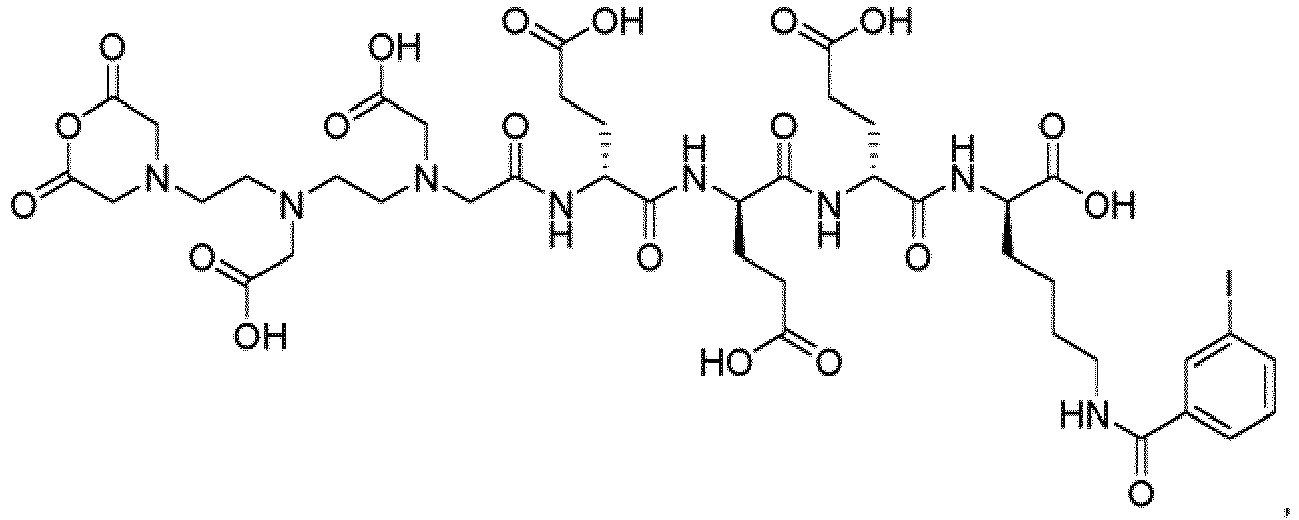


oder
- Pharmazeutische Zusammensetzung, umfassend ein Konjugat nach einem der Ansprüche 1-7 und einen pharmazeutisch unbedenklichen Hilfsstoff.
- Konjugat nach einem der Ansprüche 1 bis 7 oder Zusammensetzung nach Anspruch 12 zur Verwendung bei einer Methode zur Behandlung von Krebs, bei der man einem Patienten, der einer derartigen Behandlung bedarf, das Konjugat nach einem der Ansprüche 1-7 oder die Zusammensetzung nach Anspruch 12 verabreicht.
- Konjugat nach einem der Ansprüche 1-7 oder Zusammensetzung nach Anspruch 12 zur Verwendung bei einer Methode zur Behandlung von Krebs, bei der man einem Patienten, der einer derartigen Behandlung bedarf, eine erste Dosis des Konjugats nach einem der Ansprüche 1-7 oder der Zusammensetzung nach Anspruch 12 in einer für die Strahlungsbehandlungsplanung wirksamen Menge verabreicht und im Anschluss daran eine zweite Dosis des Konjugats nach einem der Ansprüche 1-7 oder der Zusammensetzung nach Anspruch 12 in einer therapeutisch wirksamen Menge verabreicht, gegebenenfalls
wobei es sich bei dem Krebs um eine Krebserkrankung mit einem soliden Tumor handelt oder wobei es sich bei dem Krebs um eine Krebserkrankung mit einem soliden Tumor handelt, die aus Brustkrebs, nichtkleinzelligem Lungenkrebs, Bauchspeicheldrüsenkrebs, Kopf- und Halskrebs, Prostatakrebs, Kolonkrebs, Sarkom oder Nebennierenrindenkarzinom ausgewählt ist, und/oder wobei die Methode ferner die Verabreichung eines Antiproliferativums umfasst oder
wobei die Methode ferner die Verabreichung eines Antiproliferativums umfasst und das Konjugat nach einem der Ansprüche 1-7 oder die Zusammensetzung nach Anspruch 12 und das Antiproliferativum innerhalb von 28 Tagen voneinander verabreicht werden.
Applications Claiming Priority (2)
| Application Number | Priority Date | Filing Date | Title |
|---|---|---|---|
| US201361903107P | 2013-11-12 | 2013-11-12 | |
| PCT/US2014/065288 WO2015073575A2 (en) | 2013-11-12 | 2014-11-12 | Residualizing linkers and uses thereof |
Publications (3)
| Publication Number | Publication Date |
|---|---|
| EP3068443A2 EP3068443A2 (de) | 2016-09-21 |
| EP3068443A4 EP3068443A4 (de) | 2017-08-16 |
| EP3068443B1 true EP3068443B1 (de) | 2019-04-10 |
Family
ID=53058250
Family Applications (1)
| Application Number | Title | Priority Date | Filing Date |
|---|---|---|---|
| EP14862412.5A Active EP3068443B1 (de) | 2013-11-12 | 2014-11-12 | Residualisierungsvernetzer und verwendungen davon |
Country Status (3)
| Country | Link |
|---|---|
| US (2) | US10758636B2 (de) |
| EP (1) | EP3068443B1 (de) |
| WO (1) | WO2015073575A2 (de) |
Families Citing this family (11)
| Publication number | Priority date | Publication date | Assignee | Title |
|---|---|---|---|---|
| EP3050878B1 (de) | 2013-09-24 | 2021-10-27 | FUJIFILM Corporation | Neuartige stickstoffhaltige verbindung oder salz davon oder metallkomplex davon |
| EP3068443B1 (de) | 2013-11-12 | 2019-04-10 | Centre for Probe Development and Commercialization | Residualisierungsvernetzer und verwendungen davon |
| PH12017500935A1 (en) | 2014-11-21 | 2017-11-27 | Merck Sharp & Dohme | Insulin receptor partial agonists |
| TWI808055B (zh) | 2016-05-11 | 2023-07-11 | 美商滬亞生物國際有限公司 | Hdac 抑制劑與 pd-1 抑制劑之組合治療 |
| TWI794171B (zh) | 2016-05-11 | 2023-03-01 | 美商滬亞生物國際有限公司 | Hdac抑制劑與pd-l1抑制劑之組合治療 |
| MA49398A (fr) * | 2017-05-05 | 2020-04-22 | Eric Steven Burak | Anticorps monoclonaux anti-igf-1r et utilisations de ceux-ci |
| JP7693317B2 (ja) | 2017-05-05 | 2025-06-17 | センター・フォー・プローブ・デベロップメント・アンド・コマーシャライゼイション | 二官能性キレートの薬物動態増強及びその使用 |
| AU2018265333C1 (en) * | 2017-05-10 | 2025-04-24 | Sanofi | Peptidic linkers and cryptophycin conjugates, useful in therapy, and their preparation |
| CN112888421A (zh) * | 2018-09-25 | 2021-06-01 | 亨斯迈石油化学有限责任公司 | 环酰胺起始的聚醚胺及其用途 |
| JP2024500847A (ja) | 2020-12-18 | 2024-01-10 | センチュリー セラピューティクス,インコーポレイテッド | 適合可能な受容体特異性を有するキメラ抗原受容体システム |
| JP2025529894A (ja) * | 2022-08-22 | 2025-09-09 | アブデラ セラピューティクス インク. | Vhh抗体dotaコンジュゲート |
Family Cites Families (15)
| Publication number | Priority date | Publication date | Assignee | Title |
|---|---|---|---|---|
| US5175343A (en) | 1985-01-14 | 1992-12-29 | Neorx Corporation | Metal radionuclide labeled proteins for diagnosis and therapy |
| US5530101A (en) | 1988-12-28 | 1996-06-25 | Protein Design Labs, Inc. | Humanized immunoglobulins |
| US5386011A (en) | 1990-12-27 | 1995-01-31 | Abbott Laboratories | Hexapeptide anaphylatoxin-receptor ligands |
| WO1992022324A1 (en) | 1991-06-14 | 1992-12-23 | Xoma Corporation | Microbially-produced antibody fragments and their conjugates |
| EP0646019B9 (de) | 1992-06-09 | 2002-12-18 | Neorx Corporation | Biotin-DOTA Konjugate und deren Verwendung in "Pretargeting" Verfahren |
| TR199902553T2 (xx) | 1997-04-14 | 2000-03-21 | Micromet Gesellschaft F�R Biomedizinische Forschung Mbh | �nsan v�cuduna kar�� antijen resept�rlerinin �retimi i�in yeni metod ve kullan�mlar�. |
| DE10002939C1 (de) | 2000-01-13 | 2001-09-20 | Schering Ag | Paramagnetische DOTA-Derivate, Verfahren zu ihrer Herstellung und ihre Verwendung für die Herstellung von pharmazeutischen Mitteln |
| US6890513B2 (en) * | 2001-05-25 | 2005-05-10 | Mcmaster University | Metal-carborane complexes for radioimaging and radiotherapy and methods for their preparation |
| US20050250700A1 (en) * | 2002-03-01 | 2005-11-10 | Sato Aaron K | KDR and VEGF/KDR binding peptides |
| WO2012122420A2 (en) | 2011-03-09 | 2012-09-13 | Pharmacofore, Inc. | Opioid prodrugs with heterocyclic linkers |
| KR20130083592A (ko) | 2012-01-13 | 2013-07-23 | 현대약품 주식회사 | 치환된 피페리딘 유도체 및 이의 제조방법 |
| WO2013148189A1 (en) * | 2012-03-30 | 2013-10-03 | Massachusetts Institute Of Technology | Probe incorporation mediated by enzymes |
| WO2014039541A1 (en) | 2012-09-05 | 2014-03-13 | North American Salt Company | Methods and compositions to prevent caking of sodium chloride and prevent transition metal stains |
| EP3068443B1 (de) | 2013-11-12 | 2019-04-10 | Centre for Probe Development and Commercialization | Residualisierungsvernetzer und verwendungen davon |
| JP7693317B2 (ja) * | 2017-05-05 | 2025-06-17 | センター・フォー・プローブ・デベロップメント・アンド・コマーシャライゼイション | 二官能性キレートの薬物動態増強及びその使用 |
-
2014
- 2014-11-12 EP EP14862412.5A patent/EP3068443B1/de active Active
- 2014-11-12 US US15/036,008 patent/US10758636B2/en active Active
- 2014-11-12 WO PCT/US2014/065288 patent/WO2015073575A2/en not_active Ceased
-
2020
- 2020-07-24 US US16/938,589 patent/US11793895B2/en active Active
Non-Patent Citations (1)
| Title |
|---|
| None * |
Also Published As
| Publication number | Publication date |
|---|---|
| US10758636B2 (en) | 2020-09-01 |
| US11793895B2 (en) | 2023-10-24 |
| EP3068443A2 (de) | 2016-09-21 |
| EP3068443A4 (de) | 2017-08-16 |
| WO2015073575A3 (en) | 2015-07-30 |
| WO2015073575A2 (en) | 2015-05-21 |
| US20160279272A1 (en) | 2016-09-29 |
| US20210060190A1 (en) | 2021-03-04 |
Similar Documents
| Publication | Publication Date | Title |
|---|---|---|
| US20230052140A1 (en) | Igf-1r monoclonal antibodies and uses thereof | |
| US11793895B2 (en) | Residualizing linkers and uses thereof | |
| US11191854B2 (en) | Pharmacokinetic enhancements of bifunctional chelates and uses thereof | |
| US20230270895A1 (en) | Radioimmunoconjugates and checkpoint inhibitor combination therapy | |
| US10093741B1 (en) | IGF-1R monoclonal antibodies and uses thereof | |
| US20250114488A1 (en) | Psma-targeted radiopharmaceuticals and checkpoint inhibitor combination therapy | |
| US20240285818A1 (en) | Radioimmunoconjugates and checkpoint inhibitor combination therapy | |
| US20250099633A1 (en) | Ntsr1-targeted radiopharmaceuticals and checkpoint inhibitor combination therapy | |
| US20250177581A1 (en) | Ntsr1-targeted radiopharmaceuticals and dna damage response inhibitor combination therapy | |
| EA045232B1 (ru) | Усиление фармакокинетики бифункциональных хелатов и их применения | |
| IL323688A (en) | PSMA-targeted radiopharmaceuticals and combination therapy with DNA damage response inhibitors | |
| EA045310B1 (ru) | Моноклональные антитела к igf-1r и их применение |
Legal Events
| Date | Code | Title | Description |
|---|---|---|---|
| PUAI | Public reference made under article 153(3) epc to a published international application that has entered the european phase |
Free format text: ORIGINAL CODE: 0009012 |
|
| 17P | Request for examination filed |
Effective date: 20160613 |
|
| AK | Designated contracting states |
Kind code of ref document: A2 Designated state(s): AL AT BE BG CH CY CZ DE DK EE ES FI FR GB GR HR HU IE IS IT LI LT LU LV MC MK MT NL NO PL PT RO RS SE SI SK SM TR |
|
| AX | Request for extension of the european patent |
Extension state: BA ME |
|
| DAX | Request for extension of the european patent (deleted) | ||
| A4 | Supplementary search report drawn up and despatched |
Effective date: 20170719 |
|
| RIC1 | Information provided on ipc code assigned before grant |
Ipc: A61K 51/10 20060101AFI20170713BHEP |
|
| GRAP | Despatch of communication of intention to grant a patent |
Free format text: ORIGINAL CODE: EPIDOSNIGR1 |
|
| STAA | Information on the status of an ep patent application or granted ep patent |
Free format text: STATUS: GRANT OF PATENT IS INTENDED |
|
| RAP1 | Party data changed (applicant data changed or rights of an application transferred) |
Owner name: CENTRE FOR PROBE DEVELOPMENT AND COMMERCIALIZATION |
|
| INTG | Intention to grant announced |
Effective date: 20180831 |
|
| GRAS | Grant fee paid |
Free format text: ORIGINAL CODE: EPIDOSNIGR3 |
|
| GRAA | (expected) grant |
Free format text: ORIGINAL CODE: 0009210 |
|
| STAA | Information on the status of an ep patent application or granted ep patent |
Free format text: STATUS: THE PATENT HAS BEEN GRANTED |
|
| AK | Designated contracting states |
Kind code of ref document: B1 Designated state(s): AL AT BE BG CH CY CZ DE DK EE ES FI FR GB GR HR HU IE IS IT LI LT LU LV MC MK MT NL NO PL PT RO RS SE SI SK SM TR |
|
| REG | Reference to a national code |
Ref country code: GB Ref legal event code: FG4D |
|
| REG | Reference to a national code |
Ref country code: CH Ref legal event code: EP Ref country code: AT Ref legal event code: REF Ref document number: 1117798 Country of ref document: AT Kind code of ref document: T Effective date: 20190415 |
|
| REG | Reference to a national code |
Ref country code: IE Ref legal event code: FG4D |
|
| REG | Reference to a national code |
Ref country code: DE Ref legal event code: R096 Ref document number: 602014044656 Country of ref document: DE |
|
| REG | Reference to a national code |
Ref country code: NL Ref legal event code: FP |
|
| REG | Reference to a national code |
Ref country code: LT Ref legal event code: MG4D |
|
| REG | Reference to a national code |
Ref country code: AT Ref legal event code: MK05 Ref document number: 1117798 Country of ref document: AT Kind code of ref document: T Effective date: 20190410 |
|
| PG25 | Lapsed in a contracting state [announced via postgrant information from national office to epo] |
Ref country code: NO Free format text: LAPSE BECAUSE OF FAILURE TO SUBMIT A TRANSLATION OF THE DESCRIPTION OR TO PAY THE FEE WITHIN THE PRESCRIBED TIME-LIMIT Effective date: 20190710 Ref country code: LT Free format text: LAPSE BECAUSE OF FAILURE TO SUBMIT A TRANSLATION OF THE DESCRIPTION OR TO PAY THE FEE WITHIN THE PRESCRIBED TIME-LIMIT Effective date: 20190410 Ref country code: PT Free format text: LAPSE BECAUSE OF FAILURE TO SUBMIT A TRANSLATION OF THE DESCRIPTION OR TO PAY THE FEE WITHIN THE PRESCRIBED TIME-LIMIT Effective date: 20190910 Ref country code: FI Free format text: LAPSE BECAUSE OF FAILURE TO SUBMIT A TRANSLATION OF THE DESCRIPTION OR TO PAY THE FEE WITHIN THE PRESCRIBED TIME-LIMIT Effective date: 20190410 Ref country code: ES Free format text: LAPSE BECAUSE OF FAILURE TO SUBMIT A TRANSLATION OF THE DESCRIPTION OR TO PAY THE FEE WITHIN THE PRESCRIBED TIME-LIMIT Effective date: 20190410 Ref country code: AL Free format text: LAPSE BECAUSE OF FAILURE TO SUBMIT A TRANSLATION OF THE DESCRIPTION OR TO PAY THE FEE WITHIN THE PRESCRIBED TIME-LIMIT Effective date: 20190410 Ref country code: SE Free format text: LAPSE BECAUSE OF FAILURE TO SUBMIT A TRANSLATION OF THE DESCRIPTION OR TO PAY THE FEE WITHIN THE PRESCRIBED TIME-LIMIT Effective date: 20190410 Ref country code: HR Free format text: LAPSE BECAUSE OF FAILURE TO SUBMIT A TRANSLATION OF THE DESCRIPTION OR TO PAY THE FEE WITHIN THE PRESCRIBED TIME-LIMIT Effective date: 20190410 |
|
| PG25 | Lapsed in a contracting state [announced via postgrant information from national office to epo] |
Ref country code: RS Free format text: LAPSE BECAUSE OF FAILURE TO SUBMIT A TRANSLATION OF THE DESCRIPTION OR TO PAY THE FEE WITHIN THE PRESCRIBED TIME-LIMIT Effective date: 20190410 Ref country code: LV Free format text: LAPSE BECAUSE OF FAILURE TO SUBMIT A TRANSLATION OF THE DESCRIPTION OR TO PAY THE FEE WITHIN THE PRESCRIBED TIME-LIMIT Effective date: 20190410 Ref country code: PL Free format text: LAPSE BECAUSE OF FAILURE TO SUBMIT A TRANSLATION OF THE DESCRIPTION OR TO PAY THE FEE WITHIN THE PRESCRIBED TIME-LIMIT Effective date: 20190410 Ref country code: GR Free format text: LAPSE BECAUSE OF FAILURE TO SUBMIT A TRANSLATION OF THE DESCRIPTION OR TO PAY THE FEE WITHIN THE PRESCRIBED TIME-LIMIT Effective date: 20190711 Ref country code: BG Free format text: LAPSE BECAUSE OF FAILURE TO SUBMIT A TRANSLATION OF THE DESCRIPTION OR TO PAY THE FEE WITHIN THE PRESCRIBED TIME-LIMIT Effective date: 20190710 |
|
| PG25 | Lapsed in a contracting state [announced via postgrant information from national office to epo] |
Ref country code: AT Free format text: LAPSE BECAUSE OF FAILURE TO SUBMIT A TRANSLATION OF THE DESCRIPTION OR TO PAY THE FEE WITHIN THE PRESCRIBED TIME-LIMIT Effective date: 20190410 Ref country code: IS Free format text: LAPSE BECAUSE OF FAILURE TO SUBMIT A TRANSLATION OF THE DESCRIPTION OR TO PAY THE FEE WITHIN THE PRESCRIBED TIME-LIMIT Effective date: 20190810 |
|
| REG | Reference to a national code |
Ref country code: DE Ref legal event code: R097 Ref document number: 602014044656 Country of ref document: DE |
|
| PG25 | Lapsed in a contracting state [announced via postgrant information from national office to epo] |
Ref country code: CZ Free format text: LAPSE BECAUSE OF FAILURE TO SUBMIT A TRANSLATION OF THE DESCRIPTION OR TO PAY THE FEE WITHIN THE PRESCRIBED TIME-LIMIT Effective date: 20190410 Ref country code: EE Free format text: LAPSE BECAUSE OF FAILURE TO SUBMIT A TRANSLATION OF THE DESCRIPTION OR TO PAY THE FEE WITHIN THE PRESCRIBED TIME-LIMIT Effective date: 20190410 Ref country code: RO Free format text: LAPSE BECAUSE OF FAILURE TO SUBMIT A TRANSLATION OF THE DESCRIPTION OR TO PAY THE FEE WITHIN THE PRESCRIBED TIME-LIMIT Effective date: 20190410 Ref country code: DK Free format text: LAPSE BECAUSE OF FAILURE TO SUBMIT A TRANSLATION OF THE DESCRIPTION OR TO PAY THE FEE WITHIN THE PRESCRIBED TIME-LIMIT Effective date: 20190410 Ref country code: SK Free format text: LAPSE BECAUSE OF FAILURE TO SUBMIT A TRANSLATION OF THE DESCRIPTION OR TO PAY THE FEE WITHIN THE PRESCRIBED TIME-LIMIT Effective date: 20190410 |
|
| PLBE | No opposition filed within time limit |
Free format text: ORIGINAL CODE: 0009261 |
|
| STAA | Information on the status of an ep patent application or granted ep patent |
Free format text: STATUS: NO OPPOSITION FILED WITHIN TIME LIMIT |
|
| PG25 | Lapsed in a contracting state [announced via postgrant information from national office to epo] |
Ref country code: SM Free format text: LAPSE BECAUSE OF FAILURE TO SUBMIT A TRANSLATION OF THE DESCRIPTION OR TO PAY THE FEE WITHIN THE PRESCRIBED TIME-LIMIT Effective date: 20190410 Ref country code: IT Free format text: LAPSE BECAUSE OF FAILURE TO SUBMIT A TRANSLATION OF THE DESCRIPTION OR TO PAY THE FEE WITHIN THE PRESCRIBED TIME-LIMIT Effective date: 20190410 |
|
| 26N | No opposition filed |
Effective date: 20200113 |
|
| PG25 | Lapsed in a contracting state [announced via postgrant information from national office to epo] |
Ref country code: TR Free format text: LAPSE BECAUSE OF FAILURE TO SUBMIT A TRANSLATION OF THE DESCRIPTION OR TO PAY THE FEE WITHIN THE PRESCRIBED TIME-LIMIT Effective date: 20190410 |
|
| PG25 | Lapsed in a contracting state [announced via postgrant information from national office to epo] |
Ref country code: SI Free format text: LAPSE BECAUSE OF FAILURE TO SUBMIT A TRANSLATION OF THE DESCRIPTION OR TO PAY THE FEE WITHIN THE PRESCRIBED TIME-LIMIT Effective date: 20190410 |
|
| REG | Reference to a national code |
Ref country code: CH Ref legal event code: PL |
|
| PG25 | Lapsed in a contracting state [announced via postgrant information from national office to epo] |
Ref country code: MC Free format text: LAPSE BECAUSE OF FAILURE TO SUBMIT A TRANSLATION OF THE DESCRIPTION OR TO PAY THE FEE WITHIN THE PRESCRIBED TIME-LIMIT Effective date: 20190410 Ref country code: LI Free format text: LAPSE BECAUSE OF NON-PAYMENT OF DUE FEES Effective date: 20191130 Ref country code: CH Free format text: LAPSE BECAUSE OF NON-PAYMENT OF DUE FEES Effective date: 20191130 Ref country code: LU Free format text: LAPSE BECAUSE OF NON-PAYMENT OF DUE FEES Effective date: 20191112 |
|
| REG | Reference to a national code |
Ref country code: BE Ref legal event code: MM Effective date: 20191130 |
|
| PG25 | Lapsed in a contracting state [announced via postgrant information from national office to epo] |
Ref country code: BE Free format text: LAPSE BECAUSE OF NON-PAYMENT OF DUE FEES Effective date: 20191130 |
|
| PG25 | Lapsed in a contracting state [announced via postgrant information from national office to epo] |
Ref country code: CY Free format text: LAPSE BECAUSE OF FAILURE TO SUBMIT A TRANSLATION OF THE DESCRIPTION OR TO PAY THE FEE WITHIN THE PRESCRIBED TIME-LIMIT Effective date: 20190410 |
|
| PG25 | Lapsed in a contracting state [announced via postgrant information from national office to epo] |
Ref country code: HU Free format text: LAPSE BECAUSE OF FAILURE TO SUBMIT A TRANSLATION OF THE DESCRIPTION OR TO PAY THE FEE WITHIN THE PRESCRIBED TIME-LIMIT; INVALID AB INITIO Effective date: 20141112 Ref country code: MT Free format text: LAPSE BECAUSE OF FAILURE TO SUBMIT A TRANSLATION OF THE DESCRIPTION OR TO PAY THE FEE WITHIN THE PRESCRIBED TIME-LIMIT Effective date: 20190410 |
|
| PG25 | Lapsed in a contracting state [announced via postgrant information from national office to epo] |
Ref country code: MK Free format text: LAPSE BECAUSE OF FAILURE TO SUBMIT A TRANSLATION OF THE DESCRIPTION OR TO PAY THE FEE WITHIN THE PRESCRIBED TIME-LIMIT Effective date: 20190410 |
|
| P01 | Opt-out of the competence of the unified patent court (upc) registered |
Effective date: 20230521 |
|
| PGFP | Annual fee paid to national office [announced via postgrant information from national office to epo] |
Ref country code: NL Payment date: 20241126 Year of fee payment: 11 |
|
| PGFP | Annual fee paid to national office [announced via postgrant information from national office to epo] |
Ref country code: DE Payment date: 20241127 Year of fee payment: 11 |
|
| PGFP | Annual fee paid to national office [announced via postgrant information from national office to epo] |
Ref country code: GB Payment date: 20241127 Year of fee payment: 11 |
|
| PGFP | Annual fee paid to national office [announced via postgrant information from national office to epo] |
Ref country code: FR Payment date: 20241126 Year of fee payment: 11 |
|
| PGFP | Annual fee paid to national office [announced via postgrant information from national office to epo] |
Ref country code: IE Payment date: 20241127 Year of fee payment: 11 |