EP3068746B1 - Procédé de préparation de 1-aminoindane énantiomériquement pur - Google Patents
Procédé de préparation de 1-aminoindane énantiomériquement pur Download PDFInfo
- Publication number
- EP3068746B1 EP3068746B1 EP14747585.9A EP14747585A EP3068746B1 EP 3068746 B1 EP3068746 B1 EP 3068746B1 EP 14747585 A EP14747585 A EP 14747585A EP 3068746 B1 EP3068746 B1 EP 3068746B1
- Authority
- EP
- European Patent Office
- Prior art keywords
- aminoindan
- acetyl
- mixture
- temperature
- solvent system
- Prior art date
- Legal status (The legal status is an assumption and is not a legal conclusion. Google has not performed a legal analysis and makes no representation as to the accuracy of the status listed.)
- Active
Links
- RFMMMVDNIPUKGG-YFKPBYRVSA-L CC(N[C@@H](CCC([O-])=O)C([O-])=O)=O Chemical compound CC(N[C@@H](CCC([O-])=O)C([O-])=O)=O RFMMMVDNIPUKGG-YFKPBYRVSA-L 0.000 description 1
- XJEVHMGJSYVQBQ-UHFFFAOYSA-N NC(CC1)c2c1cccc2 Chemical compound NC(CC1)c2c1cccc2 XJEVHMGJSYVQBQ-UHFFFAOYSA-N 0.000 description 1
- XJEVHMGJSYVQBQ-UHFFFAOYSA-O [NH3+]C1c2ccccc2CC1 Chemical compound [NH3+]C1c2ccccc2CC1 XJEVHMGJSYVQBQ-UHFFFAOYSA-O 0.000 description 1
Images

Classifications
-
- C—CHEMISTRY; METALLURGY
- C07—ORGANIC CHEMISTRY
- C07B—GENERAL METHODS OF ORGANIC CHEMISTRY; APPARATUS THEREFOR
- C07B57/00—Separation of optically-active compounds
-
- C—CHEMISTRY; METALLURGY
- C07—ORGANIC CHEMISTRY
- C07C—ACYCLIC OR CARBOCYCLIC COMPOUNDS
- C07C209/00—Preparation of compounds containing amino groups bound to a carbon skeleton
- C07C209/82—Purification; Separation; Stabilisation; Use of additives
- C07C209/86—Separation
- C07C209/88—Separation of optical isomers
-
- C—CHEMISTRY; METALLURGY
- C07—ORGANIC CHEMISTRY
- C07C—ACYCLIC OR CARBOCYCLIC COMPOUNDS
- C07C211/00—Compounds containing amino groups bound to a carbon skeleton
- C07C211/33—Compounds containing amino groups bound to a carbon skeleton having amino groups bound to carbon atoms of rings other than six-membered aromatic rings
- C07C211/39—Compounds containing amino groups bound to a carbon skeleton having amino groups bound to carbon atoms of rings other than six-membered aromatic rings of an unsaturated carbon skeleton
- C07C211/41—Compounds containing amino groups bound to a carbon skeleton having amino groups bound to carbon atoms of rings other than six-membered aromatic rings of an unsaturated carbon skeleton containing condensed ring systems
- C07C211/42—Compounds containing amino groups bound to a carbon skeleton having amino groups bound to carbon atoms of rings other than six-membered aromatic rings of an unsaturated carbon skeleton containing condensed ring systems with six-membered aromatic rings being part of the condensed ring systems
-
- C—CHEMISTRY; METALLURGY
- C07—ORGANIC CHEMISTRY
- C07C—ACYCLIC OR CARBOCYCLIC COMPOUNDS
- C07C233/00—Carboxylic acid amides
- C07C233/01—Carboxylic acid amides having carbon atoms of carboxamide groups bound to hydrogen atoms or to acyclic carbon atoms
- C07C233/45—Carboxylic acid amides having carbon atoms of carboxamide groups bound to hydrogen atoms or to acyclic carbon atoms having the nitrogen atom of at least one of the carboxamide groups bound to a carbon atom of a hydrocarbon radical substituted by carboxyl groups
- C07C233/46—Carboxylic acid amides having carbon atoms of carboxamide groups bound to hydrogen atoms or to acyclic carbon atoms having the nitrogen atom of at least one of the carboxamide groups bound to a carbon atom of a hydrocarbon radical substituted by carboxyl groups with the substituted hydrocarbon radical bound to the nitrogen atom of the carboxamide group by an acyclic carbon atom
- C07C233/47—Carboxylic acid amides having carbon atoms of carboxamide groups bound to hydrogen atoms or to acyclic carbon atoms having the nitrogen atom of at least one of the carboxamide groups bound to a carbon atom of a hydrocarbon radical substituted by carboxyl groups with the substituted hydrocarbon radical bound to the nitrogen atom of the carboxamide group by an acyclic carbon atom having the carbon atom of the carboxamide group bound to a hydrogen atom or to a carbon atom of an acyclic saturated carbon skeleton
-
- C—CHEMISTRY; METALLURGY
- C07—ORGANIC CHEMISTRY
- C07C—ACYCLIC OR CARBOCYCLIC COMPOUNDS
- C07C2602/00—Systems containing two condensed rings
- C07C2602/02—Systems containing two condensed rings the rings having only two atoms in common
- C07C2602/04—One of the condensed rings being a six-membered aromatic ring
- C07C2602/08—One of the condensed rings being a six-membered aromatic ring the other ring being five-membered, e.g. indane
Definitions
- the present invention relates to an improved process for the preparation of enatiomerically pure (R)-1-aminoindan which is a valuable intermediate in the process for preparation of rasagiline. Moreover, the invention relates to diastereomeric salts of 1-aminoindan which are useful in the synthesis of (R)-1-aminoindan.
- Rasagiline is a common name for ( R )- N -(prop-2-ynyl)-2,3-dihydro-1 H- inden-1-amine, a compound of formula (I):
- Rasagiline functions as a selective, irreversible MAO-B inhibitor indicated for the treatment of signs and symptoms of idiopathic Parkinson's disease as initial monotherapy and as adjunct therapy to levodopa.
- the selectivity for inhibiting MAO-B diminishes in a dose-related manner.
- MAO a flavin-containing enzyme, is classified into two major molecular species, A and B, and is localized in mitochondrial membranes throughout the body in nerve terminals, brain, liver and intestinal mucosa.
- MAO regulates the metabolic degradation of catecholamines and serotonin in the CNS and peripheral tissues.
- MAO-B is the major form in the human brain.
- rasagiline was shown to be a potent, irreversible monoamine oxidase type B (MAO-B) selective inhibitor. Rasagiline at the recommended therapeutic dose was also shown to be a potent and irreversible inhibitor of MAO-B in platelets. The precise mechanisms of action of rasagiline are unknown. One mechanism is believed to be related to its MAO-B inhibitory activity, which causes an increase in extracellular levels of dopamine in the striatum. The elevated dopamine level and subsequent increased dopaminergic activity are likely to mediate rasagiline's beneficial effects seen in models of dopaminergic motor dysfunction.
- MAO-B monoamine oxidase type B
- Rasagiline was first disclosed in EP 436492 which describes a method reacting (R)-1-aminoindan and propargyl chloride.
- the document teaches that (R)-1-aminoindan could be prepared by resolution of a racemic mixture of R- and S-enatiomers e.g. by formation of diastereomeric salts with chiral acids.
- US 4833273 discloses a process for resolution of 1-aminoindan using (R)-N-acetyl-3,4-dimethoxyphenylalanine as resolving agent.
- the drawback of the process is that the unwanted diastereomeric salt (R,S) is precipitated first from the reaction mixture and that the desired salt (R,R) is recovered by concentrating and cooling mother liquors whereby more impure product was produced. This is also evident from the physical data, such as the melting point and the specific rotation, reported for the product of the first crop and the second crop which substantially differ from each other.
- the resolving agent used is very expensive and, therefore, not desirable for use in a large scale processes.
- WO 2009/147430 a process which uses 2,3,4,6-di-isopopylidene-2-keto-L-gulonic acid as a resolving agent is disclosed.
- the diasteromeric salt formation is performed in methanol. Recrystallization takes place in a solvent mixture of methanol and water.
- Enantiomeric purities for resolving processes exemplified in the document are about 96%. However, in processes for the preparation pharmaceutical active ingredients an enantiomeric purity of more than 98% is usually required. Another drawback of this process is the relatively high price of the reagent.
- the present invention relates to a process for preparation of optically pure (R)-1-aminoindan using N-acetyl-L-glutamic acid, and in particular to a process for preparing optically pure (R)-1-aminoindan by a diastereomeric resolution of 1-aminoindan using N-acetyl-L-glutamic acid as a resolving agent.
- Another object of the invention relates to the diastereomeric salt of R-1-aminoindan with N-acetyl-L-glutamic acid, its use in the process for the preparation of rasagiline.
- Yet another object of the invention is a process for racemization of (S)-1-aminoindan which is recovered from the mother liquor after diastereomeric salts separation.
- the present invention relates to a new process for the manufacture of optically pure (R)-1-aminoindan, which comprises a resolution of racemic 1-aminoindan using N-acetyl-L-glutamic acid as a resolving agent.
- the process of the present invention comprises the following steps:
- optically pure means that the desired enantiomeric form comprises less than 10 area % of unwanted enantiomeric form, preferably less than 5 area %, more preferably less than 2 area %, most preferably less than 1 area %; even most preferably less than 0.5 area %. Enantiomeric purity has been determined by means of HPLC analysis.
- racemic 1-aminoindan refers to a mixture of (R)-1-aminoindan and (S)-1-aminoindan, having an (S):(R) ratio ranging from about 65:35 to about 35:65.
- the racemic 1-aminoindan has an (S):(R) ratio ranging from about 55:45 to about 45:55.
- the racemic 1-aminoindan has an S:R ratio ranging from about 52:48 to about 48/52.
- the racemic 1-aminoindan has an S:R ratio ranging from about 51:49 to about 49:51.
- the racemic 1-aminoindan has an S:R ratio of about 1:1.
- racemic 1-aminoindan is used as starting material in step (i) of the process of the present invention.
- N-acetyl-L-glutamic acid is a diacid comprising two carboxylic acid groups. Therefore, according to the process of the present invention two types of diastereomeric salts could be formed, namely an acidic salt, wherein the molar ratio of 1-aminoindan to N-acetyl-L-glutamic acid is 1:1, or a neutral salt, wherein the molar ratio of 1-aminoindan to N-acetyl-L-glutamic acid is 2:1.
- step (i) The formation of diastereomeric salts of 1-aminoindan with N-acetyl-L-glutamic acid according to step (i) may be carried out by combining racemic 1-aminoindan with N-acetyl-L-glutamic acid in a solvent and subsequent recovery of the salt formed.
- the molar ratio of racemic 1-aminoindan to the N-acetyl-L-glutamic acid may be from 1:0.5 to 1:1.3, preferably from 1:0.6 to 1:1.1, most preferably from 1:0.7 to 1:1.
- the salt formation in step (i) is carried in the presence of a solvent.
- the solvent used in step (i) may be selected from the group comprising alcohols, such as methanol, ethanol, 1-propanol and 2-propanol; ethers, such as diethyl ether, methyl ethyl ether, methyl tert-butyl ether (MTBE), isobutyl methyl ether (IBME), isopropyl ether, cyclopentyl methyl ether; water; hydrocarbons such as hexane, cyclohexane, heptane, octane, or a mixture thereof.
- alcohols such as methanol, ethanol, 1-propanol and 2-propanol
- ethers such as diethyl ether, methyl ethyl ether, methyl tert-butyl ether (MTBE), isobutyl methyl ether (IBME), isopropyl
- the solvent mixture of an alcohol and an antisolvent such as ether or hydrocarbon is used, more preferably mixture of ethanol with a solvent selected from diethyl ether, methyl ethyl ether, methyl tert-butyl ether (MTBE), isobutyl methyl ether (IBME), isopropyl ether, cyclopentyl methyl ether, hexane, cyclohexane or heptane, is used. Most preferably, a mixture of ethanol with methyl tert-butyl ether is used.
- a solvent selected from diethyl ether, methyl ethyl ether, methyl tert-butyl ether (MTBE), isobutyl methyl ether (IBME), isopropyl ether, cyclopentyl methyl ether, hexane, cyclohexane or heptane is used.
- the diastereomeric salt formation (step (i)) as well as the resolution (steps (ii) and (iii)) may be carried out in the same solvent system or in a different solvent system.
- the first solvent system used in step (ii) and the second solvent system used in step (iii) may be identical or different.
- step (ii) a resolution of the diastereomeric salts obtained in step (i) takes place, i.e. the diastereomeric salts obtained in step (i) are separated by crystallization.
- the unwanted diastereomeric salts i.e. salts comprising (S)-1-aminoindan or a mixture of salts enriched with (S)-1-aminoindan
- the desired diastereomeric salts i.e. those comprising (R)-1-aminoindan or enriched with (R)-1-aminoindan, precipitate during crystallization.
- step (iii) a resolution of the precipitated diastereomeric salts obtained in step (ii) takes place.
- the solvent system preferably used in the resolution steps (ii) and (iii) is a combination of alcoholic solvents such as methanol, ethanol, 1-propanol and 2-propanol with 0-10% (v/v) of dipolar solvents such as N,N-dimethylformamide, N,N-dimethylacetamide, N-methyl-2-pyrrolidone; dimethylsulfoxide or water.
- the solvent system used in steps (ii) and (iii) comprises ethanol with 0-10% (v/v) of water.
- the first solvent system comprises ethanol.
- the first solvent system comprises ethanol and the second solvent system comprises a mixture of ethanol with 0.1-3% (v/v) of water.
- the second solvent system comprises a mixture of ethanol with 0.5-2% (v/v) of water, and most preferably with 1% (v/v) of water.
- Optimal solute to solvent ratios used in step (ii) can include 1g of the solute to 10 to 50 ml, preferably 1g of the solute to 20 to 40 ml of the first solvent system, whereas in step (iii) the preferred ratio includes 1g of the solute to 50 to 100 ml of the second solvent mixture, preferably 1g of the solute to 60 to 80 ml of the second solvent mixture.
- the term "solute” relates to a diastereomeric salt of 1-aminoindan with N-acetyl-L-glutamic acid, which needs to be further optically purified.
- diastereomeric salt of 1-aminoindan with N-acetyl-L-glutamic acid, which needs to be further optically purified means that the desired enantiomeric form comprises more than 0.5 area % of the unwanted enantiomeric form, preferably more than 1 area %, more preferably more than 2 area %, most preferably more than 5 area %, even most preferably more than 10 area % of the unwanted enantiomeric form. Enantiomeric purity has been determined by means of HPLC analysis.
- the temperature can also play a key role in the resolution process for obtaining the optically pure (R)-1-aminoindan.
- the inventors have found out that if the resolution is carried out at a temperature of 5°C-80°C, the desired product is obtained in a higher optical purity. The best results can be achieved in cases where crystallization is initiated at a temperature between 20-65°C, preferably at 30° to 50°C, most preferably at 35°C to 45°C.
- the crystallization is preferably initiated by addition of seeding crystals of a diastereomeric salt of (R)-1-aminoindan and N-acetyl-L-glutamic acid.
- the seeding crystals may be added at a temperature of 20 to 65°C, preferably at 30° to 50°C, most preferably at 35°C to 45°C. If seeding crystals are added, the seeding crystals have to be added prior to spontaneous crystallization occurs.
- the amount of seeding crystals may vary from 0.1 to 10 wt% in relation to the weight of the starting material 1-aminoindan. Preferably, 0.5 to 2wt% is used.
- the seeds can be added in a powder form or in a form of suspension in any type of liquid.
- the formed or resolved diastereomeric salt obtained in steps (i), (ii) or (iii) can be isolated from the reaction mass by filtration. Moderately resolved diastereomeric salt may also be further purified using the first solvent system or the second solvent system, preferably the second solvent system.
- step (iv) the resolved diastereomeric salt is then treated with a base to obtain optically pure (R)-1-aminoindan as free base (neutralization).
- the base can be selected from alkali hydroxides, carbonates and hydrogen carbonates, preferably from potassium hydroxide, sodium hydroxide, sodium carbonate, potassium carbonate, sodium bicarbonate or potassium bicarbonate. Most preferably, sodium hydroxide is used.
- the mother liquor obtained from step (ii) and/or step (iii) contains a diastereomeric salt of (S)-1-aminoindan or a diastereomeric salt of a mixture of (R)- and (S)- enantiomers of 1-aminoindan enriched in (S)-1-aminoindan with N-acetyl-L-glutamic acid.
- (S)-1-aminoindan or a mixture of (R)- and (S)- enatiomers of 1-aminoindan enriched in (S)-1-aminoindan can be obtained after neutralization of the salt recovered from the mother liquor after diastereomeric salts separation of 1-aminoindan with N-acetyl-L-glutamic acid.
- (S)-1-aminoindan or a mixture of (R)- and (S)-enatiomers of 1-aminoindan enriched in (S)-1-aminoindan can be racemized according to the processes known in the art such as by reacting said (S)-1-aminoindan with an alcoholate, e.g.
- the present invention also relates to a process for racemization of (S)-1-aminoindan which is recovered from the mother liquor after separating diastereomeric salts of 1-aminoindan and N-acetyl-L-glutamic acid.
- the resolving agent N-acetyl-L-glutamic acid can be recovered from the aqueous mother liquor by usual known methods, as reported in literature, and reused for the same resolution.
- a second aspect of the present invention is directed to a diastereomeric salt of 1-aminoindan with N-acetyl-L-glutamic acid.
- the salt may exist in racemic form, i.e. in form of a mixture of (R)-1-aminoindan N-acetyl-L-glutaminate and (S)-1-aminoindan N-acetyl-L-glutaminate, or in optically pure form, such as in form of optically pure (R)-1-aminoindan N-acetyl-L-glutaminate.
- the salt may exist in an acidic form having the chemical name 1-aminoindan N-acetyl-L-glutaminate (1:1), shown with the following structural formula: or in a neutral form, having the chemical name 1-aminoindan N-acetyl-L-glutaminate (2:1), shown with the following structural formula:
- the acidic form is (R)-1-aminoindan N-acetyl-L-glutaminate (1:1), shown with the following structural formula: and the neutral form is (R)-1-aminoindan N-acetyl-L-glutaminate (2:1), shown with the following structural formula:
- Racemic 1-aminoindan N-acetyl-L-glutaminate (1:1) may be characterized by the following NMR data: 1 H NMR (DMSO-d 6 ) ⁇ : 7.64 (d, 1H), 7.53 (d, 1H), 7.18-7.34 (m, 3H), 4.58 (m, 1H), 4.07 (m, 1H), 2.94-3.06 (m, 1H), 2.74-2.90 (m, 1H), 2.34-2.48 (m, 1H), 2.10-2.28 (m, 2H), 1.86-2.00 (m, 1H), 1.71-1.86 (m, 5H); 13 C NMR (DMSO-d 6 ) ⁇ : 174.8, 174.1, 168.4, 143.6, 141.5, 128.3, 126.5, 124.7, 124.6, 54.9, 52.6, 31.9, 31.7, 29.8, 28.3, 22.7.
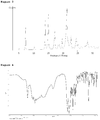
- the racemic salt may be further characterized by a powder X-ray diffraction pattern with the following peaks (°2 ⁇ 0.2) and relative intensity [%]: No. Pos. [°2Theta] Rel. Int. [%] 1 7.2 15 2 13.7 68 3 14.4 24 4 15.4 23 5 17.9 27 6 21.6 51 7 23.0 100 8 23.7 31
- the racemic salt is in particular characterized by an XRPD spectrum as shown in Figure 1 and by an FT-IR as shown in Figure 2 .
- Optically pure (R)-1-aminoindan N-acetyl-L-glutaminate (2:1) may be characterized by the following NMR data: NMR: 1 H NMR (DMSO-d 6 ) ⁇ : 7.61 (d, 1H), 7.38-7.47 (m, 2H), 7.13-7.31 (m, 6H), 4.42 (m, 2H), 4.11 (m, 1H), 2.89-2.99 (m, 2H), 2.77 (m, 2H), 2.34-2.44 (m, 2H), 2.28 (m, 1H), 2.13 (m, 1H), 1.70-1.88 (m, 6H), 1.58-1.69 (m, 1H); 13 C NMR (DMSO-d 6 ) ⁇ : 174.5, 173.6, 168.2, 144.2, 143.1, 127.6, 126.3, 124.5, 124.1, 55.8, 52.2, 33.8, 32.6, 29.7, 28.4, 22.7
- the salt may be further characterized by a powder X-ray diffraction pattern with the following peaks (°2 ⁇ 0.2) and relative intensity [%]: No. Pos. [°2Theta] Rel. Int. [%] 1 7.4 53 2 14.1 68 3 15.2 81 4 17.4 41 5 19.9 26 6 21.5 100 7 22.9 32 8 24.6 26 9 28.5 21
- Optically pure (R)-1-aminoindan N-acetyl-L-glutaminate (2:1) is further characterized by an XRPD spectrum as shown in Figure 3 and by an FT-IR as shown in Figure 4 .
- the optically pure salt preferably exhibits optical purity of more than 90 area %, preferably more than 95 area %, most preferably more than 99 area %. Optical purity is determined by means of HPLC method.
- the salts of 1-aminoindan with N-acetyl-L-glutamic acid according to the present invention may be used in the process for preparation of rasagiline and/or acid addition salt thereof according to any known procedure such as disclosed in e.g. EP 812190 , WO 2012/153349 , WO 2009/141737 , EP 2364967 or WO 2011/087791 .
- Rasagilin acid addition salt may be selected from rasagiline mesylate, esylate, sulfate, (hemi)-L-tartrate, which were disclosed in WO 95/11016 , rasagiline hydrochloride disclosed in EP 436492 , tannate salt of rasagiline disclosed in WO 2008/076315 , acid addition salts of rasagiline with organic diacids, specifically rasagiline edisylate and rasagiline oxalate disclosed in WO 2008/019871 , rasagiline fumarate salt, succinate salt, besylate salt etc disclosed in WO 2010/007181 , citrate salt disclosed in WO 2010/085354 .
- the present invention also relates to a process for preparing optically pure (R)-1-aminoindan according to the first aspect of the invention, wherein said optically pure (R)-1-aminoindan is used for the preparation of rasagiline or a pharmaceutically acceptable salt thereof.
- the present invention also relates to a process for preparing rasagiline or a pharmaceutically acceptable salt thereof comprising the preparation of optically pure (R)-1-aminoindan according to the first aspect of the invention and a further step in which said optically pure (R)-1-aminoindan is converted into rasagiline or a pharmaceutically acceptable salt thereof.
- the conversion of the optically pure (R)-1-aminoindan into rasagiline or a pharmaceutically acceptable salt thereof can be performed by processes known in the art such as processes described in EP 436492 , WO 2009/14730 or WO 2012/116752 .
- X-ray powder diffraction patterns were obtained by a PANalytical PW3040/60 X'Pert PRO diffractometer using CuK ⁇ radiation of 1.541874 ⁇ .
- the FT-IR spectra were obtained with a FT-IR spectrometer Perkin Elmer Frontier at a resolution of 4 cm -1 from 4000 cm -1 to 400 cm -1 .
- the samples of Form K were prepared as KBr discs.
- HPLC high pressure liquid chromatography
- Enantiomeric purity was assessed by HPLC method using a polysaccharide based chiral column (type Chiralpak AD-H, 250 x 4.6 mm, 5 ⁇ m particles).
- Mobile phase which was a mixture of hexane, ethanol and butylamine in the ratio 980:20:0.4 (V/V/V); flow-rate: 0.7 ml/min; UV detector: 265 nm; injection volume: 10 ⁇ l
- Mobile phase which was a mixture of hexane, ethanol and butylamine in the ratio 980:20:0.4 (V/V/V); flow-rate: 0.7 ml/min; UV detector: 265 nm; injection volume: 10 ⁇ l
- sample solution was prepared in concentration of about 1 - 1.5 mg/ml.
- Dilution solvent was acetonitrile and water.
- Enantiomeric purity The sample solution was prepared in concentration of about 10 mg/ml. Dilution solvent was a mixture of ethanol and 2-propanol.
- a reactor was charged with 200 g of 1-indanone (1.5133 mol) and 1440 ml of 96 % ethanol. The mixture was stirred at room temperature (20° - 25°C) for 15 minutes. To the mixture 189.3 g of hydroxylamine hydrochloride (2.7239 mol) was added and the resulting mixture was stirred for 10 minutes. A thick suspension was formed to which 1040 ml of 2N NaOH were added, the suspension was stirred at room temperature for 1 hour. The solvent was evaporated under reduced pressure to obtain a solid residue. To the residue 2400 ml of water and 2500 ml of ethyl acetate were added and stirred for 15 minutes.
- a reactor was charged at 25°C with 585.8 g of 1-indanone oxime and 4960 ml of 4.2 M ammonia in methanol, then to the reactor 117 g Catalyst Raney Ni (in the form of suspension in methanol) was added and the mixture was hydrogenated under stirring at constant pressure of 3.5 ⁇ 0.1 bar.
- the hydrogenation reaction was carried out at a temperature of 42 ⁇ 2°C for 20 hours.
- the reaction mixture was cooled to 25 ⁇ 2°C, the suspension was filtered to separate the catalyst.
- the filtrate was concentrated under reduced pressure and at a temperature of less than 40 °C to constant weight to obtain 558.0g of an oily product.
- Assay 95.1% HPLC, molar yield wass 100%.
- the product was kept in an inert atmosphere, at temperatures below 10°C and protected from light.
- the mixture was stirred at this temperature for 20 minutes, and then the suspension was cooled within 30 minutes to the final crystallization temperature of 5°C and left at this temperature under stirring overnight.
- the product was isolated using vacuum filtration and washed with 20 ml of cold ethanol.
Landscapes
- Chemical & Material Sciences (AREA)
- Organic Chemistry (AREA)
- Organic Low-Molecular-Weight Compounds And Preparation Thereof (AREA)
Claims (15)
- Procédé pour la préparation de (R)-1-aminoindane optiquement pur par une résolution de diastéréoisomères de 1-aminoindane à l'aide d'acide N-acétyl-L-glutamique en tant que solvant de résolution.
- Procédé selon la revendication 1, qui comprend les étapes suivantes consistant à :(i) former des sels diastéréoisomères de 1-aminoindane avec de l'acide N-acétyl-L-glutamique,(ii) séparer au moyen d'une cristallisation fractionnée les sels diastéréoisomères dans un premier système de solvant dans une plage de température spécifiée,(iii) en option, faire cristalliser dans un second système de solvant le sel diastéréoisomère obtenu dans l'étape (ii), pour atteindre la pureté optique désirée,(iv) neutraliser le sel diastéréoisomère obtenu dans l'étape (ii) ou l'étape (iii), pour obtenir du (R)-1-aminoindane optiquement pur.
- Procédé selon la revendication 2, dans lequel la formation de sels diastéréoisomères dans l'étape (i) ainsi que la résolution dans l'étape (ii) et en option l'étape (iii) sont effectuées dans le même système de solvant ou dans des systèmes de solvants différents.
- Procédé selon la revendication 2 ou 3, dans lequel le système de solvant utilisé dans l'étape de résolution (ii) et/ou l'étape de résolution (iii) est une association de solvants alcooliques tels que le méthanol, l'éthanol, le 1-propanol et le 2-propanol avec 0-10 % (v/v) de solvants dipolaires tels que le N,N-diméthylformamide, le N,N-diméthylacétamide, la N-méthyl-2-pyrrolidone, le diméthylsulfoxyde ou l'eau.
- Procédé selon l'une quelconque des revendication 2 à 4, dans lequel le système de solvant utilisé dans les étapes (ii) et (iii) comprend de l'éthanol avec 0-10 % (v/v) d'eau.
- Procédé selon l'une quelconque des revendication 2 à 5, dans lequel le premier système de solvant comprend de l'éthanol et le second système de solvant comprend un mélange d'éthanol avec 0,1-3 % (v/v) d'eau, de préférence le second système de solvant comprend un mélange d'éthanol avec 0,5-2 % (v/v) d'eau, de façon plus particulièrement préférée 1 % (v/v) d'eau.
- Procédé selon l'une quelconque des revendication 2 à 6, dans lequel la cristallisation dans l'étape (ii) et/ou l'étape (iii) est déclenchée par addition de cristaux germes de sel diastéréoisomère de R-1-aminoindane et acide N-acétyl-L-glutamique, l'addition des cristaux germes étant effectuée de préférence à une température de 20 °C à 65 °C, de façon plus particulièrement préférée de 30 °C à 50 °C, de façon tout particulièrement préférée de 35 °C à 45 °C.
- Sel diastéréoisomère de 1-aminoindane avec l'acide N-acétyl-L-glutamique, qui se trouve de préférence sous forme racémique ou sous forme optiquement pure.
- Sel diastéréoisomère selon la revendication 8, où le sel se trouve sous une forme acide portant la dénomination chimique N-acétyl-L-glutamate de 1-aminoindane (1:1) ou sous une forme neutre, portant la dénomination chimique N-acétyl-L-glutamate de 1-aminoindane (2:1).
- N-acétyl-L-glutamate de (R)-1-aminoindane (1:1), caractérisé par la formule structurale suivante :

- N-acétyl-L-glutamate de (R)-1-aminoindane (2:1), caractérisé par la formule structurale suivante :

- Utilisation des composés selon l'une quelconque des revendications 8 à 11 pour la préparation de rasagiline et/ou d'un sel d'addition avec un acide de celle-ci.
- Utilisation d'acide N-acétyl-L-glutamique dans la préparation de (R)-1-aminoindane optiquement pur.
- Procédé pour la préparation de (R)-1-aminoindane optiquement pur selon l'une quelconque des revendications 1 à 7, dans lequel on utilise ledit (R)-1-aminoindane optiquement pur pour préparer de la rasagiline ou un sel pharmaceutiquement acceptable de celle-ci.
- Procédé pour la préparation de rasagiline ou d'un sel pharmaceutiquement acceptable de celle-ci, comprenant la préparation de (R)-1-aminoindane optiquement pur selon le procédé de l'une quelconque des revendications 1 à 7 et une étape supplémentaire dans laquelle ledit (R)-1-aminoindane optiquement pur est converti en rasagiline ou en un sel pharmaceutiquement acceptable de celle-ci.
Priority Applications (1)
| Application Number | Priority Date | Filing Date | Title |
|---|---|---|---|
| SI201431507T SI3068746T1 (sl) | 2013-11-15 | 2014-07-29 | Postopek za pripravo enantiomerno čistega 1-aminoindana |
Applications Claiming Priority (2)
| Application Number | Priority Date | Filing Date | Title |
|---|---|---|---|
| SI201300386 | 2013-11-15 | ||
| PCT/EP2014/066308 WO2015070995A1 (fr) | 2013-11-15 | 2014-07-29 | Procédé de préparation de 1-aminoindane énantiomériquement pur |
Publications (2)
| Publication Number | Publication Date |
|---|---|
| EP3068746A1 EP3068746A1 (fr) | 2016-09-21 |
| EP3068746B1 true EP3068746B1 (fr) | 2019-12-04 |
Family
ID=51266306
Family Applications (1)
| Application Number | Title | Priority Date | Filing Date |
|---|---|---|---|
| EP14747585.9A Active EP3068746B1 (fr) | 2013-11-15 | 2014-07-29 | Procédé de préparation de 1-aminoindane énantiomériquement pur |
Country Status (3)
| Country | Link |
|---|---|
| EP (1) | EP3068746B1 (fr) |
| SI (1) | SI3068746T1 (fr) |
| WO (1) | WO2015070995A1 (fr) |
Families Citing this family (1)
| Publication number | Priority date | Publication date | Assignee | Title |
|---|---|---|---|---|
| CN109456235A (zh) * | 2018-12-17 | 2019-03-12 | 苏州华道生物药业股份有限公司 | 一种苯磺酸炔丙酯的绿色合成方法 |
Family Cites Families (1)
| Publication number | Priority date | Publication date | Assignee | Title |
|---|---|---|---|---|
| EP2681186B1 (fr) * | 2011-03-03 | 2016-05-11 | Synthon BV | Procédé de résolution de 1-aminoindane |
-
2014
- 2014-07-29 EP EP14747585.9A patent/EP3068746B1/fr active Active
- 2014-07-29 WO PCT/EP2014/066308 patent/WO2015070995A1/fr not_active Ceased
- 2014-07-29 SI SI201431507T patent/SI3068746T1/sl unknown
Non-Patent Citations (1)
| Title |
|---|
| None * |
Also Published As
| Publication number | Publication date |
|---|---|
| WO2015070995A1 (fr) | 2015-05-21 |
| SI3068746T1 (sl) | 2020-04-30 |
| EP3068746A1 (fr) | 2016-09-21 |
Similar Documents
| Publication | Publication Date | Title |
|---|---|---|
| EP1954667B1 (fr) | Procedes de separation d amino-indanes propargyles | |
| WO2008062460A2 (fr) | Formes cristallines de la prégabaline | |
| EP2181980A1 (fr) | Procédé pour la préparation de (R)-1-aminoindanes | |
| CN102596897A (zh) | 一种n-(苯基甲基)丙酰胺衍生物的多种固体形态及制备方法 | |
| CA2790519A1 (fr) | Procedes de resolution perfectionnes pour l'isolement d'enantiomeres souhaites d'intermediaires du tapentadol et leur utilisation pour la preparation de tapentadol | |
| WO2019242192A1 (fr) | Intermédiaire de brivaracétam, son procédé de préparation, et procédé de préparation de brivaracétam | |
| US8378106B2 (en) | Method for preparing argatroban monohydrate and a process for its synthesis | |
| CN110015978B (zh) | O-[2-[[叔丁氧羰基]氨基]乙基]-n-[芴甲氧羰基]-l-酪氨酸的合成方法 | |
| EP3068746B1 (fr) | Procédé de préparation de 1-aminoindane énantiomériquement pur | |
| WO2007080470A2 (fr) | Procede de purification de levetiracetame | |
| JP4257573B2 (ja) | R(+)α−リポ酸の製造方法 | |
| CN102264672A (zh) | 使用转移氢化制备旋光化合物的方法 | |
| EP3247697B1 (fr) | Procédé pour la racémisation de 1-aminoindane énantiomériquement enrichi | |
| EP3044215B1 (fr) | Procédés de préparation de médicaments pour le traitement de maladies cardiovasculaires et intermédiaires prévus à cet effet | |
| WO2022202982A1 (fr) | Procédé de préparation de biotine, sel de l-lysine de la biotine, et procédé de préparation associé | |
| CN121666378A (zh) | 反式-2,2-二氯-3-(3,5-二氯苯基)环丙烷-1-羧酸的手性拆分方法 | |
| JP2002187875A (ja) | 光学活性な2−アミノ−5−メトキシテトラリンの製造方法 | |
| JP5704182B2 (ja) | 光学活性テトラヒドロフラン−2−カルボン酸の製造方法 | |
| JP2576598B2 (ja) | 光学活性1−メチル−3−フェニルプロピルアミンの製法 | |
| JP2016222628A (ja) | デュロキセチン塩酸塩の製造方法 | |
| CN110540520A (zh) | 一种多奈哌齐的纯化方法 | |
| JPH06271512A (ja) | 光学活性トランス−1,2−ジアミノ−4−シクロヘキセンの製造方法 | |
| MXPA06007477A (en) | Preparation of r-5-(2-(2-ethoxyphenoxyetylamino)propyl)-2- methoxybenzenesulphonamide hydrochloride of high chemical | |
| JP2003055295A (ja) | 光学活性な2−ベンジルコハク酸の製造方法 |
Legal Events
| Date | Code | Title | Description |
|---|---|---|---|
| PUAI | Public reference made under article 153(3) epc to a published international application that has entered the european phase |
Free format text: ORIGINAL CODE: 0009012 |
|
| 17P | Request for examination filed |
Effective date: 20160613 |
|
| AK | Designated contracting states |
Kind code of ref document: A1 Designated state(s): AL AT BE BG CH CY CZ DE DK EE ES FI FR GB GR HR HU IE IS IT LI LT LU LV MC MK MT NL NO PL PT RO RS SE SI SK SM TR |
|
| AX | Request for extension of the european patent |
Extension state: BA ME |
|
| DAX | Request for extension of the european patent (deleted) | ||
| STAA | Information on the status of an ep patent application or granted ep patent |
Free format text: STATUS: EXAMINATION IS IN PROGRESS |
|
| 17Q | First examination report despatched |
Effective date: 20180221 |
|
| GRAP | Despatch of communication of intention to grant a patent |
Free format text: ORIGINAL CODE: EPIDOSNIGR1 |
|
| STAA | Information on the status of an ep patent application or granted ep patent |
Free format text: STATUS: GRANT OF PATENT IS INTENDED |
|
| RIC1 | Information provided on ipc code assigned before grant |
Ipc: C07C 209/88 20060101ALI20190801BHEP Ipc: C07C 211/42 20060101ALI20190801BHEP Ipc: C07C 233/05 20060101ALI20190801BHEP Ipc: C07B 57/00 20060101AFI20190801BHEP Ipc: C07C 233/47 20060101ALI20190801BHEP |
|
| INTG | Intention to grant announced |
Effective date: 20190823 |
|
| GRAS | Grant fee paid |
Free format text: ORIGINAL CODE: EPIDOSNIGR3 |
|
| GRAA | (expected) grant |
Free format text: ORIGINAL CODE: 0009210 |
|
| STAA | Information on the status of an ep patent application or granted ep patent |
Free format text: STATUS: THE PATENT HAS BEEN GRANTED |
|
| AK | Designated contracting states |
Kind code of ref document: B1 Designated state(s): AL AT BE BG CH CY CZ DE DK EE ES FI FR GB GR HR HU IE IS IT LI LT LU LV MC MK MT NL NO PL PT RO RS SE SI SK SM TR |
|
| REG | Reference to a national code |
Ref country code: GB Ref legal event code: FG4D |
|
| REG | Reference to a national code |
Ref country code: CH Ref legal event code: EP |
|
| REG | Reference to a national code |
Ref country code: AT Ref legal event code: REF Ref document number: 1209210 Country of ref document: AT Kind code of ref document: T Effective date: 20191215 |
|
| REG | Reference to a national code |
Ref country code: DE Ref legal event code: R096 Ref document number: 602014057812 Country of ref document: DE |
|
| REG | Reference to a national code |
Ref country code: IE Ref legal event code: FG4D |
|
| REG | Reference to a national code |
Ref country code: NL Ref legal event code: MP Effective date: 20191204 |
|
| REG | Reference to a national code |
Ref country code: LT Ref legal event code: MG4D |
|
| PG25 | Lapsed in a contracting state [announced via postgrant information from national office to epo] |
Ref country code: NO Free format text: LAPSE BECAUSE OF FAILURE TO SUBMIT A TRANSLATION OF THE DESCRIPTION OR TO PAY THE FEE WITHIN THE PRESCRIBED TIME-LIMIT Effective date: 20200304 Ref country code: BG Free format text: LAPSE BECAUSE OF FAILURE TO SUBMIT A TRANSLATION OF THE DESCRIPTION OR TO PAY THE FEE WITHIN THE PRESCRIBED TIME-LIMIT Effective date: 20200304 Ref country code: FI Free format text: LAPSE BECAUSE OF FAILURE TO SUBMIT A TRANSLATION OF THE DESCRIPTION OR TO PAY THE FEE WITHIN THE PRESCRIBED TIME-LIMIT Effective date: 20191204 Ref country code: LV Free format text: LAPSE BECAUSE OF FAILURE TO SUBMIT A TRANSLATION OF THE DESCRIPTION OR TO PAY THE FEE WITHIN THE PRESCRIBED TIME-LIMIT Effective date: 20191204 Ref country code: SE Free format text: LAPSE BECAUSE OF FAILURE TO SUBMIT A TRANSLATION OF THE DESCRIPTION OR TO PAY THE FEE WITHIN THE PRESCRIBED TIME-LIMIT Effective date: 20191204 Ref country code: GR Free format text: LAPSE BECAUSE OF FAILURE TO SUBMIT A TRANSLATION OF THE DESCRIPTION OR TO PAY THE FEE WITHIN THE PRESCRIBED TIME-LIMIT Effective date: 20200305 Ref country code: LT Free format text: LAPSE BECAUSE OF FAILURE TO SUBMIT A TRANSLATION OF THE DESCRIPTION OR TO PAY THE FEE WITHIN THE PRESCRIBED TIME-LIMIT Effective date: 20191204 |
|
| PG25 | Lapsed in a contracting state [announced via postgrant information from national office to epo] |
Ref country code: RS Free format text: LAPSE BECAUSE OF FAILURE TO SUBMIT A TRANSLATION OF THE DESCRIPTION OR TO PAY THE FEE WITHIN THE PRESCRIBED TIME-LIMIT Effective date: 20191204 Ref country code: HR Free format text: LAPSE BECAUSE OF FAILURE TO SUBMIT A TRANSLATION OF THE DESCRIPTION OR TO PAY THE FEE WITHIN THE PRESCRIBED TIME-LIMIT Effective date: 20191204 |
|
| PG25 | Lapsed in a contracting state [announced via postgrant information from national office to epo] |
Ref country code: AL Free format text: LAPSE BECAUSE OF FAILURE TO SUBMIT A TRANSLATION OF THE DESCRIPTION OR TO PAY THE FEE WITHIN THE PRESCRIBED TIME-LIMIT Effective date: 20191204 |
|
| PG25 | Lapsed in a contracting state [announced via postgrant information from national office to epo] |
Ref country code: NL Free format text: LAPSE BECAUSE OF FAILURE TO SUBMIT A TRANSLATION OF THE DESCRIPTION OR TO PAY THE FEE WITHIN THE PRESCRIBED TIME-LIMIT Effective date: 20191204 Ref country code: EE Free format text: LAPSE BECAUSE OF FAILURE TO SUBMIT A TRANSLATION OF THE DESCRIPTION OR TO PAY THE FEE WITHIN THE PRESCRIBED TIME-LIMIT Effective date: 20191204 Ref country code: ES Free format text: LAPSE BECAUSE OF FAILURE TO SUBMIT A TRANSLATION OF THE DESCRIPTION OR TO PAY THE FEE WITHIN THE PRESCRIBED TIME-LIMIT Effective date: 20191204 Ref country code: RO Free format text: LAPSE BECAUSE OF FAILURE TO SUBMIT A TRANSLATION OF THE DESCRIPTION OR TO PAY THE FEE WITHIN THE PRESCRIBED TIME-LIMIT Effective date: 20191204 Ref country code: CZ Free format text: LAPSE BECAUSE OF FAILURE TO SUBMIT A TRANSLATION OF THE DESCRIPTION OR TO PAY THE FEE WITHIN THE PRESCRIBED TIME-LIMIT Effective date: 20191204 Ref country code: PT Free format text: LAPSE BECAUSE OF FAILURE TO SUBMIT A TRANSLATION OF THE DESCRIPTION OR TO PAY THE FEE WITHIN THE PRESCRIBED TIME-LIMIT Effective date: 20200429 |
|
| PG25 | Lapsed in a contracting state [announced via postgrant information from national office to epo] |
Ref country code: SK Free format text: LAPSE BECAUSE OF FAILURE TO SUBMIT A TRANSLATION OF THE DESCRIPTION OR TO PAY THE FEE WITHIN THE PRESCRIBED TIME-LIMIT Effective date: 20191204 Ref country code: IS Free format text: LAPSE BECAUSE OF FAILURE TO SUBMIT A TRANSLATION OF THE DESCRIPTION OR TO PAY THE FEE WITHIN THE PRESCRIBED TIME-LIMIT Effective date: 20200404 Ref country code: SM Free format text: LAPSE BECAUSE OF FAILURE TO SUBMIT A TRANSLATION OF THE DESCRIPTION OR TO PAY THE FEE WITHIN THE PRESCRIBED TIME-LIMIT Effective date: 20191204 |
|
| REG | Reference to a national code |
Ref country code: DE Ref legal event code: R097 Ref document number: 602014057812 Country of ref document: DE |
|
| REG | Reference to a national code |
Ref country code: AT Ref legal event code: MK05 Ref document number: 1209210 Country of ref document: AT Kind code of ref document: T Effective date: 20191204 |
|
| PLBE | No opposition filed within time limit |
Free format text: ORIGINAL CODE: 0009261 |
|
| STAA | Information on the status of an ep patent application or granted ep patent |
Free format text: STATUS: NO OPPOSITION FILED WITHIN TIME LIMIT |
|
| PG25 | Lapsed in a contracting state [announced via postgrant information from national office to epo] |
Ref country code: DK Free format text: LAPSE BECAUSE OF FAILURE TO SUBMIT A TRANSLATION OF THE DESCRIPTION OR TO PAY THE FEE WITHIN THE PRESCRIBED TIME-LIMIT Effective date: 20191204 |
|
| 26N | No opposition filed |
Effective date: 20200907 |
|
| PG25 | Lapsed in a contracting state [announced via postgrant information from national office to epo] |
Ref country code: AT Free format text: LAPSE BECAUSE OF FAILURE TO SUBMIT A TRANSLATION OF THE DESCRIPTION OR TO PAY THE FEE WITHIN THE PRESCRIBED TIME-LIMIT Effective date: 20191204 Ref country code: PL Free format text: LAPSE BECAUSE OF FAILURE TO SUBMIT A TRANSLATION OF THE DESCRIPTION OR TO PAY THE FEE WITHIN THE PRESCRIBED TIME-LIMIT Effective date: 20191204 |
|
| REG | Reference to a national code |
Ref country code: DE Ref legal event code: R082 Ref document number: 602014057812 Country of ref document: DE Representative=s name: UEXKUELL & STOLBERG PARTNERSCHAFT VON PATENT- , DE Ref country code: DE Ref legal event code: R081 Ref document number: 602014057812 Country of ref document: DE Owner name: KRKA, TOVARNA ZDRAVIL, D.D., SI Free format text: FORMER OWNER: FARMA GRS, D.O.O., NOVO MESTO, SI |
|
| PG25 | Lapsed in a contracting state [announced via postgrant information from national office to epo] |
Ref country code: IT Free format text: LAPSE BECAUSE OF FAILURE TO SUBMIT A TRANSLATION OF THE DESCRIPTION OR TO PAY THE FEE WITHIN THE PRESCRIBED TIME-LIMIT Effective date: 20191204 |
|
| REG | Reference to a national code |
Ref country code: SI Ref legal event code: SP73 Owner name: KRKA, TOVARNA ZDRAVIL, D.D., NOVO MESTO; SI Effective date: 20201127 |
|
| PG25 | Lapsed in a contracting state [announced via postgrant information from national office to epo] |
Ref country code: MC Free format text: LAPSE BECAUSE OF FAILURE TO SUBMIT A TRANSLATION OF THE DESCRIPTION OR TO PAY THE FEE WITHIN THE PRESCRIBED TIME-LIMIT Effective date: 20191204 |
|
| REG | Reference to a national code |
Ref country code: CH Ref legal event code: PL |
|
| GBPC | Gb: european patent ceased through non-payment of renewal fee |
Effective date: 20200729 |
|
| REG | Reference to a national code |
Ref country code: BE Ref legal event code: MM Effective date: 20200731 |
|
| PG25 | Lapsed in a contracting state [announced via postgrant information from national office to epo] |
Ref country code: CH Free format text: LAPSE BECAUSE OF NON-PAYMENT OF DUE FEES Effective date: 20200731 Ref country code: GB Free format text: LAPSE BECAUSE OF NON-PAYMENT OF DUE FEES Effective date: 20200729 Ref country code: LI Free format text: LAPSE BECAUSE OF NON-PAYMENT OF DUE FEES Effective date: 20200731 Ref country code: LU Free format text: LAPSE BECAUSE OF NON-PAYMENT OF DUE FEES Effective date: 20200729 Ref country code: FR Free format text: LAPSE BECAUSE OF NON-PAYMENT OF DUE FEES Effective date: 20200731 |
|
| PG25 | Lapsed in a contracting state [announced via postgrant information from national office to epo] |
Ref country code: BE Free format text: LAPSE BECAUSE OF NON-PAYMENT OF DUE FEES Effective date: 20200731 |
|
| PG25 | Lapsed in a contracting state [announced via postgrant information from national office to epo] |
Ref country code: IE Free format text: LAPSE BECAUSE OF NON-PAYMENT OF DUE FEES Effective date: 20200729 |
|
| PG25 | Lapsed in a contracting state [announced via postgrant information from national office to epo] |
Ref country code: TR Free format text: LAPSE BECAUSE OF FAILURE TO SUBMIT A TRANSLATION OF THE DESCRIPTION OR TO PAY THE FEE WITHIN THE PRESCRIBED TIME-LIMIT Effective date: 20191204 Ref country code: MT Free format text: LAPSE BECAUSE OF FAILURE TO SUBMIT A TRANSLATION OF THE DESCRIPTION OR TO PAY THE FEE WITHIN THE PRESCRIBED TIME-LIMIT Effective date: 20191204 Ref country code: CY Free format text: LAPSE BECAUSE OF FAILURE TO SUBMIT A TRANSLATION OF THE DESCRIPTION OR TO PAY THE FEE WITHIN THE PRESCRIBED TIME-LIMIT Effective date: 20191204 |
|
| PG25 | Lapsed in a contracting state [announced via postgrant information from national office to epo] |
Ref country code: MK Free format text: LAPSE BECAUSE OF FAILURE TO SUBMIT A TRANSLATION OF THE DESCRIPTION OR TO PAY THE FEE WITHIN THE PRESCRIBED TIME-LIMIT Effective date: 20191204 |
|
| REG | Reference to a national code |
Ref country code: DE Ref legal event code: R082 Ref document number: 602014057812 Country of ref document: DE Representative=s name: HOEFER & PARTNER PATENTANWAELTE MBB, DE |
|
| PGFP | Annual fee paid to national office [announced via postgrant information from national office to epo] |
Ref country code: SI Payment date: 20250708 Year of fee payment: 12 |
|
| PGFP | Annual fee paid to national office [announced via postgrant information from national office to epo] |
Ref country code: DE Payment date: 20250725 Year of fee payment: 12 |