EP3069655A1 - Messvorrichtung - Google Patents
Messvorrichtung Download PDFInfo
- Publication number
- EP3069655A1 EP3069655A1 EP16158919.7A EP16158919A EP3069655A1 EP 3069655 A1 EP3069655 A1 EP 3069655A1 EP 16158919 A EP16158919 A EP 16158919A EP 3069655 A1 EP3069655 A1 EP 3069655A1
- Authority
- EP
- European Patent Office
- Prior art keywords
- blood pressure
- pressure
- pulse wave
- measuring apparatus
- mean
- Prior art date
- Legal status (The legal status is an assumption and is not a legal conclusion. Google has not performed a legal analysis and makes no representation as to the accuracy of the status listed.)
- Granted
Links
Images




Classifications
-
- A—HUMAN NECESSITIES
- A61—MEDICAL OR VETERINARY SCIENCE; HYGIENE
- A61B—DIAGNOSIS; SURGERY; IDENTIFICATION
- A61B5/00—Measuring for diagnostic purposes; Identification of persons
- A61B5/02—Detecting, measuring or recording for evaluating the cardiovascular system, e.g. pulse, heart rate, blood pressure or blood flow
- A61B5/021—Measuring pressure in heart or blood vessels
- A61B5/02108—Measuring pressure in heart or blood vessels from analysis of pulse wave characteristics
- A61B5/02116—Measuring pressure in heart or blood vessels from analysis of pulse wave characteristics of pulse wave amplitude
-
- A—HUMAN NECESSITIES
- A61—MEDICAL OR VETERINARY SCIENCE; HYGIENE
- A61B—DIAGNOSIS; SURGERY; IDENTIFICATION
- A61B5/00—Measuring for diagnostic purposes; Identification of persons
- A61B5/02—Detecting, measuring or recording for evaluating the cardiovascular system, e.g. pulse, heart rate, blood pressure or blood flow
- A61B5/021—Measuring pressure in heart or blood vessels
- A61B5/022—Measuring pressure in heart or blood vessels by applying pressure to close blood vessels, e.g. against the skin; Ophthalmodynamometers
- A61B5/02225—Measuring pressure in heart or blood vessels by applying pressure to close blood vessels, e.g. against the skin; Ophthalmodynamometers using the oscillometric method
-
- A—HUMAN NECESSITIES
- A61—MEDICAL OR VETERINARY SCIENCE; HYGIENE
- A61B—DIAGNOSIS; SURGERY; IDENTIFICATION
- A61B5/00—Measuring for diagnostic purposes; Identification of persons
- A61B5/72—Signal processing specially adapted for physiological signals or for diagnostic purposes
- A61B5/7235—Details of waveform analysis
Definitions
- the presently disclosed subject matter relates to a measuring apparatus, and more particularly to a measuring apparatus which measures the blood pressure of a subject.
- an oscillometric blood pressure monitor In a method of measuring the blood pressure of a subject, an oscillometric blood pressure monitor is widely used.
- the subject attaches a cuff to a predetermined position (preferably, the upper arm).
- the cuff pressure is changed between a pressure which is equal to or higher than the systolic blood pressure, and that which is equal to or lower than the diastolic blood pressure, and the systolic blood pressure, the mean blood pressure, and the diastolic blood pressure are calculated from the amplitude change of the pulse wave which is superimposed on the cuff pressure during the change.
- Patent Literature 2 discloses a measuring apparatus having a configuration in which, in order to enhance the measurement speed, a provisional blood pressure value is displayed.
- the history of the systolic and mean blood pressures is used, and the mean blood pressure is estimated at the timing when the current systolic blood pressure is calculated (Columns 0033 and 0034 of Patent Literature 2).
- the diastolic blood pressure is not considered, and therefore there is a possibility that the blood pressure cannot be correctly estimated.
- the presently disclosed subject matter may provide a measuring apparatus which can solve the various problems caused in the case where an oscillometric blood pressure monitor is used.
- the measuring apparatus may comprise: a blood pressure calculator which is configured to measure first and second blood pressure values of a subject; and a blood pressure estimating section which is configured to estimate a third blood pressure value based on ratio information indicative of relationships of difference levels of blood pressure values, and the first and second blood pressure values.
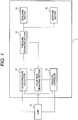
- Fig. 1 is a block diagram showing the configuration of a measuring apparatus 1 of the embodiment.
- the measuring apparatus 1 includes a pulse wave measuring section 11, a blood pressure calculator 12, a pressure controller 13, a blood pressure estimating section 14, a displaying section 15, and a notifying section 16.
- the measuring apparatus 1 adequately includes a storage device (for example, a hard disk drive) and the like.
- the measuring apparatus 1 may be a patient monitor, a medical telemeter, a blood pressure monitor, or the like.
- the measuring apparatus 1 is connected to a cuff 21.
- the cuff 21 is an air bag which is used in a related-art non-invasive blood pressure measurement.
- the cuff 21 is attached to a predetermined portion (preferably, the upper arm) of the subject.
- the pressure controller 13 performs a control of pressurizing and depressurizing the cuff 21.
- the pressure controller 13 gradually increases the cuff pressure (the pressure which is applied by the cuff 21 to a predetermined position of the subject) from a state where the cuff pressure is 0, and ends the pressurization (starts the depressurization) after the blood pressure calculator 12 calculates the diastolic and mean blood pressures.
- the pressure control performed by the pressure controller 13 will be described later in detail with reference to Fig. 2 .
- the pulse wave measuring section 11 non-invasively measures the pulse wave of the subject. Specifically, the pulse wave measuring section 11 detects the cuff pressure. The pulse wave of the subject is superimposed on the cuff pressure. The pulse wave measuring section 11 performs a signal process on the detected cuff pressure to acquire the pulse wave superimposed on the cuff pressure.
- the pulse wave measuring section 11 measures the pulse wave during a period when the pressure applied to the cuff 21 has a value which is within a range where the pulse wave component of the vein is not contained. For example, it is considered that a pressure which does not contain the pulse wave component of the vein (a pressure which is higher than the venous pressure) is a pressure that is equal to or higher than 20 mmHg.
- the pulse wave measuring section 11 measures the pulse wave during pressurization (from 40 mmHg to 50 mmHg) under a pressure which is supposed to be equal to or lower than the diastolic blood pressure.
- the artery can be prevented from being excessively closed, and the pulse wave can be accurately measured.
- the pulse wave measuring section 11 supplies the measured pulse wave to the blood pressure calculator 12 and the blood pressure estimating section 14.
- the blood pressure calculator 12 calculates the diastolic and mean blood pressures based on the pulse pressure and the cuff pressure. The method of calculating the diastolic and mean blood pressures will be described with reference to Fig. 2.
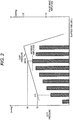
- Fig. 2 is a conceptual view showing the concept of calculation of the diastolic and mean blood pressures by performing pressurization by using the cuff 21.
- the blood pressure calculator 12 detects the amplitude (the portion of the bar graph in Fig. 2 ) of the pulse wave which is superimposed on the cuff pressure in the pressurization process using the cuff 21.
- the blood pressure calculator 12 detects the cuff pressure corresponding to the maximum amplitude of the pulse wave, as the mean blood pressure (MEAN).
- MEAN mean blood pressure
- the blood pressure calculator 12 calculates the diastolic blood pressure (DIA) based on the maximum amplitude.
- the blood pressure calculator 12 calculates the diastolic blood pressure (DIA) based on the cuff pressure at a point where the amplitude of the pulse wave is sharply increased.
- the pressure controller 13 After the diastolic and mean blood pressures are successfully calculated (or after a state where the blood pressures can be calculated is attained), the pressure controller 13 starts depressurization of the cuff 21. That is, the diastolic and mean blood pressures are calculated from the pulse wave which is measured during a period of pressurization at a pressure which is equal to or lower than a pressure that is estimated to be equal to or lower than the systolic blood pressure. Since the pressurization is performed at a pressure which is equal to or lower than the systolic blood pressure, the burden on the subject can be reduced.
- the blood pressure calculator 12 supplies the calculated diastolic and mean blood pressures to the blood pressure estimating section 14.
- the pulse wave, the diastolic blood pressure, and the mean blood pressure are supplied to the blood pressure estimating section 14.
- the blood pressure estimating section 14 calculates the systolic blood pressure (third blood pressure value) by using the pulse wave, the diastolic blood pressure (first blood pressure value), and the mean blood pressure (second blood pressure value).
- the blood pressure calculator 12 calculates the systolic blood pressure by using relationships between the pulse wave, the volume of an arterial blood vessel (hereinafter, often referred to as the arterial blood vessel volume), and the blood pressure. Therefore, the relationships between the pulse wave, the arterial blood vessel volume, and the blood pressure will be first described.
- Fig. 3 (cited from Non-patent Literature 1) is a view schematically showing relationships between the pressure and volume of an arterial blood vessel.
- the ordinate of the figure indicates the blood vessel internal pressure
- the abscissa indicates the arterial blood vessel volume.
- a blood vessel in which the internal pressure is equal to or lower than the applied pressure is closed. Therefore, a change of the arterial blood vessel volume shows a discontinuous waveform. Therefore, the relationship between (the value which is obtained by subtracting the cuff pressure from the blood pressure) and (the arterial blood vessel volume) is a nonlinear relationship as shown in Fig. 3 .
- a variation of the pulse wave is caused by a change of the cuff volume due to a change of the arterial blood vessel volume.
- the cuff pressure is indicated by P
- the cuff volume is indicated by V
- a change of the cuff volume due to a change of the arterial blood vessel volume is indicated by ⁇ V
- the amplitude of the pulse wave is indicated by ⁇ P
- the following Exp. (1) holds in accordance with Boyle-Charles's Law.
- ⁇ P is proportional to ⁇ V. That is, it is possible to consider that the amplitude ⁇ P of the pulse wave has a similarity relationship to a change of the arterial blood vessel volume.
- the blood pressure estimating section 14 focuses attention on the relationships between the amplitude of the pulse wave and the blood pressure, and estimates the systolic blood pressure by using the above-described inputs (the diastolic blood pressure, the mean blood pressure, and the pulse wave). Hereinafter, this will be described in detail.
- the pulse wave is relevant to a change of the blood pressure (i.e., the blood pressure waveform). Namely, it is possible to assume that the waveform of the pulse wave is similar to that of the blood pressure. Therefore, the blood pressure estimating section 14 performs the process while assuming that the waveform of the pulse wave is identical with (or similar to) that of the blood pressure.
- Fig. 4 is a conceptual view showing the waveform of the pulse wave.
- the blood pressure estimating section 14 calculates a pressure value Y1 (mmHg) by which the area of the one amplitude waveform is divided so that the two divided waveform sections have the same area. Then, the blood pressure estimating section 14 calculates the ratio of a : b in the figure (Y1 - minimum pressure value Y3 in the one amplitude : maximum pressure value Y2 in the one amplitude - Y1). The following description is made assuming that the ratio of a : b is 1 : 2.
- the blood pressure estimating section 14 estimates the systolic blood pressure by using the ratio, the diastolic blood pressure, and the mean blood pressure.
- Fig. 5 is a conceptual view showing the blood pressure waveform. As described above, it is possible to assume that the waveform of the blood pressure is similar to that of the pulse wave ( Fig. 4 ).
- the blood pressure calculator 12 calculates the diastolic blood pressure and the mean blood pressure as described above. In the following description, it is assumed that the diastolic blood pressure is 70 mmHg and the mean blood pressure is 90 mmHg.
- the mean blood pressure is a value by which, in the case where one amplitude of the waveform of the blood pressure is considered as an area, the area is divided into halves.
- the ratio (a : b) which is calculated in Fig. 4 is 1 : 2. As described above, it is possible to assume that the waveform of the blood pressure is similar to that of the pulse wave ( Fig. 4 ).
- the method of estimating the systolic blood pressure in the blood pressure estimating section 14 will be described in more detail.
- the above-described blood pressure estimating section 14 estimates the systolic blood pressure based on the shape of the waveform of the pulse wave.
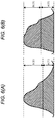
- Various examples of the shape of the pulse wave, and the method of estimating the systolic blood pressure based thereon will be described with reference to Figs. 6(A) and 6(B) .
- Fig. 6(A) shows a first example of the waveform of the pulse wave.
- the ratio of a : b which divides the area of the waveform into halves is 1 : 2.
- Fig. 6(B) shows a second example of the waveform of the pulse wave.
- the ratio of a : b which divides the area of the waveform into halves is 2 : 3.
- the ratio of a : b which divides the area of the waveform into halves is varied.
- the waveform of the blood pressure is similar to that of the pulse wave ( Fig. 4 ).
- the blood pressure estimating section 14 performs estimation while assuming that, depending on the waveform of the pulse wave, also relationships of blood pressures (the diastolic blood pressure, the mean blood pressure, and the systolic blood pressure) are changed.
- the blood pressure estimating section 14 estimates the systolic blood pressure while treating the shape of the pulse wave as a ratio indicating the relationships of the blood pressure values (the diastolic blood pressure, the mean blood pressure, and the systolic blood pressure).
- the displaying section 15 displays the diastolic and mean blood pressures which are calculated by the blood pressure calculator 12, and the systolic blood pressure which is estimated by the blood pressure estimating section 14, on a display device or the like disposed in the measuring apparatus 1.
- the notifying section 16 outputs an alarm sound.
- the measuring apparatus 1 has the configuration in which the systolic blood pressure (third blood pressure value) is calculated based on two blood pressure values (the diastolic blood pressure (first blood pressure value) and the mean blood pressure (second blood pressure value)).
- the pressure controller 13 pressurizes the cuff 21.
- the blood pressure calculator 12 calculates the diastolic and mean blood pressures. After the two blood pressure values are calculated, the pressurization is ended ( Fig. 2 ).
- the pressurization is not performed at a pressure which is estimated to be equal to or higher than the systolic blood pressure.
- the measurement time period is shortened, and the burden on the subject (i.e., the cuff pressure applied to the predetermined portion) can be reduced.
- the measuring apparatus 1 of the embodiment is characterized in that the systolic blood pressure is estimated by using blood pressure values which are measured in the past. With respect to the embodiment, points which are different from Embodiment 1 will be described.
- the measuring apparatus 1 of the embodiment In the case where anesthesia is applied in an operating room, the anesthetist frequently measures the blood pressure of the subject in order to determine the onset of anesthesia. In this case, the anesthetist often emphasizes the recognition of transition of the blood pressure from the previous measurement (i.e., whether the blood pressure is in a rising trend or a falling trend), than a correct measurement value.
- the measuring apparatus 1 which is effective in the case where the previous result of the blood pressure measurement remains as described above, and transition of the blood pressure is to be immediately known will be described.
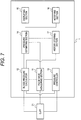
- Fig. 7 is a block diagram showing the configuration of a measuring apparatus 1 of the embodiment.
- the measuring apparatus 1 shown in Fig. 7 is configured so as to further have a history storing section 17 in addition to the configuration of Fig. 1 .
- the processes of the processing sections are different from those of Embodiment 1 in the following points.
- the blood pressure calculator 12 and the pressure controller 13 perform a related-art blood pressure measurement using the oscillometric method, at least one time on the subject.
- the blood pressure calculator 12 and the pressure controller 13 store blood pressure values (the diastolic blood pressure, the mean blood pressure, and the systolic blood pressure) which are calculated by using the oscillometric method, in the history storing section 17. That is, the pressure controller 13 pressurizes the cuff 21 to a pressure which is estimated to be equal to or higher than the systolic blood pressure, and thereafter depressurizes the cuff 21.
- the blood pressure calculator 12 calculates the diastolic, mean, and systolic blood pressures based on the amplitude of the pulse wave.
- the blood pressure calculator 12 stores the calculated blood pressure values (the diastolic blood pressure, the mean blood pressure, and the systolic blood pressure) as reference values in the history storing section 17.
- a blood pressure value stored in the history storing section 17 is generally referred to as a reference blood pressure value.
- the diastolic blood pressure, mean blood pressure, and systolic blood pressure which are stored in the history storing section 17 are referred to as the reference diastolic blood pressure, the reference mean blood pressure, and the reference systolic blood pressure, respectively.
- the history storing section 17 may be realized by, for example, a hard disk drive which is disposed in the measuring apparatus 1.
- the measuring apparatus 1 calculates the blood pressure of the subject periodically or in accordance with manual instructions. In this case, the measuring apparatus 1 estimates the systolic blood pressure without performing pressurization at a pressure which is equal to or higher than the systolic blood pressure, similarly with Embodiment 1.
- the pressure controller 13 gradually increases the cuff pressure (the pressure which is applied by the cuff 21 to the predetermined portion of the subject) from a state where the cuff pressure is 0, and ends the pressurization (starts the depressurization) after the blood pressure calculator 12 calculates the diastolic and mean blood pressures.
- the blood pressure estimating section 14 estimates the systolic blood pressure based on the calculated diastolic and mean blood pressures, and the reference blood pressure value values (the reference diastolic blood pressure, the reference mean blood pressure, and the reference systolic blood pressure) read out from the history storing section 17.
- the blood pressure estimating section 14 calculates a ratio (reference mean blood pressure - reference diastolic blood pressure : reference systolic blood pressure - reference mean blood pressure) as 1 : 2.
- the blood pressure estimating section 14 estimates the systolic blood pressure so as to attain coincidence with the ratio. For example, it is assumed that the mean blood pressure calculated by the blood pressure calculator 12 is 92 mmHg, and the diastolic blood pressure is 70 mmHg. In this case, the blood pressure estimating section 14 estimates that the current systolic blood pressure is 136 mmHg (92 mmHg + (92 mmHg - 70 mmHg) ⁇ (2/1)).
- the measuring apparatus 1 estimates the systolic blood pressure by using the reference blood pressure values, and the diastolic and mean blood pressures which are calculated by the blood pressure calculator 12.
- the blood pressure calculator 12 previously calculates the reference blood pressure values (the reference diastolic blood pressure, the reference mean blood pressure, and the reference systolic blood pressure) by using a related-art oscillometric method. The calculation is performed by using the oscillometric method, and therefore the reference blood pressure values are correct.
- the blood pressure estimating section 14 estimates the systolic blood pressure by using the correct reference blood pressure values. Therefore, the systolic blood pressure can be accurately estimated.
- the measuring apparatus 1 can promptly calculate the systolic blood pressure corresponding to the blood pressure trend of the subject.
- the measuring apparatus 1 of the embodiment estimates the systolic blood pressure by using past blood pressure values (reference blood pressure values) similarly with Embodiment 2. With respect to the measuring apparatus 1 of the embodiment, points which are different from Embodiment 2 will be described.
- the configuration of the measuring apparatus 1 is similar to that of Embodiment 2 ( Fig. 7 ).
- the blood pressure calculator 12 and the pressure controller 13 perform a related-art blood pressure measurement using the oscillometric method, at least one time on the subject.
- the calculated reference blood pressure values are stored in the history storing section 17.
- the pulse wave measuring section 11 measures the pulse wave which is superimposed on the cuff pressure, and stores it in the history storing section 17.
- the reference blood pressure values have the following values
- the ratio of a : b ( Fig. 5 ) which divides the area of the pulse wave waveform in the measurement by the oscillometric method into halves has the following value:
- the blood pressure calculator 12 calculates the diastolic blood pressure and the mean blood pressure in the pressurization process. After the calculation of the mean blood pressure, the pressurization is promptly ended. Moreover, the pulse wave measuring section 11 acquires the pulse wave superimposed on the cuff pressure.
- the blood pressure estimating section 14 estimates the systolic blood pressure by using the diastolic and mean blood pressures calculated by the blood pressure calculator 12, the pulse wave measured by the pulse wave measuring section 11, and the correction value (6/5).
- the diastolic and mean blood pressures calculated by the blood pressure calculator 12 are assumed to have the following values., respectively Here, it is assumed that the shape of the pulse wave is changed, and the ratio of a : b ( Fig. 5 ) which divides the area of the pulse wave waveform into halves has the following value:
- the blood pressure estimating section 14 corrects the above-described ratio (3 : 7) by using the correction value (6/5) in the following manner:
- the blood pressure estimating section 14 estimates the systolic blood pressure by using the correction ratio (3.6 : 6.4), the diastolic blood pressure (80 mmHg), and the mean blood pressure (98 mmHg) in the following manner:
- the measuring apparatus 1 obtains the correction value by using the reference blood pressure values which are previously acquired by using the oscillometric method. From the pulse wave and the correction value, then, the measuring apparatus 1 calculates the correction ratio, and estimates the systolic blood pressure by using the correction ratio.
- the reference blood pressure values are calculated by using the oscillometric method which is used in a related-art blood pressure measurement, and therefore have an accurate value. Even in the case where the shape of the pulse wave is changed by lapse of time, when the correction is performed by using the reference blood pressure values, the blood pressure estimating section 14 can correctly estimate the systolic blood pressure.
- the embodiment is characterized in that the systolic blood pressure is estimated by referring the %MAP (Mean Artery Pressure).
- %MAP Mel Artery Pressure
- Fig. 8 shows the configuration of the measuring apparatus 1 of the embodiment.
- the measuring apparatus 1 of the embodiment further includes a MAP calculator 18 in addition to the configuration of Fig. 1 .
- the %MAP will be described.
- the %MAP is a value which is obtained by dividing the average of the area of the waveform, and expressing the quotient in percentage ( Fig. 1 of Non-patent Literature 2) .
- the value of the %MAP is increased (see Fig. 9 ).
- the %MAP is smaller than 45%, it is usually determined that the state is normal.
- cuff pressure the pressurizing force of the pressure controller 13
- %MAP the %MAP
- the cuff pressure is high (for example, 40 mmHg or higher), it is considered that a blood vessel collapses, and therefore the %MAP is large.
- the lower the cuff pressure the higher the intravascular pressure. That is, a state where little external pressure is applied to a blood vessel is obtained. Therefore, the lower the cuff pressure, the more the relationships between the intravascular pressure and the sectional area of a blood vessel become linear.
- the MAP calculator 18 calculates (estimates) the %MAP in the case where the cuff pressure is 0 (the pressurization by the pressure controller 13 is canceled) An example of the estimation technique will be described.
- the pulse wave measuring section 11 supplies the pulse wave superimposed on the cuff pressure, to the MAP calculator 18.
- the MAP calculator 18 calculates relationships corresponding to Fig. 10 and between the cuff pressure and the %MAP. Then, the MAP calculator 18 calculates an estimated value of the %MAP in the case where the cuff pressure is 0.
- the MAP calculator 18 calculates an approximate expression of the %MAP such as shown in Fig. 10 , and, from the approximate expression, calculates the %MAP in the case where the cuff pressure is 0.
- the MAP calculator 18 supplies the calculated %MAP to the blood pressure estimating section 14.
- the blood pressure estimating section 14 estimates the systolic blood pressure by using the diastolic and mean blood pressures calculated by the blood pressure calculator 12, and the %MAP.
- the diastolic and mean blood pressures, and the estimated value of the %MAP in the case where the cuff pressure is 0 have the following values, respectively will be described:
- the blood pressure estimating section 14 estimates the systolic blood pressure in the following manner:
- the measuring apparatus 1 of the embodiment estimates the systolic blood pressure by using the relationships between the cuff pressure and the %MAP. As described above, the measuring apparatus 1 calculates the %MAP in the case where the cuff pressure is 0, from the relationships between the cuff pressure and transition of the %MAP. Then, the measuring apparatus 1 estimates the systolic blood pressure by using the %MAP.
- the %MAP is an index related to the average of the area of the pulse wave. Even in the case where the shape of the pulse wave is changed by lapse of time, when the %MAP is used, therefore, the blood pressure estimating section 14 can accurately estimate the systolic blood pressure.
- Embodiments 5 to 8 which will be described are the measuring apparatus 1 which estimates the mean blood pressure
- the processes of the embodiments correspond to those of Embodiment 1 to 4, respectively.
- the measuring apparatus 1 of Embodiment 5 has a configuration in which the mean blood pressure is estimated based on the diastolic blood pressure, the systolic blood pressure, and the pulse wave.
- the estimation technique basically corresponds to Embodiment 1. Therefore, points which are different from Embodiment 1 will be described.
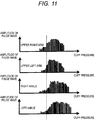
- Fig. 11 (cited from Non-patent Literature 3) is a conceptual view showing pulse waves which were measured from a subject with advanced arteriosclerosis. As illustrated, the point where the amplitude is maximum is not clear. Therefore, a related-art oscillometric blood pressure monitor cannot correctly calculate the mean blood pressure which is a blood pressure corresponding to the point where the amplitude is maximum. It is a main object of the measuring apparatus 1 of the embodiment to correctly calculate the mean blood pressure even from such a subject.
- the configuration of the measuring apparatus 1 of the embodiment is similar to that shown in Fig. 1 , but the operation is different in the following points.
- the blood pressure calculator 12 calculates the diastolic and systolic blood pressures. Therefore, the pressure controller 13 applies a pressure which is equal to or higher than the systolic blood pressure, to a predetermined position (preferably, the upper arm) of the subject.
- the method of calculating the diastolic and systolic blood pressures by the blood pressure calculator 12 may be similar to the calculation method in a related-art oscillometric method.
- the blood pressure estimating section 14 estimates that the mean blood pressure is 90 mmHg (70 mmHg + (130 mmHg - 70 mmHg) ⁇ (1/3)).
- the measuring apparatus 1 of the embodiment estimates the mean blood pressure by using the systolic and diastolic blood pressures and the ratio which is calculated from the pulse wave. That is, the measuring apparatus 1 estimates the mean blood pressure without using the oscillation amplitude. Even in the case where the maximum value of the oscillation amplitude cannot be clearly identified, therefore, the correct mean blood pressure can be calculated.
- the measuring apparatus 1 of the embodiment has a configuration in which the mean blood pressure is estimated based on the diastolic and systolic blood pressures and reference blood pressure values.
- the estimation technique basically corresponds to Embodiment 2. Therefore, points which are different from Embodiment 2 will be described.
- the configuration of the measuring apparatus 1 is similar to that shown in Fig. 7 .
- An example of a use case where the measuring apparatus 1 of the embodiment is assumed to be used is identical with Embodiment 5 (a subject with advanced arteriosclerosis).
- Embodiment 5 a subject with advanced arteriosclerosis
- the blood pressure calculator 12 and the pressure controller 13 perform a related-art blood pressure measurement using the oscillometric method, at least one time on the subject.
- the blood pressure calculator 12 and the pressure controller 13 store the reference blood pressure values (the reference diastolic blood pressure, the reference mean blood pressure, and the reference systolic blood pressure) which are calculated by using the oscillometric method, in the history storing section 17.
- the measuring apparatus 1 calculates the blood pressure of the subject periodically or in accordance with manual instructions.
- the blood pressure calculator 12 calculates the diastolic and systolic blood pressures based on the pulse pressure and the cuff pressure.
- the blood pressure estimating section 14 estimates the mean blood pressure based on the calculated diastolic and systolic blood pressures, and the reference blood pressure values (the reference diastolic blood pressure, the reference mean blood pressure, and the reference systolic blood pressure) read out from the history storing section 17.
- the blood pressure estimating section 14 calculates a ratio (reference mean blood pressure - reference diastolic blood pressure : reference systolic blood pressure - reference mean blood pressure) as 1 : 2.
- the blood pressure estimating section 14 estimates the mean blood pressure so as to attain coincidence with the ratio. For example, it is assumed that the diastolic blood pressure calculated by the blood pressure calculator 12 is 70 mmHg, and the systolic blood pressure is 133 mmHg. In this case, the blood pressure estimating section 14 estimates that the current mean blood pressure is 91 mmHg (70 mmHg + (133 mmHg - 70 mmHg) ⁇ (1/3)).
- the other processes are similar to those of Embodiment 2. Then, effects of the measuring apparatus 1 of the embodiment will be described.
- the measuring apparatus 1 estimates the mean blood pressure by using the reference blood pressure values, the diastolic blood pressure, and the systolic blood pressure.
- the blood pressure estimating section 14 estimates the mean blood pressure by using the correct reference blood pressure values which are acquired by the oscillometric method. Therefore, the mean blood pressure can be accurately estimated.
- the measuring apparatus 1 of the embodiment estimates the mean blood pressure by using past blood pressure values (reference blood pressure values) similarly with Embodiment 6.
- the processes of the measuring apparatus 1 of Embodiment 7 correspond to those of the measuring apparatus 1 of Embodiment 3. Therefore, points which are different from Embodiment 3 will be described.
- the configuration of the measuring apparatus 1 is similar to that of Embodiment 2 ( Fig. 7 ).
- the blood pressure calculator 12 and the pressure controller 13 perform a related-art blood pressure measurement using the oscillometric method, at least one time on the subject.
- the calculated reference blood pressure values are stored in the history storing section 17.
- the pulse wave measuring section 11 measures the pulse wave which is superimposed on the cuff pressure, and stores it in the history storing section 17.
- the reference blood pressure values have the following values, respectively, and the ratio of a : b ( Fig. 5 ) which divides the area of the pulse wave waveform in the measurement by the oscillometric method into halves has the following value:
- the blood pressure calculator 12 measures the blood pressures (the diastolic blood pressure and the systolic blood pressure) at an arbitrary timing. Moreover, the pulse wave measuring section 11 acquires the pulse wave superimposed on the cuff pressure.
- the blood pressure estimating section 14 estimates the mean blood pressure by using the diastolic and systolic blood pressures calculated by the blood pressure calculator 12, the pulse wave measured by the pulse wave measuring section 11, and the correction value (6/5).
- the diastolic and systolic blood pressures calculated by the blood pressure calculator 12 are assumed to have the following values, respectively.
- the shape of the pulse wave is changed, and the ratio of a : b ( Fig. 5 ) which divides the area of the pulse wave waveform into halves has the following value:
- the blood pressure estimating section 14 corrects the above-described ratio (3 : 7) by using the correction value (6/5) in the following manner:
- the blood pressure estimating section 14 estimates the mean blood pressure by using the correction ratio (3.6 : 6.4), the diastolic blood pressure (80 mmHg), and the systolic blood pressure (130 mmHg) in the following manner:
- the measuring apparatus 1 obtains the correction value by using the reference blood pressure values which are previously acquired by using the oscillometric method. From the pulse wave and the correction value, then, the measuring apparatus 1 calculates the correction ratio, and estimates the mean blood pressure by using the correction ratio. Even in the case where the shape of the pulse wave is changed by lapse of time, when the correction is performed by using the reference blood pressure values, the blood pressure estimating section 14 can correctly estimate the mean blood pressure.
- the embodiment is characterized in that the mean blood pressure is estimated by referring the %MAP (Mean Artery Pressure).
- the processes of the measuring apparatus 1 of Embodiment 8 correspond to those of Embodiment 4. Therefore, points which are different from Embodiment 4 will be described.
- the configuration of the measuring apparatus 1 is similar to that of Embodiment 4 ( Fig. 8 ). Namely, the measuring apparatus 1 has the MAP calculator 18. The MAP calculator 18 calculates the %MAP in a manner similar to Embodiment 4.
- the blood pressure calculator 12 calculates the diastolic and systolic blood pressures by using a related-art oscillometric method.
- the blood pressure estimating section 14 estimates the mean blood pressure by using the diastolic and systolic blood pressures calculated by the blood pressure calculator 12, and the estimated value of the %MAP.
- An example in which the diastolic and systolic blood pressures, and the estimated value of the %MAP in the case where the cuff pressure is 0 (the pressurization by the pressure controller 13 is canceled) have the following values, respectively will be described:
- the blood pressure estimating section 14 estimates the mean blood pressure in the following manner:
- the measuring apparatus 1 of the embodiment estimates the mean blood pressure by using the relationships between the cuff pressure and the %MAP. As described above, the measuring apparatus 1 calculates the %MAP in the case where the cuff pressure is 0, from the relationships between the cuff pressure and transition of the %MAP. Then, the measuring apparatus 1 estimates the mean blood pressure by using the %MAP.
- the %MAP is an index related to the average of the area of the pulse wave. When the %MAP is used, therefore, the blood pressure estimating section 14 can accurately estimate the mean blood pressure.
- the blood pressure calculator 12 calculates two blood pressure values (first and second blood pressure values) by using the oscillometric method.
- the calculation method is not limited to the oscillometric method.
- the blood pressure calculator 12 may use another technique as far as two blood pressure values are correctly obtained.
- the diastolic blood pressure value is calculated as the first blood pressure value
- the mean blood pressure value is calculated as the second blood pressure value.
- the diastolic blood pressure value is calculated as the first blood pressure value
- the systolic blood pressure value is calculated as the second blood pressure value.
- the blood pressure estimating section 14 estimates the third blood pressure value based on the first and second blood pressure values and the ratio information indicative of the relationships of the difference levels of the blood pressure values.
- the systolic blood pressure is estimated as the third blood pressure value
- the mean blood pressure is estimated as the third blood pressure value.
- the ratio information is indicated by the ratio of levels of (the mean blood pressure - the diastolic blood pressure) and (the systolic blood pressure - the mean blood pressure).
- the ratio information may be regarded as the ratio of levels of (the systolic blood pressure - the diastolic blood pressure) and (the mean blood pressure - the diastolic blood pressure).
- the ratio information is calculated in the different methods.
- the pulse wave measuring section 11 acquires the pulse wave.
- the blood pressure estimating section 14 focuses attention on that there is relevance between the amplitude of the pulse wave and a change of the blood pressure, and calculates the ratio information (a : b in Fig. 5 ) based on the shape of the pulse wave.
- the blood pressure estimating section 14 estimates the third blood pressure value by using the ratio information and the two blood pressure values (the first blood pressure value and the second blood pressure value).
- the blood pressure estimating section 14 calculates the ratio information based on the reference blood pressure values (the reference diastolic blood pressure, the reference mean blood pressure, and the reference systolic blood pressure) which are previously acquired by a correct adequate technique (for example, the oscillometric method).
- the blood pressure estimating section 14 performs the process of estimating the blood pressure while using, for example, (reference mean blood pressure - reference diastolic blood pressure : reference systolic blood pressure - reference mean blood pressure) as the ratio information.
- the blood pressure estimating section 14 calculates the ratio information from the shape of the pulse wave similarly with Embodiments 1 and 5.
- the blood pressure estimating section 14 corrects the ratio information by using the correction value which is calculated from the reference blood pressure values (the reference diastolic blood pressure, the reference mean blood pressure, and the reference systolic blood pressure), and thereafter estimates the blood pressure.
- the MAP calculator 18 calculates the %MAP in the case where the cuff pressure is 0, from the cuff pressure and transition of the %MAP.
- the %MAP is a value which is obtained by dividing the average of the area of the waveform, and expressing the quotient in percentage, and may be regarded as a kind of the ratio information.
- the blood pressure estimating section 14 estimates the third blood pressure value by using the %MAP and the first and second blood pressure values.
- the measuring apparatus 1 calculates the third blood pressure value by using the first and second blood pressure values which are acquired by using a related-art technique, and the ratio information indicative of the relationships of the difference levels of the blood pressure values.
- a blood pressure value of a human being there are three blood pressure values (the systolic blood pressure, the mean blood pressure, and the diastolic blood pressure).
- the measuring apparatus 1 calculates the third blood pressure value by using two (first and second blood pressure values) of the three blood pressure values, and the ratio information. Since all the three blood pressure values are not calculated, the measurement time period can be shortened, and the burden imposed on the subject can be reduced (Embodiments 1 to 4).
- the measuring apparatus 1 estimates a blood pressure value which seems to be incorrectly acquired by a related-art measurement method, by using the ratio information (Embodiments 5 to 8). Therefore, it is possible to solve the various problems which are caused in a related-art oscillometric method.
- the ratio information is calculated during measurement
- the invention is not limited to this.
- the user of the measuring apparatus 1 may arbitrarily set the specified value.
- various methods may be considered as the method of calculating the specified value. When the user sets a most adequate specified value in consideration of the condition of the subject and the like, therefore, a desired blood pressure value related to the subject can be appropriately measured.
- a configuration where the systolic blood pressure is estimated in Embodiments 1 to 4, and calculated by the oscillometric method may be employed. That is, the pressure controller 13 does not start the depressurization even after the mean blood pressure is successfully calculated, and continues the pressurization until the systolic blood pressure can be calculated by the oscillometric method.
- the blood pressure estimating section 14 estimates the systolic blood pressure based on the diastolic blood pressure and the mean blood pressure by the above-described method.
- the displaying section 15 displays the diastolic and mean blood pressures and the estimated systolic blood pressure.
- the displaying section 15 switches the display so that the estimated systolic blood pressure is overwritten by the systolic blood pressure which is calculated by the oscillometric method.
- the doctor or the like who refers the measuring apparatus 1 can quickly know the general situation of blood pressure values including the systolic blood pressure, and refer the correct systolic blood pressure which is calculated by the oscillometric method.
- a part or all of the above-described processes in the pulse wave measuring section 11, the blood pressure calculator 12, the blood pressure estimating section 14, and the MAP calculator 18 may be realized as computer programs which operate in the measuring apparatus 1.
- the programs may be stored in a non-transitory computer readable medium of any one of various types, and then supplied to the computer.
- the non-transitory computer readable medium includes tangible storage media of various types.
- non-transitory computer readable medium examples include a magnetic recording medium (for example, a flexible disk, a magnetic tape, and a hard disk drive), a magneto-optical recording medium (for example, a magneto-optical disk), a CD-ROM (Read Only Memory), a CD-R, a CD-R/W, a semiconductor memory (for example, a mask ROM, a PROM (Programmable ROM), an EPROM (Erasable PROM), a flash ROM, and a RAM (Random Access Memory)).
- the programs may be supplied to the computer by means of a transitory computer readable medium of any one of various types.
- Examples of the transitory computer readable medium are an electrical signal, an optical signal, and an electromagnetic wave.
- the transitory computer readable medium can supply the programs to the computer through a wired communication path such as a metal wire or an optical fiber, or a wireless communication path.
Landscapes
- Health & Medical Sciences (AREA)
- Life Sciences & Earth Sciences (AREA)
- Cardiology (AREA)
- Engineering & Computer Science (AREA)
- Public Health (AREA)
- Medical Informatics (AREA)
- Vascular Medicine (AREA)
- Physics & Mathematics (AREA)
- Physiology (AREA)
- Biophysics (AREA)
- Pathology (AREA)
- Biomedical Technology (AREA)
- Heart & Thoracic Surgery (AREA)
- Veterinary Medicine (AREA)
- Molecular Biology (AREA)
- Surgery (AREA)
- Animal Behavior & Ethology (AREA)
- General Health & Medical Sciences (AREA)
- Computer Vision & Pattern Recognition (AREA)
- Psychiatry (AREA)
- Ophthalmology & Optometry (AREA)
- Signal Processing (AREA)
- Artificial Intelligence (AREA)
- Measuring Pulse, Heart Rate, Blood Pressure Or Blood Flow (AREA)
Applications Claiming Priority (1)
| Application Number | Priority Date | Filing Date | Title |
|---|---|---|---|
| JP2015046701A JP6440535B2 (ja) | 2015-03-10 | 2015-03-10 | 測定装置及びプログラム |
Publications (2)
| Publication Number | Publication Date |
|---|---|
| EP3069655A1 true EP3069655A1 (de) | 2016-09-21 |
| EP3069655B1 EP3069655B1 (de) | 2024-08-28 |
Family
ID=55484905
Family Applications (1)
| Application Number | Title | Priority Date | Filing Date |
|---|---|---|---|
| EP16158919.7A Active EP3069655B1 (de) | 2015-03-10 | 2016-03-07 | Messvorrichtung |
Country Status (3)
| Country | Link |
|---|---|
| US (1) | US20160262639A1 (de) |
| EP (1) | EP3069655B1 (de) |
| JP (1) | JP6440535B2 (de) |
Families Citing this family (8)
| Publication number | Priority date | Publication date | Assignee | Title |
|---|---|---|---|---|
| US10524672B2 (en) * | 2016-06-21 | 2020-01-07 | Capsule Technologies, Inc. | Diastolic blood pressure measurement calibration |
| WO2018136135A1 (en) | 2017-01-18 | 2018-07-26 | Physio-Control, Inc. | Non-invasive blood pressure measurement using ultrasound |
| JP2018156592A (ja) * | 2017-03-21 | 2018-10-04 | 株式会社東芝 | 表示制御システム、表示データ生成システム、表示制御方法及びプログラム |
| DE102017110770B3 (de) * | 2017-05-17 | 2018-08-23 | Up-Med Gmbh | Verfahren zum nicht-invasiven Bestimmen von wenigstens einem Blutdruckwert, Messvorrichtung und System zur nicht-invasiven Blutdruckbestimmung |
| US11413005B2 (en) * | 2017-08-14 | 2022-08-16 | Stryker Corporation | Constitutive equation for non-invasive blood pressure measurement systems and methods |
| US11357415B2 (en) | 2017-10-27 | 2022-06-14 | Stryker Corporation | Light-based non-invasive blood pressure systems and methods |
| KR102655676B1 (ko) * | 2018-10-10 | 2024-04-05 | 삼성전자주식회사 | 혈압 추정 장치 및 방법과, 혈압 추정 지원 장치 |
| KR102564546B1 (ko) * | 2021-03-19 | 2023-08-07 | 삼성전자주식회사 | 생체정보 추정 장치 및 방법 |
Citations (5)
| Publication number | Priority date | Publication date | Assignee | Title |
|---|---|---|---|---|
| JPH10276994A (ja) | 1997-04-10 | 1998-10-20 | Nippon Colin Co Ltd | 暫定血圧値表示機能を備えた自動血圧測定装置 |
| EP1302155A2 (de) * | 2001-10-09 | 2003-04-16 | Colin Corporation | Blutdruckmessgerät |
| US20050119578A1 (en) * | 2002-03-28 | 2005-06-02 | Takeshi Kubo | Electronic hemomanometer and blood pressure measuring method of electronic hemomanometer |
| US20100298726A1 (en) * | 2009-05-22 | 2010-11-25 | Samsung Electronics Co., Ltd. | Low-pressurization blood pressure monitoring apparatus and method |
| JP2014230671A (ja) | 2013-05-29 | 2014-12-11 | 学校法人 関西大学 | 血圧推定装置、血圧推定システム、および制御プログラム |
Family Cites Families (15)
| Publication number | Priority date | Publication date | Assignee | Title |
|---|---|---|---|---|
| JPS6040038A (ja) * | 1983-08-16 | 1985-03-02 | コーリン電子株式会社 | 自動血圧測定装置 |
| JP2668996B2 (ja) * | 1988-10-17 | 1997-10-27 | オムロン株式会社 | 電子血圧計 |
| JPH0675406U (ja) * | 1993-04-02 | 1994-10-25 | 日本コーリン株式会社 | 生体の循環動態表示装置 |
| JP3218786B2 (ja) * | 1993-04-13 | 2001-10-15 | オムロン株式会社 | 電子血圧計 |
| JP3602880B2 (ja) * | 1995-02-17 | 2004-12-15 | コーリンメディカルテクノロジー株式会社 | 末梢循環状態監視装置 |
| JP2003299627A (ja) * | 2002-04-10 | 2003-10-21 | Omron Corp | 電子血圧計 |
| JP4590844B2 (ja) * | 2003-08-26 | 2010-12-01 | パナソニック電工株式会社 | 循環器機能判定装置 |
| US20080235058A1 (en) * | 2005-12-01 | 2008-09-25 | The General Electric Company | Vital sign monitor utilizing historic patient data |
| US7344503B2 (en) * | 2006-04-03 | 2008-03-18 | The General Electric Company | System and method for monitoring pre-eclamptic patients |
| JP5151690B2 (ja) * | 2008-05-27 | 2013-02-27 | オムロンヘルスケア株式会社 | 血圧情報測定装置および指標取得方法 |
| JP5257136B2 (ja) * | 2009-02-25 | 2013-08-07 | オムロンヘルスケア株式会社 | 電子血圧計 |
| JP5352298B2 (ja) * | 2009-03-18 | 2013-11-27 | 株式会社エー・アンド・デイ | 動脈血管柔軟度測定装置 |
| KR101800705B1 (ko) * | 2009-04-28 | 2017-12-21 | 삼성전자 주식회사 | 혈압의 오차를 보정하는 혈압 측정 장치 및 방법 |
| KR101640498B1 (ko) * | 2009-05-22 | 2016-07-19 | 삼성전자주식회사 | 가변 특성비를 이용하는 혈압 추정 장치 및 방법 |
| TWI383778B (zh) * | 2009-09-03 | 2013-02-01 | Quanta Comp Inc | 具有消除動作雜訊功能之血壓量測裝置及方法 |
-
2015
- 2015-03-10 JP JP2015046701A patent/JP6440535B2/ja active Active
-
2016
- 2016-03-07 EP EP16158919.7A patent/EP3069655B1/de active Active
- 2016-03-07 US US15/062,751 patent/US20160262639A1/en active Pending
Patent Citations (5)
| Publication number | Priority date | Publication date | Assignee | Title |
|---|---|---|---|---|
| JPH10276994A (ja) | 1997-04-10 | 1998-10-20 | Nippon Colin Co Ltd | 暫定血圧値表示機能を備えた自動血圧測定装置 |
| EP1302155A2 (de) * | 2001-10-09 | 2003-04-16 | Colin Corporation | Blutdruckmessgerät |
| US20050119578A1 (en) * | 2002-03-28 | 2005-06-02 | Takeshi Kubo | Electronic hemomanometer and blood pressure measuring method of electronic hemomanometer |
| US20100298726A1 (en) * | 2009-05-22 | 2010-11-25 | Samsung Electronics Co., Ltd. | Low-pressurization blood pressure monitoring apparatus and method |
| JP2014230671A (ja) | 2013-05-29 | 2014-12-11 | 学校法人 関西大学 | 血圧推定装置、血圧推定システム、および制御プログラム |
Non-Patent Citations (4)
| Title |
|---|
| COLIN INFORMATION SERVICE, 23 February 2015 (2015-02-23), Retrieved from the Internet <URL:http://www.colin.omron.co.jp/colininfo/pdf/ll.pdf>> |
| DENIS CHEMLA ET AL.: "aortic pressure is the geometric mean of systolic and diastolic aortic pressure in resting humans", AORTAPPL PHUSIOL, vol. 99, 2005, pages 2278 - 2284 |
| SHIMAZU HIDEAKI: "Kenko o Sasaeru Iryokiki Kantan de Oku no Fukai Ketsuatsu Sokutei", CLIN ENG, vol. 9, no. 1, pages 26 - 33 |
| YOSHIKAWA KIMIHIKO: "Heisokusei Domyaku Kokasho Shindan ni Okeru ABI Sokutei to Myakuhakei no Juyosei", DAI 8 KAI RINSHO KETSUATSU MYAKUHA KENKYUKAI SHOREI KENTOKAI, vol. 3, pages 58,60 |
Also Published As
| Publication number | Publication date |
|---|---|
| JP2016165381A (ja) | 2016-09-15 |
| EP3069655B1 (de) | 2024-08-28 |
| US20160262639A1 (en) | 2016-09-15 |
| JP6440535B2 (ja) | 2018-12-19 |
Similar Documents
| Publication | Publication Date | Title |
|---|---|---|
| EP3069655A1 (de) | Messvorrichtung | |
| US10130270B2 (en) | Electronic blood pressure monitor | |
| US11903684B2 (en) | Blood pressure measuring apparatus and blood pressure measuring method | |
| JP6003487B2 (ja) | 血圧測定装置、血圧測定方法、血圧測定プログラム | |
| US20240252119A1 (en) | Method for non-invasively determining at least one blood pressure value, measurement apparatus and system for determining blood pressure non-invasively | |
| JP5399832B2 (ja) | 血管内皮機能評価装置 | |
| EP3050500B1 (de) | Messvorrichtung und messverfahren | |
| US11298031B2 (en) | Sphygmomanometer, blood pressure measurement method, and blood pressure measurement program | |
| WO2017004069A1 (en) | System and method of monitoring autoregulation | |
| WO2017129495A1 (en) | Pulse rate measurement module and method | |
| US10750961B2 (en) | Diagnosis assistance apparatus, diagnosis assistance method, diagnosis assistance program | |
| KR20100126128A (ko) | 저가압 혈압 측정 장치 및 방법 | |
| KR20100126127A (ko) | 가변 특성비를 이용하는 혈압 추정 장치 및 방법 | |
| EP3199101B1 (de) | Vorrichtung zur vaskulären elastizitätsratenauswertung | |
| JP6607728B2 (ja) | 静脈圧測定装置、静脈圧測定方法、及びプログラム | |
| KR101665779B1 (ko) | 압맥파 측정을 위한 가압 방법 및 가압 장치 | |
| JP2005168583A (ja) | 生体計測装置 | |
| JP5750805B2 (ja) | 連続血圧測定システム、連続血圧測定方法、連続血圧測定プログラムおよび、連続血圧測定プログラムを記録したコンピュータ読み取り可能な記録媒体 | |
| CN120731040A (zh) | 用于确定压力脉搏重搏切迹位置的处理器、方法和计算机程序 | |
| JPS63230146A (ja) | 血圧測定方法 |
Legal Events
| Date | Code | Title | Description |
|---|---|---|---|
| PUAI | Public reference made under article 153(3) epc to a published international application that has entered the european phase |
Free format text: ORIGINAL CODE: 0009012 |
|
| AK | Designated contracting states |
Kind code of ref document: A1 Designated state(s): AL AT BE BG CH CY CZ DE DK EE ES FI FR GB GR HR HU IE IS IT LI LT LU LV MC MK MT NL NO PL PT RO RS SE SI SK SM TR |
|
| AX | Request for extension of the european patent |
Extension state: BA ME |
|
| STAA | Information on the status of an ep patent application or granted ep patent |
Free format text: STATUS: REQUEST FOR EXAMINATION WAS MADE |
|
| 17P | Request for examination filed |
Effective date: 20170314 |
|
| RBV | Designated contracting states (corrected) |
Designated state(s): AL AT BE BG CH CY CZ DE DK EE ES FI FR GB GR HR HU IE IS IT LI LT LU LV MC MK MT NL NO PL PT RO RS SE SI SK SM TR |
|
| STAA | Information on the status of an ep patent application or granted ep patent |
Free format text: STATUS: EXAMINATION IS IN PROGRESS |
|
| 17Q | First examination report despatched |
Effective date: 20190613 |
|
| GRAP | Despatch of communication of intention to grant a patent |
Free format text: ORIGINAL CODE: EPIDOSNIGR1 |
|
| STAA | Information on the status of an ep patent application or granted ep patent |
Free format text: STATUS: GRANT OF PATENT IS INTENDED |
|
| INTG | Intention to grant announced |
Effective date: 20240417 |
|
| GRAS | Grant fee paid |
Free format text: ORIGINAL CODE: EPIDOSNIGR3 |
|
| GRAA | (expected) grant |
Free format text: ORIGINAL CODE: 0009210 |
|
| STAA | Information on the status of an ep patent application or granted ep patent |
Free format text: STATUS: THE PATENT HAS BEEN GRANTED |
|
| AK | Designated contracting states |
Kind code of ref document: B1 Designated state(s): AL AT BE BG CH CY CZ DE DK EE ES FI FR GB GR HR HU IE IS IT LI LT LU LV MC MK MT NL NO PL PT RO RS SE SI SK SM TR |
|
| REG | Reference to a national code |
Ref country code: GB Ref legal event code: FG4D |
|
| REG | Reference to a national code |
Ref country code: CH Ref legal event code: EP |
|
| REG | Reference to a national code |
Ref country code: DE Ref legal event code: R096 Ref document number: 602016089083 Country of ref document: DE |
|
| REG | Reference to a national code |
Ref country code: IE Ref legal event code: FG4D |
|
| REG | Reference to a national code |
Ref country code: LT Ref legal event code: MG9D |
|
| PG25 | Lapsed in a contracting state [announced via postgrant information from national office to epo] |
Ref country code: NO Free format text: LAPSE BECAUSE OF FAILURE TO SUBMIT A TRANSLATION OF THE DESCRIPTION OR TO PAY THE FEE WITHIN THE PRESCRIBED TIME-LIMIT Effective date: 20241128 |
|
| REG | Reference to a national code |
Ref country code: AT Ref legal event code: MK05 Ref document number: 1717045 Country of ref document: AT Kind code of ref document: T Effective date: 20240828 |
|
| PG25 | Lapsed in a contracting state [announced via postgrant information from national office to epo] |
Ref country code: NL Free format text: LAPSE BECAUSE OF FAILURE TO SUBMIT A TRANSLATION OF THE DESCRIPTION OR TO PAY THE FEE WITHIN THE PRESCRIBED TIME-LIMIT Effective date: 20240828 Ref country code: GR Free format text: LAPSE BECAUSE OF FAILURE TO SUBMIT A TRANSLATION OF THE DESCRIPTION OR TO PAY THE FEE WITHIN THE PRESCRIBED TIME-LIMIT Effective date: 20241129 Ref country code: FI Free format text: LAPSE BECAUSE OF FAILURE TO SUBMIT A TRANSLATION OF THE DESCRIPTION OR TO PAY THE FEE WITHIN THE PRESCRIBED TIME-LIMIT Effective date: 20240828 Ref country code: PT Free format text: LAPSE BECAUSE OF FAILURE TO SUBMIT A TRANSLATION OF THE DESCRIPTION OR TO PAY THE FEE WITHIN THE PRESCRIBED TIME-LIMIT Effective date: 20241230 Ref country code: PL Free format text: LAPSE BECAUSE OF FAILURE TO SUBMIT A TRANSLATION OF THE DESCRIPTION OR TO PAY THE FEE WITHIN THE PRESCRIBED TIME-LIMIT Effective date: 20240828 |
|
| PG25 | Lapsed in a contracting state [announced via postgrant information from national office to epo] |
Ref country code: BG Free format text: LAPSE BECAUSE OF FAILURE TO SUBMIT A TRANSLATION OF THE DESCRIPTION OR TO PAY THE FEE WITHIN THE PRESCRIBED TIME-LIMIT Effective date: 20240828 |
|
| PG25 | Lapsed in a contracting state [announced via postgrant information from national office to epo] |
Ref country code: LV Free format text: LAPSE BECAUSE OF FAILURE TO SUBMIT A TRANSLATION OF THE DESCRIPTION OR TO PAY THE FEE WITHIN THE PRESCRIBED TIME-LIMIT Effective date: 20240828 |
|
| REG | Reference to a national code |
Ref country code: NL Ref legal event code: MP Effective date: 20240828 |
|
| PG25 | Lapsed in a contracting state [announced via postgrant information from national office to epo] |
Ref country code: IS Free format text: LAPSE BECAUSE OF FAILURE TO SUBMIT A TRANSLATION OF THE DESCRIPTION OR TO PAY THE FEE WITHIN THE PRESCRIBED TIME-LIMIT Effective date: 20241228 Ref country code: AT Free format text: LAPSE BECAUSE OF FAILURE TO SUBMIT A TRANSLATION OF THE DESCRIPTION OR TO PAY THE FEE WITHIN THE PRESCRIBED TIME-LIMIT Effective date: 20240828 |
|
| PG25 | Lapsed in a contracting state [announced via postgrant information from national office to epo] |
Ref country code: HR Free format text: LAPSE BECAUSE OF FAILURE TO SUBMIT A TRANSLATION OF THE DESCRIPTION OR TO PAY THE FEE WITHIN THE PRESCRIBED TIME-LIMIT Effective date: 20240828 |
|
| PG25 | Lapsed in a contracting state [announced via postgrant information from national office to epo] |
Ref country code: RS Free format text: LAPSE BECAUSE OF FAILURE TO SUBMIT A TRANSLATION OF THE DESCRIPTION OR TO PAY THE FEE WITHIN THE PRESCRIBED TIME-LIMIT Effective date: 20241128 Ref country code: ES Free format text: LAPSE BECAUSE OF FAILURE TO SUBMIT A TRANSLATION OF THE DESCRIPTION OR TO PAY THE FEE WITHIN THE PRESCRIBED TIME-LIMIT Effective date: 20240828 |
|
| PG25 | Lapsed in a contracting state [announced via postgrant information from national office to epo] |
Ref country code: RS Free format text: LAPSE BECAUSE OF FAILURE TO SUBMIT A TRANSLATION OF THE DESCRIPTION OR TO PAY THE FEE WITHIN THE PRESCRIBED TIME-LIMIT Effective date: 20241128 Ref country code: PT Free format text: LAPSE BECAUSE OF FAILURE TO SUBMIT A TRANSLATION OF THE DESCRIPTION OR TO PAY THE FEE WITHIN THE PRESCRIBED TIME-LIMIT Effective date: 20241230 Ref country code: PL Free format text: LAPSE BECAUSE OF FAILURE TO SUBMIT A TRANSLATION OF THE DESCRIPTION OR TO PAY THE FEE WITHIN THE PRESCRIBED TIME-LIMIT Effective date: 20240828 Ref country code: NO Free format text: LAPSE BECAUSE OF FAILURE TO SUBMIT A TRANSLATION OF THE DESCRIPTION OR TO PAY THE FEE WITHIN THE PRESCRIBED TIME-LIMIT Effective date: 20241128 Ref country code: NL Free format text: LAPSE BECAUSE OF FAILURE TO SUBMIT A TRANSLATION OF THE DESCRIPTION OR TO PAY THE FEE WITHIN THE PRESCRIBED TIME-LIMIT Effective date: 20240828 Ref country code: LV Free format text: LAPSE BECAUSE OF FAILURE TO SUBMIT A TRANSLATION OF THE DESCRIPTION OR TO PAY THE FEE WITHIN THE PRESCRIBED TIME-LIMIT Effective date: 20240828 Ref country code: IS Free format text: LAPSE BECAUSE OF FAILURE TO SUBMIT A TRANSLATION OF THE DESCRIPTION OR TO PAY THE FEE WITHIN THE PRESCRIBED TIME-LIMIT Effective date: 20241228 Ref country code: HR Free format text: LAPSE BECAUSE OF FAILURE TO SUBMIT A TRANSLATION OF THE DESCRIPTION OR TO PAY THE FEE WITHIN THE PRESCRIBED TIME-LIMIT Effective date: 20240828 Ref country code: GR Free format text: LAPSE BECAUSE OF FAILURE TO SUBMIT A TRANSLATION OF THE DESCRIPTION OR TO PAY THE FEE WITHIN THE PRESCRIBED TIME-LIMIT Effective date: 20241129 Ref country code: FI Free format text: LAPSE BECAUSE OF FAILURE TO SUBMIT A TRANSLATION OF THE DESCRIPTION OR TO PAY THE FEE WITHIN THE PRESCRIBED TIME-LIMIT Effective date: 20240828 Ref country code: ES Free format text: LAPSE BECAUSE OF FAILURE TO SUBMIT A TRANSLATION OF THE DESCRIPTION OR TO PAY THE FEE WITHIN THE PRESCRIBED TIME-LIMIT Effective date: 20240828 Ref country code: BG Free format text: LAPSE BECAUSE OF FAILURE TO SUBMIT A TRANSLATION OF THE DESCRIPTION OR TO PAY THE FEE WITHIN THE PRESCRIBED TIME-LIMIT Effective date: 20240828 Ref country code: AT Free format text: LAPSE BECAUSE OF FAILURE TO SUBMIT A TRANSLATION OF THE DESCRIPTION OR TO PAY THE FEE WITHIN THE PRESCRIBED TIME-LIMIT Effective date: 20240828 |
|
| PG25 | Lapsed in a contracting state [announced via postgrant information from national office to epo] |
Ref country code: RO Free format text: LAPSE BECAUSE OF FAILURE TO SUBMIT A TRANSLATION OF THE DESCRIPTION OR TO PAY THE FEE WITHIN THE PRESCRIBED TIME-LIMIT Effective date: 20240828 Ref country code: SM Free format text: LAPSE BECAUSE OF FAILURE TO SUBMIT A TRANSLATION OF THE DESCRIPTION OR TO PAY THE FEE WITHIN THE PRESCRIBED TIME-LIMIT Effective date: 20240828 Ref country code: DK Free format text: LAPSE BECAUSE OF FAILURE TO SUBMIT A TRANSLATION OF THE DESCRIPTION OR TO PAY THE FEE WITHIN THE PRESCRIBED TIME-LIMIT Effective date: 20240828 |
|
| PG25 | Lapsed in a contracting state [announced via postgrant information from national office to epo] |
Ref country code: EE Free format text: LAPSE BECAUSE OF FAILURE TO SUBMIT A TRANSLATION OF THE DESCRIPTION OR TO PAY THE FEE WITHIN THE PRESCRIBED TIME-LIMIT Effective date: 20240828 |
|
| PG25 | Lapsed in a contracting state [announced via postgrant information from national office to epo] |
Ref country code: CZ Free format text: LAPSE BECAUSE OF FAILURE TO SUBMIT A TRANSLATION OF THE DESCRIPTION OR TO PAY THE FEE WITHIN THE PRESCRIBED TIME-LIMIT Effective date: 20240828 |
|
| PG25 | Lapsed in a contracting state [announced via postgrant information from national office to epo] |
Ref country code: SK Free format text: LAPSE BECAUSE OF FAILURE TO SUBMIT A TRANSLATION OF THE DESCRIPTION OR TO PAY THE FEE WITHIN THE PRESCRIBED TIME-LIMIT Effective date: 20240828 Ref country code: IT Free format text: LAPSE BECAUSE OF FAILURE TO SUBMIT A TRANSLATION OF THE DESCRIPTION OR TO PAY THE FEE WITHIN THE PRESCRIBED TIME-LIMIT Effective date: 20240828 |
|
| REG | Reference to a national code |
Ref country code: DE Ref legal event code: R097 Ref document number: 602016089083 Country of ref document: DE |
|
| PLBE | No opposition filed within time limit |
Free format text: ORIGINAL CODE: 0009261 |
|
| STAA | Information on the status of an ep patent application or granted ep patent |
Free format text: STATUS: NO OPPOSITION FILED WITHIN TIME LIMIT |
|
| 26N | No opposition filed |
Effective date: 20250530 |
|
| PG25 | Lapsed in a contracting state [announced via postgrant information from national office to epo] |
Ref country code: SE Free format text: LAPSE BECAUSE OF FAILURE TO SUBMIT A TRANSLATION OF THE DESCRIPTION OR TO PAY THE FEE WITHIN THE PRESCRIBED TIME-LIMIT Effective date: 20240828 |
|
| PG25 | Lapsed in a contracting state [announced via postgrant information from national office to epo] |
Ref country code: MC Free format text: LAPSE BECAUSE OF FAILURE TO SUBMIT A TRANSLATION OF THE DESCRIPTION OR TO PAY THE FEE WITHIN THE PRESCRIBED TIME-LIMIT Effective date: 20240828 |
|
| REG | Reference to a national code |
Ref country code: CH Ref legal event code: H13 Free format text: ST27 STATUS EVENT CODE: U-0-0-H10-H13 (AS PROVIDED BY THE NATIONAL OFFICE) Effective date: 20251023 |
|
| PG25 | Lapsed in a contracting state [announced via postgrant information from national office to epo] |
Ref country code: LU Free format text: LAPSE BECAUSE OF NON-PAYMENT OF DUE FEES Effective date: 20250307 |
|
| GBPC | Gb: european patent ceased through non-payment of renewal fee |
Effective date: 20250307 |
|
| REG | Reference to a national code |
Ref country code: BE Ref legal event code: MM Effective date: 20250331 |
|
| PG25 | Lapsed in a contracting state [announced via postgrant information from national office to epo] |
Ref country code: GB Free format text: LAPSE BECAUSE OF NON-PAYMENT OF DUE FEES Effective date: 20250307 |
|
| PG25 | Lapsed in a contracting state [announced via postgrant information from national office to epo] |
Ref country code: FR Free format text: LAPSE BECAUSE OF NON-PAYMENT OF DUE FEES Effective date: 20250331 |
|
| PG25 | Lapsed in a contracting state [announced via postgrant information from national office to epo] |
Ref country code: BE Free format text: LAPSE BECAUSE OF NON-PAYMENT OF DUE FEES Effective date: 20250331 |
|
| PG25 | Lapsed in a contracting state [announced via postgrant information from national office to epo] |
Ref country code: CH Free format text: LAPSE BECAUSE OF NON-PAYMENT OF DUE FEES Effective date: 20250331 |
|
| PG25 | Lapsed in a contracting state [announced via postgrant information from national office to epo] |
Ref country code: IE Free format text: LAPSE BECAUSE OF NON-PAYMENT OF DUE FEES Effective date: 20250307 |
|
| PGFP | Annual fee paid to national office [announced via postgrant information from national office to epo] |
Ref country code: DE Payment date: 20260128 Year of fee payment: 11 |