EP3070681A1 - Anzeigesteuerungsvorrichtung, anzeigesteuerungsverfahren und programm - Google Patents
Anzeigesteuerungsvorrichtung, anzeigesteuerungsverfahren und programm Download PDFInfo
- Publication number
- EP3070681A1 EP3070681A1 EP14861731.9A EP14861731A EP3070681A1 EP 3070681 A1 EP3070681 A1 EP 3070681A1 EP 14861731 A EP14861731 A EP 14861731A EP 3070681 A1 EP3070681 A1 EP 3070681A1
- Authority
- EP
- European Patent Office
- Prior art keywords
- image
- display
- displayed
- orientation
- record
- Prior art date
- Legal status (The legal status is an assumption and is not a legal conclusion. Google has not performed a legal analysis and makes no representation as to the accuracy of the status listed.)
- Withdrawn
Links
Images






Classifications
-
- G—PHYSICS
- G06—COMPUTING OR CALCULATING; COUNTING
- G06T—IMAGE DATA PROCESSING OR GENERATION, IN GENERAL
- G06T11/00—Two-dimensional [2D] image generation
-
- G—PHYSICS
- G06—COMPUTING OR CALCULATING; COUNTING
- G06F—ELECTRIC DIGITAL DATA PROCESSING
- G06F3/00—Input arrangements for transferring data to be processed into a form capable of being handled by the computer; Output arrangements for transferring data from processing unit to output unit, e.g. interface arrangements
- G06F3/01—Input arrangements or combined input and output arrangements for interaction between user and computer
- G06F3/011—Arrangements for interaction with the human body, e.g. for user immersion in virtual reality
-
- G—PHYSICS
- G06—COMPUTING OR CALCULATING; COUNTING
- G06F—ELECTRIC DIGITAL DATA PROCESSING
- G06F3/00—Input arrangements for transferring data to be processed into a form capable of being handled by the computer; Output arrangements for transferring data from processing unit to output unit, e.g. interface arrangements
- G06F3/01—Input arrangements or combined input and output arrangements for interaction between user and computer
- G06F3/048—Interaction techniques based on graphical user interfaces [GUI]
- G06F3/0484—Interaction techniques based on graphical user interfaces [GUI] for the control of specific functions or operations, e.g. selecting or manipulating an object, an image or a displayed text element, setting a parameter value or selecting a range
-
- G—PHYSICS
- G06—COMPUTING OR CALCULATING; COUNTING
- G06T—IMAGE DATA PROCESSING OR GENERATION, IN GENERAL
- G06T19/00—Manipulating three-dimensional [3D] models or images for computer graphics
- G06T19/006—Mixed reality
-
- G—PHYSICS
- G06—COMPUTING OR CALCULATING; COUNTING
- G06V—IMAGE OR VIDEO RECOGNITION OR UNDERSTANDING
- G06V10/00—Arrangements for image or video recognition or understanding
- G06V10/20—Image preprocessing
- G06V10/24—Aligning, centring, orientation detection or correction of the image
- G06V10/242—Aligning, centring, orientation detection or correction of the image by image rotation, e.g. by 90 degrees
-
- G—PHYSICS
- G06—COMPUTING OR CALCULATING; COUNTING
- G06V—IMAGE OR VIDEO RECOGNITION OR UNDERSTANDING
- G06V20/00—Scenes; Scene-specific elements
- G06V20/20—Scenes; Scene-specific elements in augmented reality scenes
Definitions
- the present disclosure relates to a display control device, a display control method, and a program.
- AR augmented reality
- an object included in a captured image is recognized and information associated with the recognized object is displayed.
- Such information is also referred to as annotation and is visualized as various forms of virtual objects such as text, icon, and animation.
- An example of such AR technology is disclosed in, for example, Patent Literature 1.
- Patent Literature 1 JP 2013-105253A
- Patent Literature 1 discloses the technique for appropriately displaying a virtual object associated with a real object to be suitable for the position or orientation of the object, but it does not teach a display technology for utilizing a real object itself.
- the position or orientation of an object can be detected, and thus such detection may allow a real object itself to be utilized, thereby displaying information that is more useful.
- a novel and improved display control device, display control method, and program capable of displaying information that is more useful by utilizing a real object itself based on the position in which the real object included in an image is displayed or the orientation of the object.
- a display control device including: a record reference unit configured to refer to a record in which an image, an object included in the image, and a position where the object is displayed or an orientation of the object in the image are associated with one another; and a display controller configured to perform a transition from display of a first image including the object to display of a second image including the object based on the record while maintaining the position where the object is displayed or the orientation of the object, the second image being different from the first image.
- a display control method including: referring to a record in which an image, an object included in the image, and a position where the object is displayed or an orientation of the object in the image are associated with one another; and performing a transition from display of a first image including the object to display of a second image including the object based on the record while maintaining the position where the object is displayed or the orientation of the object, the second image being different from the first image.
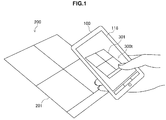
- FIG. 1 is a diagram illustrating an overview of the configuration of a device in an embodiment of the present disclosure.
- a smartphone 100 captures a real space 200 that includes an object 201.
- a through-the-lens image 300t which is generated by the image capturing, is displayed on a display unit 118 of the smartphone 100.
- the through-the-lens image 300t includes an object 301 that corresponds to the real object 201.
- FIG. 2 is a block diagram illustrating a schematic configuration of a smartphone according to an embodiment of the present disclosure.
- the smartphone 100 is configured to include an imaging unit 102, an object recognition unit 104, an object DB 106, a record generator 108, a record reference unit 110, an image-object DB 112, a display controller 114, an image DB 116, and a display unit 118.
- the smartphone 100 is an example of a display control device according to an embodiment of the present disclosure, and may be implemented by the hardware configuration of an information processing apparatus described later. In the following, the respective components will be further described.
- the smartphone 100 is configured to include at least a processor such as central processing (CPU), a memory or storage, a camera (imaging device), and a display (output device).
- a processor such as central processing (CPU), a memory or storage, a camera (imaging device), and a display (output device).
- the object recognition unit 104, the record generator 108, the record reference unit 110, and the display controller 114 may be implemented as a processor to be executed in accordance with a program stored in the memory or storage.
- the object DB 106, the image-object DB 112, and the image DB 116 may be implemented as the memory or storage.
- the imaging unit 102 may be implemented as a camera.
- the display unit 118 may be implemented as a display.
- the imaging unit 102 captures a real space and generates an image.
- the imaging unit 102 may generate a still image or may generate a moving image.
- the image data generated by the imaging unit 102 is supplied to the object recognition unit 104, and is stored in the image DB 116 as necessary.
- the image data may be supplied to the display controller 114 for displaying it on the display unit 118 as a through-the-lens image or a preview image.
- the object recognition unit 104 executes the object recognition on the image generated by the imaging unit 102.
- the object recognition unit 104 may refer to the object DB 106 for execution of the object recognition.
- the object DB 106 previously accumulates, for example, model data that is related to the shape or appearance of an object to be recognized.
- the model data includes data used to define the shape of each object, image data such as a predefined symbol mark or text label attached to each object, feature amount set data that is extracted from a known image for each object, or the like.
- the object recognition unit 104 uses the image generated by the imaging unit 102 as an input image to recognize an object to be included in the input image.
- the object recognition unit 104 checks a feature point set that is extracted from the input image, for example, by comparing it with the shape of an object defined by the model data.
- the object recognition unit 104 may check the image data such as a symbol mark or text label defined by the model data by comparing it with the input image.
- the object recognition unit 104 may check the feature amount of the image of a known object defined by the model data by comparing it with the feature amount extracted from the input image.
- the object recognition unit 104 may add a feature amount set that represents the recognized object as the feature amount set data extracted from the known image for the object.
- the object recognition unit 104 may add new model data to the object DB 106 based on the shape, image data, feature amount, or the like of the recognized object.
- the object recognition unit 104 can recognize the position in which an object is displayed and the orientation of the object in an image. More specifically, for example, the object recognition unit 104 uses the image generated by the imaging unit 102 as an input image and thus detects the position in which an object included in the input image is displayed and the orientation of the object. For example, the orientation of the object is represented in an integrated manner by one homogeneous transformation matrix with four rows and four columns, which indicates the transformation between the model coordinate system for the model data stored in the object DB 106 and the coordinate system of the object visible on the input image. The object recognition unit 104 can extract the angle of the object with respect to the smartphone 100 from the homogeneous transformation matrix. In addition, the position in which an object is displayed in the image can be represented, for example, by the center coordinate of the object in the image.
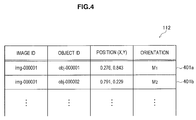
- the record generator 108 generates a record in the image-object DB 112 based on a result obtained from the object recognition by the object recognition unit 104. For example, a record in which an image, an object included in the image, and the position in which the object is displayed in the image or the orientation of the object are associated with one another is generated in the image-object DB 112. For example, as shown in FIG. 3 , when the object recognition unit 104 recognizes two objects 301a and 301b in an image 300 generated by the imaging unit 102, the record generator 108 adds a record shown in FIG. 4 to the image-object DB 106.
- FIG. 4 is a diagram illustrating an example of a record generated in the image-object DB in an embodiment of the present disclosure.
- FIG. 4 illustrates the record that includes an image ID, an object ID, a position, and an orientation as a record to be generated in the image-object DB 112.
- the record is unique to the combination of the image ID and the object ID.
- the object recognition unit 104 recognizes two known objects 301a and 301b in the image 300a generated by the imaging unit 102.
- the record generator 108 adds two records 401a and 401b shown in FIG. 4 to the image-object DB 112.
- the record in the image-object DB 112 is unique to the combination of the image ID and the object ID.
- a plurality of records 401a and 401b corresponding to each of the objects may be generated.
- a new record 401 is additionally generated.
- the record reference unit 110 refers to the record in the image-object DB 112 based on a result obtained from the object recognition by the object recognition unit 104. What is referred to is a record for another image that includes an object recognized by the object recognition unit 104.
- the record reference unit 110 refers to the record for an image that includes the object 301a as an image other than the image 300a.
- the record reference unit 110 may refer to a record of the image-object DB 112 in response to a request of the display controller 114.
- a record for an image that includes an object specified by the display controller 114.
- the record reference unit 110 can specify the object ID and refer to the record, thereby collectively acquiring records for a plurality of images that include the specified object.
- the display controller 114 controls the display of an image on the display unit 118.
- the display controller 114 may cause the image generated by the imaging unit 102 (hereinafter also referred to as a captured image) to be displayed on the display unit 118 as a through-the-lens image or a preview image.
- the display controller 114 may read out an image stored in the image DB 116 (hereinafter referred to as a recorded image) and may display the image on the display unit 118, in response to the operation performed by the user of the smartphone 100. In this case, the display controller 114 may process the captured image or the recorded image as necessary for displaying.
- an object included in the image is recognized by the object recognition unit 104.
- the display controller 114 it is also possible for the display controller 114 to change the position in which an object included in the captured image or the recorded image is displayed (or may move the image itself) or to change the orientation of the object.
- the display controller 114 may perform a transition from the display of a first image (a captured image or recorded image) that includes an object to the display of a second image (a recorded image different from the first image) that includes the same object.
- the display controller 114 can perform the transition of the display of the image while maintaining the position in which an object is displayed or the orientation of the object, for example, by changing the position in which the object is displayed in the first image or the second image or the orientation of the object.
- Such a display may be achieved, for example, by allowing the display controller 114 to specify the second image at the transition destination (image that includes the same object as the first image and is stored in the image DB) and further to recognize the position in which an object included in the second image is displayed and the orientation of the object, based on the record referred to by the record reference unit 110.
- the display controller 114 recognizes the displayed position and orientation based on a result obtained from the object recognition by the object recognition unit 104 (when the first image is a captured image) or another record acquired by the record reference unit 110 (when the first image is a recorded image).
- the image generated by the imaging unit 102 is stored, for example, in the image DB 116 in response to the operation performed by the user of the smartphone 100.
- the image DB 116 may store an image acquired from an external device (not shown) via a network.
- the image DB 116 may store a content entity of an image or may store information on a link to the content entity of an image.
- an image ID assigned to the image stored in the image DB 116 and an image ID in the image-object DB 112 it is preferable for an image ID assigned to the model data stored in the object DB 106 and an object ID in the image-object DB 112 to be common to or transformable into each other.
- the smartphone is illustrated as the display control device in the above example, the embodiment of the present disclosure is not limited thereto.
- the display control device may be any of various types of equipment provided with a display and an input device, such as a desktop or notebook personal computer, a television, a tablet terminal, a media player, and a game console.
- the display control device is not necessarily provided with an imaging unit.
- the display control device may acquire an image that is shared via a dedicated network, or may acquire an image accumulated in memory storage, for example, by reading from a removable medium.
- the smartphone 100 (or other terminal devices) includes the imaging unit 102 and the display unit 118, and other components such as the object recognition unit 104, the object DB 106, the record generator 108, the record reference unit 110, the image-object DB 112, the display controller 114, and the image DB 116 may be implemented in a server on a network.
- the server is an example of the display control device.
- some or all of the object DB 106, the image-object DB 112, and the image DB 116 may be implemented in memory storage on a network.
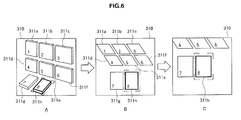
- FIG. 5 is a diagram illustrating a first display example in an embodiment of the present disclosure.
- an image 310 that includes objects 311a to 311h is illustrated.
- the object 311c is highlighted and the orientations of the objects 311a to 311h are changed while maintaining their mutual positional relationship, and then the object 311c is positioned to face straight ahead on the screen, as shown in the portion B.
- the object 311c which is facing straight ahead, is displayed in an enlarged state by zooming in the image 310 centering on the object 311c.
- FIG. 6 is a diagram illustrating a second display example in an embodiment of the present disclosure.
- an image 310 that includes objects 311a to 311h is displayed (similar to FIG. 5 ).
- the object 311h is highlighted and the orientations of the objects 311a to 311h are changed while maintaining their positional relationship, and then the object 311c is positioned to face straight ahead, as shown in the portion B.
- a further predetermined operation e.g. drag, pinch, double tap, or the like
- the object 311h which is facing straight ahead, is enlarged by zooming in the image 310 centering on the object 311h, as shown in the portion C.
- the object specified in the image it is possible to allow the object specified in the image to face straight ahead on the screen by changing the orientation of the object, to move the range over which the image is displayed so that the specified object is displayed in the center, or to zoom in the image so that the specified object is displayed in an enlarged state.
- Such a change in the display can be achieved by allowing the display controller 114 to process the image acquired from the imaging unit 102 or the image DB 116 based on a record in the image-object DB 112 that is referred to by the record reference unit 110 (a record in which an image, an object included in the image, and the position in which the object is displayed in the image or the orientation of the object are associated with one another).
- the record reference unit 110 a record in which an image, an object included in the image, and the position in which the object is displayed in the image or the orientation of the object are associated with one another.
- the display controller 114 transforms an image corresponding to each object so that the respective objects are positioned to face straight ahead on the image, based on information indicating the orientation of each object included in the image.
- the display controller 114 rearranges the respective transformed objects so that their positional relationship before the transformation is reproduced, based on information indicating the position in which each object is displayed in the image.
- the display controller 114 moves the range over which the image is displayed so that the specified object is displayed in the center or zooms in the image so that the specified object is enlarged, based on the information indicating the position in which each object is displayed in the image.
- FIG. 7 is a diagram illustrating a third display example in an embodiment of the present disclosure.
- the object 311c is displayed facing straight ahead in an enlarged state on the image 310 (a first image).
- This display may be, for example, those that are displayed through a series of display cases described above with reference to FIG. 5 .
- a transition of the display is performed from the image 310 to another image 320 (a second image) automatically or in response to a predetermined operation by the user, as shown in the portion B.
- the image 320 includes an object 321c.
- the object 321c is the same object as the object 311c (i.e., it is recorded in the image-object DB 112 using the same object ID).
- the image 320 includes objects 321i and 321j in addition to the object 321c.
- the position in which the objects 311c and 321c are displayed and the orientation of the objects are maintained throughout the display of the image 310 shown in the portion A and the display of the image 320 shown in the portion B.
- the object 311c is arranged adjacent to the center facing straight ahead in the image 310 of the portion A
- the object 321c is also arranged adjacent to the center facing straight ahead in the image 320 of the portion B.
- the display of the image 320 is changed to the state in which the object 311c does not face straight ahead and also is not displayed in the center, as shown in the portion C. In the illustrated example, this is the original state of the image 320.
- the image 320 is processed and then displayed so that the orientation of the object 311c and the position in which the object 311c is displayed in the image 310 before the transition is maintained even in the object 321c displayed after the transition.
- the display controller 114 can change the orientation of an object in the display of the first image to a predetermined orientation (e.g. facing straight ahead) and can maintain at least temporarily a predetermined orientation even after the transition to the display of the second image, thereby seamlessly representing the transition between images that include the same object.
- a predetermined orientation e.g. facing straight ahead
- the display controller 114 can change the orientation of an object in the display of the first image to a predetermined orientation even after the transition to the display of the second image, thereby seamlessly representing the transition between images that include the same object.
- the transition to another image that includes the same object as the object 321j may be performed by selecting the object 321j this time in the state shown in the portion C.
- the present embodiment in this way, it is possible to form a link of information between objects or images by a new context by repeating the transition of an image by the medium of an object while changing a target object as necessary.
- the display controller 114 may change the position in which the object 311c is displayed and the orientation of the object 311c to the position and orientation that are similar to those of the object 321c in the display in the original state (state illustrated in the portion C of FIG. 7 ) of the image 320 (the second image), and then may perform the transition of the display from the image 310 to the image 320.
- the display controller 114 does not change the position in which the object 311c is displayed and the orientation of the object 311c (without facing straight ahead or zooming in as shown in FIG. 5 ) in the display of the image 310 (the first image).
- the display controller 114 may change the position in which the object 321c is displayed and the orientation of the object 321c in the display of the image 320 to the position and orientation that are similar to those of the object 311c in the display of the image 310, and then may execute the transition.
- FIG. 8 is a diagram illustrating a fourth display example in an embodiment of the present disclosure.
- an image 330 (a web page) that includes an object 331a represented as a graphic is displayed.
- the transition of the display from the image 330 to another image 340 (photograph) is performed as shown in the portion B by allowing the user to specify the object 331a to execute a predetermined operation.
- the image 340 includes a photographic object 341a.
- the object 341a is the same object as the object 331a (i.e., to be recorded in the image-object DB 112 using the same object ID).
- the images before and after the transition may be any of a virtually created image such as web pages or a captured image (photograph).
- the transition may be executed mutually between the virtually created image (a web page) and the captured image (photograph), or the transition may be executed between the virtually created images or between the captured images.
- either or both of the images 330 and 340 may be processed so that the position in which the objects 331a and 341a are displayed or the orientation of the objects 331a and 341a are maintained before and after the transition.
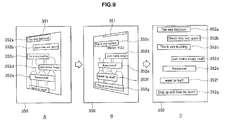
- FIG. 9 is a diagram illustrating a fifth display example in an embodiment of the present disclosure.
- annotation 352 which is assigned by a plurality of users, is displayed in association with an object 351 (a poster) included in an image 350 in a cumulative manner.
- the annotation can also be treated as an object, the object 351 and the annotation 352 are distinguished from each other in this example for the purpose of description.
- the annotation 352 can be scrolled and displayed while maintaining the orientation displayed by being superimposed on the object 351 (annotations 352a to 352e are displayed in the portion A, while annotations 352c to 352g are displayed in the portion B).
- Such a display can be achieved in the present embodiment by allowing the annotation 352 inputted to the same object 351 included in the respective different images 350 by a plurality of users to be recorded along with the relative positional relationship with respect to the object 351 in the respective images 350.
- An example of the process for such a display will be further described below with reference to FIG. 10 .
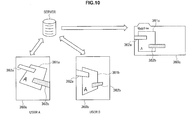
- FIG. 10 is a diagram illustrated to describe an example of the process of displaying an annotation in an embodiment of the present disclosure.
- a user A inputs an annotation 362a to an object 361a that is included in an image 360a.
- the annotation 362a is recorded, for example, depending on an object ID of the object 361a, a relative position of the annotation 362a with respect to the object 361a, a relative angle of the annotation 362a with respect to the object 361a, and the contents (text or image) of the annotation 362a.
- another user B refers to another image 360b that includes an object 361b that is the same as the object 361a.
- the object 361b is displayed in the image 360b with the position and orientation that are different from those of the object 361a in the image 360a, but the object 361b can be associated with the object 361a, for example, by allowing it to be recorded in the image-object DB 112 using the same object ID.
- the annotation 362a which is inputted by the user A, is recorded along with the relative position or angle with respect to the object 361a, and thus it is also possible to display the annotation 362a in the image 360b on the basis of the object 361b.
- the display controller 114 can calculate a difference between the position in which the object 361a is displayed in the image 360a and its orientation and the position in which the object 361b is displayed in the image 360b and its orientation based on the record of the image-object DB that is acquired by the record reference unit 110, and can add the calculated difference to the relative position or angle of the annotation 362a with respect to the object 361a, thereby displaying the annotation 362a in the image 360b on the basis of the object 361b.
- the user B may input an additional annotation 362b to the object 361b that is included in the image 360b.
- the annotation 362b is also recorded depending on an object ID of the object 361b (same as the object 361a), a relative position of the annotation 362b with respect to the object 361b, a relative angle of the annotation 362b with respect to the object 361b, and the contents (text or image) of the annotation 362b.
- the annotation inputted by each of the users A and B may be displayed in an image 360c (a web page) that is referred to by another user C.
- any of the object 361c and the annotations 362a and 362b may be displayed in the image 360c while facing straight ahead.
- the process for the display of the object 361 and the annotation 362 as described above may be executed, for example, in a server for providing a service to the users A, B, and C on a network.
- the server on a network may be an example of the display control device.
- FIG. 11 is a diagram illustrating a sixth display example in an embodiment of the present disclosure.
- an option icon 373 of an image a transition to which can be performed by the medium of an object 371 is displayed in an image 370.
- a plurality of images that include the same object as the object 371 are stored in the image DB 116, and it is possible to allows the user to select a destination of each of the images using the option icon 373.
- four option icons 373a to 373d are displayed.
- the option icon 373 is displayed, for example, when the user executes a predetermined operation (e.g. long press) on the object 371 through a touch panel or the like.
- a predetermined operation e.g. long press
- the user's selection of any of the plurality of option icons 373 allows a transition from the image 370 to a corresponding image to be performed. Even in the transition of this case, the position in which the object 371 is displayed or its orientation may be maintained between the image 370 before the transition and an image after the transition.
- the option icon 373 for example, a predetermined number of images that are selected randomly among images a transition to which can be performed may be displayed.
- an image that is selected under a predetermined condition may be displayed.
- an image having the highest resolution, an image having the highest degree of recommendation, an image captured at a location that is closest to the shooting location of the image 370, and an image having the highest evaluation by the other user are displayed in the option icon 373a, the option icon 373b, the option icon 373c, and the option icon 373d, respectively.
- an image to be displayed as the option icon 373 is determined based on attributes such as resolution, degree of recommendation, shooting location, or other user's evaluation, information indicating the attribute of each image is stored, for example, in the image DB 116 in association with the respective corresponding image IDs.
- an image a transition to which can be performed by the medium of the object 371 included in the image 370 is displayed as the option icon 373, and thus the user can access the desired information using the transition of images more easily.
- the transition from an image obtained by capturing a book placed on a desk by the user to another image that includes the same book as an object is executed, the transition to an image of a book arranged in a bookcase at a bookstore (may be an image that is captured by another user and is shared on a network) allows the context of which book is selected as a book associated with the imaged book to be understood.
- the user's viewpoint images are continuously recorded using a camera or the like mounted on a wearable display worn by the user, an enormous amount of images may be recorded. For example, when the user feels like that such an certain object have been seen somewhere, but the user does not remember where it is, a sample image of the object can be captured and the same object as the object included in the sample image can be retrieved and displayed, thereby exactly reminding the user of the user's situation when viewing the object.
- the viewpoint image is shared over a network, another user can access the user's viewpoint image by the medium of an object.
- both the position in which an object is displayed and the orientation of the object upon the transition of an image are maintained, but the embodiments of the present disclosure are not limited thereto.
- At the time of transition of an image only one of the position and the orientation may be configured to be maintained. Even in this case, it is sufficiently possible to allow the user to recognize that the display of an image is executed by the medium of an object.
- a record in which an image, an object that is included in the image, and any one of the position in which the object is displayed and its orientation in the image are associated with one another may be stored in the image-object DB.
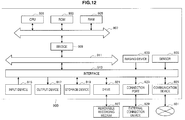
- FIG. 12 is a block diagram showing an example of a hardware configuration of an information processing apparatus according to an embodiment of the present disclosure.
- An information processing apparatus 900 which is shown may achieve the display control device such as the smartphone and the server in the above described embodiments, for example.
- the information processing apparatus 900 includes a central processing unit (CPU) 901, read only memory (ROM) 903, and random access memory (RAM) 905. Further, the information processing apparatus 900 may also include a host bus 907, a bridge 909, an external bus 911, an interface 913, an input device 915, an output device 917, a storage device 919, a drive 921, a connection port 923, and a communication device 925. Furthermore, the information processing apparatus 900 may include an imaging device 933 and a sensor 935 as necessary. The information processing apparatus 900 may also include, instead of or along with the CPU 901, a processing circuit that is also called a digital signal processor (DSP) or an application specific integrated circuit (ASIC).
- DSP digital signal processor
- ASIC application specific integrated circuit
- the CPU 901 functions as an arithmetic processing unit and a control unit and controls an entire operation or a part of the operation of the information processing apparatus 900 according to various programs recorded in the ROM 903, the RAM 905, the storage device 919, or a removable recording medium 927.
- the ROM 903 stores programs and arithmetic parameters used by the CPU 901.
- the RAM 905 primarily stores programs used in execution of the CPU 901 and parameters and the like varying as appropriate during the execution.
- the CPU 901, the ROM 903, and the RAM 905 are connected to each other via the host bus 907 configured from an internal bus such as a CPU bus or the like.
- the host bus 907 is connected to the external bus 911 such as a peripheral component interconnect/interface (PCI) bus via the bridge 909.
- PCI peripheral component interconnect/interface
- the input device 915 is a device operated by a user, such as a mouse, a keyboard, a touch panel, buttons, a switch, and a lever. Also, the input device 915 may be a remote control device using, for example, infrared light or other radio waves, or may be an external connection device 929 such as a cell phone compatible with the operation of the information processing apparatus 900.
- the input device 915 includes an input control circuit that generates an input signal on the basis of information input by the user and outputs the input signal to the CPU 901. The user inputs various kinds of data to the information processing apparatus 900 and instructs the information processing apparatus 900 to perform a processing operation by operating the input device 915.
- the output device 917 is configured from a device capable of visually or aurally notifying the user of acquired information.
- the output device 917 may be: a display device such as a liquid crystal display (LCD), a plasma display panel (PDP), or an organic electro-luminescence (EL) display; an audio output device such as a speaker or headphones; or a printer.
- the output device 917 outputs results obtained by the processing performed by the information processing apparatus 900 as video in the form of text or an image or as audio in the form of audio or sound.
- the storage device 919 is a device for storing data configured as an example of a storage unit of the information processing apparatus 900.
- the storage device 919 is configured from, for example, a magnetic storage device such as a hard disk drive (HDD), a semiconductor storage device, an optical storage device, or a magneto-optical storage device.
- This storage device 919 stores programs to be executed by the CPU 901, various data, and various data obtained from the outside.
- the drive 921 is a reader/writer for the removable recording medium 927 such as a magnetic disk, an optical disc, a magneto-optical disk, or a semiconductor memory, and is built in or externally attached to the information processing apparatus 900.
- the drive 921 reads out information recorded on the attached removable recording medium 927, and outputs the information to the RAM 905. Further, the drive 921 writes the record on the attached removable recording medium 927.
- the connection port 923 is a port for allowing devices to directly connect to the information processing apparatus 900.
- Examples of the connection port 923 include a universal serial bus (USB) port, an IEEE1394 port, and a small computer system interface (SCSI) port.
- Other examples of the connection port 923 may include an RS-232C port, an optical audio terminal, and a high-definition multimedia interface (HDMI, registered trademark) port.
- the connection of the external connection device 929 to the connection port 923 may enable the various data exchange between the information processing apparatus 900 and the external connection device 929.
- the communication device 925 is a communication interface configured from, for example, a communication device for establishing a connection to a communication network 931.
- the communication device 925 is, for example, a wired or wireless local area network (LAN), Bluetooth (registered trademark), a communication card for wireless USB (WUSB), or the like.
- the communication device 925 may be a router for optical communication, a router for asymmetric digital subscriber line (ADSL), a modem for various communications, or the like.
- the communication device 925 can transmit and receive signals and the like using a certain protocol such as TCP/IP on the Internet and with other communication devices, for example.
- the communication network 931 connected to the communication device 925 is configured from a network which is connected via wire or wirelessly and is, for example, the Internet, a home-use LAN, infrared communication, radio wave communication, and satellite communication.
- the imaging device 933 is a device which images a real space by use of various members including an image sensor such as a charge coupled device (CCD) or a complementary metal oxide semiconductor (CMOS) and a lens for controlling image formation of a subject on the image sensor, and generates a pickup image.
- the imaging device 933 may image a still image or a moving image.
- the sensor 935 is any of various sensors such as an acceleration sensor, a gyro sensor, a magnetic field sensor, an optical sensor, and a sound sensor.
- the sensor 935 acquires information related to the state of the information processing apparatus 900 itself, such as the orientation of the housing of the information processing apparatus 900, or information related to the peripheral environment of the information processing apparatus 900, such as the brightness or noise around the information processing apparatus 900.
- the sensor 935 may include a global positioning system (GPS) sensor which measures the latitude, the longitude, and the altitude of the apparatus by receiving a GPS signal.
- GPS global positioning system
- each of the structural elements described above may be configured using a general-purpose material, or may be configured from hardware dedicated to the function of each structural element.
- the configuration may be changed as appropriate according to the technical level at the time of carrying out embodiments.
- the embodiments of the present disclosure may include the display control device (smartphones, servers, or the like) as described above, a system, a display control method executed in the display control device or the system, a program used to allow the display control device to function, and a non-transitory tangible medium having the program recorded thereon.
- the display control device smart phones, servers, or the like
- a system a display control method executed in the display control device or the system
- a program used to allow the display control device to function and a non-transitory tangible medium having the program recorded thereon.
- present technology may also be configured as below.
Landscapes
- Engineering & Computer Science (AREA)
- Theoretical Computer Science (AREA)
- Physics & Mathematics (AREA)
- General Physics & Mathematics (AREA)
- General Engineering & Computer Science (AREA)
- Human Computer Interaction (AREA)
- Multimedia (AREA)
- Computer Graphics (AREA)
- Computer Hardware Design (AREA)
- Software Systems (AREA)
- User Interface Of Digital Computer (AREA)
- Processing Or Creating Images (AREA)
Applications Claiming Priority (2)
| Application Number | Priority Date | Filing Date | Title |
|---|---|---|---|
| JP2013234930 | 2013-11-13 | ||
| PCT/JP2014/071386 WO2015072194A1 (ja) | 2013-11-13 | 2014-08-13 | 表示制御装置、表示制御方法およびプログラム |
Publications (2)
| Publication Number | Publication Date |
|---|---|
| EP3070681A1 true EP3070681A1 (de) | 2016-09-21 |
| EP3070681A4 EP3070681A4 (de) | 2017-07-12 |
Family
ID=53057140
Family Applications (1)
| Application Number | Title | Priority Date | Filing Date |
|---|---|---|---|
| EP14861731.9A Withdrawn EP3070681A4 (de) | 2013-11-13 | 2014-08-13 | Anzeigesteuerungsvorrichtung, anzeigesteuerungsverfahren und programm |
Country Status (4)
| Country | Link |
|---|---|
| US (1) | US10074216B2 (de) |
| EP (1) | EP3070681A4 (de) |
| JP (1) | JP6337907B2 (de) |
| WO (1) | WO2015072194A1 (de) |
Families Citing this family (9)
| Publication number | Priority date | Publication date | Assignee | Title |
|---|---|---|---|---|
| US10139985B2 (en) | 2012-06-22 | 2018-11-27 | Matterport, Inc. | Defining, displaying and interacting with tags in a three-dimensional model |
| US10127722B2 (en) | 2015-06-30 | 2018-11-13 | Matterport, Inc. | Mobile capture visualization incorporating three-dimensional and two-dimensional imagery |
| US10163261B2 (en) | 2014-03-19 | 2018-12-25 | Matterport, Inc. | Selecting two-dimensional imagery data for display within a three-dimensional model |
| US9786097B2 (en) | 2012-06-22 | 2017-10-10 | Matterport, Inc. | Multi-modal method for interacting with 3D models |
| US10430924B2 (en) * | 2017-06-30 | 2019-10-01 | Quirklogic, Inc. | Resizable, open editable thumbnails in a computing device |
| US11030822B2 (en) | 2019-05-15 | 2021-06-08 | Microsoft Technology Licensing, Llc | Content indicators in a 3D environment authoring application |
| US11164395B2 (en) | 2019-05-15 | 2021-11-02 | Microsoft Technology Licensing, Llc | Structure switching in a three-dimensional environment |
| US11287947B2 (en) | 2019-05-15 | 2022-03-29 | Microsoft Technology Licensing, Llc | Contextual input in a three-dimensional environment |
| US11039061B2 (en) | 2019-05-15 | 2021-06-15 | Microsoft Technology Licensing, Llc | Content assistance in a three-dimensional environment |
Family Cites Families (25)
| Publication number | Priority date | Publication date | Assignee | Title |
|---|---|---|---|---|
| JPH10275161A (ja) * | 1997-01-28 | 1998-10-13 | Dainippon Screen Mfg Co Ltd | 画像検索方法およびその処理を実行するためのプログラムを記録した記録媒体 |
| US6012069A (en) * | 1997-01-28 | 2000-01-04 | Dainippon Screen Mfg. Co., Ltd. | Method and apparatus for retrieving a desired image from an image database using keywords |
| US5995119A (en) * | 1997-06-06 | 1999-11-30 | At&T Corp. | Method for generating photo-realistic animated characters |
| US6278466B1 (en) * | 1998-06-11 | 2001-08-21 | Presenter.Com, Inc. | Creating animation from a video |
| US7027054B1 (en) * | 2002-08-14 | 2006-04-11 | Avaworks, Incorporated | Do-it-yourself photo realistic talking head creation system and method |
| JP4136838B2 (ja) * | 2003-08-06 | 2008-08-20 | キヤノン株式会社 | 画像表示方法および画像表示装置 |
| US7889170B2 (en) * | 2004-07-15 | 2011-02-15 | Nippon Telegraph And Telephone Corporation | Inner force sense presentation device, inner force sense presentation method, and inner force sense presentation program |
| JP2007280212A (ja) * | 2006-04-10 | 2007-10-25 | Sony Corp | 表示制御装置、表示制御方法及び表示制御プログラム |
| EP2030171A1 (de) * | 2006-04-10 | 2009-03-04 | Avaworks Incorporated | Fotorealistisches selbstbau-sprechkopferzeugungssystem und verfahren |
| US20080002225A1 (en) * | 2006-06-27 | 2008-01-03 | Masajiro Iwasaki | Printing control method, printing control device, printing sytem, terminal device, program, and recording medium |
| JP4934843B2 (ja) * | 2006-11-29 | 2012-05-23 | 株式会社リコー | 情報処理装置、画像登録方法、およびプログラム |
| JP5167821B2 (ja) * | 2008-01-11 | 2013-03-21 | 株式会社リコー | 文書検索装置、文書検索方法及び文書検索プログラム |
| US20130215116A1 (en) * | 2008-03-21 | 2013-08-22 | Dressbot, Inc. | System and Method for Collaborative Shopping, Business and Entertainment |
| JP5331783B2 (ja) * | 2010-12-13 | 2013-10-30 | ヤフー株式会社 | 画像検索装置、画像検索方法、および画像検索プログラム |
| US9354718B2 (en) * | 2010-12-22 | 2016-05-31 | Zspace, Inc. | Tightly coupled interactive stereo display |
| JP5776201B2 (ja) * | 2011-02-10 | 2015-09-09 | ソニー株式会社 | 情報処理装置、情報共有方法、プログラム及び端末装置 |
| JP5741160B2 (ja) * | 2011-04-08 | 2015-07-01 | ソニー株式会社 | 表示制御装置、表示制御方法、およびプログラム |
| JP5732988B2 (ja) * | 2011-04-08 | 2015-06-10 | ソニー株式会社 | 画像処理装置、表示制御方法及びプログラム |
| US20130249948A1 (en) * | 2011-08-26 | 2013-09-26 | Reincloud Corporation | Providing interactive travel content at a display device |
| JP6121647B2 (ja) | 2011-11-11 | 2017-04-26 | ソニー株式会社 | 情報処理装置、情報処理方法およびプログラム |
| US9405463B2 (en) * | 2011-11-25 | 2016-08-02 | Samsung Electronics Co., Ltd. | Device and method for gesturally changing object attributes |
| JP2013165366A (ja) * | 2012-02-10 | 2013-08-22 | Sony Corp | 画像処理装置、画像処理方法及びプログラム |
| GB201208088D0 (en) * | 2012-05-09 | 2012-06-20 | Ncam Sollutions Ltd | Ncam |
| US10223859B2 (en) * | 2012-10-30 | 2019-03-05 | Bally Gaming, Inc. | Augmented reality gaming eyewear |
| US20150123966A1 (en) * | 2013-10-03 | 2015-05-07 | Compedia - Software And Hardware Development Limited | Interactive augmented virtual reality and perceptual computing platform |
-
2014
- 2014-08-13 JP JP2015547663A patent/JP6337907B2/ja not_active Expired - Fee Related
- 2014-08-13 WO PCT/JP2014/071386 patent/WO2015072194A1/ja not_active Ceased
- 2014-08-13 US US15/025,500 patent/US10074216B2/en not_active Expired - Fee Related
- 2014-08-13 EP EP14861731.9A patent/EP3070681A4/de not_active Withdrawn
Also Published As
| Publication number | Publication date |
|---|---|
| JP6337907B2 (ja) | 2018-06-06 |
| WO2015072194A1 (ja) | 2015-05-21 |
| JPWO2015072194A1 (ja) | 2017-03-16 |
| EP3070681A4 (de) | 2017-07-12 |
| US10074216B2 (en) | 2018-09-11 |
| US20160210788A1 (en) | 2016-07-21 |
Similar Documents
| Publication | Publication Date | Title |
|---|---|---|
| US10074216B2 (en) | Information processing to display information based on position of the real object in the image | |
| JP6167703B2 (ja) | 表示制御装置、プログラム及び記録媒体 | |
| US8249397B2 (en) | Playback of digital images | |
| JP6121647B2 (ja) | 情報処理装置、情報処理方法およびプログラム | |
| WO2013145566A1 (en) | Information processing apparatus, information processing method, and program | |
| JP2015018365A (ja) | 情報処理装置、情報処理方法およびプログラム | |
| CN105074641A (zh) | 显示控制装置、显示控制方法和显示控制程序 | |
| EP3236336B1 (de) | Causaler zusammenfassender inhalt in virtueller realität | |
| US20160299666A1 (en) | Information processing apparatus, information processing method, and program | |
| JP6149862B2 (ja) | 表示制御装置、表示制御システムおよび表示制御方法 | |
| JP6617547B2 (ja) | 画像管理システム、画像管理方法、プログラム | |
| JP6686547B2 (ja) | 画像処理システム、プログラム、画像処理方法 | |
| JP6065084B2 (ja) | 情報処理装置、情報処理方法およびプログラム | |
| US9791997B2 (en) | Information processing apparatus, system, information processing method, and program | |
| JP2013097773A (ja) | 情報処理装置、情報処理方法、及びプログラム | |
| JP2014146248A (ja) | 表示制御装置、表示制御方法およびプログラム | |
| US20140181709A1 (en) | Apparatus and method for using interaction history to manipulate content | |
| JP5446700B2 (ja) | 情報処理装置、情報処理方法およびプログラム | |
| GB2513865A (en) | A method for interacting with an augmented reality scene | |
| TWI514319B (zh) | 藉由虛擬物件編輯資料之方法及系統,及相關電腦程式產品 | |
| JP2016177834A (ja) | 画像処理装置、画像処理方法及びプログラム | |
| JP6208910B1 (ja) | 動画像処理装置、動画像処理システム、動画像処理方法及び動画像処理プログラム | |
| KR20250028494A (ko) | 전자 기기, 제어방법, 및 컴퓨터 판독가능한 기억매체 | |
| JP2015087848A (ja) | 情報処理装置、情報処理方法、およびプログラム | |
| KR20120035321A (ko) | 증강 현실 컨텐츠 재생 시스템 및 방법 |
Legal Events
| Date | Code | Title | Description |
|---|---|---|---|
| PUAI | Public reference made under article 153(3) epc to a published international application that has entered the european phase |
Free format text: ORIGINAL CODE: 0009012 |
|
| 17P | Request for examination filed |
Effective date: 20160609 |
|
| AK | Designated contracting states |
Kind code of ref document: A1 Designated state(s): AL AT BE BG CH CY CZ DE DK EE ES FI FR GB GR HR HU IE IS IT LI LT LU LV MC MK MT NL NO PL PT RO RS SE SI SK SM TR |
|
| AX | Request for extension of the european patent |
Extension state: BA ME |
|
| DAX | Request for extension of the european patent (deleted) | ||
| A4 | Supplementary search report drawn up and despatched |
Effective date: 20170613 |
|
| RIC1 | Information provided on ipc code assigned before grant |
Ipc: G06F 3/048 20130101ALI20170607BHEP Ipc: G06T 19/00 20110101AFI20170607BHEP |
|
| STAA | Information on the status of an ep patent application or granted ep patent |
Free format text: STATUS: EXAMINATION IS IN PROGRESS |
|
| 17Q | First examination report despatched |
Effective date: 20180824 |
|
| STAA | Information on the status of an ep patent application or granted ep patent |
Free format text: STATUS: THE APPLICATION IS DEEMED TO BE WITHDRAWN |
|
| 18D | Application deemed to be withdrawn |
Effective date: 20210302 |
|
| RAP3 | Party data changed (applicant data changed or rights of an application transferred) |
Owner name: SONY GROUP CORPORATION |