EP3071353B1 - Verfahren zur herstellung von metallschaumstoffen mit ligamentdurchmessern unter einem mikron - Google Patents
Verfahren zur herstellung von metallschaumstoffen mit ligamentdurchmessern unter einem mikron Download PDFInfo
- Publication number
- EP3071353B1 EP3071353B1 EP14863128.6A EP14863128A EP3071353B1 EP 3071353 B1 EP3071353 B1 EP 3071353B1 EP 14863128 A EP14863128 A EP 14863128A EP 3071353 B1 EP3071353 B1 EP 3071353B1
- Authority
- EP
- European Patent Office
- Prior art keywords
- aerogel
- metal foam
- metal
- polymer
- nanoparticles
- Prior art date
- Legal status (The legal status is an assumption and is not a legal conclusion. Google has not performed a legal analysis and makes no representation as to the accuracy of the status listed.)
- Active
Links
Images




Classifications
-
- B—PERFORMING OPERATIONS; TRANSPORTING
- B22—CASTING; POWDER METALLURGY
- B22F—WORKING METALLIC POWDER; MANUFACTURE OF ARTICLES FROM METALLIC POWDER; MAKING METALLIC POWDER; APPARATUS OR DEVICES SPECIALLY ADAPTED FOR METALLIC POWDER
- B22F3/00—Manufacture of workpieces or articles from metallic powder characterised by the manner of compacting or sintering; Apparatus specially adapted therefor ; Presses and furnaces
- B22F3/10—Sintering only
- B22F3/11—Making porous workpieces or articles
- B22F3/1143—Making porous workpieces or articles involving an oxidation, reduction or reaction step
-
- B—PERFORMING OPERATIONS; TRANSPORTING
- B22—CASTING; POWDER METALLURGY
- B22F—WORKING METALLIC POWDER; MANUFACTURE OF ARTICLES FROM METALLIC POWDER; MAKING METALLIC POWDER; APPARATUS OR DEVICES SPECIALLY ADAPTED FOR METALLIC POWDER
- B22F3/00—Manufacture of workpieces or articles from metallic powder characterised by the manner of compacting or sintering; Apparatus specially adapted therefor ; Presses and furnaces
- B22F3/10—Sintering only
- B22F3/11—Making porous workpieces or articles
- B22F3/1121—Making porous workpieces or articles by using decomposable, meltable or sublimatable fillers
- B22F3/1125—Making porous workpieces or articles by using decomposable, meltable or sublimatable fillers involving a foaming process
-
- B—PERFORMING OPERATIONS; TRANSPORTING
- B22—CASTING; POWDER METALLURGY
- B22F—WORKING METALLIC POWDER; MANUFACTURE OF ARTICLES FROM METALLIC POWDER; MAKING METALLIC POWDER; APPARATUS OR DEVICES SPECIALLY ADAPTED FOR METALLIC POWDER
- B22F5/00—Manufacture of workpieces or articles from metallic powder characterised by the special shape of the product
- B22F5/009—Manufacture of workpieces or articles from metallic powder characterised by the special shape of the product of turbine components other than turbine blades
-
- B—PERFORMING OPERATIONS; TRANSPORTING
- B22—CASTING; POWDER METALLURGY
- B22F—WORKING METALLIC POWDER; MANUFACTURE OF ARTICLES FROM METALLIC POWDER; MAKING METALLIC POWDER; APPARATUS OR DEVICES SPECIALLY ADAPTED FOR METALLIC POWDER
- B22F9/00—Making metallic powder or suspensions thereof
- B22F9/16—Making metallic powder or suspensions thereof using chemical processes
- B22F9/18—Making metallic powder or suspensions thereof using chemical processes with reduction of metal compounds
- B22F9/20—Making metallic powder or suspensions thereof using chemical processes with reduction of metal compounds starting from solid metal compounds
- B22F9/22—Making metallic powder or suspensions thereof using chemical processes with reduction of metal compounds starting from solid metal compounds using gaseous reductors
-
- B—PERFORMING OPERATIONS; TRANSPORTING
- B22—CASTING; POWDER METALLURGY
- B22F—WORKING METALLIC POWDER; MANUFACTURE OF ARTICLES FROM METALLIC POWDER; MAKING METALLIC POWDER; APPARATUS OR DEVICES SPECIALLY ADAPTED FOR METALLIC POWDER
- B22F9/00—Making metallic powder or suspensions thereof
- B22F9/16—Making metallic powder or suspensions thereof using chemical processes
- B22F9/18—Making metallic powder or suspensions thereof using chemical processes with reduction of metal compounds
- B22F9/24—Making metallic powder or suspensions thereof using chemical processes with reduction of metal compounds starting from liquid metal compounds, e.g. solutions
-
- B—PERFORMING OPERATIONS; TRANSPORTING
- B82—NANOTECHNOLOGY
- B82Y—SPECIFIC USES OR APPLICATIONS OF NANOSTRUCTURES; MEASUREMENT OR ANALYSIS OF NANOSTRUCTURES; MANUFACTURE OR TREATMENT OF NANOSTRUCTURES
- B82Y30/00—Nanotechnology for materials or surface science, e.g. nanocomposites
-
- B—PERFORMING OPERATIONS; TRANSPORTING
- B82—NANOTECHNOLOGY
- B82Y—SPECIFIC USES OR APPLICATIONS OF NANOSTRUCTURES; MEASUREMENT OR ANALYSIS OF NANOSTRUCTURES; MANUFACTURE OR TREATMENT OF NANOSTRUCTURES
- B82Y40/00—Manufacture or treatment of nanostructures
-
- C—CHEMISTRY; METALLURGY
- C22—METALLURGY; FERROUS OR NON-FERROUS ALLOYS; TREATMENT OF ALLOYS OR NON-FERROUS METALS
- C22C—ALLOYS
- C22C1/00—Making non-ferrous alloys
- C22C1/08—Alloys with open or closed pores
-
- B—PERFORMING OPERATIONS; TRANSPORTING
- B22—CASTING; POWDER METALLURGY
- B22F—WORKING METALLIC POWDER; MANUFACTURE OF ARTICLES FROM METALLIC POWDER; MAKING METALLIC POWDER; APPARATUS OR DEVICES SPECIALLY ADAPTED FOR METALLIC POWDER
- B22F2201/00—Treatment under specific atmosphere
- B22F2201/01—Reducing atmosphere
- B22F2201/013—Hydrogen
-
- B—PERFORMING OPERATIONS; TRANSPORTING
- B22—CASTING; POWDER METALLURGY
- B22F—WORKING METALLIC POWDER; MANUFACTURE OF ARTICLES FROM METALLIC POWDER; MAKING METALLIC POWDER; APPARATUS OR DEVICES SPECIALLY ADAPTED FOR METALLIC POWDER
- B22F2201/00—Treatment under specific atmosphere
- B22F2201/10—Inert gases
-
- B—PERFORMING OPERATIONS; TRANSPORTING
- B22—CASTING; POWDER METALLURGY
- B22F—WORKING METALLIC POWDER; MANUFACTURE OF ARTICLES FROM METALLIC POWDER; MAKING METALLIC POWDER; APPARATUS OR DEVICES SPECIALLY ADAPTED FOR METALLIC POWDER
- B22F2301/00—Metallic composition of the powder or its coating
- B22F2301/15—Nickel or cobalt
-
- B—PERFORMING OPERATIONS; TRANSPORTING
- B22—CASTING; POWDER METALLURGY
- B22F—WORKING METALLIC POWDER; MANUFACTURE OF ARTICLES FROM METALLIC POWDER; MAKING METALLIC POWDER; APPARATUS OR DEVICES SPECIALLY ADAPTED FOR METALLIC POWDER
- B22F2302/00—Metal Compound, non-Metallic compound or non-metal composition of the powder or its coating
- B22F2302/25—Oxide
-
- B—PERFORMING OPERATIONS; TRANSPORTING
- B22—CASTING; POWDER METALLURGY
- B22F—WORKING METALLIC POWDER; MANUFACTURE OF ARTICLES FROM METALLIC POWDER; MAKING METALLIC POWDER; APPARATUS OR DEVICES SPECIALLY ADAPTED FOR METALLIC POWDER
- B22F2998/00—Supplementary information concerning processes or compositions relating to powder metallurgy
- B22F2998/10—Processes characterised by the sequence of their steps
-
- B—PERFORMING OPERATIONS; TRANSPORTING
- B22—CASTING; POWDER METALLURGY
- B22F—WORKING METALLIC POWDER; MANUFACTURE OF ARTICLES FROM METALLIC POWDER; MAKING METALLIC POWDER; APPARATUS OR DEVICES SPECIALLY ADAPTED FOR METALLIC POWDER
- B22F2999/00—Aspects linked to processes or compositions used in powder metallurgy
-
- F—MECHANICAL ENGINEERING; LIGHTING; HEATING; WEAPONS; BLASTING
- F05—INDEXING SCHEMES RELATING TO ENGINES OR PUMPS IN VARIOUS SUBCLASSES OF CLASSES F01-F04
- F05D—INDEXING SCHEME FOR ASPECTS RELATING TO NON-POSITIVE-DISPLACEMENT MACHINES OR ENGINES, GAS-TURBINES OR JET-PROPULSION PLANTS
- F05D2220/00—Application
- F05D2220/30—Application in turbines
- F05D2220/32—Application in turbines in gas turbines
- F05D2220/323—Application in turbines in gas turbines for aircraft propulsion, e.g. jet engines
-
- F—MECHANICAL ENGINEERING; LIGHTING; HEATING; WEAPONS; BLASTING
- F05—INDEXING SCHEMES RELATING TO ENGINES OR PUMPS IN VARIOUS SUBCLASSES OF CLASSES F01-F04
- F05D—INDEXING SCHEME FOR ASPECTS RELATING TO NON-POSITIVE-DISPLACEMENT MACHINES OR ENGINES, GAS-TURBINES OR JET-PROPULSION PLANTS
- F05D2230/00—Manufacture
- F05D2230/20—Manufacture essentially without removing material
-
- F—MECHANICAL ENGINEERING; LIGHTING; HEATING; WEAPONS; BLASTING
- F05—INDEXING SCHEMES RELATING TO ENGINES OR PUMPS IN VARIOUS SUBCLASSES OF CLASSES F01-F04
- F05D—INDEXING SCHEME FOR ASPECTS RELATING TO NON-POSITIVE-DISPLACEMENT MACHINES OR ENGINES, GAS-TURBINES OR JET-PROPULSION PLANTS
- F05D2300/00—Materials; Properties thereof
- F05D2300/10—Metals, alloys or intermetallic compounds
- F05D2300/16—Other metals not provided for in groups F05D2300/11 - F05D2300/15
-
- F—MECHANICAL ENGINEERING; LIGHTING; HEATING; WEAPONS; BLASTING
- F05—INDEXING SCHEMES RELATING TO ENGINES OR PUMPS IN VARIOUS SUBCLASSES OF CLASSES F01-F04
- F05D—INDEXING SCHEME FOR ASPECTS RELATING TO NON-POSITIVE-DISPLACEMENT MACHINES OR ENGINES, GAS-TURBINES OR JET-PROPULSION PLANTS
- F05D2300/00—Materials; Properties thereof
- F05D2300/60—Properties or characteristics given to material by treatment or manufacturing
- F05D2300/612—Foam
Definitions
- the present disclosure relates to lightweight and high-strength metal foams, and more specifically, relates to a method for producing nanocellular metal foams having ligament diameters below one micron as materials for aerospace components.
- Metal foams which are lightweight and high-strength porous metallic structures, are gaining increasing interest in numerous industries, such as the aerospace and automotive industries.
- the introduction of components formed from metal foam materials into aerospace or automotive structures may lead to improvements in fuel efficiency, while providing other beneficial properties such as vibration dampening, erosion resistance, and enhanced mechanical strength and overall performance.
- metal foams may have high temperatures resistances and, therefore, may provide thermal protection properties for a range of applications as well.
- Nanocellular metal foams are a sub-class of metal foams which have pore sizes in the nanoscale or submicron range. Open-celled nanocellular metal foams, which have open and gas-filled pores, may appear as a network of interconnected ligaments that form the solid, metallic portion of the metal foam. The diameters of the ligaments (as measured by the width of the ligament at its narrowest part) may be correlated with the strength-to-weight ratio of the metal foam. In particular, it has been predicted that the strength of a nanocellular metal foam may approach the strength of an identically-sized solid metal part as its ligament diameters decrease, while at only a fraction of the weight of the solid metal part.
- nanocellular metal foams having high integrity ligaments with diameters on the nanoscale or submicron scale may be a desirable target for many engineers.
- lightweight and high-strength materials may provide for numerous applications, it currently remains a challenge to fabricate metal foams with ligament diameters below one micron.
- a method for fabricating a metal foam component from and aerogel containing a polymer and nanoparticles may comprise: 1) exposing the aerogel to a reducing condition at an elevated temperature for a reaction time to provide a metal foam, wherein at least one of the elevated temperature and the reaction time may be selected so that at least some ligaments of the metal foam have a desired ligament diameter or at least some pores of the metal foam have a desired pore size; and 2) using the metal foam to fabricate the metal foam component, wherein the metal is manganese, titanium, tungsten, vanadium, niobium, hafnium, tantalum, rhenium, ruthenium, iridium, palladium, platinum, zirconium, cobalt, yttrium, copper, molybdenum, aluminum, chromium, iron, nickel, or combinations thereof, the polymer is a polyepoxide, the reducing condition is an atmosphere of hydrogen gas in an in
- the desired ligament diameter may be less than about one micron.
- the metal foam component may be a component of a gas turbine engine.
- exposing the aerogel to the reducing condition at the elevated temperature for the reaction time may both pyrolyze the polymer and at least partially reduce the nanoparticles to the metal foam.
- the method may further comprise preparing the aerogel from a mold prior to exposing the aerogel to the reducing condition.
- preparing the aerogel from the mold may comprise: 1) polymerizing a polymer precursor in a solvent containing a metal salt to form a gel comprising the polymer and the nanoparticles; and 2) evaporating the solvent by a supercritical drying process to provide the aerogel.
- the polymer precursor may be propylene oxide and the polymer may be polypropylene oxide.
- the metal salt may be a hydrate of a nickel (II) salt and the nanoparticles may be nickel (II) oxide nanoparticles.
- a metal foam component having ligament diameters below one micron may be produced from an aerogel containing a polymer and nanoparticles by a method comprising: 1) exposing the aerogel to a reducing condition at an elevated temperature for a reaction time to provide a metal foam, wherein at least one of the elevated temperature and the reaction time may be selected so that at least some ligaments of the metal foam have a desired ligament diameter or at least some pores of the metal foam have a desired pore size; and 2) using the metal foam to fabricate the metal foam component, wherein the metal is manganese, titanium, tungsten, vanadium, niobium, hafnium, tantalum, rhenium, ruthenium, iridium, palladium, platinum, zirconium, cobalt, yttrium, copper, molybdenum, aluminum, chromium, iron, nickel, or combinations thereof, the polymer is a polyepoxide, the polymer is a polyepoxide, the metal is manganese,
- the metal foam component may be a component of a gas turbine engine.
- exposing the aerogel to the reducing condition may both pyrolyze the polymer and at least partially reduce the nanoparticles to the metal foam.
- the method may further comprise preparing the aerogel prior to exposing the aerogel to the reducing condition.
- preparing the aerogel may comprise: 1) polymerizing a polymer precursor in a solvent containing a metal salt to form a gel comprising the polymer and the nanoparticles; and 2) evaporating the solvent by a supercritical drying process to provide the aerogel.
- the polymer precursor may be propylene oxide and the polymer may be polypropylene oxide.
- a method for producing a metal foam from an aerogel comprising a polymer and nanoparticles may comprise: 1) heating the aerogel at an elevated temperature in a range of 400°C to 1000°C to pyrolyze the polymer; and 2) exposing the aerogel to a reducing condition to at least partially reduce the nanoparticles to the metal foam, wherein the reducing condition is an atmosphere of hydrogen gas in an inert gas, the metal is manganese, titanium, tungsten, vanadium, niobium, hafnium, tantalum, rhenium, ruthenium, iridium, palladium, platinum, zirconium, cobalt, yttrium, copper, molybdenum, aluminum, chromium, iron, nickel, or combinations thereof, and the polymer is a polyepoxide.
- heating the aerogel and exposing the aerogel to a reducing condition may be carried out simultaneously for a reaction time.
- a ligament diameter or a pore size of the metal foam may be controllable by at least one of the elevated temperature and the reaction time.
- the gas turbine engine 10 may consist of a fan section 12, a compressor section 14 (which may include both a low-pressure compressor and a high-pressure compressor), an annular combustor 16 (although circumferentially-spaced "can" combustors may also be used), and a turbine section17 (which may include a high-pressure turbine 18 and a low-pressure turbine 20), all of which may be encased in an engine case 21, as shown.
- a nacelle 22 may surround the engine case 21 and define a bypass duct 23, as shown.
- air 24 may be drawn into the engine 10 and accelerated by the fan section 12. After passing the fan section 12, a part of the air 24 may be routed through the compressor section 14, the combustor(s) 16, and the turbine section 17. More specifically, the air 24 may first be compressed and pressurized in the compressor section 14 and it may then be mixed with fuel and combusted in the combustor(s) 16 to generate hot combustion gases. The hot combustion gases may then expand through and drive the turbines 18 and 20 which may, in turn, drive the compressor section 14 and the fan section 12 by driving the rotation of an interconnecting shaft 26.
- the gases may be exhausted through an exhaust nozzle 28 to provide some of the propulsive thrust to an associated aircraft or to provide power if used in land-based operations.
- the remaining propulsive thrust may be provided by the air 24 passing through the bypass duct 23 and exiting the engine 10 through a nozzle 30, as shown.
- Each component in the gas turbine engine 10 and the nacelle 22 may contribute to the overall weight of an associated aircraft.
- one or more gas turbine engine components may be at least partially formed from a metal foam 32 (see FIG. 2 ).
- the metal foam 32 may be lightweight and have a high mechanical strength. Accordingly, the fabrication of gas turbine engine components from the metal foam 32 may lead to advantageous reductions in fuel efficiency of the gas turbine engine 10 as a whole, as well as improvements in the performance features of the gas turbine engine components made from the metal foam. These performance features may include, but are not limited to, increased mechanical strength, improved vibration dampening and erosion resistance, and increased temperature resistance.
- the fan section 12, the compressor section 14, the combustor(s) 16, the turbine section 17, and/or the nacelle 22 may include one or more components formed, at least in part, from the metal foam 32.
- one or more blade outer air seals may be fabricated, at least in part, from the metal foam 32.
- a blade outer air seal may be located between the rotating blades of a rotor stage (located in the compressor section 14 or the turbine section 17) and the engine case 21.
- the incorporation of the metal foam 32 into gas turbine engine components is disclosed as a non-limiting example, it is to be understood that the concepts described herein are not limited to gas turbine engines and may be applicable to other applications as well.
- the metal foam 32 may have any structure suitable for its intended use and, therefore, may deviate from the exemplary box-like structure shown in practice.
- the metal foam 32 may be formed from a monolithic metal, a multi-metal, a metal alloy, a monolithic ceramic material, a ceramic-containing material, or combinations thereof.
- the metal or metals may be various metals such as, but not limited to, manganese, titanium, tungsten, vanadium, niobium, hafnium, tatalum, rhenium, ruthenium, iridium, palladium, platinum, zirconium, cobalt, yttrium, copper, molybdenum, aluminum, chromium, iron, nickel, or combinations thereof.
- metal foam 32 may be synthesized into other elements such as silicon and carbon.
- additional elements may be present in the metal foam to enhance specific properties. For example, if the metal foam 32 is formed from nickel aluminide (Ni 3 Al), boron may be added to enhance desired properties. It is also noted that the metal foam 32 may contain fractions of metal oxide in some cases (see further details below).
- the metal foam 32 may have a plurality of pores 33 formed between a network of interconnected ligaments 34.
- Each of the ligaments 34 of the metal foam 32 may extend between two joints 36, wherein each of the joints 36 may form a branching point between two or more ligaments 34.
- at least some, if not all, of the ligaments 34 of the metal foam 32 may have a diameter ( d ) of less than about one micron.
- the diameter ( d ) of each ligament 34 may be measured by the width of the ligament at its narrowest point.
- the pores 33 of the metal foam 32 may be open and gas-filled, and they may have non-uniform or random sizes and geometries.
- the metal foam 32 may be a stochastic, open-celled foam.
- the pores 33 may be filled (closed-cell foam) and/or the geometries of the pores 33 may be uniform throughout the metal foam 32.
- the sizes of the pores 33 may range from less than about 50 nanometers up to about 1.5 micron (1500 nanometers). Given the nanoscale size of its pores, the metal foam 32 may be a nanocellular foam.
- the metal foam 34 may have a substantially increased strength-to-weight ratio compared with similarly-sized metal foams of the prior art, which typically have ligament diameters greater than one micron.
- the mechanical properties (strength-to-weight ratio, elastic modulus, etc.) of the metal foam 32 may be correlated with the diameter ( d ) of the ligaments 34.
- the mechanical strength and the strength-to-weight ratio of the metal foam 32 may increase as the diameter ( d ) of the ligaments 34 decrease.
- a desired submicron diameter ( d ) of the ligaments 34 and/or the pore sizes of the metal foam 32 may be selected in order to impart the metal foam 32 with specific mechanical properties such as, but not limited to, a desired elastic modulus or a desired strength-to-weight ratio.
- the metal foam 32 may be prepared by selecting reaction conditions that provide the desired ligament diameters and/ or pore sizes (see further details below).
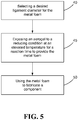
- a method for producing the metal foam 32 and a component 38 at least partially made from the metal foam 32 is depicted.
- the component 38 may be a component of the gas turbine engine 10, or it may be a component for use in another suitable application.
- a desired ligament diameter ( d ) and/or pore size for the metal foam 32 may be selected in order to impart the metal foam 32 with specific mechanical properties such as, but not limited to, a desired strength-to-weight ratio and/or a desired elastic modulus.
- the desired ligament diameter may be a diameter less than about one micron.
- the metal foam 32 may be prepared from an aerogel 42 according to a next block 45 (also see FIG. 6 ).
- the aerogel 42 may be a lightweight and low-density porous structure that is formed by replacing solvent molecules with gas molecules.
- the pores of the aerogel 42 may be filled with gas molecules, while the solid portions of the aerogel 42 may consist of a polymer and nanoparticles.
- the nanoparticles in the aerogel 42 may be the molecular precursors to the metal foam product.
- the identity of the nanoparticles in the aerogel 42 may be dependent on the desired material composition of the metal foam 32.
- the nanoparticles in the aerogel 42 may be nickel (II) oxide nanoparticles.
- the desired product is a ceramic foam or a ceramic-containing foam
- the nanoparticles may be ceramic oxide nanoparticles or ceramic-containing metal oxide nanoparticles.
- the aerogel 42 may be prepared by a sol-gel process (see further details below) or it may be obtained from a commercial supplier.
- the block 45 may involve exposing the aerogel 42 to a reducing condition at an elevated temperature for a reaction time to produce the metal foam 32 having at least some ligaments 34 with the desired diameter and/or at least some pores with the desired pore size.
- the polymer may be pyrolyzed and removed (burned-off) from the aerogel 42, while the nanoparticles may be simultaneously converted to the metal foam 32.
- the reducing condition may be a reducing atmosphere, such as an atmosphere of hydrogen gas in an inert gas, although other reducing conditions and/or reducing agents may also be used.
- the reducing condition may be an atmosphere of 4% (v/v) hydrogen gas in argon.
- suitable elevated temperatures for carrying out the block 45 may be in the range of about 400°C to about 1000°C, although other temperatures may be used.
- At least one or both of the elevated temperature and the reaction time used for the block 45 may be used to control the ligament diameters (or pore sizes) of the resulting metal foam 32.
- Table 1 shows the influence of the elevated temperature on the pore sizes of a nickel metal foam (at a constant reaction time of 480 minutes) and Table 2 shows the influence of the reaction time on the pore sizes of a nickel metal foam (at a constant elevated temperature of 1173K).
- Table 1 Influence of the Elevated Temperature on Pore Sizes of Nickel Foams. a, b Sintering Temperature (K) Pore Size (nm) 273 1900 773 900 873 700 973 500 a Process time held constant at 480 minutes.
- b Pore sizes measured using porosimetry and neutron scattering. Table 2. Influence of Reaction Time on Pore Sizes of Nickel Foams. a, b Sintering Time (minutes) Grain Size (nm) Pore Size (nm) 0 3 1900 1 12 1800 90 100 800 480 200 500 a Temperature held constant at 1173K. b Pore sizes measured by x-ray diffraction and neutron scattering.
- At least one of the elevated temperature and the reaction time used for carrying out the block 45 may be selected so that at least some of the pores 33 have a desired pore size and/or at least some of the ligaments 34 of the metal foam product have a desired diameter.
- the pyrolysis/reduction of the aerogel 42 may driven to at least near completion by varying the reaction conditions, such as the elevated temperature, the reaction time, and/or the concentration of hydrogen gas.
- the block 45 may be carried out as a single manipulation as described above, in some circumstances it may be possible to instead perform the pyrolysis of the polymer and the reduction of the metal oxide nanoparticles by separate manipulative steps.
- the aerogel 42 may first be heated to an elevated temperature sufficient to pyrolyze the polymer, and it may be subsequently exposed to a reducing condition to reduce the nanoparticles to the metal foam 32.
- the metal foam 32 may be used to fabricate the component 38 according to a next block 50, as shown.
- the metal foam 32 may be formed in the shape of the desired component 38 during the block 45 with an appropriate mold or other tooling, or it may be shaped following the block 45 using appropriate tooling or other shaping techniques.
- the aerogel 42 may already be formed in the shape of the desired component 38 prior to the block 45.
- the metal foam 32 may form the entire body of the component 38, or it may be applied as a coating or surface layer of a desired thickness to selected surfaces of the component 38.
- the metal foam 32 may form the core of the component 38, and the metal foam core may be surrounded by a solid shell which protects the metal foam 32 from mechanical damage, such as abrasion, and/or environmental damage.
- the solid shell may be formed from one or more metals or metal alloys.
- the mechanical properties of the component 38 may be tailored as desired by tuning the diameters ( d ) of the ligaments 34 (or pore sizes) of the metal foam 32. As explained above, tuning of the diameters ( d ) (or pore sizes) of the metal foam 32 may be achieved by varying the elevated temperature and/or the reaction time that is used during the block 45.
- one or more polymer precursors may be polymerized in a liquid solvent containing one or more metal salts.
- the block 55 may involve preparing a solution containing the liquid solvent and the metal salt(s) in a reaction vessel 56, adding the polymer precursor to the solution to form a mixture 57, and allowing the mixture 57 to form a biphasic gel 58 (see FIG. 8 ).
- the reaction vessel 56 may be any type of reaction vessel, or even a mold to control the shape of the resulting aerogel 42.
- the block 55 may be carried out at room temperature and under atmospheric pressure, although other conditions may also be used.
- the polymer precursor may be converted to a polymer and the metal cations of the metal salt may be converted to a plurality of metal oxide nanoparticles by a sol-gel process, as will be understood by those skilled in the art.
- the polymer generated by the block 55 may be a homopolymer (i.e., consisting of one type of monomer subunit) or a copolymer (i.e., consisting of two or more types of monomer subunits), in which case it may be a block copolymer (i.e., consisting of 'blocks' of one type of monomer subunit alternating in series with 'blocks' of another type of monomer subunit) or another type of copolymer.
- the biphasic gel 58 produced by the block 55 may consist of at least two distinct phases, including a liquid solvent phase and an insoluble solid phase, with the polymer forming the insoluble solid phase.
- the metal oxide nanoparticles may be soluble in both the liquid solvent phase and the insoluble polymer phase of the gel 58.
- Suitable solvents for use in the sol-gel process may include, but are not limited to, ethanol, ethanol-water mixtures, other alcohols or polar protic solvents, or other suitable solvents.
- the polymer precursor may be an epoxide such as propylene oxide or another suitable polymer precursor. Accordingly, if propylene oxide is used as the polymer precursor, the polymer produced by the block 55 may be polypropylene oxide.
- suitable metal salts for the sol-gel step (block 55) may depend on the composition of the desired metal foam 32.
- the metal salt may be a nickel (II) salt or a hydrate of a nickel (II) salt such as, but not limited to, nickel (II) chloride, nickel (II) nitrate, a hydrate of nickel (II) chloride, a hydrate of nickel (II) nitrate, or combinations thereof.
- nickel salt a nickel salt
- the metal oxide nanoparticles produced during the block 55 may be nickel oxide nanoparticles.
- other types of metal salts may also be employed depending on the desired composition of the metal foam product.
- the metal salts may instead be a ceramic precursor such as, but not limited to, molybdenum chloride and tetraethyl orthosilicate.
- the solvent (or the liquid phase portion) of the gel 58 may be evaporated to convert the gel 58 to the aerogel 42 according to a next block 60.
- the block 60 may be performed by a supercritical drying process or another suitable solvent evaporation process. If supercritical drying is used to evaporate the solvent of the gel 58, the gel 58 may be subjected to temperatures and pressures above the critical point (including a critical temperature (Tc) and a critical pressure (Pc)) of the solvent where a distinction between the liquid phase and the gas phase of the solvent does not exist, followed by depressurization of the system and cooling to atmospheric conditions. As will be appreciated, the conditions used for the supercritical drying process (block 60) may be dependent on the critical point of the solvent used.
- CO 2 liquid carbon dioxide
- the resulting aerogel 42 may then be subjected to pyrolysis/reduction according to the block 45 as described in detail above (see FIGs. 5-6 ).
- the technology disclosed herein may have industrial applicability in a variety of settings including, but not limited to, industrial applications which may benefit from lightweight and high-strength materials.
- the method of the present disclosure provides a route for producing nanocellualr metal foams having high-integrity ligaments with diameters on the submicron scale by exposing an aerogel containing a polymer and metal oxide nanoparticles to an elevated temperature under reducing conditions.
- the method disclosed herein may provide metal foams with significantly higher strength-to-weight ratios than existing metal foams.
- desired mechanical properties e.g., mechanical strength, strength-to-weight ratio, elastic modulus, etc.
- desired mechanical properties e.g., mechanical strength, strength-to-weight ratio, elastic modulus, etc.
- desired mechanical properties e.g., mechanical strength, strength-to-weight ratio, elastic modulus, etc.
- the diameters of the ligaments of the metal foam may be controlled by varying the reaction conditions (e.g., temperature, reaction time) that are used during reduction/pyrolysis of the aerogel.
- the method of the present disclosure may be amenable to bulk processing and scale up to quantities appropriate for industrial materials and components, such as gas turbine engine components. It is expected that the technology disclosed herein may find wide industrial applicability in numerous areas such as, but not limited to, aerospace and automotive applications.
Landscapes
- Engineering & Computer Science (AREA)
- Chemical & Material Sciences (AREA)
- Nanotechnology (AREA)
- Manufacturing & Machinery (AREA)
- Mechanical Engineering (AREA)
- Chemical Kinetics & Catalysis (AREA)
- Physics & Mathematics (AREA)
- Condensed Matter Physics & Semiconductors (AREA)
- General Physics & Mathematics (AREA)
- Crystallography & Structural Chemistry (AREA)
- Materials Engineering (AREA)
- General Chemical & Material Sciences (AREA)
- Composite Materials (AREA)
- Metallurgy (AREA)
- Organic Chemistry (AREA)
- Powder Metallurgy (AREA)
Claims (12)
- Verfahren zur Herstellung eines Metallschaumstoffs aus einem Aerogel, das ein Polymer und Nanopartikel umfasst, umfassend:Erhitzen des Aerogels auf eine erhöhte Temperatur in einem Bereich zwischen 400 °C und 1000 °C, um das Polymer zu pyrolisieren, und Aussetzen des Aerogels gegenüber einer Reduktionsbedingung, um mindestens teilweise die Nanopartikel des Metallschaumstoffs zu reduzieren,wobei die reduzierende Bedingung eine Atmosphäre aus Wasserstoffgas in einem Inertgas ist,das Metall, Mangan, Titan, Wolfram, Vanadium, Columbium, Hafnium, Tantal, Rhenium, Ruthenium, Iridium, Palladium, Platin, Zirconium, Cobalt, Yttrium, Kupfer, Molybdän, Aluminium, Chrom, Eisen, Nickel oder Kombinationen daraus ist, unddas Polymer ein Polyepoxid ist.
- Verfahren nach Anspruch 1, wobei das Erhitzen des Aerogels und das Aussetzen gegenüber einer Reduktionsbedingung zeitgleich für eine Reaktionszeit ausgeführt werden.
- Verfahren nach Anspruch 1 oder Anspruch 2, wobei ein Ligamentdurchmesser oder eine Porengröße des Metallschaumstoffs durch mindestens eines von der erhöhten Temperatur und der Reaktionszeit steuerbar ist.
- Verfahren zum Herstellen einer Metallschaumstoffkomponente aus einen Aerogel, das ein Polymer und Nanopartikel enthält, umfassend:Aussetzen des Aerogels gegenüber einer Reduktionsbedingung bei einer erhöhten Temperatur für eine Reaktionszeit, um einen Metallschaumstoff bereitzustellen, wobei mindestens eines der erhöhten Temperatur und der Reaktionszeit derart ausgewählt ist, dass mindestens einige Ligamente des Metallschaumstoffs einen gewünschten Ligamentdurchmesser aufweisen oder mindestens einige Poren des Metallschaumstoffs eine gewünschte Porengröße aufweisen und Verwenden des Metallschaumstoffs zum Herstellen einer Metallschaumstoffkomponente, wobei das Metall Mangan, Titan, Wolfram, Vanadium, Columbium, Hafnium, Tantal, Rhenium, Ruthenium, Iridium, Palladium, Platin, Zirconium, Cobalt, Yttrium, Kupfer, Molybdän, Aluminium, Chrom, Eisen, Nickel oder Kombinationen daraus ist,das Polymer ein Polyepoxid ist,die Reduktionsbedingung eine Atmosphäre aus Wasserstoffgas in einem Inertgas ist und die erhöhte Temperatur in einem Bereich zwischen 400 °C und 1000 °C liegt.
- Verfahren nach Anspruch 4, wobei der gewünschte Ligamentdurchmesser unter einem Mikron liegt.
- Verfahren nach Anspruch 4 oder Anspruch 5, wobei die Metallschaumstoffkomponente eine Komponente eines Gasturbinentriebwerks ist.
- Verfahren nach einem der Ansprüche 4 bis 6, wobei das Aussetzen des Aerogels gegenüber der Reduktionsbedingung bei der erhöhten Temperatur fürdieReaktionszeit das Polymer jeweils pyrolisiert und mindestens teilweise die Nanopartikel des Metallschaumstoffs reduziert.
- Verfahren nach einem der Ansprüche 4 bis 7, ferner das Vorbereiten des Aerogels durch eine Form umfassend, bevor das Aerogel einer Reduktionsbedingung ausgesetzt wird.
- Verfahren nach Anspruch 8, wobei das Vorbereiten des Aerogels durch eine Form umfasst:Polymerisieren eines Polymervorgängers in einem Lösungsmittel, das ein Metallsalz enthält, um ein Gel zu bilden, welches das Polymer und die Nanopartikel umfasst; undVerdampfen des Lösungsmittels durch ein superkritisches Trocknungsverfahren, um das Aerogel bereitzustellen.
- Verfahren nach Anspruch 9, wobei der Polymervorgänger Propylenoxid und das Polymer Polypropylenoxid ist.
- Verfahren nach Anspruch 8 oder Anspruch 9, wobei das Metallsalz ein Hydrat eines Nickel(II)-salzes ist und die Nanopartikel Nickel(II)-oxid Nanopartikel sind.
- Metallschaumkomponente mit Ligamentdurchmessern unter einem Mikron, wobei die Metallschaumkomponente aus einem Aerogel, das ein Polymer und Nanopartikel enthält, durch ein Verfahren nach einem der Ansprüche 4 bis 11 hergestellt wird.
Applications Claiming Priority (2)
| Application Number | Priority Date | Filing Date | Title |
|---|---|---|---|
| US201361906105P | 2013-11-19 | 2013-11-19 | |
| PCT/US2014/050866 WO2015076881A1 (en) | 2013-11-19 | 2014-08-13 | Method for fabricating metal foams having ligament diameters below one micron |
Publications (3)
| Publication Number | Publication Date |
|---|---|
| EP3071353A1 EP3071353A1 (de) | 2016-09-28 |
| EP3071353A4 EP3071353A4 (de) | 2017-10-11 |
| EP3071353B1 true EP3071353B1 (de) | 2018-12-05 |
Family
ID=53179986
Family Applications (1)
| Application Number | Title | Priority Date | Filing Date |
|---|---|---|---|
| EP14863128.6A Active EP3071353B1 (de) | 2013-11-19 | 2014-08-13 | Verfahren zur herstellung von metallschaumstoffen mit ligamentdurchmessern unter einem mikron |
Country Status (3)
| Country | Link |
|---|---|
| US (1) | US10071425B2 (de) |
| EP (1) | EP3071353B1 (de) |
| WO (1) | WO2015076881A1 (de) |
Families Citing this family (4)
| Publication number | Priority date | Publication date | Assignee | Title |
|---|---|---|---|---|
| WO2015061243A1 (en) * | 2013-10-23 | 2015-04-30 | United Technologies Corporation | Nanocellular foam damper |
| US20160177732A1 (en) * | 2014-07-22 | 2016-06-23 | United Technologies Corporation | Hollow fan blade for a gas turbine engine |
| EP3002517A1 (de) * | 2014-09-30 | 2016-04-06 | Siemens Aktiengesellschaft | Poröse rotierende Maschinenkomponente, Brennkammer und Herstellungsverfahren |
| EP3945033B1 (de) * | 2020-07-27 | 2022-09-07 | Airbus Operations (S.A.S.) | Flugzeugantriebseinheit |
Family Cites Families (4)
| Publication number | Priority date | Publication date | Assignee | Title |
|---|---|---|---|---|
| WO2003057367A2 (en) | 2001-12-27 | 2003-07-17 | Aerogel Composite, Llc | Aerogel and metallic compositions |
| US8809230B2 (en) | 2010-08-02 | 2014-08-19 | Lawrence Livermore National Security, Llc | Porous substrates filled with nanomaterials |
| JP5769153B2 (ja) * | 2010-11-09 | 2015-08-26 | 国立大学法人大阪大学 | 金属多孔質体および金属含有多孔質体の製造方法ならびに金属多孔質体および金属含有多孔質体 |
| CN104379496A (zh) | 2011-10-05 | 2015-02-25 | 得克萨斯A&M大学系统 | 抗菌金属纳米泡沫及相关方法 |
-
2014
- 2014-08-13 EP EP14863128.6A patent/EP3071353B1/de active Active
- 2014-08-13 US US15/037,573 patent/US10071425B2/en active Active
- 2014-08-13 WO PCT/US2014/050866 patent/WO2015076881A1/en not_active Ceased
Non-Patent Citations (1)
| Title |
|---|
| None * |
Also Published As
| Publication number | Publication date |
|---|---|
| US20160288210A1 (en) | 2016-10-06 |
| US10071425B2 (en) | 2018-09-11 |
| EP3071353A4 (de) | 2017-10-11 |
| EP3071353A1 (de) | 2016-09-28 |
| WO2015076881A1 (en) | 2015-05-28 |
Similar Documents
| Publication | Publication Date | Title |
|---|---|---|
| EP3071353B1 (de) | Verfahren zur herstellung von metallschaumstoffen mit ligamentdurchmessern unter einem mikron | |
| Jenei et al. | High temperature thermal stability of pure copper and copper–carbon nanotube composites consolidated by high pressure torsion | |
| Unocic et al. | High-temperature performance of UNS N07718 processed by additive manufacturing | |
| EP3733886B1 (de) | Produkt mit kobaltbasierter legierung, verfahren zur herstellung des besagten produkts und artikel mit kobaltbasierter legierung | |
| JP6796157B2 (ja) | 性能強化された金属材料の製造方法 | |
| Liang et al. | Reaction behavior and pore formation mechanism of TiAl–Nb porous alloys prepared by elemental powder metallurgy | |
| EP3725902A1 (de) | Produkt aus einer legierung auf kobaltbasis und verfahren zu seiner herstellung | |
| US8609187B1 (en) | Method of producing an oxide dispersion strengthened coating and micro-channels | |
| EP3936632A1 (de) | Legierungsprodukt auf kobaltbasis und auf kobalt basierender legierungsartikel | |
| JP6792837B2 (ja) | チタン‐アルミニウム合金 | |
| US20080131608A1 (en) | Thermal barrier coating material, thermal barrier member, and member coated with thermal barrier and method for manufacturing the same | |
| Zan et al. | Three-dimensional porous tungsten via DLP 3D printing from transparent ink | |
| CN112105473A (zh) | 铜镍合金泡沫的制备方法 | |
| CN113737122A (zh) | 一种CoCrFeNiTi/cBN复合粉末、制备方法及其涂层 | |
| Wang et al. | Phase transformation in Ti–48Al–6Nb porous alloys and its influence on pore properties | |
| Wang et al. | Effect of high temperature aging on microstructures and tensile properties of a selective laser melted GTD222 superalloy | |
| JP2011089201A (ja) | ニッケル含有合金、製造方法及び物品 | |
| Gui et al. | Effects of nano-NiO addition on the microstructure and corrosion properties of high Nb-TiAl alloy | |
| EP2921245A1 (de) | Herstellung von Artikeln aus Nanodrähten | |
| JP6552137B2 (ja) | 酸化物粒子分散強化型Ni基超合金 | |
| Hsu et al. | Ti2AlNb microlattices via 3D ink-extrusion printing and sintering of precursor powders | |
| US20120196146A1 (en) | Gas turbine engine components including carbon nanofiber composites | |
| Marcano et al. | Controlling the stress state of La1− xSrxCoyFe1− yO3− δ oxygen transport membranes on porous metallic supports deposited by plasma spray–physical vapor process | |
| Cox et al. | Bulk gold with hierarchical macro-, micro-and nano-porosity | |
| Yao et al. | Networked γ′ in additively manufactured cobalt-based superalloy through dislocation cell-templated precipitation |
Legal Events
| Date | Code | Title | Description |
|---|---|---|---|
| PUAI | Public reference made under article 153(3) epc to a published international application that has entered the european phase |
Free format text: ORIGINAL CODE: 0009012 |
|
| 17P | Request for examination filed |
Effective date: 20160620 |
|
| AK | Designated contracting states |
Kind code of ref document: A1 Designated state(s): AL AT BE BG CH CY CZ DE DK EE ES FI FR GB GR HR HU IE IS IT LI LT LU LV MC MK MT NL NO PL PT RO RS SE SI SK SM TR |
|
| AX | Request for extension of the european patent |
Extension state: BA ME |
|
| RAP1 | Party data changed (applicant data changed or rights of an application transferred) |
Owner name: UNITED TECHNOLOGIES CORPORATION |
|
| DAX | Request for extension of the european patent (deleted) | ||
| A4 | Supplementary search report drawn up and despatched |
Effective date: 20170908 |
|
| RIC1 | Information provided on ipc code assigned before grant |
Ipc: B22F 5/04 20060101ALI20170904BHEP Ipc: B22F 3/11 20060101AFI20170904BHEP Ipc: B22F 9/24 20060101ALI20170904BHEP Ipc: B22F 1/00 20060101ALI20170904BHEP |
|
| RIC1 | Information provided on ipc code assigned before grant |
Ipc: B22F 5/00 20060101ALI20180430BHEP Ipc: B82Y 40/00 20110101ALI20180430BHEP Ipc: B22F 1/00 20060101ALI20180430BHEP Ipc: B22F 5/04 20060101ALI20180430BHEP Ipc: B22F 3/11 20060101AFI20180430BHEP Ipc: C22C 1/08 20060101ALI20180430BHEP Ipc: B82Y 30/00 20110101ALI20180430BHEP Ipc: B22F 9/24 20060101ALI20180430BHEP |
|
| GRAP | Despatch of communication of intention to grant a patent |
Free format text: ORIGINAL CODE: EPIDOSNIGR1 |
|
| STAA | Information on the status of an ep patent application or granted ep patent |
Free format text: STATUS: GRANT OF PATENT IS INTENDED |
|
| INTG | Intention to grant announced |
Effective date: 20180613 |
|
| GRAS | Grant fee paid |
Free format text: ORIGINAL CODE: EPIDOSNIGR3 |
|
| GRAA | (expected) grant |
Free format text: ORIGINAL CODE: 0009210 |
|
| GRAA | (expected) grant |
Free format text: ORIGINAL CODE: 0009210 |
|
| STAA | Information on the status of an ep patent application or granted ep patent |
Free format text: STATUS: THE PATENT HAS BEEN GRANTED |
|
| AK | Designated contracting states |
Kind code of ref document: B1 Designated state(s): AL AT BE BG CH CY CZ DE DK EE ES FI FR GB GR HR HU IE IS IT LI LT LU LV MC MK MT NL NO PL PT RO RS SE SI SK SM TR |
|
| REG | Reference to a national code |
Ref country code: GB Ref legal event code: FG4D |
|
| REG | Reference to a national code |
Ref country code: CH Ref legal event code: EP |
|
| REG | Reference to a national code |
Ref country code: AT Ref legal event code: REF Ref document number: 1072424 Country of ref document: AT Kind code of ref document: T Effective date: 20181215 |
|
| REG | Reference to a national code |
Ref country code: IE Ref legal event code: FG4D |
|
| REG | Reference to a national code |
Ref country code: DE Ref legal event code: R096 Ref document number: 602014037633 Country of ref document: DE |
|
| REG | Reference to a national code |
Ref country code: NL Ref legal event code: MP Effective date: 20181205 |
|
| REG | Reference to a national code |
Ref country code: AT Ref legal event code: MK05 Ref document number: 1072424 Country of ref document: AT Kind code of ref document: T Effective date: 20181205 |
|
| REG | Reference to a national code |
Ref country code: LT Ref legal event code: MG4D |
|
| PG25 | Lapsed in a contracting state [announced via postgrant information from national office to epo] |
Ref country code: ES Free format text: LAPSE BECAUSE OF FAILURE TO SUBMIT A TRANSLATION OF THE DESCRIPTION OR TO PAY THE FEE WITHIN THE PRESCRIBED TIME-LIMIT Effective date: 20181205 Ref country code: FI Free format text: LAPSE BECAUSE OF FAILURE TO SUBMIT A TRANSLATION OF THE DESCRIPTION OR TO PAY THE FEE WITHIN THE PRESCRIBED TIME-LIMIT Effective date: 20181205 Ref country code: LV Free format text: LAPSE BECAUSE OF FAILURE TO SUBMIT A TRANSLATION OF THE DESCRIPTION OR TO PAY THE FEE WITHIN THE PRESCRIBED TIME-LIMIT Effective date: 20181205 Ref country code: HR Free format text: LAPSE BECAUSE OF FAILURE TO SUBMIT A TRANSLATION OF THE DESCRIPTION OR TO PAY THE FEE WITHIN THE PRESCRIBED TIME-LIMIT Effective date: 20181205 Ref country code: NO Free format text: LAPSE BECAUSE OF FAILURE TO SUBMIT A TRANSLATION OF THE DESCRIPTION OR TO PAY THE FEE WITHIN THE PRESCRIBED TIME-LIMIT Effective date: 20190305 Ref country code: BG Free format text: LAPSE BECAUSE OF FAILURE TO SUBMIT A TRANSLATION OF THE DESCRIPTION OR TO PAY THE FEE WITHIN THE PRESCRIBED TIME-LIMIT Effective date: 20190305 Ref country code: LT Free format text: LAPSE BECAUSE OF FAILURE TO SUBMIT A TRANSLATION OF THE DESCRIPTION OR TO PAY THE FEE WITHIN THE PRESCRIBED TIME-LIMIT Effective date: 20181205 Ref country code: AT Free format text: LAPSE BECAUSE OF FAILURE TO SUBMIT A TRANSLATION OF THE DESCRIPTION OR TO PAY THE FEE WITHIN THE PRESCRIBED TIME-LIMIT Effective date: 20181205 |
|
| PG25 | Lapsed in a contracting state [announced via postgrant information from national office to epo] |
Ref country code: AL Free format text: LAPSE BECAUSE OF FAILURE TO SUBMIT A TRANSLATION OF THE DESCRIPTION OR TO PAY THE FEE WITHIN THE PRESCRIBED TIME-LIMIT Effective date: 20181205 Ref country code: RS Free format text: LAPSE BECAUSE OF FAILURE TO SUBMIT A TRANSLATION OF THE DESCRIPTION OR TO PAY THE FEE WITHIN THE PRESCRIBED TIME-LIMIT Effective date: 20181205 Ref country code: GR Free format text: LAPSE BECAUSE OF FAILURE TO SUBMIT A TRANSLATION OF THE DESCRIPTION OR TO PAY THE FEE WITHIN THE PRESCRIBED TIME-LIMIT Effective date: 20190306 Ref country code: SE Free format text: LAPSE BECAUSE OF FAILURE TO SUBMIT A TRANSLATION OF THE DESCRIPTION OR TO PAY THE FEE WITHIN THE PRESCRIBED TIME-LIMIT Effective date: 20181205 |
|
| PG25 | Lapsed in a contracting state [announced via postgrant information from national office to epo] |
Ref country code: NL Free format text: LAPSE BECAUSE OF FAILURE TO SUBMIT A TRANSLATION OF THE DESCRIPTION OR TO PAY THE FEE WITHIN THE PRESCRIBED TIME-LIMIT Effective date: 20181205 |
|
| PG25 | Lapsed in a contracting state [announced via postgrant information from national office to epo] |
Ref country code: PT Free format text: LAPSE BECAUSE OF FAILURE TO SUBMIT A TRANSLATION OF THE DESCRIPTION OR TO PAY THE FEE WITHIN THE PRESCRIBED TIME-LIMIT Effective date: 20190405 Ref country code: CZ Free format text: LAPSE BECAUSE OF FAILURE TO SUBMIT A TRANSLATION OF THE DESCRIPTION OR TO PAY THE FEE WITHIN THE PRESCRIBED TIME-LIMIT Effective date: 20181205 Ref country code: IT Free format text: LAPSE BECAUSE OF FAILURE TO SUBMIT A TRANSLATION OF THE DESCRIPTION OR TO PAY THE FEE WITHIN THE PRESCRIBED TIME-LIMIT Effective date: 20181205 Ref country code: PL Free format text: LAPSE BECAUSE OF FAILURE TO SUBMIT A TRANSLATION OF THE DESCRIPTION OR TO PAY THE FEE WITHIN THE PRESCRIBED TIME-LIMIT Effective date: 20181205 |
|
| PG25 | Lapsed in a contracting state [announced via postgrant information from national office to epo] |
Ref country code: EE Free format text: LAPSE BECAUSE OF FAILURE TO SUBMIT A TRANSLATION OF THE DESCRIPTION OR TO PAY THE FEE WITHIN THE PRESCRIBED TIME-LIMIT Effective date: 20181205 Ref country code: SM Free format text: LAPSE BECAUSE OF FAILURE TO SUBMIT A TRANSLATION OF THE DESCRIPTION OR TO PAY THE FEE WITHIN THE PRESCRIBED TIME-LIMIT Effective date: 20181205 Ref country code: SK Free format text: LAPSE BECAUSE OF FAILURE TO SUBMIT A TRANSLATION OF THE DESCRIPTION OR TO PAY THE FEE WITHIN THE PRESCRIBED TIME-LIMIT Effective date: 20181205 Ref country code: RO Free format text: LAPSE BECAUSE OF FAILURE TO SUBMIT A TRANSLATION OF THE DESCRIPTION OR TO PAY THE FEE WITHIN THE PRESCRIBED TIME-LIMIT Effective date: 20181205 Ref country code: IS Free format text: LAPSE BECAUSE OF FAILURE TO SUBMIT A TRANSLATION OF THE DESCRIPTION OR TO PAY THE FEE WITHIN THE PRESCRIBED TIME-LIMIT Effective date: 20190405 |
|
| REG | Reference to a national code |
Ref country code: DE Ref legal event code: R097 Ref document number: 602014037633 Country of ref document: DE |
|
| PLBE | No opposition filed within time limit |
Free format text: ORIGINAL CODE: 0009261 |
|
| STAA | Information on the status of an ep patent application or granted ep patent |
Free format text: STATUS: NO OPPOSITION FILED WITHIN TIME LIMIT |
|
| PG25 | Lapsed in a contracting state [announced via postgrant information from national office to epo] |
Ref country code: SI Free format text: LAPSE BECAUSE OF FAILURE TO SUBMIT A TRANSLATION OF THE DESCRIPTION OR TO PAY THE FEE WITHIN THE PRESCRIBED TIME-LIMIT Effective date: 20181205 Ref country code: DK Free format text: LAPSE BECAUSE OF FAILURE TO SUBMIT A TRANSLATION OF THE DESCRIPTION OR TO PAY THE FEE WITHIN THE PRESCRIBED TIME-LIMIT Effective date: 20181205 |
|
| 26N | No opposition filed |
Effective date: 20190906 |
|
| PG25 | Lapsed in a contracting state [announced via postgrant information from national office to epo] |
Ref country code: TR Free format text: LAPSE BECAUSE OF FAILURE TO SUBMIT A TRANSLATION OF THE DESCRIPTION OR TO PAY THE FEE WITHIN THE PRESCRIBED TIME-LIMIT Effective date: 20181205 |
|
| PG25 | Lapsed in a contracting state [announced via postgrant information from national office to epo] |
Ref country code: LI Free format text: LAPSE BECAUSE OF NON-PAYMENT OF DUE FEES Effective date: 20190831 Ref country code: LU Free format text: LAPSE BECAUSE OF NON-PAYMENT OF DUE FEES Effective date: 20190813 Ref country code: CH Free format text: LAPSE BECAUSE OF NON-PAYMENT OF DUE FEES Effective date: 20190831 Ref country code: MC Free format text: LAPSE BECAUSE OF FAILURE TO SUBMIT A TRANSLATION OF THE DESCRIPTION OR TO PAY THE FEE WITHIN THE PRESCRIBED TIME-LIMIT Effective date: 20181205 |
|
| REG | Reference to a national code |
Ref country code: BE Ref legal event code: MM Effective date: 20190831 |
|
| PG25 | Lapsed in a contracting state [announced via postgrant information from national office to epo] |
Ref country code: IE Free format text: LAPSE BECAUSE OF NON-PAYMENT OF DUE FEES Effective date: 20190813 |
|
| PG25 | Lapsed in a contracting state [announced via postgrant information from national office to epo] |
Ref country code: BE Free format text: LAPSE BECAUSE OF NON-PAYMENT OF DUE FEES Effective date: 20190831 |
|
| PG25 | Lapsed in a contracting state [announced via postgrant information from national office to epo] |
Ref country code: CY Free format text: LAPSE BECAUSE OF FAILURE TO SUBMIT A TRANSLATION OF THE DESCRIPTION OR TO PAY THE FEE WITHIN THE PRESCRIBED TIME-LIMIT Effective date: 20181205 |
|
| PG25 | Lapsed in a contracting state [announced via postgrant information from national office to epo] |
Ref country code: HU Free format text: LAPSE BECAUSE OF FAILURE TO SUBMIT A TRANSLATION OF THE DESCRIPTION OR TO PAY THE FEE WITHIN THE PRESCRIBED TIME-LIMIT; INVALID AB INITIO Effective date: 20140813 Ref country code: MT Free format text: LAPSE BECAUSE OF FAILURE TO SUBMIT A TRANSLATION OF THE DESCRIPTION OR TO PAY THE FEE WITHIN THE PRESCRIBED TIME-LIMIT Effective date: 20181205 |
|
| PG25 | Lapsed in a contracting state [announced via postgrant information from national office to epo] |
Ref country code: MK Free format text: LAPSE BECAUSE OF FAILURE TO SUBMIT A TRANSLATION OF THE DESCRIPTION OR TO PAY THE FEE WITHIN THE PRESCRIBED TIME-LIMIT Effective date: 20181205 |
|
| REG | Reference to a national code |
Ref country code: DE Ref legal event code: R081 Ref document number: 602014037633 Country of ref document: DE Owner name: RAYTHEON TECHNOLOGIES CORPORATION (N.D.GES.D.S, US Free format text: FORMER OWNER: UNITED TECHNOLOGIES CORPORATION, FARMINGTON, CONN., US Ref country code: DE Ref legal event code: R081 Ref document number: 602014037633 Country of ref document: DE Owner name: RTX CORPORATION (N.D.GES.D. STAATES DELAWARE),, US Free format text: FORMER OWNER: UNITED TECHNOLOGIES CORPORATION, FARMINGTON, CONN., US |
|
| P01 | Opt-out of the competence of the unified patent court (upc) registered |
Effective date: 20230520 |
|
| PGFP | Annual fee paid to national office [announced via postgrant information from national office to epo] |
Ref country code: DE Payment date: 20250724 Year of fee payment: 12 |
|
| PGFP | Annual fee paid to national office [announced via postgrant information from national office to epo] |
Ref country code: GB Payment date: 20250725 Year of fee payment: 12 |
|
| PGFP | Annual fee paid to national office [announced via postgrant information from national office to epo] |
Ref country code: FR Payment date: 20250725 Year of fee payment: 12 |
|
| REG | Reference to a national code |
Ref country code: DE Ref legal event code: R081 Ref document number: 602014037633 Country of ref document: DE Owner name: RTX CORPORATION (N.D.GES.D. STAATES DELAWARE),, US Free format text: FORMER OWNER: RAYTHEON TECHNOLOGIES CORPORATION (N.D.GES.D.STAATES DELAWARE), ARLINGTON, VA, US |